Back in 2020 and 2021, in and around the straight economics and economic policy posts, there were quite a few on aspects of the Covid experience in New Zealand, particularly in a cross-country comparative light.
More recently, you see from time to time suggestions that New Zealand’s experience may have been so good that in fact excess mortality here since Covid began might actually have been negative (in which case, fewer people would have died than might have been expected had Covid never come along.
A couple of alternative perspectives on that caught my eye in the last couple of months, both from academics, one from a physicist and one from an economist.
The first was a very very long Twitter thread from Professor Michael Fuhrer at Monash in Melbourne. His thread starts with this tweet
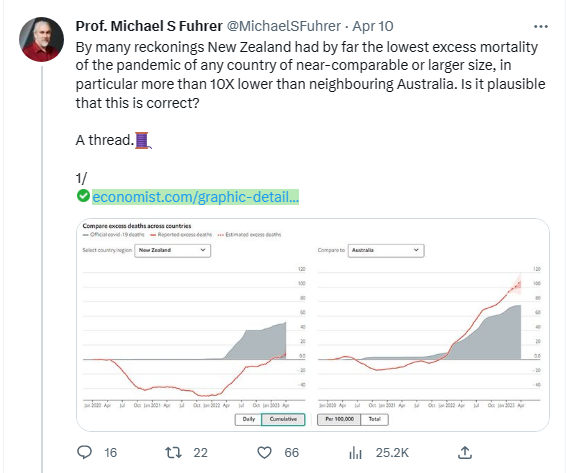
and after reviewing the evidence, and granting that
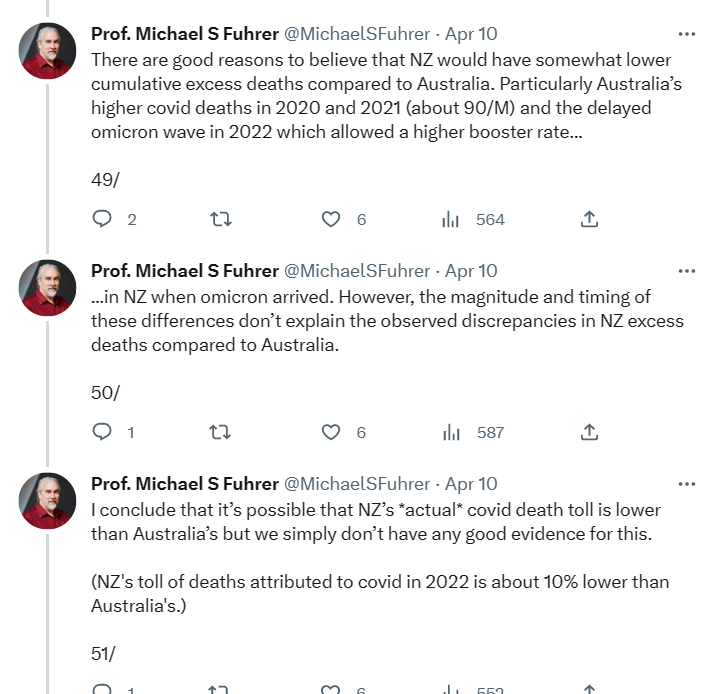
he concludes that
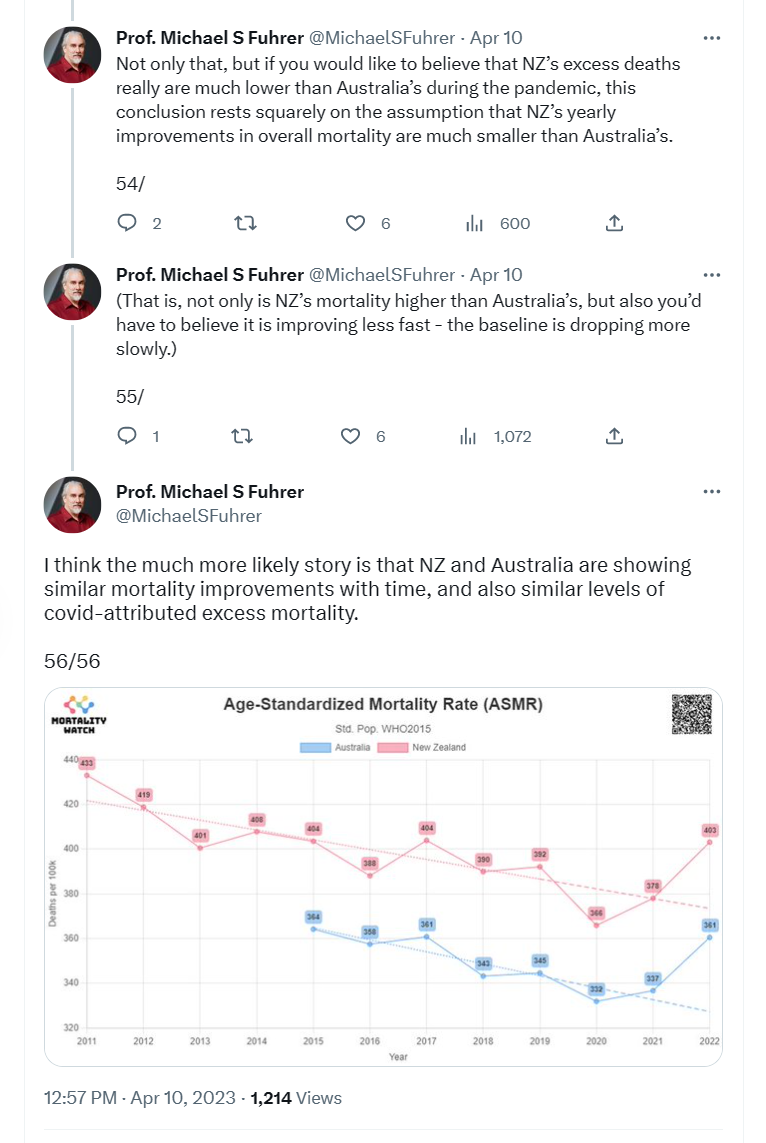
All of which sounded plausible, at least having read the entire thread.
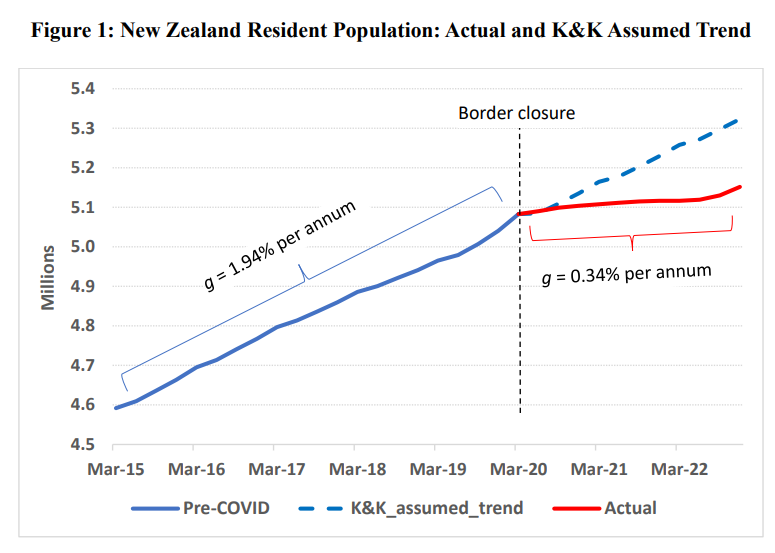
A week or so later Professor John Gibson, one of New Zealand’s leading academic economists (at the University of Waikato), sent me a copy of a new short paper he had written, under the heading “Cumulative Excess Deaths in New Zealand in the COVID-19 Era: Biases from Ignoring Changes in Population Growth Rates”. I’d done a couple of posts on earlier work by Prof Gibson on aspects of Covid policy responses and the likely impact of some of those choices.
For New Zealand, one of the biggest things that changed over the first 2.5 years of the Covid era was a dramatic slowing in the population growth rate, not because of Covid or other deaths but because net migration went from a hugely positive annual rate to a moderately negative rate. Pre-Covid – and probably again now – migration is the biggest single influence on the year to year change in New Zealand’s population. He includes this chart
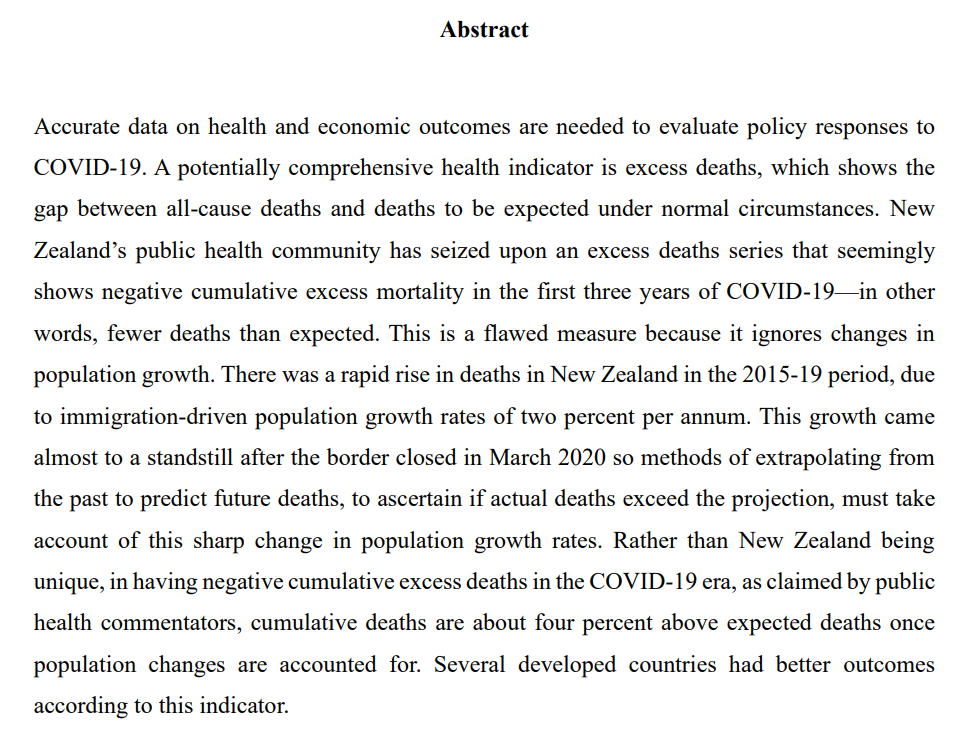
Here is Gibson’s abstract
It is a short paper, and easy enough to read, so I’m not going to elaborate further, and will simply cut and paste the final page.
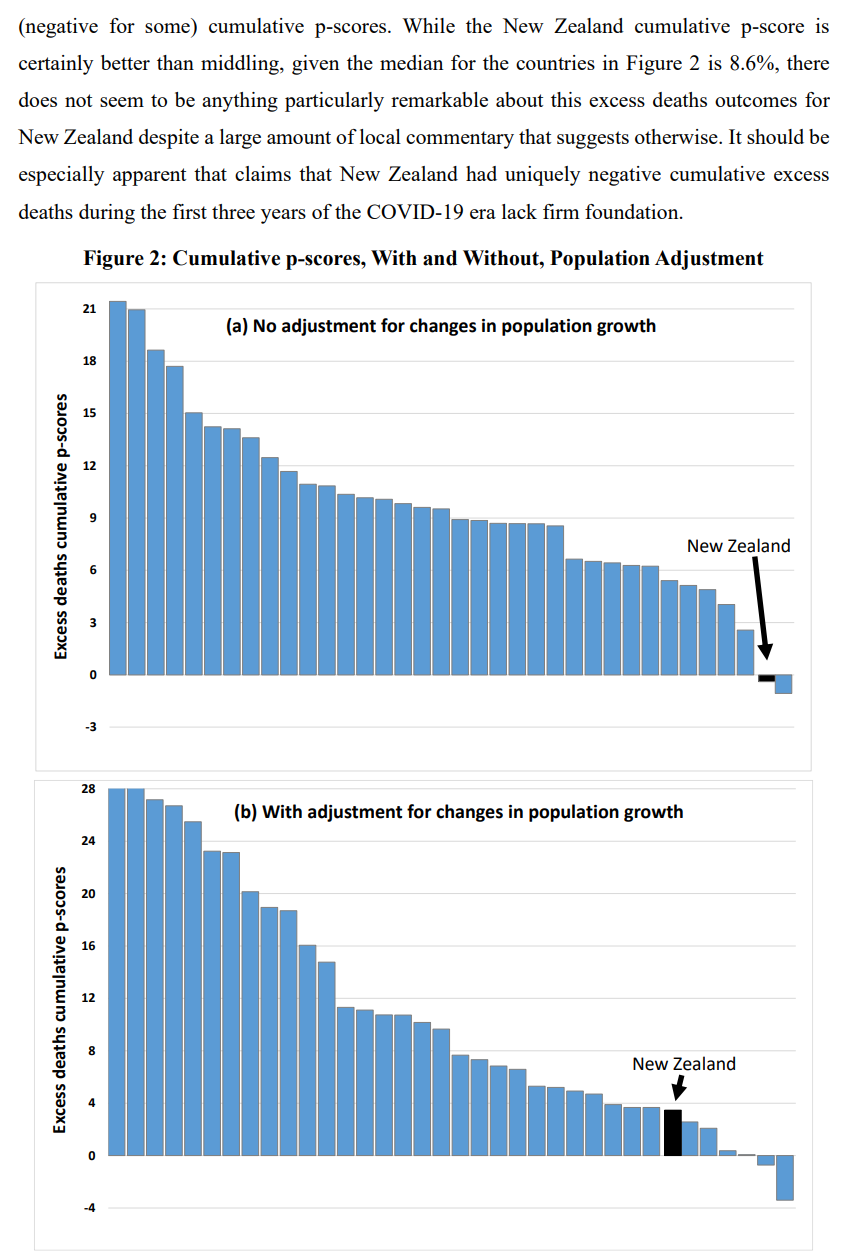
It is a shame he hasn’t labelled all the other countries, but his text tells us that the countries to the right of New Zealand on that bottom chart are Luxembourg, Canada, the Netherlands, Iceland, Israel, and Australia. Note too that several countries just to the left of New Zealand have estimated excess mortality barely different from that estimated for New Zealand.
Across the entire grouping of countries New Zealand still rates fairly well (there are many other things we might reasonably hope to be in the best quartile for but are not; this one we are), but as he notes for the three years to the end of 2022 even in New Zealand there does appear to have been positive excess mortality in the Covid era.
I have no particular point to make, but found both Fuhrer’s thread and Gibson’s note interesting notes, providing some useful context to thinking about the New Zealand experience. Since one still sees claims (including reportedly from David Seymour just a couple of days ago) that there have been no excess deaths in New Zealand over the Covid period, is it too much to hope that some media outlet or other might give some coverage to what appears to be careful work by, in particular, Gibson, a highly-regarded New Zealand academic?
 croaking cassandra
Reblogged this on Utopia, you are standing in it!.
LikeLike
Thank you Michael for all this. It would certainly be helpful if papers like The Post who boast of their mandate to speak truth to power actually did so.
Why do we still insist on boosters for five year olds? England has restricted vaccinations to those over 75 years old, up from over 50 last year. Switzerland has abandoned vaccinations. masking, isolation, altogether – https://www.swissinfo.ch/eng/society/covid-19_coronavirus–the-situation-in-switzerland/45592192
But strangely in our little country, although the vacc mandate was lifted last September, we still have unvaccinated doctors and nurses unable to find employment – in the midst of a health crisis!
LikeLike
It will also require more time to tell what is the difference in outcomes; ultimately you would expect mortality to converge on the same trend, as people who didn’t die in one year or two, have to end up dying one day.
Another important metric is excess mortality by age group. Because there are fewer and fewer deaths as you go lower in age group, it is easy for a dramatic increase in a young age group to not be apparent in the overall data. You could have several times as many youth deaths and it wouldn’t noticeably affect the overall data.
If someone could calculate it, excess aggregate lost life-years would be a telling statistic. Numerous experts pointed out that the Covid “mitigation” strategies would have a mortality cost of their own; through mental health, deferred care, immune deficit (RSV rebound killed dozens of infants in NZ and we hardly have any idea what immune deficit has done in the entire population), and in economic impacts which we may be witnessing for some time. We already had an appalling economic illiteracy problem where voting majorities have no idea of cause and effect, wealth creation or destruction, or an economy “paying its way” just like a household has to. The idea that lockdowns would be harmless is like a peak manifestation of this ignorance.
We should totally expect increased mortality of numerous kinds from the mitigation strategies themselves; whether this mortality is “excess” needs honest analysis. Some want to blame the “V word” for any excess that shows up, but there are plenty of mortality mechanisms that don’t need to involve that specifically.
Early on in Covid, some of us asked why we were bombarded with comparisons with truly disastrous pandemics of the past, when those killed at 3 or more times the rate, and the average age was in the 20’s; when Covid deaths obviously had an average age somewhere around 80. No context was provided by anyone who mattered, about demographic bulges and age-adjusted mortality expectations. Maybe we did actually reduce the rate at which the oldest and frailest are brought to death by circulating viruses, for a year or so. We would then expect this to “catch up” even if the vaccines reduce the role of Covid itself in this. One of the unfortunate consequences now, of official failure to distinguish “of Covid” from “with Covid” right from the start, is now we have an overhang of elderly and frail who are going to die anyway, of something, the fact that they die after a positive Covid test in spite of being fully vaccinated, plays havoc with vaccine effectiveness statistics. Rest Homes are the main problem; NZ is an outlier in that 70%+ of our Covid deaths are in those institutions versus around 45% for most of the rest of the world. And the proportion of the population in those institutions is of course in single percentage figures. Ioannidis et al calculated that the IFR for elderly living independently is 3%; but 25% for those in Rest Homes, and even this data was very spiky, with some Rest Homes being below 10% and others close to 50%.
It is an absolute travesty that the evidence, including the Rest Home impacts, pointed all along to Covid being spread and made deadly, by inhalation of aerosolized viruses building up in indoors air; but it took till late 2021 for officials to start admitting this, and when they did, their panic over ventilation and air treatment related almost entirely to schools and almost not at all to Rest Homes!
Old people being terrified into foregoing fresh air and sunshine and meeting relatives outdoors, certainly is a form of manslaughter when the alternative is 24/7 breathing of internally recirculated indoors air in which viruses will build up. One’s own anecdotal experience is that elderly folk who love their fresh air and sunshine, including leaving their apartment ranch sliders open all day, are the ones who bat away Covid with nothing more than a few mild symptoms.
If official expert “epidemiologists” aren’t grounded in such obvious basics, what do they actually learn when they get their qualification? This sounds to me like physicists not learning Gravity. Mind you, urban planners and urban economists don’t understand economic rent, which is like “gravity” in their discipline; so what can we expect in our decadent civilization anymore?
LikeLike