In defence of capital charges (and higher public sector discount rates)

I don’t usually see the National Business Review but a copy of the latest issue turned up at home and I flicked through it on Saturday afternoon.  On page 2, I found a very strange article, in a column called (Tim) “Hunter’s Corner”, about health funding and (in particular) the application of the “capital charge” to DHBs.  It is, we are told, a “knuckleheaded approach” and should, in Tim Hunter’s view, be abolished.

Capital charges have been around for a long time now, since 1991 in fact.  Here is one description

The charge is levied on the net worth (assets minus liabilities) of departments and some Crown entities. The assets are assessed on the basis that they are valued in financial statements and may include buildings and other fixed assets, cash appropriated for depreciation or held as working capital, inventory, or receivables. The capital charge represents the opportunity cost of money – what the government can expect to earn in alternative investments entailing similar risk. It may be thought of as an internal rate of return on the government’s investment in its own entities.

and here is one articulation of the point of the charge

The capital charge has a dual purpose: it signals that capital is not costless and should be managed as would any other cost of production, and it spurs managers to include the cost of capital in comparing the cost of outputs produced by government entities with the cost of obtaining the outputs from outside suppliers. The charge puts internal contracting on the same footing as contracting out and encourages full cost recovery of outputs sold to governmental or private users.

It has always seemed eminently sensible to me.  Don’t charge for the cost of capital and government agencies will be incentivised to use lots of it, and to do things themselves that might be more efficiently provided by private sector firms (whose owners will, reasonably enough, expect to cover the cost of capital).   Without a capital charge, any hope of limiting those tendencies requires (even) more centralised adminstrative edicts.

I couldn’t see any information on The Treasury’s website about the current rate of captial charge, so I’ll take Mr Hunter’s word for the fact that it is “typically about 6-8%”.    Eight per cent (nominal) is the standard discount rate Treasury recommends for project evaluation.

So what bothers Mr Hunter?  His article seems to imply that capital charges squeeze the funds available to deliver health services to the public.  Waive them and suddenly DHBs will have more money.  Except that, were capital charges to be scrapped, one would expect to see an entirely-commensurate drop in central government funding to DHBs.  Of course, the Crown could decide it wanted to spend more on health service delivery but logically that is a quite different decision.  One can increase health spending with or without the capital charge.  All else equal, just scrapping the capital charge would increase the overall government deficit, and it would weaken the incentives in government agencies for capital to be used wisely and abstemiously.  Crown capital costs –  and that costs fall on citizens and taxpayers.

Hunter also seems worried about incentives

“…charging 6-8% on net assers provides an incentive to sell property and lease it back where the rental cost is below the capital charge”

Indeed, and so long as the capital charge is designed reasonably well, that is a feature not a bug.  Recall that the purpose was to help efficiently allocate resources and not artifically favour in-house solutions.

Getting still more specific, he goes on to argue that

“However, the actual cost to the Crown of the capital is more like 2% (the latest bond tender achieved a weighted average yield of 1.8%) and the chances of a DHB achieving a lease cost at or below that level are zero.  This means the capital charge incentivises the DHB to increase the actual cost to the Crown.”

It has to be pretty worrying that a senior business journalist thinks an appropriate measure of the Crown’s cost of capital is the rate it can raise debt at.

Just as for any private sector entity (businesses most obviously, but the concept applies more broadly), the cost of capital is better represented by some weighted some of the cost of debt and the cost of equity.    That is what The Treasury is trying to mimic in its recommended discount rates (and, I assume, in calculating rates of capital charge).  You can see the various assumptions (including the equity risk premium and leverage) laid out at the link.

The fact that the Crown doesn’t pay dividends and isn’t listed on the stock exchange doesn’t change the fact that equity capital has a cost.   When the government takes our money – and that is how the government raises equity, coercively through the tax system –  we can’t use that money for other things.   As citizens we, presumably, expect them to use that money wisely, and at least as well (for things at least as valuable) as the alternative options we have open to us.  Opportunity cost matters.    And, of course, the Crown’s cost of issuing debt isn’t just kept modest by the actual equity the Crown has accumulated, but by the ability of the Crown to raise our taxes whenever necessary to service the debt.   Lenders know that; in fact, they count on it.   And yet in evaluating state projects that option cost (to citizens) isn’t internalised.

I wrote a post a few years ago on the question of what price we should put on government projects.  Here are a couple of key paragraphs.

The Reserve Bank of Australia recently ran an interesting and accessible Bulletin article on the required hurdle rates of return that businesses use in Australia.  They report survey results suggesting that most firms in Australia use pre-tax nominal hurdle rates of return in a range of 10-16 per cent (the largest group fell in the range10-13 per cent, and the second largest in a 13-16 per cent band). Recall that nominal interest rates in Australia are typically a little lower than those in New Zealand, and their inflation target is a little higher than ours.   In other words, it would surprising if New Zealand firms didn’t use hurdle rates at least as high in nominal terms as those used by their Australia peers.     The RBA reports a standard finding that required rates of return were typically a little above the firms’ estimated weighted average cost of capital. The literature suggests a variety of reasons why firms might adopt that approach, including as a buffer against potential biases in the estimated benefits used in evaluating projects.

As a citizen, it is not clear why I would want to government to use scarce capital much more profligately than private businesses might do. I use the word “profligately” advisedly – using a lower required rate of return puts less value on citizens’ capital than they do themselves in running businesses that they themselves control.  And if the disciplines of the market are imperfect for private businesses (as they are), the disciplines on public sector decision-makers to use resources wisely and effectively are far far weaker. Fletcher Challenge took some pretty bad investment decisions in the 1980s and 1990s: its shareholders and managers paid the price and the firm disappeared from the scene (along with many more reckless “investment companies”). The New Zealand government, architect of Think Big debacle, lives on – citizens were the poorer, but ministers and officials paid no price.

And here was a chart from J P Morgan that I used in a recent post

hurdle rates

I also noted

If anything, there are several reason why governments should be using higher discount rates than private citizens would do:

  • Governments raise equity (“power to tax”) coercively rather voluntarily, and effectively impose near unlimited liability on citizens.
  • Governments are subject to fewer competitive pressures and market disciplines to minimise the risk of resources being misapplied.
  • Many government investment projects exaggerate the exposure of citizens to the economic cycles (the projects go bad when the economy goes bad)

The last of those isn’t really relevant to use of capital in the health sector, but the other two certainly are.  They represent what looks like a pretty good case for requiring something well above 8 per cent to used in evaluating public sector capital projects, both when seeking new funding from the government, and when making ongoing management choices within organisations.

Note that none of this is about taking a view on the appropriate level of health services the public sector should provide, it is simply (but importantly) about helping to get closer to recognising the true costs and risks associated with the capital devoted to funding these services.

There is no perfect system for allocating capital, whether within a private multinational company, or within a government.  “Perfect” is never the relevant benchmark.  But if the capital charge regime isn’t perfect –  and that is almost inevitable –  we are materially better off with it than without it.   I hope the Minister of Health pays no attention to the siren call from Tim Hunter to scrap capital charges, at least as they apply in the health system.    There is probably a stronger case to scrap DHBs themselves, but even if that were done much the same challenges around the efficient use of capital, getting the best mix of labour and capital, would still face health system managers and those funding them.   Capital costs, and those (true) costs are quite high, especially when politicians and public officials are making the decisions, and rarely face sufficiently strong incentives to utilise capital as efficiently as possible.


Other people’s money

Our taxes –  explicit or otherwise – pay for the whims and initiatives of politicians and public servants.  One might like to think that these people would spend our money at least as abstemiously as they would spend their own –  rather more so, one might hope, since they know they’ve taken it from us coercively.   For those given to personal extravagance we might hope they’d be particularly conscious of the need to avoid taking the same approach with other people’s money.

But the incentives are all wrong aren’t they?  It is not their own money, so why would they be anywhere near as careful with it as they would with their own?

At least politicians are in the public spotlight (even if the OIA still doesn’t apply to MPs), visible in their local communities.  Ministers face possible questions in the House each week, and all politicians face the threat of loss of office, perhaps loss of job altogether.   Elections do something to sharpen the focus of accountability.

And Cabinet ministers are accountable for government departments,  themselves funded by annual parliamentary appropriation, a cornerstone of the protections for citizens built into our system.

There are no such protections when it comes to the Reserve Bank.    All spending (and other management) decisions are made by one unelected official, not even directly appointed by a minister.  The Governor is, notionally, overseen by the Bank’s Board, but historically they’ve seen their primary role as championing the Governor, not protecting the interests of citizens.  And there are no annual appropriations.  By law, the Bank can spend whenever it likes – and, after all, it “prints” the stuff (electronic and physical).  The law provides for a (voluntary) five-year funding agreement, and if such an agreement is signed it is subject to ratification in Parliament.  But the Bank discloses the same level of detail about its plan for spending over the following five years as, say, the SIS does.  And, unlike the SIS, not even that one line number is binding.   It is, of course, all but impossible to get rid of the Governor.  In other words, little or no effective accountability around their stewardship of our money.

In recent decades, the Bank has tended to be a relatively abstemious place, partly reflecting the influence and example of Don Brash.   Arguably, in some areas, it even overshot a little.  But the culture of excess seems to be creeping back in: not so much gold-plating working conditions or salaries, but other sorts of waste.  Take this advertisement from the Dominion-Post this morning.

RB maori advert

Perhaps there are dozens, even hundreds, of such positions around the myriad of public sector agencies.  In some cases, it probably even makes sense for such positions to exist.

But this is the Reserve Bank.  It does three main jobs, none of which ever involve dealing directly with the general public; Maori, European, Chinese, Mexican or whatever:

  • the Bank issues bank notes and coins.  That involves purchasing them from overseas producers, and selling them to (repurchasing them from) the head offices of retail banks;
  • it sets monetary policy.  There is one policy interest rate, one New Zealand dollar, affecting economic activiity (in the short-term) and prices without distinction by race or culture.  Making monetary policy happen, at a technical level, involves setting an interest rate on accounts banks hold with the Reserve Bank, and a rate at which the Reserve Bank will lend (secured) to much the same group.  The target – the inflation target, conditioned on employment (a single target for all New Zealand) – is set for them by the Minister of Finance.
  • and it regulates/supervises banks, non-bank deposit-takers, and insurance companies, under various bits of legislation that don’t differentiate by race or culture.

Sure, there is a handful of other functions.  They can intervene in the foreign exchange market (one dollar for all), and they operate a wholesale payments system (NZClear), but it doesn’t  alter the picture.  There is just no specific or distinctive European, Maori, Pacific, Chinese, Indian or whatever dimension to what the Bank does (or what Parliament charged it with doing).

But the new Governor –  49 weeks in and still no substantive speeches about things he is actually responsive for –  is clearly enamoured of things Maori.  A fine thing no doubt for him personally. But here he is running a major public agency, using public money.

So what is he up to with his “Te Ao Maori strategy..designed to build a bankwide understanding of the Maori economy”?  Given his statutory responsibilities –  and those in charge of public agencies are supposed to operate constrained by statute – what makes the so-called “Maori economy” any different than the “European New Zealander economy”, the “Asian economy”, the “British immigrant economy”, the “Pacific economy” and so on, for Reserve Bank purposes and policy?

The Bank’s claim is that this new understanding will “enable improved decision making…about monetary policy and financial soundness and efficiency”.   Yeah right.

Monetary policy operates in much the same way whatever the colour of skin, or  culture, of the agent.  Bank notes are as useful to us all.  And financial sector regulation isn’t going to be –  or shouldn’t be –  any different.  Perhaps we’ll have a Presbyterian cultural competency adviser next, or a Catholic culture one?

It all has the feel of personal virtue-signalling at your expense and mine; the Governor pursuing his political or other personal aspirations, rather than being a position a high-performing Reserve Bank actually needs.

Anyway, you can read the rest of the advert for yourself, including noting that this isn’t just one position.  This “cultural capability advisor” is to work with the “Project Manager (Te Ao Maori strategy)” already in place.

Arguably, this specific position is less ridiculous than the whole “Reserve Bank as tree god” nonsense the Governor continues to expound, complete with the island vision, that just happened to be represented in his glossy pamphlet by the rather expensive foreign resort of Bora Bora.

RB island

But if it is less ridiculous, it is even more wasteful – annual salaries for experienced “cultural facilitators” won’t come cheap.   The present value cost of this initiative is at least $1 million (I’ve lodged an OIA request for the relevant background papers and costings).

Just a week or two ago, the Deputy Governor claimed that the Bank needed more resources to do properly its financial regulation role (I even expressed some mild sympathy for that position).  Not on the evidence of this advert, which suggests a very curious sense of priorities.

But if they do have that sort of money floating around, it might be considerably more productive –  and more attuned to their statutory responsibilities –  to, for example, conduct and publish some serious research and analysis around their aggressive bid to require banks to have much more capital funding, or to respond to some of the critiques that Ian Harrison posed in his paper earlier this week.   Serious money is at stake in what they propose –  billions of dollars.   But that isn’t the Governor’s money, or the Bank’s.  It was –  or would have been –  your money and mine.  Only the Bank proposes to, on its own numbers, obliterate –  billions of dollars of future income we’ll just never have, in pursuit of an exaggerated uncertain saving decades hence, not grounded in serious analysis.

But no doubt the Governor will be welcome at all those “powhiri, whakatau, wananga, hui and other engagements”.

It is nonsensical virtue-signalling, without substance.  And at your expense, not the Governor’s.

On refusing to hear from Prof. Brady

[Note that this afternoon Huo backed down and is now inviting Brady to appear.  While welcome, it is pretty chaotic –  the PM’s office supported the ban this morning –  and hard questions should be posed to all the Labour MPs involved, including the PM. If/when she appears it will be extensively covered by domestic and foreign media, with almost every story prefaced by “in the appearance the committee chair tried to prevent happening at all…]

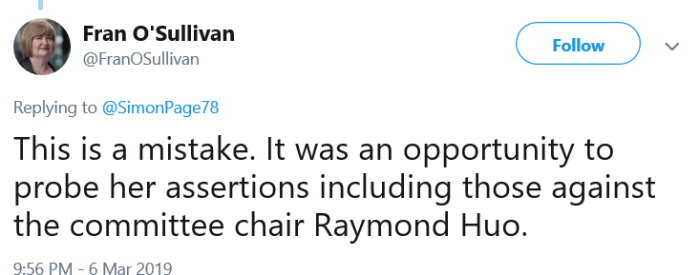
Perhaps it went down well in Beijing, but it is hard to imagine it did so anywhere else. Even China Council Advisory Board member and China Business Summit co-chair Fran O’Sullivan tweeted that it was a mistake.

fran

My own tweet of the Herald’s article on the story, noting that it seemed almost literally unbelievable (but nonetheless true), was retweeted by quite a range of PRC-focused journalists and the like, and many others have drawn attention themselves to this extraordinary mis-step (the most charitable possible interpretation) by our PRC-deferential government.

Yesterday, the four Labour members of Parliament’s Justice select committee voted to block Professor Anne-Marie Brady from appearing in front of the committee as part of its investigation into foreign interference in our election.   That committee is chaired by Raymond Huo, who has close associations with various PRC United Front bodies, and was personally responsible for adopting a slogan of Xi Jinping’s as Labour’s campaign slogan among ethnic Chinese communities in New Zealand.

After each general election, Parliament’s Justice committee undertakes a review.  They invite public submissions, an opportunity for people to raise issues of concern (eg bizarre laws that mean that despite huge volumes of advance voting, you can say anything partisan you like on all those days, but are subject to very tight restrictions on so-called “election day”).  Each time, the committee makes a choice about a particular area to focus on.

This time round public submissions closed last September.  In October –  note that October comes after September –  the Minister of Justice (who is also responsible for the intelligence services) wrote to the committee encouraging it to focus on foreign interference issues.   The committee adopted the Minister’s suggestion.  This was, to repeat, after the opportunity for public submissions had already closed.

According to the media reports, Professor Anne-Marie Brady of Canterbury University, recently wrote to the committee and asked to be heard as part of its inquiry.    The committee voted yesterday, splitting on party lines, to refuse.    This was, we are told, on “narrow procedural grounds”, or in the words of Mr Huo the chairman

huo

If we don’t tell you (in fact don’t know ourselves) we are looking into the subject until after the normal date for submissions has closed, somehow it is your fault if you didn’t read Andrew Little’s mind and make a submission anyway.   After all, it is such a trivially unimportant issue and your view so lacking in usefulness, that why would we even think about making an exception and taking up your kind offer to come and testify, sharing your professional expertise in the area.

Huo and his Labour colleagues on the committee (Ginny Anderson, Duncan Webb and Greg O’Connor, each of whom one might have expected more from –  one a lawyer, two former Police employees) are acting disgracefully.  They dishonour Parliament and our democracy.

I’ve been a bit sceptical about this inquiry all along.  When National MP Nick Smith suggested a few months ago a foreign donations ban, and noted that the intelligence services would be invited to talk to the Justice Committee inquiry, I wrote this

So a committee chaired by Raymond Huo, he of various United Front bodies, he who chose a slogan of Xi Jinping’s for Labour Chinese-language compaign in 2017, with a senior National MP promoting only the narrowest reform (while [still] providing cover for Jian Yang) will invite the intelligence agencies to provide advice on foreign influence issues, but in secret.   Perhaps –  but only perhaps, because the fact of this hearing might be used to simply play distraction – it is marginally better than nothing, but we don’t need intelligence agencies to tell us there is an issue around the PRC. Both main parties know what they are doing –  who they associate with, who they take money from, who they honour, who they seek closer relations with, and who they refuse ever to criticise, no matter how egregious the regime’s abuses.  All the minor parties keep quiet and go along too.

I’m still more than a little suspicious of National in this area, but credit to them for pushing the Brady (non)appearance to a vote, and championing the importance of outside perspectives –  even awkward ones for them –  being heard.  Next thing you know they’ll be disowning Jian Yang.  But no, silly me….

It seems from the various news articles that Labour MPs only want the intelligence services to testify to the inquiry.

The Committee had asked the Security Intelligence Service, the Government Communications and Security Bureau and the National Assessments Bureau to appear.

“As committee chair, I am satisfied that the correct procedure has been followed and that the agencies will keep the committee well informed about any issues of foreign interference that may arise,” Huo said in a statement.

Of course the intelligence services –  while no doubt exercising some integrity in their comments –  work for (Labour) cabinet ministers.  And many of the sorts of issues Anne-Marie Brady has raised, in particular in her Magic Weapons paper , aren’t primarily matters for the intelligence services at all, but more about political culture and integrity.  For what it is worth, whenever in my career I dealt with the National Assessments Bureau, it further undercut my confidence.

It has always been a slight mystery why the government, in the form of Andrew Little, initiated this foreign interference focus to the post-election inquiry.  After all, very soon after becoming minister for the intelligence services Little was on record as regards the PRC saying words to the effect of “move right along, nothing to see here”.   Like his leader, he’s never expressed any concern about a former PRC military intelligence official sitting in Parliament, actually in the government caucus for six years.

Perhaps all they really wanted was some cyber-focused thing, perhaps building off all the stuff around Russian social media activity in the lead-up to the US election.   Perhaps there is even something useful they can do in that area, but it is like digging in pursuit of hidden treasure while ignoring the issues and risks that are in plain sight.   It was, after all, former diplomat and now lobbyist, Charles Finny who observed on national TV that, in view of their close ties to the PRC Embassy he was always rather guarded in what he said in front of either Raymond Huo or Jian Yang.   Large political donations flow to parties from New Zealand citizens with close PRC regime ties.  The mayor of Auckland was elected with heavy financial support from a large offshore (PRC) donor.  One (now) prominent regime-associated political donor managed to gets a Queen’s Birthday last year, supported by both main parties.   Senior figures in Chatham House fora express open concern about the reliance of the main parties on PRC-sympathetic funding.  PRC interests now dominate the Chinese language media in New Zealand.  Perhaps the public servants have some perspectives on these and other issues, but public service perspectives are not (and never should be) the only ones being heard by MPs.

I initially wondered if this block on Brady was simply Raymond Huo going off reservation. He doesn’t seem to be regarded as the best of the bunch in the Labour caucus.  Nick Smith even suggested the Prime Minister might intervene

Smith said Prime Minister Jacinda Ardern needed to intervene and ask the Labour members of the committee to reconsider their decision.

But, as Newsroom reports, the Labour MPs on the committee appear to have the full backing of the Prime Minister

A spokesman for Ardern echoed Huo’s comments, saying: “Our position would be that this is a procedural matter for the committee and that the various agencies presenting are well placed to provide information on foreign interference and the threat of it.”

Simply extraordinary.  Either captured by the public service and/or by those trying to tap the PRC-related markets (deals or donations).  Someone still not interested in serious and open examination of the issues.  Another Prime Minister more interested in deferring to Beijing, never ever saying anything upsetting if it can possibly be avoided, than in shedding light on the issues in New Zealand, and advancing the decency and integrity of our political system.  The same Prime Minister who has never made a robust defence of Anne-Marie Brady, facing physical attempts to intimidate her for doing her job.  Pretty shameful really, if perhaps now par for the prime ministerial course.

Labour will take, and have already taken, quite a bit of flak over this blatant refusal to hear from Professor Brady.  Invited to testify to the Australian Parliament, our own main governing party (party of the Prime Minister, party of the minister for the intelligence services) is apparently too scared to openly face her in our own Parliament.  What an extraordinary situation.  One wonders what the Minister of Foreign Affairs –  in fine voice often in opposition, silent as a lamb in government –  makes of this choice by his senior coalition partner?

If the Prime Minister or Andrew Little really are behind this ban, they must be very worried about Professor Brady might say, and the coverage it might get.  Why otherwise would you block her?  If her arguments and evidence were so easy to dismiss and rebut, where better than at a parliamentary inquiry (with all the resources of the public service to support the government).  They’re clearly scared.

Professor Brady’s paper isn’t primarily, or even largely, about Raymond Huo. In many respects, he is a bit player.  But here for ease of reference is what Brady wrote about the chair of Parliament’s Justice Committee, appointed by our Prime Minister.

National’s ethnic Chinese MP Yang Jian, Labour’s Raymond Huo, and ACT’s Kenneth Wang have had varying degrees of relations with united front organizations in New Zealand and the PRC embassy.

and

Even more so than Yang Jian, who until the recent controversy, was not often quoted in the New Zealand non-Chinese language media, the Labour Party’s ethnic Chinese MP, Raymond Huo霍建强 works very publicly with China’s united front organizations in New Zealand and promotes their policies in English and Chinese. Huo was a Member of Parliament from 2008 to 2014, then returned to Parliament again in 2017 when a list position became vacant. In 2009, at a meeting organized by the Peaceful Reunification of China Association of New Zealand to celebrate Tibetan Serf Liberation Day, Huo said that as a “person from China” (中国人) he would promote China’s Tibet policies to the New Zealand Parliament.

Huo works very closely with the PRC representatives in New Zealand.  In 2014, at a meeting to discuss promotion of New Zealand’s Chinese Language Week (led by Huo and Johanna Coughlan) Huo said that “Advisors from Chinese communities will be duly appointed with close consultation with the Chinese diplomats and community leaders.” Huo also has close contacts with the Zhi Gong Party 致公党 (one of the eight minor parties under the control of the United Front Work Department). The Zhi Gong Party is a united front link to liaise with overseas Chinese communities, as demonstrated in a meeting between Zhi Gong Party leaders and Huo to promote the New Zealand OBOR Foundation and Think Tank.

It was Huo who made the decision to translate Labour’s 2017 election campaign slogan “Let’s do it” into a quote from Xi Jinping (撸起袖子加油干, which literally means “roll up your sleeves and work hard”). Huo told journalists at the Labour campaign launch that the Chinese translation “auspiciously equates to a New Year’s message from President Xi Jinping encouraging China to ‘roll its sleeves up’.” However, inauspiciously, in colloquial Chinese, Xi’s phrase can also be read as “roll up your sleeves and f..k hard” and the verb (撸) has connotations of masturbation. Xi’s catchphrase has been widely satirized in Chinese social media.  Nonetheless, the phrase is now the politically correct slogan for promoting OBOR, both in China and abroad. The use of Xi’s political catchphrase in the Labour campaign, indicates how tone deaf Huo and those in the Chinese community he works with are to how the phrase would be received in the New Zealand political environment. In 2014, when asked about the issue of Chinese political influence in New Zealand, Huo told RNZ National, “Generally the Chinese community is excited about the prospect of China having more influence in New Zealand” and added, “many Chinese community members told him a powerful China meant a backer, either psychologically or in the real sense.”

and

During his successful campaign for the Auckland mayoralty, in 2016, former Labour leader and MP, Phil Goff received $366,115 from a charity auction and dinner for the Chinese community.  The event was organized by Labour MP Raymond Huo. Tables sold for $1680 each. Because it was a charity auction Goff was not required to state who had given him donations, but one item hit the headlines. A signed copy of the Selected Works of Xi Jinping was sold to a bidder from China for $150,000. A participant at the fundraiser said the reason why so many people attended and had bid strongly for items was because they believed Goff would be the next mayor.  In individual donations, Goff’s largest donor, giving $50,000, was Fuwah New Zealand Ltd, a Chinese-owned company building a 5-star hotel on Auckland’s waterfront and working closely with the New Zealand One Belt One Road Promotion Council.

and

In June 2017, at the Langley Hotel in Auckland, the State Council Overseas Chinese Affairs Office hosted an update meeting to discuss the integration of the overseas Chinese media with the domestic Chinese media. In attendance was Li Guohong, Vice Director of the Propaganda Department of the State Council Overseas Chinese Affairs Office, and other senior CCP media management officials, representatives of the ethnic Chinese media in New Zealand, representatives of ethnic Chinese community groups, and Labour MP Raymond Huo.  Update meetings (通气会) are one of the main ways the CCP relays instructions to the domestic Chinese media, in order to avoid a paper trail. Party directives are accorded a higher status than national law.

For someone who claims that his activities and involvements are all fair and proper and just the sort of thing one expects MPs to do, he and his masters certainly act –  in the Brady affair –  as if there is something to hide, something that might leave them rather uncomfortable.

That is supposed to be the point of parliamentary scrutiny, parliamentary inquiries.  But not, it appears, in this country, on these issues.  Better to keep Madame Wu happy than bother overly much about our own people, their interests, and their system of government.  It is still an odd call though.  Professor Brady shows no sign of being intimidating or stopping her work. If it refuses to engage and examine the issues she is raising, Parliament reveals itself the problem more than the people we can look to for the solution.  Oh, but I forgot, according to the government there is no problem.


Read this and weep

I’ve never been to Las Vegas, and have no intention of ever doing so.  The idea of living there (desert, casinos etc) mostly seems quite unappealing –  although I can imagine people from Las Vegas may feel the same about living on an earthquake fault line and sending your kid to school in a spot the inevitable Hikurangi trench tsunami will one day sweep through.

But a reader was in Las Vegas earlier this week and left this comment here last night.

I just got off the plane from Las Vegas yesterday. I stayed there with a nice young couple who live in a townhouse about 10 years old. He’s an iPhone repairman and she’s a stay at home mom. He makes enough money to rent their nice, 10 year old, 140sqm 4 bed 2.5 bath townhouse with garage. I viewed an open home of an identical property going for US$275,000. They’re a short 3 [minute] drive from plenty of public amenities and only about 15 minutes from the city center. Driving around I saw a lot of new properties from single family homes to apartment buildings all prices at commensurate levels. Those properties were built en masse, in large developments each about half a square km block at a time. Similar young kiwi couples in their early 20s can only dream of this relatively idyllic lifestyle in cities of anywhere near similar size!

These were the kind of communities that made headlines 10 years ago for plummeting property prices in the subprime mortgage crisis. Now, they’re affordable, new, well-built homes for young families and in spite of the relatively low prices, developers are still hard at work building block after block of new market-rate affordable housing.

A cruel irony of New Zealand is things here cost more, but you still earn less. I thought the example in Las Vegas put to shame supposedly progressive polities like Los Angeles, San Francisco, and New Zealand, all of whose governments virtue signal in favour of “affordable housing” but cannot deal with market realities.

Sure, you always have to be a little careful in cross-country comparisons of individual house prices.  In the United States in particular, properties can come with quite high ongoing obligations to cover infrastructure costs etc (in New Zealand much of that cost falls directly on developers and is embedded in section prices).    But there is no credible way those sorts of charges are going to explain the differences between the prices of those Las Vegas townhouses and what our politicians here inflict on New Zealanders.

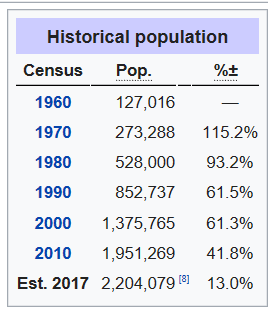
If I’m not keen on the idea of Las Vegas, it seems that many Americans are.  This is the data for the population of the metropolitan statistical area including Las Vegas.

las vegas

Lots of people, rapid population growth (faster than Auckland’s), and (it appears) wholly affordable housing.

As it happens, there is a big (well, by Wellington standards) townhouse development going on 100 yards or so, as the crow flies, from here. I think the individual townhouses have mostly been presold, but I did find one advert still online.  These places are perhaps 3 minutes drive from the park and beach, 15 minutes drive from the centre of town. But they are only two bedrooms, have a carpark rather than a garage, a single bathroom,and are only 76 square metres.  The asking price was $735000.

And this is Wellington, not as bad as Auckland.

You have to wonder why there isn’t more public outrage about a situation that gets worse (more people hooked into debt based on current high prices) with each passing year.

But what of our so-called leaders –  Ardern, Bridges, Twyford, Collins, Goff, Lester (and 30 years of their predecessors) who let this situation develop, know the problem (well, most of them do), and still have done nothing to fix the mess.  Not one of them will even suggest that house prices as cheap as those in Las Vegas is something we can and should aspire too.   What are they, by their indifference, doing to our kids?

Addendum

I know the distributional challenges of fixing this mess, once National and Labour in turn got us into it, are real.  A couple of years ago, in a post on options a new Labour government could consider if they were serious about reform, I proposed a compensation scheme.  If it helped overcome the obstacles to the sort of reform Phil Twyford and Judith Collins both talk about wanting, I’d support something like this.

No one will much care about rental property owners who might lose in this transition –  they bought a business, took a risk, and it didn’t pay off.  That is what happens when regulated industries are reformed and freed up.    It isn’t credible –  and arguably isn’t fair –  that existing owner-occupiers (especially those who just happened to buy in the last five years) should bear all the losses.   Compensation isn’t ideal but even the libertarians at the New Zealand Initiative recognise that sometimes it can be the path to enabling vital reforms to occur.  So promise a scheme in which, say, owner-occupiers selling within 10 years of purchase at less than, say, 75 per cent of what they paid for a house, could claim half of any additional losses back from the government (up to a maximum of say $100000).  It would be expensive but (a) the costs would spread over multiple years, and (b) who wants to pretend that the current disastrous housing market isn’t costly in all sorts of fiscal (accommodation supplements) and non-fiscal ways.

Nurses, pay equity, and the real structural problems

I’ve heard or read a couple of strange stories in the last day or so about the nurses’ trade union making the case for a “pay equity” settlement for their members.

Of course, the very notion of “pay equity” settlements is bizarre, fit only for somewhere like the old Soviet Union.  Some government officials decree that job x should be paid the same as job y, as if the price of a banana should be adminstratively and arbitrarily set equal to, say, the price of a kiwifruit because the two might have (say) similar nutritional value.

But what interested me were two lines being used by the nurses in support of the view that they were underpaid (neither line seemed to have much to do with the false equivalency of “pay equity”, but were rather intended to support the claim that nurses were –  absolutely –  underpaid).

The first, reported here, was this

“In Australia, nurses can be paid as much as $90,000 as a base rate with penal and on-call rates as well. The limit in New Zealand sits around $68,000.”

Last I looked, real GDP per hour worked in Australia (in comparable – PPP –  terms) was 41 per cent higher than in New Zealand.  That is the best aggregate measure of labour productivity.  You’d expect wages and salaries for most jobs to be higher in Australia than they are in New Zealand.   That appears to be so for nurses.   A larger share of New Zealand’s population is in paid employment than is the case in Australia, so the difference in per capita income is a bit smaller, but still just over 30 per cent.  In material terms, Australia is now a richer and more successful country than New Zealand is.  Those gaps keep (slowly) getting wider.

Because of the somewhat-common labour market between the two countries that creates some specific problems for New Zealand.  Plenty of people will look across the Tasman, weigh up the pros and cons of the heat, the snakes and spiders, and the challenges and opportunities of big cities, and move.    Since our somewhat-common labour market applies across the board (not just, say, to public sector nurses), it isn’t a problem we can fix by simply agreeing to all pay ourselves more.  Those sorts of outcomes have to be “earned”  –  not about individuals working harder, but about the economy as a whole finding better and remunerative opportunties, lifting earning possibilities for everyone.  Do it enough, and one day that might even be a net flow of New Zealanders coming back from Australia (Ireland managed it, it can be done).

I’m sure the Nurses Organisation is better connected to people at the top of the government than I am, so I can only urge them to suggest to their friends and allies who currently hold office that economywide productivity might be elevated quite a long way up the list of government priorities (in the Labour Party “Our Plan for New Zealand” brochure dropped in my letter box the other day it featured not at all).  Remind them, perhaps, that for decades New Zealand has been failing on this count, reducing successive governments to pretending to a success that just hasn’t been achieved.  In consequence, wages are much lower than they really should be, and we’ve been more limited than anyone would have liked in dealing with all sort of other social problems.

(Of course, from a Nurses Organisation perspective the strategy I’m proposing would fail any sort of cost-benefit assessment: neither National nor Labour show any sign of being seriously interested in doing what it might take to generate much better productivity and incomes, and (by contrast) the nurses seem to have the government wrapped around their little finger on the pay-equity path to improving their own position. But I’m sure nurses are public-spirited people, and they have children too, not all of whom will choose to be nurses.)

The other strand of the nurses’ argument was a bit closer to home. A Wellington hospital nurse was quoted as saying

Only a quarter of the nurses she worked with lived within walking distance of their hospital.  The result was that only a quarter of the nurses Ms Hopkinson worked with lived within walking distance of their hospital.

“We can’t afford to live in the communities we nurse in, we’re priced out of these neighbourhoods.”   12 years ago when she started, nurses lived in the central city, but that was no longer the case.

“They’re commuting from Featherston, from up the Kapiti Coast, Upper Hutt; they’re a long way away and they won’t be able to make it to us after an earthquake.”

Even in Wellington, it did seem a bit of a stretch to argue for a pay rise so that nurses could walk to the hospital when the 1 in 300 year earthquake hits.  The present value of the cost of that possible post-quake complication will be pretty small indeed.

Now, as it happens I do live within walking distance of Wellington hospital. It is a pleasant middling suburb, and when I was younger I knew lots of nurses who lived in the neighbourhood, attended our church etc etc.  It was close to their work and convenient.  As I’ve noted previously, I bought my first (three bedroom, 30 year old) house in this same suburb 30 years ago –  actually bought it from a teacher who was moving to Wanganui where housing was more affordable (it was near the peak of the then-boom).  The Reserve Bank’s inflation calculator tells me I paid about $296000 in today’s money for that house.

Real wages and productivity have increased since then.  Real GDP per hour worked has risen by a third, so roughly speaking spending $400000 on a house today would bear a similar relationship to incomes as $300000 then.

You cannot buy any house in Island Bay –  still less a three bedroom house, 30 year old, decent-sized section, garage etc – for $400000.  As it happens, earlier this week a real estate agent sent me a several page list of sales in the area in the last few months.  The cheapest property sold was a unit with no land at all, and 60 square metres of house: that went for $400000.  The next two cheapest ($507K and $570K) were also units and had 60 and 70 square metres respectively.  The cheapest house that looks roughly comparable (size, age, but much smaller section) to that first house of mine went for $805000.   The median price across those particular 37 properties was $960000.

It is insane.  No wonder nurses can’t afford to buy anything decent reasonably close to Wellington Hospital (there are slightly cheaper suburbs, but they’ll all have had much the same escalation).   It is not that nurses are underpaid.  And it isn’t just the nurses.  Anyone in a moderate-income job –  especially if there is only one income, or one fulltime and one part-time income –  will really struggle.  And, much as I quite like Island Bay, it isn’t Fendalton or Remuera or St Heliers –  yes, we have a beach too, but even with warming sea temperatures the sea is always more ‘refreshing’ than inviting.

It simply isn’t an issue about nurses, or nurses’ pay.  It is a straightforward consequence of vicious choices that a series of central and local governments have made to mess up urban housing markets.  Government has failed, very badly.  And if it perhaps doesn’t impinge too terribly on the children of the wealthy, it greatly restricts the options of most everyone else looking to get into the housing market, nurses included.  They are, to put it, colloquially, stuffed.  And if that isn’t you or your children yet, it will be mine in a decade’s time.  (Rents are not my primary focus, but in an age in which real interest rates are at record low, real rents should also be lower than ever.)

I’m sure the Nurses Organisation is better connected to people at the top of the government than I am, so I can only urge them to suggest to their friends and allies who currently hold office that fixing the urban land market might be elevated quite a long way up the list of government priorities (in the Labour Party “Our Plan for New Zealand” brochure dropped in my letter box the other day it featured not at all).   Nice Mr Twyford appeared to understand the issue when he was in Opposition, but there has been as little action from him in government as there was from the class enemies of the Nurses Organisation, the previous government.   Remind him, perhaps, of those fast-growing cities across swathes of middle America where good houses really are still affordable.  There is no shortage of land in New Zealand, not even in Wellington (except to the extent the Nurses Organisation friends at the Wellington City Council make it artifically so.   Do not just paper over the cracks, but fix the problem at source.

(Of course, from a Nurses Organisation perspective the strategy I’m proposing would fail any sort of cost-benefit assessment: serious land-use reform from either National or Labour still seems like a long shot (by contrast) the nurses seem to have the government wrapped around their little finger on the pay-equity path to improving their own position. But I’m sure nurses are public-spirited people, and they have children too, not all of whom will choose to be nurses. All of whom will eventually want houses.)

From any sensible policy perspective, so-called pay equity is just daft.  From the perspective of any particular group of workers, perhaps it is the fastest path ahead –  zero-sum game (well, worse) across the whole economy, but beneficial for those particular individuals. But, probably without really being aware of it, the Nurses Organisation put their finger on two really big symptoms of policy failure in New Zealand –  productivity/earnings and housing – that affect almost everyone.   While pursuing their own short-term self-interest, I would urge them to add their voice to the call for serious structural reform in these two areas.   They need it.  We all need it.  Political parties, meanwhile, keep on failing to deliver.

The China Council defends itself

After my interview on Morning Report yesterday about Jenny Shipley and the New Zealand China Council, the Executive Director of the China Council Stephen Jacobi was tweeting that it had been a “hatchet job”.    This morning Radio New Zealand interviewed him: he observed that my comments, noting that the China Council in effect served as a propagandist for Beijing’s interests, had “put me off my muesli”.

It was a fairly soft interview that really did nothing to dispel the suggestion that the China Council – substantially funded by the government, with two very senior public servants on the Board –  serves, in effect, as a propagandist for Beijing’s interests.  The fact that the people involved probably think they are primarily serving their own commercial interests, and perhaps even some warped conception of the national interest, doesn’t change that.   Unfortunately, the interviewer didn’t ask Jacobi for a single example of a case where the China Council had been critical of the PRC.  For the record, I haven’t been able to find a single example.   Around a regime so egregious –  in the way it operates at home, in other countries, in New Zealand, in commercial and in political spheres –  that really tells you all one needs to know.   It looks a lot like a body solely motivated by deals, dollars, and donations, and using public money to try to keep the public quiet.   When you treat as normal a regime that represents so much that is evil, you serve their ends, even if that is not necessarily your conscious intent.   A well-publicised gala dinner for the emissary of the CCP/PRC, just helps make that more egregious.  Supping with the devil, without even a desire for a long spoon.

But the interview probably was useful in explaining to listeners some of how the China Council works.  It is an incorporated society, sponsored by the previous government, with substantial government funding (and senior public servants on the Board).  The rest of the funding comes from the corporate or individual members of the Council, who are able to leverage the government funding to advance their business interests around the PRC (not necessarily directly –  as Jacobi notes, Fonterra doesn’t need the China Council to handle its relationship with the PRC –  but in managing the climate of opinion in New Zealand, attempting to neutralise any criticisms of the PRC).  There is no PRC government money involved, but two of the Executive Board members also hold positions in PRC-sponsored entities in China (the Confucius Institute worldwide programme and the Boao Forum).   One of the Advisory Board members was a former member of the PRC military intelligence system, and a Communist Party member.

Jacobi claims that the China Council works for all New Zealanders and in the national interest. You might have supposed that that is what we have the Ministry of Foreign Affairs and Trade (even NZTE) for, and what we elect politicians for.  The former work to politicians, and the politicians themselves we can toss out.    The China Council seems more about trying to articulate a view of the national interest that happens to suit the commercial imperatives of those involved.  Of course, it is pretty well-aligned with the views of senior figures in both main political parties, which boil down to “if at all possible, never ever say anything that might upset Beijing”, while cowering in the corner even when friends and allies (or fellow New Zealanders) are under attack.  If a life worth living is about more than just dollars, it is a pretty sick conception of a “national interest”, although easy to see how it might be in the narrow individual business interests of some firms, universities etc.   Jacobi claimed that none of the people involved would allow themselves to be duped or a mouthpiece for a foreign government.  At one level I’m sure that’s true: they aren’t duped, they are simply prioritising their commercial interests over any sense of decency, or of the integrity of our own political and social system.   These things just don’t matter (enough) to them.

I had a look yesterday at the rules of the China Council

china council rules incorporated society

I was interested to learn that, for a body set up and sustained by the government, allegedly to advance the “national interest”, actually it is a self-perpetuating oligarchy.   You can only join this Council (not the Executive Board, but the society itself) if you are invited to do so by the Executive Board.  And who appoints the Board?  Why, the Board itself appoints its own members.    In a genuinely private organisation that might be just fine  (their choice) but this is a publicly-funded, government-sponsored body, where two of our most senior public servants themselves sit on the Board.   Don’t expect (for example) Anne-Marie Brady to be showing up on the council any time soon –  a Council that can’t even bring itself to express concerns about the way a New Zealand citizen, expert on the PRC, appears to have been harrassed and worse by people rather more directly attempting to serve PRC interests.

As I said, it was a pretty soft interview.   Jacobi was asked about my suggestion that the Council never ever says a word critical of the PRC.  He parried this by observing (correctly enough) that they do note from time to time that there are differences in our systems, and that he even says (again from time to time) that the way we interact with the PRC needs to take account of our values.    But it just doesn’t make any practical difference, and neither Jacobi nor his masters (on the Executive Board or in Wellington) seem to want it to.  Such things shouldn’t get in the way of the dollars (whether exports or political party donations).    When news of possible ban on Huawei emerged, the China Council’s statement seemed a lot more concerned to protect Huawei than it did about the national security etc of New Zealand.  When the GCSB was issuing a statement about PRC state-sponsored intellectual property theft, the China Council was totally silent –  not a press statement, not a tweet nothing.    When serious concerns have been raised by Jian Yang’s past, included acknowledged misrepresentations on his immigration/citizenship forms, the China Council goes into bat for this former PRC intelligence officer, keeps him close on their Advisory Council, and repeatedly attempts to invoke the x word.   When public debate, led by the work of Anne-Marie Brady, gets going, the China Council can only lament it.  It never substantively engages –  for example with the specifics of Brady’s work.  And that is the sort of thing I mean when I say that the China Council (whatever their individual subjective intentions) objectively serves Beijing’s interest and ends.

As I said the other day, there might well be a place for some public funding for a serious think-tank or independent body devoted to serious analysis, research, and debate around the nature of the relationship with the PRC.  It is a big and a powerful country, with values very much not our own, and there are all manner of dimensions to a relationship.  The China Council is nothing of that sort –  in its own purpose statements, it is an advocacy body, championing ever-closer relationships with a regime so evil, with no serious interest in exploring risks, threats, or downsides.  That serves Beijing’s interests.

Towards the end of the interview Jacobi was asked about the position of Jenny Shipley on the China Council’s Executive Board.  Jacobi attempted to parry that by suggesting it was above his pay grade (a matter for the Executive Board) –  which might leave one wondering why Don McKinnon (the chair) didn’t front up instead.   Jacobi told us that McKinnon had spoken to Shipley, but said that he wasn’t aware of the content.    With a full week having now passed since the High Court judgment was handed down, and with the Prime Minister not willing to express any concern, it looks as though she is going nowhere.  In fact, Jacobi went on to speak highly of Shipley (former Prime Minister, “widely respected in China”), and to note that the China Council is not a financial institution or a commercial organisation.  That’s true.  It is more than that; it is a New Zealand government sponsored organisation.    I’m sure there is some fondness for Shipley in Beijing –  cover for Jiang Zemin against protestors all the way through to interviews declaring how wonderful the Belt and Road Initiative is.   But this is someone who presided over the failure of a major company in New Zealand, allowing it to trade for years while insolvent, failing in her basic duties.   That isn’t acceptable conduct in New Zealand.  A person with that track record –  perhaps especially when a former Prime Minister –  shouldn’t be holding high-profile semi-government appointments.  For her to keep on doing so tells you about the Prime Minister’s, the Foreign Minister’s, and the China Council’s Board and Executive Director’s values and priorities.  Again, it wouldn’t appear to be decency and integrity.

As it happens, skimming through the China Council rules I came to the section headed “Expulsion”.  It had this provision under which the Board could expel a member

expulsion

Seemed to cover the Mainzeal situation and the recent High Court ruling quite well.

But if the self-perpetuating business and political people on the China Council board –  including the Secretary of Foreign Affairs no less –  think Shipley’s ongoing presence among them isn’t unbecoming or damaging to their interests, it really probably tells you all one needs to know about the tawdry China Council, simply pursuing the dollars and always looking away from the evils –  at home, abroad, and here –  of one the worst regimes on the planet today.  Propanda isn’t just telling upbeat lies, it can include minimising evil and treating as normal and respectable the perpetrators of those evils.

But quite at home with Ardern, Haworth, Bridges, McClay, Goodfellow and the rest of our political “leaders”.

Postlude

In a post the other day, I ran an extract from this article about PRC forced labour camps from the Italian site Bitter Winter.  A prominent New Zealander later told me it had shaken him.  Here is another extract

The living conditions in prisons are deplorable. Prisoners often eat vegetable-leaf soup with insects floating in it. As a result of malnutrition, they often feel dizzy and do not have the strength to work.

To ensure that prisoners complete their work even when physically exhausted, the prison authorities resort to torture.

The interviewees report that prison guards incite the more vicious prisoners to discipline other inmates. Thus, it is common to be beaten by “prison bullies” when someone fails to complete the task. Mr. Zhu told Bitter Winter, “If a prisoner cannot complete their task, the prison guards will tie the prisoner’s hands and feet to an iron fence, and they are forced to stand continuously except during meals. Whether in winter or summer, they remain continually tied up for three or four days and aren’t allowed to sleep.”

This sort of thing is just fine by the China Council, Jenny Shipley, or Stephen Jacobi?  Or do they just not care.  Hard to tell which is worse.

We can’t fix other countries.  We can demand some self-respect and decency around how we do things here.   Neither Jian Yang nor Jenny Shipley has any place near a China Council that really served New Zealand interests, consistent with New Zealand values.


“The 30 billion dollar whim”

A week or two back I foreshadowed a forthcoming paper by my former colleague Ian Harrison reviewing the Reserve Bank’s proposals under which the banks would have to greatly increase the volume of capital simply to carry on doing the business they are doing now.

Like me, Ian spent decades at the Reserve Bank.  But much of his time was spent specifically in the area of banking regulation and bank supervision, including leading much of the modelling work done a few years ago as part of the Basle III process, which resulted in something like the current bank capital requirements.   He knows the detail in this area, has consulted on this sort of stuff since leaving the Bank, and has invested a great deal of time and effort over the last couple of months in getting to grips with the Bank’s proposals, reviewing the various papers they’ve published, and going back and reviewing the papers the Bank has cited in support of their case.   The result is his (50 page) review document.   Here are his key conclusions (overlapping in various places with points I’ve made in post here). Ian does not pull his punches.

Part two: Key conclusions

1. The ‘risk tolerance’ approach is a backward step that ignores a consideration of both the costs and benefits of the policy. The soundness test is based on an arbitrarily chosen probability of bank failure that ignores the cost of meeting the target. The Bank has ignored its own cost benefit model which did take the probability of bank failure, the costs of a failure, the interest rate costs of higher capital and societal risk aversion into account.

2. Bank decision based on fabricated evidence. The Banks’s decision to pursue a 1:200 failure target was purportedly based on evidence from a version of the Basel advanced model. It was manipulated to produce the right answer. Initially, a 1:100 target was proposed, but when this couldn’t generate a capital increase, the target was switched to 1:200 at the last minute.

The Bank’s model inputs were not credible. It was assumed that all loans were higher risk business loans and that the probability of loan default, a key model input, was more than two and a half times the estimates the Reserve Bank has approved banks to use in their capital modelling.

The Bank’s analysis was embarrassingly bad, so it attempted to cover this up with a subsequent information paper that was written after the decision was made, and after the Consultation paper was released. It reached the same conclusion on the required level of capital, but only by assuming a 1:333 failure probability, and by using model inputs that were still not credible.

3. A 1:200 target can be met with a capital ratio of around 8 percent. If the Basel model were rerun using credible inputs if would probably show that a 1:200 failure rate can be met with a capital ratio of around 8 percent.

4. The policy will be costly. The Bank has down played the interest rate impact of the policy, saying any increases will be ‘minimal’. Based on its own assessment of the interest rate impact, the annual cost will be about $1.5-2 billion a year. The present value of the cost of the policy could be in excess of $30 billion.

A homeowner with a $400,000 mortgage could be paying an additional $1,000 a year. A business with a $5 million loan could be paying an additional $50,000.

5. The Bank’s assessment that the banking system is currently unsound is at odds with rating agency assessments and borders on the irresponsible. The rating agancies’ assessment of the four major banks is AA-, suggesting a failure rate of 1:1250. The Bank is now saying that, at current capital ratios, the banking system is ‘unsound’ because the failure rate is worse than 1:200. Or in other words the New Zealand banking system is not too far from ‘junk’ status. The international evidence does not support the Bank’s contention that the probability of a crisis is worse than 1:200. The Bank has ignored the fact that banks will need to hold an operating margin over the regulatory minimum, and has not adjusted New Zealand capital ratios to international standards to make a fair like-for-like comparison.

6. The Bank‘s analysis ignores the fact that the banking system is mostly foreign owned. Foreign ownership increases the cost of higher capital because the borrowing cost increases flow to foreign owners. Foreign owners will support their subsidiaries in certain circumstances, which reduces the probability of a bank failure. There is little point in having a higher CET1 ratio than Australia, because if a parent fails then it is highly likely that the subsidiary will also fail, because of the contagion effect. A New Zealand subsidiary might still appear to have plenty capital, but depositors will run and the Reserve Bank and government will have to intervene.

7. The Australian option of increasing tier two capital has been ignored. APRA is proposing to increase bank capital by five percentage points, but will allow banks to use tier two capital to meet the higher target. This provides the same benefits, in a crisis, as CET1 capital, but at about one fifth of the cost. New Zealanders will be required to spend an additional $1.2 billion a year in interest costs for almost no benefit in terms of more resilience to a severe crisis.

8. The benefits of higher capital are modest. Most of the costs of a banking failure are due to borrowing decisions made before the downturn. This will impose costs regardless of the amount of capital held. With current levels of bank capital failures will be rare, with the main cost likely to be a government capital injection. The experience with most banking crises, in countries most like New Zealand, is that governments have recovered most of their costs when the bank shares are subsequently sold.

9. The Bank is mis-selling insurance. The Bank is selling a form of insurance to the New Zealand public, but it vague about the premium costs and has exaggerated the benefits. The premium is the $1.5-2 billion. The benefit would be around a 10 percent reduction in the economic cost of a financial crisis, with an expected return of a few tens of millions.

An informed, rational public would not buy this policy.

10. New Zealand banks already well capitalised compared to international norms. A recent PricewaterhouseCoopers report argued that if New Zealand bank capital ratios were calculated using international measurement standards they would be 6 percentage points higher, placing New Zealand in the upper ranks of well capitalised banking systems. The Reserve Bank critised some details in the report, but has not produced is own assessment as Australia’s APRA has done.

11. The Bank has forgotten about the OBR.   The Open Bank Resolution (OBR) bank failure mechanism, was originally conceived as a substitute for higher capital to reduce fiscal risk, and to reduce the costs of a bank failure. While banks are been required to spend almost $1 billion on outsourcing policies to supportthe OBR, it does not appear in the capital review at all – despite the Governor’s arguments that the main justification for capital increases is to reduce fiscal risk.

The bottom line?

An informed, rational public would not buy this policy.

But, as it happens, an informed rational public won’t get a say. The Governor proposes and (under New Zealand law) disposes: prosecutor, judge, jury, and appellate court in his own case.

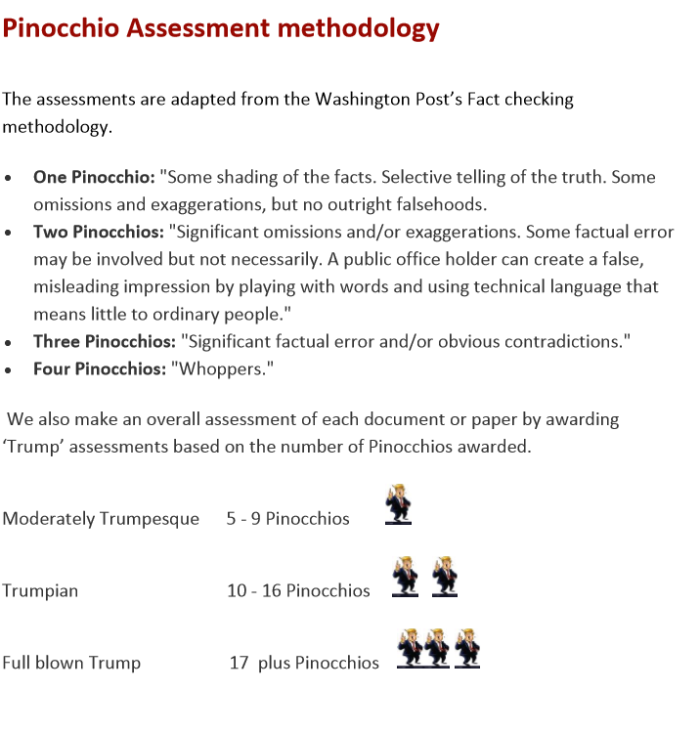
Partly, I gather, for his own amusement, and partly to help respond accessibly to some specific assertions/arguments in the more accessible material the Bank has put out to support the Governor’s case, Ian has a separate document, the Pinocchio awards.

pinocchio 2pinocchio 1

The Governor is a great deal smarter and more analytically capable than Donald Trump, but on Ian’s reading, he is resorting to the financial regulator’s equivalent of questionable Trumpian rhetoric to champion the indefensible.  Against Trump there are the courts and Congress.  Against a Governor with a whim and the bit between his teeth……well, nothing really.

It would be interesting to see what the Reserve Bank makes of Ian’s arguments and evidence.

UPDATE: A fairly accessible summary of some of Ian Harrison’s key argument in this article by veteran journalist Jenny Ruth.


Shipley and the China Council

Last week I wrote a post about Jenny Shipley’s position in the wake of the High Court judgment against her and other directors of Mainzeal.

I noted then that her position as chair of the local China Construction Bank was almost certainly untenable.  Even if, for some reason, the owners (the parent bank) had still been happy to have her, the Reserve Bank could not have allowed her to remain in her post and still retained any credibility around its “fit and proper person” regime. The Mainzeal board, chaired by Shipley, had continued trading for years with negative equity, with only the weakest suggestions of possible support from the parent.  Corporate law is designed to protect creditors from that sort of corporate (mis)governance.

Shipley has now announced that she will be leaving the China Construction Bank board.   We don’t know how much of a role the Reserve Bank played in that departure. No doubt they would hide behind the Official Information Act (or worse, section 105 of the Reserve Bank Act) and refuse to tell us.  That is a shame: it is a lost opportunity to demonstrate to the public that the regime has teeth when it comes to seriously problematic individuals. Mind you, I guess it might also leave them open to questions about how it is that they were happy to have Jenny Shipley chairing a New Zealand bank for the last several years, as more and more information about the Mainzeal situation emerged.

The focus now turns to Shipley’s role on the Executive Board of the New Zealand China Council.   In my earlier post I commented on this only briefly

As for Shipley’s membership of the executive board of the China Council……surely that tawdry taxpayer-funded body that sticks up for Beijing at every turn, has Jian Yang on its advisory board, defends Huawei, and won’t stick up for Anne-Marie Brady is just the place for her?  Then again, if the government doesn’t want the last vestiges of any credibility its propaganda body still has to be in shreds, they should probably remove her too. 

Shipley has clearly been very much in the good graces of Beijing over the years.  It wasn’t long ago that she had actually been on the parent board of the China Construction Bank, and she is now on the board of the regime-sponsored Boao Forum.   She has a long history of giving cover (literally in this case) to Beijing, going back to her brief time as Prime Minister.   Even that interview she gave to the People’s Daily back in December suggests a strong (and useful to Beijing) alignment between her public views and the preferred stances of Beijing.

But it isn’t clear whose interests are now really being served if she remains on the Executive Board of the China Council –  except perhaps those like me who poke the stick at this taxpayer-funded pro-Beijing advocacy and propaganda body.

Perhaps it suits Beijing to have such a tainted individual on their tame domestic lobby group.  See, democracy  and ‘doing the right thing’ is so enfeebled in New Zealand that our friend gets to retain her public position despite the very evident systematic poor governance on display at Mainzeal.   Perhaps, but Shipley’s failings are now sufficiently evident –  and will now always be associated with her name – that is doesn’t look as though it would really help the cause of keeping New Zealanders lulled into obliviousness about the nature of the regime.  The China Council is supposed to look like a bunch of decent public-spirited New Zealanders.

For similar reasons it can’t really be in the interests of the China Council itself for Shipley to stay on.  All the other, individually decent, people who sit on the Executive Board will be tarred by association.  You can’t so fundamentally mismanage a major business, resulting in huge losses for many people as a result of choices that were irresponsible and probably illegal, and expect to keep right on in prominent governance roles.    It wasn’t one small mistake early in someone’s career, but a big and very costly mistake for someone with the seniority and experience people should have been able to count on.  Shipley might still be well-connected in China, but there are other people with connections (if not, I’m sure Madame Wu at the PRC Embassy could help with introductions).  And everyone knows that neither corporate governance nor political governance in the PRC operate to the sorts of standards we expect in New Zealand.    If the China Council really wants us to believe that they champion New Zealand standing for New Zealand values, standards, and interests –  not just pre-emptively submitting to Beijing’s preferences – it should be in their interests too to get Jenny Shipley off their board, and quickly.

In a sense who owned Mainzeal shouldn’t be that relevant here –  the failure of the directors was alarming and unacceptable whoever the shareholders had been – but the fact that the firm was owned by someone originally from the PRC, and with extensive interests back there, just strengthens the argument around appearances.   The suspicion has been that, in effect, the China Council serves PRC interests more than those of New Zealanders.  A harsh critic might suggest something similar (perhaps unfairly) about the Mainzeal board.

And it shouldn’t be in the government’s interest for Jenny Shipley to remain on the China Council board either.  I was staggered at the way the Prime Minister the other day sought to avoid any responsibility or any involvement.

Prime Minister Jacinda Ardern was earlier asked whether she had any problem with Shipley being on the New Zealand China Council. She said it was not an appointment the Government had any role in.

The rules of the incorporated society that is the China Council are not readily available, so I’m not sure quite what the formal mechanism is for appointments to the Executive Board.  The China Council’s website also doesn’t say.   But it shouldn’t matter greatly.  The government pays

The Council receives approximately two thirds of its operational funding from the New Zealand Government through an annual grant from the Ministry of Foreign Affairs and Trade. 

[UPDATE: The latest set of accounts suggest just under half now, but with the government clearly the single largest funder.]

and very senior government officials serve on the Executive Board with Shipley.

The Secretary of Foreign Affairs and Trade and the Chief Executive of New Zealand Trade and Enterprise are both ex officio members of the Executive Board.

It is a creature of the New Zealand government and the Prime Minister simply can’t avoid responsibility.  I wonder what the Foreign Minister –  no fan of Shipley –  thinks?  Is the Secretary of Foreign Affairs and Trade really comfortable serving on an Executive Board with someone like Shipley?

Perhaps there are discussions going on behind the scenes, but after a week since the judgment was handed down, it is quite inappropriate that Jenny Shipley is still on the Executive Board of this prominent government-funded body, and that the Prime Minister won’t express a view on the appropriateness of Shipley’s position.

I was debating this point with someone the other day who argued that if the Prime Minister expressed a view she would open herself to attacks from the National Party (presumably something about inappropriate interference, or upsetting (Todd McClay’s, Jian Yang’s, Peter Goodfellow’s friends in) Beijing).   Well, maybe, but I wouldn’t have thought Jenny Shipley, in her current position, is someone even National would want to touch with a barge pole.  Are those the sorts of business governance practices National wants to defend, in public?  I can’t imagine so.

And so if the Prime Minister won’t express concern about a senior figure, found to have grossly underperformed in a very prominent governance position, it risks looking as though (a) the Prime Minister isn’t bothered by such misconduct (generally) or (b) remains more interested in not upsetting friends of Beijing and Beijing’s sensitivities than about defending acceptable standards of corporate governance and decency here in New Zealand.  She associates herself with all the tawdriness of the China Council –  defences of Huawei, silence on Jian Yang, silence on Anne-Marie Brady, and a general reluctance ever to articulate New Zealand interests when, as inevitably happens, those sometimes clash with those of the PRC. Perhaps it buys her an easier life in the short-term.  In the longer-term it further corrodes whatever reputation for decency she might once have had.  It simply shouldn’t be in her interests, or that of the government, for Shipley to remain on the China Council board.  And no one really doubts that – as the agency holding the purse strings –  if she wanted Shipley gone she would very soon be gone.

Whatever other contributions Jenny Shipley may have made over the years, her record at Mainzeal now means that she diminishes the standing and reputation of any body or individual that continues to use her in governance roles, or which support her in such roles.  Foremost among those now, the Prime Minister and the China Council itself.   As one expert noted in the Dominion-Post this morning, the market has ways of taking care of these issues – Shipley (and her other fellow Mainzeal directors) might now struggle to get directors and officers liability insurance.   But those mechanisms can’t protect us when it comes to public bodies. Only leadership protects us there.  But at present there seems to be a void – an abdication – where leadership on this issue should be.

I did an interview with Morning Report on this issue this morning.  If they put the audio up I will link to it.  [UPDATE: In fact, here it is.]

UPDATE:  A reader has pointed me to where the constitution and rules of the China Council are online (details in a comment).  It appears that the Executive Board is self-selecting and self-perpertuating

CC rules

The point remains that if the Prime Minister, representing by far the largest funder, wanted Shipley off the Executive Board (a) she would almost certainly be gone quite quickly, and (b) even if she wasn’t, the PM would have made clear her refusal to countenance the standards of corporate governance on display in the Mainzeal case.

Unelected officials wielding too much power

The Governor of the Reserve Bank is currently consulting on his own proposal that would markedly increase the share of their balance sheets New Zealand registered and incorporated banks have to fund from equity.     Whatever the possible merits of this proposal –  saving some possible, but highly uncertain, costs in several decades’ time – it is an expensive proposition.   From the economy’s perspective, if his deputy is to be believed, we’ll all be poorer (level of annual GDP permanently lower) by about 0.25 per cent.  In present value terms, that is a cost in the range of $15 to $20 billion.    As for the owners of the banks themselves, they will have to stump up billions in new capital just to keep doing the business they are doing now.  Among other options, the Deputy Governor cavalierly observes, they could simply sell off part or all of their business (which seems to be one of the possible outcomes the Governor would quite like –  with no statutory authoritiy – to see).

All on a whim, supported by flimsy analysis at best.  And with few or no protections for citizens or for the owners of the directly affected private businesses.  Government in a free society shouldn’t be done this way.   And mostly it isn’t.   Mostly there are a lot more checks and balances.   But not when it comes to the Governor of the Reserve Bank exercising his extensive regulatory powers over banks.

Typically, if a bureaucrat has a bright idea about a new rule or law, he or she first has to persuade the bosses of their own agency.    Even if they are persuaded, the boss then has to persuade the relevant minister.  The minister might have to persuade his or her Cabinet colleagues (at which point other relevant government agencies will have input to the Cabinet paper).  And Cabinet may even need to persuade Parliament, a process which involves select committee submissions (which are public), deliberations and reports back, sometimes through a committee chaired by an opposition party MP.   Even if it is the minister who has the bright idea –  and ministers are actually elected, and can be tossed out again (either by the PM instantly or at the next election) –  it will still typically have to go through much the same sort of process –  referred to the relevant agency/department for advice, and so on as above.    Heads of agencies/departments don’t set out to gratuitously upset ministers, but they do have an degree of independent status and authority and can, and sometimes do, offer free and frank advice on a minister’s bright ideas.

Contrast that with what happens when the Reserve Bank has a bright idea around the regulation of banks (“hey, how about we double the amount of capital banks have to have?”).  If there are any formal checks and balances, they are about process only.  I’m sure staff still come up with ideas –  good ones and daft ones –  and not all of them are accepted by management.

But if an idea comes from the Governor, or is once accepted by the Governor, things quickly become all-but-unstoppable.   After all, all the power (around the regulation of banks) rests with the Governor personally.     Someone who wasn’t elected, and wasn’t even directly appointed by someone who was elected –  rather he was chosen by half a dozen faceless company director types who themselves have no accountability and little or no subject expertise.     All the executive power with in the Bank also rests with the Governor personally (not necessarily a problem in itself, except in conjunction with that extensive policymaking power).   If we blessed with a highly competent saint as Governor –  of equable temper, open mind, encouraging dissent etc etc –  none of this might matter much.    But such people will be (exceedingly) rare: we need to build institutional arrangements around the crooked timber of humanity; people with all their flaws, biases etc.   Few of us are as ready to acknowledge the weaknesses in cases we are advancing, championing, as might objectively be warranted.  That is human nature, not something to specific to central bank governors.  It becomes harder to change our minds the more we’ve nailed our personal colours to the mast.   Everyone recognises that, which is why most serious decisions involve multi-stage processes, appeal or review rights etc.  In the criminal system, you can’t be prosecutor, judge, jury, and appellate court in the same case –  even in places like the PRC, in the deference vice pays to virtue, they observe the form of distinctions like this, although not the substance.

And yet that is exactly how the bank capital proposals are handled.    It is not even as if there was any socialisation of the ideas, testing of the argumentation, with interested and/or expert parties in advance of the Governor’s proposal being announced.  Instead, with little or no preparation of the ground, the person who will be the final decisionmaker launched his radical proposal.   Understandably, he and staff now champion that proposal in public fora (interviews, speeches etc).  But how then do we suppose that the Governor will be able to bring the requisite degree of objectivity and detachment to the submissions that come in.       No doubt, he will do enough to get through the legal hoop of “having regard to” the material in the submissions, but that is much much too weak a standard when he is prosecuting a case in which he will also be judge.  Imagine a criminal case in which the prosecutor was also judge (and there were no substantive appeal rights): the prosecutor/judge might swear black and blue that they would take seriously defence evidence/arguments, but no one –  no one –  would regard that as a credible or appropriate model.   It isn’t either when it comes to multi-billion dollar regulatory decisions.

The problems are compounded when the people most directly affected by the Governor’s regulatory whims have to keep on his good side because the Governor wields a great deal of discretion around other things that matter to individual banks (approval of models, approval of instrument, approval of individuals).  That has typically left banks very reluctant to say anything much in public about what the Governor might be proposing, no matter how potentially costly or troublesome those proposals might be.  From their own perspective, that might be the best course open to them.  It isn’t a pathway to good policymaking, or robust decisionmaking around bank regulatory matters.

There is no need for things to be done this way.   A more-normal process would involve major policy decisions being made by the Minister of Finance, or preferably Cabinet.  The Minister would want to take expert advice from the Reserve Bank and from the Treasury, and it might even open to those agencies to champion their preferences in a consultative document.   But when unelected people are championing change, they shouldn’t also be the ones making final decisions, with no appeal or review rights.  (All the more so in a structure like the current Reserve Bank one in which all power rests with a single individual –  a highly unconventional, inappropriate, governance structure for major regulatory powers.)

The specific issues are totally unrelated, but I had much the same thoughts –  too much power resting with unelected unaccountable bureaucrats –  when I listened to the Police Commissioner on Morning Report yesterday asserting his absolute right to decide whether or not Police routinely carry guns.   (This is the same Police Commissioner who thought it appropriate to give the eulogy, praising the man’s integrity, at the funeral of a former policeman found to have planted evidence.)  The mantra of “operational independence” was chanted, in ways reminiscent of the Reserve Bank.

I’m not clear whether the Polce Commissioner really has the power he claims (although successive ministers seem to have been willing to defer to that view), but when I looked up the Policing Act it contained a high-level distinction between matters for the minister and matters for the Commissioner that seemed appropriate.

police

The items under 16(2) seem like exactly the sort of areas we don’t ministers involved in: the Minister of Police should never be able to tell Police to arrest, or not arrest, a friend or enemy  (any more than the Minister of Finance should be able to tell the Governor to go easy on bank x and hard on bank y, where cronies might be involved) or interfere in individual personnel decisions

But applying the law to all people without fear, favour or political interference is very different than a general policy question as to whether, say, Police should routinely carry guns.  That is the sort of choice (including about what sort of society we want to be, what risks we will accept, or not) that only elected politicians – directly accountable to us –  should be making.    The incentives are all wrong otherwise.  I’m strongly opposed to routinely arming Police, but I’m even more opposed to letting the Police Commissioner get away with assertions that it is a decision for him alone to make.  If that really is the law, it should be changed.    No matter how much Police Commissioners like to tell you they serve the public, historically they (and probably any bureaucracy) will tend to serve its own interests more.  Thus, I noticed an article in which the southern police commander, asked what kept him awake at night, replied that it was safety of his officers.  That is natural, and not even necessarily inappropriate (and health and safety laws apply to Police management too) but against that has to be weighed other interests – for example, the rights of law-abiding citizens not to live in fear of Police, the rights of innocent people not to be deprived of life by a Police officer acting rashly (it happens) and so on.  It is simply unreasonable and inappropriate to allow Police themselves to make such policy decisions.

Democracy isn’t perfect by any means, just less bad than the alternatives.  And one of those alternatives involves delegating a great deal of power to unelected unaccountable bureaucrats.   When big policy decisions –  whether about capital structures of banks, or routinely arming the Police force –  are involved, only those who are elected –  and thus able to be unelected – should be making the decisions.  And when officials are championing any particular cause, they shouldn’t be the ones making the final decisions, the more so when there are no appeal rights.  Too often, of course, it suits politicians to opt out –  not just here, it has been a huge problem in the US Congress for decades –  but if they aren’t willing to make and defend hard decisions themselves perhaps they should consider another occupation.   We want and need experts for (a) advice, and (b) implementation.  But the big choices should be made only be those whom we elect, and can toss out again.   Neither Adrian Orr nor Mike Bush has got themselves elected.


Banking crises are not bolts from the blue

The Herald’s economics columnist Brian Fallow devoted his column last Friday to the Reserve Bank’s proposal to massively increase the proportion of their balance sheets banks would have to fund by equity.  He ended on what seemed to be a moderately sceptical note.

So we are left trying to weigh a highly debatable but significant cost against an incalculable benefit.

As I’ve noted here, the sort of cost-benefit calculus we can glean from various Reserve Bank publications just doesn’t stack up at all.    In his speech the other day (which a couple of readers have suggested I was too generous towards), the Deputy Governor indicated that the level of GDP might be up to 0.3 per cent lower (permanently) as a result of these changes.    Call it an annual insurance premium of 0.25 per cent of GDP (and bear in mind that the estimates Bascand is using don’t take account of the implications of most of our banks being foreign-owned, which raises the cost to New Zealand).

If we knew with certainty that:

(a) adopting these much higher capital ratios would prevent a crisis in 75 years time that would have otherwise cost 40 per cent of GDP (recall that the proposals aren’t supposed to prevent 1 in 200 year crises, but are presumably supposed to prevent 1 in 150 years crises, and 75 years is halfway through 150 years –  the crisis could happen next year, or in year 149), and

(b) that the new higher capital ratios would be applied consistently for the next 75 years

that might be a borderline reasonable bet –  the benefits might roughly match the costs.

If you thought instead there was no more than a 50 per cent chance that the new policy would be applied consistently for 75 years  (and given how politics, personalities, and conventional policy wisdom has changed quite a bit, to and fro, since 1944 that seems generous) , you’d need to be preventing a crises twice as large for the insurance policy to be worthwhile.

As a benchmark for how serious these events can be, you could think about the United States since 2008.   Over 2008/09, the United States experienced the most severe banking crisis of (at least) the modern era, since (say) the creation of the Federal Reserve.   (The Great Depression itself was, of course, worse, but it was mostly a failure of monetary policy management and institutional design rather than a banking crisis).

I’ve shown this chart previously.  Real GDP per capita for the US and New Zealand from 2007q4.

crisis costs 2019

The United States was the epicentre of the systemic banking and financial crisis.  New Zealand did not experience a systemic banking crisis at all.  At least on the OECD’s estimates, the output gaps of the two countries were pretty similar in 2007.   And there is no just credible way you can come up with estimates that have the United States doing (cumulatively, in present value terms) 40 per cent of GDP worse than New Zealand.   Do the comparisons of the US with other OECD countries that didn’t run into serious banking problems –  eg Australia, Canada, Norway, Israel, Japan –  and you still won’t find cumulative output losses sufficient to justify the sort of tax the Reserve Bank of New Zealand wants to lump on our economy.

In fact, for what it is worth, here is the cumulative labour productivity (real GDP per hour worked) growth of the United States and those non-crisis countries for the period 2007 to 2017 (from the OECD databases).

United States 10.6
Australia 14.0
Canada 9.6
Israel 10.1
Japan 8.3
Norway 3.0
New Zealand 4.4

Sure, there are all sorts of other things going on in each of these countries.   But bad as the 2008/09 banking crisis was in the United States, it is all but impossible to come up cumulative cost estimates that would reach even 20 per cent of GDP (crisis country experience over the experience of non-crisis countries).

And if the Reserve Bank continues to believe otherwise, the onus should be on them to make the case, to set out their arguments, assumptions, and evidence.

(Note, that none of this is to suggest that the 2008/09 recessions were anything other than undesirable and costly.  Recessions generally are.  But there are lots of low probability bad things in our world, and not all of them are worth paying the price to try to prevent.)

But even having come this far, I’ve risked conceding too much to the Reserve Bank ‘s story.  In part, that is because the storytelling implicitly treats higher capital ratios as sufficient to spare an economy all the costs associated with a banking and financial crisis.  And in part (but not unrelated to the previous point) because it tends to treat systemic banking crises as bolts from the blue –  unlucky bad draws imposed on a country when the Lotto balls are selected.   Neither is true.

Unfortunately, Brian Fallow seemed to buy into some of this sort of implicit reasoning in his column.

But in a complicated and perilous world it is idle to suggest that stress tests or banks’ internal modelling can accurately quantify the probability and magnitude of a major economic shock that could threaten the solvency of banks. Or even forecast the nature of the shock: another global financial crisis, perhaps?

The last one inflicted the deepest recession New Zealand had suffered since the 1970s.

A pandemic against which we are pharmacologically defenceless? It’s 100 years since the Spanish flu killed more people than WWI.

International hostilities breaking out in some surreptitiously weaponised but systemically vital realm of cyberspace?

Or a more conventional geopolitical conflict? The current crop of world leaders do not inspire confidence.

One might note first that the stress tests the Reserve Bank requires banks to undertake have deliberately used highly adverse combinations of shocks (rising unemployment, falls in house prices etc).  They are deliberately designed to look at really adverse events.

One might also note that –  contrary to the implication here and in Geoff Bascand’s speech –  the banking crisis (failure of DFC, need to recapitalise BNZ) did not “inflict the deepest recession New Zealand has suffered since the 1970s”, rather it was one (probably rather modest) factor in a range of contributors (disinflation, structural reform, fiscal adjustment, downturns in other countries etc).

But what I really wanted to focus on were the final three paragraphs in that extract, which imply that banking crises arise out of the blue.  And they just don’t.  They never (or almost never) have.  Might they in future?  Well, I suppose anything is possible, but we can’t sensibly take precautions against everything.

The prospect of a serious pandemic is pretty frightening.  But awful as the episode 100 years ago was, it didn’t result in systemic banking crises.    Cyber-warfare sounds pretty scary as well, but it isn’t remotely clear how higher bank capital requirements protect us against that.   World War Two was dreadful, but it didn’t result in systemic banking crises either.    There was a serious financial crisis at the start of World War One, but it was a liquidity crisis not a solvency one, and capital requirements (then, or in some future unexpected outbreak of hostilities) are pretty irrelevant in a crisis of that sort.    Do the leaders of the world as individuals or a group command much confidence?  Well, no, but then in the last 100 years or so periods when it was otherwise seem rare enough  (the PRC and USSR border war of 1969 anyone)?  I suppose if we go back far enough a repeat of the Black Death –  wiping out a third of the population –  wouldn’t be great for the value of bank collateral, but (a) capital proposals aren’t supposed to counter 1 in a 1000 year shocks, and (b) you might think there would be bigger things to worry about then (and a high likelihood of statutory interventions to redistribute gains and losses anyway).

Systemic banking crises –  one where banks and borrowers lose lots and lots of money and 5 per cent, 10 per cent or more of bank loans are simply written off in a short space of time –  simply do not arise out of the blue, as decent well-managed banks and universally responsible borrowers are suddenly hit by some totally unforeseeable event.  Rather they are –  always and everywhere – the outcomes of choices made over the years (typically only a handful) previously.    Lenders and borrowers make bad –  wildly overoptimistic  –  choices, some just going along for ride, others actively pushing the envelope.  In the process, real resources in the economy in question are misallocated, perhaps quite badly, but that cost is something that is really only apparent (only crystallises) when the boom comes to end, whether it ends in a whimper or a bang.   Sometimes government policies can play a direct part in helping to generate the mess.  In the United States, for example, the heavy state involvement in the housing finance sector greatly exacerbated the imbalances that crystallised in 2008/09.  In Ireland, for example, entering the euro and taking on the interest rate fit for Germany and France when Ireland might have been better with New Zealand interest rates, was a big part of the story.  Fixed exchange rates have often been a significant factor, both giving rise to initial imbalances, and aggravating the difficult resolution afterwards).  Transitions out of periods of heavy regulation can play a role too: in New Zealand (and various other countries) in the late 80s, neither lenders nor borrowers really had much idea of operating in a liberalised financial system.  You can go through every modern financial crisis –  and probably plenty of the older ones too – and point to the excesses, the over-optimistic lending and borrowing that accumulated in the preceding years.  Japan –  crisis of the 1990s – was yet another prominent example (Zambia in 1995, a crisis I was quite involved in, was the same).

Would higher required capital ratios have prevented any (many) of these episodes?  One can’t answer with certainty.  They might have prevented some bank failures themselves, but that isn’t the issue I’m focused on here (which is about the bad lending/borrowing in the first place).    Perhaps a few banking systems really went crazy because creditors thought they could offlay all the risks on the state, but that isn’t a compelling story more generally.  After all, shareholders still stood to lose everything.   A more plausible interpretation (to my mind) of those periods of undisciplined lending/borrowing is that people simply misjudged the opportunities, and got carried away by excess optimism, in ways that meant they just pay much less attention to the potential downsides.  The world was different (so people were being told, or they told themselves).  If so, most of the misallocations of real resources would happen quite independently of the levels of bank capital requirements that were imposed.  And you can mount an argument that high capital requirements may tend to encourage banks to seek out more risks than they would otherwise take, especially in buoyant times, concerned to keep up rates of return on equity.    Even if that doesn’t happen, disintermediation would see more risks to be taken on in the shadows –  no less resource misallocation in the process, but rather less visibility to the authorities and resolution agencies.

Perhaps good and active bank supervision can prevent those excesses, and misallocations, building up.  But that is a (very) different case from one in which ever-more-demanding capital buffers  supposedly eliminate (or reduce to minimal levels) the costs when the bad lending crystallises.  It isn’t a case the Reserve Bank has made –  and they probably wouldn’t, as historically they have been (rightly) fairly sceptical about the value hands-on supervision can add.  And it is a case I am pretty sceptical of.   And for which there is not much evidence (even allowing for the fact that crises avoided tend to be not very visible).   Much as APRA likes to suggest it is an example (in the 2000s) I don’t think they were really tested.

Bank supervisors –  and their bosses in particular –  breath the same air as everyone else in a society, and when lending and borrowing in a particular country is going badly off course, it is unlikely that the bank supervisory agency will be taking (for long) a very different stance from those around them, and those who appoint them.   This isn’t an argument about corruption –  although regulators perceived to be realistic and responsive will no doubt attract a better class of well-remunerated job offer –  but about political and economic realism.  But even if better Irish regulators (say) could really have made a difference in the 2000s, what was really needed were different lending/borrowing practices, not just more capital.  More capital wouldn’t have avoided a nasty aftermath (even if it would have reduced some fiscal costs) –  and at the peaks of self-confident booms, capital is cheap and easy to raise.

And so we are brought back to the specifics of New Zealand where:

  • repeated stress tests conclude that our banking system is resilient to very very nasty shocks,
  • the Reserve Bank tells us at every FSR that the financial system is strong and sound,
  • we have control of our own monetary policy, including a floating exchange rate (34 years today),
  • we have healthy public finances,
  • we have little active involvement of the government is directing finance

Against that backdrop, and against the experience in which it is hard to conclude that banking crises themselves (as distinct from the bad lending that later gave rise to them) are worth more than a few percentage points of GDP, in a country not prone to systemic financial crises (the episode doesn’t even meet the test in many collections of crises), with our banks owned mostly from a country also with no track record of frequent serious financial crises, the case just hasn’t been at all convincingly for compelling banks to fund so much more of their balance sheets with equity.  Doing so will, on the Reserve Bank’s own telling, involve real economic costs.  For benefits that are, at best, tiny and far-distant.

It is disconcerting that in none of the Reserve Bank’s material do they ever show signs of engaging with any of this sort of analysis.  Instead, they have a policy preference and prefer assertions and flimsy analysis to any serious engagement with the issues and experience.

My former colleague Geof Mortlock has another piece on interest.co.nz making the case for splitting up the Reserve Bank and creating a separate Prudential Regulatory Agency.  I strongly agree with him on that –  and have argued the case here last year.  Geof is probably more optimistic than I would be about what bank regulators can add, but on this particular item we seem to be as one.   Among his long list of what is wrong with the Bank’s conduct of its financial regulatory functions, introduced thus

Geof Mortlock argues the Reserve Bank is about as much use as a financial regulator as is a cricket umpire who is nearly blind and who understands little about the game

is this:

the recent release of bank capital regulation proposals that would see banks in New Zealand being required to hold a very high level of capital compared to other countries, with potentially adverse consequences for borrowers’ access to credit, an increase in interest rates and adverse impacts on the economy – and all on the basis of shockingly flimsy analysis by the Reserve Bank.

Quite.