Known by the company they keep

Where might one turn if writing today about the New Zealand/ People’s Republic of China issues?

One could start with yesterday’s extraordinary interview our Foreign Minister gave yesterday on Radio Live where, on the one hand, he laid into Jian Yang, and on the other seemed to suggest that anyone who questioned the activities of the PRC here or abroad was somehow motivated by racism.    Quite extraordinary.  And while we are on the subject of Jian Yang, perhaps Mr Peters could have a chat to the Prime Minister (who seems totally unbothered by Jian Yang), or to the MP from his own party who is Minister of Internal Affairs, responsible for citizenship law (Jian Yang having acknowledged a year ago that he misrepresented his past to get into the country in the first place, apparently under “guidance” fron Beijing).

And the Herald this morning was awash with material.  There was a rather wishy-washy editorial, which ended with the suggestion that if the delay in the Prime Minister’s visit to Beijing was “a rebuke it is not warranted”.   Well, of course not, both the Prime Minister and (successive) leaders of the National Party do their utmost to cover for Beijing, and never ever give offence.

There was the flippant cartoon, suggesting that all the PRC would be interested in here was the recipe for slow-cooked lamb, which one might just pass over without note if the issues weren’t so serious, the abuses undertaken by the regime –  at home and abroad – so grave.

There was another article in which the Prime Minister and Simon Bridges seemed to compete for who could grovel before the PRC regime –  tossing overboard any sense of decency or right – the most.    You’ll recall that Simon Bridges had a head-start, having been the minister responsible last year for signing New Zealand up to the rather warped aspiration of a “fusion of civilisations” –  with the PRC of all people.   According to Bridges

He said New Zealand’s default position should not be to question the legitimacy of China’s actions in the Pacific and around the world.

But, being independent and all that, and with the PRC’s track record, it actually doesn’t seem a bad starting point.  Perhaps his predecessors suggested our default shouldn’t be to question the legitimacy of Germany actions in the Europe in the 1930s, ….but I doubt it.  It is hard to see that Bridges is guided by anything resembling the word “principle”.

As for PM,

Ardern would offer no definite view when asked which country, United States or China, was more important to New Zealand.

“Some of the discussion around choosing lanes in which we swim does not fit with our independent foreign policy,” she told reporters.

“New Zealand has a range of important relationships, some for different reasons, some with different histories. But for me, the most important thing is maintaining the independence of that foreign policy basing it around New Zealand values, upholding those values and continuing to strengthen them when it is in New Zealand’s interests.”

No sign of anything resembling “principle” there either.  For her, it seems, “independence” is the primary virtue, not standing up for what is right, and standing up for the freedoms and interests of New Zealanders, including those in the ethnic Chinese community.   From both her and Bridges, it seems that visceral anti-Trumpism is being allowed to provide cover for simply sacrificing the integrity of our domestic political system, and a climate in which New Zealanders can go about their business in New Zealand –  including call out the abuses by the PRC –  free of fear.

And then there was the frankly pretty scurrilous column by Fran O’Sullivan, “Academic draws a long bow on China”.  I thought it was pretty bad on two counts.  First, she accused Anne-Marie Brady of “China derangement syndrome”, and yet when one gets to the end of the column all O’Sullivan has to say in disagreement with Brady’s paper –  which, as published was only in working paper form –  was that it included Ruth Richardson among the former politicians now involved in the boards of Chinese (PRC controlled) companies.  Whatever the ins and outs of the Synlait situation, former Minister of Finance, Ruth Richardson sits on the board of one Chinese bank here, Don Brash chairs another, Jenny Shipley is on one of the boards, and former National minister Chris Tremain is on another.   In all cases, with the possible exception of Don Brash, no one supposes these appointments were about banking expertise.  It is about connections, and such appointments also have the side benefit of putting such senior former politicians in a position where they can’t really criticise anything the PRC does.   But, in a way, the second count bothers me more.  O’Sullivan is the “Head of Business, NZME”, but she is also co-chair of the China Business Summit, and sits on the Advisory Board of the taxpayer-funded advocacy and propaganda outfit, the New Zealand China Council.  Neither of those involvements was noted in the article.  General readers can’t just be assumed to know such things, and should be able to assume that staff writers and columnists have no personal interests in the causes they are championing.

(Oh, and there was also the de haut en bas tone –  O’Sullivan being a favourite of the establishment these day –  of  this comment on Brady’s paper

It highlights issues that the higher echelons of the NZ Government are currently grappling with: whether foreign-sourced political donations carry a tag; an alleged Mainland influence on Chinese nationals and local ethnic media and unanswered questions that remain over National MP Jian Yang.

Except that there is no sign of the Prime Minister or the Leader of the Opposition taking a stand on either issue.  Perhaps some officials are indeed troubled, but politicians call the shots.  We know there are problems – answered questions in the case of Jian Yang.  Bridges and Ardern simply refuse to face what they – and their predecessors –  have reduced our politicaL system to.)

But actually what I really wanted to write about today was an article not in the New Zealand media at all, but in the Chinese media (a Xinhua story to be exact –  thanks to a reader for sending through the link).

Both main party presidents –  Peter Goodfellow for National and Nigel Haworth for Labour –  have form when it comes to gushing over the PRC regime and its leader, Xi Jinping.  It keeps the donations flowing I suppose, and Goodfellow was the source of reported line that Chinese donors were less trouble than others.  Goodfellow is also reported as having business links with Jian Yang, including in the promotion of the Belt and Road Initiative, and –  as reported only relatively recently –  is closely involved in one of PRC-favourite Yikun Zhang’s promotional activities in New Zealand.

This story is about Goodfellow, who was apparently up in China last week, one of the

….attendees of a meeting held in Hangzhou, east China’s Zhejiang Province, on Friday.  The meeting to showcase Zhejiang’s achievements in high-quality development invited leaders and representatives of more than 80 political parties from over 30 countries.

The Chinese Communist Party was singing its own praises

Che Jun, secretary of Zhejiang Provincial Committee of the Communist Party of China (CPC), introduced the coastal province’s experiences in improving governance capacity to better serve economic growth, promoting innovation-driven development, nurturing new growth drivers while upgrading old ones, and building an ecological civilization.

and so was Peter Goodfellow

Noting China’s national rejuvenation is a good thing rather than a threat for the world, President of the National Party of New Zealand Peter Goodfellow expressed his willingness to strengthen friendly exchanges with the CPC and to actively participate in construction under the Belt and Road Initiative.

I’m sure we can all welcome China’s economic development, even as we note how badly the PRC lags behind Taiwan, Hong Kong, Singapore, as well as Japan and South Korea.  But there was a time, not that many decades ago, when hobnobbing with the Chinese Communist Party was looked on rather suspiciously in New Zealand (I’ve just been reading James Bertram’s  slightly sickening account of his party’s trip to China in the mid-1950s, meeting with Mao and Chou En Lai just before the dreadful Great Leap Forward ), but now the president of our largest political party is wanting to work together with Communist Party, source of so much evil for the PRC citizens in the subsequent decades.  And no serious observer any longer pretends that the Belt and Road Initiative is anything much other than a geopolitical play.  Peter Goodfellow seems keen on pretending otherwise.

Probably from his perspective, so far so routine.  He – and his Labour peers –  probably do this sort of stuff all the time, long since detached from the sort of values their respective parties were founded on.  But it shouldn’t be normalised. It should be about as shocking as their counterparts in the late 1930s praising the Nazi Party and pledging to work together in its geopolitical initiatives.  Bad as the appeasers were, that would have been unthinkable then.  It should be again today.

But in a way what really struck me was the company Peter Goodfellow was keeping in this article.    There was Arshad Dad, Secretary-General of  (ruling) Pakistan Tehreek-e-Insaf party.  There was Alsayed Mahmoud Al-Sharif, the first deputy speaker of Egypt’s House of Representatives, who was clearly very taken with the regime

….[he] said the experience of the CPC is worthy of deeper exploration.

“China, represented by Zhejiang, pays attention to the quality behind the speed in its development, continuously enhances its innovation and competitiveness, accelerates industrial transformation and upgrading, and opens up a unique, high-quality development path,” said Al-Sharif.

And Pavle Budakov, a Bureau member of the Socialist Party of Serbia.

But here’s the thing.  Pakistan is widely-recognised as something close to a Chinese client state, now deeply indebted to Beijing.    Egypt seems to be heading in somewhat the same direction, sucking in PRC money and labour (and “craving allies at a time when much of the world has recoiled from its brutal crackdown on dissent”) to build a new capital, and as for Serbia…..well, for a start the Socialist Party of Serbia was formerly the party of Slobodan Milosevic, and in an ongoing New York Times series on China (from whence the Egypt quote is taken), the Prime Minister of Serbia outdoes even Li Keqiang

Mr Li seeks to allay European worries that China poses a challenge to its rules. He promises that Chinese-financed projects will be awarded on the basis of competitive bidding.   “There needs to be open and transparent tendering”, the Chinese premier declares.

But the Serbia prime minister, Ana Brnabic, has just undercut that aseertion.  Asked moments earlier about the [highly-contetious, almost certainly uneconomic] high-speed rail from Belgrade to Budapest, she says Chinese companies have been promised construction work.  “China is a strategic partner”, she says.  “We are not putting out tenders”

Not even the deference that vice pays to virtue in pretending to a proper process.

Whether it is Beijing and the CCP, or these other regimes, our politics –  our political parties –  really should be better than that.  We had a long and honourable tradition, which our political parties seem only interested in trashing, along with the sort of values that underpinned this democracy, this society.

In closing, just two brief things.  The first is to encourage readers to view this short clip, sent to me by a reader.  It is the story of a (now) New Zealand Chinese family –  father and daughter.  The mother died in a PRC political detention facility, three months pregnant.  The regime wanted the father and daughter back (they’d got to Bangkok) but fortunately the then New Zealand government offered them refuge here.  They are still harassed by Beijing and its agents, formal or informal here, and threats made about family back in China.  Bravely, they are still willing to speak up and speak out, about their own awful experience.   I commented to the person who sent me the link

Powerful, sad, and yet a little hopeful too – that people aren’t willing to just give up and be quiet

Perhaps Todd McClay –  who repeats PRC propaganda about the Xinjiang internment –  could watch it, or Simon Bridges, or Jacinda Ardern.  These are New Zealanders.  And that is the regime to which you –  who purport to be “leaders” – give cover.  Surely they can’t really believe the regime is morally worthy at all, but perhaps it might be less shameful if that were their excuse, rather than “another deal, another donation”.  As Scott Morrison put it recently, in an Australian context, we have to be more than the sum of our deals.

Anastasia Lim isn’t a New Zealander. She is a Chinese-born Canadian actress who a few years ago won the Canadian competition to qualify for the Miss World finals.  She hasn’t been afraid to speak out about China’s human rights abuses –  including the forced organ transplants – and was thus banned from China (and thus the competition finals) in 2015.  If the PRC hoped to silence here, the ban only seemed to draw attention to her and her cause.  She pays a price –  her family back in China is scared to talk to her – but seems undeterred.  She is visiting New Zealand briefly next week.  Auckland readers might be interested in this  Monday evening screening of an award-winning film based around real-life PRC events,  at which she will host a question and answer session.  Perhaps Winston Peters could drop in, and listen to another courageous ethnic Chinese voice speak up about the regime in Beijing.
 

Implicit admissions and bids for resources

The Reserve Bank’s Financial Stability Report was released earlier this morning.  The headline, of course, was the easing in the loan to value restrictions on mortgage lending, although perhaps what should get more attention was the Governor’s suggestion that the avowedly “temporary” restrictions” will be in place for at least “the next few years”.     There was no good case for them –  putting a bureaucrat between willing borrowers and willing lenders – in the first place, and there is no good case for having them in place now.  Other than, of course, the interest that isn’t the public interest at all –  more discretionary power for an unelected unaccountable public official.

(Given the Bank’s repeated unease about dairy debt, it has also never been clear to me why LVR limits were appropriate for people buying houses but not for people buying farms. I used to raise the point while I was still at the Bank, and have never heard a satisfactory or persuasive response.)

Two other small things in the press release warrant just brief mention for now:

The first was this

Our preliminary view is that higher capital requirements are necessary, so that the banking system can be sufficiently resilient whilst remaining efficient. We will release a final consultation paper on bank capital requirements in December.

Time will tell how persuasive their case is, but given the robustness of the banking system in the face of previous demanding stress tests, the marginal benefits (in terms of crisis probability reduction) for an additional dollar of required capital must now be pretty small.

And the second was this

Aside from CBL, the insurance sector as a whole is meeting its minimum capital requirements. However, capital strength has declined and a number of insurers are operating with small buffers. The insurance industry must ensure it has sufficient capital to maintain solvency in all business conditions.

That is quite a shot across the bows of the sector, but it is worth remembering that when the solvency standards were set up the Reserve Bank consciously chose not to require insurers to hold sufficient capital to remain solvent in all circumstances. I vividly recall the day I asked, at the internal Financial System Oversight Committee, whether the solvency standards were demanding enough that they would have prevented the AMI collapse, and was told no.

But two other things caught my eye in the full document.

The first was that the Bank no longer seems to be claiming that LVR controls –  coming between borrowers and lenders for five years now –  have done anything to improve the soundness of the financial system (while they have inevitably impaired the efficiency of the system).  Those are the statutory goals the Bank is required to use its powers towards, and yet in the document today we find this (in the cartoon summary at the front):

The restrictions have reduced the number of borrowers who would be forced to sell their houses or significantly reduce spending if they ran into financial problems.

But, even if true, that is not the same –  at all – as improving the soundness of the financial system. It is about “nanny knows best” customer protection, which is no part of the Bank’s mandate.   You can’t be forced to sell your house if the Bank’s action prevented you from getting into one in the first place.

And here is the claim from the body of the document

The Reserve Bank’s LVR restrictions have leaned against the build-up in risks from high household debt by increasing the amount of equity borrowers have in their homes. The restrictions have seen the proportion of outstanding mortgage debt to households with loans larger than 80 percent of the value of their houses fall from over 20 percent in 2013 to under 7 percent. This extra equity provides households with more room to avoid cutting consumption or defaulting on their loans if economic conditions deteriorate or if interest rates rise.

Nannying again, not (apparently) focused on the soundness of the financial system.  As a reminder, the two diverge because (a) even if LVR controls modestly reduced housing lending risks, we never get a good sense of what other risks banks have taken on to maintain profits, and (b) because less risky lending means banks need to hold less capital.  Capital relative to (properly assessed) risk-weighted assets is the key issue when it comes to solvency.

From the text there is no way of telling whether the Bank’s focus has really changed or just the marketing. But marketing –  from a powerful public agency – should be aligned with, and disciplined by, mandate.

And then there is climate change.  In the Governor’s press release there was this

In the medium-term, an industry response to a variety of climate change-related challenges appears likely, requiring investment.

Which is pretty cryptic, perhaps even empty.

But in the full document there is a two page spread on “The impact of climate change on New Zealand’s financial system”.   There is lots of text, and very little substance.  It smacks of the Governor bidding for relevance – signalling to his buddies on the (political and business) left –  and involvement in the wider whole of government programme, and perhaps worse, it looks like a bid for more budgetary resources (a case we know the Bank has been making) or amended legislation to do things like

The Reserve Bank is developing its own climate change strategy. The strategy focuses on ensuring that climate risks are appropriately incorporated within the Reserve Bank’s mandate. The Reserve Bank also stands ready to collaborate with industry and government to help position New Zealand for the challenges ahead.

This for a body with two city offices, and a balance sheet full mostly of exposures to New Zealand government debt and overseas government debt.

The text burbles on about possible risks, but it all adds up to very little.     There are numerous risks banks and borrowers face every decade, every century.  Relative prices change, trade protection changes, external markets change, exchange rates change, technology changes, economies cycle, land use law changes.  Oh, and the climate changes.

If one looks at the structure of New Zealand bank (or insurer balance sheets) it just isn’t credible that climate change poses a significant risk to the soundness of the New Zealand financial system (that pesky law again).   Some individuals are likely to face losses from actual and prospective sea-level rises, but banks (and insurers) typically have diversified national portfolios.   People can’t have mortgage debt without insurance, and so the insurers are likely to be constraining people first.   Much the same surely goes for the rural sector?   Sure, adding agriculture into the ETS at the sort of carbon price some zealots have called for would be pretty detrimental to the economics of a dairy debt portfolio, but then freeing up the urban land market probably wouldn’t be great for residential mortgage portfolios, and we don’t see double-page spreads from the Reserve Bank on that issue, or the Governor trying to play himself into some more central role in that area.     It smacks of politics –  signalling the Governor’s green credentials –  more than anything legitimately tied to financial system soundness.

But then we probably should not be surprised. The Governor sells himself as head of a tree god (fortunately there was none of that stuff in today’s document), and gives speeches on climate change, but eight months into his term still hasn’t managed to give a speech on either of his main areas of statutory responsibility (monetary policy or financial supervision/regulation/stability).


Squirming and hoping the issue goes away

The Prime Minister was briefly put under the spotlight on Radio New Zealand this morning on the narrow issue of her reaction to the open letter regarding the Anne-Marie Brady/PRC situation.   The Radio New Zealand story reports that

The prime minister said at her weekly post-Cabinet press conference on Monday that she would not be making any moves to condemn China, despite rising concern from academics about the country’s attempts to suppress talk of its interference in domestic politics.

And in her interview this morning she was at pains to minimise and play down the issue, on the defensive, and playing red herrings

“As much as I support academic freedom, I also have to be careful how much I’m seen to interfere in the police as well…

Had anyone suggested she interfere in the Police?

If you took her responses line by line, each line might have seemed reasonable on its own.  But what it added up to was the sound of someone who (a) desperately wanted the issue to go away, and (b) was not interested at all in providing a clarion call for freedom from fear, whether for Professor Brady and her family, or those members of ethnic Chinese community in New Zealand who report harrassment and threats (including to family in China) from Beijing’s agents if they dare to exercise rights –  to speak up and speak out –  in New Zealand.  She seemed totally unbothered that an investigation, which she tried to imply was being conducted solely by something like the Riccarton suburban police station, was still going on after nine months.  Maybe it really is, but as Professor Brady notes

But Prof Brady said she had been told her case was closed.

“The discussions I’ve had with police make it clear that they’ve done everything they can, and I think that they would be ready to make a report to the government.”

She said this was a case for the national security teams at the highest levels, and not just a police matter because it was “not an ordinary burglary”.

The Prime Minister gives every sense that she wishes the whole situation would go away. Perhaps she doesn’t.  Perhaps she really cares about the freedom of New Zealanders. But it wasn’t the impression she was giving.  It came across as it might if the Prime Minister were more concerned about the interests of a few big businesses (public and private) selling to China, and perhaps the flow of political donations (presumably greater now she is in office).   Only she can really allay that impression, if in fact it is false.

From my perspective, one of the sad aspects of this affair is that people sticking up for Professor Brady seem to have been almost entirely from the left (I don’t know most of the people on the open letter list, but I’m guessing there aren’t many people not of the left on the faculty of the AUT school of social sciences and public policy (from whence many of the signatories come)).  But what is interesting is that much of the pushback also seems to come from the left. I’ve seen some particularly nasty comments in the comments sections of, for example, the left-wing The Standard blog.

And this morning one of the more respected figures of the left, Chris Trotter, is out with a full-blown attack, (“The Case of the Problematic Professor), having a go at Professor Brady and suggesting that all that should guide government policy on these matters is some narrow economic perspective –  what is good for Fonterra, or Red Stag, or Auckland University is good for New Zealand.  It almost deserves a post of its own, but just (relatively) briefly some comments.

He writes that annoying “China, on the other hand, can be extremely injurious to this nation’s economic health”.    Well, no, actually not.  Should the government of the People’s Republic ever decide to attempt to “punish” New Zealand they could create some short-term damage, and perhaps even some serious damage in individual sectors, but our total exports to China are about 5 per cent of GDP, and we have tools like monetary and fiscal policy to stabilise the economy in face of shocks.  China doesn’t make us rich (or, actually, as underperforming as we are), we do.  And do we have any self-respect or not?

Weirdly, for someone who is part of the Free Speech Coalition, Trotter seems to suggest universities should be pretty hesistant about criticising China.

Prattling on about being the “critic and conscience” of society is all very well, but when New Zealand’s universities are so dependent on the continuing inflow of international students, is it really all that wise to antagonise one of the largest contributors to this country’s educational export trade? It would be interesting to see how the nation’s vice-chancellors would react if equivalents of Anne-Marie Brady started popping up on their own campuses. Each academic activist launching equally uncompromising attacks against the Peoples Republic. How would all that criticising and conscientising affect their bottom-line I wonder?

Well, indeed, and the absence of the vice-chancellors from yesterday’s statement (or any other) was notable, but Trotter’s point argues for managing our universities differently, in a way that reduces our short-term vulnerability to thugs, not just pushing deeper into the market, and becoming more afraid of our own shadow, indifferent to those actually being intimidated.

Then Trotter repeats one of Murray McCully’s old lines –  no more true for being repeated from the left.

New Zealand lives by its agricultural exports – which is why the New Zealand-China Free Trade Agreement was so important when the Global Financial Crisis struck. Without it, this country would have had significantly less to come and go on. Chinese consumers saved us from the sort of vicious austerity measures that afflicted the people of the United Kingdom and Greece. The nature of the Chinese system has not changed since 2008.

The economics is simply wrong (I’ve pointed out in previous posts the similarities between the path of our economy and that of the US over the last decade) and what about that last sentence? Most observers will say China has changed markedly, and for the worse, under Xi Jinping, and at very least that the hopeful trajectory many in the West envisaged certainly hasn’t come to pass.

Then Trotter has a go at Brady herself

The good professor is not, however, above advancing a little soft power on her own account. Is it no more than a coincidence that she has been called upon to present her ideas to the Australian parliament during the “China Panic”? Or that her academic articles and speeches are followed closely, and receive considerable approbation, in Washington DC? That the name of Anne-Marie Brady started appearing in our news media at exactly the same moment as the rivalry between the USA and China ratcheted-up several notches – was that nothing more than serendipity?

Might not her appearance before the Australian parliamentary committee have something to do with (a) her expertise, and (b) a bipartisan Australian commitment to taking PRC influence activities seriously?  And as I understand it, her name became prominent here after she released her Magic Weapons conference paper –  not intended for publication until a later book came out –  after the FT/Newsroom (hardly agents of Trump) published the astonishing story last year on Jian Yang’s background.

Trotter writes in praise of the crass Donald Trump approach to Saudi Arabia, reflected in the appalling statement last week.  In Trotter’s description – which he appears to endorse – if that involved “turning a blind eye to cold-blooded, state-sanctioned murder, then so be it”.   If the Prime Minister really wants to line up with Donald Trump’s approach to foreign policy, perhaps she could at least come out and say so.  But, as a reminder, evil as the Khashoggi murder was, he wasn’t a US citizen.  Anne-Marie Brady and many of the intimidated in the ethnic Chinese community are New Zealand citizens.

Trotter concludes urging that the Prime Minister should stay silent, and that in so doing she will “earn the respect of Beijing and Washington alike”.  More likely, both would despise her, if for slightly different reasons.  More importantly, it would be the sort of stance –  prioritising a few big businesses over the interests and values of New Zealanders –  that eats away at any residual respect people have for the political process and our “leaders”.   Far better the words from Scott Morrison’s recent speech (as aspiration, if not always observed)

I fear foreign policy these days is too often being assessed through a narrow transactional lens.   Taking an overly transactional approach to foreign policy and how we define our national interests sells us short.

If we allow such an approach to compromise our beliefs, we let ourselves down, and we stop speaking with an Australian voice.

We are more than the sum of our deals. We are better than that.

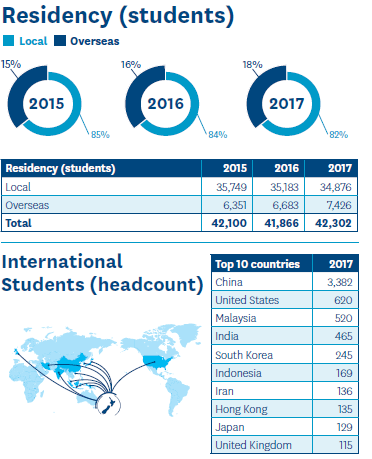
As a reminder of just how compromised our university hierarchies are I found this graphic on the Auckland University website.

au students

Not only is the dependency on foreign students rising, but the foreign student numbers are totally dominated by PRC students.    I’m usually very keen on free and open trade, but when you find yourself dealing with thugs, the sensible response (in almost any business or area of life) is to pull back and reduce your exposure to thugs, not to simply do the kowtow –  perhaps especially when you are a university, residue of some of greatest bits of the Western tradition.    We can’t allow our values, and the safety of our people, to be simply played around with to protect the interests of a few big (public and private) corporate businesses.   In Australia, a former Secretary of Foreign Affairs and Trade recently called for Australian universities to not act as if the revenue will always be there

“While demand remains high, it makes little sense for Australian universities to turn their back on the revenue stream offered by students from China and elsewhere,” he said. “But it would be wise to invest the profit margin for the longer term, not use it for current expenditure. Put it into a future fund or endowment, which would give universities a measure of resilience in the event that the market abruptly shifts for reasons beyond the control of universities.”

That would seem prudent here too, but of course it might force governments to look harder at the long-term financial structuring of our tertiary sector.

Finally, there was a story on some of these issues on Newsroom this morning, the key line in which is best captured in this tweet.

As Geremie Barme notes further (perhaps rather generously on the government’s intentions)

“China’s challenge to everybody in this region … is it requires governments are much smarter in dealing with a rising superpower that is aggressive, totalitarian, bullish and nasty in many ways, but also is varied and complex and interesting and engaging.”

Standing up to China, while still maintaining a working relationship, was difficult.

“It’s hard work and it’s constant work. This Government wants to do good but can’t quite manage to do so,” Barmé said.

“This is the real deal, and New Zealand’s never had to face this … You have to sit down and you have to work out, what is a consistent long-term policy, at least for the life of this Government. And how do you articulate that.

“And I get the sense they haven’t done that; Jacinda Ardern just runs for cover.”

She can’t even bring herself to talk, concernedly, about the astonishing situation in which a former PRC intelligence official, Chinese Communist Party member, sits in our Parliament –  close to the Embassy, never criticising the regime for anything –  having acknowledged that he misrepresented his past to get into the country in the first place.

I guess it suits the handful of big corporates and university bosses that she simply keeps quiet.  It should shame the rest of us.

Services exports and economic performance

A couple of pieces I saw yesterday got me thinking again about New Zealand’s services exports and our economic performance.

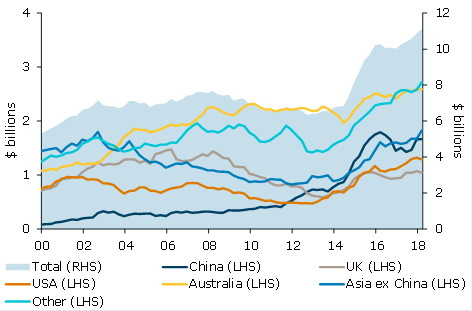
On the one hand, there was an interesting ANZ report on tourism, which included this chart.

Chart of the week

Spending by international visitors has seen impressive growth in recent years.

International visitor spend by country

tourism

Source: MBIE

And then there was speech on the MFAT website by Catherine Graham, their Economic Divisional Manager.  MFAT doesn’t publish many speeches, so it was interesting to see a bit of an economics angle, even if  it was infected with the government of the day’s propaganda.  Perhaps that was inevitable to some degree in a speech by a public servant, but gratuitous endorsement of the Provincial Growth Fund didn’t seem strictly required in a speech notionally on “small state diplomacy”.

There was a certain breathlessness to the speech

All countries and regions face technological mega trends that are consequential to businesses and governments and affect decisions. Digitalisation, artificial intelligence and automation will increasingly affect wage and employment levels, in developing as well as developed countries. The key difference from the past is that the change – driven by computing power – will occur at an exponential, rather than linear, rate. 

Maybe, although the best guess remains that people who want to work will continue to be able to do so.  Markets adjust like that.  And global productivity growth shows no sign of such a dramatic transformation (for the better).

Also from the breathless side was this

Non-state actors such as the major e-commerce platforms (think Amazon and Alibaba) and the social media giants (think Facebook, Instagram and Google) are each on their own much bigger economically than New Zealand (and many other countries’ economies). How do we navigate our relationships with them as a nation state?

This seems mostly (a) meaningless or (b) wrong.  For example, on checking I learned that the market capitalisation of Facebook was US$390 billion, and its annual revenues were less than US$50 billion.  On no meaningful metric is it bigger than New Zealand, but even if it was there is a fundamental difference between a company and a nation state.  For better or worse, Facebook could be regulated out of existence almost overnight.

But the line that caught my eye, and prompted this post, was a couple of paragraphs later

Continuing to create and leverage smart ideas will be essential for New Zealand’s agricultural sector to keep delivering value to the economy and address broader societal and environmental challenges. Elsewhere in the economy, New Zealand’s success in weightless exports – such as software development, services embedded and embodied in physical products, and the creative arts – are growing apace. It is likely that this trend will be supported by ongoing technological advances.

You’d have thought that a senior economics person in our foreign affairs and trade ministry might have thought it worth mentioning that exports as a share of GDP peaked (in modern times) 18 years ago, or that there has been no growth in the real per capita output of the tradables sector in the same period.

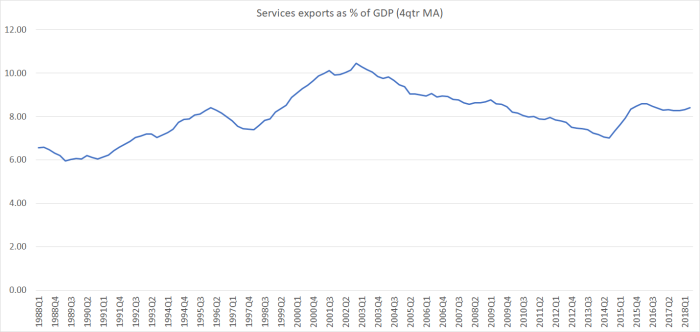
But what about those “weightless exports” specifically?  Here is the time series of New Zealand’s services exports for the last 30 years.

services x nov 18

The 1990s looked quite good, indeed the peak wasn’t even until as late as 2003, but since then it has mostly been downhill.   There was a bit of a pick-up a couple of years ago, but even that doesn’t look to be going anywhere in particular.  The services export share of GDP is currently at a level first reached in 1996.  This is success?

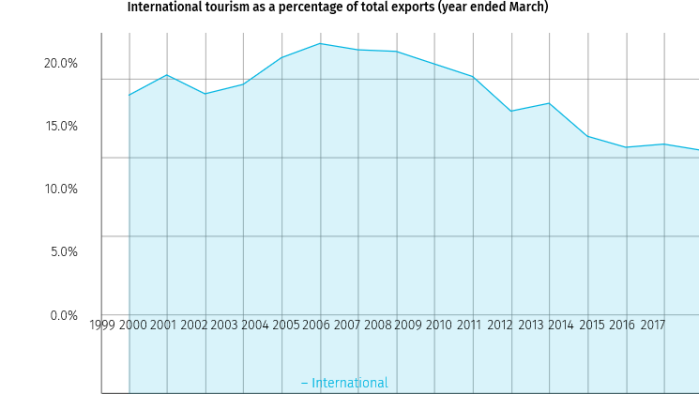
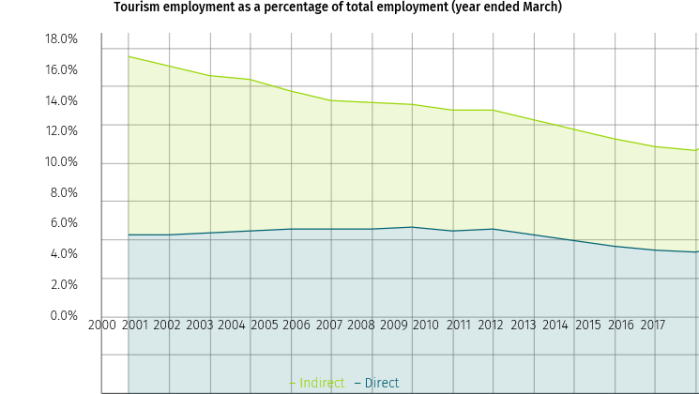
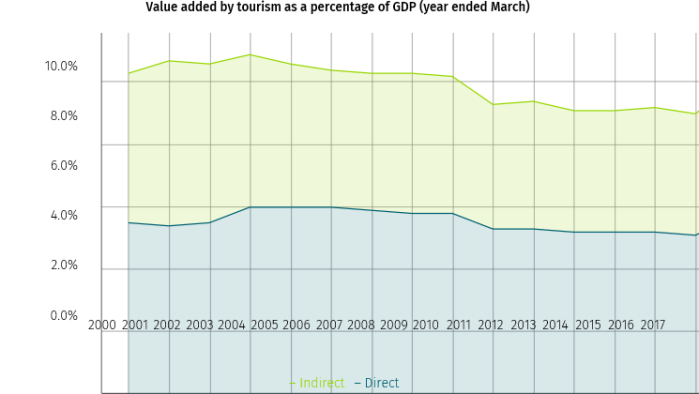
That ANZ chart I started the post with looked quite impressive.  Nominal series over long periods of time often do.  But MBIE now has a nice tourism data dashboard (there is a migration data one coming), with some useful summary charts.  Here are a few of them

tourism mbie3

tourism MBIE 2

and, as a share of GDP –  direct and (estimated) indirect contributions

tourism MBIE 1

(UPDATE: A careful reader points out that these charts, which I directly downloaded from the dashboard, have not translated correctly.  Anyone wanting the correct pictures should go to dashboard itself (link above) and click on the “Overview” menu and then “Economic Contribution”.   As represented above the charts don’t capture the pick-up in tourism in the last couple of years.)

And tourism is by far the largest component of our “weightless exports”.    We all know there are specific services firms doing well, either selling abroad directly or (as Ms Graham notes) with their services embedded in other goods exports, and on the other hand we have the film industry (kept alive on massive direct public subsidies) and the export education industry (aided by substantial implicit subsidies, bundling immigration and work access provisions to the sale of educational services).  The bits that are doing very well, standing on their own feet, just have to be very small relative to the size of the economy, and to the scale of the New Zealand economic challenge (closing those huge productivity gaps).

How do we do by international comparison?

Here are exports of services as a share of GDP for the small OECD countries (I’ve left Ireland and Luxembourg off the chart, but –  for various reasons –  their services export shares are “off the charts” high).  Small countries is the relevant comparator here, as countries with large populations naturally tend to have rather lower foreign trade shares.

services x nov 18 2

Services exports from New Zealand have been shrinking as a share of GDP, and our services export share of GDP was low to start with.   This century to date, only three of these small OECD countries have had more of a fall in the services exports share of GDP than New Zealand has.   And all three of them –  Czech Republic, Slovakia and Estonia –  have in any case managed much faster productivity growth than New Zealand over that period.

Our economy isn’t doing well, no matter how much bureaucrats and politicians like to pretend otherwise, and regardless of whether one focuses on the “weightless” bit of the economy or the rest of it.  We do quite well at employing our people, but then wage rates and productivity are now so modest by advanced country standards –  gaps that simply aren’t closing –  that more people feel the need to work.

And strangely, it seems that MFAT’s Economic Divisional Manager has some inkling of this as she ends this particular part of her speech thus

I strongly believe that earth will never be “flat”, as Thomas Friedman claimed, and that geography remains, to a greater or lesser extent, destiny. Digitalisation is not causing the end of geography as a key determinant of prosperity. Industry clusters, international connections and trade, knowledge exchange and IP transfer are all positively correlated with geographical proximity as well as prosperity – in other words, they are much easier for large countries and countries with land borders to achieve. The catch-22 for small, isolated countries is that they are also the very conditions essential to overcoming the disadvantage of geographical distance. This is a huge challenge for New Zealand, both in terms of international policy but also domestically – currently we see the government tackling this challenge through regional policies such as the Provincial Growth Fund.  

Except that it isn’t some sort of “catch-22”.  It is a constraint that New Zealand officials and politicians need to finally get real about.   If – natural resource based opportunities aside – the best opportunities in the world arise from being in close proximity to lots of other people (as markets, skills networks or whatever), then trying to grow New Zealand’s population as a matter of policy –  lots more people in an unpropitious location –  looks crazy.  Many of the people who come would have been better off to have gone somewhere else (if they could).  And the challenge facing the typical longstanding citizen (native or otherwise) –  to manage top-tier global incomes and living standards – is simply made tougher with each new person our governments bring in.  That is not because of access to jobs (that is a straw man non-argument –  you observe full employment in poor, rich and middling countries) but precisely for the sorts of reasons that Ms Graham of MFAT identifies (even if she apparently has not thought fully through the implications of her observation).

Thoughts prompted by the open letter

There was an open letter to the Prime Minister, cc’ed to the Deputy Prime Minister and Foreign Minister, released this morning and signed by 29 people (mostly academics), prompted by

….the reports of intimidation and harassment suffered by Professor Anne-Marie Brady of Canterbury University. According to news reports, she has been repeatedly burgled and her car tampered with, starting from December 2017. Reports have suggested that these events are related to her high-profile academic work on overseas influence campaigns by the government of the People’s Republic of China.

The letter calls for two things

…we echo the recent calls by Professors of Chinese history and literature Geremie Barmé and John Minford for the New Zealand authorities to take the threats against Professor Brady more seriously, in consideration of their implications for all New Zealanders.

(I ran the Barmé/Minford letter here last week.)

We also urge Prime Minister Jacinda Ardern to make a clear statement in defence of academic freedom in New Zealand in light of the Brady case, and to be very clear that any intimidation and threats aimed at silencing academic voices in this country will not be tolerated.

It should be hard for decent people to dissent from the broad thrust of the letter (which even appears to have briefly united ACT and the Green Party –  at least the bits out of office.)  One might quibble about the details –  for my own tastes it seems a bit too focused on “academic freedom” (which is mostly about the relations between universities and their staff), as distinct from the more general freedoms of New Zealand citizens and residents, including those of the ethnic Chinese community, whether or not they happen to be associated with a specific government tertiary institution –  but the thrust of the case really shouldn’t have needed saying, and yet apparently did need to be said.

But I found two things about the statement interesting.  First, who did and didn’t sign.  And, second, the (reported) reaction of the Prime Minister.

By my count, 21 New Zealand-based academics signed (plus a couple of PhD students, and one New Zealander working at a US university).  Of those 21, only one appears to specialise in international relations, and none appear to be specialists in matters to do with China (politics, society, economics, international relations or whatever).

One of the signatories was (former academic and now) consultant Paul Buchanan.  In  an exchange of comments here on Saturday, and in reference to this letter he noted

It appears many academics are reluctant to sign on because a) they fear retribution of one sort or another (say, loss of funding); and b) they personally dislike Ms. Brady and/or claim that her research is flawed etc. The fact that people cannot separate personal animus and/or concern about funding from a defence against criminal harassment is telling. As for her research, her “Magic Weapons” essay is an example of applied research and was not meant to be a theoretical or conceptual path-breaker, so sniping about its quality is pedantic.

Perhaps some of our media might like to ask, for example, those involved in the Contemporary China Research Centre about why not one of them signed this statement (or, so far as I’ve seen, have issued their own statements supporting Professor Brady).   As a reminder

The New Zealand Contemporary China Research Centre is New Zealand’s national research centre on China. We are based at Victoria University of Wellington with New Zealand’s other seven universities all being University Members of the Centre, University of Auckland, Auckland University of Technology, the University of Canterbury, the University of Otago, the University of Waikato, Lincoln University and Massey University, and with each University providing a Deputy Director.

Here is a list of the senior people at CCRC, including the Executive Chairman, Tony Browne (who also happens to chair Victoria’s Confucius Institute, and to sit on the board that advises the PRC government agency on the Confucius programme worldwide).   As the excerpt says, there is a director and then deputy directors in each university, and there are research/senior fellows.

But then here is the Advisory Board to the CCRC.   It includes representatives of MFAT, NZTE, MBIE, and Treasury, as well as the Director of the Asia New Zealand Foundation, the chair of Education New Zealand and the former chair of the New Zealand China Trade Foundation.

The CCRC helps run courses for MFAT.  And it hosts various visiting delegations from PRC government agencies.  Just next week, it is hosting a conference on next year’s Year of Chinese Tourism which event, no doubt, the PRC Embassy smiles benignly on.

Wouldn’t do then for anyone to speak up or speak out.  I don’t suppose there was anything quite as crass as a directive to all to keep quiet, but all those involved surely know which side their bread is buttered on (perhaps they wouldn’t have got appointed if not).  Much as I care about the intimidation and threats to Professor Brady, if there is a narrow issue of academic freedom, it is probably more about the utter silence of the rest of the China-focused New Zealand academic community.  It was perhaps also telling that no university vice-chancellors signed the open letter.  Perhaps they are all sympathetic –  and there have been no reports of Canterbury trying to close Professor Brady down –  but they have enrolments to sell, and the PRC is a big and threatening market.    But, again, perhaps some journalist could ask them about their attitude to attempts to intimidate a prominent New Zealand academic?

I guess the Prime Minister will probably get some direct questions on this issue at her post-Cabinet press conference, or in her weekly media rounds tomorrow, but I was interested in her initial response, as Radio New Zealand reported it.    It was terse and largely empty, apparently attempting to avoid the issue, with brief comments along the line that she “supports” and “defends” academic freedom, but that she couldn’t say anything more substantive until the Police investigation had concluded. She couldn’t even manage –  wasn’t willing to –  make a statement that was (in the words of the signatories)

“very clear that any intimidation and threats aimed at silencing academic voices [or others] in this country will not be tolerated.”

And, again as Radio New Zealand reported it, Professor Brady understands that the Police investigation has already concluded, and the question now is whether the government will show any backbone.     Whose values is the Prime Minister actually sticking up for?

Of course, if anything the Leader of the Opposition, interviewed on Radio New Zealand a few minutes later, was worse.  He managed some quick passing comments vaguely in support of the letter –  I guess he could hardly say he opposed “academic freedom” –  before moving on to run his own (in effect) defence-of-Beijing line.    Rather rashly he declared the US and China to be in a “virtual war”, was more or less defending Huawei (there was “no smoking gun” –  it might be a bit late when there is, surely?), and criticising the government for being a little hesitant about the Belt and Road Initiative (recall that Bridges was the minister who signed us up for a “fusion of civilisations”) and for upsetting China by buying the P8s and stating a few honest words –  never echoed by the PM –  in a defence policy statement.

“We’ve got a situation of inflamed language, particularly from the Foreign Minister whether it’s been on defence strategy, whether it’s been Belt and Road. These things will be of concern to the Chinese and they will be sending a [subtle] signal.”

As if he belonged to the youth wing of the Labour Party, he was reciting lightweight lines about how “we shouldn’t take sides”.   Not in opposing evil?  Not in resisting aggression?   That wasn’t New Zealand’s historical approach –  National or Labour. Then again, his stance seems to be avoiding even taking New Zealand’s own side, given the continued presence of Jian Yang in his caucus, and Yikun Zhang in arranging large donations for his party.

To return, finally for now, to the Prime Minister, TVNZ ran a story/article on Friday night about the decision – no doubt from Beijing –  to deny the Prime Minister a trip to Beijing this year.   With the website version there was a little video clip from the opening moments of her meeting with Chinese premier Li Keqiang in Singapore a couple of weeks ago.  I very rarely listen to such clips, but for some reason did this time.   The clip captures the Prime Minister opening the meeting stating that she was encouraged by “the significant common ground between your vision for China and the policies of my government”.  She went on to observe that “just as you are focused on a balanced development model and the wellbeing of the Chinese government, my government is focused on sustainable economic development and a fair society”.

It is, frankly, sickening and shameful.  Our Prime Minister, elected leader of a free, open and democratic society, governed by the rule of law etc suggests that there is “significant common ground” between her government’s policies and those of one of the most brutal un-free regimes on the planet, that has spent at least the last six years going backwards not forwards on the sorts of values and practices that most New Zealanders cherish,

Sure, Prime Ministers and like need to mutter pleasantries at the start of meetings, but surely “did you travel well, and get a good sleep?” beats this sort of stuff?    And why is she giving recognition and apparent approbation to the desire of the Chinese Communist Party to extend its brutal rule (“the wellbeing of the Chinese government”).

Is there any decent moral core there at all?  No wonder she hasn’t managed a robust defence of free and open debate, of the sort the academic signatories called for.

(I’d been going to write a bit about former NSW premier, former Australian foreign minster, current head of a somewhat Beijing-sympathising think-tank, Bob Carr’s interview on China-related issues on TVNZ’s Q&A last night.   There were plenty of bits to disagree with, but actually compared to either Simon Bridges or Jacinda Ardern he came across as fluent and somewhat reasonable.  Perhaps it helps being out of office, but he was willing to welcome Mike Pence’s efforts to highlight China’s human rights abuses, and was explicit that he would not have signed Australia up to the Belt and Road Initiative.    By his standards, New Zealand’s “leaders” seem very far gone.)

Central bank minutes released: a small victory for transparency

Regular readers will recall that the Reserve Bank has long been deeply resistant to releasing any information relating to OCR decisions or Monetary Policy Statements, other than what they themselves chose to release, whether in the published documents or in subsequent interviews.  That has never been very satisfactory, but the Bank has attempted to carve out for itself a special place, more or less above the provisions of the Official Information Act.

One of the things they’ve consistently refused to release is minutes of the Governing Committee, the body set up by the previous Governor, in which the Governor takes his final OCR decision (and other major decisions, including ones around LVRs).  They had long taken the same stance to the minutes of the predecessor Official Cash Rate Advisory Group, even when the requests related to decisions some time in the past. Often enough, it seemed that there were no written minutes at all (which was probably in breach of the Public Records Act).

I had largely given up on making any progress on this issue (and, anyway, the new statutory Monetary Policy Committee, which will have its own charter on such matters, is coming next year). But for some reason, which I now forget, I had lodged one more request six months ago seeking

1. the minutes of any meetings of the Governing Committee relating to the May MPS,
including minutes of the meeting where the OCR decision was taken;

When the Bank refused to release anything (not even date of meeting, list of attendees, headings –  even if all the substantive content was redacted) I complained to the Ombudsman, noting that (among other things) the Bank quite often released minutes of Board meetings (even with some content withheld).

The Bank regularly releases minutes of the meetings of its own Board (in response to OIA requests), with individual deletions as appropriate.  It seems inconceivable, for example, that the date, time, place of the meeting, the list of attendees, the confirmation of past minutes, and the final decisions of any meetings (themselves reflected in a later published document) could pass a “free and frank”: withholding test, even if (again) it is plausible that if there is any substantial account of the nature of contentious discussion at the meeting that specific element of the material might.

And then I forgot all about the request until a short time ago when an email from the Reserve Bank turned up.

We refer to your complaint to the Office of the Ombudsman (ref: 480453) relating to your request for: “minutes of any meetings of the Governing Committee relating to the May MPS, including minutes of the meeting where the OCR decision was taken.

The Reserve Bank has reconsidered its initial position and is now releasing with redactions, a copy of the only document within the scope of your request – the Governing Committee minutes in May. The document is attached to this correspondence.

And it has only take six months, which is progress.  Credit to the Ombudsman.

For anyone interested, the minutes themselves are here

Governing Cttee minutes May 2018 OCR

One day perhaps we might even have released –  with a suitable lag – the background papers the Governor (and his new MPC) receive, and upon which they base their decision

I’m not sure there is any new information in the particular minutes released, but having released Governing Committee minutes in this form –  against a request made almost immediately after the relevant OCR decision was released – a small but helpful precedent has been established.   Some material is still withheld on the highly questionable ground of avoiding damage to the substantial economic interests of New Zealand.  One day, the Ombudsman is going to have to provide some substantive guidance on that provision, but for now both he and the Bank seem keen to avoid the Ombudsman having to draw the appropriate line between national economic interests and those of a particular public agency.


LVR restrictions: towards the FSR

The Reserve Bank’s latest Financial Stability Report is due out on Wednesday.  Perhaps we will see some further articulation of the Governor’s strange vision of the Bank as a tree god, but I guess the main interest will be in what, if anything, the Governor does with the loan to value controls rushed into place, and then frequently amended, by his predecessor a few years ago.  It is as well to recall that although legislation is going through Parliament at present that will, at least on paper, modestly weaken the Governor’s personal power over monetary policy, in respect of banking regulation his statutory powers remain untrammelled, and unchannelled.  There are few legal constraints on what he  –  an unelected official whose appointment was controlled by unelected and unaccountable academics and company directors –  can do.

Market economists are, understandably enough, focused on the narrow question of whether there will be any changes to the rules announced this week. You can read a summary of their views here.   I remain less interested in that (forecasting) issue than in the cases for and against having such controls in the first place.   They are a new thing: we never had some legal restrictions in the bad old days of a heavily regulated financial system prior to 1984.  But, like weeds or wilding pines, once regulatory controls get in place people come to treat them as normal, the only debate tends to occur around the edges, and it takes huge effort to do something serious about fixing the problem.  Years ago, when the LVR restrictions were first introduced, we were assured they would be temporary (I was still inside the Bank at the time, and as far as I could see senior people genuinely believed it) but now the very idea that willing lenders and willing borrowers should be free to contract on mutually agreeable terms seems to be becoming lost.

The Herald’s economics columnist Brian Fallow used his column last Friday to argue to “Keep the brakes on houses”.  I can’t see the column on line, but the gist of his article is that house prices are high and household debt is high and that unless that combination changes the Reserve Bank shouldn’t think of lifting the LVR controls.  It doesn’t matter that stress tests repeatedly show that banks can cope with big falls in house prices and even big rises in the unemployment rate.  It doesn’t matter that our banks came through the last serious recession –  when household debt to GDP was about as high as it is now –  unscathed. It doesn’t matter that high house and land prices are mostly a phenomenon of the artificial scarcity created by land use restrictions (with high construction costs into the mix).  It doesn’t even seem to matter than there is no evidence that the LVR controls have made banks safer (banks with fewer individual risky loans also need to hold less capital) or the economy more stable.  It doesn’t seem to matter that the LVR controls have acted to favour established (cashed-up) buyers over new entrants to the housing market.  No, even though there is no threat to financial stability, and everyone recognises that LVR limits impede the efficient functioning of financial markets  (and those are the only two criteria the law allows the Bank to act under), the call is simply to leave the controls in place.

It was a bit like people in earlier decades who opposed removing import licenses or exchange controls because of the “foreign exchange constraint” (imports might increase if we took the controls off): papering over symptoms rather than tackling causes is rarely a sensible approach to policy.  Sadly, this government, like its predecessor, seems to be doing almost nothing to fix the underlying problem (and when I heard the UDA announcement over the weekend cited as something that had “worked well” in the UK and Australia one was reminded a new of just how obscene house prices in the UK and Australia remain).  But if the government isn’t doing anything serious, they will no doubt be grateful for the cover the Reserve Bank provides, claiming that somehow it is “doing its bit”, when it has no responsibility (there is “our bit”) for the fundamental problem.

But, of course, with no evidence whatever, the Governor is convinced that he knows best, the banks and markets are too “short-sighted” and so no doubt the controls will remain.  If the Governor is really so convinced he should at least really go to the effort of persuading the Minister of Finance to agree to extend the restrictions to other non-bank lenders.  The LVR controls only apply to banks because they are the only lenders the Reserve Bank Governor himself can order round in this way –  restrictions on other non-bank deposit-takers require the agreement of the Minister of Finance.  We have been fortunate in the last few years that there has been less disintermediation of mortgage business to non-bank lenders than most (including Reserve Bank staff doing the evaluation) had expected.   But if we learned anything from the decades of heavy controls prior to 1984, over time risk-taking will gravitate to institutions where it can occur.  Putting in place a competitively-neutral regulatory framework (treating banks and non-banks similarly) was a huge step forward in the 1980s, and it is unfortunate that the Reserve Bank now treats the same risks differently depending on whether an institution wears a “bank” or “non-bank” label.

At the press conference a few weeks ago for the Monetary Policy Statement, the Governor and his deputy (once a fairly market-oriented economist) indicated that in the forthcoming Financial Stability Review the Bank was planning to outline a more disciplined framework or road-map for assessing when, and whether, adjustments should be made to the LVR controls.  In principle, that sounds sensible and welcome. In principle, it should involve the Bank setting out some markers against which they can be held to account when the next decisions/reviews come round.  Whether it is so in practice only time will tell, but I was disconcerted when I heard them talking of this new framework as something similar to what they have for OCR decisions.

While we have a Reserve Bank there have to be regular monetary policy decisions.  That isn’t so for LVR restrictions, and it would be unfortunate if the initiative the Bank has foreshadowed was also about entrenching LVR controls as a permanent feature of New Zealand’s financial system.  Capital and liquidity requirements, backed by regular and robust stress tests, should remain the heart of our banking regulatory framework, rather than having bureaucrats reach into private businesses –  well-run over decades –  and tell them who they can and can’t lend to, or who they can and can’t employ.  But bureaucrats have incentives to build up their bureau and are typically reluctant to give up powers they’ve once got their hands on.  They are just human, and in their shoes you and I might face similar temptations.  We need banking regulation and supervision –  mostly, in my view, because politicians will bail out large banks in crises and everyone knowing that efforts need to be made to limit the risks –  but its appropriate place is distinctly limited, accountable, and kept in fully in check.   Instead, those paid to hold the Bank to account –  ministers, the Board, FEC –  mostly just accommodate the regulators, at times even egging them on.

On a totally different matter, for anyone interested in a some snippets of New Zealand economic history, you might want to try the latest Newsroom/Radio New Zealand Two Cents’ Worth podcast, which was built around the odd coincidence that –  if you look at the data a bit loosely and from the right angle – for several decades in a row, years ending in 8 had also seen a New Zealand recession.  I did an interview with Bernard Hickey for the podcast, in which he had me run quickly through aspects of the New Zealand economy in each “8” year since 1918.   As I noted to Bernard, there is now a rather large hole in the market for a up-to-date economic history of New Zealand (the last full one appeared in about 1985 and much has been done, much has happened, since then).  Brian Easton’s long-awaited history of New Zealand from an economics perspective – his framing –  is still awaited.

Economics of climate change

I’ve written a few posts here about the economics of climate change, and of the sorts of goals the government proposes to adopt in response.  On the one hand, OECD and IPCC work has suggested that, if anything, the New Zealand economy in aggregate is likely to benefit a bit from warming (albeit with sectoral and regional ups and downs –  the sort of thing that is a normal part of economic life).  And, on the other hand, the government’s own modelling, undertaken by NZIER, suggests a very high real economic cost to New Zealanders from pursuing a net-zero target.

And so I was interested to see a headline on the Wall St Journal website this morning

U.S. Government Report Warns of Economic Losses From Climate Change

The story noted

Its conclusions are at odds with statements by President Trump, who has been skeptical of global-warming trends, questioned the validity of climate science, and challenged federal regulations designed to control greenhouse-gas emissions.

“There has been no external interference in the development of this report,” said David Easterling, director of the technical support unit at the National Centers for Environmental Information, who helped prepare the 1,500-page assessment.

That’s good.

But what did it have to say about these economic costs?

The impact of global climate change is being felt across the country and, unchecked, could cause U.S. economic losses totaling hundreds of billions of dollars a year by the end of the century, says a new U.S. government report released Friday.

“Hundreds of billions of dollars a year” is a lot of money, but then (a) the US is a big economy, and (b) the end of the century is a long time away (especially once you apply any sort of discount rate).

How big?  Well, US GDP last year was US$19.4 trillion dollars.

I clicked through to the report document itself.  Unfortunately, there isn’t a distinct economics chapter (although there are sixteen separate topic chapters). But the summary did report these comments.

Some aspects of our economy may see slight near-term improvements in a modestly warmer world. However, the continued warming that is projected to occur without substantial and sustained reductions in global greenhouse gas emissions is expected to cause substantial net damage to the U.S. economy throughout this century, especially in the absence of increased adaptation efforts. With continued growth in emissions at historic rates, annual losses in some economic sectors are projected to reach hundreds of billions of dollars by the end of the century—more than the current gross domestic product (GDP) of many U.S. states.

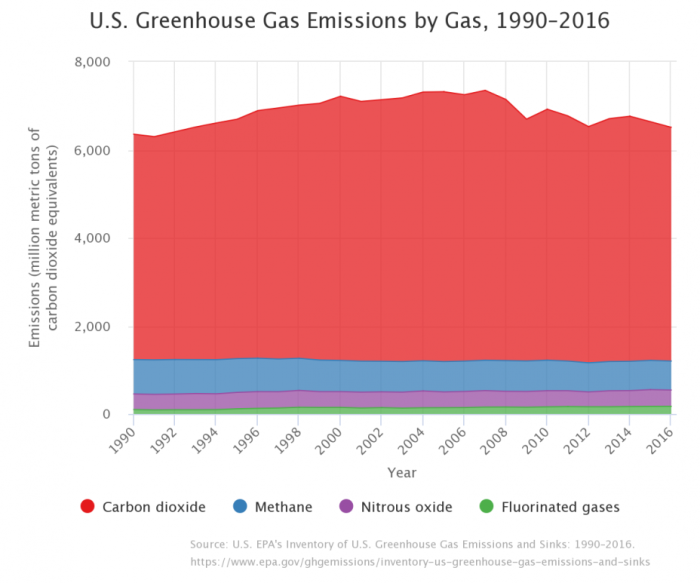
All of which made me even more curious, as I’d had the hazy impression in my mind that US emissions had already peaked, and yet this report talks of the economic costs of emissions continuing to increase at historical rates.

And sure enough there was this chart on the EPA website

us-greenhouse-gas-emissions-1990-2016

In other words, whatever the historic rates of growth of emissions were, there has been no growth since the early 1990s, and the trend appears to have reversed in the last decade.

I guess the report has in mind global emissions rather than US-specific ones, but then these days China’s choices (and non-choices) are the bigger issue.

And what about the size of the US economy at the end of the century?  If we assume very conservative numbers (no population growth and perhaps 1 per cent per annum productivity growth) then in real terms an economy of US $19.4 trillion in 2017 would be one of about $44 trillion per annum.  If the real economic costs of climate change are “hundred of billions of dollars per annum” by the end of the century that must mean a number less than one trillion dollars. In other words, the scary headline reduces to a cost that is, at most, 2 per cent of GDP.  Not nothing.   But it is (a) long time in the future –  discounted back to today at any reasonable discount rate, it will be equivalent to a lot less than 2 per cent of GDP, and (b) the discussion on the economic impact in the summary does not mention at all the potential economic costs of policy measures to accelerate the reduction in emissions already underway.   Those costs are likely to be materially smaller than those facing New Zealand (the 10 to 22 per cent of GDP estimate from the government’s NZIER modelling, falling most heavily on the poorest) but they aren’t likely to be trivial either.

Whatever the case for doing something dramatic, and potentially quite economically costly, on climate change, it doesn’t seem reasonable or sensible to base any such argument on the economic consequences for rich countries of doing nothing.   It is easy to produce big dollar numbers far enough into the future, but no credible modelling I’ve heard of suggests that climate change is a material long-term economic threat to existing advanced economies –  and certainly not to New Zealand.

NZ and the PRC: Friday bits and pieces

I noticed in the Herald’s “Dynamic Business” supplement, associated with the Deloitte Top 200 awards (themselves notably short on successful outward-oriented companies based on anything much other than natural resources), that the former Prime Minister John Key was interviewed about China.   It was, to say the least, a bit of a mixed bag.  In his first answer this line appeared

“I think Xi Jinping’s going to go down in history as a good leader of China.”

That would be in the history as written by the Chinese Communist Party (assuming it survives that long)?  I’d accept “consequential”, “influential”, even (in a bleak way) “pathbreaking”, but “good”?  What does John Key possibly see as “good” –  a term that usually has some moral connotation to it – about Xi Jinping’s rule?   It isn’t even as if the economy has been set on firmer foundations, let alone the seizures of power, seizures of territory,  the Xinjiang situation, or whatever.  But I suppose the PRC embassy will have taken note, and doors are likely to remain open in Beijing.

Key was then asked about the (straw man) question about balancing China and the United States.  I don’t particularly agree with his stance but at least –  in contrast to our current Prime Minister –  he seems capable of giving a straightforward answer, including recognising where our values, our culture, and our history take us.

…the reality is that our relationship with China is still a very economic relationship…. In the case of the US and our traditional allies –  Australia particularly – it’s a much different relationship.  They are the people that we culturally feel most at home with.  We share such a massive history.  Everything lines up much more closely there…..

I think if we turned our back on the Chinese, we’d find a lot more Irish an Dutch dairy products would flow into China and less would flow from New Zealand. It might be a bit mercantile but I think that would be negative for the New Zealand economy, for dairy farmers and for lots of New Zealand businesses –  from tourism to education services

I think he is mostly wrong about dairy –  it is a globally traded market and as we are seeing in the soybean market at present in time what doesn’t go to one country ends up going to another (if, say, the Irish and Dutch industries had WMP capability, to divert that product to China would involve not selling to the people they are now selling to).  But at least Key seems willing and able to give a straight answer –  even if it is an amoral one:  “never mind the nature of the regime, we should give priority to businesses selling stuff there”.

There was an interesting snippet in the Herald’s (typically rather well-sourced) “Insider” column in which it is noted that

NZ diplomats have been told the long-expected invitation for Jacinda Ardern to go to Beijing won’t come any time soon.

Perhaps that is the explanation for her shameful refusal to front up for the Herald’s longstanding interview request.  But if so, she needs to rethink her priorities.  Tea at today’s Berchtesgaden beats an open and honest discussion with –  and accountability to – her own citizens and voters, confronting concerns about the activity of the regime at home, abroad, and here in New Zealand?

You could read the account on the Chinese Embassy’s website of her meeting with the PRC Premier Li Keqiang and not come away with any sense of any awkwardness at all, with bizarre talk of working together for the “peace and prosperity” of the Asia-Pacific region.  We are presumably supposed to accept with a straight face words like these from the Premier

He also encouraged New Zealand companies to expand investment in China and boost technological cooperation with China, saying that China will conduct the cooperation on the basis of strict protection of intellectual property rights.

Surely only that distinctive New Zealand “Yeah right” should greet claims like that?.  Perhaps the Prime Minister’s perspective on the meeting would be different, but there is no similar account on the Beehive website (and if MFAT had problems with Beijing’s account, no doubt they have raised those concerns).

Can it really be that deals and donations are all that now matter to her?    If she doesn’t care about the citizens of the PRC, or about surrounding states, or even about how closed an economy China is in many respects, is she really not bothered about the PRC activities here?  Presumably not.  After all, Raymond Huo chairs the Justice committee and sits in her caucus, and Jian Yang sits on the other side, and not a word in heard from the Prime Minister.

There was an interesting post a couple of days ago from Paul Buchanan, the American (but New Zealand resident) former academic and now consultant on issues international.  He began by addressing the somewhat extraordinary suggestion (made by David Parker and the Prime Minister) that New Zealand could be some sort of bridge or broker between the US and China. He is simply dismissive of it, and doesn’t think either Beijing or Washington is likely to take it seriously.

For my tastes, Buchanan’s discussion  is altogether too cold (then again, perhaps his future isn’t tied to New Zealand?).   He suggests

While New Zealand audiences may like it, China and the US are not fooled by the bridge and broker rhetoric. They know that should push come to shove New Zealand will have to make a choice. One involves losing trade revenues, the other involves losing security guarantees. One involves backing a traditional ally, the other breaking with tradition in order to align with a rising power. Neither choice will be pleasant and it behooves foreign policy planners to be doing cost/benefits analysis on each because the moment of decision may be closer than expected.

I’ve disagreed with him in comments here on earlier posts, because I think he grossly overstates the extent of any sort of “economic dependence” of New Zealand on China.

On trade, New Zealand has an addict-like dependency on agricultural commodity and primary good exports, particularly milk solids. Its largest trading partner and importer of those goods is China. Unlike Australia, which can leverage its export of strategic minerals that China needs for its continued economic growth and industrial ambitions under the China 2025 program, New Zealand’s exports are elastic, substitutable by those of competitors and inconsequential to China’s broader strategic planning. This makes New Zealand extremely vulnerable to Chinese economic retaliation for any perceived slight, something that the Chinese have been clear to point out when it comes to subjects such as the South China island-building dispute or Western concerns about the true nature of Chinese developmental aid to Pacific Island Forum countries.

But even if there is some potential for short-term disruption to some sectors or firms, countries largely make their own medium-term fortunes. That was true of us in the past, is today, and will be still in the future.  Policymakers here have been very unwise in continuing to encourage stronger trade links with China, even as they recognise the sorts of threats and disuptions China has proved capable of in other countries, and the more aggressive approach China is taking internationally across a range of fronts.  No serious and free country, none with any integrity whatever, ever prioritises (for any length of time) the interests of a few of its export firms, over the values of its people.  In the medium to longer-term values and interests amount to the same thing.

And it is not as if other countries in years past have not faced these sorts of tensions.  Denmark and the Netherlands had Germany as a major trading partner in the late 1930s, but they didn’t simply roll over and invite Hitler in.

Perhaps more importantly, and a reason why I think the US vs China framing is a distraction, is that whatever the US is or isn’t doing, we face the interference activities of the PRC in our own country.  Simply taking a stand there –  clearing Jian Yang and Raymond Huo out of Parliament, standing up for Anne-Marie Brady and for those ethnic Chinese New Zealanders facing regime pressure and threats, being more open and serious about the cyber-security threats, shunning people with recognised United Front connections (not honouring Yikun Zhang), protecting and promoting an independent Chinese language media here.  These are the sorts of things a minimally decent government would be doing, even if it said not a word about abuses in China or China’s near-abroad.  But not our government: faced with the choice not between China and the US, but between decency on the one hand, and deals and donations on the other, they seem to side with the deals and donations.  And the National Party provides them cover to do so.

On the topic of cyber-security, the Australian papers this week had several stories about PRC cyber-attacks on Australia.   There were two classes of attack in the stories I saw –  one about a resurgence in direct cyber attacks on Australian companies, in violation of some deal Malcolm Turnbull and the PRC had done a couple of years ago.    The other built on this academic article, in which the authors report the results of a study showing how the PRC appeared to get round a similar deal between Barack Obama and the PRC in 2015, by using China Telecom to route selected international internet traffic through China –  where presumably the PRC could spy on it, copy it or whatever –  rather than following the standard (shortest distance) protocols. The authors provided evidence to the Australian media strongly suggesting a specific such attack involving Australia last year.

But here is the thing that interested me.  In the newspaper articles I read we saw senior government officials confirming “a constant, significant effort to steal our intellectual property”, and even a senior Cabinet minister expressing concern about the number and severity of such attacks.

By contrast, what do we get here, but blather from the Prime Minister about needing to keep an eye on cyber-security, and otherwise silence –  “national security” don’t you know, providing cover for anything ministers and officials don’t want to talk about.  I did see a Radio New Zealand article quoting a PWC person saying there was no evidence New Zealand had been caught up in the first class of attacks described above.  It would be nice to hear it from official sources, but even if it is true in the specific case, how likely is that the PRC approach to New Zealand is very much different than that to Australia –  take what they want, and can get at?   Occasionally, I make glib remarks about how perhaps New Zealand has nothing much advanced to steal, and when I do I get firmly put in my place, with links to various advanced university departments (for example).  Surely we might reasonably expect the Prime Minister or the Minister for the Intelligence Services to front up on this sort of issue, at least to give us reason to believe (confidently) that they aren’t living in some fool’s paradise, convinced they are uniquely immune from the efforts of the Ministry for State Security?

And finally,  I was sent yesterday a copy of a statement by a group called the New Zealand Values Alliance, which appears to be a group of ethnic Chinese people living in New Zealand who are concerned about the intrusion of the PRC into New Zealand.  (There is a similar, more prominent group in Australia, called the Australian Values Alliance.)   This was the statement

We, New Zealand Values Alliance(NZVA) , hereby issue the following declaration:

It is learned from media that the prominent China researcher Anne-Marie Brady has encountered on-going harassment which has recently widened to include a vehicle  sabotage of her private car, which “absolutely posed a risk to her life”.  We hereby express our concern and condemnation on the matter.

To our knowledge, similar harassments and threats sometimes happen to people who criticize CCP. Such harassments include text intimidation, tracking, stalking and a variety of harassment activities which has now escalated to sabotaging private vehicle to seriously threaten life safety.

We are very concerned about the personal safety of people who publicly criticize CCP. We earnestly appeal to the NZ government and police to pay close attention to the safety of those human rights activists and researchers against dictatorships and give more attention  to the rampant activities related to foreign political infiltration. Meanwhile an investigation into foreign interference should be started ASAP   and relevant laws be established for deterrence and punishment against related activities from agents with foreign interests.

Hard to disagree (the Values Alliance had an earlier statement about Jian Yang, reported here).  The organiser, a relatively recent migrant from China, Freeman Yu, has noted on his Twitter feed his own experience of what he talks of

Does this sort of thing bother our politicians at all?

You might have hoped that New Zealand political leaders would be speaking out  (let alone New Zealand academics working on China and/or international relations).  Former Prime Ministers, former Opposition leaders, former foreign ministers?  People like Don McKinnon, Jenny Shipley, Don Brash, Murray McCully, Helen Clark, Phil Goff, Geoffrey Palmer, Jim McLay, Jim Bolger or Mike Moore.  But, it appears, not a word from any of them, let alone Bill English or John Key.   A sad commentary, that rather tends to make the point Anne-Marie Brady was making in her paper about how too many of our elites have been persuaded that keeping quiet and going along is somehow in the best interests of New Zealand.  In fact, it largely just serves Beijing’s interests.

Not adequately reforming the Reserve Bank

Lest Reserve Bank readers think I’ve lost interest in them, it is time for an update on the Reserve Bank of New Zealand (Monetary Policy) Amendment Bill, currently before Parliament.

The government introduced this not-very-good piece of legislation some months ago, carrying out their election pledge to reform the Bank, but in such a minimalistic way that it is likely to make next to no difference.  Being seen to have done something, anything, seemed to be more important than properly overhauling our monetary policy agency, to be fit for purpose in an open and transparent democracy.   As a well-informed commenter here put it a few months ago

It appears to me that the Government has largely made its mind up about what it wants; the illusion of change rather than anything fundamental.

It’s a pity because as you say, this is probably a once in a generation opportunity to throughly review the legislation, to learn from best practice abroad, and bring into being a stronger Reserve Bank better aligned with public benefit.

What was proposed seemed only marginally better than the status quo, and even then on a couple of dimensions only.  The reforms proposed simply didn’t address the evident weaknesses in the way the Bank has been run, including:

  • the dominance of a single unelected official,
  • the structural weaknesses that made it unlikely the Board would ever really hold the Governor to account (despite being designed entirely to do so), and
  • the lack of transparency of the institution.

Some of these issues can be seen as “cultural”, but legislation supports, and underpins, the sort of culture we can expect to see in powerful public institutions.

The bill was sent to the Finance and Expenditure Committee for consideration.  I made a submission, which I wrote about here.    Although I made some specific suggestions in other areas, including a better formulation of the proposed employment objective, and on how the Board works, my main concern was about the proposed new Monetary Policy Committee where I noted

The Monetary Policy Committee provisions of this bill are unambitious and disappointing, especially when set against the expressed aspiration of a once in a generation update to the legislation to reflect the way in which the world (including central banking) has changed since 1989.  Among the features of our age are a much degree of openness, a greater recognition of uncertainty and of the benefit of an open contest of ideas, and less willingness to build institutions based on a deference.  This bill reflects almost none of that.

In considering the bill, I would urge the Committee to look closely at the experiences of open central banks in the United Kingdom, the United States, and Sweden (in particular).  All are more open than anything envisaged in this legislation, and in the way the Minister has described his intentions for how the proposed New Zealand system should work.  Each of those central banks has had strong individuals willing and able to challenge consensus views, and to debate monetary policy issues thoughtfully and openly.  They do so in part by avoiding designing a system where the Governor (chief executive) has a too-dominant formal role.  The current bill does not really address that glaring weakness in the New Zealand system.

I concluded my post on the issue this way

This shouldn’t be a particularly partisan issue.  Everyone should want a better, more resilient, better-governed institution handling monetary policy, and for the regime itself to command confidence across the political spectrum.  I hope the select committee deliberations do finally prompt the Minister of Finance and the government to reconsider, to give up their small ambitions, and to embrace the idea of more far-reaching change and improvement in the way monetary policy is governed, contested, and accounted for.

I wasn’t optimistic.    The chair and deputy chair of the committee are both parliamentary under-secretaries; the chair the under-secretary to the Minister of Finance.  It is hardly arms-length parliamentary scrutiny.  And, from their public comments and a couple of reports I saw of committee sessions, the National Party members seemed more interested in playing partisan politics –  with silly arguments that adopting a (marginally) more internationally comparable model was putting at risk New Zealand macroeconomic stability.

And, having expected little, I was not thus unduly surprised when the Committee reported back a couple of weeks ago.   It was a pretty short report, falling along partisan lines (ACT even called the bill “an invitation to corruption”), and recommending hardly any changes to the bill.    The one (welcome) change of significance relates to a new document provided for under this legislation, the charter.

The charter would impose additional requirements on the MPC relating to transparency, accountability, and decision-making procedures. The requirements in the charter would go beyond what is provided for in legislation, allowing for flexibility as best practice evolves. The charter would be set by agreement between the Minister and the MPC, while the remit [effectively the policy target itself] would be set by the Minister following a specified process. Whenever the Minister issued a new remit, the Minister and the MPC would need to consider issuing a replacement charter. We agree that there is a legitimate public interest in the MPC’s decision-making procedures (for instance, vote attribution), and that changes to the charter could potentially be quite significant. To increase transparency, we recommend requiring public consultation on key issues relating to a replacement charter alongside the consultation on the remit required by clause 37.

That is a small step forward, at least in principle.    However, since the first of these charters is to be set by the Minister and the Governor (rather than the MPC), and the initial provisions are likely to be quite influential in how the MPC operates for some considerable time, there should be a commitment by the Minister to apply the same process of public consultation to the initial charter as will be required for subsequent replacements.   I can’t see any sign of such a commitment, or legislative requirement, at present.

One of the things the Reserve Bank management has consistently opposed is the idea that members of the Monetary Policy Committee should be able to openly articulate their views on issues relating to monetary policy (whether in speeches, interviews, or in comprehensive published minutes.  The Minister of Finance appears to have allowed himself to be persuaded by those arguments –  arguments which serve the institutional self-interest of public sector managers, rather than the public interest, which is advanced by robust debate, inside and outside the institution, on issues characterised by huge uncertainty, and where bureaucrats have no monopoly on wisdom.  (And, of course, the Governor himself shows no sign of any sort of personal self-restraint, apparently regarding it as appropriate for him to talk on all manner of things, whether or not the Bank has responsibility for them –  just no serious speeches on his core areas of responsibility.)   There are good, and highly-regarded, central banks abroad that do things quite differently, much more openly –  without the scary bogeyman the Reserve Bank invokes (“adds to uncertainty, lacks clarity, creates confusion”) coming to pass.

The United States is one example of such a system.  And as a specific example of how a more open system works, the Wall St Journal had a long interview with Patrick Harker, president of the Philadelphia Fed, one of the regional presidents who rotates through voting positions on the FOMC.  In fact, when I went looking for the transcript again I found they’d had three such interviews in just the last few months.

interviews

Of course, the US is a big country with much deeper journalistic resources, but the key point is that markets didn’t shake, confidence in the Fed wasn’t eroded, because citizens (and markets) were able to see and hear what these influential policymakers thought about important issues.   And it wasn’t shocking that not everyone agreed on everything. There is no reason to think it would be different in New Zealand, if our minister hadn’t allowed the bureaucrats to wrap him round their little finger.  It was, after all, supposed to be a government committed to openness and transparency.

As I’ve noted here previously, the very narrow scope of the proposed New Zealand Monetary Policy Committee, the legislated dominance of the Governor, the lack of resources for MPC members, and the tight constraints on their ability to do or say much is likely to make it hard to attract good people into those roles, and won’t encourage those who do get appointed to take the position very seriously.   Of course, that will probably suit the government and the Governor

And so it will be interesting to see what people they finally manage to attract, both in the first round, and a few years later when the novelty has worn off.  A smart (but deferential) semi-retired person would probably fit the bill quite well, but since the government and the Bank have been clear they don’t want people who might rock the boat, and they apparently aren’t keen on economists, and since even the externals together will be a perpetual minority, you wonder why someone good would be interested.   Pocket money probably shouldn’t be the motivation, at least if the government were serious about putting in place a strong, well-functioning, MPC.  Of course, as it is, there is no evidence of such intent.

The (minority) external MPC positions were advertised some time ago.   As I wrote about a few weeks ago, it appeared that the recruitment process had run into trouble.   I’d lodged OIA requests for a breakdown of applicants and of those taken to the next stage of the process, but when the Bank responded they indicated that no one had been taken to the next stage of the process at all.   I hadn’t even asked about a short-list, just about the group who hadn’t immediately been ruled out as totally unsuitable.

The other day I had a first stage substantive response, providing a breakdown of the people who had lodged applications for the external MPC positions.

There were 75 candidates in total, including candidates identified through a search process, for the roles of external members of the Monetary Policy Committee being established under the Reserve Bank of New Zealand (Monetary Policy) Amendment Bill.

Of these 75 candidates: 23 percent (17 candidates) are women, 92 percent (69 candidates) are currently resident in New Zealand, and 8 percent (6 candidates) are currently employed at a university.

It was a surprisingly large number of people (although I’d asked about applicants, and it isn’t clear from the response whether all the people “identified through a search process” were necessarily actually wanting to be considered).

But it also makes it all the more odd that the process is moving so slowly.  There was a Reserve Bank Board meeting last week (the Board is responsible for the selection of MPC members) and yet the email I had earlier this week says they still don’t have a short-list.

Perhaps in the end they will manage a barely-credible set of appointees, but even if they manage it the first time (perhaps the Minister twists a few arms, and hands the nominations to the Board to send back to him), it is going to be hard to sustain even that as time goes on, so inadequate is the model the Minister has chosen.

It isn’t democratic (even questionable Deputy Commissioners of Police are directly appointed by elected people), it isn’t broad-ranging (the MPC has a deliberately very narrow mandate), it isn’t conducive to a serious contest of ideas (being too dominated by a single unelected person), it isn’t very accountable (formally or otherwise) and it isn’t very open and transparent.  It simply isn’t very good legislation.  And that is a shame, a lost opportunity.