Net-zero carbon emissions: a “massive economic boost”?

James Shaw, co-leader of the Green Party and Minister for Climate Change (surely Minister against it?), tells us he is working his way through 15000 submissions on the recent climate change consultation document.  I’ve done a couple of posts here on the document, and on the NZIER modelling used extensively in it, and I’ve chided both the Minister and his department, NZIER, and the Productivity Commission for simply ignoring the fact that our large-scale non-citizen immigration policy is a discretionary policy measure that drives up New Zealand’s carbon emissions, further increasing the economic cost of any variant of a “net-zero” target the government might choose to adopt.   But I didn’t make a submission: there are only so many hours in the week, and it seems pretty clear from some recent broadcast remarks from the Minister that he thinks his own Ministry (for the Environment) is altogether too pessimistic.   A net-zero target is, he claims, a huge economic opportunity for New Zealand.   Never mind that there is precisely no analysis to support such a claim.

In any good policy development process, one wants to see evidence of a proper cost-benefit analysis having been undertaken.    What is the value of the benefits of any actions it is proposed to take, what are the costs of those actions themselves, how uncertain are each of those sets of numbers, and (not unimportantly) how might those costs and benefits change if we were simply to wait a while, or respond gradually (in ways that might, for example, give us more data).     That sort of analysis –  with inevitable imprecisions –  is perhaps all the more important when crusaders are champing at the bit to launch a really major, far-reaching, change in our economy and society, and one with –  on the government’s own numbers –  really big, adverse (ie falling most heavily on the poorest) distributional effects.

The government consultation document, drawing on the NZIER modelling (with all its limitations), did attempt to outline the costs of adopting a net-zero by 2050 emissions target.  The Ministry, in particular, was keen to play down the numbers, but they did report them: best estimates from NZIER were for a loss of GDP of 10 to 22 per cent (ie lower than otherwise).   As I noted in my earlier post, I doubt any democratic government has ever consulted on a proposal to reduce the wealth and incomes of its citizens by quite so much.

But the consultation document made no attempt to assess the economic costs (if any) to New Zealand, and New Zealanders, from the sort of climate change that is likely to occur in the absence of (global) policy responses.   There doesn’t seem to be any such analysis that has been done anywhere in, or for, the New Zealand public sector.   Former Treasury and MBIE official (and now a consultant) Jim Rose highlighted this in a recent Dominion-Post op-ed.

Estimates of the cost of global warming as a percentage of GDP to New Zealand are elusive. I drew a nil response when I asked for that information from James Shaw, the Minister for Climate Change, and from the Ministry for the Environment. Both said such an estimate was too hard to calculate.

As he notes

Fortunately, the OECD rose to the challenge in its 2015 report on The Economic Consequences of Climate Change.

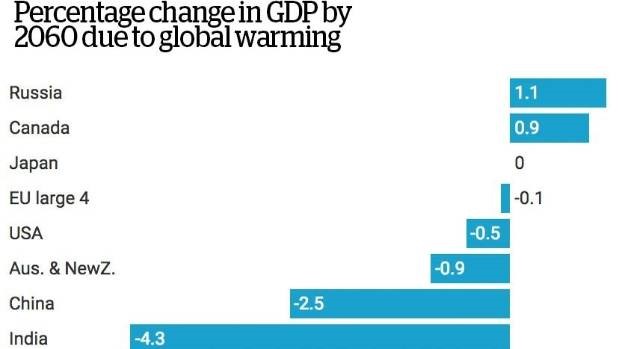
Rose included this chart, drawing on the OECD’s modelling work
climate change 2

Very cold countries are expected to see an economic gain from climate change over the next few decades, and for temperate climate countries it looks like roughly a wash.  New Zealand is modelled with Australia, but Australia is a much hotter country, and it seems quite quite reasonable to suppose that the New Zealand numbers is isolation would be basically zero.  Given the importance of agriculture in our economy, and that warmer temperatures would improve crop yields etc in many areas, some overall economic gain seems not implausible.

Now, it is quite reasonable to point out that, in some respects, 2060 isn’t that far away, and climate effects seem to be slow to unfold.  So the OECD –  hardly a bunch of climate change sceptics – also did some modelling on the effects out to 2100.  This is from their Executive Summary

climate exec summary

Presumably the adverse effects still differ quite markedly by geographic region.  But notice two things.  First, this OECD modelling suggests that some of these modelled costs are now sunk costs anyway (would happen even if emissions fall to zero as soon as 2060).  And second, and more importantly, recall the range of economic costs to New Zealand of adopting a net-zero (by 2050) target: 10 to 22 per cent of GDP.  In other words, even if New Zealand were exposed to economic costs of climate change at the upper end of the OECD estimates (10 per cent of GDP by 2100), it still wouldn’t be economically worthwhile to pay a price of 10 to 22 per cent of GDP 50 years earlier to prevent such outcomes.  That is basically what the government’s own numbers say.

And it is all even worse than that.   After all, on these OECD estimates, getting to net-zero (globally) by 2060 would only prevent half the losses.   And since much of modelled adjustment in New Zealand relies on sequestration (planting lots and lots of new forests, almost exclusively on land not currently used for economic purposes) –  and that can really only be done once –  it isn’t implausible to suppose that the economic costs of maintaining net zero emissions beyond 2050 would only increase further.

But somehow none of this –  material from his own ministry, from their consultants, or from the OECD –  seems to have any impact on the Minister.   He tries to draw strange parallels with the internet

“I think the New Zealand of 2050 will look as similar and as different as the New Zealand of today does to the New Zealand that we had 30 years ago. You’ve got to remember 30 years ago, the same period of time that we’re talking about, the internet did not exist. Didn’t exist, right? But you try and run your school or your home or your community group or your business without the internet today, it’s unimaginable.

“The internet has had a profound impact on our economy, on our lives. Whole new industries have been built off the back of it… but the New Zealand of today still feels in many ways a bit like the New Zealand of 1988.”

All of which is largely true (and the further into middle-age you are, the more 1988 seems like yesterday anyway), but irrelevant.   The internet (and associated applications) has been a series of new technologies that have materially changed elements of peoples’ lives.  But that is (largely) private sector innovation, and consumer adoption (or not) of the opportunities and technologies.    Perhaps a more important comparison the Minister might like to reflect on are areas of demonstrable underperformance since 1988? Our economy (per capita) is better off than in 1988. But, for example, we’ve had among the very worst rates of productivity growth of an advanced country in that 30 year period.  Productivity is what opens up options to deal with poverty and all those social issues the Greens say they care about.   Or house prices – which have moved from more or less affordable to highly unaffordable in large chunks of the country (largely as a result of well-intentioned policy choices by people with noble aspirations).

Just like James Shaw and the government of which he is now a part.  This is what he says about the economics of his proposed net-zero target

He says investing in meeting our climate change goals will be a massive economic boost, rather than a burden.

“What we’re talking about here is a more productive economy, with higher-tech, higher-valued, higher-paid jobs. It’s clearly a cleaner economy where you’ve got lower health care costs, people living in warmer homes, congestion-free streets in Auckland.

“It’s an upgrade to our economy. It’s an investment, you’ve got to put something in, in order to generate that return. If we don’t, the clean-up costs from the impacts of climate change will well exceed the costs of the investment we’ve got to make to avoid the problem in the first place.”

But where is his analysis?  Where are his numbers in support of this?   There is nothing of the sort in the consultation document, or in the NZIER modelling.   Without something of that sort –  tracing through the mechanisms he expcts to see these effects –  this is all dreamtime stuff, arguably either delusional or worse.   There is nothing to demonstrate why we should take seriously the Minister’s claim that markedly shifting pricing (or using regulation to the same end) against key sources of energy, and skewing pricing against our handful of large internationally competitive industries (even, unlikely at this stage, if our competitors were going to do the same thing) would mean we’d all end richer (“massively” so apparently) than if the government hadn’t adopted such policies.  It simply doesn’t ring true.

Perhaps the Minister is (deliberately?) confusing two things.   The centuries-long era of technological innovation shows no sign of having ended.  There will be technologies 50 years from now that few of us can even dream of today.  In some cases, they may leave our grandchildren considerably wealthier than we are.  In some cases, they are likely to markedly ease the costs of adjusting away from an economic structure that involves large-scale carbon emissions. But that is a quite different thing from supposing/assuming that heavy government intervention, of the sort the government is proposing, will itself make us all a lot richer.  And, as I’ve noted previously, even the NZIER modelling numbers already assume into existence big improvements in technology, in turn assuming away what would otherwise be very large economic costs of adjustment.

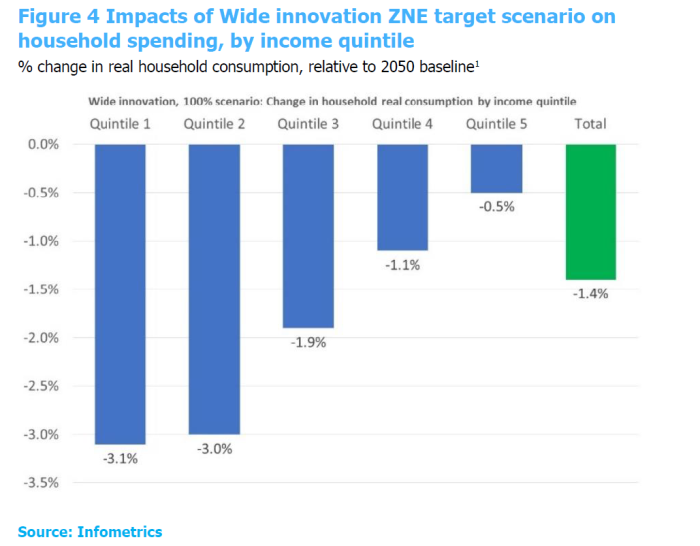
Perhaps those technology assumptions will themselves prove to conservative.  But wouldn’t we be a lot better off waiting to see how the technological opportunities unfold, rather than racing ahead, wishing upon a star, when –  on the OECD’s own numbers, the economic costs to New Zealanders of waiting appear likely to be modest (at worst).   And lets no forget –  and in any circumstances the Green Party rightly wouldn’t let us do so –  the distributional impact the government’s own commissioned modelling revealed.
emissions distribution

Six times as heavy a burden on the bottom 20 per cent as on the highest-income 20 per cent.  Six times.

In his enthusiasm for rushing ahead, beyond any sort of current international commitment, James Shaw cites public opinion

“New Zealanders do want us to lead on climate change. They think our response so far has been inadequate. They think that New Zealand should act even if other countries don’t,” he told Newshub Nation on Saturday, citing a recent survey by IAG.

That survey showed while three-quarters of Kiwis think New Zealand should take action even if other countries don’t, only one in 10 percent think the rest of the world will.

More details of that survey (or not the exact wording of the questions, probably rather leading given the commercial virtue-signalling purposes it appears to have been  commissioned for) are here.

Public opinion matters, a lot.  The public elect, and oust, governments.  But what proportion of the public does the Minister honestly suppose has any sense –  even the vaguest sense – of the sort of cost-benefit calculus implicit in combining the OECD estimates (economic costs of climate change) with his government’s own published estimates of the costs of fast New Zealand moves to zero emissions?   And the fact that the answer is likely to be well under 5 per cent isn’t really an adverse reflection on the public –  ignorant voters and all that –  but a reflection on our political parties and official/bureaucratic classes, which have fallen over themselves to avoid sharing such perspectives more widely.  The feel-good response to the end-of-the-world-is-nigh rhetoric is hard to stand against; easier to go with the flow, and if anything cheer it on.  But pointing out this pretty basic considerations –  and they aren’t hard arguments to explain –  should perhaps be something political leaders (if the word “leader” means more than just holding office) should do.

My former colleage Ian Harrison, now at Tailrisk Economics, makes a bit of a speciality of digging more deeply into some of the dubious claims that government ministries, and the like, often make (a collection of his papers is here).    He has been digging into some of the claims, and the modelling, regarding possible New Zealand emissions targets, and sent me the other day a draft of a paper he is working on, with permission to share a few excerpts.

Ian’s draft paper draws attention (more than I have, and more than the report itself does) to the pretty significant reductions in exports in the NZIER modelling.   It seems unlikely that a small economy doing less trade with the rest of the world is going be achieving a “massive boost” to prosperity.    Ian also draws attention to a point I’ve also made in earlier posts, about where the new forests are likely to go.  NZIER assumes that the new forests are on land that currently has little or no economic use.  But if agriculture is brought into an ETS (even partially and gradually) and there are substantial carbon credits from forestry sequestration, we could see a large amount of existing farmland converted to forestry.  Whatever the possible merits of such a conversion, it would further reduce exports over the decades in which the trees were growing, which in turn would be likely to have implications for the exchange rate (something not dealt with in the NZIER modelling at all).

Ian also draws attention to the way in which both the IPCC’s most recent report on Australasia (a summary of the New Zealand bits is here) does not support the notion that the economic impacts of global warming itself “would be strongly negative, or at least negative at all” this century.  He draws attention to a 2012 Ministry of Primary Industries report on the impact of climate change on land-based sectors.

The main purpose of the report was to look at adaptation and resilience issues rather than make an overall assessment of the economic costs and benefits, but two major themes suggest that the overall impact would be positive. The first is that C02 fertilisation will have a major positive impact. The second is that New Zealand farmers are very good at adapting both tactically and more strategically to climate events, which would help mitigate some of the adverse impacts, which are in any event, less quantitatively significant.

Recall that the assumed warming over the 21st is less than the temperature difference between Invercargill and Auckland (and, even setting aside growing conditions, most people would count such a shift as an improvement in the amenity value of their location –  certainly true of Wellington).

Much of the thrust of Ian’s paper is scepticism about the case –  touted by the government, with public opinion support for the time being –  for acting early and aggressively.   One argument made in official papers is that acting early reduces the risk of later sudden drastic shocks, but the basic logic of this argument seems flawed, given the absence of technology to deal with some of the major sources of New Zealand emissions.

Logic would suggest that in New Zealand more time would reduce those risks. In particular, reducing animal methane emissions per animal is challenging and will take time. The NZIER report shows that if we pursue a zero emissions target without a technical solution the impact on the pastoral sector would be devastating with output falling by 70 percent, from baseline projections, by 2050.

Another argument is that by acting early by will get economic advantages from being early into emerging technologies.

This argument is overblown and reflects wishful thinking rather than hard analysis. The reduction in emissions will not involve (much) marketable technological innovation. We will mainly grow more trees. The rest of the world already knows how to do that. We will import electric cars leveraging off innovation elsewhere.  Norway has been an earlier adopter of electric cars but no one has suggested that Norway has innovated to produce better electric cars.  We may close down some carbon intensive industries such as iron and steel and cement manufacturing. Painful, but doesn’t require much innovation that we can sell to the rest of the world.

And then, of course, there is the incredible “moral leadership” argument, recently also advanced –  stepping well out of his field –  by the Reserve Bank Governor.

Again this is wishful thinking. Does anyone seriously expect the countries that matter: the US, China and India, to be influenced by what New Zealand does.

And if, in some sense, rich countries probably should take some sort of lead in dealing with global problems

It is generally accepted that the rich countries should take the lead in reducing greenhouse emissions. However, New Zealand is not really a rich country, sitting on the margin of being an upper middle-income country. This weakens the case for New Zealand bearing a disproportionate share of the mitigation burden, particularly if the result is to push us more firmly into middle-income territory.

And there is a reminder of the elephant in the room that not even the Greens seem yet to be willing to address. Emissions from international travel and shipping aren’t in the international emissions numbers, but it doesn’t change the facts.   There are no good alternative technologies are present, and yet international shipping and aviation are probably more important to New Zealand (given distance, and being an island) than for most advanced countries.

Setting out to, in some sense, “lead the world” in this area is a recipe for severely impairing the future living standards of our own people.   Perhaps the warm inner glow of the “feel good” –  which would no doubt linger long among Greens supporters, well after most New Zealanders were living with the economic consequences –  should be added to Treasury wellbeing dashboard?  But it is likely to take an awfully large amount of “feel good” to compensate for the lost opportunities –  for rich and poor alike –  of wilfully giving up 10 to 22 per cent of future GDP (on the government’s own numbers).

Victoria University of Wellington

The proposal to change the name of Victoria University (dropping “Victoria” and just leaving the institution as University of Wellington) probably doesn’t get much attention in the rest of the country.  But here it has excited quite a flurry of interest, with thousands signing petitions opposing to the planned change.  Graduates and staff seem to have been particularly vocal, amid reminders of the ancient conception of universities in which graduates are forever, in some sense, “members” of the university.

I graduated from Victoria, some decades ago.  I suppose I do still feel a vague warm fuzzy sense of association with the place, and have even done the odd lecture there over the years.   But even that association probably has more to do with a career spent at the Reserve Bank which has long had reasonably strong associations with Victoria.  I suppose I have fairly happy memories of my time as a students (low fees, universal student allowances and all that), but I was living at home and Victoria was never the centre of my life.  So, equally, I can’t summon a great deal of analytical or emotional energy to object to the latest plans of the corporate bureaucrats who now run the degree factory.

This proposal seems to be all about money.  Money isn’t unimportant, of course.  But the bureaucrats claim that simply changing the name of the institution will somehow boost the institution’s prestige, and in turn boost their international student numbers by up to 850 a year  (I don’t have the numbers at my fingertips, but that must be a fairly large percentage –  actually, on checking a 25 per cent increase).  Something doesn’t really ring true.

The university has published various papers in support of its proposal.  One is some market research conducted by people in various countries who might be of a stage to consider foreign study, as well as some interviews with international agents (presumably advising potential students).

The agents apparently noted that university name might matter a bit at the beginning of a search process but

Agents think as students do more research, name becomes less important as the students rely on university rankings and the agents to identify universities.

Which seems about as rational as one might expect.

The market research people also asked how much various factors matter in deciding where to study.  These were the top seven, all of which seem (again) strikingly sensible.  The name of the institution doesn’t –  as one might expect – matter very much at all.

vuw

There was also an interesting page about the name options that were market-tested

Three names tested well: National University of New Zealand, New Zealand National University, and University of New Zealand, Wellington. When presented in isolation students preferred National University of New Zealand or New Zealand National University. However, when presented with other factors (in the choice modelling task), University of New Zealand, Wellington produced the greatest increase in preference. We think this is because having the city name in a contextualised decision making task provided the students with more information to base their decision on.

The impact of the names on preference for Victoria differed by country, for example changing the name to New Zealand National University would increase preference by 6.2 percentage points amongst Chinese students but drop it 1.9 percentage points amongst American students.

Nothing like grandiose ambitions from the Vice-Chancellor: National University of New Zealand indeed!   From an establishment that trails far behind Auckland in the international rankings, and which would have no claim at all to a title “National” (although one can see why foreign students might be misled if such a title had been adopted).

The corporate bureaucrats are keen to stress that Victoria University of Wellington isn’t a very old name –  and indeed it isn’t (we had the University of New Zealand, with (mostly) various constituent colleges (thus Victoria University College) until about 60 years ago).   That in itself is hardly good grounds to scrap a well-established name (and, as their material also notes, this is apparently the third or fourth time they’ve tried to change the name).

As various observers have pointed out, there are many universities around the world with names that (in isolation) give you no clue about where they are located (unlike Victoria University of Wellington, or VUW). I just had a look at one list of global universities: by my count, 7 of the top 25 in that list had names that didn’t tell directly of specific location.  One could add the Sorbonne, Imperial College, Notre Dame, Brown, McMaster, and the list would run on without limit.     Perhaps the difference here, if there is one at all, is that Victoria University of Wellington is just not that good a university?   That wouldn’t change by trying to jettison a historical name.    If anything, if location-based titles really matter a fig, there is probably a stronger case to consider change for Wellington’s other university (Massey), except of course that it is a multi-campus operation.

But, to be honest, the thing that surprises me a little is how many Wellington liberals have come out to defend the name: empire, colonisation, and all the rest being more than a little out of fashion, and no name being more emblematic of the British Empire and its colonial foundations than Victoria.  Why, even the local newspaper has an editorial this morning calling for the name to be kept –  the same newspaper that only weeks ago was weighing in strongly supporting the Wellington City Council’s Maori strategy, prioritising Maori street names, jettisoning old names for civic features, jettisoning Guy Fawkes for  Matariki, and aiming for some sort of bilingual city by 2040 (a city with one of the smallest proportion of Maori in New Zealand).    The Dominion-Post is keen to preserve its social justice warrior credentials, so gratuitously compares Queen Victoria to Lenin and Stalin (eponymous cities in Russia now renamed), but still somewhat surprisingly it ends on a note of “Stick with Vic”.

There seems to be a huge amount of guilt, perhaps even shame, about our heritage among the Wellington (and no doubt non-Wellington) liberals. I’m a bit surprised our mayor and his deputy haven’t been out campaigning not just to drop “Victoria” from the university name, but to replace it with primarily a Maori name.  Perhaps University of Te Whanganui-a-Tara (the Maori name for Wellington harbour)? After all, the Duke of Wellington is hardly someone today’s liberals will admire.  Or calling for Mt Victoria to be renamed (or its scrubby companion on whose lower slopes I’m typing this, Mt Albert).  Not content with having relegated the city’s statue of Queen Victoria to the remote fringe of the inner city decades ago, some of them are probably keen to junk it altogether.  These days Victoria University includes what used to be the teachers’ college, and primary school teachers now seem to see it as their goal to make kids rather ashamed of their heritage (my 11 year old is doing colonisation at the moment, and we have long discussions in which I remind her that, for all its faults and failings (captured in her little hand-drawn poster above the dinner table marking “exploitation, murder and robbery”), New Zealand was –  and in many respects still is –  one of the finest countries in the world).  These days an increasing number of official government agencies aren’t even content to leave the country with its proper name, New Zealand, slipping in an “Aotearoa” whenever they can.

As I say, I’m a bit puzzled at the way the liberals have emerged to defend the Victoria name for the university.  I’m pleased they have, but even if somehow they win this time, I can’t imagine the success will last long.  Even if Professor Guilford himself is simply after more money, and an implausible increase in foreign student numbers, it surely won’t be long until the crusaders will be coming for any names associated with our colonial heritage, Victoria University of Wellington among them.

What is “formulating monetary policy”?

Under clause 8 of the current Reserve Bank of New Zealand Act, the primary function of the Bank is “to formulate and implement monetary policy”.   All powers rest with the Governor personally.

I did a lot of work over the years on issues around monetary policy, both bigger picture stuff around goals and governance, and on the detailed implementation arrangements (the design of the OCR system itself, and various supporting liquidity management arrangements).  I sat on whatever internal advisory committees we had for the best part of 25 years.  I wrote this piece, for example, and this one.  So I know whereof I speak.  But I don’t recall anyone ever making much of the distinction between formulation and implementation, or getting a legal opinion on which of “formulate” or “implement” mattered in what particular context.  Why would we have?  All the powers rested with Governor, and there was no particularly need to clearly delineate formulation activities from implementation activities, either in the present, or in thinking about contigency planning.

In practice, and on a day to day basis, under the current system the two activities are fairly clearly divided: monetary policy formulation is, in effect, things up to including the OCR decision, while implementation involves the detailed management of market conditions to deliver something akin to the chosen level of the OCR.

But the broad parameters of an OCR system itself –  indeed, even the decision to have an OCR (we’ve only had one for 19 years) –  doesn’t fall neatly on either side of a line between “formulation” and “implementation”.  And then there is foreign exchange intervention for monetary policy purposes. Perhaps things have changed, but when I was there decisions that the preconditions for intervention were right (the “traffic light system”) were made by the Governor in the OCR Advisory Group context, while (rare) decisions to actually intervene were made by the Governor directly liaising with the Financial Markets operational department.

It doesn’t matter much at present, because all powers vest with the Governor, and how or whether he takes advice on individual bits of his monetary policy responsibilities is entirely up to him.

But in the Reserve Bank bill introduced last week splits those two functions apart.

Under the amended clause 8, it is intended that

The Bank, acting through the MPC, has the function of formulating a monetary policy….

and, in section 8(3)

The function of formulating monetary policy includes deciding the approach by which the operational objectives set out in a remit are intended to be achieved.

And in a new clause 9, we read

The Bank has the function of implementing monetary policy in accordance with this Act.

And later in bill, in the new clause 63B we read

The MPC must perform the function of formulating monetary policy in accordance with this Act

Neither “formulation” nor “implementation” is further defined in the Act at present, and I can’t see any attempt to add more specific definitions in the new bill, other than a circular definition which says that

formulating, in relation to monetary policy, has the meaning set out in section 8(3)

Which, to say the very least, isn’t very specific.

I have two concerns about this, which boil down to much the same point I was making in a post last week: this bill would results in a committee which is likely to be nothing more than figleaf, and which leaves all substantive power in the hands of the Governor (and his chosen management team).  That is likely to be even more so in the next serious recession, when the limits of conventional monetary policy (how far the OCR can be cut) are likely to be reached.  If that is the Minister’s intention, he should be honest enough to say so. If he is serious about building a stronger, more open institutions, not totally controlled by management, he needs to look again.

I suspect the intention of the wording of the bill is that OCR decisions (and only those decisions) should be made in, and by, the MPC.   That would be consistent with the explanatory note to the bill, which twice refers (loosely) to the goal being to institute an MPC “to make decisions on monetary policy”.

But the OCR itself is (rightly) not referred to in the Act.  And clause 8(3) only talks, very loosely, about “>deciding the approach by which the operational objectives set out in a remit are intended to be achieved”.   Couldn’t a Governor argue that not even the specific OCR decision is covered by that mandate?   The MPC might decide that it thought an inflation target should be achieved over, say, a two-year forecast horizon, but it isn’t clear why the Governor couldn’t insist that even specific OCR decisions were a matter for him alone, provided they weren’t inconsistent with the MPC’s “approach”.   That interpretation might be buttressed by the proposed wording around Monetary Policy Statements.  MPSs need the approval of the MPC, but the specific material an MPS has to cover is  (emphasis added)

specify the approach by which the MPC intends to achieve the operational objectives [and] state the MPC’s reasons for adopting that approach

I’m not suggesting such a departure is at all likely under the current Governor, but legislation should be written in a way that is robust, including to power-grabbers (either the Governor, or the MPC).   Specifically, it would be quite inappropriate for the Governor to be able to assert that OCR setting was purely his responsibility, and that MPC was only there to provide advice, even a decision, on the broad “approach” to achieving the remit goals.  It would make a mockery of the rhetoric around reform.
Similarly, I don’t think it should be acceptable for the Governor alone to decide to, say, scrap the OCR system itself (which would appear to be possible under the current legislative drafting) or to modify the system substantially in ways that led to much greater (or much reduced) volatility in key financial prices.  I’m not even convinced that choices around the policies the Bank adopts on what sort of collateral to take in its market operations, implementing monetary policy, should be matters for the Governor alone.  Such decisions have the potential to materially affect monetary conditions, and the achievement of the remit goals set for the MPC by the Minister of Finance.   At a bare minimum, the Governor should be required to consult with the MPC on such matters, and have regard to any comments or representations on such matters they wish to make.  Similarly, I don’t believe it should be acceptable for foreign exchange intervention decisions (the traffic lights) done for monetary policy purposes (or, indeed, the policy on such matters) to be made outside of the context of the MPC.

These issues might seem of second-order importance in normal times.  They have the potential to become hugely important in crisis periods, or in circumstances in which the limits of the OCR have been reached (recall that the Bank itself reckons the practical limit is only 250 basis point from here).  In those circumstances, if the MPC has power only over the OCR –  and perhaps not even secure statutory power there –  it will be all-but neutered; irrelevant to the real choices that the Bank management (and perhaps the government) is making.

Thus, for example, decisions to:

  • intervene heavily to drive down the exchange rate,
  • decisions to undertake substantial QE,
  • decisions to intervene to control yields on interest rate swaps

(all options touched on in the Bank’s recent article)

as well, potentially, as decisions around any limits on the volume of notes and coins, or on the conversion rates between settlement balances and notes and coins, would have potentially very large consequences for monetary conditions, and for the ability to meet the remit target

but I suspect the Governor would argue that they are all matters for him to decide, not choices for the MPC.

If the Governor successfully made such an argument, it would be unfortunate on at least two counts:

  • substantively, since the whole argument (made in the Explanatory Note, and in the Minister’s speech) is the benefits of diverse perspectives.  Such perspectives would be likely to be more valuable usual in an unconventional environment, which management had not previously experienced,
  • transparency.  The bill envisages requiring that some (pretty neutered) MPC minutes will have to be routinely published.  But if the important stuff of monetary policy is still being decided by the Governor –  not just him block-voting management in the committee – even what limited gains we might hope for around transparency and accountability will be foregone.

Of course, one way of looking at all this is to observe that if I’m right and the new legislation just cements in effective control by the Governor (through his management majority of the committee, and his likely clout with the board regarding the handful of externals) perhaps it doesn’t really matter very much.    Good people are likely to be reluctant to accept appointment, and that would simply be reinforced during a period when the OCR itself was neutered.

But, presumably the Minister doesn’t accept that interpretation (after all, he talks about the benefits of committees, diverse perspectives etc).  Nor, presumably, does the Opposition –  who talk up the risks to the independence of the Bank.  The legislation should be better-worded:

  • it should be explicit that the MPC has responsibility for decisions on the OCR or any official interest rate,
  • it should be explicit that the MPC has policy responsibility for matters to do with foreign exchange intervention done in support of monetary policy, and for policy parameters around domestic liquidity management,
  • it should be explicit that policy matters to do with, for example, QE should be matters for the MPC
  • operational decisions on matters within these mandates would be matter for the Governor, but accountable to the MPC,
  • and, at very least, the MPC should be free to make written representations on any other aspects of Bank responsibility which, in their view, are likely to affect their ability to deliver the remit objectives.

Consistent with that, of course, the MPC should have a clear majority of outsiders, and a clear majority of the members (preferably all) should be directly appointed by the Minister of Finance, without the involvement of the Bank’s (ill-qualified, illegitimate, and unaccountable) Board.

Treasury and modish ideological agendas

You might have thought that there were real and important issues for The Treasury to be generating research and advice on.   Things like, for example, the decades-long productivity underperformance and the associated widening gap between New Zealand and Australia.  Or a housing and urban land market which renders what should be a basic –  the ability to buy one’s own house –  out of reach for so many New Zealanders.    Or even just preparing for the next recession.   Analytical capability is a scarce resource, and time used for one thing can’t be used for others.

But instead…..

In a post last night about various papers presented at the recent New Zealand Association of Economists conference, Eric Crampton alerted his readers last night to a contribution from Treasury’s chief economist (and Deputy Secretary) Tim Ng and one of his staff.

I did not attend Treasury’s session in which they noted Treasury’s diversity and inclusion programme which saw the scrubbing of the word “analysis” from Treasury’s recruitment ads as overly male-coded. Those interested in priorities at Treasury might wish to read the paper.

And so I did.   I’m not sure I could recommend anyone else do so, except to shed light on what seems to have become of a once-capable rigorous high-performing institution.   We’ll see later the background to the “overly male-coded” stuff, but –  in fairness to Treasury –  the first Treasury job advert I clicked on did still look for

  • Critical thinking, analytical ability and learning agility
  • An ability to drive discussion and provide critical analysis

[UPDATE: As Eric notes in a comment below, he has now amended his reference to “analysis”.]

There is no standard disclaimer on the paper, suggesting that we should take it as very much an institutional view (perhaps not surprisingly, when one of the authors is a member of the senior management of The Treasury).

The Ng/Morrissey paper has several sections.  The first relates to what the authors describe as “women’s (in)visibility within mainstream economic theoretical approaches, in particular, with respect to the conception of ‘rational man’.

A well-known trope in economics (and in critiques of economics and of economists) is that of the rational individual, one who is self-interested and seeks to maximise their own welfare, and who is consistently rational in the sense of diligently and correctly applying the calculus of constrained optimisation using complete information. Sometimes this actor is explicitly referred to as a man (especially in writings earlier than the mid-20th century – no doubt at least partly reflecting the linguistic conventions of the time). At other times, it has been argued that this is implicit in the way in which the scope of the subject is defined for the purposes of research or pedagogy.

In my years of formal economics study –  some decades ago now –  I don’t recall any aspect of economic analysis ever being framed in terms that focused on men, or male involvement in the market.  Since I focused mainly on macroeconomic and monetary areas, perhaps it was different in other sub-disciplines, but I doubt it.    And if standard simplifying assumptions –  as much about tractability as anything – about rationality are a common feature in models, those assumptions are not, actively or implicitly, focused on male perspectives.   They are a proposition that people will use the information they have, that they will pursue the best interests of themselves, their families, or other things they care about.  None of which should be terribly controversial.

But Ng and Morrissey seem to think something terribly important is missing.

We look at the degree to which mainstream theory adequately captures the value of the roles typically undertaken by women, especially unpaid care work, and examines how alternative models, such as those based on the mother/child relationship, could improve economic understanding and policy advice in contemporary developed economies.

They go on

There is a consensus from a number of notable authors that the new paradigm would have the mother / child relationship at its heart as this provides a more accurate depiction of fundamental human interaction.

Both Orloff (2009) and Strassman (1993) identified human’s dependency in infancy and old age, and often in between, as unchosen but present. By identifying dependency as natural they resist the negativity now associated with the term. Folbre (1991) considers how this negativity came about and suggests that women’s dependency was created as a fact through discourse, in the vocabulary used in the political and economic census, which tied non-earning women to earning or moneyed males.

Held (1990) makes her case by identifying the inherent dependency within the relationship between the mothering person and the child, and based on her observation of children as ‘necessarily dependent’, she puts this need at the centre of human interaction. Hartsock (1983) makes a similar argument in asserting mother/ infant as the prototypical human interaction. The importance of this relationship is discussed by Fineman (1995) who suggests the classic economic focus on the sexual relationship neuters the mother from her child.

I struggle to see how any this –  even if it has any substantive merit –  has any relevance to the sort of work, and advice, The Treasury should be providing.  But no doubt it goes down well with the Ministry for Women.

The authors do offer some thoughts on the potential relevance. They begin thus

The implications of the above for policy depend to some extent on the degree to which gender roles and preferences are socially constructed (rather than innate). If the latter, then policy settings (e.g. labour market regulation) have a role not only in recognising different gender roles and preferences, but also in possibly reinforcing or leaning against gender roles that contribute to gender inequality. A more comprehensive microeconomic and measurement approach that incorporates care work would support better analysis of policy settings to promote better gender equality over the longer run.

But even this is almost content-free.    Whether things are socially constructed (society having evolved the way it did for reasons that presumably had survival value) or innate, what role is it of The Treasury to be trying to impose its vision on how people organise their lives?    What, after all, does “gender equality” mean –  beyond individual equality of opportunity, before the law – if there are indeed innate differences (on average) between men and women?

It is a very heavy-handed feminist analysis

A number of feminist theorists have noted the value of paid employment for women. It has been suggested as being ‘constitutive of citizenship, community, and even personal identity’ (Schultz, 2000:1886). It has also been proposed to be a vehicle for participation in society and entitlement to social insurance rights (Lister, 2002:521). Of course paid work also has benefit to women in terms of poverty alleviation (Lawton and Thompson, 2013; Ben-Galim et al, 2014; Thompson and Ben-Galim, 2014).

Whereas I’m quite sure my grandmothers (and even my mother) would not have seen paid employment as a positive for them (or for their families).  Both would have seen it as constraining their ability to be heavily involved in church and community activities.  Nor, in today’s terms, is there any recognition of the fact that many families would prefer one parent (often the mother) to be able to stay at home fulltime with young children, but find that a near-impossible choice to make given the dysfunction that is the housing market.   (And, as a voluntary stay-at-home parent –  albeit male –  I don’t feel remotely disenfranchised or devalued as a result of that household choice.)

Four pages of the paper is devoted to a rather strained attempt to demonstrate the potential value of a gendered lens on macroeconomics  (Ng is a macroeconomist, indeed a former Reserve Bank colleague of mine).    Some charts show basically no difference between the cyclical behaviour of male and female unemployment rates, but the authors are undeterred

Of course, this descriptive commentary is just that – we are not attempting here to make strong empirical claims about gender differences relevant to the cyclical labour market behaviour. Instead the idea is to simply to illustrate, with a bit of introspection, the directions in which policy thinking – macroeconomic in this case – could be enriched if a gender lens is taken, exploring the possible links between behaviour within the household regarding participating in the labour market vs. other activities, and the possibly gendered impacts of macroeconomic phenomena on employment, which is an important contextual factor for within-household decisions. A public policy which aspires to be relevant to different groups in society, including different genders, and cognisant of the possibly different impacts of policy on those groups, could be strengthened by taking more of this kind of approach.

For all the blather –  and without denying that it can be interesting to understand differences in how different population groups (male and female, old and young, European and Maori, Christian, Muslim, Hindu, and pagan, and so on) behave –  there is, it seems, nothing there.

Having failed to demonstrate a problem –  except perhaps an agenda to pursue –  the authors push on to look at the participation of women in the economics discipline.  This. it appears, is key (to what, one might ask?)

Education is our critical starting point. Those who study economics will later be those who practise economics, those who work in policy making, and those who undertake economic research. In order to ensure diverse perspectives are represented within that work, particularly with respect to gender and other distributional consequences of economic policy, it is important to have diversity within those who study economics. As this paper specifically focuses on gender, we will consider the position of women in economic education, in particular. Such a focus is supported by New Zealand’s international obligations through the Convention on the Elimination of all Forms of Discrimination against Women (CEDAW) and the Sustainable Development Goals (SDGs).

When authors have to invoke CEDAW (twice in two paragraphs) and UN SDGs you know they are on substantively weak ground.

As the authors demonstrate, numbers of people studying economics have been in decline (not just in New Zealand).  That probably should be of concern, at least to agencies wanting to employ economists.   The authors present numbers suggesting that, at least at high school level, the drop has been particularly concentrated among girls (personally –  and I have both a son and a daughter doing high school economics at present –  that seems a wise choice on the girls’ part, so mind-numbing (and non-economic) is much of what is taught as economics at high school).

At an advanced tertiary level, it seems that perhaps a third of the economics students are female (in 2014, 31.4 per cent of economics doctorates were awarded to women).  Ng and Morrissey don’t like this at all.

What is our impressionistic conclusion about these patterns in participation in economics education by gender? There appears to be a “pipeline” problem with both genders, and some evidence that the proportion of women is falling – a double whammy in terms of the female economist pipeline in particular. Evidence is accumulating on a number of smoking guns relating to the way in which economics itself is taught and perceived, how leaders in the field are presented, and questions about the social construction of our identity as economists. It appears that a lot of work is needed on several fronts to improve the female pipeline into the profession.

But what, specifically, is the problem?  They don’t say?  Do they have a problem with the fact that 97.5 per cent of speech langugage pathologists are women or that 98.3 per cent of automotive service technicians and mechanics are male (US data for 2016)?   Can they, for example, point to areas where The Treasury’s analysis and advice has been deficient because female students have chosen –  and over decades now it has been pure choice –  not to study economics?   They make no effort to do so in the paper.  The consistent undertone appears to be that Treasury (and economists) make policy, when in fact politicians make the big choices (and, as it happens, in New Zealand three of our last five Prime Ministers have been female).

Ng and Morrissey go on to a new section of the paper

This section reports some experience with a programme to increase gender diversity in an economic and financial Ministry, the New Zealand Treasury.

They perhaps don’t help their case by suggesting that the current head of the International Monetary Fund is an economist, when in fact she is a lawyer and politician.

Treasury is certainly at the forefront of politically-correct blather

In the context of the now well-established literature on the benefits of diversity for the quality of decision making, as well as an obligation to be a good employer, the Treasury has for some time had an active and comprehensive diversity and inclusion (D&I) programme. The discussion in Section 2 about the (non-)role of women in mainstream economic models and approaches, and the consequences of the potential “blind spots” this might imply for policy development, reinforces the importance of gender diversity in a Ministry focused on economics and finance such as the Treasury. Meanwhile, the gender imbalance in the economist pipeline discussed in Section 3 underlines why the Treasury cannot be complacent about this issue.

In fact, this stuff carries over to the Treasury Annual Report

The Secretary to the Treasury co-leads the diversity and inclusion work stream in Better Public Services 2.0 and is a Diversity Champion for the Global Women’s Champions for Change initiative.

Too bad he isn’t a champion of analytical excellence, or of fixing New Zealand’s deep-seated economic problems (but then, not being a New Zealander, he doesn’t have much motivation to care).

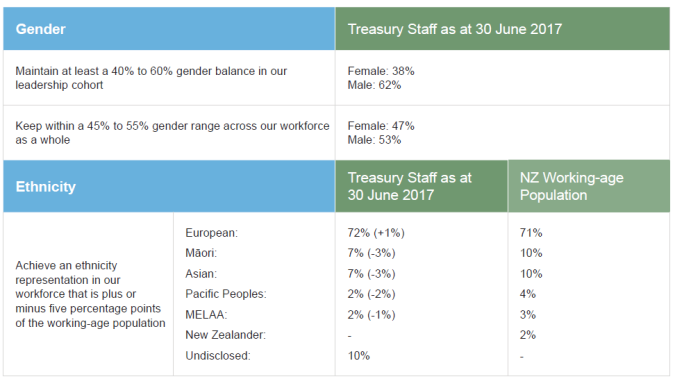
Consistent with all this, they run quasi-quotas.  They would probably object to the numbers being called quotas, but when you report your target near the front of your Annual Report, it must put a great deal of pressure on individual managers to hire to the quota, not to ability to do the job.

tsy quotas

Franly, citizens should be more worried about the proportions of people who are top-notch economic and policy analysts, not their skin colour or sex.

But not, apparently, at Treasury.  Here is Ng and Morrissey again

As the data above suggest, a clear issue is the lack of women in senior leadership positions, and part of the response includes obligations on managers to have regular career discussions with all staff on a regular basis and for succession planning to more systematically address possible sources of disadvantage for women. Within-grade gender pay gaps are regularly examined and the target of eliminating any such gaps explicitly included as a criterion in annual remuneration reviews. The parental leave and flexible working policies are regularly reviewed to check for gendered impacts.

But still with no attempt whatever to suggest how any of this has adversely affected Treasury’s policy advice.    Surely that should be the most important test?

It is also clear that The Treasury is dead-keen on the flawed concept of unconscious bias (here for some problems with the Australian public service experience), and the associated training/indoctrination.

Application of emerging insights from studies of unconscious bias have been quite influential in this work, and point to certain interventions and relatively simple changes in HR processes that may help to address some of these biases. For this paper, we took the opportunity to explore in some detail the Treasury’s recent use of a tool, Kat Matfield’s Gender Decoder, which provides an easy way of assessing the potentially different impacts on prospective male and female applicants of language used in job advertisements. The Treasury now has about two years of experience with using this tool as a way of reducing unintended gendered impacts on pools of job applicants

What of this tool?

The Gender Decoder is available on the web at http://gender-decoder.katmatfield.com/. This tool is based on the findings of Gaucher et al. (2011) which provide evidence that certain words in job ads appeal differently to each gender, which may be a channel to exacerbate existing gender imbalances by profession, especially in traditionally male-dominated occupations. The theoretical mechanism is essentially that words connoting individualism and agency (“leadership”, “ambitious”, “challenging”), or that reflect stereotyped male traits, tend to appeal more to male applicants, while words connoting communalism or that reflect stereotyped female traits appeal more to female applicants.

They attempt some analysis of Treasury’s experience with the tool  (emphasis added)

To look at gendered language in Treasury job ads in general and the possible impact of the use of this tool, we sampled 40 job ads posted by male and female hiring managers, 20 before and 20 after the introduction of the use of the tool in March 2016 as a recommended practice in Treasury recruitment.

Looking at the pre-2016 ads, it is notable that male and female hiring managers tended to code their ads towards their own gender, with male managers in particular tending to use strongly “masculine” language. Post 2016, male managers showed roughly balanced gender coding in their ads, while female managers showed a dominance of masculine-coded ads. The preponderance of strong gender coding increased after the introduction of the use of the tool, the opposite to what one would expect if the tool alerted managers to unintended or unnecessary gendered language in ads and if the managers wanted to attract gender-balanced pools of applicants (as they are encouraged to do by Treasury policy).

So those were “quotas” again, in that final sentence?  I’d hope Treasury managers, male and female, wanted the best pool of applicants, based on ability to do the job, not based on some institutional gender quota approach (that seems to disregard the fact –  demonstrated earlier in the paper –  that at least among economists, there will only be half as many women as men in the overall pool to atract applications from).

The authors reflect

Faced with this somewhat surprising result…..we looked at the nature of the jobs advertised themselves, and this exercise suggested to us some limits to the effect that scrubbing job ads of unintended gendered language can have on the gender split of applicants, including for economics jobs. The masculine-coded ads tended to be for jobs in the analytical functions of the Treasury, and “analysis” is coded as a masculine word by the Gender Decoder. Treasury also routinely presents itself as “ambitious” and a “leader” – another masculine-coded word – in the area of economic policy. The feminine-coded ads tended to be for “support” and corporate jobs, with an emphasis on “collaboration” – both feminine-coded words.

Dear, oh dear.  Treasury management has for some time been using an HR tool that treats “analysis” as some nasty male word.    Perhaps this paragraph should lead Ng and his senior management colleagues to rethink, and to wonder whether zeal and ideological presuppositions have not been not been outstripping evidence and analysis?

The Ng and Morrissey paper concludes this way

This paper has reviewed the position of women in economic theory, economics education and economics practice. We argued that the role of women and care work is insufficiently incorporated into mainstream economic models and approaches, and illustrated how a more gender-sensitive approach could enrich a particularly gender-blind sub-discipline – macroeconomics. We then documented the lack of a deep pipeline of women entering the profession, and the gender imbalance at senior levels in our own economic Ministry.

and

We conclude that the position of women in all three areas of economics is unsatisfactory. While the quality of management and decision making in general has been shown to benefit from diversity in general, in the delivery of quality economic policy advice that benefits all New Zealanders, it is particularly important that a diversity of perspectives is represented.

As a profession we have lots of work to do.

Eric Crampton has previously challenged  as “wishful thinking” (or worse) the Secretary to the Treasury’s repeated insistence on the substantive benefits from “diversity” (population diversity, rather than diversity of view).  Other recent New Zealand research has challenged that proposition too.

The Treasury seems to have become committed to the modish view that how one analyses an issue depends on where one comes from (at least race and sex, although presumably their logic applies to age, religion, birthplace, and all the other trendy identity markers).  As an institution, they now have a huge distance to go, lots of work to do, to restore a reputation for analytical excellence.  Between their institutional weaknesses and the lack of demand for excellence from our politicians, it is no wonder our serious economic problems aren’t seriously addressed.  Pursuing modish causes, no doubt ones in favour with the government of the day, is easier I guess.

The former Minister of Finance, Bill English, had many weak points in his political record.  Among them was his decision a few years ago to support the reappointment of Gabs Makhlouf as Secretary to the Treasury (when, within the law, he’d have been quite within his rights to have asked SSC to find someone who might actually restore the quality of Treasury we once had).    We are the poorer for that degradation of what was once a strong, robust, and analytically-driven institution.  Politicians make policy, and a good Treasury can’t force them to make good policy, but a poor Treasury gives them all the excuses they need to avoid tackling the real issues (while revelling in the feel-good content-lite nature of the coming Wellbeing Budget).

In the meantime, one has to wonder about the opportunity cost of the Ng/Morrissey paper.  Time spent writing it, is (taxpayers’) time that could have been used for tackling some real issues.


NZSF: engaging an alternative perspective

Andrew Coleman is one of New Zealand’s smartest economists, one of those people I learn something from almost every time I talk to him, or read something he has written.   Andrew currently divides his time between the University of Otago and the Productivity Commission.  But we disagree, it appears quite starkly, on the place of the New Zealand Superannuation Fund.  I’ve written various posts, mostly quite critical of the Fund for a variety of reasons (some things in NZSF’s own control, others a reflection of the political choices that led to the establishment of the NZSF).    I favour winding up the Fund and using the proceeds to repay debt.

In response to a couple of posts in recent months, Andrew has posted substantive and thoughtful comments that appear to be intended as a defence of the current system, and the place of NZSF in that system.   The first set was here and the second set was posted here on Saturday night.

As I understand it, Andrew and I share a view that there should be a universal public pension scheme, that is not less generous (relative to, say, average wages) than the current system.  Where, I think, there is a difference is that I firmly believe that the age of eligibility for NZS should be increased, and that subsequent further increases in the age of eligibility should be linked to further improvements in life expectancy (there should also be rather tighter residence requirements for eligibility) .    This makes a material difference because under my preferred model, NZS spending does not keep on increasing as a share of GDP, and is a manageable expense/burden for society. By contrast, Andrew often appears to be writing in a context that treats the current eligibility rules as a given, and thus focusing on how best to finance those (political) commitments.

Andrew puts a lot of emphasis on save-as-you-go (SAYGO) funding models, as distinct from pay-as-you-go (PAYGO) models.  A funded defined benefit pension scheme is a classic SAYGO model –  employees and the employer put aside money each week for, say, 40 years, and at retirement there is, in principle, enough to finance the employee’s pension for the rest of his or her life.  The power of compound interest has been harnessed.   In principle, at least in respect of the employer’s contribution, it could have been done another way: the firm could simply have invested the money itself (including reinvesting in its own operations) and then paid its share of the pensions as they fall due.  The reason that isn’t a good model is that (a) pensions of this sort are deferred remuneration and individual employees (reasonably enough) want a secure and certain claim, and (b) firms come and go, management changes, businesses fail etc.   A separate legal entity – a superannuation fund, with a trust deed etc – is the preferred way to go, but not because one approach involves saving and the other doesn’t, but because of agency/governance/enforcement issues.

How does the NZS/NZSF model fit in to this sort of picture?

First, as I noted in some earlier comments to Andrew

Our difference is around the specific place for the NZSF. Personally, I see any connection between it and NZS as just political branding. NZSF is just a set of govt-owned financial assets, and one can’t really put ribbons round particular pots of money.

NZSF does not make any future NZS promises more affordable,  If it manages reasonable returns –  as one might expect over time – it modestly improves the government’s overall financial position, and hence its ability to meet all future spending aspirations at something like current tax rates.

I’d prefer to think of managing the government’s balance sheet and income/expenditure, both now and across time, in an overall way, rather than assigning individual pots of money to individual line items.  That seems likely to be more efficient. It is also more realistic, about the nature of how government finances will end up being managed.  Governments can’t bind themselves to not use one pot of money labelled for purpose X for purpose Y if subsequent pressures change.  Probably, nor should they.  Wars happen, disasters happen, the uncertain happens.

Thus, Andrew argues the economic merits of savings, and I wouldn’t disagree with him particularly.  But in my proposal to wind up the NZSF and use the proceeeds to reduce debt, there is nothing that would reduce either public or private savings.  All that would happen is that the government balance sheet would be less leveraged (less debt, fewer financial assets, no change to the operating balance).  I’m also quite relaxed about the notion that if a government is going to take on far-future financial commitments (like an NZS) scheme, it should probably have a stronger balance sheet (more savings, less net debt) than a government that did none of those sort of things.   A balance sheet with near-zero net debt –  when, as Andrew notes, the government is very long-lived –  and extensive real asset holdings, in a country with above-average population growth, looks pretty cautious to me. Excluding a handful of countries with non-renewable natural resource extraction proceeds (Norway, Abu Dhabi etc), our government finances are among the most conservatively managed in the world.

So the issue isn’t one of whether the government should save or not, but simply of how much it should save.  I’m not sure of the answer to that question, but there are both political and economic dimensions to any answer.

Among those economic questions is whether, and if so to what extent, additional government savings (or even compelled private savings) actually raises national savings.   If there was full offset (every dollar of additional public savings was offset by an equivalent reduction in private savings) there would be no obvious societal benefit at all (in fact, given the deadweight costs of taxation – and intermediation costs – there would net welfare costs to society).    I see no evidence that, for example, the Australian compulsory savings system has raised national savings rates in Australia.  As for government savings itself, there seems to be plenty of sign of at least some private offset.

Among the political, or political economy, questions are ones about the durability of large tax-funded holdings of government financial assets in a democratic society.  It is one thing for governments to hold large asset pools in societies with little or no democratic accountability (Singapore, Abu Dhabi and so on) or even when the assets arise from a non-renewable natural resource (as in Norway).    It is another matter altogether when the assets are tax-funded, and governments face voters every few years, in a country no longer particularly well-off by advanced country standards.  Such accumulations of assets invite electoral auctions. They also invite political jockeying to see that the assets are used in line with the priorities and preferences of those currently in power (or, indeed, of those who happen to be managing the money).

There also arguments advanced that it would be natural for any portfolio to have some significant equity exposure to (for example) secure some of the equity risk premium for the Crown.  Against some abstract benchmark in which the government was otherwise funded by lump sum taxes on the one hand, and simply paid NZS on the other, I would agree.  But that isn’t what government finances (here or abroad) look like.  Through the income tax system, the government already has an effective equity stake in every business enterprise in the country (28 per cent of all profits go to the Crown, 28 per cent of losses can usually be written off against future earnings).  And the Crown has an extensive base of real assets (equity exposures) –  whether shares in SOEs or the extensive holdings of schools, hospital, roads etc (which don’t produce a dividend stream, but save the Crown paying user fees which would include someone else’s dividend stream).

Perhaps there is a case for more Crown equity exposures, but that case really needs to be made convincingly against the backdrop of the overall public finances, not just thought of relative to future expected NZS payments.   It should also be thought about in the context of citizens’ own “risk budgets”: increased equity exposures taken on by Crown agencies should, rationally, be offset at least in part by reduced private holdings.

In his writings in this area, Andrew Coleman puts quite a lot of emphasis on government (and, by extension, NZSF) as a long-lived agent, better placed to invest in long-term assets than the private sector, and less prone to liquidity pressures.   I think he is mostly wrong about that, for a variety of reasons.  From an anecdotal perspective, NZSF seems to have had more asset allocation changes in the last decade or so than the modest superannuation scheme I’m a trustee of.    But, and much more importantly, the government (at least in a democracy) doesn’t stand remote from its citizens and taxpayers, and taxpayers/voters don’t like large losses, and (I’d argue) especially not when their personal finances are already under greater than usual stress.   NZSF will record large losses in the next serious global recession –  the more so, as NZSF hedges back to NZD –  and that recession is also likely to put stress on the New Zealand government’s operating balances.     There is likely to be heightened pressure on the government, and on those managing the Fund, to account for their losses, and perhaps to cut those losses.  It might be silly, wrong, or in some longer-term sense irrational, but no investment strategy should ever be operated without considering the extreme loss tolerances of the ultimate investor (in this case, not some detached Treasury official, but voters).   I’m sceptical that the public is comfortable with the potential for tens of billions of annual mark to market losses (the scale we could be looking at if NZSF gets much bigger), coming at a time when (say) taxes are being raised or public spending is being cut.  In other words, even if an NZSF strategy offered possible longer-term benefits, it would do so only at the cost of concentrating periods of pain.

Another aspect of Andrew’s argument is an assumption (implicit, and sometimes explicit) that governments can be trusted, and will typically be good economic stewards.  It is far from clear why we should expect them to be so, especially when entrusted with other people’s money.  Each citizen has a strong interest in their own future financial position, and (one hopes) that of their children and grandchildren.   As individuals, politicians no doubt have the same interest.  But let lose on a whole country, politicians have interests which are rather different –  often as focused on the next election as anything longer –  and with little accountability (beyond losing office) if things go wrong.  These same governments that Andrew wants us to entrust more of our money to are the same sorts of governments that did Think Big, that turned our economy inwards for decades from the 1930s, that take us into wars, that ran us into serious debt problems (whether in 1939 or 1990), and so on.  They are same group who cavalierly talk of pursuing net zero carbon targets, even if the consequence is that (on their own numbers) GDP is cut by 10 to 22 per cent, with the costs falling disproportionately on the poor).   I’m not some anarchist who wants to get rid of all government, but I don’t think the track record is particularly good, especially when governments want to commit our money/resources for the long-term.

And all this is before we look at the specifics of the way NZSF has actually been run:

  • overselling its investment returns in a rising market, while quietly noting that it takes 20 years of data to seriously evaluate their sort of risky strategies (which may do no real direct harm, but speaks to integrity),
  • used (together with ACC) to solve the previous government’s Kiwibank capital issues, in ways that inject no additional expertise to Kiwibank, while corroding effective accountability for this risky government-owned assets (no doubt at favourable pricing for NZSF, but at cost to the system),
  • the decision to reduce carbon exposures, purportedly as a normal risk-return call on business prospects, but nonetheless implemented in a way where the consequences can’t be monitored, and thus looked more like virtue-signalling and playing politics than a serious neutral investment stance,
  • the opportunistic bid to own part of all of the new light rail proposals. NZSF has little or no apparent experience in such assets, which themselves appear uneconomic, and thus the approach again smacks of politics and lobbying, more than pursuit of citizens’ longer-term interest.
  • the latest attempt to lobby for huge tax concessions (adding new distortions to the system) for projects (and project partners) they want to get involved in.

These problems will only get more serious if the Fund is allowed to grow larger. One experience which shook my confidence was involvement a decade ago in the then-government’s Jobs Summit, which occurred at the trough of the last recession.  The NZSF fund was small then, and the pressures were resisted, but it was likes bees round a honey pot as people (well-motivated and not) emerged with ideas of how the moneypot could be used to help.  Those pressures will return next time.

And all that is before the ethical investment question.    We all have exposures to all industries (legal, moral or not) through the tax system, but NZSF involves active choices to put our money in individual companies. You might not be comfortable with whaling companies, tobacco companies, arms companies, or even financial institutions like AMP. I’m not comfortable with exposures to hospital chains that do abortions, or conglomerates that produce pornography, and I’m not keen on funding McDonalds either. My point isn’t that my preferences are better than yours or vice versa, but investment is participation, it is support, and those investment choices are neither a natural nor necessary part of a New Zealand government.  (Neither is a large leveraged investment fund.)

In many respects, the governance provisions of the NZSF aren’t badly set up, if one is going to have a body of this sort.  But rules of that sort can only take one so far.  All Board members will have their own futures in mind –  and governments have lots of apppointments in their gift.  The same goes for the CEO.    And, of course, so many people now have business dealings with NZSF, including competing for investment mandates, that it is hard to ensure that ongoing robust scrutiny an asset of that size deserves.

As I’ve noted previously, one way to reduce some of the risks around NZSF would be to amend the legislation to prohibit the NZSF dealing with New Zealand or local governments (to buy or sell assets, or to invest in proposals floated by government agencies) –  or perhaps even just to restrict exposures to, say, 5 per cent of any project/deal.    It would restrict NZSF’s opportunities, but it would also restrict the scope for logrolling, sweetheart deals, and all the sort of stuff that simply shouldn’t happen in the idealised world some supporters envisage for NZSF.

Finally, in his most recent comments, Andrew posed this point

So here’s a question, in the interest of debate: Do you have similar issues with the ACC fund? And if not, what is different about the ACC fund that makes it better than the NZSF fund?

Actually, a few months ago I noted that I thought it was worth putting ACC onto a PAYGO basis –  and to the extent there are very long-term commitments on the Crown balance sheet, that should influence the overall structure of the Crown finances, including the extent to which the Crown saves (rather than have an individual ACC moneypot).  As it happens, the ACC investment performance has been better than that of NZSF.   But my views on ACC are influenced more by my long-term doubts about the merits, or the fairness, of treating all accident victims differently from those with very long-term illnesses or disabilities.

In conclusion, I think there two quite separate issues to evaluate, and we don’t help either conversation by conflating them (as the previous Labour government attempted to when it set up NZSF).  There is the question of what an appropriate NZS policy should be.  But then there are the, largely separable questions of:

  • what the appropriate overall shape of the government balance sheet, and income statement should look like, and
  • what, if any, role a standalone leveraged global investment fund has to play in such a balance sheet.

Answering either question needs to range widely, and consider likely private sector responses to public sector choices, governance constraints, and the long track record of ambitious government interventions here and abroad.


Treasury advice on rushing the Reserve Bank bill

From a Treasury paper to the Minister of Finance, written in March and pro-actively released yesterday (emphasis added)

Legislative Timeline
14. Officials’ recommended timeline, set out in Annex 2, would see drafting instructions issued in tranches from the end of April, and Cabinet approval of draft legislation by the end of August. Consistent with previous decisions, the recommended process does not allow for public consultation on an exposure draft of the legislation prior to the Bill being referred to select committee. You should note that this timeline is indicative only, and will depend on how quickly decisions are made, securing time in the House and the length of the select committee process.

15. Officials’ proposed timeline will allow the first reading of the Bill when Parliament resumes in the first week of September. Assuming the normal six month select committee process, this would enable Royal Assent by the end of April 2019.

16. The bid for space on the legislative agenda suggested the legislation would be passed this year. However, we do not recommend passing the legislation in 2018. Doing so would require shortening either the policy and drafting process, the select committee process or both. Reducing the time for either of these processes risks compromising the quality of the final legislation, and will make it harder to build public support for the reforms. A substantive select committee process that builds public support is particularly important given that the changes are to one of New Zealand’s major economic frameworks and that only limited public consultation was conducted during the policy development process.

17. If you want to pass legislation in 2018 and run a full select committee process, the policy and drafting process would need to be completed by early June. While this is not impossible, it would greatly increase the risks around introducing legislation. Risks could include introducing legislation with provisions with unintended consequences or new processes that are unworkable. This would make significant amendments likely during the select committee and the committee of the whole House stages.

Since the bill introduced this week has to be reported back from select committee by 3 December, it seems likely the government wishes to pass the bill this year, contrary to Treasury’s fairly-trenchantly worded advice.

I’m a little torn.  I’m keen to see a statutory committee in place, and I don’t usually put much store in Treasury’s economic analysis (and see Eric Crampton on the limited number of economists they are recruiting), but they should know something about policy development and legislative processes.  And they clearly think this legislation is being rushed, in an unnecessary, inappropriate, and risky way.

Consumption, investment and wages (inflation) in New Zealand

After writing yesterday’s post, I noticed another somewhat-confused article on the “low wage” question.  The author of that piece seemed to want to look at after-tax wages, without then looking at the services those taxes might deliver.   Taxes are (much) higher in France or Denmark, but so is the range of government services.

One way of looking at the material standard of living question is to look at per capita consumption, again converted using PPP exchange rates.   Just looking at private consumption –  the things you and I purchase directly –  will also skew comparisons.    Take two hypothetical countries with the same real GDP per capita.  One has much lower taxes than the other, but health and education in that country are totally private responsibilities,  whereas in the higher tax country many of those services are delivered by the government, largely free to the user at the point of use.    Private consumption in the low-tax country will be much higher than in the high-tax country, but the overall actual consumption of goods and services may not be much different  (depending on incentive effects etc, a topic for another day).

For cross-country comparisons, the way to handle these differences is to use estimate of actual individual consumption: private consumption plus the bits of government consumption spending consumed directly by households (eg health and education).  Separate again is “collective consumption” –  things like defence spending, or the cost of central government policy advice, which have no direct or immediate consumption benefit to households.

Here is the data for the OECD countries for 2016, where the average across the whole of the OECD is 100.

AIC 2016

New Zealand does a little less badly on this measure than on the various income or productivity measures.  That is consistent with the fact that our savings rates tend to be lower than those in many other OECD countries and (relative to productivity measures) to high average working hours per capita.  On this measure in all the former communist countries now in the OECD the average person still consumes much less than the average New Zealander does.  Unlike many advanced economies, we have consistently run current account deficits.   Large current account surpluses –  Netherlands for example has surpluses of around 10 per cent of GDP –  open up the possibility of rather higher future consumption.

Having dug into the data this far, I decided to have a look at investment spending per capita.  I mostly focus on investment as a share of GDP, and have repeatedly highlighted here the OECD comparisons that show business investment as a share of GDP has been relatively low in New Zealand for decades, even though we’ve had relatively rapid population growth (and thus, all else equal, needed more investment just to maintain the existing capital stock per worker).   Here is the OECD data, for total gross fixed capital formation (“investment” in national accounts terms) and ex-housing (where there are a few gaps in the data).

investment ppp

You can probably ignore the numbers for Ireland (distorted by various international tax issues) and Luxembourg (lots of investment supports workers who commute from neighbouring countries).  But however you look at it, New Zealand shows up in the middle of the pack.  That mightn’t look too bad –  and, actually, was a bit higher than I expected to find – but when considering investment one always needs to take account of population growth rates.      Average investment spending per capita might be similar to that in France, Finland, or Germany, but over the most recent five years, the populations of those countries increased by around 2 per cent, while New Zealand’s population increased by 9 per cent.  Just to keep up, all else equal, we’d have needed much more investment spending (average per capita) than in those other countries.

Over the most recent five years, only two OECD countries had faster rates of population growth than New Zealand.  One was Luxembourg –  where, as far as we can tell, things look fine (lots of investment, lots of consumption, high wages, high productivity) –  and the other was Israel.  In Israel, average investment spending (total or ex-housing) was even lower than in New Zealand.  And as I highlighted in a post a few months ago, Israel’s productivity record has been strikingly poor.

But how has Israel done by comparison?  This chart just shows the ratio of real GDP per hour worked for New Zealand and Israel relative to that of the United States (as a representative high productivity OECD economy), starting from 1981 because that is when the Israel data starts.

israel nz comparison

We’ve done badly, and they’ve done even worse.

If productivity growth is the basis for sustained growth in material living standards –  and employee compensation –  how have wages been doing recently in New Zealand?

One way of looking at the question is to compare the growth in GDP per hour worked with the growth in wages.  If we look at nominal GDP per hour worked, we capture terms of trade effects (which can boost living standards without real productivity gains) and avoid the need to choose a deflator.  From the wages side, I still like to use the SNZ analytical unadjusted labour cost index series.  Perhaps there are serious flaws in it –  if so, SNZ should tell us – but, on paper, it looks like the best wage rates series we have.

Here is the resulting chart, with everything indexed to 1 in 1998q3, when the private sector LCI analytical unadjusted series begins.

NGDP and wages

When the series is rising, wages (as measured by this series) have risen faster than the average hourly value of what is produced in New Zealand.  A chart like this says nothing about the absolute level of wages (or indeed of GDP per hour worked), but it does suggests that over the last 15 years or so, wage rates in New Zealand have been rising faster than the value of what is produced in New Zealand.  That is broadly consistent with the rebound in the labour share of total GDP over that period.  There is some noise in the data, so not much should be made of any specific shorter-term comparisons, but even over the last five years –  when there has been so much public angst about wages – it looks as though wage inflation has outstripped hourly growth in nominal GDP (even amid a strong terms of trade).    All of which is consistent with my story of a persistently (and, so I argue, unsustainably) out-of-line real exchange rate, notably over the last 15 years or so.

New Zealand is a low wage, low productivty (advanced) country.  We don’t seem to do quite as badly when it comes to consumption, but investment remains quite low (relative to the needs of rapidly growing population) and wage earners have been seeing their earnings increase faster than the (pretty poor) growth in GDP per hour worked.  None of that is a good basis for optimism about future economic prospects, unless politicians and officials finally embrace an alternative approach, under which we might see faster (per capita) capital stock growth and stronger productivity growth, in turn laying the foundations for sustainably higher earnings (and higher consumption).  Most likely, a key component of any such approach would involve finally abandoning the “big(ger) New Zealand” mythology that has (mis)guided our leaders –  and misled our people – for decades.

A low wage, low productivity (advanced) economy

There was an article on Stuff the other day from Kirk Hope, head of Business New Zealand, suggesting (in the headline no less) that “the idea [New Zealand] is a ‘low-wage economy’ is a myth”.   I didn’t even bother opening the article, so little credence have I come to give to almost anything published under Hope’s name (when there is merit is his argument, the case is almost invariably over-egged or reliant on questionable numbers).   But a few people asked about it, including a resident young economics student, so I finally decided to take a look.

Hope attempts to build his argument on OECD wages data.   I guess it is a reasonable place to try to start, but he doesn’t really appear to understand the data, or their limitations, including that (as the notes to the OECD tables explicitly state) the New Zealand numbers are calculated differently than those of most other countries in the tables.

The reported data are estimated full-time equivalent average annual wages, calculated thus:

This dataset contains data on average annual wages per full-time and full-year equivalent employee in the total economy.  Average annual wages per full-time equivalent dependent employee are obtained by dividing the national-accounts-based total wage bill by the average number of employees in the total economy, which is then multiplied by the ratio of average usual weekly hours per full-time employee to average usually weekly hours for all employees.

That seems fine as far as it goes, subject to the limitation that in a country where people work longer hours then, all else equal, average annual wages will be higher.  Personally, I’d have preferred a comparison of average hourly wage rates (which must be possible to calculate from the source data mentioned here) but the OECD don’t report that series  (and I don’t really expect Hope or his staff to have derived it themselves).   Although New Zealand has, by OECD standards, high hours worked per capita, we don’t have unusually high hours worked per employee (the reconciliation being that our participation rate is higher than average) so this particular point probably doesn’t materially affect cross-country comparisons.

The OECD reports the estimated average annual wages data in various forms.   National currency data obviously isn’t any use for cross-country comparisons, so the focus here (and in Hope’s article) is on the data converted into USD, for which there are two series.  The first is simply converted at market exchange rates, while the second is converted at estimated purchasing power parity (PPP) exchange rates.   Use of PPP exchange rates –  with all their inevitable imprecisions –  is the standard approach to doing cross-country comparisons.

Decades ago people realised that simply doing conversions at market exchange rates could be quite misleading.   One reason is that market exchange rate fluctuate quite a lot, and when a country’s exchange rate is high, any value expressed in the currency of that country when converted into (say) USD will also appear high.  Take wages for example: a 20 per cent increase in the exchange rate will result in a 20 per cent increase in the USD value of New Zealand wages, but New Zealanders won’t be anything like that amount better off.  The same goes for, say, GDP comparisons.   That is why analysts typically focus on comparisons done using PPP exchange rates.

But not Mr Hope.   Using the simple market exchange rate comparisons, he argues

OECD analysis however shows that NZ is not a low-wage economy. We sit in 16th place out of 35 countries in terms of average wages.

(Actually, I count 14th.  And recall that it isn’t many decades since we were in the top 2 or 3 of these sort of league tables.)

But he does then turn to the PPP measures, without really appearing to understand PPP measures.

But the OECD analysis also shows that among those countries our relative Purchasing Power Parity (PPP), a measure of how much of a given item can be purchased by each country’s average wage, is lower.

New Zealand is included among a group of countries – Australia, Denmark, Iceland, Norway, Sweden, Switzerland and the UK – where wages don’t buy as much as they could.

That’s right: Australia – where the grass has always been deemed to be greener, and Switzerland – which has long been lauded for its quality of life.

There are several possible explanations for wages in this group being higher than their PPP.

The Nordic countries have high tax rates, which support their social infrastructure but dilute their spending power.

We have lower tax rates – but the costs of housing, as an obvious example, are a lot higher in PPP terms than in other countries.

In PPP terms, the estimated average annual wages of New Zealand workers, on these OECD numbers, was 19th out of 35 countries.   The OECD has expanded its membership a lot in recent decades –  to bring in various emerging economies, especially in eastern Europe (the former communist ones).  But of the western European and North American OECD economies (the bit of the OECD we used to mainly compare ourselves against), only Spain, Italy, and (perpetual laggard) Portugal score lower than New Zealand.  On this measure.

But to revert to Hope’s analysis, he appears to think there is something wrong or anomalous about wages in PPP terms being lower than those in market exchange rate terms.  But that simply isn’t so.  In fact, it is what one expects for very high income and very productive countries, even when market exchange rates aren’t out of line.   In highly productive economies, the costs of non-tradables tend to be high, and in very poor countries those costs tend to be low (barbers in Suva earn a lot less than those in Zurich, but do much the same job).     Poor countries tend to have PPP measures of GDP or wages above those calculated at market exchange rates, and rich countries tend to have the reverse.  It isn’t a commentary on policy, just a reflection of the underlying economics.

Tax rates and structures of social spending also have nothing to do with these sorts of comparisons.  They might be relevant to comparisons across countries of disposable incomes, or even of consumption, but that isn’t what Hope is setting out to compare.

But he is right –  inadvertently –  to highlight the anomaly that in New Zealand, PPP measures are below those calculated on market exchange rates.  That seems to be a reflection of two things: first, a persistently overvalued real exchange rate (a long-running theme of this blog), and second, the sense that New Zealand is a pretty high cost economy, perhaps (as some have argued) because of the limited amount of competition in many services sectors.

But there is a more serious problem with Hope’s comparisons, one that presumably he didn’t notice when he had the numbers done.   I spotted this note on the OECD table.

Recommended uses and limitations
Real compensation per employee (instead of real wages) are considered for Chile, Iceland, Mexico and New Zealand.

Wages and compensation can be two quite different things.   If so, the comparisons across most OECD countries won’t be a problem, but any that involve comparing Chile, Iceland, Mexico or New Zealand with any of the other OECD countries could be quite severely impaired.   In many respects, using total compensation of employees seems a better basis for comparisons that whatever is labelled as “wages” –  since, for example, tax structures and other legislative mandates affect the prevalence of fringe benefits – but it isn’t very meaningful to compare wages in one country with total compensation in another.

Does the difference matter?  Well, I went to the OECD database and downloaded the data for total compensation of employees and total wages and salaries.  In the median OECD country for which there is data for both series, compensation is about 22 per cent higher than wages and salaries.     I’m not 100 per cent sure how the respective series are calculated, but those numbers didn’t really surprise me.   Almost inevitably, total compensation has to be equal to or greater than wages.   (There is an anomaly however in respect of the New Zealand numbers.  Of those countries where compensation is used, New Zealand is the only one for which the OECD also reports wages and salaries.  The data say that wages and salaries are higher than compensation –  an apparently nonsensical results, which is presumably why the OECD chose to use the compensation numbers.)

So what do the numbers look like if we actually do an apples for apples comparison, using total compensation of employees data for each country.  Here I’ve approximated this by scaling up the numbers for the countries where the OECD used wages data by the ratio of total compensation to total wages in each country (rather than doing the source calculations directly).

compensation per employee

On this measure, New Zealand comes 24th in the OECD, with the usual bunch behind us – perpetual failures like Portugal and Mexico on the one hand, and the rapidly emerging former communist countries on the other.  On this estimate (imprecise) Slovenia is now very slightly above New Zealand.  By advanced country standards, we are now a low wage (low total employee compensation) country.

But it is about what one would expect given New Zealand low ranking productivity performance.   Here is a chart showing the relationship between the derived annual compensation per (FTE) employee (as per the previous chart) and OECD data on real GDP per hour worked for 2016 (the most recent year for which there is complete data).  Both are expressed in USD by PPP terms.

compensation and productivity

Frankly, it is a bit closer relationship than I expected (especially given that one variable is an annual measure and one an hourly measure).  There are a few outliers to the right of the chart: Ireland (where the corporate tax rules resulted in an inflated real GDP), Luxembourg, and Norway (where the decision by the state to directly save much of the proceeds from the oil wealth probably means wages are lower than they otherwise would be).    For those with sharp eyesight, I’ve marked the New Zealand observation in red: we don’t appear to be an outlier on this measure at all.  Employee compensation appears to be about what one would expect given our dire long-term productivity performance.

And that appears to be the point on which –  unusually –  Kirk Hope and I are at one.  He ends his article this way

We need to first do the hard yards on improving productivity, and then push for sustainable growth in wages.

If we don’t fix the decades-long productivity failure, we can’t expect to systematically be earning more.  Sadly, there is no sign that either the government or the National Party has any serious intention of fixing that failure, or any ideas as to how it might be done.

Incidentally, this sort of analysis –  suggesting that employee compensation in New Zealand is about where one might expect given overall economywide productivity –  also runs directly counter to the curious argument advanced in Matthew Hooton’s Herald column the other day, in which he argued that wages were being materially held down by the presence of Working for Families.   In addition, of course, were Hooton’s argument true then (all else equal) we’d should expect to see childless people and those without dependent children dropping out of the labour force (discouraged by the dismal returns to work available to those not getting the WFF top-up).   And yet, for example, labour force participation rates of the elderly in New Zealand –  very few of whom will be receiving WFF –  are among the highest in the OECD and have been rising.

And, of course, none of this is a comment on the merits, or otherwise, of any particular wage claim.

When economists all agree

There was a new survey out last week from the European IGM panel of economics experts, about the recent proposal from the UK Labour Party to give the Bank of England an economywide productivity objective.  These were the results:

IGM productivity

Not a single economist in the panel seemed to think this was a good idea. Not one thought that central banks can make any material difference to productivity growth, except by promoting or maintaining macroeconomic stability.  Note that the question wasn’t just about monetary policy, and the Labour Party policy talks of the use of regulatory tools as well.

I share the view of the panellists, but it is interesting to see the answers coming through so strongly when the Bank of England itself (notably the chief economist Andy Haldane) has at times been quite vocal in arguing (drawing from this speech) that the costs of financial crises are large, and are either permanent or semi-permanent.    I’ve long been rather sceptical of that proposition (some arguments developed at the first link in the previous sentence).   Whether the respondents to the IGM survey connected the two stories I don’t know –  many would probably just have been running the conventional macro story that monetary policy is more or less neutral in the longer-run –  but the results are a useful reminder of just how limited monetary policy and banking regulation are in doing good, once one gets beyond the relatively short-term (perhaps three to five years).

It being school holidays, I’m taking a break and will resume late next week.   There are many things I haven’t got round to writing about so far this year, and I hope to put some of them high on the priority list in the coming weeks, including taxation.  For example, there are the officials’ papers for the Tax Working Group, in which it is recommended that rates of taxation on business incomes should not be lowered.    With such weak long-term rates of business investment, and low rates of productivity growth, you might have thought this was an obvious place to look.  But not, apparently, to the Treasury and IRD officials.  The bacillus of Treasury’s wellbeing approach has reached even into these background papers: lower rates of business taxation would, it is asserted, damage “social capital”.


Productivity: still doing poorly

I had been planning to write today about some of the recent Reserve Bank material on electronic currency.  I even took the papers away with me yesterday to read on some flights, but in the course of that reading  –  coincidentally, en route to another funeral – I discovered that a former Reserve Bank colleague, only a year or two older than me, had died a couple of months ago.    We hadn’t been close, but I’d known him off and on for 35 years beginning with an honours course at VUW in 1983, and when I’d last seen him six months or so ago he’d been confident the cancer was beaten.   What left me a bit sick at heart was that I had commented here last month, moderately critically, on a recent Reserve Bank Bulletin article of which he had been a co-author.   None of the comments were, as I reread them, personal.  But I’d have written differently had I known.  So I’m going to put aside issues around the Reserve Bank for a few weeks (and the blog is taking a holiday next week anyway).

So instead, having listened to a few upbeat stories in the last few days, including the IMF mission chief for New Zealand on Radio New Zealand this morning, talking about the “sweet spot” the New Zealand economy was in etc, I thought it was time to update some productivity charts.

Here is real GDP per hour worked for New Zealand.

real GDP phw jul 18

I’ve marked the average for the last year, and for the 12 months five years’ previously.  If anything, things have been going backwards a bit for the last three years, and for the last five or sx years taken together, productivity growth has averaged no better than 0.3 per cent per annum.  Some “sweet spot”, especially when our starting position relative to other advanced economies was already so far behind.

And here is the comparison with Australia –  in many respects the OECD economy with most in common with New Zealand (distance, resource dependence, Anglo institutions), and also the exit option for New Zealanders.

real GDP nz and aus jul 18

In 1989, when this chart starts, New Zealand was already behind Australia.   Since then, we’ve lost another 15 percentage points of ground, about 0.5 per cent per annum.  A decade ago perhaps one could have mounted an argument that the decline had come to an end: looked at in the right light, perhaps we were even showing signs of some modest closing of the gap.  But then we took another step down, and the rate of decline in the last decade as a whole has been about the same as that for the full period since 1989.

For almost a decade now, I’ve been sobered by the performance of the former eastern-bloc countries that are now part of the OECD.  Thirty years ago, when we –  already a market economy –  were in the throes of reform, they were just beginning the journey to freedom (Estonia and Latvia were still actually, involuntarily, part of the Soviet Union).   Their starting point was, of course, a great deal worse than ours –  for all the early 80s talk of New Zealand having an economy akin to a Polish shipyyard –  but the common economic goal was catching-up, reversing decades of relative decline.

In the decades since, New Zealand has lost ground relative to the richer countries of the OECD (and, as per the chart above, has lost a lot of ground relative to Australia, even more recently).  The former eastern-bloc countries have done a great deal of catching up.  They still have a long way to go to catch that group of highly productive northern European economies (Belgium, Netherlands, France, Germany, Denmark), but New Zealand is on track to be overtaken: on OECD numbers Slovakia now has real GDP per hour worked higher than that in NEw Zealand.

There are seven former eastern-bloc countries in the OECD.  The OECD is filling in 2017 data only slowly, and so in this chart I’ve shown real GDP per hour worked for New Zealand relative to the median of the six former eastern-bloc countries for which there is 2017 data (the country for which they don’t yet have 2017 data is Poland, which managed 7 per cent productivity growth in the four years to 2016, a period when New Zealand –  on the measure the OECD uses –  had none).

eastern bloc

Some of these former eastern-bloc countries had a very rocky ride (notably Estonia and Latvia, which ran currency board arrangements in the 00s, and had massive credit booms, and then busts), but the trend is still one way.  They are catching up with us, and we aren’t catching up with the sort of countries we aspire to match.

The pace of decline (New Zealand relative to these former eastern-bloc countries) has slowed, as you would expect (in 1995 it was still quite early days for post-communist adjustment) but the scale of the chart shouldn’t lead us to minimise the recent underperformance.   In 2007, we had an economy that was 20 per cent more productive than the median former eastern bloc OECD member, and last year that margin was only 12 per cent.

The measure of success in this economy shouldn’t be whether we stay richer and more productive than Slovenia or the Czech Republic.  All of us are a long way off the pace, far from the overall productivity frontier (best outcomes).    But what these former eastern bloc countries help highlight is that convergence can and does happen, if you have the right policies and institutions for your country (in all its relevant particulars).  Policymakers here used to genuinely believe that. It is no longer clear that they – or their Treasury advisers –  any longer do.

On which note, Paul Conway of the Productivity Commission recently published an interesting article in an international productivity journal on New Zealand’s productivity situation and policy options.  Commission staff were kind enough to send me a link.  Paul Conway has a slightly more optimistic take on the last decade or so than I do, but common ground is in recognising the total failure to achieve any catch-up or convergence.  There is a lot in Paul’s article –  which, not surprisingly, is not inconsistent with his earlier “narrative” on such issues that he wrote for the Commission itself, and which I wrote about here.   I will come back later and write about Paul’s analysis and prescription –  there is a lot there, some of which I agree with strongly, and some of which I’m much more sceptical of.  For my money, he materially underweights the importance of a misaligned real exchange rate as a key symptom, which has skewed incentives all across the economy.     But it is good to see public service analysts contributing substantively to the (rather limited) debate on these issues.