Apocalypse Cow

That was the title of Wellington economist Peter Fraser’s talk at Victoria University last Friday lunchtime on why Fonterra has failed (it is apparently also a term in use in various bits of popular culture, all of which had passed me by until a few moments ago –  and a Google search).    Peter is a former public servant –  we did some work together, the last time Fonterra risks were in focus, a decade ago –  who now operates as a consultant to various participants in the dairy industry (not Fonterra).   He has a great stock of one-liners, and listening to him reminds me of listening to Gareth Morgan when, whatever value one got from purchasing his firm’s economic forecasts, the bonus was the entertainment value of his presentation.       The style perhaps won’t appeal to everyone, but the substance of his talk poses some very serious questions and challenges.

The bulk of Peter’s diagnosis has already appeared in the mainstream media, in a substantial Herald  op-ed a few weeks ago and then in a Stuff article yesterday.  And Peter was kind enough to send me a copy of his presentation, with permission to quote from it.

His starting point is with the misplaced belief among senior political figures 20 years ago that by allowing the creation of Fonterra –  using legislation to override the Commerce Commission – the door would be opened to the evolution –  in pretty short order –  of something equivalent to New Zealand’s Nokia.  In revenue terms, the promise had been

From a starting point of only $5B, they outlined a six-fold increase in revenues in only 10 years to $30B.

Critically, just under two-thirds of the $30B would come from what is euphemistically known as ‘value add’: specialised ingredients and biotech-heavy products.

So this was almost $20B of revenue from a starting point of ‘nothing’.

Actual revenue now, 17/18 years on, is about $20 billion (including a structural improvement in world dairy prices) and relatively little is from those vaunted specialised products.   The rate of return on that business, in turn, is barely higher than that on the bulk commodity business.

And

A much cited figure is the 2018 value report published by the International Farm Comparison Network (IFCN). This ranked Fonterra 17th out of the 20 companies in terms of value creation.

Its figures show while Fonterra collects the second largest amount of milk (and is the world’s largest milk exporter), its estimated turnover per kg of milk solids is only US60c.

By comparison, Danone is the 11th largest milk processor, but it turns over US$2.40 for every kg to make it the best performer. Nestlé is next at US$1.90 per kg. The average across the entire group is $1.00.

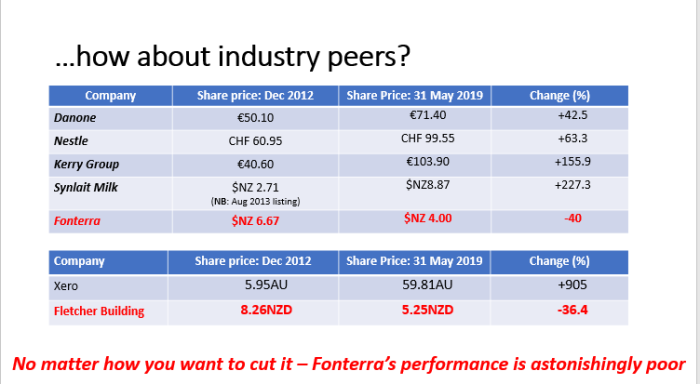
The “failure” is nicely illustrated in the share price (the non-voting shares were listed in 2012).   The comparison against the NZX index is stark, as is that against industry peers.
fraser 1

Apparently the share price fell further in June (and Peter told us that on Thursday the share price closed a touch below the initial valuation back in 2002).

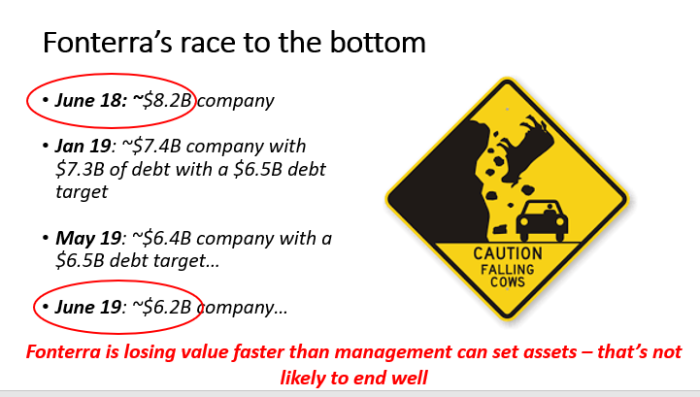
Fonterra asset sales have been in focus this year.  They started when the market value of the company was much higher than it now is, and haven’t kept up, so that the ratio of market value to debt is now higher than it was.
fraser 2

For various reasons I don’t want to get into the fine details of DIRA, but as I understand the essence of Peter’s story is that:

  • farmers themselves never much cared about the added-value ideas (New Zealand’s Nokia and other dreams).  Why would they?  They are farmers, and their interests were primarily about a high price for their milk, and a high/rising price for their land.
  • between provisions in the legislation and in the constitution of Fonterra, the rules mean Fonterra has been paying materially too much (Peter says 50c per kg)  for milk purchased from suppliers,
  • dividends on the shares have been limited,  which doesn’t matter to (voting) farmer shareholders, but does matter to the outside shareholders, and retentions (or retaining earnings) –  now the main source of additional capital in a cooperative –  have also been low.
  • given Fonterra’s dominant market position, the too-high milk price also drives up the price of milk other industry participants have to pay.   That has encouraged more milk production – including “half way up Mt Cook”, and with associated environmental issues –  but also makes it difficult for firms to make profitable investments in other (value-added) products.

Peter again

…the idea of using the ingredients business as a springboard to a value creation business was part of the original concept and is actually a good one.

The problem is, it basically didn’t happen.  There are two reasons for this.

Firstly, Fonterra relies heavily on payout subordination so has very high gearing – something it seems the Board has failed to learn from after courting near disaster during the GFC.

This constrains Fonterra’s ability to borrow further, such as for acquisitions or to finance value creation activities.

The other problem is woeful levels of retentions, which are critical for a coop because without new capital from a growing milk supply, retentions are only other way of getting new capital.

So Fonterra remained a capital starved, deeply indebted and under performing farmer-owned cooperative.

That “near-disaster” ten years ago (his account here) was when I first met Peter.  Global funding markets was seizing up, world dairy prices had fallen sharply, land prices were falling, and lenders to dairy farmers were becoming seriously uneasy (including parents in Australia that hadn’t fully appreciated quite how much exposure, to a sector with very illiquid collateral, had been taken on).   In those days, struggling farmers had one buffer and Fonterra one exposure, that doesn’t exist today –  redemption risk (on the farmers’ own production-related shares in the co-op).

That particular risk has now been shifted back onto farmers, which probably leaves Fonterra’s own lenders a bit more comfortable (but in turn removed one discipline from the Board).  But there is still a hugely high level of debt (presumably largely from international markets and banks).

Peter argues that, unless something dramatic changes pretty soon, Fonterra is likely to run into crisis within the next five years or so (and, he argues, since the current government probably likes to believe it will still be in office five years hence, they really need to focus on this now).

I was among those at the presentation the other day who weren’t entirely sure how this mooted crisis would come about, or what form it might take.   After all, Fonterra isn’t a conventional company.  The traded shares –  the price of which has been falling away –  are not a direct stake in Fonterra.  The share price could go to zero (if, say, unit holders lost confidence there would ever be dividends, tied to value-added returns) without rendering the co-op itself insolvent.    The banks and bond markets that have lent to Fonterra are exceedingly unlikely to lose their money –  that is what (milk) payout subordination means –  but it is likely that quite a few of the existing facilities have caveats and covenants about financial conditions Fonterra has to meet.  And the asset sales programme of recent months seems fairly explicitly premised on the idea that the market price of the shares (and those the notional market value of the co-op) mattersa, including to lenders.    Presumably there has to be a risk that if Fonterra’s underperformance continues, lenders would become increasingly reluctant to renew existing facilities, and the costs of what credit they could still obtain would rise?

And, of course, there is only so much money to go around (perhaps rather less if commodity prices were to fall away sharply in a recession in the next few years), and what is paid to providers of capital (debt or equity) can’t be paid to farmers.  The dairy farm industry has an uncomfortably high, and rather concentrated, level of debt already. And dairy land values are underpinned, to a considerable extent, by the actual and expected milk price.  50 cents off the milk price for one year might not make much difference to land values, but if Fraser is right and prices are perhaps 50c too high generally, adjusting the milk price itself into line with that would severely impede the profitably of many dairy farms (as Fraser notes, on-farm costs have been rising, and much of any margin New Zealand dairy farmers had relative to the rest of the world appears to have been greatly eroded.  Fonterra also risks losing suppliers, and ending up with stranded assets.

The sketch outline of Peter Fraser’s story –  directional pressures – seems plausible to me, but here I’m mostly trying to tell his story rather than sign up to it all.  I don’t claim enough industry familiarity for that, and haven’t been exposed to serious alternative arguments –  if there are some, bearing in mind the repeated underperformance over a long time now.  The Fonterra statement to Stuff, in response to Fraser, didn’t instill great confidence

Fonterra managing director co-operative affairs Mike Cronin responded in a statement:
“Our focus right now is on the future of our co-op. We’re well down the path of a strategy review which will enable us to deliver on our potential and meet people’s expectations. We know where we want to go, but how we get there will take time. We will play to our strengths – our New Zealand provenance, our pasture-based farming model and our dairy know-how.”

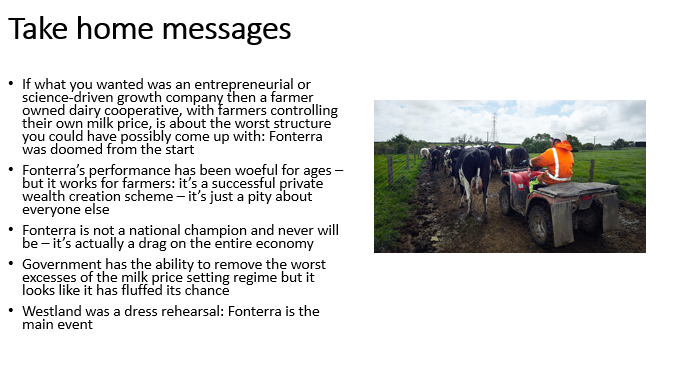
Fraser’s presentation ended with these lines
fraser 3

That final line –  Westland as dress rehearsal –  is also where I want to end.    Fraser argues that, most likely, Fonterra will need extensive recapitalisation and that –  short of nationalisation –  there is no likelihood that the New Zealand market could provide the necessary capital, and thus that a foreign takeover is the most likely market solution.

Perhaps it would be the eventual market solution, but I struggle to believe that the market would be allowed to operate in such a case.  The politics of foreign ownership of Fonterra would be too much for any major political party –  in today’s climate – to swallow.  Most likely, we’d have government moneypots –  the New Zealand Superannuation Fund and ACC –  corralled to provide the new capital  (those two are already half owners of KiwiBank, and NZSF falls over itself to pursue politically-attuned projects).

If I read Peter correctly, he believes things could be turned around.  But that there is little sign of it from either Fonterra –  and no demand for it from their farmers –  or from the government.

 

40 years on

The almost-always-upbeat Herald “Business Editor at Large” Liam Dann had a column yesterday reflecting on the changes in the New Zealand economy  in the 30 years since he was studying 7th form economics in 1989.  “Studying” may be an overly generous term here: in Dann’s words

Let’s ignore the fact that I was a distracted surfer with a bad blonde haircut, prone to sitting with the most disruptive kids in the room.

As it happens, it is 40 years since I was studying 7th form economics (I was the nerdy kid).

In the 30 years since Dann’s 7th form economics teacher was bemoaning all that was wrong with the New Zealand economy then, inflation has come down, the unemployment rate is lower, and governments normally aim to run operating surpluses. We were in the middle of an extensive economic restructuring back then, and the full aftermath of the massive credit and asset price boom of the previous handful of years was just about to be felt (DFC, for example, failed in late 1989, while the second BNZ crisis was still another year away).    Net public debt in 1989 was about 40 per cent of GDP  –  not disastrous, but far from good either –  but (little recognised at the time or later) the government was already running primary surpluses (ie deficits were mostly financing costs, the real consequences of which were, in turn, overstated by the effects of inflation).

But I wondered how the comparisons looked with 1979, my 7th form year.   Inflation in 1979 had been even worse than it was by 1989 (when we were already well on the way to getting back to something like price stability), but on the other hand the unemployment rate in 1979 is estimated to have been (backdated HLFS estimates) only  about 1.4 per cent.  Quite a difference from today.     And, somewhat to my surprise when I checked the Treasury’s numbers, net public debt as a share of GDP in 1979 was much the same as it is now.  And if the financial sector in 1979 was still more regulated than it is today – I was regaling my kids yesterday with stories about how the last restrictions on current account foreign exchange transactions didn’t come off until 1982 –  at least at the time the policy changes were in the right direction (liberalising), not the wrong direction as we’ve now been for the past six years.

Some things are clearly better than in either 1979 or 1989 –  New Zealand’s terms of trade reached the end of a longrunning decline in about 1988 and (equally outside our control) have been quite a lot stronger since then.  For such small mercies we should be grateful (a 20 per cent lift in the terms of trade is roughly equivalent to a 6 per cent lift in average national incomes).

And I’m not here disputing that in material terms the average New Zealander is materially better off than our parents were in 1979 or 1989 (be it life expectancy, smartphones, cheaper cars, overseas holidays etc).  That is true of almost every country in the world (think Venezuela for the sorts of places that are exceptions.    And those also aren’t the arguments Liam Dann seems to be making when he says of the present –  the headline to his column  –   “The economic numbers that would have blown us away in the 1980s”.

Instead he talked about how hard it was (in prospect) to get a job as a young person in 1989.  Maybe, but as it happens the employment rates for 15-19 and 20-24 year olds are pretty similar now to what they were in 1989 (and, sure, more people go on to tertiary education now, but it will be a rare tertiary student now who doesn’t have a part-time job.

Now, in a way I have been a little unfair to Dann so far.  Despite the headline, I don’t think his intention was to be that upbeat.  Later in his column he notes high levels of private debt, and the incidence of homelessness (although weirdly he presents the latter as being in some sense the “price of economic stability” –  which is simply wrong.    But he avoids actually identifying the policy changes –  land use restrictions etc –  that have meant that whereas in 1979 (in particular, near the trough of a multi-year real house price slump) or in 1989, houses were relatively affordable, they simply are not today.  I’ve noted previously, that I bought my first house in 1989.  In today’s dollar terms, that house cost just under $300000, just down the road from where I live now.  The same house today would probably cost $850000+ (the median price now for this suburb is just over $900000).    It leaves me very glad I was 26 then, not 26 now.

Perhaps the worst of it is diminished ambitions.

Back in the late 1970s, people talked in terms of how we’d crippled out export prospects, recognising that a small country’s prosperity depended on lot on the ability to create a climate in which locally-based firms were taking on the world and winning.  People talked in terms of the tax on actual and potential exporters that tariffs and quotas represented, and looked forward to a day  when we’d stop tying two arms behind our back.  By 1989 many of these restrictions etc were well on the way to being removed, but everyone knew it took time for the gains to flow –  indeed, we had expert overseas advisers highlightin the significance of the real exchange rate (then temporarily boosted by the drive to get inflation down).

And yet 30 or 40 years on, the foreign trade shares of GDP (exports and imports) are much the same now as they were then.   There is still lots of talk about export-led growth etc, but no remotely credible story from our politicians or officials as to how this might –  at last – come to be.

And then, of course, there is the small matter of productivity. It isn’t everything, but (in words not original to me) when it comes to long-term average material living standards it is almost everything.

The 1970s were a disastrous decade for New Zealand productivity.  We slipped a long way down the OECD rankings in a single decade.

And here is an adaptation of a table I’ve shown here previously (I’ve just added a 1980 column), comparing average labour productivity in New Zealand and in the leading bunch of OECD countries.

Table 1: Labour productivity: New Zealand and a leading OECD group
GDP per hour worked
USD, constant prices, 2010 PPPs
1970 1980 1990 2017
New Zealand 21.4 22.7 28.5 37.3
Netherlands 27.5 40.2 47.7 62.6
Belgium 25 37.9 46.6 64.8
Denmark 25.1 34.8 44.7 64.9
France 21.6 32.0 43 59.8
Germany 22.3 32.2 40.6 60.5
Sweden 27.2 34.5 38.8 61.7
United States 30.9 35.9 41.8 64.2
Median of seven 25.1 34.8 43 62.6
NZ as per cent of median 85.3 65.2 66.3 59.6

We’ve lost quite a lot more ground since 1979/80 or 1989/90.  In fact, the period of worst relative performance on this metric has been in the last few years, when we’ve managed no productivity growth at all.  No individual year is disastrous, but cumulatively it represents as astonishing slippage, that should be alarming – and once seemed so to our elites.

(This table compares New Zealand with the OECD leading bunch now.  I also did the comparison against the seven countries in the leading bunch in 1989 (Italy was one of those countries).  We also kept on losing ground against them, although –  logically –  a bit less so.)

Relative to what might have been our potential –  the global advanced country productivity frontiers, in a countries none of which have anything like ideal policies –  we’ve done poorly on the economic fronts that really count.  Sure, we have achieved a much higher degree of macro stability –  and that is no trivial achievement, although most countries like us (small advanced) have done something similar.    But we’ve fallen further behind on productivity, and rendered the housing and urban land market seriously dysfunctional.  Firms don’t find it more attractive to trade globally from here.   And there isn’t much sign our “leaders”  –  political or bureaucratic –  care much, are interested in finding the answers or acting to bring about better tomorrows.

Liam Dann writes

It has struck me that were I to time-travel back and share New Zealand’s current economic statistics with Mr Shaw, he would be gobsmacked by the nation’s success.

To be honest, reflecting on what I’ve written here, if I could time travel back to 1989 and share New Zealand’s economic situation now with my 1989 self –  a young policy manager and economist at the Reserve Bank – the young me would have been gobsmacked by the extent of the failure and (more so) by the apparent indifference to it, the refusal to grapple with what it would take to make things better.  (Although I would have been pleasantly surprised by the inflation track record –  I recall in the early 90s casually offering a bet to one bank chief economist that inflation wouldn’t average below 3 per cent for the following 15 years.)

What is really depressing – with a son doing Year 12 economics this year (a year that focuses on macro) – is the thought that in thirty years time he might look back astonished at how poorly New Zealand has continued to do relative to countries that were once its peers.

A last post on Makhlouf

One final post before the waters close over the issue.

When I wrote my post on Thursday afternoon about the SSC report on Gabs Makhlouf’s conduct in the “Budget leak” affair, Makhlouf himself had still made no comment.  By then, he had made no comment at all for four weeks, since the press release put out –  hand in hand with one from SSC – at 5am on Budget day.  Among other scrutiny he had avoided, he’d deliberately stayed away from a select committee hearing he would normally have attended, thus denying MPs any last chance to question his conduct.

But later on Thursday afternoon, Makhlouf issued a short statement  (4:41pm being about as close to close of business as he could possibly get).   In the circumstances, it is worth quoting in full.

“Mr Ombler’s investigation was conducted thoroughly and fairly. I have read the report carefully and encourage others to do so. I apologise that Budget information was not kept secure. The inquiry that I asked the SSC Commissioner to undertake will help us understand exactly how that happened and how to stop it happening again.

The report confirms I acted at all times in good faith and with political neutrality. It also confirms that I acted reasonably, other than in my descriptions of the incident. I am pleased that my honesty and integrity are not in question.

It has been my privilege to have had the opportunity to serve New Zealanders and I’m very proud of what my Treasury team has achieved over the last 8 years.”

He’d probably have been better off to have said nothing, and left us wondering. We already knew from the SSC report that Makhlouf disputed all the report’s adverse findings, and showed no sign of any contrition, or even of a sense that with the benefit of hindsight he should have done things differently.  But, perhaps, (we might have wondered) in his heart of hearts he really knew things hadn’t been handled well.

What does Makhlouf’s statement actually say?

The first paragraph is, in context, mostly an exercise in distraction. He apologised that the Budget information itself hasn’t been kept secure but (a) he had more or less taken institutional responsibility for that a month ago, and (b) that wasn’t the subject of the SSC inquity that had been released earlier on Thursday.  That report was about Makhlouf’s own conduct after the premature access to Budget information came to light.  It was a pretty damning report, especially when read in full (which I join him in encouraging people to do), and read knowing it was written by and for people who had worked closely with Makhlouf, including at the height of the “Budget leak” affair  (the timeline in the report has Peter Hughes in two meetings with Makhlouf, Ombler in one, and there was sufficient coordination and discussion that Treasury and SSC were issuing simultaneous press statements on 30 May).   It was only two weeks since Hughes had gushed about Makhlouf: if they had thought they could acquit him of everything, most likely that would happily have done so.

The final paragraph is irrelevant to the topic of interest on the day.

Which leaves simply that second paragraph.  A very senior public servant needs to draw attention to the fact that an inquiry judged that he was acting in good faith.  “Good faith” is an incredibly weak standard, and I don’t recall anyone –  through the whole affair –  suggesting that his actions were taken other than in good faith.   16 year olds probably mostly act in “good faith”, but it doesn’t mean they make good calls.

And what of political neutrality?  Sure, there is no suggestion that Makhlouf was some Labour hack, but who ever thought otherwise?  After all, he had been appointed and reappointed, with the consent of ministers, under a National government.  Had the tables been turned, and Labour MPs had done the same thing under a National government presumably Makhlouf would have handled things in exactly the same way.

That is, badly.

And then we get the central sentence of the short statement

It also confirms that I acted reasonably, other than in my descriptions of the incident.

As I pointed out in my earlier post, the “reasonableness” test used by Ombler was a very weak one –  nothing about whether the actions were what could reasonably be expected from a senior longserving Secretary to the Treasury –  and yet there were still three explicit findings against him, about “unreasonable” choices.   Read the report itself and Ombler could easily have identified several more (for example, Makhlouf’s refusal to accede to the urging of the head of the GCSB –  actual technical experts –  to correct the inappropriate use of the word “hack”, or his meeting with the Minister in which he was reading out the draft of the infamous press release (containing “hack”) but clearly didn’t understand enough to be able to answer the question of why GCSB wasn’t investigating).

But stick with the three adverse findings by Ombler.  Gabs attempts to diminish them, calling them just being about how he “described the incident”.

It is barely even accurate and is highly misleading. Here is the extract from the report

Mr Makhlouf did not act reasonably in relation to:

  • his use of the phrase “deliberate and systematically hacked” in his media statement issued at 8:02pm on Tuesday 28 May
  • his use of the bolt analogy in media interviews on the morning of Wednesday, 29 May
  • in his media statement on the morning of Thursday, 30 May, continuing to focus on the conduct of those searching the Treasury website rather than the Treasury failure to keep Budget material confidential.

The first involved a press release –  on what was already a very sensitive political issue –  the second involved a sustained round of interviews (he had chosen to do, at the request of the Minister) with four of New Zealand’s main media outlets, and the third  –  about a release on the morning of Budget day, amid seriously escalated political tensions –  goes directly not just to description but to mindset and perspective  (as Ombler noted, even during the inquiry interviews Makhlouf continued to hold to an interpretation of Budget confidentiality conventions that (a) no other serious observer holds, and (b) which Ombler politely takes apart).

Those alone were really serious failings, and Makhlouf accepts not one of those findings.

He might take comfort (as he does)

I am pleased that my honesty and integrity are not in question.

But that isn’t really the point is it? What is in question is his competence, his judgement, his ability to lead under fire, his willingness to listen to others, his ability to recognise mistakes and learn from them –  let alone his willingness to account to the people of New Zealand for his handling of this episode, played out in the full glare of the public spotlight.

The whole episode, right to the very end, reflects pretty poorly on Makhlouf and on SSC, including the fact that Makhlouf didn’t front up to the media at all, and that SSC didn’t insist (Makhlouf was still their employee on Thursday). No one could force him to hold views that he didn’t, but if he is going to refuse to accept any responsibility, or acknowledge any misjudgements, he should at least have had the decency to have fronted up to the media and faced, and answered, serious questioning.  As it is, he got off without even a formal reprimand – enabling him to get away with spin like this press statement –  and simply refused to explain his view.  Peter Hughes argued that Makhlouf’s reputation had taken a big hit anyway, and that that was really what mattered for those in these “big jobs”.    But it isn’t.   The old biblical maxim is relevant here

“For unto whomsoever much is given, of him shall be much required,”

People in those “big jobs” have money, power, influence, status, connections –  in Makhlouf’s case even citizenship –  bestowed on them.   We should expect much higher standards of responsibility and accountability for them.     Sure, there are then bigger costs (to those individuals) when they fail and are held to account, but that is how the system is supposed to work –  the quid pro quo for all those things society bestows on them.   It reminded me of Victoria academic Lisa Marriott’s work

Associate Professor Lisa Marriott, from Victoria Business School, has spent six years looking at the unequal treatment of people who commit welfare fraud compared with those who commit tax fraud, with her research showing that beneficiaries are treated more harshly at every turn.

I don’t suppose it is conscious choice, but it seems to happen anyway.  In Makhlouf’s case, the system worked to minimise the price he paid, the accountability, for some really severe misjudgements and a refusal to accept he’d done anything wrong. (Of course, the circumstances of the calendar helped too – had his term still had six months to wrong, it is hard to see how he could have survived in office, avoiding facing media or parliamentary questions, all while maintaining he had done nothing wrong.)

Pottering around doing chores this morning, I listened again to Makhlouf’s Radio NZ interview on 29 May, and the discussion with RNZ’s political editor immediately after the interview. It was fascinating to do so having to hand the SSC report and the detailed timeline it contains.  We now know a lot about what Makhlouf really knew (or should have), what advice he’d taken (and rejected) and so on…..and it was a reminder of just how much of a political firestorm this was (a point the SSC report largely ignores, even though Makhlouf was –  in good faith no doubt –  inflaming it): the RNZ political editor was talking of this as an episode that could cost with Bridges or Robertson their jobs (at this point, Makhlouf was the unquestioned good guy).  It would be tedious to run through many details, but suffice to say that although Makhouf had a fair idea of the nature of what had gone on (the report makes that clear) he made no effort in the interview to hose down talk of a serious cyber-attack and he explicitly rejected the idea that there had been any incompetence or sloppiness at the Treasury end (when the report makes clear that Treasury had a good idea on the previous afternoon that the clone site indexing issue was a probable explanation).  He fed the frenzy, played distraction……and was still playing distraction in his statement this Thursday, as he headed out the door, refusing to take any questions,

In my very first post on this business I wrote

Whatever your view of how Gabs came to be appointed and reappointed, or of his overall stewardship of the office of Secretary to the Treasury, it is a sad business in many ways.

And, of course, it has only gotten worse –  and sadder –  since then.  What a sad, rather tawdry, way to end an eight year term as the most senior public servant in New Zealand.

And yet it was (and remains) all of his own making, as –  instead of hosing things down, making amends, apologising –  he climbed onto the pyre as if determined to commit reputational-suttee.

Perhaps acknowledging nothing, conceding nothing, avoiding a formal reprimand, helps him in some short-term sense –  harder for the Irish to backtrack perhaps? – but he leaves a severely-dimished figure, and you have to suppose his future colleagues around the ECB Governing Council will always look rather askance at him, wondering about his judgement, pressure under fire and so on.

It is sad to see, especially when it is someone one has had a little to do with. As an outside observer and commentator I’ve been a bit ambivalent about Makhlouf.  Mostly critical of his stewardship to be sure, but there was a reasonable speech just a couple of weeks ago, and it is only a couple of months ago since, out of blue, one Saturday afternoon I had an umprompted text from him.  He must have been reading this blog.  He chose to remark on two “particularly good posts on [  ] and [  ] this week”.


Cavalier lawlessness

There does seem to be a growing sense among far too many public agencies that laws don’t really apply to them, only to other people.    This is particular so in respect of the Official Information Act.

A TVNZ journalist nicely illustrated this sort of contempt for the law in a tweet the other day

In similar vein, I had an experience a couple of months back in which the Police simply ignored the statutory deadline (“no later than 20 working days”).  Since they were the Police – ideally, examplars of upholding the law –  I lodged a complaint with the Ombudsman.  The Ombudsman actually dealt with the complaint reasonably promptly and I had a letter from them basically saying “we pointed this out to the Police, who accepted that they had missed the deadline”,  and “and now there is nothing more we can do”.  There are no sanctions in the Act, and not even the pretence of an apology from Police.

The Ombudsman also dealt reasonably promptly with a similar complaint about the Reserve Bank.    They had delayed and slow-walked (using the formal extension provisions in the OIA) the release of material supporting their position on the bank capital proposals –  material which, when finally released, turned out to be quite limited, and which had been given to other members of the public long before.     The extension looked to have been pure delaying tactics, deliberately obstructive, and so I complained to the Ombudsman.  And, much to my surprise, I had a letter earlier this week from a new Assistant Governor at the Bank

rb apology

That was a first.

Sadly, it doesn’t seem to be a marker of a genuine change of approach, just that they are a bit more bothered (than Police, say) of falling foul of the Ombudsman.  They tend to delay until the Ombudsman belatedly determines there is a problem, and then suddenly play nice.

In late March, the Minister of Finance announced the appointment of the members of the new Monetary Policy Committee. On 29 March (three months ago tomorrow) I lodged Official Information Act requests with the Minister of Finance and with the Reserve Bank Board (responsible for determining the names the Minister could accept or reject).   Given that, on paper at least, this was a powerful new body, it seemed not unreasonable to ask questions, including about any back channels through which (say) the Minister might have sought to get his preferred people onto the Board’s list (in most countries, the Minister of Finance can simply appoint directly the people conducting monetary policy).

Both the Minister and the Board initially extended my request.  I didn’t have much problem with that (plausibly there was quite a bit of paperwork to sift through etc) and the issue wasn’t overly urgent.   The Minister of Finance complied with the law and released a set of papers to me a few weeks ago.

Not so the Board (or the Bank handling the processing for them).  They initially extended my request to the same date as the Minister had done.  That didn’t seem unreasonable, even if the delay was quite long, and I’d envisaged there might need to be consultation between the two offices.  But deadline day arrived.  The Minister responded, and sent the requested material.  But the Reserve Bank Board (staff on their behalf) sent me an email saying they were further extending the deadline to 26 June (Wednesday this week)

“because of the consultations necessary to make a decision on the request such that a proper response to the request cannot be made within the original time period”

And so time passed. I fully expected a response on Wednesday –  it was, after all, almost three months they’d had by then.  But midnight came and went and there was nothing.

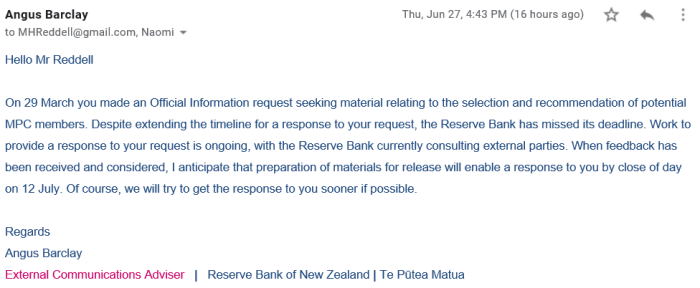
And so, having had that nice letter from the Bank’s Assistant Governor early in week, I sent her an email yesterday morning, reminding her that the extended deadline, set by the Bank itself, had passed.  I ended

I hope this further delay is pure oversight and that I will have a response very very shortly.

But no.  I didn’t actually get a reply to that email, but it clearly sparked action because much later in the day I had an email from someone down the line.

rb delay.png

Well, that’s nice isn’t it.  Not even a new deadline, just an indication.

So this is the third extension on a single request.  The first was made (well) within the orginal 20 days, the second was made on the final day of the extended period, and the third quasi-extension, well it came after the second deadline had already expired, and it looks as if it might not have made at all if I hadn’t approached the Assistant Governor.

But there is this thing called the law, under which agencies are required to operate. It is not voluntary, or just a nice idea, it is the law.   And here is what the Ombudsman’s office has to say about agencies extending request (the document is their guidance to government agencies on handling OIA requests).

Nothing in the OIA prevents multiple extensions being made, providing any extensions are made within the original 20 working day time period after receiving the request. For example, if an agency notifies the requester of a one week extension, and then later realises that a two week extension is actually necessary, a second extension may be notified as long as the original 20 working day time period has not yet passed.

You simply can’t extend a request again once the initial 20 day period has passed (in this case, that date would have been in late April).  That isn’t my reading of the Act, my opinion, it is the determination of the Ombudsman, who is responsible for enforcing the Official Information Act and holding agencies to account.  As it happens, the State Services Commission has also issued OIA guidance to agencies, and their text on extensions repeats the Ombudsman’s stance, without question or challenge.

Perhaps the Reserve Bank’s lawyers have a different interpretation (untested in the courts, the only way the Ombudsman’s view could be overturned). Or perhaps the Bank just doesn’t care.  Laws are for other people.

The Ombudsman even offers some suggestions for agencies (I guess unexpected obstacles do come up from time to time).  It is commonsense really, the sort of thing any decent public-spirited person would want to do anyway (but not apparently the Bank).

If it looks like it will not be possible to meet either the original or an extended maximum time limit, the agency should consider contacting the requester to let them know the current state of play and reasons for the delay. Requesters will appreciate being kept informed, and may be more understanding if the agency ends up in breach of the timeframe requirements.

Agencies should be aware, however, that a failure to comply with a time limit may be the subject of a complaint to the Ombudsman.

And so, in the spirit of sweating the small stuff –  how are public agencies to be held to account if we don’t make a fuss and use the avenues that are open to us? – but with a somewhat heavy heart (couldn’t they just obey the law instead?), I will be lodging another complaint with the Ombudsman later this morning.

The request was made to the Board of the Reserve Bank.  They don’t work for the Governor or the staff, rather the staff provides secretarial and adminstrative support to the Board.  Neil Quigley, vice-chancellor of Waikato University, is chair of the Board, and he and the Governor between them need to take responsibility for this lawless obstructionism.  “Culture and conduct” is one of the Bank’s trendy mantras.  It really needs to start close to home.

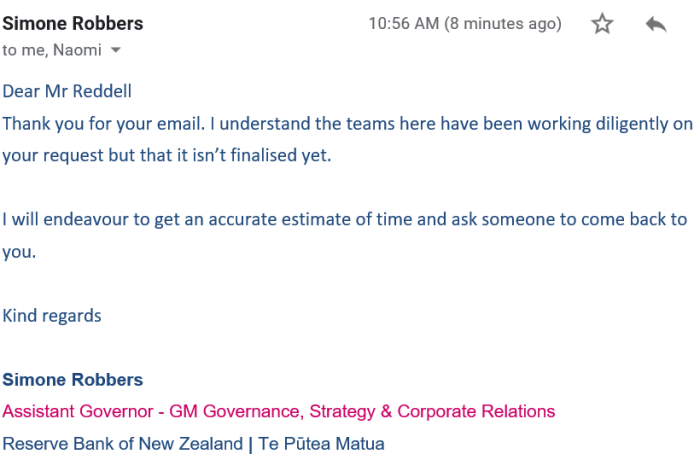
UPDATE: The Governor recently told an acquaintance of mine that he doesn’t read this blog, but clearly someone at the Bank does.  I finished the post, went off to clean the house, and came back to find this.

RB OIA

Again, that’s nice, and slightly better than nothing.  But, the law…….  As the law is written, and applied by the Ombudsman, the response was finally due on 11 June.

The law.


The SSC on Makhlouf

The SSC report (undertaken by Peter Hughes’s deputy) on Gabs Makhlouf’s conduct in the “Budget leak” affair late last month was finally released this morning, along with a statement from the State Services Commissioner himself, and a press conference (for which we appear to have to rely on media reports).  It was a very mixed bag but (remarkably) manages to show Gabs Makhlouf’s conduct and judgement in an even worse –  materially worse –  light than most would have expected, even having followed the media stories at the time and since.  Had it not been his last day in office anyway, his position would surely have been utterly untenable.

As it is, Peter Hughes appears to find himself betwixt and between.  He is clearly keen to distance himself from Makhlouf.  (As one small example, I was bemused that he had his comms person contact me last night to correct a mistake in my post yesterday, expressed thus: “in the current political climate, Peter feels it important to make clear that he did not reappoint Makhlouf” (previous Commissioner Iain Rennie had): not exactly standing behind your employee.)   And many of the words in his official statement, and (particularly) those reported from the press conference sound good, and pretty hardhitting.  From the official statement

“I have concluded that Mr Makhlouf failed to take personal responsibility for the Treasury security failure and his subsequent handling of the situation fell well short of my expectations.  Mr Makhlouf is accountable for that and I’m calling it out.”

and

At a press conference on the report, Hughes said his expectation of what chief executives should do when things go wrong was “very clear” and the chief executives knew it.

“They need to own it, fix it and learn from it. And I expect people to stand up and be accountable, and I am disappointed that Mr Makhlouf did not do that on this occasion,” Hughes said.

“The right thing to do here was to take personal responsibility for the failure, irrespective of the actions of others and to do so publicly. He did not do that.”

There were no hugs for Makhlouf (see Iain Rennie/Roger Sutton).  And yet that was it.  Hughes is reported as saying that were Makhlouf not leaving anyway he’d have looked at some formal reprimand (easy to say now, all hypothetical), and yet to do so now would be “cynical and meaningless”.  I don’t see anything cynical about it at all, and the meaning would be to show citizens and voters that there is at least some degree of formal accountability for people at the top.    Hughes went on to say that in these ‘big jobs” reputation is everything, and Gabs’s will have taken a big hit.  That is no doubt true, and as report makes clear it was entirely self-inflicted.  But what employers and governments can do is to make formally clear –  endorse the reputational hit – that conduct of this sort is utterly unacceptable, and judgement this poor would not be tolerated in very senior public servants.

And it got worse

“We can’t run the public service on the basis that you’re only as good as your last mistake. We can’t do that – that’s The Apprentice, it’s not Fair Go New Zealand. I have to look at this in the round, I have to look at this in terms of his eight years of service, and that’s what I’ve done…

What message does that send?  That really severe misjudgement by one of the most senior public servants in the end doesn’t matter that much, cos’ he’s a good bloke?  It is fine to talk in terms of learning from mistakes –  and just possibly, if this were a new Secretary to the Treasury one week into the job it might be applicable here –  but this was someone who had held top office for eight years and yet, when the heat really came on, performed very badly.  And, worse, as the report makes clear still today does not accept that he did anything wrong.  No “learnings” in that case.

And, of course, this was the same Peter Hughes who just two weeks ago at the gala farewell for Makhlouf, hosted by the Minister of Finance at the Beehive said

“Thank you from the people of New Zealand. Our country is a better place for your work.”

He said Makhlouf had brought “strong leadership and a great deal of personal integrity” to Treasury.

He had been “authentic and straight up” and had been calm and unflappable.

“I will certainly miss your calm authority,” Hughes said.

As I noted in a post at the time

In no conceivable universe (except perhaps some parallel one inhabited by SSC) could Makhlouf during that Budget episode be said to have displayed “calm and unflappable” leadership.  Had he done so, there’d have been no inquiry.

And the inquiry report demonstrates just how far from calm and unflappable Makhlouf’s conduct appears to have been, and how little “strong leadership” and “personal integrity” has been on display.    That gush, when Hughes must already have known much of what would be in the report –  a lot of it was in the media, some involved meetings he himself had attended –  seems both borderline dishonest, and if not then casting some doubt on the judgement of the State Services Commissioner himself.

It is perhaps worth noting too that the Minister of Finance has been playing the whole thing down even more than the Commissioner.  His statement makes no reference at all to the adverse findings in the Deputy Commissioner’s report (even though in my reading of the report, the Minister emerges not too badly –  recognising that the report dealt only with his, and his staff’s, interaction with officials).

But what of the Deputy State Service Commissioner’s report itself.   There was a great deal of interesting material, which puts Makhlouf in a very poor light, even though the standard Mr Ombler was asked to use was a fairly weak one, interpreted in ways that made it weaker still.   The standards he was asked to use were whether Makhlouf acted in “good faith”, “reasonably”, and “maintaining political neutrality”.   I didn’t have too much difficulty with how he interpreted good faith and the political neutrality (and as I’ve said before I thought most likely Gabs acted in good faith, and was not knowingly partisan), but here “reasonable” is defined as an action/decision that was “one that was open to be reached and is within the limits of reason”.   Either in how his mandate was written or how he interpreted it, there is no sense of a standard being whether actions/decisions were of a standard that might be reasonably expected from the most senior public servant in the land, who had held that high office for eight years.

And yet even on that rather generous standard, Mr Ombler still found that Makhlouf failed to act reasonably in three important respects.

Mr Makhlouf did not act reasonably in relation to:

  • his use of the phrase “deliberate and systematically hacked” in his media statement issued at 8:02pm on Tuesday 28 May
  • his use of the bolt analogy in media interviews on the morning of Wednesday, 29 May
  • in his media statement on the morning of Thursday, 30 May, continuing to focus on the conduct of those searching the Treasury website rather than the Treasury failure to keep Budget material confidential.

Very little of what Makhlouf did during this period, after the first few hours, seems to meet a standard a fair-minded observer should expect from such a senior public servant.

Among the puzzles is just who Makhlouf was taking counsel from, if anyone, during this period.  Paragraph 10 of the report list the people Ombler talked to in the course of his investigation, but although various Treasury officials are listed, only one of Makhlouf’s second tier is mentioned (a new acting Chief Operating Officer on secondment from elsewhere in the public sector).  But none of the rest of his second tier –  the people he’d been working with for years, and who had a better sense of The Treasury, the Budget –  is mentioned. It is most unlikely –  in Budget week –  they were all away.  Did he really not talk at all to Struan Little, the Deputy Secretary responsible for the Budget, who takes over as Acting Secretary tomorrow.   Did people like him not take Gabs aside and suggest he was losing perspective?  If not –  based on all else in the report – that reflects poorly too.  We know that when Makhlouf decided –  late on the Tuesday night –  to do a round of media interviews the next morning, he explicitly rejected his Communications Manager’s offer to help him prepare lines/answers  (he went on to do those interviews with no outside prep, and not that much sleep apparently either).

What also becomes clear is that, although Treasury staff initially thought there had been a leak, by pretty early on (1pm on the Tuesday) they were converging towards recognising that the material may well have been taken from searches of their own website (all that clone site indexing stuff), and by 3pm that day they had turned off the function that was creating the snippets (of the sort that had been released earlier that morning).     They told Makhlouf this by 5pm, before Police, GCSB or anyone else was much involved (although one gap in the report is there is no discussion of contact between Treasury staff and the Minister’s office during the afternoon  – it is just impossible to believe there was none).

What is more, the report records that Makhlouf told the Minister of Finance (7;15pm on the Tuesday) that it was ‘very likely” that the information released had been accessed through deliberate searches on the website (all that clone indexing stuff again was explicitly mentioned).  Sure, they don’t seem to known that with certainty, but a calm chief executive would surely have taken it as the most likely explanation and tailored his actions and comments accordingly (while not closing down other lines of inquiry).

The timeline in the report has a lot of detail on the back and forth among Treasury, GCSB, and Police over this period.   GCSB seem to have made clear that it wasn’t a matter for them, and  –  since Treasury already knew the likely nature of the way the information had got out  –  to the extent there was anything for Police, it was already clear that it probably wasn’t about what had gone on, but on the narrower question of whether that activity had been illegal.

But none of that stopped Makhlouf.    At 8.02pm he had gone out with his, now infamous, “deliberate and systematic hacking” statement, and (by implication) associating GCSB with his statements/actions.  He had sufficiently little understanding himself that he told the Minister he didn’t know why GCSB weren’t investigating, and yet went on to tell the Minister he thought he (Makhouf) had to make a statement.  He read out the draft statement to the Minister –  hadn’t even given him a draft in advance to reflect on –  and at the same time said he wasn’t going to do media interviews. The report notes that the Minister’s staff who were in the meeting gained the impression that what had gone on was a far more serious computer system intrusion than what (Treasury staff already knew was most likely) the case.  It looks a lot like a chief executive, stung by the breaches on his watch, probably rather emotional, not turning to wise counsellors, and not ensuring that he had himself fully understood what staff were telling him.   Any statement should have been toning down the issue, accepting (probable) responsibility, not amping it up and (a key point in the SSC report) attempting to shift responsibility.

It got worse.  Treasury hadn’t shown GCSB their draft statement (with the word “hack”) and when Andrew Hampton saw it he texted Makhlouf and said Treasury needed to correct the statement (Hampton’s comms adviser then lodged a complaint with Treasury at not being shown the draft statement –  as would be conventional when one government department refers to another in a statement).  Makhlouf and Hampton talked and Makhlouf simply rejected the advice (even though GCSB is a key adviser on cybersecurity threats etc).

Earlier in the evening, Makhlouf hadn’t intended to do media interviews.  That was about his last good call in the whole affair.  But late in the evening, the Minister’s press secretary rang to ask him to do so, and Makhlouf agreed.  He seems to have taken no advice, including on possible responses, and instead got up at 4:30 on the Wednesday morning to prepare himself, where he came up with the infamous and highly misleading bolt analogy.

According to the report, by about 1:40pm on the Wednesday Treasury not only had a high degree of confidence that the “leaks” had simply involved systematic searches, but they had been told Police weren’t taking the matter any further.   Makhlouf told the Minister this at about 5:30 on the Wednesday.  He said he would make a media statement (and a parallel one from SSC) but thought it could wait until Friday, after the Budget was out of the way.  It was just another in a series of extraordinary lapses of judgement.    Wisely, the Minister’s office got back to Makhlouf shortly thereafter to indicate the statement should go out before the Budget.  (Presumably it was about this time the National Party had indicated they would hold a briefing in the morning to reveal how they got the information.   The report is endlessly cute on this point –  despite the fact that Treasury had a near-certain view of how the information had been found, we are expected to believe that they had no strong sense, even quite late in the piece, that National staffers had done the searching).

A reasonable person might have supposed that, having amped the issue up in his press release on Tuesday night, raised the stakes further in the media interviews on Wednesday, and (as background noise) having had senior ministers alleging all sort of impropriety, that a statement would be rushed out just as soon as it could possibly be got together (perhaps even a press conference with Makhlouf and his head of IT).  But no.  And Ombler concludes that this was all quite reasonable because “it takes time to draft an appropriate media statment and to appropriately consult other agencies”.    Except that the decision to do a press statement had been done by 6pm, the draft was sent off to various agencies –  including SSC (who thus saw the draft of the statement they now rightly criticise Makhlouf for) –  at about 8pm, the Minister’s office had it by 8.53pm, and the whole thing was finalised and sent out to various officials under embargo just after 9:30,    There was no reason why it could not have gone public then, not released into the dead of dawn, at 5am the following day.

Except, of course, that the statement was not well done.   As the report concludes, Makhlouf ended up focusing more on the people who had found the information than on the failures of The Treasury itself, and played up an extraordinary interpretation of Budget confidentiality conventions that surely no one else would have regarded as reasonable –  and which Ombler decisively picks apart.  Such conventions bind ministers and public servants, not people who find information through weaknesses in your website.  According to the report, Makhlouf even now rejects this interpretation.

The report suggests that Treasury staff themselves seem to have got caught up in a similar defensive mindset. In a way that is understandable: the “leak” would have been deeply embarrassing, but it was Makhlouf’s job to lead the organisation above the embarrassment and to do the right thing.  He simply didn’t do that, and no one else –  in his department or elsewhere in the public sector (the very top tier of public servants) – was willing or able to stop him.  Where, for example, was his employer –  Peter Hughes – after the first statement, after the interviews, or when he got the draft of Thursday’s statement (and the timeline records he was in two meetings with Makhlouf on the Wednesday afternoon, but the report tells us nothing about what he said or did with those opportunities).

Bottom line seems to be that Makhlouf does not regard himself as having done anything wrong.  Even with the benefit of hindsight, the report contains no sense of Makhlouf looking back with regret or wishing some things had been done differently (and he had a draft of the report, so had the opportunity to inject such perspectives if Ombler had missed them).  Consistent with that there was no contrition or apology at the time, and not a word from Makhlouf since.  He deliberately avoided parliamentary scrutiny at FEC the other day, and there has been not a word from him today.   And at the close of business today he is off, no longer accountable to anyone in New Zealand at all.  It is a shockingly poor standard of conduct on display.  He could not have survived in office –  with these findings and no contrition –  had it not been his final day.  It must be a tough day for Treasury staff, many of whom will probably be going out of their way to stay clear of Makhlouf (even those who otherwise have good impressions of him).

We –  citizens –  deserve much better.  We deserve more answers from SSC themselves.  And, one would have to say, the people of Ireland –  and of Europe –  deserve much better: if this is how their new Governor (and ECB Governing Board member) reacts under pressure when something goes wrong on his watch, it is a real worry as economic and financial pressures and tensions build.    And it is a reminder of how utterly crucial it is for anyone near the top to have at least one person they trust who is willing to tell them to their face when the top person has stuffed up, lost perspective, got it wrong.  If Gabs had such a person, they were missing in action in Budget week.

Thoughts prompted by the OCR review

When I read yesterday’s OCR review release from the Reserve Bank, my first thought was actually about process.   This was the first interim –  ie between full Monetary Policy Statements – OCR review since the new Monetary Policy Committee took over responsibility.

The actual statement from the committee was about 175 words long.   It was accompanied by the summary record of the meeting (“the minutes”) that was about 530 words long.     That looks anomalous.   When there is a full MPS (with projections), the minutes are – in normal times –  not much more than a modest supplement.   But when there are no numbers and the press release itself is so short, the minutes are always likely to be the main event.    Given the way the Minister of Finance has chosen to set up the new system –  “minutes” released simultaneous with the policy decision (not done in plenty of other countries), and minutes not generally conveying individual views –  I wonder what the point is of having both statements on the occasion of interim OCR reviews.    There is nothing in the press release that couldn’t quite easily have been included in the minutes (almost all of it is there anyway) and having two documents just opens up risks of conflicting wording or differences of emphasis (in this case, the minutes are clearer on the likelihood of another cut than the statement is), for no obvious benefit.    It isn’t a big issue, but if I were in their shoes I’d be taking another look in the light of experience.    As it is, when one document has three times as many words as the other, the focus of attention is likely to fall on the longer fuller document.

Having said that, (with a sample of only two cases admittedly) experience is already confirming that the summary record of the meeting is really just a long-form version of the policy statement (whether the OCR review one, or the first page of the MPS).    I get that, for largely inexplicable (and unexplained) reasons, the Minister of Finance was keen on encouraging consensus decisions –  not an approach we take, for example, in the appellate courts, when individual judges are responsible for their own views and free to express them –  but the minutes we’ve so far really add nothing.   Take the possibility of an OCR cut yesterday.  This what they said, all of it.

The Committee discussed the merits of lowering the OCR at this meeting. However, the Committee reached a consensus to hold the OCR at 1.5 percent. They noted a lower OCR may be needed over time.

Wouldn’t a useful summary record have given some indication of the arguments members (perhaps only some) found persuasive in favour of a cut and the considerations that led them (by consensus) to conclude that it wasn’t an appropriate decision right now.  There is no sense of richness to the discussion, no insight into the thought processes or arguments or models being used, just nothing.       And this is early days, when presumably the Committee wants to put the best foot forward, to suggest real change, real gains in transparency.    It was predictable that the new-look committee would probably become little more than a slightly different front window for the Bank’s longstanding preference to tell us only what they think we need to know, only when they want to tell us.  It could have been different, even under the severe limitations of this legislation, but it would have been an uphill battle even with the right people  –  and there is now documentary evidence that several of the likely best people were simply excluded from consideration from the start. MPC members are free to speak publicly, but thus far none has.   It is a shame, but it is what I pointed out in my submission on the legislation last year, that the monetary policy reforms always appeared more cosmetic than real.

As for the actual OCR decision, I think it was the wrong decision (although I wouldn’t make too much of the point).  Data have weakened here and abroad, inflation is –  and has persistently been – below target, the exchange rate is holding up, and there is little real prospect of a sustained reacceleration of growth or of inflation pressures.  Oh, and market measures of medium-term inflation expectations are around 1 per cent, not 2 per cent.   In that climate, being a little pro-active and cutting the OCR now looks to have been the better choice.   It isn’t clear what the risks to moving would have been.   It is only six weeks until the next MPS, but (a) the MPC won’t have a lot more domestic information between now and then (eg the labour market data come out only 27 hours before the next release, and won’t be properly incorporated –  or in the projections at all) and (b) the way the global situation is going one can’t rule out the possibility that another cut could have been warranted by then.   Then again, markets strongly anticipate central banks.

Perhaps the saddest bit of the press release was this plaintive, orphaned, line

Inflation is expected to rise to the 2 percent mid-point of our target range,

The Bank has been saying this for years. December 2009 was the last time annual core inflation (on the Bank’s sectoral factor model was as high as 2 per cent).  There is no support offered for their view, either in the press statement or in the minutes, and no evidence even of any discussion to risks around the story.  I guess anything is possible, but it simply doesn’t seem the most likely story any longer.   The Bank’s former chief economist used to argue that they had to say this (that inflation was heading back to 2 per cent) because if they didn’t, it meant they should have been changing the OCR.  Well, quite.  But in these circumstances, the line should just have been quietly dropped –  or some more analysis/argumentation provided to support their beliefs.

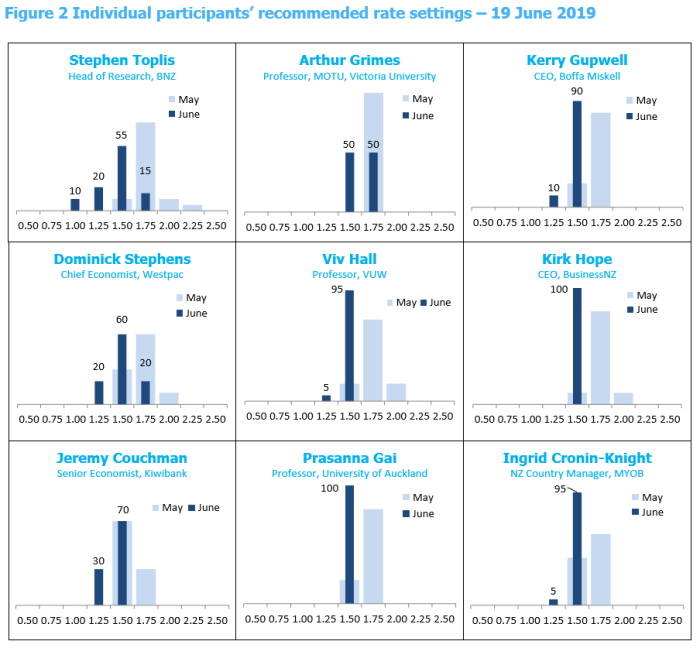
Earlier in the week, the NZIER released their Shadow Board exercise, in which a group of economists and business people offer their advice, and their range of views, on where the OCR should be set (conditioned on the target the Bank is given).  I know various readers are dismissive of the exercise –  and it does appear to be limping on towards eventual termination, rather than helping shape the debate –  but I’ve always had a geeky interest in exercises like this, even while noting that the Shadow Board tends to adjust into line with the Reserve Bank, rather than providing much collective leadership or independence of perspective.  This was in evidence in the NZIER press release this week

NZIER’s Monetary Policy Shadow Board has adjusted their recommendation in the wake of the Reserve Bank’s OCR cut in May.

It is strange that experts would adjust their view of what the OCR should be just because the Reserve Bank –  with no monopoly on knowledge and huge margins for error –  changed its view.   But here were the individual views of the panellists.

shadow board 19

I’ve always been puzzled too by how anyone could be 100 per cent confident of their view of where the OCR should be.   When I was on the Reserve Bank’s OCR Advisory Group (a forerunner to the MPC), we introduced a survey of this sort, where each member’s advice to the Governor had to include a probability distribution (summing to 100 per cent) on what the OCR should be (eg 50% 1.5 per cent, 25% 1.25 per cent, 25% 1 per cent).  Being a bit stubborn, and reminded of the breadth of the historic confidence intervals in OCR forecasts, I always tried to discipline myself to spread my probabilities over perhaps six alternative OCR settings, with not too high a probability on the OCR I actually recommended.  Apart from anything else, it was a helpful prompt to think about what would invalidate my central view.   Most of these respondents don’t seem to do anything similar.  For what it is worth, my current distribution might look something like this

0.5 or less 5
0.75 10
1 20
1.25 35
1.5 17.5
1.75 7.5
2 or more 5

The most interesting view in the chart (setting aside how tightly bunched his views were) is that of former Reserve Bank chief economist Arthur Grimes, who indicated a 50 per cent probability that the OCR now should still be 1.75 per cent. In his comments he notes

Conditions imply no need to change the OCR right now, but that has to be balanced against the unnecessary (and unwise) cut to the OCR at the last decision. Hence it is a 50:50 call as to whether the cut should be restored or whether to leave the OCR as is.

It is an interesting stance, more “hawkish” (for example) than the (typically) most hawkish of the local banks (BNZ), and it is a shame no media seem to have asked Arthur to elaborate on his view.  He must hold it strongly –  the words are much more forceful than just the numbers would have been –  and it would be interesting to read his fuller reasoning.  After all, although my central view appears to be substantially different to his, the margins of error/uncertainty in this game are quite large enough that he could prove to be correct (my own probabilities – above –  overlap with his).     Perhaps it is just that Arthur is downplaying the target midpoint, even though it is highlighted in the target given to the committee, and in that case it is just a personal policy preference.  But if it is a genuine difference of model, of making sense of current or prospective economic or inflation developments, it would be interesting to see his reasoning.

But for me, the downside risks, and the asymmetric nature of the consequences of being wrong –  surprising high inflation means getting into the top half of the target range for the only time in more than a decade, while the approaching limits of conventional monetary policy mean that any further slippage in inflation expectations could really aggravate the next significant downturn, arguing for erring –  if it all –  on the side of a lower OCR.

Secretary to the Treasury

Gabs Makhlouf finishes as Secretary to the Treasury tomorrow, and there is still no sign of the SSC report on his conduct in the “Budget leak” affair. (Although the State Services Commission doesn’t really seem to live in the 21st century –  when it publishes press releases it seems not to put them on its website simultaneously with sending them out to the favoured list of journalists –  so it is always possible it is in fact out.)   Even if the report finally emerges in the next day or so, they’ve basically run out the clock. And that would, surely, be convenient for everyone –  government, SSC, Makhlouf, and the public sector CEs club –  except those actually seriously concerned about accountability in public life.

But yesterday we did finally get an announcement of an appointment of a new Secretary to the Treasury.   The job was advertised more than six months ago  (the fact that there would be a vacancy on Friday was known three years ago), suggesting that SSC had some difficulty finding a good person for the job.  In a well-functioning organisation/system, there would have been at least two or three really impressive, and pretty obvious, internal contenders (not necessarily internal to The Treasury, but to the New Zealand public service) and it wouldn’t have taken that long for a decision to have been made in favour of one of them.  A decision would have been announced several months ago, and the chosen person would have taken office on Friday.    Serious questions should be asked –  but no doubt won’t be answered –  about the process, and (more fundamentally) about the state of the upper levels of the public service (supposedly developed and nurtured by first Iain Rennie and now Peter Hughes) when twice in succession, SSC has chosen to turn to outsiders, with no knowledge or experience of New Zealand, to fill the premier position in the New Zealand public service.  Successful organisations mostly appoint from within.

Of course, The Treasury isn’t a high-performing organisation these days –  use any standard you like, but including stakeholder surveys, reviews of the technical quality of policy, the perspectives of capable staff who have now left, or even just the telling anecdotes (someone told me the other day about their dealings with Treasury social policy analysts, who reportedly struggled with the difference between average and marginal).  There are some good stories too, and some very able people, but few now view it with the mix of fear and awe that once characterised official Wellington. But the degradation of the public sector institutions’ isn’t unique to The Treasury –  after all, if it were just a Treasury problem, it shouldn’t have been hard to find a new Secretary to the Treasury from elsewhere in the high-performing policy parts of the public sector.

But what to make of the new appointee, Dr McLiesh?   The only honest answer is that it is very hard to know, and only time will tell.   That isn’t really good enough, in someone stepping the role –  in Peter Hughes’s own words –  in which they will be (not the organisation, but the individual)

“is the principal economic advisor to the Minister of Finance and the Government.”

It appears that very few people in New Zealand –  at least those in a position to comment – know her, and so we are left having to take Peter Hughes on trust. But then he was the person who reappointed Gabs Makhlouf, and that choice doesn’t inspire much confidence (even less now than at the time it happened).[UPDATE:SSC has got in touch and pointed out that the reappointment decision was made by Iain Rennie.]

I may be in a small minority here –  although I suspect not –  in that, however able someone is, I just don’t think it is appropriate to be recruiting foreigners –  especially not ones with no background in or experience of New Zealand – for such critical and sensitive roles.  Few other countries –  at least ones that had got beyond either colonial status or complete dysfunction –  would, and we shouldn’t.    Countries have interests that are, at times, in conflict with those of other countries, and that is true even for someone coming from the UK (Makhlouf) or Australia (McLiesh) –  and, in fact, those potential conflicts are much greater as regards Australia than the UK (just think of the banking sector for example).   One needn’t criticise the individuals concerned to think that we really should be capable of running our own country, and if the Secretary to the Treasury is not an elected policymaker, the person who holds that office should be a highly influential counsellor to elected governments, and hugely influential on what should be the premier department of state.  Someone rushed in from another country –  even a very friendly one –  just does not have primary loyalties to New Zealand, or a sense that their own future, and that of their children and grandchildren, depends on a job done excellently.   And they have no historical, social or political context for their advice.    We don’t have foreigners with no background in New Zealand as MPs or ministers, no matter how able.  And we went through a big debate 15+ years ago in which we decided that we didn’t want foreign judges either –  even though, at least in principle, judges simply apply Parliament’s law, and should be much less influential than the Secretary to the Treasury.

One might also add some comment about selection bias. Really top-notch foreigners –  really well suited to be premier economic adviser to the government of a sovereign state –  might normally expect to be recognised and rewarded best at home.  The New Zealand public sector isn’t spectacularly well-paid (unlike, say, Singapore or Hong Kong) and New Zealand is a poorer and smaller country than either the UK or Australia.   And it isn’t as if, these days, New Zealand is at the leading edge of reform, economic thinking, or public adminstration.  As far as we are aware, neither Makhlouf nor McLiesh had compelling family connections to New Zealand that made them want to give up the glittering prizes of home, make the sacrifice and just happened to be available to serve New Zealand.     Neither, at the time of appointment to the New Zealand Treasury secretary rule, seem likely to have been serious contenders for the comparable appointment in their home country.  Perhaps they were the best we could get……but that then is an indictment on the SSC handling of the New Zealand public service.

At the time Makhlouf was appointed, it was made known that the government had rushed through an emergency grant of New Zealand citizenship to enable Makhlouf to have the job (as if, somehow, a label transformed loyalties).   The question should be asked now as to whether Dr McLiesh is also being given a rushed grant of citizenship.  And if not, what is going to happen when really sensitive issues arise?  When I worked at The Treasury for a couple of years, there were a couple of second and third-tier people who were Australian citizens, and care was taken around NZEO (New Zealand eyes-only) documents to ensure that those people did not see them.  Perhaps that works down the line, but how appropriate is it as an option for the Secretary to the Treasury?    If, for example, an Australian banking group, and/or their New Zealand subsidiary, is in crisis?

(The point here is not that any such appointments would be likely to consciously seek to serve another country’s interests, but that (a) the rules are designed to protect against extreme eventualities, and (b) appearances matter greatly.  I have worked as a mid-senior level official in two foreign countries’ national bureaucracies, and so know something of which I speak –  fortunately perhaps there were few/no Zambia/NZ issues.)

And what of the individual?  Eric Crampton has been the most vocal (public) critic of The Treasury under Makhlouf.  He is quite positive, if guardedly so, on the new appointee, who has a PhD in finance, and during a term on the staff of the World Bank was the co-author of several journal articles with highly-regarded academic authors.   I put less weight on that, partly because I’m not convinced of the cult of the PhD (in non-academic contexts, where I’ve seen people with top degrees from even better universities and with pretty strong publication records who simply weren’t suited to senior public sector roles).

I guess I put more weight on (a) what she has, and hasn’t, been doing and saying in the last decade or so (since moving into the New South Wales public sector), and (b) on who appointed her, and so the likely criteria being used to make the choice.

The new Secretary to the Treasury joined the New South Wales Treasury in 2008.  New South Wales, you will have noted, is not a country but a state.  Quite a few people live there, but in the end it is still more than a city council but less than a country.  So much power and functionality has been centralised in Australia, that technocrats regularly ask what the point of state bureaucracies really is.    Where this matters, in thinking about the New Zealand Treasury role, is not around managing a budget, or even dealing with individual (perhaps very complex) infrastructure projects, but around most everything else.   Tax policy for example.  Or monetary policy (The Treasury has just been handed a seat on the new MPC), financial system regulation, or even much of the big picture around health, education or welfare policy.  McLiesh has precisely no experience –  according to the SSC’s statement, which will have been putting the best foot forward –  in advising national governments on critical areas of national policy.    And there is a pretty good chance that, until the last couple of months, she has never given New Zealand economic policy, and its major failures (productivity) and challenges, a moment’s thought –  unless perhaps on a skiing trip she happened to pick up a local newspaper.    Frankly, this new appointee appears about as substantively well-equipped to be the key economic adviser to a sovereign national government, in a country with its own currency etc, as Makhlouf does to sit on the ECB Governing Council.

Perhaps one doesn’t really expect fairly senior state public servants to be making speeches, writing articles etc.  Mostly, it isn’t the day job.  I went looking and couldn’t find any evidence of anything.  But people who nurture a longstanding commitment to excellence in economics and policy advice often find avenues – and avenues are found for them –  to tap that expertise, in papers, commentaries, discussant comments or whatever.  But I couldn’t find anything with her name on done since she left the World Bank.  Perhaps I missed something –  I’d be keen to know if so –  but she looks like someone who has successfully transformed herself into a fairly well-regarded public sector operator.    There is a place (an important one) for those skills.

In eleven years in the New South Wales public sector, McLiesh has had five jobs.    From the look of the documents, they weren’t a succession of stellar promotions, but of frequent rotations, and then a move last year to run what seem to be the NSW equivalent of polytechs (in the wake of a sudden departure of the previous incumbent).    One of the questions that should interest anyone in thinking about the New Zealand Treasury is the management record: especially so for anyone uneasy about the current state of The Treasury.  Perhaps the new appointee really is a stellar change-manager and someone with a demonstrated track record of lifting performance in troubled organisations.   But when you are on your fifth job in eleven years, there have to at least be questions about whether you’d stayed around long enough for anyone to really tell the good that might have been done.

Which brings me to the final relevant set of considerations: who made the appointment, and what is the evidence on their predispositions?    I wrote about the appointment process, and the advertising for the job, in a post back in January (skip the first few paras).  From that post

The procedure for the appointment of public service chief executives is set out in the State Sector Act.  Section 35 provides that when there is a vacancy the State Services Commissioner must

invite the Minister to inform the Commissioner of any matters that the Minister wishes the Commissioner to take into account in making an appointment to the position.

That is the Minister’s opportunity to scope the job, and identify his or her priorities.  And although there is now a perception that appointments are made by the State Services Commissioner, in fact the law is clear that the Cabinet can not only reject a nomination, but can appoint their own preferred nominee.   In other words, while Peter Hughes (the State Services Commissioner) has considerable influence, appointments ultimately reflect to a substantial degree the choices and priorities of ministers.

And, writing about the capabilities SSC said it would be assessing people on

All probably fine and reasonable in their own way –  if what you want is some generic public service manager –  but again what is notable is the absences.   Neither here, nor anywhere in any of the documents, is there any sense of wanting someone who might model excellence as a policy adviser, or lift the performance of the organisation in a way that might deliver credible and compelling answers to the appalling productivity underperformance of the New Zealand economy.

And why not?  Presumably because neither Grant Robertson, nor his boss, nor his party, nor the parties they govern in league with, care.  Nothing –  in these documents, in speeches, interviews or anywhere –  suggests otherwise.

Perhaps Grant Robertson really was made uncomfortable by Makhlouf’s extraordinary behaviour in the “Budget leak” affair, but that aside we’ve not heard or seen a word suggesting that he wants something materially better or different in The Treasury.  Only yesterday he was out promising more wellbeing and Living Standards Framework stuff.

And Hughes?  His track record isn’t one of promoting people with real expertise, and leadership capability, in the subject area they are responsible for –  what does Andrew Kibblewhite know about Justice, or Andrew Bridgman about Defence, or Carolyn Tremain about economic development. to take just three high profile examples.   Real expertise might not be disqualifying –  people seem to speak highly of the new MFAT head –  but it scarcely seems to be a prerequisite.  Nothing in the Treasury advert really suggested he’d made an exception in that case.  The focus seems always to be on appointing general public service managers, who won’t rock the boat, won’t upset Peter Hughes, and will get along nicely with ministers.    If that is what you want in the job, quite probably the new Secretary to the Treasury may do quite well, while probably seeking to use the job as a stepping stone to something bigger, better, and better-paid (richer country and all that) back home.     But count me sceptical that the appointment presages a substantial improvement in The Treasury.   (And, as always with public service heads these days, the likelihood now of disrupting the Treasury second tier, so that the incumbent has their own people:  some might argue that change is warranted –  but the sun/moon feeling card senior manager has already gone  – but where are better candidates likely to be found in the diminished New Zealand public sector?).

Near the end of my earlier post I wrote

I guess there is nothing to stop the person who is eventually appointed choosing to make productivity a priority and foster work developing compelling analysis and recommendations.  But it doesn’t seem very likely.  Even if Treasury isn’t as resource-constrained as some government agencies, there won’t be lots of capable staff resources readily able to be diverted to something that just isn’t a government priority.  But more importantly, what sort of person do we suppose is likely to get the job?   And why would such a person, who got through the selection process (acceptable to both SSC and the Minister) be likely to change their spots once in office.  What would be their incentive?  And how likely is it that they’d be the sort of person who would even care much, or understand the issues well enough to know where to start.

That still feels about right now.

I’d love to be wrong about this, and truth is that at present we have only very very partial data.  If the new Secretary to the Treasury really is the agent of transformation, dramatically lifting the performance and standing of the organisation, I’ll be delighted –  and, I hope, ready to highlight my pleasant surprise.  But it isn’t clear, on the information to hand now, why we should expect anything more than a competent generic public service manager, with little expertise in national economic management, no background in New Zealand, and –  perhaps most importantly –  no mandate or imperative for anything much better or different.

Our institutions have been in decline for some time, and there is little reason to suppose that Peter Hughes –  or the ministers he works for –  will be the agents of reversal, or that this latest appointment is a sign that change (for the better) is really in the wind.


Not tenable in a crisis

On a quick read through the Executive Summary of the latest consultation document from the review of the Reserve Bank Act, there look to have been a range of not-entirely-unreasonable in-principle decisions made by the Minister of Finance.   Some even look thoroughly welcome, if long overdue, including the in-principle decision to end the charade that the Board of the Reserve Bank could or would adequately do the job of holding the Governor to account.  In turn, the decision to stop the Governor being the sole decisionmaker on banking regulatory policy can’t be implemented soon enough.

The other major change that I welcome, and have championed for some years inside and outside the Reserve Bank, is the decision to introduce a deposit insurance system.   Among advanced countries, New Zealand has been increasingly unusual in not having such a system.  The discussion of deposit insurance issues is from page 85 onwards in this document.

There are lots of details still to be sorted out, but the headline-grabber in the announcement yesterday was the aspect of what is proposed that I have most problem with.

The Minister has also made an in-principle decision that the scheme will protect eligible depositors’ savings up to an insured limit, proposed to be in the range of $30,000-$50,000 per depositor.

This has the feel of a bureaucratic compromise, including with the staff at the Reserve Bank who have consistently opposed deposit insurance.    More importantly, it is a ridiculously low limit which would almost certainly prove untenable, unsustainable, in an actual crisis.  David Tripe, at Massey University, calls it “a joke”, but it is (of course) more serious than that.

I favour deposit insurance mostly for second-best reasons.   You can advance various arguments for why deposits should, in principle, be specially favoured and protected.  I’m not really convinced by any of them.  If people really wanted rock-solid assets, and were willing to pay for them, the market could and would provide.  The evidence is, quite strongly, that people don’t (look, for example, at the tiny number of people holding government retail Kiwi Bonds, in contrast to the amount in bank term deposits etc).  And that isn’t surprising. Not only are banking crises rare, in countries where markets are allowed to work –  how much different the literature and mindset in this area might be if for 150 years Canada had had US banking etc laws, and the US had had Canadian ones –  but in the course of our lives many of us are much more likely to have serious  –  larger –  unexpected losses (financial or otherwise) from other sources.  A leaky home, a lost job, a serious relationship break-up, health problems, a business plan that just didn’t work out, an unexpected change in government policy,  living in a town that economic activity moved away from, and so on.

I’m not even persuaded by arguments about bank runs, that seem to have appealed to the authors of the consultation document (and the IMF and OECD).  There is little evidence of irrational runs and –  as we saw globally in 2008/09 –  wholesale creditors are at least as capable of running for their money, rationally or otherwise, as small depositors.

No, I support a credible deposit insurance system because governments –  abroad, and here –  have a demonstrated track record of bailing out depositors, and whole banks, when faced with a crisis, and political incentives that mean it would be difficult to change that track record –  perhaps especially in a political system such as our own, where so much power is bested in the executive, and the executive governs by commanding a majority (at least on supply issues) of Parliament.    If we believe in the importance of market discipline (beyond simply shareholders) – and I do –  then we need to do what we can to identify and recognise the pressure points and to internalise the costs of the protection they result in.   In this case, it is a concentration of (likely) voters, facing (potentially) large and visible immediate losses.

I’ve run through the likely political calculus in earlier posts (eg here), but suffice to say that I just do not believe that a plausible New Zealand government, faced with a plausible failure scenario for a major New Zealand bank, would let a bank fail, and use the OBR tool on all creditors, with protection only (via a deposit insurance scheme) for $30000 to $50000 per depositor.

The government has sought to argue that the proposed cap on coverage is somehow internationally mainstream, but I don’t know who they are trying to fool (themselves apart?).   This chart is from the official document.

dep insurance

You can ignore the strained attempt to split OECD countries into two separate classes and just focus on the data.  Whether you look at the limit in simple dollar terms, or as a ratio to GDP per capita, the range of coverage the government proposes here would be lower than in all but two OECD countries.   And perhaps the thing that stands out to me most starkly from the chart is how many of those red dots (the other country limits in NZD terms) are at or near $150000.

Not unimportantly, the limit in Australia is A$250000 (just a bit more than that in NZD terms).  The government has probably noticed that the big banks in New Zealand are all subsidiaries of Australian banks.  It is probably aware that if a big New Zealand bank ever gets to the point of failure, it is highly likely to be a situation in which the parent is also on the brink of failure.  And anyone who has ever thought about the issue recognises the high likelihood that the resolution of a failed Australian banking group, with major operations in New Zealand, is likely to be handled at a trans-Tasman political level (including because of pressure from the Australian government to keep the banking groups together, which might well be the best way to realise value for creditors).  Most likely, the big banks would simply be bailed out completely.  But if they weren’t, how credible do you suppose it is that a New Zealand government will simply walk away from depositors with amounts in excess of, say, $50000 –  left to the tender mercies of OBR –  while their Australian siblings (in a bank with the same brand) are protected to A$250000?  Not very, would be my answer.     (And bear in mind the complication that it is generally recognised that if OBR is ever used, the non haircut deposits in any failed bank will need to be government guaranteed, and that such a guarantee may even need to be extended to other banks, to avoid a big loss of funds to the failed bank.)

I’m not arguing that we need the same limit as Australia –  apart from anything else, New Zealanders are poorer on average (but would it have hurt to have looked at common model?) –  but a $30000 to $50000 limit will simply strike people as so low that it won’t be persisted with if and when a crisis hits.  Deposit insurance limits get changed on the fly –  it happened all over the advanced world in 2008/09 –  and when they are, those who get the protection won’t have paid for it.    Failing to get this right, ex ante, simply increases the risk that when the crisis comes we’ll end up bailing out wholesale creditors (including foreign ones) too.

Much better to put in place a credible limit (indexed to inflation or nominal per capita, to remain sensible) –  perhaps $150000 per depositor – and charge depositors directly for the protection the Crown is proposing to offer.  Don’t –  as the discussion document talks of –  build up a modest fund and then stop charging the levy.  Remember that major bank failures are (and are supposed to be) very rare events: a levy of 15 basis points per annum on insured deposits for 150 years, would cover losses of (say) 20 per cent of all insured deposits (an extraordinarily large loss).   But just like your house insurance, the best outcome is if you pay your premium all your life and never need to make a claim.

The consultation document discussion on deposit insurance is itself something of a mixed bag.  At a technical level, some of its seems solid enough, but then they attempt to buttress it with overwrought claims.  There was this, for example

The GFC showed that a loss of confidence in one bank can rapidly spread throughout the financial system through ‘contagion’ that causes instability and destroys financial and social capital.

“One bank”????     And, even more far-fetched

The OECD (2013) and IMF (2017) have both warned that, without depositor protection, New Zealand is particularly vulnerable to contagious bank runs that can escalate into banking crises that destroy social and financial capital. The financial costs alone could be profound and long-lasting: experience overseas suggests that in a bank crisis GDP might fall 20 percent below trend, and the Government debt-to-GDP ratio might increase by 30 percentage points for a decade.

As we have seen, in analysing the Reserve Bank’s claims around bank capital, most of those “cost of crises” analyses simply don’t withstand serious scrutiny.  But, even if they did, no serious observer would claim that the presence or absence of deposit insurance in the difference sparing us staggering GDP losses.  Here, officials and the governments are attempted to sell us a model in which financial crises arise out of nowhere, and they know –  even the Minister really should –  that that is simply not so.

But I was left wondering quite how much the Minister of Finance understands when I saw him reported as suggesting that

A bank deposit protection scheme may help defuse the battle between the Reserve Bank and the country’s biggest trading banks over how much extra capital they should have to hold on their balance sheets, Finance Minister Grant Robertson indicated today.

It is a lot more likely to amp up the tensions I’d have thought.  From a fiscal perspective –  the Crown as underwriter of a deposit insurance scheme –  deposit insurance increases your interest in having bank capital ratios as high as possible (and the discussion document talks of funding deposit insurance with a levy on bank profits, rather than directly on insured deposits). But it was noticeable that there was no discussion at all of the interaction between the two: in principle, the higher your minimum capital ratios, the cheaper the deposit insurance should be.  I guess we will know the Governor’s final decision on capital before the Minister tries to legislate deposit insurance, but you would hope for some more joined-up discussion at some stage.

On which note, on the Radio New Zealand news last night, I heard the Prime Minister quoted as saying (apparently at her post-Cabinet press conference)

“Our banking system is one of the strongest and most resilient in the world”

I suspect she is probably right about that (floating exchange rate, vanilla loan books, little or no government interference in housing finance markets, no history of recent financial crises, banks part of much bigger overseas groups (from a similarly governed country).

But, if she is right, if that is what she has picked up from her briefings, from Grant Robertson, and perhaps even from the Governor, what possible grounds are there for requiring the huge increases in minimum bank capital ratios that the Governor is currently proposing?  We’ve not seen a cost-benefit analysis (but, who knows, perhaps she has).  On the face of it, let alone digging more deeply, there is no such case.   She is content, it appears, to let an unelected bureaucrat impose potentially large costs on the New Zealand economy  –  over a period (next few years) when things are likely to be difficult anyway –  for little or no gain (given the strength and resilience of the banking system, of which she spoke, and the inability to commit to such capital standards for more than a few years ahead).


Some material on Makhlouf’s performance

Someone –  perhaps a current public servant or someone who depends on access/opportunities – sent me a carefully anonymous email with a collection of material (all public) that the compiler thought relevant to judging the performance of Gabriel Makhlouf as Secretary to the Treasury.   I’m passing it on as I received it (deleting only the –  meaningless to me – email address I received it from).  I’m not sure if the person was just trying to persuade me (I suspect not) or wanted to get the material out more broadly and wanted to use me as a conduit.
I’m not sure I read all the material in quite the same way the sender does: so-called “gender pay gap” data are just meaningless, and I’m not going to criticise someone for not “doing better” against a meaningless benchmark –  even if the person concerned was a champion of the “diversity and inclusion” movement, which is full of vapid rhetoric.   Similarly, I’m not persuaded that the proportion of women in senior management is a meaningful statistic, even if Makhlouf himself did once come out and suggest he’d adopted internal quasi-quotas.   If people on the left want to attack him on those grounds I’ll leave that to them.
I also couldn’t play the Bloomberg TV pre-election clip, so I’m not sure what to make of that (although I never thought of Makhlouf as partisan per se).  I had my own post earlier this year in which Makhlouf participated in some craven –  and highly inappropriate in a serving senior public servant –  adulation of the Prime Minister.
But since I do care, a lot, about the quality of analysis and policy advice, I thought the table in the very last section (below) was pretty telling and –  on the face of it –  almost scandalous.     And the best evidence of poor judgement under pressure was, surely, what we all saw in the “Budget leak” affair a couple of weeks ago, compounded by his retreat behind closed doors and public silence –  no apology, no contrition, no explanation –  since.
Beyond that, make of it what you will.   Here is what I was sent.
Publicly available evidence regarding the actual performance of Makhlouf as Secretary
In what state does Makhlouf leave the capability, culture, performance and reputation of the Treasury – below his actual LEGACY from observable statistics
EVIDENCE REGARDING OPERATIONAL PERFORMANCE
Some recent examples of operational failure
  1. Technology: Website security failure May 2019
  2. Comms: Heartwork the Wellbeing Game 
  3. Comms: 2019 Budget Cover photo
  4. Technology: Coding error in Treasury child poverty calculations 2018
Can NZ be confident there won’t be further significant operational failures at the Treasury
 
EVIDENCE REGARDING POLITICAL NEUTRALITY AND JUDGEMENT:
makhlouf 1.png
EVIDENCE OF DIVERSITY AND INCLUSION ACTUAL PERFORMANCE versus RHETORIC
TREASURY has the LOWEST % of women in senior leadership in the entire public service
TREASURY has the 4th largest gender pay gap in the entire public service
m2
m3
m4.png

2. Why was the Treasury’s 2016 Cultural Audit withheld from OIA

https://treasury.govt.nz/sites/default/files/2017-11/oia-20170007.pdf

m5

EVIDENCE REGARDING STAKEHOLDER SATISFACTION AND REPUTATION

2017 Stakeholder survey results:
https://treasury.govt.nz/sites/default/files/2018-09/oia-20180319.pdf

m7
2. Inability to recruit locally for entry level roles reflecting weak reputation and culture – Treasury’s HR team travel to London to recruit analysts / senior analysts
m8.png
EVIDENCE REGARDING QUALITY OF POLICY ADVICE
From Treasury’s  2018 annual report
m9

It would be interesting to OIA what the score would have been if “methodical robustness of at least 80%” was not applied as was the case in previous years
Consistent decline is evidenced by observing this measure over the last 4-5 years – all in Annual Reports

The creeping corruption of official New Zealand

I’m not sure how many readers get and read the Sunday Star-Times (SST) newspaper.  Some weeks I flick through and wonder why we still do.  But yesterday as I turned the pages I was glad I had, because it was as if one page after another shone a light on some aspect or other of the degraded state of New Zealand public life.   And it got me thinking not just about those specific stories, but about others that had been in the news over the previous week.

Starting with the relatively small stuff, there was an SST story about NZTA.   The first bit of the story was about how

The New Zealand Transport Agency allowed a senior staffer to bid for a multi-million dollar contract in a ridesharing service that came with a $475,000 subsidy from the Government agency.

Surely that should have been totally unacceptable?  But not, it appears, to NZTA.  Despite, as the article notes, guidance from the State Services Commission that

“in general, having a private business in the same area as a public servant’s official responsibilities would be highly problematic and is most likely to be unacceptable”.

NZTA’s blithe response was to state that “it managed the obvious conflict of interest”.

Now, as I understand it, it wasn’t NZTA itself awarding the contract and (as it happens) the senior NZTA employee didn’t win the contract.  But why was such conduct allowed in the first place?  If you work for a government agency, you simply don’t do stuff in your private life where there could be any reasonable suggestion of a conflict of interest.

This particular story was, we were told, one of seven cases of employee conflict of interest NZTA had to disclose.  The other specific case cited in the article –  around an NZTA regional director who is also chair of a Maori tribal authority “involved in a project currently under construction” by NZTA –  seems, if anything, worse.  The fact that the regional director had agreed not to be involved in any matters relating to the project, doesn’t change the fact that all her staff and colleagues know her, and presumably know of her outside interests.  It is (well, should be) staggering that these arrangements are smiled on by NZTA.  (And it should be a little surprising that the journalist writing up the story seems to have made no effort to get comment from the Minister of Transport, or from the Opposition spokesperson.)

Elsewhere in the media last week – I think mainly in the Herald – was the story of the Supreme Court judge who had been off on holiday with a senior lawyer in a case that was currently before the Supreme Court.   In various articles I saw, uneasy lawyers were falling over themselves not to impugn the “personal integrity” of the judge –  I guess the (now retired) judge has colleagues and these lawyers might have to appear before them –  but frankly this just should not be acceptable conduct.  Apparently the rules allow the other side to object to such cosy holiday arrangements (or other possible conflicts) –  which didn’t happen in this case –  but as the articles noted that is hardly a cost or risk-free option for the other side’s counsel, risking getting offside with the judge (for having disrupted his or her –  in this case – holiday plans, and perhaps being seen to impugn their integrity).   But the onus shouldn’t be on opposing counsel: the rules should be strict, and the conduct of the judges should be (if anything) stricter.  Personal integrity here should include a conscious recognition of the need for justice to be seen, by fair-minded observers, as utterly impartial.

There is talk in the articles about how hard it is for judges, of the “small and tight-knit” legal community, of lifelong friends, and so on and so forth.    Nothing in that should make it acceptable behaviour for judges to be holidaying with lawyers who appear before them (and especially not in current cases, and for higher court judges).  When you take on the office of judge –  perhaps especially in our final court of appeal –  you should accept –  and the system should demand –  a high degree of restraint, and of distance, that people in most other roles won’t face.

But, being New Zealand, it isn’t clear that anything is happening about situations like this  (there is a specific –  somewhat belated –  application for a recall of the judgment in question, but this is a wider issue).  I saw no questions of the Chief Justice demanding answers as to how this can be acceptable behaviour, and no questions of the Minister of Justice and/or Attorney-General.   And not a peep from the Opposition, of course.

A bit further on in yesterday’s SST was a column about the Gordon Jon Thompson situation.  This was the lobbyist, and friend of the Prime Minister’s, brought in by the Prime Minister to serve as her chief of staff for several months, with exposure to all Cabinet papers, and heavy involvement in the appointment of Labour ministerial staff, all the time fully intending to return to his lobbying business.  If I’ve read correctly the various stories, throughout his time in the PM’s office, he remained a director of his lobbying firm, and never disclosed who his clients were, rendering it hard to take seriously the Prime Minister’s claims that matters relating to his clients were never discussed between them.    And then this morning we read that there is more

“The Prime Minister’s office has said she ‘seeks out Mr Thompson as a sounding board from time to time.’ However, none of the Prime Minister’s interactions with Mr Thompson appear in her ministerial diary released on the Beehive website.

“Last year, the Government undertook to publicly release details of Ministers’ diaries consistent with its promise to be the most open and transparent administration in New Zealand’s history. The Prime Minister has released details of phone calls and meetings with a wide range of people. So, why is she keeping her communications with Mr Thompson a secret?

Again, lots of people seem to fall over themselves to not impugn the “personal integrity” of those involved.  But their personal integrity is in question, because senior people need to recognise, and live in a way that respects, that the absolute avoidance of any appearance of conflicts is almost as important as the absolute avoidance of the substance.  Confidence in our system depends on people have good grounds to believe that the system works fairly, impartially, and with rules and degrees of self-restraint that bend over backwards to avoid actual or perceived conflicts.      The question isn’t whether laws have been broken or not –  although it looks as though the laws should be tightened –  but a matter of what is an acceptably high standard of behaviour from those holding public office.     Even if everyone in this affair had the best of intentions (which we can’t simply grant) conduct in this case cannot possibly have reached that level, if we are at all serious about decent and demanding standards in public life.

Then, of course, there is the ongoing Makhlouf affair.  Really serious misjudgements by one of our most senior public servants were on full display during the “Budget leak” affair a couple of weeks ago.  Notionally, Makhlouf’s employer is conducting an inquiry into that behaviour, but (a) this is the same State Services Commission that was putting out coordinated statements with Makhlouf as part of the original problematic series of events, and (b) even as the inquiry is ongoing, the State Services Commissioner was giving a gushy farewell speech at the Beehive farewell party for Makhlouf, including stressing how collegial the group of public sector CEOs is.   Perhaps we’ll even see this week the State Services Commissioner’s report, but how can anyone have any confidence in the integrity of the process, let alone in the willingness of top officials to take any responsibility, or express contrition, when they get things wrong –  as Makhlouf demonstrably did?   The cosy arrogance of the whole affair was further compounded last week when Parliament’s Finance and Expenditure Committee held its hearings for Vote Finance.  The Minister of Finance turned up, but the Secretary to the Treasury simply absented himself.  He wasn’t sick, he wasn’t suspended while the SSC inquiry was ongoing, and he seems to have simply decided that serious scrutiny –  not from his chums at SSC but from Opposition MPs – whether about the systemic weaknesses that led to the problems in the first place, or about his own conduct, could be uncomfortable, and so stayed away, sending his underlings along to make excuses for him.   And, as we know, he leaves office later this week, flitting off to another job in another country.   Parliamentary scrutiny of public officials is supposed to be one of the features of our systems, but when it gets uncomfortable it clearly doesn’t matter to Makhlouf – nor, presumably, to Grant Robertson who might reasonably have insisted that Makhlouf turn up.

In a post last week on the ANZ/Hisco affair, I noted that –  whatever the prurient interest in a large private business’s issues with its now-departed CEO –  there should be greater focus on senior public officials who use the public purse (their time, paid for by the taxpayer) to advance personal causes, political or otherwise, for which they have no official mandate.   After all, while we can change banks, we are stuck with our central bank (our transport agency, our courts and so on).    As I noted

And when the Governor of the (monopoly) Reserve Bank never gives substantive speeches about things he is actually responsible for, plays fast and loose with the Official Information Act, claims he has no resources to properly oversee the bank capital system (internal models and all) that the Bank itself put in place, all while spending a million dollars on a Maori strategy (for a body with little or no public-facing role), devoting his time and professional energies to personal passions, be it climate change, infrastructure, or whatever, there is also nothing we can do about it.  The amounts involved –  money diverted from core functions (under budgetary pressure) to finance the Goveror’s personal causes and whims –  is probably already at least as much as the Hisco case over 10 years.  But we can’t change central banks, can’t dump our shares in the Reserve Bank.  Perhaps these issues (for some reason) excite fewer people, but when the abuses and slippages are by high government officials, they need to be taken much more seriously, precisely because exit isn’t (for us, citizens) an options.  The small(ish) stuff needs to be sweated.

Some readers may have thought I was slightly over-egging the point, but shortly after releasing that post, I had an email from a reader with yet another example of Orr abusing his office.  Next month, Orr is giving a speech to the financial industry group FINSIA (members can get continuing professional development credits for turning up to hear him) and my reader sent along the promotional email.  Orr’s speech is billed as “The Future of the Reserve Bank: The View from Tane Mahuta” (which itself was a bit puzzling because in responding to critics of his tree god nonsense Orr claimed that “we don’t see ourselves as a tree god”, and yet that seems to be exactly how his speech is billed.)    It is possible there could be some substantively interesting material –  after all, the next stage of the review of the Reserve Bank is supposed to see a discussion document out in the next couple of weeks.  And there is some mention of that review in the email FINSIA sent out hawking the Governor’s address.    But just as much space is given to this

The Bank is focusing on strategies that contribute to climate change sustainability and a commitment to a more culturally inclusive central bank with a higher degree of awareness of Te Ao Māori.

You can be sure that Bank’s communications people will have approved how the Governor’s speaking engagement is described in the FINSIA advert.

As I have noted many times before, the Bank has no mandate at all for the Governor’s climate change focus.  As he very well knows, it is largely irrelevant to monetary policy, and of very little relevance around financial stability in New Zealand.  It is a personal crusade –  using a public platform to advance his personal causes.  Much the same can be said for his Maori strategy: it bears no relation to the things Parliament asked him to do, and neither monetary policy nor financial regulatory policy bear down in systematically different ways on Maori than on non-Maori (any more than on red heads as distinct from others,  Christians as distinct from atheists, Labour voters as distinct from National voters, and so on).  It is simply a misuse of office, and of the scarce resources the taxpayer has put at the Governor’s disposal (recall, that this is the Governor who claims he is under-resourced to do basic elements of his financial regulatory role).    Perhaps it all plays well with members of the Labour and Greens caucuses, but that simply isn’t his job –  and it remains possible he could find himself working with a National-led government before his term is out.   How could they, or we, have any confidence in the impartiality of the Governor, or that he is using his office –  and resources –  strictly for the things Parliament mandated the Bank to do.

(And while people on the right often want to suggest that all the bad stuff emanates from the Minister of Finance –  same tendency evident in reverse when National-led governments are in offce – I took the opportunity to look up the Minister of Finance’s latest letter of expectation to the Governor.  These letters can’t add to or subtract from statutory obligations, but can be interesting/important nonetheless.    But, as it happens, none of the Governor’s personal obsessions  – climate change, the tree god, the “Maori strategy” –  were mentioned at all,  It was nice to have that level of confirmation that the abuse of office is all the Governor’s own doing.)

I could go on as regards the Bank. I’m involved at present in the consequences of highly problematic (at best) choices made by the Bank, dating back to when Orr was Deputy Governor, and for which neither he nor his current deputy –  responsible for the Bank’s work on “culture and conduct” in the financial system –  show any real sign of taking responsibility for, or fixing.  Come to think of it, the Financial Markets Authority –  financial regulator –  displays little energy either.  But that is enough for now.

These are just a handful of the sorts of episodes, great and small, that go on in New Zealand –  a country that likes to claim high standards of governance and accountability in public life.  They take different forms.  Already, the Shane Jones/Semenoff affair recedes into memory.  Police simply flout the law.  Or what of a statistics agency run so poorly that even the Census was botched, and yet no one loses their job?  And so we could go on. If we don’t start sweating the “small stuff” again, or simply get used to a ‘near enough is good enough”, or “never mind, decent individuals” standard, we’ll lose any traction in clinging onto the sort of standards a decent and open society should be insisting on from those who hold public office.  Good –  honest, open, rigorous, accountable – government is a rare and valuable thing.  Degraded government –  and we risk slipping down exactly that path  –  is a serious threat to the sort of standards New Zealanders once held dear.

Then again, what to expect in a country where the major Opposition party has a former PRC military intelligence official, close to the PRC embassy, (formerly?) a CCP member, sitting in its caucus, while its president sings the praises of Xi Jinping?  And the governing parties seem quite unbothered by any of that, having sold any soul they once had when it comes to anything to do with the regime in Beijing (in fact, this very week, the deputy leader of the Labour Party is in China aiming “to deepen…our relationship with China”.)  Xinjiang?  Hong Kong extradition laws?  Forced organ extractions?   South China Sea?  Systematic persecution of religious believers of all stripes?  Systematic repression of any dissenters?  Abduction of Canadian citizens?  Never mind, nothing to do with us, seems to be the combined National and Labour line.

Just another example of a corrupted and corroding system, where the only “value” left seems to be some mix of what can be got away with, and what generates a few more dollars or donations.  And barely anything left at all about what is right and decent.  Or about the notion that the only real test of someone’s values is what they will pay a price for.

(And, after all that, I never even got to the SST stories on the immigration system. Perhaps tomorrow.)