Questions

I’m a bit puzzled as to quite what has gone on in the New Zealand economy over the last year.

Of course, to some extent Statistics New Zealand must share that puzzlement. On their two real GDP measures – and there is no particular reason to favour one rather than the other – they aren’t sure whether by the December quarter last year real GDP was a bit higher or a bit lower than it was a year earlier. One measure shows a 1.2 per cent increase, and the other a 0.9 per cent fall. I tend to average the two measure, so a best guess now might be the GDP in December 2020 was about the same as in December 2019.

two GDP measure

The difference in the New Zealand GDP measures is almost the least of my concerns. Unfortunately there is always some difference in these two measures (trying to measure the same thing) and things have been a bit more difficult than usual during 2020 (especially so in the June quarter). We’ll keep getting that history revised for several years.

In Australia, the (generally highly-regarded) ABS reconciles their two real GDP measures: according to them Australia’s real GDP in the December quarter was 1.1 per cent lower than in the December 2019 quarter. On the face of it, such a difference seems plausible. We both had closed international borders, but Australia had more intensive sustained closed internal borders, and a few more Covid restrictions in place. (As it happens, if one looks at 2020 as a whole the falls in real GDP in New Zealand and Australia were more similar, reflecting our horrendous June quarter.)

But dig a little deeper and things get more curious. I’m really interested in labour productivity, and have regularly run here charts of labour productivity growth (and lack of it). So I checked out the hours data. We have two measures in the New Zealand: the HLFS measure of (self-reported) hours worked, and the QES measure (based on sample surveys of firms) of hours paid.

According to the QES, hours paid in the December 2020 quarter were 0.3 per cent higher than in the December 2019 quarter. That didn’t sound too implausible, especially if GDP (see above) hadn’t changed much over the period as a whole.

Unfortunately, the HLFS reports an increase of 3.9 per cent in hours worked over the same period. And while there are always differences in the two measures (a) over a full year they aren’t usually anywhere near that large, and (b) there was nothing like such a difference in the first year of the 1991 and 2009/09 recessions. Oh, and if one was going to expect a difference in 2020 one might have thought hours paid would have held up better than hours worked (between government wage subsidies, employers trying to hold onto staff, and public servants (eg immigration and biosecurity staff who don’t have much to do, but who couldn’t be laid of, by government decision). And since the HLFS employment rate – reported by the same people – fell by 0.8 percentage points over the year (and the unemployment rate rose) it really doesn’t seem very likely that the hours worked really jumped by 4 per cent.

In Australia, by contrast, the employment rate also fell by 0.8 percentage points last year and hours worked fell by 3.5 per cent. Which sounds fairly plausible: some job losses and a wider group of people working fewer hours than previously.

So what does all this mean for productivity? In the ABS official series, real GDP per hour worked rose by 2.5 per cent from December 2019 to December 2020. That seems plausible, not because Covid and closed borders were good for productivity but because tourism and related sectors (including eating out) have been particularly hard-hit, and those are typical low wage/low productivity sectors. Even if no individual worker is any more productive, the temporary loss of those lower-skilled jobs/hours will have averaged up real GDP per hour worked over the whole economy. A clue that this is what is going on is that the lift in average reported productivity was much larger in the June quarter (more Covid restrictions), unwinding to some extent subsequently,

What about New Zealand? I usually report an indicator of labour productivity growth calculated by averaging the two GDP series and the two hours series. If I do that for last year, we experienced -2.1 per cent average growth in real GDP per hour worked. And I simply do not believe that. But even if I just use the QES hours paid measure, we end up with a 0.1 per cent fall in real GDP per hour worked for the year, much worse (on those estimates, which will be revised over time) than Australia.

Closed borders etc should be bad for productivity. If we had true estimates, adjusted for changes in capacity utilisation, we might expect to see a fall in both countries. But there isn’t really a credible explanation for New Zealand doing quite so much worse than Australia last year (in December on December comparisons), other than problems with the data.

But then I’m also left with doubts about the GDP numbers themselves. Partly because in putting together quarterly estimates of GDP – and they really are just estimates at this stage – Statistics New Zealand needs to have some sense of how many people are here, as something to calibrate their sample surveys with. And there are oddities there too, highlighted by comparisons with Australia.

Recall that both countries have had largely closed borders since about this time last year. In the year to December 2019, Australia’s population was estimated to have risen by 1.5 per cent, while ours was estimated to have risen by 1.9 per cent. And yet in the year to December 2020 our population is estimated to have increased by 1.7 per cent, and Australia’s by 0.7 per cent. Both countries have rates of natural increase, that don’t change much year to year, of currently about 0.5 per cent per annum.

Of course, as we know people have continued to cross the borders, but in greatly reduced numbers. In New Zealand, for example, a net 39000 more people left New Zealand from the end of December 2019 to the end of February 2021 (more than the natural increase over that period). There have been net outflows (mostly quite small now) each month since March last year (125000 outflow from March to February). And yet the SNZ estimate is that the official (resident) population measure has grown almost as rapidly in 2020 as in 2019. Now, of course, lots of holidaymakers went home/came home – they were always “resident” at home, wherever they were spending at the time. Lots of temporary dwellers went home/came home. But the rate of population increase SNZ is reporting doesn’t make very much sense. Again, especially relative to Australia, which has had a 180000 net outflow over the twelve months to February (and presumably quite similar dynamics to New Zealand – lots of people leaving and really only Australian citizens and permanent residents coming in).

Perhaps both numbers are right, perhaps one country’s is and the other’s isn’t. Both are using (what I thought were similar) model estimates. But on the face of it, the Australian change in resident population looks a lot more plausible than New Zealand’s (and I’m not even reporting here GDP per capita numbers).

It isn’t obvious that we have any really good, timely, independent checks on these New Zealand numbers. I’m not offering answers, just highlighting questions and uncertainties. Unfortunately it might be a few years yet until we have a really good steer on what went on last year (if ever re the June quarter specifically) and what the new emergent trends are, including re relative productivity performances of Australia and New Zealand.

Free up the land

I suggested on Twitter yesterday that the Green Party’s new housing policy – as articulated on BusinessDesk here by Julie Anne Genter – was absolutely right about the urgency of the issue (actually reform has been overdue for the best part of 30 years) and the need for boldness, but quite wrong about proposed policy responses, which seemed to tackle symptoms while failing to get to the heart of the matter. BusinessDesk invited me to submit a piece offering my solutions. That column came out this afternoon, and is here (not behind the paywall).

Since people tend not to click on links, and I haven’t given the copyright to BusinessDesk who published it a couple of hours ago, I’ve set out my full text below.

Bear in mind that I had only 800 words. That meant I had no chance to do anything much more than set out the key points of my own proposal – even then briefly – and in particular could not defend claims like “Banks aren’t the problem, and the tax system isn’t the problem either.   Nor are those popular scapegoats, “landlords” and “speculators” “, or elaborate on a whole variety of points, and qualifications, that a fuller treatment of the issue would warrant. I’ve dealt with many/most of those points here over the years, often at length, but might take the opportunity next week to do a further post, with commentary on each paragraph elaborating (or where necessary qualifying) various points and arguments.

In a way, my bottom line is in the second to last paragraph. With structurally record low real and nominal interest rates, houses and housing (two different things) really should be cheaper than ever in real terms. That they aren’t is the choice – active and passive – of successive waves of central and local government politicians. The current wave is currently responsible, and sadly they – especially the Prime Minister, who has the most say (and an absolute majority) – show no serious interest in the sort of better, much cheaper, outcomes – sustained over the longer-term – that are quite possible.

Free up the land

Real house prices have more than trebled in the last 30 years.  The most recent surge is just the latest in a series that result directly from the choices of successive central and local governments.   And what choices mattered most?   Land use restrictions, in a country with so much land that our urban areas cover only 1 per cent of it.    When people talk about real house prices having skyrocketed, mostly what they really mean is that the price of the land under the house has gone crazy.

Unfortunately, all indications are that the sorts of the things the government and the Reserve Bank  are considering will just paper over a few more of the cracks and not address the real issues.  Banks aren’t the problem, and the tax system isn’t the problem either.   Nor are those popular scapegoats, “landlords” and “speculators”.

One way of seeing this is to look at the United States, where the regions all have much the same banking and tax systems, but often quite different land-use regulatory regimes.   Some big growing cities there are among the most expensive places on earth – like Auckland and Wellington – while others have price to income ratios that are low and haven’t changed much over several decades.  They also tend to be the places with the highest rates of owner-occupied housing.

 So, what urgent steps should the government be taking?

First, legislate now to establish a presumptive right for any landowner to build as many single or two storey dwellings on any land they own, anywhere.    Aggressive competition among landowners on the fringes of our cities and towns, scared that they will miss out and that development will happen elsewhere, is what would underpin much lower urban land (and house) prices.

Second, empower groups of existing landowners in built-up areas (perhaps at a block or individual part of a suburb level) to determine – by super-majority vote (perhaps 75 per cent) – how much, if any, additional density they want to permit on their land.  Vote for greater density and they can capture any gains from land made more valuable as a result (which might not be large outside central city areas if new land can easily be brought into development). If not, respect those groups of landowners’ preferences.  

Third, the Prime Minister needs make it a personal priority – featuring prominently in all her communications – that house and urban land prices should fall very substantially and stay down. Serious reforms happen, and are followed through on, when Prime Ministers believe in them and commit their skills and political capital to making them happen.  We can’t have any more of senior political figures (both sides of politics) feeding a narrative that house prices should always trend up.  They shouldn’t. 

Asset markets trade on expectations, and no smart purchaser one is going to be keen to pay ever higher prices today when there is a serious chance, by actual reform now and evident political commitment, that the asset will be much cheaper a year from now.   

Fourth, as too many ordinary families – just wanting a place to call their own – have been caught in this government-facilitated mess, establish a partial compensation scheme for owner-occupiers (only) who have bought in the last decade and who sell in the next decade.  It won’t be cheap, but neither are the economic and social costs of the mess governments have got us into, that among other things has young people convinced that what should be a normal aspiration – buying a first house in your 20s – is now some unattainable aspiration, reserved for the offspring of the rich.  Stabilising prices now and hoping low inflation does the job over decades is no adequate substitute for proper reform.  Our young people deserve much better.

Real interest rates having been falling for decades, and are now at lows not seen persistently in a very long time, if ever.  If we had functioning markets in land and housing, that should mean houses and housing that are cheaper, in real terms, than ever.  It takes time (and a lot of money) to develop subdivisions, it takes time to build houses, and the interest costs of doing so are lower than ever.  Rents are the cost of using a long-lived asset for a period of time, and the alternative investments (bonds, term deposits) now yield less than ever. And yet because governments make land artificially scarce, house/land prices continue to push ever higher, and rents themselves are unconscionably – utterly unnecessarily – high.    

Reform should be about getting housing/land markets functional again, partly compensating some of the losers, and making housing once again something that young people don’t need to worry much about, all without messing up access to finance.  It is about fixing injustice now, and rooting out the systematic disadvantage, working against the young and the poor, that governments themselves created.

What the IMF has advised

Following on from yesterday’s post looking at what the IMF had advised the government on housing issues in the Concluding Statement from the recent Article IV consultation, I got curious about how that advice had evolved over the years. I could recall some bits and pieces, but I thought something a little more systematic might be in order.

I had hoped to look at the Concluding Statements going back 20 years, to encompass at least the house price surge in the 2000s, but the Concluding Statements I could find on the IMF’s website go back only as far as the (March) 2009 consultation. But at least starting from there encompasses a full economic cycle. In March 2009 all the attention was on the recession, the global crisis pressures, and so on. House prices had been falling, but not dramatically so and so got little attention.

Productivity issues are not the focus on the IMF, which is supposedly primarily about macroeconomic and financial stability issues, but I’ve had a bit of a bee in my bonnet over the years about the way the Fund often comments anyway, often without much depth, and – so it seemed to me – often just reflecting back not much more than the political priorities of the government of the day.

So I went through the 11 Concluding Statements from 2009 to 2021 (there was none in 2016 or 2020) and pulled out all the references I could find to housing (house prices, housing finance, taxation of housing, housing debt vulnerablity, housing policy) and, separately, all the comments that fit, explicitly or not, under a productivity heading. The resulting document, composed almost entirely of cut and paste paragraphs, organised by year (housing at the front, producitivity later), is here.

IMF concluding remarks on NZ housing and productivity 2009 to 2021

What impressions did I take from this exercise?

On housing, the first impression is how event-driven their advice seems to be, except perhaps around the underlying level of household debt (relative to income/GDP). There really isn’t much in the first few years, when house prices weren’t doing much but the underlying structural policy failures around housing hadn’t changed. Then as house prices rise they express concern, and as house price pressures ease so do the expressions of concern. That is the stuff of newspapers, not detached independent analysts supposedly with a long-term vulnerability-based perspective.

There is plenty of evidence in the early years of the Fund endorsing what was then the Reserve Bank’s view – that our banks were adequately capitalised, that our approach to risk weights etc was more conservative than in most places. Then came Graeme Wheeler who, in a radical departure from decades of New Zealand financial system regulation rushed into imposing LVR controls. And the Fund’s advice suddenly thinks such controls are a good and proper thing, albeit to be exercised temporarily and sparingly. Remarkably – well, perhaps not, but the vision (of Fund surveillance) is supposed to be of free and frank external advice – not once do they cast doubt on any of the numerous iterations in aspects of LVR policy (not even, for example, the politically-driven exemption for new builds, even when the Fund must know such developments tend to be riskier than existing dwellings). And then a few years ago when the Bank gets keen on DTI limits, suddenly (but not before) the Fund is very keen too.

And whereas the advice had been that – as the Reserve Bank had stated at the time – that LVRs should be used temporarily and sparingly, the IMF becomes increasingly reluctant to see any easing of such restrictions, even years on. Not coincidentally, that seemed to be the Orr position (he has increasingly talked of such restrictions being a permanent feature).

Of course, they also flipped on capital requirements – essentially the stance at the time of the Bank itself; praising the cautious conservative approach in earlier years, and then flipping to favour Orr’s aggressive planned increases in capital requirements. Never, of course, addressing their earlier view.

What about housing policy itself? There is probably some continuity in Fund advice around favouring a capital gains tax but – whatever the tax policy merits of such a regime – no suggestion in any of the mentions of countries where a capital gains tax had made a sustained material difference to house price outcomes.

For the rest, they talk up Kiwibuild when the government was….and then it quietly disappears. From time to time they mention land taxes, but typically not with any conviction. Again, there is probably an underlying theme – mostly echoing back what officials and ministers tell them – about liberalising supply and land use (but, of course, they have no expertise to evaluate specific claims).

And then this year….quite out of the blue…..we get the proposal for a stamp duty on houses – never before mentioned in New Zealand, and something the Fund has favoured (eg) the UK and Australia getting rid of.

They used to favour neutral policy instruments but by this year’s report you’ll recall that they were dead-keen – echoing the government – on singling out “investors” for much harsher treatment, tackling sypmtoms not causes. Could the Fund have imagined itself – all while still suggesting the financial system is sound – recommending a decade ago the sort of discriminatory measures they proposed in this year’s report?

Now in the Fund’s defence one could argue that housing policy itself is not really part of their mandate: macroeconomic and financial stability is their thing. But it is the Fund itself that repeatedly chooses to step beyond the narrower dimensions – how robust are the banks and the government finances – the housing policy, housing tax policy, policies on the sectoral allocation of credit (the latter I’m sure they’d have censured firmly 40 years ago).

What of productivity? Again, even though this is a longrunning New Zealand policy failure, it isn’t really that close to the IMF’s remit. One can be poor and stable, rich and stable, or – now New Zealand’s story – upper income and stable. Or unstable in all those states of income/productivity.

But again, at times the IMF chooses to offer its tuppenceworth (although in four of years I looked at they focused more narrowly and had nothing to stay on wider structural policies – some of that may be about the interests/style of individual mission leaders). But what of what they did say? A decade ago they were keen on lower income taxes. This year, there is not a mention of the government raising income tax rates. A decade ago they were keen on welfare reform with a focus on encouraging the unemployed back into work. This year, they explicitly welcome permanent increases in unemployment benefit rates. Three years ago they got brave and raised some doubts about increasing minimum wages too much – mentioning specifically downturn risks – but this year, no mention of steadily higher real minimum wages at all, even as they rightly highlight ongoing macro risks.

There is some continuity, but where it isn’t surprising or controversial (among officialdom and the main parties). They like foreign trade and preferential trade agreements – even as they have almost nothing to offer on why trade as a share of GDP remains so low in New Zealand. They are generally keen on facilitating foreign investment (which I welcome) and are reasonably consistently keen on R&D subsidies. A couple of years ago they were keen on the Provincial Growth Fund and even fees-free tertiary education but we must assume they were simply reporting and endorsing the ministerial preferences of the day. This year, of course, we have green and inclusive growth, but with no analysis, evidence or reasoning in support.

Of course, to some extent I am being a little unfair. These Concluding Statements are typically only two or three pages long, and you can’t put everything in that sort of space. I could – but won’t at present – go through the fuller Article IV reports and do a similar exercise. I’m pretty sure what I would find would be no more consistency through time (or across countries) but a bit more reasoning in support of some of the positions IMF staff happen to hold that year.

Does any of this matter? Not a great deal, at least if you start from a view that the IMF has no useful role in today’s world. But given that the institution exists, employs a lot of able people, and has access to the perspectives and experiences of a very wide range of countries (much more readily so than any one here, government or private, does) it seems a shame we don’t get something better. The IMF should be able to bring two things to the table: independence and a willingness to speak in a free and frank way into the local discussion, and the benefit of really good cross-country comparative perspectives and insights. As it is, we are mostly getting neither, mostly just getting reflected back the preferences and inclinations of the day’s ministers and officials, with perhaps a few (nearly random) asides, some marginally useful, but more often not.

Housing, house prices, and the like

We’ve had a couple of widely-reported contributions to discussions on housing policy in the last few days.

The first was the Concluding Statement from the staff mission responsible for conducting the latest International Monetary Fund Article IV consultation with New Zealand (usually a physical mission here from Washington, but presumably done remotely this time). These statements are not formally the official view of the IMF management, let alone the Board, but you don’t get to be a mission leader without demonstrating your soundness and ability to run a line that won’t upset the Board and management. That doesn’t mean the messages are typically consistent either across time or across countries, but it does mean the final report (and the Board review of it) won’t be materially different. Of course, it helps that New Zealand isn’t a very important country (to the IMF – we don’t borrow from them, we pose no threat to global or regional stability etc) – and that the New Zealand authorities don’t these days typically pay much heed to the IMF (in some countries, including a bigger one west of us, authorities have been very very concerned that never is heard a discouraging word from the Fund).

I used to have quite a bit to do with the Article IV processes, both from an RB/Treasury perspective, and in the couple of years I spent representing New Zealand on the Fund’s Board. Specifically, I used to be regularly involved in the final meeting between the Fund mission and Treasury/RB senior macro people on the drafts of the Concluding Statements. I guess it must have been different at times, in countries, when the Fund thought the authorities were going rogue, running reckless or dangerous policies, but if New Zealand has at times offered puzzles for the Fund, it has also been run with pretty cautious macro and financial policy approaches (low public debt, focus on balanced budgets, low inflation, stable banks, high capital requirements and so on). So whatever the Fund has to say tends to be pretty marginal or incidental anyway, and in many topics they touch on the mission team don’t actually have much specific expertise (they are mainly macro people, often very able to that narrow space). So the Fund team tended to be quite accommodating of Treasury/Reserve Bank preferences around what was said in any Concluding Statement, with a focus on “what would be helpful” to the authorities at that time. And this, of course, is only the end of days and days of meetings – often some wining and dining too (although I guess not this year) – in which staff are fully appraised of “sensitivities” and what officials (and the Minister) would prefer the Fund did or didn’t say. No doubt there are limits, but most often the remarks are about issues at the margin – either shades of policy in core areas, or matters on which the mission team doesn’t have much expertise, authority or mandate. Not often then will the Concluding Statement be troublesome for the authorities. (In fact, this is one of the downsides of the move to near-full transparency around the IMF Article IV processes in recent decades.) Favoured mantras will often, quite conveniently, be repeated back to the authorities, as little more than mantras: an example this time is “inclusive green growth”, whatever that means.

In this post I wanted to focus on housing, a rather central issue in current policy and political debate in New Zealand, arguably even a source of potential financial sector instability. What did the Fund have to say on the subject? There were several references, the first from the summary bullet points

  • The rapid rise in house prices raises concerns around affordability and financial vulnerabilities. A comprehensive policy response is needed, including measures to unlock supply, dampen speculative demand, and buttress financial stability.

Surging house prices have supported household balance sheets but amplify affordability concerns for first home buyers and financial stability risks.

“Affordability” has certainly been stretched (to say the least), but it isn’t clear there is any greater threat to financial stability at this point. After all, as the report notes, household balance sheets as a whole have improved – not worsened – and if some marginal borrowers have taken on new debt at very high valuations (a) they are the marginal players, and (b) both banks and the Reserve Bank have imposed new and demanding LVR standards. Private lending standards have tightened – over the whole of the last year – not loosened. But it will have suited the authorities to have these references included.

Then we start to get to policy. The first reference reads as follows

Surging house prices should be addressed primarily through fiscal, regulatory, and macroprudential measures, though monetary policy may have a role if house prices pose risks to the inflation objective.

FIscal (tax?) measures as the main way to “address” house prices? On what planet does the Fund think this would be anything more than papering over cracks, and distracting from the core issue? But it will have suited the authorities to have it. And when they say “macroprudential measures” what they really mean is just new waves of controls. After all, the rest of the report suggests no particular reason for concern about the soundness of the financial system. It might have been nice to have seen “deregulatory” instead of “regulatory”, but I guess we can let that pass.

And what about monetary policy? Remarkably, there is no mention at all in this Concluding Statement of the government’s recent change to the Reserve Bank’s monetary policy Remit – the one that seemed designed to create the impression monetary policy was going to do something, even as the Reserve Bank itself said it wasn’t (an impression that at some international audiences have also erroneously taken). And that final half sentence? Well, it just looked like pandering as the Statement had already indicated the team’s macro view that monetary policy is likely to need to “remain accommodative for an extended period”.

They then get a little more substantive

Tackling supply-demand imbalances in the housing sector requires a comprehensive approach.

· Achieving long-term housing affordability depends critically on freeing up land supply, improving planning and zoning, and fostering infrastructure investments to enable fast-track housing developments. Steps taken to support local councils’ infrastructure funding and financing would facilitate a timely supply of land and infrastructure provision. The reform of the Resource Management Act is expected to reduce current complexities in land use that restrict infrastructure and housing development and contribute to efficiency in strategic planning. Increasing the stock of social housing also remains important, and the Residential Development Response Fund’s plans to deliver 18,000 public houses and transitional housing space, undertake rental housing reforms, and provide assistance to low-income households are welcome.

I guess the government will be quite happy with that. Suggest it is all big and complex and will take years to come to much. Oh, and that final sentence which would appear to be pure politics – you might agree, or not, with building more state houses or handing out more money to low-income people, but it bears no relationship at all to the Fund’s macro mandate, let alone to fixing the housing/land market that regulation has rendered dysfunctional. Smart active (but big) governments are clearly the thing.

But the broad thrust of that paragraph isn’t really that objectionable. Where it gets really problematic is the next paragraph.

· Mitigating near-term housing demand, particularly from investors, would help moderate price pressures. Introduction of stamp duties or an expansion of capital gains taxation could reduce the attractiveness of residential property investment. The authorities should differentiate in these approaches between first home buyers and investors, while continuing to provide selective grant and loan assistance to first-time buyers.

and this one

The deployment of macroprudential tools to address housing-related risks is welcome. The reinstatement of loan-to-value ratio (LVR) restrictions in March and further tightening for investors from May 2021 will help mitigate stability risks. Additional tools, including debt-to-income ratio limits, caps on investor interest-only loans, and higher bank capital risk weights on mortgage lending, are under consideration and could play a useful role in addressing housing-related risks.

Of the first of those paragraphs, really the less said the better. Price freezes dampen reported CPI inflation, wage freezes dampen reported wage inflation. Lockdowns reduce effective demand for, say, restaurant or cafe services. And so on. All sorts of daft, dangerous and inefficient mechanisms can be deployed to try to suppress symptoms, but most of them never should be. And nothing in that first paragraph stands up to any serious (macroeconomic, or really housing market functionality) scrutiny at all. But it must have gone over quite well in the Beehive, where “investors” seem now to be scapegoats for all ills, almost in the way that Jews were often so tarred in eastern Europe etc 100+ years ago. Just an attempt to distract from the real issues, the real policy failures.

The IMF – once concerned with functioning markets and more efficient policy regimes – is now actively touting policy interventions that differentiate by type of buyers, even though this advocacy seems to rest on no analysis whatever. And take as a particularly egregious example the mention of a stamp duty. These sort of transaction taxes are widely disliked in the economics literature – since they impede the functioning of the market directly affected and impair, for example, labour market mobility. In fact, they used to be firmly disapproved of by the IMF – which within the last five years has again recommended to the Australian and UK authorities (with very similar housing markets) that they move away from using stamp duties. So where did this suggestion come from? Either the Fund itself – in which case, serious questions should be asked about consistency of advice – or from The Treasury or the Minister of Finance? Is this an option that they are considering – perhaps (as the Fund phrasing talks of) just for the despised “investors”? The government made those idle pledges about no new taxes, but the “two minutes hate” now routinely directed at “investors” might suggest the government could get away with such a (Fund-supported) fresh distortion, at least among their own base.

And what about that “while continuing to provide selective grant and loan assistance to first-time buyers”? Surely the Fund knows – they’ve told countries often enough – that such interventions tend to flow straight into prices? And what does any of it have to do with the Fund’s macro or financial stability mandate (let alone any focus on economic efficiency?) But no doubt it went down well with the government: was “helpful to the authorities”.

I have heard a suggestion that perhaps what the Fund might have had in mind was a “temporary” stamp duty – whether just for investors or for everyone. If so, they should have said so. But if so, what planet are they on? All manner of taxes have been introduced “temporarily” over the years in many countries. Few get removed very easily – governments become addicted to the revenue, and/or happy to continue to deal with symptoms not causes. And the Fund itself – at least those of its officials with any sense of political economy – knows that.

And then there is the financial controls paragraph. These days the Fund really likes LVR restrictions, and the tighter ones still to come. In none of this is there any hint of the efficiency dimension. In none of it is there any hint of the analysis of risk (let alone of the interaction with the demanding new capital requirements – which don’t mess up the allocation of credit across sectors – the Fund has previously favoured), And having favoured very stringent LVR controls there is then no discussion about what, if any, the residual systemic risks (related to housing) might be. Instead, they allow themselves to become a channel for communicating, and apparently endorsing, the Reserve Bank’s own interventionist aspirations. If the Fund favours, for example, banning interest-only mortgages to “investors”, how does it square that preference with a regulatory restriction that already requires investors to have a 40 per cent deposit? One or other restriction might, in some circumstances, make sense. Both combined just seem like giving up on the market allocation of credit, papering over symptoms, and returning to the control mentality of ministers like Walter Nash. All ungrounded in that statutory goal that the Reserve Bank must exercise its regulatory powers over banks towards: promoting the soundness and efficiency of the financial system.

(Oh, and if the IMF believes that higher risk weights are warranted on housing, it will be interesting to see any argumentation they can advance in their final report – surely there will be none – for how the Reserve Bank has previously got it wrong: the same organisation the Fund repeatedly praised over the years for its cautious (emphasis on risk) approach in setting capital requirements, including for housing.)

If one had any doubts about the direction in which things are heading, there was the Q&A interview with the Reserve Bank Governor yesterday. It was a seriously soft interview by a TV1 political reporter, who displayed (a) no sign of any understanding of the legal framework the Bank operates under, (b) no sign of any real understanding of the housing market, and (c) no interest in doing anything but helping the Governor run his message, even feeding him loaded phrases in the questions. There was not a single serious challenging question. Not one. (Not even – an obvious question for a political reporter – about the recent change to the MPC Remit, talked up the Minister of Finance and then talked down – to the point of being almost dismissed – by the Bank.)

Orr went on and on about investors purchasing housing, but never once noted that if the land market were sorted out – and he did in passing acknowledge supply issues – the entire environment would be different: not only would houses/land not be expected to appreciate in real terms, but owner-occupier affordability would be that much greater (and without LVR restrictions it would also be easier for first home buyers). He made no attempt to tie the fresh interventions he and the government seem to be cooking up to the soundness of the financial system. In fact, he almost disavowed that as a consideration, claiming that the Bank had previously focused on systemic stability (whole financial system) but now had a new mandate that would enable it to focus on a specific asset class. Here he appeared to be referring to the direction issued to be the Bank a couple of weeks ago under section 68B of the Reserve Bank Act. It reads

 I direct the Reserve Bank of New Zealand (“Reserve Bank”) to have regard to the following government policy that relates to its functions under Part 5 of the Act.

Government Policy

It is Government policy to support more sustainable house prices, including by dampening investor demand for existing housing stock which would improve affordability for first-home buyers.

As the Governor himself noted in a speech just a few days ago, no one really knows what “have regard to” (the statutory phrase) means. The Act itself provides no further guidance. But what is clear is that this direction provides the Bank with (a) no additional powers it had not already had, and (b) no change (broadening or narrowing) in the statutory goals the Bank is required to use its Part 5 (banking regulation) powers towards. Those powers must be exercised for these purposes (only):

The powers conferred on the Governor-General, the Minister, and the Bank by this Part shall be exercised for the purposes of—

(a) promoting the maintenance of a sound and efficient financial system; or
(b) avoiding significant damage to the financial system that could result from the failure of a registered bank.

It might be all very interesting to know that an incumbent left-wing government really doesn’t like non owner-occupiers buying housing, but what of it? If such activity threatens the soundness of the financial system the Bank should (have) acted anyway, and if it doesn’t well….they can’t. And any such interventions are all-but certain to detract from the efficiency of the financial system, a (statutory) consideration one never hears of from the Governor (except perhaps when he thinks banks don’t lend to people he thinks they should – but that is no definition of efficiency).

There is just nothing in the Act that allows the Bank to focus on the soundness or health or performance of anything other than the financial system (as a whole). And yet they appear to be lining up new restrictions on interest-only mortgages (see above) to help the government out politically, and pursue’s Orr’s own political agendas, not to underpin the soundness and efficiency of the financial system. (As he noted, using debt to income restrictions – which he is legally free now to deploy, if doing so would support the soundness and efficiency of the system, already buttressed by very high capital requirements – would almost certainly cut further against the government’s bias towards first-home buyers.)

Policymaking in this country has been going backwards for years. We see examples of it all the time (another recent one is of course the Climate Commission’s secrecy around its modelling, Treasury’s secrecy around relevant analysis), but the housing market and housing finance markets seem particularly egregious examples, where more interventions keep on substituting for addressing issues at source, adding ever more inefficiency and papering over the cracks (hoping prices will level off for a while and the political heat will recede) rather than cutting to the heart of the problem. It is bad enough when governments and government departments do it, worse when autonomous agencies like the Reserve Bank weigh in beyond their mandate, pursuing personal and political agendas. And whatever limited value an independent international agency like the IMF might have brought to the policy debate, is severely undermined when – supported by no analysis whatever – they just weigh in largely echoing the preferences of the moment of domestic political playersa.

Negative rates, and the option of more

Last week the International Monetary Fund released a paper prepared in its Monetary and Capital Markets Department by five researchers (one a former RBNZer). The title? Negative Interest Rates: Taking Stock of the Experience So Far. It isn’t an official IMF view, but it seems unlikely that a paper of this sort would have been published if the senior management of the department were not broadly comfortable with the messages it contains. There is an accessible summary of the paper on the IMF’s blog.

As the authors note, a number of these sorts of survey papers have been done over recent years, but recent is almost always better when (a) the experiments with modestly negative interest rates are really quite recent themselves, and (b) there is a steady flow of new papers attempting to get or other angle of how negative (policy) rates might, or might not, have worked. And with policy interest rates now lower than ever – in New Zealand too – it is not as if the issue has no continuing relevance. Even if we get through this pandemic downturn without any more countries deploying negative policy rates, who knows when the next more-economically-founded downturn would be.

I won’t claim that the paper is an easy read for someone coming new to the issue, but by the standards of such papers much of it is pretty readily accessible, and there is plenty of summary material (arguably to the point of repetitiveness).

There seems to be quite a range of views among central bankers themselves on the potential of (mildly) negative policy rates, even across pairs of economies and financial systems that are otherwise very similar. In New Zealand, this was the latest from the Reserve Bank, in last month’s MPS.

rb neg rates

Just a shame they hadn’t used the previous decade to sort out operational readiness to deploy the tool.

On the other hand, the Reserve Bank of Australia (and apparently especially the Governor) has been really quite dismissive on the possibility of a negative policy rate tool, for reasons that they have never really sought to articulate.

So what do the authors of the IMF paper have to say? These paragraphs are from their Executive Summary

IMF 1a
IMF 2a

It is not without nuance, and as the authors note in the text unpicking the effects is rarely easy, but overall it is a pretty story. It was music to my ears, having been championing the case for having negative rates in the toolkit here, and generally consistent with the (subset of the) papers that I had read and conversations I’d had, but I was still quite pleasantly surprised to see it in an IMF paper, especially perhaps when taken with the final paragraph of the Executive Summary

imf 4

You might not like negative policy rates, but you might not have much choice. I found that conclusion particularly interesting because the authors are more confident than I am that central bank large scale asset purchase operations have had a material and useful macroeconomic stabilisation effect.

I’m not fully persuaded by some of the authors’ stories. For example, they claim the flow-through into corporate deposit rates has been greater than that for household deposit rates because “it is costlier for companies to switch into [physical] cash”. I don’t really buy that argument. You or I might find it easy to hold an extra $200 in our wallets, but storing securely $50000 or more of cash just isn’t that easy, and it is really the conversion of large scale holdings (as distinct from transactions balances) that is at issue here. By contrast, for big investment funds conversion to physical cash would be more feasible if central banks pushed policy rates “too deeply” negative. We don’t actually know how deep is “too deep” here, but as the authors note there has, so far, been no sign of large scale physical cash conversions yet. There has been a hunch that it would be unwise to push beyond about -0.75 per cent, but no central bank has yet been willing to push the point to find out. My own interpretation of why household deposits rates mostly haven’t fallen below zero is some mix of (what the authors report) material increases in fees charged by banks on household deposits, and (perhaps not unrelatedly) a sense that it isn’t worth facing the aggro that might come from charging a negative interest rate on household deposit when, at most, it is a few tens of basis points involved. Threshold effects sometimes matter.

The idea of a “reversal rate” has had some play in the literature and debate on negative rates, including being touted by some bank economists here. This is the idea that a move to a negative policy rate might actually have the paradoxical effect of tightening overall monetary conditions, perhaps by tightening lending margins and reducing the willingness of banks to lend. Generally, the IMF authors are not persuaded that this theoretical possibility has been a real world outcome in the countries (euro-area and Denmark, Japan, Switzerland, and Sweden) that have run negative policy rates. And some evidence has suggested that whatever banks do, corporates sitting on large deposits facing negative rates have been encouraged to increase physical investment (transmission mechanism working as one might hope).

Reflecting on the IMF paper and the wider issue of negative policy rates, three points strike me:

The first is a reminder of just what small changes in rates are being dealt with when researchers try to unpick the effects, and how few changes there are to study. The Swiss National Bank’s policy rate of -0.75 per cent is the lowest anywhere. By contrast, as the IMF researchers note, in studying the effect of cyclical swings in monetary policy we are often dealing with policy rate fluctuations of 500 basis points or more (RBNZ in the last recession -575 basis points), and whereas policy rates used to be adjusted quite often, there just have been many changes in the last decade. Somewhat related to this, one negative rate is not necessarily quite like the other: the various central banks that used the tool have also typically introduced tiering-type regimes to attentuate the effect (especially on returns to core holdings of settlement cash by banks). With a handful of countries, unavoidable selection bias in the choice of those countries, small adjustments and infrequent fluctuations, any conclusions are inevitably going to be provisional.

The second is to note that over the 12 months or so since Covid became an issue, although almost all central banks claim to have done quite a lot with monetary policy (a) no central bank that had not already had negative policy rates has moved to introduce them, and (b) none of the central banks with negative policy rates have cut them (even though all other advanced country central banks have cut their policy rates). I don’t purport to know why that is, and really hope some smart and careful researcher in the area has a paper in the works on the subject. In the case of the already-negative central banks, perhaps it really is that they think they have already reached the effective lower bound (ELB) and that, although cuts so far have been useful and stimulatory, any further cut at all would be too risky, and either ineffective or counterproductive. That might make some sense, although the IMF researchers nicely illustrate the absence of any systematic shift to physical cash thus far (although in New Zealand, coincident with the cut in the OCR to near-zero currency in circulation was 13 per cent higher in January than in January 2020). A year ago I would not have believed an “operational unreadiness” explanation for no further countries moving to use negative rates – given the 10 years or so advance notice they have all had – but the revealed failure of the RBNZ to be ready (even when amenabe to using the tool), and the Bank of England even now, suggests there might be more to this story than I had thought plausible. Another interesting piece of research for someone would be to dig into the experience of the negative rate countries and find out how, and how quickly, they came to have systems that were operationally ready.

The third and final point is related to the first. The greatest extent of negative policy rates is really only playing at the margin. Central banks that have used negative rates appear to have found them useful, and (for example) the IMF survey tends to back up such a view. And yet a decade on, not one central bank (or government – and it is likely to be in effect a joint responsibility) – appears to have taken any steps at all to remove, or sharply reduce/attenuate, the effective lower bounds, by a wedge to preventless the limitless conversion at par from settlement cash balances to physical cash. There is no sign any central bank had done so in the 2010s, and there has been no hint of any fresh urgency in the year since Covid dispelled any wishful thinking that macroeconomic conditions would mean rates could really only rise from where they had got to.

The issue here is not about deciding to cut the policy rate more deeply, but about optionality. If macroeconomic circumstances – weak inflation, probably hand in hand with above-normal unemployment – meant that much more macro policy action was warranted do monetary policymakers have all possible tools at their disposal. And do markets (and firms and households) believe they have? Believe in the efficacy of asset purchase programmes all you like (I don’t, especially when- as in New Zealand – it just comes to swapping one government liability for another) but no one has ever deployed a programme that purports to be as effective as 500 basis points of policy rate cuts, and it would be exceedingly rash to believe such recessions will never happen again. Perhaps the world’s central bankers are now all big fans of fiscal policy – not just as short-term income relief – but (a) even if so, they can’t ensure fiscal policy is used, and they still have macro stabilisation responsibilities, and (b) if they really want to give up on monetary policy they should probably surrender their autonomy and simply become operational branches of finance ministries. It seems negligent to have done nothing about easing an obstacle to using monetary policy that exists only because of a rather arbitrary series of state interventions in the first place (banning private notes, and the innovation that probably would have come with them, while insisting on invariant conversion at par between central bank notes and central bank deposit liabilities).

I’m genuinely puzzled why nothing has been done, either in the quiet times – the idea time to socialise these ideas and new rules and procedures – or in the difficult conditions of the last year. There is no obvious good explanation, leaving either subtle ones (too secret for the public to know) or negligent ones.

As it happens, our Reserve Bank came a bit closer to addressing the issue openly than I’ve seen from others. In a speech given a year ago yesterday – at a time when the Bank was still oblivious to the wave about to break over them, Orr included this in a discussion on tools under consideration

orr 2a

That second sentence was right to the point (and I recall welcoming it at the time). But we’ve heard not a word more from them either, even though only recently (see above) they have reaffirmed their view that a negative OCR has a valuable place in the toolkit. If a modestly negative OCR does, why not the possibility of a deeply negative one? Convince people that you have a credible tool of that sort, and would be willing to act aggressively to deploy it, and you are less likely ever to need it, since expectations will do some of the work for you. If you fail to do so, you risk recessions lingering longer than they need to, something inconsistent with the thrust of inflation targeting whether in its 1989/90 articulations or this government’s (cosmetically different) new one.

No idea apparently, probably not much interest

Over the three and half years that Jacinda Ardern has been Prime Minister and Grant Robertson Minister of Finance it has become increasingly obvious that not only do they have no serious ideas for turning around decades of productivity growth underperformance, and no intention of doing much on that score, but they have no real interest either.

Appointments are among the things that help reveal priorities. A couple of years ago they had the opportunity to look for a new Secretary to the Treasury who might revitalise the agency and start generating serious credible advice on fixing that economic failure – with all its ramifications for opportunities in other areas of life. They chose to pass up that opportunity.

More recently – and the focus of this post – there has been the Productivity Commission, set up a decade ago with some vision that it might offer medium-term analysis, research, and advice focused on reversing that economic failure. It hasn’t done a great job at that over the years, partly because the Commission is heavily constrained to work on specific inquiry topics that the government of the day determines. Neither government has really been interested in tackling the decades-long failure.

Late last year the government had the chance to appoint a new chair of the Commission – the key position in this (small) organisation. They could have found someone serious: someone with wide credibility on these issues, and preferably not seen as a partisan figure. As it was, they appointed Ganesh Nana. I wrote a bit about the appointment at the time.

Nana took office on 1 February. There was always the hope that reality wouldn’t be as bad as I (and others) had feared. Unfortunately, this week we’ve had two public contributions from Nana – an introductory statement, and a first on-the-record speech – that suggest reality is at least as bad as feared.

Take first his introductory statement, posted on the Commission’s website the other day. I described it elsewhere as just another marker in the sad decline of the Productivity Commission. In 1000 words there was not one hint of any insight on New Zealand’s productivity challenges just – in the style of the modern public sector – lots of Maori words, together with straw men (as if any government – or person – ever has cared only about GDP). It wasn’t much more than, as one other observer put it, a “word salad”. Perhaps it warmed the hearts of parts of the Labour Party and places further left, but it was almost entirely substance-free. He just doesn’t seem that interested in the medium-term performance of the economy – for which productivity is a key marker.

Perhaps more disconcerting was his speech yesterday at a Waikato University event called the 2021 New Zealand Economics Forum (which continues this morning), an event focused on the longer-term economic challenges New Zealand faces, especially in the wake of Covid. The organisers seem to have attracted a reasonably impressive array of speakers. After a welcome and introduction from the Waikato Vice-Chancellor, Nana – newly inducted head of the Productivity Commission – was the first speaker. It would seem like a forum and topic tailor-made for a powerful and insightful speech from the Chairman.

You can watch the whole thing yourself – about 45 minutes into the recording of yesterday’s event here. It was quite remarkable for how little there was there (and in fact how low-energy it all was). His title was “Challenges and opportunities for inproving productivity in a post-Covid world” but I heard not a single serious idea and hardly any supporting analysis. He did acknowledge that New Zealand’s productivity performance for the last two decades “and probably longer” (as if there is any serious doubt on the matter) had been “sobering”, and that productivity growth had been slowing. But that was about it. And if one of his messages was intended to be “you can’t keep on doing the same thing over and over again and expect different results” well, I’d agree. But that was really it. And when he suggested -in the body of his talk – that perhaps tourism shouldn’t come back to the way it was pre-Covid, it was supported by precisely no analysis at all, nor any suggestion as to where – if his idle prognostication or wish came true – the earnings and employment that tourism has generated might be replaced from. Perhaps someone might ask the Minister of Finance, the Minister of Tourism, or the PM what they think of their new Chairman’s perspective.

To be clear, I do not regard international tourism as the sort of industry likely to lead us back to first world economywide productivity performance – there is no country I’m aware of that it plays such a role – but them I’m not the only idly, but publicly, as head of a significant government agency, suggesting that the industry might usefully shrink. There seemed to be no mental model behind the comments, no research, and no policy prescriptions. And, of course, no cross-country comparative analysis or perspectives, and no sense of how far behind the productivity leaders we now are. It was as if he really wasn’t that interested.

There was quite a bit – none insightful – about the “Four capitals” Treasury likes to go on about. And just to reinforce the doubts that Nana has little or nothing useful to say about productivity, and not even much interest, in the question time we got a comment about how while the Commission would continue to publish its annual statistical report on productivity, he didn’t really like to pay too much attention to productivity. There was a fair point – but one that no one disputes – that productivity is really a medium-term thing and that he doesn’t pay much attention to a couple of quarters (to which I’d add, among other things data revisions reinforce that point). He described it as akin to a “profit and loss” measure, while he preferred to look at the “balance sheet” – those four capitals again, which might perhaps sound good to some but (a) for economic assets, the value is in the returns they generate (or credibly could generate, but (b) by comparison with labour productivity for which there is a good time series data, and reasonable cross-country comparisons, most of the “lets value the capitals” approaches offer neither. If, of course, there is a well-understood, long accepted, point that simply raping and pillaging the environment is, all else equal, a less valuable form of economic growth than income that does not do so, it doesn’t help in the slightest address the issues of New Zealand’s economic failure.

But perhaps that is the point. Robertson and Ardern have no interest in doing so – simply in cutting a small pie a bit differently – and so why bother appointing a chair of the Productivity Commission who might lead some hard thinking on the issues and offer options that might improve productivity – and wider “wellbeing” that stems from productivity possibilities. Easier simply to handwave and feel good.

Shame about the prospects for our country.

Not that good really

The Reserve Bank’s Monetary Policy Committee yesterday ambled back from their extended summer break and delivered the first monetary policy communication for the year – no speeches, no sign of any substantive interviews, but we did finally get this OCR review and Monetary Policy Statement. Having given themselves 3.5 months one might have hoped for something very good and insightful – there has, after all, been a lot happening, and the Bank has the largest concentration of macroeconomists anywhere in the country, generously funded at taxpayers’ expense.

I didn’t have that much trouble with the policy bottom line. If they were never going to cut the OCR and scrap the LSAP (as I suggested on Monday would have been warranted), at least they weren’t carried away with the “inflation risks mounting” sentiment that seems to be sweeping markets. In fact, I rather liked Orr’s response to a question in which he reminded listeners that central banks – the Reserve Bank more than most – had been too ready after the 2008/09 recession to want to raise interest rates and get back towards “normal” (a favoured line of his predecessor Graeme Wheeler), nicely and rightly adding that no one now knows what is “normal”, at least when it comes to interest rates. If medium-term forecasting is a mug’s game (on which more below), the Governor/MPC look to be right in suggesting that OCR increases are unlikely to be warranted any time soon.

On policy, there was an interesting framing in which the MPC said that they would keep policy “stimulatory” “until it is confident that consumer price inflation will be sustained at the 2 per cent per annum target midpoint, and that employment is at or above its maximum sustainable level. One might argue that that framing – especially that “and” – was (a) ultra vires (since the Remit subordinates the employment dimension) and/or (b) not entirely consistent (if employment is above maximum sustainable levels (as estimated) it is less likely that the Bank will be able to satisfy itself that inflation will remain “at” 2 per cent. Perhaps we should read it a little dovishly, but it remains a little disconcerting that after all these years of undershooting the target midpoint, the Bank is still giving nothing to ideas like the average inflation targeting the Federal Reserve has adopted for the time being. “At or above 2 per cent” might have been a preferable formula, and if that required a change in the Remit well…..as we discovered subsequently the Minister was already in that game. And it should remain a little troubling that with all the stimulus the Bank claims to be throwing at the situation, on their forecasts it is still 2.5 years until core inflation gets back to 2 per cent. Not much sign of the least-regrets framework really being acted upon, as distinct from cited.

In that context, one of the oddities about the Bank’s forecasts is that 2-3 years hence the Bank tells us it thinks there will be a positive output gap of 1.4 per cent (output running ahead of potential) and yet they also think the unemployment rate by then will be no lower than 4.6 per cent. On the face of it, that suggests they think the NAIRU-equivalent unemployment rate will by then be in excess of 5 per cent. Perhaps they do (perhaps those higher minimum wages really do cost jobs?), perhaps they don’t, but we don’t know because the Bank doesn’t explain.

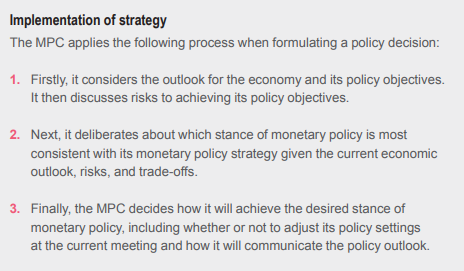
Which is another of the oddities of the document. I’m not a big fan of medium-term macroeconomic forecasting, and was openly sceptical of its value for years when I was inside the Bank (it is too long ago to recall whether I was so sceptical when I ran the forecasting function) but the Bank purports to believe. A lot of effort has typically gone into doing and writing up the forecasts. And if you go to the formulaic pages at the front of the MPS, we are still told of a threefold approach to policy.

strategy

Which seems to put a lot of emphasis not on the conjuncture (current situation) but on the outlook (projections, forecasts surely?). And yet when we got to chapter 5 of the MPS – devoted to the outlook – there is much less than a full page of text, and then a two page bullet point table which contains no economic analysis at all, and which doesn’t appear to add anything beyond the numbers in the table. This appears to be a new approach – there was much more text in November – and it isn’t obviously an improvement. We have the Bank’s numbers, but almost nothing at all about the thinking, analysis, and research that lies behind them.

Perhaps – given my scepticism on medium-term forecasting – that might be more pardonable if there was lots of really high quality analysis of the current and recent past situation. In times like the present, perhaps one really can’t improve on a decent understanding of where we are now, and what we are learning from incoming data. But there isn’t anything very serious on that score either. For example, there is no sustained analysis of the housing market – which seems all the more extraordinary in light of the Minister’s intervention this morning – no sign that the Bank has done serious work on unpicking the various factors driving it, or influencing their quite optimistic forecasts. There is, for example, reliance on a story about returning New Zealanders last year. Perhaps it is a big part of the story, but argumentation is never developed, alternative hypotheses are never tested, and there is barely any mention of the rather large reduction in the number of non-citizens arriving (as it happens, it also isn’t that clear what they are assuming about net migrations as and when borders reopen).

Similarly I didn’t see any serious analysis of why the Bank thought it had been so surprised about recent developments. Of course, they weren’t alone in that surprise, but they set monetary policy, and they have all those resources at their disposal. Was it that monetary policy had been surprisingly potent – whether OCR or LSAP? Was it that resources and consumption were just much more flexible than they thought? Was it housing? (but if so, an authoritative analysis of the housing market is all the more important surely?) I don’t know the answers, and am not pushing particular stories, but shouldn’t we expect fresh and authoritative insights from the Bank? But there is nothing there – and nothing in the comments of the Governor and his senior staff at the press conference yesterday. There are lists, there are charts (some moderately interesting), but little or no insight or analysis – and there have been no speeches etc offering it either. It is the weakness of the institution – they might get some individual calls right, but one can’t have any confidence that they really know what they are doing and deserve deference for their insights, research and authoritative insights and judgements. Instead we get things like populist digs at banks for not, in the Governor’s view, having lowered their lending rates “enough’ – as if he was either a politician or perhaps a competition regulator. Oh, and in a document of not much more than 30 pages of text, devoid of much serious analysis on core issues, there is three pages devoted to one of the Governor’s pet playthings – the “Maori economy”. Can we expect one on the Catholic economy, the lefthanders’ economy, or the Labour-voters economy next? Each would be equally irrelevant to the Bank’s macroeconomic monetary policy – one economy, one instrument – statutory focus.

But the MPS was yesterday, and then this morning – safely after the FEC had had its chance to question the Bank – we had the real monetary policy initiative of the week, with the Minister of Finance announcing that he had changed the Remit to which the Bank works. He can do that, and had signalled back in November that he might make such a change. The new Remit is here.

It is a pretty shoddy affair on the Minister’s part. The new Remit was dated 22 February – Monday. Presumably the Bank was well aware of it. But the Minister kept it quiet until today, and the Governor made no mention of it yesterday – when the journalists had their quarterly chance to grill the Governor on monetary policy topics (next time not until late May). From a government that used to talk of being the most open and transparent ever, from a central bank that likes to claim it is highly transparent, it was like a sick joke, designed to avoid serious scrutiny and have all the reportage based on press releases – the Minister’s puff piece, and the Governor’s fluff.

It was typical Robertson (and perhaps Orr too). Robertson has never shown any sign of being serious about better monetary policy or a better institution (if he had, for example, he wouldn’t have banned people with an active research interest in monetary policy from being considered for the Committee) but he is very assiduous about having it look as if he is making a difference. That remains the best way to understand the first round of Reserve Bank reforms, and is the best way to see today’s announcement. The government is under pressure for doing little or nothing on housing. The Minister knows that monetary policy has little or nothing to do with the New Zealand housing market policy disaster, but he needs to look as if he is doing something, win a news cycle or two, and perhaps even fend off a few of his left-wing critics who do blame the Bank.

If you doubt that interpretation, look at the specific changes the Minister has made. At the front of the document there is woolly political paragraph about the government’s wider economic goals. It has no binding effect on anyone, but to that long list Robertson has added

An effective functioning housing market is a critical component of a sustainable and inclusive economy and promotes the maintenance of a sound and efficient financial system.

Well maybe, but even if you, I, the Governor or the MPC agreed it is simply a statement of faith, and anyway the Reserve Bank – especially with its monetary policy hat on – has no impact in delivering “an effective functioning housing market”.

And then later in the document the Minister has added some words. The first ones are in a section that does bind the Bank. There is a list of things that, in pursuing price stability and supporting maximum sustainable employment the Bank is required to do. There is longstanding stuff about avoiding “unnecessary instability in output, interest rates, and the exchange rate”, about looking through one-off price shocks, and having regard to “the efficiency and soundness of the financial system”. To that list the Minister has added this

assess the effect of its monetary policy decisions on the Government’s policy set out in subclause (3

and that “Government’s policy”? It reads thus

The Government’s policy is to support more sustainable house prices, including by dampening investor demand for existing housing stock, which would improve affordability for first-home buyers.

How wet is that? So the MPC is only required to “assess” the impact of its decisions on the government policy, not act in pursuit of that “government policy” (which might well be ultra vires anyway). A Reserve Bank action will no impact on a government policy: government policy will still be what it will be. At most that is another paragraph in each MPS. And quite how monetary policy decisions will affect the mix between the despised “investors” and other potential buyers will be a mystery to almost everyone (the Bank has financial regulatory interventions that it can use – although borders on the ultra vires to do so – that might have an effect but…..this is monetary policy.

It was a feeble effort. On the one hand we should be glad that the Minister sees sense and doesn’t ask the Bank to pursue house prices – doing so would simply push unemployment higher than it needs to be – but much better if he’d simply done nothing on monetary policy – and he and his colleagues concentrated on the real issues – rather than this limp effort in performative display, stage-managed to minimise the risk of serious immediate scrutiny. The Governor was, I guess, much too diplomatic to point out the emptiness of today’s announcement, but how he’d have answered faced with a sceptical press conference would have been interesting. And how MPC colleagues might have answered if they were ever allowed to speak openly, if appointments had not simply been based on who met certain political and gender criteria, who wouldn’t ever make life awkward for the Governor.

(Oh, and if the Minister and Governor really weren’t trying to avoid scrutiny, the obvious thing would have been to have released the Reserve Bank advice, the Treasury advice, and any Cabinet paper when the new Remit was announced. Of course they didn’t.)

Monetary policy

Having taken their long summer break – not heard from since 11 November – the Reserve Bank’s Monetary Policy Committee will be out with their Monetary Policy Statement on Wednesday. Much has changed in the economic data and indicators, here and abroad, since then, and it will be interesting to see what the Governor and has committee have made of it all. There are some genuine surprises and puzzles that the Committee should have been grappling with – and most other macro economists and commentators too, but the rest of us don’t get to set monetary policy. And if the strength of the economic rebound is a surprise – and it would appear to have been to the Bank too – how resilient is that rebound likely to prove, and under what conditions?

I’m somewhat sceptical of the idea of a resilient rebound this year – and with more than a few questions/puzzles about quite which data we can really count on at present – but without a compelling explanation for last year, one has to be even more hesitant than usual about backing a view about the future (macro forecasting is mostly a mug’s game anyway).

My own approach to monetary policy would probably be the one – “least regrets” – the Bank has repeatedly articulated over the last couple of years, if rarely followed in practice. That is especially so because the last year has made me more sceptical than I was about attempting to use fiscal policy for macro stabilisation (as distinct, say, from income relief amid a lockdown). Interest rates are the prices that balance savings and investment intentions, and monetary policy is about allowing interest rates to do that job.

And so even if the level of economic activity – even in per capita terms – is now back to something like it was at the start of last year, we still have

  • a central bank that has done nothing to reduce the (true) effective floor on the nominal OCR (even if they have very belatedly ensured that banks can cope with modestly negative rate),
  • core inflation that is still (a little) below the midpoint of the target range, not having been at or above that midpoint for the best part of a decade),
  • inflation expectations (surveys and market prices) that are still typically below the target midpoint, often by quite a long way (and this is so even though there has been quite a –  welcome –  lift in recent months),
  • the unemployment rate (inevitably measured less precisely than usual) is still non-trivially above reasonable guesses at where a NAIRU might be,
  • most other countries’ economies are doing less well cyclically than New Zealand’s and if vaccination programmes are well underway in a few of them, anything like normality still seems quite a way away, 
  • there is a great deal of uncertainty (inescapable, unavoidable) about the environment in which firms and households will be operating, and uncertainty tends not to encourage either consumption or investment spending, and
  • if the US is having another fiscal splurge, more generally across advanced countries the pressure in the next year or two is likely to be towards fiscal consolidation –  not necessarily dramatically so, but certainly in contrast to last year.  There isn’t much sign New Zealand will be any exception to that (nor, in my view, should it).

And then there is the wider backdrop. Even if we recover from this unusual Covid recession more readily than many had expected, the issue that has increasingly dogged monetary policy over the last decade has not gone away: nominal policy interest rates in more and more countries (now including former high interest rate countries New Zealand and Australia) are now near zero leaving rather limited monetary policy capacity when the next serious recession – grounded in economic developments not infection ones – comes along. That might be 10 years away, but it might be only a handful. The best thing monetary policy can do to help ensure there is some policy leeway next time is to err strongly on the easing side at present, generating inflation (and inflation expectation) outcomes that are – for a change – in the upper part of the target range. The Bank could articulate something like the Fed’s average inflation targeting approach – or, since the Minister is the one supposed to set the target, the Minister could tell them to – but a decent start would be to start acting as if they would be totally comfortable if, by chance, core inflation averaged say 2.3-2.5 per cent over the next five years. That doesn’t require actively targeting such numbers, but it does require recognising that central banks (including our own) have consistently over-forecast inflation over the last decade, and still don’t adequately understand why they’ve made that mistake. So by being actively willing to embrace higher inflation outcomes, perhaps the Bank and the MPC might just give themselves a better chance of delivering outcomes around 2 per cent – what successive ministers of finance have asked them to do.

If it were me, then, I would still be cutting the OCR, perhaps to zero this time. It would add a bit more macroeconomic stimulus, and would also be more realistic – since we don’t know the future – than idle pledges to keep the OCR where it is for some arbitrary length of time (recall that their last, hawkish as it turned out, arbitrary commitment only expires next month). And I would continue to express a willingness to take the OCR negative – and not a grudging willingness, but a genuine “do what it takes” approach to getting the economy back to full employment and inflation back to target.

And what of the Large Asset Purchase programme? If it were me, I would discontinue it now. That isn’t inconsistent with my macro stance (see above) because as regular readers know I’ve long been of the view that the LSAP was not making much macro difference at all (even if it may, at the margin, have helped a little in stabilising bond markets in the couple of weeks of global flurry last March), while it continues to (a) act as distraction (enabling the Bank to look and sound as if it is doing more than it is, and (b) has led some people to believe that somehow monetary policy, notably the LSAP programme, is greatly exacerbating that unnatural disaster of the rigged New Zealand housing market. Scrap the LSAP and nothing of substance will change around the housing market – access to finance, access to (use) land, supply of finance, demand, or even the shorter-term interest rates that are relevant to most mortgage borrowers. (And, of course, more generally the unnatural disaster has almost nothing to do with monetary policy – and even for those who want to “blame” interest rates, bear in mind that very long-term market rates, that central banks have little direct hold over most of the time, have been falling for decades.)

Now I don’t for a moment suppose that the Bank will do anything of that sort, on any of what I’m suggesting about monetary policy. But I hope they do give us some sort of serious framework outlining the sorts of specific factors that might eventually lead them to discontinue the LSAP. It is, for example, hard to see how they could justify continuing it if (a) they now believe banks can adequately cope with negative interest rates, and (b) if they get to a point where they think the risks are no longer skewed to the downside.

On such things, I’ve been reading over the last week a new book by the British economist Jonathan Ashworth on the experience this century with central bank asset purchase programmes (it is 20 years next months since the Bank of Japan first launched its quantitative easing). Quantitative Easing: The Great Central Bank Experiment was published last year and clearly was completed on the very eve of Covid – a couple of 2020 references, but no mention of the Covid recessions/interventions at all. It is a really nice summary treatment and documentary record of the activities in this area of the Fed, the Bank of England, the ECB, and the Bank of Japan, up to and including the Fed’s partial withdrawal from QE, as it finally raised interest rates after 2015 and wound back the size of its balance sheet. Although the publisher – launching this new series of books on aspects of the global financial system – describes the approach of the series as “resolutely heterodox”, in fact the book is strikingly orthodox. It is, therefore, quite a nice summary of the likely way the Reserve Bank and The Treasury were seeing the possibilities, and limitations, of quantitative easing when they were advising the government at the start of last year. It is also a good single point of reference if, like me, memories of some of these programmes grow somewhat hazy over time. And for anyone wanting a good introduction it is a fairly accessible read.

The orthodox view tends to be that asset purchase programmes have had some, perhaps significant, macroeconomic benefits. The case is probably strongest in the midst of the 2008/09 crisis when both the UK and US launched such programmes (although with important differences between those programmes) although Ashworth seems to favour interpretations in which later programmes have also had useful effects. I’m more sceptical, for a variety of reasons. Much of the work in this area rests of event studies around the announcement of programmes, and so it is a shame that Ashworth does not engage with (for example) the published work of former senior St Louis Fed researcher Dan Thornton who has critically reviewed claims in that are (see, for example, this journal article, and this policy piece). Ashworth rightly highlights how wrong were the people who claimed a decade ago that the asset purchase programmes would lead to a huge upsurge of inflation (much the same claims are made in some quarters on the right about the latest asset purchase programmes) but doesn’t really probe deeply questions as to whether a large scale asset swap can really make very much sustained macro difference. He doesn’t, for example, engage with the idea that things might be different if a central bank was buying bonds yielding, say, 10 per cent, and paying zero interest on settlement cash balances (as would once have been the norm) than if the central bank is purchasing assets yielding under 1 per cent (sometimes under zero) and paying the full policy rate on the resulting settlement cash balances. And although he usefully looks at the Fed’s balance sheet wind-down pre-Covid, his conclusion that that policy choice had little or no macro impact doesn’t seem to lead him to reflect afresh on whether the earlier policy interventions really had as much sustained effect as many central bankers prefer to believe. (One of my own sceptical arguments over they ears has been that there was little sign that bond yields had fallen further relative to policy rates in countries that used the LSAP tool – say the US or UK – than they had in countries that did not – say New Zealand or Australia.)

One point Ashworth does usefully highlight – and which I hope the RB will touch on on Wednesday – is the stock vs flow distinction. If QE has an effect, it is from the transactions in the market at the time (the flow) or from the accumulated withdrawal of bonds from the market (a stock effect). He notes that the literature tends to favour the stock story. If that is correct – and if QE has much effect at all – then, for example, the Reserve Bank could discontinue the LSAP now and continue to assert that the stock of bonds they had purchased was continuing to have a material stimulatory effect.

And just in case you think that LSAP-scepticism might just be some Reddell idiosyncrasy, I can leave you with a couple of quotes, The first is from the body of the book, from Paul Krugman, quoted in 2015 observing of the unconventional monetary policy tools “the bad stuff [presumably inflation risks] unpersuasive, the good stuff maybe, but not really compelling, this has just not turned out to be the game changing policy too that people had expected”. The other quote is from the Foreword to the book by the eminent academic and former central banker, Charles Goodhart (also a former colleague of Ashworth’s). Goodhart clearly likes the book, and commends it to readers, but notes that his own view that beyond intense crisis periods – in which bond purchases can respond to liquidity and market dysfunction stresses – the direct effect on the real economy via interest rates [ and recall that Orr claims the LSAP works by affecting interest rates], either actual or expected, and on the portfolio balance, was of second-order importance. QE2, QE3 and QE Infinity are relatively toothless”.

As I’ve noted previously when you have a tool that largely involves swapping one lots of (longer-term) government liabilities for another lot of (shorter-term) government liabilities – both paying low but market interest rates – and when your swap doesn’t even displace many existing holders of the long-term assets, it is inherently unlikely that you could use such a tool to generate large or sustained macro effects. My best read of the experience to date – abroad, nicely described in the book, or at home – is that we’ve seen just what we should expect, but with lots of central bank handwaving (the need to be seen to be doing something) that has distracted people into thinking that the tool is much more powerful – for good or ill – than it actually is.

Not really

Late on Friday afternoon I saw a tweet from Stuff politics and economics journalist Thomas Coughlan linking to a new and substantive article he’d written under the headline “Reserve Bank repeatedly warned Government money printing would lead to house price inflation”. Several other journalists who’ve each had a bee in their bonnet about the Reserve Bank’s asset purchase programme weighed in in support. None of them is too keen on Grant Robertson, and so it was presented as if they’d found evidence that the Minister of Finance had spent the year ignoring things that were not only totally predictable, but of which he had been advised by his officials. The Bank knew (we are told), as did The Treasury, but Robertson fiddled while Rome burned. Or so the story goes.

Now I yield to no one in my distaste for this government’s 3.5 years of appalling indifference to the unnatural disaster that is New Zealand house prices. But on a first glance the Stuff story didn’t seem very plausible – even noting that Coughlan was drawing on papers he seems to have obtained from The Treasury (and which, to his credit, he provided links to). However, it was Friday afternoon and my appetite for chasing these things down isn’t what it once was. So it wasn’t until yesterday that I read carefully the article, and the official papers Coughlan cited.

Coughlan links to three official papers. The first of these is a joint paper from the Reserve Bank and The Treasury dated 29 January 2020 addressed to the Minister of Finance on “Institutional Arrangements for Unconventional Monetary Policy”. I’d be surprised if the Minister paid much attention to it at all, for several reasons:

  • it was more than 20 pages long,
  • it was signed out by two fairly junior people (one on each side of the street), and
  • all it asked was for the Minister to agree that officials keep working on the issues (not the substance of so-called unconventional monetary policy, but “institutional arrangements” for something officials explicitly say is a low probability event any time in the following two years).   The intention at the time was a report back by the end of July.

But even if the Minister had read, marked, and inwardly digested the full report, what else would he have found?

Coughlan notes that the report says that “as these tools have never been used in New Zealand before, the magnitude of the macroeconomic stabilisation benefits is highly uncertain”.  Well, indeed.  But what of it?  In fact, at least one of the tools on the list has never been used anywhere, so it is hardly surprising no one could be confident what effect it might have.   It is the sort of boilerplate statement that, in a report of this sort, any reader will quickly pass over.

Then we learn that “although UMP tools entail many of the same trade-offs as conventional monetary policy, the scale of the tradeoffs can be larger with UMP.  The trade-offs include fiscal risks, financial stability risks, distributional impacts, and the impact on financial market functioning”.  Not that the operative word is “can”, and the list of “tradeoffs” is still very generic.  However, officials refer to a Figure A.  In this table the orange-coloured items are “the more significant trade-offs”, and this box (below) is about the class of tools labelled “Large scale asset purchases, including domestic government bonds, foreign currency or foreign government bonds, and corporate bonds.


Note that

  • there is no mention of house prices at all
  • the observation is about what “may” happen, not what will happen
  • a reasonable reader might reasonably suppose that officials were talking mainly about bidding up the price of assets the central bank was purchasing in such operations –  the most obvious “more directly” effect, since conventional monetary policy doesn’t work by buying assets outright but by setting an overnight deposit rate.

And that is about it in the body of a 20+ page document.  There is, however, an Annex about specific possible tools.  Do Ministers read Annexes at the end of 20 page documents?  Not often is my guess, especially when all this is about hypotheticals (so officials were telling the Minister), and when the paper is about institutional arrangements not details of tools.    But had he got that far here is what the Minister would have learned from his officials about asset purchase programmes.
Not only is there is no reference to house prices at all, but officials explicitly tell the Minister that in a New Zealand context a lower exchange rate is likely to be the main transmission channel.

So that was the 29 January paper. One might reasonably criticise both officials and the Minister for the lack of urgency by then (Wuhan was in lockdown, the Ministry of Health had deemed the coronavirus a serious issue, and the NZ government was days away from stopping arrivals from China…….oh, and the Bank/Treasury had had 10 years to prepare for a crisis in which the OCR hit zero) but one could hardly say Grant Robertson was now fixed with knowledge that if monetary policy was eased in the next downturn house prices would go crazy. No one was proposing the Reserve Bank buy houses, and house prices weren’t even mentioned.

The next document Coughlan cites is a short aide memoire from The Treasury dated 9 March 2020, prompted by the speech the Governor was to give the next day on unconventional monetary policy. It is titled “Update on work on institutional arrangements for unconventional monetary policy”. There is no analytical substance in the note at all (nor would one expect there to be). It does note that the risks of needing unconventional tools at some point had increased due to Covid-19, but there was no sense of urgency, and officials simply noted that they were bringing forward the report-back date for some bits of the institutional arrangements work to the end of May. I count that as pretty damning – this was, after all, only a week before the MPC (with the Secretary to the Treasury sitting on it) finally confronted reality and cut the OCR sharply, and instituted a floor (OCR at 25 basis points) that not even Treasury seems to have envisaged, but none of this has anything to do with house prices, distributional effects, or the like.

The third paper is dated 16 March and is an aide memoire from The Treasury on large scale asset purchases, the MPC having announced that morning that the LSAP would be next cab off the rank if the Bank considered more policy support was needed (note that the Minister’s own Covid-response package was to be announced on 17 March). Unsurprisingly perhaps, there isn’t anything new in this note either. House prices, for example, are not mentioned at all. There is something similar to the bit from the January paper about how the portfolio rebalancing channel might “push up the price of a range of assets, helping to flatten yield curves” – a phrasing that clearly has in mind simply bidding up long-term bond prices – and a repeat of the point that the exchange rate effect might be particularly strong in New Zealand. (At this point, Treasury still doesn’t seem to have envisaged that the government would be issuing so many new bonds that total private holdings might not drop much, if at all.)

And a little later there is the repeat of the distribution line: “LSAPs have many of the same distributional impacts as conventional monetary policy, but can raise asset prices more directly than conventional monetary policy, creating wealth inequality. However, they can also mitigate inequality by supporting employment.”. One might challenge some of the Treasury’s economics, but there is no reason in any of this to think (or for the Minister to think) that they were referring to anything other than the direct effects on prices of assets the Bank itself might purchase. And no one was suggesting houses for that list.

And that is it. That is the set of documents Coughlan claims show that the Minister of Finance was repeatedly warned that asset purchases would send house prices further into the stratosphere. It seems like very slim pickings to me.

Of course, we don’t know what the Secretary to the Treasury and the Governor may have said to the Minister in their private conversations with him. But we do know quite a lot about the Bank was saying in public.

For example, there was that long speech (19 pages) that the Governor delivered on 10 March – when he was also doing everything possible to play down any sense that monetary policy might need to do anything soon. It was sold as some sort of framework for thinking about monetary policy issues and options when the OCR had got to, or very near, zero.

The Governor tells us about a BIS assessment of other countries’ asset purchase programmes

and something of the Bank’s own thinking (emphasis added)

and then something that looks a bit more directly relevant

But note that (a) here he refers to both low global interest rates and unconventional monetary policy, not just the latter, and (b) Figure 5 actually shows that house prices (and share prices) in New Zealand had increased more in New Zealand over the last decade than in advanced countries as a group (many of which had used asset purchase programmes).

The very next paragraph reads as follows

Not exactly some sort of smoking gun, and certainly no sense that the Bank thought that launching an LSAP early in a severe downturn would send house prices further into the stratosphere.

In fact, the Governor helpfully included this chart showing how the Bank thought the transmission mechanism would work
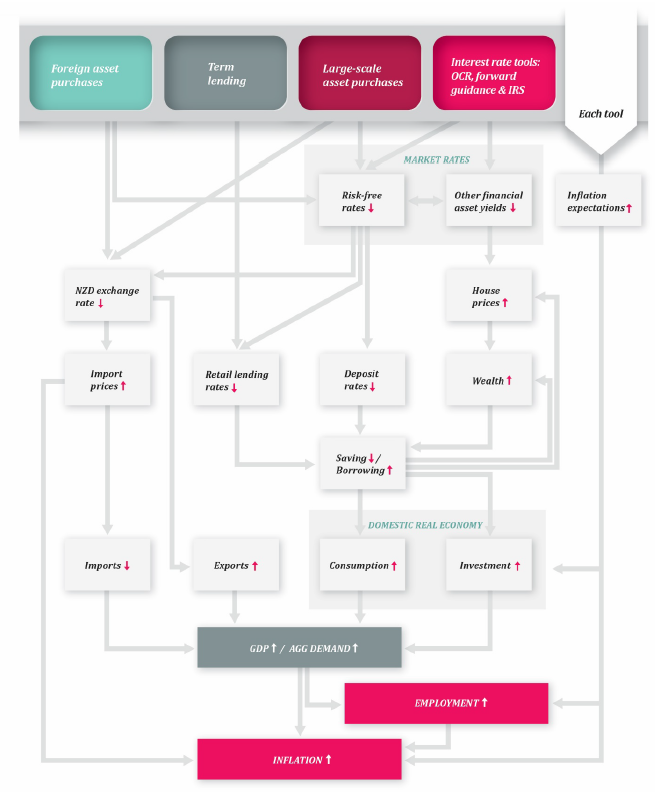
It is quite a complicated chart but note that (a) there is no channel to house prices that is different from the way they thought normal monetary policy works (ie through lower interest rates) and (b) the only separate channel they highlight in regard to an LSAP tool is the exchange rate.

On the final page of his long speech the Governor wraps up this way (again, emphasis added)

The Governor had his bases covered with a long list of issues, but note that even that final warning is (a) not specific to an LSAP tool, (b) never – as with the rest of the speech – mentions house prices, and (c) seems to be talking about prolonged period effects, not those in the first few months after an intervention.

Quite possibly the Minister of Finance didn’t read this speech either, but had he done so he’d still not have been fixed with the sort of knowledge, and implied guilt, Coughlan claims.

One could go on. One could look back to the Bank’s significant Bulletin article in 2018 on monetary policy options. It was a careful survey of some of the issues and overseas experience, but on skimming through it again I didn’t see references to house prices. Or the Governor’s substantial Newsroom interview in late 2019 – the one in which he expressed a distinct preference for a negative OCR over LSAP-type tools – where there was also no reference to house prices.

Or, since Coughlan claims the Minister was fixed with knowledge and that the Bank had clearly advised him, we could look at the Bank’s own Monetary Policy Statements last year. In May, for example. when it was still early days, but when the LSAP had been deployed and the OCR been cut, the Bank’s baseline scenario was that house prices would fall by 9 per cent over the rest of 2020. In August, several months on, they noted that “accommodative monetary policy is supporting household spending by limiting house price declines”. They weren’t telling the Minister of Finance the LSAP would cause house prices to explode because…..that wasn’t their view, and at most they thought all their interventions were limiting house price falls (as one would expect – see transmission mechanism chart above – with conventional stabilisation monetary policy).

One could go on. There are other telling quotes from the Governor and other senior officials – although of course never from external MPC members who exist, if at all, in some sort of purdah – and the actions of the Bank (eg suspending LVR restrictions) or the rolling out of stress test guesstimates based on falling house prices.

There is simply nothing in the paper trail to suggest that the Bank (in particular, but probably Treasury too) was vigorously highlighting to the Minister of Finance that if they were let loose with the LSAP tool house prices would starting rocketing upwards again. They just weren’t. (And for what it is worth, the Bank’s survey of expectations – mostly of economists – through last year consistently had house price inflation expectations at or below the expectations that existed at the start of last year.)

Now it is of course true that house prices have gone crazy again (yesterday a real estate agent put a brochure in our letterbox telling us of this little Island Bay house – 112 square metres of house, 259 square metres of section, no view – that just sold for $1.4 million). In a better world – more knowledge, more good analysis – our officials and economists would have anticipated such an outcome. But they (well, we) didn’t. Speaking only for myself, I expected that as in most recessions we would see a fall in house prices that wouldn’t last that long, or be that deep, but might take a few years to reverse. After all, in typical recessions (a) interest rates fall, often more than they did in 2020), (b) bank lending standards often tighten (as the survey suggested they did last year), and in this downturn the net inflow of migrants was also likely to be disrupted.

There are people – on both the left (including the journalists I mentioned earlier) and on the right – who want ascribe a lot of the blame (the different than normal outcome) to the LSAP. There is much use of the loose, and not very accurate, term “money printing”. In this lecture late last year I told my story on why I’m convinced that what is little more than a large scale asset swap (two very similar assets, differing only by maturity date) is not having much macro effect at all. And I echo the Reserve Bank’s own repeated view that to the extent the LSAP works it does so by lowering interest rates, and the fall in interest rates in not unduly large, or larger than the Bank’s own published forecasts repeatedly suggested was needed for macro-stabilisation purposes.

I’m not that confident of my own story, but for now it would emphasise macroeconomic forecasting errors. To date, and for reasons that still aren’t clear, the economic rebound has been much sharper than any forecaster – but notably the RB and the Treasury – expected. Perhaps that will last, or perhaps not, but for as long as it does, in an environment where governments keep land artificially scarce, people are more likely to be willing to bid house prices to even more outlandish levels than would have seem plausible when the Bank and Treasury were advising the Minister in the first half of last year of the likelihood that the Covid downturn would be quite deep and quite enduring.

(Of course, adding further distortions to the once-functional market for housing finance, pursuing political agendas more than hardheaded assessments of risk as with the RB’s new LVR controls announced today, can dampen some of those house price pressures for a time. But the solution to the house price debacle still lies where it always did, with the central and local governments that continue to make land for development artificially scarce in a land-abundant country. Blaming the Reserve Bank, blaming the banks, blaming the tax system, or blaming anything else is really just distraction.)
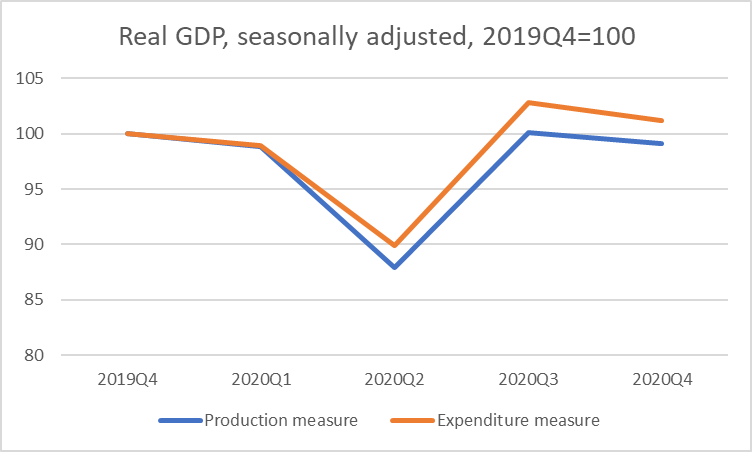
Reforming the Reserve Bank, continued

Submissions to Parliament’s Finance and Expenditure Committee on the Reserve Bank of New Zealand bill close today. This is the next stage in the ongoing overhaul of the Reserve Bank legislation, and this particular bill focuses on a new governance structure for the Bank, largely importing for monetary policy the provisions of the amending legislation passed a couple of years ago. In the process, the substantive regulatory powers that were part of the Act are being spun out, unchanged for now, into a separate piece of legislation.

There is a fair amount of sensible stuff in the bill. The single decisionmaker model, flawed and unusual for monetary policy, deeply unsuited to the regulatory functions, will finally be no more. The MPC now makes monetary policy – well at least on paper at does, perhaps it more true that MPC is the venue at which monetary policy is made – and in future the Bank’s new Board will be responsible for all the other functions of the Bank (notably all those highly contentious bank regulatory policy functions, and the application of supervisory policy to banks, non-bank deposit takers, and insurance companies). There are some small steps in the right direction on funding agreements, and a formalised responsibility for Treasury in monitoring the Bank in support of the Minister’s role in holding the Bank to account.

There are some problematic things as well. There is a worrying provision that allows someone with a conflict of interest to nonetheless act and or a vote on a matter if someone as lowly as the deputy chair of the Board thinks it is okay. There is the worrying disappearance of the “efficiency” constraints on the Bank’s interventionist enthusiasms from the statutory goals for prudential policy. And there is what I think is the wrongheaded choice to keep all the functions – really quite different functions, probably needing quite different sorts of people at the helm – in a single institution.

I made only a quite short submission focused on just two areas of the bill that I see as problematic:

  • the quite different (utterly different) governance models being established for two different, each complex, policy functions housed in the same institution, and
  • the key role the Bank’s Board – primarily responsible for corporate matters and financial regulation/supervision – will have in the appointment of key monetary policy decisionmakers, the Governor and (in particular) the external members of the Monetary Policy Committee, even though there is no reason to think the Board will have any macro expertise, or will treat it as a priority, and although they will have no effective public accountability for appointments these unelected people will control.

On the first point

The Bank has two prime functions. 

The first is the conduct of monetary policy, which is primarily the responsibility of the Monetary Policy Committee (MPC).  The MPC operates under a Remit set by the Minister, outlining more specifically the goals for monetary policy.  The Governor chairs the MPC, and although the remaining members (three internal, three external) are appointed by the Minister on the recommendation of the Board, the Governor himself has a great deal of say in those appointments, especially those of the internal members, whom the Governor appoints, remunerates, and allocates resources to (in respect of their line management functions).  That influence will be further strengthened under this bill because (rightly) the Deputy Governor will no longer be a statutory role.

The second main function is financial supervision and regulation, oversight of the financial system as a whole and prudential regulation of banks, deposit-takers, and insurance companies.  The Bank has extensive discretionary policymaking powers, especially as regards banks (the largest, by far, financial institutions in New Zealand).   This discretion exists not just as regards the application of clear policy to a specific institution’s circumstances, but as regards policy itself (notable recent examples in New Zealand have been around loan to value limits, and bank capital requirements).

This bill provides for a new Financial Policy Remit.  There is probably some merit in this innovation, although only time will tell (since we have not seen what such a Remit will look like or operate).  However, members should not be deceived by the use of the term of “Remit” for both monetary policy and financial regulatory functions.  The monetary policy remit is more or less binding on the MPC, clearly setting out a fairly widely-agreed target that is not too dissimilar to targets in a range of other advanced countries.  By contrast, section 201 makes clear that the financial policy remit is to be no more than the identification of things the Minister considers it desirable for the Bank to have regard to.       In other words, a huge amount of discretionary policymaking power is to be left with the Bank, in areas where there is no generally agreed right or wrong approach and thus little effective basis for holding the Bank to account for its exercise of those powers.    In the literature, notably for example former Bank of England Deputy Governor Sir Paul Tucker’s book Unelected Power, this lack of clarity (an unavoidable lack given our current state of knowledge) would be an argument for putting less policy-setting power in the hands of unelected officials, leaving contested policy choices to the Minister of Finance, working with expert advice from (in this case) The Treasury and the Reserve Bank.

What is striking, however, is the quite different governance model chosen for the Bank’s financial regulatory functions.  The powers of the Bank in this (and most other) areas will, in future, be vested in the Bank’s Board, and neither the Governor nor any other staff will be members of the Board.   There may be some merits in a governance model of that sort for some sorts of agencies.  In many Crown entities the chief executive is simply an employee of the Board.  That is, as I understand it, the situation at the Financial Markets Authority (albeit an agency that does not have extensive policymaking, as distinct from implementation, powers).  But it seems strangely anomalous to have two quite different governance models for two different, both prominent and complex, policy functions operating in the same institution.    And if there was a case for giving the chief executive (and fulltime experts) a stronger role in one or other of these functions, one might suppose it would be in the financial regulatory and policy side, where there is much greater ambiguity and uncertainty [including about goals, constraints, and transmission mechanisms]. 

It also seems anomalous that the monetary policy provisions have been written to make clear that the Governor is the key figure, including the prime public representative.  By contrast, for financial regulatory matters there will be a separate chair of a Board the Governor is not even a member of, and the Governor is at most an adviser to, and spokesman for, the Board.    While it is not unknown to have monetary policy and financial regulation done by different committees in the same institution (eg the UK) I’m not aware of any country that has chosen to create such gaping differences in the roles/powers of the Governor across those functions.   In one – the smaller (although more prominent) side of the Bank in future – he will be “kingpin”; in the other the Governor will have a diminished role that will only become clear with time.

Perhaps it might be a more pardonable outcome if the model has grown like topsy over a long period of times, but the two stages to the institutional reform of the Reserve Bank of New Zealand have been done as part of one process and by a single Minister of Finance.  It is not too late to step back and introduce greater alignment across the governance models used for the Bank’s two main functions.  Or to reserve more of the financial regulatory policymaking power to the Minister of Finance.

And on the second

Since 1989 the Governor has been appointed by the Minister of Finance, who may only appoint someone recommended by the Bank’s Board.  That in itself is a highly unusual model internationally. It is much more normal for the Minister of Finance (or the executive collectively) to be able appoint his/her own preferred candidate as Governor (that is, for example, the model in Australia, the UK, and – subject to Senate confirmation –  in the US).  Much the same model – Minister can appoint only people recommended by the Board –  was adopted for the other members of the Monetary Policy Committee in the 2018 amendments.

Whatever the possible merits of that model under the 1989 Act, the situation will be quite different under the provisions of this bill as drafted.  Under the 1989 model, the Board itself had few decision-making powers, none on any policy or operational matters, and its role was explicitly primarily about holding the Governor to account, and one of its key functions was the recommendation of the appointment of the Governor.  Whatever considerations influenced successive ministers in making Board appointments over the years, it was clear the Board had much the same (monitoring and accountability) responsibilities across all the functions the Bank/Governor were responsible for.   That remained more or less so under the 2018 amendments, in respect of the other MPC members.

But under this bill, the primary functions of the Board will in future be the conduct of the affairs of the Bank, other than those of the Monetary Policy Committee.  By far the largest of those functions will be financial system oversight and financial institution regulation and supervision (together with associated financial functions such as physical currency, payments systems, and the wholesale securities settlement system).    It seems likely that the bulk of the people appointed to the Board will be people with skills and background in and around financial institutions, and perhaps some people with a regulatory/corporate background.   That may be quite appropriate for the financial regulatory/oversight functions.  But macroeconomics and monetary policy is a quite different sort of role and requires a quite different set of skills, and it isn’t obvious that we (or future Ministers) can count on future Boards to have any real expertise in these matters, or any great interest (given that they will be busy doing the stuff the Board has prime responsibility for).    And when it comes to the appointment of the Governor in particular, isn’t there a serious risk that the Board will be more likely to emphasise skill sets relevant to their functions, those they see the Governor in each week/month, and not the skills necessary for the effective conduct of monetary policy?   And even if the Board members are well-motivated around monetary policy, what expertise or ability to judge are they likely to bring to the appointment/recommendation decisions.

I would strongly urge that these provisions be reviewed and amended.  In the Bill, Board members are to be appointed by the Minister but he/she will be required to consult with other political parties before making those appointments.  Why not, then, adopt, the same model for the appointment of the Governor and the appointment of other MPC members?  Doing that would not only make clear that monetary policy is not some secondary function, but would ensure that the Minister (a) has discretion to appoint people he/she is comfortable with (important since only the Minister has electoral accountability), (b) can draw on advice from The Treasury, the government’s key adviser on economic policy matters, and (c) adds a layer of reassurance (consultation with other parties) that still keeps tolerably low the risk of raw cronies being appointed to these important roles.   An alternative model to political party consultation – one I would prefer, and one used in the UK – is to provide for FEC itself to hold hearings on people being appointed to these before people can take up their appointments.  FEC would not have a formal power of veto, but the requirement for public scrutiny and the scope for hard questions also acts as an effective check in helping ensure that good quality candidates are consistently appointed.

There is really no excuse for such a dogs-breakfast. Yes, the MPC model is up and running, but has been in place for less than two years, and it would not require very large changes to bring the models applying to the two functions into greater alignment, and ensure appropriate control of appointments by the only people we – voters – can toss out; that is, the Minister of Finance.