Getting the small things right

Readers may be getting bored with a full week of posts on nothing other than Reserve Bank topics.  In truth, so am I.    But here is one last post in the sequence.

Saturday’s Herald featured, as the front page of the business section, an interview with outgoing Reserve Bank Governor Graeme Wheeler.    This seems to have become a bit of a pattern –  the Herald gets access to the Governor the day after the MPS, to provide a bit of a platform for whatever the Governor wants to say.  The interviews are notable for being about as searching and rigorous as, say, the recent Women’s Weekly profile of Bill and Mary English.

The interview allowed the outgoing Governor to “launch the campaign” to become Governor for his deputy (and former Government Statistician), Geoff Bascand.    That shouldn’t surprise anyone.  Then again, it has now been 35 years since an internal candidate was appointed Governor.  Successful organisations – the Reserve Bank of Australia is one example –  are often seen promoting from within.

But my interest in the interview mostly centred on the Governor’s claim that “the economy is in very good shape”, and that we really should be grateful to the Reserve Bank for being a “big part of that outcome”.    I had to read it several times to be sure I wasn’t missing something.   Here was the full excerpt:

Broadly, if you look at where New Zealand is now “in terms of growth, inflation, unemployment rate, current account as a share of GDP, labour force participation and compare all that with a 20 or 30 year average, then the economy is a very good shape”, he says.

“It is puzzling to me why some of the commentators been so critical when the Reserve Bank is a big part of that outcome. We aren’t the whole story by any means, but our monetary policy configurations do have a major impact on the economy.”

In the initial version I read online on Saturday, and in the hard copy newspaper, that “compare all that with a 20 or 30 year average” read “compare all that with a 2009 year average”.    Quite which of them the Governor actually said, or intended to say, isn’t clear.  But either way, it isn’t very convincing.  2009 was the depth of the recession: economies tend to recover from recessions.  Pretty much every economy in the world –  perhaps with the exception of Greece –  has done so to a greater or lesser extent.  It is no great achievement to cut interest rates a lot in a recession.

But lets grant that the Governor meant to refer to comparisons with a 20 to 30 year average (I’ve seen him make such comparisons previously).  How then do his claims stack up?  He lists several indicators to focus on. Of them

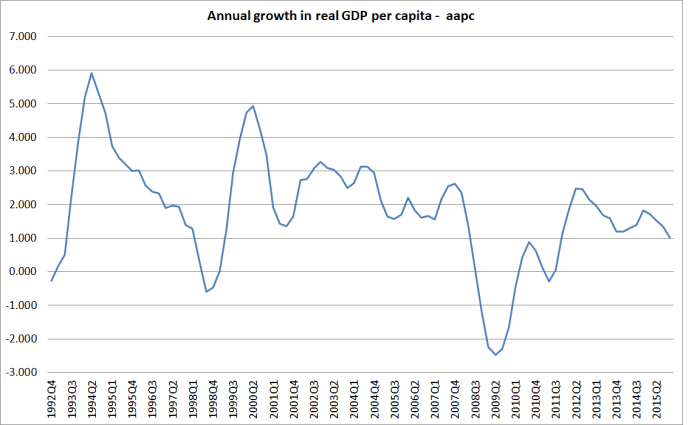
  • Per capita growth –  the only sort of growth that really matters –  has been pretty weak this cycle compared to that in previous recoveries and growth phases,real-gdp-pc-aapc
  • Inflation is (of course) low, but then it is supposed to be higher.  The target is centred on 2 per cent –  a rate we haven’t seen for several years –  and was previously centred on 1 per cent, and then 1.5 per cent.  Trend inflation outcomes are the responsibility of the Reserve Bank, but those outcomes have been away from target for some time.
  • The unemployment rate is below a 20 or 30 year average –  although well above the average prior to the mid 1980s –  but then all estimates (including the Bank’s) are that the NAIRU has been falling over that time, and no one claims that that has been because of monetary policy (any more than previous increases were).
  • The current account deficit is certainly smaller than it has been.  But that is mostly because interest rates have been so much lower than had been expected (s0 that the servicing costs of the large stock of external debt have been surprisingly low).  Much of the time, the Governor is more inclined to lament, than to celebrate, just how low interest rates have been, here and abroad.
  • Labour force participation is higher than the historical average, but it isn’t clear why this is unambiguously a good thing.    Work is a cost to individuals as well, at times, a source of satisfaction, but mostly people work to live.  In a subsistence economy, pretty much 100 per cent of adults work.  When New Zealand had the highest per capita incomes in the world, participation rates were lower.

But, of course, even then the Governor has cherrypicked his data.    There isn’t even any mention in this list of disastrously high house prices, or of the household debt stock, let alone of the real exchange rate, or the productivity growth performance, or the weak performance of the tradables sector, or of the large gaps between New Zealand incomes/productivity and those in most other advanced countries.

You might think that those are simply “Reddell hobbyhorse” indicators.   But we know the Governor cares a lot about house prices and household debt, and about the real exchange rate.  And it isn’t that long –  before he became embattled, and seemed to feel the need to become something of an apologist for New Zealand’s economic performance –  since he was talking about exactly the same sort of stuff.

Just a few weeks after he became Governor, he gave a speech in Auckland on Central banking in a post-crisis world . In the opening paragraphs of that speech he counselled

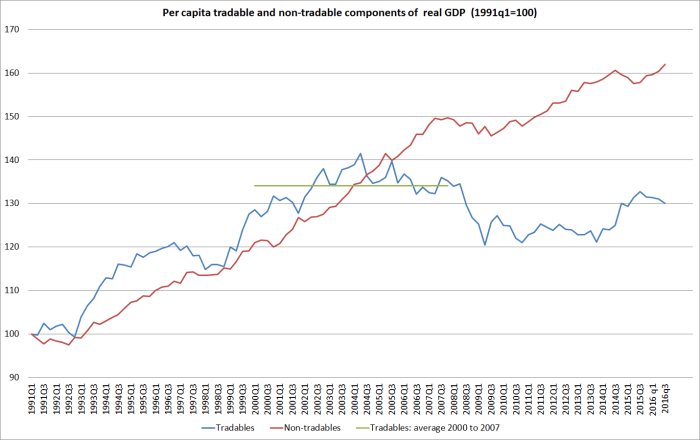
With these assets we should be capable of stronger economic growth. Internationally, and particularly in smaller economies, economic growth is driven by the private sector and its ability to compete on global markets. We need to reverse the slowdown in multifactor productivity growth since 2005 and the decline in value added in our tradables sector. And we need to reverse the shift of resources into the public sector and other non-traded activities.

Productivity growth hasn’t improved –  if anything the reverse – since then, exports as a share of GDP have been slipping, and there has been no sustained rebalancing towards the tradables sector.
t-and-nt-gdp-feb-17

They were the Governor’s words, not mine.

Another couple of months into his term, he gave another interesting speech, this time Improving New Zealand’s Economic Growth.   Back then he seemed concerned about productivity (and the lack of it)

Since 1990 we’ve outperformed many OECD countries on inflation and unemployment. Our inflation rate has been one and a quarter percent below the OECD median and our unemployment rate half a percent lower. But our per capita income has lagged behind and we’ve run large current account deficits. Real per capita GDP growth has been one and a quarter percent, about half a percent below the median and our current account deficit has averaged five percent of GDP – about the 6th largest relative to GDP in the OECD region.

There are two main ways in which our prosperity can improve over the longer run. The first is if the world is willing to pay more for what we produce. The second is by raising our labour productivity – that is by increasing the level of output per working hour. In the short term, we can generate higher income if we increase labour force participation or work longer hours. But we already have a higher proportion of our population in the labour force than nearly all other OECD economies and we work longer hours than most people in the OECD.

and

This is striking given the high international rankings for the quality of our institutions, control of corruption, ease of doing business, and according to the World Bank, the highest per capita endowment of renewable resources in the world.

Chart 2: Labour productivity growth in selected OECD economies, 1990-2011

(Average annual rate)

5124340_files/gw-improving-new-zealand-s-economic-growth-cecc-february-201301.jpg

Source: OECD

So why is our per capita income so far below the OECD median? Partly it’s due to our geographic location and small economic size. Distance and economic size matter a lot even in a more globalised world of trade, capital and knowledge flows, and increasing interdependence. This also partly explains why our export range is concentrated over relatively few products – with food and beverages accounting for almost half our exports. The OECD and IMF believe size and distance, which limit economies of scale and market opportunities, account for around three quarters of the gap in our per capita income compared to the OECD average.

But this is not the whole story. Despite our high international rankings in key areas, the latest World Economic Forum’s Global Competitiveness Report ranks New Zealand’s overall competitiveness at 25th out of 142 countries. Besides market size, we perform poorly on our macroeconomic environment, and especially on our budget deficit and low national savings. But regulatory and performance-related factors also diminish our growth potential. Many of the remedies to substantially improve our ranking lie in our own hands, and groups such as the 2025 task force, the Savings Working Group, and the Productivity Commission, emphasised reforms that can raise our living standards.

He thought then there were three areas governments should focus on

Three areas seem particularly important. The first, is to raise our level of saving and investment, and improve the quality and productivity of our investment.

The other two were to close fiscal deficits, and to lift human capital. On the latter he observed

The bottom income deciles are populated by those with lesser skills, and those who experience prolonged and recurrent spells of unemployment. Addressing these groups would both promote productivity and reduce inequality.

Very little has changed since the Governor gave those speeches early in his term.  The fiscal deficit has been closed, and no doubt the Governor would welcome that.  But in late 2012 and 2013, there was just no sign that he thought the economy was in “very good shape” –  rather it had key pretty deeply embedded structural challenges – and few of the key indicators he cited have changed for the better since then.

Now, to be clear, (and as central bank governors have pointed out for decades) very little of this is down to the Reserve Bank.  Central banks aren’t responsible for  –  and don’t have much influence on trends in –  house prices, current account deficits, productivity growth (labour or multi-factor), the health of the tradables sector, savings rates, participation rates or NAIRUs, let alone human capital and inequality.  So the fact that the economy isn’t in particularly “good shape” –  even if it isn’t doing that badly on some purely cyclical measures – isn’t the Governor’s fault, or that of the Reserve Bank.  What the G0vernor can do is keep inflation close to target, and help safeguard the soundness of the financial system.

Which makes that line of the Governor’s, from Saturday interview, so puzzling

“It is puzzling to me why some of the commentators been so critical when the Reserve Bank is a big part of that outcome. We aren’t the whole story by any means, but our monetary policy configurations do have a major impact on the economy.”

After all, since 2009, the Reserve Bank has twice started tightening monetary policy only to have to reverse itself.  I’m not today getting into the question of how much of that was a foreseeable problem.  Even if none of it was, the fact remained that the Bank twice (out of two times) had to reverse itself.    Neither episode –  tightening and then reversal –  had the sort of major positive impact on the economy that the Governor talks of.  At best, they probably did little damage.  And those episodes aside, the Reserve Bank just hasn’t done much on monetary policy for years.   People –  like me –  have been critical of the Reserve Bank’s monetary policy management because of (a) those reversals, (b) the refusal to even acknowledge mistakes, (c) more recently, almost laughable attempts to rewrite history to suggest they were easing when in fact they were tightening.  And, of course, the persistent deviation of inflation from target, and the concomitant extent to which the unemployment rate has been kept unnecessarily higher than required, or than the Bank’s own estimate would have suggested.  Those outcomes suggested that, on average, monetary policy has been a bit too tight, as well as unnecessarily variable.

Is the aggregate cyclical position of the economy terribly bad?  No, it isn’t.  But it isn’t great either, and the longer-term metrics give even less reason for an upbeat story.  The Graeme Wheeler who took up the job of Governor in late 2012 was better than this.  Back then, he was willing to highlight what he saw as some of the structural problems.  Perhaps it wasn’t his job –  central bank governors don’t need to get into that territory, but he chose to.   If he ventures into such territory, what we should expect is a Governor who calls things straight –  for whom black doesn’t become white just because the Governor himself has himself had a rough few years.  If he no longer feels he can name the serious economic challenges New Zealand still faces, perhaps he’d have been better to keep quiet rather than further undermine his good name with the sort of propaganda that we shouldn’t hope for, but might nonetheless expect, from a political party or lobby group.

Why do I bother, you might wonder?  I was reading this morning a brief piece written to mark the anniversary of the death of  US Supreme Court justice Antonin Scalia, by one of his former law clerks.   The author wrote about “five lessons for living well” that he had seen in the judge’s life.  One of them was

“Be honest in the small things, even if it makes life more difficult”

If our democracy and institutions are to be strong, it is what we should expect from people in powerful public office.    It is too easy to put out “propaganda” and for it to slide past, and for people to nod in acquiescence when they read stuff they don’t know a lot about.  At one level, Graeme Wheeler’s interview doesn’t matter much –  and he’ll be off to pastures new shortly –  but we deserve better, from our journalists and (in particular) from those who seek out and voluntarily assume high public office.
The new tightening cycle?

“When I use a word,” Humpty Dumpty said, in rather a scornful tone, “it means just what I choose it to mean—neither more nor less.”

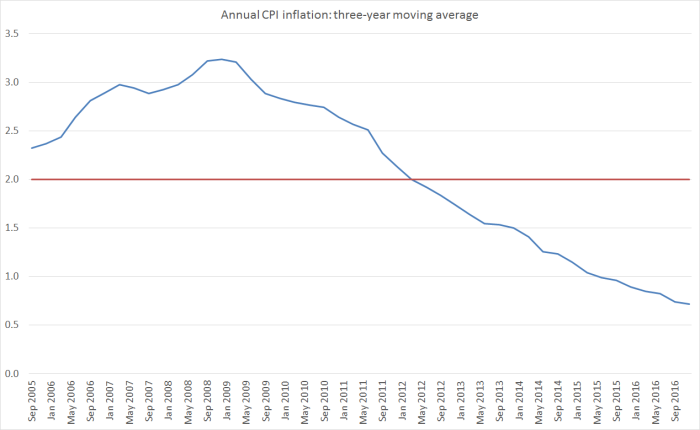
This chart shows the Reserve Bank’s projected future OCR tracks from last November’s MPS and the track from yesterday’s MPS.

ocr-projections-feb-17-and-nov-16

Using the definition of an “easing cycle” they appear to have adopted yesterday, to try to provide some cover for their 2014 misjudgements, this must surely mark the beginning of a new “tightening cycle”?     And, yes, the forward track was revised up very slightly.  Given that the Bank usually moves in increments of 25 basis points, the first actual OCR increase is currently expected in 2020 (this is the first time we’ve had projections for 2020).

But, of course, you didn’t hear the words “tightening cycle” from the Governor, or his offsiders, to describe what they’d done yesterday.  (I missed the start of the press conference, but I’ve seen no references anywhere to the words, or ideas).  And that is because it wasn’t the start of a “tightening cycle”.  Indeed, if one takes the projections seriously, one must assume there is about as much chance of another OCR cut in the next year to two, as of an increase.

And the Bank’s own official words back up the idea that this wasn’t the start of a tightening cycle.  Here are the key final sentences from the press release for the November MPS when, you’ll recall, they cut the OCR.

Monetary policy will continue to be accommodative. Our current projections and assumptions indicate that policy settings, including today’s easing, will see growth strong enough to have inflation settle near the middle of the target range. Numerous uncertainties remain, particularly in respect of the international outlook, and policy may need to adjust accordingly.

and here are the sentences from yesterday’s statement.

Inflation is expected to return to the midpoint of the target band gradually, reflecting the strength of the domestic economy and despite persistent negative tradables inflation.

Monetary policy will remain accommodative for a considerable period.  Numerous uncertainties remain, particularly in respect of the international outlook, and policy may need to adjust accordingly.

Parse it as you will, in substance those statements are all but identical.  If one wanted to be picky, one could highlight the addition of the words “for a considerable period” –  but it was probably aimed at those market participants who the Bank thinks (rightly in my view) have got a bit ahead of themselves in their enthusiasm for OCR increases later this year.

It would simply be nonsensical to claim that yesterday’s MPS was the start of a “tightening cycle”. It clearly wasn’t.  The Bank didn’t present it that way, and neither markets nor media have interpreted in that way.

It was even more nonsensical for them now to attempt to rewrite history and suggest that they began an easing cycle in June 2014.  They didn’t, they didn’t think that was what they were doing at the time, no one else did then (here, for example, was one of Wheeler’s bigger fans’ own quick assessment at the time) , and no one else does now.  They should be embarrassed.

Perhaps some readers will think I’ve made too much of the point.  But Parliament has given a great deal of power to the Governor, who has openly argued that the Bank is highly accountable.  One of the vehicles for that accountability –  a statutory vehicle –  is the Monetary Policy Statement.   Reasonable people can and do differ over the conduct of policy in 2014, and it is healthy to have the debate –  human beings learn from considered reflection and examination.    But attempting to twist language to try to rewrite the historical memory isn’t the sort of thing we should be expect from public servants who wield so much power.   And while Wheeler himself will soon be history, he has been keen to argue that he governs collegially –  emphasising the role of his deputies and the assistant governor.  Of them, the deputy chief executive will succeed Wheeler as Governor for six months, and most lists of potential candidates for the next permanent Governor seem to include both the other deputy governor, Geoff Bascand, and the assistant governor John McDermott.  The Governor signs the MPS, but McDermott’s department generates the document –  text and supporting analysis.   An excellent central bank –  doing policy well, producing strong supporting research and analysis, being open and accountable (rather than just playing political games), should be doing a lot better than this.

I was also struck by another of the Bank’s attempts in yesterday’s MPS to smooth over its record.  They noted in chapter 2 that

“Annual CPI inflation has averaged 2.1 per cent since the current target range was introduced in 2002”.

Which is true, but not particularly revealing.    For a start, during the Bollard decade, it averaged 2.5 per cent (excluding the direct effects of the higher GST) and in the Wheeler years it has averaged so far 0.8 per cent.  Lags mean Brash (and the old target) was responsible for the first year or so of the Bollard results, and Bollard was responsible for the first year or so of the Wheeler results, so here is a chart showing a three-year moving average of annual CPI inflation (again ex GST).  I’ve started from September 2005, so that all the data cover periods when the inflation target midpoint was 2 per cent.

cpi-inflation-3-yr-ma

It isn’t exactly a record of keeping inflation near the midpoint, even on average.  If the Bank seriously wants to argue that its performance should be evaluated over 15 year periods, they should abandon any pretence that there is serious accountability embedded in the system. Or, they could just play it straight, recognise their own (inevitable) limitations, and participate in some thoughtful, rather than propagandistic, reflections on the past conduct of policy and lessons for the future.  We should be wanting –  the Minister and Board should be seeking –  a Governor who has that sort of open-minded self-confidence.

When I exchange notes with other former Reserve Bank people one common line that comes up is a sense that the analysis in the Bank’s Monetary Policy Statements is often rather tired, and adds little of value to the reader.    Someone went as far yesterday as to send me a 20 year old MPS as a standard for comparison.  I often caution people that each generation is prone to view their successors that way, and insert the caveat that I hesitate to claim much for a period in which the Reserve Bank had the MCI (and a key senior manager, who fortunately didn’t last long, who often nodded off, just across the table from the Governor, in Monetary Policy Committee meetings).  Nonetheless, I can’t help coming to the same conclusion myself.    There are defences –  for a small central bank, four full MPSs a year is probably too many –  simply cranking the handle to churn out the documents take a lot of resource.  But it is the Bank that chooses that model –  Parliament only requires two statutory MPSs a year.  It could be argued also too that most of the value in the document is in the one page press release and a single table  –  but then why produce 30 to 40 pages?   And sadly, even when they do try to introduce new material, I often don’t find it very persuasive or enlightening.  And sometimes, the emphases seem quite politically convenient –  productivity, for example, (or the complete lack of it in New Zealand’s case) appears not at all in the text of yesterday’s MPS.

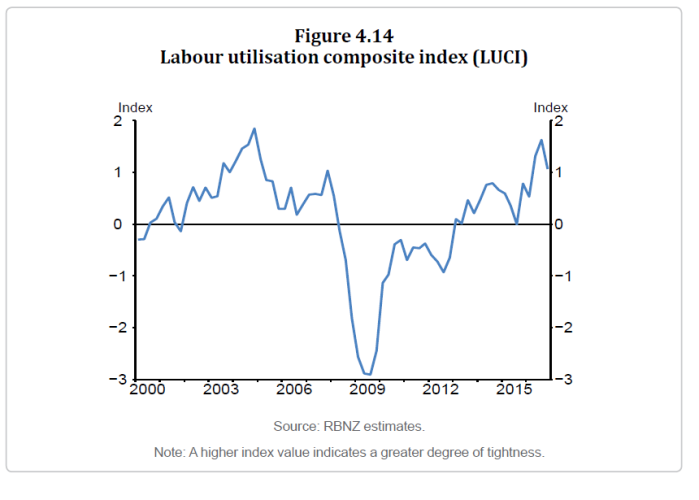
I wanted to touch on just two examples from yesterday’s document.  A year or so ago, the Reserve Bank introduced LUCI –  the labour utilisation composite index, an attempt to provide a summary measure of resource pressure in the labour market.    It was interesting innovation, if not fully persuasive as an indicator.  They ran the chart in yesterday’s document

luci

In the text, the Bank simply notes that labour market tightness increased over 2016.  But if this indicator is supposed to be a measure of that, how seriously can we take the claim?  After all, this index appears to suggest that in the Bank’s view the labour market is now almost as tight as it was at the peak of the previous boom (late 2004?) and materially tighter than it was over say 2006 and 2007 –   a period when the unemployment rate averaged less than 4 per cent, and when wage inflation was quite high, and increasing further.

Over the last year, however

  • the unemployment rate was basically flat (actually 2016q4 was higher than 2015q4, but lets treat that as possibly just noise),
  • wage inflation was flat or falling,
  • and in the Bank’s Survey of Expectations, expectations of future wage inflation were flat as well (actually down a bit in the latest survey)

And all this when the unemployment rate has been persistently above the Bank’s own estimate of the NAIRU (which appears to still be around 4.5 per cent), let alone Treasury’s which is around 4 per cent.  There is little to suggest anything like the degree of labour market pressure that was apparent in the pre-recession years.

No doubt, there are good answers to some of these questions and apparent contradictions.  But the Bank has made no attempt to address them, even though other labour market developments –  around immigration – receive a lot of focus.  The public, and readers of the MPS, deserve better analysis than that.

The Bank’s immigration analysis has also been rather tortured.  Historically, they have worked on the basis, and produced research to support, the common view that the short-term demand effects of immigration exceeded the supply effects.    There shouldn’t be anything surprising, or very controversial, about that –  immigrants (or non-emigrants) need to live somewhere, and need all the attendant private and public infrastructure of a modern economy.  Those pressures tell one nothing about the pros and cons of immigration policy.

But in the last couple of years, the Bank has been going to great lengths to try to suggest that this time things are different: this time the composition of the immigrants is so different (than in every previous post-war cycle) that, if anything, the supply effects outweigh the demand effects, and that high net PLT immigration is part of what is keeping inflation down.

It isn’t totally impossible of course.  Fly in labourers, house them in disused prisons, forbid them from spending anything locally, and employ them only in very labour-intensive roles and the supply effects might outweigh the demand effects.  But that isn’t the modern New Zealand immigration story  (and in case anyone wants to be obtuse, obviously nor should it be).

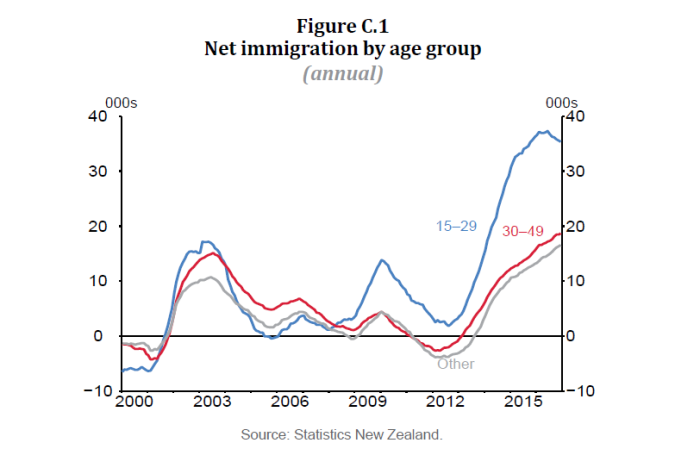
The Bank likes to illustrate their case with charts like this one, produced again in the MPS yesterday.

plt-by-age

It uses PLT net migration data to purport to show (a) record immigration, and (b) that that record influx is hugely concentrated among young people who, it is claimed, add more to supply than to demand, dampening inflation pressures.  The contrast is supposed to be particularly stark with the last big influx in 2002/03.  The Bank explicitly states “young migrants and those on student visas represent a much higher share of migration than in previous cycles”.

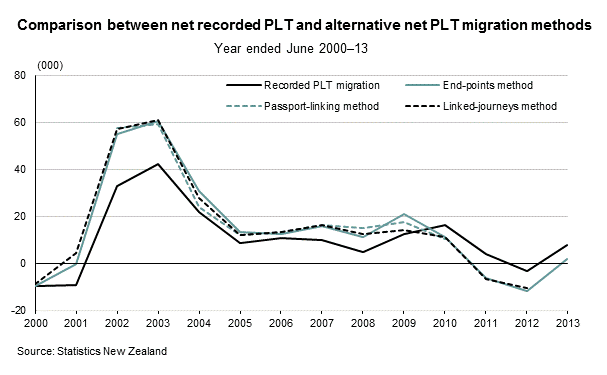
I’ve covered much of this ground before, especially in this post.   The limitations of the PLT data are well known, both in principle and in practice.    At my prompting, with the full knowledge of my then RB superiors, Statistics New Zealand produced a research note on the issue a couple of years ago.  In that document they showed how the PLT data had materially misrepresented the actual long-term migration inflow to New Zealand in the 2002/03 period (not wilfully –  just the limitations of the timely measure).  This was their chart.

plt-methods

So the best later estimates are that the 2002/03 influx was around 50 per cent larger than the PLT data (including the age breakdown data) the Bank is constantly citing.

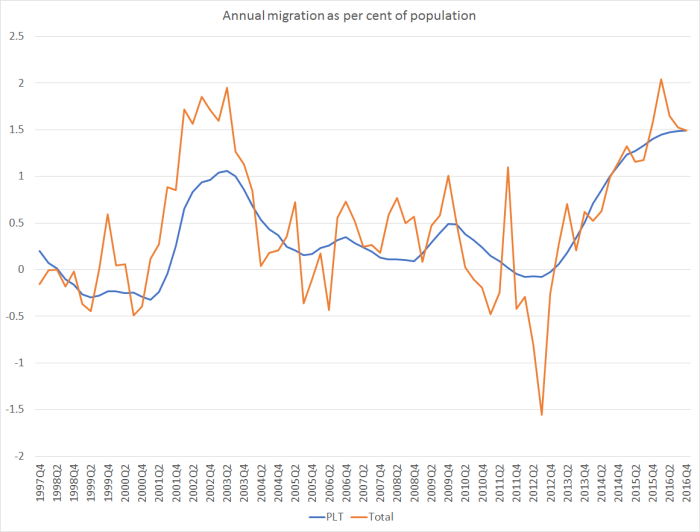
We don’t have current estimates from this improved methodology for the current cycle, but one can see the point in just comparing the net PLT inflow with the net total passenger arrivals. It is a more volatile series –  things like World Cups and Lions tours help introduce volality.

migration-per-cent-population-feb-17

But you can see the big difference between the two series over 2002/03 –  and SNZ estimated that much of that difference wasn’t very short-term tourists, it was people who ended up staying longer.  Jump forward to the current cycle: contrary to the mythology the influx of people this time round, as a share of the population,  hasn’t been larger than it was then.  The peaks are around the same, and the peak this time (at least so far) was shorter-lived than it was in 2002/03.

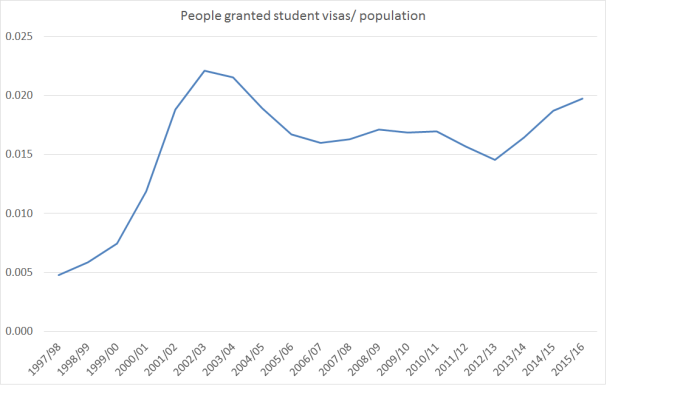
And what of the student story?  Well, it doesn’t really hold up either.  Here is the MBIE data on the number of people granted student visas each year, as a share of the population.

student-visas-feb-17

The peak isn’t as high as it was in 2002/03, and the extent of the increase is much much smaller this time.   Foreign students add to demand –  as all exports do.  (Of course, there have been some  –  somewhat controversial  – changes in student work rules, which might have mitigated the demand effects, but curiously the Bank doesn’t invoke that effect as part of its story.)

My point here is not to argue whether my conclusion (net migration tends to boost demand more than supply in the short-term) is right, or the Bank’s (this time is different) is.   And as it happens, we see eye-to-eye right now on the current stance of monetary policy.   I’m mostly concerned that the Bank seems to just ignore inconvenient data that just isn’t hard to find or use.    There might well be good counterarguments to the data points I’ve highlighted here, but instead of making those arguments, the Bank simply ignores them.  One might, sadly, expect that sort of standard from political parties and lobby groups.  We shouldn’t expect, or tolerate, it from powerful well-resourced public agencies.  The Bank’s argument is certainly fairly politically convenient: it keeps the focus off that unemployment rate that is still above the NAIRU (a gap that might be expected to be constraining inflation) and the near-complete absence of productivity growth, which might be deterring new investment (also dampening inflation pressures in the short-run).

There are plenty of complex issues around in making sense of what is going on. I certainly don’t claim to have a fully convincing story myself. But given the level of public resources put into the Reserve Bank, we should expect a lot more from them –  not just answers, but evidence of genuine intellectual curiosity, and a desire to evaluate arguments from all possible angles.  Their current policy stance is fine, but there doesn’t seem to be a strong and robust organisation, of the sort that would underpin consistently good policy through time, judged by the strength of its analysis and its openness to debate.   Yesterday’s MPS is just one more example of that.   Turning around that weakness should be one of the key challenges for the new permanent Governor.

Alternative facts: a possible interpretation

A reader who is paid to, among other things, monitor the Reserve Bank got in touch to suggest that the Reserve Bank’s claim, highlighted in this morning’s post, to have “initiated an easing cycle in June 2014” was neither a typo nor a piece of carelessness (I’d assumed the latter), but something conscious and deliberate.

Recall that in this morning’s MPS, the Bank wrote that

The Bank initiated an easing cycle in June 2014, by lowering the outlook for the policy rate from future tightening to a flat track, and then cutting the OCR from June 2015

Most people, when they think of an easing cycle or a tightening cycle, think of actual changes in the OCR.  On that conventional description, the OCR was raised four times, by 25 basis points each, from March 2014 to July 2014.  Note those dates: not only was the OCR raised in the June 2014 MPS, but it was raised again the very next month.

And if one compares the crucial final few sentences in the press releases for the March and June 2014 MPSs there is no material change in wording from one document to the other, and there is nothing in chapter 2 of the June 2014 MPS (the policy background chapter) to suggest a change in policy stance.

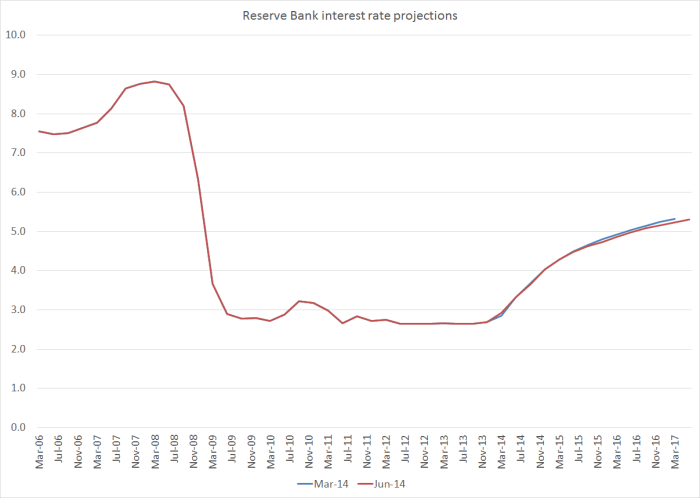
So how might they now –  revisionistically – attempt to describe an “easing cycle” as having been commenced in June 2014?  Well, the only possible way they could do so –  perhaps hinted at in that phraseology “by lowering the outlook for the policy rate” –  is using a change in the forecast for the 90 day rate from the previous set of projections, in March 2014, to those in the June 2014 MPS.

But here is the chart showing the two sets of projections

90-day-projections

The differences are almost imperceptible.  In fact, the June track (red line) is very slightly above the blue line in the very near term, and at the very end of the period the difference is that the 90 day rate is projected to get to 5.3 per cent in the June 2017 quarter rather than the March 2017 quarter.  And recall that there were no contemporary words to suggest a change of stance.

Sure enough over subsequent quarters the Bank did start to revise down the future track, but there is no evidence that over that period they thought of themselves –  or openly described themselves –  as having begun an “easing” cycle.    That didn’t happen –  and even then they didn’t think of it as a “cycle” –  until the OCR was first cut in June 2015.   Here is the Governor talking about monetary policy in a February 2015 speech.

We increased the OCR by 100 basis points in the period March 2014 to July 2014 because consumer price inflation was increasing as the output gap became positive and was expected to increase further. Since July, the OCR has been on hold while we assessed the impact of the policy tightening and the reasons for the lower-than-expected domestic inflation outcomes.

The inflation outlook suggests that the OCR could remain at its current level for some time. How long will largely depend on the development of inflation pressures in both the traded and non-traded sector. The former is affected by inflation in our trading partners and movements in our exchange rate; the latter by capacity pressures in the economy and how expectations of future inflation develop in the private sector and affect price and wage setting.

In our OCR statement last Thursday we indicated that in the current circumstances we expect to keep the OCR on hold for some time, and that future interest rate adjustments, either up or down, will depend on the emerging flow of economic data.

Again, no sense from the Governor that he was well into an “easing cycle”, as we are now apparently supposed to believe.

Now, there is a theoretical argument that the stance of monetary policy can be summarised not just by the current OCR but by the entire future expected/intended track.  But as the Reserve Bank has often –  and rightly – been at pains to point out, projections of interest rates several years in the future contain very little information, as neither the Reserve Bank nor anyone else knows much about what will be required 2 to 3 years hence.   And it is a dangerous path for them to go down, for it invites those paid to hold the Governor to account to do so not just in respect of the actions he or she takes, but in respect of their ill-informed (but best) guesses as to what the far future of the OCR might hold.

If this is the explanation for the Reserve Bank’s words this morning –  and sadly it seems like a plausible explanation –  it is, at best, a case of someone trying to be too clever be half, and change the clear meaning of plain words (to the plain reader) in mid-stream.  At best, too-clever-by-half, but at worst a deliberate attempt to use a verbal sleight of hand to deceive readers, including the members of Parliament to whom the document is, by law, formally referred.    Sadly, it looks a lot like the “alternative facts” label –  one that should be worn with shame – might have have been quite seriously warranted.  They didn’t start easing in June 2014; at best by later that year they started slowly backing away from their enthusiasm for (a whole lot more) further tightening.

I’d hoped for better from the Reserve Bank, its Governor, incoming acting Governor, and other senior managers who may perhaps have aspirations to become Governor next March.

Lewis Carroll wasn’t intending Through the Looking Glass as a prescription for how powerful senior public officials should operate.

“When I use a word,” Humpty Dumpty said, in rather a scornful tone, “it means just what I choose it to mean—neither more nor less.”


Alternative facts: Reserve Bank edition?

I might have a post later on the substance of today’s Monetary Policy Statement –  or might not, since the bottom line stance seems entirely correct to me (regular readers may think this a first).   But I couldn’t let one particularly egregious misrepresentation go by without comment; a claim so blatantly wrong that one almost had to wonder whether the Bank was now taking communications advice from Sean Spicer and Kellyanne Conway.

In each MPS Box A “Recent monetary policy decisions” appears.  This box is one of my minor legacies to the Bank.  I banged on often enough about the statutory requirements for MPSs –  which require some retrospective assessment and self-evaluation –  that they agreed to include this box. It is rarely done well and –  in fairness –  the Act probably needs changing, to provide for reviews and assessments rather less frequently.  And the content tends, perhaps inevitably, to be rather self-serving.    But the latest version was just too much.

It begins as follows

The Bank initiated an easing cycle in June 2014

When I first saw that I assumed it was just a typo –  bad enough, but these things happen.  The OCR wasn’t actually cut until June 2015.  But no, the authors were apparently serious.  The whole sentence reads

The Bank initiated an easing cycle in June 2014, by lowering the outlook for the policy rate from future tightening to a flat track, and then cutting the OCR from June 2015

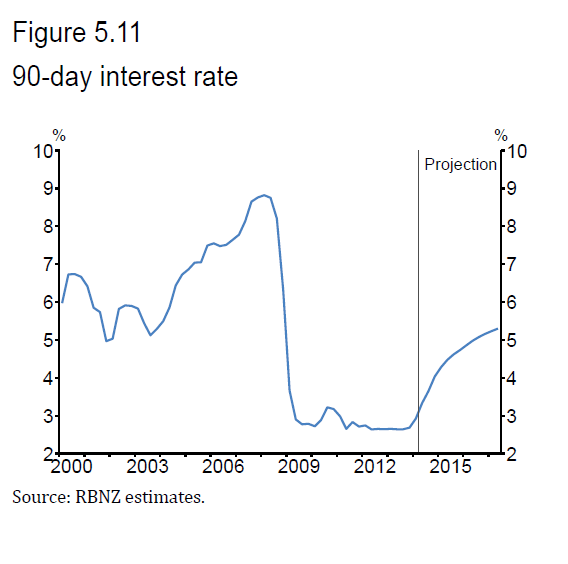
Do they really expect to be taken seriously?   For a start, their statement isn’t even true.  Here is the chart of the projected 90 day interest rates from the June 2014 MPS.

90-day-rate-track-mps-june-2014

The OCR was not only increased in the June 2014 MPS, but they projected another 200 basis points or so of increases.   By now –  March quarter of 2017 –  the OCR was projected to be still rising, and at 5.2 per cent.

And here was what the Governor had to say in the June 2014 MPS

june-14-mps-extract

There was no doubt that the Bank –  the Governor –  in June 2014 thought they would be raising the OCR a lot further, and had no thought in mind of beginning an easing cycle any time in the following few years.

I’m not sure what has gone wrong in this quarter’s Box A.    All the key players –  the Governor and his closest advisers –  were around in June 2014, and are around now.  They know what happened, and in June 2014 they were pretty confident of their tightening stance.  But they made a mistake.  It happens.     What shouldn’t happen is crude attempts to rewrite history.

I rather doubt this was deliberate on the Governor’s part –  probably some carelessness further down the organisation, and then insufficient care in reading and approving the final text.     But it isn’t a good look, and I hope they will take the opportunity to acknowledge the mistake and issue a correction.

Perhaps the FEC and/or the Bank’s Board might ask just what went on?

On Graeme Wheeler

Morning Report had invited me on this morning to talk about Graeme Wheeler, the change of governor, prospects for a permanent successor etc.  The death of Steve Sumner apparently changed their schedule so that interview didn’t happen, but I’d already jotted down some notes as to what I might say, so I thought I’d use them here.  Wheeler, of course, still has seven months in office, and we’ll see his next Monetary Policy Statement tomorrow.

When Graeme Wheeler was first appointed as Governor, there was generally a fairly positive reaction.  I shared that view.  Until quite late in the process, I’d assumed that Grant Spencer was the favourite for the role –  after all, successful organisations tend to promote from within, and a capable insider should always have an advantage, being constantly visible to the Board.  And so when Graeme was appointed, my initial reaction was “well, he must have been a very strong candidate to have beaten the capable internal deputy”.    And it was well known at the time that Bill English and John Key had been keen to have Wheeler back in New Zealand –  there had been well-sourced talk that the Minister had wanted him as Secretary to the Treasury, something apparently stymied by SSC bureaucracy.

With hindsight, one can only conclude that the Bank’s Board –  the key players in the appointment of the Governor –  just didn’t do a very good job in evaluating the candidates. Perhaps that shouldn’t be surprising –  mostly behind the scenes people themselves, they don’t have much experience in appointing someone to a position with as much visibilty and probably more untrammelled power than most Cabinet ministers.  There are suggestions that Board members were rather too easily swayed by big names Wheeler had produced as referees, and by his international connections (coming just a few years after the international financial crisis) rather than looking hard at the qualities required to do the Reserve Bank Governor job well.    Since many of the Board members then are still on the Board now, one can only hope they’ve learned from their experience.

I think Wheeler has done a poor job as Governor, both in the specific decisions he has made, and in the processes and procedures and style he has adopted.   For most of the time, he seems to have been aided and abetted –  or at least sheltered –  by the Board, who are actually paid as the public’s agents, not as associates and defenders of the Governor.

And it is not as if times have been unusually hard for him.  We haven’t had a recession in New Zealand and there has been no major flare-up of international financial stresses during his term (so far).  The terms of trade moved around a bit, but not much more so than usual.  There was no domestic financial crisis, no major domestic fiscal stresses, no change of government, and the major natural disasters of the last decade (the Canterbury earthquakes) had all happened by the time the Governor took office.   Sure, what is going on globally is a little hard to fully make sense of, but whereas most other advanced country central banks had by 2012 largely reached the limits of conventional monetary policy (interest rates very close to zero) that has not yet been a constraint here.

The Reserve Bank’s primary function –  according to the Act –  is monetary policy.  Graeme came into office with a new PTA that he was comfortable with –  in particular, with an explicit focus for the first time, on the 2 per cent midpoint of the inflation target range.  And yet over his 4.5 years in office, annual headline inflation has averaged not 2 per cent but 0.8 per cent.  Falling oil prices played a part in that, but CPI ex petrol has averaged not 2 per cent, but 1.1 per cent.  The Governor’s preferred measure of core inflation –  the sectoral factor model measure –  has averaged not 2 per cent, but 1.35 per cent.  All sorts of one-off factors that the Governor can’t be really be held accountable for influence inflation rates –  thus cuts in ACC levies have held down headline inflation in the last couple of years, while large increases in tobacco taxes have artificially boosted headline inflation throughout the Governor’s term.

There are a lot of comfortable commentators inclined to treat these inflation outcomes as a matter of indifference –  so what they imply, after all low inflation is better than high inflation.    But persistently low inflation over several years –  and especially when it doesn’t arise from surprisingly good productivity outcomes – almost invariably comes at a cost –  lost output, and lost employment.  And that has almost certainly been the case over the last few years.   Throughout the Governor’s term, the unemployment rate has been reasonably materially above estimates of the non-inflationary or “natural” level –  these days thought to be around 4 per cent.  The Governor’s choices affected the lives and options of real people –  and years lost out of employment simply can’t be got back.

My standard here isn’t one of perfection.  Central banks, engaged in active discretionary monetary policy of the sort now common around the world, will inevitably make mistakes.  Central banks try to operate on the basis of forecasts, and yet no one  –  least of all them  – knows the future.  So in evaluating the Governor, we need to look at the specific circumstances, and at the willingness to acknowledge and learn from mistakes.  Here, Graeme Wheeler doesn’t score well.

Before he came to office, the Reserve Bank had already once misjudged the need for a tightening cycle to commence, and had had to reverse itself.  At the time –  2010/11 –  they had some company internationally, and there was a fairly widespread expectation that interest rates would need to return to “normal” fairly soon.  That wasn’t the case by the end of 2013, when the Governor was not just talking about tentatively beginning a tightening cycle, but confidently asserting that interest rates would need to rise by 200 basis points.   He –  and his machinery of advisers –  simply got that one wrong.  Fortunately, they never raised the OCR by 200 basis points, but it was 18 months before they even started to reverse themselves –  and even now, to my knowledge, they have never acknowledged having made a mistake.  In so doing, they’ve unnecessarily exaggerated both interest rate and exchange rate variability, all the while leaving unemployment unnecessarily high.   Good managers and leaders recognise that human beings make mistakes, but they expect those who make them to acknowledge and learn from them.  Graeme Wheeler failed that test.

The other big part of the Reserve Bank’s policy responsibilities is the regulation of key elements of the financial system, to promote the soundness and efficiency of the system.  Graeme made that a much more prominent part of the Bank’s role with his enthusiasm for successive waves of LVR controls.   The Reserve Bank has no policy responsibility for the housing market, or for house prices, only for the soundness and the efficiency of the financial system.    And yet I see a leading commentator criticising the Governor for not doing the impossible:

Wheeler should have earlier called out the Prime Minister and Finance Minister on their tardiness in developing policy responses to counter the house price bubble. But he was late to the party.

Notably, the bank was also tardy in its own policy responses, thus earning itself a rebuke from then Prime Minister John Key, who rather cynically tried to take the focus off a Government that was running immigration hot for its own ends.

A more adept governor should have been able to persuade the politicians that slowing the boom was a job for both the politicians and the central bank. And that it was necessary for NZ’s long-run stability.

Quite how Graeme Wheeler was supposed to have changed the mind of the government on reforming supply – when no one else, in New Zealand or in many Western countries, has succeeded in doing that –  is a bit of mystery.  I have pretty high expectations of a Reserve Bank Governor, but that seems like a Mission Impossible task.  It is not that reform couldn’t be done, but against a Prime Minister determined to present high and rising house prices as a mark of success, a central bank Governor, with no detailed background in the area, no real research to back him, and no particular mandate wasn’t likely to succeed.  After all, our housing supply and land use laws have created problems, interacting with immigration policy, for 25 years, and Alan Bollard and Don Brash had made no inroads either.

As for the Bank being “tardy”, hardly.  When Graeme Wheeler took office, no one in the Reserve Bank had been keen on direct LVR controls –  they were a clear fourth preference, when assessed against the Bank’s responsibility for financial system soundness and efficiency.    But Graeme rushed such restrictions into place, at times surprising even his own senior managers, with no tolerance for any debate or dissent (there was no substantive discussion of the merits of the measures at the key relevant internal committee).  If you think LVR limits were a good thing, the last thing you can accuse Graeme of was being tardy.  I think they were ill-conceived, sold on a false promise (about how temporary they would be), are still poorly-researched, and have spawned one new set of controls (and odd exemptions) after another.  And, unsurprisingly, the real housing market issues –  mostly about land supply, not finance –  haven’t been dealt with.  Wheeler liked to fancy himself as a shrewd political player, and yet if there is a valid criticism of him in this particular area it is as much that he eased the pressure on politicians by rushing to do something/anything, at time when there was a growing sense that “something must be done”.  The appropriate response to “something must be done” is not “so anyone should do anything”.    And it remains concerning that despite Wheeler’s penchant for increased use of direct controls –  harking back to earlier decades –  there has been little or no serious analytical or research engagement with the issues around the efficiency of the financial system, and the way in which direct controls can undermine efficiency, and in the process favour insiders over outsiders, the well-connected and well-resourced over the more marginal, and so on.  The experience of the US over 2008/09 –  where Wheeler lived at the time –  always seemed to loom large, and never once has the Bank answered my challenge to consider the similarities and differences between the US and New Zealand, or to look at the experiences of countries (many of them including New Zealand) that didn’t have domestic financial crises in 2008/09 despite large house price booms.

Effective communication is a big part of what the central bank governor should be expected to do, and the more so in New Zealand where (a) all the statutory power rests with the Governor personally, and (b) where the Bank has such wide-ranging powers, and is not just responsible for monetary policy.  And yet during the Wheeler years, the Bank hasn’t done well on that score either.    The number of on-the-record speeches the Governor has made has dwindled, and those he does give don’t typically compare favourably –  in terms of quality, depth and insight –  with those of his peers in other countries.   There have been specific communications stuff-ups (speeches inconsistent with subsequent action etc), although I’m reluctant to be too harsh on those –  most central banks end up with some of those problems in one form or another, at some time or another.  But it is also a matter of accountability:   Wheeler has been very reluctant to grant serious media interviews (none at all to the main TV current affairs programmes, and only belatedly the occasional soft-soap interview to the Herald) in a way that is quite extraordinary for someone personally wielding so much power.  A Cabinet minister wouldn’t get away with it.  And in his press conferences, the Governor has often come across as embattled, defensive and weary.    Despite his past senior roles, he had no background in the public limelight, and clearly wasn’t comfortable with it.  But that was a significant part of what made him, at least with hindsight, the wrong person for the job.

Neither in my time at the Bank –  around half his term, involved in most of key policy committees –  nor subsequently have I seen any sign in the Governor of wanting to foster a climate of debate and explorations of ideas and alternative options.  I mentioned the LVR controls already, but they weren’t the only example.  In my own experience, one small example lodged in my brain.  One day a few years ago Graeme was down in a meeting in the Economics Department and there was a bit of a low key discussion about alternative policy approaches etc: the death glare I received for even mentioning, hypothetically, nominal income targeting was a pretty clear message, not just seen by me, that what the Governor wanted was support for his position, and answers to his detailed questions, not alternative perspectives or debate, no matter how non-urgent the issues were.  People respond to incentives.  In a area so rife with uncertainty as monetary policy, it is very dangerous approach.  The same goes for the ability to deal with external criticism –  a capable and intellectually confident Governor would recognise the value in alternative perspectives and relish the prospect of engaging with the alternative ideas.  Doing so is part of how people come to have confidence in the Governor.  But there has been none of that with Wheeler –  if anything he seemed to become unreasonably rattled by disagreement (his active effort to tar the messenger who drew to his attention the OCR leak last year was a sad example of that –  made worse by the cover he received for it from his Board).

I could go on, but won’t at length.  The Governor has been highly obstructive in his approach to the Official Information Act –  we still don’t have access to papers relating to the 2012 PTA for example –  and has done nothing to advance transparency around the Bank’s medium-term spending plans.  Nothing appears to have been done to prepare for the likelihood that the near-zero bound will become an issue here in the next recession.  The refusal of the Governor to engage with serious evidence of past misconduct around staff superannuation policy is a blight.  And despite the large team of researchers and analysts the Governor commands, there has been little good policy-relevant research published in the last few years, particularly in the areas of financial system regulation and macro and financial stability.  Sadly, the Reserve Bank has been living off reputational capital for some considerable time now, and one of the challenges for a new Governor should be turning that around and lifting the quality of the Bank’s outputs and its senior people.

As I’ve noted before, I give the Governor a small amount of credit for his recognition that the single decisionmaker model is past its use-by date, and should be reformed.  A committee of his own apppointees –  his two deputy governors and one assistant governor, all answerable to him – is not the right answer, but at least he was willing to start addressing the issue, unlike his predecessor.  Responsibility for the Reserve Bank governance model rests mostly with the Minister of Finance and the Treasury, but the Governor sought to get approval for legislative changes and failed.  That reflects poorly on him  –  our current model is so out of step with how countries do things and how government agencies are structured –  and is partly a reflection of his own fixation on a technocratic model, and partly of the loss of trust he incurred with the Minister and the Treasury (including around the financial regulation powers).  The Bank should have been able, by a flow of good research and analysis, to have helped shape a public debate on the appropriate future governance model.  But it failed to do that –  and now still refuses to release any of the background papers from that long-completed work programme undertaken at taxpayers’ expense (and this time, extraordinarily, they have managed to get Ombudsman cover for their refusal).

Quite who will be the next Governor is anyone’s guess.  If I had to put money on it, I’d assume it would come down to a choice between Geoff Bascand and Adrian Orr –  both of whom have their own weaknesses –  but there are other possible candidates both here and (New Zealanders) abroad.  Even though the Bank’s Board have all been appointed by the current government and have the key role in determining who will be the next Governor, quite a bit could still turn on the outcome of the election and what changes, if any, they might want to make to the Act.  In my view, whoever wins the election should focus quite quickly on sketching out a plan for governance reforms, and should look to appoint a person who will be able to carry those through and help the Bank adapt, and perform well, under a new model, under which the Governor personally would have a vital role, but a much less dominant personal role in determining monetary and bank regulatory policy.

Doing so now isn’t a reflection on Graeme Wheeler –  as perhaps it might have been seen as a year or two ago –  just a recognition that times, and the institution and its challenges, have changed,  While so much power rests with the Governor personally, it is important to appoint someone with some reasonable credibility in the subject areas the Bank is responsible for –  an effective deputy can do much of the day-to-day management of what isn’t a very large or complex organisations –  but if the new government, of whatever stripe, is seriously willing to move to a committee-based model (the more conventional approach) then the requirements for a Governor would be rather different.   Change management skills would be a key component, as part of revitalising the Bank and shaping a position for a strong chief executive who can support the decisionmakers –  rather than being both the principal decisionmaker, and the one who controls all the flow of paper, him or herself.  It might be a little more akin to the important role a Secretary to the Treasury plays in leading his organisation as advisers to the Minister of Finance.

A temporary Governor: is it lawful?

And so we have confirmation that Graeme Wheeler is leaving his position as Governor when his current term expires, a couple of days after the election.  (Reserve Bank statement, and Minister of Finance statement.)

That is less newsworthy than the solution the Board and the Minister have come up with –  the appointment of current Deputy Governor (and deputy chief executive) Grant Spencer as acting Governor for six months, to allow the search and appointment process for a new permanent Governor to conclude after the election, when the shape (and policy orientation) of the new government is known.  Spencer will retire at the end of that acting period, and will not again seek permanent appointment as Governor (having sought the role unsuccessfully in 2012).

It is a pragmatic solution, and not that out of line with the one I had proposed –  that Wheeler be invited to stay on for perhaps a year, to allow the appointment to be made by the new government.  It would be interesting to know why that didn’t happen –  was Wheeler not willing, or the Board or Minister not interested?  No doubt, Spencer will be a safe enough pair of hands for six months.

But there are other unanswered questions.  For example, is this a solution envisaged by the Act?     The only previous appointment of an Acting Governor was when Don Brash resigned to go into politics, and Rod Carr was appointed as acting Governor while the selection process for a permanent successor took place.  There is a clear need for acting Governor provisions in such cases –  Governor can resign, die, or otherwise become incapacitated (and can even be removed for cause by the Minster).

But here is the relevant statutory provision (section 48)

If the office of Governor becomes vacant, the Minister shall, on the recommendation of the Board, appoint—

(a) a director of the Bank; or
(b) an officer of the Bank; or
(c) any other person—

to act as Governor for a period not exceeding 6 months or for the remainder of the Governor’s term, whichever is less.

As I have read that section, it envisages an acting Governor to complete a Governor’s term. not to provide a temporary Governor when it is inconvenient to appoint a permanent one.

That interpretation seems consistent with two other aspects of the Act.  First, Governors must be appointed for an initial term of five years (although subsequent extensions can be for shorter terms).  Parliament made that choice deliberately, presumably to help emphasise that the Governor was to operate at arms-length from the government.  If, by contrast, an acting Governor could keep on being appointed for terms of six months at a time, it would allow the intent of the Act, operational autonomy, to be eroded if the government determined on such an approach, without coming back to Parliament to amend the law.

And second, the PTA provisions of the Act clearly tie in to the fixed term appointment of a Governor –  and in that context an acting Governor filling in for an unexpected vacancy (as Rod Carr was in 2002) simply carries on with the PTA the substantive Governor had had in place.  There is no provision in the Act for a PTA with an acting Governor –  and the existing PTA is personal to Wheeler, and expires with his term in September this year.

Steven Joyce’s statement says that

Mr Joyce and Mr Spencer have agreed that there will be no change to the Policy Targets Agreement for the period Mr Spencer will be acting Governor.

Which might be fine for practical purposes.  But that isn’t the way the law was written.  In legal effect, there is likely to be no PTA in place during that interregnum,and that isn’t how the Act should operate.

I welcome the fact that the authorities have recognised the significance of the issue that the governor’s term expired just after the election  (it is a point I have been making here for more than a year, including this post).  And in practical terms, no harm is likely to be done by having Spencer as acting Governor, but I remain uneasy as to whether this specific solution is legal, or consistent with the spirit and intent of the Act.

More generally, it highlights again the desirability of a more throughgoing review of the governance provisions of the Reserve Bank Act.  That should not be a particularly partisan issue –  more like an opportunity for some sensible reflections and revisions in light of 27 years experience with the current framework, changes in the role of the Bank, changes in the governance of other core government agencies, and changes in the understanding of how mechanically (or not) monetary policy can be run (and monitored).

UPDATE: Just to be very picky, the Minister’s statement says Spencer will act from 27 September 2017 to 26 March 2018.  But –  unless I have badly misread something –  Wheeler took office on 26 September 2012, and therefore his five year term appointment must expire at the end of 25 September 2017.   Easily remedied, but it looks a little careless.


Maori and immigration

Early last month, just before I headed off to the beach, a couple of readers forwarded me references to an article written in about 1992 by the late Professor (of Maori Studies at the University of Auckland) Ranginui Walker, headed New Zealand Immigration and the Political Economy.  Having done no more than glance through it, I included a link to the article at the end of a post and went on holiday.

On my return, I sat down and read Walker’s article more carefully, including in the light of the new New Zealand Initiative advocacy report on immigration, which touches lightly on issues of how we should think about New Zealand immigration policy in light of the place of Maori in New Zealand.

Walker’s piece is interesting for two things: first, that is was written in the quite early days of something like the current immigration policy (policy having been reworked considerably over the 1986 to 1991 period), and second because it is a distinctively Maori-influenced perspective.   (Incidentally, Walker’s biographer was Prof Paul Spoonley, now a leading (and MBIE-funded) pro-immigration academic.   It would be interesting to know what Spoonley makes of Walker’s somewhat sceptical assessment of New Zealand’s immigration policy written at a time when the target non-citizen inflows were smaller than they are now (and the stock of migrants was much smaller than it is now).)

Walker argued that modern immigration policy was a matter covered by the Treaty of Waitangi, consistent with his attempt to re-insert the Treaty into contemporary policymaking.  He cited words from the preamble to the Treaty

The original charter for immigration into New Zealand is in the preamble of the Treaty of Waitangi. There, it states that Her Majesty Queen Victoria of the United Kingdom:

“has deemed it necessary, in consequence of the great number of Her Majesty’s subjects who have already settled in New Zealand, and the rapid extension of Emigration from both Europe and Australia which is still in progress, to constitute and appoint a functionary properly authorized to treat with the Aborigines of New Zealand for the recognition of her Majesty’s sovereign authority over the whole or any part of those islands.”

And went on to argue that

The present generation of Maori leaders abide by the agreement of their ancestors to allow immigration into New Zealand from the countries nominated in the preamble of the treaty, namely Europe, Australia and the United Kingdom. But, for any variation of that agreement to be validated, they expect the Government to consult them as the descendants of the Crown’s treaty partner.

Asian immigration, in particular, so it was argued, required formal consultation between the Crown and Maori.  You might find that a stretch –  I do  –  but it does focus attention on the question of just what Maori leaders in the first half of the 19th century were agreeing to when it came to immigration.  I suspect it wasn’t a set of policies that would reduce Maori to a small minority, marginalised politically, in their own land.

British and settler control over New Zealand developed gradually, from the first European settlement at Oihi through to the end of Maori/land wars in the early 1870s, by some mix of acquiescence, agreement (notably the Treaty), annexation  –  and military defence/conquest.  I wrote a post last year drawing attention to a lecture by 19th century Premier Sir Julius Vogel who had noted unashamedly, looking back on the origins of his own huge public works and immigration policy, the role played by a desire to secure the North Island militarily, and so shift the population balance that European dominance of New Zealand would be secured for the future.

I will tell you the real facts, and I think I may say there are only two or three men now living who can speak with equal authority. The Public Works’ Policy seemed to the Government the sole alternative to a war of extermination with the natives. It comprised the construction of railways and roads, and the introduction of a large number of European immigrants. The Government argued that if they could greatly increase the population of the North Island and open up the means of communication through the Island, and at the same time give employment to the Maoris, and make their lands really valuable, they would render impossible any future war on a large scale. They recognised that in point of humanitarianism there was no comparison between the peaceful and warlike alternatives.

In the almost 150 years since then, there have been a variety of motivations espoused for promoting immigration to New Zealand –  including (external) defence, relieving population pressures in Britain, sharing the great opportunities here, possible economies of scale, and more latterly encouraging greater diversity and encouraging possible productivity spillovers.  But whatever the argument, the effect of immigration policy has consistently been to reduce the relative place of Maori in New Zealand.  Non-citizen immigrants are almost inevitably non-Maori, and in a unitary democracy, overall voter numbers count.  Each immigrant lowers the relative weight on Maori in decisionmaking in New Zealand.  And to the extent that immigrants assimilate, it typical isn’t with Maori culture.

In his article, Ranginui Walker touches on one of the ways in which policymakers have sought to avoid confronting the issue.  Writing of the 1986 review of immigration policy he notes

The review asserted that New Zealand is a country of immigrants, including the Maori, thus denying their prior right of discovery and millennial occupation of the land. Defining the Maori as immigrants negates their first-nation status as people of the land by lumping them in with the European immigrants who took over the country, as well as later immigrants from the Pacific Rim. Furthermore, the review disguised the monocultural and Euro-centric control over the governing institutions of the country by claiming that immigration has molded the national character as a multi-cultural Pacific country. This multi-cultural ideology is a direct negation of the Maori assertion of the primacy of biculturalism.

In other words, if Maori are just another minority there is no distinctive place, or no particular need to be sensitive to the implications of immigration policy for them.

A few years later, the Business Roundtable (forerunner to the New Zealand Initiative) commissioned Australian-academic Wolfgang Kaspar to write a paper on immigration policy in a New Zealand context.  Kaspar –  and the Roundtable –  were dead keen on freeing up immigraton, seeing it as one important element in a strategy to lift New Zealand’s economic and productivity performance.    Commenting on how Kaspar treats the Maori issue, Walker wrote

Kaspar’s views on Maori policy are also a matter for concern. With few exceptions, most Maori would reject his sooth-saying that they should not fear becoming a smaller minority in a situation where land and resources would be “competed away.” Like Job’s comforters, he says: “They (Maori) could instead live in a nation of many minorities where the Maori minority fitted in much better as an equal social group.” Kaspar’s view is advanced with the ignorance and naivete of the outsider who knows nothing of the 150-year struggle of the Maori against an unjust colonial regime. The reduction of the Maori to a position as one of many minorities negates their status as the people of the land with bi-cultural treaty rights and enables the government to neutralize their claims for justice more effectively than it does now. Furthermore, new migrants have no commitment to the treaty. For these reasons, the ideology of multiculturalism as a rationale for immigration must be rejected. Although its primary rationale is economic, the government’s immigration policy must be seen for what it is — a covert strategy to suppress the counter-hegemonic struggle of the Maori by swamping them with outsiders who are not obliged to them by the treaty.

One doesn’t need to be comfortable with the rhetoric – I’m not – to see Walker’s point.  Whether by design (less probably now) or as a side-effect that the policy designers are largely indifferent to, large scale immigration simply reduces the relative significance of Maori in New Zealand.  It has done that in new ways in recent decades as much of the immigration has been non-Anglo.  For decades, immigration was mostly British, which left Maori as a small minority in their own country, but as at least the only “other” group.  Modern migration patterns risk treating Maori as simply one minority among many –  perhaps even, in time, with outcomes similar to (say) California where there is no longer any majority ethnicity.

Some of Walker’s article is now quite dated, but I think it is still worth reading if only because such perspectives don’t seem to get much airplay in the mainstream policy discussions.  And when occasionally people do make the point about large scale immigration undermining the role of Maori and the Treaty, they are often simply batted away with rather glib reassurances that today’s politicians –  who can make no commitments about how politics plays out 20 years or more hence – simply can’t back up.

(Although it isn’t my focus today, the first person to refer me to the Walker article highlighted this quote about the emphasis on large scale immigration to New Zealand

this policy does not take into account the fact that New Zealand is a primary producing country, it is resource poor in terms of minerals and oil, and is the most distantly placed country from world markets. It is difficult to produce competitively priced manufactured goods with the plussage of high freight costs on top of manufacturing costs.

Walker wasn’t an economist, but his observation is passing doesn’t seem to have been undermined by developments in the last 25 years, in which New Zealand’s overall economic/productivity performance has languished, despite the huge influx of new people.)

Last week, the New Zealand Initiative released their advocacy report, making the case for continued – or perhaps even increased –  high levels of non-citizen immigration.  It is an unsatisfactory report in several respects –  for example, the subtitle “Why migrants make good kiwis” seems to rather deliberately(?) miss the point that should guide policy; do migrants make existing New Zealanders better off –  and I’ll have quite a bit to say about various aspects of it over the next week or two.    But today I just wanted to focus on the treatment of the Maori dimension.

As the report notes

Many Maori too are concerned about immigration, seeing it as a threat to their unique position as the first people to settle in New Zealand

and

The Election Survey reveals that Māori are significantly less favourable towards immigration than other New Zealanders, and Māori are significantly more likely to want reduced immigration numbers. They are also less likely to think immigration is good for the economy, and more likely to see immigration as a threat. This finding remains even after controlling for age, religion, marital status, home ownership, household income, education, gender, and survey year.

The authors note

This is clearly a concern for New Zealand, where Māori and the Treaty of Waitangi occupy a special cultural and constitutional role in society and national identity. Given the low barriers to obtaining voting rights in New Zealand, there may be a fear that allowing migrants to express these views at the ballot box would dilute Māoridom’s special standing.

That is all fine, but what sort of response do they propose?

The range of policy responses to this problem are fairly limited. Cultural education programmes for migrants may sound appealing, but it is unclear how successful they would be in changing views. Some migrants may simply see it as a tick box exercise to be endured to gain entry into the country, and may not have the intended effect on
migrant attitudes towards Māori and their place in New Zealand.

Indeed, and even if it it had the “intended effect” that wouldn’t alter the inevitable shift in the population balance.  Maori –  like others –  might reasonably be assumed to want power/influence, not just understanding or consideration.

We have also considered a values statement, such as the one used in Australia. All visitors to the country are required to sign this document, affirming to abide by Australia’s largely Western values. Although this idea is appealing, it has two main weaknesses. First, New Zealand has yet to formally define its cultural values. Unlike Australia, or many other nation states, New Zealand does not have a single constitutional document. Instead, New Zealand’s constitutional laws are found in numerous documents, including the Constitution Act 1986, the Treaty of Waitangi, the Acts of Parliament, and so on. This allows the nation state of New Zealand to function, but does little to define what it is to be a New Zealander, and what set of national values need be upheld. Until this is done, it would be difficult to craft a robust and useful values statement. Even if it were possible, without constitutional protection, it would be subject to change according to political whim. Second, any values statement would still suffer from the pro forma weakness that a cultural education programme is subject to.

I don’t disagree that a “values statement” isn’t the answer, partly because in a bi-cultural nation there will be differing values –  things that count, ways of seeing and doing things –  even between the two cultures.    But they go on.

A partial answer to this problem may be to shift the burden from the immigration system to the education system. The national curriculum, which acts as a reference guide for schools in New Zealand, places significant emphasis on learning Te Reo and the cultural practices of Māori.   This may do little to address concerns about the attitudes primary migrants have towards Māori in New Zealand, but may influence the attitudes of second generation migrants. This is far from a complete solution, and monitoring attitudes of migrants to Māori, and vice versa, is advisable.

Indoctrination by the education system would seem equally likely to provoke backlashes, and –  of course –  does nothing to deal with the population imbalance issue.  As the final rather limp sentence concedes,  the report hasn’t actually got much to offer on this issue at all.  They go on to conclude

There are also cultural dilution concerns of the Māori community regarding high levels of immigration threatening their unique constitutional position in New Zealand. These areas require attention from policymakers if the current rates of immigration are to be maintained.

But surely if think-tank reports are to be of any real value they need to confront these issues and offer serious solutions, not just kick the issue back to busy and hard-pressed policymakers?

By the time we get to the conclusion of the whole report, things are weaker still

Māori views on immigration policy should be welcomed. A more inclusive process is needed to instruct migrants on the key place Māori hold in New Zealand society.

It is both condescending in tone –  both towards Maori and to migrants –  while not actually substantively addressing the real issues, which aren’t just about sensitivity, but about power.

It is difficult not to conclude that in putting the report together the New Zealand Initiative had a strong prior view on the merits of large scale immigration globally, but could do no more than handwaving when it came to an important consideration in thinking about immigration policy and its implication in New Zealand.   Of course, libertarians –  as most of the Initiative people would probably claim to be, or accept description as  –  tend to have little sense of national identity or sub-national cultural identity; their analysis all tends to proceed at the level of the individual.  But most citizens, and voters, don’t share that sort of perspective.

I don’t want to sound like a bleeding heart liberal in writing this, or to suggest a degree of identification with, or interest in, Maori issues and culture which I don’t actually have.  My family have been here since around 1850, but I have no family ties with Maori, whether by blood or by marriage, and am quietly proud of my own Anglo heritage.  In many respects I probably identify more easily with people and cultures in other traditionally Anglo countries than I do with Maori.  But this seems to me a basic issue of fairness, including a recognition that (empirically), there is such a meaningful group as Maori, and that on average they see some –  but far from all – issues differently than non-Maori.  No doubt there is about as much diversity among Maori as there is, say, among Anglo New Zealanders, but the differing identities are meaningful and show up in various places, including in voting behaviour.    And the inescapable point remains that New Zealand is the only long-term home of Maori.

I’m not one for apologising for history, and of course we can’t change history.  But current policies changes the present and especially the future.  Every temperate-climate region in the Americas and Australasia saw indigenous populations swamped in the last few centuries –  between the power of the gun, and the prospects of greater prosperity that superior technology and economic institutions offered.  Compared with, say, Canada, Australia, the United States, and Argentina, Uruguay and Chile, the indigenous population remained a larger share of the total in New Zealand.

This isn’t mostly a post about economics.  It is impossible to do a controlled experiment, but I think there is little doubt that the indigenous populations of all those countries of European settlement are better off economically today than they’d have been without the European migration –  even though in each of those countries indigenous populations tend to underperform other citizens economically.  But, those gains have been made, and at what cost have they come in terms of self-determination and control?    It isn’t easy for members of majority populations to appreciate what it must mean for a group to have become a disempowered minority in their own land.  For some it is probably not an issue at all, for others perhaps it is of prime importance, for most perhaps somewhere in between, important at some times and on some issues, and not important at all on others.

If there were demonstrably large economic gains now, to existing New Zealanders, from continued (or increased) large scale immigration there might be some hard choices to make.  Perhaps many Maori might even accept a further diminution of their relative position, as the price of much greater prosperty.   But there is simply no evidence of such economic gains –  whether in the New Zealand Initiative report or in other analysis of the New Zealand position.     If so, why should we ask of –  or simply impose on (we don’t have a federal system, with blocking power to minorities) –  Maori New Zealanders a continuing rapid undermining of their relative position in the population, and in voting influence in New Zealand?

Much of this comes to, as in many ways it always has, fairly crude power politics.  But the quality of a democracy should be judged in significant part by how it protects, and provides vehicles for the representation of the interests of, minorities.  A minority population, that was once the entire population of New Zealand, seems to have a reasonable claim to a particular interest in that regard.  Advocates of large scale immigration to New Zealand –  whether politicians or think tanks or business people-  might reasonably be asked to confront the issue, and our history, more directly.


The underperforming New Zealand economy

Today’s labour market data seem to point again to the underperformance of the New Zealand economy.  Oh, the headline rates of GDP growth haven’t looked too bad –  although they are quite modest in comparison with previous New Zealand growth cycles –  and employment growth has been strong.  But to what end?  Labour productivity looks still to be shockingly weak, yet another year ends with the unemployment rate well above Treasury estimates of NAIRU, and even as core inflation has picked up somewhat (yesterday’s post) wage inflation seems to be about as subdued as ever.  There seems to be something quite wrong with the economic strategy that presides over such outcomes –  and no sign from the major opposition parties that they have anything materially better or different to offer.

Hours worked, as captured in the HLFS, have increased strongly in the last five quarters, up by 6 per cent (adjusting for the break in the series, because of new methodology in the June quarter last year).  There have only been a couple of periods in the 30 year history of the series that have seen growth in hours worked that rapid.

We don’t have GDP data for the December quarter yet, and of course earlier quarters are always subject to revision.  But for the four quarters we do have, real GDP (averaging expenditure and production measures) rose by 4.0 per cent.   In other words, unless quarterly GDP growth for the December quarter is at least 1.9 per cent, we’ll again have had no productivity growth at all during that five quarters of rapid growth in hours worked.  Few commentators I’ve seen think GDP growth was anything like that strong  –  something a bit over 1 per cent seems closer to expectations.  If so, we’ll have had really rapid increases in hours worked and employment, but the economy will have got less productive at the same time.  (And recall that we’ve now had five years of no productivity growth).

In the past, periods when growth in hours worked have been very strong haven’t always seen rapid productivity growth.  There can be good reasons for that, if (on average) lower productivity workers are being reabsorbed into employment for example.  In the early-mid 1990s we had a couple of years of very rapid growth in hours worked, and over that period productivity growth, although positive, was pretty weak.     But over that couple of years the unemployment rate fell from around 10 per cent to around 6 per cent, and the employment rate also rose by around 4 percentage points.

Here is the unemployment rate (four quarter moving average to smooth through some of the quarterly noise, down and up)

u-rate-dec-16  The unemployment is still slowly trending downwards, but the pace is quite excruciatingly slow.  Over the five years in which there has been no productivity growth, the average unemployment rate has fallen from around 6 per cent to around 5 per cent, and over that period Treasury estimates that the natural rate of unemployment (determined by things like demographics, welfare provisions and labour market regulation) has been falling –  and is now around 4 per cent.
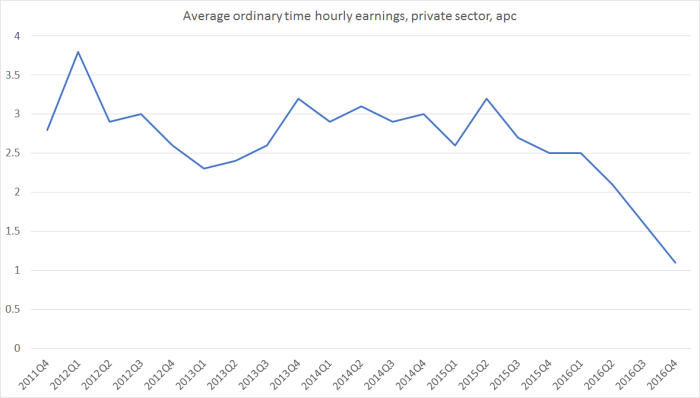
So we’ve had:

  • no productivity growth (perhaps even a contraction over the last year)
  • high and only slowly falling unemployment (and for those inclined to glibly respond that 5 per cent unemployment isn’t high, recall that that numbers mean that any one time one in 20 of those people available for wanting, wanting to work and making active efforts to find work can’t find a job).

And what of wage increases?  Unsurprisingly perhaps, there has been little sign of any recovery nominal wage inflation.    A standard response is that wages will inevitably lag improvements in the labour market, but….the unemployment rate has now been falling slowly for five years or so.

There is a variety of different wage inflation measures.   Here are two from the Labour Cost Index –  both the headline published series, which tries to adjust for productivity growth, and the Analytical Unadjusted index which is more like a raw measure of wage inflation.   In both cases, I’ve shown the data for the private sector.

lci

Of course, if one believes this data (in particular the red line) there must have been some continuing productivity growth in New Zealand, even if at a slower rate than previously.  Quite why SNZ finds (implied) productivity growth here, and not in national accounts (real GDP per hour worked) is a bit of a mystery.

The other measure of wage increases if from the QES. In this case, the annual rate of increase in private sector ordinary time hourly wages.

qes-wages

There is some volatility in this series, and I’m not sure I’d want to put much at all on the reported sharp fall-off in hourly wage inflation over the last year, but…….there is certainly no sign of an increase in wage inflation.

It is always easy to look around and find countries that have done worse than New Zealand –  several of the euro area countries spring readily to mind.    But our performance, and the gains for our people, are nothing much to celebrate.  And while, for example, there has been a global slowdown in productivity growth since the mid 2000s, New Zealand’s productivity levels are so far below those of the more strongly performing OECD countries, that there was no necessary reason why we needed to share in the slowdown.  It should, if anything, have been an opportunity for some convergence.  But there has been no sign at all of that.

I don’t find that particularly surprising –  an economic strategy that appears to involve attracting ever more people to one of the most isolated corners on earth, in an era in which connections, contacts, and proximity seem to matter more than ever, all while producing a very high real exchange rate (again resurgent in recent weeks/months), and the highest real interest rates in the advanced world, is simply a recipe for continued long-term underperformance.  One would like to think that the government –  and the Opposition which seems to support very similar policies –  has been surprised. They can’t, surely, have planned on such a bad performance.  But persistent bad outcomes, of the sort New Zealand continues to see, should be prompting some serious policy rethinks, not just more PR about how rapidly employment numbers are growing.


Immigration: where should the burden of proof lie?

The New Zealand Initiative, the business (and Wellington City Council) funded think-tank, is on record as strongly in favour of allowing high levels of non-citizen immigration.  Indeed, some of their senior staff seem quite strongly influenced by the “open borders” strand of libertarian literature that, in principle at least, favours allowing in almost anyone who wants to come.  But very little of what they have had to say thus far has been very New Zealand specific at all – the presumption seems to be that whatever might be true and valid in some places abroad will also apply here.

The Initiative has indicated that it will shortly (later this month?) be releasing a major report on immigration policy as it applies in New Zealand.  They ran a seminar on a draft of the report late last year and I was no doubt only one of many people who gave them fairly extensive comments on the draft.

Over the last couple of years I’ve been highlighting that there is no modern empirical analysis focused on New Zealand indicating that New Zealanders have benefited, in economic terms, from the large scale non-citizen immigration policy that has been run over the last 25 years or so (as a reminder the net inflow of non-citizens is about three times that in the United States, both in per capita terms).  Champions of large scale immigration to New Zealand –  including well-resourced public agencies like Treasury and MBIE, MBIE-funded academics, and think-tanks/lobby groups like Business NZ and the New Zealand Initiative – all rely either on overseas research about other countries (often much more central ones, like the US or various northern European countries), or relatively simple theoretical arguments about possible gains to New Zealanders.  And mostly they do not seriously engage either with the specifics of the continuing economic underperformance of New Zealand, despite the large scale non-citizen notionally-skills-focused immigration programme, or with the continuing natural resource orientation of this specific economy  My challenge has been along the lines of “show us the evidence”.  After all, if a policy has been run for a quarter of a century, on a relatively large scale, and it really has material economic benefits to New Zealanders as a whole  surely it shouldn’t be too hard to demonstrate those gains?

I had hoped that in the forthcoming report the New Zealand Initiative might take up that challenge and do some New Zealand specific research that would support their enthusiasm for high rates of inward non-citizen immigration.  If they had done so, no doubt there would still be plenty of room for debate –  no one study is ever definitive on any topic –  but at least there would then be a marker out there for sceptics to look at,be challenged by, and be forced to engage with.

But the other day a reader  – who is, I think, generally sceptical of my immigration analysis –  forwarded me a link to a tweet from the Initiative’s head of research, Eric Crampton.

In it, Eric was retweeting something from Erik Berglof, a professor at LSE, who in turn was linking to what proved to be a two year old piece by a Bulgarian sociologist who had (a) asserted that the academic evidence of the impact of immigration (to the UK) was overwhelmingly positive and (b) debunked a few of the dubious claims sometimes made about the impact of immigration in the UK (eg on social housing demand).  There was no  evidence on the wider economic impact advanced at all –  and in fairness to the Bulgarian sociologist, hers was only a two page piece.

But what really struck me was Eric Crampton’s own strong language –  aimed, I assume, at people like me.  We apparently “insist the null hypothesis is that NZ migration is terrible unless proved otherwise” and then “That shouldn’t be the null”.  A lot turns on that second sentence.

I’m quite open to the possibility that large scale immigration to New Zealand might have little or no long-term net economic impact on New Zealanders.  If so, that wouldn’t make such immigration “terrible”, but it would rather undermine the assertions of academics and officials that there are material gains for New Zealanders as a whole –  in MBIE’s terms that our immigration programme is, and has been, a “critical economic enabler” for New Zealand.  If it was all a wash –  and there were no material economic gains or losses for New Zealanders as a whole – we might still keep an immigration programme going if we wanted to offer that opportunity to the immigrants (who clearly expect to benefit or they wouldn’t move) but if New Zealand voters preferred not to do so, economists and officials would have no good reason to gainsay that preference.

My own suspicion is that our immigration programmes –  since World War Two, but particularly in the last quarter century, have been more damaging than that.  I’ve advanced a story –  which hangs together, even if it may not finally be the correct story –  which explains our continuing deterioriation in relative productivity performance in terms of the continuing rapid growth in population (mostly immigration policy driven) into a location with relatively few strong natural economic opportunities, reinforced by the pressure that rapid population growth (in an economy with a modest savings rate) has put on our real interest and exchange rates.  My story has never been that immigration is always and everywhere bad for natives, just that at times it could be, and that modern New Zealand could be one of those times places.  We see enough moribund towns, here and in other settler countries, to realise that where settlers arrive isn’t always where they can generate good returns over the longer-run.

Do I have robust formal empirical evidence for this story?  Well, no, I don’t.  And I don’t have the resources, or technical skills, of our leading government agencies to do such empirical research –  even if there were an easy or obvious way to formulate the test.  I’ve tended to rely on a “competing narratives” approach –  looking for stories that can best explain the various stylised facts of New Zealand’s disappointing long-term economic performance, and assessing how well each of those narratives do.

Eric Crampton proposes that the burden of proof be reversed from the traditional one.  In his story, we should welcome large scale immigration –  probably even larger than we have now –  unless there is clear proof that the immigration programme is harming New Zealanders.  It seems a lot like a concession that the alleged economic gains to New Zealanders can’t easily be shown –  and won’t be shown in the forthcoming Initiative report.  That point alone should be telling –  it defies the repeated rhetoric from politicians, officials, academics etc.

But how reasonable is the argument?  In some markets, and some products, I think it is a quite reasonable approach.  I don’t think we should be banning, or differentially taxing, trade in goods or services without pretty clear evidence of harm to New Zealanders as a whole.  I don’t think we should typically be regulating domestic markets in this, that or the other thing without clear evidence of harm –  and it is a test that is too little applied, at least with any rigour.  But non-citizen immigration is different.

What makes it different?  I think it is the fact that migrants are people, not goods, services (or dollars).  And the two categories are profoundly different.   People aren’t a sofa or a holiday.  People –  immigrants, not holidaymakers – take up residence , and in time become citizens and voters, and that they embody a whole set of institutions/cultural norms etc.  And people from other countries will often have a quite different culture etc from the people already here.   And even if they don’t, the natural resources in a particular location might be limited –  and if natural resources certainly aren’t everything, they aren’t nothing either, especially in remote locations such as this.

None of this is intended as a novel or particularly provocative observation. Norway (and Norwegians) are different than Portugese who are different than Argentineans or Singaporeans, and all of them are different from New Zealanders.  And of course there is plenty of diversity among New Zealanders.  The differences and similarities within and across countries aren’t easy to define, but there have to be some things that bind us together as New Zealanders –  if “New Zealand” is to be any more than some arbitrary administrative boundary such as that between the Wellington City’s southern and eastern wards.   We feel (by revealed preference of our political choices) some obligation to mutual support of fellow New Zealanders in a way that we  don’t feel –  or practice –  for people in Iceland, Ireland or Malta.  It doesn’t mean we think those people are inferior, but they simply aren’t our people.

I suspect every human society ever has maintained boundaries.  Outsiders have never been totally free to join an alternative grouping (whether a national state, or some other), no matter how attractive the alternative might appear.  No doubt there are various reasons for that, but it will include the intuited wisdom that communities with similar values and backgrounds tend to function more efficiently and effectively –  trust, for example, is a key dimension of any well-functioning society, and trust is developed and maintained most easily among those with similar backgrounds and shared experiences.  Yes, market insitutions can reduce to some extent the need to rely on trust, but only to some extent.   If anything, there is probably a “diversity tax”more often than a diversity dividend (and I wrote last year about some suggestive work in that area).

None of this means that effective societies can’t or shouldn’t cope with any newcomers.  But the capacity to absorb newcomers –  especially if from quite different cultures –  and still maintain the trust and intuitive understanding of each other –  is likely to be quite limited: human nature isn’t likely to have suddenly changed in the last few decades after millenia of operating within relatively homogeneous groupings.   If there are really big gains from welcoming lots of newcomers, those gains will offset any diversity costs.  But that brings us back to the question of starting presumptions.   The advocates of New Zealand’s large scale immigration programme simply haven’t been able to show such gains –  whether it was in the 50s and 60s, where the bulk of the immigrants were from the UK, or more recently.  There is a lot of wisdom embedded in established human institutions –  they evolved for a reason, typically a good one. The libertarian conceit is that those institutions, or presumptions, can simply be demolished and all will be fine.  Perhaps it will, but really the burden should be on them –  and their fellow travellers – to show it, including in the case of large scale movements of people.

So perhaps there was a case to be made 30 years ago that we should give large scale immigration from an indiscrimate range of countries a go.  Perhaps there really were large economic benefits to be had for New Zealanders.  And since few people had ever tried the experiment, we’d never know unless we tried.  But we did try, and have gone on doing so for at least 25 years now.  At this point, the onus really should be shifted to the advocates to show that their policy –  historically unusual, unusual in a cross-country context – is really producing benefits for New Zealanders as a whole.

I’ll look forward to the forthcoming Initiative report, and will no doubt comment further when I’ve had a chance to read it.  I was struck however by two observations I’ve seen in the last few days.  The first was the blurb for an old New Yorker article, in a newsletter that came through promoting a collection articles about Barack Obama.

Obama’s aunt told him that his father had never understood that, as she put it, “if everyone is family, no one is family.” Obama found this striking enough so that he repeated it later on in his book, in italics: If everyone is family, no one is family. Universalism is a delusion.

That sounded right, and uncontroversial (perhaps to all except libertarians).  The family analogy isn’t perfect, but it isn’t without value either.

And the second was a piece on Canterbury university lecturer Paul Walker’s blog, with the salutary reminder –  drawing on a piece from Nobel laureate Ronald Coase – about the limitations of empirical economic research, and the tendency of researchers –  and one might no doubt generalise it to analysts more broadly –  to find what they expect or want to find.  In Coase’s words

I remarked earlier on the tendency of economists to get the result their theory tells them to expect. In a talk I gave…. I said that if you torture the data enough, nature will always confess, a saying which, in a somewhat altered form, has taken its place in the statistical literature. Kuhn puts the point more elegantly and makes the process sound more like a seduction: “nature undoubtedly responds to the theoretical predispositions with which she is approached by the measuring scientist.”

It doesn’t mean the work shouldn’t be done, but it is a caution, and a reminder that societies rarely make policy choices, especially about big issues that have the potential to change the character of the society, on the basis of empirical studies.   All too often such studies offer support more than illumination.

Before stopping (for a couple of weeks):

Some readers might be interested in a 1990s piece from the late professor Ranginui Walker on immigration policy from a Maori perspective that a reader sent me the other day.    The nature of what large scale immigration did to the Maori place in New Zealand –  perhaps offering economic benefits but other losses –  still seems too little discussed in the current debate.

And Radio New Zealand on Monday broadcast a prerecorded discussion on some of New Zealand’s economic challenges between me, Ganesh Nana of BERL, and Rod Drury, CEO of Xero.    This was the discussion referred to in a pre-Christmas post on cities , in the context of the relative underperformance of Auckland.

Greenspan and pressure on independent central bankers

I’ve been reading a succession of long biographies of influential Americans.  The US election result prompted me to read biographies of the four presidents from Eisenhower to Nixon – one president with no prior experience in elected office, and three very flawed individuals –  and in the middle of all that I read (to review) Sebastian Mallaby’s big new biography of Alan Greenspan, The Man Who Knew.  There is some overlap:  Greenspan played a role in Nixon’s 1968 election campaign  – in domestic policy, and in doing polling analysis (his economic consultancy/forecasting firm had just acquired its first computer) –  and Greenspan was nominated to his first official government job, Chairman of the Council of Economic Advisers, in the last days of the Nixon administration.

I’d strongly recommend the Greenspan book.  It is well-written, deeply-researched (the author notes that one of his research assistants read the full transcripts of every FOMC meeting in the 19 year Greenspan term), and as interesting for the pre-Fed period as for Greenspan’s lengthy term as Chairman.  For some there might be a little too much on his succession of girlfriends over 40 years –  of one, we learn what she was wearing when Greenspan first encountered her in the Oval Office –  or the tennis holidays, but it is a biography of the man and his times, not the story of monetary policy.  Even in New Zealand bookshops, the price of the 750 page hardback isn’t extortionately expensive.

I’m not going to attempt a full review here.  Instead, I wanted to highlight Mallaby’s account of one interesting little episode from the early 1970s, when Greenspan was still prospering from his success as an economic adviser to major corporations (“the man who knew”).

As I noted, Greenspan had been quite involved in the 1968 Nixon campaign –  Nixon built a fairly formidable team of policy advisers, and carried many of them into the White House with him.    Greenspan had turned down the offer of a fulltime government position after the election, reckoning that the only positions that interested him were ones he was not yet senior enough to be offered (eg Secretary to the Treasury).  But he stayed involved, serving on the commission that (sucessfully) recommended the abolition of military consciption and on a presidential commission on financial reform.

By 1970, the chairman of the Federal Reserve was Arthur Burns, one of Greenspan’s former professors with whom Greenspan had stayed close.  Burns had also been quite involved in both Nixon presidential campaigns, and (somewhat against his own wishes, so his diary records) had been brought into the White House at the start of Nixon’s term as Counsellor, with Cabinet rank.

One of Nixon’s perennial concerns (he was a politician after all) was his re-election prospects.  As it happened he needn’t have worried –  his 1972 margin of victory was one of the largest ever – but he did, obsessively.  And in mid 1971 he was very concerned about what the state of the economy might be by the election time in 1972.   He had been convinced that Fed misreading of the state of the economy had contributed to his narrow defeat by Kennedy in 1960.

On 23 July 1971, Mallaby records,

Nixon invited three advisers to join him on the presidential yacht, Sequoia, for a Friday-night cruise on the Potomac.  The men kicked about ideas on how to deal with the wayward Fed chairman. Burns was behaving like a professional Eeeyore, talking down the economy with one gloomy comment after another…..Building on a suggestion from John Connally, the Treasury secretary, Nixon and his henchmaen settled on a plan.  They would make Burns shut up by planting a negative story in the press about him.

Burns had been urging the president to take a stand against inflationary wage increases. the Nixon men resolved to tell the press that Burns had simultaneously been lobbying behind the scenes for a personal pay raise [in fact, he had argued for an increase in the Chairman’s salary, but starting from the commencement of his successor’s term].  Coupling this charge of hypocrisy with crude intimidation, they would also inform reporters that Nixon was contemplating a reorganization of the Federal Reserve to curb the chairman’s authority.

Four days later the story appeared in the press, and the President’s press secretary “gave the story legs by refusing to deny it”.

With Burns now on the defensive, Nixon’s men moved in for the kill.  They would get a message to Burns demanding a positive speech on the economy. If the Fed chairman wanted to avoid all-out war he would have to cry uncle.

Charles Colson, a member of the Sequoia trio who would later serve jail time for organising Nixon’s dirty tricks, tracked down Greenspan.  He phoned him in New York and asked him to get Burns to change his tune on the economy.

Years later Greenspan insisted he refused to do Colson’s bidding.  But Colson’s handwritten notes from the conversation suggest otherwise.  After taking Colson’s phone call, Greenspan spoke at length to Burns.  Then he reported back to the White House.

Burns were seriously put out –  “very disturbed” was Greenspan’s description.  Mallaby continues for a couple of pages, with accounts of conversations between Nixon, his chief of staff Haldeman, and Connally about keeping up the pressure on Burns, including Greenspan’s role.

And then

Within twenty-four hours, the Fed chairman caved and Nixon appeared at a press conference to disavow the shameful attacks on his good character.  “Arthur Burns has taken a very unfair shot,” the President said, explaining how Burns had in fact turned down  a pay increase when the White House budget office had recommended one. A transscript of Nixon’s remarks was forwarded to Burns, who was soon on the phone to express his gratitude.

“It warmed my heart,” an elated Burns told Nixon’s speechwriter, William Safire.  “I haven’t been so deeply moved in years. I may not have shown it, but I was pretty upset.  This just proves what a decent and warm man the president is.  We have to work more closely together now.”

Burns’s diary for the years 1969 to 1974 has been published –  and is a good read for junkies.  Unfortunately, it is a little patchy and doesn’t cover July 1971.

Mallaby asserts that this episode, in which Greenspan appears to have played a not unimportant role, was a key turning point in the whole of monetary policy in the 1970s (Burns remained chair until 1977) when inflation became an increasingly serious problem, not just in the US, but around much of the advanced world.

In fact, distasteful as the episode is , reflecting no credit on anyone involved, Mallaby probably exaggerates when he writes that

The central bank had not been so clearly under the thumb of the White House since the Fed-Treasury accord of 1951. Politics had triumphed, and Greenspan had been a party its victory.

It is worth remembering the timing.  All this happened just a few weeks before the US suspended gold convertibility and the Adminstration imposed wage and price controls and temporary import levies.  They weren’t normal times, and nor  –  as the fixed exchange rate era broke down –  was it an era in which one might expect the usual distance between the White House and the Fed.

As importantly though, White House pressure on the Fed wasn’t new.  Burns’s diary on 21 March records his request for a meeting with Nixon “to have a candid talk about the war of nerves the White House gang had set in motion”.

And nor was the tension within Burns, between his anti-inflation instincts and his apparent desire for access to, and influence with, the President new.  In the same entry he records:

I informed the President as follows: (1) that his friendship was one of the three that has counted most in my life and that I wanted to keep it if I possibly could; (2) that I took the present post to repay the debt of an immigrant boy to a nation that had given him the opportunity to develop and use his brains constructively; (3) that there was never the slightest conflict between my doing what was right for the economy and my doing what served the political interests of RN; (4) that if a conflict ever arose between those objectives I would not lose a minute in informing RB and seeking a solution together; (5) that the sniping in the press that the White House staff was engaged in had not the slightest influence on Fed policy, since I will be moved only by evidence that what the Fed is doing is not serving the nation’s best interests

and so on.  He notes “RN seemed pleased by my reassurances to him, indicated that he never had  any doubts, that he would put an end promptly to the sniping about the Fed that has been going on at the White House…”

Perhaps more useful still, is Allan Meltzer’s comprehensive history of the Federal Reserve.  Meltzer was a monetarist and in the 1970s had not been particularly supportive of the rather ad hoc way in which the Fed ran monetary policy and allowed inflation to build up.   But in his careful discussion, and analysis of the documentary record, Meltzer absolves the Fed of the charge that in the run-up to the 1972 presidential election it was shaping policy according to political imperatives.  As he notes, the FOMC votes were rarely close (typically unanimous), and the FOMC itself was manned by plenty of independent-minded people who had been appointed by Presidents Kenndy and Johnson (one of the most independent had been appointed first by another Democrat president, Truman).

As he notes

Burns was able to get a majority vote of the FOMC because he could appeal to beliefs that considerable resources were idle, that inflation would be held back by price controls, and that their principal mandate was to contribute to full employment.  This was compatible with service to the president’s reelection campaign.

It is an alien world in many respects –  quite different models of how to think about inflation, the primary role of the central bank etc –  and none of the key figures emerges that well –  Nixon, Burns, Greenspan, Colson, Connally, Haldeman.  Some of that is clearer with hindsight, others should have been clear at the time.  But it wasn’t a case of the President’s placeman successfully orienting policy simply to re-election.

One of the themes of Mallaby’s book is how Greenspan, who started out very close to Ayn Rand, quickly gravitated towards the centre of affairs –  at times willing to compromise perhaps rather too much to retain that place. Mallaby praises Greenspan’s deft political management skills.  I couldn’t help feeling slightly uncomfortable.  One example was the account of the way Greenspan hosted annual 4 July parties at the Fed, at his own expense, for the movers and shakers of Washington and their families –  effectively buying influence and regard.  I came away from the book with a strong sense that 19 years was just too long for any one unelected official to hold such an influential office –  and as the book illustrates there is no evidence that Greenspan was uniquely well able to read the economy, or judge the best policy response –  but perhaps that is a topic for another post another day.