Confucius Institutes, the PRC, and all that

Last week there were screenings in Auckland and Wellington of Canadian journalist and filmmaker Doris Liu’s documentary “In the Name of Confucius” .  Each screening was followed by a Q&A session with the filmmaker herself, who has been on a bit of a roadshow promoting the film (which is funded by the Canada Media Fund) and its message (which has now also been screened at the British Parliament and at various parliaments in Australia).

From the promotional material

Culture. Language. Power.  On average, China opens one Confucius Institute per week in partnership with school boards and academic institutions around the world, with a goal of opening 1000 by 2020.  Yet, a growing number of schools are also starting cut ties with the program, alarmed by concerns ranging from human rights violations, financial incentives and censored content to national security and espionage.

In the Name of Confucius is a one-hour documentary about the Chinese government’s multi-billion dollar Confucius Institute (CI) program and the growing global controversy at academic institutions around the world as scholars, parents and others question the program’s political influence and purpose.

The Confucius Institute (CI) programme began in 2004, and there are now three of them in New Zealand (made possible as part of the 2008 China-New Zealand “Free Trade” Agreement), one each at Auckland, Victoria and Canterbury universities.  Given the substantial amounts of money involved –  the universities get to extensively leverage their brand with PRC money –  and the sensitivities of the PRC authorities on all manner of things (try the Rockhampton fish story for example), it was to the credit of Victoria University that they allowed their facilities to be used for the Wellington screening, even with the strange disclaimer that “This external event does not necessarily reflect the views, thoughts and opinions of the university”.    Perhaps naively, I’d associated universities with the contest of ideas, evidence etc, rather than with any single view held by “the university”.

(Reflecting an official PRC perspective, the film featured a clip of the head of Hanban –  the PRC government agency responsible for the CI programme –  stating that the CIs meant that it was “like foreign universities work for us”.)

The documentary centres on two main Canadian stories.  The first was the defection of a Mandarin language assistant (the main strand of what CIs do), Sonia Zhao, whose defection and subsequent human rights complaint (based on the then formal PRC prohibition of anyone with Falun Gong connections being a Mandarin language assistant) contributed to the closure of the Confucius Institute at McMaster University in Ontario.   Zhao herself had been a Falun Gong practitioner who, on her telling, had been unaware of the prohibition until presented with her draft contract, and was then fearful of imprisonment or other punishment in China.    She recounted the instructions the assistants received that –  in Canadian government classrooms –  they should avoid issues like Taiwan and Tibet, change the subject if possible, and otherwise parrot the Party line.

The second story was around the battle, ultimately successful, to convince the Toronto public schools system (apparently the third largest in North America) to end its association with the Confucius Institute/Confucius classroom programme.  It featured rather gruesome footage of little Canadian kids singing a song, drawn from CI resources provided by the PRC authorities for Toronto schools, in praise of Chairman Mao “leading his people forward” (no mention presumably of the tens of millions of deaths ascribed directly to government choices?).

The section focused on the Toronto debate featured footage of vociferous protests outside the meetings (on both sides, mostly from the ethnic Chinese community, with those in favour of the CI programme apparently organised by other PRC front organisations), some pretty arrogant bureaucrats (including one who had clearly enjoyed being “wined and dined” –  his words –  by Beijing), and some dramatic footage of the impassioned debate at meetings of the school district board of trustees.    There were the competing perspectives: one Chinese immigrant tried to claim that Tibet’s status was really just like Quebec’s.  That sparked a feisty response from one trustee about the possibilities for independence referenda in Tibet, to which the response was ‘oh, we don’t need referenda, because we know no one wants independence”.    And, on the other side, other ethnic Chinese noted that for all the CI claims to promote Chinese culture, it was the Communist Party which had set out to destroy so much of Chinese culture.     At the end there was an overwhelming vote (20 for, 2 against) to end the Toronto school district’s association with the Confucius programme.

The documentary was primarily about the Confucius Institute programme.  But it was also –  particularly through the lens of the Sonia Zhao story –  about the brutal and systematic PRC persecution of the Falun Gong.    The filmmaker –  herself a Chinese immigrant to Canada only about 10 years ago – has some involvement with Falun Gong herself, and indicated that she has family members back in the PRC who are active practitioners. One could only admire her courage in speaking out, although wondering about the risks she might be exposing her family still in the PRC to.

Here is an extract from a pamphlet Falun Gong people were distributing in central Wellington last week

falun gong

Or you could read an Australian (ABC) article.

This is the sort of regime that we allow to put its people into our schools.

Falun Gong isn’t, to put it mildly, my cup of tea.  But that isn’t the point.   States shouldn’t get to compel, or proscribe, religious/spiritual practices in this day and age (cuius regio, eius religio was from hundreds of years ago) and, when they nonetheless still choose to do so, we should not be actively aligning ourselves with such regimes (one could add regimes like Saudi Arabia to such a list), let alone allowing them to put (ideological “sound”, politically safe) people in our schools.   The PRC has now removed the explicit prohibition on Falun Gong people from the websites describing these Mandarin language assistant roles, but it makes no practical difference, given that the practice of Falun Gong is prohibited in the PRC and the government actively persecutes (and in some cases, it appears, murders) practitioners.

As it happens, and to her credit, the director of Victoria University’s Confucius Institute attending the screening of “In the name of Confucius” in Wellington.  Rebecca Needham was, until recently, a fairly senior MFAT official, including former New Zealand Consul-General to Guangzhou.  As I noted recently, in the weird conflation of roles and interests that swirls around Wellington over the PRC relationship, even though her current job (directly on the payroll of Victoria University) involves implementing a programme largely funded by the PRC, she is still shown on the MFAT website as one of the group of public sector experts on China (the only non public servant on the list).

When it came to the Q&A session, Needham made a couple of points:

  • to the extent that events were portrayed accurately in the film, they bore no resemblance to the way the Confucius Institute at Victoria (or others in NZ) were run, and
  • that the Victoria Confucius Institute was completely transparent and non-political.

Since I had met her once before, and she had then volunteered a willingness to talk and answer questions, I emailed her and asked whether she could be specific about any differences in how the New Zealand CIs were run, and whether there were any prohibitions on Falun Gong teaching assistants.

She invited me to come and talk it over, and we met in her office yesterday. Despite her offer to talk, she was clearly a bit uneasy about talking to me, and so I offered to keep her remarks off-the-record, and simply use them as background to my own descriptions etc.  In the course of the discussion, Tony Browne – former New Zealand Ambassador to China, chair of the Confucius Institute and senior consultant (unpaid) to Hanban (the PRC agency behind Confucius Institutes –  dropped in.  I’ve also written previously about the multiple hats Browne wears.

To recap, the main focus of the Confucius Institute, despite its location in a university, and use of the university brand, has almost nothing to do with the traditional role of a university.  They neither teach undergraduates, nor conduct research.  It is mostly a programme of (at PRC government expense) putting native Chinese speakers (typically young graduates from good Chinese universities) into our schools, to support Chinese language (and related) programmes. (There are also “cultural” programmes that look as though they should be better done, if at all, directly through the PRC embassy, not with a local university imprimatur).   A different cohort of these young people come out each year, and they are based in various towns and cities (in Victoria’s case, the North Island up to and including the Bay of Plenty), working in local schools alongside New Zealand registered teachers.  Apparently, no textbooks or the like are provided by Hanban, the Confucius Institutes, or the Mandarin Language Assistants themselves (presumably reducing the likelihood of kids in our schools singing songs celebrating Chairman Mao).

Apparently the hope of Hanban has been to localise Chinese language teaching over time (presumably, in turn, reducing the substantial cost the PRC taxpayer –  in a much poorer country than NZ –  bears).  Even if that is the hope, it isn’t the situation at present, whether in New Zealand or in other countries where CIs are operated.

The recruitment process for the Mandarin language assistants who come out here involves the New Zealand Confucius Institute staff making the final decisions (sensibly enough –  they need people who will fit in, living in perhaps a small New Zealand provincial town for some time). But they make those decisions from a list provided to them by PRC universities.    We can be pretty sure that all of those people –  after all, coming to pursue an official government agenda just by their presence – will have well-vetted. No Falun Gong will have survived the vetting process, but nor will anyone calling for (say) independence for Tibet, free and open elections in the PRC itself, respect for Taiwanese democracy, or freedom of religion or freedom of expression.   That is just the way the PRC is, and he who pays the piper calls the tune.  New Zealand staff needn’t concern themselves with this sort of pre-vetting.

Now, of course, these are young graduates.  Some might be politically passionate, but probably most aren’t –  more concerned with seeing the world, shopping, the opposite sex, developing their English, or whatever, all the while adopting the only safe PRC position (keeping your head down, and your speech tightly constrained).  So I’m not suggesting that when these people come into our classrooms they are generally consciously actively propagating some PRC agenda or worldview to our kids.  But it doesn’t change the fact that they are approved representatives of a heinous regime, and they (and the Victoria staff) have chosen to be complicit with that regime, no matter how often they repeat the line that “we just do language and culture”.     Are they helping some New Zealand kids in the process?  Yes, no doubt.  (And having myself spent time growing up in Kawerau, I was half-pleased to see that kids in places like Kawerau and –  still poorer –  Murapara are getting support in their Chinese language learning.)

But it doesn’t make the system right.  I suggested to the director that it really wasn’t much different than if, say, a cohort of Hitler Youth (which pretty much everyone had to join, whether a zealot or not) had beeen coming to the UK in the mid-late 1930s each summer to teach German language and culture, at the expense of the Nazi regime.  There is nothing wrong with learning German, or Chinese, but the people who work on those programmes (from university vice-chancellors down) make themselves complict in the evil.

If we want to encourage Chinese language learning in New Zealand, how much better if we spent our own money on it?   That is what we do when we want to improve science or maths or English or economics teaching.   It is what self-respecting people do, not mendicants.  We don’t (that I’m aware of) have a government-facilitated programme to bring in native French or German or Spanish speakers for our schools, but if that were regarded as a worthwhile part of secondary education I’d have no particular objection. But spend our own money, recruit people directly ourselves, and recruit them from places (in the Chinese case, eg Taiwan, Singapore, or even semi-free Hong Kong) where we can reasonably confident that a foreign government won’t have prescreened for political suitability and safety.  Particularly not a foreign government like that of the PRC.   (And this is all the more so for courses for our public servants, of the sort the CI conducts.)

You can read the Victoria University Confucius Institute material for yourself: there is plenty of it on their website.   You can also see that the talk about it being “just” language and culture (and doesn’t “culture” encompass “the way we do things” –  the PRC not being a model for most New Zealanders), they are quite open about the political nature of what is going on.  The handbooks for schools might mostly be branded as “Victoria University” products (Vic has many institutes and schools) and perhaps that helps marketing and recruitment in the provinces.  The Annual Reports are a bit different.   We find photos of a Vice-Premier, of a visiting Communist Party secretary.  We read that a counsellor from the PRC Embassy sits on the board of the Confucius Institute, and that one of the CI staff is involved in programmes “to raise China literacy in the public sector”  (we ask the PRC government to help “educate” us on China?   And the Nazi Party to educate us on Germany in the 30s?)   In fact, in the 2017 Annual Report there is a celebratory photo of Xi Jinping on page 2 –  clearly not embarrassed that this tyrant, just taking power for life and further clamping down on any freedoms in the PRC –  launched the Victoria CI in 2010.

The PRC doesn’t have any doubts about the point of the Confucius Institute programme.  But you have to wonder why New Zealand universities, government departments, and decent individuals are so willing to allow themselves to be used by such a dreadful regime.  Language learning generally is a good cause, but ends aren’t all the matter. Means matter too.

The presence of Confucius Institutes clearly isn’t the biggest issue that should be worrying people in the supine, even slavish, way our authorities approach the PRC.  Rather more important is when, for example, the Leader of the Opposition (who as a minister signed us up for a “fusion of civilisations” with this dreadful regime) can claim, apparently with a straight face

He also said he continued to back National MP Jian Yang who was forced to defend himself after confirming that he had taught ‘spies’ in China.     “Before me being or becoming the leader, he has asked and answered quite decisively the questions around all of this … he is a highly valued member of parliament,” Mr Bridges said.

(This of a man hardly heard from in the English language media since the allegations surfaced)

or a Defence Minister who was reported the other day, at a function to celebrate the People’s Liberation Army 91st anniversary, that New Zealand was a “strategic partner” of the PRC.

If you want to update on what sort of regime it is that we allow to put its people in our schools, that we solicit foreign aid from, and have our universities celebrate, I recommend that new Der Spiegel piece on the open-air concentration camp that the Chinese province of Xinjiang has become.  Or an update on the organ transplant abuse situation, that someone sent to me a few days ago.  Perhaps you are inclined to look the other way, or just ignore this issue, as I was until quite recently.  If so, at least I suggest you check out the calibre of some of the people involved in leading the fight against this practice.  Yes, governments need to have relationships with the PRC (stiff formal ones ideally), but we shouldn’t be beggars, and we shouldn’t give our good name to voluntary association with such a regime.
Women at the Reserve Bank

My post the other day, about the Treasury paper on “Women in economics”, was mostly about the apparent waste of (probably quite expensive) staff resources –  diverted from the real and substantive economic challenges Treasury should be addressing.  It seemed to be about virtue-signalling and feel-goodism more than focused analysis, made all the worse because the authors weren’t new graduates repeating an honours project (sometimes the basis for NZAE papers by young economists); indeed one of the authors is the chief economist of The Treasury, a deputy secretary no less.  Of course, that paper in itself was just a small example of what has gone wrong at The Treasury under its current leadership (facilitated by both the past and present government).  The Living Standards Framework, and the coming Wellbeing Budget, are the more prominent examples: a “well-meaning wafflefest” is the best that is likely to be said for that.   The quote is from Pattrick Smellie’s column today –  he seems slightly more optimistic than I am, noting the “intellectual grunt of The Treasury” (perhaps his memories of his time as Roger Douglas’s press secretary in the days when Treasury had intellectual grunt –  agree with them or not), but clearly a bit uneasy that it might all come to nothing much.

As I noted in comments to the previous post, I spent a couple of years working at The Treasury, and although it was getting on for a decade ago now, one of the things that struck me then –  recall, I was coming from the Reserve Bank – was the much higher proportion of women in economics, policy, and core management roles.  Frankly, I found it refreshing, and it was the only time in my working life when I sometimes went to economics/policy meetings at which there were more women than men.  I was struck then by the openness of The Treasury to part-time work, and to job-sharing arrangements, which seemed to make the place more attractive to women, especially those with young children (including several who had moved from the Reserve Bank to The Treasury).  The situation is also self-reinforcing –  when some (future) parents see flexible arrangements in an institution genuinely working for other people, it gives them more confidence it can work for them.  My own children were very young at the time, and my wife was considering going back to work, so they were issues that I paid attention to.

Perhaps it has all gone downhill again, even in these areas, in the last few years.  But I doubt it.   Which is partly why I struggle to take seriously Gabs Makhlouf, Tim Ng, and the rest of them whipping themselves about not meeting self-imposed quotas –  or indeed giving more attention to such issues, including in their Annual Report, than to lifting analytical excellence and the quality of their policy advice.   It just isn’t clear that they are addressing a real problem in The Treasury –  perhaps exemplified by them discovering that the institution had been using a tool that would have discouraged the use of words like “analysis” in job adverts, because they were somehow male-dominated words.

By contrast, I think there probably is a real situation that needs addressing at the Reserve Bank.  Here is how I described my assessment of the situation at the Bank in a comment on a post a few months ago

I agree that sex is not, and should not be, a relevant criterion in the selection of a Governor. But I also recognise that in a powerful public sector institution, with a high public profile and pervasive impact, in this era it isn’t necessarily inappropriate that questions should be asked to understand why, after 84 years there has never been a women appointed to a policy or operational senior management position (Governors, or heads of economics, financial markets, macrofinanancial stability, prudential regulation, or even notes and coins). For years, I defended those outcomes as mostly reflecting preferences (far more men end up doing macro and finance – and far more women do health and social economics etc), and I still think there is something to that story, but I’m no longer convinced it is enough of an explanation – substantively or politically. After all, Janet Yellen has just stepped down, and the RBA has two pretty impressive female Assistant Governors.

A commenter on my Treasury post drew my attention to an article from a couple of months ago, quoting the new Governor, that I hadn’t seen.   In it, Adrian Orr says

“I’m disappointed that it is as imbalanced as it is. We will be working actively. We are just going to have to be far more aggressive at getting the gender balance balanced,” Orr said in a recent interview with BusinessDesk.

Consistent with my comments in that quote just above

At the Reserve Bank, 36 percent of its 252 staff were women, although that dropped down to 20 percent of management roles – including managers and team leaders and senior positions of influence – and 26.2 percent of senior specialist roles. The Reserve Bank’s website shows just two of 13 senior managers are women: chief information officer Klarissa Plimmer and human resources head Lindsay Jenkin.

To its credit, the Bank is now being a bit more open with some of the data

In the year to June 30, 2017, the bank tried to hire six mid and senior management positions, attracting 101 external applicants, of which 19 were women. Of the four external hires, only one was female.

In particular, the data around applications for the position of Governor.    They initially refused to release this data, only relenting after the (surprisingly quick) intervention of the Ombudsman.

In the same vein, the hiring process that appointed Orr attracted 48 applicants, of which just six were women. Only two of those women made the final short list of 25.

But in a sense, the data on applicants for the position of Governor highlight that whatever is going on, isn’t a simple and straightforward story about (eg) institutional bias.

After all, anyone is free to apply, and in applying to be Governor you are backing yourself to be able to make a difference, including if you had heard that the Bank wasn’t (say) very welcoming to capable women.

And who got to make the decisions?  Well, the Minister of Finance was the final decisionmaker, and even he had to take the nomination to Cabinet (chaired by a woman).  But the real decision on the appointment of the Governor was made by the Reserve Bank’s Board.   And at the time, late last year, of the six Board members, three were women (including the deputy chair).  I only know one of the three, but none looks like the sort of person who would be pushed around by anyone, let alone consciously or unconsciously biased against female candidates.

Successful organisations mostly end up promoting from within.  It is a mark of the Reserve Bank’s failure as an organisation that 1982 was the last time an internal candidate was appointed as Governor and, perhaps even more so, that currently three of the four most senior positions (including Governor and Deputy Governor) are held by outsiders.  The failure of the Reserve Bank to have women in senior core functional positions (top advisers or senior managers) is, to a substantial extent, a failure of history, the failure to develop and maintain a culture and working arrangements that made it attractive for the very many female economics (and related) graduates the Bank has recruited over the years to stay.  Of course, most of all the graduates the Bank hires go on to do other things, but not one of the many female hires has stayed. I look around Wellington and see various women who once worked for the Bank in economics roles now holding relatively senior positions in other agencies.

The Bank itself has made this point.

The Reserve Bank admitted as much during a Parliamentary review of its 2017 annual report in February, with then acting governor Grant Spencer saying the bank hired a lot of women graduates, but struggled to retain women in senior and management roles

It is the single biggest difference between the Reserve Bank of New Zealand and the Reserve Bank of Australia: both of the two (impressive) female RBA Assistant Governors (in core areas –  economics and financial system) have spent the bulk of their careers at the RBA.  There has been nothing similar at the Reserve Bank of New Zealand.

To be sure, the Reserve Bank of New Zealand is a smaller organisation.  And no organisation can compel an individual to stay.  And I –  and probably most people –  am firmly opposed to so-called “positive discrimination”.  But our central bank should be the sort of place –  interesting work, reasonable prestige –  that plenty of able people (male and female) would want to stay at.

I wrote earlier about my observations of flexible working arrangements at The Treasury.  There was, in practice, nothing similar at the Reserve Bank; few or no examples of it working successfully, even if on paper the rules allowed it.  In my observation, it wasn’t that senior managers were in any active sense discriminating against women, but they just didn’t have a mindset that focused on creating an environment where women (in particular) who wanted to be parents as well as economists would find it most attractive to work.  That was still my observation, as part of the Economics Department management group, just a few years ago.  And, as a result, decades on the Bank seems to have not many more women in senior policy or analysis roles than it did when I started there 35 years ago.

Is the quality of the Bank’s work poorer as a result?  Probably not much, but probably a bit –  I seriously doubt there is a distinctive female perspective on macro or financial stability or bank regulation, but some of those very able women who didn’t stay might well have made a stronger contribution than at least some of the men who did.  We’ll never know.

There are probably aren’t any wise quick fixes.  As the pool of applicants for Governor suggests, there aren’t currently many women in New Zealand with a strong interest and/or the skills/experience for the very top roles in the Bank.  And, as the Treasury paper noted, the number of people doing economics to an advanced level at university is falling, and the proportion of women among them seems to be falling away a bit too.   Absent token appointments (which would be bad for everyone, except perhaps the appointee, and perhaps even her) fixing the Bank is likely to be the work of a decade or more –  most worthwhile things probably are.  But it still needs to be treated as a priority, for both substantive reasons, and because the Bank is a high profile and very powerful institution and questions will (and should) be asked.

What worries me a bit is that the Governor often shows signs of appearing to favour the quick win and the rather-too-glib answers, rather than digging more deeply into issues.  He has, after all, lots of turf battles to fight in the next few years, and a government that is all too keen on quotas.  In the article my reader linked to there was a private sector example of the sort of questionable responses to external pressures

ANZ Bank New Zealand has a policy that any short list for a position must be 50:50 gender split and the interview panel must also be equally split.

And yet, if honours graduates in economics are roughly one third female and two thirds male, a shortlist requirement of 50/50 male and female will (by construction) often not mean that only the best candidates are on the list.

And keep an eye out for appointments from the Governor in which he chooses to positively discriminate (while no doubt denying it).  I was a bit puzzled recently to see who the Bank had appointed an acting head of its Macro-financial Department (to fill in for a substantial period while the permanent head is on secondment leading the review of the RB Act).  The Macrofinancial Department is responsible for producing the Financial Stability Report, and for analysis and policy advice on macro-stability and macro-prudential issues. It also happens to include the Bank’s statistics unit (which doesn’t naturally fit in any of the core departments).  The acting head of the unit has no background at all in financial stability, regulatory policy or anything of the sort.  I gather she is quite well-regarded as manager of the statistics unit, but is hardly a natural fit for leading the entire policy-focused department.   Perhaps she really was the best available option, but when the Governor is out promising to be “aggressive” in rebalancing the statistics, it is inevitable (and sadly appropriate) that the question will have to be asked.

Change needs to come, but it needs to be done well and wisely.


What is “formulating monetary policy”?

Under clause 8 of the current Reserve Bank of New Zealand Act, the primary function of the Bank is “to formulate and implement monetary policy”.   All powers rest with the Governor personally.

I did a lot of work over the years on issues around monetary policy, both bigger picture stuff around goals and governance, and on the detailed implementation arrangements (the design of the OCR system itself, and various supporting liquidity management arrangements).  I sat on whatever internal advisory committees we had for the best part of 25 years.  I wrote this piece, for example, and this one.  So I know whereof I speak.  But I don’t recall anyone ever making much of the distinction between formulation and implementation, or getting a legal opinion on which of “formulate” or “implement” mattered in what particular context.  Why would we have?  All the powers rested with Governor, and there was no particularly need to clearly delineate formulation activities from implementation activities, either in the present, or in thinking about contigency planning.

In practice, and on a day to day basis, under the current system the two activities are fairly clearly divided: monetary policy formulation is, in effect, things up to including the OCR decision, while implementation involves the detailed management of market conditions to deliver something akin to the chosen level of the OCR.

But the broad parameters of an OCR system itself –  indeed, even the decision to have an OCR (we’ve only had one for 19 years) –  doesn’t fall neatly on either side of a line between “formulation” and “implementation”.  And then there is foreign exchange intervention for monetary policy purposes. Perhaps things have changed, but when I was there decisions that the preconditions for intervention were right (the “traffic light system”) were made by the Governor in the OCR Advisory Group context, while (rare) decisions to actually intervene were made by the Governor directly liaising with the Financial Markets operational department.

It doesn’t matter much at present, because all powers vest with the Governor, and how or whether he takes advice on individual bits of his monetary policy responsibilities is entirely up to him.

But in the Reserve Bank bill introduced last week splits those two functions apart.

Under the amended clause 8, it is intended that

The Bank, acting through the MPC, has the function of formulating a monetary policy….

and, in section 8(3)

The function of formulating monetary policy includes deciding the approach by which the operational objectives set out in a remit are intended to be achieved.

And in a new clause 9, we read

The Bank has the function of implementing monetary policy in accordance with this Act.

And later in bill, in the new clause 63B we read

The MPC must perform the function of formulating monetary policy in accordance with this Act

Neither “formulation” nor “implementation” is further defined in the Act at present, and I can’t see any attempt to add more specific definitions in the new bill, other than a circular definition which says that

formulating, in relation to monetary policy, has the meaning set out in section 8(3)

Which, to say the very least, isn’t very specific.

I have two concerns about this, which boil down to much the same point I was making in a post last week: this bill would results in a committee which is likely to be nothing more than figleaf, and which leaves all substantive power in the hands of the Governor (and his chosen management team).  That is likely to be even more so in the next serious recession, when the limits of conventional monetary policy (how far the OCR can be cut) are likely to be reached.  If that is the Minister’s intention, he should be honest enough to say so. If he is serious about building a stronger, more open institutions, not totally controlled by management, he needs to look again.

I suspect the intention of the wording of the bill is that OCR decisions (and only those decisions) should be made in, and by, the MPC.   That would be consistent with the explanatory note to the bill, which twice refers (loosely) to the goal being to institute an MPC “to make decisions on monetary policy”.

But the OCR itself is (rightly) not referred to in the Act.  And clause 8(3) only talks, very loosely, about “>deciding the approach by which the operational objectives set out in a remit are intended to be achieved”.   Couldn’t a Governor argue that not even the specific OCR decision is covered by that mandate?   The MPC might decide that it thought an inflation target should be achieved over, say, a two-year forecast horizon, but it isn’t clear why the Governor couldn’t insist that even specific OCR decisions were a matter for him alone, provided they weren’t inconsistent with the MPC’s “approach”.   That interpretation might be buttressed by the proposed wording around Monetary Policy Statements.  MPSs need the approval of the MPC, but the specific material an MPS has to cover is  (emphasis added)

specify the approach by which the MPC intends to achieve the operational objectives [and] state the MPC’s reasons for adopting that approach

I’m not suggesting such a departure is at all likely under the current Governor, but legislation should be written in a way that is robust, including to power-grabbers (either the Governor, or the MPC).   Specifically, it would be quite inappropriate for the Governor to be able to assert that OCR setting was purely his responsibility, and that MPC was only there to provide advice, even a decision, on the broad “approach” to achieving the remit goals.  It would make a mockery of the rhetoric around reform.
Similarly, I don’t think it should be acceptable for the Governor alone to decide to, say, scrap the OCR system itself (which would appear to be possible under the current legislative drafting) or to modify the system substantially in ways that led to much greater (or much reduced) volatility in key financial prices.  I’m not even convinced that choices around the policies the Bank adopts on what sort of collateral to take in its market operations, implementing monetary policy, should be matters for the Governor alone.  Such decisions have the potential to materially affect monetary conditions, and the achievement of the remit goals set for the MPC by the Minister of Finance.   At a bare minimum, the Governor should be required to consult with the MPC on such matters, and have regard to any comments or representations on such matters they wish to make.  Similarly, I don’t believe it should be acceptable for foreign exchange intervention decisions (the traffic lights) done for monetary policy purposes (or, indeed, the policy on such matters) to be made outside of the context of the MPC.

These issues might seem of second-order importance in normal times.  They have the potential to become hugely important in crisis periods, or in circumstances in which the limits of the OCR have been reached (recall that the Bank itself reckons the practical limit is only 250 basis point from here).  In those circumstances, if the MPC has power only over the OCR –  and perhaps not even secure statutory power there –  it will be all-but neutered; irrelevant to the real choices that the Bank management (and perhaps the government) is making.

Thus, for example, decisions to:

  • intervene heavily to drive down the exchange rate,
  • decisions to undertake substantial QE,
  • decisions to intervene to control yields on interest rate swaps

(all options touched on in the Bank’s recent article)

as well, potentially, as decisions around any limits on the volume of notes and coins, or on the conversion rates between settlement balances and notes and coins, would have potentially very large consequences for monetary conditions, and for the ability to meet the remit target

but I suspect the Governor would argue that they are all matters for him to decide, not choices for the MPC.

If the Governor successfully made such an argument, it would be unfortunate on at least two counts:

  • substantively, since the whole argument (made in the Explanatory Note, and in the Minister’s speech) is the benefits of diverse perspectives.  Such perspectives would be likely to be more valuable usual in an unconventional environment, which management had not previously experienced,
  • transparency.  The bill envisages requiring that some (pretty neutered) MPC minutes will have to be routinely published.  But if the important stuff of monetary policy is still being decided by the Governor –  not just him block-voting management in the committee – even what limited gains we might hope for around transparency and accountability will be foregone.

Of course, one way of looking at all this is to observe that if I’m right and the new legislation just cements in effective control by the Governor (through his management majority of the committee, and his likely clout with the board regarding the handful of externals) perhaps it doesn’t really matter very much.    Good people are likely to be reluctant to accept appointment, and that would simply be reinforced during a period when the OCR itself was neutered.

But, presumably the Minister doesn’t accept that interpretation (after all, he talks about the benefits of committees, diverse perspectives etc).  Nor, presumably, does the Opposition –  who talk up the risks to the independence of the Bank.  The legislation should be better-worded:

  • it should be explicit that the MPC has responsibility for decisions on the OCR or any official interest rate,
  • it should be explicit that the MPC has policy responsibility for matters to do with foreign exchange intervention done in support of monetary policy, and for policy parameters around domestic liquidity management,
  • it should be explicit that policy matters to do with, for example, QE should be matters for the MPC
  • operational decisions on matters within these mandates would be matter for the Governor, but accountable to the MPC,
  • and, at very least, the MPC should be free to make written representations on any other aspects of Bank responsibility which, in their view, are likely to affect their ability to deliver the remit objectives.

Consistent with that, of course, the MPC should have a clear majority of outsiders, and a clear majority of the members (preferably all) should be directly appointed by the Minister of Finance, without the involvement of the Bank’s (ill-qualified, illegitimate, and unaccountable) Board.

Treasury and modish ideological agendas

You might have thought that there were real and important issues for The Treasury to be generating research and advice on.   Things like, for example, the decades-long productivity underperformance and the associated widening gap between New Zealand and Australia.  Or a housing and urban land market which renders what should be a basic –  the ability to buy one’s own house –  out of reach for so many New Zealanders.    Or even just preparing for the next recession.   Analytical capability is a scarce resource, and time used for one thing can’t be used for others.

But instead…..

In a post last night about various papers presented at the recent New Zealand Association of Economists conference, Eric Crampton alerted his readers last night to a contribution from Treasury’s chief economist (and Deputy Secretary) Tim Ng and one of his staff.

I did not attend Treasury’s session in which they noted Treasury’s diversity and inclusion programme which saw the scrubbing of the word “analysis” from Treasury’s recruitment ads as overly male-coded. Those interested in priorities at Treasury might wish to read the paper.

And so I did.   I’m not sure I could recommend anyone else do so, except to shed light on what seems to have become of a once-capable rigorous high-performing institution.   We’ll see later the background to the “overly male-coded” stuff, but –  in fairness to Treasury –  the first Treasury job advert I clicked on did still look for

  • Critical thinking, analytical ability and learning agility
  • An ability to drive discussion and provide critical analysis

[UPDATE: As Eric notes in a comment below, he has now amended his reference to “analysis”.]

There is no standard disclaimer on the paper, suggesting that we should take it as very much an institutional view (perhaps not surprisingly, when one of the authors is a member of the senior management of The Treasury).

The Ng/Morrissey paper has several sections.  The first relates to what the authors describe as “women’s (in)visibility within mainstream economic theoretical approaches, in particular, with respect to the conception of ‘rational man’.

A well-known trope in economics (and in critiques of economics and of economists) is that of the rational individual, one who is self-interested and seeks to maximise their own welfare, and who is consistently rational in the sense of diligently and correctly applying the calculus of constrained optimisation using complete information. Sometimes this actor is explicitly referred to as a man (especially in writings earlier than the mid-20th century – no doubt at least partly reflecting the linguistic conventions of the time). At other times, it has been argued that this is implicit in the way in which the scope of the subject is defined for the purposes of research or pedagogy.

In my years of formal economics study –  some decades ago now –  I don’t recall any aspect of economic analysis ever being framed in terms that focused on men, or male involvement in the market.  Since I focused mainly on macroeconomic and monetary areas, perhaps it was different in other sub-disciplines, but I doubt it.    And if standard simplifying assumptions –  as much about tractability as anything – about rationality are a common feature in models, those assumptions are not, actively or implicitly, focused on male perspectives.   They are a proposition that people will use the information they have, that they will pursue the best interests of themselves, their families, or other things they care about.  None of which should be terribly controversial.

But Ng and Morrissey seem to think something terribly important is missing.

We look at the degree to which mainstream theory adequately captures the value of the roles typically undertaken by women, especially unpaid care work, and examines how alternative models, such as those based on the mother/child relationship, could improve economic understanding and policy advice in contemporary developed economies.

They go on

There is a consensus from a number of notable authors that the new paradigm would have the mother / child relationship at its heart as this provides a more accurate depiction of fundamental human interaction.

Both Orloff (2009) and Strassman (1993) identified human’s dependency in infancy and old age, and often in between, as unchosen but present. By identifying dependency as natural they resist the negativity now associated with the term. Folbre (1991) considers how this negativity came about and suggests that women’s dependency was created as a fact through discourse, in the vocabulary used in the political and economic census, which tied non-earning women to earning or moneyed males.

Held (1990) makes her case by identifying the inherent dependency within the relationship between the mothering person and the child, and based on her observation of children as ‘necessarily dependent’, she puts this need at the centre of human interaction. Hartsock (1983) makes a similar argument in asserting mother/ infant as the prototypical human interaction. The importance of this relationship is discussed by Fineman (1995) who suggests the classic economic focus on the sexual relationship neuters the mother from her child.

I struggle to see how any this –  even if it has any substantive merit –  has any relevance to the sort of work, and advice, The Treasury should be providing.  But no doubt it goes down well with the Ministry for Women.

The authors do offer some thoughts on the potential relevance. They begin thus

The implications of the above for policy depend to some extent on the degree to which gender roles and preferences are socially constructed (rather than innate). If the latter, then policy settings (e.g. labour market regulation) have a role not only in recognising different gender roles and preferences, but also in possibly reinforcing or leaning against gender roles that contribute to gender inequality. A more comprehensive microeconomic and measurement approach that incorporates care work would support better analysis of policy settings to promote better gender equality over the longer run.

But even this is almost content-free.    Whether things are socially constructed (society having evolved the way it did for reasons that presumably had survival value) or innate, what role is it of The Treasury to be trying to impose its vision on how people organise their lives?    What, after all, does “gender equality” mean –  beyond individual equality of opportunity, before the law – if there are indeed innate differences (on average) between men and women?

It is a very heavy-handed feminist analysis

A number of feminist theorists have noted the value of paid employment for women. It has been suggested as being ‘constitutive of citizenship, community, and even personal identity’ (Schultz, 2000:1886). It has also been proposed to be a vehicle for participation in society and entitlement to social insurance rights (Lister, 2002:521). Of course paid work also has benefit to women in terms of poverty alleviation (Lawton and Thompson, 2013; Ben-Galim et al, 2014; Thompson and Ben-Galim, 2014).

Whereas I’m quite sure my grandmothers (and even my mother) would not have seen paid employment as a positive for them (or for their families).  Both would have seen it as constraining their ability to be heavily involved in church and community activities.  Nor, in today’s terms, is there any recognition of the fact that many families would prefer one parent (often the mother) to be able to stay at home fulltime with young children, but find that a near-impossible choice to make given the dysfunction that is the housing market.   (And, as a voluntary stay-at-home parent –  albeit male –  I don’t feel remotely disenfranchised or devalued as a result of that household choice.)

Four pages of the paper is devoted to a rather strained attempt to demonstrate the potential value of a gendered lens on macroeconomics  (Ng is a macroeconomist, indeed a former Reserve Bank colleague of mine).    Some charts show basically no difference between the cyclical behaviour of male and female unemployment rates, but the authors are undeterred

Of course, this descriptive commentary is just that – we are not attempting here to make strong empirical claims about gender differences relevant to the cyclical labour market behaviour. Instead the idea is to simply to illustrate, with a bit of introspection, the directions in which policy thinking – macroeconomic in this case – could be enriched if a gender lens is taken, exploring the possible links between behaviour within the household regarding participating in the labour market vs. other activities, and the possibly gendered impacts of macroeconomic phenomena on employment, which is an important contextual factor for within-household decisions. A public policy which aspires to be relevant to different groups in society, including different genders, and cognisant of the possibly different impacts of policy on those groups, could be strengthened by taking more of this kind of approach.

For all the blather –  and without denying that it can be interesting to understand differences in how different population groups (male and female, old and young, European and Maori, Christian, Muslim, Hindu, and pagan, and so on) behave –  there is, it seems, nothing there.

Having failed to demonstrate a problem –  except perhaps an agenda to pursue –  the authors push on to look at the participation of women in the economics discipline.  This. it appears, is key (to what, one might ask?)

Education is our critical starting point. Those who study economics will later be those who practise economics, those who work in policy making, and those who undertake economic research. In order to ensure diverse perspectives are represented within that work, particularly with respect to gender and other distributional consequences of economic policy, it is important to have diversity within those who study economics. As this paper specifically focuses on gender, we will consider the position of women in economic education, in particular. Such a focus is supported by New Zealand’s international obligations through the Convention on the Elimination of all Forms of Discrimination against Women (CEDAW) and the Sustainable Development Goals (SDGs).

When authors have to invoke CEDAW (twice in two paragraphs) and UN SDGs you know they are on substantively weak ground.

As the authors demonstrate, numbers of people studying economics have been in decline (not just in New Zealand).  That probably should be of concern, at least to agencies wanting to employ economists.   The authors present numbers suggesting that, at least at high school level, the drop has been particularly concentrated among girls (personally –  and I have both a son and a daughter doing high school economics at present –  that seems a wise choice on the girls’ part, so mind-numbing (and non-economic) is much of what is taught as economics at high school).

At an advanced tertiary level, it seems that perhaps a third of the economics students are female (in 2014, 31.4 per cent of economics doctorates were awarded to women).  Ng and Morrissey don’t like this at all.

What is our impressionistic conclusion about these patterns in participation in economics education by gender? There appears to be a “pipeline” problem with both genders, and some evidence that the proportion of women is falling – a double whammy in terms of the female economist pipeline in particular. Evidence is accumulating on a number of smoking guns relating to the way in which economics itself is taught and perceived, how leaders in the field are presented, and questions about the social construction of our identity as economists. It appears that a lot of work is needed on several fronts to improve the female pipeline into the profession.

But what, specifically, is the problem?  They don’t say?  Do they have a problem with the fact that 97.5 per cent of speech langugage pathologists are women or that 98.3 per cent of automotive service technicians and mechanics are male (US data for 2016)?   Can they, for example, point to areas where The Treasury’s analysis and advice has been deficient because female students have chosen –  and over decades now it has been pure choice –  not to study economics?   They make no effort to do so in the paper.  The consistent undertone appears to be that Treasury (and economists) make policy, when in fact politicians make the big choices (and, as it happens, in New Zealand three of our last five Prime Ministers have been female).

Ng and Morrissey go on to a new section of the paper

This section reports some experience with a programme to increase gender diversity in an economic and financial Ministry, the New Zealand Treasury.

They perhaps don’t help their case by suggesting that the current head of the International Monetary Fund is an economist, when in fact she is a lawyer and politician.

Treasury is certainly at the forefront of politically-correct blather

In the context of the now well-established literature on the benefits of diversity for the quality of decision making, as well as an obligation to be a good employer, the Treasury has for some time had an active and comprehensive diversity and inclusion (D&I) programme. The discussion in Section 2 about the (non-)role of women in mainstream economic models and approaches, and the consequences of the potential “blind spots” this might imply for policy development, reinforces the importance of gender diversity in a Ministry focused on economics and finance such as the Treasury. Meanwhile, the gender imbalance in the economist pipeline discussed in Section 3 underlines why the Treasury cannot be complacent about this issue.

In fact, this stuff carries over to the Treasury Annual Report

The Secretary to the Treasury co-leads the diversity and inclusion work stream in Better Public Services 2.0 and is a Diversity Champion for the Global Women’s Champions for Change initiative.

Too bad he isn’t a champion of analytical excellence, or of fixing New Zealand’s deep-seated economic problems (but then, not being a New Zealander, he doesn’t have much motivation to care).

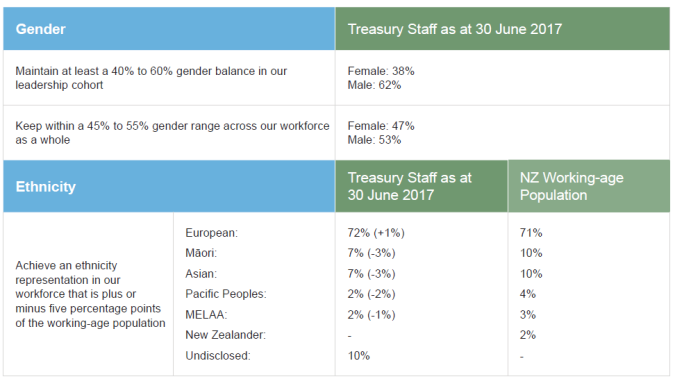
Consistent with all this, they run quasi-quotas.  They would probably object to the numbers being called quotas, but when you report your target near the front of your Annual Report, it must put a great deal of pressure on individual managers to hire to the quota, not to ability to do the job.

tsy quotas

Franly, citizens should be more worried about the proportions of people who are top-notch economic and policy analysts, not their skin colour or sex.

But not, apparently, at Treasury.  Here is Ng and Morrissey again

As the data above suggest, a clear issue is the lack of women in senior leadership positions, and part of the response includes obligations on managers to have regular career discussions with all staff on a regular basis and for succession planning to more systematically address possible sources of disadvantage for women. Within-grade gender pay gaps are regularly examined and the target of eliminating any such gaps explicitly included as a criterion in annual remuneration reviews. The parental leave and flexible working policies are regularly reviewed to check for gendered impacts.

But still with no attempt whatever to suggest how any of this has adversely affected Treasury’s policy advice.    Surely that should be the most important test?

It is also clear that The Treasury is dead-keen on the flawed concept of unconscious bias (here for some problems with the Australian public service experience), and the associated training/indoctrination.

Application of emerging insights from studies of unconscious bias have been quite influential in this work, and point to certain interventions and relatively simple changes in HR processes that may help to address some of these biases. For this paper, we took the opportunity to explore in some detail the Treasury’s recent use of a tool, Kat Matfield’s Gender Decoder, which provides an easy way of assessing the potentially different impacts on prospective male and female applicants of language used in job advertisements. The Treasury now has about two years of experience with using this tool as a way of reducing unintended gendered impacts on pools of job applicants

What of this tool?

The Gender Decoder is available on the web at http://gender-decoder.katmatfield.com/. This tool is based on the findings of Gaucher et al. (2011) which provide evidence that certain words in job ads appeal differently to each gender, which may be a channel to exacerbate existing gender imbalances by profession, especially in traditionally male-dominated occupations. The theoretical mechanism is essentially that words connoting individualism and agency (“leadership”, “ambitious”, “challenging”), or that reflect stereotyped male traits, tend to appeal more to male applicants, while words connoting communalism or that reflect stereotyped female traits appeal more to female applicants.

They attempt some analysis of Treasury’s experience with the tool  (emphasis added)

To look at gendered language in Treasury job ads in general and the possible impact of the use of this tool, we sampled 40 job ads posted by male and female hiring managers, 20 before and 20 after the introduction of the use of the tool in March 2016 as a recommended practice in Treasury recruitment.

Looking at the pre-2016 ads, it is notable that male and female hiring managers tended to code their ads towards their own gender, with male managers in particular tending to use strongly “masculine” language. Post 2016, male managers showed roughly balanced gender coding in their ads, while female managers showed a dominance of masculine-coded ads. The preponderance of strong gender coding increased after the introduction of the use of the tool, the opposite to what one would expect if the tool alerted managers to unintended or unnecessary gendered language in ads and if the managers wanted to attract gender-balanced pools of applicants (as they are encouraged to do by Treasury policy).

So those were “quotas” again, in that final sentence?  I’d hope Treasury managers, male and female, wanted the best pool of applicants, based on ability to do the job, not based on some institutional gender quota approach (that seems to disregard the fact –  demonstrated earlier in the paper –  that at least among economists, there will only be half as many women as men in the overall pool to atract applications from).

The authors reflect

Faced with this somewhat surprising result…..we looked at the nature of the jobs advertised themselves, and this exercise suggested to us some limits to the effect that scrubbing job ads of unintended gendered language can have on the gender split of applicants, including for economics jobs. The masculine-coded ads tended to be for jobs in the analytical functions of the Treasury, and “analysis” is coded as a masculine word by the Gender Decoder. Treasury also routinely presents itself as “ambitious” and a “leader” – another masculine-coded word – in the area of economic policy. The feminine-coded ads tended to be for “support” and corporate jobs, with an emphasis on “collaboration” – both feminine-coded words.

Dear, oh dear.  Treasury management has for some time been using an HR tool that treats “analysis” as some nasty male word.    Perhaps this paragraph should lead Ng and his senior management colleagues to rethink, and to wonder whether zeal and ideological presuppositions have not been not been outstripping evidence and analysis?

The Ng and Morrissey paper concludes this way

This paper has reviewed the position of women in economic theory, economics education and economics practice. We argued that the role of women and care work is insufficiently incorporated into mainstream economic models and approaches, and illustrated how a more gender-sensitive approach could enrich a particularly gender-blind sub-discipline – macroeconomics. We then documented the lack of a deep pipeline of women entering the profession, and the gender imbalance at senior levels in our own economic Ministry.

and

We conclude that the position of women in all three areas of economics is unsatisfactory. While the quality of management and decision making in general has been shown to benefit from diversity in general, in the delivery of quality economic policy advice that benefits all New Zealanders, it is particularly important that a diversity of perspectives is represented.

As a profession we have lots of work to do.

Eric Crampton has previously challenged  as “wishful thinking” (or worse) the Secretary to the Treasury’s repeated insistence on the substantive benefits from “diversity” (population diversity, rather than diversity of view).  Other recent New Zealand research has challenged that proposition too.

The Treasury seems to have become committed to the modish view that how one analyses an issue depends on where one comes from (at least race and sex, although presumably their logic applies to age, religion, birthplace, and all the other trendy identity markers).  As an institution, they now have a huge distance to go, lots of work to do, to restore a reputation for analytical excellence.  Between their institutional weaknesses and the lack of demand for excellence from our politicians, it is no wonder our serious economic problems aren’t seriously addressed.  Pursuing modish causes, no doubt ones in favour with the government of the day, is easier I guess.

The former Minister of Finance, Bill English, had many weak points in his political record.  Among them was his decision a few years ago to support the reappointment of Gabs Makhlouf as Secretary to the Treasury (when, within the law, he’d have been quite within his rights to have asked SSC to find someone who might actually restore the quality of Treasury we once had).    We are the poorer for that degradation of what was once a strong, robust, and analytically-driven institution.  Politicians make policy, and a good Treasury can’t force them to make good policy, but a poor Treasury gives them all the excuses they need to avoid tackling the real issues (while revelling in the feel-good content-lite nature of the coming Wellbeing Budget).

In the meantime, one has to wonder about the opportunity cost of the Ng/Morrissey paper.  Time spent writing it, is (taxpayers’) time that could have been used for tackling some real issues.


NZSF: engaging an alternative perspective

Andrew Coleman is one of New Zealand’s smartest economists, one of those people I learn something from almost every time I talk to him, or read something he has written.   Andrew currently divides his time between the University of Otago and the Productivity Commission.  But we disagree, it appears quite starkly, on the place of the New Zealand Superannuation Fund.  I’ve written various posts, mostly quite critical of the Fund for a variety of reasons (some things in NZSF’s own control, others a reflection of the political choices that led to the establishment of the NZSF).    I favour winding up the Fund and using the proceeds to repay debt.

In response to a couple of posts in recent months, Andrew has posted substantive and thoughtful comments that appear to be intended as a defence of the current system, and the place of NZSF in that system.   The first set was here and the second set was posted here on Saturday night.

As I understand it, Andrew and I share a view that there should be a universal public pension scheme, that is not less generous (relative to, say, average wages) than the current system.  Where, I think, there is a difference is that I firmly believe that the age of eligibility for NZS should be increased, and that subsequent further increases in the age of eligibility should be linked to further improvements in life expectancy (there should also be rather tighter residence requirements for eligibility) .    This makes a material difference because under my preferred model, NZS spending does not keep on increasing as a share of GDP, and is a manageable expense/burden for society. By contrast, Andrew often appears to be writing in a context that treats the current eligibility rules as a given, and thus focusing on how best to finance those (political) commitments.

Andrew puts a lot of emphasis on save-as-you-go (SAYGO) funding models, as distinct from pay-as-you-go (PAYGO) models.  A funded defined benefit pension scheme is a classic SAYGO model –  employees and the employer put aside money each week for, say, 40 years, and at retirement there is, in principle, enough to finance the employee’s pension for the rest of his or her life.  The power of compound interest has been harnessed.   In principle, at least in respect of the employer’s contribution, it could have been done another way: the firm could simply have invested the money itself (including reinvesting in its own operations) and then paid its share of the pensions as they fall due.  The reason that isn’t a good model is that (a) pensions of this sort are deferred remuneration and individual employees (reasonably enough) want a secure and certain claim, and (b) firms come and go, management changes, businesses fail etc.   A separate legal entity – a superannuation fund, with a trust deed etc – is the preferred way to go, but not because one approach involves saving and the other doesn’t, but because of agency/governance/enforcement issues.

How does the NZS/NZSF model fit in to this sort of picture?

First, as I noted in some earlier comments to Andrew

Our difference is around the specific place for the NZSF. Personally, I see any connection between it and NZS as just political branding. NZSF is just a set of govt-owned financial assets, and one can’t really put ribbons round particular pots of money.

NZSF does not make any future NZS promises more affordable,  If it manages reasonable returns –  as one might expect over time – it modestly improves the government’s overall financial position, and hence its ability to meet all future spending aspirations at something like current tax rates.

I’d prefer to think of managing the government’s balance sheet and income/expenditure, both now and across time, in an overall way, rather than assigning individual pots of money to individual line items.  That seems likely to be more efficient. It is also more realistic, about the nature of how government finances will end up being managed.  Governments can’t bind themselves to not use one pot of money labelled for purpose X for purpose Y if subsequent pressures change.  Probably, nor should they.  Wars happen, disasters happen, the uncertain happens.

Thus, Andrew argues the economic merits of savings, and I wouldn’t disagree with him particularly.  But in my proposal to wind up the NZSF and use the proceeeds to reduce debt, there is nothing that would reduce either public or private savings.  All that would happen is that the government balance sheet would be less leveraged (less debt, fewer financial assets, no change to the operating balance).  I’m also quite relaxed about the notion that if a government is going to take on far-future financial commitments (like an NZS) scheme, it should probably have a stronger balance sheet (more savings, less net debt) than a government that did none of those sort of things.   A balance sheet with near-zero net debt –  when, as Andrew notes, the government is very long-lived –  and extensive real asset holdings, in a country with above-average population growth, looks pretty cautious to me. Excluding a handful of countries with non-renewable natural resource extraction proceeds (Norway, Abu Dhabi etc), our government finances are among the most conservatively managed in the world.

So the issue isn’t one of whether the government should save or not, but simply of how much it should save.  I’m not sure of the answer to that question, but there are both political and economic dimensions to any answer.

Among those economic questions is whether, and if so to what extent, additional government savings (or even compelled private savings) actually raises national savings.   If there was full offset (every dollar of additional public savings was offset by an equivalent reduction in private savings) there would be no obvious societal benefit at all (in fact, given the deadweight costs of taxation – and intermediation costs – there would net welfare costs to society).    I see no evidence that, for example, the Australian compulsory savings system has raised national savings rates in Australia.  As for government savings itself, there seems to be plenty of sign of at least some private offset.

Among the political, or political economy, questions are ones about the durability of large tax-funded holdings of government financial assets in a democratic society.  It is one thing for governments to hold large asset pools in societies with little or no democratic accountability (Singapore, Abu Dhabi and so on) or even when the assets arise from a non-renewable natural resource (as in Norway).    It is another matter altogether when the assets are tax-funded, and governments face voters every few years, in a country no longer particularly well-off by advanced country standards.  Such accumulations of assets invite electoral auctions. They also invite political jockeying to see that the assets are used in line with the priorities and preferences of those currently in power (or, indeed, of those who happen to be managing the money).

There also arguments advanced that it would be natural for any portfolio to have some significant equity exposure to (for example) secure some of the equity risk premium for the Crown.  Against some abstract benchmark in which the government was otherwise funded by lump sum taxes on the one hand, and simply paid NZS on the other, I would agree.  But that isn’t what government finances (here or abroad) look like.  Through the income tax system, the government already has an effective equity stake in every business enterprise in the country (28 per cent of all profits go to the Crown, 28 per cent of losses can usually be written off against future earnings).  And the Crown has an extensive base of real assets (equity exposures) –  whether shares in SOEs or the extensive holdings of schools, hospital, roads etc (which don’t produce a dividend stream, but save the Crown paying user fees which would include someone else’s dividend stream).

Perhaps there is a case for more Crown equity exposures, but that case really needs to be made convincingly against the backdrop of the overall public finances, not just thought of relative to future expected NZS payments.   It should also be thought about in the context of citizens’ own “risk budgets”: increased equity exposures taken on by Crown agencies should, rationally, be offset at least in part by reduced private holdings.

In his writings in this area, Andrew Coleman puts quite a lot of emphasis on government (and, by extension, NZSF) as a long-lived agent, better placed to invest in long-term assets than the private sector, and less prone to liquidity pressures.   I think he is mostly wrong about that, for a variety of reasons.  From an anecdotal perspective, NZSF seems to have had more asset allocation changes in the last decade or so than the modest superannuation scheme I’m a trustee of.    But, and much more importantly, the government (at least in a democracy) doesn’t stand remote from its citizens and taxpayers, and taxpayers/voters don’t like large losses, and (I’d argue) especially not when their personal finances are already under greater than usual stress.   NZSF will record large losses in the next serious global recession –  the more so, as NZSF hedges back to NZD –  and that recession is also likely to put stress on the New Zealand government’s operating balances.     There is likely to be heightened pressure on the government, and on those managing the Fund, to account for their losses, and perhaps to cut those losses.  It might be silly, wrong, or in some longer-term sense irrational, but no investment strategy should ever be operated without considering the extreme loss tolerances of the ultimate investor (in this case, not some detached Treasury official, but voters).   I’m sceptical that the public is comfortable with the potential for tens of billions of annual mark to market losses (the scale we could be looking at if NZSF gets much bigger), coming at a time when (say) taxes are being raised or public spending is being cut.  In other words, even if an NZSF strategy offered possible longer-term benefits, it would do so only at the cost of concentrating periods of pain.

Another aspect of Andrew’s argument is an assumption (implicit, and sometimes explicit) that governments can be trusted, and will typically be good economic stewards.  It is far from clear why we should expect them to be so, especially when entrusted with other people’s money.  Each citizen has a strong interest in their own future financial position, and (one hopes) that of their children and grandchildren.   As individuals, politicians no doubt have the same interest.  But let lose on a whole country, politicians have interests which are rather different –  often as focused on the next election as anything longer –  and with little accountability (beyond losing office) if things go wrong.  These same governments that Andrew wants us to entrust more of our money to are the same sorts of governments that did Think Big, that turned our economy inwards for decades from the 1930s, that take us into wars, that ran us into serious debt problems (whether in 1939 or 1990), and so on.  They are same group who cavalierly talk of pursuing net zero carbon targets, even if the consequence is that (on their own numbers) GDP is cut by 10 to 22 per cent, with the costs falling disproportionately on the poor).   I’m not some anarchist who wants to get rid of all government, but I don’t think the track record is particularly good, especially when governments want to commit our money/resources for the long-term.

And all this is before we look at the specifics of the way NZSF has actually been run:

  • overselling its investment returns in a rising market, while quietly noting that it takes 20 years of data to seriously evaluate their sort of risky strategies (which may do no real direct harm, but speaks to integrity),
  • used (together with ACC) to solve the previous government’s Kiwibank capital issues, in ways that inject no additional expertise to Kiwibank, while corroding effective accountability for this risky government-owned assets (no doubt at favourable pricing for NZSF, but at cost to the system),
  • the decision to reduce carbon exposures, purportedly as a normal risk-return call on business prospects, but nonetheless implemented in a way where the consequences can’t be monitored, and thus looked more like virtue-signalling and playing politics than a serious neutral investment stance,
  • the opportunistic bid to own part of all of the new light rail proposals. NZSF has little or no apparent experience in such assets, which themselves appear uneconomic, and thus the approach again smacks of politics and lobbying, more than pursuit of citizens’ longer-term interest.
  • the latest attempt to lobby for huge tax concessions (adding new distortions to the system) for projects (and project partners) they want to get involved in.

These problems will only get more serious if the Fund is allowed to grow larger. One experience which shook my confidence was involvement a decade ago in the then-government’s Jobs Summit, which occurred at the trough of the last recession.  The NZSF fund was small then, and the pressures were resisted, but it was likes bees round a honey pot as people (well-motivated and not) emerged with ideas of how the moneypot could be used to help.  Those pressures will return next time.

And all that is before the ethical investment question.    We all have exposures to all industries (legal, moral or not) through the tax system, but NZSF involves active choices to put our money in individual companies. You might not be comfortable with whaling companies, tobacco companies, arms companies, or even financial institutions like AMP. I’m not comfortable with exposures to hospital chains that do abortions, or conglomerates that produce pornography, and I’m not keen on funding McDonalds either. My point isn’t that my preferences are better than yours or vice versa, but investment is participation, it is support, and those investment choices are neither a natural nor necessary part of a New Zealand government.  (Neither is a large leveraged investment fund.)

In many respects, the governance provisions of the NZSF aren’t badly set up, if one is going to have a body of this sort.  But rules of that sort can only take one so far.  All Board members will have their own futures in mind –  and governments have lots of apppointments in their gift.  The same goes for the CEO.    And, of course, so many people now have business dealings with NZSF, including competing for investment mandates, that it is hard to ensure that ongoing robust scrutiny an asset of that size deserves.

As I’ve noted previously, one way to reduce some of the risks around NZSF would be to amend the legislation to prohibit the NZSF dealing with New Zealand or local governments (to buy or sell assets, or to invest in proposals floated by government agencies) –  or perhaps even just to restrict exposures to, say, 5 per cent of any project/deal.    It would restrict NZSF’s opportunities, but it would also restrict the scope for logrolling, sweetheart deals, and all the sort of stuff that simply shouldn’t happen in the idealised world some supporters envisage for NZSF.

Finally, in his most recent comments, Andrew posed this point

So here’s a question, in the interest of debate: Do you have similar issues with the ACC fund? And if not, what is different about the ACC fund that makes it better than the NZSF fund?

Actually, a few months ago I noted that I thought it was worth putting ACC onto a PAYGO basis –  and to the extent there are very long-term commitments on the Crown balance sheet, that should influence the overall structure of the Crown finances, including the extent to which the Crown saves (rather than have an individual ACC moneypot).  As it happens, the ACC investment performance has been better than that of NZSF.   But my views on ACC are influenced more by my long-term doubts about the merits, or the fairness, of treating all accident victims differently from those with very long-term illnesses or disabilities.

In conclusion, I think there two quite separate issues to evaluate, and we don’t help either conversation by conflating them (as the previous Labour government attempted to when it set up NZSF).  There is the question of what an appropriate NZS policy should be.  But then there are the, largely separable questions of:

  • what the appropriate overall shape of the government balance sheet, and income statement should look like, and
  • what, if any, role a standalone leveraged global investment fund has to play in such a balance sheet.

Answering either question needs to range widely, and consider likely private sector responses to public sector choices, governance constraints, and the long track record of ambitious government interventions here and abroad.


NZSF: from bad to worse

I’ve written various posts here about the conduct of the New Zealand Superannuation Fund when Adrian Orr was CEO.    Their investment returns have been no better than one might have hoped for given the amount of risk they (force taxpayers collectively to) take.  Formally, they will argue that their strategies are risky enough that one can really only judge based on 20 year runs of performance (the Fund is only 15 years old).   But they talk themselves up endlessly, making dubious claims about their contribution, and playing politics more often than sound economics.  We had the big call last year to reduce their carbon exposures, allegedly on the grounds that risk-return considerations didn’t support such investments any longer, but then they implemented the decision in a way that makes it impossible to see whether this big active management call was well-judged on financial grounds, or not.  As I say, they play politics more than good policy, good economics, or good finance.

Since Adrian Orr moved on, the Fund has been led by Matt Whineray, now confirmed as CEO.    From him we’ve seen the unsolicited bid to be owner or part-owner of the government’s planned new light rail projects.     As I noted when that news came out

I’m sure the government is delighted.  As their predecessors were when the NZSF and ACC teamed up –  off-market of course – to take part-ownership of Kiwibank, without actually providing any fresh expertise, and in the process reducing the transparency and accountability around (what is still 100% state-owned) Kiwibank.  But in the end these are votes of confidence from public servants, who know which side their bread is buttered on.

As I’ve written about here previously, NZSF aren’t great investment gurus.  They’ve made quite a lot of money taking big risks in a strongly rising global market, but the returns relative to risk, or to taxpayer’s cost of capital haven’t been particularly attractive and –  as even NZSF will acknowledge –  markets go down as well as up.   As for light-rail projects, the NZSF statement noted that around 2 per cent of the Fund is in infrastructure assets worldwide.  That doesn’t suggest any particular expertise in light-rail –  and they don’t point to any in the statement.   And almost any government project can be made viable for an investor if the associated contracts are skewed sufficiently favourably in the investor’s direction.

Perhaps a good deal can be constructed for NZSF (with appropriate pricing and risk shifting, silk purses for some parties can be created almost anywhere), but it doesn’t have the feel of NZSF doing its core job.  It has the feel of NZSF continuing to degrade the  New Zealand policy process, using its (our) moneypots to serve political ends.

This last week I see NZSF has had a press release out.

The NZ Super Fund has congratulated Bloom Energy on its initial public offering on the New York Stock Exchange.

“The public listing is a significant milestone for Bloom Energy as it works to deliver sustainable on-site electricity to organisations around the world,” said Acting Chief Investment Officer Mark Fennell. “We look forward to supporting Bloom Energy as a listed entity for mutual benefit.”

Bloom Energy appears to be fairly new company NZSF had invested in.   Unfortunately, it is one that NZSF has already lost money on.

Mr Fennell acknowledged that Bloom Energy, while performing strongly on listing (up 67%), was currently priced below the level at which the NZ Super Fund initially invested in the company.

But no matter.  Just stick the investment in the bottom drawer for long enough and hope it comes right…..

“As a long-term investor the NZ Super Fund’s primary focus is on what we buy an asset for and the value we ultimately realise. Our investment returns will only crystallise when we sell our stake. What our investment is worth at various interim time periods is not as important to the NZ Super Fund as it is to investors with a shorter investment horizon.”

Typically, the best estimate of what someone will see an asset for is closely related to the current market price for that asset.  I’m not sure why NZSF felt it necessary or appropriate to put out a press release on this occasion, but I’m quite uneasy about an organisation –  managing our money, not their own –  that thinks that in rising global markets, a mark to market loss is just irrelevant, and made so because somehow NZSF can take a longer view than some other investors.   Even NZSF should recognise that it would have been rather better for them to have paid the IPO price (had they done so, they’d already have been up 67 per cent), not whatever loss-making price they actually did pay.

And then, in this morning’s newspaper, comes news that NZSF is lobbying (via the Tax Working Group) for tax concessions –  subsidies and corporate welfare programmes –  for infrastructure businesses it wants to get involved it.  The full (quite short) submission is here, but the gist is that they want cut-price company tax rates (no more than half the company tax rate) for “nationally significant infrastructure projects” (one of the criteria for such projects would be “Alignment with the Treasury’s living standards framework”), protection against any changes in tax rates over the (multi-decade) life of the project, and exemptions from standard RMA, immigration etc procedures.

I’m all in favour of lower company (and capital income) taxes more generally.  Standard economic analysis supports that sort of policy, and all of us would be expected to benefit from adopting such a policy approach.  But that isn’t what is proposed by NZSF; it is just a lobbying effort to skew capital towards particular sectors they happen to favour.  It is a pretty reprehensible bid to degrade the quality of our tax system.  There is no economic analysis advanced in support of their proposal –  so little it almost defies belief –  no sense of considerations of economic efficiency, just the success of lobbying efforts in a few other countries (including two struggling middle income countries not known for the efficiency of capital allocation or quality of governance, and the United States –  which not only has plenty of poor infrastructure, but a corporate tax code  riddled with exemptions and distortions).

NZSF is clearly in favour with the new government.  But the cause of good policymaking and the cause of efficient allocation of capital would, almost certainly, be advanced if it were simply wound up and the proceeds used to repay debt.  We should also stop the pretence –  advanced repeatedly by Fund spokespeople –  that we have a “sovereign wealth fund”.  What we have is a speculative investment fund, financed with borrowed money, producing no better than respectable, high risk returns, making no real difference to important questions around state-funded age pensions, and increasingly at risk of being used to skew capital allocation towards favoured political ends, backed by threadbare (or non-existent) economic analysis.


Treasury advice on rushing the Reserve Bank bill

From a Treasury paper to the Minister of Finance, written in March and pro-actively released yesterday (emphasis added)

Legislative Timeline
14. Officials’ recommended timeline, set out in Annex 2, would see drafting instructions issued in tranches from the end of April, and Cabinet approval of draft legislation by the end of August. Consistent with previous decisions, the recommended process does not allow for public consultation on an exposure draft of the legislation prior to the Bill being referred to select committee. You should note that this timeline is indicative only, and will depend on how quickly decisions are made, securing time in the House and the length of the select committee process.

15. Officials’ proposed timeline will allow the first reading of the Bill when Parliament resumes in the first week of September. Assuming the normal six month select committee process, this would enable Royal Assent by the end of April 2019.

16. The bid for space on the legislative agenda suggested the legislation would be passed this year. However, we do not recommend passing the legislation in 2018. Doing so would require shortening either the policy and drafting process, the select committee process or both. Reducing the time for either of these processes risks compromising the quality of the final legislation, and will make it harder to build public support for the reforms. A substantive select committee process that builds public support is particularly important given that the changes are to one of New Zealand’s major economic frameworks and that only limited public consultation was conducted during the policy development process.

17. If you want to pass legislation in 2018 and run a full select committee process, the policy and drafting process would need to be completed by early June. While this is not impossible, it would greatly increase the risks around introducing legislation. Risks could include introducing legislation with provisions with unintended consequences or new processes that are unworkable. This would make significant amendments likely during the select committee and the committee of the whole House stages.

Since the bill introduced this week has to be reported back from select committee by 3 December, it seems likely the government wishes to pass the bill this year, contrary to Treasury’s fairly-trenchantly worded advice.

I’m a little torn.  I’m keen to see a statutory committee in place, and I don’t usually put much store in Treasury’s economic analysis (and see Eric Crampton on the limited number of economists they are recruiting), but they should know something about policy development and legislative processes.  And they clearly think this legislation is being rushed, in an unnecessary, inappropriate, and risky way.

Debating the Reserve Bank bill

The first reading debate yesterday on the Reserve Bank amendment bill wasn’t exactly Parliament at its finest.    There was plenty of courtesy on display (with one exception, which I’ll come to below) but not much rigour, and not much regard for the importance of building strong and robust, open and transparent, institutions.

The National Party voted against the first reading.  According to the party’s finance spokesperson, Amy Adams, they support the move to establish a statutory Monetary Policy Committee

I want to deal reasonably briefly with the monetary policy committee, because that is an area where we see a lot of merit in what has been proposed. Of course we want to go to select committee and see what comes in, and we may well find issues that need exploring, but, at this stage, I think the monetary policy committee makes good sense.

but they oppose the change to the statutory goal of monetary policy.  It isn’t entirely clear from her speech read together with those of her colleagues whether they oppose the change because it will make no difference, simply reflecting what the Bank already does, or because they think it will make a difference, and they don’t like the difference it might make.    The former seems a very weak ground on which to oppose legislation: it is a good thing, not a bad thing, to ensure that legislation and practice are kept in line (arguably, for example, the Reserve Bank of Australia’s and the Federal Reserve’s legislation should have been updated long ago).

As I noted in yesterday’s post, I don’t much like the formulation of the statutory objective for monetary policy contained in the bill.  That isn’t because I think it will be deeply damaging, just that the government and their advisers haven’t done a very good job in capturing what it is that we should expect from an active discretionary monetary policy.  National Party members were at pains to point out that there is no long-term tradeoff between price stability on the one hand and employment/unemployment on the other hand.  And, of course, that is quite right.  It has been well-known for decades.   But equally well-known –  and for even more decades –  is that there is a relationship in the shorter-term.  It is why we have an active monetary policy.     But there is no sense of that distinction in the drafting the government has brought before Parliament.

Thus, I repeat the suggested wording I included in yesterday’s post

“Monetary policy should aim to keep the rate of unemployment as low as possible, consistent with maintaining stability in the general level of prices over the medium-term.”

or the sort of wording I proposed last year when I was a discussant at the seminar where Labour launched its policy.

To promote and safeguard price stability and the highest degree of employment [or lowest degree of unemployment] that can be achieved by monetary policy

That drew heavily on the language used in the Reserve Bank Act in the 1950s, introduced by a National Party finance minister.

One wants the Reserve Bank to do all it can to keep unemployment low, but only to the point where that is not in conflict with medium-term price stability.  In severe recessions –  mostly what we worry about, since these are human lives that are scarred –  “all it can” is quite a lot.  I don’t think the government has the wording right, and the National Party is right to push back, but if they are as serious as they say about working constructively in the select committee, it should be possible to find better wording which reflects the signicant short-run potential of monetary policy, and the very limited medium to long-term potential to do anything other than maintain price stability (or some similar nominal goal).

The complacency of the National Party probably shouldn’t have surprised me, just coming off nine years in government, but it did.    There were ludicrous claims –  from one backbencher old enough to know better – that for 30 years “the economy has gone incredibly well”, odd suggestions that the inflation target and price stability were themselves in conflict, and more specific ones about about the excellence of the Reserve Bank’s stewardship, even the suggestion that the new Governor will do a “superb job”.  Perhaps they have forgotten already that it is only a few weeks since the Opposition leader had a press statement out criticising the Governor?   Perhaps they are unbothered by past debacles like the MCI, or more recent episodes where the single decisionmaking Governor started lashing out at his critics, while refusing to ever substantively engage on issues?

But perhaps the most disconcerting claim was that there had never been an issue around unemployment and monetary policy in New Zealand.   On the Reserve Bank’s own numbers New Zealand went through seven years of a negative output gap (2008 to 2015), core inflation has been below the target focal point for eight years now, and the unemployment rate was above the Bank’s own estimate of a NAIRU for eight years (only dropping down to around that level in the last year or so).    Now clearly that was a failure in terms of the objectives set for the Bank, even without any sort of explicit employment/unemployment objective; on average monetary policy should have been run with lower real interest rates over much of that period.  But it seems to me that there is a reasonable argument to be made that had the Bank been obliged to, say, use monetary policy to keep the unemployment rate as low as possible, consistent with medium-term price stability, we might have had slightly better outcomes –  notably for those people who were involuntary unemployed, a scarring experience, during that period.

Oddly, the Minister of Finance never makes this argument –  consistent with his refusal ever to disagree with, or criticise, the Governor when he himself was in Opposition.  He should.   The experience of the last decade isn’t greatly to the credit of the Reserve Bank.  Perhaps they mostly had the best of intentions.  But they did poorly, and real people suffered as a result.    A reorientation of the target, focusing a bit more on the short-term stabilisation aspects, without sacrificing medium-term nominal stability, with strong reporting requirements –  and the right people –  could have made some useful difference.   (And, to stress that I’m not going to be tarred as some inflationista, in my ideal world the inflation target itself would be lower than it is.)

I wanted to pick up comments from two other speeches.  The first was from Chloe Swarbrick of the Green Party.  Whatever my differences with the Green Party, they deserve considerable credit for being the first party to call for a statutory Monetary Policy Committee, and historically they have also put a lot of emphasis on securing greater openness and transparency from the Reserve Bank (and used to greatly annoy the Bank by regularly requesting copies of Reserve Bank Board minutes, inadequate as they are).

In the course of her speech yesterday she made this comment

I think this piece of legislation, this bill, is a fantastic starting point for providing greater transparency and accountability for one of our most fundamental institutions.  This is, ultimately, about democracy.

If only that were so.   At very best, in respect of the Monetary Policy Committee, it is a baby-step in the right direction.  More realistically, it is a step away from accountability, and towards more power for unelected people (not even technocrats) with no visibility, no public accountability, and a majority of whom will have been appointed by the previous government.

For all its weaknesses, one feature of the current system is that it is very clear who should be accountable when the Reserve Bank gets it wrong, or even makes a controversial call that reasonable people differ over.  It is the Governor.  Effective accountability isn’t very strong, since the Board is supine, Ministers typically afraid of openly disagreeing with Governors, and market economists often cowed (either by threats from the Governor –  as in the Toplis case –  or more generally by the need to maintain relationships, access, and so on to an entity that regulates their employer).  But responsibility –  credit and blame –  is clear.      The same goes for good monetary policy committee systems, such as those in the UK, the United States, or Sweden  (actually, the same goes for Parliament itself, or even your dysfunctional local council –  there is individual responsibility).   But recall that the Minister of Finance has already said that he wants decisionmaking to be by consensus, no public record of who is dissenting and why, no opportunity for MPC members to articulate their views publicly, and so on.  We’ll have published minutes, which looks on paper like a small step forward, but with the amount gagging the Minister seems to envisage, it is unlikely to be a material win for transparency.    It looks a lot like a fig-leaf.        Not only will accountability be diffused and weakened –  in a quite unnecessary way – but these closed systems weaken any incentive for anyone appointed as an external member to invest heavily in the process. Free-riding, going along with the Governor as much as possible, will offer the best risk-return strategy (after all, challenge the Governor and you could be sacked, or not reappointed, and there is no opportunity for your views –  in an area of huge uncertainty –  to get a public airing.

And what of democracy?   The Governor was appointed by the Board –  oh, the Minister took the name to Cabinet, but he could only take the name proposed by the Board (or tell them to go away and come back with another name of their choosing.   The Board –  when the Orr appointment was made –  had all been appointed by the previous government (clearly out of sympathy with any sort of employment focus).  The current Deputy Governor was appointed by the previous Governor –  him of silencing critics, undershooting inflation etc –  and his supine board.  Both these appointees will be members of the new MPC.   The one or two new internal appointees will be appointed by the Minister, but only on the recommendation of the Board, who in turn will be guided by the Governor.    As I noted yesterday, the external appointees will also be chosen by the Board and the Governor (and recall that the Governor is on the Board), subject to an effective gubernatorial veto.  These appointments won’t be made until next year, but even by early next year, a majority of the Board members –  shocking track record, no expertise in the field, no accountability or scrutiny at all – will have been appointed by the previous government.

That isn’t democracy.  You couldn’t even call it rule by technocrats or philosopher kings, since the Board members are themselves just a bunch of company directors, academics etc, with no expertise, no legitimacy, no mandate.  And yet the Labour Party thinks –  apparently with support from both National and the Greens –  that these people should decide who makes monetary policy, the principal lever of short-term stabilisation policy.  I believe in the importance of democracy.   This isn’t it.

It is simply normal practice to have major appointments made directly by the relevant minister (or Cabinet, or on advice by the Governor-General).  It is strikingly abnormal to have appointments to major discretionary roles –  in central banks, or elsewhere in government –  so much out of the hands of elected politicians.  It would be a material step backwards, especially given the weakened accountability the government is proposing.  The National Party spokesperson is apparently worried that external members might be political hacks or under political pressure.  On the one hand, the Governor (at present) is probably much more susceptible to pressure, since he has lots of other battles to fight, including around his financial stability responsibilities. But perhaps more importantly, the dominance of politically-appointed decisionmakers is the norm in central banks abroad.  Those countries manage macroeconomic stability just fine.  It is also the norm in New Zealand –  I devoted a whole post to go through other roles.  Politicians appoint the Police Commissioner, members of the Commerce Commission, the Parole Board, the Governor-General herself, and all individual judges.    There is no good reason why appointments to key, powerful, Reserve Bank roles should be different: ministers should appoint directly, and thus be fully accountable for, people who wield such power on our behalf.

The final contribution to the debate that I wanted to comment on was that of the ACT Party, David Seymour.   Whenever I’m tempted to consider supporting ACT, all I need do is listen to one of Seymour’s speeches.  Here are some lines from his speech yesterday.

Thank you, Madam Assistant Speaker. I rise, on behalf of the ACT Party, in opposition to this bill—this piece of ministerial vanity and economic vandalism.

…..

Could it be that this is not just dumb policy; this is actually evil policy. This is an erosion of the independence of the central bank. This is the current Government attempting to take control of the printing presses—not quite Venezuelan style; just in a sort of smaller capacity than they’re used to. It is a way that this Government will be able to influence the supply of money, and I bet this House that, when this is place, and when their committee is making the decisions, we will no longer have independent monetary policy; we will have a pattern that will be detectable in a few electoral cycles, which will tell us that the money supplied goes up and inflation goes up and the economic sugar hit comes out right before an election, and then, once the election is gone, they take the punchbowl away and the New Zealanders get the economic instability that the Reserve Bank Act was designed to take away.

This is a black letter day in New Zealand lawmaking. The Minister either has no idea what he’s doing or he has every idea what he’s doing.

Reasonable people can debate the merits of altering the statutory objective.  Reasonable people can debate the design of a committee system.  Perhaps reasonable people can even debate whether a committee is a good idea, although we use them in almost every other aspect of public (and private –  company boards, tennis club committees, church synods etc) life.  But a contribution like this says more about the speaker than it does about the issues.    And, rightly or wrongly, there is just no sign in market pricing (eg gaps between conventional and indexed bonds) that the market shares Mr Seymour’s fears.

One hopes that Finance and Expenditure Committee deliberations will prove constructive, and that the government will be open to amendments.  Given that the chair and deputy chair of the committee are both part of the government (both holding Under-Secretary positions), I’m not that optimistic, but we’ll see.  I did notice one National Party speaker yesterday praising the committee chair (Michael Wood), and Wood’s speech in the debate was probably the best of them, so time will tell.

Reserve Bank of New Zealand (Monetary Policy) Amendment Bill

The first reading of the Reserve Bank of New Zealand (Monetary Policy) Amendment Bill is on Parliament’s order paper for today.      This bill is designed primarily to give effect to the policy decisions the Minister of Finance announced a few months ago, to change the statutory objective of monetary policy, and to create a statutory Monetary Policy Committee responsible for the conduct of monetary policy (details of which were set out here and here).

There are, however, some other changes proposed.  In particular, there seems to have been –  at last –  a recognition that the process used last year to appoint Grant Spencer as “acting Governor” was probably not lawful.   The proposed amendments would deal with any similar situation (created by the timing of an election) by allowing the extension of the term of an incumbent by (or a temporary appointment for) up to six months.   The ability to extend terms seems sensible (provided it can be done only once), although I’m less sure about the proposal to appoint a new person as Governor for six months.  But individual vacancies should matter less under the new model (at least as regards monetary policy) because of the move to a statutory committee.

In addition, the bill sensibly proposes to remove the age limit (age 70) for the Governor.   There was a strong case for some age limit with a single decisionmaker (given the extensive powers and the extreme practical difficulty of removing someone who was in clear mental decline) even if age 70 was probably now too young.  With a shift to a committee decisionmaking structure (at least for monetary policy) the issue becomes somewhat less important.  However, for now at least, the Governor still will wield enormous power around bank and non-bank financial regulation, so I’m not totally comfortable with the change.  Higher court judges, for example, must retire at 72.

There are lots of detailed provisions in the bill. some of which are sensible, and others fairly problematic. I will be making a submission to the select committee, and so will cover many of the issues in more detail then, with the benefit of a bit more time to reflect on how the specific provisions might work.

In the rest of this post, I wanted to come back to the two big changes that are being proposed.

I’ve been sympathetic for some time to the addition of a real economy dimension to the statutory objective for monetary policy.  The only case for active discretionary monetary policy is –  and always has been –  cyclical stabilisation.   We don’t need a Reserve Bank to deliver broadly stable price levels over the longer-term, and even if we have a Reserve Bank it doesn’t need to be active.  But there is a case for active monetary policy to limit the downsides from severe adverse shocks to money demand or aggregate demand –  the Great Depression was the most obvious example, and indeed the backdrop to the establishment of the Reserve Bank of New Zealand.  Monetary policy should do what it can, subject to a longer-term nominal constraint (eg price stability).

I’m less keen on the specific formulation in the government’s new bill

The Bank, acting through the MPC, has the function of formulating a monetary policy directed to the economic objectives of—

(a) achieving and maintaining stability in the general level of prices over the medium term; and

(b) supporting maximum sustainable employment.

That formulation has a number of problems:

  • the whole concept of what monetary policy can do is to avoid (or keep to a minimum, consistent with price stability) periods of excess capacity.  Despite Treasury’s attempt to argue otherwise in the Explanatory Note to the bill, “maximum sustainable employment” is not a measure of excess capacity.  Unemployment is much closer to an excesss capacity measure.
  • the wording treats employment as good in itself, whereas labour is an input (a cost, including to those who supply it) and a high-performing high productivity economy might well be one in which people preferred  to work less not more.  Speaking personally, as a non-participant in the labour force I feel slightly judged by the wording –  as if, by not being a good Stakhanovite, I’m not doing my bit,
  • the wording makes no attempt to integrate the two dimensions of the goal,
  • it continues to suggest that active monetary policy is primarily about medium-term price stability.  As noted earlier, we don’t need monetary policy for that goal.  Instead, medium-term price stability is more like a constraint (a really important one) on the use of monetary policy to keep the economy operating close to capacity.

I’d prefer that the goal was specified as something like

“Monetary policy should aim to keep the rate of unemployment as low as possible, consistent with maintaining stability in the general level of prices over the medium-term.”

It isn’t anywhere near as radical as it might seem.  The working definition of “stability in the general level of prices over the medium-term” could be kept exactly as it now (ideally, lowered a bit once the lower bound issues are resolved).  But it is clearer, and better aligns with what we should look for from the Bank and the new MPC.

The Minister’s announcement a few months also (sensibly) proposed moving away from the current target-setting system (Governor and Minister agree before the Governor is appointed) to one where the Minister sets the objective and the MPC as a whole is responsible for implementing policy to give effect.

Currently, the PTA is an agreement between the Minister of Finance and the Governor. Looking forward, as the MPC will be collectively responsible for making monetary policy decisions, it would be inappropriate for the Governor to be the sole member of the MPC to agree the operational objectives for monetary policy. As a result, we are changing to a model where the Minister of Finance sets the operational objectives for monetary policy. These objectives will be set after nonbinding advice from the Reserve Bank and the Treasury (as the Minister’s advisor) is released publicly.

Unfortunately, the bill before Parliament today materially waters down the (very welcome) promise in the last sentence.    Under that statement from the Minister, the operational objectives would be set only after both the Reserve Bank and the Treasury had provided advice, and that advice had been made publicly available.

In the bill itself, there is no reference to advice from Treasury, and no commitment that any such advice they proferred would be made public (although no doubt eventually an OIA request would bring it to light).   The Bank is required to give advice, but that advice remains specifically that of the Governor himself.  The Governor must consult with the other MPC members (but is not even specifically required to “have regard” to their views), and the Governor’s advice is now only to be published after the Minister has published the new operational objectives.

Interestingly, the bill explicitly requires public consultation by the Bank before it submits its advice on the operational objectives (“remit”), and it is required to “have regard” to those comments.  But instead of the consultation requirement being cast broadly, the Bank is able to determine “the matters the Bank considers would assist it to prepare its advice”.   Used wisely by a good Governor it wouldn’t be a problem, but legislation is largely about protecting the system from bad or weak individuals: in the case of a bad, weak, or just overconfident Governor, that person could deliberately rule anything s/ he found awkward out of scope when inviting public submissions.  And there is no requirement that the submissions themselves should be made public –  an omission that really should be corrected.

Much of the bill is about keeping as much power with the Governor as possible, while still instituting a committee.  Sadly, it is probably a recipe for a fig-leaf committee, rather than for the sort of real and positive change that is needed.    As just one example, although future Monetary Policy Statements will have to be approved by the MPC, the bill introduces (something I’ve previously suggested) a requirement that at least once every five years a longer-term report on the formulation and implementation of monetary policy be published.   But instead of, for example, mandating the commissioning of independent assessments and evaluations, this report will be the product of the Governor alone.   The Governor will be required to consult the other  MPC members and “consider” the “comments (if any) of the MPC on the draft”, but not even a majority of the committee can alter the direction of the report if the Governor doesn’t agree.   It is bizarre and inappropriate, but seems to reflect the Minister’s preference for a fig-leaf.   Based on some of his other comments, it is not obvious that the rest of the MPC could go public even if they disagreed strongly with the Governor’s assessment.

In previous posts, I have touched on the way in which the Minister’s proposals will effectively maintain the near-complete domination of monetary policy by the Governor.  Perhaps as disconcerting is that they also increase the power of the Bank’s Board –  that group of unaccountable company directors and academics who’ve proved totally useless in ever holding successive Governors to account, and who have backed Governors without exception even as they have seriously overstepped the mark.

The new MPC will comprise the Governor, a single Deputy Governor, 1-2 internals, and 2-3 externals (plus a non-voting Treasury observer).  By law, there must be a majority of internals.  All of these people will be appointed by the Minister of Finance, at least on paper, but in reality the Minister will continue to have almost no real say over the people who wield the most powerful short-term macro policy lever.    Recall that the Minister can only appoint as Governor someone whom the Board has recommended.  Board members themselves may have been mainly appointed by a previous government.  The same procedure will now apply to the appointment of the Deputy Governor, but in practice one would expect the Governor to have a major influence on the name put forward by the Board.   The internal candidates will also be appointed by the Minister on the recommendation of the Board.  The Board will be required to consult the Governor on these appointments to the MPC, but as the appointees are most likely to be people already appointed by the Governor as (say) Chief Economist or Head of Financial Markets), the Board will have not have much effective say at all.

So the Governor –  who sets working conditions, and sets pay and conditions for the internals –  already has his majority.  But his control on the composition of the committee doesn’t stop there.  Because the Minister can only appoint the handful of externals on the recommendation of the Board, the Governor himself is a member of the Board, and the Board –  being non-experts themselves – is likely to be highly deferential to the Governor’s views on who should (and shouldn’t) be nominated.  There is no way the Board is going to recommend someone the Governor is uncomfortable with.  Good Governors will welcome challenge and diversity etc, but legislation isn’t really needed for good Governors, but for poor, weak, or insecure ones.

It is simply the wrong model.  It is, as far I can see, pretty much without precedent, leaving the elected Minister of Finance no degrees of freedom over who is appointed to conduct the most important part of short-term economic management policy.  We can, after all, hold the Minister to account.  We do nothing about the Governor, the Deputy Governor, or the MPC members all appointed, in effect, by the unelected Governor and unelected Board.   This isn’t how open and democratic societies are supposed to work.  It isn’t how central banks work in other comparable democratic countries, and it isn’t how we handle appointments to other major crown entities.

I’ve argued previously that a much superior model would be:

  • all members, including Governor and Deputy, appointed directly by the Minister of Finance,
  • a requirement for a clear majority of external members, and
  • non-binding confirmation hearings by FEC on all (external) appointees before they take office (mirroring the practice now adopted in the UK for the Bank of England MPC).

The amendment bill Parliament will be considering today does not really deal with the communications procedures etc that are envisaged –  most of that is delegated to a charter to be determined later.  The Minister has, however, already indicated that his bias is towards a system where decisions are reached by consensus if possible, and that although minutes will have to published, there would be no identification of individual dissenting votes or any ability for MPC members to openly express their own views on monetary policy and economic issues.   That will suit the Governor, but won’t advance the cause of good policymaking or of an open and accountable central bank.    The charters are supposed to be agreed between the Minister and the MPC (recall that the Governor will almost always have a built-in majority) but the bill provides that the first such charter –  from which it will be hard to deviate much for a long time –  will be agreed not with the first MPC but just between the Governor and the Minister.   No doubt, the Governor will ensure his personal and institutional interests are served.  Will the Minister care enough to look to the interests of the wider process and of the public?  (And will the Governor still be able to talk openly about climate change policy, infrastructure, capital gains taxes etc, and if he, then what about the rest of the committee, for whom monetary policy won’t be a fulltime job.)

As I said, this bill further increases the power of the Board.    Another example –  extraordinarily so given the Board’s own shocking record –  is that the Board will be required to approve a code of conduct for MPC members.   But instead of discussing those arrangements and provisions with the first MPC members, the bill provides for the Governor and the Board to cook up the code of conduct themselves, no doubt reflecting the interests and preferences of the Governor.

As for Board’s capability and credibility in this area, well where do I start?  In just the last couple of years:

  • they’ve backed the Governor in attacking a member of the public who brought to light a leak in an OCR annoucement,
  • they’ve backed the Governor is his attack on, and attempt to muzzle, BNZ’s chief economist,
  • they’ve demonstrated a flagrant disregard for the provisions of the Public Records Act (maintaining no minutes of any meetings involving the appointment of the new Governor),
  • they confirmed that they had provided no written advice to the Governor in recent years at all,
  • they have shown no sign of interest in resolving serious misconduct issues in a superannuation scheme they have considerable legal responsibility for.
  • their own code of conduct, when finally revealed, proved to have no conflict of interest provisions at all,
  • they seem to have no interest in acting to keep the current Governor on reservation, and
  • just this week, their chair has attempted to assert that Chatham House rules trump the Official Information Act.

A supine, lawless group.  Just the sort of people you would look to for leadership in this area…..     But, no doubt, just the sort of people who can be relied on to do the Governor’s bidding and avoid any openness, challenge, or serious scrutiny.  In fact, who can be relied on the ensure that the new MPC is little more than a figleaf.   One has to wonder who will be willing to accept appointment, for anything other than the status, the pay or perhaps just academic curiousity.  Those aren’t the sort of motives we need in a revamped Reserve Bank.

All in all, this legislation falls far short of what could, and should, have been.   The Governor should be a CEO servicing and supporting (and chairing) an open and accountable, ministerially appointed committee.  Instead, his empire –  his dominance –  will be intact.   It cements in the victory for the Bank establishment, and for the Governor personally.  I haven’t yet written about Stage 2 of the review now underway, but the possibility of good outcomes from that process took a big step back when the Minister agreed that the review would be jointly done by the Bank and Treasury (which side is going to be more motivated to fight its corner?) reinforced when it emerged that the review process is being led by a (seconded) member of the Reserve Bank’s own senior management team, who will have his own future, working for the Governor, to look to.


The Governor as a Green

No doubt the Green Party has its place.  Some people –  a small minority generally, although rather a large minority around where I live –  vote for it.    Under our parliamentary system, that earns them some MPs, and at present –  a first –  they even have a few ministers outside Cabinet.     The critical point here is that those people were elected, and can be tossed out again if the voters get disillusioned.   They and their supporters champion their causes, as people on the other sides of politics pursue their own causes and views.

But if the contest of ideas and worldviews is integral to our political system, our system of government has also historically relied on senior public servants and holders of appointed public offices doing the specific job they were appointed to, and not using (unelected) public office as a platform, openly or covertly, for advancing their personal political or policy agendas in areas for which they have no responsibility.     Of course, many such people will have personal views on all manner of political and policy issues.   But we expect them (a) to keep those views to themselves, and (b) not to allow those personal views to influence the conduct of their professional responsibilities.   Historically, some holders of really senior public service or judicial positions have quietly chosen not to vote at all.   Respecting these sorts of self-denying conventions is all the more important the more power the holder of a specific office wields (the Deputy Secretary, Corporate in the Department of Internal Affairs –  say –  is a different matter than the Chief Justice, the Commissioner of Police, or the Governor of the Reserve Bank).  Keeping the personal and the professional separate is part of that ethos.

Why do these rules and conventions matter?   Because the office is supposed to be more important than the officeholder.   And one of the strengths of our system of government has been avoiding, to a large extent, the politicisation of the public service, or of that top tier of state appointments.    A capable Chief Justice, a capable Commissioner of Police (is there such a thing?), a capable Secretary to the Treasury should command confidence across the political spectrum, across the community, for their technical expertise, good judgement, shrewd advice (or whatever mix of skills is relevant to the particular position).  And part of that  should involve being able to be confident that the holder of any particular position is not using his or her office as a platform to advance personal and political views on matters quite unrelated to the role to which they have been appointed.  Apart from anything else, these officeholders are being paid, from your taxes and mine, to do a specific job.

And the alternative approach is pretty unappetising, especially in a small country with (typically) a pretty thin pool of talent.   Perhaps the US is big enough that it can comfortably turn over thousands of positions each time the President changes, and still mostly staff senior ranks with capable people.   We almost certainly can’t.  Or consider the unsightly spectacle of the US Supreme Court: all the nominees, from whichever party, seem highly capable, but no one on either side now views the Court as some impartial body, disinterestedly applying the law and constitution.  It has become largely an extension of ideological politics, but beyond the usual accountability mechanisms.  Fortunately, even in the United States, the central bank has been relatively immune from partisanship –  perhaps partly because of the self-restraint exercised by most incumbents, limiting the extent to which they stray off reservation in their speeches etc.

Our new Governor seems to understand none of this. Or if he does understand it, he seems to care not a fig about our system of government: there are ideological causes to fight, and institutional turf battles to win.  In the first month or two in office we saw him talking openly about all manner of things that were simply nothing to do with his current job –  sustainable agriculture, climate change, infrastructure financing, capital gains taxes (and both sides of the bank conduct issues –  neither of them being a prudential issue).  A charitable person might have seen these as rookie errors –  a new appointee revelling in the spotlight and not quite sure where the limits were.  In Orr’s case, he has been around long enough that that never seemed very likely, and it is now clear that the way he started is the way he means to go on.  In the process he is destroying the institutional capital built up around the Reserve Bank –  as surely, and perhaps more damagingly, than his predecessor did by other means.

And for all his (stated) enthusiasm for openness, transparency, “demystifying” the Reserve Bank, and cartoons to aid communications, the Governor has not given a single speech on any of his core responsibilities during his now four months in office.  The Bank’s website tells us none is scheduled either. Nothing on monetary policy, nothing on the state of the economy, nothing on governance of the institution, nothing on financial regulation, nothing on financial stability.  Just nothing.

That doesn’t stop him sounding off on all manner of other topics.  There have been two more examples just recently.

I don’t usually follow Tagata Pasifika, but a reader yesterday sent me link to an interview that outlet had recently done with the new Governor.  I guess the Governor isn’t responsible for the headlines (“The Cook Islander keeping our economy afloat”) but, whatever his background, one had thought of the Governor as a New Zealander (unlike, say, the British Secretary to the Treasury), and perhaps more importantly, the Reserve Bank doesn’t “keep our economy afloat”.

Much of the interview was fairly heartwarming innocuous stuff about that one strand of Orr’s ancestry that is from the Cook Islands.  But as it went on, it became more troubling.  Interviewed as Governor, from the Reserve Bank premises, he was offering his thoughts on what “we” (Pacific people in New Zealand) could do to overcome poor outcomes (incomes, home ownership etc).  There was strange rhetoric about how people had sought to divide and conquer them, and that everyone needed to “work together”.  Predictably (perhaps even appropriately given his role), there was no suggestion that (for example) low home ownership rates might be improved if only the government freed up land markets, but weirdly there was talk about subsidised loans (I think from within the community) to get into housing –  which might seem a little at odds with the Governor’s day job (where he wields regulatory powers to stop willing borrowers and willing lenders getting together to take on a housing mortgage).

Even that mightn’t have been too bothersome.  But as we got towards the end of the interview, the left-wing rhetoric was really unleashed.  We were, listeners were told, facing challenges of “societal sustainability”: we can’t have, so the Governor told us, haves and have nots and all expect to get along together.  In such a world, said the Governor, one group will be locked in, and the other group locked out.

It would make great – if largely empty –  election rhetoric from, say, the Green Party (Metiria Turei’s proxy now governs the Reserve Bank?).  But it has nothing, repeat nothing, to do with the job the Governor is paid to do, and in which capacity he was conducting this interview.   It wasn’t even backed by any suggestion of serious analysis, but I guess it sounded good at the time.  It is hardly the sort of stuff that is going to command general respect for the Governor in his important day job.

“Doing stuff” about climate change seems to be one of the Governor’s personal causes, nay crusades.  It was there in some of those earlier interviews I wrote about previously, but it was on full, and prepared, display a couple of weeks ago, when the Governor was a panellist at the launch of something called the Climate Leaders Coalition.    They advertise themselves as 60 CEOs whose businesses, in some sense or other, allegedly account for nearly 50 per cent of New Zealand’s emissions –  a claim which seems like a bit of stretch, since (for example) although Fonterra is part of it, the farmer shareholders (who actually own the cows) aren’t.   Buried a bit further down the website, we find that these firms actually account for 8 per cent of employment in New Zealand.   I found it hard to take the grouping very seriously –  it seemed to involve a great deal of virtue-signalling and keeping on side with the new government –  even before I looked down the list and found that the Wellington City Council zoo was a member.

I guess virtue-signalling, lobbying, and generally kowtowing is what CEOs have to do in the regulatory state.  Here is what all the hullabaloo was about

We take climate change seriously in our business:
*We measure our greenhouse gas emissions and publicly report on them
*We set a public emissions reduction target consistent with keeping within 2° of warming
*We work with our suppliers to reduce their greenhouse gas emissions

We believe the transition to a low emissions economy is an opportunity to improve New Zealand’s prosperity:
*We support the Paris Agreement & New Zealand’s commitment to it
*We support introduction of a climate commission and carbon budgets enshrined in law

All of which is pretty devoid of content or, arguably, demonstrably untrue.  The cause of a least-cost adjustment towards a lower-emissions economy –  economic efficiency – isn’t helped by every individual firm proposing some emissions reductions target that is somehow “consistent with” keeping within 2 degrees of warming –  one wants price signals and individual firms reacting based on the specifics of their own businesses and markets.  Some firms and industries might actually increase gross emissions, others might close down completely.  Then, of course, there is the claim that the transition to a low emissions economy is an opportunity to improve New Zealand’s prosperity: the government’s own consultative document suggests that a net-zero target by 2050 could come at a cost to GDP of 10-22 per cent, and no credible argument has been advanced as to how prosperity and productivity will be boosted by this big adverse shock (in a country still heavily reliant on animal emissions –  let alone international aviation emissions, not included in the official numbers.

In other words it was mostly feel-good stuff, worth some headlines on the day, but amounting to almost nothing.   It was self-interest on display (perhaps defensive self-interest, but self-interest nonetheless) –  which is fine; it is what businesses do, especially in face of looming regulatory constraints.

But what was the Governor of the Reserve Bank doing participating in this function, celebrating the event, cheering them on, all without adding a shred of economic analysis to the discussion?

You can watch the Governor’s part in the panel discussion (about an hour in at this link).  There was no sign from the Governor suggesting that he was participating simply in some sort of personal capacity – if that is even possible for high officials.  In fact, apparently rather the contrary: his speaking notes are available on the Reserve Bank website as his first and (so far) only gubernatorial speech.

Even the published text is like something from a crusade rally:

To see so many companies agree to the following is a moment of rejoice.

and

The best time to start this process is 30 years ago, or today. So I am privileged and proud to be a Kiwi sitting on this stage with so many New Zealand companies involved.

We are told that consumers will want “intergenerational justice” –  although I suspect most of the businesses present know that consumers typically want a decent product at a low price.

We are told that

Climate change, if not addressed, will create unforeseen social disruption and displacement.

I’m not sure how a public servant can state with such confidence that ‘unforeseen” things will in fact happen.

New Zealand can’t change the world. But, the world expects New Zealand to lead.
What do we have at risk?

Apparently almost nothing

We have less embedded costs and risks associated with making change (e.g., very limited fossil fuel production and dependency). We have least to lose and most to gain.

and

We can be a brand leader on climate change in the world given our starting point.

Surprisingly –  or perhaps not –  there is no mention of those animal emissions, and the absence as yet of economic ways of reducing emissions without eliminating the animals.  No mention of us having among the very highest per capita emissions in the advanced world, no mention of the importance of international shipping and aviation to the New Zealand economy, no mention of the policy-induced rapid population growth which drives hard against any other policy efforts to reduce emissions.  And, of course, no mention at all of the NZIER modelling featuring in the government’s own consultative document suggesting a very large real economic cost of adjustment, or of the Infometrics modelling featuring in the same document suggesting that the costs of adjustment will fall disproportionately on lower decile New Zealanders, and not very much at all on the highly paid like Mr Orr and the Climate Leaders Coalition members.

Orr never cites any evidence for his bizarre claim that the world expects New Zealand to lead in this area (in fact, given our size and different economic structure, it would be a sign of profound cynicism and unseriousness if “the world” actually did have such expectations.   But he does provide what he considers as evidence for why “we” can lead.

I have been fortunate to have witnessed great transformation in thinking and behaviours – such as the business commitment today – related to responsible investing.   My own experiences include involvement in:

  • The UN’s Carbon Disclosure Project (which the New Zealand Super Fund (NZSF) led and had pushed back at us by so many New Zealand businesses – there is no ‘I’ in denial);
  • Our leadership of the International Forum of Sovereign Wealth Funds (IFSWF) on responsible investing, and the ‘One-Planet’ initiative that the NZ Super Fund only last week promoted and signed;
  • The NZSF’s own courage in reducing their carbon exposure and engaging companies and searching for new alternative energy uses; and

In other words, not a single private sector entity, and no real economic adjustment (no actual reductions in emissions) just various different gatherings of government agencies around the world.  As for the claim that the NZSF portfolio reallocation took “courage” –  and isn’t it bad form to boast of your own “courage” anyway? – whose money was on the line?  It certainly wasn’t the Governor’s –  and as I’ve pointed out before the change was done in such a non-transparent way that we can’t even keep track of how much money this reallocation will have made (Orr’s claim had in any case been that it was hard-headed business decision, justified by expected risk/return considerations).

There is, in the published speaking notes, some rather strained attempt to connect the Reserve Bank’s financial stability role to the climate change discussion, but almost all of that was missing from the version he actually delivered, and none of it is compelling in the New Zealand context.  Perhaps there is some story to be told about dairy debt exposures, if emissions prices are pushed up too quickly undermining farm profitability and driving down rural land prices –  but there was none of that even hinted at in the Governor’s notes. I guess it would have disturbed the feel-good mood of the day.  It might have suggested an economic cost, rather than the nonsensical claims the Governor associated himself with about the opportunity to improve prosperity.

It was the sort of stuff you might expect at a Green Party rally –  although probably at least some of them might be more honest about the likely cost of the hairshirt.

And all that was just the Governor’s published text.  In his actual comments (viewable at the link above) we saw the schoolboy clownish side of the Governor on display, flippantly suggesting that the Bank wouldn’t raise the OCR until carbon had been reduced to zero.  I don’t suppose anyone took him remotely seriously –  a problem in itself, since Governors (like Presidents of the United States) really should be able to be taken seriously –  but it displayed none of the gravitas and seriousness one might hope for in the holder of such a high office.   That isn’t just me getting old and pompous: here was the relevant line from the Board’s advertisement for the position of Governor

Personal style will be consistent with the national importance and gravitas of the role.

And then we had this nonsense

“Let’s have our moment of glory, but we are lagging behing the world. And today we’re leap-frogging at least back to the frontier on one part of it,”

“Moment of glory” or “leap-frogging at least back to the frontier” from that lot of not very specific commitments, Wellington Zoo leading the way to save the world?

It went on.  We were told that “social cohesion would be truly truly challenged if we don’t do something about climate change” –  really, in New Zealand, which might just get a bit warmer and more pleasant?  The audience was warned of nation-state failures, thus presumably the imperative for New Zealand to “take the lead” – “we can do it, we should do it.  Lets do it”.   It must have felt very good in that meeting that morning.

At least until the Governor began to denounce capitalism.    Modern-day capitalism, the audience was told, drives you to short-termism.  No sense that it might have contributed mightily – including sparking innovation to deal with costs, problems, and opportunities that arise – to the unrivalled material prosperity the world – in almost every corner –  enjoys today.  No, capitalism is the problem.  That must have been a bit awkward for the assembled CEOs –  or at least for their owners –  but no one seemed to challenge the Governor on that.   Which was probably just as well, as the Governor didn’t seem to have anything to back up his claims.   Rereading his published speaking notes, it was striking that not once did he identify any problems, costs, risks, or failures in government interventions.   Wise governments, wise central banks, wise regulators will save us………

It isn’t as if this sort of rhetoric is new.    A month or two back the Governor was sounding off nearer to his own territory, claiming that financial markets (lenders, borrowers, and all) were myopic and therefore regulation was needed.  But when I asked for any research or analysis done by or for the Bank in support of this proposition, it turned out there was none.  It was just off the top of his head.  But it must have sounded good at the time.

Reflecting on all this, I have a number of concerns.  Perhaps the least of them is the lightweight nature of the Governor’s contribution, which too often sound more like campaign speeches than the considered thoughts of a serious senior public official.   If this is how he comments when we do see or hear him, what must things be like in private?  If this is the standard we now get from top public servants, what must the rest of government be like (all those CEOs we –  rightly –  never hear from)?

A good test is always whether one would have the same reaction if someone you are criticising was saying things you agreed with.  In this case, I can unambiguously say yes.  I’d be embarrassed to have such lightweight crusading perspectives from someone so senior for any cause I supported.  And it is simply inappropriate for the central bank Governor to be weighing in on such issues at all –  whether climate change policy, infrastructure. taxation policy, immigration policy, welfare reform, land supply or whatever.  It isn’t his job, and we need to be able to have confidence that the Governor has just one agenda –  doing his job –  not using his pulpit to champion personal agendas.  If the Governor wants to pursue those causes, he should set up a think-tank or run for Parliament.

I don’t suppose that Adrian Orr is setting out to advance the cause of any particular political party.  And no doubt the views he expresses –  flippantly and more seriously –  are all his own.  But he only gets away with it because he is mostly advancing causes the current government and its support parties happen to agree with.  Imagine the outrage if he were attacking –  especially in a similarly lightweight way –  causes dear to the heart of the government?  I’m not, of course, suggesting he should do so –  whatever private views he might have on such things, neither we nor the government should know them.  The Governor is paid well, and given enormous power, to do a quite specific job, and he needs to learn to stick to his knitting.

Idly, one might suggest that the Reserve Bank Board should do its job.  Not only did they lay down that requirement for gravitas, but they added this criterion

The successful candidate will also demonstrate an appreciation of the significance of the Bank’s independence and the behaviours required for ensuring long-term sustainability of that independence.

Sounding off loudly (and lightly) in support of all manner of contentious causes represents a real threat to the sustainability of effective independence.  If this behaviour is tolerated, only politically-acceptable lackeys need apply for the Governor’s role in future, and incumbent Governors are likely to find it quite difficult to work with a different colour of government.  Both would be most unfortunate outcomes.

As I say, one might idly hope that the Reserve Bank Board would do its job, and pull the Governor back into line.  Then again, when has the Board ever done that?  They seem to see their role as being to have the back of the Governor –  whoever he is, whatever he does –  added to a sense that the law itself doesn’t really apply to them.

I’m no fan of the Green Party. But at least they put themselves to the people and got elected. They face the electorate again in two years.  The Governor has no such mandate, no such legitimacy, for running Green Party like rhetoric from his well-paid public bully pulpit.