Leadership and accountability

I’d been going to write just a short post on the contrast, that I’ve been trying to make sense of over the past week, between the very public calls for the head of the Director-General of the Ministry of Health, and the near complete silence around the conduct of the Governor of the Reserve Bank.   Perhaps there are just more votes in health than in the Reserve Bank?

Chai Chuah seems to lead a not entirely well functioning ministry –  in time presumably the SSC PIF report will reveal more –  but he has little or no direct control over anything beyond his own agency.  And the latest calls for his head –  or at very least for severe reprimand –  appear to relate to errors in putting together the Budget.  The mistakes were made by people down the organisation, and while chief executives have to take responsibility for everything in their agency, it doesn’t look as though the direct mistakes were made by Chuah himself.   And even the mistake affected expected flows of money between various government agencies (the various DHBs), with little or no apparent consequences for the public.   But the Minister was openly embarrassed by the mistake.  And there has been plenty of public and media comment, and even comment from politicians –  so much so that the State Services Commissioner has (rather unconvincingly) sought to suggest public service chief executives shouldn’t be openly criticised by the Opposition.

Contrast that situation with Graeme Wheeler, Governor of the Reserve Bank.  He is an extremely powerful indepedent public servant, who makes policy himself and regulates financial institutions, with relatively few checks and balances.   Upset by comments on his policies by the BNZ’s economist, he engaged in a sustained campaign to “silence” (materially alter the tone and/or content of) a leading critic.  It wasn’t a matter of a single upset phone call, but a sustained campaign over weeks (at least) involving not just the Governor, but each of his three other most senior managers, a meeting with the BNZ chief executive, and finally (that we know of) a letter to the BNZ chief executive, urging that Stephen Toplis be censored.   The Governor, recall, is a key regulator of the BNZ’s business.

And what was the response?   Pretty muted to say the very least.  Lots of people were pretty appalled by the behaviour, but hardly anyone was willing to say so openly.  As Reuters put it in a story

To write such a letter was an unusual move for the head of an independent central bank in an advanced economy, particularly one that directly regulates banks.
The fact the letter did not cause more controversy indicated the central bank’s power, analysts said.

Whether it is really the central bank’s power that was the issue I’m not sure.  For some no doubt it was (some people directly associated with banks made that point to me).   But for many others, with no current involvement in banks, it must have been something else. Perhaps it was partly because Wheeler is leaving shortly anyway?  Perhaps an ingrained willingness to turn a blind eye to egregious conduct when it involves establishment institutions?  The sort of practical indifference that, in turn, enabled the Minister of Finance to get away with abdicating his responsibilities (for the Governor and the Bank) and breezily dismissing the issue as nothing whatever to do with him.   A silence that risks leaving the impression that such conduct –  active attempts by senior public officials to silence a prominent (and annoying) critic –  is acceptable is modern New Zealand.

Then again, look at the example set by our current head of government.

I’m not party political at all.  If any readers think they can work out who I’ll vote for they are doing better than me.  But I’m probably the sort of pro-market conservative that might in times past have been most naturally comfortable supporting National.  And I’ve always had some regard for Bill English.  He was Minister of Finance when I spent some time at The Treasury and if he wasn’t willing to be very ambitious about doing stuff, at least he seemed to recognise – and care about – many of the underlying issues.    And in this very secular age, there was also something reassuring about a conservative practising Catholic as Prime Minister.   He seemed to be a person of decency and integrity, the sort of person any Cabinet would be fortunate to have.

Which is probably why what has emerged this week is so profoundly troubling.

I don’t care greatly about Todd Barclay himself.  What bothers me is Bill English, long-serving Minister of Finance, now Prime Minister, about to seek election to a full term as Prime Minister in his own right.   They are roles in which we should be looking for leadership with integrity.  What is on display this week doesn’t look remotely like that  –  not much leadership, not much integrity.

I’m sure plenty of politicians in the past have had guilty secrets – things that were either never widely known, or never able to be reported.       Had they become known, perhaps some other political reputations would have been severely damaged.    But we are dealing with this specific episode, which has become public, and this specific election.  In the process, the standards of the man who seeks to keep leading our country seem to be laid bare pretty starkly.  Not, I hope, the standards he would sign up to in the abstract, but the way that, under pressure, he actually chose to operate.

From his comments this week it is clear that:

  • Bill English knew not just that a financial settlement had been made in the dispute that had arisen over the employment relationship between Todd Barclay and his former staffer, but that (a) part of the settlement had been funded from the National Party leaders’ fund (not a problem in itself). and (b) that the payment had been larger than usual because of the “privacy issues”
  • Bill English knew that Todd Barclay had taped some of (her end of) his employee’s phone calls (as he noted in his statement to the Police that Barclay had told him so)
  • Bill English knew there was a Police investigation into a complaint around the taping (approached by the Police, he made a statement to them),
  • Bill English knew that  –  as was public knowledge – that Todd Barclay had refused to cooperate with the Police investigation.
  • Bill English knew that when an OIA release was made on these matters, his statement to the Police (with the report of Barclay acknowledging the taping), was deliberately and consciously withheld.

If it didn’t initially occur to him, when Barclay first mentioned the matter, that taping someone else’s phone calls could be a criminal offence, the possibility must have been clear by the time he was making his statement to the Police a couple of months later.

Bill English wasn’t Prime Minister when all this was going on, but he was both Deputy Prime Minister and the former electorate MP for Clutha-Southland.  He knew all those involved in a way that, presumably, John Key didn’t.  And can anyone really doubt that, in a matter with these specifics, if Bill English had insisted to John Key on a higher standard being adopted, it would have been done?

What might a high standard of integrity have involved in this case?

I’d have thought it was as simple as this.

Once it became clear that there was a Police investigation into these matters, English (and Key) should have insisted that Barclay co-operate with the Police inquiry –  first made that insistence known privately, and then (if that failed) publicly.  There was no legal obligation on Barclay to cooperate with Police, but this is about politics and acceptable standards in public life.    Insisting on co-operation with Police isn’t an asssement of guilt, or innocence, just the sort of minimum acceptable standard we should expect in those holding high public office (in this case under the National Party banner) –  especially when you as leader or deputy know stuff (per the English statement) that, at least on the surface, looks questionable.

And if Barclay had refused?   Suspension from Caucus would presumably have been an option, followed by expulsion from Caucus if necessary.   Richard Prebble did that as leader of ACT when the Donna Awatere case arose.

English –  and Key and the National Party Board –  could also have made clear that if Barclay refused to cooperate that under no circumstances would he be a National Party candidate at the 2017 election.

And Mr English could have released his Police statement.

No doubt, well before any of this happened, Barclay would have quietly bowed to the inevitable and either resigned or cooperated with the Police investigation.    But he isn’t the issue here; the conduct of the National Party leadership (and that of Bill English in particular) is.

Might it have been uncomfortable for English and the National Party?  Quite possibly –  and over something that they had had no effective control initially.  But doing the right thing often is uncomfortable.   But it is also why we all drum into our kids that “you’d get in less trouble if you’d fronted up straight away”.    Dealt with effectively 15 months ago (a) this would largely be forgotten by now, and (b) as much of any memory would have been about the willingness of the Prime Minister and Deputy Prime Minister to act decisively to uphold standards.

Instead, none of this was done, and presumably the hope was that none of it would ever come out.  As late as Tuesday morning –  after the Newsroom story came out –  the Prime Minister was still trying to claim he didn’t know much about what had gone on.

It is pretty shameful conduct from the Prime Minister.  And pretty feeble leadership even now.  There is no sign of contrition.  There has been no apology.  Even now, Barclay is still not indicating that he will be cooperating with the Police, still not apologising.  And yet he still sits in the National caucus.    Meanwhile, media seem to find it impossible to get the President of the National Party to face the media on the issue –  even though if the Prime Minister told him otherwise he’d surely be available almost instantly.  (In fact, I heard one National Party MP on Morning Report this morning bemoaning how unfortunate it was that “internal party stuff” had become public.  It suggests they still don’t get it.  Police investigations into possible criminal conduct aren’t just “internal party stuff”. )

Where was the leadership with integrity last year?  Where is it today?

Perhaps the spin is right that the public don’t care.  Time will tell.  But I reckon we should expect, and demand, better from those who hold, or seek, high office.  In a sense, we are fortunate that so much detail emerged on this episode –  that, for example, the Police got Mr English’s text with the comment about taping.  The standards  apparent in the stuff we do see is our best predictor for how our leaders handle other difficult stuff.  On the evidence of how Bill English (and John Key) have handled this episode, from the beginning to today,  those standards look pretty deeply disquieting.

As readers will know, I have written here more than once about a tendency that has crept into this government as the years have gone, and the problems of underperformance have become more apparent, to just make stuff up.  Perhaps it is the pretence that the economy is doing wonderfully, better than most of our peers (when in fact productivity growth is non-existent, the tradables sector is in relative decline, and the unemployment rate still disconcertingly high etc), or the proposition that New Zealand came through the 2008/09 recession better than most, or the laughable (and worse) attempt to pass off extraordinarily high house prices as a “quality problem” or mark of success, it has become all too pervasive.    Frustrating as that sort of thing is, at least anyone who looks for themselves can see that it is largely made-up lines.

The lack of leadership, and attempts to keep things from the public, apparent over the Barclay affair seems to me an order of magnitude more serious.   But perhaps one sort of spin eventually corrodes in other areas the standards these people would surely once have set for themselves, and allows them to lose sight of just how unacceptable the continued failure of leadership now on display really is.  Flourishing free and open democracies need better than that.
 

A few scattered thoughts prompted by the OCR

Once again, I largely agree with the Governor’s bottom line –  OCR unchanged, and no great sense of urgency about future changes in either direction.   And I have quite a few other things on my plate over the next few days.  So here are just a few scattered thoughts prompted by the OCR statement this morning.

At a fairly trivial level, I was a bit surprised, on two counts, to see this line “Recent changes announced in Budget 2017 should support the outlook for growth.”   First, aren’t the bulk of the Budget announcement changes conditional on the current government being re-elected?   That is hardly in the nature of a sure thing I’d have thought.   And second, the comment could be read as something of an endorsement for the government’s spending plans, which doesn’t really seem appropriate for an independent apolitical Reserve Bank.  Why do I say that?  Because the observation isn’t just that increased government spending will provide a boost to demand in the near-term, but that it will increase the “outlook for growth” –  generally regarded as “a good thing”.  Perhaps I’m being a little picky, but it would be surprising if the sorts of initiatives announced in the Budget do anything to lift potential growth.

I wonder too if the Reserve Bank ever gets uncomfortable with the implications of this line “Monetary policy will remain accommodative for a considerable period”?  On their reckoning, presumably, monetary policy has been “accommodative” for probably eight and half, getting on for nine, years, now.   And they expect it to remain “accommodative” for a considerable period ahead.  In total, on their reckoning, at least a decade.     And yet throughout the whole of that period unemployment has been or is projected to be above the NAIRU.   And inflation (core) has been persistently low.  It isn’t even as if that can be ascribed to a series of positive supply shocks –  in fact, productivity growth (not something the RB has any real influence over) has been shockingly bad in recent years.    So where, specifically, is the evidence of the “accommodation”?  Interest rates are certainly low, but that is potentially a quite different thing.    There is an old line about the evidence of leadership being the existence of people actually following.  Perhaps the evidence of monetary “accommodation” should be some sustained resurgence in inflation and pressure on the economy’s available labour?  We still haven’t seen it.

Does it matter?   Perhaps, it could be argued, it is only words.  What matters is actions.    I think it does matter.  The Reserve Bank has twice started what it saw as sustained tightening cycles, only to have to reverse itself quite quickly.   And even though they are no longer champing at the bit to raise the OCR, the mindset still seems to be on the gap between actual and (their estimate of) neutral interest rates.   That increases the likelihood that they will miss, or downplay, downside risks.     In fairness to the Reserve Bank, I suspect it is a problem shared with many of their peers in other advanced country central banks –  there is plenty of talk of a hankering for “normalisation” in the United States – but most are perhaps more subtle and less dogmatic about their phraseology.   In the RBA latest statement, for example, there is no attempt to comment on the gap between the actual cash rate and (estimates of) the neutral cash rate.

And, finally, the Governor repeats his common line that “Longer-term inflation expectations remain well-anchored at around 2 percent”.   Perhaps that is what economists tell survey-takers  (and in a welcome development the Reserve Bank is just about to add such a question to its own survey of expectations).   In fact, we know very little about what (implicit or explicit) assumptions about medium-term future inflation that firms and households are basing their decisions on.   Perhaps, in most cases, they don’t even need to give it much thought –  most interest rates and most wage contracts reprice at least every year or two, and most selling prices can be reset or reviewed at least that frequently.

But we do have one set of indications about what people putting real money on the line might be thinking.    That is the gap between the yield on conventional government bonds and the yield on inflation-indexed government bonds.  That difference isn’t a pure measure of inflation expectations –  there probably are no such things anywhere – and it can be affected by the relative supply of the various instruments, and changing attitudes towards risk.  Try to sell too many indexed bonds, for example, and the yield on them will rise compared to yields on conventional bonds.  That isn’t a change in inflation expectations.   Indexed bonds are often less liquid than conventional bonds.  But then again, for many purposes an indexed bond is a more natural hedge (and thus a more valuable asset) than a conventional bond.   Some of the issues around indexed bonds were covered, long ago, in a Reserve Bank Bulletin article.

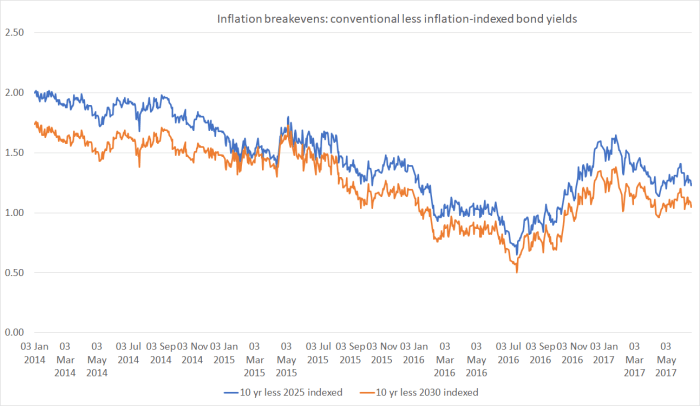
There is also a problem that indexed and conventional bonds rarely have the same maturity dates.   Here is the chart of the differences (the “breakevens”) for New Zealand for the last few years.  I’ve used the Reserve Bank’s benchmark 10 year conventional bond yield (the actual bond they are using moves through time), and the indexed bonds maturing in 2025 and 2030.   Throughout the whole period shown, the 2025 bond was closest to 10 years away, but by the end of the period (now) it has only little over eight years to run, and can start to get thrown around by short-term CPI fluctuations (eg oil price changes).

breakevens NZ

There was a big rebound in these “breakevens” (or implied inflation expectations) from the lows in the middle of last year.  But it hasn’t really come to much.  Take the average of last observations from those two series, and the 10 year breakeven –  where people are placing actual money –  is 1.15 per cent.   That is a long way from the 2 per cent target midpoint that the Governor has been required to focus monetary policy on throughout his term.  It has now been at least two years since the breakevens were averaging even as high as 1.5 per cent.

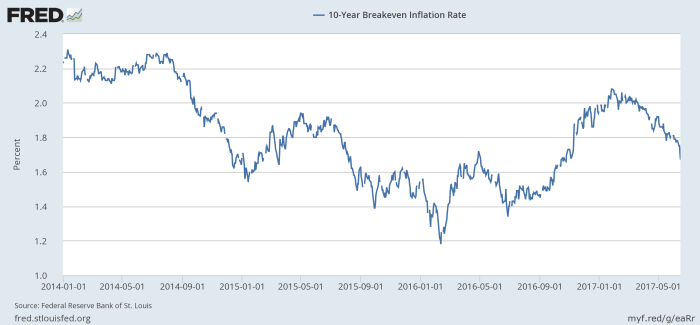
As readers who are closer to markets will no doubt be drumming their fingers and telling themselves, it isn’t just a New Zealand issue.   What about the US and Australia?  Well, here is the same chart for the United States (using the constant-maturity series for both indexed and conventional bonds).

breakevens US

There has been quite a fall off in the last few days, but at least until then the picture looked less disquieting that the New Zealand one does.   If the breakevens weren’t averaging around 2 per cent, perhaps you could say that at around 1.8 per cent they weren’t too far away.  For those defending the Fed’s interest rate increases –  I’m not fully convinced of the case myself –  it might have been some comfort.

And here is a similar chart for Australia, using data from the RBA website (for which the data are only available since the start of 2016).

breakevens aus

Australia’s inflation target is centred on 2.5 per cent annual inflation.  Averaging these two series, implied inflation expectations for the next 10 years are currently only around 1.75 per cent.  The gap in Australia, between the breakeven inflation rate and the midpoint of the target, is almost as large in Australia as in New Zealand.

Perhaps there are compelling market-based reasons why such breakeven inflation rates should be completely discounted, as currently telling us nothing relevant to monetary policy.  But if so, perhaps the respective central banks could explain the reasons why they think there is no meaningful information, rather than (as it seems) simply ignoring the information.  Curiously, twenty years ago –  when Graeme Wheeler was still head of the Treasury’s Debt Management Office – the Reserve Bank was dead-keen on having inflation-indexed bonds, as one read on inflation expectations.  Treasury themselves were never that keen –  they just thought it would be expensive funding.    But at the moment it looks as though markets are telling us that Graeme Wheeler will finish his term as Governor without any widespread investor confidence that things are well-positioned for inflation to average near 2 per cent over the next 10 years.  On the face of it, that should disquiet the Bank, and those charged with holding them to account.

In conclusion, and in passing, one of my repeated themes has been the persistently large gap between New Zealand real interest rates and those in other advanced countries.  When our OCR is 1.75 per cent and the Australian cash rate is 1.5 per cent, it is easy to gloss over that point.  But bear in mind that the Australian inflation target is 0.5 per cent per annum higher than New Zealand’s, so that even at the short end there is still a material real interest rate gap.   And what about the very long-term indexed bond yields?   Both governments have indexed bonds maturing in 2035.  Ours was at 1.94 per cent earlier this week, and Australia’s was yielding 0.91 per cent.  Those are really big differences –  think how much they cumulate to over almost 20 years –  and not supported at all by productivity growth differentials in New Zealand’s favour.     The US yield on a 20 year indexed bond is similar to Australia’s at 0.8 per cent.   The gap is, amomg other things, one marker as to how overvalued our real exchange rate is.   That has been a constant theme of the Governor’s during his term.  The policy things that might make a difference to that outcome are in the government’s hands rather than the Governor’s.  And sadly, they don’t seem very interested.


The OECD Survey process

The OECD’s biennial report on the New Zealand economy was out yesterday.

I noticed that Treasury has put out a blog post on the late phases of the process, in which New Zealand officials go to Paris to engage with other countries’ representatives on the analysis and recommendations, and to haggle over the numerous differences the authorities and staff will have.

I participated in this phase of the process on perhaps half a dozen occasions over almost 25 years.  In anticipation of the 2015 survey, I wrote a post along similar lines.

Being public servants, who have to keeping dealing with the OECD, the Treasury piece errs occasionally on the side of gush.

Every two years the Treasury assists some of the world’s best economists and policy analysts from the OECD with their study of New Zealand.

I, being of a more sceptical, perhaps contrarian disposition, and not any longer being a public servant, emphasised some questions.

It is, in other words, quite a political process. And that, of course, is also how these OECD Surveys are used.  Opposition parties have liked calls for, say, capital gains taxes.  The Reserve Bank likes references to overvalued exchange rates.  The government likes positive comments on fiscal consolidation.  And so on.  The Reserve Bank doesn’t much like references to leverage ratios, or the Treasury references to fiscal councils, but then no one much cares either.

What is the quality of the Surveys like?  I’m somewhat sceptical.  The OECD does have some fairly unparalleled databases, and quite a knack for compiling and presenting interesting charts.  I’m a data junkie, and I find those cross-country data comparisons fascinating, and labour-saving.  But the quality of the policy analysis and recommendations is rather more questionable.  I’ve looked at draft reports for New Zealand and for other countries over the years, and often found the argumentation quite unpersuasive, even in areas where I lay no claim to being a specialist or an expert.  These days there is a strong tendency to favour what I’d call “smart active government” solutions, and a disinclination to put much weight on markets and market processes.  That isn’t the image the OECD has often had in New Zealand – the late Roger Kerr often used to cite “OECD orthodoxy” to back his own arguments about what should be done in New Zealand.  But a few years back, I pointed out to the head of the Country Studies Division that the OECD could probably be best characterised as the technocratic wing of the more market-oriented strands of European social democratic movement.   He looked askance, and then somewhat reluctantly acknowledged my point.    Reasonable people will differ on how to read the evidence on the appropriate role of government, but OECD papers aren’t inclined to put much weight on questions of why governments fail so often and how policy should be shaped in the light of that.

All of which is by way of saying that no one should put too much weight on anything in any particular OECD survey.  Sometimes they will be right on the mark –  out of interest I went back last night and read the 1983 Survey and thought that they had done a very good job of highlighting the microeconomic and macroeconomic challenges then facing New Zealand, without any sense of imminent crisis.  At other times, they will be missing the mark, or adopting a particular recommendation based on not much more than institutional priors and the preferences of a few staffers.  As the OECD acknowledges, they have consistently failed to come to grips with why the New Zealand economy has not performed better over the last 25 years.  Without a good story about that it is hard to nest their individual recommendations in an overall narrative of what needs to be done.

Read together they’ll probably give you a reasonable sense of how these things come together.   I do hope the New Zealand Ambassador still offers as fine a lunch as ever.

Market rents

In the aftermath of the London fire, in some ways my heart isn’t in writing much about housing.  Disasters don’t often get to me, but this one has.

Nonetheless, the Dominion-Post led with housing this morning, and when I saw that the first word in the entire article was “greedy”  (followed by that other emotive term “landlords”) it wasn’t promising.    Just because people scoff when Fox News talks of being “fair and balanced” doesn’t mean the rest of media should abandon the aspiration.

Faced with rising demand for rental accommodation –  in a city where central and local government have again combined to make housing supply not very responsive to changes in demands –  owners (or their agents) of residential rental services businesses have faced excess demand for the limited stock available.  The typical response you might expect would be for rents to rise.

There are different sorts of pricing structures used for different goods and services.  Typical dry goods in a supermarket will have a fixed price, and occasionally the supermarket runs out of stock –  which can be mildly annoying to you or me, but is presumably easier to manage for them.  The value of New Zealand dollar (the exchange rate) is constantly changing, typically by quite small amounts, as pressures from potential buyers and sellers ebb and flow.   Even at a retail level, petrol prices now change very frequently.   There are whole literatures on the reasons why different structures are adopted in different markets (and I’m certainly not expert in that field).

Housing is typically nearer the variable pricing end of the spectrum.  In the market for actual house purchases, fixed price adverts, “buyer enquiry over”, tenders, and auctions all co-exist.   In the last two, the seller can reconcile supply (one house) to demand, simply by using the amounts bid.  In a fixed price advert, if there is more than one interested party, the seller might have to use some other decision criterion (although I imagine that typically even then one bidder will offer more).

It is, as I understand it –  not owning rental property, and not having rented one in this country for many decades –  customary to advertise rental properties with a fixed rental price.  Holiday home websites operate that way too –  and, in effect, they just operate on a “first come, first served” basis.    In a normal market, it probably often works quite well –  if there are plenty of people offering rentals, and plenty of potential tenants, even if one misses out on one property, there is another not far away.  If the property owners sets his or her price too high, they find there is little or no interest in renting their property, and eventually have to re-evaluate and revise the fixed asking price.

But the current situation seems to be one where lots of people are enquiring eagerly about almost any rental property on offer.  Fixed asking prices are, in that sense, too low to clear the market.   Over time you’d expect that those fixed asking prices would rise –  and thus take care of that particular element of the problem –  but that doesn’t deal with the property owner’s issue on the day: when 20 people want one rental.

Wellington Central MP Grant Robertson knew of two cases of renting tenders in Wellington – both from around the start of the year when students were returning to the capital.
“I think it is barely legal,” he said.
At one, would-be renters turned up to view a flat with an advertised price. “When they got to the property they were asked, ‘how much are you prepared to pay?'”

At the other there was no advertised price and would-be renters were simply asked how much they were prepared to pay.
“I think it is abhorrent. It is exploiting the fact we have a real shortage of rental homes in Wellington at the moment – exploiting people in vulnerable positions.”

So how is the property owner or agent supposed to respond?  Just ignore the excess demand and draw straws to determine who should get the flat at the –  evidently –  too low advertised price?  It is a market, and the property owners aren’t running charities for the homeless, but private businesses.

As is noted in the Dom-Post article, auctions aren’t always an ideal mechanism –  as an owner you are likely to care about the quality of the tenant as well.   But simply drawing straws doesn’t seem to have any particular merit –  moral or practical  – in this climate.

Don’t get me wrong.  The housing market in New Zealand is, in many, respects a scandal, and the problems flow largely from the choices of successive waves of central and local governments.  Since we are talking about right now, in this case it means the National-led central government, and the Labour-dominanted Wellington City Council.   But attacking a symptom –  rising rents, and alternative techniques to reconcile supply and demand –  isn’t a particularly meaningful response.   Owners of rental properties are, in many respects, the last people who should be being blamed here.

But I also learned something new from the article.    The journalists approached, and got some comment from one of their officials

Ministry of Business, Innovation and Employment national manager tenancy compliance and investigation Steve Watson said the practice was allowable under the Residential Tenancies Act.

“Any party who feels that they are being asked to pay rent that exceeds ‘market rent’ has the ability to apply to the Tenancy Tribunal who can review and determine the appropriate amount of rent for a residential property,” Watson said.

Really?   I know there has been centuries of philsophical and theological debate around concepts of “just prices”, but have we (or rather our Parliament) really legislated to provide for cases where some arbitrarily determined “market price” differs from a price being paid in….well…the market.  It seems that our politicians had done just that.

Here are the relevant bits of section 25 of the Residential Tenancies Act

25 Market rent

(1)  On an application made to it at any time by the tenant, the Tribunal may, in accordance with the succeeding provisions of this section, on being satisfied that the rent payable or to become payable for the tenancy exceeds the market rent by a substantial amount, make an order reducing the rent to an amount, to be specified in the order, that is in line with the market rent.

(2) Notwithstanding anything in subsection (1), no application may be made under that subsection in respect of the rent payable under a fixed-term tenancy later than 3 months after—

(a)  the date of the commencement of the tenancy or (in the case of a tenancy that was subsisting immediately before commencement of this Act) the date of the commencement of this Act; or

(b)  the date of the last review of rent,—

whichever is the later.

(2A) …..

 (3)  For the purposes of this Act, the market rent for any tenancy shall be the rent that, without regard to the personal circumstances of the landlord or the tenant, a willing landlord might reasonably expect to receive and a willing tenant might reasonably expect to pay for the tenancy, taking into consideration the general level of rents (other than income-related rents within the meaning of section 2(1) of the Housing Restructuring and Tenancy Matters Act 1992) for comparable tenancies of comparable premises in the locality or in similar localities and such other matters as the Tribunal considers relevant.

Initially I wondered if this might be some historical provision to deal with, say, a situation in the Great Depression where there was a long-term fixed rent, and the general price (and wage) level fell sharply.  But that can’t be –  at least for fixed term tenancies these provisions can only be used within three momths of the tenant taking up the tenancy, or of the most recent rent review.

It just looks like an extraordinary piece of “feel good” law.     The standard (in 25(3)) is the rent that “without regard to the personal circumstances of the landlord or tenant, a willing landlord might reasonably expect to receive and a willing tenant might reasonably expect to pay, for the tenancy, having regard to the general level of rents”.

It isn’t clear at all why the “personal circumstances” should be irrelevant.  If someone desperately wants to live on a particular street, because they want to be close to aged parents (say) why shouldn’t that be something that can reflected in the price they pay for a rental tenancy?    One bag of flour might be much the same as the next one.  But except perhaps in high-rise blocks, almost every rental property is different from the others, even if only by location –  and location preferences are often quite idiosyncratic and personal.

I have no idea how often this provision is used –  perhaps more often now  having been highlighted on the front page of a major daily paper.  Various readers have a lot of exposure to running rental businesses, and I’d be interested in any perspectives they can offer.     But you also have to wonder why the MBIE official felt it appropriate to add in this information when he commented.  After all, the one common element, agreed (it would seem) by all parties in the story, is that the rental market in Wellington is very tight.  The general level of rents is presumably rising.        (And if, perchance, someone does agree to pay a level of rent “above the market rent”, it was a contract voluntarily –  even if grudgingly –  entered into: not great perhaps, but better –  for the renter –  in their own assessment, than the alternative.)

I was interested to see Grant Robertson stating that Labour will soon be announcing a package to “strengthen renters’ right”.  There may well be merit in some of that.   But the best way to protect the position of renters, and all others coming into the accommodation market (whether as renters or buyer) is surely to fix up the land use and housing supply markets.  Abundant responsive supply in the face of  changes in demand is the best assurance of genuinely affordable and secure accommodation.

(On which note, a reader sent me a link the other day to a stimulating piece on housing and land markets from a UK academic. I don’t agree with everything in it, but for those interested in the debate –  and in recognising the similar issues in other countries –  it is worth reading.)


An astonishing illustration of unfitness for public office

I wasn’t planning to write anything today, but I was flicking through the NBR website when I found a story that both shocks and appals me.  I suggest reading it first, before reading my take on it.

After my experiences with the Reserve Bank over the last couple of years, I thought I was beyond the possibility of being shocked by the Governor.  Clearly, naive optimist that I must really be, I was wrong.

Somehow the media got hold of a story that Graeme Wheeler had lodged an official protest with BNZ over something their head of economics, Stephen Toplis, had written.  So an Official Information Act request was lodged and the Bank has apparently responded by releasing both Wheeler’s letter to BNZ chief executive Anthony Healy and Healy’s response.  The Bank hasn’t put those documents with the other OIA releases on their website, so I have asked for a copy.

I should add that Toplis is not some close friend of mine.  I always find his commentaries stimulating, but we usually disagree on the substance of monetary policy.  In fact, when I was in the gun from the Governor last year, Toplis was sending the Bank snarky comments about me (that he no doubt didn’t expect to be published).  But no one should be treated, by a top public servant, the way he has now been treated by Graeme Wheeler.

What is Wheeler’s complaint?    Apparently, he was upset with the preview of the latest Monetary Policy Statement that Toplis had written.

Mr Wheeler, who is to step down as governor on September 26, wrote to Mr Healy on May 11, the day the MPS was released, saying a preview written by BNZ head of research Stephen Toplis called into question the Reserve Bank’s integrity by saying it would be “negligent” not to admit it had a tightening bias, expressed “through an explicit expression of rate increase(s) in its published OCR track.” 

For some context, here is what Toplis actually wrote

So why do we think the RBNZ will sit pat this week? Simply because it said it would. When it released its March OCR review, the Bank reaffirmed that not only did it expect interest rates to stay where they were for the foreseeable future but it went on to reiterate that it thought there was equal chance that the next move could be a cut as a hike. To hike this week would leave the Bank with egg splattered all over its face, a prospect it couldn’t abide.

But surely, at the very least, the Bank will be forced to admit that it now has a tightening bias? Equally, it would be negligent not to express this through an explicit expression of rate increase(s) in its published OCR track. The biggest questions should revolve around how early the Bank is prepared to poke in a first rate increase and how quickly (if at all) rates rise thereafter.

Toplis seemed to be trying to strike a middle path.   Hawks, he argued, would be foolish to think Wheeler would raise the OCR in May, whatever they thought the data showed.  And doves who might expect a flat (OCR) track forever were also likely to be mistaken.    In Toplis’s view –  given the data he had seen –  it would be “negligent” of the Bank not to show some rate increases in the published OCR track.

And, as it happens, the Bank largely agreed.  The actual OCR track released in the May MPS wasn’t  anywhere near aggressive enough for BNZ’s liking  (I agreed with the Bank this time), but it did show some increases in the OCR eventually.    Presumably they thought it would be wrong –  inconsistent with their obligations under the PTA – not to have done so.

So quite what was the Governor’s problem?

Monetary policy is one of those areas of considerable uncertainty.  Reasonable people can and will differ quite materially on what the best approach is.  But the power –  very considerable power over the way the economy develops in the short to medium term –  is vested only in the Reserve Bank.  More specifically, it is vested in a single individual, the Governor.  It is one of the unfortunate aspects of the single decisionmaker model that any criticism of the Bank’s decisions is inevitably a criticism of an individual’s actions/choices.   For a thick-skinned and self-confident individual on the receiving end, that just shouldn’t be a problem.  After all, the Governor took on the job voluntarily, knowing that he would be making key decisions in an area where (a) almost inevitably there would be mistakes (almost the nature of uncertainty) and (b) where he would subject to a lot of scrutiny from smart people, in political and economic spheres, here and abroad.  He gets paid a great deal of money (by New Zealand public sector standards)  to make the decisions and be accountable for them.   A self-confident Governor might either (a) let disagreements wash over him, or (b) pick up the phone and invite the critic in for coffee and an open exchange of views.   But Wheeler is notoriously thin-skinned –  and unwilling to engage.

Here is how NBR continued the story

Mr Wheeler’s letter describes a back story, suggesting he reached out to Mr Healy after failing to bring Mr Toplis to heel. It says Mr Wheeler’s deputy governors had individually approached someone (the name is redacted) “to convey their concern at the personal nature of the criticism being expressed by the BNZ in its written publications.”

“When this failed to address the situation I met with you and passed on examples of the material,” Wheeler wrote. “I mentioned that the BNZ approach was damaging to the Reserve Bank and the New Zealand financial market, and the personal nature of its tone was contrary to that of other banks.”

Clearly, Wheeler’s concern was more than just the particular pre-MPS commentary.  And certainly, more than most other bank economists, Toplis is willing to quite openly disagree with the Governor and the Bank, sometimes with a vigorous style.   But there is nothing “personal” in that preview, and even if there were, the Governor personally exercises the power.

Personally, I wish there were more like Toplis willing to openly question and challenge the Bank.  The Bank –  the Governor –  after all wields huge power, not just in monetary policy but in regulatory matters, with rather little effective accountability.  Banks in particular are very reluctant to openly call out the Reserve Bank –  journalists have told me how difficult it is to get anyone to go on the record.

What bothers the Governor?   Apparently, he thinks the Reserve Bank is damaged by criticism.   It isn’t clear how or why, unless the Bank is operating in a way that leads people who read the criticism, and think about it, to conclude “yes, that’s right”.  High-performing organisation shouldn’t need to worry about criticisms,  And insular, low-performing organisations, need the criticism –  and need to be willing to learn from it.   Even more important, when it is a troubled public sector organisation,  the public need the criticised body to learn from and respond constructively to criticism by lifting its game.

Perhaps even more oddly, the Governor thinks that Toplis’s commentary is “damaging the New Zealand financial market”.  Who knows what he means by that?    There is a competitive market in commentary.   If Toplis’s criticism are wrong (on average over time) presumably that reflects badly on Toplis and the BNZ.  If they right, perhaps it reflects badly on the Governor himself, but that doesn’t harm the New Zealand markets or economy.  People having less faith in the Governor might, in principle, be a bad thing, but not if the criticisms are well-founded.  And if they aren’t well-founded, the sort of observers who matter will go elsewhere for their commentary.

Wheeler clearly doesn’t see it that way

In his letter to Mr Healy, Mr Wheeler said it was “unacceptable” to question the Reserve Bank’s integrity while “fundamentally misrepresenting” how it sets monetary policy.

“I would also expect that the editorial quality assurance process (and any legal sign-off involved) would have identified that an accusation of negligence is inappropriate in a public document distributed by BNZ.”


Perhaps there is something in the Governor’s concern that I’m missing, but nothing in that quote above from the MPS preview questions the Bank’s integrity.  It sets out some hypotheticals, and suggests the Reserve Bank would be not doing its job –  “negligent”  –  if it didn’t do something Toplis favoured.    But it did do it –  there were rate hikes put into the OCR forward track.  And even if the Bank has disagreed altogether –  and run with a dead flat OCR track –  the BNZ claim was “negligence”, it wasn’t a comment on integrity at all.   When people suggest the Reserve Bank isn’t running monetary policy well, that is a judgement on their competence or their diligence (or just a disagreement about the data), but it isn’t a reflection on anyone’s integrity.  It is disconcerting that the Governor doesn’t seem able to tell the difference.  Nor, apparently, were the Bank’s Deputy and Assistant Governors.

The whole thing is extraordinary.  I’ve never worked in a bank economics team, but I’ve never supposed that they had their daily or weekly economics commentaries signed off by in-house lawyers (or indeed by anyone much).   It is chilling to have the Governor of the Reserve Bank writing to the chief executive of a major bank in effect urging such tight control.   What is it, one can only wonder, that the Governor is afraid of?   And isn’t this, after all, the Governor who regularly claims that the Bank is highly accountable, partly because of the scrutiny financial market participants and commentators provide?

All this would be quite bad enough if the Reserve Bank was simply a monetary policy body.  Some central banks are.   Such central banks influence the economy and the rate of inflation, but have little or no direct regulatory influence over private financial institutions.  Access might still be valuable, but the central bank just doesn’t have that much leverage.  Nor should it.

But that isn’t the model in New Zealand.  Here, the Reserve Bank –  the Governor personally –  not only sets monetary policy, and sets prudential policy, but is also responsible for a wide range of detailed regulatory approvals that banks and financial institutions need to keep operating in this market.  Mr Healy himself will have needed the Governor’s approval to take up his current position.  So will all his direct reports.  And approval of individuals is just the least of it.   That is a huge amount of power, and all vested in one person.  In this case, it appears, an extremely thin-skinned and reactive one.

Banks are typically pretty scared of the regulator –  whether here or abroad –  and unwilling to take them on over regulatory matters.  That is bad enough.    What is worse is when the Governor of the Reserve Bank openly –  directly and through his deputies –  attempts to coerce banks to just keep quiet, to say only stuff that the Reserve Bank likes to be said.  We might expect that in Singapore, Russia, or other semi-authoritarian states.  We shouldn’t tolerate it in a free and democratic society, governed by the rule of law not the whims of powerful men, like New Zealand.   It would be bad enough from an elected politician –  and I’m sure it goes on there to some extent (we saw recently the Alfred Ngaro comments) –  but it is far far worse in an unelected, and exceptionally powerful, public servant.

As far as we can tell, the BNZ hasn’t been cowed by Wheeler’s approach.   Perhaps they just think “there he goes again, and thank goodness he’ll be gone in another three months or so”.  But even if they aren’t (this time), it is a chilling example that people in other organisations will take note of.  Some of them will be more cautious, more risk averse, and the message will go down “be careful what you say; don’t upset the central bank”.  We’ll be poorer for it.  And actually, over time, the quality of our Reserve Bank would be poorer for it to, if the extent of robust scrutiny of this powerful institution was even less than it is now.

The fault here is clearly primarily with Graeme Wheeler, who reveals himself to be manifestly unfit to hold his current high office.   But there are other people who need to take some responsibility:

  • where, for example, in all this were Grant Spencer, Geoff Bascand, and John McDermott, the deputy and assistant governors.   Wheeler has tried to tell us that that group makes all the Bank’s major decisions collectively, whatever the legal position.  The NBR article implies that they too were making calls to the BNZ to get pressure put on Toplis to alter his commentary.  Were any of them willing to stand up to Wheeler and tell him that he appeared to have lost all sense of perspective, and that if he went ahead with these actions it would only leave him and the Bank looking worse (even before this OIA, I gather the story was pretty widely known)?  If not, why not?  If not, why we would we suppose that any of them was fit to hold the office of Governor –  Spencer will be acting for six months, and Bascand is widely expected to be a leading contender for the permanent role?   Do any of them know what is, and isn’t fit behaviour for a regulator?  You would hope so given that Spencer is now Head of Financial Stability, and Bascand will assume that role in September.
  • where is the Bank’s Board in all this?  They exist to monitor the performance of the Governor, and the chair has often seen his role as a bit of a confidential sounding board for the Governor.  They were totally supine over the OCR leak last year, backing the Governor to the hilt?   Will it be different this time –  when the Annual Report comes out in a few months?  If not, how could we possibly consider that these individuals are fit to take the lead responsibility for choosing a new Governor?
  • What does the Minister of Finance make of this?   He appoints, and can dismiss, the Governor. I hope some journalists are willing to ask hard questions of the Minister, and not allow themselves to be fobbed off, about whether this sort of conduct is acceptable from a New Zealand public servant?
  • And what of the Finance and Expenditure Committee?  Are they willing to call Wheeler before them to answer openly for his conduct in this matter?  If not, what use are they to citizens?

I noticed that one commenter on the NBR article observed that if this is what Wheeler made of Toplis’s comments

“This is insane. Can you ask for Wheeler’s correspondence with Michael Reddell?”

There is no such correspondence.    The difference is that Graeme Wheeler has no leverage over me.   Stephen Toplis, by contrast, works for a bank over which the Reserve Bank has extensive regulatory clout.   It shouldn’t make a difference –  views are views and should stand or fall on their own merits –  but in Graeme Wheeler’s Reserve Bank, sadly, it appears to.  That is simply unacceptable.

He might only have three months left in office, but it is now three months too long.  The words of Oliver Cromwell to the Rump Parliament –  or Leo Amery to Neville Chamberlain in May 1940 –  come to mind

You have sat too long for any good you have been doing lately … Depart, I say; and let us have done with you. In the name of God, go!


Bank capital: some thoughts

Six months or so ago the Reserve Bank announced that it would be conducting a review of capital requirements for banks.  At the start of last month, they released an Issues Paper, inviting submissions by today (rather a short period of time, for an issue which has major implications for banks’ financing structures and, potentially, costs).   I’m not going to make a formal submission, but thought I might outline a few thoughts on some of the issues that are raised in (or omitted from) the paper.

I’d also note that it is a curious time to be undertaking the review.  Background work and supporting analysis is always welcome, but here is how the Reserve Bank summarises things.

Detailed consultation documents on policy proposals and options for each of the three components will be released later in 2017, with a view to concluding the review by the first quarter of 2018.

But the Reserve Bank is now well into a lame-duck phase.  Graeme Wheeler –  currently the sole formal decisionmaker at the Bank –  leaves office on 26 September, and then we have an acting Governor (lawfully or not) for six months.  Spencer’s temporary appointment expires (and he leaves the Bank) on 26 March 2018, which is presumably when a new permanent Governor will be expected to take office.   The incentives look all wrong for getting good decisions made, for which the decisionmakers will be able to be held accountable.     Big decisions in this area –  and the Bank is raising the possibility of big increases in capital requirements –  are something the new Governor should be fully coomfortable with (and, especially if an outsider is appointed, that shouldn’t just mean some pro forma tick granted in his or her first days in office.)    We have constitutional conventions limiting what governments can do immediately prior to elections.  It isn’t obvious why something similar shouldn’t govern the way unelected decisionmakers behave in lame-duck, or explicitly caretaker, periods.  Some decisions simply have to be made and can’t wait.   These sorts of ones aren’t in that category.

(In passing, and still on capital, I’d also note that there is something that seems not quite right about the Reserve Bank’s refusal to comment on why a couple of Kiwibank instruments have not been allowed to count as capital.   The capital rules should be clear and transparent.  The terms of the relevant instruments are also presumably not secret.  Perhaps Kiwibank has been told why their instruments missed out, but it seems unsatisfactory that everyone else is left guessing, or reliant on things like the deductions and speculations of an academic who was once a regulatory policy adviser (eg here and here).    I have no particular reason to question the Reserve Bank’s substantive decision, but these are matters of more than just private interest.  It is an old line, but no less true, that in matters where government agencies are exercising discretion sunlight is the best disinfectant.)

High levels of bank capital appeal to government officials.   To the extent that more of a bank’s assets are funded by shareholders rather than depositors then, all else equal, the less chance of a bank failing.  And if avoiding bank failure itself isn’t a public policy interest –  after all the Reserve Bank regularly reminds us that the supervisory regime isn’t supposed to produce zero failures –  minimising the cost of government bailouts is.   There might be various ways to do that –  the Open Bank Resolution model is designed to be one, but high levels of capital are another.

High levels of capital should also appeal to depositors and other creditors.  Your chances of getting your money back in full are increased the more the bank’s assets are funded by shareholdes, who bear the losses until their capital is exhausted.   Of course, that argument is weakened if you think that the government will bail out anyway, but that is just another reason for governments to err towards high levels of capital.

Capital typically costs more than deposits (or wholesale debt funding).  That isn’t surprising –  the shareholders are taking on more risk.  But, of course, the larger the share of equity funding then the lower the level of risk per unit of equity.  In principle, higher capital requirements lower the cost of capital.  Very low capital levels should tend to raise the cost of debt (debt-holders recognise an increased chance that they will be the ones who bear any losses).  Modigliani and Miller posited that, on certain assumptions, the value of a firm was unaffected by its financing structure –  to the extent that is true, higher capital requirements don’t affect the economics of (in this case) banking.

It won’t hold in some circumstances.  For example, if creditors are all sure a government will bail them out, a bank is much more profitable the lower the capital it can get away with.  In the presence of that sort of perceived or actual bailout risk, there is little doubt that increasing capital requirements is a real cost to the banks.  But it is almost certainly worth doing: it helps ensure that the risks are borne by the people responsible for the decisions of the bank (shareholders, and their representatives –  directors and management).

Taxes also complicate things.  If the tax system has an entrenched bias in favour of debt, then increased capital requirements will also represent a real cost to the banking system.  Many –  most –  tax systems do have such a bias.  For domestic shareholders, and to a first approximation, neither our tax system nor that of Australia have that bias.  That is because of the system of dividend imputation, which is designed to avoid the double-taxation of business profits (returns to equity).    Unfortunately, there is no mutual recognition of trans-Tasman imputation credits, and most of our banking system is made up of Australian banks with (mostly) Australian shareholders.   For most, but not all, of our banks increasing capital requirements is likely to represent some increase in effective cost.  And the resulting revenue gains are mostly likely to be collected by the Australian Tax Office.

An open question –  and one not really touched on in the Bank’s issues paper –  is to what extent our bank regulators should take account of these features of the tax system.  For most companies, capital structure is a choice shareholders and management make, weighing all the costs, benefits, opportunities and distortions themselves.  But in banking, for better or worse, regulators decide how much capital banks have to raise to support any given set of assets.   One could argue that tax is simply someone else’s problem:  if higher required capital ratios increased costs, the Australian banks could simply redouble their lobbying efforts in Canberra to get mutual recognition of imputation credits, and if that didn’t work, there would simply be a competitiveness advantage to New Zealand banks.   Perhaps that solution looks good on paper, but I think it is less compelling than it might seem. First, banks can and do lobby here too.  The Reserve Bank might get to set capital ratios at present, but that law could be changed.  And second, we benefit from having foreign banks, with risks spread across more than one economy.

Even if all the tax issues could be eliminated here –  and they won’t be in time for this review, if ever –  there is still the possibility that the market will trade on the basis that additional capital requirements will increase overall funding costs for banks, even if there is little rational long-term reason for them to do so.   One reason that problem could exist is because the tax biases are pervasive globally, and it is therefore a reasonable rule of thumb for investors to treat higher capital requirements as an expected cost.

Over the years, I’ve tended to have a bias towards higher capital requirements.  I’ve read and imbibed Admati’s book (for example).  As recently as late last year I wrote here

My own, provisional, view is that for banks operating in New Zealand somewhat higher capital requirements would probably be beneficial, and that there would be few or no welfare costs involved in imposing such a standard.  My focus is not on avoiding the possible wider economic costs of banking crises (which I think are typically modest –  if there are major issues, they are about the misallocation of capital in booms), but on minimising the expected fiscal cost of government bailouts.  As I’ve explained previously, I do not think the OBR tool is a credible or time-consistent policy.

But I have been rethinking that position to some extent.   The Reserve Bank talks in its Issues Paper of the possibility of an “optimal” capital ratio (from the academic literature) of perhaps 14 per cent (with estimates that range even higher), well above the minimum ratios that are in place today.

But if there are additional costs from raising capital requirements –  which seems likely, at least to an extent –  we need some pretty hard-headed assessments of the real gains that might accrue to society as a whole to warrant those increased costs.  And those gains are hard to find:

  • for over 100 years our banking system has been impressively stable.  If that was in jeopardy in the late 1980s, that was in unrepeatable circumstances in which a huge range of controls had been removed in short order (and when there were no effective minimum capital requirements at all).
  • repeated stress tests, whether by the Reserve Bank, APRA, or the IMF all struggle to generate credible extreme scenarios in which the health of an indvidual bank, let alone the system, could be seriously impaired.  In most of those scenarios, the existing stock of capital hasn’t been impaired at all, let alone being at risk of being exhausted.
  • we have a banking system where most of the main players are owned by major larger overseas banking groups with a strong interest in the survival of the domestic operation, and the ability to provide any required capital support (the New Zealand regulated entities aren’t widely-held listed companies).

I’m still not sure what to make of the role of the OBR mechanism.  As I noted earlier, I’ve never been convinced that it is a credible or time-consistent option, but our officials appear to, and even ministers talk up the option.  If they really believe that they (and their successors) will be willing and able to impose material losses on bank creditors and depositors in the event of a future failure, there can’t be any strong case for higher capital requirements (indeed, arguably a very credible OBR eliminates the basis for capital requirements at all).  Even if officials and ministers aren’t 100 per cent sure about OBR, any material probability of it being able to be used in future crises needs to be weighed into the calculations when a proper cost-benefit assessment of proposals for higher capital requirements is being done.  At present, there is little or sustained discussion of the OBR issues in the Issues Paper.  I look forward to the inclusion of OBR considerations in a proper cost-benefit analysis if the Bank does end up proposing to raise capital ratios.

My other reason for unease is that in the Issues Paper the Reserve Bank does not engage at all with, for example, the past stress test results.  There is nothing in the paper to suggest that current capital ratios don’t more than adequately cover risks.  Instead, they fall back on generalised results from an offshore literature, and arguments about why New Zealand capital ratios should be higher than those abroad.  Those simply fail to convince.

Here is the gist of their argument

One of the principles of the capital review is that the regulatory capital ratios of New Zealand banks should be seen as conservative relative to those of their international peers, to reflect New Zealand’s current reliance on bank-intermediated funding, New Zealand’s exposure to international shocks, the concentration of our banking sector, the concentration of banks’ portfolios, and a regulatory approach that puts less weight on active supervision and relatively more weight on high level safety buffers such as regulatory capital.

I’m not sure what weight should rest on that “be seen as” in the second line.  I presume not that much, as these seem to be presented as arguments that would warrant genuinely higher capital ratios than in other countries, not just something about appearances.  But in substance they don’t amount to much:

  • “New Zealand’s current reliance on bank-intermediated funding”.  I’m not quite sure what point they are trying to make here.  Does the Reserve Bank regard bank-based intermediation as a bad thing?  If so why?  I presume the logic of the point is something about it being more important than in most places to avoid bank failures, but that simply isn’t made clear, or justifed with data.  Payments systems –  a big focus of Bank concern around the point of a bank failure –  tend to be based through the banking system everywhere.  It is not even as if our corporate bond market –  while modestly-sized –  is unusually small by international standards.   (Incidentally, it is also worth noting that there appears to be nothing in the Issues Paper about non-banks, some of whom the Reserve Bank also regulates.  Making bank-based intermediation relatively more expensive –  which higher capital requirements could do –  would tend to lead to disintermediation.)
  • “New Zealand’s exposure to international shocks”.   Again, it isn’t obvious what this point amounts to.  Presumably the sorts of shocks New Zealand is exposed to are reflected in the scenarios used in the stress tests the Bank and others have run?  And it isn’t obvious that New Zealand’s economy is more exposed to international shocks than many other advanced economies –  there was nothing very unusual for example about our experience of the crisis of 2008/09.   I suspect that lurking behind these words is some reference to the old bugbear, the relatively high level of net international indebtedness –  a point the Bank and the IMF often like to make.   But this simply isn’t an additional threat to the soundness of the financial system.  Rollover risks can be real, but they aren’t primarily dealt with by capital requirements (but by liquidity requirements) and as we saw in 2008/09 the Reserve Bank can easily temporarily replace offshore liquidity.  Funding cost shocks also aren’t a systemic threat because, with a floating exchange rate, the Reserve Bank is able to offset the effects through lowering the OCR and allowing the exchange rate to fall.  The difference between a fixed exchange rate country and a floating exchange rate one, in which the bank system’s assets are all in local currency, seems to be glossed over too easily.
  • “the concentration of our banking sector”    Is this really much different from the situation in most smaller advanced economies (or even than Australia and Canada)?
  • “the concentration of banks’ portfolios”.  This seems a very questionable point.  Banks’ exposure in New Zealand are largely to labour income (the largest component of GDP, and the most stable) –  that is really what a housing loan portfolio is about – and to the export receipts of one of our largest export industries.  That is very different from, say, being heavily exposed to property development loans, to financing corporate takeovers, or other flavours of the day.   The effective diversification is very substantial, including the fact that in any scenario in which labour income is severely impaired (large increases in unemployment) it is all but certain the exchange rate will be falling (boosting dairy returns).  The two biggest components of the banks’ books themselves thus provide additional diversification.
  • “a regulatory approach that puts less weight on active supervision and relatively more weight on high level safety buffers such as regulatory capital.”     Is the Reserve Bank really saying they believe that on-site supervision would produce better financial stability outcomes?  I’m sceptical, but if they are saying that, surely the case would be strong to change the regulatory philosophy.  It would, almost certainly, be cheaper than a large increase in capital requirements.  At very least, if they want to rely on this argument, it would need to be carefully evaluated in any cost-benefit analysis.

It all leaves me a bit uneasy as to whether there is really the strong case for higher capital ratios that the Bank might like us to believe.  They’ll need to provide much more robust analysis if they really choose to pursue such an option.

And a final thought.  The Bank devotes some space in their Issues Paper to considering the role of convertible capital instruments  –  issued as debt but converting to equity under certain (more or less well-defined) adverse event circumstances.  In doing so, they provide vital loss-absorbing capacity, providing a buffer for depositors and other non-equity creditors.  There are some practical problems with these instruments –  the Bank touches on many of them –  and they probably shouldn’t be marketed to retail investors (at least without very explicit warnings) lest the pressures mount for holders of these instruments also be to bailed out in a crisis.     Nonetheless, in the presence of the tax issues discussed earlier, convertible instruments look like a generally attractive option for supporting the robustness of banks in a cost-efficient way.

Given that I was interested in this paragraph  on convertible instruments from the Bank.

In New Zealand there has been no conversion at all of Basel-compliant AT1 and Tier 2 instruments, because banks have not been in financial difficulty, so there is even less certainty about the practical effects of conversion in New Zealand’s particular legal and institutional environments. In the Reserve Bank’s view these instruments should be regarded as essentially untested in the New Zealand environment.

Of course, the same can be said for OBR, and indeed for almost all the crisis-management provisions of New Zealand bank supervisory legislation.

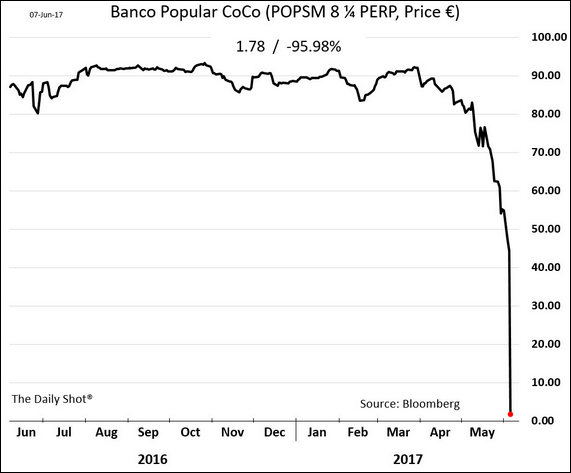
The Bank does draw attention to the risk of bailouts of holders of convertible capital (co-co) instruments.  On the other hand, they can work when banks fail.  Earlier this week, Banco Popular in Spain “failed”.  It was taken over, for 1 euro, by Banco Santander, which will inject a lot of new equity into Popular.   Popular had co-co instruments on issue.  Here is what happened to the price of those bonds.

popular co-co

Banks can fail, banks should fail from time to time (as businesses in other sectors should), and when they do it should be clearly established who is likely to lose money.  This looks like a good example, where the shareholders and the holders of the co-cos will have lost everything they had invested in these instruments.

To revert briefly to our own Reserve Bank’s review, perhaps there is a case for higher capital ratios.  But, if they want to pursue that option, it isn’t likely to be cost-free, and any such proposal will need to be backed by a robust and detailed cost-benefit analysis. For now, it isn’t clear that the reasons they have suggested why capital ratios here should be higher than those in other advanced countries really stand up to scrutiny.


Roger Douglas, the economy, and an option for reform

I went along yesterday to a Treasury guest lecture, to hear from one of great figures in the history of New Zealand economic policymaking, Sir Roger Douglas, and his co-author Auckland University economics professor Robert MacCulloch.   Their presentation was based on a recent paper proposing a wholesale reshaping of New Zealand’s tax and welfare system.  I’ll get back to that.

Roger Douglas is 79 now, and if his voice is weaker than it was once way, his passion for a better New Zealand is as clear as ever.   In his brief remarks, there was more evidence of a passionate desire to do stuff that would make for a more prosperous, and fairer, New Zealand than one is likely to hear from our current crop of political leaders in an entire election campaign.

I very much liked the fact that they started their lecture with a chart of real GDP per hour worked (my favourite productivity indicator) for New Zealand and other OECD countries.   Things are, very much, not okay economically was the intended message.   Music to my ears.

Unfortunately, given that they made quite a bit of the graph, they got the wrong chart.

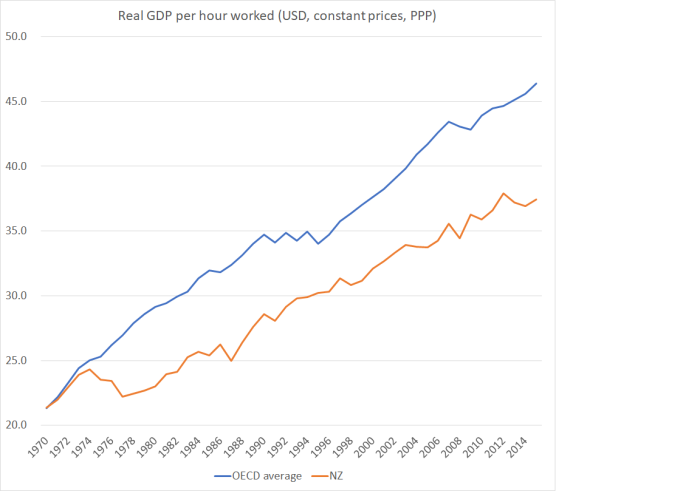
What they showed was something very like this.

Douglas RGDP phw 1

Both speakers made something of it, telling of a large gap that opened up in the Muldoon years, but which then closed substantially again following the reforms of the 1980s and early 1990s, only to resume widening again in the last 15 years or so (when, as they noted, no politician has been willing to do any significant reforms).

But the chart looked a bit odd to me, and I wondered about all the new –  mostly poorer –  countries that had entered the OECD in the last couple of decades.

Sure enough, when I got home and dug out the data myself, it became clear that what they (or whoever prepared the chart for them –  I think they mentioned the Reserve Bank) had done, was simply to average the real GDP per hour worked of whichever countries the OECD happened to have data for in any particular year.  That is how I produced the chart above.

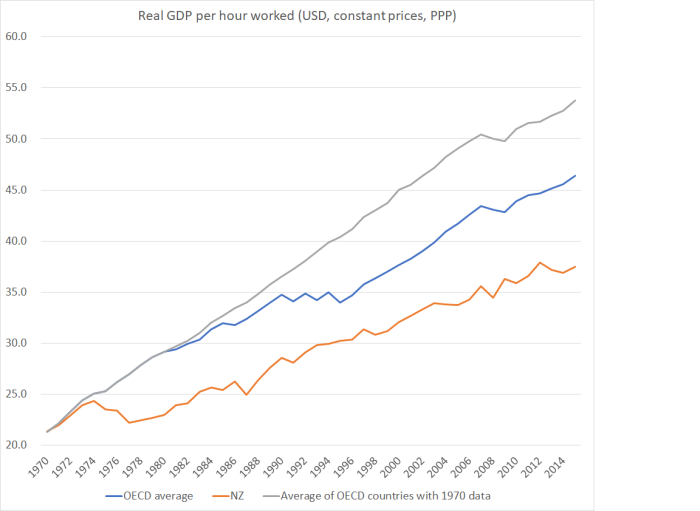
Unfortunately, in 1970 when the chart starts. the OECD had this data for only 23 countries.  By 2015 it had data for 35.    The odd rich country (Austria) was missing in 1970, but so were almost all the emerging markets and former communist eastern European countries now in the OECD (several weren’t even separate countries then).   It is only since 1995 that the OECD has had data for all 35.

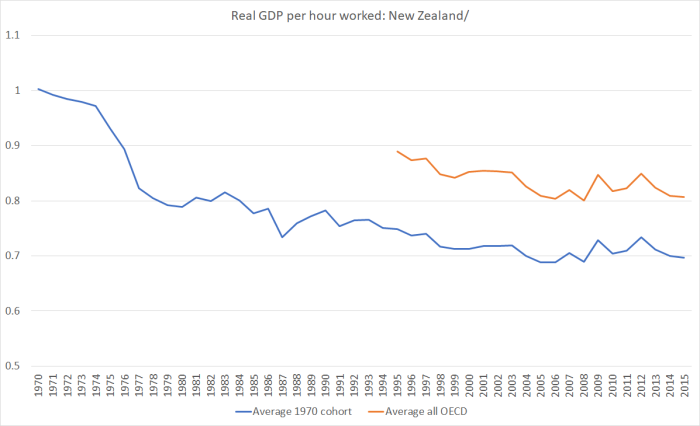
So here is another way of looking at the chart.  The extra line is the average real GDP per hour worked for the 23 countries the OECD did have data for in 1970 –  a fixed panel of countries throughout the whole period.

douglas 2

And here is how New Zealand productivity (on this measure) has performed relative to the OECD.  I’ve shown both the measure relative to the average of the OECD countries with data for the whole period, and relative to the full sample of countries for the period since 1995 when data are available for all of them.  Remember that most of the new-joiners are poorer than us, so the orange line is above the blue line.

douglas 3

There has been the odd good year here and there – and a few phases (including, actually, the Muldoon years, and the last decade) when we’ve gone sideways – but over the entire period since 1970 there has never been a phase when, on this measure, we’ve done consistently better than the group of other OECD countries.  The pretty clear trend has been downwards.

I really wish it had been otherwise – not just because it is my country too, and I care about its fortunes, but because I supported a great deal of the reforms that were done (and which I still consider were mostly to the good).    But even if the reformers expected, and hoped for, something better –  some closing of the gaps –  it just hasn’t happened.

I probably wouldn’t make much of it on this occasion, except that (a) Sir Roger is an eminent figure, and (b) the presentation yesterday, and the (no doubt unintentionally)  misleading slide, was being presented to quite a large crowd of past and present econocrats.

However, the main focus of the Douglas/MacCulloch presentation was a proposal for a radical reshaping of the tax and welfare system.  There is a nice accessible summary here (which includes a link to fuller versions).   The gist of the proposal is as follows:

  • much lower income tax rates,
  • a lower company tax rate (and eliminated “corporate welfare”), and
  • higher GST

But, “in exchange”, people have to contribute a set proportion of their income  (and there is an employer contribution too) to dedicated private accounts for:

  • health
  • risk events (unemployment, disability etc)
  • superannuation

There are lots of details, but on health everyone would have to buy an insurance policy against catastrophic events (anything more than $20000 per annum) and would have to meet other expenses either from their own health account, or if that was exhausted from direct government funding.  Something similar applies to unemployment: your risk account is your first line of support, but if that is exhausted the government remains provider of last resort.

For retirement income, if I understand the scheme correctly, in many ways it isn’t much different than what we have now:  a universal basic state pension, on top of which is private savings (including through Kiwisaver, although as they note Kiwisaver isn’t compulsory and their retirement accounts would be).  The difference is that the age of eligibility would be gradually raised from the current 65 to 70.

It would represent a massive rejigging of the system.  They argue that, in respect of health, it is largely the Singaporean model, and in Singapore health outcomes are very good and health expenditure (public and private) as a share of GDP is remarkably low. I don’t know enough about the Singaporean system to comment further, including whether it is likely to be replicable elsewhere.

There are all sorts of potential practical and philisophical problems.  I wouldn’t rule out the possibility of some real benefits, for some people in time, or even more generally.  But Douglas and MacCulloch argue that it is a politically feasible way to get necessary reform going again.  And on that –  fairly critical – count I’m sceptical.

In a fuller version of their paper they state

Most of the long-term reduction in government spending under the “Savings-not-Taxes” regime comes from the following sources. First, pension spending drops from $28.1b (under the existing system) to $17.4b (under the new regime) due mainly to the rise in the retirement age from 65 to 70 years old between 2015 and 2035. Second, there are the cuts in ‘corporate welfare’ and interest-free loans and grants to students from high-income, high-capital families.

In other words, huge changes to the entire tax and welfare system, to get the NZS age up from 65 to 70, to get rid of what they describe as (and I agree with them) as “corporate welfare” (film subsidies, Callaghan funding and so), and to eliminate interest-free student loans and related support to high income earners.

In the question time, I asked why they regarded the sweeping change as more politically feasible than simply focusing on those three items.   I guess I sort of knew how Douglas would reply –  it was a variant of a line he has used for many years, about doing lots of changes which can (a) distract people,  but (b) provide an opportunity for everyone to benefit in some area.  But I wasn’t really persuaded.  They argue, for example, that people from high income families currently getting interest-free student loans would benefit from the lower tax rates in the Douglas-MacCulloch plan.  Fair enough I suppose.

But the big money is in NZS cutbacks.  It isn’t clear how the people who are most uneasy about raising the NZS age –  the current middle-aged –  are likely to benefit systematically very much from anything in the Douglas-MacCulloch package.  Any gains/savings would be probabilistic at best (especially as health expenditures rise with age), and the potential personal losses (five extra years without NZS) certain and specific.     I think change can and will be made –  governments in the 1990s did raise the NZS age by five years, and got re-elected –  but I don’t see how the huge “throw everything in the air” approach really helps.  Grey Power, and Winston Peters, will be quite capable of seeing through to the bottom line.

Similarly, corporate welfare is a real scourge.   But how does reforming the tax and welfare system on a large scale make it easier to, first, scrap those provisions, and then later resist the endless pressures that will come from various loquacious vested interests to put them back in place?  I just don’t see it.    It looks like an approach that, rather than making major savings more feasible, would simple multiply the number of enemies the reformers would make.

All that said, and sceptical as I am, it was good to see a serious plan outlined by people who really care.  And credit goes to The Treasury for hosting the event.

(In passing I’d also add that one thing I really like about the package is that it would put sickness, disability and accidents all on the same footing).  

In many respects, the saddest line of the day was one made almost in passing by Professor MacCulloch.  He told us that he administers a fairly generously-funded visiting professorship at the University of Auckland, which aims to bring in distinguished or innovative, leading international thinkers to contribute to policy debate and development in New Zealand.    But the last three people who had been invited had declined the invitation to come.  There was, so far as they could tell, nothing bold or interesting on the table here, no real prospect of significant reform, or interest in it from our political leaders.

Things were very different, in that regard, 20 or 30 years ago.  It is not as if, sadly, we have in the interim solved all our problems, and re-establishing a position as a world-leading economy,  or a world-leader in dealing with the various social dysfunctions.  We just drift, and allow our elites to tell themselves (and us) tales about how everything is really just fine.


A pseudo-PTA and other miscellania

This morning it was announced that something that purports to be a Policy Targets Agreement, to cover the conduct of monetary policy during the six months after Graeme Wheeler leaves office, had been signed between the Minister of Finance and Grant Spencer, currently the deputy chief executive of the Reserve Bank.  The Minister announced some months ago that he intended to appoint Spencer as acting Governor for six months, to get the appointment of a permanent Governor clear of the election period.

There are a number of problems with this:

  • first, the Minister has no statutory power to appoint an acting Governor, except where a Governor resigns or otherwise leaves office during an uncompleted term, and
  • second, even if it were argued, contrary to the clear sense of the legislation, that the Minister had such appointment powers, there is also no statutory provision for a Policy Targets Agreement between an acting Governor and the Minister (rather, the Act envisages that the acting Governor would run monetary policy under the PTA already signed with the substantive Governor for his/her unexpectedly foreshortened term).

You might respond that even if there is no statutory provision, there is nothing to stop the Minister and the “acting Governor” signing an agreed statement about how monetary policy would be run during the “acting Governor’s” term.  And if the acting Governor appointment was itself lawful, I would agree with you.   But the so-called Policy Targets Agreement signed yesterday explicitly states the parties believe it to be the genuine binding article, not just some informal statement of agreed intentions.

This agreement between the Minister of Finance and the Governor  of the Reserve  Bank of New Zealand (the Bank) is made under section 9 of the Reserve Bank of New Zealand Act 1989 (the Act).

The Reserve Bank’s statement stressed that there were no changes in this new (pseudo) PTA, relative to the current PTA applying during Graeme Wheeler’s term.   Unfortunately they seem to have taken that a bit too literally.  You’ll notice that in that extract (immediately above) it is referred to as an agreement between “the Governor” and the Minister.  But the Minister’s announcement in February was that Spencer would only be “acting Governor”.  Indeed, there is no way that Spencer could have been appointed as “Governor”, because any new person appointed as Governor has to be appointed for a term of five years, and any such appointment would have defeated the whole point of not making a long-term appointment in or around the election period.

It wasn’t just a slip either.  At the bottom of the document it is signed by Steven Joyce as Minister of Finance and by Grant Spencer as “Governor Designate”  (the “designate” bit matters, because real PTAs have to be agreed before the appointment is formally made).  But Spencer isn’t “Governor designate” at all, he is “acting Governor designate”.     I guess they are trying to slip him in under the provisions of section 9 (rules governing the PTAs) which refer only to the Governor, not to any acting Governors.  As I said before, the Act does not provide for acting Governors to sign proper PTAs.  So the document resembles a PTA, but it can’t in fact be one.

Does it matter?  In one sense, perhaps not.  But laws matter, and details matter, and this appointment, and the purported PTA, appear to be in breach of the law.   If nothing goes wrong and there are no legal challenges during the “acting Governor’s” term, then there probably won’t be any practical problems. But the Governor exercises a lot of powers, including in crises, and the last thing one needs in crises –  which one never foresees correctly the timing of – is uncertainty as to whether a purported Governor really has powers to do what he is trying to do.

(As I have noted previously, there are remedies, even if awkward ones.  For example, Graeme Wheeler –  as an existing Governor – could have been reappointed for six months, and a new PTA signed with him, all while he announced his intention to resign after one day.  Nothing then would prevent the Minister appointing Spencer as lawful acting Governor, operating under a fully lawful PTA.)

I have put in OIA requests with both the Bank and Treasury for the papers relevant to today’s purported PTA.

Being in a slightly flippant mood this evening, I thought I’d throw a few curiosities from the day.

First, on looking on the blog statistics page I discovered that someone had got to my blog today by searching under  “functions of weet bix to the unborn”.    Quite why anyone would be searching for anything using those words for a search at all is a beyond my understanding.   On scrolling down several pages of search results I discovered that I had once, long ago, referred to Weetbix, but not to nutrition or the unborn.

Second, the Reserve Bank might find my OIA requests annoying (they did, after all, launch a whole charging regime in response).   But other people lodge requests too.  I occasionally have a look at the ones the Bank releases.   Some are easy to answer, but distinctly strange.   A few weeks ago they responded to this one

I would like a categorical response to the question­ ” What influence does the Rothschild family exert over the reserve bank of New Zealand?

The categorical answer, of course, is none whatever, although the Bank gave the person a slightly fuller response.

It has been quite a while since I’d seen such a New Zealand-focused example of the old conspiracy theory, in which bankers –  especially perhaps Jewish bankers –  had the central banks of the world under their thumb.  It is a fascinating, if unnerving, phenomenon.  On a par, I suppose, with the whole “one world government” conspiracy stories:  I have on my shelves a book which claims that Don Brash was installed as Reserve Bank Governor by the one world government, as a safe pair of hands, as the son of someone who himself had been part of the conspiracy, as a leading figure in the World Council of Churches.

And finally, looking back at Steven Joyce’s statement on 7 February announcing that Graeme Wheeler was retiring, I noticed the Minister’s description of the Governor’s conduct

The Governor has performed his role calmly and expertly during a highly unusual period for the world economy

Calmness having been so prominently highlighted as a feature of the Governor’s stewardship, I can only assume that the story I heard a while ago on the grapevine, that the Governor had, as it were, tossed his toys out of the cot when someone wrote something the Governor disagreed with, couldn’t possibly be true.


Unaffordable housing markets and the next generation

Last week I’d been discussing house prices etc with a couple of friends whose kids are a bit older than mine, of an age where they might in years gone by (not that long ago) have been thinking of buying a house.   As one noted, they didn’t know what to advise their kids.  Another talked of the seeming inevitability of parental assistance –  which, in many families, isn’t much of an option.  I know of another friend who decided that parental assistance was probably inevitable, so bought another house himself so that at least his position was hedged –  if house prices went down, so would the needs of his kids, and if they stayed high or rose further, there would be some additional wealth in the inflated value of the additional house.   When this week’s Listener reports yet another poll suggesting housing is the most important issue going into this year’s election, we can’t be the only one having these sorts of conversations.

And then I found a Labour Party election pamphlet in my letterbox.  There was a lot of text, but on only two issues –  health and housing.

Jacinda says everywhere she goes, one topic keeps coming up: the housing crisis.  “National has failed on housing.  People are worried that they or their kids won’t ever be able to get on the property ladder.

Andrew can relate –  he’s concerned about what the future holds for his 16-year-old son, Cam. “I want Cam and his generation to have the same opportunities I had, and more.  But it’s getting so much harder for young people to buy a house. I worry that Cam and other young New Zealanders won’t ever be able to afford their own homes.”

That struck a chord with me.  Partly because my (slightly younger) son knows his son.  But also because my own first house was about 50 metres from Little’s current house which, according to a recent Herald article, is approximately valued at $920,000.  I walk past both houses most days.   It isn’t a fancy neighbourhood by any means –  pleasant, but not fancy.

I bought my own first house in December 1988 –  which I guess is almost thirty years ago, although in many ways it seems just yesterday.   I paid $152000 for it, which at the time was less than twice my income.  The Reserve Bank’s inflation calculator says that is roughly $287000 in today’s money.  I looked up the same website the Herald used to get a value for Little’s house.  It estimates –  who knows how accurately –  that my old house is now worth around $800000.        The current owners have extended it a bit, but it is still a three bedroom house, and the bottom outside walls of the garage have rusted a bit more than they had in 1988.    But then productivity has risen since then –  real GDP per hour worked is up around 35 per cent –  and with it earnings across the economy.

I’m not sure what the Reserve Bank now pays people who’ve been managers in their economics areas for just over a year (that was me in December 1988), but I’m quite sure it isn’t anything like $400000 a year –  recall that I paid less than twice my then income for the house.  In fact, in the Reserve Bank’s Annual Report last year, only four people were getting paid at least that much –  the Chief Economist looked to be receiving just over $400000 per annum.  It brings back memories of a training course I did at the Swiss National Bank in 1990, where they told us that house prices in Berne were so high that only the most senior managers could afford to purchase their own house.  I still recall the astonishment I felt, and never imagined it would be like that in New Zealand.

On Monday the Herald ran their regular supplement of QVNZ house values across all the different suburbs and localities in the North Island.    Island Bay median prices have now, apparently gone just over $800000.  No doubt that still seems quite cheap to Aucklanders –  although I did find one North Shore suburb (Birkdale) that was cheaper –  no one much else in likely to find them so.  In the whole of fast-growing Hamilton and Tauranga, only one suburb is that expensive.

Which brings me back to Andrew Little and the Labour Party.  I’m quite happy to take him at his word on his concern for his own son.   But what does it amount to?  It isn’t that long since Little told us (and here) he didn’t want house prices to fall.

But asked if he welcomed signs Auckland house prices were falling, Little said no.

and

“Having the right number of houses, or closer to it, stabilises prices, it doesn’t collapse prices.”

Labour has a list of policies on housing (I’ll come to them in a minute) but are they simply supposed to stop already unaffordable houses getting ever-more unaffordable?

As I’ve noted before, if nominal house prices stayed flat from here, then even if productivity growth picks up quite a bit, it would still be 20 years before house price to income ratios halved from here. It isn’t much of an answer for today’s generation of twenty-somethings, let alone 16 year old Cam.

Flat house prices –  while better than what we’ve had –  just shouldn’t be regarded as an acceptable outcome after the house price inflation of the last 25 years.  I know people who have bought recently, taking on lots of debt to do so, get very uneasy about house prices falling but (a) that is a minority, (b) an increasing number of those buying recently have been quite tightly constrained by LVR limits, and (c) perhaps most importantly, there has never been an economic reform where there were no losers.   Yes, the more people who have entered the market on prices that assume the continuance of regulatory restrictions, the harder it is to undo those restrictions, but the restrictions themselves are pretty morally indefensible in the first place (just like those that had us assembling TVs or cars, or making kids clothes, in New Zealand at vast expense to consumers).

I suspect there is an element of the concern is a worry –  derived from, say, the US and Irish experience last decade – that any significant fall in house prices is somehow economically disastrous.   When a sharp fall in house prices results from massive over-building, and a serious misallocation of credit, that is probably a quite reasonable concern, especially when (as in Ireland) the authorities have no monetary policy leeway to offset the fall in demand associated with the housing slump.    It is a quite different prospect if the falls in house and land prices arise because regulatory restrictions are unwound –  if anything that would be likely to stimulate building activity –  in a country which has its own monetary policy and exchange rate.   That is what could, and should, be done in New Zealand.  We certainly don’t have a problem of an oversupply of new houses.

But what is Labour proposing?  After the Labour Party conference last month, I expressed concern that in a speech largely devoted to housing, Andrew Little had not mentioned at all freeing up the urban land market.  Labour’s housing spokesperson, Phil Twyford has been good on this stuff (and there is still reference to it in the policy documents on the website)

But in the entire speech –  and recall that most of it was devoted to housing –  there was not a single mention of freeing up the market in urban land, reforming the planning system etc.  Not even a hint.    I understand that giving landowners choice etc probably isn’t the sort of stuff that gets the Labour faithful to their feet with applause.   But to include not a single mention of the key distortion that has given us some of the most expensive (relative to income) house prices in the advanced world, doesn’t inspire much confidence.     Planning reform isn’t going to be easy.  Few big reforms are under MMP.  It probably isn’t something the Greens are keen on.  And if the putative Prime Minister isn’t on-board, hasn’t yet internalised (or even been willing to simply state it openly) that this is where the biggest problems lie, it is hard to believe that a new government would really be willing to spend much political capital in reforming and freeing up the system, no matter how capable, hardworking and insightful a portfolio minister might be.

So when the Labour pamphlet landed in the letterbox, I looked to see what Labour was going to do about housing.   The four point plan from Little’s speech, was now reduced to a two point plan (ok, so it is a pamphlet and there is less space)

  • building more houses themselves (“affordable” ones)
  • crack down on foreign speculators

There was also a pledge on “healthy rentals” but, whatever the merits of that, it isn’t going to make housig more affordable.

Perhaps I just don’t get out much, but I’ve seen very little talk of “foreign speculators” playing much of a role –  any in fact –  in the Island Bay market.  They explain, almost certainly, precisely nothing about why my humble first house is valued at roughly three times (in real terms) what I paid for it.

But more importantly there is nothing, not a hint, in the entire pamphlet of freeing up the urban land market.   Sure, one could mount an argument that it might be hard to put that sort of promise into catchy phrases that attract the attention of potential voters.  But that is why you employ marketing people isn’t it?  And successful political leaders find ways of putting their vision into language that resonates with ordinary people.

It all leaves me deeply discouraged about the prospects for meaningful change.  No one else seems to have managed it, and now Labour –  after toying with ideas of reform –  seems to be getting cold feet, and won’t campaign on freeing up the land market.   The outlook for 16 year old Cam isn’t great, and neither it seems is that for my kids.  As I reflected on the friend who wasn’t sure what to advise his kids, I noticed in the Herald house prices supplement that median prices in my old childhood home, Kawerau, were still only $181000.   My younger daughter wants to be a primary school teacher.   She has been hanging around me too long because when we were in the Bay of Plenty on holiday over Christmas I was reading out Kawerau house prices, and her immediate reaction was “Daddy, I want to live there when I grow up”.    Perhaps in time that’s what I’ll have to advise her –  after all, there are national salary scales for teachers.  Kawerau, for all its problems, isn’t all bad as a town, but New Zealand kids surely deserve better than that.


The Rennie review

A couple of months ago we learned that the new Minister of Finance had requested Treasury to have a review done of two key aspects of the governance of the Reserve Bank:

  • whether something like the existing internal committee in which the Governor makes his OCR decisions should be formalised in legislation, and
  • whether the Reserve Bank should remain the “owner” of the various pieces of legislation (RB Act, as well as the insurance and non-bank legislation) it operates under.

Treasury, in turn, contracted Iain Rennie to conduct the review. Rennie was, until not long ago, State Services Commissioner.  And a bit earlier in his career he had been Treasury’s Deputy Secretary for macroeconomic policy, including all matters to do with the Reserve Bank.

Learning of the review, someone lodged an Official Information Act request with The Treasury, seeking (a) the terms of reference of the review, and (b) the terms on which Rennie was engaged.    Treasury’s response, dated 17 May, is here.

Somewhat strangely, the terms of reference for the review were withheld, allegedly to “maintain the constitutional conventions protecting the confidentiality of advice tendered by ministers and officials”.      Which seems strange because (a) the Minister had already talked to the media (first link above) about what the review would cover, and (b) because Rennie is neither a minister nor an official, just a consultant hired to provide some analysis and advice.  The terms of reference for that work hardly seem to amount to “advice”.   Treasury further state that the terms of reference are withheld “to enable Minister and officials to have undisturbed consideration of advice”.  I’m not clear that that is a statutory ground, and –  as importantly –  how knowledge of a consultant’s terms of reference would interfere with “undisturbed consideration of advice” is far from clear.

But Treasury did release Rennie’s terms of engagement, and some other interesting bits of information.   We learn that

The Treasury is contracting Iain Rennie to provide a report assessing governance and decision-making at the Reserve Bank.

Is this different, I wonder, than looking at the relevant statutory provisions (the implication  of the words is that the report will assess actual governance and decisionmaking, rather than the relevant laws)?  Perhaps not.  The wording might also be taken as implying that the review covers more than just decisionmaking for monetary policy.  If so, that would be welcome.

Pleasingly, Treasury seemed not just to be pushing a single option.

The analysis should outline a few alternative, coherent reform packages, and draw out the central design trade-offs, while making clear a preferred approach.

We also learn, and this did surprise me a little, that the contract period began on 7 February.  That was the day the Minister of Finance announced Grant Spencer’s appointment as acting Governor, having taken the relevant paper to Cabinet that morning.   If Rennie’s contract started from 7 February, presumably the Minister’s decision to initiate this review work had been taken some time earlier –  perhaps not long after he took office.

When he took the job, Rennie undertook to have his report completed by 31 March (in return for $60000 + GST).  In fact, the papers confirm that Rennie took longer than expected and, by mutual agreement, the final report was delivered to Treasury on 18 April.

In undertaking this contract, Rennie and Treasury agreed that

In completing the work, the author will engage with an agreed set of domestic and international experts

This seems a strange provision.  It suggests that Treasury could veto who Rennie could consult with in researching the issues and analysing the options.  It would be very interesting to know who these experts are –  perhaps especially the domestic ones.   (I’ve written extensively on the issues and wasn’t consulted –  not that I had expected to be.)  I will lodge an OIA request for that information.

Having received Rennie’s report, Treasury has a further step in the process, presumably before they pass on the report, and their own advice, to the Minister of Finance.

The key deliverable is a report, which will be peer reviewed by a panel of international experts.

Again, it would be useful –  and interesting to know –  which “international experts” they are consulting, and perhaps a little surprising that the peer review process does not appear to include people who might be expert in New Zealand public sector governance.  The Reserve Bank is,  after all, one government entity among many.

It would be good if we could get some clear answers from Treasury and the Minister of Finance as to when the final report, together with comments from the peer reviewers, might be available.   In his earlier comments, Steven Joyce told the Fairfax journalist that  “he expected Rennie to report back some time after May’s Budget”.   That was clearly somewhat misleading –  the original contract had a report back from Rennie by 31 March –  but even setting that aside, it is now after the Budget.    As this is an issue where the political parties differ –  Labour, the Greens, and (I think) New Zealand First already promising change –  it would be highly desirable to have this expert report, peer-reviewed by international experts, in the public domain as soon as possible.

In digging around, I stumbled across The Treasury’s 2001 advice to the then Minister of Finance on the recommendations of the Svensson inquiry into monetary policy and the Reserve Bank.  I’d seen it at the time, but long since forgotten it.  The principal author  of the paper was someone who is now a Treasury Deputy Secretary, but his boss –  also listed on the paper –  was one Iain Rennie, then deputy secretary responsible for matters macro.

Svensson had a number of sensible recommendations.  Until that time, the Governor had chaired the Reserve Bank Board, even though the Board’s main job was to monitor and hold the Governor to account.  That was clearly a nonsense, and Svensson recommended change.  That recommendation has been adopted and the law was changed accordingly.   But Svensson also recommended removing the Governor from the Board altogether –  it being, at very least, anomalous to have the Governor as a member of a body whose main purpose is to review his own performance (as distinct, say, from a business in which a Managing Director might be a member of the board, but in that case the Board has all the ultimate strategic decisionaming responsibilities).  The Police Commissioner, for example, isn’t involved in the governance of the IPCA.  Rennie and Treasury advised against making that change, even though they explicitly recognised what the role of the Board was.   Quite why is never made clear.

And then, perhaps more importantly, Svensson recommended that the law be changed to shift away from the single decisionmaker structure, in which all executive powers are vested in the Governor personally.  Even then, in 2001, it was an unusual model internationally.  Svensson proposed legislating to give an internal committee of senior Bank managers the formal decisionmaking powers.

Here was the response of Rennie’s wing of Treasury.

We believe the clear and strong accountability of the present structure has considerable merit.  The Governor is solely and clearly responsible for monetary policy performance and may be dismissed by the Minister in the event of inadequate performance.  While the Minister’s ability to dismiss a poorly performing Governor may be severely limited in practice, his ability to dismiss a poorly performing committee would be even more limited.

The formation of a decision-making committee would require extensive changes to the Reserve Bank Act.  The statutory responsibility for price stability that currently rests with the Governor, and the statutory relationship between the Minister and the Governor, would need to be amended to give effect to the responsibilities of the Committee.

The issues raised above suggest that the potential benefits of forming a formal internal decision-making committee are likely to be small.

Having taken such a stance then, one can only hope that in conducting his recent review, Rennie is rather more open to change than he was in 2001.   (I should add that I did not then, and do not now, think Svensson’s specific recommendation should have been adopted –  but there are other feasible approaches to adopting a collective decisionmaking model).  It is striking, for example, that in this Treasury advice there is no mention at all of how other government agencies in New Zealand are governed (hint: none involving policy setting involve single decisionmakers, with no rights of appeal).  It is also telling of how the Bank has changed –  by legislation and gubernatorial inclination –  that there is no discussion at all of how the financial regulatory powers of the Bank should be governed.  In many respects, the advice seems stuck in the 1980s –  when the Reserve Bank structure was first designed –  including with the emphasis on the ability of the Minister to sack an individual relative to a committee.  That was an important consideration in the late 1980s, but it isn’t one that has led us to have other government rule-making, policymaking, agencies governed by single (unelected) decisionmakers.

It is, of course, a little unfair to hold anyone to advice they offered sixteen years ago, and I’m not seriously attempting to.  Times and attitudes, and responsibilities, change. But it can be difficult at times for senior people to walk away from public stances on important issues that they have taken previously.   I hope that when we finally see the Rennie report, a willingness to approach the issue with a genuinely fresh set of eyes is evident.