The Reserve Bank’s case for minimal reform

In early December, the Reserve Bank’s briefing to the incoming Minister of Finance  (BIM) was released, as part of the general release by the new government of the set of BIMs.     I wrote about the Bank’s briefing, and in particular about the appendix they included on the governance and decisionmaking issues.  In a departure from the now-common practice of including nothing of substance in BIMs the (unlawful) “acting” Governor –  I think I’ve gone a whole month without using that description –  took the opportunity to make his case in writing for minimal reform.

The Bank indicated that the appendix was itself a summary of a fuller document that they would make available to the Minister on request.  So I lodged an Official Information Act request for the fuller document, which they have released in full to me today.     It is really the sort of document that should be included with the collection Treasury has made available as part of the current Treasury-led review of the Reserve Bank Act, but as it isn’t there, I thought I should make it available for anyone interested ( RBNZ Memo – Review of policy decision process 16 Oct 2017 (1) ).

The paper was written by a couple of Reserve Bank managers –  Roger Perry, who manages a monetary policy analysis team, and Bernard Hodgetts who head the macrofinancial stability area –  and is dated 16 October, a few days before it became clear who would form the next government.   The paper itself is not described as Bank policy, but in the release I got today it is stated that

Please be aware that the document encapsulates Reserve Bank thinking at the time it was prepared.

Which suggests that at time it did represent an official view –  probably workshopped with senior management before the completed version we now have.     There is a pretty strong tone to the document suggesting that the authors did not expect a change a government (with only a couple of footnote references to possible implications of Labour Party policy positions in this area).

But, frankly, I was surprised how weak, and self-serving, the document was.  The Reserve Bank has been doing work on these issues off and on for several years –  there was the secretive bid a few years ago by Graeme Wheeler to get his Governing Committee enshrined in statute –  and yet there was little evidence of any particularly deep thought, and no sign of any self-awareness or self-criticism (over 30 years was there really nothing the authors –  or Bank –  could identify as not having worked well?).

There was also, surprisingly, no sign of any engagement with the analysis or recommendations of the Rennie report.  It is hard to believe that a report, on Reserve Bank governance issues, completed months earlier had not been shown to the Reserve Bank itself.   There was no substantive engagement with the models adopted in various countries that we tend to be closest too, or which are generally regarded as world-leaders in the field (by contrast, several references to the Armenian model –  to which my reaction was mostly “who cares”).    There was no reference at all to how Crown entities are typically governed in New Zealand –  that omission isn’t that surprising, given the Bank’s track record, but it should be (the Bank is after all just another government agency).  There wasn’t even any reference to how other economic and financial regulatory agencies in New Zealand are governed, even though the Financial Markets Authority is a new creation with a markedly different (but more conventional Crown entity) governance and decisionmaking model.

For what it is worth, on 16 October, the Bank seemed to favour:

  • enshrining the idea of the Governing Committee in law, but perhaps with slightly different versions of membership for monetary policy and financial stability functions,
  • legal decisionmaking power continuing to rest with the Governor,
  • the Governor’s appointment continuing to be largely controlled by the Board,
  • no publication of minutes or votes,
  • no external members of the committee(s).

But they make no serious attempt at critical analysis to support their case, let alone to engage with the risks of a system in which a single decisionmaker is key, and where that single decisionmaker is the boss of the other members of (what is really just) an advisory committee.   Or the anomalous nature of such a system in the New Zealand system of government, where even elected individuals rarely have such unconstrained authority, where committee-decisions are the norm (from Cabinet, the higher courts, through major Crown entities to school Boards of Trustees) and where Cabinet ministers (or Cabinet collectively) typically have the key role in appointing those who exercise considerable statutory powers.

The management of a central bank that can’t come up with better analysis than this really makes it own case for change –  legislative change, personnel change, and cultural change.

The Rennie report finally sees the light

Almost a year ago now, the former Minister of Finance Steven Joyce asked The Treasury to commission some advice on possible changes to the governance of the Reserve Bank.  We only found this out a couple of months later, and then only when hints of a review seeped out prompting a journalist to put the direct question to the then Minister.  It turned out that Iain Rennie, former State Services Commissioner (and before that former senior Treasury official) had been commissioned to write the report –  indeed, by the time we learned of the commission, Rennie had already largely completed his work.

All along the way, The Treasury has been incredibly obstructive about the review.   The terms of reference have never been released.    They eventually told us (some of) the people Rennie had talked to, and the names of the peer reviewers Treasury had used but refused to release drafts of the reports, comments made by reviewers, or the finished report itself.   They even took to arguing that it had all been Treasury’s idea, and that the report was just to inform Treasury’s own post-election advice, as if Steven Joyce had never been any part of the story.    Frankly, it was a pretty gross case of flouting the Official Information Act –  for what was, when all boiled down, a private consultant’s report, paid for with public money, on matters of organisational design and goverance of a single government agency.

But yesterday The Treasury finally (and quietly) released the report itself, along with comments from the peer reviewers (on an earlier version, itself still secret), some advice on the report from Treasury to the (new) Minister of Finance, and some recent comments from the Reserve Bank on the contents of the Rennie report (all available here).   I appreciate the pro-activity of The Treasury in at least letting me know that the report was now, belatedly, available.    The material is all now presented as background material for the current two-stage review of the Reserve Bank Act, including the contribution of the Independent Expert Advisory Panel.

The Rennie report itself is here.  It isn’t a bad report –  in fact, for a fairly short report done quite quickly, it is a bit better than I had come to expect.   In some respects, the details don’t matter that much –  it is just one person’s view (having consulted not very widely, and mostly with people inside the central bank “club”), and his report has been superseded by the wider review Grant Robertson has commissioned.  Rennie’s report will be just one input to that mix.

Then again, Rennie had been the State Services Commissioner.  And he’d been the Treasury Deputy Secretary responsible for things to do with macro policy and the Reserve Bank (at the time of the last major review, with Lars Svensson, at which time Treasury had opposed any change in the governance and decisionmaking model).

And Rennie is quite clear that:

  • the current single decisionmaker model is far from best practice, whether considered relative to other central banks/ financial regulatory agencies, or relative to the governance of other New Zealand public sector entities,
  • a single committee is not a sensible solution.  Rennie, in fact, ends up favouring three separate committees (a model very similar to the one used now in the United Kingdom –  one for monetary policy, one for (so-called) micro-prudential policy, and one for (so-called) macro-prudential policy),
  • an internal executive committee (or even several of them) is not an appropriate solution.  External, non-executive, members should be involved,
  • the Minister of Finance should have primary responsibility for the appointment of all the members of the decisionmaking committees, given that the committees exercise significant statutory powers.

And on monetary policy he favours a materially greater degree of transparency than exists at present, including favouring (on-balance) the individualistic model –  as, for example, in the US, the UK and Sweden –  where individual members are individually accountable for their advice and their votes.    Existing Reserve Bank management hates –  I don’t think that is too strong a word –  that model: they hated it when I was still at the Bank, and in recent months they have gone public with their intense dislike of it.

There are lots of other details in the report, some of which I strongly agree with (eg the Policy Targets Agreement shouldn’t be tied to the appointment of the Governor, and if the Board is to be retained as a monitoring agency, it needs some resources of its own, and the Governor himself should not be a member), and others of which I’m more sceptical of (eg the proposed role of the State Services Commission in advice on the selection of the Governor and Deputy Governors, or the idea of devising a –  meaningful –  formal charter for the prudential committees).   One of the peer reviewers –  my former colleague David Archer –  is keen on a greater formal role for Parliament in the appointments, something I’m sceptical of (it just isn’t our constitutional system).  But I would probably favour emulating one aspect of the UK system Rennie doesn’t really touch on: hearings by Parliament’s Finance and Expenditure Committee in which nominees to the various committees can be scrutinised by MPs (and reported on), although not a binding confirmation vote (as in the US).

There are also limitations to the Rennie report.   For example, he treats the current assignment of powers to the Reserve Bank as given (perhaps this was inevitable in what he was asked for, but isn’t a limitation of the current review), a particular issue in the area of financial regulation and supervision.   There also isn’t much richness to his treatment of other countries’ models –  and it remains surprising that he made no effort to engage with Lars Svensson, who was not only a former reviewer of the New Zealand system, but a former practitioner (member of the Swedish monetary policy committee) in the sort of system (open contest of ideas) Reserve Bank management hates.  And perhaps partly because Rennie seems only to have talked to insiders –  eg there was three pages of (totally withheld) material in the Reserve Bank Board minutes on his meeting with them, and no attempt at open consultation –  there is no serious attempt to evaluate how effectively (or otherwise) the Board model has worked over the years.

What of the Treasury’s comments on Rennie?  Their report is short and is mostly a summary of Rennie’s recommendation.  But it was good to see this observation

“we are strongly of the view that a committee decision-making model should be codified in the Reserve Bank Act, and agree that there should be multiple committtees which include external experts”

In the first stage of the current review the government has only committed to a committee, with externals, for monetary policy.  I hope Treasury sticks to its guns, and persuades the Minister of Finance that better governance and decisionmaking on the financial regulation side of things is at least as important, and needs it own statutory reforms.    As even Rennie noted, there is –  for example –  a stark contrast between the governance of the other main financial regulatory –  the FMA –  and that of the Reserve Bank.  In the former, a non-executive Board (all appointed directly by the Minister) has overall responsibility for the organisation and the exercise of its powers, with some specific powers being delegated the Board to the chief executive and staff.  That is a much more conventional, and defensible, model than the Reserve Bank model in which all the power is held by the Governor personally.    And the Reserve Bank exercises a much greater degree of discretion over policy itself –  especially as regards banks –  than the FMA does (where big picture policy is mostly set by the Minister on the advice of MBIE).

As I noted, in yesterday’s release there was also a short note by the Reserve Bank commenting on the Rennie report.  Even though the report was completed months ago, this note is dated 11 December, and is prepared for the Independent Expert Advisory Panel assisting the Treasury-led phase one of the current review of the Reserve Bank Act.  Presumably there are rather more substantive comments, which the Bank is keeping secret –  along with all the extensive background work  (Rennie mentions it) done a few years ago on these issues, which the Bank has previously refused to disclose.

The Reserve Bank does not like the Rennie report at all.

we believe that much of the analysis underpinning the report was insufficient, and consequently the conclusions of the report are unreliable, or would require considerable further analysis.

“Sniffily dismissive” was my own summary of the Reserve Bank’s reaction.

In hand-waving mode, the Bank loftily notes

The Report does not define the nature of the problem it is seeking to address and needs a clearer analysis of the current decision-making framework and why it needs amending. In proposing a particular set of changes to the decision-making framework, the Report fails to provide options and does not demonstrate why the particular changes proposed would result in better policy decisions for monetary or financial policy in New Zealand.

You might suppose that having a decisionmaking and governance model designed thirty years ago when

(a) few central banks had updated their laws in these areas for a long time,

(b) our own laws and practices for governing Crown entities had not really been updated,

(c) the prevailing conception in New Zealand was that monetary policy was simple, and that it would be easy to hold a single decisionmaker to account,

(d) when financial regulation was conceived as a small and largely passive part of what the Reserve Bank did and

(e) when open government was still a pretty new concept, largely unknown to central banks and related regulatory agencies

was sufficient grounds for a serious review, and the probability that better models could be designed.   One might be strengthened in that view if one was aware that (as Rennie notes) no central bank has shifted from a committee-based decisionmaking to a single decisionmaker model for monetary policy, or was aware that no other significant regulatory body in New Zealand was governed the way the Reserve Bank is.

Had a five person Commission spent a year on the report, no doubt there would have been a lot more richness to the background material.  But the case for change has come to be pretty widely accepted already, and even the Reserve Bank gives the game away by conceding that committee-based decisionmaking is generally better than that of a single individual.  Once they conceded that –  and they could hardly do otherwise –  much of the rest of the issue is about detail.

But it doesn’t stop the Bank attempting to distract the Independent Expert Panel.

The Report makes no attempt to document the processes that the Bank actually uses to support its decision-making, beyond the high level parameters established by the Act. Nor does The Report attempt to evaluate the mechanisms that the Bank currently has in place to help ensure that its decision-makers confront a broad range of policy perspectives, including a wide range of views of those outside the Bank. There is, for example, no mention of the role of the broader group of MPC members in providing policy advice to the Governing Committee, the use of external advisers on the MPC, the Bank’s programme of business and financial sector liaison, its active public outreach programme, or its participation in the international financial and economic community. These are all ways in which the Bank considers a diversity of external views and perspectives ahead of its monetary policy decisions.

But so what?   All central banks do this sort of stuff in one form or another, and yet almost all of them also have the respective country’s Parliament specify a statutory committee as the basis for monetary policy decisions.  And if it is good enough for the Governor to invite a couple of outsiders into his second-ring of advisers (these days: it was the first tier when the system was established) why shouldn’t Parliament mandate the involvement of external members?   Moreover, the case for reform has rarely been about the problems with an individual Governor, but about a core principle of institutional design –  resilience.  We don’t want a system that works adequately only when a decent Governor is in place, but when that is resilient to bad choices and bad individual appointees (because in human systems there will be some of those).

I don’t disagree with all the Bank’s comments.  They oppose establishing two separate statutory committees for the different aspects of prudential policy, and I agree with them on that (apart from anything else, the whole thrust of bank supervision –  in particular-  is systemic in nature).

Rennie’s report recommended leaving the precise composition of statutory committees as a matter for negotiation through time.  I think that is wrong.  That balance is sufficiently important that it should be specificed in legislation (as, I understand it, is the near-universal practice abroad).   The Reserve Bank is clearly opposed to any suggestion that external members should out-number internal or executive members.

There is a strong argument that external members should not be able to out-vote the internal members if the latter are in agreement. Such an occurrence could severely undermine the influence of the Governors and the credibility of the institution.

I disagree, and was pleased to see that external reviewer Archer took the same view.  He argued  –  noting that the “probability of groupthink increases with the presence of hierarchy”  –  that “the law should restrict the proportion of executive insiders to below half by a big enough margin that these tendencies have a chance to be offset.

On the Reserve Bank’s argument:

  • if the Reserve Bank insiders, with all the resources and professional expertise at their disposal, can’t persuade enough outsiders to their point of view, it suggests they haven’t got a particularly compelling case (and may in turn struggle to convince outsiders),
  • if the system is set up with, say a 4:3 mix of outsiders and internals, it is explicitly designed by Parliament not to make the Governor a dominant figure (let alone any deputies).  The Governor and Deputy Governors have important executive roles in the management of the institution (generating advice and research, implementing decisions etc) and there should be no automatic presumption that the holders of those offices should play the key role in deciding the OCR outcome,
  • other countries have managed situations in which the Governor has been outvoted, without undermining the institution, and finally
  • even if there were such concerns, the Governor (and other executive staff) always have the option of voting tactically, such that there is no a straight insider/outsider split.  In a number of overseas models, the Governor chooses to vote last.

Perhaps anecdotes aren’t worth much, but it is worth recalling that the senior managers of the Wheeler bank were unanimous in their support of the 2014 tightening cycle.  And wrong.   Groupthink among internals is one of the problems reforms should be trying to overcome.

The Reserve Bank is also pushing back against Rennie’s proposal that all members of the decisionmaking committees (all three of them in his case) should be appointed by the Minister of Finance.

As in any other senior management context, it is essential that the Governor has confidence in his or her senior staff. There are few examples where a Chief Executive has no input into the selection of the senior management team.   It is also surprising that the Report does not confront the dangers that could arise in a system where appointments to the Policy Committees were made by the Minister of Finance. While the Report’s recommendation appears to be made largely on the grounds of ensuring decision-makers have democratic legitimacy (as per the discussion in para 102), the potential risks of political appointments are not considered.

The first of those arguments might look superficially plausible, at least in a corporate context.  But this is a situation where people are exercising considerable statutory powers.  And in central banks it is not at all uncommon for senior figures (often “deputy governors”) to be appointed directly  by Ministers with no formal role for the Governor in that decision (in practice, no doubt there is often consultation).   That is the way things work at the Reserve Bank of Australia (although the Governor then gets to appoint all the actual department heads, which seems appropriate), and at the Bank of England (for deputy governors), and at the Federal Reserve, and at the ECB.  It is pretty much the norm in fact.     Things are different in more conventional models like the Financial Markets Authority, where power vests with the Board, not with management (even the CEO, let alone his/her deputies).

As for the second argument, yes of course there are risks with political appointments.  There are risks with democracy in fact.  But if the Reserve Bank criticises Rennie for not covering that issue in great depth –  he touches on it, and to some extent takes it for granted –  the Bank itself never acknowledges that direct political appointment is the norm in other countries, and seems to work.  Certainly, they cite no evidence suggesting that the New Zealand system has produced superior results to those abroad.  As it happens, Rennie does touch on and speaks favourably of consultation by the government with other political parties for some of these appointments (as is apparently required  by the NZ Superannuation Fund board).

The final Reserve Bank concern that I want to touch on today is the one that seems to concern them a lot: the idea (endorsed by Rennie) that individual members of the statutory Monetary Policy Committee should be individually accountable for their views: that votes, and views, should be minuted and disclosed, and that individual members should be able to openly voice their views (in, eg, speeches or interviews).     It is pretty much exactly the model that has been used in the UK, the USA, and Sweden for quite a long time now.

But here is the Bank.

The proposition that members of the monetary policy committee would be able (and expected) to highlight their individual policy views in public is problematic. While this approach is clearly adopted in some countries (notably the UK, US), we believe such an approach could be destabilising in a small open economy like New Zealand. Any perception of a rift between committee members would be likely to add unhelpful noise to the communication of policy as well as inviting outside lobbying around particular views. There are more constructive ways of conveying divergent viewpoints and the balance of risks around monetary policy decisions.

Neither here nor previously has the Bank –  Spencer, Bascand, McDermott, the existing senior management –  ever sought to clearly articulate what it is about the model used in other countries that would not work well here.   I gather they aren’t even able to do so effectively in private and they floundered in an earlier press conference when they tackled the topic.

What makes New Zealand so different from, say, Sweden –  another “small open economy” –  or in these respects different from the US or the UK (UK economists often like to claim it too is a small open economy)?    The Bank makes no effort to tell us.    They never grapple with notions of open government –  as Rennie notes, the principles of the Official Information Act bias towards openness –  but perhaps as importantly they never really grapple with the huge uncertainties that face monetary policymakers everywhere and always.  Differences of view among policymakers shouldn’t be seen as problematic –  and they don’t seem to create great problems in other countries –  but as, if anything, reassuring.  Groupthink is one of the perils of any institution, and it is perhaps particularly risky where so little of the relevant future is known with any confidence.

Here is David Archer –  former chief economist of the Bank, and now head of central bank studies at the BIS.

Apparent unanimity is quickly shown to be untrustworthy spin. The essential reason is that the future is largely unknowable, and it is foolish to pretend otherwise. Consider the records of the few central banks – including the RBNZ – that publish forward policy interest rate paths. Forecast paths are almost always poor predictors of reality, even in the RBNZ case where unanimity about the outlook exists by construction. Being honest about the limited predictive powers of even highly paid specialists is likely eventually to increase their trustworthiness, at least relative to the results of repeated false marketing
of ostensible consensus.

I’d agree with every word of that.  He argues for timely release of good and transparent minutes, which reflect the individual differences of view.

I don’t like to think that the existing management of the Bank are just trying to protect their own position –  although bureaucrats will tend to protect themselves and their bureau, often to the detriment of the public –  but without a more robust articulation of their specific concerns, grounded in the international experience, it is hard to conclude otherwise.    Policymaking is typically better for dialogue, debate, and challenge –  inside the institution, outside in, and across the boundaries between the two.    Where there is so much uncertainty, and no institutional monopolies on wisdom or knowledge, it is perhaps as important in these functions as in any other areas of government.  It might not be comfortable for the bureaucrats, but that isn’t the goal of policy or institutional design.  And excellent officials –  as excellent outsiders –  should thrive on the opportunities that open and transparent contest of ideas and analysis throws up.

For now, I urge Treasury and the Independent Expert Advisory Panel –  not a group of individuals I have huge confidence in –  to reject the Bank’s apparently self-serving arguments, and to make recommendations that would lead to the redevelopment of a leading open, transparent and accountable central bank.
The Reserve Bank and housing collapses

In early December, the Reserve Bank published a Bulletin article, “House price collapses: policy responses and lessons learned”.  The article wasn’t by a Reserve Bank staffer –  it was written by a contractor (ex Treasury and IMF) –  but Bulletin articles speak for the Bank itself, they aren’t disclaimed as just the views of the author.   Given the subject matter, I’m sure this one would have had a lot of internal scrutiny.  Or perhaps I’ll rephrase, it certainly should have had a lot of scrutiny, but the substance of the article raises considerable doubt as to whether anyone senior thought hard about what they were publishing in the Reserve Bank’s name.

I’ve only just got round to reading the article and was frankly a bit stunned at how weak it was.    Perhaps that helps explain why it appears to have had no material media coverage at all.

The article begins with the claim that

This article considers several episodes of house price collapses around the globe over the past 30 years

In fact, it looks at none of these in any depth, and readers would have to know quite a bit about what was going on in each of these countries to be able to evaluate much of the story-telling and policy lessons the author presents.

Too much of the Reserve Bank’s writing about house prices tends to present substantial house price falls as exogenous, almost random, events: a country just happened to get unlucky.  But house prices booms –  or busts –  don’t take place in a vacuum.  They are the result of a set of circumstances, choices and policies.

And none of the Reserve Bank’s writings on housing markets ever takes any account of the information on the experiences of countries which didn’t experience nasty housing busts.  Partly as a result they tend to treat (or suggest that we should treat) all house price booms as the same.  And yet, for example,  New Zealand, Australia, the UK and Norway all had big credit and housing booms in the years leading up to 2008 but –  unlike the US or Ireland –  didn’t see a housing bust.  What do we learn from that difference?   The Reserve Bank seems totally uninterested.   Their approach seems to be, if the bust hasn’t already happened it is only a matter of time, but 2018 is a decade on from 2008.

One particular policy difference they often seek to ignore is the choice between fixed and floating exchange rates.  When you fix your exchange rate to that of another country, your interest rates are largely set by conditions in the other country.  If economic conditions in your country and the other country are consistently similar that might work out just fine.  If not, then you can have a tiger by the tail.  Ireland, for example, in the 00s probably needed something nearer New Zealand interest rates, but chose a currency regime that gave it interest rates appropriate to France/Germany.    Perhaps not surprisingly, things went badly wrong.

In the Bulletin article, the Bank presents a chart showing “house price falls in [10 OECD] selected crisis episodes” (surprisingly, not including Ireland).  But of those, eight were examples of fixed exchange rate countries (in several cases, the associated crisis led the country concerned to move to a floating exchange rate).   The same goes for all the Asian countries the author mentions in the context of the 1990s Asian financial crisis.     There can be advantages to fixing the exchange rate, but the ability to cope with idiosyncratic national shocks in not one of them.     And yet in the ten lessons the author draws in the article, there is no hint of the advantages of a floating exchange rate, in limiting the probability of a build-up of risk, and then in managing any busts that do arise.    It is a huge omission.  As a reminder, New Zealand, Australia, Norway, the UK, and Canada –  the latter a country that has never had a systemic financial crisis –  were all floating exchange rate countries during the 2000s boom and the subsequent recession/recovery period.

The author also hardly seems to recognise that even if house prices fall, house prices may not be the main event.   Even the Reserve Bank has previously, perhaps somewhat reluctantly, acknowledged the Norges Bank observation that housing loan losses have only rarely played a major role in systemic financial crises.   But there is no hint of that in this article.     Thus, in the severe post-liberalisation crises in the Nordics in the late 1980s and early 1990s, house prices certainly went up a lot and fell back a lot too, but most accounts suggest that those developments were pretty marginal relative to the boom and bust in commercial property, in particular development lending.  The same story seems to have been true for Ireland in the crisis there a decade ago.  Housing also wasn’t the main event in Iceland –  a floating exchange rate country not mentioned here that did have a crisis.  Even of the two floating exchange rate countries the article mentions –  Japan and the United States –  only in the United States could housing lending, and the housing market, be considered anything like the main event (and the US experience may not generalise given the very heavy role the state has historically played in the US housing finance market).

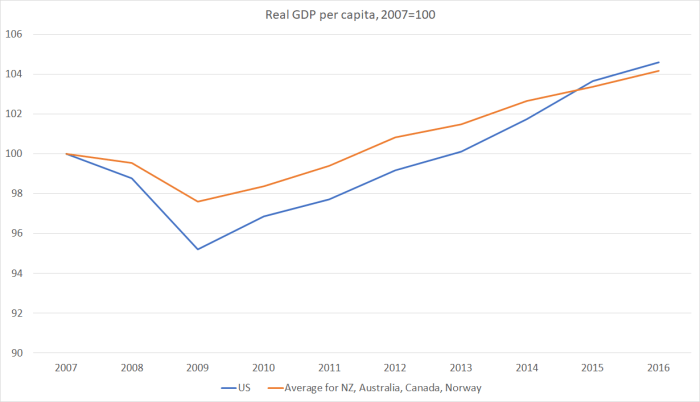
(And as I’ve noted here before,  even the US experience needs rather more critical reflection than it often receives: the path of the US economy in the decade since 2007 wasn’t much different to that of, say, New Zealand and New Zealand experienced no housing bust at all.)

Some of the other omissions from the article are also notable.  The author seems quite uneasy, perhaps even disapproving, about low global interest rates (without ever mentioning that inflation has remained persistently low), but there is no hint in the entire article that neutral interest rates may have been falling, or that global trend productivity growth may have been weak (weakening before the 2008/09 crisis showed up).   Thus, where economic activity is now –  10 years on –  may have little or nothing to do with the specifics of housing market adjustments a decade ago.   And although he highlights the limits of conventional monetary policy in many countries (interest rates around or just below zero), again he doesn’t draw any lessons about the possible need for policymakers to give themselves more room to cope with future downturns (by, for example, easing or removing the technological/legislative constraints that give rise to the near-zero lower bound in the first place.)

It is also remarkable that in an article on housing market collapses, there is only one mention of the possible role of land use restrictions in giving rise to sharp increases in house prices in the first place.   And then it is a rather misguided bureaucrats’ response: because supply may eventually catch up with demand the public need wise officials to encourage them to think long-term.  Perhaps the officials and politicians might be better off concentrating their energies on doing less harm in the first place –  whether fixing exchange rates in ways that give rise to large scale misallocation of resources, or avoiding land use restrictions that mean demand pressures substantially translate in higher land and house prices.

But in all the lessons the Bank (and the author) draw in the article, not one seems to be about the limitations of policy and of regulators.   There are typical references to short-termism in markets – although your typical Lehmans employee had more personal financial incentive (deferred remuneration tied up in shares that couldn’t be sold) to see the firm survive for the following five years –  than a typical central bank regulator does, but none about incentives as they face regulators and politicians (including that in extreme booms, an “insanity” can take hold almost everywhere, and even if there were a very cautious regulatory body, the head of such a body would struggle to be reappointed).

And nor is there any sense, anywhere in the article, as to when cautionary advice might, and might not, look sensible.  Alan Greenspan worried aloud about irrational exuberance years before the NASDAQ/tech bust –  someone heading his concerns then and staying out of the market subsequently would probably have ended up worse off than otherwise.   Much the same surely goes for housing.  In New Zealand, central bankers have been anguishing about house prices for decades.  Even if at some point in the next decade, New Zealand house prices fall 50 per cent and stay down –  the combination being exceedingly unlikely, based on historical experience of floating exchange rate countries, unless there is full scale land use deregulation –  that might not be much encouragement to someone who responded to Reserve Bank concerns 20 years ago.  (Oh, and repeated Reserve Bank stress tests suggest that even in a severe adverse economic shock of the sort that might trigger such a fall, our banks would come through in pretty good shape.)

The article concludes “housing market crashes are costly”.    Perhaps, but even that seems far too much of a reduced-form conclusion.  The misallocations of real resources that are associated with housing and credit booms are likely to be costly: misallocations generally are, and often it is the initial misallocation (rather than the inevitable sorting out process) that is the problem.  To me, it looks like an argument for avoiding policy choices that give rise to major misallocations (and all the associated spending) in the first place: be it fixed exchange rates (Nordics or Ireland), land use restrictions (New Zealand and other countries), or state-guided preferential lending (as in the United States).   Of the three classes, perhaps land use restrictions are most distortionary longer-term, and yet least prone to financial crises and corrections, since there are no market forces which eventually compel an adjustment.

It was a disappointing article on an important topic, sadly all too much in the spirit of a lot (but not all) of the Reserve Bank’s pronouncements on housing in recent years.

On housing, in late November, the Minister of Housing Phil Twyford commissioned an independent report on the New Zealand housing situation.   According to the Minister

“This report will provide an authoritative picture of the state of housing in New Zealand today, drawing on the best data available.

The report was to be done before Christmas and it is now 15 January.  Surely it is about time for it to be released?

Reflecting on Jim Anderton

I have a pleasant memory of the only time I met Jim Anderton. One of his daughters was in the same class as me at Remuera Intermediate, and at the end of the year the Andertons hosted a class barbecue at their home just up the street from the school.   I was a youthful political junkie and Jim Anderton was running for Mayor of Auckland.  It was a pleasant evening and he seemed to be a lively and engaged parent (later struck by the awfulness of the suicide of another daughter).

Accounts suggest that Anderton did a good job of helping to revitalise the Labour Party organisation in the late 1970s and early 1980s.  He was, for the time, a moderniser, instrumental in helping reduce the direct influence of the trade unions in the party, and promoting the selection of some able candidates who hadn’t served time in the party (eg Geoffrey Palmer).  Various tributes talk of a personal, and practical, generosity.

I don’t suppose either that there was any doubt that he pursued causes he believed in, and that those causes were, more or less, what he regarded as being in the best interests of New Zealanders (perhaps especially “ordinary working New Zealanders”).   Probably most politicians do.  Sometimes they are mostly right about the merits of the causes they pursue, and sometimes not.    In Anderton’s case, even if one agreeed with the sort of outcomes he might have hoped for, his views on the best means seem –  perhaps even more so with hindsight than at the time –  to have been pretty consistently wrong.   And for all the public talk in the last few days about Anderton’s contribution to New Zealand, few (if any) of the things he opposed in the 1980s have been unwound/reversed, and few of the things he championed when he served later as an effective senior minister have done much for New Zealanders.

Take the 1980s when, upon entering Parliament in 1984, Anderton quickly isolated himself in caucus.  Even before that election, he’d opposed the CER agreement with Australia, and opposed Roger Douglas’s talk of a need for a devaluation and a reduction in the real exchange rate.  Even after the 1984 election, in circumstances of quasi-crisis, Anderton still opposed the by-then inevitable devaluation –  and in league with Sir Robert Muldoon sought to use a select committee to run a kangaroo-court inquiry, to undermine the choices his own government had made.   He was opposed to GST, and he was opposed to creating SOEs for state-trading operations.   He opposed privatisations, whether small or large.   Of the large, there was vocal opposition to the sale of the BNZ and of Telecom.  I suspect the list of reform measures, not subsequently unwound, that Anderton did enthusiastically support would be considerably shorter –  perhaps vanishingly so –  than the list of those he opposed.

As a pure political achievement, to have survived resigning from the Labour Party – in a pre MMP period –  was worthy of note.  But then Winston Peters did much the same thing –  and he’d had the courage to resign his seat and win a by-election to return to Parliament.  And the distinctive Jim Anderton party has long since disappeared, as Anderton returned to the Labour fold.

And what causes did he champion as a senior minister (for a time, deputy prime minister, in the fifth Labour government).   Probably the institution that will be always associated with Anderton’s name is Kiwibank: it certainly wouldn’t have existed without him.  But to what end?   Has Kiwibank changed the shape of New Zealand banking?  Not in ways I can see.  It remains a pretty small player, operating in segments of the market where there has always been plenty of competition.  It hasn’t come to a sticky end –  as many state-owned banks have here and abroad –  but we’ve never had the data to know whether, even on strictly commercial grounds, the establishment of the bank was a good deal for taxpayers (but the fact that no private new entrant has tried something similar suggests probably not).   If simply promoting competition in banking had been the goal, perhaps it would have been preferable to have prevented the takeover of The National Bank by the ANZ?

There has been talk in the last few days of Anderton’s contribution to “revitalising the regions”.  I’m not sure what this can possibly mean –  even allowing for a few government offices being decentralised (at some cost) around regional centres.   Generally, the real exchange rate mattters much more for the economic health of the regions than direct stuff governments do.   Anderton was Minister of Economic Development.  In that role, he was keen on using taxpayer money to subsidise yacht-building (which didn’t end well), and a champion of film industry subsidies.   In tributes this week, there has also been the suggestion that Anderton was one of those responsible for the creation of the New Zealand Superannuation Fund, something I hadn’t heard before.   If so, I guess he deserves some partial credit for the fiscal restraint the then Labour government exercised in its first few years.  Beyond that, what was created was a leveraged speculative investment fund –  not a model followed, as far as I can tell, in other advanced economy –   with returns that over almost 15 years now really only seem to approximately compensate for the high risks the taxpayer is being exposed to.  No doubt Anderton opposed the decision in 1989 or 1990 to start raising the NZS eligibility age from 60 to 65, and the same opposition to any further increase in the age beyond 65 –  even though it is a step many other advanced countries have taken, as life expectancies improved –  was presumably behind any involvement he had in the creation of the NZSF.  In so doing, once again his hand was involved in holding back sensible gradual reforms, and keeping New Zealand a bit poorer than it need be.

I suspect many of the tributes of the last few days are mostly a reflection of Anderton’s part in the Labour reconcilation.  The prodigal son returned –  having been one of the leading figures in fomenting the civil wars in the first place, before walking out of the party.   They were tumultuous years, and few things are nastier than civil wars.  Anderton doesn’t ever seem to have been a team player, but by the end of his career he seem to have found his place back alongside the team he started with.

But from a whole-of-nation perspective, what did Anderton accomplish?     If the reforms of the 1980s and 1990s haven’t produced the results the advocates hoped for –  we still drift, more slowly, further behind other advanced countries – that wasn’t for the sorts of reasons Anderton advanced.  Had we followed his advice, we’d most likely now be poorer still –  and many of the issues around equality and social cohesion that he worried about might have been no more effectively addressed.     In the end, Anderton is perhaps best seen as a belated figure from the New Zealand of the 1950s and 60s.  There was a lot to like about the New Zealand of those years –  some of the best living standards in the world then – for all the increasingly costly distortions to our economy.   There are parallels to Muldoon –  who famously told a TV interviewer of his goal to leave New Zealand no worse than he found it –  both in the genuineness of their concerns, and the wrongness of too many of their policy stances.  Both seemed to back very reluctantly into the future, with all too much willingness to trust our fortunes to the state, and the possible winners identified by politicians and officials, rather than to the market.

OIA obstructionism – yet more evidence for RB reform

Working my way through things that turned up while I was away, I stumbled on an impressive piece of public sector diligence.  At 3.44pm on the last working before Christmas – a time by which surely most office-bound workers had already left work for the holidays –  Angus Barclay, from the Communications Department of the Reserve Bank, responded to an Official Information Act request I’d lodged with the Bank’s Board several weeks earlier.   I was impressed that Angus had still been at work, but was less impressed with the substance of the response.

I’d asked the Board for copies of the minutes of meetings of the full Board and any Board committees in the second half of last year (specifically 1 July to 30 November).  It didn’t seem likely to be an onerous request: there would probably only have been four or five full Board meetings, and perhaps some committee minutes, all of which will have been readily accessible (in other words virtually no time all in search or compilation).    Perhaps the Board would have wanted to withhold some material, and (subject to the statutory grounds) that would have been fine.  But again, doing so shouldn’t have been onerous.   The Board, after all, exists mostly to monitor the performance of the Governor, on behalf of the public.   In an open society, it isn’t naturally the sort of material one should expect to be kept secret.

In fact, in the 22 December response I received I was informed that there were only five documents.  But I couldn’t have them.  Instead, the request was extended for almost another two months, with a new deadline of 19 February.   Oh, and they foreshadowed that they would probably want to charge me for whatever they might eventually choose to release.

Why was I asking?     After an earlier request to the Board, around the appointment of an “acting Governor”, it had come to light that there was no documentation at all around the process for the appointment of a new Governor (that had been underway in 2016, before Steven Joyce told them to stop), which in turn appeared to be a clear violation of the Public Records Act.    The process of selecting a candidate to be the new Governor is one of the Board’s single most important powers.   And yet the records showed that nothing had been documented –  to be clear (see earlier post), it wasn’t that material was withheld (for which there might well have been an arguable case), it just didn’t exist.   Following that post in May, I was interested to see whether the Board had sharpened up its act, and come into compliance with its statutory obligations.

I had some other interests, of course.   For example, in the five months covered by my request, Graeme Wheeler had finished his term, and I also wondered if there might be some insight in the minutes on the still-secret Rennie review on the governance of the Reserve Bank.

But instead I met obstruction.

There are two things that interest me about the response.  The first is that, although the request was explicitly made of the Reserve Bank Board –  which has a separate statutory existence, and whose prime function is to hold the Bank/Governor to account –  the response came from Reserve Bank staff, referencing only Reserve Bank policies and practices.  It is consistent with my longstanding claim that the Board has allowed itself to simply serve the interests of, and identify with, the Bank –  rather than, say, the Minister who appointed them, or they public whom they (ultimately) serve.

Thus, in respect of the charging threat, I received this line

The Ombudsman states on page 4 of the guidelines on charging that: “It may also be relevant to consider the requester’s recent conduct. If the requester has previously made a large volume of time-consuming requests to an agency, it may be reasonable to start charging in order to recover some of the costs associated with meeting further requests.”

I’m not precisely sure how many OIA requests I lodged with the Board last year, but I’m pretty sure it was no more than four (and one of those was to secure material that was in fact covered by, but ignored in the answer to, an earlier request).   Three of the four I can recall were simply requests for copies of minutes – with no substantial search or collation costs.  Given the uncertainty around the legality of the appointment of the “acting Governor”, major events during the year such as the Rennie review, questions around compliance with the Public Records Act, and the process of selecting a new Governor, it didn’t seem like an undue burden on the Board.

As the Ombudsman’s charging guidelines also note

Note, however, that some requesters (for example, MPs and members of the news media), may have good reasons for making frequent requests for official information, and they should not be penalised for doing so.

Since this blog is one of the main vehicles through which a powerful public agency –  Bank and/or Board –  is challenged and scrutinised, I’d say I was on pretty strong ground in my request for straightforward Board minutes.  (And just to check that the Board itself isn’t being overwhelmed with other requests, I lodged a simple further request this morning asking how many OIA requests the Board has received in each of the last two years, and copies of the Board’s procedures of handling OIA requests made of it.)

I can only assume that the Bank itself, which seems to be controllling the handling of requests made even to the Board, has gotten rather annoyed with me again, and decided to use the threat of charging as some sort of penalty or deterrent.  Longstanding readers may recall that we have been this way once before.  About two years ago, the Bank got very annoyed with me (and some other requesters) and started talking of charging left, right and centre.   Reaction wasn’t very favourable, and Deputy Governor Geoff Bascand even took to the newspapers with an op-ed defending the Bank’s stance.   There was talk of a “mushrooming” number of requests, but on closer examination even that didn’t really stack up –  the number of OIA requests the Bank received was much smaller than, say, those The Treasury received.     Explaining is (often) losing, and as I noted at the time, the Bank didn’t come out of the episode well.   As a refresher, the Bank released responses to 20 OIA requests in 2017.  The Treasury, by contrast, released responses to more than 80 OIA requests (in both agencies there will be have responses not posted on the respective websites).

But even in their defence a couple of years ago, Bascand asserted that the Bank –  no mention of the Board –  would be charging only when the requests were “large, complex or frequent”.  My latest request of the Board is neither large nor complex, and neither were the earlier requests.

Even though the Bank and the Board are not the same entities, they are clearly trying to conflate my requests to both entities.   But over the course of last year, my records suggest I lodged no requests at all with the Reserve Bank itself in the first five months of last year.    Between June and the end of the year, there seem to have been quite a few, but on topics as diverse as:

  • the new “PTA” signed by Steven Joyce and Grant Spencer,
  • the Toplis suppression affair,
  • assumptions about new government policies the Bank referred to in its latest MPS,
  • some data from an expectations survey that the Bank had not published
  • three old papers, each clearly-identified in the request,
  • a specific paper on RB governance issues explicitly mentioned in the Bank’s BIM, and
  • work on digital currencies that the Bank explicitly highlighted in a recent research paper.

All still seem like reasonable requests, of a powerful agency which has a wide range of functions.  It seems unlikely that many of them should have involved any material amount of time to search for, or collate (in fact, in response to several requests the Bank responded quite quickly and in full, prompting notes of thanks from me).   There are no requests that can reasonably be described as “fishing expeditions”, and no pattern of repeated requests for much the same information.  They seem like the sort of requests those who devised the Official Information Act might have had in mind.

Finally, it is worth noting what the Ombudsman’s guidelines suggest can and can’t be charged for (bearing in mind that very few agencies charge at all).    Agencies can, in appropriate circumstances, charge for things like

Search and retrieval 

Collation (bringing together the information at issue) 

Research (reading and reviewing to identify the information at issue) 

Editing (the physical task of excising or redacting withheld information) 

Scanning or copying

Five nicely-filed documents (Board minutes) will have taken mere minutes to retrieve, no time to copy (since they will exist in electronic form already) and no time to research.  It is conceivable that the physical task of redacting withheld information might take a little time –  but very little.

And what can’t agencies charge for at all?

Work required to decide whether to grant the request in whole or part, including:
– reading and reviewing to decide on withholding or release;

– seeking legal advice to decide on withholding or release;

– consultation to decide on withholding or release; and – peer review of the decision to withhold or release. 

Work required to decide whether to charge and if so, how much, including estimating the charge.

If the Reserve Bank or the Board think that trying to charge for five simple, easily accessible, documents is consistent with the principles of the Official Information Act, or of the sort of transparency they often like to boast of, things are even worse than I’d supposed.   And in the attempt, they will again damage their own image and reputation more than they inconvenience me.

If anything, it is further evidence of why a full overall of the Reserve Bank Act –  and of the institution –  is required.  You might have supposed that, with a review underway, the Bank and the Board would have wanted to go out of their way to attempt to demonstrate that there were no problems, no issues, in an attempt to convince the Minister to make only minimal changes, leaving incumbents with as much power and control over information as possible.  But no, instead by the words and actions they simply reinforce the case for reform, and indicate that they have little concept of what genuine public accountability means.   We should be looking for openness, not obtuseness and obstructiveness from the Bank –  whether the Governor (“acting” or permanent) or the Board, supposedly operating on our behalf to keep the Bank in check.  Once again, we don’t see what we should have the right to expect.

Perhaps, on reflection, the Bank or the Board will reconsider their wish to charge for some simple documents –  the sort of documents that should probably be pro-actively released as a matter of course.  If not, one can only assume they have something to hide.   The “good governance” former public servant in me is sufficiently disquieted about the evidence of weak or non-existent recordkeeping that I am thinking of taking further the apparent breach of the Public Records Act.  Options might include:

  • a letter to the chair of the Board, asking how the Board is assured that it is operating in compliance with the Act,
  • a letter to the Minister of Finance, asking whether (and how) he can be sure that his appointees (the Board) are operating in compliance, given past evidence of major gaps,
  • a letter to the minister responsible for the Public Records Act itself,
  • a letter to the Auditor-General expressing concerns about the evidence suggesting that the Board of the Reserve Bank is not meeting its statutory obligations under the Public Records Act.


Money and madness

On Monday morning we were driving home from holiday, with a car so chock-full that my eleven year old daughter had bet me I couldn’t get everything back in (she lost), when we got to Tirau and saw a sign advertising a book sale –  at $1 a book.  It was too much for us to resist.   Among the hall full of books, I spotted Street Freak: Money and Madness at Lehman Brothers, by one Jared Dillian.

Readers may recall Dillian.  He was the US-based commentator who late last year wrote a piece on forbes.com claiming that, with the election of the new government, New Zealand was about to “commit pointless economic suicide”.     I wrote about his column here (various other people had a go too).   Like others, I was pretty dismissive: perhaps, as Dillian suggested, there will be a recession here in the next few years (but in any three year period that is a non-trivial risk, including for factors quite outside New Zealand’s control).   And as for “pointless economic suicide” (I noted)

If there is a “suicide” dimension to economic policy in New Zealand, it is the wilful blindness of successive governments led by both main parties, who keep on doing much the same stuff, and either believe they’ll get a different and better (productivity) result, or who just don’t care much anymore.

I’d never heard of Dillian previously –  although on checking around I found that he was a regular markets commentator, and seemed to have people willing to pay for his views –  and had given him no attention since.   But on Monday I picked up his book anyway, for three reasons:

  • it was only $1 and I was just a little curious about the author,
  • the jacket suggested it wasn’t just another description of life in the financial markets, but was also a pretty honest and searing account of the author’s struggles with mental illness, and
  • the rave review on the back cover from the novelist Siri Hustvedt  (“Always vivid, by turns hilarious and sad, this is an electrifying memoir”).     It turns out that Hustvedt had spotted Dillian’s writing talent when she was helping with a programme in a psych unit when Dillian was at his lowest.

It is an excellent book.  I’m a bit of a sucker for (second hand) histories of American corporate takeovers, I have quite a few books about markets acquired when I shifted into the Reserve Bank Financial Markets Department 20+ years ago, and really big piles of 2008/09 financial crisis books.  Dillian’s is unlike any of them.  He had –  and offers –  almost no insights on the failure of Lehmans (though no doubt the name helped him find a publisher a few years after the failure). Dillian was a trader (latterly head trader for exchange traded funds) and knew little more about his employer’s travails –  and reckless real estate risks – than anyone could see (evenually) in the share price.  He’d developed his newsletter  –  and found an audience –  while still at Lehmans but then much of it was about the esoterica of market liquidity.

But it is simply an extraordinarily vivid book –   not sparing the vulgarity, or accounts of his alcohol excesses –  tracing Dillian’s desperate, obsessive, desire to make it in the financial markets (as a late entrant –  he’d been a US Coast Guard officer –  with a part-time MBA from a no-name university.  There are the highs and lows, the emotional intensity, of markets let alone of Dillian himself.  One is never quite sure how his wife coped with him, even before the mental illnesses came to the fore.   As the jacket notes

The extreme highs and lows of the trading floor masked and exacerbated the symptoms of Dillian’s undiagnosed bipolar and obsessive compulsive disorders, leading to a downward spiral that eventually landed him in a psychiatric ward

And that after an earlier suicide attempt, which he survived only because after taking a big dose of pills he –  as people sometimes do –  made a call, not for help but just to say goodbye.  After a family member went through years of serious mental illness I also have a pile of books on mental illness and the experiences of patients and families.  I’m tempted to shelve Dillian’s book with those works, even though most people buying it will probably be after the markets stuff.   Siri Hustvedt continues her endorsement suggesting that the book is “not only about money and madness, but the madness of money”, but I think that is both simply too cute, and wrong.   But it is a powerful account, full of insight, of one man’s experience of both.

What also interested me was Dillian’s career turn. Through much of the book his aspiration is to turn himself into a prop trader successful enough that he could work where he wanted, pretty much on his own terms  –  his example was a Lehmans prop trader then operating from Florida  And when I’d seen he’d previously been at Lehmans I assumed he’d lost his job in the failure, and after a time taken a different path.  His was a (much) braver call.  After the Lehmans failure, Barclays acquired many of the better bits of the business, and Dillian’s job was safe.   And yet he chose to walk anyway, leaving without severance or great wealth (and having lost all the value in his locked-in Lehmans shares) deciding he was going to pursue the vision of writing (and selling) his own newsletter.  That took guts in September 2008 as the crisis was heading towards its worst.

The book is well worth reading.  The author may, for now, have nothing useful or interesting to say about New Zealand economic policy or performance, but set that to one side.  He can certainly write, and it appeared that in his day he could trade and generate trade ideas.   The book is searingly honest –  at times almost uncomfortably so –  and the better for it.

As I say, Dillian can write.  I’ve even signed up now for his free weekly newsletter, The 10th Man . He’s a contrarian;

His free weekly newsletter isn’t called The 10th Man for no reason. It’s named after a strategy which states: if nine people agree on a particular action or plan, then the tenth must disagree in order to stir up alternatives to be considered.

Flicking through some of his past issues, I’m not sure I often agree with him (on things I know something about), but he makes one think and writes interestingly.  Perhaps one day he’ll even revisit New Zealand and there will be some nugget to think about.

A bauble for underperformance

As an Anglophile traditional conservative, the idea of the twice-yearly honours lists appeals to me.   It has deepish roots in our past  –  although not that deep (the Order of the British Empire, initial source of most of the awards to ordinary people who do good dates back only to 1917.)   Many societies have such awards in one form or another –  although the United States doesn’t.    All societies honour success –  however defined – and/or sacrifice in some way or another, and formalised state awards can be a part of such a system.  Perhaps the best forms of recognition emerge from below –  whether subsequently encapsulated in formal awards or not.

But if the idea of the honours lists has a certain appeal, the practice is much less satisfactory.   That is especially so in the higher reaches of the lists, where there seem to be too many awards in total, and far too many given to people who, at best, have done competently in highly-paid (or otherwise rewarded) roles.   In our most recent honours list seven knighthoods were awarded –  about a quarter as many as in the UK, for a country with less than one twelfth of the population of the UK.   Are there really 14 people each year of such exceptional merit in New Zealand?     (I’m not bothered about the Sir/Dame title –  hardly anyone knows who has been awarded the premier award in our system, the Order of New Zealand, and there seems to be some merit –  as well as historical continuity –  in the use of a title for the handful of people of exceptional merit.)

And many or most of the people in the upper reaches of the system have already, as it were, had their reward.  Even among the 19 members of the Order of New Zealand, at least half seem to have been rewarded largely for doing their job, typically for quite a long time.  Ken Douglas anyone?  Or Don McKinnon?  Jonathan Hunt, Ken Keith, Ron Carter, or even Richie McCaw.  Jim Bolger, Helen Clark, Cardinal Williams or Mike Moore.

And what of the seven new knights and dames in the latest honours list?   There are a couple of public servants, two former politicians (one successful, one much less so), one former president of a political party, a judge, a successful business person, and a former sportsman –  from the amateur era – who appears to have put a lot back into rugby.   Perhaps they’ve all done exceptionally well at what they did –  most of the names I don’t know well enough to tell –  but in most cases they seem already to have had their rewards –  whether in salary, status, power or whatever.  In most cases, they seem already have have been officially honoured previously too.   From what I can see, there might be a compelling case for a high honour –  titled or not – to perhaps two of these people.

Of the next tier down –  the eight recipients of the CNZM –  most (but not all) appear to have been rewarded for doing their day jobs, often again over long periods of time.   And this doesn’t appear to be unusual.  If I reflect back on people I’ve known who received honours over the years –  family members included –  most seem to have been honoured for doing their job.  In many cases, they probably did those jobs quite well, but not many seemed exceptional.  I suspect –  without doing the supporting analysis –  that there is a big difference between the upper and lower reaches of the honours list.  Probably most recipients of the QSM (eg this chap) are very worthy –  people who have poured their time and energies into some cause or community with little or no expectation of reward. In the higher reaches, that is much less common.  An acquaintance of mine won an award a year or two back for “services to the state”, which consisted of (paid) service on various government boards.  In this year’s honours list, David Smol –  recently departed head of MBIE –  picked up a QSO, simply for doing his job.   Perhaps he ran MBIE well –  but then he was well-paid to do so –  but when the citation suggests that

As Chief Executive of the Ministry of Economic Development from 2008 to 2012 and Deputy Secretary (Energy and Communications Branch) from 2003 to 2008, Mr Smol’s leadership has been critical to the New Zealand economy.

the words “gilding the lily” spring to mind, along with the debacle that is the New Zealand housing market, or an export sector that has been shrinking.  “Critical to the New Zealand economy”?  I think not.  Smol’s isn’t an egregious case –  it seems to be how the system works.

But if rewarding people with honours simply for doing competently a job they were well paid for sticks in the craw a little, rewarding people with high honours for doing a well-paid job rather badly simply shouldn’t happen.

I’ve written quite a lot about Graeme Wheeler, former Governor of the Reserve Bank.  After he left the Bank in September, I didn’t really expect to write about him again.  But then his name popped up in the New Year’s Honours List, as recipient of a CNZM.

In his single five year term –  so it wasn’t even a long-service award –  Graeme Wheeler exercised a great deal of power (the Governor is the most powerful unelected person in New Zealand), but generally neither wisely nor well.   Whether in stories when he left office, or in stories around the appointment of his successor last month, few seemed to much lament his passing from the scene.   So just a quick reminder of some features of Wheeler’s stewardship:

  • as sole monetary policy decisionmaker he materially misread inflation pressures, enthusiastically commencing a monetary policy tightening cycle which was soon widely recognised to have been unnecessary. The tightenings were fully reversed, but slowly and, generally, grudgingly,
  • as sole prudential policy decisionmaker he rushed into imposing LVR restrictions without any serious supporting analysis of the housing market or the nature of the risks to the financial system.  And then added greatly to regulatory uncertainty through repeated changes to the rules,
  • his public communications were poor.  Speeches were generally not very enlightening –  and at times at odds with policy moves shortly thereafter –  and he rarely if ever opened himself to critical scrutiny in the media (refusing all requests for interviews that might involve searching questions).
  • he adopted a consistently obstructive approach to the Official Information Act, all the while continuing to assert that he ran one of the most transparent central banks anywhere,
  • he oversaw systems that allowed an OCR decision to leak prior to the official release, and when reluctantly he finally had to acknowledge the leak he chose to praise the helpfulness of the media outlet responsible for the leak, and attempt to attack the person who brought the possibility of the leak to his attention (and that of the public),
  • his thin-skinned approach to debate and critical scrutiny reached a low point earlier this year when a leading bank economist got under the Governor’s skin to such an extent that Wheeler had his entire team of senior managers trying to censor or silence the economist.  The Governor himself –  regulator of the economist’s employer, the BNZ –  put in writing his attempt to have Stephen Toplis censored.

No wonder even the official citation lists no particular achievements, just offices held –  each and every one well-remunerated.    It is as if even Bill English and Steven Joyce knew there just wasn’t much there.  But they went ahead and tossed him a bauble anyway – comfirmed by the new Prime Minister and her deputy.   It is an award that reflects poorly on the system, on the recipient, and on those bestowing (or acquiescing in) the award.  It should be one more strand in the case for an overhaul of the system, perhaps even for disbanding all but, say, the QSM.  But no doubt Graeme Wheeler will enjoy his day out at Government House.

And thus I agree with much of the editorial in the Dominion-Post on honours lists that seems to have appeared a few days ago.

Why so secretive?

Five weeks ago now, on 7 November, the Minister of Finance announced a process for his review of the Reserve Bank Act.    There was to be a two-stage process: the first stage led by Treasury to come up with specific recommendations on how to implement the Labour Party promises around monetary policy (goal and decisionmaking issues), and then an amorphous second stage, to be jointly led by the Reserve Bank and Treasury, to look at other  –  as yet undefined – issues around the Reserve Bank Act.  We were told that the phase one would be completed, with a report to the Minister, in early 2018.

Presumably the work is well underway.  At the post-Cabinet press conference the other day, we were told that the new Policy Targets Agreement –  which has to be signed by the Minister and the Governor-designate before Adrian Orr can be formally appointed  – will be informed by the recommendations of the first phase of the review.    As Orr is scheduled to take office on 27 March, you’d have to suppose that the report of the review would have gone to the Minister of Finance at least a couple of weeks prior to that.    After all, Orr himself would need to consider any proposed changes to the PTA, and might wish to take his own advice from Reserve Bank staff.

But if the work is well underway it is being kept very secretive, something that seems quite out of step with how things were portrayed when the Minister announced the terms of reference and associated process five weeks ago.

For example, we were told that an Independent Expert Advisory Panel was to be appointed.  According to the Q&A sheet issued on 7 November

Who will be on the Independent Expert Advisory Panel?

The panel members will be announced once they have been confirmed, but they will be individuals with independence and stature in the field of monetary policy, including in governance roles.

But there has been no announcement.   Either members haven’t been appointed yet –  in which case, how is the work going to be well done in the remaining time? –  or the Minister has gone back on his commitment to openness.  I have Official Information Act requests in with both Treasury and the Minister seeking the names.  The expectation of openness was confirmed with this q&a

Will their views be made public?

In commissioning the review, I have asked officials for advice on the terms of engagement of the Independent Expert Advisory Panel. This will include how their views are made public, and further details will be made public once that has been confirmed.

Note the “how”, not “whether”.   But, five weeks on, still no details.

The Minister also promised more details about a timeline for the whole review.  Five weeks on, heading into Christmas, still no details.  At yet the first stage is supposed to be completed by early March.

When will it conclude/report?

I expect the Treasury to report to me on phase one of the review early in 2018.

In commissioning the review, I have also asked officials to develop a detailed timeline for the review, and more details will be provided once they have been agreed.

I had supposed that the review would be seeking submissions or public input.  I wondered if that was just my imagination, but no.  Going back to the Q&As

Will there be public consultation? When?

I have also asked officials to develop a detailed timeline for the review, including how public consultation can best be facilitated. More details will be made public once they have been agreed.

Five weeks on, heading into Christmas, still nothing.   If the underlying review by officials is well underway, it makes a mockery of any sort of public consultation if views are only to be invited very late in the piece, if at all.

I’m not sure what the Minister of Finance can possibly have to hide.  The Labour Party campaigned on making changes along these lines, and the first stage of the review is supposed to be largely about giving that effect, and associated consequential issues.  But whatever the reason, it isn’t a particulary look, and again undermines any suggestion that the government might be committed to a more open approach.   Rhetoric around the Official Information Act is fine, but this stuff should be easy –  and it was explicitly promised weeks ago, in a review that is operating to tight timeframes.

It also isn’t clear why the Minister and Treasury are still keeping secret the Rennie review and associated documents.  The Rennie review of Reserve Bank goverance was commissioned by Treasury, at the request of the previous Minister of Finance.  The report was completed in April, and yet Treasury has repeatedly refused to release it and associated material (eg comments from expert reviewers), even though it is clearly official information and should be highly relevant to discussion/debate/submissions around the new government’s own proposals and review.      I have appealed the latest denial to the Ombudsman, and had confirmation this morning that the Ombudsman has opened an investigation.      But such investigations simply shouldn’t be needed, if we had any semblance of an open government.

As noted above, a new Policy Targets Agreement has to be agreed and signed by March.    The Policy Targets Agreement is the major document guiding short-term stabilisation policy for the next five years –  it affects us all.   And yet it seems that deliberations will continue to go on in secret (as has been the custom).    Again, it would be a good opportunity for a more open approach.  I’ve pointed previously to the Canadian model of conducting the research leading up to the renewal of the inflation target early and openly discussing/reviewing/debating it in public seminars/workshops.  It would be a good practice to adopt here, but it is probably too late for this time round.  But it wouldn’t be too late for the papers the Reserve Bank and Treasury have inevitably already prepared on the topic to be made public, in a way that would enable market economists and other observers to provide input on how this major macroeconomic tool is to be specificied and managed for the next five years.    We’d never pass legislation as secretly as the PTA is done. Indeed, the Reserve Bank couldn’t even put on the latest iteration of LVR controls  –  half-life perhaps one year – without proper serious consultation.  It is time for a more open and consultative approach to shaping macroeconomic policy.   Robertson (and Orr) could lead the way.

In addition to the work Treasury and Reserve Bank staff have done, consultation could take account of the comments the Minister made recently about contemplating removing references to the target midpoint from the PTA (I have mixed feelings about that idea, but think it is probably a bad idea, reinforcing the weakness of inflation expectations).  And there were other suggestions at the post-Cabinet press conference –  Robertson talking of how the government doesn’t just want the Bank to focus on price stability, or employment, but on “the overalll wellbeing of New Zealanders” –  that dread Treasury phrase once again, as devoid of specific meaning as ever.   But in case he isn’t aware, the 4th Labour government already included its own “virtue signalling” mandate in the Reserve Bank Act

169 Bank to exhibit sense of social responsibility

It shall be an objective of the Bank to exhibit a sense of social responsibility in exercising its powers under this Act.

38 years on and still no one knows what it means, if anything. But it probably felt good to include it.  Perhaps those words could be carried up into the Policy Targets Agreement, and the Governor could cite them every so often?


Governing financial stability policy

On Monday afternoon, The Treasury hosted Professor Prasanna Gai of Auckland University, who gave a guest lecture on the topic “Resilience and reform –  towards a financial stability framework for New Zealand”.     The timing of this event, put on at quite short notice, is presumably not unrelated to the current review of the Reserve Bank Act.

Prasanna Gai is well-qualified to talk about such issues.  He was formerly a professor at ANU, and prior to that worked at both the Bank of Canada and the Bank of England.  These days –  even from the ends of the earth –  he is an adviser to the European Systemic Risk Board.  A few years ago he served as an external academic adviser to the Reserve Bank of New Zealand, and did one of the periodic visitor reviews of our forecasting and monetary policy processes, based on his observation of one Monetary Policy Statement round.

In his presentation the other day, he appeared to set out to be “politely provocative” in pushing for reform, including greater transparency and accountability.   There was a fairly large number of Reserve Bank people at the lecture, and I suspect Prasanna’s calls won’t have gone down that well with them.

He began by noting that even now, 10 years after the last international financial crisis, there is very little academic analysis of the political economy of financial stability policy/regulation.  As he noted, in monetary policy there were key defining papers that laid the groundwork for monetary policy operational independence to become the norm internationally.    There is still really nothing comparable in respect of financial stability –  and certainly nothing robust that would justify delegating a very high degree of autonomy (arounds goals, instruments, and intermediate targets) to unelected officials (especially a single such official).

As he notes, in most countries –  though not the US or the euro-area –  politicians (as representatives of societies) play the lead role in setting/approving the inflation target.   Things aren’t just mechanical from there –  there can be, and are, real debates about how aggressively to respond to deviations from target and the like –  but at least there is some benchmark to measure performance against.    There is nothing comparable for financial stability, and Prasanna Gai argues  –  and I strongly agree with him –  that politicians need to “own” financial stability policy, including taking a view (implicit or explicit) on things like the probability of a crisis that society is willing to tolerate (it is the implicit metric behind much of what systemic financial regulators do).

Gai’s focus in his talk was on what he –  and the literature –  likes to call “macroprudential policy”.     He draws a distinction between the supervision of individual banks and the supervision/regulation of the system as a whole.  I’ve never been convinced that it is a particularly robust distinction, at least in the New Zealand context, where a key defining characteristic of our banking system is four big banks, all with offshore parents from a single overseas countries, all with relatively similar credit exposures (and funding mixes).   Gai –  and others (including the Reserve Bank when it suits them) –  argue that each bank might manage its own risks relatively prudently, but has no incentive to take adequate account of the impact of its choices on other banks.  Again, in a concentrated system like our own, I’m not sure that is really true, at least in a way that has much substantive content.   Anyone lending on dairy farms (for example) will know that the market in such collateral gets extremely illiquid whenever times turn tough (as they did after 2007).  You’d be a fool, in managing your own bank’s risks, not to recognise that other people might be trying to liquidate collateral at the same time as you.   Much the same goes for housing loans –  and even if you didn’t directly take account of other banks’ exposures, if your bank has a quarter of the market, you can’t just assume your actions will have no impact on the value of the overall collateral stock (whereas, say, a 1 per cent player might be able to).   It doesn’t mean that banks don’t get carried away at times, and excessively ease credit standards, but I doubt the big 4 are ever not aware they are big fish in a small pond.  Banks were all very consious of firesale risks in managing dairy exposures in 2009/10.

And if the banks themselves forget it, I don’t think the Reserve Bank ever has.   As regular readers know, I don’t feel a need to defend the Reserve Bank on every count, but……I sat on the Financial System Oversight Committee for the best part of 20 years, and was involved in putting together Financial Stability Reports, and the sort of narrow “my bank only” focus people talk about when they try to carve out macroprudential policy as something different from micro-prudential supervision never resembled the way the Reserve Bank dealt with these issues and risks.   Perhaps it happened to some extent at the level of an individual supervisor, but not at the institution level.  The starting assumption tends to be that the risks –  credit and funding –  are pretty similar in nature for all the big banks.  In fact, we see that illustrated in the way our Reserve Bank treats stress tests –  here is the focus is systemic whereas, for example, the Bank of England provides a high degree of individual institution detail (since banks fail individually, I think the BOE approach is preferable).    What also marks out New Zealand supervision/regulation, is that the statutory mandate is explicitly systemic in focus; there is no explicit depositor protection mandate.

So although Gai’s talk was avowedly focused on macroprudential functions, in the end most of what he had to say applies (at least here) to the full gamut of the Reserve Bank’s financial regulatory functions.  I think that conclusion is reinforced by the scepticism Gai expressed about the ability of central banks/regulators to do much effective to dampen credit/housing cycles, leaning against booms.  He sees the case for regulation as primarily about building the resilience of the financial system.

In passing, I would note that I also think he grossly overstates the cost of financial crises.  He put up a series of charts for various countries showing the path of actual GDP in comparison to what it might have been if the pre-2007 trends had continued, and asserted that the difference was the effect of financial crises (perhaps as much as 70 per cent of one year’s GDP).  I’ve disputed that sort of claim previously here (including here and here) and a few months ago I ran this chart  suggesting that another meaningful way of looking at the issue might involve comparing the path of GDP for a country at the epicentre of the crisis (the US in this case), with the paths for advanced countries that didn’t experience material domestic financial crises,

US vs NZ Can etc

But if the costs of financial crises are far smaller than people like Gai (or Andy Haldane) assert, they probably aren’t trivial either, especially in the short-term (one or two year horizons).  And much the damage isn’t done in the crisis itself, but in the misallocation of credit and real resources in the build-up to the crisis.

So I’m not arguing a case against supervision/regulation –  and have been recently arguing that we should, on second best grounds, introduce a deposit insurance scheme, which would only reinforce the case –  but I am more sceptical than many, perhaps including Gai, about how much value supervisors can really achieve, whether macro or micro focused.    There has been a great deal of  regulatory activity –  sound and fury –  in the few years since the last crisis, but that was precisely the period when banking systems were least likely to run into trouble anyway (managers, shareholders, rating agencies all remembered –  and were often scarred by –  the 2008/09 crisis, and actually demand for credit was generally pretty subdued too).  The test of supervision/regulation isn’t the difference it makes in times like the last 7 or 8 years, but the difference at makes at the height of the next systemic credit boom.  It isn’t obvious –  including from past cycles –  that regulators, and their political masters, will be much different from bankers next time round either.  Some regulators might well want to be different, but typically they will be marginalised, or just never (re)appointed to key positions in the first place.

But given that we have bank regulation/supervision, how should it best be organised and governed?     There is no one model, either in the academic literature or in the institutional design adopted in other advanced countries.  One of the question is how closely tied financial stability policy should be to monetary policy.   At one end there is  –  perhaps the practical majority  – view (including from Lars Svensson) that monetary policy and financial stability are two quite separate things, and should be run separately, possibly even in separate institutions.   At the other extreme, there is an academic view that monetary and financial stability are inextricably connected and policy needs to address both together.  A middle ground is perhaps a view associated with the BIS, seeing a role for monetary policy to lean against credit asset booms, with the advantage –  relative to regulatory measures –  that “interest rates get in all the cracks”.

In New Zealand, the Reserve Bank Act has since 1989 required the Bank to have regard to the soundness and efficiency of the financial system in its conduct of monetary policy (a requirement carried over in the PTA in 2012).  But no one really knows what it means – to the drafters in 1989 it seems to have meant something about avoiding direct controls –  but it sounds good –  motherhood-ish almost.   In practice, it has never meant much: successive Governors have, at times, anguished about housing markets and possible future risks, and on the odd occasion have tempered their OCR calls by those concerns.  But my observation suggested they’d have done so anyway.

So we are in the curious position where financial stability considerations don’t matter to any great extent to monetary policy, and yet we have single decisionmaker deciding policy in both areas with –  partly as a result –  little direct accountability.    The Minister of Finance has little effective involvement in the appointment of the decisionmaker, or in the specification of the goals of financial stability policy.   The Governor decides –  based on whim, rigour, or prejudice, but with little or no legitimacy or democratic mandate. Even the legislation grew like topsy, and the governance provisions never envisaged as active prudential policy as we’ve seen in recent years.

There is a range of different models, and Gai covered some of them in his talk.  In Sweden there is little or no integration between the central bank and the financial regulatory agency.  In the UK, all the functions are (now back) in the Bank of England, but there are statutorily separate committees (albeit with overlapping membersships), most of the members are appointed by the Chancellor, and all members are individually accountable for their views/votes.  In Australia, there are multiple agencies, a Council chaired  by the Reserve Bank, but also a strong role in policysetting for the Federal Treasury, representative of the Treasurer (and the Treasurer/government directly appoint the key players, including the Governor).  There are other countries –  for example, Norway –  where decisionmaking powers on systemic prudential interventions are reserved to the Minister of Finance.

Prasanna Gai wrapped up his talk arguing that there is a strong case for rethinking the governance model around systemic financial stability in New Zealand.     Specifically, he made the case for the Minister of Finance to be more directly involved.  As he had noted earlier in his talk, the sort of regulatory interventions like LVRs are almost inevitably highly political in nature (especially as they can be highly granular –  we saw a couple of years back regulatory distinctions between Auckland and non-Auckland, and we still have distinctions between types of purchasers, even if the collateral is identical), and that the more independent a central bank is around such interventions the more politicised the institution risks becoming.  Gai argued –  and I agree with him –  that we’ve seen this in New Zealand in the last few years.  He argues that wider participation in decisionmaking could help safeguard monetary policy credibility (and perhaps the Bank’s effective operational independence there).

Gai argues for the establishment of a statutory committee to be responsible for systemic financial regulatory matters that are currently the sole preserve of the Governor.  He didn’t spell out clearly what, if any, powers he would reserve to the Minister –  perhaps that is captured in establishing a mandate (backed by statute, not the goodwill/moral pressure of the current MOU).  But he envisages a model in which the members of the committee would be appointed by the Minister of Finance, and would be individually accountable (including to Parliament) –  presumably implying a considerable degree of transparency around minutes/voting records.  He argues –  correctly in my view –  that such a committee would not only provide access to more technical expertise but that it would provide greater “legitimacy” for the choices being made.

Mostly, Gai’s talk was very diplomatic.  But there was a bit of a dig at the current Reserve Bank, noting that there didn’t seem to be much turnover (“churn”) at the senior levels of the Reserve Bank, at least when compared to the experience of places like the RBA or the Bank of England, which –  he argued –  limited the scope for challenging “house views” or established orthodoxies.    Bringing in outsiders –  individually accountable – to a statutory committee could counteract those risks.    Personally I’m less sure that turnover (generally) is the issue –  and as compared to the RBA (most notably) the Reserve Bank of New Zealand has been weak at building internally capability (as a result, 1982 is still the last time a Reserve Bank Governor was appointed from within).  The issues at the Reserve Bank seem to be more about the capability of certain key individuals –  several of whom (Spencer, McDermott, Fiennes and Hodgetts) have been in their roles for a long time –  and the sort of culture fostered from the top in the Wheeler years in particular.     In a high-performing organisation, constantly opening itself to challenge, scrutiny and new ideas (from inside and outside) that stability might be a real strength.  In our Reserve Bank it has become a considerable weakness.  But an external committee, properly constructed, could be part of a process of change, and entrenching new and better behaviours.

Gai’s summary:

  • financial stability policy should be on an equal footing with monetary policy,
  • the focus of such policy should be on resilience of the system, not trying to fine-tune the credit cycle (just too ambitious),
  • politicians need to own the standards of resilience policy is working to maintain/manage, and be engaged more overtly in decisionmaking, and
  • because it will never be possible to establish very specific, short horizon, goals comparable to those in the PTA, the process of policy formulation and governance/accountability mechanisms take on an even greater importance for financial stability than for monetary policy.

I’d largely agree with him.

I hope these are issues that the Minister of Finance is going to take seriously as part of his (currently secretive) review of the Reserve Bank Act.    With central bankers who have a strong incentive to defend their patch and their powers –  including a new Governor with a reputation for fighting his corner, come what may –  if the Minister isn’t engaged it would be all too easy to end up with no material change, and far too much power still concentrated in the hands of one, less than excellent, institution and its single decisionmaker.     This is the opportunity for serious reform – bearing in mind Mervyn King’s injunction that legitimacy (the “battle for hearts and minds”) matters greatly –  and I hope the Minister is exposed to the advice Prasanna Gai offered the other day.  A Financial Stability Committee shouldn’t be dominated by academics, but the Minister could do worse, in establishing such a committee, than to appoint Prasanna as one of the founding members.

For anyone interested in these issues, there is also a presentation here given last year by David Archer – former Assistant Governor of the Reserve Bank, and now a senior official at the BIS. I meant to write about it at the time, but never did.  His title is “A coming crisis of legitimacy?”  and this from his first slide captures his concern

Make the case that many central banks are at risk of a crisis of legitimacy, with respect to new macro financial stability mandates. The issue is an inability to write clear objectives.

He highlights some similar issues to Gai, but is more strongly committed to keeping ministers out of regular decisionmaking, and so his approach is to supplement committees with a clear statutory specification of the issues, considerations etc that should be taken into account in using/adjusting systemic financial regulatory policy.

Westpac’s plan to lower productivity

You may have seen the story in various media a few days ago about new work commissioned by Westpac suggesting that

New Zealand’s economy has a nearly $900 million annual economic hole because of low numbers of women in management roles, new research suggests.

But if there was an even split of men and women in management there would potentially be an $881m boost to the economy and a positive impact on businesses themselves.

I didn’t pay much attention to it, beyond noting to myself that $881 million is about 0.3 per cent of GDP –  not much of a “hole” in other words, even on Westpac’s (and the consultancy company they paid to do the research) own claims.

But I wondered quite how they’d come up with these estimates so last night –  while the resident woman in management was off at her office party –  I downloaded the document.

It begins with lots of puffery around the alleged economic and financial benefits of diversity –  our banks now apparently see themselves as “social justice warriors”.   I don’t claim any expertise in that particular literature, but I’d refer you to some of Eric Crampton’s reads or, indeed, to a paper I wrote about here a while ago, that leaves me pretty sceptical that there is anything much in the sorts of claims Westpac makes.

The bank is horrified that “60 per cent of businesses do not have a gender parity policy or strategy in place” –  as if picking the best person for the job, male, female, black, white or whatever –  isn’t any sort of legitimate approach to employment these days.   And seems to think that the mere existence of gaps between median earnings of mean and median earnings of women is somehow proof that employers are breaching laws “mandating equal pay for equal work”.  Perhaps Westpac’s crusading CEO could spend some time reading Claudia Goldin, for example.    In the Westpac world, there is apparently no recognition that more mothers than fathers prefer to take time out –  or work in less demanding roles –  to be actively involved in raising children (note the word “more” –  in this household, I’m the “primary caregiver”).  There are implausible claims (without proper documentation in the report) that raising the share of female managers raises rates of return on assets –  in New Zealand’s case they argue that reaching parity could raise returns on assets by 1.5 percentage points.     Not only are these huge numbers, but what sort of metric is return on assets anyway?  Some businesses require lots of fixed assets and other require not many at all.

But what I was really curious about was this alleged $881 million per annum that Westpac reckoned was being left on the table, simply because the share of female managers was less than the share of male managers.  How on earth, I wondered, did they get these estimates?

Fortunately, there is appendix to the report on the modelling.  They’ve attempted to come up with estimates of two separate effects:

  • a “role model” effect in which a higher share of female managers encourages more women into the labour force, and
  • an effect in which the availability of more (by number) flexible employment policies increases the number of women in the labour force.

Taking the “role model” effect first, the OECD has apparently been collecting data recently on the share of employed workers who are managers, by gender, for various countries (unfortunately for this study, there is no data for New Zealand).    But there is only data for four years (2011 to 2014), which even the authors concede make the subsequent model they estimate “statistically challenging”.    They model the labour force participation rate as a function of various things, including the share of women in managerial roles, and they find a statistically significant result.  Statistically significant, but very small.  On the assumption that the gap between the share of male employees who are managers and the share of female is the same in New Zealand as in Australia, if that gap was not there then, on this model, overall labour supply in New Zealand would rise by 0.15 per cent and –  according to a separate Deloittes model –  that would raise New Zealand GDP by 0.07 per cent.   Knocking off an hour earlier/later on Christmas Eve is probably worth about the same amount.

Even then, the results don’t really hold up to much scrutiny.  There is no underlying model of what determines the share of women in management roles (whether here –  for which they have no data –  or abroad), nothing that is robust across time (remember four years of data) and no insight as to what might be involved in achieving the sort of “parity” Westpac wants to see: closing the gap is treated (or so it seems) as something one can simply wave a wand and deliver.

If those estimates are both small and shaky, what follows is worse.   They attempt to estimate an effect on a company changing the number of flexible work policies of the proportion of women in management, and then translate that into an increase in overall labour supply.   Unfortunately all their data are Australian –  include a survey result on the number of working age people not in the labour force who claim that flexible working policies are very important consideration for them, and a count on the number of flexible working policies surveyed companies have in place.   In a simple model, they find that the number of flexible working policies (there is no sense of the empirical size/significance of any of them) is explained (statistically significantly) by the number of women in management in those companies, and thus conclude that if the proportion of women in management was raised to the same as men, there would be (in Australia) a 13 per cent increase in the number of flexible working policies.

The authors then take that 13 per cent increase, the 23 per cent of people not in the workforce who said flexible working practices mattered to them to get an estimate of how many more people would join the labour force through this channel if only the proportion of women in management was raised to parity with men.    They then adjust the result for the fact that many of the new entrants would only be part-time, and estimate that the overall labour supply in New Zealand would rise by 0.55 per cent.   Using the same Deloitte model as earlier this, it is estimated, would raise GDP by 0.26 per cent.

This is all incredibly ropey.  There is no attempt, for example, to assess how robust those answers to the survey were (probably many more people will say flexible working conditions really matter than actually mean it –  it is a socially desirable response).  There is no attempt to look at what the trade-offs for more –  by number –  flexible working policies might be: is there, for example, an offset in lower wages?  And there is no attempt to look for common third factors: maybe it isn’t women in management who  (causally) lead companies to offer more (by number) flexible working policies, but (say) a particular ethos among the owner and top managers of the particular business that drives both outcomes.  And there is no attempt to look at whether the presence of those flexible policies affects more strongly which firm a person (especially a woman) joins, rather than the choice to join the labour market at all.   And there is also no evidence for whether there are threshold effects –  eg perhaps having a lot of women managers lead to more –  by number – flexible work policies,  but the effects might be much smaller if the share of female managers moves from  say 35 per cent to 50 per cent, than if the share moves from 5 per cent to 20 per cent.

I’m not suggesting there is no effect, just that the case is not even remotely compellingly made on these numbers.  It might be fine for David McLean –  Westpac’s CEO –  to lead his firm’s “social justice warrior” campaign, but he really should be rather embarrassed to rely on numbers as shaky as these in support.  I do hope he does banking itself a bit better (then again, there were all those unapproved models where he found himself falling afoul of the Reserve Bank).

But to revert to my headline, did you notice the bottom line numbers for those two effects?  Here is my summary, just replicating their own numbers:

westpac lab supply

In each case, the increase in the labour supply (a cost to the individual concerned) exceeds the estimated increase in GDP.  In other words, on their own numbers nationwide productivity falls as a result (of increasing the proportion of female managers to that of males).

Do I believe the number?  No, I don’t.  I’m sure they are just an artefact of the CGE model of the New Zealand economy they assume –  perhaps something like adding labour, but with no change in productive capital or somesuch.  But Westpac published the numbers, and Westpac claimed the headlines, even though their own numbers suggest our nationwide would fall in the magic wand could be waved and their goal of parity achieved just like that.   It is a case of ropey inputs, ropey outputs, and not much more in the end than a left-liberal feel-good crusade.  Perhaps bankers should stick to banking.