The Treasury on the new proposed LVR limits

UPDATE: There was also a release yesterday of some Reserve Bank papers on these issues.  The Reserve Bank papers are described as being released in response to OIA requests.  The Treasury papers were pro-actively released, but apparently in coordination with this Reserve Bank release.  I have not yet read the RB papers.

I got home late last night and missed the significance of Stuff’s story about the newly-released Treasury papers on the Reserve Bank’s proposed new LVR controls.

But reading the package of material that The Treasury released, it does not paint a particularly pretty picture.

First, it is interesting that Treasury has pro-actively released this material, about the proposed investor restriction that the Reserve Bank is currently consulting on.  It was not extracted from them reluctantly by a citizen’s Official Information Act request.  One assumes that they released the material with at least the acquiescence of the Minister of Finance.   I’m all for transparency, but this release suggests something quite uncomfortable about relationships between the Reserve Bank, Treasury, and the Minister –  something already hinted at in the Minister’s comments on a couple of occasions about the Bank’s handling of monetary policy.

I don’t agree with everything in the Treasury papers –  for example, invoking the results of a DSGE model as a basis for advice on the timing of a relaxation of LVR limits is not particularly persuasive.   But the bottom line seems to be that Treasury, the government’s chief economic policy advisers, are also not convinced that the case has been made for the proposed new investor controls.

For the moment, as they note, decision rights on these matters rest exclusively with the Governor, but if the Governor can’t make his consultative paper convincing to The Treasury  –  who are by no means as sceptical of the general case for active regulatory interventions in this area as I might be  –  it should be a little concerning to the rest of us.

Here is what Treasury had to say on the substance a month ago in their aide memoire to the Minister on the Bank’s consultative document:

Overall, we do not think that the consultation document makes a compelling case for the proposed use of these macroprudential settings, due to the concerns below. Nevertheless, the RBNZ does have the decision rights, and so our focus will be to work with the RBNZ to make improvements in some key areas. Our main focus will be to encourage:

  • Clarification of the problem identification, evidence and channels. We accept that house price changes can have macroeconomic implications, but the RBNZ’s mandate is to promote financial stability. Therefore, the policy should be reframed to focus more clearly on reducing systemic risk, rather than on prices in a particular market.
  • Additional evidence on the investor segment. The evidence presented is somewhat mixed on the extent that high-LVR investors underpin systemic fragility, as they are a relatively small part of the market and many may be able to alter their portfolio. Similarly, we will be asking the RBNZ to provide further information on the extent to which the increase in investor activity may have been encouraged by the original LVR policy.
  • Discussion on the risks of relaxation of the speed limit outside of Auckland should credit growth and prices pick up again. Although we appreciate that the policy was designed to be temporary, and that the RBNZ prefer light touch regulation, there are a number of potential downsides. In this case, the policy rule is not clear, and the RBNZ policy settings are reactive to recent data. This may lead to an active management of policy settings, which may increase market uncertainty and reduce RBNZ credibility. This is particularly important around LVR limits – Treasury modelling using a DSGE framework suggests that the costs of taking the limits off early may be greater than leaving them in place for longer.
  • Evidence from policy evaluation and additional cost benefit analysis of this policy to be published, including with respect to the other options available. The consultation paper contains little discussion on some of the possible unintended consequences, such as: increased risk of disintermediation or higher non-bank lending; the possibility of shifting demand towards cashed-up buyers; or risks that investors leverage up property outside of Auckland. We will also be asking the RBNZ for more detailed evaluation on the impact of the existing LVR policy, and of the unintended consequences compared with the impacts anticipated in the Regulatory Impact Statement.

The points expressed about process are also a bit disconcerting:

Process

A robust process of consultation is a characteristic of good regulatory practice and should occur within government at the options stage well before the policy is made public.

The late notice and lack of consultation complicates the ability of government agencies to coordinate, which could lead to government policy that conflicts or pays inadequate attention to government’s wider economic objectives.

We will raise these issues with RBNZ and propose process changes to address these concerns.

As I noted in my address last night, under the current Reserve Bank Act model the Governor comes close to being prosecutor, judge, and jury in his own case.  That is a dangerous feature.  Managing the risk makes it all the more important that the Bank goes out of its way to engage pro-actively with the Minister and with Treasury when it is proposing new regulatory measures.  Consultation matters for a whole variety of reasons, but Treasury’s views and questions can, among other things, offer one arms-length test of just how persuasive the Bank’s arguments are.

A more pro-active release policy from the Bank would also be welcome.  Perhaps, for example, the Reserve Bank could consider posting all submissions on the current consultative document on the Reserve Bank website, as and when they are received.  These proposals need all the scrutiny and debate they can get.
Housing, financial stresses, and the regulatory role of the Reserve Bank

Last night I spoke to the Wellington branch of LEANZ on “Housing, financial stresses, and the regulatory role of the Reserve Bank”. They had a good turnout and some stimulating discussion ensued.

The text of my address is here

Housing, financial stresses, and the regulatory role of the Reserve Bank LEANZ seminar 25 June 2015

The presentation was organised in three parts:
• Making the case that high house (and land) prices in Auckland are largely a predictable outcome of the interaction of supply restrictions and high target levels of non-citizen immigration. With, say, 1980s levels of non-citizen immigration, New Zealand’s population would be flat or falling slightly. Much of that ground will be familiar to regular readers of this blog.   It matters because what has raised house prices in New Zealand is very different from what raised them in the crisis countries. In the United States, government policy initiatives systematically drove lending standards downwards in the decade prior to the crash, and in Ireland and Spain, imposing a German interest rate on economies that probably needed something more like a New Zealand interest rate systematically distorted credit conditions across whole economies. New Zealand – and other countries with floating exchange rates and private sector housing finance markets – had no such problems.  Credit was needed to support higher house prices in other advanced economy, but it was not the driving force behind the boom.

If I am right that the New Zealand house price issues result from the interaction of our planning regime and our immigration policy, then these are structural policy choices that systematically overprice houses, largely independently of the banking and financial system.  They are not ephemeral pressures –  here today and gone tomorrow.  They have been building for decades.  I hope they are reversed one day, but there is no market pressures that will compel them to (any more than there are market pressures that compel the reversal of planning restrictions in Sydney, London, or San Francisco).  These distortions are not making credit available too easily and too cheaply right across the economy  (which is the single big difference between NZ or Australia, and say the Irish, US or Spanish situations).  They are simply making houses less affordable.   The Reserve Bank has no better information than you, I, or the young buyers in Auckland do, on whether and when those policy distortions will ever be reversed.   And even if the policy distortions were corrected, it is pretty clear that real excess capacity (too many houses, too many commercial buildings) is a much bigger threat than simply an adjustment in the price of banking collateral.   No one thinks Auckland has too many houses, or too much developed land.

• The core of the paper was the proposition that the Reserve Bank’s actual and proposed LVR restrictions appear both unwarranted by, and inconsistent with, the Reserve Bank’s statutory mandate to promote the soundness and efficiency of the system. In subsequent discussion, a very senior lawyer went so far as to suggest that the Bank might even be acting ultra vires. My arguments around the LVR policies had a number of dimensions including:
o The almost total absence of any sustained comparative analysis of the international experience of the last decades, including the issue of why some countries (Spain, Ireland, and the United States) had very nasty financial crises and housing busts, and others (New Zealand, Australia, the UK, and Canada) did not.
o The lack of any engagement with New Zealand’s own experience in the last decade. Risks appeared much greater in 2007 than they are now, and yet the banking system came through a severe recession, and sluggish recovery, unscathed.
o The lack of willingness to engage openly with the results of the one piece of sustained work the Bank has done, the 2014 stress tests, which suggested that the New Zealand banking system, on the current composition of their asset portfolios, could relatively easily withstand even a very severe shock.
o The failure to address the efficiency dimension of the Bank’s statutory responsibility. Both the actual and proposed LVR controls will impair the efficiency of the financial system.
o The failure to identify and address the distributional implications of the controls.
o The failure to grapple with the limitations of the Bank’s (and everyone else’s) knowledge. There might be an arguable case for controls if we could be sure a crash was coming 12 months hence, but in fact the Bank has no better information than you or I do as to when, or if, there will be a substantial fall in nominal house prices.

• Discussion of the regulatory powers of the Bank, and its governance. As I put it in the conclusion:

These concerns bring into focus the weaknesses that have become increasingly apparent in the Reserve Bank Act. That Act was a considerable step forward in 1989, at a time when only a modest and limited role was envisaged for the Reserve Bank. But it is now 2015, and the legislation is not consistent with the sorts of discretionary policy activities the Bank is now undertaking, with modern expectations for governance in the New Zealand public sector, or with how these things are done in other similar countries. Doing some serious work on changing the single decision-maker model would be an excellent place to start, but it is only a start. A much more extensive rethink and rewrite of the Act, and the Bank’s powers, is needed to put in place a much more conventional model of governance and accountability, especially in these regulatory areas.

Central banks blogging

The Bank of England has launched a new staff blog, and the fact of the blog –  rather than the initial content –  has attracted some attention.  The Bank of England summarises its aim this way:

Bank Underground is a blog for Bank of England staff to share views that challenge – or support – prevailing policy orthodoxies. The views expressed here are those of the authors, and are not necessarily those of the Bank of England or its policy committees.

Tony Yates, a former BOE staffer, seems surprisingly optimistic.

There is a growing number of ex central bank bloggers, eminent (Bernanke) or otherwise, but central bank blogs are uncommon, if not entirely new.  The New York Fed has been running the Liberty Street Economics blog for a while, and Macroblog at the Atlanta Fed has been around for even longer.  At a supranational level, there is the iMFdirect blog.

But a blog is just a technology, one of many “communications channel” that central banks, as powerful public institutions can use.   The interesting point is the suggestion that the BOE blog will be a vehicle in which staff can “share views that challenge –  or support –  prevailing orthodoxies”.

That certainly would represent quite a change for most central banks.  But again, it is along a spectrum.  Many/most central banks have long published research and discussion paper series, which typically carry a disclaimer that the views were those of the authors and not necessarily those of the institution (at the Reserve Bank, we drew a strong distinction between Bulletin articles which carried no disclaimer, and thus could be taken as, in some sense, the views of the Bank, and other papers). Central bank analysts and researchers give conference papers, dealing with a variety of technical or policy issues, which carry similar disclaimers.  And not that many years ago, I heard Janet Yellen, then only vice-chair of the Fed, give a speech at a conference, and that speech also carried the standard disclaimer[1].

But the truth is that most central banks –  and I’m sure other government agencies, even those with operational independence, are no different –  typically have quite strict, but not always clear (to themselves or staff), limits to what staff are allowed to say in such documents or papers.   I’m still somewhat surprised, and impressed, that senior Fed researcher Robert Hetzel has been able to publish major books carefully (but critically) reviewing the Fed’s conduct of monetary policy.  Perhaps it is an advantage to be a very big but decentralised central banking system.

Tony Yates gives some of the flavour of this (historically quite tight) control in a BOE context, and I have also heard some BOE horror stories from people who used to work there.  It will be interesting to watch the BOE experiment, but I suspect it will end up being a channel primarily for the sorts of pieces on the blog today –  one on a topic not related to the Bank’s responsibilities at all, and one a nice, but anodyne, piece of analysis illuminating the rather obvious point that risks of deflation rise if shocks happen when conventional monetary policy has reached its limit.

And that is fine.  Openness and transparency in powerful public agencies are important, and there is far too little of both.  But the ability to have robust debate within an organisation in the formative stages of policy development is also important.   Great leaders can probably cope with challenge and scrutiny wherever it comes from, but on average we have to expect average leaders.  Often enough, they will feel threatened if someone down the organisation is being used by external critics to bash the organisation.  I’ve mentioned earlier how Graeme Wheeler got the Ombudsman to block release of a discussion note I had written, some time previously, on governance issues.    I think he was worried that the Green Party –  who have championed the cause of reform and greater transparency at the Reserve Bank –  would use my note to “politicise the issue” [aren’t institutional design and governance issues appropriately political choices?] and to undermine his own preferred approach to reform.

In many ways, a central bank blog is not much different than what we were trying to do at the Reserve Bank when we set up the Analytical Notes series a few years ago (a product I edited) –  or the Fed’s FEDS Notes series.  Our idea was that analytical pieces, that weren’t heading for journal publication, could be published, carrying a disclaimer that they were the views of individuals not the Bank.  Since any of this material would have been discoverable under the OIA, it was thought good for openness, and for staff themselves, to have a vehicle for putting such material in the public domain.  Sometimes it was actively used by the institution to get supporting material out for scrutiny.  There are quite a few interesting papers in this series, and I’ve already linked to several of them, but I’m pretty sure there was nothing in them that challenged current orthodoxies.  Prone to challenge orthodoxy as I was personally, I was pretty good at judging what could be got out the door, and phrasing things accordingly.

I’m not suggesting that the Reserve Bank has typically been a monolith in how staff participated in external events.  We hosted, with Treasury, an exchange rate policy forum a couple of years ago  –  to which a range of business and other people were invited.   All the papers were published with no “censorship” (at least for the Reserve Bank ones) and are still on official websites.  My paper involved a fairly critical perspective on New Zealand’s immigration policy and the potential adverse macroeconomic implications (not, of course, that the Reserve Bank is responsible for immigration policy).  I’ve given discussant comments at international central banking conferences casting doubt on the benefits of publishing extensive central bank forecasts, and have a chapter in a recent (fairly obscure) book suggesting, with all sorts of caveats, that we should not automatically think of inflation targeting as the ‘end of history’ (although this did prompt efforts at censorship by one new Deputy Governor).

But all that is different from whether staff should be able to question, in public, current policy preferences and frameworks.  Much as I think the Governor’s LVR policies are unnecessary, inappropriate and costly, I really don’t see that it is appropriate, or in the interests of good government processes, for staff to be saying so, even with all the qualifications in the world, in public fora.  And I’ve thought the Governor’s monetary policy decisions over the last few years were wrong, but no matter how carefully crafted the argument was, it wouldn’t have been appropriate to run that argument in public as a staff member.  In fact, I did a variety of speaking engagements in which I persuasively made the case for the Governor’s stance.  That was the external-facing bit of the job.  And rightly so.

Perhaps in some idealised world all debate could or should be open –  Tom Scott once ran a cartoon satirising Don Brash’s commitment to open comment and suggesting Don would have liked to broadcast all monetary policy deliberations live  –  but it isn’t the world we live in.  Organisations need to be able to have robust debate internally, without the sense of a simultaneous parallel track being pursued externally by people who happen to disagree on a particular issue.  And as I listen to accounts of people reluctant to comment on this or that issue because, for example, it might affect their future consulting opportunities, it is a reminder of why it is not a realistic alternative vision.

Now, I’m quite sure the Bank of England has no intention of allowing that level of dissent or openness either.  Perhaps pieces that “challenge current current orthodoxies” will be published when Mark Carney or Andy Haldane themselves want to challenge such “orthodoxies”, but it will be a surprise if we see pieces directly challenging views advanced by those senior managers.  The blog might also be used actively at times as a place for testing the waterr –  putting an idea or some analysis out, in a controlled way, but with some plausible deniability (‘it was just the author’s view”).

I’m not critical of that approach.  If I have a criticism, it is that perhaps the Bank of England is overselling what the blog can be.  If it can be a vehicle for some shorter and more informal pieces of analysis, or for translating into English some of the more technical working papers, it will probably serve a useful purpose.  And its existence is something of a “brand marker” –  the Bank’s current management wanting to mark itself out from the past.

In the end, there are always going to be judgements about the appropriate level of openness.  It will depend on the person, the issue, and even the specific external environment.  For some issues, treated in some ways, at some times, senior management will be comfortable with alternative perspectives (perhaps even quite critical, but well-argued, ones) from staff being published.  On other issues, the market or political sensitivities just make it unrealistic.

There are delicate balances to be struck.  For example, if central banks want to have and retain top-flight researchers there needs to be a reasonable commitment to a willingness to publish.  And a willingness to publish a range of views can help signal a general openness to challenge and the contest of ideas.  And engagement with alternative perspectives –  genuine engagement, not just an evangelisation exercise –  is important.  But robust internal debate –  with ex post scrutiny and document discovery –  remains far more important to well-functioning central banks.  Central banks, and those holding them to account, should be much more concerned to establish that those processes and cultures are in place.  In my observation and experience, that increasingly has not been the case at the Reserve Bank of New Zealand.

[1] It struck me at the time, because at much the same time the Reserve Bank Communications Department was trying to insist that we should not use the disclaimer in any presentation, on the grounds that when anyone was speaking anywhere they were speaking “for the Bank”.

Magna Carta, the regulatory state, and the Reserve Bank

In the very early days of this blog, one commenter observed that he was looking forward to posts based on my (rather large) collection of books more than fifty years old.  This is one of them.

Today is the 800th anniversary of the Magna Carta.  The charter is dated 15 June 1215, although apparently it was probably signed a few days later.    In anticipation, I pulled down from the bookcase last week an excellent 1961 biography (by W L Warren) of King John, the monarch who provoked the demands that the charter responded to.    One clause of the Magna Carta is (according to an article in the  Herald the other day) part of current New Zealand law (in fact, here it is), but in a sense the charter is more important for what it came to represent in the stories we tell ourselves about Anglo-American freedoms, limited government etc than for the specifics of the 1215 document (which was annulled only a few months later, only to be later reissued).   The specifics are worth reading –  but probably, for anyone other than scholars of medieval law, only once.

There is plenty of material around on Magna Carta, John, and the history of the times.  I particularly liked this piece by Daniel Hannan.  But I’m writing this post mostly because of a single point that struck me as I read.

Part of what provoked the demands that led to Magna Carta was the king’s increasingly need for money.  John had been fighting to defend his extensive French territories, and wars don’t come cheap.  Unable to raise more money by conventional measures, which even then required the consent of the barons, John’s government chose to resort to ratcheting-up discretionary impositions.

One example was amercements.  As Warren notes:

“It was easy to get on the wrong side of the authorities, to be adjudged in misericordiam – at the king’s mercy –  and to escape only by paying an “amercement”.  Amercements were not imposed for crimes (upon which death, mutilation or outlawry were visited) but for misdemeanours, such as neglect of public duties, failing to bring a criminal to justice, or for mistaken or stumbling pleading in a case before the court.  “You were almost bound to come out of the court poorer than you went in”, it has been said, “whether you were there as plaintiff or defendant, pledge or juryman.”…. The charges imposed by the justices were not often large, but they rarely fell below half a mark (6s 8d) and this was a serious vurden for many men at a time when a wage labourer could not expect to make more than thrity shillings a year, and the goods and chattels of an ordinary peasant were worth little more than ten shillings.  Most men, it seems, could expected to be amerced at least once a year in the normal course, so it was intolerable when, as in 1210, special justices came round the courts in addition to the normal circuit judges who seemed to have no object beyond the collection of money for the king’s coffers.  Though the barons were not usually amerced themselves, they were deeply concerned that their peasants and villagers should not be ruined by hard-hearted royal judges.

John had his own ways of getting extra revenue out of the barons, including levying extremely heavy (much more than conventional) charges on heirs taking up a title and estate.   Technically such levies were within the law, and John pushed them to such an extreme as to provoke Magna Carta

Both abuses were addressed in clauses of the Magna Carta.  Clause 2 limited succession duties to £100 for a baron, and 100 shillings for a knight, and clause 20 provided that

A freeman shall not be amerced for a slight offence except in accordance with the degree of the offence, and for a grave offence he shall be amerced in accordance with its gravity, yet saving his way of living; and a merchant in the same way, saving his stock-in-trade; and a villain shall be amerced in the same way, saving his means of livelihood –  if they have fallen into our mercy: and none of the aforesaid amercements shall be imposed except by the oath of upright men of the neighbourhood.

It perhaps won’t surprise you that in reading this, I had the regulatory actions of the Reserve Bank in mind.  But it isn’t only the Reserve Bank (and it isn’t only a New Zealand issue).  In the last couple of months I’ve read very nice pieces concerned about the growth of the regulatory state, one from the right by Chris Berg (who the NZ Initiative have visiting later this month) in Quadrant and one from the left by David Graeber in Harpers.

As Berg notes:

We often imagine that our modern concerns are distinct from those of the past.  But how much legislative power the executive could exercise without parliamentary approval was one of the great contests in the lead-up to the English Civil War.  The seventeenth century English historian Roger Twysden declared that “the basis or ground of all the liberty and franchise of the subject” was “this maxim, that the king cannot alone alter the law”.  Yet through executive pronouncements and delegation governments have vested vast legislative power in what scholars call “non-majoritarian” regulatory and bureaucratic agencies.”

As a New Zealand First MP put in Parliament recently  “Although my party has issues with this Government’s economic policies, it is elected, whereas Messrs Wheeler and Spencer most definitely are not”

How consistent is it with the sorts of freedoms and limited government that our ancestors fought for that a single unelected official can determine  who private businesses can, and cannot, deal with, and on what terms?  The Governor, for example,  asserts the right to allow banking businesses to be subject one set of constraints in Auckland, and a different set in Dunedin –  although we live in a unitary state.   He plans to impose severe limits on one type of property owners (but not others), in some regions (but not others) to use otherwise identical collateral to support their spending or investment plans.  And he proposes to impose such restrictions through a process that lacks transparency:

  • He commissions policy proposals and the background work in support of them, and then makes final policy decisions himself (there is none of the customary separation between, say,  ministers and officials, or even between an individual minister and the Executive Council)
  • He takes submissions on his proposals, but the public has no automatic or timely access to those submissions before final decisions are made (and no guarantee of seeing them even afterwards)
  • Unlike debates in Parliament on new primary legislation, the Governor’s own internal deliberations are not public.  Minutes of key internal meetings are not published and since, ultimately, the decisions are those of a single person, the mental musings that lead to new law are not even effectively OIA-able).
  • He uses provisions of 25 years old law which were never intended to be used for such intrusive and restrictive purposes.
  • He seeks to compel banks to comply with his new law before he has even gone through the required legal processes to make it law.
  • And, if the previous LVRs restrictions are any guide, he will no doubt seek to require, on pain of potentially severe penalties, banks to comply with the “spirit of the restriction”.  What happened, one might wonder, to law being written in ways that citizens could consciously comply with, not being dependent on the whim of an official as to whether he judged one’s actions to be compliant with the “spirit of the law”?

I’m not suggesting that what the Reserve Bank Governor has been doing is against the law.  But neither, generally, were the sorts of initiatives King John took.  But what is lawful is not necessarily legitimate or right.

Of course, there are more protections for citizens now than there were in the 13th century (judicial review –  which banks seem strangely reluctant to use –  the rather weak reed of the Official Information Act, and ultimately the capacity of Parliament to change the enabling legislation), but it is not the sort of style of government that made Anglo countries some of the most prosperous, and freest, societies on earth.

No doubt there are other examples, in other areas of New Zealand public life, of this sort of discretionary regulatory overreach.   And the regulation-making power of even elected ministers should be a concern (thank goodness for the, not extensively used, powers of the Regulations Review Committee established in the 1980s), but such extensive powers exercised by a single official seem particularly egregious, and disconcerting, in a month when we remember, with gratitude to our forebears, our inheritance of law and politics, of freedom and of limited government.

“We didn’t get it wrong: Wheeler”

I’m getting tired of the subject, and readers probably are too, but I noticed that in today’s Herald Brian Fallow had reported Graeme Wheeler’s case that the Reserve Bank had not made a mistake in raising the OCR so much last year, and holding it up for so long.

I’m sure Graeme had no say in the headline “We didn’t get it wrong: Wheeler”, and perhaps Brian Fallow didn’t either.   But actually the article is a compilation of individual items where the Bank did get it wrong over the last 18 months.  Some of those mistakes were probably quite pardonable (in full or in part), but they were mistakes:

  • The Bank did not forecast a material fall in dairy prices
  • It did not forecast the fall in oil prices
  • It did not forecast the extent of the net migration inflow (or, apparently, the proportion of those arriving who were (a) students, or (b) young workers.
  • It did not forecast the extent of the increase in the labour force participation rate.

As I noted yesterday, dairy prices have been volatile for the last decade.  Faced with dairy prices as high as they were at the start of last year, it was imprudent of the Bank to have acted on the assumption that they would stay anywhere near that high for long.

The Governor seems to have in mind some sort of version of the world where GDP growth had been around 3.5 per cent, and yet labour force growth had been much lower than it was.  That would, almost certainly have been a more inflationary economy than the one we have seen.  And in fact it was what the Bank was forecasting at the start of last year.  But we now know that GDP growth would not have reached anything like 3.5 per cent without the growth in the population and the labour force we’ve seen.  Demand just wasn’t strong enough otherwise.  And, on the other hand, population growth surprises add a lot to demand.

I was also puzzled by the claims around migration.  Fallow reports:

The bank says the composition of the immigrants – more single workers recruited for the Canterbury rebuild and more students – has meant that the boost to the supply-side capacity of the economy has been faster and stronger, and the effect on demand weaker, than headcount alone would historically have indicated.

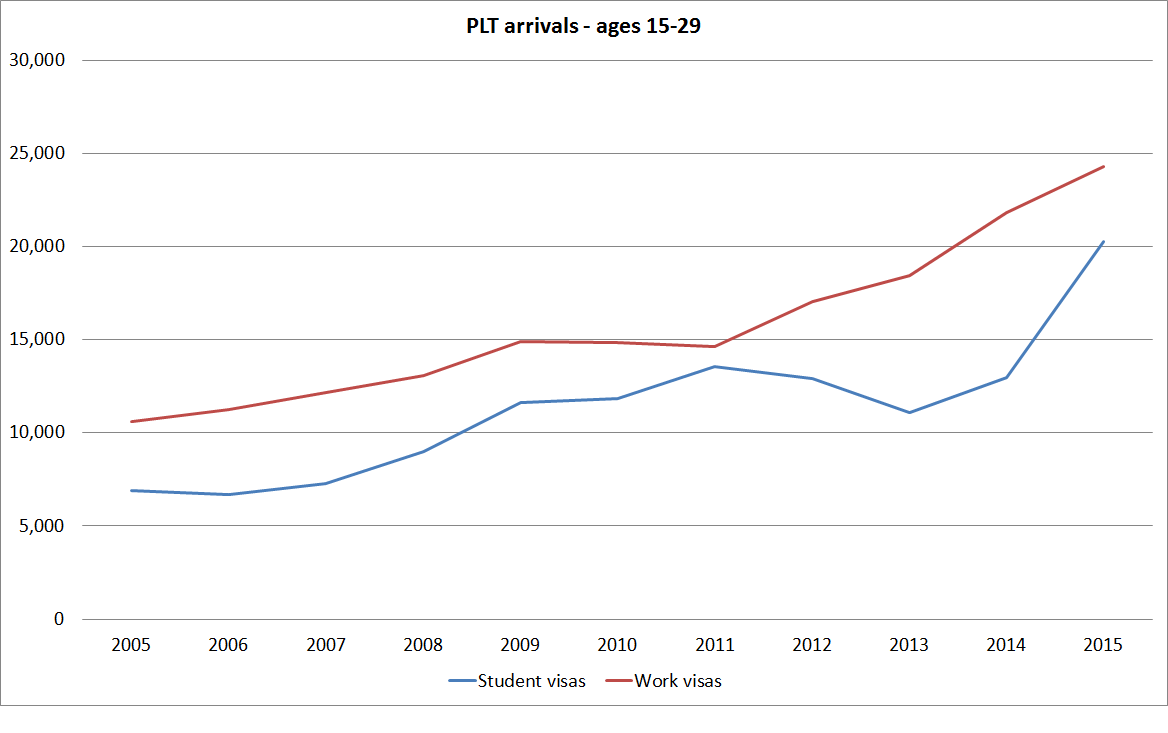
This sentence seems internally contradictory.  More single workers [or presumably married ones without children] certainly have the direction of effect the Bank talks about, but more students goes in the opposite direction.  Foreign students add to demand (for accommodation, for education, and for other consumption items) but generally add very little to labour supply.  This chart shows permanent long-term arrivals for those in the age group 15-29.  If anything, over the last year or two, the rate of increase in those of student visas has been even greater than the increase in the number of young foreign workers.

plt15-29

The article also reports

Combined with capital investment by business it means that it has taken a couple of years longer for the slack in the economy to be taken up and the output gap to turn positive than the bank expected when it started tightening last year.

But as I noted the other day:

  • The Bank’s view of the level of excess capacity that existed 18 months ago, at the start of the tightening cycle, has been revised materially.  Judging spare capacity isn’t easy, but they now think they were wrong about the earlier view that excess capacity had already been fully absorbed.
  • The level of investment since then just has not been very strong.  Growth in hours worked has been quite rapid over the last year, even by the standards of the previous boom, and yet investment did not reach previous boom levels.  (And, of course, when the previous rates of investment were occurring there was still a lot of inflationary pressure). As our best estimate is also that productivity growth has been lousy, this story of an unexpected growth in supply capacity just does not wash.

Economic forecasting is hard, and mistakes will happen.  With the possible exception of the over-optimism about dairy prices, I wouldn’t be very critical of the Bank on any of those forecasting errors.  They are the sort of thing that happens.

But what I think translated the events of the last 18 months into something a little more serious (and again, it isn’t the worst monetary policy mistake ever, by a long shot) is that the Reserve Bank was under no pressure at all to have acted at all last year:

  • Core inflation, on the estimates available to the Bank at the time, was around 1.6 per cent, and had been for several years
  • The unemployment rate was still 6.1 per cent, not far below the sort of level it have averaged in the recession years
  • Credit growth was modest

And inflation had stayed low, to that point, despite the very big and concentrated increase in residential building activity that had already occurred in Christchurch.  For several years, the Bank had (quite reasonably) cited the rebuild as one of the forthcoming major pressures on resources and inflation.  For that matter, there was no sign that commodity prices –  which had been high for a year, while inflation stayed low – were about to rise further.

When inflation is high and resources are demonstrably stretched it is quite understandable when central banks are a little jumpy about new inflationary pressures.  As I noted yesterday, Alan  Bollard raised the OCR four times in succession in 2007 when dairy prices were soaring.  With hindsight, those increases weren’t necessary –  the 2008 recession took care of the inflation, and reversed the dairy price increases –  but I wouldn’t call those 2007 increases a policy mistake.

But in 2014 the Reserve Bank did not need to act.  There were no new inflationary pressures, and the Bank was under no pressure to raise rates, other than the pressure it imposed on itself.  Having started raising the OCR, it was under no pressure to carry on increasing rates.  It was under no pressure, as late as December last year, to be talking of further rate increases.

It was a policy mistake.    They happen.  They have occurred in the past, here and abroad.    And policy mistakes will happen again.

Here’s roughly how, in Graeme Wheeler’s shoes, I  would have answered the question “did you make a mistake?”

Yes, we did.  Monetary policy aims to keep inflation over the medium-term at around 2 per cent.  Doing so means we make extensive use of economic forecasts –  trying to make sense of where we are now, and where things are likely to head over the next couple of years.    Our forecasts were not so very different from those of other economists and agencies     But we misjudged just how much pressure there was (and was going to be) on resources, and as a result we raised interest rates sooner, and further, than was really warranted.

One of the lessons people should take away from this episode is that monetary policy isn’t a precise or surgical tool.  We have to make judgements about things that reasonable people can reach quite different views about.  That means at times we will make mistakes.  When we do, we’ll be very open about them, and correct them as quickly as we can.  What I can’t promise you –  and no one can –  is that there will be no mistakes in the future.

I’m disappointed that we got it wrong this time –  and as the chief executive and single (statutory) decision-maker I have to take responsibility for that error.  Our mistakes matter for people’s lives and businesses.   But you have my commitment that we are going to learn from this episode –  not just about the economy, and also about our processes for making sense of, and responding to, the data.

I’d have applauded an answer like that. I suspect the wider community probably would have too.

Was a mistake made?

Both the Dominion-Post and the Herald this morning devoted their editorials to monetary policy and yesterday’s announcement by Graeme Wheeler.  The Herald, somewhat oddly, commends the Governor on “seeking to get ahead of the curve”.  In principle, I suppose that is always what he is trying to do –  it is, after all, forecast-based inflation targeting.  But I’m not sure that too many people would regard one OCR cut, just beginning to reverse last year’s increases, as “getting ahead of the curve” when core inflation has been so persistently low, and the unemployment rate has remained troublingly high.  A belatedly awakening might be a better description.

But I was more interested in the Dominion-Post’s thoughtful piece.  Here is the heart of it:

This is more than just an abstract number. It is a signal that more was possible. It suggests that, even though growth has been robust for the past couple of years, it might have been higher, with few costs, had the bank kept rates lower. That, in turn, might have meant more jobs and lower unemployment – which, at 5.8 per cent currently, is still too high.

Was it possible to sense any of this earlier? Monetary policy is a difficult business, and reasonable people can disagree. Certainly the plunge in global oil prices, a key factor behind low inflation, was a surprise to most observers. The slump in dairy prices, too, which will likely weigh heavily on the economy, has been steeper and more prolonged than anticipated.

But other factors were perhaps not so shocking – the slow progress of the global economy, the large influx of migrants to New Zealand (in train before last year), the persistence of low wage growth and local unemployment.

Much hinges on the opaque question of the economy’s “capacity” – essentially how hot it is running. It is always difficult to tell at any given moment; the truth gets clearer in the rear-view mirror.

The bank moved swiftly last year when dairy prices soared, the housing market surged, and the economy began hitting its straps. In hindsight, it moved too fast; it turns out there was more capacity – more labour and resources – to go round than it thought.

At the least, bank governor Graeme Wheeler and his team will need to consider if they were too quick to jump then, and too slow to reverse course.

Still, they have done it now, and rightly so.

I happen to agree with the editorial, but that isn’t really my point.  I’m hardly alone in lamenting the quality of a lot of public debate and media coverage of policy issues, but I was impressed that a newspaper editorial in this country could, in a calm way, highlight the uncertainties that monetary policy makers face, and the scope for reasonable people to disagree on the outlook for the economy.    And that the paper could suggest, in a very moderate tone, that it might be time for some critical self-examination by the Governor and his team .  It was the sort of balanced perspective that, say, those charged with holding the Reserve Bank to account, such as the Bank’s Board, might have read with profit, or which their advisers might have written.  (Of course, it is an open question whether it is the sort of piece that sells more newspapers.)

I noticed media accounts of the Governor’s appearance at FEC yesterday report him again denying that he made a mistake last year, whether in raising the OCR so much or holding it up for so long.  I’m not quite sure what he hopes to gain by this stance.  The Governor used to tell staff that his aim was for the Reserve Bank to be the “best small central bank in the world”.  One of the marks of a successful, learning, organisation is the ability to acknowledge mistakes, learn from them, and move on.  I suspect that there is a more chastened attitude internally than is evident publically, but this is a powerful public organisation, and we should reasonably expect to see more evidence of an ability to acknowledge mistakes.  A misjudgement  about monetary policy is not the worst thing in the world  –  it is in the nature of the game.   If anything, a refusal to acknowledge the misjudgement is more worrying, and detrimental to our ability to have confidence in the Governor, or in the single decision-maker governance framework.  It might, for example, be easier for a committee to acknowledge a mistake than for an individual to do so.

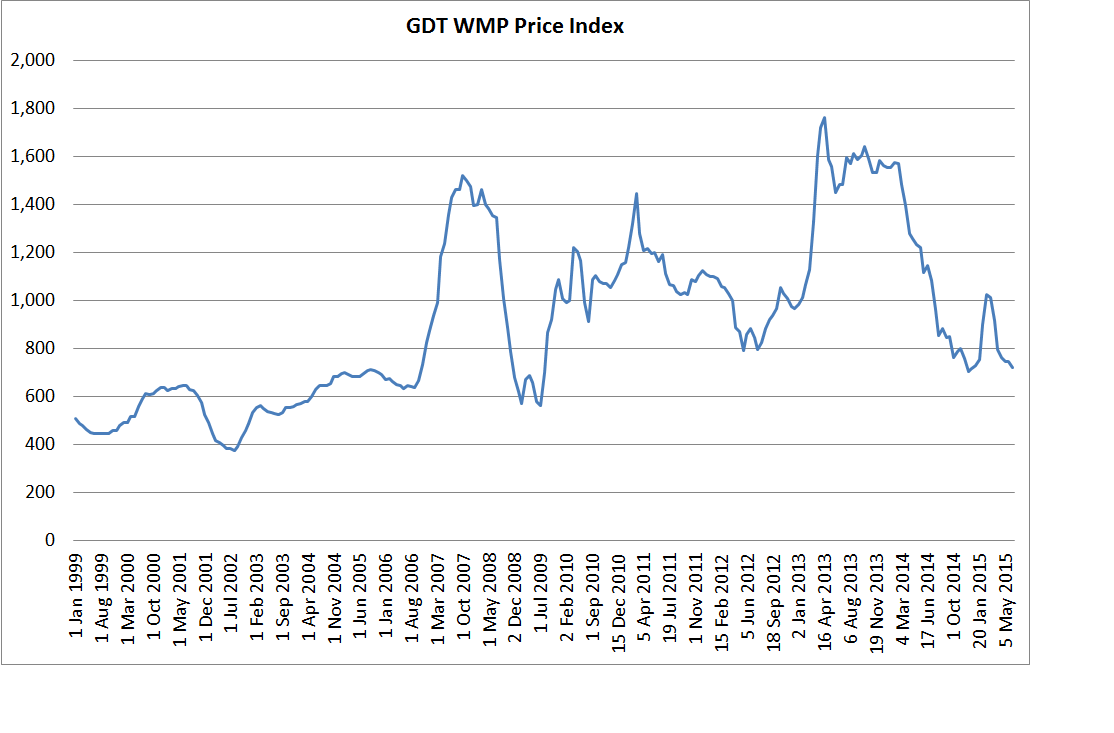
But was it a mistake?  The Governor appears to put a great deal of weight on the high dairy prices at the start of last year.  Even then, the Bank’s forecasts did not have export prices staying up indefinitely.  But the Bank’s optimistic forecasts for dairy prices back then required something quite out of the ordinary.  In the last decade, since EU policies began to change and dairy stockpiles were exhausted, global dairy prices have been much more volatile than previously (and production is much more responsive to changes in output prices and input costs).  At the start of 2015 a reasonable person might not have forecast dairy prices falling quite as low as they have or for long, but they would not have assumed the persistence of anything like the WMP prices seen in 2014.

wmp

This is what the Governor had to say in the March 2014 Monetary Policy Statement as he initiated the tightening cycle

Overall, trading partner growth has seen demand for New Zealand’s goods exports remain robust. Increasing rates of urbanisation and protein consumption in China are supporting demand for many of New Zealand’s commodity exports

Consequently, global prices of New Zealand’s commodities are extremely high, particularly for dairy. Dairy prices increased substantially in the first half of 2013 and remain at those high levels.

Rising demand in New Zealand’s trading partners, and particularly China, will result in continued growth in demand for New Zealand’s exports over the projection. Export prices are expected to remain high relative to history, though ease by about 3 percent over the next year due to an assumed moderation in global dairy prices.

The Bank –  and the Governor –  seemed beguiled by China.  A rather more reasonable approach would have been to have assumed that large fall in dairy prices were likely, even if the Bank could not be quite sure when they would occur.  Forecasters have to have a specific track.  Policymakers need to exercise judgement.

And context matters greatly.  When the first OCR increase was put in place, the unemployment rate was still above 6 per cent, less than one percentage point off the peak during the 2008/09 recession.  The recovery had not (and still has not) ever achieved the sorts of real GDP growth rates seen in earlier recoveries. And, of course, headline and core inflation were both (still) below the midpoint of the target range.  Private sector credit growth was running at around 5 per cent per annum, less than the (then) rate of growth in nominal GDP.

There just was no urgency[1].  There was slack in the economy,  continuing low inflation, modest credit growth.  Reasonable people might have been able to differ about the first OCR increase –  for what its worth, I advised against it, but I was a minority voice –  but the Governor went on tightening, moving at each of four successive reviews, even as dairy prices started falling sharply and core inflation just kept on staying low.  As late as December last year, the Governor was talking about the likely need for further OCR increases.

But he was wrong.  His approach last year was a mistake.  It appeared to be driven, at least in part, by a belief that there was something anomalous about the OCR as low as it had been, and that getting interest rates nearer the Bank’s estimate of neutral would be “a good thing”.

In one sense it shouldn’t be a great surprise that such mistakes are made. The single decision-maker system system is not well-designed to minimise the risk of mistakes (some of Alan Bollard’s early moves were also mistaken, as he later acknowledged).  And the Governor does not have a strong background in monetary policy or macroeconomics, and had not worked in New Zealand for 15 years when he took up the job.  Last year’s OCR adjustments were the first OCR changes he had made.

It would be better if the Governor simply acknowledged that he had made a mistake.  They happen.  It would be better for him, for the organisation (externally and internally –  learning organisations have to create room for staff to make mistakes), and for the country which entrusts so much power to the Governor.  If he is so unwilling to acknowledge a pretty clear-cut mistake, how willing is he to engage in critical self—scrutiny (or encourage it among staff) in areas where there might be rather more shades of grey?

[1] And, thus, the situation was quite different at the start of 2007 when, with unemployment already very low and core inflation very high, a lift in dairy prices, from relatively low levels, prompted Alan Bollard to raise the OCR four times in successive reviews.

Time to reform Reserve Bank goverance – the Bank does different things

Reader numbers tell me that anything on housing is more popular than things I write on Reserve Bank governance.  And, in fairness, the housing issues are probably more important.   But a good quality central bank, subject to best-practice governance models, matters too, and the governance issues are actually much easier to deal with. Any minister willing to pick them up would be pushing at an open door.  There would (and should) be debate around details, but no one would fight for the status quo.

This is last in my series of posts on the basic case for changing the Reserve Bank governance model adopted in 1989.  I haven’t set out to re-litigate the choices made in 1989.  At this point, doing so would only be of historical interest, and in any case I’ve tried to illustrate the quite rational and reasonable basis on which the 1989 choices were made.  But things are different now, and the governance model needs to be overhauled to reflect the way things are today.

As I noted on Tuesday, no other country does things the way we do (gives a single unelected official formal decision-making powers over both monetary policy and financial regulatory policy), even though many countries have reformed their systems since 1989.

As I noted on Wednesday, in no other area of policy in New Zealand are decisions made the way we allow Reserve Bank policy to be made.  Policy decisions (as distinct from the application of policy in individuals’ cases) are typically made by elected politicians, or by boards, not by single officials.

As I noted yesterday, back in the late 1980s monetary policy was seen by some as likely to be pretty straightforward and uncontroversial, involving little exercise of discretion. As one of my former colleagues put it, exaggerating to make the point, “with the right PTA, any bozo could be Governor”.  In fact, experience here and abroad suggests that considerable discretion is needed, and the choices have material implications for the short-term performance of the economy.  So it isn’t the sort of policy for which one might appropriately rely just on the talents and preferences of a single unelected individual, no matter how able.

And, if the conception of monetary policy has changed, so has the conception of the Bank itself.  The sort of organisation the Bank was seen as becoming materially influenced the governance model chosen.

In 1989, the Reserve Bank was seen as being en route to becoming a rather simple institution.  It would be primarily a monetary policy institution, with next to no financial risks on its quite small balance sheet.  Banking registration and supervision powers were put in the Act, but no one envisaged the Bank as being engaged in much active discretionary prudential supervision (and key failure management powers were, in any case, reserved to the Minister).

I’ve already talked about the changed conception of monetary policy, which meant that a PTA did not provide any simple or easy way to hold the single unelected decision-maker to account.  But the changes to the rest of the Bank, and their implications for governance and accountability, are probably even greater, and more important.  The Bank has been assigned by Parliament a much wider range of regulatory responsibilities (non-bank deposit-takers, insurance companies, AML, and the payment system (where it is bidding for still more powers)).  That alone represents a hugely greater weight on regulatory matters.  But in addition the Bank has chosen to use its existing statutory powers over banks in ways that involve much greater degrees of discretion.  The most obvious examples are the recent and proposed LVR restrictions, but there is also a lot of (not very transparent)  discretion involved in the approval processes for the capital models used by the big banks in calculating regulatory capital requirements.  Where considerable discretion is involved, the personal preferences of the decision-maker become important.    And that discretion can’t easily be constrained by something like a PTA  –  it is pretty much common ground that nothing like a PTA, that would materially constrain discretion, could be put in place for the financial stability policy responsibilities the Bank has.   The state of knowledge is just too limited[1].

Note that, for these purposes, I’m not questioning whether or not the Bank should have such powers, or should interpret them as it does.  I’m simply making the point that when so much discretion is involved it is inappropriate –  and not seen anywhere else –  to have a single unelected official making the decisions.  It is simply too risky.  It isn’t the way the New Zealand generally allows policy to be made.

New Zealand has pretty good quality institutions and systems of government and public sector governance.  The Reserve Bank governance model has become out of step with practice globally,  with that in the rest of the New Zealand public sector, and with what the Reserve Bank now actually does.  It really is Time to Reform the Governance of the Reserve Bank.

As things appeared in 1989

At the time Reserve Bank was thought of as being (in the process of becoming) a relatively simple institution.  Exchange control had gone in 1984, direct controls had been removed by early 1985, and government banking, tendering and registry functions were gradually being removed from the Bank.  No one in officialdom had much interest in foreign exchange intervention and the foreign reserves the Bank was allowed to hold were well-hedged.

The 1989 Act gave the Reserve Bank powers in a variety of areas, but the Bank was overwhelmingly seen as a monetary policy institution[2]  Many of the clauses of the Act were devoted to the registration of new banks, and the management of bank failures, but there was little or no sense that the Bank was likely to become a particularly active regulatory agency. People close to the work on the 1989 Act report that in detailed discussions around the drafting of the 1989 legislation, little or no attention was given to governance issues as they affected the regulatory responsibilities of the Bank.  Thus, although the governance arrangements (single decision-maker, complemented by the monitoring role of the Board) covered all the Bank’s responsibilities, it is clear that they were designed primarily with (the rather simple conception of) monetary policy in mind.

And, by contrast, how they are today:

The third aspect that has turned out materially differently than the designers of the 1989 legislation expected is the wider role of the Reserve Bank.

In the late 1980s, the Reserve Bank was envisaged primarily as a monetary policy institution, with a very limited – and well-hedged – balance sheet. Since then the Bank’s roles have expanded considerably, but there has been no material change in its (single unelected official) governance.   What are the changes in role?

The Bank has taken on substantial foreign exchange risk, including a more active foreign exchange intervention role. In crisis periods it has assumed substantial credit risk.  And whereas in 1989 the registry business was in steep decline, the Bank is now the owner and operator of New Zealand’s major securities clearing and settlement system.

But perhaps the most substantial changes have been in the supervisory and regulatory functions, which now take a much larger, and a more active, place.  Considerable amounts of regulator discretion are now being exercised, as to policy and the implementation of policy.  The change has accelerated in the last half-dozen years with:

  • The move to Basle II and then Basle III capital models (involving approval of risk models, and the exercise of detailed discretion and judgement on risk weights etc)
  • The introduction of the so-called macro-prudential (time-varying) approach to regulation of banks, including the 2013 residential mortgage LVR “speed limit” and the recent proposal for a ban on high LVR property investor lending in Auckland.  Regional differentiation in the way prudential policy is applied is yet another new step in regulator discretion.
  • The Reserve Bank becoming responsible for the regulation of non-bank deposit-taking institutions
  • The Reserve Bank becoming responsible for insurance supervision.
  • The Reserve Bank becoming responsible for implementing anti-money laundering etc legislation in respect of the financial institutions it regulates, and
  • The Reserve Bank’s bid (not yet successful) for more payment system powers.

It is common ground that there no framework in the Act for defining output-based performance standards for these functions and that for most of them it is simply not possible to do so.  That is not a criticism of the Reserve Bank, or of the roles Parliament has assigned, but simply a description of the difficulty all countries face in these areas.

So the Reserve Bank is now an organisation that, with the acquiescence of ministers and sometimes with the specific mandate of Parliament, has a wide range of functions and powers, but typically has rather ill-defined, and hard to measure, goals[3].   But that means it is very difficult to defend a conception of the Bank in which having a single (unelected) decision-maker provides for clear and decisive point of accountability across these multiple different functions and responsibilities.

[1] Although it has been pointed out that the UK Banking Act makes an effort in this regard.

[2] Section 8 of the Reserve Bank Act still states that monetary policy is the “primary function of the Bank”.

[3] In one or two areas there are memoranda of understanding with the Minister of Finance, but these documents have no legal status, and bind neither subsequent ministers nor subsequent governors.

Reserve Bank spending plans – as transparent as those of the SIS?

Sometimes events determine what I write about.  I had no intention of writing two posts today about Reserve Bank governance, but then I saw that Parliament had ratified the new Funding Agreement for the Reserve Bank.  Since these things come round only every five years, and since the Funding Agreement is a material part of the Bank’s governance framework, today was the day to write about it.

Most government activities are funded, following each year’s Budget, by annual appropriations made by Parliament.  Huge documents are published providing details of the plans the government is seeking appropriations for.

By contrast, historically most central banks were funded from their own resources, and legislatures had no real say in their spending.  A statutory currency monopoly generates a lot of income, even in this era of lower interest rates and electronic payments.  When the Reserve Bank was being reformed in the 1980s, everyone agreed that that model was inappropriate. Some parliamentary accountability/approval for the Bank’s spending was needed.  But, equally, since the main point of the reforms was to provide operational independence for the Reserve Bank on monetary policy, no one really favoured a system of annual parliamentary appropriations for the Bank.  The concern was that a Minister of Finance who wanted the Bank to run looser monetary policy could use the threat of a cut to the next year’s appropriation as behind-the-scenes leverage on the Governor.  Such pressure might be particularly easy to exert since the Governor was both sole monetary policy decision-maker, and chief executive of the organisation.

The model that was settled on and passed by Parliament was a five-yearly Funding Agreement.  Under this model, the Governor reaches an agreement with the Minister of Finance as to how much the Bank can spend in each of the next five years[1], and that agreement only becomes effective when it has been ratified by Parliament.  In fact, it is not even obligatory to have a Funding Agreement – the Act says only that the Governor and Minister “may” reach an agreement, and if there is no agreement then, in principle, the Bank has no formal constraints on its spending.

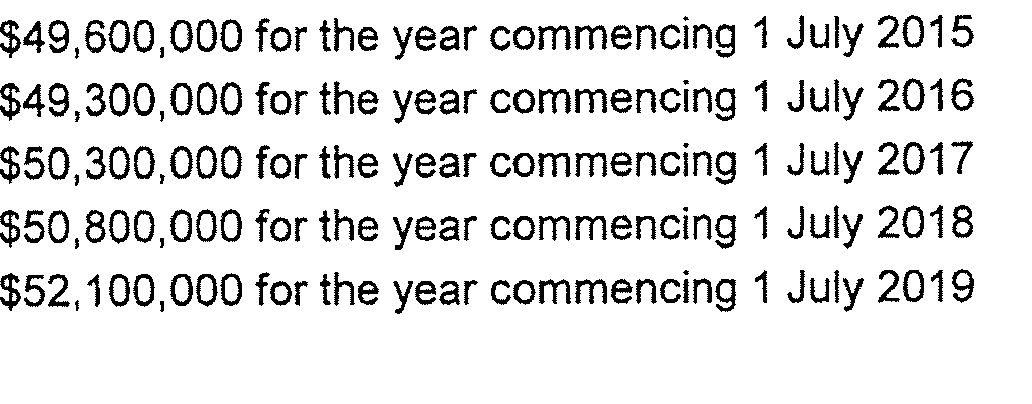
Parliament ratified the latest Funding Agreement last night, after a short debate (of which more below).  The Bank and the Minister had agreed that the Bank will spend $49.6 million this coming year, rising by about 5 per cent in total over the following 4 years[2].

I don’t have any particular argument with the size of the Funding Agreement total, or the modest increase over the next few years (although it does seem to be a larger increase than many government departments, with flat baselines, have been experiencing).  My concern is about process.

In particular, for one of the most powerful government agencies in New Zealand, the agreement contains almost none of the information people might reasonably need, whether as MPs or citizens, to know whether $49.6 million is the right amount.  The entire document runs to just over two pages, but the meat of it is simply five lines

funding agreement

That is the same level of detail we get in the Estimates about the spending of the SIS – and at least Parliament (a) has to vote for the SIS’s spending, or the spending can’t happen, and (b) has to vote each and every year.

MPs were asked to vote on the Funding Agreement yesterday with no information about what the Bank and the Minister proposed that the Bank would do with the money.  Presumably the Minister is aware of the Bank’s plans, but he now has no control over them beyond the top line number.  In particular, the Bank has two quite distinct main statutory functions and it would be useful to know how the spending is split between monetary policy and financial stability.  And within financial stability, how much is being spent on responsibilities under the Reserve Bank Act and how much on those under the Insurance (Prudential Supervision) Act?  And how are those splits envisaged as changing over time?

There is nothing in the Act that requires funding agreements to be so abbreviated, and there is certainly nothing that would have stopped the Bank, the Minister, and Treasury releasing background papers to accompany the Funding Agreement, either before it was put to Parliament.  That would have given MPs, and outside observers, the opportunity to scrutinise the plans for the Bank’s spending before the matter came to a vote in the House.  Estimates hearings for other departments spring to mind.

The Funding Agreement system was a huge step forward when it was introduced in the 1989 Act.  But it is really not good enough 25 years on.  It could be made to work in much more open and transparent way without any legislative changes (as above).

But after 25 years, it is probably time for a re-think of the entire model.  Why should the Reserve Bank be able to spend at all without parliamentary appropriation?  Even if one doesn’t go that far, shouldn’t the (elected) Minister be responsible for telling the Bank how much it can spend, not reaching a (legally voluntary) agreement with the (appointed) Governor on the matter? The Governor can provide advice, and make a bid for spending (as all agencies around town do), but the Minister and Parliament should decide.   Is there really any case for not making the Reserve Bank’s regulatory functions (at least) subject to an annual parliamentary appropriation?  And if monetary policy decision-making responsibility were to move to a non-executive committee would there still really be a need for monetary policy to be funded five years at a time by Parliament[3]?  I’m not sure how I’d answer that final question, but it should at least be asked.

The Funding Agreement model, as laid out in statute, and as it is worked in practice, is just another example of the gaps, the democratic deficits, in the governance model Parliament has put (left) in place for the Reserve Bank.  The onus for change is with the Minister and with Parliament.

And just briefly on the parliamentary debate itself, which you can read here.  It wasn’t Parliament at its finest, but then what could MPs do with so little information? Perhaps even with more information it would still have been an opportunity for hammering hobbyhorse issues?  But what if there had been an estimates hearing first?

In addition to the Associate Minister, four MPs spoke:

  • Grant Robertson seemed to be suggesting that the Bank needed more resources because the government had abdicated policy around the housing boom to the Bank.  More seriously, he argued that the Bank “should be funded for a comprehensive overview of monetary policy and of the policy targets agreement”, arguing (and this is the first time I have heard him speak on the PTA) that New Zealand needs “the kind of policy targets agreement that would enable monetary policy that actually supports the exporters of New Zealand.”
  • Russel Norman spoke, almost entirely about the housing market and financial stability.
  • For New Zealand First Fletcher Tabuteau spoke.  He took the opportunity to advocate significant change in the Reserve Bank, including the change in objectives proposed in private members bills in the previous Parliament by Winston Peters.  Somewhat gratifyingly (I think) he quoted me, and the article last weekend on my governance ideas, noting that I considered the current Reserve Bank governance model “outdated, risky, and out of step internationally”.
  • David Seymour (ACT) also spoke.  It was a curious speech, perhaps intended primarily as a rebuttal of the previous speaker.  He claimed that the Bank of Canada is modelled on the Reserve Bank of New Zealand (which is simply wrong), and appeared to blame the US housing bust on multiple objectives of the Federal Reserve (not a view that would be very widely shared).

But what else could they talk about when they have no more information about planned expenditure than is provided about the SIS?

[1] This is an approximation, both because the Bank can dip into capital (so the agreement does not formally cap the Bank’s spending even on the areas it covers) but also because various aspects of the Bank’s activities are not covered by the headline Funding Agreement total.

[2] Note that in the previous Funding Agreement the Bank had approval to spend $56.4 million in 2014/15.

[3] And actually one problem with the Funding Agreement model has been the difficulty of envisaging what spending will be required five years hence (in both real and nominal terms). No corporate board signs off on budgets five years ahead.

Time to reform Reserve Bank goverance – conceptions of monetary policy

I’ve been arguing that it is Time to reform the governance of the Reserve Bank.  Earlier in the week, I pointed out that no other country does things the way we do (giving a single unelected official discretionary control over monetary policy and much of financial regulatory policy), and that New Zealand does not operate any other areas of policy in this way.  Other policy decisions are generally made by elected politicians or by boards, not by single unelected officials.

But, as I have also pointed out, the model adopted in 1989 had its own logic.  Not only did it reflect (slightly uneasily) the public sector reforms then being put in place, that set out to establish powerful but accountable (and dismissable) chief executives of core government ministries, but it also reflected views about monetary policy that were around at the time.  And when the 1989 Act was being written, and debated, it was the monetary policy role of the Bank that got far and away the most focus. The Act said (and still says) that monetary policy is the “primary function” of the Bank.

The gist of the story is this (more extensive background is here and here):

  • Monetary policy in the late 1980s was highly contentious and subject to lots of uncertainty.  Policy was focused on getting inflation down once and for all, in a newly-deregulated economy where many indicators were hard to interpret.
  • But in some quarters, especially in the Treasury, there was a view that the issues could (and should) all be made much simpler, especially once the initial post-liberalisation period passed.  If, for example, the Reserve Bank could be required to target a steady growth rate in the money base, there would be little room for discretion, and no room for debate as to whether or not the Bank had done its job.
  • Even if those sorts of targets weren’t feasible (and I don’t think anyone in the Reserve Bank ever thought they were), perhaps an inflation target itself could a very close approximation.  If inflation ended up inside a target range, job done.   If not, then not.
  • In short, in the minds of some those shaping the Act there was a sense that monetary policy should not be particularly controversial, and should be a largely technical matter, not involving material amounts of discretion.

Against that backdrop (and I’m inevitably stylising views somewhat), a single unelected decision-maker made some sense. The person would have little effective discretion, and could be dismissed if he/she stepped out of line.

Of course, actual monetary policy, whether in New Zealand or abroad, turned out nothing like that stylised story, even in a low inflation environment.  If done sensibly, monetary policy under inflation targeting involves huge amounts of discretion, amid a great deal of uncertainty.  There are choices to be made that have implications for the price level, and for how things like the unemployment rate and the real exchange rate (and the impact those have on livelihoods of people and businesses) for several years at a time.  Oh, and there hasn’t been an election since 1990 when monetary policy has not been a campaign issue for at least some of the parties.

So the single unelected decision-maker is not a model other countries use, it isn’t how we in New Zealand run other areas of policy, and it also doesn’t fit well with how monetary policy actually works, here or abroad.

Here are the relevant extracts from my paper:

As things were seen in the late 1980s:

This outputs vs outcomes framework was an important factor in the debate around how the Reserve Bank of New Zealand should be governed[1].    From the original discussions around the possibility of converting the Reserve Bank into an SOE, through until at least a year after the Reserve Bank Act was passed, elements of the Treasury were heavily influenced by a strand of thought that reckoned that monetary policy could be appropriately, and perhaps best, configured as an “output” problem.  If so, an autonomous decision-maker could be held clearly and directly accountable for delivering a pre-specified desired output.

At one stage, the idea of a statutory quantitative limit on the Reserve Bank’s note issue was floated.  Rather more persistent was the view that a target rule for growth in the money base – something that could be directly controlled by the Reserve Bank if it chose – was the appropriate basis for setting monetary policy.  If so, it would have been easy to judge whether (or not) the Bank had done its monetary policy job.

Within the Reserve Bank and Treasury it was largely common ground that something like price stability was the appropriate medium-term desired outcome.  However, it was also accepted that, in a market economy, inflation was not directly controllable by policy actions, and could be influenced (indirectly) by monetary policy only with fairly long and variable lags, and subject to a variety of exogenous shocks[2].   A robust relationship between the monetary base and medium-term price stability might have provided a suitable foundation for an outputs-based approach.  But such a relationship never emerged.

The point here is not that the governance aspects of the 1989 Act mechanically reflected views of particular individuals about which operational targets the Reserve Bank should use to conduct monetary policy.   It is more that the milieu inevitably, and perhaps even appropriately, affected the thinking about institutional design.  On the one hand, public sector reforms processes put a strong focus on individualised accountability.  On the other, there was a sense – perhaps rarely written down explicitly, but implicit in a lot that was written – that once low inflation had been achieved, the conduct of monetary policy should be relatively straightforward and not especially controversial.  The implicit vision of monetary policy was of an important, but essentially technical, matter.

And now:

Except for fixed exchange rate countries, output-based approaches to monetary policy do not work.  That was fairly generally recognised internationally by the time the 1989 legislation was passed, but ideas around an output-based framework still had an impact on the New Zealand framework.

For a time perhaps, some hoped that even though an inflation target was for an outcome, it might still be amenable to output-like accountability regimes.  If inflation outcomes were inside the target range, the Reserve Bank had done its job, and if not, then not[3].  But it has not proved to be that simple, for a variety of reasons.  Even core inflation outcomes can be away from the target midpoint for years, and considerable amounts of judgement are required to interpret the Policy Targets Agreement (including, but not limited to, questions around avoiding “unnecessary variability” in output, interest rates and the exchange rate).

Monetary policy setting, in the forecast-based approach adopted across the advanced world, involves considerable discretion.  Reasonable people can reach quite different views

And since Reserve Bank discretion involves choices that can materially affect output and unemployment, for periods of perhaps 1-2 years at a time, or the real exchange rate (and hence relative returns across major sectors of the economy), these choices matter to many people.  To be clear, monetary policy choices materially affect only the price level in the long run, but transition paths (especially when discretionarily chosen) have real implications for real people.

At the time the 1989 Act was passed, monetary policy was highly controversial (as, of course, was much of the rest of the reform programme). But the implicit view was that once low and stable inflation was established monetary policy would be a fairly low-key matter, not exciting much debate or political contention.  In fact, since 1989 there has not been a single general election in which at least one party has not been campaigning for change to the monetary policy aspects of the Reserve Bank Act[4]. Latterly, the tide has been rising, and at the last election for example all the parties on the political left were campaigning for change.  The point here is not whether (or not) the advocates for change are correct, simply to highlight that monetary policy remains contentious, and that to vest all powers in such a controversial area in a single unelected official increasingly seems anomalous.

……..

If a central bank has discretion – and all modern ones (not adopting fixed exchange rates) do – then preferences and values come into play, and it is not obvious why the preferences of a single unelected official should be given such a high weight.

One previous Reserve Bank Governor sometimes liked to argue that he wasn’t very powerful at all – that he was tightly constrained and really had little choice around the decisions he took.  If he really believed it (and he was talking only of monetary policy in any case), I think he must have been the only one to have done so.

Reflect, for example, on the last boom during the 2000s.  Core inflation ended up persistently well above the target midpoint (with no action taken against the Governor by either the Board or the Minister).  That suggests that a different Governor could equally legitimately have made choices that delivered inflation as far below the midpoint of the target range.  Over a 10 year view that difference might not have made much difference to the end-point level of GDP, but it almost certainly would have made a huge difference to the trajectory of GDP, and of many economic activity/price variables, including house prices, debt, the exchange rate, and exports.

Or consider the years since 2007.  Actual decisions have been widely regarded as PTA- consistent, but different Governors could have made a plausible case for a materially looser stance.    That is real, and largely untrammelled[5], power of the sort that societies such as ours very rarely repose in a single person –  elected or not –  no matter how able.  (Indeed, this was the gist of Lars Svensson’s case, in his 2001 review for the previous government, for a formal decision-making committee. Svensson thought very highly of the then Governor, but argued that we needed to build institutions to cope with the less good ones –  less technically able, less inclusive, less good judgement or whatever.)

[1] These issues are treated in Singleton, in a Bulletin article on the origins of inflation targeting http://www.rbnz.govt.nz/research/bulletin/1997_2001/1999sep62_3reddell.pdf, and in  this Reserve Bank piece on monetary policy accountability and monitoring http://www.rbnz.govt.nz/monpol/about/2851362.html

[2] As the Bank itself noted in one 1988 paper, the problem with inflation targeting (relative to, say, money base targeting or a fixed exchange rate) is that it had a “trust us, we know what we are doing” dimension.

[3] The high tide of this sentiment was Don Brash’s unequivocal statement in a radio interview in 1993 that if inflation went above 2 per cent (the top of the then target range) he would lose his job (this statement is reproduced in an interview with Dr Brash included in the September 1993 edition of the Reserve Bank Bulletin).

[4] As far as I am aware, this degree of electoral debate over central banking, spanning multiple elections, is unique to New Zealand.

[5] The note on accountability and monitoring, referenced earlier, discusses some of the practical constraints on what appears in statute to be the Board’s considerable freedom of action to hold a Governor to account.

Yet more on stress tests

Two more points on the stress testing issue.

I’ve mentioned a couple of times that someone who was at the Finance and Expenditure Committee hearing on the day of the Financial Stability Report had told me that the Governor deliberately refused to answer a question about the stress tests, and the implications of those results for assessments of the stability of New Zealand’s financial system.

I’m told that the transcript of that hearing is now on the public record, so here is the relevant question and answer.  The questioner is National MP Chris Bishop, who is deputy chair of the committee:

Bishop             Thanks, Governor. I’m just interested in teasing out what the specific risks to financial stability are for Auckland house prices, because the banking sector has rising capital and liquidity buffers; they exceed the minimums. The banks came through the stress testing pretty well last year. Credit growth is relatively restrained, and as a percentage of GDP, credit is below where it was in 2008-09. So given all that, what are the specific risks to financial stability—which is what we’re discussing here today—from the rising Auckland prices?

Wheeler           I think they’re very substantial. I mean, if you look at mortgage commitments, you quoted a number that credit flowing to the housing sector was low. It is on a net basis, but if you look at mortgage commitments, they’re growing at around 20 percent. House prices in Auckland are growing at around 17 percent. They’ve been growing in the rest of the country over the last year at around 2 percent. If you look at house prices to disposable income in Auckland, that ratio is 7.4 percent. But the rest of the country is 4.2 percent. If you look at rental yields in Auckland, they’re at historic lows, which suggests that there’s a lot of people basically investing for capital gain, whereas the rental yields across the country are basically where they have been for the last 10 years.
If you look at the median house price in Auckland, it’s up 60 percent since 2008. We had the highest rate of house price inflation in the OECD from 2003 to 2008. So the median house price in Auckland is now 60 percent above that. If you look at the Demographia survey that was done last year, we were 14th out of 370 housing markets around the world, in terms of affordability. If you look at the survey that was done by ANZ Bank in terms of investor expectations, late last year, basically, investors in Auckland were forecasting that house prices would increase by 75 percent over the next 5 years. Now, our job is to try and keep inflation, on average, at around 2 percent per annum. So that’s just a phenomenal increase in house prices that are anticipated, and that would just drive house price to disposal income ratios up at a huge rate.

So there’s a whole range of reasons why there are major, I think, financial stability risks around Auckland.

The Governor raised a number of interesting issues, and possible areas of risk, but did not respond to any of Bishop’s points or questions.  Now sometimes MPs at select committees can ask questions just to be on record as having asked them, or to make partisan points.  And so there is an art in how public servants respond to such questions.  But Bishop’s questions and points don’t look as though they fit either of those categories.  They seem to be entirely reasonable questions, drawing on the Bank’s own factual material, and yet the Governor simply chose not to engage or respond.  That doesn’t seem very wise, or very accountable.

And now, back to some geeky stuff.  In discussing the stress tests this morning I mentioned the issue of what size house price fall one might reasonably assume if the stress tests were re-run today.  But as someone pointed out, neither I nor the Bank touched on the other factor that is critical in assessing the likelihood of large loan losses, and that is what happens to unemployment.

By and large, falls in house prices alone do not result in large losses for banks.  Between with-recourse lending and a general desire to avoid moving (which is costly and disruptive), owner-occupiers don’t tend to default if they can service their debts.  Banks can, typically, foreclose if the borrower has negative equity, but are unlikely to do so if the debt is being serviced.  Much the same is likely to go for lending for investment properties –  if rents are high enough to cover the debt service, banks aren’t likely to foreclose.  Foreclosing (itself expensive) crystallises a loss, which might otherwise never happen.

Similarly, high unemployment alone doesn’t typically lead to large loan losses on residential lending.  Some individuals will end up losing their houses, but if they have to sell up (or be sold up) the sale price will usually cover most or all of the debt outstanding.

What gets really nasty is the scenario in which house prices fall a long way and unemployment goes up a lot (and stays high for a while).  In that scenario, many people can’t service their debts (even if the OCR is cut) and if they have to sell, in many cases the proceeds won’t be large enough to cover the debts.

That is the scenario the Reserve Bank’s stress tests (rightly) focused on.  It is the true test of the quality of the residential mortgage loan book.

The Reserve Bank tells us that in the stress test they assumed that the unemployment rate “peaks at just over 13 per cent”.  The unemployment rate at present is 5.8 per cent, and the “natural rate” is probably around 5 per cent.  The modern low was 3.4 per cent.  So 13 per cent is a long way away.  In normal times it would take around an 8 percentage point increase in the unemployment rate to get to “just over 13 per cent”.

I was curious how unusual 13 per cent unemployment rates were, so I downloaded the OECD data as far back as it goes.  In most cases, that is just over 30 years (but we also know that in most OECD countries the earlier decades were decades of pretty full employment).

Here is the chart of the highest unemployment rates on record for each of the 34 OECD countries.  Only 13 of the 34 countries has had an unemployment of 12.5 per cent or above in more than 30 years.

peakU

I took a look at those countries.  First, I wanted to understand how much the unemployment rate had increased by in each of those country episodes.  If the NAIRU in one country had been 10 per cent (perhaps reflecting very restrictive labour market regulation), an increase in the unemployment rate to 13 per cent would have much different implications than if that country’s NAIRU was 6 per cent.

Of the 13 countries whose unemployment rates had peaked at over 12.5 per cent, in one case that peak was the first observation in the database (so I couldn’t tell where the unemployment rate had risen from).  Six of the other 12 had had increases in their unemployment rates of 8 percentage points or more (from the previous cyclical low to the measured all-time peak).  Thus, for example, Greece’s unemployment rate peaked at 27.8 per cent last year, but had been as low as 7.5 per cent in 2008.

But the other factor I looked at was the exchange rate regime these countries had been using when their unemployment rate rose to 13 per cent or more.  In only two of the 13 cases had the exchange rate been floating, and in neither of those cases had the unemployment rates increased by anything like 8 percentage points.

Why do floating exchange rates matter?  Simply because they act as a buffer when the economy is hit by severe shocks.  Greece, Spain, and Ireland have had very high unemployment rates (and large increases in those rates) in the last few years because they have had no independent national monetary policy, and no ability for their national nominal exchange rates to depreciate.  The US, the UK, and Iceland, on the other hand, each having had a nasty financial crisis, had nothing like the extent of those increases in unemployment.

Adjustment is a great deal harder, and more costly, without the additional flexibility the floating exchange rate provides.  But New Zealand has had a floating exchange rate for 30 years now, and when the economy has been in serious difficulties the exchange rate has fallen a long way.  No one really doubts that the same would happen again if, say, there was a serious recession here that involved the OCR being cut to, or near, zero.

I’m not suggesting that the unemployment rate could not possibly rise by 8 percentage points here.  From 1987 to 1991, the unemployment rate did rise by 7 percentage points, to around 11 per cent, even with a floating exchange rate.  But that was a pretty stringent test:

  • Huge amounts of labour-shedding from public and private sector structural reform
  • A serious domestic financial crisis
  • And the transitional costs of both lowering inflation markedly, and closing the fiscal deficit, at the same time.

My point is simply to highlight that the Reserve Bank’s stress tests were very stringent, using an increase in the unemployment rate larger than any seen in any floating exchange rate country in at least 30 years.  It is right that stress tests are stringent (the point is to test whether the system is robust to pretty extreme shocks)  but these ones certainly were.  And yet not a single one of big banks lost money in a single year.  That might seem a bit optimistic –  it did to me when I first saw the results –  but they are the Reserve Bank’s own numbers.

And so, again, we are left wondering where is the evidence for the Governor’s latest regulatory initiative?