LVR controls, regulatory philosophy (and the OIA)

I’ve had a bit of a relapse in my recovery and seem set to spend much of this week doing little more than lying on the sofa reading something not too taxing.  There are plenty of things I’d like to comment on substantively, but for now it won’t happen.

The Reserve Bank released its (latest –  third in three years) final LVR decision on Monday.  To no one’s surprise, after a sham consultation, they confirmed the Governor’s original plans, albeit with some curious refinements to the exemptions –  curious, that is, if one thinks that decisions on such things should be based on considerations – the statutory ones – around the soundness and efficiency of the financial system.

And although the lawgiver has now descended from the mountain and issued his unilateral decrees, which have the force of law, there is still no sign of a regulatory impact assessment.  There is talk in the summary of submissions that one is forthcoming, but really……when the regulatory impact assessment is published only some time after all the decisions have been made, it reveals quite how little weight the Governor seems to put on good processes.  And it is not as if the initial consultation document was sufficiently extensive and robust to cover the ground –  recall the “cost-benefit” analysis that consisted of a questionable list of pros and cons with no attempts to quantify any of them.

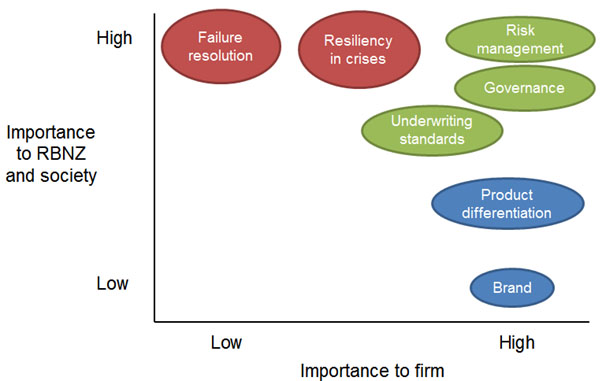
One of the other things I had hoped to comment on in more depth was a speech given last week by Toby Fiennes, the Reserve Bank’s Head of Prudential Supervision. on the Bank’s regulatory philosophy and supervisory practices.    It included this nice chart, outlining various aspects of financial institutions’ operations and how much, in the Bank’s judgement, they mattered to the “RBNZ and society” (as if these were the same thing) and how much they mattered to the institutions themselves.

Figure 1: Selected interests of the RBNZ, society and financial institutions

fiennes

Fiennes went on to note that the blue areas aren’t of much interest to the Bank (and don’t therefore attract much regulatory interest), while the red area are typically quite heavily and directly regulated.

But in this context, it was the comments on the green areas that caught my eye

Some things – like risk management and underwriting standards (in green) – are of strong interest to both the Reserve Bank and firms. Here we tend to use market and self-discipline. Examples of some of our supervisory practices in this area are:

  • Disclosure of credit risks;
  • Mandatory credit ratings;
  • Governance requirements; and
  • Publicly disclosed attestations by the board that key risks are being managed.

Now I know that the Bank’s prudential supervisors have never been keen on LVR restrictions, and that they are devised in a different department, but……..all controls are imposed under the same legislation –  indeed the same part of the legislation –  and by the same Governor.  And when housing loans are the biggest single component of banks’ credit exposure –  and banks have most to lose if things go wrong – and yet when the Bank has imposed three sets of direct controls on housing LVRs in three years, imposing its own judgements on underwriting standards, you might have hoped that practice and “philosophy” might have been better reconciled, or the gaps smoothed over in a speech by the Head of Prudential Supervision.

As regular readers know, I’ve been pushing to get submissions on Reserve Bank regulatory proposals routinely published.  Such publication is common practice in other areas of government, including submissions to parliamentary select committees.  If you make a submission seeking to influence public policy, that submission should generally be public as matter of course –  it should be one of the hallmarks of an open society.

Some progress has been made with the Reserve Bank.  If someone asks, they will now typically release submissions made by anyone who isn’t a regulated institution.  I asked for all the submissions on the latest LVR “proposal” to be released, and  –  as expected –  the Bank has released all those not made by banks (the regulated institutions in this proposal).  Anyone interested can find those submissions here. I have three remaining areas of concern.

The first is that release of submissions should be a routine part of the process for all consultations, not just when someone makes the effort (remembers) to ask.  The second is that on this occasion they have withheld the names of four private submitters.  As I noted, if you want to influence lawmaking, you should be prepared to have your name disclosed.  How can citizens have confidence in the integrity of lawmaking processes if they don’t know who the Bank is receiving submissions from, and what interests they may represent?  (Of course, since one of the anonymous submitters appears to have views very similar to my own, we can safely assume that that person’s views will have had no influence on the Bank.)

And the third concern is that the Reserve Bank is still consistently keeping secret the views of regulated entities (the banks in this case).  When the regulated lobby the regulator it is particularly important that citizens are able to see what arguments are being made, to ensure that the process remains robust and that the regulators are not being “captured” by their closeness to the regulated –  bearing in mind that the Bank is supposed to be regulating in the public interest, not that of banks.   As I’ve noted before, the Bank justifies withholding bank submissions on the grounds of section 105 of the Reserve Bank Act –  which they argue compels them to withhold such material.  In fact, that section of the Act gives no hint of a distinction between material received from banks and that from other parties,  If section 105 applies to submissions on proposed regulatory changes, the Bank is obliged to keep secret all submissions, not just those from banks.  As I’ve noted before, there is a good case for a small amendment to the Reserve Bank Act to make it clear that the section 105 protections do not apply to submissions on regulatory proposals and hence that banks should expect their submissions to the Reserve Bank on regulatory initiatives to be published, in just the same way that bank submissions to parliamentary select committees will generally be published.

I have appealed to the Ombudsman the Bank’s decision to withhold the bank submissions, in effect seeking greater legal clarity on what the section 105 restrictions actually apply to.  In the meantime, of course, if the banks have nothing to hide –  and I don’t imagine they really do –  they could chose to publish their submissions.  According to the Summary of Submissions “a few respondents urged tighter LVR restrictions on investors than proposed”, so perhaps the ANZ really did follow up on their CEO’s newspaper op-ed and advocate more far-reaching restrictions.  If so, citizens should have the right to know (customers might be interested to, but that is their affair).

Graeme Wheeler, Geoff Bascand, and the cluster munitions

As a a key regulator of components of the New Zealand banking and financial system, and an institution which puts a great deal of emphasis in its regulatory philosophy (expounded again in a speech given only last night) on strong governance systems  and protocols and the importance of directors taking very seriously their legal and other responsibilities, you might have supposed that the Reserve Bank would be punctilious in observing canons of good governance, to the limits of the legal requirements and beyond, for any institutions they themselves, and key managers, were associated with.  After all, that respect for the law, for boundaries, for the appropriate management of potential and actual conflicts of interest for example, would surely be second nature.  And, even if it weren’t, they would surely want to set a good example, and be whiter than white so that if questions even arose there would no doubt that the Reserve Bank was operating fully consistently with the best of the sorts of standards they espouse for (and often impose on) regulated institutions.

Unfortunately, if that had been your supposition, you would be quite wrong.

I’m a trustee of the Reserve Bank of New Zealand Staff Superannuation and Provident Fund.  The long-standing fund, long since closed to new members, is established and operates under its under trust deed.  It is a separate legal entity, with its own governance structures, lawyers,auditors, and is subject to the Superannuation Schemes Act, soon to transition to the Financial Market Conduct Act.  The Reserve Bank is a party to the deed that establishes the fund, but neither the Reserve Bank, nor its Board of Directors (nor for that matter the Minister of Finance) has any powers in respect of the Fund.  It cannot direct the trustees on their investments, or how to apply the rules, and nor has it any rights to demand information from the trustees.  The Bank has obligations to the Fund under the trust deed, but no specific rights or powers in respect of it.   By law –  common law and statute –  all trustees must operate in the best interests of the members of the Fund.  The Fund, in essence, exists for members, in effect holding some of their remuneration in a savings vehicle and then paying out pensions and other benefits, under the rules, in due course.

On paper, the governance model is quite elegant.  The Governor is a trustee.  The Bank’s Board appoints one of its members as a trustee, and they also appoint one member of the scheme as a trustee (although both these appointees serve at the pleasure of the Board, and appointments can be revoked at any time if those trustees get difficult).  And there are two trustees elected by the members for five year terms.  I’m one of those members’ trustees.    Most members are now retired, so typically members’ trustees also are (although I’ve been a trustee since 2008).

But whoever appoints the trustees, none of us serves as delegates or representatives of those who appoint us.  We are all –  equally –  subject to the same legal responsibility that in conducting the affairs of the Fund, we must serve the best interests of members.  If there is any (actual or potential) conflict between the interests of members, those conflicts need to be identified, but it is the interests of members that must be paramount.  For material conflicts, conflicted trustees should absent themselves from involvement in the matters where conflicts arise.

This isn’t novel stuff.  And it has long been recognized that when senior managers  (or directors) of sponsoring organisations serve as trustees of superannuation funds, there is a particularly serious risk of conflicts of interest arising, between the duties those individuals owe to their employer, and those they owe to the members of the superannuation scheme.  In the United Kingdom, the Pensions Regulator some years ago published a very useful and substantial guide to managing conflicts of interest in the context of superannuation schemes.

Management of these issues at the Reserve Bank scheme has been shockingly bad over the years.  From meeting to meeting, there often aren’t material conflicts, but when the conflicts do arise there has been no evidence that the Governor (or, typically, his alternate  –  since the Governor consistently claims to unavailable for meetings, even when scheduled a year in advance) has managed those conflicts in ways consistent with their overriding legal obligation, when acting as trustees, to act in the best interests of members.  I’m a bit of a starry-eyed optimist at heart, so have been constantly surprised at how indifferent to these responsibilities  trustees who are senior Bank managers have been.  Mostly, I don’t even think it is willful –  but sheer indifference, or failure to appreciate the importance of appropriately managing conflicts of interest, are almost as bad.  Perhaps especially in an institution that is a key financial regulator.

I could give you lots of boring detail about examples.  This is a troubled scheme, against which complaints have now been made to the Financial Markets Authority (regulator of such superannuation schemes).  But for now, those are issues for us, and many of them are very complex.

But this morning one of the issues has been put in the public domain by the trustees as a whole, acting under duress.  This morning, the trustees made their first ever press statement (stories here and here) .  And so since the matter is in the public domain, I feel free to give you some context.

On Wednesday last week, in the face of media coverage of some of the investments of the State Services Retirement Savings Scheme, I suggested to trustees that we should check with our investment managers on whether we had any similar exposures, about which questions might be raised.  As I noted then, I wasn’t particularly concerned for the fund itself –  a private body, and closed to new members –  but recognized that there might be some reputational questions for the Bank, and that we should probably be aware of any such exposures.  Our regularly quarterly meeting was to be held the next day, which would provide a good opportunity to discuss the matter (albeit, we already had a full agenda).

Our administration managers arranged to get the relevant information, at least at a high initial level, identifying that in one passive offshore equity fund we had holdings of, some of the underlying shares were those of firms associated with what might be considered “controversial weapons”.

The next day we held a meeting of trustees.  It was long and difficult one dealing with several other issues.  The Reserve Bank’s Deputy Governor, Geoff Bascand, is the Governor’s alternate (when the Governor is unavailable to attend) and also chairs the meeting.  He made no effort to raise the “ethical investment” issue, and when he tried to adjourn the meeting I pointed out that we had still not discussed this issue.  Geoff insisted he had another meeting, and rather than (say) handing over the chairmanship to another member, he simply refused to have a discussion, made no effort to schedule one even by email (we only meet quarterly) and ended the meeting and left.  Curiously, as he left the meeting he signed, as chair, a revised Statement of Investment Performance and Objectives (SIPO), a document all superannuation schemes need to have, that reaffirmed our existing investment approach, including (explicitly) the holdings in the offshore index fund that had the small “controversial weapons” exposures.

We heard nothing more until late on Monday when Geoff emailed trustees about a written parliamentary question that the Minister of Finance had received.  Predictably, questions had been raised about the holdings of the Reserve Bank superannuation scheme.  As is customary, the Minister’s office had referred the PQ to the Reserve Bank for advice on a draft answer.  The people who handle PQs etc in the Reserve Bank work to Geoff, as Deputy Governor.

It wasn’t clear to me what business it was of the Minister of Finance.  The Minister has no ministerial responsibility for the Reserve Bank superannuation fund (structure and governance as above) although he no doubt does have responsibility for the actions of the Reserve Bank (including vis-à-vis the Fund).   How the Minister chose to answer was, and is, up to him.  However, the information requested in the PQ belonged to the trustees, and no one else (in this context, the Reserve Bank or the Minister) had any legal right to demand it from us.  It was our information, and our members’ money.

In a well-governed institution, Geoff would have passed on the PQ to trustees and invited trustees themselves to consider how the Fund should respond.  If the Bank had wanted us to provide the information so that, in its interests, it could pass it on to the Minister, a proper request, cognizant of the legal responsibilities of the trustees, could have been made to the trustees.  And given the potential for the interests of the Bank and the trustees to diverge, Geoff would wisely have taken no further role in the discussions on the matter by the trustees.

But this was the Reserve Bank.  By the time, late on Monday afternoon, that trustees were even made aware of the issue, Geoff had already emailed our investment managers and got the detailed information that was being sought in the PQ.     In fact, he had known about the request since mid-afternoon on the previous Friday.  And when he emailed the investment managers, he didn’t keep the information to the trustees (or their own administration managers), he copied in Bank staff who had nothing whatever to do with the superannuation scheme.  Emails went back and forth on Sunday and Monday, every single one was copied to other Bank staff, and the trustees had still not been made aware of the issue.  To the extent that Geoff Bascand had a right to the information on the Fund’s investment, it was solely as an (alternate) trustee, not as Deputy Governor of the Bank, and he had no right at all to use that information himself for Bank purposes or to share that information with Bank staff, without the prior authorization of the trustees as a whole.

That made the whole exercise a fait accompli.  Whatever the attitude of trustees, the Bank now had our information and was free to use it as it chose.  Geoff’s email to the trustees late on Monday afternoon said “we have to supply information” –  but it wasn’t clear, at all, who “we” were.  The trustees were certainly under no legal obligation to do so.

As the first trustee to respond to Geoff, I noted that the Minister had no power over, or ministerial responsibility for, the Fund, noted that we needed to obey any laws constraining our specific investments, noted that shifting the portfolio in response to Bank reputational concerns could be costly so the Bank might need to consider reimbursing the Fund, and also highlighted the importance of ensuring that conflicts of interest were appropriately managed in handling this issue.

There was never of any sign of that.  The Bank –  having obtained our information without authorization –  simply advised us, via emails from Geoff (never clear from them whether acting as a trustee or as Deputy Governor) that the Bank would pass on our information to the Minister, would advise the Minister to answer the question fully, and would advise the Minister to say that the Bank would be seeking to encourage us to adopt an “ethical” investment policy.   Continuing his glaring inability to recognize the different interests of the Fund and the Bank, he urged trustees not to approach the Minister’s office directly “as the Bank was handling that”.     The Bank, of course, was not required  –  or expected – to operate in the best interests of members (or trustees).

We gravitated towards the idea of putting out our own public statement –  while Geoff continued to act as conduit for the Bank in telling us what the Bank “insisted” had to be in such a statement.  At one point, I explicitly asked Geoff, acting as trustee, what course of action he thought we should take, acting (as legally required) in the best interests of members.  He simply refused to answer directly, responding with the following extraordinary comment

Now I accept that this may reflect the Bank’s interests more than that of Trustees per se, but the reality is that a Bank director, the Governor and a bank employee are trustees (with me as alternate and chair).

All these people are legally required to act in the best interests of members.  For several years, I was an employee and a trustee, and I hope I always sought to do so.

Fighting something of a rear-guard action, I argued that if we were giving the information about these exposures to anyone, we  should at very least provide it to members of the scheme before we provide it to the Minister of Finance, let alone the public.   It is, after all, their money, and if there are to be any changes in investments as a result of a distaste for particular types of exposures, members’ preferences should presumably be the ones that count.  That request got nowhere either, with Geoff apparently much more interested in his day job as Deputy Governor.  We finally got a grudging statement that the information would be sent to members shortly after our public press release went out at 10am this morning.  It went out, baldly, with no context or background.  Frankly, it is the sort of process that treats members with disdain.  I can only apologise to our members for that.

There has been a suggestion that even a passive interest in cluster munitions firms, through a very broad-based index-linked fund –  we held one that mirrored the MSCI  World ex Australia index  –  was illegal under New Zealand law.  There is a range of views on that issue apparently, and reallocating any fund’s investment involves (potentially quite material) transactions costs, but even when it was suggested that we should consult our own lawyers, or the legal opinions of industry bodies, Bascand has little or no interest.  The best interests of members didn’t seem to matter, but the “reputation” of the Reserve Bank did. I have no particular problem with the Reserve Bank managing its own reputational risks –  recall, I was the first person among trustees to even raise the issues –  but for a Reserve Bank senior manager to abuse his position to force through the Bank’s interests is quite another matter.

In the press release it states that

Trustees will act expeditiously to eliminate our exposure to these firms.

In fact, when I pointed out yesterday that if we were going to say this, we really should have some sort of process in place to effect the change (eg formally request options and costs from our investment managers), I was simply ignored. Trustees have not commissioned any such process yet.    I guess what mattered more to the Bank was to (have the trustees) be seen to say it.

The press release goes on.

The Bank has requested that Trustees adopt a socially responsible investment policy and we will consider the matter at our next meeting.

At the time this press release was agreed there had been no such request at all.  When I asked again last night, shouldn’t we actually have a written request from the Bank if we were going to say there was such a request,  one finally came through at 8.24 this morning.  Interestingly, it came from the Bank’s Communications Manager, highlighting the extent to which this is mostly a Bank PR management issue.  Graciously, the Bank sent through a version of their “socially responsible investment policy”, expressing their “surprise” that the trustees did not have such a policy and commending to us the example of theirs.  This blatant attempt to seize the high moral ground was somewhat undermined  (in addition to the fact that the Governor himself is a –  absentee – trustee) by the fact that their own ‘responsible investment’ policy document does not apply to international ventures the Reserve Bank is party to, or to any specific countries.   Which is convenient because, as I used to point out as an insider, it allowed the Bank to invest New Zealand taxpayers’ money in Chinese government bonds, do swap deals with the Chinese central bank, even though China remains one of the greatest human rights abusers of modern times, as well as an aggressively expansionist power.  Maybe that is just fine, in the interests of international relations, but don’t try claiming the moral ground Governor.  Perhaps its just me, but $15000 of passive indirect holdings in companies that may be making cluster bombs, bother me much less than the Bank funding the butchers of Beijing.  Tastes on that will differ –  but the Reserve Bank’s assets are public money, and the superannuation scheme’s assets are not.

So let’s summarise:

  • as recently as last Thursday, this issue didn’t bother Bascand –  or his boss, who could have turned up to a trustees meeting –  enough to even have a discussion at a long-scheduled meeting.  Despite the points I’ve noted here, had they done so, I’d have suggested we get a prompt legal opinion, get out of such exposures expeditiously if they were illegal, and if not would have been happy to have agreed to restructure the portfolio if the Bank had covered the transactions costs etc of doing so.
  • But once the PQ was asked, the Bank panicked.  Good governance processes were over-ridden and in exchange after exchange, Geoff Bascand –  a man generally regarded as ambitious to become the next Governor –  prioritized the interests of the Bank over the interests of members of the superannuation fund.  That wasn’t just bad form, it was in breach of the fundamental duty of trustees.
  • When an institution communicates with an associated institution, that is only a email away, primarily by press release, you know that what is going on is mostly about spin and PR.

Does it really matter?  On the specific issue, perhaps not overly, and the final outcome might well have been the same anyway.  After all, I’d raised the issue before the MP did.  But as the old saying had it “take care of the pennies and the pounds will take care of themselves”.   It applies as much to doing the small stuff well, and having good and disciplined processes in place, and observed.  The Reserve Bank would surely expect no less from the institutions it regulates/supervises.  And when small stuff is done badly –  as it was here –  it often points to some rather serious problems in the institution concerned.   .

I don’t know how the Minister of Finance will eventually choose to respond to the original parliamentary question. I’ll watch with some interest, conscious that it will be one of those days when an Opposition MP can take heart.  That MP will have made a difference.

In the course of all this, it became clear that most dealings of the superannuation scheme, and all the email traffic over this issue, is captured by the Official Information Act (since two trustees are Reserve Bank employees, using Reserve Bank computers and email addresses) and thus the material is “held” by the Reserve Bank.  I wouldn’t necessarily encourage it, but anyone interested could seek the whole gruesome paper trail.


Still abusing the Official Information Act

I still don’t have much energy back and posting next week is also likely to be light, but I didn’t want to let pass another shameless abuse of the Official Information Act.

Several weeks ago I lodged a submission with the Reserve Bank on their (long and slow) consultation on the publication of submissions to consultations.  I made the case for a default approach of full publication –  bringing the Bank into line with a widespread practice now in the rest of the public sector.  If necessary, I argued, the Bank should promote a minor legislative change that, for the avoidance of doubt, might ensure that they were fully able to release submissions on matters relating to the exercise of the Bank’s regulatory powers.

The consultation on publication of submissions was not about the exercise of regulatory powers, so there was no question that submissions to that consultation were covered by the Official Information Act.  So I lodged a request asking for copies of the submissions.

I don’t suppose they will have received that many submissions to this consultation.  Few of the submissions are likely to have been long.  The issues covered by the consultation concern the Reserve Bank only, not any other agencies, so there shouldn’t be any need for inter-agency consultation.  And of course the Act requires official information to be released “as soon as reasonably practicable”.  So my request should, quite easily, have been able to be dealt with within, say, 10 days.

But this afternoon I received this letter

Dear Mr Reddell

On 3 August 2016 you made a request  under the provisions of the Official Information Act (OIA), seeking:

“copies of all submissions received by the Reserve Bank on this consultation up to and including the close of the consultation period on 5 August 2016,” where the consultation you are referring to is the consultation on the default option for publication of submissions.

The Reserve Bank is extending by 20 working days the time limit for a decision on your request, to Friday 23 September 2016, as permitted under section 15A(1)(b) of the Official Information Act, because consultations necessary to make a decision on the request are such that a proper response to the request cannot reasonably be made within the original time limit.

You have the right, under section 28(3) of the Official Information Act, to make a complaint to an Ombudsman about the Reserve Bank’s decisions relating to your request.

Yours sincerely

Angus Barclay

External Communications Advisor | Reserve Bank of New Zealand 2 The Terrace, Wellington 6011 | P O Box 2498, Wellington 6140   +64 4 471 3698 | M. +64 27 337 1102

It isn’t the most time-sensitive request ever, and there have been more egregious Reserve Bank obstructions, but the law is the law.

Actually, I suspect they are delaying not because any “consultations” are necessary, but simply because it doesn’t suit them to release anything until they have released their own final decision.    But that isn’t a legitimate grounds for extending a request, and nor should it be.  The Bank is, of course, free to make its decision on the substance of the policy on its own timetable, but the submissions are public information.  A public institution committed to open government, transparent policymaking etc etc, would already have released the submissions.    But not the Reserve Bank.

The Ombudsman promised a few months ago to start reporting on how agencies did in responding to OIA requests.  It will be interesting to see how the Reserve Bank –  which actually does make much of its alleged openness and transparency (about stuff it doesn’t know –  the future –  rather than stuff it does know –  official information)  – scores.

English demonstrates why monetary policy governance needs to change

Writing about monetary policy the other day, I observed that

we all know that ex post accountability for monetary policy judgements means little in practice (perhaps inevitably so)

Our (unusual) system for the governance of monetary policy was built around the presumption that such accountability could be made effective, but it has long been clear that wasn’t correct.  The Acting Chief Economist of Westpac, Michael Gordon, is quoted in the Herald saying:

“There needs be tighter enforcement of it [inflation targeting]. The problem at the moment is the only option the Finance Minister or the Reserve Bank board has is the nuclear option of sacking the governor, and of course they don’t want to do that, so it’s just left to drift.”

I think that is only partly right (and actually the Board can’t dismiss the Governor, only the Minister can).  The issue isn’t so much the lack of powers as the lack of will (in turn perhaps reflecting lack of incentives).  The Board and the Minister could give the Governor a very hard time –  well short of sacking him (something I doubt anyone wants) –  but don’t.

The Reserve Bank’s Board met yesterday and, if past practice is anything to go by, it will have been the meeting at which they finalized their Annual Report –  their job being, primarily, to monitor and hold to account the Governor.  It has been a pretty bad year for the Bank and the Governor.  Inflation continued to undershoot the target, communications has been patchy at best, and the analysis in support of the Governor’s housing finance market controls remains at least as poor as ever.  And then there was the OCR leak.  These things happen –  sometimes it takes a breach to highlight system vulnerabilities –  but the refusal to take any responsibility, and then to resort to smearing the person who brought the leak to their attention, showed something of the character of the Governor, his Deputy, and the Board members who –  passively or (in the case of the chair) actively – backed his approach.  In a post last month, I suggested what a good Board Annual Report might actually look like –  one that took seriously the problems, as well as seeking to build on the strengths of the institution.  We’ll see when the report is finally published, but I’m not optimistic that there will be any evidence of serious scrutiny or accountability.

The Minister’s approach to all this was nicely reflected in another useful Bernard Hickey story

English was asked if the Governor had failed to meet his PTA target with English.

“I think that’s an unfair assessment in the circumstances,” English told reporters in Parliament.

So inflation, on the Bank’s own forecasts, will be away from target for seven years and that’s okay according to the Minister of Finance.  Of course, the first year or two of that wasn’t the current Governor’s responsibility, but it seems unlikely that in the five years of inflation outcomes he is responsible for, inflation will get to 2 per cent at all.   And yet Mr English and Mr Wheeler explicitly inserted that 2 per cent focal point into the PTA.

I’m not sure that “failed” is open to an easy yes or no answer.  But it wouldn’t have been hard for the Minister to have noted that “look. pretty obviously there have been some mistakes and misjudgments, at least with the benefit of hindsight, and that’s unfortunate.  But humans make mistakes –  even politicians do –  and, as I think the Governor has pointed out, often private economists had even higher inflation forecasts than the Bank did”.

But, no.  Instead, the Governor is absolved of all blame/responsibility.

“If world inflation was 2-3% and we were wandering along at 1% and had high unemployment then I think you could say that,” he said.

As the Treasury has pointed out –  to him and to us –  the unemployment rate is still well above the NAIRU, and has been for the whole of the Governor’s term (in fact, almost the whole of the government’s term).  Oh, and there is that pesky new under-utilisation series as well –  almost 13 per cent.

And then there was the first half of that sentence.  It sounded a lot like the sort of nonsense criticism we used to get back in the late 1980s when the price stability target was being set: Winston Peters, for example, used to argue that we couldn’t possibly get inflation lower than that of our trading partners.  Perhaps it was true in the days of fixed exchange rates, but securing that monetary independence was one of the reasons the exchange rate was floated 30 years ago.  If your target inflation rate is lower than that of your trading partners, you should expect to see the exchange rate appreciate over time, and if your target inflation rate is higher, than the exchange rate should depreciate over time.

And as it happens, when I checked the IMF database, world inflation last year was 2.8 per cent last year, a little lower than the 3.2 per cent the year before.  I suppose the Minister had in mind other advanced economies or the G7 –  they each had an inflation rate last year of around 0.3 per cent.

The Minister goes on

“But the fact is we’re dealing with the threat of deflation around the world.”

Well yes.  Many countries have exhausted their conventional monetary policy capacity, and are stuck.  We aren’t, and there is simply no reason why a country with policy interest rates well clear of the effective floor can’t keep core inflation relatively near target.  As Norway has done, for example.

I suspect the Minister knows all this very well, but it is easier and less politically risky to blame deep foreign trends outside our control, than to cast any doubt on the performance of the Governor for whom he is responsible, and risk reflecting adversely on his own government’s economic performance.  He did fire the odd shot across the bows of the Governor last year –  which never came to much, even in his annual letter of expectation –  but perhaps the government itself was under less pressure then?

The Minister continues with his defence, falling back on the “quality problems” approach preferred by his leader.

English said any assessment had to take into account that the economy was growing at faster than 3% with stable interest rates and moderate wage growth.

“These are characteristics of an economy that is actually succeeding, not one that’s failing, and that’s the important context of the discussion you have about the Reserve Bank,” he said.

“Whatever the niceties of Reserve Bank monetary policy, the fact is the economy is producing jobs, it’s lifting incomes and that’s relatively unusual.”

GDP growth has been around 3 per cent in the last year –  but then population growth has been just over 2 per cent.  That’s pretty feeble per capita income growth.  Perhaps GDP growth will strengthen from here –  as the Reserve Bank forecasts –  or perhaps not.

And I’m not sure what to make of the final phrase in that block, the claim that “the economy is producing, jobs, it’s lifting incomes and that’s relatively unusual”.   I’ve been among those making much of the dismal long-term economic performance of the New Zealand economy, but per capita real income growth is the norm not the exception –  and typically at a faster rate than we’ve had in the last few years.

But perhaps the Minister has in mind international comparisons.  Since 2007 we’ve done a little better than the median advanced country in GDP per capita comparisons.  Good quarterly estimates are harder to come by, but I did find some on the OECD website.  Of the 28 member countries for which they have data, the median increase in real capita GDP in the most recent year (typically year to March 2016, as for NZ) is 0.9 per cent.  In other words, per capita growth in the typical advanced country is running about as fast (or slow) as that in New Zealand.  Few people anywhere in the advanced world think that is a mark of success.

Pushed further, the Minister reverts to his “it is all too hard” defence of the Bank (and, by implication, himself):

“But any reasonable person would think that it’s quite difficult when you’ve got a deflationary effect around the world, where deflation has become the big threat, rather than inflation. Our Reserve Bank is trying to achieve the target in a global context where inflation is zero and interest rates are negative in some places,” English said, adding it was challenging for the Reserve Bank to hit its target.”

Many “reasonable people” might think that –  it might sound initially plausible when the Minister of Finance says it –  but they would be wrong.  Many other countries have largely run out of policy capacity.  We haven’t, but we –  or rather the Governor –  have simply chosen not to use it.  Perhaps few people would want to hold against the Bank the initial failure to recognize what was going in the wake of the 2008/09 recession, but it is seven years later now.  We spend a lot of money employing capable people in the Reserve Bank to recognize trends promptly and respond sufficiently firmly to keep inflation near target.  Perhaps one day we’ll also have exhausted conventional monetary policy capacity –  sadly, more probable than it needs to be because the Minister and Governor have done no planning to remove the roadblocks that create effective lower bounds –  but we are nowhere near that situation now.

As I noted the other day, all the Governor has needed to do over his entire first four years in office was…..nothing.  If he’d just left the OCR at 2.5 per cent then, whatever, the global pressures, inflation (and inflation expectations) would be nearer the 2 per cent target today.  I’m sure the Minister knows that.  He probably knows that the 2014 tightening cycle was completely unnecessary, and that subsequent reversal was –  and remains –  grudging at best.  But the Minister won’t say any of that, even in more muted and diplomatic terms.

And I can sort of understand why not.  After all, the economy isn’t in fact doing that well.  Unemployment remains disconcertingly high, the government’s export target is totally off track, per capita income growth is subdued, and there is no sign of governments fixing the disaster they’ve made of the housing market.  But if the Minister is critical of the Governor’s performance –  even though that is the model the Act envisages –  it will probably blowback on the Minister himself.   The Governor isn’t up for election, but the Minister and his colleagues are.

And that was my starting point: the sort of ex post accountability the current legislative framework is built around is simply unrealistic in all but the most egregious (almost inconceivable) circumstances.  And that makes it all the more important to the get the right people for the job in the first place, including not putting so much power in the hands of single unelected person who most probably won’t effectively be held to account if that person does make mistakes or prove not well-suited to the job.  The current Governor only has a year to go on his term.  It is tempting to suggest, quoting Cromwell to the Rump Parliament or (more recently) Leo Amery to Neville Chamberlain

You have sat too long here for any good you have been doing. Depart, I say, and let us have done with you. In the name of God, go!

In fact, we’ll just have to wait out the end of the Governor’s term, and the Minister –  despite his defence –  may be as pleased as anyone to see that term end.  There is a real challenge in finding the right replacement –  there is no obvious Churchill figure (nor, fo course, a crisis of that magnitude)  –  but the focus should really be on reforming the institutional arrangements so that no one person carries that much power without effective responsibility.  Other countries don’t do it.  And we don’t do it in other areas of government.  It is time for a change.

(And it is also time for a break. I’ve been slowly recovering from surgery last week. I have a reasonable amount of energy for the basics, but none to spare, and next week I have some other stuff I just have to do. If there are any posts next week, they will be few in number.)

.

Let’s not give even more statutory powers to the Reserve Bank

This morning the Reserve Bank released a variety of material that followed on from the leak of OCR at the time of March MPS.    Slipped out quietly onto their website – in response to an OIA request from me – was what might best be called the second stage of the leak inquiry report.  It is a document written by Deloitte almost a month after the release of what the Governor has called the “summary report” that was released on 14 April, and in places it is clearly phrased to respond to criticisms made after the release of that report.  I’ll have more to say about that document another day, but would just note that I was touched by the solicitousness of the Bank in deleting my name from a report they were releasing to me, apparently so as to “protect the privacy of natural persons”.  Perhaps they thought I’d forgotten my involvement?

The Bank also put out a press release headed “New Reserve Bank procedures for policy releases”.   After the discontinuation, from 14 April, of pre-release MPS and FSR lock-ups for journalists and analysts, there was pushback, especially from journalists, seeking the reinstatement of media lock-ups, under new and improved security arrangements (as distinct from what Deloitte call the “very high trust” arrangements –  under  which journalists could simply email from the lock-ups whenever they liked –  which had been found sorely wanting).   The Governor had indicated that the Bank would consider the options, and apparently commissioned a “security review” to explore the feasibility of lock-ups with much tighter security.  That review was undertaken under the leadership of Deloitte, but from the text the Bank has released today it is clear that it had a high degree of Reserve Bank staff involvement.

At the end of the process, the Governor has come to the right conclusion.  Lock-ups are not being reinstated, whether for analysts or journalists.  That was an approach I recommended at a time when the Bank itself didn’t even believe there had been a leak.  I commended the Governor’s initial decision to terminate the lock-ups, and I commend him again today.  There is simply no need for such lock-ups, and to hold them inevitably exposes the Bank to unnecessary security risks and/or unnecessary costs.  The public might have been well-served by lock-ups in a pre-internet age –   when it was hard to get timely access to the released documents –  but with today’s technology, the text is open to everyone at much the same time, and the onus is on the Bank to write its documents in a way that clearly communicates the messages it wants to convey.

Of course, the Bank is not seriously committed to openness or competitive neutrality in the access to information.  I have heard that they are still running briefings for analysts after the release.  [UPDATE: A market economist tells me that although they had such a briefing in June, there won’t be any in future]  An overseas expert on central bank communications has recommended –  and I agree with him –  that if such briefings are to be held (and there may be a useful place for them) they should be webcast, so that everyone has access to the same information/interpretation, not just the invited few who find it worthwhile to come all the way to Wellington (recall that most trading in the NZD is done offshore, and most New Zealand government bonds are held offshore).

[UPDATE: On further reflection, I would argue that such a post-release briefing, provided it is made openly available, would be a sensible option and cannot really understand why the Bank has scrapped them.  At a minimum it is less bad (and less costly in time) than lots of analysts approaching the Bank individually, and getting answers that could be (a) inconsistent across analysts, and/or (b) could be influenced by how well the analyst in question gets on with – eg  doesn’t criticize too much – the Bank and its senior economic staff in particular.]

For the media, the Bank notes that

We will also be placing additional emphasis on other opportunities for media access, such as on-the-record media briefings which have been trialled successfully this year.

There may be a place for such briefings, but if they are on-the-record again there is a strong case for webcasting them –  or even quickly publishing a transcript –  again so that everyone has the same information on a timely basis.  And, of course, on-the-record briefings –  with an emphasis on what the Bank wants to tell the media –  are very different from the sort of on-the-record searching interviews that the Governor consistently refuses.

I noted the other day that the Bank is sheltering behind an old provision of the Reserve Bank Act which, they argue, imposes serious sanctions (including a large fine or a term of imprisonment) if they were to release submissions –  especially from banks –  on proposed changes in regulatory policy.  I argued that if they had any sort of commitment to open government they should be promoting a simple amendment to the Act, to ensure that such submissions were fully, and simply, within the ambit of the Official Information Act.  If the Bank won’t promote such a change, perhaps an MP with a commitment to open government might.

So when I read through the Deloitte security review document, I was struck by the number of times that report had encouraged the Bank to seek a change to the Reserve Bank Act, this time to provide criminal sanctions for the early unauthorized release of OCR or MPS (or FSR?) material.  I suspect the idea for such a change did not come from Deloitte, but from Bank management themselves – in particular from the Deputy Governor responsible for such things (and former Government Statistician) Geoff Bascand.  In previous material released on the OCR leak, Bascand was on record as noting that Reserve Bank material of this sort did not have the sort of protections the Statistics Act provided to Statistics New Zealand.

It is really important that when the coercive powers of the state are used to compel individuals and firms to provide information to state agencies that people can be confident that that information is held securely.  Severe punishment for the inappropriate release of private information supplied by other people is quite appropriate.  But in fact, both the Statistics Act and the Reserve Bank Act already provide such penalties –  under the Reserve Bank Act someone can be sent to prison for three months, or a company can face a half million dollar fine.

But the economic forecasts and policy views of a government official (the Governor in this case) are a quite different matter.  And in many respect, that sort of information is not so different than the private information a firm might hold about a proposed merger or acquisition, about its planned dividend, about a new investment project, or –  in the New Zealand case –  Fonterra’s expected dairy payout.  Perhaps I’m wrong, but I’m not aware that there are criminal sanctions that protect, say, government Budget documents, or any other release of planned policy or legislation by government ministers.

In all those cases, confidentiality is clearly important to the information holder.  But in each case there would appear to be civil procedures open to information holders to protect the confidentiality of their information.  Typically, some staff in the relevant organization would have access to such information, and early unauthorized release would typically be a grounds for disciplinary action or perhaps even dismissal.    But other parties might too –  government Budget documents are printed externally, as is the MPS.  Sometimes professional advisers –  eg lawyers –  will be involved. And in some cases, entities will choose to provide information under embargo, or even to hold a lock-up.  In each and every case, it is open to the owner/provider of the information to specify in contract the confidentiality obligations of any party receiving the information.   Remedies for breaches of those policies are the responsibility of the institution providing the information.  There is no obvious need for criminal sanctions to be introduced in the process.  I hope that the Reserve Bank thinks again, and decides not to seek amendments of the sort Deloitte (no doubt at the Bank’s prompting) has suggested.  There is simply nothing that special about the OCR information –  it is not private information involuntarily provided to a government agency, and nor is it (say) material relating to national security.

In conclusion, it is interesting that in all the material that has emerged in recent months there has been little or no mention of one of the greatest security risks the Bank –  quite unnecessarily  – faces.    In most countries, the OCR decision is made and released on the same day –  that will have been what happened at the RBA yesterday.  The Reserve Bank has considerably shortened the lags over recent years, but as their recent article on the monetary policy process decision illustrates, the OCR decision to be released next Thursday will be made by the Governor this Friday.  There is six whole days when the information about the decision is known within the Bank.  Even if the formal knowledge is kept to a relatively small group –  when I was involved it was 10 to 15 people – it is simply an unnecessary risk.  With the best will in the world,it is almost inevitable that one day some one will let something slip, and there will be a huge uproar.  In terms of tightening security, still the best reform the Bank could make would be to release the OCR decision on the day it is made.


Time to let the sunshine in

Former US Supreme Court Justice Louis Brandeis was the author of the famous line that sunshine is the best disinfectant, arguing for greater transparency in government agencies and the political process.   There is no perfect system, and probably no country reaches an ideal standard, but as governments around the world have become more intrusive and more powerful there have at least been some important counterbalances developed.  One of the most important has been the passing of freedom of information acts –  our own dating from 1982 –  which typically help move towards a presumption that information held by government agencies is accessible to citizens unless there is a compelling reason otherwise.  In making primary legislation (passing Acts of Parliament) Parliament now uses select committees much more extensively than was once the case and there is recognition, reflected now in established practice (Parliament itself not being subject to the OIA), that submissions to such committees, from people trying to influence our laws, should be made public on a timely basis.

The timely publication of submissions –  whether to, eg Productivity Commission enquiries, to local councils reviewing district plans, or to government regulatory agencies –  is increasingly becoming the norm.

There is, however, one notable blackspot in this generally positive story.  The Governor doesn’t invite public submissions on the OCR, but if you send him one anyway, it will be discoverable under the Official Information Act –  there is presumption in favour of release, unless there is a compelling specific ground not to.  But make a submission on a regulatory initiative –  where the Bank is required to consult, take submissions, and have regard to those submissions when the Governor makes his final decision – and anyone who wants to see that submission will face a barrage of obstructionism, some of it enabled by old legislation that simply hasn’t kept up with how the Bank’s extensive powers have evolved.

Last year, for example, various government agencies were doing things about housing.  The new brightline test and associated tax number provisions required parliamentary legislation.  All the submissions on these issues were published shortly after they were received.  The Reserve Bank put out proposals for a new round of LVR controls.  The Bank first refused absolutely to publish any of the submissions, even after the event, arguing that the summary of submissions that it wrote itself should be quite enough.  After several OIA requests, it finally backed down a little and agreed to release the submissions made by people who weren’t themselves regulated entities (ie those of people like me)-  but by then it was well after the decision had been made.

In their regulatory stocktake last year the Bank responded to several submissions and indicated that it would take another look at moving towards routine publication as the norm.  That sounded encouraging, but nothing was heard for many months, and then finally in May they released a consultative document on the publication of submissions on consultative documents.   By this time, they were clearly mostly interested in defending the status quo  –  publishing only their own, belated, summary of submissions.  That is apparent in the text, and also in the time they allowed for consultation: not seeking to change the status quo, they allowed almost three months for interested parties to make submissions.  By contrast, on stuff where they want change –  eg the latest LVR proposals –  three weeks’ consultation is deemed more than enough (“more than” since they are urging banks to apply the “spirit” of the new rules, even though the Bank has to be open to reaching a different view in light of submissions received).

My own submission on the consultation on the publication of submissions is here.

Submission to RBNZ consultation on publication of submissions Aug 2016

The Bank outlined two options

  • the status quo (summary of submissions and whatever they might eventually be forced to release under the OIA)
  • an alternative in which the Bank would publish all or part of submissions (timing of publication not clear) but only when submitters given their explicit consent.

The second option is not really a step forward at all.  The submissions the public need to be most worried about are those where submitters might refuse consent.  What, we might reasonably, wonder are they trying to hide –  wanting influence over our laws, without enabling the public to know what they are arguing.  This is particularly an issue in respect of regulated entities, where regulators can get all too solicitous of the interests of the regulated.  But it isn’t just regulated entities who should concern us.

The Reserve Bank’s stance seems to be a combination of genuine obstructiveness –  “rules and principles that apply elsewhere in government really shouldn’t apply to us” –   and some genuine legislative constraints.  Section 105 of the Reserve Bank Act –  and parallel provisions in other legislation the Bank operates under –  prohibits the Bank from releasing “information relating to the exercise, or possible exercise, of the powers conferred by this Part” of the Act (prudential regulatory and crisis management powers).  The Bank argues that they can –  but don’t want to –  release submissions from other interested observers, but simply cannot –  even if they wanted to –  release submissions on possible rule changes from regulated entities.

But here’s the thing: in section 105 there is no distinction drawn at all between information or views obtained from “regulated entities” and that from citizens more generally.  If the Reserve Bank really thinks these provisions apply to submissions on possible law changes (in this case, changes in banks’ conditions of registration), it cannot release any submissions at all.  But it can’t just pick and choose which it wants to release and which it does not.  They haven’t produced anything more than assertions in support of their interpretation.  One alternative possibility is that these provisions apply only to commercially confidential information –  which is in any case protected by the OIA, but which does not include an institution’s views on appropriate regulatory policy.

But there is a solution –  and really rather an easy one.  If section 105 really does constrain the Bank’s ability to be open and transparent, it is open to them to approach the Minister of Finance (and Treasury) and seek a simple change to the Act.  It should be easy enough to draft a short clause that provided that any submissions, from any party, on possible rule changes affecting all, or significant subset, of a class of regulated entities were not subject to section 105, and were fully subject to the provisions of the Official Information Act. Ideally, such a amendment would go a little further, and require all such submissions to be published on the Bank’s website on the day submissions close.  It is difficult to imagine who would oppose such an amendment.  Which opposition party is going to vote for greater bureaucratic secrecy? Perhaps some banks might object –  but these same banks know that when they make submissions to select committees or to other regulatory bodies those submissions will typically be published on a timely basis as a matter of routine.  If the Minister of Finance –  who seems strangely reluctant to touch the Reserve Bank Act –  wasn’t willing to make even this simple amendment, perhaps some backbencher with a serious commitment to open government could put such a provision in a draft bill in the members’ ballot.

I said that the legislative constraints mostly reflected old legislation that hadn’t kept pace with the changing role and powers of the Bank.  The section 105 provision dates back to 1987, a time when the Reserve Bank had very few supervisory or regulatory powers.  The older banks were established by their own acts of Parliament (rather than Reserve Bank registration) and these confidentiality provisions were, in effect, mostly about the ability of regulated entities to provide sensitive material to the Bank in an urgent and unfolding crisis situation.  Most people probably have little problem with protections of that sort –  although arguably the OIA provided them anyway.  There were no consultations on discretionary changes in regulatory policy, because there were no such changes.    LVR restrictions have really been the discretionary initiatives which have had the most pervasive effects – using conditions of banks’ ongoing registration as an instrument of short-term macroeconomic policy.  But the Reserve Bank did not even have the powers to impose LVR restrictions until an amendment to the Reserve Bank Act in 2003.  And even then, for a decade afterwards such powers weren’t used.

So if section 105 really protects the confidentiality of submissions on new regulatory initiatives, it is an unintended consequence. It is a most unfortunate one –  in an open society, lawmaking and the material lawmakers draw on, should be open to public scrutiny.  But it is also an easily remediable one.  It would be good to see the Reserve Bank re-think its stance, and approach the Minister of Finance seeking the sort of change I outlined above.   At present, foreign regulators have better access to the views of people maming submissions on our laws than our own citizens do.     And it is all the more important to fix this issue given that so much power in vested in a single unelected official –  who faces little or no effective accountability, and too little responsiveness to the concerns of citizens and voters. The Reserve Bank is a regulatory agency, not an institution warranting the deference and protections that, say, the Supreme Court might enjoy.

(An interesting example of where we really should have timely access to all submissions is highlighted by the article a couple of weeks ago from the ANZ’s Australian head of New Zealand operations, David Hisco.    Hisco argued that the new LVR restrictions should be even more onerous than what the Reserve Bank was proposing. But is he serious, or was he just wanting to convey the impression that he was a “banker who cared”?   There are not entirely-public-spirited reasons why bankers might favour tight restrictions on new business –  they might for example think they would be more temporary than higher capital requirements –  but at present we don’t even know whether Hisco is serious in his call for even tighter LVR controls.  His economics team didn’t seem very convinced even by what the Reserve Bank was proposing, but if he is really serious about the substance of his proposal, presumably it will be reflected in ANZ’s submission to the Reserve Bank this week or next, complete with supporting analysis.  If not, we can draw our own conclusions.  Either way, if the Reserve Bank has its way, we simply won’t be able to know.)

As this consultation itself (on the publication of submissions) is not about the exercise of powers under Part 5 of the Reserve Bank Act, I have lodged an OIA request for all submissions the Bank receives on it.


This is what good policy formulation looks like now?

I’ve now read the Reserve Bank’s consultation document on the latest iteration of their ever-extending, but highly unpredictable, LVR restrictions, and also the issue of the Bulletin they released yesterday Financial stability risks from housing market cycles.  Neither document seemed remotely convincing: just a series of the same old material, now twice-over lightly, that mostly doesn’t stand up to much scrutiny.  It was particularly striking that in the Governor’s mad rush to put yet more controls on banks and yet more potential borrowers, he never stops to reflect on any lessons from the fact that this is the third iteration (the Third Coming, as Gareth Vaughan puts it) of these controls in less than three years.  Does this not raise any questions in the Governor’s mind –  or those holding him to account –  about the Bank’s ability to set these sorts of controls effectively and provide a stable climate for private businesses and households?

But I’ve been tied up with other stuff today, and even on the Governor’s rushed timetable there are still a few days left to think harder about the Bank’s analysis.  (It is noteworthy that, despite the Bank’s commitment only a few months ago to longer consultative period, there is no attempt in the consultative documents to make a case for why action is so urgent that the new –  welcome –  standard is just tossed out the window.  Various critics suggest the Governor has bowed to political pressure, but I don’t believe that is the explanation).

So today I wanted to focus mostly, and quite briefly, on this table from the Bank’s consultative document.  As the Bank itself puts it, this table summarises the discussion “through the lens of a cost-benefit analysis”.

It looks like no cost-benefit analysis I’ve ever seen. I could commend to the Governor and his staff The Treasury’s guide to undertaking cost-benefit analysis.   Agencies simply cannot get away with calling a short list of possible costs and benefits, painted with the broadest possible brush and with not a number in sight, a cost-benefit “analysis”.  How could anyone look at a table like this and conclude with any confidence that what the Governor is proposing is in the national interest?  Perhaps he is right, but this table simply doesn’t show it.

Everyone knows there is a great deal of uncertainty about many of the possible costs and benefits, but one of the key arguments for disciplined  numerical cost-benefit analysis is that it forces agencies to write down numbers, make the case for those numbers, and illustrate the sensitivity of the resulting bottom line to a reasonable range of alternative assumptions.  Everyone knows bureaucrats and ministers game the system to help produce the outcomes they want, but the discipline of writing down the numbers is part of enabling others to scrutinize what is being proposed.  As a reminder, this is a consultative document –  a proposal for scrutiny and external comment –  and the Governor is legally required to have regard to submissions that are made. The law isn’t supposed to allow the Governor to simply rule by decree.

It is also striking that nowhere in the document, or anywhere in the cost-benefit so-called “analysis” is there any sense of the distributional implications of the proposed policy.  Who gains and who loses is often as important as the aggregate assessment of national costs and benefits? It isn’t clear that the Bank has given that any thought whatever.  That shouldn’t be good enough: Treasury, the Board, and  relevant parliamentary select committees should be questioning the Bank about the inadequacy of what it has rushed out yesterday.

What should be doubly disconcerting is that the Bank also shows no sign of having thought, in a disciplined way, about the distinction between private and social costs and benefits.  For example, take the very first “benefit”.    Loan losses are not a loss for the country as a whole, they are simply a redistribution of wealth among people within the economy.  Banks might be glad to have lower loan losses at some future date, but then banks –  private businesses accountable to their shareholders –  are able to adjust their lending practices themselves. Indeed recent evidence –  banks reining in, or cutting altogether, lending to offshore borrowers –  illustrates that they do just that.  What is that gives the Governor confidence that he is better able to make those judgements than the private businesses he is regulating?  We simply aren’t told –  even though this is his third attempt to get it right.

And why is a temporary reduction in house price inflation –  the second “benefit” –  a national gain.  Again, it redistributes gains/losses among players in the economy –  providing slightly cheaper entry levels in the near-term for those not directly affected by the controls, at the expense of those who are directly affected.   How do we value this alleged “gain”, especially if the fundamental distortions in the housing market –  yet more regulations –  aren’t changed.

I could go on.  There is, for example, no attempt to justify the proposition that it matters less if potential landlords are squeezed out of the market than if potential owner-occupiers are squeezed out.  And from a financial system efficiency perspective one could reasonably argue that an upsurge of non-bank lenders would  actually be a net gain, given that the controls are being put on at all.  But in any case, there is not a single number in sight.

These are highly intrusive controls, being imposed in a sweeping manner, and there simply isn’t much to underpin them.  Perhaps it won’t matter much to the Bank.  After all, the Prime Minister, the Labour Party Finance spokesperson, and even the former leader of the ACT Party seem to be in favour.   But citizens deserve much better quality policy formulation than what we have here.

I noted yesterday that it wasn’t clear quite why, even if one granted the need for some controls, we needed to effectively prohibit purchases of rental properties in places like Wanganui and Gisborne with LVRs above 60 per cent.  I half-hoped the consultative document might shed some light, but no.  Simply nothing.

As a reminder, real house prices in New Zealand as a whole are almost unchanged from the levels in 1987 –  and since those in Auckland are so much higher, those in the rest of the country  as a whole must be lower.

qv house prices since 2007 peak

We didn’t have a domestic financial crisis after 2007.  And I’m quite sure that anyone borrowing in those cities to the right of the chart, and anyone lending to them, is very conscious that house prices can go down as well as up.  The case for this regulatory imposition just isn’t made.

As ever, if the Bank is determined to rush ahead and do something more (perhaps on the  maxim that “something must be done by someone, and the Bank is ‘someone'”), the much less distortionary, and less knowledge-intensive, approach would be to increase capital requirements, either more generally or specifically on housing lending.  Doing so would provide bigger buffers, at minimal cost to banks and borrowers (since the financing structure shouldn’t materially affect the overall cost of capital).  The Governor talks complacently about longer-term reviews of capital requirements, but higher capital requirements could be imposed now.  I doubt there is a good economic case for doing so, but it is much less bad case than what we’ve been presented with in this latest consultative document.


Reserve Bank on housing – still all over the place

As I was writing this, the Reserve Bank’s latest set of regulatory interventions and controls were announced.  I haven’t yet read that document but from the press release I would make just three observations:

  1. The flip-flops continue.  After easing the LVR restrictions for non-investors outside Auckland last year, they now plan to totally reverse that change.  As a reminder, when these controls were first introduced three years ago, they were all supposed to be “temporary”.  So, I suppose, were the exchange controls, introduced in 1938 and lifted in 1984,
  2. The consultation process is a joke.  Not long ago, as part of their regulatory stocktake, the Bank indicated that it intended to put in place materially longer consultative periods for its proposed regulatory initiatives (typically six to ten weeks).  But in today’s announcement they are allowing only three weeks for submissions on the new “proposals” to be made, and then plan to implement the changes three weeks after that.  Only 10 days ago they were talking languidly of “a measure that could potentially be introduced by the end of the year”.   There is no real consultation going on, simply jumping through what they must regard as the bare minimum of legal hoops they must be seen to comply with.  And they will, no doubt, continue to refuse to publish most of the submissions.  It is, frankly, a travesty of democracy –  and the nature of what is going on is well-illustrated by the Governor’s statement that “We expect banks to observe the spirit of the new restrictions in the lead-up to the new policy taking effect.”  Citizens –  even banks –  are required to obey the law, not the wishes and whims of officials, elected or otherwise.   None will do so of course –  they are all too scared to challenge the Reserve Bank in public – but it would be interesting if a bank were to seek a judicial review of what is going on here.
  3. The policy remains as incoherent as ever, in that the LVR restrictions will not apply to loans for new house building, even though the risks of losses are materially higher on new buildings  –  often on the peripheries of towns/cities – than on existing ones.

I was away when Grant Spencer’s 7 July speech on housing was released, and although I glanced through it then on my phone, last night was the first time I had sat down and read it carefully.  It was really quite disappointing.

I say that not primarily because I disagree with Spencer on many points –  although I do.  But reasonable people can interpret the same data and experiences in different ways.  What concerns me is that the Reserve Bank still doesn’t seem to have a disciplined framework for thinking about housing markets here or abroad, or about its role in respect of the efficiency of the financial system,  and simply doesn’t back up its claims with much analysis or research at all.

Grant Spencer gave a speech on housing in April 2015, shortly after I started this blog.  At the time I was quite critical of that speech (here and here), and rereading those comments this morning I could easily simply repeat most of them now.  They apply as much to the latest speech as to the one given 15 months ago.  Back then I concluded:

Without more detailed and extensive analysis, it is still difficult to escape the conclusion that the Reserve Bank’s approach to housing is being shaped more by impressions of the US last decade than by robust in-depth analysis of the sorts of specific risks the New Zealand economy and, in particular, New Zealand banks and the New Zealand financial system face.

That still seems to be the case.

Of course, not everything can be covered in a single speech.  But good speeches by authoritative senior central bankers  typically draw on analysis and research undertaken in their own institution and elsewhere.  But Spencer’s speech has no references to any other Reserve Bank research and analysis (other than his own April 2015 speech) and in fact no significant references to anyone else’s research or analysis either –  whether to support his case, or respond to alternative perspectives.

And even though Spencer is the Deputy Governor with explicit responsibility for the Bank’s financial stability functions, nowhere does he even mention the Bank’s stress tests.  Perhaps he disagrees with the assumptions that were used in doing the stress tests –  but if so, he should have had them changed –  or perhaps the results are simply uncomfortable given that he knew his boss was champing at the bit to impose yet more controls.  But it should be seen as simply unacceptable for a major speech on housing from the central bank’s financial stability Deputy Governor to not even engage with the stress test results.

There is also nothing in the speech on how the Bank thinks about the implications of its ever-growing web of controls for the efficiency of the financial system –  an explicit (and equal) part of the Bank’s financial regulatory responsibilities.  In his latest letter of expectation to the Bank, released a few days ago, the Minister of Finance indicated to the Governor that he expected the Bank to produce analysis on how the stability and efficiency goals were being balanced.  Four months on from when that letter was written, there is nothing at all in Spencer’s speech.

The Reserve Bank has explicit statutory responsibility for monetary policy, and for financial regulation to promote the soundness and efficiency of the financial system.  It has no statutory responsibility for the housing market, or house prices per se.  And it certainly has no responsibility for tax policy, immigration policy, land use regulatory policy, fiscal policy, policy around Urban Development Authorities, and so on.  And yet in the speech, Spencer weighs in on all of them.

That is not good practice generally, and particularly not in this case where the Bank’s comments seem to be based on no supporting analysis at all.  Central banks are given quite considerable power in specific and limited areas, but continued support for central bank independence (whether in monetary policy or financial regulatory policy) depends in part on a sense that (a) the central bank is a technocratic, limited, institution that doesn’t involve itself in other partisan or politically contentious issues, and (b) that when on very rare occasions the central bank might weigh in on matters outside its direct ambit, it does so backed by very sound research and analysis.  Since central banks often have considerable research capacity, at times such research might be able to shed useful light on some of these wider issues.  But neither of those criteria are met with the material in this speech.

I happen to agree with the Deputy Governor that the government should be reviewing immigration policy –  which is itself quite a change of stance from the Governor’s view on immigration only a few months ago –  but I don’t think it is a matter on which the Reserve Bank should be expressing a view.  And in particular, it should not be expressing such views without the supporting research and analysis.  There appears to be none behind these comments.

Much the same might be said for the government’s recent announcement of a Housing Infrastructure Fund –  the $1000m fund under which the government on behalf of the rest of us will lend interest-free to councils in high population growth areas.  The Deputy Governor opines that this will “help to relieve an important constraint”, except that (a) he references no analysis in support of this claim, which is perhaps not surprising as (b) no one has yet  seen the details of the fund, which appeared to many to be more about getting a weekend’s headlines rather than making a very material difference to the housing situation (recall that it is a $25m per annum interest subsidy, which doesn’t seem likely to make very difference to anything that matters to a macro-focused agency).

Similar comments could be made about the Deputy Governor’s views on taxes or Urban Development Authorities (compulsory acquisition wasn’t explicitly mentioned, but I assume he is probably sympathetic).  It is tempting to lodge an OIA request asking for copies of the analysis the Bank used in support of each of these policy preferences, but it is easy enough to guess how little there would be.  After all, Spencer has form.  In his speech last year, he advocated introducing a capital gains tax.  When I asked for the analysis etc in support of that proposal –  and was pretty sure there was none, as I’d left the Bank only a couple of weeks earlier and had previously written any material the Bank had on CGTs – it boiled down to a single brief email.   It really isn’t good enough.

I could go on.  The Bank has still produced no analysis that looks  carefully at the international experience of the last decade, including considering the countries where house prices did fall sharply and, as importantly, those where they did not.  Instead, they cherry-pick a couple of countries with bad experiences, and don’t ever stop to analyse the similarities and differences between those countries and their policy interventions and the New Zealand situation.  They have still produced nothing explaining why they think the risks are now so much greater than in 2007, even though the banks’ buffers are bigger, and any mood of exuberant optimism is much more attenuated.  While I was still at the Bank I used to pose that latter question to Grant, and never got a serious attempt at a response.

The Bank also continues to anguish about the low level of global interest rates –  the same attitude that has continued to leave them (and the Governor specifically) too reluctant to simply do their main job and keep inflation near-target.  But even there, what they have to offer is unconvincing.  We are told that low real interest rates are “a worldwide phenomenon linked to post-GFC caution”, with no mention of the weak underlying productivity growth and demographics pressures that are at play.  In other words, they treat low interest rates as some exogenous event, rather than something that is an endogenous response to the apparently poor fundamentals, here and abroad.  Partly as a result we get anguishing about low interest rates driving up house prices, rather than a considered reflection on what it is that means interest rates in New Zealand need to be as low –  or lower –  than they are.  For example, real per capita income growth is much less than it was.

Related to this, they simply ignore how not-very-widespread any serious housing market stresses really are.  If low real interest rates were a major factor in the overall house price story we might reasonably have expected to see real house prices well above where they were at the end of the last boom.  After all, at the end of that boom the OCR was 8.25 per cent, and today it is 2.25 per cent.  Inflation expectations have fallen of course, but real interest rates are a lot lower than they were.

House prices not so much.  I downloaded the QV house price index data.   On the QV numbers, house prices nationwide have risen 18.5 per cent since the peak in 2007.   But the CPI has risen 18.1 per cent over that period. In other words, in real terms nationwide house prices are barely changed from where they were in 2007, despite the sharp fall in real interest rates –  and the boom that peaked in 2007 was much bigger credit event than what we have seen so far, and didn’t end in banking system stresses.

In fact, plenty of places in New Zealand have real house prices today materially lower in real terms (and sometimes in nominal terms) than they were in 2007.  Here is an illustrative chart from the QV data

qv house prices since 2007 peak

Of course, the overall level of house (and urban land) prices in New Zealand remains far too high –  far higher, relative to incomes, than in the vast swathes of the US with well-functioning housing supply markets –  but in terms of the last decade or so, what we have had in mostly an Auckland boom.  It is a very big boom in Auckland – as one might expect when unexpectedly rapid population growth collides with land use restrictions – and Auckland is a big place in a New Zealand context, but it is hardly a nationwide phenomenon.    There is some spillover from Auckland to places like Hamilton, and the earthquake related pressures put, probably temporary, pressures on prices in Christchurch and surrounds. But vast swathes of the country –  including our now second largest city –  have seen no real house price inflation over almost a decade, or in some cases really quite substantial falls.  There are plenty of smaller TLAs that I haven’t shown individually –  and almost all of them have had falling real prices –  but they are included in the overall New Zealand number.

One would know nothing of this from reading the Spencer speech.  And quite why the Bank considers it appropriate to have tight controls on access to housing finance in Gisborne, Wanganui and Invercargill remains a mystery –  perhaps the new consultative document will shed some light, but I rather doubt it.

The citizens of New Zealand deserve (a lot) better from the Reserve Bank –  and frankly, from those charged with holding it to account.  Of course –  since the housing problems are primarily a responsibility of the government –  we also deserve a lot better from the government.  Sadly, the Reserve Bank continues to take responsibility on itself for something it is not charged with, and then does not back up its claims with the standard of analysis and research that we have a right to expect.  Far-reaching reforms are needed –  different governance structures, reformed legislation, and different people across the top ranks of the Bank.


What the Board might (but surely won’t) say

Yesterday was the end of the year for the Reserve Bank, and attention will be turning to the annual accounts and the Annual Report.  There are two relevant Annual Reports, required by law. The Bank itself is required to produce an Annual Report, but so is the Bank’s Board.

The Reserve Bank’s Board is quite different from a corporate board, or from boards of other statutory bodies.  The Board has no responsibility for running the institution – whether in a managerial sense, or setting strategic direction or policy.  The Board, in effect, selects the chief executive, but there the similarities largely end.  The Board isn’t charged to work with the Governor to collectively deliver the Reserve Bank’s goals.  Instead, it is explicitly charged with holding the Governor to account for his stewardship of the Bank.  In that role, their primary responsibility is to the Minister of Finance and to the public.   They are given privileged access to information, but are expected to be willing to stand at arms-length from management generally, and the Governor in particular.

Of course, structural flaws in the model make this hard to do effectively.  When a Board appoints someone as Governor, they naturally have a strong desire to see their choice validated, and hence a natural instinct to “back their man”.  The superficial similarities to corporate boards probably don’t help –  since many of the Reserve Bank Board members sit on other private or government boards.    I’ve also been critical of the Board for allowing itself, over the years to get too close to management – repeatedly making former staff chair of the Board for example –  and for seeing one of its role as helping sell the Bank’s messages.    But again, under-resourcing (the Board has none) tends to reinforce this dependent relationship

Last year, for the first time, the Minister of Finance sent a Letter of Expectation to Rod Carr, the chair of the Reserve Bank’s Board, setting out what he expected from the Board (I wrote about it here). In that letter, the Minister was quite explicit in drawing attention to the different nature of the responsibilities of this Board, and he outlined some clear expectations for what he thought the Board should report on.  He certainly wasn’t just interested in a list of meetings attended or papers received –  as past Board reports have often been.  He also explicitly noted that “greater visibility of the Board’s activities would also be welcome”.

So as the Reserve Bank’s Board begins to think about how it might shape and phrase this year’s Annual Report, bearing in mind the Minister’s written expectations, I thought I’d have a go at a version of the Board’s Annual Report that I think would be more consistent with (a) the data and evidence, and (b) the Board’s actual responsibilities.    Sadly, I will be surprised if any of these points are made, or even if the issues are treated in a substantive and balanced way, while reaching different conclusions.   But here goes:

Annual Report of the Board of the Reserve Bank of New Zealand
Year ended 30 June 2016

The Board of the Reserve Bank of New Zealand has quite different roles and responsibilities than boards of most other statutory bodies, let alone those of private sector companies.  Following receipt of the letter of expectation from the Minister of Finance in November 2015, we have taken the opportunity to reflect again on how best we can fulfil the role provided for us in the Act.  That role is primarily about holding the Governor to account for his stewardship of the Bank, on behalf of the Minister of Finance and the people of New Zealand.  Doing that well involves striking a difficult balance.  We are provided with privileged access to information, and the ability to engage with and question the Governor and his staff.  But we need to maintain a considerable distance from the management of the Bank, and ensure that we are exposed to, and consider, alternative perspectives on the Bank’s performance, in reaching our own assessments.   We are not here to be cheerleaders for the Bank, and regret that at times in the past we have allowed ourselves to become part of the Bank’s outreach efforts –  which compromises our subsequent ability to evaluate management, and to be seen to do so in an objective fashion.   And equally we need to bring a professional detachment to our evaluation, and not allow ourselves to be unduly influenced by the part we or our predecessors had in appointing any particular Governor.

We are also conscious that the Board has limited resources.  The role of Board member is a part-time position, remunerated on the basis that members will typically spend no more than perhaps two days a month on Bank matters.  Few of us are experts in the subject matter the Bank in responsible for, and we have no independent budgets or staff resources.  The Governor  –  whose performance we are charged with evaluating – controls the papers that come to the Board from the technical experts on staff.  Indeed, we are dependent on the Bank for even secretarial and administrative support.  We do not think that is an adequate model to enable the evaluation task to be done well, and we have written to the Minister of Finance suggesting that the Board be provided with a limited amount of independent resource (including the ability to commission external advice) to be better able to fulfil the role that he, and others, rightly expect of us.

The Reserve Bank has a wide range of tasks and statutory responsibilities.  That breadth of functions, and the extent of the powers delegated specifically to the Governor, is unusual –  both in New Zealand public agencies, and among central banks and financial regulatory bodies internationally.  We work within the framework Parliament has given us, but we are uneasy about how different the Reserve Bank framework now looks.  We would encourage the Minister to consider establishing a process to review whether the design of the institution and its governance model is the best possible model for New Zealand in coming decades.

The Reserve Bank has a substantial body of high quality staff.  We thank them for their dedicated input over the last 12 months.

As we reviewed the Bank’s performance over the last 12 months – and particular that of the Governor, who we are specifically charged with holding to account –  we have found a number of areas of concern.

The most obvious is the way in which inflation has undershot the midpoint of the target range –  the midpoint having been specifically identified as the focus as recently as the 2012 Policy Targets Agreement.    Many –  although not all –  advanced country central banks have been grappling with persistent surprising weakness in the inflation rates in their respective countries.  Of course, unlike many of those central banks, the Reserve Bank of New Zealand still had ample tools at its disposal –  the OCR has been consistently above 2 per cent, while in most advanced countries rates close to, or even below, zero have been more common.

We also recognize that many of the more prominent local commentators had similar, or even more optimistic, views on inflation, than the Reserve Bank did.  Perhaps there is comfort in a crowd, but unlike the other commentators, the Reserve Bank has been charged with delivering inflation at or near target.  It hasn’t done so over the last year, and unfortunately that followed several years of undershooting.  We disagree with the senior Bank manager who was recently quoted as suggesting that six years was too short a timeframe to evaluate monetary policy performance over.

It isn’t our place to second-guess specific monetary policy judgements made by the Governor.  But it is our duty to stand back and consider lessons from the patterns that start to emerge over time.  We are concerned that the Bank may have allowed itself to become too inward-looking, and too reluctant to foster or engage with alternative perspectives –  whether internally, or externally.  In an area in which there is so much uncertainty, this would be a serious weakness in the institution.  In most institutions, any such reluctance stems from signals –  deliberate or inadvertent –  sent from the top.  In this respect, we have been concerned that the Governor has not been willing to openly admit that mistakes were made in the setting of monetary policy in recent years.  To err is human.  To wish to deny error is also, perhaps, human, but unhelpfully so.  “He Knew Was the Right” is the title of one of Anthony Trollope’s novels. That character’s certainty did not end well.

We have already drawn attention to the well-known fact that most advanced countries now find themselves having exhausted their conventional monetary policy capacity.  If policy interest rates can still be cut at all, it is only by very small amounts by the standards of past cycles and shocks.  New Zealand is fortunate in that respect that the OCR is still some way clear of zero.  But that is no basis for complacency, and unfortunately we have seen little sign of the Reserve Bank taking steps to address the risks.  In typical past downturns the Reserve Bank has often had to cut interest rates by 500 basis points.  In a future downturn that can’t be done.  And yet there is no sign –  including in the latest Statement of Intent –  of any work programme to anticipate these risks and to, for example, seek to remove the near-zero lower bound on nominal interest rates.  With so much advance notice, New Zealand should not find itself unable to use monetary p0licy sufficiently in the next serious downturn.  As the Governor has rightly noted, risks abound globally.

We note, with some concern, issues that have been raised over the last year about the consistency of the Reserve Bank’s monetary policy communications.  We would expect management to take these concerns into account, but we recognise that inconsistent communication (or at least perceptions of it) has also been an issue facing some other central banks, including the Federal Reserve.  Our assessment thus far is that the communications problems are mostly a reflection of the underlying issues central banks have had with correctly reading and interpreting inflation, and inflation risks.  In the Reserve Bank’s context, they have probably been amplified by the lack of clarity around the role of house prices in the way the Bank has been conducting monetary policy.

The Reserve Bank’s second main area of policy responsibility is the regulation and supervision of various institutions in the financial sector, under a mandate of promoting the efficiency and soundness of the financial system.

As the Bank has noted in its own reports, New Zealand’s financial system is sound.  Demanding stress tests suggest that there is no credible threat to the soundness of the system, based on the lending patterns and standards observed in recent years.  Those patterns can change, and quite quickly, and the Bank needs to be closely monitoring developments, especially in the banking sector.

In recent years, however, the Governor has articulated concerns that house price developments, especially in Auckland could –  if left unchecked –  develop in ways that could pose a systemic threat. In turn, the Bank has used several unprecedented regulatory interventions –  unprecedented in New Zealand, even in the decades of direct controls – to attempt to influence access to housing finance.  In recent months, the Bank has signaled the possibility of yet more controls, when only three years ago it was explicitly talking of the first wave of controls as “temporary” in nature.

In his letter of expectation, the Minister indicated that he expected us to explicitly address both the soundness and the efficiency dimensions of the Bank’s responsibilities.  We are concerned that the Bank has not been giving sufficient attention to the way in which direct controls impede and impair the efficiency of the financial system. Recent FSRs, for example, have given efficiency little or no attention.

In a wider sense, we are uneasy that the Bank has been adopting successive waves of controls with too little robust analysis or research underpinning them.  Here we have in mind two particular types of research. First, the Bank has published nothing in recent years looking carefully at the experiences of the countries which did, and did not, experience financial crises or systemic stresses following the last credit boom prior to 2007.  And there has been nothing looking carefully at New Zealand’s own experience during that period –  a a huge, widely spread, credit and asset boom, and no serious or systemic stresses followed.  For an institution provided with a substantial amount of research resource, we don’t think that is a satisfactory state of affairs.  And second, we have seen no research from the Bank reviewing literature on government failure, or examining the various regulatory failures and knowledge gaps that plague well-intentioned efforts to use regulatory restrictions in all sorts of sectors.

Again, we do not see it as our role to reach different conclusions than the Governor on specific interventions.  But we are concerned at signs that the institution is insufficiently skeptical and self-critical.  That is often a recipe that leads over-confident regulators into sub-optimal policy responses.  We think the Bank, and those monitoring it, would also benefit from some more structured published research around its wider financial regulatory activities.

Relatedly, we would urge the Bank and the Governor to recognize that, under their current mandate, house prices are not something the Bank is responsible further.  That is quite clear in respect of monetary policy –  the Policy Targets Agreement charges the Bank with focusing on the CPI, and the Bank has long been of the view that house prices should not be in the CPI.  But it is also true of the financial stability responsibilities.  The current level of house prices appears to be a serious national issue, but it isn’t one of the Reserve Bank’s responsibilities.  We have not been presented with evidence over the last year, and nor has such research been made public, that direct interventions in the housing finance market are a better response –  better balancing soundness and efficiency concerns, and the knowledge problems facing all regulators –  than, say, requiring larger buffers through higher capital requirements and more demanding leverage ratios.

The Board’s responsibilities do not simply involve the Bank’s prime policy roles, but also involve monitoring the handling of administrative and management matters. Two in particular have come to light during 2015/16.

The first was the OCR leak that occurred at the March 2016 Monetary Policy Statement.  The  inquiry into this, established expeditiously by the Governor, highlighted not just that there had been a deliberate leak, but that the Bank’s system were sufficient weak (reliant on trust) that it was almost inevitable that at some point a leak, deliberate or accidental, would occur.   We endorsed the decision to discontinue lock-ups –  a practice adopted in few other central banks now –  and believe that the penalty imposed on the culprit (MediaWorks) was appropriate, if belated.  We are concerned, however, by evidence that the Bank’s senior management, and our own Chair, allowed apparent personal animus to colour their reaction to the events, and how they were brought to light.  We appreciate the actions of the person who alerted the Bank to the possibility of a leak.

The second relates to the Reserve Bank staff superannuation fund.  The Board is required to approve rule changes to this scheme, and appoints two of the five trustees (the Governor is a third). We have been seriously disconcerted to learn about substantive errors and at least one breach of the law that occurred around rule changes undertaken some time ago.  The trustees have already had to apologise to members for one breach of the law, and we are now aware that one major rule change –  which benefited the Bank financially, potentially at the expense of members –  was done illegally.  That would be concerning enough in itself, but we have now learned that this information was known to trustees (including senior Bank management) 25 years ago and it was neither acted on nor were members informed.  In fact, members were asked to consent to other subsequent rule changes – which did materially benefit the Bank financially – where knowledge of that past error would have been material information for some members in deciding whether to consent.  Other important rule changes appear to have been made without member consent; changes which could have materially disadvantaged members.  These are not standards of management or governance which we find acceptable, especially in a scheme dealing with the life savings of many of our former (and current) staff.  We apologise for the mistakes of our own predecessors in this area, and we have urged the Governor, and the other trustees whom we appoint, to act expeditiously to remedy past wrongs.

All New Zealand institutions are small by international standards, but the concentration of expertise on matters macroeconomic and financial (unparalleled anywhere else in New Zealand) and the Bank’s typically high standards in recruiting staff should enable the Bank to be at the forefront of engagement on the relevant policy and analytical issues, shaping the debate by the quality of the research and analysis, and unafraid to engage, including openly, with alternative perspectives.  Unfortunately, that has often not been the case in recent years.  We don’t think that is because the quality of the staff has deteriorated.  We note concerns that have been expressed in some quarters about the Governor’s apparent reluctance to participate in serious searching interviews.  Given the extensive powers the Governor wields, we think this choice has been unwise, and would encourage the Governor to adopt a more open approach.  Similarly, the Bank’s reputation for being highly obstructive in handling Official Information Act requests seems neither good policy consistent with the law, nor consistent with the approach to forward-looking transparency in monetary policy that the Bank has done so much to foster over the years.  Transparency can’t just involve telling people what the powerful want them to know.

In recognition of some of the weaknesses in how the Board has fulfilled its role in recent years, we have decided that it is time for a change of Chair. The Board will shortly elect a new Chair. In future we will aim to ensure that the role is not held by former Reserve Bank staff.

The Reserve Bank is a powerful and important organization in New Zealand.  But it has fallen short of what the public should expect from it in a number of major areas.  The Governor recognises this and has committed to work to lift performance over the remainder of his term.  We appreciate that.  As we move towards the appointment of a new Governor next year, we are committed to identifying candidates who would continue to lift the performance of the institution, producing the right blend of sound judgement, analytical excellence, operational efficiency, and a commitment to transparency and accountability and two-way engagement, of the sort the country deserves.

Rod Carr, Chair

Keith Taylor, Deputy Chair


As I say, I don’t expect to see even a substantive discussion of these issues in the Board’s actual report.  But time will tell.

In the meantime, while I’ve been writing this post and in and out this morning, responses from the Board and the Bank to several longstanding OIA requests about the OCR leak have turned up, on the very last day of the long extension the Bank gave itself.  I haven’t yet looked at the contents (now available here), but the lengthy delays just reinforce the point about the Bank’s lack of any serious commitment to institutional transparency.


How good a forecaster is the Reserve Bank?

Not very good at all.

Of course, that isn’t necessarily a particular criticism of the Reserve Bank.  Forecasting is hard –  especially, as the old line goes, when it is about the future.  But economic forecasters find the past a challenge too.  Yesterday, we finally got the first estimate of GDP data for a quarter that happened, on average, four months ago (ie mid February to mid June).  Even for forecasts done not long before the official data are released the forecasts errors are often non-trivial (the Bank’s forecasters used to try to convince us that even errors of 0.5 percentage points for quarterly GDP forecasts shouldn’t be particularly bothersome).  I don’t have much confidence in economic forecasting, and I mostly try to stay clear of it in my comments on this blog.

You might wonder why, if forecasting is so challenging, central banks devote so much effort to it.  It is not as if there are no alternatives, or as if monetary policy has always been run this way.   A Taylor rule –  using just current estimates of a neutral interest rate, an output gap, and the distance between current inflation and the target –  is one quite plausible alternative as a starting point for policy deliberations.

It is easier to understand why other institutions do economic forecasts.  There is a demand for them from people (corporates, local authorities) who need numbers to populate the cells of planning spreadsheets.  Even central governments, planning expenditure over several years ahead, need such numbers –  but for them, as for other users, trends matter more than cycles.  For central banks, it is cycles that really matter.

Forecasts also get media coverage –  as horoscopes helped sell newspapers in years gone by –  and part of a bank economist’s role is media coverage, and visibility for the respective banks’ brands.  For some other forecasters, the visibility of forecasts might, at the margin, help sell other consulting services.

Whatever the reasons behind their respective operations, there are now plenty of outfits doing economic forecasts for key New Zealand variables.  And yesterday the Reserve Bank published an issue of the Bulletin devoted to a statistical analysis of how the Reserve Bank’s forecasts have done over recent years relative to a large group of these other forecasters.  They’ve done these exercises from time to time, but this one in particular seems to be part of the Reserve Bank’s defensive operation to cover for its monetary policy misjudgments in recent years.  Although there is nothing complex about the analysis, and although the Reserve Bank has a large team of numerate researchers and analysts, the analysis (and article) was contracted out to NZIER.  As it happened, the NZIER researcher –  Kirdan Lees –  had, in fact, been one of the managers in the Bank’s Economics Department, fully involved in the scrutiny of the forecasts, in the early years of the period the exercise reviews (2009 to 2015).

It is good that official agencies do these exercises.  They help shed some light on questions that those who approve agency budgets, and assess their performance, might reasonably ask.   The new Reserve Bank exercise helpfully uses the same approach adopted in a 2009 analysis of the previous few years of Bank forecasting performance, but benefits from a larger sample of forecasters.  The Treasury just last month published a new review of its own macro and tax forecasting performance.

Having said that, it is as well to take each exercise with a considerable pinch of salt.   Most of these studies look at quite short periods.  The Bank’s previous exercise looked at forecasts done over 2003 to 2008.  This one looks at forecasts done from 2009 to 2015.  For two-year ahead forecasts –  and it is the medium-term the Reserve Bank ostensibly focuses on in setting policy –  that means no more than three non-overlapping forecasts for each observation (eg a March 2009 forecast for March 2011,  a March 2011 forecast for March 2013, and a March 2013 forecast for 2015).  There just isn’t enough data to meaningfully tell the various forecasters apart in a statistical sense (as the author recognizes in explicitly choosing not report measures of the statistical significance of differences across forecasters).  Good performance  –  or bad performance – in a particular period might just be a result of luck.  The recent Treasury exercise used a longer-run of data (in some cases all the way back to 1991) and it might have been interesting for the Bank researchers to have at least(also) looked at the full period performance since 2003.

It is also important to recognize that the way the exercise is done is systematically set up to favour the Reserve Bank (the Treasury exercise has the same problem, a point which their write up explicitly notes).   The Reserve Bank collects forecasts from a variety of other official and private forecasters two to three weeks before the Bank’s own forecasts as finalized.  That collection of external forecasts is one input in the Bank’s own forecasting and scrutiny process.  We would sit around the MPC table, scrutinizing the draft projections our own forecasters had come up with, and use the external forecasters’ numbers as a basis for questions of our own.  Often enough, people (me included) were quite dismissive of the external forecasters, but we were keen to understand the logic where the forecasts of the more respected external forecasters differed materially from our own draft forecasts.    It  was one part of running a process designed to assure the Bank’s Board (for example) that we had thought about alternative possibilities and to test the robustness of our own numbers.

But what that inevitably means is that in comparing these external forecasts with the Reserve Bank ones, not only does the Reserve Bank have several weeks more data than the external forecasters have, but the Reserve Bank can condition its forecasts on any useful information in the external forecasts (individually or in aggregate).  For some variables, that two to three weeks can make quite a difference –  eg the exchange rate can move a lot, oil and dairy prices can move quite a bit, and some (typically second tier) domestic data will have emerged that the external forecasters just didn’t have.  For the June MPS forecasts, the Bank often has Budget information private external forecasters wouldn’t have had.  How large that advantage is is an empirical question (which can’t readily be answered), but the direction of the advantage is clear.  The Reserve Bank should typically do a bit better than most external forecasters –  not hugely so, as much about the future is inherently unknowable, but better.

Oh, and the Reserve Bank spends massively more on macro forecasting and analysis than any other agency monitoring/forecasting the New Zealand economy: a typical large domestic economics team is perhaps five people in total and several of the forecasters on the list are one-person operations.  The Reserve Bank used to have perhaps eight people in its forecasting team, another half dozen doing modelling (mostly oriented to forecasting concerns), more doing research, and more monitoring international economies.  And key senior managers (from the Governor on down) are heavily involved in reviewing/challenging/confirming the forecasts, along with a couple of external advisers.  These (mostly very smart) people don’t just do forecasting, but a sceptical Treasury analyst, considering the Reserve Bank’s funding agreement submissions, might reasonably ask about how large the marginal gains in forecasting accuracy and policy quality are from all the additional resource the Bank devotes to the operation.

How did the Bank do?  The usual method for looking at forecast accuracy is to calculate the Root Mean Squared Error, a measure which looks at the size of absolute errors (ie upside and downside errors don’t offset each others) and which particularly penalizes large errors.

The Bank reports the results of their comparison for four variables (GDP growth, 90 day bill rate, CPI inflation, and the TWI) and for both one and two years ahead.   They also show the results for each other forecaster –  anonymized –  and the results if on each occasion the Bank published a forecast they simply used the median forecast for each variable from the most recent grouping of external forecasts.      That means we can look at 16 RMSE comparisons.  Here is my summary table.

Reserve Bank forecasting performance
Better than the median forecaster Better than the median forecast
GDP 1 yr ahead Yes Yes
2 yrs ahead No No
90 day bill 1 yr ahead Yes Yes
2 yrs ahead No No
CPI 1 yr ahead Yes Yes
2 yrs ahead Yes Yes
TWI 1 yr ahead No No
2 yrs ahead No No

Of the sixteen observations, the Reserve Bank does better than the median eight times, and worse than the median eight times.   That is a little bit better than it sounds –  it has long been recognized that using a median forecast will typically produce a better forecast than using any individual forecast.  In the charts in the article, adopting a rule of just using the median forecast on each occasion produces results that would typically put someone running that rule in the best third of the forecasters examined here.

But recall that:

  • the Reserve Bank has information advantages over the external forecasters
  • the Reserve Bank devotes a lot more resources to forecasting
  • the Reserve Bank actually (in effect) sets the 90 day rate (in announcing an OCR as part of its forecasts)
  • the variable that the Reserve Bank has consistently beaten the median (forecast and forecaster) on is CPI inflation, a variable which has undershot the target now for four years.
  • the Bank does relatively worse on the two year ahead forecasts than the one year ahead forecasts, even though monetary policy is ostensibly set on a medium-term (18 mth to two year ahead) view.    Information advantages are likely to be materially less for two year ahead forecasts than for year ahead ones.

The Bank’s article has its own summary measure of forecast errors (aggregating across the four measures –  details are in the article).

Here is the chart for one year ahead forecasts

forecast errors 1 yr ahead

The median forecaster is between forecasters J and I, with an RMSE of .965.  The Reserve Bank’s RMSE of .94 is neither economically nor statistically significantly different from that median forecaster’s (and those of a bunch of others clustered near)

And here for two year ahead forecasts

forecast errors 2 yrsThe median forecaster is between forecasters J and D.  Again, the Reserve Bank looks no better (or worse) than the group of forecasters clustered near the median forecaster.

In doing the analysis, Kirdan Lees did the interesting exercise of looking at how using the median forecast on each case would have performed.  But another exercise one could think of doing is to compare how these forecasters (including the RB) did relative to simply using the most recent actual information, and assuming that what we see today is what will be (the best forecast f0r) the outcome one and two years ahead.  For forecasting the exchange rate, it is widely accepted that it is very difficult to beat this “random walk” approach.

I did a quick exercise to see how the random walk would have done over 2009 to 2015 for the CPI and the OCR (not the same as the 90 day rate, but very close).  For year ahead inflation forecasts, forecasters certainly did better.  At the two year horizon, the Reserve Bank did a little better than the random walk over this sample period, but most of the other forecasters didn’t.  Given the small sample, over this period, there might have no useful information in the laboriously produced medium-term inflation forecasts at all.

What about the OCR?  Looking a year ahead, the Reserve Bank’s 90 day bill forecasts had the same RMSE as simply forecasting the OCR using a random walk –  and the Reserve Bank sets the OCR, using its own reaction function.  Quite a few forecasters did worse than the random walk, but then they had less information than the Bank.   On two year ahead forecasts, only one forecaster was as good (on this measure over this time) as the random walk OCR forecast.  The Reserve Bank was among those who were far worse.

Perhaps it would also be interesting to look at some other comparisons.  For example, to see whether forecast errors at the Bank are different from one Governor to the other (probably not, but gubernatorial overlay is a well-recognized and, in principle, quite legitimate part of the RB forecasts).  One could look at (implicit) forecasts from predictions markets (rather thin, and now undermined by regulatory interference) and for 90 day bills one could compare the Reserve Bank’s forecasts with implicit market prices.  But those weren’t the point of this particular exercise.

What would I take from all this?  Not overly much.  In the Reserve Bank’s press release they were rather inclined to oversell the Bank’s performance –  noting neither the Bank’s information advantages, nor the lack of statistical (or economic) significance in most of the results.  Forecasting is a mug’s game and it shouldn’t be any surprise that no one much can do it consistently well.  It might be better to stop pretending otherwise.

I suspect that the Reserve Bank is –  on average – about as good, or bad, as the other forecasters focusing on New Zealand.  At one level, perhaps we shouldn’t expect more.  Then again, they (a) spend huge amounts of public money on generating and publishing forecasts, and (b) are charged –  and have agreed to accept – a mandate that involves their ability to adjust the OCR to deliver on an inflation target.  I haven’t looked at the bias results in this post (all the results are in the article) but there were huge biases in the inflation forecasts over this period.  The Reserve Bank’s were a bit less than most –  and that had certainly been my impression when I was still at the Bank –  but it is hardly an impressive performance.  As Bernard Hickey noted in questions at the recent MPS press conference, on their own –  not overly good –  forecasts, they are on track for six years below target.

As I noted earlier, these exercises need to be done from time to time. But I’m not sure they really shed much light on the policy judgements and misjudgements over the last few years (or indeed in the period covered by the earlier article).    There is some defensive cover in being in among the pack in (small sample) forecasting comparisons –  in that it is better than the alternative of being shown to be consistently most wrong –  but it doesn’t really justify what has gone on.  A lot of smart people, led by the Governor and his chief economist, got it consistently wrong, made overly bold calls at key junctures, then proved continually averse to scrutiny or to even acknowledging errors and misjudgements (to which all humans are prone), and continue to rely today on overly bold assumptions about things being just about to come right.