That 24 February meeting again

After The Treasury released their file note of that 24 February meeting between the Reserve Bank, Treasury, and the Minister of Finance (full copy here) a few people got in touch directly about a couple of aspects of what was written there, and what I’d made of it.

The file note indicated at one point that in the middle of the Funding Agreement discussion “The Governor left the meeting”. A couple of charitable people (not typically Orr allies) suggested that perhaps I was overinterpreting things to suggest that he’d walked out. I think they were pretty readily convinced that this was a very unlikely interpretation (in a meeting of which the Minister of Finance had already said that it had been clear to her that “emotions were running high”).

Former academic and now consultant economist Martin Lally then sent me this rather neat piece. Some of the non-economists among you might roll your eyes and suggest ‘that’s economists for you”, but I thought it was a nice example of the use of the technique to help discipline thinking.

Seems like a great opportunity to apply Bayesian analysis. 

The hypothesis (H) is that Orr stormed out of this meeting.  Your background data concerns his type of behaviour on other occasions.  Suppose this alone leads you to the view that H has a 10% chance of being true.  This is likely to be too low.  The odds on H being true are then at least 1/9. 

The next piece of evidence is the anonymous information about Orr’s behaviour at the meeting.  I sense that you think this evidence would be much more likely to arise if H were true than if H were not true; maybe five times as likely?  So, the Likelihood ratio for this evidence is 5.  The odds on H being true now rise from 1/9 to 5/9. 

The next piece of evidence is the meeting at Treasury a few days before the meeting in question here, on the same funding issue, after which Quigley apologised on Orr’s behalf for Orr’s behaviour.  Since it was on the same contentious topic, this evidence seems much more likely to arise if H were true than if H were not true; maybe five times as likely.  So, the Likelihood ratio for this evidence is 5.  The odds on H being true now rise from 5/9 to 25/9. 

The last piece of evidence is the minutes of the meeting in question, which reveal that Orr left during discussion about the funding issue, which Orr had very strong feelings on.  If H were true, this evidence or something even more damning would be almost certain to arise because the minute taker would be most unlikely not to have recorded that Orr left.  Say a prob of 0.95.  If H were not true, the minutes could still have recorded him leaving at the time he did but in that case it would have to be due to quite extraordinary information he had just received that demanded his immediate departure from a discussion he would otherwise have strongly desired to be present for.  It could be news of his house burning down or a serious injury to a loved one.  These things happen but it would be extremely unlikely to have occurred in the 45 minute time slot in question.  So, if H were not true, the prob of his departure from the meeting at this time is close to zero.  Suppose events like his house burning down etc happen once every 6 months, so 1/180 chance of it happening on that day and, if on that day, 1/10 of it happening during the 45 minute duration of the meeting on that day, so 1/1,800 of it happening during the meeting, which is 0.0005.  So, the Likelihood ratio for this evidence is about 0.95/0.0005 = 1900.  The odds on H being true now rise from 25/9 to 47,500/9, so the prob that H is true is now 47,500/(47,500 + 9) = 0.9998, i.e., 99.98%. 

So, with all this evidence, it is virtually certain that Orr stormed out of the meeting. This nicely illustrates the power of Bayesian analysis.

A few other people got in touch about the earlier part of the meeting, on banking regulation and competition matters. This part of the meeting was attended by Reserve Bank Deputy Governor Christian Hawkesby, whose day job at the time was financial stability, supervisory and regulatory etc issues (and he left the meeting when his item ended, thus missing the – apparent – fireworks).

The relevant bit of the file note was this
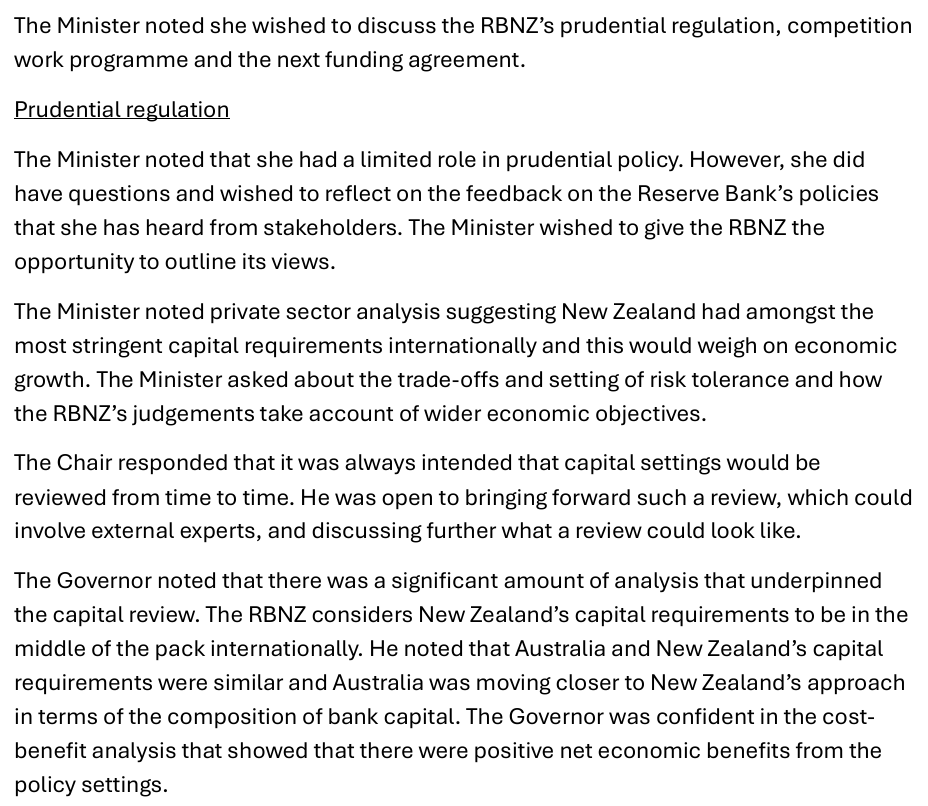
It is pretty clear from that that the Minister of Finance wanted a review. Perhaps she didn’t say it directly, but it is the clear implication of what is recorded in those first two paragraphs, and Quigley clearly recognised it as such, noting (folllowing the Minister’s remarks) that he “was open to bringing forward such a review….and discussing further what a review could look like”.

Why raise this now? Because Hawkesby is currently the temporary Governor, and supposed in some circles to be keen on getting the permanent job. Even if he doesn’t want to be permanent Governor, he is the deputy chief executive of a major government agency and a statutory appointee to the Monetary Policy Committee. Those who got in touch earlier this week reminded me that a few months ago (8 May) Hawkesby had been asked at Parliament’s Finance and Expenditure Committee about this meeting. Radio New Zealand’s report is here.

The first part of Hawkesby’s remarks seem fine

But then FEC was told this

The meeting had been only two months previously, it had been only a 45 minute meeting (of which he was only there for half an hour or so), on matters he had direct responsibility for, and the meeting itself has to have stuck in his mind given the role it seems to have played, within days, in the Governor’s departure. What’s more, surely you’d normally expect that coming out of a meeting like that there’d have been some sort of file note (especially when his boss and the board chair had appeared to be singing from different song sheets) or even an email to his direct reports in that area, and if he was really in doubt as to what went on I guess he could have asked Treasury for their file note. And yet we are supposed to believe that whether or not the Minister had requested (or only strongly implied) that a review should be undertaken was “not something that I sort of generally get into”. It reads a lot like misleading Parliament – in much the same way Orr had done repeatedly, often with Hawkesby in the room.

To be clear, I’m sure he is quite correct that “the decision to do a capital review was the Reserve Bank’s”, but in much the same way that the Governor’s decision to resign was a “personal decision” – at one level it was, but he was clearly prevailed on, pressured to go. Under the law as it stands Willis couldn’t directly compel the Bank to undertake such a review, but it will have been the less bad choice for them (she could have changed the legislation or commissioned her own review for example). And it was also a time – the end of March when the final decision to do a capital setting review was announced – where it probably will have suited Quigley and Hawkesby not to have been difficult; Quigley wanted his medical school, and Hawkesby may well have wanted to be made permanent Governor. The review would not have happened when it did without the Minister’s lead.

(And, to be clear, I don’t think that is a problem. As I’ve noted repeatedly, I think the law should be changed so that big picture prudential policy choices are made by ministers, with the Bank acting as (a) expert advisers, and b) implementing agents. I don’t think the Minister’s involvement here is inappropriate – whatever one’s view of actual capital settings – but really senior officials should not be misleading Parliament. And when they do, and when they sit silent while their bosses mislead Parliament, they really should not be serious contenders for high and very powerful office. Misleading Parliament is supposed to be a serious matter, and if MPs seem to have given up bothering over much (except when it suits), the rest of us should still insist on higher standards of integrity.

It is, in addition, supposedly one of the Reserve Bank’s own values

But perhaps those are just words. The actions at the top certainly haven’t aligning with the words for some time.

Inquiring into banking

Hard on the heels of the Commerce Commission’s inquiry into some aspects of banking competition, Parliament’s Finance and Expenditure Committee is also holding an inquiry. Submissions weren’t open for very long and have now closed, but the full terms of reference are here. It is a select committee inquiry, so it is hard to be optimistic anything very useful will come from it. Select committees are poorly resourced, even if they wanted to make a serious contribution, and the incentives seem to be almost entirely partisan political in nature.

A few submissions have so far seen the light of day. Those I’ve seen are:

None is particularly long, although Body’s piece has several appendices of past contributions in this general area.

The Reserve Bank’s contribution is mostly defensive in nature: if there are any issues, responsibility doesn’t rest with us or with our regulatory model. Which is, of course, pretty much what you would expect them to say, as an entrenched and powerful independent existing regulator, who no doubt believe that all the policy judgements they’ve made have been wise, in the best interests of New Zealanders etc. But just because it is them saying it doesn’t automatically mean they are wrong.

And in some areas no doubt they are right. As they note, having four big banks isn’t at all unusual. And some scepticism of state-enabled “maverick disruptors”, especially in the form of an unimpressive modest retail bank, is likely to be well-warranted. They also fairly note that patterns of finance have changed over time, something particularly evident in rural lending (where Rabobank is now the second biggest lender) and in corporate lending (where even on the data they have access to – and big corporates can tap international markets directly – overseas banks other than the big 4 apparently now have 30 per cent of the market).

And I (have always tended to) share their view that (approved regulatory) relative risk weights, used in calculating capital requirements matter a lot less than is often made out. In principle they should make no systematic difference at all since the aim of relative risk weights is more or less to reflect true differences in the underlying riskiness of different types of credit (eg a residential mortgage, with a 40 per cent LVR, is likely to be much much less risky, individually and as part of a portfolio, than an unsecured loan to a B-rated corporate). In practice, things aren’t that simple, including because the dividing lines between different types of lending and associated risk aren’t always clear or straightforward, and which side of a rather arbitrary line something falls can matter. And since no one – regulator or regulated – knows with any great certainty how (relatively) risky different types of loans are (mercifully, very bad crises don’t come along very often, and so data are scarce and open to contextual interpretation – regulators can get things wrong, and impose risk weights on particular types of lending that are quite at odds with the views of the lenders themselves. And any mapping for particular Reserve Bank imposed risk weights to either the pricing or availability of individual loan products is likely to be fuzzy and indirect at best.

Most importantly, relative risk weights simply do not explain why bank balance sheets are chock-full of residential mortgages. Rather, the artificial scarcity of houses and land, imposed over decades by central and local government, has led to hugely expensive houses, which each incoming generation needs to finance. Bank balance sheets would be much smaller if regulatory reform successfully delivered enduring low prices of houses and urban land.

All that said, one shouldn’t be too keen to come to the defence of the Reserve Bank as regulator. This is an agency with very limited specialist expertise at the top (see, notably, the Bank’s Board which now wields the policymaking power), has a culture of being aggressively dismissive, produces no serious research or analysis on financial regulation or stability (even though these functions now comprise the largest chunk of the Bank’s staff) and so on. What speeches there are lack any real depth or insight.

As I noted at the start, the New Zealand Initiative’s submission is brief. There are, broadly speaking, two aspects to it. The first is about efficiency considerations – a dimension unfortunately now lost from the legislation

Of course, any bureaucracy can produce a cost-benefit analysis of sorts of justify its own choices. I didn’t find the case for the 2019 decisions compelling, but a review now – especially if the reviewers were appointed by the RB or those sympathetic to it – isn’t really the answer (and under current legislation the Minister of Finance can’t direct the Bank in this area). My own view remains that (a) key people matter, and b) key policymaking decisions (as distinct from implementation on individual instruments and institutions) should be moved back to the Minister of Finance, who has both some real accountability (governments get tossed out, and question in Parliament routinely) and better incentives to balance the competing imperatives around any regulatory structure. It is very unusual to delegate major regulatory choices to an unelected agency (the more so, one with little demonstrated depth, expertise, and commanding little respect).

The New Zealand Initiative doesn’t go that far. They propose instead

I’ve written previously in favour of splitting around a NZPRA, which would have advantages for both those functions and for the Reserve Bank’s monetary policy and related functions. As they note, a suitably-qualified FPC might be a halfway house, although I’m not sure that the MPC – as staffed, and (not) scrutinised and held to account for the mistakes of recent years – is a great advert.

(I’m less convinced of the merits of taking the Governor off the Board. The FMA is primarily an implementation agency without much of a public face. The Reserve Bank, or major policymaking committees, are a different matter…….and for what it is worth it would be quite anomalous internationally not to have the Governor on the central bank board.)

The main prompt for doing this post was Andrew Body’s submission, which he was kind enough to send me. I don’t agree with everything in his submission – we’d disagree I think mainly on the risk weights issue (see above) – but the bulk of the submission captures a number of areas where the current Reserve Bank is ill-equipped for its job, and not doing that job well. His submission is an easy read. Here are a few extracts.

It is often forgotten just how much of an impost was imposed on banks the local incorporation and outsourcing requirements.

What I’m less sure of is how much of this is idiosyncratic to New Zealand, and how much is a general tendency of regulators and the regulated. The stylised wisdom when I was at the Reserve Bank was that banks were typically under orders from Australia to be very reluctant to upset or call out the regulator (there or here). Of course, when your regulator – as Graeme Wheeler did here – takes offence at anodyne critical comments from a bank economist, and calls in the heavy artillery to get the economist silenced, it sends a message. Banks have a lot at stake, and the Reserve Bank has a lot of power, which can be wielded for good or ill.

Before turning to governance

Much of that makes a lot of sense. But, of course, there is no sign that the Minister of Finance has any interest whatever in a better Reserve Bank, whether in its monetary policy or regulatory functions. She just reappointed the chair, has left Board vacancies unfilled, and included nothing about a reorientation in her Letter of Expectation. Instead, she seems to have been toying with arbitrary new taxes on banks.

Standing back from all three submissions, a few things struck me. The first (and most important) is that neither the Reserve Bank in its defence or the critical submitters mentioned the APRA regulatory requirements and how they affect things in New Zealand (neither did the FEC’s terms of reference). That should be really quite surprising as most of the grumbling is about the four big Australian banks, all of which are part of Australian-based consolidated banking groups, regulated as such by APRA (eg capital requirements that apply to group exposures as a whole). There is no doubt that more onerous regulatory requirements can materially affect the New Zealand subsidiaries, but in any area in which the RBNZ’s requirements were less burdensome than APRA’s it might make or little or no difference here, as the group would still be constrained by group-wide regulation. I’ve never been quite sure how it all works out in practice – how banks do their pricing and risk allocation etc having regard to these distinct regulatory regimes – but it is surprising not to see it mentioned once. At an aggregate level, I’m inclined to the view that the Reserve Bank never made a compelling case for the extent of the 2019 increases in New Zealand capital requirements (and that the heavy focus on high capital is somewhat misplaced, relative to the much-harder-to-measure/observe changes in credit standards), but markedly lower requirements might well become non-binding.

I’ve long been a bit puzzled as to why more non deposit-taking entities don’t lend directly into the New Zealand market (at least if, as we are often invited to believe, there are excess profits on offer here). I recall being heavily involved in some work almost 20 years ago now on possible alternative approaches to monetary policy implementation, and one thing we focused on a lot then was the possibility of entities lending mortgages (say) directly into New Zealand from abroad. Disintermediation was also in focus when the first LVR restrictions were put in place. But none of it ever seem to have come to much. I was exchanging notes with a banking lawyer recently and asking why, say, Macquarie – an aggressive new entrant to the Australian mortgage market – couldn’t just lending into New Zealand as “Cheap Mortgage Loans Limited” (so wouldn’t need to be a New Zealand bank), but the person I was engaging with noted that people who had considered such options were scared that the Reserve Bank would act to stop them (and apparently there are designation powers in the new deposit-takers legislation). You have to wonder why it would: no New Zealand depositors’ funds would be at risk, and new competition would be injected to the system. I note it mainly because it isn’t entirely compelling that everything sensible has been done by the Reserve Bank to reduce unnecessary barriers to entry. Better “Cheap Mortgage Loans Limited” than a juiced-up Kiwibank, in which taxpayers’ money is directly at stake.

I have no expectation that the FEC inquiry will produce anything useful. It isn’t set up to. The submission time was short – who could commission serious or fresh analysis in that time? – and the committee has few resources, no specialist support, and its members don’t appear overly strongly qualified, except to pursue narrow political agendas (some of which might be sensible, but most won’t). And thus how equipped are they going to be to evaluate competing claims in the submissions they receive? It isn’t like a court case in which expert witnesses are grilled by counsel for both sides, and arguments, evidence, and implications tested. A proper workshop, with major submissions presented as papers with discussants and audience questions might have offered the prospect of shedding some serious light. But the political process is all too often interested more in heat than light.

UPDATE: Martien Lubberink (VUW) draws my attention to his submission here. A one sentence summary might be that we should be at least somewhat grateful for what we have – a stable, predominantly foreign-owned, system – and wary of the siren calls to any sort of quick fixes to apparent problems. Thus far, it is hard to disagree (although I have a few specific areas in which I might reach different views than he does).

Still a bad idea

The Minister of Finance has, over the last couple of weeks, been trailing various possible changes in the financial system. At the National Party conference there was the suggestion of trying to beef up Kiwibank, including by the injection of some additional capital from other than direct central government sources. And last Friday, there was an interview with the Herald’s Jenee Tibshraeny in which the Minister talked up the idea of overriding various bits of policy that are now squarely the legal responsibility of the Reserve Bank. Commentators suggest all this talk is to a considerable degree about preparing the ground for the release next week of the final report of the Commerce Commission’s report on elements of the banking sector, perhaps trying to ensure that there is little plausible ground for Labour or the Greens to attack the government on banking profits, access to services, or whatever.

I’m not going to respond in depth to all the Minister’s suggestions. On Kiwibank, I largely agree with VUW banking academic (and former regulator) Martien Lubberink’s column, and (rarely, and as it happens, even with John Key). If it were me, I would sell 100 per cent of Kiwibank tomorrow, simply because there is no good reason for a government to own a commercial bank, but I am even more wary of partial privatisation of a bank than of the status quo).

The Minister also suggested that she might change the law to force the Reserve Bank to (a) lower bank capital requirements, and b) provide carveouts for some or other favoured groups. Now, as it happens, I have long argued that prudential regulatory policy settings should be decided by the Minister of Finance, on the advice of the Reserve Bank and The Treasury. As Willis notes, she is accountable, and the Reserve Bank is not (although the Minister decided to reinforce that effective unaccountability recently by further extending the term of the chair of the Reserve Bank Board – and it is the board that now wields the prudential policysetting powers). But if you really want to make a change like that you do it after wide and serious consultation, or perhaps even as part of a well-trailed campaign promise, not simply (as it seems) to play distraction because another government agency might be about to release a briefly awkward report. I’m also inclined to think bank capital requirements are higher than is really warranted (that was my view when the policy was being set five years ago and remains so today) but if you want to be taken seriously as a Minister of Finance, you don’t just drop such a view into an interview – with, it appears, nothing in support – you outline carefully your case, or commission some reviewers to look into the matter carefully. Martien Lubberink also addressed this set of Willis comments, including this apt line.

But the item in the Minister’s grab-bag that I wanted to comment on was around the remuneration of settlement account balances held by banks at the Reserve Bank. On these balances – the aggregate level of which is determined wholly and solely by the Reserve Bank – banks are paid the OCR (currently 5.5%). The level of settlement cash balances is currently around $43 billion – off its highs, but still hugely higher than the $7bn or so that was more common pre-Covid. The reason for the difference? LSAP bond purchases by the Reserve Bank, and the subsidised direct lending (under the so-called “Funding for Lending” scheme) from the Reserve Bank to banks.

In the Herald interview the Minister is reported as saying that “she had asked officials for advice on the way the RBNZ manages banks’ settlement accounts”, and in further comments in the same interview making clear that she was referring to how interest was paid. She goes as far as to suggest that it might be appropriate to amend the Reserve Bank Act to compel any change in approach that she considered warranted.

The issue of remuneration of the high settlement cash balances has been around for a couple of years. I think I introduced it first to the New Zealand discussion with a post in late 2022 on a paper by a former Bank of England Deputy Governor in which, among other issues, he suggested a possible case for paying below market rates on some portion of the large (at present) settlement cash balances in the UK. My post was headed “A bad idea”, which remains my view. That October 2022 post prompted Tibshraeny to give the issue a bit of coverage, which in turned seemed to prompt the then Minister of Finance Grant Robertson to ask for some official advice on the matter. Tibshraeny OIAed that advice, and I wrote about it in another post in March 2023. Neither the Reserve Bank nor The Treasury were at all enthusiastic, and there even Grant Robertson – who, we later learned, had at the same time been toying with windfall profits taxes on banks – left it. It was, after all, on current legislation simply a matter for the Reserve Bank (the OCR, the rate paid on settlement cash balances, is the primary instrument of monetary policy, and the Reserve Bank has operational independence).

There is a bit of a view around in some quarters that changing remuneration practices could undermine the effectiveness of monetary policy (in fact, it was one of the lines the Reserve Bank used on Robertson). That isn’t necessarily so. Tiered approaches have been used elsewhere (including by the ECB when they had negative interest rates, as a subsidy to banks in that case), and so long as one clearly distinguishes between a first tranche that received a nil or below market rate from the marginal balances on which the full OCR would be paid, effective monetary control would not be impaired. But that doesn’t make the policy option the Minister was openly toying with a better idea. In fact, it is still a very bad idea. Bank settlement account balances don’t just arrive in a vacuum – rather they are a counterpart to a change in some or other items on bank balance sheets (eg a bank increases its settlement account balances when it wins deposits from another bank, or (in this case) when (say) a customer sells government bonds to the Reserve Bank and deposits the proceeds in a bank account, on which the customer will normally and reasonably expect a return). Running a tiered approach to remuneration of settlement cash balances, of the sort Paul Tucker first proposed a couple of years ago, is simply an arbitrary tax on banks, and financial intermediation more generally, without any analytical foundations or – if the RB simply did it – without any parliamentary scrutiny. Taxes should be imposed by those whom we elect, our MPs sitting in Parliament.

But changing the law to enable the Minister to direct the bank on policy on remuneration of settlement accounts, or simply to mandate a completely different model, would be hardly any better than the RB just arbitrarily making such a change. There would be some formal democratic legitimacy, but for a policy that has just no substantive merit. As there was no good case for a windfall profits tax for banks, so there is no decent case – not even a shred of one – for a targeted ongoing tax specifically on banks. It would be arbitrary, inefficient, largely borne by New Zealand depositors and borrowers, and would send a simply dreadful signal, at a time when international markets are already looking askance at the Reserve Bank and the conduct of policy – and the policy “debate” more generally.

I don’t suppose it is very likely that Willis and the government will end up doing any of the things she trailed in last week’ Herald interview. Doing them probably wasn’t the point – rather the pursuit of a good headline with a certain sector of the New Zealand audience, narrowing room for Labour and the Greens, seems to have been the point. Empty populist rhetoric seems a description closer to the mark than serious considered policy options and analysis (note that not a hint of any of this appeared in the election campaign, less than a year ago). Perhaps the rhetoric plays well with some focus groups, but it hardly enhances any reputation Willis aspires to to be (and be seen as) a more serious Minister of Finance (focused on things that might make a real difference) than her predecessor.

I’ve already noted that Willis could readily have changed the chair of the Reserve Bank board when his term expired (her government has been happy to replace various other chairs in agencies where dismissal at will as an option). She could have filled the vacancies on the board with people better qualified than those Robertson appointed but hasn’t done anything about that either. It remains almost beyond comprehension that she didn’t move on either front, and suggests she isn’t really serious about any of this. In the same vein, each year the Minister of Finance writes a Letter of Expectation to the Board, an opportunity to highlight her priorities or things she wants the board and Bank to have regard to etc. The 2024 letter is sitting on the Bank’s website, and has not a hint of any of the sorts of issues/concerns Willis was raising in the Herald interview. She also hasn’t revised the Financial Policy Remit (a new tool) issued by Robertson a couple of years ago. There are things around the Reserve Bank that the Minister can’t easily or quickly fix (eg she is stuck with the Governor, unless he chooses to go early, for another 3.5 years), but she has shown no sign of doing any of the things she could (eg Board chair and vacancies, unwinding new indemnities the Bank has been given) or of using any moral suasion (eg through the letter of expectation) around financial policy issues or the Bank’s budgetary excesses.

So it all just looks a lot like a search for a good headline, and political operatives managing tactical risks for a couple of weeks, rather than a Minister with any sort of serious interest in, or intent towards, a much better central bank, whether in its monetary policy or financial regulatory roles. Perhaps in that sense she and the Governor – who seemed to have such a testy relationship when National was in Opposition – deserve each other. It is just that New Zealanders deserve much better from both roles.

(I have submitted an OIA this morning for the advice etc around remuneration on settlement cash balances. It will be interesting to see if either Treasury or the Bank are giving Willis even slightly different advice now than they gave Grant Robertson last year (but it seems unlikely).

John Kay on banks, regulators and politicians

The Treasury has had Professor John Kay in town this week.  Kay has had a long and distinguished (microeconomics-focused) career in the United Kingdom as an academic, adviser, FT columnist, author etc and last year published a new book Other People’s Money: Masters of the Universe or Servants of the People, the introductory chapter of which is here.  Key’s Treasury guest lecture was built around the ideas in this book.  To be clear, I have not read the book –  although despite the skeptical comments that follow I may now do so.

It wasn’t a lecture, and apparently isn’t a book, about the 2008/09 financial crisis per se.  That said, the book probably wouldn’t have been written without the crisis, and he clearly sees the crisis as a manifestation of what, in his view, has gone wrong with the financial sector. In a line from his website :

The financial crisis of 2007-8 has dominated subsequent discussion of economic policy. In my view the responses are characterised by two widespread misunderstandings. The first mistake is to believe the crisis is an inexplicable, once in a lifetime, event, rather than another demonstration of an increasingly dysfunctional financial system.

Kay began with a line many have used –  the changing nature of the people who go into banking.  In the 1960s, when he grew up in Edinburgh, banking was for the people not quite smart enough to get into university (as in New Zealand, only a small proportion of school leavers then went to university).  By contrast, these days finance attracts many of the smartest graduates from top universities.  The range of products is, of course, much more complex.  But not, Kay would argue, so correspondingly socially useful, despite the staggering remuneration on offer to a fairly small number of people in these institutions (if I recall rightly, he notes that most people in the big UK bank Barclays actually earn less than the UK median wage).  And, of course, the incidence of financial crises is much greater today than it was in the post-war decades.

For a time, politicians across much of the advanced world fell at the feet of bankers.  Kay showed an amusing clip of Gordon Brown, then Chancellor of the Exchequer, opening a new headquarters in Europe for Lehmans only 10 years or so ago.  And in the United States in particular, there is the ongoing unease over the revolving door that seems to operate between senior government positions and highly-remunerated positions in the financial sector  (it isn’t just Goldmans’ alumni going into government and back into the financial sector (eg Robert Rubin), but the flow from government positions into the financial sector –  be it Bernanke, Summers, Geithner or whoever).  Bernie Sanders is currently tapping that anxiety.

Kay isn’t “anti-finance”.  As he notes

A country can be prosperous only if it has a well-functioning financial system, but that does not imply that the larger the financial system a country has, the more prosperous it is likely to be. It is possible to have too much of a good thing. Financial innovation was critical to the creation of an industrial society; it does not follow that every modern financial innovation contributes to economic growth. Many good ideas become bad ideas when pursued to excess.

And so it is with finance. The finance sector today plays a major role in politics: it is the most powerful industrial lobby and a major provider of campaign finance.

He seems to be arguing some combination of the following:

  • Banks are too large, and encompass too many different types of activities within them,
  • Banks should be broken up.
  • There is “too much finance”
  • Banks have huge political clout (especially in the US and the UK), and exercise that in their own interest, in particular in the (successful) pressure for bailouts.
  • Someone should pay for what went wrong in 2008/09.
  • Banking regulation has become too prescriptive and detailed.

I didn’t find the overall story that persuasive, partly because it doesn’t seem to generalize across countries, and partly because it doesn’t even seem to get to the heart of the 2008/09 issues.  There are bits of the story I agree with  –  concerns about the volume of increasingly detailed, lawyer-driven, focus of regulation, often in effect more concerned with process and form than with economic substance.  And I sympathise with his unease about the hubris implicit in the belief among central bankers that they can somehow determine what risk weights to use for each and every type of credit.

So what bothers me?

First, is there any evidence that banks were “bailed out” because of the political clout of the sector?  I’ve read huge number of the books written since the crisis, and tracked events through the crisis very closely, and that interpretation simply just doesn’t ring true –  in the US, the UK, Ireland, or anywhere else for that matter.  After all, by and large it was not bank shareholders (or senior management) who were bailed out –  and many of the senior management of banks had large proportions of their own wealth tied up in shares in their own banks.  The bailouts typically primarily benefited creditors  (not exclusively –  after all, even Bear Stearns shareholders walked away with a small amount of their money)  and – so the argument went –  the economy as a whole.  Creditors weren’t always voters, but most voters were creditors of banks in one form or another, and most were employees –  alarmed at the prospect of extreme economic disruption.

This isn’t the place to debate whether any or all of the bail-outs were good things or not, simply to note that –  as things were by 2008 –  they would have happened, largely as they did, if financial sector interests had had no clout and no superior access to politicians at all.

And what of the line that banks are simply too big and complex to be run effectively?  Well, for decades we saw that argument run about corporate conglomerates across the western world (including our own Fletcher Challenge).  But actually the market had ways of taking care of that problem –  companies were bought up, restructured, dismantled etc, by purchasers who could make more of the assets that the unwieldy conglomerates could.    The “asset strippers” weren’t always attractive personalities, and some probably went close to (or even beyond) the edge of the law, but the point simply was that the market has a way of ensuring that assets are owned by those who can place the highest value on them.   Bank takeovers aren’t always easy, but they happen.  It isn’t obvious what the (financial stability) policy problem is, unless a strong case can be mounted that some combination of size and complexity effectively buys a bailout insurance policy.  I don’t think the evidence for that point is particularly persuasive either.

At one point is his lecture drew the distinction between whether we thought as banks as a “den of thieves” or as a “monastery”.  I’m not sure either description is remotely warranted.  Avaricious, arrogant and unpleasant as many of these leading bankers seem to have been, I don’t see any sign that the crises of 2008/09 –  in any country –  occurred because anyone systematically set out to dupe anyone else.  Don’t get me wrong: I’m not suggesting there was none of that sort of activity, simply that much more of what went on is down to some combination of:

  • choices of politicians (choosing to adopt the euro, which involved holding interest rates well away from natural interest rates for year after year –  most obviously in Spain and Ireland –  and the high degree of political pressure brought to bear in the United States on the financial system to take on low quality housing loans)
  • collective over-optimism, among borrowers, lenders, citizens and politicians.

Were people let down?  Yes, no doubt.  Banks failed, but so did most of the world’s leading regulators and central bankers (as Kay put it, the effortless subsequent continued rise of several, who had been quite dismissive of risk before the crisis, illustrates the “unimportance of being right”), and most of the world’s leading finance ministers (and most of those who might have wanted to replace those central bankers and finance ministers).  So who should pay, and in what form?

And of course there is the “so what” question.  If one believes that the financial crises (or even the build up of debt prior to the crisis) was responsible for the world’s current economic travails (eg GDP per capita 15 per cent or more below pre-crisis trends) one might perhaps regard the financial sector as a dangerous bacillus, attacking the common wealth.  But as I’ve noted here several times, I don’t think the case is that strong.  Through its history, for example, the US was plagued by financial crises, and yet each time the economy bounced back  – usually quite quickly –  to much the same growth path it was previously on

What of New Zealand?  Is there too much finance here?    We don’t have complex banks (they lend, mostly in quite vanilla forms, and the borrow –  domestic households and institutions, and from abroad.)  We don’t have many complex instruments either –  actively traded or not.  It isn’t obvious banks have huge political clout either –  for better or worse, in the midst of the crisis we forced them to join the deposit guarantee scheme, we forced through the local incorporation policy, we compelled them to pre-position for OBR, and we’ve imposed higher effective minimum capital requirements than most of the countries.  We didn’t have a domestic loan losses financial crisis during 2008/09 (actually neither did the UK), and yet, as I’ve repeatedly highlighted, our economic performance over the last decade has been distinctly mediocre.  There is a lot going on globally, insufficiently understood, but it isn’t yet remotely clear that finance is the problem, rather than just another symptom.

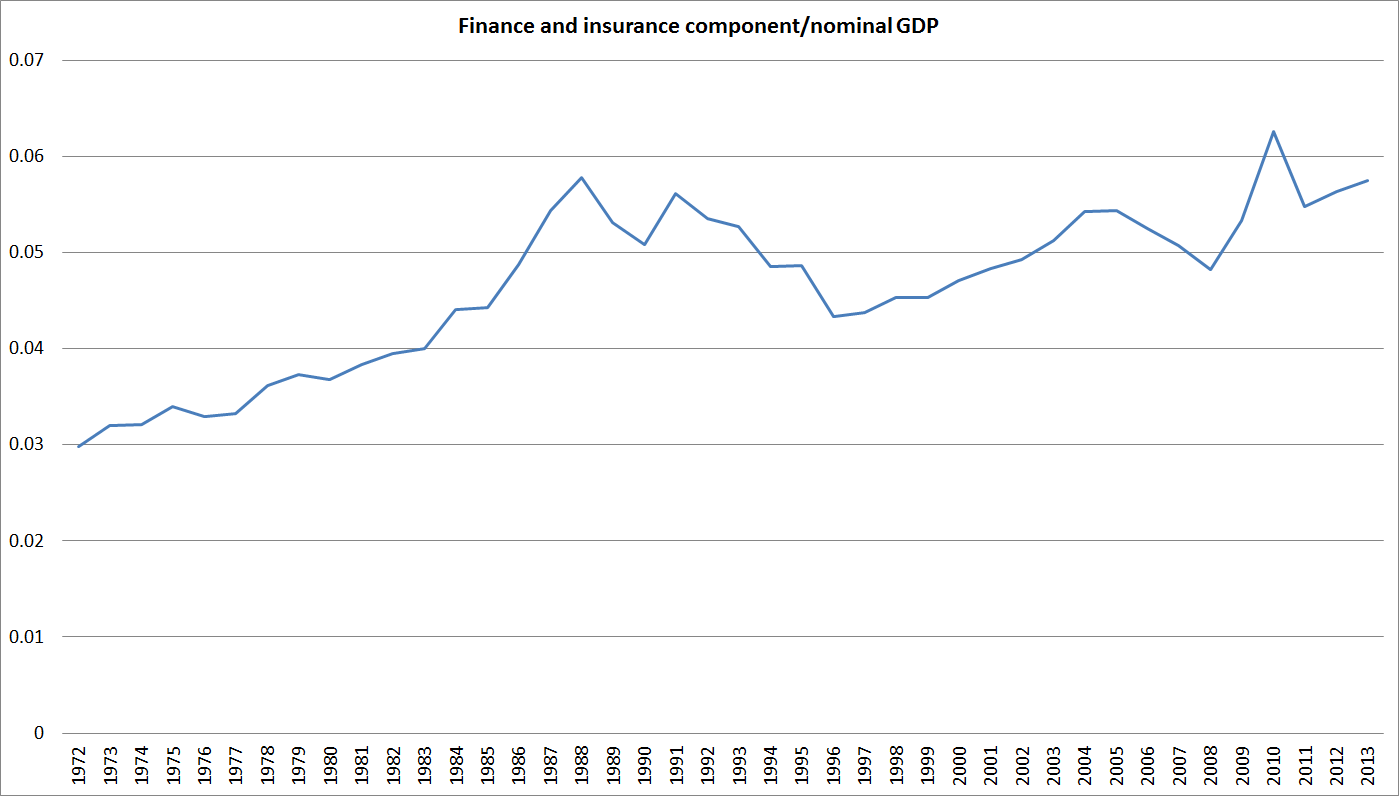
finance and insurance

The New Zealand financial sector is larger than it once was. But much of that isn’t about  over-mighty financial institutions and their “master of the universe” bosses  – although we had our period of craziness in the mid-late 80s.  But if high house prices here  –  as in much of the West –  are about the interaction of supply restrictions and population pressures, the increase in the stock of credit is substantially an endogenous response to those structural distortions.  If governments make urban land really scarce and expensive, younger generations will need to borrow more real resources from older generations to be able to afford a house at all.  The stock of credit (on the one side) and deposits (on the other side) rises, and financial institutions facilitate that-  and value-added associates with that activity and accordingly appears in the national accounts.  Don’t blame banks for that, but governments that so badly mess up the markets in housing supply.

I’m left uneasy about what social value much of the activity in the financial sector generates.  As an analyst, even as a citizen, I’m curious about that.  But I’m not sure that Kay –  or others –  have made a convincing case that is deeply harmful either. In principle it could be –  as others might argue that sugar, alcohol, fast food, or fast cars could be harmful.    Kay avers that he wants less intrusive regulation, but in fact the thrust of his arguments tends to give aid and comfort to those who want more of it.  That appeals to regulators, responds to a public itch “something is wrong, and banks aren’t overly sympathetic causes”, but doesn’t rest sufficiently on a hard-headed analysis of the role of governments and regulators in past crises, and the importance of markets –  messy as they often are – as “a chaotic process of experimentation…the means through which a market economy adapts to change”.

That last quote comes from an excellent lecture, The Future of Markets, which I return to often, given by one John Kay in 2009.

In conclusion, I would just note that at one of his sessions this week, Kay was apparently asked about deposit insurance. He asserts that it is simply imperative: without it the pressure for bailouts of all creditors inevitably becomes almost impossible to resist.  It was a point I made here last week, and remains good advice for our political parties, our government, and for those among the official agencies who continue to believe that the OBR tool deals with these pressures.

Predictable pre-Christmas bureaucrats

Bureaucrats are mostly rather predictable.

I’d been conscious that the Reserve Bank had not yet released the results of its “regulatory stocktake”, even though submissions had closed three months ago.  The Friday before Christmas seemed like a good day for a release by an institution that might want as little coverage as possible of its decisions.  So I kept an eye on my email yesterday, and sure enough at 4.35pm up popped the results of the so-called stocktake.  As far I can see, there has been no media coverage so far, and even if any of the relevant journalists are still around, readership interest in anything serious is rapidly waning.  NBR had covered the issues earlier, and it has already published its last paper for the year.

The stocktake was never a very serious exercise. I was still at the Reserve Bank when the terms of reference was determined, and the Governor was clear then that he did not want any serious issues addressed.  It seemed that it was as much an exercise in appeasing the Minister, to show that the Bank was willing to look afresh at its stock of regulation and perhaps even tidy up some small stuff.

There were, in my reckoning, three main issues dealt with in the consultation document:

  • Refinements to the disclosure regime, generally with a view to reducing public disclosure
  • Refinements to the “fit and proper” regime
  • Some reflections on the Bank’s own policy processes for bank regulation.

I made a submission to the stocktake, along with many of the banks and variety of fairly well-informed individuals including the former Governor, Don Brash.

As far I can tell from reading the document the Bank released yesterday, it had no real interest in any submissions other than those of the banks and of a single rating agency.    It does report the gist of some of those individual submissions, but there is no sign that any of them had any impact on the Bank’s thinking, nor an attempt to explain why the Bank regards the arguments made as unconvincing.   That is one of the problems in having a regulatory agency set policy as well as implement it –  insiders will tend to be defenders of the status quo, and if they are responsive to outside input at all it will tend to be to submissions from those they have most to do with (in this case, the regulated entities, the banks).

The Reserve Bank has been putting progressively less emphasis on public disclosure by banks over the last decade or so.  The Bank itself has been quite open that it does not now use the information in the disclosure statements for supervisory purposes, having replaced it with a variety of ‘private reporting’ returns that no one else has access to.  Note that the Bank is very enamoured of what it describes as a “non-zero failure regime” –  that is, the system is run to allow for the possibility of bank failures (rather than to prevent them all), and with the aim of ensuring that any losses fall, as far as possible, on shareholders and creditors (including depositors).  There is no deposit insurance in New Zealand, and the Bank is staunchly opposed to the introduction of deposit insurance.  In other words, in their vision the risks from any failure of a bank fall first and foremost on creditors, not taxpayers.  And yet those creditors do not get access to the information that the Reserve Bank regards as vital to assess the health of banks.  The disclosure statements are really, in effect, just a legacy of history –  probably of no real value to creditors (since it isn’t the information the supervisors themselves use).

I pointed this out in my submission, and suggested a rather simpler and cheaper approach which would better reflect the risks the system is designed around –  ie providing creditors much the same information as the central bank gets, when the central bank gets it.

The Bank has canvassed an option somewhat along these lines in its consultative document, raising the option of a “continuous disclosure” model, something like what stock exchanges impose on listed entities, for periods between six-monthly disclosure statements (at present, disclosure statements are quarterly).

The Bank did not respond to my suggestion at all.  It did respond to the partial continuous disclosure idea.  The first argument advanced against it was “banks did not support this option”, but with no statement of why –  and recall that we don’t have access to submissions made to the Reserve Bank.  The Bank’s own concern seemed to be that it might lead to “confusion in the market”,  but quite why it should lead to such confusion, and among whom, is not made clear.

The Bank appears to have settled on a halfway house, that might be workable, but continues to maintain a charade –  a disclosure regime that forces banks to disclose some information, but not the information that the Reserve Bank itself uses for supervisory purposes, and only then with a considerable lag.  Perhaps there is a good reason for maintaining this distinction, but in its release yesterday the Bank gives no sign of having thought hard about the issues at all.

There is further consultation to come on the Bank’s preferred “dashboard” option for 0ff-quarter disclosure, but a strong hint in the document that the Bank wants to consult only with banks.  The Reserve Bank needs to remember that banks are the regulated entities, regulated in the public interest.  Registered bank perspectives on cost and workability should be welcomed, but the rationale for supervision is that banks represent a risk to the rest of us, not those in whose interests regulation is undertaken.

On “fit and proper”, again the Bank showed no interest in asking or answering some of the more fundamental challenges some submitters posed (eg straightforward ones such as “is there any evidence that fit and proper tests, applied discretionarily by bureaucrats, have done any good, in promoting the soundness of the financial system?”.  I proposed a much simpler and cheaper option than what the Bank has been doing (or will be doing in future): ban anyone with a conviction for dishonesty in the past 10 years and require senior officers and directors CVs to be listed on the website of the regulated entity.  I’d be surprised if the Reserve Bank, with the best will in the world, could improve on that option, not being granted the gifts of insight or foresight greater than those of mere creditors and shareholders.    Again, the Reserve Bank gave no hint of why it thought this (quicker and cheaper) approach would lead to worse outcomes.

But there was modestly encouraging stuff to come out of the stocktake.  In their, still secret, submissions several banks (or perhaps the Bankers’ Association, to protect individual banks) had raised concerns about the Bank’s policy processes.

Various banks had complained that the typical consultation period was far too short, for often rather complex issues.  The Bank has agreed that in future its normal consultation period will be 6 to 10 weeks,   but this looks like a rather small gain as the Bank reserves the right to ignore this guideline when it suits them (eg when the Governor wants to rush in new LVR restrictions, on very limited evidence).

Various banks also appear to have raised concerns about the robustness of the Reserve Bank’s cost-benefit analysis in support of regulatory changes (unsurprisingly I’d have thought, as I don’t recall any quantitative cost-benefit analysis for this year’s investor finance restrictions) and of the Bank’s regulatory impact statements.  Of course, RISs are mostly a sick joke around much of the public sector, but it is good to keep the pressure up on individual agencies –  especially independent ones –  to improve their game.  The Bank doesn’t offer anything very specific in response, but seems conscious of the concerns.

One bank “asked for a requirement that the Reserve Bank publish a summary of submissions and responses (including rationalise) to viewpoints not accepted.”

The Reserve Bank responded that “we currently aim to publish summaries of submissions that take into account responses to viewpoints not accepted.  We would welcome specific feedback from industry in cases where they feel this insufficient.”.  As I noted, none of the views I and other expressed in this consultation were responded to specifically.  Then again, I guess I’m not “industry”.  The Bank  might want to note that “industry” are not the (only) stakeholders –  they are the regulated entities.

Dearer to my heart was this comment:

One bank also suggested that submissions should be available online, in addition to the Reserve Bank publishing the summary of submissions. This bank noted that this is the standard practice for public consultations run by other government departments (e.g. the Ministry of Business, Innovation and Employment).

This is a point I’ve made repeatedly.  And it isn’t only government departments. Submissions to Select Committees are public, submissions on City Council consultations are public, and submissions to the Productivity Commission are public. It is simply good practice, taking seriously the idea of open government.  Such submissions are not just public after all the decisions have been made, but while deliberations are going on.  The Bank has always been very resistant to such openness.  However, they have now shifted their ground somewhat:

Our current approach is based on our understanding that respondents prefer to keep their submissions confidential. Prior feedback indicated that banks, in particular, were reticent to share cost information and the Reserve Bank is concerned that the publication of submissions would impact the quality and detail of the submission feedback. On the other hand we also recognise the importance of transparency in the policy-making process, so we will return to this issue and consult on a revised approach under which the default position would be that all submissions are published on our website (although submitters could ask to have any confidential information in submissions redacted). We will add this issue our register of “Future Policy Work.”

I think this statement tells one a lot about the extent to which the Reserve Bank sees its clients as primarily the institutions it regulates, rather than the public the institution exists for.  I’m sure that banks would generally prefer to keep their submissions confidential, and it is precisely for that reason that their submissions, in particular, should be made public.  It is too easy for a cosy relationship to develop between the regulator and the regulated (Ross Levene among others have written extensively on this topic) ,and although I don’t think it has really happened to a great extent in New Zealand it is a risk that constantly needs guarding against.

In any case, kudos to the Bank for a modest step forward.  I’ll look forward to their consultation document on this issue to see whether it represents a serious move to the sort of consistent transparency other agencies adopt.  And I’ll be interested to see how they plan to get around the limitations of section 105 of the Reserve Bank Act –  which, as I noted a few months ago, really needs amending.

In the meantime, I lodged an OIA request months ago for the submissions on this consultation. I agreed with the Bank to delay the request taking effect until the results of the stocktake were published (otherwise they would just have declined it), so in the new spirit of openness I will look forward to a fairly comprehensive release  –  not just private individual submissions – in the New Year.  Given that they have had the submissions for months already, if they were serious about transparency they could release them right now (“as soon as reasonably practical” is what the Official Information Act says).

I will take some convincing that they are serious about transparency. Recall that in the course of this year they have already:

  • Refused to publish many of the submissions on the investor finance restrictions consultation (all of them initially)
  • Refused to publish most of the background material to the 2012 PTA (under threat of heavy charges)
  • Have still not published their forecasting model  [UPDATE: a commenter points out that the model has now been released, something I had missed]
  • Have refused to publish any of the substantive papers as part of their work programme on reforming governance of the Reserve Bank
  • Have refused to publish any minutes of meetings of the Governing Committee
  • Have refused to publish any material provided to the Bank’s Board as the basis for the Board’s evaluation of the September Monetary Policy Statement.

And then I had an email from them the other day about another request.  I had asked for copies of minutes of the Bank’s Board’s meetings for a couple of years in the late 1980s.  I wanted them for two, quite unrelated, pieces of work I was doing.  I assumed this would be uncontroversial –  it is material that is almost 30 years old, and not conceivably withholdable.  Actually, I had made a similar request for a couple of other years’ Board minutes when I was still at the Bank, and was told I was free to photocopy the relevant papers, which I did.

The Board papers are all nicely bound and properly stored, so there is no research or collation involved in meeting my request.  I deliberately just asked for all the minutes –  perhaps five pages a months, 11 months a year, rather than excerpts, to minimise any effort in meeting the request.  All it required was some undemanding photocopying or scanning, taking no more than hour in total.

But the Bank first took almost 20 working days to respond (“as soon as reasonably practicable”?), and even then has not determined whether the information is releasable at all.  And it is demanding $276 as a deposit to even begin determining whether the material could be released.   Note, by contrast, the easily availability of historical Board (equivalent) minutes at the Bank of England.

The Reserve Bank has announced:

The Reserve Bank has a policy of charging for information provided in response to Official Information requests when the chargeable time taken to provide the information exceeds one hour, and charging for copying when the volume exceeds 20 pages. Our charges are $38 per half hour of time and 20c per page for copying (GST inclusive).

Their stance appears to be technically legal, but hardly in the spirit of open government[1].  I’m curious how many people have been charged by the Reserve Bank under its policy, and am wondering whether I should now expect a bill for (a) the request for submissions on the regulatory stocktake, and (b) the request for information on the Reserve Bank’s volte face on the short-term impact of immigration.

The institution needs serious reform. Among other things, it needs to take on board the spirit of pro-active release.   It remains a bit puzzling why the Minister of Finance has closed down work on even reforming the governance provisions.  Occasional sideways or mildly critical comments about the Bank’s recent monetary policy mistakes are all very well, but they don’t seem to lead anywhere.


[1] And I’d happily come in to the Bank and photocopy the pages myself, and even cover the photocopying costs.

Disclosure requirements: some anomalous laws

Parliamentary sovereignty is a key feature of our political and governance system. But sometimes parliaments end up producing rather anomalous results when we look from one piece of legislation to another.

Twenty years ago, the Reserve Bank moved to a system of prudential regulation of banks that was designed to rely heavily on public disclosure of key information on a regular basis. Disclosure was never envisaged as the only element of the regulatory regime. Basle 1 basic regulatory capital requirements were also in place, and were left in place as much at the request of the banks (who wanted to be seen as operating in an internationally-recognisable regime) as because of any conviction by the Reserve Bank that capital requirements were worthwhile. And the Bank and the Minister of Finance retained significant powers to intervene if a bank was getting into trouble, and was (or appeared to be approaching) insolvency.

But the proposition underpinning the disclosure framework was that investors (depositors, bond-holders) and others transacting with a bank should have all the information that the Reserve Bank had about a regulated bank. That seemed only fair and reasonable – after all, it was investors’ money that was at stake, not the Reserve Bank’s.  And if the Reserve Bank had private information that was not disclosed to depositors/investors that could, in the event of a subsequent failure, open the Reserve Bank up to charges (political and rhetorical, even if not legal) that it should have acted earlier, and thus prevented the losses investors/depositors subsequently experienced.  Private information might have supported the argument for government bailouts if things went wrong.

A lot of effort went in to devising the disclosure regime. In some areas it may have gone a little too far.  One example might have been requirements on banks to have Key Information Summary documents immediately available in every branch.  I suspect the number of these documents that were ever actually read was extremely small. The regime went to somewhat absurd lengths: someone who worked in the economics department of one local bank told me that their bank interpreted the regulations to mean that Key Information Summaries had to be available for perusal in the economics department (“branch”)  itself – a part of a bank not typically visited by the public.

Because so much weight was put on disclosure requirements, the law was written in a way that exposed those responsible for bank disclosure documents to significant penalties (including potential imprisonment) for breaches of the requirements. Don Brash has many stories to tell of the reaction of outraged directors (and puzzled ones in other jurisdictions). There had, perhaps, been a tendency for bank boards to be made up of people with gilded reputations, rather than much ability or willingness to ask hard questions about the conduct of the Bank. The prospect of such steep penalties certainly altered incentives, and behaviour.   Banks may, or may not, be safer, but directors have certainly gone to considerable lengths to minimise their own risks

In the last decade, the Reserve Bank has backed away from heavy reliance on the public disclosure aspect of the regulatory regime for banks. The disclosure requirements have themselves been watered down, and there are proposals for further reductions in the requirements in a recent Bank consultative document. This tendency seems unfortunate – despite inevitable complaints from banks about compliance costs. If anything, the focus globally in recent decades has been on more and more disclosure. Perhaps more concerning is the explicit shift the Reserve Bank has made to collecting private information about banks’ day-to-day activities and risks, information which is not available to investors and depositors.  The  Reserve Bank has been keen to promote the idea of its OBR tool being used in the event of a bank failure, so it remains the case that the regime is designed to be about depositors/investors being primarily at risk of losing money, not the Crown. And yet the Crown uses statutory powers to acquire information about these regulated institutions which depositors do not typically have access to.

But notwithstanding the diminished emphasis on disclosure, the Reserve Bank is still keen to remind people of the stiff penalties for breaches of disclosure requirements. In a speech only a couple of years ago, the head of the banking supervision department noted

Self-discipline is closely linked with sound governance. We have a strong tradition of director attestations, coupled with heavy penalties for non-compliance. For example, bank directors who fail to comply with disclosure obligations face fines of up to $200,000 or 18 months in prison.

Those are very stiff penalties for individuals, even if the scale of potential fines on the institutions themselves seems lighter (a maximum fine of $2 million –  banks typically have rather more than 10 times the equity of a typical director).

But, of course, banks are only one element of the financial system, and only one of the areas in which people are exposed to financial risk.  Another, in which people are typically quite risk averse, is superannuation schemes.   There is no prudential supervisory regime for superannuation schemes –  no government regulator actively scrutinises the business of schemes to minimise the risk of failure.  To a large extent, members of superannuation schemes are on their own.

However, there is a Superannuation Schemes Act, which is designed to provide some basic regulatory parameters and protections for members.  One key component of that regime is disclosure.  And that makes sense, how can members make good decisions, and help ensure that their money is safe, if they do not have access to information.

One of the key requirements is regarding scheme annual reports.  For members of superannuation schemes, the material in the Annual Report is akin to a disclosure statement for bank depositors.  But an important difference is that there is a quite a lot of public information available about banks, even if disclosure statements didn’t exist (credit rating information for example), whereas there is almost none about superannuation schemes.  The disclosures in the Annual Report are absolutely imperative.

There is an entire schedule to the Act which sets out minimum information that must be included in the Annual Reports.  That includes audited financial statements, disclosure of related party exposures, affirmations that contributions and payments have been made in accord with the rules of the relevant scheme.  And scheme trustees must also advise members of any amendments to the relevant trust deed since the previous Annual Report.  All of those seem pretty foundational.  You wouldn’t want to be in a scheme where the rules could be changed without you being aware of it.

Recall that breaches of disclosure requirements on banks could be met with both civil and criminal sanctions, with the latter including up to 18 months in prison.

And in the Superannuation Schemes Act?  Well, there, Parliament seemed to take a rather different approach.  Breaches of disclosure requirements are subject to a fine of up to $500.  No, there are no missing zeroes there, the maximum penalty is five hundred dollars.  I’m a trustee of a superannuation fund, and I was surprised to learn how light the potential criminal penalties are [1].  And yet people who are members of longstanding defined benefit pension schemes typically have far more money tied up in those schemes than most will have in any bank or other regulated financial institution.

I’m not quite sure why Parliament in 1989 had such a different approach to the importance of full  and honest legally-required disclosures than it had only a few years later when it came to consider the case of banks.

I’m not usually a fan of increased regulation, but if there is a good case for such disclosure laws at all, as there probably is with very long-lived commitments such as superannuation schemes, which often involve people in their declining years, then such slight penalties almost make a joke of the requirements.  Trustees might, for example, come to treat apparent breaches of such requirements as a matter of little account, even if the consequences for members of such breaches could have been serious.

I hesitate to encourage them, but this looks an issue for MBIE, in its policy role, and the FMA to take up.

[1] And apparently, and equally remarkably, there is apparently a two year statute of limitations on prosecuting such offences