The Ombudsman on the OIA

The new Chief Ombudsman, Peter Boshier, had some encouraging comments in his interview about the Official Information Act with TV3’s The Nation that was broadcast over the weekend (transcript here).

In some cases, they involved walking back some earlier surprising comments.  In an interview with Fairfax only a couple of months ago Boshier said that, despite the huge backlog of complaints and very long delays

Turning to parliament for more resources and money wasn’t tenable, he said,

But now he tells us that he has a request before Parliament for more budget resources

That request should fall on receptive ears.  In their recent financial review of the Office of the Ombudsman, Parliament’s Government Administration Committee noted that, despite the efforts of the previous Chief Ombudsman to improve efficiency

Nevertheless, we believe the Office is under-resourced and over-worked, and would benefit from additional resources.

Boshier talks in a way which suggests a commitment to making the Official Information Act work in a way that respects, and gives tangible form to,  the stated purpose of the Act

The purposes of this Act are, consistently with the principle of the Executive Government’s responsibility to Parliament,—

(a) to increase progressively the availability of official information to the people of New Zealand in order—

(i) to enable their more effective participation in the making and administration of laws and policies; and

(ii) to promote the accountability of Ministers of the Crown and officials,—

and thereby to enhance respect for the law and to promote the good government of New Zealand:

and its Principle of Availability

The question whether any official information is to be made available, where that question arises under this Act, shall be determined, except where this Act otherwise expressly requires, in accordance with the purposes of this Act and the principle that the information shall be made available unless there is good reason for withholding it.

He spoke several times of his view that we should think of it as a freedom of information act (the title used in several other countries), noting

I think that there should be a premise that why don’t we make information available? Let’s start with the default position of ‘why not?’ instead of ‘why should we?’

Although he didn’t mention it, greater use of pro-active release of material by ministers and agencies would be consistent with this sort of approach (and typically cheaper for agencies too).

Boshier is planning to meet with all the political parties in Parliament to discuss his expectations and aspirations, and the standards to which he will be holding government agencies.  It is though perhaps a little disappointing that instead of meeting with the Prime Minister and/or the Minister of State Services, he will only be meeting the Prime Minister’s chief of staff.

But his goals seem good.  He says he isn’t going to tolerate agencies going against the spirit of the Act in respect of meeting deadlines –  using all 20 working days, rather than releasing material as soon as reasonably practicable (the statutory requirement).  That sounds good, although I had a conversation a few weeks ago with one of his staff that suggested that that attitude has not yet seeped all the way down the organization –  or at least that staff can still be too trusting of agencies and their excuses for delays.

In one concrete measure,

when we get a complaint or an official information request and we ask an agency’s view, we will give them 28 days. I think it’s too long, so I’ve started to a) cut down that down to something like 14

And he is hoping to use any additional resources to clear out the current backlog (650 cases more than 12 months old) and get the Office onto a basis in which 70 per cent of complaints can be resolved within three months, and all complaints dealt with in 12 months.  If that can be achieved, it would be a huge step forward (but would, no doubt, prompt more complaints, since people might believe a complaint might actually make a difference, in timeframes that matter).  There was talk of greater use of ADR techniques, which sounded interesting, but there were no specifics.

Boshier also announced that

as of the 1st of July, we intend to move towards publishing what I’ll call league tables. We pretty much know who are really good compliers with the act and those who are not, and probably it will be good for the public to know that as well.

It sounds very well-intentioned, but I’m a little skeptical.  We will need to see the details of what is planned, and the Office of the Ombudsman will need to be willing to revise those details in the light of experience.

The Official Information Act, and its local government counterpart, covers a huge number of organisations (including every school Board of Trustees) most of which probably get very few requests (or at least very few that they consciously treat under the provisions of this legislation).  I wonder which organizations the Office is planning to cover in its league tables?

Perhaps a list that encompassed each government minister, public service departments, non public service departments, the Reserve Bank, and some of the larger crown agents, autonomous crown entities, and independent crown entities might be a good place to start.

But perhaps more importantly, what are they planning to measure and report?  If league tables are to be used to heighten pressure on agencies, and yet those league tables can be easily or materially gamed, they could be almost worse than useless.

Much of what we should care about in respect of compliance with the Act isn’t easily measured in ways that are amenable to league tables.  It is about compliance with the spirit and principles of the Act.

It might be useful to know how many OIA requests have been responded to within 20 working days, and track those proportions for each agency over time, but…..if many requests are of a sort that should be turned round in three working days, and others are genuinely complex, how is that going to be reduced to a useful league table?

At present, when agencies respond to occasional requests about how many OIA requests they receive they have no particular incentive to gloss the numbers.  Technically, any request to any agency for information, of almost any sort, has to be treated as if it were explicitly a request under the OIA, but few count every approach.  League tables, designed to exert pressure, change the incentive.

Take the Reserve Bank as one illustrative example (and not to criticize the Bank, it is just the agency I know best).  The Bank generates a considerable volume of financial statistics and publishes a lot of material on its website (although, like many websites, unless you are familiar with the site specific material can sometimes be hard to find).  The Bank gets a lot of simple requests re data, simply dealt with in a very quick email response, or answer to a phone call. Those requests aren’t included in the 51 requests the Bank reported receiving last financial year.  But a league table could easily capture all these requests, and the quick response times (which are welcome), without shedding any real light on the issues of concern around the handling of the more contentious OIA requests.

Or take the Governor’s press conferences, at the release of the MPS and FSR.  As far as I can tell, each question is technically a request for information, covered by the Official Information Act.  Each answer is given within seconds of the request being made.  Over a full year, that would be easily another 100 requests lodged and expeditiously dealt with, without shedding any light on how the Bank handles requests for material it doesn’t want to release.

I’m sure those who know other agencies or departments in detail could readily come up with similar opportunities to game the statistics and any league tables.

It is good that the Onbudsman reckons he knows who the good performers are, and who the bad performers are, and that he wants to let the public know, but I suspect he is going to have a very hard time reflecting those assessments in any sort of league table.  This is mostly about attitudes, and they are fairly easy to spot, but hard to attach a number to.

Finally, the Ombudsman was asked about agencies charging for OIA requests, and specifically about the stance of the Reserve Bank.  He avoided the specific issue of the Reserve Bank’s approach, but commented more generally

 if we were to call this a freedom of information act and not an official information act, it gives the right tone. There should be an assumption that you can get information in a freedom way – that is without cost. That’s my starting point.

I do not support charging as a general rule.

That is welcome.

It is, however, quite a change of stance over only a few months. In that Fairfax interview in January he had said

“I think the Reserve Bank’s response is actually very fair. When I looked at it I couldn’t fault it. As a statement of principle it was perfectly fair and it’s one to which I subscribe,”

And, as the Reserve Bank itself revealed, the Ombudsman’s office had advised the Bank, as recently as November, that

Ms Kember [Principal Adviser in the Ombudsman’s Policy and Professional Practice Advisory Group] said that the Ombudsmen generally consider both that it was reasonable for agencies to charge in accordance with the guidelines and that the charges imposed within those guidelines are likely also to be reasonable. She said it is surprising that more agencies don’t make greater use of charging as one of the tools available to manage their overall workload and processes for responses where this would be helpful.

November was, however, before the new Ombudsman had taken office.

The Chief Ombudsman’s heart appears to be in the right place, and the direction of his comments yesterday is very much one that I would support. The Office of the Ombudsman has some legal powers and should have some moral authority which he may be able to use to lift the compliance of government agencies with the letter and spirit of the Official Information Act.  His predecessor was reluctant to use that authority.  But much also depends on political leadership.  There were some encouraging comments in response to Boshier’s interview from the Greens, but are the leaders of the National and Labour parties likely to treat this an issue that matters?

In the end, the Ombudsman can go only so far.  As I’ve pointed out previously, the relevant provisions of the Official Information Act itself appear to allow a more active use of charging than is envisaged either in the government guidelines on charging, or in the comments yesterday from the Ombudsman.  Good practice –  few agencies actually do charge – need not be as stringent as the provisions of the Act allow, but it might be timely to review the statutory provisions to buttress a sense, now apparently shared by the Chief Ombudsman, that official information should largely be available freely, in both senses of the word.


How many OIA requests do government departments receive?

The blogger No Right Turn, prompted by the Reserve Bank’s OIA charging policy, lodged requests with all government departments, and the Reserve Bank, about how many requests they had had in the last year, and how many they’d charged for.  His results are reported here –  unsurprisingly, charging is very unusual.

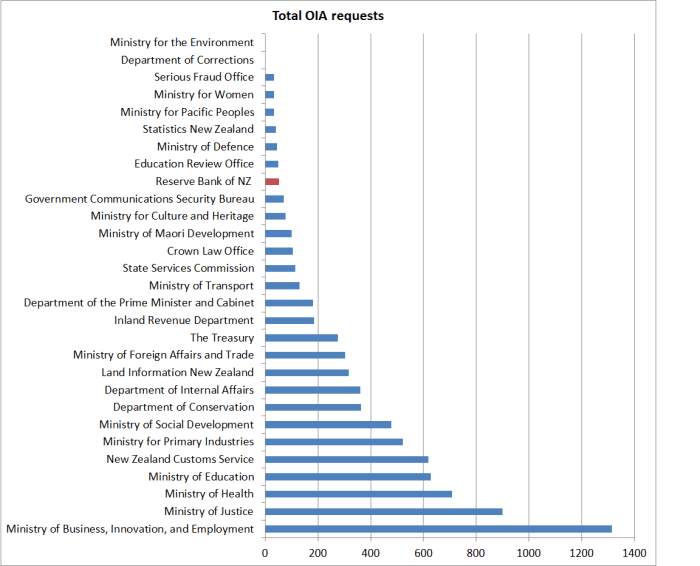
This chart takes his data on the total number of OIA requests each department received in the previous year (mostly the answers are for the financial year 2014/15). There don’t appear to have been responses yet from Environment and Corrections.

OIA requests

Every agency has different responsibilities, some are much larger than others (and one has to be a little wary of how things are classified, eg there is a note on the IRD response saying that their numbers include only requests handled at National Office (ones from media, MPs, and those of a sensitive nature)), but the Reserve Bank does not stand out among government departments as overburdened by requests.  The Ministry for Women, for example, or the Ministry for Pacific Peoples –  both with fewer requests – are tiny departments with little or no independent power or responsibilities.  The Treasury, it turns out, had five times as many requests as the Reserve Bank in this particular year.

By contrast to MfW or MfPP, the Reserve Bank independently sets monetary policy (with a huge short-term impact on the economy and the sectoral distribution of incomes), it regulates banks, non-bank deposit takers, and insurance companies (and now directly impinges on housing mortgage borrowers), it is a major payments system operator, it takes large financial risks in international markets, and it issues our notes and coins.  In some ways, against the backdrop of this data, it is a little surprising that such a powerful independent agency has not received more requests over the years.


Once telephones took forever….

Don Brash tells a good story of taking over as CEO of  the merchant bank Broadbank in the early 1970s and being told by the Post Office it would take several months to get some new phone system installed in the dealing room.  It wasn’t just merchant banks. Te Ara, the on-line encyclopaedia records that

business customers in particular wanted more sophisticated telephone services which were available internationally, and households were often frustrated by the time it took to get a telephone.

and

Delays in the installation of new telephones affected more than residential customers. In 1984 Treasury, at the forefront of the push for re-organisation of the Post Office, waited two months for existing telephone jacks to be shifted. Senior officials exchanged angry letters. Treasury argued that it was inefficiency, and the Post Office insisted it was pressure of work.

It is easy enough to get a telephone today.  It is a shame one can’t say the same about official information –  that reforming legislation having come a few years earlier than the telecoms ones.

As I noted the other day, last year I asked the Reserve Bank for any papers relating to work it had undertaken on reforming the Bank’s governance model (single decision-maker, role of the Board etc).  That request was lodged on 29 June.    On 24 August –  almost two months later, notwithstanding the “as soon as reasonably practicable” provision in the Act, the Bank declined my request almost in full (releasing one paper not that relevant to the issue).  They cited numerous reasons including the rather grandiose claim that to release such papers would damage “the substantial economic interests of New Zealand” .  I documented all of that here.

A few days later (27 August) I complained to the Ombudsman’s office.  They acknowledged receipt of the complaint and noted, as is typical, that it would probably take some time to get to it.

This afternoon, 17 February, a nice letter from the Ombudsman’s office was dropped into our letter box, informing me that they are just now getting underway with an investigation and that the Chief Ombudsman, Peter Boshier, will be investigating my complaint.  That is welcome.

It is a genuinely nice letter, quite apologetic about the “workload pressures” that “have led to delays in progressing this matter”.   I am not intending here to be critical of the Ombudsman’s office at all –  Parliament determines their resources, and they must do their best within those constraints.

But it is now almost eight months since the first request was lodged.  I presume it will take another month or two for the matter to be resolved.   Perhaps 10 months on from the initial request I might finally get an answer.

I think the specific issue is an important one, of some public interest, but it clearly isn’t that time-critical.  For plenty of other matters, time matters more.  But if this is a typical lag –  as I can only assume it is –  no wonder plenty of government agencies find it worthwhile to stall, and wait out the Ombudsman.

Telephone delays etc were quickly resolved once the industry was deregulated.  The same solution doesn’t look to be available here.    Perhaps not many problems can be solved simply by throwing more money at them –  and there may be scope for productivity improvements in the Office of the Ombudsman  –  but an effective well-functioning Ombudsman’s office, with prompt turnaround times, does have the feel of a currently underfunded public good.

The Reserve Bank’s OIA charging policy release

Thanks to Eric Crampton for alerting me to the Reserve Bank’s OIA release (to Alex Harris) around its new charging policy.

The documents are interesting in that they provide us with some data.  The Reserve Bank has complained about a large increase in the number of OIAs they have been receiving, and used that as one justification for the new charging policy.

 18 requests in calendar 2010

21 requests in calendar 2011 – up 17% from previous year

30 requests in calendar 2012 – up 42% from previous year

45 requests in calendar 2013 – up 50% from previous year

47 requests in calendar 2014 – up 4% from previous year

70 requests in calendar 2015 – up 49% from previous year

As they acknowledge, the Reserve Bank has been rather more active in a number of policy areas in the last few years –  LVR restrictions are the most obvious example –  which might have been expected to generate more requests, and more (attempted) scrutiny of the Bank.

But what is a reasonable baseline?

In their paper, the Bank staff note that the Treasury informed the Bank that they had a team for four full-time staff to handle OIA requests (and had charged only one person –  an academic with a large research grant – some years ago).  We don’t know how many OIA requests Treasury deals with each year (for requests to The Treasury itself, and those it handles for the Minister of Finance), but on the Treasury website there  are more than 100 OIA releases in the last 12 months –  and that list is described as “selected responses” and also excludes pro-actively released material (such as the post-Budget large pro-active release).

The Treasury is a larger organization than the Reserve Bank (around 420 staff to the Bank’s 260 or so), and covers a wider range of functions.  On the other hand, the Reserve Bank has a large amount of delegated power in a variety of very significant areas (monetary policy and banking regulation), and with a very large balance sheet.  It isn’t obvious that 70 OIA requests a year is an unreasonable number for an organization of the power, size, and importance of the Reserve Bank.  Perhaps –  as various people have suggested –  it is just that the Reserve Bank was getting off surprisingly easily in the previous few years?

In the note to the Bank’s Senior Management Group I am listed as one of the culprits –   having, at that time, apparently lodged 16 OIA requests in 2015 (the final total would have been 2 or 3 higher).  Curiously, the Bank proposes in the documents a benchmark for charging in which charges would apply to people making more than a rolling average of two requests per month.  Not even I managed that last year –  and I haven’t lodged a request with the Bank this year to date.   As the No Right Turn blog puts it:

The bank’s cutoff for when it will refuse a request for “substantial collation and research” is a mere three hours, while their definition of a “high volume requester” is someone who makes two requests a month for two months. Combined, these basically rule out any use of the OIA for serious research or investigation of the bank’s policies, whether by academics, investigative journalists, or the public. And while MPs won’t be charged, their requests will still be refused if they take more than that three hour limit. The net result: less scrutiny, and a specific incentive against regular scrutiny. Which means less accountability to the public.

I had a quick look through my email inbox to refresh my memory of last year’s requests:

  • four related to issues around the Bank’s superannuation fund. I am an elected trustee of that Fund, and we have been grappling with some difficult and serious issues raised by a pensioner about events in the late 1980s and early 1990s.  The Governor’s alternate (Geoff Bascand) had been actively seeking to close the issues down, without further investigation (even though they have already led to the discovery, disclosure, and apology for the fact that past trustees –  chaired by Don Brash, and including the current head of the New Zealand Transparency International –  had broken the law).  The only way to get some of the information needed was to request it from the Bank under the Official Information Act.    In no case was any substantial research or collation faced by the Bank (in one case I was simply told to photocopy the pages I wanted).
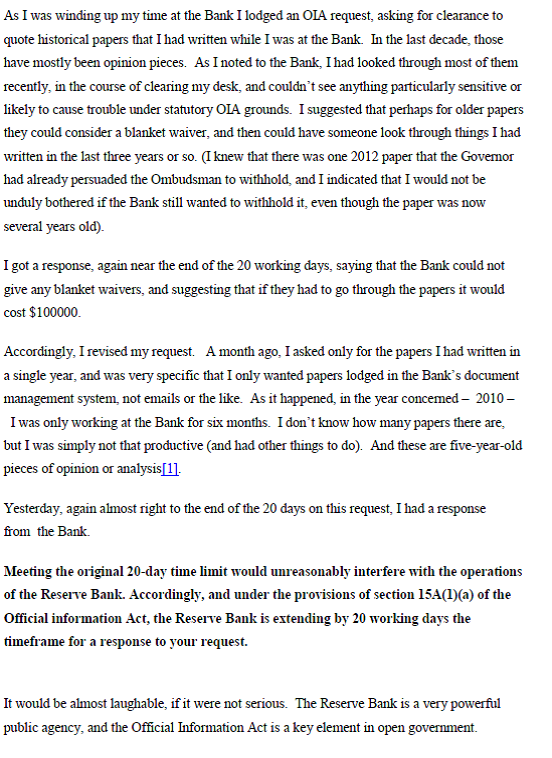
  • When I left the Bank I sought approval to use old discussion notes and memoranda that I had written.  This was an entirely friendly approach, designed to minimize future requests by, in effect, seeking general approval to quote old papers (I even excluded from the request one paper I knew the Governor was sensitive about).  Approval could have been granted, at least for older papers, with no Bank resources at all.
  • I sought the release of background papers to one of the 2005 MPSs.  These were 10 year old documents, nicely collated and stored. The point of the request was to establish the principle that such papers should be public, at least with a lag.  The request should have involved no material costs to the Bank, and when the papers were finally released –  well beyond 20 working days –  there were no deletions at all.
  • In two cases, I sought background papers after major changes of view by senior bank management –  changes where no reasoning was provided at the time.  One related to capital gains taxes, and the current one relates to immigration.  Since they were current issues, (of material public interest) there should have been limited resources required to respond promptly.
  • I requested background papers relating to 2012 Policy Targets Agreement. As this is the key document governing monetary policy, and no background papers had been released at the time the PTA was signed, it seemed desirable to better understand what the Minister and Governor had had in mind (especially in light of the current monetary policy stance debates).
  • I requested papers relating to the extensive work programme the Reserve Bank had been doing on reforming  the governance of the Reserve Bank.  The Bank has refused to release anything of substance, a quite extraordinary stance for a work programme that has now (apparently) ended (and quite in contrast to the Treasury’s approach to a request on that work).
  • I sought papers provided to the Bank’s Board relating to the September MPS.  The Bank will have spent next to no resources on this request, since was refused completely (as I expected, but I wanted to establish the point).
  • I sought minutes of the Bank’s Governing Committee for a defined period last year.  The Governor has been keen to stress the role the Governing Committee plays in decisionmaking, and as is well known it is common for minutes of key policy committees in other central banks to be released.  Totally refusing this request will also have taken almost no resources, since there was no sign in the response that they had considered the individual meeting minutes.
  • I requested one specific paper I had written about fiscal and monetary events in 1991 –  the first big test of the inflation targeting framework.  This request was, of course, necessary only because the Bank had (see above) refused my general request to be able to cite my old papers.
  • I requested copies of the submissions on the new investor finance restrictions.  After great difficulty, and only after another media request, were some of these documents released (in total). It remains common practice elsewhere in government to publish submissions pro-actively.
  • I requested copies of submissions on the regulatory stocktake.  Comments as for the previous item: costs and resource pressure arise entirely from the Bank’s choice to be non-transparent.
  • And I made two requests relating to the (TPP) Joint Macroeconomic Declaration, to which the Reserve Bank is a party.  The second request followed when the first request was denied in full.  The second request is still pending.

Reviewing that list with the benefit of hindsight they seem like exactly the sorts of requests that a central bank and financial regulator might expect in the course of a year like last year.  Most would have been avoided if the Bank adopted the sort of pro-active transparency, as regards process, that is now best practice, or (in some cases) had simply explained itself.  Even when material was released, it was almost always done on the last lawful day, or after an extension or two.

(Of course I would say this), but none of the requests appear vexatious or deliberately time-wasting.  I have been encouraged to make other requests of the Bank –  to seek information on the process they have used on each of the requests they have stalled, obstructed or refused, but have chosen not to.  I’m less interested in the details of any particular request than in the general pattern of obstruction and (despite their claims) non-transparency.

The Official Information Act is about improving access to official information –  an idea that the Bank appears to be rather uncomfortable with.  As I’ve noted before, it may be that their charging policy is lawful, but if so there is something amiss with the law itself. Whether or not it is lawful, it is not good practice, and not consistent with the sort of image –  an open and transparent institution –  that the Bank regularly tells us it wants for itself.

A transparent central bank? Not our one.

Readers may recall that on the day of the December Monetary Policy Statement I lodged a request for analytical papers the Bank had considered in recent months on the economic impact of immigration.  The background was (a) the Governor’s press conference endorsement of New Zealand immigration as “a good thing”, and (b) the explicit statement in the MPS that the Reserve Bank had changed its view of how immigration affects the short-term balance between supply and demand pressures.  As they stated in the key policy judgements chapter:

Record net immigration is adding materially to demand and to labour supply.  Given continued strong flows, we have revised up our projection for net immigration (see chapter 5).  Based on the cycle to date, we assume the future population boost and associated increases in the labour force will translate more quickly into supply potential than we have assumed in the past.

That has important implications for monetary policy.

But there was nothing in the rest of the document, or in the answers at the press conference, to explain this quite marked change of stance.  As I have pointed out, the new stance is not just different from their past view, but different from quite recent Bank published research, in which demand effects exceed supply effects in the short-term, meaning that all else equal the OCR tends to rise when net immigration does.

As I noted a couple of weeks ago, when the Bank extended my quite limited request, it had seemed at the time like a fairly simple request: show us the analysis you are using to back what represents quite an important change of view.

A short time ago, I received the Bank’s final response.  The heart of the response is here (I’ve highlighted the section in bold)

The Reserve Bank holds 20 documents within the scope of your request, which are all related to either the Monetary Policy Committee or the Governing Committee’s discussions of Monetary Policy.

The Act explicitly recognises, in section 4(c), that there are times when releasing information is against the public interest and provides for such circumstances with different types of reasons to withhold information. The Reserve Bank is withholding these 20 documents under the following grounds of the Act:

  • s6(e)(iv) – to prevent damaging the economy of New Zealand by disclosing prematurely decisions to change or continue government economic or financial policies relating to the stability, control, and adjustment of prices of goods and services, rents, and other costs;
  • s9(2)(g)(i) – to maintain the effective conduct of public affairs through the free and frank expression of opinions by or between officers and employees of any department or organisation in the course of their duty;

The papers about immigration that you’re seeking were prepared in the context of monetary policy discussions, including setting the Official Cash Rate and publishing the Monetary Policy Statement. As you are aware from your time working at the Bank and from your previous requests for information related to both the Monetary Policy Committee or the Governing Committee, the Reserve Bank considers that information provided to and discussed recently by policy committees in relation to setting the Official Cash Rate must be kept confidential in order to ensure that free and frank discussion occurs and that free and frank advice is provided to the Governor. The Bank considers that the need to maintain confidentiality abates over time as the economic cycle moves along, but that current and recent advice must remain confidential in order for the Bank to effectively perform its monetary policy function. Public disclosure of current and recent advice occurs, in summary form, via publication of the Monetary Policy Statement and associated news statement. The process of deciding what to publish in the Monetary Policy Statement recognises and balances the tension between disclosure and confidentiality.

Frankly, if they had told me that they had no papers within scope I might not have been unduly surprised.  Sometimes forecast assumptions are tweaked to produce the bottom line the Governor wants (always have been, probably always will be).

But to suggest that no paper on any aspect of immigration that went to the Monetary Policy Committee  at any time over the five months or so leading up to the Monetary Policy Statement can see the light of day, on principle, seems completely inconsistent with the statutory purposes and principles of the Official Information  Act –  designed to make information more available.  And there is no sign that the Bank has considered the papers one by one: it looks a lot like a blanket refusal.

As for the statutory provisions they quote:

  • section 6(e)(iv) simply cannot be used here. It refers to premature disclosure of decisions.  My request was for background analysis or research.
  • and the invocation of the “free and frank” provisions is also, at best, a stretch.  I didn’t ask for minutes or records of discussion at meetings.  I don’t even ask for individual pieces of OCR advice (the one page notes advisers submit), but for pieces of analysis –  prepared, most probably, in one or other of the sections in the Economics Department.  The material clearly exists.  It is official information.  We should be able to see it –  especially, when it has “important implications for monetary policy”.

As I’ve noted repeatedly there is a far higher degree of transparency (and timely transparency) around background papers feeding into the government’s Budget deliberations.

I noted recently that “the Reserve Bank constantly tries to convince us of how transparent it is.  As Deputy Governor, Geoff Bascand, put it in his first on-the-record speech

The Reserve Bank is deeply committed to transparency – of policy objectives, policy proposals, economic reasoning, and of our understanding of the economy, and of course of our policy actions and intent. Clear communication and strong public understanding make our policy actions more effective.

We are working to enhance the openness and effectiveness of our communications

Mine wasn’t a request for anything obscure.  It didn’t have a “gotcha” agenda –  though legally it doesn’t matter if it did. (And, if anything, their change of view happens to support my current view on monetary policy).   It was just a request to see the background papers that appear to have led to a large change of view, on an important part of how current shocks affect the economy and inflation pressures –  a change not elaborated on at all in the document they did make available, the Monetary Policy Statement.    To enable us to better appreciate, in Bascand’s words, their “economic reasoning, and…our understanding of the economy”.

The Bank simply isn’t very transparent at all.

I will pass on this response to the Office of the Ombudsman.

The cause of getting some insight into the Bank’s view of immigration is not, apparently, totally hopeless.  At the end of today’s email they did include this

The Bank holds other information that is not within the scope of your request but that nevertheless may help shed light on the Bank’s views about immigration. This material is currently being worked on with a view to publication and the Bank will inform you when it is available.

I’ll look forward to seeing that material when it eventually appears.  But, as they note, it isn’t within the scope of my request, or within the sort of 20 working day OIA timeframe.  It continues the Bank’s longstanding approach of acting as if the principles of the Official Information Act really don’t apply to them, and that as far as possible only things that the Bank has written for external publication should see the light of day, not “official information” as defined by Parliament.


Immigration effects and the OIA

The economic impact of immigration received considerable attention in the Reserve Bank’s December Monetary Policy Statement.  That made sense –  the net inflow (a small net outflow of New Zealanders and a large net inflow of foreigners) over the last year or so has been one of the larger net inflows seen for some time, and has led to an estimated population growth rate higher than we’ve experienced for decades.  Changes in immigrant numbers affect the labour market, the housing market, demand for government infrastructure etc.   A forecast-based monetary policy needs a good story about (a) what will happen to net migration, and (b) what the short-term economic effects of those immigration developments will be.  And making sense of what has already happened requires disentangling the various influences –  including those associated with changes in immigration.  It is particularly important in New Zealand, where the level of inward non-citizen migration is larger than in most advanced countries, and where the variability in the net flow of New Zealanders and foreigners is larger than most.  Watching the Republican debate the other day, I heard Marco Rubio argue that the US was the world’s most generous nation because it took around a million legal migrants a year.  That is about 0.3 per cent of the US population.  Our annual non-citizen residence approvals target is around 1 per cent of our population.

But reverting to the Reserve Bank view, the material in the Monetary Policy Statement and associated press conference wasn’t that convincing.  Here is what I wrote about it then:

I am also puzzled about the Bank’s stance on immigration, and the evidence base that lies behind it. The Governor is clearly at one with New Zealand elite opinion –  he told the news conference that he thought high levels of immigration were “a good thing for New Zealand” and that he did not think there should be any immigration policy changes.  Views differ on the long-term economic impact of immigration, and many certainly agree with him, but why was this a subject the Governor is commenting on at all?  Historically, the Reserve Bank has been studiedly neutral on the long-term issue, and focused (rightly) on the short-term cyclical implications.  Governors who use the platform they have been given to advocate their personal policy preferences in other areas risk further undermining support for the autonomy they enjoy in respect of monetary policy.

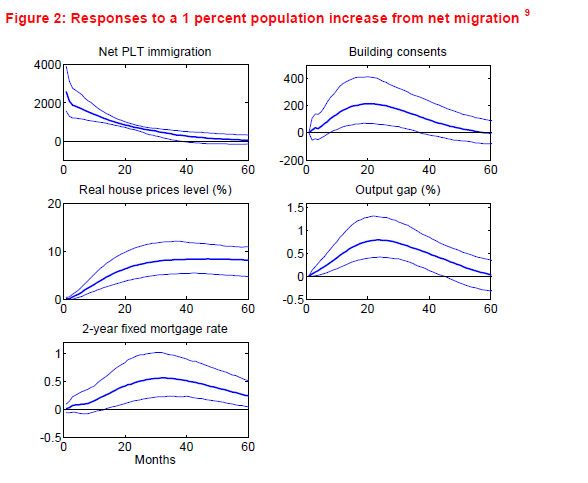
But even the Bank’s view on the cyclical impact of the recent high levels of immigration seems confused.  In chapter one (the press release) they assert that high levels of immigration have reduced capacity pressures and contributed to  a lowering of inflation (ie supply effects exceed demand effects).  In chapter 5, they produce a scenario about the impact of immigration staying unexpectedly high over the next year or two.  In that scenario they explicitly articulate what appears to be their latest new view, in which a change in immigration has no net short-term impact on capacity or inflation pressures (short-term demand effects are just matched by short-term supply effects).  There is no analysis in support of any of this.  And there is no engagement with their own past research, or with the consensus view of New Zealand macroeconomists going back decades that whatever the possible long-term gains from immigration, in the short-term the demand effects dominate the supply effects (which shouldn’t be surprising, since the per capita capital stock requirements of each new person are materially greater than one year’s labour supply).  It was only two years ago that they published a research paper which showed these results.

mcdonald rresults

Demand effects exceed supply effects in the short-run (of several years).

The Bank seems all over the place on these issues. Perhaps they have fresh new research on the issue, but they put out two new Analytical Notes this morning, and there was nothing on immigration. I have asked for copies of any analysis they have produced in support of their new view, including how it might relate to the 2013 research.

For decades, the Reserve Bank has been clear that the short-term demand effects of immigration outweigh the short-term supply effects in New Zealand.  That was typically the view of other macro forecasters, and it was also the consensus among New Zealand economists throughout the post-war period.  It isn’t surprising (modern economies need lots of physical capital – and building a house typically takes more than the value of a year’s labour) –  and it says nothing about whether or not large scale immigration is beneficial in the long-run.  But the Reserve Bank has now apparently changed its stance, while providing analysts, commentators, and the public no basis for their new stance.  Perhaps the new stance is correct, but we should be able to evaluate their arguments and evidence.

So on the morning of the MPS release, I lodged a request with the Bank for

Copies of any analysis undertaken by, or discussed by policy committees at, the Reserve Bank since 1 June 2015 about the determinants of net migration in New Zealand and the economic impact of immigration.  I am interested both in any material shedding light on the Bank’s evolving views around the balance between supply and demand effects of immigration (including any reflections on the ongoing relevance, or otherwise, of the results published in Chris McDonald’s 2013 Analytical Note) [from which the chart above is taken], and anything shedding light on the Governor’s comment this morning that the high level of net immigration is a “good thing” for New Zealand.

It wasn’t a “gotcha” request.  I assumed there must be some new modelling or research behind the Bank’s stance, and was keen to see it, and cover it here.  It was also surprising that a Reserve Bank Governor would comment explicitly on longer-term immigration policy so I wondered if they had new evidence, or were influenced by new evidence from others, to justify that stance.  I also drew the request quite narrowly, focusing on the previous two forecast rounds only, and not asking for emails.  I was quite genuinely interested only in either research papers (there just aren’t that many  in any five month period) or analytical pieces discussed at the Monetary Policy Committee (again, it seemed unlikely there would be many –  immigration not having featured in the Statement of Intent as a key aspect of the Bank’s research programme.   Moreover, since immigration had been a prominent aspect in the Monetary Policy Statement released just that morning, it was hard to imagine that any extensive investigation would be required to unearth papers, which had been prepared and discussed in the previous few weeks.  And as I noted the other day, the Reserve Bank has tried to convince us of how transparent it is around its  “policy objectives, policy proposals, economic reasoning, and of our understanding of the economy”, so it seemed reasonable that they would be keen to get any material out as soon as possible.

And since the Official Information Act requires agencies to release material “as soon as reasonably practicable” the naively optimistic strand that lurks within me wondered if I might get something by Christmas.  Silly me.

Instead, I had an email from the Bank just before 5pm last Friday –  the very last day of the 20 working days available to the Reserve Bank to respond.  I was advised that

The Reserve Bank is extending the time limit for a decision on your request to Monday 29 February 2016, as permitted under section 15A of the Act, because the request necessitates a search through a large quantity of information and meeting the original time limit would unreasonably interfere with the operations of the Bank.

That is certainly a statutory ground on which a deadline for dealing with a request can be extended.  But it is highly unlikely to be a legitimate argument in this instance.  As I noted, it is not plausible that there is huge amount of material.  And as for unreasonably interfering with the operations of the Bank, recall that these aren’t ancient historical papers, or about some obscure points of policy; they are recent papers directly relevant to the Bank’s primary function, where it prides itself on transparency.  And the OIA had already given the Bank extra time (since deadlines are automatically extended over the summer holiday period).

Frankly, I’m not sure what the Bank has to hide.

But it feels like deliberate stalling and, accordingly, I have appealed this decision to the Ombudsman.    I am beginning to worry that perhaps there is nothing there at all.

That would be a concern –  and especially from an agency which wants to convince us that its new charging policy is itself in the public interest [1], and indeed supports access to official information.


[1]  Somewhat curiously, despite the alleged need to “search through a large quantity of information” and the risk that doing so might “unreasonably interfere with the operations of the Bank”, there has not yet been any suggestion of a charge for meeting this request.


Charging for official information

Debate over the Reserve Bank’s new charging policy has continued.  Under a heading “The perils of user-pays democracy” Bryce Edwards had a nice summary of the articles and commentaries that had appeared by late last week.  And since then the flow has continued –  including a Rob Hosking piece in NBR, a Dominion-Post article about, and interview with, the new Chief Ombudsman, and an op-ed this morning from Bronwyn Howell at Victoria University, run alongside the hard-copy version of Geoff Bascand’s defence (that first appeared last week).

If the Reserve Bank is monitoring the reaction and debate, which I’m sure it is, it can only conclude that it is losing in the court of public opinion.    It isn’t just about journalists, bloggers, academics etc, but in the comments sections to the various articles the balance of opinion seems to tilt quite clearly away from the Reserve Bank’s stance.

Losing in the court of public opinion should concern the Governor –  and those charged with holding him to account (the Board, the Minister, Parliament’s Finance and Expenditure Committee).  Democracy rests on the consent of the governed, and although formal laws play a vitally important part in expressing that consent, and securing compliance, it is buttressed by a sense that the decisions of the powerful (elected or otherwise) are fair and consistent with the values of the society.  I don’t get the sense that many people who have thought about the issue at all think that blanket charging, for any OIA requests that are at all complex or awkward, is consistent with the way in which this country should be run.  All the more so perhaps when the agency concerned wields so much power – the Governor has more discretionary policy freedom than even most elected officials –  with so little effective formal accountability.

It is, however, somewhat troubling that in his interview the other day with the Dominion-Post the new chief ombudsman, Peter Boshier, declares that the Reserve Bank’s policy is just fine:

“I think the Reserve Bank’s response is actually very fair.  When I looked at it I couldn’t fault it.  As a statement of principle it was perfectly fair and it’s one to which I subscribe”

I was surprised that the new Ombudsman was so upfront in his defence of officials, but it is consistent with the point I made last week, that the charging provisions of the Official Information Act itself are quite permissive, putting few constraints on agencies (other than that any charge be “reasonable”).  The government’s charging guidelines are considerably less permissive (and the Reserve Bank’s policy is not consistent with those guidelines), but those are guidelines to government agencies, not the law that the Ombudsman is required to interpret.

As a commenter on my earlier post has pointed out, in the end the only final and binding ruling on how the relevant provisions of the Act should be interpreted would be those of the courts, should anyone seek a judicial remedy.  I’m not aware that there has ever been a case on the charging provisions.   Last year, the courts heard Jane Kelsey’s case, but in largely upholding her argument that the Minister of Trade, and the then Ombudsman, had misapplied the law, by blanket refusals to release information, but the judge in that case did point to the option the Minister had had to charge for collation/ scrutiny etc of the information.  Perhaps at some point a court might rule that a fairly extensive charging policy, like that adopted by the Reserve Bank, was impermissible under the Act – ie unreasonable, because the effect was inconsistent with the whole purpose of the Act, to make official information more readily available.  But frankly, I’m old-fashioned enough to hope that no court would do so: Parliament put the charging provisions in the Act, and Parliament should refine or remove it, not (in Professor James Allan’s words), a committee of ex-lawyers.

Bronwyn Howell’s article this morning is a curiously “on the one hand, on the other hand” academic economist’s piece.

Inevitably, there are trade-offs to be made between the costs of acquiring information and the costs and incentives of concealing it.  There are economic arguments both for and against explicit fees.

The only certainty is that when it comes to the costs of Official Information, democracy itself doesn’t come cheap.

Yes, of course there are potential trade-offs, but they aren’t typically very large ones.  And, yes, open government and democracy carry some direct costs (even elections cost), but not typically very large ones –  and the costs of a not-very-open government (harder to put a dollar price on perhaps) are considerably greater.  And if the potential dollar costs are upfront, the benefits often flow over the longer-term.  Open and transparent government helps provide citizens with the confidence to allow governments, and government agencies, to act –  knowing that we can later scrutinize the choices made, and the evidence and arguments used in support of those choices.  When people don’t trust governments, they eventually take away the powers, and the flexibility those agencies have –  and sometimes need.

What of the Reserve Bank?  In his op-ed last week, the Deputy Governor argues that the Bank will only be charging for requests that are “large, complex or frequent”, suggesting that ordinary people have nothing to worry about.  But the case he cites –  a Fairfax’s reporter’s series of requests – involved 8.5 hours of time.  I’ve been asked to pay for a couple of requests that they estimate would, they estimate, have involved a similar amount of time.  But any serious request for information on policy matters is typically going to take, at least, several hours of work by officials, and that is partly because it is difficult to be sure where the information a requester is looking for might be found (ie which specific document), and agencies are not inclined to assist requesters.  In practice,  the requests the Deputy Governor appears happy not to charge for seem to be mostly the ones that involve no threat or risk to the Bank (in other words, no serious scrutiny).  It is way of fending off serious questions or investigations by the media and commentators.

Here are some of my experiences with the Bank and OIA charges.  The first two date from before the current policy was adopted in November/December last year.

oia

If it were an agency committed to open government, it would have been very easy, with no direct cost to the Bank at all, to have simply responded to the initial request with a general authorization to use any of the older papers, and perhaps asking for a discussion about refining the request for the more recent ones.  But that isn’t the Reserve Bank’s way.

A bit later I asked for background papers to the 2012 Policy Targets Agreement.  The PTA is the key document governing the conduct of monetary policy, and no background papers to it were released at all when the Governor and the Minister of Finance agreed the PTA in 2012.  I was threatened with a large bill, and invited to refine the request.  A Bank official prompted me to narrow my request to a particular file which, when the Bank eventually finally responded to the revised request, proved to have almost nothing in it that shed any light on the background to the Policy Targets Agreement.

What of the more recent episodes?

I asked for copies of some old Board minutes.  Those papers are well filed, and nicely bound at the Bank.  The Bank knows there is nothing problematic in them as a year or so ago, I had made a request for a slightly more recent set of minutes, and was quickly told I could copy them myself.  And yet they wanted to charge hundreds of dollars for these readily accessible uncontroversial historical papers.

I also asked the Bank for papers relevant to the post-TPP Joint Macroeconomic Declaration to which the Reserve Bank has become a party.  I’ve been told that meeting that request is also likely to cost hundreds of dollars.  It isn’t a large or complex request either: the Bank tells me that they have identified seven papers and 26 pages of emails; if anything, I was a little surprised at how little material they had.

With a track record like this, it is not surprising that people are uncomfortable with the Reserve Bank’s new policy.  It seems designed to obstruct, not to inform, and particularly to obstruct any awkward questions about the activities of a very powerful agency.   I’m not sure what specific topics Richard Meadows’ requests were about, but it seems unlikely that they were very large or complex either.

In passing, I would note that one of the aspects of the Reserve Bank’s involvement in the post-TPP Joint Declaration that I was curious about was the additional costs they were committing to (with no new funding), and what they were proposing to displace to cover these costs.   The agreement committed the agencies involved to (at least) annual macroeconomic consultations between the parties to the agreement, which will involve additional travel costs, and additional analytical work in preparation for such meetings.   An additional business class airfare to Washington alone appears to be another $7000 or so, with additional costs (and lost other productive opportunities for a senior official) as well.    It would be surprising if the involvement in the Joint Declaration did not cost the Bank at least another $15000 a year.  And it would be surprising if all their OIA requests, trivial and substantive, cost much more than that.  Recall, that the Joint Declaration was developed only at the insistence of the US Congress (and even then the Federal Reserve refused to be party to it).  I’m not necessarily suggesting there is anything inappropriate about our Reserve Bank and Treasury being party to the declaration, although it does carry some risks.   But we should be able to see how the Bank has thought about those risks (and the additional costs).

In concluding, here is a link to the more radically open approach adopted in Norway.    The Reserve Bank should be reconsidering its policy on charging for information, but the more general issue really requires some political leadership from some party or another that believes seriously in open government, even recognizing that genuinely open government will sometimes be uncomfortable for the powerful.  Indeed, that discomfort is more or less the point.


OIA: changes in RB practice and in law needed

Just before Christmas, I drew attention to the Reserve Bank’s new policy of charging for Official Information Act requests.  At the time, this paragraph appeared on the Bank’s website.

The Reserve Bank has a policy of charging for information provided in response to Official Information requests when the chargeable time taken to provide the information exceeds one hour, and charging for copying when the volume exceeds 20 pages. Our charges are $38 per half hour of time and 20c per page for copying (GST inclusive).

That text has now been removed and they appear to have provided some rather more extensive material outlining the approach they are now planning to take.  This is what is now stated on the website:

The Official Information Act allows the Reserve Bank to charge for preparing information that we send in response to requests. When charging for responses to Official Information requests, the Reserve Bank works within the guidelines published by the Ministry of Justice here – Official Information Act: Charging for Services. Charges are $38 per half hour of staff time after the first hour, and 20 cents per page for printed or copied material provided in response to a request, after the first 20 pages.      The Reserve Bank is resourced to meet disclosure obligations for a reasonable level of Official Information requests and generally will not impose charges for small, simple or infrequent requests. If requests are made for large amounts of information that require substantial collation and research, the Reserve Bank’s first step is to work with the requester to refine the request to a smaller scale or scope that is less likely to involve charges. Where request is still chargeable and likely to be expensive, we will give the requester further opportunity to refine the scope of the request and thereby reduce or eliminate charges.

Basis for charging     The cost of providing free responses to Official Information requests is generally borne by taxpayers. The Reserve Bank believes that requesters should bear some of the costs when requests are made for very large amounts of information, where a response to a request is particularly complex, or where individuals or organisations make very frequent requests.

Guidelines for charging      Charges will be imposed for responses when preparation of the response involves more than one hour of chargeable collation, research and preparation work. If the Reserve Bank decides that information requested can be made available, but that charges are appropriate, we will formally advise the requester of:

  • our decision to release the information,
  • the estimated amount of proposed charges,
  • the basis for proposed charges, and
  • the requester’s right to seek an Ombudsman’s review of the proposed charges.

Remission of charges        The need to pay charges may be modified or waived at the Reserve Bank’s discretion, if:

  • charges might cause financial hardship for the requester; or
  • releasing the information is likely to contribute significantly to public understanding of the Reserve Bank and its work, and release of the information is not primarily for the benefit or interest of the requester; or
  • if the information already in the public domain in a form which the requester could acquire without substantial cost.

As I noted before Christmas, it appears probable that the Reserve Bank’s general stance is legal, since the relevant provisions of the Official Information Act itself are quite short and permissive

Subject to section 24, every department or Minister of the Crown or organisation (including an organisation whose activities are funded in whole or in part by another person) may charge for the supply of official information under this Act.

Any charge fixed shall be reasonable and regard may be had to the cost of the labour and materials involved in making the information available and to any costs incurred pursuant to a request of the applicant to make the information available urgently.

Whether it is appropriate is quite another matter.

I discovered the new policy when the Bank sought hundreds of dollars to provide me copies of some easily accessible, non-contentious, very old minutes of meetings of the Reserve Bank Board. But I’m not now the only one to have been hit by the new policy. Richard Meadows of Fairfax was told he would have to pay a similarly large amount to progress several of his OIA requests, a step that has brought greater coverage to the issue. There were articles on Stuff last week (here and here), and yesterday the Dominion-Post editorialised on the Reserve Bank’s new policy, under the heading “An obstacle in the path of freedom”.

The Bank is, of course, bound by the law. But it also notes that it seeks to work within the charging guidelines approved by the then government in 2002. But it is not clear that it is really doing so.

For example, the Bank lists factors it would take into account in deciding whether to modify or waive any charges, but the list it uses is not the same as the list in the government’s charging guidelines. They state

7.1 The liability to pay any charge may be modified or waived at the discretion of the department or organisation receiving the request. Such decisions should have regard to the circumstances of each request. However, it would be appropriate to consider inter alia:

  • whether payment might cause the applicant hardship;
  • whether remission or reduction of the charge would facilitate good relations with the public or assist the department or organisation in its work; and
  • whether remission or reduction of the charge would be in the public interest because it is likely to contribute significantly to public understanding of, or effective participation in, the operations or activities of the government, and the disclosure of the information is not primarily in the commercial interest of the requester.

To comply with these guidelines the Reserve Bank first has to consider the circumstances of each request.   And it is advised to consider whether “remission or reduction of the charge would facilitate good relations with the public” and whether “a remission or reduction in the charge would be the in public interest because it is likely to contribute significantly to public understanding of, or effective participation in, the operations or activities of the government”. The Bank states that it will consider remission or reduction if the request is “not primarily for the benefit or interest of the requester”, but that is hugely different phraseology than the one in the government’s charging guidelines, which talk about where “the disclosure of the information is not primarily in the commercial interest of the requester” – in other words, the test is whether the requester making money from the information in the request.

Yesterday, I was also informed that my request for material the Reserve Bank held relating to its involvement in the post-TPP Joint Macroeconomic Declaration (that our central bank and Treasury were party to, along with macroeconomic authorities in other TPP countries) would also be subject to a charge of $560.

There is no evidence in the letter from the Reserve Bank that they have considered the circumstances of the specific request. For example, as the Dominion-Post editorial notes, charges of this scale “would be a serious obstacle for any individual” and “if OIA requests routinely cost this much it would also be a problem even for large media outlets”.  But I suppose it would not necessarily cause “hardship”

More pointedly, there is clearly no commercial benefit to me at all (let alone it being a “primary” factor) in making such a request. This blog is a non-commercial operation.

What about the wider public interest? Well, the government has been clear that it wants to encourage scrutiny and discussion of TPP issues now that the agreement has been signed. And yet, one press release apart, the Reserve Bank has published no background information about its involvement in the Joint Macroeconomic Declaration, and the Governor has not answered any questions about it. Against that background, a request of the sort I lodged seemed likely to assist public understanding of a new international commitment made by the Reserve Bank. The fact that the Reserve Bank itself constantly stresses the gains from transparency makes their stance on OIA requests in general, and this one specifically, particularly incongruous.

Perhaps the Bank wants to argue that publication on my blog would not advance the public interest (although I’m not sure how they would apply that reasoning to one of the country’s largest media groups). I have, of course, a smaller readership than the Fairfax publications, but by New Zealand standards it is a pretty significant number of people – including, but not limited to, officials, market analysts, journalists and politicians – with an interest in economic and financial policy and analysis issues in New Zealand. The official charging guidelines note that it is reasonable to ask whether requesters have a means of disseminating the requested material. As they note “in the case of the media, however, it can be reasonably assumed that they do have access to means of public dissemination”. The same might be said for requests from reasonably widely read bloggers – blogs not having been as common in 2002 when the charging guidelines were written.

But in any case, the Reserve Bank has itself created a platform for disseminating material, by adopting the (admirable) policy of releasing the results of many of the OIA requests it receives on its own website.

I suspect the change of Reserve Bank policy was prompted by the various requests I have lodged with the Reserve Bank over the last year or so. I haven’t gone back and checked each of them, but I’m pretty sure that in all cases (a) I have written about them here, thus giving dissemination to what the Bank has released (or refused to release) and (b) that all of them have had a focus on enhancing the understanding and scrutiny of a powerful public agency[1].

The Reserve Bank’s new stance is a serious misjudgement. The issue isn’t whether their stance is legal – it probably is – or whether, as applied to either Fairfax or me, it is in accordance with the government’s charging guidelines – it probably isn’t. The bigger issue is the one I have been highlighting for the last nine months. The Reserve Bank is a very powerful organisation, with a great deal of discretionary policy choice left (formally) in the hands of one unelected person. The Bank exercises far more discretion, in a much wider range of areas, than the designers of the Act – and especially of its governance provisions – ever envisaged. Against that backdrop, the Reserve Bank – and its Board and the Minister, both charged with responsibility for the Governor’s performance – really should be going out of its way to be open and transparent – not just on the things it wants to communicate to us, but in facilitating the sort of scrutiny and challenge that open and democratic societies thrive on. The questions might be awkward at times, and some of the angles oblique, but it is for citizens to define the questions and challenges, not the unelected bureaucrats.

It would tedious to go through once again all the areas in which the Bank fails to practice openness and transparency, but to take just three think of submissions on its regulatory proposals, background papers to the current PTA, and background papers on the substantial programme of work undertaken on possible reforms to the governance model. If the Bank is going to add to its generally obstructive approach – responding as slowly as possible, and releasing absolutely as little as possible while waiting out the Ombudsman – by making access to public information something only for those with deep pockets, it will simply further undermine any legitimacy or respect that it has. I would urge the Governor (and his committee) to rethink, and would encourage the Board, the Minister, and members of the Finance and Expenditure Committee to pick up the issue with the Governor. I welcome the fact that James Shaw, co-leader of the Green Party has already gone public on the issue.

More generally, as I have noted before, the Bank would be well-advised to consider adopting a much more pro-active approach to the release of background papers (akin to the pro-active approach taken by the Minister of Finance and the Treasury following each Budget).   For example, the Bank might consider:

  • releasing all submissions on regulatory proposals on the website on the day submissions close,
  • releasing background papers to the Funding Agreement the day the Funding Agreement is released,
  • releasing background papers on any new PTA at the time of the signing of that PTA
  • releasing proper minutes of the OCR-advisory Monetary Policy Committee, and of the monetary policy meetings of the Governing Committee, say, six weeks after the relevant OCR release
  • releasing background papers to each Monetary Policy Statement immediately after the release of the subsequent Monetary Policy Statement

None of these would be extraordinary by the standards of other government agencies or international central banking.

There would, no doubt, still be matters on which people would lodge Official Information Act requests with the Reserve Bank, but the more open the Bank is upfront the less people will feel the need to lodge ad hoc requests.

More generally, this issue highlights the need for a more comprehensive reviews of the Official Information Act, including the role of the Ombudsman’s office and the charging regime. It may well be the Reserve Bank is isolated in its new stance – the No Right Turn blog is seeking the information on that. But as the Dominion-Post editorial puts it, the “default position should be to give the information free. Only in the most exceptional cases should this rule be breached”.

A reader has suggested that perhaps any proposal to charge should require the explicit advance consent of the Ombudsman’s office. That sounds sensible, provided the Ombudsman is properly resourced, but would require a change to the legislation. Legislation might provide that charges could be levied only for exceedingly complex requests (perhaps those taking more than 100 hours – and with decent document management systems how many should that be?) or where it is evident, on the balance of probabilities, that the primary benefit in releasing the information would be for the commercial interests of the requesters (although general release on a public website would presumably deal with what might otherwise be uncharged gifts to commercial operators). Perhaps there needs to be a separate provision for “vexatious requesters”, akin to vexatious litigants in the courts – but again that would be a matter for the Ombudsman to judge, and “asking awkward questions of powerful agencies” would not qualify of itself as vexatious.

We have sought to avoid a “dollar democracy”. The rich and powerful have no more voting rights than you or I. The same really should apply to the access to public information that enables us to evaluate and hold to account politicians and other officeholders (as it largely has in the way the OIA has been administered  –  for all its problems – by most agencies). Whether or not the Reserve Bank backtracks, it is time for Parliament to revisit the OIA and better fit it for an age when openness and transparency are seen as increasingly important. Part of that will be about a stronger culture (and obligation) to pro-actively disclose, part about better-resourcing the Office of the Ombudsman, and part is about ensuring that access to public information is not determined by the size of one’s bank account.

As I was just about to publish this I noticed an op-ed from the Reserve Bank’s Deputy Governor Geoff Bascand, defending the Reserve Bank’s stance in response to yesterday’s editorial.  Readers can evaluate it for themselves, but I noticed this section

Since the policy was introduced we’ve responded to seven OIA requests and sought charges for two of them because most could be addressed without collating large amounts of information.

The particular charge that sparked recent commentary arose because providing the information requested would take an estimated 8½ hours of chargeable time (along with additional non-chargeable time).

As the Bank has sought charges for two of my OIA requests since the policy was changed, and Richard Meadows noted in the comments on my earlier piece that he was charged for three, this account seems not quite accurate.  And I’m still waiting for a response to my September request for the submissions made to the Bank on its regulatory stocktake.


[1] As it happens, the Board papers I requested last year probably fitted those categories least (they were about (a) some background work on the origins of the Reserve Bank Act and the Board’s role, and (b) the interests of hundreds of present and former members of the Reserve Bank’s superannuation fund (I’m a trustee of the scheme and some difficult issues have arisen from that era)).

Predictable pre-Christmas bureaucrats

Bureaucrats are mostly rather predictable.

I’d been conscious that the Reserve Bank had not yet released the results of its “regulatory stocktake”, even though submissions had closed three months ago.  The Friday before Christmas seemed like a good day for a release by an institution that might want as little coverage as possible of its decisions.  So I kept an eye on my email yesterday, and sure enough at 4.35pm up popped the results of the so-called stocktake.  As far I can see, there has been no media coverage so far, and even if any of the relevant journalists are still around, readership interest in anything serious is rapidly waning.  NBR had covered the issues earlier, and it has already published its last paper for the year.

The stocktake was never a very serious exercise. I was still at the Reserve Bank when the terms of reference was determined, and the Governor was clear then that he did not want any serious issues addressed.  It seemed that it was as much an exercise in appeasing the Minister, to show that the Bank was willing to look afresh at its stock of regulation and perhaps even tidy up some small stuff.

There were, in my reckoning, three main issues dealt with in the consultation document:

  • Refinements to the disclosure regime, generally with a view to reducing public disclosure
  • Refinements to the “fit and proper” regime
  • Some reflections on the Bank’s own policy processes for bank regulation.

I made a submission to the stocktake, along with many of the banks and variety of fairly well-informed individuals including the former Governor, Don Brash.

As far I can tell from reading the document the Bank released yesterday, it had no real interest in any submissions other than those of the banks and of a single rating agency.    It does report the gist of some of those individual submissions, but there is no sign that any of them had any impact on the Bank’s thinking, nor an attempt to explain why the Bank regards the arguments made as unconvincing.   That is one of the problems in having a regulatory agency set policy as well as implement it –  insiders will tend to be defenders of the status quo, and if they are responsive to outside input at all it will tend to be to submissions from those they have most to do with (in this case, the regulated entities, the banks).

The Reserve Bank has been putting progressively less emphasis on public disclosure by banks over the last decade or so.  The Bank itself has been quite open that it does not now use the information in the disclosure statements for supervisory purposes, having replaced it with a variety of ‘private reporting’ returns that no one else has access to.  Note that the Bank is very enamoured of what it describes as a “non-zero failure regime” –  that is, the system is run to allow for the possibility of bank failures (rather than to prevent them all), and with the aim of ensuring that any losses fall, as far as possible, on shareholders and creditors (including depositors).  There is no deposit insurance in New Zealand, and the Bank is staunchly opposed to the introduction of deposit insurance.  In other words, in their vision the risks from any failure of a bank fall first and foremost on creditors, not taxpayers.  And yet those creditors do not get access to the information that the Reserve Bank regards as vital to assess the health of banks.  The disclosure statements are really, in effect, just a legacy of history –  probably of no real value to creditors (since it isn’t the information the supervisors themselves use).

I pointed this out in my submission, and suggested a rather simpler and cheaper approach which would better reflect the risks the system is designed around –  ie providing creditors much the same information as the central bank gets, when the central bank gets it.

The Bank has canvassed an option somewhat along these lines in its consultative document, raising the option of a “continuous disclosure” model, something like what stock exchanges impose on listed entities, for periods between six-monthly disclosure statements (at present, disclosure statements are quarterly).

The Bank did not respond to my suggestion at all.  It did respond to the partial continuous disclosure idea.  The first argument advanced against it was “banks did not support this option”, but with no statement of why –  and recall that we don’t have access to submissions made to the Reserve Bank.  The Bank’s own concern seemed to be that it might lead to “confusion in the market”,  but quite why it should lead to such confusion, and among whom, is not made clear.

The Bank appears to have settled on a halfway house, that might be workable, but continues to maintain a charade –  a disclosure regime that forces banks to disclose some information, but not the information that the Reserve Bank itself uses for supervisory purposes, and only then with a considerable lag.  Perhaps there is a good reason for maintaining this distinction, but in its release yesterday the Bank gives no sign of having thought hard about the issues at all.

There is further consultation to come on the Bank’s preferred “dashboard” option for 0ff-quarter disclosure, but a strong hint in the document that the Bank wants to consult only with banks.  The Reserve Bank needs to remember that banks are the regulated entities, regulated in the public interest.  Registered bank perspectives on cost and workability should be welcomed, but the rationale for supervision is that banks represent a risk to the rest of us, not those in whose interests regulation is undertaken.

On “fit and proper”, again the Bank showed no interest in asking or answering some of the more fundamental challenges some submitters posed (eg straightforward ones such as “is there any evidence that fit and proper tests, applied discretionarily by bureaucrats, have done any good, in promoting the soundness of the financial system?”.  I proposed a much simpler and cheaper option than what the Bank has been doing (or will be doing in future): ban anyone with a conviction for dishonesty in the past 10 years and require senior officers and directors CVs to be listed on the website of the regulated entity.  I’d be surprised if the Reserve Bank, with the best will in the world, could improve on that option, not being granted the gifts of insight or foresight greater than those of mere creditors and shareholders.    Again, the Reserve Bank gave no hint of why it thought this (quicker and cheaper) approach would lead to worse outcomes.

But there was modestly encouraging stuff to come out of the stocktake.  In their, still secret, submissions several banks (or perhaps the Bankers’ Association, to protect individual banks) had raised concerns about the Bank’s policy processes.

Various banks had complained that the typical consultation period was far too short, for often rather complex issues.  The Bank has agreed that in future its normal consultation period will be 6 to 10 weeks,   but this looks like a rather small gain as the Bank reserves the right to ignore this guideline when it suits them (eg when the Governor wants to rush in new LVR restrictions, on very limited evidence).

Various banks also appear to have raised concerns about the robustness of the Reserve Bank’s cost-benefit analysis in support of regulatory changes (unsurprisingly I’d have thought, as I don’t recall any quantitative cost-benefit analysis for this year’s investor finance restrictions) and of the Bank’s regulatory impact statements.  Of course, RISs are mostly a sick joke around much of the public sector, but it is good to keep the pressure up on individual agencies –  especially independent ones –  to improve their game.  The Bank doesn’t offer anything very specific in response, but seems conscious of the concerns.

One bank “asked for a requirement that the Reserve Bank publish a summary of submissions and responses (including rationalise) to viewpoints not accepted.”

The Reserve Bank responded that “we currently aim to publish summaries of submissions that take into account responses to viewpoints not accepted.  We would welcome specific feedback from industry in cases where they feel this insufficient.”.  As I noted, none of the views I and other expressed in this consultation were responded to specifically.  Then again, I guess I’m not “industry”.  The Bank  might want to note that “industry” are not the (only) stakeholders –  they are the regulated entities.

Dearer to my heart was this comment:

One bank also suggested that submissions should be available online, in addition to the Reserve Bank publishing the summary of submissions. This bank noted that this is the standard practice for public consultations run by other government departments (e.g. the Ministry of Business, Innovation and Employment).

This is a point I’ve made repeatedly.  And it isn’t only government departments. Submissions to Select Committees are public, submissions on City Council consultations are public, and submissions to the Productivity Commission are public. It is simply good practice, taking seriously the idea of open government.  Such submissions are not just public after all the decisions have been made, but while deliberations are going on.  The Bank has always been very resistant to such openness.  However, they have now shifted their ground somewhat:

Our current approach is based on our understanding that respondents prefer to keep their submissions confidential. Prior feedback indicated that banks, in particular, were reticent to share cost information and the Reserve Bank is concerned that the publication of submissions would impact the quality and detail of the submission feedback. On the other hand we also recognise the importance of transparency in the policy-making process, so we will return to this issue and consult on a revised approach under which the default position would be that all submissions are published on our website (although submitters could ask to have any confidential information in submissions redacted). We will add this issue our register of “Future Policy Work.”

I think this statement tells one a lot about the extent to which the Reserve Bank sees its clients as primarily the institutions it regulates, rather than the public the institution exists for.  I’m sure that banks would generally prefer to keep their submissions confidential, and it is precisely for that reason that their submissions, in particular, should be made public.  It is too easy for a cosy relationship to develop between the regulator and the regulated (Ross Levene among others have written extensively on this topic) ,and although I don’t think it has really happened to a great extent in New Zealand it is a risk that constantly needs guarding against.

In any case, kudos to the Bank for a modest step forward.  I’ll look forward to their consultation document on this issue to see whether it represents a serious move to the sort of consistent transparency other agencies adopt.  And I’ll be interested to see how they plan to get around the limitations of section 105 of the Reserve Bank Act –  which, as I noted a few months ago, really needs amending.

In the meantime, I lodged an OIA request months ago for the submissions on this consultation. I agreed with the Bank to delay the request taking effect until the results of the stocktake were published (otherwise they would just have declined it), so in the new spirit of openness I will look forward to a fairly comprehensive release  –  not just private individual submissions – in the New Year.  Given that they have had the submissions for months already, if they were serious about transparency they could release them right now (“as soon as reasonably practical” is what the Official Information Act says).

I will take some convincing that they are serious about transparency. Recall that in the course of this year they have already:

  • Refused to publish many of the submissions on the investor finance restrictions consultation (all of them initially)
  • Refused to publish most of the background material to the 2012 PTA (under threat of heavy charges)
  • Have still not published their forecasting model  [UPDATE: a commenter points out that the model has now been released, something I had missed]
  • Have refused to publish any of the substantive papers as part of their work programme on reforming governance of the Reserve Bank
  • Have refused to publish any minutes of meetings of the Governing Committee
  • Have refused to publish any material provided to the Bank’s Board as the basis for the Board’s evaluation of the September Monetary Policy Statement.

And then I had an email from them the other day about another request.  I had asked for copies of minutes of the Bank’s Board’s meetings for a couple of years in the late 1980s.  I wanted them for two, quite unrelated, pieces of work I was doing.  I assumed this would be uncontroversial –  it is material that is almost 30 years old, and not conceivably withholdable.  Actually, I had made a similar request for a couple of other years’ Board minutes when I was still at the Bank, and was told I was free to photocopy the relevant papers, which I did.

The Board papers are all nicely bound and properly stored, so there is no research or collation involved in meeting my request.  I deliberately just asked for all the minutes –  perhaps five pages a months, 11 months a year, rather than excerpts, to minimise any effort in meeting the request.  All it required was some undemanding photocopying or scanning, taking no more than hour in total.

But the Bank first took almost 20 working days to respond (“as soon as reasonably practicable”?), and even then has not determined whether the information is releasable at all.  And it is demanding $276 as a deposit to even begin determining whether the material could be released.   Note, by contrast, the easily availability of historical Board (equivalent) minutes at the Bank of England.

The Reserve Bank has announced:

The Reserve Bank has a policy of charging for information provided in response to Official Information requests when the chargeable time taken to provide the information exceeds one hour, and charging for copying when the volume exceeds 20 pages. Our charges are $38 per half hour of time and 20c per page for copying (GST inclusive).

Their stance appears to be technically legal, but hardly in the spirit of open government[1].  I’m curious how many people have been charged by the Reserve Bank under its policy, and am wondering whether I should now expect a bill for (a) the request for submissions on the regulatory stocktake, and (b) the request for information on the Reserve Bank’s volte face on the short-term impact of immigration.

The institution needs serious reform. Among other things, it needs to take on board the spirit of pro-active release.   It remains a bit puzzling why the Minister of Finance has closed down work on even reforming the governance provisions.  Occasional sideways or mildly critical comments about the Bank’s recent monetary policy mistakes are all very well, but they don’t seem to lead anywhere.


[1] And I’d happily come in to the Bank and photocopy the pages myself, and even cover the photocopying costs.

The OIA: a rather egregious abuse

The outgoing Ombudsman’s report reviewing OIA practices in the public sector is to be released this week.  The Dominion-Post this morning has a scathing editorial about her tenure, and her approach to the Official Information Act.  As it notes

Her retirement is welcome.  We don’t expect much from her review.

The Ombudsman’s office is badly under-resourced, limiting the extent to which she can do her job properly, even if the inclination was there to do so.  Funding choices are made by politicians, who should be – but clearly aren’t – embarrassed by the backlog of complaints and the way in which that backlog deters others from even bothering lodging complaints.  But the cast of mind the current Ombudsman has brought to the job is something she has control over.  Her approach seems not to be what the country needs from an Ombudsman –  welcome as it might be to some state officials and ministers.  Not long ago, Justice Collins highlighted the way that the Ombudsman appears to misunderstand, and misapply, the provisions and principles of the Official Information Act.

Over the last few months, I’ve highlighted various examples of the Reserve Bank’s abuse of the Official Information Act.  Blanket refusals to release whole classes of documents, deliberate time-wasting, secrecy for the sake of secrecy all seem to have become par for the course.

But today I wanted to highlight a particularly egregious example of abuse from another agency, the Ministry of Business, Innovation and Employment (MBIE).  I’ve only ever lodged one OIA request with MBIE, and apart from the unconscionably long time taken to deal with it, my impression was that they were playing straight.  That certainly wasn’t the case in what follows.

My former colleague Ian Harrison is chair of a group called EBSS (Evidence-based Seismic Strengthening), which among other things has been scrutinising the government’s proposals for seismic strengthening standards.

When Nick Smith, the Minister of Building and Housing, announced his new seismic strengthening policy proposals on 10 May 2015 he said that it would save 330 lives over the next 100 years. This contrasted starkly with the estimate of 24 lives saved in MBIE’s cost benefit analysis that was prepared as part of the 2012 review of seismic strengthening policy.

To get to the bottom of the difference EBSS asked, under the Official Information Act, for the documents that explained how the number was calculated.

And

In May EBSS asked MBIE, under the OIA, for the documents that would explain how the Minister’s number was calculated. The request was initially refused because it would be a  “contempt of the House of Representatives” (presumably  because it had something to do with the Select Committee’s proceedings), and after three months only some partially  relevant documents were provided. The key document  was missing.

We only obtained the document with the analysis by asking the Minister for it under the OIA. His response shows that the analysis paper was received by his Office from MBIE.  It is clear that MBIE did have the document, and we do not believe that MBIE forgot it existed, or misunderstood the request. They simply hid it.

So EBSS asked MBIE why the relevant document, a consultancy reported commissioned by MBIE from Martin Jenkins, had not been released to them in response to the earlier request.

We received a letter with the following response.

 “As detailed in our response dated 2 October, this document was not released to you in our response of OIA 1614 of 12 August 2015 as the information was contained in an e-mail. On 17 July 2015 we wrote to you about the substantial collation your request involved, and proposed refining the scope to exclude e-mails. We received no response, so proceeded on the basis of the refined scope, supplying the substantive material, briefing and aide memoire, but refusing, on substantial collation grounds, the e-mail correspondence”

 This explanation is absurd. MBIE knew exactly what we wanted, e-mails are documents, and it does not provide ‘substantial collation’ to provide a single e-mail trail with a document attached.

The offer to refine the scope of the request (two months after the OIA request was made) was an obvious trap. We did not know that the key document was attached to an e-mail, and were being induced to exclude e-mails from the request to address the ‘substantial collation’ issue. That would have put MBIE off the hook with respect to providing the document.

We did not fall for the trap.  But no matter, MBIE took it upon themselves to ‘refine’ the scope of the request for us. There is no provision in the OIA for them to do so.

I’m not sure why EBSS didn’t respond to MBIE and simply decline to accept the narrowing.  But agencies can’t just refine the scope of a request themselves.  If they could, the Act would be totally undermined –  any request would be only what the responding agency wanted it to be.

MBIE’s explanation was not a botched response from a junior staffer. The letter was signed by Derek Baxter, Acting General Manager, Building System Performance.

What MBIE has not explained was why the Martin Jenkins report on the number of deaths was only available in an e-mail to the Minister. MBIE directed the authors of the report on the methodology, and presumably managed the contract.  Was MBIE so embarrassed by the document that they didn’t want a copy in their files? Or did they deliberately not keep a copy to defeat a possible OIA request?

This looks like pretty egregious behaviour from state officials, working under an Act explicitly designed

to increase progressively the availability of official information to the people of New Zealand in order

(i) to enable their more effective participation in the making and administration of laws and policies; and

ii) to promote the accountability of Ministers of the Crown and officials

What, if any, consequences are there for senior officials at MBIE who allowed this sort of abuse of the OIA to occur?

Of course, this is just one example.  Ian notes the Ombudsman’s imminent review, and argues

We think she should consider the incentives on agencies to comply with spirit and letter of the law.

…..

We think there should be criminal penalties for serious non-compliance with the OIA, which would apply to the chief executive. If there was a risk that a chief executive could be prosecuted for egregious breaches of the OIA, the incentive structure alters radically, and agency cultures would quickly change. This not an outlandish suggestion. The Securities Act provides for criminal penalties for directors and certain other company officers when untrue statements are made in prospectuses and other documents. This risk has a material impact on compliance with that act.

We think that the Securities Act comparison is apposite. Honest compliance with disclosure requirements is part of the fabric that makes markets work more efficiently. The OIA is part of New Zealand’s constitutional fabric and similarly needs to have criminal sanctions in reserve to work well.

It is an interesting suggestion.  To make such a change would require a government with a serious commitment to advancing the cause of open government.  But any such government would presumably already have

  • issued written instructions to all government agencies restating the expectation of the Prime Minister that each of them will comply with the letter and spirit of the Official Information Act
  • asked the State Services Commissioner to ensure that compliance with the letter and spirit of the OIA formed a material part of the annual performance assessment of department chief executives
  • appointed as Ombudsman a person with a strongly independent cast of mind, who did not believe that the requester’s relationship with the relevant chief executive should influence what information they received.
  • adequately funded the Ombudsman’s office to ensure that complaints are consistently dealt with expeditiously, to substantially the incentive to buy time by denying a request and forcing the requester to turn to the Ombudsman.

Criminal penalties would be largely irrelevant under such an administration.  But, of course, most governance provisions are designed to cope with bad circumstances or bad/obstructive ministers and agencies.  Personally, I’d rather that the political culture and conventions underpinned a strong culture of open government –  including a stronger emphasis on pro-active release of papers and reports –  rather than new criminal sanctions on department or agency chief executives.  But sometimes laws are necessary. The Official Information Act itself was.

On another matter, Ian also has a new report out having a careful look at some aspects of the cost-benefit analysis of the Wellington airport runway extension.   He concludes

Impact on cost benefit outcomes

All of the issues raised here go the same way and cumulatively  would reduce the net present value to a number that is much lower then the $2,090 million mid-point. There is a material risk that there could be no net benefits.

The report is available here. I had some initial comments on the cost-benefit analysis here, and will have some further observations and comments in a post tomorrow.