As non-transparent, and obstructive, as ever

Just when you think there are the occasional promising signs that the Reserve Bank might, perhaps, be becoming a little more open…….they come along and confirm that they are just as secretive as ever.

At the last Monetary Policy Statement, the Reserve Bank indicated that it had made allowance for four (and only four) specific pieces of the new government’s policy programme.   They provided no details, beyond the barest descriptions, even though these assumptions fed directly into their projections and to the “acting Governor’s” OCR decision.  In one specific example, they indicated that they had assumed that half the planned Kiwibuild houses would displace private sector housebuilding activity that would otherwise have taken place.   That assumption directly feeds into their forecasts of resource pressures, but is also quite politically sensitive.  You might suppose that in an open democracy, a public agency that came up with such estimates would publish their workings, at least when a formal request was made.

You’d be quite wrong.  I lodged a request a few weeks ago, asking for “copies of any analysis or other background papers prepared by Bank staff that were used in the formulation of the assumptions”.  I wasn’t asking for emails back and forth between staff, and I wasn’t even asking for the minutes of meetings where these papers were discussed.  I certainly wasn’t asking for copies any other government department or minister might have supplied them.  Just the analysis and related background papers the Bank’s own staff had done.

In response –  having taken several weeks of delay –  they didn’t redact particularly sensitive items, they simply withheld everything (down to an including the names of the papers concerned).   This is, it is claimed, to “protect the substantial economic interests of New Zealand”, a claim which is simply laughable.  Protecting senior officials of the Reserve Bank from scrutiny is not, even approximately, the same thing as protecting the “substantial economic interests of New Zealand”.  It might even be less intolerable conduct if they had laid out the gist of their reasoning in the MPS itself.  But they didn’t.

Of course, it is par for the course from the Reserve Bank.  They consistently refuse to release any background papers related to the MPS, no matter how technical they might be, or how high the degree of legitimate public interest (I did once get them to release such papers from 10 years ago).  They simply have no conception of the sort of open government the Official Information Act envisages.

Reform –  including opening up the institution –  is long overdue.  I do hope that the Minister’s review of the Act is going to address these issues seriously.

And in the meantime you and I –  citizens, taxpayers, who paid for this analysis –  are left none the wiser as to why, say, the Bank thinks a 50 per cent offset is the right assumption for Kiwibuild.  Perhaps it is, perhaps it isn’t, but the debate –  including around monetary policy –  would be better for having the workings in the public domain.

I was tempted to reuse my “shameless and shameful” description from yesterday, but that might a) overstate slightly the true importance of this particular issue, and (b) is a description better kept today for the Prime Minister and her willed blindness to the issues around China’s interference in the domestic affairs of New Zealand.  Anything for an FTA extension, nothing for protecting the democratic institutions and values of New Zealanders.

Full letter from the Bank below.

Dear Mr Reddell

On 16 November you made an Official Information request seeking:

copies of any analysis or other background papers prepared by Bank staff that were used in the formulation of the assumptions about the impact of four specific policies of the new government (minimum wages, fiscal policy, immigration, and Kiwibuild), as published in last week’s Monetary Policy Statement.

The Reserve Bank is withholding the information for the following reasons, and under the following provisions, of the Official Information Act (the OIA):

  • section 9(2)(d) – to avoid prejudice to the substantial economic interests of New Zealand;
  • section 9(2)(g)(i) – to maintain the effective conduct of public affairs through the free and frank expression of opinions by or between officers and employees of the Reserve Bank in the course of their duty; and
  • section 9(2)(f)(iv) –  to maintain the constitutional convention for the time being which protects the confidentiality of advice provided by officials.

You have the right to seek a review of the Bank’s decision under section 28 of the OIA.

Yours sincerely

Roger Marwick

External Communications Adviser | Reserve Bank of New Zealand | Te Pūtea Matua

2 The Terrace, Wellington 6011 | P O Box 2498, Wellington 6140

  1. + 64 4 471 3694

Email: roger.marwick@rbnz.govt.nz  | www.rbnz.govt.nz


OIA: unexpected bouquets and brickbats

I have been critical over the years of the Reserve Bank’s approach to Official Information Act requests.  I made mention of it, in passing, just this morning.   The long-established practice had been to withhold absolutely anything they could conceivably get away with, and to delay as long as possible anything they really had to release.   The presumptions of the Act (well, specific provisions actually), of course, operate in the opposite direction.

In the last couple of weeks I had lodged requests for a couple of pieces I had written while I was still working at the Bank in 2014.   One was the text of a speech, on New Zealand economic history and the evolution of economic policy, to a group of Chinese Communist Party up-and-coming officials, delivered as part an Australia New Zealand School of Government programme (in which they got to hear from John Key, Gerry Brownlee, Iain Rennie, no doubt a few others, and me).     The other was a discussion note I had written on how best to think of New Zealand’s economic exposure to China.    The second request was lodged only late on Monday.    I could not envisage any good (lawful) reason for them to withhold the material, but that often hasn’t stopped the Reserve Bank in the past.  If they released the material at all, I was anticipating a 20 working day wait.

But this afternoon, I received both documents in full.  I was shocked.  I took the opportunity to send a note to the Bank thanking them for the prompt response.  And as I have often been critical here of aspects of the Bank’s handling of various things, including OIA requests, I thought I should take the opportunity to record my appreciation openly.    Who knows what prompted the change, but it is an encouraging sign.  Perhaps the “acting Governor” (a sound caretaker, unlawful as his appointment may be) is making a positive difference?

On the other hand, I’ve usually been pretty openly positive about The Treasury’s approach to OIA requests.  One isn’t always happy with their decisions, but there is a strong sense that they generally do all they can to be as open as possible.    There is the look and feel of an agency that seeks to comply with the spirit of the Act, as well as the letter.

But not when it comes to the Rennie review.   Some time ago, they refused a journalist’s request for the terms of reference for the review.   They also refused to release some of the papers associated with the Rennie review (including drafts of the report) that I had requested some time ago .   In July they told me they wouldn’t release papers because of “advice still under consideration” (even though that is not a statutory ground, and Rennie is neither a minister nor an official, and even though I had not then requested a copy of the final report which had been delivered in April).

But time has moved on, and so early last week I lodged a fresh request.  This time I asked for:

I am requesting copies of :

  • the draft supplied to Treasury on 5 April 2017
  • the report delivered to Treasury on 18 April 2017
  • the version of the report sent out for peer review
  • the completed report incorporating any comments provided by the peer reviewers.
  • copies of comments supplied on the draft paper by peer reviewers
  • file notes of meetings Rennie or assisting Treasury staff had with non-Treasury people in the course of undertaking the review (including the Board of the Reserve Bank).

I am also requesting copies of any advice to the Minister of Finance or his office on the Rennie review, and matters covered in it, since 18 April 2017.

And this afternoon I got a response from The Treasury, refusing to release any of this material.

Their justification?

This is necessary to maintain the current constitutional conventions protecting the confidentiality of advice tendered by Ministers and officials.

That is, in principle, a valid statutory ground (unless public interest considerations trump it).  But…..Iain Rennie is not an official or a Minister, but was rather a contractor to The Treasury.

But what about the advice to the Minister himself (or his office)?  Well, according to Treasury,  “Mr Rennie’s report has not been tendered to the Minister of Finance, nor has any other Treasury advice on this issue since the report was commissioned.”

So, the report which was requested by the Minister of Finance himself (he told a journalist so in April which is how news of the review became public), which was finalised more than six months ago, has not been sent to the Minister of Finance at all, and nor has any advice from Treasury been sent.  Since oral briefings are covered by the Official Information Act, we must then assume that a notoriously hands-on minister has no idea what is in a report he requested, and which was finished six months ago.   Perhaps, but it seems unlikely.

Treasury tries to claim in its letter “that this work was commissioned to inform Treasury’s post-election advice”.  But that certainly wasn’t the impression the Minister of Finance was giving in April, when this was presented as his own initiative.   But even if that story is true, it still isn’t grounds for withholding a six months old consultant’s report paid for with public money.  It is official information, and releasing the report is not the same –  at all –  as releasing Treasury’s views on it.

There were three external reviewers of the draft report.  Comments were sought from:

  • Charles Goodhart, an academic and former Bank of England official and MPC member,
  • Don Kohn, former vice-chair of the Fed, and currently a member of the Bank of England’s Financial Policy Committee, and
  • David Archer, former Assistant Governor of the Reserve Bank and now a senior official at the Bank for International Settlements.

The comments of the first two are withheld on the standard ground “to maintain the current constitutional conventions protecting the confidentiality of advice tendered by Ministers and officials”, but neither Goodhart nor Kohn is either an official (of New Zealand or –  in Goodhart’s case of anywhere) or a Minister, and these are comments on a draft report I’m seeking, not something ever likely to get as far as the Minister of Finance.

Archer’s comments are withheld on different grounds:

  • “the making available of that information would be likely to prejudice the entrusting of information to the Government of New Zealand on the basis of confidence by the Government of any other country or any agency of such a Governoment or by an international organisation”

But there is no indication that Archer was commenting on behalf of an international organisation, but rather was offering personal views (rather than confidential “information”).   It isn’t, say, confidential information about the business of, say, the BIS.

  • “to protect information which is subject to an obligation of confidence where the making available of the information would likely prejudice the supply of similar information or information from the same source and it is in the public interest that such information should continue to be supplied”.

There is no evidence that (a) Archer’s comments, made presumably in a personal capacity, were subject to an “obligation of confidence”, or (b) that publishing his comments on a draft report would make him less likely to provide such comments (not clearly “information” in any case) on future Treasury consultants’ reports on Reserve Bank issues.      And nor is there any reason why this clause should apply any more to Archer’s comments than to those of Goodhart and Kohn –  for which it has not been invoked.

It is all (a) incredibly obstructive and (b) not remotely convincing.  I will be appealing The Treasury’s decision to the Ombudsman.  Perhaps some journalist might consider asking Steven Joyce if it is really true that he has no idea what is in the Rennie report that he asked for eight months ago, which was completed six months ago, and which is held by his own department.  Even if that is true, it is not good grounds under the Act for withholding a consultant’s report, let alone drafts of it.

So, well done Reserve Bank.  And it is a shame about The Treasury.


Bits and pieces

As regular readers will know I have been uneasy about whether the Minister of Finance’s recent appointment of Grant Spencer as acting Governor of the Reserve Bank (while pragmatic) is in fact lawful.    I dealt with the issue first on the day the appointment was announced, and again when the Bank’s Board, the Treasury, and the Minister of Finance released material in response to my OIA request.

What made me most uneasy is that there was no suggestion in any of the papers –  whether the Board’s recommendation to the Minister, the Minister’s Cabinet paper, or in any of the various Treasury papers –  that officials, the Board, or the Minister had even considered seriously the lawfulness of such an appointment.  There is no summary of any legal advice in any of the papers, and no reference to the issue.  This is so even though the Act quite clearly makes the Policy Targets Agreement (PTA) the centrepiece of the balance between autonomy and accountability, and yet it makes no reference to the possibility of a PTA in a case where an acting Governor is appointed after a Governor’s term, and that Governor’s PTA, expires.   As an expression of good intent, the Minister of Finance and the incoming acting Governor have indicated that they expect policy will continue to be conducted according to the current PTA, but……(a) the whole point of the acting appointment is that Grant Spencer will take office a few days after the election (so the current Minister of Finance may be irrelevant) and (b) none of this is legally binding, even though the monetary policy provisions of the Act are built around quite detailed, and legally binding, rules.

All three agencies/people noted that they had withheld legal advice (from the Reserve Bank’s in-house lawyer and from Crown Law).  That wasn’t a surprise.   Protection of legal professional privilege is a grounds on which material can be withheld under the OIA.  But it is not an absolute grounds, and any possibility of withholding such material on that ground must first consider whether the public interest is such that the material should be released.  Recall that the whole point of the OIA is to allow more effective public scrutinty, accountability, and participation in public affairs.

I was initially inclined to let the matter lie.   But on further reflection, and having a look at some of the material the Ombudsman has put out in recent years (and a report of an even more recent decision), in which it has been ruled that either legal advice, or a summary of it, should be released, I have decided to lodge an appeal with the Ombudsman in this case.     It isn’t a case where, for example, the legal advice is contingent on facts known only to the parties commissioning the advice.  The relevant facts are all in the public domain already.  All that is being protected is the assessment of the interpretation of legislation on which powerful government entities are acting/advising.  If their interpretation of the acting Governor provisions is robust –  and it may well be –  then the Act is less robust –  in ensuring that the monetary policy decisionmaker is at arms-length from the Minister (not eg subject to six monthly rollovers), and yet is at all times subject to a legally binding accountability framework –  than had previously been thought.     There is a clear public interest in us being aware of any analysis the government, the Board, and the Treasury are relying on in making an appointment of this sort.  They act on those interpretations, and in so doing create “facts on the ground”.

I suppose it will take some considerable time for the Ombudsman’s office to get to this request –  perhaps even after the acting Governor’s term has ended –  but with the possibility of reviews to the Reserve Bank Act governance provisions in the next couple of years, it would still be valuable for this advice and intepretation (in full or in summary) to be put in the public domain. This is, after all, about the appointment and accountability provisions for the most powerful unelected public office in New Zealand.

On another matter altogther, I noted the other day that one of my readers, and periodic commenter, Blair Pritchard had published his own set of policy proposals for New Zealand.   Blair sets out seven policy goals and 15 policy proposals under the heading What’s a platform Kiwi Millenials could all get behind?    There is lots to like in his agenda –  and he graciously refers readers to some of my ideas/analysis –  although I’m sure most people, even non-millenials,  will also find things to strongly disagree with (for me, cycleways and compulsory savings –  although I’m also sceptical of nominal GDP targeting).      But I’d commend it to readers as a serious attempt to think about what steps might make a real and positive difference in tackling the challenges facing New Zealand.  And I really must get round to a post on a Nordic approach to taxing capital income –  one of the topics that has been on my list for two years now, and never quite made it to the top.   Cutting company taxes is the headline-grabbing option, and it would make quite a difference to potential foreign investors, but for New Zealanders pondering establishing and expanding businesses here, the company tax rate is much less important than the final rate of taxation on capital income which, in an imputation system, is determined by the personal income tax scale.   The Nordic approach quite openly sets out to tax capital income more lightly than labour income.   It isn’t a politically popular direction at present, but is the direction we should be heading, if we want to give ourselves the best chance of closing those persistent productivity chasms.


Bouquets and brickbats for the ANZ

In July last year, while the Reserve Bank was consulting on the latest extension in its (seemingly) ever-widening web of controls –  this one, restricting mortgages for residential investment properties to 60 per cent LVRs –  David Hisco, the chief executive of the local arm of the ANZ bank, went very public arguing that the Reserve Bank wasn’t going far enough.

Heavily increase LVR limits for property investors. The Reserve Bank wants most property investors around the country to have 40 percent deposits in future. We think they should go harder and ask for 60 percent. Almost half of house sales in Auckland are to property investors. Taking them out of the market will be unpopular amongst investors but it may end up doing them a favour. Of course this would mean less business for us banks but right now the solution calls for everyone to adjust.

It was an interesting stance.  As I noted at the time (a) there was nothing at all to stop the ANZ tightening up its lending conditions along those lines if they thought such restriction was prudent, but (b) the ANZ’s own economics team, in a piece issued the very same week, had been less than convinced of the case for even the Reserve Bank’s own more-modest proposed restrictions.

To us, the case for requiring investors to have a 40% deposit is not overly
strong. This is particularly considering the RBNZ’s own stress tests and the fact that most investor lending was already done at sub-70 LVRs anyway.

I noted then that

There must be some interesting conversations going on at the ANZ.  It would be very interesting to see the ANZ submission on the Reserve Bank’s proposals, and if the Reserve Bank won’t release it, there is nothing to stop ANZ itself doing so.  I’ll be surprised if they do, and even more surprised if the submission recommends limiting all investors throughout the country to LVRs not in excess of 40 per cent.

The Reserve Bank has long been quite resistant to releasing submissions made on regulatory proposals –  even though if, say, you make a submission to a select committee on a proposed new law that submission will routinely, and quite quickly, be published.  Under pressure, the Reserve Bank has slowly been backing away. First, they agreed to release submissions from entities they didn’t regulate, while refusing to release anything from regulated entities (banks in this case).  They rely in their defence on a provision of the Reserve Bank Act which, even if it legally means what the Bank has claimed it does, was never intended to enable permanent secrecy for submissions on general policy proposals.  The Bank has now reviewed its stance again, and has now agreed to release/publish submissions made by regulated entities but only if those entities themselves consent (and subject to normal provisions allowing commercially sensitive information to be withheld).  Partly presumably because I had appealed to the Ombudsman over the withholding of bank submissions on last year’s extension of the LVR controls, they have now decided to apply this new stance retrospectively.

Yesterday I received a letter from the Reserve Bank

The Reserve Bank has sought the consent of the registered banks to provide to you their submissions from the consultation on adjustments to restrictions on high-LVR residential mortgage lending. We have obtained consent from ANZ Bank to release its submission to the consultation. Accordingly, the submission from ANZ Bank is being provided to you under the provisions of section 105(2)(a) of the Reserve Bank of New Zealand Act 1989.  Some parts of the submission have been redacted by ANZ Bank as a condition of its consent.

Other registered banks have not provided consent and submissions provided by other registered banks continue to be withheld

Of course, ANZ could have released the submission itself months ago, but they still deserve credit for agreeing to the release even at this late date.   I hope this move foreshadows routine willingness to allow ANZ submissions to the Reserve Bank to be published.

The ANZ stance contrasts very favourably with that of the other banks.    Given the risks of regulators and the regulated getting too close to each other, at risk to the public interest, getting the submissions of regulated entities published should be a basic feature of open government, and the continued reluctance doesn’t reflect well on either the Reserve Bank or the other commercial banks.  What do they have to hide?

Apparently the Reserve Bank will be putting a link to the ANZ submission (as redacted) on their website shortly [now there, together with all the other LVR submissions and material they’ve released over the years] but for now here it is.

anz-response-to-lvr-consultation

Perhaps to no one’s surprise, there is nothing in the submission suggesting that ANZ would have favoured a more restrictive approach (of the sort outlined by the chief executive a few weeks earlier).

anz-on-lvr

It wouldn’t have cost them anything to have advocated the chief executive’s preferred position –  after all, it wasn’t likely that the Reserve Bank would adopt it anyway –  but there is no suggestion, not even a hint, that our largest commercial bank thought the Reserve Bank wasn’t going far enough.

I noted at the time

But I don’t suppose we will actually see ANZ move to ban all mortgages for residential investors with LVRs in excess of 40 per cent.  Instead, Hisco wants the Reserve Bank to do it for him.    That would enable him to tell his Board that he simply had no choice, and provide cover when profits fell below shareholder expectations.  That should be no way to run a business in a market economy –  although sadly too often it is.

Reality seems to be even worse, in some respects.   Not only did ANZ not pull its own LVR limits back to 40 per cent, they didn’t even take the opportunity of a (then) private submission to the regulator to make their case for a tougher policy.  Instead, it looks a lot like they were just going for the free publicity of a call for bold action, while never having had any intention of doing anything about it.   It isn’t exactly straightforward.  Of course, they are free to do it if they can get away with it, but it doesn’t look like the sort of ethical behaviour we might hope for from senior figures in major financial institutions.

Although the Reserve Bank was consulting on extending LVR restrictions, quite a lot of the ANZ’s submission is devoted to what appear to be mostly sensible concerns about the possible extension of the regulatory net to include debt to income limits.  The Reserve Bank is apparently about to launch a consultation on the possible addition of debt to income limits to its “approved” tool-kit (technically it doesn’t need anyone’s approval to use them).  I hope that the forthcoming consultative document takes seriously the practical problems various people, including the ANZ, have already raised.

I welcomed the recent decision of the Minister of Finance to require the Reserve Bank to undertake public consultation now, not just at the point they want to use DTIs.  Perhaps his motivations were somewhat mixed –  there is after all an election only a few months away –  but there is probably a better chance of the Governor taking submissions seriously now than at a point when the Governor has already decided he wants to use the tool, perhaps as a matter of urgency.    Having said all that, I was a little bemused at the suggestion from the Minister that the Reserve Bank should now do a cost-benefit analysis on the use of DTIs. I’m all in favour of such analysis, and am concerned that too often there is no attempt to quantify the costs and benefits of proposed interventions, but……it isn’t clear how one can do a cost-benefit analysis on an intervention except in the specific circumstances that might arguably warrant the deployment of the instrument.  One surely needs to know the specific threat to be able to evaluate the chance that a proposed intervention might mitigate the risks?

LVR controls, regulatory philosophy (and the OIA)

I’ve had a bit of a relapse in my recovery and seem set to spend much of this week doing little more than lying on the sofa reading something not too taxing.  There are plenty of things I’d like to comment on substantively, but for now it won’t happen.

The Reserve Bank released its (latest –  third in three years) final LVR decision on Monday.  To no one’s surprise, after a sham consultation, they confirmed the Governor’s original plans, albeit with some curious refinements to the exemptions –  curious, that is, if one thinks that decisions on such things should be based on considerations – the statutory ones – around the soundness and efficiency of the financial system.

And although the lawgiver has now descended from the mountain and issued his unilateral decrees, which have the force of law, there is still no sign of a regulatory impact assessment.  There is talk in the summary of submissions that one is forthcoming, but really……when the regulatory impact assessment is published only some time after all the decisions have been made, it reveals quite how little weight the Governor seems to put on good processes.  And it is not as if the initial consultation document was sufficiently extensive and robust to cover the ground –  recall the “cost-benefit” analysis that consisted of a questionable list of pros and cons with no attempts to quantify any of them.

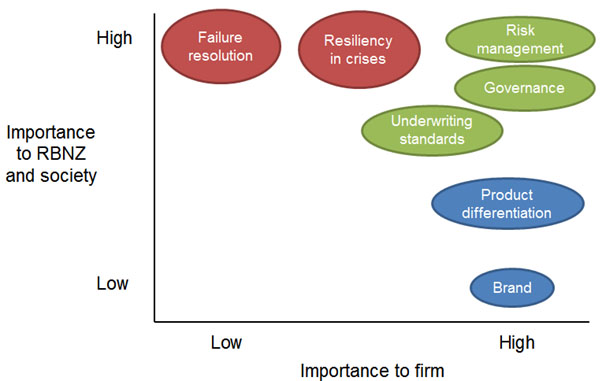
One of the other things I had hoped to comment on in more depth was a speech given last week by Toby Fiennes, the Reserve Bank’s Head of Prudential Supervision. on the Bank’s regulatory philosophy and supervisory practices.    It included this nice chart, outlining various aspects of financial institutions’ operations and how much, in the Bank’s judgement, they mattered to the “RBNZ and society” (as if these were the same thing) and how much they mattered to the institutions themselves.

Figure 1: Selected interests of the RBNZ, society and financial institutions

fiennes

Fiennes went on to note that the blue areas aren’t of much interest to the Bank (and don’t therefore attract much regulatory interest), while the red area are typically quite heavily and directly regulated.

But in this context, it was the comments on the green areas that caught my eye

Some things – like risk management and underwriting standards (in green) – are of strong interest to both the Reserve Bank and firms. Here we tend to use market and self-discipline. Examples of some of our supervisory practices in this area are:

  • Disclosure of credit risks;
  • Mandatory credit ratings;
  • Governance requirements; and
  • Publicly disclosed attestations by the board that key risks are being managed.

Now I know that the Bank’s prudential supervisors have never been keen on LVR restrictions, and that they are devised in a different department, but……..all controls are imposed under the same legislation –  indeed the same part of the legislation –  and by the same Governor.  And when housing loans are the biggest single component of banks’ credit exposure –  and banks have most to lose if things go wrong – and yet when the Bank has imposed three sets of direct controls on housing LVRs in three years, imposing its own judgements on underwriting standards, you might have hoped that practice and “philosophy” might have been better reconciled, or the gaps smoothed over in a speech by the Head of Prudential Supervision.

As regular readers know, I’ve been pushing to get submissions on Reserve Bank regulatory proposals routinely published.  Such publication is common practice in other areas of government, including submissions to parliamentary select committees.  If you make a submission seeking to influence public policy, that submission should generally be public as matter of course –  it should be one of the hallmarks of an open society.

Some progress has been made with the Reserve Bank.  If someone asks, they will now typically release submissions made by anyone who isn’t a regulated institution.  I asked for all the submissions on the latest LVR “proposal” to be released, and  –  as expected –  the Bank has released all those not made by banks (the regulated institutions in this proposal).  Anyone interested can find those submissions here. I have three remaining areas of concern.

The first is that release of submissions should be a routine part of the process for all consultations, not just when someone makes the effort (remembers) to ask.  The second is that on this occasion they have withheld the names of four private submitters.  As I noted, if you want to influence lawmaking, you should be prepared to have your name disclosed.  How can citizens have confidence in the integrity of lawmaking processes if they don’t know who the Bank is receiving submissions from, and what interests they may represent?  (Of course, since one of the anonymous submitters appears to have views very similar to my own, we can safely assume that that person’s views will have had no influence on the Bank.)

And the third concern is that the Reserve Bank is still consistently keeping secret the views of regulated entities (the banks in this case).  When the regulated lobby the regulator it is particularly important that citizens are able to see what arguments are being made, to ensure that the process remains robust and that the regulators are not being “captured” by their closeness to the regulated –  bearing in mind that the Bank is supposed to be regulating in the public interest, not that of banks.   As I’ve noted before, the Bank justifies withholding bank submissions on the grounds of section 105 of the Reserve Bank Act –  which they argue compels them to withhold such material.  In fact, that section of the Act gives no hint of a distinction between material received from banks and that from other parties,  If section 105 applies to submissions on proposed regulatory changes, the Bank is obliged to keep secret all submissions, not just those from banks.  As I’ve noted before, there is a good case for a small amendment to the Reserve Bank Act to make it clear that the section 105 protections do not apply to submissions on regulatory proposals and hence that banks should expect their submissions to the Reserve Bank on regulatory initiatives to be published, in just the same way that bank submissions to parliamentary select committees will generally be published.

I have appealed to the Ombudsman the Bank’s decision to withhold the bank submissions, in effect seeking greater legal clarity on what the section 105 restrictions actually apply to.  In the meantime, of course, if the banks have nothing to hide –  and I don’t imagine they really do –  they could chose to publish their submissions.  According to the Summary of Submissions “a few respondents urged tighter LVR restrictions on investors than proposed”, so perhaps the ANZ really did follow up on their CEO’s newspaper op-ed and advocate more far-reaching restrictions.  If so, citizens should have the right to know (customers might be interested to, but that is their affair).

Still abusing the Official Information Act

I still don’t have much energy back and posting next week is also likely to be light, but I didn’t want to let pass another shameless abuse of the Official Information Act.

Several weeks ago I lodged a submission with the Reserve Bank on their (long and slow) consultation on the publication of submissions to consultations.  I made the case for a default approach of full publication –  bringing the Bank into line with a widespread practice now in the rest of the public sector.  If necessary, I argued, the Bank should promote a minor legislative change that, for the avoidance of doubt, might ensure that they were fully able to release submissions on matters relating to the exercise of the Bank’s regulatory powers.

The consultation on publication of submissions was not about the exercise of regulatory powers, so there was no question that submissions to that consultation were covered by the Official Information Act.  So I lodged a request asking for copies of the submissions.

I don’t suppose they will have received that many submissions to this consultation.  Few of the submissions are likely to have been long.  The issues covered by the consultation concern the Reserve Bank only, not any other agencies, so there shouldn’t be any need for inter-agency consultation.  And of course the Act requires official information to be released “as soon as reasonably practicable”.  So my request should, quite easily, have been able to be dealt with within, say, 10 days.

But this afternoon I received this letter

Dear Mr Reddell

On 3 August 2016 you made a request  under the provisions of the Official Information Act (OIA), seeking:

“copies of all submissions received by the Reserve Bank on this consultation up to and including the close of the consultation period on 5 August 2016,” where the consultation you are referring to is the consultation on the default option for publication of submissions.

The Reserve Bank is extending by 20 working days the time limit for a decision on your request, to Friday 23 September 2016, as permitted under section 15A(1)(b) of the Official Information Act, because consultations necessary to make a decision on the request are such that a proper response to the request cannot reasonably be made within the original time limit.

You have the right, under section 28(3) of the Official Information Act, to make a complaint to an Ombudsman about the Reserve Bank’s decisions relating to your request.

Yours sincerely

Angus Barclay

External Communications Advisor | Reserve Bank of New Zealand 2 The Terrace, Wellington 6011 | P O Box 2498, Wellington 6140   +64 4 471 3698 | M. +64 27 337 1102

It isn’t the most time-sensitive request ever, and there have been more egregious Reserve Bank obstructions, but the law is the law.

Actually, I suspect they are delaying not because any “consultations” are necessary, but simply because it doesn’t suit them to release anything until they have released their own final decision.    But that isn’t a legitimate grounds for extending a request, and nor should it be.  The Bank is, of course, free to make its decision on the substance of the policy on its own timetable, but the submissions are public information.  A public institution committed to open government, transparent policymaking etc etc, would already have released the submissions.    But not the Reserve Bank.

The Ombudsman promised a few months ago to start reporting on how agencies did in responding to OIA requests.  It will be interesting to see how the Reserve Bank –  which actually does make much of its alleged openness and transparency (about stuff it doesn’t know –  the future –  rather than stuff it does know –  official information)  – scores.

Time to let the sunshine in

Former US Supreme Court Justice Louis Brandeis was the author of the famous line that sunshine is the best disinfectant, arguing for greater transparency in government agencies and the political process.   There is no perfect system, and probably no country reaches an ideal standard, but as governments around the world have become more intrusive and more powerful there have at least been some important counterbalances developed.  One of the most important has been the passing of freedom of information acts –  our own dating from 1982 –  which typically help move towards a presumption that information held by government agencies is accessible to citizens unless there is a compelling reason otherwise.  In making primary legislation (passing Acts of Parliament) Parliament now uses select committees much more extensively than was once the case and there is recognition, reflected now in established practice (Parliament itself not being subject to the OIA), that submissions to such committees, from people trying to influence our laws, should be made public on a timely basis.

The timely publication of submissions –  whether to, eg Productivity Commission enquiries, to local councils reviewing district plans, or to government regulatory agencies –  is increasingly becoming the norm.

There is, however, one notable blackspot in this generally positive story.  The Governor doesn’t invite public submissions on the OCR, but if you send him one anyway, it will be discoverable under the Official Information Act –  there is presumption in favour of release, unless there is a compelling specific ground not to.  But make a submission on a regulatory initiative –  where the Bank is required to consult, take submissions, and have regard to those submissions when the Governor makes his final decision – and anyone who wants to see that submission will face a barrage of obstructionism, some of it enabled by old legislation that simply hasn’t kept up with how the Bank’s extensive powers have evolved.

Last year, for example, various government agencies were doing things about housing.  The new brightline test and associated tax number provisions required parliamentary legislation.  All the submissions on these issues were published shortly after they were received.  The Reserve Bank put out proposals for a new round of LVR controls.  The Bank first refused absolutely to publish any of the submissions, even after the event, arguing that the summary of submissions that it wrote itself should be quite enough.  After several OIA requests, it finally backed down a little and agreed to release the submissions made by people who weren’t themselves regulated entities (ie those of people like me)-  but by then it was well after the decision had been made.

In their regulatory stocktake last year the Bank responded to several submissions and indicated that it would take another look at moving towards routine publication as the norm.  That sounded encouraging, but nothing was heard for many months, and then finally in May they released a consultative document on the publication of submissions on consultative documents.   By this time, they were clearly mostly interested in defending the status quo  –  publishing only their own, belated, summary of submissions.  That is apparent in the text, and also in the time they allowed for consultation: not seeking to change the status quo, they allowed almost three months for interested parties to make submissions.  By contrast, on stuff where they want change –  eg the latest LVR proposals –  three weeks’ consultation is deemed more than enough (“more than” since they are urging banks to apply the “spirit” of the new rules, even though the Bank has to be open to reaching a different view in light of submissions received).

My own submission on the consultation on the publication of submissions is here.

Submission to RBNZ consultation on publication of submissions Aug 2016

The Bank outlined two options

  • the status quo (summary of submissions and whatever they might eventually be forced to release under the OIA)
  • an alternative in which the Bank would publish all or part of submissions (timing of publication not clear) but only when submitters given their explicit consent.

The second option is not really a step forward at all.  The submissions the public need to be most worried about are those where submitters might refuse consent.  What, we might reasonably, wonder are they trying to hide –  wanting influence over our laws, without enabling the public to know what they are arguing.  This is particularly an issue in respect of regulated entities, where regulators can get all too solicitous of the interests of the regulated.  But it isn’t just regulated entities who should concern us.

The Reserve Bank’s stance seems to be a combination of genuine obstructiveness –  “rules and principles that apply elsewhere in government really shouldn’t apply to us” –   and some genuine legislative constraints.  Section 105 of the Reserve Bank Act –  and parallel provisions in other legislation the Bank operates under –  prohibits the Bank from releasing “information relating to the exercise, or possible exercise, of the powers conferred by this Part” of the Act (prudential regulatory and crisis management powers).  The Bank argues that they can –  but don’t want to –  release submissions from other interested observers, but simply cannot –  even if they wanted to –  release submissions on possible rule changes from regulated entities.

But here’s the thing: in section 105 there is no distinction drawn at all between information or views obtained from “regulated entities” and that from citizens more generally.  If the Reserve Bank really thinks these provisions apply to submissions on possible law changes (in this case, changes in banks’ conditions of registration), it cannot release any submissions at all.  But it can’t just pick and choose which it wants to release and which it does not.  They haven’t produced anything more than assertions in support of their interpretation.  One alternative possibility is that these provisions apply only to commercially confidential information –  which is in any case protected by the OIA, but which does not include an institution’s views on appropriate regulatory policy.

But there is a solution –  and really rather an easy one.  If section 105 really does constrain the Bank’s ability to be open and transparent, it is open to them to approach the Minister of Finance (and Treasury) and seek a simple change to the Act.  It should be easy enough to draft a short clause that provided that any submissions, from any party, on possible rule changes affecting all, or significant subset, of a class of regulated entities were not subject to section 105, and were fully subject to the provisions of the Official Information Act. Ideally, such a amendment would go a little further, and require all such submissions to be published on the Bank’s website on the day submissions close.  It is difficult to imagine who would oppose such an amendment.  Which opposition party is going to vote for greater bureaucratic secrecy? Perhaps some banks might object –  but these same banks know that when they make submissions to select committees or to other regulatory bodies those submissions will typically be published on a timely basis as a matter of routine.  If the Minister of Finance –  who seems strangely reluctant to touch the Reserve Bank Act –  wasn’t willing to make even this simple amendment, perhaps some backbencher with a serious commitment to open government could put such a provision in a draft bill in the members’ ballot.

I said that the legislative constraints mostly reflected old legislation that hadn’t kept pace with the changing role and powers of the Bank.  The section 105 provision dates back to 1987, a time when the Reserve Bank had very few supervisory or regulatory powers.  The older banks were established by their own acts of Parliament (rather than Reserve Bank registration) and these confidentiality provisions were, in effect, mostly about the ability of regulated entities to provide sensitive material to the Bank in an urgent and unfolding crisis situation.  Most people probably have little problem with protections of that sort –  although arguably the OIA provided them anyway.  There were no consultations on discretionary changes in regulatory policy, because there were no such changes.    LVR restrictions have really been the discretionary initiatives which have had the most pervasive effects – using conditions of banks’ ongoing registration as an instrument of short-term macroeconomic policy.  But the Reserve Bank did not even have the powers to impose LVR restrictions until an amendment to the Reserve Bank Act in 2003.  And even then, for a decade afterwards such powers weren’t used.

So if section 105 really protects the confidentiality of submissions on new regulatory initiatives, it is an unintended consequence. It is a most unfortunate one –  in an open society, lawmaking and the material lawmakers draw on, should be open to public scrutiny.  But it is also an easily remediable one.  It would be good to see the Reserve Bank re-think its stance, and approach the Minister of Finance seeking the sort of change I outlined above.   At present, foreign regulators have better access to the views of people maming submissions on our laws than our own citizens do.     And it is all the more important to fix this issue given that so much power in vested in a single unelected official –  who faces little or no effective accountability, and too little responsiveness to the concerns of citizens and voters. The Reserve Bank is a regulatory agency, not an institution warranting the deference and protections that, say, the Supreme Court might enjoy.

(An interesting example of where we really should have timely access to all submissions is highlighted by the article a couple of weeks ago from the ANZ’s Australian head of New Zealand operations, David Hisco.    Hisco argued that the new LVR restrictions should be even more onerous than what the Reserve Bank was proposing. But is he serious, or was he just wanting to convey the impression that he was a “banker who cared”?   There are not entirely-public-spirited reasons why bankers might favour tight restrictions on new business –  they might for example think they would be more temporary than higher capital requirements –  but at present we don’t even know whether Hisco is serious in his call for even tighter LVR controls.  His economics team didn’t seem very convinced even by what the Reserve Bank was proposing, but if he is really serious about the substance of his proposal, presumably it will be reflected in ANZ’s submission to the Reserve Bank this week or next, complete with supporting analysis.  If not, we can draw our own conclusions.  Either way, if the Reserve Bank has its way, we simply won’t be able to know.)

As this consultation itself (on the publication of submissions) is not about the exercise of powers under Part 5 of the Reserve Bank Act, I have lodged an OIA request for all submissions the Bank receives on it.


Another example of the Reserve Bank’s approach to the OIA

Regular readers will recall the OCR leak at the time of the March MPS.  A month or so later, when the Reserve Bank reluctantly recognized that there had in fact been a leak, and that their systems needed to change to reduce future risks, they released what purported to be a report undertaken for them into the leak by Deloitte.

In fact, subsequent material released by the Bank in response to an OIA request confirmed that what had been released then was not the actual report but a short-form “public” version.  I’m not sure what they had to hide, but decided to ask for a copy of the full report, partly out of genuine interest in its contents (as I had been the subject of a significant portion of the short-form “report”) and partly on the principle that leak inquiry reports, paid for by taxpayers’ money, should be made public as a matter of course.  In particular, the public should not be misled into believing that they were being given a full report, when in fact they were being given only a convenient summary.  When the initial release was made on 14 April, there was no suggestion at all that what was being released was a summary report only.

Anyway, I lodged the request several weeks ago, and this afternoon received this response.  How it can take more than 20 working days to decide whether or not to release a single report (that they already claimed to have released), which they themselves commissioned, and which they must have expected to be requested, and which deals only with their lock-ups etc is beyond me.  It seems like just another excuse for delay, another opportunity to simply ignore the principles of the Official Information Act.

(UPDATE: A reader points out that the Bank has given itself almost twice as long to consider the release of a single easily accessible administrative document as it allows for citizens to make submissions on its own proposals for further far-reaching regulatory interventions around housing finance.)

22 July 2016

Dear Mr Reddell

RE: OIA REQUEST FOR FULL DELOITTE INQUIRY REPORT

On July 4 2016 you made a request under the Official Information Act for:

“…. a copy of the full Deloitte inquiry report (as distinct from the “summary” – Graeme’s description in the Board minutes – or “public” version that was released on 14 April”.

The Reserve Bank is extending the time limit for decisions on your request to 10 August 2016, as permitted under section 15A(1)(b) of the Act, because consultations necessary to make decisions on the request are such that a proper response to the request cannot reasonably be made within the original 20 working day time limit.

Under section 28(3) of the Official Information Act, you have the right to complain to the Ombudsman about the Reserve Bank’s decisions relating to your requests.

Yours sincerely

Naomi

Naomi Mitchell

External Communications Adviser | Reserve Bank of New Zealand (Auckland)

205-209 Queen St, Auckland 1010 | P O Box 5240, Auckland 1141

  1. +64 9 366 2643 | M. +64 27 294 3900 | F. +64 9 366 0517

www.rbnz.govt.nz

Charles I?

Charles I was a good man, but (was generally reckoned) a bad king.  His reign ended. following the Civil War, with his beheading on 30 January 1649.

In their amusing take on English history 1066 And All That, Sellar and Yeatman offer this caricature of Charles’s views:

Charles explained that there was a doctrine called the Divine Right of Kings, which said that:

(a) He was King, and that was right.

(b) Kings were divine, and that was right.

(c) Kings were right, and that was right.

(d) Everything was all right.

Sometimes I wonder if Graeme Wheeler sees himself, and the Reserve Bank, in much the same light.

I wrote the other day about my request to the Reserve Bank to provide summary information on the OCR recommendations made by the Governor’s designated advisers for each of the OCR reviews since mid 2013.  The Governor himself had disclosed that information for the March Monetary Policy Statement review in an interview conducted only a day or two after the release of that particular OCR decision.

As I noted the other day, I didn’t expect them to respond positively to my request.

I finally got the response late yesterday afternoon, just before the end of the maximum allowed time of 20 working days.  I wasn’t surprised by the decision to withhold all the information, but was more than a little surprised at the argument they sought to rely on.  Here is what they had to say:

Decision

The Reserve Bank is withholding the information under the grounds provided by section 9(2)(d) of the OIA, to protect the substantial economic interests of New Zealand.

Reasons

Official Cash Rate (OCR) decisions clearly relate to the substantial economic interests of New Zealand and it is clearly in the public interest that the Governor is able to decide the OCR as the Reserve Bank of New Zealand Act intends and requires.

The Governor has a statutory position as the sole decision-maker on the OCR. While the Governor chooses to take advice from the Monetary Policy Committee (MPC) and others prior to making decisions, the advice does not bind or compel the Governor to any particular decision. MPC policy recommendations are simply advice that the Governor is free to accept or not. What matters under the law is the Governor’s decision.

Given the Governor’s sole responsibility for determining monetary policy settings and the limited objective value of the information, the Bank considers the public interest in knowing this selective aspect of the advice of the MPC is not strong.

Moreover, there are serious risks that mis-informed commentary on this partial aspect of advice could detract from the Governor’s ability to implement monetary policy.  This could adversely impact on the effectiveness of monetary policy, likely damaging the substantial economic interests of New Zealand.

As noted in responses to two previous OIAs requests from you (24 and 25 September 2015), the underlying analysis and advice for OCR decisions are published in summary form in a programme of carefully drafted media statements, Monetary Policy Statements, news media press conferences and media interviews.  The Bank considers that the public interest in understanding OCR decisions made by the Governor is sufficiently met by these existing information disclosures.

The Governor may choose, on occasion, to publicly state that his decision on monetary policy settings accords with the views of the MPC or anyone else that he receives advice from or wants to refer to.

For those not familiar with the details of the Official Information Act, the relevant provision allows for information to be withheld if to do so is

necessary [emphasis added] to avoid prejudice to the substantial economic interests of New Zealand”

“unless in the circumstances of the particular case, the withholding of that information is outweighed by other considerations which render it desirable, in the public interest, to make that information available”

The operative word there is “necessary”.  There being some remote possibility that some harm could be done is not sufficient.   Nor is a higher likelihood that some minimal inconvenience or discomfort to officials might ensue.  No, it must be ‘necessary” to withhold that specific information to avoid prejudicing the substantial economic interests of New Zealand.  And even then the wider public interest needs to be considered, in the context of an Act designed to make information available to public, to assist public understanding and to strengthen the accountability of ministers, officials, and official agencies.

The Governor’s case is already severely undermined by the fact that he chose to disclose this information, about the most recent OCR decision.  Could he be sure that that information would not be misinterpreted, and lead to commentary that might make his life difficult?    But he took the (surely very modest) risk anyway, and made the information available, presumably concluding that there was no material risk of prejudice to the substantial economic interests of New Zealand.

But then how can he seriously argue that the release of the same information for, say, the July 2013 OCR review has such serious risks that it is “necessary” to withhold it to avoid prejudicing those “substantial economic interests of New Zealand”?  Or the July 2014 review? Or the July 2015 review –  now eight months in the past.  There is no sign in the Bank’s response that they have considered each piece of information separately, and evaluated the risks (which might well be different for information six weeks old than for information almost three years old).  That sort of blanket refusal is inconsistent with the Act.

The substance of the Governor’s claim is that there are

serious risks that mis-informed commentary on this partial aspect of advice could detract from the Governor’s ability to implement monetary policy.  This could adversely impact on the effectiveness of monetary policy, likely damaging the substantial economic interests of New Zealand.

Quite how  a summary of the non-binding opinions of his own chosen advisers, relating to events already some time in the past, could detract from the Governor’s ability to implement monetary policy is really beyond me.  Ultimately, the Governor makes the OCR decisions, and communicates his final stance by both the announced OCR itself and his press statement around it.  It is entirely lawful, and reasonable, for the Governor to adopt an OCR that a minority or even, on rare occasion, a majority of his advisers disagree with.  He is appointed Governor, and he signed the PTA, not them.

Of course, markets and commentators might be interested in which way the balance of advice went but this is lagged information (the most recent event I requested information for was the January OCR review, and my request was lodged after the next OCR decision was already known).    If I had asked for named views of each individual adviser it might perhaps have been a little different –  people could have fun with evidence that, say, the Deputy Governors disagreed with the Governor. But (a) that isn’t the information I asked for, and (b) in other countries, evidence of such a range of views within a central bank doesn’t seem to impair the ability of the central bank concerned to conduct monetary policy effectively.  On several occasions, the former Governor of the Bank of England chose to be in a minority in the vote of the binding MPC, again without impairing either confidence in the individual or the effectiveness of UK monetary policy.

Frankly, the suggestion that the effectiveness of monetary policy could be thus impaired, particularly to extent that could “prejudice the substantial economic interests of New Zealand”, is preposterous.

I’ve highlighted previously the contrast between the pro-active approach adopted by the Minister of Finance and Treasury to the release of advice and papers relating to each year’s government Budget. The Minister of Finance is, in this context, the sole decision-maker, and the Treasury are the advisers to the Minister.  The Treasury provides analysis, and advice, and recommendations.  Sometimes those views are accepted by Ministers, sometimes regretfully not accepted, and sometimes just dismissed out of hand.  That is the nature of good advice, in a world characterized by uncertainty and a range of perspectives on any one issue.

And yet most of that advice is routinely published.  Occasionally perhaps it embarrasses either Treasury or the Minister (but embarrassment isn’t grounds for withholding) but no one questions the ability of the Minister to make fiscal policy decisions effectively. It isn’t impaired by knowing that at times the advisers – and that is all they are –  disagree with the decisionmaker.  What makes monetary policy different?

At times, commentary on official agencies and officials will be annoying, uncomfortable, perhaps lightweight, and perhaps even (the Bank’s concern) “misinformed”.  Democracy is messy. We leave the alternative approach to places like Singapore.  (And, of course, the usual remedy when there is “misinformation” or misinterpretation abroad, is to make more information available.)

In the end much of this comes down to what I wrote about the other day.  The Bank has long considered that the final products that it chooses to publish should be enough –  whether for financial markets, the public, or members of Parliament.  The only people they are comfortable with providing more information to, apparently, are the members of the Reserve Bank Board.  It was the mindset that used to prevail across the whole public sector, here and abroad.

But that isn’t law in New Zealand.  Of course it would be tidier for official agencies and Ministers if only the approved “carefully drafted” final documents were ever made public –  press releases, Budget speeches, Monetary Policy Statements and so on.  But the Official Information Act was not passed in the interests of tidiness, or the convenience of powerful institutions and individuals. It was –  and is –  about allowing greater light to be shed on government processes, and the background analysis and advice that underpins decisions. That is what an open society is about.  It is a big part of how we hold the powerful to account.  As the Reserve Bank well knows, much though it may not like, it, the Official Information Act covers drafts as well as final documents –  it might be interesting for someone, say, to ask for the various drafts of a particular OCR press release (perhaps one from a few quarters ago, the disclosure of which could not possibly impair current monetary policy).

I experienced this line of argument repeatedly in my time in the Bank.  The Bank tends to operate as if it is a world apart.  Many of its people think of the Bank –  subconsciously I’m sure –  more as one of international circle of likeminded central banks, interacting mostly with banks and financial markets, rather than as agency of executive government in New Zealand, accountable to the public (including through the Official Information Act) just as other agencies are.

And I’ve experienced this line repeatedly in responses to OIA requests over the last year or so.  Of those relevant to monetary policy:

  • after some months’ delay, the Bank grudgingly agreed to release the background papers to a Monetary Policy Statement from 10 years previously.  On that occasion I did not ask for either copies of the individual OCR advice, or the summary of the recommendations.
  • they subsequently refused to release  any of the papers provided to the Bank’s Board regarding the September 2015 MPS
  • the Bank refused to release any material background information relevant to the most recent Policy Targets Agreement.
  • the Bank refused to release any minutes of meetings of its Governing Committtee (the forum in which the Governor takes the final OCR decision)
  • the Bank refused for months to release any material information about the work they had been doing on governance reform, belatedly releasing a small amount only recently, claiming as warrant for doing so an Associate Minister’s answer to an Opposition MP’s supplementary question six months earlier.
  • the Bank has refused to release any of the background information on its analysis of the economic impact of immigration that led into its material change of view at the December MPS.  (this is a good illustration of all that is wrong with the Bank’s argument that the MPS is really quite enough for us mere mortals –  since they included no supporting analysis in that MPS to justify their change of view).

Sadly, this latest response is all too typical, even if the particular excuse they must have spent a month crafting has a degree of novelty. It speaks of an organization –  and the key individuals –  who believe that they are, or should be, above the messiness of the sort of real world scrutiny that we expect in a democracy, and for which the Official Information Act provides.  Hence, the Charles I references.

It is a shame, because I really can’t imagine what they have to hide.  It shouldn’t be surprise if from time to time advisers disagree with the Governor –  it should worry us much more if they never do.  From time to time a Governor has gone against the majority view of his advisers –  hindsight suggests that sometimes he was right to do so, and on other occasions probably not.   But we should be able to see the balance of that advice, perhaps with a modest lag.  Sometimes it will suit the Governor (as presumably in March, when he unilaterally released the information) and sometimes not.  But what suits the Governor on particular occasions is not a relevant consideration under the Act.

The Reserve Bank of New Zealand was once at the forefront of greater openness and transparency among central banks.  Sadly, that is no longer true.

I have appealed this decision to the Ombudsman, on two grounds:

  • first, taking 20 working days to issue a blanket refusal (on material that involvement no substantial compilation or review effort) is simply inconsistent with the statutory responsibility to respond “as soon as reasonably practicable”, and
  • second, that it is simply not credible that withholding all this information (including that about decisions in 2013) is “necessary” to avoid prejudice to the substantial economic interests of New Zealand.

Hamish Rutherford has covered the story here.


Advisory “votes” on OCR decisions

Four weeks ago, commenting on his March OCR decision, the Governor of the Reserve Bank, Graeme Wheeler, was quoted telling the Herald

“I don’t think it’s a mystery that the Reserve Bank cut interest rates. In fact, we have 13 people who give advice to the governing committee who make these decisions and the advice from the 13 was unanimous.”

It was striking disclosure.  Not the fact that his advisers had been unanimous –  historically that isn’t uncommon – but the fact that the balance of advice, in numerical terms, was revealed at all, and only days after the OCR decision to which that advice related.  Neither Graeme Wheeler nor Alan Bollard or Don Brash prior to him had ever released that sort of specific information previously.  In fact, in the past the Bank has been almost obsessive about keeping secret almost anything to do with the OCR decision or the associated Monetary Policy Statement (there is a case being looked at by the Ombudsman now on just one recent example of that).  The Bank’s attitude tends to be that it is highly open and transparent about what it wants us to know –  eg the finished product, the Monetary Policy Statement –  and for the rest (“internal stuff”) it is really none of our business.  Fortunately that isn’t the law.

Following the Governor’s disclosure, I lodged this request with the Bank on 14 March

As the Governor has disclosed in the Herald this morning (page B3) the summary results of the OCR advice from members of the MPC for the most recent OCR decisions, I am requesting the same information (no names, just aggregate numbers favouring each rate option) for each OCR decision since mid 2013.

The statutory deadline for responding to that request is tomorrow (20 working days from the day they received the request).

I think it is safe to assume that the Bank is most reluctant to release this information.  It would have taken no more than a couple of hours to compile and check the information I asked for, and the Act requires (not suggests, requires) that agencies respond “as soon as reasonably practicable”.  Had the Governor’s remark to the Herald foreshadowed a new era of openness, I would have had the requested information weeks ago.  By law, I should have anyway.

We’ll see shortly whether they have decided to release some or all of the information, or to withhold it completely.  Regardless, I suspect there is some gnashing of teeth going on, and muttering beneath the breath that the Governor should never have told the Herald the voting numbers, leaving himself open to a request of the sort I have lodged.

But it is worth being clear what I am, and am not, asking for.  The request is simply for the numbers favouring each OCR option on each occasion in the previous 2.5 years.  Most of these advisory “votes” relate to decisions that occurred more than a year ago, and even the most recent request relates to the January 2016 OCR review, itself superseded by the March MPS, the results of which (and the advisory vote numbers) we already know.  All those participating are fairly senior people –  second and third tier managers, and external advisers.

I am not asking for:

  • the names of participants in the advisory group,
  • the “vote” of each participant to be identified by name,
  • copies of the one page analysis and advice each participant provides in support of his or her OCR recommendation.

All of that is official information, and could be subject to separate requests, but it isn’t what I asked for on this occasion.

Why might the Bank want to keep the information secret?  We can distinguish between their preferences and the law.

As I noted earlier, the Bank has long taken the view that the finished product is all that should be disclosed.  Anything else will only be “noise” to markets, confusing the messages, and so on.  And as it is a single decision maker model, only the Governor’s vote really counts anyway.  From within I repeatedly argued for more openness, and these were the standard lines used in response.  There is also likely to be some worry that disclosing even just the numbers favouring each OCR option, even with a lag (and recall that some of the dates I asked about are almost three years ago),  might undermine the willingness of some of the Governor’s advisors to offer advice different to the Governor’s own preference. A Governor who really didn’t want it known that a significant minority of his senior staff disagreed with him has plenty of leverage to discourage people from putting that disagreement on paper (including, but not limited to, simply tossing the person concerned off the advisory committee).

I don’t think these arguments have much merit.

First, it is now pretty common in countries with voting committees making monetary p0licy decisions for dissents/votes to be recorded, and to be disclosed pretty promptly (always with the names identified and sometimes with the reasons disclosed).  The Bank of England, the Federal Reserve, and the Swedish Riksbank are just three prominent examples.  It isn’t a universal practice by any means, but given the statutory presumption in favour of release of official information, it certainly isn’t obvious that great damage has been done to the effectiveness of policy (of policy formation/debate) in those countries where there is much fuller disclosure.

Second, it is not as if, in the nature of human affairs and especially those involving forecasts, there are many occasions when anyone is 100 per cent confident of the right thing to do.  An agency can try to present a monolithic front if it chooses, but everyone knows that behind any decision there is a weighing of pros and cons and the likelihood that some advisors will be more strongly convinced of the merits of a particular action than others.  Citizens –  and markets –  aren’t children.

Thirdly, all this information and more is already disclosed to the Reserve Bank Board, typically within days of it being offered. The Board receives all the background papers for each MPS, copies (without names) of the one page OCR advice provided by each member of the advisory group.  Board members, I’m told, can at times, and with experience, work out who provided which advice.    The Board gets copies of that material partly to assure themselves that the Governor really is being exposed to (a) good quality advice/analysis and (b) a range of views and perspectives.  If a Governor were really uneasy about it being known that some of his advisers at times disagreed with him (a) he is the wrong person for the job (in general we should be much more worried if no one ever openly disagreed with a Governor), but (b) he and his predecessors have long faced that incentive (since the Board is, after all, the group paid to monitor his performance, and able to recommend his dismissal or non-reappointment).

Monetary policy decisions have an important influence on the short to medium term path of the economy.  And they are decisions made under conditions of considerable uncertainty.  Parliament has given the power to make those decisions to a single individual, but part (a small part perhaps) of how we satisfy ourselves that he is exercising that power prudently is to be able to see, after the event, the balance of the internal advice he is receiving from his highly paid expert staff (and external advisers ).

Of course, nothing in law requires the Governor to seek formal or written advice from identified staff on where to set the OCR.  It is possible that the Bank could argue that if it is forced to reveal the advisory votes, even with a lag, the Governor would simply discontinue the practice of seeking such advisory “votes”.     But (a) the Governor has already revealed the votes on one particular occasion, with next to no lag, and (b) to do so would presumably not impress the Board, who would also lose one of their windows into the processes the Governor uses in making his OCR decisions.

But what about the law?  My request has to be decided not according to the Reserve Bank’s preferences, but under the provisions of the Official Information Act.

What are some of the relevant provisions?

First, the purpose of the Act

The purposes of this Act are, consistently with the principle of the Executive Government’s responsibility to Parliament,—

(a) to increase progressively the availability of official information to the people of New Zealand in order—

(i) to enable their more effective participation in the making and administration of laws and policies; and

(ii) to promote the accountability of Ministers of the Crown and officials, –

and thereby to enhance respect for the law and to promote the good government of New Zealand

And the statutory principle of availability.

The question whether any official information is to be made available, where that question arises under this Act, shall be determined, except where this Act otherwise expressly requires, in accordance with the purposes of this Act and the principle that the information shall be made available unless there is good reason for withholding it.

Are there any such good reasons?

The Act provides for both “conclusive reasons” for withholding information, and “other reasons”.

Take the conclusive reasons first.  Here they are

Good reason for withholding official information exists, for the purpose of section 5, if the making available of that information would be likely—

(a) to prejudice the security or defence of New Zealand or the international relations of the Government of New Zealand; or
(b) to prejudice the entrusting of information to the Government of New Zealand on a basis of confidence by—
  • (i) the Government of any other country or any agency of such a Government; or
  • (ii) any international organisation; or
(c) to prejudice the maintenance of the law, including the prevention, investigation, and detection of offences, and the right to a fair trial; or
(d) to endanger the safety of any person; or
e) to damage seriously the economy of New Zealand by disclosing prematurely decisions to change or continue government economic or financial policies relating to—
  • (i) exchange rates or the control of overseas exchange transactions:
  • (ii) the regulation of banking or credit:
  • (iii) taxation:
  • (iv) the stability, control, and adjustment of prices of goods and services, rents, and other costs, and rates of wages, salaries, and other incomes:
  • (v) the borrowing of money by the Government of New Zealand:
  • (vi) the entering into of overseas trade agreements.

I doubt the Bank would seek to invoke most of these.  Items (a) to (d) are clearly not relevant.

The Bank might seek to argue for the items under (e), since monetary policy decisions affect the exchange rate.  However, they would be on very weak ground to attempt to do so, because (e) refers to damage arising from prematurely disclosing decisions to change policy.  In other words, if I had asked for the Governor’s OCR decision after it was made but before it was released, he would have conclusive (and quite reasonable) grounds to refuse on these grounds – the decision would be disclosed prematurely.    But my request is not for information on a decision (only advice from non decision making advisers), and the request relates to advice on decisions which have already been released (in some case, several years ago).    One line of argument they might try is that the pattern of advisory “votes” might contain information about the future path of the OCR, but (a) they would have show that, not just assert it, and (b) since the decision is always the Governor’s, it doesn’t seem terribly persuasive, especially as the Bank already releases information about its own (the Governor’s) expected future path.

The Official Information Act also has a long list of other reasons for withholding, many of which I’ve repeated here.  In these cases, even if there is an argument made for withholding, that case has to be balanced against the wider public interest in disclosure.

(1) Where this section applies, good reason for withholding official information exists, for the purpose of section 5, unless, in the circumstances of the particular case, the withholding of that information is outweighed by other considerations which render it desirable, in the public interest, to make that information available.

(2) Subject to sections 6, 7, 10, and 18, this section applies if, and only if, the withholding of the information is necessary to—

………

  • (ii) would be likely otherwise to damage the public interest;

(d) avoid prejudice to the substantial economic interests of New Zealand; or

(f) maintain the constitutional conventions for the time being which protect—

  • (i) the confidentiality of communications by or with the Sovereign or her representative:
  • (ii) collective and individual ministerial responsibility:
  • (iii) the political neutrality of officials:
  • (iv) the confidentiality of advice tendered by Ministers of the Crown and officials; or

(g) maintain the effective conduct of public affairs through—

  • (i) the free and frank expression of opinions by or between or to Ministers of the Crown or members of an organisation or officers and employees of any department or organisation in the course of their duty; or
  • (ii) the protection of such Ministers, members of organisations, officers, and employees from improper pressure or harassment; or

(h) maintain legal professional privilege; or

(i) enable a Minister of the Crown or any department or organisation holding the information to carry out, without prejudice or disadvantage, commercial activities; or

(j) enable a Minister of the Crown or any department or organisation holding the information to carry on, without prejudice or disadvantage, negotiations (including commercial and industrial negotiations); or

(k) prevent the disclosure or use of official information for improper gain or improper advantage.

 Would disclosing the advisory “votes” on the OCR, with some lag, after release of the relevant OCR decision prejudice the “substantial economic interests of New Zealand”?  Hard to envisage, especially when there is already much greater disclosure in a variety of other advanced democratic countries.

The only argument I can see them trying to rely on is 2(g)(i), that to release the information I’m seeking would jeopardise  the “effective conduct of public affairs” by threatening the “free and frank expression of opinions” by staff of the Reserve Bank.   But, as the Bank’s own legal adviser used to tell us, officials (and especially senior ones) are expected to offer free and frank advice, and the mere fact that free and frank advice is offered is not in itself a reason to withhold the information requested.    More specifically, if I was asking for the advice of, say, Dean Ford, or Roger Perry, Willy Chetwin or Geoff Bascand individually it might be a different matter, but this request is simply for the number of votes on each side of an OCR decision.  Officials who would be feel constrained from offering free and frank advice on the appropriate level of OCR by the fact that the numbers favouring each option (jno names) would be published are in the wrong job.  Senior officials are paid to offer expert advice, and that advice is official information.  Aggregate information on the numbers in favour of each option should not be able to be kept secret, after the event, with the protection of the law.

We’ll see shortly if the Bank realizes that this is simply not the sort of information the Act is designed to protect, and makes a virtue of necessity, setting up a new protocol for the regular release of this information with a modest lag.  In fact I suspect they will decide to fight the issue anyway, relying on the delay (apparently shortening) in the Ombudsman’s processes to try to fend off disclosure for a while longer.  If so, it will reinforce a line I’ve used previously: we have a central bank quite happy to be open and transparent about stuff they know almost nothing about (what the OCR might be a couple of years hence) and not at all happy about being open (despite the law) about things they do know about, such as the policy processes they use in coming to decisions.

I will  write about the response when I receive it.  You might wonder about why I devoted so much space to the issue today.  The answer, at least in part, is to try to look at the issue in a relatively detached way, against both the statutory provisions and a former insider’s sense of what might, or might not, be strong arguments.  Sometimes the Bank’s responses to OIA requests simply annoy me, and my initial comments might be flavoured by a tinge of emotion/irritation.  In this post, I’ve tried to look for the arguments they might use, all the time half hoping that, albeit somewhat belatedly, they might finally choose to (follow up on the Governor’s one-off openness) and take some structural steps towards greater transparency.

And why does it matter?  The request was partly a matter of principle. I believe that this information should be a matter of public record, once the relevant OCR decision has been released.  But I also chose my dates carefully.  From the middle of 2013 (a time when I was still part of the advisory group) the Bank was preparing the ground for its ill-fated 2014 tightening cycle, which was only belatedly reversed over the period since June 2015.  I think we have a right to understand whether the Governor was acting alone, whether he has unanimous support from his advisers, and when any material divergences of view began to open up.  The last few years have been a somewhat inglorious episode in New Zealand’s monetary policy (and for the Reserve Bank), and the Board has done little to provide effective transparent accountability.  Fortunately, the Official Information Act is there to allow citizens to pose their own questions, with a presumptive right to access to official information to enable them to evaluate the performance of powerful officials and their agencies.