Productivity growth (or lack of it)

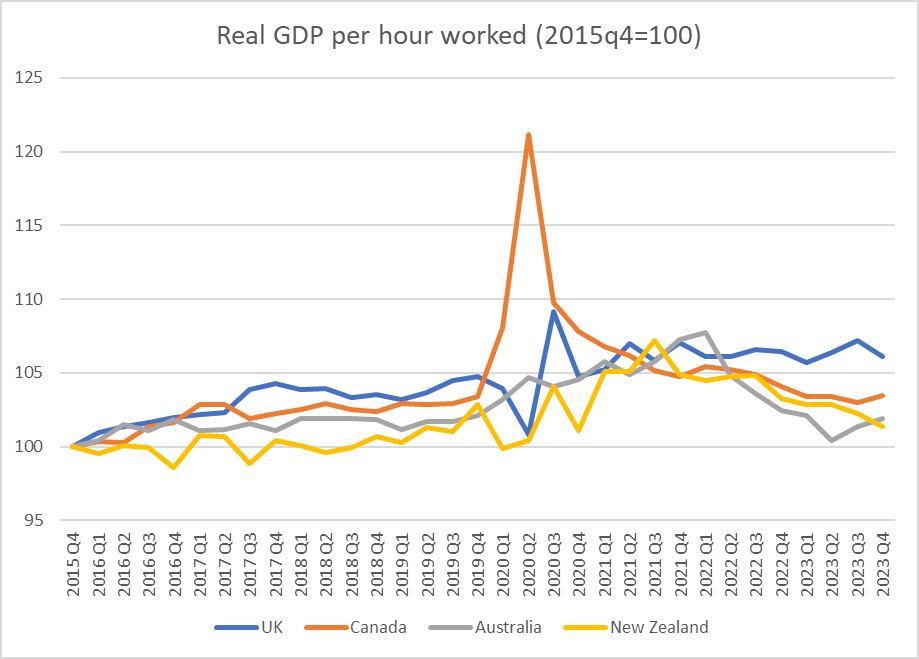
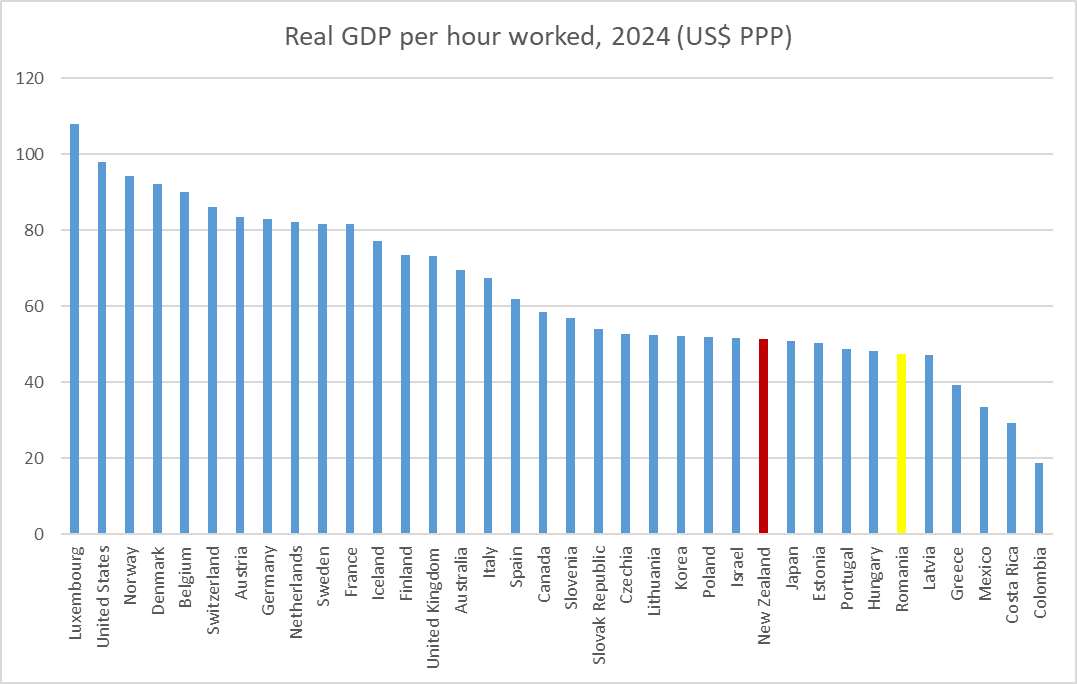
In a post last week I included this chart of the latest annual OECD data on labour productivity, expressed in PPP terms.
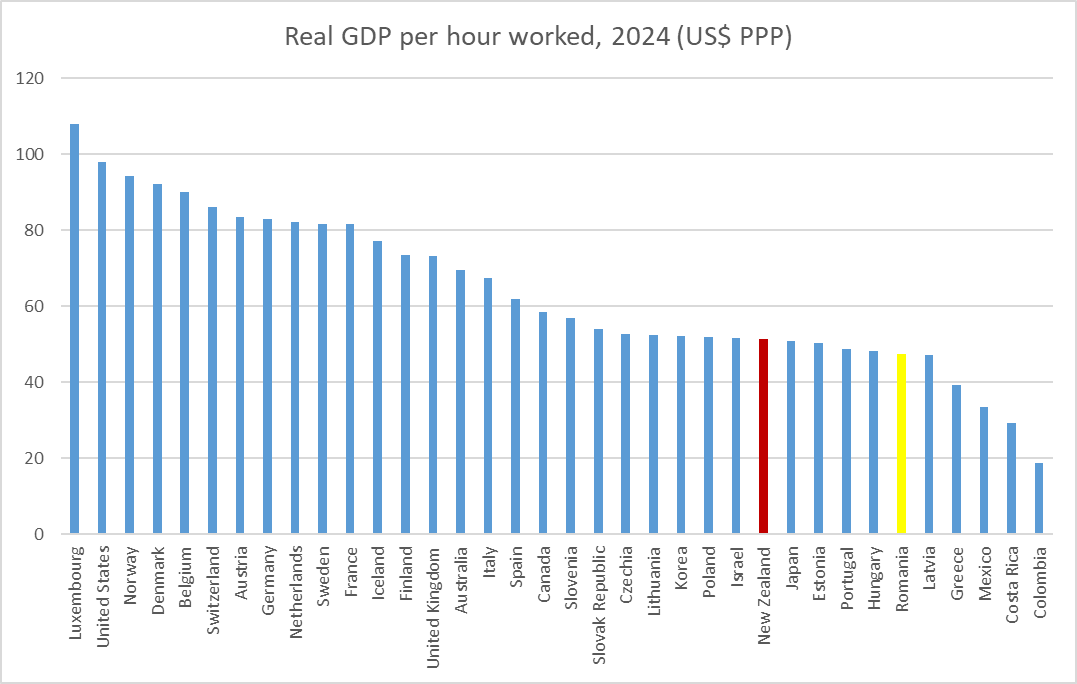
It was grim, in a familiar sort of way. New Zealand’s overall economic performance has long been poor (the halcyon days when New Zealand was in the top 3 in the world relegated to the history books, and stories the older among us might have heard from grandparents etc). These days more and more of the formerly communist central and eastern European countries are passing us (Romania – highlighted – will probably do so in the next five years or so).

But it reminded me of the Prime Minister’s State of the Nation speech back in January, which was full of fine rhetoric about the need to do (much) better. He told us that “2025 will bring a relentless focus on unleashing the growth we need to lift incomes, strengthen local businesses and create opportunity”.

At the time, I welcomed the rhetoric but rather doubted that the substance would come anywhere near matching it, pointing out that although in its first year the government had made some useful reforms (with productivity in view), in other areas they had taken things backwards. And they’d made no progress at all on fiscal consolidation which, while not in itself critical to productivity prospects, was not a great signal. Together with Don Brash (who’d chaired the 2025 Taskforce 15 years previously, when an earlier government’s rhetoric had briefly talked up closing those income and productivity gaps) I wrote an op-ed for the Sunday Star Times (full text in the previous link), lamenting the decades of aspirational cheap talk on the one hand and lack of realised progress (productivity gaps as large as ever or widening further) and ending this way.

We can choose to continue to drift, with just incremental reforms, as successive governments have done for 30 years even amid the fine talk.  But if we do, more and more New Zealanders are likely to conclude rationally that there are better opportunities abroad, and for those who stay aspirations to first world living standards and public services will increasingly become a pipe dream.  

It is a multi-decade challenge under successive future governments, but as the old line has it the longest journey start with the first step.  We hope the Prime Minister’s bold rhetoric signals the beginning of a willingness to lay things on the line, to lead the debate on serious options, to spend political capital, for the serious prospect of a much better tomorrow for our children and grandchildren.

Where do things stand almost a year on? In cyclical terms, there isn’t much to show for the year. GDP growth has been on average weak (I’m assuming next week’s September quarter number comes out respectably), the unemployment rate has crept up a bit, business investment has been weak, and so on. But, for all the rhetoric and cheap attempts to either claim credit or cast blame, governments usually have little influence over short-term real economic developments, the more so in this era of operationally independent central banks. In our case, the weak economy mostly seems to have been the lagged effect of belated Reserve Bank actions to get inflation back under control, the Bank itself having previously misjudged (in tough circumstances) and let it get away on them. That, of course, doesn’t stop ludicrous government claims that falling interest rates have resulted from government actions and choices, or equally ludicrous suggestions from the left that somehow slash and burn fiscal policy accounted for the recent economic weakness. In short, there has been no fiscal consolidation. Don’t take it from me: I just use Treasury data and charts and the Secretary to the Treasury made exactly my point to FEC last week.

This year’s Budget was also (slightly) expansionary, increasing the structural fiscal deficit.

I noticed the other day a post from Don Brash in which he attempted an assessment of the government’s overall performance at the end of their second year. Don was interested in a wide range of areas, but it was the economic bits that interested me. (While noting the failure on fiscal policy) he scored the government reasonably well here.
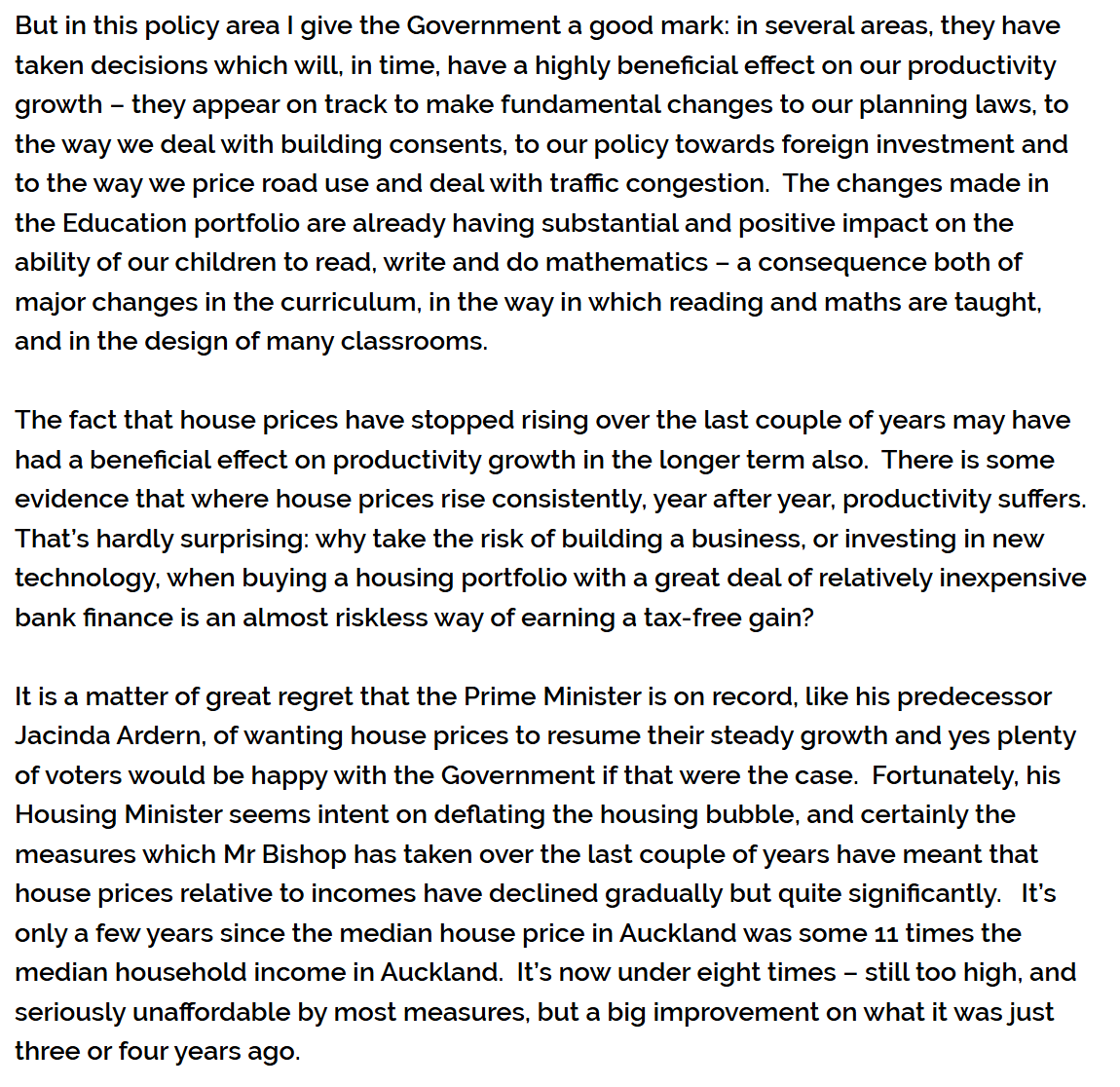
Count me rather more sceptical. Overall, it looks to have been another year of a few useful reforms, some (modest) backward steps, and a much greater focus on attempting to gee up sentiment and activity (or appear to do so) before next October than any real drive to markedly lift New Zealand’s productivity prospects and performance over the coming decade (and thus, to the extent that good things are happening in schools, any overall economic gains are almost by necessity a decade or more away).

I’m a strong believer in much (and sustainably) lower real house prices (not just achieved by people consuming less house, less land) but, as Don notes, the Prime Minister isn’t. He claims to be keen on prices just rising less rapidly than they once used to. And although house prices have generally been falling in the last couple of years it still isn’t clear how much of that is more or less cyclical (unwinding the extraordinary 2020/21 surge) and how much might be structural. Productivity performance was pretty woeful a decade ago and real house prices now are no lower than they were then. Some economists believe that much lower house prices would themselves help materially lift productivity: I’m sceptical about that in our specific circumstances, and reckon improved housing affordability and responsiveness is mainly good (very good, if taken far enough) for its own sake. Young families on moderate incomes should be able to afford a basic house in our cities. It was so before and can be so again.

The government is tomorrow launching to great fanfare (huge lockup and all) its RMA reforms – one of the items the PM promised for this year back in January. We’ll see what that package looks like. In principle, reforms should be supportive of productivity growth. My story of New Zealand’s failure emphasises the apparently limited number of profitable opportunities here open to business (local or foreign) and if costly roadblocks can be removed the expected returns to opportunities will improve. More investment should follow.

But….it is a long road ahead. Whatever is announced tomorrow is not guaranteed to be what passes Parliament in (presumably) the dying days before the election next year. If there is a change of government (coin toss territory at present?), how likely is this particular package to endure? And, as we saw with the original RMA itself, what was initially seen as liberalising and enabling legislation turned into anything but, between the courts and successive lots of central and local government.

As for the government itself, we learned this year that the Minister of Finance had gone along with bizarre new Treasury schemes under which investment and regulatory proposals being evaluated by government agencies will use discount rates that are absurdly low and bear not the slightest relationship to the cost of capital. In the private sector, the government’s flagship policy in this year’s budget wasn’t about addressing the high tax rates on business income here but on subsidising firms to buy new capital equipment, with the biggest effective subsidy going to the sector (commercial buildings) they’d imposed a new distorting tax impost on only last year. So much for the efficient allocation of scarce resources, whether in the public or private sectors. Nor has there been any sign of top-notch appointments to any of the key economic agencies in the public sector – in the MBIE case, still no chief executive appointment at all. Small as such a reform might be, in an age of Trumpian tariffs the government hasn’t even gotten round to removing the remaining tariffs New Zealand has in place (including protection for the local ambulance building industry…of all things).

Looking back over the year it is a lot easier to be persuaded that what is driving the government – perhaps the Prime Minister in particular, and his “Minister for Economic Growth” is initiatives to grab a headline for a news cycle or two, with a focus mostly on next year’s election. We’ve had new film subsidies, new gaming subsidies, the taxpayer has been helping to buy a rugby league game for Auckland, and we’ve had the (laughable if it weren’t so bad) money thrown at the Michelin company to get their guide to cover New Zealand restaurants. Whatever you think of National’s new Kiwisaver policy, it isn’t going to shift the dial on productivity (where access to capital has never been the presenting issue, even if Kiwisaver changes ended up shifting national savings rates, itself questionable – to put it mildly). Headlines, and associated chirpy social media posts, seem to be where it is at, rather than a serious sustained reform effort, grounded in hardnosed analysis and New Zealand specific insights on just what has gone wrong here. What has seen us drift behind so many other countries.

It is one of those areas where I’d love for my pessimism to be wrong. There is a risk that after decades of failure it becomes too easy to be cynical about the latest efforts. But at this point, and two years into the government’s term, there is still little or no sign of things that are really set to turn out performance around. Inevitably a post like this has to be somewhat selective, but you could also look to the financial markets. Is there any sign, for example, of our stock market outperforming as investors markedly re-rate longer-term business (and profitability) prospects here? Not that I can see. And although our bond yields have been quite high by international standards for a long time – which is something one might also see if investment prospects were improving sharply – if anything those differentials are narrower now than they used to be.

The Prime Minister ended his January speech this way
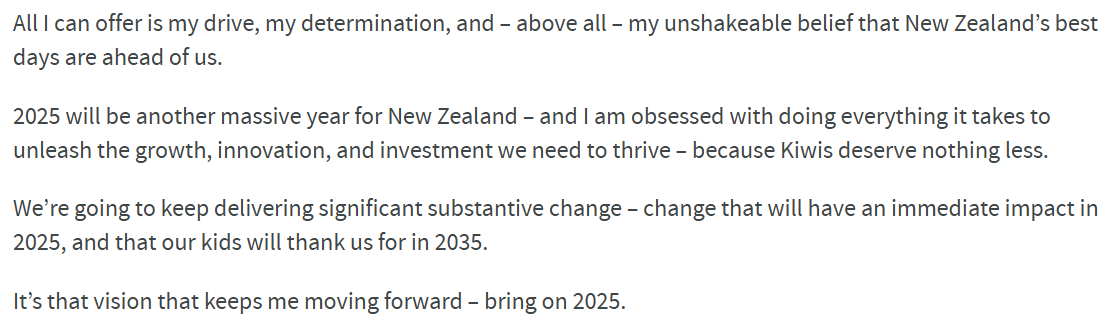
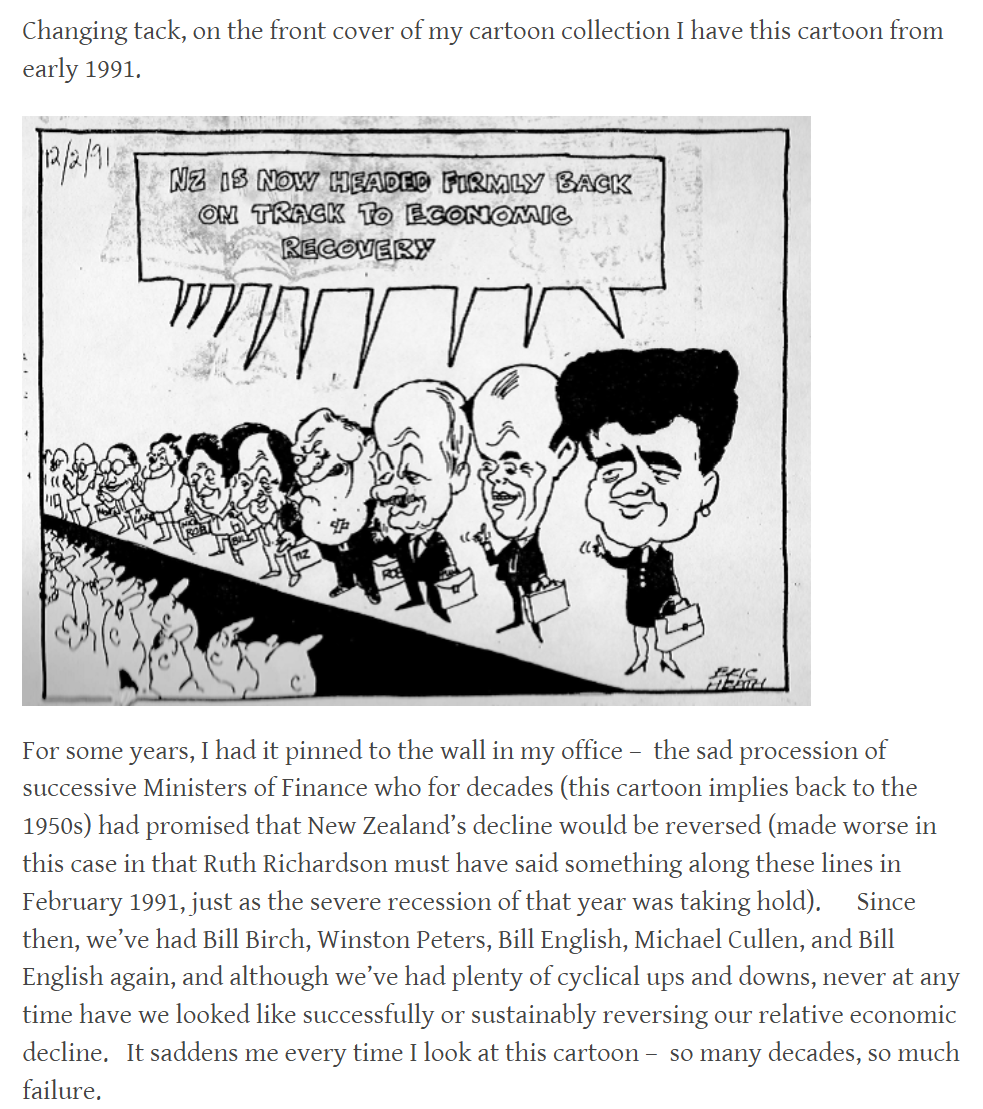
But I’m afraid he and his Minister of Finance look as if they will slot in nicely with the sequence this old cartoon (which I first ran here almost a decade ago. Yes, there will be (may already be) a cyclical upturn, but the structural failings still lie largely unaddressed (and certainly unresolved).
A few charts updated

Over the life of this blog there have been a few charts I’ve kept coming back to. There have been some of the obvious ones, for example around the persistent underperformance of the New Zealand economy on labour productivity. It takes a while for a fairly annual data to turn up on the OECD database, but here are the near-complete 2024 estimates.

Just two observations on that chart:

First, it would take a 74 per cent increase in average labour productivity in New Zealand to match the average across Denmark, Belgium, and Switzerland (3 small European countries, not heavily reliant on nature’s bounty – unlike, notably, Norway). That margin – the steep hill we have to climb – has slightly increased in the last decade.

Second, Romania isn’t in the OECD but back in 2017 I wrote a long post about Romania and suggested then that if the relative performance of productivity growth in the two countries over the previous decade continued in another 20 years they’d have caught us (the backdrop of course being the absolute mayhem left at the end of the Ceaucescu regime). On present trends now (last decade’s performance), Romania is likely to pass us in perhaps another five years.

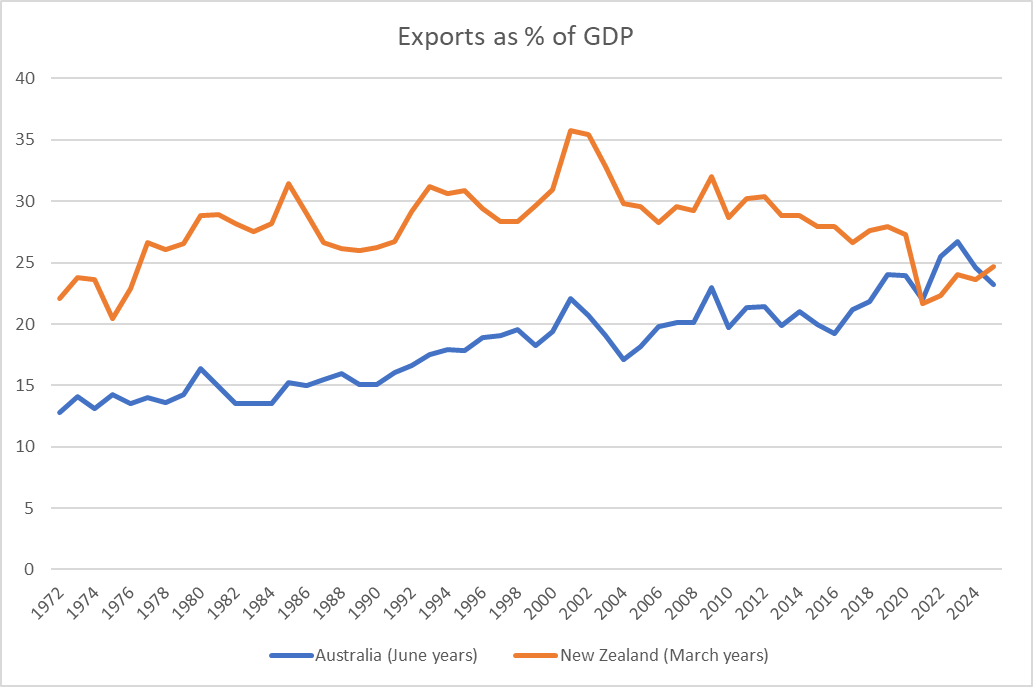
Then there were the foreign trade charts I updated in a post last week.

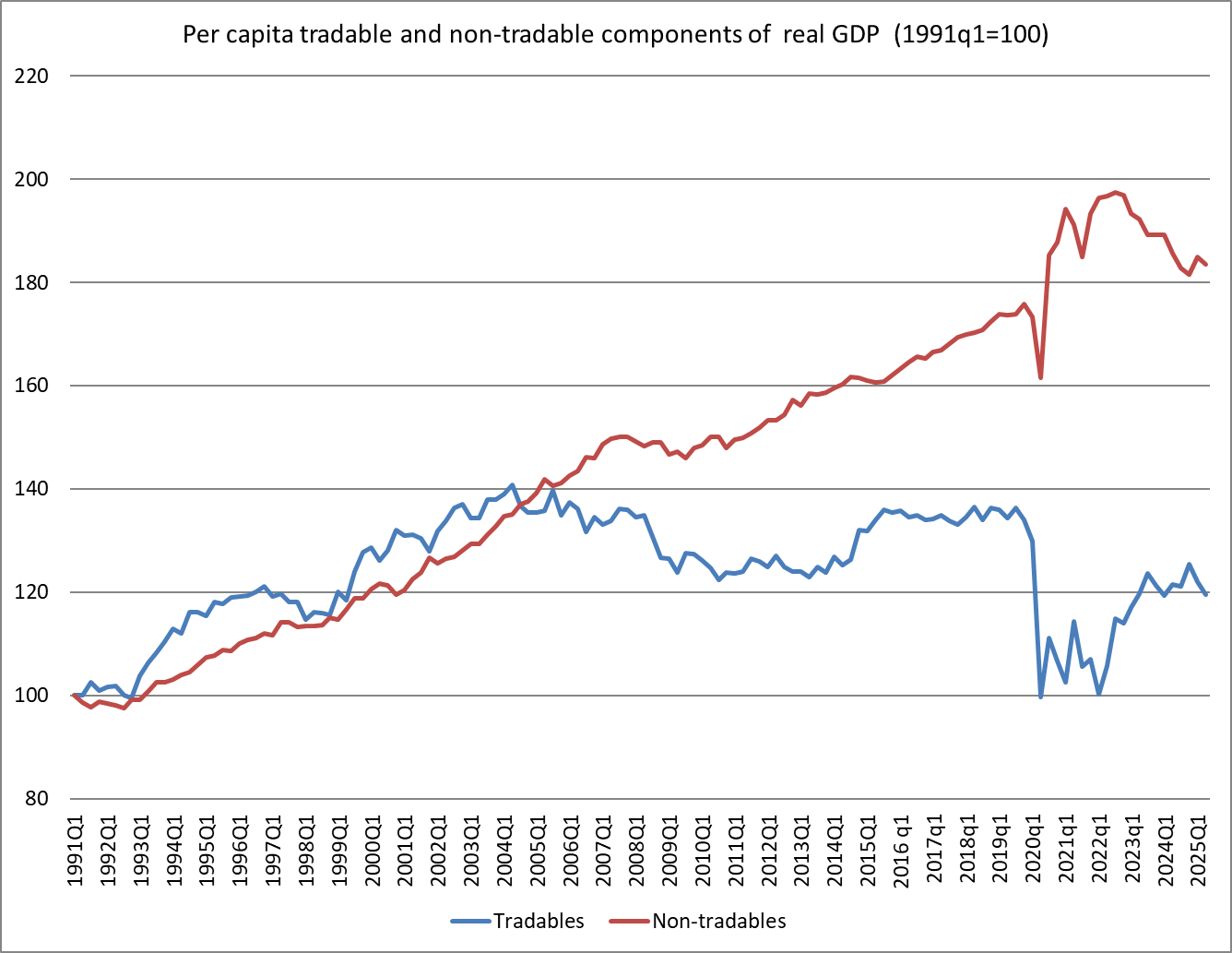
In a somewhat related vein, every so often I’ve run a chart (first devised for New Zealand by the IMF) that is a rough and ready indicator of the split between the tradables and non-tradables parts of our economy (tradables here being the primary and manufacturing sector, together with exports of services).

This is the latest version

The dismal nature of the picture (and economy) is captured in that blue line. Not only has the pre-Covid level not been regained, but the per capita size of the tradables sector of our economy is way smaller than it was 20 years ago. Meanwhile, the non-tradables sector, after a Covid and overheated domestic economy interruption, seems to keep tracking upwards. It isn’t a sign of a healthy economy.

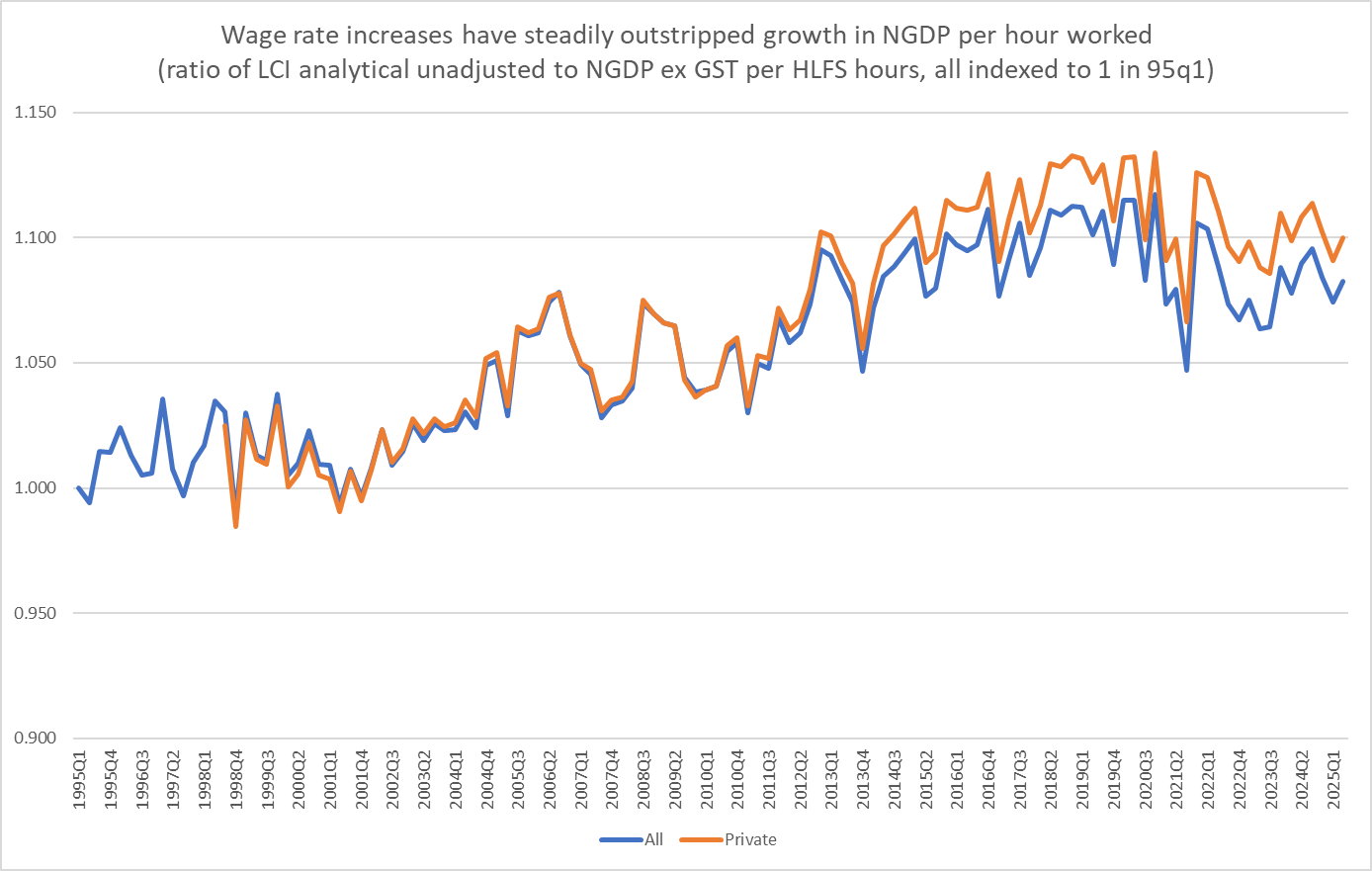
And finally in this brief update post, what about wages? Every so often I’ve included this chart.

People don’t seem to find it very intuitive, but when the lines are going up wage rates (captured by the LCI analytical unadjusted series) are rising faster than nominal GDP per hour worked. When I first did the chart, perhaps seven or eight years ago, of course what caught my eye was the (quite strong) upward trend over 15+ years from about 2000. I saw it as another way of casting light on real exchange rate or competitiveness issues, and as not inconsistent with the inward skew to the economy apparent in the previous (tradables vs non-tradables) chart. Whatever the causes, relative to the capacity of the overall economy to pay (or generate income), wage rates were holding up strongly.

The series is noisy (terms of trade fluctuate quite a bit, and the hours worked series is also a bit noisy quarter to quarter). But there is also no mistaking that the trend apparent up to the late 2010s, arguably right up to the eve of Covid, has changed since. Wages have actual fallen back relative to nominal GDP, whether on the private sector or whole economy wage measure. (And for those who insist on a partisan lens, it doesn’t appear to be a Labour vs National thing.) The fall back isn’t large, absolutely or relative to the previous rise, but equally it isn’t inconsistent with all those polls suggesting that “cost of living” is still the most front-of-mind public concern.

There is no overall intende message in this post, just that coming towards the end of another year it is worth standing back and reflecting on the more structural aspects of how the New Zealand economy is doing (there will always be cyclical swings). In summary, not well.

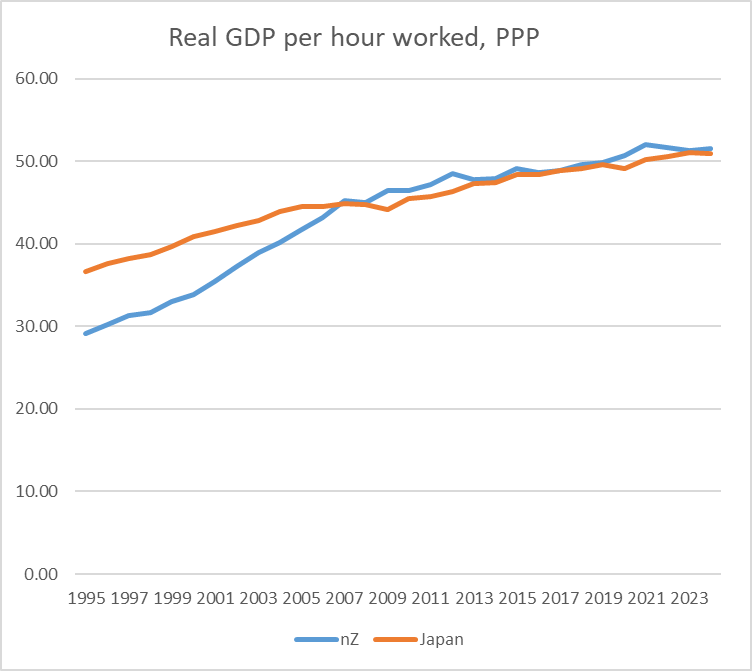
UPDATE:

A commenter noted that in the first chart above NZ was just ahead of Japan. On this measure, we have been much the same as Japan for getting on for 20 years now.

Trade: NZ vs Australia

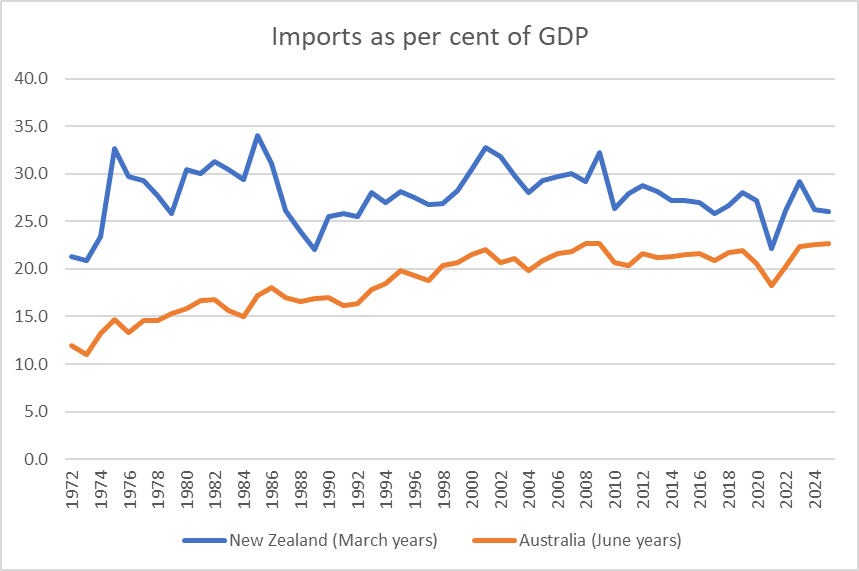
For years now it has been recognised that New Zealand’s foreign trade (share of GDP) is small compared to what one would expect to see in a small country. Small countries generally sell to and buy from firms abroad to a greater extent (relative to the total size of the economy) than larger ones. There is nothing surprising about that: there are simply fewer domestic opportunities in a small country than there are in a large one. The United States, for example (and well before Trump), has exports of around 11 per cent of GDP. But New Zealand’s foreign trade share is small by the standards of small countries, and actually not many large countries now have a smaller trade (exports or imports) share than New Zealand. I’ve done various posts on variations of this issue over the years.

But time passes and I hadn’t noticed that exports from Australia – a country with a population more than five times ours – are now about as large a share of GDP as those from New Zealand. I put this chart on Twitter yesterday, with the observation that Australia itself is hardly a stellar success story.

Even back in the bad old protectionist days, when New Zealand tended to have higher trade barriers than Australia did, the value of exports as a share of GDP was higher in New Zealand than in Australia.

The imports chart is not as stark, but the gap has been narrowing (Australia now has a current account surplus after some decades of having run substantial deficits like New Zealand).

And, of course, from a New Zealand perspective don’t lose sight of the fact that as a share of GDDP both exports and imports are now well below the peaks, themselves well in the past. It isn’t exactly a marker of a successful economy. I’ve made this point numerous times before but I’ll say it again anyway: it isn’t that exports are special, simply that in successful economies it is usual for domestically-operating firms to find more and more opportunities to sell successfully in the rest of the world. You’d certainly expect to see it in any economy that was successfully closing the gaps to the rest of the world. Which New Zealand isn’t.

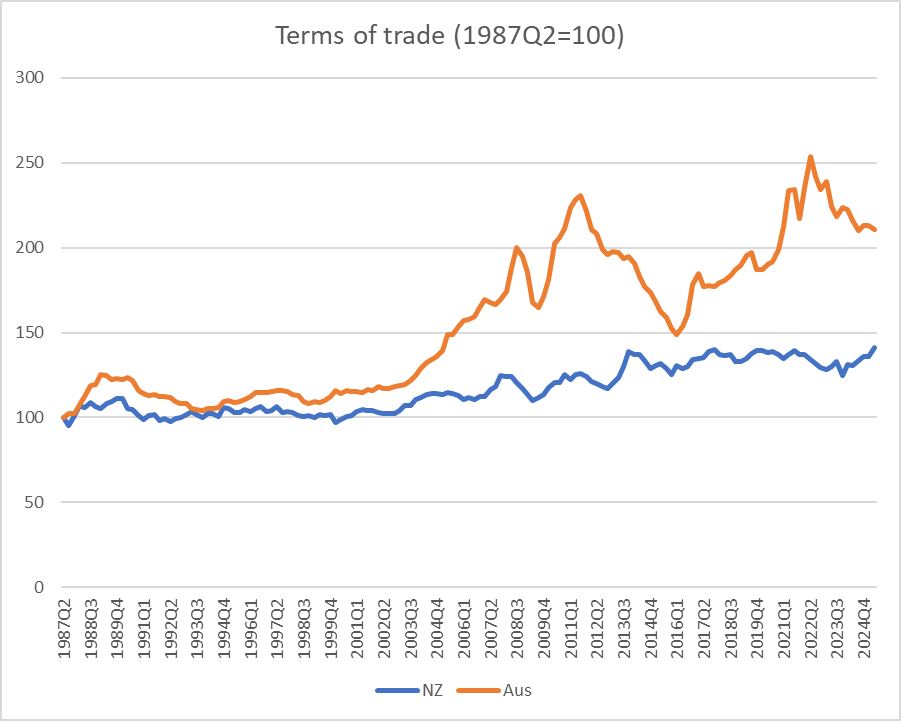
Export revenues result from the mix of price and volume. By wider advanced country standards our terms of trade have been pretty good in the last couple of decades. But Australia’s terms of trade (export prices relative to import prices) have been much more favourable – although also more variable. In the near-term, terms of trade for commodity exporting countries are largely outside their control, but over the longer-run firms presumably invest in anticipation of a particular view of future average selling prices.

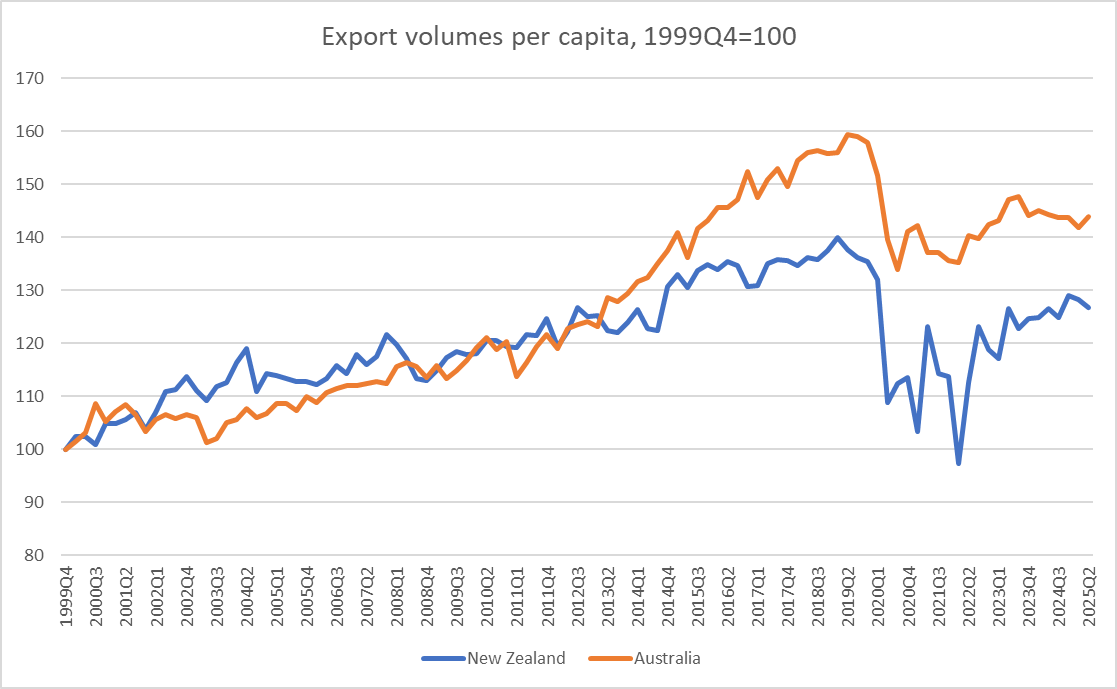
What about export volumes? Using the constant price exports series for each country, here is how the volume of exports per capita has unfolded in the two countries this century.

The two lines don’t materially diverge until the last decade or so,

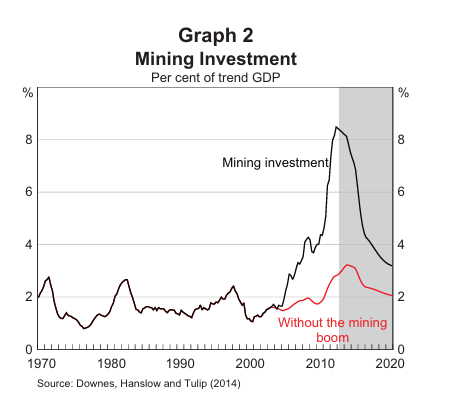
as the massive Australian mining investment boom translated into materially higher export volumes (and revenues). New Zealand simply had nothing similar.
One sobering snippet I took from that export volumes chart is that New Zealand export volumes per capita are no higher now than they were in 2012, 13 years ago now. As a share of GDP total export revenues are now at a level first reached in 1977.

But the other sobering snippet from that volumes chart is Australian export volumes per capita haven’t grown now for almost a decade (and so the gap between the New Zealand and Australian lines isn’t widening further). But then, as I noted already, Australia isn’t a stellar economic success story – and productivity growth there in the last decade has been next to non-existent – just richer and more successful than New Zealand, and the easy exit option for our people.

Both the New Zealand and Australian economies are very heavily reliant on natural resources for their exports to the rest of the world, and that shows little or no sign of changing. If, as the Australian economy did, firms can bring newly to market a huge swathe of natural resource exports things tend to go better for you, as a very remote economy, than if you can’t or don’t.

Is compulsory saving the answer?

Economic growth – and the lack of the sustained productivity growth that underpins it – is again briefly in focus. 70 years of relative economic decline still shows no sign of being durably reversed, but the last few years have been particularly tough and there is an election next year, and so the government’s rhetorical focus has turned to growth. Time will tell whether it is supported by any serious policy changes equal to the magnitude of the problem.

Over the decades, whenever the conversation has (usually briefly) turned to growth and New Zealand’s fairly dismal longer-term economic performance, advocates of compulsory private savings emerge to some fresh prominence. The late Brian Gaynor used to argue that if only we’d kept on with the 1974 Roger Douglas scheme all would have been well. Other funds manager types refer us to the Australian compulsory savings system. And others champion Singapore (including former NZ Initiative and National Party adviser, Leonard Hong who recently devoted an entire dissertation to it [and whose Herald op-ed is here]). Over the last decade, Roger Douglas and Auckland university economics professor Robert MacCulloch have been championing an overhaul of our entire system of health and welfare (including superannuation) provision, which would involve a lot more compulsory private saving. Just this week, MacCulloch is quoted in the Listener’s (flawed) feature article on New Zealand economic decline putting a big emphasis on lack of national saving, suggesting that the difference between New Zealand and Australian wealth/productivity is substantially explained by the differences in savings policies. On his blog yesterday MacCulloch reminds us of one of those empirical regularities of macroeconomics – the correlation between savings rates and investment rates – and claims that much of Singapore’s economic success is down to their compulsory private savings policy; that without something similar National’s growth aspirations aren’t likely to come to much.

One can be a bit cynical about funds managers championing compulsory private savings – Kiwisaver, after all, has been good for funds managers – but I’m sure all these people believe their stories. I’ve become increasingly sceptical over the years,

I don’t want to focus here on what is the best way to do retirement income policy (let alone the political feasibility of different models). One can mount arguments for a variety of different models. But my focus is on overall macroeconomic performance and outcomes, and my starting point is that the design of your country’s retirement income system is most unlikely to be a dominant factor in explaining your country’s overall economic performance.

Let’s take Australia first. As a reminder, 30 years or so ago the Australian government introduced a compulsory private retirement savings scheme (employer contributions), starting at 3 per cent of income then rising to 9 per cent, and this year getting to 12 per cent. Sceptics note that, as yet, Australia still isn’t spending much less than New Zealand as a share of GDP on public pensions, but the focus here is macroeconomic outcomes.

The first place one might look for evidence of the transformational macroeconomic possibilities is the national savings rate.

Champions of the scheme have occasionally produced papers claiming a positive impact, and the counterfactual is – as almost always – impossible to know, but if there has been a positive effect it doesn’t exactly look transformational.

Thoughtful Australian observers also worry about productivity growth over there (Australia is now richer and much more successful than New Zealand, but average productivity lags a long way behind the OECD leaders). There is always lots more going on in both countries but….there is no sign of Australia catching up with the US in the decades since large-scale compulsory private saving became a thing.

Australia is, by the way, the most culturally and behaviourally similar country to New Zealand in the world.

But what about Singapore? It is a stellar economic success story that has seen real GDP per hour worked in Singapore reach levels not that far behind the most successful European economies and the US (although note that experts reckon that Singapore is one of those economies – like Ireland and the Netherlands – where international tax distortions (not just differences in company tax rates) are flattering the data more recently. No one serious uses headline GDP numbers in Ireland.)

Singapore has also had a compulsory private savings system since colonial times (introduced in the mid 1950s).

But it would be very hard indeed to argue that national savings played any very substantial part in Singapore’s economic emergence.

I couldn’t find a very long-term series for Singapore’s national saving rate but the current account is just the difference between saving and investment.

Investment as a share of GDP took off in Singapore from about 1970, averaging about 40 per cent of GDP for 15 years or so, and translating into rapid growth in the aggregates that count (real GDP per capita, productivity growth etc). Throughout almost all that period, Singapore ran really large current account deficits (ie relied heavily on foreign savings).

The IMF’s WEO database has a (directly observed) national savings series since 1980,

where the peak in the national savings rate (at times in excess of 50 per cent of GDP) came well after the peak in investment in a share of GDP. (As a curiosity, and if one takes the numbers in face value, investment as a share of GDP in Singapore and New Zealand have been roughly the same in the last half dozen years or so.) It looks as though, as one might expect, domestic investment tended to respond to opportunities rather than primarily, or to any great extent, to savings.

And that shouldn’t be in the least surprising, since it was, after all, how countries like our own emerged to around the top of the world GDP per capita tables in the late 19th and early 20th centuries (eg there is an estimate for New Zealand for 1886 in which the net international investment position – net reliance on foreign capital – was almost 300 per cent of GDP). Not only New Zealand, but Australia, places like Argentina and Uruguay, and indeed the freshly settled parts of the US itself. Britain, by contrast, ran massive current account surpluses (national savings far exceeding domestic investment), and its lead in the world economic tables began to fade. There is a vast literature on this sort of stuff. More recently, you can see similar pictures for places like Ireland and South Korea (large account deficits in the early phase of emergence, as high investment rates start occurring, followed by later increases in savings rates).

Robert MacCulloch’s post yesterday makes a lot of the Feldstein-Horiaka “puzzle”, first identified in a paper 45 years ago. Across countries, domestic investment rates (national accounts investment concept here as throughout) tend to be correlated with national savings rates. MacCulloch includes in his post this chart, covering (as I understand it) all countries

I did one just for the IMF’s group of advanced countries covering the last 30 years (the period for which the IMF has comprehensive data). Each dot represents a country

It isn’t a tight correlation (check the range of savings rates for countries with investment rates averaging between 25 and 27 per cent, but it is definitely there. The question is what it means.

The thrust of MacCulloch’s claim is that investment in New Zealand is (national) savings constrained. I’m sure he doesn’t mean it in a tight mechanical sense but the implication is that we couldn’t durably get from 23 per cent of GDP in investment to (say) 27 per cent – the sort of market-led change that would make a huge difference over time – on current policies around saving.

I don’t see it. I’ve already illustrated how some current account balances have swung through enormous ranges over time – Singapore is one of the most glaring examples, now accumulating massive claims on the rest of the world, even as domestic investment rates are no longer anything out of the ordinary. Taking that IMF advanced economies grouping over the same 30 year period in the chart above, the median range within which current account deficits have fluctuated over that period has been 12 percentage points of GDP (over that 30 year period Spain, for example, has had both a 3 per cent of GDP current account surplus and a 9 per cent current account deficit). Several countries have had fluctuations within a range of 30 percentage points of GDP, and there are now multiple advanced countries (Europe and Asia) experiencing persistent and large current account surpluses – national savings well outstripping domestic investment.

A fair amount of that correlation between domestic investment and national savings is likely to be because savings themselves are endogenous. When people think casually about saving rates they often have in mind household saving, or perhaps government saving (fiscal deficits and all that). But actually business saving matters a lot. Most of the series above are gross (ie including depreciation effects). Materially higher business investment is accompanied by higher depreciation provisions which firms need to fund. And economies in which the returns are high, where firms are finding plenty of opportunities, are also likely to be ones where firms find shareholders agreeing to higher rates of retained earnings. Much of the capital stock is either houses (always likely to be predominantly owned nationally, and where an increased stock also draws forth over time increased savings to pay for those houses) or government assets (and governments will tend to own physical assets almost exclusively in their own country), which also tend to be paid for domestically over time.

There are some genuine and interesting puzzles as to why the ownership of firms displays more of a “home bias” than a simple model might suggest. But there isn’t much evidence -historical or contemporary – to suggest that if the opportunities were there a much higher sustained level of business investment could not occur in New Zealand without some step change (voluntary or coerced) in household saving rates. (And if that claim were true then given the Australian experience – see above – we might as well give up now.) One indicator of New Zealand’s ongoing ability to attract foreign capital is that with (a) some of the largest current account deficits (over many decades now, but including that 1995- 2014 period, and b) on average very low government deficits, the real exchange rate has remained very strong (puzzlingly so on some models, given the deterioration in our relative productivity performance).

Opportunities? Some of the discussion around saving – and indeed mention of “capital intensity” from ministers and officials – seems to imply that private firms (ones actually operating here, or potential entrants) are leaving opportunities unexploited, leaving money on the table as it were. Frankly, that seems unlikely. They have strong incentives to produce good returns for their investors (& sharper incentives than those facing ministers and officials in this regard). I list among the reasons why there might be relatively few exploitable opportunities here things like high business tax rates, foreign investment restrictions, restrictions on exploiting natural resources (minerals etc), RMA-type obstacles, distance, and the persistently high real exchange rate.

How might higher national savings help? Take a rather extreme example in which we all woke up tomorrow and decided that we were going to save another 5 percentage points of our income hereafter forever (well, for just the next two or three decades). You would then expect to see the real exchange rate move sustainably lower (still with cyclical fluctuations). That would be likely to make more outward-oriented business opportunities look attractive (although fewer domestically-oriented ones would, because we’d all be spending less, and most of our spending is local). That might well be a good and helpful thing, in response to a change in private preferences. (And if local opportunities really were even worse than I thought then New Zealanders would – like Singaporeans now – be accumulated assets abroad and our future incomes would rise, even if domestic productivity didn’t.)

But changes in private preferences are one thing, while attempted state coercion is another (and these days the state might well first look to itself and close those operating deficits that we’ve been inflicted with all decade now). And if the real exchange rate was really the only macro thing that might be susceptible to changing savings behaviour, wouldn’t we want to first understand why it remains so persistently high before leaping to try (perhaps ineffectually) to attack symptoms? I’ve got a story for that, but ministers and officials hardly ever engage with the stylised fact.

There might be a decent case for a different approach to retirement income – I’m sceptical, although I’d raise the NZS age quite a bit, and change the tax treatment of savings (as part of a better tax system all round, with less emphasis on taxing returns to capital) – but retirement income policy should be approached on its own terms, with a focus on individuals and their own ability to manage retirement (thus I was also very sceptical of Andrew Bayly’s desire to hijack Kiwisaver funds in pursuit some politicians’ growth stories). Perhaps a better retirement income model would have useful macroeconomic benefits, but for decades whenever politicians and officials – and economists – wanted to focus on savings it has so often had the feel of “lets force the great unwashed to do something different with their money, to suit our ends” rather than the hard graft of actually getting the obstacles the growth that governments themselves pose out of the way.

If I have one final summary point it is that higher national savings rates have rarely, if ever, been a prelude to durably higher rates of domestic productivity or investment growth.

Willis and Rennie speaking

Last week various of the great and good of New Zealand economics and public policy trooped off to Hamilton (of all places) for the annual Waikato Economics Forum, one of the successful marketing drives of university’s Vice-Chancellor.

My interest was in the speeches delivered by the Minister of Finance and by Iain Rennie, the newly appointed (by this government) Secretary to the Treasury. The Minister also used her speech to announce the launch of a Going for Growth website complete with a 44 page document (15 of which are photos and covers, and another 9 are lists of things (being) done) titled “Going for Growth: Unlocking New Zealand’s Potential” – in the Minister’s words, “Going For Growth outlines the approach the Government is taking to turbo-charge our economy”.

Yeah right.

Now, to be clear, there are some (mostly small) useful things the government has done in the area of economic policy. There are also some (fewer in number) overtly backward steps (eg increasing effective company tax rates by eliminating tax depreciation on buildings, free liquidity insurance for big end of town property developers, debt to income limits imposed by the Reserve Bank), and some important areas where the government has so far failed to act at all (eg last year’s Budget didn’t reduce, and actually marginally increased, the estimated structural fiscal deficit). There is just nothing in what the Minister said, or in what the government has done (or has concretely indicated it will shortly do), that comes even close to being likely to “turbo charge” the economy. It isn’t even clear that either the Minister or her Treasury advisers has anything close to a compelling model and narrative about how we got into the longer-term productivity mess, let alone how we might successfully get out of it (if any politicians really cared enough to want to do so).

Take the Minister’s speech first. I read it against her speech to the same forum last February, given just a couple of months after she had taken office. In that speech we got quite a lot of good stuff about things the incoming government had quickly undone. It made a reasonably impressive list for a first couple of months. By contrast, it is thin pickings in this year’s speech.

We are told, for example, that

Leaders around the world are being compelled to act more boldly than they have for several decades

But there isn’t much sign of it – with the growth focus she talked of – in either what the government is doing, or in what is discussed in the speech.

It isn’t a long speech (just under 8 pages of text) but two full pages are devoted to supermarkets. It is the centrepiece of the speech, to an economics forum just a couple of weeks after the Prime Minister’s big push on emphasising growth-focused policies. Now, I’m as much in favour as the next person of removing regulatory restrictions that might impede the entry of new supermarket competitors – and of cutting company tax rates when possible (which bear particularly heavily on overseas investors’ calculations) – but as the focus of the Minister’s speech it seems like not much more than populist rhetoric. One could eliminate every cent of supermarket profits in New Zealand – which presumably no one wants to do, because unprofitable businesses tend not to keep operating – and it might lower grocery prices by 5 per cent of so (half that for some more realistic scenario based on claims around “excess profits”). Nice to have of course, but not exactly transformative even for households, let alone for the productivity and performance of the economy as a whole. And yet the Minister touts there as being “massive gains for Kiwi shoppers”. And as for suggestions that the government might help hold the hands of potential entrants, how about just getting the regulatory roadblocks out of the way for everyone, rather than rewarding lobbying with special treatment for those who have a taste for and knack of bending the ear of governments for favourable treatment for their particular firms?

Following on from those two pages, the Minister lists four other areas of potential policy overhauls:

  • Government procurement rules. There is talk of a review underway.  It sounds sensible enough (but nothing specific), but it is a little hard to believe that what might eventually be delivered will be any sort of game-changer
  • Tax settings.  Here the Minister tells us that “I am considering a range of proposals to make out tax settings more competitive over time”.  Which is fine, but….there is barely any mention in the speech of the fiscal constraints (the structural deficit the government has so far done nothing about), or of course of the fact that the government increased taxes on business just last year.
  • Affordable energy sounds like a good thing of course.  But there is nothing specific in the speech, and in fact there is a potentially troubling reference to potential steps “the Government may need to take to incentivise new generation”.   Other than removing regulatory roadblocks and, perhaps one day, tax imposts?
  • Savings.  Here there is disconcerting talk of changes to KiwiSaver rules, although probably in the end with marginal effects at best (or worst).  There is talk of enabling more investment in private unlisted assets, even though KiwiSaver fund managers may have little expertise in those sectors, and liquidity and valuation challenges will be very real.  There is the suggestion that more KiwiSaver balances should be invested in New Zealand, which makes little sense for individual New Zealand savers’ whose assets these are and who diversification imperatives should be driving a heavy weighting on international assets.  The Minister tells us she is looking at taking options to Cabinet, but since there is little evidence that difficulty of raising wholesale funding has been a major obstacle to growth in New Zealand it is difficult to see that whatever she comes up with is likely to make much useful change.

And so, almost half way through the government’s term, supermarket reform seems to be what the Minister is holding out as the big prospect (and of course there is Kiwibank, another much-touted cause likely to deliver little useful). 

What of the Secretary to the Treasury’s speech?  You may recall last year that it was reported on several occasions that the Minister of Finance was wanting bold, fresh, innovative thinking from whoever got the job (and since she sets out the search requirements and Cabinet makes the appointment, it really is a government appointment, one in which PSC simply acts on their behalf).

I’m fairly ambivalent about heads of Treasury giving public speeches.  On the one hand, it should be an opportunity to advertise the analytical chops of the Secretary and his/her team, and thus to be welcomed.  On the other hand, the Secretary and the Treasury are the government’s principal economic advisers and those internal relationships are much more substantively important than Treasury public speeches.  There are distinct limits –  quite severe limits in practice –  on what the Secretary can really say, since he or she can’t really be out of step with the Minister in public.  Which means it is never quite clear whether what we are hearing is their best professional analysis, or just what they more or less have to say.

I was pretty underwhelmed by Rennie’s speech, and perhaps the more so as it was I think his first on-the-record speech, and was being delivered not to a provincial Rotary club but to a significant professional economics and policy forum.  No one forced him to accept the speaking invitation, and so we might reasonably have expected the best Treasury had to offer.

Instead, we got a fairly once-over-lightly treatment of both the productivity and fiscal challenges, and the highly dubious claim –  but perhaps it went over well in the Beehive –  that “the Government already has a significant economic reforms programme underway”.   Really?  Do tell.  Interestingly, on the productivity side of things Rennie stated (of Treasury) “we are confident that we understand the basic problems”.  But there was little in the speech to suggest that they really do.  Instead, we get the same rather mechanical growth-accounting stuff that The Treasury has been trotting out for 20 years, and that has found its way into speeches by ministers too.

Thus, we are told that “New Zealand’s low capital intensity is a key driver [note the choice of words] of our poor productivity performance”.   No one disputes that business investment as a share of GDP has been low in New Zealand for a long time, more particularly when considered in the light of rapid population growth.  So the capital stock per worker is, in some mechanical sense, quite low.  But what this approach invites –  and has for the 15-20 years Treasury has been running this line –  is some of “lump of capital” fallacy, that if only more capital was thrown at the economy things would be much better.  It is also captured in comments from both the Secretary and the Minister that are reasonably read as suggesting that somehow individual firms are making bad choices and not putting enough capital into their production processes.

The mentality is all wrong.   Low levels of capital intensity are at best seen as symptom not as any sort of cause or “driver” of productivity growth failures economywide.    New Zealand has never had a particularly problem attracting finance – for example, for decades we’ve financed largish current account deficits even as on average the real exchange rate has stayed high.  And we should assume that, on average, firms and potential investors are responding rationally, and even optimally on average, to the opportunities they face.     So the issue is not that firms are failing to use enough capital in their production processes –  they are most likely doing what is best for them – but that, having regard to all the other constraints (taxes, FDI rules, RMA regimes, other bits of regulation, real exchange rates) there just aren’t that many attractive projects here in New Zealand.  A highly successful New Zealand economy would be likely to be more capital intensive (and generate higher wages),but focusing on the capital intensity or otherwise is the wrong lens with which to look at the problem.    Firms and investors respond to opportunities, and sometimes (often) governments get in the road and make investment (particularly that in the tradables sector) unattractive.

The emphasis on “capital intensity” also drives a focus –  and it is there is the Secretary’s speech –  on something labelled “savings policy”.   I suspect there is a more sophisticated analysis behind some of this stuff, but again the way it comes across is to feed a mentality that if only more “savings” were available more productivity would flow.  As already noted, we’ve had no problem attracting generic foreign savings, but government policies do make business investment proposals often rather unattractive, whether the potential finance is from domestic or foreign sources.

Rennie also addressed (or largely avoided addressing) the fiscal challenges.   “Avoided addressing” because he was more or less stuck with his Minister’s choice to go very slowly and to keep postponing the date for a return to structural fiscal balance.   Instead we get lines like “the current Government has committed to concrete steps to address structural deficits” –  which is generous at best, since they have taken few actual concrete steps, and have only “committed” to the variable vapourware of future (changeable) operating allowances – and suggestions that somehow adjusting over a long period of time is just fine, when there was never a robust economic case for the current structural deficits at all.

And then of course there was the heartwarming, somewhat detached from reality, ending

Governments need to make progress in the here and now. Our job is to advise them on
which pathways are the best to start walking down. We do think hard about a coherent
programme, drawing on evidence and judgment but also remain mindful of the uncertain
connections between policy changes and policy outcomes when you look out over the
horizon. Over time governments will choose to stride faster or slower down those paths.
The important thing is to keep taking those steps and maintain momentum across a broad
front of economic and fiscal policy frameworks.

First, it has an implicit assumption that Treasury knows what is best to do, whether around fiscal or productivity issues.  This is the same Treasury that was advising Grant Robertson only a couple of years ago that higher spending was just fine, the Treasury that seems keen on more active use of fiscal policy (notwithstanding where that mentality got us in the last few years), and the same Treasury that does not have and has not had a compelling narrative around productivity failures or solutions.  And then there is the rather delusional suggestion that, Treasury having identified the right paths, different governments might just walk them at different paces.  The real world is one in which different governments will, at times, be walking in almost exactly the opposite direction to what either fiscal prudence or better productivity performance might call for.    One might think of raising corporate taxes last year, or film and gaming subsidies, or…..or……or……. (all parties, all governments).

Perhaps it really is the case that all the answers to New Zealand’s economic woes rest with failure to adopt the old-time religion.  I rather doubt it, but whatever the case the sad reality of the Secretary’s first public speech is that there was no sign even of fresh or interesting ways of articulating the old-time religion or any interesting or bold new angles.

But that probably suited his political masters.

Going for growth…..perhaps

The Prime Minister’s speech 10 days or so ago kicked off a flurry of commentary. No one much anywhere near the mainstream (ie excluding Greens supporters) questioned the rhetoric. New Zealand has done woefully poorly on productivity for a long time and we really need better outcomes, and the sorts of policy frameworks that would supports firms and markets delivering better material living standards for New Zealanders.

The Prime Minister asserted that “2025 will bring a relentless focus on unleashing the growth we need to lift incomes, strengthen local businesses and create opportunity”. Assuming that these are shorthands for measures intended to durably and substantially lift economywide productivity growth (I saw a nice quote the other day from the Canadian Leader of the Opposition to the effect that no one talks about productivity per se except economists and friends of economists), one could only respond “good if true”.

We have been promised a “rolling maul” of new policy measures as the year unfolds. And the Minister of Finance (now rejoicing in the rather absurdly named additional title of Minister for Economic Growth -albeit perhaps no more absurd that the Economic Development title it replaced) went further in her press release announcing the Budget date and promising

It is a distinctly different emphasis than in her Budget-date announcement press release last year.

Nothing like building up expectations….and one hopes journalists will keep an eye on this set of promises.

I’d give this government credit for a number of steps that, at the margin, may help boost growth, productivity, and efficiency of the New Zealand economy. But it is hardly a case of everything working in the same direction: last year, for example, we had increased business tax rates (re building depreciation), increased taxes on inbound tourists, more restrictions of bank mortgage lending, passing up chances to overhaul key personnel at the Reserve Bank, and of course a Budget that, taken together, slightly widened the structural fiscal deficit. And it wasn’t as if the growth rhetoric wasn’t around last year (eg this quite respectable, as far as these things go, speech from March 2024).

Perhaps this time they really will deliver “bold steps” in May. I’m open to being convinced – and in this case would love to be wrong- but count me sceptical.

For various reasons:

  • For all the rhetoric from the PM and Minister of Finance there is no specific goal which they are willing to use as a stake in the ground (even John Key for a short time would run the line that “our vision is to close the gap with Australian by 2025”),
  • There was nothing in the National Party’s campaign material in 2023 that suggested either a deep understanding of the issues or a policy agenda equal to the sort of challenge New Zealand faces (and that was so even when there were some specifics I thought made sense),
  • We are now 14-15 months into the government’s term –  the election is next year –  and not much has been done so far, no compelling narrative has been developed, no key government agencies have been overhauled and made fit for the challenge etc,
  • Where are the advisers? It isn’t obvious that there are first-rate productivity-focused political advisers in ministers’ (or the PM’s) offices, and what about MBIE and Treasury?  MBIE is a bureaucratic behemoth run by a former Air New Zealand HR senior manager (no, before Luxon’s time) and in appointing a new Secretary to the Treasury, and despite more fine words from Willis last year, the government ended settling for a recycled former Deputy Secretary, who is certainly skilled at managing upwards but would never have been mistaken for a bold and innovative policy reformer (or leader of such people/processes).  Oh, and the Ministry for Regulation is headed by a non-policy recycled public sector chief executive, who didn’t seem to be particularly well-regarded in her previous chief executive role.
  • The Budget is now a mere 3.5 months away.  Based on standard timings Treasury will be finishing their economic forecasts by the end of next month and the Budget is unlikely to incorporate anything not decided by the end of April.  Without excusing bureaucratic sludge, good policy processes take time, perhaps especially in a coalition government.
  • And, of course, none of the three measures announced in the last 10 days look to add up to very much (Invest NZ – one wonders why this spin-out from NZTE is needed at all, and what private sector advisers can’t provide –  the re-organisation of the CRIs, and the digital nomad visa)

There is, of course, some stuff in train that should in time prove helpful (for example, the RMA overhaul, although with the best of intentions it is likely to be years until we can be confident just how helpful – the original RMA having been understood at the time as a liberalising reform).

One can only assume that the word has gone out from the offices of Luxon and Willis to all ministers, and then all public service agencies, to pull together whatever they now can – and perhaps hold off on other announcements for a while – to enable a set of Budget announcements that can be dressed up as passably resembling “bold steps”. No doubt there is stuff in the works – there almost always is – so perhaps the net effect will even be positive (though with enough confidence to lift Treasury’s assumptions about real per capita potential GDP growth?) but I wouldn’t be holding my breath that it will be the real thing, or even begin to get to grips with the magnitude of the challenge. But – Trump ructions permitting – quite probably there will be some cyclical rebound in GDP growth in time for next October (for which the government will deserve no more credit than it deserves blame for the monetary policy induced recession last year),

On that note, the Sunday Star-Times yesterday ran an op-ed from Don Brash and me, prompted by some combination of memories of that goal of catching Australia by 2025 (Don chaired the taskforce and I provided analytical and drafting support) and the PM’s speech, trying not be to be particularly partisan (the failure – and the rhetoric, in varying volumes – has been common to all governments for decades). We ended the column this way.

For anyone interested, the full text follows:

When Don was young and Michael’s parents were young, New Zealand had among the very highest material standards of living in the world.  It really was, in the old line, one of the very best places to bring up children.  But no longer.

For 75 years now, with no more than brief interruptions, New Zealand has been losing ground relative to other countries.   Australia and the UK pulled ahead of us, previously poor places like Singapore and Taiwan caught up and overtook us, and increasingly now the former eastern bloc countries (Slovenia, Estonia, Poland, and so on) are catching and overtaking us. 

Don’t get us wrong: material living standards here are still well ahead of where they were in the 1950s, but if we were once a leader we are now a laggard.  All too many of our people have seen better opportunities across the Tasman for themselves and their kids and have made the move.  That’s good for them, of course, but a poor reflection on economic performance and policy back here.

For 40 years, successive governments have talked a good game about reversing that relative decline and closing the gaps that were opening up.    In the earlier part of the period there were far-reaching policy reforms, which probably helped slow the rate of relative decline.  In more recent decades, the ratio of talk to action has very much favoured talk.  And that is so whichever of our main political parties has led the government.

In late 2008, nearly 17 years ago now, as part of a post-election agreement with ACT, the then government led by John Key announced a goal of catching up with Australia by 2025.  A Taskforce was set up to advise the government on policy options that might enable aspiration to be turned into solid economic achievement.  Don chaired that 2025 Taskforce and Michael wrote much of the Taskforce’s first report.   

The report wasn’t well-received by the then government –  in fact, the then Prime Minister openly dismissed it even before it was released publicly – but that didn’t alter the facts:  New Zealand was lagging far behind Australia (and Australia itself wasn’t, and isn’t, a stellar economic performer).

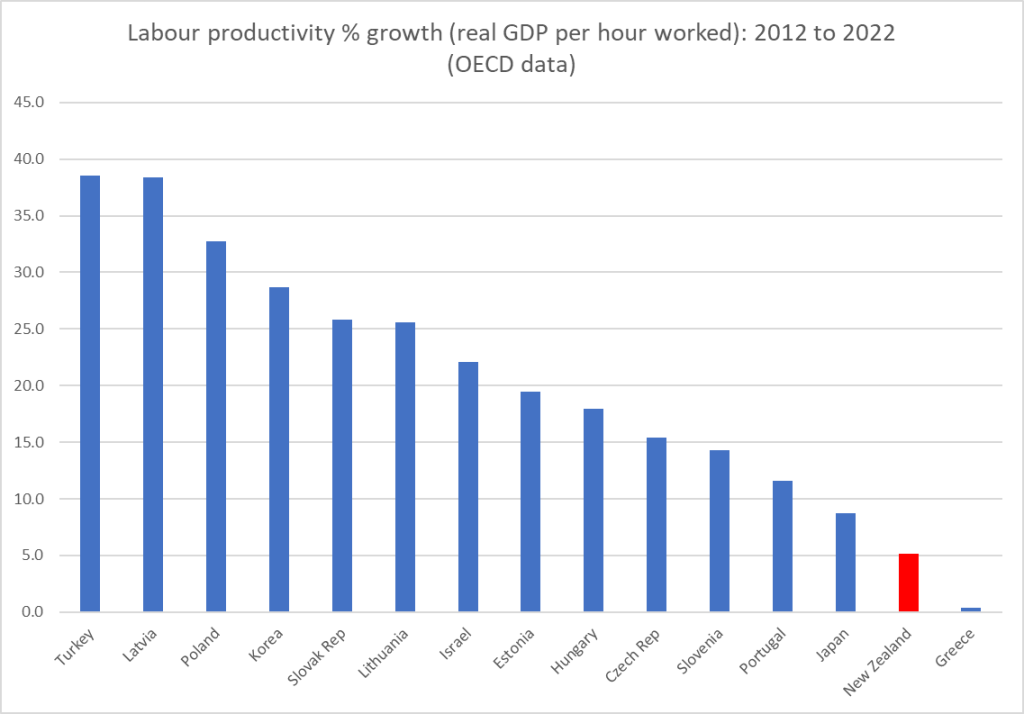
It is now 2025 and over the intervening years –  under successive governments, led by both main parties – no progress at all has been made in closing the gaps to Australia.  If anything, and as measured by labour productivity (output per hour worked), the gaps have widened a bit further.  Recently the Australian government has made it easier, and more secure, for New Zealanders – any of us, skilled or unskilled, young or old –  to cross the Tasman.   It isn’t that Australia has done particularly well economically in recent years –  rather the contrary –  it is just that New Zealand hasn’t even managed to match their underperformance consistently.    Productivity growth – the only secure foundation for material prosperity – here dropped away further from about 2012.

This month we’ve heard a lot from the Prime Minister about the importance of economic growth.   It is fine rhetoric and we entirely endorse his argument.   Material prosperity – whether it is private consumption or better and more public services – rests on restarting sustained economic growth, which in turn rests on accelerated sustained growth in productivity. 

This isn’t just about the ups and downs of the business cycle. Economic activity has been particularly weak in the last 12-18 months as the Reserve Bank has been getting on top of the inflation it inadvertently generated with too easy monetary policy during the Covid period. Now that inflation is falling and interest rates are dropping, we should expect a cyclical recovery.    But a near-term bounce isn’t anything like enough; what we need is, say, 20 years of 2-3 per cent per annum productivity growth.  Over the last decade, actual productivity growth has averaged not much more than 0.5 per cent per annum.

The Prime Minister announced a couple of small reforms in his speech this week.  They may well be individually helpful, but small changes aren’t what will produce really big differences in outcomes. 

We’ll watch with interest the promised “rolling maul” of reforms but aren’t confident that this government, any more than its National and Labour predecessors this century, is likely to respond on the scale equal to the challenge.  

Sadly, it isn’t obvious either that the government has a public service with the energy, intellectual ferment, and concrete ideas that a willing government could pick up and run with.   But some of the options that should be considered are pretty obvious:  economics literature suggests that most of the burden of heavy taxes on business is actually borne by labour (in the form of lower wages than otherwise), and yet New Zealand –  plagued by decades of low levels of business investment – has one of the highest company tax rates in the OECD, and takes a higher percentage of GDP in corporate income tax than almost any OECD country.   Foreign investment in New Zealand remains harder than it should be, and is taxed more heavily than it should be.

We can choose to continue to drift, with just incremental reforms, as successive governments have done for 30 years even amid the fine talk.  But if we do, more and more New Zealanders are likely to conclude rationally that there are better opportunities abroad, and for those who stay aspirations to first world living standards and public services will increasingly become a pipe dream.  

It is a multi-decade challenge under successive future governments, but as the old line has it the longest journey start with the first step.  We hope the Prime Minister’s bold rhetoric signals the beginning of a willingness to lay things on the line, to lead the debate on serious options, to spend political capital, for the serious prospect of a much better tomorrow for our children and grandchildren.

ENDS

NB: Since I saw a BusinessDesk column this morning claiming that 1950-type cross-country comparisons are unfair (much of continental Europe was still recovering from the war), it is worth pointing out that exactly the same could have been said of 1939. New Zealand had among the very highest material living standards among advanced economies throughout the first half of the 20th century.

2025 and what might have been

Okay, so the weather in Wellington is even less conducive to either being at the beach or in the garden than it was on Friday.

Tomorrow it will be 2025. Once upon a time there was a government that adopted a goal of catching up economically with Australia by 2025. I don’t suppose the Prime Minister of the day – John Key – really cared that much for the goal, although for a while he articulated the rhetoric well enough, and he’d campaigned in 2008 on the continuing exodus of New Zealanders to greener pastures – well, higher incomes anyway, on a dry continent – across the Tasman. The goal, and the associated taskforce set up to advice the government on how it might get there, was more of an ACT win.

Treasury provided the secretariat to the 2025 Taskforce, and since I was working at Treasury at the time, and as the chair was my old boss Don Brash, I ended up working extensively with the taskforce and holding the pen on most of the first report (after I went back to the Reserve Bank, Neil Quigley was contracted to write the second report, and I had less to do with that report). The first report was (very publically) binned by John Key the day before we released it. I later came to conclude that while I agreed with most of the long list of policy recommendations in the first report, they weren’t sufficient and overlooked one important issue in particular, but even if one disagreed with the specific policy recommendations – and Key clearly had no stomach for them – one might have hoped that his government (and those that followed) might be serious about the goal itself and looking for effective policy solutions. After all, as the 2025 Report pointed out in 2009 there had been a long history of politicians talking about catching up again with the best performing countries abroad (just no sustained success in bringing it about). (There is a link to both 2025 Taskforce reports here.)

Here it is worth noting that even in 2008 Australia wasn’t one of the stellar advanced economies, with average real labour productivity (in PPP terms) not much above the median OECD country. Much better than New Zealand of course, and Australia mattered for us both as a natural point of reference in our part of the world (similar disadvantages of distance, similar cultures) and as the place where almost all New Zealanders could readily move if they chose (and hundreds of thousands already had).

In this chart I’ve shown how things have actually unfolded

Over the full period we haven’t caught up with Australia, we haven’t even begun to close the gap, and instead the gap has widened a bit further again. Both series are noisy and subject to revisions (in New Zealand alone there are levels differences between the income and expenditure real GDP measures), but overall things have gone in the wrong direction. If one wanted to look on the less gloomy side, I guess one could note that whereas Australia has had no productivity growth at all since 2016, we have had a bit, but I wouldn’t put much weight on that myself (including with declining foreign trade shares, weak terms of trade). And although one could generate a bunch of other comparative graphs, it is productivity that ultimately underpins a country’s longer-run average prosperity.

What I find most depressing – and why I have, somewhat gloomily, been anticipating for some years writing this post – is the lack of any apparent sense of urgency in New Zealand about turning things round or actually finally beginning to sustainably close the gaps. And that has been true really regardless of which parties have held office – if Key binned the advice on the 2025 goal and did little or nothing useful instead, Ardern/Robertson refocused the Productivity Commission on distributing the economic pie rather than growing it, and Luxon/Willis show no better than occasional conventional rhetoric on the topic. And all this against a backdrop where Australia has again made it easier and safer for New Zealanders to move across the Tasman.

As it happens – and what reminded me to write the post – in the New Years’s Honours list released this morning, the government chose to honour one of the members of the 2025 Taskforce, the economist Bryce Wilkinson. That’s nice, but if I know Bryce I’m pretty sure he’d much prefer that governments – including this one – had gotten serious about finally reversing 70+ years of relative economic decline. That would have benefits for all of us, and for our children and grandchildren, who might be more interested in staying to build a better New Zealand.

The PM and economic performance

This post was prompted by watching the Prime Minister’s interview on Q&A yesterday (where I don’t think either the interviewer or the PM did particularly well). My interests here are only in the first (economic) half of the interview.

Minor things first. You had to wonder about the staff work when the PM professed to have no idea that on the IMF forecasts New Zealand’s annual real GDP growth is around the 10th worst of the 190 or so places the IMF does numbers for. It is a line Auckland professor Robert MacCulloch has been running for some time, and others have picked up and repeated his point (including me, more than a year ago). If you (or your staff) don’t read them, then Google’s AI Overview tells the same story for real per capita GDP.

That’s pretty bad (and, to be clear, it is not Luxon’s government’s fault).

Perhaps less importantly, asked which countries hadn’t had a bout of really high inflation, Luxon had no idea (Japan and Switzerland would have been reasonable answers). And he seemed to have no idea either when Jack Tame asked if he was aware of any forecasters who’d become more optimistic on New Zealand’s medium-term economic performance since the government had taken office.

At a political level, one might wonder why Luxon allowed himself to be caught up in the obscure question of whether people at the bottom had improved their relative position in the last year. I suspect most voters for the governing parties weren’t really motivated by wanting to see more redistribution to the bottom (I remain staggered at the fact that in the first pandemic handout package – in a shock that seem likely to make the whole country poorer – Labour permanently increased real welfare benefit levels).

But lets come back to inflation? Luxon (and his ministers, and predecessors) have been loudly proclaiming for some time that the reduction in inflation (headline inflation currently 2.2 per cent, core measures rather higher) and the associated reductions in the OCR have been due to the efforts of the new government sworn in on 27 November last year. It is such a preposterous claim, and yet there seems to have been very little pushback against it, whether from journalists and interviewers or from the political Opposition (the latter perhaps preferring to keep quiet, lest focus come on the fact that inflation got away on their watch and they still reappointed the culprits – notably the Reserve Bank Governor).

Why do I say that it is preposterous? The bottom line of course is that we have an operationally independent central bank and its Monetary Policy Committee. They may not be very good at their job – they let inflation get badly away, were late and slow to react even when they saw the inflation, and their communications and policy have lurched all over the place as recently as this year – but…..they control the OCR lever, they generated the recession we’ve been over last year and this, and they (belatedly) got inflation back down again. Serious economic observers know this. The Prime Minister knows this. But he just repeats what is little better than a lie.

And, as Jack Tame noted to the Prime Minister, inflation has been coming down in lot of (advanced) countries, reductions that were presumably not caused by the election of the current coalition in little old New Zealand. Central banks globally have belatedly done their jobs. If the system didn’t work fully as it was supposed to – such blowouts of core inflation were never supposed to happen again – at least the fallback worked and inflation generally now seems more or less back to around target(s).

So, at best, the Prime Minister’s claim (if it had any substance at all) must be that somehow things his government had done had meant inflation this year had come down faster than it would otherwise have done. Unfortunately, the Reserve Bank does not publish forecasts for core inflation measures (and current headline numbers get messed around by one-offs, whether oil prices changes or changes to government taxes and charges). But the Reserve Bank’s last projections done before this government took office (the Nov 2023 MPS) had headline inflation comfortably inside the target range by now, and – perhaps coincidentally – I see that the November 2023 projections for quarterly inflation in the Dec 2024 and Mar 2025 quarters are exactly the same (0.4 and 0.5 per cent respectively) as those in last week’s Monetary Policy Statement. It would be fair to note that the OCR projections/actuals are much lower, but it was always a mystery a year ago why the MPC then thought the OCR now would still be 5.7 per cent even with inflation comfortably inside the range. They were, eventually, mugged by reality.

But there are two problems with any suggestion from the Prime Minister that his government can take the credit for the inflation outcomes we’ve already seen.

The first is timing. As central bankers rarely fail to remind people, monetary policy works with lags. Changing policy today might not affect inflation very much at all in the first quarter or two, and won’t have its full effect for perhaps 18 months. That is why monetary policymakers put so much emphasis on projections. The government was sworn in on 27 November, and the September quarter CPI (the 2.2 per cent annual headline rate the government likes to talk up) was measured at mid-August. So there was basically eight months from when the government took office to when the CPI was measured. Even had fiscal policy been materially adjusted (actual money going out the door) in the first few weeks, there just wasn’t enough time to have had much of an effect on (core) inflation, or what monetary policy was required.

In principle, perhaps, the expectation of swingeing fiscal policy adjustments might just have done the trick – expectations do affect behaviour – but that wasn’t what the coalition, now in government, either promised or did. Any return to operating balance or surplus was going to be done pretty gradually, over multiple years.

And there was to be no adjustment at all in the first year. Don’t take it from me. This chart is taken from the recent speech by The Treasury’s Chief Economic Adviser and reports numbers published with this year’s Budget.

The blue line is the cyclically-adjusted balance, and you can see that the projected deficit for this (24/25) year is no smaller (in fact, a little larger) than the estimated cyclically-adjusted deficit for 23/24. Yes, there have been spending cuts (and some tax increases, notably the egregious removal of depreciation on buildings for company tax purposes), but this year they have all (and slightly more) gone to fund a range of new giveaways (tax cuts, childcare subsidies etc). It was pretty much what was promised, but it simply isn’t fiscal consolidation and it hasn’t put, and isn’t putting, downward pressure on demand or inflation. If you wanted to be particularly harsh you could contrast this year’s Budget with the 24/25 HYEFU numbers, but as they were largely on the previous government’s policy it is probably fair to set them aside as akin to vapourware.

So:

  • (core) inflation is coming down in a bunch of countries,
  • central banks have (belatedly) done their jobs,
  • New Zealand inflation was forecast to be well inside the target range by now, on RB projections from just prior to this government taking office,
  • anything but the most draconian fiscal adjustments simply wouldn’t have had time to have made a material difference to inflation by the time the Sept CPI was measured, and
  • in any case, there has been no aggregate fiscal consolidation yet (cyclically-adjusted deficit this year is estimated to be slightly bigger than that last year).

The rank dishonesty of the claims coming from the government hardly conduces to lift confidence and trust in governments more generally.

Oh, and if the government were really serious about much better performance on inflation, you might have thought that they’d have replaced the chair of the Reserve Bank Board (which is supposed to monitor MPC on our behalf) and not extended the term of an elderly non-executive member who has been in office right through the costly and enormously disruptive monetary policy mistakes of recent years.

What of fiscal policy itself? It doesn’t bode well when a new government does no aggregate fiscal adjustment in the first year of a three year term, having inherited – and known pre-election it would inherit – a structural deficit, in which not even the cost of the groceries was being covered by tax revenue even when the economy was fully employed. The government has already continued the drift evident in the last couple of years of Labour, with the crossover point for getting back to a balanced budget drifting relentlessly into the future.

Recent comments from The Treasury, from senior minister Chris Bishop (“we won’t be a slave to a surplus”) and the silence of the PM yesterday more or less assure us that when the HYEFU numbers come out in a few weeks, the return to balanced budget will have been delayed yet again. Pretty soon we’ll be on a track for decade of Robertson/Willis deficits, with the 14 straight years of balanced budgets or surplus under National and Labour governments in the 90s/00s just a dim memory for the economic historians. The Prime Minister seems unbothered, happy to mouth rhetoric about being ‘committed to getting to surplus” …..one day perhaps, but not now (and note that comments from Barbara Edmonds over the weekend suggest that Labour is no better). The fiscal pressures of an ageing population – especially pointed when no one will adjust the NZS age – get not a mention. Oh, and Luxon had the gall to suggest that there was a need to be “fiscal conservatives”. A balanced budget would be nice Prime Minister.

And then there is what should be the enormous elephant in the room: productivity. Luxon was happy to acknowledge it was an issue (even Labour ministers used to do that) but not much more.

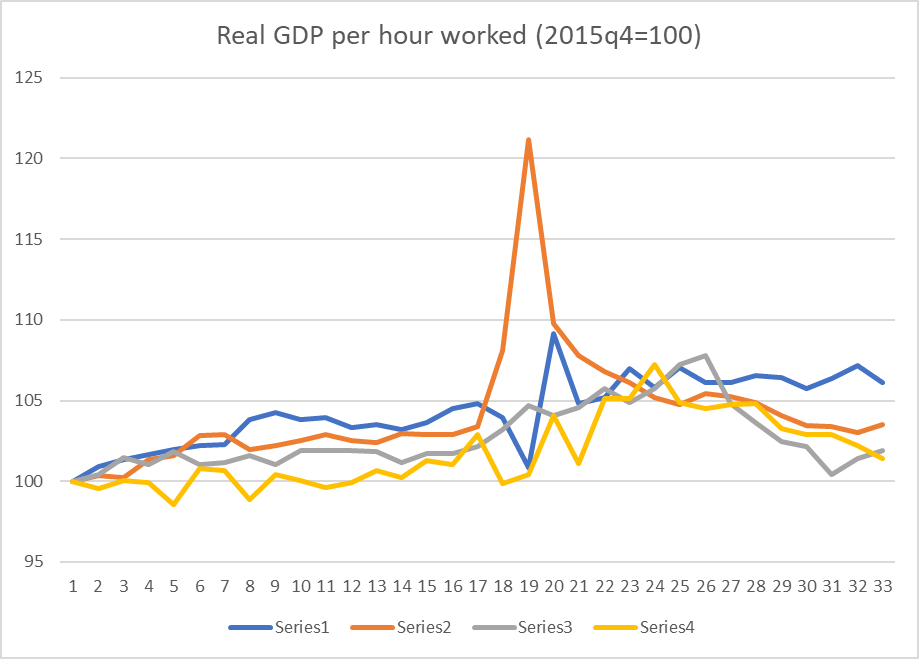
Here is the path of New Zealand real GDP per hour worked since just prior to the start of the last major recession. It is a bit less bleak than one in the recent Treasury speech (I think because I’ve allowed for a 2016 break in the hours series) and I’ve added the orange line (stylised) to take account of the revisions to real GDP over the last couple of years – which will boost measured productivity – that SNZ announced the other day were coming later this month.)

If it isn’t as bleak as Dominick Stephens’ chart, it is still pretty bad. Since about 2012, productivity growth (allowing for the revisions) has averaged only about 0.5 per cent per annum, and although Covid disruptions mess up the picture there isn’t much basis for seeing things under the previous National government as much less bad than those under the recent Labour government. Now, people can fairly point out that productivity growth in recent years has been poor in a range of advanced countries (US excepted) but…..we start from so far behind many of those countries that it isn’t any sort of excuse. For 40 years, the goal of catching up with the OECD leaders has been talked about, but hardly ever has there been any progress in that direction. It would take a 60 per cent (or more) lift in average New Zealand economywide productivity – on top of whatever growth the leaders were achieving – to close those gaps. It was a shame that Tame didn’t take the opportunity to point this out (it isn’t exactly state secret data).

As for Luxon, there was brief mention of his mantra – his five point plan for productivity. The problem with his five point plan isn’t that there is necessarily much wrong with items in it, but that it simply isn’t equal to the scale of the challenge. You don’t get big game-changing results off a series of really rather small policy changes, even when they are eventually implemented (eg nothing necessarily wrong with trade agreements with the UAE, but it is pretty small beer, and successive governments have been signing such deals for years, even as the export share of our economy has been shrinking). There is no sign or sense of much urgency, or of ideas or policies equal to the task.

Tame did ask about the company tax rate, although he didn’t point out that ours is now one of the highest among OECD countries, or that the company tax rate is particularly important for foreign investors. Luxon, sadly, had no substantive response other than to briefly note that it wasn’t “a focus”. There has been money for giveaways, but not for either closing the deficit or for initiatives that might actually make some longer-term difference to the attractiveness of business investment in New Zealand.

Finally, Tame made the fairly effective point that if the government was really getting things back on track and improving economic performance, surely it should be showing through in economists’ medium-term economic forecasts. His researchers had found no evidence that any forecaster had in fact revised up their medium-term forecasts.

I’m not sure what measure he was using or how many forecasters he checked, but in that vein this table summarises the Reserve Bank’s projections for “trend productivity” growth from the Monetary Policy Statements going back to November last year (completed just before the government took office)

I wouldn’t necessarily put too much weight on those numbers. The Reserve Bank isn’t a productivity-focused agency, and these numbers probably won’t have had much, if any, MPC attention. But, equally, the Reserve Bank has no particular partisan axe to grind, and their numbers don’t seem inconsistent with the spirit of the sorts of comments coming out of The Treasury in recent months. It is all rather grim, and the Bank forecasts using government policies as put in place, not some idle wishlist of things that might – but probably won’t – be.

Words and (in)actions

When I wrote yesterday morning’s post, highlighting how poorly both New Zealand and its Anglo peer countries have been doing in respect of productivity in recent times (ie, in the case of New Zealand, Australia, and Canada even worse than usual), little did I know that the Prime Minister was about to announce a bold new economic performance goal. I wasn’t even aware he was giving a pre-Budget speech yesterday.

But there it was

Now, read it carefully. If it were just the first sentence in 1. it would be largely devoid of content. Even pessimists, with long experience of the underperforming New Zealand economy, probably reckon that the average level of productivity in the New Zealand economy will be higher in 2040 than it is now (these are the sorts of lines that go up over decades, under all but the most adverse circumstances). But the Prime Minister doesn’t stop there. The second sentence is clearly a statement about relative performance: the Prime Minister’s “vision” is for a New Zealand where there is a net return of New Zealanders (after 50-60 years of trend (often large) outflows), because they can have a “better life” here and aren’t driven to move abroad by the lure of “higher incomes” there. His “vision” seems to be that economic growth in New Zealand over the next 16 years will be so strong that we’ll have matched – perhaps even exceeded – what is on offer abroad. As we all know, by far the largest net outflow of New Zealanders is to Australia. The “vision” seems to be to catch Australia.

Wouldn’t that be great? Australia is far from being a leading-edge economy but it is the easiest exit option for most New Zealanders, and has done much better than New Zealand for decades now. For those who are into trans-Tasman rivalries, it must be quite embarrassing for our country to have done so much worse than them, when for many decades we pretty much level-pegged.

As for the PM, he reminded us of his firm focus (“resolutely and unapologetically”) on “delivery”

So having set out a bold vision what is the Prime Minister offering as a policy programme to achieve it? It isn’t, after all, a small ambition. (By my reckoning, using IMF data, catching Australia’s GDP per capita by 2040 would require New Zealand’s per capita real growth rate to exceed Australia’s by about 1.45 percentage points each and every on average for 17 years – so if Australia managed 1 per cent average per capita real GDP growth, we’d have to average almost 2.5 per cent year in year out. Over the last 17 years we’ve managed about 1 per cent per capita real growth.)

The Prime Minister does lay out some substance on the early days

Personally, I’d give a tick to almost all those (but not too keen on allowing small panels of Cabinet ministers to decide which private sector projects get favoured treatment). It is mostly good stuff. But to a first approximation what it mostly does is undo stuff the previous government did and restore something like the policy set of 2017. But if productivity growth in the years up to 2017 was less bad than it has been here – and in Australia and Canada – more recently, we weren’t making any progress then either in closing gaps to the rest of the advanced world. And where it is still mostly prospective (“charting out a course of systematic RMA reform”), it is welcome, and sounds good, but…..we’ve heard lines about fixing the RMA before, including from the previous National government.

And that was sort of the problem with the entire economic strand of his 2040 vision. It brought to mind this

I hadn’t previously noticed the transition from “concrete goal” to “vision”, but whatever the language, it all made no difference whatsoever.

The Taskforce that was set up to advise on meeting the 2025 goal noted at the start of its first report that there had been a lot of talk over the years.

(I don’t suppose the Taskforce really believed that last couple of sentences, but…..the Prime Minister himself had been party to setting a “concrete goal” so he might as well be treated as taking it seriously.)

Of course, it all came to nothing and nothing about the goal (whether “concrete goal” or “vision”) was achieved. (I had some part in assisting the 2025 Taskforce, but the substantive issue is not the Taskforce, but the goal – which is what would greatly have benefited New Zealanders had it been seriously pursued. It wasn’t.)

Here is the summary chart, comparing GDP per capita (in PPP terms) between the two countries since 2007 (just prior to the severe recession on 2008/09). There are two different measures, but they both tell the story: no progress at all has been made in the intervening years to closing the gap in real GDP per capita to Australia.

In the short-term governments (government policy settings) can’t do much about the terms of trade, but generally Australia’s have been stronger than ours.

Productivity is more amenable to policy settings. If anything the gap has widened over the period covered by the original 2025 goal (these lines are indexed to a common value at the start of the period. Using annual OECD data, in PPP terms, the average level of labour productivity in Australia is about 28 per cent higher than that in New Zealand, larger than the gap in real GDP for capita (the latter also reflecting the higher employment rate in New Zealand).

Who knows if Mr Luxon is any more serious about his “vision” – laudable on its own terms – than John Key was about the 2025 goal. No doubt both of them would be quite happy if things happened to have turned out that way (wouldn’t we all) but Key and his government did nothing even close to being equal to the task to make it happen. There seems little basis – whether in PM’s speech, his campaigning last year, or anything about what his government is and isn’t doing now – for believing it will be any different this time. Most likely, it is just another positive-sounding rhetorical line that will disappear, even from prime ministerial speeches, almost as soon as it appeared.

It would be great to be proved wrong on that, because the people who pay the price of empty political aspirational rhetoric never matched by policy seriously equal to the task aren’t Prime Ministers, who eventually move on to gilded retirements, but the children and grandchildren of ordinary New Zealanders.

If, as he should be, the Prime Minister is serious about that aspiration of New Zealanders (net) coming home not just because mountains and beaches make it a nice place for many to live, but because economic performance means you don’t have to leave for a higher income, the concrete policies need to start matching the rhetoric. In the PM’s own words, delivery matters.

UPDATE: As if to reinforce my scepticism I came across this in a Stuff article

On the assumption that his answer has been fairly reported, really what can one say. It is just devoid of any substance whatever, and meanwhile his government in practice shows no sign of ending the corporate welfare handouts (which are what reinforce any sense of dependency, at least among the favoured firms).

Productivity growth: 4 Anglos

In my post last week on The Treasury’s recent note on productivity, I highlighted that the weak labour productivity growth evident in New Zealand over the last decade wasn’t something we’d shared with the OECD countries that were around our level of average productivity. This chart was from that post.

But as I also noted, it might have been worth Treasury having a look at Australia and Canada (richer and more productive than us, but with some important structural similarities, and neither in recent decades having been productivity growth star performers).

For many countries it is quite difficult to get whole-economy quarterly labour productivity data. But Australia, Canada and the UK publish such series, and I’ve done so for New Zealand (using the average of the two real GDP series and HLFS hours data). The data are all available to 2023Q4, although in all cases no doubt with the caveat of being subject to revision as fuller data emerge for the most recent periods.

First, a quick quiz. Which of the four Anglo countries do you think is which in this chart (I went back to end of 2015 to start from before the Brexit referendum)? Note that none of the lockdown period numbers are likely to be very reliable, and may just reflect differing assumptions the various statistical agencies made. But in all four countries, lockdowns are now well in the past.

The answer? And somewhat to my surprise…..best of a poorly performing bunch of countries over this eight year period was the UK, Brexit and all.

And how about the period since just prior to Covid (there is some noise in the quarterly data so I’ve used the 2019 average as the base)?

I’d usually highlight New Zealand in a different colour, but….it is hard to highlight (exceedingly close to) zero.

Given the potential for revisions I wouldn’t put much weight on it, but……for what the data are worth…..there is no reason to doubt that the recent productivity performances of New Zealand, Australia, and Canada have been rather similarly poor, and especially so since Covid.

It is worth making these comparisons for various reasons, but including because it is all too easy for partisans to highlight their own country’s experience, blaming everything on the rhetorical predilections and headline choices of whoever happens to have held office in this period. Over the full Covid period (in the chart just above), we had a Labour government, Canada had a government that seemed similarly “left wing”, but then for much of the period Australia had a centre-right Coalition government, and the UK…. has had the Tories (who sometimes appeared very similar to Ardern, but are notionally at least of the centre-right).

But lest you are tempted again by thought that everyone is just as bad as each other and global forces mean productivity growth was just impossible over this period, consider the US

They don’t produce whole-economy real GDP per hour worked data, and you’d expect the business sector to do better than the economy as a whole (ie including government). But I had look at how large the differences might be (using the annual US GDP per hour worked estimates from the OECD) and it is pretty clear that the US economy as a whole – an economy very much closer to the productivity frontier – has managed materially faster labour productivity growth over recent years than the 4 Anglos focused on in this post.

Countries can still manage robust productivity growth. Perhaps especially countries that are well behind the productivity frontier (see first chart in this post), but….apparently not with the policy mixes of the New Zealand, Australian, and Canadian governments.