Yield curve indicators, monetary policy, and the case for action

Six months or so ago, shortly after a flurry of attention in the US around the 10 year bond rate dropping below the three-month rate (which had been something of a predictor of weaker economic conditions) I wrote a post here on yield curve indicators in New Zealand.    Once upon a time, we used to pay quite a bit of attention to the relationship between bond yields and 90-day bank bill rates although, as I explain in that post, it isn’t a great indicator of future New Zealand recessions (and wasn’t really used that way when we did pay attention to it).

In the post I suggested it might be worth looking at a couple of other yield curve indicators, using the (fairly limited) retail interest rate data the Reserve Bank publishes, comparing short-term retail rates with long-term goverment bond rates.  The absolute levels wouldn’t mean much, but the changes over time might.   Here is a version of those charts updated to today (using current retail rates from interest.co.nz)
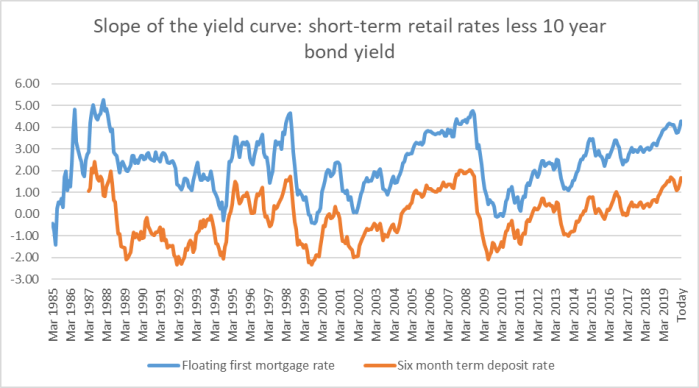
yield curve 20 1

and the same chart for just the last two years.
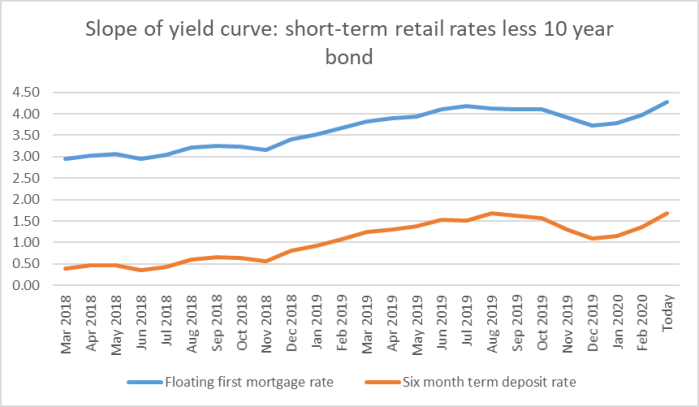
yield curve 20 2

For what it is worth, the only times these lines have been at or above current levels a New Zealand recession has followed.  And although the Reserve Bank interest rates cuts in the middle of last year did reduce the slope of the retail yield curves, we are now sitting right back where we were at the peak last year.

The Reserve Bank is, of course, now strongly expected to cut the OCR this month –  as Australia did yesterday and the US this morning, and as they should have done last month.  But do that and they’ll only take those retail yield curve slopes back to around where we were late last year –  and that on the assumption that long-term bond yields don’t fall materially further.  By historical standards that will look like relatively tight monetary policy, at least on this indicator.    And all that with credit conditions that tightened last year, look likely to tighten further because of the ill-considered capital requirement increases (they were warned about the risks that the transition period would cover, and exacerbate, the next major downturn) and –  despite political rhetoric –  are only likely to tighten further under the cloud of extreme uncertainty and actual/potential income losses currently descending.

In this climate, with the evident sharp slowing in economic activity, it would be more normal to envisage hundreds of basis points of cuts.  But, through official lassitude and a decade focused more on hoped-for rate increases than on the next severe downturn, cuts of that magnitude simply aren’t an option.

The constant pushback against the idea of OCR cuts now (whether last month, right now, or later in the month) is that they won’t achieve anything much in coping with the immediate disruption and the (probable) rapid increases in job losses over the next month or two.   And, of course, that is quite correct.

One also sees pushback using the argument that central banks shouldn’t be responding to share prices, noting that world markets are even now not much off their peaks.  Whatever the merits of that argument abroad –  and in general I don’t stock prices should (directly) drive monetary policy actions –  it is pretty irrelevant here: in all my years of involvement in advising on New Zealand monetary policy, the only time share prices ever really entered deliberations was in October 1987, and even then it was only as a proxy for the serious problems developing just behind the scenes.

But the fact that monetary policy doesn’t have much affect in the very short-term, particular amid really disordered conditions, is really rather beside the point.  If what you care primarily about is the employees and firms directly disrupted, there are plenty of direct options the government can, and probably is, considering.  But that is simply a different issue, even if one that operates in parallel.  Even direct short-term assistance won’t do much to slow the deterioration of economic aggregates –  won’t summon up more tourists, won’t fill gaps in supply chains, won’t offset the decline in spending if/when social distancing becomes more imperative.  By and large, we are stuck with whatever deterioration in economic activity the next few months bring, most of which will be events almost totally outside our control (overseas economic activity and the spread of the virus abroad and here).   We can support individuals to some extent, and perhaps can do something to increase the chances firms will still be there when the pressures pass.

But in many respects, monetary policy is also about the second leg of that. It is about getting in place early –  and providing confidence about –  conditions that will (a) support the recovery of demand as and when the virus problems pass, or settle down, and (b) helping ensure against that the sort of precipitate fall in inflation expectations (in turn confounding the economic challenges) that I warned about in yesterday’s post does not happen.   The importance of early and decisive action is compounded by several things:

  • the physical limits to conventional monetary policy (can’t cut very far, so need decisive early action to keep expectations up),
  • the probable political limits to fiscal policy (see 2008/09 globally)
  • the extreme uncertainty about the course of the virus or the economic consequences (like any city/country, we could face northern Italy or Korean disruption at almost any time),,
  • reasons to doubt just how rapid a recovery in demand will be (perhaps especially in tourism) and the likelihood of some –  growing by the day –  permanent wealth losses

All supported by the fact that, unlike other possible programmes, monetary policy action is readily reversible if the best-case scenario comes to pass.

I find two other thoughts relevant to the discussion.   It seems almost certain that the price-stability consistent interest rate is quite a bit lower than it was just a few months ago.  In normal circumstances, the job of the central bank is to keep policy rates more or less in line with that short-term neutral rate.  It might well be –  but no one knows –  that the fall is temporary, but the Reserve Bank’s job isn’t to back a particular long-term view (they have taken to talking recently far too much about the long-term, when their prime job is really quite short-term, about stabilisation) but to adjust to pressures evident now.

(In the same vein, we also hear the objection that the virus issues are “short-term” and thus no action is warranted.  Quite possibly, perhaps even probably, they are short-term, but so are most of the pressures central banks deal with.  Most recessions for that matter, even most crises.)

And finally, it is worth bearing in mind that many commentators are already highlighting debt service burdens for businesses where activity has fallen away sharply,     There are no easy answers to what the appropriate policy response, if any, is to those issues. But it is worth pointing out that there are likely to be permanent income/wealth losses, even if in a year’s time the path of GDP is back on the pre-crisis course.  Income not earned this year is unlikely to be made up for by more income later.  In the extreme, if the economy largely shut downs in certain cities or regions for a short time –  or if certain sectors (eg foreign tourism) largely shutdown for longer –  those losses will not be made back, and the debt (business and household, bank and non-bank, lease commitments and loans) that was being serviced supported by those actual/expected income flows will still be there.   Those losses have to be (will be) distributed somehow and frankly it seems reasonable that part of that would be by adjustments to servicing burdens.     People will say –  commenters here have –  that 25 basis points is really neither here nor there.  And, of course, that is true.  They will also say that the OCR is “only” 1 per cent –  also true – but retail lending rates are over 5 per cent (floating mortgages) or 9 per cent (SME overdrafts), and in a climate like the present.    Those rates really should be a great deal lower –  at least temporarily –  as, of course, should the adjustable rates being earned by savers/depositors.

Pro-active macro policy would be doing all it can, as soon as it can, whatever additional firm-specific measures the government might also try.  To repeat, the point isn’t to fix the immediate situation –  there is no such fix, absent the magic fairy curing the world of the virus overnight –  but to limit the risk of longer-lasting damage and better position ourselves for what could still be a difficult recovery, with permanent wealth losses.  The Reserve Bank should be taking the lead –  it is conceivable that if they are going to wait until the scheduled review date that even a 100 basis point cut could be under consideration by then –  but there is sufficiently little the Bank can do –  even about that medium-term horizon, that we should have well-targeted and designed effective and prompt fiscal stimulus as well (again focused on the six to eighteen month horizon).  If anyone influential is reading, I commend again –  as one part of a response – the case for looking hard at a temporary cut in GST).


Preparing

In those distant days when world sharemarkets were still at or very near record highs –  actually, on Monday –  the Federal Reserve Bank of San Francisco released one of their short accessible Economic Letters summarising some research work done last year on the question “Is the Risk of the Lower Bound Reducing Inflation?“.   The views expressed are those of the authors, not the FRBSF let alone the wider Federal Reserve system, but the authors aren’t just fresh out of college either: one is the executive vice-president and head of research (one of the most senior policy positions) at the FRBSF, and the two authors are senior managers on the research side of the Bank of Canada.

Here is their summary

U.S. inflation has remained below the Fed’s 2% goal for over 10 years, averaging about 1.5%. One contributing factor may be the impact from a higher probability of future monetary policy being constrained by the effective lower bound [ELB] on interest rates. Model simulations suggest that this higher risk of hitting the lower bound may lead to lower expectations for future inflation, which in turn reduces inflation compensation for investors. The higher risk may also change household and business spending and pricing behavior. Taken together, these effects contribute to weaker inflation.

How does this work? Here is their description

If monetary policymakers are constrained by the ELB in the future, recessions could be deeper and last longer because central banks may be unable to provide sufficient stimulus. The greater decline in economic activity in this case would translate into lower inflation during such downturns relative to recessions when the policy rate is not close to the lower bound.

In addition, greater risk of returning to the ELB could also affect inflation during good times, when the economy is performing well and interest rates are above the lower bound. Investors and households often care about the future when making long-term investment decisions that are difficult to reverse, such as setting up a new production plant or buying a house. The possibility that recessions might be more severe in the future because of the ELB can affect their economic decisions today, prompting them to be more cautious to guard against this risk. For instance, households could start saving more in anticipation of possible harder times ahead. Similarly, businesses could engage in precautionary pricing by setting lower prices today if they anticipate a greater likelihood of deeper recessions in the future and do not review their pricing strategy frequently.

As something for the future –  perhaps the very near future –  it all seems a plausible tale, and is consistent with a line I’ve been running here for years, that when the next severe downturn comes markets (and other economic agents) will quickly focus on the limitations of conventional monetary policy and adjust their behaviour (for the worse, in cyclical terms) accordingly, deepening and lengthening the downturn.  But these authors go further and posit that people (real economy and financial markets) have already been factoring the ELB risks into their planning and decisionmaking, in turn directly contributing already to lower inflation and lower inflation expectations (than perhaps the current cyclical state of the economy might otherwise deliver).

I haven’t yet read their full working paper so can’t really evaluate the strength of their evidence on this point.  But if they are capturing something important about actual behaviour in the last decade or so, presumably those effects would be expected to have become larger the closer to the present we come.   Prior to 2007 the Fed (and other central banks other than Japan) had not reached the ELB at all. Immediately after the recession there was a pretty strong expectation that things would return to normal (including normal policy interest rates) before too long –  a view typically shared by markets and by central banks.    Only with the passage of time did those expectations gradually fade –  and perhaps more completely in Europe (where policy rates are still often negative, and pretty consistently lower than those in the US).

For New Zealand, of course, if there is anything to this story, it must be even more recent, having started with higher policy rates, and with markets and the Reserve Bank mostly looking towards higher policy rates until just the last couple of years.   The possibility of reaching the ELB in New Zealand has been a distinctly minority point (yours truly and perhaps a few others) for most of the last decade, in ways that leave me a little sceptical that the story will explain anything much of the inflation experience in New Zealand (or Australia) for the decade as a whole. In both countries, inflation has averaged materially below the respective target midpoints.

Whatever the case for the past, the FRBSF note ends with this point

These findings suggest that the puzzle of how to raise inflation to meet central bank goals may require new ways of addressing the risk of returning to the ELB and new ways of understanding how to set and meet inflation goals.

The problem is that there is a growing risk that it is now too late, and that central banks (and Ministries of Finance) have spent the last ten years not getting to grips with ensuring effective capacity for the next severe downturn, leaving things potentially almost paralysed when that severe downturn breaks upon us.  Which it could be doing right now.

Many advanced country central banks can now barely reduce the policy interest rate much at all –  the biggest problem with former Fed governor Kevin Warsh’s call yesterday for a coordinated international rate cut is that it would immediately highlight the limits, especially in Europe.  Even in a traditionally high interest rate country like New Zealand, there is perhaps 150 basis points of capacity, when the average recession in recent decades has involved 500+ basis points of cuts –  a point our Minister of Finance rather glossed over yesterday in his talk of the advantage of starting with relatively high interest rates.

As the FRBSF authors note

To compensate for this lack of conventional firepower, central banks can rely on unconventional policy tools, such as forward guidance or quantitative easing. While these tools proved effective during and following the crisis, it remains unclear whether they can fully compensate for the diminished conventional policy space and the more frequent encounters with the ELB

That is fairly diplomatic speak, as befits senior officials.  In reality, few really believe that unconventional tools under the control of central banks can adequately compensate for lack of conventional policy space.

In my view, those limits have not really been sufficiently focused on by markets, firms and households, or governments.  There has been quite a lot of wishful thinking around –  hankering for higher neutral rates, inability to spot an near-at-hand risk that might trigger an early severe downturn, or whatever.   But when people look at the looming coronavirus risks –  and markets will no doubt ebb and flow still, just as happened as the financial crisis unfolded a decade ago – and really begin to focus on what can, and will, be done, we are likely to see inflation expectations falling away much faster than in a normal downturn, in turn raising real interest rates and accentuating the problems, at a time when neutral interest rates are likely to be falling further (perhaps temporarily, but real enough for the time being).

To bring that back to the New Zealand situation, after ignoring the issue for a long time the Reserve Bank appears to have begun to take it more seriously in the last 18 months or so. But with little or no transparency and no apparent urgency.  We keep being told they are about to reveal their thinking –  I hope with a view to getting serious feedback etc –  but they’ve already mentioned enough that we can be sure that what they’ve had in mind simply will not make up for the limits of conventional interest rate capacity, even allowing for the likelihood that in such a severe downturn our exchange rate will fall a long way (as it did in most of those previous 500 basis point rate cut episodes).   There is also sadly little sign that the Minister of Finance has shown much leadership or urgency about seriously addressing this problem (again, nothing along those lines in yesterday’s speech –  good enough as far as it went, but it stopped short of the really serious issues/risks).

It would be easy for me to suggest that the Governor has been too much occupied with his tree gods, his climate change interests, his views on infrastructure or the distribution of income, rather than driving action urgently in this area of monetary policy capacity (core day job).  And that is no doubt true, but as a specific criticism it needs to be kept in perspective –  his predecessors had let the issue drift, and his peers at the top of many other central banks have also seemed to prefer to believe things would come right than to seriously prepare for the constrained alternative.  We risk paying the price now –  including with central banks paralysed by their own limitations and reluctant to act early and decisively to lean against (do what they can to buffer) the economic downturn (and downside risks to inflation and inflation expectations).

Quite possibly there is a place for fiscal policy in responding to a serious downturn, even one amid the chaos of a potential pandemic, but there needs to be a lot more realism about the likely constraints on how much, and how longlasting, any discretionary stimulus is likely to last.   There is no real excuse – even in a less fiscally constrained country like New Zealand –  for authorities not to have moved to greatly alleviate or remove the effective lower bound before now, and to have used relatively settled times to have socialised the case for doing so.

And even if the FRBSF authors are wrong about the influence of the ELB on inflation over the last decade, if it very quickly now becomes even more binding – starting from a lower initial level –  it will be front of brain for everyone through the next cycle.    It really needs to be dealt with now.  It isn’t technically hard –  there are various workable options –  but it needs leadership, will, and vision for something to happen, something which has the potential to limit the extremes (depth, duration) of that severe downturn whenever it finally strikes us.


A tweet from the Reserve Bank

I was in a meeting all morning and don’t have that much time this afternoon, so I should offer a special thanks to the Reserve Bank for suggesting a topic for today’s post.  It is prompted by this tweet, which turned up in my feed just as I was about to head into my meeting

The Bank used to use Twitter for not much more than sending out links to press releases etc.   But they seem to be trying to use it more actively, with a strategy (if any) that is less than entirely clear to the outsider.   For example, a couple of weeks ago there was the invitation to us all to submit questions via Twitter for the Governor’s MPS press conference –  which went rather badly when they only took two questions that were reframed as soft platforms for the Governor to declaim on some or other favoured topic.   Yesterday, there was a puff piece telling the world that the Bank was now 43rd most favoured employer for graduates in New Zealand.  I suppose that didn’t sound too bad –  small organisation and all that –  until I clicked on the link and found that the Bank came in behind 11 other government departments and a couple of local government entities.  Oh well, thanks for letting us know I guess.

This morning’s tweet has the potential to be quite a bit more concerning, on several counts.  Most concerning is that it reads as a statement of the institution’s view –  that of the MPC? – on matters directly relevant to monetary policy, launched into the ether with no notice at all.     That is no way to do monetary policy –  or rather it was the sort of way we did monetary policy 25 years ago, before we moved to a clearer, more scheduled, more predictable system.  This might seem like only a picky inside-the-Beltway issue, but this isn’t way things should be being done.  It would be interesting to know whether the MPC were consulted, or even advised, that a statement on the economic outlook was about to be made.

More substantively concerning is the content of the comments, perhaps especially when released in the middle of one of worst financial market trading days in several years.   Look at the substance of their new text: “we expect activity will pick up later this year, meaning more investment, more jobs, and higher wages”.      The link is to their cartoon summary of the Monetary Policy Statement, released almost two weeks ago, based on forecasts finalised almost three weeks ago.    Those were forecasts based on very short and quite limited negative coronavirus effect.    Those are the forecasts today’s statement links to.    How can they possibly still be the MPC’s best view now, when a growing range of medical experts now expect the virus to go round the world, infecting (in time) perhaps 40 to 70 per cent of the world’s population, with attendant disruption and uncertainty?  At very least, the risks to the happy upbeat story must be much more serious than the MPC thought them two or three weeks ago.

My guess is that the tweet wasn’t really intended as monetary policy and related economic commentary at all.  My guess is the MPC wasn’t aware of it, and quite possibly the Governor was not either.   Perhaps someone down the organisation running the Twitter account just thought it would be a good idea to tell us a bit more about the Bank (“we do forecasts”).    But official communications need to be managed better than that –  an excellent central bank, best in the world, would certainly do so.

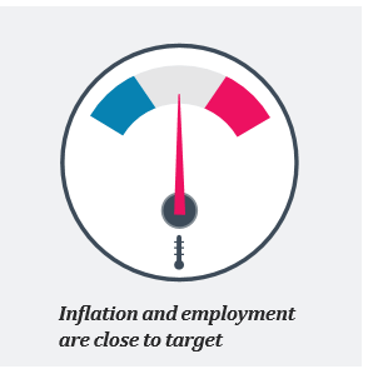
Excellent central banks also communicate carefully and precisely about things bearing directly on their mandate.  A reader yesterday drew my attention to (something I’d missed) the way the Reserve Bank is falling short there too.   A good example was in the cartoon summary of the latest MPS, linked to in that tweet, where I found these

target 1

target 2

It isn’t just the cartoon version either.  Here from the MPC’s minutes

The Committee agreed that recent developments were consistent with continuing to meet their inflation and employment objectives

And my assiduous reader tells me the same phrasing pops up in comments made by the Governor, and in the last few MPS rounds as well.

Can you tell me what the Reserve Bank’s employment target is?

Trick question, as there isn’t one.

The MPC and the Governor surely know this, as their Remit –  the mandate set for them by the Minister of Finance –  is reproduced at the start of each Monetary Policy Statement.  Here is the central section

The current Remit sets out a flexible inflation targeting regime, under which the MPC must set policy to:

• keep future annual inflation between 1 and 3 percent over the medium term, with a focus on keeping future inflation near the 2 percent midpoint; and

• support maximum sustainable employment, considering a broad range of labour market indicators and taking into account that maximum sustainable employment is largely determined by non-monetary factors.

There is a clear and measureable inflation target, basically the one we’ve had for almost 20 years now.

And then there is a requirement to “support” maximum sustainable employment –  which is, more or less, what monetary policy tends to do when it acts to keep inflation near the inflation target.  There simply is not an employment target, so what are the Governor and MPC doing claiming that they’ve met this non-existent target.  It might be quite reasonable for them to argue that they believe they’ve done what they can to support keeping actual employment near maximum sustainable employment –  reasonable people might differ from them on that, but the debate would then be around an explicit mandate the Bank has been given.

Perhaps to many the loose language will seem harmless.   And perhaps when we are near to full employment it does little damage, but that won’t always be the case.  Come the next serious recession, unemployment will rise a lot/employment will fall a lot.  The Bank will do what it can to lean against those changes, but it won’t be failing –  not hitting a target –  just because the unemployment rate is high, perhaps even for several years (especially if the limits of monetary policy are reached).   More generally, it creates a sense in which someone there are equally important employment and inflation targets, when the Minister of Finance –  the one responsible for setting the target –  has clearly specified otherwise.

Mostly, it is probably some mix of sloppiness and the Governor’s ongoing efforts to play the “tribune of the masses” card.    And we should expect (demand) better than that from the Governor and the MPC – especially in formal written documents, whether aimed at the “specialists” Orr affects to despise or at a wider general audience.  You do not need to be sloppy in the use of language to communicate the essence of what you are supposed to be about.   From the Bank recently we’ve had loosely-grounded factual claims, outright misrepresentations, and repeated sloppy use of language to misrepresent the Bank’s mandate.  I’m guessing it would not go at all well with the Bank’s bank supervisors if they found the banks and financial institutions they regulate operating in so loose a way.  Apart from anything else, those supervisors might reasonably ask themselves “if things are this loose in what we see –  prepared for the public face –  what are things like where we cannot see, inside the organisation”.

These might be issues the Bank’s Board and the Minister of Finance –  both charged with keeping the Governor (and MPC) in line and accountable –  might be asked about.    I imagine they would just run defence for the Bank, but you never know.   Perhaps some journalist might approach an MPC member for comment –  and if, as most likely would happen, they simply refused to comment then report that stonewalling.


An unimpressive MPC

I didn’t expect to be particularly critical of the Reserve Bank after yesterday’s Monetary Policy Statement.  A journalist asked me yesterday morning what I’d say if they didn’t cut the OCR, and I noted to him that whether they cut or not, what I’d really be looking for was evidence of the Bank treating the issues in a serious way, alert to the magnitude of what was going on and the sheer uncertainty the world faces around the coronavirus.

They –  the almost a year old new Monetary Policy Committee –  did poorly on that score.  And in his press conference, I thought the Governor simply seemed out of his depth.  Much of what the Bank had to say might have seemed reasonable two weeks ago –  no doubt when the bulk of their forecasts were brought together – but the situation has been moving (deteriorating) quite rapidly since then.   They can’t update published forecasts by the day, but there was little sign in the record of yesterday’s meeting, or in the Governor’s remarks yesterday afternoon (or those of his senior staff), of anything more immediate or substantive.  The Governor seemed to attempt to cover himself by suggesting that the Bank”s line was consistent with some “whole of government” inter-agency perspective, but….that is (or should be) no cover at all, since Treasury and MBIE don’t face the same immediacy the Bank does (it had to make an OCR decision) and whatever the Ministry of Health might be able to pass along about the virus itself, it knows nothing about economic effects.  On those, the government should be able to look to the Bank for a lead.  Instead, we got something that seemed consistent with the lethargic, lagging, disengaged approach of our government (political and official) to the coronavirus situation.

Thus, remarkably, faced with one of the biggest out-of-the-blue economic disruptions we’ve seen for many years, arising directly and most immediately in one of the world’s two largest economies, we get three-quarters of the way through the press statement before there is any mention of the issue, ploughing our way through upbeat commentary including on the world economy.   Even when we do get there, the coronavirus effects are described only as an “emerging downside risk” –  for something which has already sharply reduced activity in parts of our economy.  It is the sort of language one might use for things where the effects are hard to see, not for something this visible, direct, and immediate.   And on the day when the head of the WHO –  who has often seemed to play defence for the PRC – was highlighting the scale of the global threat.  On a day when a CDC expert was on the wires noting that the only effective response is social distancing –  the more distant people stay the less economic activity there is.

The Bank loves to boast about how transparent it is. As I’ve noted, they are happy to tell us the (largely meaningless) forecasts for the OCR three years hence, but they are astonishingly secretive about their own analysis and deliberations.   Thus, we now get a “summary record” of the final MPC meeting.  Here is pretty much all we get to see about the coronavirus issue

The Committee discussed the initial assumption that the overall economic impact of the coronavirus outbreak in New Zealand will be of a short duration. The members acknowledged that some sectors were being significantly affected. They noted that their understanding of the duration and impact of the outbreak was changing quickly. The Committee discussed the monetary policy implications if the impacts of the outbreak were larger and more persistent than assumed and agreed that monetary policy had time to adjust if needed as more information became available.

….The Committee discussed alternative OCR settings and the various trade-offs involved.

There is no sense of the sort of models members were using to think about the issue and policy responses.  There is no sense of the key arguments for and against immediate action and how and why members agreed or disagreed with each of those points.  There is no sense of how the Bank balances risks, or of what they thought the downsides might have been to immediate action.  There is no effective accountability, and there is no guidance towards the next meeting.  Consistent with that, the document has one –  large meaningless (in the face of extreme uncertainty) – central view on the coronavirus effects, but no alternative scenarios, even though this is a situation best suited to scenario based analysis.   It is, frankly, a travesty of transparency, whether or not you or I happen to agree with the final OCR decision.

Consistent with that, there was no mention –  whether in the minutes or in the body of the document or in any remarks from the Governor –  of past OCR adjustments in the face of out-of-the-blue exogenous events.  Again, perhaps there are good reasons why the cuts in 2001 (after 9/11) or 2011 (after Christchurch) or –  less clearly –  around SARS in 2003 don’t offer good lessons for policy-setting now.  Presumably the MPC thought so, but they lay out no analysis or reasoning, and thus no way to check or contest (or even be convinced by) their thinking.  It really isn’t good enough.   Then again, in the press conference no journalist challenged the Governor on these omissions.

Similarly, there was no sign in any yesterday’s material or comments of having thought hard about the limitations on monetary policy (globally) as interest rates are near their effective lower bound.  All else equal, and with inflation well in check, that starting point should typically make central banks more ready to react early against clear negative demand shocks to do what can be done to minimise the risk of inflation expectations dropping away.  Perhaps again it still wouldn’t have been decisive this time –  and our Reserve Bank still has a little more leeway than many –  but to simply ignore the issue, and show no sign of having thought hard about the wider policy context, was pretty remiss.

From his tone in the press conference, it was as if the Governor really didn’t want monetary policy to have to play a part –  to do his job –  as if it was all just an unfortunate distraction from good news stories he’d been hoping to tell.   So he told one journalist that at best monetary policy would be a “bit player”: for individual sectors that is no doubt true (but then monetary policy is never about dealing with specific sectoral problems), but not really the point, since there has been a clear and significant, highly observable negative demand shocks, and a huge increase in uncertainty (often a theme of RB speeches etc over the last year).  In fact, in answer to another question the Governor was heard claiming that there was “no specific event” to consider reacting to (hundreds of millions of people locked down in China, second-largest economy in the world?) and –  worse –  then claimed that there was no need to act as we already have very low and stimulatory interest rates.  The problem with that argument is that they were just as low six weeks ago, and since then we’ve had a clear large negative demand shock.

Asked about the fact that implied long-term inflation expectations (from the government bond market) were barely above 1 per cent, the Governor took a lesson from politicians and simply refused to answer the direct question.  He then went to on to claim that the monetary policy foot was already on the accelerator, that we’ve had more positive global growth –  even as global projections are in the course of being revised down – and that if anything the question that should have been being asked was why we weren’t thinking about raising the OCR (“renormalising”).

One journalist thought to ask the Governor about the difference between the Bank’s GDP forecasts for the year ahead (2.8 per cent I think I heard) and those of various outside commentators (more like 2.0 per cent) and asked about the difference.  The Governor’s response was that of glib teenager: “0.8 per cent I think”.  Pushed a bit further, he indicated that he had no idea why the difference and (more importantly) no real interest. He claimed (fair enough) not to accountable for anyone else’s forecasts, but showed no interest in the cross-check (that used to be pretty standard around the MPC table) of understanding why the Bank is different from others, and why the Bank still thinks that is the best forecast.

There was also the line about market prices constantly adjusting and buffering……all this as the exchange rate rose the best part of 1 per cent on his announcement yesterday, rather undercutting any exchange rate buffering  of the economy that had been underway.

Oh, and then we had gung-ho political cheerleading for the government’s infrastructure spending plans.  He claimed to be “very excited” by it and rushing past any issues around “crowding out” was keen to talk up all the possibilities of “crowding in” accompanying new private sector investment etc.  No evidence, no analysis, but it probably went down well with the Labour Party.  Sadly, the Governor seems to do campaigning and cheerleading better than he does monetary policy, and there seems to be no serious and substantial figure on his team to compensate for those weaknesses (while, as far we can tell, the invisible unheard external MPC members just function as ciphers and political cover).

As an illustration of what the Bank simply seemed to be missing –  or choosing to ignore – a reader left this comment here last night

The shock from nCoV isn’t just confined to China. It’s spilling rapidly across the Asia-Pacific region…

I have just spent the past few days in Singapore and I write this on a flight to Hong Kong, which is maybe 15% occupied. Singapore is shutting down, which is worrying given its entrepôt status. Malls are emptying, as are hotels and restaurants. Traffic is thin. Companies are rolling out their business continuity plans which will further exacerbate the dislocation. This isn’t about just China, it’s region-wide.

The same reader sent me directly a photo of one of Changi airport’s main terminals at lunchtime yesterday, with this note “Changi T-3 unloading zone. Today, 12 noon. Not a soul in sight.. no cars no people..”

I noted yesterday that more or more people would be cancelling trips, business or leisure, in the face of some mix of risk aversion and sheer uncertainty.  That happened to me yesterday –  less about immediate threat than about the extreme uncertainty about the environment a few weeks hence.

And this morning we hear a local public health expert calling for our sluggish government to expand travel restrictions to people coming from various other countries (including Singapore and Hong Kong) where there is now established community outbreak. Or news of major international events in Hong Kong being cancelled. Or a major world telecoms convention in Barcelona being cancelled.

I’m not suggesting the Reserve Bank should have tried to turn itself into disease experts or even to pin their colours to a different central scenario.  But they simply don’t seem alert to the magnitude of what is already going on, including that huge rise in uncertainty, and they provided us with very little useful analysis about the way they think about monetary policy, demand shocks, risks, instrument stability etc –  nothing to give us any confidence in their stewardship.

Oh, and you’ll recall I mentioned yesterday their interesting –  and potentially positive – experiment in transparency, inviting real-time questions to the Governor during the press conference via Twitter.  As I’d noted in advance, one might well be sceptical about just which questions they would choose to answer.  Actuals were even worse than my expectations.  The Bank’s comms guy had clearly been primed not to expose the Governor to any searching questions, and only two were let through at all, essentially translated into patsy questions, allowing the Governor to wax eloquent on a couple of favoured themes.   No one forced them to adopt this particular approach to being more open.  But if they want kudos for it, they need to be seriously willing to allow real and searching questions to the Governor.


Coronavirus and the OCR

A month ago there were no commentators suggesting the OCR should be raised at the next review.   Since then we’ve watched day-by-day as the news about the coronavirus (now named “SARS-CoV-2” and the disease it causes “COVID-19.”) has got relentlessly worse.   Against that backdrop, the case for an OCR cut today looks pretty unanswerable. Not because an OCR cut will make any material difference to March quarter GDP – it won’t –  but because the job of discretionary monetary policy is to lean against demand shocks, positive or negative, so long as inflation is well in check.

As I noted the other day, core inflation hasn’t got as high as the target midpoint for the whole of the last decade.  In that context, when there is a clear-cut (if not readily calculable) adverse demand shock, the Monetary Policy Committee would be remiss if it simply sat on the sidelines today, suggesting that they would merely be “watching closely” and be ready to act down the track.  In the current macro climate –  quiescent inflation, flat or falling inflation expectations –  there is simply no downside to acting now.    There is no particular virtue in instrument stability: the instrument exists to lean against macroeconomic instability (doing what it can to maintain “maximum sustainable employment”, in the current jargon).

Even a couple of weeks ago one might perhaps reasonably have reached a different view.  But now we have Chinese inbound tourism cut to almost nothing overnight (first as a result of Chinese restrictions and then our own), and confirmation from the universities that perhaps 60 per cent of their PRC students are still out of the country and unable to travel here.    We have much the same situation in Australia, a key economy for us, and in China itself –  one of the world’s largest economies –  huge economic disruption, and a spreading range of restrictions on movement, social gathering etc etc.  We see photos of largely empty streets or public transports in big Chinese cities that aren’t locked down, quite limited returns to work after earlier shutdowns, and so on. From Hong Kong there are reports of more cases, but again the bigger impact is probably people staying home, avoiding social gatherings etc.  Investment banks doing business in China –  ie quite severely constrained in their freedom to run negative lines –  have been marking down their 2020 Chinese and global economic forecasts.  Even the WHO –  which previously presented as relatively complacent – is now talking of this as

WHO chief Tedros Adhanom Ghebreyesus told reporters in Geneva the vaccine lag meant “we have to do everything today using available weapons” and said the epidemic posed a “very grave threat”.

“To be honest, a virus is more powerful in creating political, economic and social upheaval than any terrorist attack,” Dr Ghebreyesus said.

“A virus can have more powerful consequences than any terrorist action.

I’ll leave the florid rhetoric to him, but if there was a good case for cutting the OCR after the 9/11 attacks and after the February 2011 earthquake (and I think there was) that case is at least as persuasive –  compelling in my view –  now.

It isn’t really clear to me why, faced with a decision to make today (not, say, a week ago as with the RBA), anyone would favour not cutting the OCR.   The OCR (monetary policy more generally) is designed to be flexible and responsive (easing and, if warranted later, reversing such easing).  The OCR isn’t about support for individual adversely affected sectors –  if that is really needed in some areas it is a fiscal policy/government matter –  but about stabilising the overall economy faced with (in this case) clear negative shocks.  The tool is fit for purpose.

One argument sometimes heard is that we shouldn’t do anything because things are so uncertain.  But that argument should run exactly the other way round. The high degree of uncertainty, which is probably now rising by the day, is exactly the conditions in which people put off spending, put off travel, are a bit warier about eating out, and so on. It represents a likely material adverse demand effect on top of the specific channels (tourists, students) we already knew about.  Think of travel.  You might have been planning a business trip into Asia.  You might be happy enough to go today, and yet you look ahead and wonder what things might be like when you want to get home again, let alone what conditions might be like if somehow you got sick.  I reckon we’ll see an increasingly number of non-essential trips postponed, whether business or leisure.  And that won’t be so just in New Zealand.   With each passing week, we’ll also see more spillover effects into spending elsewhere in the economy and the confidence surveys –  whatever we make of them –  are likely to take a hit.

There is also the argument that things will snap back once the virus is behind us.  No doubt that is the most sensible assumption, but an increasing number of commentaries are noting that a full snap back isn’t likely to be a matter of a few weeks: it seems increasingly likely that the level of economic activity over much of this year, in much of the world, will be weaker than otherwise –  perhaps not a lot by the end of the year, but that is still 10-11 months away.    And assuming things will simply snap back risks being a recipe for doing nothing with monetary policy when it was actually needed (there are plenty of things forecasters think will be shortlived, but turn out to drag on rather longer).

I’ve also heard a story that the Reserve Bank cutting the OCR by 50 basis points last August may have instilled in some a sense of unjustified worry, becoming a bit of an own goal. Is there a risk of something similar now?    First, the August cut wasn’t well-handled.  It may have been substantively justified, but was poorly communicated and was not clearly tied to specific and very visible adverse developments here and abroad.  As it happens, I don’t think the “own goal” effects, if they existed at all, lasted for long at all (little sustained evidence in eg confidence surveys).    What about a move now?  Sure it would be unexpected, in that surveys of economists were all picking no change.  But (a) those surveys were often done a week or more ago, (b) economists generally aren’t asked what they think the Bank should do, and (c) there is a very clearly identified adverse event, which every commentator will be focusing on.  It would be quite easy for the Bank to credibly justify a cut today, specifically tagged to the coronavirus (and referring to 9/11 and 2011).  And if in doing so the Bank raised a bit more public consciousness of the mounting economic issues, it would probably be no bad thing anyway.

Perhaps the final caveat I’ve seen is that global equity markets seem quite surprisingly sanguine.  If they aren’t pricing something quite bad –  or even high risk – why should central banks react?  It is a fair question.  One answer is a matter of different time-horizons.  Equity markets are pricing earnings prospects over the life of the firm, while central banks are (by design) supposed to be focused more on the short-term.  A few bad months might not rationally affect the value of most firms much, but might still warrant lower policy interest rates. It is just a different game.  But it is also worth noting that New Zealand markets are pricing an OCR cut by the end of this year.   If it is needed, and likely to be useful, in a coronavirus context, it is much more useful –  and more likely –  frontloaded.

Time (not long now) will tell what the Monetary Policy Committee decides to do.  I am encouraged by two things: first, was the MPC’s willingness to act decisively last August (even if the accompanying communications etc were hamfisted) on much less clear-cut evidence, and second by the fact that one of the external members of the MPC (retired economics professor, Bob Buckle) was heavily involved in The Treasury’s early work on pandemic economic effects last decade.

Whatever the MPC chooses to do, the Reserve Bank has introduced an interesting new exercise in transparency.  If you are on Twitter you can ask the Bank directly a question during the press conference this afternoon.

The OCR should be cut

The Reserve Bank Monetary Policy Committee releases its next Monetary Policy Statement and Official Cash Rate (OCR) decision next Wednesday –  the first we’ve heard from them since November.

Until a couple of weeks ago you could probably mount a pretty strong case for the status quo. If the MPC was right to have left the OCR unchanged at 1 per cent in November,  it probably looked as if that was still going to be the right decision in February.  I thought they should have cut in November, and so was still inclined to think they should cut now –  but it wasn’t a particularly strongly held view.  It is worth remembering that after all these years, the Bank’s favoured core inflation measure still isn’t back to 2 per cent (it was last there in 2009) and there wasn’t a lot in the wind suggesting it was likely to rise further.   But there hadn’t looked to be a lot in it.

The Reserve Bank’s Survey of Expectations, released at 3pm today, looks to be not-inconsistent with that sort of status quo story.  But the survey closed a week ago, and opened two weeks ago –  the Bank doesn’t tell us when responses came in, but I know I completed mine on 25 January.

Since then coronavirus has become a huge story.  From an economic perspective, the issue isn’t so much the number of deaths –  50 or so in total two weeks ago and 640 now, on official figures –  as the policy and personal responses, here (and in other similar countries) and in China.    Two weeks ago, perhaps optimists might have hoped a one week shutdown over Lunar New Year might break the back of the problem.  But then, of course, ever more cities in China were locked down, the PRC authorities banned most outbound tourism, countries starting putting restrictions on arrivals of non-citizens who’d been in the PRC, and finally New Zealand –  apparently dragged along by Australia –  banned the arrivals of anyone other than citizens (and their close family members) who’d been in China recently.  We’ve also seen dairy product prices falling, talking of serious disruption in the logging industry, and so on.   We’ve even seen some more-domestic effects, including the cancellation of the Lantern Festival in Auckland.  Oh, and there seems to be no sign in the PRC responses that suggests they think they’ve already got on top of the problem.

No one knows how long these effects will last, or whether things may yet get (perhaps materially) worse from here (I was talking to a journalist the other day about possible extreme scenarios, and it doesn’t really do to contemplate what would happen to world trade –  perhaps only for a short period – in such scenarios).

When I say ‘no one”, that of course includes the Monetary Policy Committee, who will have not a shred more information on the underlying situation –  and probably very little more on domestic economic effects – than you, I, or anyone else.   Any data available just yet –  perhaps daily air arrivals, or electronic transactions volumes in (say) Queenstown –  will be fragmentary at best, and there won’t even be new local business survey data for a few weeks.  So they have to work with what we know, perhaps how things would be likely to play out if the policy responses (here and abroad) remain much as they are for any length of time, and within a framework for thinking about risk and regret.

All of which looks a lot like the classic sort of shock monetary policy is designed to help manage (lean against).  Aggregate demand in New Zealand will take a not-insignificant hit: tourism and export education from the PRC is about 1 per cent of GDP, and tourist numbers will dry up almost completely for now, and (if our numbers are similar to those in Australia) the export education numbers are likely to more than halve.

These effects might not last long, but they are the situation we face now and no one has any idea how long the adverse effect will last.

But these aren’t the only demand effects.   Australia and the PRC are our two largest overall export markets: economic activity in China is likely to have taken a substantial hit this quarter, and Australian universities are (for example) even more dependent on the PRC student market than the New Zealand ones are.

And how would you respond to uncertainty if you were in business, or were (for example) a lending institution.  The rational response is to put projects on hold where possible.  That seems likely to happen –  perhaps on a very small scale initially (few new projects start each week, but mounting as the situation becomes more protracted (and perhaps doubts grow about just how quickly business might rebound).

Also, although the focus to date has been on services exports (tourism and export education), and a couple of goods export sectors, even if goods can be still shipped out to China, you have wonder how soon the flow of imports is going to be affected –  people who’ve been in China in the last 14 days can’t enter Singapore, Australia, PNG, Fiji, Taiwan or…..New Zealand (and, I understand it, much of New Zealand’s trade is trans-shipped through Australia or Singapore).  Ships need sailors.

I don’t know what the Reserve Bank will have chosen to do about their formal economic forecasts.  In their shoes, I’d probably publish ex-coronavirus forecasts, and then a series of scenarios around coronavirus effects (what else can they do: they usually treat other policies as a given, and in this case the ban of people who’ve visited the PRC is scheduled to lift next Sunday, but I doubt anyone much expects it will be, and more importantly neither they nor anyone else can credibly forecast the path of the virus, including how its is beginning to spread outside China).

But whatever they do in the body of the document is much less important than the policy call they make.     This is the time to cut the OCR. perhaps even by 50 basis points.  It would be a mix of risk-mitigation and responding to a real loss of demand (very rarely do we see such hard early evidence of a specific source of demand drying up so quickly).

The standard counter-argument is something along the lines of “early days”, “likely to rebound quite quickly –  eventually”, and so on.  But here is the thing about monetary policy: it can be adjusted quickly (to cut and to raise); it is the tool designed for short-term macro-stabilisation (unlike fiscal policy) and some of the channels –  notably those to the exchange rate –  work really quite quickly.  I’m not suggesting that cutting the OCR would make more than a trivial difference to GDP in the March quarter (the tourists and students still won’t have come), but if the effects are any longer-lasting we would start to see the benefits.

Twice before the Reserve Bank has cut the OCR is response to truly-exogenous external events.  The first was the unscheduled 50 basis point cut in September 2001 (a week or so after the terrorist attacks).  Here was the case we made then

“It seems more likely now that the current slowdown in the world economy will worsen. In these circumstances, New Zealand’s short-term economic outlook would be adversely affected, although any downturn might well be relatively short-lived.
“New Zealand business and consumer confidence will be hurt by recent international and domestic developments, and today’s move is a precaution in a period of heightened uncertainty.

I still reckon that was an appropriate response at the time, even though we had (a) no new survey or hard data, (b) there were no foreign or domestic government restrictions which would have the direct effect of biting into domestic demand in New Zealand and (c) the exchange rate –  already low –  was by this point almost 5 per cent lower than it had been on 11 September.  It was explicitly precautionary, but in a climate where our best judgement told us that if there was any effect it was going to be adverse (disinflationary).

The second such 50 point cut was in March 2011, after the severe February earthquake.    As the Governor put it at the time

“The earthquake has caused substantial damage to property and buildings, and immense disruption to business activity. While it is difficult to know exactly how large or long-lasting these effects will be, it is clear that economic activity, most certainly in Christchurch but also nationwide, will be negatively impacted. Business and consumer confidence has almost certainly deteriorated.

Going on to observe

We expect that the current monetary policy accommodation will need to be removed once the rebuilding phase materialises. This will take some time. For now we have acted pre-emptively in reducing the OCR to lessen the economic impact of the earthquake and guard against the risk of this impact becoming especially severe.”

We knew that the longer-term impact of the earthquake would be a big positive boost to demand (all that rebuilding activity, which would crowd out other activity in time) but still concluded that it was appropriate to cut early and quite hard to lean against adverse confidence effects etc (and some direct adverse demand effects –  eg to South Island tourism).    Perhaps we just got lucky, but it still looks like an appropriate response to me, even with years of hindsight.

In June 2003, SARS also played a role in the Bank’s decision to cut the OCR then.  I wasn’t involved in that decision –  I was working overseas –  so don’t have as strong a sense of the balance of factors.  One can mount an argument that it was unnecessary to have cut  –  the Governor eventually concluded as much –  but much of that argument was with the benefit of a hindsight that real-time decisionmakers could not have had (about how quickly the virus would be contained).

Set against the backdrop of those three cuts, I reckon the case for an OCR cut now –  even it had to be pullled back in six months’ time –  is stronger than in any of those other cases.  We have clear adverse domestic demand effects, that aren’t just about confidence but about policy choices in China and in New Zealand (and, more peripherally, in other countries), we don’t just have a one-day event which we live with the aftermath of (rather an ongoing situation, which is probably still worsening), the epicentre of the issue is in the world’s largest or second-largest economy which itself is taking a large negative economic hit for now, and Australia –   our other main trading partner, and major source of investment –  faces very similar issues to New Zealand.

Against that backdrop, it isn’t obvious what the downside would be to an OCR cut next week.  Core inflation is still below the target midpoint, and yet the demand shock is adverse.  Perhaps things resolve themselves very quickly in a couple of months and the Bank is slow to pull back the OCR cut.  The worst that could happen then might be core inflation going a bit above 2 per cent.  But since 2 per cent isn’t supposed to be a ceiling, and we’ve haven’t even been to 2 per cent in the last decade, that might count as a gain not a loss, in terms of supporting core medium-term inflation expectations.

Then, of course, think about really bad scenarios, and a world with very limited fiscal and monetary policy capacity to respond to a serious downturn. It really is important to keep those expectations up.  Recall that that was one of the stories the Reserve Bank told for a while after the unexpected 50 basis point cut last August.

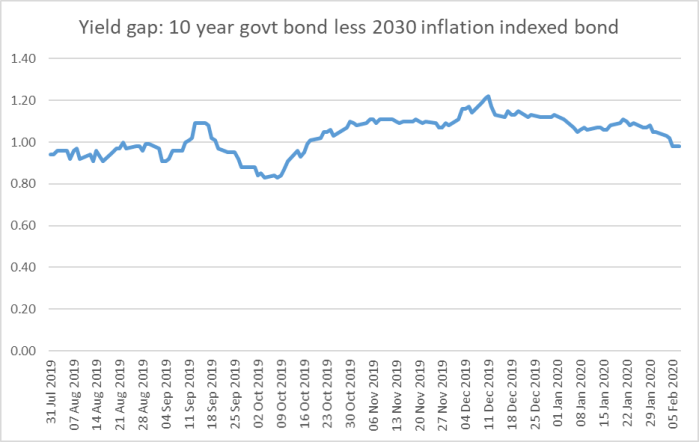
But here is the implied inflation expectation measure from market prices, right up to today (the difference between yields on nominal and indexed 10 year government bonds)

IIB jan 2020

There was a bit of lift in this measure of implied expectations late last year (partly global, but a range of central banks were responding similarly).  But now we are pretty much back to where we were before the Bank cut the OCR unexpectedly sharply six months ago (and this even after bond yields have bounced off their lows earlier this week).   I guess we should take some comfort that implied expectations aren’t lower than those in August, but 0.98 per cent is a long way from 2.

And as one last straw in the wind, in 2017 the Bank (helpfully) added a couple of questions asking about respondents expectations for inflation five and ten years hence.  The answers have hewed pretty close to 2 per cent –  I usually put in 2 per cent for 10 years hence, noting that the current MPC/government won’t have any effect on those outcomes –  but when I opened the survey results today I noticed that even these expectations (which the Bank likes to boast of, as a sign of confidence) have been edging down.

long-term expecs

The differences are small, and in isolation I wouldn’t put much weight on them.  But not much is moving in the right direction, and these results were surveyed two weeks ago when most respondents thought the policy status quo was just fine for now.

It seems a pretty obvious call to me that they should cut on Wedneday –  absent some startling positive turn in the virus and related news between now and Wednesday morning –  rather than just idly handwringing about “watching and waiting”.  And the Governor/MPC was willing to make some big and unexpected calls (wisely or not) last year.    The Bank wouldn’t be the first central bank to move either.

Who knows whether or not the Bank will actually move on Wednesday – quite possibly not even them yet – but I’m sure the MPC will have been looking for some analysis of past responses to out-of-the-blue shocks and thinking about the similarities and differences here.    Whichever path they finally choose, that thinking should be laid out – not just noted – in the MPS and/or the minutes.


Easy to underestimate how far things may go

I was at a meeting earlier this week at which a funds manager from one of the leading firms in the New Zealand market was giving us a presentation on our money, their performance etc etc.  We had a light agenda and the presentation was basically over and I like to probe funds managers to see how they think about things.  So I asked him about the possibility of New Zealand getting to negative interest rates, deliberately phrased in  a fairly vague way (rather than, say, “what is the probability in the next 12 months?”).  You’ll recall that the OCR at present is 1 per cent.

Anyway, the funds manager’s response was that it was “highly unlikely”, going on to note that although a “couple of people” had been talking up the possibility that had been a while ago.  The implication was that those people had been, most likely, proved wrong.

I found it a really surprising answer.  Maybe many clients (at least on our fairly modest scale) don’t like talk about uncertainty, contingency etc and want to hear more definitive views from their funds manager.  If so, they are ill-advised.  The world isn’t like that.     And it isn’t 1990 when negative interest rates anywhere in the world might have seemed all-but inconceivable.

Closer to now and to home, even the Governor of the Reserve Bank has been quite open about the possibility of negative rates.

If someone asks me my question –  and they do from time to time –  my answer is along these lines: in many respects it would be surprising if we didn’t get to a negative OCR at some point in the next few years, just because the starting point is one per cent and we know so little about the future.  I often go on to add that after nine years since the last recession the chances of some fairly significant downturn at some point in the next few years must be quite high (statistically, the probability of a significant downturn in any particular year is never that low).

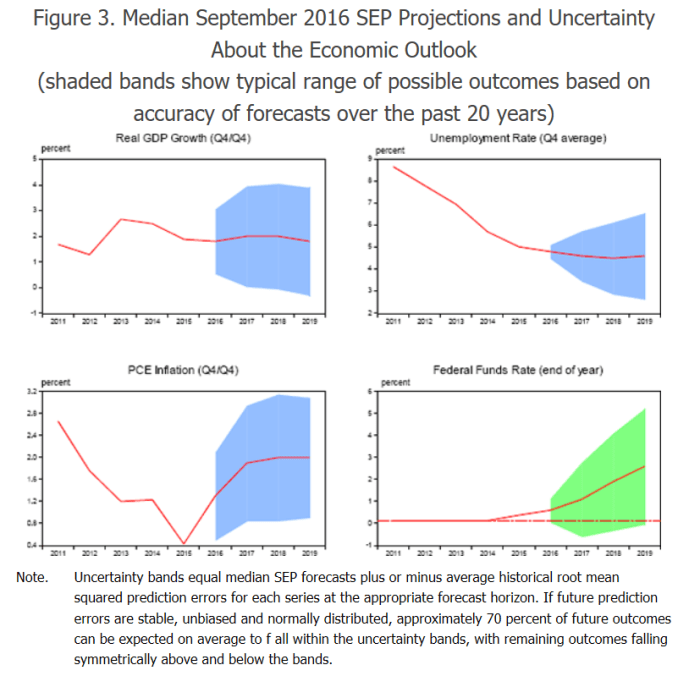
Fan charts are one of the techniques people use to illustrate the plausible ranges of uncertainty around macroeconomic (and similar) forecasts.  Here is an example, applied to the US, from an RBA Discussion Paper published a couple of years ago.

fan charts 1.png

Focus on the bottom-right chart.  Over a three-year ahead horizon, only 70 per cent of historical forecasting errors for the Fed funds target rate would be captured in a range five percentage points wide.

Our OCR system has only been running for 20 years, but I had a look at the historical record to see how much the OCR moved over a three year horizon. (One could do the exercise looking at outcomes vs RB forecasts, but that would be more time-consuming.)  The (absolute value) median change in the OCR over a three year horizon was 1.25 per cent.  Take a longer run of data and look at changes over three years in the 90 day bill rate since financial markets were liberalised here and the median change was 1.8 per cent.

Those are medians, so encompassing only 50 per cent of the changes.  From a starting OCR of 1 per cent, a reasonable description of the range of possibilities –  knowing precisely nothing about the macro outlook –  simply based on historical variability would be along the lines of a 50 per cent chance that the OCR three years hence would be in a range of -0.25 to 2.25 per cent, with a 25 per cent chance each that the OCR would be lower or higher than that the options encompassed by that range.     Simply based on historical variability, there might be something like a 30 per cent chance that the OCR would go negative, from this starting point, in the next few years.

Another way of looking at the issue is to look at how large the falls in short-term interest rates have been when the economy turned down.

For the pre-OCR period we had these examples:

1987 to 1989:   about 600 basis points

1991-1992:   about 700 basis points

1997-1998:   about 450 basis points

And since the OCR was adopted

2001:    175 basis points (not measured as a New Zealand recession)

2008-09:    575 basis points

Recessions in New Zealand look to have been associated with 500 (or more) basis points of cuts in short-term interest rates.

That isn’t particularly unusual: I was reading last night a recent speech by one of Fed Board of Governors who noted, in a quite matter-of-fact way, that the Fed has typically needed about 4.5-5 percentage points of policy leeway in recessionary periods in the last 50 years.

(Under current laws and technologies) the OCR can’t be cut by 500 basis points, but cut by 125 basis points from here and we would already be negative.

Of course, it might be reasonable to ask what is the appropriate starting point. The last time the OCR was raised was back in late 2014, and the OCR is already 250 points lower than it was then.   Since those OCR increases were never really warranted by the data (with hindsight –  and some with foresight – never really needed to meet the inflation target), perhaps 3.5 per cent isn’t really a sensible starting point.

But this year’s 75 basis points of OCR cuts have been in response to actual/forecast data on weakening economies and inflation pressures. If so, perhaps 1.75 per cent might be a reasonable starting point for comparison.  And if a recession hits in the next few years, historical experience suggests that (the equivalent) of 500 basis points of easing will be required.  Again, we can’t cut 500 basis points from 1.75 per cent, but we don’t need anything like that –  less than half in fact –  to get negative.

What are the chances of a recession in the next three years?   Well, no one can tell you with any great confidence.  But if we look at (a) the array of risks, locally but especially internationally, (b) the passage of time since the last recessions, and (c) the very limited conventional macro firepower authorities have at their disposal (and are known by markets to have at their disposal) it would be a brave forecaster –  or funds manager – who didn’t have such a possibility in their reasonable range of outcomes over the next few years.   One could add into that mix the fact that in most advanced economies inflation starts below target (quite different from, say, the New Zealand starting point in 2008).   With the best will (wishfulness?) in the world, I’d have thought a significant downturn, requiring a lot more macro policy support, had to be more than “highly unlikely”.

The Reserve Bank surveys professional expectations/forecasts of the OCR, but only a year ahead, and it only asks for point estimates, not (say) a band within which the forecaster would be fairly confident.  The latest survey has a range – for September next year –  of point estimates of 0.0 per cent to 1.25 per cent.  Even if the more pessimistic of the respondents might have pulled back their point estimates a bit, they aren’t responses suggesting negative rates in the next few years are “highly unlikely”.

I’m not sure whether anyone sells options on, say, bank bill futures in New Zealand.  If so, it would be interesting to know what the prices of those instruments are saying about the range of plausible outcomes for the next few years.

I suspect our fund manager was really just giving (a) his point estimate, and (b) implicitly at least, something about the next 12 months or so.  But the general point is independent of his specific comment: when the OCR is already 1 per cent and the economy is still relatively near a NAIRU (not deep in a downturn already), little or nothing from historical experience should give anyone grounds for confidently predicting that New Zealand will avoid a negative OCR at some point in the next few years.   Constantly thinking the OCR is as low as it will go has been a pretty consistent mistake of observers of New Zealand for 10 years now.

Deputy Governor talking up the economy

On Friday afternoon a reader sent through a copy of a Bloomberg story quoting Geoff Bascand, Deputy Governor, on the health of the New Zealand economy.    As reported, it was pretty upbeat to say the least.   But the foundations for such an upbeat tone seemed more akin to sand than to solid rock.  Storms expose houses built on sand.

This was the opening section of the article

New Zealand’s central bank doesn’t expect its new bank capital rules to present a headwind for the economy, which looks to be near the point of entering a recovery, Deputy Governor Geoff Bascand said.

“We don’t expect major economic impacts” from banks raising their capital buffers, Bascand said in an interview Friday in Wellington. Furthermore, latest developments are “supportive of the story that we’re near or around that turning point” in the economic cycle, he said.

Bascand had been interviewed by Bloomberg’s local reporter, Matthew Brockett, following the announcement on Thursday of the final bank capital decisions: very big increases in required bank capital ratios, even if some portion of that can be met a bit more cheaply than the Governor’s initial proposal had envisaged.  So I guess we should expect spin.  Bascand’s day job is as the senior manager responsible for financial stability, banking regulation etc.  All the advice and the documents published on Thursday emerged from his wing of the Bank.  But he is also a statutory member of the Monetary Policy Committee, with personal responsibility –  with his colleagues –  for actual delivering inflation rates near target, something the Bank hasn’t managed for years now.  For most of that time, the Bank has been consistently too optimistic about the economy, and about the prospects for getting inflation back to target (fluctuating around the target midpoint, perhaps especially in core inflation terms).

I guess the characterisation “doesn’t expect its new bank capital rules to present a headwind for the economy” is the journalist’s, and there is quite a lot of leeway in Bascand’s own words: “we don’t expect major economic impacts”.  If “major” here means “singlehandedly tip the economy into recession” then I suspect everyone would agree, but that shouldn’t be the standard.   The Bank’s own numbers tell us that they think the base level of GDP –  absent crises –  will be lower as a result of the change in the capital rules.  And their modelling effort focuses on the long-term, not the transition.  The headline out of last week’s announcement was that the transition period had been stretched out, from five years in the consultative document to seven years.  But (a) in making decisions now, and in the next couple of years, people will sensibly factor in changes in the regulatory environment that have already been announced (and are final, in the Governor’s words) –  expectations matter, as the Bank often (and rightly) tells us, with its monetary policy hat on and (b) for the big banks a significant chunk of the policy change is frontloaded, because the change in rules to increase risk-weighted assets calculated using internal models to 90 per cent of what would be calculated using the standardised rules happens right at the start.  That change alone is equivalent to a 20 per cent increase in minimum capital.

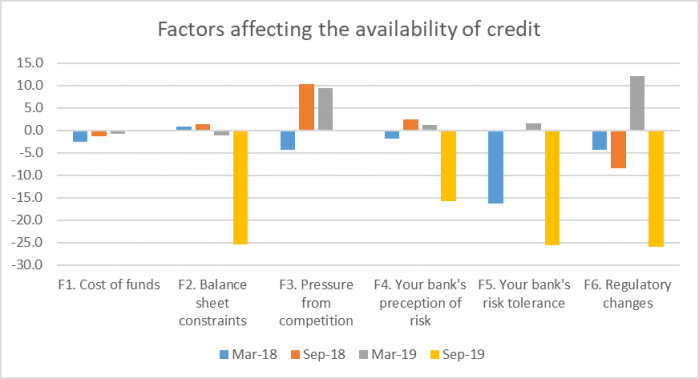
And it isn’t as if there are no hints of effects already, even before the final decisions were made.  The Governor and Deputy Governor clearly prefer to avoid addressing these data, but the Bank’s own credit conditions survey showed not only that credit conditions (a) have already been tightening, (b) are expected to continue tightening, and (c) respondents ascribe much of that effect to the impact of regulatory changes.

credit 4

Perhaps the banks were just making it up when they responded to this survey?  Perhaps, but the Bank was happy to cite either components of the survey in its recent FSR, just not these awkward ones.

And why wouldn’t much higher capital requirements, in a world where there is no full MM offset (as the Bank itself recognises), no full or immediate scope for disintermediation to entities/channels not subject to the Bank’s rules, constrain credit availability to some extent, especially in the early stages of a multi-year transition period?   And, as the Bank also keeps telling us, the availability of credit is one of lubricants to economic activity.  If credit isn’t as readily available, all else equal economic growth is likely to be dented.

And what about Bascand’s other big claim that indicators are

“supportive of the story that we’re near or around that turning point” in the economic cycle,

Count me sceptical.     At best, what we’ve seen so far might support the possibility of an inflection point.  If you want a nice summary, with charts, I thought last week’s ANZ economics weekly was about right.

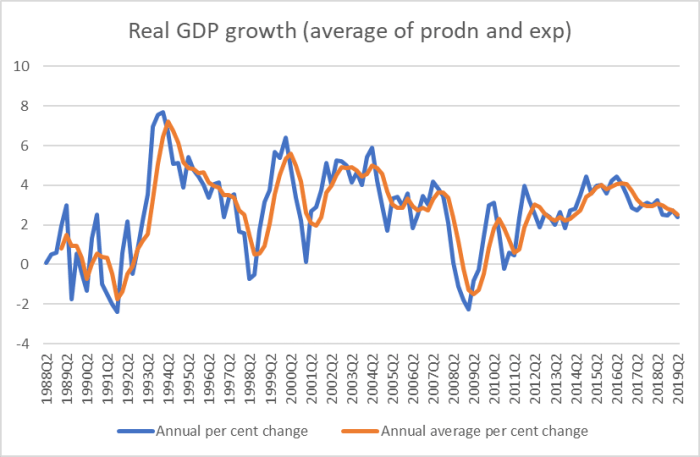
It is worth remembering just how subdued economic growth rates have been this decade –  headline, not even per capita –  and that the slowing has been underway for several years.

GDP growth

On the home front, business confidence and related measure seem to have bounced a bit, but aren’t outside the range we’ve seen over the last couple of years  (when actual growth has been falling and low).   Some agricultural products prices are doing very well, but (a) surely the best estimate is that many of these lifts will be shortlived, and (b) debt overhangs and tightening credit constraints locally will limit the extent to which near-term income gains materially increase activity.  Bascand makes quite a bit of the promise of fiscal stimulus, but recall that on the Treasury fiscal impulse indicator there was a fairly substantial fiscal stimulus in the year to June 2019, and growth was low and slowing.

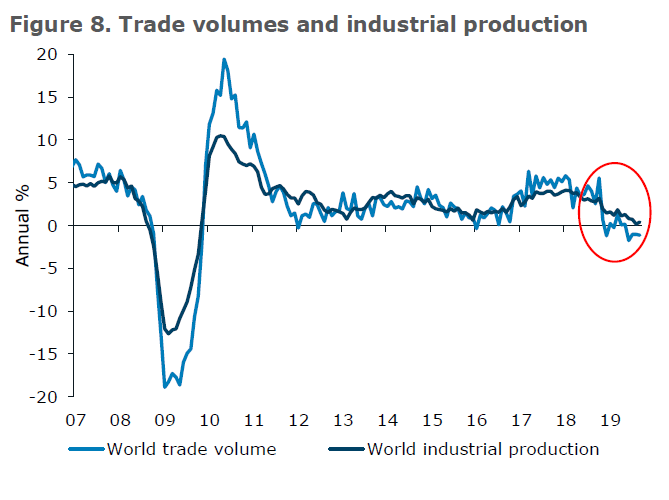
And that is before we start on the rest of the world.  Here is an ANZ chart of growth in world trade and industrial production

ANZ trade

Data out of Europe, Australia, and the PRC (the latter two being the largest New Zealand export markets) have remained pretty downbeat, even as sentiment ebbs and flows at the margin.  The latest Chinese export data offered little encouragement,  And there isn’t much optimism about the US either, with a considerable chunk of US forecasters expecting a recession in the next two years.   And all this against a backdrop in which people (markets in particular) know that there are quite severe limits on how much macro policy can do if a new serious downturn happens.  That alone is likely to engender caution.

The TWI doesn’t move independently of all these domestic and foreign influences, but it is worth noting that it is now a bit higher than it was when the Bank surprised everyone with their 50 basis point OCR cut in August.

TWI dec 19

Perhaps time will prove the Deputy Governor right, but at present I’d suggest his claims should be taken with a considerable pinch of salt.  Things probably aren’t getting worse right now, but it seems heroic –  against the backdrop of both domestic and foreign constraints and headwinds (including those capital changes) to be talking up the idea of a turning point in the economy.    And rather concerning if this is the sort of sentiment shaping the Bank’s monetary policy thinking right now, after a decade in which things have kept disappointing on the downside.   It doesn’t have that “whatever it takes” sound about it, of which we heard quite a bit in the wake of the August OCR cut.  It sounds more like the sort of spin we hear repeatedly from the Minister of Finance and Prime Minister, who go on endlessly about headline GDP growth rates here and abroad, and never once mention how much faster population growth is here than in most advanced countries.

A few weeks ago I wrote a post about the sudden mysterious, but very welcome, appearance of inflation expectations as a factor in the Bank’s storytelling about policy.    For a few weeks the Governor was outspoken in his desire to act boldly to boost inflation expectations, and do what he could to minimise the risk of hitting lower bound constraints in the next downturn.

And then, like the morning mist, all that concern was gone again –  totally absent in the presentation of the latest MPS.   If anything, inflation expectations measures had fallen a bit further from August to November.

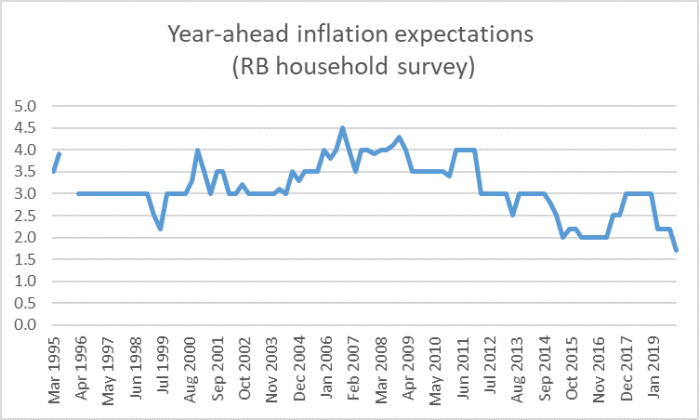
I don’t typically pay much attention to the Reserve Bank’s survey measure of household inflation expectations.  Neither, I expect, do they.  But it has been running for a long time now, and the latest numbers –  finally released late last month – look as though they should be a bit troubling for the Bank.

household expecs 19

This series is nowhere near as volatile as the ANZ’s household expectations survey (although, for what it is worth, recent observations in that series have also been pretty low).   It began in the far-flung days when the inflation target was 0 to 2 per cent (centred on 1 per cent) and yet this is the first time ever that household year ahead inflation expectations (median measure) have dropped below 2 per cent.  At one level, that might be welcome –  the series has historically had quite an upward bias –  but when household expectations are converging towards professional and market expectations, and all those are below the 2 per cent target midpoint it shouldn’t be a matter of comfort at all.    This is the sort of drop the Governor claimed (at least in August and September) he was trying to prevent.   In the same survey, respondents are also asked whether they expect inflation to rise, fall, or stay the same over the next year (probably easier to answer than a point estimate).  There too respondents have become less confident that inflation is going to pick up.

For a brief period a few months ago it looked as though the Bank, and the Governor, were really taking seriously the challenges we face, in a context where conventional monetary policy just does not have much more leeway.  More recently, they seem more interested in talking things up again –  keeping pace with the political rhetoric, and perhaps playing defence re the bank capital changes.  A more realistic tone would offer a better chance of getting through tough times with as little damage as possible, including by better preparing firms and households for the risks that arise if the global downturn intensifies, with little monetary policy leeway, the risk of significant policy-induced tightening in credit conditions, and inflation (and particularly at present inflation expectations) falling away.

We are getting very late in the business cycle and we’d be better served by a strongly counter-cyclical central bank, rather than one playing defence for its own (deeply flawed) other policies, and whistling to keep spirits up (and political masters, making decisions about the future of the Bank, happy).  With the sort of mindset on display at present they risk being blindsided by events, in a context where –  as the Governor himself put it only a few months ago –  the costs and consequences of being wrong the other way (inflation gets to say 2.3 per cent) are pretty slight and inconsequential after a decade of such low inflation.

Compass gone wonky

Having delivered his Monetary Policy Statement, done his press conference, fronted up to the Finance and Expenditure Committee –  oh, and roiled the markets –  Reserve Bank Governor appears to have jumped on a plane for a quieter couple of days at conference in San Francisco.  I don’t begrudge him that –  the conference in question is usually pretty good (I got to go once) and this year’s programme looked as interesting as ever.  The topic was “Monetary Policy Under Global Uncertainty”.

The Governor was on a “Policymaker’s Panel” –  along with a Deputy Governor from Korea and a former Deputy Governor from Brazil.    It can’t have been a very in-depth panel (the programme allowed only 50 minutes in total), but we don’t hear much systematic from the Governor on monetary policy and so it was welcome that he chose to release his short (four pages or so of text) remarks.  I don’t think I’ve seen them covered in the local media at all.    That is perhaps a little surprising as, having greatly surprised commentators and markets in two MPSs in succession, his remarks to this FRBSF panel were under the heading Monetary Policy: A Compass Point in Uncertain Times.   Sounds like a worthy aspiration.  Shame about the execution.

But what did Orr have to say in his brief remarks?

First, he attempts to suggest that policy (etc) uncertainty isn’t really much of an issue in New Zealand.  Yes, he really does claim that, drawing on a measure – of the dispersion of GDP forecasts –  which isn’t an indicator of policy uncertainty at all.    Now, no one is going to claim that we have anything like the degree of policy uncertainty they face in the UK (or, thus, its major trading partners including Ireland). We don’t even have a “trade war”.   Then again, we had months of uncertainty around capital gains taxes, ongoing uncertainty about the future labour market regulatory regime, and now about the future water pollution regime. Oh, and bank capital requirements…..to name just a few.

Then we come to paragraph that I agree with, quite strongly, and yet it seems he no longer does.   In the light of the uncertainty (globally) he tells us

it is vital that monetary policy acts as a compass point for decision making

going on to note

For New Zealand, this means setting policy to achieve our price stability target and support maximum sustainable employment. It means acting decisively to prevent an unnecessary worsening in economic conditions and the un-anchoring of long-term inflation expectations. And it means recognising the limits of monetary policy.

I’m not going to disagree, but quite how he justifies his MPC’s decisions, and communications, in and around both the August and November MPSs is less clear.  As I noted the other day, in August –  when they did act “decisively” there was little attempt to invoke arguments about inflation expectations in support, then we had a couple of months of wheeling out such arguments, only for them largely to be abandoned last week when he chose to err on the side of caution, “unnecessarily” so, at least in my view, against a backdrop of inflation and inflation expectations below targets with (in their own words) downside risks.   Not much of guiding light there.

Then we get the sort of paragraph beloved of self-important central bankers

In discussing these topics, I will touch on how, since the Great Financial Crisis, central banks have been tasked with a widened set of objectives. On one hand, we appreciate the constraints faced by other institutes, and the peril that may have resulted from the crisis had central banks not stepped up to the task. On the other hand, central banks are sometimes expected to solve phenomena that are structural in nature, and that do not sit easily within the conventional realm of monetary policy. At the Reserve Bank, we are always exploring new policy options to meet our broadened mandate.

Except that, typically, central banks don’t have a wider mandate how than they did before.  That is certainly true of New Zealand –  where nothing at all (in legislation) has changed around regulation/supervision, and where the change to the formal goal of monetary policy was, in the Bank’s own telling, more cosmetic than substantive, designed to capture something about the way the Bank had long sought to operate, while altering some rhetoric.  The big change in New Zealand has been central bankers looking to extend their own reach, both within and beyond the mandate Parliament has given them –  whether LVR limits (arguably within the letter of the law), focus on “culture and conduct” (clearly not),  the Maori strategy (not), the green agenda (largely not) and so on.    Perhaps in a few corners of the world there has been a belief, by a few people, that central banks can markedly change structural growth outcomes.   If so, such a mantra has rarely, if ever, been heard here in the last decade. But it makes central bankers feel important and valued to pretend otherwise.

Keeping on through the speech, we do actually get some recognition that “policy uncertainty” –  and “regulatory requirements” –  were acting as a barrier to business investment in New Zealand.  As he notes, most of this doesn’t have much to do with monetary policy, except that monetary policy needs to take account of whatever is influncing overall demand and supply pressures/balances.

From a central bank perspective, uncertainty has one clear impact: it makes our job harder. Good monetary policy depends on reasonable forecasts. High uncertainty makes forecasting harder. There is more noise in the data and forecasts are more subject to revision. A consequence of this is that the Official Cash Rate (OCR) may be less predictable simply because the world in which we are making our decisions is less predictable.

Except that earlier he showed that chart (mentioned above) in which the dispersion of GDP forecasts has been quite a bit lower than usual in the last couple of years.  So it might be a fair point in principle, but in practice –  in recent months –  the real source of short-term uncertainty about the OCR has been……the Reserve Bank itself.    Not a point that Governor chose to address.

He then moves on to a section headed “Monetary policy response to uncertainty”.

First up is a straw man

Firstly, maintaining low and stable inflation enables organisations and individuals to carry out meaningful financial planning, by reducing overall uncertainty. This is something that is nearly impossible when prices are high and volatile or falling uncontrollably.

Neither is a world any advanced country has been dealing with in recent decades (I’m assuming he meant “inflation” was high and volatile), and in the case of “falling uncontrollably” never.

Then we do get to recent New Zealand policy

In particular, it is now more suitable for us to take a risk-management approach. In short, this means we look to minimise our regrets. We would rather act quickly and decisively, with a risk that we are too effective, than do too little, too late, and see conditions worsen. This approach was visible in our August OCR decision when we cut the rate by 50 basis points. It was clear that providing more stimulus sooner held little risk of overshooting our objectives—whereas holding the OCR flat ran the risk of needing to provide significantly more stimulus later.

And yet, wasn’t that title something about a reliable “compasss point”.   None of his August approach was flagged in advance, arguments for it unfolded only slowly even after the event, and then –  when there was still (on his own numbers) “little risk of overshooting our objectives” they abandoned that particular “least regrets” line, without explanation in advance, in the release, or subsequently.  He goes on

We can also address uncertainty through our communication and forward guidance, which are broad-ranging. We reveal our assessment of the economy—good or bad—to the public, so they can make decisions based on the best possible information amid the prevailing uncertainty. We voice the types of policies we believe may be needed to sustain long and prosperous growth—be they monetary, fiscal, or financial policies.

But that is almost exactly the opposite of what the Governor and MPC are doing.  We have still not had a single substantive speech from the Governor on monetary policy and the economy.  We haven’t at all from three of the statutory members of the MPC.  It is harder to make good decisions when central banks spring –  quite unnessary – surprises.  Oh, and actually it is no part of the Bank’s mandate to be opining on what policies are best for “long and prosperous growth” (although it is remarkable that structural policies appear not to be relevant to the Governor’s view of growth, productivity etc).

There is a final page on “Beyond conventional monetary policy” which I don’t have particular problem with.  It is good that the Governor again repeats his intention to publish their analysis. It is only a shame that (a) this process has been so long delayed, including under his predecessor, and (b) that the work done so far has not proceeded in a more open and consultative way, rather than being something akin to the “wisdom” delivered to the masses from the wise experts on the mountain top.

Orr ends in a typically upbeat tone.   I just want to highlight the last few sentences in which (as so often) he overreaches, partly in the process of distracting attentions from the failings in areas he is directly responsible for.

Yes, there is uncertainty. Yes, it is affecting us. No, monetary policy cannot directly resolve this issue. But we can offset its effects and empower others to fuel economic activity that will benefit us in both the short and long-term. There has never been a greater time to make use of accommodative monetary policy for investing in productive assets.

Yes, monetary policy has a (vitally) important stabilisation role.  It was why countries set up discretionary monetary policy many decades ago.   But it can do nothing to offset the blow to potential output created by policy uncertainty and other regulatory burdens.  It does nothing to boost our longer-term prosperity.  And as for the final sentence…….he falls into the trap again of trying to convince us that low interest rates are some exogenous gift, empowering whole new opportunities, when in fact interest rates –  long-term market-set ones and official OCRs –  are low for reasons that seem to have to do with diminished opportunities, diminished prospects for profitable investments.  Don’t get me wrong – given all that, the OCR should be lower (mimicking what real market forces would be doing if short-term interest rates were a market phenomenon), but when interest rates are falling in response to deteriorating fundamentals it is a stretch –  at very least –  to expect the sort of pick-up in business investment the Bank often forecasts but rarely gets to see.

It wasn’t a persuasive or particularly insightful set of comments.  Perhaps his San Francisco audience –  knowing little of New Zealand –  weren’t bothered, but we should be.  We should expect a lot more from such a powerful, not very accountable, public figure.

(And if you want a speech from a much more serious figure, try this one –  given at the same conference –  by Stephen Poloz, Governor of the Bank of Canada.  There is a depth and seriousness to it that is simply now not seen from senior figures in our own economic policy agencies.)

Effective communications and consistent messaging (not)

One can debate whether or not the Reserve Bank should have cut or not.  Reasonable people can differ on that.  But their communications quite clearly needs (a lot of) work.   This post is just one illustrative example of the sort of problem there is: the role of inflation expectations in their thinking and public commentary.

Back in the August Monetary Policy Statement – the one where they announced the rather panicked 50 basis point cut, not really consistent with either the rest of the document or their own numbers – there wasn’t much mention of inflation expectations.  To be specific:

  • they are not mentioned at all in chapter 1, the main policy assessment/OCR announcement,
  • they are mentioned more or less in passing in the minutes, viz

Some members noted that survey measures of short-term inflation expectations in New Zealand had declined recently. Others were encouraged that longer-term expectations remained anchored at close to 2 percent.

with no suggestion that it was a significant part of the story

  • of the seven other references in the document, five are simply labels of charts, and one was in the standard descriptive framework section (“how we do monetary policy”).  The only other substantive reference was pretty unbothered.

Although survey measures suggest inflation expectations remain anchored at around 2 percent, firms and households continue to reflect past low inflation in
their pricing decisions.

If that had been all, a reasonable reader might have assumed expectations measures were something they were keeping an eye on, but weren’t much of a concern, or playing much of a role in the OCR decision.

But in his press conference, we got the first hint of a quite different line.  Perhaps the Governor genuinely felt differently than the majority of the MPC –  which frankly seems unlikely, given that he chairs the committee and he and has staff have a majority on it –  or perhaps he was simply casting around, more or less on the spur of the moment, for reasons to justify cutting by 50 basis points rather than the 25 points everyone had expected (50 point moves not having been used since the height of the 08/09 recession).

But whatever the reason, in answer to a question (just after the 10 minute mark here) he made the following points:

  • they’d tossed and turned between going 50 points then, or 25 points then and 25 later and,
  • over recent days they had become increasingly convinced that doing more sooner was a safer strategy to achieve their targets than a strategy of going more slowly over a longer period. He went on to note that
  • it was all about the least regrets analysis and stated that in a year’s time he would much prefer to have the quality problem of inflation expectations getting away on us, and possibly having to think about “other activity” [ tightening?]
  • that was preferable (better/nicer) than finding a year hence that they had done too little too late.

I was quite taken with those comments at the time, and commented positively on them in my own review of that MPS.  It seemed exactly the right way to think about things, especially as in the same press conference he was highlighting the risks of the OCR having to go negative (the more that could be done now to boost expectations, the less likely the exhaustion of conventional monetary policy capacity).

But do note that none of that “least regrets” perspective was reflected in the MPC minutes.

The Governor obviously took something of a fancy to this line.  In a interview with Bernard Hickey a few days later, of which we have the full transcript, he is quoted thus

“Doing the 50 points cut was interesting: whilst you get closer to zero, you also shift the probability of going below zero further away,” Orr said.

and

We’ve spent a lot of time around, I suppose, regret analysis, and I spoke about – you know, in a year’s time looking back, thinking ‘well, I wish I had done what?’ And I thought it’s – I would far prefer – and the committee agreed – far prefer to have the quality problem of inflation expectations starting to rise and us having to start thinking about re-normalizing interest rates back to, you know, something far more positive than where they are now. And that would be, you know, it would be a wonderful place to have regret relative to the alternative: which would be where inflation expectations keep grinding down.

and a few days later, in a speech given in Japan, the Assistant Governor was also now running this message (emphasis added)

A key part of the final consensus decision to cut the OCR by 50 basis points to 1.0 percent was that the larger initial monetary stimulus would best ensure the Committee continues to meet its inflation and employment objectives. In particular, it would demonstrate our ongoing commitment to ensure inflation increases to the mid-point of the target. This commitment would support a lift in inflation expectations and thus an eventual impact on actual inflation.

On balance, we judged that it would be better to do too much too early, than do too little too late. The alternative approach risked inflation remaining stubbornly below target, with little room to lift inflation expectations later with conventional tools in the face of a downside shock. By contrast, a more decisive action now gave inflation the best chance to lift earlier, reducing the probability that unconventional tools would be needed in the response to any future adverse shock.

I commented positively on that too.  It was good orthodox stuff.

And it kept coming.  In an interview with the Australian Financial Review, at Jackson Hole, a few days later, here was Orr

Q Was this [falling world rates][ front of mind when you did your recent interest rate cut?

A. It was front of mind. Without doubt the single biggest….one [factor] was domestic.  We saw our inflation expectations starting to decline and we didn’t want to be behind the curve.  We want to keep inflation expectations positive-  near the centre of the band.

And it was also referred to in passing in the folksy piece the Governor put out back here that week, noting “lower inflation expectations” as second in the list of influences on the OCR decision.

And here it was again in the Governor’s 26 September speech

We also judged that it would be better to move early and large, rather than risk doing too little too late. A more tentative easing of monetary policy risked inflation expectations remaining stubbornly below our inflation target, making our work that much more difficult in the future.

By this point – less than two months ago – any reasonable observer would have been taking note.

So what had actually happened to inflation expectations by this point?  At the time of the August MPS the Bank already knew that the 2 year ahead expectations had fallen quite a bit  –  from 2.01 per cent to 1.86 per cent in a single quarter.  That’s not huge, but it is not nothing either, and with core inflation still below 2 per cent it wasn’t something the Bank should have been that comfortable with.  The year ahead measure (noisier) had dropped by more.

As it happens, the other main inflation expectations survey –  the ANZ’s year ahead measure –  hadn’t dropped at all by the time the Bank acted in August: from May to July year ahead expectations were in a 1.8 to 1.9 per cent range.   In August – but not published until 29 August –  they fell to 1.7 per cent, and over the last couple of months they’ve fallen a bit further, the latest observation being 1.62 per cent.

As for the RB survey, there was also a slight further drop in mean expectations in the latest survey that was released on Tuesday (but which the Bank had in hand throughout its November MPS deliberations).

Both the latest ANZ and latest RB surveys were completed exclusively in the period well after the Bank’s surprise 50 point cut in August.  If the Governor (and Hawkesby) were serious about that rhetoric they’d surely have hoped to have seen at least some bounce in the latest survey –  after all, that was the logic of preferring a big cut early.   Instead, those survey measures fell a bit further (not to perilous levels of course –  in fact, current levels are just consistent with where core inflation has been for some time, a bit below the target midpoint).

During the Wheeler/McDermott years the Reserve Bank rarely if ever mentioned the market implied inflation expectations, calculated as the breakeven rate between indexed and nominal government bond yields. I used to bore readers pointing out this curious omission –  they never even explained why they felt safe totally discarding this indicator.

Inflation breakevens have been below 1.5 per cent now consistently for four years now and fell further this year.  In recent months, those implied expectations –  average inflation expectations for the coming 10 years –  were just on 1 per cent.  In monthly average terms, the low point wasn’t even July/August (ie just prior to the MPC’s bold action) but October.

Here is the chart, monthly averages but with the last observation being today’s.

breakevens nov 19

As the Governor was very keen to point out yesterday, there has been a small lift in this measure……but he was less keen to mention the level; the small lift only takes the breakeven rate back to aroud 1.13 per cent.  This time last year it was 1.41 per cent, still miles below the target midpoint.  Perhaps the recent lift will be sustained –  we should hope so –  but on any reasonable balancing of survey and market measures you could really only say things hadn’t got worse over the period since August.  On the clear words of the Governor and Assistant Governor, it was quite reasonable for analysts/markets to look at the inflation expectations data and expect it to feature prominently in this week’s MPS – after all the merits of the Governor’s August/September arguments (agree with them or not) hadn’t changed, expectations hadn’t lifted, and the Bank had given no hint they’d changed their way of thinking, yet again.

But what did the MPC have to say about inflation expectations on Wednesday?  Again there was nothing at all in the chapter 1 policy assessment/announcement, and there was just this in the minutes

The Committee also noted the slight decline in one- and two-year ahead survey measures of inflation expectations. Nevertheless, long-term inflation expectations remain anchored at close to the 2 percent target mid-point and market measures of inflation expectations have increased from their recent lows.

They were pretty half-hearted, even about those market breakevens.  No mention at all of the arguments the Governor and Assistant Governor were running only a couple of months ago, and although the minutes do now mention the idea of least regrets this was all they said

In terms of least regrets, the Committee discussed the relative benefits of inflation ending up in the upper half of the target range relative to being persistently below 2 percent.

The Governor’s comments in August certainly suggested he’d have thought it better then to run the risk of being a bit above 2 per cent (after a decade below).  But this time, the Bank as a whole has reverted back to the cautious approach the Governor was looking unfavourably on, in public, only three months ago.   We are back to “oh well, never mind”, or so it seems, and all that pre-emptive talk,  doing what they can to minimise the risk of needing to go below zero, is supposed to disappear down the memory hole?

It seems all too symptomatic of what is wrong with the way the Bank is conducting monetary policy at present.    There are few/no substantive speeches, the minutes capture little of the flavour of thinking, half the MPC members are simply never heard from (and no one knows if they have any clout or not), there is no personalised accountability (as a market commenter here noted, it is incredible that no one on the Committee was willing to record a dissent yesterday, all hiding behind the Governor)….and then we get the Governor just making up policy rationales (quite sensible ones in this case) on the fly, only to then jettison them, without explanation or a chain of articulated thought, when for some reason (still unknown) they no longer support his instincts.

Was it ever an approved MPC line?  If not, why was the Governor just making up stuff  –  and then repeating it several times in open fora?  Under the rules he is supposed to be the spokesman for the whole committee.   And if it was an approved line why (a) did it never make it into the MPS, and (b) why has the MPC now changed its thinking when there is no sign of significant rebound in expectations, the effective lower bound is still in view, and the domestic measures have actually been drifting lower?

There is little basis for observers and markets to make any reliable sense of the MPC.  We know little, that is in any way consistent, about their reaction functions, their loss functions, their models, or even their stories about what is going on locally and internationally.  Big surprises, of the sort we’ve had in New Zealand at the last two MPSs, have become quite uncommon internationally, and that is generally a good thing.  Where are we now –  18 months into the Orr governorship, 7 months into the new MPC –  simply isn’t good enough  The reforms the government initiated last year could have been the opportunity for something genuinely much better.  Instead all we seem to get is a bit more expense –  all those high fees for the silent, invisible, and unaccountable externals.

Monetary policy isn’t being handled well, and neither is bank supervision (bank capital and all that).   Together, these twin failings in the Bank’s two main functions paint the Bank and the Governor –  and those responsibe for holding them to account in a pretty poor light.    There are hints that, under pressure, the Governor may have recently toned down his act and started to operate a bit more professionally.  If so, it would not be before time, but if this week was anything to go by the tone may be a bit better but the substance of the messaging and communications still leaves a lot to be desired.  At present, the best guess (sadly) would be on another lurch, in an unpredictable direction, relying on new arguments plucked fresh from the air, with no one certain quite who they represent or how long they will last.