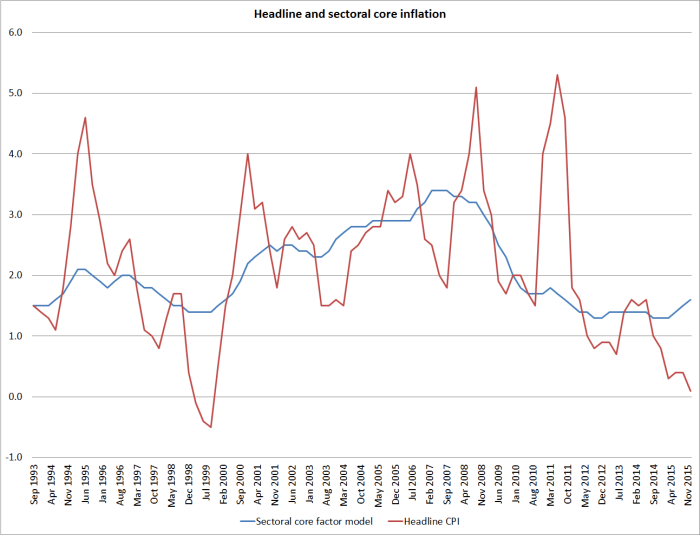
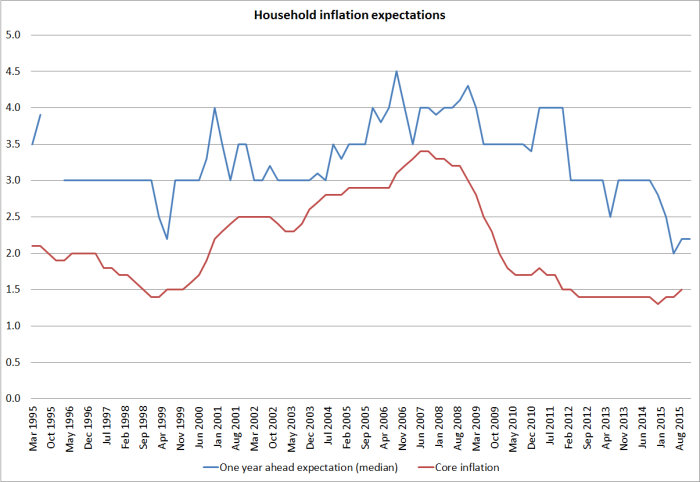
Monetary policy is bust….

Or so Vernon Small, the Dominion-Post’s political columnist would have us believe.  His article appeared yesterday under the heading “Reserve Bank rules need major rethink”, and then online as “Monetary policy is bust, so why are we still banking on it”.

I reckon he has rather overstated his case.  “Reserve Bank ‘rules’ need following” might be a more accurate assessment.

Start with the odd line that Small got from the Minister of Finance, claiming that “no one ever thought it [the inflation targeting framework] would be used to try to lift inflation”.  I’m not sure where the Minister got that idea from, but as a reminder New Zealand is the classical case where it has been used, successfully, that way.  In 1996, the National-New Zealand First government raised the target midpoint from 1 per cent to 1.5 per cent.  And in 2002 the Labour government raised the target midpoint to 2 per cent (the then Prime Minister wanted to raise it further, to match Australia, and to Alan Bollard’s credit he resisted).  As I’ve noted previously, right through to the2008/09 recession the Reserve Bank delivered inflation rates averaging higher than the successive (and increased) target midpoints.

Small does have some nice lines that had me nodding in approval

….Governor Graeme Wheeler’s rejection of a “mechanistic” approach that would see low inflation immediately trigger a cut to interest rate, currently at 2.5 per cent. It is hard to find any sophisticated analysts in the area who has made such a “mechanistic” call, but hey! Straw men have no say over what goes into their stuffing.

But he can’t quite seem to make up his mind whether, as he says, “the prime tool of monetary policy, cuts to the official cash rate, cannot achieve the target”. [my emphasis added] or whether it is more a matter that “the Reserve Bank appears reluctant to try”.

No one has advanced any evidence that, or even a strong argument why, New Zealand’s inflation rate could not have been raised, or could not now be raised.  And I’m quite sure the Reserve Bank doesn’t believe such a story.  In my post the other day, I set out a list of factors that suggested that keeping inflation up around target should be less hard here than in most advanced countries.  And we know, for example, that another small advanced commodity exporter, Norway, has managed.

In a New Zealand context, no one seriously doubts that –  all else equal –  if the Reserve Bank were to come out with significant OCR cuts and a convincing statement of their determination to do whatever it takes to get and keep inflation near 2 per cent, that the exchange rate would fall.  Prices of tradables would rise to some extent, and returns to tradables production in New Zealand would also rise.  That combination of factors would lift the inflation rate –  and, over time, the latter would be the more important channel.

New Zealand isn’t a surplus country –  so we don’t find capital flooding home to our safe haven when international fears rise.  We are a small remote net-borrowing country, whose currency foreigners mostly hold because of the yield advantages it typically offers.  All else equal, when those yield advantages narrow or disappear so does a lot of the interest in holding New Zealand dollar assets.   Stories about what, on occasion, may have happened to exchange rates in Japan or Switzerland or the United States just aren’t particularly relevant here.

For a long time, I don’t even think it was a case of the Reserve Bank being “reluctant to try” to get inflation back to target. At least while I was still closely involved there was a quite genuine and quite widely-shared belief in the Bank that there would be sufficiently strong economic growth that the inflation rate would soon lift back to around 2 per cent, and would have gone beyond that midpoint if interest rates were not raised.  They were persistently wrong –  and, over time, that should involve some effective accountability for the relevant decisionmakers and advisers –  but it was a quite genuine belief. 

But over the last 18 months, it increasingly seems as though “reluctant to try” has been a more apt description of the Bank’s approach.   This has been exemplified in some of the rather shaky arguments they have begun to run.  Last year, for example, we were repeatedly told that headline inflation would rise because the exchange rate had fallen, but there was hardly any emphasis on the underlying or core inflation trends that they should have been focusing on.  More recently, we’ve had a convenient fixation on a single measure of core inflation, which just happens to be the highest around, when previously they had told us what most other central banks say –  there is no one ideal measure, and one needs the information from a range of series to interpret what is going on. Oh, and claims that it is “all about oil” when the data clearly don’t reflect that.  And attacking straw men  – claiming that those who advocate further OCR cuts are just inappropriately focused on headline inflation.

I don’t even think it is a case of the Bank looking for inflation under ever stone. Rather strangely, they have changed their view on the short-term demand effects of immigration –  in a way that supports the dovish side of the story –  and yet even though it was a major feature of the last MPS they can’t, or won’t, tell us why or show us their research or analysis in support of their story.

Perhaps the 2.5 per cent “barrier” has been a factor.  The OCR has never been taken lower than 2.5 per cent, and there might be a psychological/mental barrier for the Governor and his advisers to taking it lower.  If so, it shouldn’t be.  Prior to 2008 the OCR had never been lower than 4.5 per cent, but Alan Bollard rightly blasted through that floor, lowering the OCR to 2.5 per cent in late April 2009 (by when the worst of the financial crisis itself had passed).  There were debates in the Bank at the time as to whether it would be safe to go any lower –  at Treasury at the time we found that rather frustrating  –  but that was seven years ago.  Since then not only have we seen many countries with official interest rates near zero for long periods, but an increasing number tentatively experimenting with negative rates.  Historical reference points are an obstacle to good policy at present, rather than being a useful anchor. If anything, they make people doubt that central banks will do enough, soon enough.  In the end I’m sure the Bank will cut further, but once again they’ll have been behind the game, when they could have got ahead of it and helped recreate a climate in which people believe that, whatever was going on abroad, inflation would average around 2 per cent in New Zealand.

Were they reluctant to try?  Well, probably latterly.  Certainly the evidence is that they haven’t tried.  There has been a lot of focus on last year’s OCR cuts, but recall that they only reversed the previous year’s unnecessary increases.  Here is a chart of the real (inflation adjusted) OCR.
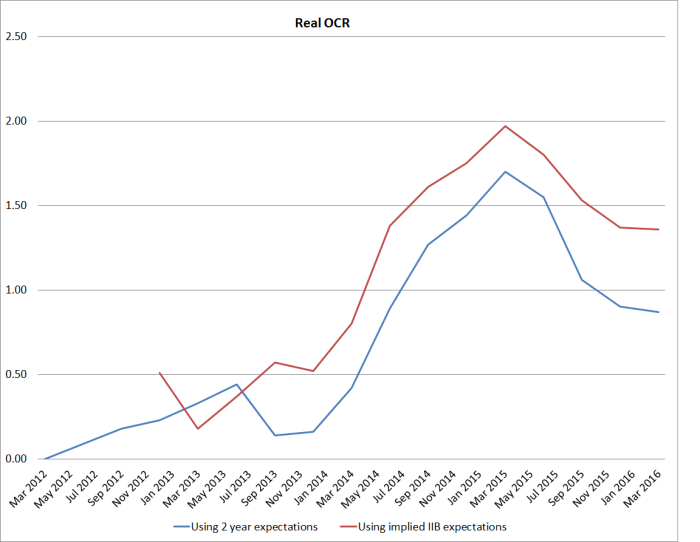
real ocr I’ve shown two versions.  One, which I prefer, deflating the OCR by the two year ahead inflation expectations from the Bank’s survey, and the second using the implied long-term expectations from the indexed bond market.  Whichever measures one uses, real interest rates have been rising not falling in New Zealand over the last few years.  In a climate of such persistently low inflation, that shouldn’t have happened.

It all adds up to a story of a central bank that has been poorly led and managed, and which has not managed monetary policy well.  It hasn’t been held to account well either.

But that doesn’t say the “rules” are wrong, it simply says they haven’t been followed well.  Perhaps we should try operating within the “rules” rather than rush to conclude that there is something wrong with the system itself.    There is no sign that delivering inflation near 2 per cent is impossible, or that it is undesirable, or that doing so would lead to otherwise weird outcomes. Protracted debates now about whether the framework is right is a distraction from the real, immediate, and easily remediable issues: even under the current framework, monetary policy has been, and is, simply too tight.

None of which is to say that we should not from time to time review the rules under which the Reserve Bank works.  I’ve been championing far-reaching governance reforms, to bring the Bank more into line with international best practice, and the way other government agencies in New Zealand are run.  And the Policy Targets Agreement itself expires with the Governor’s term in September next year (which creates timing problems I’ve noted earlier).  I’ve argued here previously that it would be a good idea to follow the lead of Canada, and announce now a joint (and open) work programme, involving the Reserve Bank and Treasury, and outside researchers and commentators, to review the issues around the best design and contents of the PTA.  The last PTA, and those before it, were done largely in secret –  even though the PTA is the main document governing short-term macroeconomic management in New Zealand –  and even now, three years on, the Bank refuses to release any material background papers relevant to that PTA.

We should advance work on both fronts –  governance reform, and open review of the PTA issues in advance of the next renegotiation.  I’m not convinced of the case for material change in the PTA –  or that eg nominal GDP targeting, or wage targeting, or adding an external balance consideration –  would make much practical difference anyway (points I’ve covered in earlier posts).  But the research should be done, and debated, openly, to test and explore the arguments and alternatives.

But the problem at present is not that inflation targeting is being followed too closely, let alone “mechanistically”, or that it is proving overly and inappropriately restrictive.  It is that isn’t being taken seriously by those – the Bank –  with a legal responsibility to do so.


Memo to the Minister: our low inflation is not a good thing

An interview with the Minister of Finance on inflation, monetary policy, and the Reserve Bank was reported in NBR (for those with subscriptions) yesterday.  The story is headed “English drops heavy hint to Reserve Bank” (to cut the OCR).  That may, or may not, have been the Minister’s intention – I suspect it was probably more about getting coverage on the right side of the issue, now that opinion among local economists has started to shift again.  The reporter, Rob Hosking, has appeared to be on the “hawkish” side of the argument until recently, and even in yesterday’s article seems to want to play down how well-established the fall in inflation expectations has become. (The breadth and extent of the falls are illustrated in this post of mine, and in a very good piece put out yesterday by the Westpac economics team.)

But my eye lit on some other comments by the Minister. Perhaps playing distraction, he observed

“While there are these discussions about Reserve Bank performance, you need to think through what the problems and the benefits of persistently low inflation are.  I think it would be worthwhile if the economists articulated those pluses and minuses a bit better.”

In between devoting too much of the last day or so to complying with new regulatory imposts of this supposedly red-tape cutting government (see the Financial Markets Conduct Act), I’ve been pondering the Minister’s question/suggestion and jotting down some notes.  I’m sure he has advisers in The Treasury who can articulate all these points for him, but in case not, here are my perspectives.

Why do we want low inflation?  Because economies work better that way, when (in Alan Greenspan’s words) people don’t have to think too much about inflation in the ordinary course of life and business.  And the tax system assumes inflation away, so high inflation can lead to some really nasty tax effects.

Why do we want stable inflation?  Again, as a predictable backdrop against which people can proceed, negotiating contracts, saving and investing etc.

Why don’t we set the target inflation rate at zero (or even half a per cent to allow for index number biases)?

Two main reasons. The first is a recognition that wages and some prices can be “sticky downwards” so that a modern economy might function less well if we insisted on targeting inflation near zero.  And the second is the lower bound on nominal interest rates.  It isn’t zero, but for the time being it isn’t far below.  With a very low target average inflation rate, average nominal interest rates will also be very low.  If so, when bad things happen (eg the next recession), the central bank might have limited leeway to do much about it.  This argument is less compelling when productivity growth is strong –  since equilibrium real interest rates will be higher –  and more so when productivity growth is weak.

There is a third “reason” in a New Zealand context.  We started out with a target centred on an annual inflation rate of 1 per cent per annum.  Under significant political pressure, successive governments  – including one of which Mr English was himself a junior minister – revised the target upwards in two stages.  It is now centred on 2 per cent –  very similar to the targets in most advanced countries.

All that is by way of prelude.  But it is also to remind the Minister that he has (now twice) signed Policy Targets Agreements in which the Reserve Bank’s target is centred on 2 per cent.  He has statutory responsibilities to assess the Governor’s performance in pursuing the target.  But he also has other powers.  If he so chose, he could invite the Governor to renegotiate the PTA and lower the target range.  Or he could use the section 12 powers of the Act to override the current target and temporarily impose a lower one.  Thus far, he has done neither of those.

When might one be comfortable with inflation being materially below 2 per cent?  One set of circumstances might be those the PTA itself talks of.

For a variety of reasons, the actual annual rate of CPI inflation will vary around the medium-term trend of inflation, which is the focus of the policy target. Amongst these reasons, there is a range of events whose impact would normally be temporary. Such events include, for example, shifts in the aggregate price level as a result of exceptional movements in the prices of commodities traded in world markets, changes in indirect taxes, significant government policy changes that directly affect prices, or a natural disaster affecting a major part of the economy.

When oil prices fall sharply that temporarily lowers the headline inflation rate.  When government taxes and charges are cut that temporarily lowers the headline inflation rate.  In both cases, good economic analysis and the PTA tell the Bank to be content to see headline inflation temporarily dropping away?  Why?  Because these aren’t persistent medium-term pressures, and it is those medium term pressures the PTA rightly focuses on (the stable environment for firms and households).    We deal with these sorts of one-offs with core inflation measures.  There is no one ideal measure but at present, when headline inflation in the most recent year was 0.1 per cent, the median of the various possible core measures is probably not much above 1 per cent.

No one is criticising the Reserve Bank for not reacting to those one-offs (even though the Governor has suggested otherwise).  The debate is about how the Bank should (or should have) responded to low core inflation.

Are there any benefits from having core inflation around 1 per cent at present?  I can’t think of any.

Could there be circumstances in which there would be benefits?  I can think of some.  If, for example, New Zealand (and perhaps the world) was experiencing a period of extremely rapid productivity growth then, all else equal, that would tend to drive down inflation rates everywhere.    Rapid productivity growth would underpin strong investment growth, and support a high level of neutral real interest rates (the marginal product of capital and the real interest rate should be related).  In such a climate one might also envisage a buoyant economy and a low unemployment rate –  plenty of jobs to take advantage of the newly productive opportunities.  In such a world, the Reserve Bank could adjust monetary policy to get inflation back up to around 2 per cent.   But society might reasonably say “why bother”, and consider changing the Bank’s target.    After all, there is no obvious excess capacity or unemployed resources lying round in this example –  the unemployment rate in this fortunate economy might already be below estimates of the NAIRU, and wage inflation would be likely to be strong, supported by the high productivity growth.   Turbo-charging a booming economy might seem rather risky and the arguments for a target centred on, say, 1 per cent rather than 2 per cent might seem reasonably good.  In the same vein, deflation driven by really fast productivity growth is a lot less concerning than deflation simply resulting from weak demand (the latter was the Great Depression story).

But the scenario I discussed in the previous paragraph bears not the slightest resemblance to New Zealand’s current situation (or, as far as I can tell, to that of the rest of the advanced world).

Do we have high, and stronger than normal, trend productivity growth?  No, like almost all advanced countries we’ve seen a marked slowing in productivity growth (labour productivity and TFP) in the last decade or so.

Do we have abnormally low unemployment rates?  Again no, even at 5.3 per cent –  which the respondents in the Reserve Bank’s recent survey don’t expect to be sustained –  the unemployment rate is well above most estimates of NAIRU.  Consistent with the excess capacity and low productivity growth, wage inflation is low and is expected to fall further.

We are also adjusting to a significant adverse terms of trade shock.  For all the talk of cheaper goods and services from abroad, the terms of trade have been falling.  When the terms of trade are falling we would normally expect to see the exchange rate falling, and domestic prices rising as a result. Core inflation measures never manage to capture all that effect, so that if anything in a weak terms of trade environment one might expect to see inflation running temporarily a bit higher than target.  Our exchange rate has not fallen very much (see the comparison with Norway), but that is partly because the Reserve Bank has presided over rising real interest rates over the last couple of years,  rather than cuts.

And, although it is becoming less of an issue now, the exogenous large boost to demand and activity resulting from the Canterbury earthquakes is yet another reason why one might have been more comfortable with inflation a bit above target, rather than well below, over the past few years.  Lots of resources needed to be diverted to the repair and rebuild process, and changes in relative prices are typically part of getting those resources in place.  Changes in relative prices need not boost the overall price level –  monetary policy can simply act to counteract them.  But, within limits, it generally isn’t sensible to do so.  We wanted the economy pushed as hard as was prudent, to get the repairs done and as much other stuff still  happening as possible. That probably implied a one-off lift in the price level –  of the sort suggested by the PTA itself (see references to natural disasters in the quote above).

Recall that the New Zealand recovery in the last few years has been the weakest and most anaemic in modern history.  Had it been the other way  – really unusually strong sustained growth –  again one might have been content to have monetary policy lean a little against the boom.  But it has been nothing of the sort –  instead we’ve had weak per capita growth, weak productivity, lingering unemployment, all in the face of a huge exogenous demand shock.

Those are sorts of combinations of circumstances in which discretionary monetary policy should be doing its utmost, not looking for excuses to justify repeat inflation outcomes well below the agreed target.

What about house prices?  I’m sure that in some minds, high house prices –  and the risk of them rising further –  is a consideration in opposing OCR cuts.  I might even sympathise with that logic if there had been broad-based large increases in real house prices and rapid supply-led growth in credit.  But again, that isn’t the story. In most of the country, real house prices are no higher, or materially lower, than those at the peak of the last boom.  Credit to GDP or credit to disposable income ratios have not risen in almost a decade, and most housing credit growth appears to be an endogenous response to higher house prices themselves.  There are real and substantial affordability problems in Auckland, but there is no real mystery about what has gone on there: the government runs an immigration policy that channels tens of thousands of people into a city, and then does not have a legislative framework in place the allows the physical size of the city to grow commensurately with the rapid population growth.  That just isn’t a consideration that monetary policy should be driven by – it is a relative price change, and the cost to the rest of the underperforming economy of using monetary policy is just too high.  Past Reserve Bank research has shown, quite plausibly, that it takes potentially hundreds of points of OCR changes to have any material impact on aggregate house prices.

We have a 2 per cent inflation target.  There is simply no good reason for us (or the Minister) to be content for the Reserve Bank not to meet that target (in core or underlying terms).   As I noted yesterday, the shocks and pre-conditions New Zealand faced should have made it easier to have meet the target here than other countries may have found it.  And none of the circumstances that might make one relaxed about a persistent undershooting of the target are present here now. We’ve simply been the victims of a poorly run monetary policy.  Under the New Zealand legislation, the Minister is the public’s agent who is supposed to sort out that underperformance.

Finally, in case anyone doubts the slow productivity growth story here is chart of TFP, based at the point when the Conference Board’s data start in 1989.  I’ve shown here the median of the West European, North American, and Oceania advanced economies (a group for which there is data all the way back), and the line for New Zealand.

tfp conf board

New Zealand’s performance has been pretty dire for a long time, but we’ve shared in the marked deterioration evident across the advanced world in recent years.  This is simply not a climate in which the wonders of human ingenuity are driving productivity strongly upward and driving prices more strongly down than usual. It is a climate in which monetary policy should do what it can, when it can. In New Zealand there are no material constraints, and neither we –  nor the Minister –  should be content with what has been being delivered.

Keeping inflation near target: easier here than for most

Some of the discussion around New Zealand’s low inflation rate, and the question of what the Reserve Bank should do (or have done) about it, has a strong element of “it has been awfully hard to keep inflation up near target, not just here but everywhere in the advanced world”.  In other words, we shouldn’t be too critical of the Reserve Bank because they have just been struggling with the same problems everyone else has faced.  Everyone, perhaps, except Norway?

Inflation is, ultimately, a monetary phenomenon.  But monetary policy works and responds within a wider economic climate, where there can be all sort of other pressures at any one time.  Sometimes those other pressures work in the same direction as monetary policy, and sometimes in the opposite direction –  in those cases we might say it is (respectively) a bit easier or a bit harder than usual to deliver on inflation goals.  People have advanced various stories about these sorts of pressures to help explain both the rise in inflation in the advanced world in the 1960s and 70s, and the subsequent sharp decline.  Changed attitudes of monetary policy decision-makers contributed in both cases, but those attitudes weren’t the only factors.

Today I don’t want to try to illustrate that point over history, but rather to look at the pressure/shocks/pre-conditions that might have made it a little easier, or a little harder, for monetary policymakers in OECD countries over the period since just prior to the 2008/09 recession.

What about the pre-conditions?

Many advanced countries have been, or felt they were, constrained in doing more with monetary policy by the near-zero lower bound on nominal interest rates.  Thus, going into a period with lots of downward pressure on the inflation rate it helped, all else equal, to have high nominal interest rates. High nominal interest rates leave plenty of room to cut.  Going into the 2008/09 recession and aftermath, New Zealand had the third highest interest rates in the OECD –  only Iceland and Turkey had rates higher than New Zealand.  That wasn’t just a reflection of some last minute RBNZ madness in driving interest rates sky high.  Our interest rates have been above those in most of the rest of the OECD for a long time.

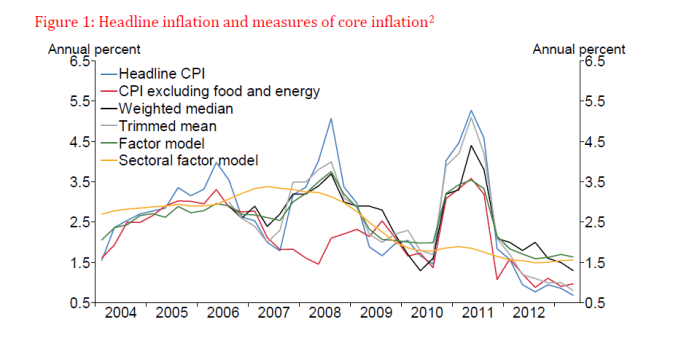
And going into the period of the recession and beyond, we had also had quite high inflation.  I’m not going to attempt to reconstruct the chart here, but work done at the Reserve Bank showed that among inflation targeting countries New Zealand was quite unusual in that our inflation outcomes had typically run above the midpoint of our (successive) target ranges.  Other countries had historically averaged nearer the midpoint.  Going into the recession, the Reserve Bank’s favoured measure of core inflation was actually above the 3 per cent top of the target range, and as this Reserve Bank chart I reproduced the other day illustrates, core measures had all typically been well above the target midpoint in the years leading up to 2008.

core inflation measures

So we had higher inflation to start with (and inflation expectations fairly consistent with that high inflation) and more room to cut policy rates should that be required.  Oh, and unlike half the OECD countries –  members of, or pegged to, the euro – we had a floating exchange rate.  Floating exchange rates increase a country’s ability to achieve its own inflation target whatever is going on elsewhere.

What about the fiscal pre-conditions?   If government finances are in such bad shape that there is little effective choice but to run severely contractionary fiscal policy, it can make it a little harder for monetary authorities if those authorities are trying to keep inflation up, especially if the near-zero lower bound is in view.

One way of looking at the fiscal situation is to look at the cyclically-adjusted balances prior to the recession.  Using the OECD’s measure, New Zealand’s average surplus over the years 2006 to 2008 was higher than those in almost every other OECD country.

fiscal surplus 06 ot 08Using data on the general government sector’s net debt, New Zealand’s position wasn’t quite as strong. But in 2007, we were one of the 12 countries where the government sector has less debt than financial assets, still one of the stronger positions among OECD countries.
So the pre-conditions looked pretty favourable for New Zealand to be able to keep inflation near target.  If anyone was going to be able to do so, in a strongly disinflationary environment, our high starting inflation, high starting interest rates, and strong fiscal position meant New Zealand was well-positioned to do so.

Pre-conditions are one thing.  But what about the shocks that each country faced?

Financial sector crises didn’t occur to same extent in all countries.  I’ve shown this table before, classifying advanced countries by the extent of the increase in non-performing loans since 2007. Real wealth losses –  whether borne by the government in bailouts, or by private creditors –  make it harder to keep inflation up, all else equal.   New Zealand is among the group of countries to the left of the table with the smallest increase in losses.

&Non-performing loans since 2007
NPLs
Source: World Bank.

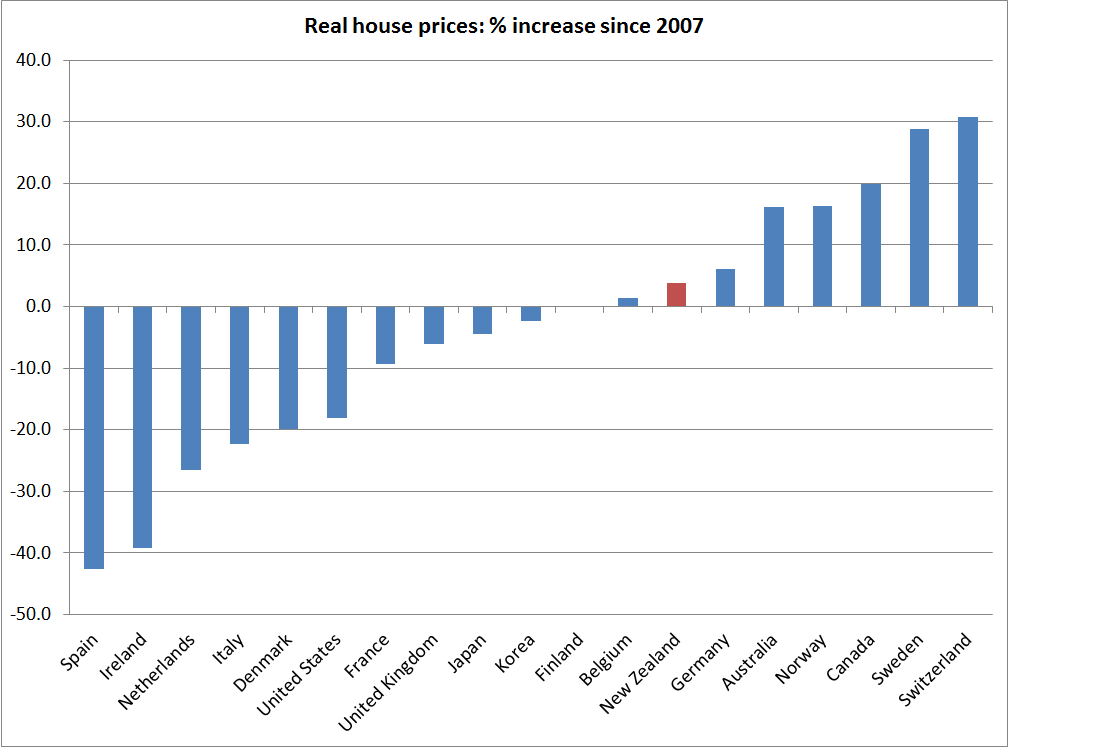
It is never clear how to think about the impact of house price falls  –   how much of it is a real wealth loss, given that we go on living in the same house and consuming the same flow of housing services?  New Zealand did experience falling house prices during the recession, but as this chart I ran a few months ago illustrates, those aggregate losses have been fully recovered and, if anything, real house prices here have been a little stronger than those in the median OECD country.

house prices since 2007

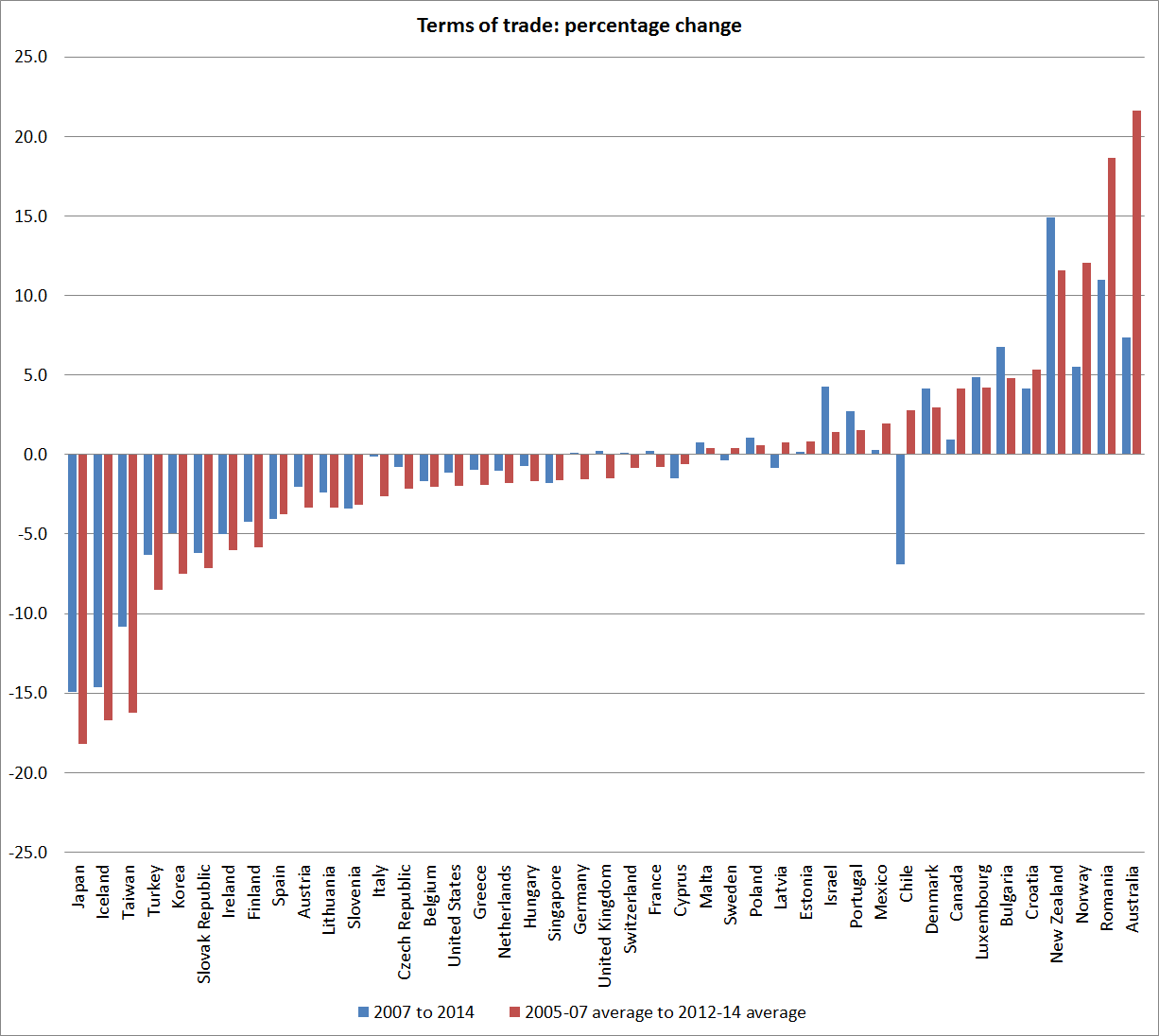
How about the terms of trade?  For a country like New Zealand, the terms of trade are largely exogenous.  A strong terms of trade boosts national incomes, supporting domestic demand (consumption and investment) whatever else is going on in the rest of the world. All else equal, if central banks are struggling to keep inflation up near target, they would prefer strong income gains, rather than the alternative, to support the efforts of monetary policy.

As this chart shows, New Zealand was among the handful of countries with the strongest terms of trade.  Even now the terms of trade are around 10 per cent higher than they were over the years prior to the recession.  That gave us an edge, all else equal, in keeping inflation up.

tot crosscountry

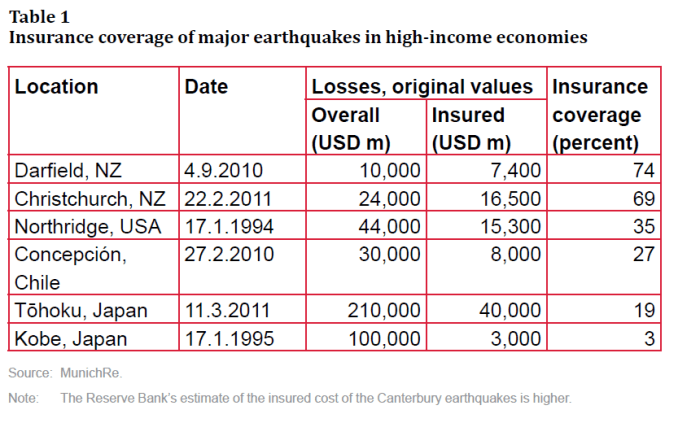
What about exogenous demand shocks?  It is often hard to think of examples of these, but the repair and rebuild process associated with the Canterbury earthquakes is one.  Other OECD countries have had to repair and rebuild after natural disasters – Chile and Japan both suffered from serious earthquakes.   But the damage in Japan, as a share of GDP, was much smaller than the damage in New Zealand and Chile (in both cases up towards 20 per cent of annual GDP).  And, as this table in recent Reserve Bank article highlighted again, what really marked New Zealand out was the extent of the insurance coverage of the losses –  most of that, in turn, covered by foreign reinsurers, rather than by domestic institutions.

insured losses

Earthquakes are awful, and often expensive, phenomena.   But the activity associated with the repair and rebuild processes can be a substantial near-term boost to demand and activity.  That is so even if all the losses are borne domestically – since people need a new house (or functioning water pipes) now, and might pay for it through higher savings over 40 years –  but it is much more obviously so when foreign reinsurers bear the bulk of the cost.  Activity needs to occur now, and someone external is paying for it.  That provides a lot of support for demand.  It could be quite troublesome if there was already a lot of inflation pressure, but –  much as one would wish the earthquakes never occurred –  it provides a lot of  potentially helpful support for demand (reinforcing monetary policy) when other inflation pressures are weak.

Looking through the list of OECD countries, I can’t see any countries that have had anything like that sort of large exogenous demand shock in the last decade or so.  Perhaps I’m missing some, and if so please feel to mention those case in the comments.

In general, declining population growth rates tend to be associated with relatively weak demand pressures.  That can be helpful when other demand and inflation pressures are strong, but more troublesome if other inflation pressures are weak –  as they have been, across the advanced world, in recent years.   But as it happens, New Zealand has had one of the faster population growth rates among OECD countries in the last decade or so, and in the last couple of years has had the fastest population growth we’ve experienced for 40 years.

Bringing it all together, thinking about things that have made it easier or harder for monetary policy to do its job and keep inflation up around target in recent years, relative to the situation in other advanced countries, we’ve had:

Favourable pre-conditions (things already in place in 2008):

  • high starting inflation (relative to target)
  • high starting interest rates
  • a floating exchange rate
  • low net public debt
  • a strong flow fiscal position

And favourable idiosyncratic shocks (or shocks avoided that others faced):

  • few direct financial crisis costs
  • no large sustained fall in house prices
  • a strong terms of trade
  • a large exogenous demand shock (earthquake repair process) largely externally-financed
  • continued strong population growth

None of this is to deny that the global environment  –  eg the declining productivity and population growth I highlighted yesterday, and global oversupply in various markets reflecting past excess investment associated with China –  might have made it more difficult, perhaps materially more difficult, generally for central banks to keep inflation up to around their respective targets.

But among advanced countries, it is difficult to think of any where it should have been easier to have kept inflation up near target than New Zealand.  Almost everything was going our way, and yet the Reserve Bank has consistently failed.

In any reasonable evaluation of the performance of an independent agency pursuing a target it does not control directly, one has to look at all the circumstances, not just at the bottom line, important as that bottom line often is.    One could easily envisage an alternative New Zealand in which many of the factors in the list above might have been reversed.  In such an environment, whatever else was going on in the rest of the world, one might not have been inclined to be very harsh in evaluating our own Governor had he persistently failed to keep inflation around the target.  But in the environment the Governor and his advisers have actually faced in the last few years, it is difficult to acquit the Reserve Bank of responsibility for failing to achieve its primary goal. It was easier for them than for almost all their overseas peers, and yet they’ve failed.  And no forecast I’ve seen suggests that situation is about to reverse rapidly.

The Reserve Bank published an article late last year on “Evaluating Monetary Policy”.  I discussed it here, and included a link to another earlier article they had published on a similar topic.  From the earlier article I highlighted a list of things the Reserve Bank’s Board (or the Minister) might want to take into account in evaluating the Governor’s performance, and perhaps considering any reappointment.

Some of the items the Reserve Bank’s Board might be expected to concern themselves with in fulfilling the monetary policy monitoring role include:

  • The processes the Governor uses to gather and interpret economic information.
  • The choices the Governor makes in allocating resources areas of the organisation relevant to monetary policy (including judgements he makes on whether to seek more, or fewer, resources, when the five-yearly funding agreement is negotiated)
  • The means the Governor uses to ensure that he is exposed to alternative perspectives.
  • The quality of the people the Governor appoints to advise him on policy choices.
  • The way in which the Governor applies section 3 and 4 of the PTA (dealing with deviations from the target range, and the avoidance of unnecessary instability).
  • The way in which the Governor thinks about and responds to the uncertainties around monetary policy.
  • The ability of the Governor to articulate the reasons for his policy choices, and his ability to convince others of his case.
  • The processes the Governor uses to assess past policy and learn from experience.
  • The stability through time in the Governor’s policy choices.

I’d now add to the list “the shocks and pre-conditions” the Governor faced over his or her term.  On this occasion, it doesn’t really seem to help his case.

Meeting the inflation target in one OECD country

There is a small OECD country whose export commodity prices surged prior to the 2008/09 recession, and again in the years after that recession.  It has grappled with high and rapidly rising house prices –  some of highest ratios in the world – and high and rising levels of household debt.  It wasn’t New Zealand I had in mind, but Norway.

There has been a lot of talk from those opposing further OCR cuts of how countries everywhere are struggling to get inflation up, as if meeting New Zealand’s inflation target was either (a) a lost cause, or (b) not something we should be bothered about anyway.

So I found Norway’s experience interesting.

The Norwegian government has set an inflation target for the central bank:

The operational target of monetary policy shall be annual consumer price inflation of close to 2.5 per cent over time

They have all the usual ‘outs’

In general, direct effects on consumer prices resulting from changes in interest rates, taxes, excise duties and extraordinary temporary disturbances shall not be taken into account.

So far, so conventional.  The precise words are a bit different, but the gist is no different from New Zealand’s Policy Targets Agreement –  ours focused on 2 per cent inflation, and theirs on 2.5 per cent.

And, much as the Reserve Bank used to, the Norges Bank recognizes that there is no one foolproof indicator of underlying inflation

There is no one indicator that provides a precise picture of underlying inflationary pressures in all situations. Different measures of underlying inflation are discussed in Monetary Policy Report.

In fact, they include on their website a nice summary table of four different measures

And here is how they’ve been doing.

Inflation indicators

CPI CPI-ATE CPIXE Trimmed mean 1) Weighted median 1)
Jan.16 3.0 3.0 2.6 ND ND
Dec.15 2.3 3.0 2.6 2.3 2.2
Nov.15 2.8 3.1 2.8 2.5 2.4
Oct.15 2.5 3.0 2.8 2.4 2.3
Sep.15 2.1 3.1 2.9 2.4 2.3
Aug.15 2.0 2.9 2.7 2.3 2.4
Jul.15 1.8 2.6 2.5 2.1 2.4
Jun.15 2.6 3.2 3.1 2.3 2.4
May.15 2.1 2.4 2.4 2.1 2.3
Apr.15 2.0 2.1 2.1 2.1 2.5
Mar.15 2.0 2.3 2.3 1.9 2.4
Feb.15 1.9 2.4 2.3 2.0 2.3
Jan.15 2.0 2.4 2.4 2.0 2.1

1) Owing to Statistics Norway’s changes to the statistical structure at a detailed level, estimates for January 2016 are temporarily unavailable.

ATE excludes tax changes and energy products

XE excludes tax changes and (estimated?) temporary changes in energy prices.

The target is 2.5 per cent inflation, and the average of the last observations of the four underlying measures is 2.5 per cent.

Inflation in Norway had been below target, but they cut official interest rates further  –  currently, the Key Policy Rate is 0.75 per cent, down from 1.5 per cent a couple of years ago.  The central bank reports that inflation expectations have been fairly stable, so that the whole of the cut in the nominal policy rate has also been a fall in the real policy rate.

As you might expect, economic conditions in Norway haven’t been great in the last year or so, since oil prices plummeted –  even though most of the direct effects of fluctuating oil revenues are sterilised in the Petroleum Fund.  The unemployment rate –  while still one of the lowest in the OECD at around 4.6 per cent –  has increased by around a full percentage point, and is as high as it has been at any time in the last fifteen years.

But, nonetheless, the inflation rate has increased and core measures suggest it is around the target midpoint.    That hasn’t been the New Zealand picture. What is the difference?

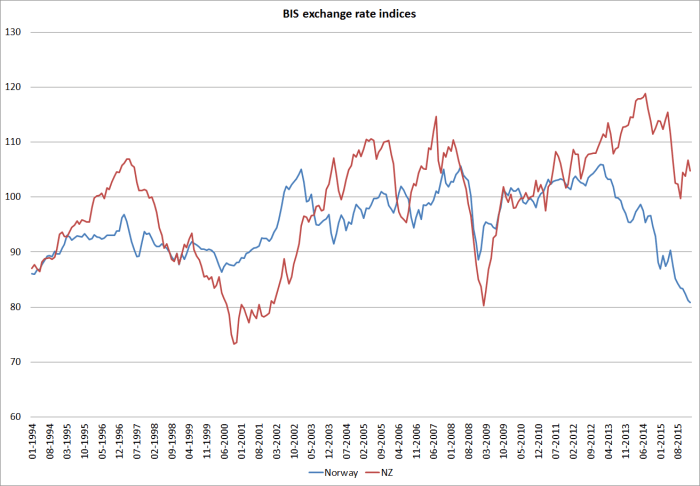
A key proximate part of the story is the behaviour of the respective exchange rates.  Here are the BIS broad exchange rate indices for the two countries.  Norway’s exchange rate is the lowest it has been for decades, while ours –  off the 2014 peaks for sure  –  hangs around the average level of the last decade or so.

bis exch rate norway and nz

People could fairly respond that oil and gas are far more important to Norway than, say, dairy is to New Zealand, and oil prices have fallen even more steeply than dairy prices.  All of which is true.  Then again, all fluctuations in dairy prices flow straight through to private domestic incomes –  unlike Norwegian oil revenues.

My point isn’t to draw exact parallels, but just to highlight a case of an advanced economy, with a severe adverse terms of trade shock, which has managed to keep inflation near the target –  they’ve been willing to do what was needed, and in parallel the exchange rate response has been large.

The direct effects of higher import prices have helped to boost Norway’s inflation rate.  That shows up in that the exclusion measures (ATE and XE) have been a little above target, while the central tendency measures (trimmed mean and median) are still a touch below.

Here is a chart from the Norges Bank’s (excellent) recent Monetary Policy Report.

norway inflation

The inflation rate for imported consumer goods has increased quite substantially, while that for domestically produced goods and services is  estimated to be holding comfortably around the 2.5 per cent target rate.  Outcomes like these are mutually reinforcing with the inflation expectations measures  – expectations consistent with the target make it easier to keep meeting the target, and outcomes around target help validate the prior expectations.

There might still be questions about what happens when the exchange rate stabilises and imported inflation drops, especially if the unemployment rate is then still high (by Norwegian standards).  Alert to the risks, the Norges Bank has flagged the possibility of further cuts in the Key Policy Rate.  But again, my point is not that the Norwegians have solved their problems for all time, but that they are now meeting their inflation target once again. Our central bank isn’t.

As a reminder, in Norway (relative to the position a couple of years ago) real interest rates have fallen. In New Zealand they have risen.  Ponder a counterfactual in which our real interest rates were 100 or 150 basis point lower than they are now –  and that is about the magnitude of the change in the gap between the two countries’ real interest rates over the last couple of years.  I think it is hard to dispute that we would have (a) a materially lower exchange rate, and hence higher tradables inflation, and (b) somewhat more domestic and net external demand and hence more upward pressure on non-tradables inflation.  There would be few doubts in anyone’s mind of the Governor’s commitment to delivering on the 2 per cent target he signed up to a few years ago.  Oh, and we’d have the good fortune to have an unemployment rate that would probably have a 4 in front of it, and probably be near the NAIRU.

Perhaps New Zealand doesn’t yet need real interest rates quite that much lower –  I’ve been arguing for some time for an OCR of around 1.5 to 1.75 per cent. The point really is just to illustrate what has been done in Norway – a small commodity-dependent country, with serious house price issues –  and what could have been, and perhaps could still be, achieved here.

Thoughts prompted by the expectations survey

The Reserve Bank’s quarterly survey of expectations results were released the other day.  As a reminder, it is a survey  of business people, sector leaders, and quite a few economists.  The vision has always been that the survey should capture some mix of informed people and people who might influence actual behavior – whether through their own business transactions, or through their commentary or advice to others.    There is a sample pool of about 100 potential respondents, and they typically seem to get about 65 or 70 replies each quarter.  Some criticize the survey for its small sample, but for what it is trying to do, in a small country, it has never seemed too bad to me.  It is, after all, asking for numerical answers to quite a bunch of macroeconomic questions.  I know that when I fill it in, I sometimes have to go back to the data to check what the latest reported numbers were –  not carrying QES wage inflation data in my head.

For inflation expectations specifically there are other surveys with larger samples.  ANZ provide their long-running Business Outlook survey, and their newer survey of household expectations, and the Reserve Bank will release its  latest survey of household expectations next week.  At the other extreme is the (inaccessible to the general public) AON survey, designed primarily to provide inputs for actuaries evaluating pension funds.  They ask about, inter alia, longer-term inflation expectations, but they ask only a handful (perhaps 7) economists.

I’ve never been quite sure what to make of inflation expectations measures.  Inflation expectations play  a significant, and quite plausible, role in conventional macroeconomic models.  The difficulties come with mapping the data we have available with the concepts in the models.  For a start, what horizon matters?  In principle, 10 or 20 year ahead expectations sounds interesting, abstracting from all the short-term noise, whether around taxes and government charges, petrol prices, or even swings in the exchange rate.  Then again, how many people sign up to 10 year nominal contracts?   No one sets wages or selling prices that far ahead.  And while plenty of bonds are issued with long maturities, when corporates issue them they typically seem to swap back to floating rates.  So 10 year ahead expectations probably provide some useful information about how confident people are that, say, the framework will hold or be delivered on, over 10 years, but I doubt they make very much difference at all to this year’s inflation rate, or the challenges a central bank faces in meeting its inflation target over the next couple of years.  I don’t know much about the politics of the next 20 years, but if forced to write down a number for average inflation over the next 20 years I might still write down 2 per cent.  But with huge error bounds….and grateful that nothing rests on it and that my pension is inflation indexed.

Shorter-term expectations matter more. But not too short.  Quarter or year-ahead expectations are influenced by specific stuff people know about –  relative price changes and administered taxes and charges.  In trying to make sense of inflation expectations, analysts are typically trying to look through those effects, to get a sense of the “norms” people have in mind when they set selling prices, negotiate wages, and make decisions to borrow or save.  If firms have in mind a benchmark inflation rate of, say, 1 per cent, then when they come to review their pricing schedules –  perhaps every six or twelve months –  pricing adjustments are likely to be different (lower) than if firms had in mind a benchmark or normal inflation rate of 2.5 per cent.  Same goes for wage negotiations.  And for how potential borrowers react to any particular nominal interest rate.   When those norms are above the inflation target, it can be hard to get actual inflation down to target –  more interest rate pressure is needed, than otherwise, to deliver the desired inflation rate.  And vice versa.  Two year ahead expectations have often been seen as a reasonable horizon to focus on for these purposes –  far enough that it gets beyond most (but not all) of the immediate noise, but close enough that it is more or less within the planning horizons of many.  In the latest RB survey, for example, the actual question asked in early February 2016 was about the annual inflation rate for the year to December 2017.  Halfway through that year respondents are asked to focus on is only 16 months away.   (Similarly, it was pleasing that when the ANZ launched a household expectations survey they asked about two year ahead expectations).

If, in principle, measures of two year ahead inflation might usually give one a steer on the “pricing norms” that firms and households are operating on (at least implicitly), there is still the matter of whether the answers to survey questions actually give us the information we really need.  As I’ve noted before, for example, the ANZBO survey and the Reserve Bank household survey measures have consistently, over decades, been materially above actual average inflation.    In the 20 years the RB household survey has been running, mean expectations have been just over 1 per cent higher than the average inflation outcome.  Does it mean households really didn’t believe the Reserve Bank would do it job?  Does it mean those are the inflation rates people implicitly contract on?  We simply don’t know (at least without a lot more formal research).  There is no incentive for people to invest any time or effort in responding to one question in a substantial telephone survey –  whereas they might well be when they ponder taking out a mortgage, or negotiating a pay increase.

All of which is a roundabout way of getting to the point that historically the Reserve Bank has put most weight on the two year ahead inflation expectations measure from the Survey of Expectations.  And it has done so because (a) there is now a good long time series (back to 1987), (b) it fits the prior that, typically, it will be horizons just beyond the immediate noise that matter, given that most contracts reprice at least every year or two, and (c)  because historically  it had a mean which seemed to align quite well over time with actual inflation.  One way to see this is to compare the two year ahead expectation with the Bank’s preferred sectoral factor model indicator of core inflation (remember what I said yesterday –  whatever the potential problems, for historical periods it is probably as reasonable as any measure, effectively smoothing through the noise in headline inflation).

infl expecs and core inflation

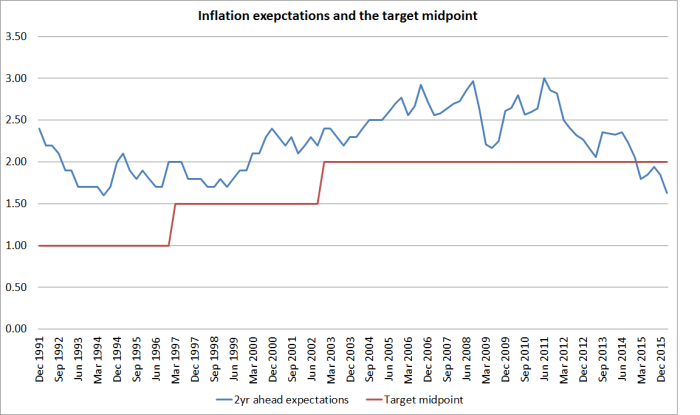
So what actually happened in the most recent survey?  Two year ahead expectations fell by 0.22 percentage points to 1.63 per cent [1].  Relative to the midpoint of the inflation target, that is the lowest in the history of the survey.  That isn’t all a bad thing –  despite the rhetoric suggesting we were crazed mechanistic inflation zealots, actually under both Don Brash and Alan Bollard inflation had averaged higher than the successive target midpoints, and expectations (in this survey) seemed more or less consistent with that.  But we don’t have a price level target, and if expectations start undershooting the target that is pretty undesirable as well.

infl expecs and target

The size of the fall in inflation expectations wasn’t unprecedented, but it was pretty large for this (not overly noisy) series.  In the period since low inflation became the norm (say since 1992) the only materially larger quarterly falls were (a) in the depths of the 2008/09 recession, and (b) in March 2012, when (post GST) the headline inflation rate had just fallen, in a single quarter, from 4.6 per cent to 1.8 per cent.

So this fall will have got the attention of the Reserve Bank, its analysts and forecasters.  It can’t really have been expected  – only 2 weeks ago the Governor told us explicitly that “survey measures of inflation…are now consistent with inflation settling at 2 per cent in the medium term”.  That was arguable, at best, previously.  It doesn’t really wash at 1.63 per cent –  and the prospect of further falls from here.

In the internal debate in the Bank, some will try to dismiss the latest fall as “just about petrol prices”.  Inflation expectations measures do respond, to some extent, to headline inflation, some seem “excessively” responsive to petrol prices, and even this two year measure (of informed respondents) is a bit sensitive to headline movements.  But, as I have pointed out on several occasions, the latest annual CPI inflation rate excluding petrol was only 0.5 per cent.  The more internationally conventional ex food and energy measure of inflation was only 0.9 per cent.  So if headline inflation is influencing two year ahead expectations (a) that seems quite reasonable –  it looks as though there is some information in trends in the headline rate, and (b) nobody much seems to expect headline inflation (including or excluding petrol) to pick up soon.  It looks as though respondents are just gradually giving up on the Reserve Bank’s story that inflation is heading back to 2 per cent any time soon.    It should be doubly sobering for the Bank that this comes in a survey in which responses to the other questions are not uniformly bleak: large falls in inflation expectations have usually gone hand in hand with more pessimistic GDP growth expectations, but in this survey those expectations have actually risen a little.

If people more generally –  not just these respondents –  are giving up on the Reserve Bank story, that will make it materially harder to get inflation back to target.

In one sense, it often seems wrong and excessively “mechanistic” to put too much weight on a single survey, and of 65 people –  it often did to me, when I sat around contemplating the survey results and wondering what OCR advice to offer successive Governors.  And in isolation that would be fine.  But it isn’t the only information we have –  rather, if anything, it is somewhat belated confirmation that the persistent undershoots of the inflation target have changed how people are thinking about prospects for inflation in New Zealand.   I suspect the Reserve Bank, perhaps rather grudgingly, will come to the same conclusion.

Recall what Mario Draghi, head of the ECB, said in the speech I discussed the other day

… in a context of prolonged low inflation, monetary policy cannot be relaxed about a succession of supply shocks. Adopting a wait-and-see attitude and extending the policy horizon brings with it risks: namely a lasting de-anchoring of expectations leading to persistently weaker inflation. And if that were to happen, we would need a much more accommodative monetary policy to reverse it. Seen from that perspective, the risks of acting too late outweigh the risks of acting too early.

And it is not as if New Zealand monetary policy has somehow already got ahead of the problem.  If the two year ahead measure is a reasonable proxy for the inflation norms now abroad in New Zealand –  and it may yet prove too high – real interest rates have actually risen over the last couple of years.

The Reserve Bank lists three lending rates on its main retail rates page: a business lending rate, an SME rate, and new customer floating mortgage rate.  In nominal terms, all are almost exactly now where they were at the start of 2014 (just before the OCR tightening cycle began). Inflation expectations, by contrast, are 70 points lower than they were then.  With an unemployment rate above any measure of NAIRU, and inflation persistently below target, rising real interest rates  have not obviously been something this economy needed. Retail deposit rates are lower than they were two years ago – by even they are no lower in real terms.  And as funding spreads are rising –  as they appear to have been recently, reflecting market unease about banks internationally  –  all else equal, the pressure on retail rates over the period ahead will be upwards not downwards.

And all this is before we focus on the continuing high exchange rate, the continuing weak commodity prices, and the growing stress persistently weak dairy returns are going to be placing on demand and activity (even if they aren’t necessarily a threat to the soundness of our banks).  Let alone the worsening global situation.

And, of course, there are market measures of implicit inflation expectations (from the difference between indexed and conventional bond yields).  These are weakening everywhere, but a chart someone sent me yesterday highlighted that the fall has been particularly sharp in New Zealand.  As of yesterday, a 10 year conventional bond had a yield of 3.06 per cent, and a 2025 inflation indexed bond was yielding 2.12 per cent.  That gap is now less than 1 per cent (and look how far it has fallen this year so far).

infl expecs indexed bonds

These aren’t perfect proxies, and bond investors’ expectations don’t directly affect (CPI goods and services) pricing now, but I don’t think central banks –  ours in particular –  can afford to be indifferent to message from bond markets: people with money on the line are no longer acting as if they think inflation is going to be near target on average over the next decade.  They might be wrong, but why would central banks be so confident that those investors are wrong –  especially when central banks, ours foremost among them, have themselves been persistently surprised by how weak inflation has been.  In part, in turn, that  has been because central banks –  ours among them –  have been persistently focused not on doing “whatever it takes” to create confidence that inflation targets will be delivered, but on doing as little as they can away with, perennially focused on “normalization” and some long-term benchmarks of where, surely, interest rates have to get back to one day.

There is a story abroad  – I saw it in a commentary from one of the local banks yesterday –  that low inflation is good and inevitable.  It certainly isn’t inevitable here –  looser monetary policy would, for example, lower our exchange rate generating additional resource pressure over time.  And it isn’t good either.  The story seems to go that structural features are driving price levels down.  But remember that productivity growth rates globally have been falling, not rising.  And stories about global overcapacity tell you mostly about demand having failed to keep up with supply capacity:  discretionary monetary policy exists to influence demand.  The indifference to what is going on is hauntingly reminiscent of some of the discussion and debate during the Great Depression –  when there was excess supply capacity (reflecting, eg, past heavy investment in agriculture), even amid rapid ongoing productivity gains –  and a sense in too many circles, for too long, that nothing very much should be done about monetary policy and the monetary system.

[1]  For what it is worth, when I completed the survey I did not lower my two year ahead expectation from the one I recorded in the November survey. On both occasions, I wrote down 1.4 per cent.


Core inflation and the Reserve Bank

Since the Governor’s speech a couple of weeks ago (building on the January OCR review announcement), I’ve been reflecting again on how best to think about what is going on with inflation in New Zealand.

The Governor cited a single measure of core inflation, the sectoral factor model measure of core inflation, to assert his comfort with the current headline inflation rate.  As I noted at the time, it is very rare for any specific measure of core inflation to be cited in official Bank announcements.  The typical story has been along these lines

There is no agreed upon ‘best’ approach to measuring core inflation, and each approach has various advantages and limitations. Some work best in some circumstances; some in others.

That line is taken from the abstract to a nice Reserve Bank Bulletin article reviewing core inflation issues and measure, published a little earlier in the current Governor’s term).

The same year they published a nice Analytical Note on the sectoral core measure itself. The non-technical summary at the start of that paper notes

There are many ways to measure core inflation. Statistics New Zealand publishes a range of measures that involve removing volatile price movements before inflation is calculated, or excluding certain groups of items from the calculation. As well, the Reserve Bank of New Zealand has a set of models that produce core inflation estimates. Every model is different, and the Reserve Bank uses the full suite of measures when forming an assessment of what is going on with inflation.

(For the record, I edited both these publications, but both were widely circulated in draft, and were approved by the Assistant Governor  –  Chief Economist – and the Bank’s Communications Committee, on which all four governors sit and actively participate. I don’t recall such lines ever being contentious.)

The Analytical Note went as far as to publish this chart, illustrating the variety of measures the Bank looked at.

core inflation measures

Incidentally, note the nice longer-term time series for the weighted median and trimmed mean series.  The Bank no longer publishes these (linked) series on its website, just reporting the very short official series published by Statistics New Zealand.  This is something that should be remedied –  as, for example, the Reserve Bank of Australia does.

But now, apparently, the Governor favours the sectoral factor model to the exclusion of all other core inflation indicators.  It is certainly convenient that it is, at present, the highest of any of the range of core inflation measures, and that the inflation rate, on this measure, has increased over the last year.

Here is a table I ran a couple of weeks ago:

Annual inflation, year to Dec 2015
Trimmed mean 0.4
Weighted median 1.5
Factor model 1.3
Sectoral factor model 1.6
CPI ex petrol 0.5
CPI ex food and vehicle fuel 0.9
CPI ex food, household energy and vehicle fuel 0.9
CPI ex cigarettes and tobacco -0.3
Non-tradables ex govt charges and alcohol and tobacco 1.8

But neither the Governor, nor his officials, have given us any reasoning as to why they think that on this occasion this indicator is the single best representation of what is going on –  so much so that the other measures aren’t even worth mentioning.  I suppose one could lodge a request but (a) I doubt there would be anything to support the Governor’s preference, and (b) no doubt, we’d be told it was none of our business and that information had to remain secret to, for example, “prevent damaging the economy of New Zealand“.    For an institution that likes to hold itself out as being transparent about its economic reasoning and analysis –  and which has more (taxpayer-funded) macro analysts and researchers than any other agency –  it really isn’t good enough.

Relatedly, if the sectoral core model is really providing much the best steer, what has changed since the start of 2014?  Recall that sectoral core inflation then had been almost dead-flat at around 1.4 per cent for a couple of years –  and yet the Governor began an aggressive tightening cycle.  Perhaps it was a misleading measure then, but the best measure now?  It is possible, but surely we are owed an explanation?

sec core and headline

Why might we be a little sceptical that some “true” notion of core inflation is (a) rising, and (b) as high as 1.6 per cent  (itself still materially below the midpoint)?

First, the sectoral factor measure is the product of a model, and that model has error bands around it. Even the historical period numbers are midpoint estimates of a range which the Bank tells us is around 0.6 percentage points wide.

sec factor uncertaintyAnd, as with all of these sorts of models, the problems are particularly acute for the most recent observations. The model is, in effect, trying to discern the common trends in the various component price series, but it can do that increasingly reliably with the benefit of more time and more data. That makes tools like this most valuable for identifying the underlying inflation processes in periods of history (eg looking back now on the pre 2008 boom) and relatively less useful for “spot” reads on what is happening right now. In that sense, it is a little like filter-based estimates of the output gap, and it is similarly unwise to put too much weight on real-time estimates of any one model of the output gap.

Second, there is no sign of any pick-up in wage inflation, or in measure of inflation expectations.

Third, the measures that are easier to disentangle mostly aren’t suggesting core inflation is rising, or that it is as high as 1.6 per cent. Take, for example, the internationally quite commonly used approach: CPI inflation rate excluding food, household energy and vehicle fuels is only 0.9 per cent.   It isn’t always reliable – in 2007 it ran below most other measures of core inflation because of some large changes in government charges (childcare subsidies). But we know (SNZ tells us) this time round that taxes and government charges are not, overall, affecting the inflation rate. It is a good example of why one needs to look at all the measures, and use them to develop an overall story. Focusing on a single indicator is often likely to be quite dangerous – especially when it is something of a black-box, prone to endpoint problems.

And here is a concrete illustration of something that bothers me about the sectoral factor model results at present.

We know that the repeated increases in tobacco excise has been having a big impact of overall non-tradables inflation in recent years (and the overall CPI). More recently, cuts to ACC motor vehicle registration charges have worked the other way. Statistics New Zealand do not give us a series of overall CPI inflation excluding tobacco and government charges, but they do provide one for non-tradables inflation (at least from 2007). And the Reserve Bank helpfully publishes separately the non-tradables component of the sectoral factor model.  The chart shows overall non-tradables inflation as well. (The 2010 surge is the increase in GST, administratively excluded from the sectoral factor measures.)

sec core NT

Over the period since 2007, the combined effects of tobacco tax increases and central and local government charges have substantially boosted non-tradables inflation (the red line has been well above the blue line). So it is troubling that the non-tradables sectoral factor model component looks so like the overall non-tradables series over the period since 2009, even though it is substantially boosted by factors that no one would regard as core inflation – they are administered (by governments) prices.   I’m less bothered by the idea that sectoral core inflation in the non-tradables sector might have been flat – a lot of the inflation in recent years looks to have been in the construction sector (think Christchurch) and the model will tend to look past that as not representative of the whole economy.

But if the Bank is going to drive policy – its assessment of the current inflation situation relative to target – off a measure that has looked more like a series that includes lots of administered taxes and prices, than it does the series that excludes those effects, they need to give us a lot more explanation than they have done to date. It is possible that there is a good and convincing story, and that the sectoral factor model is really capturing something important that has been going on in non-tradables inflation that simply isn’t visible to the naked eye (or in other price series), but we need to see that story. and the other supporting evidence for it. What is it, for example, that is leading to the sectoral measure holding up, and even rising, just as the overall non-tradables inflation rate converges (downwards) on the series excluding those government-determined prices?

Personally, I think it would be safer for the Bank to work on provisional basis that core inflation is around 1 per cent at present. That is around where the exclusion measures would suggest, and well above the trimmed mean – the approach to core inflation approach that, for example, tends to get most coverage among analysts in Australia.

[UPDATE: And don’t lose sight of the fact that the average of the blue line –  excluding the GST spike –  has been below 2 per cent since 2009.  No one I know of would expect non-tradables inflation to be at or below 2 per cent if core or underlying inflation in total were anywhere near the 2 per cent target midpoint.]

This whole episode is pretty unsatisfactory, and a poor reflection on the Bank. Reasonable people might differ on the appropriate stance of monetary policy. But the attempt to justify the stance on a single (complex) core measure, without substantive elaboration or explanation, when that same core measure would appear to have warranted policy easings when the Bank began aggressively tightening two years ago, looks disconcertingly like a Governor fixing for a time on the highest convenient measure of inflation. That isn’t good policy or good governance. And I suspect it makes many of the Bank’s own economists quite uncomfortable.

As a reminder of the Deputy Governor’s 2013 report of the Bank’s aspirations

The Reserve Bank is deeply committed to transparency – of policy objectives, policy proposals, economic reasoning, and of our understanding of the economy, and of course of our policy actions and intent. Clear communication and strong public understanding make our policy actions more effective.

We are working to enhance the openness and effectiveness of our communications

It just isn’t happening.

And note that all these quotes are from 2013, early in the Governor’s term, before things started going really wrong. And before they responded to those mistakes  –  which any humans will at times make –  by turning inward, pretending that nothing is wrong, and avoiding serious scrutiny and debate.  Digging deeper holes doesn’t usually solve such problems.

It was wryly amusing to note the other day that the Governor of the People’s Bank of China – central bank of a brutal repressive state not know for any sort of transparency – had given an extensive interview (not necessarily revealing a great deal) to a publication not historically known as a party mouthpiece. Our Governor has, I’m told, not given a single substantive interview in his three and half years in the job.


Lessons from Mario Draghi

In two successive days last week, two heads of central banks gave speeches on monetary policy.   Graeme Wheeler’s speech was characterized by a rather desperate defensiveness –  attacking nameless critics for views that no one seems to hold, in an attempt to defend his (and the Bank’s) rather poor track record: a CPI inflation rate that hasn’t been at the midpoint of the target range for four years.

A commenter pointed me to ECB head Mario Draghi’s speech, given the following day, “How central banks meet the challenge of low inflation” .   It isn’t a perfect speech by any means –  the claim that “monetary integration in the euro area is both complete and secure” must just be one of those lines he has to use, regardless of the continuing severe stresses on the system.  It is a speech of two halves –  the second half is about the particular challenges of the euro area, but the first half is an excellent and authoritative discussion of how central banks generally should respond to low inflation.

Core inflation in each jurisdiction is quite similar: in 2015 CPI inflation ex food and energy was 1 per cent in the euro-area, and was 0.9 per cent in New Zealand.  If anything, New Zealand’s inflation target is a little higher than that for the euro-area: our Reserve Bank is required to focus on 2 per cent, while the ECB articulates its goal as keeping CPI inflation close to, but below, 2 per cent over the medium-term.

Draghi’s speech is well worth reading.  It is the speech of someone who has a deep belief in the power of monetary policy – that inflation is, over time, a monetary phenomenon, and that if inflation is persistently below whatever goal is set for the central bank it is the central bank’s responsibility to do something about it.    It is a refreshing speech, especially as the ECB is no doubt closer than it would like to the limits of conventional monetary policy (with the policy rate already below zero).    Draghi could have offered excuses, but instead it is robust call for monetary policy to simply do its job.

Draghi draws on the lessons of the 1970s, when central bankers often wanted to shift the responsibility for high inflation onto other structural forces.  He fully recognizes the wide range of shocks than can hit an economy (demography, technology etc), and the way some of them can persist, but  argues that monetary policy authorities are responsible for offsetting the effects of those shocks on inflation –  whether they are pushing upwards (as in the 1970s) or downwards (as at present).

… in a context of prolonged low inflation, monetary policy cannot be relaxed about a succession of supply shocks. Adopting a wait-and-see attitude and extending the policy horizon brings with it risks: namely a lasting de-anchoring of expectations leading to persistently weaker inflation. And if that were to happen, we would need a much more accommodative monetary policy to reverse it. Seen from that perspective, the risks of acting too late outweigh the risks of acting too early.

In sum, even when faced with protracted global shocks, it is still monetary policy that determines medium-term price stability. If we do not “surrender” to low inflation – and we certainly do not – in the steady state it will return to levels consistent with our objective. If on the other hand we capitulate to “inexorable disinflationary forces”, or invoke long periods of transition for inflation to come down, we will in fact only perpetuate disinflation.

This is the clear lesson of monetary history, especially the experience of the 1970s.

Nor does he offer up excuses of the sort that “inflation is low everywhere, so there isn’t much we can –  or perhaps should –  do about it”.

We now have plenty of evidence that, if we have the will to meet our objective, we have the instruments.

and

So there is no reason for central banks to resign their mandates simply because we are all being affected by global disinflation. In fact, if all central banks submit to that logic then it becomes self-fulfilling. If, on the other hand, we all act to deliver our mandates, then global disinflationary forces can eventually be tamed.

He even deals with the line of argument that easing monetary policy to get inflation back to target may do more harm than good.

Still, there are some that argue that even if central banks can lean against global disinflationary forces, in doing so they do more harm than good. In particular, expansionary monetary policies at home lead to the accumulation of excessive foreign currency debt or asset price bubbles abroad, especially in emerging markets. And when these financial imbalances eventually unwind, it weakens global growth and only adds to global disinflation.

To which his response is:

In fact, when central banks have pursued the alternative course – i.e. an unduly tight monetary policy in a nascent recovery – the track record has not been encouraging. Famously, the Fed began raising reserve requirements in 1936-37, partially due to fear of a renewed stock bubble, but had to reverse course the next year as the economy fell back into recession. That has also been the experience of some central banks in recent years: raising rates to offset financial stability risks has undermined the primary mandate, and ultimately required rates to stay lower for longer.

This suggests that the so-called “assignment problem” between monetary policy and financial stability at the domestic level should also apply at the global level. Monetary policy should not try to balance opposing objectives: it is optimal for all parties if it delivers its mandate. And if that creates financial stability concerns, they need to be addressed by other policies more suited to the task. And in fact there are several policy levers available.

Countries can improve their financial regulation and supervision to make their financial systems more resilient to external shocks. They can adjust their fiscal policies. They can adopt macro-prudential measures.

That is the sort of speech that Graeme Wheeler should have been giving last week – indeed, given how badly inflation has been undershooting the Reserve Bank’s target, he should have been giving it a year or two ago.  Instead, he drove up interest rates –  when his preferred measure of core inflation was even lower than it is now.  And even now that the OCR increases have reluctantly been fully reversed, we are left with real interest rates that are higher than they were two years ago, even as confidence in inflation getting back to target erodes further (and the terms of trade have fallen, the peak impulse from Christchurch has passed, and the global situation has materially worsened).

Chris Green, at First New Zealand Capital, had a commentary out late last week on the Governor’s speech.  I agreed with almost all of it.  But two lines particularly caught my eye:

“My sense is that the Governor is far more focused in defending his current position than objectively attempting to assess the optimal risk-adjusted monetary policy response”

and

“The perception that they give of a reasonably high hurdle before cutting rates would be more consistent with CPI out-turns around the top of the band, not having been below the midpoint for more than 5 years [I presume he means on the Bank’s preferred core measure] and not projected to get back there until the December quarter of 2017 –  at the earliest”.

Quite.   And one could add that the problem is compounded by the Governor’s reluctance to substantively engage with the issues –  rather than responding to straw men of his own imagining –  or indeed to open himself to sustained scrutiny from the media.

The Governor and his chief economist have been putting a lot of weight on inflation expectations measures recently, and suggesting that there is really nothing to worry about.  We’ll have a new round of inflation expectations data shortly, and I’ll come back to the topic then, but for now consider this chart, drawn from the Bank’s survey of household expectations.

household expecs Feb 16

People are asked whether they expect inflation to rise, fall or stay the same over the coming year.  The survey has been running for over 20 years, and in every single survey a net balance have reported expecting inflation to increase (suggesting that not much weight should be put on the absolute numerical value of the answer).  But what I wanted to highlight is that at present fewer people expect inflation to rise than at any time in the history of the series, with the exception of the depths of the recession in 2008/09.    But in March 2009, when only 20 per cent people expected inflation to rise over the coming year, the last annual inflation rate they’d seen was 3.4 per cent.  Of course –  in the middle of a recession, with plummeting oil prices –  they didn’t expect inflation to rise.  And they were right.  Annual inflation fell sharply.    The most recent observation in the survey was November 2015.  When those respondents completed the survey, the most recent annual inflation rate they’d seen was 0.4 per cent.  And still, not many (by historical standards) expected annual inflation to rise.   There is nothing to be complacent about in the inflation expectations data –  and even among more expert observers, medium-term inflation expectations are lower, relative to the target midpoint, than they have been since inflation targeting began.

It must almost be time for the Minister of Finance’s annual letter of expectations to the Governor.  As I noted last year, the persistent undershoot of the target has had little or no attention in  past year’s letters.  We must hope that this year’s is different.  The primary responsibility for the persistent undershoot of the target rests with the Governor, his chief economist, and his other senior advisers.  But the apparent passivity to date of those charged with holding the Governor to account –  the Minister of Finance, who set the target, and the Bank’s Board, paid to monitor the Governor’s pursuit of the target –  risks making them complicit in the failure.  After all, together they were responsible for the appointment of an individual as Governor who increasingly seems to lack the stature and qualities that the position demands.

Some thoughts on the inflation data

Perhaps not surprisingly there has been a lot of coverage of yesterday’s CPI outcome –  an inflation rate of only 0.1 per cent for the year; materially lower than either the Reserve Bank (in its December MPS) and all other published forecasters had expected.

Quite what the numbers mean isn’t so clear-cut, and I’ll come back to that, but it is very low inflation.

Of course, this is an era of low inflation.  According to the OECD database, nine OECD countries had even lower inflation (or deflation) than we did last year –  eight of those countries have policy interest rates at zero (or even a bit below).

The media made much of our inflation rate being the lowest since 1999, but they probably missed the story.  After all, 1999 isn’t that long ago (and the target was lower then).  And in those days, the CPI included retail interest rates, and interest rates dropped by around 400 basis points in 1998.  All the experts thought that in a deregulated economy including interest rates in the CPI was daft –  apart from anything else, it meant that when the Reserve Bank tightened monetary policy, inflation temporarily went up.  So daft in fact that the Policy Targets Agreement in place at the time, signed by Winston Peters and Don Brash, set the target in terms of CPIX (ie the CPI excluding credit services).  In fact, the way the official CPI was calculated was changed shortly afterwards to essentially the approach used today.

We don’t have a consistently compiled historical CPI in New Zealand (the way all sorts of things have been measured, but especially around housing, has changed materially over time, but then so –  for example –  has the extent of price controls, regulation etc).   But here is a chart using the official historical CPI all the way back to the 1920s, with an overlay (in red) of the CPIX inflation rate over 1997 to 1999.  At the trough, annual CPIX inflation was around 0.9 per cent –  not that much below the midpoint (1.5 per cent) of the then target range.

cpi inflation

Taking a longer horizon, annual CPI inflation got as low as 0.3 per cent in 1960 (I recall tracking this number down in the early days of inflation targeting and holding it out as something to aspire to, the last time New Zealand had managed ‘price stability’).  And since the Reserve Bank opened in 1934, the only time annual inflation has really been lower than it was in 2015 was in 1946, when the annual inflation rate briefly dipped to -0.2 per cent.  The lowest inflation rate for almost 70 years might have been more of a story.  “Lowest inflation since the Great Depression” would no doubt be a headline the Reserve Bank will be keen to avoid, but that too must be a non-trivial risk now.

Quite what to make of the inflation numbers is another matter.  Although the Reserve Bank has been playing up headline inflation in its recent statements, headline inflation shouldn’t be (and rarely is) the focus of monetary policy.  What matters more is the medium-term trend in inflation: as the PTA puts it

“the policy target shall be to keep future CPI inflation outcomes between 1 per cent and 3 per cent on average over the medium term, with a focus on keeping future average inflation near the 2 per cent target midpoint”

But it has been four years now since headline inflation was 2 per cent.  The Reserve Bank keeps telling us it is heading back there relatively soon, and has continued to be wrong.  Even before this latest surprise, they had been forecasting it would be another two years until inflation got back to 2 per cent.

If the weak inflation was all about petrol prices perhaps we could be relaxed –  whatever mix of supply and demand factors is lowering oil prices, taken in isolation it is a windfall real income gain to New Zealand consumers.   But CPI inflation excluding vehicle fuels was 0.5 per cent last year, down from 1.1 per cent in 2014.  Indeed, tradables inflation excluding vehicle fuels was -1.2 per cent in 2015, also a bit lower than the 0.9 per cent in 2014.

Over the last few years, a common explanation for New Zealand’s low inflation rate had been the rising exchange rate, which tends to lower tradables prices.  But the exchange rate peaked in July 2014, and in the December quarter 2015  (having already rebounded a little) it was 7 per cent lower than it had been in the December quarter of 2014.  Of course, some Reserve Bank research not long ago suggests that when the exchange rate has fallen previously the inflation rate itself has tended to fall –  presumably because the exchange rate falls don’t occur in a vacuum and are often associated with a weakening terms of trade and a weakening economy.

Government taxes and charges throw around the headline CPI –  for the last few years, large tobacco tax increases held headline inflation up, and more recently the cut in vehicle registration fees lowered the headline rate.  But in the last year, non-tradables inflation excluding government charges and tobacco and alcohol taxes was 1.8 per cent, exactly the same as overall non-tradables inflation.   Non-tradables prices tend to rise faster than tradables prices (think of labour intensive services) so with an inflation target on 2 per cent, one might normally be looking for a non-tradables inflation rate of perhaps 2.5 to 3 per cent.

What of the “core” measures of inflation?   Probably for good reason, the “ex food and energy” measures don’t get much focus in New Zealand.  But SNZ do report such a measure, and it recorded 0.9 per cent inflation last year, right at the bottom of the target range although barely changed from the 1.0 per cent in 2014.

The Reserve Bank reports four core inflation measures on its website.  None of them is close to 2 per cent, but the message from them in terms of recent trends isn’t that clear.  Two measures (the weighted median and the factor model) suggest little change in the core inflation rate over the last year.  One of them –  the trimmed mean –  suggests a material slowing in core inflation (indeed, in quarterly terms the trimmed mean –  which excludes the largest price changes in both directions – had its weakest quarter in 15 years of data).  But the fourth measure –  the sectoral core factor model –  actually suggests that core inflation has picked up quite noticeably over the last few quarters.  It is a pretty smooth series, and so an increase in inflation from 1.3 per cent to 1.6 per cent, especially when headline inflation is so weak, is worth paying attention to.

The sectoral core measure has been the Reserve Bank’s preferred measure of core inflation, and mine.  Frankly, I’m not sure what to make of it, although I take some comfort from the fact that the increase seems concentrated in tradables prices (the sectoral factor model separately identifies common factors among tradables and non-tradables prices and only then combines the two factors).  The tradables factor seems quite sensitive to exchange rate movements –  as one might expect –  but is not obviously something monetary policy should be responding to.    It is always important to think hard about data that go against one’s story, so I remain a bit uneasy about what the sectoral core measure is telling us (even recognizing that it has end-point problems, that mean recent estimates are sometimes subject to quite material revisions).

For the last nine months I’ve been arguing here (and had earlier been arguing the case internally) that monetary policy needs to be looser if future inflation is once again to fluctuate around 2 per cent –  the target the Governor and the Minister have agreed.  Somewhat belatedly, and grudgingly the Reserve Bank has cut the OCR, and it will take some time for the full lagged effects of those cuts to be seen.   Current core inflation –  whatever it is –  partly reflects the lagged effects of previous overly-tight policy.

In terms of future monetary policy, yesterday’s CPI results in isolation aren’t (or shouldn’t be) decisive.    They rarely are.  But equally there isn’t much reason in those data for anyone to be confident that inflation will relatively soon be fluctuating around 2 per cent.  That confidence matters –  as I noted earlier in the week, both financial markets and firms and households have been gradually lowering their expectations of future inflation .  If that becomes entrenched, it is harder to get inflation back up –  but the risks of trying more aggressively to do so are also diminished (people today simply aren’t looking for inflation under every stone, worried that some nasty inflation dynamic is just about to destroy everything they’ve worked for).

And context matters too.  As I explained in December, I thought the Reserve Bank’s case  that the economy and inflation would rebound over the next couple of years –  and hence no more OCR cuts were needed –  was unconvincing.  The intervening six weeks have done nothing to allay those concerns.  Over recent years there were some huge forces pushing up domestic demand –  strong terms of trade, the upswing in the Christchurch repair process, and the huge increase in net migration.  None of those factors seemed likely to be repeated.  Dairy prices seem to be lingering low, global economic uncertainty is rising, global growth projections are being revised downwards (even by that lagging indicator, the IMF) and just today US Treasury bond yields dropped back below 2 per cent.   Unease seems to be turning to fear, in a global climate where deflationary risks seem more real than those of any very substantial positive inflation.

In sum, the case for further OCR cuts in New Zealand now is pretty clear, and the risks (of materially or for long overshooting the inflation target) seem low.  Would doing so boost the property market?  Relative to some counterfactual, no doubt.  That is a feature not a bug.  Monetary policy works in part by increasing the value of long-lived assets, and encouraging people to produce more of them.  But what it would also do is lower the exchange rate, providing a buffer to more-embattled tradables sector producers (think dairy farmers) and increasing the expected returns to new investment in other areas of the tradables sector.

Who knows what the Governor and his advisers will make of the recent data flow.  In a more transparent central bank we could look forward to seeing the minutes of next week’s meetings, the alternative perspectives and arguments.  As it is, the Governor will tell us what he wants us to know in his OCR release next week, and perhaps in his speech the following week.

Is inflation going to settle back at 2 per cent?

Financial markets don’t seem to think so.

There is a variety of inflation expectations measures.  None of them is ideal (and few are directly comparable across countries), but together they have been providing a reasonably consistent picture of weak, or weakening, expectations of future inflation in New Zealand.  No one knows quite to what extent people use expectations of future inflation in their planning and economic behavior, let alone whether the expectations they actually use (mostly probably no more than implicit) are similar to what they tell those conducting the surveys.    If anything, many  of the survey measures seem to have had a persistent upward bias over the years –  but whether that has influenced behavior is hard to tell.

When inflation expectations start undershooting the inflation target midpoint, it isn’t necessarily a problem in the short term.  After all, it is generally better if firms and households expect what is actually happening than that they are persistently surprised.  But if expectations are slow to adjust –  as they tend to have been – and if expectations, in some form or another, play an important role in influencing the medium-term trend in inflation (reflecting the norms firms and households have in mind for wage and price inflation when they go into the market), then a sustained weakening in inflation expectations can become quite problematic.  After all, the Reserve Bank has been given a goal of maintaining core inflation around 2 per cent.  And if people no longer really expect that future inflation will be near 2 per cent it can become quite hard to get inflation back up again.  People don’t have to think 2 per cent (or above) inflation is impossible, just that the best guess might now be to act on the assumption that something lower will probably be delivered.  After the best part of two decades in which core inflation persistently overshot the midpoint of the inflation target, that would represent a huge change in mindset.  Not all of it would be unwelcome –  as the Bank has noted, it would be good if firms and households became convinced that inflation average 2 per cent rather than, say, 2.5 per cent.  But good things can be carried too far and it increasingly looks as though that has happened.

Survey measures of inflation expectations are useful, but putting a number in a survey involves no risk for respondents and so no incentive to be particularly accurate.  So economists have tended to hanker after market-based measures, where money is directly at stake.  In a world of incomplete information and incomplete contracts, the best we have available in New Zealand is the difference between the yields on New Zealand government conventional bonds and inflation indexed bonds.  It is not a perfect measure by any means, but if there is a reasonable amount of both indexed and conventional bonds on issue, and at least a moderate degree of liquidity in each market, then any persistent changes in investors’ expectations of inflation should, over time, be reflected in changes in the spread between the yields on the inflation-indexed and conventional bonds.    And whereas most survey measure of inflation expectations are for periods one or two years ahead, implied inflation expectations derived from the bond market can provide information on the next 10 years (or more) –  something about the overall expected inflation climate, abstracting from all the noise of regulatory and relative price changes.

The New Zealand government now has 20 year indexed and conventional bonds on issue in reasonable volumes, but unfortunately I can’t find any time series data on the conventional yields ( eg the Reserve Bank is only providing data on the yield on the 20 year indexed bond not the conventional one).   But for these purposes the 10 year bonds should be fine.  And here is the chart of the gap between indexed and nominal yields since the start of 2014, using the data on the Reserve Bank’s website.

iib expecs to jan 16

A common problem with these sorts of comparisons in New Zealand has been that there were very few indexed bond maturities on issue and rather more conventional bond maturities, so that one wasn’t always comparing the same maturity dates.  But these days the government is issuing conventional and indexed bonds with the same maturity dates.  At least since the middle of 2014, the chart will be showing the gap between indexed and conventional bonds each maturing on 20 September 2025.  [UPDATE: A reader drew my attention to the fact that I had misread the DMO’s bonds on issue page and there are not yet exactly matched maturities. It does not affect the gist of the story, although as ever it is indicative only.]

It is not a pretty picture.  Up until perhaps September 2014, there wasn’t anything obvious to worry about.  Implied expectations for the 10 years ahead were very close to 2 per cent.  In the first half of 2014 much of the market appeared to buy the Reserve Bank’s story that a robust recovery meant that even with a progressively higher OCR inflation was going to settle relatively quickly around 2 per cent.

But since then, the trend decline in implicit market expectations has been striking.  As always, there are ups and downs –  individual pieces of data, or changes in market positioning, push prices this way and that.  But whereas investors 18 months ago were happy to trade on the assumption that the Reserve Bank would deliver inflation averaging around 2 per cent, that has not now been so for some time.  As of yesterday, the implicit expectation (average inflation over the next 10 years) was only 1.17 per cent –  not just nowhere near the target midpoint, but close to the very bottom of the target range.  And recall that these are expectations for the next 10 years –  not just the immediate period of falling oil prices, or the last 20 months of Graeme Wheeler’s term, or any of other stuff that throws around the headline CPI – which is what matters for indexed bonds –  in the short-term.  It increasingly looks as though markets (potential buyers and sellers of these longer-term instruments) are pricing a reasonable prospect of at least a year or two of deflation over the next 10 years.  It is certainly a very long way from a confident expectation that, on average over time, the Reserve Bank will do its job.

I wonder what the Reserve Bank’s Board makes of such developments.

Weak inflation expectations – again

A couple of weeks ago I wrote about the results of the Reserve Bank’s Survey of Expectations  –  the quarterly survey of relatively well-informed participants and commentators.     Those expectations were still very subdued, with little sign of any expectation that (for example) core inflation would soon return to the 2 per cent target midpoint, which the Governor has undertaken to focus on.

Since then a couple of other inflation expectations surveys have come out.  Both the ANZBO business survey and the Reserve Bank’s household expectations survey question on inflation have had an upward bias for many years.  Reported expectations are, on average, well above both actual inflation at the time the survey was taken, and above the actual inflation rate for the period to which the expectations related.  Both are measures of year-ahead expectations.

The Reserve Bank’s household expectations measures remain very subdued.   In the 20 year history of the survey median year ahead expectations have never been lower than they have been over the last few quarters.  And when the survey started, the inflation target midpoint was 1 per cent inflation not 2 per cent.    Unless the relationship between core inflation (ie excluding the “noisy” bits like swings in oil prices) has suddenly changed, if inflation actually picks up materially over the coming year –  as the Reserve Bank keeps telling us it will –  these respondents will be surprised.

household expecs

The survey also asks respondents directly whether they think inflation over the next year will go up, down, or stay the same.   Again, there is a systematic bias in the survey –  net, respondents have always expected inflation to rise.  But outside the depths of the 2008/09 recession –  the inflation effects of which people then thought would be short-lived –  expectations for headline inflation rising have never been weaker.  And, as a reminder, the most recent headline annual inflation rate was a mere 0.3 per cent

household expecs 2

The survey now also asks about five year ahead expectations.  We only have data since December 2008, but for what it is worth these longer-term expectations have never been lower than they are now.

The latest ANZBO survey came out yesterday.  Inflation expectations dropped slightly, and looking at the chart that also seems to be a record low for the series.  The Reserve Bank might claim to take comfort from the fact that expectations are still 1.6 per cent, not too far from the target midpoint.  They shouldn’t.  Again there has been a persistent bias in this series, and no obvious reason to think that that relationship has changed.

ANZBO inflation expectations

At the other end of the range of measures, New Zealand has a 10 year conventional government bond and a 10 year inflation indexed government bond.  The gap between the two isn’t a pure measure of inflation expectations, but in normal circumstances it won’t be too far from what investors are implicitly thinking that inflation will be.   The monthly average difference for November, as reported on the Reserve Bank website, was 1.40 per cent.

There is talk today of business confidence being a little stronger than it was.  Perhaps, but the Reserve Bank’s job is to target inflation, near 2 per cent.  It hasn’t done that successfully for some years now, through the ebbs and flows of business confidence, commodity prices, and the Christchurch repair process.  And there is no sign in any of the recent surveys and related measures that that failure is about to remedied any time soon.

As the Governor contemplates his final OCR decision for the year, he should be thinking very carefully about these rather disconcertingly low expectations.  The Governor often tells us that he wants to stabilise the business cycle.  But if inflation expectations do become, in effect, entrenched at levels inconsistent with the inflation target, it can be very difficult –  and potentionally quite destabilising –  to get them up back again.

On a slightly different topic, I noticed the other day that the Bank of Canada has a page on its website about the extensive research programme it is planning in advance of next year’s quinquennial review of the Canadian inflation target (a non-binding agreement reached with the Minister of Finance).  The Bank of Canada has a strong track record of undertaking serious research in advance of these reviews.  They plan to undertake significant work on each of the following three topics:

  • The level of the inflation target
  • Measuring core inflation, and
  • Financial stability considerations in the formulation of monetary policy.

The first of these topics particularly caught my eye.  As they note:

 Canada targets 2 per cent inflation, the midpoint of a 1 to 3 per cent inflation-control target range. Since the last renewal of the agreement in 2011, the experience of advanced economies with interest rates near the zero lower bound has put the 2 per cent target under increased scrutiny. After taking all factors into consideration, the Bank will undertake a careful analysis of the costs and benefits of adjusting the target.

The process is an admirable one.  I have previously urged that, with the next (legally binding) PTA due to be negotiated in New Zealand in not much more than 18 months that a similar, open, process should be getting underway here –  commissioned jointly by the Minister of Finance, the current Governor, and the Secretary to the Treasury.  That would be quite a contrast to the very secretive way these things are typically done in New Zealand –  in the case of the 2012 PTA, secretive even after the event.

Doing the work is vitally important, but so is getting it out into the public domain and ensuring open scrutiny and debate of material that will influence the key document in short-term macroeconomic management for the next five years.   It would be valuable at any time, but should be particularly so now, after years of undershooting the target, and as the near-zero lower bound moves uncomfortably close again.  For example, with the benefit of hindsight was the move to a focus on the midpoint a mistake for New Zealand?  I don’t think so, but in view of his track record the Governor may, and there could be reasonable arguments on either side of the issue –  particularly in view of the potential interaction with financial stability considerations.

But what I thought was particularly praiseworthy was the Bank of Canada’s willingness to openly acknowledge that questions should be asked, in the light of changed circumstances, as to whether the 2 per cent target midpoint is still appropriate.  The issues are a little more pressing for them than for us, since Canadian interest rates are much near zero than ours are, but we cannot afford to be complacent.  And if it was decided that a higher inflation target was appropriate, the time to make that call is when there is still conventional monetary policy leverage available.  I’d probably still prefer authorities to take serious legislative steps to remove the zero lower bound, but the questions and issues should be asked and examined.  In New Zealand to date  –  including in the Bank’s Statement of Intent –  the issues and risks are not even acknowledged.