Housing, land tax, and associated things

The Prime Minister attracted considerable coverage last week for his suggestion that a tax might be applied non-resident (however defined) holdings of land.  The Prime Minister wasn’t very specific about the options he had in mind, but it probably didn’t matter – it got some mostly favourable coverage on an issue (house prices, in Auckland in particular) where the government probably senses that it might be politically vulnerable.

Quite how house prices play politically has never really been clear to me.  I’ve noted before that I’m not aware of a single example of a city or country that, having once put in place restrictive land use regulation, has ever substantially unwound those controls.  I can well understand existing users’ unease about greater intensification, and in particular the coordination challenges that can arise. Existing owners as a whole in suburb near the central city might be (considerably) better off financially from allowing their land to be used more intensively, but that won’t necessarily be so for each of them if such development occurs piecemeal, or if benefits are captured by those first in the queue.   The market seems to deal with these issues through private ex ante contracts, the covenants that are now used in most new subdivisions (and which the Productivity Commission was quite disapproving in its report last year).

And I can also understand that no one really wants the value of their property to fall much.  Of course, for many it actually doesn’t matter very much.  If you haven’t got a mortgage and plan to live in the same city for the rest of your life, the market price of houses in your area just isn’t (or shouldn’t be) that important to you.  For those with very large recent mortgages it is another matter.  For them, and especially those who aren’t owner-occupiers, falling house prices look like a visceral threat.

But then the mortgage-free are in many cases those with children, already adult or approaching adulthood, who face the huge –  increasingly insurmountable – hurdles to entering the owner-occupation market.  That should be quite some motivation to be concerned about policies which keep house prices very high, or keep driving them up further.  Increasing the physical footprint of cities, and allowing that process to happen in ways and in places that offer the best opportunities (rather than where Council officials and politicians dictate) looks as though it should be the answer.  But bureaucrats and politicians obstruct those processes, and seem to get away with it because the issues are complex, and because they cover their tracks, blaming high house (and urban land) prices on banks, the tax system, the building industry, “speculators”, “land bankers”, becoming a “global city”, or whatever.

Other bureaucrats and politicians peddle the line that high levels of non-citizen permanent immigration are somehow good for us.  High house prices are just one of those things –  a price of progress, indeed of success, so the Prime Minister would often have us believe.

Once in place, distortionary policies, even very costly ones, often last for a long time.  We saw that in New Zealand with the import licensing regime first put in place in the 1930s, which wasn’t finally abolished until 1992.  It was an enormously inefficient system, driving up costs on many items (and restricting choice) for most people, it was contested politically (largely unwound in the early 1950s, and then re-imposed by the next government).   But the entrenched interests of those who benefited from the system (or thought they did) combined with ideologies of “national development” to make it very difficult to undo.  Licence-holders themselves obviously benefited, but many of the employees of firms producing products protected by the licensing regime thought they did too.    And transitions are/were costly – we saw a lot of that in the 1980s, when big steps were finally made in dismantling the regime.  A larger proportion of the population is employed now than was then, but that didn’t mean the transition wasn’t difficult, and even traumatic, for many individuals, and even for whole towns.

One might have hoped that the rigged housing market was different, but it doesn’t seem to be.  The distributional effects (winners and losers) are far larger than any aggregate adverse effects (I’m skeptical that GDP is much smaller than otherwise because the housing market is so badly distorted).  And unfortunately, those most adversely affected tend to be the poorer, younger, less sophisticated elements in society –  those on the peripheries.  One might have hoped that one or other main party would have made grappling with these issues a real priority, consistent with the underlying values they claim to represent:  National perhaps on some ‘property-owning democracy’ line, in which communities will be stronger etc when property ownership is more broadly based, providing a “fair go” to the hardworking and aspiring classes.  Or Labour, built on a fight for the rights and interests of ordinary workers, campaigning for the full inclusion and equal opportunities for peripheral groups.

But it simply doesn’t happen.  Instead, the Prime Minister keeps talking of high house prices as “a good thing”, and a sign of success.  And for all the somewhat encouraging talk from Labour’s Phil Twyford, less than 18 months out from an election, there is little public sense of a party making fixing the housing market a defining issue.  Time will tell.  Rigged markets are hard to unscramble –  politically hard, not technically so.    Doing something far-reaching could be very costly for groups who would quickly become quite vocal, and loss aversion is a powerful force.

Where do land taxes fit within all this?  I outlined some of my skepticism about a general land tax in a post late last year.    But the Prime Minister’s latest comments relate only to non-resident purchasers.  The theoretical arguments for a general land tax don’t apply to one explicitly targeted at a specific subgroup.  Instead a land tax appears to be one of the few possible tools (specific to foreign purchasers) left to the government –  having signed up to a succession of preferential trade (and other) agreements – if, as the Prime Minister put it, it could be shown that non-resident purchasers were a big influence on the housing market.  Of course, we haven’t yet seen the data the government has started collecting, but even when we do there will no doubt be lots of debate about what it means.    Say that it shows that 1 per cent of purchases in the last six months have been from non-resident foreigners.  One per cent doesn’t sound much.  But the significance depends on a various things, including a variety of elasticities.  If the supply of houses and urban land was totally fixed (it isn’t, but this is just an illustrative example), a one per cent boost to demand could have a considerable impact on the price of houses.  If New Zealand residents were deterred from buying by even the slightest increase in price, then an increase in non-resident foreign demand might have very little impact on price even if supply was largely fixed.    Various quantitative researchers will have various estimates of these different elasticities.   But some past work has suggested that a 1 per cent increase in population, say, can have a material impact on house prices.

I had a couple of posts on the non-resident purchases issues last year.  Despite my general stance strongly favouring a pretty liberal regime for foreign investment, the housing supply market is so badly messed up that I don’t think we should rule out restrictions targeting non-resident foreign purchasers, as a second or third best option (perhaps especially if there was evidence that a large proportion of such purchases were being left empty).  The capital outflows from China –  which is where the main issue is –  are historically unprecedented.  They aren’t a normal phenomenon of an emerging economy, but a reflection of a whole variety of things that are badly wrong with the governance and rule of law in China.

But is a land tax the answer?  If it is, it is a pretty unappealing one.   It would seem to be a tax planners’ dream.  One of the appeals of a general land tax is that the land is fixed, and some identifiable entity (person, company, trust, government) one owns each piece of land.  It doesn’t really matter who owns it, but someone will have to pay the tax.  A land  tax focused only on some definition of non-resident purchasers means it makes a huge difference who owns the land.  If I own it, there is no tax liability.  If a family in Shanghai owns it there is.  Which looks like a pretty clear incentive to have the land owned by New Zealanders, and (to the extent there is demand) the things on the land owned by the foreigners.  No doubt lots of clever intrusive anti-avoidance provisions could be added to any land tax legislation but to quite what end?  Are we better off if, say, the non-residents purchasers bought apartments (which typically have a smaller land component) rather than, say, standalone houses?  Perhaps if it stimulated a supply of new apartments –  for which there would be an enduring demand –  but not if it largely just reallocated who owned what within an existing housing stock.

And there is, of course, the question of what might be a reasonable rate of land tax.  Long-term New Zealand government bond yields in New Zealand are among the highest in the world.  At present, those real bond yields are just over 2 per cent per annum.  Imposing a tax of 1 per cent per annum on value of land (including farm land?)  would be a very heavy burden in such a low yield environment.  Perhaps it might not matter too much to those seeking to safeguard their capital (return of capital rather than return on capital), but if so it might not make that much difference to offshore demand either.   I’ve seen talk of higher rates –  Rodney Hide’s Herald column yesterday talked of a 3 per cent annual rate –  but in such a low yield environment such tax rates could quickly starting looking like expropriation, confiscatory in intent.  I suspect our preferential trade agreement partners might start looking askance at that.

For what it is worth, I think a serious response to the house and urban land price affordability issue would have several dimensions, including:

  • limiting the assessability and deductibility of interest to the real (inflation-adjusted) interest only.  The ability to offset losses in one activity against profits in others is a good feature of the tax system not a flaw, but there is no good economic case for taxing the inflation component of nominal interest, or allowing borrowers to deduct the inflation component.  This is a small issue, especially at present when inflation is so low, but it would be good tax policy and work towards slightly better housing market outcomes.
  • creating a presumptive right for owners to build, say, two storey dwellings on any land, with associated provisions to developers/purchasers to cover the costs of associated infrastructure (whether through private provision, or differential rates).
  • sharply cutting the target level of residence approvals under the New Zealand immigration programme, from the current 45000 to 50000 per annum to perhaps 10000 to 15000 per annum.  Since there is no evidence that New Zealanders, as a whole, have been gaining from the high trend levels of immigration –  and indications that Auckland, prime recipient of the inflows, has been persistently underperforming, this would represent immigration policy reform in any case.  But it would also have material implications for trend housing market pressures as well.

The third element would be the one that would be easiest to implement.  But, of course, like the policies around housing supply –  or import licensing (see above) –  the distributional implications of the current arrangements (positive and negative) are probably larger than the overall economic effects.  Those who see themselves as “winners” from the current arrangements –  a funny mix , including those who genuinely benefit, and those with a “feel good” preference for diversity  –  are likely to be more vocal, and more easily heard, than those who pay the price of an misguided approach to economic management: a “critical economic lever” (MBIE’s words) that has done little or nothing positive for New Zealanders as a whole.  The parallels with Think Big in the 1980s, or with the protective regime of the 1930s to 1980s, each well-intentioned and with their own internal logic, are sobering.



Diversity dividends? Maybe not

The belief that “diversity is good”, and probably “and more diversity is better” pervades our public debate.  Sometimes people just mean intellectual diversity, sometimes diversity of managerial style, sometime gender diversity, sometimes ethnic diversity, sometimes diversity of nationalities.  But too often is all lumped together in some amorphous mass.  Who, after all, would argue that diversity might not always be good?

Enthusiasm for diversity pops up all over the place.  The Secretary to the Treasury  –  often, it seems, something of a bellwether of elite sentiment –  has celebrated diversity and called for more of it (but Eric Crampton has cast significant doubt on Makhlouf’s use of the literature on gender diversity).

Even amid the general elite celebration of “diversity”, I was a bit surprised to note a letter in last week’s Listener from a representative of top-tier law firm Russell McVeagh declaring that at that firm “we have made diversity our No. 1 priority in the past couple of years”.  If I were a client, I’d probably have hoped that delivering top-notch legal advice had been the top priority.  It may well have been, but it is telling that it sounded better to claim that diversity was their “No. 1 priority”.

Of course, a range of perspectives on many issues that face firms or public agencies or even individuals is likely to be helpful.  For hard issues there is rarely only one useful way of looking at a problem, and all of us are prone to our own biases and blind spots.  Then again, all cultures (national, organizational, local, or even family) rely on not too much diversity, and on shared assumptions (usually tacit) about how things are done,  how differences are dealt with, debate encouraged (or suppressed), and about what sorts of behaviours are acceptable and which ones are not.  And so on.  It is simply how societies work, and that doesn’t change because a particular tide of liberal opinion wishes it were otherwise.

The alleged benefits of “diversity” are part of the case often made by the champions of our large-scale non-citizen immigration policy.  Late last year, supported by taxpayer funding, lawyer Mai Chen published a 400 page Superdiversity Stocktake , championing the benefits of the diversity of ethnicities and nationalities that now make up modern New Zealand.  She champions in particular the alleged economic benefits

Most of the benefits from superdiversity, such as greater innovation, productivity and investment, increase New Zealand’s financial capital, whereas most of its challenges adversely impact New Zealand’s social capital

Ian Harrison has done a nice piece reviewing how flimsy the economic case, and the evidence cited for it, in the Superdiversity Stocktake really is.  But “diversity is good” seems to remain one of those mantras that business and political leaders repeat to each other.

Professor Bart Frijns of AUT (himself an immigrant) has been doing some interesting empirical work on one particular aspect of the impact of diversity.  His co-authored paper is The Impact of Cultural Diversity in Corporate Boards on Firm Performance , and a couple of weeks ago I went along to hear him present it at a Victoria University seminar.

Frijn and his co-authors look specifically at the impact on the performance over 13 years (2002 to 2014) of 243 listed UK firms (excluding financial sector ones), making up 95 per cent of British stock market capitalization, of having directors who were not British citizens.  Performance is here measured by the change in the market value of the firm (share price) relative to the book value (Tobin’s Q) and return on assets.  The proportion of firms with at least one foreign director has been increasing, reaching 72 per cent by the end of the sample.  Previous studies along these general lines have, so they report, produced mixed results, but those results included negative effects from the presence of foreign independent directors.

Here is the abstract to the paper

We examine the impact of cultural diversity in boards of directors on firm performance. We construct a measure of cultural diversity by calculating the average of cultural distances between each board member using Hofstede’s culture framework. Our findings indicate that cultural diversity in boards negatively affects firm performance measured with Tobin’s Q and ROA. These results hold after controlling for potential endogeneity using firm fixed effects and instrumental variables. The results are also robust to a wide range of board and firm characteristics, including various measures of ‘foreignness’ of the firm, and alternative culture frameworks and other measures of culture. The negative impact of cultural diversity on performance is mitigated by the complexity of the firm and the size of foreign sales and operations. In addition, we find that the negative effects of cultural diversity are concentrated among the independent directors. Finally, we find that not all aspects of cultural differences are equally important and that it is mainly the diversity in individualism and masculinity that affect the effectiveness of boards of directors.

As someone who hadn’t looked into this literature in any detail previously, those results surprised me.  As a sceptic of the value of such “diversity”, I might have expected them to fail to find any statistically significant economic benefits (to the owners of the firms), but in fact they found statistically significant negative effects.    Try as they might, they couldn’t consistently get rid of the negative effects.  They test for all sorts of things.  Does being based in a metropolitan area as opposed to a smaller town matter?  Does the complexity of the business matter?  Does it matter whether the foreign directors are independents or executive directors?  Does it matter if the firm is also listed in the US?   The negative effects aren’t there in every possible alternative specification –  they disappear for executive directors, for very complex firms,  and for those with large proportions of foreign sales for example  – but there were no alternative specifications that generated statistically significant positive results.

The authors look at the nationalities of the foreign directors, using a (now quite old) cultural values framework developed by Hofstede for classifying each country.  People from different countries (loosely “cultures”) differ on things like individualism, uncertainty avoidance, attitudes to the relationship between superiors and juniors (“power distance”), and “masculinity” (assertiveness, outspokenness, driven-ness, rather than gender per se).  They also use some more recently developed “cultural scores” capturing dimensions like religion, language, or even genetic differences.    As they note in the abstract above, not all cultural characteristics seem to matter much, but “individualism” and “masculinity” did in the results of this study.

Why might these effects exist?  Boards need a variety of perspectives on the sorts of issues they face.   But one element of a common culture is about trust, and cultural diversity seems to have the potential to undermine some of that trust (if one doesn’t understand quite how someone operates one is less likely to trust them, and perhaps less likely to take seriously their perspectives – even if you were part of appointing the person to the group).  Thus cultural diversity looks as though it can be disruptive to group problem solving.  There are benefits, but there are also costs, and –  at least in this study –  the costs generally seem to have outweighed the benefits.

However good this particular paper is, it is only one study.  And, importantly, it is only one dimension of diversity, or even cultural diversity.    In fact, it is only measuring nationality diversity –  anyone who is a naturalized British citizen, no matter how recently, is British for the purposes of this study, even though their cultural similarity with most natural-born British directors might be considerably less than that of, say, an Australian citizen director who might have resided in the UK for thirty years.  (As it happens, around half of all the foreign directors were from Anglo countries).   And it doesn’t deal with cultural diversity within countries at all –  the differences between a black and white South African director (in this period, only a decade after apartheid), and between most white and black British directors (given the socioeconomic disadvantages in the background of most of the latter) may be as important as those between “South Africans” and “British” directors.

Knowledge advances one paper – and one database –  at a time.  Other authors will be able to refine, or perhaps even refute, some of these results, and perhaps extend the analysis further.  But it is the sort of paper that should be taken seriously by those enthusiastically championing the possibility (near- certainty many would have us believe) of diversity economic dividends here in New Zealand.

I was interested to see yesterday an article from the Financial Times economics columnist Martin Wolf on immigration and the Brexit debate.  Wolf is a pretty reliably voice for elite informed UK opinion.  He regards himself as a classical liberal,  but seems to me pretty representative of a David Cameron/Tony Blair view of the world.

Economists tend to think it evident that immigration is beneficial to all parties. I am not convinced. High net immigration imposes significant negative externalities: greater congestion, more stress on social services, higher land prices and a need for significant investment in infrastructure and housing. If necessary investments are made, people suffer significant costs. If they are not, the costs will be higher still.

All this cannot be entirely ignored. Moreover, while I fully accept the arguments for the benefits of diversity, I understand why many differ, even feeling that they are “losing” their country. Some would argue that this idea of having inherited property rights in a country is illegitimate. I feel it is politically fundamental.

There are issues, and questions, which need to be addressed, perhaps even more so in New Zealand –  where immigration has been on a much larger scale, and for longer – than in the UK.


Can the terms of trade explain Auckland’s apparent underperformance?

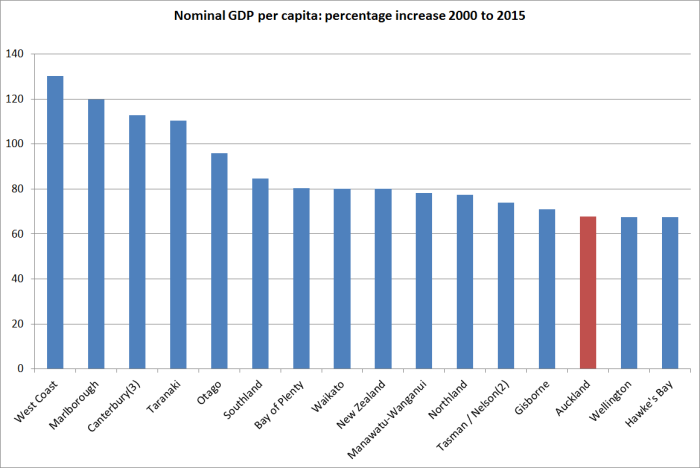
My post follow-up post yesterday on Auckland’s surprising weak performance in the regional nominal GDP data over the last 15 years prompted a reader to get in touch suggesting that changes in the terms of trade over the period were sufficient to explain why the provincial areas generally seemed to have done well, and Auckland and Wellington had not.

I had been conscious of the possible role for terms of trade changes in explaining the patterns –  these, after all, were nominal GDP data, and ideally we would have liked real series – but hadn’t gone much beyond that.

To see the issue, I’ve set up a very simple stylized version of New Zealand.  This New Zealand has just two, highly stylized, regions.  One produces all the foreign exports of the country (Region A), and the other (Region B) generates lots of domestic services, many of which are supplied to Region A.  You could think of these services as being banking, electricity generation, advertising or whatever.  And each region produces lots of stuff that is consumed within its own region, and each also assumes the same amount of foreign imports.  Both regions have GDP of 500, and Consumption of 500.  (For this little illustrative exercise, I’m just assuming away investment, and any current account deficits/surpluses.)

Region A Region B NZ
Consumption 500 500 1000
Exports 200 0 200
Services trade within country -100 100 0
Imports -100 -100 -200
Nominal GDP 500 500 1000

Now what happens if the terms of trade double?

It depends greatly on whether import or export prices change.

Export prices double:  Region A  Region B  NZ
Nominal GDP 700 500 1200

If foreign export prices double, then the value of region A’s exports will jump from 200 to 400, and the value of nominal GDP in region A will increase to 700.   Region B’s nominal GDP is unaffected (it doesn’t export anything internationally).  Over time, if the higher prices are sustained, it is likely that there will be other consequential changes: consumption in A will tend to rise, and with it both foreign imports and purchases from region B.  But the shock has clearly favoured region A, raising its nominal GDP relative to that of region B.

But what if the terms of trade double through a halving of import prices?

Import prices halve  Region A  Region B  NZ
GDP –  zero pass-through 550 550 1100
GDP – full pass-through 500 500 1200

The immediate impact depends in part on what happens to domestic prices.  If import prices halve, and none of that is passed through to consumers, nominal GDP in both regions will rise by 50 (the size of the reduction in the import spend).  If the lower import prices are fully passed through to consumers, nominal GDP won’t change at all  in either region (lower consumption prices will offset the lower import spend).  Again, over time the gain in the terms of trade will affect behavior (presumably there would be more consumption, and perhaps a higher volume of imports), but for these purposes all that matters is that the shock has hit the two regions equally.

This is all deliberately highly stylized, and says nothing about actual New Zealand (although you might be thinking that somewhere like Auckland might resemble region B and Southland or Taranaki might resemble region A: in the most recent year for which we have detailed industry breakdowns, 13 per cent of Auckland’s GDP was from primary sectors and manufacturing, while 56 per cent of Taranaki’s was).

The terms of trade increased very substantially in New Zealand from 2000 to 2015 (March years), the period covered by the regional GDP data.  The increase over that period was 31.7 per cent.

But most of the gain has been realised in the form of lower import prices.  Export prices have increased, in New Zealand dollar terms (and the nominal GDP series are NZD series), by only about as much as the consumption and investment deflators.  What stands out is that import prices have fallen by 4 per cent over 15 years.  What has been going on?

national acs deflators

First, the real international prices of a lot of imports have been falling –  a beneficial effect of the rise of China and other emerging manufacturing centres.   And, second, the exchange rate has risen very substantially over that period (up 33 per cent on the Reserve Bank’s TWI measure).  Global prices of many of New Zealand’s exports certainly rose over that period, and New Zealand as a whole was better off as a result, but the higher exchange rate meant that, on average, export-focused regions didn’t get the gains of the higher terms of trade (nominal GDP in those regions wouldn’t have risen systematically faster than that in less export-oriented regions).  If we take the six components of the ANZ Commodity Price Index over the 2000 to 2015 period, meat and dairy prices rose modestly in real NZD terms, while the other components (horticulture, seafood, aluminium and forestry) saw falls in their real NZD prices over the full 2000 to 2015 period.    Much of this process is discussed at greater length in an Analytical Note published by the Reserve Bank a couple of years ago.

Instead, the terms of trade gains came mostly in the form of cheaper real import prices, benefiting people in all regions (including Auckland).

Ideally, we would still like to have region-specific GDP deflators.  In some regions with a heavy weight on dairy exports, the rise in the terms of trade may help explain with that particular region’s nominal GDP per capita has done quite so well relative to Auckland’s over this particular 15 year period but (a) the rises in real NZD dairy prices over the full period weren’t that large (around 15 per cent, if deflating with the private consumption deflator), and (b) even in the Waikato total agriculture is only around 10 per cent of GDP).  The differences in GDP per capita growth rates across regions (illustrated in yesterday’s post) swamp anything that can be explained largely by terms of trade effects.

Wellington-boosters (such as the dreadful Wellington City Council, its “economic development” agency, and the myriad of “booster” mayoral candidates) probably take some consolation from the fact that, according to the regional GDP data, if Wellington hasn’t been doing overly well, at least it hasn’t done much worse than Auckland.  I’m not sure they should take such comfort.  Over this 15 year period, the private consumption deflator has increased by 31 per cent, but the government consumption deflator has increased by 51 per cent.  The production of government consumption goods makes up a great deal of economic activity in Wellington  (“public administration, defence and safety”  is around 11 per cent of Wellington’s GDP and 3 per cent of Auckland’s).  If we had real per capita GDP data for the regions, Wellington might be lagging even more  –  and specifically further behind Auckland –  than the nominal data suggest.

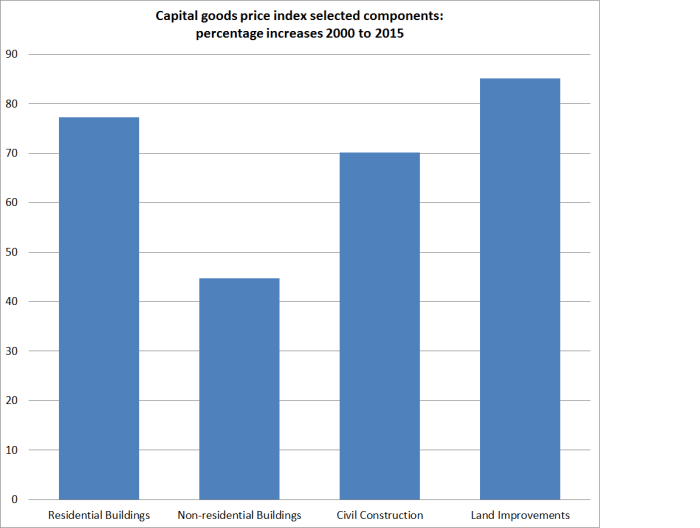
On the other hand, I wondered if there was at least one factor overstating Auckland’s performance.  In the national accounts deflators, the deflator for residential investment increased by 85 per cent over the 15 year period, while the private consumption deflator had increased by only 31 per cent.  And it isn’t just residential construction activity that has seen large price increases: here are the construction-related components from the Capital Goods Price Index for the same period.

cgpi

Surely, I thought, Auckland’s rapid population growth over this period (see earlier posts) would have meant a larger share of Auckland’s GDP was in construction-related activities.  If so, the higher inflation rates for these sectors would tend to boost nominal GDP.

We only have detailed industry breakdowns by region to 2013, but I was a little surprised that when I calculated the average share of construction in each region’s GDP over 2000 to 2013 this is what I came up with.

construction share of gdp

Auckland has certainly had a lot more construction activity (share of GDP) than Wellington, but beyond that I have no idea what to make of the results.  They don’t seem very plausible numbers,  but then SNZ collects the data.

There is no point putting too much weight on regional nominal GDP data.  But they do throw up some results that were unexpected (at least by me), and the apparent underperformance of Auckland over this particular 15 year period doesn’t seem easily able to be explained away simply by the effects of terms of trade changes. (Even if it could, it might be troubling that so many people were gravitating to a region that  – the market was signalling –  relative price changes were not favouring.)

And, to repeat a point I made yesterday, there is no necessary reason why simply putting more people in Auckland would raise the productivity of the city.  To those who assure me that agglomeration economies are real, I respond, well, yes, of course.  The question is not, and has never been, whether many (although not all –  see natural resource extraction) high value functions/industries/activities function most productively in big cities.  The economics of agglomeration helps describe why big cities exist.  But the question –  an analytical one, but one New Zealand practical policymakers need to think seriously about –  is whether Auckland is one of the places where firms undertaking many increasingly high value activities will increasingly choose to cluster.    There is no necessary reason why it should be.  Most places aren’t.  There are reasons why there aren’t half a million people in Invercargill or Launceston –  or Helena, Montana or Kearney, Nebraska .  Wishing it were otherwise does not make it so.

There seems to be a strong element of wishful thinking (or “build it and they will come”) about the policymakers’ (and their advisers’) Auckland story.  One could mount an argument –  not necessarily a fully compelling one, but one with substantial elements of truth to it –  that Auckland’s current relative size is largely a function of two big policy interventions.  The first was the high level of manufacturing protectionism that prevailed from the 1930s to the 1980s. Manufacturing firms all over the country benefited, but if one was producing things just for the local market, being in the biggest city made a lot of sense.  The South Auckland manufacturing base grew up during that period.  And the large scale immigration programmes ended up with the same effect, boosting Auckland’s population dramatically (particularly as immigration became increasingly non-Anglo), and generating a deal of economic activity in non-tradables sectors simply to support the infrastructural needs (broadly defined) of a rising population.  But there has never been any sign that Auckland is a location that has the economic opportunities that encourage the growth of new high –productivity industries successfully taking on world markets.  New Zealand’s export base remains overwhelmingly natural resource based –  dairy, wool, meat, fish, oil and gas, gold, wine, forestry, and tourism (most of the appeal is the landscape not the great art or glorious cathedrals).

I’d really like to be wrong, but where is the evidence that incredibly strong population growth in our major city, fuelled largely by immigration policy (New Zealanders, net, have tended to be leaving Auckland, not drawn to its great opportunities), is generating the national benefits the advocates would claim for it?  At present, it looks as though this Think Big strategy is perhaps even more flawed than the 1980s energy version (fortunately called to a halt quite quickly) was.


A question for Steven Joyce

A reader pointed me to an article on the NBR website in which Science and Innovation Minister [isn’t there something wrong when we even have a government “innovation minister?]  was quoted as telling a business audience yesterday that:

more migration is the only way to bridge the current skills gap for ICT companies in New Zealand.

and

“That’s one of the reasons I’m leery of calls to halt immigration – apart from the fact there’s not much reason to because of the economic gains,” he said.

In the last fifteen years, we have had huge waves of immigration,  under both governments, and yet there is not the slightest evidence of economic gains accruing to the New Zealand population as a whole.  Tradables sector production per capita has gone nowhere in fifteen years, productivity growth has been lousy, and there is no sign of any progress at all towards meeting Mr Joyce’s own government’s (well-intentioned but flawed) exports target.

And yet the Minister’s answer is even more immigration.

My simple question to Mr Joyce would be along the lines of “what evidence can the Minister point to suggesting that the very high rates of immigration to New Zealand in recent decades have done anything to lift productivity in New Zealand, or lift the average per capita incomes of New Zealanders?”.

MBIE officials and Ministers of Immigration talk of immigration as a “critical economic enabler”, but in the papers they released last year, there was nothing remotely akin to evidence that the programme has enabled anything very much –  we have a bigger New Zealand as a result, but no evidence that it is a richer or more economically successful one.  Mr Joyce and the other MBIE ministers have huge resources, staff and budgets, at their disposal.  Surely they should be able to point to clear demonstrated economic gains for New Zealanders as a whole from such a large government intervention.  Our non-citizen immigration programme is already one of the largest (per capita) in the world.  Citizens might reasonably ask for evidence that such an outlier programme has benefited them before considering calls from Ministers for “even more immigration”.

In the last 100 years of New Zealand economic policy history there has been a weird disinclination to trust New Zealanders and their ability to take on the world and succeed themselves.  The Labour Party from 1938 put in place huge protective barriers, as if we could only prosper by turning inwards and producing everything from tennis racquets, TVs, and cars here just for the domestic market.  It took decades to unwind that policy.  And for the last 25 years, National and Labour governments have seemed discontented with the New Zealand population, and the skills, energies and expertise of our own people, turning instead to large scale immigration programmes as some sort of enabler/transformer.  25 years on, there is no more evidence that this unfortunate experiment has been much more beneficial to New Zealand than the protective barriers of earlier decades (or for that matter the Think Big programme of an earlier rather-too-interventionist National government).

But perhaps Mr Joyce can point us to the evidence that guides his interventions?

The Reserve Bank on immigration and the labour market

Four months ago, in the December Monetary Policy Statement the Reserve Bank indicated that they believed that the surge in immigration over the last few years had eased capacity pressures and contributed to a reduction in inflation.  That was a view quite contrary to their own past research, or to the historical consensus of New Zealand economists that – whatever the long-term economic effects of immigration –  in the short-term the demand effects outweighed the supply effects.

The Bank might be right, but they provided no analysis or background material in support of their change of view.  So I asked for the background material. Almost two months ago they refused to release any of that material.  I have appealed that decision to the Ombudsman, and was pleased have an indication from the Ombudsman’s office yesterday that they are about to investigate it (less than two months after the complaint was lodged, suggesting that the new Ombudsman really is making progress).   At the time, the Bank indicated that it had other material that might shed light on the Bank’s view on immigration that was being worked on with a view to later publication.

Two such papers were released finally yesterday, accompanying an on-the-record speech by the Bank’s Deputy Governor, Geoff Bascand, “Inflation pressures through the lens of the labour market”.  It was a little curious to have a speech on such a major economic topic given by someone who is, in effect, the Bank’s chief operating officer.  Bascand has responsibility for things like notes and coins, property and security, HR, IT,  and NZ Clear (and chairs the Bank’s ill-governed and troubled superannuation scheme).  But, of course, he does have a background in economics and, having taken a step downwards in becoming Deputy Governor, is generally assumed to see himself in the running to be the next Governor, perhaps as early as next September.

It was a curious speech. The accompanying press release –  designed no doubt to highlight the key messages – begins with the claim that “rapid growth in the workforce…has helped create strong economic growth over the past four years”.   GDP growth in the last four year has averaged 2.85 per cent per annum.  I know it is an age of diminished expectations, but if that is “strong”, I think my dictionary needs updating.

strong growth

Despite the (alleged) biggest immigration surge in 100 years, neither average nor peak growth got anywhere near the levels reached in the previous couple of cycles.

Between the speech, press release, and the Analytical Notes, the Bank is clearly going to great efforts to stress the line that this is “the largest recorded surge in migration in 100 years”.  In particular, they want to have us believe that this event is bigger than the surge of immigration over 2002/03.  But they know that is simply not true.  In some places they are more careful, and only claim that it is the largest net inflow of (self-recorded) permanent and long-term migrants, but even then they know that those numbers do not always represent very well the actual net inflow of people (total, or even just those who stay for more than a year –  the PLT vs visitor threshold).

Why do I make this point so strongly? Because when I was at the Bank, and with the full knowledge of senior Bank managers, in 2014 I prompted Statistics New Zealand to produce Alternative methods for measuring permanent and long-term migration.  The issue arose from something like this chart

movements-migration

It illustrates that over 2002 and 2003 in particular there had been a huge divergence between the self-reported PLT numbers and the (accurate) count of the overall net flow of people into New Zealand.  Many more people (net) came in –  all needing a roof over their head –  than had said they were intending to stay for a year or more.

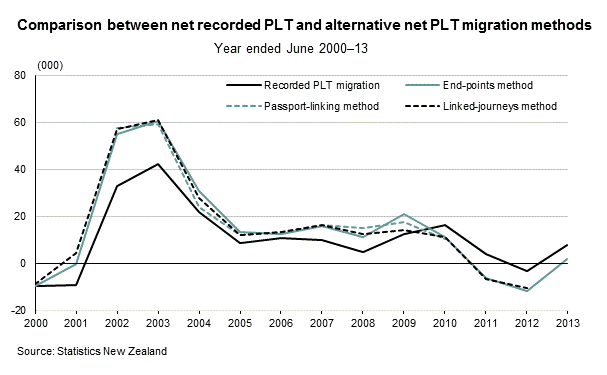
Statistics New Zealand had done nice work, using several different methods, to estimate what actually happened  (eg did the person actually leave the country again, or come back, within 12 months, even though they said they were PLT).  And they produced this chart.

plt-methods

Net PLT inflows in  2002 and 2003 proved, using these techniques, to be 50 per cent higher than the initial monthly data had suggested.  New Zealand’s population was around 4 million in 2003, and is around 4.6 million now.  Even just focusing on PLT numbers, the population surge resulting from immigration was just as large then as it has been over the last year or two.

And yet there is not a single mention of this work, or this issue, in any of the material that the Reserve Bank put out yesterday.  It is unfortunate that (a) the estimates go back only to 2000, (b) they are only annual (c) that SNZ has no money to do this work on an ongoing basis, and (d) that inevitably these better estimates have a 12 month lag on them.  But it is simply materially better information about immigration over the last 15 years, produced by our national statistical agency, than is in the monthly data the Bank makes so much of.

The total (net) arrivals data are noisy –  eg changing timing of school holidays, and/or major events such as Lions tours or the Rugby World Cup can add a lot of noise –  but here are the PLT and total net arrivals series (rolling annual totals) for the last 20 years or so.

plt vs total

There isn’t a lot of noise around 2002/03, or in fact around the current period.  And the  patterns over time are not necessarily typically different.  But there were simply somewhat more people coming into New Zealand (net) in 2002/03 than there have been in the last couple of years, and as percentage of the population the difference is even larger.  The immigration surge in the last couple of years has been big, but 2002/03 was simply a bigger event.    Here is the same chart shown as percentages of the population.

plt vs total per cent of popn

The Reserve Bank knows all about this. It is strange, almost inexcusable, that it is not even mentioned.  Not explicitly recognizing the issue undermines the confidence we might have in the rest of their analysis and interpretation.

What of their two Analytical Notes?  The first, by Tugrul Vehbi, a recent recruit from Treasury (his bio says he joined in Dec 2015, so clearly this wasn’t analysis that fed into the December MPS view) tries to look at “The macroeconomic impact of the age composition of migration”.  Using data for only the period since 1994 (so in effect only about 2.5 cycles) he constructs a small model to look at how several key economic variables respond to net migration by, on the one hand, those aged 17 to 29, and on the other hand those aged 30 to 49.  It isn’t entirely clear why he divides the groups where he does (or, hence, whether any results are sensitive to slightly different classifications). Loosely, I suppose he is distinguishing between the “young” (but independent) and the “not young”.  For the same sized shock, he produces results which –  with wide error bounds – suggest that the net demand effects of increase in immigration of 17 to 29 year olds are less than those for the 30 to 49 year olds.  In the current cycle, there has been a disproportionately large increase in the net inflow of 17 to 29 year olds.

I have several problems with the analysis.

The first point relates to the earlier discussion, and the apparent material underestimation of the PLT inflow (in the monthly data the Bank uses) over 2002/03.  It is generally recognized that much of that issue related to students (typically in Vehbi’s younger age group).  As this chart shows, drawing from MBIE visa approvals data, there was a huge increase in the student visa numbers granted over that period.  Since his estimation effectively uses only a fairly short run of data, only 2.5 of so cycles, mis-measurement in the biggest of those cycles is a potentially severe problem.

student visas

Related to the small sample problem, the (one standard deviation) error bounds on his estimates are sufficiently large (see Figure 3 in the paper) that we can’t say with any confidence that the effects are different between the two age groups, even if all the immigration data are correctly measured.   Moreover, Vehbi runs an useful alternative estimation leaving out the last couple of years data, and although he describes the effects as “qualitatively similar” in the two runs (and no error bounds are shown for the alternative), for at least some of his series (residential investment and consumption) the quantitative effects are quite materially different.

But perhaps a more important effect still is that he simply looks at the two ages ranges 17 to 29, and 30 to 49.  In most cases, we can probably think of the actions of 17-29 year olds as being independent of other age groups (eg they won’t be coming with children –  or parents for that matter).  The same can’t be said of people in the 30 to 49 age group, many of whom will be bringing children with them.   You can see that in this chart, going all the way back to the 1970s, and simply using the PLT data (with all its weaknesses, as discussed above)

net plt by age

All the main age range groups cycle together to some extent, but the 17-29 year old group behaves materially different from the 0 to 16 and 30 to 49 age group in particular. In the early decades, most of the net migration outflow was young people, and right now much of the net inflow is.   But the key point is that when the 30-40 age group numbers increases there is almost always a very similar sort of increase in the inflow of 0 to 16 year olds (as one would expect, children mostly come with parents).  But if you test how the economy responded when 17-29 year old inflows increases and compare that with a same sized shock to the 30 to 49 age group, of course you should see large net pressures on resources from the older age group, because you are ignoring the fact that these people bring with them a lot more people (the kids).  Kids don’t add anything much to labour supply, but they need housing, schooling and the other basic necessities of life.  The model might be better rerun comparing, say, the impact of a shock in the 17 to 29 year old inflows with the impact of a shock to the other age groups taken together (or even just the 0 to 16, and 30 to 49 age groups together.

It is (always) good to have the Analytical Note out.  But the measurement problems around PLT numbers (which SNZ themselves recognize), the short sample, and the failure to allow for kids who accompany the older people means we can’t really have much confidence in the results at all.

Is it credible that the young (17 to 29, say) migrants could have a materially different impact on net capacity pressures than other age groups?  In principle, it is possible.  Take a scenario in which all the young were working 60 hours a work, living in extremely cramped conditions, and remitting most of their earnings home. In that scenario one would certainly expect quite weak pressures (perhaps even negative) on inflation. Perhaps that describes illegal Latin Americans in the US, or even the stereotyped Polish plumber in the UK?

But about as many of our young PLT migrants arrive as students, as come on work or residence visas (and many more shorter-term arrivals, all consuming and not able to work legally, are students).    The Reserve Bank makes quite a bit of the change in policy allowing students limited work rights in New Zealand, but even under that policy most students only have a legal right to work 20 hours a week, and then only under certain conditions.   But even if all the students could work, it is still only 20 hours week –  roughly half what a typical full-time worker will do (or the same as a couple raising kids, in which one parent works fulltime and another is at home).  And the students still have to live, pay tuition etc, all of which puts pressure on New Zealand resources (export earnings, so generally welcome, but demand nonetheless).

Perhaps the fact that our current migrants are disproportionately quite young does result in less net demand pressure per migrant. (And it is quite plausible that students put a bit less pressure on resources than they once did.)   But on the information presented so far, at best it is “case not proven”.

The other new  Analytical Note is “Why drivers of migration matter for the labour market”. One of the authors is Chris McDonald, author of a 2013 piece illustrating the way the net migration inflows to New Zealand have typically added materially to inflation pressure.

In the new paper, the authors set up a very small model in which they try to distinguish between net migration flows that result from fluctuations in the strength of the Australian labour market from those arising from other factors (eg changes in New Zealand immigration policy).  In their model, the latter sorts of flows have the conventional expected effect on domestic demand and inflation pressures – higher migration inflows, for example, lower the unemployment rate.  But

a higher Australian unemployment rate that generates positive net immigration [to New Zealand] typically coincides with a higher New Zealand unemployment rate.

But –  as the authors acknowledge as a possibility in their final paragraph –  mostly what this is telling us is that New Zealand and Australian economic cycles have tended to be quite correlated and that Australia affects New Zealand through a variety of channels.  Australia is our largest trading partner (and largest source of FDI) so that when the Australian economy is weak (proxied in this model by an “unemployment gap”) economic activity here is also, to some extent, adversely affected.   As I’ve noted here previously, it has never been clear what the net effects of an Australian slowdown on New Zealand are: we face some losses of demand in our direct trade (and probably investment, if Australian firms rein in their investment spending), but on the other hand when Australia slows we get fewer New Zealanders (net) going to Australia.  That adds to demand here.  The net effect is clearly different from, say, the net effect of an exogenous immigration policy change (say targeting 20000 more permanent residents from other countries), but it isn’t necessarily that the effects of the migrants themselves is any different. When they get here, they still need houses, schools, shops, roads, factories, and they can supply some labour. Capital stock requirements are typically more than a year’s labour, so generally short-term demand effects  from the migration choice typically exceed supply effects.  It isn’t clear to me that McDonald and Armstrong have really (even attempted) to show that those effects are different across the two classes of migrants.  Of course, if all they are saying is that there are offsetting shocks –  weakness in Australia’s economy offsets the demand effects of the resulting migration choices, then I can happily agree.

In the end there is little reason still to depart from the longstanding consensus of New Zealand economists, going back many decades, and of the Reserve Bank’s own past analysis (formal and otherwise) over more recent decades, that net migration inflows put more pressure on demand than on supply in the short-term.    But if major trading partners are weak at the same time, an upsurge in net immigration won’t typically be a basis for tightening monetary policy and worrying about inflation.

There is a more material on other topics in Bascand’s speech, and another whole Analytical Note on other labour market issues which I haven’t read yet. I might come back to them next week.


Universities,export education and immigration

I’ve made a few passing comments in recent weeks about New Zealand universities, mostly in the context of discussions and debates around immigration.  Export education is one of the key emphases of the current government’s economic strategy; they and their MBIE advisers appear to believe that somehow we boost the incomes of New Zealanders by making it relative easy for people who come to study here to gain residence.

I’ve been a bit skeptical about this argument.  If there are economic benefits to New Zealanders from immigration to New Zealand, they probably arise mostly if we are able to attract particularly high-skilled, able and innovative people.  In a US context, people often talk of the benefits of having a top tier university system, which attracts top-flight students to do PhDs in the US and can help encourage some of those people to settle in the US, with possible spillover benefits to the wider economy.  It all sounds good in principle, and there is some evidence of those sorts of gains for the United States.

But what about New Zealand?  Well, I noticed that one set of international rankings of universities (the QS rankings) had been released earlier this month, and I started digging round in their data.  There are a number of different rankings systems, and they all produce slightly different results, emphasizing slightly different things.

On the QS rankings, here are the top 10 world universities

1 MIT
2 Harvard
3= Cambridge
3= Stanford
5 Caltech
6 Oxford
7 University College, London
8 Imperial College. London
9 Swiss Federal Institute of Technology
10 Chicago

New Zealand universities just aren’t in the same league as these sorts of places.  But how do our universities compare with those of other small advanced economies?

I painstakingly went through both the QS rankings and the Times Higher Education rankings for New Zealand and all the smaller OECD and EU countries, plus Singapore.  “Small” in this context meant fewer than 11 million people (Greece, Belgium and the Czech Republic are all just below that population).  There is quite a gap to the next smallest country, the Netherlands, with almost 17 million people.  New Zealand’s population is around that of the median country.

I took the average ranking for each of the universities in each of these countries, for both the QS and Times rankings.  Across the two sets of rankings, New Zealand’s universities turn out to be right on the median among these small advanced economies. The really lowly ranked systems are those of the former Eastern bloc Communist countries (notably Bulgaria, Croatia, Hungary, Latvia, Lithuania and Slovakia).

But New Zealand’s economic performance is also less impressive than most of these advanced economies.    There is a reasonable correlation between the two.  Here I’ve shown the average university ranking for each of these small advanced countries against real GDP per hour worked for 2014, taken from the Conference Board’s database.  New Zealand is highlighted in red.

universities.png

New Zealand doesn’t seem to do too badly, but we don’t stand out.  (The outliers on the right are Luxembourg and Norway).

If we don’t stand out, it is a little hard to see why top-tier foreign students would be keen to come and do PhD (and subsequent post-doc) study in New Zealand.   We will always attract some people –  and being an English language country helps us attract more foreign students than one might expect given our size and distance –  but not many of them will be from the top tier of potential students. It is those top tier students from whom the strongest contributions are later made –  and usually only from a relative handful of them.  And for almost all of those people, the top universities in the US or the UK (and a handful of others, in Switzerland, Singapore, or perhaps even Australia) will overwhelmingly be the destination of choice.

Perhaps for some these sorts of numbers suggest a strategy: “lets make our universities great, and then we’ll attract top tier students, who in turn might stay and help lift New Zealand’s economic performance”.  I suspect that if there are any causal relationships here, they are mostly the other way round.   Top universities are as much consumption goods as production ones, and luxury products tend to be found in the richest and most successful countries.  The United Kingdom and the United States have long been the richest and most successful countries and they have university systems that reflect that (the UK isn’t that large a country but has around 15 universities in the top 100).  Among the smaller countries, Switzerland and the Netherlands  have  also long been among the most prosperous countries, and also stand out with relatively high-performing universities.

No doubt, causation runs both ways –  top universities are a magnet for talent and in some cases that talent can be part of the process of innovation and economic advancement –  but it seems most unlikely that one can first  create the top tier university and then see the prosperity follow. That is perhaps especially so in somewhere as small and remote as New Zealand.   What would make top tier foreign academics, in large numbers, want to come and stay in New Zealand?  Perhaps money might do it for some, but even if governments were to make the money available, backing this as some new “growth strategy”, I rather doubt it could be a sustainable strategy.  Distance is simply too formidable an obstacle.

As I was playing around with this material, I was thinking of the New Zealanders who had worked at the Reserve Bank in my time there who had gained PhDs.  A few have pursued them at New Zealand universities –  several are at present – because it enables part-time study and fits with family commitments etc.  But I jotted down a list of 14 people I could recall who had done PhDs overseas, mostly after leaving the Bank.  Most went to the US or UK, and all of those went to top tier universities (LSE, Cambridge, Berkeley, Stanford, Chicago, Yale, Princeton, Harvard, NYU).  Even the two who did PhD study in Australia did so at universities rated materially higher (overall, and in economics) than any of New Zealand’s universities.  These were all very able people, and the revealed preference in their choices suggests that universities of the quality of those in New Zealand (middling by international standards) are most unlikely ever to attract any material number of the sort of exceptionally talented creative people from abroad around whom one might reasonable begin to build an immigration policy.

PhDs aren’t everything, and lots of highly creative people have no interest in that particular sort of field of endeavor, but it just helps illustrate the point about how difficult it is more generally for a small remote country, with mediocre incomes, to attract the world’s best.  In my view, we are much better focusing on building a prosperous and successful society around our own people, as capable and hardworking as any in the world.

But, by all means, put in place a facility akin to the US one for people of ” extraordinary ability”. Here are the requirements for one set of fields:

Proving extraordinary ability in science, education, business or athletics:

The applicant can submit evidence of receipt of a major international award such as the Nobel Prize, Olympic Gold Medal or at least 3 of the following:

  • Receipt of nationally or internationally recognized award
  • Membership in organization that requires outstanding achievement
  • Published materials about the applicant in professional or major trade publication
  • Judgment of the work of others
  • Original scientific or scholarly work of major significance in the applicant’s field
  • Evidence of authorship of scholarly work
  • Evidence that he or she has been employed in a critical or essential capacity at an organization with a distinguished reputation
  • Has commanded or will command a high salary in relation to others in the field
  • Other comparable evidence

If we can attract these sorts of people, New Zealanders might well benefit.  We probably wouldn’t get many, but who knows.  And large numbers aren’t really the path to prosperity; mass moderately-skilled immigration hasn’t been any sort of successful economic lever in New Zealand in the last 25 (or 70 ) years.


Cross-party support for high immigration policies

My post yesterday about the Prime Minister’s immigration interview at the weekend prompted a few comments from people keen to pin the responsibility for the current policy on John Key and offering thoughts on what electoral motives National might have for favouring high rates of non-citizen immigration.

Now, of course, any incumbent government (especially one that has held office for more than seven years) must accept some responsibility for current policies.  Especially on matters that don’t require legislation, if they didn’t like the current policy, they could have changed it.

But, as I’ve pointed out on various occasions, current policy is not some bold new innovation of the current government.  It is, more or less, a continuation of the policies of previous governments since at least the start of the 1990s.  A couple of weeks ago, I linked to the 2014 immigration policies of the various smaller parties, not one of which suggested any material disquiet with the regime. (I didn’t link to the 2014 Labour policy, and they now appear to have taken down their 2014 policies, but here is a 2014 summary of the various party immigration policies. Labour seemed then to favour more use of immigration policy in a counter-cyclical way, but there is no obvious disquiet with the overall target levels.)

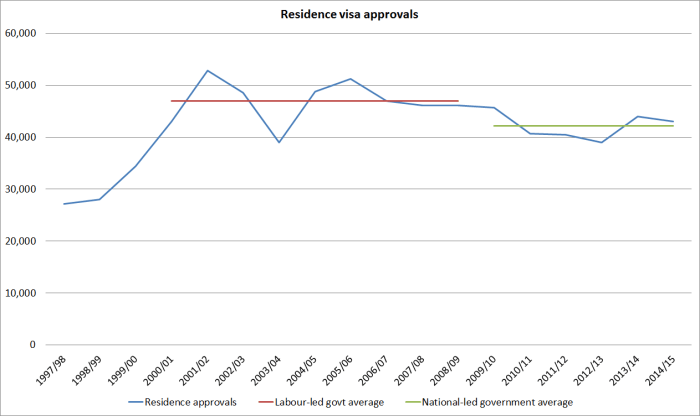
And what of the practice?  The MBIE website has a series for residence approvals for each year back to 1997/98.  Here is a chart of that data, including averages for the previous Labour-led governments (2000/01 to 2008/09) and the current National-led governments (2009/10 to 2014/15).

residence approvals

The target number of approvals (45000 to 50000 per annum) has not changed from one government to the other, and the average number of residence approvals has actually been slightly lower under the current government than it was under the previous government (probably largely reflecting the fact that labour market conditions have been more difficult in recent years).  As the population is now 20 per cent larger than it was in 2000, annual residence approvals as a share of the existing population are now quite a bit lower than they were back then (albeit still very high by international standards – roughly three times, per capita, legal immigration to the United States).

There have been plenty of refinements of policies over time –  some for the better, others not.  We’ve had changes in the eligibility for parent visas, changes in the points offered for people moving to places other than Auckland, and an increased orientation in granting entry to people with specific job offers (an approach criticized – I think rightly – in the new Fry and Glass book).  But the overall approach to residence approvals has had much more continuity than difference from one government to the next.  And only people who get a residence visa can stay here permanently.

What of some of the other visa types?  Foreign students are a reasonably significant export market, and if there has been some (material) change in policy over the granting work rights to longer-term students while they are here, overall student visa numbers haven’t changed much from one government to the other.

student visas.png

Ideally, one might have hoped that we’d be seeing more students than 10-15 years ago, but mediocre universities and a high exchange rate are obstacles to that.

The number of working holiday scheme visas granted has increased hugely.

whs visas

But (a) if you didn’t know the dates of the change of government, you couldn’t tell from the chart, and (b) much of the more recent expansion of working holiday programmes seems to have been in pursuit of votes for the Security Council seat, a goal shared and pursued by both main parties.  Moreover, although 60000 visas were granted last year, these people are typically only in New Zealand for a few months.  I don’t have any strong views on working holiday schemes, although in papers released last year, even Treasury expressed some unease.

The number of people granted work visas has also trended up very strongly –  most strongly when the unemployment was very low –  over the period since 1997/98.

work visas.png

But again, there is no obvious difference between the experiences under National and Labour led governments.  Much of the trend reflects the change of approach under which most people who obtain residence visas do so from within New Zealand. In the 1990s, most people who got residence visas did so directly from abroad, but now the most common model is for someone to come on a work (or student) visas, get established in a specific job here, and then apply for a residence visa.  That aids the integration of the people who do come but, as Fry and Glass note, may not help attract the very best people.

The point of this post so far has been to illustrate the substantial continuity, and commonality of approach, from one government to the next.

But on the off chance that anyone thinks ‘but Winston is different’, recall that Winston Peters was Deputy Prime Minister and Treasurer in the National-New Zealand First government from 1996 to 1998, and was Foreign Minister in the Labour-led government of 2005 to 2008.

I tracked down a copy of the (very long) 1996 coalition agreement between National and New Zealand First.  Immigration policy is dealt with on page 45. Here is what it said:

Statement of General Direction:
The goal is to have an immigration policy that reflects New Zealand’s needs in terms of skills, ability of the community to absorb in relation to infrastructure and recognising the diversity of the current New Zealand population. Such a policy will take into account the capacity of this nation to meet the general economic and social needs of New Zealanders.

Key Initiatives of Policy:

To maintain current immigration flows as per the last quarter of 1996 until the Population Conference has been held in May 1997.

  • Introduce a strict four year probationary period.
  • Introduce a limited overstayer amnesty following agreement upon appropriate definition and objectives of the amnesty
  • Health screening of overseas visitors.
  • Population Conference/strategy.
  • Clamp down on refugee scams.
  • Increased resources to policing immigration policies

Whatever you make of the specifics, it doesn’t have the ring of something dramatically different from what had gone before (or what came after).  (And for those of a historical bent, here is the programme –  with comments from the then Prime Minister and the then Minister of Immigration –  for that Population Conference.)

By 2005, confidence and supply agreements were rather shorter, but this is what the Labour-New Zealand First agreement said about immigration

Immigration

• Conduct a full review of immigration legislation and administrative practices within the immigration service, to ensure the system meets the needs of New Zealand in the 21st century and has appropriate mechanisms for ensuring the system is not susceptible to fraud or other abuse, and taking note of other items raised by New Zealand First.

Again, not suggesting any very material changes of policy.

Of course, minority parties have to prioritise.  My point is only that over 25 years in practice our high levels of inward non-citizen migration have been the result of a widely-shared consensus among our political parties (and bureaucrats). Some might have been zealous for it, and others just not that bothered.  Perhaps that outcome has been a good thing, leading to real economic gains, or perhaps not (it would nice if the advocates could show us the evidence of those gains), but it certainly isn’t a Key innovation.


No, Prime Minister

The Prime Minister was also on TV3’s The Nation last weekend.  Most of the interview was about immigration.

Late last year, I wrote about some earlier, probably rather off-the-cuff, remarks that Key had made about immigration, in which he described the recent high net migration inflows as a “time of great celebration”.

The TV3 interview was a rather more substantial occasion (The Nation isn’t exactly a mass market programme), and it was about the issues, not just an opportunity to attack his political opponents.  The Prime Minister will no doubt have been briefed for it by his own DPMC officials, and perhaps also by MBIE, the government department responsible for immigration (administration and policy).  And yet I was surprised just how insubstantial his answers were, and a little alarmed at the central planner’s mentality that they evinced.  On Radio New Zealand yesterday, Matthew Hooton described the current government as the most interventionist since the 1970s.  That mentality was fully on display in John Key’s interview.  I had to watch the interview again to be sure that I had correctly heard a Prime Minister from an avowedly centre-right party declare that there was an optimum number of (immigrant) truck drivers.

I was pleased to see that the interviewer kept the focus on the flows of non-New Zealand citizens.  New Zealand can’t, and shouldn’t try to, control the comings and goings of New Zealand citizens.  We can’t even, and shouldn’t try to, control the outflows of non-New Zealand citizens –  the people who come and, after a time, find that New Zealand isn’t quite right for them, or just find an even better opportunity somewhere else.    But every inflow of a non New Zealand citizen requires the approval of the New Zealand government  –  that is what immigration policy is about. (As a matter of policy, we allow any Australian citizens to move here without advance approval but (a) that is still a New Zealand policy choice, and (b) the numbers involved are pretty modest (over the last 40 years the annual net inflow of Australians has fluctuated between 0 and 3500)).

The Prime Minister, of course, was keen to emphasise the fall in the net outflow of New Zealanders.   In the data released yesterday, there was still a net outflow of 3890 New Zealanders to Australia over the last year.  That is, by the standards of recent decades, a small net outflow, but the people who know New Zealand best  –  New Zealanders –  are still choosing to leave rather than to return (and to a country where real per capita income has been falling for the last couple of years, and hasn’t grown in seven years).  That should be telling the Prime Minister something.

The interviewer kept trying to push the Prime Minister to name an “optimal number” for the inflow of non New Zealanders.  He consistently refused to do so, asserting that there was no limit to number of arrivals he would be happy with “so long as they add value to New Zealand”.  Oddly, neither he nor the interviewer mentioned that actual government policy is rather different.  After all, there is a target level for the number of residence approvals granted (45000 to 5000o per annum), that target is approved by Cabinet, and the target has not changed for quite a long time.   Despite all the fluctuations in the number of foreign students, or short-term workers, the residence approvals programme is the main way in which immigration policy boosts the population over time. Broadly speaking, I think it is a sensible way to run immigration policy –  we shouldn’t be playing around with the target each year in the light of immediate pressure, but setting some medium-term targets and reviewing them from time to time.    But there was simply no discussion as to whether 45000 to 50000 is the best target, or how we might know.  Why not, for example, 30000 per annum more?  Or fewer?

In fairness to the Prime Minister, there was also nothing explicit along the lines often found in MBIE documents, lauding New Zealand’s immigration policy as a “critical economic enabler” or a “key lever” in economic strategy.  But he didn’t seem far from that either, but with equally little evidence.  He asserts that immigration is a source of growth, without ever being quite clear what he had in mind.

Everyone recognizes that increases in immigration boost demand, and tend to boost total GDP.  Bur our real interest should be in per capita or per hour worked measures, whether of GDP or of national income –  and, to be even more specific, in what, if any, gains there are to those who were already here.  From an economic policy perspective, immigration makes sense if it makes those of us who were already here better off.  But despite running one of the largest immigration programmes in the advanced world, neither the Prime Minister, nor his advisers in MBIE and Treasury, have been able to produce any evidence that New Zealanders as a whole have been made better off.  In his interview, the Prime Minister didn’t even try to make the case, to (for example) outline the channels by which he believes New Zealanders are being made better off.  (And, in fairness, the interviewer didn’t push him to do so.)

Instead, the Prime Minister seemed reduced to assertions that the high rate of immigration is a “sign of success” or even “a badge of honour”, asserting that people don’t want to come to countries that aren’t doing well.

It is surprising that anyone takes that line of argument seriously.  At the grim extreme, Turkey, Lebanon and Jordan –  none of them terribly well-performing – have been very attractive places to non-natives in the last few years.   They are simply (much) less bad than Syria.  But more generally, immigrants tend to move from poorer countries to richer countries, and for all its disappointing performance over 60 years or more, New Zealand still offers higher incomes than most of the countries of the world.  That people want to come here simply reflects what we already know, that New Zealand is better off than most places.  It sheds no light at all on whether New Zealanders are benefiting from the large scale immigration programme run by successive governments.  And that should be the question we constantly ask.

It is not as if this is some unimportant question: if New Zealand’s productivity growth or per capita income growth was outstripping that of all its peers there might still be an interesting question as to what contribution immigration was making to that outperformance.  But only a handful of people would care much –  there would be plenty of prosperity to go round.  But we’ve kept on underperforming for decades, despite the allegedly productivity-enhancing immigration programme.

And yet the Prime Minister is adamant that “we need these people”.

I’m not entirely sure why.  There are plenty of people around to offer cynical explanations of anything and everything John Key does.  Perhaps there is merit to that –  as for most politicians –  when it comes to tactical choices.  But the large-scale immigration programme seems to be one of those things which he genuinely believes in.

No doubt it helps that his official advisers (Treasury and MBIE) keep telling him we benefit from the immigration programme, even if they don’t offer –  or even really try to offer – any evidence of those benefits.  That inclination is probably reinforced by the fact that the global elites among whom he moves treat the benefits of immigration as almost axiomatic.

And I don’t suppose he has ever seriously engaged with the fact that, despite its poor productivity record, New Zealand has had some of the highest real interest rates in the advanced world for at least the last 25 years, or the possible connection from that (and the associated high real exchange rate) to the weakness of business investment in New Zealand, and the failure to make any progress towards his own government’s (well-motivated but questionable) goal of markedly increasing the export share of GDP.

But I suspect that a significant part of why Key supports such a large immigration programme is because he buys into the skill shortages story.  It was the only story that he used in the TV3 interview.  Employers tell MBIE, and those taking surveys, that they can’t find staff locally, and that if they can’t find staff it will impede their ability to grow their business.  MBIE certainly believes the story –  as I wrote about a while ago, it suffuses their annual report on migration trends.

What I find remarkable in this document, as in other MBIE immigration work I’ve seen, is the absence of any sense of market processes, and how the market might sort these things out.  For example, if there are excellent opportunities here which New Zealanders are simply ignoring in their rush to get to Australia, surely we’d expect real wages to increase here?    If that happened, some of the opportunities might disappear.  Some New Zealanders might change their minds about going to Australia.  Some people might regard more training as worthwhile, to better equip themselves for those higher-paying opportunities.  Some will switch jobs from less rewarding ones, to the ones where the returns are now higher.  Some people might work harder or stay in the workforce longer.  But not one of these market mechanisms is even discussed.  And this from a key economic agency, implementing the policy of a vaguely centre-right government?  Does it not occur to them that “shortages” don’t happen in most markets, and when they do they are usually just a sign that the price has not adjusted.  Why does MBIE think that labour is different?

Although MBIE and the government seem to see immigration largely as a labour market phenomenon (“a critical economic enabler”), the price of labour  “wages”  appears only once in the entire document (purely descriptively).  “Price” does not appear at all.  In fact, “productivity” and “competition” each appear only once, in neither case in the context of an analytical sentence.  “Labour market” does appear repeatedly, but almost always only descriptively.  There is simply no sense, anywhere in the document, of a competitive market process at work.  If one were being unkind, one might think MBIE saw the role of government as being to ensure that the right pegs were in the right holes.

And that seemed to be how the Prime Minister saw it, as he talked of the need to juggle which occupations were on, and off, the approved list, and never once talking about market adjustments, changes in wages etc.  In fact, it was where the comment about the optimal number of immigrant truck drivers came in –  apparently truck drivers have recently been removed from the list.

From an individual employer level it all makes some sense. Importing a foreign worker really can relieve an individual firm’s shortages.  But it simply doesn’t do so economywide, and isn’t necessary anyway.  Markets and price/wage adjustments take care of reconciling supply and demand, in and across markets. One might have hoped that the Prime Minister of a centre-right government might, just once, have made that point.

When I make the point about market adjustment, I often get some sceptical comments –  higher wages, I’m told, would price producers out of the market.  But if we decided to have a much lower level of immigration a lot of things would change.  Some industries would shrink markedly.  We’d have a fairly flat population, so we’d probably have a much smaller construction sector, freeing up a lot of labour.  We’d have lower interest rates, and a lower real exchange rate.  Resources would, over time, shift from the non-tradables sector to the tradables sector, as more offshore opportunities became viable for smart New Zealand firms.  In some sub-sectors which have been favoured by immigration policy  –  dairy workers for examples –  wages might be expected to rise somewhat, to attract more New Zealanders into the industry.  But remember that the real exchange rate would be lower.    We simply don’t need government officials deciding which particular skills to import this year.

These arguments aren’t remotely new even in a New Zealand context.  In a chapter in the Oxford History of New Zealand in 1981, Victoria University economic historian Professor Gary Hawke wrote

“Ironically, the success with which full employment was pursued until the late 1960s led to frequent claims that labour was in short supply so that more immigrants were desirable. The output of an individual industrialist might indeed have been constrained by the unavailability of labour so that more migrants would have been beneficial to the firm, especially if the costs of migration could be shifted to taxpayers generally through government subsidies. But migrants also demanded goods and services, especially if they arrived in family groups or formed households soon after arrival and so required housing and social services such as schools and health services. The economy as a whole then remained just as “short of labour” after their arrival.”

But 35 years on Radio New Zealand was still leading its news bulletins last night with a story along the lines of “despite record net migration flows, employers claim skill shortages are as severe as ever”.  We simply shouldn’t be surprised.  Immigration simply does not ease skill shortages in the economy as a whole or, typically, ease pressure on resources. Across a range of colonies of settlement, Prof James Belich illustrated that point quite effectively in his 2009 book Replenishing the Earth.

If there are real gains to New Zealanders from large scale immigration –  and the onus really should be on the Prime Minister and other advocates to demonstrate those gains –  they simply don’t come that way.

Finally, Auckland. The Prime Minister was astonishingly upbeat in his story about Auckland, and dismissive of the implications for house prices.  Now, we can all accept that high immigration does not cause housing market problems, and serious affordability issues, when housing and land supply are only lightly regulated.  But that isn’t the New Zealand situation.  The government has been unwilling or unable to legislate to facilitate the sort of physical growth of Auckland that would have kept urban land (and house) prices in check.  Given that, it is quite reasonable to ascribe much of the rise in Auckland house prices to the immigration policy that the government can, but won’t, change.

But the Prime Minister simply falls back on “global city” arguments. He asserts that Auckland has “reinvented itself”, and now competes on a global stage with cities like Sydney, Dubai, London and so on.  According to the Prime Minister, young Aucklanders simply cannot expect house prices to come down again –  this is, we are told, the price of being a “global city”.

This is really nonsense on two counts.  The first, of course, is that there are plenty of successful fast-growing cities in the United States where real house prices have not risen materially at all, and where price to income ratios remain about as low as they were in New Zealand for decades.  As just two examples, Houston and Atlanta are both materially larger, fast-growing, by most counts more successful, and home to much more international business than Auckland is.   Yes, real house prices in Sydney and London and Auckland might not ever come down, but if so in each of them that is a direct result of government choices –  constraining the supply of urban land in the face of population pressure (in the New Zealand case, the population pressure itself mostly resulting from immigration policy choices).

But perhaps more concerning is that there is just no evidence of this Auckland economic success.  Auckland’s population has grown much faster than that of the rest of the country, and Auckland is much bigger than any other place in New Zealand.  According to the champions of the immigration programme, and of the application of agglomerationist ideas more generally, this should have seen Auckland’s economic performance pulling away from that of the rest of the country.  If anything, the data suggest that the opposite is happening.  I ran this chart, from the regional GDP data, a couple of weeks ago.

nom gdp pc akld vs rest

If Auckland has “reinvented itself” anywhere other than in the heads of the Auckland Council and government officials, it doesn’t look to have been for the better.

The regional GDP data aren’t an ideal measure by any means –  and they can be a bit cyclical, as in the short-term Auckland benefits from the initial boost to spending from high immigration flows, and suffers when immigration slows –  but once again there is just no sign of the gains (incremental or transformational) that the advocates of the immigration programme, as a key economic lever, would have been looking for.    International trade isn’t growing (share of GDP), productivity growth remains disappointing, our biggest and fast growing city is slipping relatively.  All we are left with is some large distributional effects: firms in the non-tradables sector do okay, but those in the tradables sector suffer (and others never even get started); those who own land in Auckland do well, while those who ever want to buy into that market suffer.  And so on.

There are plenty of year to year fluctuations in overall net migration numbers. They shouldn’t really be the focus, and even if they were there are distinct limits to what governments can do about them.  But we deserve a much more compelling case for how the large scale medium-term immigration programme is benefiting New Zealanders as a whole than the Prime Minister (or his officials and ministers) has given us.


Thinking Big…..

…and drifting ever further behind (the rest of the advanced world).

That was the title of my address this morning to annual New Zealand Initiative Members’ Retreat in Auckland.  It is a gathering  of several dozen chief executives and senior executives of the Initiative’s corporate (and government) members.

Here is the text.

Drifting slowly ever further behind NZI retreat presentation 17 March 2016 

I was sharing a session on the economy with James Shaw, the leader of the Green Party.  I’m not sure how we got grouped together –  perhaps speakers the organisers thought the attendees would be rather suspicious of?

I talked only briefly about the current state of the New Zealand and global economies, concluding that there wasn’t much positive to look forward to over the next few years from either source, but that at least New Zealand didn’t seem to face much risk of a domestic financial crisis.

notwithstanding the obscene level of Auckland house prices, and the overhang of dairy debt, New Zealand as a whole has not been on some credit-fuelled rampant boom.  If we take the country as a whole, our dependence on foreign capital (the NIIP position as a share of GDP) has largely gone sideways for the last 25 years. Perhaps ideally it would have shrunk a bit, but this is no Greece, Spain, Ireland, or Iceland.  Or even the US –  with all that government sponsored or promoted poor quality housing lending.  Risks of a domestic financial crisis should rate very low on your list of concerns.

I got the impression that some people thought that was about the only upbeat comment in the speech.

The rest of the address was about the longer-term economic challenges facing New Zealand.  I pointed to some of the stylized facts:

  • persistently high (relative to other countries) real interest and (relative to our relative productivity trends) real exchange rate,
  • the continuing decline in our relative productivity (labour or MFP),
  • the failure to see any expansion in tradables production per capita over 15 years, and
  • the failure of Auckland incomes to rise relative to those in rest of the country, despite all the emphasis on possible agglomeration benefits and a policy focus on promoting Auckland.

I noted that New Zealand had been, and remains, a natural-resource based economy.

Modern New Zealand has always been, and remains, a natural resource-based economy, and no one is making any more land, sea or other natural resources. We find new and smarter ways to maximise what we earn from the natural resources – productivity in agriculture in recent decades, for example, has been quite impressive  –  but that doesn’t change the fact that we have a given stock of natural resources and a fairly rapidly growing number of people.    For each new person we add there are simply fewer natural resources per capita.    In a well-ordered society, abundant natural resources are a blessing not a curse, and there are plenty of opportunities for productivity gains in many of those industries.   But the stock of resources isn’t increasing, and the people are.

That wouldn’t matter if we were rapidly growing industries that were taking on the world based largely on the skills and talents of our people. After all, there are no known bounds to human creativity and ingenuity.    You could think of the US or the UK, or Belgium or Ireland.  But we aren’t.

What New Zealand exports has changed over 170 years – at one stage, gold was our largest export, perhaps whale products at one stage even earlier.  Optimists like to point out the agricultural exports have diminished in relative significance.  But if we look at all our exports, our natural resource based exports –  agriculture, oil, fish, gold, (most) tourism, forestry, aluminium –  make up probably 80 per cent of our total exports (good and services).  That proportion isn’t shrinking materially.  There are some globally successful companies based here, who don’t primarily draw on the natural resource base – Fisher and Paykel Healthcare might be the best known – but there aren’t many, and there is simply no sign of the export base transforming.  Exports of educational services have been in the headlines this year: they are a welcome boost, but we aren’t exactly selling premium Ivy League type products.

Against this background, I drew attention to the failure of our skills-based immigration programme

Unfortunately, there is not the slightest evidence that the New Zealand strategy has worked.  The formal evidence base around the economic impact of immigration to New Zealand is unfortunately still quite limited, and we never quite know what would have happened without the immigration.  But it was never a strategy that was likely to succeed.  For one thing, New Zealand is small, remote and (by advanced country standards) relatively poor – not exactly first choice for the hard-driving and ambitious best and brightest.  Our universities are middling at best, so we can’t attract many potential stars that way.  As Hayden Glass and Julie Fry  reportedly point out in their new book, our skills-based programme has been attracting less skilled people, on average, than the Australian or Canadian programmes.

And

There is simply no sign of a fast-growing knowledge-based outward-oriented tradables sector, that would lead faster national growth in productivity and incomes, emerging here. [Auckland].

And nor would I expect it to: this is a natural resource based economy, and simply not a place where those knowledge-based industries would naturally locate in any number.  Even if they started here, in many or most cases the owners could maximise value by relocating (or selling) abroad.

New Zealand might have plenty of smart people and low regulatory barriers to starting businesses but it seems to be a pretty poor place to base global business.  That seems to be our experience.  But look around the world, and you simply don’t find many such businesses on remote islands.

And

In their individual wisdom, knowing their own country, New Zealanders has been recognising that prospects for them and their families are better abroad than here.  Even last year, more left than came back.   And yet our governments –  backed more or less by all political parties –  have simply decided to bring in huge numbers of new people each year.  It is an astonishing example of a central planner’s hubris –  a whole new Think Big strategy in which governments, all with the best will in the world, mess up the stabilising adjustments that would otherwise have been underway.

Governments don’t help by messing up the housing market but, salient as that pressure is, especially here in Auckland, it isn’t the real issue. The real issue is simply that there are no new really good income earning prospects –  new highly rewarding export industries – that the much higher population is enabling us to tap.  We haven’t found new natural resources or ideas that need lots more people to take full advantage of them.  Of course, we sustain reasonable total GDP growth building to support a rising population, but it does nothing to close our productivity deficits.  And because people can’t be used for two things at once, the need to build to accommodate the ever-rising population crowds out some productive, internationally oriented, investment that would otherwise be profitable here.  If we keep on with such a strategy we’ll keep on, little by little, drifting further behind the rest of the advanced world. We are simply in the wrong place to support very many people.  No other remote island has anything like our population.  Our own people have implicitly recognised the limits of New Zealand for decades. It is governments and their official advisers who seem blind to it.

Concluding that we need to change course

Closing those gasps will take far more rigorous and robust analysis and advice from our key economic agencies, such as Treasury and MBIE, that looks hard at all the symptoms of our longer-term economic condition.  But it will also take political will, drive and vision –  and a willingness to put aside the implicit “big New Zealand” mentality that has shaped so much of our history –  from Vogel to Seddon to Holland to Holyoake to Douglas, Birch, Clark and Key. 

New Zealand isn’t in short-term crisis, and for that we can be grateful.  But our people –  our kids and grandchildren –  deserve more than leaders simply smoothing the pillow of continued relative decline, all the while pursuing a flawed “Thinking Big” more-people strategy that failed in the post-war decades, and has failed again in the last 25 years.

Depressing?  Well, several people thought so, one pointing out how fitting it was that I’d named the blog for Cassandra.  Personally, I’m a lot more optimistic than that.  I reckon there is no reason at all why a bunch of smart people can’t generate really high per capita incomes in these pleasant islands, combining our skills, institutions, and natural resources.  Various other small countries do so –  mostly from oil, but there is nothing unique about that particular resource.  We have been deluding ourselves –  or rather our politicians and officials have –  in the belief that a bigger population and bigger cities are the path to success.  There is simply no evidence they have been so far – not just in the last few years but in the many decades since the last really positive New Zealand-specific productivity shock.  But that is really quite easy to fix.  We can’t change where we are in the world, which is a big drawback in many ways – some activities are just never likely to be generated to any large extent in places like New Zealand –  but that shouldn’t hold back our living standards so long as we avoid the central planners’ ambitions to rush to populate.

But if you still reckon my presentation is bleak, James Shaw trumped it with a fairly shockingly dark joke.  (It was a Chatham House rules occasion, but he said I could say that) talking about robots and the risks they might pose he recounted a joke he’d come across on Twitter.

9 year old girl:  Daddy, will robots one day rule the world?

Father:  Yes, dear.  Probably.

9 year old girl:  Daddy, will that be before I die?

Father:  Probably dear.  Just shortly before.

Finally, I learned today that the New Zealand Initiative is planning to do some substantive work on the economics of immigration in New Zealand.  It might still be some way off, but I welcome the prospect of the work being done, and look forward to what they come up with.  Eric Crampton apparently is keen on inflows that would enhance the availability of Latin American cuisine.


Think Big: where did all those agglomeration and immigration benefits get to?

Statistics New Zealand this morning released the annual regional GDP data.  My former colleagues at the Reserve Bank were never very keen on money being spent on producing this relatively new data –  it is nominal rather than real, and is only available with a fairly long lag.  The data are no use at all for short-term analysis of macroeconomic trends –  and of course it would be better if we had regional real GDP data, and real income data –  but there are plenty of other uses for even not-that-timely nominal data.   It has brought together the range of other regional data in a useful summary form, and provides us data back as far as the year to March 2000 (which conveniently coincides with the terms of last two governments).

To listen to much of the New Zealand debate in the last 20 years or so, you might suppose that Auckland has been the stellar economic performer.  After all, we often hear about the benefits of agglomeration, the importance of cities and so on (all of which are, in general, valid and important perspectives). Auckland is our one moderately large city, its population has continued to grow strongly, and central government –  in the form of an ACT Party minister – even created a single council to help realise all these benefits.   Population growth in Auckland in recent times has largely resulted from immigration (there has been a small outflow of New Zealanders from Auckland to the rest of the country).  And successive governments, advised by The Treasury and MBIE, tout the economic benefits of a high rate of immigration, under our skills-based immigration policy –  it is, we are told, a critical economic enabler.

Against that backdrop, the actual regional data look pretty disappointing, to say the least.

As a reminder, Auckland’s population (estimated at 1.55 million in the year to March 2015) is more than twice that of next largest region (Canterbury).

And its population has been growing much more rapidly (more than twice as fast) as the population in the rest of New Zealand.

population growth since 2000

As one would expect, nominal GDP per capita is higher in Auckland than in most other regions –  but it is only third highest, behind Taranaki, somewhat “artificially” boosted by oil and gas production at high prices in recent years, and Wellington.  In the most recent year, Canterbury’s GDP per capita is about the same as Auckland’s – but that is no doubt a temporary rebuild-related phenomenon.

And the trend has been going against Auckland, despite (?) all that rapid population growth.  Here is a chart of Auckland per capita GDP divided by the GDP per capita of the median region in New Zealand.  It is a bit noisy from year to year –  Auckland looks to have done quite badly during the 08/09 recession and regained a little ground since –  but the trend has clearly been modestly downwards (compare the latest observation with one from 10 years ago).

nom gdp pc akld vs rest

And which regions have done best?  Well, here is the percentage growth in nominal GDP per capita, by region, for the 15 years to the March 2015 year.  (The picture for just the last 10 years is pretty similar – although Wellington has done notably better in that subperiod.)

nom gdp pc by region

Of course, these are GDP per capita measures, and the age structures of regions do differ.  But it doesn’t look as thoough that helps much.   The labour force participation rates in Auckland and the rest of the country are almost identical (a higher labour force participation rate  helps boosts GDP per capita in Wellington).   Working age population as a share of total population is a little lower in Auckland than in the country as a whole, but over the 15 years for which we have data the working age population share has changed by much the same amount in Auckland as in the country as a whole.

Perhaps there are good answers to why Auckland appears to have underperformed –  not over a year or two, but over 10 or 15 years –  that would leave intact the story about the gains to New Zealanders from a large scale immigration programme, and the emphasis on the centrality of our largish city, Auckland, to New Zealand’s overall economic success.

But for now, it just seems to add to the increasing number of straws in the wind that suggest that the whole population and immigration-based approach to economic policy  –  and our immigration policy is one of the largest discretionary levers of government economic policy – is flawed.  Productivity growth has been consistently poor, tradables sector production per capita has recorded no growth in a decade, and our largest and fastest-growing city (in both cases, by some considerable margin) has been recording lower per capita growth than most of the rest of the country, and average incomes in Auckland have, if anything, slowly been converging towards the median.

An alternative narrative of New Zealand’s economic performance and policy, of the sort I have been running now for several years, would find little or none of this surprising.  Disappointing yes –  this is our country’s prosperity, and the future of our children –  but no more surprising than the failure of other flawed economic strategies in the past, here and abroad.  Our immigration programme for the last 25 to 30 years might better be reassigned the label once given to the ambitious, deeply flawed, energy projects of the early 1980s, Think Big.  Like that programme, it was put –  and kept – in place by well-intentioned people, genuinely seeking the best interests of their country.  But like the earlier Think Big, this one has failed, and goes on failing.  Outcomes matter a great deal more than good intentions.