Chile: undermining the NBR editor’s own argument

Browsing on the NBR website yesterday morning, I noticed a headline: “Editor’s Insight: Migrant scaremongering will damage economy in long run”.   The headline didn’t exactly suggest fair and balanced reporting, but I don’t have an NBR subscription so didn’t pay it any more attention.

Later in the day someone showed me a copy of the text of the article.  In it, the editor of the NBR, Nevil Gibson, laments that

Hardly a day goes past when the anti-immigrant arguments aren’t being given the headlines and air time.  It has put government ministers on the backfoot as they attempt to justify New Zealand staying open for business.

Perhaps if there were evidence being produced of the benefits to New Zealanders of the large scale non-citizen immigration programme, that would be getting some air time too.  I’m sure ministers would be keen to use such evidence if it existed –  and the rest of us would be keen to see it.

Gibson singled out the interview with me in the latest North and South, noting of “the popular economic contention…that population growth has reduced per capita wealth, according to GDP figures”   that “these are quantitative but do not tell the full story of immigration benefits”.

Given that the non-citizen immigration programme is ostensibly driven by economic considerations –  recall MBIE’s phrase that it is a “critical economic enabler” –  I suspect most would settle for actually seeing evidence –  or even a compelling sense –  that per capita incomes of New Zealanders were rising over time as a result of the immigration programme.  But even Gibson seems to more or less accept that those benefits either don’t exist, or at least are hard to find.

Gibson devoted the final section of his article to a comparison between relatively high immigration countries –  New Zealand, Australia, and Canada, with passing reference to the much less open USA –  and Chile.

“Chile provides an example of an open economy like New Zealand’s but with a restrictive immigration policy.  It has fallen off the pace and Harvard-based Professor Ricardo Hausmann, a former planning minister in Venezuela, says the reason is the low proportion of foreign-born citizens”

Around 2 per cent of Chile’s population is foreign born, and the comparable figures for the other countries are New Zealand 28 per cent, Australia 27 per cent, and Canada 20 per cent.

Chile went through some pretty tough times in the 1970s and 1980s: very high inflation, military dictatorship, and severe financial crisis.  It was much more badly mismanaged than (then) heavily-protected New Zealand, even with the massive waste of resources that was Think Big, and a pretty bad financial crisis at the end of the 1980s.  And per capita incomes in New Zealand have always –  going back to first European settlement here –  been considerably higher than those in Chile.

But to read Gibson you’d expect to find that Chile was drifting ever further behind. Here is the relative productivity performance of the two countries, using the Conference Board’s estimates of real GDP per capita since the data begin in 1950.

chile and nz.png

On these estimates, 1990 was the best year for New Zealand relative to Chile.  We –  not Chile – have been in relative decline ever since.  As it happens, our current immigration programme has been in place since around 1990.

It isn’t just New Zealand.  Australia and Canada have also been losing a lot of ground relative to Chile, as has the United States.  Over the full 65 years, all those four high immigration countries have lost ground relative to Chile.

I’m not, repeat not, suggesting that the only factor explaining Chile’s pretty impressive productivity performance is the absence of a large non-citizen immigration policy.  Rather, I’d see it as an illustrative example of a point I’ve made many times previously: successful countries mostly make their own success, through the skills and talents of their people, the energy and dynamism of their firms,  the natural resource endowments they have, and the strength of their legal and cultural institutions.  Cargo cults –  “there is a better lot of people in other countries, if only we could get them here” – are not the answer.

Chile apparently hasn’t needed lots of foreign immigrants to put itself on a much better economic performance path.  And, by contrast, New Zealand –  in particular –  and Australia and Canada show few concrete signs of having benefited (and in particular of their citizens having benefited) from the large-scale non-citizen immigration programmes they’ve run for decades now.

So when Mr Gibson talks about a concern that lower non-citizen immigration might damage the economy in the long run, one has to wonder quite when he expects the tangible benefits for New Zealanders to show up.    It has been 71 years since World War Two ended and New Zealand restarted its large scale immigration programme (with an interruption between the mid 1970s and late 1980s).  We haven’t seen –  not even the advocates can’t point to –  the concrete economic benefits yet.  Perhaps I’m just an excessively cautious former bureaucrat, but I’ve rarely found the idea of just keeping on with a policy when, after several decades, there is no evidence of its benefits to New Zealanders a particularly attractive one.    It looks more like a pursuit of an “ideology”, without regard to the specific circumstances of our own country –  very remote, in an age when personal connections seem to matter more than ever, and strongly natural-resource based, suggesting little likelihood that lots more people would add much, if anything, to New Zealand’s medium-term productivity or per capita growth story.


Woodhouse on immigration

Bernard Hickey had an interesting article the other day, having talked to both the Minister of Immigration and the Minister of Finance about the growing calls for a rethink of immigration policy, and particularly about the high number of relatively lowly-skilled migrants that have been allowed in.   I’m still staggered that we grant immigration approval, even for temporary work visas, to any labourers, let alone 6500 of them.

The Ministers seem torn.  Woodhouse in particular often comes across, as Steve Joyce typically does, as a true believer.  Immigration is good and, if anything, more immigration would be better.  Of course, there is no evidence of these benefits to New Zealanders at an economywide level –  Ministers don’t produce any, and their advisers in MBIE and Treasury don’t either.  25 years of the current policy, and 70 years of high immigration since World War Two (with a brief exception between the mid 70s and the late 80s), and you’d think the advocates of the policy would have no real trouble demonstrating the benefits to New Zealanders of their policy, if they existed.  I know people still debate the merits of free trade (although most of the debate these days is about the non-trade aspects of preferential trade agreeements), but pretty much everyone welcomes the much cheaper cars, clothes, TVs etc that followed from the dismantling of import controls.  It was a clear gain for the overwhelming bulk of New Zealanders.

But there is simply nothing comparable for the succession of large scale immigration programmes New Zealand has run.  As a reminder, we’ve had one of the very largest planned immigration programmes anywhere, and one of the very worst productivity performances among advanced countries for decades.  The best case story must be that the immigration just stopped things getting worse, but no one has even been able to show that.  Of course, there is the hardy perennial of the wider range of ethnic restaurants.  But it is hard not to think that that is typical example where upper income people are capturing almost all the gains. I can’t imagine that people on the average wage or below eat out much at all.  Actually, with three hungry kids and a (good) single income, we don’t.

If Woodhouse and Joyce are true believers, there are signs of a bit of unease, and bet-hedging, going on.   Woodhouse repeatedly runs John Key’s line that the demand for immigrant workers is a “sign of success, not failure”, but when pushed on the possibility that –  as Treasury warned –  high levels of low-skilled immigration could be dampening wages for low-skilled New Zealanders, he accepts the warning but notes that in his view the “evidence is not clear yet”.   That isn’t exactly a ringing statement of confidence.  The Minister of Finance is similarly hesitant.  Perhaps even MBIE is beginning to have second thoughts?

The curious thing about the current debate is that on my reading of the international literature and evidence, no thoughtful advocate of large scale immigration really bothers to contest the idea that if you bring in lots of unskilled immigrants it will probably have some adverse effect on the wages of the native unskilled.  Those who are more enthusiastic will stress their view (their reading of the evidence) that the effect is pretty small, and might go on to argue that often recent immigrants aren’t actually competing with natives at all, but with the last-but-one cohort of earlier immigrants.  That competition is part of how the (claimed) wider national benefits of that sort of immigration (as distinct from the possible productivity spillovers from really highly-skilled and innovative people) arise –   it makes projects viable that otherwise wouldn’t have been.  Defenders of the New Zealand programme can reasonably point out that our immigration programme is less heavily weighted towards unskilled people than those of many other countries –  the US, with its focus on family-based immigration criteria, is a prime example –  but that unskilled (or modestly-skilled) component of our immigration can only benefit New Zealanders as a whole (and it may not do so even then)  if it changes relative prices –  making relatively unskilled labour relatively cheaper.    If it doesn’t do so, there is no point in having it at all  (at least on economic grounds –  the ostensible basis of the programme).

Ministers like Woodhouse and Joyce devote huge amounts of time to recounting stories of labour shortages in particular sectors, or regions, or firms and how they –  and their wise bureuacrats –  closely monitor emerging pressures etc, juggle and refine the approved occupational categories to match supply and demand.  It has all the overconfidence of a Soviet-era central planner –  and not a jot of faith in the markets, or indeed in their fellow New Zealanders.

Which is strange in a way since, in their former pre-politics lives, both Woodhouse and Joyce were private sector CEOs, operating medium-sized businesses.  Of course both were in domestically-oriented sectors (private hospital and radio respectively)  –  which is where the firms are who do tend to benefit from immigration, at the expense of the tradables sector.  But perhaps the business mindset comes through in this way: from any individual firm’s perspective, it would be worse off if it (in isolation) were not able to draw in immigrant labour.   Business CEOs aren’t paid to worry about the national economy, but about the best interests of their shareholders (and perhaps other direct stakeholders).  If my individual rest home  –  or dairy farm –  can’t import Filipino labour and competitors can. I’m in a much worse position.  In  a business with tight margins, it might even be enough to force me out of business.  But you simply can’t do –  as business people commenting on public policy often do –  and translate straight from an individual firm’s perspective to a whole economy perspective.

At an individual firm level, increased demand is, typically, a sign of success, and the need to take on more staff is, typically, too.  At a whole economy level, increased demand might simply be the result of high levels of immigration (foreigners coming, or New Zealanders not leaving because the Australian labour market isn’t that good).  We know –  and it has been the consensus view of New Zealand macroeconomists for decades –  that the short-term demand effects of an upsurge in immigration exceed the supply effects.  Why?  Because immigrants are people too: they need housing, schools, shops, offices, roads etc,  And each fully fitted out member of a modern economy needs physical capital equivalent to several years of additional labour supply.   And this is partly why it is hard to detect the wage effects of immigration –  in the short-run, immigration actually creates its own demand, supporting employment and activity.  It often takes time for any relative price changes to work through, and there is always lots of other stuff to complicate a reading of the data.

So the individual business person sees immigration as imperative (never pondering how other economies ever prospered without high levels of immigration) because s/he mostly sees the situation his or her specific firm faces right then (which is how markets do and should work). For a rest-home operator, advertising for staff at the prevailing wage might bring no suitable New Zealand applicants.  But why would it when immigration settings have allowed in lots of immigrant labour to the sector, typically from countries with much lower wages than New Zealand?  New Zealand wages in the rest-home sector get driven towards the minimum wage, and New Zealanders gravitate elsewhere.  It is individually-rational behavior all round.  The possibility of reducing access to immigrant labour will scare the individual rest home operator –  or even employers in the sector as a whole.  Where will we get labout from they ask?  New Zealanders won’t do the job. they will say.

In fact, New Zealanders won’t at the prevailing wage –  which both they, and employers, treat as given.  But it isn’t a given.  Pull back on the ability to bring in lowly-skilled immigrants and the market will adjust.  In the Hickey piece, Michael Woodhouse is quoted as worrying that shutting the door overnight would be “quite damaging”.  And perhaps it would be quite disruptive, but his is a straw man worry.  After all, these things can be phased. Give a year’s notice for example.   Halve the number of work visas next year, and halve it again the following year.  Pull down the number of residence approvals by 10000 a year for each of the next three years. I’ve got no problem with clear signaling of a reform path.

Recall the high levels of immigration create a lot of demand.  With a much lower targeted annual inflow, many fewer people will be required in sectors directly oriented to a rising population (not just construction, but all the projected employment growth in non-tradables sectors).  So when the rest-home, or the dairy farm –  or those firms employing immigrants labourers or clerks –  go looking for New Zealand staff, they probably will have to offer a bit more than they have been (especially in sectors that have been heavily reliant on immigrant labour), but they’ll also find more New Zealanders looking for work.  In the short-term higher wages offered by an individual firm help draw staff away from competitors in the same industry, but over time they will draw more people into the industry itself.  Will this undermine competitiveness of our tradable sector firms?  Well, no, because with a much lower rate of immigration we would finally see our interest rates converge to those in the rest of the advanced world –  and without population pressures, any house price responses would be pretty muted, to say the least –  and the exchange rate would be lower, probably quite a lot lower.  Because here is the thing, for all that ministers like to talk about tradables sector firms needing immigrant labour, once you take a whole economy perspective, tradables firms typically aren’t better off at all –  slightly cheaper immigrant labour (what the firm itself sees) only slightly offsets the adverse impact of the higher real exchange rate.  Almost all the gains have flowed to firms in the non-tradables sector, and not surprisingly our exports (share of GDP) have done poorly, and there has been no per capita growth in tradables sector output for 15 years now.

It is time Ministers started taking a whole of economy perspective on immigration, not the individual business CEO perspective they have been bringing to the issue (backed by their business supporters).  In passing, the other day, I noted that if one wanted to do something about work visa numbers, one could look at imposing a rule that said that, in most circumstances, no work visas would be granted for any position paying less than, say, $100000 per annum (perhaps phased in over two or three years).  I haven’t given the option a lot of detailed thought, but on the face of it, it looks very attractive.  And, frankly, if we did that I’d be a lot more relaxed about having a lot less central planning around work visas –  there might be little harm in allowing any firm to hire anyone in a job paying more than $100000 for a single, non-renewable, three year work visa.  It would be a lot more skills (and market) oriented than the current work visa system.  And to the extent that immigration did intensify wage competition it would be for people at the upper end of our income distribution rather than at the bottom end –  which seems rather less unappealing on social justice grounds.

Having said all that, I should reiterate that my own main area of focus is on the (high, but fairly stable) long-term residence approvals programme.  When I started working in this area around 2010, I took for granted the official rhetoric that our immigration was very skills-focused and built my arguments on that assumption.  The essence of my story –  that rapid immigration-fuelled population growth has put persistent pressure on real interest rates and the real exchange rate, skewing the economy away from business investment (especially in the tradables sector) and undermining productivity growth –  works on that assumption.  Since then, I’ve become more aware of just how modestly-skilled most of our immigrants are, and have also come to focus more on the heavy burden our remote physical location imposes in generating really high incomes for lots of people.  None of that story is much affected at all by short-term swings –  up or down –  in official net immigration numbers.

And so, while I welcome the current debate, which is raising some important issues, I am uneasy that with a few policy tweaks here and there, or a resumption of a larger outflow of New Zealanders to Australia (in many ways, that exodus is the defining feature of New Zealanders’ experience in the last 40 years), will remove the current vocal discontent, without ever having addressed the longer-term questions I’m raising about the possible links between our medium to long-term immigration programme and our disappointing poor longer-term economic performance.

On which note, readers might be interested in the latest issue of North and South magazine, which features 20 pages of immigration-related articles. Included in that is a fairly lengthy interview with me, where I try to keep the focus mostly on the medium-term issues –  the connection with our longer-term productivity performance.  The editor has chosen for her “Quote of the Issue” this line from me.

There’s just no evidence over 25 years –  indeed over the whole 70 years since WWII – that we’ve had gains for New Zealanders across the board from immigration.

Rereading the interview there are a few things I’d word differently –  and when I spoke to the journalist, I wasn’t really appreciating that she wanted to run pages of text verbatim – but it provides a reasonable flavour of some of the issues, and the political puzzles (why, for example, are the Green and Maori parties apparently so much on board with the status quo).

In one of other articles, this passage caught my eye.

Matthew Hooton admits he might have backed the wrong horse for the past two decades. …..he opined in the comments section of the Dim-Post blog site that he was reconsidering his long-held stance on immigration:  “There is also the argument on immigration that the liberal globalists (of which I count myself one) have spent at least 20 years arguing. ‘Immigration is good for you because it makes a country more cosmopolitan and internationally connected and also a moral duty, and if you are against it you are racist’.

“My regular use of this argument over many years (or at least one like it) was a reaction to the vile way Winston Peters raised the issue in the early 1990s……But it is a false argument.  Immigration is a choice. No country has to take anyone if they don’t want to….But for 20 years, no one in authority in New Zealand has really made the case for why immigration is good for us –  just if you’re agin it, you’re a racist, provincial xenophobe.  Yet as I look back over the last 25 years in New Zealand, I’m not sure that Peters was wrong on the substance of the issue.”

Hooton is a politics and PR guy, not someone with a strong economics orientation, and yet his natural home is on the (market) liberal right of politics.  At a time when the latest poll suggested that even 60 per cent of National voters think something needs to be done about immigration, I thought it was a telling acknowledgement of how the ground might be shifting on this (really large large scale government intervention) issue in New Zealand.  It isn’t even now a conventional left-right issue –  people of the centre-right orientation of Kerry McDonald and Don Brash are also calling for change. If anything, the fault lines now seem to fall along these lines: individual employers with a firm-level perspective, and academics/bureaucrats on one side.  The rest of New Zealand is considerably more skeptical as to quite what they are gaining from this programme that John Key, Steven Joyce, Michael Woodhouse and Bill English still seem ready –  perhaps ever more out on a limb –  to defend.


Making up stories as they go along?

Sometimes I wonder whether senior government figures, apparently determined to defend their immigration policy, just make up defences on the fly.

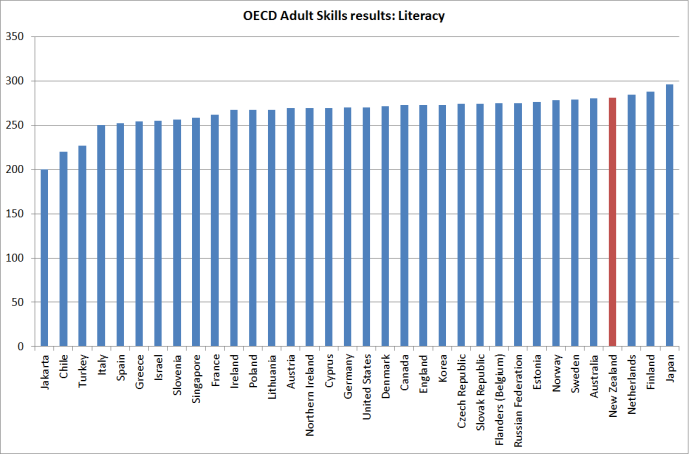
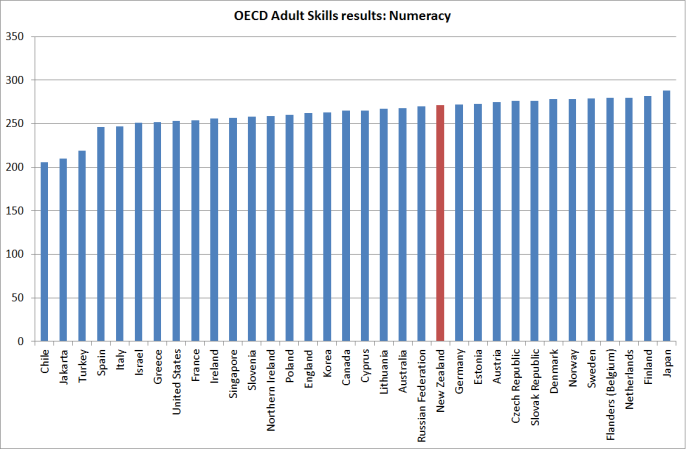
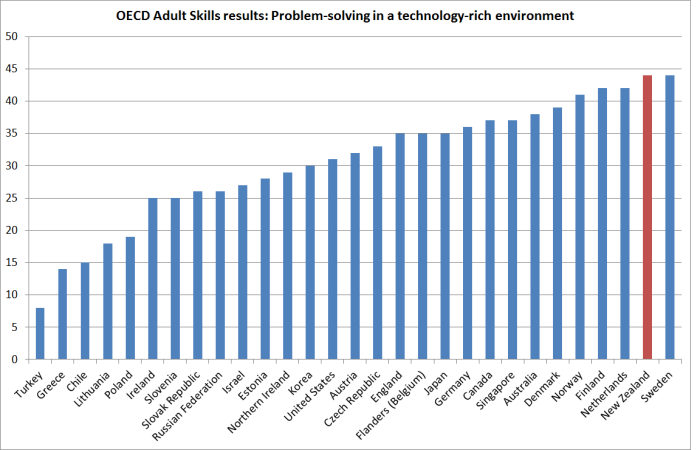
I wasn’t so much thinking of Steven Joyce’s assertions that I critiqued earlier in the week.  The Minister cited an apparently-reputable OECD report which shows that, on a particular (plausible) test measure, the skills level of the immigrant workforce in New Zealand are higher than those in the other OECD countries (included in the survey).  Of course, he omitted to mention two things from the same survey:

  • New Zealanders’ skill levels, on these OECD metrics, are already among the highest in the world, and
  • In every single country in the survey, including New Zealand, the skills levels of the average immigrant worker were below those of the average “native” worker.

But at least Joyce cited statistics that were reasonable when taken in isolation.  Of course, one might reasonably wonder where the evidence is that (a) shortage of skills is a major structural issue in New Zealand, and (b) that actual plausible immigration policies are able to ease those shortages, at a whole economy level.

John Key’s latest claims reach new levels of implausibility –  indeed, if one were oneself unemployed, one might well think them simply offensive.  Bernard Hickey reported the other day that in pushing back against calls for a review of immigration policy setting, the Prime Minister had said:

Key said he acknowledged high migration “put pressure on the system.”

“On the other side, we need these people in an environment where unemployment is 5.2% and where growth is still very, very strong. You’ve just got to be careful when you play around with these things that you don’t hamstring certain industries that need these workers,” Key said.

In the last year, per capita growth in real GDP has been less than 1 per cent.  In quite which state of small ambitions and diminished expectations that qualifies as “very very strong” growth is a bit beyond me.

per capita gdp

Even based on New Zealand’s own (internationally underwhelming) record, I’d have been looking for something more like 3 per cent per capita growth before I’d accept a description of New Zealand having “very very strong” growth.

But what really irked me was the suggestion that an unemployment rate of 5.2 per cent suggested that we needed lots of immigrants, as if the entire labour market were overheating.  Of course, even if it was overheating, we know that immigration adds more to overall demand pressures in the short-term than it does to supply.  But even accepting the Prime Minister’s story in its own term, by what possible criteria does he regard 5.2 per cent unemployment as low?

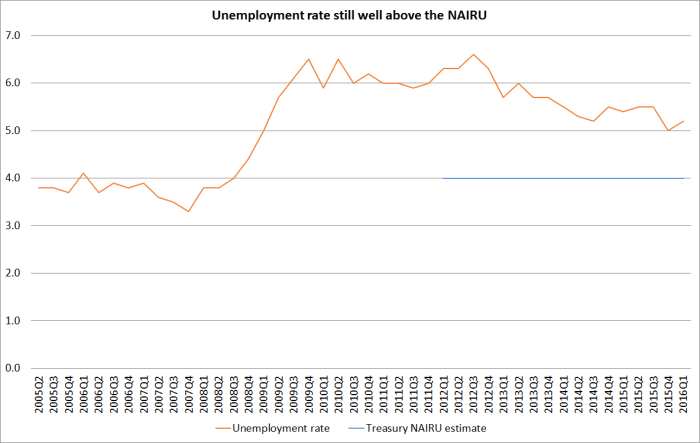
Wage inflation is low, and if anything surprising on the low side.  And his own Treasury only a few days previously had published a nice short note on the implications of the recent revision to the HLFS.   In that piece they succinctly noted

Treasury takes the view that the unemployment rate consistent with full employment (the non-accelerating inflation rate of unemployment or NAIRU) has also fallen over time, so that, as in Figure 4 above, it would be closer to 4.0% than our Budget Update estimate of 4.5%.  Our view is that while the data definition and published data have changed, people’s behaviour has not.

So the Treasury – the government’s principal macroeconomic adviser –  reckons that practical full employment is around 4 per cent.  We don’t know what the other main macroeconomic forecasting agency –  the Reserve Bank – thinks, as they didn’t give us anything on that in this week’s MPS.  But it would be surprising if their estimate was much different –  it had also been something like 4.5 per cent before the HLFS revisions.  There are reasonable grounds for thinking the NAIRU has been trending downward (I outlined some reasons here) –  and perhaps on this measure it might have been 4.5 per cent prior to the recession.

u and nairu

But there is no reason to think that at any time since the start of 2009 –  any time, that is, in the Prime Minister’s 7.5 years in office –  that the unemployment rate has been anywhere near the NAIRU.  We’ve not had anything remotely close to practical “full employment” (and recall that the “full employment” term is Treasury’s not mine).

So, given New Zealand’s relatively liberalized labour market, we’ve had excess unemployment  – more than the economy might need to sustain – for years now.  Those are real people, out there actively looking for work.

And as I showed the other day, our unemployment rate has fallen more slowly since the recession than typical other advanced economies. But somehow the Prime Minister seems to think that our unemployment rate is already so low that we need record numbers of new migrants.

There might be good arguments for a large scale immigration programme –  although it is hard to find them in the government’s flailing attempts to defend the system –  but our “low” unemployment rate just isn’t one of them.   And in case the Prime Minister is indifferent to an unemployment rate of 5.2 per cent, it is worth reminding him that over a 45 year working life, a 5.2 per cent unemployment rate is equivalent to every person spending 2.3 years unemployed –  out of work, and actively looking for a new job.  And yet the PM apparently thinks this is low unemployment. Talk about small ambitions.

Still on immigration, the FT’s Alphaville blog had a substantial piece yesterday on New Zealand’s immigration patterns, prompted by the Reserve Bank Deputy Governor’s recent suggestion that it might be time to look again at the parameters of the immigration programme (a stance, incidentally, not backed by the Governor in his press conference this week).  For foreign readers there was quite an extensive set of charts, although most of it will familiar to New Zealanders.  But what caught my eye was this line

Looking at all these facts, it’s hard to see how New Zealand’s migration policy could be modified to meaningfully reduce net inflows without draconian controls.

“These facts” means, of course, the significant variability in the net outflow of New Zealanders –  swings in that flow being often at least as large as swings in non-citizen numbers.  But this is simply dealing with a straw man. No one I know thinks that the net permanent and long-term migration flow could, or even should, be targeted, at least on an annual basis. New Zealanders will do what they want.  But as readers will know, the centerpiece on New Zealand’s immigration policy is the residence approvals programme, where we aim to hand out 45000 to 50000 approvals a year.  It requires no more than stroke of a ministerial pen to lower that target, and our points system helps ensure that if the target were lowered we would generally cut out the relatively less skilled applicants before the more highly-skilled applicants. We could, for example, cut the target to around 10000 to 15000 people per annum –  which would be similar to the residence approvals (per capita) granted each year in the US.  There might be good reasons not to make such a change all in one go, but even if we did it would hardly require ‘draconian controls’, just a recalibration of the dials, on a system set up to be managed against a numerical target

Of course, changing the residence approvals target wouldn’t immediately cut actual inflows – as most residence approvals are granted to people who first come on temporary visas – but it would make a material difference to actual inflows over time.  And (importantly, since markets work on expectations) it would make an immediate substantial change to expected future inflows, and the associated pressures (whether on heavily regulated urban land markets, or on real interest rates and the real exchange rate).   Exporters might, finally, have a chance to lift exports towards the government’s target.

The residence approvals programme –  the most stable part of the immigration system –  is my focus.  But if we wanted to do something about the record number of work visas granted, that wouldn’t be hard either –  impose a requirement that any job employing a non-resident must generally pay at least, say, $100000 per annum would keep the door open for those pockets of highly-skilled jobs where there is a strong case for short-term foreign labour – and it is those highly-skilled people who are asserted to offer the biggest gains to New Zealand – while easing the pressure on less-skilled New Zealanders’ wages.  Nothing very draconian about that either –  and probably the sort of system voters might think quite reasonable, unlike the most recent poll results (National voters as much as others) that suggest material unease about the current immigration arrangements.

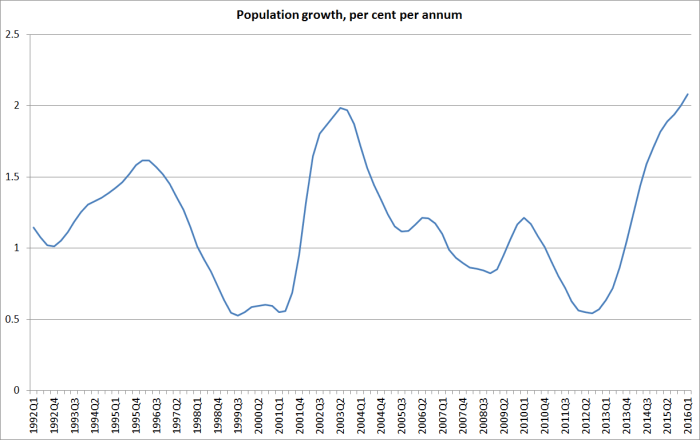
Finally, Statistics New Zealand put out new population estimates yesterday trumpeting the increase in the population over the last year as the largest ever.   An annual increase of 2.1 per cent is certainly large, and rather recklessly so in my view.  But citing the absolute increase in the total number of people as the basis for a “largest ever increase” claim seems a bit too cute, and also rather meaningless. Most trending series have such “record increases” every few years.   Back in the 19th century, for example, the base level of New Zealand’s population was much lower.  In fact, here are the population growth rates pre 1914 from the (unofficial) annual estimates reported on SNZ’s own website.

popn growth pre 1914

Both the gold rushes and the Vogel immigration programme rather shade the most recent annual population growth rate.


An economist for President?

My two young US citizens have been badgering me about the US election, and when I tell them I’m just glad I don’t have to choose this year, one says “but what if someone had a gun at your head and forced you to choose between Trump and Clinton?”.  Watching Trump’s convention address last week confirmed many of the reasons why I would not support him, and watching Clinton’s address yesterday had much the same effect for her.  Last week’s New Yorker had an interesting profile of the Libertarian Party candidate Gary Johnson, but the more I read about him the less appealing he also seems to be.   I’m still glad I don’t have to choose –  and, what’s more, get to live in a country that has had women as head of state for 128 years of its 176 year modern history.

About the same time I was reading the Johnson profile, I stumbled on “Kotlikoff for President“: prominent economist Laurence Kotlikoff (a professor at Boston University) is running for President, urging voters to give him –  and his running mate, another prominent economist, Ed Leamer (at UCLA) –  a write-in vote in this year’s presidential election.  Kotlikoff is perhaps best known for his push to ensure that governments are fully transparent about the nature of the intergenerational fiscal obligations they take on.

A quick skim through Kotlikoff’s campaign website confirms that there are many issues I disagree with him on – not limited to his banking reforms proposals, contained in his 2010 book. Jimmy Stewart is Dead: Ending the World’s Ongoing Financial Plague with Limited Purpose Banking which he presented, and I had a chance to discuss with him, when he visited New Zealand two or three years ago.  It wasn’t so much that I thought his proposal was wrong, as that I thought he was much too optimistic as to what difference it would make –  my typical reaction to monetary reform proposals.

But what really interested me in working through his economics material was his discussion on immigration and population issues, in particular the bolded passage.

Immigration

Immigration has been a major topic in the Republican Presidential debates. But the discussion has been remarkably disconnected from the facts. Notwithstanding the suggestion that illegal immigrants are overrunning our borders, there are and have been more illegal immigrants leaving our country than entering it. Indeed, over the last decade, roughly 1 million more illegal immigrants have left our country than have entered it. This is tribute, in large part, to our immense, decades-long effort to secure our borders. We still need to work extremely hard on border enforcement to eliminate illegal entry to our country. But we shouldn’t presume nothing has been accomplished.

The real issue with immigration is legal immigration. We are adding 1 million legal immigrants to the population each year. The great majority are unskilled. This isn’t hurting investment bankers or the software engineers at Google. This is hurting low-skilled U.S. workers. It’s the last thing we need if we are trying to restore our middle class.

Population Explosion

Legal immigration is also fueling a veritable population explosion. Unless we reduce legal immigration, our population will rise by one-third – over 100 million people – in just 45 years. That’s the current population of the Philippines. Most of these additional people will locate in the nation’s major cities. Driving in our major cities at peak hours is already a major challenge. With one-third more people, driving in our major cities may be like driving in Manila – an experience I don’t recommend.

Kotlikoff’s academic speciality is public finance, and Leamer specialises in trade and econometrics, but it was unusual to see  any such prominent academic economists speak up on the issue, expressing unease about the US immigration policy.  And recall that legal US immigration –  the bit Kotlikoff and Leamer focus on –  is one third the size, in per capita terms, of New Zealand’s non-citizen immigration programme.  The US grants around one million green cards a year –  every year roughly one new person for every three hundred already there. We aim to grant 45000 to 50000 residence approvals a year –   every year roughly one new person for every hundred already here.  In a single year, that difference might not sound like much.  Over even 20 years, it is enormous: over 20 years the US will have let in one person for every 15 already there, and we’ll have given the right to live here to one person for every five already here.

I’ve been reluctant to focus on the implications of immigration for wages.  My focus has been on the more macro perspectives: the potential impact on real interest rates, the real exchange rate, and tradables sector growth and investment prospects, in a country that has a modest savings rate and is constrained by its remoteness from the rest of the world.  I’ve also been a little uneasy about the wages story in aggregate in the short-term, since I read the evidence as suggesting that in aggregate immigration tends to boost demand more than it does supply in the short-term.  If anything, surprise immigration surges tend to lower the unemployment rate not raise it, at least in the short-term.

But the repeated (fallacious) insistence of business groups that large scale immigration eases skill shortages for the economy as a whole –  a proposition I dealt with here – eventually forced me to realise that at least in those occupational groupings where there is substantial immigration, that immigration simply must be holding down wages for New Zealanders in those sectors below what they would otherwise be.    The effect might be quite small at an economywide level, but if your sector can persuade the central planners in MBIE (and their Minister) to allow relatively easy recruitment of immigrant labour it simply must dampen the wage rate you as employer would otherwise have to pay.   If the available supply of labour diminishes, the typical response will be for the price to rise.

One could readily think of a number of occupational groupings that stood out when I looked last year at either residence approvals’ occupations or those getting Essential Skills work visas (and that is before starting on the sorts of role the people on working holiday visas tend to cluster in), such as

  • chefs
  • retail managers
  • dairy workers
  • aged care worker or nurse
  • restaurant or café managers
  • cook
  • truck driver

For each of these occupations, the alternative to a ready availability of immigrant labour must have involved, at least in part, higher wages.  Each firm would tend to pay higher wages to attract good people from other employers, and the industry as a whole will end up paying higher wages which will, over time, attract more locals into the industry.  Sympathetic as I am to aged care workers, it has always seemed that the heavy reliance –  as a deliberate matter of policy – on immigrant labour probably explains rather more about the pay differentials they complain about in pay-equity suits, rather than any sort of structural gender-based discrimination.

I understand why government politicians will want to deny these sorts of adverse wages effects. It is more puzzling why Opposition ones do  – especially Opposition parties with their roots in the trade union movement.  And even more so why most economists are at pains to try to deny any adverse effects on anyone.    Unless there are big productivity spillovers from the sheer presence of super-talented foreigners –  and in the New Zealand, most immigrants just aren’t super-talented (any more than most locals are), and no one has been able to find evidence of such spillover benefits at all – if there are any medium-term economic benefits from immigration at all they result from dampening the price of labour relative to the price of capital.  If labour is cheaper more projects are viable than would otherwise be the case.

In case anyone thinks this is just crazy stuff, there is a huge  formal literature on how immigration worked, and affected economic outcomes, in the first great modern age of immigration – the 50 to 70 years prior to World War One.   I’ve touched this in a previous post, referencing a piece by leading Irish economic historian (and professor at Oxford), Kevin O’Rourke.    Overnight, I stumbled on a new accessible essay by O’Rourke written prompted by the recent 100th anniversary of the Irish rising of 1916.  Here is what he has to say about the implication of emigration for wages.

Ireland was hardly the only country to experience mass emigration in the nineteenth century. If its emigration rates were particularly high, this was not due to a uniquely repressive environment (of either Irish or British origin). Irish wages were much lower than American wages, Ireland’s marital fertility rate was high, and there was a large stock of previous migrants to facilitate the transition to a new life in a New World. High emigration is precisely what would be predicted under such circumstances; the Irish were not unusually prone to emigrate, other things being equal.

And as was the case elsewhere, high emigration had a profound impact on the Irish economy, lowering the supply of workers competing for jobs, and raising wages. The wages of unskilled Irish building labourers rose from around 60 per cent of what their British counterparts were earning in the 1830s, to more than 90 per cent in the decade before World War I. Something similar happened in economies as superficially dissimilar as Italy and Norway, and in all three countries emigration was largely or entirely responsible for this wage convergence.

Irish wage convergence was emphatically not due to a superior Irish growth performance

This is just a standard non-contentious result in the modern literature about this historical period –  for anyone interested check out the writings of Hatton, Williamson and O’Rourke himself, for example. Emigration from Europe to the New World (including New Zealand) lowered wages here and raised them in the source countries. It greatly helped the process of income convergence –  although in New Zealand’s case, it took significant public subsidies to make even the high wages on offer here attractive to “enough” people.

There are occasional attempts to explain why the 19th and early 20th century experience might not be applicable today, but I’ve not found any of them even remotely persuasive. Instead,  most modern academic enthusiasts for high immigration to Western countries are either altogether unaware of the historical literature, or simply choose to ignore it.    That is particularly unfortunate –  one could think of worse descriptions –  in the New Zealand case, where since the 1970s we have had huge net emigration of New Zealanders and since the end of the 1980s huge policy-facilitated and promoted immigration of non-New Zealanders.  If it had just been the outflow of New Zealanders, the 19th and early 20th century experience might have led us to expect a substantial measure of income convergence between New Zealand and Australia (as outflows from Invercargill or Taihape helped keep factor returns in those places somewhat in touch with those in the rest of the country).  But if such a process had been incipiently at work, the policy programme to bring in so many non New Zealanders to a country no longer sufficiently attractive to its own would have worked to directly stymie the prospects of such convergence.   And yet in none of the MBIE or Treasury work on immigration I’ve seen has the historical convergence literature been applied to the New Zealand experience.  That seems like quite an omission.

It seems like a good year for Kotlikoff and Leamer to get some coverage for the issues they are promoting. I hope their sensible comments on the immigration policy issues do get some more attention.   And that as we approach our election next year –  with one of the largest controlled non-citizen immigration programmes anywhere in the world (and one of the worse long-term productivity performance –  we can have some thoughtful engagement with the costs and benefits of immigration, including the distributional ones, informed by the historical experience, as well as by the models of modern academic immigration enthusiasts.


A former Prime Minister and Minister of Finance on immigration policy

A couple of weeks ago we had a family holiday in the Bay of Islands. It was almost 20 years since I’d been that far north, to a part of the country suffused with New Zealand history.  It is also a part of the country where some of tensions and divisions are still pretty visible. The visible divide between prosperous, heavily European, eastern towns, and the poorer browner inland areas is one example, but I was also struck by how often I saw the 1835 United Tribes flag flying.  In a country where flags are flown much less often than in, say, the United States, it was hard to miss.

As we looked over the historical sites and talked to the kids about New Zealand history, it had me wondering again, rather uneasily, about Maori perspectives on immigration in New Zealand history.  Scholars can debate quite what mix of factors led various Maori leaders to agree to sign the Treaty of Waitangi, or what they thought they meant in doing so.  But by some mix of consent and proclamation in and around 1840, the British government acquired control of New Zealand, and international recognition of that new possession.  At the time, the European population was probably no more than 2 per cent of the total population of New Zealand.

Mass European immigration wasn’t a specific article in the Treaty.  Many of the Maori leaders probably welcomed some immigration –  which had brought, for many, trade opportunities, education, Christianity and so on (as well as law and order problems etc).  But I don’t suppose anyone signing the Treaty, or probably anyone associated with establishing colonial government in New Zealand for that matter, really thought much about how the numbers would eventually turn out.

But whether it was foreseen or not, the numbers quickly changed.  Even by the mid 1850s, it is estimated that Europeans and Maori were roughly equal in number, and the immigration associated with the gold rushes further skewed the numbers towards European dominance, especially in the South Island.  Since then, of course, the numbers have swung ever further against Maori –  complicated by intermarriage.  Whatever benefits there might have been from the immigration, it is hard not to avoid a conclusion that it has created a society in which Maori are marginalized –  in important respects – in what had been for hundreds of years their own land.  Things Maori have more prominence now than they did when I was young, but the way things are done in New Zealand today isn’t primarily a reflection of Maori culture.  And, in a sense, that is inevitable –  countries reflect the cultures of the people who inhabit them –  but I can’t help wondering what that means to Maori.  Immigration changes societies, and in largely irreversible ways, whether intended or not.

My real focus today though is the history.  In the North Island in particular, the process wasn’t without tension.  There had been the Northern War of the mid 1840s, and then the North Island land wars of the 1860s and early 1870s.  These conflicts were enormously costly, and involved really large deployments of British military forces (in the 1860s apparently the British forces in New Zealand were the second largest British military deployment –  behind India –  anywhere in the world).  But by the end of the 1860s the British wanted out, and wanted the burden of defence and security to rest with the New Zealand government.  At the time, the colonial government could barely be said to have a secure hold on most of the North Island, at least outside the major towns.

It was around this time that the huge debt-funded immigration and public works programme was launched, driven by Julius Vogel.  It was a key event in New Zealand history, and features in all the histories and economic histories. The scale of the population inflows, and of the debt that was taken on in the process –  bringing in migrants and building railways and other public works –  swamps (proportionately) anything in more modern times.  The net migration inflow in 1874 –  the peak year –  was around 10 per cent of New Zealand’s total population at the time. Last year, our population increased by 2 per cent.

What isn’t much discussed is quite what drove the immigration and public works programme.  Earlier in the year I had seen a passing mention that in the leading biography of Vogel, the author –  Professor Raewyn Dalziel –   had suggested there was evidence that an active desire to change the population balance, “swamping” the Maori population in the troubled North Island in particular, was a key factor.  Having just come back from Northland, I decided to should look up the reference (p 105 for anyone interested).

In his own contemporary statement on the policy, which Dalziel quotes, Vogel had written

“The one chance of gaining adequate control was to introduce such a system of public works and workmen into the North Island as would 1st give protection in case of need 2nd occupy to some extent the natives 3rd open up communications 4th keep the natives in touch with the colonists….It was a matter of life and death to secure its adoption.”

Dalziel also draws from a lecture Vogel gave in London in 1893.  That was some time after the policy was introduced, but only six years after Vogel had ceased being Colonial Treasurer (Minister of Finance, in today’s terminology).  It is perhaps no different to listening today to Ruth Richardson explain the thinking behind the Fiscal Responsibility Act, or Bill Birch on the Employment Contracts Act.  Retrospectives are often tinged with the benefit of hindsight, but such reflections also often offer valuable insights on just what was shaping policy thinking.

Fortunately, Vogel’s lecture is available on-line here, as part of Victoria University’s Electronic Texts Collection.  I found it fascinating reading on numerous counts.

In discussing the immigration and public works programme, Vogel begins with the British government’s decision to transfer defence and security responsibility to the New Zealand government.

Mr. Gladstone euphemistically describes the sudden imperative withdrawal of the Imperial troops in 1870, at a time when war with the natives was proceeding on both sides of the North Island. There is a modern phrase which more aptly describes what took place. “Scuttled” is the word that would now be used. That the Colonists proved equal to the task they had to undertake was no excuse for the way in which the obligation was flung upon them in the midst of a double warfare existing at the time. I have always felt grateful to the Maoris for the way they behaved at this crisis. Had they been possessed of less generous instincts, they would have taken advantage of the position. The North Island was sparingly peopled, the Colonists of the Middle Island, by far the most wealthy and populous, were profoundly discontented with the onerous call which had been made on their resources, by expenditure which they comprehensively regarded as cast upon them to fulfil Imperial obligations contracted by the Treaty of Waitangi. The actual means of the Colony at the time were not large, and any attempt to raise a war-loan would have been scouted. The North Island was not only scantily populated, but much of the interior was almost impenetrable to Europeans, whilst the Maoris could go from end to end and from side to side of the Island with great ease. It took General Chute, with a considerable force, a long time to penetrate to New Plymouth from the Wellington Province, and his able performance of the task was regarded as a great feat. Had Te Kooti and Titokowaru, who were respectively at war with the Europeans on the east and west coasts, joined their forces, and other great chiefs combined with them, the issues would have been very grave. This risk the Colonists were left to confront whilst Downing Street exhibited the most stoical disregard of the consequences of its own previous acts, and of the responsibilities it had specially contracted.

The Public Works’ Policy.

The Government had but one resource, a policy of the utmost conciliation, until they could place themselves in a position of strength for the future. It was a most anxious period. The ‘Maoris were a fiery race, and any little dispute in any part of the Island might have occasioned a fierce and general war.

It has often been said and written that the Public Works’ Policy was the outcome of a speculative desire to obtain the expenditure of a large quantity of borrowed money for the gain that expenditure would bestow, leaving to chance subsequent consequences. I will tell you the real facts, and I think I may say there are only two or three men now living who can speak with equal authority. The Public Works’ Policy seemed to the Government the sole alternative to a war of extermination with the natives. It comprised the construction of railways and roads, and the introduction of a large number of European immigrants. The Government argued that if they could greatly increase the population of the North Island and open up the means of communication through the Island, and at the same time give employment to the Maoris, and make their lands really valuable, they would render impossible any future war on a large scale. They recognised that in point of humanitarianism there was no comparison between the peaceful and warlike alternatives. They considered also that, financially, it was infinitely preferable to spend large sums on permanent development, to expending equal, or probably larger amounts on issues of warfare.

…….

The Colonial Government dared not introduce the Public Works’ Policy as a measure to subjugate the natives to future peacefulness. To have done so would have involved the risk of exciting them to immediate hostility. The most that could be stated in that direction was contained in the following paragraph in the speech in which a declaration of the policy was made.

“I cannot close this branch of the subject without adverting to the effect which the promotion of railways and immigration must certainly have on the native question. The employment of numbers of well-paid natives on Public Works, to which in their present temper they will resort with avidity, the opening up of the country and its occupation by settlers, which will result from the construction of roads coupled with the balancing of the numbers of the two races by a large European immigration, will do more to put an end to hostilities, and to confirm peaceful relations than an army of ten thousand men.”

There was thus the necessity of bringing the measure forward on its merits, only as a colonising scheme. Pray do not think the Government had any doubt on the subject, but it was a bold departure for so small a community, and under ordinary circumstances it would probably have been proposed on a less ambitious and rapid scale. But the circumstances forbade anything of the kind. From what I have previously said it may be gathered that the South Island would not be willing to give its credit to benefit colonisation in the North Island without inducements applied to itself of a large character. Hence to really serve the North Island, it was necessary to frame the whole scheme on a scale sufficient to offer great advantage to the South Island.

What surprised me was that when I pulled other books off my shelves  –  political and economic histories of New Zealand –  there was almost no reference at all to this strand of argument.  There is plenty of discussion of the economic and fiscal impact of the immigration and public works programmes –  albeit nothing on what it might have done (good or ill) for per capita incomes in the longer-term –  but nothing at all on what seems to have a key motive for key figures in the government of the time, Vogel  –  former Premier and Colonial Treasurer – foremost among them.

I’m not sure why, but I can guess.  Among other things, it is pretty uncomfortable stuff for a European author –  or reader.  Conquest and displacement are, no doubt, the way of history, but it isn’t a comfortable thought about one’s own country, about events that are only 140 years or so in the past. It is a reminder of the fragility of many of the settler societies, and of how –  plausibly enough –  the New Zealand story could have ended quite differently.   Personally, I read it with a mix of conflicting thoughts and feelings: glad on the one hand that my own ancestors were all in the South Island, and  the comfort and familiarity of being part of a majority culture.  But on the other hand, more than a little uneasy about what it has all meant for the place of Maori in New Zealand –  and for all that the rest of us (rightly and reasonably) claim this place as home, it is the only home for Maori and their culture.

Quite plausibly, mass European immigration to New Zealand in the 19th century did raise per capita incomes here –  for Maori and for Europeans –  but it did so partly by operating on scale that substantially displaced the cultures and institutions that had been here previously.  Indeed, Vogel suggests that for the largest single wave of that migration, to do so was a matter of calculated government policy.

For many readers, there might be a “so what?” reaction to all this.  A family member’s response was “well that’s fine, but it happened and can’t be undone”.  And that is fine too – this isn’t directly about lessons for today, but for me anyway it prompts me to reflect afresh on how immigration –  and immigration policy – has shaped our country in the past, and in different ways continues to do so today.  And to wonder again about what it means for the relative and absolute place of Maori in New Zealand.

(On quite another matter, I was amused to see that the concept of value-added in exporting made the speeches of former Ministers of Finance even 120 years ago.  I’ve written here about how New Zealand performs pretty poorly on that score now.   Here is Vogel talking about value-added in exporting –  and the lowish proportion of imported inputs in New Zealand’s exports – back in 1893:

over the 40 years ending 1892 an exportation of articles produced in New Zealand equal to £14 annually per head of population. The United Kingdom prides itself on being a great exporting country. During the 16 years to the end of 1890, the annual value per head of population, of exports, the growth, or produce of the United Kingdom amounted to £6. 7s. 5d., against £14 per head in the case of New Zealand. But even this comparison does not give a full idea of the difference between the two countries. The New Zealand exports were entirely the growth and produce of the country, whilst one-half of the exports from the United Kingdom were merely preparations or manufactures of imports received from other countries.

For anyone with an interest in New Zealand history, Vogel’s lecture is fascinating stuff – an upbeat visionary politician’s take on what had been created in New Zealand over the previous 50 years, and what might yet be.)

Beware the ignorant

Sitting in the sun, reading the Herald over lunch, I found my own name leaping out at me.

An Auckland immigration lawyer –  I’m going to treat his argument on its merits, but do note the vested interest here –  Alastair McClymont had an op-ed headed Beware ignorant debate on motivated migrants.  I am apparently one of the “ignorant”.

Just who are the migrants supposedly stealing our houses and jobs? There have been plenty of knee-jerk reactions recently about the appropriate number of migrants that New Zealand can absorb each year. There has also been evidence of much ignorance on the subject.

In the 12 months to April, New Zealand received 68,000 net migrants (long-term arrivals minus long-term departures). New Zealand First leader Winston Peters has suggested the number be reduced to a maximum of 15,000 a year and as few as 7000.

Economist Michael Reddell has stated that cutting migration to 10,000 a year would lead to a reduction in house prices.

But the debate about migrant numbers is more complicated than Mr Peters or Mr Reddell would have us believe.

I am not speaking for Winston Peters, who I have never met or talked to.  A fairly prominent person told me this morning that I had changed their way of looking at the New Zealand immigration debate over the last year or so, and noting that he had previously treated immigration as desirable partly because of a reaction against the way Winston Peters had raised the issues 20 years ago.  I can certainly understand that.

But as for me, perhaps Mr McClymont could refer me to any suggestion I’ve ever made that migrants are “stealing our jobs and houses”.  On the jobs front, I’ve been quite clear that I think the evidence is that immigration boosts demand more than supply in the short-term, and hence that increases in immigration at least temporarily lower unemployment.  The Reserve Bank’s research, which I often quote, is consistent with the decades-long experience –  implicit in all macro forecasting frameworks – in which, all else equal, interest rates typically rise here when immigration is unexpectedly strong. That is because of the considerable boost to demand –  new immigrants need houses, road, schools, shops, just as long-term residents do.  As for houses, well I don’t think anyone doubts that increased population pressure –  whether immigrants (foreign or New Zealanders) or natural increase –  increases the demand for housing, and that the new supply of housing is all too sluggish.  So, yes, population shocks tend to boost house prices, and it often takes a long time for supply to catch up.  That isn’t controversial stuff.

But apparently “the debate about migrant numbers is more complicated than [I] would have us believe”.   I’ve written various  lengthy papers and speeches on the issues over several years (for anyone interested, links are here), and have written dozens of posts here over the last 15 months on the issues.  I quite agree it is a complex issue, and especially the connection to New Zealand’s long-term economic underperformance  –  something Mr McClymont does not even mention in his article.  I’ve even taken the time to spell out what, specifically, I think should be done about changing our residency programme.

He goes on

Shamefully, Indian and Chinese migrants have too often borne the brunt of our community’s negative reactions to the high number of migrants, but total net migrants also include your German au-pair, the French or British waitress at your local cafe, the young, Aussie, seasonal worker at the ski field or your friend’s son returning home from work in London.

Well, yes.  But where is the news?  Go back and look at everything I’ve written on this topic, and you’ll find that I have been almost exclusively focused on the economics of the argument.  I’ve been clear all along that all the economic arguments apply even if all the migrants were from Yorkshire and Sussex (as mine mostly were).  In fact, in the post-war decades, the overwhelming bulk of our migrants were British –  and since the new income-earning opportunities weren’t that good here, in fact that rapid population growth seems to have compromised our per capita income prospects.  We’ve been in relative decline for 70 years.

Mr Clymont seems to want to suggest that I’m not even aware of the different classes of arrivals. So we are treated to a brief description of them –  returning New Zealanders, working holiday schemes, foreign students, temporary work visas holders. But barely a mention of the residence approvals programme, with its explicit economic focus (the “critical economic enabler” as MBIE puts it).   As McClymont will know, from having looked at what I have written, I have been focused on the residence programme, and have argued for substantially reducing the size of that programme (to something more like the US scale).  Treasury themselves have had doubts about the working holiday schemes and the use of work visas in some relatively low-skilled areas.  Others have raised concerns around the abuse of the foreign student process.  Those mostly look like reasonable concerns, but they aren’t my focus.  I’m focused on the residence approvals programme, which is what determines the long-term contribution of non-citizen immigration to our population growth.  Perhaps Mr Clymont is focused on the headline PLT immigration numbers –  I’m not, and never have been.

As I said, McClymont barely mentions the residence approvals programme, and doesn’t mention at all the 45000 to 50000 annual target –  a target which is three times, per capita, the number of residence approvals the United States grants.  Instead he falls back on debates around the short-term programmes.

The filling of low-skilled jobs by migrant workers is just a by product of the export education industry. The only low-skilled workers being imported fill jobs in the horticulture, dairy and health care industries.

But hold on, until a few years we didn’t allow foreign students generous work rights here –  and actually had as many foreign students in the previous boom of the early 2000s as we do now.  So it is a choice we make, not a necessary corollary. It isn’t really my issue –  it isn’t something that really affects long-term economic performance –  but it isn’t the choice I’d make  if I were setting policy.

And his final sentence in that quote rather gives the game away. Those are each rather large industries.   But again, my focus is on the residence approvals programme target, something McClymont doesn’t address directly at all.

By the end of the article, he is reduced to anecdote

I regularly speak with employers who are desperate to retain and recruit migrant employees. They all complain about the casual Kiwi attitude towards work and their constant “sick days”, particularly on Mondays.

By contrast, these employers find that migrants are more highly motivated to work and succeed at their jobs.

Many employers testify to the fact that 90 per cent or more job applications come from migrants, so why aren’t Kiwis applying for the jobs?

The condescending attitude to his own fellow citizens is pretty unnerving –  lets trade in our people for another lot.  But even then he seems unaware of the fact that New Zealanders work long hours per capita (longer than citizens of almost any other advanced country), and recently emerged on the OECD’s cross-country skills comparisons as having some of the best developed skills of people in any advanced countries.  Could all of us do better?  Well, quite possibly – even those of us not in the workforce.    And is it any wonder that new arrivals are dead keen to establish themselves and get a foothold in a new country.  But the point of the immigration policy is that it is supposed to boost the medium-term economic fortunes of New Zealanders as a whole –  not just some individual employers.  Somewhat surprisingly, no one has yet been able to produce serious evidence –  or even sustained argument supported by reasonable data –  that New Zealanders are materially better off as a result of the really large immigration programmes we have run for most of the last 70 years, and which we continue to run today.  MBIE hasn’t, the Minister of Immigration hasn’t, Treasury hasn’t, the Prime Minister hasn’t.  And Mr McClymont has not even really addressed the issue.

I argue that New Zealanders have probably been made worse off – our exports still rely almost entirely on natural resources, and yet the fruit of those natural resources is spread over ever more people.  It would be interesting to know why Mr McClymont thinks such a remote place, underperforming for decades, would have one of the faster population growth rates anywhere in the advanced world.  In fact, the “why” is simple: the answer is “policy”, but it doesn’t look like good policy, especially when New Zealanders themselves –  who presumably know the opportunities here pretty well –  keep leaving,

There are real and important debates to be had on the best immigration policy for New Zealand. I’ve argued that experience suggests a very distant country that has struggled to grow its export base isn’t a natural place for policymakers to try to drive up the population And I’ve repeatedly pointed to the troubling data around our:

  • lagging productivity
  • weak business investment
  • weak tradables sector and export activity
  • persistently high real exchange rates, and
  • persistently high real interest rates (relative to those in other advanced countries)

and made a case that our immigration policy is part of what has held our economy back from being able to offer really high material living standards to our people.  It isn’t a criticism of the immigrants, who are simply and rationally pursuing their best interests.  If there is criticism to be levelled, it is at our own officials and ministers.  But it is quite possible that my hypothesis is wrong.  And there are also other –  non-economic –  motivations for immigration (humanitarian, through the refugee quota, or perhaps even a general sense that migrants will be better off even if we aren’t).  Those are respectable arguments, and there are considered alternative perspectives to some of the points I’ve raised –  few issues in economics are ever totally clear-cut.  Lets have the debate –  looking at the data, and the evidence, and trying to develop a compelling narrative of New Zealand’s economic performance, and immigration policy’s role (for good, ill, or not much difference) in it.  But pretending that people raising questions about the programme are simply ignorant, and need it all explained to them once again, this time slowly and clearly, isn’t really likely to be very constructive.


Immigration is “a good thing”, and that is all we need to know

I’ve been struck again over the last few days by the determination of our “elites” –  whether from the left-liberal end of the spectrum, or the (rather smaller) libertarian end – not to actually engage with the data on New Zealand’s experience of large scale immigration.

In their amusing tongue-in-cheek simplified retelling of English history, 1066 and all that, Sellars and Yeatman had most things classified as “a good thing” or “not a good thing”.

There seems to be a world view, straddling National, Labour and the Greens, and ACT as well, that in some sense “immigration is a ‘good thing'” and that is really all that needs to be said on the matter.  Much the same goes for the media.  The plebs just need to get with the programme –  perhaps having it explained to them again, slowly and clearly this time, that immigration is a “good thing”.   Any skepticism is too often deemed to reveal more about the character of the sceptic, than the merits of the economic case.

There is a respectable theoretical argument (at least within the narrow confines of economics) to be made for an open borders policy.  But the fact that no political party I’m aware of –  here or abroad –  actually argues for such a policy is probably quite telling.  Within the EU, there is a particularly respectable case for open borders –  the EU-enthusiasts see the countries of Europe as being on a transition to a political union.  Only brutal authoritarian countries –  think China – want to control migration of citizens within their own country.  But, as it happens, most Brits didn’t want to be part of an EU political union, preferring to govern themselves.  Polls suggest citizens in most other EU countries also don’t want such a union.

Even without political union, there can be a reasonable case for an easy flow of people across borders.  New Zealand and Australia are two different countries, and that doesn’t seem likely to change.  And yet there have never been direct immigration restrictions on people moving among the various colonies (pre 1901) or between the Commonwealth of Australia and New Zealand (since then).    In practical terms, the barriers to moving – especially from New Zealand to Australia –  have been getting higher in the last few decades, as Australian welfare provisions etc and citizenship have become progressively less readily available to New Zealanders.  On my reckoning, New Zealanders have gained considerably from this ability to move to Australia, especially as the large income and productivity gaps have opened up in the last 50 years.  Some New Zealanders relocated and took direct advantage of the higher incomes and better opportunities abroad.  The rest of us benefited –  at least in principle –  because the departures from this land of (apparently) diminished opportunities eased the pressure on living standards here.   Whether Australians have benefited from the easy flow of people across the Tasman is more arguable.  There are reasonable arguments (and, thus, models) for small gains, small losses, and not much difference at all.

Even within the context of a system of immigration controls, there can be a variety of motives for allowing immigration.  There is the humanitarian perspective that governs refugee policy.  We don’t take refugees because it is good for us, but because it is good for them –  people whose homelands have become impossibly difficult.  If the refugee intake ends up benefiting us economically that is a bonus, but it isn’t –  or shouldn’t be –  what drives us.   And, of course, we allow New Zealanders who marry abroad to bring their spouse home, and to become a New Zealander.  Again, there isn’t an economic motivation behind those provisions.    And some countries have real problems controlling their borders, and get stuck with people they never intended to allow in.

But we do control our borders and the bulk of New Zealand’s non-citizen immigration programme has an economic focus.  MBIE, and the government, have described the immigration programme as a “critical economic enabler” for New Zealand –  a phrase which sounds sillier, and emptier, each time I write it, but which is at least honest.  We take migrants   –  lots of them (three times the per capita inflow in the US) – on the hypothesis that doing so will help New Zealanders economically over the medium to long-term.  We certainly needed “critical economic enablers”, so poor has our economic performance been over the post World War Two decades.  And there are plausible hypotheses for how immigration can help, at least in the abstract.

But several decades on, surely the advocates, administrators, and cheer leaders of the programme should be able to point to economic gains for New Zealanders? It doesn’t seem an unreasonable request, given the economics-based case made for the programme.   The presence of a wider range of ethnic restaurants, or the success of the All Blacks, are all very interesting –  although, to be honest, I hadn’t seen too many new English restaurants (the UK is still the source of more new residents than any other country)  – but that isn’t the case that has been made.  New Zealanders are supposed to have been made better off economically by large scale immigration.  And if there is evidence of those gains, the champions of the programme are strangely reluctant to cite it.

And so we have Liam Dann in the Herald this morning

Australians have been panicking about immigrants and to some extent their loss has been our gain.

Migration-driven GDP growth through a period of commodity price downturn has been a timely break for our economy.

….

There are risks that high immigration disenfranchises those at the bottom of the social ladder.

We need to ensure we have social policy to protect people from losing out and turning their anger towards migrants. We need to remember the current surge is not driven just by the more highly visible arrivals of different culture and ethnicity.

It is being driven by New Zealand passport holders.

History tells us this wave will not last. And that when it passes it will have left this country richer and stronger.

It is a strange argument.  After all, had the economy of our largest trading partner been doing better, presumably that would have helped our economy not hurt it.  And if demand had been weak here –  as actually it has been –  we could have had lower interest rates and a lower exchange rate, the latter in particular would likely to have been helpful.

And then, apparently confusing the variability in the NZ citizen immigration with the baseline large inflow of non-citizen migrants, he worries about people at the bottom “losing out”.  But this appears to be only about perceptions because he knows that when the current immigration surge ends “it will have left this country richer and stronger”.    That is, certainly, the logic behind the immigration programme.  But where is the evidence?  There is no sign that the income or productivity gaps between New Zealand and Australia are closing.  They haven’t closed after the previous waves of immigration either.  It seems to be based on little more than a wish  – and that same underlying belief that somehow high immigration is a “good thing”.

The Prime Minister on Q&A yesterday was no better.   Corin Dann put to the Prime Minister the case recently made by leading businessman (and economist) Kerry McDonald that high rates of immigration to New Zealand are quite damaging.  The Prime Minister responded that he “didn’t think the evidence bears that out”.   But he offered no evidence at all.   He mentioned wage increases in New Zealand, but when the interviewer pointed out that there was still a very large gap to Australia, all the Prime Minister could offer was the defensive “well, we’ve trying to close that gap for a long time” (really?) and “most New Zealanders would say we are making some progress”.  If the numbers supported his case, presumably he’d have quoted them.  They just don’t.  As I illustrated on Saturday, the gaps to Australia have just continued to widen –  not by large amounts in any one years, but little by little.  There is still a net outflow of New Zealanders to Australia, and if it isn’t as large as it was that seems to be mostly because the Australian labour market is tougher than it was, rather than that New Zealand is doing well.  (Again, as I illustrated on Saturday, both New Zealand and Australia have relatively high unemployment rates at present, and the gap in our favour is no larger than it was on average over the last couple of decades).

The Prime Minister was challenged on political spin in the interview, and he acknowledged that both governments and oppositions do it.  It was certainly on display in the answers on immigration.  The Prime Minister likes strong immigration because it is a “vote of confidence in New Zealand”.  Which might sound good for the first five seconds, until one remembers that for New Zealanders not leaving it is mostly that Australia isn’t doing that well either right now, and for those coming from emerging countries, New Zealand is richer than, say, India, China or the Philippines.  None of that tells one anything about whether New Zealanders are gaining from the large scale programme.  Similarly, the PM fell back on the “house prices are a quality problem” type of argument –  suggesting that Auckland was no different than cities around the advanced world with population pressures.  Perhaps he could check out Atlanta and Houston some time.

In a serious interview, on a major issue, the Prime Minister was simply unable to offer any evidence –  or even good arguments –  for how New Zealanders were actually benefiting from the immigration programme that he continues to run (the same programme his predecessors ran).  It should be a clue that there just aren’t such benefits.  With all the resources of the state at his disposal, including state-funded research programmes for advocates of the current policy, and he can’t articulate the benefits for New Zealanders.  Something seems wrong.

This week’s Listener –  house journal for the left-liberal establishment – had a lot of advocacy material on (the perils and woes of) Brexit –  epitomized perhaps in the column of the Otago university professor who concluded

Enough is enough. The British Government must halt its plans to proceed with Brexit and organize a second legally binding referendum to determine Britain’s future relations with the EU.

Vote again –  and again –  until the people deliver the approved answer.

Political columnist Jane Clifton dealt with immigration issue.  She observed

But the bitterest Brexit realisation is the damage that ensues when governments fail to “sell” immigration.  That’s the most urgent lesson for our MPs to swat up, because anti-immigrant sentiment is seldom far from the surface here. A sizeable bloc of British voterdom simply does not believe that immigrants enrich their country and stoke economic growth and job opportunities. And who can blame them, since in many long-term depressed areas, there’s precious little evidence of it.

Here, immigrants are increasingly copping referred anxiety about Auckland’s growing pains. Rather than document and illustrate the benefits of migration, the Government simply refuses to engage on any other level than to call the anxious xenophobic or racist

I’m not sure that last phrase is correct.  So far, to the extent there has been a discussion, it has mostly been free of that sort of thing.  [UPDATE: That was before I saw these comments from the Minister of Immigration.]   But the more general point holds.  The government simply does not, and perhaps cannot, illustrate the benefits of the programme for New Zealanders as a whole.  The alternative approach seems to be instead to whistle to keep spirits up, and attempt to spin the problems into a story of some sort of success.  If there really is now a robust case to be made for current policy, it should be beneath our government to rely on such feeble assertions.   Clifton herself, of course, seems unable to recognise the possibility that there may not be such benefits to New Zealanders –  that it might just be an economic experiment that has failed.

These days, we have serious figures from the centre-right, such as Don Brash and Kerry McDonald, arguing that our immigration policy is flawed, and probably damaging to the fortunes of New Zealanders, but our media and political elites remain enthralled with an “immigration is a good thing” mentality, unwilling or unable to engage with the specifics of New Zealand’s circumstances, location, and general ongoing economic underperformance.

And it carries across to housing policy.  In the last week, there have been a couple of serious contributions to the debate as to “what should be done” about housing, from, Eric Crampton and Arthur Grimes (and here). I agree with a fair amount of Crampton’s piece, and disagree with a fair amount of Grimes’s –  which is notable for wanting to ride roughshod over the rights and interests or existing residents.  But where they unite –  from the left-liberal end of the spectrum and the libertarian end –  is in avoiding any serious discussion about the high baseline target rate of immigration.  Now, I’ve always argued that as a first best we should try to sort of our housing supply issues –  Atlanta and Houston have –  and ideally have a separate conversation about immigration (since my arguments about the damage immigration policy seems to be doing are not at all reliant on house price stories).  And if there were any evidence that rapid inward migration was in fact boosting the fortunes of New Zealanders as a whole that might be a particularly robust case.  But…..there is none, or certainly none that the advocates have advanced.  Instead, we know that Auckland’s GDP per capita has been falling relative to that in the rest of the country for 15 years (as far back as the data go) and the margin by which GDP per capita in Auckland exceeds that in the rest of the country is now very low by international standards.  And if there is no sign that rapid immigration-driven population growth is helping lift New Zealanders’ income, while the political difficulties of fixing housing supply remain large, the  case for cutting back the target inflow is strong.  Doing so would immediately ease house price pressures  –  and without riding roughshod over property rights through use of compulsory acquisition powers that the government and economists now seem to favour –  and at worst not harm our medium-term income prospects.

As a reminder, the OECD produced new data only last week suggesting that the skill levels of adults in New Zealand are among the very highest anywhere (and that, as in most advanced countries, the skill levels of the average immigrant are a bit lower than those of the native-born.  To the extent we’ve managed to grow our exports –  the foundation of long-term prosperity  –  it has mostly been in natural resource based industries (complemented by the heavily subsidized film industry and the subsidized export education industry) where numbers of people just don’t help much, if at all.  There is no compelling economic case –  and recall it is economics that supposedly drives our immigration policy –  for using policy to deliver lots more people to New Zealand.  The Prime Minister, the leader of the Opposition, the Greens leaders all seem to disagree, as do the media establishment, but none of them can offer a clear simple straightforward data-driven explanation for why.

I’m not sure if there is a risk of a serious social/political backlash of the sort senior lawyer and former ACT MP Stephen Franks talks of.  But I certainly hope there is an economic backlash before too long. The alternative is, most likely, that our long slow relative decline continues –  and any other decent policies we adopt, and the skills and capabilities that our people possess, are constantly battling up hill, in face of an ideology (no doubt mostly well-intentioned) convinced that “immigration is a ‘good thing’ for New Zealand”.  In economic terms it doesn’t seem to have been so for a long time.

In a Listener article a few weeks ago, my former colleague (and New Zealand historian) Matthew Wright was writing about the early pre-1769 history of New Zealand.  One line in particular caught my eye:

New Zealand was the last large habitable land mass on Earth reached by humanity. The long journey of our species from Africa’s Rift Valley into the wider world ended, it seems, on the Wairau Bar.

New Zealand has produced pretty good living standards, at such great distance, for a small number of people.  In the halcyon days  –  when our relative performance was at its best –  we had a quarter the population we now have.  New Zealanders saw something going wrong decades ago and started leaving in large numbers –  in outflows that, as a share of the population, are really large by past international standards –  and haven’t yet seen fit to reverse that judgements.  Distance isn’t dead, but our government’s immigration policy –  in thrall to the ideology –  seems to assume that wishing it so can make it so.  We need to be much more cautious, and evidence/experience driven, in continuing to pursue an economic case for an ever-larger population


Skills matter….and we already seem to have them

Earlier this week the OECD released Skills Matter, a 160 page report on the results of a programme of surveys of adult skills in OECD (and a handful of other) countries.  As usual with OECD reports, it is full of fascinating charts.  Here is how they describe the programme:

In the wake of the technological revolution that began in the last decades of the 20th century, labour market demand for information-processing and other high-level cognitive and interpersonal skills is growing substantially. The Survey of Adult Skills, a product of the OECD Programme for the International Assessment of Adult Competencies (PIAAC), was designed to provide insights into the availability of some of these key skills in society and how they are used at work and at home. The first survey of its kind, it directly measures proficiency in several information-processing skills – namely literacy, numeracy and problem solving in technology-rich environments.

It is worth emphasizing that the survey involves attempting to directly assess skill levels, not formal qualifications.

The first such survey was done a few years ago, but this is the first round to include all OECD countries and, in particular, the first to include New Zealand.   They even provide a 20 page country note on New Zealand.

The bottom line for New Zealand?  The news is good.

Here is how our adults scored on literacy.

oecd literacy 2

And numeracy

oecd numeracy

And on “Problem-solving in technology-rich environments”

oecd problem solving

Looking across the three measures, by my reckoning only Finland, Japan, and perhaps Sweden do better than New Zealand.    Perhaps there is something very wrong with the way the survey is done, and it is badly mis-measuring things, but those aren’t usually the OECD’s vices.  For the time being, I think we can take it as reasonably solid data.  And the broad sweep of the cross-country results makes some sort of rough sense: typically the poorer countries are to the left of the charts (relatively less highly-skilled).

But if the skill levels of our adults are so high, on average, by international standards (and, as it happens,  we have quite a high rate of tertiary qualifications as well), it should perhaps raise questions again about the size and nature of our immigration programme.

After all, as I noted, the poorer and lower productivity countries are generally to the left of these charts. But New Zealand is one of the less well-performing OECD countries on that score.  Here is real GDP per hour worked for OECD countries in 2014.

real gdp per hour worked 2014

And when the OECD lines up the skills scores against the productivity data one of the largest gaps (lagging productivity) is for New Zealand   The cross-country scatter plots don’t show a tight relationship by any means, but they do tend to suggest that the skills and talents of our people aren’t what holds New Zealand back.

And yet we aim to grant 45000 to 50000 new residence approvals each year (a scale three times the size of US and UK programmes, per capita), supposedly with a focus on skilled migrants.  What is the logic?  And where is the evidence that this is the right place to focus in tackling New Zealand’s long-term economic underperformance?  Reinforcing those doubts, we know that other data show the incremental returns to tertiary education –  a different thing from skills, but one hopes not wholly unrelated –  are also among the lowest in the OECD.

A reasonable person might instead look at the data and suspect that, for whatever reason, the economic opportunities in New Zealand just aren’t that good.  Perhaps that is about location and distance, and a seeming inability to break out of a dependence on (a fixed supply of) natural resources or to increase productivity in those natural resource sectors rapidly enough.  But whatever the underlying reason, the opportunities haven’t been found here –  our export share of GDP has been static for decades, per capita tradables sector production hasn’t changed for 15 years, and a huge number of New Zealanders have kept on leaving for better opportunities abroad (mostly in –  on these measures –  slightly less skilled Australia).

One might have severe doubts about the logic of using policy to actively pursue bringing in lots more people  –  it might be no more sensible here than it would be in Wales, or Scotland, or Nebraska, or Newfoundland, or Tasmania (who’ve been spared the depradations of Think Big bureaucrats and politicians with immigration as a lever).  Perhaps it would be a little less worrying if the new arrivals were typically very highly-skilled people –  but recall that the highly-skilled people we already have aren’t succeeding in generating high returns (high productivity) here now.

But in fact, our immigrants aren’t that highly-skilled at all.  At the frivolous end of the spectrum, we were giving a small number of Essential Skills work visas to shelf stackers and kitchen hands.  More seriously, among those gaining residence visas in the skilled migrant category, the top four occupations in the last year for which we have official data were

Occupation 2014/15
Number %
Chef 699 7.2%
Registered Nurse (Aged Care) 607 6.2%
Retail Manager (General) 462 4.7%
Cafe or Restaurant Manager 389 4.0%

But it isn’t just a matter of occupational lists.

As it happens, the OECD report looks directly at the skills level of immigrant populations.  There are a few countries where immigrant population skill level match those of native born populations.  Perhaps that isn’t too surprising where most migrants come from countries with very similar cultural or linguistic backgrounds.  Among subsets of migrants, one could think of the flow among NZ/Australia/Ireland/UK, or between Chile and Argentina, or between the Czech Republic and Slovakia.  At the other extreme, some countries now face the challenges of very large skills gaps between migrants and native-born (most of the Nordic countries are now in this situation).  New Zealand doesn’t do too badly on this count – after all, we have control on who comes in, we have a notional skills focus, and the UK remains the largest single source of residence approvals. But there is a clear skills gap between immigrants and native-born New Zealanders.  Importing people doesn’t look as though it has been a means of raising skill levels here, or in most other countries.  In general that shouldn’t be surprising –  successful countries solve their own problems, and when they succeed they might share their bounty with newcomers. But a different sort of people is very rarely the answer to serious economic challenges.

On paper, there is some evidence suggesting that migrants to New Zealand have higher formal qualifications than the average New Zealander.  Nonetheless, as Julie Fry reported in her Treasury working paper a couple of years ago

Evidence suggests that immigrants are, on average, more qualified than the
New Zealand-born.  However, they also face language and adjustment barriers, at times including discrimination, which on average take 10-20 years to overcome.  In common with overseas patterns, recent New Zealand immigrants have poorer outcomes than others in the labour market, although those outcomes improve over time.   Immigrants who are from culturally similar source countries (such as Australia and the United Kingdom) adjust more quickly.   On average, migrants from Asia take longer to adjust, and migrants from the Pacific Islands never reach parity with the New Zealand-born, reflecting the fact that they enter mainly on family reunification grounds and non-skills-based quotas.
Our immigration policy seems seriously misguided.  It has been sold as a “critical economic enabler“, but if anything looks more as though it might be serving as a disabling factor.  There is no evidence that we are short of people, or of skills.  Skill levels  –  individually and collectively –  could no doubt always be higher than they are.  But immigration policy hasn’t been, and isn’t, raising skill levels in New Zealand –  nor is it doing so anywhere else in the OECD.
(And to anyone who wants to run an individual sector skills shortages argument, I commend to them the post I wrote on that topic a couple of weeks ago.)


Is NZ less receptive to immigrants than Australia?

Tyler Cowen had an interesting and thoughtful piece on Marginal Revolution yesterday, headed Why Brexit happened and what it means. He summarises his answer as “ultimately the vote was about preserving the English nation” –  on this telling, primarily about immigration. And despite his own pro-immigration inclinations, he runs a sympathetic interpretation of why a majority of British voters might reasonably have voted as they did.

He runs a story in which there is something distinctly different about Britain (along with Japan and Denmark)

One way to understand the English vote is to compare it to other areas, especially with regard to immigration.  If you read Frank Fukuyama, he correctly portrays Japan and Denmark, as, along with England, being the two other truly developed, mature nation states in earlier times, well before the Industrial Revolution.  And what do we see about these countries?  Relative to their other demographics, they are especially opposed to very high levels of immigration.  England, in a sense, was the region “out on a limb,” when it comes to taking in foreigners, and now it has decided to pull back and be more like Denmark and Japan.

The regularity here is that the coherent, longstanding nation states are most protective of their core identities.  Should that come as a huge surprise?  The contrast with Belgium, where I am writing this, is noteworthy.  The actual practical problems with immigration are much greater here in Brussels, but the country is much further from “doing anything about it,” whether prudently or not, and indeed to this day Belgium is not actually a mature nation-state and it may splinter yet.  That England did something is one reflection of the fact that England is a better-run region than Belgium, even if you feel as I do that the vote was a big mistake.

I’m not sure I’m totally persuaded by the idea that immigration was the main factor explaining the British vote.  One of a package of issues no doubt, but whether it is the main story is another question.  After all, Lord Ashcroft’s poll asked thousands of people why they had voted as they did.  Here were the results

Leave vs Remain podium rankings

  • Nearly half (49%) of leave voters said the biggest single reason for wanting to leave the EU was “the principle that decisions about the UK should be taken in the UK”. One third (33%) said the main reason was that leaving “offered the best chance for the UK to regain control over immigration and its own borders.” Just over one in eight (13%) said remaining would mean having no choice “about how the EU expanded its membership or its powers in the years ahead.” Only just over one in twenty (6%) said their main reason was that “when it comes to trade and the economy, the UK would benefit more from being outside the EU than from being part of it.”

Among both Labour or Tory voters the biggest single reason for voting Leave was, on respondents’ own accounts, “the principle that decisions about the UK should be taken in the UK”.    If governments are going to do something as silly as ban powerful vacuum cleaners, at least it should be our own government that does it.

Perhaps voters were reluctant to own up to concerns about immigration as the most important factor?  And perhaps immigration and the changing character of the country was important beneath the surface –  as the economic underperformance of the last nine years has probably been.  But it isn’t an open and shut case that this was mostly an immigration referendum.  After all, stories – accurate or not –  about the EU wanting to ban bendy bananas, or force people to use metric units, have had considerable traction in Britain for decades.

And if you were British you might reasonably think you would be at least as well off having your own government makes the choices for you.  Things might seem different in the rest of Europe where, for example,

  • in 1970, Spain, Portugal and Greece were under authoritarian dictatorships,
  • in 1980, the Baltic states didn’t exist as recognized entities, and Poland, Rumania. Bulgaria, the Czech Republic, Slovakia, Slovenia, Croatia and Hungary were all under failing Communist rule (and four of those countries didn’t even exist independently),
  • Finland Ireland, and Norway (the latter not in the EU, only the EEA) weren’t independent countries as recently as 1900,
  • Germany had its unsavoury 20th century history (accompanied by Austrians cheering for the Anschluss),
  • Denmark, Belgium, Netherlands and Luxembourg were all occupied by Germany for several years,
  • Having been defeated by Germany in 1871, and narrowly  (and at vast cost) winning World War One, France then endured the shame of German occupation in World War Two, the collaborationist Vichy regime, and the crisis of 1958,
  • Malta’s 40 years between independence and joining the EU was the historically abnormal self-rule phase.

It doesn’t leave many countries where citizens can look back over the last 150 years and say “yep, we ran ourselves over long periods of time pretty well really”.   But Britain did. Now, as we know, there is plenty of anti-EU sentiment in much of the rest of Europe as well, but it seems quite readily understandable, just in terms of their own country’s history, that UK voters would prefer their own governments to make decisions for them.    And it doesn’t take a huge political and bureaucratic edifice to establish a free trade area, or a mutual external defence arrangement (such as NATO).

Having said all that, what really prompted me to write this post was this line in Cowen’s post.

Of course, USA and Canada and a few others are mature nation states based on the very idea of immigration, so they do not face the same dilemma that England does.  By the way, the most English of the colonies — New Zealand — has never been quite as welcoming of foreign immigrants, compared to say Australia.

I’m at a loss to know what he is basing that final sentence on.  For better or worse –  and given the economic opportunities here, I think it has been mostly for the worse –  that proposition seems to be defied by the data.

At times, I’ve had people run the line to me that since in 1500 the non-indigenous populations of New Zealand, Australia, Canada and the United States were all, essentially, zero, and since New Zealand has by far the smallest population of any of those countries we must have been less open to immigration.  But those other places started European settlement and immigration earlier than we did –  and were closer to Europe, at times when travel costs (mostly elapsed time) mattered hugely.

I’m going to start my comparisons from 1870.  That is partly because I was using the Maddison database and its first annual New Zealand population numbers are for 1870.  But it also seems reasonable on other grounds. In both New Zealand and Australia the influxes (and outflows) associated with the respective gold rushes were over by then, and by 1870 the New Zealand Land Wars were winding down –  never thereafter was there any serious question about settler control of the North Island.  The large scale Vogel immigration and public works programme began shortly thereafter.

Here is a chart showing the total populations of New Zealand and Australia since 1870, both normalized to 100 in 1870, and done in logs so that readers can see changes in growth rates over time.

aus and nz popn since 1870.png

Over the full period –  145 years – New Zealand’s population has grown materially more rapidly than Australia’s.  Of course, the largest differences were in the first decade, but the gap hasn’t narrowed since.

I’ve often run the argument that New Zealand’s post-WWII immigration policy was materially misguided, at least on economic grounds, given the absence of new favourable productivity shocks or technological opportunities that would support top tier incomes for a rapidly growing number of people in these distant islands

Here is same chart starting from 1945.

aus and nz popn since 1945


You can see the period from the mid 1970s to the late 1980s when New Zealand had very low rates of net immigration, but over the full period New Zealand’s population growth has still modestly exceeded that of Australia.

And here is the most recent period since 1991 –  which uses official New Zealand population data, and ties in quite well with the change in immigration approach in New Zealand that largely prevails to today.

aus and nz popn growth since 1991

Again, our population growth has been a bit faster than that of Australia.

Now it is perfectly true that in the immediate post World War Two period, Australia was much keener on taking continental European migrants than we were.  Then again, in the 1960s and 70s we had large inflows of Pacific Island migrants, and there was nothing comparable in Australia.

But, and here is my other key point, we’ve had faster population growth than Australia even though we’ve had huge outflows (net) of New Zealand citizens, that swamp any outflow from Australia of Australian citizens.

Here are the numbers on the total net outflows of New Zealand citizens for each decades since the 1950s

Net PLT outflow of NZ citizens (March years)
1950-59 -2494
1960-69 -34,057
1970-79 -161,231
1980-89 -229,874
1990-99 -146,229
2000-09 -263,651
2010-16 -138,705

That is a total of 976000 people, from a country which at the start of the period had only 2 million people and now has around 4.6 million people.

Some of the people who left will have died by now, but official estimates reported by Statistics New Zealand suggest 600000 New Zealand born people living abroad (and perhaps 1 million New Zealand citizens living abroad).     Australia has five times the population of New Zealand, and yet estimates of the total number of Australians living abroad are around one million.

Yes, there are differences in rates of natural increase from time to time, but the big story of recent decades in particular has been one in which New Zealand has taken materially more non-citizen migrants (per capita) than Australia has, reflected in the slightly faster population growth we’ve had despite the huge continuing outflow of New Zealanders.

In fact, you can see this in the respective policy-controlled bits of the immigration programmes.   This chart is cobbled together using data since the late 1990s on Australian permanent migration approvals under their Migration stream and Humanitarian stream, and New Zealand data on residence approvals. To the Australian numbers I’ve added the net inflow of New Zealand citizens to Australia, and to the New Zealand numbers the (much smaller) net number of Australian citizens moving to New Zealand.

migration rates nz and aus

Most years, the rate of permanent immigration of non-citizens to New Zealand has been higher  –  often materially higher – than that to Australia.  And the Australian numbers have dropped back since the end of this chart as the flow of New Zealanders moving to Australia has fallen back.

Perhaps Cowen had some less numerical basis in mind for thinking that New Zealanders have been less welcoming of immigrants than Australia.  But I’m not quite sure what it could be (although there is always this site).  And given our continuing economic underperformance, it is quite remarkable how receptive New Zealanders have been to such high rates of immigration (roughly three times per capita the size of net non-citizen inflows to the US and UK) –  especially as the programme is repeatedly sold as an economic-based measure, a “critical economic enabler” in the words of the government department responsible for immigration policy matters.


Underperformance: still fossicking in the the GDP numbers

As everyone knows, our current population growth rate is extraordinarily high at present.  We only have an official census every five years or so, but SNZ produces quarterly population estimates using births and deaths data and information on migration flows.  Here is the estimated annual growth rate of New Zealand’s population for the full period since the official estimates begin in 1991.

nz popn

By international standards, New Zealand’s population growth rate is highly variable.  Most of the short-term variability in the series is not about discretionary New Zealand policy choices.  The (large) target for the number of residence approvals has been the same for 15 years or more, and most of the shorter-term variability is a reflection of fluctuations in the net number of New Zealanders leaving –  in turn, much influenced by perceived prospects in Australia.  Incomes are higher there, but that isn’t much use if one can’t get and keep a job, given that most New Zealand migrants to Australia are not eligible for most elements of the Australian welfare safety net.  But New Zealand policy choices do make some difference –  for example, allowing foreign students to work while they are here, appears to have materially increased the number of those living here.

As I illustrated yesterday, productivity growth in New Zealand in recent years has been almost non-existent.  To restate the obvious, it isn’t some fundamental reassessment of New Zealand’s fortunes and productivity prospects that seems to be boosting our population.

But some of the other trends in the data are interesting too.  For example, here is a chart of per capita growth in real consumption.  I’ve shown two lines –  one for private consumption, and one for total consumption (ie including government consumption).

consumption

Private consumption growth per capita – the red line –  was averaging around 4 per cent annum over 2002 to 2005, the last huge population surge.  Those growth rates hadn’t been much lower in the mid 1990s.  In the last year, private consumption per capita has grown by only 0.6 per cent.   And remember that when the population is growing fast, one might reasonably expected recorded consumption to be growing even faster –  after all, those new people all need tables and chairs, washing machines, fridges and other consumer durables (that might actually be used over many years, but are measured as consumption at the point of purchase).

And for all the talk of “wealth effects” from rising house prices –  even though higher house prices only redistribute wealth, they don’t make New Zealanders as a whole better off –  there isn’t much sign of it here.  I’ve run previously the chart of (nominal) consumption as a share of GDP, which has been largely stable for 30 years, despite the repeated surges upwards in the level of house prices.

What about investment?  Over a long period of time, New Zealand has tended to devote a surprisingly small share of its GDP to investment, even though our population growth rate has been well above average, and larger populations need a larger stock of capital.   Among the IMF “advanced economies”, the median country devoted 23.6 per cent of GDP to investment over the period 1980 to 2015.  By contrast, New Zealand devoted 22.7 per cent of GDP to investment –  even though our population increased by around 50 per cent over that period, and the median advanced country’s population increased by around 30 per cent.     When the population surges, a country typically needs to see quite a lot more investment taking place if growth in per capita living standards is to keep pace with that in countries with slower growing populations.

investment weo

Right at the moment, total investment as a share of GDP in New Zealand is a bit larger than in the typical advanced economy.  But in the last year, our population has increased by 2 per cent, and the median advanced economy has had population growth of around 0.5 per cent.  And our investment numbers are boosted by the Christchurch rebuild and repair process, replacing capacity destroyed by a natural disaster.     To maintain the ratios of capital to output typical of a modern successful economy (around 3:1), in the face of such large population growth differentials, one might have hoped to see investment as a share of GDP here perhaps  4 percentage points higher than in other advanced economies.  The actual margin is less than 2 percentage points, and even that margin includes the substantial rebuild spending.

What about our own national accounts data?

non-housing I

Here is non-housing investment spending as a share of GDP.  Even though population growth is now exceeding even that in the early 2000s, the non-housing investment share of GDP has recovered very little since the recession.  When we finally  get the annual capital stock data, we are likely to see very growth in the non-housing per capita capital stock at all.  When even entirely orthodox bodies such as the Productivity Commission produce modelling results in which immigration comes at a modest cost to the recipient country, while the sending country gains a little –  and that was the modelling (of the trans-Tasman flow) that the Australian and New Zealand Productivity Commissions jointly reported a couple of years ago –  the mechanism in the model is typically through a sluggish adjustment of the capital stock.    Ours just has not kept up with the rapid growth in our population.  Some of that is probably about government infrastructure, but mostly it will be because firms have not found sufficiently attractive investment opportunities.

And much of that must be about the unattractiveness/uneconomic nature of expanding exports rapidly from New Zealand. Here is the chart of exports to GDP.

exports to gdp 2016

I wouldn’t focus too much on the 2000 spike –  it was the outcome of a rare combination of events in which our commodity prices were quite high, and our exchange rate was very low –  the latter as much about events in the US as here.  But with very few exceptions, countries –  and especially small countries –  don’t prosper  –  and catch up with the best in the world – if their firms can’t find ways to profitably sell more, better, and more valuable stuff in competition with international producers.  Despite our booming (subsidized) export education sector, and our booming tourism sector, exports as a share of GDP last quarter were largely unchanged from a level first reached 25 years earlier.  Yes, there is some variability in the series, but the peaks haven’t been getting any higher for a long time now.  And this is the series that government policy is supposedly set to get to around 40 per cent…….

The outcomes shouldn’t really be very surprising.  The highest real interest rates in the OECD, a real exchange rate that has never sustainably adjusted to reflect our economic decline, and the perils of a location that make it difficult anyway to build internationally competitive firms relying on anything other than location-specific natural resources.  And yet our policymakers for some reason think that even more people is part of solving the problem.  If anything, it looks to have been make things worse –  making it harder to overcome our natural disadvantages.  Our per capita capital stock adjusts at best sluggishly, and the  per capita stock of natural capital just keeps falling (ie no more natural resources are being made).

Just to illustrate quite how unusual what is going on with our population is, in international terms, here is a chart I ran a few weeks ago showing annual population growth rates back to the 1950s, for New Zealand, the world (ie mostly the emerging/developing/poorer bits), and what the UN terms the “more developed regions”.

un popn chart

Population growth rates have been tailing off for decades, in advanced countries and in the world as whole.  But this year, New Zealand’s population growth rate (see very first chart) will be similar to those we saw in the 1950s.    Our productivity performance was already tailing off then, but at least we still had among the highest material living standards anywhere.  Quite why our politicians and their advisers think that such rapid population growth –  policy-induced population growth –  relative to the rest of the advanced world makes sense now, when our people are already so much poorer than most of those in the rest of the advanced world –  is one of the questions we really deserve a serious and considered answer to.