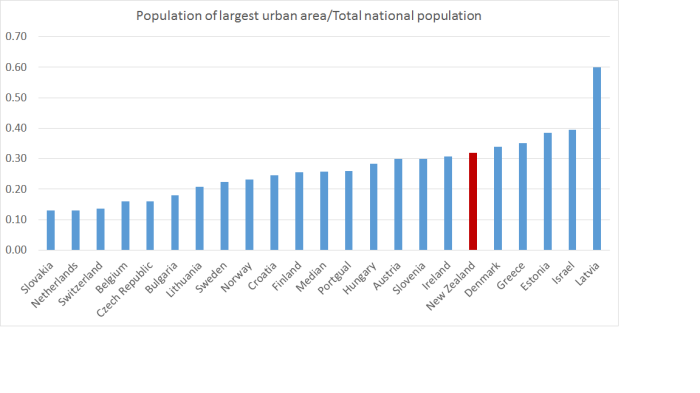
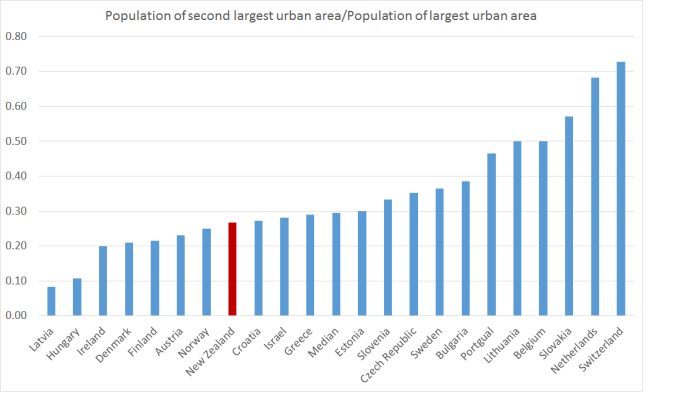
Another perspective on the New Zealand Initiative report

I will be resuming today my own series of posts on aspects of the New Zealand Initiative’s report on immigration.    However, some readers might also be interested in a new 29 page paper reviewing the New Zealand Initiative’s report by my former colleague Ian Harrison, now of Tail Risk Economics.

Ian focuses his comments on some of more formal research papers the New Zealand Initiative authors cite in support of their case.  There is some overlap with the material I’ll be presenting here, but in some areas Ian takes a more specifically technical approach to his critique.   On the other hand, sometimes his approach is a little more “in your face” than one I might typically adopt.

Here is some of the Introduction to his paper

Recently the New Zealand Initiative has released a report ‘The New Zealanders’ on the immigration issue.  The stated purpose is ‘To give the most up-to-date information to the public. To stack up these social, economic and nationhood fears against the available data and research.  It is claimed that the evidence on the economics is positive and fairly conclusive.

By and large, economists favour immigration as migrants benefit the countries they move to through knowledge spill-overs and global connectedness. Growing the population through immigration also produces ‘economies of agglomeration’ (i.e. the abilities of larger, denser populations to support more commerce and knowledge exchange).
All this is presented as a solid, objective assessment “While we could deduce the objective economic effects ….’

We disagree.  The economic ‘facts’ had a distinct ‘alternative’ whiff to them.  The arguments were at best thin, and the paper did not seriously engage with some of the key issues. It is easy to cherry-pick the (mostly) foreign literature to find an article that supports an assertion. It is much harder to convey a fair overall sense of the state of the economics of immigration, and critically, its relevance to New Zealand. The report does not do this, and the reader is left with the impression that nearly all economists support high levels of immigration, and that there is compelling support for this in the literature.

This paper presents an alternative view. But first let us define the scope of the debate. First, It is not about stopping all immigration or reversing what has happened. Most people are relaxed about genuinely high skilled immigration.  And we can continue to enjoy the ‘soft benefits’ of diversity from the existing stock of migrants.  The debate is about whether we continue the policy of large-scale medium/low skilled immigration. Second, it is not about whether immigration will generate a bigger economy. It will.  The issue is whether it will make current New Zealanders better off. The ‘New Zealanders’ is somewhat ambivalent on this point, but it is the broadly accepted test.

Our alterative economic narrative addresses the major shortcoming in the paper. It did not seriously engage with the critical structural features of the New Zealand economy.   That is, New Zealand economy is, more than any other advanced economy, land based and isolated. Other things being equal we would expect a large influx of immigrant labour to drive down average incomes as a larger labour force has to seek out more labour intensive low income jobs.  Thus the foreign literature, even if robust, may not be a good guide to New Zealand outcomes

And, on the other hand, this from his conclusion

To be fair, we found much in the report that was very useful, in particular the taxonomy of beliefs about migration. The report certainly challenged some of our preconceptions and it provides a good starting point for a debate that has to include what people really feel and believe about some sensitive issues.

The taxonomy of possible beliefs about immigration appears quite late in the report.  I agree that it provides a useful framework for helping to think carefully about the issues, and will be discussing it later in my series.

What proportion of migrants (in and out) reside in Auckland?

Pottering around between children’s orthodontic appointments and the start of the cricket, my eye lit on the Herald’s editorial on a various issues/problems relating to immigration.  These are, we are told, “problems” we are fortunate to have, contrasting favourably with current situation with that a few years ago. Among others things, we were enjoined to remember that:

“This country’s population barely grew during the last quarter of the 20th century”

Actually, our population in 1975 was 3.083 million, and in 2000 it was 3.858 million, an increase of a mere 25 per cent.  Over the same period, the United Nations population database tells us that high income countries in total experienced a population increase of 20 per cent.

One thing led to another and I decided to dig out the data on the regional patterns of net PLT migration.  I’d recently used the (common) line that about half the migrants come to Auckland, while Auckland has about a third of the population, but I’d never looked at the data myself.

The data aren’t ideal.  The PLT numbers are based on self-reported intent at the time of arrival/departure, and we know that at times even in aggregate they can differ from the actual realised experience.  Census numbers might be better for longer-term trends, but we only get that data every five years, and it is now four years since the last census.  So, the PLT data are the one set of numbers we have that allow us to distinguish New Zealand citizens from others (only the latter  are a matter of immigration policy) and provide breakdowns by regions within New Zealand.  And Statistics New Zealand has this breakdown all the way back to 1991, around the time broadly the current approach to immigration policy was adopted.

What do they show?

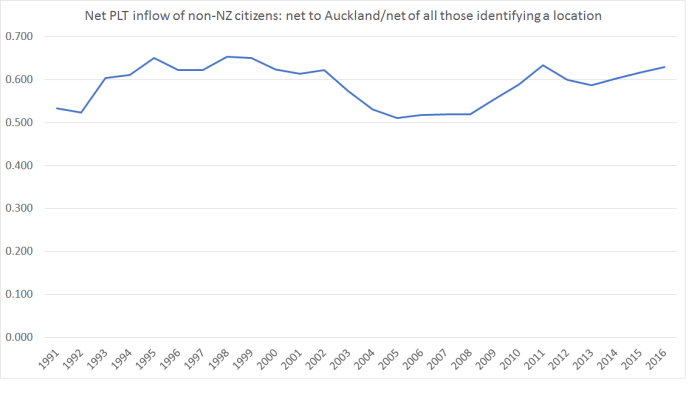
Often people compare the flow into Auckland with the overall net inflow, but within those net inflow figures quite a lot of people don’t state where in New Zealand they have come from or, if arriving, where they are planning to stay.  Among non-citizens, in calendar 2016 there were a net 14000 of those people, of a net inflow of 72406.  It is probably more reasonable to compare the net inflow to any particular region  to the overall inflow of those who stated a place of residence (perhaps a reasonable assumption is that those who didn’t state were representative of those who did, but presumably no one knows).  Here is the net PLT inflow of non NZ citizens to Auckland, for each year since 1991, as a share of the identified net inflow.

akld-inflow-non-nz

Over the full 26 year period, 59.1 per cent of the net inflow of non-citizens was to Auckland.  It dipped for a while during the 2000s but in the last five years or so seems to have returned to around normal.  And before anyone interjects the word “students”, yes we know that students disproportionately come to Auckland, and we know that most of them eventually leave again.  But these are net figures, and there is nothing unusual about where things stand now in terms of the share of the non-NZ flow that has been coming to Auckland.

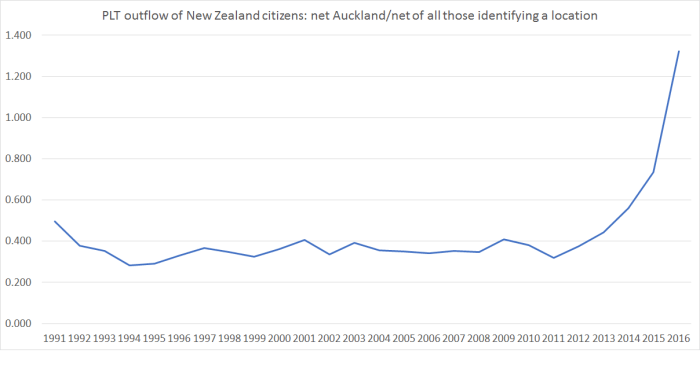
And what about New Zealand citizens?  Every year since 1991 there has been a net PLT outflow of New Zealand citizens from Auckland.  Some years, the net flows of New Zealanders are quite small –  last year only a net 1818 New Zealand citizens left New Zealand –  so the regional shares can swing around quite a lot.   Last year was especially notable –  a net 2836 New Zealand citizens left  Auckland for abroad, more than the outflow of New Zealand citizens for the whole country.

akld-outflow-nz

But over the 26 years as a whole, 37 per cent of the net outflow of New Zealand citizens has been from Auckland.    Last year, Auckland’s population was around 34 per cent of the total New Zealand population.

Broadly speaking then, New Zealanders (net) leave the country pretty evenly across the country.  They are perhaps a little more likely to leave from Auckland (given that Auckland has a larger share of the non-citizen population) than from other places –  and that is consistent with the Census data which has found that net people seem to be moving out of Auckland for other places in New Zealand too – but that difference seems fairly secondary. But the non-New Zealanders who come to New Zealand (net) come overwhelming to Auckland.

Out of curiosity I put the two together.  I was a bit reluctant to do so, since what New Zealanders do isn’t a matter of immigration policy at all.  But for some purposes –  housing is notable example – both matter, because it is the combination that affects demand for accommodation.

From year to year, the share has been hugely variable  (mostly because of the variability in the net outflow of New Zealanders).  But with all the caveats that surround the PLT data noted, and recognising that over 26 years there was a net inflow of 162594 people (NZers and others) who didn’t specify a location, the Auckland share of the net inflow of the people who did specify a location was, on this measure, 98.1 per cent.

I found that pretty staggering.  Perhaps it isn’t surprising that land use restrictions run head on into this net inflow to produce in Auckland some of the highest house price to income ratios anywhere.

New Zealand Initiative on immigration: Part 3 Culture and Identity

Chapter 2 of the New Zealand Initiative’s immigration advocacy report is headed “The New Zealand Way”.  It was a big part of why I’ve been procrastinating in writing about the report.  My focus has tended to be on economic issues –  and thus to be largely indifferent on that count whether the migrants came from Brighton, Bangalore, Beijing, Brisbane or Bogota.  Almost all of my concerns about the economic impact of New Zealand’s immigration programme would remain equally valid if all, or almost all, our immigrants were coming from the United Kingdom –  as was the case for many decades.  Relatively calm and rational debate can, and often does, occur on those sorts of dimensions.  Issues around “national identity”, “national security” etc, the sorts of issues the Initiative tackle in this chapter, are trickier.   I could have chosen to simply ignore this chapter, but they chose to deal with the issues directly, even if (in my view) unsatisfactorily, so it would be a bit wimpish of me to avoid doing so.    But in attempting, perhaps not successfully, to step through some of the minefields, without upsetting too many people unncessarily, this post gets long and discursive.

The Initiative begin their chapter

While many of the concerns New Zealanders have about immigration can be assessed empirically, other concerns strike a deeper chord which evidence cannot prove or disprove – the concern that a large inflow of people from abroad could threaten our national identity.

I’m not sure why they think evidence can’t “prove or disprove” these other concerns, unless they have a particularly narrow conception of what is allowable as “evidence”.

As they rightly point out, there is no single definition of what it means to be a New Zealander.  There are people who are legally New Zealand citizens who may never have visited the country (people born offshore to New Zealand citizens).  And there might some people brought here by their parents as children, who have lived here for decades and never been naturalised.  And although the legal status of someone naturalised yesterday and someone who has never left the country might be formally equal, in practice people in those two groups are likely to be thinking of different things when they label themselves “New Zealanders”.  Gabs Makhlouf and Peter Thiel –  two recipients of pieces of paper labelling them New Zealand citizens, not having met the conventional requirements for citizenship –  are New Zealanders for some purposes, but not for others.

But the fact that there is no single definition of a New Zealander does not mean that there is no New Zealand identity.  And the same could be said of almost any country in the world – representative Dutch people are different from Britons who are different from Italians who are different from Poles.  Of course, there is overlap –  plenty in some cases –  but senses of “how we do things here”, “what we value” etc differ from place to place, often in quite material ways.  And those differences aren’t just incidental (though some may well be); they go to how effectively societies function together –  to, for example, the trust and tacit knowledge that enables people to work effectively together, and feel secure.   There are economic dimensions to this –  trust is an integral part of a well-functioning market economy, and business cultures differ from place to place –  but it isn’t only a matter of economics.  We see the same thing with families –  within the bounds of trust that typically come to exist within well-functioning families, mutually-beneficial or sacrificial actions and transactions will occur that simply wouldn’t occur voluntarily for outsiders.

The Initiative largely skates over all these sorts of considerations.  Instead they pose the issue this way.

The public quite rightly wants reassurance that the kinds of migrants entering New Zealand are going to fit into our society and way of life. From the perspective of the authors (or at least as we aspire it to be), this way of life is characterised by
meritocracy, freedom of association and speech, and equality before law. Within New Zealand, people are free to pursue their beliefs, be they spiritual or corporeal, provided these do not impose on other people’s pursuit of the same.

The authors appear to define New Zealandness by “meritocracy, freedom of association and speech, and equality before the law”.  Perhaps those things do matter to most New Zealanders, but they wouldn’t mark New Zealand out from most other advanced countries.  And yet New Zealanders aren’t Dutch or Norwegian or French or Czech or even Irish or British.  All of those seem like good and prosperous countries, inhabited mostly by good and decent people.  And yet if a million French people moved to New Zealand, or 10 million Britons and French people swapped countries, the recipient countries would be distinctly different as a result.

The New Zealand Initiative just hasn’t come grips with the idea that countries differ from each other in many, perhaps individually small but cumulatively important ways, and that people in those countries value those features.  Not difference for difference’s sake, but simply that the society that has evolved here is different to that in, say, Norway, and that both we and the Norwegians probably rather like it that way –  even with a shared commitment to equality before the law, freedom of speech etc.

I’ve been loath to make the point, but in this context surely the backgrounds of the New Zealand Initiative people must be somewhat relevant.    The Initiative has eight policy/research/analysis staff.  At least five appear to have been adult migrants to New Zealand.  The ones I know are good and able people.  But most people –  even in New Zealand –  aren’t migrants.  And the tendency of someone who has left their own country (temporarily or permanently) and voluntarily migrated, in at least two cases (including the Initiative’s director, and one of the authors of this report) in just the current decade, must be to see things differently than people who are natives of a country.  It isn’t that those perspectives are invalid –  indeed, often they will add something ofconsiderable value – but that they make it difficult to see what is distinctive or tenaciously clung onto about New Zealand (or any other country), which the natives might wish to preserve.  You can’t easily share, or perhaps even identify, a national identity when it isn’t your nation.  The difficulty is compounded when you are based in downtown Wellington (or Auckland), probably interacting mostly with senior bureaucrats, politicians and business leaders.

The Initiative isn’t open slather.

The corollary of this expectation is the system should stop ‘undesirable’ people from moving to New Zealand. Undesirable is a broad term but in this context it means views and actions antithetical [emphasis added] to New Zealand culture. While broad, this definition would not exclude a law abiding person from settling in New Zealand simply because their race, creed or religious views differ from the majority. Our definition focuses instead on extremists who seek to impose their views on society by illegal or forceful means. An undesirable person in this context might be a white supremacist or a Muslim fundamentalist who wanted to move to New Zealand to break the law or incite others to do so.

So long as we vote our culture out of existence the Initiative apparently has no problem.  Process appears to trump substance.  For me, I wouldn’t have wanted a million Afrikaners in the 1980s, even if they were only going to vote for an apartheid system, not breaking the law to do so.  I wouldn’t have wanted a million white US Southerners in the 1960s, even if they were only going to vote for an apartheid system, and not break the law to do so.  And there are plenty of other obvious examples elsewhere –  not necessarily about people bringing an agenda, but bringing a culture and a set of cultural preferences that are different than those that have prevailed here (not even necessarily antithetical, but perhaps orthogonal, or just not that well-aligned).

When governments facilitate the inward migration of large numbers of people –  as ours is every year –  they are changing the local culture in the process.  Now, cultures and sense of national identity are not fixed and immutable things, but cultures also embed the things that the people of that country have come to value and which have produced value.  Those people (“natives”) typically aren’t seeking change for its own sake: the culture is in some sense the code “how we do things here”, that built what people value about the society in which they live.  Whether it is comfortable or not to say so, in the last few centuries, Anglo cultures have tended to be among the most stable, prosperous and free.  So it is far from obvious why should embrace change so enthusiastically, or why we would want to adopt the Initiative’s stance, and only want to exclude those whose views and actions are “antithetical” to our own, or who might want to topple our society illegally.

Perhaps if there were really substantial economic gains to New Zealanders from bringing the huge numbers of non-citizens to live in New Zealand it might be different. At very least, we might face the choice –  give up on some of our culture and sense of national identity in exchange for the economic gains.  In some respects, that was the choice Maori faced when the Europeans came –  a clearly more economically productive set of institutions etc, but on the other hand the progressive marginalisation of their own culture. Through some mix of consent and coercion –  increasingly the latter as the 19th century went on –  the choice was made, and then became effectively irrevocable.   But if there are such large economic gains on the table now, from the sorts of immigration programmes the Initiative has supported, and continues to support, they simply haven’t yet been demonstrated.

There is also a degree of naivete about the Initiative’s take on culture and/or religion (and the two overlap to a considerable extent).  Back in one of the earlier quotes, the Initiative argued that it was fine with people of whatever belief coming, and

Within New Zealand, people are free to pursue their beliefs, be they spiritual or corporeal, provided these do not impose on other people’s pursuit of the same.

They don’t seem to recognise that most people hold to beliefs that they think should influence how society is organised.  Even libertarians do. This is particularly obvious in Islam, which has never had a very strong distinction between ‘state’ and “church’, but it is no less true of Christianity.  Both are evangelistic religions, proclaiming what they believe to be true – and seeing truth as an absolute concept.  Both can, and have, survived at times and in places as minority faiths, but neither has ever been content to believe that its truths are just for its people, and not for export. I’m not so sure it is really much different either for today’s “social justice warriors”, or for libertarians –  whose proposed rule is, essentially, that we should all just leave each other alone (even though this has never been, and never seems likely to be, how human beings have chosen to organise themselves).

I’m not convinced that stable democratic societies can survive that long without a common culture and/or common religion (the two aren’t the same, but they overlap considerably, and necessarily).  It is hard to know.  We don’t have a long track record of democratic states –  a few hundred years at most (even if one doesn’t use universal suffrage as the standard), and then only for a handful of countries.  And the great mass migrations of the pre WW1 era were among countries the shared substantial elements of cultures (at least once the indigenous minorities had been more or less suppressed or numerically overwhelmed).  In the New Zealand or Australia (or Argentina, Uruguay, Chile) cases it was clear cut.  In the United States and Canada less so –  but the immigration was all from predominantly Christian countries, and severe immigration restrictions ended up being imposed when the foreign-born share of the US population was well below the foreign-born share of New Zealand’s population today.

What of today?  Perhaps the New Zealand and Australian stories are reasonably positive.  But the European situation seems rather less so, and that with Muslim minority populations that are typically not as high as 10 per cent of the population.  Sometimes federalism seems to help –  as in Quebec, or in Belgium, or Switzerland.

Democracy involves agreeing to live by a set of common rules, agreed by some sort of majoritarian process.  In almost any state, those rules include procedures for handling those least able to support themselves (whether it was Old Testament gleaning rules, the Poor Law, or the modern welfare system).  In a democracy, the willingness to help and support others is likely to be limited, to a considerable extent, to those with whom one feels a sense of shared identity.  The boundaries aren’t absolute, but revealed preference –  and introspection –  suggests that almost all of us are willing to do much more for our own families, and then perhaps for friends or members of other close communities of interest (neighbourhoods, church groups etc), and then for others in one’s own country, and only then for citizens of the world.  Is it a desirable model? I’m not sure. But it is human one, one that seems fairly ineradicable at a practical level.   Speaking personally, I don’t feel a strong sense of obligation to support someone down on their luck just because they became a New Zealander yesterday.  And I don’t feel a strong sense of obligation to support someone who won’t work to support themselves.  But I’m much more willing to vote my taxes to support those people than I am to support those down on their luck in Birmingham or Bangalore.  It is partly in that sense that “being a New Zealander” matters.  Mostly, humans will sacrifice for those with whom they sense a shared identity –  and generally that isn’t just the Initiative’s line about a shared belief in equality before the law, free speech etc etc (important to me as those things are).

Of course, what unites and divides a “country” or community changes over time.  In the wake of the Reformation, divisions between Protestants and Catholics were sufficiently important to each to make it practically impossible for both groups to co-exist for long in any numbers in the same territory/polity.  And, sure, multi-national multi-faith empires have existed for prolonged periods –  the Ottomans and Habsburgs were two examples – but not as democracies. Prudent repression can maintain stability for a long time.  But it isn’t the sort of regime that Anglo countries (and many others) have wanted to live under.

But the New Zealand Initiative report doesn’t seem to take seriously any of these issues, not even to rebut them.  They take too lightly what it means to maintain a stable democratic society, or even to preserve the interests and values of those who had already formed a commuity here.    I don’t want stoning for adultery, even if it was adopted by democratic preference.  And I don’t want a political system as flawed as Italy’s,even if evolved by law and practice.   We have something very good in New Zealand, and we should nurture and cherish it.  It mightn’t be –  it isn’t –  perfect, but it is ours, and has evolved through our own choices and beliefs.  For me, as a Christian, I’m not even sure how hospitable the country/community any longer is to my sorts of beliefs – the prevalent “religion” here is now secularism, with all its beliefs and priorities and taboos – but we should deal with those challenges as New Zealanders – not having politicians and bureaucrats imposing their preferences on future population composition/structure.

But the New Zealand Initiative report seems to concerned about nothing much more than the risk of terrorism.

A commonly cited concern in the immigration debate is of extremism. The fear of importing extremism through the migration channel is not unreasonable. The bombing of the Brussels Airport in 2016, in which 32 people were killed, or the Bataclan theatre attack in Paris where 90 people were murdered, shows just how real the risk is.

The report devotes several pages to attempting to argue that (a) the risk is small in New Zealand because we do such a good job of integrating immigrants, and (b) that the immigration system isn’t very relevant to this risk anyway.

The point they simply never mention is that in many respects New Zealand has been fortunate.  For all the huge number of migrants we’ve taken over the years, only a rather small proportion have been Muslim.    There is, no doubt, a good reason for failing to mention that, as on the Initiative’s own criteria outlined above, they would not object to large-scale Muslim immigration.

Of course, there is something in what the Initiative says about integration, and it tends to help that although our immigration programme doesn’t bring in very many highly-skilled people, it hasn’t involved a mass migration of unskilled people either (who often find it harder to integrate etc).  But it is an overdone point.  They highlight Germany –  perhaps reflecting the Director’s background –  where integration of Turkish migrants hasn’t worked particularly well over the decades, while barely mentioning the United Kingdom which is generally regarding as having done a much better job, and yet where middle class second generation terrorists and ISIS fighters have been a real and serious threat.  Here is the Guardian’s report on comments just the other day from a leading UK official –  the independent reviewer of terrorism legislation –  that the UK now faces a level of threat not seen since the IRA in the 1970s.  Four Lions was hilarious, but it only made sense in a context where the issue –  the terror threat –  is real.

But the Initiative argues that few terrorists are first generation immigrants, and some come on tourist or student visas (eg the 9/11 attackers) and so the immigration system isn’t to blame, or the source of a solution.  I’d largely agree when it comes to tourists, and perhaps even to students –  although why our government continues to pursue students from Saudi Arabia, at least one of whom subsequently went rogue having become apparently become radicalised in New Zealand, is another question.   But there are no second generation people if there is no first generation immigration of people from countries/religions with backgrounds that create a possibility of that risk.  Of course the numbers are small, and most people –  Islamic or not –  are horrified at the prospect of terrorism, or of their children taking their path.  But no non-citizens have a right to settle in New Zealand, and we can reduce one risk  –  avoiding problems that even Australia faces – by continuing to avoid material Muslim migration.

Having said that, I remain unconvinced that terrorism is the biggest issue.  Terrorists don’t pose a national security risk.  Whatever their cause, they typically kill a modest number of people, in attacks that are shocking at the time, and devastating to those killed.  But they simply don’t threaten the state –  be it France, Belgium, Netherlands, the US, or Europe.  Perhaps what they do is indirectly threaten our freedoms –  the surveillance state has become ever more pervasive, even here in New Zealand, supposedly (and perhaps even practically) in our own interests.

The bigger issue is simply that people from different cultures don’t leave those cultures (and the embedded priors) behind when they move to another country –  even if, in principle, they are moving because of what appeals about the new country.  In small numbers, none of it matters much.  Assimilation typically absorbs the new arrivals.  In large numbers, from quite different cultures, it is something quite different.  A million French people here might offer some good and some bad features.  Same goes for a million Chinese or Filipinos.  But the culture –  the code of how things are done here, here they work here –  is changed in the process.  There is no necessary reason to suppose that those changes are in the interests of the native population.  Perhaps some are, some times.  At one level, I’m still convinced most Maori are economically better off as a result of large scale immigration here in the 19th century.  But others won’t be.  We don’t have a million French people here, or a million Chinese, but we do have 25 per cent or more of the population born abroad, increasingly from a range of countries with whom we have not historically shared a culture.

Is it a problem?  Views will differ, but the Initiative simply doesn’t confront what the large scale immigration they support might mean for the New Zealand of native New Zealanders.  The real issues aren’t about ethnic cuisine, or even buttressing the All Blacks, but about the values and priorities of the new arrivals, and just the ability of a common culture to facilitate life –  economic and otherwise –  together.   There are plenty of advocates of cultural “diversity” and “superdiversity”, but little evidence that such diversity makes countries better for the ordinary native resident.

On which note, I was interested in this piece the other day from the generally pro-immigration Tyler Cowen

The assimilation problem in fact comes from the longstanding native-born Americans, often of more traditional stock.  The country around them has changed rapidly, and they do not assimilate so well to the new realities.  And since they are not self-selected migrants who know they will face hardship, they are not always so inclined to internalize a “suck it up” kind of attitude.  Many complain, others settle into niches of failure or mediocre careers.

In this regard, encouraging the actual arriving immigrants to assimilate better or faster can make the actual assimilation problem worse, because it will change the home culture more rapidly too.

Often, the real impact of immigration is not on wages or electoral outcomes, but it is the assimilation burdens placed on some of the longer-standing traditional natives of the home country.  And the more productive and successful the immigrants are, the more serious these problems may become.

Something to think about.  Especially, perhaps, when as in New Zealand the key advocates of large scale immigration –  be it politicians of both stripes, officials or the New Zealand Initiative –  can’t actually show, whether by formal empirical studies or well-reasoned narrative economic history, that New Zealanders have benefited much, if at all, from the continuing large scale immigration programme.

And for anyone interested, I wrote a short piece on diversity, immigration etc for a forum the Goethe Institute ran in Wellington in 2015.  My text is here.

And now I can get back to the economics –  arguments that apply (or perhaps don’t) whether the immigrants are from Birmingham, Buenos Aires or Beijing.
New Zealand Initiative on immigration: Part 2 Introduction

A month or so ago, the business (and Wellington City Council) funded think tank, the New Zealand Initiative released their report on immigration.    They called the report The New New Zealanders: Why Migrants Make Good Kiwis, which seemed to –  perhaps deliberately –  miss the point.  I’m sure most migrants –  or at least they who stay longer-term  – do become “good kiwis”, in some sense or other, and even when they don’t –   adjustment to a new country can be hard –  their children and grandchildren typically do.  But New Zealand government policy is, or should be, primarily about pursuing the best interests of New Zealanders.  Those “best interests” involve assessing the economic impact of immigration, as well as the non-economic dimensions.   But the central question for New Zealand policymakers should be focused on is do we, New Zealanders, benefit from immigration, and particularly do we benefit from one of the largest planned non-citizen immigration programmes run anywhere in the world?  Or perhaps we would benefit more from even more immigration: if this extract from their report is to be taken seriously, the New Zealand Initiative certainly seems to think so.

Free movement of labour is a fundamental driver of the creative destruction process, just like free movement of goods and capital.

I’ve been a bit slow to getting round to commenting on the Initiative report.  A few weeks ago I wrote about the possible implications of continued large scale immigration for the relative place of Maori in New Zealand –  something the Initiative had touched on in their report, apparently found awkward, and then largely passed over in their enthusiasm for continuing, and perhaps even extending, our immigration programme.   But since then I’ve been procrastinating.

Over the next couple of weeks I want to comment on the rest of the report.  I’ll work through it more or less section by section.  My own interests have tended to be predominantly in the economic arguments –  best encapsulated (but not exclusively so) in the question “has our immigration policy been adding, over the medium term, to the level of GDP per capita, and/or GDP per hour worked, of the native population”.     But reflecting the structure of the Initiative’s report, today’s comments are on points in the first couple of chapters, Introduction and Fictions and Facts.

Overall, I was quite disappointed in the report.  When I first heard that the Initiative was going to do something on immigration, I was quite encouraged.  I didn’t really expect that we would end up in agreement, but the Initiative is very well-funded by New Zealand standards, and in the past some Initiative reports (and, more often, those of the predecessor Business Roundtable) had shed fresh light on important public policy issues.   I looked forward to seeing the strongest case that the pro-immigration people could mount.  After all, there is little value in engaging with straw men, or with the weakest arguments of one’s opponents.

Sadly, the finished report wasn’t what I expected.  There wasn’t any fresh research –  except perhaps for some insights on public opinion –  and even on the economics there wasn’t much sign that they had thought hard,  and specifically, about New Zealand’s economic performance, and the way in which large scale, not overly-highly-skilled, immigration had affected, and is affecting, New Zealand medium-term economic performance.  Some time ago, in an exchange on this blog, the Initiative chairman conceded that there were no New Zealand specific studies demonstrating the economic gains to New Zealanders from large-scale non-citizen immigration.  There still aren’t.

I suspect that the Initiative allowed the approach of the election to shape their timetable to too great an extent.  As a result, they ended up delivering something longer on rhetoric than on New Zealand specific evidence.  Indeed, in the Introduction there is a telling comment.  On the one hand while noting that “this report cannot definitively say whether immigration is in and of itself good for New Zealand”, they claim that they “could deduce [emphasis added] the objective economic effects”.     These apparently “objective” effects can’t be demonstrated empirically, rather they are simply “deduced” from some model or set of first principles the authors have in their tool bag.  I’m not averse to models –  we all use them –   but when a large scale immigration programme, that the authors are relatively happy with, has been run for more than 25 years, you really should be able to do better, in making the case for the defence, than deductions from first principles, or some libertarian playsheet.  In this report, they haven’t done so.  That is a shame.

There is evidence of this rather rushed politics-focused approach.  In the Initiative’s 3 February newslettter, one of the two authors of the immigration report, Jason Krupp wrote as follows:

Six months ago, when we started scoping the Initiative’s immigration report, we had a very specific audience in mind: Winston Peters. Our aim was to assemble all the available research and have a fact-based conversation with New Zealand’s most prominent immigration sceptic.

Now, to be frank, I don’t believe them.  No one writes reports expecting to change the minds of their most vocal opponents –  very few humans change their minds that easily – instead, the aim to typically to influence those potentially wavering and perhaps those leaning towards support for the other side (and in other places Eric Crampton has expressed concern that officials might be losing faith).  But that is what the Initiative wrote about this report, and it certainly seems quite plausible that they were concerned about the apparently growing unease in New Zealand as to just what  large scale non-citizen immigration was doing for New Zealanders.

In the introduction to the report itself, the aspiration seemed to be more modest.

Although we hope this report will win over the doubters, the real success metric will be in elevating the tone of the immigration debate.

Which might indeed be a worthy goal, if the Initiative had set the example.  Well through the report, there is a suggestion that some of those who oppose large-scale immigration are really just equivalent to bad old eugenicists (a cause once favoured by many of policy and political elites around the Western world).  But one doesn’t even have to go that far.  In the same newsletter, Mr Krupp goes on.

Judging by Mr Peters’ comments on Facebook, which were re-published in the Indian News Link community newspaper, we have failed. Not only does it look as if the leader of NZ First failed to crack the cover of the report, but he also appears to be gathering his alternative facts from his local supermarket.

I’m not a big fan of Winston Peters, and have never voted for him or his party, but I thought the Initiative had reached a new low when Mr Krupp concluded his newsletter with this extract

Seen from this perspective, it is obvious why we called the report The New Zealanders: Why migrants make good Kiwis. Based on the widespread media coverage and messages of support we have received over the week, many people agree with this sentiment.

Mr Peters is clearly not a part of this group. But as Upton Sinclair said: “it is difficult to get a man to understand something when his salary depends upon his not understanding it.”

Agree with him or not, Winston Peters has been making his points around immigration in various ways for more than 20 years now (plenty of time for most politicians to have gone through several fresh stances on many issues).  Perhaps he is right in his views, or perhaps not, but I’ve never heard anyone before seriously argue that Peters holds his views on immigration because to do so pays his salary.  Of course, given that Mr Krupp appears to have been in New Zealand himself for only about six years perhaps it isn’t surprising that he doesn’t seem aware of the consistent stance adopted over decades by Mr Peters.  It is just offensive and unnecessary –  and I suspect Mr Krupp and his Initiative colleagues would be (rightly) offended if someone suggested that they held the views they did just because they got paid by a libertarian think-tank.  So much for their goal of elevating the tone of the immigration debate.

What about the report itself?

Mostly, I’m going skip over the Executive Summary now, perhaps to return to it at the end of this series of posts.  But as I was reading through the report again on Saturday, I was struck by one line in particular under a heading “forgotten benefits”.

Immigration can provide New Zealand consumers with a rich array of consumer products that would otherwise not be readily available.

I’ve been puzzling over it for a couple of days, but still have no idea what it is supposed to mean.   Trade in goods and services simply isn’t tied to movement of people.  We can, and do, import French cheese, Danish butter, Spanish olive oil, and Iranian dates with, or without, any material number of immigrants from those countries.  Same goes for clothes made in Bangladesh or Vietnam, electronics from Taiwan, or coffee from PNG or Brazil.

I can only assume this is simply a reference to ethnic restaurants –  a defence of those many hundreds of chefs we give residency approvals to each year.  Large-scale immigration from an increasingly diverse range of countries will increase the range of ethnic eating options.  It is a gain, no doubt about that, but a pretty small one for most people.  Most people, most of time, eat within their own culinary culture.  And people at the bottom, those whose interests policymakers should be particularly looking out for, are unlikely to be frequent consumers of the services of ethnic restaurants.

But moving on to the Introduction.

The authors note

Policymakers may repeatedly assure the public they have struck the balance right, and that the benefits of immigration exceed the costs. Judging by the popular discourse, many New Zealanders are beginning to doubt this rhetoric. They are questioning whether keeping the door open to migrants will threaten the very things that make New Zealand special.

This scepticism is understandable. Immigrants account for about a fifth of New Zealand’s population. What does it mean for the nation’s identity and Kiwi culture if foreigners outnumber locals?

Immigrants actually account for just over a quarter of New Zealand’s population –  one of the highest proportions anywhere in the advanced world, and far higher than in, say, the United Kingdom or the United States.  But it was the final sentence that really struck me.

I haven’t run the numbers, and haven’t seen anyone else do so either, but the overseas-born share of the New Zealand population has increased from an already-high 19.5 per cent at the 2001 census to 25.2 per cent in the 2013 census.  Perhaps by next year’s census, given that immigration policy in the last five years hasn’t changed much, that might be getting up towards around 28 per cent (our residence approvals programme is equal to around 1 per cent of the population per annum).    And in another 20 years if current policy continued would it be implausible that a third of our population might have been born abroad?  I’ve heard no one suggesting running immigration policy sufficiently aggressively that the foreign-born might outnumber the locals –  as has happened in various of the Gulf states.  I don’t think there would be much political/public support for such an approach here, but there is little or nothing in the Initiative report that suggests they would not welcome – or think beneficial – such an approach.   The actual list of policy recommendations that they conclude the report with is modest, but the tone of the document is suffused with the sort of open borders/creative destructions thinking, captured in the quote above.

Chapter One of the report is headed “Fictions and Facts”.  I didn’t have too much problem with most of it.  It is important to distinguish between flows of New Zealanders (in and out), which aren’t a matter of immigration policy at all and flows of non New Zealanders, and also to distinguish between short-term flows of non-citizens, and the rate at which non-citizens are approved for longer-term or permanent residence in New Zealand.  Headlines often don’t do that. The report cites what appears to be MBIE polling data that suggests that when the public is told the specifics of the scale of the residence approvals programme,  they are a bit keener on reducing migrant numbers than they are when not given those details.

But it was one of the “spillovers” that caught my eye.  Media commentary on the Initiative report made a bit of their use of a quick literature review done by a couple of pro-immigration academics, commissioned by MBIE (the ministry responsible to the –  increasingly under pressure – ministers for housing and for immigration), which concluded that immigration didn’t have much affect on house prices and housing affordability.  I’ll come back to to that paper in more detail in a later post, but for now I was interested in this comment

The spill-over effects of immigration can be seen in housing, particularly in Auckland. Residential property prices in New Zealand’s biggest city have risen in double digits since 2011, such that the average house price recently breached the $1 million mark. The median multiple, a measure of how many years of the median household income are needed to pay off the median house price, of Auckland shows how far affordability has declined. Economists consider housing to be affordable when the median multiple is 3 or lower. In 2013, Auckland’s median multiple was 6.4, and in 2016 Demographia put it at 9.7.  The Initiative’s housing research blames restrictive planning policy and resistance to urban development. However, against a policy-induced, near-fixed supply, additional demand for housing must contribute to rising prices.

I couldn’t disagree with any of that.  I’m as keen as they are on fixing the supply side, markedly reducing regulatory restrictions on land use.  But there has been little sign of that happening over the last 15 years, and little reason to be optimistic that is about to change, whover wins this year’s election.  And so

against a policy-induced, near-fixed supply, additional demand for housing must contribute to rising prices.

When immigration policy has delivered another 45000 to 50000 people to New Zealand each year, around half of them to Auckland –  a city which accounts for only about a third of the population –  immigration policy “must” be exacerbating the house price affordability problem.  In principle, the problem can be fixed at source –  land-use restrictions –  but if it isn’t, the massive redistributions of wealth and opportunity that result from persevering with large scale non-citizen immigration have to be set against the benefits of those ethnic restaurants.

In passing, I was also struck by this under the heading Exploitables

The immigration system is open to abuse by unscrupulous parties. For example, the government is revoking visas issued to a number of Indian students. These students had paid an India-based third party to arrange the process, who then used false information to obtain the visas. Judging by the reaction in the media, this abuse of process clearly offends New Zealanders’ sense of fairness,

Well, yes –  and especially as it now seems pretty clear that many of the students were using New Zealand student visas not to get a first rate education, but as a pathway to residence.   But the report talks –  like some anthropologists studying an alien tribe – of “judging by the reaction in the media, this abuse of process clearly offends New Zealanders’ sense of fairness”.   Did it not, one is left to wonder, bother the authors?

This post has got long enough already.  Tomorrow, I’ll offer some thoughts on their chapter “The New Zealand Way” –  a chapter which starts suggesting that it is all about issues of national identity, and ends stating that it has sought to answer “whether migration is making New Zealand less safe”.


Maori and immigration

Early last month, just before I headed off to the beach, a couple of readers forwarded me references to an article written in about 1992 by the late Professor (of Maori Studies at the University of Auckland) Ranginui Walker, headed New Zealand Immigration and the Political Economy.  Having done no more than glance through it, I included a link to the article at the end of a post and went on holiday.

On my return, I sat down and read Walker’s article more carefully, including in the light of the new New Zealand Initiative advocacy report on immigration, which touches lightly on issues of how we should think about New Zealand immigration policy in light of the place of Maori in New Zealand.

Walker’s piece is interesting for two things: first, that is was written in the quite early days of something like the current immigration policy (policy having been reworked considerably over the 1986 to 1991 period), and second because it is a distinctively Maori-influenced perspective.   (Incidentally, Walker’s biographer was Prof Paul Spoonley, now a leading (and MBIE-funded) pro-immigration academic.   It would be interesting to know what Spoonley makes of Walker’s somewhat sceptical assessment of New Zealand’s immigration policy written at a time when the target non-citizen inflows were smaller than they are now (and the stock of migrants was much smaller than it is now).)

Walker argued that modern immigration policy was a matter covered by the Treaty of Waitangi, consistent with his attempt to re-insert the Treaty into contemporary policymaking.  He cited words from the preamble to the Treaty

The original charter for immigration into New Zealand is in the preamble of the Treaty of Waitangi. There, it states that Her Majesty Queen Victoria of the United Kingdom:

“has deemed it necessary, in consequence of the great number of Her Majesty’s subjects who have already settled in New Zealand, and the rapid extension of Emigration from both Europe and Australia which is still in progress, to constitute and appoint a functionary properly authorized to treat with the Aborigines of New Zealand for the recognition of her Majesty’s sovereign authority over the whole or any part of those islands.”

And went on to argue that

The present generation of Maori leaders abide by the agreement of their ancestors to allow immigration into New Zealand from the countries nominated in the preamble of the treaty, namely Europe, Australia and the United Kingdom. But, for any variation of that agreement to be validated, they expect the Government to consult them as the descendants of the Crown’s treaty partner.

Asian immigration, in particular, so it was argued, required formal consultation between the Crown and Maori.  You might find that a stretch –  I do  –  but it does focus attention on the question of just what Maori leaders in the first half of the 19th century were agreeing to when it came to immigration.  I suspect it wasn’t a set of policies that would reduce Maori to a small minority, marginalised politically, in their own land.

British and settler control over New Zealand developed gradually, from the first European settlement at Oihi through to the end of Maori/land wars in the early 1870s, by some mix of acquiescence, agreement (notably the Treaty), annexation  –  and military defence/conquest.  I wrote a post last year drawing attention to a lecture by 19th century Premier Sir Julius Vogel who had noted unashamedly, looking back on the origins of his own huge public works and immigration policy, the role played by a desire to secure the North Island militarily, and so shift the population balance that European dominance of New Zealand would be secured for the future.

I will tell you the real facts, and I think I may say there are only two or three men now living who can speak with equal authority. The Public Works’ Policy seemed to the Government the sole alternative to a war of extermination with the natives. It comprised the construction of railways and roads, and the introduction of a large number of European immigrants. The Government argued that if they could greatly increase the population of the North Island and open up the means of communication through the Island, and at the same time give employment to the Maoris, and make their lands really valuable, they would render impossible any future war on a large scale. They recognised that in point of humanitarianism there was no comparison between the peaceful and warlike alternatives.

In the almost 150 years since then, there have been a variety of motivations espoused for promoting immigration to New Zealand –  including (external) defence, relieving population pressures in Britain, sharing the great opportunities here, possible economies of scale, and more latterly encouraging greater diversity and encouraging possible productivity spillovers.  But whatever the argument, the effect of immigration policy has consistently been to reduce the relative place of Maori in New Zealand.  Non-citizen immigrants are almost inevitably non-Maori, and in a unitary democracy, overall voter numbers count.  Each immigrant lowers the relative weight on Maori in decisionmaking in New Zealand.  And to the extent that immigrants assimilate, it typical isn’t with Maori culture.

In his article, Ranginui Walker touches on one of the ways in which policymakers have sought to avoid confronting the issue.  Writing of the 1986 review of immigration policy he notes

The review asserted that New Zealand is a country of immigrants, including the Maori, thus denying their prior right of discovery and millennial occupation of the land. Defining the Maori as immigrants negates their first-nation status as people of the land by lumping them in with the European immigrants who took over the country, as well as later immigrants from the Pacific Rim. Furthermore, the review disguised the monocultural and Euro-centric control over the governing institutions of the country by claiming that immigration has molded the national character as a multi-cultural Pacific country. This multi-cultural ideology is a direct negation of the Maori assertion of the primacy of biculturalism.

In other words, if Maori are just another minority there is no distinctive place, or no particular need to be sensitive to the implications of immigration policy for them.

A few years later, the Business Roundtable (forerunner to the New Zealand Initiative) commissioned Australian-academic Wolfgang Kaspar to write a paper on immigration policy in a New Zealand context.  Kaspar –  and the Roundtable –  were dead keen on freeing up immigraton, seeing it as one important element in a strategy to lift New Zealand’s economic and productivity performance.    Commenting on how Kaspar treats the Maori issue, Walker wrote

Kaspar’s views on Maori policy are also a matter for concern. With few exceptions, most Maori would reject his sooth-saying that they should not fear becoming a smaller minority in a situation where land and resources would be “competed away.” Like Job’s comforters, he says: “They (Maori) could instead live in a nation of many minorities where the Maori minority fitted in much better as an equal social group.” Kaspar’s view is advanced with the ignorance and naivete of the outsider who knows nothing of the 150-year struggle of the Maori against an unjust colonial regime. The reduction of the Maori to a position as one of many minorities negates their status as the people of the land with bi-cultural treaty rights and enables the government to neutralize their claims for justice more effectively than it does now. Furthermore, new migrants have no commitment to the treaty. For these reasons, the ideology of multiculturalism as a rationale for immigration must be rejected. Although its primary rationale is economic, the government’s immigration policy must be seen for what it is — a covert strategy to suppress the counter-hegemonic struggle of the Maori by swamping them with outsiders who are not obliged to them by the treaty.

One doesn’t need to be comfortable with the rhetoric – I’m not – to see Walker’s point.  Whether by design (less probably now) or as a side-effect that the policy designers are largely indifferent to, large scale immigration simply reduces the relative significance of Maori in New Zealand.  It has done that in new ways in recent decades as much of the immigration has been non-Anglo.  For decades, immigration was mostly British, which left Maori as a small minority in their own country, but as at least the only “other” group.  Modern migration patterns risk treating Maori as simply one minority among many –  perhaps even, in time, with outcomes similar to (say) California where there is no longer any majority ethnicity.

Some of Walker’s article is now quite dated, but I think it is still worth reading if only because such perspectives don’t seem to get much airplay in the mainstream policy discussions.  And when occasionally people do make the point about large scale immigration undermining the role of Maori and the Treaty, they are often simply batted away with rather glib reassurances that today’s politicians –  who can make no commitments about how politics plays out 20 years or more hence – simply can’t back up.

(Although it isn’t my focus today, the first person to refer me to the Walker article highlighted this quote about the emphasis on large scale immigration to New Zealand

this policy does not take into account the fact that New Zealand is a primary producing country, it is resource poor in terms of minerals and oil, and is the most distantly placed country from world markets. It is difficult to produce competitively priced manufactured goods with the plussage of high freight costs on top of manufacturing costs.

Walker wasn’t an economist, but his observation is passing doesn’t seem to have been undermined by developments in the last 25 years, in which New Zealand’s overall economic/productivity performance has languished, despite the huge influx of new people.)

Last week, the New Zealand Initiative released their advocacy report, making the case for continued – or perhaps even increased –  high levels of non-citizen immigration.  It is an unsatisfactory report in several respects –  for example, the subtitle “Why migrants make good kiwis” seems to rather deliberately(?) miss the point that should guide policy; do migrants make existing New Zealanders better off –  and I’ll have quite a bit to say about various aspects of it over the next week or two.    But today I just wanted to focus on the treatment of the Maori dimension.

As the report notes

Many Maori too are concerned about immigration, seeing it as a threat to their unique position as the first people to settle in New Zealand

and

The Election Survey reveals that Māori are significantly less favourable towards immigration than other New Zealanders, and Māori are significantly more likely to want reduced immigration numbers. They are also less likely to think immigration is good for the economy, and more likely to see immigration as a threat. This finding remains even after controlling for age, religion, marital status, home ownership, household income, education, gender, and survey year.

The authors note

This is clearly a concern for New Zealand, where Māori and the Treaty of Waitangi occupy a special cultural and constitutional role in society and national identity. Given the low barriers to obtaining voting rights in New Zealand, there may be a fear that allowing migrants to express these views at the ballot box would dilute Māoridom’s special standing.

That is all fine, but what sort of response do they propose?

The range of policy responses to this problem are fairly limited. Cultural education programmes for migrants may sound appealing, but it is unclear how successful they would be in changing views. Some migrants may simply see it as a tick box exercise to be endured to gain entry into the country, and may not have the intended effect on
migrant attitudes towards Māori and their place in New Zealand.

Indeed, and even if it it had the “intended effect” that wouldn’t alter the inevitable shift in the population balance.  Maori –  like others –  might reasonably be assumed to want power/influence, not just understanding or consideration.

We have also considered a values statement, such as the one used in Australia. All visitors to the country are required to sign this document, affirming to abide by Australia’s largely Western values. Although this idea is appealing, it has two main weaknesses. First, New Zealand has yet to formally define its cultural values. Unlike Australia, or many other nation states, New Zealand does not have a single constitutional document. Instead, New Zealand’s constitutional laws are found in numerous documents, including the Constitution Act 1986, the Treaty of Waitangi, the Acts of Parliament, and so on. This allows the nation state of New Zealand to function, but does little to define what it is to be a New Zealander, and what set of national values need be upheld. Until this is done, it would be difficult to craft a robust and useful values statement. Even if it were possible, without constitutional protection, it would be subject to change according to political whim. Second, any values statement would still suffer from the pro forma weakness that a cultural education programme is subject to.

I don’t disagree that a “values statement” isn’t the answer, partly because in a bi-cultural nation there will be differing values –  things that count, ways of seeing and doing things –  even between the two cultures.    But they go on.

A partial answer to this problem may be to shift the burden from the immigration system to the education system. The national curriculum, which acts as a reference guide for schools in New Zealand, places significant emphasis on learning Te Reo and the cultural practices of Māori.   This may do little to address concerns about the attitudes primary migrants have towards Māori in New Zealand, but may influence the attitudes of second generation migrants. This is far from a complete solution, and monitoring attitudes of migrants to Māori, and vice versa, is advisable.

Indoctrination by the education system would seem equally likely to provoke backlashes, and –  of course –  does nothing to deal with the population imbalance issue.  As the final rather limp sentence concedes,  the report hasn’t actually got much to offer on this issue at all.  They go on to conclude

There are also cultural dilution concerns of the Māori community regarding high levels of immigration threatening their unique constitutional position in New Zealand. These areas require attention from policymakers if the current rates of immigration are to be maintained.

But surely if think-tank reports are to be of any real value they need to confront these issues and offer serious solutions, not just kick the issue back to busy and hard-pressed policymakers?

By the time we get to the conclusion of the whole report, things are weaker still

Māori views on immigration policy should be welcomed. A more inclusive process is needed to instruct migrants on the key place Māori hold in New Zealand society.

It is both condescending in tone –  both towards Maori and to migrants –  while not actually substantively addressing the real issues, which aren’t just about sensitivity, but about power.

It is difficult not to conclude that in putting the report together the New Zealand Initiative had a strong prior view on the merits of large scale immigration globally, but could do no more than handwaving when it came to an important consideration in thinking about immigration policy and its implication in New Zealand.   Of course, libertarians –  as most of the Initiative people would probably claim to be, or accept description as  –  tend to have little sense of national identity or sub-national cultural identity; their analysis all tends to proceed at the level of the individual.  But most citizens, and voters, don’t share that sort of perspective.

I don’t want to sound like a bleeding heart liberal in writing this, or to suggest a degree of identification with, or interest in, Maori issues and culture which I don’t actually have.  My family have been here since around 1850, but I have no family ties with Maori, whether by blood or by marriage, and am quietly proud of my own Anglo heritage.  In many respects I probably identify more easily with people and cultures in other traditionally Anglo countries than I do with Maori.  But this seems to me a basic issue of fairness, including a recognition that (empirically), there is such a meaningful group as Maori, and that on average they see some –  but far from all – issues differently than non-Maori.  No doubt there is about as much diversity among Maori as there is, say, among Anglo New Zealanders, but the differing identities are meaningful and show up in various places, including in voting behaviour.    And the inescapable point remains that New Zealand is the only long-term home of Maori.

I’m not one for apologising for history, and of course we can’t change history.  But current policies changes the present and especially the future.  Every temperate-climate region in the Americas and Australasia saw indigenous populations swamped in the last few centuries –  between the power of the gun, and the prospects of greater prosperity that superior technology and economic institutions offered.  Compared with, say, Canada, Australia, the United States, and Argentina, Uruguay and Chile, the indigenous population remained a larger share of the total in New Zealand.

This isn’t mostly a post about economics.  It is impossible to do a controlled experiment, but I think there is little doubt that the indigenous populations of all those countries of European settlement are better off economically today than they’d have been without the European migration –  even though in each of those countries indigenous populations tend to underperform other citizens economically.  But, those gains have been made, and at what cost have they come in terms of self-determination and control?    It isn’t easy for members of majority populations to appreciate what it must mean for a group to have become a disempowered minority in their own land.  For some it is probably not an issue at all, for others perhaps it is of prime importance, for most perhaps somewhere in between, important at some times and on some issues, and not important at all on others.

If there were demonstrably large economic gains now, to existing New Zealanders, from continued (or increased) large scale immigration there might be some hard choices to make.  Perhaps many Maori might even accept a further diminution of their relative position, as the price of much greater prosperty.   But there is simply no evidence of such economic gains –  whether in the New Zealand Initiative report or in other analysis of the New Zealand position.     If so, why should we ask of –  or simply impose on (we don’t have a federal system, with blocking power to minorities) –  Maori New Zealanders a continuing rapid undermining of their relative position in the population, and in voting influence in New Zealand?

Much of this comes to, as in many ways it always has, fairly crude power politics.  But the quality of a democracy should be judged in significant part by how it protects, and provides vehicles for the representation of the interests of, minorities.  A minority population, that was once the entire population of New Zealand, seems to have a reasonable claim to a particular interest in that regard.  Advocates of large scale immigration to New Zealand –  whether politicians or think tanks or business people-  might reasonably be asked to confront the issue, and our history, more directly.


New Zealand Initiative on immigration: Part 1: The place of Maori

(This is not a new post.  It simply lifts the New Zealand Initiative focused material from a post I wrote on 7 February on Maori and immigration, so that all my comments on the Initiative report are in this numbered series, and are thus able to be tracked down –  including by me – in future.)

Last week, the New Zealand Initiative released their advocacy report, making the case for continued – or perhaps even increased –  high levels of non-citizen immigration.  It is an unsatisfactory report in several respects –  for example, the subtitle “Why migrants make good kiwis” seems to rather deliberately(?) miss the point that should guide policy; do migrants make existing New Zealanders better off –  and I’ll have quite a bit to say about various aspects of it over the next week or two.    But today I just wanted to focus on the treatment of the Maori dimension.

As the report notes

Many Maori too are concerned about immigration, seeing it as a threat to their unique position as the first people to settle in New Zealand

and

The Election Survey reveals that Māori are significantly less favourable towards immigration than other New Zealanders, and Māori are significantly more likely to want reduced immigration numbers. They are also less likely to think immigration is good for the economy, and more likely to see immigration as a threat. This finding remains even after controlling for age, religion, marital status, home ownership, household income, education, gender, and survey year.

The authors note

This is clearly a concern for New Zealand, where Māori and the Treaty of Waitangi occupy a special cultural and constitutional role in society and national identity. Given the low barriers to obtaining voting rights in New Zealand, there may be a fear that allowing migrants to express these views at the ballot box would dilute Māoridom’s special standing.

That is all fine, but what sort of response do they propose?

The range of policy responses to this problem are fairly limited. Cultural education programmes for migrants may sound appealing, but it is unclear how successful they would be in changing views. Some migrants may simply see it as a tick box exercise to be endured to gain entry into the country, and may not have the intended effect on
migrant attitudes towards Māori and their place in New Zealand.

Indeed, and even if it it had the “intended effect” that wouldn’t alter the inevitable shift in the population balance.  Maori –  like others –  might reasonably be assumed to want power/influence, not just understanding or consideration.

We have also considered a values statement, such as the one used in Australia. All visitors to the country are required to sign this document, affirming to abide by Australia’s largely Western values. Although this idea is appealing, it has two main weaknesses. First, New Zealand has yet to formally define its cultural values. Unlike Australia, or many other nation states, New Zealand does not have a single constitutional document. Instead, New Zealand’s constitutional laws are found in numerous documents, including the Constitution Act 1986, the Treaty of Waitangi, the Acts of Parliament, and so on. This allows the nation state of New Zealand to function, but does little to define what it is to be a New Zealander, and what set of national values need be upheld. Until this is done, it would be difficult to craft a robust and useful values statement. Even if it were possible, without constitutional protection, it would be subject to change according to political whim. Second, any values statement would still suffer from the pro forma weakness that a cultural education programme is subject to.

I don’t disagree that a “values statement” isn’t the answer, partly because in a bi-cultural nation there will be differing values –  things that count, ways of seeing and doing things –  even between the two cultures.    But they go on.

A partial answer to this problem may be to shift the burden from the immigration system to the education system. The national curriculum, which acts as a reference guide for schools in New Zealand, places significant emphasis on learning Te Reo and the cultural practices of Māori.   This may do little to address concerns about the attitudes primary migrants have towards Māori in New Zealand, but may influence the attitudes of second generation migrants. This is far from a complete solution, and monitoring attitudes of migrants to Māori, and vice versa, is advisable.

Indoctrination by the education system would seem equally likely to provoke backlashes, and –  of course –  does nothing to deal with the population imbalance issue.  As the final rather limp sentence concedes,  the report hasn’t actually got much to offer on this issue at all.  They go on to conclude

There are also cultural dilution concerns of the Māori community regarding high levels of immigration threatening their unique constitutional position in New Zealand. These areas require attention from policymakers if the current rates of immigration are to be maintained.

But surely if think-tank reports are to be of any real value they need to confront these issues and offer serious solutions, not just kick the issue back to busy and hard-pressed policymakers?

By the time we get to the conclusion of the whole report, things are weaker still

Māori views on immigration policy should be welcomed. A more inclusive process is needed to instruct migrants on the key place Māori hold in New Zealand society.

It is both condescending in tone –  both towards Maori and to migrants –  while not actually substantively addressing the real issues, which aren’t just about sensitivity, but about power.

It is difficult not to conclude that in putting the report together the New Zealand Initiative had a strong prior view on the merits of large scale immigration globally, but could do no more than handwaving when it came to an important consideration in thinking about immigration policy and its implication in New Zealand.   Of course, libertarians –  as most of the Initiative people would probably claim to be, or accept description as  –  tend to have little sense of national identity or sub-national cultural identity; their analysis all tends to proceed at the level of the individual.  But most citizens, and voters, don’t share that sort of perspective.

I don’t want to sound like a bleeding heart liberal in writing this, or to suggest a degree of identification with, or interest in, Maori issues and culture which I don’t actually have.  My family have been here since around 1850, but I have no family ties with Maori, whether by blood or by marriage, and am quietly proud of my own Anglo heritage.  In many respects I probably identify more easily with people and cultures in other traditionally Anglo countries than I do with Maori.  But this seems to me a basic issue of fairness, including a recognition that (empirically), there is such a meaningful group as Maori, and that on average they see some –  but far from all – issues differently than non-Maori.  No doubt there is about as much diversity among Maori as there is, say, among Anglo New Zealanders, but the differing identities are meaningful and show up in various places, including in voting behaviour.    And the inescapable point remains that New Zealand is the only long-term home of Maori.

I’m not one for apologising for history, and of course we can’t change history.  But current policies changes the present and especially the future.  Every temperate-climate region in the Americas and Australasia saw indigenous populations swamped in the last few centuries –  between the power of the gun, and the prospects of greater prosperity that superior technology and economic institutions offered.  Compared with, say, Canada, Australia, the United States, and Argentina, Uruguay and Chile, the indigenous population remained a larger share of the total in New Zealand.

This isn’t mostly a post about economics.  It is impossible to do a controlled experiment, but I think there is little doubt that the indigenous populations of all those countries of European settlement are better off economically today than they’d have been without the European migration –  even though in each of those countries indigenous populations tend to underperform other citizens economically.  But, those gains have been made, and at what cost have they come in terms of self-determination and control?    It isn’t easy for members of majority populations to appreciate what it must mean for a group to have become a disempowered minority in their own land.  For some it is probably not an issue at all, for others perhaps it is of prime importance, for most perhaps somewhere in between, important at some times and on some issues, and not important at all on others.

If there were demonstrably large economic gains now, to existing New Zealanders, from continued (or increased) large scale immigration there might be some hard choices to make.  Perhaps many Maori might even accept a further diminution of their relative position, as the price of much greater prosperty.   But there is simply no evidence of such economic gains –  whether in the New Zealand Initiative report or in other analysis of the New Zealand position.     If so, why should we ask of –  or simply impose on (we don’t have a federal system, with blocking power to minorities) –  Maori New Zealanders a continuing rapid undermining of their relative position in the population, and in voting influence in New Zealand?

Much of this comes to, as in many ways it always has, fairly crude power politics.  But the quality of a democracy should be judged in significant part by how it protects, and provides vehicles for the representation of the interests of, minorities.  A minority population, that was once the entire population of New Zealand, seems to have a reasonable claim to a particular interest in that regard.  Advocates of large scale immigration to New Zealand –  whether politicians or think tanks or business people-  might reasonably be asked to confront the issue, and our history, more directly.


Immigration: where should the burden of proof lie?

The New Zealand Initiative, the business (and Wellington City Council) funded think-tank, is on record as strongly in favour of allowing high levels of non-citizen immigration.  Indeed, some of their senior staff seem quite strongly influenced by the “open borders” strand of libertarian literature that, in principle at least, favours allowing in almost anyone who wants to come.  But very little of what they have had to say thus far has been very New Zealand specific at all – the presumption seems to be that whatever might be true and valid in some places abroad will also apply here.

The Initiative has indicated that it will shortly (later this month?) be releasing a major report on immigration policy as it applies in New Zealand.  They ran a seminar on a draft of the report late last year and I was no doubt only one of many people who gave them fairly extensive comments on the draft.

Over the last couple of years I’ve been highlighting that there is no modern empirical analysis focused on New Zealand indicating that New Zealanders have benefited, in economic terms, from the large scale non-citizen immigration policy that has been run over the last 25 years or so (as a reminder the net inflow of non-citizens is about three times that in the United States, both in per capita terms).  Champions of large scale immigration to New Zealand –  including well-resourced public agencies like Treasury and MBIE, MBIE-funded academics, and think-tanks/lobby groups like Business NZ and the New Zealand Initiative – all rely either on overseas research about other countries (often much more central ones, like the US or various northern European countries), or relatively simple theoretical arguments about possible gains to New Zealanders.  And mostly they do not seriously engage either with the specifics of the continuing economic underperformance of New Zealand, despite the large scale non-citizen notionally-skills-focused immigration programme, or with the continuing natural resource orientation of this specific economy  My challenge has been along the lines of “show us the evidence”.  After all, if a policy has been run for a quarter of a century, on a relatively large scale, and it really has material economic benefits to New Zealanders as a whole  surely it shouldn’t be too hard to demonstrate those gains?

I had hoped that in the forthcoming report the New Zealand Initiative might take up that challenge and do some New Zealand specific research that would support their enthusiasm for high rates of inward non-citizen immigration.  If they had done so, no doubt there would still be plenty of room for debate –  no one study is ever definitive on any topic –  but at least there would then be a marker out there for sceptics to look at,be challenged by, and be forced to engage with.

But the other day a reader  – who is, I think, generally sceptical of my immigration analysis –  forwarded me a link to a tweet from the Initiative’s head of research, Eric Crampton.

In it, Eric was retweeting something from Erik Berglof, a professor at LSE, who in turn was linking to what proved to be a two year old piece by a Bulgarian sociologist who had (a) asserted that the academic evidence of the impact of immigration (to the UK) was overwhelmingly positive and (b) debunked a few of the dubious claims sometimes made about the impact of immigration in the UK (eg on social housing demand).  There was no  evidence on the wider economic impact advanced at all –  and in fairness to the Bulgarian sociologist, hers was only a two page piece.

But what really struck me was Eric Crampton’s own strong language –  aimed, I assume, at people like me.  We apparently “insist the null hypothesis is that NZ migration is terrible unless proved otherwise” and then “That shouldn’t be the null”.  A lot turns on that second sentence.

I’m quite open to the possibility that large scale immigration to New Zealand might have little or no long-term net economic impact on New Zealanders.  If so, that wouldn’t make such immigration “terrible”, but it would rather undermine the assertions of academics and officials that there are material gains for New Zealanders as a whole –  in MBIE’s terms that our immigration programme is, and has been, a “critical economic enabler” for New Zealand.  If it was all a wash –  and there were no material economic gains or losses for New Zealanders as a whole – we might still keep an immigration programme going if we wanted to offer that opportunity to the immigrants (who clearly expect to benefit or they wouldn’t move) but if New Zealand voters preferred not to do so, economists and officials would have no good reason to gainsay that preference.

My own suspicion is that our immigration programmes –  since World War Two, but particularly in the last quarter century, have been more damaging than that.  I’ve advanced a story –  which hangs together, even if it may not finally be the correct story –  which explains our continuing deterioriation in relative productivity performance in terms of the continuing rapid growth in population (mostly immigration policy driven) into a location with relatively few strong natural economic opportunities, reinforced by the pressure that rapid population growth (in an economy with a modest savings rate) has put on our real interest and exchange rates.  My story has never been that immigration is always and everywhere bad for natives, just that at times it could be, and that modern New Zealand could be one of those times places.  We see enough moribund towns, here and in other settler countries, to realise that where settlers arrive isn’t always where they can generate good returns over the longer-run.

Do I have robust formal empirical evidence for this story?  Well, no, I don’t.  And I don’t have the resources, or technical skills, of our leading government agencies to do such empirical research –  even if there were an easy or obvious way to formulate the test.  I’ve tended to rely on a “competing narratives” approach –  looking for stories that can best explain the various stylised facts of New Zealand’s disappointing long-term economic performance, and assessing how well each of those narratives do.

Eric Crampton proposes that the burden of proof be reversed from the traditional one.  In his story, we should welcome large scale immigration –  probably even larger than we have now –  unless there is clear proof that the immigration programme is harming New Zealanders.  It seems a lot like a concession that the alleged economic gains to New Zealanders can’t easily be shown –  and won’t be shown in the forthcoming Initiative report.  That point alone should be telling –  it defies the repeated rhetoric from politicians, officials, academics etc.

But how reasonable is the argument?  In some markets, and some products, I think it is a quite reasonable approach.  I don’t think we should be banning, or differentially taxing, trade in goods or services without pretty clear evidence of harm to New Zealanders as a whole.  I don’t think we should typically be regulating domestic markets in this, that or the other thing without clear evidence of harm –  and it is a test that is too little applied, at least with any rigour.  But non-citizen immigration is different.

What makes it different?  I think it is the fact that migrants are people, not goods, services (or dollars).  And the two categories are profoundly different.   People aren’t a sofa or a holiday.  People –  immigrants, not holidaymakers – take up residence , and in time become citizens and voters, and that they embody a whole set of institutions/cultural norms etc.  And people from other countries will often have a quite different culture etc from the people already here.   And even if they don’t, the natural resources in a particular location might be limited –  and if natural resources certainly aren’t everything, they aren’t nothing either, especially in remote locations such as this.

None of this is intended as a novel or particularly provocative observation. Norway (and Norwegians) are different than Portugese who are different than Argentineans or Singaporeans, and all of them are different from New Zealanders.  And of course there is plenty of diversity among New Zealanders.  The differences and similarities within and across countries aren’t easy to define, but there have to be some things that bind us together as New Zealanders –  if “New Zealand” is to be any more than some arbitrary administrative boundary such as that between the Wellington City’s southern and eastern wards.   We feel (by revealed preference of our political choices) some obligation to mutual support of fellow New Zealanders in a way that we  don’t feel –  or practice –  for people in Iceland, Ireland or Malta.  It doesn’t mean we think those people are inferior, but they simply aren’t our people.

I suspect every human society ever has maintained boundaries.  Outsiders have never been totally free to join an alternative grouping (whether a national state, or some other), no matter how attractive the alternative might appear.  No doubt there are various reasons for that, but it will include the intuited wisdom that communities with similar values and backgrounds tend to function more efficiently and effectively –  trust, for example, is a key dimension of any well-functioning society, and trust is developed and maintained most easily among those with similar backgrounds and shared experiences.  Yes, market insitutions can reduce to some extent the need to rely on trust, but only to some extent.   If anything, there is probably a “diversity tax”more often than a diversity dividend (and I wrote last year about some suggestive work in that area).

None of this means that effective societies can’t or shouldn’t cope with any newcomers.  But the capacity to absorb newcomers –  especially if from quite different cultures –  and still maintain the trust and intuitive understanding of each other –  is likely to be quite limited: human nature isn’t likely to have suddenly changed in the last few decades after millenia of operating within relatively homogeneous groupings.   If there are really big gains from welcoming lots of newcomers, those gains will offset any diversity costs.  But that brings us back to the question of starting presumptions.   The advocates of New Zealand’s large scale immigration programme simply haven’t been able to show such gains –  whether it was in the 50s and 60s, where the bulk of the immigrants were from the UK, or more recently.  There is a lot of wisdom embedded in established human institutions –  they evolved for a reason, typically a good one. The libertarian conceit is that those institutions, or presumptions, can simply be demolished and all will be fine.  Perhaps it will, but really the burden should be on them –  and their fellow travellers – to show it, including in the case of large scale movements of people.

So perhaps there was a case to be made 30 years ago that we should give large scale immigration from an indiscrimate range of countries a go.  Perhaps there really were large economic benefits to be had for New Zealanders.  And since few people had ever tried the experiment, we’d never know unless we tried.  But we did try, and have gone on doing so for at least 25 years now.  At this point, the onus really should be shifted to the advocates to show that their policy –  historically unusual, unusual in a cross-country context – is really producing benefits for New Zealanders as a whole.

I’ll look forward to the forthcoming Initiative report, and will no doubt comment further when I’ve had a chance to read it.  I was struck however by two observations I’ve seen in the last few days.  The first was the blurb for an old New Yorker article, in a newsletter that came through promoting a collection articles about Barack Obama.

Obama’s aunt told him that his father had never understood that, as she put it, “if everyone is family, no one is family.” Obama found this striking enough so that he repeated it later on in his book, in italics: If everyone is family, no one is family. Universalism is a delusion.

That sounded right, and uncontroversial (perhaps to all except libertarians).  The family analogy isn’t perfect, but it isn’t without value either.

And the second was a piece on Canterbury university lecturer Paul Walker’s blog, with the salutary reminder –  drawing on a piece from Nobel laureate Ronald Coase – about the limitations of empirical economic research, and the tendency of researchers –  and one might no doubt generalise it to analysts more broadly –  to find what they expect or want to find.  In Coase’s words

I remarked earlier on the tendency of economists to get the result their theory tells them to expect. In a talk I gave…. I said that if you torture the data enough, nature will always confess, a saying which, in a somewhat altered form, has taken its place in the statistical literature. Kuhn puts the point more elegantly and makes the process sound more like a seduction: “nature undoubtedly responds to the theoretical predispositions with which she is approached by the measuring scientist.”

It doesn’t mean the work shouldn’t be done, but it is a caution, and a reminder that societies rarely make policy choices, especially about big issues that have the potential to change the character of the society, on the basis of empirical studies.   All too often such studies offer support more than illumination.

Before stopping (for a couple of weeks):

Some readers might be interested in a 1990s piece from the late professor Ranginui Walker on immigration policy from a Maori perspective that a reader sent me the other day.    The nature of what large scale immigration did to the Maori place in New Zealand –  perhaps offering economic benefits but other losses –  still seems too little discussed in the current debate.

And Radio New Zealand on Monday broadcast a prerecorded discussion on some of New Zealand’s economic challenges between me, Ganesh Nana of BERL, and Rod Drury, CEO of Xero.    This was the discussion referred to in a pre-Christmas post on cities , in the context of the relative underperformance of Auckland.

Immigration as a tool to advantage professional women

One day earlier this week the Dominion-Post was editorialising about whether some form of “Trumpism” might come to New Zealand.  As I wrote a few weeks ago, I remain a bit sceptical about quite how much Trump’s victory and the Brexit vote have in common, or about sweeping generalisations as to what electorates are doing/choosing/saying.     The editorial noted that although some have talked of Winston Peters as “New Zealand’s Trump”, in fact (as I have noted previously) Peters has done little when he has held ministerial office:

He did nothing to advance the anti-immigrant agenda when he gained power.  And this fact is a great blessing to New Zealand.

If we allow that, despite the editorialist’s enthusiasm, one of the things that seems to bothering an increasing number of voters in many Western countries has been high rates of immigration –  actual or perceived –  then a Bloomberg article on the very same page of that issue of the Dominion-Post might offer one strand in the complex picture of why.  In that article, a Cambridge University economics academic, Victoria Bateman,  argues in favour of a pretty open approach to immigration because such immigration makes the lives of professional women (and their spouses) so much easier.

Not only does immigration boost the economy, it has also helped empower professional women in the U.K. and U.S. economies over the last 50 years.   The entry of professional women into the labor market has been supported by an army of low-paid — often immigrant — domestic helpers. …. At the end of the day, where would “power couples” be without the low-paid, often female and immigrant, labor on which they depend?

and

Reduced immigration will leave us with a choice: Either life will be more difficult for professional women, or professional men will have to do more around the home.

Yes, I can see all the gains-from-trade arguments that Bateman, and libertarian supporters of an open approach to immigration policy, would advance.  Highly productive people can do, and produce, more if they can deploy support services to assist their participation in the labour force.  This is the counterpoint to the easy-assimilation approach used in New Zealand immigration policy –  if one brings in people much like those who are already here they might settle in easily, but there are few gains from trade.

But it is also a very stark example of the way in which immigration policy is more about redistribution than it is about the prospect of any material overall gains to the citizens of the recipient country.    In the best of cases, the evidence that high levels of immigration boost productivity and per capita GDP in recipient countries very much at all is pretty slender.  There are reasonable theoretical arguments, but even if the signs are sometimes right (ie there are real overall economic gains) the magnitudes are typically small, and can’t easily be seen even over decades.  In some places –  I argue that New Zealand is a prime example –  misguided immigration policy may be materially impairing the economic fortunes of the country as a whole.  But there isn’t much doubt that –  as with many other policy levers –  immigration policy can advantage some groups at the expense of others.  For example, combine planning restrictions with high levels of immigration and there are real windfalls gains for existing landowners –  and commensurate losses for those who would have been seeking to enter that market.

And that is just the sort of redistribution Bateman is talking about.  She welcomes immigration that keeps down the cost of low-skilled labour which means that

educated women have been able to subcontract out their traditional domestic duties, from cleaning and childcare to preparing meals and looking after the elderly.

Perhaps this wouldn’t be (as) morally offensive if there was an entirely separable class of temporary guest workers, who didn’t substitute at all for low-skilled domestic workers.   The temporary workers would gain from the trade, and so would those employing them. But that (separability) isn’t how labour markets operate.  What Bateman is in fact arguing for is a policy designed to explicitly help people like her, at the expense of poorer less highly-skilled Britons (in fact, in the roles she talks of typically poorer relatively unskilled British women).  No one person is ever an exact substitute for another, but there is a great deal of overlap.    Even though she never says it, what Bateman is arguing for is a policy designed to increase the differences in incomes between the highly-skilled and the less-skilled –  for the comfort of the highly-skilled (women and their spouses).

Many advocates of a fairly liberal approach to immigration like to downplay the possibility of any costs to low-skilled natives of the recipient country, but Bateman’s argument relies almost entirely on those costs.  Reasonable people can debate how large the actual adverse effects are, but Bateman clearly believes they are large –  that is why, in her view, immigration makes things so much easier for people like her.     And she can’t even be arguing  –  as some might –  that it is just a transitional effect, or otherwise the possibility of outsourcing domestic duties cheaply would soon go away again.  So it seems to be a vision of society that involves repeatedly importing new waves of lowly-skilled immigrants to keep the relative returns to low-skilled labour sufficiently low to make life comfortable for the professional classes.

Libertarians might not like it, but stable societies are organised around a set of common interests, and a common sense of identity.  Whatever the other arguments for and against immigration, it is hardly surprising that citizens might rebel against a proposal to bring in lots of foreigners to widen the income gaps in society –  not just those between nationals and non-citizen foreigners, but those between skilled and unskilled nationals.   Sceptics of other economic reforms will argue that some of those changes also had that effect, but even if so (which I mostly dispute) it was never the intention, or the envisaged long-term effect.  By contrast, Bateman’s argument is in effect for using immigration to maintain a permanent class of helots –  not always the same specific people, but a constantly refreshed pool of people able to earn relatively little, because of the direct competition fron unskilled new arrivals.

I remain of the view that any immigration we do actively pursue should focus on a small number of very highly-skilled people (in addition to a limited number of refugees etc).  By contrast, Bateman’s vision –  whether applied here, or in the UK or the US – would seem to undermine most people’s sense of what a well-functioning society and economy should look like.

If people are really worried about obstacles to outsourcing domestic duties, take another look at the high maximum marginal tax rates that in many countries (less so New Zealand than most) still encourage people to do it themselves, within families.

Thank goodness that so far Bateman appears to have kept to pen and paper (so to speak) to articulate this argument, rather than the alternative surfaces she used last year for her highly-publicised anti-Brexit protest.

And now it is time to hang out the washing and spend some time with the kids.

The Morgan immigration policy: appealing to MBIE and Treasury?

Gareth Morgan’s The Opportunities Party last week released their immigration policy, in a reasonably substantial eight page document, long on words and light on pictures.  I’m a classic floating voter, with absolutely no idea who I might vote for at next year’s election, and a nerd too, so I like the idea of a party coming out with some serious discussion of important issues perhaps nine months before the election.  On immigration policy in particular, it is more than we have seen from any other party.

The TOP immigration policy strikes me as one that the bureaucrats in MBIE and Treasury might quite like.  Perhaps some of the more thoughtful ministers might be inclined to agree (quietly) as well, but it is an approach that is in quite striking contrast to the gung-ho assertions that the current system is working just fine, and benefiting all New Zealanders, often heard from the new Minister of Finance.

TOP’s policy document begins

“We are strongly pro-immigration as another tool in the box to improve the prosperity of New Zealanders”

Which seems to fit very nicely with MBIE’s claims that New Zealand’s non-citizen immigration is a “critical economic enabler“.    TOP go on to note/claim that

“Migration enlarges our economy and has a small but real positive impact on our living standards”

and

Net immigration puts a small upward bias to economic growth which is good for keeping confidence and encourages investors to take the risks necessary to underpin growth in per capita incomes.

There are certainly plenty of claims along those lines, and it has been easy enough for academics to generate models showing how such gains to living standards might arise, in principle.    But there is no evidence advanced by TOP –  or by MBIE, Treasury, Steven Joyce, Michael Woodhouse, Business New Zealand or the New Zealand Initiative –  to demonstrate that in the specific circumstances of New Zealand large scale non-citizen immigration has actually improved the living standards of New Zealanders.

The focus of the TOP immigration policy document is on some of the specifics of what is wrong with the current policy approach.  In many respects, there has been a lot of continuity in policy whatever party has been in government over the last 20 years.  But the current government has gone further than its predecessors in debauching the system, a point made in the TOP document with Gareth’s customary vigour:

“The Government’s craven desire for economic growth at any cost – even if incomes of New Zealanders aren’t rising –  has seen it make Permanent Residency far too easy for migrants who add nothing.”

And here I can agree with a lot of the TOP specifics.  The way the student visas policy has been run is a disgrace, and should be an embarrassment to any New Zealander –  at least perhaps other than those running private training enterprises.  As TOP put it

“There have been numerous instances of dishonest behaviour by NZ providers and their foreign and local agents. There are many sotries about conflicts all along the supply chain from the finders in India, right through to shonky qualifications being granted in New Zealand.  The real issue is that too many involved in the supply chain don’t care much about the education anymore, it’s become an Underground Railroad for aspiring but modestly skilled folk of modest means to gain permanent residency in New Zealand.

The Government, with its obsession in seeing foreign education as a winning growth sector has sold the integrity of our immigration policy down the river.”

Probably no one would argue against an approach that gave points towards residency to people completing, say, a Master’s degree in a core academic subject from a well-regarded New Zealand university.  New Zealand PTE qualifications are quite  another matter.

They go on to criticise the plethora of new working holiday visa schemes –  themselves often put in place more for foreign policy reasons than based on a hardheaded analysis of the economic impact on New Zealanders (especially perhaps less skilled and lower income New Zealanders) –  and the clearly inadequate way in which the points scheme is working.

As TOP note, in dealing with economic immigration

“we only desire people who make us more prosperous.”

There is little sign of that in how current policy rules are working.

Among the specifics on the TOP list of policy proposals there are ones I can agree with:

  • “remove the need for highly-skilled migrants to have a job to come to”.  If we are serious about bringing in highly-skilled migrants, we shouldn’t be putting them through the hoop of compelling them to find a job here from offshore, and potentially move their families to the other side of the world unsure if they will eventually get residency.  Yes, language tests probably have an important role, and there is no point bringing in people with qualifications that simply won’t be recognised here, but if there are long-term gains from immigration they almost certainly arise from the quality of the people we attract, not from the ability to match up with a specific job from the first moment they arrive in  New Zealand. The policy change to favour, in granting residency, people already in New Zealand on temporary visas, was well-intentioned but hasn’t worked to benefit New Zealanders.
  • “reform the study-to-work-to residency regime for foreign students so that only jobs that meet a genuine skill criteria are recognised for residency points”.  I’d go further than that –  removing the right of students to work here while studying, and granting points only for recognised post-graduate qualifications –  but what TOP proposes would be an improvement on where we are now.
  • “reform the points system to reflect the importance of salary level, English language skills, and the ability of migrants to contribute to the economy”.  That last provision worries me a little –  it can cover a multitude of sins –  but the direction seems right.  Again, I would go further and remove the additional points available for job offers in the provinces –  that scheme simply reduces further the average skills level of the migrants we do get.

It is also good to see that TOP endorses the increasingly popular view – even the Retirement Commissioner has belatedly come out in favour  of it – that the residential qualifying period for obtaining New Zealand Superannuation should be extended from the current 10 years to (in their case) 25 years.

I’m less sure I could be enthusiastic about “applicants for Permanent Residency must demonstrate an understanding of our Constitution and the status of the Treaty of Waitangi”.  I sympathise with the apparent intent, but would “uncertain” be an acceptable answer –  in one of the few countries without a formal written constitution and where the status of the Treaty is more a matter of political debate than of law?

Thus far, I think the TOP policies, if adopted, would represent quite an improvement on what we have now.  But, as I noted earlier, I suspect that Treasury and MBIE officials might well agree.

I’m less convinced that the points system itself is a bad way to ration whatever quantity of non-citizen migrants we want to allow in.  Gareth argues

And at the heart of this question [who should we allow in] is – who should decide?  Some bureaucrat adding up eligibility points in a dark room at the back of an earthquake-prone building in Wellington? Or the market?  Obviously the market needs to.  There needs to be either a job offer at a wage that reflects the skill shortage or a track record of the employee having what it takes to add value.”

But it sounds a lot like a points system to me.    The real question is what we should issue points for, not whether to have something like that sort of scheme.  If one is an open-borders libertarian, or even someone who thinks that almost our migrants should come on refugee or family reunification grounds, things might seem different.  But TOP –  rightly in my view –  argues for an explicit economic orientation for most of our immigrant inflow, and if that is the framework someone needs to devise a rationing device.  We could auction places subject to various minimum criteria but, to my knowledge, no one has proposed such a scheme (and no other country with a substantial immigration programme has operated an auction scheme).

Many of these points are about detail.  The big area in which I disagree with TOP is around the overall level of non-citizen immigration we should be aiming for.  They observe

“our immigration policy then, is all about improving the levers.  A 1% contribution to annual population growth from net immigration is a good ceiling”.

As I noted a few months ago in writing about the Green Party’s new immigration policy, an annual ceiling on net immigration is all but impossible to manage.   The flows of New Zealand citizens into and out of the country are large, variable and very hard to forecast.  By contrast, we have fairly tight control on the flows of non-New Zealand immigrants.

I’m not entirely sure how to read the TOP target, but given that for the last 40 years of so there has been a net outflow of New Zealand citizens almost very single year, presumably TOP would be aiming at a net inflow of non-New Zealand citizens of around –  or perhaps slightly more than –  1 per cent of the population per annum.    At present, that would be a net inflow of non-citizens of around 47000 per annum.  By contrast, the gross residence approvals target now is centred on 45000 per annum, and the typical net inflow of non-citizens over the last couple of decades has been a bit lower than that (some of those granted residency don’t end up staying long).     In other words, in terms of overall numbers TOP seems to proposing inflows a bit less than those of the last year or two, but something quite similar to the average outcomes of the last 15 years.

That makes some sense on their own terms.  As I quoted earlier, they believe that high levels of immigration can improve the long-term prosperity of New Zealanders.   And I’m with them (at least most of the way) when in their FAQs they say

Question

How big then should the inflow of foreigners be?

Answer

The simple answer is the levels beyond which migration ceases to contribute to raising per capita income of Kiwis.

But where is evidence that anything like the sort of inflows of non-citizens we’ve had in recent decades –  or most of the time since World War Two – is contributing to “raising per capita income of Kiwis”?

It all seems to rest on the same underlying belief –  without evidence specific to the circumstances of New Zealand –  that now guides Treasury and MBIE: the current rules aren’t working very well, but if only we reorient them we can bring in at least as many people and we’ll finally –  decades on –  start seeing the gains of the large scale immigration programme.  Tui’s “Yeah right” springs to mind.

One of the real problems we face is that, attractive as New Zealand is to poor people and people of middling skills in poor countries, we just aren’t that attractive to many really able people.   By advanced country standards, we aren’t that wealthy or productive.  We are a long way from anywhere, including from the cultural and economic centres of the world.  And for all the talk about New Zealand’s wonderful lifestyle, I doubt there is an advanced economy that doesn’t offer very attractive lifestyles in one form or another.  Really ambitious and able people will typically aim for other countries first if they can get in there.  I’m a New Zealander and am at home here, but why as an able ambitious skilled foreigner would you come to New Zealand if you could get into the UK, the US, Canada, Australia, Ireland, or even –  so long as you are happy to learn another non-English language –  most of Europe?  All those countries have problems.  So does New Zealand.

The constant desire, repeated in the TOP document, to bring in lots of foreigners seems fated to be an approach that constantly disappoints.  We  could attract some really able people, and rule changes could help to attract more than the low number we get now.    But we shouldn’t fool ourselves about how desirable New Zealand is –  especially its long-term underperforming economy.  TOP associates itself with the recent strange call from Richard Dawkins for New Zealand to invite the world’s top academics to settle here.  I wouldn’t really have a problem with us doing so, but people need to stop and ask how likely it is to succeed.  When your country is remote, not that well-resourced economically, and when your universities are no better than middling, it simply isn’t very likely that many ‘top academics” would want to come, and in doing so cut themselves off from the funding, the networks etc that help make top tier research possible on a long-term basis.

Perhaps it does no harm to try, but in a way the real problem with the constant focus on trying to get lots of really skilled migrants is that it risks turning into a cargo cult.  Instead of looking to our own people, skills, institutions and energies to produce and sustain prosperity, we constantly look abroad. Other people aren’t the answer to our economic underperformance –  exchanging our people for some mythical superior group from abroad.  It is past time that New Zealand political parties, including TOP, started recognising this.


Cities

I was participating in a debate the other day with a prominent economist and a leading business person.  Both seemed keen on actively growing New Zealand’s population further –  the economist in particular calling for a “population policy”, and appearing to argue that a much larger population was a critical element in improving New Zealand’s productivity outcomes.  The principal channel that he appeared to have in mind was better physical infrastructure, notably (because he explicitly mentioned them) high speed trains between our major cities.  Both my interlocutors seemed keen on a much larger population for Auckland –  to which my response was along the lines of “what, and dig an even deeper hole than we’ve already dug”, given the economic underperformance of Auckland relative to the rest of the country over the last 15 years.  None of this advocacy for an active policy role in growing population further appeared to give any recognition at all to

  • the economic underperformance of Auckland
  • the lack of any evidence that countries with smaller populations tend to be smaller or less productive than those with larger populations, and
  • the lack of any evidence that small countries have been achieving less productivity growth than large ones.

As far as I can see, the only OECD country where there might –  just might –  be a strong case for an active government role in trying to grow the population is Israel, surrounded by much more populous hostile states.  And even then, Israel’s survival so far  –  I remain a little sceptical that it will last longer than the Crusader states of earlier centuries – is more down to technology, organisation, institutions, and embedded human capital than to numbers of people.

But what prompted this post was a comment from the economist that not only should Auckland’s population be markedly further increased –  and the residents urged into apartments –  but that governments should be actively aiming to increase the population of our other cities and regions.  The specific aspiration that caught my attention was the suggestion that our second biggest city –  at present, Wellington and Christchurch have similar populations –  should have a population around half that of Auckland.  I was somewhat taken aback and responded “but that isn’t typically how things are in other countries”, to which the confident response was “oh yes it is”.  So I thought I had better check the data.

I set aside very large countries, and extremely small ones.  Most of Malta, for example, is Valetta.  Even among the large countries there is quite a range of experience: Britain, France and Japan have single dominant city, while Germany, Italy, and the United States don’t. But I found 22 advanced (OECD or EU) countries each with a total national population of between 1.3 million (Estonia) and 17 million (Netherlands), and I dug out the data, as best I could, for the populations of the largest and second largest urban areas in each of those 22 countries.  20 of the 22 countries are in Europe, and Israel and New Zealand are also in the sample.

Here is the share of the total national population accounted for by the largest city in each country.

cities-1

Among these smaller advanced countries, our largest city’s share of total population is a bit above the median, but nowhere near the highest share.  Of course, as I have noted previously, except for Israel (Tel Aviv), our largest city has grown faster than any of these countries’ largest cities in the post-war decades.

But what about the specific point at issue: the size of the second largest city relative to the largest city.  Here is that chart.

cities 2.png

There is huge range of experiences even among this group of relatively small advanced countries –  from Latvia and Hungary where the second city is tiny relative to the largest, to the Netherlands and Switzerland at the other end.  In those two countries, the largest city is quite small relative to the total population.  There isn’t an obvious correlation between economic success and the relative size of the second largest city.  Ireland and Denmark are much richer than New Zealand, but so are the Netherlands and Switzerland.  And Latvia, Hungary, Slovakia, Portugal and Bulgaria are poorer than us.  New Zealand’s number isn’t much different from the median country’s experience.

One thing worth bearing in mind in this sample is that in most of these countries, the largest country is also the capital.  That isn’t so in New Zealand, Israel, or Switzerland – or, for practical purposes, the Netherlands.  All else equal, one might hypothesise that Wellington would be smaller if it were not the capital –  but that might just have left Christchurch as the clear-cut second largest city.

Since there is a wide range of experiences across similarly wealthy countries in the relative size of largest (and second largest) cities, it might be wise to be rather cautious in concluding that government policy should be actively directed to altering the relative size of some or other groups of cities.  Patterns across countries are likely to reflect some mix of history, geography, and economic opportunities.  In some countries, outward-oriented economic activity is heavily concentrated in big cities (one might think of London), in others it derives largely from non-urban natural resources (one might think of Norway).

As it happens, as a matter of prediction rather than prescription, I do think that a successful reorientation of policy in New Zealand would increase the relative size of second and third tier cities relative to Auckland.  But it would do so because (a) Auckland’s population would no longer be supercharged by an aggressive immigration policy, and (b) because, as a result, overall population growth would be lower, there would be less pressure on real interest rates and the real exchange rate, and the outward-oriented economic opportunities, which are at the heart of the provincial economies, would be more attractive, and would see more business investment taking place.

If, instead, governments persist with large non-citizen immigration programmes then, for all the talk of the attractive lifestyle the regions offer, it is a recipe for even more of the same.   Why wouldn’t that happen –  doing the same thing again and again and expecting a different result doesn’t, to put in mildly, make much sense.    For the last few decades, Auckland’s population has grown rapidly relative to that of most of the rest of country.  And its relative economic performance appears to have languished –  there is  certainly lots of activity to keep up (more or less) with the needs of a growing population, but little productivity growth.  Indeed, the large productivity margin one might normally expect to see in the data for largest cities is quite small in Auckland, and has been shrinking further.  There is no sign of some critical tipping point being reached in which –  say – high speed trains are about to transform our economic prospects.

As for the regions, one hears enthusiastic talk from time to time of encouraging migrants to the provinces –  and last year the rules were further tweaked in that direction.  But that is simply a recipe for further undermining the quality of the migration programme –  less able people who are desperate to get in will go to the provinces, to pick up the additional points on offer.  We want people to move to Invercargill or Napier –  if they do – because the business opportunites there are sufficiently good to attract people, not because the government puts points “subsidies” on offer, which simply mask the serious structural imbalances in the economy.  The best path to better provincial performance –  not an end in itself, but probably part of a more successful New Zealand –  is likely to be the removal of the distortions and policy pressures that have given us such a persistently overvalued real exchange rate for so long.  Using policy to simply bring in lots more people won’t do that –  any more than it has for the last 25 years.