Land use regulations matter

Most local councils don’t employ economists –  or at least not ones we hear of.  The Auckland Council does have an economics unit, and the previous incumbent did some interesting and stimulating work.

But yesterday on interest.co.nz there appeared an article by two of the Auckland Council’s economists which argued, so the headline proclaimed, that “evidence from across NZ supports conclusion that land use regulation is unlikely to be the main culprit for house price rises”.   They even had an estimated empirical model in an attempt to back their claim.

But, frankly, it looks like an attempt to play distraction, and shift responsibility from their employer (and other local governments around the country).   And it is as if this is the very first time they had come to the subject and were, thus, unaware of the large number of thriving growing cities in the US with house price to income ratios not much more than a third of those in Auckland or Tauranga.

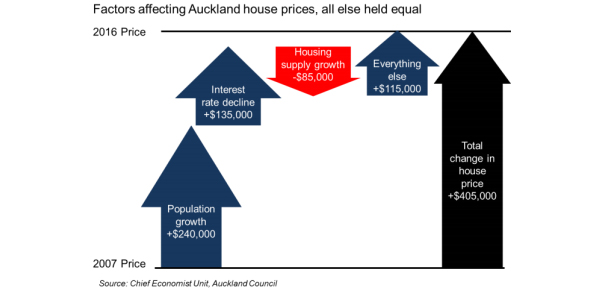
This is the centrepiece of the article
martin-norman-jan-18-2

Which might look superficially fine, at least until one stops to think about what is going on here.

Firstly, it appears to be an odd model, in that they appear to be explaining changes in nominal house prices, but without any explanatory variables like general prices or wages.  Over the best part of a decade, one might expect nominal house prices to rise by around 20 per cent as general costs and prices rose.   Perhaps they’ve estimated the model in real terms, but there is no suggestion in the article that they have done so.

Secondly, all else equal, lower real interest rates might indeed tend to raise the value of an asset in fixed supply.  But, on the one hand, this proposition doesn’t engage at all with the reasons why real interest rates might have fallen.  If, for example, expected future income growth has fallen at the same time – a part of the story in most explanations of the last decade –  any such asset price effect will be greatly weakened.   And, on the other hand, in a well-functioning housing and land market, the only fixed factor here is unimproved land.   And absent land-use restrictions, unimproved land in most places –  even most parts of a city –  simply isn’t worth much.  Perhaps you might think of $50000 per hectare for good rural land.    You could see long-term real interest rates fall 300 basis points (more than we’ve actually experienced), with no changes in future income expectations, and it still wouldn’t make that much difference to the free-market price of unimproved land (and the component of that used in a typical suburban dwelling).

Third, what about population increases?   Auckland (and Hamilton and Tauranga) have had a lot of population growth –  indeed, over decades Auckland has had one of the fastest population growth rates of any largest city in an OECD country.  And when regulatory obstacles –  land, consenting/construction or whatever –  get in the way then shocks to population will boost house prices.  There are regular population estimates published, which are easy to drop into a model.  And, no doubt, had Auckland’s population growth rate been half the actual rate, house and land prices would be somewhat lower.   But all this simply ignores the point –  the insight we really get from that swathe of US cities, (as well, actually, as from basic theory) – that population growth alone makes little or no sustained difference to house prices when the land and construction markets are free to work effectively.  So ascribing responsibility for house price increases to population growth is largely just cover for the regulatory failures of central and local government.

As a reminder, in fairly substantial US cities –  with growing populations –  we find median house (including land) prices of around NZ$250000 to $300000   (from the Demographia report: Des Moines US$198000, Louisville US$176000, Omaha $179000).

Noting that across local authority regions places with larger population growth rates have tended to have higher house price inflation, the Auckland City economists attempt to cover themselves this way

To point the finger at land use regulation would imply that all the areas with the largest population increases have the worst land use regulations and those with the smallest gains have the best regulations.

But that simply doesn’t follow.  Of course, it is often the interaction between population pressures and land-use restrictions that matters in determining what happens to prices.  And it is quite plausible that places with the fastest population growth might even have some of the less worse land-use restrictions, but those restrictions are simply placed under more pressure.  Land-use restriction is, to some extent, endogenous.

As the end of their article approaches, they argue that

Council, the Reserve Bank and the Ministry of Business, Innovation and Employment have all estimated Auckland’s housing shortfall at between 43,000 and 55,000 and growing. The Auckland Unitary Plan allows for up to one million potential new dwellings. Yet the plan was implemented a year ago, and there is no evidence of decreasing land prices.

Put another way: If having already zoned to develop 20 times the current housing shortfall is not bringing land prices down at all, can land use regulation in Auckland be the major cause of high house prices?

As I’ve noted here previously, those estimates of a “housing shortfall” are almost meaningless.   In the Auckland market as it stands, given the regulatory and other features, effective supply and effective demand appear to be in more–or-less balance.  What makes me say that?  The fact that prices haven’t moved much for a year or more.     No doubt there would be demand for many more houses if the price of land were lower, but at current land prices –  regulated and thus artificially scarce –  effective demand seems to be largely sated.

And what of the argument that “we’ve done the Unitary Plan and prices aren’t coming down, so the problem can’t be land regulation”?   Well, yes, of course it can.  If anything, given the manifestly obscene prices people face for land in  or around Auckland, Auckland Council officials (and their political masters) should be looking at the failure of land prices to fall back and concluding that their latest planners’ vision had failed.   It is all very well to talk of the potential for a million more houses, but these are the sorts of lines local authorities have run for a long time –  I recall councils running these lines when the 2025 Taskforce was looking at these issues.   I haven’t looked into the “million house claim” in any depth, but as I understand it, much of this potential is about the possibility of increased density on properties that the existing owners are simply never going to sell (they like living in their existing house/location).   There was probably a lot of theoretical capacity before the Unitary Plan, and of course there has been a lot more population pressure in recent years.

And the bigger issue is that when Council planners and politicians deem that certain places can be built on and others can’t etc etc, there isn’t much of the market at work.  A well-functioning land market would be one in which developers and land owners on the fringes of growing cities were in active competition with each other as to which could supply new sections and new homes more effectively, and where those options in turn competed with realistic options for increased density (according to the tastes/incomes of potential purchasers, not the whims and preferences of officials and politicians).     In a competitive market, holding costs are quite substantial –  not so where regulation rewards “land-banking” –  rewarding bringing land to market early.

The Auckland Council economists’ final line is cute in a way

In the case of Auckland at least, the answer is simple: You can’t live in a resource consent. It is because not enough houses are being built fast enough (for a range of reasons), rather than just the technical availability of developable land, that is keeping prices up. Land may be resource consented for development, but until houses are actually built on it, a premium will be placed on houses that are available.

And, of course, one can’t live in a consent, and we know from other work that the net addition to the housing stock in Auckland has been well less than the number of consents issued for various reasons (including that densification often loses existing houses).  But the point isn’t really relevant to the claim the economists are trying to rebut.

I did a brief post last year on one small example of undeveloped land on the fringes of Auckland –  property at Dairy Flat, still some years from actual development –  where various plots were selling at an average of $1.266 million per hectare.   When that sort of land –  with no prospect of a house on it for the next few years –   is still that expensive –  land which for rural purposes might be worth $30000 per hectare –  we know there is still something very wrong with land use regulation as it is being applied in Auckland.  If one looked, I can only assume we’d find similar examples around Tauranga.

None of this is deny that there might be problems around consenting processes, construction costs (and the construction products supply chain), and/or infrastructure, but please Auckland City stop trying to pretend that black is white and that land use regulation is not a major part of why house price to income ratios are so high in New Zealand –  not just in Auckland, or even Tauranga, but in places with few natural obstacles and modest population growth like Napier-Hastings, Christchurch, or even Palmerston North.
demographia 2 2018

Palmerston North or Des Moines?

I’m still enfeebled by the last of a bad cold –  three days of Wellington Anniversary Weekend and I didn’t even get out the front door –  so there won’t be much here today. But I noticed that Demographia yesterday released their annual report on median prices relative to median incomes in Anglo countries cities (and a few other places).

As three academics from the London School of Economics put it in their introduction

Before we can have useful debates or even give a balanced assessment of the issues we need good measures. Here Demographia has done wonders over the past decade to focus public debate on the inequity of rising house prices relative to incomes. As Oliver Hartwich in his Introduction to the 13th edition last year said “Demographia’s‘ median multiple’ approach…firmly established a benchmark for housing affordability by linking median house prices to median household incomes. It… is not a perfect measure because it does not account for house sizes or build quality. But it is the only index that allows a quick comparison of different housing markets, and it is the best approximation of housing affordability measures we have to date.”   We agree.

(The house size point matters when comparing, say, New Zealand or Australian price to income ratios with those in, say, the UK  –  where the typical house is notoriously small –  but much less so for comparisons across, say, the US, Canada, Australia and New Zealand markets.)

The big strength of the report is the collation of the data.   But the authors have policy prescriptions in mind too.  This is the more “analytical” of the charts in the report –  a variant of one they seem to show most years.

demographia chart 2018

No New Zealand city is large enough to feature, but the general point isn’t reliant on a single observation: by and large, cities with high price to income ratios have restrictive land use laws.   And no city –  in their sample –  with liberal land use laws has particularly high price to income ratios.

As so often, the US offers a high degree of in-country variability.  There isn’t just a single large city, or a single large fast-growing city. And there are very substantial differences in the land-use restrictions regime.  All within a country that has the same currency (and interest rates), the same banking regulations, and much the same tax system.

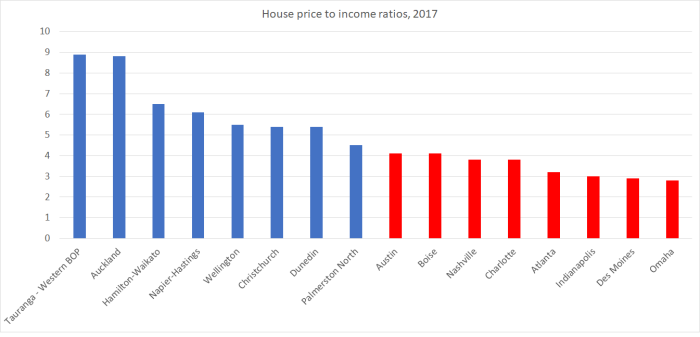
So here are the median house price to income ratios for the New Zealand cities in the Demographia sample and a selection of US cities.

demographia 2 2018

Did I cherry-pick the US cities?   Well, yes, in some ways I did.  If I’d simply wanted to show what can be done in the US, there are 10 cities with populations over 2 million with price to income ratios of 3 and under.  But some of them are cities that haven’t done very well economically, and really depressed places with falling populations can have house prices below replacement costs.

Instead, I picked out a selection of cities –  of different size, although all larger than the typical New Zealand city – in a different parts of the country.  I don’t know a lot about some of them, but many are regarded as pretty nice places to live –  at least if one gets over New Zealand priors in favour of cities by the sea (which, of course, Hamilton and Palmerston North aren’t).

As for population growth, I found some scattered snippets:

  • the Charlotte area is estimated to experienced a 15 per cent increase in population from the 2010 census to 2016,
  • the Nashville MSA is estimated to have doubled its population in the last 30 years, and had a rate of population increase similar to Charlotte’s in the most recent decade,
  • the Boise (Idaho) area has doubled its population since 1990,
  • according to the US Census Bureau, Des Moines has recently been the fast-growing city in the mid-west (at around 2 per cent per annum).

As regular readers know, I’m not a fan of government-fuelled population growth.  But in the US as a whole, immigration policy isn’t a large contributor to population growth, and so rapid population growth rates in individual cities are mostly about people and firms locating where the opportunities are.       And, perhaps, where the housing is affordable.

There seem to be plenty of examples in the United States in particular showing what can be achieved –  functioning affordable housing markets – even in areas with fast-growing populations.     Perhaps there is something amiss in our construction (and construction products) markets, but there has to be something seriously amiss with our land use laws and regulations when price to income ratios in what is –  for now –  by some margin our least unaffordable market are materially higher than those in flourishing US cities, such as some of those shown in the chart.

It would be good to see the urgent report the Minister for Housing commissioned before Christmas on the problems around housing in New Zealand highlight some of these simple, but telling, contrasts.

The Reserve Bank and housing collapses

In early December, the Reserve Bank published a Bulletin article, “House price collapses: policy responses and lessons learned”.  The article wasn’t by a Reserve Bank staffer –  it was written by a contractor (ex Treasury and IMF) –  but Bulletin articles speak for the Bank itself, they aren’t disclaimed as just the views of the author.   Given the subject matter, I’m sure this one would have had a lot of internal scrutiny.  Or perhaps I’ll rephrase, it certainly should have had a lot of scrutiny, but the substance of the article raises considerable doubt as to whether anyone senior thought hard about what they were publishing in the Reserve Bank’s name.

I’ve only just got round to reading the article and was frankly a bit stunned at how weak it was.    Perhaps that helps explain why it appears to have had no material media coverage at all.

The article begins with the claim that

This article considers several episodes of house price collapses around the globe over the past 30 years

In fact, it looks at none of these in any depth, and readers would have to know quite a bit about what was going on in each of these countries to be able to evaluate much of the story-telling and policy lessons the author presents.

Too much of the Reserve Bank’s writing about house prices tends to present substantial house price falls as exogenous, almost random, events: a country just happened to get unlucky.  But house prices booms –  or busts –  don’t take place in a vacuum.  They are the result of a set of circumstances, choices and policies.

And none of the Reserve Bank’s writings on housing markets ever takes any account of the information on the experiences of countries which didn’t experience nasty housing busts.  Partly as a result they tend to treat (or suggest that we should treat) all house price booms as the same.  And yet, for example,  New Zealand, Australia, the UK and Norway all had big credit and housing booms in the years leading up to 2008 but –  unlike the US or Ireland –  didn’t see a housing bust.  What do we learn from that difference?   The Reserve Bank seems totally uninterested.   Their approach seems to be, if the bust hasn’t already happened it is only a matter of time, but 2018 is a decade on from 2008.

One particular policy difference they often seek to ignore is the choice between fixed and floating exchange rates.  When you fix your exchange rate to that of another country, your interest rates are largely set by conditions in the other country.  If economic conditions in your country and the other country are consistently similar that might work out just fine.  If not, then you can have a tiger by the tail.  Ireland, for example, in the 00s probably needed something nearer New Zealand interest rates, but chose a currency regime that gave it interest rates appropriate to France/Germany.    Perhaps not surprisingly, things went badly wrong.

In the Bulletin article, the Bank presents a chart showing “house price falls in [10 OECD] selected crisis episodes” (surprisingly, not including Ireland).  But of those, eight were examples of fixed exchange rate countries (in several cases, the associated crisis led the country concerned to move to a floating exchange rate).   The same goes for all the Asian countries the author mentions in the context of the 1990s Asian financial crisis.     There can be advantages to fixing the exchange rate, but the ability to cope with idiosyncratic national shocks in not one of them.     And yet in the ten lessons the author draws in the article, there is no hint of the advantages of a floating exchange rate, in limiting the probability of a build-up of risk, and then in managing any busts that do arise.    It is a huge omission.  As a reminder, New Zealand, Australia, Norway, the UK, and Canada –  the latter a country that has never had a systemic financial crisis –  were all floating exchange rate countries during the 2000s boom and the subsequent recession/recovery period.

The author also hardly seems to recognise that even if house prices fall, house prices may not be the main event.   Even the Reserve Bank has previously, perhaps somewhat reluctantly, acknowledged the Norges Bank observation that housing loan losses have only rarely played a major role in systemic financial crises.   But there is no hint of that in this article.     Thus, in the severe post-liberalisation crises in the Nordics in the late 1980s and early 1990s, house prices certainly went up a lot and fell back a lot too, but most accounts suggest that those developments were pretty marginal relative to the boom and bust in commercial property, in particular development lending.  The same story seems to have been true for Ireland in the crisis there a decade ago.  Housing also wasn’t the main event in Iceland –  a floating exchange rate country not mentioned here that did have a crisis.  Even of the two floating exchange rate countries the article mentions –  Japan and the United States –  only in the United States could housing lending, and the housing market, be considered anything like the main event (and the US experience may not generalise given the very heavy role the state has historically played in the US housing finance market).

(And as I’ve noted here before,  even the US experience needs rather more critical reflection than it often receives: the path of the US economy in the decade since 2007 wasn’t much different to that of, say, New Zealand and New Zealand experienced no housing bust at all.)

Some of the other omissions from the article are also notable.  The author seems quite uneasy, perhaps even disapproving, about low global interest rates (without ever mentioning that inflation has remained persistently low), but there is no hint in the entire article that neutral interest rates may have been falling, or that global trend productivity growth may have been weak (weakening before the 2008/09 crisis showed up).   Thus, where economic activity is now –  10 years on –  may have little or nothing to do with the specifics of housing market adjustments a decade ago.   And although he highlights the limits of conventional monetary policy in many countries (interest rates around or just below zero), again he doesn’t draw any lessons about the possible need for policymakers to give themselves more room to cope with future downturns (by, for example, easing or removing the technological/legislative constraints that give rise to the near-zero lower bound in the first place.)

It is also remarkable that in an article on housing market collapses, there is only one mention of the possible role of land use restrictions in giving rise to sharp increases in house prices in the first place.   And then it is a rather misguided bureaucrats’ response: because supply may eventually catch up with demand the public need wise officials to encourage them to think long-term.  Perhaps the officials and politicians might be better off concentrating their energies on doing less harm in the first place –  whether fixing exchange rates in ways that give rise to large scale misallocation of resources, or avoiding land use restrictions that mean demand pressures substantially translate in higher land and house prices.

But in all the lessons the Bank (and the author) draw in the article, not one seems to be about the limitations of policy and of regulators.   There are typical references to short-termism in markets – although your typical Lehmans employee had more personal financial incentive (deferred remuneration tied up in shares that couldn’t be sold) to see the firm survive for the following five years –  than a typical central bank regulator does, but none about incentives as they face regulators and politicians (including that in extreme booms, an “insanity” can take hold almost everywhere, and even if there were a very cautious regulatory body, the head of such a body would struggle to be reappointed).

And nor is there any sense, anywhere in the article, as to when cautionary advice might, and might not, look sensible.  Alan Greenspan worried aloud about irrational exuberance years before the NASDAQ/tech bust –  someone heading his concerns then and staying out of the market subsequently would probably have ended up worse off than otherwise.   Much the same surely goes for housing.  In New Zealand, central bankers have been anguishing about house prices for decades.  Even if at some point in the next decade, New Zealand house prices fall 50 per cent and stay down –  the combination being exceedingly unlikely, based on historical experience of floating exchange rate countries, unless there is full scale land use deregulation –  that might not be much encouragement to someone who responded to Reserve Bank concerns 20 years ago.  (Oh, and repeated Reserve Bank stress tests suggest that even in a severe adverse economic shock of the sort that might trigger such a fall, our banks would come through in pretty good shape.)

The article concludes “housing market crashes are costly”.    Perhaps, but even that seems far too much of a reduced-form conclusion.  The misallocations of real resources that are associated with housing and credit booms are likely to be costly: misallocations generally are, and often it is the initial misallocation (rather than the inevitable sorting out process) that is the problem.  To me, it looks like an argument for avoiding policy choices that give rise to major misallocations (and all the associated spending) in the first place: be it fixed exchange rates (Nordics or Ireland), land use restrictions (New Zealand and other countries), or state-guided preferential lending (as in the United States).   Of the three classes, perhaps land use restrictions are most distortionary longer-term, and yet least prone to financial crises and corrections, since there are no market forces which eventually compel an adjustment.

It was a disappointing article on an important topic, sadly all too much in the spirit of a lot (but not all) of the Reserve Bank’s pronouncements on housing in recent years.

On housing, in late November, the Minister of Housing Phil Twyford commissioned an independent report on the New Zealand housing situation.   According to the Minister

“This report will provide an authoritative picture of the state of housing in New Zealand today, drawing on the best data available.

The report was to be done before Christmas and it is now 15 January.  Surely it is about time for it to be released?

Housing policy and prospects

I’ve been wary for some time of Labour’s approach to the disgrace that is the New Zealand housing and urban land market –  a mess created, and/or presided over, by successive National and Labour-led governments.

Eric Crampton and Oliver Hartwich at the New Zealand Initiative (bastion of quasi-libertarian public policy analysis) had been consistently pretty upbeat about Labour’s proposals, and particularly about the stated desire of (then housing spokesman, now Minister of Housing, Phil Twyford) to free up the urban land market and fix problems around infrastructure financing.  There was the famous joint op-ed in the Herald a couple of years ago.    I have never been sure how much the NZI people really believed Labour was committed to letting the market work, how much they simply wanted to reinforce that strand of Labour’s thinking with support from a business-funded body, and how much it was just about building relationships with a party that would, one day, no doubt be back in government.   Perhaps there was an element of all three?

As for me

I’ve liked the talk, but have been a bit sceptical that it will come to much.  In part, I’m sceptical because no other country (or even large area) I’m aware of that once got into the morass of planning and land use laws has successfully cut through the mess and re-established a well-functioning housing and urban land market.  In such a hypothetical country, we wouldn’t need multiple ministers for different dimensions of housing policy.  I’m also sceptical because there is a great deal local government could do to free up urban land markets, but even though our big cities all have Labour-affiliated mayors, there has been no sign of such liberalisation.    The Deputy Mayor of Wellington for example leads the Wellington City Council ‘housing taskforce”.  Paul Eagle is about to step into a safe Labour seat.   His taskforce seems keen on the council building more houses, and tossing more out subsidies, but nothing is heard of simply freeing up the market in land.  Or even of looking for innovative ways to allow local communities to both protect existing interests and respond, over time, to changing opportunities.

There was also the fact that any Labour government was likely to depend on Green votes in Parliament, and there was no sign the Greens were keen on land-use liberalisation.

And then there was little sign of leadership commitment.

Labour’s leader, Andrew Little, devoted the bulk of his election year conference speech to housing, complete with the sorts of personal touches audiences like.  Media reports say the speech went down well with the faithful…….

But in the entire speech –  and recall that most of it was devoted to housing –  there was not a single mention of freeing up the market in urban land, reforming the planning system etc.  Not even a hint.    I understand that giving landowners choice etc probably isn’t the sort of stuff that gets the Labour faithful to their feet with applause.   But to include not a single mention of the key distortion that has given us some of the most expensive (relative to income) house prices in the advanced world, doesn’t inspire much confidence.

It has been no different since Jacinda Ardern took over as leader.

Sure, as defenders point out, reform of the planning system does appear in Labour’s manifesto, and there was a brief mention in the Speech from the Throne.  But mostly what we hear about are the same, consistently emphasised, lines they’ve been running for at least the last year:

  • the ban on non-resident non-citizens buying existing residential property,
  • the extension of the brightline test (from two years to five years),
  • ringfencing, so that rental property losses can’t be offset by other income, and
  • Kiwibuild.

As well as measures to impose new higher standard on rental properties.  In practice, the new Tax Working Group also seems likely to be focused on housing-related tax issues (capital gains tax in particular).

Two things in the last few days reinforced my unease.

The first was the new “independent stocktake of the housing crisis” the Minister has commissioned.  Given that it was announced on 25 November, and is to report “before Christmas”, it is hard to believe that the group will come up with much new and different.  Probably, that isn’t even the point.

Here is how the Minister framed the work

“Shamubeel Eaqub, Philippa Howden-Chapman, and Alan Johnson are among New Zealand’s foremost experts on housing. Their insight will be invaluable.

“This report will provide an authoritative picture of the state of housing in New Zealand today, drawing on the best data available. It will put firm figures on homelessness, the state of the rental market, the decline of homeownership, and other factors in the housing crisis.

“The Labour-led Government is already pushing ahead quickly with initiatives to make housing more affordable and healthy, including banning overseas speculators, passing the Healthy Homes Guarantee Bill, cancelling the state house selloff, and setting up KiwiBuild. This report will help the Government refine and focus that work where it is most needed.

Each of the members has some expertise in aspects of housing, but none has any expertise  in –  or known sympathy with arguments for – freeing up land-use restrictions, and allowing the physical footprint of cities to grow readily as the population does.  And then there is the third paragraph –  the same old list of direct interventions, with nothing at all about liberalisation of the land market, even though it is vital if the long-term structural problems are to be effectively addressed.

Now perhaps the Minister will argue that planning reform is proceeding on a separate track, or even point to the responsibility of his colleague, the Minister for the Environment, David Parker.  But the fact remains that in all the talk about fixing the badly-distorted housing market there is little open emphasis on land-use law, nothing on reducing the price of urban land, and nothing on (finally) letting the market work effectively.

And then there was a substantial interview  the other day with Phil Twyford on interest.co.nz.   And it was much the same again.  There was plenty of talk of the coming tax changes and the proposed foreign ownership ban.  And there was great deal of talk about Kiwibuild.  There was reference to using Crown and Council-owned land in Auckland to build on.  But there was nothing at all, in the entire 23 minute interview, on reforming or freeing up the market in urban land.  There were defensive references –  it would be hard to produce ‘affordable” houses in the $500-600K range because land was ‘absurdly expensive” –  but nothing,  not a word,  about reforms that might effectively, and enduringly, lower land prices.

There was. of course, lots of talk of how “we have to build more houses”, but no attempt to seriously address the argument that, given land-use restrictions, there may not be any material unmet demand for houses at the prevailing price.   Talk about a shortage of 71000 houses –  or whatever the latest guess is –  is mostly nonsense unless the land market is fixed, and the price of land falls considerably.  At much lower land prices, I think there is little doubt that there would be more effective demand for housing –  and no obvious reason why the private sector would not meet that additional effective demand.  That would be a highly desirable outcome, but in his interview the Minister studiously avoided any suggestion of land prices falling.   And at current (very high, but currently stable) prices, there isn’t obviously any unmet effective demand in Auckland at present.

All the Minister’s talk seems to be of state-led projects to build more houses, including more ‘affordable’ houses, and more state houses.   In some cases, it seems, it will just involve the state participating in developments that were already planned.    But unless land prices are going to fall materially, it is really hard to see how any big increase in state-associated housebuilding isn’t going to largely displace private sector building that might otherwise have taken place.    For all the talk about building at different price points, and actually building more so-called “affordable houses”, houses are substitutable, to a greater or lesser extent.  A new small place on a tiny amount of land at, say, $600,000 (a price point which even the minister conceded would be a stretch) is going to be competing with existing houses in that price range in, say, Manurewa.  Perhaps additional state-led building can alter relative prices a bit but (a) if so, it seems likely too be only by use of government subsidies (the Minister indicated that the government will not be charging for the development risk, in a way that any private developer would need to), and (b) nothing about the underlying scarcity (regulation-induced) of land will change.

In their recent Monetary Policy Statement, the Reserve Bank indicated that it was assuming that half of the Kiwibuild activity displaced other construction.    They didn’t elaborate on that point, but I have an Official Information Act request in with them asking for the analysis they did in support of that assumption.

(Incidentally, while I am keen to see LVR restrictions come off –  since they never should have been put on –  it would be quite curious to see them beginning to be removed at just the sort of time when –  on government policy –  the risks around housing lending might increase quite considerably.   If the government is to be taken at its word, and we really are to see a massive increase in housebuilding, led by government initiatives rather than market forces – and at a time when many forecasters expect net immigration to be dropping away –  the risks of an oversupply of physical housing (as in Spain, Ireland and parts of the United States) would have to be considerably greater than they’ve been in recent decades.  Of course, weirdly, LVR restrictions have never applied to the most risky type of housing lending, that for houses being built.)

Two final points:

The Minister indicated, again, that one of the government’s motivations in its housing reforms is to “shift investment”, so that people don’t so much buy houses, as buy shares etc.  On this point, they seem as confused as ever.  If there really is a physical shortage of, say, 71000 houses and that is to be met over the next few years, there will have to be much more physical investment in building houses.  And someone will need to own those houses –  whether owner-occupiers, the state, or private rental businesses.  Real resources devoted to one use can’t be devoted to another use.  And, for any given stock of houses, it isn’t that evident that it is likely to make much difference to economic performance who (among New Zealand residents) owns those houses.  I’m all for home ownership, but if owner-occupiers buy houses (with large mortgages) it isn’t obvious why capital markets etc, or investment choices by businesses elsewhere in the economy, will be much different than if rental property owners buy houses (with large mortgages).

In his interview, the Minister was also lamenting large boom-bust cycles in residential construction, and suggesting that was part of the problem in New Zealand. I was a bit puzzled by that suggestion, and wondered if there was any evidence that the fluctuations in residential building activity were larger here than in other advanced economies.  It was possible they were –  after all, our population growth rates are quite variable, mostly because of swings in the flow of New Zealanders going to Australia.  So I dug out the data, for residential investment as a share of GDP, going back to 1995 (when complete data is available for most OECD countries).  This chart shows the coefficient of variation (ie the standard deviaton divided by the mean).

construction coeff of var

At least over this period, residential building activity (as a share of GDP) in New Zealand has been less variable than in the median OECD country, and far less variable than in the countries to the far right of the chart.  Over a longer period, back to 1970, there is no sign that New Zealand’s residential investment cycles have been larger or more variable than those in Australia or the United States.  Investment is variable –  typically the most variable component of GDP.  It is how market economies work.

Where does all this leave me?  With the new government’s apparent determination to continue to pursue a “big New Zealand” approach, without any material change to immigration policy, the need for additional housing will continue to grow largely unabated (tax changes and foreign ownership bans won’t make much more sustained difference here than they have abroad).   Perhaps the government has plans, currently kept quiet, for far-reaching land use reforms that will enable the market to meet changing demands, at genuinely affordable prices –  as happens in much of the US.  But at present it looks disconcertingly as though the centrepiece is going to be a government-led house building programme that (a) never gets to grips with the land issues, (b) will substantially displace private sector building, and (c) runs all the sorts of risks that government-led investment projects are often prone to.

Perhaps it will work. But it is hard to be optimistic at present.


UPDATE: An interesting piece from today’s Herald on the way land prices render even moderate intensification not really consistent with more “affordable” house prices in Auckland.

UPDATE (Friday):  Twyford speech on the government’s housing policy does nothing to allay any of the concerns in this post.   Land use reforms appear, a little cryptically, very briefly and near the end of the speech.


Growth in debt, but barely at all in New Zealand

I’m a bit tied up for the next couple of days, and so posting might be light and insubstantial  My share in the stewardship of a financial entity that has now operated for decades without appropriate authorisations and approvals is somewhat time-consuming (thank goodness we have a Reserve Bank to deal with cases where major commercial banks don’t follow the rules).

But for today, I’m just going to leave you with a simple chart. presumably constructed by Moody’s from BIS data, that I found in a newsletter last night.  It shows the change in the ratio of business and household debt to GDP between 2007 (just prior to the recession and financial crisis) and 2017 for 41 advanced and emerging countries.

household and corporate debt

In some quarters you hear a lot about high and rising debt in New Zealand.  I’ve pointed out previously that the “rising” bit is mostly wrong –  and that levels comparison across countries are difficult to do meaningfully, because of issues such as the tax treatment of debt.  Despite the surge in house prices in the last few years, household debt as a share of GDP isn’t much higher now than it was in 2007.

What this chart highlights is that New Zealand is towards the end of the spectrum with the least increases in private debt as a share of GDP.   Of these 41 countries, only five advanced economies and two emerging ones had less of an increase (more of a fall) than New Zealand.

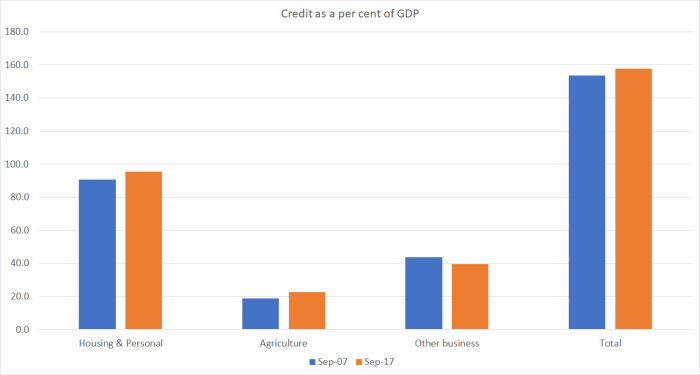
And here is a slightly more detailed chart on the specific New Zealand data, showing credit for each of the three sectors the Reserve Bank reports, as a share of GDP.

credit

In the years leading up to 2007 we did, indeed, see a big increase in private sector indebtedness (as a share of GDP), across households, farms, and non-farm business.  In the crisis-prediction literature it was a classic warning sign –  taking on lots of new loans very quickly is often associated with a serious deterioration in credit standards.    But it didn’t come to anything much, at least outside the (small) finance company sector.

Sure, we had a serious recession in 2008/09 –  as most other countries did (it was largely a global phenomenon, with roots in the US in particular) –  but our core financial sector came through the recession unscathed.  Banks weren’t perfect by any means (they are run by humans in a world of imperfect information so that is hardly surprising) and of course there was some increase in loan losses and provisions.  But nothing to threaten the soundness of any major institution or the system as a whole.

There probably are some serious questions to ask about what has gone on, and what might yet happen, in some of the countries in the chart that have had big recent increases in debt to GDP ratios –   China most notably –  but as was the case pre-2007, a big increase in debt is unlikely to be any sort of safe predictor of future financial sector problems.

And whatever the situation abroad, New Zealand at present doesn’t look like one of those places where anyone should be concerned about financial system risks.  Yes, our house prices are cruelly high, but the structural policy failings that took them there don’t show any sign of being sustainably fixed.  And there just hasn’t been much new debt taken out for other purposes.

All this is, of course, backed up by successive waves of stress tests undertaken by the Reserve Bank.   Which does leave you wondering why we now have such a regulatorily-distorted and suppressed market in housing credit.


Foreign bans and CGTs

I was going to write about something quite different this morning but I noticed an article by Bernard Hickey suggesting that the presence of a capital gains tax in Australia, and tighter restrictions there on foreign ownership of residential property, explains a substantial difference in performance in the two housing markets, across decades and over the last few years in particular.

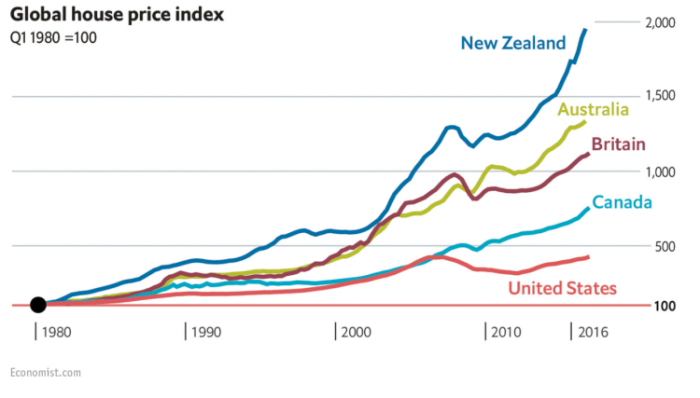
Hickey starts from this chart, using a helpful tool The Economist makes available for comparing house price inflation across countries.

hickey chart

But (a) this is a chart of nominal house prices and everyone knows we had much more general inflation than these countries early in the period, and (b) 1980 marked near the trough of a savage correction in New Zealand real house prices (down around 40 per cent over five years or so, as the New Zealand economy went through some troubled times and the exodus of New Zealanders to Australia (not then offset by increases in other immigration) began).   1980 is the starting point The Economist uses, but it isn’t where I’d be starting looking for evidence of the contribution of Australia’s CGT and foreign ownership restrictions.

Australia’s capital gains tax came into effect in September 1985.  The restriction on foreign ownership of residential properties was already in place, but no one thinks that was a material issue in Australia at the time (either there, or here).    Rising concerns about non-resident foreign ownership (actual or potential) of residential dwellings –  especially in New Zealand –  have mostly been an issue for the last five years.

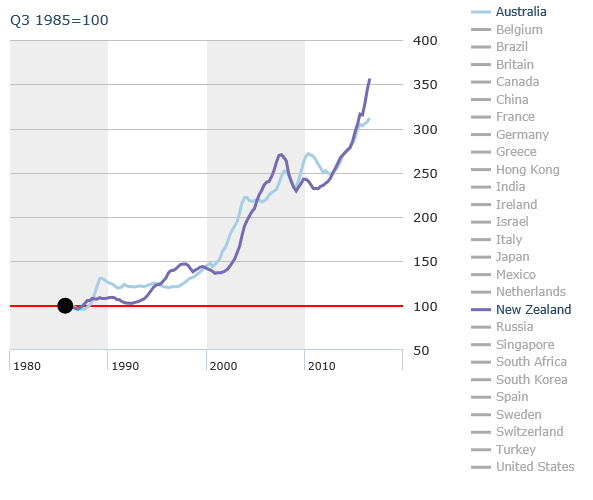
So how have real house prices in the two countries behaved since September 1985, when Australia introduced the CGT?  Using the same Economist  database – which has data only up to the end of 2016 – this is the resulting picture.

real house prices since 85 q3

In total, real house prices have increased a little more here than in Australia.  But at times, even over this period, prices in Australia have been increasing faster and at times here.   In the late 80s for example –  just after the capital gains tax was put in place –  prices in Australia were much stronger (the difference is quite large even if, without a log scale, it doesn’t appear that way).  And real house prices here fell from around 1997 to 2002 while they surged in Australia.

There are, of course, differences in the housing markets in the two countries, but the similarities look a lot stronger than the differences.  Both countries have tight land use restrictions, both countries have had rapid population growth (and although both countries currently have quite low absolute interest rates, both countries have among the highest real interest rates anywhere in the advanced world).  Here is the last 20 years of data (1996 q4 to 2016 q4).

economist index

Over the whole period, New Zealand house prices have increased just slightly less than those in Australia.

Of course, over just the last few years New Zealand real house prices have increased more than those in Australia.  Capital gains tax provisions haven’t changed materially in the two countries, although we did impose the bright-line provisions (on re-sale within two years) in 2015, and Hickey notes that Australia “removed the exemption from its capital gains tax for the main home for overseas investors in this year’s budget” (beyond the end of the data in these charts).

Perhaps the differing approaches to non-resident non-citizen purchases of existing residential property have played a part, at the margin.    We’d need a much more careful study to know, and it may never be possible to conclusively answer the question.  But recall –  the point I made yesterday –  that banning, or taxing, non-resident purchases of existing dwellings does not stop such purchasers buying new properties, or does not remove any of the road-blocks that stand in way of increased supply, of urban land in particular.  In both countries, land price inflation is by far the largest component of urban house+land inflation.

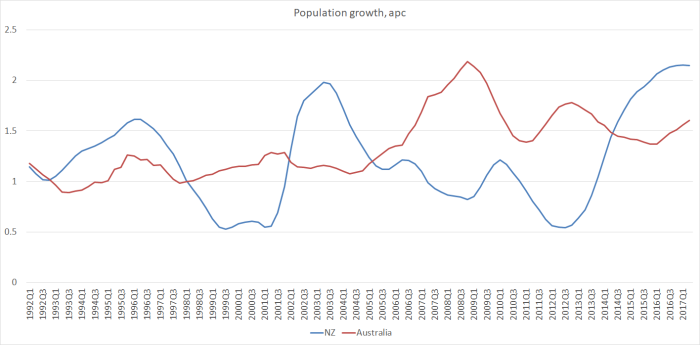
Personally, I’ve got a different candidate explanation for why house price inflation has been stronger in New Zealand just in the last few years than it was in Australia: our population growth has simply been much faster.

popn growth nz vs aus

Those are huge swings –  both in New Zealand’s own population growth rate, and in that growth rate relative to Australia’s population growth rate.     You might think that rapid population growth is a fine thing –  as people at the New Zealand Initiative (probably) do –  or a deeply problematic one, as I do, but no serious observer is going to dispute that when you have the sorts of land-use restrictions that both New Zealand and Australia do, big unexpected changes in population growth will, all else equal, quickly spill into higher house prices.  They did in Australia around the post-recession peak mining investment boom years, and they’ve done so here in the last few years.     Over longer periods of time, the two housing markets look (depressingly) similarly bad.

To be clear, I’m not suggesting that idiosyncratic tax or (eg) credit-restriction changes have no effect on housing market in the short-term. Australia has tinkered with its CGT, we’ve altered depreciation rules, ring-fencing rules etc, and we’ve put up and lowered again our maximum marginal tax rates (all things potentially relevant for investors).  I’m also not suggesting that large enough changes in the foreign buyer rules will have no effect in the short-term.    But the New Zealand and Australian experience over decades suggests that such effects don’t last for very long (and any permanent effects are pretty small), that the similarities in the two markets are much more important than the differences,  and the toxic brew of tight land use restrictions in the face of policies that drive up the population rapidly are a more compelling part of the story in both countries.    Relative economic cycles aren’t always in synch, and waves of intense population growth occur at slightly different times but the divergences in relative housing market performance never seem to have last for very long.   And are unlikely to, unless one or other set of governments sets about seriously fixing the land-use rules (and/or materially pull back on the policy contribution to population growth and housing demand).

Even the government seems to agree.    Asked about the foreign buyers ban the other day, David Parker noted (according to a record of press conference I saw) that “the impact on the number of houses built in New Zealand will be negligible”, and suggested that any price effect now would be pretty modest too.


Making progress on housing?

I’ve been quite sceptical that either side of politics –  whichever group of parties won the election – would address the fundamental distortions that have rendered urban land and houses so expensive.  After all, successive National and Labour-led governments had enabled us to get, and overseen us actually getting, into this mess.  And for anyone looking to the minor parties, New Zealand First had previously been part of, or supported, governments of both stripes, and the Greens –  with a taste for rapid population growth and restrictive planning laws –  didn’t seem any more hopeful.   Neither the Prime Minister nor the Leader of Opposition, before or after the election, seemed interested in seeing lower house prices.

An optimistic supporter of the Labour Party yesterday put it to me –  it was Reformation Day , and the 500th anniversary of Luther nailing his theses to the door of the church in Wittenberg –  that not even the Pope could stop an idea whose time had come.   As I noted in response, the general point was no doubt true, but plenty of aspirant reformers misjudged when “the time had come”, when the mood and opportunity for change had become irresistible.   Often they paid a dreadful price.   In modern democracies, of course, that usually only means losing the next election, or quailing at the prospect and just not doing anything much of substance at all.

As I’ve noted various times previously –  including in this post a year ago – while there are plenty of examples of successful places (notably now in significant parts of the United States) without tight land-use restrictions limiting housing development, I’m not aware of any country (or even region/major city) that, having once adopted the morass of planning laws and associated restrictions, has ever successfully unwound those controls.  And thus we have house prices as they are in New Zealand, or Australia, or much of the UK, or California (and many other parts of the United States).

Housing was a significant issue in the election campaign, but perhaps less significant than it might have been if Auckland prices had still been rising strongly this year.  Four of the items on Labour’s pre-election 100 day plan were housing-related:

  • Pass the Healthy Homes Guarantee Bill, requiring all rentals to be warm and dry
  • Ban overseas speculators from buying existing houses
  • Issue an instruction to Housing New Zealand to stop the state house sell-off
  • Begin work to establish the Affordable Housing Authority and begin the KiwiBuild programme


Whatever the merits of some of them, nothing on that list was seriously likely to address the fundamental regulatory distortions that have stopped the housing and urban land markets working effectively.

Today the headlines are dominated by the announcement that the government appears to have found a way to ban non-resident non-citizens from buying existing homes, by amending the Overseas Investment Act to classify all the land under such dwellings as “sensitive land” (for which we reserved rights to “adopt or maintain any measure that requires the following investment activities to receive prior approval by the New Zealand Government under its overseas investment regime” –  page II-59 of this Annex to the Korea-New Zealand agreement).      Given that the Act requires a “national benefit” for any overseas investment in “sensitive land”, and it is difficult to conceive how a potential non-resident purchaser of a house could demonstrate such a benefit given the criteria set out in the Act, it looks to this lay reader like a clever wheeze that should, largely, be effective.

But to what end, other than political signalling?   At the margin, presumably transactions costs for all purchasers of houses, anywhere in New Zealand, will increase a bit forever (will we all have to verify that we are residents or citizens?).    More importantly, is there any evidence at all that a law change like this will increase housing supply?    And is housing supply, as distinct from land supply, the real issue at all?   The argument is supposed to run that if non-resident foreigners want to buy in New Zealand they will have to build, or buy a newly-built house, instead (as is, indeed, the law in Australia).    If the law discourages foreign purchases in total it will, to some extent, ease overall demand pressures –  although experiences with provisions like the British Columbia stamp duty suggest the effect might be quite shortlived –  but if it simply leads foreigners to bid for new houses rather than existing houses, presumably residents and citizens will –  at the margin –  buy more existing houses rather than new ones.     The law is likely to change, at the margin, who buys which type of dwelling, but why will it increase overall supply?     The land market is rigged, by regulation, to be as unaffordable as ever.  That won’t change as a result of this policy.  Any issues around development finance, council consenting, or infrastructure won’t change either.   In many cases, non-resident non-citizen purchasers –  however many there truly are –  probably already prefer new apartments (if, for example, what concerns them is an easily-maintained and secured store of value).    Perhaps there is evidence from some other places that such a restriction has increased effective supply?  If so, it would be good to have it drawn to our attention.   As it is, as I noted the other day, if the goal is real impact on housing affordability for New Zealand there is probably a stronger case for banning all house purchases by non-resident non-citizens than simply banning purchases of existing dwellings.

For the moment though, it is telling that the sound and fury –  perhaps even lifting the government’s poll ratings –  is around a measure that might dampen demand very slightly, and should do almost nothing to increase supply.    No doubt there is a place for signalling in politics.  But if you want to believe that real structural reform is coming, wouldn’t it have been reassuring to have seen something tangible around land supply in the 100 day plan, or emerging –  together with the non-resident ban –  from yesterday’s first substantive Cabinet meeting?  The Minister of Housing is quoted in the media talking about potentially using the Public Works Act to confiscate private land (and the Public Works Act provisions, while necessary for some limited purposes, never adequately compensate owners).  But not about allowing private land owners to use their own land more freely.     Labour went into the election promising

Labour will remove the Auckland urban growth boundary

Couldn’t that have been made part of the 100 day plan?   Or what about a piece of legislation allowing any geologically-stable private land to be used for housing, up to two storey height, without further resource consent (preferably for the whole country, but at least say in a circle with a radius 100 kms from downtown Auckland)?     Yes, there are still transport and infrastructure issues to be resolved –  so perhaps make the commencement date of the new legislation 12-18 months hence – but changes in this area –  land-use rules –  get much closer to the heart of the problem.    If there is a problem with “land-bankers”, it is a problem created by regulation and legislation, which removes the element of free competition from the market for developable land.  And, perhaps to balance the potential to increase the physical footprint of cities, how about a Working Group to report back within six months on options for allowing groups of residents/existing owners to contract out of existing planning restrictions when collectively those owners judge doing so to be mutually beneficial?

But this all highlights the question as to whether the government is really willing, let alone wanting, to see house and urban land prices fall.    On that score, the evidence is mixed at best.    Both the current Prime Minister, and her predecessor as leader of the Labour Party, have fallen over themselves to deny such an interest, and both have proved very reluctant to talk prominently about land-use reform (although I’m told that in small meetings  –  including during the Mt Albert campaign – the PM can talk fluently on the topic), favouring instead a public focus on (a) tax changes, (b) non-resident bans, and (c) state-driven building activity (much of which is likely to displace other building, since there is little evidence of unmet excess demand at current house+land prices).

On the other hand, Labour’s official housing policy has sounded promising, and both Phil Twyford (Minister of Housing) and David Parker (Minister for the Environment) have a promising track record.  In the previous Parliament, Parker moved an amendment –  which came very close to passing –  that would have removed the urban growth boundary around Auckland.  But Opposition –  when you don’t live with the consequences (gains and costs) – is different from government, and tactical embarrassment of an incumbent government, is different from managing a tri-party government and implementing serious structural reform.   Greens/Labour/New Zealand First agreement was presumably easy around the non-resident ban, but will probably be lot harder around fixing the land market (especially now that the government has recommitted to the “big New Zealand” approach to immigration and population).

I’m not ready to be very critical of the new government yet. But my scepticism about the prospects of serious reform remains.  It isn’t really about individuals or personalities –  as I’ve noted, past governments for 25 years have also done little or nothing –  but about incentives, risks, and precedents.  In that post I wrote a year ago I concluded

Individual political leaders can make a real difference.  It would be great if one would stake a lot on urban land use reform, but anyone considering it needs to recognize the lack of precedents, the potential losers, and the worries and beliefs that underpin the durability of the current model here and abroad. And they probably need to find not only the right language to help frame repeal choices and options, but find a package of measures which helps allay – even if only in part, and for a time –  the sorts of concerns some have.

(If anyone was serious about reform, and lowering house prices, I suggested a possible limited compensation scheme here.)

In a three year electoral term, if serious reform is going to happen it needs to be got under way quite quickly.  Whatever the possible merits of KiwiBuild (and I don’t have strong views) at present it looks as if there is risk that it –  with lots of activity –  will crowd out addressing the real issues around land use law that have, unnecessarily, given us among the highest house price to income ratios anywhere in the advanced world.


Property prices gone crazy: Island Bay edition

Much of the media coverage of the housing market in recent months has been on prices having levelled off, or even fallen back a bit in some places.   Such things happen –  regulatory interventions have an affect for a time, elections create risks of new regulatory interventions, credit standards ebb and flow, as do restrictions on Chinese capital flows –  without necessarily signalling any more fundamental change in the market.    I noticed a Canadian article just the other day highlighting that in Vancouver house prices are already back up to the levels they were before the substantial tax on non-resident foreign buyers was imposed.  That shouldn’t be surprising.  The big trends in house prices are mostly about land use restrictions.  Neither in Vancouver nor in New Zealand have those restrictions been materially liberalised in ways that might foreshadow a significant structural fall in house prices.     And with the leaders of both our major political parties unwilling to suggest that lower house prices would be a good thing, it is difficult to be optimistic that that situation will change here, no matter which group of parties finally gets to form a government.

The situation in Auckland is, of course, far more serious than in the rest of the country.   Million dollar houses are two a penny there.   But the other day, I heard of a house sale in my own suburb, Island Bay, that left me pretty gobsmacked about the extent of the unjust redistributions of wealth that central and local governments have continued to enable and exact.

It was this house, 34 Derwent St

34 derwent st

It looks to have been very nicely restored (see the photos) but:

  • it is 113 sq metres only, with a single bathroom,
  • it is only 429 sq metres of land,
  • it has no views, and
  • as you see from the photo, it is in under a hill (on the west side, from whence would come the afternoon sun) and is very close to the house on the north.

And yet two months ago it sold for $1,047,000.

If you don’t value sun, it is quite conveniently located: there is a supermarket just around one corner, and a cinema just around another.  The bus stop is perhaps 100 metres away, and the primary school perhaps 200 metres away.

But it isn’t the most salubrious part of the street (nothing wrong with it, but they are mostly smaller workers’ cottages dating from around 1910), and did I mention the hill and the lack of sun?    Island Bay is a pleasant family spot, with a safe and swimmable beach (even if the water is not much above freezing even in February), but it is a typically a degree or two cooler than the inner city, let alone than seaside places a bit further north in greater Wellington.   It isn’t exactly Grey Lynn, even in proximity to the central city.

As a teenager, I lived a bit further down the same street, albeit in a somewhat sunnier spot (having come from Auckland, we bemoaned the lack of sun even there).  And my own first house was couple of hundred metres away.  That house was much the same size as 34 Derwent St –  although nowhere as nice as the newly-renovated interior – on a section that was almost 50 per cent larger.  It had limited morning sun, but at least got good afternon sun, and had a modicum of a view.  I sold that house in January 1995 for (in today’s dollars) $235000.    There has been some productivity (and real income) growth since then –  but real GDP per hour worked is up only 26 per cent.

How have we allowed the market to become so rigged and dysfunctional that 34 Derwent St now sells for $1,047,000?   Why do none of the main political parties appear to have the courage and vision to want to change this?    What, in their plans, would prevent the situation continuing to get worse –  wealth transferred from the young to the old, from those without to those with?


Who will build the houses?

One of the Prime Minister’s campaign lines has been “who will build the houses?” if immigration numbers are cut back.   It is a curious line of argument, for a variety of reasons.

But it takes on a particular air of unreality when used –  as I heard in a debate last week –  to attack the Labour Party.    After all, Labour is campaigning on a policy that will (a) leave the current 45000 per annum residence approvals target unchanged, and (b) reduce students visa numbers quite substantially (resulting in a one-year reduction in the net PLT migration inflow).  On their own numbers, the changes they are proposing won’t make that much difference to the number of work visas issued, and where those numbers do change, the intention is to focus reductions at the lower-end of the skill spectrum.  (Their document is here, and my post on it is here.)   For what it is worth, Labour even proposes a Kiwibuild visa, designed to ensure that any reductions in work visa numbers don’t interrupt a flow of construction workers.

The student aspect aside (and even that isn’t part of the 100 day plan, although it isn’t that long until the new academic year starts), one might reasonably doubt whether Labour is serious at all about reducing ongoing immigration pressures.   Their policy, if implemented, won’t materially alter the net inflow over time. And I heard this morning an extended interview with Jacinda Ardern on Radio New Zealand in which she declared that she would have no problem at all with a net 70000 migration inflow per annum if only the houses were there, and actively endorsed some recent strongly pro-immigration comments made by Helen Clark.    Labour, like National, is still a “big New Zealand” party –  despite the economic damage that strategy has been doing over decades (remember how bad our productivity record has been) and will continue to do (ever more people and a heightened priority on improving water quality and meeting climate change targets is a recipe for severely undermining our productivity prospects.)

But this post isn’t about Labour’s proposals, but about (a) what has actually been happening over the last few years in the construction sector and related migrant inflows, and (b) more briefly, how the economy might adjust if there was to be a sustained material cut to target levels of non-citizen immigration.

In his weekly column in last Friday’s Herald, Brian Fallow touched on some of the first of those topics.  He went to the latest annual MBIE Migration Trends and Outlook publication (for the year to June 2016 –   MBIE could you please make data easily accessible on a more timely basis), looked at the data on who had been granted Essential Skills work visas in recent years, and concluded thus:

The conclusion has to be that the impact of net migration flows on the housing market and the construction industry is overwhelmingly on the demand, not the supply, side.

There has been a big increase in construction activity in New Zealand in the last few years.  Some of that is driven by the Christchurch repair and rebuild process, but increasingly the key influence has been the unexpectedly rapid growth in the population.  Each of those people needs a roof over their head.

And so employment in the construction sector has increased rapidly.    Here is the data from the HLFS, showing the percentage increase in people employed from calendar 2013 to calendar 2016 for each of the sectors employing more than 100000 people.

HLFS by sector

The construction sector has had by far the biggest increase in employment over the last three years.  Around 56000 more people were employed in construction in 2016 (on average) than in 2013 (the current total number of people employed in the sector is around 240000).

What contribution has non-citizen immigration (the bits our policy controls) made to this employment?

As Brian Fallow noted, on MBIE’s own numbers, this is how many Essential Skills visas were granted for construction trades and construction labouring roles in the year to June 2016.

And a startlingly low proportion – 7 per cent, or 2233 to be precise – were classified as construction trades workers like carpenters, plumbers, plasterers, tilers and painters. If you include scaffolders and builders’ labourers, the proportion rises to nearly 10 per cent.

And here are the corresponding figures for the previous couple of years.

Essential skills visas granted
2013/14 2014/15 2015/16
Construction trades workers 2090 2123 2233
Construction and mining labourers 399 546 831
Construction sub-total  2489  2669  

3064


Total 26502 28548 31766
Construction as % of total 9.4 9.3 9.6

Those might look like quite large numbers but:

  • at last report, construction jobs made up 9.3 per cent of all employment (and yet in this really rapidly growing sector only around that share of Essential Skills visas –  suggesting that immigration was hardly easing sector-specific pressures), and
  • as Brian Fallow also pointed out, most of these Essential Skills visas were being granted to people who were already in New Zealand (eg renewals).  Of 31766 Essential Skills visas granted in the year to 2016, only 8334 (or 26 per cent) were new workers (the proportions are similar in the earlier years).
  • people arriving and taking up first-time work visas need to be offset against people leaving.    In the three years I’m looking at here, MBIE tells us that the total stock of people here on essential skills visas increased by only 10062.   If the patterns were similar for construction jobs as for other roles, construction would account for about 1000 of that increase.

Of course, some people will have moved from work visas and obtained residence visas.  Based on the 2015/16 residence visa approvals numbers, that might have been around 450 people working in construction roles per annum.  Over three years, perhaps as much as 1500 people.

In other words, in a construction sector where total employment has increased by 56000 in three years, perhaps only 2500 (or less than 5 per cent) of that increase will have been met by the immigration of non-citizens.

So in that sense the answer to the Prime Minister’s question is easy.  Who will build the houses if immigration is cut back?  The same people who always overwhelmingly have, people who were already here.

But perhaps more importantly, if immigration were to be sharply cut back, the number of people needing accommodation would fall.  At one extreme, if the population is growing by 100000 per annum (as it has in the last couple of years), that suggests a “need” for around another 35000 houses each year (on top of the small number that would need replacing each year with a static population).  With net non-citizen migration at present in excess of 70000, the non-citizen immigrant flows alone create a “need” for perhaps 23000 additional houses each year.     Even if we go back to Brian Fallow’s original numbers of gross approvals of Essentials Skills visas, 3000 construction workers cannot build 23000 houses a year.   So the way immigration policy is actually being conducted it is exacerbating pressure on the construction industry, not relieving it.  That additional pressure is substantial.

(It needn’t be that way of course.  In the short-term immigration will almost always in increase economywide demand more than it increases supply.  But composition of the immigrants afffects where the pressures are most felt.  At the extreme, if all the migrants were builders (and related occupations), they’d probably just about keep up with the additional demand for housing (building, in effect, to house themselves).  Then the demand pressures would show up more severely in other sectors.    But when there is a big increase in the population, and hence in construction activity, immigration policy certainly isn’t relieving construction sector constraints when only around 10 per cent work visas are going to construction workers, when almost a quarter of the new jobs are in construction.)

So what would happen if, say, the 45000 residence approvals target was cut to, say, the 10000 to 15000 per annum I’ve been advocating (still, in per capita terms, around the rate of permanent approvals in the United States), and issuance of work visas was also tightened up, so that the stock of people on temporary work visas was no longer growing?

Overall, growth in domestic demand would weaken, and with it the pressure on domestic resources.  The notion that the short-run demand effects of immigration outweigh the supply effects shouldn’t really be controversial.  It has been that way in New Zealand for many decades.  But, given the huge scale of the pressures that new people put on the construction sector (not just houses, but roads, schools, offices, shops etc), and the fact that immigration policy as actually run has not seen us bring in many construction workers (10 per cent of the visas, when 25 per cent of the new jobs have been in construction), such a policy change would greatly ease resource pressures in the construction sector specifically.  In some other sectors it is quite conceivable that resource pressures could increase (one could think of export-oriented sectors such as tourism or dairying) if such an immigration policy change was made.  But on the construction side of things –  one of the most politically and economically pressing areas of our economy – the gains (the relief of pressure) would be substantial and almost immediate.  Not only would construction sector resource pressure ease, but land prices could also be expected to fall back to some extent (due to a reduction in expected future demand).

More generally, across the economy one would expect to see  interest rates falling (both market interest rates and the OCR) and with them the real exchange rate.    A lower real exchange rate would help secure the overdue resource-switching towards the tradable sectors. It would also provide the additional margin that would enable employers in those sectors to bid up wages to the extent required to attract existing residents to take up jobs in those sectors.    Plenty of people would be freed up from the construction sector –  a country with a modestly growing population wouldn’t have 10 per cent of total employment in construction –  and they’d be looking for jobs elsewhere.  Most of them would be long-term residents or citizens –  something we know with a high degree of confidence because the government’s own data tell us not many visas have been issued in recent years to people in construction, whether skilled workers or labourers.

But I guess the Labour Party can’t really use these arguments to push back against the Prime Minister because they aren’t actually planning a material and sustained reduction in non-citizen immigration at all.  That’s a shame.

(And if you wonder why all this discussion has used visa numbers up to June 2016, that is because MBIE only release more recent numbers in massive (600000 line) unwieldly spreadsheets.  It is possible that patterns in the last year have been a little different, but it seems unlikely –  given the similarity in each of the previous three years.  But debate would be better-informed, and more timely, if MBIE would make  timely data available in more readily accessible formats, as happens for almost all other important economic data released by Statistics New Zealand, the Reserve Bank or whoever.)


Housing failure set to continue

I’ve long been sceptical that any government is likely to fix the housing market problems any decade soon.   Some of that was specific New Zealand points: National seemed to be doing almost nothing, Labour had done almost nothing when it was in government, and Labour seemed likely to rely on the anti-development Greens if and when it formed another government.    But most of the scepticism was – and is –  rather more overarching: no one has been able to show me a case study anywhere in the world where intense land use restrictions had once badly messed up a housing market, and where those controls had then been successfully unwound and housing made affordable again.   In principle, there was no reason why New Zealand should not have been first.  But the ages of pathbreaking New Zealand reforms  –  whether the 1890s or the 1980s –  seem well behind us at present.

It wasn’t a weekend that led my to revise my opinion.    In yesterday’s Sunday Star-Times Rob Stock had a piece reporting widespread scepticism about the claims that both Labour and National are making.  He began with both leaders’ reluctance to even call for lower house prices.  No one much seemed persuaded by the idea that nominal house prices might hold flat and incomes rise steadily to reduce price to income ratios.  On paper it could be a plausible story, but even if so it is a solution for the next generation not the current one.   And the article also reported a great deal of scepticism about the apparent Labour aspiration to introduce a lot more lower-priced homes without having much impact on the prices of existing dwellings.    The people Stock quoted seemed a bit more optimistic that –  despite the disavowals – Labour’s plans might actually lower house prices.   Fundamentally improve the land supply situation and perhaps that might be realistic.  Without that, government-sponsored builds seem likely to substantially displace private sector builds.

But then there were the policy cues.  Yesterday morning, National announced that, if re-elected, it would increase the subsidies offered to first-home buyers.  First-home buyer grants, in a supply-constrained market, are a policy so daft that I’m not aware of any serious analyst, from any side of the political/economic debate, who thinks they are a good idea (and Treasury and the Reserve Bank have opposed them).  New Zealand was mercifully free of such subsidies for most of its history –  and policy people used to look across the Tasman, slightly disdainfully, at the grants there.   First home buyer grants are, largely, an expensive way of getting house prices a bit higher than they otherwise would be.  And here that outcome is even more likely given the announced increases in accommodation supplement payments next year.   Renters will be able to pay a bit more (so investors can afford to pay a bit more), and potential first home buyers would now also be able to pay a bit more –  perhaps especially in provincial areas where the grant goes a bit further.  Since the policy is well-foreshadowed, most of the effects will have been compounded into prices before the first young couple can get their increased grant.  And, as so often, the winners will be the people selling out of the market –  those who already have.  It is the sort of policy that gets adopted when governments have given up on  believing that they might actually fix the underlying problems –  and/or given up believing that they can convince voters that they might.    Subsidies to home buyers –  rather than fixing the underlying problem –  is like some throwback to the early 1980s (actually the last time we had such direct first-home buyer subsidies).

The messages from the other side of politics weren’t much more encouraging.  The leader of the Opposition yesterday announced her plans for the first 100 days of a Labour government.  Housing appears on the list, but the three most specific items are

  • Pass the Healthy Homes Guarantee Bill, requiring all rentals to be warm and dry
  • Ban overseas speculators from buying existing houses
  • Issue an instruction to Housing New Zealand to stop the state house sell-off

Whatever you make of the Healthy Homes Guarantee Bill, it won’t improve the affordability of housing (if anything, rather than contrary for renters).  And stopping the sell-off of state houses might (or might not) make some sense, but again it won’t alter, by one iota, the affordability of housing in New Zealand.   And, in fairness, both are probably being done for other reasons.  And so the one specific thing they’ll pledge to pass by Christmas actually designed to improve housing affordability is the proposed ban on non-resident foreigners buying existing housing.  Consistent with this, on Labour’s website, the very first thing one comes to under housing policy is

Crack down on speculators


Ban foreign speculators from buying existing homes

Reasonable people can differ on the specifics of this (and other “anti-speculation” measures –  the extension of the bright-line test for investment properties, and ring-fencing).   To me, it has the much the same feel as that around first-home buyer grants –  it is the sort of policy one adopts when one has given up on dealing with the underlying problems.    Blaming “speculators”, for the symptoms of a rigged and dysfunctional market, is a distraction strategy from way back for politicians here and abroad.

Banning non-resident foreign purchases of existing houses isn’t the worst policy imaginable –  and any adverse impact on New Zealanders is likely to be small to non-existent – but as a flagship policy for a possible new government it is hardly one that suggests a serious focus on fixing the underlying long-term problems.  Sure, it is probably quite easy legislation to draft  (though no doubt MFAT officials will be turning their minds to the issue of how to reconcile the proposed ban with, eg, the New Zealand-Korea “free trade” agreement) and comprehensively fixing the planning system isn’t.  But after years in opposition, and with policies around land supply that look promising on paper, if they were really serious about far-reaching reform in this area, one might have hoped they’d have found something specific to have done in the first 100 days –  a stake in the ground, an earnest of a serious commitment to free-up land supply later in a first term.   But when the previous leader never mentioned the issue, the current leader never does, and when there is nothing in the 100 day action plan, I’ll stick with my scepticism for the time being.

Bloodless economists probably aren’t supposed to do disgust, but that pretty much summed up my reaction to the weekend story that, less than a year out of office, John Key had sold his Parnell property, at what is apparently a very substantial profit, to enable him and his wife to downsize.    No doubt it is mostly about “time of life” thing –  kids off their hands etc –  and I’m not suggesting that the National Party’s failure to do anything much about fixing the housing market problems for nine years was mostly about personal enrichment.     But this was a leader whose approach to the increasingly severe housing disaster was to glibly call it a “quality problem” or some sort of “sign of success”.  As I put it 18 months ago

In a speech to an Auckland business audience yesterday –  there is a report here, and also video footage –  the Prime Minister repeated his breezy claims that Auckland’s “challenges” around housing and transport are “a quality problem”, and a “sign of success”, and that both the city and the country are doing “incredibly well”.

Perhaps that is how it appears when you are already wealthy, live in a large house in a prime inner suburb, and have a taxpayer-provided chauffeur at your constant disposal.  Neither housing nor traffic problems must impinge terribly much.

And so, having moved on from public life, Key now extracts what is reported to be several million dollars of profits which are really just monopoly rents.  Keep the land supply market dysfunctional, boost the population considerably, allow house prices to be driven up to an extent that an ever-larger proportion of the young and the poor can’t afford to buy, and then simply take your own profits.   It is, in effect, money taken at the expense of the poor of Auckland –  not because any of them could afford Parnell, but because most of the increase in Parnell land prices is a reflection of the same common factor that has driven prices high across Auckland.  It is easy to be indifferent to a problem when you yourself benefit – even just passively –  from that continuing indifference.    The record, the policies, National is campaigning on today, including around housing and land, are more or less exactly the same as those of the first eight years of a National government, under John Key –  who has now cashed-out millions of dollars personally, made from his government’s refusal to fix the housing market.

Putting disgust aside and returning to the numbers, one often hears the current Prime Minister talking of 10000 houses a year now being built in Auckland, as if somehow this is the answer to the past policy failure.    It is often complemented by references to bureaucrats’ claims that tens of thousands of new houses are in the pipeline – I think I’ve even heard references to some multiples of Hamilton being built in the next few years.    (I’m not sure why we should be impressed by that figure, when New Zealand’s population is currently growing by as much as Hamilton every two years).

Of course, as Core Logic has pointed out, the actual increase in the housing stock is much less than the number of new dwellings being consented (many new builds require the demolition of existing houses), but even just focusing on building permits, is there any sign that the number of permits being granted in Auckland is getting ahead of the population growth?

The chart below uses official data.  It shows the number of building permits being granted in Auckland each (June) year relative to the (SNZ) estimated increased in the population over that same year.  Comparisons that look just at consents per capita are meaningless –  it is increases in the population that (are the biggest factor that) increase the need for accommodation.    The data are only annual, but for the year to June, so the actual building consents numbers are almost right up to date.    The population estimates for individual areas for June 2017 won’t be out until later next month.  But Auckland’s population is estimated by SNZ to have increased by 2.82 per cent in the year to June 2015 and by 2.83 per cent in the year to June 2016, and there has been no material change in net migration inflows over the most recent year.  So I’ve assumed a population increase in Auckland of another 2.82 per cent in the year to June 2017.   It is a rough estimate, but it would be surprising if the SNZ estimate next month was materially different.

building permits per person increase

So, yes, in annual terms, the number of building permits for new dwellings per person increase in the population has increased, but not by much.  But in the last two years, the rate of consenting has still been lower than in any year in the first decade of the data series.    It is unspectacular at best.  Sure, there is a lot of building going on right now, but then there are huge (government-abetted) increases in the population which don’t yet show any sign of abating.

And if there is a lot of house-building activity going on at present, there are straws in the wind suggesting there will be less in future.  At a national level we’ve already seen some of that already in the building work put in place data released last week.  But here is a chart of Auckland new dwelling permits.  The data are noisy from month to month, so here I’ve taken the annual growth rate in the three-monthly total (eg May to July 2017 over May to July 2016) and shown the data for (a) the total number of new dwellings consented, and (b) for the total floor area of those consented new dwellings.

building permits 2

Both annual growth rates are now (a) well below where they were, and (b) actually are negative.  In other words, in annual terms the volume of new housing being consented in Auckland is dropping.  And there is no sign that the rate of population increase is.

Views will differ on whether these numbers reflect capacity constraints or the limits of effective demand at the prevailing (extremely high) prices.  My own bias tends towards the latter story –  and Rodney Dickens at SRA has done some analysis taking the same view.  But whichever story you think is more convincing, the numbers don’t suggest any near-term lift in the overall supply of houses relative to the increase in the population.  Taken together with the lack of much land-use regulation reform, it all provides little reason to think that housing affordability in our largest city is likely to improve much, or for long, on anything like current policies.  Meanwhile, the system will remain skewed to those who have, and against those who have not, and we can only expect yet more ad hoc measures –  whether from the elected government or outfits like the Reserve Bank –  to paper over the symptoms of housing market failure.