Offshore demand for houses

What to make of the housing data released by the Labour Party, and of the subsequent debate?

I’m writing this partly to help clarify my own thoughts.

First, can the data be relied on?  Well, no, but then no one really suggests that it can be.  Even if we assume that the data Labour obtained are reported accurately, they are still only a partial snapshot, and report something that is likely to be aligned, but not that closely, with the subject of interest –  purchases of residential property in Auckland by non-resident investors.  It isn’t ideal, but then neither are other contributions to the debate (eg searches on juwai.com, or anecdotes from people on either side of the debate).  There is a reasonable argument that there are no particular grounds for official statistics to be collected in this area.  But if so then informal statistics and surveys are likely to be the best there is.   And for those who do favour official data collections, well they are being put in place but the results won’t be available for months, since the data requirements don’t come into effect until 1 October.

Frankly, it seems reasonable to suppose that buying by non-resident Chinese is a material part of the market at present.  If so, that is not a normal state of affairs.  Generally, people do not buy individual residential properties in other countries as a part of a balanced investment portfolio.  In particular, they do not buy such property in small cities at the end of the earth.   People might, on occasion, own holiday houses abroad.  The super-rich might have second houses in great world cities such as New York and London.  But normal middle and upper middle class people in developed market economies don’t generally invest for their retirement in rental properties in faraway cities.  Apart from anything else, monitoring costs are high.  In fact, when people do own residential rental properties they are usually owned in locations quite close to where the owners themselves live.

In the 175 years since British government was established here, I expect this is the first time we’ve had this particular debate in New Zealand.  And it is a different debate than one around immigration and housing.  Reasonable people can differ about how much immigration we should have, and even where we might welcome migrants from, but if we are going to allow people to settle here they need to live somewhere.

“Capital flight” is a different issue.  In Latin America, Africa, and now China, people who have acquired money in ill-governed countries – many of the gains themselves might be ill-gotten, but many won’t be – want safety and security for themselves and their families.  That might be protection against a rickety domestic financial system.  Or it might be protection against the current ruling elite cracking down on political enemies (as much of Xi Jinping’s recent “anti-corruption crackdown” seems to have been).  It might just be protection against the risk of a substantial depreciation in the local exchange rate (which would probably be an appropriate course of action in China now, from a Chinese perspective).  In countries where many forms of capital outflow are illegal, people have to take what routes they can.

So, I think people who talk of offshore-Chinese interest in residential property abroad as something we just have to get used to, or an inevitable feature of globalisation, are wrong.   This demand is a function of the failure of China, not its success.  There was never a time when British or American savers were managing their investments by buying houses in Sydney or Auckland.  They were well-governed countries with rule of law protections.  China, to date, is not.

People are also wrong if they suggest something odd in singling out Chinese purchasers.  In most places around the world, the issue at present is about Chinese-sourced flows –  and, of course, unlike many of corrupt countries from which capital has previously flown, China now has one of the largest economies in the world, so any spill-over effects potentially matter more.  But if it were Russian or Argentinian buyers (which it isn’t, and has not ever been here), it would be just as much an issue.

Which is why I thought the intervention of the Race Relations Commissioner in this debate was particularly unhelpful and ill-judged.

But why might non-resident purchases of houses in Auckland matter? And to whom?  I’d argue that they matter only because laws and administrative practices make new housing supply so sluggishly responsive to changes in demand.   There is apparently substantial Chinese buying interest in Houston too, but when housing supply is much more responsive to changes in demand, foreign interest in local properties is largely beneficial to the local economy and its permanent residents.  It is, in effect, just another export opportunity.

But things are different when supply is so sluggish – and when it is mostly government policy that makes it so.   If supply were sluggish enough, even a few percentage points of additional demand could have material implications for house and urban land prices.  I’d be surprised if anything like 20 per cent of demand in Auckland was from non-residents, but if the true number is five per cent (which wouldn’t surprise me) it could still be making a material difference to prices in the current rather over-heated environment.  The Reserve Bank’s current and proposed lending restrictions are only likely to increase the relative importance of such offshore demand in explaining continuing price increases.

If most of any offshore-purchased houses are quickly put back on the rental market, offshore demand does not affect the availability of accommodation in Auckland.  If anything, it would probably drive further declines in rental yields (though not in nominal rents).  But it would still put home ownership further beyond the reach of New Zealand citizens and permanent residents living in our largest city.

The implications would be more serious if (and we don’t have the data) any material proportion of the offshore demand is being bought and left (largely) empty –  perhaps occupied two weeks a year if the owners take a holiday here.  Again, if housing supply were responsive, this demand would be pure gain (as at a holiday resort town), but in a city with tight housing supply restrictions (imposed, maintained and administered by central and local government), such demand would represent a reduction in effective accommodation supply, with consequences not just for the affordability of home ownership, but also for rents.  In that case, there are gains from offshore demand for the immediate sellers of the property (at least if they are leaving Auckland) but the distributional consequences for the wider Auckland population look pretty awful.  It doesn’t affect existing home owners, but the young and the poor typically end up worse off –  and in Auckland, as David Parker has noted, those on the margins are disproportionately of Maori and Pacific backgrounds.

Bernard Hickey has suggested that offshore demand should be welcomed if it is accompanied by large scale apartment building, perhaps directly financed by Chinese capital.  I’d have no objection at all to such investment, although as one who is a little sceptical of the estimates of the scale of any “shortage of physical houses”( the issue is mostly a land price issue), such a huge building programme could well sow the seeds of a subsequent collapse in Auckland property prices if the offshore demand for Auckland property proved not to be a long-term phenomenon.  Real overbuilding tends to be more economically damaging than simply price overshoots.

In the longer-term I suspect (hope?) the offshore non-resident demand is a second or third order issue.  Indeed, it may not be an issue at all.  A more liberalised Chinese financial system would allow savers to diversify their holdings offshore through much more efficient investment vehicles.  And Auckland is still a small city (and not exactly London, Sydney or San Francisco), compared to most of the others in which Chinese investors are reported to be interested, suggesting that demand would reallocate away from New Zealand if prices in Auckland got too high.  In the medium to longer-term, it is still likely that the interaction between tight land use restrictions and high target rates of inward migration  (which permanently boosts the population and demand for housing) will be more important for house and land prices in Auckland, and housing affordability.  As I remain sceptical that housing supply can (politically) be substantially liberalised –  I’m still curious to learn of any overseas examples where the controls have been substantially unwound –  winding back the target level of inward migration needs to be discussed.  It would be a more useful place to focus policy debate than overseas purchaser restrictions (and easier to implement effectively).  Again, this is an issue that should be able to be debated without accusations of “xenophobia” or ‘racism” being flung around by the great and the good.

I favour a relatively unrestricted environment for foreign investment, putting foreign investors on the same footing as New Zealand citizens and residents (though not as more favourable footing, as ISDS provisions have the effect of doing).  Most of our current restrictions appear unnecessary or counter-productive.

But when the government makes it hard to use urban land and increase housing supply, we are moving into a world of considering second or third best policy options if there is a large sustained source of offshore demand to own New Zealand houses.  Policy should be made in the interests of New Zealand citizens and permanent residents, and it is not clear what interest of New Zealanders is served by allowing an unrestricted inflow of offshore demand (if indeed it is substantial).  I heard David Mahon on Radio New Zealand this morning suggesting that even raising the issue would adversely affect our image in China, highlighting some deep “latent xenophobia”.  Perhaps it will affect our image, but I rather doubt it will affect how much milk powder is sold, or the price at which it is sold.  And when the country with the largest population in the world is both sufficiently ill-governed that many of its people just want to get their money out any way they can (after one of the biggest, and least disciplined credit booms in history), and just sufficiently liberal that there are some legal vehicles for those outflows, it is not inappropriate that other countries’ citizens might be wary about the implications.  China  –  and the choices of the Chinese rich – matters for other countries in a way that Zaire mostly did not.

Are there easy answers?  I doubt it.  People talk of the Australian policy of allowing non-resident purchases only of new houses – which sounds not totally implausible in principle, but doesn’t appear to have worked that well in practice.  If the government is confident that its registration scheme will produce robust data, perhaps an “offshore investor levy” –  akin to Treasury’s dubious “Auckland investor levy” –  could be considered.  But I suspect any such provision would run into problems with provisions in any number of our free trade agreements.  The same might go for banning non-resident purchasers altogether (eg from anyone without New Zealand citizenship or residence).

I’m not sure what the answer is, in a third best world.  But in this debate, I reckon the medium-term interests of people needing accommodation in Auckland, and wanting to buy their own home, need to be the policy priority.

And good quality debate around what could be an important issue isn’t help by sloganeering from people on any side of the issue.  I rather liked the guidelines for debate that Bryan Caplan and David Henderson have posted on Econlog in the last few days.  I’d add just one other –  to win a debate, and deserve to win it, one has to engage with the strongest arguments of those on the other side, not the weakest.  Attacking straw men perhaps has its satisfactions, but doesn’t really advance understanding, or the cause of good policy.
A brickbat and a bouquet for Treasury

A brickbat and a bouquet for Treasury this morning, following from the pro-active release yesterday (albeit with many deletions) of papers related to this year’s Budget.  Pro-active release is a welcome practice that should be more widely adopted.  Indeed, in some form it is a practice that should generally be made mandatory.

First the brickbat.  Very late in the Budget process, as the government continued to flail around with an apparent sense that “something must be done” about the housing market, but a reluctance to expend political capital to actually address the underlying issues (land use restrictions and the active policy-driven programme of inward non-citizen immigration), Treasury was asked for some advice on several tax options.  None involved serious or thoroughgoing reform of the overall tax system  (eg land tax, taxing imputed rents, shifting the basis of local authority rates back to land values, inflation-indexing the tax system (which reduces the value of interest deductibility), or even less desirable measures such as a comprehensive capital gains tax, or ring-fencing the ability to offset losses on rental properties).  Instead, they were patches, or worse.  Treasury compounded the problem by throwing in its own proposal –  an Auckland Investor Levy.

By this point, Treasury was probably under quite unreasonable pressure.  As they bluntly note in their 24 April Treasury Report, “because of the very short timeframe, this is a longer and less considered report than we would normally provide”.  That is not a good basis for making policy.  But public servants must respond to the demands of their Ministers.

The Auckland Investor Levy –  a 1 per cent annual levy on the value of residential rental property –  appears not to have been the Minister’s idea, but a proposal of officials.  Perhaps they saw it as something less bad than other possibilities canvassed in the paper (such as an interest levy).    But this is not just an idea that Treasury is reluctantly providing pros and cons on.  They recommend to the Minister to “consider progressing” such a tax.  Much of the discussion of the proposed Auckland Investor Levy has been withheld in the document that is released, but the summary table at the back of the paper makes it clear that Treasury is pretty sympathetic to this option.

And yet:

  • There is no analysis in the paper to explain why Treasury believes that investors, as opposed to (say) owner-occupiers are a  particular “problem” in the housing market.
  • There is no discussion of how the “tax advantages” of housing are distributed among owner-occupiers and investors.  Previous analysis has suggested that unleveraged owner occupiers are at the greatest advantage.
  • There is no apparent attempt to reconcile this proposal with the more general point that there appear to be too few houses (or at least too little effective land supply) not too many.
  • There is no analysis in the paper to justify why such a wealth tax should be so partial.  Why impose a levy on investor residential properties, and not on owner-occupier ones?  Why houses and not commercial buildings?  Why rental houses and not farms or equities?
  • Treasury proposes hypothecating the revenue from this (supposedly temporary) levy to the Auckland Council, and yet there is no discussion (released) of the difficulty of lifting the levy in future (and thus depriving the Council of a major revenue line).
  • There is no discussion of the efficiency costs (or the equity) of having one tax system for Auckland, and one for the rest of the country.

In a rushed paper, I’m not suggesting that Treasury could have fully adequately dealt with each of these issues, but it is pretty inexcusable that these issues are not even mentioned.

And the bouquet.  Media reports indicate that Treasury proposed ending public funding of Kiiwrail and either markedly reducing the size of the operation, or closing the company altogether.  Given the amount of money that has already been sunk into Kiwirail, in one sense it would be a shame if it were to come to that.  But sunk costs are sunk costs, and unfortunately it does not appear that the analysis underpinning the earlier injections was particularly robust.  I don’t suppose Treasury expected that Ministers would agree to their proposal, but it is good that it was made.

It is particularly encouraging that the recommendation was presumably endorsed by the Secretary to the Treasury.  I spent a couple of years on secondment to the Treasury, which overlapped with the early days in Treasury of Gabs Makhlouf, fresh from the UK.    A major discussion was held one day to try to gravitate towards an agreed “narrative” on the reasons for New Zealand’s disappointing long-term economic performance.  Gabs’s contribution was to observe that New Zealand’s problem was that it had underinvested in rail.  Britain developed railways and exported the technology around the world, and New Zealand never really took advantage of it.    Fortunately, it did not seem to be a widely held view.  I guess Gabs has learned.  A while ago I asked for a copy of an “economic narrative” document Treasury did in 2013.  If and when it arrives, it will be interesting to see how the Makhlouf Treasury now accounts for New Zealand’s disappointing longer-term performance.

Brian Fallow covers my criticisms of the proposed new controls

In his weekly column in today’s Herald, Brian Fallow outlines and reviews some of the criticisms I have made of the Reserve Bank’s proposed Auckland investor property finance controls.   The accompanying cartoon (only part of which is online) shows pygmies attacking the giant Wheeler, secure in his moated castle.

Fallow’s piece is a very fair presentation of some of the arguments I have made, particularly in my LEANZ address last week (and he also notes the Treasury’s evident disquiet about the proposed controls).  I’m not going to repeat old material here, but will just highlight a couple of the points that arose in subsequent discussion.

Brian noted that Grant Spencer, the Bank’s Deputy Governor, has often argued that even though the stock of debt is not currently growing rapidly, there are a lot of new loans occurring and hence the risks are rising.  My response to that point is that, in normal times, there will always be lots of new loans, and lots of repayments going on.  It is great that the Bank is now collecting more detailed flow data that enables us to better see that breakdown.  But because we have no historical time series, we don’t have any good basis for interpreting it, and knowing what it might mean about risk.  In particular, as I noted, we don’t know what the pattern of new loans vs repayments was in the credit and housing boom of 2003 to 2007 when, for example, housing turnover was much higher (and from which episode, as a reminder, banks emerged unscathed).   That drives me back to the international empirical literature on crises, which suggests that big increases in the stock of debt (relative to GDP) over short periods of time has been one of the best indicators of building crisis risks.  Of course, historical empirical work is also limited by data availability, but at this stage with no material increase in debt to GDP ratios, and no sign of any material deterioration in lending standards, there doesn’t seem a basis for great concern about financial stability in New Zealand.

I have also suggested that the Bank should be doing more careful comparative research and analysis on the similarities and differences between New Zealand’s situation and those of countries that have had nasty housing busts (US, Spain ,and Ireland) and those that did not (UK, Canada, and Australia for example).  Brian posed the reasonable question as to whether people won’t just focus on the superficial similarities and differences, cherry-picking points of similarity or difference that suit their own argument.  That is a risk, but in a sense that is the point of doing research and analysis (for which the Bank has far more resources than any else in New Zealand), and making it available.  It enables informed debate to occur, and each piece of data or analysis is open to scrutiny and challenge.  The contest of ideas and evidence is a big part of  how we learn.

Fallow concludes his article thus:

A financial crisis is a low probability but high-cost event, as the Treasury says.  If you focus on the low probability, like Reddell, the conclusion is that the bank should pull its head in.  If you focus on the high potential cost, like Wheeler, you would want to do whatever you can to slow the growth in house prices and buy time to get more built and for the net inflow of migrants to return to more normal levels.

Maybe, but actually I suspect that misrepresents both Graeme and me.  Graeme Wheeler probably thinks the probability of something nasty happening in the New Zealand financial system in the next few years is higher than I do.  And I’m not just focused on the low probability of serious financial stresses.  That is the importance of stress tests.  They aren’t probability-based.  Instead, they take an extreme scenario (in the Bank’s stress tests, a tough but appropriate extreme scenario) and examines what happens to banks if the scenario happens.  On the evidence the Bank has presented so far, the soundness of the financial system is not jeopardised in such an extreme scenario.  Whatever Graeme Wheeler’s personal inclinations or feelings, a threat of that sort is the only statutory basis on which the Reserve Bank should be acting.

What the government does is, of course, another matter. I reckon it should be doing more about liberalising land use restrictions and, since large scale change in these restrictions seems unlikely, should probably reduce the very high target level of non-citizen immigration.

Criticism of the RB is “bizarre”

Reading the Herald over lunch, I found a column by Matthew Goodson, the head of a funds management company.   Authors don’t get to write the headlines, but I think the gist of Goodson’s piece is summed up here in his own words:

“Thank goodness that Graeme Wheeler and the RBNZ are beginning to pay attention to the issue.  It is simply bizarre that they are being criticised for being the one official institution to show some leadership and tentatively use their limited tools to lean against Auckland house prices.”

I assume that I’m one of those whose views are being described as “bizarre”.

But let’s step through Goodson’s argument:

First, he seems to suggest that critics of the Bank think house prices will never come down.  Perhaps there are some who believe that, but I’m quite happy to work with an assumption that some event, at some point, could lower Auckland house prices by 50 per cent.  Indeed, that is what the Reserve Bank assumed when they did their stress tests.  And the banks came through unscathed.  Goodson does not mention this work, which has been published by the Bank, and Graeme Wheeler has not engaged with it.  Perhaps it is wrong or seriously misleading –  I’m open to the possibility –  but let’s see the evidence and argumentation.

Second, Goodson rightly stresses the bad economic consequences that have at times followed from credit-fuelled asset price booms.  As he says, the post-1987 New Zealand equity and commercial property crash springs to mind.  But the operative word is “credit-fuelled”.    Credit is growing at around 5 per cent per annum, just a little faster than nominal GDP, right now.  But over the years since 2007 the ratio of credit to GDP has fallen, not risen.  Big increases in the ratio of debt to GDP over quite short periods of time have been one of the better indicators of future problems (but there have been plenty of “false positives” too).  We had those sorts of increases from 2002 to 2007.  We’ve had nothing similar since.

Third, Goodson invokes Spain and Ireland, and fails to mention that these were economies that had German interest rates during the boom when they needed something more like New Zealand ones, and when the construction boom burst –  and construction booms do much more damage than pure asset prices booms – they were still stuck with German interest rates, not something lower, and couldn’t adjust their nominal exchange rates either.  There are plenty of lessons from Spain and Ireland if New Zealand is ever thinking of adopting a common currency.  But otherwise not.

Fourth, Goodson does not mention that all his points could have been made, more compellingly, about New Zealand in 2007.  We’d had rapid rises in the prices of all types of assets, rapid growth in credit across all components of bank lending books, signs of material deterioration in credit quality around dairy loans, and probably commercial construction, and big corporate-finance loans as well.  And yet, the banking system came through unscathed.  If controls had been put on back then, would they still be on today, at what costs to individuals and to the efficiency of the financial system?

Fifth, Goodson does not engage with the provisions of the Reserve Bank Act.  Perhaps what Graeme Wheeler is doing is in some sense good for the country –  I doubt it, but let’s grant the possibility.  But Graeme is not the elected Minister of Finance, proposing legislation to a Parliament of elected members.  He is an unelected official, supposed to operate within the confines of a specific Act.  That Act requires him to use his banking regulatory powers to promote the soundness and efficiency of the financial system.  But his own stress tests tell him that the soundness of the banking system is not impaired –  and even if it were to be, the capital buffers in the system are much bigger than they were in, say, 2007.  And what of the adverse impact on the efficiency of the system?  Equally creditworthy borrowers in Auckland will not, by the coercive power of the state, be permitted to take a loan from a bank that they would be able to if they were in Wellington or Christchurch. And non-banks can make such loans in Auckland, but banks can’t. Where is the evidence that banks and borrowers are behaving so recklessly that they cannot safely be permitted to have a single cent of debt secured on investment property if the loan is above a 70 per cent LVR?  Goodson doesn’t present it, and neither has the Bank.  Build bigger capital buffers if you must –  they have much smaller efficiency costs, and  don’t directly come between willing borrowers and willing lenders.

Finally, Goodson observes that “the RBNZ’s tools need to be sharpened rather than tempered, with other countries providing plenty of evidence for the success or failure of tools such as stamp duty, removing the tax advantages of so-called investors, overseas investment restrictions, loan restrictions et al”. To which I would make two responses.  The first is to say “Really?”   I think the evidence of the impact these differences make to house prices is much less clear.  Tax regimes differ enormously around the world, and if ours offer unjustifiable advantages to anyone it is to unleveraged owner-occupiers, rather than those operating residential rental services businesses (“so-called investors”).

But perhaps more importantly, I hope he isn’t suggesting that such tools should be wielded by the Reserve Bank.  We live in a democracy, where key economic policy decisions should be taken by those whom we elect, and whom we can vote out.  Goodson alludes to Sir Robert Muldooon.   Some of Muldoon’s interventions were pretty damaging and unwise, but we voted him into office, and we could (and did) vote him out again.

As I’ve said previously, the sense that “something needs to be done” seems to be  leading to sense that “anything is something, so let’s welcome anything”, with no proper problem definition, no sense of what should properly be done by whom, and no sense of the risks and costs if the authorities have it wrong.    The Reserve Bank has an important role to play. It should be doing two things.  It should be continuing to refine its stress-testing exercises, and the risk-weighting models used by banks in their internal capital models, to ensure that the banks really can cope with a very nasty shock.  And beyond that should be using part of the significant research and analysis capability the taxpayer funds to produce rigorous and well-grounded papers identifying the real issues in the local housing (and housing finance) markets, reviewing the lesssons from countries that have, and have not, had banking crises related to their house prices booms, reviewing lessons from past interventions (successful and otherwise).  They might even develop (or commission) expertise in things like capital income taxation or urban planning regulations, to better be able to provide advice on the costs and benefits of action, or inaction.  Considered analysis of this sort, complementing that from core government departments, can provide a good foundation for political decision-makers to act, or not act.  But these are the sorts of instruments that, in a free society, only elected people should be deciding on.

Serious liberalisation of planning laws, and/or a reduction in the non-citizen target immigration level would be good places to start.  Both would, very belatedly, lower house and land prices, probably rather a lot.  But they would not threaten the soundness of our financial system..

The Treasury on the new proposed LVR limits

UPDATE: There was also a release yesterday of some Reserve Bank papers on these issues.  The Reserve Bank papers are described as being released in response to OIA requests.  The Treasury papers were pro-actively released, but apparently in coordination with this Reserve Bank release.  I have not yet read the RB papers.

I got home late last night and missed the significance of Stuff’s story about the newly-released Treasury papers on the Reserve Bank’s proposed new LVR controls.

But reading the package of material that The Treasury released, it does not paint a particularly pretty picture.

First, it is interesting that Treasury has pro-actively released this material, about the proposed investor restriction that the Reserve Bank is currently consulting on.  It was not extracted from them reluctantly by a citizen’s Official Information Act request.  One assumes that they released the material with at least the acquiescence of the Minister of Finance.   I’m all for transparency, but this release suggests something quite uncomfortable about relationships between the Reserve Bank, Treasury, and the Minister –  something already hinted at in the Minister’s comments on a couple of occasions about the Bank’s handling of monetary policy.

I don’t agree with everything in the Treasury papers –  for example, invoking the results of a DSGE model as a basis for advice on the timing of a relaxation of LVR limits is not particularly persuasive.   But the bottom line seems to be that Treasury, the government’s chief economic policy advisers, are also not convinced that the case has been made for the proposed new investor controls.

For the moment, as they note, decision rights on these matters rest exclusively with the Governor, but if the Governor can’t make his consultative paper convincing to The Treasury  –  who are by no means as sceptical of the general case for active regulatory interventions in this area as I might be  –  it should be a little concerning to the rest of us.

Here is what Treasury had to say on the substance a month ago in their aide memoire to the Minister on the Bank’s consultative document:

Overall, we do not think that the consultation document makes a compelling case for the proposed use of these macroprudential settings, due to the concerns below. Nevertheless, the RBNZ does have the decision rights, and so our focus will be to work with the RBNZ to make improvements in some key areas. Our main focus will be to encourage:

  • Clarification of the problem identification, evidence and channels. We accept that house price changes can have macroeconomic implications, but the RBNZ’s mandate is to promote financial stability. Therefore, the policy should be reframed to focus more clearly on reducing systemic risk, rather than on prices in a particular market.
  • Additional evidence on the investor segment. The evidence presented is somewhat mixed on the extent that high-LVR investors underpin systemic fragility, as they are a relatively small part of the market and many may be able to alter their portfolio. Similarly, we will be asking the RBNZ to provide further information on the extent to which the increase in investor activity may have been encouraged by the original LVR policy.
  • Discussion on the risks of relaxation of the speed limit outside of Auckland should credit growth and prices pick up again. Although we appreciate that the policy was designed to be temporary, and that the RBNZ prefer light touch regulation, there are a number of potential downsides. In this case, the policy rule is not clear, and the RBNZ policy settings are reactive to recent data. This may lead to an active management of policy settings, which may increase market uncertainty and reduce RBNZ credibility. This is particularly important around LVR limits – Treasury modelling using a DSGE framework suggests that the costs of taking the limits off early may be greater than leaving them in place for longer.
  • Evidence from policy evaluation and additional cost benefit analysis of this policy to be published, including with respect to the other options available. The consultation paper contains little discussion on some of the possible unintended consequences, such as: increased risk of disintermediation or higher non-bank lending; the possibility of shifting demand towards cashed-up buyers; or risks that investors leverage up property outside of Auckland. We will also be asking the RBNZ for more detailed evaluation on the impact of the existing LVR policy, and of the unintended consequences compared with the impacts anticipated in the Regulatory Impact Statement.

The points expressed about process are also a bit disconcerting:

Process

A robust process of consultation is a characteristic of good regulatory practice and should occur within government at the options stage well before the policy is made public.

The late notice and lack of consultation complicates the ability of government agencies to coordinate, which could lead to government policy that conflicts or pays inadequate attention to government’s wider economic objectives.

We will raise these issues with RBNZ and propose process changes to address these concerns.

As I noted in my address last night, under the current Reserve Bank Act model the Governor comes close to being prosecutor, judge, and jury in his own case.  That is a dangerous feature.  Managing the risk makes it all the more important that the Bank goes out of its way to engage pro-actively with the Minister and with Treasury when it is proposing new regulatory measures.  Consultation matters for a whole variety of reasons, but Treasury’s views and questions can, among other things, offer one arms-length test of just how persuasive the Bank’s arguments are.

A more pro-active release policy from the Bank would also be welcome.  Perhaps, for example, the Reserve Bank could consider posting all submissions on the current consultative document on the Reserve Bank website, as and when they are received.  These proposals need all the scrutiny and debate they can get.

Housing, financial stresses, and the regulatory role of the Reserve Bank

Last night I spoke to the Wellington branch of LEANZ on “Housing, financial stresses, and the regulatory role of the Reserve Bank”. They had a good turnout and some stimulating discussion ensued.

The text of my address is here

Housing, financial stresses, and the regulatory role of the Reserve Bank LEANZ seminar 25 June 2015

The presentation was organised in three parts:
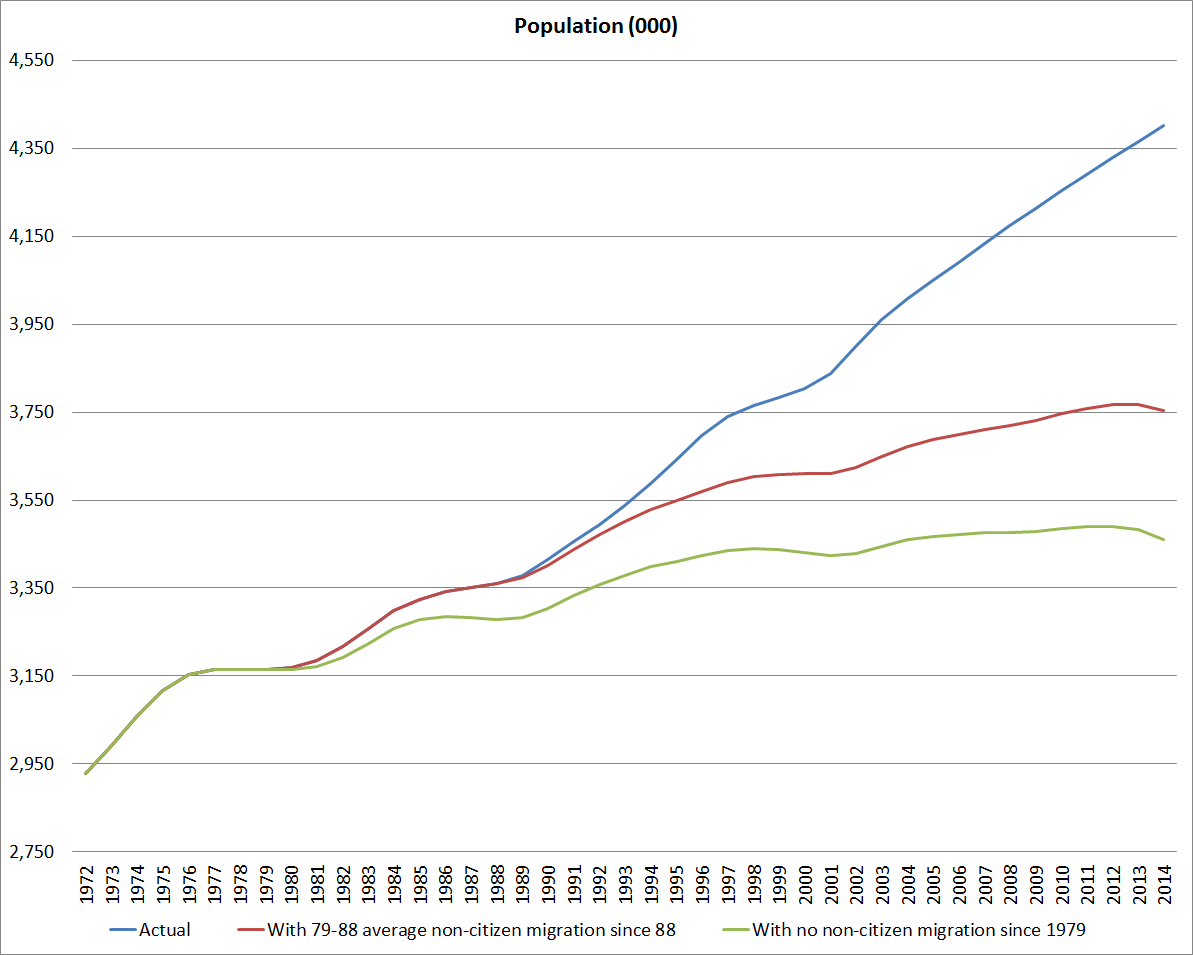
• Making the case that high house (and land) prices in Auckland are largely a predictable outcome of the interaction of supply restrictions and high target levels of non-citizen immigration. With, say, 1980s levels of non-citizen immigration, New Zealand’s population would be flat or falling slightly. Much of that ground will be familiar to regular readers of this blog.   It matters because what has raised house prices in New Zealand is very different from what raised them in the crisis countries. In the United States, government policy initiatives systematically drove lending standards downwards in the decade prior to the crash, and in Ireland and Spain, imposing a German interest rate on economies that probably needed something more like a New Zealand interest rate systematically distorted credit conditions across whole economies. New Zealand – and other countries with floating exchange rates and private sector housing finance markets – had no such problems.  Credit was needed to support higher house prices in other advanced economy, but it was not the driving force behind the boom.

If I am right that the New Zealand house price issues result from the interaction of our planning regime and our immigration policy, then these are structural policy choices that systematically overprice houses, largely independently of the banking and financial system.  They are not ephemeral pressures –  here today and gone tomorrow.  They have been building for decades.  I hope they are reversed one day, but there is no market pressures that will compel them to (any more than there are market pressures that compel the reversal of planning restrictions in Sydney, London, or San Francisco).  These distortions are not making credit available too easily and too cheaply right across the economy  (which is the single big difference between NZ or Australia, and say the Irish, US or Spanish situations).  They are simply making houses less affordable.   The Reserve Bank has no better information than you, I, or the young buyers in Auckland do, on whether and when those policy distortions will ever be reversed.   And even if the policy distortions were corrected, it is pretty clear that real excess capacity (too many houses, too many commercial buildings) is a much bigger threat than simply an adjustment in the price of banking collateral.   No one thinks Auckland has too many houses, or too much developed land.

• The core of the paper was the proposition that the Reserve Bank’s actual and proposed LVR restrictions appear both unwarranted by, and inconsistent with, the Reserve Bank’s statutory mandate to promote the soundness and efficiency of the system. In subsequent discussion, a very senior lawyer went so far as to suggest that the Bank might even be acting ultra vires. My arguments around the LVR policies had a number of dimensions including:
o The almost total absence of any sustained comparative analysis of the international experience of the last decades, including the issue of why some countries (Spain, Ireland, and the United States) had very nasty financial crises and housing busts, and others (New Zealand, Australia, the UK, and Canada) did not.
o The lack of any engagement with New Zealand’s own experience in the last decade. Risks appeared much greater in 2007 than they are now, and yet the banking system came through a severe recession, and sluggish recovery, unscathed.
o The lack of willingness to engage openly with the results of the one piece of sustained work the Bank has done, the 2014 stress tests, which suggested that the New Zealand banking system, on the current composition of their asset portfolios, could relatively easily withstand even a very severe shock.
o The failure to address the efficiency dimension of the Bank’s statutory responsibility. Both the actual and proposed LVR controls will impair the efficiency of the financial system.
o The failure to identify and address the distributional implications of the controls.
o The failure to grapple with the limitations of the Bank’s (and everyone else’s) knowledge. There might be an arguable case for controls if we could be sure a crash was coming 12 months hence, but in fact the Bank has no better information than you or I do as to when, or if, there will be a substantial fall in nominal house prices.

• Discussion of the regulatory powers of the Bank, and its governance. As I put it in the conclusion:

These concerns bring into focus the weaknesses that have become increasingly apparent in the Reserve Bank Act. That Act was a considerable step forward in 1989, at a time when only a modest and limited role was envisaged for the Reserve Bank. But it is now 2015, and the legislation is not consistent with the sorts of discretionary policy activities the Bank is now undertaking, with modern expectations for governance in the New Zealand public sector, or with how these things are done in other similar countries. Doing some serious work on changing the single decision-maker model would be an excellent place to start, but it is only a start. A much more extensive rethink and rewrite of the Act, and the Bank’s powers, is needed to put in place a much more conventional model of governance and accountability, especially in these regulatory areas.

Immigration policy: 106 per cent of net new housing demand

I’ve just read Shamubeel and Serena Eaqub’s book Generation Rent¸one of the Bridget Williams Books series of short, often stimulating, books on New Zealand issues.    Housing is perhaps the ultimate topical issue, and I hope the Eaqubs’ contribution is widely read.

There is plenty in that I agree with, as well as quite a bit that I disagree with.  I might come back to the rest of the book when I have a bit more time, but today I wanted to focus on just one “framing” issue.   How one frames an issue often influences how readers think about it.

The Eaqubs have collected the data from old Yearbooks, and censuses, to show where population-based pressures on housing demand have arisen from over last fifty years (strictly, from the 1961 Census to the 2013 Census).  They present the influences under the following headings:

  • Natural increase,
  • Change in average household size, and
  • Net migration

Under this decomposition 61 per cent of the increase in the number of households has arisen from natural increase, 30 per cent from a reduction in average household size.  The remaining 9 per cent results from net migration.

Put that way, it allows them to present migration (and, hence migration policy) as a fairly minor issue, only really material in a short-term or cyclical sense. As we know net migration is quite variable and not particularly forecastable in the short-term.

But there is another way to look at the numbers.  The New Zealand government has no ability to control the movements of New Zealand citizens, inwards or outwards, so discussions of the role of immigration policy really should focus on the movement of non-New Zealand citizens.   Non-citizens can only come and live in New Zealand with the permission of the New Zealand government –  active permission is required in most cases, while policy allows Australian citizens to come and stay without prior approval.    There are lags in the system, and not everyone who is approved actually comes (or stays) but by and large we can think of the net flow of non-NZ citizens as the contribution of immigration policy.  Since 1960, there has been a net inflow of non-New Zealand citizens every (March) year except 1979.  If economic conditions here are poor, non-New Zealand citizens can leave again too.  In that sense the net inflow of non-New Zealand citizens understate the role of immigration policy in boosting demand for housing.

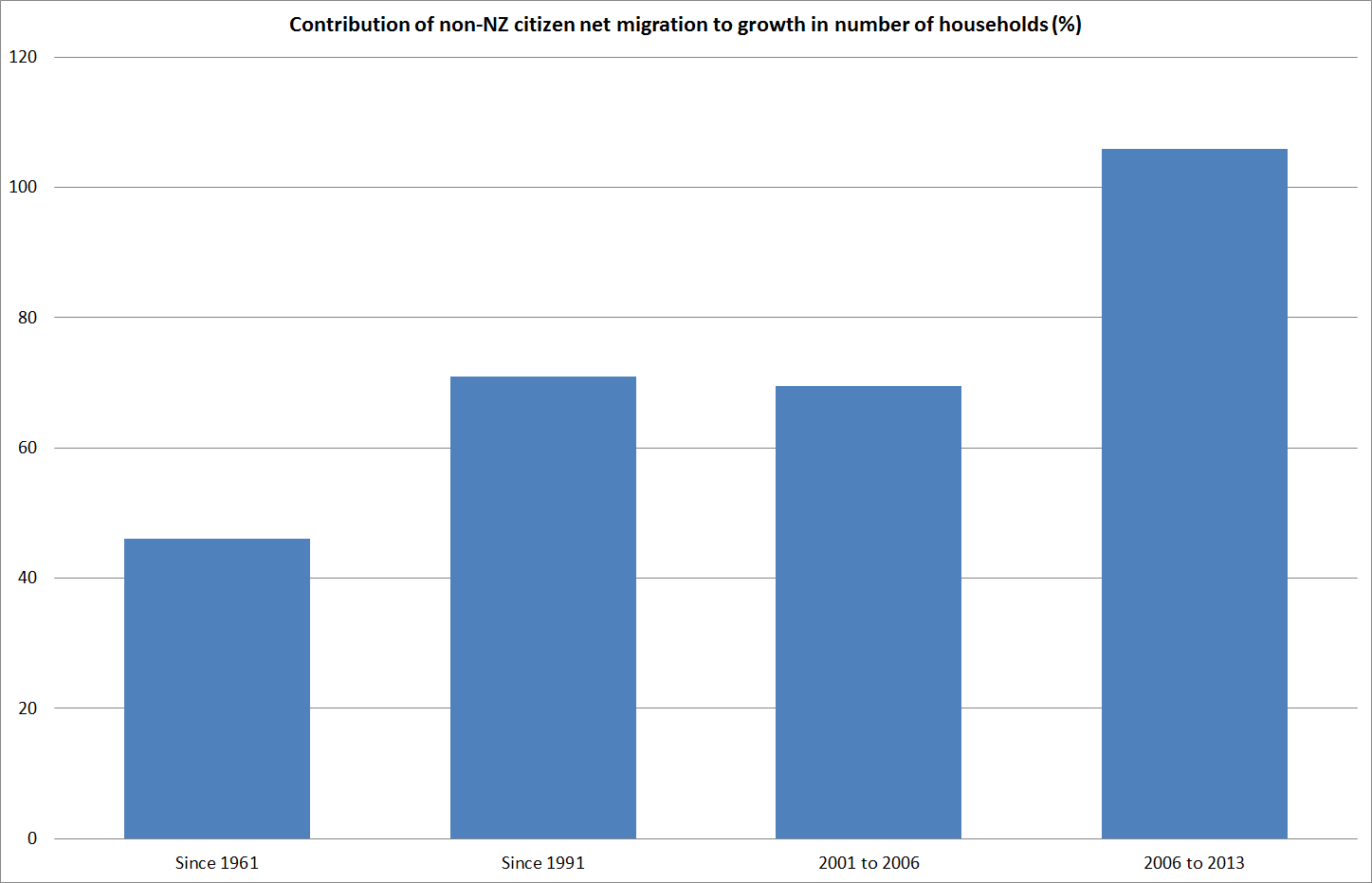
So what has the impact of non-NZ citizen net migration to New Zealand been?   In the 52 years from April 1961 to March 2013 there was a net inflow of 1139351 non-New Zealanders.  Over the same period (between the two censuses), the number of private occupied dwellings in New Zealand has increased by 918000.  With around 2.7 people per dwelling, the net inflow of non-New Zealand citizens has contributed 46 per cent of the total increase in the demand for houses since 1961.

The impact doesn’t happen all at once –  in 1961, people didn’t live at 2.7 per dwelling, but they do now.  And, of course, many of the non-New Zealanders who migrated in 1960s will have died by now.  But most of them will have had children or grandchildren since they moved to New Zealand –  and since the average birth rate in New Zealand has been above replacement, the effective contribution to housing demand from immigration policy is likely to have been higher than suggested by the raw numbers.  As birth rates have dropped, that may not be so in future.

Since 1961 there has been a variety of changes in immigration policy.  From the late 1970s to the late 1980s, inflows of non-New Zealanders were very small.  But what about the most recent since immigration policy was changed to actively pursue much larger inflows (at present, policy aims at 135000 to 150000 permanent residence approvals on a three year rolling basis)?

From 1991 to 2013, non-New Zealand citizen immigration accounted for around 71 per cent of the change in the number of households (or dwellings required).  For the last two intercensal periods the contributions of non-New Zealand citizen net immigration were as follows:

  • 2001 to 2006        70 per cent
  • 2006 to 2013       106 per cent

Even I was a little taken aback by the last number but, of course, it just reflects two things:

  • The chart I showed the other day illustrating that with no (or much lower) non-citizen immigration New Zealand’s population would now be flat or slightly falling
  • No change in the average person per dwelling number between 2006 and 2013.

non citizen plt to households

These numbers aren’t precise.  It is quite possible that new immigrants start off with a higher than average persons per dwelling –  as, on average, non-New Zealand immigrants are poorer than the average resident population.  And the number of people per dwelling is itself partly endogenous to house prices –  if house prices had not been so high, more people would have been able to fulfil their desire to, for example, live on their own.  It is also possible that without the high level of non-New Zealand inflow, the outflow of New Zealanders (which, all else equal, massively reduced the demand for housing) would have been a bit smaller.

But what the numbers do make clear is that immigration policy choices made by successive New Zealand governments account for a very large share of the new household formation, and housing demand, in New Zealand.  If anything, that share has been rising as natural increase slowed.

And, of course, these numbers also tell us nothing about what the appropriate target rate of non-citizen immigration is.  But, unless we can construct a regulatory environment in which the supply of housing and urban land are hugely more responsive to demand than they have been in recent decades, then any conversations around demand influences, and the potential influence of policy on them, needs to engage seriously with the role of immigration policy.  At present –  given what it is knows about supply responsiveness – the government’s immigration policy is actively driving house prices, especially in Auckland, at the reach of too many of those who would like to buy –  citizen or not.

“Market failure” or failure to let the market work

Brian Fallow has a piece in the Herald today, prompted by the Productivity Commission report,  that champions more active government involvement in the housing market, with barely a hint that anything governments do ever goes wrong.  The words “masterplanned”, when uttered of the activities of government entities, other than tongue in cheek, should send something of a shiver of alarm through the citizenry, rather than a frisson of excitement.  The track record isn’t good.

But what struck me was the claim that the Productivity Commission’s report “is unequivocal about the fact that we are dealing with market failure here”.    Where, I wondered, was the evidence of the market being allowed to work?   One might more accurately sum up the Auckland property market as the most probable outcome of two sets of government policies.  Restrict the supply of land, and at the same time actively take steps to maintain rapid population growth, and what would one expect but high land prices?  One might more accurately call it “policy success”  (predictable outcome of deliberately chosen measures, if anyone had actually done the analysis) than “market failure”.  But surely no politician was ever dumb, or venal, enough to have wished for the sorts of outcomes we’ve seen in Auckland in particular in recent decades?

Which is not to disagree with Fallow’s concluding observation “the status quo is perilously unsatisfactory”.  Well, yes, but instead of proposing providing new compulsory acquisition powers –  not just to elected ministers, as at present, but to unelected, barely accountable, appointees – how about giving the market a chance?  Free up land supply (zone it all residential, as a default) and urban land will quite quickly become affordable again, and arguments about “hold-outs” surely become moot (if any land can be built on).  Oh, and our ancient freedoms are respected as well.

It is a sobering reflection on the growth of the regulatory state that yet more encroachments on peoples’ liberties, with even fewer protections, are proposed in the week in which we mark the 800th anniversary of Magna Carta.

The Productivity Commission on land supply

The Productivity Commission yesterday published its draft report on improving the supply of land for housing.  It builds from earlier work by the Commission and others identifying supply restrictions as one of the most important explanations for the high price of houses (more strictly, house+land) in New Zealand.

There looks to be a lot of fascinating material.  Being history-minded, the first thing I read was the fascinating little research note on the history of town planning in New Zealand.  Modern documents that quote from 1839 New Zealand newspapers appeal to me, even if the author of that research note seems more taken with the “need” for “town planning” than I would be.  And was the New Zealand Company really much involved in the founding,settlement and planning of Christchurch?  The books on my shelves don’t suggest so.

I also read the Summary Version of the report.  It is a summary, and while it lists the findings and recommendations and outlines the arguments,  there is a no doubt a lot more in the remaining hundreds of pages.  Some answers to my points below may lie in those pages, and I hope to look at them in more depth in coming weeks.

Land supply issues matter a lot.  That was one of the points the 2025 Taskforce stressed back in 2009.  It is a shame that the Commission does not pick-up the Taskforce’s recommendation that Councils be required to develop and publish indicators of the prices of otherwise similar land that is, and is not, zoned for residential development.  Information and data are a key input to any analysis, and even when the current public and official focus on these issues fades, it will be important to maintain the flow of data.

But what of the Commission’s own ideas and analysis?  Here is a list of thoughts/observations/concerns, in no particular order:

  • It is good to see the Commission come out in favour of land-value rating, reversing the trend in recent decades towards capital value rating.  Land value rating tends to focus the minds of owners of the scarce resource, land.  There are other ways to tackle “land banking” (ie don’t allow regulation to make new urban land scarce in the first place), but land value rating would be a step in the right direction.
  • As would, on a much smaller scale, levying local authority rates on Crown land.
  • But, as with many Commission reports, there seems to be a too-ready sense that government is the source of on-going solutions, rather than the source of the underlying problems.  In other words, the report doesn’t mainly focus on getting government (central and local) out of the way, but on finding smarter or better ways of the government being actively involved (eg “this means a greater degree of publicly-led development”).  Perhaps it shouldn’t be too surprising  –  after all, two of the three commissioners are former heads of government departments, and the Commission works on projects requested by government, in a process where ministers are advised by government departments –  but it is something to watch out for.  I had a similar reaction to the Commission’s recent draft social services report.
  • The report does not seem to grapple at all with the indications from historical cross-country experience that as cities grow richer they tend to become less dense, not more dense.  It also does not engage with the Demographia data suggesting that Auckland is already a relatively dense city by advanced New World standards.  I’m not at all suggesting that regulation should impede denser development, but some of the Commission’s lines of arguments become less persuasive if greater density is unlikely to be the main preferred market response to ongoing population pressures.
  • For example, the Commission focuses on the idea that local authorities do a poor job in this area because of the excessive weight of existing homeowners, concerned about the losses of price and amenity value on their houses.  That sounds plausible if we think about establishing high rise apartment through Epsom, but it is far less clear that existing home owners have any strong objection to greater ongoing development on the periphery of cities, where historically most new building has happened.     After all, existing home owners have children who will be looking for housing before too long –  but again the intergenerational perspective seems to be lacking in some of the Commission’s work.
  • The Commission does not seem to give much weight to the idea that restrictions on development at the periphery may have as much to do with the biases, preferences  and ideologies of Council staff.  Perhaps there is nothing to that suggestion, but I wonder how many Council staff come to work each morning dedicated to facilitating citizens doing as they like with their own property, rather than shaping and imposing a vision on “their” city.  I read the Wellington City Council’s recent draft long-term plan, and it confirmed my worries.
  • The Commission proposed removing “District Plan balcony/private open space requirements for apartments”, which sounds sensible.  But what about site coverage ratio restrictions?
  • I reckon the Commission oversells the gains to be had from improving land supply.  I’m reluctant to say that because I think the gains that are on offer –  much lower house prices –  are substantial and important, especially for the younger and poorer sections of the urban population.  But I’d say it is “case unproven” when it comes to gains in real GDP, or real GDP per capita.  The Commission cites recent work by Hsieh and Moretti, which suggests that releasing adequate land could lift GDP per capita in the US by as much as 9.5 per cent.  Perhaps it is true, and perhaps it is true of Auckland.  But New Zealand is already a highly urbanised country, Auckland already makes up a large share of the total population, and Auckland has had faster population growth than almost any other largest city in an OECD country in the decades since World War Two.
  • Related to this, the Commission seems to be too ready to embrace agglomerationist arguments.  Yes, it is true that cities tend to have higher levels of productivity than smaller centres, but that does not mean that policy designed to drive the growth of big cities will, of itself, lift productivity.  Yes, policy should avoiding impeding the distribution of population within the country to its most productive locations, but not go beyond that.  In fairness, many of the Commission’s specific recommendations are about removing roadblocks, but the supporting text often seems to go beyond that.
  • For example, there is the unsupported proposition that “Councils and their elected representatives also need to lead in persuading their communities of the benefits of growth. These are difficult conversations.  Facilitating growth requires communities to change, and change is hard.  Some people will lose from that change.  But the community as a whole, and New Zealand, will benefit from it”    Setting aside the condescending tone, where is the evidence that population growth is a “good thing” –  because population growth is the issue here?  Again, if we are going to have fast population growth, we need to find ways to absorb it, without causing scandals like, for example, current Auckland house prices.  But a reasonable voter (or elected representative) might reasonably ask “haven’t we had rapid population growth for 70 years, and some of the poorest  growth in productivity/GDP per capita of any advanced country?
  • The Commission proposes providing powers of compulsory land acquisition for housing purposes.  At one level, the claim that “compulsory acquisition of property by the state can be justified if it is in the public interest” is circular.  What is “the public interest”?  The public interest might, for example, involve the protection of private property rights, including the right to hold property undisturbed.  This is another example of the Commission’s apparent reluctance to grapple with pervasive government failure and abuse of regulatory powers.  The abuses of eminent domain powers in the United States should be a salutary warning here.  The Commission goes on to argue that “given the significant social and economic harm caused by the current housing situation, a good case exists for compulsory acquisition powers to assist in the assembly of sites for large masterplanned developments.”    As if to water down the rather shocking nature of this proposal, the report suggests that powers don’t need to be exercised much, as they can provide leverage (in the same way a mugger with a baseball bat won’t need to hit me to get my money) and the chair is also quoted as suggesting the powers might only be to deal with “holdouts”.     But it just is not clear why such powers should be given to public agencies.  In a well-functioning economy, housing is readily provided by the private sector.  Public agencies and political leaders got us into this mess, and why would we expect that new powers would not be abused?   Have powers of compulsion worked well in central Christchurch?  It hadn’t been my impression.
  • The Commission does not seem (I may have missed it) to touch on a more radical option.  Why not, for example, explore a proposal that would allow any land to have houses built on it, by right perhaps up to three storeys high?  One might make exceptions for geologically unstable land, but shouldn’t the presumption be shifted back in favour of the private land owner?    With something like that sort of model, combined with land value rating, it is difficult to envisage that peripheral urban land prices would be very high for very long.    Yes, I know this proposal does not deal with all the transport  and infrastructure issues, and many of the Commission’s suggestions on these issues appear sensible.

Keen as I am to see a more responsive supply of urban land, I came away from the report with a question.  Supply and planning restrictions have become an increasing obstacle to affordable urban house prices in many advanced countries in recent decades.  There are individual areas that have held out – Houston is among the best known – but are there any cases where there has been a move back from heavily planned and regulated urban land markets to much more liberalised ones?  I’m not aware of any, but my detailed knowledge in this area is pretty limited.  My prior is to be a bit sceptical about how likely it is that far-reaching changes to the planning regimes, of the sort that would materially reverse the growth in real urban land prices, could be made, and then made to last.  If the Commission is aware of examples of successful substantial durable reforms it might be helpful to include them in the final report.  A low prospect of success is not a reason for not doing the analysis and continuing to make the case, but there is a question as to where political capital might best be devoted.

Which brings me to my final point.  The Commission has to take population growth as given, since it was asked by ministers to look at land supply issues.  But it is too often forgotten that most of our population growth in recent decades, and all of it now, arises directly from active government policy.

The chart below shows New Zealand’s actual population, and what it might have been under two different immigration scenarios.  Immigration policy only affects the movement of non-New Zealand citizens, and so what I’ve shown here is what population would have looked like if there had been no net non-NZ citizen immigration, and if net non-NZ citizen immigration had been kept at the sort of levels seen in the 1980s.  They aren’t precise estimates by any means –  it is possible, for example, that if there had been less non-New Zealand citizen immigration, there might have been somewhat less New Zealand citizen emigration.  But it is just designed to make the point that population pressures on the housing market are not any longer about the choices of New Zealanders (to have children or not, to stay or to migrate) but about active government policy.   With 1980s levels of non-citizen immigration, the total population would now be flat or falling slightly.   The only aspect of the non-citizen migration that is unrestricted is the (modest) flow of Australian citizens: all other arrivals require explicit government approval, and a planned policy of high net inward migration of non-citizens.

population scenarios

If we are worried about house prices –  and I certainly think we should be  –  a strategy with a higher probability of durable success might be to combine land supply liberalisation with some reduction in the targeted level of inward migration (bearing in mind that our government’s target for inward migration of non-citizens is itself very high by international standards).  There would still be considerable cycles in net immigration flows (as the net outflow to Australia waxes and wanes with the economic cycles), but the trend is the issue for longer-term affordability concerns.

And to hark back to the discussion on why New Zealand interest rates have been so persistently high, if lack of sufficient agglomeration and scale were really the big issue in New Zealand, we should tend to see low interest rates, and a low exchange rate, not the reverse.

Housing, financial stability etc – LEANZ seminar 25 June

About the time, back in April, when I posted some comments on Grant Spencer’s speech on housing LEANZ invited me to speak at one of their Wellington seminars, next Thursday 25 June.

LEANZ is an organisation dedicated to the advancement in New Zealand of the understanding of law and economics. It provides a forum for the exchange of information, analysis and ideas amongst those with an interest in this form of analysis. That interest may be practical (for example, the field of law and economics is very relevant to many aspects of the practice of law, public policy and consultancy), or it may be more academic.

“Nowhere is the baneful effect of the division into specialisms more evident than in … economics and law … the rules of just conduct which the lawyer studies serve a kind of order the character of which the lawyer is largely ignorant; this order is studied chiefly by the economist who in turn is similarly ignorant of the character of the rules of just conduct on which the order he studies rests.” F A Hayek Law, Legislation and Liberty Vol I, pp 4-5. LEANZ hopes to work to bridge this divide.

This is the topic blurb I gave them some time ago –  by the look of it, written before the new lending restrictions proposed in the May FSR

House prices, especially in Auckland, have become increasingly unaffordable. This is largely the outcome of the collision between two sets of public policies: restrictions on land use which impede new housing supply, and high target levels of inward migration of non-citizens.  One or other policy might make sense, but the combination has very adverse effects on the younger and poorer elements of the population of our largest city.  It is a real phenomenon rather than a financial one, and the pressures can only be sustainably alleviated by government action in these policy areas.  The Reserve Bank appears to have taken on itself some responsibility for trying to manage house price fluctuations.  However, the Bank’s involvement appears to be based on a misconception of what is going on, and a misapplication of insights from financial crises abroad, notably that in the United States last decade. There is little or no evidence that financial stability in New Zealand is in any way threatened.  The LVR restrictions –  and others the Bank appears to be contemplating – undermine the efficiency of the financial system.  They may also be slightly impairing its soundness.  Parliament should be asking harder questions about whether such uses of regulatory powers, especially by a single unelected official, are appropriate.

LEANZ tell me that all are welcome to attend –  there is no obligation to become a member first, although I’m sure they would also be happy to have a few more paid-up members.   Details of the event are here.