It is good to know there is diversity of views at ANZ

The Australian head of ANZ’s New Zealand business, David Hisco, was out last night with an article in the Herald headed Housing and New Zealand dollar overcooked.

Hisco is gung-ho on LVR limits.  Here are two of his list of “things that should be done”.

Heavily increase LVR limits for property investors. The Reserve Bank wants most property investors around the country to have 40 percent deposits in future. We think they should go harder and ask for 60 percent. Almost half of house sales in Auckland are to property investors. Taking them out of the market will be unpopular amongst investors but it may end up doing them a favour. Of course this would mean less business for us banks but right now the solution calls for everyone to adjust.

Voluntary tightening of lending criteria by banks. Since the GFC banks have been more conservative than ever on lending. But the current situation will see ANZ implement even tougher criteria for investment loans as house price inflation spreads from Auckland to other regions.

I have no problem at all if the management and Board of ANZ Bank want to adopt tighter lending standards.  They run a private business, in a competitive market, and must make their own choices about what risks are worth it, for their shareholders, to run.  Bureaucrats and politicians are fond of second-guessing those choices, and we all know that banks have made mistakes in the past –  as businesses in all sectors do –  but there is rarely much basis offered by the bureaucrats and politicians for thinking their assessments of what risks private lenders should run are better than those of the bankers.  Actually, Australasian bankers have had a pretty good record over many decades –  and when things did go wrong in the late 1980s, it had as much to do with bureaucrats and politicians as with bankers: repress an industry for decades by regulatory fiat, and inevitably it will take everyone a while to learn how to lend (and borrow) well in a much different environment.

It is the first of those paragraphs above that I have a problem with.  If Mr Hisco really thinks it would be imprudent –  they couldn’t make a positive expected risk-adjusted return from doing so –  to lend to anyone wanting to buy a potential rental property with an LVR over 40 per cent, he probably has the delegated authority to make that change himself.   Today.  He is paid a great deal of money by ANZ, and his board –  and superiors in Australia –  presumably think highly of his ability to manage the bank, including its credit risks   It simply doesn’t need a bunch of bureaucrats telling him to do his job.

But his paragraph seems stronger on the rhetorical flourishes than on the analysis.  After all, where have nationwide nominal house prices ever fallen by 60 per cent?  And even if they did fall 60 per cent –  or even more –  in Auckland to perhaps bring price to income ratios down to a more sensible 3 (rather than the current 10), such falls seem exceptionally unlikely in much of the rest of the country, where real house prices have barely changed in almost a decade.  Can bankers really not make money lending to landlords in Oamaru or Invercargill at LVRs of even 50 per cent?  If so, they must be a lot less good at their jobs than they would typically have us believe?  If so, one might reasonably hope for the emergence of new entrants to the new mortgage lending market – preferably non-bank lenders beyond the reach of the Reserve Bank’s controls.   One can always worry about extreme hypotheticals, but if one did no bank would ever lend money to anyone for anything –  which would rather defeat the point of setting up in business as a bank.

But I don’t suppose we will actually see ANZ move to ban all mortgages for residential investors with LVRs in excess of 40 per cent.  Instead, Hisco wants the Reserve Bank to do it for him.    That would enable him to tell his Board that he simply had no choice, and provide cover when profits fell below shareholder expectations.  That should be no way to run a business in a market economy –  although sadly too often it is.  It is good illustration of the distinction between pro-business and pro-market policies: the former too often involve politicians, bureaucrats and big business people in each other’s pockets, providing cover for actions that work against the interests of citizens.  We already see this  happening to some extent with the Reserve Bank and the banks: the Reserve Bank adamantly refuses to release submissions made by banks on its regulatory proposals.

If Hisco followed his own analysis and banned all investor mortages with LVRs above 40 per cent, no doubt ANZ would lose a lot of market share.  If Hisco was fundamentally right, and in another year or two house prices nationwide did fall 60 per cent, he’d be vindicated as presumably ANZ’s loan losses would be much lower than those of other banks who didn’t follow his lead (unless of course he’d taken the capital that would have funded investor mortgages and used it on something that proved even riskier, if currently less visible).  It is all very well to invoke the old Chuck Prince (ex Citi CEO) line about “while the music goes on one has to stay on the dance floor”.  But top executives are paid to be a bit ahead of the game in how they position their own businesses.  Of course, they aren’t always rewarded –  as often in life –  for being too far ahead, but nothing stops Hisco making his case to the Board and shareholders for pulling lending standards in even more than the Reserve Bank requires them to. If the shareholders decline, and in good conscience he cannot bring himself to undertake such lending, he could consider other career options.

As it happens, his own economics team doesn’t seem to agree with him.  Of course, they aren’t the people setting credit standards for the ANZ, but it was interesting to see their note on Tuesday shortly after the Reserve Bank had released its new proposals. It concluded.

To us, the case for requiring investors to have a 40% deposit is not overly
strong. This is particularly considering the RBNZ’s own stress tests and the fact that most investor lending was already done at sub-70 LVRs anyway.

There must be some interesting conversations going on at the ANZ.  It would be very interesting to see the ANZ submission on the Reserve Bank’s proposals, and if the Reserve Bank won’t release it, there is nothing to stop ANZ itself doing so.  I’ll be surprised if they do, and even more surprised if the submission recommends limiting all investors throughout the country to LVRs not in excess of 40 per cent.

Hisco seems to have some form as regards bold calls.  Digging around, I stumbled on this piece from October 2014, less than two years ago.  It was full of all sorts of calls for interventionist active government, but not a mention of LVR limits or bank lending standards.   Back then –  21 months ago, and not that much has changed since then –  it was all about supply.

The housing affordability issue is a housing supply issue, pure and simple. In 1974 there were 34,400 new homes built. Last year there were 15,000 – less than half. It’s no wonder houses doubled in price in under a decade in Auckland.

The solution is simple – urgently build more houses. To do that in places like Auckland we need to build more suburbs and allow intensification in existing areas.

In his latest piece, he hasn’t totally abandoned the supply arguments, but has rather markedly backtracked.  It doesn’t appear in his five point list of things we should do now, and there is just this

The Leader of the Opposition says we need to build more homes faster. That makes sense, too, if we have the resources and approvals to do it.

And yes I did notice his comments about immigration.   This is what he says about that item in his five point plan

Review immigration policies. Immigration has been great for New Zealand. We are a harmonious, diverse and inclusive society. But Auckland’s housing, roads, public transport and schools are struggling to cope. Let’s have an honest and sensible debate about immigration using facts rather than prejudice to see if we should push the pause button.

Debating using “facts rather than prejudice” seems a good idea in most areas of life, but his approach doesn’t really seem to offer much.    There is little evidence (“facts”) to suggest that immigration has been “great for New Zealand”, but on-off immigration policies seem about as undesirable as unpredictable regulation in any other area of life.



Reserve Bank on housing – still all over the place

As I was writing this, the Reserve Bank’s latest set of regulatory interventions and controls were announced.  I haven’t yet read that document but from the press release I would make just three observations:

  1. The flip-flops continue.  After easing the LVR restrictions for non-investors outside Auckland last year, they now plan to totally reverse that change.  As a reminder, when these controls were first introduced three years ago, they were all supposed to be “temporary”.  So, I suppose, were the exchange controls, introduced in 1938 and lifted in 1984,
  2. The consultation process is a joke.  Not long ago, as part of their regulatory stocktake, the Bank indicated that it intended to put in place materially longer consultative periods for its proposed regulatory initiatives (typically six to ten weeks).  But in today’s announcement they are allowing only three weeks for submissions on the new “proposals” to be made, and then plan to implement the changes three weeks after that.  Only 10 days ago they were talking languidly of “a measure that could potentially be introduced by the end of the year”.   There is no real consultation going on, simply jumping through what they must regard as the bare minimum of legal hoops they must be seen to comply with.  And they will, no doubt, continue to refuse to publish most of the submissions.  It is, frankly, a travesty of democracy –  and the nature of what is going on is well-illustrated by the Governor’s statement that “We expect banks to observe the spirit of the new restrictions in the lead-up to the new policy taking effect.”  Citizens –  even banks –  are required to obey the law, not the wishes and whims of officials, elected or otherwise.   None will do so of course –  they are all too scared to challenge the Reserve Bank in public – but it would be interesting if a bank were to seek a judicial review of what is going on here.
  3. The policy remains as incoherent as ever, in that the LVR restrictions will not apply to loans for new house building, even though the risks of losses are materially higher on new buildings  –  often on the peripheries of towns/cities – than on existing ones.

I was away when Grant Spencer’s 7 July speech on housing was released, and although I glanced through it then on my phone, last night was the first time I had sat down and read it carefully.  It was really quite disappointing.

I say that not primarily because I disagree with Spencer on many points –  although I do.  But reasonable people can interpret the same data and experiences in different ways.  What concerns me is that the Reserve Bank still doesn’t seem to have a disciplined framework for thinking about housing markets here or abroad, or about its role in respect of the efficiency of the financial system,  and simply doesn’t back up its claims with much analysis or research at all.

Grant Spencer gave a speech on housing in April 2015, shortly after I started this blog.  At the time I was quite critical of that speech (here and here), and rereading those comments this morning I could easily simply repeat most of them now.  They apply as much to the latest speech as to the one given 15 months ago.  Back then I concluded:

Without more detailed and extensive analysis, it is still difficult to escape the conclusion that the Reserve Bank’s approach to housing is being shaped more by impressions of the US last decade than by robust in-depth analysis of the sorts of specific risks the New Zealand economy and, in particular, New Zealand banks and the New Zealand financial system face.

That still seems to be the case.

Of course, not everything can be covered in a single speech.  But good speeches by authoritative senior central bankers  typically draw on analysis and research undertaken in their own institution and elsewhere.  But Spencer’s speech has no references to any other Reserve Bank research and analysis (other than his own April 2015 speech) and in fact no significant references to anyone else’s research or analysis either –  whether to support his case, or respond to alternative perspectives.

And even though Spencer is the Deputy Governor with explicit responsibility for the Bank’s financial stability functions, nowhere does he even mention the Bank’s stress tests.  Perhaps he disagrees with the assumptions that were used in doing the stress tests –  but if so, he should have had them changed –  or perhaps the results are simply uncomfortable given that he knew his boss was champing at the bit to impose yet more controls.  But it should be seen as simply unacceptable for a major speech on housing from the central bank’s financial stability Deputy Governor to not even engage with the stress test results.

There is also nothing in the speech on how the Bank thinks about the implications of its ever-growing web of controls for the efficiency of the financial system –  an explicit (and equal) part of the Bank’s financial regulatory responsibilities.  In his latest letter of expectation to the Bank, released a few days ago, the Minister of Finance indicated to the Governor that he expected the Bank to produce analysis on how the stability and efficiency goals were being balanced.  Four months on from when that letter was written, there is nothing at all in Spencer’s speech.

The Reserve Bank has explicit statutory responsibility for monetary policy, and for financial regulation to promote the soundness and efficiency of the financial system.  It has no statutory responsibility for the housing market, or house prices per se.  And it certainly has no responsibility for tax policy, immigration policy, land use regulatory policy, fiscal policy, policy around Urban Development Authorities, and so on.  And yet in the speech, Spencer weighs in on all of them.

That is not good practice generally, and particularly not in this case where the Bank’s comments seem to be based on no supporting analysis at all.  Central banks are given quite considerable power in specific and limited areas, but continued support for central bank independence (whether in monetary policy or financial regulatory policy) depends in part on a sense that (a) the central bank is a technocratic, limited, institution that doesn’t involve itself in other partisan or politically contentious issues, and (b) that when on very rare occasions the central bank might weigh in on matters outside its direct ambit, it does so backed by very sound research and analysis.  Since central banks often have considerable research capacity, at times such research might be able to shed useful light on some of these wider issues.  But neither of those criteria are met with the material in this speech.

I happen to agree with the Deputy Governor that the government should be reviewing immigration policy –  which is itself quite a change of stance from the Governor’s view on immigration only a few months ago –  but I don’t think it is a matter on which the Reserve Bank should be expressing a view.  And in particular, it should not be expressing such views without the supporting research and analysis.  There appears to be none behind these comments.

Much the same might be said for the government’s recent announcement of a Housing Infrastructure Fund –  the $1000m fund under which the government on behalf of the rest of us will lend interest-free to councils in high population growth areas.  The Deputy Governor opines that this will “help to relieve an important constraint”, except that (a) he references no analysis in support of this claim, which is perhaps not surprising as (b) no one has yet  seen the details of the fund, which appeared to many to be more about getting a weekend’s headlines rather than making a very material difference to the housing situation (recall that it is a $25m per annum interest subsidy, which doesn’t seem likely to make very difference to anything that matters to a macro-focused agency).

Similar comments could be made about the Deputy Governor’s views on taxes or Urban Development Authorities (compulsory acquisition wasn’t explicitly mentioned, but I assume he is probably sympathetic).  It is tempting to lodge an OIA request asking for copies of the analysis the Bank used in support of each of these policy preferences, but it is easy enough to guess how little there would be.  After all, Spencer has form.  In his speech last year, he advocated introducing a capital gains tax.  When I asked for the analysis etc in support of that proposal –  and was pretty sure there was none, as I’d left the Bank only a couple of weeks earlier and had previously written any material the Bank had on CGTs – it boiled down to a single brief email.   It really isn’t good enough.

I could go on.  The Bank has still produced no analysis that looks  carefully at the international experience of the last decade, including considering the countries where house prices did fall sharply and, as importantly, those where they did not.  Instead, they cherry-pick a couple of countries with bad experiences, and don’t ever stop to analyse the similarities and differences between those countries and their policy interventions and the New Zealand situation.  They have still produced nothing explaining why they think the risks are now so much greater than in 2007, even though the banks’ buffers are bigger, and any mood of exuberant optimism is much more attenuated.  While I was still at the Bank I used to pose that latter question to Grant, and never got a serious attempt at a response.

The Bank also continues to anguish about the low level of global interest rates –  the same attitude that has continued to leave them (and the Governor specifically) too reluctant to simply do their main job and keep inflation near-target.  But even there, what they have to offer is unconvincing.  We are told that low real interest rates are “a worldwide phenomenon linked to post-GFC caution”, with no mention of the weak underlying productivity growth and demographics pressures that are at play.  In other words, they treat low interest rates as some exogenous event, rather than something that is an endogenous response to the apparently poor fundamentals, here and abroad.  Partly as a result we get anguishing about low interest rates driving up house prices, rather than a considered reflection on what it is that means interest rates in New Zealand need to be as low –  or lower –  than they are.  For example, real per capita income growth is much less than it was.

Related to this, they simply ignore how not-very-widespread any serious housing market stresses really are.  If low real interest rates were a major factor in the overall house price story we might reasonably have expected to see real house prices well above where they were at the end of the last boom.  After all, at the end of that boom the OCR was 8.25 per cent, and today it is 2.25 per cent.  Inflation expectations have fallen of course, but real interest rates are a lot lower than they were.

House prices not so much.  I downloaded the QV house price index data.   On the QV numbers, house prices nationwide have risen 18.5 per cent since the peak in 2007.   But the CPI has risen 18.1 per cent over that period. In other words, in real terms nationwide house prices are barely changed from where they were in 2007, despite the sharp fall in real interest rates –  and the boom that peaked in 2007 was much bigger credit event than what we have seen so far, and didn’t end in banking system stresses.

In fact, plenty of places in New Zealand have real house prices today materially lower in real terms (and sometimes in nominal terms) than they were in 2007.  Here is an illustrative chart from the QV data

qv house prices since 2007 peak

Of course, the overall level of house (and urban land) prices in New Zealand remains far too high –  far higher, relative to incomes, than in the vast swathes of the US with well-functioning housing supply markets –  but in terms of the last decade or so, what we have had in mostly an Auckland boom.  It is a very big boom in Auckland – as one might expect when unexpectedly rapid population growth collides with land use restrictions – and Auckland is a big place in a New Zealand context, but it is hardly a nationwide phenomenon.    There is some spillover from Auckland to places like Hamilton, and the earthquake related pressures put, probably temporary, pressures on prices in Christchurch and surrounds. But vast swathes of the country –  including our now second largest city –  have seen no real house price inflation over almost a decade, or in some cases really quite substantial falls.  There are plenty of smaller TLAs that I haven’t shown individually –  and almost all of them have had falling real prices –  but they are included in the overall New Zealand number.

One would know nothing of this from reading the Spencer speech.  And quite why the Bank considers it appropriate to have tight controls on access to housing finance in Gisborne, Wanganui and Invercargill remains a mystery –  perhaps the new consultative document will shed some light, but I rather doubt it.

The citizens of New Zealand deserve (a lot) better from the Reserve Bank –  and frankly, from those charged with holding it to account.  Of course –  since the housing problems are primarily a responsibility of the government –  we also deserve a lot better from the government.  Sadly, the Reserve Bank continues to take responsibility on itself for something it is not charged with, and then does not back up its claims with the standard of analysis and research that we have a right to expect.  Far-reaching reforms are needed –  different governance structures, reformed legislation, and different people across the top ranks of the Bank.


A 40 per cent fall in house prices?

I noted the other day that I had disagreed with a fair amount of what was in Arthur Grimes’s recent piece on fixing the housing market (both the Spinoff piece, and the earlier Herald account of his remarks).  Arthur is quite clear in his value judgements, and mine differ: I don’t think there are good grounds for riding roughshod over the rights and interests of existing residents, in pursuit of some bureaucratic-political vision of a bigger Auckland.

But where I strongly agreed with him was that making home ownership affordable again means that house prices have to fall.  And they have to fall a long way.  If price to income ratios are around 10 in Auckland today and are around 3 in places with well-functioning housing markets, it might be desirable if house prices today were as much as 70 per cent lower than they are now.   Allow for some growth in nominal incomes over the next decade –  perhaps 3 per cent per annum (2 per cent inflation and 1 per cent productivity –  both ambitious assumptions by the standards of the last few years) and even a 50 per cent fall in nominal house prices over that time would only get Auckland house prices back to a price to income ratio a little under 4.

So when Arthur Grimes suggested that politicians should think in terms of actions that would bring about a 40 per cent fall in house price, in some ways he was being quite moderate.  Perhaps he shouldn’t have used the word “collapse” as his goal, but that sort of fall is what making home ownership affordable actually means.    Alternatively, I suppose, nominal house prices could hold at current levels and in 35 to 40 years time price to income ratios might be back to respectable levels.  And another whole generation would be doomed to barely affordable houses..

Perhaps fortunately, the Grimes remark prompted the Prime Minister to reveal what appear to be his true colours on housing.  He simply dismissed the Grimes suggestion of a 40 per cent fall in house prices as “crazy”.  He could have said “well, I don’t want to get bogged down in precise numbers, and one has to remember that some people will be adversely affected if house prices fall”.  But no, the Grimes suggestion was “crazy”.

It betrayed a fundamental lack of seriousness on the part of the Prime Minister and the government about making housing affordable, and in fixing the dysfunctional market that they –  and their Labour predecessors –  have presided over.   Since the Prime Minister is often quoted as suggesting that high Auckland prices are a sign of success, a “quality problem”, or just the sort of outcome big cities everywhere have, why would we be surprised?  Grimes notes that no politician has been willing to give a a straight answer on how much they wish house prices to fall.    Perhaps there is some role for “constructive ambiguity” in such areas but I had a lot of sympathy for Arthur’s line:

I suggest that this simple question should be asked every time a politician (of any stripe) talks on the subject. One can then see if they are really serious about making house prices in Auckland affordable for ordinary people.

And one only has to look at the “policy solutions” the government has proferred over recent years.  This time two years ago, the Prime Minister launched National’s election campaign with increased subsidies for first-home buyers –  a scheme opposed by officials who recognized, as everyone knows, that those sorts of subsidies flow straight into house prices.

Last year, the clever wheeze was altering the points scheme to encourage more of those gaining residence approvals in New Zealand to move somewhere other than Auckland –  thus perhaps very marginally easing house price pressures there, while guaranteeing a slight worsening in the average quality of the migrants who get residence approval.

And this year it was the infrastructure fund –  the $1 billion headline, with seemingly no details behind it, and involving interest-free loans from the rest of us to councils in places with fast population growth (and rapid future income growth).  Wasn’t this the party that, not that long ago, (rightly) thought that interest-free loans to students with good income prospects was simply bad policy.

We also now have talk of the government seizing private property.  David Seymour was quoted suggesting it sounded like a Venezuelan solution –  although, in actual fact, the idea came from the (admittedly rather statist) Productivity Commission, one of ACT’s earlier policy wins.   Whatever the source of the idea, it is another example of the vision, the dream, of the “big Auckland” potentially trumping the rights of private citizens.  Or perhaps just wanting to sound as if something might be done.  Populist bashing of “land bankers” keeps ignoring the fact that land scarcity, of the sort that makes “land banking” expected to be profitable, is the result of regulatory restrictions presided over by central and local government.  From what I’ve read of the draft National Policy Statement, there is nothing in the works that will fundamentally change that.

Would 40 per cent lower house prices be a problem for some people?  Well, yes, of course.  Big relative price changes often are.    But it becomes a bigger, and more constraining, problem the longer any correction is deferred.    Most people in Auckland didn’t enter the property market for the first time in the last five years or so.   Those existing home owners are no better off as a result of the extraordinary increase in house prices, and would be no worse off if structural reforms (whether increased supply or reduced population growth) reversed the increases of the last five years.  Those who have bought in the last year or two could be in some difficulty, but even then everyone’s situation is different.  For someone who bought three years ago with an 85 per cent LVR loan, a 40 per cent in house prices now might leave them with little or no equity.    But they didn’t have that much equity to start with.  There isn’t much risk of them losing their home –  the ability to service the debt is what counts and that depends more on unemployment than house prices.

We are often reminded that a large proportion of purchases in the last few years have been made by the much-maligned “investors” (no doubt the Deputy Governor will indulge in that populist game again tomorrow night).    That isn’t really surprising, given how high prices have got, making it very difficult for young people to get on the home ownership ladder.  But for those “investors” (residential rental business owners) what is the worst that can happen?  Perhaps their highly-leveraged business operation fails, and their lenders take some losses.  That is what happens in a market-economy.  Many businesses fail.  People take risks, and sometimes they get things wrong, or circumstances change.  Their businesses fail and in most cases they pick themselves up and start again. Is it tough for them?  I’m sure.  In the same way, it is tough for ordinary workers who lose their jobs and incomes in a recession and often take quite some time to get established again.

And if some people will suffer in house prices fall, that is only the quid pro quo for relieving the pressures (“suffering”) on whole classes of people who find it desperately difficult to afford a house at all, especially in Auckland –  the younger, the less well-established, the newer arrivals, those without wealthy parents to fall back on.    If one puts together all the Prime Minister’s comments, it seems that he would be content if only the rate of increase in house prices  from here slows down –  even just for a few months at a time – and he has little or no fundamental interest in getting real or nominal prices back down again. He  seems to have no real interest in doing what might be necessary to make housing affordable again.

How else to interpret him playing distraction yesterday by urging the Reserve Bank to impose yet more controls.  Perhaps there is a case –  in the soundness and efficiency of the financial system, the only statutory grounds the Reserve Bank has to work with –  for more controls. The cases made for the successive waves of controls to date haven’t been very convincing, but perhaps Spencer and Wheeler have some persuasive new analysis up their sleeves.   But everyone recognizes –  the Reserve Bank foremost among them –  that such controls aren’t the answer to the housing problem.  Perhaps such controls can reduce banking system risk a little – the evidence isn’t clear even on that point –  at the cost of undermining the efficiency of the financial system, but to the extent such measures have an impact on house prices and house price inflation it is for a matter of months only.

After that initial relief –  which simply provides cheaper entry levels for people not directly affected  by the controls –  the underlying forces shaping supply and demand for housing reassert themselves: a “rigged” land supply market running head-on into the effects of policy-fuelled rapid population growth.  Without fixing one or both of those factors, there is little prospect of houses being much more affordable for long.  Tax changes are not the issue –  we know that from cross-country experiences.  But, implicit in his dismissal of Arthur Grimes’s proposition, the Prime Minister and his government don’t really seem to care.  They seem happy to cement in something like the current woefully awful market outcomes –  where fewer people than ever can buy a home, at ever older ages –  just so long as the headlines about high rates of increase abate for a few months.  It is pretty disheartening.  Frankly, I think it is worse that that; it is pretty disgraceful.

Of course, the other reason people might be uneasy about large falls in house prices is if such falls resulted in serious banking system problems.  But we  –  and the PM – know the results of successive waves of Reserve Bank stress tests: faced with a savage fall in Auckland house prices, and an increase in the unemployment rate unprecedented in modern times in countries with floating exchange rates, the banking system comes through pretty much unscathed.  A reader recently reminded me of a good 2009 speech on stress tests etc by a senior Bank of England official.   In that speech, Andrew Haldane identified a five point plan that would enable us –  following the 2008/09 financial crisis –  to be more comfortable with stress test results in future.  On my reading of that list, the Reserve Bank’s tests score well on all counts.  Perhaps as importantly is a point Haldane didn’t include in his list:  at times it suits supervisors to not be too demanding in their stress tests, so that they don’t face pressure to force banks to act.  In the Wheeler years, the Reserve Bank has been dead keen to act, imposing ever more controls.  It would clearly be in the Reserve Bank’s interests –  in making the case for controls –  if the stress test results were worse than they actually are.

Perhaps as importantly, the stress tests are premised on a scenario in which the unemployment rate rises hugely –  a very severe recession, worse even than New Zealand experienced in the early 1990s.  But if house prices fall because there is the potential for much more supply on the market, that isn’t a recessionary force, but if anything an expansionary one.  The banking system would cope just fine with a liberalization of the land and housing supply market.

I’ve always refused to call the Auckland (or wider New Zealand) housing market a bubble. The disastrous results seem to be a predictable outcome given the combination of land use restrictions and extraordinarily rapid population growth –  structural features of the policy regime, not signs of irrational exuberance (perhaps especially not in an economy generating such weak per capita income growth).    Sometimes circumstances can take care of these problems –  perhaps we’ll have an unexpected annual outflow of 40000 people for a few years –  but the structural imbalances that have skewed the housing market so strongly against ordinary people starting out is largely a policy problem. and one that needs p0licymakers to fix.  Based on his comments in the last few days –  and his actions in the last few years – the Prime Minister doesn’t seem to care, if only the headlines would abate.


Household debt, house prices….and Sky


Stories about household debt and house prices are everywhere at present.  For anyone interested, Radio NZ’s Sunday morning show yesterday had a 20 minute (pre-recorded) discussion with Chris Green, of First NZ Capital, and me on some of the issues. I think we agreed on more than we disagreed, both emphasizing that large falls in real house prices have happened before and will, no doubt, happen again.  And the domestic economy is currently less robust than either Treasury or the Reserve Bank would have us believe.

The Radio NZ interviewer was, it seemed, keen to run with a narrative of mass collective irresponsibility, but as I’ve noted here before there is no sign that higher house prices are leading to a huge surge in consumption (any more than has happened with previous house price booms), and good reason to think that many people are very uneasy about the size of the debts they are having to assume to get into a first house.  I could have added that house sales per capita, and mortgage approvals per capita are not particularly high by historical standards.  Scandalous as the house price situation is, if there is a mania –  contagious exuberant optimism –  it must be very localized.

Tomorrow, I want to focus again on the Reserve Bank’s stress tests and how we should think about those results.  But before getting into that, it is worth briefly repeating a few other relevant points.

First, there is the constantly repeated claim, especially from some commentators on the left, that the system of banking regulation incentivizes banks to lend on housing security, skewing their whole portfolios towards housing lending, beyond the natural levels justified by the underlying riskiness of different classes of loans.     That is simply false.    The essence of the argument is that in calculating capital requirements, loans secured on housing generally carry a lower “risk weight” than most other forms of bank credit.   They do, and that is because such loans are generally less risky.  Compare a loan secured on an existing house in an established suburb, supported by the wage or salary income of the occupants, with a loan to a property developer for a new project on the fringe of a fast-growing town and you start to get a sense of the difference in risk.   If anything, the initial risk-weighted capital regime (Basle I) probably overstated the riskiness of a typical housing loan and understated the riskiness of many corporate loans (and sovereign exposures for that matter).  In the shift to Basle II, many countries appear to allow banks to reduce risk weights for housing exposures too far.  New Zealand (the Reserve Bank) was much more cautious (even than, say, APRA in Australia).  As I’ve noted previously, the IMF has accepted that New Zealand’s housing risk weights are among the highest used anywhere –  other countries have been coming towards us.   There are reasonable arguments as to whether risk weights can ever be assigned in a fully satisfactory way –  hence the support in many circles for simple leverage ratios, as a buttress to the capital regime –  but there is no reason to think that all types of credit exposures should be treated identically.  Bankers wouldn’t –  with their own shareholders’ money at stake.

Second, there have been plenty of systemic banking crises around the world over the decades.  But as the Norwegian central bank, the Norges Bank, pointed out in a nice survey a few years back, which has been cited by our own Reserve Bank,

Normally, banking losses during crises appear to be driven by losses on commercial loans. Loans for building and construction projects and (particularly) commercial property loans have historically been vulnerable. Losses on household loans appear to be a less significant factor,

This was true, for example, in the Scandinavian crises of the early 1990s –  savage recessions in which (in Finland) house prices fell by 50 per cent and banking systems around the region got into severe difficulties –  and in Ireland in the most recent recession.  And each of those crises occurred in fixed exchange rate countries, in which the authorities had (in effect) abandoned the ability to use monetary policy to buffer severe adverse events.

Are there exceptions?  Well, the US in the most recent crisis certainly looks like one on the face of it.  Housing loans were at the epicenter of the crisis, and the US has a floating exchange rate.  But as I’ve pointed out previously, drawing on excellent book Hidden in Plain Sight, much of what went on in the United States was the direct result of the heavy direct government involvement in the US housing finance market, and the legislative and regulatory pressure placed on private and quasi-government lenders to lower their lending standards on housing exposures. Government-directed credit is often a recipe for some pretty bad outcomes.  Advanced countries where the government did not have a substantial role in the allocation of credit (especially housing credit) and where domestic monetary policy was set to domestic economic conditions –  rather than, say, pegged to German conditions –  did not have banking systems which experienced large losses on their domestic loan books, and especially not their domestic housing loan books.  I’m not aware of any exceptions in recent decades.   I looked at the post=2007 crises here.

Individuals who have taken out large amounts of debt just before housing (or other asset) markets turn can find themselves in a very difficult financial position.  If the borrower has a good income, it might just be an overhang of debt that limits mobility.  In principle, banks can foreclose on mortgages with negative equity, but they very rarely do so as long as the loan is being serviced.  And nasty housing market shakeouts often take place in the context of severe recessions –  in part because building activity is one of the most cyclical aspects of the economy and building activity tends to dry up when house prices fall sharply.  But the case just has not been convincingly made that the New Zealand economy and financial system are seriously exposed as a result of current house prices per se, or of the current level of household debt.  As a reminder (a) that level of debt (relative to disposable income or GDP) is little changed over the last eight years, after a sharp increase in the previous fifteen years, and (b) that level of debt did not cause evident problems when New Zealand last experienced a pretty serious recession in 2008/09.   And relative to the situation on the eve of the 2008/09, New Zealand households now have a much higher level of financial assets (again relative to income or GDP) than they had then.     The risks now may be more localized and concentrated in Auckland than they were in 2007, but there is little to suggest that they pose more of an independent threat to the whole economy or the financial system.  On all published metrics –  whether or capital or liquidity – the banking system is in better health today than it was in 2007 –  and the same goes for the Australian parent banks.  When you dig into the details of the Reserve Bank’s FSR, that is what the data say, but it isn’t what you hear from the Governor.

I’ve been concerned for some time that the Governor has an inappropriate focus on the US experience.  He lived in the United States for more than a decade, including during the 2008/09 crisis, and although his role at the World Bank was focused on emerging markets, he got to participate in some of the international meetings that were epiphenomena around the crisis –  ie lots of headlines, but of little actual relevance to dealing with the various national crises.  Inevitably, that sort of experience influences a person’s perspectives.   But the Governor has never given us any reason to believe that the New Zealand situation now is remotely comparable to the US situation in the run-up to the financial crisis.

Despite all the research resource at its disposal, the Reserve Bank has never published any analysis or research looking at the countries which did, and did not, have domestic financial crises (and especially ones sourced in the housing mortgage books).    What marked out the US and Ireland, for example, from New Zealand, Australia, Canada, the United Kingdom, Norway or Sweden?  Each had very high house prices going into the global recession of 2008/09, each had had very rapid credit growth, most were seriously affected by the recession itself, and yet some had serious domestic loan losses and domestic financial crises, and most didn’t.    Almost certainly, the difference was not simply that the US and Ireland were selected for crises by some celestial random number generator, which indifferently spared the other countries and their banking systems.    As he rushes from one ill-considered distortionary intervention to another, overlapping one control upon another, exempting some borrowers and some institutions but not others, and impairing the efficiency of the financial system, surely the Governor owes us at least this modicum of explanation and analysis?  And that is even before we start asking questions about why the Governor (and his staff) should be thought better able to decide on the appropriate allocation of credit than private institutions whose managers have built careers on making lending decisions, and whose shareholders have considerable amounts of their own money at stake.  Last I looked, the Reserve Bank –  and the Governor –  has nothing at stake in the matter, and they have demonstrated no track record of expertise in making credit allocation decisions. In that respect, of course, they are little different than their peers in other countries. The level of hubris on the one hand, and lack of deep thinking, research and analysis on the other, is quite breathtaking.

And yet our politicians let them get away with it.  They leave so much power vested in a single unelected individual –  selected by another pool of unelected individuals  – whose term is rapidly running out, and who won’t be around to be accountable for the consequences of his intervention.   Then again, perhaps he will.  A typically well-sourced Wellington political newsletter last week claimed that the Governor is well-regarded in the Beehive and might well be reappointed.  It seems unlikely –  and I’d be surprised if our scrutiny-averse Governor even sought another term – but the line must have come from someone, presumably someone reasonably senior.

But, on a quite different topic, now I’m going to stick up for the Reserve Bank.  Bashing government agency spending on all sorts of things makes good headlines.  Bad policies deserve lots of critical scrutiny, and bad polices typically cost taxpayers a lot of money, whether directly or indirectly.  But frankly I was unpersuaded by the Taxpayers’ Union’s latest effort, highlighted in the Sunday Star-Times yesterday, around government agencies’ spending on Sky subscriptions.  Among core government agencies, the Reserve Bank was one of the larger spenders, with a total outlay of around $12000 in the last year.  The Taxpayers’ Union specifically called attention to the Bank.

But why?   The Reserve Bank has a variety of functions, some of which (notably the financial markets crisis management functions) which might warrant a Sky subscription even for professional purposes.  But even if the rest of them are scattered around lunch and breakout rooms in the rest of the building, so what?  Any organization seeks to create a climate that encourages high levels of staff engagement, and the recruitment and retention of good staff.  Some people are just motivated by cash salary –  always the overwhelming bulk of costs for central government policy and operational agencies –  but many are motivated by a richer complex of considerations, including on-site staff facilities –  which might include the quality of the cafeteria, fruit bowls, coffee machines, the Christmas Party, Friday night drinks, medical benefit schemes, access to newspapers, or even access to Sky.  In the private corporate sector there is a range of different approaches –  some no doubt work best for some types of workers, and some for others.  Sometimes these things are actually cheap at the price –  there is more motivational benefit than there is cost to the organization, which suggests everyone is better off.   Access to Sky was never one of the things the Bank offered that particularly appealed to me –  then again, the bonds built over a morning coffee, or gathered round a TV late on a rare afternoon when New Zealand was on edge of winning a cricket test in Australia, were probably good for the Bank, and for staff attitudes to the Bank.

I’m all for serious scrutiny of government agencies.  But focus on the big picture. Look at the quality of the policy advice and research being offered up. Look at the overall costs of organisations and functions, including overall average remuneration levels –  and perhaps even focus on the details when it comes to what senior managers spend on themselves.   But leave managers some flexibility to  attract, manage, and reward good staff  –  within those overall constraints –  in ways that don’t leave them constantly fearing “will this be a Stuff headline”.    We’ll all be a little less well off –  citizens who need a good quality public sector, with a limited number of able staff –  if we don’t.


$492500000000

That’s the Herald’s headline for its new “Nation of debt” series, where they state “New Zealand now owes almost half a trillion in debt”.

Whatever “New Zealand” and “owes” might mean.

The New Zealand government has some debt –  $109 billion of it, in gross terms, according the Herald’s numbers, spread between central and local government.  Of course, these very same entities have financial assets as well.  The financial assets aren’t as large as the financial liabilities, but by most reckonings the New Zealand public sector isn’t particularly indebted.

Another way of reckoning ‘New Zealand’s debt might be the amount New Zealand firms, households and governments owe to foreigners.  That isn’t $500bn, but –  according to Statistics New Zealand – $247 billion (gross).  Again there are some assets on the other side.  And actually the net amount of capital New Zealand resident entities have raised from abroad is largely unchanged, as a share of GDP, for 25 years.  It is quite high by international standards, but the ratio isn’t going anywhere.

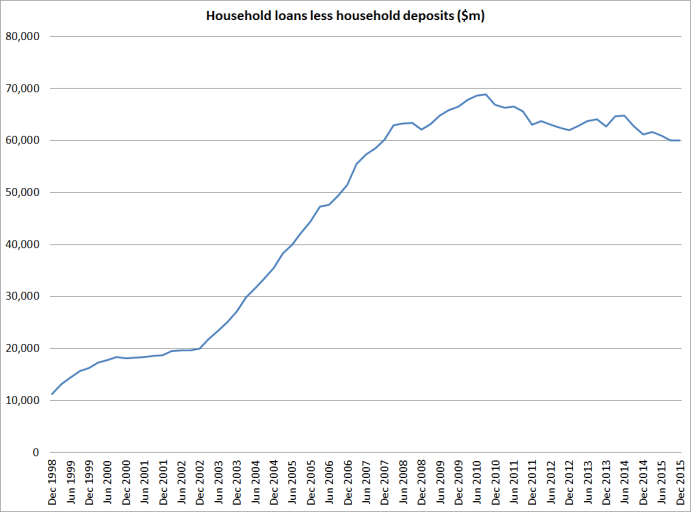
But the Herald chooses to focus simply on the gross debt of New Zealand entities, and pays no attention to what might be going on elsewhere in the balance sheet.  Since they end up focusing on households, lets do that.  The Herald focuses on $232.9 billion of gross household debt, but pays no attention to what has been going on with household deposits.  Here is the chart, using the Reserve Bank’s household statistics, of the gap between household debt and household deposits.

household debt to deposits

It rose very rapidly in the boom years of the 2000s, but has gone nowhere at all for seven or eight years now.   GDP has gone up a lot in that time, so that the ratio of this gap (between loans and deposits) to GDP is materially lower than it was back in 2007/08.    This isn’t some novel point –  the Reserve Bank has been mentioning it in FSRs for years now.

Even ignoring deposits, household debt to GDP itself has gone nowhere for eight years, after a huge increase in the previous 15 years.

household debt to gdp

Probably these ratios will increase somewhat over the next few years.  HIgh house prices, and a housing stock that turns over only quite slowly,  does that.  Here is a chart I ran a while ago illustrating how debt to income ratios keep rising for quite some time –  all else equal –  even if there is just a one-off increase in house prices.

In the chart below I’ve done a very simple exercise. I’ve assumed that at the start of the exercise, housing debt is 50 per cent of income, house prices and incomes are flat, and people repay mortgages evenly over 25 years. Only a minority of houses is traded each year, but each year the new purchasers take on new debt just enough to balance the repayments across the entire mortgage book.

And then a shock happens – call it tighter land use regulation – the impact of which is instantly recognized, and house prices double as a result. Following that shock, house purchasers also double the amount of debt they take on with each purchase, while the (now rising) stock of debt continues to be repaid in equal installments over 25 years.

In this scenario remember, house prices rose only in year 1. There is no subsequent increase in house prices or incomes. But this is what happens to the debt to income ratio:

debt to income scenario

None of this is reason to be indifferent to the scandal of house prices, especially those in Auckland.  But high house prices –  that result mainly from the interaction of population pressures and the thicket of land use restrictions which rig the market against the young – tend to increase the amount the young need to borrow from, in effect, the old to get into a first house.  It is quite risky for the borrowing cohort, but on the other side are much higher financial assets held by the older cohort, who sold the young the houses.  “New Zealand” isn’t more indebted –  one significant cohort of New Zealanders have much more debt, and others have much more financial assets.  And that outcome is mostly down to choices made by successive governments.

The Herald is also keen to run the line that people are treating their houses like ATMs –  drawing down on the additional equity to boost consumption.  No doubt some are –  and for many it will be quite rational to do so.  If you are 60 now, living in Auckland, and thinking of moving to Morrinsville or Kawerua to retire, you might as well take advantage of the rigged housing market now and spend some of your equity.  On the other hand, people trying to get on the housing ladder are having to save ever more to get started in the market (through some combination of market constraints and regulatory restrictions).  But whatever the case at the individual level, here is a chart I’ve run a couple of times recently, showing household consumption as a share of GDP.

household C to GDP

If you didn’t already know there had been a massive increase in house prices, and gross household debt, over these decades, there is nothing in overall consumption behavior to suggest a problem (or even an issue).  High house prices don’t make New Zealanders as a whole better off, they simply involve redistributing wealth from one cohort to another.  If they don’t make New Zealanders as a whole better off, we wouldn’t expect to have seen a surge in consumption.  And we don’t.

I’d hate to be one of the young taking on mortgages of the staggering size that are all too common today.  Even if house prices never come down much –  quite plausible if the land supply mess is never properly fixed –  they face a heavy servicing burden for decades.  If house prices do fall a lot, those people risk carrying an overhang of debt that could make it all but impossible to move.  And some risk of serious distress if the borrower were to be out of a job for very long.

But it isn’t “New Zealand” that owes this money.  It is one lot of New Zealanders who owe it to another lot of New Zealanders, in a market rigged by governments.  Fortunately –  and I didn’t see this in the Herald story –  even our Reserve Bank (constantly uneasy about debt and housing) has repeatedly run severe stress tests and found that the banking system is robust enough to cope with even some nasty adverse shocks.  The same, of course, won’t necessarily be able to be said for all the borrowers if something very bad does happen.


Loan to income limits, housing etc

I did a brief radio interview this morning on the (hardly surprising) news that the Reserve Bank had approached the Minister of Finance for initial discussions on the possibility of adding loan to income limits to the list of (so-called) macroprudential instruments the Reserve Bank could use.  Preparing for that prompted me to dig out the material on what has been done in the UK and Ireland.

It is worth remembering that the Reserve Bank does not need the Minister’s approval to impose loan to income limits.  Some years ago, Parliament amended the Reserve Bank Act in a way that seems to have given the Reserve Bank carte blanche to impose pretty much any controls it chooses, so long (in this case) as they can squeeze them under the heading of matters relating to

risk management systems and policies or proposed risk management systems and policies

This was the basis they used for the two rounds of LVR controls, and various amendments, to date.  In principle, controls could be challenged, on the basis that they were inconsistent with the statutory requirement to use the regulatory powers to promote the soundness and efficiency of the financial system.  But the reluctance of banks to take on the Reserve Bank openly –  the Bank always has ways of getting back at banks – and judicial deference on contentious technical matters effectively leaves the Governor free to do pretty much whatever he wants, at least as far as banks are concerned (the legislation gives him much less policy power over non-bank deposit takers, and none at all over lenders who don’t take deposits).

The memorandum of understanding with the Minister of Finance is non-binding, but ties the Bank’s hands to some extent.   The MOU contains an agreed list of the sorts of direct controls the Bank might use.  Legally the Bank can ignore that list.  Practically, it can’t.   But the Minister of Finance is also in something of a bind.  Since the government has been unwilling to do very much to deal with the fundamental factors driving house prices, it would risk accusations of complete dereliction of duty if the Governor came asking for the power to impose new direct controls and the Minister turned him down.  The controls might be daft, costly, and probably ineffective, but refusing the Governor’s request would be a gift to the Opposition (“do nothing Minister just doesn’t care; ignores sage Governor”, and so on).  So most probably, if the Governor wants loan to income limits added to the MOU list, they will be added.  It is still the Governor’s decision whether and how to use those powers, and if they go wrong, or prove unpopular, blame can be deflected to the Governor.  (Unlike the Minister, the Governor doesn’t have to front up in Parliament for question time each day, can’t really be sacked, and generally faces limited effective accountability –  ie questions with consequences.)

If and when loan to income restrictions are added to the list of permitted controls (not just when the Bank wants to deploy them), we should expect to see some rigorous and comprehensive analysis from the Reserve Bank, complemented by the Treasury’s advice to the Minister.  Something that showed signs of thinking hard about the possible pitfalls, and which addressed the strongest case sceptics might make would be particularly welcome from the Bank –  and novel.

Loan to income ratio limits have been applied recently in the UK and Ireland. I was interested to see a comment yesterday from Grant Robertson, Labour’s Finance spokesman, indicating that

his party could be willing to back central bank debt-to-income ratios, if they can be tailored to target investors.

However, Mr Robertson said it would not support a blanket debt-to-income ratio being introduced by the Reserve Bank as it would unfairly target first home buyers.

Presumably Robertson is unaware that in both the UK and Ireland loans to finance the purchase of rental properties (“buy to let” loans as they are known there) are explicitly excluded from the loan to income limits.  It is an instrument that, if used at all, is in effect targeted at first home buyers, usually the owner-occupiers who will borrow the largest amount relative to income (quite rationally, since they also have the longest remaining span of working life).

The fact that a few other countries adopt controls does not make them a sensible response in New Zealand.  But it is worth bearing in mind that the UK controls –  under which mortgage lenders cannot lend more than 15 per cent of their total new residential mortgages (by number) at loan to income ratios of 4.5 times or above – were explicitly envisaged as non-binding at the time they were imposed.  The Bank of England indicated that “most lenders operate within its new limit, so the measure will simply insure against potential risks to financial stability if mortgage lending standards loosen markedly in the future”.

Ireland is a little different, having come through an extreme house price boom and bust cycle, although even they noted that there was little sign that bank lending behavior was a problem in Ireland at present.  In Ireland, no more than 20 per cent of the euro value of all new housing loans for owner-occupied properties can have loan to gross income ratios in excess of 3.5.

In neither case is there a blanket ban on loans with high loan to income ratios.  Both countries have structured their limits as “speed limits” (as was done with the LVR limits here).  Presumably the same would be done here, if LTI limits are introduced.  Encouragingly, in both countries there is no differentiation by region, and our Reserve Bank should resist pressure for any regional differentiation here.

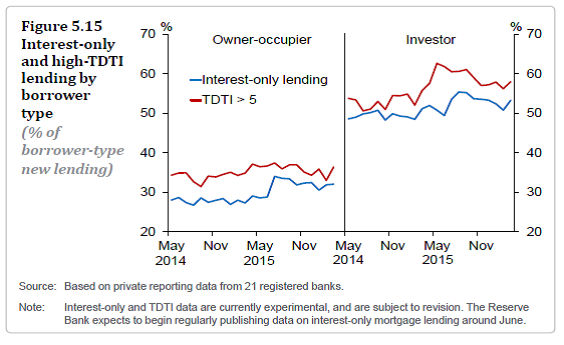
The controls are not easily compared across countries.  In one case, the limit is by number of loans, and in the other by value.  Both appear to use gross income in the denominator, but tax rates differ from country to country, and so the effective impact of the restrictions will differ for that reason alone.  Our Reserve Bank recently published a chart suggesting that around 35 per cent of new owner-occupier loans have a debt to income ratio greater than or equal to five, but since this data is the fruit of “private reporting”, and is described as “experimental and are subject to revision”, we have no way of knowing whether either the “debt” or “income” concepts they are using –  which may well differ by bank –  are even remotely comparable to those used in the UK or Irish regulation.

dti

(But it is worth noting that in the short run of experimental data, there is no sign of an explosion in the share of high debt to income lending.)

The income of a potential borrower is clearly one of things a prudent lender would take into account in deciding whether to lend money, and how much.  The same goes for the value of any collateral the borrower can pledge, any other conditions or covenants that are part of the loan contract, and as host of other factors.  But the fact that these considerations might be relevant to assessing the creditworthiness of the borrower does not mean they are things that should be regulated.  As the Irish central bank noted in its consultative document

An acknowledged weakness in the use of LTI as a guide to creditworthiness is the fact that income at the time of borrowing may not be a good guide to average income over the life of the mortgage or to the risk of unemployment. Lenders need to take this into account in their lending decisions and must not rely mechanically on LTI.

And yet LTI limits increase the likelihood that banks will manage to the rules –  breaches of which expose them to severe penalties –  rather than to the underlying credit risk  (where, all other factors aside) it is overall portfolio risk rather than the risk of an individual loan that probably matters a lot more –  especially for systemic soundness.  Curiously, an LTI limit risks making finance relatively more available to those borrowers with highly variable income –  borrow in a good year, and your loan might not be excess of the LTI threshold, and no one at the central bank cares much that in another year’s time your income might have halved.  It might be an unintended effect, but it won’t an unforeseeable one.

More generally, there is no good external benchmark for what an appropriate or prudent loan to income ratio should be.  At least with LVRs there is a certain logic in suggesting that, say, a loan in excess of the value of the property changes the character of loan (the top tranche is unsecured).  No one has any good basis for knowing whether a debt to income ratio (however either of those terms is defined) of 3 or 5, or 7 is unwise or excessively risky.

I don’t personally have a high appetite for debt – I’ve taken two mortgages in my life, both were about 2 times income, and both felt forbiddingly large at the time.  Then again, the interest rate on the second of those loans were something like 10 per cent.  But if, say, nominal mortgage interest rates were to settle at around 5 per cent –  not low by longer-term international historical standards –  then why would it be imprudent for a young couple aged 25 to take a 40 year mortgage at, say, six times their (age 25) income?  The upfront servicing burden would certainly be high, but twenty years hence even general wages increase (no ,movement up respective scales) would have halved the burden.  And why would it be imprudent for a bank to have a portfolio of mortgages which had some new mortgages at high LTIs and some well-aged mortgages with much lower LTIs?

(The same might go for investment property loans.  If someone is running a rental property business, the prudent ratio of debt to income –  whether wage income of the borrower or rental income – is likely to be much higher when rental yields are, say, 4 per cent than when they are 8 per cent.)

Don’t get me wrong.  There is something obscene about house prices in New Zealand –  and a bunch of similar countries with dysfunctional land supply markets. There is no reason why we can’t have house prices averaging perhaps 3 times income –  with mortgages to match –  but our policy choices have rigged the market, delivering absurdly high house prices.  If so, people need to be able to borrow at lot just to get a toe on the ladder.  Try to prohibit willing borrowers and willing lenders from agreeing such loans and you simply further skew policy in favour of the “haves”, and create an industry in getting round the controls.  There hasn’t been that much effort so far to get round the LVR controls –  through quite legal means, involving unregulated lenders –  but recall the Deputy Governor’s comments at the last FSR, that controls might now be with us for much longer than the Reserve Bank had first envisaged.  I’m not sure why the non-bank (and especially non deposit-taking) lenders have not been more active to date, but a further intensification of controls surely heightens the likelihood of larger scale use of alternative lenders.

Loan to value ratio controls haven’t solved, or materially alleviated, housing market pressures.  For all the rhetoric, not even the Reserve Bank’s modelling suggested they would. There is some short-term relief –  helping those not affected directly, at the cost of the more marginal potential borrowers –  but it doesn’t last.  There is no reason to think that loan to income ratio controls would be different. They tackle, rather ineffectually, symptoms rather than causes, and over time mostly alter who owns houses, not how much is paid for them.  The Reserve Bank will argue that even if the controls don’t change house prices, they still enhance financial stability, but there is not even any serious evidence of that. First, they have not shown any evidence that financial stability is threatened –  and their own tough stress tests keep delivering quite reassuring results –  and second, and perhaps as importantly, they have made no effort to analyse what risks banks will take on if controls prevent them lending as much on housing as they might like.  Banks are profit-maximizing businesses, and deprived (by regulation) of some opportunities they will surely seek out others.

Far better for the Reserve Bank to recognize that it has no mandate to control house prices (or even the growth of housing credit), and in any case it has no tools that will do much over time anyway.  Its responsibility is the overall soundness of the financial system.  If the risk weights on housing loans look wrong, let them make the case for higher weights and consult on that. If the overall capital ratios look too low, then again make the case.  Using those tools will do less damage to the efficiency of the financial system, and better secure the soundness of the system, that one new wave of direct controls after another.  At the current rate, Graeme Wheeler will be giving a good name to Walter Nash, the first person who imposed so many controls on our financial system. (I usually eschew references to Muldoon in this context, but over his full term he deregulated the financial system more than he reregulated it).

Of course, there is still no sign of those actually responsible for the house price debacle doing much about it.  I haven’t yet read the full proposed National Policy Statement, but the material I have read is full of central planner conceit, and seems unlikely to achieve very much.  And I find it seriously disconcerting –  if perhaps not overly surprising –  that the Ministry for the Environment released a supporting document yesterday on “International approaches to providing for business and housing needs” .  But this survey of international approaches drew exclusively on the UK and two Australian states (New South Wales and Victoria).  Since London, Sydney and Melbourne are some of the cities with the most dysfunctional housing markets in the world, indicated by price to income ratios similar to, or even higher than , Auckland’s, you have to wonder why MfE would look to those places for guidance or insight.  When the Productivity Commission report on land supply was released last year, I criticized them for a similar focus –  they’d visited various places, but not the functioning land supply markets of the US.

One might have hoped that government agencies, and ministers, who were serious introducing a well-functioning competitive urban land market might have devoted at least some serious analytical attention to the experiences of thriving cities in the US which manage to cope with rapidly rising populations with markets in which house price to income ratios fluctuate somewhere near 3.

Having said all this, I’m not very optimistic that the house price problems will be solved. I went to a good lecture yesterday on housing by the Chief Economist of Auckland Council, Chris Parker.  He has a lot of good analysis and ideas which I can’t discuss here –  he told us it was under Chatham House rules, under which we could say what was said, but not who said it, but he was the only speaker….. –  but I wanted to ask him the same question I’ve posed here previously: is there any example anywhere of a city or country that has materially unwound the thicket of planning controls once they were in place.  If not, perhaps we can be first.  But, if so, it doesn’t look as though we are getting there fast.

(Which does make the government’s continued indifference to the huge population growth, largely driven by immigration policy when there is no evidence that that population growth has been systematically benefiting New Zealanders, ever more inexcusable).


House prices and the Reserve Bank

House prices are not the responsibility of the Reserve Bank, any more than tomato prices are.

In its monetary policy, the Bank was charged by Parliament with maintaining a stable general level of prices.  In the Policy Targets Agreement, the Governor and the Minister of Finance agreed that, while the Bank should keep an eye on all sorts of price measures, for practical purposes the focus should be on keeping annual CPI inflation near 2 per cent.  The CPI includes rental costs and the cost of construction of new dwellings, but it does not include section prices or the prices of existing dwellings.  Parliament or the Minister could require the Bank to focus on some different index altogether –  there is nothing sacrosanct about the CPI, even as a measure of prices –  but they haven’t.  And the way the CPI treats housing is consistent with the Reserve Bank’s view as to how housing should be treated.

What about the financial regulatory side of the Bank’s responsibilities?  The Reserve Bank Act requires that the Bank exercise its regulatory powers over banks in ways that promote the soundness and efficiency of the financial system.  What matters is the overall health of the balance sheets of the financial system as a whole.  Loans secured on residential properties make up a fairly large proportion of bank balance sheets, which suggests that the Reserve Bank might reasonably want to understand the risks banks are carrying, and the buffers they have in place if things turn out less well than expected.  But it does not make house prices a policy responsibility of the Reserve Bank.

Perhaps one might make an exception to the statement if there were evidence that house prices increases were occurring primarily because of reckless lending by banks.  But even that is a higher standard than it might sound.  It doesn’t just mean that credit growth for housing might be running ahead of incomes –  one would expect that if other shocks and distortions (eg land supply or immigration) were putting upward pressure on house prices. If so, the younger generation will typically need to borrow more from older generations to get into a house, and the banks may be just the intermediaries in that process.  And even if the Reserve Bank suspected “recklessness” it would have to ask itself why, and what basis, its judgements were likely to be better than those of the banks.  After all, the Reserve Bank has nothing at stake, while the shareholders of banks have a great deal at stake (even if you think that governments would mostly bail-out creditors, shareholders usually lose a lot when things go wrong).

One might draw on past experience and international research.  But even then one has to do so carefully.  After all, as the Reserve Bank itself has highlighted, losses on residential mortgage portfolios have rarely played a central role in systemic financial crises –  and particularly not in countries with floating exchange rates (check) and with little or no direct government involvement in housing finance (check).  Very rapid housing turnover can be a sign of things going haywire –  although even then not necessarily of high risk to banks.  But in New Zealand, house sales per capita have remained well below what we saw in the previous boom, and mortgage approvals per capita also remain pretty subdued by pre 2008 levels.  And recall that in New Zealand, with the same banks we have now and the same incentives, the banking system did not get into trouble even after that boom.  During the 2008/09 recession, senior Reserve Bank and Treasury officials toured the world spreading reassuring words, and they were right to do so.

Perhaps too, the Bank might worry about the spillover from higher house prices into the rest of domestic demand.  But, in fact, over the last 25 years, despite huge increases in real house prices, the private consumption share of GDP has been essentially constant.

household C to GDP

That is largely what we should expect: after all, higher house prices don’t make New Zealand any better off, and the individuals who are better off must be offset by other individuals who are made worse off.  The Bank might also pay attention to high-level research suggesting that financial crises have typically been foreshadowed by big increases in debt to GDP ratios over relatively short periods (the few years just prior to the crisis).    But on that score, it is worth remembering that most countries that have had big increases in debt to GDP ratios have not had domestic financial crises (think of the UK, Canada, Australia and New Zealand for example).  And in New Zealand, household debt to GDP ratios have gone largely nowhere for eight years, after a huge increase in the previous 15 years.  Yes, there has been quite an increase in the last couple of years, but that is surely what one would expect when population pressures and land supply restrictions combine to push house prices up.  A higher level of credit is a typical endogenous response.    It is not, of itself, a danger signal regarding the soundness of the financial system.

This was all prompted by a piece I noticed on interest.co.nz which appeared under the heading “RBNZ has nowhere to hide from the housing market”, with the fuller heading  “Each new piece of housing-related data coming out at the moment is increasing the pressure on our central bank”.   If so, it is only because the Reserve Bank has chosen, with no good statutory justification, to put that pressure on itself.  Good central banks don’t need to “hide”.  The housing market is just another, albeit important, market.

The Reserve Bank has a relatively straightforward job. It is supposed to keep inflation near 2 per cent, which it has been failing to do.  And it is supposed to use its regulatory powers to promote the soundness and efficiency of the financial system.  There is no sign that the soundness of the system is threatened, and each new regulatory intervention impairs the efficiency of the financial system –  and provides, briefly, cheaper entry levels for those upon whom the Reserve Bank’s favour rests.

Here’s what I would expect the Reserve Bank to be doing.  They should be continually reviewing the reasonableness of the risk weights that they allow the banks to use in their capital modelling, and ensuring that they understand how different banks are assessing the same risk.  They should carry on with their programme of stress tests, which so far have shown very encouraging results in the face of very severe shock scenarios.  And then they should be leaving the responsibility for house prices and a dysfunctional housing supply market where it rightly belongs: with central and local government.  When the Reserve Bank intervenes not only does it compromise financial system efficiency, for little obvious gain on soundness, but it leaves observers with a sense that perhaps the real issues are different from what they are.  And it encourages banks to focus on managing regulatory limits rather than thinking hard about the risks they, and their shareholders, are taking on.

The Reserve Bank is not responsible for the current housing mess, and it cannot provide the solution –  not even partial or temporary solutions.  Responsibility rests with successive governments that bring in tens of thousands of non-New Zealanders each year into a system that is simply unable to generate effectively and cheaply a sufficient supply of houses.  And that isn’t a market failure, but yet another example of government failure.

And for those who worry that a lower OCR would simply push up house prices further, a reminder that one of the key ways in which monetary policy works is by raising the prices of long-lived assets – which encourages people to invest in producing more of them.  But perhaps too it is worth remembering that the real OCR has fallen by more than 600 basis points since 2008, and yet material real house price increases have only been seen in places with that fatal combination of substantial population pressures and a highly distorted land supply market.  Interest rates are low for a reason –  the economy would be even weaker and inflation lower if they were not.


Non-resident purchases of houses: the data

Last week, LINZ released the first batch of data from the new attempt to measure non-resident purchases of property in New Zealand.

As they note, at this stage the data have considerable limitations (including around the exclusion of purchases by trusts and companies).  In addition, it is unlikely that the few months these data cover will prove to have been representative.  On the one hand, there may have been some permanent behavioural changes as a result of the introduction of the “brightline test” and the tax number requirement introduced on 1 October.  For those concerned about non-resident purchases of houses in New Zealand, if those legislative changes reduce the extent of purchases that would no doubt be welcomed, but it will also mean we will never know with any certainty what the extent of non-resident purchases was in the couple of years before the law was changed.

So our law changes may have permanently reduced offshore purchases.  But they will almost certainly have temporarily disrupted the flow of such purchases.  Some people will have rushed to get in ahead of the law changes, and others will simply have been unsettled by them, or a little confused by them.  Many regulatory changes have that sort of effect –  a (potentially material) short-term disruption, which gradually abates.  In the housing market, we’ve seen it with the succession of new LVR restrictions.

All of which means that whatever the non-resident share of house purchases over the first three months of the year, it is likely to be a low-end estimate of the number of non-resident purchases (at least until China more effectively cracks down on capital outflows, and/or runs a regime that makes people more comfortable with holding their wealth in China. As I’ve pointed out before, in normal successful countries citizens don’t rush to buy houses in other countries as some sort of safe-haven store of value.

The focus of the discussion of this issue has been on the Auckland market.  The LINZ data tell us that in the January to March period, 4 per cent of transfers involved non-resident purchasers.  In most other localities, that share appears to have been smaller, but in the Queenstown-Lakes TLA, the share was a little higher still (for the entire October to March period).

What has surprised me somewhat is that 4 per cent has been treated by most people as a small number.  In writing about this almost a year ago, I noted that –  with no data whatever to back the supposition –  it wouldn’t surprise me if 5 per cent of Auckland housing demand was from non-residents, and that in a market with fairly tightly constrained new supply, even quite small percentages could make a material difference to house prices.

And much of the discussion of this issue seems to ignore the fact that most turnover in the housing market is not as a result of people entering the market for the first time or leaving it for the last time.    Most turnover involves New Zealanders buying and selling from one another –   people changing city or suburb, or just changing their stage of life (wanting a bigger house as the kids grow, or a smaller house later in life).  The same goes for residential rental properties: the stock turns over as individual owners’ circumstances and interests change.  A well-functioning housing market will have a lot of turnover (facilitating those changes in life circumstances etc) and little persistent pressure one way or the other on real prices.    In these data, New Zealanders bought sold from each other around 40000 houses in a six-month period.

Pressure on prices arises from net new demand to the market (or –  the Christchurch story post-earthquake – net reductions in supply) not from routine turnover.  It is a bit like immigration influences on the housing market.  In a year in which there are big swings in net migration, those fluctuations might amount to only around 1 per cent of the population.  Even if migrants typically eventually purchase their own home, probably most don’t purchase in their first year or two here (especially as many initially come on temporary –  work or student – visas), so newly-arrived immigrants themselves might still only account for a quite small percentage of house sales in any year.  But previous formal empirical studies have  suggested that a 1 per cent shock to the population from a change in immigration can still produce up to a 10 per cent change in house prices.  Markets operate at the margin –  it is changes in the net new demand/supply that really should be the focus of attention.

If the average New Zealand house was turned over five or six times in the course of an adult life (eg turning over roughly every 10 years), then perhaps 80 per cent of all turnover would just represent “churn” –  a term that sometimes has pejorative connotations, but here I just mean New Zealanders moving through different phases of their lives.  If, on the other hand, most of the non-resident purchases were net new demand to the market, then 4 per cent of total turnover might be more like 20 per cent of net new demand to the market.  I’m not staking anything on that number; it is purely to illustrate that data suggesting non-resident purchases are 4 per cent of turnover may tell one very little about what role those purchases are playing in the overall balance of pressures on the Auckland market.

The issues around immigration are a bit different from those around non-resident purchases.  Immigrants need to live somewhere, regardless of whether or not they own a house themselves.  Non-resident purchasers, almost (but not quite on the LINZ measure) by definition don’t need somewhere to live here.  On the other hand, the suggestion has been  – although we don’t have the data to know the extent of it –  that many non-resident purchasers have been buying properties and leaving them empty (recall the store of value motive).  If that is happening to any material extent, the impact on the housing market is much as if they were a new migrant. If, on the other hand, houses purchased by non-residents are placed on the rental market, non-resident demand might still raise house prices materially (in a supply constrained city) but shouldn’t materially affect the affordability of accommodation itself –  ie rents.

One other limitation of the residency data is that it doesn’t give a sense of transitions from one residency to another.  For example, the data show quite a large number of purchases, and a large number of sales, by Australian tax residents.  One possibility is that most of these people are actually New Zealand citizens.  A New Zealander might have gone to Australia a few years ago, and left a house behind, unsure how long they would stay in Australia.  Finding that life has worked out well in Australia, and having become an Australian tax resident, they might now be selling the house here.  Or a New Zealander who has lived in Australia for some time, and become an Australian tax resident, might be looking at coming home, and purchases  a house here in anticipation of the move.  Given the easy migration flows between New Zealand and Australia, there is likely to be a different interpretation on transactions by these non-residents than there might be in respect of most purchasers with Chinese tax residence (a country where there is a well-known high level of capital outflows to a variety of countries, often manifest in residential real estate purchases).  Of course, if that Australian story is correct, there is a considerable element of “churn” in those transactions too, rather than net new demand to the market.

It is going to take time, and more refinements by LINZ, to really get a good sense of the situation, particularly after the first disruptive effects of last year’s regulatory changes pass.   But, for now, it is best to keep in mind that even if the offshore non-resident purchases (from people not having lived here previously or likely to live here in the near future) are only equivalent to a few per cent of total housing turnover in Auckland, that probably isn’t a small number in terms of its economic effect.  In a well-functioning house supply market it might be different –  increased demand boosts supply, in effect providing a new export industry.  When supply doesn’t work well, quite small changes in the net balance of demand can have uncomfortably large implications for prices.


Does voter turnout explain dysfunctional housing supply markets?

I learned something from listening yesterday to Radio New Zealand’s 4-5pm show “The Panel”.  Bernard Hickey was one of the panellists and he was waxing eloquent about the apartment building boom apparently underway in Melbourne.  I’ve long known that Australia was one of the handful of countries in which voting is compulsory in federal elections (in company, apparently, with North Korea, Ecuador and so on, as well as a handful of more respectable stable democracies).

What I hadn’t known, and which Bernard highlighted, is that voting is also compulsory in Australian state and local authority elections.  In fact, it isn’t a universal requirement for local elections, but voting certainly is compulsory in local council/mayoral elections in New South Wales, Victoria,  and Queensland, the three most populous states, with the three largest cities.   Compulsory voting – at least in Australia, North Korea may be different –  doesn’t produce anything like a 100 per cent voter turnout.  But turnout in Australia is far higher than in New Zealand, where voting is voluntary.  At our last local authority elections in 2013, even with postal voting, turnout was only 39 per cent.

This all got me thinking about one explanation sometimes offered for the dysfunctional (“rigged”) housing supply market.  Why, people sometimes wonder, do the existing land use rules persist, even though they seem to put the hurdles in face of starting out as a home owner ever higher?  Our Productivity Commission weighed in on that topic in their land supply report released late last year  The Productivity Commission’s report was very sympathetic to local authorities.  As I noted at the time:

The Commission shows no signs of unease with the concept of urban planning, and indeed seems to treat as wholly legitimate the choices of local councils to pursue particular visions of urban form (especially compact ones). It is simply those pesky voters who stand in the way of councils realising their visions.

The Commission took the view that turnout in local authority elections was one of the problems.  They noted that older age groups were more likely to already own existing houses, and were also more likely to vote in local authority elections.

The significantly higher voter participation of older groups in local government elections, and the markedly higher home ownership rates among older New Zealanders, means that homeowners are likely to be the dominant voters in local government elections.

And

The dominance of homeowners in local government political processes could help to explain a number of the characteristics of land use regulation and the provision of infrastructure discussed in subsequent chapters of this report.

And

Local politicians will find it particularly difficult to resist the preferences of existing homeowners where those owners organise into residents’ associations, where ward voting makes councillors responsive to particular communities, or where community/local boards are formally established to act as a voice for an area.

Before concluding with an official Finding (F3.17 on page 60)

Groups that have high home ownership rates have higher rates of participation in local government elections. The influence of homeowners in local government elections and consultation processes promotes local regulatory and investment decisions that have the effect of reducing land supply for housing.

The young, the renters, the new arrivals disproportionately choose not to vote, and so they get done over in the political process.  House prices stay high as a result.

I’ve never found the story particularly persuasive.  It might be an element in a story for why existing home owners can often limit more intensification in their own neighbourhoods.  But private covenants  –  now pretty pervasive, as the Commission recognises – represents voluntary market instruments to achieve much the same sort of protections for new developments.  But existing home-owners have no strong or permanent interest in preventing the physical expansion of their city, provided that the costs of expansion are appropriately allocated.   And homeowners have children and grandchildren – who will want to buy homes in time – and we might reasonably suppose that they care at least as much about the interests of those generations as local councilors and council bureaucrats do.

I didn’t find it a persuasive story –  although it was a convenient story for council staff and Wellington bureaucrats to tell each other.  It can be hard to find  good voters to back bureaucrats’ preferences….

But the compulsory voting arrangements in Australia provide us with a bit of a natural experiment.  Voting in Australia has been compulsory for a long time, and it has always been voluntary here. I think it is safe to treat those arrangements as prior to the expansion of urban land use restrictions.

If the Productivity Commission’s story was correct –  as any material part of the story – we should be able to look across housing markets in Australia and New Zealand, and see what difference compulsory voting and voter turnout in local elections makes.   Price to income ratios should be lower in Australia than in New Zealand, and lower in compulsory voting states of Australia than in the other states.

The Demographia report is the best collection of price to income ratios.  Here are the New Zealand cites/regions they report data for, from late last year.

Median House Price/Median Household Income
Auckland 9.7
Christchurch 6.1
Dunedin 5.2
Hamilton 5.1
Palmerston North/Manawatu 4.1
Napier-Hastings 5.0
Tauranga 8.1
Wellington 5.2
Median of these markets 5.2

There are a lot more cities in Australia (Demographia capture all those with populations above about 100000 –  details are here).  Here are capital city multiples, and the median market multiple for all the Australian cities.

Median House Price/Median Household Income
Sydney 12.2
Melbourne 9.7
Brisbane 6.1
Adelaide 6.4
Perth 6.6
Hobart 5.6
Darwin 6.0
Canberra 5.9
Median of ALL Australian markets 5.6

Looking across the New Zealand and Australian cities, there doesn’t seem much prima facie evidence to support the Productivity Commission voter story.   These are snapshot numbers, and the picture might look a little different if one compared markets in a different year.  And there is always other stuff going on in each market –  rating schemes, land taxes, stamp duties, foreign investor restrictions, capital gains taxes, marginal income tax rates and so on –  but there doesn’t seem to be much support for the “middle aged and elderly capture the electoral process and skew housing markets to their own advantage” hypothesis.  In fact, I noticed that in Victoria, voting is compulsory only until age 70 – a concession, apparently, with the effect of (modestly) favouring the interests of the relatively younger groups.

One could generalize the point.  Voting isn’t compulsory in UK national or local body elections and their housing supply markets seem just as dysfunctional.  Voting also isn’t compulsory in the United States, and yet we see hugely different housing supply markets (and housing affordability outcomes) in different growing cities, largely reflecting differences in land use restrictions.  Atlanta is one of the success stories.  When I checked, I found that voting was once compulsory in Georgia –  but it ceased being so in 1787.  It doubt that is making much difference today.

All regulatory provisions are endogenous –  they arise out of political and bureaucratic processes in a variety of often complex and not particularly transparent ways.  In democratic societies, the public can –  ultimately – defeat any law or regulation, if enough of them care enough.  But the Australian experience suggests it is a much more complex story than one which casts local government (and even more central government) as the “good guys”, looking out for the interests of the marginalized, while the middle aged and elderly who choose to turn out to vote, rig the system in their favour.   I’d be putting much more weight on the ideologies and values of councils and their staff, and the entire ‘planning’ industry, (reinforced or enabled by central government officials and ministers).  Make an issue complex enough and sufficiently non-transparent, and it can take a long time for enough people to really realise what has been going on.  And by then the mess can certainly be very –  politically –  difficult to undo.


Housing, land tax, and associated things

The Prime Minister attracted considerable coverage last week for his suggestion that a tax might be applied non-resident (however defined) holdings of land.  The Prime Minister wasn’t very specific about the options he had in mind, but it probably didn’t matter – it got some mostly favourable coverage on an issue (house prices, in Auckland in particular) where the government probably senses that it might be politically vulnerable.

Quite how house prices play politically has never really been clear to me.  I’ve noted before that I’m not aware of a single example of a city or country that, having once put in place restrictive land use regulation, has ever substantially unwound those controls.  I can well understand existing users’ unease about greater intensification, and in particular the coordination challenges that can arise. Existing owners as a whole in suburb near the central city might be (considerably) better off financially from allowing their land to be used more intensively, but that won’t necessarily be so for each of them if such development occurs piecemeal, or if benefits are captured by those first in the queue.   The market seems to deal with these issues through private ex ante contracts, the covenants that are now used in most new subdivisions (and which the Productivity Commission was quite disapproving in its report last year).

And I can also understand that no one really wants the value of their property to fall much.  Of course, for many it actually doesn’t matter very much.  If you haven’t got a mortgage and plan to live in the same city for the rest of your life, the market price of houses in your area just isn’t (or shouldn’t be) that important to you.  For those with very large recent mortgages it is another matter.  For them, and especially those who aren’t owner-occupiers, falling house prices look like a visceral threat.

But then the mortgage-free are in many cases those with children, already adult or approaching adulthood, who face the huge –  increasingly insurmountable – hurdles to entering the owner-occupation market.  That should be quite some motivation to be concerned about policies which keep house prices very high, or keep driving them up further.  Increasing the physical footprint of cities, and allowing that process to happen in ways and in places that offer the best opportunities (rather than where Council officials and politicians dictate) looks as though it should be the answer.  But bureaucrats and politicians obstruct those processes, and seem to get away with it because the issues are complex, and because they cover their tracks, blaming high house (and urban land) prices on banks, the tax system, the building industry, “speculators”, “land bankers”, becoming a “global city”, or whatever.

Other bureaucrats and politicians peddle the line that high levels of non-citizen permanent immigration are somehow good for us.  High house prices are just one of those things –  a price of progress, indeed of success, so the Prime Minister would often have us believe.

Once in place, distortionary policies, even very costly ones, often last for a long time.  We saw that in New Zealand with the import licensing regime first put in place in the 1930s, which wasn’t finally abolished until 1992.  It was an enormously inefficient system, driving up costs on many items (and restricting choice) for most people, it was contested politically (largely unwound in the early 1950s, and then re-imposed by the next government).   But the entrenched interests of those who benefited from the system (or thought they did) combined with ideologies of “national development” to make it very difficult to undo.  Licence-holders themselves obviously benefited, but many of the employees of firms producing products protected by the licensing regime thought they did too.    And transitions are/were costly – we saw a lot of that in the 1980s, when big steps were finally made in dismantling the regime.  A larger proportion of the population is employed now than was then, but that didn’t mean the transition wasn’t difficult, and even traumatic, for many individuals, and even for whole towns.

One might have hoped that the rigged housing market was different, but it doesn’t seem to be.  The distributional effects (winners and losers) are far larger than any aggregate adverse effects (I’m skeptical that GDP is much smaller than otherwise because the housing market is so badly distorted).  And unfortunately, those most adversely affected tend to be the poorer, younger, less sophisticated elements in society –  those on the peripheries.  One might have hoped that one or other main party would have made grappling with these issues a real priority, consistent with the underlying values they claim to represent:  National perhaps on some ‘property-owning democracy’ line, in which communities will be stronger etc when property ownership is more broadly based, providing a “fair go” to the hardworking and aspiring classes.  Or Labour, built on a fight for the rights and interests of ordinary workers, campaigning for the full inclusion and equal opportunities for peripheral groups.

But it simply doesn’t happen.  Instead, the Prime Minister keeps talking of high house prices as “a good thing”, and a sign of success.  And for all the somewhat encouraging talk from Labour’s Phil Twyford, less than 18 months out from an election, there is little public sense of a party making fixing the housing market a defining issue.  Time will tell.  Rigged markets are hard to unscramble –  politically hard, not technically so.    Doing something far-reaching could be very costly for groups who would quickly become quite vocal, and loss aversion is a powerful force.

Where do land taxes fit within all this?  I outlined some of my skepticism about a general land tax in a post late last year.    But the Prime Minister’s latest comments relate only to non-resident purchasers.  The theoretical arguments for a general land tax don’t apply to one explicitly targeted at a specific subgroup.  Instead a land tax appears to be one of the few possible tools (specific to foreign purchasers) left to the government –  having signed up to a succession of preferential trade (and other) agreements – if, as the Prime Minister put it, it could be shown that non-resident purchasers were a big influence on the housing market.  Of course, we haven’t yet seen the data the government has started collecting, but even when we do there will no doubt be lots of debate about what it means.    Say that it shows that 1 per cent of purchases in the last six months have been from non-resident foreigners.  One per cent doesn’t sound much.  But the significance depends on a various things, including a variety of elasticities.  If the supply of houses and urban land was totally fixed (it isn’t, but this is just an illustrative example), a one per cent boost to demand could have a considerable impact on the price of houses.  If New Zealand residents were deterred from buying by even the slightest increase in price, then an increase in non-resident foreign demand might have very little impact on price even if supply was largely fixed.    Various quantitative researchers will have various estimates of these different elasticities.   But some past work has suggested that a 1 per cent increase in population, say, can have a material impact on house prices.

I had a couple of posts on the non-resident purchases issues last year.  Despite my general stance strongly favouring a pretty liberal regime for foreign investment, the housing supply market is so badly messed up that I don’t think we should rule out restrictions targeting non-resident foreign purchasers, as a second or third best option (perhaps especially if there was evidence that a large proportion of such purchases were being left empty).  The capital outflows from China –  which is where the main issue is –  are historically unprecedented.  They aren’t a normal phenomenon of an emerging economy, but a reflection of a whole variety of things that are badly wrong with the governance and rule of law in China.

But is a land tax the answer?  If it is, it is a pretty unappealing one.   It would seem to be a tax planners’ dream.  One of the appeals of a general land tax is that the land is fixed, and some identifiable entity (person, company, trust, government) one owns each piece of land.  It doesn’t really matter who owns it, but someone will have to pay the tax.  A land  tax focused only on some definition of non-resident purchasers means it makes a huge difference who owns the land.  If I own it, there is no tax liability.  If a family in Shanghai owns it there is.  Which looks like a pretty clear incentive to have the land owned by New Zealanders, and (to the extent there is demand) the things on the land owned by the foreigners.  No doubt lots of clever intrusive anti-avoidance provisions could be added to any land tax legislation but to quite what end?  Are we better off if, say, the non-residents purchasers bought apartments (which typically have a smaller land component) rather than, say, standalone houses?  Perhaps if it stimulated a supply of new apartments –  for which there would be an enduring demand –  but not if it largely just reallocated who owned what within an existing housing stock.

And there is, of course, the question of what might be a reasonable rate of land tax.  Long-term New Zealand government bond yields in New Zealand are among the highest in the world.  At present, those real bond yields are just over 2 per cent per annum.  Imposing a tax of 1 per cent per annum on value of land (including farm land?)  would be a very heavy burden in such a low yield environment.  Perhaps it might not matter too much to those seeking to safeguard their capital (return of capital rather than return on capital), but if so it might not make that much difference to offshore demand either.   I’ve seen talk of higher rates –  Rodney Hide’s Herald column yesterday talked of a 3 per cent annual rate –  but in such a low yield environment such tax rates could quickly starting looking like expropriation, confiscatory in intent.  I suspect our preferential trade agreement partners might start looking askance at that.

For what it is worth, I think a serious response to the house and urban land price affordability issue would have several dimensions, including:

  • limiting the assessability and deductibility of interest to the real (inflation-adjusted) interest only.  The ability to offset losses in one activity against profits in others is a good feature of the tax system not a flaw, but there is no good economic case for taxing the inflation component of nominal interest, or allowing borrowers to deduct the inflation component.  This is a small issue, especially at present when inflation is so low, but it would be good tax policy and work towards slightly better housing market outcomes.
  • creating a presumptive right for owners to build, say, two storey dwellings on any land, with associated provisions to developers/purchasers to cover the costs of associated infrastructure (whether through private provision, or differential rates).
  • sharply cutting the target level of residence approvals under the New Zealand immigration programme, from the current 45000 to 50000 per annum to perhaps 10000 to 15000 per annum.  Since there is no evidence that New Zealanders, as a whole, have been gaining from the high trend levels of immigration –  and indications that Auckland, prime recipient of the inflows, has been persistently underperforming, this would represent immigration policy reform in any case.  But it would also have material implications for trend housing market pressures as well.

The third element would be the one that would be easiest to implement.  But, of course, like the policies around housing supply –  or import licensing (see above) –  the distributional implications of the current arrangements (positive and negative) are probably larger than the overall economic effects.  Those who see themselves as “winners” from the current arrangements –  a funny mix , including those who genuinely benefit, and those with a “feel good” preference for diversity  –  are likely to be more vocal, and more easily heard, than those who pay the price of an misguided approach to economic management: a “critical economic lever” (MBIE’s words) that has done little or nothing positive for New Zealanders as a whole.  The parallels with Think Big in the 1980s, or with the protective regime of the 1930s to 1980s, each well-intentioned and with their own internal logic, are sobering.