As obstructive as ever

Late last week I suggested that Pattrick Smellie of BusinessDesk was being more than a little generous to the Reserve Bank when he suggested that, even though the Governor was now displaying some of the same bunker mentality as was on display late in the Wheeler years, more generally

The RBNZ is now more open and transparent.

There was no evidence then for that proposition.  As I noted

it just isn’t so –  the capital review is only the latest example, but nothing material has changed about monetary policy, we’ve had no serious speeeches from the Governor on his core responsibilities, and they play OIA games just as much as ever

And today I’ve had another couple of fresh examples illustrating my point, and a reminder of a third.

The reminder?  Contact from the Ombudsman’s office about a complaint I lodged some time ago when the Bank took a grossly excessive amount of time to release material I’d requested –  relevant to bank capital review – all of which, in turned out, had already been given to other people (and thus should have been able to be released almost immediately).

And the new examples?    More than two months ago I asked both the Bank’s Board and the Minister of Finance for papers relevant to the appointment of members of the new Monetary Policy Committee.    After a while, both parties extended my request.  I wasn’t unduly bothered, although even then the notion ran around in my head that a pro-active release might have been a good idea, around the first appointments to a powerful new body.    Today, the Minister of Finance did release a fair amount of material (I haven’t read it yet), but what about the Bank’s Board?   Well, they just sent me a note extending the request yet again, using as their justification –  after having had 2.5 months already

because of the consultations necessary to make a decision on the request such that a proper response to the request cannot be made within the original time period.

And this is what Pattrick Smellie thinks is a “more open and transparent bank” (bear in mind that the Governor sits on the Board, and the Governor’s staff will do doing all the actual work).

Quite possibly the request for information around the MPC appointments could have taken a bit of effort.   But my other example of the Bank continuing on as ever, playing games outside both the letter and the spirit of the OIA, is one where they could easily have responded fully and openly within a day or two of the original request.

On 11 May, I lodged the following request

nzi oia

I was pretty sure he would have been speaking without notes or slides (but if there had been any they’d have been easy to send on –  after all, the material had already been provided to private sector people).   And since the request was made just a day after the presentation, it should have been very easy for the Governor to have jotted down a quick summary of what he had said, and how he had answered questions on two specific topics.

But 20 working days have now passed –  and recall that under the law the requirement is to respond “as soon as reasonably practicable, but no later than 20 working days” –  and this afternoon this request was also extended for another couple of weeks, again allegedly because the consultations necessary to make a decision could not be made within the original timeframe.  Yeah right.   (In fact, there shouldn’t need to be any consultations at all.  I asked only for the Governor’s words, which are official information.)

Why did I frame the request around those specific points?  It was easy to anticipate that the Governor would get lots of questions about his bank capital proposals, probably not (from that audience, which includes both private businesses and banks) sympathetic ones.  And about the Bank’s research capability?  That reflected a post here on the morning the Governor was to meet the New Zealand Initiative over lunch.

On which note, one hears that the Reserve Bank’s research function has been  substantially gutted, with several recent resignations in recent months from among their best-regarded and most productive researchers (and the manager of the team left this week and is reportedly not being replaced).    The Bank’s research function once played a very influential part in policy and related thinking, but that is going back decades now.   Even with a Chief Economist who himself had a strong research background, the research team never quite found a sustained and valuable niche in recent years, even as some individual researchers have generated some interesting papers, often on topics of little direct relevance to New Zealand.  One of the most notable gaps is that the Bank has become increasingly focused on financial stability and financial regulation, and yet little or no serious research has been published in those areas of responsibility (a senior management choice).  That weakness has been evident in the recent consultation document(s) on bank capital.

One can always question the marginal value of any individual research paper, but we should be seriously concerned if the Reserve Bank under the new wave of management is further degrading the emphasis on high quality and rigorous analysis.  Apart from anything else, a good grounding in research has often been the path through which major long-term contributors to the Bank have emerged, including former chief economists (and roles more eminent still) Arthur Grimes and Grant Spencer.   I see that the Governor is delivering an (off the record) talk at the New Zealand Initiative today: perhaps someone there might like to ask just what is going on, and what place the Governor sees for a research function in a strongly-performing advanced country central bank.  Not even he, surely, can count on Tane Mahuta for all the answers.

So I was interested to see if anyone with the opportunity had asked the question.

(As it is, I heard on the grapevine that at this event the Governor may have attempted to fend off any criticisms of his tree god nonsense with the allegation that criticism was simply “racist”.)

I’m more amused than outraged.  Because the Bank’s –  the Governor’s –  conduct is simply par for the course: obstructive whenever they can get away with it, as they have been for a very long time.   There is no sign –  none –  that in this regard the Orr regime is any better than what went before.  You might now get cartoons with your MPS or FSR, but what you won’t get is an open, transparent, and accountable Reserve Bank, seriously interested in substantive engagement or searching scrutiny.  That’s a shame.  And it is something the Board and the Minister should take a lot more seriously, including when the Minister exercises his new statutory power to appoint the chair and deputy chair of the Bank’s Board –  finally making it clear that the Board work for the Minister and the public, not for the Governor or their own quiet lives.

UPDATE: A commenter points out that a second extension, made outside the initial 20 day window, is itself in breach of the OIA.  Even the SSC agrees with that interpretation.

MULTIPLE EXTENSIONS You can extend the time limits for a request more than once, providing all extensions are made within the original 20 working day time period after receiving the request (see section 15A(3)).


An embattled Orr

Still catching up, but noticing some concerning newspaper stories about how the Governor was handling things, yesterday I finally got round to reading the Reserve Bank’s Financial Stability Report and watching the Governor’s press conference.

Of the former, probably the less said the better.  It is a disappointingly lightweight effort, clearly designed to sound a bit more worried about New Zealand financial system risks – to support (belatedly) the Governor’s capital proposals – even while offering no evidence to suggest that such risks were (a) significant, or (b) worsening.       There were statements of the blindingly obvious –  “some” households and farms are overindebted, as if that has not always been the case –  and alarmist conclusions (about the threat banks could face if lots of borrowers default) made without any reference to the Bank’s own repeated stress tests.

And then there was the press conference.   I’ve seen some pretty poor performances from Governors over the years –  early ones by Alan Bollard were often awkward, and as Graeme Wheeler became more embattled the defensive introvert, never comfortable with the media, took over.     But this one was the worst I’ve seen, and from someone who has many talents in communications.  But just not, so it is confirmed again, in coping with challenge, disagreement, or finding himself on the back foot.  I doubt a senior politician would have got away with it, and it isn’t obvious why an unelected bureaucrat, uncomfortable at facing serious scrutiny, should do so.

The Governor and Deputy Governor faced several questions about the possible impact of the Bank’s capital proposals on farm lending –  various commentators have suggested such borrowers will be among the hardest hit.  The Bank attempted to push back claiming that any sectoral impacts were nothing to do with them, and all about banks’ own choices.  But they seemed blind to the fact that banks will have more ability to pass on the additional costs of the higher capital requirements to some sectors, some borrowers, than others.  And that is because of a point the Bank never addresses: their capital requirements don’t apply to all lenders.

They don’t apply to banks operating here that aren’t locally incorporated, they don’t apply to banks operating abroad in respect of loans to New Zealand entities, they don’t apply to local non-bank institutional lenders (deposit-takers, who have their own capital regime, or others), and they don’t apply to bond markets.   So some borrowers (think large corporates in particular) have a variety of alternative options and others don’t.  Almost inevitably the costs of the Bank’s capital proposals would bear most heavily on those with the fewest options, and farm borrowers are foremost among that group (there isn’t a big appetite from new entrants to build farm loan books, and farm lending is information-intensive and quite property-specific).   The Reserve Bank’s failure to openly and honestly address these sorts of issues –  none of them have been touched on in any of the consultative documents –  reflects poorly on them.   Whether it is because they simply never recognised the issue, or are trying to play blame games and shift responsibility etc, isn’t clear, but since the issues have been raised here (and elsewhere) for months, there is an increasingly likelihood that they know exactly what they are doing, not playing straight with the New Zealand public.

The Governor came across as embattled from start to finish –  embattled at best, at times prickly, rude, and behaving in a manner quite inappropriate for a senior unelected public official exercising a great deal of discretionary power, with few formal checks and balances.   BusinessDesk’s Jenny Ruth – who often asks particularly pointed questions about the exercise of the Bank’s regulatory powers, and the lack of transparency around its use of those powers – was the particular target of his ire, and at one point he tried to refuse to take further questions from her.

It isn’t always clear that the Governor hears the way he sounds: he goes out of his way to state that it is a genuine and open consultation, only to then conclude “but we are going to have more and better capital” –  in other words, no true consultation at all, as he has already made up his mind on the big picture.  Asked by another journalist what had changed in recent years that made further big increases in capital requirements warranted now, he fell back on spin –  no substantive answer, but “not enough has changed since 2008”, which isn’t a serious answer at all, especially in view of (a) the resilience of Australasian bank loan books in 2008/09, (b) repeated stress tests since, and (c) that aggregagate debt to income ratios are little different now than they were 10 years ago.   At one point, he actively misrepresented a prominent submitter’s submission.

Not all the awkward questioning was about the new capital proposals.  Some was about the recently-discovered failure of ANZ to use approved models in calculating capital requirements for operational risk, in the course of which it was revealed –  belatedly –  that the  Reserve Bank had told banks  (but not the public) that it is no longer approving any changes they would like to make to their internal models.    Under pressure –  this is after all the Reserve Bank’s day job –  the Governor moaned that the Bank hadn’t been adequately funded and that they had to prioritise. It was a shame no one asked about why the $1 million on the Governor’s Maori strategy, his tree god spin, and the endless talk about climate change –  at best peripheral to the Bank’s responsibilities – is being prioritised over proper adminstration of the bank capital regime.  Someone still should (after all, recently they had the money to send two staff to Paris for a climate change shindig).

The press conference deterioriated further as it got towards the end.  Without specific further prompting, the Governor noted a certain frostiness in the room, and then launched off again in his own defence.  The Bank was very transparent –  he asserted, even though it took months to get the full capital proposal documentation out, and we still have no cost-benefit analysis –  and it was very open-minded (except that, as he told us, he was closed minded on the needed for more and better capital).  He went on to note that he needed to rely on facts, and he would welcome decent questionings but (and I paraphrase) “I will be short with people when I see continuous mis-statements from journalists and others with vested interests”, all while – he told us –  he was trying to serve the interests of the people of New Zealand.

It should become a case-study for official agencies in how not to do things.

But it appears that Orr wasn’t finished, and didn’t go back to his office, reflect that that hadn’t gone well, listen to some sage counsel from his senior managers or Board, and re-engage in that sunny upbeat way the Governor at his best can manage much better than most.

A couple of articles in the Herald in recent days tells us some more of the story.   The first was from Liam Dann, who has in the past provided a trusty outlet for the views of successive Governors, and the second was a column from Pattrick Smellie, under the heading “Bunker mentality returns to the RBNZ?”, evoking unwelcome memories of the Wheeler governorship.

Dann’s article draws from a media lunch at which Orr had apparently been speaking.  There was, it appears, no hint of emollience, no suggestion of welcoming all the thoughtful work and analysis that had gone into the many submissions the Bank had received.  That is what a normal person would do and say (whatever they felt privately).  But not Orr.  He’s all in.  People either don’t understand, or they choose not to understand because –  on the Governor’s telling – they are all self-interested, part of the financial sector, while he –  and he alone it appears –  is looking out for the future of New Zealand.   If you think I’m caricaturing, read the article for yourself (I’m reluctant to excerpt extensively something behind a paywall).   But here are two extracts.

Orr said he had expected the strong critical response from the banks because he was aware of “the capability and resource” within the industry to lobby for the status quo.

“It is a very, very powerful industry.”

But he said he had been surprised by the personal attacks and “the underlying venom” that had come from the broader financial sector – including bloggers, think tanks and some sections of the media.

The noble Governor –  alone equipped to assess the public interest –  as the Three Hundred at Thermopylae facing down the amassed hordes of bankers (and “bloggers, think tanks and some sections of the media”).

Not only is there nothing about the substance of the arguments and evidence submitters and commenters have made (at length over many months) but note the attempt to imply that anyone criticising his proposals (and the very weak process around them) was part of the “financial sector”.   No doubt my views don’t count for much, but I’ve articulated numerous questions and criticisms here (and in my submission), and have never once taken a cent from the “financial sector”.  My former colleague Ian Harrison has extensively critiqued the Bank’s proposals and supporting documents, and I know for a fact it was entirely a labour of love (well, voluntary and unremunerated anyway).  And even if affected industries have made submissions –  shouldn’t we want them to? –  the onus should still be on the Governor and his staff to address issues and criticisms in a constructive way, not to engage in some sort of Trumpy politics of slur (no need to engage, because you are  – great evil –  banks).  It actually got worse at FEC (at least according to the Smellie column): questioned about why his “independent experts” (appointed belatedly) were all from abroad, he couldn’t stick to a moderate line that (say) most New Zealand residents who knew much about the issue had already weighed in in one form or another, but had to resort to the (frankly slanderous) suggestions that any New Zealand experts “had already been ‘bought’ by the trading banks”.

In the Dann article there was further illustration of how the Governor plays politics and spin, rather than engaging on substance.    We get this

Orr described the notion that the major banks “sailed through the GFC” as a popular myth that had taken hold with the general public.

In fact sailing through had involved a $133 billion overnight guarantee, an $8b direct asset purchase by the Reserve Bank to provide liquidity, a $10b wholesale underwrite and a drop of the OCR by 5.75 per cent.

I know Orr was not in the core public sector at the time (he was trading the markets at NZSF), but this is a highly misleading attempt to play distraction.   First, as the Governor very well knows, the big banks did not want to participate in the retail deposit guarantee scheme (the Minister of Finance compelled them to, as a condition of the limited wholesale guarantees).  Second, as the Governor equally well knows, every wholesale funding market in the world dried up for a time (and for reasons –  as all the contemporary documentation makes clear –  that had nothing to do with the specifics of Australasian banks).  Third, it is a core role of the Reserve Bank to provide liquidity support when demand for liquidity rises.  Fourth, as regards banks, all those operations were profitable for the Crown.    Fifth, the scale of the OCR adjustment is totally irrelevant to questions of bank soundness or otherwise –  there was a severe recession, partly domestic, partly foreign –  and adjusting the OCR as it did was just the Reserve Bank doing its day job (a little slowly as it happens).  And finally –  and really the only point of relevance to the capital debate  – bank losses (and NPLs) remained impressively moderate through that nasty recession and slow recovery.  Capital was never impaired.

On my reading, even Pattrick Smellie’s column is too willing to defend Orr’s conduct –  last week, and more generally.    He sticks up for his use of the Bank to pursue climate change agendas that have no grounding in statute (translations of the Bank’s self-chosen Maori name signify precisely nothing), of the tree god nonsense and the costly Maori strategy (even defending Orr’s claim that criticism of him on this is somehow “racist”).  And he buys into the Orr propaganda line that the Bank is “now more open and transparent” (it just isn’t so –  the capital review is only the latest example, but nothing material has changed about monetary policy, we’ve had no serious speeeches from the Governor on his core responsibilities, and they play OIA games just as much as ever), but this really should worry the Board (albeit they are usually in the Governor’s pocket), The Treasury (other distractions I suppose), and the Minister of Finance.

Ebullient, rambunctious, prone to Shane Jones-ian turns of phrase, Orr is the antithesis of his prickly predecessor, Graeme Wheeler. The RBNZ is now more open and transparent.

However, Orr and members of his senior team are starting to exhibit some of the same bunker mentality as beset Wheeler,

Orr very much needs to be pulled into line, for his own sake and that of the country (as single decisionmaker he still wields huge untrammelled power).  At present, he is displaying none of the qualities that we should expect to find in powerful unelected official –  nothing calm, nothing judicious, nothing open and engaging, just embattled, defensive, aggressive, playing the man rather than the ball, all around troubles of his own making (poor process around radical proposals made without any robust shared analysis, all while he is prosecutor, judge, and jury in his own case).

It is a sad week for New Zealand when the heads of our two main economic agencies –  The Treasury and the Reserve Bank –  are so much, and so deservedly, under intense scrutiny, and when we have no idea who will even be Secretary to the Treasury –  lead economic adviser to the government –  three weeks from now.


Central bankers not giving speeches

I’ve been among those who’ve drawn attention, disapprovingly, to the fact that the Governor of the Reserve Bank, now in office for more than a year, has made no on-the-record speeches about either of his main areas of policy responsibility: monetary policy and financial stability/regulation.   The enabling legislation meant that until very recently he was the sole decisionmaker in both areas, and in both areas there have been significant new initiatives in the last year – a new objective, and new governance structure, for monetary policy, and far-reaching contentious proposals around bank capital.

The Governor has recently become merely primus inter pares on most aspects of monetary policy, joined by six others to form the new Monetary Policy Committee.  The first OCR decision of that new committee was released on Wednesday.

On Thursday morning, the Governor appeared at Parliament’s Finance and Expenditure Committee for his regular post-MPS questioning.  I was going to use the word “grilling” there, but the questioning is often pretty soft, and used to seem more attuned to soundbites for the evening news bulletins than to serious scrutiny and accountability. But this week, apparently, the Governor was asked about the criticism that he had not been delivering substantive speeches.   His response apparently was to “dismiss the criticism” on the grounds that the Bank publishes Monetary Policy Statements, OCR reviews, and some descriptive material on the new governance structure.

But here’s the thing.  Other countries’ central banks also publish official interest rate announcements, and the equivalents of Monetary Policy Statements (and these days, those documents are typically more in-depth and insightful than New Zealand Monetary Policy Statements). 

But since the Governor took office in March 2017 there has been not a single substantive public speech from the Governor on monetary policy.  There was one conference paper written by the now-departed chief economist, which must have been commissioned and substantially written before Orr took office.  That was more than a year ago.

In Australia this calendar year alone the Governor has given two public speeches on economic matters firmly within the monetary policy remit of the Reserve Bank of Australia.   And other senior managers have given another four such speeches.

In Canada, the Governor and senior managers have given eight to ten such speeches (depending how on classifies particular speeches).

In the UK, there appear to have been about six such speeches this year –  again, on things pretty closely related to monetary policy and the state of the economy.

And in the US, just at the Board of Governors (there were numerous other speeches by regional Fed people), I counted 10 such on-the-record speeches this year.

I deliberately mention speeches both by the Governor (or US equivalent) and by senior staff or committee members, because apparently Orr went on to ask, presumably rhetorically, if all public communications needed to come from the Governor, noting that in the past there had been criticism (when?) of a Governor having too high a profile (recall that Graeme Wheeler avoided all substantive searching interviews for five years).   Indeed, it doesn’t, but (a) we’ve had no speeches from any of them for more than a year now, and (b) until a few weeks ago the Governor was solely and personally accountable for monetary policy, and is still formally (ministerial determination) the spokesman for the MPC.

Playing distraction, Orr apparently went to suggest that a lot of discussion focuses on issues around things like climate change and social inclusion, asserting that the same people who criticise him for not doing speeches would criticise him for talking about such issues, and that he just couldn’t seem to win.

Of course, he knows very well that there are two quite separate lines of criticism.   Many (including me) think it is inappropriate and unwise for the Governor to be talking about such topics which go well beyond his remit (as it would be, say, for the Chief Justice to be giving speeches on economic policy).   But even if you were to grant that it was appropriate for the Governor to be discussing such peripheral (to the Bank) issues, you would then surely think it should be all the more reasonable to expect the Governor –  and other MPC members – to be giving serious, on-the-record, speeches about the state of the economy, monetary policy and so on (not to mention financial regulation, but this post –  and the FEC appearance – were about monetary policy).   Things they are actually responsible for, and where they wield a great deal of power, subject to no appeal or review.  It should be all the more reasonable to expect that at a time when (a) a new regime is being put in place, and (b) when the Bank has had to materially alter its policy view.

And when all their peers in other similar countries seem to give serious speeches as a matter of course.  It isn’t clear why our Reserve Bank has stopped doing so.


Another of the Governor’s whims

I was chatting to someone yesterday about what was behind the undisciplined, highly political, way in which Reserve Bank Governor Adrian Orr has taken to the job.  My interlocutor reckoned Orr might have his eye on a high place on Labour’s 2023 list (“doing a Brash”).  I was a bit sceptical –  he’d be about 60 and Jacinda Ardern about 43 –  but then I guess this is the era where a youngish (only 72) Trump could be facing off against either Bernie Sanders (77) or Joe Biden (76).   I still doubt Orr has a conscious personal party political goal in mind –  and if he did, it would be highly inappropriate for him to be serving as Governor –  and suspect it is mostly about revelling in being a big fish in a small pond, the opportunity to strut his personal ideological commitments using a statutorily provided (and funded) bully-pulpit to do so.    By comparison, the basics of the day job must seem rather technocratic and dull –  hence, no doubt, why we’ve had no public speeches about either monetary policy or financial regulation.   Anyone seen any sign of developed Reserve Bank senior management thinking about, for example, handling the next serious recession –  starting from an OCR of 1.75 per cent or less?  Thought not.   Or, for that matter, robust and honest articulations of the case for much-increased minimum bank capital ratios.

Instead we hear him on all sorts of stuff that is no part of the responsibility of the Reserve Bank.  There is infrastructure, thinking long-term (in the Governor’s view he apparently does, but we don’t, think long-term enough), and lots and lots on climate change, all entirely predictably left-wing (not even interestingly left wing) in nature.  Oh, and of course there is the tree god nonsense.   There are only so many hours in the day, so time spent on this stuff – and time spent getting his staff to do it –  is time not spent on core business.  And this from an institution that claims to be underfunded.

Early last month, I wrote a post, Other People’s Money,  prompted by a newspaper advertisement from the Bank for a “Cultural Capability Adviser Maori”.   I noted then

So what is he up to with his “Te Ao Maori strategy…designed to build a bankwide understanding of the Maori economy”?  Given his statutory responsibilities –  and those in charge of public agencies are supposed to operate constrained by statute – what makes the so-called “Maori economy” any different than the “European New Zealander economy”, the “Asian economy”, the “British immigrant economy”, the “Pacific economy” and so on, for Reserve Bank purposes and policy?

The Bank’s claim is that this new understanding will “enable improved decision making…about monetary policy and financial soundness and efficiency”.   Yeah right.

I lodged an Official Information Act request for material relating to the decision to create this position, including “any material covering the estimated costs and benefits of such a position”.

It took them a while –  more than 20 working days –  to respond but I eventually received 25 pages of material.    There was, of course (this is the Reserve Bank after all), no cost-benefit analysis, and more remarkably there was no mention (explicit or implicit) of any opportunity cost of the resources devoted to the Governor’s latest whim.  It is as if the Bank thought it had more or less unlimited resources and no clear need to prioritise –  I guess that is what using other people’s money, in an institution with very weak external budgetary controls can come to.

The direct financial costs were outlined –  almost a million dollars over three years, and a couple of hundred thousand a year thereafter (about as expensive as slushy machines for prison officers, and at least someone gets some benefit from those).  A million here and a million there and pretty soon you are talking serious money.

And all this for an organisation that, of all those in the entire public sector, must have the least compelling need for a Maori strategy (for this cultural capability adviser is only one bit of the wider strategy).   As a reminder, these are the key Reserve Bank functions

  • the Bank issues bank notes and coins.  That involves purchasing them from overseas producers, and selling them to (repurchasing them from) the head offices of retail banks;
  • it sets monetary policy.  There is one policy interest rate, one New Zealand dollar, affecting economic activity (in the short-term) and prices without distinction by race, religion, or culture.  Making monetary policy happen, at a technical level, involves setting an interest rate on accounts banks hold with the Reserve Bank, and a rate at which the Reserve Bank will lend (secured) to much the same group.  The target – the inflation target, conditioned on employment (a single target for all New Zealand) – is set for them by the Minister of Finance.
  • and it regulates/supervises banks, non-bank deposit-takers, and insurance companies, under various bits of legislation that don’t differentiate by race, religion or culture.

The Bank has chosen to put some decorative Maori motifs on the bank notes it issues, but that is about the limit of it.

Sure, there is a handful of other functions.  They can intervene in the foreign exchange market (one dollar for all), and they operate a wholesale payments system (NZClear), but it doesn’t  alter the picture.  There is just no specific or distinctive European, Maori, Pacific, Chinese, Indian or whatever dimension to what the Bank does (or what Parliament charged it with doing).  I looked up the list of institutions which are members of NZClear, and (unsurprisingly) there was not a single specifically Maori one  (Swiss, German, Indian, American, British, Tongan, Fijian, Sri Lankan  –  those last three other central banks –  and so on).

The Reserve Bank is essentially a “wholesale” institution.  The actions the Bank takes affect all of us to some degree or other, and so they need to open and accountable in communicating what they are doing, but it just isn’t the sort of agency that has a direct client base (or clients with culturally specific issues relevant to its statutory responsibilities) where race, culture, ethnicity, or whatever is an important consideration.  And so the million dollars –  and all the uncosted staff time –  is just money down the drain, advancing the Governor’s personal ideological and social whims, not the statutory responsibilities of the Bank.

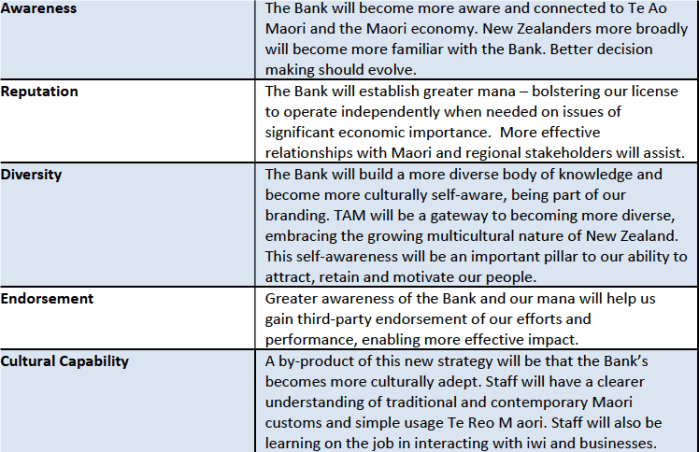
There is a great deal of unsupported nonsense in the document.  But it starts here

TAM 1

And here is one of the key sets of deliverables

TAM 2

Which is, itself, a grab-bag of unsupported stuff.   “More assured forecasts” would, of course, be great, but from an institution whose inflation forecasts have been wrong (one-sided bias) for eight or nine years now, doing the core job more accurately seems rather more important.  The documents never suggest how their better understanding of “the Maori economy” will improve the forecasts –  as distinct perhaps from making the Governor feel better about them.

Notice too that reference to “the Maori economy”: not only is $50 billion rather less than one-sixth of GDP, but the $50 billion they are talking about is a collection of assets (a tiny portion of total assets of New Zealanders), and GDP is a collection of income flows.   Since Maori are a significant chunk of the population, I’m sure they do make up quite a share of the economy, but most assets owned by Maori people aren’t included in that headline-grabbing number (any more than my house is in some “European New Zealander economy”).

There is a similar degree of vacuousness about the references to the financial system.  It all the feel of someone making stuff up to backfill another of the Governor’s whims.

What of some other stuff. Among the responsibilities of the cultural capability adviser this was listed first

Lead development and implement an institutional language plan for the Reserve
Bank of New Zealand

You do rather get the sense, reading through the documents, that Reserve Bank staff will be under pressure to learn Maori whether they want to or not.  Again, perhaps there might be merit in that if the Bank were a customer-facing body dealing with (say) troubled families in the Ureweras, but this is the (wholesale) central bank.

I don’t suppose anyone (perhaps other than the Governor, and probably not even him –  he’s smarter than that) really believes the nonsense front line rhetoric about better policy.   It all seems much more about these “deliverables”

TAM 3

In other words, how “woke” can we be?

It is all pretty incoherent.  For a start, there is that reference to the ‘growing multicultural nature of New Zealand”, and yet this is an explicit Maori strategy, with no hint of comparable ones for Chinese cultures, Indian cultures, South African cultures, Filipino cultures, Samoan cultures…..let alone, Muslim, Christian or atheist cultures.     Another $1m for each perhaps? I thought not (and nor should there be).

Perhaps all this stuff will go down well among some in the Labour Maori caucus, in the further reaches of the Green caucus, and among some of those the Governor will be distributing largesse among.  Perhaps Guyon Espiner will be a bit softer next time he interviews the Governor.  But I find it harder to believe that this sort of strategy is going to, in any way, enhance the Bank’s standing in middle New Zealand.  And nor should it.   As for staff, I suspect there will be a selection process at work (perhaps a bit like the Treasury) – capable people who care more about serious analysis and policy (actually doing the Bank’s statutory job) will select out (or not be hired) and the place will increasingly be filled with cheerleaders for the Governor’s political and social agendas.

I don’t usually like to scoff at overseas travel budgets – there is often real value in building connections and relationships –  but I had to in this set of documents.  $40000 for international travel for a Maori strategy, when Maori culture has no substantial home but New Zealand, seeemed, shall we say, not exactly an abstemious use of public money.

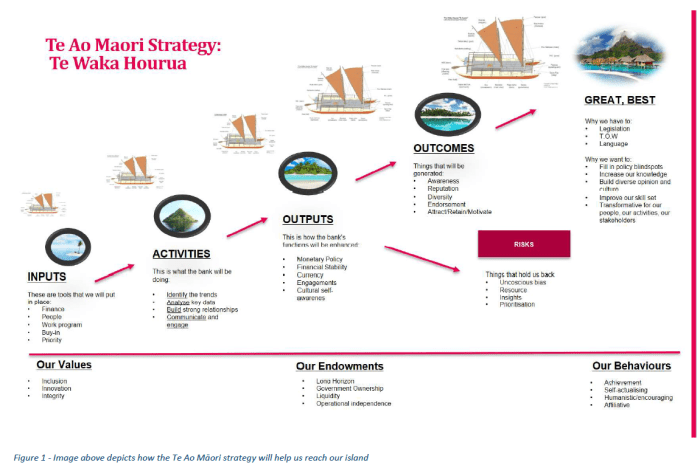
Here is a graphic for the Governor’s Maori strategy

TAM 4.png

The writing is a bit hard to read, but it is just full of earnest trendy, rather unsubstantiated, feel-good stuff.  Unconscious bias holds back the Bank’s policy outputs we are told.  It would be fascinating to see the evidence base for that, including (for example) why it was an issue around Maori dimensions of the economy/financial system and not, say, Chinese, Indian or Fililpino bits.   Fortunately, monetary and banking policy operate  indiscrimately (in the good sense of that terms) –  there is, for example, precisely nothing the Bank can do that will affect long-term unemployment at all, let alone differentially affect that of Maori.  It is all a political front, using your money.   But –  bottom right corner –  no doubt the Governor and has staff will be self-actualising in a humanistic way.

(Oh, and recall that that island –  pictured in the top right hand corner –  isn’t even New Zealand, but Bora Bora –  the Maori strategy moving the Bank towards French Polynesia!)

I could go on, but I’ll leave it to anyone interested to plough through the verbiage (“we will actively seek to operate within the virtuous circle of sustainable economic development”, or references to “Cultural Security” – did this get lost from an MCH document?) and the rather non-questions (“Do Maori use cash differently to other people groups?” –  perhaps Catholics, atheists, Freemasons. Green Party supporters, or lefthanders do as well, but why would we want to spend scarce public money to find out?).

One of the points former Bank of England Deputy Governor Paul Tucker made in his book, Unelected Power, that I wrote about quite a bit last year, is that when central bankers start pursuing issues that range well beyond their narrow areas of specific responsibility, they run a real risk of undermining the willingness of the wider community to let them (fallible individuals, with limited accountability) exercise the discretionary power in their core responsibilities.  Sometimes people will agree with the errant central bankers on individual issues –  I often agreed with the substance of what Don Brash was saying when he strayed off-reservation, even as I thought he was very unwise to do so –  but over time it leaves a growing proportion of the population uneasy about overmighty public officials using platforms and money provided by all of us to pursue personal whims, personal social and political agendas.      If we can’t have a central bank that (a) sticks to its knitting, and (b) does that knitting excellently, we might as well just hand all the powers back to the politicians.  We elected them and can kick them out again.  We just have to put up with the Governor pursuing his whims at our expense, with very few effective constraints.


Critics of the Governor

There have been a couple of media stories this week that were less than flattering about the Governor of the Reserve Bank, Adrian Orr.  I was going to say “new Governor”, but checking the calendar I see that in another month or so he will be a quarter of the way through his first term.

The first story was by Stuff’s Hamish Rutherford, and centred on the Governor’s plan to require banks to greatly increase the share of their assets funded by equity rather than debt.   In the on-line version of the story, Orr is labelled “Mr Congeniality”.  The story begins this way

Since Adrian Orr became Governor of the Reserve Bank of New Zealand he has built a reputation of being someone who likes to be liked.

Charming and jocular, but possibly sensitive to criticism.

But Orr is now in a battle with the bulk of New Zealand’s banking sector in a way which could see him demonised, probably with the focus on lending to farmers.

He knows it. Recent days have seen Orr on a campaign to explain itself.

I’m not sure he seems any different as Governor than he ever was before –  his well-known strengths and weaknesses have continued to be on display.

I’ve written quite a lot here about the substance and process around the Bank’s capital proposals – starting with the apparent lack of consultation and coordination with APRA, through to the weaknesses of many of the arguments the Bank advances, the lack of apparent understanding of how financial crises come to occur, the grudging and gradual release of further supporting material, and (presumably partly as a result) two extensions to the deadline for submissions.

In the article Orr is quoted thus, in perhaps the understatement of the week

The consultation process, in Orr’s words “could have been tidier”.

Done properly there would have been extensive workshopping of the technical material over months before the Governor ever put his name to a specific proposal.   As it is, we have a half-baked proposals, not benefiting from any prior scrutiny, and yet the same Governor who put the proposal forward is now judge and jury in his own case, with no effective rights of appeal for anyone.    And there is big money involved –  not just the additional capital that might need to be raised, but probable losses in economic output that will affect us all to a greater or lesser extent.

Presumably no one in the industry would go on record for Rutherford’s article.  Not upsetting prickly Governors is an art the banks have sought to master (even when it involved pandering to an earlier Governor who wanted a senior bank economist censored), although presumably the banks’ submissions will be fairly forthright.  (But will the public ever see those submissions?)

But some of the tone of the off-the-record concern is there in the article

Sources across several of the major banks are warning that if the bank pushes ahead with its plan it could act as a significant constraint on lending to farmers and small businesses,  sectors which are as economically important as they are politically sensitive

Both sectors are considered risky and when capital requirements go up the impact will be magnified.

Why those sectors?  Well, the “big end of town” (Fonterra, Air New Zealand or whoever) will have no difficulty raising debt either directly (bond market) or from banks that aren’t subject to the Reserve Bank’s capital requirements (which means every other bank in the world not operating here, as well as the parents of the locally-incorporated banks operating here).  And the residential mortgage market is both pretty competitive (including from some local institutional players that are less badly hit by the Governor’s proposals than the big banks), and more open to the possibilities of securitisation (which would then avoid the capital requirements too).   Idiosyncratic small and medium loans (including farm loans) aren’t, and farm loans in particular require a level of industry knowledge that newcomers won’t acquire easily (and offshore parents often won’t have).

Perhaps these effects will be large, perhaps they will be quite moderate in the end. But the point Rutherford didn’t make, but could have, is that none of this was analysed in the Bank’s consultative document.   When a really major change is proposed we should surely expect a serious analysis of transitional paths (not just for the banks, but for customers and the economy) as well as the long run.  But there was almost nothing, and nothing in any more depth has emerged in subsequent material that has seeped out.

It simply isn’t a good policy process, and that should concern both the Minister of Finance (and his advisers at The Treasury) and the Bank’s board.   The Governor simply isn’t doing a good job on this front.  If there is a compelling case for what he proposes, he hasn’t made it.  And that is almost as bad –  in a serious independent regulator –  as not having a good case in the first place.

The second article was by the news agency Reuters.   The focus in that article is Orr’s conduct of monetary policy, and particular his policy communications (which many had expected to be one of his strengths).

There are at least two strands to the article.  There are criticisms of Orr for not yet having given a single substantive on-the-record speech on either of his main areas of policy responsibility (monetary policy and financial regulation).  I’m among those quoted

Michael Reddell, an ex-RBNZ official who served with Orr on its monetary policy committee in the 1990s and 2000s, is critical of Orr for not giving a “substantive” speech on monetary policy in the past year.

“It would be unthinkable in Australia or the United States or even under previous governors here.”

I’ve been more and more surprised at the omission as time went on.  And in respect of monetary policy it is not as if there has been much from his offsiders either.  Sure, we get the rather formulaic paint-by-numbers Monetary Policy Statement every few months, but it simply isn’t the same as a thoughtful carefully-developed speech –  which shows more of how the individual/institution is thinking, and the omission has been particularly significant given that we had a new Governor and a refined mandate.

Orr’s response to this criticism is reportedly that it is “thin”.   Whatever that means, the fact remains that in other countries top central bankers talk, quite frequently, about their thinking in on-the-record speeches.  I’ve suggested, speculatively, that perhaps he doesn’t do serious speeches on core areas of responsibility because he just isn’t that interested (saving his passion for infrastructure, climate change, diversity, and all manner of other stuff he has little or no responsibility for).  I’d  like to be wrong on that, but nothing in this article provides any countervailing evidence.

But the bigger criticism in the Reuters article appears to come from financial market participants, concerned that they aren’t able to read the Governor’s policy intentions well.

Many traders who spoke to Reuters in the past two weeks blame Orr for confusing the message, and some have even been critical of frequent references to legends of the indigenous Maori people in his speeches, saying they served little purpose for financial markets eager for more policy clues.
“I am extremely frustrated at the lack of communications for global market participants,” said Annette Beacher, Singapore-based macro-strategist for TD Securities.
“Since Adrian Orr has assumed the role, he’s managed to surprise the market every six weeks. We don’t hear anything from him in between policy decisions,” Beacher said, echoing similar complaints from others.
“So what do I recommend to my trading desk? I’m saying trade the data but we’re not quite sure what is going to happen at the next meeting. It’s not meant to be this way.”

Here, to be honest, I’m not sure quite what to make of the criticism (I mostly don’t hang out with international markets people).   I’m sure there is a great deal of eye-rolling at the tree god nonsense that Orr continues to champion, but perhaps here the longstanding central banker in me comes out and I wonder if the offshore market people aren’t being a little precious.    Markets should not need their hands held to anything like the extent some of the comments in the article suggest, and if there is a little noise in market prices as a result that isn’t necessarily a bad thing.

It seems that quite a few people the journalists talked to were grumpy about the move to an explicit easing bias at the last OCR review, I couldn’t help wondering how much of that was a disagreement with the Governor’s stance (market economists on average have been more hawkish than the Bank for years, and have been more wrong) and how much a sense that a forthcoming change hadn’t been signalled.  I was bit (pleasantly) surprised myself by the move to an easing bias, but mostly because I thought the Governor wouldn’t want to launch a change of direction days before the new MPC took over.  Perhaps that is one of the circumstances in which advance signalling  might have been appropriate?    And perhaps the two strands of concern come together here: we shouldn’t have the Governor or senior staff giving private previews to select contacts about their evolving thinking.  So it has to be serious interviews or serious speeches –  and, as Annette Beacher notes, we haven’t really had either.

The Bank has probably also suffered somewhat from being in transition. At the start of last year, they lost the ultimate safe pair of hands, longserving Deputy Governor Grant Spencer.  A new top-team took over, and within a few months Orr was restructuring, which included demoting longserving chief economist John McDermott.  He lingered for a few months before leaving entirely, but can’t have been entirely engaged.  The head of financial markets was also ousted, and it was only in late March that the new recruits started to take office.  As I’ve noted previously, on the monetary policy side of the Bank it is very much a case now of a Second XI at play (internals and externals) and there is now quite a challenge in getting communications onto a steady, sustainable, and functional path.   The goal shouldn’t be keeping overseas economists happy, but it is perhaps telling that Reuters couldn’t find a domestic one willing to go on the record defending the Orr approach.

What of the Governor’s response to all this?  I’ve already recorded his response to the concern about speeches.  Here is some of the rest of what he told Reuters

In an interview with Reuters earlier on Tuesday, Orr said he wants to reach out to a wider audience than just currency traders, analysts and bloggers.

“The broad audience for this bank is the public of New Zealand. We are seen as a trusted institution but they don’t know what we do. So that is my communication challenge,” he said.

Orr also defended the Maori references in his speeches as part of the bank’s efforts to reach out to wider groups.

“Metaphors have their limits and metaphors can be over used. I get all that, but metaphors need to be introduced and created sometimes.”

I quite get that he wants to communicate to people beyond just the likes of Annette Beacher or me.    But it is not much short of populism to pretend that the audience of people who do pay close attention to the Bank, and know something about it and other central banks (and can even think through the aptness or otherwise of his metaphors), don’t matter.  He can try to appeal over the head of the relatively knowledgable all he likes, but I suspect he won’t find many listening.  Most people have better –  more interesting and important to them –  things to do with their lives.  As it happens, the Governor released a while ago a record of which audiences he delivered speeches to last year, and despite all the rhetoric –  tree god and all –   I was a bit surprised by how relatively few and conventional the audiences were.  The only novelty seemed to be a lot of mention of the tree god – cue to eyes rolling from many of the audiences no doubt.   How many more readers, I wonder, have the cartoon versions of the MPS and FSRs won?  How many have tried twice?

There is a “retail communication” dimension to the Reserve Bank’s role –  when you are driving interest rate up (or down) and affecting people’s employment prospects, business profitability etc, you have to explain yourself.  Over 30 years of an independent Reserve Bank, successive Governors have done a great deal of it –  Don Brash almost to the point of exhaustion, in his nationwide roadshows.  But the core of the job is actually rather more “wholesale” in nature.  And the Governor doesn’t seem to have been getting that right –  at all re bank capital, and in some dimensions re monetary policy (I’m probably closer to his bottom line on the OCR than many other commentators).  All this should be a concern for the Minister of Finance, and for the Bank’s Board.

There is still time for the Governor to right the ship –  and perhaps the new MPC will end up helping –  but the signs aren’t good. Only this morning, a press release emerged from the Bank championing the cause of climate change.  Action may well be really important, but it just isn’t the core business –  or really any business at all in a New Zealand context, with the sort of loan book New Zealand banks have –  of the Reserve Bank.  It is what we have an elected government for.

Sadly, we can expect to hear more from the Governor on climate change and his tree god (flawed) metaphor, and there is no sign of any contrition around the lack of serious communication from him on monetary policy or (where he is still sole decisionmaker) financial sector regulation.


The Governor’s talk

It was pleasant to walk along Wellington’s waterfront this morning to hear the Governor of the Reserve Bank speaking at a local function centre.  Given the numbers who turned up –  many of them Bank staff –  they could probably have saved a few dollars by holding the event on their own premises, but, I guess, it is other people’s money.

As the Governor explicitly noted that he would “look forward to the blogs”, I should probably do my bit.

A week ago when this event was announced, I devoted a whole (short) post to the announcement of the event, including the indication that they would be filming the speech and making that footage available on the web.   Doing so is a genuine step forward and I hope it becomes standard practice.

In that earlier post I noted

I have been critical of the Reserve Bank Governor for not yet having given an on-the-record speech about either of his main functions, monetary policy or financial regulation/supervision.  Next week marks a year since he took up the job

Unfortunately a year has now passed and we still haven’t had a substantive on-the-record speech about either of his main functions –  the sort of speech that would be standard, and quite expected, under any other Governor and in any other country.

Today’s speech was billed this way

Reserve Bank Governor Adrian Orr will talk about the future of New Zealand’s monetary policy framework  …..The revised monetary policy framework comes into effect on 1 April 2019. It is an outcome of the recent Phase 1 review of the Reserve Bank Act.    Adrian Orr will talk about changes to how monetary policy decisions are made in New Zealand, including greater transparency and accountability.

But there wasn’t very much about the new monetary policy framework (any aspect of it) at all.  You can read the text for yourself (and on this occasion the speech delivered was recognisably similar to the published text, which is not always the case I gather).

The whole event started rather oddly, with a fairly lengthy greeting in Maori from someone whose name I didn’t catch but who had no apparent connection to the Reserve Bank.  Only a small portion of whatever he said was translated, so I suspect very few attendees had any idea what he’d been saying.  He did, however, take the opportunity to make a few digs in English about the Foreshore and Seabed Act – of infamous memory – including at a former Labour MP from that era who was apparently in the room.  That seemed rather inappropriate in a Reserve Bank function.  Not even the Governor has yet claimed Reserve Bank responsibility for the foreshore and seabed.

The Governor did, however, tell us that someone else in the room had just agreed to be a “kaumatua” to the Reserve Bank – a title apparently quite in vogue in trendy government agencies, but not having an obvious place in way Parliament set up the governance of the Reserve Bank.  Isn’t all that stuff –  leadership, nurturing talent, resolving disputes –  among the functions of those tedious prosaic statutory roles such as Governor, Deputy Governor, and Board members?  But there is, we are told, a forthcoming Bulletin article, “RBNZ’s Strategic Approach to Te Ao Maori”.  That will be something to look forward to, no doubt involving more expensive and tortured efforts to explain why a macro-focused government agency, which deals with general public hardly at all, needs such a strategy and not (say) a Catholic one, a secular humanist one, a Pacific one, or an NZRFU one?   For an organisation that claims to be underfunded, they certainly seem to take every opportunity to spend resources on stuff other than their core business.

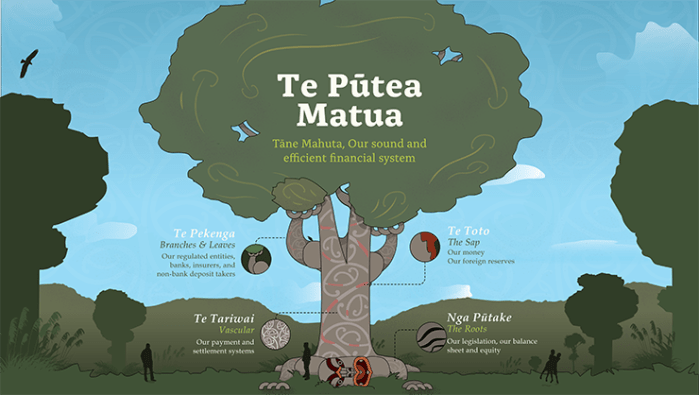
The Governor keeps on doubling down with his tree god nonsense, urging us to think of the Bank as akin to Tane Mahuta, the mythological forest god.   He delivered his speech flanked by two screens of this cartoonish graphic.

rbnz-tane-mahuta.png

He claimed this myth –  which has precisely nothing to do with central banking – “is” (not “was”) “central to the Maori belief system”.    Those who bothered by such things might suggest it was “cultural appropriation” –  although, ever deferential, he did stress that he asked permission to use the myth – but as I’ve noted in an earlier post

Pre-evangelisation, Maori had their own tree god, Tane Mahuta.    As far as I can tell, not many believe any longer in this local tree god: when I looked up the 2013 Census data, there were lots of Maori recording no religion, and there were plenty of Catholics and Anglicans.  But there wasn’t a category shown for tree gods, or any of the other deities (Wikipedia has a list of at least 35 of them).

As a recent commenter on another post noted

Imagine the reaction if the Bundesbank president started discussing policy in terms of Odin and Thor…. he’d get locked up…

And in addition to those references, we got the same warmed-over inaccurate nonsense the Governor has  run repeatedly about the creation of the Reserve Bank ‘letting the sunshine in” on the New Zealand economy and financial system.  I happen to agree that the creation of the Reserve Bank was, on balance, a good thing, but you’d not know from listening to the Governor that we’d had a stable financial system and a highly prosperous and productive economy without one.

What the speech really tended to show was a Governor with not much interest in the core business of the Bank (price stability, financial regulation, notes and coins, and a few ancillary bits and pieces).    Each of those functions matter.  It is important they are done well.  When they are done well, most people should have little interest in the Reserve Bank.

But, so he told us, the Governor is bothered that when they went out to “the community” (no polling results or the like, but I’ll take his word for it), people said they had significant trust in the Bank, but didn’t really know what it did.   But then they don’t really need to, any more than (say) I need know anything much about many of the dozens of government organisations you can find listed here (and I’m a geeky policy person, and still have no idea what, say, the Accreditation Council does).  How much does the person in the street know about, say, the organisation of our judiciary, or the distinction between the New Zealand Defence Force and the Ministry of Defence.  I’d struggle to even tell you what the Ministry of Housing and Urban Development does.

But it isn’t good enough for the Governor. So, on the one hand, we get cartoon versions of Monetary Policy Statements and Financial Stability Reports.  And on the other, considerably more worryingly, we get attempts by an overtly left-wing Governor to tie himself and the institution he leads to a whole series of trendy left-wing causes.  I’m sure he is not directly partisanly political, but his colours are firmly staked to an ideological mast, in ways that are potentially quite damaging.  After all, if he wants citizens to have confidence in his organisation around its core functions, those who aren’t sympathetic to his overt left-wing agenda will be less inclined to trust him even on the core issues he has responsibility for.  A new centre-right government at some point (ok, just kidding, but at least a new National one) might also be less inclined to trust him.   And, in championing these causes, he creates unrealistic expectations about what central banks can actually do, and opens the Bank up to pressure in future to join in promoting some other government’s set of ideological causes.

As an example of what I mean, here is an extract from the speech.

In the world today, the dynamics of global and national economies are interacting to a greater extent and, at times, working at cross-purposes. Underlying these interactions are social and political movements driven by a desire for greater well-being, both for current and future generations.

More recently we have been confronted with the issue of climate change, and its complex and powerful economic and financial impact.

We have barely scratched the surface in understanding the intergenerational impacts of these developments.

This desire for well-being is regularly reflected in discontent along the lines of economic, gender, racial, and intergenerational inequities – to name just a few. Therefore, ensuring social inclusion as a way forward in capitalist societies is necessary.

The first of those paragraphs barely even makes sense.  The rest do, but none of it has anything to do with central banks doing their jobs.    If this text appeared in a speech from Grant Robertson or James Shaw it might be quite unexceptionable –  it is the sort of stuff left-wing politicians say –  but what is a (supposedly neutral non-partisan) Governor doing spouting off about his views as to how “capitalist societies” should move forward.  Since it is what he is paid for, I’d rather hear him on the New Zealand cyclical economic situation, financial stability risks, positioning monetary policy for the next serious downturn or whatever.  Intrinsically less interesting perhaps, but that is the job he and his institution are paid to do.

The Governor –  particularly in his oral delivery –  was claiming a much wider mandate for himself from the newly amended Reserve Bank Act.  He is wrong to do so.

Even the badly-worded new Remit (replacement for the Policy Targets Agreement) makes that clear

remit

Whatever good monetary policy does –  and it is only the monetary policy bits of the Act that are changed –  it is “by” doing the same old stuff: leaning against cyclical fluctuations and maintaining medium-term price stability.

Here is the purpose statement from the amended Act

purpose RB

Yes, the current government’s waffly rhetoric about “wellbeing: and a “sustainable and productive economy” is enacted, but even this legislation is clear that –  whatever else the rest of government does (or doesn’t) do, the Reserve Bank makes its contribution by doing (well) the same old basics: monetary policy, a focus on a sound and efficient financial system, and notes and coins.

Inclusion –  gender, racial, religious, ideological, socioeconomic or whatever –  just isn’t the Reserve Bank’s territory.  Neither is climate change or other “social or political movements”.  Some of those issues may be quite important. Most are very interesting.  But if the Governor wants to pursue them perhaps he could create a blog in spare time (I wouldn’t recommend it), stand for Parliament, or put in a belated application to be the new Secretary to the Treasury.  All that other stuff will either distract the Reserve Bank’s attention (and perhaps suggest it already has too many resources), and/or skew support for the Reserve Bank along ideological lines in ways that are quite unhelpful in the longer-term (the Governor talked often of “legitimacy” and that dubious left-wing concept “social licence”).  The Governor talked of “our need to be a good global citizen”, but actually the New Zealand Parliament set up the Bank, and resourced it, to be a quite limited New Zealand government agency.

I could go on, but will bring this towards an end.   Three final points:

The Governor did mention briefly his proposals to substantially increase bank capital requirements. Nothing much of the substance, but he claimed that the Bank is open-minded and urged people to get their submissions in.  That is well and good, but it might be helpful to potential submitters –  including those not from the banks, who the Governor claimed to be keen to hear from – if the Bank actually released the supporting material –  for example, the Analytical Note on aspects of the economic impact that the Deputy Governor promised in his speech now more than a month ago, or the supporting information for ad hoc claims the Governor made on this issue at his MPS press conference more than six weeks ago.   It is more than three months since the proposal was released, and process is looking increasingly shoddy, as if they hope to run out the clock rather than provide substantive evidence for their proposals.   (Incidentally, in his delivered speech –  but not in the published text –  the Governor claimed that “we know” that significant bank failures cause significant damage for “all future generations”.  Perhaps that is another claim he might like to substantiate.  But it is probably just another one from off the top of his head.)

As I noted at the start, a former Labour MP was present.  That former MP was Tim Barnett who now leads what looks like a worthy organisation called FinCap which is

a new entity driven by the public good, acting in the interests of New Zealanders seeking budgeting and financial capability advice.

Sounds worthy. The Governor seemed keen on it, and said that the Reserve Bank would be endorsing this organisation in public.  Thus far, probably fine.  What was much less acceptable was to hear the Governor of the Reserve Bank say that he would be “coercing banks” to support it.  One hopes he wasn’t entirely serious, but when a regulator already wields a great deal of power on a wide range of fronts, they have to bend over backwards to avoid even suggesting any pressure (let alone ‘coercing’) on regulated entities to do things the regulator personally might like, but for which he or she has no statutory mandate.

Finally, the Governor ends the speech talking of how he and the Bank are going to “maximise their mandate”. I suspect he has in mind actually doing as much as possible to fulfil the mandate he has been given by Parliament, but it does sound awfully like a bureaucrat looking to expand –  to the maximum-  the role and scope of his bureau.  That isn’t what we need. We need a pretty boring organisation getting on and doing the (important, but quite limited) basics well.  At present, they are some very considerable margin away from the goal he articulates of being the “world’s best central bank” –  and nothing in this speech, or the others the Governor has given (and his term is now one-fifth over already) suggests they are making any progress towards it. If anything – and as evidenced in this speech – they are drifting further away.

But they turned on a good sausage roll, it was a good chance to catch up with a few people I hadn’t seen for a while…..and it really was a nice morning for a walk.

Just a shame about the central bank that was on display.

Kudos to the Governor

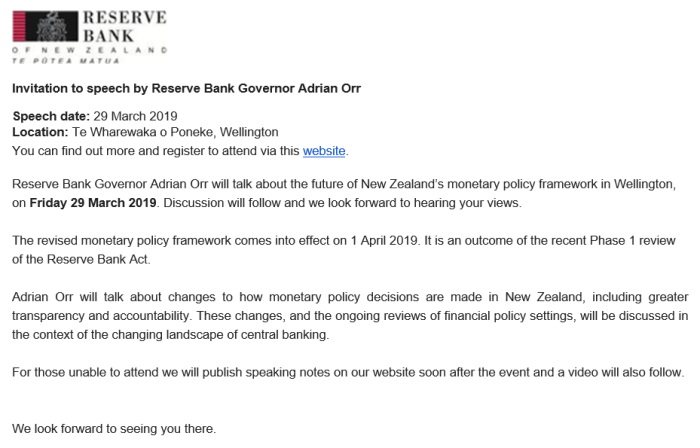
I have been critical of the Reserve Bank Governor for not yet having given an on-the-record speech about either of his main functions, monetary policy or financial regulation/supervision.  Next week marks a year since he took up the job, and 1 April is the day he loses exclusive control of monetary policy to the new MPC, which he will nonetheless chair (and effectively control).

But this invitation just turned up.  It seems to be an open invitation, so anyone interested should feel free to sign up.  I’ll certainly be there and will no doubt write about what he has to say.

orr speech

It is also commendable that the invitation indicates that the Bank will be releasing video of the Governor’s speech (and any Q&A?)  This is a well overdue step forward –  especially as this Governor is quite open about freely departing substantially from his written texts –  and, if adopted consistently, will bring the Bank into line with how things have long been done at the Reserve Bank of Australia.

Presumably, by next Friday the Minister of Finance will finally have announced the other members of the new Monetary Policy Committee.

The apostle of the tree god

There wasn’t going to be a post today but then someone sent me the link to a super-soft interview the Herald’s Liam Dann had done with Reserve Bank Governor Adrian Orr.   Had the Bank’s own PR consultants been scripting the interview it would scarcely have been softer (in fact, they might have advised a couple of serious questions to give the resulting interview a bit of credibility).

Orr will by next week have been in office for 11 months, wielding vast amounts of policymaking power singlehandedly, and yet we’ve still not had a single speech on either of his main areas of responsibility; monetary policy, and the regulation of much of the financial system.  But there is still time to play the tree god line (that’s the Herald headline: “Orr embraces the forest god”).

I’ve written about this silliness before.  Extracts

The latest example was the release on Monday of a rather curious 36 page document called The Journey of Te Putea Matua: our Tane Mahuta.   Te Putea Matua is the Maori name the Reserve Bank of New Zealand has taken upon itself (such being the way these days with public sector agencies).  It isn’t clear who “our” is in this context, although it seems the Governor  – himself with no apparent Maori ancestry – wants us New Zealanders to identify with some Maori tree god that –  data suggest –  no one believes in, and to think of the Reserve Bank as akin to a localised tree god.  Frankly, it seems weird.  These days, most New Zealanders don’t claim allegiance to any deity, but of those of us who do most –  Christian, Muslim, or Jewish, of European, Maori or any other ancestry – choose to worship a God with rather more all-encompassing claims.

But the Governor seems dead keen on championing Maori belief systems from centuries past.    In an official document of our central bank we read

A core pillar of the evolving Māori belief system is a tale of the earth mother (Papatūānuku) and the sky father (Ranginui) who needed separating to allow the
sun to shine in. Tāne Mahuta – the god of the forest and birds – managed this task after some false starts and help from his family. The sunlight allowed life to flourish in Tāne Mahuta’s garden.

This quote appears twice in the document.

All very interesting perhaps in some cultural studies course, but what does it have to do with macroeconomic management or financial stability?  Well, according to the Governor (in a radio interview on this yesterday) before there was a Reserve Bank “darkness was on our economy”.  The Reserve Bank was the god of the forest, and let the sun shine in.  Perhaps it is just my own culture, but the imagery that sprang to mind was that of people who walked in darkness having seen a great light.   But imagine the uproar if a Governor had been using Judeo-Christian imagery in an official publication.

On the same page we read

Many of these birds feature on the NZ dollar money including the kereru, kaka, and kiwi – core to our belief system and survival.

I’m a bit lost again as to who “our” is here.  I’m pretty sure I’m like most New Zealanders; I never saw a bird as “core” to my “belief system”.  Perhaps the Governor does, although if so we might worry about the quality of his judgements in other areas.

As I say, it is an odd document.  There are pages and pages that have nothing whatever to do with monetary policy or the financial system.  Some of it is even quite interesting, but why are we spending scarce taxpayers’ money recounting stories of New Zealand general history?  …. There is questionable history,….highly questionable and tendentious economic history, and overall a tone (perhaps comforting to today’s liberal political elite) that seems embarrassed by the European settlement of New Zealand.     There is lots on the difficulties and injustices that some Maori faced, and little or nothing on the advantages that western institutions and society brought.  Reasonable people might debate that balance, but it isn’t clear what the central bank –  paid to do monetary policy and financial stability –  is doing weighing in on the matter.

As I noted earlier, in a radio interview yesterday the Governor claimed that prior to the creation of the Reserve Bank ‘darkness was on our economy’, that the Reserve Bank had let the sunshine in, and that Australia and the UK had somehow turned their backs on us at the point the Bank was created.   In fact, here it is – Reserve Bank as tree god –  in the document itself.

The Reserve Bank became the Tāne Mahuta of New Zealand’s financial system, allowing the sun to shine in on the economy.

I think there was a plausible case for the creation of a central bank here, but to listen to or read the Governor you’d have no idea that New Zealand without a Reserve Bank had been among the handful of most prosperous countries in the world.  Here from the publication, writing about the period before the Reserve Bank was created

The infrastructure funding was further hindered by the banks being foreign-owned (British and Australian) and issuing private currency. Credit growth in New Zealand was driven by the economic performance of these foreign economies, unrelated
to the demands of New Zealand. Subsequent recessions in Britain and Australia slowed lending in New Zealand when it was most needed.

Very little of this stands much scrutiny.  You’d have no idea from reading that material that the New Zealand government had made heavy and persistent use of international capital markets, such that by 1929 it –  like its Australian peers –  had among the very highest public debt to GDP ratios (and NIIP ratios) ever recorded in an advanced country.  You’d have no idea that New Zealand was among the most prosperous countries around (like Australia and the United States, neither of which had had central banks in the decades prior to World War One).   You’d have no idea that the economic fortunes of New Zealand, trading heavily with the UK, might reasonably be expected to be affected by the economic fortunes of the UK –  terms of trade and all that.   Or that economic cycles in New Zealand and Australia were naturally quite highly correlated (common shocks and all that).  And of course –  with all the Governor’s talk about how we could “print our own money” – within five years of the creation of the Reserve Bank, itself after recovery from the Great Depression was well underway, that we’d not unrelatedly run into a foreign exchange crisis that led to the imposition of highly inefficient controls that plagued us (administered by the evil twin of the tree god?) for decades.  Or even that persistent inflation dates from the creation of the Reserve Bank

One can’t cover everything in a glossy pamphlet, even one that seems to purport to be aimed at adults (including Reserve Bank staff according to the Governor), but there isn’t much excuse for this sort of misleading and one-dimensional argumentation, aka propaganda.

The propaganda face of the document becomes clearer in the second half.   Among the issues the government’s review of the Reserve Bank Act is looking at is whether the prudential and regulatory functions of the Bank should be split out into a new standalone agency, a New Zealand Prudential Regulatory Authority.  …. There are arguments to be made on both sides of the issue, but you wouldn’t know it from reading about the Governor’s vision of the Bank as a Maori tree god, where one and indivisible seems to be the watchword.      Everything is about “synergies”, and nothing about weaknesses or risks, nothing about how other countries do things, nothing about the full range of criteria one might want to consider in devising, and holding to account,  regulatory institutions for New Zealand.

I don’t have any problem with officials, including from affected agencies, offering careful balanced and rigorous advice on the pros and cons of structural separation. But that is a choice ultimately for ministers and for Parliament.  And among the relevant considerations are issues of accountability and governance.  Neither word appears in Governor’s propaganda piece.   But then tree gods probably aren’t known for accountability.  New Zealand government regulatory institutions should be.   If ministers and Parliament decide to opt for structural separation, I wonder how the Governor will revise his document –  his tree god having been split in two.

Among the tree god’s claims about financial regulation and what the Bank brings to bear was this breathtaking assertion, prominently displayed at the head of a page (p27).

The Reserve Bank is highly incentivised to ‘get it right’ when it comes to prudential regulation. We have a lot at risk

It is an extraordinary claim, that could be made only be someone wilfully blind –  or choosing to ignore –  decades of serious analysis of government failure, and the institutional incentives that face regulators, regulatory agencies, and their masters.

There is nothing on the rest of that page to back the tree god’s claim.   On any reasonable and hardheaded analysis, the Reserve Bank has very weak incentives to “get it right”, or even to know –  and be able to tell us –  what “get it right” might mean.   When banks fail, neither the Reserve Bank Governor nor any of the tree god’s staff have any money at stake (at least in their professional capacity, and as I recall things, Reserve Bank staff – rightly –  aren’t allowed to own shares in banks).  It is all but impossible to get rid of a Reserve Bank Governor, and it is even harder to get rid of staff (for bad policy or bad supervision).  Most senior figures in central bank and regulatory agencies of countries that ran into financial crises 10 years ago, stayed on or in time moved on to comfortable, honoured (a peerage in Mervyn King’s case) retirements, or better-remunerated positions in the private sector.

And when the Reserve Bank uses its powers in ways that reduce the efficiency of the financial system, or stopping willing borrowers and willing lenders writing mortgage contracts, where are incentives on the Reserve Bank to “get things right”.  There are no personal consequences –  the Governor and his senior staff either won’t have, or would have no problem getting, mortgages.  The previous Governor got to exercise the bee in his bonnet about housing crises, and to play politics, with no supporting analysis and no effective accountability.    The current head of the tree god opines that lenders and borrowers can’t be trusted –  but tree gods apparently can –  but when challenged produced no analysis to support his claim.  That sort of system creates incentives for sure, but they aren’t to “get it right”.

End of extracts.  2019 here again.

The Governor was at it again in the interview, including running his bizarre version of economic history in which “sunshine” was let in upon the New Zealand economy in 1934  (there was also the surprising claim that the banks had chosen to graft themselves into the Reserve Bank, apparently oblivious to the fact that the main banks have been around New Zealand a lot longer than the Reserve Bank).

The Governor claims his metaphor is wildly popular –  except among “two bloggers” apparently (although I could give him a rather longer list of sceptics) –  and I’m sure it is in some quarters. It probably sounds cool, accessible, relevant and so on. But metaphors can be used for good and for ill, and the Governor attempting to have us all think of the Bank as akin to a tree god doesn’t serve the public interest well at all, even if it happens to suit his personal campaigns.

There were plenty more questionable claims made by the Governor is the course of the interview.  Some of them literally invite questions –  they might be true, or they might not, we just don’t know.  For example, the Governor claims that his proposed new capital requirements will be “in the pack” by international standards, but they’ve not yet shown any evidence to support this claim (especially once one takes account of their irrational distaste for cheaper Tier 2 capital, and for the high minimum overall risk weights they are planning to impose).  It should be a simple matter to put the evidence and analysis out there for scrutiny, but instead apparently we are simply supposed to trust this apostle of the tree god.

Then there was the claim –  made in the consulative document but not supported with one shred of serious analysis or evidence –  that the Bank’s proposed capital requirements will make the economy not only safer but also more efficient.  I’ve shown this chart previously

something for all

In today’s interview he explicitly asserted that New Zealand –  and all other advanced economies –  are to the “south-west” of that green dot.     Perhaps he’s right, but you’d think there would be some support offered for these “free lunch” claims.  It isn’t in the consultative document, it wasn’t in the Governor’s interview.  Perhaps  (at last) it will be in the Deputy Governor’s speech next week?

The interview ended with a super-soft invitation to the Governor to campaign for more taxpayer’s money, more staff, and more financial resources.   Perhaps there is a case for more  (actually I suspect there is).   But the idea that we should put more of our scarce money in his hands isn’t as persuasive as it should be when we get repeated doses of this tree god silliness, attempts at playing politics, repeated bold claims that just aren’t supported (complete with assertions that people who disagree him haven’t read his documents –  the problem is, they have), diversions onto all manner of things that just aren’t his responsibility, and a lack of serious –  as opposed to superficial –  transparency and accountability.

UPDATE: The interview and accompanying article might have been incredibly soft, but in many respects the sub-editors of the hard-copy Herald say it all with their headline on the front page of Saturday’s business section: “How Maori myth is guiding the Reserve Bank”.    Were it so –  and even I don’t think it really is –  it would explain a lot about the policy and comms mis-steps……

And as a commenter overnight observed

It shows how bad things have gotten in New Zealand – not so much that he makes these examples but because no one else even thinks to challenge it. Imagine the reaction if the Bundesbank president started discussing policy in terms of Odin and Thor…. he’d get locked up…


The tree god again

Some months ago the Governor of the Reserve Bank inaugurated his audacious bid to have his institution –  seen by most as a official agency created by, and accountable to, Parliament –  seen as some sort of local pagan tree god, with him (I assume) as the high priest in the cult of Tane Mahuta.  We’ve been told, by the Governor, that a people –  New Zealanders –  walked in economic darkness until finally the light dawned with the creation of the Reserve Bank.  It is pretty absurd stuff, not even backed by decent history or analysis, and one might be inclined just to ignore it, but the Governor seems serious.  In particular, he keeps returning to his claim. In fact, he was at it again –  claiming the mantle of Tane Mahuta –  yesterday with another little release that poses more questions than it offers answers (and which presumably means we’ll end the year still with no substantive speech from the Governor on anything he actually has statutory responsibility for).

Readers might recall that there was a damning report on the Reserve Bank as financial regulator, drawing on survey results of regulated institutions, released in April by the New Zealand Initiative.    This chart summed it up quite well

partridge 1

It has, presumably, been a priority for the Governor to improve the situation.   After all, even the Bank’s Board –  always reluctant to ever suggest any weaknesses at the Bank, even though their sole role is monitoring and accountability –  was moved to comment on this report, and the issues it raises, in their Annual Report this year.

And thus the Governor begins

In a step toward achieving the best “regulator-regulated” relationships possible, the Reserve Bank (Te Pūtea Matua) has established a Relationship Charter for working effectively with banks. The Charter will also be discussed with insurers and non-bank deposit takers in the near future.

One might question just how “best” is to be defined here –  after all, the public interest is not the same as that of either the Reserve Bank or of the banks, and there have been many examples globally of all too-comfortable relationships between regulators and the regulated.

But it was the next paragraph that started to get interesting.

Reserve Bank Governor Adrian Orr said the Relationship Charter commits the Bank and the financial sector to a mutual understanding of appropriate conduct and culture. “This is underpinned by the principle ‘te hunga tiaki’, the combined stewardship of an efficient system for the benefit of all,” Mr Orr said.

I’m not sure that understanding is necesssarily advanced when an institution operating in English introduces little-known phrases from another language to their press releases.  Here is how Te Ara explains “te hunga tiaki”

Te hunga tiaki

The Te Arawa tribes use the term ‘te hunga tiaki’ instead of kaitiaki, explains Huhana Mihinui.

The prefix ‘hunga’ is more common than ‘kai’ amongst Te Arawa, hence te hunga tiaki rather than kaitiaki. The essence of hunga is a group with common purpose. Hunga may also link with the sense of communal responsibilities. The same meaning is not conveyed with ‘kai’ … te hunga tiaki likewise invokes ideas of obligations to offer hospitality, but also to manage and protect, with the implicit recognition of the group’s mana whenua [customary authority over a traditional territory] role in this respect. 1

Which sounds pretty problematic frankly.  Banks and the Reserve Bank do not have a common purpose or a common set of responsibilities.  The Reserve Bank has legal responsibilities to the people of New Zealand, and the banks have legal responsibilities to their shareholders.  The two won’t always be inconsistent, but at times they will and there is little gained (and some things risked) from trying to pretend otherwise.  In both cases –  but particularly in that of the Reserve Bank –  there are limits on the ability of the principals (citizens and shareholders) to ensure that the boards and/or managers are actually operating according to those responsibilities.   Shareholders can sell.  Citizens are stuck with the Governor.

The statement goes on

“Writing it was the easy part. Operating consistently with the conduct principles is the challenge. We will regularly mutually review behaviours with the industry. Appropriate conduct is critical to the trust and wellbeing of New Zealand’s financial system, and the Reserve Bank – the ‘Tane Mahuta’ of the financial garden,” Mr Orr said. 

It is the tree god again –  a tree god that has some considerable way to go in improving its own conduct, be it around attempting to silence critics or whatever.

But this is also where I started to get puzzled.   In both those last two paragraphs from the statement, there is a suggestion that this document is some sort of agreed position between the banks and the Reserve Bank.   It is there in the charter document itself –  a one pager, complete with cartoonish tree god characters.

RBNZ-Relationships-Charter

(What I didn’t see was, for example, “we will avoid abusing our office and putting pressure on regulated bank CEOs to silence their economists when those economists write things we don’t like”.)

The word “mutual” is there twice, clearly suggesting that the banks have signed on to this.

But, if so, isn’t it a little strange that there are no quotes from any bankers, or the Bankers’ Association, in the press release, just the Governor’s own spin?   And when I checked the Bankers’ Association website, there was no statement from them. In fact, I checked the websites of all the big four banks and there was not a comment or statement from any of them.   Frankly, it doesn’t seem very “mutual”.   It looks a lot like gubernatorial spin.

And, to be frank, I don’t really see any good reason why there should be such mutual commitments.   Regulated entities don’t owe anything to the regulators.  They may often be intimidated by them, (privately) derisive of them, or even respect them.  But the regulated entities are just private bodies trying to go about their business in a competitive market.  By contrast, the Reserve Bank  –  the Governor personally –  carries a great deal of power over those entities, and they have few formal remedies against the abuse of that power.   What might reasonably be expected is unilateral commitments by the Governor as to how his organisations will operate in its dealings with regulated entities, standards (ideally measurable ones) that they and we can use to hold the regulator to account.      But that is different from what purports to be on offer in yesterday’s statement.

Of the brief specifics in the list of commitments, I don’t have too much to say.  There is a big element of “motherhood and apple pie” to them, and a few notable elements missing.  There is nothing about analytical rigour, nothing about transparency, nothing about remembering that the Bank’s responsibility is primarily to the New Zealand public, nothing about maintaining appropriate distance between the regulator and the regulated.  But I guess those would have been inconsistent with the fallacious claims about all being in it together and working for common goals.

It is at about this point that the Bank’s press release changes tone quite noticeably (not quite sure what happened to “one organisation, one message, one tone”).   Deputy Governor Geoff Bascand takes over and claims

Deputy Governor Geoff Bascand said the Reserve Bank’s recent announcement of a consultation with banks about the appropriate level of bank capital highlights the usefulness of the Relationship Charter.

And even in that one sentence he captures some of the mindset risks.  As I read the announcement the other day, it was a public consultation about the appropriate level of bank capital, and yet the Deputy Governor presents it as a “consultation with banks”.  If the Bank is going to run with this “Relationship Charter” notion, perhaps they could consider one for their relationship with the only people who give them legitimacy, Parliament and the public (having said that, perhaps I should be careful what I wish for).

And then weirdly –  in a press release supposed to highlight a new era of comity, open-mindedness etc –  the Deputy Governor launches into an argumentative spiel about the proposed new capital requirements.

“There is a natural conflict of interest. Banks will want to hold lower levels of capital to maximise returns for their shareholders. However, customers and society wear the full economic and social cost of a bank failure. We represent society’s interests and will naturally insist on higher capital holdings than any one individual shareholder,” Mr Bascand said.

Strange use of the phrase “conflict of interest”, which usually relates to a person or an organisation having two competing loyalties (perhaps personal and institutional), but even if one sets that point to one side for now, the rest is all rather one-dimensional and not terribly compelling.  He seems unaware, for example, that banks often hold capital well above regulatory minima –  creditors and rating agencies have perspectives too –  or that in most industries firms happily determine their own levels of capital, and somehow society manages (and prospers).  And, of course, there is not an iota of recognition of the way in which bureaucrats all too often serve bureaucratic interests (rather than societal ones), of the distinction between loan losses and bank failures, or of how the interventions of official and ministers often create the problems in the first place.

And then there is the final paragraph

“Following our Relationship Charter, we long signalled the purpose of our work and shared our analysis and consultation timetable. We have also committed significant time to engage with banks and provide a sensible transition period to make any changes we decide on. The Charter means what we are looking to achieve can be discussed professionally, while we continue to build appropriate working relationships. Outcomes will be superior and better understood and owned by society,” Mr Bascand said.

Of course, for example, whether the proposed transition period is “sensible” is itself a matter for consultation (one would hope –  and not just with banks).  Given the high probability of a recession in the next five years –  and the limited firepower here and abroad to deal with a severe recession –  some might reasonably wonder at just how wise it would be to compel big increases in capital ratios over that five year period, at a time when the Bank’s own analysis repeatedly suggests the banks are sound with current capital levels.   Credit availability might well be more than usually constrained.

One might go on to note that the level of disclosure in the consultative document is seriously inadequate for such a substantial intervention –  one that would take New Zealand further away from the international mainstream not closer to it.   As I noted in a post a few days ago, back in 2012 the Bank published a fuller cost-benefit analysis of the sorts of capital requirements that were then in place.  There is nothing similar in the consultative document issued last week, not even (I gather) any engagement with the previous cost-benefit analysis.  Given the amounts of money involved, that is simply unacceptable.  I’ve lodged an Official Information Act request for the (any) modelling and analysis they’ve done, but I (and others) shouldn’t have needed to; it should have been released as a matter of course.  In fact, even better they should have published a series of technical background papers over the year, held discussions with a range of interested parties (not just banks) before coming to the decisions they chose to formally consult on.      That is what good regulatory process might have looked like.

And then there is that bold final claim

Outcomes will be superior and better understood and owned by society

I’m all for effective and professional relationships between the Reserve Bank and the banks it regulates.  Perhaps that may even lead to better policy outcomes, but there is no guaranteee of that (after all, at the end of it all the law allows the Governor to make policy pretty much on a personal whim –  which is a lot like what the proposed higher capital ratios feel like).  But quite how a better relationship between the Reserve Bank and the banks will make outcomes “better understood and owned by society” is a complete mystery to me.   There are plenty of examples of regulators and the regulated ganging up against the public interest, and others of the regulators ramming through changes that might –  or might not –  be in society’s interest.  There is simply no easy mapping from a better relationship between the Bank and the banks, and good outcomes for society, let alone ones that –  whatever it means –  are “owned by society”.   Good outcomes rely heavily on very good and searching analysis.  And nothing in the Charter commits the Bank to that.

When one reads the argumentative second half of the press release it is little wonder the banks themselves wanted nothing to do with the statement.   I guess there isn’t much chance of the banks and the Reserve Bank getting too close to each other in the coming months as they (and the bank parents and APRA no doubt too) fight over the billions of additional capital Adrian Orr thinks they should have.

Meanwhile, the Governor can play at tree gods.  But it would be much better for everyone, including most notably citizens, if he were to engage openly and (in particular) more substantively on the issues he has legal responsibility for.   Cartoons and glib statements don’t build confidence where it counts.


Funding the Reserve Bank: focus on your statutory mandate

The Reserve Bank has been joining the ranks of the public sector agencies bidding for more money –  not just doing so in the conventional manner, behind closed doors in private discussions with relevant ministers, but in public.

There were some initial comments a few weeks ago, which I didn’t notice at the time, using this totally spurious argument

we are a net contributor to Crown revenue rather than a cost, and we’ve asked if we can hang on to a little more of what we make in order to fund extra work,” the Reserve Bank spokesman said.

The Reserve Bank generates a lot of money (mainly) by issuing zero interest bank notes (a statutory monopoly) and investing the proceeds in interest-bearing assets.  It takes little skill to collect this (what is in effect a) tax.     That income should have no bearing, formal or rhetorical, on how much of our resources the Reserve Bank is permitted to spend on other stuff –  mostly more bureaucrats to do regulation, analysis, and (see below) political positioning, of the sort many other cash-constrained bureaucracies in Wellington do.   Those activities do not generate even an iota of revenue for the Crown.

They were back with the begging bowl this week at the annual financial review undertaken by Parliament’s Finance and Expenditure Committee.  I saw two accounts –  one from Newsroom, and one from interest.co.nz.      There were a couple of strange claims, including the Governor appearing to suggest that the CBL failure might have occurred because the Reserve Bank didn’t have enough staff.  I don’t regard that as a totally implausible story  –  then again, the system is not supposed to prevent all failures, and at least some concerns relate to what the Bank did do (suppression orders) rather than what it didn’t do.  But if staffing was a concern, and the Bank thought it didn’t have the resources to do the job Parliament had given it, surely the previous year’s Annual Reports would have said so.  And I’m pretty sure they didn’t.

Orr is also reported as claiming that

….now was the time to resource-up and ready the bank for a crisis.

“The time when under-resourcing most shows up is generally during a time of crisis and we aren’t in one of those times,” Orr said.

I doubt that is so. In a crisis it is all hands to the pump, and institutions pull through.  If there is under-resourcing (and that is an open question) it is more likely to affect progressing work programmes in more-normal times.

Perhaps it is why, 8.5 months into his governorship, we still haven’t had a substantive speech from the Governor on either monetary policy or financial stability/regulation?  But that can’t really be the explanation either –  after all, we’ve always only had one Governor, and his predecessors somehow managed.

The Reserve Bank’s finances are not very tightly managed (externally, by the minister or Parliament).  Under the current Act there is provision for (but not a necessity for) a five-yearly funding agreement, outlining how much the Bank can spend.   It isn’t a great model, for various reasons, even if it was a step forward on the total lack of formal controls that existed prior to the 1989 Act.

But my experience was that almost every year, the Reserve Bank’s actual spending undershot what was provided for in the Funding Agreement.  I knew they had had the odd tighter year this decade, but other than that it isn’t something I follow closely.  But here is interest.co.nz’s account of what the Bank said in its latest Annual Report released in October.

The Reserve Bank’s annual report, issued last month, showed it had undershot spending allowed through its funding agreement by $26.7 million over three years and paid a $430 million annual dividend. By June 30 the Reserve Bank had spent $173.1 million of a possible $199.8 million allowed by its 2015-2020 Funding Agreement, signed with the previous National-led government. Net operating expenses in the June 2018 year were $4.1 million below the funding agreement, despite rising $8 million year-on-year to $76 million.

“The $26.7 million cumulative underspending is expected to partially reverse in the last two years of the funding agreement, as capitalised expenditure on systems improvements is amortised to operating expenses, and the issuance of new banknotes continues. The Bank expects to be within the five-year aggregate expenditure provided for in the funding agreement,” the annual report said.

Bottom line?  They’ve been underspending again, and even though that is “expected to partially reverse” over the next two years, the forecast reversal is only partial and, once again, they expect to underspending the Funding Agreement allowance.  And, under the current statutory model there are no adverse consequences for the Bank if it were to have spent a little more than the Funding Agreement number anyway.  But the issue is moot –  they seem to have managed in a way that will actually underspend (again).

Which leaves another of Orr’s comments ringing a bit hollow

Orr in the select committee again pointed out the limitations of the five-yearly model, saying a “phenomenal” number of “unanticipated” events had happened in the last five years, and the same would be the case in the next five years.

And probably every five years since 1990, and yet the Bank still almost always underspends.

Having said that, this may be one of the areas in which there is some convergence of views between me and the Governor.  The five-year funding agreement model is crazy and should be scrapped.   No corporate – no government agency for that matter –  sets operating expenditure budgets five years in advance, and it is simply silly to expect to do so for the Reserve Bank.  It is fine to do rough medium-term plans to help ensure that foreseeable expenditure pressures are identified well in advance, but that is different from a binding five-year budget.

Where we may well diverge again is that I think the Reserve Bank’s policy, regulatory and related activities should be funded –  as most government agencies are – by means of detailed annual appropriations by Parliament (and will be forthrightly making that case when the current review of the Reserve Bank Act gets round to looking at funding issues).  I wrote about the issue in a post earlier in the year.   Here were some of my points:

A common argument –  at least among central bankers –  is that somehow central banks are different.  There is only one important respect in which they are: they earn far more than they spend.  But even that isn’t very important here.  Central banks make money largely through the statutory monopoly on currency issue, which is just (in effect) another form of taxation.  And spending and revenue are two quite different bits of government finance: IRD might collect lots of money, but it can only spend what Parliament appropriates.

And what of those arguments about avoiding back-door pressure?  Even they don’t mark out central banks.  After all, we don’t want ministers interfering in Police decisions either (a rather more important issue than a central bank), but Police are funded by parliamentary appropriation.  So is the Independent Police Complaints Authority.   There are plenty of regulatory agencies where policy might be set by politicians, but the implementation of that policy is set by an independent Board, and where backdoor pressure could –  in principle be applied.  Other bodies publish awkward reports that make life difficult for politicians.  But those bodies too are typically funded each year by parliamentary appropriation.  It is just how our system of government works.

When I wrote about this issue in 2015 (having only recently emerged from the Bank), I was hesitant about calling for radical change.   The funding agreement system itself could be tightened up in various ways, which might represent an improvement on what we have now.   But there isn’t any very obvious reason not to start with a clean sheet of paper, and build a new system –  aligned with how we manage public spending in the rest of government –  starting from the principle of annual appropriations, with a clear delineation by functions (monetary policy, financial system regulation, physical currency etc), and standard restrictions on the ability of ministers to reallocate funds across votes).

I’m not aware of any country that funds it central bank by annual appropriation.  But historically, central bank spending all round the world was subject to weak parliamentary control.  This is one of those areas where the international models aren’t attractive, and the standard should instead be the way in which we authorise spending across the rest of government.   This is a policy and regulatory agency ….  and should be funded, and held to account, accordingly.

But if the Governor really thinks he doesn’t have enough resources to do aspects of the job Parliament has given, perhaps he could look rather hard at how he prioritises.  In his FEC appearance the other day, he claimed to have been doing so, but in my observation his sense of priorities appears personal, idiosyncratic and even political, not at all well-aligned with the Bank’s statutory mandate.

Recall that the Governor has only been in office for just over eight months, but already we’ve had things like:

  • speeches on climate change, helping out his buddies in the government and in the liberal wing of the business community,
  • the “Reserve Bank as tree god” exercise, which surely didn’t just flow off the end of the Governor’s pen in an idle hour one Saturday afternoon. It will have consumed real resources, at an opportunity cost,
  • cartoon versions of the Monetary Policy Statements and Financial Stability Reviews,  and
  • swamping those individually modest items by several orders of magnitude there was the conduct inquiry of which I noted upon its release

Despite highlighting several times in the report that this was really none of their business (of course they phrased it more bureaucratically: “neither regulator has a direct legislative mandate for regulating the conduct of providers of core banking services”), they’d spent an estimated $2 million of public money to mount their bully pulpit, lecture the banks, lobby for more powers for themselves.  

It simply wasn’t their job, but it suited the Governor’s ambitions to sweep in and spend large amounts of public money –  for modest-sized agencies –  on a personal campaign, to discover what?

The waste goes on.  There is an advert out at the moment for a Manager, Performance and Corporate Relations.  There appears to be some real work associated with the role (some of the bureaucratic hoop-jumping all government agencies have to do) but part of the role is this

Leading a mid-sized team of specialists, the person appointed will provide leadership to organisation-wide initiatives such as the Bank’s Climate Change Strategy and Te Ao Maori framework.

There can be no possible need for whatever a “Te Ao Maori framework” actually turns out to be.   The Reserve Bank isn’t some social agency dealing with troubled individual families, where quite possibly individual cultural backgrounds matter.  It doesn’t really deal with ordinary people much at all –  that is not a criticism, it doesn’t need to.    It runs monetary policy –  which affects and benefits people quite regardless of ethnicity-  and it regulates banks (and other financial institutions) again –  one would hope –  regardless of the ethnicity of individual managers or shareholders.  Fortunately, the “principles of the Treaty of Waitangi” are not part of the Reserve Bank Act.     I don’t suppose the Bank will be spending a vast amount of money in this area, but every little bit reallocated to financial regulation would surely help, at least if you believe the Governor and his Deputy.  It has the feel of the Governor pursuing another personal political agenda at the expense of the taxpayer.

And then there is “the Bank’s Climate Change Strategy”.    I’ve touched on this before, but as a reminder the Reserve Bank is an office-bound organisation, with precisely two offices (main one and a small one –  probably unnecessary –  in Auckland).  For practical reasons (to do with specialist vaults) the Bank –  unlike most central government agencies –  owns a building in central Wellington, and if they own any vehicles at all it might be just one car.  They are a wholesaler of one physical product –  bank notes –  but they import that product from overseas producers, for whom the Reserve Bank is no more than a modest-sized customer (thus with little market power).  But they do, I suppose, travel to lots of overseas meetings (but last I looked, international air travel still isn’t captured in the agreed international carbon reporting framework or our own current government’s incipient net-zero goal).

There is just no obvious reason –  at least not one that isn’t ultra vires –  for the Reserve Bank to be spending public money on a “climate change strategy” at all.  It is a feel-good piece of political positioning, perhaps helping the Governor is his turf fights around the Reserve Bank Act, and assisting him in a cause that he clearly feels strongly about personally –  even if there is little sign of him thinking about it deeply.

I’ve written prevously about the sheer vacuity of much of this, especially in the New Zealand context –  our banking system hardly being heavily exposed to, say, oil producers.  There was a vapid box in the FSR a few weeks ago, and as I noted of it

The text burbles on about possible risks, but it all adds up to very little.     There are numerous risks banks and borrowers face every decade, every century.  Relative prices change, trade protection changes, external markets change, exchange rates change, technology changes, economies cycle, land use law changes.  Oh, and the climate changes.

If one looks at the structure of New Zealand bank (or insurer balance sheets) it just isn’t credible that climate change poses a significant risk to the soundness of the New Zealand financial system (that pesky law again).   Some individuals are likely to face losses from actual and prospective sea-level rises, but banks (and insurers) typically have diversified national portfolios.   People can’t have mortgage debt without insurance, and so the insurers are likely to be constraining people first.   Much the same surely goes for the rural sector?   Sure, adding agriculture into the ETS at the sort of carbon price some zealots have called for would be pretty detrimental to the economics of a dairy debt portfolio, but then freeing up the urban land market probably wouldn’t be great for residential mortgage portfolios, and we don’t see double-page spreads from the Reserve Bank on that issue, or the Governor trying to play himself into some more central role in that area.     It smacks of politics –  signalling the Governor’s green credentials –  more than anything legitimately tied to financial system soundness.

As it happens, the Bank yesterday released its “Climate Change Strategy“, a 10 point statement which seems almost equally devoid of content relevant to the statutory responsibilities of the Bank.  Instead, the Governor is offering political support to the government (that is the gist of the first paragraph) and bidding to be a player.  Here are two of their 10 points.

8.No single institution working alone can achieve meaningful progress on a global challenge such as climate change. Furthermore, it is not for financial policymakers to drive the transition to a low-carbon economy, nor is it the role of the Bank to advocate one policy response over another. That is the role of government.

9. However, appropriate action on a national or global level can only be achieved if individuals and entities are able to take action on a micro level. For this to occur, two conditions need to be met. First, there has to be proactive and effective leadership to drive our collective understanding of climate risks and to establish robust strategies to respond to those risks. Second, there has to be effective and timely dissemination of those assessments and strategies. Appropriate information will be vital in enabling entities and individuals to price and manage risks, facilitating the transition to a low-carbon economy, and ultimately contributing to both the soundness and efficiency of the financial system.

You might agree, disagree, or simply yawn, but when did this become an issue for a central bank, with important, powerful, but quite limited, statutory responsibilities?  And a central bank crying poor, claiming it doesn’t have enough money for its day jobs.   It is more like a creed than something one might reasonably expect from a central bank.

As part of the Bank’s statement we learn that

The Bank has also been welcomed as member of the Network of Central Banks and Supervisors for Greening the Financial System (NGFS). The Network was set up in December 2017 at the Paris ‘One Planet Summit’ to strengthen the global response required to meet the goals of the Paris agreement.

Head of Department Financial System Policy and Analysis Toby Fiennes says the Reserve Bank is very proud to have been accepted as a member of the NGFS.

“Playing our part globally, and as a leader in the Pacific region, is important both in terms of reinforcing New Zealand’s reputation as a ‘good global citizen’, and in providing us access to the latest thinking around the globe,” Mr Fiennes says.

(Among this small group of (excessively funded?) central banks and regulators is the central banking arm of the Chinese Communist Party. )

I guess it is the sort of feel-good, but empty, rhetoric one now expects from public servants.  And I guess when you see yourself as a tree god, the fit with an organisation devoted to “greening the financial system” must be almost complete?   But it is all empty.  “Playing our part globally” seems likely to involve little more than another round of international meetings to attend –  all those extra emissions – at the taxpayers’ expense, to advance Orr’s personal agenda at a time when he suggests the institution has insufficient money to do the job the taxpayer instructed them to do.  On an issue where there are no material financial system implications at all.

I’m open to the idea that the Bank might in fact need more financial resources, given the various jobs that (wisely or not) Parliament has instructed them to do.   There are other agencies and causes that might have a stronger case  and (on the other hand) some that should simply be wound up altogether.  But the Bank’s case would be that much more compelling if there weren’t repeated signs that the Governor was using the institution and public resources to advance personal, often quite political, agendas that reach beyond his statutory responsibilities.  He should be ensuring –  and the Board insisting –  that resources are rigorously prioritised to focus on the statutory mandate.