In the press release for last week’s Reserve Bank Financial Stability Report, the Governor commented that
Our preliminary view is that higher capital requirements are necessary, so that the banking system can be sufficiently resilient whilst remaining efficient. We will release a final consultation paper on bank capital requirements in December.
In commenting briefly on that, I observed
Time will tell how persuasive their case is, but given the robustness of the banking system in the face of previous demanding stress tests, the marginal benefits (in terms of crisis probability reduction) for an additional dollar of required capital must now be pretty small.
There wasn’t much more in the body of the document (and, as I gather it, there wasn’t anything much at the FEC hearing later in the day), so I was happy to wait and see the consultative document.
But the Governor apparently wasn’t. At 12.25pm on Friday a “speech advisory” turned up telling
The Reserve Bank will release an excerpt from an address by Governor Adrian Orr on the importance of bank capital for New Zealand society.
It was to be released at 2 pm. The decision to release this material must have been a rushed and last minute one – not only was the formal advisory last minute, but there had been no suggestion of such a speech when the FSR was released a couple of days previously.
And, perhaps most importantly, what they did release was a pretty shoddy effort. We still haven’t had a proper speech text from the Governor on either of his main areas of responsibility (monetary policy or financial regulation/supervision) but we do now have 700 words of unsubstantiated (without analysis or evidence) jottings on a very important forthcoming policy issue. which could have really big financial implications for some of the largest businesses in New Zealand and possibly for the economy as a whole.
The broad framework probably isn’t too objectionable. All else equal, higher capital requirements on banks will reduce the probability of bank failures, and so it probably makes sense to think about the appropriate capital requirements relative to some norm about how (in)frequently one might be willing to see the banking system run into problems in which creditors (as distinct from shareholders) lose money. At the extreme, require banks to lend only from equity and no deposit or bondholder will ever lose money (there won’t be any).
But what is also relevant is the tendency of politicians to bail out banks. Not only does the possibility of them doing so create incentives for bank shareholders to run more risks than otherwise (since creditors won’t penalise higher risk to the same extent as otherwise), but there is a potential for – at times quite large – fiscal transfers when the failures happen. Politicians have more of an incentive to impose high capital requirements on banks when they acknowledge their own tendencies to bail out those banks. If, by contrast, they could resist those temptations – or even manage them, in say a model with retail deposit insurance, but wholesale creditors left to their own devices – it would also be more realistic to leave the question of capital structure to the market – in just the same way that the capital structure of most other types of companies is a mattter for the market (shareholders interacting with lenders, customers, ratings agencies and so on).
But nothing like this appears in the Governor’s jottings. Instead, we have the evil banks, the put-upon public and the courageous Reserve Bank fighting our corner. I’d like to think the Governor’s analysis is more sophisticated than that, and one can’t say everything in 700 words, but…..it was his choice, entirely his, to give us 700 words of jottings and no supporting analysis, no testing and challenging of his assumptions etc.
There are all manner of weak claims. For example
We know one thing for sure, the public’s risk tolerance will be less than bank owners’ risk tolerance.
I think the point he is trying to make is about systemic banking crises – when large chunks of the entire banking system run into trouble. There is an arguable case – but only arguable – for his claim in that situation, but (a) it isn’t the case he makes, and (b) I really hope that (say) the shareholders of TSB or Heartland Bank have a lower risk tolerance around their business than I do, because I just don’t care much at all if they fail (or succeed). Their failures – should such events occur – should be, almost entirely, a matter for their shareholders and their creditors, with little or no wider public perspective.
There are other odd arguments
Banks also hold more capital than their regulatory minimums, to achieve a credit rating to do business. The ratings agencies are fallible however, given they operate with as much ‘art’ as ‘science’.
Bank failures also happen more often and can be more devastating than bank owners – and credit ratings agencies – tend to remember.
And central banks and regulators don’t operate “with as much ‘art’ as ‘science'”? Yeah right. And the second argument conflates too quite separate points. Some bank failures may be “devastating” – although not all by any means (remember Barings) – but the impact of a bank failure isn’t an issue for ratings agencies, the probability of failure is. And I do hope that when he gets beyond jottings the Governor will address the experience of countries like New Zealand, Australia, and Canada where – over more than a century – the experience of (major) bank failure is almost non-existent.
The Governor tries to explain why public and private interests can diverge (emphasis added)
First, there is cost associated with holding capital, being what the capital could earn if it was invested elsewhere. Second, bank owners can earn a greater return on their investment by using less of their own money and borrowing more – leverage. And, the most a bank owner can lose is their capital. The wider public loses a lot more (see Figure 2).
But what is Figure 2?
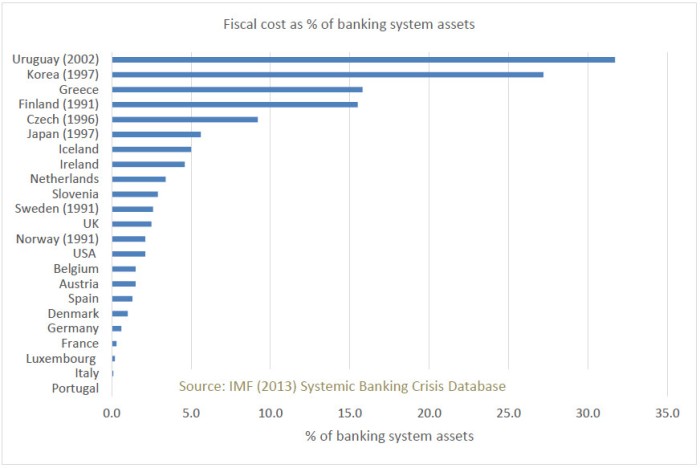
Which probably looks – as it is intended to – a little scary, but actually (a) I was impressed by how small many of these numbers are (bearing in mind that financial crises don’t come round every year), and (b) more importantly, as the Governor surely knows, fiscal costs are not social costs. Fiscal costs are just transfers – mostly from one lots of citizens (public as a whole) to others. I’m not defending bank bailouts, but they don’t make a country poorer, all they do is have the losses (which have arisen anyway) redistributed around the citizenry. If the Governor is going to make a serious case, he needs to tackle – seriously and analytically – the alleged social costs of bank failures and systemic financial crises. So far there is no sign he has done so. But we await the consultative document.
There is a suggestion something more substantive is coming
We have been reassessing the capital level in the banking sector that minimises the cost to society of a bank failure, while ensuring the banking system remains profitable.
The stylised diagram in Figure 3 highlights where we have got to. Our assessment is that we can improve the soundness of the New Zealand banking system with additional capital with no trade-off to efficiency.
and this is Figure 3
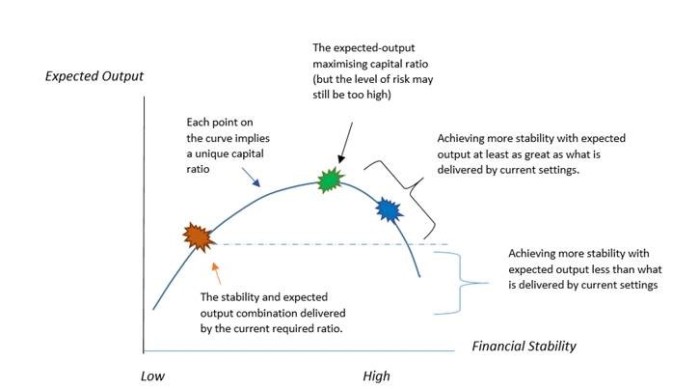
It is a stylised chart to be sure, but people choose their stylisation to make their rhetorical point, and in this one the Governor is trying to suggest that we can be big gains (much greater financial stability, and higher levels (discounted present values presumably) of output) by increasing capital requirements on banks.
I don’t doubt that the Bank can construct and calibrate a model that produces such results. One can construct and calibrate models to produce almost any result the commissioning official wants. The test will be one of how robust and plausible the particular specifications are. We don’t know, because the Governor is sounding off but not (yet) showing us the analysis. Frankly, I find the implied claim quite implausible. Probably higher capital requirements could reduce the incidence of financial crises. But the frequency of such events is already extremely low in well-governed countries where the state minimises its interventions in the financial system, so I don’t see the gains on that front as likely to be large. And, as I’ve outlined here in various previous posts I don’t think that the evidence is that persuasive that financial crises themselves are as costly as the regulators (champing at the bit for more power) claim. And many of the costs there are, arise from bad borrowing and lending, misallocation of investment resources, which are likely to happen from time to time no matter how well-capitalised the banks are.
There are nuanced arguments here, about which reasonable people can disagree. But not in the Governor’s world apparently.
He comes to his concluding paragraph, the first half of which is this
A word of caution. Output or GDP are glib proxies for economic wellbeing – the end goal of our economic policy purpose. When confronted with widespread unemployment, falling wages, collapsing house prices, and many other manifestations of a banking crisis, wellbeing is threatened. Much recent literature suggests a loss of confidence is one cause of societal ills such as poor mental and physical health, and a loss of social cohesion.
Oh, come on. “Glib proxies”…….. No one has ever claimed that GDP is the be-all and end-all of everything, but it is a serious effort at measurement, which enables comparisons across time and across countries. Which is in stark contrast to the unmeasureable, unmanageable, will-o-wisp that the Governor (and Treasury and the Minister of Finance) are so keen on today.
As for the rest, sometimes financial stresses can exacerbate unemployment and the like, but the financial crises typically arise and deepen in the context of common events or shocks that lead to both: people default on their residential mortgages when they’ve lost their jobs and house prices have fallen, but those events don’t occur in a vacuum. And anyone (and Governor) who wants to suggest that mental health crises and a decline in social cohesion can be substantially prevented by higher levels of bank capital is either dreaming, or just making up stuff that sounds good on a first lay read.
The Governor ends with this sentence
If we believe we can tolerate bank system failures more frequently than once-every-200 years, then this must be an explicit decision made with full understanding of the consequences.
As if his, finger in the dark, once-every-200 years is now the benchmark, and if not adopted we face serious consequences. Let’s see the evidence and analysis first. Including recognition that systemic banking crises don’t just happen because of larger than usual random shocks – the isimplest scenario in which higher capital requirements “work” – but mostly from quite rare and infrequent bursts of craziness, not caused by banks in isolation, but by some combination of banks and (widely spread) borrowers, often precipitated by some ill-judged or ill-managed policy intervention chosen by a government. Higher capital ratios just aren’t much protection against the gross misallocations that arise in the process – in which much of any waste/loss is already in train (masked by the boom times) before any financial institution runs into trouble (the current Chinese situation is yet another example).
Perhaps as importantly, under the current (deeply flawed) Reserve Bank Act the choice about capital is one the Governor is empowered to make. But his deputy, responsible for financial stability functions, had some comments to make on this point in a recent speech (emphasis added)
And Phase 2 of the Government’s review is an opportunity for all New Zealanders to consider the Reserve Bank’s mandate, its powers, governance and independence. The capital review gives us all an opportunity to think again about our risk tolerance – how safe we want our banking system to be; how we balance soundness and efficiency; what gains we can make, both in terms of financial stability and output; and how we allocate private and social costs.
It may be that the legislation underpinning our mandate can be enhanced, for example, by formal guidance from government or another governance body, on the level of risk of a financial crisis that society is willing to tolerate.
These are choices that should be made by politicians, who are accountable to us, not by a single unelected and largely unaccountable (certainly to citizenry) official. We need officials and experts to offer analysis and advice, not to be able to impose their personal ideological perspectives or pet peeves on the entire economy and society.
We must hope that the forthcoming consultative document is a serious well-considered and well-documented piece of analysis, and that having issued it the Governor will be open to serious consideration of alternative perspectives. But what was released last Friday – 700 words of unsupported jottings – wasn’t promising.
(I should add that I have shifted my view on bank capital somewhat over the years, partly I suspect as a result of no longer being inside the Bank. It is somewhat surprising how – for all one knows it in theory – things look different depending on where one happens to be sitting. But my big concern at present is not that it would necessarily wrong to raise required bank capital, but that the standard of argumentation from a immensely powerful public official seems – for now – so threadbare.)



 croaking cassandra