Peak starts in Christchurch?

I spent Saturday in Christchurch visiting family. I haven’t lived in Christchurch since I was six, but in some respects it is still “home”.  People close to me lost a lot.   I get down every few months and have followed progress since the earthquakes with both professional and personal interest.  Among the (not original) observations was the striking contrast between the quick private sector action on the periphery, and the mostly glacial pace of activity in the central city government-controlled zone (where, not coincidentally, owners’ property rights had been quite severely impaired).

Saturday’s Press had an interesting feature on “the growing number of rebuild-related firms going bust despite a building boom in Christchurch” –  presumably not a reflection of lack of work, but of the dislocations and opportunities that major economic shocks bring.  Some will have prospered enormously over the last few years, and others –  a minority – just won’t have coped with the challenges of, say, going out on their own and running their own business.

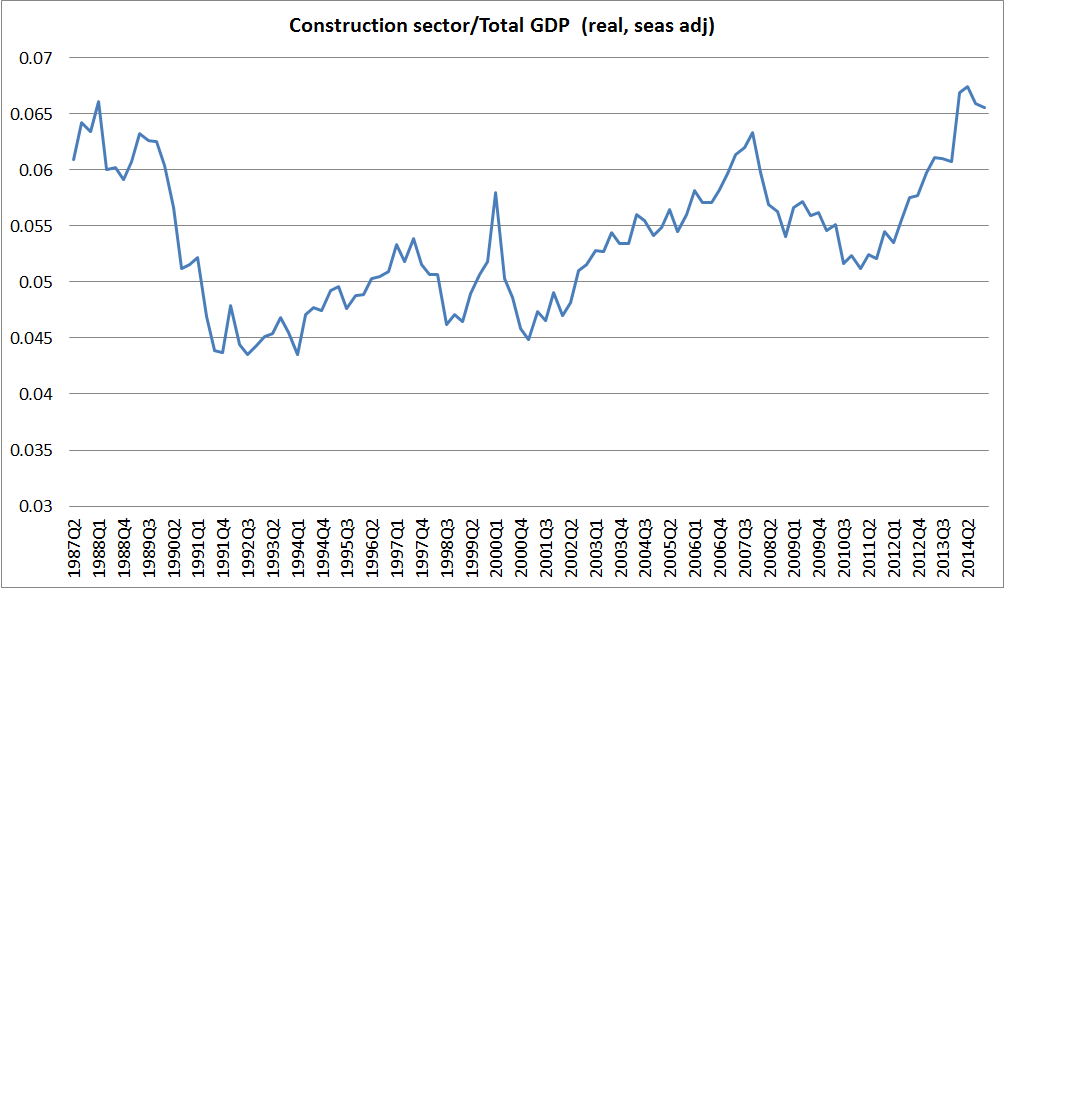
On this visit, even the government-controlled zone was finally starting to look more like a building site than a bomb site  (and I noticed that the Sunday Star Times had a big article yesterday on the scale of the central city developments).  And it is good to see an increasing number of new buildings up and open.  But I noticed on my previous visit, and again this time, that the new buildings often still have “for lease” signs up, and several vacant floors.  Wandering around the city it was not hard to imagine that Christchurch might already have passed “peak starts”, not just for commercial buildings, but for houses as well. Of course, there is years of work still to go –  and some of the questionable vanity projects (convention centre and sports stadium) are not even near commencement –  but it is difficult to envisage that the level of activity goes higher than it has been over the last year or so.  Four to five years on, presumably everyone has a roof over their head, and fewer firms are operating from very unsatisfactory temporary premises.  Housing market pressures look to be easing, and if the early commercial buildings aren’t quickly filled, what prospect for many more starts in the next five years beyond the projects that are already underway?  At an aggregate level, construction sector activity as a share of production GDP ran up very sharply (and much of that was Christchurch), but it has gone sideways or backwards for the last few quarters.

Once again, the Australian resources investment boom, and its aftermath, spring to mind.  With the difference that, vital as it was, the diversion of resources into repairing Christchurch doesn’t leave us with a new large productive sector at the end of it all.
 

Morgan Stanley has the answer (not)

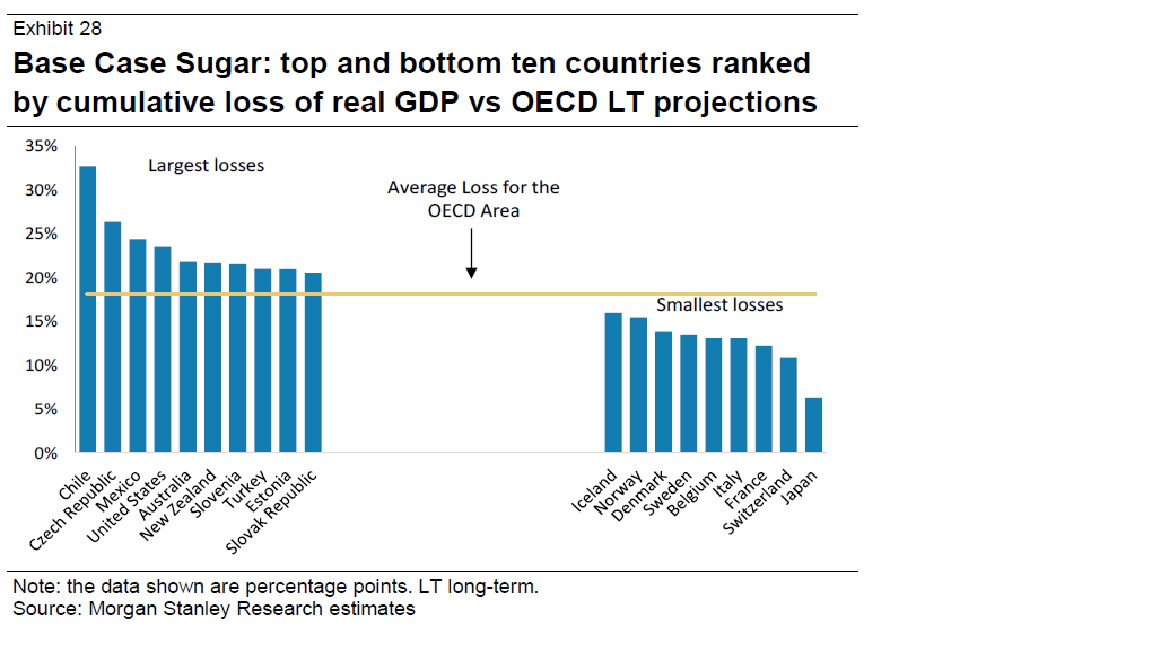
Morning Report this morning gave considerable coverage to a new research report from the investment bank Morgan Stanley, Sustainable Economics: The Bitter Taste of Sugar.  The authors argue that rising obesity levels will act as a major drag on economic growth and productivity across the advanced world over the next 20 years, lowering growth rates by around 0.5 percentage points per annum (roughly 18 per cent of GDP cumulatively over 20 years).

sugar (2)

Reports like this are like a gift to those who loudly insist governments have to “do something” about the voluntary private consumption of sugar.  But there is almost nothing solid to back up the Morgan Stanley assumptions.  And not many things change annual growth rates semi-permanently by 0.5 percentage points. There is some discussion  in the report of the way in which obese people may be less productive than otherwise, but nothing to indicate whether people are more likely to become obese if they are already less productive for other reasons, or to back up the estimates/assumptions at an aggregate level.  And there is no attempt to back-test the numbers they use –  for example, does the changes in each country’s obesity rates in recent decades correlate, even loosely,  with changes in the respective country’s growth rate?

Of course, even if the estimates were accurate, it is hard to believe there is a policy problem.  These are private choices.

But if they were accurate  – and we were happy to ride roughshod over private preferences – it would suggest any easy way of closing the New Zealand productivity gap: reduce our per capita sugar consumption to, say, Japanese levels and in 20 years we would well on our way up the OECD league tables.     But, most likely, it just isn’t so.

And among the FIFA World Cup finalists

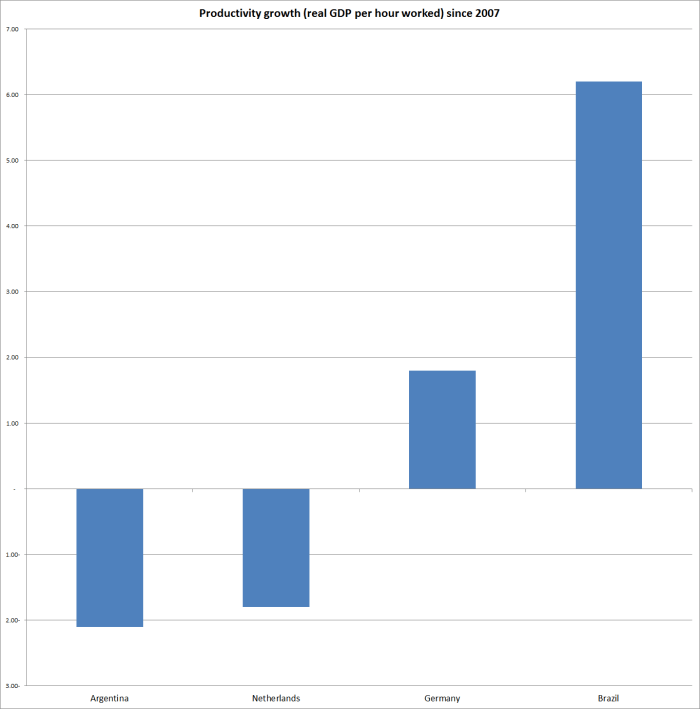
A commenter –  my son –  asked how the countries which were finalists at the last football World Cup have done.

The chart is below, done using the Conference Board’s annual database.  Curiously the two finalists have done the best, but the productivity performance (in favour of Brazil) reverses the crushing victory Germany secured in that memorable final.

Of these four countries, the Netherlands has the highest level of real GDP per hour worked

soccer

The other Australia vs New Zealand rivalry

After the thrilling semi-final against South Africa, the New Zealand cricket team finally has to venture across the Tasman for what will surely be the game of their lives on Sunday.  The bookies and most commentators expect the other finalist will be Australia.  Despite the momentum that comes from  being unbeaten in the tournament so far, New Zealand is likely to be the underdog.  Sometimes underdogs win, so we can hope.

But what about relative economic performance?  For a century or more, New Zealand and Australia had pretty similar living standards, and then at some stage post WW2 (when depends on the series one chooses) we started drifting behind, and New Zealanders started moving in larger numbers to Australia from the late 1970s.

There has been a curious thread running through economic commentary, and political commentary on economic developments, in the last couple of years suggesting that New Zealand has begun outperforming Australia.  Those on the right of the Australian have been heard to talk of how the Australian government should follow the (apparently) reforming path of the New Zealand government.  The head of one of our think-tanks has reinforced the message in a little book published in Australia.

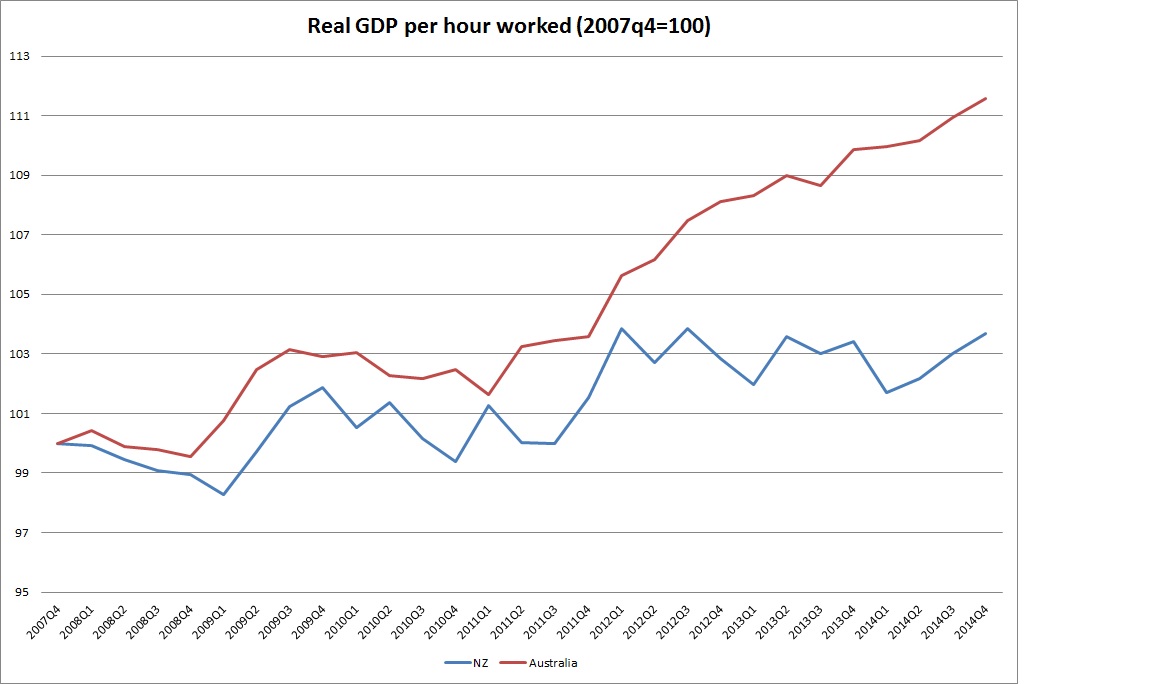
Export commodity prices certainly ebb and flow, and Australia’s are still retreating, but from the extraordinary highs of just a few years ago.   One of the best timely indicators of how well an economy is utilising resources to deliver long-term prosperity is to look at real GDP per hour worked.  I’ve graphed it below for both countries for the period since December 2007 (just before the recession), indexed to 100 at that date (NZ data uses HLFS hours worked data).  It isn’t a pretty picture for New Zealanders.  For the first 3 or 4 years the cumulative difference wasn’t large, but look at the last 3 years.  NZ has had no productivity growth, and Australia’s productivity growth has accelerated.  Cumulatively these are big differences: eight percentage points over seven years, from a starting point where our incomes were already well below theirs.

ausnzgdp

We can only hope for a rather better result in the cricket, although the phrase “bread and circuses” springs to mind.  Argentina still does well at soccer, but I suspect most of the public would regard that as small compensation for a century of economic failure.

Do more people make NZ more productive?

The Australian blogger Leith van Onselen today ran a piece prompted by a new Ross Gittins article in the Australian papers about how high immigration could impede productivity growth.  Van Onselen took the opportunity to draw readers’ attention (again) to my own 2013 paper on how New Zealand’s large scale inward migration programme may have exacerbated imbalances in the New Zealand economy, and frustrated any aspirations to close the gaps between New Zealand’s productivity level and those of the more successful OECD countries.  He also linked to the Treasury Working Paper Julie Fry did last year which looked at various aspect of New Zealand immigration, including the “Reddell hypothesis”.

There will be more on these issues on this blog over the coming year.  I started thinking on these issues while I was working at Treasury from 2008 to 2010, and those early notes influenced the material in the report of the Savings Working Group.  My hypothesis is, of course, controversial.  I think that is a good thing, in such a challenging and important area as New Zealand’s long-term underperformance. And the hypothesis is not easily (dis)proved.  We need to have a more substantial debate around the New Zealand immigration programme, which has grown over the last 25 years with little advance public discussion.  No political party ever campaigned for the cause of much-increased immigration.    The debate shouldn’t be about year-to-year fluctuations –  most of those are about the comings and goings of New Zealand citizens –  but about just what a country with low savings, few obvious positive productivity shocks, and an exodus of its own people, is gaining from such large trend inflows of non-citizens, many from countries and economic cultures much poorer than our own (underperforming) one.

German voters, the euro, and government spending

Last year, the great and the good were repeatedly found advocating that Germany should increase government spending, and hence public debt, to boost demand across the eurozone.  It was consistent with a line that has echoed round the commentariat for the last five years, that somehow demand in Germany needed to be boosted.

From the scale of the unemployed resources across the euro-area it is pretty clear that, in the abstract, a boost to demand would be helpful.  But fiscal policy is national, and it was never clear to me why German voters would regard additional spending and debt as a “good thing”; something worth supporting at the ballot box.

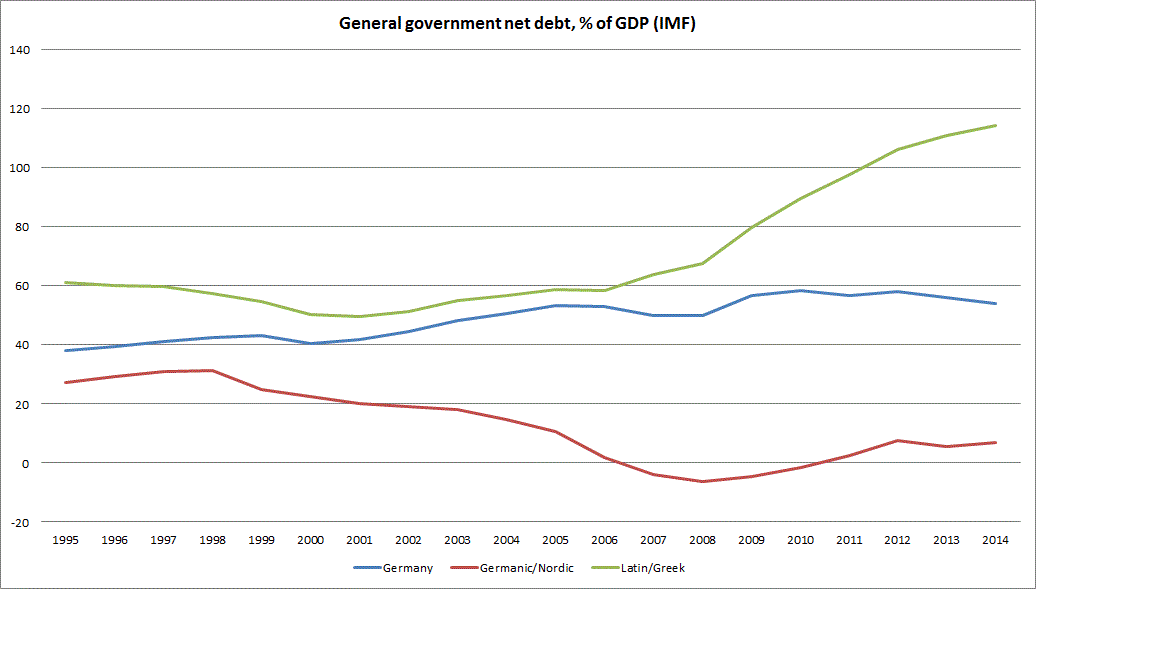
To me, the chart below helps explain why a sensible German voter might reasonably be averse to expansionary fiscal measures.  Not only is the German unemployment rate low but Germany has been doing relatively better economically than it did in the half decade or so prior to the 2008/09 recession, but Germany’s public debt doesn’t look so good in international comparisons.

The IMF World Economic Outlook database has data on net government debt as a percentage of GDP.  Germany is in blue.  The other lines represent two other broad groups of European countries German voters might compare Germany with.  The green line is the median of net debt to GDP for France, Spain, Italy, Greece and Portugal.    And the red line is the median of the other Germanic/Nordic countries: Austria, Switzerland, Netherlands, Denmark, Norway, Finland, and Sweden.  For that latter group, median government debt has been lower than that in Germany for the whole of the last 20 years.  German voters might reasonably conclude that the Northern European route was more attractive than the Southern, on this count as well as others (including good governance, low levels of corruption etc).

German debt

Of course, it might be different if German voters for some reason put the interests of the euro area ahead of those of Germany. But, much as the elites might wish it otherwise, there is no sign of that happening. Politics is mostly national, even in the euro area.

The limits of the state

Another post prompted by my recent reading.  In this case, two very different books about the role of the state:

The Tyranny of Utility should probably be read by all those in the sorts of public agencies and departments that dot Wellington and other capital cities, and which offer advice, and champion public action, newly-inspired by the insights of behavioural economics. As Deirdre McCloskey writes in her blurb “Saint-Paul stands courageously in the middle of the new road to serfdom” –  the no doubt well-intentioned paternalism that puts little or no intrinsic value on freedom, including the freedom to fail or to choose ‘badly”, in diet, education, health, savings, or speech or whatever.  As Saint-Paul notes, it is a critique of the economics approach more generally, which “does not value individual freedom per se”, only as an instrument or means.   it It is a bracing critique, and perhaps the more encouraging for coming out of France, which has been a bastion of statism.  If there is less new than in Piketty, the rather more prominent French economist, a larger proportion of this book would withstand close scrutiny.

The Fourth Revolution is written in that brisk, slightly breathless, style that characterises The Economist.   They gather a lot of interesting material, including potted accounts of interesting experiments from around the world, although for me the value in the book was as much the scrawls of disagreement that it prompted in the margins.  There is a huge degree of China-boosting that seems to lose sight of both the corruption and injustice that riddles the Chinese system, and of the fact that it will be decades, if ever, until China again approaches the living standards, and levels of productivity achieved in the West.  Singapore is lauded, but it would have been interesting to have included some discussion of Taiwan: I don’t think it is mentioned at all, and yet with more democracy and more-market than either Singapore or China it has been a hugely successful story, despite its awkward relationships with most countries.  The authors don’t directly address the sorts of issues Saint-Paul raises, and I suspect they can’t quite make up their minds what the role of the state is, or should be: at times they worry that “the state will keep on expanding,gradually reducing liberty”, but in other places they seem enthusiastic about local councils in Britain that place tight restrictions on what can and can’t be put out for rubbish collections.  More than I would, the authors emphasise fiscal policy and the need for entitlement reform. Perhaps that reflects North Atlantic priorities.  But they give too little weight to the seemingly inexorable, and probably more threatening rise, of the regulatory state.  And barely any attention at all to the incentive and knowledge problems – too easily ignored or assumed away by the well-intentioned – that bedevil so much of what government does.  Government is as double-edged sword –  and the side that is the biggest threat to life, liberty, freedom (and affordable housing in our big cities) does not get anywhere enough weight in this book.

Declining and expanding regions – and some puzzling data

This afternoon Shamubeel Eaqub of NZIER presented in the Treasury Guest Lecture Series.  Building from material in his short book Growing Apart and drawing on census data the highlighted the economic divergences between Auckland (and Wellington) on the one hand, and many of the other regional council areas in New Zealand.  Population has increasingly gravitated towards big cities, and many towns and some provinces are already facing the prospect of absolute population decline.

The regional mix of the population has been changing, at least ever since European settlement.  Towns have either disappeared completely, or shrunk  –  absolutely and relatively –  from their former glory. I visited Hokitika again last year, and was reminded that it was  once (briefly) one of the larger towns in New Zealand.  Shamubeel seemed to regard the shifting population mix as something for central and local government policymakers to respond to with positive programmes of action.  That seems much less clear to me.  A good maxim for policy is “first do no harm”.  Local governments in particular seem prone to doing harm.  As Shamubeel reminded us, the Dunedin white elephant stadium was an initiative of a local body, hoping a covered stadium would help boost Dunedin, with no robust cost-benefit analysis.  The individual citizens of Dunedin certainly would not have taken on such ill-considered risk themselves.  Wellington City Council seems to hanker to waste similar amounts of money on an airport runway extension.  And it is local authorities who are responsible for making land for housing scarce in growing regions.

Perhaps we need to focus policymaker attention on getting government out of the way, and allowing market adjustments to work.  For example, to help make growing towns and cities more affordable and responsive mandate that property owners everywhere have a presumptive right to build houses/apartments up to three storeys high (I’m looking out on one that high as I type).  And on the other hand, look to wind back onerous central government infrastructure mandates, especially for declining areas.  Citizens of those area are likely to choose themselves to settle for less than the best.  And reversing the proposed new earthquake building standards, which have destroyed value across the country (and especially in older regions) for little or no expected savings of human life.   Perhaps more controversially – and a subject to which I will return – cut back the large scale programme of inward migration.  This is a central government programme, whose direct effects are concentrated in Auckland, puts pressure on non-tradables prices across the country, and undermines the competitiveness of tradables sector producers concentrated in places like (eg) Hawkes Bay, Waikato, Otago, or Nelson.

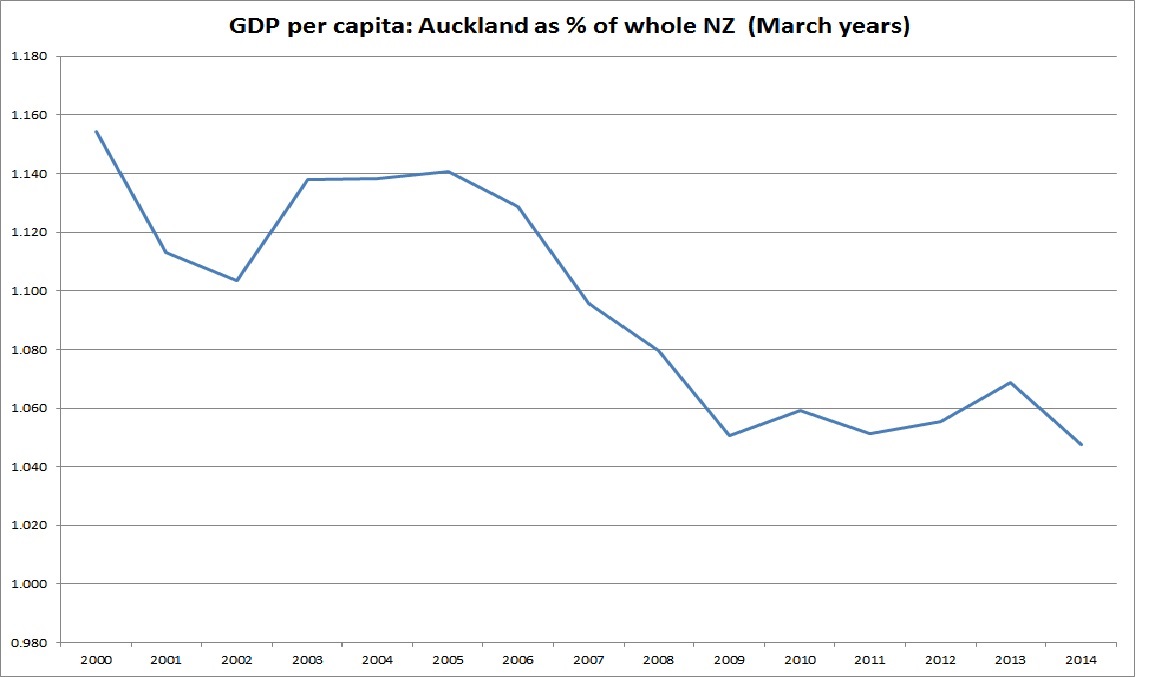
For all the elite discussion around the importance of Auckland to New Zealand’s economic prospects, today’s regional GDP data was more than a little puzzling.  According to SNZ, nominal GDP per capita in Auckland has been trending downwards relative to that in New Zealand as a whole for the last 14 years.  No doubt the recent high terms of trade are part of the story, but I don’t know quite what to make of these data.

Auckland per capita GDP

A forgotten result of World War One

From 2014 to 2018 countries like ours are marking the centenary of successive phases of World War One.  For New Zealand, next month’s commemorations of the 25 April 1915 Gallipoli landings may well be the high point –  complete, no doubt, with rather saccharine portrayals of the enemy, devoid of any reference to the systematic Turkish massacres of their own Armenian subjects which, rather hauntingly, date from 24 April 1915.

But this is a blog about economic matters.  And for New Zealand, World War One marked the end of the Gold Standard.  Like the other British Dominions, New Zealand did not have a central bank at the time.  Commercial banks took deposits, made loans, and issued paper banknotes.  By law, these had to be convertible into gold, on demand, and banks held substantial gold reserves.  With the UK (and Australia) also on a Gold Standard, this established a very stable series of fixed exchange rates against the currencies of the economies most important to New Zealand.

There had been a departure from the gold convertibility provisions earlier, at the time of the BNZ crisis of 1894 –  convertibility was a double–edged sword, helping to build well-founded confidence in the value of deposits, but potentially exacerbating a crisis if a contagious run on banks looked like taking place. But that suspension was, and was always envisaged as, temporary.

When World War One broke out, New Zealand’s Parliament had already been considering banking legislation which would allow the Government, in an emergency, to suspend the convertibility into gold of notes issued by commercial banks. and declare bank notes themselves legal tender.  We can easily read the contemporary accounts thanks to the National Library’s wonderful Papers Past. The proclamation declaring that New Zealand was at war was not read until 5 August, but on 4 August the banking amendments were passed under urgency in view of the imminence of war.  The legislation also gave the government power to prohibit the export of gold during the period convertibility was suspended.

The next day, as part of New Zealand’s entry into the war, convertibility was suspended and gold exports were prohibited.  The suspension was initially for one month, but it was later extended.   New Zealand bank notes were never again convertible into gold as of right.  LIke many things, it was quite unforeseen in 1914.

What followed was a curious arrangement, which appears to have confused some eminent modern students of historical monetary arrangements (including Barry Eichengreen in his great book Golden Fetters).  Unlike most Gold Standard countries, New Zealand never resumed any sort of gold convertibility requirement after the war was over (unlike, say, the UK which did so in 1925).   Indeed, at least until the negotiated devaluation of January 1933, and perhaps until the opening of the Reserve Bank in 1934, there was no direct or indirect government control over the issuing, or management, of money in New Zealand.  In the jargon, there was no nominal anchor, only customary practice.  In fact, until the onset of the Great Depression, the banks managed their lending policies to ensure that notes were convertible into sterling (but not to gold) at par.

Good institutions – and the lack of them

I’ve read two very different books lately about societies in which the powerful plunder, while the legal systems offers few reliable protections against such abuse.

The British novelist Rana Dasgupta now lives in Delhi and has written Capital.  The title of this series of vignettes is a play on words –  Delhi is both the political capital of modern India, and it is a city in which moneymaking and trading on the power of political and bureaucratic connections is rampant.   India isn’t a country I know that much about, and the book was both fascinating and disconcerting. India has had democratically elected governments since Independence – in contrast, say, to  Burma, Bangladesh, and Pakistan – but it is scarcely a credit to democracy.

Written in a very different style, US academic Karen Dawisha’s Putin’s Kleptocracy is a relentless detailed account of the way Vladimir Putin has played the Russian system, to enrich himself and his cronies, as part of the complex mesh of, sometimes extremely brutal ways, he has established pretty pervasive control.  At best, Russian can now be described as an authoritarian quasi-democracy. Dawisha’s UK publisher refused to publish the book, apparently in fear of the weight of the onerous UK libel laws falling on them, but Simon and Schuster in the US have published it.

Both books are recommended, but they are very different.  Dasgupta is an easy read –  a sometimes dizzying series of pictures of people, his own Indian family included, that illustrates what modern Delhi has come to represent.  For 450 pages of text it has 4 pages of footnotes.  Dawisha, by contrast, has 350 pages of text and almost 70 pages of bibliography and notes –  the detail is what makes the case against Putin so strong.

Dasgupta himself draws some parallels:

“Earlier in this book we saw how fondly and often India was likened to America.  But for the most part, this was pure ideology. India has much more obvious similarities to America’s alter ego: Russia.  India and Russia had both had systems of state-run capitalism that had foundered by the 1980s, generating a new class of clever, underground entrepreneurs who came into their own after the old systems – almost simultaneously – collapsed.  Both countries developed systems, after that point, in which the existence of electoral democracy did not prevent the emergence of a class of oligarchs who used the political system to take control of their countries’ essential resources.  Both of them had capital cities, Moscow and Delhi, where the people watched with resentment as a small number of people used the immense power of large-country politics to their immense advantage.”

A year on from his book, with all the subsequent adventurism in Ukraine, this may be a little unfair to India.  But I was struck more by the contrast between these two countries, and the advanced Northern European tradition of which New Zealand is part.  No country has been totally free of corruption, and constant vigilance is required against, for example, sweetheart deals with those who cosy up to the powerful.  But it is difficult to see how India or Russia could reach even New Zealand’s (barely) First World living standards without far-reaching changes in the political and legal systems.  And, as always, entrenched interests, that don’t arise from nowhere, are a powerful obstacle.  And perhaps that is why, with few exceptions, the countries that were rich 100 years ago are still the rich countries today, as Ed Glaeser illustrated a few years ago.