Greenspan and pressure on independent central bankers

I’ve been reading a succession of long biographies of influential Americans.  The US election result prompted me to read biographies of the four presidents from Eisenhower to Nixon – one president with no prior experience in elected office, and three very flawed individuals –  and in the middle of all that I read (to review) Sebastian Mallaby’s big new biography of Alan Greenspan, The Man Who Knew.  There is some overlap:  Greenspan played a role in Nixon’s 1968 election campaign  – in domestic policy, and in doing polling analysis (his economic consultancy/forecasting firm had just acquired its first computer) –  and Greenspan was nominated to his first official government job, Chairman of the Council of Economic Advisers, in the last days of the Nixon administration.

I’d strongly recommend the Greenspan book.  It is well-written, deeply-researched (the author notes that one of his research assistants read the full transcripts of every FOMC meeting in the 19 year Greenspan term), and as interesting for the pre-Fed period as for Greenspan’s lengthy term as Chairman.  For some there might be a little too much on his succession of girlfriends over 40 years –  of one, we learn what she was wearing when Greenspan first encountered her in the Oval Office –  or the tennis holidays, but it is a biography of the man and his times, not the story of monetary policy.  Even in New Zealand bookshops, the price of the 750 page hardback isn’t extortionately expensive.

I’m not going to attempt a full review here.  Instead, I wanted to highlight Mallaby’s account of one interesting little episode from the early 1970s, when Greenspan was still prospering from his success as an economic adviser to major corporations (“the man who knew”).

As I noted, Greenspan had been quite involved in the 1968 Nixon campaign –  Nixon built a fairly formidable team of policy advisers, and carried many of them into the White House with him.    Greenspan had turned down the offer of a fulltime government position after the election, reckoning that the only positions that interested him were ones he was not yet senior enough to be offered (eg Secretary to the Treasury).  But he stayed involved, serving on the commission that (sucessfully) recommended the abolition of military consciption and on a presidential commission on financial reform.

By 1970, the chairman of the Federal Reserve was Arthur Burns, one of Greenspan’s former professors with whom Greenspan had stayed close.  Burns had also been quite involved in both Nixon presidential campaigns, and (somewhat against his own wishes, so his diary records) had been brought into the White House at the start of Nixon’s term as Counsellor, with Cabinet rank.

One of Nixon’s perennial concerns (he was a politician after all) was his re-election prospects.  As it happened he needn’t have worried –  his 1972 margin of victory was one of the largest ever – but he did, obsessively.  And in mid 1971 he was very concerned about what the state of the economy might be by the election time in 1972.   He had been convinced that Fed misreading of the state of the economy had contributed to his narrow defeat by Kennedy in 1960.

On 23 July 1971, Mallaby records,

Nixon invited three advisers to join him on the presidential yacht, Sequoia, for a Friday-night cruise on the Potomac.  The men kicked about ideas on how to deal with the wayward Fed chairman. Burns was behaving like a professional Eeeyore, talking down the economy with one gloomy comment after another…..Building on a suggestion from John Connally, the Treasury secretary, Nixon and his henchmaen settled on a plan.  They would make Burns shut up by planting a negative story in the press about him.

Burns had been urging the president to take a stand against inflationary wage increases. the Nixon men resolved to tell the press that Burns had simultaneously been lobbying behind the scenes for a personal pay raise [in fact, he had argued for an increase in the Chairman’s salary, but starting from the commencement of his successor’s term].  Coupling this charge of hypocrisy with crude intimidation, they would also inform reporters that Nixon was contemplating a reorganization of the Federal Reserve to curb the chairman’s authority.

Four days later the story appeared in the press, and the President’s press secretary “gave the story legs by refusing to deny it”.

With Burns now on the defensive, Nixon’s men moved in for the kill.  They would get a message to Burns demanding a positive speech on the economy. If the Fed chairman wanted to avoid all-out war he would have to cry uncle.

Charles Colson, a member of the Sequoia trio who would later serve jail time for organising Nixon’s dirty tricks, tracked down Greenspan.  He phoned him in New York and asked him to get Burns to change his tune on the economy.

Years later Greenspan insisted he refused to do Colson’s bidding.  But Colson’s handwritten notes from the conversation suggest otherwise.  After taking Colson’s phone call, Greenspan spoke at length to Burns.  Then he reported back to the White House.

Burns were seriously put out –  “very disturbed” was Greenspan’s description.  Mallaby continues for a couple of pages, with accounts of conversations between Nixon, his chief of staff Haldeman, and Connally about keeping up the pressure on Burns, including Greenspan’s role.

And then

Within twenty-four hours, the Fed chairman caved and Nixon appeared at a press conference to disavow the shameful attacks on his good character.  “Arthur Burns has taken a very unfair shot,” the President said, explaining how Burns had in fact turned down  a pay increase when the White House budget office had recommended one. A transscript of Nixon’s remarks was forwarded to Burns, who was soon on the phone to express his gratitude.

“It warmed my heart,” an elated Burns told Nixon’s speechwriter, William Safire.  “I haven’t been so deeply moved in years. I may not have shown it, but I was pretty upset.  This just proves what a decent and warm man the president is.  We have to work more closely together now.”

Burns’s diary for the years 1969 to 1974 has been published –  and is a good read for junkies.  Unfortunately, it is a little patchy and doesn’t cover July 1971.

Mallaby asserts that this episode, in which Greenspan appears to have played a not unimportant role, was a key turning point in the whole of monetary policy in the 1970s (Burns remained chair until 1977) when inflation became an increasingly serious problem, not just in the US, but around much of the advanced world.

In fact, distasteful as the episode is , reflecting no credit on anyone involved, Mallaby probably exaggerates when he writes that

The central bank had not been so clearly under the thumb of the White House since the Fed-Treasury accord of 1951. Politics had triumphed, and Greenspan had been a party its victory.

It is worth remembering the timing.  All this happened just a few weeks before the US suspended gold convertibility and the Adminstration imposed wage and price controls and temporary import levies.  They weren’t normal times, and nor  –  as the fixed exchange rate era broke down –  was it an era in which one might expect the usual distance between the White House and the Fed.

As importantly though, White House pressure on the Fed wasn’t new.  Burns’s diary on 21 March records his request for a meeting with Nixon “to have a candid talk about the war of nerves the White House gang had set in motion”.

And nor was the tension within Burns, between his anti-inflation instincts and his apparent desire for access to, and influence with, the President new.  In the same entry he records:

I informed the President as follows: (1) that his friendship was one of the three that has counted most in my life and that I wanted to keep it if I possibly could; (2) that I took the present post to repay the debt of an immigrant boy to a nation that had given him the opportunity to develop and use his brains constructively; (3) that there was never the slightest conflict between my doing what was right for the economy and my doing what served the political interests of RN; (4) that if a conflict ever arose between those objectives I would not lose a minute in informing RB and seeking a solution together; (5) that the sniping in the press that the White House staff was engaged in had not the slightest influence on Fed policy, since I will be moved only by evidence that what the Fed is doing is not serving the nation’s best interests

and so on.  He notes “RN seemed pleased by my reassurances to him, indicated that he never had  any doubts, that he would put an end promptly to the sniping about the Fed that has been going on at the White House…”

Perhaps more useful still, is Allan Meltzer’s comprehensive history of the Federal Reserve.  Meltzer was a monetarist and in the 1970s had not been particularly supportive of the rather ad hoc way in which the Fed ran monetary policy and allowed inflation to build up.   But in his careful discussion, and analysis of the documentary record, Meltzer absolves the Fed of the charge that in the run-up to the 1972 presidential election it was shaping policy according to political imperatives.  As he notes, the FOMC votes were rarely close (typically unanimous), and the FOMC itself was manned by plenty of independent-minded people who had been appointed by Presidents Kenndy and Johnson (one of the most independent had been appointed first by another Democrat president, Truman).

As he notes

Burns was able to get a majority vote of the FOMC because he could appeal to beliefs that considerable resources were idle, that inflation would be held back by price controls, and that their principal mandate was to contribute to full employment.  This was compatible with service to the president’s reelection campaign.

It is an alien world in many respects –  quite different models of how to think about inflation, the primary role of the central bank etc –  and none of the key figures emerges that well –  Nixon, Burns, Greenspan, Colson, Connally, Haldeman.  Some of that is clearer with hindsight, others should have been clear at the time.  But it wasn’t a case of the President’s placeman successfully orienting policy simply to re-election.

One of the themes of Mallaby’s book is how Greenspan, who started out very close to Ayn Rand, quickly gravitated towards the centre of affairs –  at times willing to compromise perhaps rather too much to retain that place. Mallaby praises Greenspan’s deft political management skills.  I couldn’t help feeling slightly uncomfortable.  One example was the account of the way Greenspan hosted annual 4 July parties at the Fed, at his own expense, for the movers and shakers of Washington and their families –  effectively buying influence and regard.  I came away from the book with a strong sense that 19 years was just too long for any one unelected official to hold such an influential office –  and as the book illustrates there is no evidence that Greenspan was uniquely well able to read the economy, or judge the best policy response –  but perhaps that is a topic for another post another day.

Immigration as a tool to advantage professional women

One day earlier this week the Dominion-Post was editorialising about whether some form of “Trumpism” might come to New Zealand.  As I wrote a few weeks ago, I remain a bit sceptical about quite how much Trump’s victory and the Brexit vote have in common, or about sweeping generalisations as to what electorates are doing/choosing/saying.     The editorial noted that although some have talked of Winston Peters as “New Zealand’s Trump”, in fact (as I have noted previously) Peters has done little when he has held ministerial office:

He did nothing to advance the anti-immigrant agenda when he gained power.  And this fact is a great blessing to New Zealand.

If we allow that, despite the editorialist’s enthusiasm, one of the things that seems to bothering an increasing number of voters in many Western countries has been high rates of immigration –  actual or perceived –  then a Bloomberg article on the very same page of that issue of the Dominion-Post might offer one strand in the complex picture of why.  In that article, a Cambridge University economics academic, Victoria Bateman,  argues in favour of a pretty open approach to immigration because such immigration makes the lives of professional women (and their spouses) so much easier.

Not only does immigration boost the economy, it has also helped empower professional women in the U.K. and U.S. economies over the last 50 years.   The entry of professional women into the labor market has been supported by an army of low-paid — often immigrant — domestic helpers. …. At the end of the day, where would “power couples” be without the low-paid, often female and immigrant, labor on which they depend?

and

Reduced immigration will leave us with a choice: Either life will be more difficult for professional women, or professional men will have to do more around the home.

Yes, I can see all the gains-from-trade arguments that Bateman, and libertarian supporters of an open approach to immigration policy, would advance.  Highly productive people can do, and produce, more if they can deploy support services to assist their participation in the labour force.  This is the counterpoint to the easy-assimilation approach used in New Zealand immigration policy –  if one brings in people much like those who are already here they might settle in easily, but there are few gains from trade.

But it is also a very stark example of the way in which immigration policy is more about redistribution than it is about the prospect of any material overall gains to the citizens of the recipient country.    In the best of cases, the evidence that high levels of immigration boost productivity and per capita GDP in recipient countries very much at all is pretty slender.  There are reasonable theoretical arguments, but even if the signs are sometimes right (ie there are real overall economic gains) the magnitudes are typically small, and can’t easily be seen even over decades.  In some places –  I argue that New Zealand is a prime example –  misguided immigration policy may be materially impairing the economic fortunes of the country as a whole.  But there isn’t much doubt that –  as with many other policy levers –  immigration policy can advantage some groups at the expense of others.  For example, combine planning restrictions with high levels of immigration and there are real windfalls gains for existing landowners –  and commensurate losses for those who would have been seeking to enter that market.

And that is just the sort of redistribution Bateman is talking about.  She welcomes immigration that keeps down the cost of low-skilled labour which means that

educated women have been able to subcontract out their traditional domestic duties, from cleaning and childcare to preparing meals and looking after the elderly.

Perhaps this wouldn’t be (as) morally offensive if there was an entirely separable class of temporary guest workers, who didn’t substitute at all for low-skilled domestic workers.   The temporary workers would gain from the trade, and so would those employing them. But that (separability) isn’t how labour markets operate.  What Bateman is in fact arguing for is a policy designed to explicitly help people like her, at the expense of poorer less highly-skilled Britons (in fact, in the roles she talks of typically poorer relatively unskilled British women).  No one person is ever an exact substitute for another, but there is a great deal of overlap.    Even though she never says it, what Bateman is arguing for is a policy designed to increase the differences in incomes between the highly-skilled and the less-skilled –  for the comfort of the highly-skilled (women and their spouses).

Many advocates of a fairly liberal approach to immigration like to downplay the possibility of any costs to low-skilled natives of the recipient country, but Bateman’s argument relies almost entirely on those costs.  Reasonable people can debate how large the actual adverse effects are, but Bateman clearly believes they are large –  that is why, in her view, immigration makes things so much easier for people like her.     And she can’t even be arguing  –  as some might –  that it is just a transitional effect, or otherwise the possibility of outsourcing domestic duties cheaply would soon go away again.  So it seems to be a vision of society that involves repeatedly importing new waves of lowly-skilled immigrants to keep the relative returns to low-skilled labour sufficiently low to make life comfortable for the professional classes.

Libertarians might not like it, but stable societies are organised around a set of common interests, and a common sense of identity.  Whatever the other arguments for and against immigration, it is hardly surprising that citizens might rebel against a proposal to bring in lots of foreigners to widen the income gaps in society –  not just those between nationals and non-citizen foreigners, but those between skilled and unskilled nationals.   Sceptics of other economic reforms will argue that some of those changes also had that effect, but even if so (which I mostly dispute) it was never the intention, or the envisaged long-term effect.  By contrast, Bateman’s argument is in effect for using immigration to maintain a permanent class of helots –  not always the same specific people, but a constantly refreshed pool of people able to earn relatively little, because of the direct competition fron unskilled new arrivals.

I remain of the view that any immigration we do actively pursue should focus on a small number of very highly-skilled people (in addition to a limited number of refugees etc).  By contrast, Bateman’s vision –  whether applied here, or in the UK or the US – would seem to undermine most people’s sense of what a well-functioning society and economy should look like.

If people are really worried about obstacles to outsourcing domestic duties, take another look at the high maximum marginal tax rates that in many countries (less so New Zealand than most) still encourage people to do it themselves, within families.

Thank goodness that so far Bateman appears to have kept to pen and paper (so to speak) to articulate this argument, rather than the alternative surfaces she used last year for her highly-publicised anti-Brexit protest.

And now it is time to hang out the washing and spend some time with the kids.

Major cities in many countries have become progressively less dense

A reader yesterday linked to the recently-published United Nations World Cities ReportSceptical as I am of most UN things, out of curiosity I dipped into a few chapters of the report.

On doing so, I stumbled on this chart

city-density

In a quite striking way it makes the same point made in an early post on this blog: as countries become richer, the cities in those countries tend to become less densely populated.  Here was the chart from the earlier post showing data for London as far back as 1680 (just over a decade after the Great Fire).

london

These numbers shouldn’t really be a surprise.  Space is a normal good –  people typically want more of it, all else equal, when they can afford it –  and technological advances make longer distance commutes feasible.

No doubt there will be some issues with how the data are compiled/estimated –  quite where are the boundaries around the “built up area”, and how well is that known for, say, 1855.  But the general proposition shouldn’t be surprising: it is easy enough to think of the cramped tenement dwellings of New York in the late 19th century.

Of course, these trends aren’t ones that seem to please either the United Nations or many of our own local councils.  This text is from the UN report, just after the chart above

In recent years, UN-Habitat has brought into the forefront of attention the need for orderly expansion and densification so as to achieve more compact, integrated and connected cities. UN-Habitat’s support for planned city extensions programmes as well as promotion of tools such as land readjustment aims to increase densities (both residential and economic) with compact communities in addition to guiding new redevelopment to areas better suited for urbanization. These interventions are suggested to be an integral part of the New Urban Agenda as elaborated in Chapter 10.

And the constant refrain locally is for “more density”, when there is little or no evidence that such densification is what residents would prefer for themselves.  Indeed, it would be surprising if the revealed preferences across time and across countries/cultures had suddenly reversed.

I have no particular problem if people wish to live in high-rise apartments, or in small townhouses with no garden.  And people will choose to do so if regulatory constraints limit their options –  eg if land simply becomes too expensive –  but it doesn’t look like a first-best unconstrained preferred choice for most people.  We don’t, for example, see such bunching in our own provincial cities –  where housing is less unaffordable than in, say, Auckland –  and of course by international standards even our own largest city, Auckland, is not much more than a large provincial city (just a bit smaller than, say, Nashville).

Freeing up the use of land around cities remains the key to making housing affordable again and providing the choices/options that people value.  Experience suggests more populous cities will cover more space.  That isn’t something officials and politicians should be trying to stop.

Stress tests and credit availability

It is 3 January, a public holiday, the heart of summer (notionally at least –  it is actually cool and wet in Wellington), and something of a low ebb in local news and analysis.  But bright and early this morning, I did a radio interview on the Reserve Bank’s stress tests of the major banks.

The request was apparently prompted by a Stuff article, itself prompted by a recent new Reserve Bank animated video explaining stress tests.    The article, rightly, pointed out that following a very severe recession and significant credit losses for banks it was likely that banks’ lending standards would be somewhat tighter than they would have been in the previous boom.  That might even affect some of those hoping to take advantage of lower asset prices.

The stress tests themselves aren’t new.  They were done in late 2015, and were written up in the Reserve Bank’s Financial Stability Report last May.   I wrote about those results at the time.  In that stress test the Reserve Bank, quite appropriately, looked at how banks would cope if they were faced with a very severe recession and a very sharp fall in asset prices.  Stress tests are useless unless they use very demanding shocks.   These were. In the stress test, the unemployment rate rose to around 13 per cent and stayed there for some time.  For housing loan books it is the combination of unemployment and falling house prices that creates the scope for large loan losses –  either strand alone isn’t enough.  In fact, the increase in the unemployment rate was larger than anything experienced in any advanced economy with its own monetary policy in the 70 years since the end of World War Two.  And house prices were assumed to fall by 40 per cent generally, and by 55 per cent in Auckland –  about as large as any falls anywhere.

The banks emerged from these very demanding stress tests intact.  It wasn’t even a close run thing.  Capital ratios dropped, but mostly because the risk weights applied to banks’ outstanding loans increased  (a 50 per cent initial LVR loan looks riskier after house prices fall by 40 per cent).  The actual loan losses weren’t large enough to offset bank’s other operational earnings, so that the actual dollar value of banking system capital was not reduced.  This is the Reserve Bank’s chart of losses.

box-c-fig-c1-fsr-may16

Total losses, over four years, were around 4 per cent of assets.  As the Bank observed

The cumulative hit to profits averaged around 4 percent of initial assets (figure C1), which is a similar outcome to phase 2 of the full regulator-led exercise conducted in late 2014. About 30 percent of total losses were related to mortgage lending, with half of this due to the Auckland property market. SME and rural lending accounted for most of the remainder of financial system losses. Loss rates for mortgage lending were around 2 percent, significantly lower than the 5 percent loss rate observed for most other sectors.

Faced with such very demanding economic circumstances, banks could be expected to become more cautious about lending.  That is what generally happens in economic downturns.    Banks –  like others in the economy –  find that things hadn’t turned out as they expected, and aren’t sure what will happen next, or how long the downturn will last for.  Central banks don’t know either.

In this sort of climate banks are typically keen to conserve capital –  it isn’t necessarily easy to raise more capital, and shareholders are a bit uneasy.  On the other hand, banks stay in business by lending and borrowing, and being known to be reasonably willing to extend credit.    As I noted in my earlier post, lower asset prices (houses and farms) tend to result in a lower stock of credit over time just through the normal process of turnover.  What was a million dollar house might now be a half million dollar house, and a new purchaser will typically need a lot less credit to facilitate the transaction than the previous million dollar purchaser would have.  That process takes time, but it is fairly inexorable.  Combine it with the lower turnover that is typical during recessions and there is likely to be a lot less new credit going out the door, even without credit standards tightening.  Business credit demand also tends to fall away sharply during recessions –  demand for new investment projects dries up, and that is particularly marked in sectors like commercial property (where empirical evidence suggests banks are particularly prone to taking losses).

But I’m sceptical of the notion that even in the sort of recession dealt with in the Reserve Bank’s stress tests credit conditions for home buyers would tighten much.  There are really three reasons for that.  The first  –  unique to current circumstances –  is that credit conditions for home buyers are already quite (inappropriately) tight as a result of the Reserve Bank’s successive waves of LVR controls.  That is a very different climate than existed in previous booms (here or abroad).  Those controls would typically be expected to be lifted in any downturn.  The second reason is that, as the Bank’s results above show, even in a scenario of this sort loan losses on the housing loan books are not large –  not trivial by any means, by not of the sort of scale that is likely to take banks by surprise if such a shakeout ever occurs.   Servicing capacity remains a vitally important factor and any young couple with a secure income would be unlikely to find it that difficult to secure a 70 or 80 per cent LVR loan to purchase a first home.  Banks, after all, will often be keen to replace extremely highly indebted borrowers (eg investment property borrowers with negative equity) with less indebted owner occupiers with decades of home ownership in front of them.

The third reason is history.  Take, for example, the banking crisis of the late 1980s and early 1990s, which was much more damaging that the stress test results in the recent Reserve Bank exercise.  Several major banks were severely adversely affected, and the BNZ would have failed were it not for the government bailout.  And yet through that period-  late 80s and early 90s –  banks’ housing credit stock grew quite rapidly.  Even though the unemployment rate was high and rising –  not to 13 per cent –  and interest rates were still quite high, banks recognised that housing loans were generally relatively lower risk exposures.  To be sure, the stock of housing credit was much lower then than it is now –  and there was still some reintermediation (from non-banks to banks) going on, so I wouldn’t expect a repeat, but it is a reason not to be too worried about the availability of credit to house purchasers with reasonable deposits even in the aftermath of a very nasty recession and a sharp fall in house prices.  Even good projects advanced by property developers would probably struggle to get credit  –  as happened after 2007/08 –  but existing suburban houses are likely to be a very different proposition than new commercial developments, or even new fringe residential subdivisions.   (One caveat to that might be if governments were to intervene, in response to a sharp fall in house prices, and impair the value or certainty of banks’ security interests in residential mortgages –  but that isn’t an element in the Reserve Bank stress test.)

As a reminder, the stress test scenarios are very demanding.  The Reserve Bank likes to suggest that the scenarios don’t fully account for the second round effects of tighter credit conditions after the initial shakeout, but the scenario is so severe –  more so, say, than the US experience in 2008/09 – that we can largely set that concern to one side.     Based on the lending standards our banks were adopting in 2015 –  when the stress tests were done –  our banks look to be able to withstand all but the very worst imaginable economic shocks, and to be able to emerge still providing finance to reasonable projects, perhaps especially mortgages on existing residential properties.  Indeed, credit conditions for potential mortgage borrowers might be little or no worse than they are now, given the direct interference in that market through the waves of LVR restrictions.

The Stuff article appeared to be driven by the idea that those hoping to take advantage of a future fall in house prices might be out of luck, as the credit might not be available to do so.    For the potential first home buyer considering waiting for a future shakeout that seems a misplaced concern (although it might not be for someone wanting to buy say 20 properties at once).

The bigger question, of course, is what might trigger a really sharp fall in New Zealand real and nominal house prices.  I don’t think there is any evidence that what has happened here is, primarily, some sort of speculative bubble.  Mostly it is a consequence of the land use restrictions, exacerbated by the rapid immigration-policy fuelled population growth.  As we saw in 2008/09, recessions and reversals in immigration numbers can prompt a temporary fall in nominal house prices.  But without far-reaching reforms in land use regulation, perhaps supported by permanent material changes in target immigration levels, it is difficult to be optimistic that the sustained halving in house prices, that might re-establish more reasonable levels of affordability, is in prospect.

Not many good tidings….

…in the productivity numbers that is.

Statistics New Zealand yesterday released the September quarter GDP data, including the revisions to the quarterly data that stem from the annual national accounts for the year to March 2016 that were published a few weeks ago.    Headline writers focused on the quite high rates of growth for the September quarter, while more sober observers allowed for the 2.1 per cent population growth in the last year and noted that in per capita terms real GDP growth remains pretty subdued.

I dug out the data to see if there had been any productivity growth.   As I’ve noted on several occasions, the labour productivity trend in recent years has been so weak it almost seems too bad to be true.  I wondered if the picture might look better with the new data.

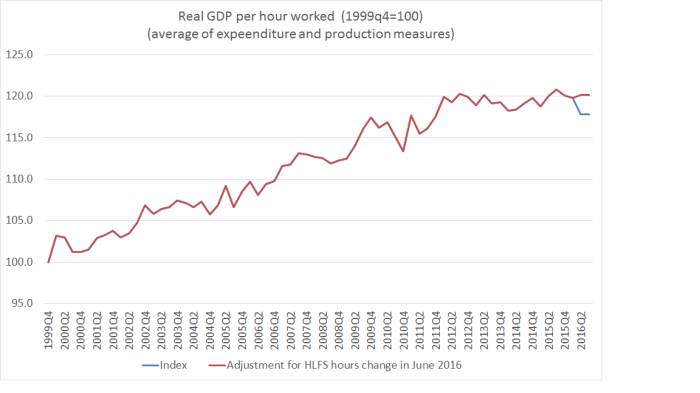
In Australia, the ABS reports an index of real GDP per hour worked as one of the standard suite of published series.  In New Zealand, no such luck.  So I average the two measures of real GDP (expenditure and production) and divide by hours worked from the HLFS.  Unfortunately, Statistics New Zealand upgraded the HLFS earlier this year, and in the process introduced a break in the hours worked series.  There is a step up in hours worked that is partly on account of simply measuring things differently (and probably better).  Improvements in statistics are, of course, welcome but it is a little frustrating that the agency has made no effort to produce an official break-adjusted series.   In the June quarter, hours worked rose by 2.6 per cent.  As real GDP rose by 0.7 per cent, and there has been little sign of productivity growth in recent years, I’m going to assume in the charts that follow that 2 percentage points of that increase in hours was just a result of the change in methodology.  It won’t be quite right, but it doesn’t look likely to be seriously inaccurate either, especially against the measurement challenges and revisions we always face in looking at GDP/productivity.

So here is the resulting measure of real GDP per hour worked

real-gdp-phw-dec-16

And, even with the data updates, there is still no sign of any material productivity growth.  It has been 4.5 years now since this productivity index got to around the current level.

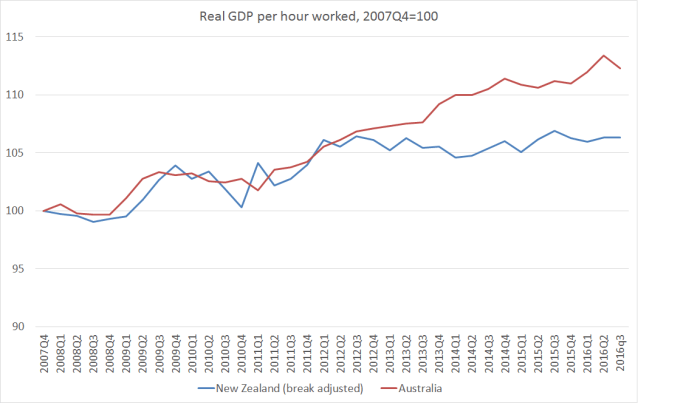
There was plenty of gloomy commentary around the recent Australian quarterly GDP outcome, but in productivity terms  even after a poor quarter (in a series with some noise), Australia continues to pull away from New Zealand.  Here are the two GDP per hour worked series, starting from 2007q4, just prior to the New Zealand (and global) recession and the Australian downturn.

real-gdp-per-hw-aus-and-nz

Our dismal productivity performance really should be getting more attention, and raising more concern, than it seems to.  But today isn’t the day for a long post on the underlying problems and possible solutions.

I’ll be taking something of a break.  There might be a few posts in the next few weeks, but something like a normal flow won’t resume until the week starting 30 January when the kids start going back to school.

In the meantime, in honour of Sunday’s Feast of the Incarnation (aka Christmas) I’ll leave you with this from John Milton’s poem

On the Morning of Christ’s Nativity
Compos’d 1629

I

This is the Month, and this the happy morn
Wherein the Son of Heav’ns eternal King,
Of wedded Maid, and Virgin Mother born,
Our great redemption from above did bring;
For so the holy sages once did sing,
That he our deadly forfeit should release,
And with his Father work us a perpetual peace.

II

That glorious Form, that Light unsufferable,
And that far-beaming blaze of Majesty,
Wherwith he wont at Heav’ns high Councel-Table,
To sit the midst of Trinal Unity,
He laid aside; and here with us to be,
Forsook the Courts of everlasting Day,
And chose with us a darksom House of mortal Clay.

III

Say Heav’nly Muse, shall not thy sacred vein
Afford a present to the Infant God?
Hast thou no vers, no hymn, or solemn strein,
To welcom him to this his new abode,
Now while the Heav’n by the Suns team untrod,
Hath took no print of the approching light,
And all the spangled host keep watch in squadrons bright?

IV

See how from far upon the Eastern rode
The Star-led Wisards haste with odours sweet:
O run, prevent them with thy humble ode,
And lay it lowly at his blessed feet;
Have thou the honour first, thy Lord to greet,
And joyn thy voice unto the Angel Quire,
From out his secret Altar toucht with hallow’d fire.

Labour on New Zealand Superannuation

Sometimes I wonder where Andrew Little gets his advice/ideas.

Yesterday, the Dominion-Post ran an article by Vernon Small reporting an interview with the Labour leader and his finance spokesperson Grant Robertson.   In it

Little reaffirmed his opposition to raising the retirement age – a policy he scrapped as leader – but he wants to resume payments to the “Cullen” fund that pre-funds some of the cost of the universal pension.

“Do we need to resume contributions to the Cullen Fund? Too darn right we do, (because) $14.5 billion of contributions not made in the last eight years would have been worth $20b to the fund.”

Other changes to superannuation were not being contemplated, although Little did not rule out other options such as changes to the current indexing, which is linked wage rates.

“Those are things you can have a look at. They are not big money-savers necessarily – over time they might be – but (I am) not certainly averse to looking at those sort of things.”

But New Zealand could be proud of its low level of elder poverty. “So why would you want to change that?”

I agree that the low level of poverty among the elderly is something New Zealand can be proud of.  So why would Labour want to put it in jeopardy?   Because that is exactly what changing the indexing basis would mean over time.   By contrast, raising the age of eligibility gradually –  the policy Labour previously campaigned on but has now abandoned – would be one of the best ways of securing the admirable record of keeping from poverty those unable to work because of advanced age.

At present, NZS payments are indexed to changes in average nominal wages.  That means that, over time, those on NZS share in the overall gains that wage earners achieve.  When productivity growth is low, neither wages nor NZS tend to rise very much in real terms, and when productivity growth is strong the elderly get to share in the gains.  It is easy enough to run an economist’s argument for an alternative approach:  index to the CPI instead (as some favour) and NZS is kept at a constant real level, regardless of what happens in the real economy.  If the current real level of NZS is enough to keep poverty at bay, that same level should keep poverty at bay in future –  at least if “poverty” is defined the same way.

Changing the indexing basis makes a huge difference over time.    In their recent Long-Term Fiscal Statement, looking ahead of 40 years, Treasury (perhaps optimistically) assumed annual labour productivity growth of 1.5 per cent per annum.  Only a couple of days ago, they tweeted the chart from the report highlighting just how much would be saved by indexing to the CPI instead of to wages.  But the flip side of moving to CPI indexing is that NZS payments received by individuals in the future would be much lower than they would be under the current rules.  In fact, on the Treasury productivity assumptions, NZS weekly payments 40 years hence would be only around 55 per cent of what they would be on the current, well-established, formula.   Adopting such a rule would almost certainly see a big increase in the number of elderly people measured as living in poverty –  and since community expectations, and regulatory minimum standards in a whole range of areas, tend to rise with economic growth it is almost certain that there would be an increase in real hardship.  Imagine if real NZS weekly payments had been held constant for the last 50 years.

There is nothing inherently right about the current real (absolute or relative) level of NZS.  It is the outcome of a series of political (com)promises.  Sure some money could be saved by moving to CPI indexing for a while, but CPI indexing would almost certainly be untenable and unsustainable in the long run, reopening intense debates every few years as to just what level of income superannuitants should receive.  Avoiding the bitter fights around NZS that characterised New Zealand politics from the mid 80s to the late 90s seems highly desirable.

What I found really puzzling about Little’s reported remarks is that changes in the indexing arrangements would affect everyone who receives NZS –  and would potentially adversely affect them for the rest of their lives.  By contrast, changing the eligibility age doesn’t affect those (a large number of voters) now receiving NZS at all.   And changing the eligibility age slowly, as New Zealand can still afford to do, is a very slight dislocation for most people.   Increase the age of eligibility by, say, two months a year until the age gets to, say, 68, and then index any future increases to future increases in life expectancy.  On that rule, someone who was 60 when the policy change took affect might have to work until almost 66, instead of until 65, to receive NZS.  From their perspective, of course it is a loss and unwelcome, but it isn’t a huge dislocation.  And it is a much slower pace of adjustment than we adopted in the 1990s and early 2000s, when the age of eligibility was raised from 60 to 65 at a rate of six months a year –  and governments managed to get re-elected nonetheless.  I don’t imagine there are many 50 year olds now who expect to collect NZS at 65.

Yes, there are some people who are physically unable to work by the time they are 65.  There always have been, and no doubt always will be.  We have working age people now who are physically unable to work.    And any compassionate society needs to make provision for those people.  But that needn’t mean a universal entitlement at age 65 indefinitely.

The other overdue change to the NZS system is to alter the rules of eligibility.  A residency requirement of only 10 years to claim a full NZS payment seems generous to the point of irresponsibility, prioritising those with a weaker natural claim on our support, over those with a greater claim.  That is especially  so as I pointed out again recently the rules mean that for many people (especially New Zealanders in Australia) they don’t need to have lived in New Zealand –  or paid New Zealand taxes – at all.    The Retirement Commissioner proposes a 25 year residency requirement.  One other possibility might be phased residency tests: perhaps after 10 years, a person might be eligible for 20 per cent of the standard NZS payment, and after 30 years might be eligible for 100 per cent.   But that residency test should involve actual physical residence in New Zealand.

I’ve long been meaning to write a sceptical post about the New Zealand Superannuation Fund.  It was a worthy wheeze in the days when Michael Cullen set it up –  discouraging his colleagues from spending all of the large surpluses –  but it has no natural place.  There is no good moral or economic ground for keeping a universal pension at 65, even as life expectancy continues to increase,  the ageing of the population is a permanent (welcome) feature not a temporary blip, and we don’t have large surpluses any more –  and haven’t had surpluses at all for the last decade.  Labour is quoted citing the investment gains that could have been had if only contributions had been continued for the last eight years –  but (a) the scale of those gains was inherently unknowable in advance, (b) if, as many believe, global asset markets are overvalued the gains may not even be permanent (the NZSF portfolio is structured in such a way that mean that returns will be highly volatile) and (c) the flip side to putting more into the NZSF would have been even larger increases in government gross debt than we have already incurred in the last few years.  Paying public servants to take big leveraged investment risks doesn’t seem a natural role for government (although I know some of my readers/commenters disagree).

I wonder what Labour’s private attitude is?  After all, Labour governments elsewhere in the world –  notably Australia –  have put in place policies to raise the eligibility age for the state pension.  Perhaps they really hope that in next year’s Budget Bill English and Steven Joyce will take the brave but responsible step of raising the eligibility age slowly.  If they did, it is hard to envisage responsible members of the Labour Party’s leadership opposing such a stance with any conviction.

Not bucking the longer-term trends

I was belatedly reading the speech given earlier this month by the Governor of the Reserve Bank.  His speeches often have had a strong tinge of cheerleading for the government –  either highlighting the positive indicators ministers and the former Prime Minister liked to cite, or highlighting as areas for concern only those aspects that the government itself had been raising (thus, for example,doing things about improving housing supply is regularly mentioned, but never the option of cutting back on the medium-term target level of immigration).

This speech was a little different.    The Governor took the opportunity to note that the current recovery –  itself interrupted by a double-dip recession in 2010 –  has been the weakest (in terms of average GDP growth rates) in New Zealand for many decades.  Under a heading “labour productivity growth has been particularly weak”, he explicitly drew attention to the estimate that “New Zealand’s trend rate of labour productivity growth is in the bottom third of OECD countries”, and also noted just how weak growth in total factor productivity growth has been.  The dismal record should be quite a challenge both for the new Prime Minister and Minister of Finance, and for opposition parties thinking about the policy proposals they will campaign on in the next year’s election.

But the paragraph that caught my eye in the Governor’s speech was this one.

New Zealand’s household net savings rate improved by 8 percentage points in the period 2008 to 2013 (from minus 6 percent to positive 2 percent of household disposable income (figure 5)).  Over this period, New Zealand’s overall savings rate (ie including savings by the business and public sectors) increased by around 5 percentage points, and this has been an important factor behind the improvement in New Zealand’s ongoing current account deficit and the decline in net external liabilities as a share of GDP (this ratio has declined from 84 percent of GDP in 2009 to around 63 percent of GDP currently).

It prompted me to go and have a look at the recent annual national accounts data (which will have been released just after the Governor gave his speech).

It was the comment on the overall national savings rate that surprised me.   Here is a chart of the net national savings rate as a share of net national income.

net national savings.png

There has certainly been quite a rebound in the national savings rate since the recessionary trough in the year to March 2008, but it does look mostly cyclical.  The latest observation is around the same level we saw in the year to March 2005.   There isn’t any sign that overall savings rates in New Zealand, averaging across the cycle, are any higher than they have been on average in recent decades.

Here is a shorter span of history for the household savings rate (also as a share of NNI).

household savings.png

The trough in this series was the year to March 2003, just before the big housing boom of the 00s got underway.   There was quite a recovery in the last years of the economic boom and during the recession and immediate aftermath.  But the steady fall in the household savings rate over the last few years also suggests nothing very different from history.    If the current household savings rate is higher than the earlier troughs, at the same time the government savings rate is lower than it was then.

Here is the chart for the same period of government and private savings rates.  “Private” includes –  and is typically dominated by –  business saving.

govt and pte savings.png

For a variety of reasons, when government savings rate rise private savings rates tend to fall, and vice versa.  The really sustained recovery since 2007 has been in business savings –  a component of savings that is typically too little analysed.

The Governor’s comments focused on changes in the savings rate(s).  But the other side of the equation –  particularly as it affects the interpretation of the current account –  is investment.

Here is the long-term chart of investment (national accounts definition –  gross fixed capital formation) as a share of GDP.

gfcf dec 16.png

Again, as I’ve illustrated previously, we’ve had a cyclical rebound in investment rates.  But it isn’t an impressive rebound.  The latest observation –  this in an economy which the Bank thinks has perhaps a small positive output gap – is well below the peaks in 1976 and 1986, and around the same level as the peak in 1996.   The economy went into the 1990s recovery with a massive overhang of commercial property, so it perhaps wasn’t surprising that overall investment didn’t surge to really high levels.  By contrast, in this cycle earthquakes destroyed quite a lot of commercial, residential and government capital stock –  necessitating a lot of gross fixed capital formation just to restore the capital stock to what it was pre-earthquakes.

In many other OECD economies, a gradual decline in the investment share of GDP over time wouldn’t seem odd, as the population growth rates have been trending downwards.  In many cases those countries now have flat or slightly falling populations, and just don’t need as much new investment to maintain capital/output ratios.    But that isn’t the story of New Zealand.  Over the period of that GFCF chart there has been no trend decline in New Zealand’s population growth and in the last year or two, our population has grown as rapidly as at any time since the 1950s.  This chart is a few quarters old, but it illustrates the point.

world-population-growth

I wouldn’t want to make very much of the narrowing in the NIIP position.  Again, the Governor referred to a trough in 2009 and compared it to the current position.  But the NIIP position tends to cycle, and over 25 years there hasn’t been much change in the trend level.

But if anything, one could run a slightly contrarian position that a better-performing New Zealand economy over the last few years –  one where more firms wanted to invest more –  the current account deficit would have been wider and the negative NIIP position somewhat larger.  Overall, weak investment looks to be a symptom of weak demand –  both domestic and external.  Firms simply haven’t seen many great opportunities for investment and so, even with all the rebuild and repair work, overall investment levels have been pretty subdued.

And it isn’t as if the economy has been fully employed during that period.  The Governor notes in his speech that the unemployment rate is below the 20 year average. But it is above official estimates of the NAIRU and has been for eight years now.  It isn’t as if there has been an inflation problem either: core inflation has been below target for years now.  And the exchange rate has been extraordinarily high.

There are limits to what monetary policy can do, but stimulating demand –  all else equal –  is what it can do; in fact, it is the reason why we have discretionary monetary policy at all.    The data –  current account, investment rate, as well as the inflation and unemployment rates –  suggest that monetary policy should have been doing more over the last few years.  That it hasn’t is a choice the Governor has made, but having made those choices –  consistently mistaken in my view –  he shouldn’t be trying to sell as a virtue one of the key symptoms of the persistent weakness of demand.

The Morgan immigration policy: appealing to MBIE and Treasury?

Gareth Morgan’s The Opportunities Party last week released their immigration policy, in a reasonably substantial eight page document, long on words and light on pictures.  I’m a classic floating voter, with absolutely no idea who I might vote for at next year’s election, and a nerd too, so I like the idea of a party coming out with some serious discussion of important issues perhaps nine months before the election.  On immigration policy in particular, it is more than we have seen from any other party.

The TOP immigration policy strikes me as one that the bureaucrats in MBIE and Treasury might quite like.  Perhaps some of the more thoughtful ministers might be inclined to agree (quietly) as well, but it is an approach that is in quite striking contrast to the gung-ho assertions that the current system is working just fine, and benefiting all New Zealanders, often heard from the new Minister of Finance.

TOP’s policy document begins

“We are strongly pro-immigration as another tool in the box to improve the prosperity of New Zealanders”

Which seems to fit very nicely with MBIE’s claims that New Zealand’s non-citizen immigration is a “critical economic enabler“.    TOP go on to note/claim that

“Migration enlarges our economy and has a small but real positive impact on our living standards”

and

Net immigration puts a small upward bias to economic growth which is good for keeping confidence and encourages investors to take the risks necessary to underpin growth in per capita incomes.

There are certainly plenty of claims along those lines, and it has been easy enough for academics to generate models showing how such gains to living standards might arise, in principle.    But there is no evidence advanced by TOP –  or by MBIE, Treasury, Steven Joyce, Michael Woodhouse, Business New Zealand or the New Zealand Initiative –  to demonstrate that in the specific circumstances of New Zealand large scale non-citizen immigration has actually improved the living standards of New Zealanders.

The focus of the TOP immigration policy document is on some of the specifics of what is wrong with the current policy approach.  In many respects, there has been a lot of continuity in policy whatever party has been in government over the last 20 years.  But the current government has gone further than its predecessors in debauching the system, a point made in the TOP document with Gareth’s customary vigour:

“The Government’s craven desire for economic growth at any cost – even if incomes of New Zealanders aren’t rising –  has seen it make Permanent Residency far too easy for migrants who add nothing.”

And here I can agree with a lot of the TOP specifics.  The way the student visas policy has been run is a disgrace, and should be an embarrassment to any New Zealander –  at least perhaps other than those running private training enterprises.  As TOP put it

“There have been numerous instances of dishonest behaviour by NZ providers and their foreign and local agents. There are many sotries about conflicts all along the supply chain from the finders in India, right through to shonky qualifications being granted in New Zealand.  The real issue is that too many involved in the supply chain don’t care much about the education anymore, it’s become an Underground Railroad for aspiring but modestly skilled folk of modest means to gain permanent residency in New Zealand.

The Government, with its obsession in seeing foreign education as a winning growth sector has sold the integrity of our immigration policy down the river.”

Probably no one would argue against an approach that gave points towards residency to people completing, say, a Master’s degree in a core academic subject from a well-regarded New Zealand university.  New Zealand PTE qualifications are quite  another matter.

They go on to criticise the plethora of new working holiday visa schemes –  themselves often put in place more for foreign policy reasons than based on a hardheaded analysis of the economic impact on New Zealanders (especially perhaps less skilled and lower income New Zealanders) –  and the clearly inadequate way in which the points scheme is working.

As TOP note, in dealing with economic immigration

“we only desire people who make us more prosperous.”

There is little sign of that in how current policy rules are working.

Among the specifics on the TOP list of policy proposals there are ones I can agree with:

  • “remove the need for highly-skilled migrants to have a job to come to”.  If we are serious about bringing in highly-skilled migrants, we shouldn’t be putting them through the hoop of compelling them to find a job here from offshore, and potentially move their families to the other side of the world unsure if they will eventually get residency.  Yes, language tests probably have an important role, and there is no point bringing in people with qualifications that simply won’t be recognised here, but if there are long-term gains from immigration they almost certainly arise from the quality of the people we attract, not from the ability to match up with a specific job from the first moment they arrive in  New Zealand. The policy change to favour, in granting residency, people already in New Zealand on temporary visas, was well-intentioned but hasn’t worked to benefit New Zealanders.
  • “reform the study-to-work-to residency regime for foreign students so that only jobs that meet a genuine skill criteria are recognised for residency points”.  I’d go further than that –  removing the right of students to work here while studying, and granting points only for recognised post-graduate qualifications –  but what TOP proposes would be an improvement on where we are now.
  • “reform the points system to reflect the importance of salary level, English language skills, and the ability of migrants to contribute to the economy”.  That last provision worries me a little –  it can cover a multitude of sins –  but the direction seems right.  Again, I would go further and remove the additional points available for job offers in the provinces –  that scheme simply reduces further the average skills level of the migrants we do get.

It is also good to see that TOP endorses the increasingly popular view – even the Retirement Commissioner has belatedly come out in favour  of it – that the residential qualifying period for obtaining New Zealand Superannuation should be extended from the current 10 years to (in their case) 25 years.

I’m less sure I could be enthusiastic about “applicants for Permanent Residency must demonstrate an understanding of our Constitution and the status of the Treaty of Waitangi”.  I sympathise with the apparent intent, but would “uncertain” be an acceptable answer –  in one of the few countries without a formal written constitution and where the status of the Treaty is more a matter of political debate than of law?

Thus far, I think the TOP policies, if adopted, would represent quite an improvement on what we have now.  But, as I noted earlier, I suspect that Treasury and MBIE officials might well agree.

I’m less convinced that the points system itself is a bad way to ration whatever quantity of non-citizen migrants we want to allow in.  Gareth argues

And at the heart of this question [who should we allow in] is – who should decide?  Some bureaucrat adding up eligibility points in a dark room at the back of an earthquake-prone building in Wellington? Or the market?  Obviously the market needs to.  There needs to be either a job offer at a wage that reflects the skill shortage or a track record of the employee having what it takes to add value.”

But it sounds a lot like a points system to me.    The real question is what we should issue points for, not whether to have something like that sort of scheme.  If one is an open-borders libertarian, or even someone who thinks that almost our migrants should come on refugee or family reunification grounds, things might seem different.  But TOP –  rightly in my view –  argues for an explicit economic orientation for most of our immigrant inflow, and if that is the framework someone needs to devise a rationing device.  We could auction places subject to various minimum criteria but, to my knowledge, no one has proposed such a scheme (and no other country with a substantial immigration programme has operated an auction scheme).

Many of these points are about detail.  The big area in which I disagree with TOP is around the overall level of non-citizen immigration we should be aiming for.  They observe

“our immigration policy then, is all about improving the levers.  A 1% contribution to annual population growth from net immigration is a good ceiling”.

As I noted a few months ago in writing about the Green Party’s new immigration policy, an annual ceiling on net immigration is all but impossible to manage.   The flows of New Zealand citizens into and out of the country are large, variable and very hard to forecast.  By contrast, we have fairly tight control on the flows of non-New Zealand immigrants.

I’m not entirely sure how to read the TOP target, but given that for the last 40 years of so there has been a net outflow of New Zealand citizens almost very single year, presumably TOP would be aiming at a net inflow of non-New Zealand citizens of around –  or perhaps slightly more than –  1 per cent of the population per annum.    At present, that would be a net inflow of non-citizens of around 47000 per annum.  By contrast, the gross residence approvals target now is centred on 45000 per annum, and the typical net inflow of non-citizens over the last couple of decades has been a bit lower than that (some of those granted residency don’t end up staying long).     In other words, in terms of overall numbers TOP seems to proposing inflows a bit less than those of the last year or two, but something quite similar to the average outcomes of the last 15 years.

That makes some sense on their own terms.  As I quoted earlier, they believe that high levels of immigration can improve the long-term prosperity of New Zealanders.   And I’m with them (at least most of the way) when in their FAQs they say

Question

How big then should the inflow of foreigners be?

Answer

The simple answer is the levels beyond which migration ceases to contribute to raising per capita income of Kiwis.

But where is evidence that anything like the sort of inflows of non-citizens we’ve had in recent decades –  or most of the time since World War Two – is contributing to “raising per capita income of Kiwis”?

It all seems to rest on the same underlying belief –  without evidence specific to the circumstances of New Zealand –  that now guides Treasury and MBIE: the current rules aren’t working very well, but if only we reorient them we can bring in at least as many people and we’ll finally –  decades on –  start seeing the gains of the large scale immigration programme.  Tui’s “Yeah right” springs to mind.

One of the real problems we face is that, attractive as New Zealand is to poor people and people of middling skills in poor countries, we just aren’t that attractive to many really able people.   By advanced country standards, we aren’t that wealthy or productive.  We are a long way from anywhere, including from the cultural and economic centres of the world.  And for all the talk about New Zealand’s wonderful lifestyle, I doubt there is an advanced economy that doesn’t offer very attractive lifestyles in one form or another.  Really ambitious and able people will typically aim for other countries first if they can get in there.  I’m a New Zealander and am at home here, but why as an able ambitious skilled foreigner would you come to New Zealand if you could get into the UK, the US, Canada, Australia, Ireland, or even –  so long as you are happy to learn another non-English language –  most of Europe?  All those countries have problems.  So does New Zealand.

The constant desire, repeated in the TOP document, to bring in lots of foreigners seems fated to be an approach that constantly disappoints.  We  could attract some really able people, and rule changes could help to attract more than the low number we get now.    But we shouldn’t fool ourselves about how desirable New Zealand is –  especially its long-term underperforming economy.  TOP associates itself with the recent strange call from Richard Dawkins for New Zealand to invite the world’s top academics to settle here.  I wouldn’t really have a problem with us doing so, but people need to stop and ask how likely it is to succeed.  When your country is remote, not that well-resourced economically, and when your universities are no better than middling, it simply isn’t very likely that many ‘top academics” would want to come, and in doing so cut themselves off from the funding, the networks etc that help make top tier research possible on a long-term basis.

Perhaps it does no harm to try, but in a way the real problem with the constant focus on trying to get lots of really skilled migrants is that it risks turning into a cargo cult.  Instead of looking to our own people, skills, institutions and energies to produce and sustain prosperity, we constantly look abroad. Other people aren’t the answer to our economic underperformance –  exchanging our people for some mythical superior group from abroad.  It is past time that New Zealand political parties, including TOP, started recognising this.


Gareth Morgan’s tax policy

Economist and commentator, Gareth Morgan, has begun releasing the policy platforms that his new party, The Opportunities Party, plans to contest next year’s election on.  Fairness seems to be his watchword and –  within limits –  who can argue with that aspiration?  But whatever “fairness” means, it doesn’t automatically translate into an obvious set of policy prescriptions.

The first policy he announced was that on tax (document here, and lots of FAQs here).  The centrepiece of the tax policy is to apply a deemed rate of return to  (the equity held in) all productive assets (including all houses) and tax that deemed rate of return at the owner’s marginal tax rate.  Own a million dollar house freehold and if the deemed rate of return was 3 per cent, you’d have an additional $30000 added to your assessed annual taxable income and those on the top marginal tax rate would have to pay, for example, an additional $10000 per annum.   The promise is that any revenue raised from this tax would be fully used to cut income tax rates, with a focus on those on below-average incomes.  In their own words, they expect this policy would

a. Make the tax system fairer;

b. Make housing more affordable over time;

c. Lead to more sensible investment of capital (everyone’s savings);

d. Make capital more readily available for productive businesses that create jobs  and pay wages;

e. Encourage a lot more “trickle down” from those who have stockpiled wealth courtesy  of this loophole; and

f. Reduce New Zealand’s reliance on foreign investment and debt to finance our growth.

I’m sceptical.

No doubt tax accountants and lawyers will have their own detailed concerns (some interesting issues were raised in this post from former Treasury and IRD tax adviser Andrea Black).

At the heart of the policy is a concern that the returns on houses are not appropriately taxed.    There are two strands to that.  The first, and most important in their thinking, is that the imputed rents on living in your own home aren’t taxed.  Everyone will, more or less, accept that that is something of an anomaly.  After all, if you rent an equivalent house and put your equity in a bank deposit, the returns to that deposit will be taxed.    The second is that capital gains typically aren’t taxed (and capital losses typically aren’t deductible).    There is much more room for debate about even the theoretical merits of taxing capital gains –  to say nothing of the practical problems.  But over the last 15 years in most of the country there have been large capital gains associated with housing.  Many rental property owners have not been declaring positive net taxable income, but have still made good overall returns through capital gains.

TOP eschew a capital gains tax –  rightly in my view –  but they appear to believe that their deemed rate of return policy will make future (untaxed) capital gains –  house price booms – less likely.

The idea of a deemed rate of return approach to taxing asset income isn’t new in the New Zealand debate.  Such an approach is already applied to holdings of foreign equities, and only a few years ago the government’s Tax Working Group reviewed the option as an approach to changing the taxation of housing.

Here are some of the reasons why I’m sceptical.

First, Gareth claims that a big part of the economic problem in New Zealand is an over-investment in housing, and that imposing a heavier tax burden on housing will reduce that.  As a result, so it is argued, more resources will be attracted towards business invesment.

This is old ground, but there is simply no evidence of systematic over-investment in housing.  Real investment (gross fixed capital formation) in housebuilding has,if anything, been less –  over recent decades- than we might have expected given our rate of population growth.  Countries with lots more people need lots more housing.  Most indications are that we haven’t built enough new houses.  And perhaps the best indication of that is the high price of houses and urban land.  Over-investment in something is usually consistent with low prices over time, not high prices.

But perhaps TOP have in mind something other than a national accounts meaning of “investment”?  They hint at a belief that houses make up more of household overall asset portfolios than is the case in other countries.  First, that factoid has been substantially discredited since the Reserve Bank last year introduced new and more comprehensive household balance sheet data.  Second, even to the extent it is true it partly reflects (a) overall modest rates of total household savings (people still have to live somewhere), and (b) the extent to which our tax system does not work to bias the ownership of the housing stock towards corporate or funds management entities (often tax-preferred in other countries).  And third, for every housebuyer there is a seller –  typically, from within the household sector.

Is there reason to think that New Zealand in some sense devotes “too many” real resources to housing.  The only one I can think of is that the average size of New Zealand houses –  like those in Australia and the United States – is quite large (much larger than in Europe).  Perhaps there is something in that, although since TOP argue that we need this policy partly because other countries (including the US and Australia) already deal with the distortions in other ways, it isn’t overly compelling.  Nor is it probably great politics to suggest smaller houses –  as we get richer – rather than more houses.

TOP claim that their tax policy will “reduce New Zealand’s reliance on foreign investment and debt to finance our growth”.  They don’t explain what they have in mind here.  Since, as I’ve pointed out, we already devote fewer real resources to building houses than one might expect given our population growth rate, it can’t really be through a channel of less housebuilding.  All else equal, less investment would reduce the current account deficit but……the TOP policy document argues we would see more business investment if their policy was adopted, so it isn’t even obvious why the current account deficit would narrow.

I think they must have in mind a wealth effect from high house prices onto consumption.  If high house prices encourages more overall consumption then, all else equal, that will widen the current account deficit –  although, contrary, to Gareth’s speaking notes at the launch of the policy, not since 1984 have these deficits involved “our political leaders trotting round the world with the begging bowl out”.    But as I have noted on various occasions previously, the evidence for a material wealth effect from higher house prices just isn’t very strong.  Here is a chart from a post I ran a few months ago showing consumption as a share of GDP over the last 30 years or so.

household C to GDP

Almost dead-flat (the red line is the full period average), and if anything edging slightly downwards, even as house prices have gone crazy.   That isn’t surprising: high house prices don’t make New Zealanders as a whole richer, they just redistribute wealth from one group to another (and in most cases –  since people want to stay living in the same house –  even the redistribution is more apparent than real).

In principle, of course, taxing an asset more heavily will tend to reduce its value.  Adopting the TOP policy could be expected to reduce house prices, to some extent.  But it won’t change the fundamental imbalances in the housing and urban land market (regulatory restrictions on land use the most important, but running head on into sustained government-induced population pressures).   And I wonder quite how much there is in the TOP policy proposal.

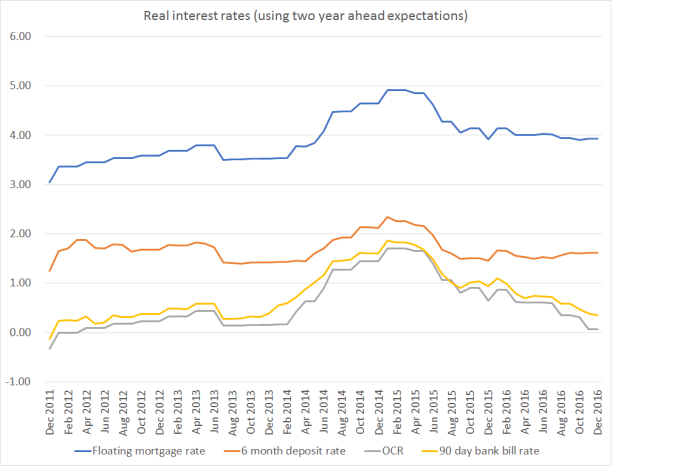
When the Tax Working Group looked at these issues a few years ago, they could talk loosely about a deemed rate of return of 6 per cent, something like the 10 year government bond rate at the time.  These days, having rebounded somewhat in the last few months the 10 year government bond rate is not much above 3 per cent.  And the Reserve Bank assures us that its modelling of long-term inflation expectations shows that they are firmly anchored around 2 per cent.    Real interest rates –  the real risk-free benchmark rate of return in New Zealand are very low.  And even then, our interest rates are still materially higher than those in most countries abroad –  and, as everyone accepts, that isn’t because productivity growth and real opportunities here are so much better than those abroad.  In the UK for example –  with a better long-term productivity record than New Zealand, much more government debt, and a similar inflation target –  the 10 year bond yield is around 1.3 per cent.

One of the problems with the TOP policy document is that there are no details.  They say that is all to be negotiated once they get into Parliament, but it makes a lot of difference whether they plan to use a real or nominal risk-free interest rate, or even a short or long-term rate.  Much discussion has tended to assume that a nominal long-term rate should be used.  I could make a strong –  stronger I think –  case for using a real short-term interest rate.

One of the flaws of our tax system –  or at least its interaction with our monetary policy inflation target –  is that all of nominal interest is taxed, and where interest is deductible all of nominal interest is deductible.  That is so even though the portion of the interest that simply compensates for inflation  –  maintains the real value of the asset – is not (in economic terms) income at all.  As a parallel, inflation raises the nominal value of your human capital to maintain the real value of that asset, but it is only the returns to that higher nominal asset value (any increase in annual wages) that is taxed.  Economists tend to quite like the idea of inflation-adjusting the tax system, while tax administrators hate it (for practical reasons).  It is already more of a problem in New Zealand than in most countries (because we fully tax –  and thus double tax –  all interest income).  But it would be a major new distortion, on a much more serious scale, to impose a nominal deemed rate of return across a much much larger stock of assets (than just fixed income assets that are already over-taxed).

So to me if the TOP policy were to be adopted the logic of using a real interest rate as the deemed rate of return (or fixing the zero lower bound and lowering the inflation target) seems pretty clear.

What about the short-term vs long-term rate issue?  No doubt, defenders of using a long-term rate would note that these are typically long-term assets.  But…..one has to assume that the deemed rate of return will change over time (even long-term bond rates do).  And it seems unlikely that if I buy a house today, Gareth’s policy would offer me tax certainty –  say, using today’s 10 year bond rate for the next 10 years.  If not, and if the deemed rate of return is subject to, say, annual review at each Budget, then using something like a one year government bond rate would seem a reasonable approach.    But the one year government bond rate is around 1.9 per cent at present, and year-ahead inflation expectations aren’t much lower than that.  A real risk-free government bond yield in New Zealand at present is around 0.5 per cent. And it is even lower in other, generally more successful, economies.

Now a reasonable rejoinder might be that the times are exceptional, and that these rates can’t last for ever.  If I were a betting man, I would probably agree.  But……our interest rates are higher than those in the rest of the world, and one of the goals of the Business Growth Agenda is to see that gap close.  And we aren’t in the depths of a recession: best estimates are that the output gap might be somewhere near zero, and yet our Reserve Bank expects no change in the short-term policy rate for the next few years.  If one is taking a policy to the electorate over the next 12 months, one surely has to work on the basis that the interest rates we have now might be around for some time.

If real short-term interest rates are the conceptually and practically appropriate rate to use in a deemed rate of return model, the tax on that million dollar housing equity would be around $1666 per annum, even for those on the top marginal tax rate.  That would be an annoyance to homeowners but –  especially with some income tax relief on the other side –  hardly likely to materially transform the housing market.   From Gareth’s perspective, that could have an upside –  an unthreatening introduction, and then when/if real interest rates return to “normal” it begins to bite much harder semi-automatically.  But it is a hard sell to make big changes in the tax system for such small potential payoffs at anything like current interest rates.

What else makes me uneasy (more briefly):

  • one of my objections to a practical CGT is that it tends to make government revenue even more highly pro-cyclical, encouraging unsustainable spend-ups as asset booms go on.   The deemed rate of return approach seems to face very similar problems.  Because a lot of housing assets are leveraged, the equity in housing changes more than proportionally with changes in houses prices.  A 20 per cent annual increase in house prices –  perhaps at a time when interest rates were rising anyway  –  might induce a 25 per cent rise in annual revenue from this tax.  While it is all very well to talk of full offsets in income tax reductions, it is very unlikely that would happen year by year –  or else, there will be material increases in income tax rates in the middle of asset busts, which again seems highly unlikely.  So, it looks like a policy that will tend to undermine spending discipline just at points of cycles when it is most needed, and undermine government revenue just at the point of the cycle when it is most valuable.
  • it is a systematic tax on Aucklanders  (most of the asset-based revenue will be raised in Auckland, but income tax rates are national and low income people aren’t concentrated in Auckland).  As a Wellingtonian that might not unduly bother me, and as an economist there might be a plausible argument for it, but there are awfully large number of voters in Auckland.
  • Valuation issues seem more substantial than TOP allow for.  In their FAQs there are blithe descriptions of how house values might be triangulated, but if I am facing a large annual tax on the imputed rent on my house I will likely care much more about the assessed value being used than I will in respect of local body rates.  The compliance costs seem non-trivial –  and that is before getting into business assets.
  • There is a reasonable economic case for a pure land tax. The quantity of unimproved land is fixed, and so taxing that value doesn’t change the supply of land.  But this isn’t a land tax.  It would apply to business assets as well, as –  in effect –  an underpinning minimum tax (if existing income tax liability is lower than the deemed rate of return).  But many businesses fail –  they never succeed in making much taxable income.  And while we want a strong stream of highly profitable businesses, one of the ways one gets there is to have plenty of entrepreneurs take risks, and often enough fail.   The TOP document talks about the ability of firms to   “allow those businesses facing a temporary or cyclical earnings downturn to defer their minimum income tax for a period of up this to 3 years (use of money interest to be charged)”.  But that doesn’t seem to deal with businesses that never succeed at all.  Imposing a fixed minimum tax, even if it can be deferred for a few years, is an increased tax on entrepreneurship.  What you tax, you get less of.    And yet TOP talk of encouraging more “productive” business investment and more entrepreneurship.

In the end, I think my assessment of the TOP policy is that a very high level it isn’t necessarily inappropriate, but would be hard to make work well, doesn’t offer very much in a low (real) interest rate world, and is misconceived as a structural answer to either our housing price problems or our sustained economic underperformance.

Next week I will write about TOP’s new immigration policy, which I strongly agree with parts of, while being quite sceptical of other parts.  To their credit, it is a more serious engagement with the issues than we’ve seen from other parties to date.

Cities

I was participating in a debate the other day with a prominent economist and a leading business person.  Both seemed keen on actively growing New Zealand’s population further –  the economist in particular calling for a “population policy”, and appearing to argue that a much larger population was a critical element in improving New Zealand’s productivity outcomes.  The principal channel that he appeared to have in mind was better physical infrastructure, notably (because he explicitly mentioned them) high speed trains between our major cities.  Both my interlocutors seemed keen on a much larger population for Auckland –  to which my response was along the lines of “what, and dig an even deeper hole than we’ve already dug”, given the economic underperformance of Auckland relative to the rest of the country over the last 15 years.  None of this advocacy for an active policy role in growing population further appeared to give any recognition at all to

  • the economic underperformance of Auckland
  • the lack of any evidence that countries with smaller populations tend to be smaller or less productive than those with larger populations, and
  • the lack of any evidence that small countries have been achieving less productivity growth than large ones.

As far as I can see, the only OECD country where there might –  just might –  be a strong case for an active government role in trying to grow the population is Israel, surrounded by much more populous hostile states.  And even then, Israel’s survival so far  –  I remain a little sceptical that it will last longer than the Crusader states of earlier centuries – is more down to technology, organisation, institutions, and embedded human capital than to numbers of people.

But what prompted this post was a comment from the economist that not only should Auckland’s population be markedly further increased –  and the residents urged into apartments –  but that governments should be actively aiming to increase the population of our other cities and regions.  The specific aspiration that caught my attention was the suggestion that our second biggest city –  at present, Wellington and Christchurch have similar populations –  should have a population around half that of Auckland.  I was somewhat taken aback and responded “but that isn’t typically how things are in other countries”, to which the confident response was “oh yes it is”.  So I thought I had better check the data.

I set aside very large countries, and extremely small ones.  Most of Malta, for example, is Valetta.  Even among the large countries there is quite a range of experience: Britain, France and Japan have single dominant city, while Germany, Italy, and the United States don’t. But I found 22 advanced (OECD or EU) countries each with a total national population of between 1.3 million (Estonia) and 17 million (Netherlands), and I dug out the data, as best I could, for the populations of the largest and second largest urban areas in each of those 22 countries.  20 of the 22 countries are in Europe, and Israel and New Zealand are also in the sample.

Here is the share of the total national population accounted for by the largest city in each country.

cities-1

Among these smaller advanced countries, our largest city’s share of total population is a bit above the median, but nowhere near the highest share.  Of course, as I have noted previously, except for Israel (Tel Aviv), our largest city has grown faster than any of these countries’ largest cities in the post-war decades.

But what about the specific point at issue: the size of the second largest city relative to the largest city.  Here is that chart.

cities 2.png

There is huge range of experiences even among this group of relatively small advanced countries –  from Latvia and Hungary where the second city is tiny relative to the largest, to the Netherlands and Switzerland at the other end.  In those two countries, the largest city is quite small relative to the total population.  There isn’t an obvious correlation between economic success and the relative size of the second largest city.  Ireland and Denmark are much richer than New Zealand, but so are the Netherlands and Switzerland.  And Latvia, Hungary, Slovakia, Portugal and Bulgaria are poorer than us.  New Zealand’s number isn’t much different from the median country’s experience.

One thing worth bearing in mind in this sample is that in most of these countries, the largest country is also the capital.  That isn’t so in New Zealand, Israel, or Switzerland – or, for practical purposes, the Netherlands.  All else equal, one might hypothesise that Wellington would be smaller if it were not the capital –  but that might just have left Christchurch as the clear-cut second largest city.

Since there is a wide range of experiences across similarly wealthy countries in the relative size of largest (and second largest) cities, it might be wise to be rather cautious in concluding that government policy should be actively directed to altering the relative size of some or other groups of cities.  Patterns across countries are likely to reflect some mix of history, geography, and economic opportunities.  In some countries, outward-oriented economic activity is heavily concentrated in big cities (one might think of London), in others it derives largely from non-urban natural resources (one might think of Norway).

As it happens, as a matter of prediction rather than prescription, I do think that a successful reorientation of policy in New Zealand would increase the relative size of second and third tier cities relative to Auckland.  But it would do so because (a) Auckland’s population would no longer be supercharged by an aggressive immigration policy, and (b) because, as a result, overall population growth would be lower, there would be less pressure on real interest rates and the real exchange rate, and the outward-oriented economic opportunities, which are at the heart of the provincial economies, would be more attractive, and would see more business investment taking place.

If, instead, governments persist with large non-citizen immigration programmes then, for all the talk of the attractive lifestyle the regions offer, it is a recipe for even more of the same.   Why wouldn’t that happen –  doing the same thing again and again and expecting a different result doesn’t, to put in mildly, make much sense.    For the last few decades, Auckland’s population has grown rapidly relative to that of most of the rest of country.  And its relative economic performance appears to have languished –  there is  certainly lots of activity to keep up (more or less) with the needs of a growing population, but little productivity growth.  Indeed, the large productivity margin one might normally expect to see in the data for largest cities is quite small in Auckland, and has been shrinking further.  There is no sign of some critical tipping point being reached in which –  say – high speed trains are about to transform our economic prospects.

As for the regions, one hears enthusiastic talk from time to time of encouraging migrants to the provinces –  and last year the rules were further tweaked in that direction.  But that is simply a recipe for further undermining the quality of the migration programme –  less able people who are desperate to get in will go to the provinces, to pick up the additional points on offer.  We want people to move to Invercargill or Napier –  if they do – because the business opportunites there are sufficiently good to attract people, not because the government puts points “subsidies” on offer, which simply mask the serious structural imbalances in the economy.  The best path to better provincial performance –  not an end in itself, but probably part of a more successful New Zealand –  is likely to be the removal of the distortions and policy pressures that have given us such a persistently overvalued real exchange rate for so long.  Using policy to simply bring in lots more people won’t do that –  any more than it has for the last 25 years.