Officials in pursuit of more powers

It is a big few weeks for the Reserve Bank and, in particular, the Governor.   This week the Monetary Policy Committee is gathering for its deliberations leading to next week’s  Monetary Policy Statement.  A couple of weeks later there is the Governor’s six-monthly Financial Stability Report,  and the week after that we are told that the Governor will descend from the mountain-top and reveal his decision on bank capital.   There are at least two press conferences scheduled (MPS and FSR) and given that he has deliberately chosen to release the momentous capital decision only after the FSR press conference one has to hope that he will make himself available to explain and defend his choices (and, although he has staff, all the decisions –  and responsibility for them –  are his alone).

Meanwhile stories rumble around about the possibility that the Bank’s Board has,for once, found its voice and suggested to the Governor that he needed to change his style.  I heard yesterday another version of a story that culminated in the Governor yelling at the chair of the Board after the latter (so it was reported) suggested that aspects of the Governor’s conduct were unacceptable.   I have no way of knowing whether these stories are true, or are just wishful thinking, but given the quiescent and deferential track record of the Board over many years, it would be perhaps a little surprising if there was nothing to the stories now.

One of the other projects the Reserve Bank has underway, which attracts less attention and controversy, is that around the future of cash.  It is both an apt issue to be focusing on and, at the same time, something of an odd one.  And, remarkably, in the discussion document the Bank put out a few months ago there was no mention –  at all, as far as I can see – of the most immediately pressing issue: the limits on the ability to cut the OCR that arise because of the (near) free option people have to shift from bank deposits etc to physical cash.

The future of (physical) cash is somewhat of an odd issue to be focusing on because cash outstanding has been rising relative to GDP.    This chart is from the Bank’s discussion document

cash 1.png

It tends to exaggerate the point, by starting from the trough.  Here is a longer-term chart from a post I wrote on these issues a while ago
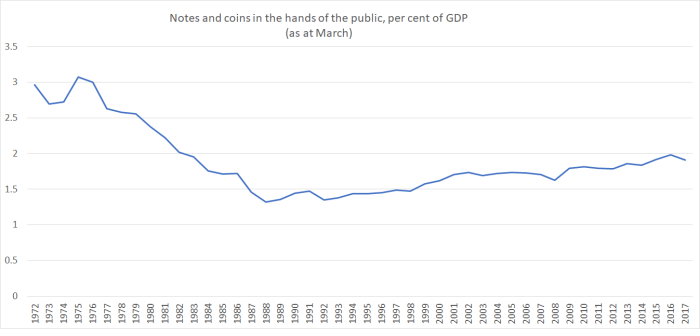
notes and coin

All else equal, when interest rates are very low (and inflation is low too) people are more ready than otherwise to hold on to physical cash.  Of course, quite who is actually holding the cash, and for what purpose, is a bit of a mystery, one not really addressed in either the Bank discussion document or in the poll results they published last week, framed in terms of a high preference for using electronic payments media whenever possible.

The Bank included an interesting chart in its document illustrating that although the ratio of cash to GDP is quite low in New Zealand, the rise in that ratio wasn’t out of line with what has been seen in quite a few other advanced countries.  Sweden and Norway –  where the ratios have fallen –  are outliers.

cash 3.png

There is quite a strong suggestion that in the most recent period a big part of what is holding up currency in circulation was the surge in overseas tourism, especially from China.

cash 4

Overseas tourism remains one of the areas where physical cash is much more likely to be used than in normal domestic spending.

Notwithstanding these routine and entirely legitimate uses of physical cash, it is still hard not to conclude that a large chunk of the physical cash on issue –  in excess of $1000 per man, woman, and child –  is held to facilitate illegal transactions, including tax evasion.   That was Rogoff’s view, and as I wrote about here he –  against my priors – converted me to that way of thinking.

So there would seem to be no risk of cash disappearing from the New Zealand scene any time soon.   And yet the monetary policy constraint arguments, that the Bank simply doesn’t address in its discussion document, suggest that if anything the use of Reserve Bank cash (and especially the potential use of cash) should be constrained more tightly than at present.  The Governor may repeatedly assert that unconventional monetary policy options will do just fine, but few other people would look at the international experience of the last decade without thinking that monetary policy ran into limits.  Those limits arise mostly because of the non-interest bearing nature of the cash and the near-free option of converting into physical cash if returns on other short-term securities go, and are expected to stay, materially negative.

This limit need not exist, or at very least could be greatly eased.  Abolish the $100 note, for example, and at very least you double physical storage costs of secure large cash holdings.  Abolish the $50 note and you more than double the costs again (while the ability to give your kids pocket money in cash, or to use cash at the school fair isn’t materially affected).  That was, basically, Ken Rogoff’s argument in the US (restrict central bank notes to no more than $20 bills).  I’ve argued for one of a range of more-wholesale solutions that have been proposed: put a physical limit (perhaps indexed to nominal GDP) on the volume of currency in circulation (perhaps with overrides for bank runs), and auction the right to purchase new issuance (there is no reason why newly-issued cash has to trade at par).  Do that –  perhaps even set the limit fairly generously –  and the effective lower bound, as a convertibility risk issue, is abolished at a stroke.

This is coming close to being a fairly immediate issue.  No one supposes the Reserve Bank could, on current technologies, usefully cut the OCR by 200 basis points or more in a new recession, and yet in typical New Zealand recession something more like 500 basis points has been required.

It is pretty staggering that they haven’t addressed these considerations at all in their document.  Instead, having had submissions (lots of them) on the first consultation document, they issues another consultation document (deadline for submissions tomorrow) bidding for more Reserve Bank powers over the currency system.

The currency system seems to have rubbed along tolerably well for the 85 years since Parliament gave the Reserve Bank a statutory monopoly on the issuance of bank notes  (it seemed to function just fine in the earlier decades as well: whatever the case for setting up a Reserve Bank there was never a robust case for the statutory monopoly on bank notes).

But none of that deters the Reserve Bank.  It is a rare bureaucracy that looks to shrink itself, or is averse to an expansion of its powers, and the modern Reserve Bank seems to be no exception.  This is their bid

cash 5.png

As they note, there is no need for any such powers at present.  Which really should be determinative.  It isn’t like preparing for an extreme national disaster, where it makies sense to have some precautionary powers on the books.  This is about a payments media that is gradually being used less and less (for payments) and where change is exceptionally unlikely to happen overnight.     Were there ever to be severe problems, surely Parliament could address such issues when they arose, rather than inventing new laws now –  and delegating the use to unelected, not very accountable, officials –  just on the off chance?

There should be a strong pushback against this bid for power.  Their (short) document makes no compelling case for legislative action –  and more discretionary regulatory power – now.  Indeed, as they note

There is a host of international examples where cash system participants have found different solutions to fit their unique economies.

It is what the private sector does –  innovate in response to market incentives and opportunities.  They worry –  as busy bureaucrats will –  that “no single organisation has system-wide oversight of the cash system or a formal role to support it”.   There is no such organisation for, say, the corner dairy sector either.  Nor an obvious need for one –  let alone for the government to be taking charge.  They complain that they don’t have information gathering powers over participants who aren’t banks, but offer no analysis or convincing demonstration as to why they should have such powers.

They offer no analysis either as to why the market could adequately manage issues around ATMs or other processing machines, or even for the quality of the notes retained in circulation.    Much of it seems to be made up on the fly –  so it seems, to catch the decisionmaking process around other changes to the RB Act.  Thus they talk of powers to compel banks to distribute cash, but seem to have thought through very of this bid for power for hypothetical circumstances.  This, for example, is the last substantive paragraph of the document.

How accountability would be defined under such regulation, and therefore how sanctions could be applied, warrants further consideration. Banks could be held collectively accountable for the provision of cash services, meaning that banks would share the responsibility for providing access to cash, and all banks within scope would face sanctions for each case of noncompliance. This would be a novel regulatory structure in New Zealand, but might be practically workable and might encourage greater cooperation among banks. Alternatively, each bank could be individually accountable for the provision of certain services in certain areas. However, this presents challenges around how accountability is allocated. Both options present considerable practical challenges, which will need to be investigated in consultation with relevant parties if any policy is developed.

Doesn’t exactly instill much confidence.

Many of the problems the Reserve Bank worries about (perhaps arising one day) would, in any case, largely be a reflection of the statutory monopoly on banknotes. So perhaps a better legislative route would be to look at repealing that restriction –  simple one clause amendment to the Act would do it –  and allow banks to issue their own notes.   Perhaps it is now a little late for that, but we don’t know if we keep on ruling out the opportunity for innovation.  It might be considerably cheaper for banks to issue their own notes (as they issue their own deposits) –  since they wouldn’t have to worry about returning them to a central point for value –  and, conceivably, technological innovation might even allow interest-bearing bank notes  (it is the zero interest nature of  the existing notes that creates the lower bound issue for monetary policy).

Bids for new regulatory powers are often a response to issues, problems (or possible future risks) thrown up by existing regulatory or legislative interventions.  The Bank’s latest bid for more discretionary powers seems exactly in that class of bureaucratic initiatives.   The Minister of Finance should say firmly no to this latest bid, should insist on the Bank openly addressing the effective lower bound issue, and might consider asking the Bank what public policy end –  other than higher taxes –  is served by maintaining the 85 year old monopoly on note issuance.  We got rid of most statutory monopolies a long time ago.
 

2019 vs 1969

I was listening to a thoughtful podcast discussion yesterday between one of my favourite US commentators, Jonah Goldberg, and Marian Tupy of the Cato Institute (where he a responsible for the Human Progress website)    This morning I read a column by economist Noah Smith along very similar lines.   The bottom line: life just gets better and better (the podcast discussion was more wide-ranging, across history and across countries, and somewhat more reflective, while Smith’s –  much shorter – piece was comparing life in the US in the 1950s and now).

I’ve read numerous books and articles along similar lines: as just two examples, Steven Pinker’s Enlightenment Now and Matt Ridley’s  The Rational Optimist. I’ve even run some of these arguments myself in a New Zealand context, illustrating just how different material living standards are now relative to those 100 years ago.

You won’t get any disagreement from me to the proposition that a market-oriented economy is the best mechanism known to man –  although its innards, which bits matter most, still have elements of mystery –  for generating material prosperity.  You also won’t get any disagreement from me that some times/places in human history have been better than others (on almost any aspect conceivable).  Then again, there have been times and places worse –  sometimes materially so – than those that went before.   Any society in the midst of a civil war is almost inevitably in a particulary undesirable situation.   1970s Cambodia was almost certainly worse than, say, the colonial era, 1940s Germany worse than most times in German history (notwithstanding the fruits of material progress), and so on.

Material gains –  whether things, life expectancies, or whatever –  aren’t everything but they aren’t nothing either.   Even abstracting from the war going on at the time, I was sympathetic to the proposition that no amount of money would make any modern American change places with John D Rockefeller 100 years earlier (except of course that some things of value have no price). I don’t even suppose there are too many takers for 1969 Czechoslovakia (Tupy is of Slovak ancestry) over today’s Czech Republic or Slovakia (not even all those US millenials who answered a recent survey suggesting they had a favourable view of communism).

But some choices –  not ones actually open to us, of course, but thought experiments –  are much less clear-cut.   I got to reflecting on life in New Zealand 50 years ago and that now.

At a material level, even as a woeful underperformer on the productivity front (although yesterday’s release from SNZ suggests they may have found another 1-2 per cent of productivity –  level, not growth rate), real GDP per capita or per hour worked are significantly higher than they were 50 years ago.  But to what end is less clear.

Fifty years ago I lived in Kawerau, which was probably as prosperous a town, if new and a little raw, as could be found in the country –  fruit of the Think Big project of the 1950s.  (From all I’ve seen and read, life in Kawerau today is probably worse than it was then.)  But that isn’t really my comparison.   We didn’t have a great deal –  my father had just taken up a role as pastor of the local Baptist church –  but two of my uncles were partners, apparently reasonable successful, in professional practices in central Christchurch (one law, one accounting).   And if I contrast the lives they, and aunts and cousins, had then with the life my family lives now –  I was a well-paid public servant for decades, my wife now is a well-paid senior public servant –  it is hard to spot the nature of the substantial gains (which isn’t a complaint at all).  That is probably even more true if I contemplate the prospects for my children, given what successive governments have done to the housing market.

Perhaps it is something about my/our tastes, and I’m certainly not suggesting the average material standard of living is worse than it was, just that the gains don’t count for that much with me (unlike, say, the gains in the 50 or 100 years prior to that) –  mostly nice-to-haves rather than things which have me celebrating leaps and bounds in human progress.  Are the cars fancier?  Well, yes of course, but I’m not one of those who greatly values cars.  Is the internet nice to have?  Well, of course (and I’d not be writing this without it), but in what ways would we be substantially poorer without it (it offers an improvement on weekly news magazines and newspapers, but not that much of one most of the time)?  Mightn’t most parents prefer a world in which schools weren’t pervaded by smartphones and their distractions.   There is immense choice of eating out options I guess, but frankly I like to cook, as did my mother.  Again, perhaps it is a matter of tastes.   But the proposition of the evangelists of “progress” is that even the material gains are self-evident and (at least by implication) substantial.  I’m not disputing there are gains, but how much weight one might put on them is another matter.  For materialists, I guess quite a lot, unless diminishing marginal utility sets in for them as well.

(This isn’t, of course, an original point, and is –  among other things –  something of a variation of the story US economist Robert Gordon tells, in suggesting that the real lifestlye-improving gains happened decades ago.)

Perhaps the gains in life expectancy for those born seem less arguable.  And I’m certainly not going to dispute that they are real.  But it brings us closer to the deeper questions about the purpose of life. And about which lives.  And what life.

As compared to 1969, New Zealand now legalises –  and has the taxpayer fund –  13000+ abortions a year, and this ability to have one’s own child put to death is deemed by our leaders some sort of basic human right, a matter of “health”.

As compared to 1969, our society grapples with disconcertingly high suicide rates, especially among some of our young people.

And, as compared to 1969, our system is on the brink of legalising assisted suicide.

In some parts of other Western societies, even adult life expectancies are falling, fruit of some mix of drugs, isolation, despair or whatever.

And for any Christian –  and Christianity has shaped the culture from which the bulk of our population comes for perhaps 1500 years –  this earthly life is just the foretaste, the preparation, for eternal life with God.  That doesn’t make life on earth unimportant –  far from it –  but creates a different perspective on the value one might attach to a few more years here.    Societies in which there is nothing more are also ones in which it is much harder to envisage a cause, a choice, worth dying for.

Why else might one legitimately be underwhelmed by what has become of the country since, say, 1969? I could list:

  • the rise of welfarism,
  • the normalisation of birth outside marriage,
  • the abandonment of any societal recognition of the importance of marriage as a bedrock institution of society.
  • the coarsening of our culture (each Saturday I’m still astonished that the Herald runs a column celebrating what were once vices, in some traditions even “deadly sins”,
  • easy and extensive access to pornography (flip side of the advantages of the internet), that degrades all those involved,
  • the normalisation –  nay celebration – of the vice of homosexual practice,
  • the current transgender mania,
  • the loss of any sense of a unifying day of rest.

And, at the heart of it, the decline in Christian faith and observance (there were never “golden days”, but everyone recognises the difference between then and now.  Every society has a “religion” of sorts –  the taboos and understanding by which societies operate and people interact –  and I find almost nothing appealing about modern New Zealand’s provisional replacements for Christianity.

I could go on and add that in 1969 our main political parties and their leaders were pretty clear about the nature of Communism and the evil represented by the regimes in the Soviet Union and the People’s Republic of China.  The Soviet Union has, mercifully, gone, but the evil represented by the PRC/CCP is as real as ever, and more threatening to us, since our “elites” have abandoned all sense of right and wrong where the PRC is concerned, pursuing (it seems) only money, whether through trade or party donations.

And there is the increasing power of the state, enabled by technology.  Surveillance, and coercive, states aren’t just a threat in China.

And so on and so forth.

Are there alternative perspectives?  Well, of course.  Perhaps as many as there are “religions” or world views.   Some will regard where we’ve got to in the last 50 years as a giant step forward.  For all the material and (often double-edged) technological advantages, personally I’d exchange 2019 New Zealand for 1969 New Zealand.  It isn’t a choice or an option, but to me what we’ve gained is small compensation –  not even really directly comparable –  to what we’ve lost.

Credit conditions

Back in mid-2009, just as the first glimmers of recovery  from the severe recession were emerging, the Reserve Bank launched a credit conditions survey (of lending institutions).  It was a sensible enough initiative but, to be honest, I never paid much attention to it.  We knew conditions had got very tight during the recession and (at least in my remaining time at the Bank) the data weren’t that interesting –  of course credit conditions were easier than they’d been in the midst of that financial scare, and when there were changes shown they were for pretty obvious reasons (eg access to housing credit was reported as tightening when the Governor imposed LVR restrictions).   Also, the number of institutions covered was quite small, and one had to worry that results could be affected by who happened to fill out the form in a particular institution on a particular occasion (plus, when reporting to your prudential regulator incentives aren’t entirely straightforward).

There is a series of questions about:

  • observed loan demand (by class of loan),
  • expected loan demand,
  • observed credit availability,
  • expected credit availability, and (since early last year)
  • a series of factors potentially affecting the availability of credit.

That makes for lots of series.  I’m less interested in the demand side, which is largely going to reflect stuff we see captured in other data (eg housing turnover, business surveys etc).  But demand for new business loans does seem to have fallen away somewhat in recent years.

But what about the supply side?

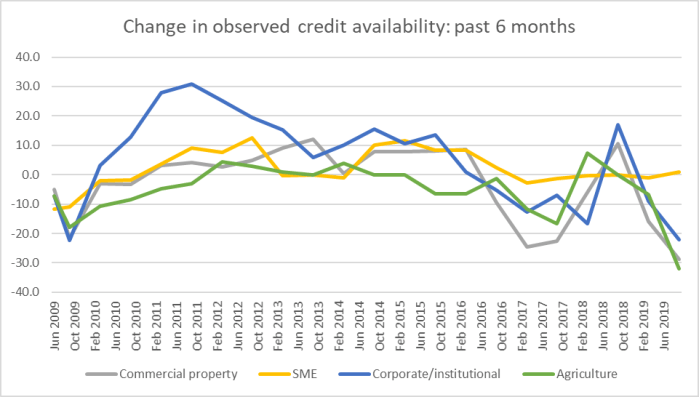
Here is observed credit availability over the last six months (the survey is six monthly) for the four business sectors (there was no particular change in availability to households).

credit 1

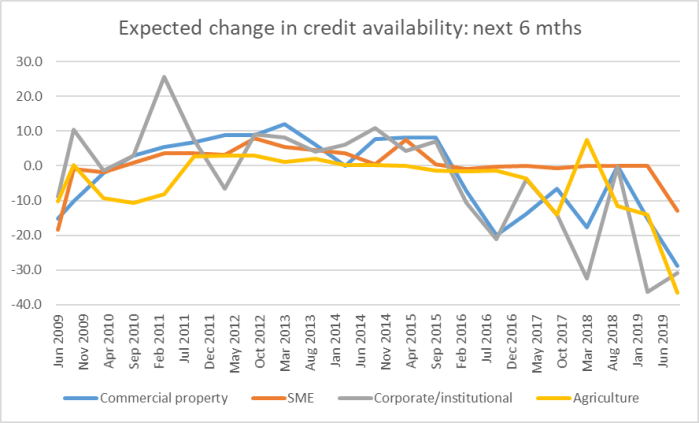
And here is what respondents expect (presumably from a position of knowledge, responsible for something around overall credit within their own institution).

credit 2.png

Yes, there is some idiosyncratic variability in the response at times, but in the ten year history of the series we’ve seen nothing like the tightening in expected conditions observed in the last few quarters, now across all the business classes (there is little movement on the mortgage and personal household lending categories).

It isn’t easy to know quite how much weight to put on these responses –  for a start, with only one incomplete cycle of observations, we have little idea of “normal” variability as economic conditions turn down.  But as the recent downturn is larger than the post-2009 upturn (coming off a pretty savage tightening in conditions) it doesn’t have the look of something that should be quickly glossed over.   It looks to represent a potentially quite material tightening in monetary and financial conditions.

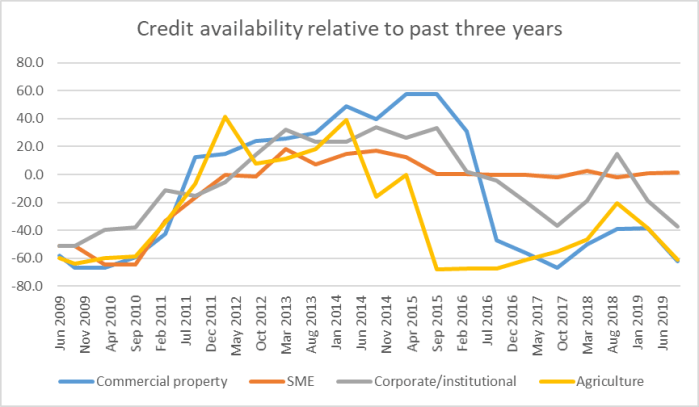
The other question they have about actual credit availability might also tend to confirm that unease.  Respondents are asked about how credit availability is now compared to the past three years (I guess to smooth through idiosyncratic influences on the past six months).  Here are the responses for the business sector loans (household was directly and materially affected by the waxing and waning of LVR restrictions, a policy intervention).

credit 3.png

Again interesting that there had been little movement re SMEs, but for the other three business categories the scores are getting back towards levels we saw just after the last recession.

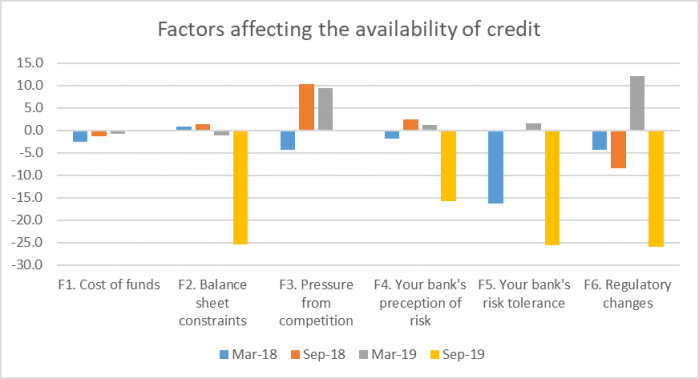
Early last year the Reserve Bank did a welcome extension to the survey and started asking respondents about the influence of various specific factors that could reasonably influence credit availability.  Here are answers.

credit 4

Cost of funds hasn’t been an issue in changing credit availability (nor would you really expect it to be –  should affect price rather than availability), and neither has competitive pressure, but look at those four striking negative yellow bars.    Risk appetite among the lenders, risk capacity, and (distinctively) regulatory changes have all worked to (apparently materially) tightened credit conditions.

Sadly, here we reach the limits of the survey. It would be fascinating to be able to disentangle quite what is going on.  There is a quite plausible story that all three of the other negative yellow bars are primarily a reflection of the fourth, regulatory change (presumably the Governor’s capital whims).  Perhaps it isn’t so, and there are independent reassessments of risk and willingness to bear risk going on in head offices, whether here or in Australia, but whatever the precise combination of factors it is pretty likely that regulation is already weighing fairly heavily on credit availability in New Zealand. (I only qualify that claim a little because banks perhaps have an incentive to play up the issue, knowing that the Governor is about to make his final capital decisions, but I doubt that is more than a marginal factor here, given the small number of respondents and the ability of the Bank to query each).

You may recall the consultation document the Bank published almost a year ago on the Governor’s proposals to greatly increase capital requirements for locally-incorporated lenders.  You may not recall the discusssion of these sorts of effects, let alone the apparent differential sectoral effects.  That isn’t the fault of your memory.  There just was no discussion of those issues in the document.  Which seemed odd at the time, and even more extraordinary now.  It will be interesting to see how the Governor responds to these data in his two scheduled press conferences in the next few weeks (MPS and FSR).

While these data are clearly of some relevance to the bank capital debate, my main interest in them was in the more immediate issues around the appropriate stance of monetary policy and the setting of the OCR.   There appears to have been quite a sharp change in market sentiment/pricing and the views of some market economists this week on the chances of the Bank cutting the OCR on 13 November (the reasons for that change still aren’t fully clear, and one is left wondering if the Bank has been signalling –  by accident or design –  some change in its own view).

My interest is much less in what the Bank will do in the short-term, but in what they should do (which should, of course, make my commentary of interest to the Bank, given the Assistant Governor’s speech the other day, but…..).  “Will” and “should” eventually tend to converge, but it can take some considerable time for them to do so.

But if we grant that this credit conditions data is material the MPC did not have when they did their August forecasts, or made their slightly panicked last minute decision on a 50 basis point cut, and did not even have at the last OCR review, it really should be  colouring the projections they finalise next week (even if the variable might not feature in their formal models).  Add in own-activity business survey data that has shown no signs of rebounding since August, inflation expectations that have either fallen further (surveys) or remained very low (inflation bond breakevens), and a core inflation rate that remains consistently materially below the (focal) midpoint of the inflation target, the case for not cutting the OCR in November seems weak at best.  There isn’t another review opportunity until February, the world situation (if not one of sentiment spiralling downwards) seems no stronger substantively, and for a committee that was sufficiently rattled to do a 50 point cut only three months ago –  and not to have seen anything much improve since then –  to do nothing now would only further muddy the communications waters, leaving people even less clear about how the MPC thinks, or that there is a consistent and disciplined process at work, secreted away from the public/market spotlight.

(Bearing in mind that there is still some material local data to be released before 13 November) the risks around a further OCR cut in November at present look quite asymmetric.  As we drift closer to the next recession, and to the limits of conventional monetary policy, the very best thing that could possibly happen would be positive surprises on core inflation, spilling over into somewhat higher inflation expectations.  People are no longer convinced inflation will settle at 2 per cent or above. It would be better, for almost everyone (certainly for the management of the next downturn) if they were.   When credit conditions appear to be tightening quite materially –  and that even before the final decisions are announced –  getting that sort of outcome will be made harder than necessary if the Bank ends up setting on its hands, confusing messaging, all for what?  So that the Governor can get some perverse psychic satisfaction from surprising people again?   Unpredictability is not a desirable feature of public policy.