Makhlouf again

In almost any well-functioning country, The Treasury should be one of the very best government agencies: a repository of wisdom, experience, rigour, and the skepticism that comes from seeing all too many “bright ideas” put forward over the years.  If the Secretary to the Treasury is going to give public speeches –  and there are reasonable arguments that someone in that role shouldn’t (one doesn’t come across public speeches from the chief executives of MBIE or MFAT, two other major departments) –  we might reasonably expect something judicious and rigorous, and which provides at least some fresh and interesting insights on the issues he is addressing.    It should be a public reflection of the very best of the sort of insight and advice The Treasury is offering their primary “customer”, the Minister of Finance.

As an example, speeches by Ken Henry, the former head of the Australian Federal Treasury, almost always met that standard –  I looked forward to reading them, and expected to see some or other issue or argument a little differently as a result.  It isn’t about whether or not one agrees with the points the speaker is making – often one learns most from thinking hard about cases made by able advocates of an alternative view –  but about the quality of what is on offer.

The speeches of our current Secretary to the Treasury simply don’t reach that standard.  On Thursday I wrote about Gabs Makhlouf’s recent speech about disruptive technological change.  Only a true believer can have felt better for reading it –  deriving, perhaps, a sense of validation in having such a senior official, a pillar of the establishment, say it.

Perhaps more disconcerting was Makhlouf’s speech earlier this week titled (apparently with reference to the title of Oscar Wilde’s famous play, The Importance of Being Earnest: A Trivial Comedy for Serious People) The Importance of Being Auckland: Strengths, Challenges, and the Impact on New Zealand, delivered to something called the “Committee for Auckland Advisory Group Summit”.

It is a disappointingly poor speech –  I wish I could say I was surprised, but I wasn’t really.  It was a piece that combined lightweight analysis, (very) selective choices of evidence, and a use of rhetoric that might have been becoming from a Cabinet minister pursuing voters, but should have been beneath a senior public servant.  It was all too similar to previous speeches: not just one bad example amid an otherwise solid record.

There were three main parts of the speech.  I don’t have anything to say on the material on infrastructure, much of which is simply a list of points from another report.

Makhlouf begins with a celebration, in a section headed “Auckland’s Strengths”.  The text reaffirms Makhlouf’s position as a true believer: a rapidly growing population is apparently something to celebrate, and the cultural/ethnic diversity of the city is “exciting”.  Here is what he has to say

Why do I find this exciting? It’s because high levels of diversity provide dividends including through increases in innovation and productivity.

Auckland’s diversity is particularly critical for our international connections. There’s much more to international connections than trade. It’s the other international flows – flows of capital and people, and the accompanying flow of ideas – which are the key to reinventing trade, and which will lay the foundation for a more prosperous New Zealand in the long-run.

The high number of overseas-born Aucklanders can bring new skills, new ideas and a diversity of perspectives and experiences that help to make our businesses more innovative and productive. And perhaps most importantly, they often retain strong personal and cultural connections to other parts of the world, which opens up, and helps us to pursue, new business opportunities.

Auckland is truly New Zealand’s gateway to the world. It’s not just that there is a big number of companies here doing business internationally. It’s the port and airport linking the country to global markets; and tertiary institutions, researchers and innovators linking us to global knowledge.

Which might all sound fine,  until one starts to look for the evidence.  And there simply isn’t any.  Perhaps 25 years ago it was a plausible hypothesis for how things might work out if only we adopted the sort of policies that have been pursued. But after 25 years surely the Secretary to the Treasury can’t get away with simply repeating the rhetoric, offering no evidence, confronting no contrary indicators, all simply with the caveat that in “the long run” things will be fine and prosperous.  How many more generations does Makhouf think we should wait to see his preferred policies producing this “more prosperous New Zealand in the long run”?

If the Secretary to the Treasury was going to address the economic issues around Auckland, one might have hoped there would be at least passing reference to:

He might also have linked to the recent presentation by Jacques Poot (in a Treasury guest lecture), in which Poot was keen not to sound very optimistic about just how large those economic benefits of diversity really are, or to the work of Bart Frijns – an (immigrant) professor in Auckland (see last sentence of the extract above) –  whose recent work suggests that on some measures, in some contexts, there may be net costs, not benefits at all.

Of course, one can’t say everything in a single speech, but when a credible case could be made that the Auckland-centred model is in serious trouble, it is bordering on the seriously unprofessional to not even allude to any of these sorts of points, even if only to explain why the Secretary interprets then differently than, say, I might.

So keen was Makhlouf not to undermine his good news creative fiction about the Auckland economy that the one difficulty he does allude to is buried under a different heading “Social Outcomes”.

Let me start with social outcomes. Auckland scores well on quality of life indicators but other measures suggest not everyone is able to enjoy what Auckland has to offer. Social outcomes vary significantly across Auckland, highlighting the potential importance of sub-regional thinking and analysis to lift social outcomes across the board in Auckland.

Issues with the labour market contribute to patchy social outcomes across the city. While Auckland has higher productivity than other urban centres in New Zealand, it also has an underutilised labour force. For example, the five year average unemployment rate in South Auckland is 11.7 percent compared with 6.3 percent for the rest of Auckland and 6 percent for New Zealand overall. That’s the sort of discrepancy that has a real impact on the quality of life of families and communities.

To the first paragraph one can only say “And?”   In what city –  or decent-sized town –  ever did “social outcomes” not “vary significantly”?

Similarly, differences in the unemployment rate across groups within cities will occur everywhere –  if we had the data, I’m sure the unemployment rate would be higher (and probably the participation rate lower) in Porirua than in Karori/Kelburn.  It might be good if were not so, but it isn’t obviously an Auckland-specific issue.   After all, across the country as a whole, the average unemployment rate over the last five years for Europeans has been 4.3 per cent, while that for Maori has been 14.7 per cent, and that for Pacific populations has been 13.4 per cent.  Given that the population of South Auckland is disproportionately Maori/Pacific, the issues in South Auckland seem most likely to be mainly national than (intra-Auckland) suburban.

But there is an Auckland underperformance that might almost escape you if you didn’t read that second paragraph quite slowly and carefully.  The unemployment rate in Auckland is higher than that in the rest of New Zealand.   For a long time, that wasn’t so.

auckland U makhlouf

The chart shows the gap between the unemployment rate for New Zealand as a whole.  Over the history of the HLFS until around 2007, Auckland’s unemployment rate averaged a bit below that of the rest of the country.  There was some clear cyclicality to the gap –  Auckland’s economy/labour market seems to have been more badly hit in recessions (I’ve highlighted the 1991 and 1997/98 recessions) and does relatively better in good times.  In a well-functioning economy, that better performance is what I’d expect.  After all, the Auckland labour market is so much deeper, and more diversified, than that in other centres, that it should be easier for workers and firms to find each other, matching the  skills offered and required, than in a smaller area, typically prone to more idiosyncratic shocks.

But even by the end of the last boom, Auckland’s advantage seemed to be fading.  And in every single quarter since the start of 2007 –  nine years now –  Auckland’s unemployment rate has been above that in the country as a whole.  The gap is slowly closing again –  but the operative word is “slowly”.  It is a quite stunning example of the (frankly rather surprising) extent of Auckland’s economic underperformance.  It certainly has “social” implications for the people adversely affected, but make no mistake, it is a striking economic issue.    And with barely a mention by the government’s chief economic adviser in a speech on the importance of Auckland’s economy.

I was going to write quite a bit about the second half of Makhlouf’s speech, on house prices and housing supply.  I have lots of scrawls in the margins of those sections, about both substance and style.    Like Graeme Wheeler, Makhlouf appears to have it in for “speculators”.  And I’m sure, for example, that Makhlouf’s comments that central and local government have “been working well together” in “addressing the housing challenge” must be a great comfort to those priced out of the market by the combination of central and local governments rules and policies.  They are probably more interested in outcomes –  which are shockingly bad – than in knowing that the bureaucrats are working well together.

But perhaps the line that caught my eye most was one that Treasury consciously chose to highlight on its Twitter feed: “Auckland NIMBYism hurting New Zealand”.    Perhaps “NIMBY” is a convenient shorthand in the popular press, and among sloganeers.  One might have hoped that the Secretary to the Treasury might have avoided clearly pejorative labelling of people, whose interests stands in the way of his preferences.  There is no analysis –  even by way of allusion – to the fact that in most new residential developments, private covenants (voluntary contracts) provide exactly the sorts of binding protections (and more) that residents of Orakei or Epsom might be looking to councils for in the current Auckland debate.  Reasonable people might differ on where the lines should be drawn, and quite which existing features of communities should be able to be protected.  But to simply decry the interests of property owners seems closer to demagoguery than to detached analysis and insightful policy advice.  It also occurred to me to wonder quite what the longstanding residents and property owners in existing suburbs might make of someone fairly fresh off the plane from the UK telling them how their suburbs should be changed.  I’m quite sure that Makhlouf has the best interests of New Zealanders at heart, but when you are a newly-arrived outsider, sometimes you need to be conscious of quite how you sound, and quite what your stake is in the country you are advising on, relative (say) to those who have lived their whole lives in Auckland.

In closing his speech, Makhlouf offered this odd paragraph:

The famous photographer Sir Cecil Beaton once appealed to people to “be anything that will assert integrity of purpose and imaginative vision against the play-it-safers, the creatures of the commonplace, the slaves of the ordinary.”   From what I can see, many Aucklanders are heeding that call in their own way.  And having the right infrastructure, supported by economic incentives that send clear, efficient and effective signals, will enable Aucklanders to continue to exercise their dynamism and diversity and to do the best that they can do.

When I looked up Beaton, his seemed a somewhat reckless life, ending in financial stress.  Perhaps it is the style the dreaded “speculators” emulate –  but then we already know Makhlouf disapproves of them.  Surely most people, in most places, in most times, crave the security of a home, an income, a family, the commonplace things that mostly conduce to sustained happiness (and prosperity for that matter). Risk is, of course, part of life, and many of the great financial successes involved some mix of great risk and great luck.  But we seem to be in an upside-down world in which a Secretary to the Treasury (self-described cautious guardian of the government’s finances) scorns the natural concerns of the vast mass of people.  One might add, that  –  with the full support of the Treasury –  we’ve been eschewing the commonplace, and the “play-it-safers” in our Think Big policy for Auckland over the last 25 years.     And there is little good –  for the vast mass of Aucklanders (and New Zealanders) – to show for it.

Makhlouf quotes various English figures in his speech.  I’ve always been quite keen on Kipling.  In his famous poem “If” comes the lines

If you can make one heap of all your winnings
    And risk it on one turn of pitch-and-toss,
And lose, and start again at your beginnings
    And never breathe a word about your loss;
you’ll be a Man, my son!
I’m not sure that giant policy experiments, showing no sign of paying off 25 years on, are really quite what Kipling had in mind.  But I’m sure that simply ignoring the signs that things aren’t going well wasn’t.
New Zealanders deserve a great deal better from the Secretary to the Treasury.


Brexit

I guess people need to mourn their defeats, but flicking around various TV channels’ coverage the comment that staggered me most was that of the prominent English historian, Simon Schama, who declared –  well before the result was clear –  “if Leave wins, it will be a repudiation of knowledge; a repudiation of reality’.

Or simply, perhaps, just a choice by UK voters to have their country governed by their own MPs, their laws interpreted and applied by their own judges, and so on.   Rather like New Zealand, Australia, Canada, or the United States.   Many other commentators have seen the vote as a vote against the Establishment,  which is no doubt true in part  – as the election of Jeremy Corbyn was, and perhaps the success of date of Donald Trump has been – but if so, comments like those of Schama, totally dismissive of the choices of his fellow citizens, might go down as a classic example of the sort of attitude and approach that many saw encapsulated in the EU model, and the way in which too many countries have been governed in recent years.

The market reactions so far seem hardly that surprising – except perhaps in highlighting the bounded rationality that had left so many (I was among them) almost unable to believe that, even though the polls had been a dead-heat for weeks, a Leave vote could actually happen.

The headline fall in the value of sterling is striking  – currently down 9.9 per cent against the USD.  But it brought back memories of the wild days of the New Zealand foreign exchange market, especially in the early years after the 1985 float.   But as recently as 28 October 2008, the NZD was down 9.3 per cent in a day (and more like 12 per cent against the yen).  The trend was strongly down in that global crisis and recession, but there was also a sharp bounce the following day.  I recall watching CNBC each evening during the 08/09 crisis.  It might be another few days for that  –  and to be glad it is “spectator sport” rather than something I have direct exposure to.


UPDATE: I thought this piece by US economics columnist Megan McArdle was a very nice articulation of views I share almost entirely.

UPDATE 2:  An absolutely fascinating set of results from exit-polling of referendum voters


How I think about our long-term underperformance problem

Tempting as it is to write about the failures and weaknesses of the New Zealand public sector –  and there is plenty more grist to the mill, reinforcing Kerry McDonad’s forcefully expressed concerns, even in this morning’s newspaper –  or the inadequate performance of the Reserve Bank in conducting monetary policy, as the TWI now sits above 76, I’m going to write today about some longer-term issues.

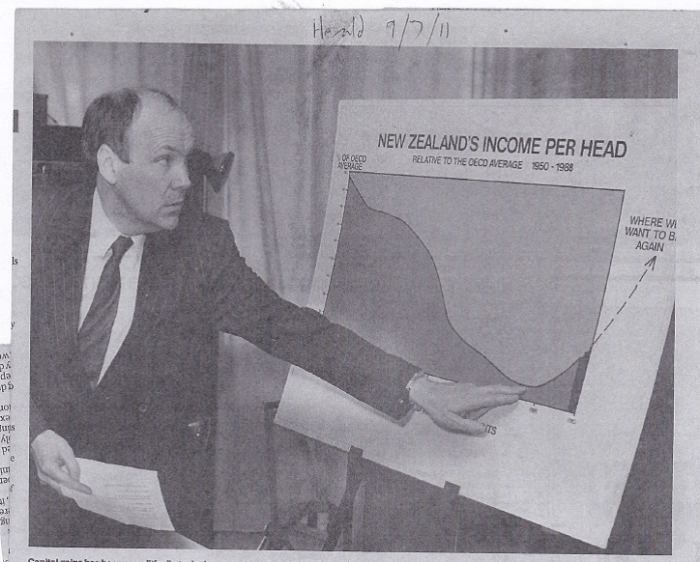
Of all the issues I write about on this blog, probably the one that concerns me most is New Zealand’s long-term structural economic decline, relative to other advanced countries.  That decline has been underway for many decades, and if the rate of decline has slowed there is certainly no sign of the gaps beginning to close. Once upon a time that decline seemed to bother people, but sadly we seem to have got used to it.  And perhaps too people are more cynical –  they’ve heard various stories over the years as to what might reverse the decline, and even when tried none seem to have worked (enough).

This photo, after all, was taken in 1989 – a generation ago now.

caygill 1989 expectations

I don’t think the current state of the affairs is good enough.  There is no political leadership that treats the issue as a priority, debate is virtually non-existent on any sustained basis, and the economic conditions that have seen almost a million New Zealanders (net) leave permanently in recent decades haven’t changed.  I don’t want my kids to grow up to discover that most of the best opportunities for them and their kids are abroad.

Readers here recognize the serious relative decline we’ve experienced over many decades.  But I often get comments, whether sympathetic or critical, asking what I would do to change things –  often with the text, or sub-text, “and why are you always banging on about immigration policy at the expense of everything else?”.

There are plenty of things about our economic policy (broadly defined) that I would change.  Many of them are in areas where I have not spent a lot of time or effort looking at the issues and options in great detail, and so in a spare-time blog I don’t write about them.  And quite a few seem to me like things that would be worth changing, but might not make that much difference at all to measures like GDP per capita, or per hour worked.  I prefer to focus my efforts in areas which might make a material difference –  individually, or even as a package –  and, perhaps, to critiquing proposals that others suggest might make a big difference, but where I disagree.  I happen to favour fully-funded school choice, while I suspect most readers don’t.  In terms of economic performance, no one would argue it matters that much, so why alienate people who might be sympathetic to my core arguments and analysis?    Then again, some of my friends on the (economic, pro-market) right are deeply uneasy about my immigration analysis, so from time to time I do like to remind them that my underlying model is a strongly market-oriented one.  In the end, there are only so many hours in a day, and only so much of my time I want to devote to these issues.

When the National Party led government assumed office in 2008, they set up the 2025 Taskforce.   As it is described on the Treasury website

As part of the Confidence and Supply Agreement between the National and ACT parties reached immediately after the 2008 election, the Government committed to closing the income gap with Australia by 2025 and to establishing an advisory group both to report annually on progress towards achieving that goal and to make recommendations about how best to achieve it.

I don’t suppose the National Party would have been averse to the gap closing.  But the Taskforce was pretty much forced on them by ACT – minor parties entering Confidence and Supply Agreements get to pick a few policies that the dominant governing party agrees to implement, and this was ACT’s that year.

It was an under-resourced exercise from the start.  The one Australian member appointed to the Taskforce by our government was staggered at how little time and resource they were given. Treasury provided the Secretariat to the Taskforce, and I got closely involved in that process –  I was at Treasury at the time, and having worked closely with Don Brash previously, he –  as chair of the Taskforce – was keen to have me involved.  The first report of the Taskforce, issued in late 2009, is the one fairly comprehensive attempt in term of the current government to provide a list of recommendations that, if adopted, offered a reasonable chance of being able to catch up with Australia.  Based on historical experiences with convergence, catching up over 16 years looked to the Taskforce to be demanding, but not impossible.  If most of the words in the Report flowed directly from my pen, the recommendations are those of the Taskforce members.  But at the time, I agreed with most of them –  even if, even then, not all seemed overly important.

Yesterday I went back and read through the 50 or so specific recommendations in the report (they are on pages 8 to 11 are the link above).    I could go through them one by one, but that would bore most readers, and bore me, and in many cases wouldn’t add much value.  But, like the Taskforce, I support:

  • lowering the share of GDP accounted for by government spending,
  • stronger institutional disciplines around new spending proposals,
  • steps to cut the high number of working age people on welfare benefits,
  • increasing the age of NZS eligibility and indexing the age to future changes in life expectancy,
  • introduction of a funder-provider model for the hospital sector and the school sector, allowing new provider entrants whether government or private owned.
  • removal of the substantially increased childcare subsidies introduced a decade or so ago,
  • government-imposed fee caps on university fees should be abolished,
  • reductions in tax rates should have regard to “the evidence that taxes on capital income can be particularly detrimental to economic performance”,
  • all government shares in businesses where competition is actual or feasible should be sold,
  • the NZSF should be wound-up and proceeds used to repay government debt,
  • congestion charging should be introduced in central Auckland (in particular) and full economic road-user charging should be introduced as feasible,
  • mining developments “on or under sensitive Crown land should generally be permitted provided that they pass a full cost-benefit test”,
  • a Regulatory Responsibility Bill should be enacted,
  • an independent Productivity Commission should be established,
  • resource management law should be reviewed from first principles,
  • in zoning land for residential purposes, local authorities should have to report regularly on, and take explicit account of, differences in land prices between residential-zoned undeveloped land and other undeveloped land in similar areas,
  • provisions allowing for probationary periods in employment should be extended
  • increases in youth and adult minimum wages – relative to median incomes –  over the previous decade should be reversed,
  • all remaining tariffs should be removed unilaterally,
  • foreign investment restrictions should be liberalized,
  • Zespri’s kiwifruit export monopoly should be removed.

A few of these have actually happened, or might soon happen.

I’d support all of those proposals.  But as I came away from my involvement with the Taskforce, I gradually came to the view that they just didn’t seem like enough to make large in-roads on the productivity and income gaps that had opened up over previous decades.  People operating within different “models” of the economy might disagree, but as I tried to think hard about the distinctive features of New Zealand’s underperformance I couldn’t convince myself that this was a game-changing agenda.  After all, radical as it was in some respects, it was less far-reaching in the important respects than the reform agenda implemented over 1984 to 1993, which hadn’t reversed our decline.  Arguments that “oh, we just hadn’t gone quite far enough” don’t typically ring very persuasively –  whoever is running them is simply inviting policymakers to double up on a bet which, so far, has shown no signs of paying off.

There is probably a variety of “models” people have in mind for thinking about New Zealand’s economic underperformance.  I’ll stylize (caricature) two of them as “small government” and “smart government”.  One of the finest representatives of the small government school in New Zealand was the late Roger Kerr, who had thought hard about economic performance and New Zealand for a long time, and was always will to engage on the issues.  I think he probably thought –  and his public and private comments at the time suggest –  that the 2025 Taskforce report didn’t go quite far enough, and didn’t grapple with all the issues it could have, but that if only we got government spending down to perhaps 15 to 20 per cent of GDP, facilitated foreign investment, reformed the provision of health and education, privatized government and local authority operating businesses, liberalised the labour market, and sorted out the RMA and the creeping advance of other regulation, we’d be well on the way to catching Australia and other richer OECD countries.

I’m not sure there is single person representative of what I would call the “smart government” school, but it is the sort of thinking that these days seem to pervade places like the OECD, and key domestic government agencies – be it Treasury, MBIE, or even the Productivity Commission.  It is the hunt for a smarter set of interventions –  ones around R&D are popular, but it might include top-down visions as to what cities should look like, granting eminent domain powers to Urban Development Authorities, getting a better class of immigrants going to different regions, getting better data on how best to intervene in individuals’ lives etc.  If this seems like a caricature that is partly because (a) there is no properly developed case made for a set of reforms  along these lines that might transform New Zealand’s prospects, and (b) because in this post I haven’t the space to develop the alternative fully myself. But the gist seems to be that our problem isn’t government interventions, but just that we had the wrong bureaucrats and ministers making the wrong interventions, and if only we adopted this alternative set we’d be fine.     And, of course, there is no doubt plenty of regulation/law required in a modern market economy, and we should always be trying to improve it.

My stance is much closer to the Kerr end of the spectrum.  In particular, I think it is a safe observation that governments, and government interventions, are more often the source of a country’s economic problems than the answer to them.  Of course, governments don’t exist in a vacuum, and so government policies are often a reflection of the societies they govern, and the problems and dysfunctions in those societies.  But the problems often manifest in misplaced economic interventions.  On the other hand, “culture” matters too: keeping taxes low, regulation light, markets open, and property rights secure wouldn’t transform Zambia, say, into an OECD success story, at least not in a single lifetime.

But in thinking about New Zealand, we have some advantages. These include:

  • we were already rich (high GDP per capita or per hour worked) for a long time,
  • we shared a culture (broadly speaking) with most of the richest and most successful countries in the world (Anglo and Northern European)
  • as part of that, we share key institutions such as the rule of law and reasonable protections of private property rights.

That should help us narrow down our search for answers.  We can try to think, in a reasonably structured way, about similarities and differences between New Zealand and these other (typically much richer, higher levels of productivity) countries.

On the similarities side, it is worth bearing mind that the overall size of government isn’t that different than in these other countries (be it spending share, ownership of assets, or regulation), and actually on one of those dimensions –  government spending as a share of GDP – there is quite a wide range of experiences among successful countries, and we are towards the middle of the pack.  But if government spending as share of GDP was perhaps 55 per cent, there might be a good case for seeing pulling back the size of government spending (and hence overall tax rates) as key element in any package of reforms (a putative list of Top 5 Reforms).

House price problems are pretty similar too.  Scandalous here and in most of those countries too, but not a prima facie reason to think distorted housing supply markets might be at the heart of our productivity and economic performance failures.

For all the opportunities there might be to improve our schools and universities, “skills” doesn’t really look like a credible huge difference.  We used to have quite a low rate of participation in tertiary education, but even that has change in recent decades.  I’d also tend to emphasise the similarities, more than the differences, between our welfare system and those in the successful advanced economies – in some areas, ours might be less of a “tax” on growth and economic performance (eg NZS deters labour market participation less, and in some more so, but overall the differences don’t look decisive.

What are some potentially significant differences:

  • we are small (but not extremely so, cf Ireland, Denmark, Finland, Iceland),
  • we are remote (though on typical measures) similar to Australia),
  • we’ve had persistently low rates of business investment (including in R&D) going back decades, even more obviously once one allows for population growth differentials (countries with faster-growing populations,
  • we remain heavily natural resource dependent (like Australia and, to a lesser extent, Canada),
  • we have had, for decades, the highest real interest rates in the OECD,
  • despite our substantial and sustained deterioration in economic performance, our real exchange rate has not adjusted downwards,
  • we have had very little growth in exports as a share of GDP, such that our export share is now very low for such a small country (small countries typically do more foreign trade than large ones)
  • we’ve had a lower national savings rate than many of these countries,
  • we have typically had the largest negative NIIP position (per cent of GDP) of any of these countries,
  • our single moderately large city has been an economic laggard (GDP per capita) in recent decades, unlike the typical advanced country experience,
  • we’ve had a very large, decades-long, net outflow of our own citizens (unlike most successful countries, although similar to what Ireland had for decades)
  • we have an unusually large target level of non-citizen immigration
  • over the decades since our economic deterioration became evident, we have had  faster population growth than many, but not all, these countries.

I suspect that most of those who think about the challenges of New Zealand’s economic underperformance would grant most of those stylized facts.  I’ve tried to write them in a way that doesn’t overstate any of them individually.  Perhaps some will think I’ve left out some key stylized facts, and if so I’d happily consider them.  Stories and explanations, and policy prescriptions, need to be fitted to the stylized facts.  But equally, everyone starts with a “model”, and some implicit assumptions about what facts matter. But we can all have blind spots.

My story has developed to try to take account of the sorts of similarities and differences I’ve listed above.  I start by looking around the policy interventions that might be messing things up (recall that my underlying model is that firms invest and generate prosperity in countries with sound basic institutions unless government interventions materially distort those prospects).

Plenty of people worry about New Zealand’s savings rate, but when one looks across time and across countries it isn’t obvious that our government policy settings around savings (ie differences from those abroad) can explain different savings outcomes.  That was the somewhat-reluctant conclusion of a Treasury exercise I had some involvement with a few years ago.  Perhaps an alternative explanation might see relatively modest savings rates as an endogenous response to whatever makes the business investment environment here sufficiently unattractive to generate those low rates of investment. After all, business depreciation and retained earnings (to take advantage of great business opportunities) are a large, and often neglected, component of national savings.   And it isn’t as if government is running large deficits either.

And low business investment must also be related –  common causal factors – to the very low rate of growth of exports (most of the potential market for many firms is the wider world), which in turn must be related to the persistently high exchange rate.  Some people try to argue that our interest rates have been high because we have so much debt, and markets “punish” us for it, but actually our debt (NIIP) has been large for 25 years  –  plenty of time for people to adjust their behavior and see any “risk premium” dissipate.  Perhaps as importantly, high risk premia are simply inconsistent with persistently high exchange rates –  when markets are really jittery, asset prices are typically weak, not persistently surprisingly strong.

Low business investment (as a share of GDP) might also be related to a relative lack of profitable opportunities here –  even if the exchange rate was lower.  There is a lot of resistance to this idea, but the resistance typically does not take seriously economic geography.  People repeatedly focus on the places where there are lots of people (in the advanced world) and hardly at all on the places where there are not lots of people –  presumably because profitable opportunities are just not there (in Nebraska, as opposed say to San Francisco).  People leave –  or don’t go to –  those places when they have better alternatives.  New Zealanders, for example, move to Australia.

So I’m driven towards a story that emphasizes the combination of the limited high-returning economic opportunities that our location/distance seems to have offered, the role of excess aggregate demand (which has given us persistently high interest rates, despite the apparently poor opportunities, and a high real exchange rate), and at the same time a population that is still growing rapidly (trend basis, not just the last year) largely now as a result of immigration policy.  And –  to revert to the point about looking for government interventions that, however well-intentioned, are messing things up  –  we have an unusually large non-citizen immigration programme, especially for such an unusually underperforming country.  Among the government’s economic policy interventions, it is large and distinctive.

For quite a few years, I believed the rhetoric that it was all “good quality” migration, but as I looked into it I found – as others have, including The Treasury –  that actually, it really isn’t such good quality migration after all (better than some countries’ experiences, but just not really that skills-focused).  Perhaps really able, highly-skilled, people don’t want to come in large numbers to a small, remote, underperforming country, that doesn’t seem to be able to support lots of highly profitable outward-oriented industries dependent on things other than the (essentially) fixed quantity of natural resources?

I could write lots more, but this post has already got rather long.  My point was not, in a single post, to make a comprehensive case for every strand of my argument.  Thinking about it this morning, I realized that I laid some of the foundations – especially around the interest rate/exchange rate/investment nexus –  in a series of posts a year ago.  But readership has increased very substantially since then (and my impression was that most readers back then knew me, and had some past exposure to my arguments, which is no longer the case).  I may dig out some of that material and re-run some updated posts in coming weeks.

And having got to the end I still don’t want to leave the impression that other  potential reforms don’t have a place.  A standard line  –  the 2025 Taskforce used it –  is that distance/location aren’t things we can do much about, so we just need to make sure we run really good policies to offset the disadvantages.  I have quite a lot of sympathy with that view –  and good policy is always better than poor policy –  but as a general proposition it can be a distraction from identifying any key areas in which ill-judged policy interventions (even ones that might make sense for other countries in other circumstances) might actually be working us against making the most, in per capita GDP terms for New Zealanders, of what we have and where we are. I think our highly unusual –  in context –  immigration policy is a prime example of that.


Makhlouf on disruptive change

In his critical assessment of economic policy and policymaking in New Zealand, that I linked to the other day, leading business figure (and economist) Kerry McDonald singled out the public service as one of his areas of concern.

There are some excellent Public Service organisations and people but, it is notable for its numerous, costly failures.

….

There is a common, fundamental cause of these: it is the failure of top level management to lead effectively, starting with, in my view the SSC. It should lead the Public Service, but hasn’t done so effectively for a long time.

….

Top level public servants now have substantial power and authority, but are not properly held to account for their performance and are more often than not reappointed, when the appropriate action would be dismissal. Many are promoted for their technical ability

I’m not sure I agree with the final line of those comments – more technical leadership at or near the top of the public service would surely be welcome –  but the gist of the concern seems right to me.

Gabs Makhlouf was recently reappointed, for a further three years, as Secretary to the Treasury.

In the little I’ve had to do with him, he seems like a pleasant enough person, but I’ve had my doubts about Gabs since, sbortly after arriving in New Zealand, as an operational Deputy Chief Executive at Treasury he declared in one Treasury meeting that one of the big mistakes New Zealand had made over its history was to underinvest in rail, one of the legacies of the British Empire.  Ah, we thought, at least he is only on the operational side of things.  A few months later he was, in fact, Secretary to the Treasury, and hence the government’s leading economic policy adviser.  Of course, no one expects one individual in an organization responsible for as many issues as Treasury to be, personally, the chief adviser (in that respect it is a very different role from that of the Governor of the Reserve Bank who is the policy decisionmaker) but the chief executive sets the tone.

Makhlouf gives quite a lot of on-the-record speeches.  In many countries –  his own UK among them – permanent heads of the Treasury wouldn’t often be seen or heard in public. But here, and in Australia, it is different.  On the one hand, it is good to be exposed to Treasury’s thinking.  On the other, the Treasury works primarily to the Minister of Finance and so it wouldn’t be proper, effective, or expected for the Secretary to depart far from the government of the day’s script.  Free and frank advice is important, but is best delivered direct to the Minister.

I’ve generally been quite unimpressed with Makhlouf’s speeches.  I’m not sure if he writes them himself or gets staff to write them, but either way the quality of the content is his responsibility.  I wrote last year about his rather unconvincing, unsupported, comments on immigration in one speech, and his similarly unpersuasive efforts on innovation.

This year, Makhlouf has given several on-the-record speeches already.  There have been two in the last week or so.  The first, to GOVIS, an annual government IT conference, was given last week, headed Turn and Face the Strange: Policy, Technology and the Modernisation of Government.  I guess the audience probably wasn’t the most demanding he will ever face; they’ll have been pleased to have a Secretary to the Treasury address them.  But the theme of the conference this year was apparently “Disruption”, and Makhlouf embraced the theme with rather breathless enthusiasm, building one rather trite set of lines upon another.

Disruption is pervasive.

We see it expressed in almost every facet of life – the economy, the environment, our neighbourhoods – even the way we raise our children.

I suppose if I include the Wellington City Council imposing its Island Bay cycle-way, we’ve seen disruption in our neighbourhood, but other than that I was a bit mystified.

Apparently

Even in the last decade New Zealand society has changed dramatically.

Really.  Must have missed it.  Is society, in other than its more superficial dimensions, really so different than it was in 2006?  Perhaps a little sobered that incomes have grown less than most expected –  was that less “disruption”, and considerably less productivity growth?   –  but “changed dramatically”?    Really?

Ah, but there are the phones

The fact that there are now more mobile devices than people in the world is remarkable.

The fact that more people own a mobile device than a toothbrush is perhaps even more remarkable.

Well maybe.  I only own one of each, but many people have one phone for work and one phone for home, and perhaps an Ipad too.  Means quite a few chargers, and passwords, and it offers a certain convenience value.  But “disruptive change”?

He reverts to the personal, still apparently talking about the last decade.

The kinds of families we have has changed, our age structure, our aspirations have shifted, and critically our expectations of government and public services has shifted.

And

We don’t need to hold a book to read it anymore.

Perhaps, but most people still do.

We don’t need to post a letter to write to someone overseas anymore.

Or even our parents in another part of New Zealand

We don’t need to queue to renew our passports anymore.

Don’t recall doing that –  I thought I posted it.

Disruption is rapidly becoming the new normal, a way of life even.

By its very nature it challenges the status quo.

The level of vacuity is what I might have expected from a breathless 25 year old consultant, not from the head of one of oldest, and most important, government departments.

Of course, no one is denying that change happens –  it has, and will no doubt continue to.  But actually, contrary to Makhlouf’s claim that

There’s probably nothing new an economist can tell you about technology and disruption and the impact they’re having on how we live and work.

I’d have thought that is exactly what a good economic adviser should be able to do.  For example, he could reflect on the research that leads some to suggest that the biggest gains have already happened.  I’m not close enough to that literature to have a strong view myself, but some pretty expert people do take the argument seriously.  And the sharp decline in global productivity growth in the last decade must surely raise some important questions, amid the breathlessness.

Ah, but apparently this isn’t a time for reflection

We can’t spend our time thinking about change when people are actively and loudly demanding it.

Actually, I’d really hope a Treasury that was doing its job well would insist on exactly the sort of calm considered reflection if some breathless sector agency came along championing some bright new change initiative.  Haven’t we seen many of them before?  Haven’t many of them been costly disasters?  How do we build processes and institutions to minimize the risk of yet more disasters, and blunders of our governments.

Disruption is creating an environment where public services can be co-created, and in some instances, even co-delivered.

You mean that government has never previously worked with private sector providers to deliver services?  Integrated schools are 40 years old.  Government-funding for private doctors dates back to 1938.  And so on.

I could go on.

Developing, designing and delivering policy needs to be based on information and evidence not assumptions and assertions. Disruption can enable that information and that evidence.

No argument with the first sentence –  though I keep asking about the evidence behind New Zealand’s continued large scale immigration policy –  but it is hardly a new proposition.  Can technological innovations help generate new insights?  Well, yes, of course, but was it not ever thus?

There is almost nothing –  actually I think nothing at all –  about government failures, including government IT project failures.  Nothing much about the inevitable tensions that technology creates –  ever more intrusions into private lives –  and barely a mention that fundamentals of how humans behave and interact don’t change much at all.

In some ways, none of the specifics in this speech matter very much. I highlight them mostly because I think this speech, while unimportant in itself, illustrates something of what is missing at the top of our public service –  an apparent lack of depth, and perspective, and rigour, and the insights that come from having a strong institution that brings rigour, and institutional memory, to advising political masters, and informing the public debate.

But even on the specifics, I don’t find Makhlouf remotely convincing. My oldest child turned 13 this week, which prompted a few reflective comparisons on his life, and mine as a thirteen year old in 1975. The differences seem pretty superficial –  we had hymn books in 1975, and now the songs in church are on a screen, the Social Studies projects in Powerpoint are perhaps more prettily illustrated than mine (illustrated with pictures cut out of National Geographics, or Weetbix cards) but I’n not convinced the learning is really much better.  School reports come electronically –  but whereas I still have the handwritten ones from 40 years ago, I had to print one out today to be sure it will be around in years to come.  My wife keeps saying “don’t forget the Internet” –  which is certainly great for immediacy, but check out just how much information there was in a 1975 issue of TIME magazine (my father subscribed for me).  And books –  Makhlouf may read his online, but my house has many more books than my parents’ one did (and Dad’s study always seemed to have books toppling off the shelves).  I’m probably an old fogey, raising young fogeys, but I’m not really convinced by the “disruptive change” story.

But the public servants seem to believe it. One of the presentations at GOVIS was billed thus

The vision for the future of government services is to centre it around the customer and not agencies. To this end, the birth of a child life event project will deliver the first iteration of a customer-centric federated service that will enable New Zealanders to access the services they need for their baby. They will also be able to complete all their requirements around the birth of a child with government & non-government organisations from anywhere, using any device at any time of the day. Service will be delivered to the customer using digital identity founded on building a long-term relationship with government.

Not sure what services we needed from government for our baby.  Two parents, love, food, shelter etc go most of the way I’d have thought,  and mostly those are what families provide.  Those needs haven’t changed much in millennia.  Perhaps the most important is two committed parents, and if anything the state has spent decades undermining that, not reinforcing it.

Yes, this has been a bit of a rant.  But I really do think that taxpayers and citizens deserve evidence of something deeper and more robust from the head of our premier economic advisory agency.  And this week Makhlouf gave another speech, on rather more important directly-economic issues, and the content (or relative lack of it) in that speech disturbed me even more. But that is a topic for another day, probably tomorrow.

PS:         I would recommend use of a search engine to The Treasury.  In his speech to GOVIS, Makhlouf noted this was the first time anyone from Treasury had spoke to the conference in its 25 year history.   Actually, I was invited to give the opening address to the conference in 2010, to spread the Treasury message as to why public service agencies couldn’t expect much more money for the next decade.  To my surprise, the slides are still on the web – I was interested how some of my perspectives have changed –  and when I entered “GOVIS, Treasury, speaker” into Google, it was the sixth link that came up,  A disruptive technology perhaps, but it has been around for a few years now.


What do the Brits have to be grumpy about?

UK voters go the polls tomorrow for the EU membership referendum.  Of the two polls of polls I follow, one has a very slight lead to the Leave side, and the other a very slight lead to Remain.

You might have thought –  rightly –  that New Zealand’s productivity performance over recent years had been pretty poor.  But here is what happens if we add the United Kingdom to the chart of real GDP per hour worked (labour productivity) that I ran the other day.

nz aus uk gdp phw

In their case, no productivity growth for eight years.

But even cyclically the story isn’t all bad in the UK.  Take unemployment for example.  Going into the 2008/09 recession, the OECD reckons that if anything the UK had a slightly larger positive output gap than New Zealand did.  British labour market regulation seems to generate a higher “natural” rate of unemployment than New Zealand’s does –  over the decades, the UK unemployment rate has averaged a bit higher than New Zealand’s.   And yet right now, not only is the UK unemployment rate materially below New Zealand’s, but it is right back to where it was – around 5 per cent –  going into the recession.

uk and nz U

By contrast, in New Zealand the unemployment rate is still more than 2 percentage points higher than it was pre-recession.

The British productivity record in recent years has been pretty dismal.  Then again, taking a slightly longer-term perspective, we are the ones with something to complain about, not them.    There are no perfect starting points for any of these sorts of comparisons, but I’ve started this one from the end of 1990.  That was just before our 1991 recession, and before the stresses and disruption that Britain faced culminating in the exit from the ERM exchange rate system in late 1992.

uk and nz gdp phw

I’ll take the British performance over that full period over ours.

Incidentally, I noticed George Soros yesterday suggesting that if the vote went in favour of Brexit, the outcome would be more disruptive for Britian than the ERM exit in 1992.  Even though that exit –  or rather the foolhardy effort to avoid it –  transferred a lot of money from the British taxpayer to Soros and his clients, the economic outcomes were generally pretty positive.  In the chart above, for example, there is no dip in productivity growth in 1992.  Yes, a Brexit would be quite disruptive, but were I a British voter I’m not sure I’d looking for advice from Soros as to whether to stay or go.

Despite my interest in immigration issues, the centrality of immigration in the Brexit debate has intrigued me.  Even in the UK context, I’m don’t find particularly persuasive the case that British citizens have had any particular economic benefit from increased immigration.  Then again, immigration to the UK has been on a much smaller scale than that to, say, New Zealand (or Australia and Canada), and the UK seems to face fewer of the constraints that lead me to question whether New Zealand’s immigration policy is right for us.

Part of the explanation is, no doubt, captured in this chart.

uk population

I showed the NZ and “more developed regions” of the world lines yesterday.  This time, I’ve added population growth rates for the UK.

For a long time, the UK was predominantly a country of emigration.  Yes, they had waves of inward migration  –  West Indian and South Asian in particular –  but it wasn’t until the policy changes of the late 1990s that the UK had had population growth rates even matching those of the advanced countries as a group.   With quite limited rates of natural increase, their immigration policy has now delivered population growth rates averaging higher than those experienced on average in the baby boom years of the 1950s and 1960s.  Whatever the economic impact of that change, seeing it in this perspective makes it a bit easier to understand the salience of the issue in the current debate.

The short answer to the question in my title is probably “less than we do”.  But at least we get to make our own decisions, not having subordinated a huge part of domestic law-making to unelected people in Brussels.

UPDATE:  A commenter provided a link to one academic’s perspective on how large (or otherwise) the EU influence on British law is.  I have no idea what the correct answer is, but I thought this piece on a fact-checking website was a useful perspective on trying to make sense of the issues.


Underperformance: still fossicking in the the GDP numbers

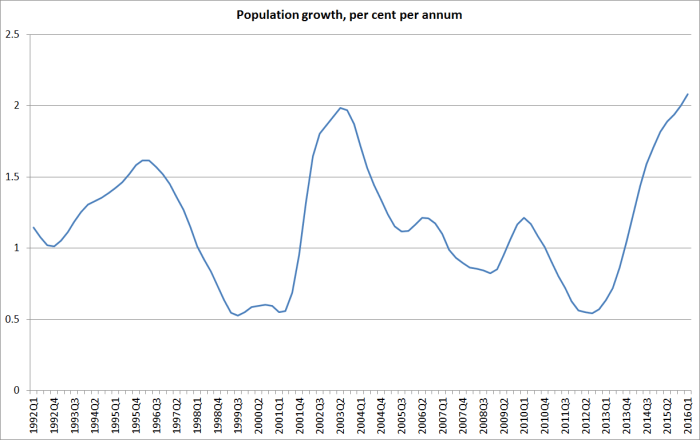
As everyone knows, our current population growth rate is extraordinarily high at present.  We only have an official census every five years or so, but SNZ produces quarterly population estimates using births and deaths data and information on migration flows.  Here is the estimated annual growth rate of New Zealand’s population for the full period since the official estimates begin in 1991.

nz popn

By international standards, New Zealand’s population growth rate is highly variable.  Most of the short-term variability in the series is not about discretionary New Zealand policy choices.  The (large) target for the number of residence approvals has been the same for 15 years or more, and most of the shorter-term variability is a reflection of fluctuations in the net number of New Zealanders leaving –  in turn, much influenced by perceived prospects in Australia.  Incomes are higher there, but that isn’t much use if one can’t get and keep a job, given that most New Zealand migrants to Australia are not eligible for most elements of the Australian welfare safety net.  But New Zealand policy choices do make some difference –  for example, allowing foreign students to work while they are here, appears to have materially increased the number of those living here.

As I illustrated yesterday, productivity growth in New Zealand in recent years has been almost non-existent.  To restate the obvious, it isn’t some fundamental reassessment of New Zealand’s fortunes and productivity prospects that seems to be boosting our population.

But some of the other trends in the data are interesting too.  For example, here is a chart of per capita growth in real consumption.  I’ve shown two lines –  one for private consumption, and one for total consumption (ie including government consumption).

consumption

Private consumption growth per capita – the red line –  was averaging around 4 per cent annum over 2002 to 2005, the last huge population surge.  Those growth rates hadn’t been much lower in the mid 1990s.  In the last year, private consumption per capita has grown by only 0.6 per cent.   And remember that when the population is growing fast, one might reasonably expected recorded consumption to be growing even faster –  after all, those new people all need tables and chairs, washing machines, fridges and other consumer durables (that might actually be used over many years, but are measured as consumption at the point of purchase).

And for all the talk of “wealth effects” from rising house prices –  even though higher house prices only redistribute wealth, they don’t make New Zealanders as a whole better off –  there isn’t much sign of it here.  I’ve run previously the chart of (nominal) consumption as a share of GDP, which has been largely stable for 30 years, despite the repeated surges upwards in the level of house prices.

What about investment?  Over a long period of time, New Zealand has tended to devote a surprisingly small share of its GDP to investment, even though our population growth rate has been well above average, and larger populations need a larger stock of capital.   Among the IMF “advanced economies”, the median country devoted 23.6 per cent of GDP to investment over the period 1980 to 2015.  By contrast, New Zealand devoted 22.7 per cent of GDP to investment –  even though our population increased by around 50 per cent over that period, and the median advanced country’s population increased by around 30 per cent.     When the population surges, a country typically needs to see quite a lot more investment taking place if growth in per capita living standards is to keep pace with that in countries with slower growing populations.

investment weo

Right at the moment, total investment as a share of GDP in New Zealand is a bit larger than in the typical advanced economy.  But in the last year, our population has increased by 2 per cent, and the median advanced economy has had population growth of around 0.5 per cent.  And our investment numbers are boosted by the Christchurch rebuild and repair process, replacing capacity destroyed by a natural disaster.     To maintain the ratios of capital to output typical of a modern successful economy (around 3:1), in the face of such large population growth differentials, one might have hoped to see investment as a share of GDP here perhaps  4 percentage points higher than in other advanced economies.  The actual margin is less than 2 percentage points, and even that margin includes the substantial rebuild spending.

What about our own national accounts data?

non-housing I

Here is non-housing investment spending as a share of GDP.  Even though population growth is now exceeding even that in the early 2000s, the non-housing investment share of GDP has recovered very little since the recession.  When we finally  get the annual capital stock data, we are likely to see very growth in the non-housing per capita capital stock at all.  When even entirely orthodox bodies such as the Productivity Commission produce modelling results in which immigration comes at a modest cost to the recipient country, while the sending country gains a little –  and that was the modelling (of the trans-Tasman flow) that the Australian and New Zealand Productivity Commissions jointly reported a couple of years ago –  the mechanism in the model is typically through a sluggish adjustment of the capital stock.    Ours just has not kept up with the rapid growth in our population.  Some of that is probably about government infrastructure, but mostly it will be because firms have not found sufficiently attractive investment opportunities.

And much of that must be about the unattractiveness/uneconomic nature of expanding exports rapidly from New Zealand. Here is the chart of exports to GDP.

exports to gdp 2016

I wouldn’t focus too much on the 2000 spike –  it was the outcome of a rare combination of events in which our commodity prices were quite high, and our exchange rate was very low –  the latter as much about events in the US as here.  But with very few exceptions, countries –  and especially small countries –  don’t prosper  –  and catch up with the best in the world – if their firms can’t find ways to profitably sell more, better, and more valuable stuff in competition with international producers.  Despite our booming (subsidized) export education sector, and our booming tourism sector, exports as a share of GDP last quarter were largely unchanged from a level first reached 25 years earlier.  Yes, there is some variability in the series, but the peaks haven’t been getting any higher for a long time now.  And this is the series that government policy is supposedly set to get to around 40 per cent…….

The outcomes shouldn’t really be very surprising.  The highest real interest rates in the OECD, a real exchange rate that has never sustainably adjusted to reflect our economic decline, and the perils of a location that make it difficult anyway to build internationally competitive firms relying on anything other than location-specific natural resources.  And yet our policymakers for some reason think that even more people is part of solving the problem.  If anything, it looks to have been make things worse –  making it harder to overcome our natural disadvantages.  Our per capita capital stock adjusts at best sluggishly, and the  per capita stock of natural capital just keeps falling (ie no more natural resources are being made).

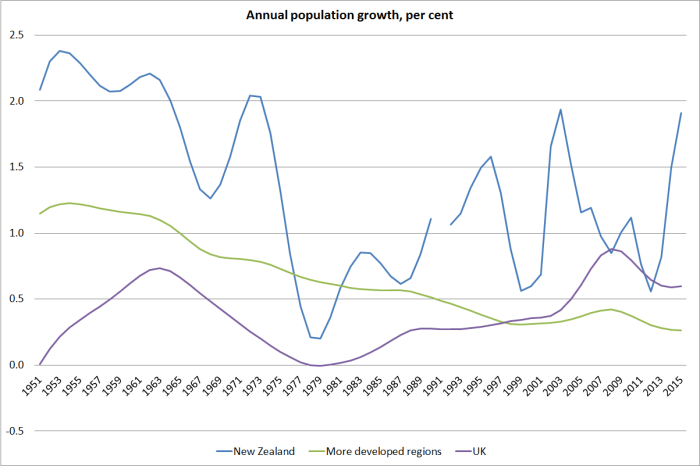
Just to illustrate quite how unusual what is going on with our population is, in international terms, here is a chart I ran a few weeks ago showing annual population growth rates back to the 1950s, for New Zealand, the world (ie mostly the emerging/developing/poorer bits), and what the UN terms the “more developed regions”.

un popn chart

Population growth rates have been tailing off for decades, in advanced countries and in the world as whole.  But this year, New Zealand’s population growth rate (see very first chart) will be similar to those we saw in the 1950s.    Our productivity performance was already tailing off then, but at least we still had among the highest material living standards anywhere.  Quite why our politicians and their advisers think that such rapid population growth –  policy-induced population growth –  relative to the rest of the advanced world makes sense now, when our people are already so much poorer than most of those in the rest of the advanced world –  is one of the questions we really deserve a serious and considered answer to.


Some snippets on New Zealand’s continuing economic underperformance

I’m tied up with some other stuff for much of this week, so if there is a post each day it is likely to be a fairly short one.

Today, I wanted to show just a few charts –  mostly updates of ones I’ve shown before.

In yesterday’s Sunday Star Times, I read Rod Oram’s column.  It was headed Australia’s Delusions Run Deep, on some of the economic challenges Australia undoubtedly faces.  It was fine, as far as it went, but it did bring to mind the words

“Why do you look at the speck of sawdust in your brother’s eye and pay no attention to the plank in your own eye?

Whatever Australia’s challenges, it remains far richer than New Zealand.  We rather take that as given these days, but through most of our modern history there was no such gap.  And there is nothing suggesting that yawning gap is about to begin to sustainably close.

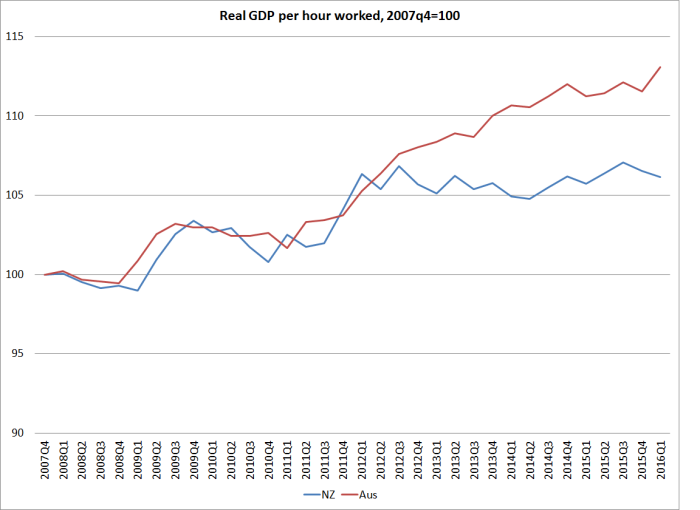
Even over the shorter-term the comparisons don’t flatter us.  Here is real GDP per hour worked (ie labour productivity) for the two countries since the end of 2007 (ie just prior to the recession).

real gdp phw nz and aus

The big differences aren’t about the recession period (our recession was worse than the Australian (income) recession) but are actually apparent in the last few years.  In short, on the official numbers –  and always subject to revisions –  there has been no productivity growth at all in New Zealand for the last four years.  And yet those were the years when, for some reason, people –  even Australians –  started talking about “rockstar” economies on this side of the Tasman, and our Prime Minister (and his acolytes) having been telling us how well New Zealand has been doing, with any stresses “quality problems” and “signs of success”.

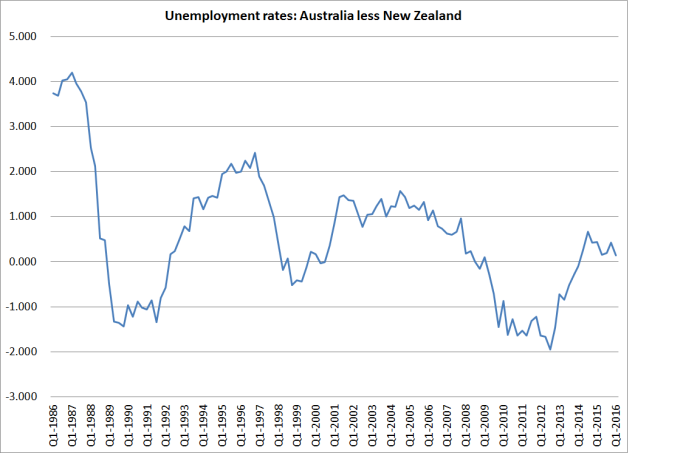
At present New Zealand’s unemployment rate is exactly the same as Australia’s –  both at 5.7 per cent.  But in the decade leading up to the 08/09 recession, Australia’s unemployment rate had averaged 5.9 per cent, while ours averaged 5.2 per cent.    Australia’s unemployment rate is actually a little less bad than average, while ours is worse.

The HLFS has been running for 30 years now.  Over that time, Australia’s unemployment rate has usually been above New Zealand’s –  and they have a more heavily regulated labour market so that is what one should expect –  but not now.

U rates Aus less NZ

But turning back to the New Zealand national accounts, the media coverage did note that per capita real GDP growth has been very slow.    But no one seemed unduly bothered.  Of course there is some quarter to quarter variability in the series, and the data are revised over time, but the simple fact is that, on the official data we currently have, and averaging the production and expenditure measures of GDP, there was no real per capita growth at all last quarter.  And yet this is supposed to be some sort of success story?  Even in the last full year, real per capita GDP growth has been only around 0.6 per cent in total. It remains something of a mystery to me why the Reserve Bank and Treasury expect growth to pick-up from here.

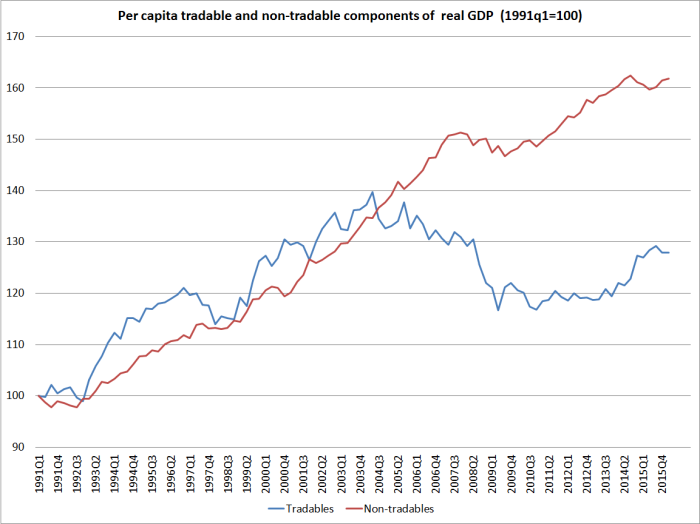
And here is the (rough and ready) breakdown of per capita GDP into its tradable and non-tradable sector components.

pc gdp components

Tradables here includes primary production, manufacturing and exports of services.  Non-tradables is the rest.  So the tradables sector, as captured here, includes the booming (subsidized) export education sector and the booming tourism sector.    And yet there has been no overall growth in tradables sector real GDP per capita for more than 15 years.

Successful economies, building on a sustainable footing, do so by selling more and different stuff in competition with the best the rest of the world has to offer.   That doesn’t describe New Zealand at all –  under this government or its predecessor.

We have

  • no productivity growth
  • a continuing high unemployment rate
  • ruinous house prices, and
  • a tradables sector that has achieved no per capita growth for 15 years.

And yet, so our ministers and officials tell us, our immigration policy is a “critical economic enabler”.    Frankly, it seems bizarre that, as a matter of policy, we bring more and more people –  many of them just not that skilled anyway –  to such an underperforming place.  It is as if theory trumps experience.  New Zealanders pay the price for these political and bureaucratic preconceptions, and for an unwillingness to look out the window and recognize that all is far from well with New Zealand’s economy. Even Australia, for all its challenges, just keeps doing better.

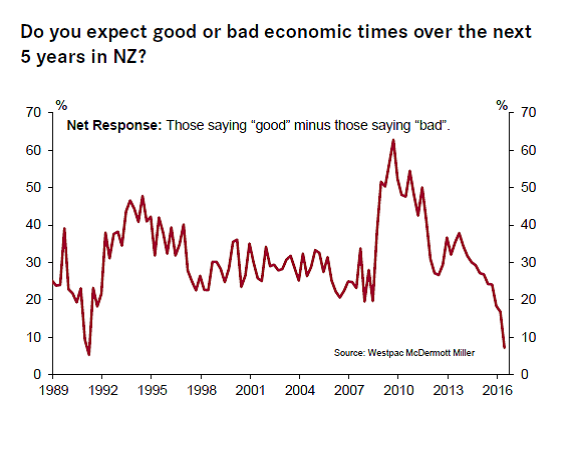
UPDATE:  After finishing that post, I noticed this chart in the Westpac consumer confidence report.  Respondents aren’t always correct in their expectations, but at present they (potential voters all) don’t seem remotely optimistic about the medium-term outlook for New Zealand.

consumer confidence

Business leaders and the case for large scale immigration

New Zealand has one of the very largest planned and managed active legal non-citizen immigration programmes of any country anywhere.  Individual EU countries sometimes have larger legal inflows –  but mostly they can’t control intra-EU flows –  and in recent times the illegal inflows (some mix of refugees and economic migrants) to some countries have been very large. Immigration is a big issue in the UK Brexit debate, but immigration to the UK is on a much smaller scale than that to New Zealand.

Cross-border flows in conflict zones are often high –  and an unwelcome, if second best, outcome all round.  Most of the Syrians who have flooded into Lebanon, Turkey or Jordan would prefer to be back home in a secure Syria.  The Lebanese, Turks, and Jordanians would no doubt prefer that too.

As I’ve noted recently, the United States issues green cards at a rate about a third the (per capita) rate New Zealand grants residence approvals.  Canada –  a much richer country than New Zealand – has just increased its target migrant intake, but in per capita terms it is still less than New Zealand’s.   The only advanced country I’m aware of that sets out to (and succeeds in) attracting more migrants, per capita, than New Zealand is Israel,  and their circumstances are quite different for two key reasons.    The first is geopolitical, in that population could well prove critical to the future existence of the state of Israel.  And the second is about the founding conception of the state of Israel as a Jewish homeland –  the Law of Return allows any Jew (and some descendants) to migrate to Israel, and grants immediate citizenship to those who do.

We are an outlier.  We have total control of our borders,  no geopolitical threats to our existence, and no sense of New Zealand as the historic homeland for some ethnic or religious group scattered across the earth.  And yet we bring in huge numbers of non-citizen migrants each year.  The anomalous nature of our approach is heightened when it is remembered that people who know New Zealand, and its opportunities, best –  ie New Zealanders – have been leaving in large numbers for decades.  Oh, and ours is an economics-based programme, and yet our long-term economic performance just keeps on being pretty disconcertingly poor.

I know most of the theoretical arguments for immigration (and emigration).  But this isn’t a theoretical argument about some abstract stylized country. It is an argument about the appropriate role, and effects, of our particular immigration policy, faced with the specifics of this particular country at this particular time in its history.  Theoretical models can be helpful in thinking about the issues, but only in so far as they capture the key relevant features of the New Zealand economy.  On my reading, few do.

And so I’m always keen to see the strongest cases that people can make for our unusual immigration policy, in a New Zealand specific context.  Hand-waving accompanied by citing papers that take a global perspective doesn’t shed much light on the particulars of New Zealand’s situation.  The government’s chief economic adviser, the Secretary to the Treasury, simply asserts there are economic benefits from immigration, but has made no attempt to demonstrate how they arising in the specific context of New Zealand.  His perspectives often seem more relevant to the British debate –  recalling that is only about six or seven years since he moved here from the UK.  Neither Treasury nor MBIE’s advice –  in formal publications or in material released under the OIA –  provides much to engage with.

There is a bureaucratic/academic elite consensus around the key elements of the immigration programme.  But the other key source of support is the business community.  Mostly they’ve favoured large scale immigration for decades –  through periods of overfull employment and of uncomfortably high unemployment.  Throughout those decades, New Zealand’s relative economic performance has continued to deteriorate.  Perhaps they think – if they stopped to analyse the issue –  we should just be thankful we avoided the counterfactual –  who knows how bad our living standards might now be if, say, our population had increased by perhaps 50 per cent over the last hundred years (as in a typical Northern European country) rather than 300 per cent?

Various representatives of the business community have been out this year championing our immigration policy.  I’m not suggesting that all of them support every detail of how the current system is working, but the general message seems to be that we are on the right track –  running such an unusually large immigration programme, even though our productivity performance remains disconcertingly bad.

A few months ago, I wrote about a brief contribution to the debate from Roger Partridge, the chair of New Zealand’s premier business-funded (typically non-tradables business funded) economic think-tank.   Running under the heading Immigration Grows the Pie, it wasn’t a long piece but it was typically forthright:

And that is not the end to the good news. Countless international studies have shown that increases in immigration not only tend to increase jobs, but also to increase the prosperity of the host nation. We benefit from their productive endeavours, their ingenuity and their diversity. And the more skilled the migrants, the greater the benefits.

That there are gains from immigration has received cross-party support in New Zealand since at least the 4th Labour Government. Let us hope the anti-immigration demagoguery falls on deaf ears. Going down that path we all lose.

The challenge is not keeping out the migrants; it is keeping out the bad ideas. Luckily, that does not need a wall, just clear thinking.

But, as Partridge acknowledged in subsequent comments, none of those “countless” studies focused on the specifics of New Zealand’s situation.

And then in the last couple of weeks, as the immigration debate has received a bit more attention, the Dominion-Post has run advocacy pieces from the leaders of two business advocacy or lobby groups.

On 10 June, the chief executive of BusinessNZ, Kirk Hope, was out with a column headed –  at least in the hard copy – Don’t stem the immigrant tide (there is an identical piece on the BusinessNZ website, under the more subdued heading Improve immigration for the long-term).   Hope has form – I highlighted another one of his op-eds earlier in the year which celebrated our GDP growth rate as among the higher in the OECD, while never once mentioning that rapid population growth was such that recent per capita growth had been quite disappointing by international standards.

In his latest piece, Hope takes issue with calls to cut our residence approvals target.

Immigration is in the news again – being blamed for Auckland’s housing problems, with suggestions that immigration should be drastically cut, to around say 10,000 new permanent residents per year, to restrain Auckland house prices.

The numbers involved –with roughly 30,000 new permanent residents settling in Auckland a year alongside a current shortfall of about 30,000 houses in Auckland – would seem to support the suggestion.

But the suggestion doesn’t stand up to scrutiny.

Reducing the quota to 10,000 would not by itself solve Auckland’s housing problem, and would bring problems of its own.

I’m not sure that anyone has suggested that reform mainly to restrain house prices.  There are other things that could and should be done on that score –   but mostly aren’t.  But equally, there is little real doubt that a much lower expected future rate of population growth would materially lower real house prices.  The sustained reversal of immigration flows from the mid 1970s was a big factor in the 40 per cent fall in real house prices in New Zealand in the late 1970s.
I don’t disagree with everything Hope says. He rightly says that we shouldn’t focus too much on cyclical peaks (or troughs), especially as those cyclical fluctuations (mostly New Zealanders leaving at a faster or slower rate) aren’t something policy can directly control.  But then that is why a sensible discussion on immigration policy focuses on the fairly stable medium-term target level for residence approvals.  At present, that target is 45000 to 50000 per annum.  I argue that New Zealanders would be better off with something more (US like) along the lines of 10000 to 15000 per annum.  All that said, sometimes it is the peaks –  and troughs –  which help spark serious conversations about the medium-term policy settings.
But why is Kirk Hope so keen on a high rate of non-citizen immigration?

Restricting immigration as proposed would harm the economy.

With a birth rate just above replacement level, an ageing population and baby boomers retiring, we need immigrants to sustain the economy and pay for our superannuation, just as in decades past.

And that seems to be his main argument.  It isn’t a very persuasive one.

On the immigration side of the story, around 10 per cent of residence approvals are under the “parent” heading –  ie mostly people who are already quite elderly themselves, and won’t be making much contribution to paying for NZS.  Another 1000 or so will be refugees.  I don’t have any problem with us taking refugees, but the evidence suggest refugees struggle to match New Zealanders’ earnings and employment rate even decades after arriving here.  And unlike the systems in many countries, immigrants themselves are entitled to the full NZS themselves after only a relatively short time living in New Zealand –  ten years.

And on the NZS side of things, if there are affordability challenges with the current system, we have it in our own hands to modify the system to make it more readily affordable.  We could raise the age of eligibility –  National knows it needs to happen, even if the Prime Minister has pledged not to, and Labour campaigned for a higher age at the last election.  Other countries have made these sorts of changes.  We could also age-index NZS eligibility.  We could modify the entitlements of those who haven’t spent most of their working lives in New Zealand.  And there are other options I don’t support, but which would also ease the fiscal pressures, such as income and asset testing, or linking NZS increases to prices rather than wages.  And we can keep the way open for more older people to stay in the labour force for longer –  on the count, we already have one of the least distortionary old age pensions systems anywhere.  We are quite capable of managing the pressures ourselves.

Large scale immigration might make a small difference to NZS affordability, but it is an awfully big intervention for a really quite small difference.  As it is, New Zealand’s birth rate is around replacement, unlike many European and Asian countries, so the ageing population issues are in any case less pressing here than in most places.

In the end, the best way to support the various social spending commitments society wants to make is to foster a highly productive economy.  We’ve kept on failing to do that, and while immigration policy almost certainly isn’t the whole story, there is no evidence whatever that high rates of immigration have improved the position.

The NZS affordability argument seemed to be the sum total of the BusinessNZ case.  In his article, Hope goes on to suggest some refinements to the current system

The jobs being filled by temporary work visas right now are mostly chefs, dairy farm workers and carpenters, showing the current growth points in the economy: tourism, dairy and construction.

There’s no problem using migrants to fill these current needs – but they are not necessarily the needs of the future.

Our aspiration for the future is to grow businesses and industries in high value areas – engineering, high tech manufacturing and services, digital technologies and high value addition to primary products.

We should be welcoming new permanent residents who have skills relevant to these areas to help these sectors to grow.

If he just means that we should be putting more focus on highly-skilled migrants then –  subject to the current overall target continuing –  I’d agree with him.  But it is curious to see the leader of a business group reckon that he knows what skills and what industries will be the ones that will prosper in a future, more successful, New Zealand.  And it is puzzling to see so little faith placed in the workings of the labour market, or the skills and capabilities of New Zealand.  It is redolent of some sort of 1960s indicative planning mentality –  the sort of line of argument I have previously criticized MBIE for.

Successful economies don’t need lots of migrants.  In some cases they might welcome them anyway, but in others not.  As I’ve noted previously, the United States was at the peak of its economic and political dominance during the decades when it was taking very few immigrants at all.  I’m not suggesting a causal relationship (in which the US prospered because it cut back immigration) simply that it wasn’t obvious that high immigration was a necessary part of economic success.

Kirk Hope’s article was followed yesterday by an article from John Milford, the chief executive of the Wellington Chamber of Commerce, under the (hard copy) heading Skilled migrants a win for us all”.

His evidence appears to be a recent MBIE National Survey of Employers. Asked their views on the impact of immigration, employers responded as follows


survey of employers

It isn’t an ideal piece of information.  After all, MBIE –  the people commissioning the survey –  are also the key official champions of immigration policy, and the administrators of the system.  And even setting that to one side, we don’t know how many people disagreed, and how many didn’t answer or didn’t know.

But even setting those points to one side, I’m not surprised at all that individual employers answered along the lines indicated in that chart. For an individual employer, the ability to choose a migrant for a particular vacancy increases that employer’s choices at the wage rate being offered.  Indeed, in some sectors  –  one could think of aged care nurses  –  the wage rates might be sufficiently low that most of the suitable applicants might well be immigrants from poorer countries with lower reservation wages.  But the ability to fill a particular vacancy says nothing at all about whether immigration policy is working to serve the longer-term economic interests of New Zealanders.  And nor would individual employers have any particular expertise in evaluating the arguments in that regard.   It is a lot like the idea that immigration eases skills shortages. For an individual employer, facing a specific hiring decision, the ability to recruit an immigrant may well ease that employer’s specific “skill shortage” (ie prevent the wage offered having to rise) but for the economy as a whole, large scale immigration increases resource pressures, it doesn’t ease them.  New Zealand economists knew that decades ago.

Back in the 1950s and 1960s many New Zealand employers probably also thought that manufacturing protectionism was good for New Zealand too.  It might well have been good for many of them individually, but it wasn’t good for the longer-term living standards of New Zealanders.

Business sector advocates often try to have us believe that key sectors just couldn’t survive without reliance on large scale immigration.  Set aside the inherent implausibility of the argument –  how do firms in the rest of the world manage –  and think about some specifics.  Sure, it is probably hard to get New Zealanders with alternative options to work in rest homes at present.  So, absent the immigration channel, wage rates in that sector would have to rise.  Were they to do so, I can see no reason why in time plenty of New Zealanders would not gravitate to the sector.  It was New Zealanders who staffed the old people’s home my grandparents and great aunts were in 30 years ago.

Same goes for the dairy sector, or the tourism sector.  As one former senior MBIE person put it to me a while ago, what reliance on migrant workers in dairy has done is mostly to enable dairy land prices to be bid a bit higher than otherwise.    Raise the wages and New Zealanders will, over time, gravitate to the opportunities in the sector.  That is how labour markets work.

Of course, none of this is obvious to an individual employer.  They probably can’t raise their wages to attract New Zealand workers instead, even if they wanted to.  To do so would undermine that particular firm’s competitive position.  But again, this is the difference between an individual firm’s perspective, and a whole of economy perspective –  and the latter should be what shapes national policy.  Cut back the immigration target, along the lines I’ve suggested, and we’d see materially fewer resources needing to be spent on simply building to keep up with the infrastructure needs of a rising population.   We’d see materially low real interest rates, and with them a materially lower exchange rate.  The lower exchange rate would enable New Zealand dairy farmers, and tourism operators, to pay the higher wages that might be needed to recruit New Zealanders into their industries, and probably still be more competitive than they are now.  And plenty of New Zealanders now working in sectors totally reliant on an ever-growing population would, in any case, be looking for opportunities in other sectors.

Perhaps some readers might think I’m being unfair to Partridge, Hope, and Milford.  After all, no one can cover all their arguments in a single article of a few hundred words.  As readers know, I certainly can’t.  But surely the best, and most robust, arguments would be put forward first in high profile pieces?.  And what they’ve offered us doesn’t look very robust or convincing at all.  It feels like either a high level application of general international theory, without thinking about the specifics of New Zealand, or an individual employer’s view of the world –  where the ability to hire more people, on the day, at much the same wage is always going to feel like “a good thing”, no matter what the macroeconomic implications might be.  I really hope some of the advocates of the current policy can make the effort to put together a more sustained case for how New Zealand’s current large scale immigration –  or even their preferred refinements to it –  has really been working to lift productivity and the medium-term living standards of New Zealanders.

Of course, there are people on the other side of the argument, even some fairly eminent ones with some serious business backgrounds.  Don Brash spent 18 years as a private sector CEO before turning first to public policy and then politics.  No one can accuse Don of being some of nativist, or of having even a shred of doubt about the benefits of an open economy.  Don published his memoirs a couple of years ago, and included some chapters on various policy issues.  One of those chapters was devoted to issues around immigration, including some of the earlier versions of the arguments I was raising.  Don concluded

I’ve been reluctantly forced to the conclusion that, if we want faster growth in per capita incomes and a lower balance of payments deficit, among the policy measures we need to take is a much more restrictive attitude to total inwards migration

Commenting further

…employers in the export sector who benefit from employing immigrant workers may themselves carry some of the “blame” for the high real exchange rate which makes their lives so uncomfortable

The current government has, during its term, commissioned two external panels to report on issues to do with New Zealand’s disappointing economic performance.  Don Brash chaired the 2025 Taskforce, and Kerry McDonald chaired the 2010 Savings Working Group.

McDonald started his career as an economist, spent time as director of the NZIER, and then moved into the corporate world, spending decades as chief executive of Comalco.  He continues to sit on various corporate boards.  This week he came out with a fairly trenchant piece on the failings in the New Zealand political and policy process.  I didn’t agree with it all by any means, but here is what this economics-trained senior business leader had to say about immigration.

The high rate of immigration is a national disaster. It is lowering the present and future living standards of New Zealanders by serious adverse economic, social and environmental consequences.

The critical criterion for policy is impact on the living standards of New Zealand residents. The impact on the immigrants is irrelevant. But, the political view is a simple and misleading “quantity” based one – more immigrants means population growth and more jobs, houses and infrastructure spending, so GDP increases. This suggests a strong, well-managed economy – which is a nonsense in New Zealand’s case with an export dependent economy.

In terms of national benefit the “per capita” impact is the important one. Unless immigrants increase New Zealand’s exports and foreign exchange earnings and savings per capita, or bring particularly valuable skills to the economy, they simply impose substantial additional costs on and reduce the living standards of New Zealand residents.

Having a job, even in an export industry or tourism, is not enough, and many immigrants lack the particular, high level of skill and productivity to add the necessary value. Using them to fill low skill, low productivity gaps in the labour market, eg. building houses for our excess population (other than on a temporary basis), is damaging to New Zealand’s interests, in the short and long term. So, we scramble to build more houses and ignore the fundamental policy problems.

As I say, I don’t agree with everything he says, but at very least his is a robust honest recognition that, whatever the glee club says, things aren’t going well for New Zealand, haven’t for a long time, and that current policy –  perhaps including immigration policy –  and political leaders have to take some considerable measure of responsibility for that.


How good a forecaster is the Reserve Bank?

Not very good at all.

Of course, that isn’t necessarily a particular criticism of the Reserve Bank.  Forecasting is hard –  especially, as the old line goes, when it is about the future.  But economic forecasters find the past a challenge too.  Yesterday, we finally got the first estimate of GDP data for a quarter that happened, on average, four months ago (ie mid February to mid June).  Even for forecasts done not long before the official data are released the forecasts errors are often non-trivial (the Bank’s forecasters used to try to convince us that even errors of 0.5 percentage points for quarterly GDP forecasts shouldn’t be particularly bothersome).  I don’t have much confidence in economic forecasting, and I mostly try to stay clear of it in my comments on this blog.

You might wonder why, if forecasting is so challenging, central banks devote so much effort to it.  It is not as if there are no alternatives, or as if monetary policy has always been run this way.   A Taylor rule –  using just current estimates of a neutral interest rate, an output gap, and the distance between current inflation and the target –  is one quite plausible alternative as a starting point for policy deliberations.

It is easier to understand why other institutions do economic forecasts.  There is a demand for them from people (corporates, local authorities) who need numbers to populate the cells of planning spreadsheets.  Even central governments, planning expenditure over several years ahead, need such numbers –  but for them, as for other users, trends matter more than cycles.  For central banks, it is cycles that really matter.

Forecasts also get media coverage –  as horoscopes helped sell newspapers in years gone by –  and part of a bank economist’s role is media coverage, and visibility for the respective banks’ brands.  For some other forecasters, the visibility of forecasts might, at the margin, help sell other consulting services.

Whatever the reasons behind their respective operations, there are now plenty of outfits doing economic forecasts for key New Zealand variables.  And yesterday the Reserve Bank published an issue of the Bulletin devoted to a statistical analysis of how the Reserve Bank’s forecasts have done over recent years relative to a large group of these other forecasters.  They’ve done these exercises from time to time, but this one in particular seems to be part of the Reserve Bank’s defensive operation to cover for its monetary policy misjudgments in recent years.  Although there is nothing complex about the analysis, and although the Reserve Bank has a large team of numerate researchers and analysts, the analysis (and article) was contracted out to NZIER.  As it happened, the NZIER researcher –  Kirdan Lees –  had, in fact, been one of the managers in the Bank’s Economics Department, fully involved in the scrutiny of the forecasts, in the early years of the period the exercise reviews (2009 to 2015).

It is good that official agencies do these exercises.  They help shed some light on questions that those who approve agency budgets, and assess their performance, might reasonably ask.   The new Reserve Bank exercise helpfully uses the same approach adopted in a 2009 analysis of the previous few years of Bank forecasting performance, but benefits from a larger sample of forecasters.  The Treasury just last month published a new review of its own macro and tax forecasting performance.

Having said that, it is as well to take each exercise with a considerable pinch of salt.   Most of these studies look at quite short periods.  The Bank’s previous exercise looked at forecasts done over 2003 to 2008.  This one looks at forecasts done from 2009 to 2015.  For two-year ahead forecasts –  and it is the medium-term the Reserve Bank ostensibly focuses on in setting policy –  that means no more than three non-overlapping forecasts for each observation (eg a March 2009 forecast for March 2011,  a March 2011 forecast for March 2013, and a March 2013 forecast for 2015).  There just isn’t enough data to meaningfully tell the various forecasters apart in a statistical sense (as the author recognizes in explicitly choosing not report measures of the statistical significance of differences across forecasters).  Good performance  –  or bad performance – in a particular period might just be a result of luck.  The recent Treasury exercise used a longer-run of data (in some cases all the way back to 1991) and it might have been interesting for the Bank researchers to have at least(also) looked at the full period performance since 2003.

It is also important to recognize that the way the exercise is done is systematically set up to favour the Reserve Bank (the Treasury exercise has the same problem, a point which their write up explicitly notes).   The Reserve Bank collects forecasts from a variety of other official and private forecasters two to three weeks before the Bank’s own forecasts as finalized.  That collection of external forecasts is one input in the Bank’s own forecasting and scrutiny process.  We would sit around the MPC table, scrutinizing the draft projections our own forecasters had come up with, and use the external forecasters’ numbers as a basis for questions of our own.  Often enough, people (me included) were quite dismissive of the external forecasters, but we were keen to understand the logic where the forecasts of the more respected external forecasters differed materially from our own draft forecasts.    It  was one part of running a process designed to assure the Bank’s Board (for example) that we had thought about alternative possibilities and to test the robustness of our own numbers.

But what that inevitably means is that in comparing these external forecasts with the Reserve Bank ones, not only does the Reserve Bank have several weeks more data than the external forecasters have, but the Reserve Bank can condition its forecasts on any useful information in the external forecasts (individually or in aggregate).  For some variables, that two to three weeks can make quite a difference –  eg the exchange rate can move a lot, oil and dairy prices can move quite a bit, and some (typically second tier) domestic data will have emerged that the external forecasters just didn’t have.  For the June MPS forecasts, the Bank often has Budget information private external forecasters wouldn’t have had.  How large that advantage is is an empirical question (which can’t readily be answered), but the direction of the advantage is clear.  The Reserve Bank should typically do a bit better than most external forecasters –  not hugely so, as much about the future is inherently unknowable, but better.

Oh, and the Reserve Bank spends massively more on macro forecasting and analysis than any other agency monitoring/forecasting the New Zealand economy: a typical large domestic economics team is perhaps five people in total and several of the forecasters on the list are one-person operations.  The Reserve Bank used to have perhaps eight people in its forecasting team, another half dozen doing modelling (mostly oriented to forecasting concerns), more doing research, and more monitoring international economies.  And key senior managers (from the Governor on down) are heavily involved in reviewing/challenging/confirming the forecasts, along with a couple of external advisers.  These (mostly very smart) people don’t just do forecasting, but a sceptical Treasury analyst, considering the Reserve Bank’s funding agreement submissions, might reasonably ask about how large the marginal gains in forecasting accuracy and policy quality are from all the additional resource the Bank devotes to the operation.

How did the Bank do?  The usual method for looking at forecast accuracy is to calculate the Root Mean Squared Error, a measure which looks at the size of absolute errors (ie upside and downside errors don’t offset each others) and which particularly penalizes large errors.

The Bank reports the results of their comparison for four variables (GDP growth, 90 day bill rate, CPI inflation, and the TWI) and for both one and two years ahead.   They also show the results for each other forecaster –  anonymized –  and the results if on each occasion the Bank published a forecast they simply used the median forecast for each variable from the most recent grouping of external forecasts.      That means we can look at 16 RMSE comparisons.  Here is my summary table.

Reserve Bank forecasting performance
Better than the median forecaster Better than the median forecast
GDP 1 yr ahead Yes Yes
2 yrs ahead No No
90 day bill 1 yr ahead Yes Yes
2 yrs ahead No No
CPI 1 yr ahead Yes Yes
2 yrs ahead Yes Yes
TWI 1 yr ahead No No
2 yrs ahead No No

Of the sixteen observations, the Reserve Bank does better than the median eight times, and worse than the median eight times.   That is a little bit better than it sounds –  it has long been recognized that using a median forecast will typically produce a better forecast than using any individual forecast.  In the charts in the article, adopting a rule of just using the median forecast on each occasion produces results that would typically put someone running that rule in the best third of the forecasters examined here.

But recall that:

  • the Reserve Bank has information advantages over the external forecasters
  • the Reserve Bank devotes a lot more resources to forecasting
  • the Reserve Bank actually (in effect) sets the 90 day rate (in announcing an OCR as part of its forecasts)
  • the variable that the Reserve Bank has consistently beaten the median (forecast and forecaster) on is CPI inflation, a variable which has undershot the target now for four years.
  • the Bank does relatively worse on the two year ahead forecasts than the one year ahead forecasts, even though monetary policy is ostensibly set on a medium-term (18 mth to two year ahead) view.    Information advantages are likely to be materially less for two year ahead forecasts than for year ahead ones.

The Bank’s article has its own summary measure of forecast errors (aggregating across the four measures –  details are in the article).

Here is the chart for one year ahead forecasts

forecast errors 1 yr ahead

The median forecaster is between forecasters J and I, with an RMSE of .965.  The Reserve Bank’s RMSE of .94 is neither economically nor statistically significantly different from that median forecaster’s (and those of a bunch of others clustered near)

And here for two year ahead forecasts

forecast errors 2 yrsThe median forecaster is between forecasters J and D.  Again, the Reserve Bank looks no better (or worse) than the group of forecasters clustered near the median forecaster.

In doing the analysis, Kirdan Lees did the interesting exercise of looking at how using the median forecast on each case would have performed.  But another exercise one could think of doing is to compare how these forecasters (including the RB) did relative to simply using the most recent actual information, and assuming that what we see today is what will be (the best forecast f0r) the outcome one and two years ahead.  For forecasting the exchange rate, it is widely accepted that it is very difficult to beat this “random walk” approach.

I did a quick exercise to see how the random walk would have done over 2009 to 2015 for the CPI and the OCR (not the same as the 90 day rate, but very close).  For year ahead inflation forecasts, forecasters certainly did better.  At the two year horizon, the Reserve Bank did a little better than the random walk over this sample period, but most of the other forecasters didn’t.  Given the small sample, over this period, there might have no useful information in the laboriously produced medium-term inflation forecasts at all.

What about the OCR?  Looking a year ahead, the Reserve Bank’s 90 day bill forecasts had the same RMSE as simply forecasting the OCR using a random walk –  and the Reserve Bank sets the OCR, using its own reaction function.  Quite a few forecasters did worse than the random walk, but then they had less information than the Bank.   On two year ahead forecasts, only one forecaster was as good (on this measure over this time) as the random walk OCR forecast.  The Reserve Bank was among those who were far worse.

Perhaps it would also be interesting to look at some other comparisons.  For example, to see whether forecast errors at the Bank are different from one Governor to the other (probably not, but gubernatorial overlay is a well-recognized and, in principle, quite legitimate part of the RB forecasts).  One could look at (implicit) forecasts from predictions markets (rather thin, and now undermined by regulatory interference) and for 90 day bills one could compare the Reserve Bank’s forecasts with implicit market prices.  But those weren’t the point of this particular exercise.

What would I take from all this?  Not overly much.  In the Reserve Bank’s press release they were rather inclined to oversell the Bank’s performance –  noting neither the Bank’s information advantages, nor the lack of statistical (or economic) significance in most of the results.  Forecasting is a mug’s game and it shouldn’t be any surprise that no one much can do it consistently well.  It might be better to stop pretending otherwise.

I suspect that the Reserve Bank is –  on average – about as good, or bad, as the other forecasters focusing on New Zealand.  At one level, perhaps we shouldn’t expect more.  Then again, they (a) spend huge amounts of public money on generating and publishing forecasts, and (b) are charged –  and have agreed to accept – a mandate that involves their ability to adjust the OCR to deliver on an inflation target.  I haven’t looked at the bias results in this post (all the results are in the article) but there were huge biases in the inflation forecasts over this period.  The Reserve Bank’s were a bit less than most –  and that had certainly been my impression when I was still at the Bank –  but it is hardly an impressive performance.  As Bernard Hickey noted in questions at the recent MPS press conference, on their own –  not overly good –  forecasts, they are on track for six years below target.

As I noted earlier, these exercises need to be done from time to time. But I’m not sure they really shed much light on the policy judgements and misjudgements over the last few years (or indeed in the period covered by the earlier article).    There is some defensive cover in being in among the pack in (small sample) forecasting comparisons –  in that it is better than the alternative of being shown to be consistently most wrong –  but it doesn’t really justify what has gone on.  A lot of smart people, led by the Governor and his chief economist, got it consistently wrong, made overly bold calls at key junctures, then proved continually averse to scrutiny or to even acknowledging errors and misjudgements (to which all humans are prone), and continue to rely today on overly bold assumptions about things being just about to come right.


Immigration policy and values statements

Vernon Small has an interesting column in the Dominion-Post this morning (not yet online) under the heading “Terror risk muddies rational migration debate”.  He seems keen on a national debate on the economics of our immigration policy, including highlighting  The Treasury’s concerns about whether the skill level of the typical migrant is really fully consistent with the original vision of a skills-based migration programme providing economic benefits to New Zealanders.

But at the same time, with a somewhat lofty condescension, he seems uneasy about other public concerns. In particular, he isn’t taken with calls from Winston Peters and David Seymour for immigrants (including refugees) to sign some sort of national values statement.

Actually, I’m also not keen on requiring immigrants to sign values statements.  Not just because they don’t seem enforceable –   and if you really want to get to Australia, why would a commitment to “respect” (whatever that means) “a spirit of egalitarianism” (one element of the required Australian values statement”) deter one?.  Who knows what it means anyway  Perhaps turning over the Prime Minister every year or so, so that as many people as possible get a go?

My concerns are about two, perhaps opposing, risks.  The first is that any values statement becomes a lowest common denominator statement as to be totally meaningless.  The second is that the wording of any values statement –  if taken seriously –  would be hotly and continuously contested, as culture wars ebbed and flowed.  And frankly, I don’t seem to be welcome in David Seymour’s New Zealand.

Here is the Australian Values Statement, required of migrants to Australia:

I understand:

  • Australian society values respect for the freedom and dignity of the individual, freedom of religion, commitment to the rule of law, Parliamentary democracy, equality of men and women and a spirit of egalitarianism that embraces mutual respect, tolerance, fair play and compassion for those in need and pursuit of the public good
  • Australian society values equality of opportunity for individuals, regardless of their race, religion or ethnic background
  • the English language, as the national language, is an important unifying element of Australian society.

I undertake to respect these values of Australian society during my stay in Australia and to obey the laws of Australia.

I understand that, if I should seek to become an Australian citizen:

  • Australian citizenship is a shared identity, a common bond which unites all Australians while respecting their diversity
  • Australian citizenship involves reciprocal rights and responsibilities. The responsibilities of Australian Citizenship include obeying Australian laws, including those relating to voting at elections and serving on a jury.

If I meet the legal qualifications for becoming an Australian citizen and my application is approved I understand that I would have to pledge my loyalty to Australia and its people.

No doubt it isn’t aimed at people like me, and were I migrating to Australia, I could probably, at a pinch, sign it.  But I would have a few mental reservations.  If I knew what the sprit of egalitarianism was, I’d certainly accept it as part of the folk mythology of Australia,  but I’m not sure I’d really “respect” it.  And as for “equality of men and women”, well yes certainly in the most important senses –  equality before the law and before God.  But I’m a Christian, and like most Christian churches (including in Australia the Catholic church, and the Anglican church in Sydney), I don’t believe that women should serve as priests.  I don’t see that as matter of inequality, but many would.

I’m not sure when the Australian Values Statement was written, but it feels as though it might be 10 or 15 years old.   The culture wars have moved on, and David Seymour offers this, rather shorter version as a possibility for New Zealand.

Seymour said it wouldn’t be difficult to pull together a simple charter, stating for example: “We believe regardless of gender, sexuality, ethnicity or religion, you have the same legal rights as everybody else.”

If by that he means that, for example, people should be able to “marry” others of the same sex, then I don’t believe that.  Actually, for almost all of history –  including New Zealand’s history –  very few people did. Most Christian churches don’t today.  It is, for now, the law in New Zealand, but it doesn’t mean I agree with or respect that law.    And, for better or worse, in some respects New Zealand law isn’t even consistent with Seymour’s statement: after all, to name just one example, we have Maori seats in Parliament.  And where does the Treaty fit in the mix?

In fairness to Seymour, his might have been the fruit of 20 minutes scribbling on the back of an envelope. Any values statement actually put into legislation would no doubt be more carefully drafted –  and for that reason, among others, quite a lot longer, to capture all the caveats and competing emphases.

And where would it stop?  I had a quick look this morning at statements I could find in which each of the three largest political parties describe their values.  There was some overlap (and the particular Labour Party document I found had three of four pages of text, while the Greens and National Party had quite short lists), but there were quite a few substantial differences.  Which is what one might expect: a significant part of political debate is the contest of ideas and values, particularly in an era of cultural transition (eg secularization, in which culture and religion are no longer intrinsically interwoven).

I might find the references to loyalty to the sovereign, and limited government, in the National Party’s list appealing.    Many other New Zealanders wouldn’t.   “Respect the planet” might be something central to a Green view on things, but to me the concept of respecting an inanimate object just seems weird.  And even though there was serious uncertainty about the consequences of doing so, I’m glad our ancestors took decisive action to confront Hitler, rather than “take the path of caution”.

As far as I can see, none of the values statement (yet) talk of the rights of the unborn, or transgender rights to bathrooms –  to take just a couple of issues that have convulsed American debate.

Perhaps we might get agreement on process issues –  parliamentary sovereignty, a universal franchise, the rule of law etc –  but even on process it might be thin pickings.  There are probably plenty of supporters here of moving to a written constitution, and others who still hanker for a return to FPP.  In the end, is there genuine common ground on very much at all, other perhaps than that change should occur non-violently?  We can all agree that individuals do and should have rights, and probably all agree that in some circumstances the needs/interests of the “community” override those individual rights.  But where that boundary is, and how it should shift, is the intrinsic stuff of politics.  We can’t agree among ourselves, so what is there for immigrants to sign up to, other than today’s (temporary) shifting majority.  I was amused, for example, to read the Prime Minister’s rewriting of history, in answering the values question, noting that for him it included “understanding that New Zealand’s always been a tolerant society”.   Really?  To name just one low-key example, our treatment of conscientious objectors during the two World Wars meets no reasonable definition of “tolerant”.

And yet the people who call for migrants to sign values statements do capture a fair point.  When large numbers of people are allowed by our governments to come and live in New Zealand they have the potential to change our society.  People are not just bloodless economic units –  dessicated calculating machines.  They bring their own attitudes and values, and while the new arrivals are likely to be changed by living here so –  if the numbers are large enough – is our society.  One need only think of European migration to New Zealand over the last 200 years –  we their descendants may be changed by living here rather than in, say, the United Kingdom, but the similarities with modern Britain are probably greater than those with pre-1840 Maori society.  The point is not that modern New Zealand is better or worse for those migrants (and their values/attitudes/technologies), but that the fact of change is inescapable and largely irreversible.  Seeking that sort of change is itself a political act.

Which is one of a number of reasons why I’m skeptical that –  even if there were material economic benefits to residents of the recipient countries – large scale immigration programmes are normally a legitimate role of government at all.  We’ll always have some immigration.  New Zealanders travel, and some will meet and marry foreigners.  Often enough the new couple will want to settle here.  And our humanitarian impulses will, rightly, drive us to take some refugees.  But in neither case –  both on generally quite a small scale – do we grant permission to reside here with a goal of changing our society.

But once we get into large scale immigration programme, governments are in the culture change business, actively or passively, often without even realizing it. In terms of the domestic culture wars, and ongoing debates, the ability to attract more people like one side or another skews the playing field.  Instead of working out our differences, and debating change, within the existing community of New Zealanders, we tilt the playing field one way or the other. I might be comfortable with a large influx of mid-western evangelicals, while most Wellingtonians might prefer liberal Swedes.  I might be happy with strongly Anglican Ugandans or Kenyans, while many would prefer secular French.   In the specific New Zealand context, few migrants have any strong reason to feel a commitment to the Treaty of Waitangi, and for those New Zealanders for whom that is an important issue, any large scale immigration skews the game against (that representation) of Maori interests

It is far easier to resolve disputes, and find an ongoing place for each other, among communities with shared memories, experiences and commitments.  Families do it better than countries.  Countries do it better than the world.  Globalists might not like to acknowledge that, but it doesn’t change the reality.  Families don’t usually resolve their differences –  sometimes painful lasting differences –   by injecting new members into the family.