Superannuation and savings: Australia

Arguments have run around for years about New Zealand’s relatively low national savings rate, Australia’s relatively high national savings rate, and the Australian compulsory private savings system.

Doesn’t NZS just contribute to New Zealand’s “savings problem” and haven’t the Australians shown the way to boost national savings?

A universal age pension will have reduced private savings, relative to a benchmark system in which there was no state age pension at all.  But it won’t have done so for everyone.  Many people never earn enough to have saved any material amount for retirement. For them, the absence of something like NZS would simply mean they went on working until they no longer physically could, and would then rely on family and private charity.  GDP might be higher, but savings rates probably wouldn’t be materially different.   And at the other extreme, it seems unlikely that Graeme Hart or others on the “rich list” will save one cent less because they too may receive a modest universal pension payment at 65.

But it makes a difference for people in the middle.  The knowledge that, in retirement, the state will provide an annual income of around $25000 per couple makes a huge difference to how much a family earning $100000 might need to save to support their desired consumption in retirement.  Whether it lowers national savings isn’t possible to tell a priori –  that depends on what the government does.  If we had no NZS, would government savings –  and accumulated government debt –  be higher, lower or no different?

But the choice isn’t universal NZS or no age support at all.  Some argue for means-testing for NZS, as was done from the mid 80s until the late 1990s.   There could be some real fiscal savings to be made from no longer paying NZS to upper income or wealthier people.    But to get material savings the system has to start abating NZS payments at relatively modest levels of other income/assets, and the people who are likely to be affected will alter their behaviour accordingly.  A lot of fiscal savings can be made, but only with the probability of further discouraging many middle income people from saving for their own retirement.  Again, it won’t make a difference to anyone with really high wealth/income, but for someone who was planning to provide themselves with, say, $30000 per annum on top of NZS it could make a real difference  – both to planned savings, and to a willingness to stay in the workforce beyond 65.

I also asserted yesterday that our NZS system probably discouraged private savings less severely than systems in many other OECD countries.  In many countries, people receive state pensions that are calculated based on the earnings of the individual concerned (sometimes lifetime average earnings, sometimes only the later years’ earnings).  A person with average lifetime earnings of say $80000 will get a state pension materially higher than someone whose lifetime earnings averaged $40000. In New Zealand, no matter how much you’ve earned over your life, the state pension is still only around $25000 per couple.  Fair or not, the point here is just that in New Zealand if you want more than the basic $25000 you have to provide it for yourself.  In many other systems, the state provides it, but the state has not funded that cost as the prospective liability has accumulated.  So our system probably deters private savings  – among those with the capacity to save materially – less than many of the schemes in other countries do.

Ah, but what about compulsory private schemes?    Australia is one of the few that has been in place for quite a long time.  And, of course, it is a scheme directly relevant to many New Zealanders, given the extensive New Zealand migration to and from Australia.

The national savings rate in Australia is relatively high – something that tantalises many in the New Zealand debate.   Often the gross national savings rate as a percentage of GDP is quoted.  But I don’t think it is the best measure of savings.  In the rest of this piece, I will be using net national savings as a percentage of net national income.  “Net” here means net of depreciation.  Australia has some very capital-intensive production structures, and a high proportion of its gross income needs to be applied to cover depreciation on the capital.  And “national” here means the incomes, and savings, of – in this case – Australians.

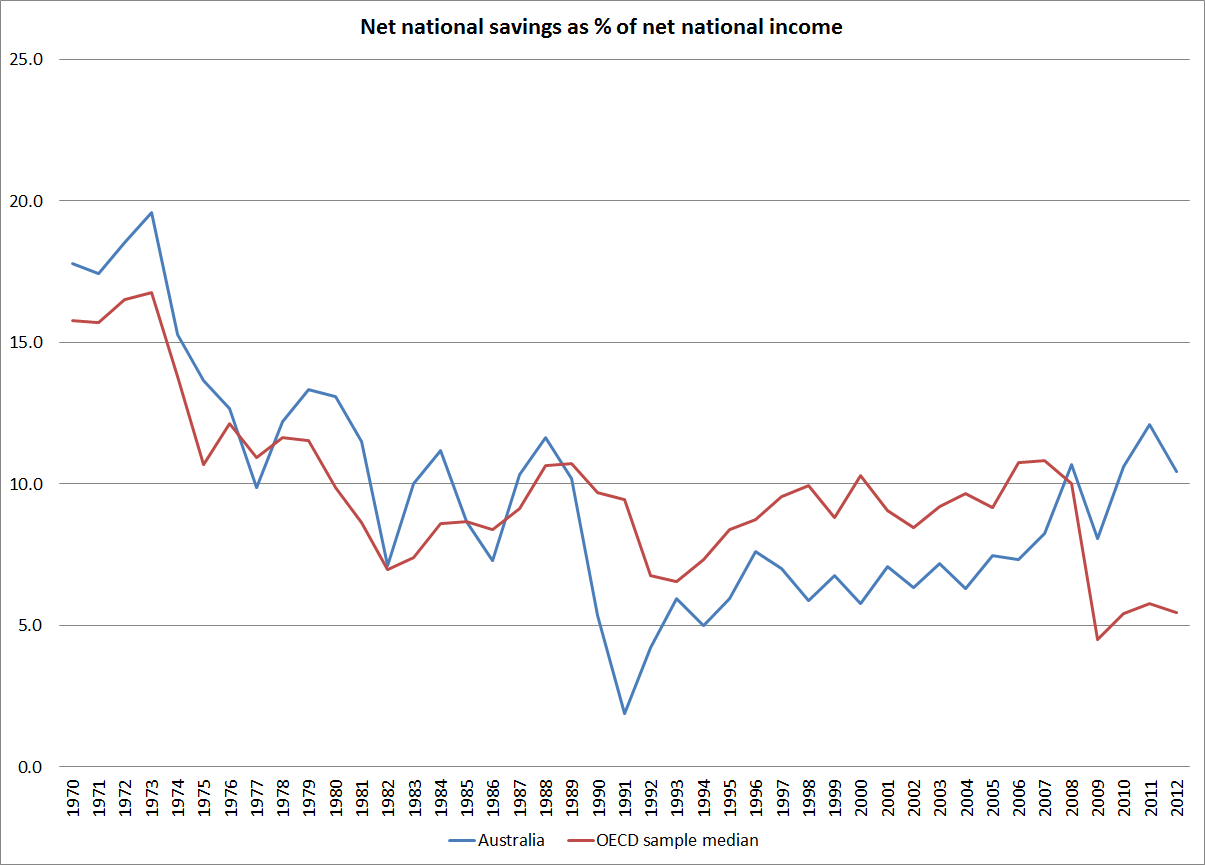
The OECD has a pretty good collection of data on these two series for around 20 member countries going back to 1970.  Australia had pretty high net national savings rates right back at the start of the period, a few percentage points above the median of this sample of OECD economies.  Quite why, I’m not sure, and I haven’t seen any good studies looking at that particular cross-country comparison.  But what I wanted to focus on is what has happened over the period since 1970, in Australia and in other advanced economies.

Australia’s net national savings rate was at or above the level of these other countries until around 1990.  But for the following 15 years, Australia’s savings rate was well below those in the other advanced economies, and lower than it had been in the 1980s.  It is only with the huge terms of trade boom from the middle of the 2000s that Australia’s national savings rate surges up again. As the terms of trade falls away forecasts suggests the national savings rate will drop too.
australia1

How does compulsory private savings fit in this picture.  David Gruen, former Deputy Secretary of the Australian Treasury, gives us the summary history:

The compulsory superannuation system began with industrial award-based superannuation, agreed by the Government of the day and the Australian Council of Trade Unions as part of the 1985 Prices and Incomes Accord. A 3 per cent superannuation contribution was paid by employers into employees’ individual accounts in nominated superannuation funds, rather than being paid as a wage rise.5

The coverage of award superannuation was expanded significantly in 1992, with the introduction of the Superannuation Guarantee Levy, which required employers to make superannuation contributions on behalf of their employees, and enshrined superannuation contributions in federal legislation rather than relying on the award system.

The then Government announced plans to gradually increase the minimum contribution rate to 9 per cent by 2000-01

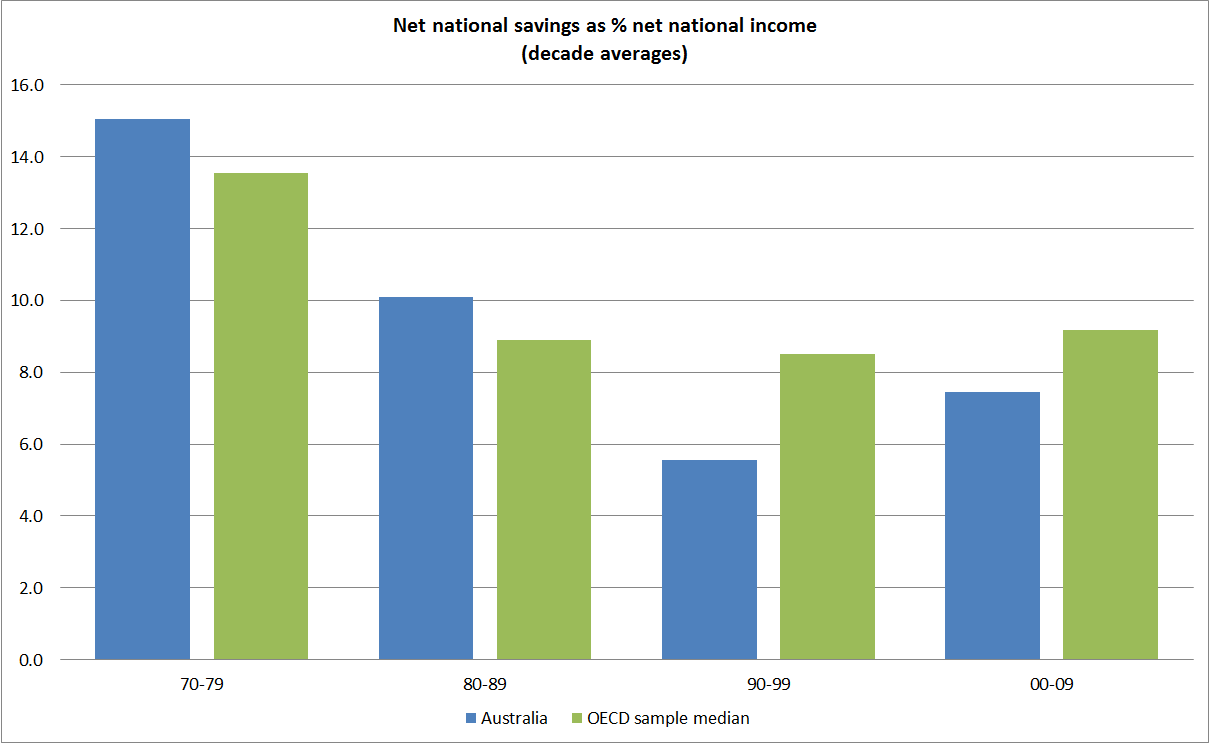
So from the mid-1980s, and particularly from 1992, Australian employees were compelled to progressively increase the proportion of their incomes put away in designated superannuation savings vehicles.    And yet, at an aggregate national accounts level there is little sign of it.  Not only is Australia’s national savings rate in the 1990s lower than it was in the 1980s, but it was lower relative to those in other advanced economies.
aus3

And what about the comparison with New Zealand?  Again, Australia has had a higher net national savings rate than New Zealand throughout, but the gap has been smaller in the last couple of decades than it was in the first two decades.  And in this comparison, it is worth bearing in mind that in the 70s and 80s, New Zealand had in place very concessional tax treatment for private superannuation vehicles, which might (if anything) have tended to boost savings rates here.
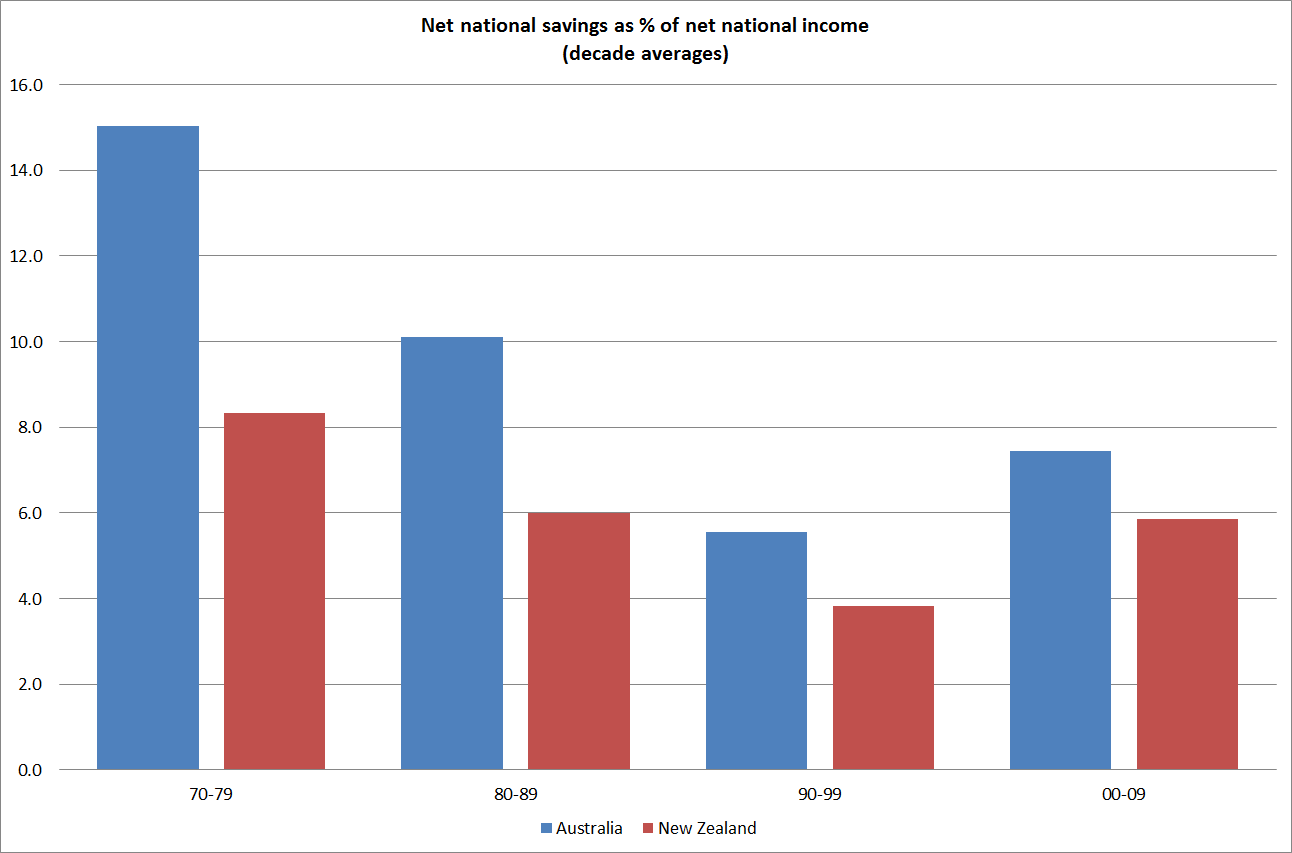
aus2

The picture doesn’t look much different if we compare Australia with the median of the other Anglo countries (Canada, Ireland, New Zealand, the US and the UK).
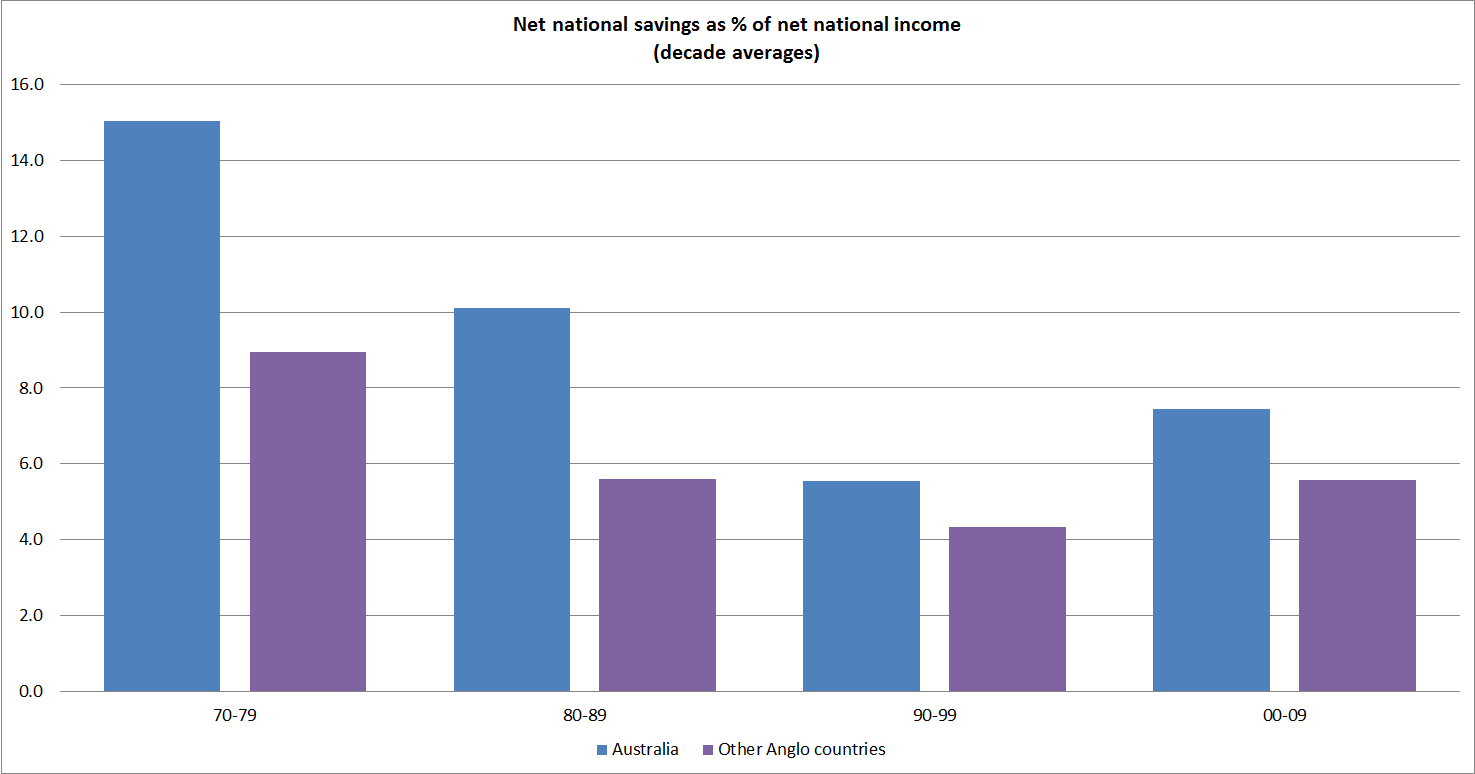
aus4

Several empirical studies have suggested that the compulsory savings scheme has boosted savings rates in Australia.    The reported evidence has been stronger in respect of household savings than for national savings, although David Gruen (who cites these studies) is confident that the arrangements have boosted Australia’s national savings rate.

Perhaps.  And. as ever, we can’t know the counterfactual. But it isn’t obvious at a macroeconomic level. There might be small positive effects that just can’t be seen at this level of aggregation – other forces would have driven national savings rates in Australia even lower, and compulsory private savings prevented those full effects being seen in the data.  But it is difficult to know quite what those effects would have been, and why for example they might have affected Australia more severely than New Zealand and other advanced economies.  At very least, it is hard to see that the really far-reaching changes Paul Keating established, and subsequent governments have persisted with, has been any sort of game-changer as far as Australia’s national savings is concerned[1].   And, as I noted yesterday, it is not as if the Australian arrangements have ended up fiscally cheaper than New Zealand’s either.

[1] And that is without even mentioning the distortions to private choices and balance sheets, the “subsidies” to funds managers and tax accountants, and so on.  The scheme will have changed many individual balance sheets, and has probably left the household sector more leveraged than otherwise, and perhaps the Australian gross international investment position too.
New Zealand Superannuation

Yesterday I mentioned that it is often forgotten that we already have a near-universal indexed annuity that ensures that no elderly New Zealander need ever end up in extreme poverty.

New Zealand Superannuation is paid from age 65 to any citizen or permanent resident living in New Zealand who meets some (relatively undemanding) accumulated residency requirements, at a rate equal to (for a couple) 66 per cent of the average net wage.

Of course, nothing is risk-free in life.  The New Zealand government is most unlikely to directly default on its debts in the next few decades.  But there is “policy risk”: as the 2025 Taskforce put it a few years ago “New Zealand has a long history of revisiting its state pension arrangements”.  But for resident New Zealanders at the bottom of the income distribution it makes perfect sense to rely almost solely on NZS for income support in old age.  Whatever changes have been made, or seem plausibly likely to be made in the next few decades, we are most unlikely to revert to the sort of good character test that was part of the 1898 scheme, or to impose new filial responsibility laws to push the responsibility for the elderly poor back onto families.

NZS has a number of pretty attractive features:

  • It is administratively simple (near-universal schemes tend to be)
  • It has contributed to New Zealand having one of the lowest elderly poverty rates in the OECD
  • It focuses on a moderate level of basic needs, and leaves those with aspirations to a higher standard of living in retirement to save for themselves.
  • Because it is not abated against other income there is no direct deterrent to people remaining in the workforce beyond 65 (and partly as a result New Zealand has relatively high voluntary labour force participation rates for people aged 65 and over).
  • Because it is tied to earnings, at least in principle it avoids periodic battles over distribution of the gains from growth (which CPI indexed would tend to induce)

On the other hand, the scheme costs a lot of money, discourages some private savings (although there is no easy way of knowing if it discourages national savings), and seems to have a created a sense of entitlement .  The availability of a near-universal income from 65 will discourage some labour force participation (itself a double-edged argument, since presumably no one wants infirm 85 year olds sent out to work), reducing average GDP per capita.  The other double-edged feature is that there is no relationship at all between one’s ability to draw NZS and any contribution one may have made to the New Zealand tax system (whether as an individual or as part of a family).

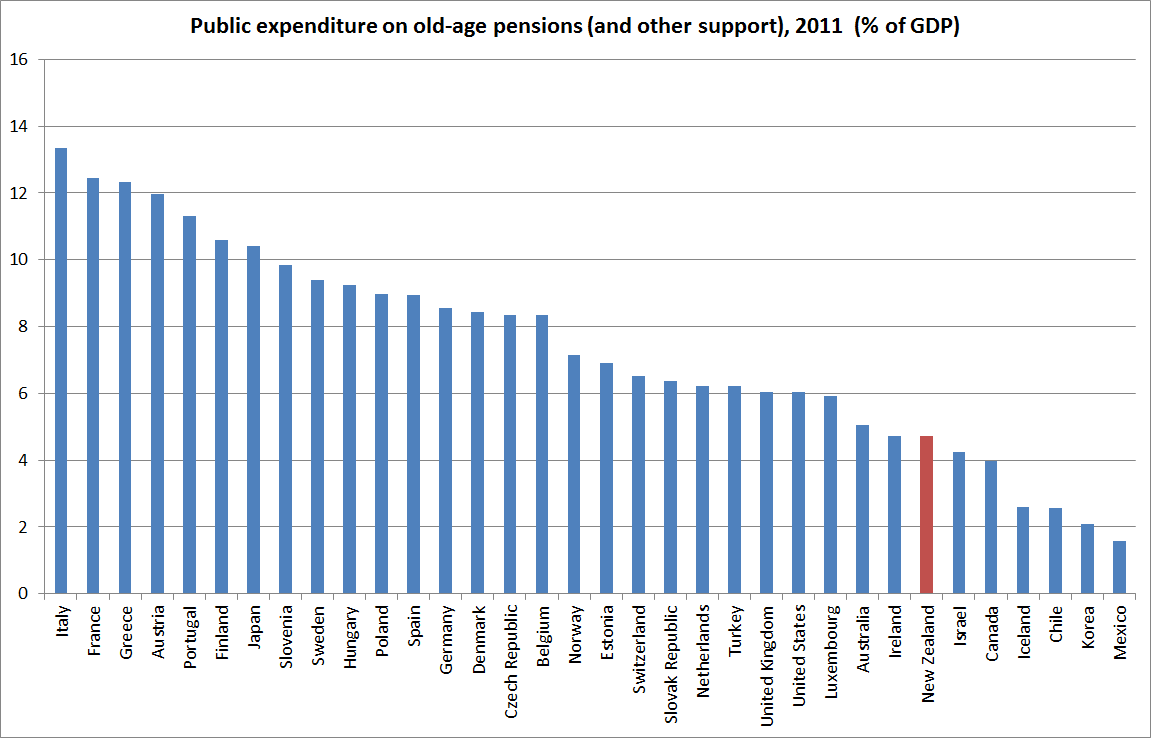
I noted that NZS is expensive, and that cost is rising quite rapidly now each year, as the baby boomer generation reaches 65 and beyond.  But high as the absolute cost is, it is worth bearing in mind that New Zealand’s public spending on pensions and other old age support is pretty low compared with that in other OECD countries. In 2011 only six of the 34 OECD countries spent a smaller share of GDP than New Zealand did.

pensions

By contrast, in 1980 not only did New Zealand spend a larger share of its GDP than it did in 2011, but only six OECD countries then spent more.  We made big changes after that –  increasing the eligibility age back to 65, and lowering the payment as a share of income.  Note that, despite the compulsory private savings scheme, Australia has been spending a little more on pensions etc than New Zealand does.

It isn’t a perfect system by any means, but I think it would be foolhardy to try to change the essential characteristics.  Those old enough to remember 1984 (or even 1973) to 1999 will recall how intense the controversies were around superannuation, all for not really that much change in the end (from, say, the 1972 system to that prevailing after the late 1990s).

Reasonable people can differ on whether the appropriate formula is 66 per cent of wages, or something a bit lower.  A case could be made for something lower (perhaps 60 per cent) but I also think it is a second or third order issue.  Sure the direct fiscal costs are not trivial, but it is mostly a distributional choice about how generously, or otherwise, we want to treat the elderly.  And even if some government was bold enough to lower NZS to 60 per cent of wages, it simply invites a future electoral auction, pushing the percentage back to (or even beyond) the current level.

The bigger issue surely is about the age of entitlement.  In 1898 life expectancy at birth was around 57, so probably well under half of people reached 65 at all.  Those who did still had a reasonable life expectancy, but rather less so than the life expectancy of the overwhelming bulk of the population who now live to 65.   Not only are more people living to 65, and living for more years beyond 65, but the average health status of those who do is much higher than it was in earlier decades.   And, in any case, fewer jobs now require hard physical labour.  It all adds to a story which suggests that if society is going to provide a near-universal income for the elderly, “elderly” doesn’t, and shouldn’t, start at age 65.    We’ve all heard the lines about 70 being the new 60 etc

If, as Brian Easton suggests, life expectancy at 65 is now five years longer than it was in 1898, perhaps we should be thinking of an NZS eligibility age nearer 70, especially as people typically enter the labour force much later in life than they were doing 100 years ago.  In 1898 someone turning 65 would have spent 50 or more years in the fulltime labour force (or as spouse to someone in the paid labour force).  Today, anyone graduating university or polytech will have spent 45 years at most in the fulltime paid labour force by 65.

Of course, one of the fruits of greater prosperity is the opportunity to consume more leisure, but in discussions around NZS we aren’t dealing with private preferences (eg to work fewer hours a week, take longer annual holidays, or to retire at 55) but about the basic state provision.  It isn’t obvious why NZS should be available at an age much less than 70.  Lifting the eligibility age over time to 70 would make a significant, and probably more enduring, contribution to easing the fiscal burden of public pensions.  In addition to the direct savings, higher labour force participation among people aged 65-69 would lift tax revenues.  Even health spending might be a little lower (people tend to remain in better health if they stay active longer).

These are difficult – but not impossible – issues for politicians to tackle, even though pretty much everyone knows that some change is coming.  Partly for that reason, in contemplating any change in the next few years making the system robust to future changes in life expectancy is probably as important as whether NZS should cut in at 68 or 70.  Life expectancy has been rising by around two years a decade, and public health alarmism notwithstanding there isn’t any sign of that changing yet.   We shouldn’t need to struggle to revisit this issue every two decades   Denmark has put in place a system of indexing the age of eligibility to changes in life expectancy –  although it is fair to say that no such adjustment will be made until 2025.

But I think two more changes need to be made.

New Zealand has a high rate of inward migration.  The target level of non-citizen immigration is around 1 per cent of the population per annum.  Many of those people come to New Zealand young and will spending most of their working lives contributing to New Zealand and its tax system.    But to collect a full rate of NZS you need only have lived in New Zealand for 10 years (at least 5 after the age of 50), so many people will be able to collect a full New Zealand pension having been in New Zealand for not much more than a quarter of a working life.  New Zealand does enforce quite strict offset rules on those who have accumulated foreign pension entitlements, but many migrants now come from countries with little or no public provision of pensions.  Surely it would make more sense to introduce a graduated scale –  perhaps paying half the full NZS after 10 years residence, and a full rate only after someone has lived here for 30 years?

I had always assumed that New Zealanders who had emigrated to Australia in their hundreds of thousands over the last 40 years or so would be unlikely to come back to New Zealand when they were old, because they would have to live here for five years after age 50 before being eligible for NZS.    I wasn’t the only one to assume that – I was corrected recently by a public servant doing some work in the area who had just discovered that residence in Australia (and several other countries with whom New Zealand has social security agreements) counts as residency in New Zealand for NZS purposes.  It looks as though people can leave New Zealand at 20, spend an working life in Australia, accumulate significant private assets under the Australian compulsory private superannuation scheme (enough that they would not be eligible for the Australian age pension), and having cashed in those assets could return to New Zealand at 65, claiming a full rate of NZS never having worked, or paid tax, in New Zealand at all.  Indeed, one might even be able to go on living in Australia.  Perhaps I have misunderstood the rules, but this structure strikes me as pretty scandalous.  What New Zealand public policy interest is served by such a generous universal approach to people who have not lived here for a very long time?

Personally, I’m happy that we should treat quite generously people who have spent most of their life in New Zealand and have reached an age that can genuinely be considered “elderly”[1], but I don’t feel the same sense of generosity towards those who have migrated here quite late in life, or to New Zealanders who have spent most of their working lives (and taxpaying years) abroad.

In a second-best world, I reckon NZS is a pretty good scheme.  It costs government less than schemes in many other countries, it deters private savings and labour force participation less than most other advanced country schemes, and it largely avoids severe poverty among the elderly.  But it isn’t a perfect scheme.  I reckon politicians should be focusing on two areas:

  • Progressively raising the age of eligibility (perhaps to 68 or 70), and indexing it to life expectancy changes
  • Reducing the rate of NZS for those who have spent less than 30 years in New Zealand after the age of 20, whether naturalised New Zealanders (or migrant permanent residents) or native New Zealanders who have chosen to spend much of their working lives abroad.

[1] Or who may be genuinely physically unable to work.

How much longer will the unemployed have to wait?

New Zealand’s quarterly suite of labour market data came out yesterday, and it seems to have shifted markets –  and some domestic economists –  a bit closer to expecting OCR cuts later this year.

Before getting to the substance, it is worth noting again some of the deficiencies in New Zealand’s (official and survey) macroeconomic data.  Of 34 OECD countries, for example, we are one of only two without a monthly unemployment rate series.  And neither of the two main business surveys –  the QSBO and the ANZBO – has a question on wage expectations.  The QSBO is a wonderful resource, and has  a very long time series even by international standards.  But sometimes history can be an obstacle: 25 years ago, when New Zealand wage-setting was being liberalised I encouraged the NZIER to include a wages question, and the response was “oh, we wouldn’t want to disrupt a survey with such a long time series”.   The Reserve Bank pays to help keep the QSBO going, so perhaps they might renew the approach one day.

In one sense there was nothing very new in yesterday’s numbers, but the data will have unsettled those backing the Reserve Bank’s stance precisely because there was no sign of wage inflation picking up or excess capacity being reabsorbed.   Employment growth continued, but in a way that continues to imply pretty poor productivity growth against a backdrop of reasonable (but unspectacular) GDP growth.

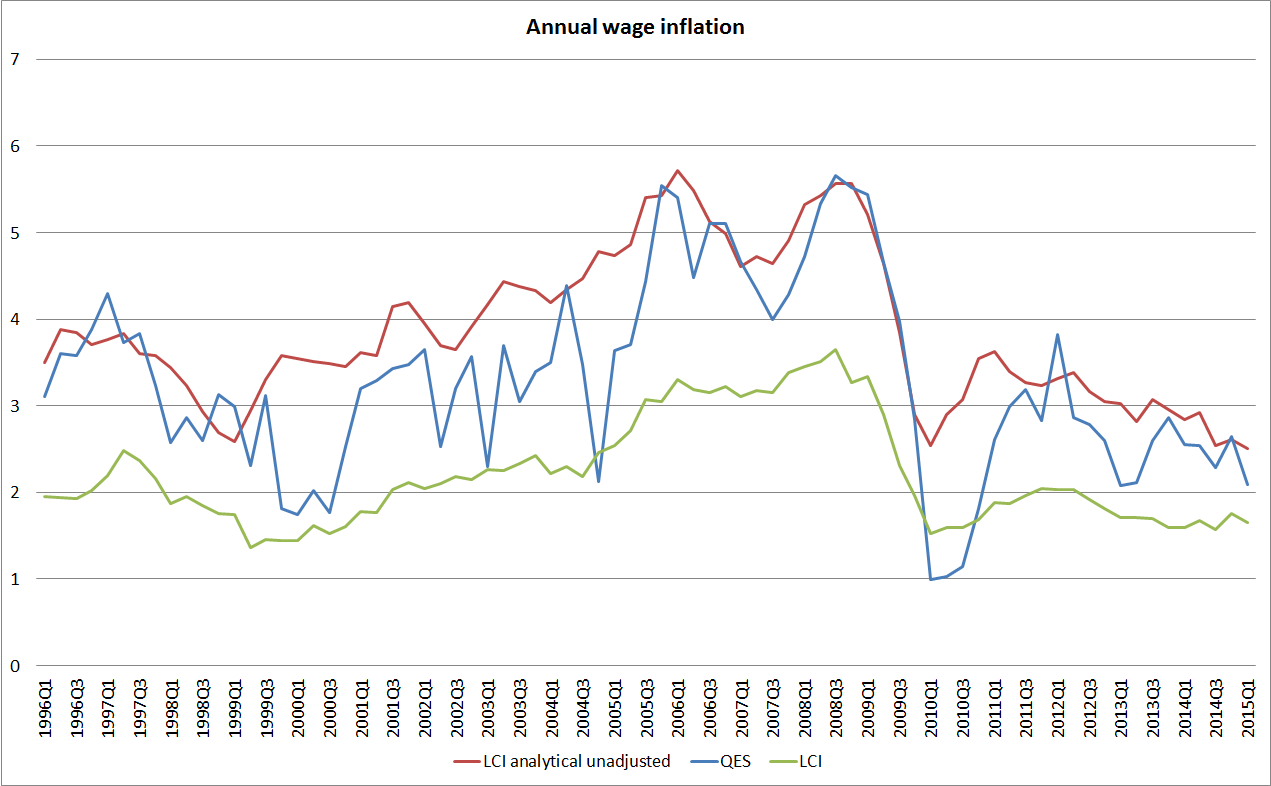
There is a variety of different wage measures in the QES and the LCI.    I’ve charted some of them below.  As former colleagues know, I’ve long had a bias towards the LCI analytical unadjusted series –  both during the boom, and in more recent years.  It is smoother than the QES hourly earnings series, and it is a wages series, rather than an attempt at a ULC measure.  But we have all the series, and we should probably look at them all.

wages

None of them suggests any recovery in wage inflation.  The chart shows annual growth rates.  There is seasonality in quarterly wage inflation, and SNZ does not seasonally adjust any of the series, but the data showed the equal lowest quarterly increase in the LCI since the recession began in 2008, and the lowest quarterly increase in the analytical unadjusted LCI since the recession began  (the QES is too noisy to make anything much of quarterly changes).

And remember that these trends are consistent with what businesses have been expecting in the wages question in the Reserve Bank’s own smaller survey of expectations.

business

Wage inflation tends to lag a bit behind activity in the labour market, so we probably shouldn’t normally put too much weight on wages numbers.    Unemployment (and underemployment) measures are another matter, and they don’t make a welcome picture.  Recent unemployment rates were revised up a touch, and there was no change in the unemployment rate in the most recent quarter.  The official unemployment rate lingers at 5.8 per cent –  and I know no one who thinks the New Zealand NAIRU is that high –  but it has come down by around one percentage point from the average level over 2009 to 2012.

The same can’t be said for some of the other measures.  SNZ has a couple of measures worth looking at, although unfortunately neither of them is seasonally adjusted.

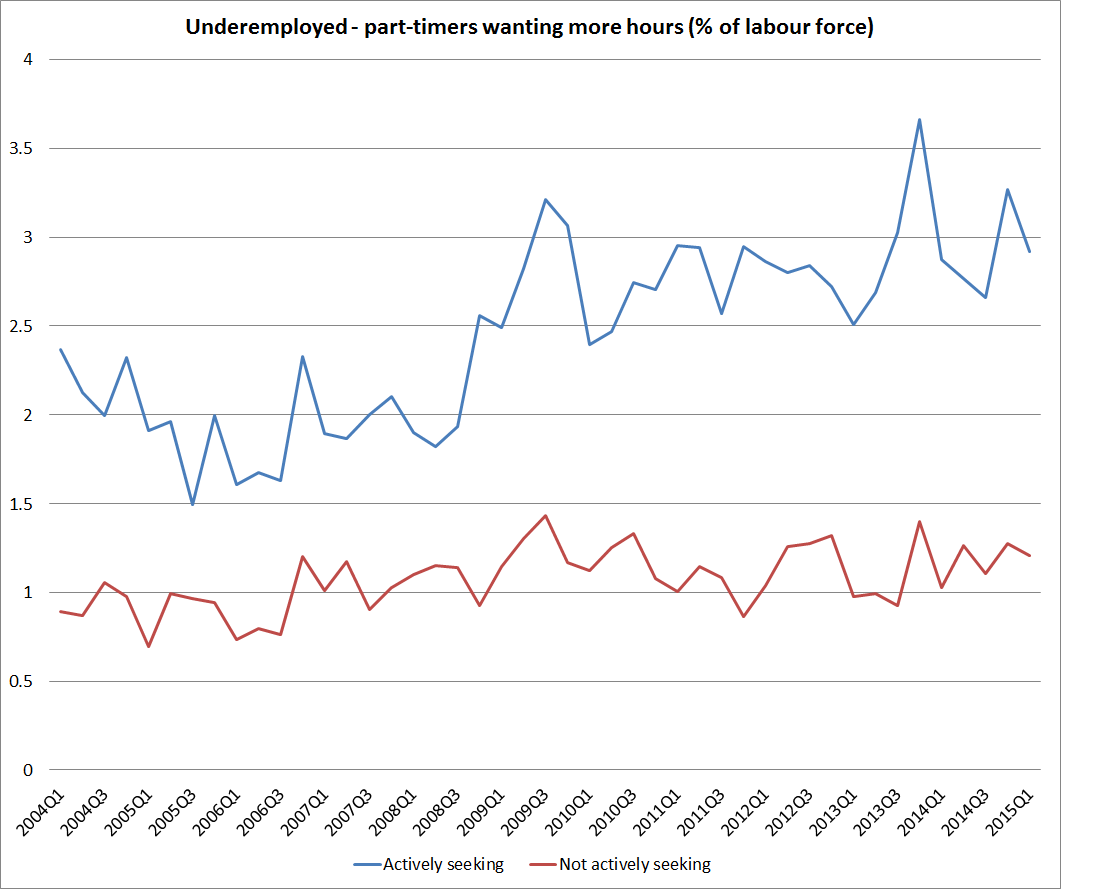
One of them is to look at part-time workers who would like more hours (underemployment).  These are people already holding down jobs – not detached from the labour market or losing basic work skills.   We can distinguish between those actively seeking (a specific SNZ definition) and those wanting more hours but not actively seeking.    Both represent additional available labour, but the former more immediately than the latter.  It is the former category –  those actively seeking extra hours – that rose sharply during the recession and has not come down at all since.    The latest March observation is higher than the observation for March 2014.

underemployed

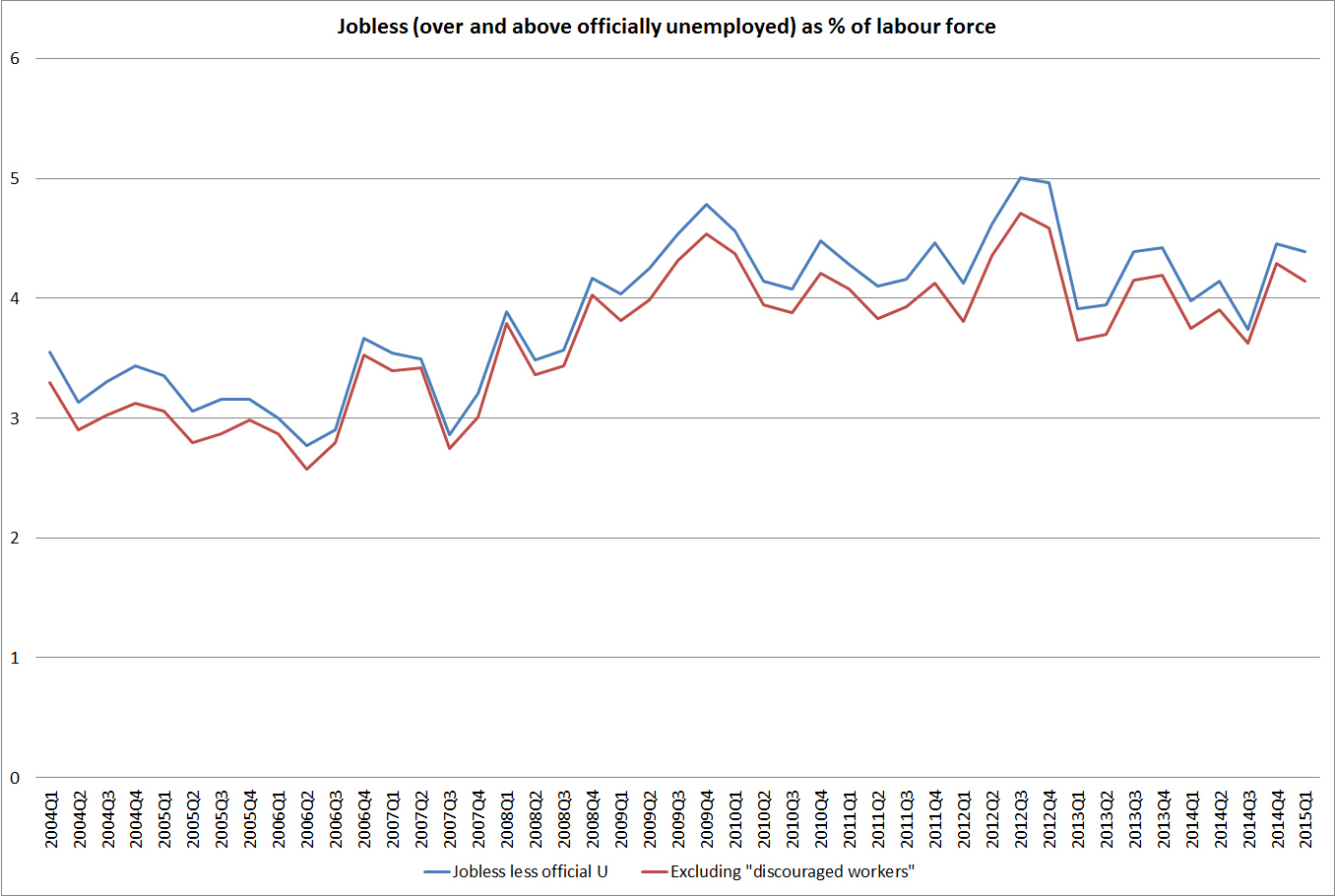
And then there are the people without jobs who would like one, but who don’t meet the definition of official unemployment (available to start work now and actively looking now).  These measures of excess capacity have barely come down at all (and again, as a crude attempt to deal with seasonality, this March’s numbers are higher than those for last March).

jobless

I’m not suggesting one can simply add the various underemployment measures to the official unemployment rate to get a measure of excess labour market capacity.  But looking across the range of measures, suggests that there hasn’t really been much excess labour market capacity absorbed in the last few years, and probably none at all over the last 12 months or so.  That might be a quite welcome outcome if the New Zealand economy was near functional stable-inflation-consistent full employment.  But it isn’t, and hasn’t been now for some years.  Real people’s lives go on being marred by unnecessarily high unemployment.

And, yes, I’m well aware that participation rates have been rising.  And no doubt that is welcome –  some mix of voluntary optimising choices, and a bit of help from welfare reform.  But excess capacity –  supply relative to demand  –  is what should matter for monetary policy.  Demand just has not been strong enough to soak up the additional labour.

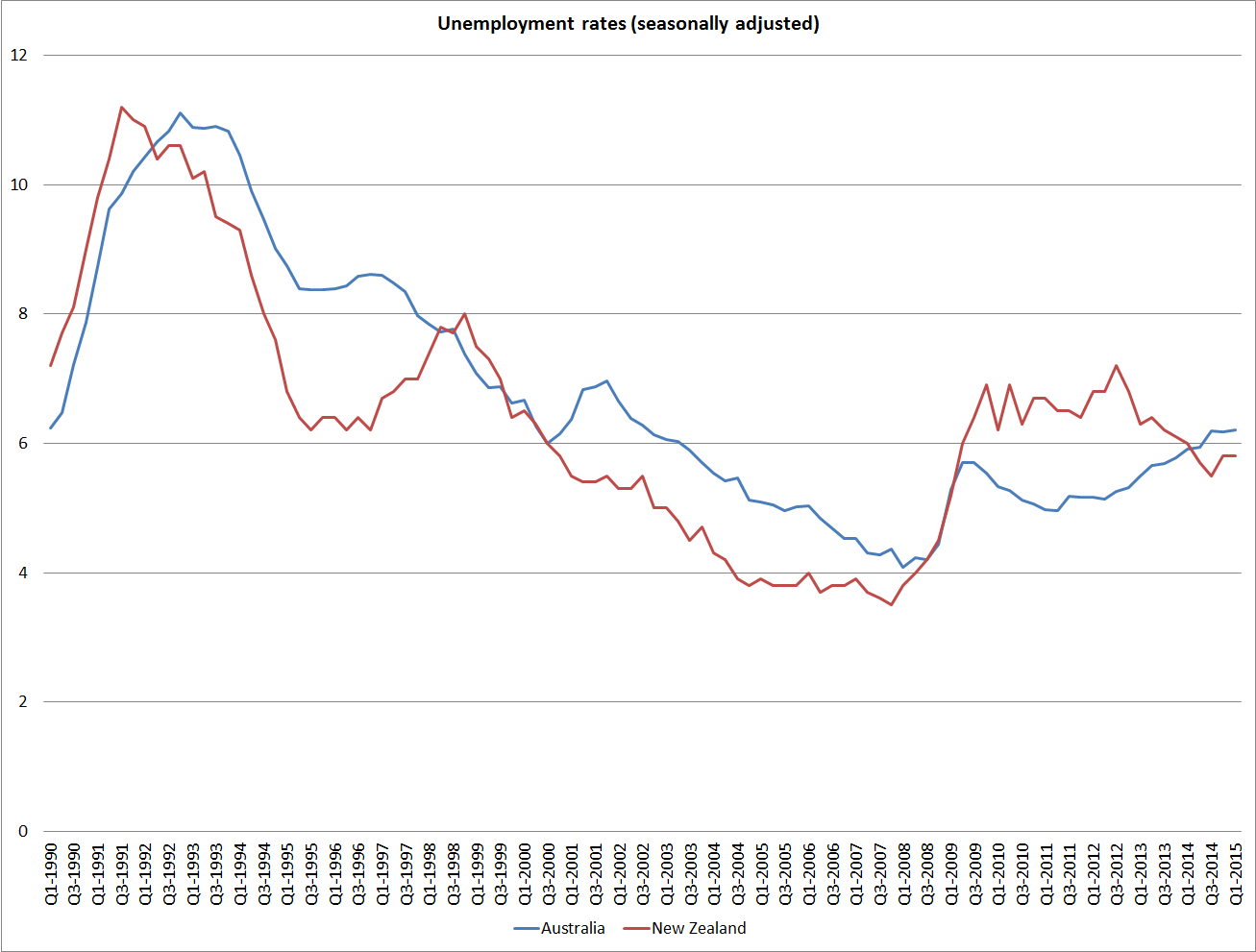
Finally, a trans-Tasman comparison.  The Reserve Bank of Australia cut it policy rate again earlier this week.  Australia’s inflation rate (headline and underlying series) is less far below target midpoint than is the case in New Zealand.  But it was the unemployment rate comparisons I wanted to illustrate.
U

New Zealand’s unemployment rate is a little below Australia’s.  But that has been the normal of state of affairs since New Zealand liberalised its labour market regulation in the early 1990s.  From 1992 until the end of 2007, New Zealand’s unemployment rate averaged just over 1 percentage point lower than Australia’s –  a credit, mostly, to New Zealand’s generally more flexible labour markets.  During those 16 years there was only one period when New Zealand’s unemployment rate matched and briefly went above Australia’s – the period associated with the 1998 recession, a period in which everyone agrees that the Reserve Bank of New Zealand did not exactly cover itself with glory (the MCI, and holding monetary policy far too tight too long during the Asian crisis).

The unemployment rates in both New Zealand and Australia rose in 2008/09.  But what is striking, and sobering, is how long New Zealand’s unemployment rate stayed above Australia’s.  Even now, the gap is only 0.4 percentage points.  Defenders of the Reserve Bank’s stance might point out that Australia experienced a huge investment boom in response to the high terms of trade.  And New Zealand saw nothing of the sort.   That is of course true, but we might reasonably wonder what New Zealand’s economy might have looked like if the OCR had been cut further and held lower after 2009. With hindsight there was no reason not to have done so.   Unlike many advanced countries, our Reserve Bank was not constrained by either actual or perceived near-zero lower bound issues.  It was simply a repeated misreading of the inflation outlook –  not a no-cost mistake either but one that has left the unemployment rate lingering so much higher, and for longer, than it needed to be.  And, as I noted last week, our real economic recovery, measured in terms of real GDP growth, has not been strong by historical standards either, despite the initial deep recession.

What of the current situation?  Our unemployment rate is below Australia’s again, even if less far below than the historical average.  But both countries have unemployment rates above any reasonable NAIRU estimates –  and with no sign now of falling unemployment rates.  One country has been steadily cutting interest rates, to new historical lows.  The other first distinguished itself from the rest of the advanced world by raising interest rates even as inflation fell further below target, and then has resisted the increasing calls to do something about reversing last year’s mistake. Overseas commentators tended to see the mistake first, but even domestic bank economists are now beginning to recognise that something went wrong.  How long will it take for the Reserve Bank of New Zealand to act?

It surprises me a little that the political Opposition has not made more of this bad misjudgement by the Reserve Bank, and its consequences for the unemployed.  We don’t want a situation in which every OCR decision is a partisan contest, but an essential feature of the monetary policy framework is supposed to be serious accountability for the Governor.  Perhaps some of that is happening behind closed doors, but the next time the Governor appears before the Finance and Expenditure Committee on monetary policy we should hope that our representatives ask him some pretty searching questions about what increasingly look like costly monetary policy misjudgements.

Managing retirement income: annuities

A couple of articles in last weekend’s newspapers got me thinking again about retirement income.

Diana Clements’ personal finance column in the Herald traversed the question of annuities. She begins:

There’s a gaping hole in the KiwiSaver concept: What happens to the money when people turn 65.

There is no need for people to do anything active with the accumulated Kiwisaver funds at 65, and in most cases the amounts involved are still quite small.  But when people have been in Kiwisaver for 20 or 30 years the amounts will be much larger.  And whether or not people do anything active with the funds at 65 they still face the question of how much of their wealth they can afford to spend each year when they do retire.

Clements reports that one company is launching a new hybrid annuity product: put your lump sum with the Retirement Income Group and you will receive an annuity for life, with the twist that if at death the total amount that has been paid out is less than the initial capital sum, the balance goes to the estate.  Of course, that additional insurance isn’t free: without it, the initial capital could afford to pay a higher annuity.

Annuities generally appeal to those with some reasonable level of wealth who think – or worry – that they will live longer than average (and to those without much of a bequest motive).  Actuarially fair annuities can be a great product for an older risk-averse person, especially if they come inflation-indexed.  They convert accumulated savings into a certain real income for life, and the recipient doesn’t have to worry about market investment risk or inflation for the rest of their life.  In that respect, they have some similarities to the best old defined benefit pension schemes.

But defined benefit pension schemes are now almost entirely a thing of the past – schemes have typically had no new contributors for decades –  and (as far as I’m aware) only government-associated schemes ever offered proper and full inflation indexing.  And annuities are hardly seen on the open market at all, and when they are offered they are not inflation-indexed.

The absence of inflation-indexing probably reflects the inability of markets to properly hedge against inflation risk.  That risk is particularly severe in a TTE tax system: when nominal interest is fully taxed at the time it is earned, an unexpected bout of inflation can do very nasty things to real returns.  Capital gains taxes also only rarely adjust for inflation in calculating the taxable gain.

Just recently, the British government announced it intended to scrap a requirement that accumulated funds in private defined contribution schemes be taken as annuities, a move described by one industry participant as “the final nail in the coffin of annuities”.  If so, that won’t be surprising.  Annuities fall foul of two things: adverse selection (when people can choose whether or not to take an annuity), and sharp falls in real long-term interest rates.

A couple of hundred years ago, annuities – and tontines – probably worked quite well (apparently the first known life tables for annuities date back to the third century AD).  Diagnostic medicine barely existed, and many people died from infections or illnesses with a random component.  An annuity provider could attract a pool for customers to whom it could provide reasonably actuarially fair annuities.  No one had the information to select into the pool in a way that would skew its long-term returns away from the provider.  (And expected inflation, and the interaction with the tax system, wasn’t a problem).

Now that is much less so.  Of course, there is still a random element to life expectancy, but it is the systematic element that creates problems for the provision of annuities.  People who come from long-lived families will be more inclined to like the idea of an annuity, but each $1m of capital will support a much lower annuity for them than it would for someone with a much shorter life expectancy.  If providers don’t, or can’t, differentiate by individual life expectancy, and instead set common annuity rates it will mostly be people who think (or fear) they will live for a long time will opt in, which will drive down the sustainable annuity rates, until fewer and fewer people opt for an annuity.    There will always be some, limited, market for the very risk averse, but it isn’t likely to be a very substantial market when people are free to make their own choices.  And even the risk-averse have to worry about the creditworthiness of the annuity provider – one reason why annuities and related products were often sold by governments (at least those with a pretty good track record of not defaulting on general creditors).

And, of course, the other problem is variable – but in trend decline over recent decades – real investment returns and real bond yields. As they have fallen, annuity rates (per $1m of capital) have fallen substantially.   In some respects, it is an inescapable problem. If real returns are low, there are no free lunches, and one can’t escape the constraint simply by not purchasing an annuity.  But timing can matter, potentially a lot.  With advanced country long-term bond yields so low, anyone forced by a government to take an annuity today risks having their purchasing power for the rest of their lives determined by today’s annuity prices.    That might be fine –  no better or worse than the alternative – if yields stay this low for the next 20 years (and who is to say confidently that they won’t)  but what if in three years’ time economies have snapped back and G7 long-term bond yields are averaging 3.5 per cent rather than something like 1 per cent at present?    A government that would force you to take an annuity now, just because you happen to turn 65 this year, would seem to be over-reaching itself.  Of course, real yields could fall further yet, but governments are no better-positioned than you or me to tell whether, and if so for how long, that will happen.

Probably none of us wants to see people in deep poverty in old age.  But the state is already providing an excellent product to cover that risk.  In New Zealand’s case, we have NZS, a modest and near-universal state welfare payment to those 65 and over, which is indexed to wages.  It is, in effect, a real indexed annuity, provided by a government with a pretty strong financial position, which has not defaulted its credit obligations for over 80 years.  NZS is not a particularly comfortable level of income, but it has been enough to ensure that New Zealand has one of the lowest levels of elderly poverty among OECD countries.  If one thinks of the role of the state as partly being a residual insurer, then NZS (combined with a public provision of health services, and resthome subsidies) pretty much has that role covered for the old.

It will be interesting to see how Ralph Stewart’s product goes. I wouldn’t be optimistic, but entrepreneurialism is partly about taking products to market and seeing if they work.  But we should resist the calls that will probably come, in various guises over the next few years as Kiwisaver matures, for anything like compulsory annuitisation of accumulated Kiwisaver balances at age 65.   Unlike the Australian compulsory private scheme, Kiwisaver was explicitly not envisaged as a replacement for the state pension, but as a top-up.  The complex Australian scheme needs all sorts of rules to avoid the state being rorted (probably more rules than it has).  Kiwisaver is just a moderately expensive, moderately distortionary, top-up to what is a pretty cheap and efficient state scheme, which serves what must surely be the main goal –  as it has been since 1898 – of avoiding the indignity of extreme poverty among our old citizens.  And it is a scheme that costs less, as a share of GDP, than most advanced country governments spend.  It isn’t perfect, but I’ll come back to that another day.

Some people might later regret blowing their lump sum Kiwisaver balance in a year or two after they turn 65, but people make choices that can look unwise  –  and that they might themselves regret later – at all sorts of phases of their lives.  Frankly, spending accumulated savings on a good time while they are still young enough to enjoy it, rather than spreading spending cautiously and evenly over decades (as I’m sure I will –  thank goodness for legacy DB pension schemes) seems like one of the less damaging choices people can make, and not really something for the state to concern itself with.

While on the subject of retirement, I noticed that the Retirement Commissioner is running a competition to come up with “catchy names” for different phases of retirement.  Why are we spending scarce public money on this patronising nonsense?  The amounts involved are no doubt small, but it is the mind-set that is concerning.   “Take care of the pennies…” was the old maxim.

Come to think of it, why do we need a Retirement Commissioner at all?   The Commissioner operates under the ambit of something now called the Commission for Financial Capability (costing almost $6m per annum).  But history suggests that governments themselves don’t have that much financial capability and are often worse  than the general public at making good financial choices –  which shouldn’t surprise us, since the people involved have less on the line.  In New Zealand, Think Big, Kiwirail, and a mismanaged Deposit Guarantee Scheme are just the first three central government activities to spring to mind.  And the Treasury is constantly warning us of what it regards as the somewhat perilous long-term position of even New Zealand government finances.  Individuals typically do less badly.

Greece: not exporting its way out of trouble

Gideon Rachman’s column in today’s FT suggests (if he doesn’t quite directly say) that for Greece to leave the euro would now be the best way forward for everyone. He uses the analogy of a struggling marriage in which both parties might be happiest apart, however traumatic the breaking up might be. Where I come from marriage is “until death alone parts us” and my reading of the literature suggests that many unhappy couples who chose to stay together end up happier than those who separate. But the euro isn’t a lifelong covenant. It is an act of foreign economic policy among a group of sovereign states. While it serves the interests of their respective peoples it should last, and when it doesn’t it should be dissolved or slimmed down.

Rachman’s line is similar to ones I’ve run in a couple of recent posts (here and here), although my focus has been more on the idea that there is no politically saleable path (saleable in Greece, and in the other eurogroup countries) that offers both a robust Greek recovery and the whole euro group of countries remaining together. There is no guarantee that exit would be in the long-term best interests of Greece, but the status quo looks pretty awful.

Everyone knows how large the fall in real GDP has been, and how high the unemployment rate now is, years on from the start of this crisis. With no scope for discretionary monetary policy, and limited fiscal room even if the sovereign debt is mostly defaulted on (since the near-term appetite of new lenders is surely going to be limited), the source of any sustained boost to demand must either domestic innovation and productivity, or external demand.

Those wanting to put an optimistic gloss on the data can certainly produce real exchange rate measures that seem to show some gains in competitiveness. Perhaps, but it is difficult to adjust for compositional effects (the least productive people will have lost their jobs, but presumably want to be employed again one day).

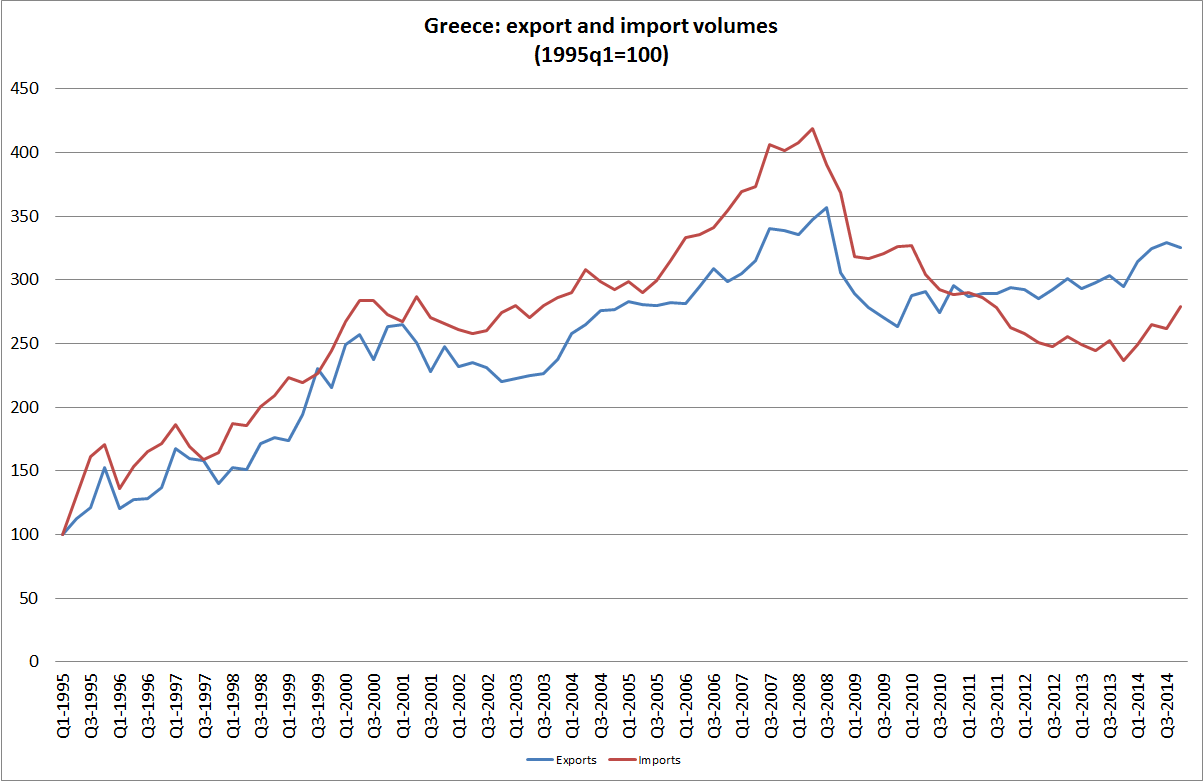
These two charts just look at some of the key aggregates, drawing from the OECD’s quarterly national accounts database.
Exports have been recovering somewhat since the trough after the global recession of 2008/09, but the volume of exports is only now back to 2007 levels. In an economy with unemployment in excess of 25 per cent, there is no crowding out of the export sector.
greece1

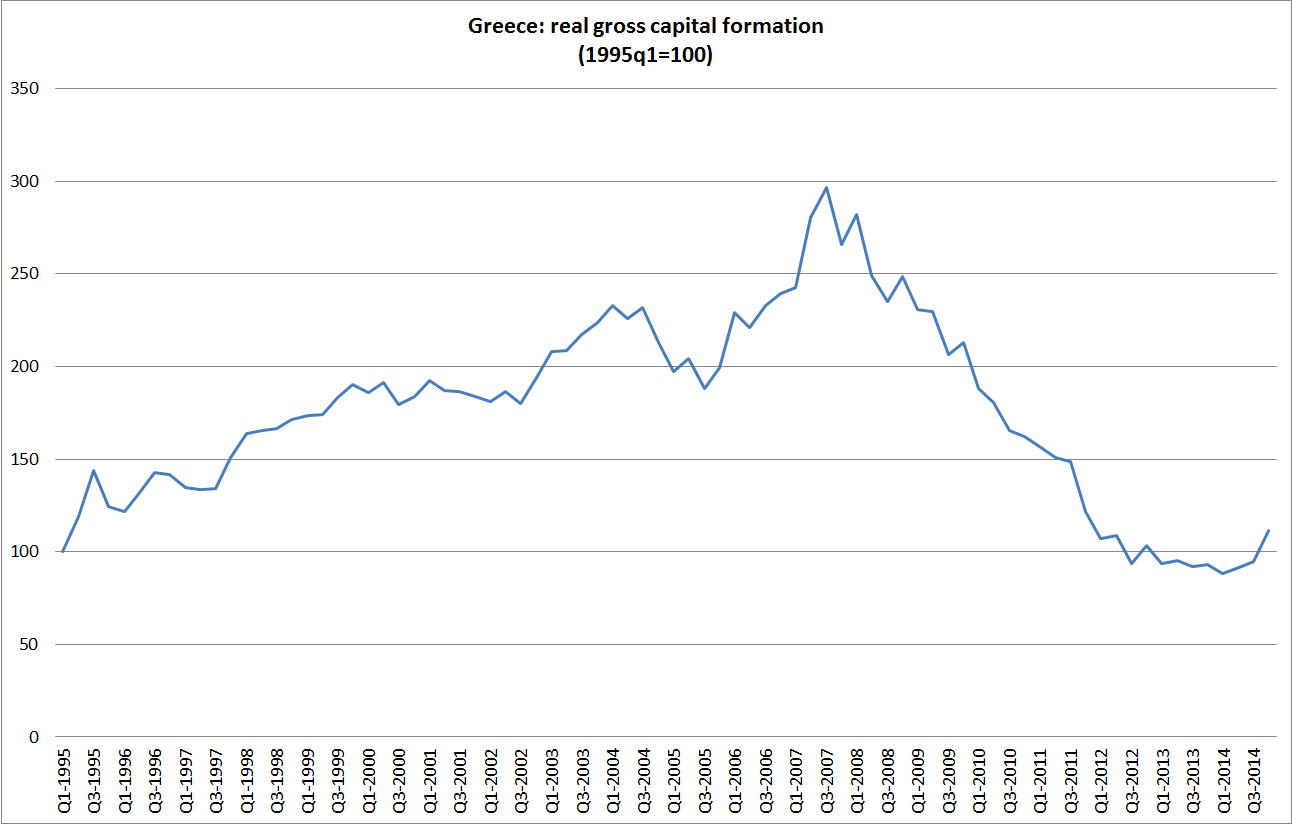
Import volumes have certainly fallen, very substantially. That might reflect competitiveness gains, and greater opportunities for domestic import-competing tradables producers. But it looks a lot more likely to mostly reflect a severe compression in demand. The collapse in real investment is particularly telling.

greece2

It is not quite all bad news. Greece has experienced an improved terms of trade over the last few years. But there is no sign of it translating into the sort of robust export growth, or business sector investment, that might enable the external sector to begin to pick up the huge slack in Greece’s economy. Whether that is because firms just aren’t competitive or because of rising uncertainty (or some combination of the two, as seems more likely) isn’t immediately clear. But note that these data go up only to 2014q4 – this was what things were looking like under the previous government and the old programme (for all its limitations). Any uncertainty has only become greater since then.

WIth almost nothing going well in Greek economy, and limited tolerance in the rest of Europe, the status quo surely can’t go on much longer.  One piece of good news today is reports that the IMF is no longer willing to extend and pretend, in this case at least.

(Lack of ) transparency at the Reserve Bank

I’ve mentioned on a few occasions that the Reserve Bank is much less transparent about monetary policy, and especially the process behind the final outcomes, than it likes to represent.

A good example is the email below that I just received.  I  requested copies of papers relating to the March 2005 Monetary Policy Statement.  To be clear, that is documents relating to a monetary policy report from 10 years ago.  It is hard to conceive of what specific or general ground under the Official Information Act the Reserve Bank could have for wanting to withhold anything from that long ago, or for why it would have taken more than 20 working days to gather and look through the material  (or, indeed, why they would realise this difficulty on the very last day on which they could respond to the first request).

No doubt, the Reserve Bank is no worse in this area than many other government agencies.  Fortunately, the Ombudsman is currently looking into the operation of the Official Information Act.

The key principle of the OIA is that information shall be made available unless there is good reason for withholding it.  The purpose of the Act is really nicely expressed as follows:

The purposes of this Act are, consistently with the principle of the Executive Government’s responsibility to Parliament,—

(a) to increase progressively the availability of official information to the people of New Zealand in order—
(I) to enable their more effective participation in the making and administration of laws and policies; and
(ii) to promote the accountability of Ministers of the Crown and officials,—

and thereby to enhance respect for the law and to promote the good government of New Zealand:

(b) to provide for proper access by each person to official information relating to that person:
(c) to protect official information to the extent consistent with the public interest and the preservation of personal privacy.

And here is the email:

Dear Michael

On 2 April 2015, you made a request under the provisions of Official Information Act section 12 seeking:  All papers provided to the Bank’s Monetary Policy Committee, and Official Cash Rate Advisory Group, in preparation for the March 2005 Monetary Policy Statement.

Meeting the original 20-day time limit would unreasonably interfere with the operations of the Reserve Bank. Accordingly, and under the provisions of section 15A(1)(a) of the Official information Act, the Reserve Bank is extending by 20 working days the timeframe for a substantive response to your request.

You have the right, under section 28(3), to make a complaint to an Ombudsman about the Reserve Bank’s decision.

Yours sincerely

Angus Barclay

External Communications Advisor | Reserve Bank of New Zealand

2 The Terrace, Wellington 6011 | P O Box 2498, Wellington 6140

  1. +64 4 471 3698 | M. +64 27 337 1102

www.rbnz.govt.nz

Monopoly money

The Reserve Bank of Australia yesterday put out a Research Discussion Paper containing some discussion of the nature, and estimates of the size, of the social costs of counterfeiting of Australian banknotes.

It is good to see a central bank producing research in this area, and opening it to public scrutiny.  But I question the starting point.  I wonder how confident the Reserve Bank of Australia (and perhaps more importantly, the Australian Treasury as advisers to the Treasurer) can be that the statutory monopoly on physical currency  – which is what the anti-counterfeit measures are protecting –  is itself socially beneficial?

Without that statutory monopoly (on notes in section 44 of the RBA Act, and on notes and coins in section 25 of the Reserve Bank of New Zealand Act) banks would have been likely to have gone on issuing their own notes (and perhaps coins).  New Zealand banks issued their own notes until 1934, when the first Reserve Bank of New Zealand Act prohibited them from offering that payments medium, as part of (but not a necessary part of) the establishment of a central bank in New Zealand.

If the monopoly were removed today, it is likely that private issuance would resume, and central bank notes would revert to being issued/used primarily in quite extreme crises, when there was a generalised loss of confidence in liabilities of the banks.    There is no obvious reason why, in normal times, people would be any more reluctant to hold, say, ANZ banknotes delivered from an ANZ ATM than they would be to hold an ANZ demand deposit (as they were doing just prior to withdrawing the notes through the ATM).  People happily hold notes from the (legally limited) private issuance in Scotland and Northern Ireland.

Actual and potential dishonesty poses major and pervasive costs to society.  A society in which all people were angels would be unrecognisable to us mere flawed mortals. So private note issuers would, of course, have to spend money to protect the integrity of their notes, in just the same sort of way they need to spend to ensure the integrity of both physical (eg cheques) and electronic payments media (credit and debit cards, for example).  Banks must make judgements about how much to spend, and what balance to strike between imposing liability on customers, and assuming responsibility themselves.  It isn’t obvious ex ante what balance should be struck, but they face market tests in making those choices (unlike central bank issuers).  And in a competitive market for physical currency issue we would normally expect a much greater degree of product innovation, including perhaps around security features.

The market for physical currency is highly distorted.  The RBA paper focuses on the extent to which counterfeiting discourages use of physical currency, but currency is probably already under-held and underused even if there were no counterfeiting at all.   At least two factors drive that.  First, using legislation to prohibit use of any notes other than Reserve Bank ones imposes considerable private holding and transportation costs on banks, and customers  (some portion of which probably amounts to deadweight social costs).  By contrast, own-bank notes have no material holding costs to banks.  And second, central banks choose (legislation does not force them) to offer no return on their monopoly note issue[1].

Sometimes it is argued – usually by central bankers – that the zero interest nature of monopoly central bank currency issuance represents an efficient tax (since demand appears to be fairly interest- inelastic).  But, whatever the merits of the argument might be on certain textbook assumptions, it isn’t an approach countries take in the practical design of modern tax system.  Using state-granted monopolies as a source of revenue has been somewhat frowned on in advanced economies for several centuries.

Nothing about monetary control would be jeopardised if the note monopolies were repealed.  So perhaps the RBA could be asked to have its researchers go back to their desks and start a new study on the social costs and benefits of a state currency monopoly.   It might be a small regulatory issue in its own right, but regulatory restrictions should remain on the statute books only when there is a clear continuing case for them. I doubt there is such a case for the physical currency monopolies.  Perhaps repeal of these monopoly provisions could be added to the list for the Australia government’s next “Repeal Day”?

[1] Various authors noted years ago that lotteries based on serial numbers offered one way of providing a positive expected return.

UPDATE:  Just to be clear that what is proposed here is not what is described as “free banking”.  Free banking would involve the abolition of the central bank and a shift to a model in which banks’ issuance of credit etc was constrained only by market forces.  Simply abolishing the bank note monopoly does not change how current monetary policy works, operating on the marginal cost of/return to central bank electronic liabilities  (settlement account balances).  I might come back and explore some of the free banking ideas at some stage.

676000 and counting

Reading the Herald over lunch I found Audrey Young’s interview with Labour’s finance spokesperson Grant Robertson.

I was interested in his praise of the former Minister of Finance, Michael Cullen.   No doubt he has to say some positive things about his predecessor, but his comments seem quite genuine – Cullen is his “finance hero”.  It isn’t an overly partisan interview –  he describes both Michael Cullen and Bill English as people “who are seen to be good Finance Ministers”.

There is no single way to evaluate the success of a Minister of Finance; it is such a multi-faceted job.  Labour ran large surpluses for much of its term, but then left a Budget  –  with Treasury’s explicit imprimatur –  that meant large deficits when the unexpectedly severe recession hit.  The current government has run deficits, despite record terms of trade, but then they had a tough starting point.  The economy was buoyant in the years up to 2008, and has shown little (per capita) growth since then, but neither Minister of Finance had much hand in those outcomes.

One the most disappointing aspects of my adult life has been the failure of any government (two Labour-led, two National-led) to make any real progress in turning round the gaps in living standards between New Zealand and other advanced economies.

People can debate how to measure living standards , but perhaps the best test is what choice New Zealanders are making.  Are they coming, going, or staying?

A successful economy isn’t one in which no New Zealander ever leaves.  Individuals will come and go at different stages of their lives, for professional opportunities, for adventure, or just to see the world.  And a few will always go permanently –  whether it is marriage to someone overseas, or a particular professional niche.  I’ve been in and out three times in thirty years, and we actually produced a PLT inflow by having two kids abroad.   But a reasonable benchmark for the success of a country is likely to be whether, on average over time, the net outflows of its own citizens roughly match the net inflows of people returning.  If so, it suggests that people, on average, reckon they can have just as good a life here  –  near home and family, in the culture they know – as in other advanced economies.

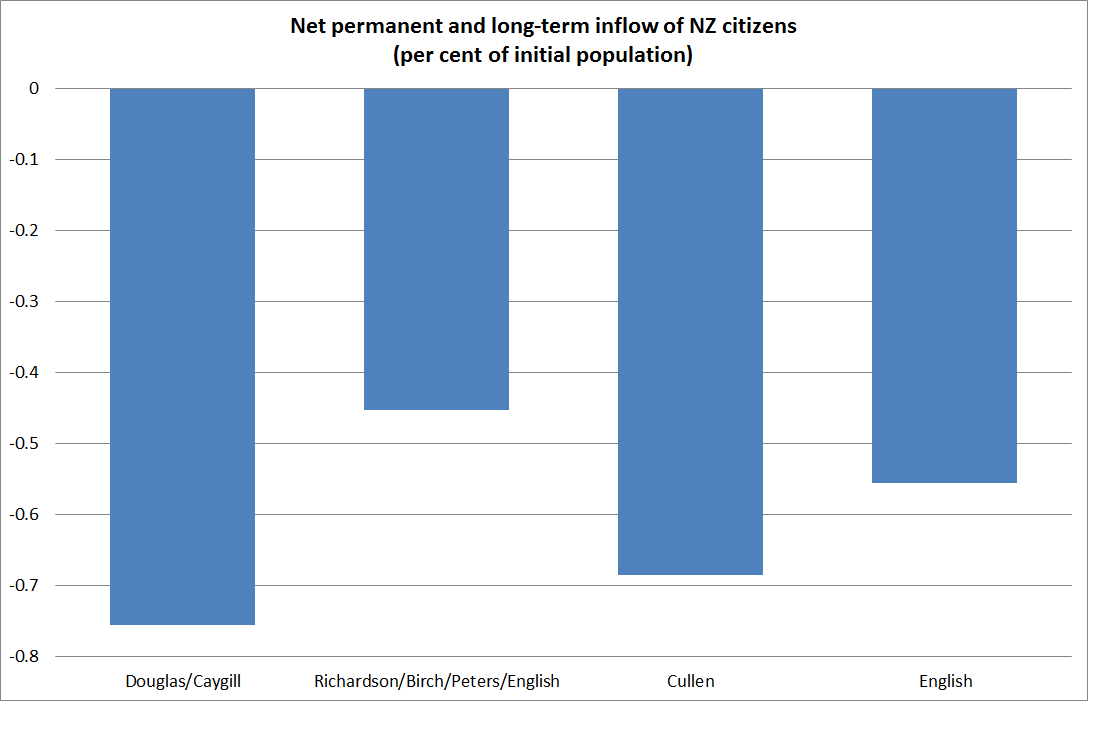
How have the different governments, and Ministers of Finance, done since 1984?

plt

These data are based on what people say on their arrival/departure cards.  They aren’t perfect: some people say they are going short-term and end up staying away for good.  Others go planning never to return and are back a few months later.  But the general picture in the multi-year averages isn’t likely to be that far off.

There just isn’t much sign of the net outflow slowing down much.  It ebbs and flows with the differences between the cyclical health of Australia’s economy and ours.  And when the world is in a particularly bad way people tend to stay close to home too.  Perhaps the 1990s period stands out as better than most, but I wouldn’t make very much of that.  Right now the net outflow is quite small, but the series is very volatile, and this trough is no shallower than others we’ve seen over the years.  It is unlikely to last, let alone turn into a net inflow.

I’ve shown the average annual net outflow as a percentage of the population.  Those can look small  –  year by year they don’t make much difference.  But over the 31 years, a net 676000 people have left New Zealand, from a country that had only 3.3m people in 1984.   And many of them will have had children and grandchildren who are also now not growing up as New Zealanders.

Does it matter?  Perhaps not to some – each individual is making his or her own best choices –  but it has changed New Zealand, and if nations mean anything then it matters. To me, it marks the failure of our governments.

John Key certainly thought so[1].  This extract was from a speech he delivered just before the 2008 election.  I had a copy pinned above my desk for several years; first in (perhaps rather naïve) hope, and then, if not in despair, at least in resignation.  What changes?

I came into politics because I believed New Zealand was underperforming economically as a country. I don’t think it’s good enough that so many New Zealanders feel forced to leave our country each year to seek higher wages in Australia. I don’t think it’s good enough that our average incomes lag so far behind the rest of the world. And I think it’s unforgivable that the Labour Party has done so little to address these fundamental challenges. I believe that a very big step change is needed in our economic performance to ensure New Zealand can make the most of its considerable potential.

[1] And I’m sure his predecessors of both parties did too. This isn’t intended as a particularly partisan comment.

Risk-sharing mortgages: Mian and Sufi

Last week I wrote

In their recent book House of Debt, the US academics Atif Mian and Amir Sufi, argued that equity-sharing contracts should become the norm for housing finance.  They argue that such contracts would materially reduce the risk of financial crises, and that the main reason such contracts aren’t common is because of the tax system and the role of US government agencies.  I’m very sceptical of both claims

And here is why.

In the final chapter of their book (so it isn’t the focus of their analysis) Mian and Sufi advocate the introduction of what they label “shared-responsibility mortgages”.  Under these contracts, when house prices in the borrowers’ locality fall the borrower gets an automatic reduction in the principal amount of the mortgage.   The cost of this (what is, in effect, a) put option is covered by providing that five per cent of any nominal capital gain would go the lender (either when the house is sold, or when the loan is refinanced).  In some cases, that payment would go to the lender in just a year or two, but in other cases it might take many decades.

If such residential mortgages were widespread, no mortgage borrower would ever have negative equity in their house as a result of movements in the general level of houses  (severe neglect of maintenance, or specific issues in, say, the street your house was located in could still result in a small number of cases of negative equity).  Whenever general house prices (in your part of the city) fall, the loss is shared with the mortgage lender, and your equity share in the house does not change.

Mian and Sufi argue that this feature would have greatly reduced the severity of the 2008/09 Great Recession in the United States.  In their story –  the thrust of their book –  the severity of the recession was mostly due to the negative equity so many borrowers had once house prices fell, and the impact of those wealth losses on consumption.  I find that story unconvincing.  I’ll skip the detail here, but the paths taken by the New Zealand and the United States economies have been so similar since the mid 2000s, and yet New Zealand had very little sustained fall in nominal house prices, and few cases of material negative equity.  Given that, it is difficult to be confident that falling house prices, and associated wealth losses, are a key causal factor explaining why economies are still lagging so far behind pre-recession trend GDP levels.   For example, fluctuations in house-building activity –  booms and busts –  are much more important than Mian and Sufi recognise.

But I wanted to focus on the suggestions that shared-responsibility mortgages (SRMs) would materially reduce the risk of financial crises, and that the main reason they don’t exist is the role of various government interventions.

Why might the risk of future financial crises be reduced?   They argue that

the downside protection in SRMs would lead lenders to worry about future movements in house prices.  If house prices plummet in the near future, then more recently issued mortgages would generate the greatest loss for the lender.  The lender would have to be very mindful about potential “froth” in local housing markets, especially for newly-originated mortgages.  If lenders fear that the market might be in a bubble, they would raise interest rates for new mortgages in order to cover the cost of the increased likelihood of loss.  SRMs would therefore provide an automatic market-based “lean against the wind”.

To which I would make a few points in response:

  • Newly-issued mortgages have always been the ones at most risk of loss to the lender (borrowers borrow to the hilt, especially to get into a first house, and then typically see their economic position improve over time, through rising nominal wages and house prices, and gradual principal repayments).
  • The nature of very frothy markets is that no one pays much attention to downside risk (or at least, they pay rather less attention to it than in more normal times).  Recall Ben Bernanke’s pre-recession scepticism about the idea of any widespread house price overshooting in the United States.   In periods of extreme optimism and persistent rises in house prices, there may be at least as much lender focus on booking the 5 per cent capital gain as on the possibility of a future loss.
  • Risk isn’t changed by the introduction of an SRM, it is just reallocated.  In principal, lenders should be somewhat more wary about the downside risk, but borrowers have less reason to be concerned about things going wrong.  If house prices fall, their equity will be impaired but- by design – by nowhere near as much as under a conventional mortgage.  There is at least an arguable case that lenders are better placed to bear risk than borrowers, since they can diversify across individual borrowers and geographically.  Mian and Sufi offer no reason to think that the net effect of the reallocation of risk would be to reduce overall risk-taking in the house finance market in boom times.

Mian and Sufi outline one other argument that might act as a modest dragging anchor.  Any  refinancing would trigger the need to make the 5 per cent capital gain payment to the lender, so any cash-out refinancing (drawing more on the mortgages to buy a boat or finance a fancy holiday) would involve meeting the 5 per cent payment.  I suspect that (a) any benefits would be small, and (b) that if such SRMs ever came to market the option premium would probably end up built into the initial value of the loan (you need $300000 to purchase your house, but the loan is booked as $304200[1], and serviced over time on that basis).

The second element of the Mian-Sufi argument is that such  products have not emerged mainly because of mortgage interest deductibility for owner-occupied houses, and because of the dominant role of the agencies in influencing the structure of US mortgage contracts.  The authors report that interest deductibility is available in the US only when the home owner bears the first losses when house prices fall.

These may well be factors that impede the emergence of such contracts in the United States, and no doubt the tax laws could be revised in ways that would bear less heavily on the prospects for SRMs.  But Mian and Sufi’s argument is a very US-centric perspective.  We do not see such contracts having emerged in other advanced economies in which the state has little or no direct role in the housing finance market, and where interest on mortgages on owner-occupied properties is not tax deductible.  New Zealand (in particular) and Australia and the United Kingdom spring to mind.  Bank regulators might not like such products greatly, but capital adequacy frameworks cope with options in other markets, and products like SRMs did not exist either in the decades before risk-weighting and capital adequacy frameworks assumed a key place in the bank regulatory framework.

Robert Shiller has long argued for the emergence of a fuller range economic derivative contracts (house price futures, nominal GDP indexed bonds, and so on), but few of them have emerged.  Revealed preference is a powerful insight.

The Mian and Sufi  SRM is in this tradition – an interesting idea, which seems to have some appeal for some borrowers, few or no regulatory/tax obstacles in many countries, and yet they just have not emerged.  It is interesting to think about why?  Personally, I suspect SRMs have not emerged because conventional mortgages are not “horrible instruments” (Mian’s and Sufi’s term) at all but very attractive and effective instruments.     They have proved to be only moderately risky over many decades, at least  in systems (unlike the US in the 90s and 00s) where government mandates don’t try to override market judgements on credit quality.  In market system the risk around conventional mortgages is managed through lender decisions around initial LVRs and servicing capacity (and, of course, overall capital holdings.  Conventional mortgages also require limited amounts of ongoing monitoring.    Borrowers typically have the most to lose: on any individual loan a new borrower may have only 10% equity in the house so the lender can lose more dollars, but the potential loss for a borrower (in New Zealand or other with-recourse markets) is everything (all their assets).  The system has worked well for many decades, so what would be the impetus for change?  In some ways this comes back to Calomiris and Haber, and the suggestion that the US financial system was made fragile by design.  As they document, the situation in other countries is rather different.

Revealed preference is a powerful insight, but….as an analyst I’m still a bit puzzled why inflation-indexed mortgages haven’t emerged (in countries like New Zealand or Australia).   That might be a topic for another day.

Finally, and harking back to Islamic banking, I presume that SRMs would not be sharia-compliant.  They add some additional uncertainty regarding the future value of the loan but an interest rate is still a key feature of the structure.   Proper equity-finance structures for residential properties still look expensive to establish and monitor, and unlikely to emerge on any scale.

[1] Mian and Sufi estimate that the upfront option premium for the protection the SRM offers would cost 1.4 per cent of the initial value of the loan, on historical US house price performance

“Disciplining” the Reserve Bank

Vernon Small’s politics column in today’s Dominion-Post had this paragraph:

English has not overtly disciplined the central bank over its persistent failure to keep inflation close to the 2 per cent target, though he noted yesterday there was a mechanism in his policy targets agreement with the bank governor to address that.  There had been “ongoing discussions” over the bank’s performance and it was a question of how long it went on  –  currently more than two years (or “a wee while” as English archly put it).

It isn’t entirely clear how much of this is accurately reported, and how much is Small’s interpretation/translation of what he thought English said.  That isn’t my concern here. I want to focus on what options are open to the Minister of Finance if he was concerned.

The first is that there is no such procedure in the Policy Targets Agreement.  The PTA sets out the target, and how the Bank is supposed to respond, and report to the public, when inflation moves materially away from target.  The agreement also notes that

The Bank shall be fully accountable for its judgements and actions in implementing monetary policy.

but this adds nothing to the provisions of the Reserve Bank of New Zealand Act, which contain both the accountability provisions and remedies open to the government.

The Act is quite an elegant structure. The Minister takes the lead in setting the [inflation] target and the Governor has sole personal responsibility for implementing monetary policy in pursuit of the target.  The Minister also appoints the Bank’s Board, whose primary responsibility is to act as monitoring agents for the Minister – and, to a lesser extent, the public.  The Minister also has The Treasury, who have no formal institutional role in the monetary policy governance process, but act as the Minister’s own professional advisers and these (and many other) issues.

The Board can recommend that the Minister dismiss the Governor, and the Minister can seek the removal of the Governor with or without a recommendation from the Board.  The Governor can’t, of course, be dismissed on a whim, but only on the grounds laid out in the Act.  The essence of the framework is that the Minister appointed the Governor to do a job –  in respect of monetary policy, as specified in the Policy Targets Agreement –  and if the Governor isn’t doing his job satisfactorily he can be dismissed.  That was one of the ideas at the heart of New Zealand’s far-reaching public sector reforms in the 1980s –  operational independence for chief executives, but the loss of the sort of “tenure until retirement” such chief executives had previously had.  It was why, unlike the situation in most other countries, our Governor is the sole decision-maker on monetary policy: Ministers responsible for the legislation in the 1980s thought it wasn’t credible to fire a whole committee, but it was quite credible to dismiss a single individual[1].

But dismissal is an extreme option.  I’ve long argued that it is not a particularly credible threat either.   A Governor’s failure would probably never be black and white, and he has large institutional resources to defend his position, as well as the threat of seeking judicial remedies (interim injunctions, and/or overturning the decision).  Given how disruptive (including in international financial markets) and uncertain all that would be, all but the very worst Governors have effective tenure to the end of their terms. And that is probably how it should be.   The option of non-reappointment at the end of a five year term is another matter.

If perhaps there is some buyer’s remorse, I’m sure no one is talking of such options at present.

But what other options does the Minister of Finance have?

He could simply pick up the phone or arrange a meeting with the Governor.  No doubt the two of them talk about various things.  But while the Minister of Finance is quite within his rights to want to be sure that the Governor is operating monetary policy consistent with the Policy Targets Agreement, he wouldn’t (or shouldn’t) want to be seen to be putting pressure on the Governor in respect of a particular OCR decision.  Operational decisions around the OCR are the Governor’s alone (with plenty of advice of course).  Maintaining that distance, and respecting appearances, is one reason why it was most unfortunate that the Governor recently appointed the Minister’s brother as one of his monetary policy advisers.

The Minister could seek a report from The Treasury on their view of how well the Governor was doing consistent with the Policy Targets Agreement, could let it be known such work was underway, and could arrange for such a report to be published.  The New Zealand Treasury offers independent professional advice to the Minister of Finance and would have to take seriously such an exercise.  It might be expected to consult externally (but confidentially) to canvass opinion.   At present, for example, most financial market economists –  not the only relevant observers but not unimportant either –  in New Zealand seem quite comfortable with the Governor’s handling of monetary policy.

The Minister could also seek formal advice from the Bank’s Board, and let it be known that he was doing so.  This would be a totally orthodox approach – the Board exists as a monitoring agent for the Minister – and it was, for example, the approach taken in the mid-1990s when inflation first went outside the target range.   The Board has a number of able people on it, but as an effective agent for accountability risks being too close to management.   The Governor sits on the Board, the Board meets on Bank premises, it has no independent resources, and it has been chaired exclusively by former senior managers of the Reserve Bank.    It was striking that last year’s Board Annual Report (which is just embedded in the Bank’s Annual Report document) had nothing substantive on the deviation of inflation from the policy target.

Although it has no formal status, the practice has grown up of Ministers writing to chief executives, in this case the Governor, in an annual “letter of expectation”.  If the Minister has had concerns one assumes that he has used his letter to pose questions to the Governor around the deviation of inflation trends from the midpoint of the inflation target.  under the Official Information Act I have requested copies of such letters (I requested them  from the Reserve Bank, who have now transferred my request to the Minister of Finance).

The Minister also has reserve powers to act directly.  Section 12 of the Act allows the Minister, transparently and for a fixed term, to impose another “economic objective” than the “stability in the general level of prices”.  These powers have never been used, although the previous Minister of Finance talked openly of the possibility of doing so (at that time, discontent with the Reserve Bank resulted in a select committee inquiry into the future of monetary policy).  Using the section 12 powers does not technically alter the governance structure.  A new Policy Targets Agreement needs to be put in place, and the Governor then has responsibility for operating with that.  I’ve previously argued that the section 12 powers might be able to be used to direct the Bank to put short-term rates at a particular level, but there are other ways of skinning the cat that could, in effect, require the Bank to cut the OCR if the government were really concerned that the Bank was not operating consistently with the current Policy Targets Agreement.

I’ve been quite open that I don’t think the Reserve Bank –  the Governor –  has been making the right calls on monetary policy.    Interest rates have been too high now for some considerable time, and it is beginning to get beyond the point where reasonable people just see things differently.  I do think there is an onus on the Board to be asking some particularly searching questions, and to be letting the Minister –  and the public –  know the conclusions they reach, and any reasoning behind those conclusions. The Board is required to satisfy itself that each Monetary Policy Statement is consistent with the Policy Targets Agreement, and there is another Statement coming out next month.    There must now be some question as to whether they could do so if the current policy stance is maintained.

I don’t think it is time for the Minister of Finance to act, but he probably doesn’t need to.  Even garbled newspaper stories that talk of the Minister of Finance disciplining the Governor will no doubt have caught the Bank’s attention.

[1] Experience suggests that dismissing whole committees is perhaps less difficult than was then thought.  The Hawkes Bay DHB and Environment Canterbury examples spring to mind.