The limits of the state

Another post prompted by my recent reading.  In this case, two very different books about the role of the state:

The Tyranny of Utility should probably be read by all those in the sorts of public agencies and departments that dot Wellington and other capital cities, and which offer advice, and champion public action, newly-inspired by the insights of behavioural economics. As Deirdre McCloskey writes in her blurb “Saint-Paul stands courageously in the middle of the new road to serfdom” –  the no doubt well-intentioned paternalism that puts little or no intrinsic value on freedom, including the freedom to fail or to choose ‘badly”, in diet, education, health, savings, or speech or whatever.  As Saint-Paul notes, it is a critique of the economics approach more generally, which “does not value individual freedom per se”, only as an instrument or means.   it It is a bracing critique, and perhaps the more encouraging for coming out of France, which has been a bastion of statism.  If there is less new than in Piketty, the rather more prominent French economist, a larger proportion of this book would withstand close scrutiny.

The Fourth Revolution is written in that brisk, slightly breathless, style that characterises The Economist.   They gather a lot of interesting material, including potted accounts of interesting experiments from around the world, although for me the value in the book was as much the scrawls of disagreement that it prompted in the margins.  There is a huge degree of China-boosting that seems to lose sight of both the corruption and injustice that riddles the Chinese system, and of the fact that it will be decades, if ever, until China again approaches the living standards, and levels of productivity achieved in the West.  Singapore is lauded, but it would have been interesting to have included some discussion of Taiwan: I don’t think it is mentioned at all, and yet with more democracy and more-market than either Singapore or China it has been a hugely successful story, despite its awkward relationships with most countries.  The authors don’t directly address the sorts of issues Saint-Paul raises, and I suspect they can’t quite make up their minds what the role of the state is, or should be: at times they worry that “the state will keep on expanding,gradually reducing liberty”, but in other places they seem enthusiastic about local councils in Britain that place tight restrictions on what can and can’t be put out for rubbish collections.  More than I would, the authors emphasise fiscal policy and the need for entitlement reform. Perhaps that reflects North Atlantic priorities.  But they give too little weight to the seemingly inexorable, and probably more threatening rise, of the regulatory state.  And barely any attention at all to the incentive and knowledge problems – too easily ignored or assumed away by the well-intentioned – that bedevil so much of what government does.  Government is as double-edged sword –  and the side that is the biggest threat to life, liberty, freedom (and affordable housing in our big cities) does not get anywhere enough weight in this book.
Declining and expanding regions – and some puzzling data

This afternoon Shamubeel Eaqub of NZIER presented in the Treasury Guest Lecture Series.  Building from material in his short book Growing Apart and drawing on census data the highlighted the economic divergences between Auckland (and Wellington) on the one hand, and many of the other regional council areas in New Zealand.  Population has increasingly gravitated towards big cities, and many towns and some provinces are already facing the prospect of absolute population decline.

The regional mix of the population has been changing, at least ever since European settlement.  Towns have either disappeared completely, or shrunk  –  absolutely and relatively –  from their former glory. I visited Hokitika again last year, and was reminded that it was  once (briefly) one of the larger towns in New Zealand.  Shamubeel seemed to regard the shifting population mix as something for central and local government policymakers to respond to with positive programmes of action.  That seems much less clear to me.  A good maxim for policy is “first do no harm”.  Local governments in particular seem prone to doing harm.  As Shamubeel reminded us, the Dunedin white elephant stadium was an initiative of a local body, hoping a covered stadium would help boost Dunedin, with no robust cost-benefit analysis.  The individual citizens of Dunedin certainly would not have taken on such ill-considered risk themselves.  Wellington City Council seems to hanker to waste similar amounts of money on an airport runway extension.  And it is local authorities who are responsible for making land for housing scarce in growing regions.

Perhaps we need to focus policymaker attention on getting government out of the way, and allowing market adjustments to work.  For example, to help make growing towns and cities more affordable and responsive mandate that property owners everywhere have a presumptive right to build houses/apartments up to three storeys high (I’m looking out on one that high as I type).  And on the other hand, look to wind back onerous central government infrastructure mandates, especially for declining areas.  Citizens of those area are likely to choose themselves to settle for less than the best.  And reversing the proposed new earthquake building standards, which have destroyed value across the country (and especially in older regions) for little or no expected savings of human life.   Perhaps more controversially – and a subject to which I will return – cut back the large scale programme of inward migration.  This is a central government programme, whose direct effects are concentrated in Auckland, puts pressure on non-tradables prices across the country, and undermines the competitiveness of tradables sector producers concentrated in places like (eg) Hawkes Bay, Waikato, Otago, or Nelson.

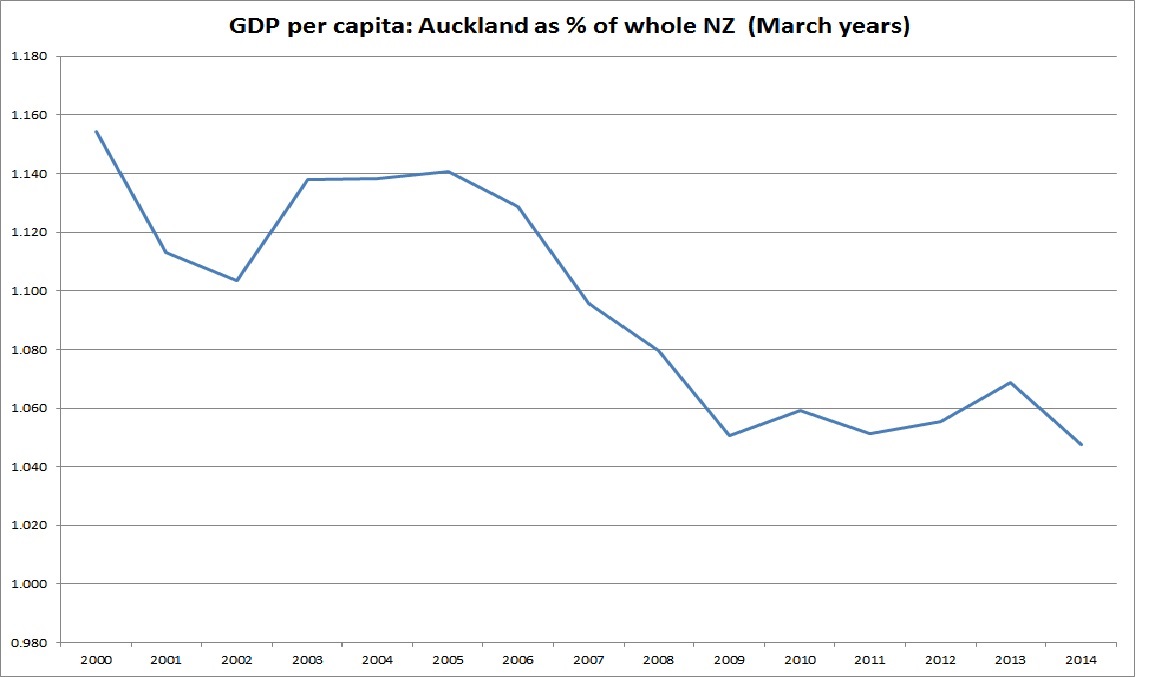
For all the elite discussion around the importance of Auckland to New Zealand’s economic prospects, today’s regional GDP data was more than a little puzzling.  According to SNZ, nominal GDP per capita in Auckland has been trending downwards relative to that in New Zealand as a whole for the last 14 years.  No doubt the recent high terms of trade are part of the story, but I don’t know quite what to make of these data.

Auckland per capita GDP

An introduction

I’m starting this blog to offer my thoughts and perspectives on a range of issues around economics, economic history, and public policy.

I’m a New Zealander.  That means I have a particular interest in New Zealand issues and institutions, and the decades-long disappointing performance of the New Zealand economy, but I will also be commenting on a range of global issues.

My primary expertise is in macroeconomic policy and related institutional design, but I will range wider.  Policy, by its nature, involves choices and judgements.  Most of those are, or should be, made by elected politicians.  That means that in discussing policy it is futile to think that one can avoid politics. But if there is advocacy here, it will be for my own views, and for the analysis of others that I find persuasive, not for any one or other of New Zealand’s political parties.