1876 revisited?

The New Zealand Initiative was out this week with a new report, In the Zone: Creating a Toolbox for Regional Prosperity.

If I’ve understood correctly their proposal, local authorities would be able to seek approval from central government to run policy experiments in their own areas (freeing up the Overseas Investment Act, legalising drugs, prohibiting prostitution, banning private schools, introducing capital punishment, banning immigration –  or the reverse of each of these).

Frankly, it seemed to be a solution in search of a problem.  I’m all in favour of a bit of localised regulatory competition –  the sort of thing that was, for example, possible in respect of building and land supply in Auckland before the ACT Party leader legislated to merge all the councils in the Auckland region into a single body.    The authors rightly cite the advantages the US federal system offers –  data on all sorts of different approaches to doing things.  And I wouldn’t challenge that.  But the data from those experiments are widely available.  Same goes for the Canadian provinces, or –  nearer to home – the Australian states. Or insights from different countries within, say, advanced country groupings such as the OECD.   In fact, in many areas New Zealand ministers already participate in the Australian inter-governmental councils, sharing experiences.  Perhaps the report would have benefited from some Australian perspectives –  including on the relentless rise of the federal government at the expense of the states.

But as the authors note, New Zealand’s population is around that of a median US state.  And we’ve been along this way before –  the provincial governments that played such a major role in New Zealand government (in many ways more important than central government) until they were abolished in 1876.  Indeed, the NZI authors prompted me to pull down from the shelves my copy of Morrell’s history of the provincial system –  a system ended for a mix of good and bad reasons.

The authors are keen on regulatory competition, but pull back from favouring the re-establishment of provinces.  It isn’t quite clear why.  They argue that “a federal system could be too costly in a small country” but then note that

We risk too little recognition of regional differences under our current domestic policy settings.  New Zealand is not expansive enough in size or disparate enough socially or culturally to warrant having a federal system of governance.  But national level policies do impose challenges to regional growth that could be better addressed through regionally specific regulation.

In some cases, perhaps.  But it is only going to happen, to any material extent, if something like a federal system was established and entrenched.  In other words, if the ex ante power is genuinely given over to local authorities  And even then, in provincial/federal systems the interests and needs of Toronto or Sydney frequently differ from those of remote rural bits of Ontario or New South Wales.

To see the problem, take one of NZI’s proposals.  They argue that the West Coast local authorities could seek specific RMA amendments to better support mining developments. But why do they think that environmentalists in Auckland or Wellington would be more willing to see the law changed just because it would apply only to the West Coast?  People think of the West Coast as part of one country, their country, and those opposed to mining would fight tooth and nail against any legislation that central government sought to pass to create this specific regional dispensation.  The words “thin end of the wedge” will pop up repeatedly whenever one of these proposals is made.   CAFCA won’t be any more relaxed about freeing up foreign investment, just because the initial exemption is only for Wellington.

After all, as the authors suggest, the central government should only agree to dispensations it would be happy to see applied everywhere.  Quite how this discipline would be enforced  –  especially since each dispensation would presumably have to be legislated separately – is not made clear in the NZI document.  Nor how they would prevent an incoming central governments of a different political complexion simply repealing all regional provisions that they didn’t like.

And I don’t see why they think a federal system might be too costly but their system would be materially cheaper or better.  Their system seems to be a recipe for each of the regional councils, or possibly territorial authorities (of which there are almost 70), to grow their own bureaucracies, to identify better policies across a whole range of possible areas than those dreamed up centrally.  And since all these experiments would have to be approved (and legislated)  centrally –  unlike in genuine federal systems –  it isn’t clear that the NZI reform would not further increase the size of the Wellington bureaucracy.  Small countries can –  and do –  manage to succeed, but we need to recognise just how limited the stock of capable policy bureaucrats is in a small country.  In a country of 4 million people I’m not sure the case is strong for competing immigration (or drugs, or crime, or education, or…) policy managers in Invercargill, Gisborne, Christchurch and Auckland.

It all seems to involve a vision of capable well-intentioned people on both sides.  Actual politics is a great deal messier, with deals done to assist supporters or more general electoral prospects in particular regions.   And many differences on policy are differences of values –  and only a minority of those differences divide regionally.

The authors reasonably caution us against automatically regarding central government as competent and local government as incompetent. As they note, even central government put money into the debacle that was the Dunedin Stadium –  although amounts that were chickenfeed relative to the national budget.  And Think Big –  the energy resource development strategy from the 1980s –  certainly swamps any regional or territorial bad policy choices.  But there is something to be said for specialisation.  Local governments often don’t do the basics that well, and do worse the further they get from basics.  If, to take a local example,  two years after the storm, the Wellington City Council still hasn’t fixed a short local stretch of seawall, I certainly can’t count on central government doing so.

seawall

Local governments already seem too busy and self-important with grandiose ten year economic development plans – imposing visions of who should live where, in what sort of accommodation, or promoting uneconomic runway extensions.    Pandas anyone?   And for all the talk of greater flexibility of land supply, has any local council anywhere in New Zealand –  even where there is no huge growth pressure – gone to the limits of the current law in freeing up residential land supply?  The New Zealand Initiative and the Productivity Commission (in their new report yesterday) seem to have acquired a touching faith in local councils, frustrated either by their voters or central government –  but what that faith is based on is less than clear.

The authors enthusiastically cite the Shenzhen special economic zone.   We should always pause and reconsider when advocates for reform cite Chinese examples.  As a reminder, China is a struggling repressive middle income country  – where central government is firmly in control –  and whose economic performance over the last 200 years makes even New Zealand look good.  Oh, and that is before starting on the matter of the number of their own people policymakers have been responsible for the deaths of (whether in famine, civil war, or in utero).

Trials and experiments are, no doubt, good things.  But this NZI proposal does not look like one of those experiments that should be given a chance to fly.  I’m a South Islander by birth and inclination, and if someone proposed a genuine federal model for New Zealand –  South Island, lower North Island, and Upper North Island –  I’d probably be emotionally sympathetic to it.  But even then I’d refer supporters to the Australian experience, and wonder just how much genuine decentralisation would occur and for how long.  Fortunately, perhaps, the differences among the regions are not yet so great that people see their primary identity as regional rather than national.  Unless that changes, the big policy fights –  including over reducing the economic role of government –  will just have to go on at a national level, as they mostly do in Australia.

UPDATE:  I’ve been pointed to some similarly sceptical remarks by the Deputy Chair of Parliament’s Finance and Expenditure Committee made at the launch of the NZI report.  (Being a Wellington MP, he nonetheless seems disconcertingly sympathetic to the runway extension.)
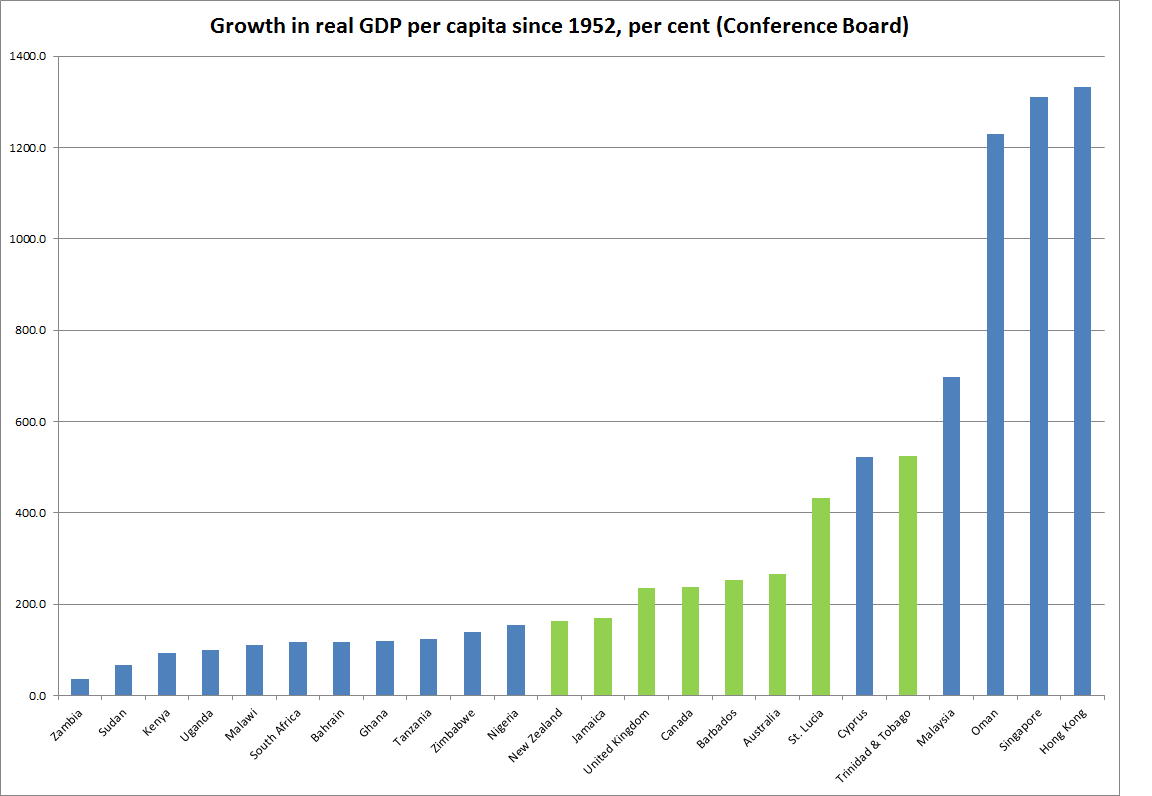
Economic performance since 1952 for Her Majesty’s realms and territories

Today Queen Elizabeth becomes the longest-reigning British monarch (as others have noted, she became New Zealand’s longest-reigning monarch a couple of years ago).

By 1952 a few places that had been British possessions or protectorates had already become independent (eg India, Pakistan, Israel, Ireland) but the extent of Her Majesty’s territories was still quite astonishingly large.  The Conference Board has GDP per capita numbers back to 1950 for a fairly large number of countries.  I found useable data for 24 countries (probably fewer than half the total) that in 1952 were either British possessions or (New Zealand, Australia, South Africa, and Canada) were independent but shared the Queen as head of state.

Here is how those countries have grown since 1952.  The green bars represent those countries in this sample which have the Queen as head of state today.

1952

In 1952, on this measure, New Zealand has (just narrowly) the highest GDP per capita of any of the three old dominions.  And although the point of this post is mostly whimsical, it is hard to go by without the sad picture of New Zealand’s deep and prolonged relative decline.

dominions

“Financial literacy”, schools, and governments

According to a new poll out this week, 93 per cent of New Zealanders want “financial literacy” to be a compulsory subject taught in all schools.  The details of the poll don’t seem to be available, but we can probably assume that the questions were phrased in such a way as to encourage a positive answer.  No doubt even a more balanced question might have drawn a positive response.  To many it sounds like a “good thing”.  I’m sceptical.

I’m sceptical at a variety of levels.  First, and perhaps most practically, these surveys (and the reported views of advocates) never ask what people would prefer schools to stop teaching.  There are only so many hours in the day/year.  I’d face the same question as what should the schools stop teaching, but given a choice, personally I’d rather that schools were required to teach a sustained course in New Zealand and British/European history than that they teach so-called financial literacy.   Kids are exposed every day to their parents’ attitudes to, and practices with, money and things.  They aren’t directly exposed, to anything like the same extent, to maths, science, history, or foreign languages.

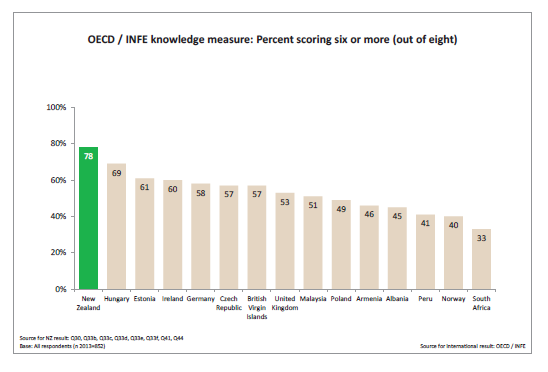
Second, as far as I can see, the evidence is pretty mixed as to whether teaching “financial literacy” makes any difference to anything that matters.  Are countries with higher “financial literacy” scores richer as a result, more stable, happier?  And a recent report (page 32) for our own government agency that deals with this stuff actually showed that, for what it is worth, the “financial literacy” of New Zealanders scored quite well in international comparisons.  What is the nature of the problem?

financial literacy

Third, why would we expect that the government, and its representatives, would be good people to teach children about money?  Perhaps we should judge people by their track record.  The current Retirement Commissioner, as captured in this profile, does not exactly inspire confidence on that front (unless perhaps “do as she doesn’t kids”).  And at a bigger picture level, in one way or another governments are the source of most financial crises –  Spain, Ireland, Argentina, the United States, China.   Governments are more prone than most to undertaking projects that they know provide low or negative economic rates of return.  Governments face fewer market disciplines than citizens. And governments don’t have to live with the consequences of their mistakes.  So perhaps I could support a civics programme that included a section on critically evaluating election promises and government policy announcements.

Fourth, much of the discussion in this area is quite strongly value-laden.  And no doubt it has always been so.  I recall the day when our 6th form economics class was visited by a banker, to try to promote savings etc.  He brought along a hundred dollar note –  this was 1978, and it was probably the first time any of us had seen one.  Trying to set up a discussion about the merits of bank deposits (probably with negative real interest rates at the time), he asked us all what we’d do with the $100 if we had it.  Various class mates rattled off their spending wishes, but the banker was totally flummoxed when one of my friends, a strong Christian, told him that what she’d do was to give it away.   .

And where, for example, in all the discussion of financial literacy is there any reference to the findings that one of the best routes to financial security is to get married and to stay married?  Finding the right spouse, and learning what is required to make a lifelong commitment work, is almost certainly a more (financially) valuable lesson that knowing that when interest rates fall bond prices rise.  But it is not one we are likely to hear from the powers that be.

And fourth, this becomes an excuse for yet more bureaucratic/political bumf, reinforcing a sense that governments should have “strategies” about everything and anything.  I was somewhat surprised to learn that our government has a financial capability strategy.  Why?

Building the financial capability of New Zealanders is a priority for the Government.  It will help us improve the wellbeing of our families and communities, reduce hardship, increase investment, and  grow the economy.

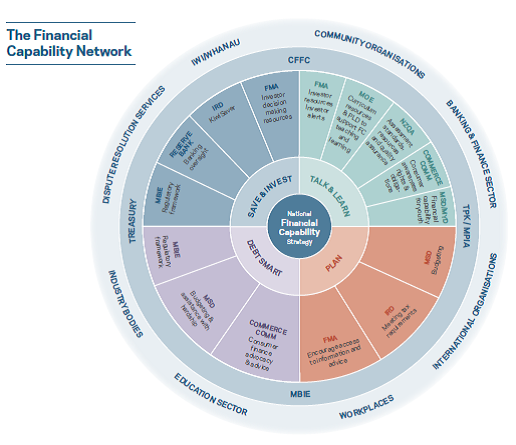
The National Strategy for Financial Capability led by the Commission for Financial Capability provides a framework for building financial capability. It has five key streams:

  • Talk: a cultural shift where it’s easy to talk about money
  • Learn: effective financial learning throughout life
  • Plan: everyone has a current financial plan and is prepared for the unexpected
  • Debt-smart: people make smart use of debt
  • Save and invest: everyone saving and investing

On this measure, might we assume that “debt-smart” would mean taking as much interest-free student debt as possible and paying it off as slowly as possible?  Not an approach I will be encouraging in my children.

More generally, I’m not sure that any of these items represent areas where we should expect governments to bring much of value to the table.  One might marvel that human beings had got to our current state of material prosperity and security without the aid of government financial literacy/capability strategies. And since when has a traditional Anglo reticence about matters of money been something for governments to try to change?   Better perhaps might be a focus on improving the financial capability of governments.

The Commission’s own research (p 26) shows what one might expect, people develop more “financial literacy” as they need it.  So-called “literacy” is low among young people (18% of 18-24 year old males are “high knowledge”), who don’t need it much.  It rises strongly during the working (child-rearing, mortgage etc) years (53% of 55-64 males are “high knowledge”), and then looks to tail off a little in retirement.  All of which is unsurprising, and (to me) unconcerning.

I know the so-called Commission for Financial Capability doesn’t cost that much money, but as I’m sure they would point out, every little counts.  The money they fritter away on national strategies and capabilities is money that New Zealanders don’t have to spend, or save, for themselves.  In fact, this graphic, from the government’s policy statement, might suggest a few other government agencies that could be a trimmed back.  Governments need to do well what only governments can do.  So-called “financial literacy” isn’t obviously one of those things.

financial literacy 2

As an easy way into this, consider this US-government funded online quiz, a shop window for a US project on better understanding financial literacy.  I imagine that most readers of this blog will score 5/5, while the average American scores 2.9.  But then stand back and ask yourself why the average American (or New Zealander) needs to know the answers to these questions, phrased rather in the manner of a school economics exam.  People who read blogs like this take for granted a knowledge of the answers, but in what way has that knowledge made your life, or mine, better?

What rates of return do major US firms require to invest?

In my post on Saturday about the appropriate New Zealand public sector discount rate, I linked to an article from the Reserve Bank of Australia’s Bulletin which included the results of a survey in which Australian firms’ CFOs were asked what hurdle rates of return their firm used in evaluating proposed investment projects.

This was the chart of those survey results:

rba hurdle rate

Prompted by a commenter, I was curious whether there was something similar for the US.  I found this JP Morgan piece, undated but apparently from last year, which reports the hurdle rates that some major US firms have disclosed.  Here was the chart, and a little commentary, from that piece.

JPM US hurdle rates

If anything, this small sample of US firms had eve higher hurdle rates than the Australian firms.

In both cases, there are a few companies using hurdle rates as low as the 8 per cent real recommended by New Zealand’s Treasury for evaluating public sector investment and regulatory proposals, but not many.  As JPM point out, these high hurdle rates are a little surprising, and it may be that firms are missing out on some opportunities, but firms are presumably making decisions that appear rational to them, subject to the threat of takeover if they underperform.

Government finances are quite highly cyclical, and it seems to me that we would need a pretty compelling case for encouraging governments –  which face rather weak disciplines –  to use our money more freely than private businesses would do.  Things governments really need to do –  true public goods –  should easily pass high hurdle rate tests.

What price should be put on proposed government projects?

Professor Miles Kimball from the University of Michigan recently spent a few weeks at The Treasury. Kimball has written a lot about the need for central banks and governments to be more active to overcoming the technological and/or legislative constraints that have allowed the near-zero lower bound to become a major constraint on monetary policy in much of the advanced world.  Weak demand has been a major constraint in much of the West in recent years, and the limits on monetary policy have been a material part of that story. (Monetary policy mistakes, by central banks in places like the euro-area, Sweden and New Zealand haven’t helped.)

We had a good conversation about the ZLB issues while Kimball was here.   My sense is that the ZLB issues are again becoming more pressing globally. That makes it highly regrettable that our Reserve Bank has done no pre-emptive work, and appears uninterested in doing any such work, about avoiding the constraint becoming an issue in New Zealand. They’ve invested in interesting research on making sense of other countries’ interest rate yield curves in the presence of the zero lower bound, but not on the practical policy options for New Zealand to overcome the constraint.

A reader pointed me to another topic that Kimball spent some time on while he was in New Zealand. Last week, he devoted a substantial blog post to the question of the appropriate discount rate to use in evaluating New Zealand government projects. The Treasury recommends that, as a default, a pre-tax real discount rate of 8 per cent should be used in evaluating most government projects (including regulatory ones). Kimball, learning of this, notes that “this custom makes no sense to me”, arguing in effect that the New Zealand government should be much more willing to borrow to undertake projects, or to invest in international equity markets through the government’s highly-leveraged hedge fund, the New Zealand Superannuation Fund (NZSF).

As Kimball notes, the government’s borrowing costs are quite low (by historical standards, although not by international standards). Real long-term government bond interest rates are just over 2 per cent at present, and implied forward rates even fifteen years ahead are probably no higher than 2.5 per cent. No one knows what the future holds. Many people expect global real interest rates to rise at some point, but even if that happens there is no necessary reason to think that New Zealand real interest rates over the next 30 to 50 years will be materially higher than they are now.  Long-term global population and productivity trends don’t look as though they would support equilibrium real interest rates much above (or even as high as) 2.5 per cent.

But using a bond yield to evaluate long-term government projects just seems wrong. Finance theory typically encourages people to evaluate projects using a weighted average cost of (debt and equity) capital. And, in practice, in evaluating projects corporations appear to use required rates of return that are higher than estimates of their cost of capital. The cost of capital isn’t directly observable, but (for example) estimates of the market equity risk premium (the cost of equity over risk-free debt) have often been in the 4 to 7 per cent range.   Treasury appears to be using a 7 per cent equity risk premium.

I was struck reading Kimball’s material that the cost of the government’s equity did not get a mention. There was a strong tendency to treat the government as an autonomous agent (like a household) managing its own wealth, whose low borrowing costs depends only on the innate qualities of the government and its decision-makers. But that is simply wrong. A government’s financial strength – and ability to borrow at or near a conceptual “risk-free” interest rate – rests on the ability and willingness of the government to raise taxes (or cut spending) as required to meet the debt commitments. That ability to tax is implicit equity, and it has a cost (an opportunity cost) that is considerably higher, in most cases, than 2.5 per cent real.  So long as the government will raise taxes as required, the bondholder bears none of the downside if a project goes wrong. But shareholders – citizens – do.  Bearing that risk has a cost, and that cost needs to be taken into account by government decision-makers.

There is a related argument sometimes heard that governments should do infrastructure projects rather than private firms simply because the government’s borrowing costs are typically lower than those of a private firm. But, again, that rests on the power to tax, and the ability to force citizens/residents to pay additional taxes has a cost from their perspective (even if the government never chooses to exercise the option).   As citizens, the possibility that the government will raise taxes (or cut other spending programmes – eg NZS) impinges on our own ability and willingness to take risks, and hence to consume or invest in other areas.   That often won’t be a small cost. The opportunity cost of the government not undertaking a project is not what, say. the NZSF might be able to earn on the funds, but what citizens themselves might prefer to do if that risk-bearing capacity was freed up..

There is also a  variety of rather philosophical arguments around whether it is morally correct to discount some far-future costs and benefits at any material discount rate at all. If, for example, a particular policy would have benefits now but (with certainty) would turn New Zealand into a wasteland 100 years hence, a conventional discount rate would give that far-distant cost almost no weight. But most projects (physical or regulatory) that governments are evaluating aren’t remotely of that sort, and conventional project evaluation techniques seem a sensible starting point. We have too little disciplined analysis of the costs and benefits of most government projects, and too little willingness to allow decisions to be guided by the results of the analysis when it is undertaken (did I hear the words “Transmission Gully”?).

I don’t have a strong view on whether 8 per cent is the “right” real discount rate to use in evaluating government projects, but the government bond yield is just not the appropriate benchmark.

The Reserve Bank of Australia recently ran an interesting and accessible Bulletin article on the required hurdle rates of return that businesses use in Australia.  They report survey results suggesting that most firms in Australia use pre-tax nominal hurdle rates of return in a range of 10-16 per cent (the largest group fell in the range10-13 per cent, and the second largest in a 13-16 per cent band). Recall that nominal interest rates in Australia are typically a little lower than those in New Zealand, and their inflation target is a little higher than ours.   In other words, it would surprising if New Zealand firms didn’t use hurdle rates at least as high in nominal terms as those used by their Australia peers.     The RBA reports a standard finding that required rates of return were typically a little above the firms’ estimated weighted average cost of capital. The literature suggests a variety of reasons why firms might adopt that approach, including as a buffer against potential biases in the estimated benefits used in evaluating projects.

As a citizen, it is not clear why I would want to government to use scarce capital much more profligately than private businesses might do. I use the word “profligately” advisedly – using a lower required rate of return puts less value on citizens’ capital than they do themselves in running businesses that they themselves control.  And if the disciplines of the market are imperfect for private businesses (as they are), the disciplines on public sector decision-makers to use resources wisely and effectively are far far weaker. Fletcher Challenge took some pretty bad investment decisions in the 1980s and 1990s: its shareholders and managers paid the price and the firm disappeared from the scene (along with many more reckless “investment companies”). The New Zealand government, architect of Think Big debacle, lives on – citizens were the poorer, but ministers and officials paid no price.

If anything, there are several reason why governments should be using higher discount rates than private citizens would do:

  • Governments raise equity (“power to tax”) coercively rather voluntarily, and effectively impose near unlimited liability on citizens.
  • Governments are subject to fewer competitive pressures and market disciplines to minimise the risk of resources being misapplied.
  • Many government investment projects exaggerate the exposure of citizens to the economic cycles (the projects go bad when the economy goes bad)

I wouldn’t necessarily push that case strongly, and it is hard enough to get disciplined use of public money even with an 8 per cent real discount rate, but we should resist the siren calls to apply even lower discount rates.

Finally, Kimball seems to have become fascinated by the New Zealand Superannuation Fund. Ever since I started this blog, I’ve been meaning to write something on NZSF, but haven’t yet got that far down my list. Today isn’t the day, but suffice to say that even if the NZSF were to offer high expected returns (a) it is doubtful that those returns would get over a typical corporate hurdle required rate of return, and (b) since the returns to the NZSF are highly pro-cyclical, losses are likely to be largest at just the points when the taxpayers (and the rest of government) are under most financial stress, and calls for additional fiscal stimulus will typically be largest.  There was perhaps a plausible case for NZSF 15 years ago, enabling the Minister of Finance to protect surpluses from his colleagues, and to delay the sort of spending binge that happened after 2005 anyway. But there is no reason to think that the New Zealand government will prove to be a superior leveraged investor in global markets, and no obvious reason to coerce citizens to participate in such leveraged punts.

Why?

Fossicking round in some old legislation yesterday, I stumbled on the Music Teachers Act.  I’d assumed this was one of those pieces of legislation that might have gone the way of Raspberry Marketing Regulations 1979, that governed the New Zealand Raspberry Marketing Council until 1999.

But no, the Music Teachers Act is still on the statute books.  It is

An Act to consolidate and amend the Music Teachers Registration Act 1928, and to make better provision for the registration and control of music teachers and the advancement of music teaching.

The prime function of the Act is to establish and govern The Institute of Registered Music Teachers of New Zealand, again with the statutory purpose of

Purposes of institute

  • The purposes of the institute shall be––

    • (a) to promote the general advancement of music teaching, and the acquisition and dissemination of knowledge and skills connected with music teaching:

    • (b) to protect the interests of music teachers in New Zealand:

    • (c) to protect and promote the interests of the public in relation to music teaching:

    • (d) to hold conferences on music teaching and related subjects:

    • (e) to publish a year book, giving an account of the proceedings of the institute, the names of persons currently registered under this Act, and such other matters as may be of interest to members of the institute:

    • (f) to grant prizes, scholarships, and financial or other assistance to any person or organisation that may further the aims of the institute:

    • (g) to administer the fund known as the Helen Macgregor Tizard Benevolent Fund, previously administered by the Music Teachers Registration Board of New Zealand.

Some of these might be worthy enough objectives in some lights, but where is the public policy interest?  And especially in protecting “the interests of music teachers in New Zealand”.  Consumers’ or customers’ interests perhaps, but legislation to protect the interests of music teachers.

The Institute seems to have no powers over anyone, and appears to do some worthy stuff.  But why does it need a statute to make such a body function effectively?  If it offers good courses, or even certification, surely it can do that on its own merits?   The New Zealand Association of Economists, for example, has no statutory backing.

I asked my children’s piano teacher yesterday what he knew of the Act, or the Institute.  He is a smart young guy, who is active in music teaching programmes in schools and privately.  And he had never come across the body.

So perhaps the Act does both little harm and little good. In other words, it is largely irrelevant.  Those of us hiring music teachers presumably do so mostly the old-fashioned way –  by repute, and word of mouth.  And we keep them on if we judge that they are helping our children learn.

For decades, governments have been reluctant to tackle occupational licensing (which is nowhere near as pervasive here as in the United States). But for a third term government with a light legislative agenda, perhaps this is one bit of ever-burgeoning statute books that can quietly be repealed.

(Right after they secure the freedom to fly remote-controlled toy helicopters in the local park.)

Welcome to new readers

Welcome to readers who have visited this blog since my Q&A interview yesterday. Although the most recent post was on Australian monetary policy, my focus here is on New Zealand issues. The range of topics I touch on reflects some, slightly random, mix of my fairly wide-ranging interests, my experience, my reading, and what pops up in newspapers, speeches, or other blogs here and abroad.

The single economic issue that I care about most is reversing the decline in New Zealand’s relative economic performance that has been going on, in fits and starts, since at least the middle of the twentieth century, if not longer. We’ve done badly.  I want New Zealand to be a place my kids want to stay in, rather than joining the diaspora – the more than 900000 New Zealanders (net) who’ve left since 1970.

But much of the content of the blog so far has been on issues relating to housing, financial stability and banking regulation, and the Reserve Bank. That mostly reflects what has been going on in New Zealand this year, and choices that the Reserve Bank in particular has made. When I gained my freedom earlier in the year I didn’t set out to focus on the Bank. I think they’ve been making some poor calls – both on monetary policy, and around banking regulation – but even in respect of the Reserve Bank I’m more interested in advancing the cause of institutional reform than in this year’s specific decisions.

For the last couple of months, I have been categorising my posts so anyone new to the site can find a way in to the various topics I’ve covered. But for anyone interested in some more substantial pieces of my argumentation, you could try these links:
• A speech I gave in May on the “blunders of our governments”, that are primarily responsible for high house prices.
• A speech given at a LEANZ seminar in June on “Housing, financial stresses, and the regulatory role of the Reserve Bank”.
• A paper issued in May making the case for reforming the governance of the Reserve Bank
• My recent submission on the Reserve Bank’s proposal to restrict access to mortgage finance for residential rental businesses in Auckland.

In terms of the longer-term economic performance issues:
• This paper, written in 2013 for a Reserve Bank/Treasury forum on exchange rate issues sets out how I’ve been thinking about the issues.
• And these more-speculative speech notes also from 2013 take a longer-term perspective on New Zealand’s relative economic decline.

I welcome comments, and have been pleased (not to say relieved) at the tone that commenters have maintained. Thoughtful discussion and debate matter, and I hope that in some small ways this site can contribute.

How about giving inflation a chance

The Governor’s OCR press release this morning held few surprises. Disappointments, yes, but not really any surprises. Given that in the June MPS the Governor had articulated only a fairly modest change of view, and had refused to acknowledge any sort of mistake in how monetary policy had been run last year, it was hardly surprising that, at a review between MPSs, at which he does not have the benefit of a full new set of forecasts, he wasn’t willing to cut by 50 basis points, as some had suggested was likely.  From the tone of the news release, such a cut probably wasn’t even seriously considered.

But if two cuts in six weeks might have broadly kept pace with the deteriorating data over the last couple of months, it does not make any inroads into the overly tight policy put in place when the Governor (and his advisers) misread inflation pressures last year. And that is the bigger problem. The Bank still seems to think it has things broadly right.

Here was my list of some sobering inflation statistics from my post last week in the wake of the CPI

Reciting the history in numbers gets a little repetitive, but:

• December 2009 was the last time the sectoral factor model measure of core inflation was at or above the target midpoint (2 per cent)

• Annual non-tradables inflation has been lower than at present only briefly, in 2001, when the inflation target itself was 0.5 percentage points lower than it is now.

• Non-tradables inflation is only as high as it is because of the large contribution being made by tobacco tax increases (which aren’t “inflation” in any meaningful sense).

• Even with the rebound in petrol prices, CPI inflation ex tobacco was -0.1 over the last year – this at the peak of a building boom.

• CPI ex petrol inflation has never been lower (than the current 0.7 per cent) in the 15 years for which SNZ report the data.

• Both trimmed mean and weighted median measures of inflation have reached new lows, and appear to be as low as they’ve ever been.

This, by contrast, is the Bank’s take:

Headline inflation is currently below the Bank’s 1 to 3 percent target range, due largely to previous strength in the New Zealand dollar and a large decline in world oil prices.

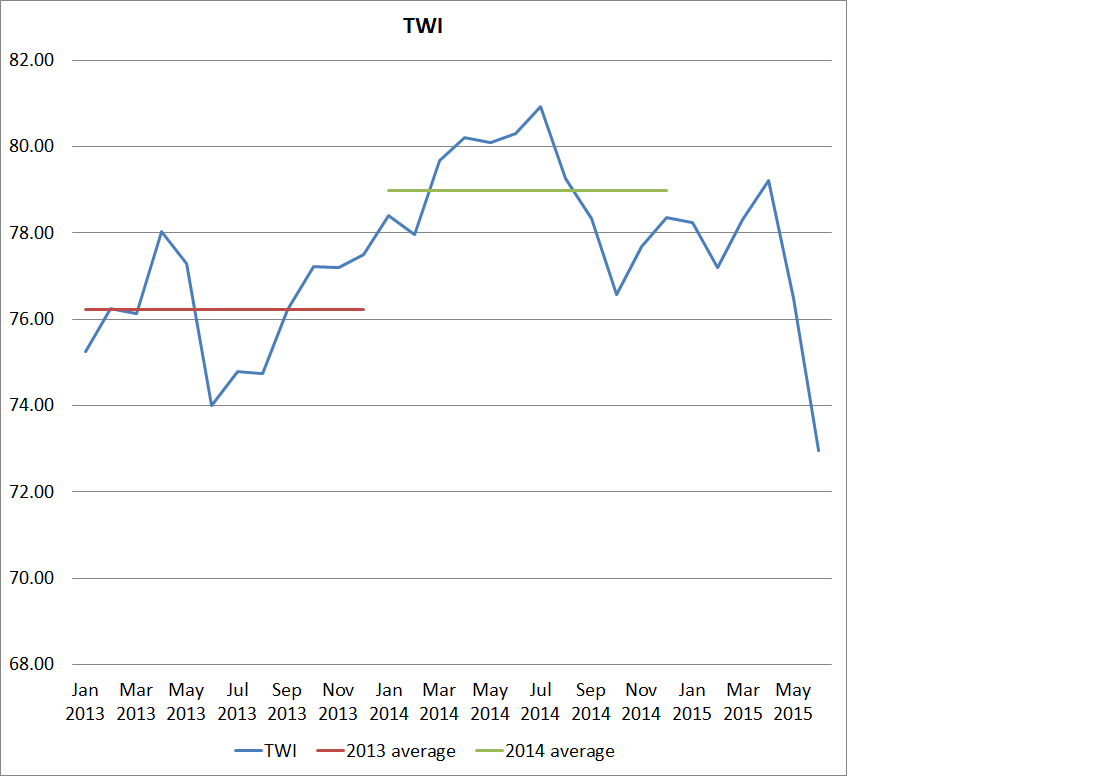
It just doesn’t wash.  CPI inflation ex-petrol was 0.7 per cent in the year to June.  CPI inflation ex tobacco (large excise increases) was…..actually not inflation, but slight deflation, a fall of 0.1 per cent in the last year.    And what of the exchange rate?  Direct exchange rate effects are not that large these days, but typically pass into consumer prices quite quickly (and one of the fastest routes is through petrol pricing).  The TWI in 2014 was around 4 per cent higher than in 2013, but that increase probably only subtracted around 0.4 percentage points from the annual inflation rate.  And as the TWI peaked in the middle of last year, the effect might have been even smaller by the year to June, the most recent CPI inflation we have.

twi to june 15

Focusing on headline inflation, as the Bank does in the extract above, seems like an effort to distract attention from the surprisingly weak core domestic inflation, whichever indicator of it one prefers to concentrate on.  And that weakness came at the very peak of a major building boom.

I was also a bit disappointed to see this sentence in the statement

While the currency depreciation will provide support to the export and import competing sectors, further depreciation is necessary given the weakness in export commodity prices.

Today would have been a good opportunity to have backed away from commenting on the exchange rate, except as it affects the inflation outlook, in these statements.  What does “necessary” here mean?  I assume it means something about stabilising the NIIP position (as a % of GDP) at a lower level, or improving the long-term growth prospects for New Zealand.    But that has nothing to do with monetary policy.  The nominal exchange rate is not an instrument in the Governor’s toolkit, and the real exchange rate is…well…a real phenomenon.  I happen to agree with the Governor’s unease about the level of the real exchange rate, but it is an endogenous real phenomenon.  Better for the Governor to focus on getting core inflation back to around the target midpoint  –  not just headline, relying on direct price effects of the lower exchange rate.  As it happens, the OCR path consistent with that obligation of the Governor’s would probably lower the exchange rate somewhat further as well.

I’ve made the point  previously, but will state it again.  When the Reserve Bank –  even more than other international central banks –  has misjudged inflation pressures for so long, it would be better for them now to err on the side of running policy a little looser than they really think wise.  Clearly there is something wrong in their mental model of inflation at present (and I’m not suggesting anyone else has a fully persuasive alternative), but after years of such low inflation, it might no bad thing if core inflation ended up a little above the target midpoint for a few quarters a year or two down the track.  I’m not suggesting a price level target, just that the policy reaction function needs to take more, and more aggressive, account of the repeated over-forecasting of inflation, and inflation pressures.  Among others, the 5.8 per cent of the labour force still unemployed might appreciate the chance to get back to work.

How sacrosanct should inflation targeting be?

On Donal Curtin’s blog the other day I noticed a reference to a recent paper published in New Zealand Economic Papers (unusually it appears to be accessible to non-subscribers) that looked at, among other things, whether inflation targeting had reduced the variability of long-term interest rates in New Zealand and Australia.   They conclude that it has.  Donal uses the results to encourage politicians to stay clear of any changes to monetary policy.

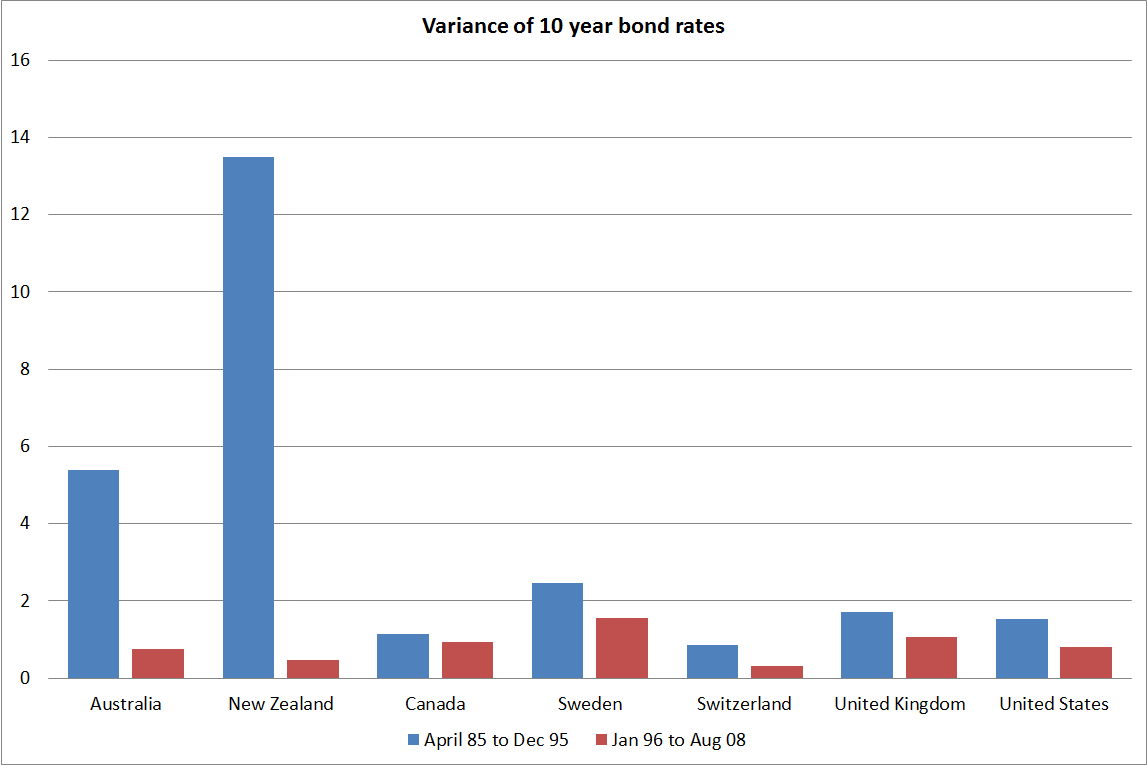
There is no doubt that long-term interest rates in New Zealand (and Australia) are much less variable than they were in the early days of liberalisation.  There was an awful lot going on back then.   The authors present the data for two sub-periods, April 1985 to December 1995 (which commences shortly after New Zealand interest rates were liberalised), and January 1996 to August 2008 (a period which ends just prior to the worst of the crisis, and the prevalence of near-zero short-term interest rates in many countries). For the countries they report, here are the data:

variance

In the late 1980s, inflation in Australia and New Zealand was also much higher than in the other countries. Australia’s inflation rate averaged around 8 per cent, and New Zealand’s 10 per cent, while the US had an inflation rate of around 4 per cent.  Sweden’s inflation rate was also still on the high side.

There is little doubt that getting inflation under control (lower and less variable) was part of what helped markedly reduce the variability in nominal interest rates. It did that in all these countries. But how much of that is down to “inflation targeting” per se? I’d suggest very little. After all, as early as 1990q3, just a few months after the first PTA was signed, New Zealand’s annual CPI inflation rate was already the second lowest among the countries these authors look at.   In the UK case, the central bank didn’t even have operational independence until mid-1997, and in the United States anything closely resembling inflation targeting really only dates to the last few years.

I don’t want to get into a debate here as to whether inflation targeting is the best option for advanced economies these days, but to get a better sense of the contribution of inflation targeting we’d really need a country (preferably several) to change their regime. A decade with several countries running NGDP targets, or wage inflation targets, or even price levels targets, in parallel with others still running inflation targets might shed rather more light on the issue. For New Zealand, as I’ve argued elsewhere, inflation targeting was a specific form of articulating a commitment to more stable macro conditions than we’d had previously. It may have provided more discipline (on the Reserve Bank) than operating without an explicit target, but even there one could be reasonably sceptical. Most other advanced countries had already got inflation a long way down –  as had we (see above) before they got very serious about anything like inflation targeting.

There is a variety of good reasons for encouraging Opposition parties not to tamper too much with the essence of the monetary policy targeting framework (and perhaps to focus their energies instead on reforming the Reserve Bank, including its governance framework). Whatever is wrong with New Zealand’s economic performance over the long-term has little or nothing to do with the details of the monetary policy arrangements. But I wouldn’t take much from this NZEP paper on that score. It won’t, for example, shed any light on whether the Labour Party’s proposed restatement of the goal would make things better or worse, or just make no difference.

Here is how Labour last year proposed to amend section 8 of the Reserve Bank Act. The new section would read.

“The primary function of the Bank with respect to monetary policy is to enhance New Zealand’s economic welfare through maintaining stability in the general level of prices in a manner which best assists in achieving a positive external balance over the economic cycle, thereby having the most favourable impact on the stability of economic growth and the level of employment.”

It was clever piece of drafting.  I argued at the time, and still believe, that it would have made no material difference to the conduct of monetary policy. The inclusion of similar sorts of words in the Policy Targets Agreement in 1996 didn’t (but it allowed Winston Peters to tell the world that he had secured changes). I was never sure whether Labour recognised, or not, that the change would make little or no difference. I think their people were smart enough to know, but also to know that, in political positioning product differentiation and branding matter.

Of course, other possible changes might make more difference. Some might (conceivably) be for the better. There is certainly no reason to suppose that inflation targeting will prove to be the last word in how best to conduct monetary policy.

72 per cent want to restrict “junk food” advertising

I’m not among them.

According to the Herald 72 per cent of respondents to a recent survey favour greater government controls on “junk-food” promotions to children. Similar numbers wanted to restrict or ban “unhealthy” food brands sponsoring children’s sport.  A couple of mothers are interviewed in support of such restrictions, citing the dreaded “pester power”.

As I said, I’m not among the 72 per cent. I have three kids, have done all our family shopping for years, usually have at least one child with me when I’m at the supermarket, and two of my children play team sports, where “player of the day” certificates/prizes often come from outfits like Hell Pizza or McDonalds.

But, you know what, we just say no. I don’t encounter very much “pester power” in the supermarket aisles, and when I do I almost always say no. The children watch some television – admittedly not much of it free-to-air – but they know what it is worth pestering me about (“how about making a goat curry, pleeease Dad”) and what it is not. And they aren’t fed on an unremitting diet of lentils and kale either – we have a dessert each evening, consistent with my constant message to them (contrary to the one the schools propagandize then with) that “what matters is a balanced diet and plenty of exercise. Both kids won player of the day certificates on Saturday, but we don’t let them take advantage of the free pizza at Hell Pizza (as it happens, not because it is “junk food” but because we deplore the values that company promotes).  I hope Hell Pizza fails, but I certainly don’t think it should be banned, or should be unable to promote its business.

Just say no. It isn’t really that hard. Start young, but start. Why would we want to contract out responsibility for raising our children to the government? Too much of life is already spent trying to reverse the pernicious effects of propaganda (“evils of capitalism”, for example) from state schools.