Still avoiding responsibility

I was away when Reserve Bank chief economist Paul Conway gave his recent speech, “The road back to 2% inflation”, and since I didn’t see any material commentary on it I didn’t bother going back to it when I got home. But my son – honours student researching monetary policy (anyone wanting a young economist at the end of year, get in touch…..) – prompted me to finally do so. And since I’ve been quite consistently critical of the lack of serious speeches from the MPC members, I shouldn’t overlook the handful (even if they are just selling a party line, rather than really opening up issues and alternative perspectives) that do emerge.

First, some kudos. With the speech on the Reserve Bank website there was a transcript of the following Q&A session (the speech was apparently delivered as a webinar). That should be standard practice, since the unscripted remarks of policymakers can be at least as informative as the scripted and carefully negotiated ones are, and we know central bankers can go off reservation. I’d link to the transcript but can’t now find it again (no doubt there somewhere, but not on their speeches page).

The speech seemed to mainly be an opportunity to report some recent research results from Reserve Bank staff (several Analytical Notes). It is good to see some of those coming out (in a telling comment on how bad things had been, in the Q&A session Conway himself highlights that it was good that they are now “really cranking out” research again).

Conway wasn’t at the Reserve Bank when the big and really costly mistakes were made by the Monetary Policy Committee, joining only in May 2022. One might therefore have hoped that he’d be able to take a more detached and objective view on what had gone before. After all, even though in his management role he works for the Governor (and his grossly underqualified direct boss, the DCE responsible for macroeconomics and monetary policy, with a marketing degree), he does actually hold a statutory position as a member of the Monetary Policy Committee, and isn’t supposed to simply defer to the boss (or institutional interests) in reaching his views and votes.

Conway’s speech is presented as forward-looking in nature (“the road back to 2%), but there is quite a lot of history in it too, and it is the historical dimensions that got my goat. In particular, there is a persistent and repeated refusal to accept (at least in public, which is where it counts in terms of accountability) that monetary policy mistakes and misjudgments are primarily responsible for the severe inflation outbreak, the aftermath of which we are still living with. All the arbitrary and never-to-be-reversed redistributions of wealth, all the dislocations of markets and businesses, and now the recession and significant rise in unemployment which the Bank, no doubt rightly, tells us is necessary to get inflation comfortably back down again.

To repeat one of my consistent lines, human beings are fallible, they make mistakes. Central banks – here and abroad – are made up of humans, so they make mistakes. Really serious ones, of the sort seen in the last few years, shouldn’t happen but they do. One might even offer perspectives in mitigation: the pandemic was something quite extraordinary, and many people (here and abroad) misread the macroeconomics of it for too long. But those responsible need to take responsibility for the mistakes that were made. Those who now hold office who weren’t even there at the time have even less justification for not detachedly owning that those who were there made (really serious and costly) mistakes. Plus, in most human affairs, contrition goes quite a long way…..including (but not limited to) as a sign that one is even interested in learning from the mistakes and doing less badly next time.

Instead, there is avoidance and minimisation right through the speech.

At one point we are told that during the Covid period interest rates were “relatively low”. Not the lowest they had ever been, just “relatively low”.

Then we get attempts to minimise Reserve Bank responsibility by highlighting (correctly) that fiscal policy was also expansionary (“at upper end across OECD economies”) and bemoaning that insufficient attention has been paid to the role of fiscal policy. But Conway knows very well that the system is set up in such a way that monetary policy is the last mover: fiscal authorities do what they will, do it transparently, and then the Reserve Bank does whatever is necessary to keep inflation in check. The responsibility for the high (core) inflation rests with the Reserve Bank, not with fiscal policy.

And so it goes on. Several times we find attempts to blame the labour market, or even border closures, as if the Reserve Bank MPC was not set up to be….the last mover, to respond to all other pressures and risks in a way that keeps core inflation in check. In the Conclusion, Conway articulates it this way

“Inflation spiked higher during the pandemic due to a range of factors, with a shortage of labour and materials in a period of strong demand being particularly important”.

But no mention of monetary policy, which is by design the main tool for influencing aggregate demand and capacity pressures to keep inflation at or near target. There are plenty of references to “demand” in the speech, but hardly any (backward looking) to the demand manager.

To read Conway in isolation, you would have absolutely no idea that the Reserve Bank itself now estimates that the economy got materially more badly overheated than at any time for decades. That is on them: minimising or avoiding such situations is an integral part of successful inflation targeting.

Or that on IMF estimates New Zealand in 2022 had the most overheated economy of any of the advanced countries/monetary areas. It was the result of what were, with hindsight, glaring monetary policy mistakes and misjudgments. But Conway – and no doubt his bosses – would simply prefer we looked the other way, and accepted that it was all somehow out of their control (except no doubt when they will take credit when inflation eventually comes down again).

What of the way ahead? There is an OCR review out tomorrow, continuing the weird RB choice to hold a review the week before the key (especially at present) quarterly CPI data are out. The Bank has signalled that Conway, their chief economist, is away and won’t be attending the meeting (which doesn’t seem like particularly good leave planning). Given that and the weirdly hawkish tone of the May MPS – the one picking an economic recovery even as the OCR is unchanged, or even rise, for the next year – one can’t expect much from the MPC tomorrow (although RB communications flip-flops haven’t been unknown).

I’m less interested in what they will do than in what they should do, and have come to believe that, on balance, an OCR cut would be appropriate. These are – or should be – almost always matters where risk and uncertainty are real considerations. If a monetary policymaker is 100% sure of their stance, they either aren’t thinking hard enough or have left things far too late, given the fairly long lags with which monetary policy works. I’m certainly not mounting an argument for a move to a neutral monetary policy stance – wherever the neutral nominal interest rate might currently be (itself highly uncertain) – but simply for taking the foot a little off the brake, and easing back a little on the extent of the disinflationary pressure. As I said, uncertainty is a pervasive factor in any forecast-based monetary policy regime. Quite possibly, time will show that by now the OCR should already be quite a bit lower, but I don’t think that is yet a view one could reach with great confidence, so mine is simply a call to begin edging in that direction (and to reverse May’s curious hawkish rhetoric and numbers).

Why? Annual inflation is still above the top of the target range after all. But it is clearly falling, and there are numerous indicators – hard data and surveys – pointing in the direction of a further material accumulation of excess capacity and disinflationary pressure, which will play out – even just on today’s policy – over the next 12-18 months. The worst of inflation is clearly past, and with it fears that some new and really bad rate of inflation was going to become embedded. And while the RB likes to talk up non-tradables inflation – which has no special role in the Remit – it is also true that a fair proportion of those pressures (insurance and rates) are resulting from non-monetary shocks (one clearly a supply shock, one about government charges), which really should be “looked through” by an inflation targeting central bank, unless (and to the extent that) they were spilling into public expectations of medium term inflation and wider price-setting and spending behaviour.

A move now to a 5.25 per cent OCR would not, of course, be game-changing in macroeconomic terms. It would, however, be a step in the right direction. One can understand the personal incentives on the Governor – who cares about the excess capacity so long as I finally am 100% sure inflation is back down again – but perhaps it would be easier for him and the MPC to take some of the risk, that is an integral part of the business they are in, if they hadn’t spent so much time and effort blustering and minimising the extent of their own mistakes from several years back.

Foreign direct investment, the Governor, and governments

(Post refers to my Saturday post on recent reported comments by the Reserve Bank Governor)

Who said this?

The world is awash with savings yet New Zealand does not provide a gateway that makes it easy for that capital to enter the country.

Well, that was one Christopher Luxon on the campaign trail three months out from the election last year.

At the time, Labour was in office. This was how their Minister of Finance had articulated the Labour government’s general attitude to foreign investment, in an official directive letter required by statute and addressed to Land Information New Zealand which runs New Zealand’s overseas investment regulatory regime

He went on to outline some caveats, and no one could accuse the 2017 to 2023 governments of being unequivocally keen on all and any foreign investment (they were, after all, the government of the ban on foreigners buying houses here).

But what of the Governor of the Reserve Bank? Normally, one might expect Governors to keep any opinions on FDI to themselves (once upon a time the Reserve Bank administered the relevant legislation, but no longer) or at very most to articulate something close to government policy. It isn’t, after all, their area of responsibility (debt inflows might be a different matter).

But this was what he told his Queenstown audience a couple of weeks ago, in a speech delivered in his official capacity

Our central bank Governor seems to be saying that there is something wrong with having so much foreign investment in New Zealand, and that it is somehow related to what holds back productivity growth in New Zealand?

As I noted in Saturday’s post, it really isn’t clear what he is on about or what he is basing these quoted comments on.

It isn’t, after all, as if New Zealand has a particularly large stock of inward foreign investment.

In fact, among OECD economies we are in the bottom third, expressed as a percentage of GDP (the chart doesn’t show Ireland, Luxembourg or Netherlands which are off the scale to the right on account of company tax regime distortions – although the “true” level of FDI in each country will be quite large).

And New Zealand is well known for having a not-exactly-welcoming regulatory approach to foreign investment

People debate quite what the New Zealand number really means in substance, but our governments don’t go out of their way to make it easy.

What about the current government? Well, as it happens, the Associate Minister of Finance with responsibility for the Overseas Investment Act issued a new one of those directive letters to LINZ just a few days ago. In his press release he noted:

And in the official directive letter he wrote

That seems pretty clear (although a shame about that absurd foreign buyers ban that is still in place).

But it seems to be utterly at odds with the public views, expressed in his official capacity, of the Governor of the Reserve Bank. Not only do Orr’s comments seem out of step with most conventional economic analysis and advice (I guess there is always the Greens and Bill Sutch of dubious memory on the other side), but – on a area in which he has no policy responsibility – quite out of step with the government. He has always been free to resign and run for Parliament or establish a think-tank. But for now he is a senior and very powerful official delegated huge powers (which, as it happens, he hasn’t even exercised well).

The Governor often likes to cite the, mostly meaningless (because it simply explains what the point of having the Bank is, and nothing about powers or specific goals), purpose clause in the Reserve Bank Act

Both governments he has served under have stated that they see foreign investment as having an important role in helping lift prosperity etc. But not, it seems, the Governor.

Look, if at a private dinner party with close friends or over a beer with his mates Orr wants to muse in some neo-Sutchian or Green Party way then who are we to object (although even then good central bank Governors should be very guarded about what they say to anyone), but this was in an official speech in his official capacity. And if he reckons the ODT’s journalist has quoted him badly out of context, the onus should be on him to clear things up (but he is only likely to do so if journalists start asking him hard questions, of which there is no sign so far).

As a reminder, the Associate Minister of Finance making those foreign investment comments wasn’t just the minister actually responsible, but also the leader of the ACT Party, a senior Cabinet minister and someone who will be Deputy Prime Minister a year from now. He is also the author of a letter to the then Minister of Finance – who was required by his own new law to consult other parties in Parliament – strongly opposing the reappointment of Orr as Governor (page 15 here). There is no sign Orr has changed for the better (Seymour objected under three headings: Poor Leadership, Poor Outcomes, and Poor Focus – and you’d have to think Orr’s weird and unsubstantiated FDI comments fall smack within that third category).

It was always a bit staggering that Grant Robertson, having passed a law himself requiring that the other parties in Parliament be consulted on the appointment of a Governor (one could argue this was an amendment with merit, consistent with the idea that even if people didn’t always agree with a person serving as Governor at least it should be someone who commanded pretty wide-ranging respect across the political spectrum) went ahead and reappointed Orr over the explicit written objections of the two largest opposition parties, knowing that the law made it very difficult (probably rightly so) for him later to be dismissed if the government changed.

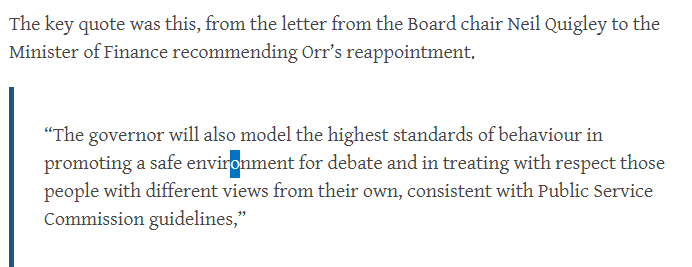
But Orr has shown no signs of buckling down and acting in a disciplined way that might command grudging respect from those who had been openly sceptical in his first term, even though that was the sort of line the egregious Reserve Bank Board chair used to make the case for reappointing his man

We’ll see a new, different and better Orr next time round seemed to be the suggestion…..

Orr was back on form a couple of weeks ago with his abuse of banks and of the New Zealand Initiative, when the Initiative (a body to which the main banks belong) had the temerity to disagree with and criticise the Governor and his policies. He just doesn’t get the idea that reasonable people might differ from him, let alone that as a very powerful regulator he has particular responsibilities to operate in a restrained and disciplined manner, not by implication opening the possibility of taking out on regulated entities his vengeance for daring to openly disagree.

Fortunately perhaps, the ACT Party is not an entity regulated by the Governor. On their official Twitter account I spotted this 10 days ago

Now, Todd Stephenson may be not much more than a backbencher BUT (a) he is actually a PPS to David Seymour, so not exactly marginal within ACT, and b) this statement (“he is temperamentally unfit as a steward of banking regulation”) is posted on the official Twitter account of a party that is a full member of the coalition government, a party headed by an Associate Minister of Finance no less. And, 10 days on, the post is still there (clearly wasn’t some junior staff’s fit of excess enthusiasm quickly pulled down by the powers that be).

It really is extraordinary that we have a central bank Governor:

  • openly articulating views on foreign investment (something he has no responsibility for) apparently at odds with views of successive govts,
  • attacking private entities for having the temerity to disagree with him, and implicitly holding over  bank members of that body a reminder of all the regulatory power he wields over them,
  • being openly attacked as unfit for office by a political party that is a component of the current coalition government, whose leader is an Associate Minister of Finance.

And all this with a Minister of Finance who seems not to care a jot.  A week or so ago when that NZ Initiative story broke she was at pains to try to disclaim any responsibility, but the Act is quite clear that responsibility for the Governor and Board rests squarely with her (the one person in the process accountable to Parliament and the public)

(I don’t think it is plausible to use these powers to sack the Governor – I don’t think behaviour since March last year (his reappointment) rises safely to that level, and any attempt could be judicially reviewed, in a very messy and disruptive way, but……Orr is her problem, and she so far displays no sign of any interest.)

I might suggest it was all rather Third World, but that might be unfair to them. But it is rather unsatisfactory all round, and really needs sorting out (like so many aspects of our failing public sector). Journalists with access asking hard questions might be a good start.

The Governor said what?

I’m sure there are more important issues right now amid the spiralling decline in New Zealand public institutions. One could argue there are even more important matters around the Reserve Bank (you know, the body that lost $11-12 billion for taxpayers’ in its reckless Covid interventions, gave us the worst core inflation for decades (still outside the target range several years on), and still has outstanding billions of dollars of concessional loans to banks (this even as the Governor openly bags banks for being too profitable for his tastes)).

But this one caught my eye.

Just before the last MPS a few weeks ago the Bank sent out a routine advisory about post-MPS engagements senior managers would be doing. It included this snippet

Quite probably no one much outside Queenstown and lakes area gave it another thought. The clear implication was that there’d be nothing new or newsworthy in what the Governor was saying.

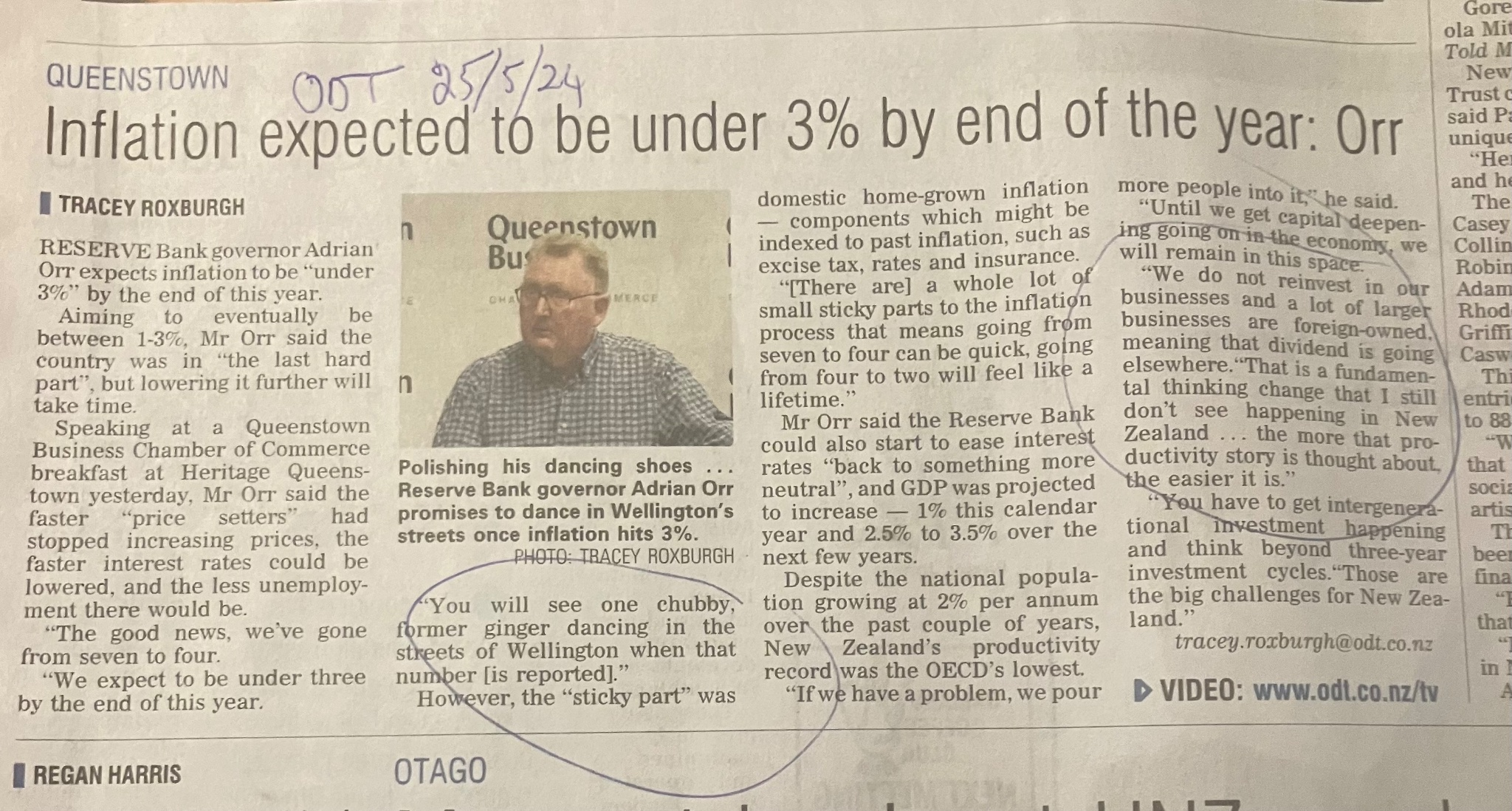
But I happened to be in Dunedin a couple of days later, where I stumbled on this article in the local paper

which made it quite clear that even if Orr had been using presentation slides from the MPS that hadn’t come even close to being the limits of what he’d said.

Again, there were a few things that caught my eye.

First, there was that weird – but not new from Orr – suggestion that “price setters” might choose to alter their behaviour to help out the Bank. Rather odd really. Not only do those firms have shareholders to whom they owe legal duties, but next time inflation undershoots the target midpoint should we expect the Governor to be urging firms to make a bit more profit by helping him out and raising their prices? Charitably, I guess that probably wasn’t what he had in mind, but whatever his intent he feeds a narrative in which core inflation is anyone’s responsibility other than the Bank’s and MPC’s.

Then there was that crass line about “you’ll see one chubby former ginger dancing in the streets of Wellington when that number [inflation under 3 per cent] is reported”. I’m guessing those whose businesses were closed down, those whose jobs were lost in the process, probably won’t be sharing in the Governor’s jubilation.

Look, I’m quite sure the Governor will genuinely be pleased when inflation is below 3 per cent – hopefully, even more so when it gets near the 2 per cent midpoint he is required to focus on – but this is the same Governor who has never expressed even a shred of contrition for his part in the inflation (let alone those huge, utterly unnecessary losses – which would have paid for many many (eg) cancer drugs). It was the sort of juvenile line one might expect from a junior official. From a Governor one might have hoped for a little more gravitas. Yes, even from Orr.

But what really prompted me to write this post was those comments on productivity, immigration, and related issues. Remarkably – and they really are quite remarkable comments from a long-serving advanced country central bank Governor – they’ve had no other coverage anywhere, and seem to have sparked no follow-up comments to (for example) the Minister of Finance, the person who is responsible to Parliament and public for the Reserve Bank and the Governor.

He is reported as having said that “New Zealand’s productivity record was the OECD’s lowest” in the last couple of years. I’m not sure quite which data he is using. but our productivity growth (or lack of it) has been pretty bad. In fairness so has productivity growth in a bunch of other OECD countries (the US tends to stand out at the other end of the scale). And this is, it seems according to the Governor, due to our immigration policy. Big news if true, especially when it comes from…..the Governor of the Reserve Bank (even if it is a matter for which he and the Bank have had no responsibility whatever). He goes on – and here we get quote marks – “if we have a problem, we pour more people into it”. Look, I have been quite vocal over the last decade or more on the way I think immigration policy has been systematically harming New Zealand’s (and Australia’s for that matter) longer-term productivity performance) but a) I’m just a private commentator, while he’s the Governor, and b) I don’t think even I’d be quite that reductionist, especially in a formal setting (like a speech from the central bank Governor).

And then he is reported as going on: “Until we get capital deepening going on in the economy, we will remain in this space” [presumably meaning low productivity growth]. Which is all rather mechanistic and not very insightful at all. There aren’t just lumps of capital that some central planner decides to allocate more of, but firms in markets, making profit-maximising choices against the backdrop of the opportunities they perceive and the regulatory etc environment governments impose.

And, to save you scrolling up and down, here is the crowning set of quotes

Not entirely clear who “we” is here, but presumably he means businesses operating in New Zealand taken as a whole. And note that his comment is about reinvestment, not investment per se (as it happens, total investment as a share of GDP has been higher in New Zealand most of the last 15 years than the median of the IMF grouping of advanced countries), so quite what is he on about? We know that New Zealand has a corporate tax system (dividend imputation) that does not generally double-tax profits earned by companies with New Zealand shareholders, and so – like Australia – tends to have quite high dividend payout rates. But what is the Governor’s beef? Is he seriously arguing for a more distortionary tax system, to stop companies distributing profits as readily? You might have thought that if he was going to weigh in on such issues he might have highlighted that we (and Australia) now have one of the highest company tax rates in the world, and company tax rates really bit on foreign investment (since foreign investors can’t use imputation credits).

But no. In fact, what we get from these comments is that the Governor isn’t very happy about the foreign investment we do have. In fact, unlike almost every serious economic commentator (and in fact the government), he seems to think there is too much of it, falling back on that rank populism beloved of the Greens, the left wing of the Labour Party…..oh, and the marketing department of TSB Bank (my photo from a few years ago). Oh no, the dividends are going to…..well, the people that provided the capital.

As it happened, when I looked up the detailed balance of payments data, there had been $21.4 billion of reinvested earnings by foreign-owned companies operating here in the five years to March 2023. Quite probably some of it was more or less compelled by Orr’s own OTT additional requirements for bank capital (the staggeringly expensive insurance policy that was never subject to a proper cost-benefit analysis) – and the banks are the biggest foreign investors (collectively) in New Zealand. But you are left wondering quite what Orr is on about, and based on what. Just more of the unedifying Australian bank-bashing that he has become known for (recall how keen he seemed when those capital proposals were around for one of the Australian banks to divest and throw their business on the tender mercies of the NZX).

But just what, substantively, was the Governor on about? And how did he conclude that it was his place – charged with delivering price stability (oops) and maintaining financial system stability – to be suggesting, and it does seem to be the implication, that really we’d be better off with less foreign investment? This the same Governor who in the same speech seemed (see above) to be lamenting the relative lack of capital investment in New Zealand.

The account in the ODT ends with a couple of rather cryptic comments. The first (“that is a fundamental thinking change…”) seems to relate to his lament about foreign-owned firms paying investors dividends – which is presumably what they do when they don’t have great investment opportunities presenting themselves here. But, according to Orr, somehow the answer lies there: on this count “the more that productivity story is thought about the easier it is”. What, we should discourage foreign investors and somehow prevail on those who remain to invest here even when it isn’t financially attractive to do so? I can’t imagine that that is really what he means, but it is certainly what it sounds like.

And then an old favourite of Orr’s – with almost nothing whatever to do with his actual responsibilities – is all that talk about needing “intergenerational investment”. One supposes that perhaps he had in mind really long-lived infrastructure projects – things New Zealand entities, many of them government ones, seem woefully bad at executing in a cost-effective way – but actually depreciation (whether of the market value of new ideas, or of physical capital) means that most investments anywhere are much shorter-lived than “intergenerational”. And if the Governor thinks he can be confident about what ‘intergenerational” opportunities are out there that private firms might sensibly lay hold off, perhaps he might reflect on his own state of knowledge about the things he’s actually responsible for. That inflation, for example, wasn’t exactly something he set out to deliver.

It really is woeful stuff coming from the Governor of the Reserve Bank. If one of his junior managers had gone off reservation with such thoughts at a briefing far from home one might put it down to youthful enthusiasm and inexperience. But this is one of the most powerful government officials in the land, the long-serving Governor of our central bank. And, sure, it no doubt wasn’t a fully scripted speech, but…..he was apparently on-the-record (and even if he wasn’t central bank Governors are supposed to speak guardedly, perhaps especially about things that aren’t their responsibility)….and the onus is on him when he speaks to speak well and not just throw out glib populist lines.

But it seems that – once again – there is no price to pay. The ODT journalist who wrote the story even had her email address in the article, so it would have been very easy for specialist political or business journalists to have followed up on these loose comments (and who knows what else he might have said – ODT readers probably having a limited appetite for reports of the Governor), but apparently not. No one seems to have challenged the Minister of Finance, about whether it was really appropriate for the Governor – who hasn’t been doing his day job well – to be masquerading as some sort of Green Party economic nationalist stand-in (but then just a week ago the same Minister told the press the Orr was not her responsibility – even though the Act explicitly says otherwise).

What does the rest of the world (markets and RB watchers) make of it? I guess if they didn’t happen to read the ODT they’d not have known.

Once again, it really isn’t good enough. Another government agency head still in place after failing badly (my 20 reasons why Orr should never have been reappointed, not then including the inflation numbers). And a government that seems to barely care (in Orr’s case, there is still no sign of any attempt to clip his wings – eg foreshadowing deep budget cuts, letters of expectations, forcing the MPC to be more open, appointing a Board chair who make actually represent the public interest etc; really just nothing).

There was an old line of Alan Greenspan’s that “if you think I have been particularly clear you have probably misunderstood what I said”. Orr, by contrast, straying beyond his bailiwick seems quite troublingly clear. Is there any other advanced country central bank Governor who is on record in recent times lamenting (simultaneously) the lack of investment in his economy, and the presence of too much FDI?

Some old documents (of no immediate interest)

This is really just a quick information post.

The Reserve Bank’s website has a complete set of Monetary Policy Statements from and including December 1996 onwards, but for some reason they have not put online the first few years of Monetary Policy Statements (which began being published, under the provisions of the Reserve Bank of New Zealand Act 1989, in April 1990). New Zealand’s inflation targeting regime (origins and early development here) took formal shape (with attendant legal obligations) when that Act came into effect, and the first Policy Targets Agreement between the Governor and the Minister of Finance was signed on 2 March 1990.

In the early years of inflation targeting there were (as the law required) only two Monetary Policy Statements a year. At the start, these documents were very light on specific forecast content. The Monetary Policy Statements were complemented by published Economic Forecasts documents, which had been released twice a year for some years (but which then had little impact on anything, and were once – in a meeting with the Minister of Finance I was attending – memorably disowned by the Bank’s Deputy Governor as “just the Economics Department’s view”). With the commencement of formal inflation targeting, and a growing recognition of the crucial importance of inflation forecasts in an inflation-targeting regime, the Economic Forecasts document took on a somewhat greater degree of prominence. For some years (until 1997) the Bank published both documents, in time on a schedule of alternating quarters (before eventually moving to the still-current model of four Monetary Policy Statements a year).

The Economic Forecasts documents for the period 1990 to 1997 are thus potentially of use to anyone seeking to study the entire New Zealand inflation targeting experience, and particularly the experience in the early years when we pathbreaking to some extent (often more like “groping in the murk”), and running a monetary policy implementation approach that was idiosyncratic to say the least. Neither they nor the early Monetary Policy Statements have been readily available.

I had had in my own files hard copies of some of these publications (with bits and pieces stuffed in them, including the September 1992 forecasts for which I was responsible and which the then Opposition Finance spokesman had described as “looking as though a public relations firm had written it” – on this occasion reality (notably fiscal reality) turned out better than the numbers he hadn’t liked)

But this complete set became available through the efforts of my son, who is doing an honours thesis in 2024 on some technical aspects of New Zealand monetary policy in recent decades. He requested the documents from the Bank and was provided with the full set from 1990 to 1997 (and my understanding is that it took a bit of work from the Bank, for which thanks). With his permission I am posting them here as a more permanent record and to make them generally available to anyone interested.

There is a full page, with a link on the front of this website, with links to all these documents

The fiscal gap that is macroeconomically significant

That was a weird 24 hours or so. If you had told me a week ago that anything I was involved with would be the lead item on Morning Report and on the two TV channels’ evening news bulletins, I would not have believed you. Election campaigns are funny things.

I don’t want to say anything much more about the foreign buyers’ tax issue, although it did occur to me this morning that National’s stance – refusing to release any workings, or details of the Castalia review- was somewhat at odds with Willis’s recent statement that National now wants a state Policy Costings Unit established. In any such model, the full costings/modelling for any policy a party adopted would routinely be released. But in the end it is their choice, as it should be. And, as I noted yesterday, whatever political/reputational significance the (likely large) gap in the revenue estimates has, it simply isn’t macroeconomically significant, at about 0.1 per cent of GDP per annum.

The OBEGAL operating balance forecast for this fiscal year in the PREFU earlier this week was 2.7 per cent of GDP, and less than three months into the fiscal year I’m sure Treasury would tell us that even if there are no policy changes, that is a point estimate within a credible range easily 0.5 percentage points either side of 2.7 per cent.

In the run-up to last year’s Budget, the Minister of Finance released a new set of “fiscal rules” (these have tended to be something of a moveable feast to say the least, but the 2022 ones are still in place). Under those “rules” (to be a real rule it has to lead to changes in behaviour not just changes in the rule), the aim was not just to get back to surplus (OBEGAL) but to maintain a surplus in the range of 0 to 2 per cent of GDP. To simplify things, we’ll focus on a midpoint of 1 per cent of GDP, each year.

Back then – less than 18 months ago, the big Covid spend now well behind the government – a surplus was thought to be close. In fact, in the HYEFU in December 2021, Treasury had projected a surplus of 0.5 per cent of GDP for this current fiscal year 2023/24 (by Budget 2022 that forecast had already slipped to a deficit of 0.6 per cent of GDP). So back then, not long ago, getting to surplus wasn’t some “end of forecast period [4 years away]” idyll, per the Labour Party’s current “Our Pathway Forward” document released a couple of weeks ago.

Treasury forecasts that GDP for the 23/24 year will be $417 billion. If we take the difference between the forecast deficit of 2.7 per cent of GDP and the 1 per cent of GDP surplus target, we get a $15.4 billion fiscal gap this year. Expenditure not sufficiently funded by revenue to be consistent with the fiscal goal the government itself had set.

People will talk a lot about Covid spending having been necessary, and I’m sure much of it was. But that was then and this is now (23/24 and beyond). The only justifiable reason for the Covid spend to still be influencing spending today is the servicing costs of the resulting debt – which themselves are much higher than they would have been if only the Reserve Bank MPC, with the imprimatur of the Minister and the Treasury, had not engaged in a massive liability swap, buying back long-dated debt and issuing huge volumes of new floating rate liabilities, right near the trough of a decades-long trend decline in long-term interest rates. And part of the reason we should aim to run surpluses in more-normal times is to counterbalance the inevitable deficits when really bad things happen (be they the Canterbury earthquakes or Covid).

One could produce lots of other estimates of “the gap”. For example, the residual cash deficit (number 2 on the PREFU “fiscal strategy indicators” bit of the tables) is way larger again. Or – as I talked of in earlier posts – we could play around with inflation adjustment. But whichever way you look at it there is a really large fiscal gap, which wasn’t foreseen even at the end of 2021, let alone pre-Covid

In the 2019 HYEFU, just prior to Covid, the forward projections had had a surplus for this year (23/24) of 1.5 per cent of GDP. Tax revenue as a share of GDP for 23/24 is higher in the recent PREFU forecasts than it was back in December 2019 (not surprising given the fiscal drag from inflation), so the gap is entirely down to additional spending. That’s a choice, by this government.

As the IMF, The Treasury, and every other serious analyst (including the ANZ just today) also recognise, the choice to widen out the prospective deficits a lot has also directly acted to work against the drive to lower inflation, putting more upward pressure on interest rates. (The Minister and RB Governor dispute this, but they must be considered motivated reasoners, and the Governor in particular has been slow walking the release of whatever (if any) analysis they might have to support his story. As one follower on Twitter noted, perhaps he and Willis have more in common than we had thought.) As I’ve documented, when we look across advanced countries, we now seem to have one of the larger deficits around. All this in a year in which the economy is expected to still be pretty much fully employed.

Ah, but the government would tell us, surpluses are coming. After all, Treasury said so. You only have to look at the PREFU tables and there in 2026/27 there is a very modest surplus.

But if we are talking about credibility of numbers, this really takes the prize for worst among the major political parties.

As I’ve pointed out previously, The Treasury has to do its forecasts on what the government tell them is its policies. There isn’t any real discretion. These are only Treasury’s best forecasts conditional on assuming the policies a government that is behind in the polls told them will be its policies in government for the next several years. You can’t really have Treasury doing unconditional forecasts, but PREFU numbers in particular for years beyond the current year really aren’t worth very much at all, because they can easily be, and have been, gamed.

Just before the numbers were finalised – no doubt knowing where they were heading – the government decided to indicate that future fiscal policy (almost entirely periods beyond the election) would be run materially tighter than they had previously indicated. This was a mix of cutting baselines for various departments, cancelling a few things immediately, and announcing that in out years the future budget operating allowances would be reduced. And, as if by magic, they took $4 billion out of total expected spending over the forecast period, without making even one specific commitment about things that wouldn’t be done etc in that future period. Going into a PREFU, the Minister of Finance can tell the Secretary any number he likes, and she has to use it. And this is not to suggest that the previously announced future operating allowances had been just fine either; after all, similar political imperatives had driven the government at Budget time, wanting to show a surplus (then) in 2025/26.

In the furore around National’s costings re the foreign buyer tax, we didn’t get to see any substance from the reviewers either. But being in government is a bit different. If Treasury had to do forecasts using what the government said was going to be its fiscal policy if it were to be re-elected, Treasury was free to provide its own interpretative or contextual comment. And it did.

We don’t have a very clear insight into just which cost pressures Treasury was referring to there. Some of it will be general inflation (prices and wages) from here, but some of it should presumably be stuff like the huge cut in real university funding that the government has imposed in the last couple of years, perhaps accidentally on account of inflation, but not remedied and probably not sustainable. Or the real wage cut they recently imposed on secondary teachers (even as private real wages are steady to rising) when recruitment and retention issues remain real, or a similar burden they seem to want to impose on senior doctors. Inflation can be a wonderful thing for government budgets in the short-term, but reality – market real wages, international competition etc – will eventually out. And as others have pointed out, none of these PREFU numbers capture things like the pressure for increased defence spending or the costs of big new projects like the new harbour crossing for Auckland that the government rushed out a few weeks ago.

On any fair assessment of the way this government operates, the current expenditure projections simply are not credible. And Treasury – the government’s professional advisers – know it (presumably some journalist will have thought to OIA any private fiscal analysis Treasury has given to the Minister in the last month or two). Cyclically-adjusted deficits do not heal themselves and nothing specific the current government has said or done has amounted to anything more in that direction than drawing a line on a graph and saying “that is our policy” (or would be if you were to re-elect us). What won’t be done, in such volume or quality or whatever. Ministers can’t or won’t tell us, and their own track record has actually been one of not delivering anything as low as the indicated future operating allowances.

These issues should swamp in substantive importance anything around one line item in National’s plan, which even if things are as bad as our model (and they could be worse if National did have to shift to a tax-residence base), is not much more than 0.1 per cent of GDP, slightly worsening a deficit that any new government will face of 2.7 per cent of GDP. It is the 2.7 per cent that really should be in focus.

But that is true as much for National as for Labour. And at the moment the signs are not encouraging. We are told to be a little patient and that the party’s “fiscal plan” will be released sometime before the first of us cast our ballots (little more than two weeks away). But nothing we have heard so far gives us much confidence that the party is any more serious about deficit reduction than Labour is.

The Back Pocket Boost package was their big tax and spending announcement. Luxon has been explicit that PREFU will change nothing about that package, so what else (material) is there? Perhaps this is unduly pessimistic but I wonder if we won’t see something a lot like Labour’s policy – vapourware commitments to surpluses years ahead, but nothing specific. In one sense National could be worse than Labour: not only is there the probable gap from the foreign buyers’ tax revenue, but National has already assumed a lot of whatever public sector fat can readily be cut is used to finance the promised tax cuts. That fat can’t be used again to cut the deficit. On the other hand, of course, National (and ACT more so) does seem genuinely exercised about bloat and excess in recent years, and you’d have to think they would be a bit better positioned (even just psychologically) to make the needed cuts, and personnel changes, than a bunch of ministers who delivered the spend-up in the first place. But those two influences probably largely net out and we are left with a big fiscal gap – that $15 billion one – and two parties neither of whom seem to have any real idea as to what they would do, sustainably, to actually deliver surpluses. Perhaps neither really cares very much. Which should go to their credibility with voters…..but probably won’t.

To end, just another chart for those – from whichever side – going “but Covid”. The chart is a variant of one I’ve shown before, but this time I’ve indexed net debt to a common starting point in 2019 for the median OECD country and for New Zealand (the latter using PREFU numbers for 23/24). (The scale here is percentage points of GDP: so an increase from 100 to 110 is an increase of 10 percentage points to net debt as a percentage of GDP.)

You can see the impact of Covid. In both the OECD grouping and in New Zealand the spending associated with the first big lockdowns made a big difference, boosting debt materially. Probably few argue with that very much. But what has happened since then? Net debt for the median OECD country (as a share of GDP) is now a bit lower than it was in 2019, reflecting some mix of inflation (unexpected inflation cuts nastily into the real value of nominal debt) and a prompt return to something near a balanced budget (not every country of course, but this is the median country).

But not in New Zealand where the government has made a conscious choice to increase core spending a lot further (even in the gamed PREFU core Crown spending as a share of GDP is now expected to be a bit higher than was projected for 24/25 even at Budget time), consciously choosing to run large deficits, which it now has no real idea how to close.

(Note that as I’ve shown previously the absolute level of NZ government net debt (share of GDP) is still below the OECD median- the chart above is about relative changes over that specific period – but that gap has been closing fast.)

One interviewer yesterday asked me to sum up the gap in National’s foreign buyers’ tax revenue estimates in one word. I could only manage three: “a bad gap”. That gap matters on its own terms, but the really bad gap – the one that should be getting a lot more attention from the media, and a lot more engagement from our political parties, is the $15 billion one that none of them seem interested in engaging honestly on how they really plan to close it. It is a huge gap. Having brought it about reflects very poorly on Labour (or should) but the apparent indifference to the grim outlook for the next few years reflects very poorly on the credibility of both our main parties, notably he who is now Minister of Finance, and she who would take the job just a few weeks from now.

I should perhaps add that while Matthew Hooton’s column today makes some useful points in a similar vein, his prophecies of impending doom, parallels with 1990 etc, really don’t stack up exposed to any very much scrutiny. Our situation now is grim but much less dramatic. More perhaps on a par with the resigned in difference of both parties to house prices (is anyone talking getting them durably lower?) or productivity (does either party have any serious ideas that might drive productivity growth sustainably much higher?). Does either party really care?

Fiscal credibility was once a thing in New Zealand. Both main parties seemed proud of it, even if at times the constraints tied their hands. These days, the two parties – led by Labour, now apparently followed by National – seem to have together shredded what was left of it.

My wife and I are heading off tomorrow for a spring holiday so most likely there will be no more posts here until the middle of the week after next.

“He immediately repaid the money spent…putting the matter right at the first opportunity”

Or not

The words in the title to this post were uttered by (outgoing) Public Service Commissioner Peter Hughes in a press release issued a month ago today.

You might recall the story:

  • the outgoing head of the Ministry of Pacific People’s (MPP) Mr Leauanae was given a lavish farewell (costing taxpayers $40000) before he moved down the road to run another second-tier government department (the Ministry of Culture and Heritage (MCH)), where he was given another fairly OTT official welcome,
  • instead of being given a card and a couple of book vouchers (say), Mr Leauanae was given lavish personal gifts, $7500 of which was paid for by taxpayers (via MPP), this at a function where the then Minister of Pacific Peoples was an attendee (and apparently a speaker)
  • for his welcome at MCH, attended by several Cabinet minister, his former ministry (MPP) spent $4100 on travel costs for Mr Leauanae’s family and personal guests.

I wrote a couple of posts about it here and here, and then lodged some OIA requests.

The PSC could be read as a fairly stern rebuke in some ways. It included lines that MPP’s expenditure had not been “moderate and conservative”, and had not complied with either MPP’s own policies or PSC’s “model standards” for chief executives. He added that “taken together, the Ministry of Pacific People’s expenditure on the farewell and the welcome were an inappropriate use of public money”.

And yet the principal culprit, Mr Leauanae, seemed to pay no price at all (nor is there anything suggesting his underlings at MPP did). He was the culprit in two senses: first, he was the chief executive of MPP and so personally responsible for its policies, key people, institutional culture, and so on. It happened on his watch in an agency which, while bloated, is still small in absolute terms (about 130 staff), and, second, he knowingly received the gifts and the travel.

But Hughes is keen to emphasise that it was all paid back and to suggest it was done pronto. These are the quotes from his press statement:

“On being made aware of the money spent on gifts he immediately repaid the $7,500 and returned all the gifts.”

“He has since reimbursed MPP $4,115.38 for travel costs associated with all family members and guests.”

“When he became aware of the matter, he immediately repaid the money spent on gifts in full and returned all cultural gifts to MPP. He also repaid the money spent on travel for his family and a guest who did not have a formal role in the welcome. That is appropriate and I thank Mr Leauanae for putting the matter right at the first opportunity.”

If you read those quotes carefully you will see an implied difference in timing as to when the two amounts were returned, but the press release ends on that note “I thank Mr Leauanae for putting the matter right at the first opportunity”.

But he didn’t. And the evidence, from PSC’s OIA response, leaves no room for doubt on the matter.

The farewell from MPP was on 14 October last year and the welcome to MCH was the following Monday, 17 October.

So let’s suppose that not knowing anything about taxpayer-funded expensive gifts in advance, Leauanae is embarrassed to receive them on the 14th. Not wanting to embarrass people on the spot, he reluctantly takes them, but vows to quietly return then straight away. Perhaps his family members never told him they’d got free tickets to welcome (doesn’t seem very likely, but just grant the possibility for the moment) and he only finds out on the Monday morning of the welcome, and again resolves to put things right straight away.

When then would you consider the latest that reimbursement could have been made and the Peter Hughes description (“put the matter right at the first opportunity”) would still have been valid. For me, I can’t see how anything later than the close of business on the Monday (14 October) could be described that way. Perhaps you are more generous than I am and allow a few more days leeway.

What actually happened was nothing of the sort. Instead Mr Leauanae took the expensive gifts, took the travel for family and friends, and got on with his new, somewhat bigger, government chief executive role.

And PSC (and ministers) did nothing. As the PSC report tells it, it wasn’t until 19 December (more than two months later) that PSC decided to have a look at things, and then only because there had been an OIA request to MPP about the expense of the farewell, and MPP have copied their response to the OIA to PSC. This in itself is all quite extraordinary, and suggestive of a PSC that simply wasn’t doing a decent job itself. We are told that Hughes himself was not at the farewell but some of his staff were. We know the Minister of Pacific Peoples was, and material MPP has provided suggest one other public sector CE probably spoke at the event (it would be quite normal for a bunch of senior public servants to be at such a CE farewell, even if he was only moving down the road). And either no one expressed any concern about (a) the lavish event, or (b) the gifts or PSC knew and didn’t care, at least until the issue looked as though it might go public via the OIA.

Christmas intervened and the PSC investigation didn’t get started until mid-January when they wrote to the acting CE of MPP.

To drag the story out, by this point three months on from the events, Mr Leauanae had taken no steps at all to return gifts or reimburse the money. The final Hughes report notes, of the travel expenditure, “He [Leauanae] advised it was always his intention to pay for his family and personal guest’s travel costs”, but not only had he not done so, he seemed to have later untroubled by any qualms of conscience. He’d done nothing to reimburse the cost of that travel.

The inquiry into the MPP farewell took PSC a while, but eventually the investigation led to Mr Leauanae returning the gifts and repaid the amount of taxpayers’ money that had been spent on them ($7500). The documents PSC released to me show that the money was repaid on 3 March and the gifts were returned on 7 March. That was six weeks or so after the investigation got underway, almost five months after the event. Only Peter Hughes could consider that to be “at the first opportunity”.

I had asked PSC to justify the “at the first opportunity” statement – not then knowing the dates. They simply refused to answer, claiming that the justification is in the report, which it isn’t (including because the report does not use the phrase, which appears only in the Hughes press release).

But there is still the travel for the MCH welcome to consider. Having been caught out and presumably rather strongly “encouraged” to return the gifts and reimburse the cost, you might have thought that an honourable man – the sort of person we might want to entrust the running of a government department – would have said “oh, and by the way, MPP actully paid for some family travel for my MCH welcome. I guess I shouldn’t have taken that either, and I’ll reimburse that cost today too”.

An honourable person might have done that. Leauanae didn’t.

In fact, at this point PSC was not even aware that taxpayers’ money had been used to pay for the family travel to the MCH welcome. The whole MPP inquiry seems to have been wrapped up – although strangely not released to the public as they had told MPP in January they intended to do – when on 19 June (months later) Hughes decided to expand the scope of the review to examine both MPP and MCH expenditure on the welcome. A copy of the Hughes letter to Leauanae (as head of MCH) is on the PSC website.

But not even that seems to have prompted Mr Leauanae to think “gee, I really should have got on and reimbursed that family travel we never should have accepted. I’ll put the payment through now”.

Because it was not for another month, on 24 July, that Leauanae finally reimbursed MPP for that travel.

And Hughes wants us to believe that it had all been sorted out and reimbursed at the first opportunity. In fact his underling (who signed the OIA response) repeats what is obviously false, re the farewell spending, that “upon being made aware of the expenditure, the outgoing Secretary returned all the gifts and reimbursed the Ministry”.

He just didn’t. Here is PSC’s own little table from the OIA response.

I’d also requested from PSC copies of any contacts with Mr Leauanae seeking these reimbursements. I half imagined something pretty stern and reproachful. It was after all wildly inappropriate for this money to have been spent on him and his family, and he was still (and is) a serving public sector CEO, in a public sector whose Commissioner is fond of emphasising not a culture of entitlement or of what one can get away with but the “spirit of service”.

I suppose it is just possible their response is to some clever reinterpretation of my request to enable them to hide stuff. But PSC did not tell me that they were withholding anything, so we must take them at their word that these were all the communications.

There is this text from Leauanae to Heather Baggott (a deputy SSC Commissioner, who as it happens had been acting CE at MCH when the expensive welcome was being put together)

So they’d had a really good chat. Months on. And Baggott’s response is also provided

And that’s it apparently for the farewell spending. No reproach, no reprimand, just a good chat among the chaps, all cleared up and no harm no foul.

For the family travel expenditure it is even worse. There is apparently nothing in writing at all from PSC. There is simply this one liner from Leauanae to an Assistant Commissioner at PSC.

Notice his very careful wording. He reimbursed MPP as soon as they told him the dollar amount that had been spent. But that doesn’t even come close to matching the Peter Hughes description “I thank Mr Leauanae for putting the matter right at the first opportunity”. No, it was months later, in two stages, with no evidence of anything proactive from Leauanae himself.

In a country with high standards of integrity (let alone frugality) in its government and public service the whole thing should be just astonishing and almost unimaginable. We no longer have that in New Zealand. Even so, what was known when the story first broke still prompted considerable public and political blowback. Who has $40000 farewells, and expensive welcomes, especially when it is just a public servant transferring from one agency to another? Who takes lavish personal gifts and unauthorised family travel, even if later they reimburse the money?

But there are plenty of other questions. How did the lead public sector agency (PSC) – responsible for public sector standards and especially the conduct and performance of CEs – allow all this to happen, and how was it that it didn’t even launch an investigation for more than two months after the events? How is it that there appears to have no black mark against Leauanae’s professional standing, and he still holds a CE job, despite behaviour that in junior staffer would probably have been met with dismissal? Where is the government in all this? Ministers were at both events, and are now well aware of the PSC report. Is this really acceptable behaviour from a government department CE in this day and age – or are both frugality and basic ethical standards just tossed out the window?

And why did Peter Hughes simply lie to and actively mislead the public? Reread the post if you think those words are too strong. The farewell expenditure/gifts were not returned/reimbursed “immediately Leauanae became aware of the matter” but months later, weeks after even the inquiry started, and the MCH welcome spending wasn’t reimbursed for several more months later. None of it was done ‘at the first opportunity’ as if there had just been some unfortunate and very brief, almost pardonable, misunderstanding. None of that is revealed in the report Hughes had had carefully constructed or in his press release. Nothing, it seems, must be allowed to damage the image of one of his CEs.

It is simply dishonest and disgraceful. Responsibility for the PSC Commissioner rests with the Minister (Little) and the Prime Minister (Hipkins, who was himself minister until January).

I’ve never had anything to do directly with Hughes. My closest encounter was in 2019. I’d made a mistake in a post here about outgoing Treasury Secretary Gabs Makhlouf, stating that Hughes had been responsible for his reappointment. I was quite surprised to get a phone call that evening from SSC’s comms guy stating that “Peter has asked me to ensure that you are aware that that reappointment was made by [his predecessor] Iain Rennie” (and I of course corrected the post).

But the Leauanae affair and what should really be called the Hughes affair – actively misrepresenting things in a public statement – appear to be all on Hughes himself.

Does any political party care?

I had to check up a specific productivity number this morning and noticed that it had got to the time of year when the OECD finally has a complete set of real GDP per hour worked (labour productivity) data for 2022. Data for 2020 and 2021 had been messed around by Covid disruptions, and measurement challenges around them, but if the illness was still around in 2022 the direct disruptions mostly weren’t.

Anyway, here is how the chart of labour productivity levels looks across countries

If you want, you could ignore the countries at the very top (notably Ireland, where the data are badly messed up by international tax distortions) and the Latin American OECD diversity hires at the very bottom. But it is not an encouraging picture for New Zealand.

Last year, the Secretary to the Treasury commented on some measurement work that Treasury and SNZ had been doing that suggested, on plausible grounds, that our hours worked numbers may overstating how they would look on a properly internationally comparable basis. She suggested that if such an adjustment was made – and it was for a variety of other countries last decade – it could lift GDP per hour worked by up to perhaps 10 per cent (wouldn’t change GDP per capita or wage rates of course). If we were to add 10 per cent to the New Zealand number in the chart above we’d be around where Slovakia, Slovenia, Japan and Israel are now.

But if there is something to that point – and there appears to be – any such adjustment would affect all the historical data as well, so that the growth rates over time won’t be materially affected, or (thus) comparisons of how New Zealand has or has not dropped down the OECD league tables.

A little arbitrarily, I wondered how New Zealand had done on that count over the last 10 years. Ten years is a nice round number, but it also happens to encompass a period half governed by Labour and half by National

Here I’ve shown the (ranked top to bottom) levels of real GDP for 2012 and 2022, and in the final column I’ve identified where a country has changed by more than two rankings over that decade.

Most of the material movements are in the bottom half of the table. There are some stellar performers, most notably Turkey and Poland. And there are some really really mediocre ones: Portugal and our own New Zealand. We’ve dropped six ranking places in a club of only 37 members in just a decade. It took me a little bit by surprise, and I think partly because the New Zealand debate (such as it is) rarely focuses on the countries that are now most similar to us in productivity terms.

Just as context, I then dug out the numbers for 2000. As it happens, the New Zealand ranking in 2012 was exactly the same as it had been in 2000. It is over the last decade that the decline down the OECD league tables has resumed.

Productivity growth is, ultimately, the basis for so much that people want for themselves and from their governments. “Productivity” isn’t the language of the focus groups or polls that seem to drive our politicians these days, but it is a critical New Zealand failing. We aren’t getting poorer in absolute terms, but we drift behind more and more advanced countries in the wages we can support, in the public services we can offer our citizens, in the private goods people can afford to purchase and enjoy.

But there is no sign that either of our major parties (well, or the minor parties) care, or have any ideas, any credible narrative, to reverse our economic decline. It is followership at its worst: competing in the race of “I am [aspire to be] their leader; I must see where they are going and follow them”. Real leadership would be something quite different than just rearranging the deck chairs, competing as to who can offer the best handouts.

I’m occasionally inclined to defend our politicians on the basis that our economic agencies don’t have much to offer them, but (a) those agencies have been degraded by much the same sort of politicians (in some cases, one lot did it, and the other lot keep quiet), and (b) real leadership seeks out, draws out, invites, examines, tests, scrutinises ideas and evidence, drawing around him or her advisers who could inform a better way, that a leader might champion, persuade and so on.

But neither Hipkins nor Luxon – or most of either’s predecessors – seem cut from that sort of cloth, perhaps not even interested or aware of what they don’t do or offer. Both seem content to preside over drift, just so long as they and their mates get to hold office rather than the other lot.

Misgovernment and other things

A while ago, after the post I wrote prompted by my return visit to Zambia, a reader suggested I might like to read Cobalt Blue: How the Blood of the Congo Powers Our Lives. The relevant bit of the Democratic Republic of Congo (DRC) is right next to Zambia, and the two countries share the geological Copperbelt, rich in copper (biggest export for both countries) and cobalt. There is now huge demand for cobalt as a component in lithium-ion batteries, and more than half the world’s fast-growing output currently comes from the DRC. It is no secret now (various reports in recent years) that, shall we say, labour conditions in cobalt-mining in the DRC are not the best. The focus of attention is around so-called artisanal mining, in which rocks with cobalt ore are gathered, broken, washed etc by hand (large scale industrial mining isn’t in focus at all). Wages (or earnings) are low, safety standards usually barely existent, injury and death rates apparently quite high,

The author of the book, Siddarth Kara is a professor in human trafficking and modern slavery at Nottingham University in the UK, and the book is based on several trips to the Katanga region of the DRC, with observations and interviews (often in some secrecy, and now with anonymity, given the very real risks that interviewees in particular often seemed to be running in talking to him.). Much in the book is pretty harrowing.

The author’s focus seems to be on big international companies that are keen to shield themselves from reputational risks and loudly proclaim their commitment that (for example) no child labour is being used in the mining of the cobalt that is so necessary to the batteries that power their products (be it phones, EVs, lawnmowers, or whatever). It is pretty demonstrably clear that any such claims are simply false, and are knowably false (any company board or executive that claims a child-labour free supply chain is almost certainly either consciously lying or consciously choosing not to look any more closely). The amounts of cobalt obtained from rocks collected, broken etc by “artisanal” labour are not marginal, peripheral or incidental. They seem to be a significant chunk of total Congolese production. As the book explains, it is often more economic to get some of the higher grade cobalt-rich rocks this way (lots are very near the surface) than through more traditional industrial processes. The conventional mining and processing companies are typically the buyers for these rocks.

If Kara is harsh, and probably fairly so, on the companies producing products that use cobalt, there are glimpses of recognition in the book that the responsibility runs more widely. He’d really like to be able to tell a relentless tale of the unremitting evils of global capitalism, destroying Congo since the first Portugese explorers arrived in the 15th century, on through the simply-evil phase of Leopold’s turn-of-the -20th-century Heart of Darkness immensely lucrative private estate. Colonialism and all that.

But he does recognise that a whole variety of interests are at work, and that successive Congolese governments and their factotums have scarcely shown (or show today) much sign of unremitting dedication to advancing the interests of the Congolese people. And while Patrice Lumumba is his hero, heroes who were killed before their own record in government was really able to be tested are handy rhetorical devices but not much more.

The DRC is staggeringly rich in natural resources. And yet (perhaps partly because of it?) it is one of the worst failures of modern post-colonial Africa. Here is real GDP per capita for the sub-Saharan African countries, from the IMF’s latest WEO database.

Africa is the world’s poorest and least productive continent, but there are poor performers, really bad performers, and then countries like the DRC – 4th lowest per capita incomes anywhere in sub-Saharan Africa. As it happens, the three poorest countries happen to border the DRC, but so do Angola, the Republic of Congo, Zambia, and Tanzania which are in the top half of countries in the chart.

Some will want to blame empire and colonialism for Africa’s overall performance, but it was a widespread story across Africa, and simply cannot credibly explain why the DRC has done so poorly. Independence came 63 years ago now, and actually – evil as earlier Leopold regime was – in the late 1950s what is now the DRC had fairly high rates of literacy and average GDP per capita is estimated to have been not much lower than Zambia or Zimbabwe or Kenya. South Korea wasn’t that much richer. Then.

For that longer-run of data we can turn to the Maddison Project database.

Barely two-thirds of the real GDP per capita of 1960. Only five countries seem to have gone backwards over that period, and not even Haiti has done as badly as the DRC. To the extent such long-term comparisons across countries make sense, real GDP per capita in the DRC now is about a fifth that of New Zealand 150 years ago.

It isn’t all bad. Life expectancy is about 50 per cent greater than it was for the hugely increased population

But the material living standards for ordinary people have gone backwards over 60+ years.

And this is a dimension that got not a mention in Kara’s book. I’m not really criticising him for not writing a different book – his real focus is companies in the West – but consider that the countries ranked 2-5 in cobalt production last year were Indonesia, Russia, Australia and Canada. You don’t hear alarming stories about artisanal cobalt mining in those countries – even in neighbouring, much richer, Zambia artisanal mining seems to be mostly for gemstones – not first and foremost because such activities would be regulated out of existence, but because they are priced out of existence. Workers in Australia or Canada have much more remunerative options than grubbing for cobalt-bearing rocks at, for many in the DRC, something like US$1 a day (a bit more if you take risk of tunnelling underground in tunnels with few/no supports for veins of cobalt). In the DRC they seem to not have such options. That is what long-term mismanagement, misgovernment, and productivity failure means (in extremis). Given the chaos and failure around them people do what they have to do, for themselves and for their children, even when that means children having to drop out of school very early, even when injury, illness, sexual assault, even death are foreseeable and realistic risks.

I’m not sure what Cobalt Red’s author would propose in response to the situation uncovered in his book. There are suggestions that the artisanal mining be properly regulated, regular wages paid, safety standard and equipment put in place and provided. Which sounds all well and good, but this is the deeply corrupt PRC where most often the financial interests of those around those in power, or able to pay them off, are really what matter. Kids are taken out of primary school mostly not because parents don’t want them to have schooling but because state revenue is used for other things (personal enrichment) – often never reaching the state coffers – rather than more-conventional basics. Rules already in place are blatantly circumvented, for just a few dollars. When your country has been gotten into such a deep mess by its own leaders, it is very hard to dig yourself out again, and quite impossible for other countries to do it for them (even more so, when as the DRC is, the rivalry between the West and China is very much in play, Chinese companies doing most of the cobalt processing). Heart-wrenchingly sad as it for ordinary people of the DRC.

I’m not one of those who ever runs the line about people being “lucky” to be born in particular places or times. Cultures are built and sustained, not just magicked into existence. We are heirs to what our ancestors built or adapted. But reading the book is a helpful occasional reminder that for all the faults, failings and frustrations of New Zealand, we shouldn’t take lightly, or dismiss readily, the cultures and cultural disciplines that still put us in top quartile of countries in terms of GDP per capita, that mean we can be pretty confident that losing parties will turn over the keys of office when they lose elections, that public officials mostly can’t be bought, and so on.

Fiscals: we used to keep good company

There are plenty of egregious examples of public sector waste (think lavish welcomes and farewells for senior public servants) or lack of discipline combined with questionable – well, really poor – process (think this morning’s post about the sly but huge increase in approved Reserve Bank spending).

But my core interests are macro in nature. There have been a series of posts in the last couple of weeks about aspects of the inflation and monetary policy story in the last few years, including yesterday’s on the external economy backdrop which should, if anything, have made New Zealand better placed than some to have kept core inflation near target (and that without even mentioning our lack of exposure to last year’s extreme European gas price shock).

It occurred to me that it might also be interesting to look at how fiscal balances and public debt levels had changed across the group of advanced countries (with their own monetary policies) that I’ve been using for comparison in these posts. I was less interested in the specific pressures put on monetary policy, since I’ve already written a couple of pieces dealing with the spin the Governor is (yet again) engaging in, trying to downplay fiscal impulse measures (developed for monetary policy purposes) in favour of ones that seem to have no macroeconomic foundation at all. I’ve asked the Bank for all/any analysis research in support of what looks to be a highly questionable alternative view, but am not holding my breath (if there were anything much they’d either have referred to it in the MPS, or they might even have been keen to send it to me by return of email to allay my doubts). So my focus was on fiscal developments in their own right.

Sometimes when one heads off to OECD databases to download lots of cross-country comparative data I already more or less knows the story and just want the hard numbers to illustrate it. Other times I’m taken by surprise. This trawl was one of those surprising ones, and not in a good way at all.

But first the good news. This is my preferred (since all-encompassing) measure of net debt. The OECD doesn’t have data on quite all the countries (and Norway data isn’t up to date, but at last read was about -350 per cent of GDP). These are the OECD’s mid-year estimates for 2023

We have lower debt than the median country. Many people (including me, but certainly not everyone) count this as a pretty good thing. But a debt stock is an accumulation of choices by successive governments over a long time. And I was more interested in looking at how things had changed over the Covid period, so since 2019. After all, every government faced some big spending in 2020, and when economies were temporarily closed down tax takes fell too.

So here is how net general government financial liabilities is estimated to have changed from 2019 to 2023 for this same group of countries.

And this is where the surprises started.

The median country in this chart – Sweden – saw basically no change in net debt to GDP over this period. New Zealand, on the other hand had the third largest increase. Australia had a slightly larger increase, but interestingly that was concentrated in the actual Covid period: from 2021 to 2023 net debt in Australia is expected to have risen by 1.5 percentage points while in New Zealand is estimated to have risen by 7.5 percentage points. Of course, for highly-indebted countries the unexpected surge of inflation typically lowers net debt to GDP – helping the US notably among these countries – although in the UK’s case having a large proportion of inflation-indexed debt on issue prevented that happening (as it was designed to do).

The OECD forecasts include 2024 as well, so we can see how they think net public debts levels will have changed across these countries from 2021 (the end of the big Covid spends) to 2024, which they base more or less on policy as at the time the forecasts are done (so mid 2023). Here’s that chart

No comment needed really.

That’s debt, but what about flow measures? Deficits and the like.

Here, we can’t look at the operating balance measures we in New Zealand usually focus on. And all the measures are for “general government” (all layers) rather than just central government (although of course in New Zealand central government absolutely dominates the numbers). There are two sensible metrics to look at:

  • the primary balance (ie excluding financing costs) as a per cent of GDP, and
  • net lending (so saving minus investment) as a per cent of GDP

Both are available either cyclically-adjusted or plain, and the OECD also identify idiosyncratic one-offs to go beyond the cyclically-adjusted measures to something more like structural balances.  Covid was a common shock, and there are very few identified one-offs for the years focused on here.

The primary balance is a deficit measure pure and simple.  Excluding finance costs makes sense for these purposes not because they aren’t real costs, but because a country with higher inflation will tend over time to have higher interest rates and much of those higher nominal interest rates aren’t a real burden, but just maintain the real purchasing power of the debt.  At present, 6 per cent inflation and 4 per cent bond rates gives you negative real financing costs, but still a significant line item of expenditure on interest.  The other reason for excluding them is that a basic maxim in public finance is that if you are running a primary balance or material surplus, your debt won’t be escalating as a share of GDP (precise definition depends on the relationship between the interest rate and the GDP growth rate).  Countries don’t need to run headline surpluses to see debt ratios stabilising or falling, but sustained primary deficits (especially in cyclically-adjusted terms) are typically a bit of concern –  the sort of thing the IMF might focus on in struggling countries.

Anyway, here are the OECD’s primary balance estimates for 2023 (Norway, as so often at present, runs off the scale)

So that would be the third largest primary deficit this year or any of these advanced economies. Japan is….well….Japan when it comes to public debt and deficits. Poland is dealing with a big influx of Ukrainians and a huge increase in defence spending, and then there is New Zealand. By far the largest primary deficit of any of the countries we are more prone to comparing ourselves to (Anglos and other north Europeans), in an economy where this calendar year the output gap will be about zero (in other words the deficit isn’t exaggerated by a deeply below-capacity economy). I did check the cyclically-adjusted picture and it looks very much the same, altho the Czech Republic just sneaks past us.

And while the median country in this grouping has seen its primary balance deteriorate (into small deficit – see above) over the Covid period since 2019, New Zealand has had the third largest widening (again, cyclically-adjusted numbers are similar, although we are second worst on that measure)

Adjusting the New Zealand numbers for the OECD’s series of estimated one-offs (mostly around the earthquakes) produces this time series chart.

From which I take two points:

  • We have never (outside Covid peak itself) run primary deficits anywhere near as large as those run last year and (estimated) this year.
  • In almost every year in the history of the chart we have a stronger (cyclically adjusted) primary balance than the median advanced country in this grouping.  Not only were our primary deficits materially larger in 2020 and 2021 (the Covid outlays years), they are still materially larger now.

The other set of measures is for net lending.  I haven’t used these data often here, but they are totally standard framework for analysing macro (im)balances (the Reserve Bank even had a nice chart of these sectoral balances, for firms, households, and general government in the latest MPS.  It is a measure of savings less investment, saving (in the public sector context) typically arising with operating surpluses.  It is set within a national accounts framework, unlike the primary balance (which is more of a pure fiscal thing, since OECD primary balances typically include capital spending).

Here are the OECD’s numbers for 2023

We are fifth from right here, with a rather large gap between government saving and the government deficit, but even that position flatters us because the saving numbers take finance costs into account, and (as discussed above) in the presence of high inflation the numbers for highly-indebted countries (think US and UK) show as worse than they really are. Simply paying out interest equal to the inflation rate is not a real burden (or hence real dis-saving), they just maintain the real purchasing power of the bondholders without worsening the real position of the government. (If you want to know more about this issue in a New Zealand context Google work Grant Scobie did at The Treasury.) Since economies are getting back towards balance this year, the cyclically-adjusted picture isn’t much different for New Zealand.

And here is the change since just prior to Covid

Third from the right when even the median country’s position has deteriorated – and remember almost all of these countries have been grappling with high inflation – is probably not the ideal place for New Zealand to be.

I could, but won’t, show you the time series chart for this measure cyclically-adjusted and with adjustment for earthquake one-offs. I won’t because the picture is so similar to the time series comparative chart for the cyclically-adjusted primary balance. We used to be better than the median, our government sector used to be net lender most years, while now we are a net borrower and quite a bit more so than the median of these advanced countries.

As I suggested towards the start of this post, I was genuinely surprised by these numbers for the last few years. I knew, of course, that New Zealand’s position had deteriorated, and have banged on here about the lack of any robust economic case for running operating deficits last year and this while the economy was overheated or (this year) getting back to balance, and the Reserve Bank was belatedly grappling with the inflation challenge. But if you’d asked me, I guess I’d have assumed that other countries had probably had similar deteriorations. Mostly, they haven’t.

None of this – except the initial debt charts – are materially influenced by the costs of Covid – lockdown support etc- themselves. Those costs were borne, and often were very heavy, in 2020 and 2021, while my charts have focused on the changes in balances from 2019 (pre Covid) to 2023 (post big Covid expenditures and with fully employed economies). They are pure political choices.

I can see an arguable case for a country that had rapid productivity growth and rapid population growth to be a net borrower (investment in anticipation of future income gains). But other than the central European countries, rapid productivity growth has been scarce among advanced countries, and although our population growth rate is now rapid again, so are those of Australia and Canada, neither of which is running anything like our net lending deficit.

And in a fully employed economy (as ours is this year) there is just no good case at all for running any sort of operating deficit (the New Zealand specific measure), let alone a material primary deficit.

In flow terms, our public finances now – fully employed economy, and terms of trade which have still been high by historical standards – just aren’t what they once were (under governments of either stripe) until quite recently. And the numbers are still flattered by that boost an unexpected surge of inflation gives to the public accounts – but which you never hear either government or Opposition parties engage with – in that public sector wages (with a considerable element of central control) tend to be slow to adjust. The government recently more or less forced secondary teachers to accept a material real wage cut. They are trying to do the same now with senior doctors. And it is probably the case, in a bigger way, for any moderately well paid public servant who hasn’t changed jobs in the last three years. None of those cuts is likely to prove sustainable (when private sector real wages are flat or rising) longer term if we care at all about the capability and quality of the services we expect governments to provide. Pressures like that really should, but won’t (given the way these things are done), be reflected in next month’s PREFU as part of the big fiscal challenge facing whoever takes office after the election.

There are lots of numbers and concepts in this post. Apologies for that but it is largely unavoidable in trying to do meaningful cross-country comparison. The bottom-line, through all the charts and numbers, is that first sentence of the previous paragraph.

Spending (lots) more….with no parliamentary authorisation

Late yesterday afternoon someone sent me the link to this

Almost two months into the Reserve Bank’s financial year it authorises a 41.7 per cent increase in spending for the current financial year and a 26.3 per cent increase the following year, both relative to the amounts approved in the current five-year Funding Agreement signed in June 2020.

The variation had, apparently, been slipped onto the Reserve Bank’s website the previous day (22nd).

I’m signed up to the Bank’s email notifications. These were the ones from the last week

There was no press release from the Bank, and none from the Minister of Finance either. For huge increases in the spending of an institution whose performance has been under a great deal of scrutiny in the last year or two, the institution actually charged with keeping domestic demand in check to keep inflation at/near target.

The Funding Agreement model, which governs how much of its income the Bank can spend, itself is very unusual. I wrote about it, and the background to it, in a post a few years ago, before Orr took office, when the Reserve Bank Act review was being kicked off. The Funding Agreement model was better than what had gone before – not hard, since previously there were no formal constraints at all on Reserve Bank spending – but not very good at all. The model was set up when the Bank was (overwhelmingly) conceived of as a monetary policy agency, with a few other peripheral functions. The five-year horizon, with nominal allocations fixed in advance, was seen as having the (modest) advantage of providing a bit of financial incentive for the Bank to meet its inflation target: if it didn’t its real spending constraint would be tighter than otherwise. These days, the bulk of the Bank’s staff are devoted to policy and regulatory functions. Most such government agencies are funded by annual appropriations, approved (and scrutinised) by Parliament through the annual Budget process. In that earlier post, I’d come round to thinking that model should be applied to the Reserve Bank too.

The variation slipped onto the website a couple of days ago exemplifies what is wrong with the current system (perhaps especially under the current players – Orr/Quigley and Robertson – but they are only egregious abusers of a poor system).

This is public spending on public functions. We have a Budget for that. There is no obvious reason why, if there really was a compelling case for more money for the Reserve Bank, it could not have been announced at the same time as the Budget. After all, governments have to prioritise, and voters have to make judgements about what they do and don’t choose to spend money on. Taxpayers are the poorer whether or not the spending is through some agency subject to parliamentary appropriation or the Reserve Bank. As it is, the Bank’s financial year began on 1 July, so why the delay in agreeing/announcing this big increase in approved spending?

But then note the specific timing. The Minister of Finance signed the variation on 31 July. Orr and Quigley only signed it, and then had it slipped onto the website, on 22 August. It doesn’t take more than five minutes to get a document across the road to the Reserve Bank, and even if they wanted Quigley’s signature on it (it just needs any two Board members), and they wanted a physical rather than electronic signature, a return courier to Hamilton could no doubt have been done in 24 hours. Most probably, they didn’t want the variation to be known any earlier because……last week was the Monetary Policy Statement, when the Bank was having to acknowledge it hadn’t yet made much progress in getting core inflation down and that interest rates might be higher for longer, when the Bank would face a press conference and an FEC hearing, and when they’d do the quarterly round of making some internal MPC members available for interviews. It came on the back of those stories a couple of weeks ago [UPDATE: the week MoF signed the variation] about the Minister and the Public Service Commissioner having meetings with government department chief executives urging upon them fiscal restraint. The last of those Bank media interviews appeared a couple of days ago. It was bureaucratic gamesmanship, presumably abetted/approved by the Minister, to minimise budgetary scrutiny and accountability on what is a huge increase in allowed spending.

By law, they had to publish the Funding Agreement variation on the Bank website as soon as possible after it was signed. They did that, even if you had to be eagle-eyed or lucky to spot it. The Minister must present a copy to Parliament within 12 sitting days. Had the agreement been signed on 31 July (when Robertson signed it, but not the others) that would have been this month. As it is, perhaps he’ll do it in the next few days, but it could be November/December, after the election.

Under the old Reserve Bank Act, Funding Agreements were subject to parliamentary ratification. In a way, it was a bit of a charade, as there were no consequences if it was voted down (it isn’t mandatory for there even to be a Funding Agreement) but it did establish a principle, and did allow a parliamentary debate and a spotlight on proposed Bank spending). In one of the very worst parts of the Reserve Bank Act reforms – that genuinely took things backwards, rather than just made botched or inadequate improvements – the government removed the provision from the Act requiring parliamentary ratification, and thus the platform for parliamentary debate (about a level of spending which in absolute terms is no longer small).

We also, at this point, have no real idea what the Minister has approved this spending increase, in straitened times, for, or why he approved it. There is, of course, no ministerial press statement, and there is no hint of a huge spending increase in the Minister’s latest letter of expectation (although this must have been underway for months, and I had a clearly well-informed email months ago encouraging me to ask questions and lodge OIAs then, which I didn’t get round to doing).

All we have at present is this

which is clearly designed to emphasise the new functions, but there is just no way they can be costing any significant part of the extra $48m. And in any case, we simply can’t take as trustworthy anything Orr and Quigley say any longer, abetted by Robertson, without explicit verification.

(One problem with the Funding Agreement model is that it includes capex so we don’t even know yet the split between ongoing operational spending and capex items).

There should, eventually, be some transparency. One positive aspects of the recent legislative reforms was a requirement that the Bank must publish a budget (previously I had pointed out the Bank’s funding was an untransparent as that of the SIS)

By law, the variation to the Funding Agreement slipped onto the website on Tuesday had to accompanied by an updated budget. But, so far, there is no sign of one. There are budget numbers in the 2023/24 Statement of Performance Expectations released a while ago, but they bear no relationship to the numbers in this variation (and there is no substantive mention of the Funding Agreement, or any variations to it, in that document). I’ve searched their website and can find nothing else.

We have no details, Parliament has no say, and the Minister and Governor and Board chair arranged to ensure the really big increase in funding was (a) kept just as low profile as possible, and (b) wasn’t disclosed at all until the quarterly round of scrutiny for the Bank had conveniently passed.

It is a travesty on multiple counts. The system is bad enough – spending should be occurring only with parliamentary approval, but the law doesn’t require that – and the application seems, if anything, to have been worse.

Since I assume that they will, after their fashion, eventually obey the law no doubt a “budget” will eventually appear. Even then it is unlikely to be very revealing, although might give a hint of a sense of the breakdown between bloat and actual increased statutory responsibilities. I’ve lodged Official Information Act requests with the Bank, The Treasury, and the Minister of Finance to understand better just what is going on, including how much (if any) pressure there was on the Bank to cut back on non-priority spending. One day, in a month or two, we should have some answers to that.

UPDATE (Friday)

This appeared in the comments last night

If I’m looking at the right page this detail now appears to have been removed. It was interesting that Quigley’s signature was affixed electronically, so that (of course) the long delay was not a matter of waiting for him to come to Wellington. Re the final point, there may well have been a Board meeting recently, but since the variation document itself reflected an agreement between the Bank and the Minister it would be (very) surprising indeed if the Board had not already approved the variation before MoF signed it on 31 July.