On the background of Zhang Yikun

Last week the original Chinese version of the article below appeared in the Chinese-language magazine Beijing Spring.  It is about the background of Zhang Yikun the (non-English-speaking) Auckland businessmen who suddenly emerged into the public spotlight recently when Jami-Lee Ross released a tape of a conversation with National Party leader Simon Bridges.  Zhang Yikun had, it appeared, arranged/facilitated a set of donations to the National Party, totalling $100000, and had discussed with Bridges and Ross the possibility of another ethnic Chinese MP, apparently naming as a possible candidate one of his own employees/associates.  Once the spotlight fell on Zhang Yikun it turned out that he had had extensive associations with senior figures in both main New Zealand political parties.  And both he and his associate appear to have extensive involvement with the PRC’s United Front programme.

The article was written by Chen Weijian. The full version of his article, in Chinese, is here.  When it appeared Anne-Marie Brady described it as a “must read”.  The English translation below was done by Daisy Lee, an Auckland-based China researcher (with a few suggestions from me to improve the flow for an English-speaking readership).     The translated version omits some detail that is in the original article, and reorders some material (but from the fuller version I’ve seen, this version omits nothing that is central to his case).   I offered to make the translation available here.

I asked for some biographical material and this is what I received

Chen Weijian is Auckland-based prominent Chinese political commentator.

He is the chief editor of online pro-democracy magazine Beijing Spring. The magazine was established in the United States in 1982 and the current president is Wang Dan, one of the most visible student leaders in the Tiananmen Square protests of 1989.

Immigrating to New Zealand in 1991, Chen Weijian and his brother Chen Weiming  published the weekly Chinese newspaper “New Times” from 1996 to 2012.  Chen Weiming is a famous artist and sculptor known for his works of the 3-meter bronze statue of Edmund Hillary and 6.4 meters tall Goddess of Democracy.

In late 1970s when Chen Weijian lived in Hangzhou city of China,  he founded a private magazine Silent Bell which was banned by the Chinese government as illegal publication.

On my reading, the author’s key point is that the evidence of Zhang Yikun’s close association with the Chinese Communist Party, and the high regard in which he is held by the Party, is crystal clear.  Among that evidence is his very rapid ascent in various significant organisations that are part of the party-state’s overall United Front programme.

Chen Weijian’s article reinforces my view that New Zealand political parties and political leaders should steer well clear of those individuals like Zhang Yikun who are so closely associated with the Chinese Communist Party; a Party that is the source of so much evil at home in China, and which seeks to control the Chinese diaspora (and turn it towards Beijing, challenging the ability of migrants to become loyal to the country they’ve settled in) and to neutralise political opinion in countries around the world, including New Zealand.   There is no sign that such people –  and Zhang Yikun appears to be one of the most important of them in New Zealand –  have the interests of New Zealand and New Zealanders at heart in their interactions with, and donations to, our political parties.  And yet our politicians court him, and honour him.

If it is of use to anyone, I have put the text below in a separate document available here

State patriotism by Chen Weijian Oct 2018

—————————————————————————————————————————–

State patriotism 

By Chen Weijian

4 June 1989 was a bloody day that cannot be erased in Chinese history. The Chinese People’s Liberation Army (PLA) opened fire on unarmed students whose blood stained Tiananmen Square. 29 years later, on the same day, a New Zealand overseas Chinese leader, former PLA member Zhang Yikun, received the New Zealand Order of Merit.

On September 12th, Zhang Yikun was formally honoured at Government House. The news was even covered by China’s CCTV: a star in the overseas Chinese community was on the rise. But while awaiting his spectacular future,  Zhang Yikun this month burst into public view in New Zealand following his undeclared $100,000 donation to National Party.

The question of what political donations are legal and illegal is a matter for the relevant authorities. What I want to talk about is Zhang Yikun’s political background in China and the role he has been effectively playing in New Zealand as a “patriotic overseas Chinese” leader.

In his motherland, China, Zhang Yikun has held quite a few resounding political titles which distinguish him from all the other community leaders of the CCP’s United Front organisations in New Zealand.

In 2012, Zhang was elected as the vice chairman of Hainan Provincial Federation of Industry and Commerce.

The website’s home page says the Federation is a group of people’s organisations and chambers of commerce under the leadership of the CCP.  It is a bridge between the Party and the government to connect with the private sector.

That all members of the Federation must serve the party’s interest was explicitly addressed by Sun Chunlan, the minister of the United Front Department, when she spoke at a national training conference in July 2017 to the chairmen and party secretaries from all of the provincial Federations of Industry and Commerce.

She said then that “where the work of the Party and state is progressed, the Federation of Industry and Commerce should organize the  majority of people in the non-public economic organisations to follow”.

Zhang Yikun’s superior, the chairman of this Federation, is a famous businessman, Chen Feng, the co-founder and chairman of the Chinese conglomerate HNA Group.

HNA is known in New Zealand after the Overseas Investment Office declined its $660 million bid to acquire ANZ Bank’s UDC Finance last December.

Ranked No. 205 on Forbes 2017 China Rich List at $1.7 billion, Chen Feng is also a former PLA member.

It is unclear if Zhang Yikun’s wealth in China can be compared with Chen Feng’s holdings in HNA,  because on several Chinese websites Zhang is only declared as the chairman of Hainan Lian Sheng Fa Industrial Co., Ltd.  and there is no information about the company’s financial position.

However, one thing is certain: Zhang Yikun is not a normal business person, otherwise he would not have been able to become the vice chairman of the Hainan Provincial Federation of Industry and Commerce.

In Hainan province, Zhang Yikun plays an important role in another United Front Organisation, the Hainan Provincial CPPCC (Chinese People’s Political Consultative Conference ) where he was promoted to the Standing Committee in January 2013.

A Brief History of the CPPCC in its website explains that the CPPCC, established in 1949, is a creation of the CCP which combines the Marxist-Leninist theories on united front, political parties and democracy, with China’s concrete practice.  In its new century and new stage of development, China’s united front has further expanded and become the broadest possible patriotic united front composed of all socialist workers, builders of the socialist cause, and patriots who support socialism and the reunification of the motherland.

Five months after he was elected in the Standing Committee of the CPPCC, Zhang Yikun was nominated by the United Front Work Department of the Hainan Provincial Committee as a “ Builder of the Socialism with Chinese Characteristics.”

At the top of a list of criteria, any potential nominee is required to have good political quality, resolutely support the leadership of the CCP and the socialist system, the party’s line, and its principles and policies.
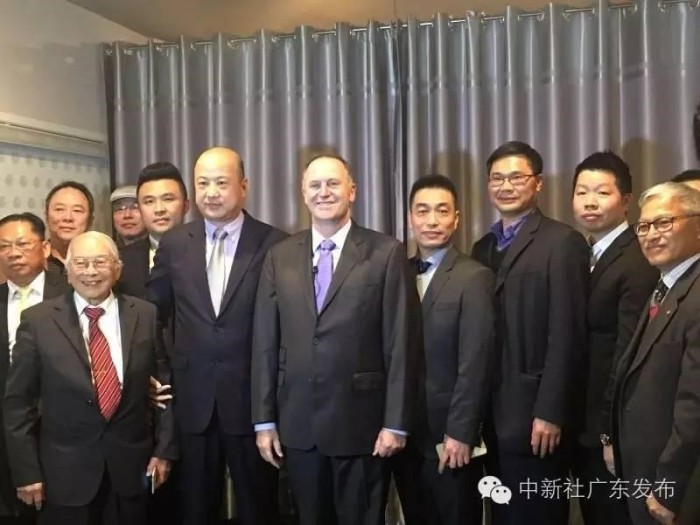
Chen 2Southland District Mayor Gary Tong says Zhang Yikun, posing here with John Key, is well known in central government.

While Zhang Yikun has been diligently fulfilling his political responsibility in China, he has also been highly committed to the United Front Work in New Zealand.

Although he has been in New Zealand for nearly 20 years and is still unable to speak English, it has not affected him networking with politicians.  Gary Tong, the mayor of Southland, who is currently travelling with Zhang in China, said that Zhang is well known in central government and has close links to high level ministers and MPs. They include National Party leader Simon Bridges, former PM John Key, party president Peter Goodfellow, Deputy Leader Paula Bennett, Auckland Mayor and former Labour leader Phil Goff , current Justice Minister and former Labour Party leader Andrew Little and other senior politicians.
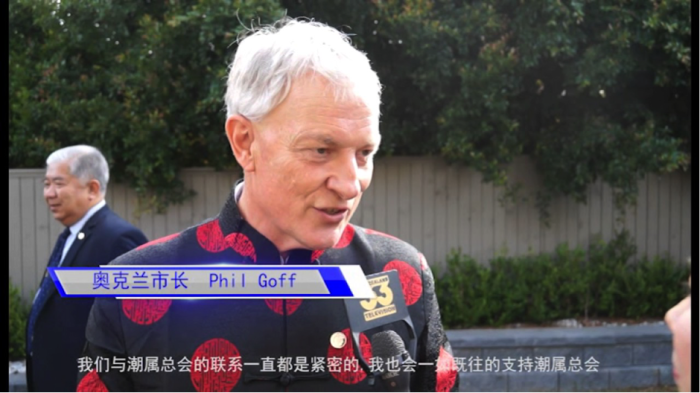
Chen 3Auckland Mayor Phil Goff at Zhang Yikun’s house wearing a gifted Chinese costume.

Among them, Auckland Mayor Phil Goff, who was in Hong Kong on 4 June 1989, and saw the massacre on live broadcast TV. The experience had moved him and he has showed sympathy for activists in the past.  For example, when Wei Jingsheng, a famous Chinese democracy activist visited New Zealand, Goff invited him to lunch at Parliament. Times have changed, and though Goff is still particularly fond of China, his favour now seems to rest with interests associated with the CCP.

In New Zealand, Zhang appears to have been almost fated to succeed. He is admired by many immigrants who have been working hard for small achievement. Zhang talks of his own success quite modestly, as if “ I was not intending to pursue wealth, but prosperity just landed on me without my intention”.

Zhang Yikun was born in a village called Nigou in Puning County of Guangdong Province.   In 1990, at the age of 18, he joined the People’s Liberation Army in China. Joining the army was an opportunity for a rural youth to get out of the countryside. In his brief time in the army, Yikun was promoted to the headquarters.   In 1992, he was discharged, and started to work at the government of the Hainan Provincial Special Administrative Region. The fact that he was able to transfer positions implies that he was already well-regarded, since only those who were could get such transfers.

In 1996, Zhang Yikun was sent to the (prestigious) Chinese Academy of Social Sciences for postgraduate study. This in-service postgraduate program is specially designed by the CCP for the training of its officials. Having joined the army at age of 18, his education was at most an intermediate level. What led to him, an official with only an intermediate school education, being sent to an institution for higher education? We can only speculate.

Soon after his arrival to New Zealand in 2000, he ran his own restaurant called “China Yum Cha Restaurant”,  located at a premium location near Princes Wharf in Auckland. Unlike most Chinese immigrants who start washing dishes and cutting vegetables, Zhang directly became the boss of a large-scale restaurant (and subsequently opened another two restaurants). He had never run his own business in China nor apparently had any opportunity to make extra money. His monthly wage was just 800RMB in 1996. A large investment was required to finance this restaurant, so we can wonder where did the money came from?

Since then his business has becoming extremely successful. He has successively founded New Zealand Huanglian Group Ltd, HLG property Management Ltd, New Zealand Huanglian Natural Food Ltd and KCC Construction Ltd. The penthouse of 175 Queen St Auckland, the most expensive commercial building in New Zealand, has become the heart of his business empire. His business has developed to encompass multiple fields and multiple countries.  Activities include property development and management, export and import, commercial investment.  Several overseas offices have been set up in Hainan province, Guangdong province, Hong Kong and Thailand.

After establishing his business empire, Zhang Yikun began to build his career as an overseas Chinese community leader. Unlike Steven Wai Cheung Wong, the former head of the United Chinese Association in New Zealand,  who had to cultivate his relationship with the Chinese consulate for some years for his dreamed position, Zhang Yikun’s political promotion has been as astoundingly rapid as his commercial success.

In 2015, he formed the New Zealand Chaoshan General Association (CGSA),  for people from Chaozhou and Shantou district of Guangdong province, and has taken the role as the chair of the International Chaozhou Federation after two years.

Undoubtedly, Zhang Yikun is treasured by the senior Chinese politicians or he wouldn’t have been given this significant role to unite those wealthy ethnic Chinese who are valuable to the CCP in their attempts to expand China’s global influence.

As just one example of his connections, on 3 September 2015, Zhang Yikun was invited to Zhu Ri He military base in Inner Mongolia to watch the military parade. He stood on the viewing platform watching the armed forces marching, various new types of military vehicles and missiles in the parade, and the aerial display. He emotionally said, “as a military officer, seeing the country is strong, (my) feeling of pride is rising.”

In New Zealand, he has been frequently visited by high level Chinese delegations. On 8 June 2018, his former comrade, Luo Baoming, the former party secretary of Hainan province, now the vice chairman of OCAC (Overseas Chinese Affairs Office) was warmly hosted by Zhang Yikun and his CGSA in Auckland.

At the reception dinner party, the two Chinese MPs who have made such a contribution to the New Zealand-China relationship, Jian Yang and Raymond Huo, witnessed how this senior OCAC official praised Zhang Yikun.

“The fulfilment of China’s dream needs the overseas Chinese community leaders like president Zhang Yikun who has the strength and passion for the state patriotism”.

State Patriotism! Here we have Jian Yang, former officer lecturer of a PLA spying school, and his fellow PLA veteran, Zhang Yikun, both members of “New Zealand Veteran Association” (Zhang Yikun is the president of the association), standing together to welcome a high ranking Chinese communist official, is it a coincidence?
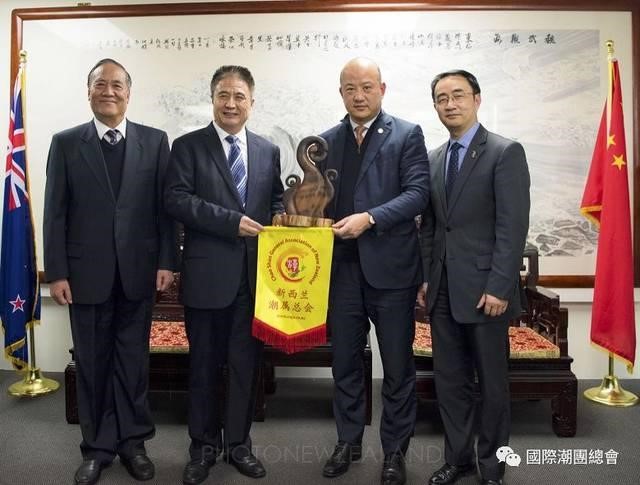
Chen 4Jian Jian Yang (far right) and Zhang Yikun (second from right ), the two former PLA members greet Luo Baoming, the vice chair of OCAC

If the above is not enough to set the scene, here is another photo. This one was taken on 30 August this year in Beijing. Zhang Yikun is staring at the display wall of propaganda and listening. The display wall is themed in communism red, titled “Always Go With the Party” and next to it is the symbol of communism, the hammer and sickle.

Chen 1 Zhang reading the “Always Go With The Party” display banner in Beijing on 30 Aug 2018

The New Zealand government granted him a high honour on 4 June, the day the whole world commemorates the young students whose lives were taken by the evil party. Zhang Yikun, the former PLA member, carried his honour back to Beijing to express his love to the party.

Is his beloved country New Zealand or China?  There is nothing wrong if he says he loves China.  But in reality, he loves the Communist Party and is following the steps of the party forever. Of course, we can’t simply conclude just from a photo that he wants to follow the party all the way. For that, we should see what he has done in the past and what he is doing now.

The revelation of Zhang’s donation has brought back to fore stories that had been dormant for a while. The National MP Jian Yang, exposed last year for his hidden past as a PLA intelligence officer and teacher in PLA spy school, and later sitting in the Foreign Affairs committee of Parliament.  And now, another (former) PLA member, Zhang Yikun has emerged on the stage.

New Zealand is the land of the long white cloud, often described as the last pure – uncorrupt – land in the world. Unfortunately, it has been polluted by CCP’s Human Common Destiny. The clean-up of the pollution may have begun, but completing it will take time.
Too few mortgagee sales?

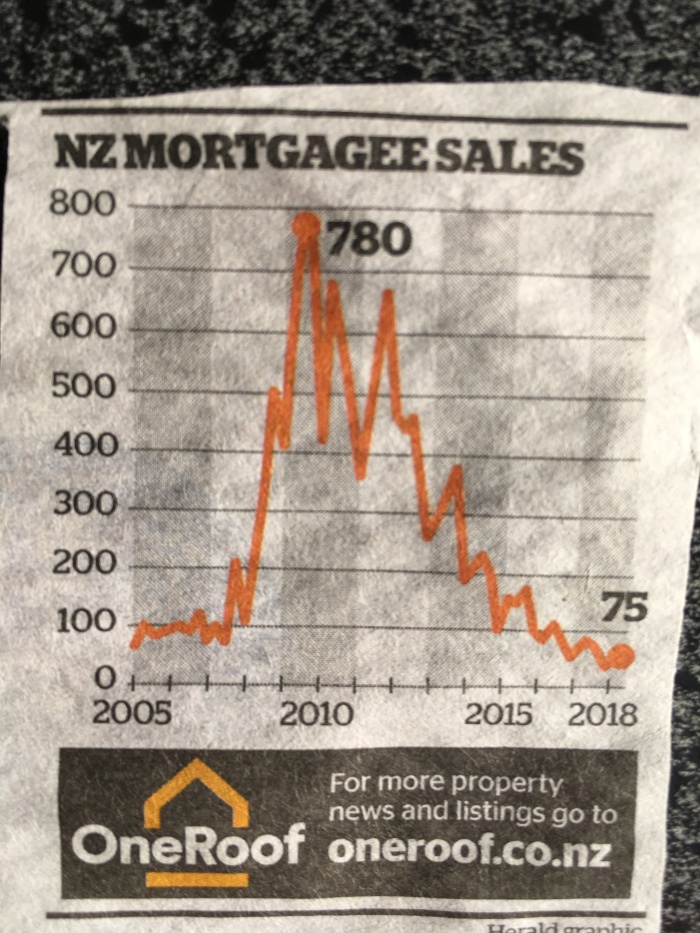
This chart appeared in an article in yesterday’s Herald, heralding (so to speak) mortgagee sales of houses hitting the lowest level for more than a decade.

mortgagee sales

The chart isn’t clearly labelled, but it appears to be quarterly data.  Elsewhere in the article, it is noted that the peak in annual mortgage sales was 2616 in 2009 –  the trough of the last recession, when the unemployment rate had risen quite sharply and nominal houses had fallen quite a bit (down 9 per cent nationwide in the year to March 2009).

In many respects, one wouldn’t wish a mortgagee sale on anyone.  But one also wouldn’t wish any individual to find themselves overstretched and having to sell the house themselves (and thus not a mortgagee sale).

But, equally, risk is part of a market economy.  And the housing stock financed by mortgage isn’t just the (sympathetic) case of the first home buyer owner-occupier, but also investment properties, beach houses, and fancy houses (the Herald story includes a piece about a pending mortgagee sale of a $3 million house in St Heliers).   In a country of almost five million people (and more than 1.8 million dwellings) one might reasonably wonder whether a mere 250 to 300 mortgagee sales in an entire year is lower than might be, in some sense, entirely desirable.   After all, the nature of taking risk –  and both purchaser and financier do –  is that sometimes things will go wrong.   The optimal number of mortgagee sales is very unlikely to be anywhere near zero.

The key combination of factors that tends to drive the number of mortgagee sales sharply upwards is higher unemployment and falling nominal house prices occurring together.  If unemployment rises but house prices stay high then even if the borrower runs into servicing difficulties they can usually sell the house themselves, repay the mortgage, and move on, without the additional and humiliation of being sold up by the bank.   If nominal house prices fall but unemployment is still low, borrowers will typically still be able to service the debt, and banks are reluctant to sell up people with negative equity who are still servicing the debt, even though they are legally entitled to do so.

We had that combination in 2009 (although in neither case to extremes) and you can see the consequence in mortgagee sales in the chart.

What is often lost sight of is that in a properly functioning housing and urban land market, mark to market losses on houses shouldn’t be uncommon, even in nominal terms (with, say, a 2 per cent national inflation target).   In such markets, land use can readily be changed in favour of housing development, and new houses/apartments readily consented and built.  In such markets there is no reason to expect a trend increase in real house prices, even if the population is growing rapidly.  Across a full country, some areas will do well and some not.  So some localities will more often see, perhaps modest, trend falls even in nominal house prices.  And, of course, without ongoing maintenance individual properties would depreciate in most localities.

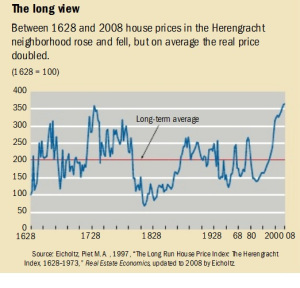
For those who doubt that such things are possible, I could bore you with charts from US cities where the markets function well, but instead I will use it as an excuse to reproduce what was for a long time one of my very favourite charts (written up here), showing prices for a street of houses in central Amsterdam from 1628.

herengracht11

There are ups and downs, but over several hundred years no strong trend.

And, of course, that is now what marks out housing markets in New Zealand (and Australia, and various other places, including parts of the US, where land use restrictions have become binding).   In recent decades there has been a strong upward (regulation-facilitated or induced trend) in real (and even more strongly in nominal terms) house prices.  As I noted yesterday, REINZ numbers show that over the last five years prices in Auckland and out of Auckland have averaged 8-9 per cent increases every year.  And that was on top of substantial increases in the 1990s and the 2000s.  It isn’t that easy (although not impossible) to get yourself into a position where the bank sells you up when house prices are rising that strongly.  But in a well-functioning market, we wouldn’t see such pervasive trend increases.

It is interesting that the number of mortgagee sales is now lower than it was in the mid 2000s (even though the housing stock is bigger now than it was then).      The unemployment rate has come down quite a long way, but is still about a full percentage point higher than it was in 2006/07 (and underemployment rates linger high).  For the sort of people –  a diminishing number –  who can afford a house anyway now, unemployment probably isn’t a big consideration now.  But, again, in a well-functioning housing market –  in which the Prime Minister wasn’t doing photo-ops with professional couples who’d won the lottery to buy a subsidised four bedroom house, but appearing with a working class couple of similar age able to buy their first house in one of our larger cities –  it might well matter more. Downturns hit harder people in less skilled jobs, and with more marginal attachments to the labour market.  In a better functioning system, more of those sorts of people would be buying houses, and some would end up unlucky and having to sell up later.   That is the “price” we pay for better access to the home ownership market.

The other relevant consideration is access to finance.   If a bank won’t lend more than, say, 40 per cent of the value of the property, it would be extremely difficult to ever see a mortgagee sale (only, say, idiosnycratic shocks such as the house burning down when the borrower had forgotten to pay the insurance bill or some such).     At the other extreme, of course, if banksare  lending 115 per cent of the value of the property –  in some over-exuberant mood in which everyone believes property values only ever go up, and where new buyers want to have extra cash for, say, fancy furniture, then it doesn’t take very much to go wrong for there to be lots of cases of negative equity, and potentially lots of mortgagee sales.  Mostly –  and to the credit of the banks –  we’ve avoided those sorts of excesses.

But for five years now we’ve had the unprecedented situation of the Reserve Bank limiting how much banks can lend to individual purchasers of residential properties (LVR limits).   We went through successive waves of these controls, and although they were eased somewhat last year binding restrictions are still in place.   The economic case for these controls was never robustly made (the Bank could never quite get round the fact that its own stress tests kept showing that banks were in fine health, or that mortgage lenders –  public and private –  had for decades been lending 90 per cent LVR loans in New Zealand and been able to managed the associated risks).

The Reserve Bank has been keen to boast about how effective these controls were in limiting the amount of high LVR lending banks were taking on.  They always presented this as “a good thing” even though they could never demonstrate (a) that banks were safer as a result (all else equal, banks need less capital when they have fewer risky loans),  or (b) that their judgement on prudent lending standards was better grounded than that of willing borrowers and willing lenders, with their own money at stake, or, incidentally (c) what other risks banks might have chosen to take on to keep up profits if prevented by regulation from lending to housing borrowers.

There wasn’t much doubt, though, that LVR controls applied tightly enough –  and the RB controls became increasingly tight – could restrict the amount of high LVR housing lending.  And high LVR loans will be disproportionately represented among those where a mortgagee sale eventually occurs.  So, even in a period of moderate unemployment, it is quite likely that LVR restrictions have reduced the number of mortgagee sales.

But it simply doesn’t follow that that is a good thing.  The other side of the same equation is that some people who would otherwise have been able to purchase a property using credit, whether owner-occupiers or investors, won’t have been able to do so.   Perhaps those people will have got into the market a few years later, but in the interim they will have missed out on the opportunities of home ownership –  and in most localities, being forced to wait means the entry price will be higher than it would have been if Reserve Bank controls had not intervened.   Those are real missed opportunities, while regulations skewed the playing field (cheaper entry levels) for cashed-up buyers.

In a well-functioning market, house prices rise and fall (although typically not that dramatically) and it is unlikely anyone will be much good at forecasting the movements that do happen.  With the best will in the world, and the best countercyclical monetary policy, economies will fluctuate, and some people who’ve taken on debt will find themselves unable to service the loan.  Painful as that no doubt it, it is only one of the many potential vicissitudes of life –  probably not the end of the world if you are in your 20s and have decades to get back in the market.  The alternative to expecting that a reasonable number of people will eventually have to sell up, in a world of uncertainty and unforecastability, is to have credit policies so tight that they also exclude substantial cohorts for much longer than necessary from being able to enter the housing market at all, whether as owner-occupiers or investors.

I don’t wish a mortgagee sale on anyone, any more than I’d wish a business failure or a redundancy on anyone. Even the transactions costs associated with any of these of events are often non-trivial.   But without them –  while still in a world where the future can’t be foreseen – we’d be living in an economy so cossetted that many opportunities –  for individuals and for the economy as a whole –  would be missed.  In the housing market, between regulatory restrictions on access to housing credit and other regulatory restrictions which impart a strong upward bias to real house prices, we are probably in that sort of situation now.  Too few people can get into the market at all, and too little risk may well mean we are in a position where a higher level of mortgagee sales might be desirable for the efficiency of the economy, the financial system, and the housing market itself.

New Zealand, the PRC, and our traditional partners

An interesting, thought-provoking, comment appeared yesterday afternoon, in response to Thursday’s post prompted by the Prime Minister’s claims (reported here, with a link to the original radio interview) that New Zealand was free of foreign interference (particularly from the People’s Republic of China).   The comment was from Peter Jennings, head of the think-tank the Australian Strategic Policy Institute.  Jennings was previously a senior Australian defence and national security official.   This was the text of his comment.

I listened to Jacinda Ardern’s Radio NZ interview and in fairness to her, she does say that the issue of Chinese interference is ‘a live item for me’ that ‘we’re never not looking’ and that ‘constant vigilance’ is being applied.

I take that to mean that the NZ national security establishment and intelligence services are indeed doing their job. The problem is that NZ politicians have no appetite to tell their voters what is really going on.

Contrast that to the very active political debate in Australia and even more strident comments by US Vice President Mike Pence in a speech to the Hudson Institute earlier this month (which I write about here: https://www.aspistrategist.org.au/the-us-shift-on-china-australias-options-narrow/.)

New Zealand’s allies are showing increasing alarm about China’s disruptive role in regional security, their industrial scale use of cyber and human intelligence to steal intellectual property and their active promotion of United Front organisations and political donations to ‘influence’ local politics.

NZ political and media sensitivities being what they are, I’m loath as an Australian to offer any advice, but it must surely be a worry to some in Wellington that NZ’s closest partners are taking a radically different approach to dealing with China. How will this impact on Wellington’s relations with Canberra and Washington DC?

You will know of Hugh White book, The China Choice, which argued that Australia’s ‘ultimate’ choice was between siding with the US or with China as the two countries contested for primacy in the Asia-Pacific. If New Zealand has a China choice it is surely between Canberra and Beijing. So what Australia thinks about China should matter to New Zealand.

Does what New Zealand’s leaders think about China matter to Australia? Most certainly. I regret that Canberra doesn’t pay as much attention to NZ as the relationship really deserves, but the current passivity among NZ’s leadership towards Beijing’s influencing of your own political system is most certainly being watched with concern in Canberra. I ask a genuinely open question: does NZ still value the defence and intelligence relationship it has with Australia?

On the first paragraph, I think that is probably a fair summary.    We can reasonably conclude that the intelligence services are probably doing their job, and the Prime Minister explicitly referred to espionage and telecommunications laws.   This is also consistent with what (little) was released of the intelligence agencies’ post-election briefings last year, and to what I heard at this session earlier in the year, attended by people in a position to know.

Speakers were keen to convince us that officialdom was right up with the play (the issue being “owned” overall by DPMC), and working hand in hand with our Five Eyes partners,  They weren’t, we were told, “naive and unprepared” but rather actively engaged in “detecting and countering interference” –  apparently some overseas partners are even envious of some of the telecommunications legislation implemented here a few years ago (an observation that should probably leave New Zealanders a bit nervous).  Any suggestion of a threat to our membership of Five Eyes is, we were told, “spurious”.  I presume that means “false”.

I guess I came away with the impression that officials think they are more or less on top of the outright illegal stuff.   One hopes they are correct.

But that stuff wasn’t really the focus of the interviewer’s question earlier in the week to the Prime Minister.

It was the other stuff, mostly (perhaps all) legal, that was where the concerns were being raised, and the questions posed to the Prime Minister.    And there I don’t think the issue is just (in Jennings’ words) that

The problem is that NZ politicians have no appetite to tell their voters what is really going on.

It is worse than that.  By her own behaviour –  mostly by neither doing nor saying anything, just letting things be – the Prime Minister demonstrates that she does not believe there is a problem at all, or that if there is stuff going on, it just doesn’t matter. (The Opposition is at least as bad, but they aren’t now in government.   Things like

  • she is content to have (well, she appointed him) Raymond Huo, reportedly heavily involved in various United Front groups, chairing a major parliamentary committee,
  • she is content to have Labour campaign among the Chinese community using a Xi Jinping slogan,
  • she is content to have her party president praise Xi and the regime  (although it was marginally encouraging to read this story this morning and see that Nigel Haworth had declined to become an honorary president of one of Yikun Zhang’s activities –  unlike Peter Goodfellow, Jian Yang, and Raymond Huo.)
  • she was content to honour Yikun Zhang,
  • she has expressed no discontent at the large mainland donations her predecessor Phil Goff used to fund his mayoral campaign (or initiated any law changes to close that loophole in future),
  • she is content not to call out the Jian Yang situation as unacceptable,
  • she seems content with the dominance of the local Chinese-language media by interests sympathetic to Beijing, and PRC news sources.
  • she seems content with Confucius Institutes –  funded from Beijing –  in our universities and schools,
  • she is apparently content with public universities forming close commercial and research partnerships with PRC universities, themselves increasingly under the thumb of the regime (in the last few days a former security official was appointed head of Peking University) and with
  • the increasing reliance of our universities on (the income from) students from the PRC.
  • and despite her calls for “kindness” to be some sort of watchword guide to policy, she is apparently content with the way no one in the New Zealand political system –  her party or others –  ever says a word of criticism of Beijing, despite the growing internal repression and the external expansionism.

Either she is blind, or she simply doesn’t care about this quasi-vassalage and the debauchment of our political system.   I’m not sure which would be worse.   Just possibly, she isn’t that comfortable with the situation personally but….she isn’t just any citizen, she is the Prime Minister.

Jennings goes on to note how the approach of the New Zealand political establishment (National and Labour, New Zealand First and Greens) seems increasingly out of step with that of our “closest partners” –  he mentions the US and Australia, but there is also increasing sign of the UK taking the issues more seriously, including having ships assert freedom of navigation rights in the South China Sea.  He wonders “how will this impact on Wellington’s relations with Canberra and Washington DC?” and goes on to note, and pose a question, as follows

….the current passivity among NZ’s leadership towards Beijing’s influencing of your own political system is most certainly being watched with concern in Canberra. I ask a genuinely open question: does NZ still value the defence and intelligence relationship it has with Australia? 

One of the interesting things about the Australian situation –  where former Labor Foreign Minister Bob Carr is a vocal defender of Beijing and suggests there are few/no issues for Australia –  is that the leaders of the two main parties seem fairly united in treating the issues as serious, including in passing the recent new legislation.  No one can seriously suggest that Australia has dealt with all the issues –  only yesterday the PRC successfully managed to go behind the Federal government’s back and get Victoria to sign up to the Belt and Road Initiative –  but they seem in a much better place than the New Zealand situation, where the leaders of all the parties (especially the two main ones) seem united in an unspoken agreement not to call out any behaviour.  Australian Labor got rid of Senator Sam Dastyari; New Zealand Labour won’t even criticise the presence in our Parliament (on the other side) of a former PRC intelligence official, one who acknowledges deliberately misrepresenting his past to get into New Zealand.

But Jennings’s question is an interesting one?  Does “New Zealand” still value the defence and intelligence relationship it has with Australia (or the United States)?   I presume the answer depends on who you are talking about, and perhaps there are parallels to the rupture with the US – which also put us offside with Australia –  in 1985?  Back then, the defence and intelligence hierarchy probably put a great deal of weight on those relationships.  But in the end it didn’t matter.  Probably not many politicians really wanted to break with the US even then, but no one was willing to pay the price –  perhaps small internationally but substantial in terms of internal party politics – to avoid it.   The New Zealand public had probably never been that consistently keen on the US relationship –  it had been a relatively new thing after all, mostly post-Suez –  and there was enough angst and disapproval of Ronald Reagan, and reaction post-Muldoon, that an isolated little country was willing to step off the playing field.

I wonder how different it is now.    (Probably like most Australians) most New Zealanders are strongly anti-Trump (and instinctively Democrats), and if anything the fact that Trump and Mike Pence are talking about issues around China, including domestic political interference, probably inclines many New Zealanders to downplay the issue further.  As for Australia, (justifiably or not –  I think mostly not) there is a widespread disapproval here around the treatment of illegal migrants, asylum seekers (“boat people”) by Australia (easy for New Zealanders, when we are so far from the immediate risk), and a resentment among many about Australia’s deportations of some of the shady New Zealand citizens who’ve fallen foul of Australian law.  New Zealand governments have, over the years, become mendicants, begging on behalf of their “guest workers” in Australia, and it doesn’t automatically foster attitudes of trust or camaraderie as regards Australian governments.  I’m not defending these attitudes in New Zealand – mostly I don’t share them –  just attempting to describe them.

And, of course, as in most countries most citizens most of the time don’t give much attention to defence or foreign policy, let alone the subtleties of the activities here of a regime like the PRC.  And with no moral leadership from the heads of our political parties, no real leaders calling out the nature of the risks/threats, it is hard to imagine that the mass of New Zealanders would be unduly bothered if at some point in the next few years New Zealand were eased (or booted) out of the Five Eyes grouping.  Many –  that strange mentality that seems to value “independence” for its own sake, regardless of the rights and wrongs of the alternative sides (and how much “whatabout-ism” do we hear, suggesting that somehow US “interference” here is a thing –  let alone a thing on a par with the PRC) –  might well wear it as a badge of pride, as (in different circumstances) so many did in the mid-80s.   At least the 80s stance had an (arguable) moral dimension, but whatever moral clothes people attempted to wrap around an opting out now, they would be threadbare at best, given the nature of the PRC regime, and the threat it poses now here, and abroad, let alone to its own people.

Of course, it is worth noting that the government did announce a few months ago the purchase of the P8 aircraft.   That suggests some value being put on maintaining the US and Australian relationships.  Still, one has to wonder whether a Labour/Greens government –  feasible if last week’s poll numbers carried into an election –  would have been willing to have paid that price.    And that price didn’t involve making any calls that, at least directly, upset Beijing.  But when a few weeks later the government released a defence policy paper, with a few mild remarks about the PRC, (a) the Prime Minister never associated herself with that stance, and (b) the leader of the National Party took the opportunity to warn the government not to upset Beijing.

So there is no political leadership apparently willing to take any stands, and without it probably few New Zealanders will much care that our traditional partners and allies are taking a different stance.  Many would probably wear it as a badge of pride.   Perhaps it would be different if the White House changes hands in 2021, or when (as seems most probable) Labor takes office in Australia next year, but I rather doubt it –  and it is worth remembering that Labor was in power in Australia in 1985.

I’m not sure what the circuitbreaker could be, what might shift politics and political debate to a more serious and self-respecting plane.  More likely, as with the continued failure to do anything about decades of relative economic decline, the established political parties just will keep on together, debauching our system and society, too craven ever to make any sort of stand, somehow persusaded that on the one hand Beijing holds the whip hand (it doesn’t) and on the other, that it really doesn’t matter much and no one cares.   If so, the sad and shameful degradation of New Zealand will continue.

Meanwhile, anyone interested in yet more on the evil way in which Beijing treats its own people –  while our government (and most others) say nothing –  might consider reading this article, detailing how the regime simply (compulsorily) moves its agents (a million of them reportedly) into the houses of Uighur people in Xinjiang province –  those not already in concentration camps – to live alongside them.  The agents are supposed to chivy people into conformity and report any deviations –  diet, ideology, religion, or whatever –  to the authorities.   And this is the regime our political “leaders” provide cover for.  They court –  and even honour – its agents and supporters, take their money, recruit them into Parlisment, act as honorary patrons to their organisation, and seem to care not a jot what the regime does here, at home, or anywhere in between.

A troubled recruitment process?

Early last month I wrote about the advertisements placed on behalf of the Reserve Bank Board, presumably with the acquiescence of the Minister of Finance, looking for people interested in becoming external (part-time) members of the new Monetary Policy Committee, to be established once the amending legislation –  currently before a select committee –  is passed.   Recall that under this legislation the Minister of Finance would be able to appoint only someone recommended by the Board.   Applications closed on 7 September.

I was fairly sceptical as to who would be interested in these roles –  which might seem attractive at first glance, but are much less so at second or subsequent glance.

It will be interesting to see what sort of people the Board and the Minister come up with, assuming that Parliament eventually passes legislation along the lines of the current bill (and bear in mind that we have a minority government again).  It is hard to see why the roles –  probably little more than silent adjuncts to the Governor – would be attractive to really good people, or who will really be free to take them up (even an academic –  apparently not wanted by the Governor –  might struggle to commit 50 days a years, spread over the year, not just in the long summer vacation).

and

And so it will be interesting to see what people they finally manage to attract, both in the first round, and a few years later when the novelty has worn off.  A smart (but deferential) semi-retired person would probably fit the bill quite well, but since the government and the Bank have been clear they don’t want people who might rock the boat, and they apparently aren’t keen on economists, and since even the externals together will be a perpetual minority, you wonder why someone good would be interested.   Pocket money probably shouldn’t be the motivation, at least if the government were serious about putting in place a strong, well-functioning, MPC.  Of course, as it is, there is no evidence of such intent.

A few days ago I was having a conversation with someone about these roles, which prompted me to wonder about progress, about what sort of applicants they had attracted, and so on.   Given that applications closed on 7 September, you’d have assumed that by now they would be well through the process of getting towards a list of names the Board could recommend to the Minister of Finance.

But apparently not.

On Tuesday I lodged an OIA request with the Board, asking for

  1. total number of applications received,
  2. the proportion of total applications received from women (as best the Board or its agents could tell),
  3. the proportion of total applications received from people currently resident in New Zealand, and
  4. the proportion of total applications received from people currently employed at a university.

and for the same information for the applications taken further (ie not immediately dismissed as unsuitable by the Board or its recruitment firm).

On Wednesday, I had a impressively quick response to the second half of the request. I was told

No applicants have been selected yet for further consideration.

It must, in that case, be one of the slowest recruitment processes ever.

As it happens, I still had the information pack provided to anyone expressing interest in the positions (which I had requested purely for research purposes), and on flicking through that I found an approximate timeline, which indicated that the original plan was for a shortlist to be presented to the Board at its meeting last week.  The Board only meets once a month, and Board papers usually go out a week prior to the meeting.  As applications had only closed on Friday 7 September, this seemed like a normal and expected timeframe –  the first Board meeting after applications closed at which names could (reasonably) be considered.   The implication of the timeline was that last week’s Board meeting would approve a shortlist, because it goes on to indicate that interviews would be occurring in late October/early November.

It isn’t clear quite what is going on.  But one hypothesis is that the pool of applicants was sufficiently small and mediocre that the Board (and perhaps the Minister) has been left in a bit of a quandary.  If there were even three or four able and impressive people applying there should have been no difficulty in drawing up a shortlist (the Minister plans to make three appointments) and sending a “thanks, but no thanks” response to the others.  Instead, they probably have a very small pool of applicants, a few of whom might at a (considerable) pinch fit the bill, but none of whom would add lustre or credibility to the government’s claims about the fresh perspectives outsiders would add to the new MPC.

As I suggested the other day, one problem with this (highly unusual) appointment process, in which the Minister cannot simply appoint people in whom he (in this case) has trust, is that if the Minister wants to inject names to the process he has to do so behind the scenes (a word in the ear of the Board chair), in a non-transparent (and thus not very accountable) way.    Suggest a fairly borderline political crony and so long as he can persuade the Board to recommend that person –  and the Board has ongoing battles to fight, including around its own role after the rest of the RB Act review –  the Minister is substantially immunised against Opposition attacks (“but I only acted on the recommendation of the Board”) in a way he wouldn’t be if he were directly responsible for all appointments.

Who knows quite what is going on at present.  Perhaps the Board chair has just had a prolonged illness and been unable to deal with the matter (in which case he has my sympathy).  More probably, they (Board and Minister) have found it a lot harder to interest good and credible people in the role –  the more so after the Governor was openly expressing his distaste for economists in the role –  and are now casting around trying to work out what to do next, whose arm to twist (to try to interest).   If so, it isn’t too late for them – Board, minister, Treasury –  to think again and propose amendments to the legislative model (and to official statements as to how it will work), in ways that might attract really able people, and make this reform the landmark step forward it could have been (but at present is unlikely to be).

Circling the wagons

Even fewer people than usual probably watched TVNZ’s Q&A programme on the Sunday evening of a long weekend (I didn’t either), but I hope many take the opportunity to download and watch the interview with Professor Anne-Marie Brady about Yikun Zhang –  initiator/organiser (or whatever) of the $100000 donation to the National Party –  the Chinese party-state’s United Front Work programme, and what New Zealand could or should do in response.   Perhaps equally worth watching –  for altogether different reasons – is the subsequent panel discussion.  I’ll come back to that.

Professor Brady was asked first about whether there was any evidence that Yikun Zhang is involved in United Front activities.  She was clear that his active involvement, both in the PRC and in New Zealand, is very well-documented in Chinese language sources (I touched on this last week, but for anyone who hasn’t read it I can also recommend this article by Branko Marcetic on The Spinoff,  which is full of useful links).  She was also careful to distinguish between welcoming, even encouraging, participation of new citizens, of whatever origin, in our political processes, and drawing a line when those activities are led by people with close ties to foreign governments, especially ones with deliberate and active strategies to exert influence over, or in, other countries.   She argued that we need to set boundaries around “inappropriate behaviour”.

Reprising arguments she has made consistently in public over the last year or so she highlighted two strands of the PRC’s United Front activities in countries like New Zealand:

  • neutralising the Chinese diaspora, including the Chinese language media and community associations, and
  • winning support, or acquiescence, for the PRC’s foreign policy agenda, including the place of the Belt and Road Initiative (ill-defined as it is), in the pursuit of a China-centred global order.

Asked what we could, or should do, Professor Brady listed these items:

  • a careful official investigation of the extent and nature of PRC influence activities in New Zealand (“as Australia, the US, and now the UK have done”)
  • “obviously” reform our election finance laws,
  • stand down periods for former MPs and minister (before taking up roles which might be seen as being in the gift of PRC entities –  or, presumably, other foreign powers),
  • look more carefully at whether MPs can lawfully be members of foreign political parties (the strong suggestion being that Jian Yang in still a member of the CCP),
  • take steps to help restore the autonomy of the New Zealand Chinese community, protect their freedoms, and promote (the restoration  of) an indigenous and diverse Chinese language media here.

She noted that the Five Eyes grouping had recently agreed on a programme to counter foreign influence, suggesting that our authorities will be doing something already.  (The article at that link is interesting reading, but when I read it last week my reaction was to be sceptical it meant anything much in the New Zealand context –  nothing suggesting any change of emphasis having been heard from the mouths of any New Zealand ministers or officials.)

Professor Brady noted that the political “bloodbath” we saw last week was an opportunity for the major parties to come together –  since they are being targeted by the PRC –  and devise better ways to build a constructive, but bounded, relationship with the PRC.

In concluding the interview, Brady was asked whether she had any concerns herself about speaking out.  She noted that it was, in law, her duty as an academic to do so, and noted that although there was some personal cost, to her and her family, she saw these issues as so important, to the integrity of our system, that she is willing to stand up and speak out, expressing the wish that more people would do so.   The still unsolved burglary of her house and office wasn’t explicitly referred to, but was a clear subtext.

The contrast between Professor Brady and most of her academic colleagues is pretty striking.  Our multi-university Contemporary China Research Centre –  chaired by Tony Browne (of the Confucius Institutes and other institutional arrangements with the Chinese Communist Party), and with representatives of MFAT, MBIE, NZTE etc on its Advisory Board – seems, from its website, more focused on dialogues with official visitors from the PRC  and the forthcoming year of Chinese tourism.  Not one of its key people has been heard from in the media and public debate on these issues, whether last week or in recent months.  In many respects, they seem little better than our politicians –  scared of their own shadows and reluctant to say anything lest visas, access, (New Zealand government) funding or whatever are jeopardised.   Any sense of that “critic and conscience” role, that the Education Act rather grandiloquently talks of for academics, seems dulled at best, or lost altogether.

But what of the panel discussion?  There was Bryce Edwards the political scientist, and three old tuskers from the big parties: former National Party president Michelle Boag, former National Party minister Wayne Mapp, and former Labour party president Mike Williams.

Bryce Edwards argued that out of last week’s maelstrom the Chinese influence/donations issue was the one that had attracted the least attention so far, and needed to have more.  The interviewer suggested something like a select committee inquiry, which Edwards seemed to think had merit, adding that there was no chance of any party in Parliament now picking up the issue.

And as if to prove him right, the old guard  – the other panellists –  rushed in to play down the issue.   Wayne Mapp went first, denying that there is any PRC influence in New Zealand politics, noting that he had never seen any evidence, and suggesting that having been Minister of Defence he would have seen it if it was there (he went on to suggest that the PRC issue was mostly one about the great powers, and the extent to which we were in some sense caught between them).   Michelle Boag chipped in to suggest that if there was a PRC influence strategy it would have to be counted a miserable failure –  there was, after all, only one “Chinese MP” (as if the fact that that one MP was a former PRC intelligence official, Communist Party member, actively associated with the PRC Embassy, and never ever heard to say anything critical about the PRC wasn’t in its own small way evidence of influence).  Mike Williams declared that he mostly “agreed with Wayne”.

It was sad, but it was worse than that.   People who are smart enough to know better, playing distraction (totally ignoring, for example, the way in which PRC activities and attitudes are compromising the rights and freedoms of ethnic Chinese New Zealanders who aren’t at all sympathetic to Beijing and its agenda) in defence of what has become the established way of doing things in New Zealand (both main parties).   It trivialises a serious domestic issue –  including the utter reluctance of any of our senior politicians to say anything that might possible disconcert Beijing and the willingness to court, and take money from, people who closely associate with one of the more evil regimes on the planet – ignores the international nature and reach of the PRC programme, completely discounts the threats to other peaceful and democratic countries in east Asia, let alone the growing repression of many of the PRC’s own populations.   People like those three know better, but choose not to see, or to care.  They actively choose to turn a blind eye to the character of the regime and its activities –  whether here, at home, or in the rest of the world.  Rather like their own current party leaders –  Nigel Haworth and Peter Goodfellow (united in perhaps nothing else but (a) the defence of the way things are done and (b) the celebration of Xi Jinping), Jacinda Ardern and Simon Bridges (and John Key, Bill English, Phil Goff and Andrew Little before them).

And this, of course, is where I part company to some extent from Anne-Marie Brady. At least in her public comments she seems to assume that our political leaders have an interest in doing the right thing, and only need to have specific suggestions made to them.  I see zero evidence of that.  I’m quite prepared to believe that both parties value the defence and intelligence relationship with the US and Australia, and will do the minimum to maintain it – and the rest of Five Eyes will cut us lots of slack, because it would be a PR coup for Beijing if it were ever to come about that we –  small as we are –  were no longer part of that partnership.

But there is no sign of any interest in doing anything about the domestic situation –  whether as regards party donations, a willingness to speak openly against external aggression or domestic human rights abuses, or about the situation of the ethnic Chinese New Zealanders who want to be free of Beijing and its abuses.  No sign last year (all parties kept quiet about Jian Yang), no sign this year (National and Labour combine to honour Yikun Zhang for what appears to be, in effect, services to the PRC), and no sign now.   This isn’t a case of good men and women being misled, and people like Professor Brady drawing things to their attention for the first time.  It is a system run by people who have allowed it, knowingly (but probably gradually and subtly), to be corrupted.    Labour and National (and ACT) seem as bad as each other, two sides the same coin.  New Zealand First is arguably worse, because it occasionally talks a good talk in Opposition, but then gets into government and just goes along.  And as for the Greens –  who don’t seemed to be reliant on donations from these sources –  and who sometimes in past appeared willing to bring a moral dimension to politics, where are they?  In government I guess, and perhaps strongly advised –  directly or indirectly –  by MFAT not to jeopardise the tourism year, or the “FTA” renegotiations.  If you just go along, you make yourself complicit.

(It was hard not to utter a wry chuckle at the suggestion of a select committee inquiry into such matters.  After all, the Justice select committee has its triennial inquiry into the election underway at present. But who chairs the Justice committee?  Why, Labour MP Raymond Huo, who –  as Professor Brady has documented –  is very actively engaged with various United Front organisations, who organised the event at which the very largest mainland donation to Phil Goff’s mayoral campaign was arranged.  If anything is ever going to be done, the stables –  party organisation and Parliament – need cleansing first.)

Wrapping up this post, I would draw your attention to a few things I saw over the weekend.

First, a reader sent me this (translated) extract from an essay/article by Auckland-based Chinese activist and dissident Chen Weijian which “examined how Zhang Yikun achieved his political promotion in three years in China and in the international Chinese community as well as his business achievements in NZ”.

The photo below was taken in Beijing on 30 Aug 2018 where Zhikun Zhang visited the Chaoshan (TeoChew or Chaozhou) Association  of Beijing along with the heads of other Chaoshan associations of the USA, Canada, Thailand etc.
永远.png
The poster on the wall they are reading is titled of ” Always go with the Party (the Communist Party).
Zhikun Zhang who joined the PLA in 1990,  the next year after the CCP sent troops to shoot unarmed Chinese young students in Tiananmen Square on 4 June 1989.
 After 29 years, on the same day of 4 June, the former PLA member was awarded of MNZM, an award to a person who ” in any field of endeavour, have rendered meritorious service to the Crown and nation or who have become distinguished by their eminence, talents, contributions or other merits”,[1] to recognise outstanding service to the Crown and people of New Zealand in a civil or military capacity.
 
Within only three months after receiving this honor, he was recognized by the CCP for his devotion to this most evilest political Party: always go with the party.
And this is the man our Prime Minister is photographed with, our Opposition leader courts, and Jami-Lee Ross, Sarah Dowie, Paula Bennett, Andrew Little, Phil Goff, Peter Goodfellow, Nigel Haworth-  and probably plenty more – are happy to associate with, happy to pursue and take donations he arranges, and so on.
How can anyone suppose his political activities in New Zealand are primarily about the best interests of New Zealanders?
“Always the Party” –  source of so much evil, past and present.

And then there are the Xinjiang concentration camps, that (all) our politicians are studiedly silent on.  I thought this thread was pretty telling (drawing on the point I’ve made here previously that in many important respects the PRC party-state is the late 1930s party-state Germany of our era)

This is regime Yikun Zhang associates with and supports.

Does this stuff not bother Jacinda Ardern or Simon Bridges at all?

Another reader sent me this over the weekend.

PRESS RELEASE – Tuesday 16 October 2018, London, UK.
Independent people’s tribunal is established to investigate forced organ harvesting
in China.

An independent tribunal to inquire into forced organ harvesting from prisoners of conscience in China has been established as an initiative of the International Coalition to End Transplant Abuse in China (ETAC).

The Tribunal will investigate if any criminal offences have been committed by state or state-approved bodies / organisations in China concerning forced organ harvesting.

You can read (a lot) more about this here and (more generally) here.   For any sceptical that there is an issue here, I’d suggest listening to this two-part BBC World Service investigation, in which they walk carefully through the reasons to strongly suspect that the PRC is killing prisoners of conscience (probably mostly Falun Gong, but not exclusively) to be able to undertake the huge number of transplants occurring in China –  for Chinese and foreigners, pretty much on demand (subject to payment) –  each year, in a culture averse to voluntary organ donation.

This is the regime Yikun Zhang associates with and supports.

While our politicians do and say nothing.

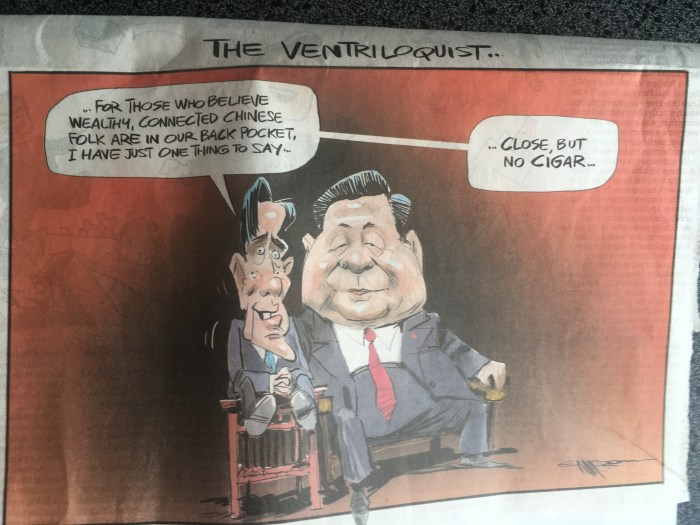
And finally, the Herald ran this cartoon on Saturday

ventriloquist

It is good that they are airing the issue.  But it still puts the responsibility on Beijing, and not where it actually lies, with our political leaders and heads of political parties.  Beijing does not force them to do or say (or not say) anything. They are moral agents, and they freely choose to allow the interests of New Zealand and New Zealanders to be compromised by their willing pursuit of, and association with, money rather strongly tinged with PRC political agendas and interests.

I was dipping into the famous Francis Fukayama book The End of History and the Last Man yesterday.   In his introduction he includes this line

For democracy to work, citizens need to develop an irrational pride in their own democratic institutions

That sounds generally right –  the fierce attachment that creates a willingness to defend something when it is threatened.  Given the way our political leaders are debauching New Zealand institutions at present, any such pride almost has to be irrational.  But perhaps there is a potential leader somewhere who will help restore our system?  Bob Jones played that role –  as regards the economic mess New Zealand had gotten into – in 1983/84.  The present challenge is greater, because all the main parties are equally compromised.  But so is the need for action.

UPDATE: Late this aftermoon today I was rung by Roy Morgan Research and participated in a quite detailed survey about trade, defence, values etc issues as regards New Zealand and each of Australia, India, Japan, China, and the United States.   Whoever was behind the survey (the Asia NZ Foundation perhaps?) I hope we eventually get to see the results.


The void where an economic strategy should be

During the week, rather lost amid the Jami-Lee Ross claims and counter-claims (how did a major party have the indecency to keep on rapidly promoting the man when their hierarchy clear knew at least a couple of years ago –  and kept quiet about – his character?  Unless of course, the main required quality for a National MP is now fundraising –  often of the most questionable kind –  not character or legislative/policy skills) the Prime Minister announced the membership of her Business Advisory Council.

This is the group

Prime Minister’s Business Advisory Council members

Christopher Luxon (Chair)                  Air New Zealand
Peter Beck                                                Rocket Lab
Barbara Chapman                                 Professional director
Jacqui Coombes                                   Bunnings
Anna Curzon                                           Xero
Andrew Grant                                        McKinsey & Company
Miles Hurrell                                          Fonterra
Bailey Mackey                                        Pango Productions
David McLean                                        Westpac
Joc O’Donnell                                          HW Richardson
Gretta Stephens                                     Bluescope/NZ Steel
Rachel Taulelei                                      Kono
Fraser Whineray                                   Mercury

And the terms of reference are here.

Here is how the Prime Minister’s statement begins

Prime Minister Jacinda Ardern has announced a diverse cross section of leaders from the business community will form her Business Advisory Council to advise the Coalition Government as it works on building a productive, sustainable and inclusive economy that improves the wellbeing of New Zealanders.

And here is how she was talking a couple of months ago when the Council was first foreshadowed.

“The Council will provide a forum for business leaders to advise me and the Government and to join us in taking the lead on some of the important areas of reform the Government is undertaking,” said Jacinda Ardern.

“The Council will report to me on opportunities it sees and identify emerging challenges. It will bring new ideas to the table on how we can scale up New Zealand businesses and grow our export led wealth.

“I want to work closely with, and be advised by, senior business leaders who take a helicopter view of our economy, who are long term strategic thinkers who have the time and energy to lead key aspects of our economic agenda.

Perhaps all the people on her group are very able at what they do.  Perhaps many are even good at thinking about the implications for their own businesses of specific technical advice.

But not one of them seems to have the background or skill set that suggests they have anything more to add to fixing New Zealand’s woeful economic underperformance –  over multiple decades –  than, say, the first 100 people in the Wellington phone book.

Drawing on old article from Paul Krugman, when this Council was first announced I wrote a post about how a company is not a country, and the skills that equip someone to run a company bear little or no relationship to those involved in identifying the economic failings, and appropriate remedies, for a country.

Expertise on economic management, and the particular confounding challenges the New Zealand economy faces, just aren’t the sort of thing that tends to be fostered in the course of a corporate career.   Many of these people might have been superb marketers, exceptional operations managers, corporate finance whizzes, smooth operators around the edges of regulation and the tax system, and have risen to assume overall responsibility for (by New Zealand standards) fairly large organisations. They are absolutely vital skills, and business roles done well are a big part of how, in pursuing the interests of shareholders, society is also made better off.   But those skills bear no resemblance to the issues involved in addressing long-term economic underperformance.  For a start, the things businesses have to take as given are precisely the sorts of things governments often can vary, and (as Krugman eloquently notes) the sorts of constraints even a large business faces are very different from those an entire economy faces.   And so on.

It is great that these individuals care about New Zealand’s economic performance, but there is no particular reason to believe that in general they will have more useful perspectives to offer than the average moderately-educated voter chosen from the phone book at random.  Running a business no more equips you to provide useful advice on economic policy more generally (as distinct perhaps from specific bits around your industry) than it does to, in Krugman’s words, write great poetry or make military strategy.

What isn’t clear is whether the Prime Minister genuinely expects this group to make a difference –  successfully identifying the key issues governments need to address –  or is simply buying a bit of time and goodwill with the big end of town in the hope that something will turn up.   One interpretation would suggest extreme naivete and the other a quite cynical approach.  Take your pick which you think is worse.  Perhaps it is just wishful thinking?  But whatever the answer, a year into the government’s three year term, there is no economic strategy, nothing that anyone credibly thinks will lift our long-term productivity underperformance, successfully reorient the economy outwards.    For a short time perhaps any goodwill around the creation of this council will paper over the void…..but a void it is.

Meanwhile,

  • the level of productivity is flat or even falling,
  • the export and import shares of GDP have been falling,
  • in per capita terms, the tradable sector of the economy hasn’t grown at all this century.
  • (and if we want to talk “inclusion” there is no sign of a structural fix to the housing o or urban land supply market),
  • while we are left with a structurally overvalued real exchange rate and the highest average real interest rates in the OECD.


Thoughts prompted by the tape

What to take from Jami-Lee Ross’s tape of his conversation with his (then) boss?  I’m not interested in Bridges’s vulgar and insulting talk about his own MPs (although being, like him, a child of a Baptist manse, I can only surmise that he wasn’t raised to use that sort of language) or even that interested in the minutiae of whether and how donations are recorded and disclosed, including to the party hierarchy itself (significant as those issues probably are generally).

As compared to the situation a few days ago, we know that there was a $100000 donation to the National Party, initiated apparently (whatever final form the lesser components took) by Auckland businessman Yikun Zhang who (despite apparently coming here as a poor former PLA soldier 18 years ago) doesn’t speak English.   The first person I asked the other day about Yikun Zhang responded along the lines of “bad news”, and the more I read around the various sources which various Chinese speaking commentators have highlighted, the truer that summary description appears to be.

Several things struck me about the Bridges-Ross conversation:

  • the first was about how normal both of them  (one the leader, one the 8th ranked front bench MP) seemed to regard this sort of tawdry business.  Sure, fundraising is a vital function of a political party, but it is a far cry from Barry Gustafson’s description in his 50th anniversary history of the National Party: “an unwritten but scrupulously observed rule has always been that no MP should be placed in the position of seeking, receiving, or even being made aware of money collected on behalf of the party” (p201).   Perhaps (although I don’t know) National is no worse on this score than other parties, but it is a pretty bad situation that has been allowed to develop –  or, more to the point, actively fostered.
  • the second was about how utterly unbothered they were (leader and no. 8) about the Jian Yang situation.  Sitting in your caucus is a former PLA intelligence official, Communist Party member, close asociate of the PRC Embassy, someone who acknowledges misrepresenting his background when he came to New Zealand, and someone who even a former diplomat –  who knows him well – says he is careful about what he says in front of the man.  As leader, perhaps you are under pressure to defend the man publicly.  But perhaps, a very generous –  naive – observer might have thought, after last year’s fuss had died down, and some face saved, the party would be looking for a way to quietly retire, and replace, Jian Yang going into the next election.    But when Simon Bridges is caught talking about his colleagues, we hear about the unfortunate Maureen Pugh, about those (Finlayson, Wagner and Carter) everyone assumes would go before long,  but the only reference to “Chinese MPs” is to adding another one.  Jian Yang’s continued presence seems just taken for granted: none of that background stuff apparently bothering either of them in the slightest.  Lacking any decency themselves –  and not facing any uproar from other parties –  Jian Yang is presumably much too valuable in tapping the potential donors.
  • third was the utterly transactional way in which they approached the donation Yikun Zhang proferred (and presumably arranged) and the bid for another ethnic Chinese National MP.

    Ross: Yeah they’re good people. Now there’s no catch or anything to it. You may recall at the dinner they did discuss candidacy, and another Chinese candidate.

    Bridges: Two MPs, yeah.

    Ross: Colin Zhang? The younger one, he’s put his name in for Candidates’ College and so I assume he’ll get through and we’ll make some decisions as a Party further down the track as to what we want to do with candidates.

    Bridges: I mean, it’s like all these things, it’s bloody hard. You’ve only got so much space. Depends where we’re polling, you know? All that sort of thing…two Chinese would be nice, but would it be one Chinese or one Filipino? What do we do?

    Ross: Two Chinese would be more valuable than two Indians, I have to say.

    It was fine for Ross to say “there’s no catch or anything to it”, but everyone involved knows  how reciprocity works.  It is about an exchange of favours over time.  When, in the same conversation a wealthy businessman talks of a big donation and proposes that one of his staff might get a winnable place on National’s list, and they take the donation anyway, there is a quid pro quo, in expectancy, if not in some written contract.  No sense presumably, either at the earlier function or in this phone call of anything improper or unethical.  It is clearly just the way the National Party now does things.

But bad –  really bad –  as all this is, I think what disgusts me is the utter indifference of either Bridges or Ross (and to the extent there is ongoing silence from elsewhere in the party, or anywhere else in the political spectrum, the rest of our political class) to the character and interests of the man they were dealing with.  Not at a basic interpersonal level –  frankly it sounds hard not to be a nicer person than, say, Jami-Lee Ross –  but as someone actively and on an ongoing basis fully involved with the PRC government and its activities, in China and abroad.   And this seems to be the bit that most of our mainstream media is either missing or downplaying.

If we are going to have private funding of political parties (which I happen still to favour), the issue isn’t whether immigrants of whatever ethnicity or natives (of whatever ethnicity) should be able to donate to political parties.  It is much more specific than that, about whether political parties (openly or secretly) should be taking substantial sums of money –  indeed, actively pursuing it –  from people who they either know, or really should know, are in league with or in active support of hostile or egregiously awful foreign powers.  From people over whom the hostile foreign power has leverage, direct or indirect.  And when the egregiously awful foreign power has a track record of using threats, and economic leverage, to buy silence (or worse).    And with the question in the background: in what ways are we tailoring what we do or say –  party presidents, for example, praising the egregiously awful regime and its leader – to keep that donor flow going.

The issues could arise from somone in league with any egregiously awful foreign power but – not having many North Korean migrants –  the PRC is the one we in New Zealand need to be most worried about right now.  At some other time, it might have been the Soviet Union, Nazi Germany, or maybe even apartheid South Africa.  In the 1980s, emigre French business people, with close links to the DSGE, donating large amounts to our politicians, would rightly have attracted extreme disapproval.  There never were such donations, but today both main parties enrich themselves from donors with close ties to Beijing.

I noticed that Stephen Jacobi, the (NZ) taxpayer-funded lobbyist for keeping New Zealanders in line on things Beijing, was out today suggesting that perhaps state funding of political parties might be desirable after all.  His argument was a bit different from most though.

I haven’t seen anyone suggest that Yikun Zhang shouldn’t allowed to donate, or even to talk to politicians.  I have seen, and made, suggestions that our political parties shouldn’t touch his money –  or that channelled through bodies he runs or influences –  with a barge pole.   The suggestion is that the man is being “vilified”, but all I’ve seen so far is straight reportage –  often drawn directly from bodies he is involved on, or the Chinese language media – about his involvements and associations.  At least in Chinese –  he not speaking English –  he seems rather proud of and unapologetic for those involvements.

For those with Financial Times access, there is a nice article here which captures some of his close ongoing official involvement with the PRC government.  In a formal sense, he seems to have much stronger ongoing ties to the regime than (for example) Jian Yang does.   For others, and anyone interested, I suggest keeping an eye on these two Twitter accounts (both have been posting copious snippets of Yikun Zhang’s associations here and in the PRC): @geoff_p-wade and @jichanglulu.    As Wade (an Australian) urges

Reading the local media coverage, it strikes me that most of the local media is still reluctant to engage with the nature of the PRC United Front programme/agenda.   These aren’t just people who happen to have a few incidental ties to the homeland. Their organisations aren’t just neutral bodies.    The PRC is widely recognised as having an active agenda of influence –  and to say so isn’t vilification, but analysis, description, and reading.  As I noted, many of the links aren’t hard to find, at least for those with the language skills (to whom the rest of us can be grateful).   Some of it is even just pictures

This afternoon, for the first time in a while, I went back and read the whole of Anne-Marie Brady’s Magic Weapons paper, which has had so much attention (arguably more abroad than here, given the studied disinterest of our political leadership) since it was released last September.

Here are a few relevant snippets

United Front Work Department personnel often operate under diplomatic cover as members of the Ministry of Foreign Affairs, using this role to guide united front activities outside China, working with politicians and other high profile individuals, Chinese community associations, and student associations, and sponsoring Chinese language, media, and cultural activities. The Party has a long tradition of party and government personnel “double-hatting”; holding roles within multiple agencies. 17 Chinese consulates and embassies relay instructions to Chinese community groups and the Chinese language media and they host visits of high-level CCP delegations coming to meet with local overseas Chinese groups. The leaders of the various China-connected overseas Chinese associations in each country are regularly invited to China to update them on current government policies.

Yikun Zhang appears to have been on such missions regularly, and he (and the acolyte he wants to put into Parliament) are apparently in the PRC now (hosting the mayor of Southland).

And this longer piece

1. “Bring together the hearts and the power of the overseas Chinese”  Xi Jinping’s ambitious strategy to harness the overseas Chinese population for the CCP’s current economic and political agenda, builds on existing practices and then takes it to a new level of ambition.

Agencies: State Council Overseas Chinese Affairs Office, CCP United Front Work Department, Ministry of Foreign Affairs, Ministry of State Security, PLA Joint Staff Headquarters’ Third Department, and other relevant organs.

Policies:

• Monitor the local long term Chinese community via community organizations (侨务社团工作); establish Overseas Chinese Service Centres (海外华侨华人互助中 心) to coordinate this work, cherry pick which groups to work with.

• Sponsor and support the emergence of new united front organizations to represent the overseas Chinese, recognizing that they are a diverse group and flexibility is required to establish a positive working relationship with them. Avoid directly interfering in overseas Chinese community affairs unless there is a situation that directly affects China’s political interests,….

• Unite the ethnic Chinese communities through nurturing and subsidizing authorized Chinese cultural activities.

• Supervise Chinese students and visiting scholars through the united front organization the Chinese Student and Scholars Association (中国学生学者联合会).

• Encourage influential figures within the overseas Chinese community who are acceptable to the PRC government to become proactive in helping shape ethnic Chinese public opinion on political matters.

• Encourage wealthy overseas Chinese who are politically acceptable to the PRC government to subsidize activities which support China’s political agenda.

• Draw on China’s agents and informers abroad to enhance China’s political influence.

• Encourage political engagement of the overseas Chinese community (华人参 政). This policy encourages overseas Chinese who are acceptable to the PRC government to become involved in politics in their host countries as candidates who, if elected, will be able to act to promote China’s interests abroad; and encourages China’s allies to build relations with non-Chinese pro-CCP government foreign political figures, to offer donations to foreign political parties, and to mobilize public opinion via Chinese language social media; so as to promote the PRC’s economic and political agenda abroad.

It doesn’t seem unreasonable to wonder whether the Chao Shan General Association –  so much in the media in recent days as one of Yikun Zhang’s key involvements –  is not one of those “new United Front organisations”; able to attract many key figures of the New Zealand political establishment to its functions.

Political donations aren’t the whole story by any means.  They are simply the bit brought into focus, almost incidentally, in Jami-Lee Ross’s revelations of the questionable activities he was, apparently, a leading figure in.  The other half of the story is, of course, trade.  The PRC has a now-established track record of using economic coercion to attempt to silence any government that ever takes a stand or utters more than the meekest and mildest concerns.  As I’ve noted here before, most of what New Zealand firms export to the PRC is fairly homogenous commodities which if not sold to China would be sold somewhere else (someone else in turn selling to China).  In other areas –  notably tourism and export education –  there are greatly vulnerabilities. But no doubt representatives of all these industries also bend the ears of our political leaders, providing them another excuse for staying silent –  or worse, gushing in praise –  of one of the more heinous (and getting worse) regimes on the planet.   Perhaps it is really true that even without the donations, the politicians (all of them) would still lack any willingness to speak out, but the donor flow –  whether direct or through charity auctions – seems likely to reinforce the supine shameful state of New Zealand political leaders as regards the PRC.

The situation needs to change, but not one person on the New Zealand political scene offers any hope of making it happen.  Jami-Lee Ross probably only wanted to be at the top table making the “sellout” of New Zealand longer-term interests and values happen his way.  I did a media interview yesterday about some of these issues, and was asked about the potential cost of making a stand –  even just separating ourselves from Beijing-affiliated ethnic Chinese money.  As I noted to the interviewer, the only real test of what you value is what you are willing to sacrifice  –  pay a price –  for.  On the evidence to date, the integrity of our political system –  let alone the freedoms of other democratic states in east Asia –  clearly isn’t one of those things for the current crop of politicians, from any party.

Bernard Hickey has a nice article on some of these issues at Newsroom.  I agree with most of what he says, and commend it to your attention.   Of the Prime Minister’s responsibility he writes

Prime Minister Jacinda Ardern has been conspicuous in her lack of comment on Jian Yang and on the role of Chinese influence in New Zealand politics. She has also not criticised China directly over its South China Sea incursions or the persecution of minorities in China.

She should draw a line under New Zealand’s acquiescence to China and review the transparency of the Electoral Finance Act in relation to overseas influence. She should call for Jian Yang to resign from Parliament at the least, and follow the example of her Australian counterparts by asking for an official inquiry into China’s influence in politics here.

The Prime Minister talked a good game about human rights and sovereignty at the United Nations recently. How serious is she when her own party’s finances may be affected by pushing back against China?

Not talking, as the PRC Embassy reported her recently, of strengthening ties between the Labour Party and Communist Party of China.

And, finally, Anne-Marie Brady has re-linked to a couple of pieces she wrote late last year (here and here) on what can and should be done, including by the new government.  I will always defer to her expertise on the nature of the PRC programmes and interventions, although in thinking about policy responses, she probably put relatively more emphasis on national security issues, (while –  charitably? – presuming governments will want to do something serious), while I tend to emphasise the problems that lie within our own political processes.  In my view, it isn’t that people don’t know what could be done, rather that our politicians simply don’t want to do anything, or be seen to express serious concerns.    In that sense, the bigger problem –  the one we could control but refuse to –  lies here, not in Beijing (evil states will do what evil states do, including suborning the locals, encouraging the mindset of a tributary. Our political processes –  in a state far away from Beijing, and simply not that reliant on them for anything much –  make choices whether to fall into line, or whether to stand up.   Of course, one test may loom quite soon: what, if anything, will our government be prepared to do if is found that PRC agents were responsible for the break-ins at Anne-Marie Brady’s house and office.  Will we even be told?


The swamp

What has New Zealand politics come to when someone who was (until a few days ago) a senior frontbench member of our largest political party claims that he was active –  as recently as a few months ago – in collecting very large donations from an open and avowed supporter of one of the most egregious regimes on the planet.   And goes further to suggest that his party leader was not only active in soliciting such donations –  and whether the words are used or not, when senior politicians turn up for dinner at the house of a wealthy person who doesn’t speak English, there isn’t much doubt what the visit is really about  –  but may, illegally so the MP claims, have sought to enable the fact of such donations to be masked from public scrutiny. (Those latter claims are the issue in law, but in many ways they should be less of a political issue than the wider environment this episode sheds fresh light on.)

And when no other member of that political party, or any other political party, is willing to speak out about the culture that our politicians and political parties –  all of them it appears –  have fostered.  Why?  Because the other side is quite as heavily involved in this “donations for acquiescence (or worse)” business.

After all, the Herald reveals this morning that although the Labour/New Zealand First government was directly responsible for the honour recently bestowed on Yikun Zhang, the nomination was a joint effort of National MP –  former PLA intelligence official, Communist Party member, and active fundraiser – Jian Yang, former National Party MP Eric Roy, and former Labour leader and Mayor of Auckland –  recipient of a very large anonymous donation from mainland China to his campaign, in an event organised by Labour MP Raymond Huo –  Phil Goff.    Yikun Zhang is photographed posing earlier this year with the Prime Minister, and in Labour Party group including party president Nigel Haworth –  on record, in the last year as more and more is learned of the new and egregious evils of the PRC regime, praising Xi Jinping and celebrating the PRC regime.

And, of course, not a word is heard from any of them –  Jacinda Ardern, Winston Peters, Nigel Haworth, Peter Goodfellow, Simon Bridges, Gerry Brownlee, Todd McClay (or Jian Yang or Raymond Huo) – about:

  • the mass imprisonments in Xinjiang,
  • the continued illegal PRC militarisation of the South China Sea,
  • the increased repression of religions (and Falun Gong) across China,
  • the rollout of the “social credit” system of repression and control,
  • the growing threat to free and democratic Taiwan, or
  • the increasing erosion of freedoms in Hong Kong.

In fact, as a government minister only last year, Simon Bridges was signing official agreements with the PRC regime committing to an aspirational goal of a “fusion of civilisations”.

What of Yikun Zhang?  He is a leading figure in PRC United Front activities in New Zealand.  That’s not my interpretation, it is the view of the most prominent New Zeland expert on these matters.

Consistent with this, he was among the United Front people invited to Beijing to participate in the 90th anniversary celebrations for the People’s Liberation Army.

On 30 July 2017, Zhang Yikun, a former military servant was invited to participate the military parade in Beijing for the celebration of the 90th anniversary of PLA establishment.

Zhang said to Chinese media, “ As a veteran, now a overseas Chinese community leaders, I felt deeply excited for the tremendous achievements in the national defense  of my homeland. “

Perhaps someone could ask him, no doubt through a translator, about the South China Sea militarisation.

Only late last year, he was leading a delegation –  that included Eric Roy and Southland mayor (see yesterday’s post) Gary Tong  –  to the Overseas Chinese Affairs Office of the State Council –  then one of the key institutional entities in the PRC influence activities in and through ethnic Chinese communities abroad.

I could go on –  I’ve been sent numerous links to Chinese language articles, which one can run through Google Translate –  but the character of the man is pretty clear.  After 15+ years in New Zealand he hasn’t learned English, he remains close to various PRC bodies including the embassy/consulate in New Zealand, is actively involved in various United Front entities and activities (including the cultural associations, which aren’t simply the equivalent of the Cornwall or Sussex associations, but vehicles through which the PRC seeks to exert control over ethnic Chinese in other countries)…..and he seems to assiduously cultivate connections to key figures in both our main parties (at least) –  and, in turn (and this is the real shame) to be courted by them.    And they give him official honours, for what seem –  in effect –  to be primarily services to the PRC.  Did I mention that it was one of the most egregiously evil, and outwardly aggressive, regimes on the planet?

It is pretty bad that we have allowed people like this to achieve such prominence in our society.   We should, and generally do, welcome people who want to come from China to escape the evils of the regime, and embrace freedom, democracy, transparency and a (until relatively recently) uncorrupt society.   Rather like people escaping to the West from Germany in the 1930s.   But what we seem to be doing is facilitating the functional equivalent of Nazi Party front organisations in Britain or France in the 1930s, and not just accommodating them but embracing them…..for the money.

But evil regimes will do what they do.  What we can, or should control, is what we tolerate –  whether as politicians and political party figures, or as voters.  Our political leaders seem to have no appetite for anything much other than keeping the donations flowing –  and maybe worse if the full extent of Ross’s allegations happen to be true.  They don’t seem to value what made New Zealand one of the world’s best and finest democracies –  part of what made good people want to come here –  or, if they still tell themselves they do, they seem to attempt to compartmentalise in ways that are simply untenable.  Our parties and politicians need to learn to say no.  And we need to demand that they do so.

It is well past time to drain the swamp of New Zealand politics.  If only there were any real hope of that happening.

(For those interested there is a useful background article on Yikun Zhang on Newsroom and interesting – non-controversial –  account of his own life here.)

The corruption of New Zealand politics

Who knows whether Jami-Lee Ross’s allegation around the handling, and disclosure, of a donation to the National Party from one Yikun Zhang are correct or not.  One hopes time, and evidence, will tell.   Frankly, one hopes Ross is wrong, or overstating things.  But at least one observer notes that Jami-Lee Ross has previously been actively involved in such fundraising.

Him again…..the former PLA intelligence official, Chinese Communist Party member, and National MP, who admits he misrepresented his past to immigration/citizenship officials, but who is stoutly defended by successive National Party leaders, and whose prime role in the National Party appears to be (highly effectively it is reported) tapping the ethnic Chinese community for donations.

It seems highly likely, to the point of being almost certain that there was at least one such substantial donation from Yikun Zhang.  After all, the man’s wife told Stuff that Simon Bridges had been to their house for dinner, while from the same story we learn

A receptionist at KCC said Zhang could not be emailed as he did not speak English.

We can assume Bridges didn’t go for dinner for the sake of the witty repartee, stimulating conversation, or on account of a personal friendship.  It is a far cry from the days  – not that many decades ago –  when party leaders and senior ministers stayed well clear of party fundraising, to avoid giving the impression of opportunities for influence.

Incidentally, I’d been under the impression that immigration to New Zealand had long involved some English language tests.

In case one wonders if the receptionist was telling a convenient tale, there is an OIA request  – to the Southland District Council of all places –  available on line about Yikun Zhang and one of his legal advisers.  The Mayor had made Yikun Zhang some sort of semi-official Businss Adviser.   Among the June 2018 OIA responses, the mayor is reported this way

The Mayor wishes to acknowledge the work of Yikun Zhang and Ping Chen and he has no emails that relate to any business matters that can be released as discussions occur between Ping Chen and the Mayor as Mr Zhang gains confidence in English. To date communication has been verbal and translated either on conference call or Wee Chat.

Very little, or no, English.

The Mayor and his wife seem to have benefited considerably from the largesse of Yikun Zhang

The Southland District has received no gifts from either party, and the Mayor has received two bottles of wine prior to a dinner (2016) in Auckland, a sponsored trip to China (2017) for he and his partner to attend business and local government introductions in Beijing and Guangzhou and return again.

The Council was obviously a bit defensive about the Mayor’s ties to Yikun Zhang and the OIA response twice highlights Yikun Zhang’s national political connections

There is an informal relationship to see how things progress. Both  [Yikun Zhang and Ping Chen] are well known in central government and both have close links to high level Ministers and MPs.

Perhaps Simon Bridges was one those “high level Ministers”, but whether he was or not we can safely assume that OIA response is referring primarily to National Party ministers, since this relationship with the Southland District Council developed over the last few years.  And as the Stuff story notes (complete with photos)

In July National Party deputy leader Paula Bennett posted photos on her Facebook page of her and Jami-Lee Ross sitting at the same table as Zhang for the opening of the Chao Shan General Association’s new function centre.

What else is there about Yikun Zhang?

Well, we know that the current government –  Labour/New Zealand First coalition –  gave him an honour in this year’s Queen’s Birthday honours –  for various things including, apparently advancing the People’s Republic of China Belt and Road Initiative (the “maritime Silk Road” bit).   There is a photo of him with the Governor-General receiving the award.  Presumably, given his inability to speak English, the conversation was rather limited.  A Cabinet minister praised him

“Mr Yikun Zhang, has been made a Member of the New Zealand Order of Merit, for services to New Zealand-China relations and the Chinese community. Mr Zhang has facilitated economic and trade conferences and Expos between New Zealand and China and is an effective and tireless community organiser.

Various other commentators have highlighted some of Yikun Zhang’s other activities.  Thus, it appears that Yikun Zhang is actively involved in various United Front organisations, used by Beijing to influence ethnic Chinese in other countries, and influence politics and society in those countries.

Rather like, as Anne-Marie Brady has pointed out, Labour MP Raymond Huo.

It is a little hard to believe that someone who established himself here, clearly has considerable resources at his disposal, but can’t even be bothered learning English (he isn’t some struggling 80 year old on a parent visa, say), has the interests of New Zealand primarily at heart, when liaising with or donating to, political parties.  Do you really not  have to know even conversational English nowadays to become a citizen?  Perhaps when he returns to Auckland someone could ask him, through a translator, about whether he has anything negative to say about the brutal regime whose diplomats he hangs out with, and whose foreign policy initiatives he seems to have helped advance?

And, of course, if this particular case puts the spotlight on National, it was Labour/New Zealand First who awarded the man’s honour, and when Labour was last in government there was the infamous case of the award of citizenship to a donor, against the strong recommendation of officials.  And, look, the minister involved is a Cabinet minister today.

National seems to have been particularly effective at tapping the ethnic Chinese donor “market” in recent years.  They were in government.  One can only imagine how the Labour fundraisers are now looking at the possibilities, and that any such approaches are likely to fall on receptive ears.  Is Labour willing to resist the temptation?  Probably not judging by the willingness of the party hierarchy to praise the CCP and Xi Jinping.  Oh, and there was the large donation to Phil Goff’s mayoral campaign from the mainland.

A few months ago, I reported this from a (Chatham House rules) seminar I was invited to

There was clear unease, from people in a good position to know, about the role of large donations to political parties from ethnic minority populations –  often from cultures without the political tradition here (in theory, if not always observed in practice in recent decades) that donations are not about purchasing influence.  One person observed that we had very much the same issues Australia was grappling with (although our formal laws are tighter than the Australian ones).  Of ethnic Chinese donations in particular, the description “truckloads” was used, with a sense that the situation is almost “inherently unhealthy”.   With membership numbers in political parties dropping, and political campaigning getting no less expensive, this ethnic contribution (and associated influence seeking) issue led several participants to note that they had come round to favouring serious consideration of state funding of political parties.   I remain sceptical of that approach –  especially the risk of locking in the position of the established parties, or locking out parties the establishment doesn’t like – but it was sobering to hear.

What is the issue?  It isn’t that New Zealand citizens, of whatever ethnic background, shouldn’t be able to donate to political parties.  The concern in the PRC context is that (a) the donors themselves are often dependent (their own businesses) on continued access to the PRC, and often have families back there exposed to the (not very) tender mercies of the party-State, (b) the extent of PRC Embassy and related United Front organisation influence on the local ethnic Chinese community, and (c) the not-unrelated risk of the flow of donations drying up should the recipient party ever do or say anything upsetting to Beijing.  The PRC regime is of a character, and determination, not like the home countries of most of our other migrants.

Yikun Zhang himself seems almost peripheral to Jami-Lee Ross’s concerns/allegations, as reported so far. But I hope that the incidential disclosure of his name, and apparent close relations with the National Party (in particular) will help to spark a more honest conversation about the flow of Chinese money to political parties, in the context of a more realistic assessment of the nature of the regime, its methods, its interest.  And, on the other hand, a renewed demand for a much greater degree of integrity –  a willingness to say no, just occasionally, to stand for the values the underpinned our political system for a long time –  among our politicians and political processes.   It wasn’t that hard, in the end, to get rid of Jami-Lee Ross.  What about Jian Yang?

Sadly, we can expect more silence, more complicity, and not just from the National Party, but from every single one of our parties and their leaders.

UPDATE: Part of a thread on Yikun Zhang and the United Front/CCP connections.

Interest rates: US and New Zealand

There is a bit of a story afoot that, somehow, the days of low interest rates are almost over.  There was even an editorial to that effect in the Herald yesterday, which seemed to hanker for higher interest rates here (without, for example, linking that preference to any good things –  much faster productivity growth –  that might make rather higher interest rates a welcome complement to greater economic success).

The idea that interest rates will soon be rising has been something of a constant (across much of the world) this decade.  Like the stopped clock, that line will no doubt eventually be proved correct.  But so far this decade, it seems to have been right (about policy rates) mostly when either:

  • there is some sort of crisis, in which domestic authorities are fighting a lower exchange rate (eg Turkey and Argentina), or
  • temporarily, when over-enthusiastic central banks misjudge inflationary pressures (eg New Zealand (twice) and a couple of other countries (eg Sweden and the ECB), or
  • on the back of massive, unsustainable, late-cycle fiscal stimulus (the US at present).

The Federal Reserve has now raised its short-term interest rate target quite considerably.  Then again, the US 10 year bond rate –  3.16 per cent as I type – is barely above the levels it reached at the end of 2013, five years ago.   And here is a chart that decomposes a 10 year yield into two parts, and using a 5 year yield, calculates the implied second half of that 10 year bond: a five year implied rate in five years time.

US 5x5

That rate has edged up a little recently, but is still a long way below where it was five years ago.   Markets recognise that short rates have risen, but seem to have no greater confidence that they are going to stay very high for very long.

What about New Zealand?  Here is much the same chart for New Zealand, drawn from the data on the Reserve Bank website.

NZ 5x5

No sign of any rebound at all.    The series isn’t at its (2016) low but –  as has been the case all decade –  each peak is lower than the one before.  Five years ago when the markets and the Reserve Bank were convinced the OCR was going up a long way, this implied forward rate was in excess of 5 per cent.  Yesterday it was 3.27 per cent.

Both charts so far have been of nominal interest rates?  What about real, inflation-indexed yields?   The New Zealand government now has a variety of maturities on issue, and this is how the yields have performed since the start of 2014.

IIBs oct 18

There is some volatility in the series, but the trend is pretty clearly downwards, even if one focuses just on the last 18 months or so.   With the passage of time each specific maturity has a shorter remaining time to run (in 2014 the 2025 maturity was an 11 year bond, and now it is just under a 7 year bond), but even adjusting for that the trend is still downwards.

Here is a chart showing the implied five year forward real rates from those indexed bond maturities.

implied forwards NZ IIBs

The continued downward trend evident in the previous chart isn’t so clear in this one.  But there is no sign of any trend rise in real long-term New Zealand yields at all.   And if we take the very longest of these series –  the grey line, which represents and implied five year real rate roughly 20 years from now (and which thus shouldn’t be much influenced by very short-term expectations of the OCR or the state of the economy) the implied forward yield has dropped by around a full percentage point in little more than a year.  Those are big moves for a very long-term security.

What about the US?  Here is the yield on a US government 20 year inflation-indexed bond, calculated as a constant maturity (ie always 20 years ahead, not fixed maturity dates as in my first NZ indexed bond chart above).

constant maturity 20 year iib

And here is the implied yield on a 10 year US indexed bond 10 years ahead (using the 10 and 20 year constant maturity series).

US 10 year implied

There is some sign of these very long-term implied US yields rising.  But even they aren’t setting new highs, or even surprising local highs of just the last few years.  Even with all that new government debt being taken on now, and projected into the future.

Perhaps the end of low interest rates really is nigh.  But there isn’t much sign of it in market prices at present –  none at all in New Zealand where, if anything, long-term and implied forward rates have just been keeping on falling.

Personally, my hunch is that yields (nominal and real) over the next decade could average lower –  not higher-  than those at present.   Mostly because when the next serious recession comes –  and there are plenty of things which could cause or compound it –  most advanced countries (and many emerging ones now) will have little capability, and perhaps even little willingness for some time, to do what it might take to get economies back on a firmer footing.   Look at how long it took last time round, even though going into that serious recession almost all countries had much more policy capacity –  and perhaps even political cohesion – at their disposal.

Later this morning, we’ll have the CPI data which may, at the margin, colour expectations about the near-term outlook.  But whatever those details, they want materially alter the picture of medium-term vulnerability, here and abroad.