Immigration, diversity etc: benefits?

On Wednesday the Treasury, in conjuction with GEN (the Government Economics Network) hosted Professor Jacques Poot, from Waikato University, for a guest lecture under the title “Economics of Cultural Diversity: Recent Findings”.

Poot has been researching, and writing about, the economics of immigration and demographic change for decades.  He was one of the co-authors of the influential 1988 Victoria University modelling exercise, which played a part in shifting the consensus of New Zealand economists away from a fairly longstanding and widely-shared scepticism as to whether large scale immigration to New Zealand was generating sustained economic benefits for New Zealanders. (I summarized some of that past scepticism here.)

These days Poot is Professor of Population Economics at Waikato. In that capacity, he leads a joint Waikato-Massey project, which is receiving large amounts of public funding through MBIE –  the key public sector champion of current immigration policy.  The title of the project reveals the presuppositions of the researchers: CaDDANZ, or Capturing the Diversity Dividend of Aotearoa New Zealand.   The focus isn’t on identifying whether there is a dividend, or whether instead it might possibly be a tax, but simply on how “to maximise benefits associated with an increasingly diverse population”.  Poot is a careful, thoughtful, and respected scholar, but his presuppositions are pretty clear.

I went along to hear him for all those reasons.  I’m skeptical that there are such dividends, especially in the New Zealand context, but there is no point beating a straw man argument.  I was interested to hear the case as articulated by one of the leading New Zealand academics in the area, who has published extensively abroad as well.  I wrote here recently about a recent paper by AUT professor Bart Frijns (and co-authors) which found that  cultural diversity –  measured by the nationality of company directors – seemed to have adversely affected (or at best had no effect) the overall financial performance of listed UK companies.

It is worth bearing in mind that thinking about cultural diversity is not the same as thinking about immigration per se.  In my own analysis, I’ve written skeptically about the impact of the large scale immigration programmes New Zealand has run since, at least, World War Two.  In the early period, we had large scale immigration but not much change in measures of cultural or ethnic diversity –  most of the migrants were from the United Kingdom, with a leavening of Dutch immigrants (Poot himself is an immigrant from the Netherlands).   Poot’s lecture was on cultural or ethnic diversity.  On aggregate measures he presented, that started to increase in New Zealand from the 1960s (with Pacific Island immigration) and has increased fairly steadily in more recent decades.  The UK remains the largest single source country for immigrants to New Zealand, but the overall contribution of decades of immigration programmes is that New Zealand is one of the more culturally and ethnically diverse countries in the world.  He quoted an aggregate index and summarized the current score as meaning that there is now more than a 50 per cent chance that if you encounter another person in the street that person will be of a different ethnicity to you.

As he noted, measurement isn’t necessarily easy.  What do we mean by “cultural” diversity, and how should it be best proxied?   After all, New Zealand had a considerable degree of ethnic diversity even decades ago (Maori and European New Zealanders) and to some extent there are real cultural differences between those groups (although differences within those ethnic groups may be at least as large on some other dimensions of culture –  eg religion.  Similarly, there is now a very large New Zealand born Pacific population.  Poot showed some nice charts for Auckland localities, and for New Zealand regions, on how much difference it makes whether one looks at diversity measured by birthplace or by ethnicity.  Areas around East Cape, or South Auckland, come up as highly diverse ethnically but are more homogeneous as regards birthplace.  The North Shore by contrast shows a lot of birthplace diversity but much less ethnic diversity.

But, in fact, most of Poot’s presentation was an attempt to summarise the international literature, with no attempt to apply it specifically to New Zealand.   After outlining various possible positive and negative effects that have been hypothesised, he attempted to summarise the literature on the impact of cultural diversity on various aspects of economic performance.

In the end, he couldn’t claim much for the effects of increased cultural diversity.  As he noted, studies in the area are plagued with reverse causality problems.  It is easy enough to highlight correlations in which more innovative regions are more culturally diverse, but which way does the predominant causation run?  Innovative regions will be more likely to attract newcomers, from home and abroad.  Poot’s reading of the literature is that immigration and diversity “shocks” affect innovation and productivity, but rather weakly.  The quantitative gains are typically small, and difficult to identify, and are much outweighed by other factors (at a firm or national level).  He appeared to have added a slide to his presentation in response to the Bart Frijns et al paper, but wasn’t quite sure what to make of the results.  Poot regarded it as a very good paper, and offered no obvious criticisms of the approach or methodology, except the passing observation that perhaps the UK was different.

There were some interesting questions, to which Poot didn’t really have particularly developed answers.  One economist asked about the relative economic importance of gender diversity and cultural diversity, while another –  something of a bastion of liberal thought –  asked whether we needed to think less about cultural diversity per se than about the differences in the productivity performances of different cultures, citing (eg) Weber.

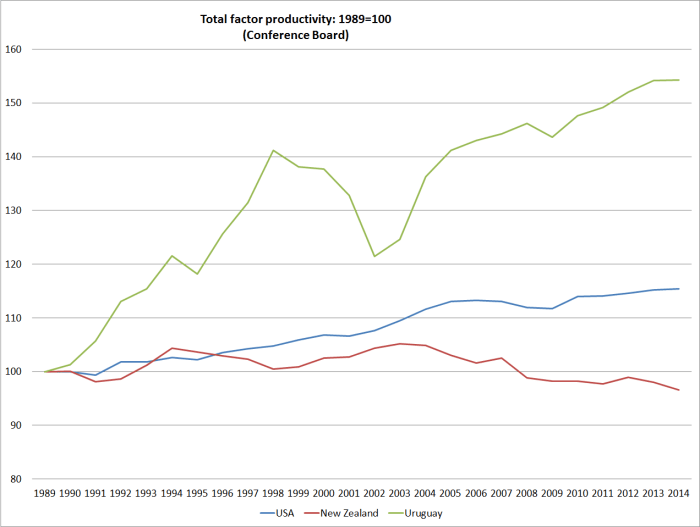
How should we apply this to New Zealand?  Poot didn’t attempt to in this presentation, but as noted we have considerable ethnic, cultural, and birthplace diversity, and that diversity has increased materially in the last few decades.  And yet our overall economic performance, including on measures such as productivity, innovation, and foreign trade, have been among the worst in the OECD.   One never knows the counterfactual, but New Zealand doesn’t look like a great place to start from if one is keen to illustrate the economic benefits of cultural diversity.  There is a literature suggesting that increased ethnic diversity boosts foreign trade –  although Poot was keen not to oversell this – but then New Zealand is one of the handful of countries to have had no increase in its foreign trade share of GDP in the last 30 years or more.  Perhaps a heavily natural resource based economy is a little different?

Ian Harrison has noted some problems with some of the literature in this area in this note.

By coincidence, I got home from the Poot lecture to find a request from TVNZ to be interviewed on immigration issues for their Q&A show tomorrow.  Apparently, they have also interviewed Professor Poot for the programme.  In my recorded comments, I noted the difficulty of having a good debate about these issues in New Zealand, and noted that when I first began developing my thoughts about how our immigration policy might have affected New Zealand’s specific economic performance, there had been a lot of embarrassed silence among my then colleagues at The Treasury,  with suggestions that I risked sounding like Winston Peters, and –  in the case of one particular manager –  outrage that the issue should even be discussed at Treasury.  But Treasury’s guest lecture series remains a valuable contribution to discussion of policy issues, and I appreciated the opportunity to hear Professor Poot speak.
The Treasury on immigration policy

The other day Treasury released a 29 page set of slides put together in September 2014 for an internal “Immigration Policy Forum”.   The Forum discussion –  probably gathering all the key people in Treasury –  seems to have been designed to help Treasury come to a “clearer shared position on immigration policy”.  For a time, at least, there seemed to be two schools in Treasury –  a “microeconomic wing” championing the gains to New Zealand from immigration policy, and a “macroeconomic wing” –  perhaps somewhat influenced by some of my arguments –  uneasy about the possibility that the macroeconomic pressures (eg on real interest and exchange rates) resulting from high target rates of non-citizen immigration might be impeding New Zealand’s medium-term economic performance.

I’m not entirely sure why Treasury chose to release these slides now.  They aren’t a response to an OIA request, but may have been prompted by my recent OIA request (the results of which they released the same day) asking for copies of any material Treasury had prepared on immigration since 1 April 2015.   I haven’t read the OIA release results in any detail yet (there is 200 pages of material), but these slides look to provide more of an overview of Treasury’s perspective than any of the specific papers in that collection.  The slides themselves don’t tell us what view the Forum reached on immigration, but from the fact that Treasury has voluntarily released them and that there is no suggestion the meeting disagreed with the proposed stance, it seems safe to conclude that the slides represented a Treasury view, at least in late 2014.

Last year, I had asked for copies of papers Treasury had provided to the Minister on the economic impact of immigration.  I discussed here what they released then, noting that I had been surprised how little evidence or argumentation they had advanced suggesting that New Zealanders as a whole were getting economic benefits from one of the largest inward migration programmes run anywhere.

What about the 2014 slide pack?  Is there any sign of a more in-depth assessment of the issues and arguments as they apply specifically to New Zealand?  Unfortunately, not really.

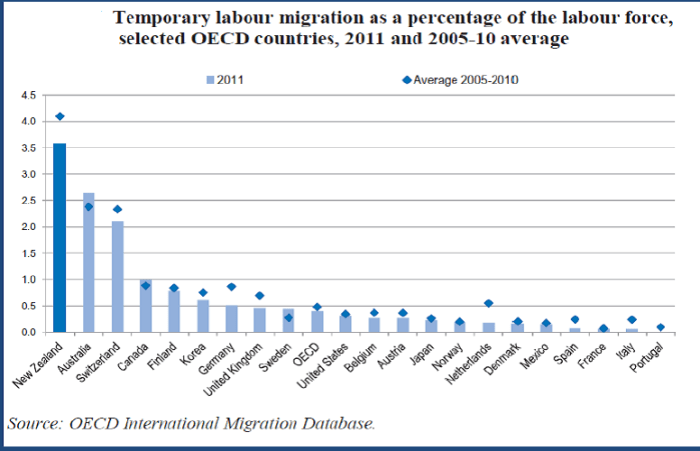
There are some interesting and nicely-put-together charts.  There were even a few things I didn’t know (eg there is an interesting OECD chart showing that New Zealand has the highest share of the labour force made up of temporary migrants of any OECD country).

temp workers

Much of the discussion is, in principle, organized around this decision tree.

decision tree

Which is more or less fine, as far as it goes, although it continues to structure debate in terms of microeconomic benefits vs macroeconomic costs, simply taking for granting that in the specific case of New Zealand there are in fact microeconomic benefits to New Zealanders.

I’m not going to devote any more space to either Option 1a (substantially increasing immigration) or Option 1d (trying to adjust the inward flow of migrants cyclically, to ease cyclical pressures on the economy).    The first simply isn’t going to happen –  especially while the advocates of large scale immigration to New Zealand can show no clear evidence that New Zealanders have benefited from the large scale immigration we’ve already had over many decades.  And I agree with Treasury that adjusting the immigration programme cyclically isn’t particularly sensible or workable –  both because the economic cycle is difficult to forecast, and because many of the fluctuations in net migration (ie flows between NZ and Australia) aren’t directly amenable to New Zealand policy measures.  Monetary policy should remain the cyclical management tool of choice.

The real choices are between maintaining something like the current target level of non-citizen immigration (45000 to 50000 residence approvals a year) and reducing that target, perhaps to something more in line with the typical OECD country.   Within either of those options, there are choices about how we select migrants and what sort of people we aim to bring in.  At least in these slides, Treasury is more interested in these latter issues than in the former.

The challenge of identifying impacts of current level of migration is that it
is difficult to specify a counterfactual – what would have otherwise
happened without the observed level of immigration.
The evidence isn’t definitive enough to make a judgement about whether
net benefits would be higher from the current quantity of inward
migration or a lower level. But it does show that composition matters.
Of course it is difficult to specify a counterfactual –  it often is –  but that is no excuse for not trying.  It seems that, in substance, Treasury is reduced to saying “we really have no idea whether New Zealanders are benefiting from the large scale immigration”.  That is quite indictment after 25 years of (more or less) the current policy, and this from our premier economic advisory agency.
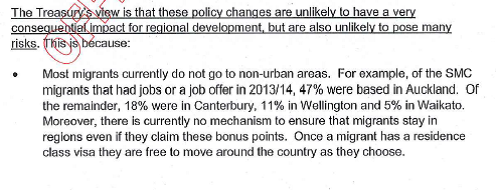
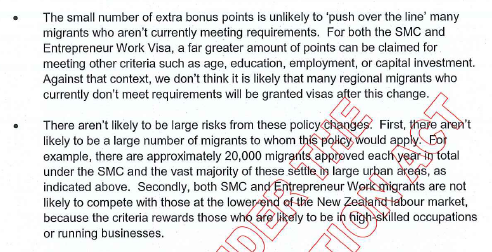
Treasury is uneasy about the skill mix of migrants however. The slides are quite explicit in some places
Our key judgment is that migrant labour is increasingly likely to be a substitute for local low -skill labour, and this is an impact that we should try and mitigate.
I’d see this as fairly consistent with the points I made in a series of posts last year (eg here) about just how relatively not-very-skilled our skills-based immigration had become (eg the disproportionate numbers of retail or restaurant managers).
But Treasury remains quite upbeat on the prospects for highly skilled migration
More high-skilled migrants can benefit high-productivity firms and industries, and we are less concerned about wage and employment effects for high-skilled local labour.
This is because we think:
– High–skill migrant labour is more likely to complement local labour and capital, rather than substitute for it
– High-skill labour will increase the skill composition of the local workforce, which is the theoretical channel through which many of the beneficial impacts of migration are achieved
– To the extent there are LM impacts on competing local labour, we think there are normative policy reasons to be less concerned at that end of the earnings spectrum
Research suggests that the high – skill migration may have a positive impact on
innovation and productivity via its effects on skill composition. High – skill labour is also likely a complement for both low -skill labour and capital.
We think this suggests that we should look to increase the supply of this sort of labour.

All of which might be fine if, for example, they could show that the New Zealand economy (and New Zealanders in particular) was actually benefiting from the high-skilled immigration we already have.   Or if they could show how New Zealand could attract genuinely highly-skilled people in large numbers, when large numbers of our own skilled people are typically treating New Zealand as a place to leave.  Or if they had engaged with the data suggesting that many skilled migrants take decades to match the earnings of comparably-skilled locals.

At one level, I don’t disagree with Treasury.  If we are going to run a large inward migration programme, it is far better to do as we advertise, and make it a genuinely highly-skilled focused programme.  The proportion of fairly modestly skilled people we have been allowing in in recent years seems most unlikely to benefit New Zealanders as a whole, and there are more plausible stories for widespread benefits from attracting highly-skilled migrants than low-skilled ones.

But one really needs a lot more material than is captured in these slides to reach a considered view on the appropriate level of non-citizen immigration for New Zealand.   Perhaps most importantly, one would need to engage seriously with 25 years of continued economic underperformance, even though we have been running one of the largest immigration programmes around.  But one would also need to show signs of thinking hard about the structural characteristics of the New Zealand economy, which continues to rely –  almost as heavily as ever  –  on its natural resource base, not self-evidently a resource that needs (or benefits from) lots more people.  One might need to show a serious willingness to grapple with such characteristics of the New Zealand economy as its persistently high real interest rates and the persistently high real exchange rate.  Or to grapple with the indications of the economic underperformance of Auckland.

And there is simply none of that in these slides.

(One might even want to grapple more seriously with the housing market tensions that high levels of immigration has created.  I’m quite with those who say that a first best response might be to sort out the housing supply and urban land market, but……there is very little sign of that happening, and no sign that it has successfully happened anywhere else.  This isn’t just some sort of sequencing problem –  urban land issues look fairly intractable, not for technical reasons, but for reasons having to do with the preferences of residents on the one hand, and planners, bureaucrats and central and local government politicians on the other.  In the meantime, while people blithely talk of “immigration isn’t the problem, housing supply is”, too many people seem to be living in overcrowded accommodation, garages and even –  no doubt rarely and temporarily –  in cars.)

I’ve argued previously that the Productivity Commission should be asked to conduct a serious review of the economics of New Zealand’s immigration policy, in the context of the specific structural features of the New Zealand economy.  The Commission seems, on its track record to date, to be prone to rehearsing  – in more sophisticated language and at considerable length –  current conventional wisdoms, but it remains the best-placed official agency to do some more serious work in this area and to contribute to a better-informed public debate.