One difference between a transparent central bank and the Reserve Bank

The Reserve Bank constantly tries to convince us of how transparent it is.  As Deputy Governor, Geoff Bascand, put it in his first on-the-record speech

The Reserve Bank is deeply committed to transparency – of policy objectives, policy proposals, economic reasoning, and of our understanding of the economy, and of course of our policy actions and intent. Clear communication and strong public understanding make our policy actions more effective.

We are working to enhance the openness and effectiveness of our communications

Just recently, the Bank even had the gall to argue that its new charging regime for official information requests would support this; it “helps the bank fulfil the OIA in making valuable information publically available”.

I’ve illustrated on numerous occasions just how relatively un-transparent the Bank now is, whether in respect of monetary policy, financial regulation, or indeed its own corporate and governance activities.  In some ways and some areas the Bank has got worse, while in others it has just not kept up with best practice –  whether in other government agencies (especially those exercising regulatory functions), or in international central banking.

This won’t be a lengthy post.  It was prompted by reading a recent blog post by Dan Thornton, a former senior researcher at the Federal Reserve Bank of St Louis (and a very stimulating visitor to the Reserve Bank).    One of the features of the Federal Reserve system is that minutes of the FOMC meetings are released, and in addition full transcripts of those meetings (whether in person, or by conference call) are released five years after end of the relevant year.  You can see all the 2010 material the Federal Reserve has released here,  all readily accessible and nicely laid out.

Researchers and commentators use this stuff.  Here is the link to the post I was reading.  Thornton looks at one aspect of March 2009 FOMC meeting, a discussion around the wording of the statement that would be released.    For anyone interested, here is the heart of his discussion.

thornton

My point is not to take one side or other of the debate at the FOMC, but simply to illustrate the sort of openness that exists in the US, even with a lag, and contrast it with the situation in New Zealand.   It took me months last year to get the Reserve Bank to release the background papers to a ten year old Monetary Policy Statement – and I didn’t even bother asking for the minutes of the meetings, or the written advice to the Governor on the OCR, or any records of debate over the press release (all of which is official information, with a statutory presumption in favour of release).  Even that didn’t prompt a change in regular practice –  and if someone asked again now, for 10 year old papers, they would no doubt face a substantial charge.   Citizens and researchers, and even MPs, have no insights into the Reserve Bank’s processes or internal debates, beyond what (very little) the Governor chooses to publish in the MPS.  And the level of transparency around other Bank activities is even worse.  

The Federal Reserve isn’t perfect by any means –  and has fought transparency around, eg, its lending activities during the crisis –  but the contrast with the Reserve Bank of New Zealand is striking.

Grant Robertson, the Reserve Bank, and the end of the Governor’s term

Further to my post the other day on Grant Robertson’s latest statement on monetary policy, Bernard Hickey has posted a substantial article about his interview with Robertson on these matters.  It is a useful piece to have –  certainly the most sustained discussion of monetary policy and Reserve Bank issues from Robertson since he became Labour’s finance spokesperson.

And yet it still poses more questions than answers, and still leaves Labour looking as though it has not really thought hard about either monetary policy or the reasons for New Zealand’s continuing economic underperformance (including the continuing large gap between New Zealand and “world” real interest rates).  As a voter and an interested observer/commentator, I found that pretty disappointing.   There is certainly space for a different approach to economic policy in New Zealand –  it is not as if either recent Labour or National led governments have managed to do anything that begins to reverse New Zealand’s relative economic decline.

But it is still looks as though they are more interested –  at least at this stage of the electoral cycle – in positioning (with their party base, and with the business community), and being seen to be different, than in the harder aspects of substantive economic analysis and concrete alternative policies (and the connection between the two of them).

Thus he says “the lowest inflation since last century combined with rising unemployment…is making a farce of monetary policy”, and “when you reach 15 quarters outside of the mid-point we do have to ask ourselves what we’re doing with monetary policy”.  And yet Robertson is very reluctant to criticize the Reserve Bank, and the Governor (formally the single decision-maker) in particular.  Indeed, he goes out of his way to praise the Governor and –  despite the single decision-maker model  – says “the targets agreement has not been met, but I wouldn’t want to bring that down to him personally at this time”.  Certainly, the Governor has advisers, but they are all employed by, and accountable to, him.

Instead, Robertson repeatedly argues for changing the framework.  He isn’t very specific about what he wants –  and it is still 20 months from the election – but the only point that keeps recurring in all his statements is a desire to have the Reserve Bank actively promote higher employment.  But he adduces no evidence whatever to suggest the reframing the wording of the Bank’s goal, along the lines of the Fed or RBA objectives, would make the slightest bit of difference to how the Reserve Bank actually runs monetary policy.  Past Reserve Bank research suggests that, on average over time, the Reserve Bank of New Zealand has reacted to incoming data in much the same way as the RBA or Fed have done.  Robertson either knows that, or should do, so the onus is on him to explain how his approach would make a difference, in substance rather than rhetoric.

And there is still nothing on the “new tools” Robertson has talked of needing.  When Hickey asked him about the variable Kiwisaver rate proposal Labour took into the last election, all he would say was that it was under review, and “that wasn’t mentioned today and won’t be in the foreseeable future”, adding (Hickey’s words) that “Labour preferred to have a simple policy that gave voters certainty”.  Which is all fine no doubt, but doesn’t give hardheaded observers reason to think Labour actually has serious alternative tools in mind.  That shouldn’t be surprising, as the tool the Reserve Bank does use is the tool other central banks use –  at least until they exhaust its potential when policy rates get to or just below zero.

It seems to me that there are two quite important separable issues:

  • the Reserve Bank has not done a particularly good job in the last few years of carrying out the Policy Targets Agreement.  That failure has been particularly stark since the 2 per cent midpoint reference was added in 2012.  With (as Robertson notes) inflation very low and unemployment high and rising, it is a pretty clear-cut case of a shortfall of demand, and a lower OCR is the best tool for stimulating additional demand.    The Reserve Bank can do something about that, but has failed to do so –  as Robertson notes, he was among those uneasy about the OCR increases in 2014, which were unnecessary, and the Bank (the Governor) has been slow to lower rates since.  Real interest rates now remain higher than were two years ago, when dairy prices were at their peak.
  • the disappointingly poor economic performance of New Zealand over recent decades, including such symptoms as the large gap between New Zealand real interest rates and those abroad, and the persistently high average real exchange rate.    As it has abandoned support for the existing monetary policy framework over the last few years, Labour has tried to imply (perhaps especially to its base) that there is something about the monetary policy framework that Labour could fix, offering some material improvement in our economic performance.  Neither Phil Goff, David Cunliffe nor David Parker ever quite managed to explain the connection.  Robertson has done no better.  That isn’t surprising, because it really isn’t there.  There might be better ways of articulating the objective, and there are better ways of running/governing the Reserve Bank etc, but none of them offer anything much in addressing the structural underperformance of the New Zealand economy.

Veteran commentator and analyst of left-wing politics, Chris Trotter wrote a piece the other day suggesting that Labour and the Greens were adopting an approach, akin to that in the early 1980s, of getting alongside the business community  –  getting them to the point where business was comfortable that an alternative government would not “scare the horses”.  I’ve no idea if that is an accurate description, but Robertson’s comments don’t look inconsistent with Trotter’s story.  I was interested, for example, in Robertson’s reaction to the question of whether Graeme Wheeler should be reappointed next year: Wheeler’s term expires almost three years to day from the date of the last election. Robertson doesn’t refuse to comment, but goes on to express his regard for Wheeler (twice), only then concluding that “ultimately it won’t be a decision I’ll be involved in”.

I have no idea, of course, whether Graeme Wheeler will even seek a second term, but whether he does or not, I think there should be some disquiet about the fact that his term expires in late September next year.  Monetary policy is now hardly something that the main political parties are united on (unlike the situation from 1990 until 2008, when any differences were about details, and the statutory goal united National and Labour), and it doesn’t seem very satisfactory that, for example, the current government could appoint someone to the office of Governor (single decisionmaker across a range of policy areas), taking office perhaps in the middle of an election campaign, or indeed just as a new government was taking office.  It isn’t a problem if the current government is re-elected, but (say) a Labour-led government supported by the Greens and/or New Zealand First might have a rather different view about priorities and emphases for the Bank.  The Governor has a degree of personal policy autonomy not shared, for example, by heads of core government departments (eg the Secretary to the Treasury).

The last time a Governor’s term expired in an election year was in 1993 (2002 was different –  Don Brash resigned just before the election campaign, and a new permanent appointment was not made until after the election result was determined).  But, as I noted, on that occasion National and Labour went into the election with no real difference on the Reserve Bank Act.  On that occasion, the Reserve Bank’s Board and the then Minister agreed to reappoint Don Brash in December 1992, well before any election year market uncertainty  (or campaigning) took hold.  And the first Brash term was due to expire a couple of months before the election would normally be due.

The situation next year seems much less tractable.    Wheeler’s term expires more than three years after the date of the last election.  And Labour seems sure to campaign for material changes to the Act (as would its potential future support parties).   And if Graeme Wheeler does not seek another term, any capable person pondering applying for the job in early to mid 2017 might be more than slightly uneasy –  it not being clear what the substance of the role might actually be.    I hope the Board –  and perhaps the Minister  – have already begun to think about the issue.  I’m not sure what the best way ahead is.  These clashes don’t happen often, but perhaps one option for the longer-term might be six year terms for the Governor, rather than five –  so that a new gubernatorial appointment was always in the middle of an electoral cycle.  For now, I wonder if it might be wise to consider extending the Governor’s term for another year. to allow longer-term decisions to be made with greater clarity about the longer-term direction of the Reserve Bank and New Zealand’s monetary policy regime.  As longerstanding readers might imagine, I’m hesitant about that option for a number of reasons, but none of the alternatives look ideal either.

In this post I haven’t touched at all on Robertson’s comments on immigration –  with which I am generally sympathetic, although sceptical about the extent to which immigration policy can be managed in a countercyclical way.  And countercyclical issues are not where the real debates about the economics of New Zealand’s large scale inward migration programme should be centred.


A perspective from the newly-released model

Somewhat belatedly, the Reserve Bank last month released a Discussion Paper outlining the features of the Bank’s relatively new forecasting and policy model, NZSIM.  I’m signed up to receive the email advisories when such papers are released, but it appears that on this occasion no advisory was sent out (an oversight apparently).  A commenter yesterday pointed me to the Discussion Paper.

The Reserve Bank has long prided itself on its formal macroeconomic models.   This dates back at least to the days of Roderick Deane, Chief Economist and later Deputy Governor of the Bank in the 1970s and early 1980s and one of the greatest figures in the history of the Reserve Bank.    The Reserve Bank was one of the early central bank adopters of formalised models, although most other advanced country central banks now use them in some role or another.  Historically, the Reserve Bank of Australia has tended to be towards the sceptical end on the role for economy-wide models in policymaking.

Maintaining such models has been a heavy investment for a small institution, especially as on at least a couple of occasions (over decades) the models have been junked almost as soon as they were finished.

And views on quite how large a role the models have ever played in the policy side of the Bank probably differ from observer to observer.  I was closely involved for a long time, and I tend towards the sceptical end.  The Bank had an unwarranted reputation for being somewhat in the thrall of whichever model it was using at the time.  I will always remember the time, fifteen years or so ago, when Glenn Stevens came over and spent several days observing our quarterly forecasting and policy round, and emerged commenting that he hadn’t realised that the Reserve Bank of New Zealand was really quite so pragmatic.

Structural models of the entire economy tend not to be overly useful for the sort of near-term forecasting (and backcasting and nowcasting) that largely shapes real-world monetary policy setting.  The current Deputy Governor, Grant Spencer, made this point well when, as an outsider speaking at a workshop to launch an earlier model in the 1990s, he noted that the technology was likely to be more useful for policy simulations (“what happens if we apply some shock to the system”) than for forecasting. There are simply too many institutional and data-related details that will be known to the forecaster at any particular time, but can’t be captured in a structural model, a deliberately stylised representation of the economy.  And that is even before one asks questions about anyone’s ability to forecast the economy more than a quarter or two ahead.

A good structural model captures the key features of how the designers think the economy works. But in an official agency, it is only likely to be useful if it reflects the key elements of how the decision-makers think the economy works   If it doesn’t, then over time either the model itself has to be adapted, or it will fall into disuse  (perhaps serving as an adding-up framework, and as a technology for generating nice charts and tables quickly –  which NZSIM was doing –  but with the structure of the model overridden pretty much all the time).  Obviously I’m no longer close enough to know what role NZSIM is playing in Graeme Wheeler’s deliberations (whether on forecasting or scenario analysis) but I’d be surprised if it was terribly large.  Apart from anything, for example, in this model, immigration is not explicitly treated, and fiscal policy changes never alter the deficit (any change in spending is automatically financed by a change in lump sum taxes)

Nonetheless, it is good to have the model Discussion Paper in the public domain.  As former Bank of England official Tony Yates has highlighted, (and here) the benchmark in this area remains the Federal Reserve

The Fed recently made its workhorse model FRB-US downloadable, with a dataset, code, everything you need to take a close look at what Governors say and what the staff have been doing for them.  The Bank of England should do the same.

Perhaps one could say the same about the Reserve Bank.  Having that additional material wouldn’t greatly interest me personally, but there are other people outside the Reserve Bank with considerable modelling background and experience for whom it could be useful, as part of further strengthening the external scrutiny of the Reserve Bank.   It can be useful to have a better sense of whether differences from the Bank arise because of different inputs (exogenous variables) or different assumptions about how the economy works.

But for now, I just wanted to highlight one chart in the Discussion Paper.  It shows the responses of a variety of variables to a 1 percentage point “monetary policy shock” –  roughly, a change in the policy rate of 100 basis points different than would the “policy rule” in the model would suggest.  There is nothing special about that particular policy rule –  indeed, I doubt it has ever been discussed in any detail at the Bank’s Monetary Policy Committee  – but also nothing especially objectionable about it.

impulse responses

But it is interesting because one could think of last year’s OCR tightenings as a 100 basis point monetary policy shock.  No doubt it won’t have been quite that in the formal model sense, but many people would now subscribe to the view that the tightening was largely (or completely) unnecessary.  Certainly, it has now been fully reversed, at least in nominal terms (real interest rates are still higher than they were when the tightenings began in March last year).

Within this model, a representation of the economy that the Bank is content to use in its internal processes and to describe as “the” new forecasting and policy model”, a 100 basis point monetary policy shock, that is unwound after a year or so, lowers inflation by about 0.2 per cent (roughly evenly split between tradables and non-tradables).  But it also has real economy effects:  after about five quarters, consumption is almost 1 per cent lower than it otherwise would be, and GDP is almost 0.6 per cent lower than it otherwise would be.

In a more formal way, it makes much the same point that the Minister of Finance was making the other day.

Finance Minister Bill English says the Reserve Bank raised interest rates “a bit too far” in 2014, contributing to slow economic growth at the start of the year.

“It’s one of the factors, along with dairy prices, that probably led to a much flatter 2015 than we had expected,” English told Bloomberg Television on Thursday evening.

“In retrospect, they lifted them a bit far” and “had to go back”, English said.

Graeme Wheeler’s experts might object to my characterisation of last year as a “monetary policy shock” in this sense, but the increases were clearly unnecessary and have been reversed.  Whether or not they could be justified at the time, the fact that they were unnecessary with hindsight means there will have been some short-term real economic cost.  The Bank’s model provides one way  –  using their view of how the economy works – of trying to get a plausible fix on the size of that cost. The model doesn’t have the unemployment rate within it, but  –  all else equal –  an additional 0.6 per cent of GDP might have been enough to have prevented the unemployment rate rising from 5.6 per cent in September 2014 to 6 per cent in September this year.

The Joint (TPP) Declaration – another Reserve Bank OIA abuse

On 6 November I posted about the joint declaration of the macroeconomic policy authorities of the trans-pacific partnership countries.  This non-binding declaration dealt with issues around exchange rate management etc.  It was, apparently, a price set by the US Congress for being willing to consider legislation to implement the TPP agreement.

The declaration was announced in a joint press release from the Governor of the Reserve Bank and the Secretary to the Treasury.  As they noted in their Q&A accompanying the press release:

This is an understanding among our macroeconomic agencies. It is not a treaty among TPP governments.

My conclusion, which seemed reasonable at the time, was that both the Reserve Bank and the Treasury were parties to this declaration.  Everything in their documents suggested so, and if we are going to have such declarations at all then it makes sense for the operationally autonomous central bank to be a party to it.

I was, however,  struck by one sentence in the declaration, which stated

We, the macroeconomic policy authorities for countries that are party to the Trans-Pacific Partnership…welcome the ambitious, comprehensive, and high-standard agreement reached by our respective governments in Atlanta.

I wondered (a) whether such judgements were really appropriate for non-partisan public servants to be making, and (b) what basis the Governor and Secretary had had for reaching their judgement.  In truth, I was more interested in the Reserve Bank’s response, since I knew that Treasury would have been reasonably actively involved in the whole process.  Accordingly, I lodged an OIA request with each agency.

Today I received this response from the Reserve Bank.

On 6 November 2015, you made a request under the provisions of Section 12 of the Official Information Act (the Act), seeking: 

Copies of any analysis and position papers etc undertaken by those two agencies (RBNZ and Treasury) which provided the basis for their judgement that TPP was an “ambitious, comprehensive, and high-standard” agreement.

The phrase you’ve quoted comes from the Joint Declaration of the Macro-economic policy authorities of Trans-Pacific Partnership Countries published on the United States Treasury website. That document was agreed between the signatories to the TPPA (Australia, Brunei Darussalam, Canada, Chile, Japan, Malaysia, Mexico, Peru, Singapore, the United States and Viet Nam).

Work to analyse the TPPA, and to advise the Government about the TPPA, was performed by the Treasury, the Ministry of Foreign Affairs and Trade, and possibly other agencies too. The Reserve Bank did not undertake its own specific analysis and so does not hold information within the scope of your request. The Bank is refusing your request under the grounds allowed by section 18(e) of the Act – the document alleged to contain the information requested does not exist.

A number of things are puzzling about this response:

  • The Bank refers to the declaration being on the US Treasury website.  But the RB/Treasury press release had a link to a copy of the declaration on the New Zealand Treasury’s website.
  • The response states that the declaration “was agreed between the signatories to the TPPA” but, as noted above, in their release the Governor and Secretary said that it was an agreement between macroeconomic policy authorities.  Is the Reserve Bank one of these authorities or not?  And if not, why was the Governor party to the press release?
  • It is also stated that the Reserve Bank neither undertook any analysis of the TPP agreement itself, and nor does it hold information prepared by other agencies.    They state that the information I  requested simply does not exist.  In other words, despite apparently being party to a declaration that lauds TPP as an “ambitious, comprehensive and high standard” agreement, that specific judgement –  really quite political in effect –  is apparently based on nothing on at.  No documents, no file notes, no analysis, no emails.  Is this  the standard of policymaking we should expect from the Reserve Bank?

Finally, if there is really nothing at all, how come it took 17 or 18 working days to respond?  As a reminder, the Official Information Act requires agencies to respond “as soon as reasonably practicable”.  I can understand it taking two or three days, but this response looks like yet another highly questionable abuse of the Act.

I’ve now lodged a further request for any material the Bank did consider prior to issuing the joint press release on 6 November.  Perhaps that will help finally confirm whether the Reserve Bank really is a party to this or not.


How the Reserve Bank thinks we should evaluate its monetary policy

The Reserve Bank released a new issue of the Bulletin yesterday headed “Evaluating Monetary Policy”.   Bulletins carry the imprimatur of the Bank itself, and in this case the key messages are conveyed in quotes from Assistant Governor John McDermott in the accompanying press release.  I’m sure Graeme Wheeler himself will have gone through this quite carefully before agreeing to its release, and we can assume that the article speaks for the Governor.

In principle, the article isn’t a bad idea.  It is worth having an accessible summary reference that outlines the key legal provisions that govern the Bank’s accountability for monetary policy, and which articulates some of the real challenges in scrutinising and holding the Bank to account in the approach to conducting monetary policy (“flexible inflation targeting”) that is now pretty widespread.  As I’ve pointed out previously, the Act was written for a simpler (not very realistic) conception of monetary policy.

But it is also the sort of article that needs to be written rather carefully and modestly.  The people (or institution) being held to account are not the ones who get to define how we review and assess them, and hold them to account. That is up to us –  whether “us” is citizens, markets, MPs, media, lobby groups, the Minister of Finance, or whoever.  If it ever comes to a question of dismissing the Governor, the formal legal provisions would have to be considered very carefully, but short of that  –  and I hope we are always short of that –  a wide range of factors will, and should, be taken into account.  Some of them are the rather narrowly technocratic items in the latest Bulletin.  But many aren’t.  And an article of this sort from the Board –  who are actually paid to hold the Governor to account –  might have been more valuable.

In publishing this Bulletin, I suspect the Bank had a couple of motivations.  One probably was genuinely didactic and informative – the public service of reminding readers of some of the issues.  But I suspect the rather more important consideration was defensive. It looks like an attempt to get critics off their back, and perhaps even to fend off doubts that even some Board members might have had (the Board, while compliant overall, has always had its awkward characters)  about just how well the Governor has been doing in ensuring that the Bank achieves the policy targets.  An article like this will have been in the works for several months.

I don’t think the article does either job well.  If anything, it raises more concerns about the depth and authority of the key policymakers and advisers at the Reserve Bank.    My advice to them, had they asked, would have been that there might have been a useful role for two quite separate articles:

  • One on the framework itself, a reminder of how the accountability system is designed, and is evolved.
  • A separate one that reviewed , with the benefit of hindsight, the conduct of monetary policy over the last few years.   Would we have learned anything from the latter?  Perhaps not, but having the Governor make the strongest case he could, including showing us how he has learned from mistakes and the flow of new information, would have been revealing, however good or bad the document actually was.

Except in passing I’m not going to debate here the record of the last few years.  The article touches on it directly in a rather unconvincing box (pages 16 and 17), but in fairness it is difficult to do justice to the arguments on either side in five charts and six short paragraphs.  But, as a hint, if you want to persuade thoughtful people of your case, it is good to actually engage with the arguments or alternative perspectives the critics have offered.  Anyone can beat a straw man, but what is gained by doing so?

My copy of the article is riddled with comments in the margins, and I won’t bore readers by going through them all.

But let’s start with John McDermott’s press release, which pummels a straw man and declaims what should be a platitude.

The straw man?  We are told, portentously, that “it is not sufficient to look at inflation outcomes alone when assessing the conduct of monetary policy”.  Indeed, but whoever said it was?

And the platitude?  This point is repeated so often, between the article and the press release, that they really must want us to take notice: “a central bank should make full use of all relevant information, and learn from new information and forecast errors as these come to light.”   Really?    I’m sure we hadn’t thought of that before.    Of course, but critics will suggest that it is precisely what the Reserve Bank has not been doing in recent years.  They haven’t convinced us –  and don’t really try to do so in the article – that they have taken the best possible approach to learning from their mistakes.  That cause is not helped when the Governor is so reluctant to concede that any mistakes were ever made.

The article has a number of curious features even in its description of the formal accountability process.  For example, the phrase “Minister of Finance” does not appear at all.  And yet the Minister of Finance:

So how did the Bank manage to write a whole article about monetary policy accountability and not mention the Minister of Finance?  Ours is quite a different system than those in most other countries.

I think it is partly because they use a muddled concept of accountability.  The article is headed “evaluating” monetary policy, which  – at least to some ears –  has rather technical connotations to it.  But even allowing for that,  there is an important distinction between people having views on the monetary policy performance, and people with the power to do something about it.  Real accountability implies the presence of remedies –  the Board and the Minister have them, but we don’t.

The article also veers down an odd line of argument that confuses transparency and accountability (and evaluation for that matter).  Take this paragraph:

Well-informed oversight from external stakeholders benefits the Bank in two ways. Firstly, a clear understanding of the Bank’s policy goals, and how it might be assessed against those goals, helps external stakeholders predict how the Bank is likely to react to new information. This improves the efficacy of monetary policy, since agents in the economy can react instantly to new information, rather than having to wait for guidance from the Bank. Secondly, it provides several avenues – in addition to the role played by the Board – for direct feedback to improve the Bank’s decision making. Well-informed feedback can help the Bank identify faster the need for policy adjustments.

But “oversight” isn’t there to benefit the Bank –  it is supposed to protect the public and the country.  There is certainly a reasonable argument that transparency about the goals the Bank is working to and the “reaction functions” it uses can be helpful in engendering public and market responses to data that are consistent with how the Bank will eventually adjust monetary policy (so, could we see that model?), but that is a different matter from policy evaluation or accountability.  One can be predictably wrong –  as the Bank has become over the last couple of years-  as well as predictably right.  And, incidentally, it would be interesting to know whether any feedback from anyone has made any difference to “improve the Bank’s decision making” or “identify faster the need for policy adjustments”

But perhaps the critical caveat is “well-informed”?  Is there any feedback or criticism about monetary policy that the Bank (current Governor) has regarded as well-informed?

The Bank goes on to note that “self-assessment by the Bank is an important part of the accountability framework”.   The willingness to recognise mistakes and learn from them should be one of the characteristics the Board and the Minister should be looking for in evaluating the Governor’s performance.  I’m not sure, though, that I have seen those aspects commented on in the Board’s Annual Reports.

And it is a little surprising that the article does not refer to the one place in the Act where the Bank is required to undertake and publish self-assessment and review.   Section 15 of the Act governs Monetary Policy Statements, which are formally only required every six months. But each such statement must

contain a review and assessment of the implementation by the Bank of monetary policy during the period to which the preceding policy statement relates.

This section of the Act certainly needs updating, but the Bank does not even try to comply with the spirit of what those who drafted the law were about.  After constant nagging, they started publishing a box in each MPS which probably barely meets the formal legal requirements –  it briefly describes monetary policy over the preceding period, but makes no attempt at assessing or evaluating such policy  (as distinct –  and the distinction is important –  from defending it).  I used to argue that perhaps once every two years such a review and evaluation should be undertaken as a major special chapter in a Monetary Policy Statement, perhaps informed by commissioned reports from independent experts.   (The article also omits to mention the legal requirement on the Board to “ determine whether policy statements made pursuant to section 15 are consistent with the Bank’s primary function and the policy targets agreed to with the Minister under section 9 or section 12(7)(b)”)

Changing tack for a moment, there are a couple of interesting and slightly surprising observations in the article that bear on current policy.  I and various market commentators have been critical of the Bank in recent months over the claim it is making that things are okay, because inflation will be back well inside the target range by early next year.  The Bank’s forecasts are quite clear that this happens only because of the direct price effects of a lower exchange rate.  As outsiders have noted, one-off shifts in the price level are not the same as the medium-trend in inflation, and there was little basis to think that temporarily higher headline inflation foreshadowed rising core inflation.

It was, therefore, both reassuring and discomforting to find this quote in the article

Tradables inflation tends to be more affected by short-term disturbances, due to exchange rate movements and volatility in international prices. It is therefore more common for the Bank to look through short-term variability in the prices of tradable items.

Reassuring, since staff clearly haven’t abandoned the framework –  trends in the persistent components of inflation are really what matter to them.  But discomforting because in press release after press release (it was there again last week), speech after speech, the Governor tries to get us to focus on a headline inflation rate that is just temporarily boosted by the lower exchange rate.   That isn’t accountability or clear communications.  It looks a lot like just trying to muddy the waters to distract people from the persistent undershoot in core inflation.

The article also discusses the timeframe over which the Governor aims to get inflation back to target. But it is a puzzling discussion because it concludes with a quote from a speech Alan Bollard gave in late 2002, shortly after he had become Governor.  The target inflation rate had been raised and (arguably) some more flexibility had been added into the PTA. The Governor (and we his advisers) wanted to help outsiders understand how we would apply the new PTA.  He stated that his interpretation of the PTA was that following deviations from the inflation target range, things would be on course if “projected inflation will be comfortably within the target range in the latter half of the three year period.”  In other words, current inflation might be above target, but for the period 18 months to three years ahead, the Bank’s forecasts should show inflation settling “comfortably within” the target range, on credible assumptions.  Alan was a dove, who was keen to “give growth a chance”.   He proved content to have forecasts settling back to around 2.5 per cent in that 18 month to three year window.

The Reserve Bank in this article has now reaffirmed that approach to the PTA.  Which is puzzling, because the 2002 PTA made no reference to the midpoint.  That was something Alan often reminded us of –  getting to the midpoint might be nice if we got there, but there was no pressing need to do anything active about it.   But, as the current Governor has often reminded us, the reference to a focus on the 2 per cent midpoint, added in 2012, was put there for a reason – to help anchor inflation expectations near the midpoint of the target range.  But how can we –  or markets –  take seriously the PTA’s focus on the midpoint if the Bank is going to run the Bollard rule, and suggest that so long as its forecasts show inflation 18 months to three years ahead at, say, 1.5 per cent, that is consistent with the PTA?  Perhaps they mis-stepped in putting this article together, and no one noticed this tension?  If so, a clarification might be in order in the December MPS.  But if it is deliberate, those paid to hold the Bank to account –  the Board and the Minister –  should surely ask the Governor some fairly pointed questions?

Two final observations on the accountability material.  The Bank, as it always does, puts great store by the material that it publishes, and which it chooses to make available to people scrutinising its performance.  Perhaps just because the article was written by macroeconomists (who don’t tend to pay much attention to public policy and governance frameworks more generally) it did not mention at all the Official Information Act, which applies to the Bank as well and exists in part to enable better scrutiny of public agencies. Of course, the track record suggests that the Reserve Bank regards the Official Information Act as a regrettable legal obligation, to which minimalistic compliance may be necessary, but only after as much delay and obstruction as possible.  Self-selected transparency is not a great basis for scrutiny, challenge and review –  although the resistance to greater transparency may provide useful signals about the more general approach of the organisation.

And I was (somewhat geekishly) interested that the article does not seem to contain even once the word “model”.  It is difficult to evaluate monetary policy without a model in mind of how the economy works.  The Bank has prided itself over the decades on the extensive investment it has put into developing formal models of the economy, and undertaking formal structured research.  I’ve never been entirely sure that it was money well-spent (and the main model is still held secret), but John McDermott took a different view (and in the recent round of cost-cutting, the Bank’s research and modelling functions were not cut  back at all).    The authors of the article cite various academic articles from abroad, and most of them use formal models for policy evaluation.  I can quite understand that the Governor might not want the Bank to come across as too geeky and unrealistic, but if the Bank has really lost so much confidence in these more formal approaches to evaluation, even as inputs provided to those holding the Governor to account, that in itself is quite revealing.

Almost finally, I was mildly amused that the authors chose not to reference the previous article on the Bank’s website that dealt with these issues.  It is a few years old now, but the relevant legislation and economic challenges haven’t changed.  I’m sure there was a good reason for not doing so.  Like the current article, it (no doubt had to) understates the  limitations of the Board as a monitoring agent, but it did include a slightly richer list of the sort of things those looking to hold the Governor to account might reasonably be expected to take into account.

Some of the items the Reserve Bank’s Board might be expected to concern themselves with in fulfilling the monetary policy monitoring role include:

  • The processes the Governor uses to gather and interpret economic information.
  • The choices the Governor makes in allocating resources areas of the organisation relevant to monetary policy (including judgements he makes on whether to seek more, or fewer, resources, when the five-yearly funding agreement is negotiated)
  • The means the Governor uses to ensure that he is exposed to alternative perspectives.
  • The quality of the people the Governor appoints to advise him on policy choices.
  • The way in which the Governor applies section 3 and 4 of the PTA (dealing with deviations from the target range, and the avoidance of unnecessary instability).
  • The way in which the Governor thinks about and responds to the uncertainties around monetary policy.
  • The ability of the Governor to articulate the reasons for his policy choices, and his ability to convince others of his case.
  • The processes the Governor uses to assess past policy and learn from experience.
  • The stability through time in the Governor’s policy choices.

It would be interesting to see an article of this sort dealing with the Bank’s financial soundness and efficiency functions and responsibilities.  If effective accountability for monetary policy is hard, except perhaps at the point of any gubernatorial reappointment, it must be well-nigh impossible for the Bank’s other main functions.

The Treasury on Reserve Bank governance

Regular readers will know that one of the constants of this blog has been making the case for reforming, and modernising, the governance of the Reserve Bank.  The current model is out of step with international practice, and with the way other government agencies are run in New Zealand.   I’ve held this view for a long time, although the concerns are becoming more pressing as the Reserve Bank assumes, and is given, ever more discretionary power.     The current Governor is probably in the wrong job  (a huge role, making the holder probably the most powerful unelected person in New Zealand).  But the case for reform would be strong even if we had the best conceivable person as Governor.  Typically, we will have someone who is about average.

There has been a growing recognition of the case for change.  In 2012 The Treasury recommended to the Minister of Finance, before the current Governor was appointed, that further work be undertaken with a view towards moving to a committee-based decision-making framework.  At the time they found that most market economists were sympathetic to change.  At a political level, the Green Party has openly and repeatedly argued for change, while the Labour Party has come and gone on the issue.  But it isn’t an obviously ideological issue –  just a matter of finding a good governance model for an increasingly powerful New Zealand policy agency.

Graeme Wheeler himself recognised some of the weaknesses of the current system, and established the Governing Committee as the forum in which major decisions would be made.  He retains the legal power, and all the other members of the committee owe their positions, and remuneration, to the Governor, but in principle it represented a small step forward.  Whether it represents any real gain is impossible for outsiders to tell.  The Bank has flatly refused to release minutes of the meetings of the Committee, on any topic whatever, and –  in truth –  governance arrangements are really only tested in times of stress, and where there might be strong differences of view. Quasi-insiders –  the Bank’s Board –  could provide us with an assessment of how the new model is working, but their Annual Reports suggest that they are more interested in being champions of the Governor and the Bank rather than in providing substantive reports analysing and scrutinising the performance of the Governor and Bank.

The Bank has also refused to release any papers from its own work on reforming the governance model.  That refusal confirmed that a substantial amount of work had been done, at least some of which had been discussed with the Minister of Finance.

Fortunately, the Treasury generally takes a more accommodative approach to Official Information Act requests.  There are plenty of things about The Treasury that I am critical of, but they seem over the years to have displayed considerably more respect for the spirit of the Official Information Act and its role in New Zealand’s system of governance.  When the Reserve Bank refused my request for governance papers, I lodged a very similar request with The Treasury.

Yesterday, they released several papers, which are available here.

Treasury governance papers OIA response

There are a couple of nice and substantive background papers.  Some are focused just on monetary policy governance, but Treasury also recognises that the Reserve Bank has a much wider range of functions, and hence that any review of the legislative governance model really needs to look at the entire institution and all its roles and responsibilities.

Treasury still appears to favour change.   In particular, in a June paper to the Minister of Finance, commenting on the Reserve Bank’s draft Statement of Intent (page 48 in the release document) they note:

A key change from the previous year’s SOI is that a workstream on “best practice institutional frameworks…has been dropped.  In the Treasury’s view, this workstream would be worth continuing.  Nevertheless, we understand that the decision to drop this workstream is consistent with your feedback that the current decision making structure best supports accountability.

Recommendation

Note that the RBNZ is discontinuing its workstream on “best practice institutional frameworks”.  The Treasury would prefer this workstream to continue.

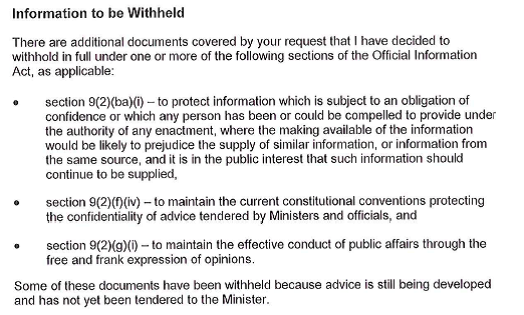
They have withheld a variety of other documents.  I’m not sure quite what the first ground (below) means in this context –  perhaps information from foreign agencies? –  but what is interesting is that the statement declining to release the other documents reveals that Treasury is continuing its own work on the issue.

Tsy governance OIA

At one level, it is nice to finally have public confirmation of the fact that the Minister of Finance has again rejected reforming the governance of the Reserve Bank.  Treasury reports that this is because the Minister thinks a single decision-maker best supports accountability.  But hardly any other country agrees with Mr English, and none do so among those who have reformed their arrangements for the central bank and financial supervision activities in the last couple of decades.    And we don’t apply that model to any other area in public life in which government agencies are making policy decisions.   There is a strong case for change, and no doubt in time change will happen.   It is a shame that the Minister is clinging to an outdated model, which is not serving New Zealand that well.  But well done to the Treasury for continuing the background work in thinking through the issues and options,

Justice Collins, the OIA and the Reserve Bank

In the High Court earlier this week,  Justice Collins –  the former Solicitor General  – handed down a significant judgement in an Official Information Act case.  The judgement itself is a fairly easy read, and Otago University law professor Andrew Geddis has a nice summary of the issues and implications here.

Professor Jane Kelsey, of Auckland University, had sought from the Minister of Trade, Tim Groser,  material associated with the TPP negotiations.  The Minister declined Professor Kelsey’s application, prompting her (and several NGOs) to seek a judicial review of the Minister’s decision (which had been upheld by the Ombudsman).

Professor Kelsey’s challenge was largely successful.  It is a decision that does not reflect well on Tim Groser, and perhaps reflects even less well on the Chief Ombudsman.   As Andrew Geddis put it

The third audience for this judgment is the Ombudsman’s office, and the Chief Ombudsman Beverley Wakem in particular. Because it is fair to say that she does not come out of the judgment all that well. Not only does Justice Collins find that she apparently misunderstands how a quite key legal test under the OIA is meant to apply (at para. [139]), but her failure to pick up MFAT/Tim Groser’s ignoring of proper process is quite concerning.

After all, the Ombudsman is meant to be the primary check on those who hold official information failing to abide by their legal obligations. If that office is not noticing those failures – if it is basically waving through decisions that fail to comply with the OIA – then what is a citizen to do? The Courts are always there in theory … but in the real world this is a completely unrealistic avenue of redress because of the time and expense involved.

The judge reminded people of the important place the Official Information Act has in New Zealand’s system of government.  He draws on the 1980 report of the Danks Committee, which laid the foundations for the Official Information Act, highlighting the principles of open government that are reflected in the wording of the Act.  Indeed, the judge describes the Act as “an important component of New Zealand’s constitutional matrix”.  It imposes significant obligations on ministers and public servants (and other government agencies) –  and these are obligations that must be complied with, not simply aspirations to be met when it is convenient to do so..

What was the problem with the way Tim Groser handled the request?  The main issue was the blanket refusal to release any of the material Kelsey sought, without (a)  considering each piece of information individually, and (b) considering whether parts of any of these documents could be released.  Again in Andrew Geddis’s words:

the major flaw in MFAT’s/Tim Groser’s process was their adoption of a blanket approach to deciding whether or not to release any information. Reverse engineering the judgment a bit, it looks like MFAT/Tim Groser took this approach to the issue:

    • Jane Kelsey’s request was for lots and lots of material, which it would be a pain in the backside to have to go through;
    • MFAT/Tim Groser knew that they would have valid grounds under the OIA to refuse to release anything “interesting” contained in that material;
    • Anything left over after they redacted the “interesting” stuff would be useless for Jane Kelsey’s purposes;
    • Therefore, rather than waste time and effort going through all the material to weed out the “interesting” stuff, they instead decided not to release anything at all.

The problem with this approach is that it runs completely counter to the OIA’s basic purpose – to make any and all information available unless one of the specific reasons in the legislation applies. For the information holder to decide that it won’t provide information without actually looking at it and considering if there is a valid statutory reason for refusing its release inverts the way the OIA is supposed to work.

The judge did not rule that any specific bits of information have to be released.  It was a ruling about the need to apply proper process.  Going through lots of documents can be costly and inconvenient, but again (a) that was choice Parliament made in 1982, and represents an obligation on public agencies, and (b) the Act allows for agencies to specify a “reasonable” charge  especially if meeting the request would involve substantial collation or reaearch, and requires the agency concerned to  “consider whether consulting with the person who made the request would assist that person to make the request in a form that would remove the reason for the refusal”.     Tim Groser did none of these things.

Why I am writing about this case here?    First, because open government is an important cause, and the more people who are aware of these issues ,and abuses, the better.

But second, because I have been on the receiving end of several of these sorts of blanket refusals from the Reserve Bank of New Zealand.

I have written about one of them already.  I’d requested copies of the work the Reserve Bank had done on governance issues, and was flatly refused.

I got from holiday the other day to find two more examples in my inbox.

On 24 September, I received this response to one request:        

On 27 August you made an Official Information request seeking:

 Copies of the minutes of all meetings of the Reserve Bank’s Governing Committee held in the first six months of 2015

The Reserve Bank is withholding information under the following provisions of the Official Information Act:

  • Section 6(e)(iv) – to prevent damaging the economy of New Zealand by disclosing prematurely decisions to change or continue government economic or financial policies relating to the stability, control, and adjustment of prices of goods and services, rents, and other costs;
  • Section 9(2)(d) – to avoid prejudice to the substantial economic interests of New Zealand; and
  • Section 9(2)(g)(i) – to maintain the effective conduct of public affairs through the free and frank expression of opinions by or between officers and employees of any department or organisation in the course of their duty.

Section 6 of the Act provides conclusive reasons to withhold information. Section 9 of the Act requires the Bank to consider if the public interest in making the information available outweighs the public interest in withholding the information. The Reserve Bank recognises the tension between disclosure and confidentiality and has considered your request in light of that tension. Public disclosure, in summary form, is essentially what happens with monetary policy decisions in a carefully considered media release and the full text of the Monetary Policy statement. The process of deciding what to publish in these documents recognises and balances the tension between disclosure and confidentiality.

You have the right to seek a review of the Bank’s decision under section 28 of the Official Information Act.

And on 25 September I received this response to another request  

On 10 September you made an Official Information request seeking:

 Copies of all papers being provided to the Reserve Bank’s Board in respect of the September 2015 Monetary Policy Statement released this morning.

The Reserve Bank is withholding the information under the following provisions of the Official Information Act (the Act):

  • Section 6(e)(iv) – to prevent damaging the economy of New Zealand by disclosing prematurely decisions to change or continue government economic or financial policies relating to the stability, control, and adjustment of prices of goods and services, rents, and other costs;
  • Section 9(2)(d) – to avoid prejudice to the substantial economic interests of New Zealand; and
  • Section 9(2)(g)(i) – to maintain the effective conduct of public affairs through the free and frank expression of opinions by or between officers and employees of any department or organisation in the course of their duty.

The Act explicitly recognises, in section 4(c), that there are times when releasing information is against the public interest and provides for such circumstances with different types of reasons to withhold information. Section 6 of the Act provides conclusive reasons to withhold information and section 9 provides reasons that must be balanced with the public interest in making the information available.

Public disclosure, in summary form, is essentially what happens with monetary policy decisions – in a carefully considered media release and the full text of the Monetary Policy statement. The process of deciding what to publish in these documents recognises and balances the tension between disclosure and confidentiality.

You have the right to seek a review of the Bank’s decision under section 28 of the Official Information Act.

Taking them in turn, the first request was for copies of the minutes of meetings of the Reserve Bank’s Governing Committee for the first six months of 2015.   The Governing Committee, readers may recall, is the internal committee comprising the Governor, his two deputies and his assistant governor, set up by Graeme Wheeler and advertised as the forum in which the Governor would make major decisions (all legal decision-making authority, of course, rests with the Governor).

The response is puzzling in a number of areas.  First, the Bank appears to assume that my only interest in the minutes was the OCR decisions.  As the judge noted, it is not up to agencies to make assumptions about the interests of applicants, and in this occasion I had given no reason to suggest that OCR decisions were my primary interest.  In fact, my interest was is process and governance, and illustrating the lack of transparency and effective accountability around Reserve Bank decision-making, whether on monetary policy or other (policy or corporate) matters.  Indeed, I had heard, but was keen to verify, that minutes of this new forum consisted of little or no more than a single sentence record of the decision made.

There may well be material in the Governing Committee minutes that could be reasonably withheld under the Act, but the Bank has not made its case, or shown any sign that it has considered the contents of each of the individual sets of minutes.  It is almost inconceivable that there is nothing in any of those minutes  that could not safely be released (even if only the dates, attendees, and subject matter).  Justice Collins appears to have ruled that blanket refusals of this sort are not permissible.  I intend to pursue this matter with the Ombudsman, and may also request from the Bank copies any papers or emails that deal with their handling of my request.

The second request was for papers provided to the Reserve Bank Board in respect of the September Monetary Policy Statement.  Once the MPS has been released, the Board typically receives all the “forecast week” papers, and (anonymised) copies of the individual pieces of advice/recommendations provided to the Governor (Governing Committee) on what to do with the OCR.

Again, the Bank appears to have made no effort to look at each of the individual papers to determine whether all of each and every one of them should be withheld under the OIA.    Blanket refusals are simply not acceptable, according to Justice Collins’ judgement.

In (a rather slow and reluctant) response to a previous request of mine, the Reserve Bank has released all the forecast week papers for the March 2005 Monetary Policy Statement round. The character of the papers is no different now than it was then, and who can take seriously a claim that to release today’s equivalent of this paper (on business investment) would damage the New Zealand economy, prejudice the substantial economic interests of New Zealand, or impair the effective conduct of public affairs?    Clearly the main issue now is one of timing –  papers from 10 years ago don’t bother them, but papers from a few weeks ago do –  but they still need to make the case, paper by paper, and explain the reasons for their decisions.  I deliberately did not ask until the MPS itself had been released.  And I deliberately asked for the papers that went to the Board, not those that went to the Governor, because I knew that the OCR advice was anonymised before it went to the Board.   But senior staff should be able to provide advice to the Governor, in a professional manner, even if that advice is subsequently disclosed.  It is now not uncommon overseas for the views of individual Monetary Policy Committee members to be made public, with a relatively short lag.

In its reply, the Bank falls back on a common Bank line: background papers don’t need to be disclosed because

Public disclosure, in summary form, is essentially what happens with monetary policy decisions – in a carefully considered media release and the full text of the Monetary Policy statement. The process of deciding what to publish in these documents recognises and balances the tension between disclosure and confidentiality.

But this is simply unconvincing.  The point of the law is not to allow government agencies to release only what it suits them to convey to the public.    If that were so, for example, there would be no release of background Budget papers –  because the final Budget documents and “carefully considered” press releases would do the job.    Background papers are official information, and the presumption in the Act is in favour of release.

To be clear, I would expect that even if the Bank had taken an approach more consistent with the letter and spirit of the Act that there would have been a limited amount of material withheld from a few of the papers (eg those around judgements that might influence exchange rate intervention during the subsequent few weeks).   But each exclusion needs to be explicitly justified under a specific provision of the Act, not with a blanket refusal and a condescending stance of “we know what is the best balance between disclosure and confidentiality”.

Many of the specific issues in this request would be dealt with permanently if the Bank would pro-actively determine a suitable release policy for background MPS papers.  We now know that they are happy enough to release 10 year old papers, but not those a few weeks old.  I used to argue internally that, say, a six or twelve month lag would be a huge step forward, and involve no material risks for the Bank.

As I have been highlighting for months, despite its claims to the contrary, our Reserve Bank is not a very transparent organisation.  That is true of management and of the Board.  It is true of monetary policy, banking regulation policy, and corporate and budgetary matters.      Reasonable people might differ as to how open the Bank should be in each of these areas –  although it has never been clear what they have to hide, as distinct from an institutional cast of mind that says ‘we’ll tell you what we think you should know, when we think you should know it”.  But breaches of the law are a much more serious matter.  It increasingly looks as though the Reserve Bank –  like, no doubt, other government agencies – plays rather fast and loose with the provisions of the Official Information Act.  That should concern voters, and more immediately it should concern those charged with holding the Bank to account –  the Board, the Minister of Finance, the Treasury, and Parliament’s Finance and Expenditure Committee.

The Board reports…and says almost nothing

In late August I wrote a piece looking forward to the Annual Report of the Reserve Bank of New Zealand’s Board.   On 27 September, that report was published quietly –  buried inside the Reserve Bank’s own Annual Report, and with no mention of it in the Governor’s press release.    As far as I can see, the Board’s Annual Report got no media coverage at all.

That is both understandable and disappointing.  Understandable, because it is much harder to report what isn’t there.  And disappointing  because Parliament set up the Reserve Bank Board as the principal body charged with holding to account the Governor of the Reserve Bank –  who is probably the single most powerful unelected individual in New Zealand.   The Board, with unparalleled access to inside information, was intended to be the agent for the Minister of Finance and for the general public in holding the Governor, and the Bank, to account.

When the Reserve Bank Act was introduced, the vision of accountability was a pretty simple one:  if (core) inflation was away from target, the Governor was culpable.  It was pretty quickly realised that things were more complex than that.  In addition, the Reserve Bank (Governor) has been given, and has assumed, a lot more discretionary power in a much wider range of areas.  Properly assessing the performance of the Governor in handling his statutory responsibilities/powers requires some pretty substantial analysis.  And substantive accountability isn’t just about a group of the great and good declaring their satisfaction, but about laying out the arguments and evidence, including addressing and responding to the strongest arguments of the critics.

Over 25 years, the Reserve Bank’s Board has pretty consistently failed in that role, even since the requirement for a published Annual Report was introduced in 2003, and the Governor was removed as chair.  From time to time they have asked awkward questions in private  –  no one has ever adequately been able to answer the questions Viv Hall used to pose around quite what clause 4(b) of the PTA really meant  –  and Boards have often had their own individual awkward and dissatisfied members.  But the public face of the Board has been a consistently bland and affirming one.  From the public’s perspective –  and I suspect from that of members of Parliament –  the Board adds next to no value.

That isn’t primarily a commentary on the individuals involved.  I’ve had good relations with many of the able members over the years.  The problem isn’t really with the individuals but with the institutional arrangements and incentives.

The Reserve Bank Board is set up to look like the Board of a corporate.  Many of the people appointed to the Reserve Bank Board have served on corporate Boards.  On a corporate Board the CEO runs the day-to-day business, but the Board is ultimately responsible for the strategy (and for the CEO).  It can command resources.  A very close relationship between CEO and Board is vital to the successful functioning of the organisation, and  –  at least in public – the Board needs to fully back the CEO, at least until the day they fire him or her.

By contrast, the Reserve Bank’s Board has no involvement in setting strategy, or deciding policy.  It has formal input to a handful of not-overly-important decisions (eg the size of the dividend to recommend), and only two big roles –  the responsibility to recommend the appointment of a person as Governor (and no person can be appointed who has not been recommended by the Board) and the ability to recommend dismissal (although it cannot actually dismiss the Governor,  and contrary to what is stated in this year’s Annual Report the Minister of Finance can act to dismiss without a recommendation of the Board).

The Act is quite clear that the primary role of the Board is ex post review and accountability.  And yet it goes through the routines that look like a normal corporate Board.  There are monthly Board meetings, a Board audit committee, Board papers, the CEO sits as a member of the Board.  A senior staff member serves as Secretary to the Board.  The Board meets on Bank premises, and has no independent budget or staff resources of its own.  But for an accountability board, the asymmetry is profound –  the Governor has 300 staff who all work fulltime on Reserve Bank issues, while Board members –  not typically experts in the field –  devote a few hours a month to the issues.

The Board can ask for papers from management, but it can’t compel the production of such papers.  It typically meets not just with the Governor (a fellow member of the Board), but with Deputy and Assistant Governors present throughout the meetings, and with other staff in attendance as required.  And unlike the situation in most Crown agencies, even though the Minister of Finance appoints the members of the Board[1], he does not get to appoint the chair.  Rather Board members get to select their own chair, increasing the likelihood that the role will be filled by someone who gets on easily with the Governor.

It would be recipe, perhaps, for effective collegial decision-making, if the Board were a decision-making Board.  But the Board doesn’t have that role; it is supposed to be an arms-length review and accountability agency.  And human nature is to avoid asking too many hard questions of those one works closely with, and to defer to expertise.    That happens between the Board and the Governor, and within the Board.   Thus, both of the independent chairs of the Board have been former senior executives of the Reserve Bank, and the current chair actually spent six months as acting Governor, aiming (unsuccessfully) to become Governor himself).   Both are able people, and either might be well-qualified to sit in a decision-making Reserve Bank Board.  But when the role of the Board is to ask hard questions and hold the Bank to account, being a former senior staffer isn’t necessarily the  best qualification for a Board chair.  Yes, former staff can ask awkward questions too, but in general  – even if they have some technical insights other Board members won’t have – they will be too ready to see things through the eyes of the Governor and staff, to “have his back” as it were.  But we  – citizens –  need a robust and independent eye.  Awkward questions, not sympathy.   Too often, the Reserve Bank’s Board seems to see a significant part of its role as being to help the Governor spread  his story and to explain the choices the Governor is making.

Don’t take my word for it:  this year’s Board report states explicitly

With most Board meetings…the Board hosts a larger evening function to engage with representatives of many local businesses and organisations, and to enhance our understanding of local economic developments and issues……. This outreach is a longstanding practice of the Board to ensure visibility of its role among the wider community, and to facilitate directors’ understanding of local economic developments, and the wider public’s understanding of the Bank’s policies.

Worthy activities for management, but that isn’t the role Parliament envisaged for the Board –  whose purpose is to hold management to account, not help management explain their choices to (select elements of) the public.

All that is by way of getting to this year’s Board Annual Report (from p3).  It was better than last year’s in one respect.  This year’s report stretched out to a little over three pages (last year’s was less than two pages).  But most of it is still descriptive (and even that contains an error).  I counted 41 paragraphs in the report.  Of them, at most 10 could be considered having anything other than purely descriptive material (“these are the activities we undertake/documents we receive/meetings we attended”).

In my earlier post, I identified some issues this year’s report might cover, if it were to do well the sort of scrutiny and accountability job Parliament appears to have intended.

This year’s Annual Report might perhaps cover, in some depth, issues such as:

The way that core inflation has now been well below the middle of the target range for some years

• The significant policy mistake that was made last year in raising the OCR repeatedly and only very belatedly beginning to slowly cut it again.

• The poor quality of Bank’s research, analysis, and argumentation around the housing market, and around the new investor finance restrictions in particular.

• The obstructive and non-transparent approach the Bank has taken, including with respect to compliance with the Official Information Act.

What is about the Governor’s performance, and stewardship of resources, that has led to these outcomes? And what steps are being taken to avoid a repetition?  Many outsiders might have a view, but the Board has unique access to the inner workings of the Bank, and the ability to grill management.

In fact, probably to no one’s surprise, there is no substantive analysis in the report of any of these issues, or any others.  The report has a single sentence stating its comfort with the new LVR restrictions.  In discussing monetary policy, the substantial policy reversal (in which the OCR was raised aggressively last year and then cut this year) was not even mentioned.  The Board appears to have had no concerns about the conduct of monetary policy at any point in the year, and simply offers the anodyne observation that they consider that “the Governor made appropriate monetary policy decisions”, while providing no analysis to defend that conclusion (although  I don’t take from that text that they gave the Governor an enthusiastic A+).  In neither monetary policy nor financial stability is there any sense of the events and policy responses being part of a chain of events stretching back over several years.

I’m not suggesting that the Board should have concluded that the Governor made mistakes.  Reasonable people might differ on that, but we should expect to see signs that the Board has thought hard about the issues, engaged with alternative perspectives, rather than just looked to gloss over any potential areas of awkwardness.  There is no sign of that this year, or in previous years.

In essence what we seem to have is a model in which the Board majority has mostly been interested in being something of a cheer leader for the Governor, helping get the Governor’s message across and not making trouble. But they don’t seem to realise that they work  not for the Governor but for the public –  who need robust scrutiny of powerful public agencies.

The Board’s Annual Report contains a mildly interesting list of some of the papers management provided to the Board during the year (I might OIA a couple of them).  But it must surely be a list than contains a major omission.  Readers may recall that I lodged an OIA request for copies of any work the Bank had been doing on reforming the governance of the Bank.  The Bank refused to release anything, in the process confirming the scale of the work programme they had underway (which appears to have included professional legal advice and discussions with the Minister of Finance).  Given the sensitivities the Board has historically displayed around anything to do with governance –  including Bulletin articles on related issues –  it is simply inconceivable that there were no discussions at the Board, or papers to the Board, on the issue during the 2014/15 year.  The Board might reflect that there would be at least as great a public interest in knowing that the Board has received, and discussed, a paper on that issue as on, say, “differences in methodologies in calculating and assessing the output gap”.

The Reserve Bank’s Board simply does not do its job well. It may be useful in some other roles –  perhaps an occasional sounding board for the Governor –  but the Board that is supposed to be focused on arms-length accountability and review, as agent for the Minister and the public.  And yet it has never once published a critical comment about the Bank (in subject matter which is riddled with uncertainty and where mistakes and revisions to judgements are inevitable)  It does not publish its minutes, its papers, its agenda (even with a lag) and is just as obstructive of OIA requests as Bank management.  It is simply not worth the money we spend on it.

Readers might wonder why I harp on the issue.  After all, the Board doesn’t cost that much.  But recall just how much power the Governor, personally, exercises.  The Board was supposed to provide the check on gubernatorial mistakes or misjudgements –  counterweight to the unusual amount of power vested in a single unelected official.  It has not done so, does not do so, and probably –  as currently constituted –  cannot really be expected to do so.  We need serious structural reform of the Reserve Bank: decision-making by committees appointed by the Minister of Finance, and ex post review and analysis (of all limbs of macro policy) by a body that is better resourced and operates at much greater distance from the Governor and his senior staff.

[1] Although the Governor himself has an input.  On one occasion, a former Governor adamantly insisted to the Minister that a certain former respected market economist not be appointed (he and the Governor had recently disagreed on the OCR).  The Minister gave way (appointing instead someone who had recently been the political adviser in the office of one of his colleagues).

Bagehot on reforming the Reserve Bank Act

In a comment the other day on my post outlining a possible alternative governance model for the Reserve Bank, Andrew Coleman at the University of Otago included some quotes from Walter Bagehot’s 1873 classic work Lombard Street: A Description of the Money Market (available free here).

The quote that particularly took my fancy was some concluding remarks Bagehot made about the need for changes to the structure and governance of the Bank of England.

“There should be no delicacy as to altering the constitution of the Bank of England. The existing constitution was framed in times that have passed away, and was intended to be used for purposes very different from the present. The founders may have considered that it would lend money to the Government, that it would keep the money of the Government, that it would issue notes payable to bearer, but that it would keep the ‘Banking reserve’ of a great nation no one in the seventeenth century imagined. And when the use to which we are putting an old thing is a new use, in common sense we should think whether the old thing is quite fit for the use to which we are setting it. ‘Putting new wine into old bottles’ is safe only when you watch the condition of the bottle, and adapt its structure most carefully.”

He could have been writing about New Zealand’s situation now.

As I’ve pointed out, our Reserve Bank Act, and particularly the governance features of it, were designed in 1989.  Back then, there weren’t many modern international models to build on.  The provisions of the Act were designed to align with a vision of how core government departments would be run that has now been largely abandoned, they were designed for a conception of what the central bank would be doing that envisaged very little effective discretion, and they were designed before the Crown entities framework was developed for the many other non-departmental government agencies in New Zealand.

Those times have, in Bagehot’s words,  “passed away” and we now need a review and extensive revision of governance, transparency and accountability provisions of the Reserve Bank Act.  Discussion of the issue often focuses on monetary policy, but the governance of the Bank’s extensive powers in banking, non-bank, and insurance regulation is at least as important (and more challenging because the goals are less well-defined).  And as I have been highlighting in the last few weeks, we need to ensure much more openness from the Bank across all its functions, and some more effective structures for holding the Bank and its decision-makers to account.  Bagehot uses a biblical image, but we can go a little further: putting new wine [new expectations of what the Bank should do and how] into old wineskins [the 26 year old Act]  leaves the New Zealand system out of step, and is a recipe for some rather poor and unsatisfactory outcomes.

And with that, I’ll stop for now.  I’ll be back around 13 October,

The Labour Party spokesman and the Reserve Bank

I wrote this morning that I didn’t really understand why the current government was not willing to do something about reforming the governance of the Reserve Bank.  But it isn’t my only area of puzzlement around how politicians deal with Reserve Bank issues.

For the last day or so, I’ve been pondering the post-MPS statement put out by the (relatively) new Labour Party Finance spokesperson, Grant Robertson.  It continues a line he has run for some time, in which he lauds Graeme Wheeler for doing what must be done on monetary policy, and speaking the truth to power around the state of the economy and the housing market.  Wheeler as the active hero and Bill English as the neglectful spectator is the thrust of his story.

I understand that the point of Opposition is to become the government, and one does that by casting the current lot in a bad light.  But Grant Robertson’s approach doesn’t seem to be a particularly well-chosen way to do that.  Indeed, one could have some sympathy for the Minister of Finance.  He appointed Graeme Wheeler, and signed him up to a more specific inflation target than previously, with an explicit focus on the 2 per cent midpoint.  Three years on there is no sign of core inflation –  or headline –  being anywhere near 2 per cent.  There might be good reasons for that, but the Governor has failed to do well his primary function.  Believe the Governor and we’ll be back at 2 per cent next year, but then he said that last year, and the year before.  And it was the Governor who raised interest rates by a whole 100 basis points last year, when there was never a clear and compelling need for any rate increases, and now it is the Governor who is only grudgingly bringing them down again.  World dairy prices aren’t something the Governor can control, but the economy now would not be as weak as it seems to be,   and – not incidentally –  inflation would be nearer target if (a) interest rates had not been raised so much, and (b) if having been raised, they had been lowered more quickly.  As I noted yesterday, we are probably the only OECD country that has real interest rates higher than they were at the start of last year, and that is Graeme Wheeler’s doing (and that of his staff).  It certainly isn’t Bill English’s fault.  Does anyone actually think it is?

But there is still room to criticise the Minister of Finance.  The Bank’s Board is appointed by the Minister of Finance, and paid, to hold the Governor to account.  The Minister has made the odd frustrated noise in public, and is probably more frustrated in private.  But what is he doing about it?  Has he sought advice from Treasury, and let it be known that he was seeking such advice?  Has he sought advice from the Board, and let it be known that he was seeking such advice? Bill Birch did back in the 1990s when inflation was temporarily outside the top of the target range.  But there is no sign of either action this time.  And in his annual letter of expectation to the Governor earlier this year there was also no sign of any discontent or serious concern from the Minister, despite years of core inflation falling increasingly below target.    The Governor has a lot of power, but it is the Minister’s job (directly and through his agents) to hold the Governor to account.  To the extent that he fails to do so, he makes himself complicit in the Governor’s mistakes.    Perhaps it would be too geeky and “inside the Beltway” for the Opposition to make these points, but they would be more telling charges than praising the Governor as a way to make the government look bad.

Robertson also seems to laud Graeme Wheeler’s contribution to the housing debate, while curiously suggesting that a “housing market that threatens banking stability [it doesn’t]” is “beyond the remit of the Reserve Bank”.  If anything, the Reserve Bank’s contribution to the housing market debate is pretty disappointingly weak.  Wheeler has rushed in with a series of relatively ineffective, but quite distortionary and nastily redistributive, interventions, for which he has no real mandate, all founded on very poor quality analysis and non-existent research.  And all the while keeping secret any submissions that have been made on those proposals.  In terms of wider housing policy preferences, he and the Bank simply seem to fall in line with the preferences of the current government –  he likes things that were done in the Budget, and thinks there should be “more supply”, but offers no serious analysis of the role of policy-driven demand pressures, whether around tax or around immigration policy.  And having done stress tests which suggest a  pretty robust banking system, even in the face of very large adverse shocks, the Governor has been quite unable (certainly unwilling) to make a case for why his own interventions are appropriate, in terms of the statutory goals Parliament has given the Bank.  The Reserve Bank’s job is to keep the financial system sound.  It appears, on its own numbers, to have done that.  Beyond that, if it is going to make a useful contribution to a debate around housing, as a public agency, it needs to do so on the basis of much richer and more robust research than we’ve seen to date.  The Minister of Finance is responsible, on our behalf, for ensuring that they do rather better.  Again, the Labour Party could point this out.

We have a poor system for governing our, now extremely powerful, Reserve Bank.  The Labour Party could usefully make the case for change. They’ve toyed with it in the past, but seem uninterested now when the problems are more than just theoretical ones. Inflation is well away from target, and may drift further away, and all while the unemployment rate is rising. That is largely the Reserve Bank’s fault, but even in this area Robertson seems only interested in highlighting contrasts between the Reserve Bank’s latest projections and past government ones.   Labour might point out that it is the government’s job to hold the institution, and the incumbent Governor, to account, and to fix the systemic/institutional problems.  At present, it seems to be doing neither.