Reforming the Reserve Bank

A couple of weeks ago I wrote a post on where the Labour Party seemed to be going on monetary policy, informed by Alex Tarrant’s interest.co.nz article on his conversations with Grant Robertson.  It all seemed to amount to not very much –  wording changes to make explicit an interest in the labour market (employment/unemployment), but without much reason to think it would make much difference to anything of substance.  My suggestion was that there was a distinct whiff of virtue-signalling about it.   And the sort of change Robertson seemed interested in on the governance front  –  legislating the position of in-house technocrats –  seemed unlikely to be much of a step forward at all.

Last week, interest.co.nz had a piece on the same issues by former Herald economics editor Brian Fallow, also benefiting from an interview with Robertson.   Fallow pushes a bit harder.  His summary is that

The changes Labour proposes to make to the monetary policy framework sit somewhere between cosmetic and perilous, but closer to the former.

Cosmetic for the sorts of reasons I’ve outlined.  On the one hand, the Bank has always taken the labour market into account as one indicator of excess capacity.  And on the other hand, plenty of pieces of overseas central banking legislation refer to employment/unemployment somewhere, but there is little evidence that the central banks in those countries have run monetary policy much differently, on average over time, than the Reserve Bank of New Zealand has.

Robertson’s response is pretty underwhelming.

Asked how much difference the regime he advocates would have made, had it been in place in the past, he said, “In the very immediate past, not that much, truthfully. But there have been other times in our history, and there have been other examples around the world, when lower interest rates could have helped to reduce unemployment.”

If he was serious about this making a difference, he’d surely be able to quote chapter and verse.  When, where and how does he think it would have made a difference?

He is, however, clearly tantalised by the current situation

Even now, “Are we satisfied as a country that with 3.5% growth 5.2% unemployment is okay?”

Given that the Treasury thinks our NAIRU is nearer 4 per cent, I don’t think we should be content.  But Robertson has spent so long over the last few years defending Graeme Wheeler that he can’t quite bring himself, even now, to suggest that monetary policy could have been conducted better in the last five years, whether on the current mandate or something a little different.

If the proposed change isn’t cosmetic, Fallow worries that it could be perilous.  Why?  Because when he pushes Robertson he gets a more explicit –  and more concerning –  answer than the one Alex Tarrant got.

He has told interest.co.nz’s Alex Tarrant that he was not going to tell the Reserve Bank whether one objective is more important than the other.

Talking to me, however, he said that ultimately the bank would remain independent. “But if unemployment starts to get out of control I would expect in that environment it says ‘At this time we are preferencing that and we are going to lower rates by a greater percentage than we might have’.”

In the event of a stagflation scenario he would expect it to focus more on the falling output and employment side of the dilemma and to ease.

“I think the setting of a clear direction here is what is important.”

In short Robertson seems to be saying that if Parliament were to change the statute, the message to the bank would be when in doubt err on the side of stimulus.

If unemployment is prioritised by the Reserve Bank in such circumstances, it is a recipe for inflation getting away.  In the medium-term, monetary policy can really only affect nominal variables (inflation, price level, nominal GDP or whatever), it simply can’t affect real variables.  Using monetary policy to pursue such goals directly is a risky prescription.  I wouldn’t want to overstate the issue –  New Zealand isn’t heading for hyperinflation – but part of reason we and other countries ended up with persistently high inflation in the 1970s is that too much weight was placed on unemployment in setting monetary policy.  Getting inflation back down again was costly –  including in terms of increased unemployment.  On a smaller scale, as Fallow highlights, the desire to “give growth a chance” was part of what was behind the monetary policy misjudgements of 2003 to 2006, when monetary policy wasn’t tight enough.

Robertson’s words suggest he still hasn’t thought the issues through very deeply or carefully.  For now, I’m sticking with the “cosmetic” or virtue-signalling interpretation of what Labour is on about.   And I’m still uncomfortable at the lack of command of the issues and experience in someone who aspires to be Minister of Finance later this year.

But yesterday, a mainstream economist came out in support of more or less the direction Robertson is proposing.  In his youth Peter Redward spent a few years at the Reserve Bank, and then spent time in various roles, including at Barclays and Deutsche Bank, before returning to New Zealand and establishing his own economic and financial markets advisory firm.  He focuses on emerging Asian foreign exchange markets, but keeps a keen eye on monetary policy developments in New Zealand.

In his short piece at Newsroom, Peter Redward says It’s time for a Reserve Bank change.  He notes of the last few years that

Whether Governor Wheeler consciously aimed for a hawkish interpretation of the Act, or not, we may never know. But hawkish he’s been, leading to tighter monetary conditions than were necessary, boosting the New Zealand dollar and confining thousands of New Zealanders to needless unemployment.

And argues that

…maybe it’s time to adopt a dual mandate in the Act. One possibility is the dual mandate of the U.S. Federal Reserve. The Federal Reserve has a two percent inflation target but it also targets ‘maximum employment’. Economists have differing interpretations of ‘maximum employment’ so it acts as a constraint, and that’s the point.

While no one knows exactly where ‘maximum employment’ in New Zealand is, I believe most economists would agree that it’s likely to be consistent with an unemployment rate somewhere around 4.5 percent (give or take 0.25 percent). If the Reserve Bank had a dual mandate, its elevated level would have acted to constrain the bank’s aborted tightening of policy in 2009 and 2014.

I’m very sympathetic to his critique of Graeme Wheeler’s stewardship of monetary policy, and highlighted in numerous of my own commentaries, after it became apparent that the 2014 OCR increases had been an unnecessary mistake, the Governor’s apparent indifference to an unemployment rate that remained well above any estimates of a NAIRU.

But I remain a bit more sceptical than Peter appears to be about how much difference a re-specified mandate might have made.  As I’ve argued before, past Reserve Bank research suggests that faced with the sorts of shocks New Zealand experienced, policymakers at the Fed, the RBA and the Bank of Canada would have responded much the same way as the Reserve Bank of New Zealand did.  That work was done for periods prior to 2008/09 –  for most of the time since then the Fed was at or very near the lower bound on interest rates, so the game was a bit different –  but it isn’t clear that the specification of the target has been the problem in New Zealand in the last few years.  After all, simply on inflation grounds alone the Reserve Bank hasn’t done well.

Here is a chart of the Reserve Bank’s unemployment rate projections from the March 2014 MPS, the occasion when they started raising the OCR.

2014 U projections.png

The second observation is the last actual data they had –  the unemployment rate for the December 2013 quarter.  So when they started the tightening cycle they thought the unemployment would be falling quite considerably that year, before levelling out around what they thought of as something near what they must have thought of as the practical NAIRU  (this was before last year’s revisions to the HLFS which lowered unemployment rates, and NAIRU estimates, for the last few years).    The problem then wasn’t that they didn’t care about unemployment, it is that they got their forecasts –  particular as regards inflation –  badly wrong.  It isn’t clear why a different target specification would have altered the policy judgement at the time.

Perhaps it would have done so once it became apparent that the OCR increases hadn’t really been necessary, but a stubborn refusal by the Governor to concede mistakes, even with hindsight, plus a mindset firmly focused on how “extraordinarily stimulatory” monetary policy allegedly was –  when no one had any real idea what a neutral interest rate might be in the current environment, and when inflation stubbornly didn’t rise much if at all –  seem more likely explanations.    The Bank kept forecasting that inflation would rise and unemployment would fall –  the jointly desired outcomes.

(And if one looks at the Bank’s forecasts in mid 2010, when they made the previous unnecessary start on tightening, one gets much the same picture –  forecasts of falling unemployment and rising inflation, that simply didn’t happen.)

So why should we supposed that a different specification of the target would have made much difference to how policy was set?  We had an institution that was misreading things, in a political climate where no one seemed much bothered by the unemployment rate holding up, and where for a long time financial markets endorsed the approach taken by the Reserve Bank (often more enthusiastic for future tightenings than even the Governor and his advisers were).   Getting something closer to the right model of the world (for the times), and quickly learning from one’s mis-steps, seem likely to matter more than the words of the Act in this area.

As I’ve said repeatedly here, I’m not firmly opposed to amending the relevant clauses of the Reserve Bank Act to mention the desirability of things like a low unemployment rate.  But even the Federal Reserve Act makes clear that good monetary policy focused on a nominal target creates a climate consistent with high employment.  High employment isn’t a goal for the Federal Reserve is supposed to pursue directly, even if –  all else equal –  a high unemployment rate relative to an (uncertain) NAIRU is a useful indicator that something might be wrong with monetary policy settings. It isn’t clear there is anything much to gain from such amendments –  or that they are where the real issues regarding the Reserve Bank are – but sometimes perhaps virtue needs to be signalled?    My own concrete suggestion in this area would be to require the Reserve Bank to publish, every six months, its own estimates of the NAIRU and to explain the reasons for the deviations of actual unemployment from the NAIRU, how quickly that gap could be expected to close, and the contribution of monetary policy to the evolution of the gap.

Brian Fallow’s article suggested that Labour still hasn’t settled on how to reform the governance of the Reserve Bank.

Robertson is non-committal at this stage on the composition of a monetary policy committee to take interest rate decisions, including to what extent it should include members from outside the bank.

Peter Redward has a more specific proposal for him.

What’s needed is a formal Monetary Board complete with published minutes and, released after a grace period, transcripts of the meeting and the voting record of members. In a recent speech, U.S. Federal Reserve Vice Chair, Stanley Fischer, argued that this arrangement is superior to the sole responsibility model in achieving outcomes and accountability. Changes to the role and responsibility of the Governor will necessitate changes to the structure of the Reserve Bank Board. Best practice would suggest that a Monetary Board should be created to set monetary policy with the Reserve Bank Board selecting candidates for the committee while maintaining oversight of the bank. To ensure that external board members are not simply captured by the bank it may be necessary to provide a secretariat similar to the Fonterra Shareholder’s Council, operated at arms-length from bank management.

It isn’t my favoured model, but it would be a considerable step in the right direction, and far superior – in terms of heightened accountability and good governance of a powerful government agency –  to Graeme Wheeler’s preference to legislate his own internal committee.  The biggest problem I see with the Redward proposal, is that it has too much of a democratic deficit.  Monetary policy decisionmakers shouldn’t be appointed by other unelected people –  the Reserve Bank Board –  but by people (the Minister of Finance and his Cabinet colleagues) whom we the voters can toss out. That is how it is pretty much everywhere else.

Peter’s proposal focuses on monetary policy.  But, of course, the Reserve Bank has much wider policy responsibilities, including a lot of discretionary power –  not constrained by anything like the PTA –  in the area of financial regulation.  I presume he would also favour committee decisionmaking for those functions.  I’ve proposed two committees –  a Monetary Policy Committee and a Prudential Policy Committee, each appointed by the Minister of Finance, with a majority of non-executive members, and with each member subject to parliamentary confirmation hearings (although not parliamentary veto).  It is a very similar model to that put in place in the United Kingdom in the last few years.  It puts much less reliance on one person –  who will sometimes be exceptional, and occasionally really bad, but on average will be about average –  and would be more in step with the way in which other countries govern these sorts of functions, and with the way we govern other New Zealand public sector agencies.  I hope the Labour Party is giving serious thought to these sorts of options, and while the headline interest is often in monetary policy, the governance of the financial regulatory powers is at least as important to get right.

And then of course, getting a good Governor will always matter a lot.  The Governor, as chief executive, will set the tone within the organisation, and determine what behaviours are rewarded and which are frowned on or penalised.  If the Reserve Bank failed over the last few years, it wasn’t just because Graeme Wheeler was the sole monetary policy decisionmaker –  his advisers mostly seemed to agree with him –  but because of the sort of organisation he fostered, where “getting with the agenda” seemed more important and more valued than dissent or challenge, in area where few people know anything much with a very high degree of confidence.    Character and judgement are probably, at the margin, more important than high level technical expertise.

And while people are thinking about reforms to the Reserve Bank Act don’t lose sight of how little accountability and control there is over the Reserve Bank’s use of public money, or about the provisions it has carved out for itself from the Official Information Act which allow it to keep secret submissions on major policy proposals even –  perhaps even especially –  when they come from parties who would be affected by those proposals.

Revising the Reserve Bank Act was the first legislative priority for the first Labour government that took office in 1935.    I’m not suggesting the same priority if there is a new Labour-led government later in the year, but there is a real and substantial agenda of reforms to address, which will take time to get right, and which take on some added urgency in view of the vacancy in the office of the Governor that needs to be filled by next March.   That appointment –  a key step in the reform and revitalisation of the Reserve Bank –  should be led by whoever is Minister of Finance, not by the faceless (and unaccountable) men and women of the Reserve Bank’s Board, the people who have presided complacently over the mis-steps of the last few years.


Getting the small things right

Readers may be getting bored with a full week of posts on nothing other than Reserve Bank topics.  In truth, so am I.    But here is one last post in the sequence.

Saturday’s Herald featured, as the front page of the business section, an interview with outgoing Reserve Bank Governor Graeme Wheeler.    This seems to have become a bit of a pattern –  the Herald gets access to the Governor the day after the MPS, to provide a bit of a platform for whatever the Governor wants to say.  The interviews are notable for being about as searching and rigorous as, say, the recent Women’s Weekly profile of Bill and Mary English.

The interview allowed the outgoing Governor to “launch the campaign” to become Governor for his deputy (and former Government Statistician), Geoff Bascand.    That shouldn’t surprise anyone.  Then again, it has now been 35 years since an internal candidate was appointed Governor.  Successful organisations – the Reserve Bank of Australia is one example –  are often seen promoting from within.

But my interest in the interview mostly centred on the Governor’s claim that “the economy is in very good shape”, and that we really should be grateful to the Reserve Bank for being a “big part of that outcome”.    I had to read it several times to be sure I wasn’t missing something.   Here was the full excerpt:

Broadly, if you look at where New Zealand is now “in terms of growth, inflation, unemployment rate, current account as a share of GDP, labour force participation and compare all that with a 20 or 30 year average, then the economy is a very good shape”, he says.

“It is puzzling to me why some of the commentators been so critical when the Reserve Bank is a big part of that outcome. We aren’t the whole story by any means, but our monetary policy configurations do have a major impact on the economy.”

In the initial version I read online on Saturday, and in the hard copy newspaper, that “compare all that with a 20 or 30 year average” read “compare all that with a 2009 year average”.    Quite which of them the Governor actually said, or intended to say, isn’t clear.  But either way, it isn’t very convincing.  2009 was the depth of the recession: economies tend to recover from recessions.  Pretty much every economy in the world –  perhaps with the exception of Greece –  has done so to a greater or lesser extent.  It is no great achievement to cut interest rates a lot in a recession.

But lets grant that the Governor meant to refer to comparisons with a 20 to 30 year average (I’ve seen him make such comparisons previously).  How then do his claims stack up?  He lists several indicators to focus on. Of them

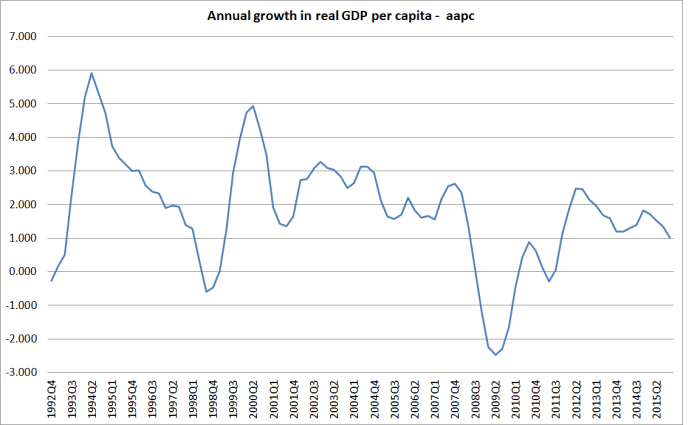
  • Per capita growth –  the only sort of growth that really matters –  has been pretty weak this cycle compared to that in previous recoveries and growth phases,real-gdp-pc-aapc
  • Inflation is (of course) low, but then it is supposed to be higher.  The target is centred on 2 per cent –  a rate we haven’t seen for several years –  and was previously centred on 1 per cent, and then 1.5 per cent.  Trend inflation outcomes are the responsibility of the Reserve Bank, but those outcomes have been away from target for some time.
  • The unemployment rate is below a 20 or 30 year average –  although well above the average prior to the mid 1980s –  but then all estimates (including the Bank’s) are that the NAIRU has been falling over that time, and no one claims that that has been because of monetary policy (any more than previous increases were).
  • The current account deficit is certainly smaller than it has been.  But that is mostly because interest rates have been so much lower than had been expected (s0 that the servicing costs of the large stock of external debt have been surprisingly low).  Much of the time, the Governor is more inclined to lament, than to celebrate, just how low interest rates have been, here and abroad.
  • Labour force participation is higher than the historical average, but it isn’t clear why this is unambiguously a good thing.    Work is a cost to individuals as well, at times, a source of satisfaction, but mostly people work to live.  In a subsistence economy, pretty much 100 per cent of adults work.  When New Zealand had the highest per capita incomes in the world, participation rates were lower.

But, of course, even then the Governor has cherrypicked his data.    There isn’t even any mention in this list of disastrously high house prices, or of the household debt stock, let alone of the real exchange rate, or the productivity growth performance, or the weak performance of the tradables sector, or of the large gaps between New Zealand incomes/productivity and those in most other advanced countries.

You might think that those are simply “Reddell hobbyhorse” indicators.   But we know the Governor cares a lot about house prices and household debt, and about the real exchange rate.  And it isn’t that long –  before he became embattled, and seemed to feel the need to become something of an apologist for New Zealand’s economic performance –  since he was talking about exactly the same sort of stuff.

Just a few weeks after he became Governor, he gave a speech in Auckland on Central banking in a post-crisis world . In the opening paragraphs of that speech he counselled

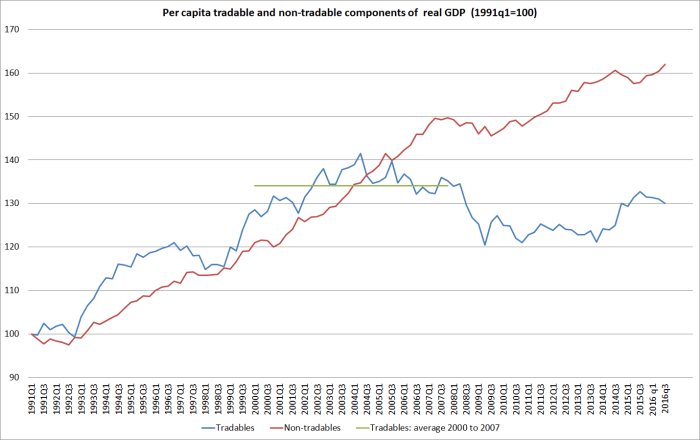
With these assets we should be capable of stronger economic growth. Internationally, and particularly in smaller economies, economic growth is driven by the private sector and its ability to compete on global markets. We need to reverse the slowdown in multifactor productivity growth since 2005 and the decline in value added in our tradables sector. And we need to reverse the shift of resources into the public sector and other non-traded activities.

Productivity growth hasn’t improved –  if anything the reverse – since then, exports as a share of GDP have been slipping, and there has been no sustained rebalancing towards the tradables sector.

t-and-nt-gdp-feb-17

They were the Governor’s words, not mine.

Another couple of months into his term, he gave another interesting speech, this time Improving New Zealand’s Economic Growth.   Back then he seemed concerned about productivity (and the lack of it)

Since 1990 we’ve outperformed many OECD countries on inflation and unemployment. Our inflation rate has been one and a quarter percent below the OECD median and our unemployment rate half a percent lower. But our per capita income has lagged behind and we’ve run large current account deficits. Real per capita GDP growth has been one and a quarter percent, about half a percent below the median and our current account deficit has averaged five percent of GDP – about the 6th largest relative to GDP in the OECD region.

There are two main ways in which our prosperity can improve over the longer run. The first is if the world is willing to pay more for what we produce. The second is by raising our labour productivity – that is by increasing the level of output per working hour. In the short term, we can generate higher income if we increase labour force participation or work longer hours. But we already have a higher proportion of our population in the labour force than nearly all other OECD economies and we work longer hours than most people in the OECD.

and

This is striking given the high international rankings for the quality of our institutions, control of corruption, ease of doing business, and according to the World Bank, the highest per capita endowment of renewable resources in the world.

Chart 2: Labour productivity growth in selected OECD economies, 1990-2011

(Average annual rate)

5124340_files/gw-improving-new-zealand-s-economic-growth-cecc-february-201301.jpg

Source: OECD

So why is our per capita income so far below the OECD median? Partly it’s due to our geographic location and small economic size. Distance and economic size matter a lot even in a more globalised world of trade, capital and knowledge flows, and increasing interdependence. This also partly explains why our export range is concentrated over relatively few products – with food and beverages accounting for almost half our exports. The OECD and IMF believe size and distance, which limit economies of scale and market opportunities, account for around three quarters of the gap in our per capita income compared to the OECD average.

But this is not the whole story. Despite our high international rankings in key areas, the latest World Economic Forum’s Global Competitiveness Report ranks New Zealand’s overall competitiveness at 25th out of 142 countries. Besides market size, we perform poorly on our macroeconomic environment, and especially on our budget deficit and low national savings. But regulatory and performance-related factors also diminish our growth potential. Many of the remedies to substantially improve our ranking lie in our own hands, and groups such as the 2025 task force, the Savings Working Group, and the Productivity Commission, emphasised reforms that can raise our living standards.

He thought then there were three areas governments should focus on

Three areas seem particularly important. The first, is to raise our level of saving and investment, and improve the quality and productivity of our investment.

The other two were to close fiscal deficits, and to lift human capital. On the latter he observed

The bottom income deciles are populated by those with lesser skills, and those who experience prolonged and recurrent spells of unemployment. Addressing these groups would both promote productivity and reduce inequality.

Very little has changed since the Governor gave those speeches early in his term.  The fiscal deficit has been closed, and no doubt the Governor would welcome that.  But in late 2012 and 2013, there was just no sign that he thought the economy was in “very good shape” –  rather it had key pretty deeply embedded structural challenges – and few of the key indicators he cited have changed for the better since then.

Now, to be clear, (and as central bank governors have pointed out for decades) very little of this is down to the Reserve Bank.  Central banks aren’t responsible for  –  and don’t have much influence on trends in –  house prices, current account deficits, productivity growth (labour or multi-factor), the health of the tradables sector, savings rates, participation rates or NAIRUs, let alone human capital and inequality.  So the fact that the economy isn’t in particularly “good shape” –  even if it isn’t doing that badly on some purely cyclical measures – isn’t the Governor’s fault, or that of the Reserve Bank.  What the G0vernor can do is keep inflation close to target, and help safeguard the soundness of the financial system.

Which makes that line of the Governor’s, from Saturday interview, so puzzling

“It is puzzling to me why some of the commentators been so critical when the Reserve Bank is a big part of that outcome. We aren’t the whole story by any means, but our monetary policy configurations do have a major impact on the economy.”

After all, since 2009, the Reserve Bank has twice started tightening monetary policy only to have to reverse itself.  I’m not today getting into the question of how much of that was a foreseeable problem.  Even if none of it was, the fact remained that the Bank twice (out of two times) had to reverse itself.    Neither episode –  tightening and then reversal –  had the sort of major positive impact on the economy that the Governor talks of.  At best, they probably did little damage.  And those episodes aside, the Reserve Bank just hasn’t done much on monetary policy for years.   People –  like me –  have been critical of the Reserve Bank’s monetary policy management because of (a) those reversals, (b) the refusal to even acknowledge mistakes, (c) more recently, almost laughable attempts to rewrite history to suggest they were easing when in fact they were tightening.  And, of course, the persistent deviation of inflation from target, and the concomitant extent to which the unemployment rate has been kept unnecessarily higher than required, or than the Bank’s own estimate would have suggested.  Those outcomes suggested that, on average, monetary policy has been a bit too tight, as well as unnecessarily variable.

Is the aggregate cyclical position of the economy terribly bad?  No, it isn’t.  But it isn’t great either, and the longer-term metrics give even less reason for an upbeat story.  The Graeme Wheeler who took up the job of Governor in late 2012 was better than this.  Back then, he was willing to highlight what he saw as some of the structural problems.  Perhaps it wasn’t his job –  central bank governors don’t need to get into that territory, but he chose to.   If he ventures into such territory, what we should expect is a Governor who calls things straight –  for whom black doesn’t become white just because the Governor himself has himself had a rough few years.  If he no longer feels he can name the serious economic challenges New Zealand still faces, perhaps he’d have been better to keep quiet rather than further undermine his good name with the sort of propaganda that we shouldn’t hope for, but might nonetheless expect, from a political party or lobby group.

Why do I bother, you might wonder?  I was reading this morning a brief piece written to mark the anniversary of the death of  US Supreme Court justice Antonin Scalia, by one of his former law clerks.   The author wrote about “five lessons for living well” that he had seen in the judge’s life.  One of them was

“Be honest in the small things, even if it makes life more difficult”

If our democracy and institutions are to be strong, it is what we should expect from people in powerful public office.    It is too easy to put out “propaganda” and for it to slide past, and for people to nod in acquiescence when they read stuff they don’t know a lot about.  At one level, Graeme Wheeler’s interview doesn’t matter much –  and he’ll be off to pastures new shortly –  but we deserve better, from our journalists and (in particular) from those who seek out and voluntarily assume high public office.

Reserve Bank Governor and governance: some considerations

Since the announcement last week that the Reserve Bank Governor is leaving at the end of his term, and that his senior deputy won’t be a candidate to replace him, there has been a lot of commentary around both about what the Board and the (post-election) Minister of Finance should be looking for in a Governor, and what changes might be made in the legislative arrangements under which the Reserve Bank operates.  As just one example, both the centre-left economics columnists in yesterday’s Sunday Star Times were writing about aspects of the topic.

That seems entirely appropriate.  The Reserve Bank exercises huge discretionary power in both monetary policy and financial regulation, and the once-vaunted accountability mechanisms have actually turned out to be quite weak.  And the basic structure of the legislation the Bank operates under is now getting on for 30 years old.   Much has changed in that time.

Finding the right individual for the job of Governor matters a lot.  Even within the limitations of the current legislation, the right individual (building the right new senior management team) can make a material difference, in revitalising the organisation, and putting it on a more open and transparent footing –  both as regards policy, and the conduct of the Bank’s own affairs.    Still, we should be careful of what we wish for.  The Herald’s editorial last Friday argued, writing about the monetary policy responsibilties, that “the next Governor will need to be bold”.  Well, perhaps.  But “boldness” isn’t a great quality unless one is sure (a) of to what end it is directed, and (b) of the judgement, capability and character of the person being bold.  If I think back over 30 years of New Zealand monetary policy, Alan Bollard’s deep cuts in the OCR in the crisis conditions of late 2008 probably qualify as bold.  But so did Don Brash’s MCI experiment and Graeme Wheeler’s 2014 tightening cycle.  Neither of those ended well.

In the Sunday Star Times, Rod Oram argued

So, the best we can hope for is the next government, regardless of which party leads it, has the courage to recruit a rare individual as the next Reserve Bank Governor – a person who is highly experienced in the intricacies of the job, yet insightful and brave enough to restore the institution to world leadership.

That last line or so seemed both unrealistic and somewhat ahistorical –  perhaps partly because Oram appears to have come to New Zealand only as the Reserve Bank’s “glory days” were already passing.

The Reserve Bank of New Zealand gets credit for being the first country in the world to introduce (modern) inflation targeting.  I was present at the creation, and am proud of having been part of that.  But it was at least as much accident as design   –  a Treasury that was determined we had to have a contractural arrangement (pretty much every other government agency was getting one), and a muddied post-liberalisation post financial crisis world in which nothing much else would work.  We weren’t forerunners in central bank independence, in getting on top of inflation, in the idea of announcing medium-term targets, or in the publication of accountability documents.  And most of the specific details of our model haven’t been followed when other countries came to revise their legislation.  And if you read our economic analysis during the late 1980s and 1990s it was mixed bag, to say the least.  If I recall with pride the day I read Samuel Brittan of the FT praise our second-ever Monetary Policy Statement, which I’d largely rewritten over a weekend after Saddam Hussein invaded Kuwait and oil prices rocketed, I read some of other stuff we (I) wrote and cringe at least a little.  We were doing some good stuff, but were rushing to catch up with what being a modern central bank really involved, and there were so little institutional resilience that we stumbled into the MCI debacle only a few years later.  (For those too young to understand the reference, (a) be thankful, and (b) I will do a proper post about it one day.)

And what of banking regulation?  After an extensive and acrimonious internal debate in the early 1990s, the Reserve Bank did change quite materially its approach to banking supervision and regulation.  Pulling back from the seemingly-inexorable pressures to become ever more intrusive and interventionist in our banking supervision, we adopted a model which emphasised director-responsibility, and public disclosure, with the aim of better aligning incentives, to strengthen market discipline and reduce the prospect of public bail-outs etc.  Capital requirements were left in place, but as much because the banks wanted them –  they feared they look “unregulated” without them – as because of any Reserve Bank preference.  I wasn’t that closely involved, but I mostly thought it was a step in the right direction –  and lament the way that the Reserve Bank has wound back on public disclosure requirements in recent years.   But if there were elements of the model that did, in small ways, influence the thinking and practice of other countries’ regulatory models, they weren’t very important.  It was innovative, and may even have been right, but it wasn’t really tested –  as the key institutions of our banking system became increasingly Australian-dominated (and hence under the overall oversight of Australian regulatory authorities).  And it hasn’t become the global model – bailouts abounded in 2008/09, no one thinks that problem has been solved, supervision and regulation is at least as intrusive and second-guessing as ever, and the Reserve Bank’s resistance to deposit insurance now looks more anomalous than ever.    There was some good and interesting stuff done, and some able people were involved in doing it, but it was never the basis of “world leadership”.

In any case, how realistic is the idea of “world leadership” in this area?  We are a small country, we don’t resource our central bank that generously (and I don’t think we should spend more), and central banking feels like one of those areas (risk management, crisis management etc) where one should be wary of the pathbreaking – after all, how do we distinguish it from what turns out to be a dead end?; isn’t this what we have academics and think-tanks for etc?  And realistically, if one looks through the lists of people talked about as potential candidates as Governor, be it Geoff Bascand or Adrian Orr (probably the names at the top of most lists) or others –  Rod Carr, John McDermott, Murray Sherwin, David Archer, Arthur Grimes, New Zealanders running economic advisory firms, New Zealanders who are past or present bank CEOs here or abroad etc –  very few look as though they have even the glimmerings of what Oram seems to be looking for.   And even those who just might, have other weaknesses.  For me, I’d settle for someone with the character, energy and judgement, backed up a solid underpinning of professional expertise, to revitalise the institution, rebuild confidence in it, and provide a steady hand on the policy levers, backed by high quality analysis and an openness to alternative perspectives, through both the mundane periods and the (hopefully rare) crises.  And all that combined with a fit sense of the limitations of what monetary policy and banking regulation/supervision can and should do (on which point, I’ll come back another day to Shamubeel Eaqub’s column – not apparently online – on what he thinks the Bank and the new Governor should be doing.)

Finding the right person is a challenge, but it is also highly desirable to take the opportunity now to think about the legislation under which the Bank operates –  in particular, the governance provisions.    Ours is quite an unusual model, whether one looks across other central banks and financial regulatory agencies, or across other New Zealand public sector institutions.  Under our law, all the extensive discretionary powers of the institution are vested in one individual –  him or herself unelected, and selected primarily by unelected people (the Board) –  and the range of powers the institution itself exercises is itself unusually wide.     And, as I’ve noted previously, there is no statutory requirement for the Reserve Bank to have, or publish, a budget, let alone anything of its medium-term financial plans, even though financial control of public spending is one of the cornerstones of democracy. Parliament has less control over the Reserve Bank’s spending than over that of, say, the SIS.       And the Reserve Bank takes an approach to the Official Information Act that suggests they still see themselves as somehow “different” and above the normal standards –  for them, transparency and accountability are about them telling us what they want us to see, not about citizens’ access to information and analysis generated at public expense.

So I was pleased to see the Dominion-Post’s editorial this morning, Good time to reform Bank.   In making their case, they quote me

“In New Zealand public life, it is difficult to think of any other position in which the holder wields as much individual power, without practical possibility of appeal,” Reddell has argued.

Joyce should also look to make the bank more transparent. It publicly releases official accounts of its forecasts and analysis reasonably regularly, but it seldom reveals anything of how its debates are conducted behind closed doors.

Again, this is not the case internationally. The US Federal Reserve releases the minutes of its regular meetings three weeks after they happen. New Zealand likes to brag about its open approach to official information, but in this sphere as in others, it has fallen behind the pack.

As they note, there has been reasonably widespread support for reform.  They note support from The Treasury, and from the Green Party (a recent post from James Shaw reaffirmed that support).  And when the Treasury looked at the issue a few years ago (before the Wheeler appointment), they found that most market economists also supported change.  The Labour Party has toyed with favouring change, and when the previous Labour government commissioned an inquiry 15 years ago, their reviewer Professor Lars Svensson also recommended change.     And we know that Graeme Wheeler himself favoured change –  he made the point again in the (rather soft) interview in Saturday’s Herald.

When Bill English was Minister of Finance, the government wasn’t willing to countenance change.  Having let the chance slip before Wheeler was appointed, going with any model other than Wheeler’s favourite one (legislate to give him and his deputies all the power) over the last few years, would probably have been a political negative for English.  And the Wheeler option is an unsatisfactory one on a number of counts –  since the Governor appoints and remunerates his deputies and assistant, it isn’t much protection against poor decisionmaking or a bad Governor.  But now the slate is clear: the Governor is moving on to new opportunities, and his deputy will simply be holding the fort for six months.   A decision now to think hard about reforming the governance model isn’t a reflection on the current Governor (not that Lars Svensson saw his recommendation in 2001 as being so either), and provides an opportunity for the government to provide a steer to the Board about what sort of Reserve Bank they want the new Governor to run.  It is unlikely new legislation could be put in place by next March (when Grant Spencer’s acting term runs out), but a new Governor could be appointed on the expectation that that person will lead the transition to a new, more modern and internationally comparable, governance model for the Bank.

Who knows if the new Minister of Finance is interested, but flicking through some old posts, I was encouraged to find one from September 2015, reporting an exchange in the House between then Associate Minister of Finance Steven Joyce and the Greens then finance spokesperson Julie Anne Genter.  In response to a question on governance, Joyce responded

Hon STEVEN JOYCE : The suggestion that the member makes, of having a panel of people making the decision, is, I have to say, not the silliest suggestion in monetary policy we have heard from the Greens over the years, and many countries—

A backhanded dig at the Greens at one level, but not an outright dismissal by any means.

Commissioning a background piece of analysis from, say, the Reserve Bank and Treasury, to review carefully, and neutrally, the issues and options, to be delivered to the Minister at the end of September, after Wheeler has left and the election is over, would be an appropriate step now.  Such a document –  which could later form the basis for a public consultative document –  would be a useful contribution to advancing the issue, and a resource that would enable any incoming government to work through the issues and analysis relatively quickly  –  consistent with the sort of timeframe relevant to the appointment of a new Governor.

Reform in this area is something I’ve championed for a long time, both inside and outside the Bank.  It isn’t primarily a matter for the Bank –  it is about how Parliament and the executive want a powerful public agency to be structured and governed –  although of course the Bank may have some specific insights on some of the relevant technical details (of which there are many –  reform in this area isn’t the stuff of some two page bill).

I’ve laid out my own arguments for reform more fully in past posts (eg here) and a discussion document of my own.

Making the case for change is, I think, relatively easy.      There is a much wider range of potential alternative models.   At one end, one could leave most other things intact, and simply shift the power from the Governor to a committee of him and his deputies/assistants.  At the other, one could perhaps break-up the Bank, creating a separate financial regulatory agency (paralleling the Australian approach) with separate governance structures for the Bank and the new successor institution.

I don’t have a strong view on whether the regulatory functions should be kept in the same institution as monetary policy –  there is a variety of models internationally.  But if the functions are kept in a single institution, I think there is a pretty strong case for separate governing bodies for each of the main functions –  both because different sets of expertise are required, but also to help manage the tensions and conflicts and strengthen accountability for the exercise of the various different parts of the Act(s).    This post covers some of that ground.   The key features of the governance model I propose would be:

  • The Reserve Bank Board would be reformed to become more like a corporate (or Crown entity) Board, with responsibility for all aspects of the Reserve Bank other than those explicitly assigned to others (NZClear, foreign reserves management, currency, and the overall resourcing and performance of the institution).
  •  Two policy committees would be established: a Monetary Policy Committee and a Prudential Policy Committee each responsible for those policy decisions in these two areas that are currently the (final) responsibility of the Governor.  Thus, the Monetary Policy Committee would be responsible for OCR decisions, for Monetary Policy Statements, for negotiating a PTA with the Minister, and for the foreign exchange intervention framework.  The Prudential Policy Committee would be responsible for all prudential matters, including so-called macro-prudential policy, affecting banks, non-bank deposit takers and insurance companies.  The PPC would also be responsible for Financial Stability Reports.
  •  Committees should be kept to a moderate size, and should comprise the Governor, a Deputy Governor, and between three and five others (non staff), all of whom (ie including the Governors)  would be appointed by the Minister of Finance and subject to scrutiny hearings before Parliament’s Finance and Expenditure Committee.  There should be no presumption in the amended legislation that the appointees would be “expert” –  however that would be defined – although it might be reasonable to expect that at least one person with strong subject expertise would be appointed to each committee.
  •  The Secretary to the Treasury, or his/her nominee, would be a non-voting member of each committee (the case is probably particularly strong for the Prudential Policy Committee).

In addition, the legislation should be amended to provide for the publication of (substantive) minutes of the meetings of these bodies (with suitable lags), and to require stronger parliamentary control, and public scrutiny, over the Bank’s spending plans.

It isn’t, of course, the only possible answer, but of those on offer I think it provides the best balance among the various considerations: providing internal expertise and external perspectives, clear lines of accountability for diverse functions, greater transparency and financial accountability, coordination across functions and arms of government, all while providing a significant role for the Governor as chief executive, and linch-pin, of the organisation, without anything like as dominant a personal policy role as there has been until now.

We won’t find –  and probably shouldn’t be seeking –  a Governor who walks on water.  But an able person who would effectively lead a revitalised Bank into a new era, with this sort of governance structure, would be making a very substantial contribution.  Change management skills and a commitment to organisation-building should be at least as important as personal technical expertise.  I hope that is the sort of person, and the sort of structure, that the post-election Minister of Finance, and the Board, end up looking for.


The new tightening cycle?

“When I use a word,” Humpty Dumpty said, in rather a scornful tone, “it means just what I choose it to mean—neither more nor less.”

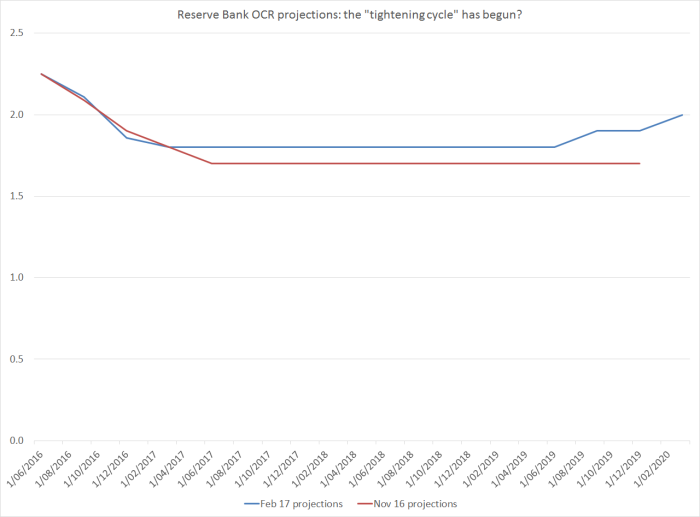
This chart shows the Reserve Bank’s projected future OCR tracks from last November’s MPS and the track from yesterday’s MPS.

ocr-projections-feb-17-and-nov-16

Using the definition of an “easing cycle” they appear to have adopted yesterday, to try to provide some cover for their 2014 misjudgements, this must surely mark the beginning of a new “tightening cycle”?     And, yes, the forward track was revised up very slightly.  Given that the Bank usually moves in increments of 25 basis points, the first actual OCR increase is currently expected in 2020 (this is the first time we’ve had projections for 2020).

But, of course, you didn’t hear the words “tightening cycle” from the Governor, or his offsiders, to describe what they’d done yesterday.  (I missed the start of the press conference, but I’ve seen no references anywhere to the words, or ideas).  And that is because it wasn’t the start of a “tightening cycle”.  Indeed, if one takes the projections seriously, one must assume there is about as much chance of another OCR cut in the next year to two, as of an increase.

And the Bank’s own official words back up the idea that this wasn’t the start of a tightening cycle.  Here are the key final sentences from the press release for the November MPS when, you’ll recall, they cut the OCR.

Monetary policy will continue to be accommodative. Our current projections and assumptions indicate that policy settings, including today’s easing, will see growth strong enough to have inflation settle near the middle of the target range. Numerous uncertainties remain, particularly in respect of the international outlook, and policy may need to adjust accordingly.

and here are the sentences from yesterday’s statement.

Inflation is expected to return to the midpoint of the target band gradually, reflecting the strength of the domestic economy and despite persistent negative tradables inflation.

Monetary policy will remain accommodative for a considerable period.  Numerous uncertainties remain, particularly in respect of the international outlook, and policy may need to adjust accordingly.

Parse it as you will, in substance those statements are all but identical.  If one wanted to be picky, one could highlight the addition of the words “for a considerable period” –  but it was probably aimed at those market participants who the Bank thinks (rightly in my view) have got a bit ahead of themselves in their enthusiasm for OCR increases later this year.

It would simply be nonsensical to claim that yesterday’s MPS was the start of a “tightening cycle”. It clearly wasn’t.  The Bank didn’t present it that way, and neither markets nor media have interpreted in that way.

It was even more nonsensical for them now to attempt to rewrite history and suggest that they began an easing cycle in June 2014.  They didn’t, they didn’t think that was what they were doing at the time, no one else did then (here, for example, was one of Wheeler’s bigger fans’ own quick assessment at the time) , and no one else does now.  They should be embarrassed.

Perhaps some readers will think I’ve made too much of the point.  But Parliament has given a great deal of power to the Governor, who has openly argued that the Bank is highly accountable.  One of the vehicles for that accountability –  a statutory vehicle –  is the Monetary Policy Statement.   Reasonable people can and do differ over the conduct of policy in 2014, and it is healthy to have the debate –  human beings learn from considered reflection and examination.    But attempting to twist language to try to rewrite the historical memory isn’t the sort of thing we should be expect from public servants who wield so much power.   And while Wheeler himself will soon be history, he has been keen to argue that he governs collegially –  emphasising the role of his deputies and the assistant governor.  Of them, the deputy chief executive will succeed Wheeler as Governor for six months, and most lists of potential candidates for the next permanent Governor seem to include both the other deputy governor, Geoff Bascand, and the assistant governor John McDermott.  The Governor signs the MPS, but McDermott’s department generates the document –  text and supporting analysis.   An excellent central bank –  doing policy well, producing strong supporting research and analysis, being open and accountable (rather than just playing political games), should be doing a lot better than this.

I was also struck by another of the Bank’s attempts in yesterday’s MPS to smooth over its record.  They noted in chapter 2 that

“Annual CPI inflation has averaged 2.1 per cent since the current target range was introduced in 2002”.

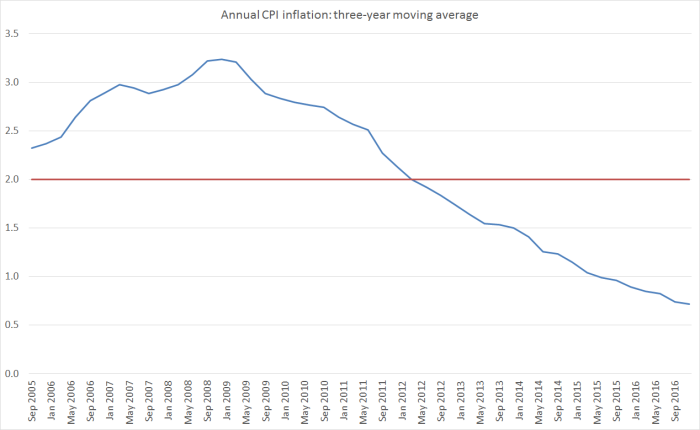
Which is true, but not particularly revealing.    For a start, during the Bollard decade, it averaged 2.5 per cent (excluding the direct effects of the higher GST) and in the Wheeler years it has averaged so far 0.8 per cent.  Lags mean Brash (and the old target) was responsible for the first year or so of the Bollard results, and Bollard was responsible for the first year or so of the Wheeler results, so here is a chart showing a three-year moving average of annual CPI inflation (again ex GST).  I’ve started from September 2005, so that all the data cover periods when the inflation target midpoint was 2 per cent.

cpi-inflation-3-yr-ma

It isn’t exactly a record of keeping inflation near the midpoint, even on average.  If the Bank seriously wants to argue that its performance should be evaluated over 15 year periods, they should abandon any pretence that there is serious accountability embedded in the system. Or, they could just play it straight, recognise their own (inevitable) limitations, and participate in some thoughtful, rather than propagandistic, reflections on the past conduct of policy and lessons for the future.  We should be wanting –  the Minister and Board should be seeking –  a Governor who has that sort of open-minded self-confidence.

When I exchange notes with other former Reserve Bank people one common line that comes up is a sense that the analysis in the Bank’s Monetary Policy Statements is often rather tired, and adds little of value to the reader.    Someone went as far yesterday as to send me a 20 year old MPS as a standard for comparison.  I often caution people that each generation is prone to view their successors that way, and insert the caveat that I hesitate to claim much for a period in which the Reserve Bank had the MCI (and a key senior manager, who fortunately didn’t last long, who often nodded off, just across the table from the Governor, in Monetary Policy Committee meetings).  Nonetheless, I can’t help coming to the same conclusion myself.    There are defences –  for a small central bank, four full MPSs a year is probably too many –  simply cranking the handle to churn out the documents take a lot of resource.  But it is the Bank that chooses that model –  Parliament only requires two statutory MPSs a year.  It could be argued also too that most of the value in the document is in the one page press release and a single table  –  but then why produce 30 to 40 pages?   And sadly, even when they do try to introduce new material, I often don’t find it very persuasive or enlightening.  And sometimes, the emphases seem quite politically convenient –  productivity, for example, (or the complete lack of it in New Zealand’s case) appears not at all in the text of yesterday’s MPS.

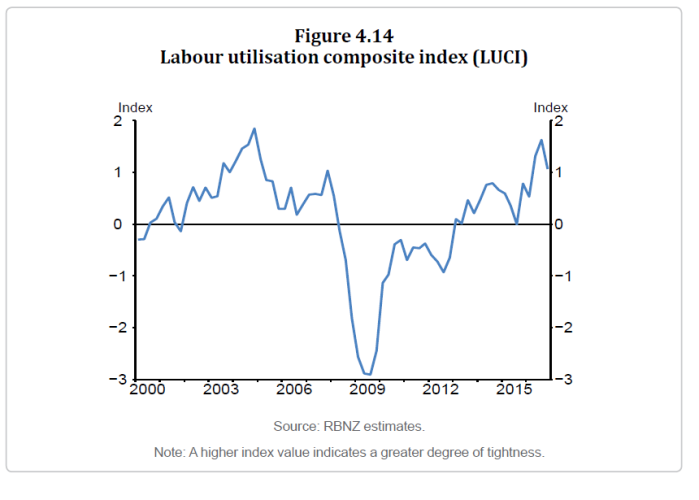
I wanted to touch on just two examples from yesterday’s document.  A year or so ago, the Reserve Bank introduced LUCI –  the labour utilisation composite index, an attempt to provide a summary measure of resource pressure in the labour market.    It was interesting innovation, if not fully persuasive as an indicator.  They ran the chart in yesterday’s document

luci

In the text, the Bank simply notes that labour market tightness increased over 2016.  But if this indicator is supposed to be a measure of that, how seriously can we take the claim?  After all, this index appears to suggest that in the Bank’s view the labour market is now almost as tight as it was at the peak of the previous boom (late 2004?) and materially tighter than it was over say 2006 and 2007 –   a period when the unemployment rate averaged less than 4 per cent, and when wage inflation was quite high, and increasing further.

Over the last year, however

  • the unemployment rate was basically flat (actually 2016q4 was higher than 2015q4, but lets treat that as possibly just noise),
  • wage inflation was flat or falling,
  • and in the Bank’s Survey of Expectations, expectations of future wage inflation were flat as well (actually down a bit in the latest survey)

And all this when the unemployment rate has been persistently above the Bank’s own estimate of the NAIRU (which appears to still be around 4.5 per cent), let alone Treasury’s which is around 4 per cent.  There is little to suggest anything like the degree of labour market pressure that was apparent in the pre-recession years.

No doubt, there are good answers to some of these questions and apparent contradictions.  But the Bank has made no attempt to address them, even though other labour market developments –  around immigration – receive a lot of focus.  The public, and readers of the MPS, deserve better analysis than that.

The Bank’s immigration analysis has also been rather tortured.  Historically, they have worked on the basis, and produced research to support, the common view that the short-term demand effects of immigration exceeded the supply effects.    There shouldn’t be anything surprising, or very controversial, about that –  immigrants (or non-emigrants) need to live somewhere, and need all the attendant private and public infrastructure of a modern economy.  Those pressures tell one nothing about the pros and cons of immigration policy.

But in the last couple of years, the Bank has been going to great lengths to try to suggest that this time things are different: this time the composition of the immigrants is so different (than in every previous post-war cycle) that, if anything, the supply effects outweigh the demand effects, and that high net PLT immigration is part of what is keeping inflation down.

It isn’t totally impossible of course.  Fly in labourers, house them in disused prisons, forbid them from spending anything locally, and employ them only in very labour-intensive roles and the supply effects might outweigh the demand effects.  But that isn’t the modern New Zealand immigration story  (and in case anyone wants to be obtuse, obviously nor should it be).

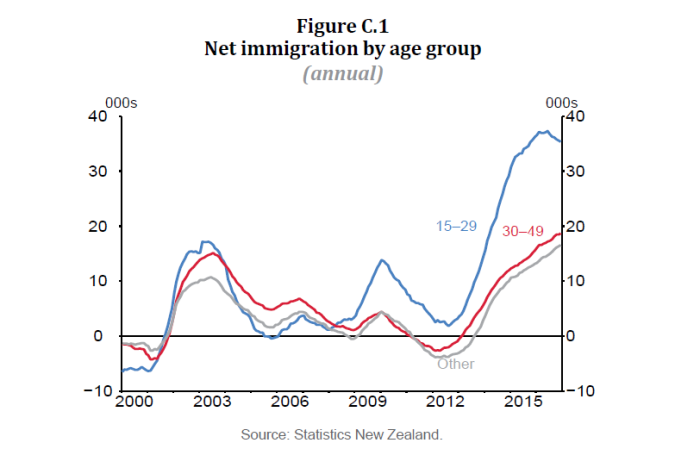
The Bank likes to illustrate their case with charts like this one, produced again in the MPS yesterday.

plt-by-age

It uses PLT net migration data to purport to show (a) record immigration, and (b) that that record influx is hugely concentrated among young people who, it is claimed, add more to supply than to demand, dampening inflation pressures.  The contrast is supposed to be particularly stark with the last big influx in 2002/03.  The Bank explicitly states “young migrants and those on student visas represent a much higher share of migration than in previous cycles”.

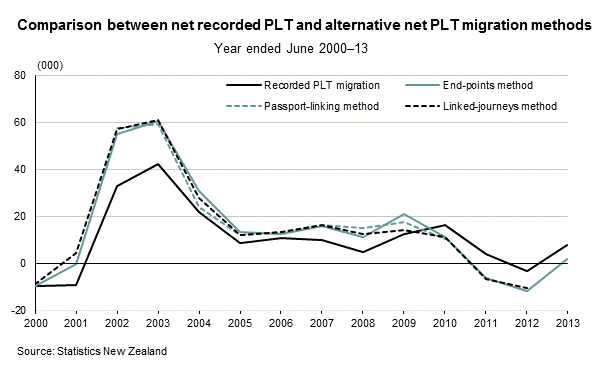
I’ve covered much of this ground before, especially in this post.   The limitations of the PLT data are well known, both in principle and in practice.    At my prompting, with the full knowledge of my then RB superiors, Statistics New Zealand produced a research note on the issue a couple of years ago.  In that document they showed how the PLT data had materially misrepresented the actual long-term migration inflow to New Zealand in the 2002/03 period (not wilfully –  just the limitations of the timely measure).  This was their chart.

plt-methods

So the best later estimates are that the 2002/03 influx was around 50 per cent larger than the PLT data (including the age breakdown data) the Bank is constantly citing.

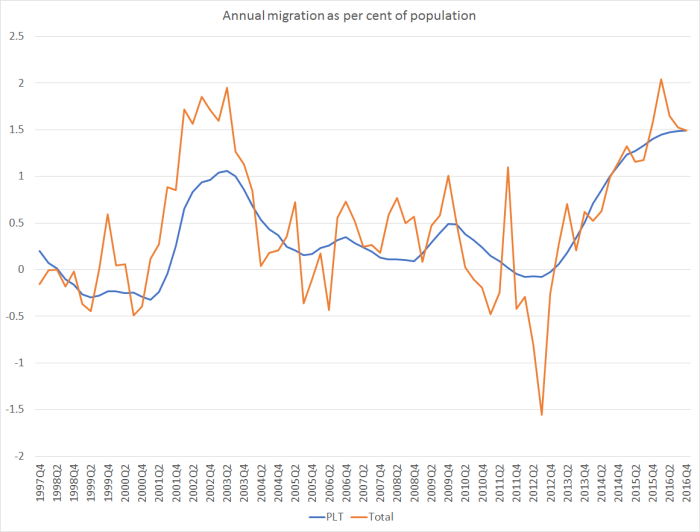
We don’t have current estimates from this improved methodology for the current cycle, but one can see the point in just comparing the net PLT inflow with the net total passenger arrivals. It is a more volatile series –  things like World Cups and Lions tours help introduce volality.

migration-per-cent-population-feb-17

But you can see the big difference between the two series over 2002/03 –  and SNZ estimated that much of that difference wasn’t very short-term tourists, it was people who ended up staying longer.  Jump forward to the current cycle: contrary to the mythology the influx of people this time round, as a share of the population,  hasn’t been larger than it was then.  The peaks are around the same, and the peak this time (at least so far) was shorter-lived than it was in 2002/03.

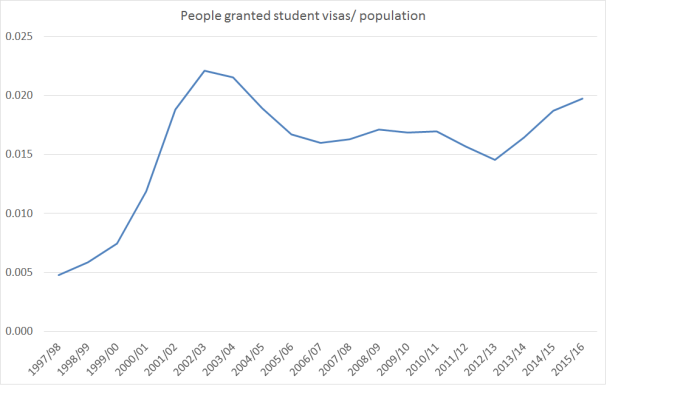
And what of the student story?  Well, it doesn’t really hold up either.  Here is the MBIE data on the number of people granted student visas each year, as a share of the population.

student-visas-feb-17

The peak isn’t as high as it was in 2002/03, and the extent of the increase is much much smaller this time.   Foreign students add to demand –  as all exports do.  (Of course, there have been some  –  somewhat controversial  – changes in student work rules, which might have mitigated the demand effects, but curiously the Bank doesn’t invoke that effect as part of its story.)

My point here is not to argue whether my conclusion (net migration tends to boost demand more than supply in the short-term) is right, or the Bank’s (this time is different) is.   And as it happens, we see eye-to-eye right now on the current stance of monetary policy.   I’m mostly concerned that the Bank seems to just ignore inconvenient data that just isn’t hard to find or use.    There might well be good counterarguments to the data points I’ve highlighted here, but instead of making those arguments, the Bank simply ignores them.  One might, sadly, expect that sort of standard from political parties and lobby groups.  We shouldn’t expect, or tolerate, it from powerful well-resourced public agencies.  The Bank’s argument is certainly fairly politically convenient: it keeps the focus off that unemployment rate that is still above the NAIRU (a gap that might be expected to be constraining inflation) and the near-complete absence of productivity growth, which might be deterring new investment (also dampening inflation pressures in the short-run).

There are plenty of complex issues around in making sense of what is going on. I certainly don’t claim to have a fully convincing story myself. But given the level of public resources put into the Reserve Bank, we should expect a lot more from them –  not just answers, but evidence of genuine intellectual curiosity, and a desire to evaluate arguments from all possible angles.  Their current policy stance is fine, but there doesn’t seem to be a strong and robust organisation, of the sort that would underpin consistently good policy through time, judged by the strength of its analysis and its openness to debate.   Yesterday’s MPS is just one more example of that.   Turning around that weakness should be one of the key challenges for the new permanent Governor.

Alternative facts: a possible interpretation

A reader who is paid to, among other things, monitor the Reserve Bank got in touch to suggest that the Reserve Bank’s claim, highlighted in this morning’s post, to have “initiated an easing cycle in June 2014” was neither a typo nor a piece of carelessness (I’d assumed the latter), but something conscious and deliberate.

Recall that in this morning’s MPS, the Bank wrote that

The Bank initiated an easing cycle in June 2014, by lowering the outlook for the policy rate from future tightening to a flat track, and then cutting the OCR from June 2015

Most people, when they think of an easing cycle or a tightening cycle, think of actual changes in the OCR.  On that conventional description, the OCR was raised four times, by 25 basis points each, from March 2014 to July 2014.  Note those dates: not only was the OCR raised in the June 2014 MPS, but it was raised again the very next month.

And if one compares the crucial final few sentences in the press releases for the March and June 2014 MPSs there is no material change in wording from one document to the other, and there is nothing in chapter 2 of the June 2014 MPS (the policy background chapter) to suggest a change in policy stance.

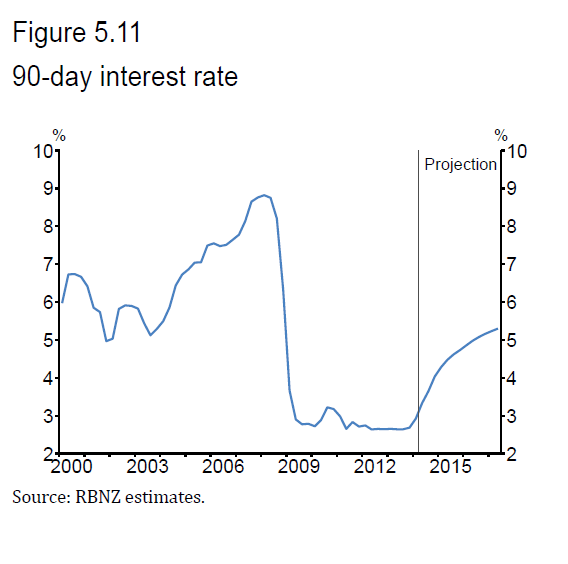
So how might they now –  revisionistically – attempt to describe an “easing cycle” as having been commenced in June 2014?  Well, the only possible way they could do so –  perhaps hinted at in that phraseology “by lowering the outlook for the policy rate” –  is using a change in the forecast for the 90 day rate from the previous set of projections, in March 2014, to those in the June 2014 MPS.

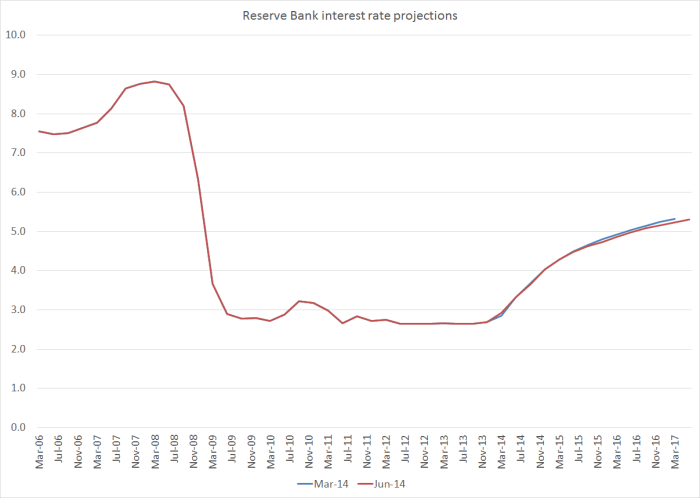
But here is the chart showing the two sets of projections

90-day-projections

The differences are almost imperceptible.  In fact, the June track (red line) is very slightly above the blue line in the very near term, and at the very end of the period the difference is that the 90 day rate is projected to get to 5.3 per cent in the June 2017 quarter rather than the March 2017 quarter.  And recall that there were no contemporary words to suggest a change of stance.

Sure enough over subsequent quarters the Bank did start to revise down the future track, but there is no evidence that over that period they thought of themselves –  or openly described themselves –  as having begun an “easing” cycle.    That didn’t happen –  and even then they didn’t think of it as a “cycle” –  until the OCR was first cut in June 2015.   Here is the Governor talking about monetary policy in a February 2015 speech.

We increased the OCR by 100 basis points in the period March 2014 to July 2014 because consumer price inflation was increasing as the output gap became positive and was expected to increase further. Since July, the OCR has been on hold while we assessed the impact of the policy tightening and the reasons for the lower-than-expected domestic inflation outcomes.

The inflation outlook suggests that the OCR could remain at its current level for some time. How long will largely depend on the development of inflation pressures in both the traded and non-traded sector. The former is affected by inflation in our trading partners and movements in our exchange rate; the latter by capacity pressures in the economy and how expectations of future inflation develop in the private sector and affect price and wage setting.

In our OCR statement last Thursday we indicated that in the current circumstances we expect to keep the OCR on hold for some time, and that future interest rate adjustments, either up or down, will depend on the emerging flow of economic data.

Again, no sense from the Governor that he was well into an “easing cycle”, as we are now apparently supposed to believe.

Now, there is a theoretical argument that the stance of monetary policy can be summarised not just by the current OCR but by the entire future expected/intended track.  But as the Reserve Bank has often –  and rightly – been at pains to point out, projections of interest rates several years in the future contain very little information, as neither the Reserve Bank nor anyone else knows much about what will be required 2 to 3 years hence.   And it is a dangerous path for them to go down, for it invites those paid to hold the Governor to account to do so not just in respect of the actions he or she takes, but in respect of their ill-informed (but best) guesses as to what the far future of the OCR might hold.

If this is the explanation for the Reserve Bank’s words this morning –  and sadly it seems like a plausible explanation –  it is, at best, a case of someone trying to be too clever be half, and change the clear meaning of plain words (to the plain reader) in mid-stream.  At best, too-clever-by-half, but at worst a deliberate attempt to use a verbal sleight of hand to deceive readers, including the members of Parliament to whom the document is, by law, formally referred.    Sadly, it looks a lot like the “alternative facts” label –  one that should be worn with shame – might have have been quite seriously warranted.  They didn’t start easing in June 2014; at best by later that year they started slowly backing away from their enthusiasm for (a whole lot more) further tightening.

I’d hoped for better from the Reserve Bank, its Governor, incoming acting Governor, and other senior managers who may perhaps have aspirations to become Governor next March.

Lewis Carroll wasn’t intending Through the Looking Glass as a prescription for how powerful senior public officials should operate.

“When I use a word,” Humpty Dumpty said, in rather a scornful tone, “it means just what I choose it to mean—neither more nor less.”


Alternative facts: Reserve Bank edition?

I might have a post later on the substance of today’s Monetary Policy Statement –  or might not, since the bottom line stance seems entirely correct to me (regular readers may think this a first).   But I couldn’t let one particularly egregious misrepresentation go by without comment; a claim so blatantly wrong that one almost had to wonder whether the Bank was now taking communications advice from Sean Spicer and Kellyanne Conway.

In each MPS Box A “Recent monetary policy decisions” appears.  This box is one of my minor legacies to the Bank.  I banged on often enough about the statutory requirements for MPSs –  which require some retrospective assessment and self-evaluation –  that they agreed to include this box. It is rarely done well and –  in fairness –  the Act probably needs changing, to provide for reviews and assessments rather less frequently.  And the content tends, perhaps inevitably, to be rather self-serving.    But the latest version was just too much.

It begins as follows

The Bank initiated an easing cycle in June 2014

When I first saw that I assumed it was just a typo –  bad enough, but these things happen.  The OCR wasn’t actually cut until June 2015.  But no, the authors were apparently serious.  The whole sentence reads

The Bank initiated an easing cycle in June 2014, by lowering the outlook for the policy rate from future tightening to a flat track, and then cutting the OCR from June 2015

Do they really expect to be taken seriously?   For a start, their statement isn’t even true.  Here is the chart of the projected 90 day interest rates from the June 2014 MPS.

90-day-rate-track-mps-june-2014

The OCR was not only increased in the June 2014 MPS, but they projected another 200 basis points or so of increases.   By now –  March quarter of 2017 –  the OCR was projected to be still rising, and at 5.2 per cent.

And here was what the Governor had to say in the June 2014 MPS

june-14-mps-extract

There was no doubt that the Bank –  the Governor –  in June 2014 thought they would be raising the OCR a lot further, and had no thought in mind of beginning an easing cycle any time in the following few years.

I’m not sure what has gone wrong in this quarter’s Box A.    All the key players –  the Governor and his closest advisers –  were around in June 2014, and are around now.  They know what happened, and in June 2014 they were pretty confident of their tightening stance.  But they made a mistake.  It happens.     What shouldn’t happen is crude attempts to rewrite history.

I rather doubt this was deliberate on the Governor’s part –  probably some carelessness further down the organisation, and then insufficient care in reading and approving the final text.     But it isn’t a good look, and I hope they will take the opportunity to acknowledge the mistake and issue a correction.

Perhaps the FEC and/or the Bank’s Board might ask just what went on?

On Graeme Wheeler

Morning Report had invited me on this morning to talk about Graeme Wheeler, the change of governor, prospects for a permanent successor etc.  The death of Steve Sumner apparently changed their schedule so that interview didn’t happen, but I’d already jotted down some notes as to what I might say, so I thought I’d use them here.  Wheeler, of course, still has seven months in office, and we’ll see his next Monetary Policy Statement tomorrow.

When Graeme Wheeler was first appointed as Governor, there was generally a fairly positive reaction.  I shared that view.  Until quite late in the process, I’d assumed that Grant Spencer was the favourite for the role –  after all, successful organisations tend to promote from within, and a capable insider should always have an advantage, being constantly visible to the Board.  And so when Graeme was appointed, my initial reaction was “well, he must have been a very strong candidate to have beaten the capable internal deputy”.    And it was well known at the time that Bill English and John Key had been keen to have Wheeler back in New Zealand –  there had been well-sourced talk that the Minister had wanted him as Secretary to the Treasury, something apparently stymied by SSC bureaucracy.

With hindsight, one can only conclude that the Bank’s Board –  the key players in the appointment of the Governor –  just didn’t do a very good job in evaluating the candidates. Perhaps that shouldn’t be surprising –  mostly behind the scenes people themselves, they don’t have much experience in appointing someone to a position with as much visibilty and probably more untrammelled power than most Cabinet ministers.  There are suggestions that Board members were rather too easily swayed by big names Wheeler had produced as referees, and by his international connections (coming just a few years after the international financial crisis) rather than looking hard at the qualities required to do the Reserve Bank Governor job well.    Since many of the Board members then are still on the Board now, one can only hope they’ve learned from their experience.

I think Wheeler has done a poor job as Governor, both in the specific decisions he has made, and in the processes and procedures and style he has adopted.   For most of the time, he seems to have been aided and abetted –  or at least sheltered –  by the Board, who are actually paid as the public’s agents, not as associates and defenders of the Governor.

And it is not as if times have been unusually hard for him.  We haven’t had a recession in New Zealand and there has been no major flare-up of international financial stresses during his term (so far).  The terms of trade moved around a bit, but not much more so than usual.  There was no domestic financial crisis, no major domestic fiscal stresses, no change of government, and the major natural disasters of the last decade (the Canterbury earthquakes) had all happened by the time the Governor took office.   Sure, what is going on globally is a little hard to fully make sense of, but whereas most other advanced country central banks had by 2012 largely reached the limits of conventional monetary policy (interest rates very close to zero) that has not yet been a constraint here.

The Reserve Bank’s primary function –  according to the Act –  is monetary policy.  Graeme came into office with a new PTA that he was comfortable with –  in particular, with an explicit focus for the first time, on the 2 per cent midpoint of the inflation target range.  And yet over his 4.5 years in office, annual headline inflation has averaged not 2 per cent but 0.8 per cent.  Falling oil prices played a part in that, but CPI ex petrol has averaged not 2 per cent, but 1.1 per cent.  The Governor’s preferred measure of core inflation –  the sectoral factor model measure –  has averaged not 2 per cent, but 1.35 per cent.  All sorts of one-off factors that the Governor can’t be really be held accountable for influence inflation rates –  thus cuts in ACC levies have held down headline inflation in the last couple of years, while large increases in tobacco taxes have artificially boosted headline inflation throughout the Governor’s term.

There are a lot of comfortable commentators inclined to treat these inflation outcomes as a matter of indifference –  so what they imply, after all low inflation is better than high inflation.    But persistently low inflation over several years –  and especially when it doesn’t arise from surprisingly good productivity outcomes – almost invariably comes at a cost –  lost output, and lost employment.  And that has almost certainly been the case over the last few years.   Throughout the Governor’s term, the unemployment rate has been reasonably materially above estimates of the non-inflationary or “natural” level –  these days thought to be around 4 per cent.  The Governor’s choices affected the lives and options of real people –  and years lost out of employment simply can’t be got back.

My standard here isn’t one of perfection.  Central banks, engaged in active discretionary monetary policy of the sort now common around the world, will inevitably make mistakes.  Central banks try to operate on the basis of forecasts, and yet no one  –  least of all them  – knows the future.  So in evaluating the Governor, we need to look at the specific circumstances, and at the willingness to acknowledge and learn from mistakes.  Here, Graeme Wheeler doesn’t score well.

Before he came to office, the Reserve Bank had already once misjudged the need for a tightening cycle to commence, and had had to reverse itself.  At the time –  2010/11 –  they had some company internationally, and there was a fairly widespread expectation that interest rates would need to return to “normal” fairly soon.  That wasn’t the case by the end of 2013, when the Governor was not just talking about tentatively beginning a tightening cycle, but confidently asserting that interest rates would need to rise by 200 basis points.   He –  and his machinery of advisers –  simply got that one wrong.  Fortunately, they never raised the OCR by 200 basis points, but it was 18 months before they even started to reverse themselves –  and even now, to my knowledge, they have never acknowledged having made a mistake.  In so doing, they’ve unnecessarily exaggerated both interest rate and exchange rate variability, all the while leaving unemployment unnecessarily high.   Good managers and leaders recognise that human beings make mistakes, but they expect those who make them to acknowledge and learn from them.  Graeme Wheeler failed that test.

The other big part of the Reserve Bank’s policy responsibilities is the regulation of key elements of the financial system, to promote the soundness and efficiency of the system.  Graeme made that a much more prominent part of the Bank’s role with his enthusiasm for successive waves of LVR controls.   The Reserve Bank has no policy responsibility for the housing market, or for house prices, only for the soundness and the efficiency of the financial system.    And yet I see a leading commentator criticising the Governor for not doing the impossible:

Wheeler should have earlier called out the Prime Minister and Finance Minister on their tardiness in developing policy responses to counter the house price bubble. But he was late to the party.

Notably, the bank was also tardy in its own policy responses, thus earning itself a rebuke from then Prime Minister John Key, who rather cynically tried to take the focus off a Government that was running immigration hot for its own ends.

A more adept governor should have been able to persuade the politicians that slowing the boom was a job for both the politicians and the central bank. And that it was necessary for NZ’s long-run stability.

Quite how Graeme Wheeler was supposed to have changed the mind of the government on reforming supply – when no one else, in New Zealand or in many Western countries, has succeeded in doing that –  is a bit of mystery.  I have pretty high expectations of a Reserve Bank Governor, but that seems like a Mission Impossible task.  It is not that reform couldn’t be done, but against a Prime Minister determined to present high and rising house prices as a mark of success, a central bank Governor, with no detailed background in the area, no real research to back him, and no particular mandate wasn’t likely to succeed.  After all, our housing supply and land use laws have created problems, interacting with immigration policy, for 25 years, and Alan Bollard and Don Brash had made no inroads either.

As for the Bank being “tardy”, hardly.  When Graeme Wheeler took office, no one in the Reserve Bank had been keen on direct LVR controls –  they were a clear fourth preference, when assessed against the Bank’s responsibility for financial system soundness and efficiency.    But Graeme rushed such restrictions into place, at times surprising even his own senior managers, with no tolerance for any debate or dissent (there was no substantive discussion of the merits of the measures at the key relevant internal committee).  If you think LVR limits were a good thing, the last thing you can accuse Graeme of was being tardy.  I think they were ill-conceived, sold on a false promise (about how temporary they would be), are still poorly-researched, and have spawned one new set of controls (and odd exemptions) after another.  And, unsurprisingly, the real housing market issues –  mostly about land supply, not finance –  haven’t been dealt with.  Wheeler liked to fancy himself as a shrewd political player, and yet if there is a valid criticism of him in this particular area it is as much that he eased the pressure on politicians by rushing to do something/anything, at time when there was a growing sense that “something must be done”.  The appropriate response to “something must be done” is not “so anyone should do anything”.    And it remains concerning that despite Wheeler’s penchant for increased use of direct controls –  harking back to earlier decades –  there has been little or no serious analytical or research engagement with the issues around the efficiency of the financial system, and the way in which direct controls can undermine efficiency, and in the process favour insiders over outsiders, the well-connected and well-resourced over the more marginal, and so on.  The experience of the US over 2008/09 –  where Wheeler lived at the time –  always seemed to loom large, and never once has the Bank answered my challenge to consider the similarities and differences between the US and New Zealand, or to look at the experiences of countries (many of them including New Zealand) that didn’t have domestic financial crises in 2008/09 despite large house price booms.

Effective communication is a big part of what the central bank governor should be expected to do, and the more so in New Zealand where (a) all the statutory power rests with the Governor personally, and (b) where the Bank has such wide-ranging powers, and is not just responsible for monetary policy.  And yet during the Wheeler years, the Bank hasn’t done well on that score either.    The number of on-the-record speeches the Governor has made has dwindled, and those he does give don’t typically compare favourably –  in terms of quality, depth and insight –  with those of his peers in other countries.   There have been specific communications stuff-ups (speeches inconsistent with subsequent action etc), although I’m reluctant to be too harsh on those –  most central banks end up with some of those problems in one form or another, at some time or another.  But it is also a matter of accountability:   Wheeler has been very reluctant to grant serious media interviews (none at all to the main TV current affairs programmes, and only belatedly the occasional soft-soap interview to the Herald) in a way that is quite extraordinary for someone personally wielding so much power.  A Cabinet minister wouldn’t get away with it.  And in his press conferences, the Governor has often come across as embattled, defensive and weary.    Despite his past senior roles, he had no background in the public limelight, and clearly wasn’t comfortable with it.  But that was a significant part of what made him, at least with hindsight, the wrong person for the job.

Neither in my time at the Bank –  around half his term, involved in most of key policy committees –  nor subsequently have I seen any sign in the Governor of wanting to foster a climate of debate and explorations of ideas and alternative options.  I mentioned the LVR controls already, but they weren’t the only example.  In my own experience, one small example lodged in my brain.  One day a few years ago Graeme was down in a meeting in the Economics Department and there was a bit of a low key discussion about alternative policy approaches etc: the death glare I received for even mentioning, hypothetically, nominal income targeting was a pretty clear message, not just seen by me, that what the Governor wanted was support for his position, and answers to his detailed questions, not alternative perspectives or debate, no matter how non-urgent the issues were.  People respond to incentives.  In a area so rife with uncertainty as monetary policy, it is very dangerous approach.  The same goes for the ability to deal with external criticism –  a capable and intellectually confident Governor would recognise the value in alternative perspectives and relish the prospect of engaging with the alternative ideas.  Doing so is part of how people come to have confidence in the Governor.  But there has been none of that with Wheeler –  if anything he seemed to become unreasonably rattled by disagreement (his active effort to tar the messenger who drew to his attention the OCR leak last year was a sad example of that –  made worse by the cover he received for it from his Board).

I could go on, but won’t at length.  The Governor has been highly obstructive in his approach to the Official Information Act –  we still don’t have access to papers relating to the 2012 PTA for example –  and has done nothing to advance transparency around the Bank’s medium-term spending plans.  Nothing appears to have been done to prepare for the likelihood that the near-zero bound will become an issue here in the next recession.  The refusal of the Governor to engage with serious evidence of past misconduct around staff superannuation policy is a blight.  And despite the large team of researchers and analysts the Governor commands, there has been little good policy-relevant research published in the last few years, particularly in the areas of financial system regulation and macro and financial stability.  Sadly, the Reserve Bank has been living off reputational capital for some considerable time now, and one of the challenges for a new Governor should be turning that around and lifting the quality of the Bank’s outputs and its senior people.

As I’ve noted before, I give the Governor a small amount of credit for his recognition that the single decisionmaker model is past its use-by date, and should be reformed.  A committee of his own apppointees –  his two deputy governors and one assistant governor, all answerable to him – is not the right answer, but at least he was willing to start addressing the issue, unlike his predecessor.  Responsibility for the Reserve Bank governance model rests mostly with the Minister of Finance and the Treasury, but the Governor sought to get approval for legislative changes and failed.  That reflects poorly on him  –  our current model is so out of step with how countries do things and how government agencies are structured –  and is partly a reflection of his own fixation on a technocratic model, and partly of the loss of trust he incurred with the Minister and the Treasury (including around the financial regulation powers).  The Bank should have been able, by a flow of good research and analysis, to have helped shape a public debate on the appropriate future governance model.  But it failed to do that –  and now still refuses to release any of the background papers from that long-completed work programme undertaken at taxpayers’ expense (and this time, extraordinarily, they have managed to get Ombudsman cover for their refusal).

Quite who will be the next Governor is anyone’s guess.  If I had to put money on it, I’d assume it would come down to a choice between Geoff Bascand and Adrian Orr –  both of whom have their own weaknesses –  but there are other possible candidates both here and (New Zealanders) abroad.  Even though the Bank’s Board have all been appointed by the current government and have the key role in determining who will be the next Governor, quite a bit could still turn on the outcome of the election and what changes, if any, they might want to make to the Act.  In my view, whoever wins the election should focus quite quickly on sketching out a plan for governance reforms, and should look to appoint a person who will be able to carry those through and help the Bank adapt, and perform well, under a new model, under which the Governor personally would have a vital role, but a much less dominant personal role in determining monetary and bank regulatory policy.

Doing so now isn’t a reflection on Graeme Wheeler –  as perhaps it might have been seen as a year or two ago –  just a recognition that times, and the institution and its challenges, have changed,  While so much power rests with the Governor personally, it is important to appoint someone with some reasonable credibility in the subject areas the Bank is responsible for –  an effective deputy can do much of the day-to-day management of what isn’t a very large or complex organisations –  but if the new government, of whatever stripe, is seriously willing to move to a committee-based model (the more conventional approach) then the requirements for a Governor would be rather different.   Change management skills would be a key component, as part of revitalising the Bank and shaping a position for a strong chief executive who can support the decisionmakers –  rather than being both the principal decisionmaker, and the one who controls all the flow of paper, him or herself.  It might be a little more akin to the important role a Secretary to the Treasury plays in leading his organisation as advisers to the Minister of Finance.

A temporary Governor: is it lawful?

And so we have confirmation that Graeme Wheeler is leaving his position as Governor when his current term expires, a couple of days after the election.  (Reserve Bank statement, and Minister of Finance statement.)

That is less newsworthy than the solution the Board and the Minister have come up with –  the appointment of current Deputy Governor (and deputy chief executive) Grant Spencer as acting Governor for six months, to allow the search and appointment process for a new permanent Governor to conclude after the election, when the shape (and policy orientation) of the new government is known.  Spencer will retire at the end of that acting period, and will not again seek permanent appointment as Governor (having sought the role unsuccessfully in 2012).

It is a pragmatic solution, and not that out of line with the one I had proposed –  that Wheeler be invited to stay on for perhaps a year, to allow the appointment to be made by the new government.  It would be interesting to know why that didn’t happen –  was Wheeler not willing, or the Board or Minister not interested?  No doubt, Spencer will be a safe enough pair of hands for six months.

But there are other unanswered questions.  For example, is this a solution envisaged by the Act?     The only previous appointment of an Acting Governor was when Don Brash resigned to go into politics, and Rod Carr was appointed as acting Governor while the selection process for a permanent successor took place.  There is a clear need for acting Governor provisions in such cases –  Governor can resign, die, or otherwise become incapacitated (and can even be removed for cause by the Minster).

But here is the relevant statutory provision (section 48)

If the office of Governor becomes vacant, the Minister shall, on the recommendation of the Board, appoint—

(a) a director of the Bank; or
(b) an officer of the Bank; or
(c) any other person—

to act as Governor for a period not exceeding 6 months or for the remainder of the Governor’s term, whichever is less.

As I have read that section, it envisages an acting Governor to complete a Governor’s term. not to provide a temporary Governor when it is inconvenient to appoint a permanent one.

That interpretation seems consistent with two other aspects of the Act.  First, Governors must be appointed for an initial term of five years (although subsequent extensions can be for shorter terms).  Parliament made that choice deliberately, presumably to help emphasise that the Governor was to operate at arms-length from the government.  If, by contrast, an acting Governor could keep on being appointed for terms of six months at a time, it would allow the intent of the Act, operational autonomy, to be eroded if the government determined on such an approach, without coming back to Parliament to amend the law.

And second, the PTA provisions of the Act clearly tie in to the fixed term appointment of a Governor –  and in that context an acting Governor filling in for an unexpected vacancy (as Rod Carr was in 2002) simply carries on with the PTA the substantive Governor had had in place.  There is no provision in the Act for a PTA with an acting Governor –  and the existing PTA is personal to Wheeler, and expires with his term in September this year.

Steven Joyce’s statement says that

Mr Joyce and Mr Spencer have agreed that there will be no change to the Policy Targets Agreement for the period Mr Spencer will be acting Governor.

Which might be fine for practical purposes.  But that isn’t the way the law was written.  In legal effect, there is likely to be no PTA in place during that interregnum,and that isn’t how the Act should operate.

I welcome the fact that the authorities have recognised the significance of the issue that the governor’s term expired just after the election  (it is a point I have been making here for more than a year, including this post).  And in practical terms, no harm is likely to be done by having Spencer as acting Governor, but I remain uneasy as to whether this specific solution is legal, or consistent with the spirit and intent of the Act.

More generally, it highlights again the desirability of a more throughgoing review of the governance provisions of the Reserve Bank Act.  That should not be a particularly partisan issue –  more like an opportunity for some sensible reflections and revisions in light of 27 years experience with the current framework, changes in the role of the Bank, changes in the governance of other core government agencies, and changes in the understanding of how mechanically (or not) monetary policy can be run (and monitored).

UPDATE: Just to be very picky, the Minister’s statement says Spencer will act from 27 September 2017 to 26 March 2018.  But –  unless I have badly misread something –  Wheeler took office on 26 September 2012, and therefore his five year term appointment must expire at the end of 25 September 2017.   Easily remedied, but it looks a little careless.


RBNZ Board: not doing the job Parliament gave them

The Reserve Bank of New Zealand’s Board published its Annual Report last week.  It didn’t attract any coverage, but then it was hard to find –  buried inside the Bank’s own large glossy (expensive?) report, and with no accompanying press release (not even a mention in the Governor’s own press release).    And it didn’t say much anyway.

The Board isn’t part of the decision-making structure of the Reserve Bank.  Unlike a typical corporate or Crown entity, all the powers Parliament has given to the Bank rest with the Governor personally.  The Board are agents for the public and the Minister in holding the Governor to account, and so need to be –  and to be seen to be –  at arms-length from management.   I’ve criticized the Board previously for not publishing its report separately, and not even insisting that it is separately visible on the Bank’s website.  The Board must have noticed that criticism because in this year’s report they claim that they are “specifically tasked…with publishing its annual assessment within the Bank’s Annual Report”.   Unfortunately, even on this small detail they are wrong.  The Reserve Bank Act allows the Board’s Annual Report to be published with the Bank’s report if the Board agrees, but it certainly does not require the Board to agree or mandate the way the Board report is buried inside the Bank’s report.   It is a small detail, but perhaps one again suggestive of a Board that too often sees itself as part of the Bank, working hand-in-glove with management, rather than as a fairly independent entity, charged with challenge and review of the Governor’s stewardship.  As I’ve noted previously, the practice until now of having a former staff member chair the Board seems to have been a part of that identification with management.

It is a hard job for the Board to do well.  Typically Board members aren’t experts in the areas the Bank is responsible for.  And they don’t spend much time on the issues either –  they aren’t paid that much, and the current and former chairs have both had demanding fulltime chief executive positions of their own.   The Board has no resources: there is no independent budget, no staff.  And not only is the Governor himself still a member of the Board, but the Board secretary is a member of the Bank’s senior management group.   The Board can ask for (but not compel) papers to be provided, but the Governor has total control over what they get back, even though it is the Governor’s performance they are charged with monitoring and evaluating.

So it is a deeply flawed model.  In no other area of public life I can think of has a review body been set up that is so close to, and so dependent on, the entity/person it is charged with reviewing.   Like so much of the rest of the Reserve Bank governance model, the role and structure of the Board is overdue for reform –  the more so as the Reserve Bank has chosen to exercise more and more discretionary powers.

Cynics might think that problems were deliberately built into the legislation, and that there was never any intention of the Board playing a serious role in holding the Governor to account.  The cynics are wrong.  As I’ve explained previously, the original conception of the Reserve Bank’s role was a fairly mechanical one, and even the first Governor thought of accountability as pretty mechanical –  if (core) inflation was outside the target range he would lose his job.   So there were genuine good intentions when the Act was written in 1989, and when it was amended in 2003, to require the Board to publish an Annual Report.  But good intentions haven’t produced good results.  Poor structures make serious review and accountability more difficult than it should be, but the individuals successive Ministers have appointed to the Board haven’t done much about doing the best with the flawed structure they operate within.  That is something those individuals –  all no doubt capable and competent people in their own fields –  need to take responsibility for.

This year’s Board Annual Report spans eight pages of text.  That might sound moderately promising, except that almost all of the text is descriptive material: lengthy lists of meetings held, topics discussed, and so on.  If you went to the Report looking to get a sense of the Board’s views  –  as might befit a body established by Parliament, paid with public money –  it would be pretty thin pickings.  As far as I could see, the only judgements were as follows:

  • “the Board’s overall assessment is that the Bank continues to perform its functions to a high standard….and contributes to New Zealand’s stability and prosperity”, which is interesting, but comes out of the blue with no supporting analysis or evidence.
  • “on the basis of the information and advice available to the Governor at the time of his decisions, the Board assessed that the four MPSs and the intervening OCR reviews met the requirements laid out in section 15 of the Reserve Bank Act”.  These are quite formal technical judgements, made at the time of each OCR decision, not ex post reviews of the conduct of policy, (and, in terms of attention to detail, section 15 of the Act deals only with MPSs, not with other monetary policy adjustments or OCR reviews).
  • “the Board agreed that the November 2015 and May 2016 Financial Stability Reports met the requirements contained in  section 165A(2)(a) and (b) of the Reserve Bank Act.
  • “the Board reviewed the Bank’s health and safety policies in the context of the new legislation and advised that these should be reviewed annually and be externally audited”, and
  • “the Board….endorsed the decision taken by the Governor to cease pre-announcement media lock-ups”.  I presume we shouldn’t interpret this as meaning that they disagreed with canning the pre-release analyst lock-ups.

Which is all very well, but in none of these occasions does the Board offer any basis for their judgements.  There is no sign in the text that they had thought about any alternative models, engaged with any alternative perspectives, or anything of the sort.  To the extent there is any analytical discussion at all in the Board’s Report (and it is brief), it could have been lifted straight from the Governor’s own report.  If the Board genuinely believes that the Governor has been doing a good job, even with the benefit of hindsight, that is certainly an option open to them, but surely they owe us  – the stakeholders –  rather more evidence of having engaged with the issues and alternative perspectives than is on display again in this report?  If there is one thing everyone recognizes about things like monetary policy, it is that reasonable people can interpret the same material differently, even given a pre-specified target like the PTA. But there is no sign of that at all in this report.   And is the Governor really so perfect that the Board could find nothing in the entire year about which it was willing to express concern?  I suppose it is possible, but I’m sure even the Governor would recognize that he is –  like all of us –  a flawed human being, rather than some plaster saint.

There are other areas for concern.  I highlighted last year my concern at how the Board seemed to see its role as “having the Governor’s back”.

Too often, the Reserve Bank’s Board seems to see a significant part of its role as being to help the Governor spread  his story and to explain the choices the Governor is making.

And this year the Board uses exactly the same words it used last year to describe the functions they host for locals “elites” on the evenings of Board meetings

This outreach is a longstanding practice of the Board to ensure visibility of its role among the wider community, and to facilitate directors’ understanding of local economic developments, and the wider public’s understanding of the Bank’s policies.

As I noted then

Worthy activities for management, but that isn’t the role Parliament envisaged for the Board –  whose purpose is to hold management to account, not help management explain their choices to (select elements of) the public.

The public needs awkward questions, not sympathy.  The Board isn’t there to be a part of the Governor’s PR programme, but as part of citizens’ protection in respect of perhaps the most powerful unelected individual in New Zealand.  But there is just no sign that the current Board members get the distinction, or are interested –  or perhaps capable –  of playing such a role.

There is also the constant risk of the Board getting too involved with management to be able to credibly hold the Governor to account.  I was interested in this extract from the Report

With the Governors present, the Board met three of the chairs and a deputy chair of the four major banks for discussions on two key issues: the governance of New Zealand subsidiaries of the large Australian banks; and regulatory issues that are currently front-of-mind for New Zealand bank boards. The banks discussed risks in the dairy and housing sectors and the impact of LVR limits on balance sheet risks. The banks also discussed the review of the Bank’s outsourcing policy and risks associated with possible cyber threats.

Sounds like an interesting series of meetings, but what role of the Board was being pursued here?  The Reserve Bank Board has no role in such areas of policy, and if its concern was about being able to hold the Governor to account, if the commercial bank boards were ever going to speak freely, they weren’t likely to do so with the Governor in the room.  Individually, such meetings probably do little harm, but they just reinforce a sense of a Board which serves the Governor’s interests more than it serves the interests of the people of New Zealand, or (more specifically) the sort of role Parliament set out for them.

The one key power the Reserve Bank Board has is to recommend the appointment of the Governor.  The Board –  not one of them elected, very few of them widely known, none with any accountability themselves –  control the appointment, since the Minister cannot appoint as Governor someone the Board has not recommended.  It is now less than a year until the current Governor’s term expires, and yet there is nothing in the Annual Report from the Board on how it thinks about the exercise of that appointment powers; no sense of what makes a good Governor in such a powerful public role, and no discussion at all of (for example) the Bank’s succession planning.  Successful organizations typically promote from within, but 1982 was the last time a Reserve Bank Governor was appointed from within –  contrast that with the Reserve Bank of Australia.  But you would have no sense from this report that the Board was even paying attention to such issues, or grappling with why the Bank appears to have had such a poor record of developing potential Governors.

As I said, with such limited resources and such dependence on Bank management, the Board members face quite a challenge to do the sort of job Parliament asks of them, and which citizens should expect.  There are plenty of much better resourced review agencies around the New Zealand public sector, and when a government finally gets round to reforming the Reserve Bank Act they should look hard at such models, but there is a lot more the current Board could do, and be seen to be doing.  Under the chairmanship of Arthur Grimes and Rod Carr, there was a strong predisposition to support the Governor and the institution’s decisions.  That needs to change. The Board works for citizens –  and the Minister of Finance –  not for the Governor.

The Board has recently chosen a new Chair, an outsider for the first time rather than a former insider.  The challenge for Neil Quigley will be to try to lift the performance of the Board, and reorient it in the direction Parliament clearly intended (including when it required publication of a Board Annual Report).  It won’t be easy, and some of the Board members might not be keen –  keeping cosy with the Governor is much easier –  but if they believe the current governance model is the appropriate one, and one that can work well, they owe to us, and to themselves, to show it can work much better, and offer much more scrutiny and challenge, than on the evidence before us it has been doing in recent years.  Apart from anything else, support and endorsement is usually that much more persuasive if there is demonstrable evidence that those who end up offering the support have posed hard questions, brought alternative perspective to bear, and come away convinced.  Unreflective echoing of the perspectives of the decisionmaker convinces few people anywhere.  If anything, it just leaves questions about the quality of institutional governance in the New Zealand public sector.

As individuals Reserve Bank Board members typically look better than that. But they need to demonstrate that they have what it takes in this demanding role.

(Three months ago, I outlined what I thought the Board should have covered in this year’s report.  To no one’s surprise, there is little or no overlap with the actual report.)


A boardroom coup?

The Reserve Bank’s Annual Report should be due out later this week.  With it, no doubt, will be the separate report by the Bank’s Board of Directors.  The Board has few/no executive responsibilities, and its prime responsibility is to (a) recommend the appointment of a Governor, and (b) to monitor the performance of the Governor.

The Bank’s own Annual Report is usually an anodyne affair, as no doubt it should be.  The Governor has plenty of other vehicles to comment on policy etc.  But the Board’s Annual Report should be different.  After all, it is the one time in the year when the Board makes a public statement.   But the operative word is “should”.  I wrote about last year’s Board report here –  that report said almost nothing, and seemed consistent with a Board view of itself primarily focused on “having the Governor’s back”, at least in public.  We’ll see soon if this year’s report is any better.

But then this morning, in a statement no doubt timed deliberately in advance of the Board Annual Report, came news that the Board had acted to replace both its chair, Rod Carr, and its Deputy Chair Keith Taylor.    In one of the odd and unsatisfactory features of the Reserve Bank Act, the Minister of Finance appoints Board members, but the Board members themselves appoint the chair and deputy chair from among their number.

And one of the practical problems of how the Act has worked since the new structure was put in place in late 2003 is that Board members have repeatedly (each year, since chair is an annual appointment) chosen former Reserve Bank staff as chair.  First Arthur Grimes (who had previously been Chief Economist and Head of Financial Markets) and since 2013 Rod Carr, former Deputy Governor (and Acting Governor for a time after Don Brash resigned).  I presume the Board liked the idea that the chair had some subject-specific expertise and experience, but the downside was that those chairs were all too ready to bring a management perspective to the Board.  When they ask questions, they might be the geeky questions that get asked on the internal Bank committees, it is too easy to get too close to management,  and externally they seem to have wanted to make sure they “have the Governor’s back”.   We saw a particularly egregious example of those sorts of faults in the way Rod Carr was egging on Graeme Wheeler, and backing him up, over Wheeler’s misjudgements in the OCR leak debacle.

But now Carr is gone, and with him his deputy Keith Taylor, replaced by the two economists on the Board: Neil Quigley (Vice-Chancellor of Waikato University) takes on the role of chair, and Kerrin Vautier becomes Deputy Chair.

In my experience, Quigley was always willing to ask hard questions, and look for alternative perspectives, even if that meant upsetting first Alan Bollard and then Graeme Wheeler.  Combined with a background that doesn’t include a stint in RB management, it looks like a step forward.

But it also looks as though the Board itself really wanted some things to be different. We are told:

Dr Carr said that he had advised the Board some months ago that he would not be seeking a further term as a Director of the Reserve Bank when his present term ends in July 2017. In light of that decision he had decided to step down as Chair.

But one might reasonably wonder if perhaps the causation was not the other way round?  Carr was in his first term as Board member, and could surely have expected reappointment to the Board by the current government.  Sure, he has a busy day job, but not necessarily any busier than it was when he first became Chair three years ago.   There might be a sense in which Board members had become discontented with Carr’s chairmanship, quietly foreshadowed the prospect of a “coup” at the next annual election, allowing Carr to go quietly, suggesting it was all his own decision.

The timing is also interesting given that Graeme Wheeler’s term expires a year (almost to the day) from now.  An experienced chair, in whom the Board had confidence, would have been a natural to oversee the process of identifying the person to serve as the next Governor.  That would have been so even if Carr had genuinely not wanted another term –  oversee the selection process, which would be over before Carr’s term expired, and then leave it to another chair to work with whoever is the new Governor.  By contrast, while Quigley has been on the Board for several years, he only becomes chair now, and has (as far as I’m aware) no experience in the leading a process to fill such a powerful role.  In itself, that shouldn’t be disqualifying –  and as I noted earlier, I think his appointment is a modest step forward –  but it does suggest something more in the nature of a board room coup has gone on.

If anything, Graeme Wheeler’s press release could be seen in the same light. I’m sure there was a nice laudatory press release from the then Governor when, in 2003, Rod Carr left the Bank staff.  And yet we get this today

When Dr Carr’s term ends as a Director, this will end a 10-year relationship with the Bank. Between July 1998 and July 2003, he was Deputy Governor and then Acting Governor of the Bank. In these positions he also served as a Director of the Bank until September 2002, since when Deputy Governors have no longer been Directors of the Bank. Dr Carr was appointed to the Board in 2012, and was first appointed Chair in September 2013.

Governor Graeme Wheeler paid tribute to Dr Carr’s contribution. “Rod has provided over a decade of invaluable service to the Bank, spanning key management and governance roles. He has been an outstanding Chairman and the Bank has benefited greatly from his intellectual rigour and sound advice and judgment.”

It is all a bit strange really.  Being a Board member is (supposed to be) quite different from being a senior manager, especially in the Bank legislative model.  And isn’t it a bit icky to have the person whose performance the Board, and Chair, are primarily responsible for monitoring lauding the excellence of the outgoing chair just a few days before the Annual Report –  the performance assessment on the Governor – is due?  I suspect Wheeler probably was rather keen on Carr’s unquestioning defence of the Governor.  But that might have been part of the problem –  just helping to reinforce that bunker mentality which characterizes the late-Wheeler Reserve Bank.

Today’s news really does start the process leading to the appointment of the new Governor.  I remain convinced that the Board –  all members unaccountable and barely known –  has far too much power in that process.  But better at least to start the current unsatisfactory model with something of a clean slate at Board chair level, and a perspective that isn’t shaped by a term as Reserve Bank senior manager.

PS: The Bank should probably be aware of the factual error in the press release.  Contrary to the statement in the blocked text above, Carr had served as a Board member throughout his term as Deputy (and Acting Governor).  He didn’t leave until the second half of 1993, and the provisions removing Deputy Governors from the Board weren’t in effect until after his departure.    It is all there on page 6 of the 2003 Annual Report.