UN Compact on Migration

Various readers have commented in recent weeks on the United Nations Global Compact for Safe, Orderly, and Regular Migration, due to be signed next week by as many governments as can be mustered in support.   I’d had a quick skim through it and decided not to write about it here, as not only was it a non-binding political declaration, but most of it seemed more relevant to countries dealing with substantial illegal migration (and with migration mainly from very poor or disrupted countries – again, not the main situation in New Zealand).   And, as I pointed out to various readers, who needs the United Nations for immigration policy and practice to cause problems at home.  We have successive New Zealand governments, cheered on by the business and political “elites”, to do that for us.

But when I saw yesterday that the National Party –  as pro-immigration as they come – had indicated that (a) it would not support signing, and (b) it would withdraw from the agreement when it returned to government, I thought I should take another look.  It would, after all, be unusual to find myself in more of a middle-ground position on immigration issues that the National Pary.  Then it emerged that the current government has still not yet decided whether to sign up.   My suspicion remains that National’s stance is more about positioning relative to New Zealand First –  the contest for provincial votes –  than anything of substance.

Overseas, I was aware that the United States and Australia had decided not to sign, as well as a few eastern European countries – including some places whose democratic credentials are no longer unimpeachable.    But when I went looking, I found this article suggesting the pushback in Europe is spreading.    Austrian and Italy have refused to sign, and governments in Belgium, Germany and the Netherlands are under pretty intense pressure (from within).  In Holland, for example

The government ordered a legal analysis of the text last week to ensure that signing it will not entail any legal consequences. The Cabinet finally decided on Thursday that it would support the pact, but would add an extra declaration, a so-called explanation of position, to prevent unintended legal consequences.

So I reread the document, more slowly this time.  I can’t see any substantive need for the document –  it seems more about political rhetoric and framing than anything else –  and have long been deeply sceptical that the United Nations adds any value to anything much.   And, yes, the document has a pro-migration tinge to it (it talks of wanting to “promote” migration) and a rather “globalist” set of presuppositions (including the demonstrably wrong statement –  especially in the context of remote island states – that “no State can address migration alone”).   But that doesn’t mark it out from dozens of pointless international fora and international declarations.    And there is little doubt that the “elite” mindset, in Europe and its offshoots anyway, is mostly pretty strongly pro-immigration.

But it still isn’t clear to me quite what additional damage would be done by signing up to this pointless agreement.   Sure, even “non-binding” agreements will, at times, be used in domestic and international fora as a rhetorical stick to beat governments with if they ever look like stepping out of line with the mainstream.  But those sorts of arguments rarely deflect a government for long if it has domestic public opinion behind it in some direction or another (for good or ill).

There is some questionable economics in the document.  For example

Promote effective skills matching in the national economy by involving local authorities and other relevant stakeholders, particularly the private sector and trade unions, in the analysis of the local labour market, identification of skills gaps, definition of required skills profiles, and evaluation of the efficacy of labour migration policies, in order to ensure market responsive contractual labour mobility through regular pathways.

Or, alternatively, one could just let the market work it out.  When there are incipient skill shortages, wage rates tend to rise.  Same thing happens when, for example, bad weather creates a shortage of spinach or lettuce.    But, daft as the economics is, this stuff is the mindset of politicians and officials adminstering immigration schemes all over the western world. including New Zealand.  Recall that in New Zealand the current government is trying to get more actively involved in this sort of thing.

There are also totally vacuous bits, like the commitment to support and promote the United Nations International Day of Family Remittances.  Just what the world needs: another United Nations “day”.

Perhaps three clauses troubled me a little more.

There was this one

Enable political participation and engagement of migrants in their countries of origin, including in peace and reconciliation processes, in elections and political reforms, such as by establishing voting registries for citizens abroad, and by parliamentary representation, in accordance with national legislation.

I guess I can see what they are probably driving at (diasporas helping the reconstruction of the country of origin after say a protracted civil war). But, normally, we should expect migrants to commit themselves to their new country and its processes and political values and not be creating doubts about where their loyalties lie.  But in a country in which Jian Yang and Raymond Huo are MPs –  while still closely associating themselves with political interests in their country of origin –  and people like Yikun Zhang appears encouraged to play both sides –  it is hard to see how this particular provisions make things here any worse than they already are (around a small handful of our migrants).

And then there was this one

Promote mutual respect for the cultures, traditions and customs of communities of destination and of migrants by exchanging and implementing best practices on integration policies, programmes and activities, including on ways to promote acceptance of diversity and facilitate social cohesion and inclusion.

Which presents the issues as symmetric when they really should be asymmetric: the focus should be on encouraging the assimilation of the migrants, and ensuring their respect for the “cultures, traditions and customs” of the destination community –  just as when you go to someone else’s place for dinner you respect their practices, table manners etc.   One could also argue that encouraging “acceptance of diversity” and facilitating “social cohesion” are two contradictory, often mutually inconsistent, goals.  But again, flakey as all this stuff is, it is the way our bureaucratic and political “leaders” think and act anyway.  If the behaviour is a threat, it is hard to see that the UN agreement would be more of one.

Relatedly

Support multicultural activities through sports, music, arts, culinary festivals, volunteering and other social events that will facilitate mutual understanding and appreciation of migrant cultures and those of destination communities.

Quite what business this is of the UN –  or even of national governments actually – one has to wonder, but there is the “globalist” mindset for you.   And, again, it is pretty much what central and local governments do anyway.  I was interested that “religion” wasn’t on the list

And then, of course, there is Objective 17 (of the 23 in the document) which I have seen people express more serious concern about.

OBJECTIVE 17: Eliminate all forms of discrimination and promote evidence-based public discourse to shape perceptions of migration

We commit to eliminate all forms of discrimination, condemn and counter expressions, acts and manifestations of racism, racial discrimination, violence, xenophobia and related intolerance against all migrants in conformity with international human rights law. We further commit to promote an open and evidence-based public discourse on migration and migrants in partnership with all parts of society, that generates a more realistic, humane and constructive perception in this regard. We also commit to protect freedom of expression in accordance with international law, recognizing that an open and free debate contributes to a comprehensive understanding of all aspects of migration.

If that isn’t muddled I don’t know what is –  let alone, unrealistic (in no conceivable world are “all forms of discrimination” going to be “eliminated”).

The specifics under that Objective include commitments to

Enact, implement or maintain legislation that penalizes hate crimes and aggravated hate crimes

So-called “hate crime” legislation is almost always bad law and bad policy.  Punish assaults or murders or whatever as that: bad and unacceptable acts, regardless of who they are committed against or why.

And this

Promote independent, objective and quality reporting of media outlets, including internet based information, including by sensitizing and educating media professionals on migration-related issues and terminology, investing in ethical reporting standards and advertising, and stopping allocation of public funding or material support to media outlets that systematically promote intolerance, xenophobia, racism and other forms of discrimination towards migrants, in full respect for the freedom of the media.

Again, muddled at best.  You want to stop any public funding to outlets whose views are “unacceptable”, while having “full respect for the freedom of the media”.   Since I’m not entirely convinced there is a good case for public funding of any media outlets –  and since the publicly-funded outlets in New Zealand are champions of high immigration and all “worthy” leftist causes anyway –  it isn’t clear what difference this might make in New Zealand.    And there seem to be some MPs –  particularly in Labour and the Greens –  who aren’t too keen on allowing free speech on such issues anyway, whether or not we sign up to UN non-binding declarations.

And finally under Objective 17

Engage migrants, political, religious and community leaders, as well as educators and service providers to detect and prevent incidences of intolerance, racism, xenophobia, and other forms of discrimination against migrants and diasporas and support activities in local communities to promote mutual respect, including in the context of electoral campaigns.

All very asymmetric –  nothing at all about engaging with communities that might be uneasy about high immigration, or the immigration of groups with values antithetical to those of the destination community.  Perhaps, in some respects, this commitment troubles me more than most.   “Intolerance” is not an offence (in principle or in law) and it is the perfect right of people to debate –  perhaps especially in election campaigns – the future composition of their society.   A Saudi Wahhabi, a Chinese Communist Party zealot, an American evangelical, and a French secularist are all very different sorts of people. In large numbers, each group transplanted to (say) New Zealand would make a material difference to the society and polity we have here.  Those debates matter –  unless, apparently like the authors of this document –  you regard all differences of culture, politics, religion etc as superficial rather than fundamental.

As I said at the start, there is no obvious need for this document.  And even if there were obvious gaps, the very fact that it is a non-binding political declaration suggests it could meet no substantive need.  But in a New Zealand context, there are policies and practices around immigration that are much more damaging and threatening, particularly to our long-term economic performance, and perhaps in other areas too.  Among them:

  • the immigration policies of the National Party
  • the immigration policies of the Labour Party
  • the immigration policies of the Green Party
  • the immigration policies of ACT, and
  • the immigration policies of New Zealand First

I think that pretty much covers the spectrum.

There is no conceivable universe in which some international declaration –  or even agreement – around immigration would be more liberal and (in our specific economic circumstances) more damaging than what our political parties have done to us all by themselves.


Promoting constructive vigilance

That was the sub-title to the substantial (200 pages or so) new report released last week by the Hoover Institution at Stanford University on Chinese (PRC) influence activities in the United States (but with eight case studies on the situation in other countries, including one on New Zealand which draws largely on the work of Anne-Marie Brady).

The report is the product of a working group of 33 academics, think-tankers, and journalists specialising in PRC-related issues.  Around half those involved are academics.  Of the 33, 10 are ‘international associates’ –  again, about half academics –  bringing perspectives to bear on PRC activities in other countries, including three Australians and Anne-Marie Brady.

I read the report over the weekend.  I’m not sure there is a great deal new in it, but it is easy to read, and extensively documented, and the accumulation of material helps build the picture.     And even on New Zealand, there are striking lines from the Magic Weapons paper that one forgets

The Chinese government considers New Zealand an “exemplar of how it would like its relations to be with other states.” One unnamed Chinese diplomat even characterized relations between the two countries as similar to China’s close ties with totalitarian Albania in the early 1960s.

Or bits I’d never noticed previously

Individuals with strong ties to United Front organizations have donated several million dollars, primarily to the National Party. One such individual, who donated $112,000 to the National Party in 2017, is listed as an officer of no fewer than seven United Front organizations.

Then again, it was Labour bestowing the QSM on Yikun Zhang.

But the focus of the report is on the United States.  In many areas one is struck by the similarity of the story to the work done on these issues for New Zealand.

The Chinese Communist party-state leverages a broad range of party, state, and non-state actors to advance its influence-seeking objectives, and in recent years it has significantly accelerated both its investment and the intensity of these efforts. While many of the activities described in this report are state-directed, there is no single institution in China’s party-state that is wholly responsible…..   Because of the pervasiveness of the party-state, many nominally independent actors— including Chinese civil society, academia, corporations, and even religious institutions— are also ultimately beholden to the government and are frequently pressured into service to advance state interests.

or

China’s influence activities have moved beyond their traditional United Front focus on diaspora communities to target a far broader range of sectors in Western societies, ranging from think tanks, universities, and media to state, local, and national government institutions. China seeks to promote views sympathetic to the Chinese Government, policies, society, and culture; suppress alternative views; and co-opt key American players to support China’s foreign policy goals and economic interests.

or (more remarkably in the much larger US market)

In the American media, China has all but eliminated the plethora of independent Chinese-language media outlets that once served Chinese American communities. It has co-opted existing Chinese-language outlets and established its own new outlets.

The report builds to a set of policy principles and recommendations.  They group the principles and recommendations under three headings: Transparency, Integrity, and Reciprocity.   Under the first two headings, most of what they suggest seems (a) sensible, and (b) relevant to other countries where these issues arise, including New Zealand.

Here are the Transparency principles (there are more detailed recommendations below many of these).

Transparency is a fundamental tenet and asset of democracy, and the best protection against the manipulation of American entities by outside actors.

• American NGOs should play an important role in investigating and monitoring illicit activities by China and other foreign actors. They should as well seek to inform themselves about the full range of Chinese influence activities and the distinctions between legitimate and illegitimate influence efforts.

• Congress should perform its constitutional role by continuing to investigate, report on, and recommend appropriate action concerning Chinese influence activities in the United States. It should update relevant laws and regulations regarding foreign influence, and adopt new ones, to strengthen transparency in foreign efforts to exert influence.

• Executive branch agencies should similarly investigate and publicize, when appropriate, findings concerning these activities, with a view to promoting healthy and responsible vigilance among American governmental and nongovernmental actors.

• The US media should undertake careful, fact-based investigative reporting of Chinese influence activities, and it should enhance its knowledge base for undertaking responsible reporting.

• Faculty governance is the key to preserving academic freedom in American universities. All gifts, grants, endowments, and cooperative programs, including Confucius Institutes, should be subjected to the usual procedures of faculty oversight.

• US governmental and nongovernmental sectors should disclose financial and other relationships that may be subject to foreign influence.

And yet, to reflect on this list of items is to realise how much more serious the issue is here.   There are few relevant NGOs, the media is struggling and thinly-resourced, and instead of Parliament taking any sort of lead we have the former PLA intelligence official sitting in Parliament, not apparently bothering either National or Labour, and Raymond Huo –  with various United Front connections, and openly championing PRC perspectives –  chairs our Parliament’s Justice committee, dealing with electoral law.    The Opposition leader is soliciting large donations through people with close connections to Beijing, and Jian Yang is reputed to be the biggest National Party fundraiser.  (Again, in this regard US campaign finance laws, including disclosure provisions, are well ahead of our own.) The National Party’s president praises the Beijing regime and its leader, and if Labour’s president hasn’t been heard from for a while, he has form in that area too.   Our system is already corrupted, whereas (from the report) on this particular dimension the threat to the US system is still nascent.

As for the executive (political and official), they remain keen to say quite as little as possible – on any dimension of the issue (donations, cyber-security, Chinese language media, threats –  whether to Professor Brady or people in the ethnic Chinese community), and direct money to propaganda outfits like the New Zealand China Council to help keep the populace in line.  Winston Peters this morning refused to even accept an interviewer’s description of the PRC as becoming “increasingly authoritarian” (although, as he implied, there has not been a time since 1949 when it been anything other than highly authoritarian and repressive).

What of disclosure?  I linked the other day to a comment from consultant and former academic Paul Buchanan about PRC funding of parts of our universities.  If true, these contributions (and those of any other foreign government) should be fully and routinely disclosed.   And what about travel?   In the flurry of stories about Yikun Zhang it emerged that the Mayor of Southland had been travelling to the PRC, working closely with (and travelling at the expense of) Beijing-affiliated Zhang.   I was struck reading the Hoover report by the observation that US members of Congress can’t accept gifts of travel, and the same day I read that a reader sent me a link to a story about Clutha Southland National MP Hamish Walker (and other local body officials) on (PRC) paid trips to China.   Shouldn’t any such (paid for) trips simply be prohibited?  I’m sure MPs do their jobs better for some travel, but either they personally or the New Zealand taxpayer should be paying.  Not vested interests –  corporate or other governments.

What about integrity?  These were the high-level principles

Foreign funding can undermine the independence of American institutions, and various types of coercive and covert activities by China (and other countries) directly contradict core democratic values and freedoms, which must be protected by institutional vigilance and effective governance.

• Openness and freedom are fundamental elements of American democracy and intrinsic strengths of the United States and its way of life. These values must be protected against corrosive actions by China and other countries.

• Various institutions—but notably universities and think tanks—need to enhance sharing and pooling of information concerning Chinese activities, and they should promote more closely coordinated collective action to counter China’s inappropriate activities and pressures. This report recommends that American institutions within each of the above two sectors (and possibly others) formulate and agree to a “Code of Conduct” to guide their exchanges with Chinese counterparts.

• When they believe that efforts to exert influence have violated US laws or the rights of American citizens and foreign residents in the United States, US institutions should refer such activities to the appropriate law enforcement authorities.

• Rigorous efforts should be undertaken to inform the Chinese American community about potentially inappropriate activities carried out by China. At the same time, utmost efforts must be taken to protect the rights of the Chinese American community, as well as protecting the rights of Chinese citizens living or studying in the United States.

• Consideration should be given to establishing a federal government office that American state and local governments and nongovernmental institutions could approach—on a strictly voluntary basis—for advice on how best to manage Chinese requests for engagement and partnership. This office could also provide confidential background on the affiliations of Chinese individuals and organizations to party and state institutions.

That last suggestion seemed like one that should be considered here, as local government figures seem all to keen on accepting PRC approaches for relationships, oblivious to (or unconcerned by) the wider political context.  I’m not sure what Yikun Zhang’s interest in the Mayor of Southland specifically is, but I’m pretty sure it isn’t just that they got on well over a beer.  As the  report notes

….it is important for local officials to understand that local American “exchange” companies that bring Chinese delegations to the United States and promote professional interactions between the United States and China all depend on official PRC sanction and have received approval to receive Chinese delegations. The business model of such companies is, of necessity, as much political as financial. Even if they conduct high-quality programs, they should not be viewed as disinterested actors. They, too, are subject to rules made by the Chinese Communist Party, its united front bureaucracy, and united front strategic imperatives.

Where I was a bit more sceptical –  and where there seems to be some ongoing debate –  was around the idea of Reciprocity.    As academics, think-tankers and journalists, they are  –  as group – frustrated over how difficult it is for many to get visa access to the PRC, research in the PRC, use PRC government archives etc.  They contrast this to the fairly open access PRC researchers and employees of PRC media outlets have in the United States, and propose that the US should tighten up to try to gain greater access for outside researchers and journalists to China.  One can understand their grievance, but are these people really suggesting that open societies (the US or places like New Zealand) should adopt a PRC approach to things?    When it comes to foreign trade, “retaliatory” tariffs mostly end up hurting consumers in the country imposing them. Perhaps things are different when it comes to idea, research etc, but surely one of the great strengths – not vulnerabilities –  of our sort of system is our openness?

Early in the report I was struck by the observation that the working group did not “generally oppose” Confucius Institutes  (three in New Zealand, very many in the US –  although some have since been closed by the host universities).  But as I read on I found the specific recommendations

Confucius Institutes We do not endorse calls for Confucius Institutes to be closed, as long as several conditions are met.

US institutions should make their CI agreements public to facilitate oversight by members of the university community and other concerned parties. Those agreements, in turn, must grant full managerial authority to the host institution (not on a shared basis with the Hanban), so the university has full control over what a CI teaches, the activities it undertakes, the research grants it makes, and whom it employs. The clause in all Hanban contracts that CIs must operate “according to China’s laws” must be deleted.   If these standards cannot be attained, then the CI agreements should be terminated.

Furthermore, universities should prevent any intervention by CIs in curricular requirements and course content in their overall Chinese studies curricula or other areas of study by maintaining a clear administrative separation between academic centers and departments on the one hand, and CIs on the other. Finally, universities must ensure that all public programming offered by their CIs conform to academic standards of balance and diversity and do not cross the line to become a platform for PRC propaganda, or even a circumscribed view of a controversial issue. In fact, this report would suggest that universities not permit Confucius Institutes to become involved in public programming that goes beyond the CI core mission of education about Chinese language and culture. To go beyond these two categories invites opportunities for politicized propaganda.

As I understand it, few of those tests would be met in respect of the New Zealand Confucius Institutes (the one that is, as I understand it, is that the Confucius Institutes are not involved in the host university’s own courses or curriculum).   And, in addition, there is the unstated dimension as to whether our governments and universities should be facilitating the presence of PRC-appointed and paid staff in our schools –  the PRC being one of the most heinous regimes on the planet (as well as ruling a relatively poor country, which means we allow the taxes of poor foreigners to help pay for the education of our kids.)  If the PRC wants to subsidise Chinese-language learning then good luck to them, but let them set up downtown and market for clients in the way other countries’ language-teaching operations (Alliance Francaise, Goethe Institute) do.

Reprising a theme in my post on Saturday, there was this line about the compromised nature of universities.

The message from China to US universities is clear: Do not transgress the political no-go zones of the Chinese Communist Party or government, or you will pay a price. Sometimes the pressure is overt; other times it is more subtle and indirect, but no less alarming. Some American faculty members report troubling conversations with university administrators who continue to view Chinese students as such a lucrative revenue stream that it should not be endangered by “needlessly irritating Chinese authorities.”

There is lots more in the report, which is well-worth reading if you have the time.

Perhaps my bottom-line unease about the report was a bit of a reluctance to call a spade a spade.    For example, at least amid the discussion of the difficulties foreign academics and journalists face in the PRC, there was either a touching naivete, or a wilful refusal to face the fact, that the PRC is not a normal country, that just needs a few nudges to bring their attitudes and behaviours into line.   Why would one expect the PRC to behave differently, given the nature of the regime?   Obviously, all those involved know much about the true situation, but there was an apparent reluctance to say out loud that the party/State is  –  and for decades has been –  a malevolent force, at home, abroad, and increasingly in other countries.  Look at the tens of millions killed under the depraved indifference of the Party, the masss incarcerations, the forced organ transplant, at the near-total absence of freedom of speech, freedom of religion, the rule of law, or at the decades of the one-child policy. Look at the huge scale industrial espionage.  Look at the militarisation of the South China Sea, the constant threats to free and democratic Taiwan, or all the influence activities the report documents in the US and other countries, including attempting to subvert ethnic Chinese abroad and pressure them –  whatever there citizenship –  to advance PRC ends.  I know some people regard comparisons between the PRC and late-1930s Germany as overstated or unhelpful.  But such parallels seem increasingly valid –  not as prophecy, but as description –  and helpful in prompting those –  some perhaps individuallly decent people –  who just go along, to stop and think about the nature of the evil they accommodate or abet.  New Zealand politicians, of both stripes, as an example.

We have to be more than sum of our deals, more than the flow of political donations.

People might (as I do) distrust Trump on these issues for his typical inconstancy.  The difference here is that there is a constancy, but one that seems determined to, in effect, serve PRC interests, not the interests of New Zealanders, or the values that underpin our society (perhaps those involved try to tell themselves the two interests are much the same?).   That is why I still regard the “choose between China and the US” line as a false one.  Our governments could choose to go along with much of whatever (limited amount) the US is doing in foreign policy (or not), and still have abandoned any sense of integrity around our own system.  Personally, much as I welcomed the decision to buy the P-8 aircraft earlier in the year, I’d be more persuaded by our “leaders” if they had

  • combined to get Jian Yang and Raymond Huo out of Parliament,
  • defunded the China Council,
  • amended electoral laws to stop Phil Goff funding his mayoral campaign with anonymous mainland donations and to force comprehensive disclosure (at the level of the ultimate human donors) of all significant political donations,
  • done something to manage the exposure of the universities and the way in which that exposure risks compromising effective freedom to speak,
  • agreed together to stop issuing statements of praise for the PRC and Xi Jinping, and
  • foreswore accepting donations from anyone with significant United Front connections.

As a start.

Without steps like that, we could end up banning Huawei,  buying P-8s, being in the good graces of the US and Australia, and it just wouldn’t matter much. We’d still have severely compromised the integrity of our political system and our own longer-term interests.


Universities and PRC-risk

A couple of days ago the prominent US economics blog Marginal Revolution highlighted a university in the United States which had taken out insurance against a significant drop in revenue from Chinese students.   The underlying article was here.  The policy had been taken out last year, but only now has the broker allowed the transaction to be publicised.

Here’s the gist

The University of Illinois at Urbana-Champaign has paid $424,000 to insure itself against a significant drop in tuition revenue from Chinese students.

In what is thought to be a world first, the colleges of business and engineering at the university signed a three-year contract with an insurance broker to pay the annual six-figure sum, which provides coverage of up to $60 million.

and

Jeff Brown, dean of the Gies College of Business, told Times Higher Education that the insurance would be “triggered” in the event of a 20 percent drop in revenue from Chinese students at the two colleges in a single year as a result of a “specific set of identifiable events.”

“These triggers could be things like a visa restriction, a pandemic, a trade war — something like that that was outside of our control,” he said.

Tuition revenue from Chinese students makes up about a fifth of the business college’s revenue.

Brown said that the insurance would cover the colleges’ losses if the decline was temporary and buy the university time to “make some adjustments to where we recruit” if it became a longer-term issue.

The article refers to the comments, mentioned here the other day, from a former head of Australia’s Department of Foreign Affairs and Trade

Last month, Peter Varghese, chancellor of Australia’s University of Queensland, suggested that universities should put revenues from Chinese students into a trust fund to insulate themselves against a future drop in enrollments from East Asia.

A few thoughts came to mind reading the article:

  • on the one hand, the insurance seems quite cheap (less than 1 per cent of the amount insured).  Even if a year ago there weren’t debates –  as now in the US –  about possible government restrictions on China student visa numbers – the risk of something going wrong wouldn’t have seemed small (after all, even pandemics happen more than once in a hundred years, and wars have also been higher frequency than that).
  • and, on the other, you have to therefore suppose that the contract is very tightly drawn, and it might well be difficult for the university to get a claim paid out.

It would also be interesting to have seen their analysis on the merits of paying a premium to an outside insurer as opposed to self-insuring.  The university concerned  appears to have an endowment of US$3.5 billion and a drop in Chinese student numbers doesn’t look like it could pose an existential threat to the institution as a whole.

And the policy seems unlikely to provide cover in the event that, say, the university president or a group of his/her senior academics were at some point to make a strong stand against the actions and policies of the People’s Republic of China.  That is something in the hands of the university and therefore almost certainly uninsurable.  If anything, one could imagine the insurance policy constraining their perceived freedom of action/speech.

But it also got me thinking about the compromised position of New Zealand universities.  Perhaps none of them is dependent on the China market for quite 15 per cent of their total revenue, although there will be individual departments and perhaps even faculties that will be at least that dependent.   In a new post, on why people on the left have been reluctant to support Anne-Marie Brady, I noticed this line from Paul Buchanan

The first, prevalent amongst academics, is concern about losing funding or research opportunities for publicly siding with her. The concern is obvious and acute in departments and institutes that receive PRC funding directly

Do we really have components of our public universities receiving direct funding from the PRC (Confucius Institutes aside, which are peripheral to the universities themselves)?  If so, surely such funding should be given more prominence, given the nature of the regime (scarcely benevolent and welcoming of scrutiny and criticism).

But even just in respect of student enrolments, the PRC market is clearly of considerable importance to the universities (and slightly far-fetched claims of increased penetration of the international student market are used to support Victoria University Vice-Chancellor – and China Council member – Grant Guilford’s bid to change the name of his institution).   Our universities are keen on lots of foreign undergraduate students for various reasons.  High numbers apparently help them in some of the mechanical international ranking schemes.   But the key driver is almost certainly the money.  Overseas students –  especially from non English-speaking backgrounds –  are quite expensive to support, but they can be charged full fees.  By contrast, the government caps both domestic student fees themselves, and limit the amount of direct support to universities in respect of those students (while, with gay abandon, offering interest-free student loans and fee-free entry to students themselves).  In a hugely distorted “market”, successive governments have set up the incentives that drove the universities further into exposure to the political whims of the PRC authorities.  Universities, in turn, were aided and abetted by the immigration policy provisions, that bundled-up work rights and qualification for post-study visas and residence points with study at a New Zealand institution.   In most fields, in most institutions, our universities simply aren’t so good (highly ranked) they’d attract large numbers on their own merits at full fees (although being a low wage Anglo country, presumably our fees are lower than those in some other countries).

The corruption of the system is double-edged.  There is the political dimension –  we are never likely to see a clarion call from our Vice-Chancellors opposing the repressive nature of the PRC regime, including the repression of academic freedom – such as it was – in China.  It seems unlikely they’d even speak up for, say, Anne-Marie Brady here –  certainly none have.  Once upon a time one might have looked to university vice-chancellors as among the eminent figures guarding and championing our traditions (for all the talk about academics as “critic and conscience”, a huge part of what they do is pass down the accumulated knowledge and wisdom, so that we don’t start anew each generation).  But not these days.  There are deals to be done –  connections with the PRC itself, even degree-granting programmes there –  and enrolment numbers to keep up.  Vice-Chancellors seem more like hawkers, than guardians and champions of our values.

But the other side of the corruption of the system relates to the pressure to pass people.  Those of us outside universities don’t see much of this directly, although occasional reports seep out.    But there was a Twitter thread the other day from an Australian economist, who teaches at the University of Queensland

One hears similar stories from time to time here (not necessarily specific to PRC students), and one can only assume they aren’t uncommon, (and that New Zealand universities are no purer, or their academics more resistant to pressure, than their Australian counterparts).

It is a very sad way to run a university system – at least if society expects anything more of universities than being degree-factories.   Rather than “critic and conscience” it has the feel of something more like corrupted exemplars of how off course our society has gone.

And thus there seems almost no chance that our universities –  or the Australian ones – will heed Peter Varghese’s advice (will his own even do so?).  Governments would have to take the issue seriously first, and that seems unlikely.    Putting aside some of the short-term profits as protection against a “rainy day” –  if the thugs in Beijing took a dislike to you – would probably immediately expose the problems in the financial standing of the universities and of our tertiary education system as a whole.  Better just to go along, get along, get the Vice-Chancellor on one or other of the pro-PRC propaganda bodies, pass the students, keep the contracts (with Beijing or Wellington), and keep supporting succesive governments in doing everything possible to avoid upsetting Beijing, to sacrifice the values of our society on the pyre of deals and donations.

But I was left wondering whether our own Export Credit Office –  a small intervention I’m deeply sceptical of –  would offer our universities the sort of insurance the University of Illinois was taking out.    They tout themselves as offering these services

NZEC can assist exporters to mitigate the effects of a buyer cancelling a contract or defaulting on its payments, as a consequence of commercial or political events beyond an exporter’s control.

And would we be better off if they did, or would the insurer just be even more keen on keeping the insured (the universities) in line?

In her writings, Anne-Marie Brady quite often introduces lines from Lenin, which appear to help shed some light on how the PRC operates.  As one reflects on our universities –  in particular – I’m reminded of the line that the capitalists would sell the communists the rope with which they’d later be hanged.   Perhaps one expects little of our “capitalists” –  businesses can prosper under any political regime (see Google worming its way back into China) – but universities were supposed to be better than that.  Governments share the blame, of course, but leaders of universities are moral agents, and should have their own responsibilities beyond just the income statement.

The China Council plumbing the depths

Last night I went to a function organised by the Wellington branch of the Fabian Society, to hear Tony Browne speak on “China’s place in the world and New Zealand’s relationship with it”.   Browne, as readers may be aware, was New Zealand’s Ambassador to the People’s Republic of China some years ago (2004 to 2009), when the regime was a bit less awful than usual.

Browne chose to make his speech off-the-record, so I can’t tell you what he said.  That is a shame, and not because I would otherwise choose to make any “gotcha” points from what he said.  It was an interesting address, and perhaps 100 people heard it, but for such a timely and important issue his perspective is probably one that more people should hear.  There was nuance to some of his views and arguments –  and perhaps more sign of perspective and some decency than, say, one gets from the New Zealand China Council (or our politicians).

Browne is no longer a public servant, and in that sense is free to keep his views private.  But he is hardly just a retired public servant doing his garden in Waikanae.  Since leaving MFAT he has taken on several roles that keep him close to the centre of things, even if just outside the official boundaries.  On the PRC side, he is the chair of the PRC-funded Confucius Institute at Victoria University and (rather more grandly) sits on the international advisory body to the PRC authorities on the worldwide Confucius Institute progamme.  Closer to home, he is Executive Chair of the Contemporary China Research Centre –  the multi-university body, itself closely tied in to MFAT/NZTE interests, based at Victoria and which shares offices and support staff with the Confucius Institute.  He’s also a member of the Council of the (largely) government-funded propaganda and advocacy body, the New Zealand China Council.   And he is joint programme director for the ANZSOG training programme in New Zealand and Australia for rising Chinese Communist Party officials, itself organised in a contractural arrangement with the Chinese Communist Party.  ANZSOG itself, as I’ve noted here previously, isn’t just some obscure academic body –  this trans-Tasman arrangement is chaired by our own State Services Commissioner Peter Hughes.

I suppose that had Browne been speaking on-the-record he’d have spoken less openly.  Which, in itself, tells us something, when it comes to issues like the PRC relationship, and interests.

You’ll have noted that the local Confucius Institutes – in addition to channelling Chinese foreign aid into the schools of an advanced country –  run seminars to champion the perspectives of the PRC, in conjunction with various other PRC front bodies.  No one, of course, supposes that the PRC runs the programmes out of the goodness of its heart.

And that the Contemporary China Research Centre –  chair, board members, and director and deputy directors –  have been totally silent on, for example, issues such as those raised by Anne-Marie Brady and more recently when various other academics stood up and called on the government to take more seriously the apparent efforts to intimidate Professor Brady.    Go to the CCRC website and you’ll see prominently displayed next week’s conference on the (jointly promoted by NZ and the PRC) Year of the Chinese Tourist.  Couldn’t queer that pitch I suppose.  More generally, there is nothing there this year that might be seen to represent a serious contribution to the emerging debate around the PRC, its activities in New Zealand, and New Zealand’s relationship with that evil regime.  And, of course, the CCRC is a content-provider to MFAT  –  an arrangement they wouldn’t want to jeopardise –  no doubt training new generations of public servants to minimise the evil and maximise the deference.

And ANZSOG –  seemingly more interested in the mechanism of government than the purposes (moral or otherwise) of such activity –  no doubt wouldn’t like any flies in the ointment of its special relationship with the Organisation Department of the Communist Party.   Perhaps the frameworks of the State Sector Act or the Public Finance Act come in handy in managing the abuses –  in Xinjiang, Tibet, or China more generally?

But if we can’t talk specifically about Tony Browne’s views, as distinct from his interests, we can talk about one of his bodies, the New Zealand China Council.   Recall that this body is largely taxpayer-funded, has the heads of MFAT and NZTE on the Board ex officio, as well as various other “worthies” mostly, it appears, with business interests in China.  They also have an Advisory Council, with people like Jian Yang, Raymond Huo, the head of (Beijing-front) New Zealand China Friendship Society (and others).  They are funded to promote the relationship with the PRC, which seems to involve (a) never ever saying anything critical (unlike the way real mutual relationships work), (b) trying to keep the populace quiet and on-board with the government and business project (“deals and donations; never mind the nature of the regime at home or abroad”).   There never seems to be much rigour or analytical depth to their material –  but perhaps one doesn’t expect that from propagandists.

Anyway, it appears that the China Council held its annual meeting last week.   We are told that they “raised the bar” at the AGM, although it isn’t clear what that means, assuming it isn’t just a reference to the drinks afterwards.   We are also told that the Chairman’s report was approved unanimously –  which seems an odd thing to emphasise in a press release, at least outside places like the PRC.  And what was in Don McKinnon’s report?  We are told about their work championing (New Zealand’s involvement in) Belt and Road.  We are told about how much propaganda is still needed (emphasis added)

The Council’s survey, undertaken in February 2018 and released later in the year, is the first to benchmark New Zealanders’ attitudes towards the relationship with China specifically, including the relationship as a whole, trade, investment and culture. The survey revealed a pleasing level of support for the relationship but showed there is more work for the Council to do to ensure it is understood properly

The way these taxpayer-funded “worthies” see it presumably?

But probably the key, and most telling, paragraph was this one

An, at times, unedifying debate about the extent of foreign influence in New Zealand risks unfairly targeting New Zealanders of Chinese descent but has not detracted from the value which the relationship with China delivers in terms of cultural diversity, wealth creation and jobs.

Feel the lofty condescension.  Perish the thought that academics, commentators, citizens, residents –  native and ethnic Chinese –  might actually want to debate the relationship, and challenge the deferential narrative that Sir Don and his “worthies” want to reinforce.  No specifics, no evidence, no reference to (for example) the many ethnic Chinese here who want nothing to do with the regime or what it represents, some of whom are courageous enough to speak out.  No sense that there are any issues, choices, or tradeoffs, just the great unwashed getting in the way of making money and collecting party donations.    Perhaps it isn’t really surprising, but you’d sort of hope that such an eminent Board  –  top tier public servants, senior academics, senior business people etc – would pride itself on being able to tackle substantive isses substantively.  But clearly not this lot.

The Council plumbed new depths of obsequiousness (to Beijing that is) this morning, when they released a statement on the Spark/Huawei 5G situation.  The words are those of Executive Director –  former MFAT official –  Stephen Jacobi, but it appears to speak for the Council, so we must assume that the chief executives of MFAT and NZTE are party to this position.  The statement opens

The New Zealand China Council is disappointed to learn plans for Huawei’s involvement in the development of Spark’s 5G network have been put on hold.

Not, note, disappointed to learn from the New Zealand government’s own GCSB that their assessment is that Huawei 5G equipment raises national security issues/threats. It is as if they are spokespeople for Huawei and for the PRC.

Executive Director Stephen Jacobi says the Council would not wish to see the decision complicate efforts to expand the trade and investment relationship with China.

One would like to think that observation was directed at the PRC.  After all, they (PRC) assure people that Huawei operates quite separately from the Party/state –  despite those new laws, and the presence of CCP cells in all significant PRC companies.  But it doesn’t seem likely that was the intended emphasis.

“We are not privy to the GCSB report and therefore cannot comment on its substance.  We note the Government’s reassurance that this decision is about the security of a certain technology rather than about China.  Even so, we are concerned that the decision may have repercussions.

Pretty clearly aimed at our government and the GCSB, despite –  as they concede –  having no information on the substance of the security issues.

They go on

“We hope the relationship is resilient enough to withstand occasional differences of view.  We understand Huawei is committed to finding a way forward, and we hope a resolution can be reached that is acceptable to all parties.

Wouldn’t you hope that, first and foremost, any issues are resolved in ways the safeguard New Zealand’s national security, present and future?  Most people would, but I guess not those committed to deference to Beijing.

They conclude

“Meantime, we need to continue to focus on building a relationship with China which reflects our respective values and interests and delivers value to both parties,” Mr Jacobi says.

Power, aggression, and self-assertion regardless of borders and citizenship on the one hand, and deference –  to the point of kowtow – on the other.

Reasonable people might take different views on the Huawei provisional decision.  Few if any of us have any basis for reaching a technical view. But this statement –  including from two of our most senior public servants –  seems aimed at deliberately undercutting the GCSB stance (a New Zealand government agency), queering the pitch for ministers, and seems concerned more about the interests and attitudes of Beijing –  and the ongoing sales (and party donations) of its members –  than it is about the national interests, national security, and values of ordinary New Zealanders.    But then they have Jian Yang and Raymond Huo inside their tent, so why should we be surprised.


Known by the company they keep

Where might one turn if writing today about the New Zealand/ People’s Republic of China issues?

One could start with yesterday’s extraordinary interview our Foreign Minister gave yesterday on Radio Live where, on the one hand, he laid into Jian Yang, and on the other seemed to suggest that anyone who questioned the activities of the PRC here or abroad was somehow motivated by racism.    Quite extraordinary.  And while we are on the subject of Jian Yang, perhaps Mr Peters could have a chat to the Prime Minister (who seems totally unbothered by Jian Yang), or to the MP from his own party who is Minister of Internal Affairs, responsible for citizenship law (Jian Yang having acknowledged a year ago that he misrepresented his past to get into the country in the first place, apparently under “guidance” fron Beijing).

And the Herald this morning was awash with material.  There was a rather wishy-washy editorial, which ended with the suggestion that if the delay in the Prime Minister’s visit to Beijing was “a rebuke it is not warranted”.   Well, of course not, both the Prime Minister and (successive) leaders of the National Party do their utmost to cover for Beijing, and never ever give offence.

There was the flippant cartoon, suggesting that all the PRC would be interested in here was the recipe for slow-cooked lamb, which one might just pass over without note if the issues weren’t so serious, the abuses undertaken by the regime –  at home and abroad – so grave.

There was another article in which the Prime Minister and Simon Bridges seemed to compete for who could grovel before the PRC regime –  tossing overboard any sense of decency or right – the most.    You’ll recall that Simon Bridges had a head-start, having been the minister responsible last year for signing New Zealand up to the rather warped aspiration of a “fusion of civilisations” –  with the PRC of all people.   According to Bridges

He said New Zealand’s default position should not be to question the legitimacy of China’s actions in the Pacific and around the world.

But, being independent and all that, and with the PRC’s track record, it actually doesn’t seem a bad starting point.  Perhaps his predecessors suggested our default shouldn’t be to question the legitimacy of Germany actions in the Europe in the 1930s, ….but I doubt it.  It is hard to see that Bridges is guided by anything resembling the word “principle”.

As for PM,

Ardern would offer no definite view when asked which country, United States or China, was more important to New Zealand.

“Some of the discussion around choosing lanes in which we swim does not fit with our independent foreign policy,” she told reporters.

“New Zealand has a range of important relationships, some for different reasons, some with different histories. But for me, the most important thing is maintaining the independence of that foreign policy basing it around New Zealand values, upholding those values and continuing to strengthen them when it is in New Zealand’s interests.”

No sign of anything resembling “principle” there either.  For her, it seems, “independence” is the primary virtue, not standing up for what is right, and standing up for the freedoms and interests of New Zealanders, including those in the ethnic Chinese community.   From both her and Bridges, it seems that visceral anti-Trumpism is being allowed to provide cover for simply sacrificing the integrity of our domestic political system, and a climate in which New Zealanders can go about their business in New Zealand –  including call out the abuses by the PRC –  free of fear.

And then there was the frankly pretty scurrilous column by Fran O’Sullivan, “Academic draws a long bow on China”.  I thought it was pretty bad on two counts.  First, she accused Anne-Marie Brady of “China derangement syndrome”, and yet when one gets to the end of the column all O’Sullivan has to say in disagreement with Brady’s paper –  which, as published was only in working paper form –  was that it included Ruth Richardson among the former politicians now involved in the boards of Chinese (PRC controlled) companies.  Whatever the ins and outs of the Synlait situation, former Minister of Finance, Ruth Richardson sits on the board of one Chinese bank here, Don Brash chairs another, Jenny Shipley is on one of the boards, and former National minister Chris Tremain is on another.   In all cases, with the possible exception of Don Brash, no one supposes these appointments were about banking expertise.  It is about connections, and such appointments also have the side benefit of putting such senior former politicians in a position where they can’t really criticise anything the PRC does.   But, in a way, the second count bothers me more.  O’Sullivan is the “Head of Business, NZME”, but she is also co-chair of the China Business Summit, and sits on the Advisory Board of the taxpayer-funded advocacy and propaganda outfit, the New Zealand China Council.  Neither of those involvements was noted in the article.  General readers can’t just be assumed to know such things, and should be able to assume that staff writers and columnists have no personal interests in the causes they are championing.

(Oh, and there was also the de haut en bas tone –  O’Sullivan being a favourite of the establishment these day –  of  this comment on Brady’s paper

It highlights issues that the higher echelons of the NZ Government are currently grappling with: whether foreign-sourced political donations carry a tag; an alleged Mainland influence on Chinese nationals and local ethnic media and unanswered questions that remain over National MP Jian Yang.

Except that there is no sign of the Prime Minister or the Leader of the Opposition taking a stand on either issue.  Perhaps some officials are indeed troubled, but politicians call the shots.  We know there are problems – answered questions in the case of Jian Yang.  Bridges and Ardern simply refuse to face what they – and their predecessors –  have reduced our politicaL system to.)

But actually what I really wanted to write about today was an article not in the New Zealand media at all, but in the Chinese media (a Xinhua story to be exact –  thanks to a reader for sending through the link).

Both main party presidents –  Peter Goodfellow for National and Nigel Haworth for Labour –  have form when it comes to gushing over the PRC regime and its leader, Xi Jinping.  It keeps the donations flowing I suppose, and Goodfellow was the source of reported line that Chinese donors were less trouble than others.  Goodfellow is also reported as having business links with Jian Yang, including in the promotion of the Belt and Road Initiative, and –  as reported only relatively recently –  is closely involved in one of PRC-favourite Yikun Zhang’s promotional activities in New Zealand.

This story is about Goodfellow, who was apparently up in China last week, one of the

….attendees of a meeting held in Hangzhou, east China’s Zhejiang Province, on Friday.  The meeting to showcase Zhejiang’s achievements in high-quality development invited leaders and representatives of more than 80 political parties from over 30 countries.

The Chinese Communist Party was singing its own praises

Che Jun, secretary of Zhejiang Provincial Committee of the Communist Party of China (CPC), introduced the coastal province’s experiences in improving governance capacity to better serve economic growth, promoting innovation-driven development, nurturing new growth drivers while upgrading old ones, and building an ecological civilization.

and so was Peter Goodfellow

Noting China’s national rejuvenation is a good thing rather than a threat for the world, President of the National Party of New Zealand Peter Goodfellow expressed his willingness to strengthen friendly exchanges with the CPC and to actively participate in construction under the Belt and Road Initiative.

I’m sure we can all welcome China’s economic development, even as we note how badly the PRC lags behind Taiwan, Hong Kong, Singapore, as well as Japan and South Korea.  But there was a time, not that many decades ago, when hobnobbing with the Chinese Communist Party was looked on rather suspiciously in New Zealand (I’ve just been reading James Bertram’s  slightly sickening account of his party’s trip to China in the mid-1950s, meeting with Mao and Chou En Lai just before the dreadful Great Leap Forward ), but now the president of our largest political party is wanting to work together with Communist Party, source of so much evil for the PRC citizens in the subsequent decades.  And no serious observer any longer pretends that the Belt and Road Initiative is anything much other than a geopolitical play.  Peter Goodfellow seems keen on pretending otherwise.

Probably from his perspective, so far so routine.  He – and his Labour peers –  probably do this sort of stuff all the time, long since detached from the sort of values their respective parties were founded on.  But it shouldn’t be normalised. It should be about as shocking as their counterparts in the late 1930s praising the Nazi Party and pledging to work together in its geopolitical initiatives.  Bad as the appeasers were, that would have been unthinkable then.  It should be again today.

But in a way what really struck me was the company Peter Goodfellow was keeping in this article.    There was Arshad Dad, Secretary-General of  (ruling) Pakistan Tehreek-e-Insaf party.  There was Alsayed Mahmoud Al-Sharif, the first deputy speaker of Egypt’s House of Representatives, who was clearly very taken with the regime

….[he] said the experience of the CPC is worthy of deeper exploration.

“China, represented by Zhejiang, pays attention to the quality behind the speed in its development, continuously enhances its innovation and competitiveness, accelerates industrial transformation and upgrading, and opens up a unique, high-quality development path,” said Al-Sharif.

And Pavle Budakov, a Bureau member of the Socialist Party of Serbia.

But here’s the thing.  Pakistan is widely-recognised as something close to a Chinese client state, now deeply indebted to Beijing.    Egypt seems to be heading in somewhat the same direction, sucking in PRC money and labour (and “craving allies at a time when much of the world has recoiled from its brutal crackdown on dissent”) to build a new capital, and as for Serbia…..well, for a start the Socialist Party of Serbia was formerly the party of Slobodan Milosevic, and in an ongoing New York Times series on China (from whence the Egypt quote is taken), the Prime Minister of Serbia outdoes even Li Keqiang

Mr Li seeks to allay European worries that China poses a challenge to its rules. He promises that Chinese-financed projects will be awarded on the basis of competitive bidding.   “There needs to be open and transparent tendering”, the Chinese premier declares.

But the Serbia prime minister, Ana Brnabic, has just undercut that aseertion.  Asked moments earlier about the [highly-contetious, almost certainly uneconomic] high-speed rail from Belgrade to Budapest, she says Chinese companies have been promised construction work.  “China is a strategic partner”, she says.  “We are not putting out tenders”

Not even the deference that vice pays to virtue in pretending to a proper process.

Whether it is Beijing and the CCP, or these other regimes, our politics –  our political parties –  really should be better than that.  We had a long and honourable tradition, which our political parties seem only interested in trashing, along with the sort of values that underpinned this democracy, this society.

In closing, just two brief things.  The first is to encourage readers to view this short clip, sent to me by a reader.  It is the story of a (now) New Zealand Chinese family –  father and daughter.  The mother died in a PRC political detention facility, three months pregnant.  The regime wanted the father and daughter back (they’d got to Bangkok) but fortunately the then New Zealand government offered them refuge here.  They are still harassed by Beijing and its agents, formal or informal here, and threats made about family back in China.  Bravely, they are still willing to speak up and speak out, about their own awful experience.   I commented to the person who sent me the link

Powerful, sad, and yet a little hopeful too – that people aren’t willing to just give up and be quiet

Perhaps Todd McClay –  who repeats PRC propaganda about the Xinjiang internment –  could watch it, or Simon Bridges, or Jacinda Ardern.  These are New Zealanders.  And that is the regime to which you –  who purport to be “leaders” – give cover.  Surely they can’t really believe the regime is morally worthy at all, but perhaps it might be less shameful if that were their excuse, rather than “another deal, another donation”.  As Scott Morrison put it recently, in an Australian context, we have to be more than the sum of our deals.

Anastasia Lim isn’t a New Zealander. She is a Chinese-born Canadian actress who a few years ago won the Canadian competition to qualify for the Miss World finals.  She hasn’t been afraid to speak out about China’s human rights abuses –  including the forced organ transplants – and was thus banned from China (and thus the competition finals) in 2015.  If the PRC hoped to silence here, the ban only seemed to draw attention to her and her cause.  She pays a price –  her family back in China is scared to talk to her – but seems undeterred.  She is visiting New Zealand briefly next week.  Auckland readers might be interested in this  Monday evening screening of an award-winning film based around real-life PRC events,  at which she will host a question and answer session.  Perhaps Winston Peters could drop in, and listen to another courageous ethnic Chinese voice speak up about the regime in Beijing.


Squirming and hoping the issue goes away

The Prime Minister was briefly put under the spotlight on Radio New Zealand this morning on the narrow issue of her reaction to the open letter regarding the Anne-Marie Brady/PRC situation.   The Radio New Zealand story reports that

The prime minister said at her weekly post-Cabinet press conference on Monday that she would not be making any moves to condemn China, despite rising concern from academics about the country’s attempts to suppress talk of its interference in domestic politics.

And in her interview this morning she was at pains to minimise and play down the issue, on the defensive, and playing red herrings

“As much as I support academic freedom, I also have to be careful how much I’m seen to interfere in the police as well…

Had anyone suggested she interfere in the Police?

If you took her responses line by line, each line might have seemed reasonable on its own.  But what it added up to was the sound of someone who (a) desperately wanted the issue to go away, and (b) was not interested at all in providing a clarion call for freedom from fear, whether for Professor Brady and her family, or those members of ethnic Chinese community in New Zealand who report harrassment and threats (including to family in China) from Beijing’s agents if they dare to exercise rights –  to speak up and speak out –  in New Zealand.  She seemed totally unbothered that an investigation, which she tried to imply was being conducted solely by something like the Riccarton suburban police station, was still going on after nine months.  Maybe it really is, but as Professor Brady notes

But Prof Brady said she had been told her case was closed.

“The discussions I’ve had with police make it clear that they’ve done everything they can, and I think that they would be ready to make a report to the government.”

She said this was a case for the national security teams at the highest levels, and not just a police matter because it was “not an ordinary burglary”.

The Prime Minister gives every sense that she wishes the whole situation would go away. Perhaps she doesn’t.  Perhaps she really cares about the freedom of New Zealanders. But it wasn’t the impression she was giving.  It came across as it might if the Prime Minister were more concerned about the interests of a few big businesses (public and private) selling to China, and perhaps the flow of political donations (presumably greater now she is in office).   Only she can really allay that impression, if in fact it is false.

From my perspective, one of the sad aspects of this affair is that people sticking up for Professor Brady seem to have been almost entirely from the left (I don’t know most of the people on the open letter list, but I’m guessing there aren’t many people not of the left on the faculty of the AUT school of social sciences and public policy (from whence many of the signatories come)).  But what is interesting is that much of the pushback also seems to come from the left. I’ve seen some particularly nasty comments in the comments sections of, for example, the left-wing The Standard blog.

And this morning one of the more respected figures of the left, Chris Trotter, is out with a full-blown attack, (“The Case of the Problematic Professor), having a go at Professor Brady and suggesting that all that should guide government policy on these matters is some narrow economic perspective –  what is good for Fonterra, or Red Stag, or Auckland University is good for New Zealand.  It almost deserves a post of its own, but just (relatively) briefly some comments.

He writes that annoying “China, on the other hand, can be extremely injurious to this nation’s economic health”.    Well, no, actually not.  Should the government of the People’s Republic ever decide to attempt to “punish” New Zealand they could create some short-term damage, and perhaps even some serious damage in individual sectors, but our total exports to China are about 5 per cent of GDP, and we have tools like monetary and fiscal policy to stabilise the economy in face of shocks.  China doesn’t make us rich (or, actually, as underperforming as we are), we do.  And do we have any self-respect or not?

Weirdly, for someone who is part of the Free Speech Coalition, Trotter seems to suggest universities should be pretty hesistant about criticising China.

Prattling on about being the “critic and conscience” of society is all very well, but when New Zealand’s universities are so dependent on the continuing inflow of international students, is it really all that wise to antagonise one of the largest contributors to this country’s educational export trade? It would be interesting to see how the nation’s vice-chancellors would react if equivalents of Anne-Marie Brady started popping up on their own campuses. Each academic activist launching equally uncompromising attacks against the Peoples Republic. How would all that criticising and conscientising affect their bottom-line I wonder?

Well, indeed, and the absence of the vice-chancellors from yesterday’s statement (or any other) was notable, but Trotter’s point argues for managing our universities differently, in a way that reduces our short-term vulnerability to thugs, not just pushing deeper into the market, and becoming more afraid of our own shadow, indifferent to those actually being intimidated.

Then Trotter repeats one of Murray McCully’s old lines –  no more true for being repeated from the left.

New Zealand lives by its agricultural exports – which is why the New Zealand-China Free Trade Agreement was so important when the Global Financial Crisis struck. Without it, this country would have had significantly less to come and go on. Chinese consumers saved us from the sort of vicious austerity measures that afflicted the people of the United Kingdom and Greece. The nature of the Chinese system has not changed since 2008.

The economics is simply wrong (I’ve pointed out in previous posts the similarities between the path of our economy and that of the US over the last decade) and what about that last sentence? Most observers will say China has changed markedly, and for the worse, under Xi Jinping, and at very least that the hopeful trajectory many in the West envisaged certainly hasn’t come to pass.

Then Trotter has a go at Brady herself

The good professor is not, however, above advancing a little soft power on her own account. Is it no more than a coincidence that she has been called upon to present her ideas to the Australian parliament during the “China Panic”? Or that her academic articles and speeches are followed closely, and receive considerable approbation, in Washington DC? That the name of Anne-Marie Brady started appearing in our news media at exactly the same moment as the rivalry between the USA and China ratcheted-up several notches – was that nothing more than serendipity?

Might not her appearance before the Australian parliamentary committee have something to do with (a) her expertise, and (b) a bipartisan Australian commitment to taking PRC influence activities seriously?  And as I understand it, her name became prominent here after she released her Magic Weapons conference paper –  not intended for publication until a later book came out –  after the FT/Newsroom (hardly agents of Trump) published the astonishing story last year on Jian Yang’s background.

Trotter writes in praise of the crass Donald Trump approach to Saudi Arabia, reflected in the appalling statement last week.  In Trotter’s description – which he appears to endorse – if that involved “turning a blind eye to cold-blooded, state-sanctioned murder, then so be it”.   If the Prime Minister really wants to line up with Donald Trump’s approach to foreign policy, perhaps she could at least come out and say so.  But, as a reminder, evil as the Khashoggi murder was, he wasn’t a US citizen.  Anne-Marie Brady and many of the intimidated in the ethnic Chinese community are New Zealand citizens.

Trotter concludes urging that the Prime Minister should stay silent, and that in so doing she will “earn the respect of Beijing and Washington alike”.  More likely, both would despise her, if for slightly different reasons.  More importantly, it would be the sort of stance –  prioritising a few big businesses over the interests and values of New Zealanders –  that eats away at any residual respect people have for the political process and our “leaders”.   Far better the words from Scott Morrison’s recent speech (as aspiration, if not always observed)

I fear foreign policy these days is too often being assessed through a narrow transactional lens.   Taking an overly transactional approach to foreign policy and how we define our national interests sells us short.

If we allow such an approach to compromise our beliefs, we let ourselves down, and we stop speaking with an Australian voice.

We are more than the sum of our deals. We are better than that.

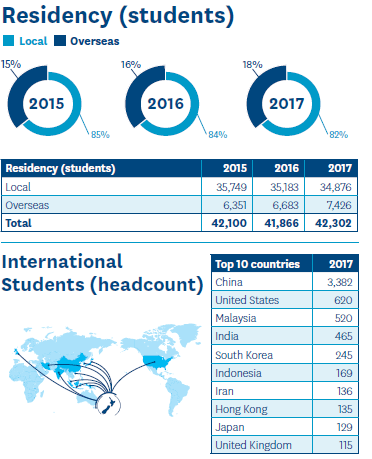
As a reminder of just how compromised our university hierarchies are I found this graphic on the Auckland University website.

au students

Not only is the dependency on foreign students rising, but the foreign student numbers are totally dominated by PRC students.    I’m usually very keen on free and open trade, but when you find yourself dealing with thugs, the sensible response (in almost any business or area of life) is to pull back and reduce your exposure to thugs, not to simply do the kowtow –  perhaps especially when you are a university, residue of some of greatest bits of the Western tradition.    We can’t allow our values, and the safety of our people, to be simply played around with to protect the interests of a few big (public and private) corporate businesses.   In Australia, a former Secretary of Foreign Affairs and Trade recently called for Australian universities to not act as if the revenue will always be there

“While demand remains high, it makes little sense for Australian universities to turn their back on the revenue stream offered by students from China and elsewhere,” he said. “But it would be wise to invest the profit margin for the longer term, not use it for current expenditure. Put it into a future fund or endowment, which would give universities a measure of resilience in the event that the market abruptly shifts for reasons beyond the control of universities.”

That would seem prudent here too, but of course it might force governments to look harder at the long-term financial structuring of our tertiary sector.

Finally, there was a story on some of these issues on Newsroom this morning, the key line in which is best captured in this tweet.

As Geremie Barme notes further (perhaps rather generously on the government’s intentions)

“China’s challenge to everybody in this region … is it requires governments are much smarter in dealing with a rising superpower that is aggressive, totalitarian, bullish and nasty in many ways, but also is varied and complex and interesting and engaging.”

Standing up to China, while still maintaining a working relationship, was difficult.

“It’s hard work and it’s constant work. This Government wants to do good but can’t quite manage to do so,” Barmé said.

“This is the real deal, and New Zealand’s never had to face this … You have to sit down and you have to work out, what is a consistent long-term policy, at least for the life of this Government. And how do you articulate that.

“And I get the sense they haven’t done that; Jacinda Ardern just runs for cover.”

She can’t even bring herself to talk, concernedly, about the astonishing situation in which a former PRC intelligence official, Chinese Communist Party member, sits in our Parliament –  close to the Embassy, never criticising the regime for anything –  having acknowledged that he misrepresented his past to get into the country in the first place.

I guess it suits the handful of big corporates and university bosses that she simply keeps quiet.  It should shame the rest of us.

Thoughts prompted by the open letter

There was an open letter to the Prime Minister, cc’ed to the Deputy Prime Minister and Foreign Minister, released this morning and signed by 29 people (mostly academics), prompted by

….the reports of intimidation and harassment suffered by Professor Anne-Marie Brady of Canterbury University. According to news reports, she has been repeatedly burgled and her car tampered with, starting from December 2017. Reports have suggested that these events are related to her high-profile academic work on overseas influence campaigns by the government of the People’s Republic of China.

The letter calls for two things

…we echo the recent calls by Professors of Chinese history and literature Geremie Barmé and John Minford for the New Zealand authorities to take the threats against Professor Brady more seriously, in consideration of their implications for all New Zealanders.

(I ran the Barmé/Minford letter here last week.)

We also urge Prime Minister Jacinda Ardern to make a clear statement in defence of academic freedom in New Zealand in light of the Brady case, and to be very clear that any intimidation and threats aimed at silencing academic voices in this country will not be tolerated.

It should be hard for decent people to dissent from the broad thrust of the letter (which even appears to have briefly united ACT and the Green Party –  at least the bits out of office.)  One might quibble about the details –  for my own tastes it seems a bit too focused on “academic freedom” (which is mostly about the relations between universities and their staff), as distinct from the more general freedoms of New Zealand citizens and residents, including those of the ethnic Chinese community, whether or not they happen to be associated with a specific government tertiary institution –  but the thrust of the case really shouldn’t have needed saying, and yet apparently did need to be said.

But I found two things about the statement interesting.  First, who did and didn’t sign.  And, second, the (reported) reaction of the Prime Minister.

By my count, 21 New Zealand-based academics signed (plus a couple of PhD students, and one New Zealander working at a US university).  Of those 21, only one appears to specialise in international relations, and none appear to be specialists in matters to do with China (politics, society, economics, international relations or whatever).

One of the signatories was (former academic and now) consultant Paul Buchanan.  In  an exchange of comments here on Saturday, and in reference to this letter he noted

It appears many academics are reluctant to sign on because a) they fear retribution of one sort or another (say, loss of funding); and b) they personally dislike Ms. Brady and/or claim that her research is flawed etc. The fact that people cannot separate personal animus and/or concern about funding from a defence against criminal harassment is telling. As for her research, her “Magic Weapons” essay is an example of applied research and was not meant to be a theoretical or conceptual path-breaker, so sniping about its quality is pedantic.

Perhaps some of our media might like to ask, for example, those involved in the Contemporary China Research Centre about why not one of them signed this statement (or, so far as I’ve seen, have issued their own statements supporting Professor Brady).   As a reminder

The New Zealand Contemporary China Research Centre is New Zealand’s national research centre on China. We are based at Victoria University of Wellington with New Zealand’s other seven universities all being University Members of the Centre, University of Auckland, Auckland University of Technology, the University of Canterbury, the University of Otago, the University of Waikato, Lincoln University and Massey University, and with each University providing a Deputy Director.

Here is a list of the senior people at CCRC, including the Executive Chairman, Tony Browne (who also happens to chair Victoria’s Confucius Institute, and to sit on the board that advises the PRC government agency on the Confucius programme worldwide).   As the excerpt says, there is a director and then deputy directors in each university, and there are research/senior fellows.

But then here is the Advisory Board to the CCRC.   It includes representatives of MFAT, NZTE, MBIE, and Treasury, as well as the Director of the Asia New Zealand Foundation, the chair of Education New Zealand and the former chair of the New Zealand China Trade Foundation.

The CCRC helps run courses for MFAT.  And it hosts various visiting delegations from PRC government agencies.  Just next week, it is hosting a conference on next year’s Year of Chinese Tourism which event, no doubt, the PRC Embassy smiles benignly on.

Wouldn’t do then for anyone to speak up or speak out.  I don’t suppose there was anything quite as crass as a directive to all to keep quiet, but all those involved surely know which side their bread is buttered on (perhaps they wouldn’t have got appointed if not).  Much as I care about the intimidation and threats to Professor Brady, if there is a narrow issue of academic freedom, it is probably more about the utter silence of the rest of the China-focused New Zealand academic community.  It was perhaps also telling that no university vice-chancellors signed the open letter.  Perhaps they are all sympathetic –  and there have been no reports of Canterbury trying to close Professor Brady down –  but they have enrolments to sell, and the PRC is a big and threatening market.    But, again, perhaps some journalist could ask them about their attitude to attempts to intimidate a prominent New Zealand academic?

I guess the Prime Minister will probably get some direct questions on this issue at her post-Cabinet press conference, or in her weekly media rounds tomorrow, but I was interested in her initial response, as Radio New Zealand reported it.    It was terse and largely empty, apparently attempting to avoid the issue, with brief comments along the line that she “supports” and “defends” academic freedom, but that she couldn’t say anything more substantive until the Police investigation had concluded. She couldn’t even manage –  wasn’t willing to –  make a statement that was (in the words of the signatories)

“very clear that any intimidation and threats aimed at silencing academic voices [or others] in this country will not be tolerated.”

And, again as Radio New Zealand reported it, Professor Brady understands that the Police investigation has already concluded, and the question now is whether the government will show any backbone.     Whose values is the Prime Minister actually sticking up for?

Of course, if anything the Leader of the Opposition, interviewed on Radio New Zealand a few minutes later, was worse.  He managed some quick passing comments vaguely in support of the letter –  I guess he could hardly say he opposed “academic freedom” –  before moving on to run his own (in effect) defence-of-Beijing line.    Rather rashly he declared the US and China to be in a “virtual war”, was more or less defending Huawei (there was “no smoking gun” –  it might be a bit late when there is, surely?), and criticising the government for being a little hesitant about the Belt and Road Initiative (recall that Bridges was the minister who signed us up for a “fusion of civilisations”) and for upsetting China by buying the P8s and stating a few honest words –  never echoed by the PM –  in a defence policy statement.

“We’ve got a situation of inflamed language, particularly from the Foreign Minister whether it’s been on defence strategy, whether it’s been Belt and Road. These things will be of concern to the Chinese and they will be sending a [subtle] signal.”

As if he belonged to the youth wing of the Labour Party, he was reciting lightweight lines about how “we shouldn’t take sides”.   Not in opposing evil?  Not in resisting aggression?   That wasn’t New Zealand’s historical approach –  National or Labour. Then again, his stance seems to be avoiding even taking New Zealand’s own side, given the continued presence of Jian Yang in his caucus, and Yikun Zhang in arranging large donations for his party.

To return, finally for now, to the Prime Minister, TVNZ ran a story/article on Friday night about the decision – no doubt from Beijing –  to deny the Prime Minister a trip to Beijing this year.   With the website version there was a little video clip from the opening moments of her meeting with Chinese premier Li Keqiang in Singapore a couple of weeks ago.  I very rarely listen to such clips, but for some reason did this time.   The clip captures the Prime Minister opening the meeting stating that she was encouraged by “the significant common ground between your vision for China and the policies of my government”.  She went on to observe that “just as you are focused on a balanced development model and the wellbeing of the Chinese government, my government is focused on sustainable economic development and a fair society”.

It is, frankly, sickening and shameful.  Our Prime Minister, elected leader of a free, open and democratic society, governed by the rule of law etc suggests that there is “significant common ground” between her government’s policies and those of one of the most brutal un-free regimes on the planet, that has spent at least the last six years going backwards not forwards on the sorts of values and practices that most New Zealanders cherish,

Sure, Prime Ministers and like need to mutter pleasantries at the start of meetings, but surely “did you travel well, and get a good sleep?” beats this sort of stuff?    And why is she giving recognition and apparent approbation to the desire of the Chinese Communist Party to extend its brutal rule (“the wellbeing of the Chinese government”).

Is there any decent moral core there at all?  No wonder she hasn’t managed a robust defence of free and open debate, of the sort the academic signatories called for.

(I’d been going to write a bit about former NSW premier, former Australian foreign minster, current head of a somewhat Beijing-sympathising think-tank, Bob Carr’s interview on China-related issues on TVNZ’s Q&A last night.   There were plenty of bits to disagree with, but actually compared to either Simon Bridges or Jacinda Ardern he came across as fluent and somewhat reasonable.  Perhaps it helps being out of office, but he was willing to welcome Mike Pence’s efforts to highlight China’s human rights abuses, and was explicit that he would not have signed Australia up to the Belt and Road Initiative.    By his standards, New Zealand’s “leaders” seem very far gone.)

NZ and the PRC: Friday bits and pieces

I noticed in the Herald’s “Dynamic Business” supplement, associated with the Deloitte Top 200 awards (themselves notably short on successful outward-oriented companies based on anything much other than natural resources), that the former Prime Minister John Key was interviewed about China.   It was, to say the least, a bit of a mixed bag.  In his first answer this line appeared

“I think Xi Jinping’s going to go down in history as a good leader of China.”

That would be in the history as written by the Chinese Communist Party (assuming it survives that long)?  I’d accept “consequential”, “influential”, even (in a bleak way) “pathbreaking”, but “good”?  What does John Key possibly see as “good” –  a term that usually has some moral connotation to it – about Xi Jinping’s rule?   It isn’t even as if the economy has been set on firmer foundations, let alone the seizures of power, seizures of territory,  the Xinjiang situation, or whatever.  But I suppose the PRC embassy will have taken note, and doors are likely to remain open in Beijing.

Key was then asked about the (straw man) question about balancing China and the United States.  I don’t particularly agree with his stance but at least –  in contrast to our current Prime Minister –  he seems capable of giving a straightforward answer, including recognising where our values, our culture, and our history take us.

…the reality is that our relationship with China is still a very economic relationship…. In the case of the US and our traditional allies –  Australia particularly – it’s a much different relationship.  They are the people that we culturally feel most at home with.  We share such a massive history.  Everything lines up much more closely there…..

I think if we turned our back on the Chinese, we’d find a lot more Irish an Dutch dairy products would flow into China and less would flow from New Zealand. It might be a bit mercantile but I think that would be negative for the New Zealand economy, for dairy farmers and for lots of New Zealand businesses –  from tourism to education services

I think he is mostly wrong about dairy –  it is a globally traded market and as we are seeing in the soybean market at present in time what doesn’t go to one country ends up going to another (if, say, the Irish and Dutch industries had WMP capability, to divert that product to China would involve not selling to the people they are now selling to).  But at least Key seems willing and able to give a straight answer –  even if it is an amoral one:  “never mind the nature of the regime, we should give priority to businesses selling stuff there”.

There was an interesting snippet in the Herald’s (typically rather well-sourced) “Insider” column in which it is noted that

NZ diplomats have been told the long-expected invitation for Jacinda Ardern to go to Beijing won’t come any time soon.

Perhaps that is the explanation for her shameful refusal to front up for the Herald’s longstanding interview request.  But if so, she needs to rethink her priorities.  Tea at today’s Berchtesgaden beats an open and honest discussion with –  and accountability to – her own citizens and voters, confronting concerns about the activity of the regime at home, abroad, and here in New Zealand?

You could read the account on the Chinese Embassy’s website of her meeting with the PRC Premier Li Keqiang and not come away with any sense of any awkwardness at all, with bizarre talk of working together for the “peace and prosperity” of the Asia-Pacific region.  We are presumably supposed to accept with a straight face words like these from the Premier

He also encouraged New Zealand companies to expand investment in China and boost technological cooperation with China, saying that China will conduct the cooperation on the basis of strict protection of intellectual property rights.

Surely only that distinctive New Zealand “Yeah right” should greet claims like that?.  Perhaps the Prime Minister’s perspective on the meeting would be different, but there is no similar account on the Beehive website (and if MFAT had problems with Beijing’s account, no doubt they have raised those concerns).

Can it really be that deals and donations are all that now matter to her?    If she doesn’t care about the citizens of the PRC, or about surrounding states, or even about how closed an economy China is in many respects, is she really not bothered about the PRC activities here?  Presumably not.  After all, Raymond Huo chairs the Justice committee and sits in her caucus, and Jian Yang sits on the other side, and not a word in heard from the Prime Minister.

There was an interesting post a couple of days ago from Paul Buchanan, the American (but New Zealand resident) former academic and now consultant on issues international.  He began by addressing the somewhat extraordinary suggestion (made by David Parker and the Prime Minister) that New Zealand could be some sort of bridge or broker between the US and China. He is simply dismissive of it, and doesn’t think either Beijing or Washington is likely to take it seriously.

For my tastes, Buchanan’s discussion  is altogether too cold (then again, perhaps his future isn’t tied to New Zealand?).   He suggests

While New Zealand audiences may like it, China and the US are not fooled by the bridge and broker rhetoric. They know that should push come to shove New Zealand will have to make a choice. One involves losing trade revenues, the other involves losing security guarantees. One involves backing a traditional ally, the other breaking with tradition in order to align with a rising power. Neither choice will be pleasant and it behooves foreign policy planners to be doing cost/benefits analysis on each because the moment of decision may be closer than expected.

I’ve disagreed with him in comments here on earlier posts, because I think he grossly overstates the extent of any sort of “economic dependence” of New Zealand on China.

On trade, New Zealand has an addict-like dependency on agricultural commodity and primary good exports, particularly milk solids. Its largest trading partner and importer of those goods is China. Unlike Australia, which can leverage its export of strategic minerals that China needs for its continued economic growth and industrial ambitions under the China 2025 program, New Zealand’s exports are elastic, substitutable by those of competitors and inconsequential to China’s broader strategic planning. This makes New Zealand extremely vulnerable to Chinese economic retaliation for any perceived slight, something that the Chinese have been clear to point out when it comes to subjects such as the South China island-building dispute or Western concerns about the true nature of Chinese developmental aid to Pacific Island Forum countries.

But even if there is some potential for short-term disruption to some sectors or firms, countries largely make their own medium-term fortunes. That was true of us in the past, is today, and will be still in the future.  Policymakers here have been very unwise in continuing to encourage stronger trade links with China, even as they recognise the sorts of threats and disuptions China has proved capable of in other countries, and the more aggressive approach China is taking internationally across a range of fronts.  No serious and free country, none with any integrity whatever, ever prioritises (for any length of time) the interests of a few of its export firms, over the values of its people.  In the medium to longer-term values and interests amount to the same thing.

And it is not as if other countries in years past have not faced these sorts of tensions.  Denmark and the Netherlands had Germany as a major trading partner in the late 1930s, but they didn’t simply roll over and invite Hitler in.

Perhaps more importantly, and a reason why I think the US vs China framing is a distraction, is that whatever the US is or isn’t doing, we face the interference activities of the PRC in our own country.  Simply taking a stand there –  clearing Jian Yang and Raymond Huo out of Parliament, standing up for Anne-Marie Brady and for those ethnic Chinese New Zealanders facing regime pressure and threats, being more open and serious about the cyber-security threats, shunning people with recognised United Front connections (not honouring Yikun Zhang), protecting and promoting an independent Chinese language media here.  These are the sorts of things a minimally decent government would be doing, even if it said not a word about abuses in China or China’s near-abroad.  But not our government: faced with the choice not between China and the US, but between decency on the one hand, and deals and donations on the other, they seem to side with the deals and donations.  And the National Party provides them cover to do so.

On the topic of cyber-security, the Australian papers this week had several stories about PRC cyber-attacks on Australia.   There were two classes of attack in the stories I saw –  one about a resurgence in direct cyber attacks on Australian companies, in violation of some deal Malcolm Turnbull and the PRC had done a couple of years ago.    The other built on this academic article, in which the authors report the results of a study showing how the PRC appeared to get round a similar deal between Barack Obama and the PRC in 2015, by using China Telecom to route selected international internet traffic through China –  where presumably the PRC could spy on it, copy it or whatever –  rather than following the standard (shortest distance) protocols. The authors provided evidence to the Australian media strongly suggesting a specific such attack involving Australia last year.

But here is the thing that interested me.  In the newspaper articles I read we saw senior government officials confirming “a constant, significant effort to steal our intellectual property”, and even a senior Cabinet minister expressing concern about the number and severity of such attacks.

By contrast, what do we get here, but blather from the Prime Minister about needing to keep an eye on cyber-security, and otherwise silence –  “national security” don’t you know, providing cover for anything ministers and officials don’t want to talk about.  I did see a Radio New Zealand article quoting a PWC person saying there was no evidence New Zealand had been caught up in the first class of attacks described above.  It would be nice to hear it from official sources, but even if it is true in the specific case, how likely is that the PRC approach to New Zealand is very much different than that to Australia –  take what they want, and can get at?   Occasionally, I make glib remarks about how perhaps New Zealand has nothing much advanced to steal, and when I do I get firmly put in my place, with links to various advanced university departments (for example).  Surely we might reasonably expect the Prime Minister or the Minister for the Intelligence Services to front up on this sort of issue, at least to give us reason to believe (confidently) that they aren’t living in some fool’s paradise, convinced they are uniquely immune from the efforts of the Ministry for State Security?

And finally,  I was sent yesterday a copy of a statement by a group called the New Zealand Values Alliance, which appears to be a group of ethnic Chinese people living in New Zealand who are concerned about the intrusion of the PRC into New Zealand.  (There is a similar, more prominent group in Australia, called the Australian Values Alliance.)   This was the statement

We, New Zealand Values Alliance(NZVA) , hereby issue the following declaration:

It is learned from media that the prominent China researcher Anne-Marie Brady has encountered on-going harassment which has recently widened to include a vehicle  sabotage of her private car, which “absolutely posed a risk to her life”.  We hereby express our concern and condemnation on the matter.

To our knowledge, similar harassments and threats sometimes happen to people who criticize CCP. Such harassments include text intimidation, tracking, stalking and a variety of harassment activities which has now escalated to sabotaging private vehicle to seriously threaten life safety.

We are very concerned about the personal safety of people who publicly criticize CCP. We earnestly appeal to the NZ government and police to pay close attention to the safety of those human rights activists and researchers against dictatorships and give more attention  to the rampant activities related to foreign political infiltration. Meanwhile an investigation into foreign interference should be started ASAP   and relevant laws be established for deterrence and punishment against related activities from agents with foreign interests.

Hard to disagree (the Values Alliance had an earlier statement about Jian Yang, reported here).  The organiser, a relatively recent migrant from China, Freeman Yu, has noted on his Twitter feed his own experience of what he talks of

Does this sort of thing bother our politicians at all?

You might have hoped that New Zealand political leaders would be speaking out  (let alone New Zealand academics working on China and/or international relations).  Former Prime Ministers, former Opposition leaders, former foreign ministers?  People like Don McKinnon, Jenny Shipley, Don Brash, Murray McCully, Helen Clark, Phil Goff, Geoffrey Palmer, Jim McLay, Jim Bolger or Mike Moore.  But, it appears, not a word from any of them, let alone Bill English or John Key.   A sad commentary, that rather tends to make the point Anne-Marie Brady was making in her paper about how too many of our elites have been persuaded that keeping quiet and going along is somehow in the best interests of New Zealand.  In fact, it largely just serves Beijing’s interests.

Blathers away when directly asked

Another week and another Matt Nippert article in the Herald updating us on the Prime Minister’s continued refusal to be interviewed substantively on the government’s approach to the People’s Republic of China.

A Herald request filed in May to discuss the Government’s China policy with Ardern was this week again rejected, with possible windows for an interview now pushed into early next year.

Perhaps it  –  refusal to be interviewed by a serious journalist on a major public policy issue – might not matter as much if our MPs were not, apparently, all in thrall to the PRC, such that there is no questioning in Parliament of the government’s approach on this really important issue.  But Parliament is useless –  and worse –  and the Prime Minister simply avoids (refuses to face) sustained media questioning.  Not, it seems, that many try, but to their credit the Herald has.

Cheap virtue-signalling is apparently fine: the Prime Minister was reported as (to her credit) having refused to travel in a Maserati at APEC.  But that’s only PNG, and hardly anyone here (well, perhaps a few MFAT diplomats) will question her small stand against such excess.

But she is not willing to engage seriously on the activities, including those in our own country and own political system, of a great (if evil) power.

Fortunately, an occasional journalist does still manage to ask the odd question.  But they are typically short interviews, and rarely focus in on things she is directly responsible for, and so she gets away with what can only be described as “blather”.    There was an excellent example on Radio New Zealand’s Morning Report yesterday when she was interviewed by Guyon Espiner.

It was a consistent attempt at minimising any issues, relativising everything, and never ever calling out China on anything.  It was actually pretty fundamentally dishonest to the New Zealand public, in attempting to imply that all that is really going on is a trade dispute.   Then again, I thought she was given a pretty easy run by the interviewer.

Thus, we were told that there was “significant consensus” around the APEC communique and that the issues were only a few words.  But she knows as well as anyone that most such communiques are just bumpf anyway, and the real issues always resolve around a few critical words.  It matters a lot –  tells us a lot – that neither the US nor China decided that it was in their interests to compromise on this specific point, which could almost certainly easily have been drafted around (and the results spun by each side) had there been a will to do so.  (“Unfair trade practices –  of course we disapprove of those, but our country doesn’t have any, just standard national security provisions”.  That sort of thing.)

She stated that both sides should “step back and de-escalate”, without addressing the substance of the issues at all.    But she must know that her consistent refusal to say anything of substance plays into the hands of the People’s Republic.  You might think –  as I do –  that Trump’s initial focus on bilateral trade deficits is pretty flakey, but it doesn’t detract from the wider issues around theft of intellectual property, market access, and so on.  The PRC remains one of the least open markets in the world.  And the US by contrast, for all its many faults, is one of the most open.

The government seems to see itself as having some sort of role as a ‘bridge” between the US and China.  Questioning drew on a comment to that effect over the weekend from the Trade Minister, David Parker.   The Prime Minister attempted to minimise this, talking of some specifics around WTO governance.  But perhaps the interviewer could have pushed her rather more on what it is that the government disagrees with in the recent combined (ie not just the US) EU, Japanese, and US approach

On November 12, the United States, European Union, and Japan will submit a package of proposals to the World Trade Organization’s Council on Trade in Goods that would significantly help curb China’s practices of heavily subsidizing its state-owned enterprises. They are also discussing ways to prevent China from forcing Western companies to transfer technology to Chinese firms.

The Prime Minister was asked why we wanted to be a “bridge”, to which her response was to burble on about a “values-based approach”, an independent foreign policy, and not picking sides.  Surely in any sort of values-based approach –  one where life is more than deal and political donations – you would be found on the side opposing the greater evil?  But, of course, there was none of this from the Prime Minister, just the suggestion that somehow being neutral was better, for its own sake.  To believe her, for example, you’d have to believe that Michael Joseph Savage and Peter Fraser were forced into World War Two against their better judgement, rather than as leaders of an independent country deciding to act together with other countries that shared our values, and the attitude to the presenting evil.

It is the sort of answer that wins praise from the largely taxpayer-funded propagandists for all things PRC.   It shouldn’t be acceptable to decent New Zealanders, not compromised by deals or donations.

The interviewer tried again, asking if she was really saying we (well, she) was as aligned with the PRC as with the United States (with whom, as he pointed out, we are in a longstanding intelligence relationship).  Even there she couldn’t manage a straight answer, burbling on about how “we align ourselves with a set of principles and values. Some of these things are not black and white”.  But even then she seemed to be trying to reduce everything to technical details about a trade dispute.  No sense, for example, that imprisoning a million people in Xinjiang, for being who they are, qualifies as pretty unconditionally “black”.  Or probihiting freedom of speech, scoffing at the rule of law, widespread theft of intellectual property, severe restrictions on freedom of religion, and no capacity of a country’s citizens to change their government –  and all that is mostly just the internal stuff –  are pretty black.  No other country –  let alone our own – is perfect, but in real life you choose to align with real people and real countries, and when you choose to consistently refuse to identify that New Zealand has a lot more in common –  in its values –  with Australia, Canada, the US, Japan, the UK, Taiwan, or EU –  than with the PRC, by default you side with other lot.   You give legitimacy to their evil.

The interviewer moved onto the Belt and Road Initiative, which the previous government signed us up to last year –  some sickening text (“fusion of civilisations”), but mostly a big propaganda win for the PRC.  Because although the Prime Minister tried to spin her listeners suggesting that lots of countries had signed up, we are the only advanced country – and the only Five Eyes partnership country – to have done so.   Of course, given that the deadine in the original agreement for specifics has now passed, one might deduce that the government is not too keen on doing too much under the loose aegis of the Belt and Road Initiative.  Perhaps the pressure from Beijing for some specifics is beginning to mount –  if, for example, New Zealand wants that extension of the preferential trade agreement (or the Prime Minister wants that trip to Beijing).

The interviewer moved onto matters we have full control over: our response to the PRC influence and interference activities in New Zealand.    He quoted Anne-Marie Brady’s line that those activities (“covert, corrupting, coercive”) were now at a “critical level”.   The Prime Minister simply refused to engage with specifics (she was “very cautious about labelling”), talking about the need for good and broad “legislative frameworks” –  as if the real issues were primarily legislative, rather than attitudinal ones being at least as important  – while naming nothing specific there either (although some mention of cyber-security).   We need, we were told, to be “vigilant across the board”, trying to play distraction with references to North Korea and Russia.   She was, she said, comforted that there was no evidence of interference in the election, without being pushed to engage with the fact that the current inquiry into last year’s election is being led by her own MP, Raymond Huo, who is himself associated with various United Front organisations, who adopted a Xi Jinping slogan for Labour’s campaign, and who organised the function at which Phil Goff funded a large chunk of his mayoral campaign with a “donation” (charity auction bid) from mainland China.  I wonder how the intelligence services would feel if they were called to testify to a committee chaired by Mr Huo?

And, finally, the interviewer moved on to the burglaries at Anne-Marie Brady’s home and office, and suggestions of interference with her car.   There was no clarion call in defence of the freedom of New Zealanders (academics or otherwise –  this isn’t largely about academic freedom) to write, advocate and lobby as they like, no observation that while the investigation hadn’t yet been resolved, if there were evidence of involvement of a foreign power it would be a very grave matter, which the government would need to respond to with utmost seriousness.  Instead we got attempts at obfuscation and procrastination.  She told us she didn’t comment on intelligence briefings, only for the interviewer to point out that she was first one to mention intelligence services.  Twice she attempted to point out that she had “been away”, as if she’d been communing with nature alone on top of some high mountain, not travelling on a government plane, accompanied by all manner of senior government officials.

If it wasn’t that surprising –  given what we’ve come to see of her performance –  it was disappointing nonetheless.   I wonder if we will even get a straight answer when the Police finally – next year, the year after  –  finish their investigation.  Effective freedom of speech –  let alone a stand for the core values of New Zealanders – seems to be an inconvenience next to keeping the donations going, and keeping the business interests trading with China (notably Fonterra, the universities, and the tourism sector) on side.  Her only “value” in this area seems to be the dollar.

But, of course, she gets away with it because the Opposition leader is just as bad.   She has Raymond Huo in her caucus (and in a senior select committee role), he has Jian Yang, and both seem to keep the donations flowing, and neither will call out the other.  The parties combine to honour Yikun Zhang for what, it seems, is in effect services to Beijing.

There was an interesting article in the Financial Times yesterday, reporting that the US is considering banning exports to China of a range of advanced technologies

In a document published on the Federal Register, the commerce department listed all the products it might subject to export curbs. These included items from genomics, to computer vision and audio manipulation technology, to microprocessor technology, quantum computing, mind-machine interfaces and flight control algorithms.

It is the sort of thing that illustrates that however silly the initial focus on bilateral trade deficits was, the tensions between the US and China are well beyond that stage now.  At a time when the Chinese economy is in any case looking under more threat as the longrunning credit boom appears to have exhausted itself, and the authorities seem unsure how –  if at all – to respond, surely an honest and decent Prime Minister would be more interested in levelling with the public, about the nature of the regime in Beijing, the nature of its threats here and abroad, than in engaging in some sort of weird amoral “balancing act”.   If she wants to run the “not black and white” line, at least she could honestly recognise the distinction between off-white and something very very deeply dark grey.

But not in New Zealand.  One could almost say she puts herself in something like the same category as Trump over Saudi Arabia –  with obfuscation and avoidance, rather than bluster, her chosen rhetorical style.

In closing, and having praised the Herald for persevering (I guess at near-zero cost) in its quest for a serious interview on these issues, I noticed this earlier in the day

https://twitter.com/niubi/status/1064907102412513281
Translated from Chinese by
Microsoft
New Zealand has fallen.

Bill Bishop is a pretty astute and highly-regarded China analyst (who wears his distaste for Trump pretty visibly).  I clicked the link and sure enough there seemed to be a whole series of sponsored articles (links down the right hand side of this particular article) from the People’s Daily –  main Chinese Communist Party newspaper – on the Herald website.  Quite extraordinary.

Voices in support of Anne-Marie Brady

Many, perhaps most, readers will have seen the article by Matt Nippert on the front page of yesterday’s Herald, about Professor Anne-Marie Brady and indications that her car may have been sabotaged.  This, of course, comes in the wake of break-ins to Professor Brady’s home and office, that are still –  months afterwards –  being investigated by the Police.  The strong suspicion has been that agents of the People’s Republic of China were involved in the break-ins, including (inter alia) because of what was, and wasn’t, taken, and letters that Professor Brady had received.  Yesterday’s article included this comment from Brady about the very slow-moving investigation.

She was unwilling to comment on the lengthy and still unfinished Police investigation, but told the New York Times in September the lack of comment or public action from government to date was “starting to look like procrastination”.

Official Wellington might be thought to have a strong interest in the investigation not coming to a conclusion, and it has (sadly) become difficult to have much confidence in the independence and integrity of the Police when it involves issues that matter to governments.

Nippert also included this section

The ongoing investigation …. had raised the temperature of local debate on the issue of China.

Commentary in local Chinese-language media has been an especially heated, with a recent op-ed by Morgan Xiao – published simultaneously by SkyKiwi, the Mandarin Pages and the New Zealand Chinese Daily News – describing Brady and other New Zealand-Chinese democracy activists as “anti-Chinese sons of bitches” who should “get out of New Zealand”.

Freeman Yu, whose New Zealand Values Alliance has started a petition urging the government to follow Australia’s lead and curb China’s local influence, was also called out by Xiao.

Yu said the language used in local debate had recently hardened, with “extreme expressions used in the Cultural Revolution”.

“The language used in their articles expressed intense hatred for different voices and the freedom of speech,” he said.

Comments sections on (for example) Stuff often don’t reveal humanity at its finest, but this is a description of a published op-ed.   New Zealanders should get out of New Zealand?

I know Professor Brady only slightly.  We’ve talked a couple of times and exchanged emails from time to time over the last year.  I’ve found her contribution to the New Zealand debate –  which seems to involve stepping a bit beyond her personal comfort zone (academics are often most comfortable behind the scenes) –  on these issues invaluable.   Such debate as there now is wouldn’t be occurring without her.

But Geremie Barmé and John Minford know Professor Brady very well.     Barmé and Minford are both emeritus professors at the Australian National University where Barmé was formerly Director, Australian Centre on China in the World and Chair Professor of Chinese History at Australian National University College of Asia and the Pacific in Canberra.   They now live near Featherston –  which perhaps accounts for the number of China books I found in a Featherston secondhand bookshop recently –  and host The Wairarapa Academy for the New Sinology.  Their website has a fascinating collection of material, which I’ve linked to occasionally.

They have today put out a statement about Professor Brady, her work, her position and so on.   I’ve reproduced it here (with permission).

17 November 2018

Re: Professor Anne-Marie Brady

To Whom It May Concern,

Professor Anne-Marie Brady is a noted specialist in China’s domestic and foreign politics at the University of Canterbury. Her work on contemporary China, and its increasingly controversial global engagement, contributes directly to the national interest of New Zealand. It is also having a considerable impact internationally, not only in academic circles but also in political debates and policy formulation among the major allies and trading partners of this country.

As teachers and mentors of Professor Brady — John Minford was one of her undergraduate teachers at the University of Auckland; Geremie Barmé was a supervisor of her doctoral work at the Australian National University — we are proud of her achievements and we strongly support her ongoing academic research work and engagement with issues of public, national and international significance.

In February this year, we were profoundly disturbed to read media reports about break-ins at Professor Brady’s workplace and of her home office, resulting in the theft of electronic equipment and research materials. The details of the break-ins, still a subject of police investigation, suggested that Professor Brady was being subjected to intimidation for her internationally recognized work on official Chinese strategies to influence the politics and societies of foreign countries, in particular New Zealand. (See: https://www.pressreader.com/new-zealand/the-dominion-post/20180219/282355450217707) We were shocked by the latest media reports — on 16 November — that, during routine Warrant of Fitness maintenance, it was discovered that her vehicle may well have been purposely tampered with. There are indications that this was done to endanger the occupants of the vehicle: Professor Brady, her husband and their three teenage children. (See: https://www.stuff.co.nz/national/108649435/professor-annemarie-brady-who-warned-about-china-interference-says-car-was-sabotaged )

The freedom from fear was long ago recognized as a basic human right; academics should be able to pursue their work, and their daily lives, without being subjected to intimidation. In any modern democracy worthy of the name, academic freedom and independent research are crucial “public goods”. They are also germane to university life.

As residents of New Zealand and as independent scholars — our main institutional affiliation is with The Australian National University as emeritus professors — we hereby express our deep concern about the on-going threats to Professor Anne-Marie Brady’s research and private life.

We hope that others whose research and teaching involves contemporary China will offer her and her important work collegial encouragement, as well as public support.

Furthermore, we also hope that the New Zealand authorities take the threats against Professor Brady seriously. We appeal to the Prime Minister, Rt. Hon. Jacinda Ardern, and her coalition partner the Foreign Minister, the Rt. Hon. Winston Peters, to address directly the issues raised by her work which she has further articulated in practicable, and succinct, formal advice to the government.

Since September 2017, Professor Anne-Marie Brady’s work has attracted overwhelmingly positive global attention. It has also been subjected to vilification by Chinese officialdom. Regardless, her work continues to influence the debate about China’s “sharp power” on the international stage, and it contributes to practical policy discussions in Europe, North America and in Australia. This work remains ever more pressingly relevant to the public life, and the future, of her homeland.

Yours,

Geremie R. Barmé
Professor Emeritus of History
The Australian National University
Founding Director, Australian Centre on China in the World
Fellow of the Australian Academy of Humanities

John Minford
Professor Emeritus of Chinese
The Australian National University
Sin Wai Kin Distinguished Professor
Hang Seng University of Hong Kong

To me, the most important lines in the statement are those addressed to our political leaders

We appeal to the Prime Minister, Rt. Hon. Jacinda Ardern, and her coalition partner the Foreign Minister, the Rt. Hon. Winston Peters, to address directly the issues raised by her work

(To which I would add “and the leaders of the National Party, so recently in government”.)

They might also speak about, for example, things like that appalling op-ed from various Chinese-language local media.

Shameful as the government’s stance on, say, Xinjiang is –  the refusal to add our voice to the protest by our friends and allies –  we can’t change China.  But we  –  they –  have no such excuse when it comes to New Zealand itself, our political system, the environment facing freedom-loving ethnic Chinese New Zealanders, and the actions of the People’s Republic of China and its agents here.

And yet Matt Nippert’s article reminds us again of the supine, scared of their own shadow, attitude of the government.

Since May the Herald has been seeking to interview Prime Minister Jacinda Ardern about the governments’ China policy in light of Brady’s research and legislative action in Australia.

The Prime Ministers’ Office has regularly put off the request

Simply refusing to engage on such vital issues with a serious journalist from our largest newspaper is astonishing, and a telling commentary on how corrupted our political system appears to have become.  Perhaps as telling is the utter silence from the National Party on the government’s refusal to engage.

UPDATE: I would strongly recommend this new piece, by the commentator on China issues who goes under the label Jichang Lulu, to anyone at all interested in the PRC influence issues as they relate to New Zealand.