Fourth term government votes

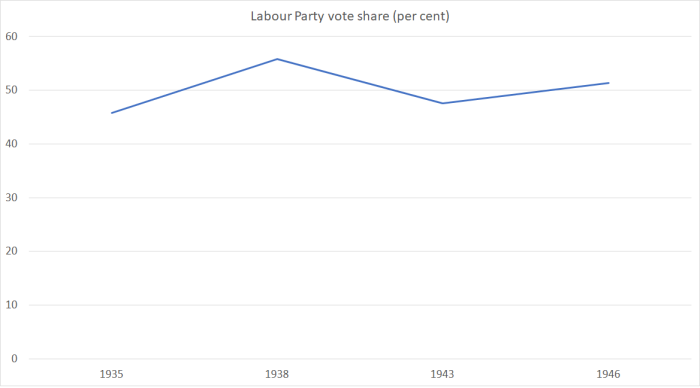
After the provisional election results were announced a couple of weeks ago I ran a post looking at how National and the other right or centre-right parties had done in this election compared to the experiences of the other two times (since National and Labour first dominated the scene) that a party had won a fourth term (1935 to 1949 under Labour, and 1960 to 1972 under National).   In both those cases, the winning party actually increased its vote share in the election that secured the fourth term (1946 and 1969).

MMP muddies the waters somewhat.  But here is a chart showing, using the final results this afternoon, the combined vote share for National, ACT, and the Conservative Party for the last four elections (numbered along the bottom) and comparing it with National’s experience in the four 1960s elections.  I’ve argued previously that most Conservative Party voters would (a) otherwise have voted National or stayed at home, and (b) had the Conservative Party won seats they’d have sided with National as surely as the Greens side with Labour.

centre-right vote share

The centre-right parties did impressively well to increase their total vote share in 2011 and again in 2014.  But the fall-off in this election – 6.6 percentage points –  is pretty stark.

It may still be enough to lead the next government –  time and New Zealand First will tell –  but, if so, it is hardly a ringing endorsement.    Here is some contextual material around National’s 1969 victory that I included in the earlier post.

Now that looks more like a genuinely impressive performance – the governing party lifting its vote share in the election in which it gained a fourth term.   There had been industrial action at the time of the election which had hurt the Labour Party, but the previous three years had been a very tough time to govern.   Wool prices had collapsed (and with them the overall terms of trade), the New Zealand government had been forced into a devaluation in late 1967, and had borrowed from the IMF under a pretty stringent domestic austerity programme.  Things here had been tough enough that over the three calendar years 1967 to 1969 there was a small overall net migration outflow (the first such outflows since the end of World War Two).

Some Australian perspectives on PRC influence-seeking

For those interested in the activities of the People’s Republic of China and the Chinese Communist Party in this part of the world, Professor Anne-Marie Brady’s paper remains essential reading.   The material Professor Brady lays out on the New Zealand is deeply troubling, as is the near-complete subsequent silence from most of our political leaders.

But if New Zealand remains somewhat unique in having a Communist Party member and former member of the Chinese intelligence services –  who has never disavowed his past and remains very close to the People’s Republic of China embassy –  as a serving member of Parliament, the issues around PRC influence-seeking, pressure on the Chinese diaspora, and direct meddling in the domestic affairs of other countries aren’t unique to New Zealand. In yesterday’s post, I highlighted several links to contribution to the open and active debate on these issues in Australia.

But today a new collection of 22 articles, speeches etc on the issue of PRC activities in Australia (“The Giant Awakens” ) has been released by Vision Times, one of the relatively small number of remaining independent Chinese media in Australia (as in New Zealand, most of the Chinese media in Australia are now apparently under the effective control of the PRC).  More than half the authors are themselves ethnic Chinese, including a former PRC diplomat to Australia who defected a decade or so ago.

I haven’t read the entire collection, but of those I have read almost every piece struck a chord in one way or another, with so much of what is written about raising similar issues and concerns to those Professor Brady alerts us to in New Zealand.   I’d commend it to anyone interested in the subject, both because Australia (a) matters to us, and (b) seems to have very similar issues to us, and because…..well….sadly there is nothing similar in New Zealand.   The near-complete cone of silence still appears to hold.

I’d particularly commend the first paper in the collection by Professor Rory Medcalf, who is currently the Head of National Security College at the Australian National University.   It is an easy read –  only three pages – but an uncomfortable one.

A few extracts

Here in Australia we have seen the Chinese Communist Party involved in what appears to be multi-faceted campaign to influence our politics and independent policymaking. This includes propaganda and censorship in much of this nation’s Chinese-language media as well as channels of interference through intimidation of dissident voices and the establishment and mobilisation of pro-Beijing organisations on Australian soil. There is also the troubling question of political donations and their motives.

On political donations –  recall the magnitude of some of the disclosed donations here

It has also been reported recently that Australia’s main political parties have received close to $6 million in donations over the last few years from individuals associated with the Australian Council for the Promotion of the Peaceful Reunification of China. The Council, in turn, is reported to have connections to the United Front Work Department, an organisation which reports to the Central Committee of the Communist Party of China.

But whatever the mix of motives, one thing is clear. The donations were enough for the Director-General of the Australian Security Intelligence Organisation (ASIO) to take the highly unusual step of directly warning the major parties that they and Australia’s national security could be compromised by such donations. For the head of ASIO to take such a step suggests he was genuinely worried, from a national security and national interest point of view. Security agencies cannot take effective action on any of this because it has been entirely legal – all they can do is raise the alarm. It is now up to the political class to decide whether there is, within Australian democracy, enough self-respect to function without money linked to the Chinese Communist Party. This, after all, is a massive, secretive, self-interested and foreign organisation, with interests that can sometimes clash directly with Australia’s.

These issues are at least as much about the interests of ethnic Chinese New Zealanders and Australians

Indeed, much of the worry about such influence is within this country’s diverse Chinese communities. If, as a nation, we chose to ignore such concerns, we would be effectively treating such dissenting voices among our Chinese-Australian population as second-class Australians, whose freedom of thought and freedom of expression do not warrant protection.

So the issue of foreign interference needs to be addressed in a context of respect for the rights of Chinese Australians. That means this needs to be an issue that is seized and owned by the moderate, bipartisan centre of Australian politics. This way, the issue cannot be captured by extreme voices or be distorted, misconstrued or falsely portrayed as one of xenophobia.

One of the points I’ve been making in a New Zealand context is that our economic dependence on China is (often) much-exaggerated.

The risk is that we will buy the story that our economy is so comprehensively dependent on China that Australia cannot afford to cause China much difficulty on security and political issues, even when our interests diverge. Indeed, perceptions of Australia’s vulnerability to Chinese economic pressure are exaggerated. Economic pressure from China that would have the biggest impact on Australia – most notably through iron ore trade – would also impose restrictive costs on Beijing. Privately or publicly, Beijing criticises or complains to Canberra frequently over multiple issues. But the accompanying threats tend to be implicit or general – that the bilateral relationship will suffer some unspecified deterioration if Australia does not heed China’s wishes.

…..If Beijing felt it needed to send an economic signal to reinforce its displeasure, its initial response would likely involve non-tariff barriers over quarantine and safety standards, or making life difficult for businesses operating in China, with limited long-term economic impact on itself or Australia.

Beijing has adopted this approach towards South Korean business interests, yet has not succeeded in its goal of changing Seoul’s stance on missile defence cooperation with the United States. Economic vulnerability is often as much about perception as reality – and it is in China’s interests for Australia to imagine itself highly vulnerable. Already, some voices in business, academia and the media focus on the possible economic impacts of annoying China. The perception of economic harm can have an outsized effect on domestic interests, creating pressure for rapid political compromise. If we overreact to any Chinese economic threats and self-censor on issues perceived to be problematic for Beijing, it will not protect Australia from further pressure – it will signal that such pressure works.

And finally

Foreign interference in Australia is not solely a national security issue. It is a fundamental test of Australian social inclusiveness, cohesion, equity and democracy that we ensure all in this country have freedom of expression, freedom from fear and protection from untoward intervention by a foreign power.

It is a paper, part of a collection, that should be widely read in New Zealand.

In my post yesterday afternoon, I linked to an article published in the AFR by Peter Drysdale and John Denton, attempting to play down the issue of Chinese influence and suggesting that critics are “demonising” the People’s Republic, or indeed Chinese-Australians.   There is a nice, accessible, response to that article by John Fitzgerald, another Australian academic.

…for Australia, the issue at stake is not whether Leninism and liberal democracy can work happily and co-operatively in their separate jurisdictions but whether it is possible for a democracy to maintain jurisdictional separation in a dependent relationship with a Leninist state without adjusting its everyday modes of operation. Whatever we may think of authoritarian Leninist states, of which contemporary China is clearly one, they are founded on an ‘enemy mentality,’ and they have immense difficulty recognising the territorial and jurisdictional limits of their overweening hierarchical authority. How is a liberal Australia to deal with a Leninist China as that country becomes more assertive beyond its borders?

A bold free press is one of the few instruments a democracy has at its disposal to check the encroachment of a Leninist state into its jurisdiction. An open, respectful, and evidence-based conversation on this encroachment in the media is essential to getting Australia’s relationship with China right.

It is not demonising China to report what the Chinese government says about itself: that it is a wealthy and powerful Communist Party state that has no time for democratic accountable government, no independent courts, security, or media, that denies universal adult political participation, that offers no protection for the exercise of fundamental rights of freedom of speech, religion or assembly. In China this is called guoqing. There are no plans to change anytime soon. Similarly, querying the behaviour of a few named and alleged influence peddlers from China no more tarnishes the reputation of all Chinese Australians than querying the conduct of Putin’s agents in Washington impugns the loyalty of all Russian Americans.

Meanwhile, here in New Zealand the final election results will be declared tomorrow.  A self-confessed member of the Chinese Communist Party, former member of the Chinese intelligence services –  both facts hidden fron voters for years, and partially hidden from the New Zealand immigration and citizenship authorities “because that is what the Chinese authorities told us to do” – will once again be confirmed as a member of Parliament.  That alone –  the tip of the iceberg in the issues Professor Brady raises –  should be deeply troubling.  But our establishment elites seem unbothered.  Nothing is heard from the Prime Minister. Nothing is heard from the Leader of the Opposition.  Nothing is heard from the Green Party.  Nothing is heard from the Minister of Foreign Affairs.  And when last heard from, the Attorney-General and minister responsible for several of the intelligence services resorted to simply making stuff up.

“That was a Newsroom article, timed to damage the man politically.  I’m not going to respond to any of the allegations that have been made about/against him. I think it is disgraceful that a whole class of people have been singled out for racial abuse.  As for Professor Brady, I don’t think she likes any foreigners at all.”

The best response to erroneous claims is the facts. As far as I’m aware, nothing in the original Financial Times/Newsroom articles, nothing in Professor Brady’s paper, and nothing in yesterday New York Times article has been refuted.  I’ve not even seen anyone try.  Some mix of embarrassed silence, and brazening through, in the hope that the issue will just go away seems to be what our “leaders” now count as responsible leadership.

The kowtow

EARLY IN the morning of 14 September 1793, George, Lord Macartney, the first British ambassador ever to visit the Chinese court, entered the imperial tent in Jehol, the Manchu capital, to see the emperor Qianlong.

As one, a thousand demonstrated their submission to the Son of Heaven by performing the ceremony of the kowtow. Three times they fell to their knees, and three times on each occasion they touched their foreheads to the ground. Macartney, however, refused to kowtow. He would bend one knee, he said, to his sovereign; both knees he would bend only to his God. Three times, with the greatest politeness, he went down on one knee. And three times, in the course of each genuflexion, in rhythm with the mandarins, he respectfully bowed his head. But he flatly refused to touch his forehead to the ground.

(from this)

There is a good article today in the New York Times today on the Jian Yang affair –  or non-issue as the National Party, and most other parties, and most of our establishment appear to believe (and want us to believe).   As the article notes

While New Zealand is a small country, it is a member of the “Five Eyes” intelligence sharing partnership along with the United States, Britain, Canada and Australia. And so vulnerabilities in New Zealand’s government could have wider import.

Curiously, not being particularly well-connected, I’ve had several people mention in the past few days private talk among our traditional allies of possibly ending New Zealand participation in Five Eyes over our government’s growing deference to China.   Whether that possibility would bother a majority of New Zealanders is questionable, but it should.

The article goes on

Chinese-language news media outlets in New Zealand reported that Mr. Yang had presented awards in April to members of the New Zealand Veterans General Federation, a group made up of former Chinese military or police officers now living in New Zealand. The awards were reportedly for members’ activities during a visit to New Zealand by Premier Li Keqiang of China, when they blocked the banners of anti-Chinese government protesters and sang military songs.

Chen Weijian, a member of the pro-democracy group New Zealand Values Alliance and the editor of a Chinese-language magazine, Beijing Spring, said Mr. Yang was “very, very active” in New Zealand’s Chinese community.

“When he speaks, he speaks more as a Chinese government representative, instead of a New Zealand lawmaker,” Mr. Chen said.

And this is how New Zealand now appears in yet another impeccably liberal part of the global press?

There are several organisations in New Zealand, partly or wholly government-funded that serve, in effect, as fronts to advance the establishment perspective on China.   There is the Asia Foundation, the Contemporary China Research Centre, and the New Zealand China Council.   The Council is chaired by a former National deputy prime minister, and includes a former National Prime Minister (who holds various positions in the gift of the Chinese government, and other Chinese directorships), the chief executive of the Ministry of Foreign Affairs, the chairman of Fonterra, and other mostly less well-known figures.  The Executive Director is Stephen Jacobi, a former diplomat and industry advocate (with a past focus on North America).

At the People’s Republic of China (PRC) national day celebrations last week, the Consul-General invited Jacobi to speak.  He posted the text of his remarks on the Council’s website.  Those brief remarks were both extraordinary and banal.   Extraordinary for the degree of deference to the PRC, and the indifference to any concerns around Yang and Raymond Huo, and yet probably just what one has come to expect from an establishment whose considered approach appears to be never, ever, openly say anything that anyone could possibly construe as critical of the PRC.   National day celebrations aren’t the time to gratuitously offend people, but with normal countries it is quite appropriate to recognise differences of values, interests, and perspectives.  We and the United States, or the UK, don’t always see eye-to-eye, as you’d expect with two different countries.  With China, per Jacobi, it is as if our hearts are at one –  or at least our minds are well-trained to pretend so.

It is an honour for me to be with you this evening and to convey the warmest greetings and congratulations of the New Zealand China Council on the 68th anniversary of the founding of the People’s Republic of China.

Toasting the founding of a regime that has brought forth so much evil…..it turns one’s stomach.  He goes on to describe it as an “auspicious day”.

The relationship is going from strength to strength, building on the firm foundation of mutual respect, shared interests and a history of co-operation.

As one observer of China noted, it is “Party-speak” (and not of the cocktail variety).

As we have watched China emerge as a major global power, we have continued Rewi’s pioneering spirit as we have built a Comprehensive Strategic Partnership based on expanding trade, investment and people to people links.

From the earliest days in the history of our country we have welcomed Chinese immigrants, thereby increasing the vitality and diversity of our nation.

And, so on the one hand we simply rewrite our own history –  Chinese migrants weren’t exactly welcome in the 19th century –  and on the other we blithely celebrate the emergence of a global power that simply flouts international law (South China Sea) and its own international commmitments (including around the WTO).  For a country –  New Zealand –  supposedly committed to a rules-based international order, it is extraordinary obseisance.

And then unadorned congratulations.

I would also like to congratulate Dr Jian Yang MP and Raymond Huo MP and the other MPs with us this evening on their re-election to Parliament.

If anyone close to the Council is remotely troubled by Yang’s past –  hidden from the electorate for years – or the wider arguments advanced by Professor Brady, they are obviously keeping very quiet.    As with Charles Finny the other day, this is the establishment falling right in behind the position of these questionable figures –  particularly Yang in our Parliament.

While we have achieved much together, I believe there is more to come.

For now, though, it gives me great pleasure to propose a toast to the health and prosperity of the great Chinese people and to the relationship between New Zealand and the People’s Republic of China.

It is almost as if Jacobi and the Council believe that the PRC has any concern with advancing the interests of New Zealand and New Zealanders.    And thus he concludes with his toast to a regime that has been responsible for the deaths of tens of millions of its own people (and tens of millions more unborn), that is increasingly repressive of its own people, is actively engaged in subverting the political process and values of countries like New Zealand, and which is an increasing expansionist threat to other countries in its neighbourhood.

Perhaps you might charitably think this is just stuff he had to say.  You sell your soul, and you pay the price.

But then earlier this week, Jacobi was tweeting his endorsement (“message in here for us kiwis too”) for a piece in the Australia Financial Review,  in which the authors –  an academic and a business figures –  push back, by very heavy use of straw men, against any concerns about the PRC and its activities in, in this case, Australia.  Nothing to worry about apparently, China no different from any other country, and foreign donations are just a “fact of life”.  And this in a country where earlier this year an Opposition Senator had to resign his shadow frontbench position over claims he’d been backing China’s position on the South China Sea in exchange for money.

At least there seems to be a serious debate occurring openly in Australia.   Denton and Drysdale can make their case for the defence in the AFR.  But others are considerably more sceptical.  There was an excellent sceptical piece in the Australian cultural, political, and literary monthly, Quadrant  by a former senior China analyst in the Australian Office of National Assessments and a former Australian ambassador to the Koreas.    And perhaps more powerful was a short article yesterday by a former senior Australian diplomat and deputy secretary in the Australian DPMC, “The China-Australia free trade agreement meets the all-controlling state”.

Philosophically, Australia and China occupy different solitudes regarding trade and investment. These days, not always, the underpinning attitude for Australia is free enterprise capitalism: commercially motivated, profit-driven, private sector enterprise, pursued within a clear legal framework. Beijing’s version is state capitalism, plus an underpinning of autarky: investment at home and abroad directed to national priorities, improving China’s competitive advantage (often using subsidies). The aim is to enhance China’s economic power and sovereignty.

and

At a societal level, President Xi has been emphatically reasserting the centrality of the Communist Party. Controls over China’s citizenry are being tightened—for example, by the ‘great firewall’ scrutinising and limiting access to the internet, and by closer monitoring of all citizenry for a ‘social credit score’.

and

The recurrent experience of foreigners seeking to invest in China has been that they are pressured to provide information on their secrets and systems as part of the price on entry. One fears for Cochlear and CSL. This is now being taken a step further. According to a recent Angus Grigg article in the Australian Financial Review, in future all foreign companies operating in China will be forced to hand over sensitive commercial data to Beijing under a system directed at generating a ‘social credit score’ for commercial enterprises as well as individuals.

More generally, while foreign investment in China is encouraged in cutting-edge industrial sectors, foreign firms are squeezed out once they reach maturity, with their key technologies secured. Writing some months ago in the Australian, Rowan Callick noted that China opened its mining industry to foreign investors about 20 years ago. At the peak, in 2009, there were 300 foreign mining operations in China. The number is now down to a handful. ‘Through a range of contrivances their services have been dispensed with.’

I presume Fonterra is well aware of all this, although one wonders if their farmer shareholders are.

There are other examples  (or here) of a robust debate in Australia, and serious open scrutiny of the way in which the PRC is attempting to exert influence in Australia.  Reasonable people might differ on the conclusions and appropriate policy responses, but in New Zealand any discussion or debate seems to be regarded as some sort of lese-majeste.    And yet this is the government of our country we are talking about.

One of the issues that needs to be tackled is our political donations laws.

In the Charles Finny defence of Jian Yang I linked to the other day, there was this line

It is my understanding that Dr Yang has become one of National’s most successful fundraisers, in much the same way Raymond Huo is important for the Labour Party’s fundraising efforts.

I dug out Barry Gustafson’s history of the National Party, published only thirty years ago.  There Gustafson’s records the active efforts of the party stalwarts to raise funds, while noting that

“An unwriten  but scruplously observed rule has always been that no MP should be placed in the position of seeking, receiving, or even being made aware of money collected on behalf of the party”

No doubt the culture change is not just of relevance to ethnic Chinese MPs or candidates.  MPs –  legislating in the interests of all New Zealanders –  shouldn’t be known for their fundraising prowess. But, more particularly, we shouldn’t be running a system where the largest known donor to the governing party is a foreign-owned company with quite modest New Zealand operations.

How has New Zealand come to this?   Where even the debate is almost disallowed, where neither the politicians nor the local media seem to have any interest in pursuing the issues (whether specific-  Yang –  or general, those raised by Brady).    When did we become the sort of country where the Financial Times and the New York Times  –  worthy outlets both –  are the ones raising more searching questions about New Zealand’s polity, and its relationship with a hostile foreign regime than our own media and our own political figures (past or present)?

What makes our establishment so willing to perform what amounts, in effect, to today’s full kowtow?

A national day for lament, not celebration

Eamon de Valera, Prime Minister of Ireland, visited the German Embassy in Dublin on 3 May 1945, to pay his condolences to the Ambassador on the death of Hitler. He apparently justified it afterwards on grounds of diplomatic protocol, but it reinforced ever afterwards impressions that de Valera had been sympathetic to the Nazis.

Yesterday was the national day of the People’s Republic of China, marking the formation in 1949 of the Chinese Communist Party government. Various people have been highlighting photographs that have appeared in the Chinese-language media show National MP Jian Yang at the Chinese Embassy’s celebratory function, posing with Ambassador, the embassy counsellor, and the military attache.

and

(the latter tweet including a link to some further offshore commentary on the New Zealand situation).

Perhaps protocol more or less requires that, for example, the Minister of Foreign Affairs and assorted MFAT staffers attend national day celebrations. It is a part of normal state-to-state relationships. But there is no such obligation on obscure government backbenchers, and certainly no reason for such people to allow themselves to be photographed happily with the leading representatives in New Zealand of such a vile regime. A not unreasonable conclusion might be that Dr Yang is really rather sympathetic to, and supportive of, the PRC regime. Perhaps he just takes the view that what is in Beijing’s interests is, somehow, also in the interests of New Zealanders? Either way, with a (belatedly) self-acknowledged background like his, he shouldn’t be in our Parliament. The National Party should be ashamed to have him in its parliamentary caucus. Should be, but presumably isn’t. There is, after all, no sign that the whips have told him to lie low (and not, for example, be photographed with representatives of the PRC regime).

But, convinced as I am that Yang shouldn’t be in our Parliament – even if, as may well be the case, he has done nothing illegal – in a way, his conduct doesn’t seem out-of-step with that of our professional diplomats; neutral public servants one might hope.

The government-sponsored China Council was out openly celebrating 69 years since the Communist revolutionary victory.

And they were retweeting the enthusiasm of the New Zealand consulate in Chengdu

(note the exclamation mark. Is 68 years of a brutal murderous regime something to celebrate?)

And then somehow I stumbled on the Twitter account of the New Zealand Consul-General in Shanghai. Her tweet managed two exclamation marks.

She describes herself as “Addicted to China. From the government (MFAT) and here to help.”

I guess I can understand a passion of things Chinese, for the culture and history, but “addicted to China” doesn’t exactly suggest the sort of calm dispassion we might hope for from our senior diplomats – in dealing with a friendly country with whom we share values, let alone a brutal regime that appears to directly interfere in the New Zealand political process, and in entities and media outlets serving New Zealand (ethnic Chinese) citizens.

It is as if our entire establishment can’t bring itself to acknowledge the nature of a regime which has gone from one horror to another over the decades, barely regretting or apologising for any of them, and which now – richer and stronger than it was before, if a distinct economic laggard even in the region – poses real and new threats to its own people – the ramping up of surveillance for example – to regional stability, and to countries (including New Zealand) with a significant population of Chinese-born people. Are MFAT and the New Zealand China Council – and the New Zealand government – untroubled by any of this? Perhaps in 1938 their predecessors would have been celebrating the anniversary of the Nazi accession to power, all the while playing up the “trade opportunities”, and quietly observing that it wouldn’t do to upset the party-state?

It is a regime that is evil epitomised for this generation. Not, to be sure, North Korea and yet (a) chief protector of that evil regime, and (b) much more of threat to many more people and countries than North Korea is ever likely to be. And yet National MPs happily celebrate another anniversary of the evil. And quite probably Labour MPs do too, and would were they to form a government.

But it does prompt the question, where is the Green Party in all this?. I’m not a natural Green Party supporter and could not ever imagine voting for them. But over the years I’ve had a certain respect for them, and some of their MPs, when they’ve stood up against oppression, against surveillance, against threats to civil liberties. I was, perhaps a little strangely, an admirer of Keith Locke on this score. But on these issue – whether the specifics of Jian Yang, or the wider issues of PRC meddling- just total silence from the Greens. I’m not sure I really understand why. They don’t represent big and established business interests, and they don’t – as I understand it – have any track record of being heavily reliant on questionable fundraising. If there was ever a time to act as some sort of moral conscience, surely this is one of those?

I’ve found it a little hard to take too seriously earnest calls in the US for inquiries into Russian attempted interference in the US election last year (and am well aware of plenty of instances where the US has interfered in the elections of other countries). But if there is a case for such investigations in the US – and I think there probably is, even though Russia is a much inferior power to the US – how much stronger is the case here for a serious inquiry into the sorts of claims, and evidence, Professor Brady has outlined in her paper.

And there are simpler questions still that should be put to Dr Yang, whether by the National Party itself, or by the media. For example, can you name – say – three occasions on which, since you were elected to Parliament, you have disagreed with a policy stance taken by the PRC, and where you have spoken out clearly in defence of New Zealand interests and values? Shouldn’t be that hard. After all, South China Sea adventurism is in flagrant breach of international law. And the growth of the surveillance state in China under Xi Jinping isn’t exactly consistent with the sort of values the National Party proclaims. Or the increasing uses of “big data” highlighted in this article in the Financial Times today. Or one might ask how differently he sees the PRC being from, say, the Soviet Union or (the much shorter-lived) Nazi Germany – the latter being particularly active among the ethnic German populations in neighbouring countries in the 1930s. Does he look forward to a day when freedom of speech, freedom of religion and multi-party democracy prevails on the mainland – as it does, say, in Taiwan? As I say, it shouldn’t be hard to get clear and straightforward answers from someone who has genuinely abandoned his party (and military/intelligence) past.

Finally, while Dr Yang, MFAT, and assorted official China-promoters in New Zealand are celebrating 68 years of evil, there is this alternative perspective from Hong Kong, where people more readily appreciate the evil, the threat, that the PRC now represents.

I’m not suggesting that our government should deliberately go out of its way to upset the regime. And normal state-to-state relations (as we had in later years with the Soviet Union) are to be expected. But our governments – our diplomats – are supposed to be there to serve the interests, and values of New Zealanders. And that means, among other things, recognising and acknowledging the dreadful character of the regime they are dealing with. Hermann Goering was known to throw a good party too. Nuremberg rallies were, reportedly, spectacular.

Two faces

In the few weeks since the Financial Times/Newsroom story about Jian Yang broke and, independently, Professor Anne-Marie Brady’s conference paper on the extent of People’s Republic of China influence-seeking activities in New Zealand became available I’ve been doing a bit of reading around the issues. As far as I can tell, overseas experts appear to see Professor Brady’s paper as portraying a situation in New Zealand that is more extreme than (and more successful?), but consistent with the direction of, PRC activities in a range of other countries. Her paper seems to have attracted quite a lot of interest abroad, even as our own politicians (in particular) and media have largely overlooked the apparently serious issues she raises. The approach of successive governments, but perhaps particularly the most recent one, appears to closely resemble “never, ever, say anything to offend Beijing”.

In the course of reading around the issue, I found a couple of interesting papers on the MFAT website. The first, Opening doors to China: New Zealand’s 2015 Vision, was released in 2012. It is currently described as

The NZ Inc China Strategy maps the possibilities for the relationship on a 10-15 year horizon.

The document is totally consistent with the relentlessly upbeat and deferential tone that seems to characterise the New Zealand government’s approach to China. It begins with a Foreword from the then Prime Minister John Key.

With its talk of “centralised plans” it seems strangely apt for China.

The NZ Inc China Strategy is the second in the Government’s series of centralised plans – developed to strengthen our economic, political and security relationships with countries and regions, and to encourage people-to-people links and two-way investment.

He continues, in a paragraph that rather gives the game away.

Our strategy for China starts from an explicit recognition that an excellent political relationship is the foundation upon which everything else must be built. We can’t engage with China just on the trading front – we need to work across all sectors to build the range of links that will enhance our understanding and familiarity with one another.

That isn’t how normal countries, and firms in them, typically operate. Trade is, largely, a firm to firm matter, and governments set overarching standards and (largely) stand back. But not with China: that compliant political relationship really seems to matter.

Even the economics seem shonky, or (deliberately?) naïve.

Knowledge is in fact set to be a key driver of our rapidly growing relationship. Clearly it is a two-way street – we want to work with China to drive forward science and technology linkages, and we want to exploit the fruits of that collaboration to the commercial advantage of both countries.

But China isn’t at the leading-edge of technological innovation – thus, it is still a relatively poor middle income country – and while it has had a strong interest in acquiring western technology, by legal means or otherwise (so much so that research agreements between western universities and Chinese interests are raising increasing concerns), there is considerably less evidence of a “two-way street”.

Key concludes

The New Zealand Inc China strategy articulates the vision of a relationship with China that stimulates New Zealand’s innovation, learning and economic growth.

I won’t blame the New Zealand-China relationship for the lack of any productivity growth at all in New Zealand for the last five years. But perhaps we could just say that the claimed benefits to the wider New Zealand economy are still somewhat hard to identify.

I’m not going to comment on the detail of the rest of the 40-page document, which is full is pretty upbeat stories, and some (no doubt) useful advice to firms considering China. But this snippet did grab my attention, as I suspect it captures the flawed mindset that lies behind so much of our government’s approach to China.

China’s increasing economic success has given it greater influence in regional and international politics. Its prosperity has driven prosperity and stability throughout the Asia-Pacific region.

But that simply isn’t true on either count. Singapore, Taiwan, South Korea and Japan – the advanced countries of east Asia – aren’t rich because of the People’s Republic of China, but because they had their own policies, institutions, and people that equipped them to catch up with the leading economies of the West (something China is still failing to do). As for “stability” well it isn’t my field, but I doubt it is an impression shared by China’s neighbours dealing with its South China Sea expansionism. (I’ll try to do a separate post on the fallaciousness of the proposition that New Zealand’s economic prosperity, wellbeing, or stability depends to any large extent on China, hopefully drawing from some possible historical parallels.)

As is perhaps so often the case, what is missing from the document – the shop-front of the government’s China strategy, whether for firms looking to operate in China, or for citizens interested in evaluating government policy – is as interesting as what is there. There is no mention of how deeply corrupt much of China is, there is no mention of the pervasive controlling role of the Chinese Communist Party (generally regarded as more important than the state itself), and nothing on the absence of the rule of law (which means not the presence of courts, but the willingness to have independent judges apply laws impartially even when it doesn’t suit the authorities). You have to wonder whose interests those omissions serve. Beijing is no doubt happy. Established businesses trying to protect their interests in China may be too. Big China-associated donors to major parties might be.  But this is supposed to be a government of 4.8 million New Zealanders.

The other document I found on the MFAT website suggested that, in fact, at least among some officials there is a rather greater degree of realism about China than politicians seem ever willing to allow. In conjunction with MFAT, the Victoria University Contemporary China Research Centre is conducting five-day “master classes” for public servants. The purpose is described as

To develop a pipeline of China-savvy public sector professionals with global perspective and deep insight into the political, economic, security and cultural dimensions of the New Zealand government’s relationship with China.

It looks like a really interesting course. Among the speakers they have the retired ANU China expert, Geremie Barme, now resident in the Wairarapa, whose post on Professor Brady’s paper I linked to the other day.

Among the themes course participants will be considering are:

• The three Chinas: through the eyes of the Party, its history, and a leading global Sinophile
• What it means to be China savvy – developing a political, economic, security and perspective
• The peculiarities of media in China and the roles that Party and government play in controlling media
• The role the Chinese government takes in the threat of commercial failure to safety of Chinese. people in China and for Chinese outside of China.
• The nuances of building and protecting a brand in China, the Chinese legal system and the cultural nuances when doing business in China
• The profile of the modern Chinese in New Zealand and media influence on Chinese youth abroad.

But if this shows signs of a greater degree of realism, there are clearly limits. In the brochure for next month’s course it states of Day 1.

Scenarios throughout the day cover visiting delegations, the Māori-Chinese relationship, and navigating authorities.

But I also happened to find on-line a brochure for a version of the course run earlier this year. In that brochure it says of day 1.

Scenarios throughout the day cover visiting delegations, being Chinese in New Zealand, corruption issues, and the party-state structure.

Perhaps that was getting just a bit too close for comfort?

Last night I finished re-reading Richard McGregor’s excellent 2010 book The Party. On his final page, there were a couple of telling quotes.

The Chinese communist system is, in many way, rotten, costly, corrupt and often dysfunctional.

And

China has long known something that many in developed countries are only now beginning to grasp, that the Chinese Communist Party and its leaders have never wanted to be the West when they grow up. For the foreseeable future, it looks as though their wish, to bestride the world as a colossus on their own implacable terms, will come true.

That was, of course, written before the ascendancy of Xi Jinping.

Somewhat more immediately, a couple of people last night sent me a link to a new article by Charles Finny, former senior diplomat, and now a partner in the government relations firm Saunders Unsworth (where he describes himself as “making the impossible possible”). For someone who knows a great deal about China, and must surely be well aware of the sort of regime it is, and the nature of its activities, it did remind me of Lewis Carroll.

“Alice laughed. ‘There’s no use trying,’ she said. ‘One can’t believe impossible things.’

I daresay you haven’t had much practice,’ said the Queen. ‘When I was your age, I always did it for half-an-hour a day. Why, sometimes I’ve believed as many as six impossible things before breakfast.

Finny’s article is headed “Time for NZ political parties to take the migrant vote seriously” (actually I was pretty sure Labour had been doing just that in South Auckland for decades), but his focus is on the ethnic Chinese vote, and Jian Yang.

On the last day of the Westie experience [some years ago] I was introduced to a National Party candidate, Dr Jian Yang. He was teaching in the political science department at the University of Auckland. We talked about his academic background, about what he had done in China before leaving for Australia (where he completed his PhD at ANU), about the China-New Zealand relationship and about the Chinese Embassy and Consulate network in New Zealand.

It was clear Dr Yang was very well-connected to the leadership of the Chinese communities in New Zealand, as well as to the Embassy of the People’s Republic of China and its Auckland Consulate. He also had significant connections in China, both to government figures, and to the business community. This was the first of many meetings I have had with Dr Yang. We have met in his context as a MP, as a member of select committees and at social functions. We have travelled together to China and elsewhere as part of official delegations. It is my understanding that Dr Yang has become one of National’s most successful fundraisers, in much the same way Raymond Huo is important for the Labour Party’s fundraising efforts.

Did they, one wonders, back in 2010/11 discuss Yang’s background in the Communist Party and his teaching role in the Chinese foreign intelligence services?

What is astonishing is that one of New Zealand’s most-experienced China experts is, at least in public, untroubled by any of this: the close connections to a foreign government’s embassy, even as he serves as a member of the New Zealand Parliament, or the key role he describes both Yang, and Labour’s Raymond Huo playing in party fundraising?  Not that many decades ago, the convention – perhaps not always rigorously observed – was that elected politicians stayed well clear of party fundraising efforts, for good reasons to help maintain the integrity of the parliamentary system.

Finny is in full defence mode for Yang (and presumably Huo).

But it was a strange campaign period, with political players employing various strategies. Among the twists and turns, a rather strange and well-coordinated analysis/investigation was undertaken and then reported by Newsroom and the Financial Times about the past of Dr Yang. Subsequent coverage has led to calls for Dr Yang’s resignation.

Now, I have been involved in politics long enough to know that there are few stories of substance to emerge in the middle of an election campaign by coincidence (particularly ones that are so thoroughly researched). This was a story suggested by someone who had an agenda of some sort – and the timing was intentional.

If 10 days before an election isn’t a reasonable time to ask questions about a candidate’s background. I’m not sure when is? And it isn’t as if, to date, anything those media outlets reported has been disproved or refuted?

And Finny has nothing at all to say about Professor Brady’s paper, the timing of which was determined by the dates of an international conference she was presenting at. As he talks up – no doubt correctly – the importance of the migrant vote, surely suggestions that a major foreign power might be actively engaged in attempting to control most of the local Chinese-language media, and Chinese cultural associations, might have been worthy of some mention? These people are, after all, voters in our system, and our system allows new arrivals to vote much sooner than any other democracy.

I’m sure Finny is well aware of all this stuff, and is probably well able to distinguish the stronger bits of Professor Brady’s case from any that might be more questionable, or which might require more evidence to confirm. But nothing, not even a word. Would saying more have queered the pitch in terms of his future professional dealings?

Of course, if so, he isn’t the only one. Those master-classes MFAT is promoting had a number of eminent speakers. Some are current public servants and they, of course, must serve the government of the day. But most weren’t. And, of them all, the only one I’ve seen engage openly on the issues, and potential/actual threats Professor Brady raises, is Geremie Barme. And he’s Australian.

I’ve been critical of much our mainstream media for their lack of ongoing or substantive coverage of either the Jian Yang issue, or the more general influence-seeking activities Professor Brady describes. But you might have supposed that the Chinese-language media would be agog with the stories. In fact, I asked a fluent Chinese speaker about that. That person found that other than in Epoch Times (an anti-communist network of papers – including a NZ version – based in the US, apparently with some Falun Gong connections) there has been little about the Jian Yang story, and nothing at all about Professor Brady’s paper.

As Brady notes

New Zealand’s local Chinese language media platforms (with the exception of the pro-Falungong paper 大纪元/The Epoch Times) now have content cooperation agreements with Xinhua News Service, get their China-related news from Xinhua, and participate in annual media training conferences in China. Some media outlets have also employed senior staff members who are closely connected to the CCP. As part of Xi era efforts to “integrate” the overseas Chinese media with the domestic Chinese media, New Zealand Chinese media organizations are now also under the ‘guidance” of CCP propaganda officials.

The (lack of any) coverage of her paper and its claim would appear to consistent with her story.

And lest there is any doubt about the sort of regime the rest of the world faces in the People’s Republic of China, I thought this Reuters story on internal censorship in the modern age was a good place to end. It tells of a flash private company in China, full of eager young “auditors”, scouring the web for material to delete, anticipating/implementing the Chinese government-Party edicts.  Here, it seems, all too many of our government and opposition politicians, our academic and business elites, and too much of our media seem all too ready to do the same.  Whether it happens through naivete, a misreading of New Zealand’s economic exposure to China, the influence of private business interests, political fundraising opportunities, post-political opportunities, sponsorship deals, access, some combination of these, or whatever, it isn’t what we should accept in a free and democratic society.

 

On the China connections and our democracy

On Saturday, New Zealand voters elected as a member of Parliament Jian Yang, a man who:

  • by his own acknowledgement
    • was formerly a member of the Chinese Communist Party (many experts claim that the way the party works, no one is ever regarded as having left unless they are expelled),
    • was formerly part of the Chinese intelligence services,
    • in seeking New Zealand citizenship did not disclose to New Zealand authorities his past with the intelligence services and their training schools, and apparently regards as an acceptable justification for that omission the wishes of the authorities of the People’s Republic of China (PRC), a country he had left a decade earlier.
  • has apparently never denounced the PRC (party or state) for the manifest evils for which it is responsible domestically, or for its increasingly expansionist and aggressive stance internationally.  He has never indicated any regret at having previously chosen to make himself part of that brutal and repressive system.
  • clear documentary evidence, including photographs, indicates that he clearly remains in the good graces of the PRC authorities, and participates in many PRC- sponsored functions in New Zealand.

Perhaps it was bad enough that Yang was first elected to Parliament in 2011, and again in 2014.   At the time, voters knew none of this.

Perhaps the National Party did?  If so –  and they didn’t care, or think it relevant to voters –  that seems even worse than if they never bothered to do the checking and (as this 2011 article suggests) were simply playing identity politics and wanting an ethnic-Chinese candidate who would, among other things tap the potential donor base.  On that latter note, last week a National Party member and conference delegate recounted to me a past conversation with Peter Goodfellow, National Party president

The President once told me the Chinese are more important than the farms – they don’t complain and they pay up.

But if Jian Yang’s election to Parliament was quite bad enough in 2011 and 2014 –  when voters didn’t know and the National Party either didn’t know either, or knew but didn’t care or think it any concern of ours – it is astonishing this time round.    Of course, he was already on the party list, in a fairly secure spot, when the Financial Times/Newsroom stories broke.   But if he couldn’t by then have been removed from the party list, the National Party leadership could have disowned him and, for example, made clear that they would not accept the vote in Parliament of someone with such a tainted past and apparently close associations with the government/party of an alien power.   If they cared.

As it is, there is no evidence that they do care.   The leader of the National Party seemed to say nothing beyond the simple descriptive statement that Yang was reviewing his citizenship application papers (some of which were released under the Official Information Act late last week).  Yang himself seems to have said little beyond things like “people don’t understand the Chinese system” –  when in fact the problem is that they do (no former public servant in New Zealand, a decade after leaving New Zealand, is going to misrepresent his or her past to the government of another country “because that is what the New Zealand government told us to do”).  And then, of course, we had the Attorney-General, Chris Finlayson –  holder of an office with responsibility for upholding some of the fundamental values of our democratic system –  who, when asked in the closing days of the campaign about the appropriateness of someone with Yang’s track record being a New Zealand member of Parliament, had only the despicable “its all racism, and targeting the entire Chinese community” attempt at distraction to offer in response.   Whatever the faults of the impeccably liberal Financial Times, “racism” isn’t among them.

If you were of a charitable inclination, you might leave open the possibility that there really is some disquiet in the upper reaches of the National Party but….well……it was a close election, and better perhaps just to deal with these things quietly afterwards.  It is pretty openly acknowledged that the government has a policy of never upsetting the PRC government in public.  Perhaps in time Yang will find that “family commitments” or somesuch will mean he regrettably has to leave Parliament, by when the National Party will have smoothed the waters with Beijing and their representatives in New Zealand.   One can but hope, and even if there was some truth to this – wishful – hypothesis, it would still be telling about the enfeebled and compromised state of New Zealand democracy.

(One also sees various comments from smart people along the lines of “why is this an issue. If he was a spy, wouldn’t it be rather too obvious, and in any case there is no evidence that during his time in the intelligence services he, say, committed crimes against humanity?”   To my mind, neither is a remotely relevant issue.  And I’ve not heard anyone suggest Yang is a spy.  But as we’d have regarded it as incredible –  simply not believable or acceptable – to have had an unrepentant former member of the KGB or the GRU, still liaising closely with the Soviet Embassy, as an MP 40 years ago whatever specific role the person had played in that evil empire, so we should regard former Chinese foreign intelligence officials now.  No matter how pleasant they might be individually, or how good an academic they might have been.  Parliament is different.

And if the National Party is particularly culpable here, the Labour Party (as principal opposition party) emerges barely better.  Over the last six years, Yang has sat opposite them in Parliament?.  Didn’t they seek to learn more about the background of MPs of the opposite party, looking to identify points of vulnerability in the governing party?  Isn’t that part of what we should expect from opposition parties.  And since the Financial Times/Newsroom stories broke, the Labour Party leadership have been almost silent –  a week out from an election.  Professor Brady’s paper suggests that the Labour Party has also been somewhat compromised by too close associations with PRC interests, but whatever the reason robust democracy depends on serious scrutiny and challenge from the opposition.  It is –  supposed to be –  an intrinsic part of the system, even if it is not an approach that commands much favour in Beijing.

And then there is the press. Financial Times/Newsroom broke the story.   The local media gave it coverage for one day’s news cycle –  TVNZ even broadcast a call from Beijing-based New Zealand economist, Rodney Jones, calling for Yang to resign.  And both Stuff and the Herald OIA’ed Yang’s citizenship application.  But that was about it.  I’m pretty sure there wasn’t a single editorial about the issue, and no sign of relentless questioning of political party leaders about the issues on the campaign trail.  And the Finlayson attack was neither reported nor followed up.

I’m not sure what to make of the silence?   Some talk about the possible commercial interests of the newspaper owners –  Fairfax signed a deal a year or two back to distribute an occasional China Watch supplement –  but that doesn’t seem terribly persuasive as an explanation.  Among other things, Fairfax papers in Australia have been writing recent stories about PRC attempts at influence in Australia, and their Asia-Pacific editor has highlighted a number of these issues, including the Brady paper and comment on it, on his Twitter feed.  And, of course, it wouldn’t explain the near-complete silence of non-commercial media like Radio New Zealand.   Perhaps there is something in the story that PRC-funded entities assist media outlets with travel to China, and one needs to be careful not to bite the hands that feed?   If so, so compromised, and worse.  So we must hope that isn’t the story either.

Our major media outlets don’t usually seem afraid of taking on the government.  Agree with them or not –  and I didn’t follow the issue closely –  Stuff recently devoted large amounts of resources to serious investigative work around New Zealand involvement’s in Afghanistan.  Health system problems, child poverty, housing, multi-national tax issues have alll seen extensive investigations, and in some cases what amount to “campaigns”.  But not, it seems, either the specific issue of the presence in our Parliament of an Chinese-government affiliated MP, and former member of the Chinese intelligence services.  Or the wider issue Professor Brady has highlighted –  and attracted plenty of positive coverage abroad for –  of the systematic PRC (state/party) efforts to exert influence, both directly and through the Chinese diaspora, in democratic societies.   It seems extraordinary that I can find correspondents from the New York Times, the Financial Times, or Fairfax Australia drawing attention to the Brady paper and the Yang issue, but not most New Zealand media.  Or international China scholars and writers, but few other local academics.   Frankly I’m a bit incredulous.

I also don’t really buy the line that the near-complete silence is explained by fear of being called “racist” –  the initial Stephen Franks interpretation – even if a senior Cabinet minister did go straight to that line of attempted defence.    No serious person thinks that this issue is about Chinese people per se, whether native-born citizens of New Zealand, more recent citizens or residents, or whatever.   China is a big and emerging power.  As the China Daily put it just yesterday, a “lion awakening”, sparking this reaction from one wit.

There have been other emergent big powers previously – the Soviet Union and Germany in just the last 100 years –  whose interests and values were antithetical to our own.  They pursued their interests, and their attempts to do so were threats to us and our interests and values.  China isn’t really any different –  it is just even bigger.

So I can only assume that the silence of the New Zealand media, and most of the political parties, and of the current and former business elites, must reflect something like them having bought into a New Zealand government narrative (established over a long period of time) that we simply mustn’t say anything critical of China, and certainly not openly.  That New Zealand’s best interests are somehow served by accommodating China’s interests and preferences wherever necessary.   In that world, perhaps, someone like Jian Yang is seen as a useful “friend at court”?      It would be a curious stance for the media at least –  after all, their self-image is often one of fearless challenge, speaking the truth to power, asking hard questions other won’t.  But what other explanation makes much sense?

You have to wonder quite what New Zealanders have to fear.   And here perhaps the double-edged sword of trade becomes relevant.  I went and dug out the numbers yesterday for New Zealand’s trade with the Soviet Union in the 1970s.  Our exports to the Soviet Union then made up around 2-3 per cent of our total exports.  By contrast, our exports to China are now around 20 per cent of total exports.

Trade is generally good and mutually beneficial. I’m a free trader, who would prefer to see all our remaining tariffs and trade restrictions removed (they harm us, not other people) and am somewhat sceptical of the various preferential trade agreements our governments have been signing.  But I suspect trade between New Zealand firms and firms in countries where governments have a pretty hands-off approach are rather different than when the trade involves firms (often effectively government/party controlled anyway –  as, say, Sanlu was ) in state with a fairly totalitarian approach to the use of trade as an instrument of heavy-handed foreign policy.

I’m sure New Zealanders benefit from trade with China, and Chinese do too.  That is, in general, the nature of trade.    But if trade access for particular firms –  and their directors and owners –  depends on making nice to a government of a state with values and practices antithetical to those of most New Zealanders then there is an unpriced externality involved.     With the Soviet Union, maintaining moral clarity around the nature of the regime was relatively easy: not that many people in New Zealand, or similar countries, had a strong economic interest in making nice to the Soviet Union.  With China it is different.  We have Fonterra and the milk powder companies.  We have university vice-chancellors and their counterparts in other educational establishments.  And we have tourism industry leaders all looking to their own economic interests –  which aren’t necessarily the same as the interests in New Zealand –  in encouraging people to look the other away, to ignore Chinese abuses, and to aim to ensure that the public never gets too bothered about the actions of the PRC in New Zealand, including among our own fellow citizens who are ethnic Chinese.

There is a view abroad – propounded for example by people at the Contemporary China Research Centre, based at Victoria University – that somehow China is critical to whether or not New Zealand succeeds economically. I found this quote in a recent major report (the bulk of which I want to come back to)

New Zealand’s future is increasingly bound with China’s continued growth and prosperity. Perhaps not inextricably, but certainly the way that China tracks over the next decade and beyond will have a profound impact on whether New Zealand prospers as a nation. Most public and political commentary in New Zealand focusses on the state of the economic relationship. It is hard to overstate its importance
for New Zealand’s prosperity.

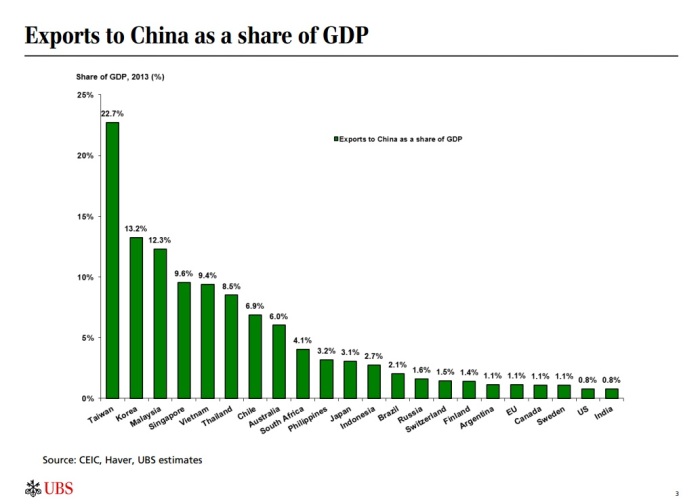
That is simply wrong. Nations largely make their own prosperity – or their own failures. Individual firms (and tertiary institutions – several of which take direct funding from the PRC) might be deeply affected by things China’s government could do, but over the medium to longer-term, New Zealand’s fortunes won’t be. As I’ve noted previously, the exports of New Zealand firms to China are (directly) around 5 per cent of our GDP. By contrast, say, Canada’s exports to the US are more than 20 per cent of Canada’s GDP.

There are plenty of countries with much larger direct exposure to China (this chart I found yesterday uses data a few years old, but the general point holds).

ExportstoChinaShareofGDP

South Korea is an interesting example, with a much larger direct trade exposure to China than we do. But that trade exposure is now smaller than it was, because in recent months China has been expressing its extreme displeasure with South Korea, imposing what are in effect economic sanctions in response to South Korea allowing the installation of the THAAD missile defence system. You can read some of the details here.

As it happens, there was a New Zealand column about just this issue on interest.co.nz yesterday, from Victoria University’s professor of business in Asia (a chair sponsored by BNZ, but also by a clutch of government agencies. After discussing the Korea situation he concludes

The THAAD case shows that it is critical to keep an eye on the political alignment between a business’ home country and the host country where it seeks to do business.

Which sort of makes my point. The interests of businesses wanting to trade in a particular country won’t always align well with the interests and values of the home country. That isn’t likely to be much of a problem in trade with the UK or Australia, or Singapore for that matter. It is, as the Koreans have found, with China. The very fact that China operates in the way it is doing with Korea suggests it isn’t the sort of regime our governments and media should be deferring to.

Some people might look at it the other way and say “if they can do it to Korea they can do it to us”. First, South Korea will survive economically, and is proceeding with the THAAD deployment. But, second, South Korea – and the entire situation on the peninsula – is likely to matter a great deal more to China than New Zealand does. It is difficult to imagine severe trade sanctions because New Zealand was willing to have an open and honest debate about whether it is appropriate for someone like Jian Yang to serve in our Parliament, let alone about the way in which the PRC seeks to exert influence and neutralise potential criticism in countries like our own. There is more of that sort of debate already in Australia and Canada. But if, just suppose, they did – to “make an example” perhaps – wouldn’t that be a moment of moral clarity, that brought into sharp relief how a state we constantly defer to operates. There was highflown talk – John Key and Xi Jinping – of a Comprehensive Strategic Partnership with China. We’d never have considered one with the Soviet Union. The PRC is today’s Soviet Union, with many more routes into our system directly than the Soviet Union ever had.

What have we come to?

I was exchanging notes the other day with a very senior journalist in Asia who observed of this state of affairs that “I have found that the more expert in China a person is the more troubling they find all of this”.

On which note, I had an email out of the blue the other day from someone with an unfamiliar name, and when I opened the link he sent me I found it was for something called “The Wairarapa Academy for New Sinology”. I wasn’t quite sure what to make of it, being instinctively sceptical of (yes, prejudiced about) the Wairarapa. But it turns out that an eminent Australian expert on China, Geremie Barme, formerly Director, Australian Centre on China in the World and Chair Professor of Chinese History at Australian National University has retired to the Wairarapa, where he contines to research and write on related issues, and is establishing the (mostly virtual) academy. He has a good new piece out on these issues, which appears to have been quite widely disseminated among China observers abroad. He might be someone New Zealand media could consider talking to. Can any good thing come out of Featherston? Apparently so.

UPDATE (Thurs)
There is a new short commentary by Professor Brady on the PRC-influence issues, and a Newsroom story suggesting that Winston Peters may continue to regard the Jian Yang issues as worth pursuing.

Immigration: numbers and options

On the off chance that anyone thinking about negotiations with New Zealand First might also be considering immigration policy options, I thought it might be time for a refresher on the numbers (as well as yet another dig at MBIE for not making accessible data readily available on a timely basis).  Since much of the accessible data MBIE do release is for June years, for this post I’ll mostly use data for the year to June 2017.

Recall that the headline writers focus on net permanent and long-term migration, calculated from the declared intentions of those (New Zealanders and foreigners) crossing the border.  If you are leaving and expect to be away for at least 12 months, or are a non-resident arriving and expect to be here for at least 12 months, you are in the PLT statistics.   Plans do change, but the new 12/16 data I wrote about a few weeks ago suggests that during the current cycle the PLT numbers have been capturing pretty well not just declared intentions but what actually happened.    In the year to June 2017, a net 72,305 people arrived as PLT migrants.   Just slightly more than that number of non-New Zealand citizens arrived, and 1284 New Zealanders (net) left.

PLT sept 17

As people often stress, a lot of the variance in the net PLT series is typically accounted for by changes in the choices of New Zealanders (net outflows have fluctuated between around 0 and around 40000, and there have been quite big fluctuations –  hard to predict –  every few years).  The choices of New Zealanders are not a matter of immigration policy.

But policy has pretty full control over the number of non-citizens arriving (Australians are allowed in without advance specific approval, although the numbers typically aren’t large).   And sometimes you will see this chart, which uses PLT arrivals data (gross, not net) to show what sort of visa people were on when they crossed the border as PLT arrivals (the “not applicables” are New Zealand and Australian citizens).

PLT arrivals by visa

But this chart doesn’t tell us anything much about immigration policy.  In the year to June 2017, 16711 people arrived on residence visas.  But during that year, MBIE granted 47331 residence visas, the overwhelming proportion to people who were already here (and who typically will have entered first on a student or work visa).  Perhaps it is worth noting, for all the talk of the success of the export education sector, by far the biggest increase in arrivals in recent years (absolute and percentage) has been in people with various types of work visas: around 24000 in the year to June 2012, and around 45000 in the year to June 2017.

If we want to look at immigration itself, it is much better to turn to the administrative data on the numbers of people approved for various classes of visas.  Unfortunately, unless you like playing with spreadsheets with half a million lines, MBIE only produce data annually, for June years, and the data for the year to June 2017 hasn’t yet been released.   Having said that, it doesn’t look as though there will have been big changes when the data do finally emerge.

Here are the numbers for visas granted to new workers under various policies (ie excluding renewals etc).

Number of new workers by policy
2011/12 2012/13 2013/14 2014/15 2015/16
Study to work 9,319 9,131 6,259 9,610 16,097
Essential skills 6,197 6,247 7,885 7,709 8,334
Work to residence 1,653 1,558 1,426 1,483 1,717

and there has been a big increase in the numbers granted working holiday visas

2011/12 2012/13 2013/14 2014/15 2015/16
Working holidays 41,561 47,168 53,131 59,742 63,230

Fortunately, Education New Zealand don’t seem to mind the half million line spreadsheets, and produce a nice monthly product on student visas.   Here is the chart of outstanding valid student visas by class of institution for the last few years.

vsv

Numbers are growing, but in the last year or two there has been quite a switch from private training enterprises (which will have included some of the more questionable institutions/courses) towards universities in particular).

What of residence approvals?  I did download the huge spreadsheet for that subset of the data to get an overview of the 2016/17 numbers.  Here are residence approvals in the last few years.

Number of residence visas approved
2011/12 2012/13 2013/14 2014/15 2015/16 2016/17
40,448 38,961 44,008 43,085 52,052 47331

Recall that (a) there is a “planning range” (in effect, a target) for the number of residence approvals granted. That range was 45000 to 50000 per annum, but was cut to 42500 to 47500 late last year.  Actual approvals fluctuate around the target, rather than being mechanically managed to meet it month by month or year by year.  The 2015/16 approvals were high, but the numbers have been cut somewhat in the most recent year.

Recall that most of those getting residence visas were already living here (on work, study, or related visas).

In terms of nationality, in 2015/16 these were the top source countries

China 9,360
India 8,498
United Kingdom 4,934
Philippines 4,614
South Africa 2,970
Fiji 2,230
Samoa 2,156
United States 1,288
South Korea 1,125

I didn’t calculate all the numbers for 2016/17, but the patterns looked pretty similar.

I hadn’t seen this data in the published MBIE summaries, but I was a little surprised to find that among the residence approvals 1937 were for people in a category of

Uncapped Family Sponsored Stream Dependant Child

These aren’t the children of principal applicants who are themselves getting residence visas (as those children are approved with the parents).   Around half of all these “dependent children” were Samoan, and of them 242 were aged 20-29, not typically what one thinks of when one hears of “dependent children”.   I’m not sure how or why such a policy exists, but when I get time I might have a dig around.

So that is the numbers.  Perhaps the key thing to keep in mind is that the residence approvals planning range –  the centrepiece of the immigration programme –  has been pretty stable for a long time (modest cut last year).  Much of the variability in the headline PLT numbers is New Zealanders, and most of the variability in the non-NZ net inflow relates to policy streams other than the residence approvals programme.

Of course, variability is only part of the picture.  The striking thing about the residence approvals programme is its sheer size: equivalent to almost 1 per cent of the population each year, and in per capita terms three times the size of the US “green card” issuance (under both recent administrations).   We have a very large number of legal temporary foreign workers here by international standards, but most of them will eventually go home.  What really marks us out is the size of the residence approvals programme –  bigger per capita than in almost any OECD country, and far bigger than most.   I’ve argued for cutting programme back to, say, 10000 to 15000 per annum (a similar size, per capita, to the US programme.)

As I’ve noted here previously, if one looks at the New Zealand First website there isn’t much specific on immigration policy.   Winston Peters has sometimes talked of lowering the annual inflow to something like 10000 to 15000, but quite what is meant by that hasn’t been clear.  Most naturally he may have wished to suggest a net PLT inflow of around those numbers.  If so, it would have to be treated as an average over time, since annual PLT flows are almost wholly unpredictable (given the variability in the net flow of New Zealanders).

Having said that, one could make some estimates of a trend net outflow of New Zealanders, likely to resume as the Australian labour market improves.   Assume that outflow is 20000 on average over the cycle (a bit less than in the past), and you might lower the residence approvals target to 30000 to 35000 per annum (the net of the two flows on average producing something like a 10000 to 15000 inflow per annum).  That doesn’t sound terribly radical, and frankly there looks to be plenty of room to (a) drop off the lower-skilled portion of the current approvals, while (b) removing the sort of absurd bureaucratic hassles really skilled people (eg the teachers profiled in the Herald the other day) can face.

One of the other, rather general, strands of New Zealand First’s immigration policy is

Ensure that there is effective labour market testing to ensure New Zealanders have first call on New Zealand jobs.

I’m sceptical of the practical means to do this, even if I’m somewhat sympathetic to the concerns that motivate it.  I don’t think bureaucrats should be trying to decide which job is really in excess demand, let alone try to reach Soviet-type judgements on which regions should be favoured, or whether wages for those particular skills should just be left to rise.  But in various recent presentations, I have included an option for reforming the work visas system (in addition to substantially tightening up on student work visas and post-study visas, for those with lower level qualifications)

Institute work visa provisions that are:

a) Capped in length of time (a single maximum term of three years, with at least a year overseas before any return on a subsequent work visa), and

b) Subject to a fee, of perhaps $20000 per annum or 20 per cent of the employee’s annual income (whichever is greater).   [To limit risks of exploitation, require the employer to prove that the employee has been paid at least $10000 above the mimimum wage, with no “fees”  allowed to be paid back to the employer or related entities.]

The key element is the second one.  If your firm really needs a highly-skilled person (surgeon, lawyer, CEO or whatever, earning say $200000 or more), and can’t find one on market in New Zealand, the annual fee is unlikely to be prohibitive given the key short-term such a person is like to be playing.   But, equally, there aren’t many of those sorts of people/roles, and many won’t want to stay here forever.  So I’d make it easy to recruit them, but with a strong emphasis (because the visa is non-renewable) on the need to identify a local permanent person.   At the bottom end of the labour market, if the business your firm is doing is really so valuable you can afford the $20000 annual fee on top of the annual salary, that might be a reasonable pointer to serious scarcity.  But it seems unlikely that we’d be granting many visas to lower-end chefs, or dairy workers, or aides in rest homes.  And that would, over time, be a good outcome for New Zealanders.


(And MBIE could you please please make the monthly data more easily available in an accessible format, as Statistics New Zealand and other agencies do.)


Fossicking in election statistics

Well, that was a fascinating election outcome.

Listening to the coverage on Saturday night, I was interested in comments about how strong National’s performance was vying for a fourth term in government.  There didn’t seem to be many statistics behind the talk.

But it is worth bearing in mind that since 1935 –  when the domination of New Zealand politics by our  current two main parties really began – we’ve had 10 governments.  Two have lasted a single term, one two terms, four completed governments last three terms, and two governments lasted four terms. It seems to be an open question whether National will now be able to lead a fourth term government.  That means there really isn’t much data.  And, to some extent, MMP changes things –  minor parties are more important, and MMP governments have so far always involved multiple parties.

There has been talk that National’s (provisional) vote share this time (46.0 per cent) is higher than it was when they first took office in 2008 (44.93 per cent).   But ACT has never had anywhere to go but National, and never had any desire to go elsewhere anyway.  So at very least one should aggregate the National and ACT votes to look at the centre-right performance.

But I’d argue one should really go a bit beyond that.  The Conservative Party has come, came close in 2014 to entering Parliament, and then has largely gone again.  Not only did the Conservative Party campaign in 2014 as another potential support party for National, but realistically most of their voters in 2011 and 2014 are people (in many case conservative Christians) who would have otherwise, naturally or reluctantly, have voted for one of the other centre-right parties.

In this chart, I’ve shown three different ways of looking at how the centre-right vote has changed:

  • National + ACT party votes as a share of the total vote,
  • National+ ACT party votes as a share of the “used” vote (ie excluding the “wasted” party votes for parties that didn’t get into Parliament), and
  • National + ACT + Conservative party votes as a share of the total vote.

centre right 2

On each of those lines, the centre-right vote share has fallen quite a bit.  If anything, what the chart highlights is how well the centre-right did (and, I guess, how disastrously the left did) at the 2014 election.  In this election, the centre-right vote share –  the grey line –  has (on the provisional results) fallen by a full 5 percentage points.

And then I wondered how it had been in the 1960s.  The 1969 election was the last time a a party secured a fourth term.

national 60s

Now that looks more like a genuinely impressive performance – the governing party lifting its vote share in the election in which it gained a fourth term.   There had been industrial action at the time of the election which had hurt the Labour Party, but the previous three years had been a very tough time to govern.   Wool prices had collapsed (and with them the overall terms of trade), the New Zealand government had been forced into a devaluation in late 1967, and had borrowed from the IMF under a pretty stringent domestic austerity programme.  Things here had been tough enough that over the three calendar years 1967 to 1969 there was a small overall net migration outflow (the first such outflows since the end of World War Two). People can counter that the third party – Social Credit –  saw its vote share fall away, and both National and Labour gained. But in a sense that is the point: tough times like that are often when third parties, and main Opposition parties do well.  But National increased its vote share.

The other fourth term victory since 1935 was in 1946, when Labour secured a fourth term.  And here is how Labour’s vote share changed over its time in government.

Labour 1946

Again, going for a fourth term Labour managed to increase its vote share.   They’d seen off John A Lee’s rebel party in the 1943 election, and no doubt won back most of that vote, but again…that is the point.  Going for a fourth term after crises, war, and post-war controls and inflation, Labour increased it vote share (to 51.3 per cent).

I was also playing around with some other of the provisional results.  For all that the Greens have done pretty badly nationwide, it was striking how strongly they poll in the neighbourhoods I live and move in.    In (booths in) Island Bay itself 16 per cent, and in next door Berhampore 26 per cent (no wonder the new local Labour MP, and current Wellington deputy mayor, avoided answering questions about his approach to the cycleway).   In the whole Rongotai electorate  the Greens scored 17 per cent, and in next door Wellington Central (where James Shaw ran) 20.8 per cent.    Both those percentages are lower than in 2014 ( 26.2 in Rongotai and 29.5 in Wellington Central) but are still huge –  and conventional wisdom seems to be that the Green vote share will rise on special votes.  No wonder that, despite the fact that 70-80 per cent of submissions from residents favour scrapping the dreaded Island Bay cycleway (and certainly don’t want to spend millions more on it), the Wellington City Council seems set to pursue its green agenda anyway.

Finally, I was interested in whether there were any material differences in the party vote shares between advanced votes and those on the day.  I only looked at two electorates (again, Rongotai and Wellington Central) but this is what I found.

Rongotai

Rongotai

And Wellington Central

wgtn central

The differences aren’t huge, but they are there – at least in these two electorates, and in particular between the Greens and National shares. Given that advanced votes of those who enrolled at the same time as they voted still haven’t been counted, it would presumably offer some encouragement to the Greens.

A story of two Attorneys-General

On Wednesday evening I wrote about the despicable conduct of our Attorney-General, senior National Party Cabinet minister, and minister for various intelligence agencies, Chris Finlayson.

Asked why it was appropriate for a (past and –  experts say –  probably present) member of the Chinese Communist Party and former member of the Chinese intelligence services (both acknowledged facts, neither of which was disclosed to voters when he was elected) to be a member of Parliament in New Zealand, Finlayson simply refused to engage or answer, other than to suggest the journalists raising the issue –  journalists from serious outlets including the Financial Times – were simply attempting to destroy the man’s political career and in the process were engaged in singling out a whole class of people for “racial abuse”.

Asked about the claims in an important new paper by Professor Anne-Marie Brady (of Canterbury University and the Woodrow Wilson Centre in Washington DC) on the efforts of the People’s Republic of China (state and party) to influence politics in New Zealand and about the close ties of various past and present National Party members to interests of the People’s Republic of China, our Attorney-General’s only response was to simply make stuff up.  He asserted that Professor Brady didn’t like any foreigners, only to have an audience member –  a former student of the professor’s –  point out that not only was Brady fluent in Mandarin, but that her husband was Chinese.

That account has received a bit of coverage –  although not, of course, that there was any sign of the New Zealand media following the issue up with, say, Mr  Finlayson, or his boss the Prime Minister, let alone with the Leader of the Opposition.  It might have been awkward all round I guess.

My own readership numbers yesterday were more than twice the normal level.

Senior Wellington lawyer and former MP, Stephen Franks wrote about the story on his blog,   He’d predicted this sort of response only a week or so earlier on Radio New Zealand.

Rarely, if ever in politics, does one get explicit, irrefutable proof of a risky and unpopular hypothesis within a week of venturing it.

But Attorney General Hon Christopher Francis Finlayson provided such proof last night.

Last week, after discussing on Radio NZ the Newsroom suspicions that NZ MP Jian Yang may be a spy for mainland China I blogged my explanation that time did not permit with Jim Mora. I predicted that the Communist government could expect their spies who have penetrated New Zealand leading circles to be sheltered by our  elite’s PC terror of being accused of racism.

Last night at an election candidate’s meeting Finlayson showed just how the accusing is done. The other  candidates then showed how effective it is in cowing them.

Others tweeted the story.  There was Rodney Jones, for example: Beijing-based New Zealand economist, who had himself last week called for Jian Yang’s resignation.

Numerous commentators offshore focused on China have been drawing attention to, and stressing the importance of, Professor’s Brady’s paper –  the one New Zealand’s Attorney-General could deal with only be attempting to smear the author.

Professor Brady herself tweeted a link to Stephen Franks’ post.

And then flicking round the web over lunch, I stumbled on a new story on the Sydney Morning Herald website.  The authors begin thus

Attorney General George Brandis is planning a once-in-a-generation shake-up of the legal framework governing who can lawfully influence Australian politicians, amid fears of clandestine Chinese Communist Party influence over politics in this country.

Having seen Professor Brady’s tweet drawing attention to Finlayson’s despicable comments, Fairfax’s Asia-Pacific editor, John Garnaut,  a former lawyer who had previously spent many years in Beijing as the Fairfax China correspondent was moved to tweet thus:

What a disgrace. How have things in New Zealand been allowed to sink this low so quickly?

For those interested in reading in more depth about the sorts of issues Professor Brady has raised, I would recommend an article on the Brady paper by an independent researcher on China who blogs at a site called Jichang Lulu (and who has also tweeted a link to the Franks account).  It is a substantial post on the issues in the (quite long) Brady paper.  The author knows China, but comes fresh to New Zealand.   As the author notes

New Zealand provides an example of successful United Front domination of a diaspora community. As of this election, the top ethnic Chinese candidates are linked to CCP organisations and support PRC policies. In New Zealand, the Chinese community can only realistically aspire to political representation by its own members through individuals approved by Beijing. This situation, enabled by the leaders of the top parties, effectively allows the extraterritorial implementation of PRC policy.

(This incidentally makes a nonsense of Chris Finlayson’s absurd allegation that anyone raising these issues is “racist”.   The alleged PRC interference in New Zealand affairs directly affects the freedoms in New Zealand of the many Chinese-origin New Zealand citizens – whether recent migrants or descendants  of those who came generations ago – who abhor the Beijing regime and its repression. State-sponsored actors are the focus of the story, and the paper.)

As he notes of Jian Yang

In the same Chinese-language interview quoted above, Yang says he used to be a Communist Party member, but he isn’t one any more. That presumably means ‘not an active member’; as Brady notes, you don’t just ‘leave’ the CCP. You are considered a member unless expelled. Considering Yang’s excellent relations with Chinese state entities and the praise state media award him, it would be ridiculous to assume he was expelled. In all likelihood, Yang is in fact a CCP member. Chen Yonglin 陈用林, a former PRC diplomat who defected to Australia in 2005, cast further doubt on Yang’s claims he was a PLA ‘civilian officer’. Based on his knowledge of military institutions before reforms in the late aughts, Chen estimates Yang was in fact a ‘soldier’ and probably reached the rank of  captain.

And

Perhaps even more remarkably, despite what an external observer would see as devastating evidence compromising a candidate before a tight election, his direct political adversaries in the Labour party produced absolutely no criticism of Yang. I’m not terribly knowledgeable about NZ politics, so perhaps I’m being naive, but is it normal to have such a major security revelation on a senior political figure days before an election and hear nothing from his rivals?

Noting that these are issues for the Labour Party as well.

In theory, Yang Jian’s direct adversary should be Raymond Huo (Huo Jianqiang 霍建强), a Labour Party MP. Yang and Huo compete for the Chinese-community electorate; Yang has been found to have a background in military intelligence, which he had declined to disclose in the past; Huo, whatever his sympathies, isn’t tainted by work for a foreign military. Recent polls have put Huo’s party a few points short of unseating the Nationals, or even able to lead a coalition. How can he not use this?

The only explanation that makes sense (and that is consistent with reactions from other senior politicians) is that he wouldn’t like to speak up against United Front interests.

Again it, as well as the original paper, is an analysis well worth reading.

We seem to have come to an extraordinary, and shameful, pass.  The very fact of the silence of most of the local media (the Herald’s recent article a welcome exception) and the refusal to engage seriously of any of our senior political figures (and responses by people like Jenny Shipley and Don Brash that could be seen to trivialise the issue) is surely worth a story in itself.

Fairfax’s local media have been very quiet on both the Yang story and on the arguments and evidence at the heart of the Brady paper – in the very week of a general election. Perhaps John Garnaut – recall, he is Fairfax’s Asia-Pacfic editor – would consider writing such an article? Perhaps the local papers might even publish it?   As he notes, the episode is  “a case study on how important it is to repel foreign interference before it gets to the political centre”.

But the primary responsibility for dealing with these issues can’t rest with foreign journalists, but with our own leaders.    I’m not sure that leaves me with much (any) reason for optimism.

(Due to New Zealand’s somewhat absurd electoral laws, I will remove any comments put up between midnight tonight and 7pm tomorrow that have any sort of party political tinge, so please refrain from making them.)

Immigration, the election, and shelf-stackers

Back in February I had coffee with a senior journalist, who was convinced that immigration was going to be a central issue in this year’s election campaign.  The journalist cited the Trump and Brexit phenomena, and I suppose at the time Geert Wilders and Marine le Pen were in the wind.   I was a bit sceptical.  I’d, mostly, have welcomed such a central place in the election campaign for what I regard as one of the key long-term failings in our economic policy settings.   But I didn’t really see any sign of a Trumpian insurgent – or a mood that was just waiting for such a person – or of the fascinating mix of motivations (immigration was only one) that had driven the Brexit vote.  But my interlocutor told me that political party focus groups were picking immigration up as a key issue, and suggested that the media need to attract readers would help fuel an intense focus on immigration.  I think there was a sense back then that National was in such a strong position in the polls that an issue like immigration would, as much as anything, be hyped to help keep things interesting.

As I say, I was sceptical –  although interested in the focus group snippet (which I later had confirmed by one MP).   We had dreadfully high house prices, and a dismal productivity (and exports) performance. High immigration has played a part in both those outcomes.  But those weren’t, it seemed to me, the sort of visceral dimensions that seemed to have played such a part in other countries: our last experience of terrorism was state-sponsored, by France; we don’t have problems with illegal immigration (some upsides to being a remote island), and we haven’t had problems with substantial Muslim immigration.  And for all my concerns about the mediocre quality of the skills of the median migrant, we’ve done less badly on that count that many other OECD countries (again, land borders and an explicit economic focus to the programme both help).

But now we are two days out from the election, and it is clear that immigration hasn’t played a particularly important role in the campaign at all.  New Zealand First –  which might have been a natural recipient of votes if there had been an upsurge in serious concerns –  looks as if it might end up with a smaller vote share than it had in 2014.   The government made some minor tweaks to immigration policy this year, on top of some other minor tweaks last year.   And Labour’s immigration policy didn’t involve much change –  outside the overseas student sector –  and hasn’t (at least that I’ve seen) had any pro-active place in their campaigning.   Oh, and the Greens’ leader ended up abjectly apologising to his base, casting slurs all round, for even having suggested last year a rational debate on the appropriate rate of immigration.

It is interesting to ponder why immigration hasn’t been a key issue.  After all, if one focuses (inappropriately, but as the headline writers do) on the PLT numbers there has been no abatement in the net inflow (whether of non-citizens –  the bit policy bears on –  or the reduced outflow of citizens).  And the “true” net inflow is almost as high, as a per cent of the population, as the previous peak 15 years ago, and it has run on for longer.

One reason is, presumably, the change in the political personalities.  At the start of the year, many thought the campaign might see Labour at or below the vote share it got in 2014, and New Zealand First and Greens perhaps both polling in the teens, and scrapping for second place in a possible left-led government.  Perhaps that might have been a climate in which Labour and New Zealand First in particular might have more prominently battled to capture those who were concerned about immigration-related issues.  But the “Jacinda effect” transformed that outlook and the campaign has mostly been like something from the old days: two big parties, with some minor players struggling for attention and coverage.    And although Labour has stuck with the immigration policy announced under Andrew Little, it is clear that Ardern has made a conscious choice to de-emphasise that policy, even though the focus of the proposed changes was on the deeply-flawed student market.

But I wonder whether some other factors aren’t at least as relevant among voters (and for all the talk of “leadership” a great deal of what politicians do is “followership”).   For one, house price inflation has abated in much of the country, and although house prices in Auckland remain sky-high they’ve gone roughly sideways for a year or so.    Quite why that has happened is still debated, but it isn’t because (a) the rate of growth of the number of people needing a roof over their head has slowed, or (b) because housebuilding in Auckland is now proceeding so rapidly that it has got ahead of population growth, or (c) because regulatory reforms have freed up land use sufficiently that peripheral section prices are now plummeting.     More plausibly, it is some mix of (a) rising domestic interest rates, (b) the tighter LVR controls the Reserve Bank put on last year, (c) tighter credit standards the banks themselves have established, under the influence of parents and of APRA, and (d) reduced capital outflows from China as the regime has tightened-up its controls.  But whatever the precise reason, it has taken much of intense heat out of the house price issue –  imagine if the opposition has still been able to repeat endlessly “house prices in Auckland are up another [x] per cent in just the last six months.   And with it, much of the heat around the immigration issue?

And the other reason –  one of the reasons I was sceptical of the political salience of the issue at present –  is the point I have been arguing for (and that previous generations of NZ economists recognised ) for years.  In the short-term, high and unexpected immigration adds more to demand in the economy than it does to supply.  In other words, it tends to boost economic activity –  measured or headline GDP for example –  and put more pressure on scarce resources.  Migrants don’t take jobs from locals, or add to unemployment; if anything, in the short to medium term, they add more to the demand for labour (all that capital stock that needs to be built) than to supply, and thus migration inflows tend to reduce unemployment.   The sugar-high is a real thing.  The effects might not last long, but when the dose is repeated each year for several in a row, it does have an effect.

There might have been no productivity growth at all for five years, but that sort of concept or measure doesn’t easily get much public resonance.  Exports might be shrinking as a share of GDP, as the need to build to cope with a rapidly-rising population crowds out the tradables sector……but it is a geeky macro statistic, and not one that anyone has successfully built a narrative around.  And perhaps people aren’t feeling good about their wages, but as I’ve noted recently, real wages have been rising consistently faster than productivity for some years now.  It is an unsustainable, unbalanced, mix, but it isn’t one that was ever going to capture the public imagination in any sort of “build a wall” way.  In the short-term, for those (most) with jobs things don’t seem too bad.  And even the Leader of Opposition has repeated on numerous occasions that the economy is doing fine.

And, of course, few of us want to be nasty about individual migrants (and of course, as I argue, the issue is New Zealand policy, not the rational choices of individuals), and no one wants to be subject to the dread “r-word” slur.

In many respects, I’ve long thought that the best environment for a serious public pushback against the out-of-step, failing, immigration policy we have run for a long time, is in the next severe downturn.  I wouldn’t welcome recessions – and remain concerned that the government and the Reserve Bank aren’t doing enough to prepare for the next one – but in a sense it is in periods when things are manifestly not going well that one is perhaps more likely to find a willingness to contemplate serious change in policy.  That’s a shame –  the best time (easiest adjustment) to make changes would be now, when the economic environment globally isn’t too bad –  but perhaps it is unavoidable, especially when (as above) we –  fortunately – don’t have the visceral issues around immigration that some other countries do.

Immigration policy did come up at the local candidates’ meeting last night.   The minor party representatives were predictable –  the Greens candidate was adamant that we “knew” that migrants benefited us economically, while on the other side the most entertaining TOP candidate –  whose opening speech was done in iambic pentameter – made the case for easier access for really skilled migrants, but for fewer migrants overall to ease the (claimed) downward pressure on wages.

Chris Finlayson repeated some of the serious misrepresentations that seem to characterise his party’s view.  We were told of the lots of New Zealanders who were coming back from Australia (when in the year to June 2017, a net 4678 New Zealanders left for Australia) and about how the immigration policy was bringing in the tradespeople wiuth the skills needed for, for example, the housebuilding.  I heard the PM repeat that line –  who will build the houses if we cut immigration – on Radio New Zealand yesterday: I would draw his attention, and that of his minister and local candidate to the data suggesting that the net immigration of building trades people is very small relative to (a) the actual increase in the construction workforce in recent years, and (b) to the total increase in the need for new housebuilding occasioned by the rapid increase in the population.   High immigration is worsening, not easing, those pressures.

But it was Labour candidate –  and near-certain winner –  Deputy Mayor, Paul Eagle whose comments on immigration really caught my attention.  He was obviously feeling on the defensive about the issue, and thus even though Labour’s actual policy proposals focus (numerically) mostly on fixing up some of the rorts around the student visa sector, he never mentioned that issue at all.  Instead, he wanted to stress that Labour welcomed immigration, and that we need immigration in some sectors.  It sounded fine, more or less, until he went on:  “Island Bay New World needs people”.   So can we take it that official Labour policy, enunciated by a candidate likely to be an MP for many years to come, is that we need immigration –  perhaps even more immigration –  so that the supermarket shelves get stacked?  What, I wondered, had we come to?  Once –  in MBIE”s words – a “critical economic enabler”, and now shelf stackers?

(And for anyone interested in some more observations from our Attorney-General, someone asked from the floor about Jim Bolger’s recent denunciation of “neo-liberalism”.  This senior minister got up and indicated he had talked to Bolger about what he had said, clarifying that he had meant the policies adopted by Labour and National governments between 1984 and 1993.  Finlayson himself went on to characterise that period as one of “extremist economic policies” concluding that “that ideology does not work, and we are not that sort of party”.  One brave member of the audience –  Island Bay is a pretty left-liberal sort of place –  called out “but none of it has been repealed has it?”        Was it floating the exchange rate, removing farm subsidies, removing trade protection, making credit available to ordinary people, lowering maximum marginal tax rates, ending fiscal deficits as a norm, putting in place a good GST, removing union monopolies, privatising state-owned business operating in competitive markets, or what……that the Attorney-General of an allegedly centre-right pro-market government regarded as “extremist”? )