What economic gains are New Zealanders getting from older immigrants?

The New Zealand government’s permanent residence approvals target is 45000 to 50000 per annum.  The target hasn’t changed for quite a long time, although actual approvals fluctuate from year to year.

As I’ve noted previously, even though the immigration programme is explicitly described as an “economic lever” only around half the permanent residence approvals have been under the skills (or business) stream, and even that total includes the immediate family of the primary applicant.

It is well-known that it takes many immigrants years to reach the earnings that a New Zealander with similar qualifications would achieve.   Here is how Julie Fry summarised the evidence in her 2014 Treasury working paper.

However, they also face language and adjustment barriers, at times including discrimination, which on average take 10-20 years to overcome. In common with overseas patterns, recent New Zealand immigrants have poorer outcomes than others in the labour market, although those outcomes improve over time.  Immigrants who are from culturally similar source countries (such as Australia and the United Kingdom) adjust more quickly. On average, migrants from Asia take longer to adjust, and migrants from the Pacific Islands never reach parity with the New Zealand-born, reflecting the fact that they enter mainly on family reunification grounds and non-skills-based quotas.  University-qualified migrants also adjust more quickly.

Ten to twenty years is a large chunk of a working life, and if the New Zealand immigration programme is really going to boost productivity and per capita incomes of New Zealanders that adjustment period is a significant hurdle to get over (as for much of their working lives here many of the migrants can’t even match the earnings New Zealanders reach).  That probably wasn’t the experience of migrants to New Zealand in the mid to late 19th century.

The issue is even more acute in respect of older immigrants, and is likely to be particular so for those from countries that are not (in Fry’s words), “culturally similar”.  A migrant arriving at age 55 has only perhaps 10-15 years left in the workforce, and that expected time in the workforce drops as the arrival age increases.

Unfortunately, although the permanent residence approvals target has not changed, the proportion of it being used up by older immigrants has been steadily increasing.  Unsurprisingly, not many people 55 and over come on work visas (around 275 in the latest year, not much changed over the previous decade). By contrast, 3279 people aged 55 and over arrived on residence visas in the year to June 2015, just over double the number who came in the year to June 2004 (the first year the data are reported).  The chances of many of these people making any material contribution to boosting productivity and incomes of New Zealanders seem small.  And yet they now make up 7 per cent of our total (skills-focused) permanent residence approvals target.

If there is little obvious economic reason to allow in most of these older arrivals –  and, in fairness, the arguments made for doing are not typically economics ones –  there are fiscal reasons to be quite uneasy about doing so.  As I’ve highlighted previously, someone who moves to New Zealand need only live here for 10 years before becoming eligible for full New Zealand Superannuation entitlements, and once granted residence they are eligible for our public health system (and time spent in Australia counts as time spent in New Zealand for NZS eligibility purposes).

The New Zealand Superannuation issue is less severe in respect of those coming from advanced economies.  Pensions earned in those countries are set off against NZS entitlements, so that New Zealand pays only a portion of the total retirement income cost.  But for people from poorer countries where there is no public pension entitlement, or nothing that can be claimed abroad, the full cost falls on New Zealand once the ten year residence period has passed.   Considered from a fiscal perspective, it is perhaps unfortunate that most of the increase in the number of older arrivals has been of people from India and China (numbers from the UK are significant, but have not increased materially).

plt arrivals 55+

Of course, there is a much larger fiscal risk in the possibility of large numbers of older New Zealanders returning from Australia (in particular) at around retirement age, having paid few New Zealand taxes and now claiming full NZS and health entitlements.  The number of older New Zealanders returning from Australia has been increasing (around 2700 of those 55 and over in the last year, about 800 of whom are 65 and over), but are still modest compared to the total number of New Zealanders living in Australia.

The average migrant to New Zealand probably makes a net positive fiscal contribution over the course of their time in New Zealand.  But that average is dragged materially downwards by these older arrivals. It tends to reinforce the argument that any real economic gains from the immigration programme could be obtained with a much lower permanent residence approvals target.

Without even touching the refugee component of the target (perhaps even increasing it), restricting permanent residence approvals to the sorts of high skilled positions illustrated in yesterday’s post, and prohibiting any permanent residence approvals for people aged over 55[1], would enable us to capture most of the putative gains with a permanent residence approvals target of perhaps 10000 to 15000 per annum.  Reducing the permanent residence approvals target by two-thirds would materially reduce the demand pressures associated with a fast-growing population.  Doing that would materially ease pressures on real interest and real exchange rates, which would allow New Zealanders and the remaining highly-skilled immigrants to take advantage of the new tradables sector business investment opportunities that would become much more attractive as a result.

As a comparative benchmark, the average annual net inflow of non-New Zealand citizens was 8500 in the 1980s.  If we are serious about lifting economic performance, and using a skills-focused immigration programme as part of that we need to get much more hard-headed about the sort of people we allow in (refugee issues aside).  In fact, over the last decade or more we’ve been going in the wrong direction, as the highly skilled have made up a decreasing share of migrants.  Many of our business migrants seem to be attracted more by the lifestyle than by the prospect of building high productivity businesses here. And the immigration programme was diluted against just recently with the decision to award more points to people moving to places other than Auckland, which will squeeze out other better-qualified applicants.

[1] With an exception perhaps for a small number of people who are entirely self-funded for their lifetime.

What occupations did our permanent and long-term migrants have?

Governments have purported to run New Zealand’s immigration programme primarily as an “economic lever”, intended to help lift the productivity and performance of the New Zealand economy, presumably with the aim of lifting not just average per capita incomes of those living in New Zealand, but of lifting the average incomes of New Zealanders.  Public policy, especially in matters economic, should be made primarily with the interests of New Zealanders in view.

As I’ve noted previously, even among those gaining permanent residence approvals only around half (including the immediate family of the primary applicants) come under a skills heading, and in some cases they don’t seem overly highly skilled.

I highlighted a couple of weeks ago how relatively unskilled many, perhaps even most, of those coming to New Zealand on work visas are, even under a so-called Essential Skills category.  That programme increasingly looks like another example of corporate welfare.  But the standards are somewhat more demanding to gain a permanent residence approval.  I used the work visa data because it was available at the right, disaggregated, level of detail.  I haven’t been able to find anything comparable for permanent residence approvals  (if any readers know of such data I’d happily be pointed to it).

But Statistics New Zealand does have data on Infoshare about the occupations of permanent and long-term arrivals.  These data have their limitations including:

  • They aren’t published by citizenship, and PLT arrivals include lots of returning New Zealanders, who of course aren’t subject to our immigration policy
  • Intentions (about whether one is coming for the long-term or not) are self-reported, and subject to change.
  • Occupations are self-reported (as distinct from the work visa data, where the approval is for a specific position).

Many arrivals don’t have an occupation either –  they might be students, children, the aged, or non-employed spouses caring for children.  Oh, and SNZ report that around 5 per cent of all stated occupations (on arrivals cards) are illegible, or otherwise unable to be fitted into ANZSCO occupational classifications.

There isn’t anything that can be done about the second and third points, but most of the flow of New Zealanders is to and from Australia, and most of the flow between New Zealand and Australia is New Zealand citizens.  So the charts below shows PLT arrivals, for the last five years, from places other than Australia, where the person arriving wrote down a clearly identifiable occupation.  There were around 135000 of these people.

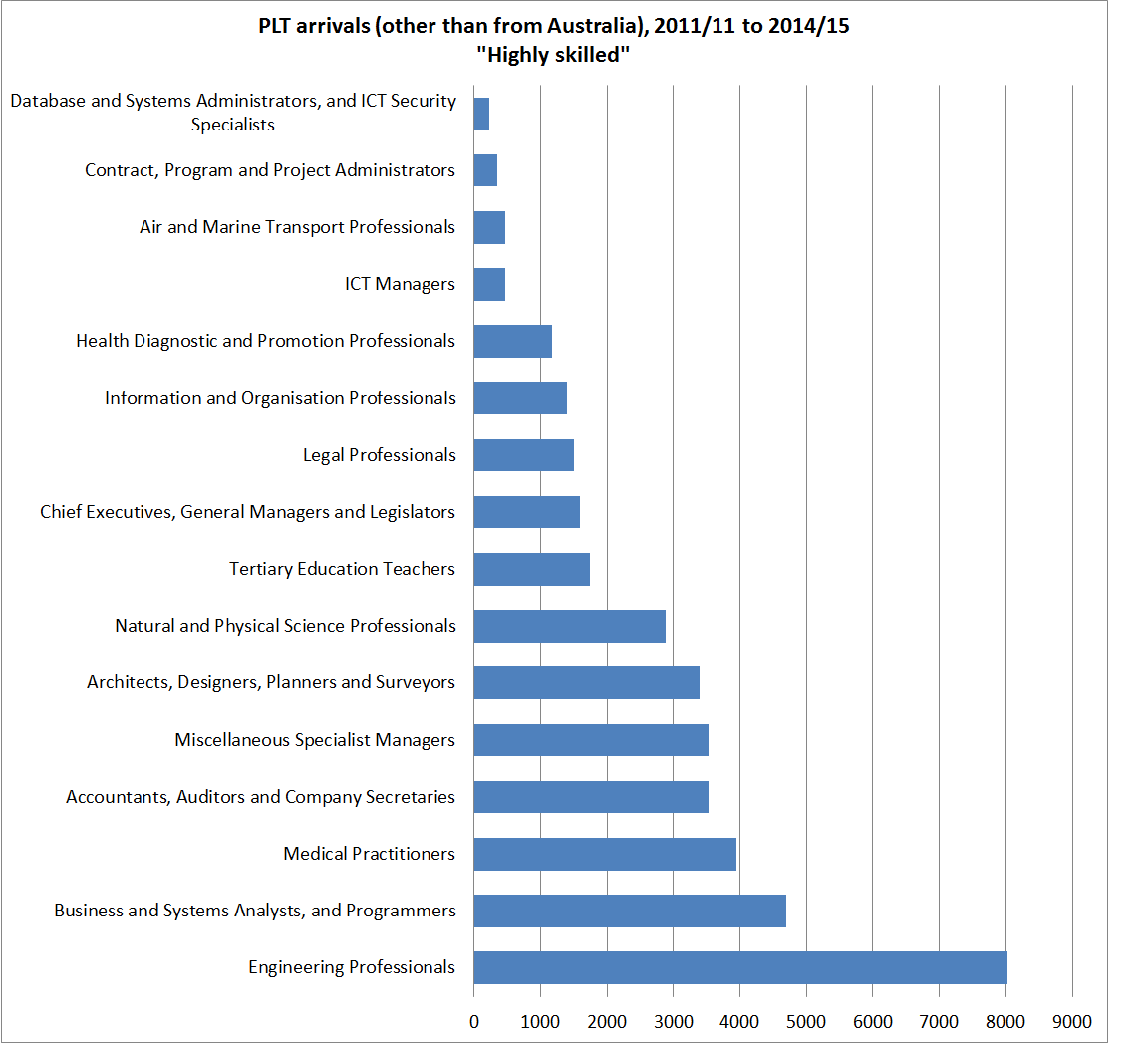
First, the positive story.  This chart showed the occupations that looked like the sort of positions people (including me) have in mind when they hear that New Zealand has a skills-focused immigration programme, designed to lift overall economic performance over the medium-term.  There were about 38000 arrivals in these occupational groupings.  Jokes about, say, lawyers aside, I doubt anyone is going to quarrel much with people like these, if we are going to run a large scale immigration programme.

plt arrivals highly skilled

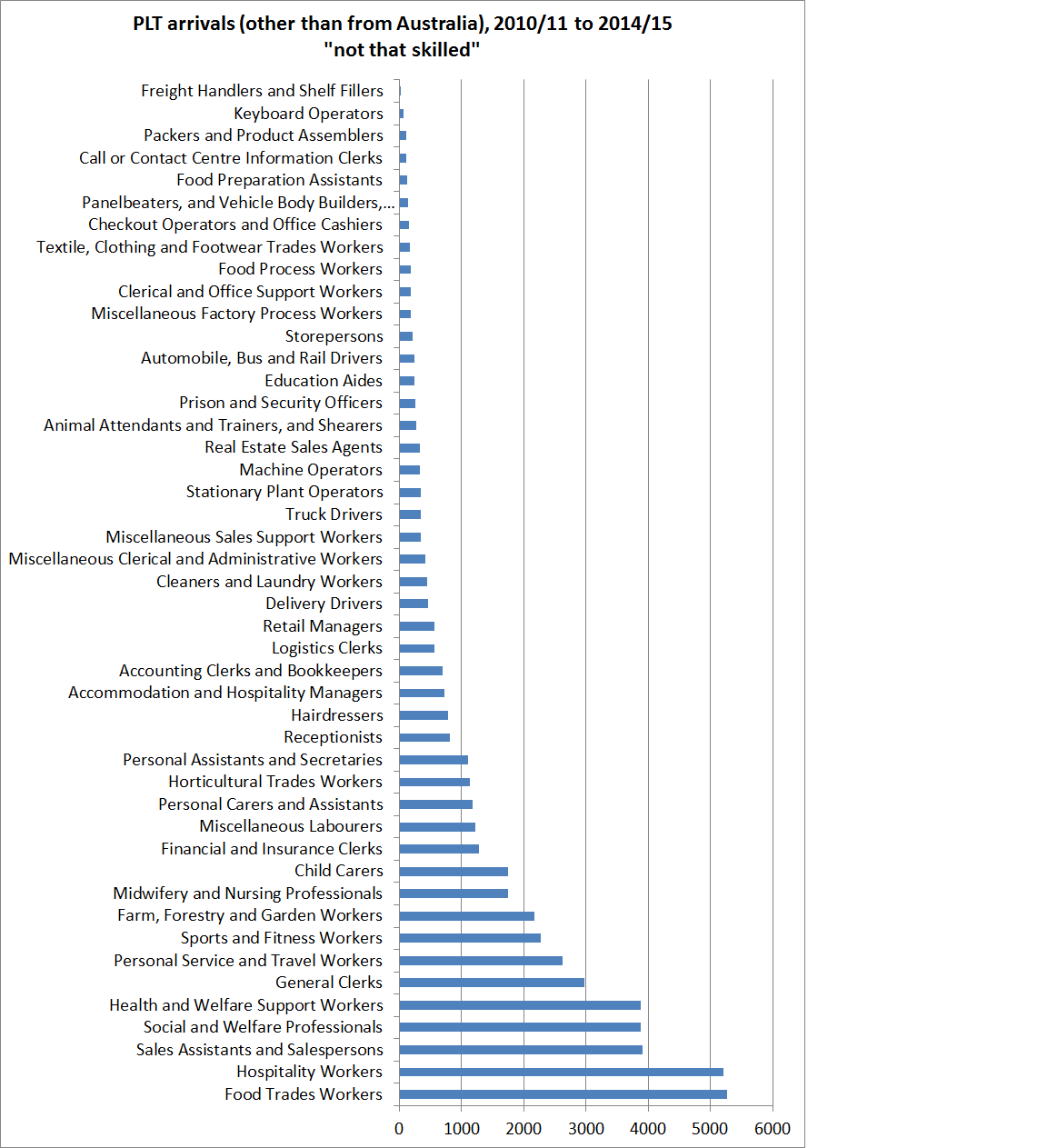
Second, the not-so-positive side.  There were 51000 arrivals (38 per cent) in occupations that few people think of when they think of a skills-focused immigration programme.   People will no doubt differ a little on what roles to put in this list, but as a whole it makes quite sobering reading.  And remember that SNZ are only capturing here the people who actually report an occupation.

PLT arrival less skilled

There is a middle group of occupations that I won’t show in detail. In deference to the Christchurch repair and rebuild process, I’ve put most building and construction-related positions in that category.  But the largest single group in that middle category, somewhat to my surprise, was school teachers. No doubt there are many able immigrant school teachers, but again they aren’t usually the sort of grouping most people have in mind thinking about skills-based immigration programme (and I doubt many of them are teaching advanced high school science courses).

So most of our migrant arrivals aren’t actually here for their skills at all, even on the government’s rather generous interpretation of skills.  And of those who are, a huge proportion look to be people, or occupations, that aren’t overly skilled at all.  The Treasury papers I discussed a few weeks ago provided little or no basis (or reference to other material) showing how our skills-based immigration, as actually run, was boosting the productivity and future incomes of New Zealanders, despite the rhetoric of ministers and of the Secretary to the Treasury.  I now have the papers MBIE has released, but have not yet had time to work through them. I’m hoping there is something more substantial there.  At the moment, however, the large scale active immigration programme has the feel of something just focused on driving up New Zealand’s population, with little or no robust analysis or evidence to support a belief that New Zealanders are benefiting from the programme.  If there are benefits to New Zealanders from the skills migrants are bringing, they are likely to be concentrated in the sort of occupations/skills captured in the first chart above. We could tap those gains with a much smaller permanent residence approvals programme –  perhaps 10000 to 15000 per annum, rather than the current (very large by international standards) 45000 to 50000 per annum.

Birthplaces of our net PLT migrants

The chart below shows the birth countries for the net permanent and long-term (self-identified) migrants for the 14 years ending March 2002 to 2015 (SNZ has a break in the series prior to that).  SNZ don’t break out all the countries, but these are the ones they separately identify.  “Net” is emphasised by the large negative number for the New Zealand-born.

I don’t have a point to make.  I hadn’t had a look at the birthplace data for a while, and I’m always conscious that two of my children are net PLT immigrants, so I was a little curious.

plt by birthplace
A few things surprised me a little, in the second tier of countries.  I was a little surprised at how many people had come from the United States, Japan, Germany and France –  all countries with higher per capita incomes than New Zealand.  Of course, the flows are tiny relative to the respective home populations, and some portion will be people like my kids (New Zealanders born overseas while their parents were working abroad), but it was a flow I was a little surprised by.  Perhaps relatedly, the size of the flow of Australian-born immigrants was interesting –  similar in total to the flow from the United States, despite being closer and despite Australian citizens having free entry.  I wonder what proportion of the Australian-born net flow is the children of New Zealanders who went to Australian for a few years and then came home?

Q&A on immigration

As most New Zealand readers will now know, TVNZ’s Q&A programme yesterday featured a debate around the economics of immigration. Unfortunately, the programme got prominence not for anything of substance that was said by the participants, but for a vulgar outburst by Shamubeel Eaqub. It was pretty unfortunate, but then this was the guy who only a few weeks ago was dismissing my analytical arguments as “that’s racist” , and then turned his attention to Fonterra, suggesting they were treating their investors as ‘scum’.

TVNZ got together Don Brash, Shamubeel Eaqub, and Massey University population/immigration professor, Paul Spoonley. They had asked me to go on the programme, but I don’t do work-like things on Sundays.

Don Brash articulated some of my macroeconomic arguments about the impact of our large-scale programme of targeting non-citizen migrants. I’ve argued that in an economy with modest savings, high average immigration inflows exacerbate pressures on real interest rates and the real exchange rate. We’ve had the highest real interest rates in the advanced world for several decades, and a real exchange rate that has been much higher than is consistent with our dismal productivity performance. In combination, the high real interest and exchange rates have squeezed out business investment – our levels have been low for decades – and skewed returns in ways that favour investment in the domestic or non-tradables sectors. Returns from investing heavily to tap world markets just haven’t been there, so even once we opened up our economy, business investment in the tradables sector has been subdued.   None of this is a story about the last 12 months, or any short-term window, it is about average patterns seen over the last 25 years or so.  (Unfortunately, some of the debate got bogged down in the last 12 months’ data.)

One should always try to ensure that one understands the arguments people on the other side are making, so in this post I have tried to identify the various points that Eaqub and Spoonley were making, and offer some comments on them.

Eaqub started out by simply asserting that my arguments were wrong.   He argues that volatility of net immigration is an important issue (“the short-term pressures are absolutely clear”) especially in the context of house prices. He argues that we need to “fix” housing supply responsiveness and associated infrastructure issues. He goes on to claim there is just a failure of political leadership, and that any “infrastructure” issues could be dealt with by more government borrowing, since the government faces no debt constraint.

Of course, I agree that housing supply responsiveness should be improved, and that the central and local government policies that impede these are a scandal.   But he seems to totally miss the point of my argument. Real resources that are used for building houses or “infrastructure” can’t be used for other stuff, and the real exchange rate and the real interest rate move to free up resources to meet these population-based demands. We could have more investment in, eg, Auckland roads, but all else equal that would put more pressure on scarce resources. Meeting the demands of a rapidly rising population squeezes out other stuff – in this case, business investment, especially that in our tradables sector.

Eaqub also asserted at this point that “immigrants are good for New Zealand, as they been for centuries for New Zealand. They’ve increased our human and physical capital base”.

Don Brash challenged him as to whether the increase in the total size of the economy from the large scale immigration programme had had benefits for New Zealanders, noting that productivity growth in New Zealand had been weak for decades. He articulated a story in which the far-reaching reforms of the late 1980s and early 1990s had not reversed that underperformance, even though immigration policy had been materially liberalised at much the same time.

Eaqub responded to this by arguing that “perhaps they weren’t the right reforms”. That is a reasonable possibility to explore, but he didn’t back it up. He said that deregulating the economy had been “fantastic”, and the only policy he cited that he was uncomfortable with was the amount of student debt being “piled on” students.  Reasonable people might have a range of different views on that one, but given the surge in New Zealand tertiary participation over the last 25 years, it is difficult to know what mechanism Eaqub had in mind for how student loans policy might explain much of New Zealand’s economic underperformance.

Eaqub also repeated the argument he made in his recent book that net immigration has not accounted for much of total population growth in the last 50 years. But as I’ve pointed out previously, net migration includes the coming and goings (mostly the latter) of New Zealanders, and that a discussion about immigration policy needed to focus on the flows of non-citizens (the bit the New Zealand government controls). As I’ve explained previously, and as Don highlighted, without non-citizen immigration, our trend population would now be flat or falling.   There would be cyclical population pressures on the housing market, but no trend ones.

The interviewer drew attention to the 2006 Australian Productivity Commission study Don Brash has cited which concludes that any gains from immigration were captured by the migrants, and there was no gain to Australians. Don noted that there was no comparable study in New Zealand and that there is little or no evidence that New Zealand’s immigration programme has improved productivity or economic well-being for New Zealanders.

Eaqub rejected that proposition, advancing as evidence a recent NZIER piece. That seemed rash. The NZIER piece in question is a four page note, and its conclusion were based on a single unreported equation (the Australian Productivity Commission report was, by contrast, hundreds of page long). I went to a discussion on the NZIER paper at Treasury last year, and I think it would be fair to say that even the advocates of immigration who were at that meeting did not find it particularly persuasive. And, in any case, since the single equation looks only at total (per capita) GDP, which combines GDP accruing to New Zealanders and to immigrants, it does not shed light on the specific question at hand: if there are gains from immigration, how many (if any) of them have flowed to New Zealanders as distinct from migrants.  Notwithstanding his claims for this NZIER note, Eaqub actually went on to acknowledge that the bulk of gains from immigration flow to the migrants, before asserting that it is “absolutely clear” that the type of immigration policy we have in New Zealand is improving skills and human capital. As Don noted, actually many of the migrants (temporary and permanent) don’t seem that skilled at all.

The interviewer interjected my past references to work done at the Reserve Bank suggesting that a 1 per cent of population immigration shock had boosted house prices by perhaps 7 or 10 per cent. Eaqub came back with his assertion again that the only thing that mattered was the volatility in net migration, reiterating this claim that net migration can’t explain most of growth in population, while ignoring the distinction between immigration of non-citizens (the bit the New Zealand government controls) and other flows. (Somewhat surprisingly, later in the show Eaqub actually claimed that New Zealand had relied on immigration for its population growth throughout its history)

In the second half of the show, the interviewer introduced some of the numbers I’ve run here about the number of shelf-fillers and checkout operators who had been given work visas under the Essential Skills category.  He went on to suggest that “beggars can’t be choosers” and that perhaps the best people just wouldn’t want to come to New Zealand. Somewhat surprisingly, Eaqub rejected that suggestion (I’ve previously heard it acknowledged by leading academic advocates of immigration) asserting that we “generally” get “very highly skilled people”, [even though no more than half of the permanent residence approvals are even in the skilled/business category, which includes not just the primary applicant but their immediate family] before rushing on to the “massive shortages” in places like orchards.  Eaqub argued that the challenge is to boost human capital, and that we need “more skills” to compete in the global economy. Despite our very large inward migration programme, he made no effort to show how this has actually been happening – in, for example, an economy where the share of exports in GDP is unchanged over 30 years, and where productivity growth has been among the worst in the advanced world.   Paul Spoonley backed up Eaqub claiming that, while not defending the checkout operator approvals, “by and large we are bringing in the right people” and that we had a selection system that was the envy of the world. He has just returned from Europe, where people would “die” for our system. But here I should add that one of the advantages New Zealand has is that we have near-absolute control on who comes in – we don’t have boat people, or other illegal migrants, and only Australians have automatic rights to come here (and not many do). The question is whether there is evidence that the migrants we’ve had have added to the economic well-being of New Zealanders.

Discussion turned to the (quite large) family reunification component of our immigration programme (around a quarter of approvals). As Don Brash noted, many of these people don’t appear to be particularly highly-skilled migrants. Eaqub’s somewhat surprising response was along the lines of “there has to be a human element to it.   You can’t just allow people in and then say they can’t maintain family connections, and we need empathy in policymaking”.   But……immigration policy is supposed to set to benefit New Zealanders (that “economic lever” MBIE and ministers tell us about). No migrant is forced to come to New Zealand, and any are free to take holidays back home (or to have family holiday here). And unlike the 19th century, technology now enables people to talk to overseas family easily and cheaply as frequently as they like.

Eaqub went on to argue that there was no problem because immigrants as a whole provided a fiscal boost to New Zealand public finances.   That is by no means certain, but even if we accept that the average migrant does makes a positive fiscal contribution, that need not be true of the marginal migrants, and as economists and policymakers we should be thinking at the margin. Many migrants probably make a positive fiscal contribution. But those who come under family reunification approvals in mid-life almost certainly do not (they typically don’t pay enough taxes for long enough to cover the full NZS and health entitlements).  It was at about this point that his vulgarity occurred – the expletive perhaps being a substitute for a missing substantive argument?

Paul Spoonley offered a slightly more sophisticated defence, arguing that our family reunification policies help provide migrants with a reason to stay in New Zealand (the centre of the family is now here), and that the cheap childcare the grandparents could provide was an economic gain for New Zealand.   His attachment story is a plausible argument, although whether it stands up to empirical scrutiny is another question. Perhaps instead primary migrants stay just long enough to get families into New Zealand and secure health and welfare rights? Having “bought the insurance” and secured the family, there is no compelling need for the migrant to stay. But even if Spoonley is correct, it simply puts more of a burden of proof on the advocates of immigration – if we need to bring in family members and parents, and provided associated welfare support, to get migrants to stay, we should be very sure that the primary migrants themselves are substantially benefiting New Zealanders by being here.   There is little real evidence of that so far.

The interviewer also raised the question of our ability to attract high net worth investor migrants. Don Brash noted that it wasn’t matter of how many we attracted, or how much money they might bring, but of whether any inflow (of financial or human capital) boosted productivity for New Zealanders. For that, he asserted, the evidence was skimpy. Eaqub reiterated his claim that in fact the evidence is yes, that gains accrue over long periods of time, and that we have relied on immigration for population and productivity growth across all our history. In his view, it made no sense to arbitrarily look at the previous 25 years or so. This made little sense to me. First, as Don Brash pointed out our productivity growth (relative to other countries) has been atrocious for decades. And second, we actually had a major change of immigration policy 25 or so years ago, and a conventional approach to policy evaluation would suggest looking at what had happened in the economy in the subsequent years.

Eaqub was asked by the interviewer what level of immigration he would regard as too high. He argued that we need to focus on medium-term trends, not annual fluctuations. This seemed inconsistent with his story that the volatility of net migration was the only problem, but perhaps it wasn’t. He seemed to favour bringing in any number of “high quality and skilled people”, and that the only problem is other “broken markets” (presumably housing supply and immigration.

In concluding the discussion, neither Don Brash nor Shamubeel Eaqub seemed keen on the recent change to immigration policy that will give more points to those willing to settle somewhere other than Auckland. As I noted recently this will, more or less as a matter of algebra, lower the average quality of the “skilled” migrants we do get.

Spoonley didn’t weigh in much on the bigger economic issues. He thinks we choose migrants well – even though seriously high-skilled migrants make up only a moderate share of our overall immigration programme. But as Spoonley noted in his 2012 book “understanding exactly how immigrants contribute to economic outcomes is still somewhat fraught in the New Zealand context”.

Eaqub made most of the economic arguments in defence of New Zealand’s immigration programme, but in the end I was a little surprised at how thin his case seemed to be. Despite his comments:

  • We simply have nothing comparable in New Zealand to the Australian Productivity Commissions studies on the economic impact of immigration.
  • Housing market problems certainly could be fixed without touching immigration settings, but there is no doubt that policy-controlled immigration (the inflow of non-citizens) is now the only source of trend population pressure on the housing market.  And annual fluctuations simply aren’t that controllable.
  • A surprisingly large proportion of New Zealand permanent residence approvals are not coming in under the skilled or business stream, despite the official rhetoric about a skills-focused immigration programme. Even among those who are, many are dependents, not those who have independently demonstrated value to New Zealand, and a disconcertingly large share of the “skilled” migrants don’t seem that skilled at all
  • Despite the repeated mantra about the need for more skills and more human capital, there is no evidence I’ve seen that New Zealand is now particularly short of human capital, or that large scale migration can easily resolve the gaps there might be.  We now have high levels of tertiary participation, and rather low estimated economic returns to tertiary education, suggesting that availability of “skills” isn’t the pressing constraint on lifting New Zealand’s medium-term productivity performance.
  • We need to be thinking about immigration (like all policies) at the margin, not as an average. I’ve no doubt that there are some migrants who make a huge contribution to New Zealand, and to New Zealanders.  But I think there are some pretty good arguments that the 45000th permanent residence approval is unlikely to be generating a net gain at all.  If there really are material gains to be had from immigration, we could presumably capture most of them with, say, an annual target of 20000 permanent residence approvals, especially if we wind-back further the family categories and focus on genuinely high-skilled migrants.

There may be other good explanations for the stylised facts around New Zealand:

  • Persistently high real interest rates
  • A persistently high average real exchange rate
  • Persistently weak productivity performance, despite much-lauded liberalisation in the 1980s and early 1990s
  • Persistently weak business investment,
  • A persistently modest export sector
  • A persistently high level of net international debt, despite the strong government balance sheet.

But against that backdrop, the very large scale non-citizen programme that New Zealand has run over the last 25 years – a really big policy experiment – looks a plausible candidate for what might have gone wrong. At best, the advocates of the large experiment are still struggling to show that there have been any real benefits for New Zealanders. At worst, if my story is right, much of the expansion in total GDP that we have had in the last 25 years might have been at the expense of the sort of productivity gains that would benefit all New Zealanders.   Since 1990, not many advanced countries have had more growth in total real GDP than New Zealand, and not many have had less growth in real GDP per hour worked.

There is apparently a great deal of faith among New Zealand elites that our large-scale immigration programme is “a good thing”. As I’ve noted previously, in the biblical book of Hebrews, there is a verse that reads “Now faith is the assurance of things hoped for, the evidence of things not seen”.       The evidence of the economic benefits to New Zealanders from one of the largest controlled immigration programmes anywhere still remains largely a thing not seen,

Big countries don’t seem to have got richer faster

Implicit in much of the discussion around an appropriate immigration policy for New Zealand is a sense that our prospects would be better if only New Zealand had more people. Some have come out and actively argued the case – see, for example, this brief note from the NZIER last year.

I’ve long been fairly sceptical of that proposition. A casual glance around the world suggests no very obvious relationship. The United States and Iceland co-exist, and Japan and Singapore. At the other ends of the income spectrum, India and Bhutan, and Brazil and Costa Rica. There are all sorts of arguments advanced around the economics of agglomeration, and that analysis seems to work quite well in describing what happens within countries. But it does much less well in describing economic performance across countries. And as I’ve pointed out to people previously, if the real economic opportunities in big countries were so much superior to those in small countries, large countries would tend to have (more high-yielding projects and) higher real interest rates than small countries. But they don’t.

Angus Maddison put together the most widely-used longer-term estimates of GDP per capita for a wide range of countries. There are plenty of holes that can be poked in those estimates, but they are what we have.   He produced estimates for a large number of countries for 1913, just before the disruption and destruction of World War One, and as he died a few years ago his last numbers were for 2008.

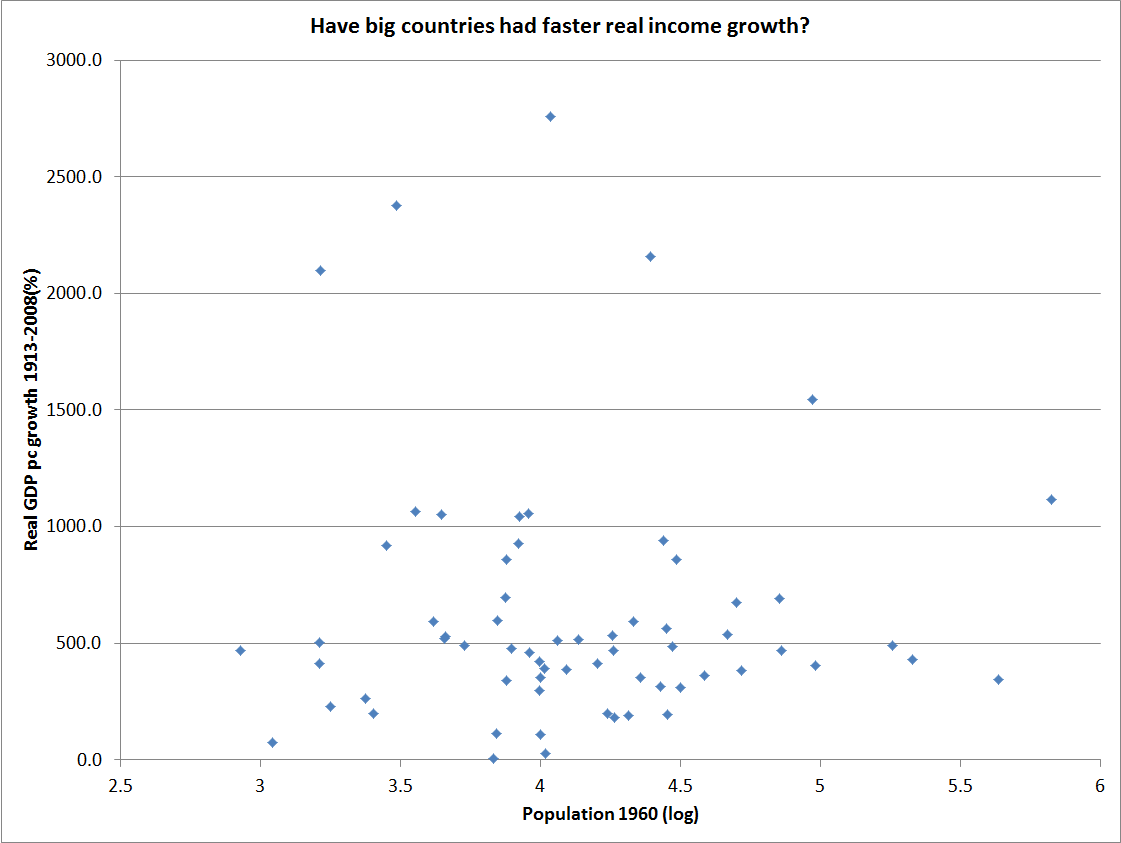
This chart shows per capita real GDP growth from 1913 to 2008 for the sixty or so countries Maddison had estimates for, plotted against the level of the population of each country in 1960 (roughly half way through his period).

popn and growth 1913 to 2008

There is no relationship. And there is also no relationship if:

  • We take out the countries that had exceptionally fast growth over that 95 year period, or
  • If we restrict the sample to  a group of countries that were already fairly advanced in 1913 (Western Europe, and the Anglo offshoot countries).  The United States and Switzerland, for example, had almost identical real per capita GDP growth over that period.

What about more recent periods? The Conference Board has built on Maddison’s work and has estimates for a wider range of variables for more recent decades.  One argument – advanced in a New Zealand context by Phil McCann – is that size has become a much more important issue for advanced countries in the last few decades. If so, perhaps we might have expected to see big countries growing faster than small countries over that period.

Here are two charts that look at that relationship for 33 advanced economies.

The first shows the relationship between the (logged) level of population in 1990 and growth in real per capita GDP growth since 1990.

population and gdp pc since 1990

And the second shows the relationship between the (logged) level of total hours worked in 1990 and growth in real GDP per hour worked since 1990.
hours worked and productivity since 1990
In neither case, is there any sign of a positive relationship.

Charts of this sort are, of course, not conclusive. Lots of other things are going on in each country.  In an ideal world, one would want a much fuller and formal modelling of the determinants of growth. But equally, the absence of a positive relationship between the size of the country and its subsequent growth shouldn’t be surprising, and there have been previous formal research results suggesting a negative relationship.

Of course, perhaps New Zealand is an exception. Perhaps real per capita incomes would really be materially lifted if we had many more people here, even though there has been no such relationship across the wider range of advanced countries in history.  But in a sense we have been trying that strategy for 100 years and there is no sign that it has worked so far.   Very few relatively advanced countries have had weaker real per capita growth than New Zealand in the last 100 years (only places like Argentina and Rumania).

Perhaps the next 25 or 100 years would be different. But I think the onus is now on the advocates of policies to bring about a bigger and more populous New Zealand to demonstrate where and how the gains to New Zealanders from a much larger population are occurring?  Recall that all our population growth now is resulting from government policy choices – the level of non-citizen immigration that the New Zealand government is targeting. If population growth were being driven by the private choices of New Zealanders (higher birth rates, or a permanent reversal of the New Zealand diaspora), I wouldn’t regard it as a particular matter of policy interest. But when our governments are actively targeting a larger population the onus is surely on them to demonstrate the real economic gains to New Zealanders. 25 years on in the current strategy there is no sign of them yet.

One could make a case that New Zealand’s greatest asset is the fertile land and temperate climate.  Refrigeration and much reduced shipping costs in the late 19th century gave those natural resources real economic value.  But there has been no comparable “shock” for the last hundred years, and arguably we are simply spreading those natural resource “rents” over more and more people.  Norway would be unlikely to have the highest real GDP per capita in Europe if they had responded to the discovery of vast oil and gas resources by doubling their population.

Natural resources alone don’t make a country rich (see Iran or Zambia), and natural resources aren’t the only way to get rich (see Singapore or Taiwan) but for a very isolated country they may well, in conjunction with strong institutions and competitive markets, provide the best possible basis for re-establishing top tier living standards for a small population.  So far, adding lots more people doesn’t seem to have helped.

Talking of which, it is now 21 August and there is still no sign of an MBIE response to my 28 May request for copies of advice to ministers on the economic impact of immigration, and on the permanent residence approvals target.

Skills-based immigration: who has got Essential Skills work visas?

It is now 18 August, and I’m still waiting for MBIE’s response to my 28 May request for copies of advice on the economic impact of immigration and the permanent residence approval target.   The Act provides a basic response time for agencies of no more than 20 working days.

Last week I ran a series of posts (here) using data from MBIE’s website on the occupational breakdown of work visas granted for New Zealand over the years 2010/11 to 2014/15.   For a skills-focused immigration programme, a remarkably large number of the approvals were in not-obviously highly skilled occupational areas.

But as I noted last week, the 250000 or so approvals on the spreadsheet encompassed a variety of different types of approvals. Around 30000 were for a “specific purpose or event” (perhaps competitors in a professional sports tournament, or performers in a visiting professional orchestra). And more than 20000 were “variation of conditions” approvals, so including them was effectively double-counting people.

But the heart of the list is the category MBIE call “Essential Skills”. Of the 250678 total approvals over those five years, 101296 were applications approved under the Essential Skills category.

Around 2500 of these approvals don’t have an identified occupation, but what of the remaining 99000?

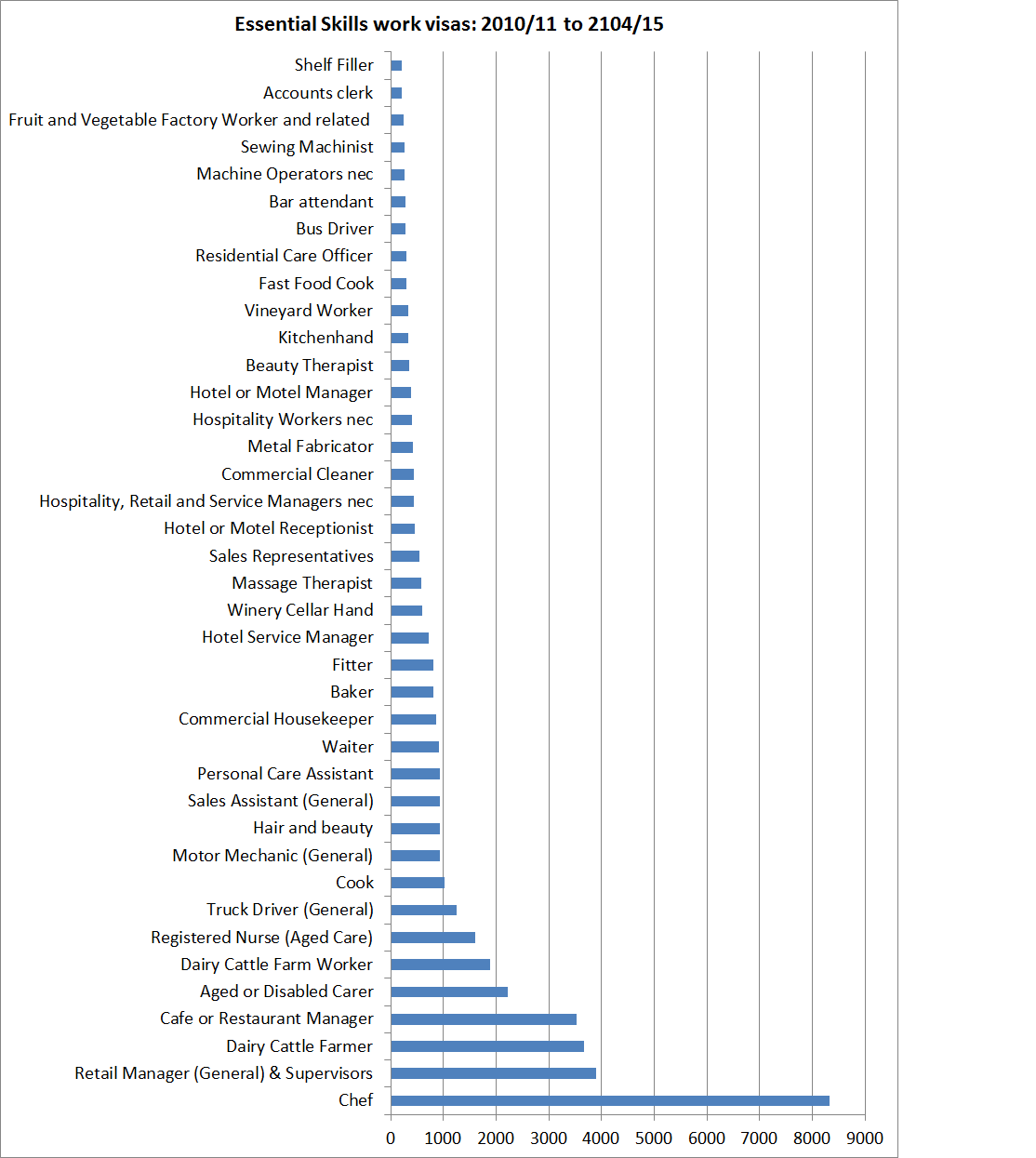
I went through the Essential Skills list and tried to pick out the occupations I’d highlighted last week as not looking overly highly skilled.   The chart shows those with more than 200 approvals – starting from the bottom with “Shelf Fillers”. These 39 occupations accounted for almost 43000 of the total Essential Skills work visa approvals, almost 45 per cent of the total. (As previously, I’ve deliberately left out construction-related positions because there is a different set of arguments around the role of temporary migration is dealing with a temporary one-off source of labour demand).

work visas essential skills

There is quite a range of occupations even on this list. Each person will probably look at the list and think of one or another occupation “oh, but that really is quite skilled”. And I’ve no doubt that most of them do involve some skill or other, but equally I’m pretty sure that looking across the list as a whole it is probably not what most New Zealanders have in mind when they hear that New Zealand has a skill-focused immigration programme, which is supposed to boost our national productivity through the spillovers from this skilled migration to the wider economy.  I certainly wasn’t what I had in mind. I’ve been critical of our migration policy on macroeconomic grounds – the sustained pressure on real interest and exchange rates – but have repeatedly accompanied that analysis with lines about “but we seem to focus pretty successfully on bringing in skilled people”.

And, as I’ve noted before, to get a visa under this Essential Skills category one needs to have a firm job offer from a New Zealand employer, which requires meeting this standard:

Evidence there are no New Zealand workers available

To get an approval in principle before you apply, or to show us that there are no suitable New Zealand workers available when you are applying, the employer has to show that they have genuinely searched for suitably qualified and trained New Zealand workers.

The employer also has to explain why:

  1. their particular job specifications are necessary for the work
  2. New Zealand applicants are not suitable, and
  3. New Zealand applicants cannot be readily trained.

There must be a huge amount of search activity going for those elusive chefs/cooks…..

Many other work visas (25000 or so over the five years of this data) are granted to people who are simply partners/spouses of students or someone who has got an Essential Skills visa approval. There appears to be no skill or occupational requirement for these people.

Unfortunately, the MBIE data do not indicate how long each work visa approval was for.   For lower-skilled occupations, visas are apparently typically for shorter-periods than those for higher-skilled occupations. That will mean that simply counting total approvals by occupation will overstate the effective share of lowly-skilled labour in the total inflows under the Essential Skills category.   But it is not obvious why we are granting Essential Skills work visas to shelf fillers, fast food cooks, cleaners, kitchen hands, waiters , or aged care workers at all.  It has the feel of something equivalent to “corporate welfare” –  employers smart or lucky enough to get on the list access labour that is cheaper than otherwise.   And this is all before we take into account people here on the numerous working holiday schemes.

Work visas are for a limited term, and are distinctly different from permanent residence approvals. Some of the latter are for genuinely quite highly-skilled people (on a skills criterion shelf fillers would not gain permanent residence approval). But as the Treasury material I commented on last week illustrated, in recent years only around half of even permanent residence approvals came under the “Skilled/Business” headings, and that heading included not just the skilled worker themselves (chefs and so on) but their immediate families.

There are all sorts of arguments for immigration. Some make cases on humanitarian grounds (genuine refugees), others on simply targeting a bigger population, some aiming for diversity or “superdiversity”. Some libertarians will even mount an “open borders” argument – that the world would be better off if everyone could simply move to where the opportunities were best for them. But New Zealand governments, over 25 years or so, have focused on skills-based arguments – that a large-scale immigration programme offers a way of supplementing local skills in ways that don’t just boost total numbers but which add to the productivity and living standards not just of the migrants themselves but of the local population.

I’m sceptical that we have had any such gains.. On the one hand, New Zealand – while attractive as a place to live – just isn’t that appealing (small, distant, underperforming) as a place to work and grow a business for the hardest-driving and most energetic of people. And the fact that the additional pressures on demand from immigration dominate any supply benefits in the short-term has meant that in a modest-savings economy, high inward immigration has put sustained pressure on real interest rates (highest in the advanced world for the last 25 years) and the real exchange rate.  Business investment, especially in the outward-oriented tradables sectors, has suffered, and continues to do so.

But these data tend to illustrate that our immigration programme isn’t really that skills-focused at all.  If so, it is hardly surprising that there are few/no signs of beneficial spillovers to the rest of us.   And the programme has just been further debauched: as I noted a couple of weeks ago, the government’s recent announcement of additional points for people going to the regions will simply lower the average quality of the migrants we let in. There is a lot of idle talk about attracting really top people, and “the next Bill Gates” is a common shorthand. But our politicians, and their advisers, need to face the fact that New Zealand just isn’t that attractive to such people, even if we could identify them. Our universities are not top-tier. Our market is small. And our country is remote.   As even the advocates acknowledge, even among the Anglo countries, why would you choose New Zealand if you could get into the US, the UK, Canada, Australia, or even Ireland (which may be no bigger, and have no better universities, but is within the EU and close to continental Europe).

It is time some pretty hard questions were asked about our immigration programme and strategy. The Australian government has had their Productivity Commission do two reviews in the last decade. It looks like an issue tailor-made for our own Productivity Commission to have a look at.  Perhaps the Secretary to the Treasury could then produce the evidence or arguments behind his rather glib assertions about the benefits to New Zealand of our very large immigration programme?

Skills-based migration: completing the alphabet

The two charts below capture the numbers of work visas given for each of the occupations shown (only those with 200 or more approvals are shown).

First, the letters e to l  (there were 51 economist approvals by the way).  There aren’t the big and egregious examples we’ve seen in some of the other charts, but one has to wonder about the number of fast food cooks, the kitchen-hands, motel receptionists, hairdressers, and hospitality workers.

work visas e to l

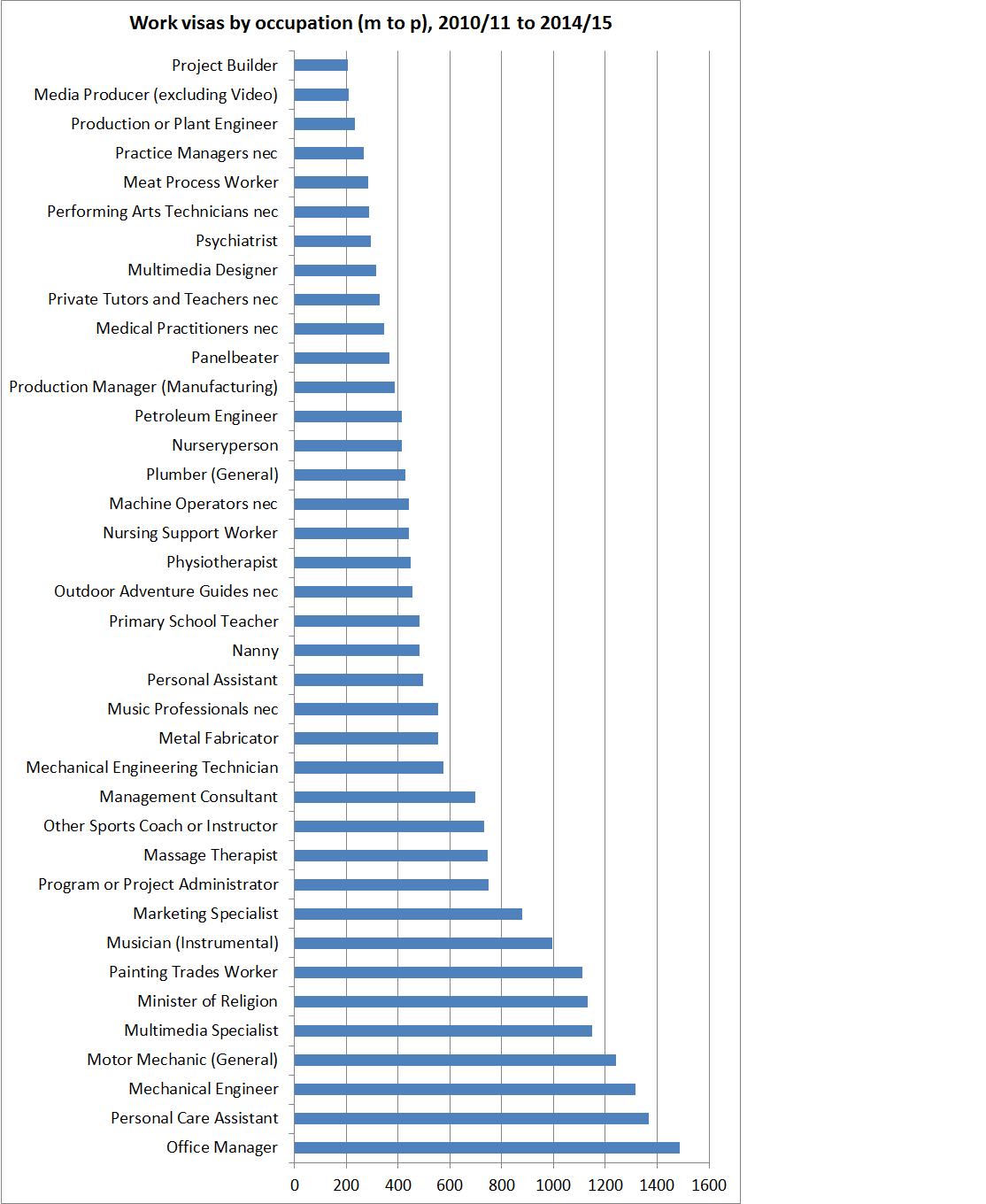
And then, finally, the letters m to p.  Nannies, personal assistants, massage therapists, personal care assistants, and even office managers raised a few questions.  And I shouldn’t pass over ministers of religion.  I’ve been in a parish that imported a British vicar, and I’m always surprised at the number of New Zealand parishes that advertise vacancies in the British Anglican weekly I subscribe to

work visas m to p

That completes the trip through the alphabet.  I think my point –  that there are very large number of not very highly-skilled positions for which work visas are being granted, often as “Essential Skills –  has been made, but I might try to bring some of the numbers together in a slightly more aggregated way next week.

Skills-based migration: q to v

I’ve had quite a few comments and questions on these data.  I want to be clear what they are.   They are drawn from an MBIE spreadsheet, usefully posted on their immigration statistics page, which contains all work visa applications over the years 2010/11 to 2014/15, over 300000 of them.  Around 60000 were declined, and I’ve just deleted those.  Another 60000 or so don’t specify an occupation.  That includes working holiday visas and a variety of others.  I’ve also not looked any further at those.  The charts in this series have been taken from the remaining 190000 or so successful applications.

And 190000 is, of course, not some net inflow of people over that period.  Some of the applications might have been people here for only a few weeks or months (eg specific event visas).  There are plenty of “variation of conditions” approvals, which are presumably multiple approvals for the same person.  And the same position might have been filled over five years by, say, five different foreign job-holders.    All I have sought to show that, of the large number of work visa approvals over the last five years a surprisingly large proportion have been for positions that don’t appear particularly highly-skilled, and which aren’t what most people (well, me anyway) had in mind when they hear of a skills-based immigration programme  (and this should, presumably be the most skills-oriented component of the overall programme –  refugees and family reunification visas have a different focus).

With that prelude, here is the chart for the letters q to v

work visas q to v

And what caught my eye this time?  A surprising number of truck drivers (if all ours really went to the West Australian mines, higher wages here would have been the market response I’d have thought), and huge number of aged-care nurses (to complement the even greater number of aged-care workers we saw the other day).

And then there was the retail sector –  more than 7000 retail supervisors and retail managers, mostly applying under an “Essential Skills” category.  Every single one of those shelf-fillers also applied under the Essential Skills category.

Somehow it doesn’t have the feel of a productivity-enhancing skills-focused programme.      Too often these have the feel of something where employers in particular sectors are rewarded for their lobbying skills in getting the particular occupational “skills” they want to employ on the approved list.  By contrast, the usual market response to shortages in particular occupations is for the relative wage for that occupation to rise.  And if the shortages are pervasive enough  –  unlikely over recent years when the unemployment has lingered around 6 per cent –  monetary policy tightens to keep overall demand in check.  Running approved lists of “essential skills” or areas of skill shortages is, in any case, a flawed strategy. It eases pressures on employers of that particular occupation, but since in the short-term demand effects of immigration outweigh supply effects (the standard result in New Zealand macro studies), any gain for employers in a single sector is outweighed by the additional demand pressures elsewhere in the economy.

Skills-based immigration – waiters

Somewhat annoyed with myself for losing my workings last night, I decided to start at the other end of the alphabet this morning.  Not many y or z occupations, but a fair number of Ws.

work visas wxyz

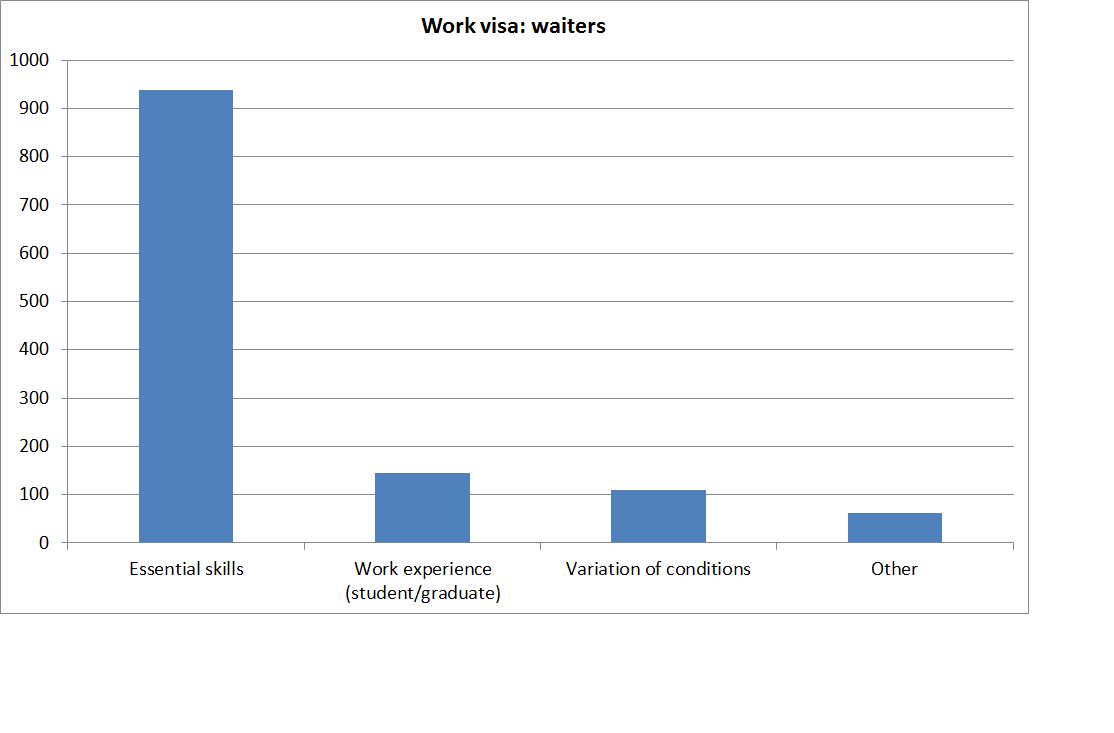
And again questions arise about the skills-based, productivity-enhancing, nature of those winery cellar hand and waiter approvals.  I had a slightly closer look at the waiter ones, using MBIE’s “application type”.  Somewhat to my surprise –  perennial optimist that I am –  this is what that breakdown looked like for the last five years.

work visas waiters

Café society and all that, but, really, an essential skill?

Skills-based immigration – D

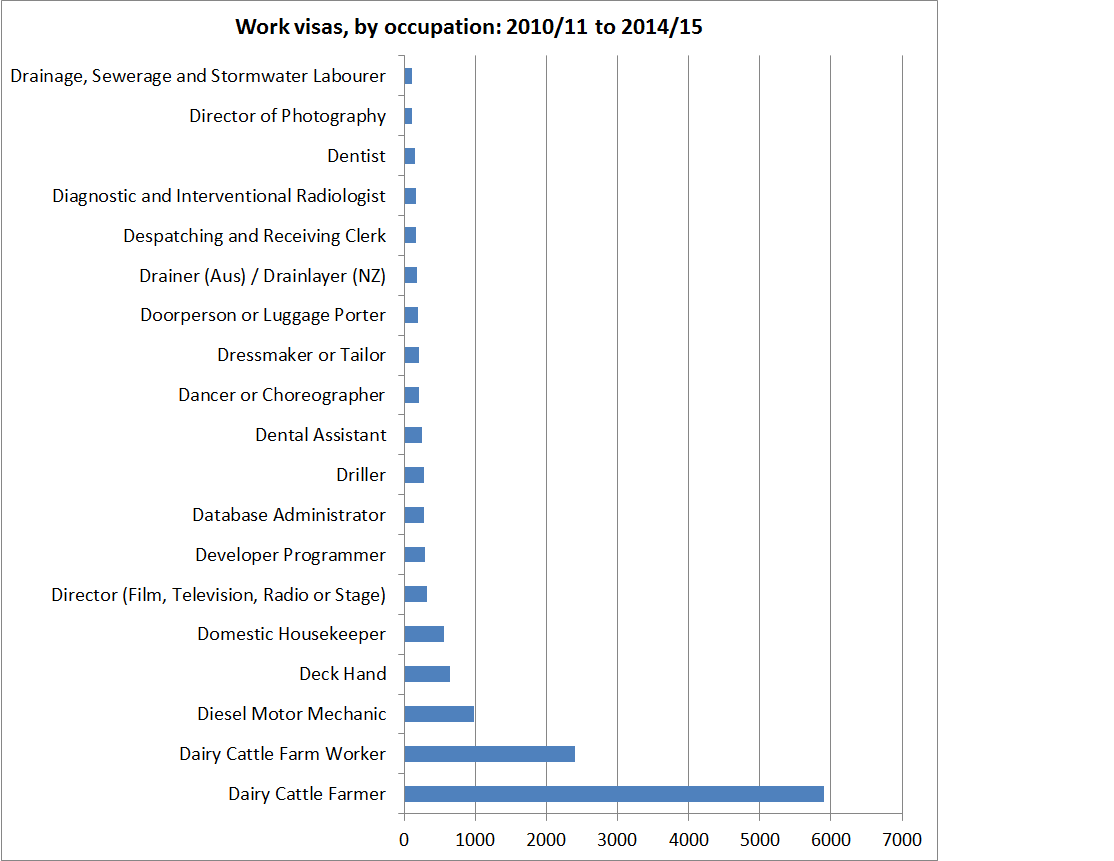
I’m sure they are excellent dairy workers/farmers (all 8000+ of them), but there are only around 11000 dairy farms in the whole country.  It does, rather, have the feel of an approach more strongly focused, in effect, on keeping down wages rates and conditions in the New Zealand dairy industry –  and fuelling the gross output driven mentality which Peter Fraser and co-authors suggest has dominated the industry in the last decade or so, a period when real value-added in agriculture has not grown at all.

The gains to farmers are clear, but those to New Zealanders as a whole are rather less obvious.

A quite remarkably larger number of (skilled?) domestic house-keepers as well, no doubt complementing the 1000 commercial housekeepers, and contributing to the long-sought lift in productivity.

work visas D