Business leaders and the case for large scale immigration

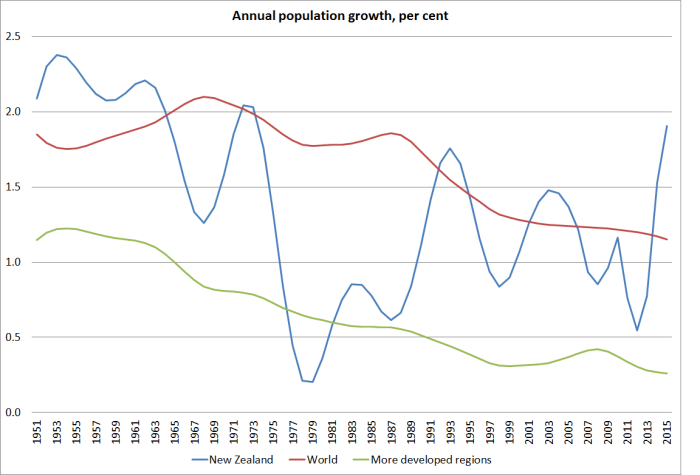
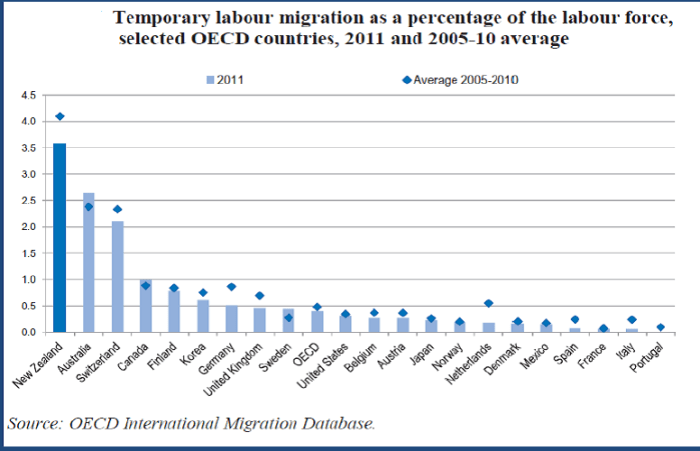
New Zealand has one of the very largest planned and managed active legal non-citizen immigration programmes of any country anywhere.  Individual EU countries sometimes have larger legal inflows –  but mostly they can’t control intra-EU flows –  and in recent times the illegal inflows (some mix of refugees and economic migrants) to some countries have been very large. Immigration is a big issue in the UK Brexit debate, but immigration to the UK is on a much smaller scale than that to New Zealand.

Cross-border flows in conflict zones are often high –  and an unwelcome, if second best, outcome all round.  Most of the Syrians who have flooded into Lebanon, Turkey or Jordan would prefer to be back home in a secure Syria.  The Lebanese, Turks, and Jordanians would no doubt prefer that too.

As I’ve noted recently, the United States issues green cards at a rate about a third the (per capita) rate New Zealand grants residence approvals.  Canada –  a much richer country than New Zealand – has just increased its target migrant intake, but in per capita terms it is still less than New Zealand’s.   The only advanced country I’m aware of that sets out to (and succeeds in) attracting more migrants, per capita, than New Zealand is Israel,  and their circumstances are quite different for two key reasons.    The first is geopolitical, in that population could well prove critical to the future existence of the state of Israel.  And the second is about the founding conception of the state of Israel as a Jewish homeland –  the Law of Return allows any Jew (and some descendants) to migrate to Israel, and grants immediate citizenship to those who do.

We are an outlier.  We have total control of our borders,  no geopolitical threats to our existence, and no sense of New Zealand as the historic homeland for some ethnic or religious group scattered across the earth.  And yet we bring in huge numbers of non-citizen migrants each year.  The anomalous nature of our approach is heightened when it is remembered that people who know New Zealand, and its opportunities, best –  ie New Zealanders – have been leaving in large numbers for decades.  Oh, and ours is an economics-based programme, and yet our long-term economic performance just keeps on being pretty disconcertingly poor.

I know most of the theoretical arguments for immigration (and emigration).  But this isn’t a theoretical argument about some abstract stylized country. It is an argument about the appropriate role, and effects, of our particular immigration policy, faced with the specifics of this particular country at this particular time in its history.  Theoretical models can be helpful in thinking about the issues, but only in so far as they capture the key relevant features of the New Zealand economy.  On my reading, few do.

And so I’m always keen to see the strongest cases that people can make for our unusual immigration policy, in a New Zealand specific context.  Hand-waving accompanied by citing papers that take a global perspective doesn’t shed much light on the particulars of New Zealand’s situation.  The government’s chief economic adviser, the Secretary to the Treasury, simply asserts there are economic benefits from immigration, but has made no attempt to demonstrate how they arising in the specific context of New Zealand.  His perspectives often seem more relevant to the British debate –  recalling that is only about six or seven years since he moved here from the UK.  Neither Treasury nor MBIE’s advice –  in formal publications or in material released under the OIA –  provides much to engage with.

There is a bureaucratic/academic elite consensus around the key elements of the immigration programme.  But the other key source of support is the business community.  Mostly they’ve favoured large scale immigration for decades –  through periods of overfull employment and of uncomfortably high unemployment.  Throughout those decades, New Zealand’s relative economic performance has continued to deteriorate.  Perhaps they think – if they stopped to analyse the issue –  we should just be thankful we avoided the counterfactual –  who knows how bad our living standards might now be if, say, our population had increased by perhaps 50 per cent over the last hundred years (as in a typical Northern European country) rather than 300 per cent?

Various representatives of the business community have been out this year championing our immigration policy.  I’m not suggesting that all of them support every detail of how the current system is working, but the general message seems to be that we are on the right track –  running such an unusually large immigration programme, even though our productivity performance remains disconcertingly bad.

A few months ago, I wrote about a brief contribution to the debate from Roger Partridge, the chair of New Zealand’s premier business-funded (typically non-tradables business funded) economic think-tank.   Running under the heading Immigration Grows the Pie, it wasn’t a long piece but it was typically forthright:

And that is not the end to the good news. Countless international studies have shown that increases in immigration not only tend to increase jobs, but also to increase the prosperity of the host nation. We benefit from their productive endeavours, their ingenuity and their diversity. And the more skilled the migrants, the greater the benefits.

That there are gains from immigration has received cross-party support in New Zealand since at least the 4th Labour Government. Let us hope the anti-immigration demagoguery falls on deaf ears. Going down that path we all lose.

The challenge is not keeping out the migrants; it is keeping out the bad ideas. Luckily, that does not need a wall, just clear thinking.

But, as Partridge acknowledged in subsequent comments, none of those “countless” studies focused on the specifics of New Zealand’s situation.

And then in the last couple of weeks, as the immigration debate has received a bit more attention, the Dominion-Post has run advocacy pieces from the leaders of two business advocacy or lobby groups.

On 10 June, the chief executive of BusinessNZ, Kirk Hope, was out with a column headed –  at least in the hard copy – Don’t stem the immigrant tide (there is an identical piece on the BusinessNZ website, under the more subdued heading Improve immigration for the long-term).   Hope has form – I highlighted another one of his op-eds earlier in the year which celebrated our GDP growth rate as among the higher in the OECD, while never once mentioning that rapid population growth was such that recent per capita growth had been quite disappointing by international standards.

In his latest piece, Hope takes issue with calls to cut our residence approvals target.

Immigration is in the news again – being blamed for Auckland’s housing problems, with suggestions that immigration should be drastically cut, to around say 10,000 new permanent residents per year, to restrain Auckland house prices.

The numbers involved –with roughly 30,000 new permanent residents settling in Auckland a year alongside a current shortfall of about 30,000 houses in Auckland – would seem to support the suggestion.

But the suggestion doesn’t stand up to scrutiny.

Reducing the quota to 10,000 would not by itself solve Auckland’s housing problem, and would bring problems of its own.

I’m not sure that anyone has suggested that reform mainly to restrain house prices.  There are other things that could and should be done on that score –   but mostly aren’t.  But equally, there is little real doubt that a much lower expected future rate of population growth would materially lower real house prices.  The sustained reversal of immigration flows from the mid 1970s was a big factor in the 40 per cent fall in real house prices in New Zealand in the late 1970s.
I don’t disagree with everything Hope says. He rightly says that we shouldn’t focus too much on cyclical peaks (or troughs), especially as those cyclical fluctuations (mostly New Zealanders leaving at a faster or slower rate) aren’t something policy can directly control.  But then that is why a sensible discussion on immigration policy focuses on the fairly stable medium-term target level for residence approvals.  At present, that target is 45000 to 50000 per annum.  I argue that New Zealanders would be better off with something more (US like) along the lines of 10000 to 15000 per annum.  All that said, sometimes it is the peaks –  and troughs –  which help spark serious conversations about the medium-term policy settings.
But why is Kirk Hope so keen on a high rate of non-citizen immigration?

Restricting immigration as proposed would harm the economy.

With a birth rate just above replacement level, an ageing population and baby boomers retiring, we need immigrants to sustain the economy and pay for our superannuation, just as in decades past.

And that seems to be his main argument.  It isn’t a very persuasive one.

On the immigration side of the story, around 10 per cent of residence approvals are under the “parent” heading –  ie mostly people who are already quite elderly themselves, and won’t be making much contribution to paying for NZS.  Another 1000 or so will be refugees.  I don’t have any problem with us taking refugees, but the evidence suggest refugees struggle to match New Zealanders’ earnings and employment rate even decades after arriving here.  And unlike the systems in many countries, immigrants themselves are entitled to the full NZS themselves after only a relatively short time living in New Zealand –  ten years.

And on the NZS side of things, if there are affordability challenges with the current system, we have it in our own hands to modify the system to make it more readily affordable.  We could raise the age of eligibility –  National knows it needs to happen, even if the Prime Minister has pledged not to, and Labour campaigned for a higher age at the last election.  Other countries have made these sorts of changes.  We could also age-index NZS eligibility.  We could modify the entitlements of those who haven’t spent most of their working lives in New Zealand.  And there are other options I don’t support, but which would also ease the fiscal pressures, such as income and asset testing, or linking NZS increases to prices rather than wages.  And we can keep the way open for more older people to stay in the labour force for longer –  on the count, we already have one of the least distortionary old age pensions systems anywhere.  We are quite capable of managing the pressures ourselves.

Large scale immigration might make a small difference to NZS affordability, but it is an awfully big intervention for a really quite small difference.  As it is, New Zealand’s birth rate is around replacement, unlike many European and Asian countries, so the ageing population issues are in any case less pressing here than in most places.

In the end, the best way to support the various social spending commitments society wants to make is to foster a highly productive economy.  We’ve kept on failing to do that, and while immigration policy almost certainly isn’t the whole story, there is no evidence whatever that high rates of immigration have improved the position.

The NZS affordability argument seemed to be the sum total of the BusinessNZ case.  In his article, Hope goes on to suggest some refinements to the current system

The jobs being filled by temporary work visas right now are mostly chefs, dairy farm workers and carpenters, showing the current growth points in the economy: tourism, dairy and construction.

There’s no problem using migrants to fill these current needs – but they are not necessarily the needs of the future.

Our aspiration for the future is to grow businesses and industries in high value areas – engineering, high tech manufacturing and services, digital technologies and high value addition to primary products.

We should be welcoming new permanent residents who have skills relevant to these areas to help these sectors to grow.

If he just means that we should be putting more focus on highly-skilled migrants then –  subject to the current overall target continuing –  I’d agree with him.  But it is curious to see the leader of a business group reckon that he knows what skills and what industries will be the ones that will prosper in a future, more successful, New Zealand.  And it is puzzling to see so little faith placed in the workings of the labour market, or the skills and capabilities of New Zealand.  It is redolent of some sort of 1960s indicative planning mentality –  the sort of line of argument I have previously criticized MBIE for.

Successful economies don’t need lots of migrants.  In some cases they might welcome them anyway, but in others not.  As I’ve noted previously, the United States was at the peak of its economic and political dominance during the decades when it was taking very few immigrants at all.  I’m not suggesting a causal relationship (in which the US prospered because it cut back immigration) simply that it wasn’t obvious that high immigration was a necessary part of economic success.

Kirk Hope’s article was followed yesterday by an article from John Milford, the chief executive of the Wellington Chamber of Commerce, under the (hard copy) heading Skilled migrants a win for us all”.

His evidence appears to be a recent MBIE National Survey of Employers. Asked their views on the impact of immigration, employers responded as follows


survey of employers

It isn’t an ideal piece of information.  After all, MBIE –  the people commissioning the survey –  are also the key official champions of immigration policy, and the administrators of the system.  And even setting that to one side, we don’t know how many people disagreed, and how many didn’t answer or didn’t know.

But even setting those points to one side, I’m not surprised at all that individual employers answered along the lines indicated in that chart. For an individual employer, the ability to choose a migrant for a particular vacancy increases that employer’s choices at the wage rate being offered.  Indeed, in some sectors  –  one could think of aged care nurses  –  the wage rates might be sufficiently low that most of the suitable applicants might well be immigrants from poorer countries with lower reservation wages.  But the ability to fill a particular vacancy says nothing at all about whether immigration policy is working to serve the longer-term economic interests of New Zealanders.  And nor would individual employers have any particular expertise in evaluating the arguments in that regard.   It is a lot like the idea that immigration eases skills shortages. For an individual employer, facing a specific hiring decision, the ability to recruit an immigrant may well ease that employer’s specific “skill shortage” (ie prevent the wage offered having to rise) but for the economy as a whole, large scale immigration increases resource pressures, it doesn’t ease them.  New Zealand economists knew that decades ago.

Back in the 1950s and 1960s many New Zealand employers probably also thought that manufacturing protectionism was good for New Zealand too.  It might well have been good for many of them individually, but it wasn’t good for the longer-term living standards of New Zealanders.

Business sector advocates often try to have us believe that key sectors just couldn’t survive without reliance on large scale immigration.  Set aside the inherent implausibility of the argument –  how do firms in the rest of the world manage –  and think about some specifics.  Sure, it is probably hard to get New Zealanders with alternative options to work in rest homes at present.  So, absent the immigration channel, wage rates in that sector would have to rise.  Were they to do so, I can see no reason why in time plenty of New Zealanders would not gravitate to the sector.  It was New Zealanders who staffed the old people’s home my grandparents and great aunts were in 30 years ago.

Same goes for the dairy sector, or the tourism sector.  As one former senior MBIE person put it to me a while ago, what reliance on migrant workers in dairy has done is mostly to enable dairy land prices to be bid a bit higher than otherwise.    Raise the wages and New Zealanders will, over time, gravitate to the opportunities in the sector.  That is how labour markets work.

Of course, none of this is obvious to an individual employer.  They probably can’t raise their wages to attract New Zealand workers instead, even if they wanted to.  To do so would undermine that particular firm’s competitive position.  But again, this is the difference between an individual firm’s perspective, and a whole of economy perspective –  and the latter should be what shapes national policy.  Cut back the immigration target, along the lines I’ve suggested, and we’d see materially fewer resources needing to be spent on simply building to keep up with the infrastructure needs of a rising population.   We’d see materially low real interest rates, and with them a materially lower exchange rate.  The lower exchange rate would enable New Zealand dairy farmers, and tourism operators, to pay the higher wages that might be needed to recruit New Zealanders into their industries, and probably still be more competitive than they are now.  And plenty of New Zealanders now working in sectors totally reliant on an ever-growing population would, in any case, be looking for opportunities in other sectors.

Perhaps some readers might think I’m being unfair to Partridge, Hope, and Milford.  After all, no one can cover all their arguments in a single article of a few hundred words.  As readers know, I certainly can’t.  But surely the best, and most robust, arguments would be put forward first in high profile pieces?.  And what they’ve offered us doesn’t look very robust or convincing at all.  It feels like either a high level application of general international theory, without thinking about the specifics of New Zealand, or an individual employer’s view of the world –  where the ability to hire more people, on the day, at much the same wage is always going to feel like “a good thing”, no matter what the macroeconomic implications might be.  I really hope some of the advocates of the current policy can make the effort to put together a more sustained case for how New Zealand’s current large scale immigration –  or even their preferred refinements to it –  has really been working to lift productivity and the medium-term living standards of New Zealanders.

Of course, there are people on the other side of the argument, even some fairly eminent ones with some serious business backgrounds.  Don Brash spent 18 years as a private sector CEO before turning first to public policy and then politics.  No one can accuse Don of being some of nativist, or of having even a shred of doubt about the benefits of an open economy.  Don published his memoirs a couple of years ago, and included some chapters on various policy issues.  One of those chapters was devoted to issues around immigration, including some of the earlier versions of the arguments I was raising.  Don concluded

I’ve been reluctantly forced to the conclusion that, if we want faster growth in per capita incomes and a lower balance of payments deficit, among the policy measures we need to take is a much more restrictive attitude to total inwards migration

Commenting further

…employers in the export sector who benefit from employing immigrant workers may themselves carry some of the “blame” for the high real exchange rate which makes their lives so uncomfortable

The current government has, during its term, commissioned two external panels to report on issues to do with New Zealand’s disappointing economic performance.  Don Brash chaired the 2025 Taskforce, and Kerry McDonald chaired the 2010 Savings Working Group.

McDonald started his career as an economist, spent time as director of the NZIER, and then moved into the corporate world, spending decades as chief executive of Comalco.  He continues to sit on various corporate boards.  This week he came out with a fairly trenchant piece on the failings in the New Zealand political and policy process.  I didn’t agree with it all by any means, but here is what this economics-trained senior business leader had to say about immigration.

The high rate of immigration is a national disaster. It is lowering the present and future living standards of New Zealanders by serious adverse economic, social and environmental consequences.

The critical criterion for policy is impact on the living standards of New Zealand residents. The impact on the immigrants is irrelevant. But, the political view is a simple and misleading “quantity” based one – more immigrants means population growth and more jobs, houses and infrastructure spending, so GDP increases. This suggests a strong, well-managed economy – which is a nonsense in New Zealand’s case with an export dependent economy.

In terms of national benefit the “per capita” impact is the important one. Unless immigrants increase New Zealand’s exports and foreign exchange earnings and savings per capita, or bring particularly valuable skills to the economy, they simply impose substantial additional costs on and reduce the living standards of New Zealand residents.

Having a job, even in an export industry or tourism, is not enough, and many immigrants lack the particular, high level of skill and productivity to add the necessary value. Using them to fill low skill, low productivity gaps in the labour market, eg. building houses for our excess population (other than on a temporary basis), is damaging to New Zealand’s interests, in the short and long term. So, we scramble to build more houses and ignore the fundamental policy problems.

As I say, I don’t agree with everything he says, but at very least his is a robust honest recognition that, whatever the glee club says, things aren’t going well for New Zealand, haven’t for a long time, and that current policy –  perhaps including immigration policy –  and political leaders have to take some considerable measure of responsibility for that.


Immigration policy and values statements

Vernon Small has an interesting column in the Dominion-Post this morning (not yet online) under the heading “Terror risk muddies rational migration debate”.  He seems keen on a national debate on the economics of our immigration policy, including highlighting  The Treasury’s concerns about whether the skill level of the typical migrant is really fully consistent with the original vision of a skills-based migration programme providing economic benefits to New Zealanders.

But at the same time, with a somewhat lofty condescension, he seems uneasy about other public concerns. In particular, he isn’t taken with calls from Winston Peters and David Seymour for immigrants (including refugees) to sign some sort of national values statement.

Actually, I’m also not keen on requiring immigrants to sign values statements.  Not just because they don’t seem enforceable –   and if you really want to get to Australia, why would a commitment to “respect” (whatever that means) “a spirit of egalitarianism” (one element of the required Australian values statement”) deter one?.  Who knows what it means anyway  Perhaps turning over the Prime Minister every year or so, so that as many people as possible get a go?

My concerns are about two, perhaps opposing, risks.  The first is that any values statement becomes a lowest common denominator statement as to be totally meaningless.  The second is that the wording of any values statement –  if taken seriously –  would be hotly and continuously contested, as culture wars ebbed and flowed.  And frankly, I don’t seem to be welcome in David Seymour’s New Zealand.

Here is the Australian Values Statement, required of migrants to Australia:

I understand:

  • Australian society values respect for the freedom and dignity of the individual, freedom of religion, commitment to the rule of law, Parliamentary democracy, equality of men and women and a spirit of egalitarianism that embraces mutual respect, tolerance, fair play and compassion for those in need and pursuit of the public good
  • Australian society values equality of opportunity for individuals, regardless of their race, religion or ethnic background
  • the English language, as the national language, is an important unifying element of Australian society.

I undertake to respect these values of Australian society during my stay in Australia and to obey the laws of Australia.

I understand that, if I should seek to become an Australian citizen:

  • Australian citizenship is a shared identity, a common bond which unites all Australians while respecting their diversity
  • Australian citizenship involves reciprocal rights and responsibilities. The responsibilities of Australian Citizenship include obeying Australian laws, including those relating to voting at elections and serving on a jury.

If I meet the legal qualifications for becoming an Australian citizen and my application is approved I understand that I would have to pledge my loyalty to Australia and its people.

No doubt it isn’t aimed at people like me, and were I migrating to Australia, I could probably, at a pinch, sign it.  But I would have a few mental reservations.  If I knew what the sprit of egalitarianism was, I’d certainly accept it as part of the folk mythology of Australia,  but I’m not sure I’d really “respect” it.  And as for “equality of men and women”, well yes certainly in the most important senses –  equality before the law and before God.  But I’m a Christian, and like most Christian churches (including in Australia the Catholic church, and the Anglican church in Sydney), I don’t believe that women should serve as priests.  I don’t see that as matter of inequality, but many would.

I’m not sure when the Australian Values Statement was written, but it feels as though it might be 10 or 15 years old.   The culture wars have moved on, and David Seymour offers this, rather shorter version as a possibility for New Zealand.

Seymour said it wouldn’t be difficult to pull together a simple charter, stating for example: “We believe regardless of gender, sexuality, ethnicity or religion, you have the same legal rights as everybody else.”

If by that he means that, for example, people should be able to “marry” others of the same sex, then I don’t believe that.  Actually, for almost all of history –  including New Zealand’s history –  very few people did. Most Christian churches don’t today.  It is, for now, the law in New Zealand, but it doesn’t mean I agree with or respect that law.    And, for better or worse, in some respects New Zealand law isn’t even consistent with Seymour’s statement: after all, to name just one example, we have Maori seats in Parliament.  And where does the Treaty fit in the mix?

In fairness to Seymour, his might have been the fruit of 20 minutes scribbling on the back of an envelope. Any values statement actually put into legislation would no doubt be more carefully drafted –  and for that reason, among others, quite a lot longer, to capture all the caveats and competing emphases.

And where would it stop?  I had a quick look this morning at statements I could find in which each of the three largest political parties describe their values.  There was some overlap (and the particular Labour Party document I found had three of four pages of text, while the Greens and National Party had quite short lists), but there were quite a few substantial differences.  Which is what one might expect: a significant part of political debate is the contest of ideas and values, particularly in an era of cultural transition (eg secularization, in which culture and religion are no longer intrinsically interwoven).

I might find the references to loyalty to the sovereign, and limited government, in the National Party’s list appealing.    Many other New Zealanders wouldn’t.   “Respect the planet” might be something central to a Green view on things, but to me the concept of respecting an inanimate object just seems weird.  And even though there was serious uncertainty about the consequences of doing so, I’m glad our ancestors took decisive action to confront Hitler, rather than “take the path of caution”.

As far as I can see, none of the values statement (yet) talk of the rights of the unborn, or transgender rights to bathrooms –  to take just a couple of issues that have convulsed American debate.

Perhaps we might get agreement on process issues –  parliamentary sovereignty, a universal franchise, the rule of law etc –  but even on process it might be thin pickings.  There are probably plenty of supporters here of moving to a written constitution, and others who still hanker for a return to FPP.  In the end, is there genuine common ground on very much at all, other perhaps than that change should occur non-violently?  We can all agree that individuals do and should have rights, and probably all agree that in some circumstances the needs/interests of the “community” override those individual rights.  But where that boundary is, and how it should shift, is the intrinsic stuff of politics.  We can’t agree among ourselves, so what is there for immigrants to sign up to, other than today’s (temporary) shifting majority.  I was amused, for example, to read the Prime Minister’s rewriting of history, in answering the values question, noting that for him it included “understanding that New Zealand’s always been a tolerant society”.   Really?  To name just one low-key example, our treatment of conscientious objectors during the two World Wars meets no reasonable definition of “tolerant”.

And yet the people who call for migrants to sign values statements do capture a fair point.  When large numbers of people are allowed by our governments to come and live in New Zealand they have the potential to change our society.  People are not just bloodless economic units –  dessicated calculating machines.  They bring their own attitudes and values, and while the new arrivals are likely to be changed by living here so –  if the numbers are large enough – is our society.  One need only think of European migration to New Zealand over the last 200 years –  we their descendants may be changed by living here rather than in, say, the United Kingdom, but the similarities with modern Britain are probably greater than those with pre-1840 Maori society.  The point is not that modern New Zealand is better or worse for those migrants (and their values/attitudes/technologies), but that the fact of change is inescapable and largely irreversible.  Seeking that sort of change is itself a political act.

Which is one of a number of reasons why I’m skeptical that –  even if there were material economic benefits to residents of the recipient countries – large scale immigration programmes are normally a legitimate role of government at all.  We’ll always have some immigration.  New Zealanders travel, and some will meet and marry foreigners.  Often enough the new couple will want to settle here.  And our humanitarian impulses will, rightly, drive us to take some refugees.  But in neither case –  both on generally quite a small scale – do we grant permission to reside here with a goal of changing our society.

But once we get into large scale immigration programme, governments are in the culture change business, actively or passively, often without even realizing it. In terms of the domestic culture wars, and ongoing debates, the ability to attract more people like one side or another skews the playing field.  Instead of working out our differences, and debating change, within the existing community of New Zealanders, we tilt the playing field one way or the other. I might be comfortable with a large influx of mid-western evangelicals, while most Wellingtonians might prefer liberal Swedes.  I might be happy with strongly Anglican Ugandans or Kenyans, while many would prefer secular French.   In the specific New Zealand context, few migrants have any strong reason to feel a commitment to the Treaty of Waitangi, and for those New Zealanders for whom that is an important issue, any large scale immigration skews the game against (that representation) of Maori interests

It is far easier to resolve disputes, and find an ongoing place for each other, among communities with shared memories, experiences and commitments.  Families do it better than countries.  Countries do it better than the world.  Globalists might not like to acknowledge that, but it doesn’t change the reality.  Families don’t usually resolve their differences –  sometimes painful lasting differences –   by injecting new members into the family.


A question for The Treasury

One thing I like about the Reserve Bank is that it has largely stayed clear of Twitter.  They use it –  you can find them here – but there was a deliberate decision made a few years ago to use it only to highlight new Reserve Bank releases; links to articles, research papers, press releases etc.  I’ve always been sceptical of a medium for expressing ideas in 140 characters or fewer.

The Treasury is a bit more adventurous in their use of Twitter (here), offering editorial perspectives at times, and enthusiastically retweeting things from other people and organisations  (here and abroad) who either endorse something Treasury has done or said, or that Treasury agrees with or endorses.

This Treasury retweet of something from a British academic caught my eye the other day.


Jun 1

Distance matters (still): Trade volume with UK vs distance of trading partner from the UK.  

It is quite a nice chart from The Economist that illustrates a now fairly well-known point.  Firms and people do much more trade, all else equal, with firms and people in countries close to them that with those in countries far away. I don’t think this particular version of the chart is wholly compelling: it uses the total value of trade between countries, but population numbers matter as well, and it might have been better to illustrate the point using per capita trade values instead.  Doing so in this chart would move both Ireland and New Zealand a long way up relative to the other –  mostly much larger –  countries that are highlighted.  But the key point holds: distance matters, a lot.  Not just in terms of who one trades with, but in terms of how much total foreign trade is done at all.  For small countries even more than for large countries, the ability to successfully sell more and better stuff to the rest of the world is a vital part of improving a country’s long-term economic fortunes.

In retweeting it, presumably official Treasury was keen to remind us that distance matters to New Zealand too.    There is no way Australia, for example, would be the largest trading partner for New Zealand firms if, for example, these islands were set in the Bay of Biscay.

Treasury has made a useful contribution over the years in reminding us of this point.  They developed the useful line 15 of so years ago that drawing a circle with a 1000 km radius around Wellington would encompass 4.5 million people and lots and lots of seagulls. while a comparable circle around Vienna or Seoul would encompass hundreds of millions of people.  Sadly, seagulls aren’t a terribly promising market.

Treasury also included this chart in their Holding On and Letting Go document, which formed part of their 2014 Post-election Briefing to the Minister of Finance

Figure 8: New Zealand’s geographic challenge
Selected countries distance from world markets and populationFigure 8: New Zealand's geographic challenge   . Note: The x axis is scaled so that each marker is ten times the magnitude of the previous one.
Source:  World Bank: World Development Indicators, ITC: Trade Map, CEPII

Among OECD and major emerging economies, New Zealand is more distant from markets than any other country.  Chile and Australia are almost as distant.  Chile is a much poorer country, and Australia –  while wealthier –  is very fortunate in the scale of its usable natural resources, but when one looks at the productivity data it is no longer in the top tier of countries.

Treasury also produced an interesting piece of formal empirical research a couple of years ago  using cross-country data to look at the various barriers to foreign trade that New Zealand faces.  In the modelling they report, distance shows up as a highly statistically significant factor influencing (negatively) the volume of foreign trade a country does.

Distance  –  and trade – isn’t mostly about land, it is about people.  Our islands are really remote, but much of what counts is the people living here, who have to find ways of making and selling stuff abroad, especially if we are to have any chance of offering top tier incomes and material living standards to those people.

And so it puzzles me that Treasury never seems to consider population size –  and especially the role of immigration policy in changing population size over time – when they discuss the implications of distance.  4.5 million or so of us face the (quite substantial) penalty of distance.  What leads Treasury to think that exposing ever more people to that “tax” –  not as a result of New Zealanders’ private fertility choices, but as a direct result of government policy –  makes sense.  As I’ve pointed before, in none of Treasury’s writing on immigration policy in recent years has there been any sense of evidence that a large scale (notionally skills -focused) immigration policy has been doing anything useful to lift the overall productivity performance of New Zealand, and the income prospects of New Zealanders.  If anything, we’ve continued to lose ground relative to other advanced countries.

For some time it has surprised me that Holding On and Letting Go had scarcely any mention of immigration policy, and most of the (few) references to immigration were simply to the cyclical pressures, rather than the medium-term issues, even though (for better or worse) it is one of the larger government policy interventions in the New Zealand economy.

Treasury argues that “geography isn’t destiny”, and there is clearly an element of truth in that.  But I don’t think they have yet taken seriously enough the nature of the geographic constraint.  Yes, New Zealand did have top tier incomes for decades, but it did so by exporting natural resource based products deploying/supporting a very small population.  There are no more natural resources here than there were 100 years ago,  the overwhelming bulk of our exports are still natural resource based (not just the obvious farm products, but fish, wine, gold, oil, the electricity that produces aluminium, and tourism) and yet we now have four times as many people as we had in 1916.  Some countries make the transition from natural resources.  When Captain Cook got to New Zealand, Britain’s exports were about 95 per cent based on Britain’s own natural resources.  These days, very little of her exports are.  We have shown very little sign of being able to make that transition.

That isn’t because we don’t have smart, able, innovative people, or good institutions, it seems to be largely because places this remote don’t successfully support many non-natural resource based businesses.  There aren’t any other examples of places that successfully do –  the other even more remote islands are too insignificant to even get on Treasury’s chart.   Internationally-oriented non natural resource based businesses might start here, but mostly the business will be worth more if, in time, it comes to be based somewhere a lot nearer markets.  In some cases, proprietors will like to live here, and will sacrifice growth to keep the business here –  but it is a sacrifice, and in that sacrifice is a measure of the limitations of this place  as a (remunerative) home for too many people.  As one person who runs a small global business here recently put it to me, face to face contact still matters a lot, and if air travel is a bit cheaper than it was 50 years ago, it is no less physically draining or time-consuming.

So my question for Treasury is something along the lines of, why not take seriously (a) the lack of hard evidence that New Zealanders have had economic benefits from immigration, combined with (b) your own recognition that distance matters a lot, and (c) the fact that New Zealand remains a heavily natural resource based economy, with few signs that that is really changing, with no more natural resources being made (and increasing environmental concerns/constraints),  and then think harder about whether a government policy to drive up New Zealand’s population –  even as New Zealanders have kept on leaving –  really makes much economic sense at all.  Treasury has recently asked some good questions about the skill mix of our actual migrants, but they need to think harder about whether there are really top tier income-earning opportunities here for very many people, even if we could somewhat improve the average skills level of those who come.

Distance and location really do seem to matter, a lot.  Policymaking hasn’t really taken that seriously.

Thinking about changing immigration policy

I was going to write about the Reserve Bank’s forthcoming Monetary Policy Statement, but discussion around immigration policy continues in the media, so I thought the topic might be worth one more post.

There are all sorts of different numbers tossed around when immigration and net migration are debated.  Different numbers are relevant for different purposes, and things aren’t greatly helped by the fact that MBIE does not release regular monthly numbers on visa approvals, and so the month to month discussion is often dominated by SNZ’s permanent and long-term (PLT) migration numbers.

The centerpiece of our medium-term immigration policy is the residence approvals target: 45000 to 50000 people per annum.  That target hasn’t been changed for a long time –  it was the previous government’s target and the current government’s.  It is a large number by international standards: as I noted yesterday, in per capita terms it is around three times the number of green cards the US issues each year.  Actual approvals fluctuate a little from year to year –  I showed the chart in yesterday’s post –  but not very much, and the rules and points are tweaked a bit over time to keep near the target.  Debates about the medium-term implications of immigration, whether for population or economic performance, should really concentrate on the appropriate target level (and composition) of residence approvals.   It is important to appreciate that these days the bulk of people getting a residence approval are already in New Zealand (around 70 per cent) –  having arrived on, for example, a student or (temporary) work visa.  In most cases, granting a residence approval changes the legal status of the individual, and does not involve a new border crossing.

But, as I noted, the PLT numbers dominate the headlines.  PLT numbers (which importantly include New Zealand citizens –  not a matter of immigration policy) are only estimates.  We know exactly how many people come across our border (in and out) each month, but the split between permanent and long-term on the one hand, and short-term on the other, relies entirely on the self-reported intentions of those filling in the arrivals and departure cards.  Plans change.  As I’ve highlighted previously, Statistics New Zealand themselves have done useful work showing that at times the reported PLT numbers have been quite substantially different from the actual numbers who have come or gone for more than 12 months (I discussed this work here .  It is a great shame that SNZ is not adequately funded to produce these refined estimates on a regular basis.

Using the PLT data, one can look at either total arrivals or the net flow.

Here is total (self-reported) PLT arrivals by visa type for the last decade or so (the period SNZ provides the data for).

plt arrivals

Among other things, this chart illustrates my point above about residence visas.  About 43000 residence approvals were granted in the last year, but when people crossed the border to enter New Zealand only around 14000 arrived in the country already holding residence visas.  In granting residence approvals, policy now puts a high weight on people already having a job and being established in New Zealand, so most people who get residence approvals come first on student or work visas.  Even over this decade, one can see the rising share of these temporary visas.  Of course, not all these people stay permanently (or would want to).

And it is also worth highlighting the “not applicable” category, which captures New Zealand and Australian citizens who don’t need a visa to come and live here.  Over these 11 years, that number has fluctuated between 28000 and 36000 per annum –  not huge variation.  There is much more variation in the departures of New Zealand citizens: over the same period that total has fluctuated between 34000 and 62000 per annum.

Total PLT arrivals probably could probably be managed, more or less, with a policy target.  But it wouldn’t be very sensible to do so.  If our universities really do offer a great tertiary education there is no obvious reason why we’d want to put a policy cap on the numbers coming.  It is just another export industry.  The policy focus should be on the number, and composition, of the people (non New Zealanders) we allow to live here permanently.

What about net PLT flows?  They fluctuate enormously.  Here is the chart of annual flows since 1921.

net plt flow

Bear in mind (a) that the population is much bigger now than it was in earlier decades, and (b) that SNZ work suggesting that self-reported PLT flows don’t always accurate represent true permanent and long-term inflows. Importantly, using that analysis, the 2002/03 boom at peak was larger, as a share of population, than the current net inflow.

The average PLT inflow over the last 25 years has been just under 15000 –  a large outflow of New Zealand citizens, and a much larger inflow of non New Zealand citizens.  Perhaps this is the sort of number Winston Peters has in mind when talking about a target inflow of 7000 to 15000?

The net PLT flow cannot be managed by policy at least over short to medium-term horizons.  Cutting the residence approvals target, as I have proposed, would markedly reduced the average net inflow over time, but the cycles in net PLT would probably be about as large as ever –  just cycling around a lower mean.    Much of the variation is the change in the number of New Zealanders leaving (see above).  As I noted yesterday, when politicians talk of short-term caps or (as I heard Andrew Little call for this morning) “more agile” management of the system, it isn’t likely to be a recipe for more stability in PLT flows, but a risk of creating more (pro-cyclical) instability.   Forecasters of the net PLT flow 12 to 18 months ahead have a shocking track record.

Export education services have been flavour of the month in this debate for a while now, and I heard Steven Joyce on the radio this morning talking about how any serious cutback to immigration could put tens of thousands of jobs at risk in the export education sector.

To the extent that people are coming to study in New Zealand for the quality of educational products New Zealand firms and institutions have to offer, the Minister’s comments are almost entirely wrong.  People choose to study at Harvard or Stanford or Oxford because they are top-notch universities.

But that doesn’t look like the New Zealand story.  Here is a chart of student visas by the type of institution the student is studying at.  Unfortunately MBIE provides this data only back to 2005/06.

student vsias by type

All the growth in recent years has been in the polytech and private training establishment sectors.  I’m sure there are some excellent institutions in that sector, offering really high quality educational services rivalling the best in the world.  But one might also suspect that the stories of people using study here mostly as a way of being better positioned to get a residence visa, financed by the recent change of policy allowing students and partners to undertake a lot of paid work while they are here, has more than an element of truth to it.  If so, it isn’t that our export education industry is hugely competitive and successful, it is just another case of “export incentives” at work.  We dish out cash to the film industry, and in this industry a leg up on the residence approvals process is the subsidy.  Subsidised export industries certainly get a benefit themselves, and perhaps that benefits the people working for them.  They rarely benefit New Zealand in the long haul.  We should have learned that lessons decades ago.

Again, if our education sector was attracting real top-notch people, and encouraging them to apply for residence, there might be a net gain for New Zealand (lifting the average quality of the people we decide to let stay).  But as Treasury has noted, we aren’t doing that well at attracting really highly-skilled people.  The recent Fry and Glass book reported that we are doing less well on that score than either Australia or Canada.  And, as a reminder, these were the top five occupations for the skilled migrants last year.

Chef
Registered Nurse (Aged Care)
Retail Manager (General)
Cafe or Restaurant Manager
ICT Customer Support Officer

Those five occupations alone made up 25 per cent of the skilled migration approvals.  And skilled migrant approvals made up only around 60 per cent of the total residence approvals –  others, presumably, were not even reaching that standard.

If we were to look at changing our target level of residence approvals there are some significant questions to address.

One is how fast to make any change.  I’ve argued for pulling the target down from 45000 to 50000 per annum to 10000 to 15000 per annum, but haven’t taken a strong view on a transition path.  The housing market stresses, and long-term productivity underperformance, are sufficiently serious that there is probably a reasonably case for making the change in one step.  I wouldn’t favour a very gradual adjustment –  say, pulling the target down 5000 a year –  partly because it would be too hard to distinguish the effects of the policy change from all the other stuff going on. A middle ground might be to, say, halve the residence approvals target for five years, with a full review of the costs and benefits of that approach to be undertaken at the end of the period.

The other key question is what the composition of a lower approvals target might be.

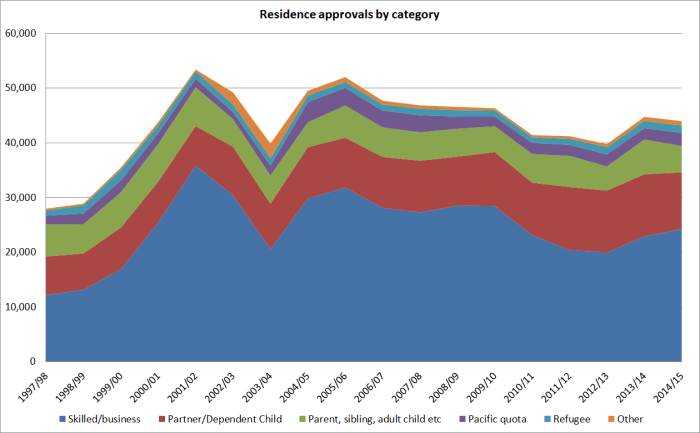
Here is a chart showing the breakdown of residence approvals, using MBIE data.

res approvals by category.png

It would be very easy to simply squeeze out skilled migrants (and their spouses and children).  Personally, I think that if we are serious about immigration serving an economic role we would need to think hard about some of the other categories.  For example, in the most recent year, around 10 per cent of residence approvals went to parents (presumably generally quite elderly) of people now living here, with a few hundred additional approvals for adult children and siblings.  There is little or no prospect of economic gain to New Zealand from this migration –  and no obvious humanitarian case either –  and a pretty good chance that (unlike most skilled migration) the net fiscal cost of these migrants will be quite substantial.

We also approved residence for 1500 people under two Pacific Island access categories.  These are presumably people who would not have qualified as skilled migrants.  Perhaps one can accommodate those sorts of numbers within a 45000 to 50000 annual target, for historical or foreign policy reasons.  Much harder questions would have to be asked if we brought our overall immigration numbers more into line with international practice.

I don’t have a particular view on appropriate refugee numbers.  If anything, at present, there is a push to increase that quota at present.  That is a legitimate choice for a country to make, but most probably to do so would further reduce the chances of the immigration programme making a meaningful economic contribution to New Zealanders.  Then again,  I read the evidence as suggesting that immigration mostly benefits the migrant, and that countries are fooling themselves if they treat large scale immigration as (as MBIE does) some sort of “economic lever” to lift medium term domestic economic performance.

There is a lot of talk about how disruptive a cut in the immigration (residence approvals) target could be. No doubt that is true for firms and sectors that are focused on meeting the needs of a rapidly rising population – be it builders or whatever (furniture and carpet shops). But a lot of that argument is built on the fallacy the immigration eases overall labour shortages. If anything, it exacerbates them: the short-term demand effects of immigration outweigh the supply effects.

Let’s say, as a deliberately extreme example, that my preferred policy – cutting the residence approvals target to 10000 to 15000 per annum was adopted tomorrow. What might we see over the following few years?

I noted yesterday that we would see house and urban land prices a lot lower, especially in places that have experienced considerable population pressure in recent years.

We’d also see a lot less building activity – across all types of construction. We’ve seen this before – when net migration was very low in the late 1970s and early 1980s the construction share of GDP was much lower than it had been before or since. Quite possibly, the PTE component of the export education industry would take a hit.

But all of these pressures would be recognised in the Reserve Bank’s economic forecasts, and monetary policy would adjust to take account of the weaker demand pressures. In fact, markets would be likely to adjust even before the Bank, so long as the policy change was well-signalled and treated as credible. Real interest rates would fall, and so would the real exchange rate. Our exchange rate stays high only because New Zealand pretty consistently offers a yield premium over those on offer in other currencies. We’d see a classic case of resource-switching. The cost of capital to firms developing businesses here would be lower, and the lower real exchange rate would be particularly attractive to firms looking at opening, or expanding, in the tradables sector. Recall, that per capita sector production has not increased for 15 years. This policy change would help reverse that shocking record. It seems likely that regions outside Auckland – in many cases, much more export focused, would get a particularly substantial boost.

What about the labour market? As I’ve already noted, high levels of immigration don’t ease overall labour market pressures, they exacerbate them in the short term. So, all else equal, a lower rate of residence approvals (not simply offset with more work visas approvals) would ease labour market pressures to some extent (offset, of course, by the easier monetary policy). Perhaps some sectors might still find it difficult to get the right people. That is what the price mechanism is supposed to deal with: higher wage rates for particular skills or sectors will, over time, draw people into those occupations. There is a price at which New Zealanders will be aged care workers or dairy hands. For firms in the non-tradables sectors, that higher price might be difficult to absorb. In a sense that is part of the point: reorienting the economy towards the tradables sectors puts pressure back on the non-tradables sectors. For firms in the tradables sectors, the lower exchange rate provides a margin that can accommodate any wage pressures that might develop in individual sectors. But I’d be surprised if those pressures were large or systematic: after all, many of the people who have been employed in sectors responding to the rapidly rising population have to find some other place to work.

Over five years, I’d expect we’d start to see material gains for New Zealanders as a whole. More affordable house prices, a larger share of the economy selling to the rest of the world, reduced pressure on unskilled New Zealanders, and so on. Successful economies typically succeed by finding ways of selling more and better stuff to the rest of the world. We’ve failed on that count (in per capita terms) for decades, but we can turn it around. I’d expect that five years after such a policy was adopted we’d have started to see our productivity performance markedly improving relative to those in other advanced countries. If global productivity performance was still weak, ours might still not be all that we’d like, but we’d almost certainly be doing less badly than our peers. The gaps between productivity levels in New Zealand and those abroad are so large that it will take decades to reverse them. But as we do, we might even find ourselves in the position the Irish finally found themselves in last decade – the huge diaspora finally started to come home.


Immigration: some follow-up points

Yesterday’s Q&A discussions on immigration seem to have attracted quite a bit of coverage.

Of course, most of that focused on the comments made by Winston Peters, and I don’t have anything much to say about those except to note two things.

First, I was interested to hear him talk of targeting 7000 to 15000 annual migrants, which was quite similar to my suggested target for residence approvals of perhaps 10000 to 15000 per annum.  The United States issues around 1 million green cards a year, and as the US had about 70 times our population that is about the same rate of per capita immigration as would be implied by my 10000 to 15000 annual range.  It isn’t a level that amounts to shutting the door.

Second, Peters has twice before been a senior minister and has never made the rate of permanent immigration a central issue in negotiations to form a government. Perhaps this time will be different.

Of my comments, most of the coverage has been around the suggestion that if the residence approvals target was cut as I suggested, house prices might be 25 per cent lower in a couple of years.  It wasn’t intended as a precise estimate, more an indication that population growth (and especially unexpected changes) make a material difference to house prices in markets where the supply response to impaired by the thicket of land use and building regulations.  However, it is quite a plausible estimate, consistent with some past empirical research on the link between population change and New Zealand house prices.

A decade ago, Coleman and Landon-Lane, in work done at the Reserve Bank, estimated that a 1 per cent shock to the population would shift house prices by 10 per cent, and more recently Chris McDonald’s Reserve Bank work produced not-dissimilar   estimates (especially for non New Zealand migrants).   Adopting my proposal to cut the residence target by 35000 per annum would, all else equal, lower the population by 1.5 per cent in the first two years.  But, more importantly, it would materially lower the expected future population, and asset markets (such as the urban land market) work on the basis of expectations.  Over a decade, again all else equal, the population would be around 7.5 per cent lower on my proposed policy than on current policy.  All else equal, urban land prices would be much lower.  Of course, all else is never equal, and with less population pressure some of the pressure to liberalise housing supply would dissipate.  But the direction of the effect on house prices is pretty clear, and the magnitude would almost certainly be quite large.

Perhaps one thing that disappointed me a little about yesterday’s programme was that discussion tended to focus on the immediate cyclical pressures, and especially those on Auckland house prices.  I guess those issues are most immediately salient, especially in Auckland, and perhaps most easily accessible to a lay audience.  My own arguments have tried to focus (a) not on the cycles in net migration, much of which are about New Zealanders coming and going, but on the trend target level of residence approvals, and (b) on the impact of New Zealand’s disappointing overall economic performance (ie the continued trend decline, over many decades, in our relative productivity).  We could fix up the land supply market –  and should –  and many of those questions and issues would, almost certainly, remain outstanding.  That said, when the advocates of the current policy can show so little evidence suggesting real economic gains to New Zealanders (as a whole) from our really large scale immigration policy (repeat, policy – the target level of residence approvals) then the appalling house price situation cries out for winding back the level of migration approvals, as one way of mitigating the adverse effects of the land use restrictions.    One could envisage an alternative world in which the real economic benefits of large scale immigration were large, clear, and demonstrable, and yet the housing market was still severely dysfunctional.  In that world, there would be some nasty potential tradeoffs if reform of land supply couldn’t be achieved.  But we aren’t in that world.  Here, it looks as though winding back migration approvals might well improve productivity prospects and improve housing affordability.   There would, and will, always be cycles in net measured migration, but the policy component is relatively easy to adjust, and to maintain at a different target level (lower or higher) than we’ve had for the past 15 years.

I was pleasantly surprised at the moderate and reasoned approach the Q&A panel took to the immigration segment.  They recognized that there are some real issues that need rational and thoughtful debate.  Nonetheless, they all still seemed in the thrall of the idea that “skill shortages mean we need migration, just perhaps a “better quality” of migrant”.   There are really just two points that need to be made in response.  The first is that empirical research suggests –  and historical casual empiricism does too –  that an influx of migrants adds more to demand rather than to supply in the short-term.  People who live in a modern economy need lots of real physical capital, and it doesn’t build itself.  So although an individual migrant might ease an individual employer’s problem, in aggregate high immigration simply further exacerbates any existing excess demand for labour (skilled or not).  Economists have recognized that for decades.  It doesn’t, of itself, make immigration a bad thing –  long term gains might still make it worthwhile –  but immigration isn’t a way of dealing with systematic skill shortages.    By contrast, a flexible domestic labour market is quite a good way: changing wage rates should signal difficulties in attracting people to particular roles/regions.  It doesn’t work overnight, and it doesn’t work in aggregate if the economy is overheating, but it works when given the chance.

The panellists also seemed taken with the idea that more should be done to get more of the migrants who do come to go to regions other than Auckland.  That seems, at least in part, to reflect a sense that something is wrong about things in Auckland (whether short term or long term) and perhaps a sense that a more successful New Zealand is likely to be one less strongly skewed away from the regions. But it risks leading to even more wrongheaded policies.  We’ve already seen that last year, when the government amended the rules to give additional bonus points to people with job offers in the regions.  Unfortunately that has the effect of lowering the average quality of the migrants who get in.  The residence approvals target is largely fixed, and the changes in the scheme rewards those who can get to particular locations, not either (a) the most highly-skilled migrants, or (b) the most rewarding and productive New Zealand jobs.  Auckland’s economic performance has been quite disappointing, suggesting it isn’t a natural place to funnel ever more people into.  But that doesn’t suggest that the solution is to funnel more people to other places instead.  It suggests focusing on the whole economy –  in particular, getting the real exchange rate sustainably down –  and letting a rather smaller number of total permanent migrants locate where the jobs and rewards are best.  In that sort of world, Auckland’s population might be materially smaller than it would be on current policy, but the population of the regions might not be much larger.  But the share of the regions in overall economic activity would be larger than it is now.  Better to cut the overall residence approvals target, and focus in on a modest number of really highly-skilled people.  The regions aren’t short of people, but Auckland seems to be awash in them (relative to the high-returning opportunities that seem to exist in Auckland).

As a final observation on the Q&A discussion, I was interested in Andrew Little’s response to questions about immigration.  He continues to toy with the idea of some sort of short-term cap on migration. I don’t think that is particularly sensible or meaningful.  No one can accurately forecast short-term fluctuations in net migration (ie the combination of New Zealanders and foreigners) and if those fluctuations can’t be forecast, one can’t run meaningful short-term caps. In the nature of things, and well-intentioned as they might be, they would simply risk exacerbating the short-term cycles in net migration: pull back approvals when net migration was at a cyclical peak, and by the time those changes took effect, often enough the natural cycle would have turned down anyway.  And vice versa when net migration is at a trough.  We are much better to run a stable and predictable programme of residence approvals, and live with the natural variation that results mostly from New Zealanders coming and going.    In my view, the target level of approvals should be lowered quite substantially, but wherever it is set it shouldn’t be messed around with –  up or down –  in response to short-term cyclical pressures.

But my concern about Little’s comments was more about the underlying message.  Twice in the space of thirty seconds, he repeated the line that “New Zealand has always been a country dependent on bringing in skills from abroad”, stressing that he would never want to change that.  It is simply a mistaken model of growth.  The prosperity of any country depends primarily on some combination of the natural resources it has and, most importantly, on the skills and talents of its own people, and the institutions (political and economic) that those people nurture.    That was true of the United Kingdom or Holland centuries ago, it was true of the United States century or more ago, it was true of twentieth century New Zealand, and it is true of every advanced successful country today.  Of course, every country draws on ideas and technologies developed in other countries. In some cases,. immigration may even have helped the recipient country a bit –  but any such gains look to be quite small – but prosperity depends mostly on a country’s own people and own institutions.  The line Little is running is certainly consistent with the implicit stance of the New Zealand elite, across the main parties, but there is little or no empirical foundation for it.  Indeed, it risks sounding like a cargo-cult mentality –  waiting for just the right people from over the water to come and bring us prosperity.  Things simply don’t work like that.  It is a shame that our political leaders aren’t willing to put more faith in the skills, talents, and energies of our own people and firms, rather than (so it seems) wanting to “trade us in” for some better group of people.  Countries don’t get successful by bringing in better people: rather, successful countries can afford to bring in more people, if they choose.

In this morning’s Herald, the other key prominent academic in the liberally-funded (by MBIE) CaDDANZ project, Professor Paul Spoonley of Massey, has an op-ed championing the current immigration policy.  It probably warrants a post of its own, but his bottom line seemed to be “keep the faith”.

Spoonley starts with this:

The International Labour Organisation estimates a 1 per cent increase in population expands GDP by between 1.25 and 1.50 per cent.

I’m not sure the source of this estimate, but it is a huge effect.  Stop and think about what it means for New Zealand, if it were true over the medium-term.  We’ve had one of the fastest population growth rates in the OECD in recent decades, and yet one of the worst productivity growth performances.  So perhaps the really rapid migration-fuelled population growth has been really really good for us, and everyone else has gone really really badly, to explain our overall disappointing performance. But where is evidence –  the telling statistics that suggest that that is really what has gone on? Professor Spoonley knows about the disappointing New Zealand economic performance, so it is a shame that he didn’t try to relate his general claim to the specific experience of New Zealand.

Spoonley then argues

Auckland gains from the effects of agglomeration. Population growth and immigration is associated with economic growth and diversity. For example, Auckland and Canterbury between them accounted for almost all the new jobs growth in New Zealand last year.

Immigration is key to this as skilled immigrants add to the human talent pool that is available to employers. They also establish new businesses and contribute to demand, including for education. Regions and cities that are not attracting immigrants are losing out on this current windfall.

It is fine theory. It just bears no relationship to  the experience of New Zealand, and Auckland in particular, in recent decades.

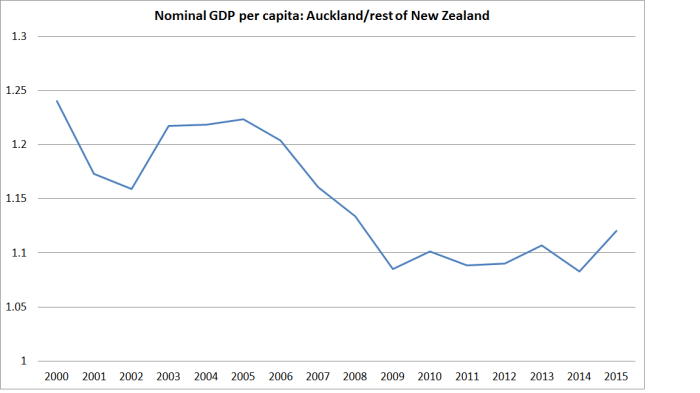
I’ve shown this chart before

ngdp akld ronz

No one disputes – Spoonley doesn’t –  that Auckland’s population growth is largely migrant-driven.  And yet Auckland’s per capita GDP has been trending down relative to the rest of the country’s over 15 years.  And the margin of Auckland’s GDP over that of the rest of New Zealand was already low relative to what we see in most other advanced economies.

Perhaps Professor Spoonley and the other New Zealand pro-immigration advocates (many of them taxpayer funded) are right about the benefits to New Zealanders of this really large scale intervention.  But even if so, surely we deserve much more evidence of those benefits than we get when leading academics simply assert over again that, whatever the short-term stresses, the Think Big programme is really working out just fine?

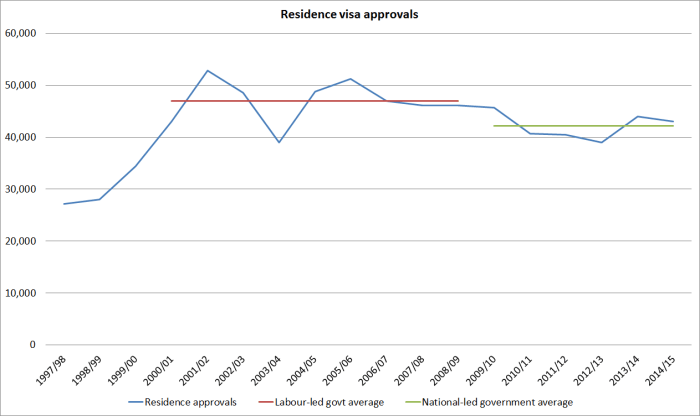
And to end a long post, just a simple chart.  It shows residence approvals for each year since 1997/98.

residence approvals

The data are only available annually, but they are hard data on the number of people MBIE has given residence visas to.  This isn’t SNZ arrivals and departures data, it is the policy core of the immigration programme –  aiming at 45000 to 50000 approvals per annum.  One of my commenters keeps trying to distract from this issue by citing PLT data. Those data are often interesting and useful (and in other ways quite limited) for various other analytical purposes, but if we want to think about the implications of the annual flow of residence approvals this is where the focus should be.  Annual approvals under this programme are not very cyclical, and haven’t varied much across the last two governments.  They are simply very high by international standard (per capita) –  three times the US level.  And on the (lack of) evidence to date of economic benefit to New Zealanders, the annual target should be wound back quite considerably.


Immigration, diversity etc: benefits?

On Wednesday the Treasury, in conjuction with GEN (the Government Economics Network) hosted Professor Jacques Poot, from Waikato University, for a guest lecture under the title “Economics of Cultural Diversity: Recent Findings”.

Poot has been researching, and writing about, the economics of immigration and demographic change for decades.  He was one of the co-authors of the influential 1988 Victoria University modelling exercise, which played a part in shifting the consensus of New Zealand economists away from a fairly longstanding and widely-shared scepticism as to whether large scale immigration to New Zealand was generating sustained economic benefits for New Zealanders. (I summarized some of that past scepticism here.)

These days Poot is Professor of Population Economics at Waikato. In that capacity, he leads a joint Waikato-Massey project, which is receiving large amounts of public funding through MBIE –  the key public sector champion of current immigration policy.  The title of the project reveals the presuppositions of the researchers: CaDDANZ, or Capturing the Diversity Dividend of Aotearoa New Zealand.   The focus isn’t on identifying whether there is a dividend, or whether instead it might possibly be a tax, but simply on how “to maximise benefits associated with an increasingly diverse population”.  Poot is a careful, thoughtful, and respected scholar, but his presuppositions are pretty clear.

I went along to hear him for all those reasons.  I’m skeptical that there are such dividends, especially in the New Zealand context, but there is no point beating a straw man argument.  I was interested to hear the case as articulated by one of the leading New Zealand academics in the area, who has published extensively abroad as well.  I wrote here recently about a recent paper by AUT professor Bart Frijns (and co-authors) which found that  cultural diversity –  measured by the nationality of company directors – seemed to have adversely affected (or at best had no effect) the overall financial performance of listed UK companies.

It is worth bearing in mind that thinking about cultural diversity is not the same as thinking about immigration per se.  In my own analysis, I’ve written skeptically about the impact of the large scale immigration programmes New Zealand has run since, at least, World War Two.  In the early period, we had large scale immigration but not much change in measures of cultural or ethnic diversity –  most of the migrants were from the United Kingdom, with a leavening of Dutch immigrants (Poot himself is an immigrant from the Netherlands).   Poot’s lecture was on cultural or ethnic diversity.  On aggregate measures he presented, that started to increase in New Zealand from the 1960s (with Pacific Island immigration) and has increased fairly steadily in more recent decades.  The UK remains the largest single source country for immigrants to New Zealand, but the overall contribution of decades of immigration programmes is that New Zealand is one of the more culturally and ethnically diverse countries in the world.  He quoted an aggregate index and summarized the current score as meaning that there is now more than a 50 per cent chance that if you encounter another person in the street that person will be of a different ethnicity to you.

As he noted, measurement isn’t necessarily easy.  What do we mean by “cultural” diversity, and how should it be best proxied?   After all, New Zealand had a considerable degree of ethnic diversity even decades ago (Maori and European New Zealanders) and to some extent there are real cultural differences between those groups (although differences within those ethnic groups may be at least as large on some other dimensions of culture –  eg religion.  Similarly, there is now a very large New Zealand born Pacific population.  Poot showed some nice charts for Auckland localities, and for New Zealand regions, on how much difference it makes whether one looks at diversity measured by birthplace or by ethnicity.  Areas around East Cape, or South Auckland, come up as highly diverse ethnically but are more homogeneous as regards birthplace.  The North Shore by contrast shows a lot of birthplace diversity but much less ethnic diversity.

But, in fact, most of Poot’s presentation was an attempt to summarise the international literature, with no attempt to apply it specifically to New Zealand.   After outlining various possible positive and negative effects that have been hypothesised, he attempted to summarise the literature on the impact of cultural diversity on various aspects of economic performance.

In the end, he couldn’t claim much for the effects of increased cultural diversity.  As he noted, studies in the area are plagued with reverse causality problems.  It is easy enough to highlight correlations in which more innovative regions are more culturally diverse, but which way does the predominant causation run?  Innovative regions will be more likely to attract newcomers, from home and abroad.  Poot’s reading of the literature is that immigration and diversity “shocks” affect innovation and productivity, but rather weakly.  The quantitative gains are typically small, and difficult to identify, and are much outweighed by other factors (at a firm or national level).  He appeared to have added a slide to his presentation in response to the Bart Frijns et al paper, but wasn’t quite sure what to make of the results.  Poot regarded it as a very good paper, and offered no obvious criticisms of the approach or methodology, except the passing observation that perhaps the UK was different.

There were some interesting questions, to which Poot didn’t really have particularly developed answers.  One economist asked about the relative economic importance of gender diversity and cultural diversity, while another –  something of a bastion of liberal thought –  asked whether we needed to think less about cultural diversity per se than about the differences in the productivity performances of different cultures, citing (eg) Weber.

How should we apply this to New Zealand?  Poot didn’t attempt to in this presentation, but as noted we have considerable ethnic, cultural, and birthplace diversity, and that diversity has increased materially in the last few decades.  And yet our overall economic performance, including on measures such as productivity, innovation, and foreign trade, have been among the worst in the OECD.   One never knows the counterfactual, but New Zealand doesn’t look like a great place to start from if one is keen to illustrate the economic benefits of cultural diversity.  There is a literature suggesting that increased ethnic diversity boosts foreign trade –  although Poot was keen not to oversell this – but then New Zealand is one of the handful of countries to have had no increase in its foreign trade share of GDP in the last 30 years or more.  Perhaps a heavily natural resource based economy is a little different?

Ian Harrison has noted some problems with some of the literature in this area in this note.

By coincidence, I got home from the Poot lecture to find a request from TVNZ to be interviewed on immigration issues for their Q&A show tomorrow.  Apparently, they have also interviewed Professor Poot for the programme.  In my recorded comments, I noted the difficulty of having a good debate about these issues in New Zealand, and noted that when I first began developing my thoughts about how our immigration policy might have affected New Zealand’s specific economic performance, there had been a lot of embarrassed silence among my then colleagues at The Treasury,  with suggestions that I risked sounding like Winston Peters, and –  in the case of one particular manager –  outrage that the issue should even be discussed at Treasury.  But Treasury’s guest lecture series remains a valuable contribution to discussion of policy issues, and I appreciated the opportunity to hear Professor Poot speak.

How has our population grown?

New Zealand’s population is estimated to have risen by 11.8 per cent in the last decade (much of it in the last three years). The starting point for that estimate is reasonably well-anchored: I used the population numbers for the March quarter of 2006, and the 2006 Census happened in that month. The end-point (March 2016) is only an SNZ estimate, which will be recalibrated after the next census.  But for now it is what we have.

Here is the high-level breakdown of where the population growth came from.

population decomposition

Net migration accounts for about 35 per cent of the total increase.

But even at very high level, this chart somewhat misrepresents the picture.  Many migrants are of child-bearing age, and some of the natural increase will itself have resulted from the net migration flows of New Zealanders and foreigners (both those during this period, and those from earlier periods).

I’ve found it useful to think about the contribution of immigration policy to New Zealand’s population.  At the extreme, almost the entire non-Maori population of New Zealand ultimately exists as a result of  post-1840 immigration policy.

But even over more recent periods, one can distinguish –  at least conceptually – between the choices of New Zealand citizens to come and go (mostly go), and those of foreign citizens.  The choices of New Zealanders aren’t a matter of immigration policy at all.  We shouldn’t, and don’t, try to impede those flows.    By contrast, any foreign citizen living here requires the explicit permission of the New Zealand government.  Some will be permanent residents, others will have work visas, and some will be students.

Statistics New Zealand has data on permanent and long-term migration flows by citizenship.  But, as I’ve noted before, it is only indicative.  People change their minds and their plans.  New Zealanders planning to leave for a few months end up staying away for decades, and vice versa.  And the same happens for foreigners coming here –  some came intending to stay forever, but it just doesn’t work out and they leave.  Others come thinking it might just be something short-term, and they end up getting permission to stay longer.

Over the last decade, these statistics show a net 233000 New Zealand citizens leaving, and a net 440000 foreign citizens arriving.   That inflow of foreign citizens is equal to 89 per cent of the increase in the total population over that decade.

Actually, the contribution of non-citizen migration (the policy-controlled bit) might not be quite that large.  The net migration inflow in the chart above is 177000 people over the decade, and the gap between the citizen and non-citizen net PLT data over the same period is 207000 people.  We know the natural increase, and we have a reasonable fix on the population.  So maybe somewhat fewer New Zealanders actually stayed away than said they were intending too, and perhaps some of the non-citizens who intended to stay went home.    My hunch –  no more –  is that over this period more of the mismeasurement is around the NZ citizen flow (the Australian labour market has been tougher than most expected).   But if the mismeasurement is split evenly between the NZ citizen and foreign citizen data, the direct contribution of immigration policy to population growth over this period would still be around 85 per cent.  And the contribution to the birth rate of those non-citizen migrants is on top of that.

Then again, according to the arrival and departure cards, a net 228000 more people arrived in New Zealand in total than left between March 2006 and March 2016.  That is rather more than the 177000 net migrants implicit in the SNZ population estimates.  So perhaps we’ll find that the population has been growing even faster than SNZ thinks.  If so, the contribution of immigration policy might drop back to around 80 per cent over the decade.

There is plenty of imprecision in all of this. But what is fairly clear is that (a) New Zealand’s population has been growing much faster than the population of most OECD countries, and (b) that the overwhelming bulk of that growth is resulting from immigration policy choices (the scale of the influx of non-citizens).  Reasonable people can differ on the economic implications of those high rates of non-citizen immigration, but that the population would not have been growing rapidly at all without our unusually large non-citizen immigration programme shouldn’t really be in question.

Internationally, there is a variety of experiences of course.  Among advanced countries, one has relatively successful countries with sharply falling populations (Latvia and Lithuania are down more than 20 per cent in the last 25 years) and sharply rising populations (Singapore’s population is up over 80 per cent in that period), and both good and mediocre performers with quite rapid population growth (New Zealand and Australian population growth rates have been similar over 25 years, and Israel has also had about 80 per cent population growth and a productivity performance about as disappointing as New Zealand’s.  Population changes, even those directly associated with immigration, can be a response to domestic opportunities or available foreign ones. In some circumstances they might help strengthen per capita growth, and in other cases they might impede.  One needs to take a country by country approach.

Taking a longer view, this chart is one I’ve used before.  It compares New Zealand’s population growth rate with those of advanced countries and the world as a whole (using UN data).

world population growth

Typically, our population growth rate has far-outstripped those of the advanced countries as a whole.  The exception was the period I referred to in my post on Saturday, between the mid 1970s and the late 1980s, when the large net outflow of New Zealanders was already well-established, but immigration policy was not aggressively pursuing a large inflow of foreign citizens, unlike the situation in the decades before and since.

The Herald’s wrongheaded call for an ever-bigger population

The Herald’s editorial today is headed “Population growth is powering NZ economy”.   It isn’t just a statement of the rather obvious, that a rapid growth in the population –  particularly unexpectedly rapid growth – boosts total GDP.    When there are more people, they all need to consume stuff, and they need houses, schools, shops, roads, offices etc.  And unexpected surges in the population boost demand more, in the short-term, than they do supply.    But they don’t do anything much to boost sustainable per capita real GDP.

That isn’t, of course, the Herald line.  Rather, channelling the Prime Minister, they assert that

The population increase is helping to generate the growth in the economy that puts New Zealand ahead of most other and larger economies at present, which in turn makes it a magnet for yet more migrants, as well as persuading more young New Zealanders to stay here.

There is so much wrong with this sentence, it is difficult to know where to start.  First, and repeating it slowly yet again, it is per capita economic growth that matters.  New Zealand has been doing quite badly on that score over the last year or so, even by comparison with other countries.  And as I illustrated yesterday, even on the Treasury’s own, optimistic-looking, numbers, we are expected to be only an average performer over the next four year.  Average isn’t necessarily bad, except that we are starting out so much poorer than most advanced countries, and not closing the gap.

And it isn’t as if jobs are abundant here either,  Our unemployment rate, at 5.7 per cent, is well above most estimates of the “natural” rate of unemployment, and not much below the median unemployment rate for OECD countries.    The number of residence approvals here is subject to a target, so even if there is increased demand from foreign citizens to move here, it only increases slightly the quality of the people we can take, not the total number.  Much of the variation results from two things.  The first is the inflow of students, probably influenced more by the policy change allowing most to work here while they study, rather than by the intrinsic strength of the New Zealand economy.  And the second is the flow –  mostly of New Zealand citizens –  to and from Australia.  Australia’s unemployment rate is also now quite high, at 5.7 per cent, and New Zealanders moving there don’t have access to the welfare safety net and associated entitlements they do at home.

The editorial goes on

The Government would not want to say this out loud, but clearly it is not controlling immigration as tightly as previous governments have done. This attitude undoubtedly comes from the Prime Minister and it is consistent with his disinclination to restrict foreign investment or even monitor its impact on the house market. He deeply believes the country is better off being open and connected to the world’s flows of capital, trade and people. The performance of the economy on his watch suggests he is right. Even the housing affordability is a cost of prosperity. If we want drastic steps taken to stop rising prices we need to be careful what we wish for.

With the exception of allowing students to work, the initial claim here is simply incorrect.  The residence approvals target is the same as it was under the previous government, and even student arrivals have not reached the peaks seen under the previous government.  As for the rest, no doubt it accurately reports the Prime Minister’s views –  he has repeated them often enough –  but there is no evidence to support it.  Productivity growth –  the foundation of sustained long-term prosperity –  has remained disappointingly weak.  And the immigration inflows have been overwhelmingly concentrated in Auckland, and yet the official data show that Auckland incomes are (a) lower relative to those in the rest of the country than we see in most advanced countries (comparing dominant cities and the rest of the country) and (b) that that gap has been narrowing.  Whatever the reason, the strategy is failing.

From there the editorial launches off into its own alternative universe

New Zealand’s desirable population size has always been a contentious subject, though not previously an urgent question. The increase since the turn of the century followed 25 years of static population figures as more people left than arrived.

Immigration policy was a notoriously capricious. Each time the economy dipped, governments would close the door. Now that we appear to have a rapidly growing population again, we need to be discussing how high we want it to go, and how it might be channelled to regions that most need it, and the houses and services it is going to need.

This country would benefit from many more people, and better preparation for their arrival.

There was a period from the mid 1970s to the late 1980s when New Zealand’s population growth was quite subdued.  But for the last 25 years –  not just since the turn of the century –  we have had one of the faster population growth rates of the OECD.  One doesn’t have to take a view on causation to note that people haven’t exactly been flocking to an economic success story.  Incomes here are presumably better than they were in the migrants’ home countries, but our productivity growth rate over that 25 years has been among the very slowest in the OECD.  Starting low, we’ve just drifted somewhat further behind.

I’m also not sure where the author gets the idea that New Zealand “immigration policy was notoriously capricious”.  Yes, there are constant changes at the margin, but to a large extent we’ve been running much the same immigration policy for 25 years now, through several recessions, and some pretty sharp ups and downs in the labour market.  Much the same could be said of the post-war decades, until the Labour government in 1974 closed down automatic access for British and Irish citizens –  and that wasn’t because the economy was doing badly, but just because they thought immigration should be less focused on traditional sources countries.

Of course, I thoroughly agree that we should be having a national debate about immigration policy.  Policy has long been premised, explicitly or otherwise, on the belief that New Zealand would be better, and more productive, if only there were more people.     But there is just no evidence for that proposition, and certainly not enough on which to rest such a large scale economic and social intervention as our immigration policy.  Big countries don’t grow faster than small ones.  When we had 1 million people, there were calls for many more people.  And when we had 2 million people.  And when we had 3 million people. And so on.  And for decades our relative incomes and productivity performance have been deteriorating.  New Zealanders have been getting poorer relative to their advanced country peers.  I’m not sure where the advocates think the critical threshold is where things might turn around –  but clearly 4.5 million people hasn’t been enough either.

The editorial writer talks of channeling people to “the regions”, which is almost certainly even more wrongheaded than bringing in large numbers in the first place.  We’ve seen that in the policy changes the government made last year: giving more points to people with job offers from the regions simply has the effect of lowering the average quality of the migrants we do get, who (on average) have not been terribly highly-skilled in the first place.

Instead of constantly championing the case for ever more people –  even at the cost of encouraging New Zealanders to leave Auckland (a weird way to help people at the bottom) – it is about time there was a serious conversation that stopped pretending everything was fine, and confronted the facts of New Zealand’s economic underperformance, and Auckland’s economic underperformance.  Doing so would force people to think harder about whether there was much realistic prospect of New Zealanders benefiting from an ever-increasing migration-fuelled population.  I’m not suggesting a population policy –  fertility and emigration choices of New Zealanders are their own affair –  rather, the abandonment of the implicit “big New Zealand” population policy we have had through successive governments.   Pretty much everyone accepts (and it is an uncontested OECD empirical result) that our distance from markets (and competitors) is a material penalty, making it harder to generate really high per capita incomes in New Zealand.  There is still no sign that New Zealand is getting much traction in products and markets that don’t rely largely on our natural resources –  and utilizing those natural resources in ever smarter ways simply does not need lots more people. Why penalize everyone more by rapidly increasing the population of a country with such a disadvantageous location?

The Herald is right that without the unexpected surge in immigration total GDP today would be lower than it is.  But without the surge in immigration over the last few years then, all else equal, our interest rates would also be lower, and our exchange rate would be lower.  And New Zealanders as a whole would be better off, because more firms would be better positioned to sell products and services into world markets at competitive prices.  But, probably more importantly in the long-run, our largely fixed stock of natural resources, found on not-very-propitiously-located remote islands, would be spread over rather fewer people.  As a country we’d be better off, and lower Auckland house prices –  no doubt still distorted by unnecessary land use restrictions –  would be a beneficial mark of that success.  As it happens, the regions  –  where the natural resources mostly are (pasture, forests, mines, seas, landscapes) –  would loom larger relative to Auckland, curiously the goal that the Herald’s editorialist seems to espouse.


Location matters

That was, more or less, the theme of my talk to the Fabian Society in Wellington last night.

I outlined some of things that seem to matter in explaining which countries prosper and which ones don’t.  The people and the “institutions” they develop, or adopt, matter most of all.  But natural resources also do –  note, for example, the contrast between the GDP per capita in Sweden (high) and Norway (materially higher).  But location, or geography also seem to matter. Once, much of that was about access to navigable waterways, and perhaps some climatic issues.  These days it seems to be more about proximity.  Whether in the past or present, one just doesn’t find many really prosperous places, or many people living in those places, at the peripheries.  As I noted

the total population of Kerguelen, the Azores, Hawaii, Seychelles, Fiji, Iceland, Tasmania, Reunion, St Helena and the Falklands is just a bit less than New Zealand’s.

If anything, proximity and personal connections seem to have become more important, not less.  Quite why this should be so, despite the rise of communications technology, isn’t entirely clear to me (it must be something about the nature of the products/services), but that it is so seems evident in the continued economic outperformance of big cities, even in already-advanced countries.  That puts New Zealand at a big disadvantage –  we have able people, a moderate level of natural resources, but are a very long way from anywhere.  And the stock of natural resources is largely fixed, and doesn’t need lots more people to make the most of (indeed, often fewer people –  think of how many more cows an average farmer can run now, compared with the situation a century ago).   New Zealand just isn’t a very natural place for many global businesses to develop successfully, or to stay.

The Treasury was the first organization really to capture my attention on the significance of distance.  About 15 years ago they drew a useful comparison:  if one drew a circle with a radius of 1000 kms around Wellington one would capture (now) 4.5 million people and a lot of seagulls, but the same circles drawn around northern European or Asian capital would encompass hundreds of millions of people.  But it is puzzling that Treasury doesn’t seem to have taken that point and applied it in thinking about the appropriate immigration policy for New Zealand.  They tend to ignore the market signal (the hundreds of thousands of New Zealanders (net) who have left), and also ignore the logic that if distance is, in effect, a tax on economic prosperity here, it isn’t obvious why one would set out, as a matter of policy, to expose even more people to that tax.    Nothing of these ideas was in the recently-released Treasury material that I wrote about the other day.    Implicitly, Treasury and MBIE immigration policy advice- and the advice of bodies like the OECD (perhaps more pardonably, located in the heart of Paris) –  is being formed as if New Zealand were moored just off the coast of western Europe or North America, or perhaps even in the South China sea.  They need to take more seriously the fact that these islands are in the middle of nowhere.  High value economic activity takes places on such islands, but mostly only stuff that is location specific –  the iron ore is in the heart of Australia, the fish stocks are off the coast of New Zealand etc.  But it is really hard for modern, non-location specific businesses, to develop, and be the best they can be, in such a remote location.  It isn’t specific to New Zealand –  check out those other remote islands too.

But we make it all the harder for anyone with the drive and ideas to develop such firms.  Having persistently the highest real interest rates in the advanced world, and a real exchange rate that never sustainably adjusted down following our decades of relative decline, just further skews things against the prospects of the tradables sector.  Business investment has been consistently modest.  And the Think Big mentality, of bringing in enough –  modestly skilled –  migrants each year to have given us one of the faster population growth rates in the OECD, both reinforces those pressures on real interest and exchange rate –  resources have to be used to accommodate a growing population rather than enriching the existing population –  but also ensures that the fruits of the largely fixed stock of natural resources is spread over ever more people.  In effect, we trade away one of our few advantages.

I argued that we need our politicians and their advisers to both take more seriously the constraints of our location, and abandon the sense –  embedded in the New Zealand psyche almost ever since first European settlement –  that we need more, and more, people.  There is simply nothing wrong with a country of around 4 million people.   There are plenty of successful small countries.  For many of them perhaps it is more of a discretionary choice. At such distance from world markets, mostly trading on our ability to apply smart ideas to natural resources, it is much more of an imperative –  at least if we are serious about trying to give our people material living standards that match those of the better-performing OECD countries.

Anyway, here is the text I spoke from. It was delivered to the Fabian Society –  where we had a good discussion and lots of questions.  But for readers skeptical of the left-wing audience, it is almost identical to what I would say on these issues to an audience anywhere else on the political spectrum.

Fabian Society speech 20 May 2016

As ever, comments (and questions) are most welcome.


The Treasury on immigration policy

The other day Treasury released a 29 page set of slides put together in September 2014 for an internal “Immigration Policy Forum”.   The Forum discussion –  probably gathering all the key people in Treasury –  seems to have been designed to help Treasury come to a “clearer shared position on immigration policy”.  For a time, at least, there seemed to be two schools in Treasury –  a “microeconomic wing” championing the gains to New Zealand from immigration policy, and a “macroeconomic wing” –  perhaps somewhat influenced by some of my arguments –  uneasy about the possibility that the macroeconomic pressures (eg on real interest and exchange rates) resulting from high target rates of non-citizen immigration might be impeding New Zealand’s medium-term economic performance.

I’m not entirely sure why Treasury chose to release these slides now.  They aren’t a response to an OIA request, but may have been prompted by my recent OIA request (the results of which they released the same day) asking for copies of any material Treasury had prepared on immigration since 1 April 2015.   I haven’t read the OIA release results in any detail yet (there is 200 pages of material), but these slides look to provide more of an overview of Treasury’s perspective than any of the specific papers in that collection.  The slides themselves don’t tell us what view the Forum reached on immigration, but from the fact that Treasury has voluntarily released them and that there is no suggestion the meeting disagreed with the proposed stance, it seems safe to conclude that the slides represented a Treasury view, at least in late 2014.

Last year, I had asked for copies of papers Treasury had provided to the Minister on the economic impact of immigration.  I discussed here what they released then, noting that I had been surprised how little evidence or argumentation they had advanced suggesting that New Zealanders as a whole were getting economic benefits from one of the largest inward migration programmes run anywhere.

What about the 2014 slide pack?  Is there any sign of a more in-depth assessment of the issues and arguments as they apply specifically to New Zealand?  Unfortunately, not really.

There are some interesting and nicely-put-together charts.  There were even a few things I didn’t know (eg there is an interesting OECD chart showing that New Zealand has the highest share of the labour force made up of temporary migrants of any OECD country).

temp workers

Much of the discussion is, in principle, organized around this decision tree.

decision tree

Which is more or less fine, as far as it goes, although it continues to structure debate in terms of microeconomic benefits vs macroeconomic costs, simply taking for granting that in the specific case of New Zealand there are in fact microeconomic benefits to New Zealanders.

I’m not going to devote any more space to either Option 1a (substantially increasing immigration) or Option 1d (trying to adjust the inward flow of migrants cyclically, to ease cyclical pressures on the economy).    The first simply isn’t going to happen –  especially while the advocates of large scale immigration to New Zealand can show no clear evidence that New Zealanders have benefited from the large scale immigration we’ve already had over many decades.  And I agree with Treasury that adjusting the immigration programme cyclically isn’t particularly sensible or workable –  both because the economic cycle is difficult to forecast, and because many of the fluctuations in net migration (ie flows between NZ and Australia) aren’t directly amenable to New Zealand policy measures.  Monetary policy should remain the cyclical management tool of choice.

The real choices are between maintaining something like the current target level of non-citizen immigration (45000 to 50000 residence approvals a year) and reducing that target, perhaps to something more in line with the typical OECD country.   Within either of those options, there are choices about how we select migrants and what sort of people we aim to bring in.  At least in these slides, Treasury is more interested in these latter issues than in the former.

The challenge of identifying impacts of current level of migration is that it
is difficult to specify a counterfactual – what would have otherwise
happened without the observed level of immigration.
The evidence isn’t definitive enough to make a judgement about whether
net benefits would be higher from the current quantity of inward
migration or a lower level. But it does show that composition matters.
Of course it is difficult to specify a counterfactual –  it often is –  but that is no excuse for not trying.  It seems that, in substance, Treasury is reduced to saying “we really have no idea whether New Zealanders are benefiting from the large scale immigration”.  That is quite indictment after 25 years of (more or less) the current policy, and this from our premier economic advisory agency.
Treasury is uneasy about the skill mix of migrants however. The slides are quite explicit in some places
Our key judgment is that migrant labour is increasingly likely to be a substitute for local low -skill labour, and this is an impact that we should try and mitigate.
I’d see this as fairly consistent with the points I made in a series of posts last year (eg here) about just how relatively not-very-skilled our skills-based immigration had become (eg the disproportionate numbers of retail or restaurant managers).
But Treasury remains quite upbeat on the prospects for highly skilled migration
More high-skilled migrants can benefit high-productivity firms and industries, and we are less concerned about wage and employment effects for high-skilled local labour.
This is because we think:
– High–skill migrant labour is more likely to complement local labour and capital, rather than substitute for it
– High-skill labour will increase the skill composition of the local workforce, which is the theoretical channel through which many of the beneficial impacts of migration are achieved
– To the extent there are LM impacts on competing local labour, we think there are normative policy reasons to be less concerned at that end of the earnings spectrum
Research suggests that the high – skill migration may have a positive impact on
innovation and productivity via its effects on skill composition. High – skill labour is also likely a complement for both low -skill labour and capital.
We think this suggests that we should look to increase the supply of this sort of labour.

All of which might be fine if, for example, they could show that the New Zealand economy (and New Zealanders in particular) was actually benefiting from the high-skilled immigration we already have.   Or if they could show how New Zealand could attract genuinely highly-skilled people in large numbers, when large numbers of our own skilled people are typically treating New Zealand as a place to leave.  Or if they had engaged with the data suggesting that many skilled migrants take decades to match the earnings of comparably-skilled locals.

At one level, I don’t disagree with Treasury.  If we are going to run a large inward migration programme, it is far better to do as we advertise, and make it a genuinely highly-skilled focused programme.  The proportion of fairly modestly skilled people we have been allowing in in recent years seems most unlikely to benefit New Zealanders as a whole, and there are more plausible stories for widespread benefits from attracting highly-skilled migrants than low-skilled ones.

But one really needs a lot more material than is captured in these slides to reach a considered view on the appropriate level of non-citizen immigration for New Zealand.   Perhaps most importantly, one would need to engage seriously with 25 years of continued economic underperformance, even though we have been running one of the largest immigration programmes around.  But one would also need to show signs of thinking hard about the structural characteristics of the New Zealand economy, which continues to rely –  almost as heavily as ever  –  on its natural resource base, not self-evidently a resource that needs (or benefits from) lots more people.  One might need to show a serious willingness to grapple with such characteristics of the New Zealand economy as its persistently high real interest rates and the persistently high real exchange rate.  Or to grapple with the indications of the economic underperformance of Auckland.

And there is simply none of that in these slides.

(One might even want to grapple more seriously with the housing market tensions that high levels of immigration has created.  I’m quite with those who say that a first best response might be to sort out the housing supply and urban land market, but……there is very little sign of that happening, and no sign that it has successfully happened anywhere else.  This isn’t just some sort of sequencing problem –  urban land issues look fairly intractable, not for technical reasons, but for reasons having to do with the preferences of residents on the one hand, and planners, bureaucrats and central and local government politicians on the other.  In the meantime, while people blithely talk of “immigration isn’t the problem, housing supply is”, too many people seem to be living in overcrowded accommodation, garages and even –  no doubt rarely and temporarily –  in cars.)

I’ve argued previously that the Productivity Commission should be asked to conduct a serious review of the economics of New Zealand’s immigration policy, in the context of the specific structural features of the New Zealand economy.  The Commission seems, on its track record to date, to be prone to rehearsing  – in more sophisticated language and at considerable length –  current conventional wisdoms, but it remains the best-placed official agency to do some more serious work in this area and to contribute to a better-informed public debate.