Where were the central agencies?

Back in early October I wrote a post “Public policy just keeps on worsening”, on the then newly-announced Residential Development Underwrite scheme, under which the government will provide free downside price/liquidity insurance to big residential property developers, for a period that was said not to be forever but with no specific time limit, and instead with confident assurances from the minister (Bishop) that the government (Cabinet) would judge when to turn this subsidy off and on. It seemed like a classic example of bad policy, playing favourites at the big end of town, offering subsidies with no rigorous analysis of any sort of market failure, handing unconstrained discretion to ministers, and so on.

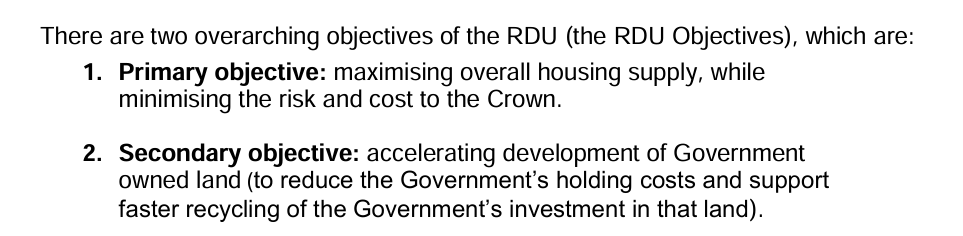
All this was stated to be being done with the primary objective of “maximising overall housing supply, while minimising the risk and cost to the Crown”. On which I noted in the earlier post

You minimise the cost and risk to the Crown by simply not offering free insurance, and if you must offer such insurance you should do so with a disciplined and transparent model (to, for example, estimate the economic price of the option). But there is nothing of that sort in any of the MHUD material, just a lot of mention of the (extensive) discretion afforded to officials, of whom we may be left wondering both what their expertise is and what their incentives are. Why would we back them to make better choices than financial market participants? And as for “maximising housing supply”, there seems to be no analytical framework there either, including around incentives on developers (who will, of course, prefer free insurance and can be expected to try to game the rules). Will there be any material impact on supply, will any impact be any more than timing, and how will MHUD rigorously evaluate claims put to them by developers? Oh, and isn’t developers finding themselves with overhangs of houses and land part of the way that much lower house prices actually come about?

I ended that post this way

It is a rather sad reflection of how the quality of New Zealand policymaking has fallen. Perhaps we should be grateful that exchange rate cycles aren’t what they were – and that past governments were less prone to scheme like this – or who knows what sort of free insurance the government would be dreaming up for exporters.

Who knows what the relevant government agencies thought of this scheme. I’ve lodged OIA requests and am particularly interested in any analysis and advice from The Treasury and the Ministry for Regulation.

You might have thought an arbitrary and apparently inefficient intervention like this would be grist to the mill for that new “central agency” the Ministry for Regulation, an opportunity to show any microeconomic chops they had. Instead, like true bureaucrats, they took a full 20 working days to reply to my OIA request to tell me that the new ministry had undertaken no analysis and offered no advice related to the Residential Development Underwrite scheme.

But I suppose I should be grateful they only took 20 working days (note that the law does not automatically give agencies 20 working days: the standard is “as soon as reasonably practicable). The Treasury, by contrast, took 40 days, insisting that they needed time for “consultations”.

Their full response is here:

Treasury OIA reply re Residential Development Underwrite scheme Dec 2024

There were only five papers.  Two were from after the scheme was announced (operationalising the required ministerial delegations).  The first two aide memoires were from January and February respectively in response it appears to advice from the Ministry of Housing and Urban Development, concerned about a possible “hard landing” in the housing construction market, and picking up on discussion of underwrite schemes that had been put in place as part of the ill-fated Kiwibuild scheme.

This is from the first of those aide memoires, dated 17 January

That is a pretty astonishing paragraph. Neither here, nor anywhere else in the papers, is there any attempt to justify a claim of “market failure”, and while we can all agree that government land-use restrictions have created and exacerbated many problems in the housing and urban land market they aren’t in any meaningful sense “government failures” either, but rather choices which governments could undo if they chose. And nothing in the first two sentences provides any serious or analytical support for the third sentence, apparently supporting fresh interventions. (There is of course little doubt that government interventions can affect the level of activity in particular markets, but the question is the robustness of the case for any such interventions.) That last sentence is also perhaps a bit puzzling: isn’t a subsidy to private developers going to add to private construction activity (not crowd it out?) and how are the efficiency and value-for- money tests even plausibly met when guarantees are handed out for free?

Carrying on through the papers we find this snippet

Really? Our Treasury thinks a mitigant is that bad underwrites can simply be stuck in the bottom drawer in the hope that one day something will turn up…. And here one thought a wider goal of a housing reform process was permanently lower real house prices.

And these from the 16 February aide memoire

But there is no robust analysis anywhere, including not scintilla of analysis leading us to believe that Treasury had thought hard and robustly about why judgements of officials and ministers were likely to be better than those of private financiers, including reflecting hard on the incentives facing the two groups. Perhaps this is more of an example of ‘government failure’.

But what is perhaps more surprising still is that those notes were written in January/February, and then there is nothing released (or withheld) until the next document, which is dated 3 October. The Residential Development Underwrite scheme was announced on 4 October.

There are several things interesting about this aide memoire

  • (rather trivially) Treasury has withheld, as out of scope, more than half of the title of the aide memoire, only to release the title in full in their letter to me
  • much more substantively, the paper is dated 3 October, and is described as being for a meeting with the Minister of Housing on 7 October.   The paper goes on to note that, as far as Treasury understood things on 3 October, “the RDU will be announced before the end of October”.  It was, of course, announced the following morning.
  • and perhaps most remarkably of all, the substance of the RDU section of the aide memoire is just slightly more than one page, and is really all process oriented, and answer one detail question from the Minister of Finance about scope for changing the parameters once the RDU was in place.

In other words, assuming (as we must) that the OIA has been answered honestly, there was no Treasury advice at all on the specific development of the RDU, or any of its parameters, and the scheme itself was rushed out far more quickly than The Treasury had understood just the day before the actual announcement.

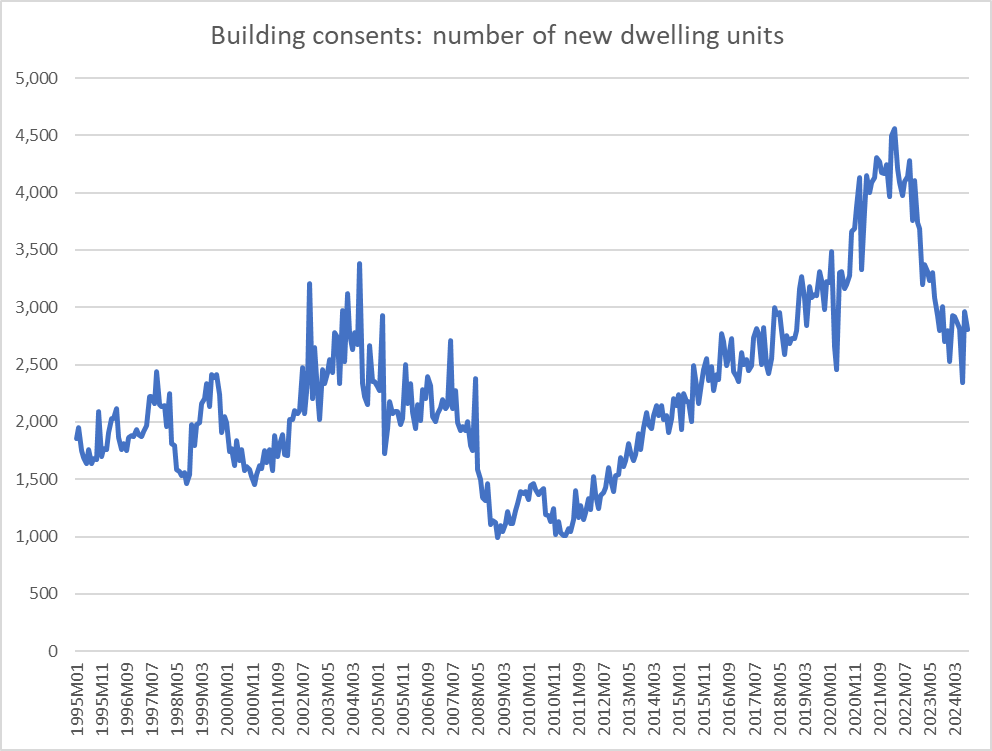
It is a poor and unnecessary policy, underpinned it appears by a poor policy process, a central planners’ mentality (government knows best how many houses should be built etc) and a cast of mind from The Treasury that seems astonishingly more sympathetic to big-end-of-town corporate welfare handouts and ministerial discretion than would have seemed even remotely plausible in the heyday of The Treasury.  And perhaps, as is the nature of so many of these sorts of interventions, many economists are suggesting that the residential building approvals cycle was already bottoming out even before ministers and bureaucrats rushed out their shiny new subsidy toy.
Public policy just keeps on worsening

On Friday morning I picked up my copy of The Post to find on the front page a story clearly handed to Stuff’s political editor Luke Malpass, about a shiny new intervention that ministers were to announce later that morning to help out residential property developers. It was, we were told, going to offer free downside price/liquidity insurance to large and established property developers. It would be sold as strictly “time-limited” except that there would, in fact, be no time limit specified.

My reaction on Twittter was “What…….” and it brought to mind that old jeer about business-friendly (as opposed to pro-market) governments and an enthusiasm among some of their supporters to “capitalise the gains and socialise the losses”. Little did we imagine that this would in fact become declared and intended policy of this National/ACT/NZ First government (not in the midst of a crisis, where sometimes these things happen, but as a whole new policy tool). I’m not generally an ACT fan, but……you have to wonder what the point of an allegedly pro-market anti-intervention libertarian party is if they wave things like this scheme through Cabinet (and not even their backbenchers have issued statements of disapproval, they being rather freer than ministers).

Malpass’s report was quickly proved accurate, with the announcement later that morning by Chris Bishop and Chris Penk (ministers of housing and of building and construction respectively) of the Residential Development Underwrite scheme.

The fact that it appeared to replace but considerably extend schemes in place under Labour was not a point in its favour

Funding for the RDU will be redirected from unused funding from the Kiwibuild and BuildReady Development Pathway programmes. Both of these programmes are now closed to new applications.

This government (rightly) having made much of inheriting a large structural fiscal deficit, and wanting to get government out of business, instead jump in boots and all. And all apparently on the basis that a couple of Cabinet ministers and their MHUD officials know better than the market what should be built when, where, and by whom, and thus who will win the benevolence of the free government underwrite.

There was more information on the MHUD website, but it was no more reassuring. There was no sign of any analytical framework behind any of it (no analysis at all, let alone anything serious or rigorous. of market failures or any sort of cost-benefit analysis or risk assessment). In fact, there was a distinct sense of something that had been rushed out. Some property developers had presumably been bending the ears of ministers. As the Herald put it “the government is riding to the rescue of stressed property developers”, in a distinctly picking-winners approach to the recession. Plenty of people and firms will have undergone huge stress in the last couple of years, as inflation was squeezed back out of the system. It was and is a necessary adjustment. But most apparently didn’t enjoy the favour of ministers.

And will no doubt do so again. In one article on Friday, Bishop was quoted thus

Bishop said the scheme wouldn’t be in place forever and Cabinet would make decisions about when to “turn it on and off” depending on demand and construction activity.

So that would no predictable and rigorous framework, but rather a great deal of trust in ministers’ ability to forecast construction cycles and housing demand, or to respond to pressures of the electoral cycle or developers bending their ears. Good regulation – like a good tax system – is stable and predictable, not turned on or off at the whim of ministers. This is poor policy, done poorly. And isn’t it simply dishonest for a government department to repeat ministerial spin about the intervention being “time-limited” (and MHUD does exactly that upfront) when there is no time limit at all? After all, in the grand scheme of things every policy intervention will eventually be altered/amended.

In essence what the scheme involves:

  • the government will guarantee to purchase at an agreed (in advance) price houses that don’t sell at an (approved) market price within an approved period of time,
  • only large-scale developers will be eligible for this assistance, preferably those building in Auckland, Wellington, Christchurch, Hamilton, and Tauranga [a little surprised Queenstown wasn’t on the favoured list),
  • no fee will be charged for this put option that is being granted to the developers

The rationale appears to be that banks and other potential lenders aren’t sufficiently willing to take risks on this projects, even at high fees/interest margins, but……government knows better/best. Quite why we are supposed to believe this self-delusion (ministers and officials falling for it is perhaps more understandable – if no more excusable – given the nature of their incentives) is never made clear. Minister are, it appears, blessed with some special insight into the state of the economy and the timing/speed of the recovery, and instead of just (say) publishing that analysis, they prefer to give handouts (and that is what free price/liquidity insurance is) to developers.

In the MHUD document there is this statement upfront

The secondary objective never seems to get another mention, but the ‘primary objective” is almost worse, for being functionally meaningless. You minimise the cost and risk to the Crown by simply not offering free insurance, and if you must offer such insurance you should do so with a disciplined and transparent model (to, for example, estimate the economic price of the option). But there is nothing of that sort in any of the MHUD material, just a lot of mention of the (extensive) discretion afforded to officials, of whom we may be left wondering both what their expertise is and what their incentives are. Why would we back them to make better choices than financial market participants? And as for “maximising housing supply”, there seems to be no analytical framework there either, including around incentives on developers (who will, of course, prefer free insurance and can be expected to try to game the rules). Will there be any material impact on supply, will any impact be any more than timing, and how will MHUD rigorously evaluate claims put to them by developers? Oh, and isn’t developers finding themselves with overhangs of houses and land part of the way that much lower house prices actually come about?

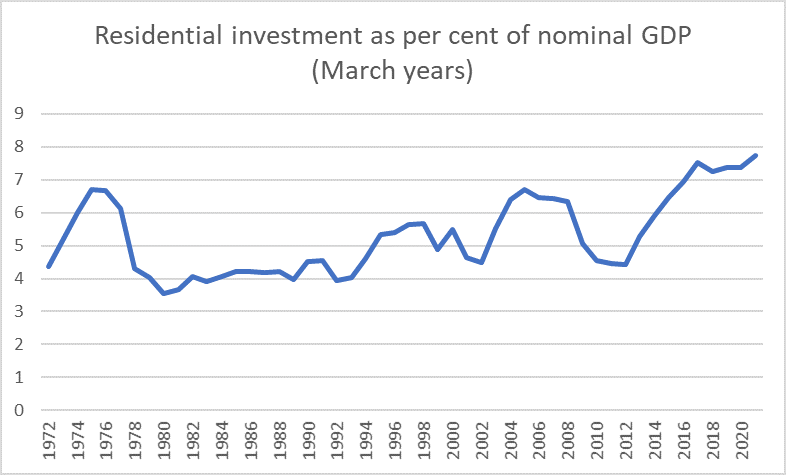
It is possible the scheme won’t end up being hugely costly. After all, house prices might take off again as interest rates fall. Or officials might err on the very cautious side and very few underwrite grants might be made (or at such deep discounts that the real insurance cost is cheap). But there is just no good or compelling analytical foundation for any sort of intervention of this sort (none provided, none readily conceivable). Even the business cycle argument seems rather flakey. Ministers seem to lament the cyclicality of residential construction (globally, it tends to be one of the most cyclically variable components of GDP), but when they lament the state of the industry, they don’t mention that new residential dwelling consents are still running around twice the level at the trough of the 2008/09 recesssion.

There is also talk about helping to get the cyclical economic recovery underway. Pretty much all the arguments against using fiscal policy for that purpose – I’ve outlined them here repeatedly – apply at least as much to discretionary sector-specific interventions like the Residential Development Underwrite. And, of course, were the Reserve Bank to regard this scheme as being likely to make a material difference it should, all else equal, make them more reluctant to, with less scope to, cut the OCR a lot further.

It is a rather sad reflection of how the quality of New Zealand policymaking has fallen. Perhaps we should be grateful that exchange rate cycles aren’t what they were – and that past governments were less prone to scheme like this – or who knows what sort of free insurance the government would be dreaming up for exporters.

Who knows what the relevant government agencies thought of this scheme. I’ve lodged OIA requests and am particularly interested in any analysis and advice from The Treasury and the Ministry for Regulation.

House prices

Every three months or so the hard copy Herald comes with a hefty supplement, the OneRoof Property Report. Yesterday was the latest such supplement. I skip straight to the detailed tables at the back which report, at suburb and district council level, the numbers from the OneRoof-Valocity House Value Index. It is a measure of average (not median) prices, draws on “a range of sources, including settled sales data” and is described as “based on a composite of statistical models and are fully stratified”. The numbers are up to the end of October.

What caught my eye when flicking through the tables was that they had not just percentage changes for the most recent quarter and year, but also enabled comparisons to pre-Covid levels and to the Covid-era peaks.

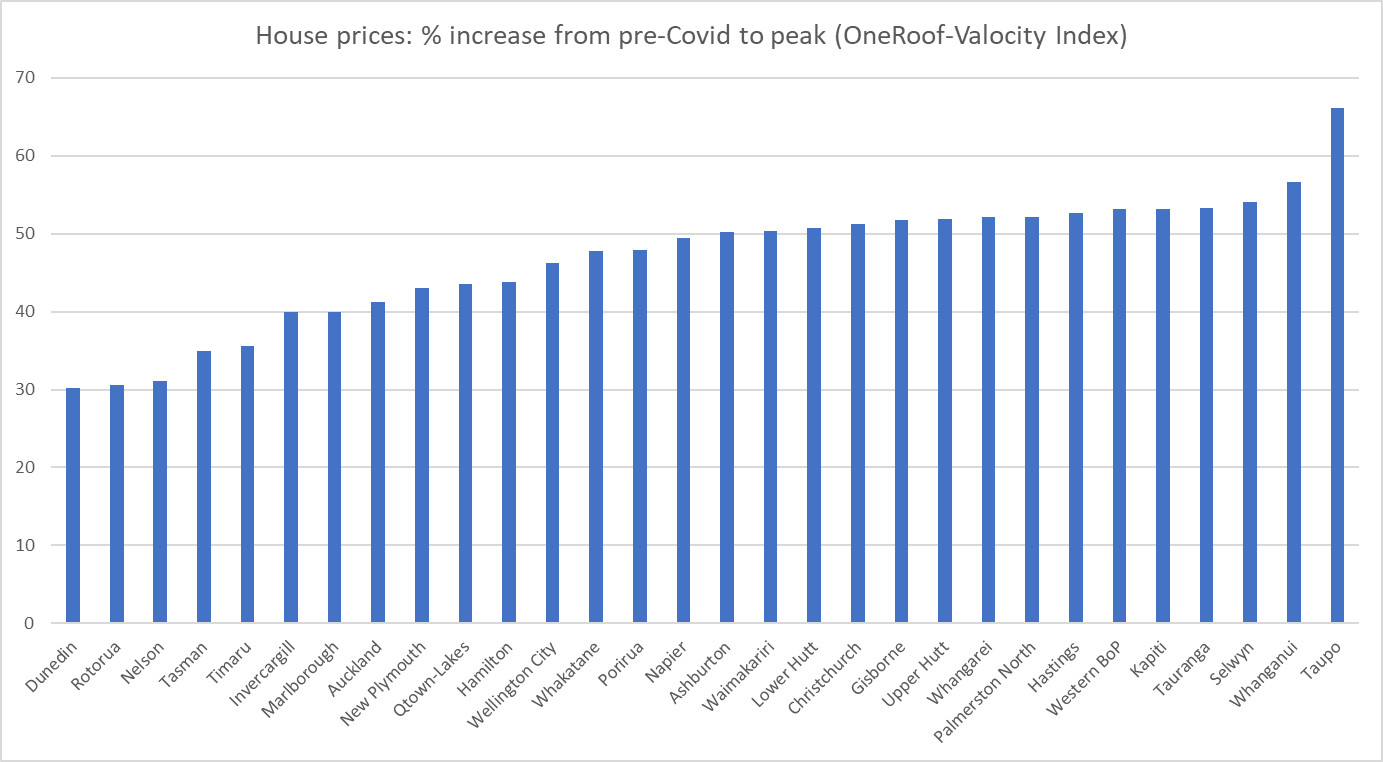
First, a reminder of that extraordinary period (mostly in late 2020 and 2021) when house prices rose sharply almost everywhere. Since I was having to do all these percentage changes manually I mostly only did the larger population places.

They really were staggering changes. There are a few surprises – I’m at a loss to know why the increase in average prices was materially larger in Taupo than anywhere else – but it is probably more striking just how consistently huge the price increases were, between 40 and 55 per cent, often in little more than a year.

Prices have generally fallen back from those peaks (except in Timaru where the latest observation is also the peak).

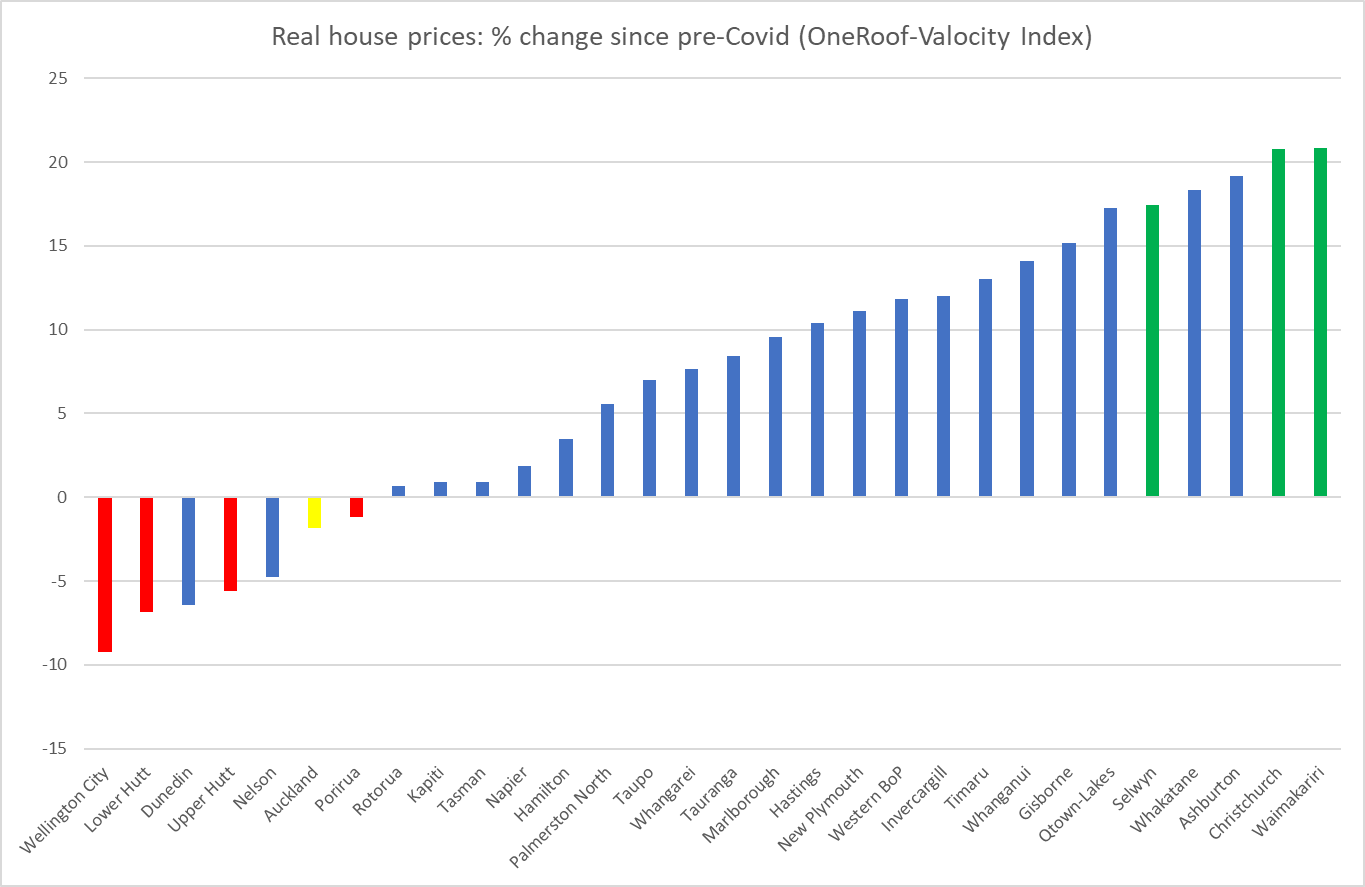
But what I was more interested in was where prices were now in real (inflation-adjusted) terms relative to those just prior to Covid. That’s this chart (with the Wellington districts highlighted in red, the Christchurch ones in green, and the mega-region Auckland shown in yellow).

There are really big differences across towns and cities in just a (bit under) four-year period, and no particular bunching around some typical rate of increase (decrease), even bearing in mind that a third of the population is in Auckland.

The dominant story of the 2020/21 increase in house prices seemed to be the toxic combination of extremely low interest rates in a fully-employed and overheating economy in the presence of supply constraints on bringing new residential land and houses to market (all despite an unexpected negative population shock). That story makes a lot of sense, including in the contrast to the 2008/09 recession when much larger cuts in interest rates went hand in hand with lower nominal house prices (there were big negative output and unemployment gaps opening up then).

But as we emerge through the other side of the entire Covid period, it is less clear what explains the divergent pattern of real house price changes over the full period. A non-trivial part of any story about the overall market must be interest rates – the OCR was 1 per cent just prior to Covid and is 5.5 per cent now (with implications for all the retail rates) – but we have an integrated financial market and thus the same interest rates (and tax rates for that matter) in Wellington as in Christchurch.

Supporters of the incoming government might note that Wellington house prices have fallen most in real terms and point out that the prospects of reduced public service numbers might be playing a part. Except that over most of four years public service numbers were rising, often quite strongly, and over the latest three months, when a victory for a National-led government came to seem much more certain, Wellington house prices haven’t done anything materially different than those in Auckland (both up a couple of per cent).

Models which emphasise the importance of supply constraints, land-use restrictions etc (models I champion) suggest that for any given state of economic activity and resource pressure, one should expect to see more responsiveness of house prices to interest rate changes the more binding the supply constraints are. It is an appealing story for Wellington (especially Wellington city) – interest rates have risen a long way- but whether it is really the main explanation would take much more systematic analysis (including trying to take account of the bipartisan limited land use reform legislative change in 2021, and expectations that a new government will alter those measures). But it is hardly as if Christchurch is some paragon of liberal land use.

Perhaps too there is some convergence at work. After all, even now Christchurch house prices are far below those in Auckland, and non-trivially lower than those in Wellington, and people are potentially mobile within New Zealand, especially when the labour market is buoyant.

I don’t purport to have a fully convincing story. The point of the post was mostly just to put the chart out there. And to note that despite the large and rapid increase in interest rates (nominal, but increasingly real too, going by any plausible measure of inflation expectations) real house prices in most of the country are at best basically unchanged from the end of 2019 (in Auckland’s case) or are materially higher than they were then.

Unnatural disasters

By which I mean here the New Zealand housing markets (though how many other glaring New Zealand policy failures could the term be used of?).

I’ve written a couple of columns for the Wellington magazine Capital on housing policy issues (here and here for the 2021 ones) and a few weeks ago the editor asked if I’d do another one. It had to be finalised before the election, which was fine with me as whatever superficial differences there were between the policies in this area of the two main parties none seemed seriously interested in, or to have policies to deliver, dramatically and sustainably lower house prices.

I noticed this morning that the magazine is on the news-stands, but I doubt it is a magazine that is much available or read outside Wellington, so here is a link to close to the final text. Word limits mean one can’t cover everything, or anything in great depth. With a bit more space I’d have made the point that squabbles over interest deductibility, foreign buyers’ bans/taxes and so on really should be peripheral to the heart of the issue, making it easy to bring land into housing use, and easy to build.

The two sides of politics have recently been offering competing (if overlapping) visions of a better-functioning market. Labour and its allies tend to be reluctant to see increases in the physical
footprint of our cities and they back the recent law change in which, for example, three-storey
dwellings can be put up almost anywhere. They are keen on encouraging intensification, almost as
end in itself. For them single-family homes, with a backyard and garden, in our cities are some
throwback to the 1950s, or a future preserve of the relatively wealthy. In and around greater
Wellington, the regional council seems intent on further restricting greenfields development.

National, by contrast, is now offering a different model in which local councils can make choices: they
have to zone enough land residential to cover 30 years of future housebuilding needs, but that can
be done by focusing on intensification or by increasing the physical footprint of cities.

Neither seems to offer a path towards a well-functioning market characterised durably by much cheaper prices for houses and peripheral urban land. Labour’s approach might well increase urban intensity, but nothing in the international experience suggests that will lower house or land prices. National’s approach will tend to increase the physical footprint of some cities – in others, probably
including Wellington, a council with an ideological commitment to density will probably opt to stick
with the Labour approach – but still falls far short of creating genuine competition, where owners of
land in and around urban area are aggressively competing to attract developers and buyers, keeping
down house prices (and, over time, rents).

We need to get councils out of the mix completely, and enable real choice and competition. On the
one hand, allow any geologically-suitable land to be built on to any height, so long as the builders
and developers face the costs of providing water services etc. If someone wants to – although it is
hard to imagine – build a 20-storey apartment block on a big property in the Ohariu Valley there is
simply no pressing public policy reason to stop them. But we also need to enable small groups of
individual property owners (perhaps at the scale of a city block) to act collectively, and cheaply, to
limit development on their own properties, but only on their properties, if that is their choice.
This model seems to have worked very well in big and fast-growing Houston, which has seen not only
the expansion of the physical footprint of the city, but also a lot of intensification. Provide that
option – akin to the covenants seen in plenty of new private subdivisions, allowing for the terms to
be amended by supermajority (perhaps 75 per cent of owners) – owners can collectively make their
own choices, at their own cost, about the development rules for their own blocks of land.
Subsequent choices for more intensive development can also then be managed collectively.

We could, and should, do so much better. Renting and buying should be easy and cheap. The path
to such outcomes – as in so many other sectors – is aggressive competition. Sadly, our councils and
our main political parties aren’t too keen on competition, and still think governments should get to
determine the shape of developments. The young and the poor pay the price.

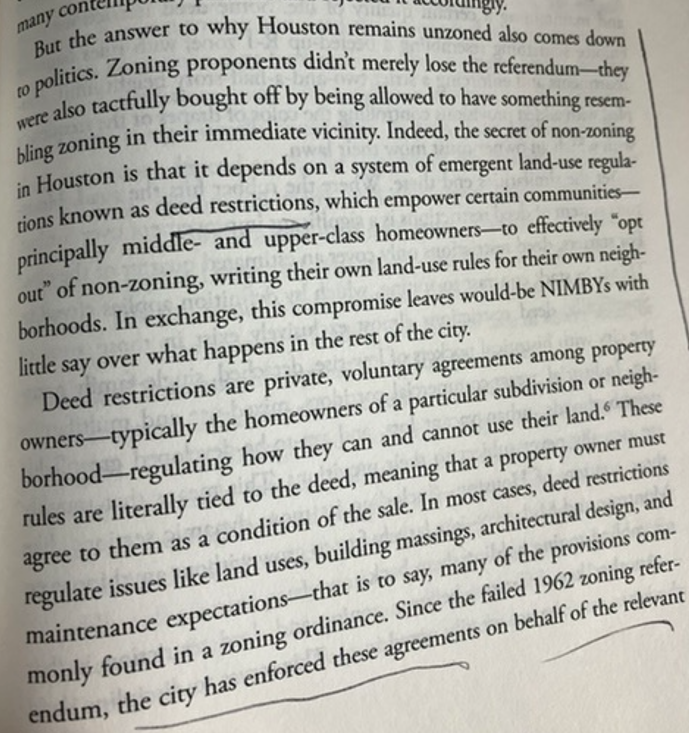
That penultimate paragraph champions an approach I have been running for some years now. I wrote a post last year on the Houston experience, drawing from the book “Arbitrary Lines” by an American (centre-left I’m sure) urban planner, Nolan Gray. Here are the last few paragraphs of that post.

It is easy to develop on the margins of Houston, it is fairly easy to develop in much of the existing city, but those individual groups of landowners who want to have collective rules for their own properties can do so, and the local authority will enforce those rules on those properties. Deed restrictions are not set in stone for ever, but appear to be often time-limited and requiring a further (super-majority) vote of the then owners (a different group than 25 years earlier typically) at expiry to renew them.

It seems like a model that has a lot to offer here, and which should be looked at more closely by (a) officials, and (b) political parties exploring the best durable way ahead for New Zealand.

Those not operating in good faith – or at least much more interested in other agendas than a) widely affordable housing, and b) property rights (individual and collective) – would no doubt hate it. And, for the moment, they have the momentum – National and Labour last year rushed through legislation that stripped away many existing restrictions, and as a technical matter the government can if it likes force individual city councils to do as it insists. But governments can lose elections too, and if we are serious about much lower sustainable real house prices – and it isn’t clear how many central or local government figures are – we need durable models. The Houston model has proved to work, both in managing the politics and in delivering a city with widely affordable housing, and a wide range of available housing types. And if greenfields development is once again made easy – as distinct from say Wellington where the regional council is currently trying to make it even harder – urban and suburban land prices would fall a lot, and stay down.

One of the arguments some mount for over-riding local community preferences is that “people have to live somewhere”, suggesting that it is unacceptable (even “selfish”) for existing landowners (acting collectively) to protect their own interests and preferences for their own land. But that argument rests only on then unspoken earlier clause “because we will make it increasingly difficult to increase the physical footprint on cities”. Allow easy development, of all types (internalising relevant costs), and there is just no reason to ride roughshod over the collective interests of existing groups of landowners, providing they can restrict things only for their own group of properties.

Some might push back and argue that there is nothing to stop groups of landowners forming private covenants now on existing properties, and I gather that is legally so. But coordination issues and transactions costs are likely to be very high, and people seek to use political channels instead. How much better if we provided a tailor-made readily enforceable collective action model, and then got politicians right out of the business of deciding what sort of houses can be built where.

And, to be clear, as someone living at the end of a hillside cul-de-sac I would have no interest in a Deed Restriction for our property. My interest is ending the evil that is Wellington price to income ratios of 8x or more, and enabling ready affordability for the next generation.

Arbitrary Lines

Ever since I’ve been writing about house prices – more or less the life of this blog – one of the things that has struck (and sobered) me is that I do not know of (and no one has ever been able to point me to) an example of a country or even a region that having once messed up its housing and urban land regulation, generating absurdly high house price to income ratios has undone things and returned to sustainably low price to income ratios (perhaps fluctuating around three times). There are, of course, many places in the United States where price to income ratios never went crazy. But never having dug a deep hole is a different matter than getting out of one once dug. One reads occasionally – even briefly on this blog – of how easy it is to build in Tokyo (and a culture of frequent demolition and rebuild), but no one ever suggests that Tokyo price to income ratios are low (just much lower than they were a few decades ago at the peak of the 1980s boom).

A month or two back I saw reference somewhere to Arbitrary Lines: How Zoning Broke the American City and How to Fix It, a new book by an American “professional city planner” Nolan Gray. Last week it turned up in the mail, and being neither very long nor very technical I’ve now read it.

Gray offers a pretty useful introduction to how zoning came to be in the United States (complete, as usual, with various Supreme Court cases), and if much of that isn’t very directly relevant to New Zealand I found it interesting nonetheless. And, of course, some of the best-known restrictions in many areas of the United States – single family dwelling zoning, to the complete exclusion of any other uses for the land (whether two single-storey townhouses, or a corner dairy, or a hairdresser’s), isn’t (and hasn’t really been) a widespread thing in urban New Zealand.

And there is some useful material on some of the potential wider costs to restrictive land use, although on my reading of the relevant papers Grey often jumps too readily to assert causal relationships. But then his background is planning (and is currently studying for a PhD in urban planning) and in some respects the book is best seen as an evangelistic tract (they have their place). No doubt it would appeal quite strongly to that small but vocal group of New Zealand reformers who dream of demolishing whole suburbs, long for light rail systems, and really dislike the idea of backyards (and increasing physical footprints of cities). They often dislike cars too. And often don’t seem too keen on – quite derisive of – people not like them.

And thus as the book went on I was finding it more than a little annoying in places. Gray makes many good points about the inadequacies (and worse) of US zoning systems. But it was pretty clear that he had one particular urban form in mind, and whole agenda of other issues he (and his publisher – explicitly focused on “solving environmental problems”) cared about. And, perhaps reflecting that, there was very little in the book about house prices themselves or the likelihood that his solutions would materially lower them. But there was quite a lot on emissions and energy use (which could simply be priced, as they now largely are in New Zealand), and a dislike of turning farmland (or any other undeveloped land) into suburbs (where, again, any externalities can and should be priced). He seems to have been living in Washington DC when he wrote the book, and enjoying that: we enjoyed our time living in a DC apartment too.

It was also getting frustrating that despite writing about a country that has quite diverse systems, for a long time there was almost no mention of the vast swathes of the United States with (a) population growth, and (b) low and fairly stable house prices.

Until, three-quarters of the way through the book, I came to the chapter headed “The Great Unzoned City”, about Houston. I wouldn’t be bothering with this post if Gray had simply been making the point that real house prices are pretty low, and fluctuate around a fairly stable trend, in Houston. There are, after all, many cities in the annual Demographia tables that are cheaper still. There isn’t that much zoning in Houston, and people have written previously about Municipal Urban Districts (MUDs) which enable land – outside established urban local government boundaries – to be readily developed by private developers, including dealing directly with (internalising) the associated infrastructure costs of development. It was nice to see his, perhaps grudging, recognition that (a) everyone drives in Houston, and b) people are moving to places such as it with cheaper housing. It works. And there has been considerable intensification in Houston over the years.

But the real thing I learned about – and the point of the post – was about the Houston system of Deed Restrictions.

Again, as long as I’ve been writing about housing and possible reform options for New Zealand, I have been intrigued (starting here I think) by the idea of allowing small groups of landowners in existing urban areas (perhaps at the scale of a city block or a small neighbourhood) to set collectively their own land-use rules for their own group of properties. They are an established market mechanisms in new developments in New Zealand, in the form of private covenants, and one could mount an argument that zoning was really an attempt to do much the same thing (collectively manage shared interests, where there are real externalities).

In a report some years ago, the Productivity Commission took a very dim view of private covenants, even suggesting that the government should legislate to restrict their use. But they’ve always seemed to me to be a way through the endless battles (eg the Christchurch City Council stories this morning) around land use, at least among those willing to operate in good faith (and it is never clear how many are). Why not, for example, remove all government restrictions on land use for housing (height, setback, site coverage, “character”, parking or whatever) in existing urban areas AND on undeveloped land, while allowing neighbourhoods/blocks (groups of existing property owners) to adopt by super-majority (and be able to amend by the same super-majority) previous restrictions as applicable to their land, and their land only?

Over the years, I’ve seen a few other people make similar suggestions (eg there was a UK think tank piece a year or two back) but it had about it perhaps an obscure textbook-y feel. It wasn’t clear that anyone had tried it ever, and I myself am inclined to invoke revealed preference arguments at times (if something doesn’t exist anywhere, it is worth at least thinking about whether there is a good – well-grounded, not just political – reason for that).

But it seems that in Houston they have done something very like what I’ve suggested, and it has been in place long enough to see how it works. It is a big, growing, city with pretty-affordable house prices (I’ve been looking recently at small modern units in Christchurch recently – NZ’s least unaffordable city of any size – and it is simply depressing (although also a reminder of what we could do) to check in from time to time and see what one gets for the same money, in a higher wage country, in Houston).

There have been attempts over the years to put in place more extensive zoning systems in Houston. They have failed, at several referenda. But here is Grey:

It is easy to develop on the margins of Houston, it is fairly easy to develop in much of the existing city, but those individual groups of landowners who want to have collective rules for their own properties can do so, and the local authority will enforce those rules on those properties. Deed restrictions are not set in stone for ever, but appear to be often time-limited and requiring a further (super-majority) vote of the then owners (a different group than 25 years earlier typically) at expiry to renew them.

It seems like a model that has a lot to offer here, and which should be looked at more closely by (a) officials, and (b) political parties exploring the best durable way ahead for New Zealand.

Those not operating in good faith – or at least much more interested in other agendas than a) widely affordable housing, and b) property rights (individual and collective) – would no doubt hate it. And, for the moment, they have the momentum – National and Labour last year rushed through legislation that stripped away many existing restrictions, and as a technical matter the government can if it likes force individual city councils to do as it insists. But governments can lose elections too, and if we are serious about much lower sustainable real house prices – and it isn’t clear how many central or local government figures are – we need durable models. The Houston model has proved to work, both in managing the politics and in delivering a city with widely affordable housing, and a wide range of available housing types. And if greenfields development is once again made easy – as distinct from say Wellington where the regional council is currently trying to make it even harder – urban and suburban land prices would fall a lot, and stay down.

One of the arguments some mount for over-riding local community preferences is that “people have to live somewhere”, suggesting that it is unacceptable (even “selfish”) for existing landowners (acting collectively) to protect their own interests and preferences for their own land. But that argument rests only on then unspoken earlier clause “because we will make it increasingly difficult to increase the physical footprint on cities”. Allow easy development, of all types (internalising relevant costs), and there is just no reason to ride roughshod over the collective interests of existing groups of landowners, providing they can restrict things only for their own group of properties.

Some might push back and argue that there is nothing to stop groups of landowners forming private covenants now on existing properties, and I gather that is legally so. But coordination issues and transactions costs are likely to be very high, and people seek to use political channels instead. How much better if we provided a tailor-made readily enforceable collective action model, and then got politicians right out of the business of deciding what sort of houses can be built where.

And, to be clear, as someone living at the end of a hillside cul-de-sac I would have no interest in a Deed Restriction for our property. My interest is ending the evil that is Wellington price to income ratios of 8x or more, and enabling ready affordability for the next generation.

Price/income ratios

Over the last couple of weeks we’ve had another round of politicians (so-called “leaders”) doing their utmost to deny any interest in seeing house prices much lower. At 60 per cent below current levels – which would be readily achievable with open and competitive land markets, and a genuinely open and competitive building products sector – we’d be looking at something a lot more reasonable. Real rents would probably then be lower than ever before. But our politicians are terrified of the very idea.

The new Leader of the Opposition made clear his opposition to any suggestion of a sustained fall in house prices (while noting that inevitably there would be some ups and downs). HIs new deputy – and National’s housing spokesperson – did suggest that much lower house price/income ratios might be desirable, with something like flat nominal house prices. And while the Prime Minister at the weekend was quoting as suggesting that she wanted lower house prices – quite a change of tone from her, perhaps just getting ahead of what may already be beginning to happen – she too was at pains to deny any interest in much lower house prices.

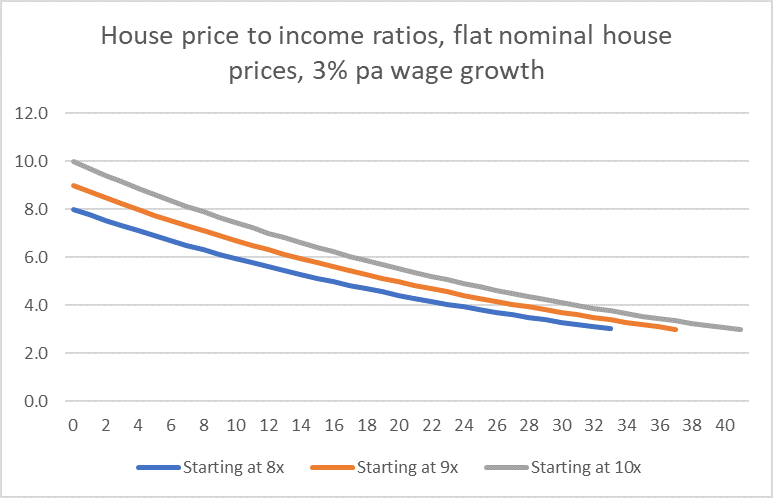
Of course, in principle, house price/income ratios could be steadily whittled away by some combination of flat nominal house prices and rising wage rate. But when one starts from such an unbalanced situation as New Zealand now does it would be the project of decades, even if anyone took it seriously. The great and good seem to rather like the idea of this “painless” whittling away, presumably as it enables them to sound serious, and not scary to the already-indebted.

Here is a chart of three scenarios, in each of which nominal house prices hold flat from here. In each scenario I’ve assumed 3 per cent annual growth in wage rates (basically inflation at target on average and something like 1 per cent per annum productivity growth). What differentiates the three scenarios is the starting point – a range from 8 times income to 10 times income.

price to income dec 21

At best, it takes 33 years for price/income ratios to get back to three – the sort of ratio seen in large chunks of the US, in cities large and small. At best, it would take almost a quarter of a century to get back to a price/income ratio of four.

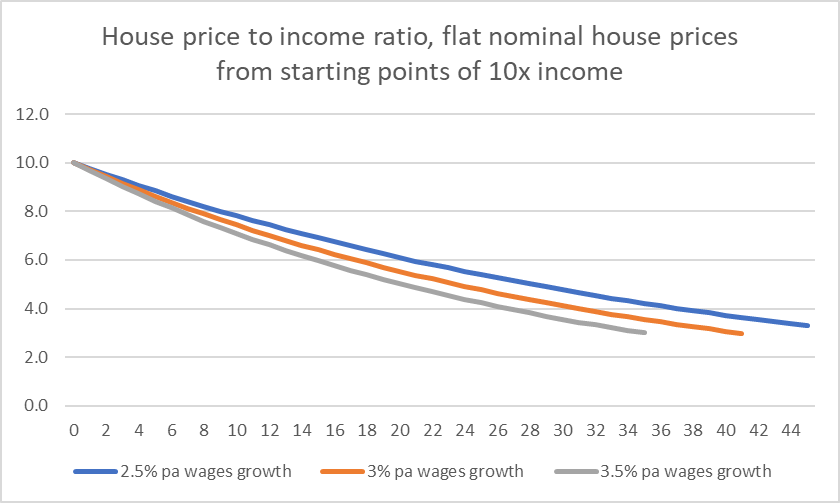
In the next chart I’ve assumed a starting point of 10 times income and shown the implications for a range of wage growth assumptions. On these scenarios, my kids would my age before house price to income ratios were again what they were when I was their age.

price to income 2 dec 21

If your idea of political leadership is along the lines of “I must find where the people are going and get out in front of them”, I suppose I understand the apparent political terror at the prospect of much lower house prices, but what a pathetically weak approach, that abdicates any responsibility towards the next generation. These people – “leaders” of our political parties – appear content to get a whole other generation (or two) load up on debt based on house prices they know not to be based on any long-term fundamentals, rather than get to the heart of the issue now.

Of course, some in the media don’t help. I saw last night one journalist suggesting that even getting house prices 25 per cent lower would be reckless, irresponsible, and deeply economically damaging. But politicians put themselves forward, at least notionally, as leaders, people (allegedly) with the best interests of the country at heart. They are supposed to be the communicators, the coalition builders, the persuaders, the people who make things happen…..not those content to sit to the sidelines, idly hoping that well beyond their time in politics things might finally be sorted out.

Take the idea of a 25 per cent fall in house prices. That might take prices back to around where they were at the start of last year. No one who bought before then is put in any particular difficulty. And neither are most of those who bought more recently, as bank lending standards have not been loose, and LVR restrictions have become increasingly onerous. Some would be left temporarily with negative equity, but (a) typically not a large amount, and (b) in a fully-employed economy, modest negative equity isn’t typically a major problem (and to anyone going “easy for you to say”, it was exactly the situation I found myself in a couple of years after buying my first house). But our “leaders” can’t even enthusiastically embrace unwinding the last couple of years’ house price rises.

Of course, the major parties sometimes like to talk about the things they’ve done, up to and including the current amendment to the RMA being rushed through Parliament. But the proof of the pudding is in the prices, and expectations of future prices. Actually, in the political rhetoric as well. Not only have expectations of future house price inflation not gone negative – or even slowed noticeably after the latest “accord” – but the politicians’ own rhetoric reinforces the point: they themselves are scared of embracing lower prices.

Were they actually serious about fixing things, in their own terms of office, some creative thinking (and coalition building) might be required. Big changes in relative prices involve big shifts in wealth. Sharp rises in house prices have skewed the playing field away from the young and the poor. Sharp falls in house prices would skew things sharply away from the very highly-indebted. Of the latter, some don’t (and shouldn’t) command much sympathy at all. If you run a residential rentals business and took on huge amounts of debt to finance your business, well tough. It is a business, in this case built on systematically rigged markets (all that central and local government land-use regulation), and sometimes businesses fail. New entrants will emerge to replace you.

But first home buyers (in particular) command a lot more sympathy, and rightly so in my view. Young families didn’t ask the government to rig the market, or probably even support them doing so. They just want a secure home and backyard to raise their kids, and the only option governments left them for doing so was to pay these absurd price/income ratios, made barely feasible by the sustained decline in neutral interest rates (which in a functioning market should have made purchasing a home easier than ever). For them, some sort of partial compensation scheme might be a fair and necessary path to breaking through the political resistance to much-lower house and land prices. Not a first-best solution perhaps, but a great deal than putting another generation through this quite-unnecessary drama of rigged housing markets. When market prices are miles from the structural fundamentals, there is no merit in trying to foreshadow some very slow and allegedly “painless” adjustment. Better to get the prices (and market regulatory frameworks) sorted out now.

(Oh, and don’t be fooled if prices do fall back a bit over the next 12-18 months. Cyclical fluctuations happen. Falls happen (as over 2008/09). But without fixing the land-use restrictions – and the current RMA amendment does not even come close – the fundamental distortions remain. House prices did fall quite a bit in 2008/09 (even with much lower interest rates), until they rebounded to levels (and price/income ratios) higher than ever.

House and land prices

The local Wellington magazine, Capital, which seems to be a curious mix of the serious and the lifestyle, earlier in the year asked if I would write a piece on house prices. That article outlined the story I’ve run here repeatedly, that durable and very large reductions in house and land prices are quite possible – we see everyday examples in perfectly pleasant urban areas in the United States – but are only likely to happen if there is genuine aggressive competition among owners of land beyond existing urban areas. It is that sort of competition, from land whose best other use is probably for something agricultural in nature, that would durably lower land (and house) prices in existing urban areas.

That article ran in April. In late September the editor got in touch and asked if I was interested in doing another piece. Since there had been numerous policy announcements around housing this year – from the government, from the Reserve Bank, sometimes from the government to the Reserve Bank – I suggested that a piece along the lines of “sound and fury, signifying not much at all other than some new inefficiencies and distortions” might be in order. That article is in the issue on sale in Wellington now, and the text is here. I will include the full text at the bottom of this post.

I wrote the article four weeks ago. It isn’t quite the article I would write today because since then we’ve had the joint Labour-National announcement on new legislation that is being rushed through which will allow more intensive (but still relatively low-rise) development in existing urban areas of our larger cities, but appears to do nothing of substance to free up land-use beyond existing urban areas (and, as I noted in both articles, there is lots of undeveloped land in greater Wellington, much of it with little economic value in alternative uses). But if I’d write a slightly different article today, the bottom line does not change: there is no sign (from ministers, Opposition spokespeople, city councillors or whoever) that those who hold power have any interest at all in delivering much lower house prices on a durable basis. They refuse to express any such interest, and nothing they have done or are now doing seems likely to bring about such an outcome. Urban density may be all very well and good, for those who like that sort of lifestyle (and good luck to them), but the international evidence offers no example I’m aware of in which allowing much-greater density in cities has been followed by move towards house/land prices dropping back towards what we see in (typically quite low-density) cities in much of the US.

In the article I suggested that much of what had been announced this year was little more than “performative display” – doing stuff for the sake of being seen to act, seen to care. That seems right for most of the initiatives, since typically the supporting advice that has been published doesn’t suggest any likelihood of a sustained impact on prices. It is possible that the parties to the latest deal actually believe that this initiative might actually make a difference – partly because they have been cheered on by some people from the genuinely pro-liberalisation side of things. But even if they do believe that – and refuse to openly say so for fear of scaring some heavily-indebted voters – they are almost certainly wrong.

The second reason for scepticism I included in the article was this

The second clue is that prices have kept on rising, and at best are perhaps expected to fall back just a few percentage points over the period ahead (despite the huge increases we’ve seen). If people – smart people with lots of money at stake – really thought that the policy changes already made (tax rules, access to finance) or those in the works (such as the replacement for the RMA, or the National Policy Statement on urban development) were going to make an enduring difference, we’d see to
see it in the prices of the assets already. That is how asset markets work, whether stock markets, foreign exchange markets, or (a little more murkily) land markets. But there are no signs or reports of substantial falls, whether for existing properties or potentially-developable land

I still reckon that is basically right, but were I writing today I might put more emphasis on the possibility of quite a shakeout over the next year or two, even while the structural problems are unchanged. In a way, this is just the sort of point the Reserve Bank has been making in its discussion around “sustainable” house prices. “Sustainable” in their terms does not mean affordable, or US-style normal. It really just means where a market might be expected to settle given all the policy-settings and distortions in the system (that underpin land prices well above best alternative use price). One can see material, even significant, falls in house prices in such markets without the longer-term structural fundamentals being fixed at all. Such falls aren’t likely to last (and in New Zealand aren’t likely to pose a financial stability threat) but they could get the headlines for a time. Many of the falls in house prices that happened around 2008/09 were of that sort – whether those in San Francisco (now incredibly expensive), New Zealand (now incredibly expensive), or even Dublin.

Building activity in and of itself does not solve the underlying problem – land prices – but it can still lead to shorter-term overhangs in the market. There has been quite a lot of housebuilding going on.

Interest rates have risen and seem likely to rise further. A return to rapid population growth, from immigration, still seems some way off. The fiscal stimulus which has helped boost economic activity will be fading, and there are all those tax and access-to-credit restrictions. None of these address the longer-term problem of a rigged market that renders peripheral (developable) land incredibly expensive in a land-abundant country, but in combination they could be a recipe for a non-trivial fall at some point soon. Of course, prices ran up so much in the last year or so that even such a fall is unlikely to take prices back to real levels even two years ago, but…..falls of that sort would grab the headlines, and would probably lead some politicians to want to claim credit for having solved a problem they haven’t really even begun to address.

Without further indenting or block-quoting here is the full text of that article.

Lots of action, but none that will fix the housing market

Michael Reddell

(Published in Capital magazine, November 2021)

October 2021

Even before Covid, house prices in much of New Zealand were very high.  Over the last year or so they’ve again risen sharply almost everywhere, putting home ownership further beyond the reach of most, and underpinning rising rents.  This dreadful situation, transferring resources (wealth) from the relatively poor and young to the relatively rich and the risk-takers, is utterly unnecessary and deeply unjust. 

In a well-functioning market, times like these should be a renter’s dream.  Purchasing a house should never have been cheaper, and rents should be lower (in real terms) than ever.

That’s because interest rates are at record lows.  The New Zealand government’s 20-year inflation-indexed bond currently trades at about 0.8 per cent.  25 years ago the comparable rate was about 5 per cent.  Basic finance theory suggests that when rates of returns on one long-term asset fall so will those on other long-term assets. And in a well-functioning market, rents are the main source of return to the owner of the rental property.

But a well-functioning market is one in which it is easy to bring to market and develop new land and new houses. In that sort of market, developing the new land (building the new houses) would now be easier and cheaper than ever.   It takes time to develop a subdivision and build houses, and finance costs are one of the major costs those in that business face.   New Zealand has abundant land, that could readily be converted to urban uses. So, of course, does Wellington, and much of the land surrounding Wellington isn’t worth much in alternative uses.   But if regulations make land artificially scarce, then lower interest rates (or other sources of higher demand) can translate quite quickly into higher house/land prices.

The alternative isn’t just some theoretician’s dream.  When I wrote here six months ago, I highlighted Little Rock, Arkansas, as one example of the many growing, pleasant and highly-affordable US cities.  Real house prices in Little Rock hadn’t changed much in 40 years and median house prices appeared to be about NZ$300000.  Interest rates are at least as low as those here.  Check any website and you’ll easily find modern townhouses to rent in Little Rock for no more than NZ$1000 per month.   Try that in Wellington.

In a well-functioning market, when interest rates fall and prices look like beginning to rise, owners of land (whether existing sites in the city or new areas at the periphery) should be falling over themselves to get new land, and then new houses, to market, and owners of rental properties should be competing aggressively to get and keep tenants.  The alternatives would be a vacant property (earning nothing) or money in the bank (earning little more).

But this is New Zealand where, absent a well-functioning market, house/land prices have surged again, where rents have been rising, and where price to income ratios –  which should be less than 4 in well-functioning markets –  are now more like 10.

There has been all manner of policy announcements this year, some substantive and others little more than rhetorical.   The government has extended the “bright-line test”, so that investors selling properties within 10 years will pay a sort of capital gains tax, and – in one of the more bizarre moves – is legislating to stop businesses owning investment properties deducting their interest costs against taxable income.  A select committee is looked into new resource management legislation.    And, of course, some councils – including Wellington’s – are moving to allow some more intense development in some parts of the city.     Bureaucrats have got in on the act too, with renewed loan-to-value (LVR) restrictions from the Reserve Bank and the threat of more restrictions to come.  And the government has insisted that the Reserve Bank should talk more about house prices.

But there are two pointers that none of this amounts to much more than performative display. The first is that government ministers – from the Prime Minister down – refuse to express any interest in lower house prices.  Instead, they talk repeatedly about just lowering the rate of increase. Councillors, and Opposition parties, are rarely much better.

The second clue is that prices have kept on rising, and at best are perhaps expected to fall back just a few percentage points over the period ahead (despite the huge increases we’ve seen).   If people – smart people with lots of money at stake – really thought that the policy changes already made (tax rules, access to finance) or those in the works (such as the replacement for the RMA, or the National Policy Statement on urban development) were going to make an enduring difference, we’d see it in the prices of the assets already.  That is how asset markets work, whether stock markets, foreign exchange markets, or (a little more murkily) land markets.  But there are no signs or reports of substantial falls, whether for existing properties or potentially-developable land.

This year’s measures aren’t designed to fix the broken housing market, just to throw some sand in the wheels, be seen to be doing something, and perhaps to buy a bit of temporary relief.  Nothing done or promised is likely to make very much sustained difference at all, because none of it gets to the source of the problem.

Some put a lot of hope in provisions allowing for greater urban density – even as our cities are already quite densely populated by New World standards.  They are probably wrong to do so.   Increasing density has already been a feature of the last few decades – think of all the infill housing a decade or two back – and, of course, the physical footprint of our cities has also expanded.  But in the face of rapid population growth – likely to resume once Covid passes – these grudging changes have only been enough to avoid house prices rising sooner to even more outrageous levels.  

Without a radical freeing-up of land use at the periphery, creating aggressive competition between development options in cities and those at the margins, simply allowing a bit more densification will not bring land prices down. It may even bid up the prices of some sections, now able to be developed more intensively.  A lot of houses are being built right now, but there is no prospect of enduringly much lower prices unless or until owners of vacant land, on the peripheries of our city, are free to bring that land into housing and other urban uses.

New Zealanders should be able to count on a well-functioning housing/land market and ready access to finance.  Increasingly we have neither; just more complexity, more inefficiency, and more-unaffordable house/land prices.


Tightening LVR restrictions

The Reserve Bank’s faux “consultation” on tightening LVR controls closes today. If you felt so inclined the consultation document is here, but it isn’t clear why you’d bother except for the record. Poor performance by powerful government agencies shouldn’t go unremarked.

I have put in a a short submission, simply to document some of the many problems with the consultation.

submission to RB on tightening LVR restrictions Sept 2021

Much of the text simply elaborates points I noted in a post last week. But here are a few extracts

More substantively, there is no discussion at all in the consultation document of the Reserve Bank’s capital requirements or the capital positions of the banks you are putting more controls on. As you will be well aware, the risk-adjusted capital ratios of New Zealand banks are high by international standards, and will be increased further – as a regulatory requirement – over the next few years.   Capital is, and always should be, the key buffer against loans going bad, and we know that the New Zealand framework imposes relatively (by international standards) high capital requirements in respect of housing loans, including high LVR ones.   It is simply unserious – or a desire to operate ultra vires – not to engage with the capital position of the banking system.  That is especially so as your consultation document acknowledges that tighter LVR controls will impair the efficiency of the financial system.  Given that acknowledged cost, there has to be a clear gain to financial system soundness (the other limb of your statutory goals/purposes) from any new regulatory impost, but your document makes no effort to quantify such a gain (reduced probability of failure), or to demonstrate that tighter LVR controls are the least-cost way to generate such a reduction.   There is not, I think, even any attempt to engage with the “1 in 200 years” failure framework that the Bank dreamed up a few years ago to support the capital proposals it was then consulting on.

….

The Bank’s consultative document also attempts to make quite a bit of an argument that somehow LVR restrictions now can dampen the size of future “boom-and-bust cycles” in the economy, even going so far as to claim these incremental restrictions will improve the medium-term performance of the economy. But none of this argument engages with the (very healthy) capital position of the banking system and at times it seems internally contradictory.  Thus, in paragraph 47 the Bank worries about dampening effects on consumption and economic activity from “increased serviceability stress” as a result of some future increase in interest rates, but never seems to recognise that the reason the monetary policy arm of the Bank would be raising interest rates is to dampen demand and inflationary pressures.  If anything, the Bank’s argument would seem to suggest that more high-LVR lending would, if anything, and in those circumstances increase the potency of monetary policy, and reduce the extent of any required OCR increases.    More generally, the Bank continues to place a considerable reliance on claims about a significant housing wealth effect on consumption that appear inconsistent with New Zealand macroeconomic data over many decades, and which appear to over-emphasise existing homeowners while largely ignoring the loss of wealth/purchasing power for those who do not (yet) own a house.

….

In conclusion, the Bank has simply not made any sort of compelling case for further tightening of LVR restrictions. At very least, such a case would have to involved a careful and documented cost-benefit analysis, that included engagement with the bank capital regulatory regime.  There is no pressing financial stability risk, and so this proposal – in practice, these new rules – has the feel of action taken for the sake of action, perhaps to provide some cover for a government that fails to address the house price issue at source, or to fend off (misguided) critics of the Bank’s LSAP monetary policy programme.   That isn’t a good or acceptable use of the powers of the state. 

To the extent the initiative is about protecting borrowers from themselves – as your communications sometimes suggests – it may be nobly intended but is no part of the Bank’s statutory responsibility (and thus not a legitimate basis for use of regulatory powers). Perhaps as importantly it seems to assume the current crop of central bankers and regulators knows more about the risks of house prices falling substantially and sustainably than (a) borrowers and their bankers (each with money on the lines) and (b) than their central banking predecessors over 30 years did (each Governor having at some point or other anguished about the risks of falls, even as central and local government policy continued to underpin the decades-long scandalous lift in real house prices). No evidence is advanced for either proposition.


My former Reserve Bank colleague – now Tailrisk Economics – Ian Harrison had a similarly cynical view on the consultation process but also put in a short submission, which he has given me permission to quote from.

Ian makes a number of serious analytical points about the substantive weaknesses in the Bank’s document

Introduction

It is clear that, from the content of the consultation paper and the time given for submissions, the consideration of submissions and final decision making, that this is not a serious consultation, and that submissions will mostly be ignored.  In that vein not all of this submission is entirely serious.  Part A discusses some key elements of the Bank’s analysis.  It shows that the Bank’s concerns appear to be driven by a data error and a lack of understanding of how loan portfolios evolve over time.

The Bank has suppressed lending to housing investors following the Minister’s wish to give first time homebuyers a better chance of securing a property.  Now that this demand has emerged the Bank wants to choke it off. 

This is based on an almost irrational obsession with housing lending risk.   Even when high LVR loans are a small part of banks’ portfolios, and its own stress testing shows that housing losses will account for a relatively small part of overall losses in fairly extreme stress events (about 28 percent), it does not seem to be able to resist tinkering with quantitative interventions.

The easiest and most effective solution to the identified problems would be to increase housing interest rates, but that option is not even mentioned.

Part B of this submission provides a different professional perspective on the Bank’s behavior.

But sometimes points are made more potently – at least in responding to unserious spin masquerading as policy analysis – by satire. And this is Ian’s Part B

Part B 

Meduni Vienna, Department of Psychiatry and Psychotherapy

Währinger Gürtel 18-20
1090 Vienna, Austria 

Consultation report

 Patient : R. Bank 

Date:   7/9/2021

Diagnosis:

From our consultation with the patient R. Bank we observed the following clinical symptoms.  Our consultation conclusions are based on the patient’s writings (in particular the document loan-to valuation ratio restrictions) and our observations of behavior over the last three years.

Moderate paranoia: The patient had a tendency to blowup the risks of everyday life into impending disasters.

Hyperactivity: There was a pronounced tendency to do things when nothing needs to be done.

Megalomania: The patient exhibits the classic signs of megalomania: overestimation of one’s abilities, feelings of uniqueness, inflated self-esteem, and a drive to maintain control over others.

Misplaced empathy:  The patient exhibited some concern that others may make mistakes but uses this as a reason to exercise control over them.

Irrationality: There was a lack of capacity to identify real problems and connect them with solutions.

Unwillingness to listen to others:  The patient will pretend to listen to alternative views but this is almost always a sham.

Treatment:

  • Heavy sedation
  • Counselling

The patient should be removed from positions of authority until there is a pronounced improvement in behavior.

Albert Pystaek Phd., Dip. A.E.M, Fm.d, Head of Clinical Psychiatry

Housing

I hadn’t paid much attention to the renewed wave of restrictive regulation of the housing finance market being imposed by the Governor of the Reserve Bank this year, but a journalist rang yesterday to talk about the latest proposal which prompted me to download and read the “consultative document” the Bank released last Friday.

Why the quote marks? Because quite evidently this is not about consultation at all, simply trying to do the bare minimum to jump through the legal hoops to allow the Governor to do whatever he wants. The document was released on Friday 3 September. The consultation period is a mere two weeks, which is bad enough. But then they tell people who might be inclined to submit that ‘we expect to release our final decision in late September’ – at most nine working days after submissions close – with the new rules to come into effect from 1 October. And if you were still in any doubt there is that line they love to use: “we expect banks to comply with the spirit of the new restrictions immediately”.

WIth that sort of urgency and disregard for any serious bow in the direction of consultation and reflection, you’d have to assume the Bank had a compelling case for urgent action, such that (for example) a delay of even as much as a month would pose an unendurable threat to the soundness and efficiency of the financial system (still the statutory purposes these regulatory powers are supposed to be exercised for). And since the Bank is quite open about the fact that the new restrictions will impede the efficiency of the system, you’d expect an overwhelming case for a soundness threat, complete with a careful analysis indicating that these new controls – directly affecting huge numbers of ordinary people – were the best, least inefficient, response.

But there is nothing of the sort. Instead they are actually at pains to stress that the financial system is sound at present, so the worry is about what might happen if things went on as they are. But that can’t possibly be an issue that rides on a one month, it must be something about several more years.

But even then their case amounts to very little. For example, they point that if house prices were to fall 20 per cent from current levels some $4 billion of lending would be to borrowers who would then have negative equity, But that is hardly news. The typical first-home buyer has always – at least in liberal financial systems – borrowed at least 80 per cent of the value of the home they are purchasing. It is usually sensible and rational for them to do so (indeed 90 per cent would often be sensible and prudent). So a fall of 20 per cent in house prices would always put a lot of recent borrowers into a negative equity position. Note, however, that (a) $4 billion is not much over 1 per cent of total housing lending, and (b) it is $4 billion of loans, not $4 billion of negative equity. If I borrowed 82 per cent of the value of the house, the house fell in value 20 per cent, and I lost my job and had to sell up, the loss to the bank might be not much more than 2 per cent of the loan.

More generally, in the entire document there appears to be not a single mention of the capital position of banks operating in New Zealand, or the Reserve Bank’s capital requirements. You might recall that New Zealand banks have some of the highest effective capital ratios anywhere in the advanced world, and that the Bank is putting in place a steady increase in those capital requirements. Moreover, if you read the Bank’s document – at least as a lay reader – you might miss entirely the point that the capital rules, and the internal models banks use, require more dollars of capital for higher risk loans than for lower risk loans. It is how the system is supposed to work. There are big buffers, those buffers are getting bigger (as per cent of risk-weighted assets), and the dollar amount of capital required rises automatically if banks are doing more higher-risk lending.

Of course, the Bank says a significant fall in house prices is more likely now. But we’ve heard that sort of line from every Reserve Bank Governor at one time or another over 30 years now. As it happens – and for what little it is worth – I happen to think house prices may be more likely to fall than to rise further over the next 12-18 months (even put a number consistent with that in the Roy Morgan survey when their pollster rang a few days ago), but I don’t back my hunch by using arbitrary regulatory restrictions that – on their own telling – will force many first home buyers back out of the market.

And it might all be more compelling if the Bank showed any sign of understanding the housing market. Thus, we are told (more or less correctly) that immigration is currently low (really negative) and lots of houses are being built. But, amazingly after all these years, there appears to be no substantive discussion of the land-use regulations and the land market more generally. Perhaps there will be something of a temporary “glut” in dwelling numbers – at current prices – but unless far-reaching changes are made to land-use rules that won’t change the basic regulatory underpinning for land prices. We know the government’s RMA reforms aren’t likely to help – may even worsen the situation – including because if these were credible reforms, the effect would be showing through in land prices now. And we know from the PM and Minister of Finance – and possibly the National Party too – that they don’t even want to do reforms that would materially lower house/land prices.

It all just has the feel of more action for action’s sake. Perhaps the government isn’t too keen on first-home buyers being squeezed out, but at least when they are criticised for not fixing the dysfunctional over-regulated housing/land market they can wave their hands and talk about all the things they and their agencies do, however ineffectual. As even the Bank notes, LVR restrictions don’t make much difference to prices for long. And if there is a compelling financial stability case, it isn’t made in this document – which, again, offers nothing remotely resembling a cost-benefit analysis for respondents to address. This despite bold – totally unsubstantiated – claims in the paper that their new controls would be beneficial for “medium-term economic performance”.

Then again, why would they bother with serious analysis when the whole thing is a faux-consultation anyway.

At which point in this post, I’m going to turn on a dime and come to the defence of both the Bank and the government. A couple of weeks ago the Listener magazine ran an impassioned piece by Arthur Grimes arguing that the amendment to the Reserve Bank Act in 2018 was a – perhaps even “the” – main factor in what had gone crazily wrong with house prices in the last few years. Conveniently, the article is now available on the Herald website where it sits under the heading “Government has caused housing crisis to become a catastrophe”.

Grimes was closely involved in the design of the 1989 Reserve Bank Act, and for a couple of years in the early 1990s was the Bank’s chief economist (and my boss). He left the Bank for some mix of private sector, research, and academic employment, but also spent some years on the Reserve Bank’s board – the largely toothless monitoring body that spent decades mostly providing cover for whoever was Governor. These days he is a professor of “wellbeing and public policy” at Victoria University.

However, whatever his credentials, his argument simply does not stack up, and given some of the valuable work he has done in the past, on land prices, it is remarkable that he is even making it.

There is quite a bit in the first half of the article that I totally agree with. High house prices are a public policy disaster and one which hurts most severely those at the bottom of the economic ladder, the young, the poor, the outsiders (including, disproportionately, Maori and Pacific populations). But then we get a story that house prices have been the outcome of the interaction between high net migration and housebuilding. As Arthur notes, immigration has hardly been a factor in the last 18 months (actually it has been negative, even if the SNZ 12/16 model has not yet caught up) and there has been quite a lot of housebuilding going on.

And yet in the entire article there is nothing – not a word – about the continuing pervasive land use restrictions (and only passing mention about the past). If new land on the fringes of our cities – often with very limited value in alternative uses – cannot easily be brought into development (if owners of such land are not competing with each other to be able to do so) there is no reason to suppose that even a temporary surge in building activity will make much difference to a sustainable price for house+land. Instead, any boost to demand will still just flow into higher prices.

Remarkably, in discussing the events of the last year there is also no mention of fiscal policy – the boost to demand that stems from a shift from a balanced budget just prior to Covid to one that, on Treasury’s own numbers, is a very large structural deficit this year.

Instead, on the Grimes telling the problem is a reversion to “Muldoonism” – not, note, the fiscal deficits, but the amendment to the statutory goal for the Reserve Bank’s monetary policy enacted almost three years ago now. Recall the new wording

The Bank, acting through the MPC, has the function of formulating a monetary policy directed to the economic objectives of—

(a) achieving and maintaining stability in the general level of prices over the medium term; and

(b) supporting maximum sustainable employment.

The main change being the addition of b).

Grimes has been staunchly opposed to that amendment from the start, but his assertion that it makes much difference to anything has never really stood up to close scrutiny. It has long had more of a sense about it of being aggrieved that a formulation he had been closely associated with had been changed.

He has never (at least that I’ve seen) engaged with (a) the Governor’s claim (which rings true to me) that the changed mandate had made no difference to how the Bank had set monetary policy during the Covid period, (b) the more generalised proposition (that the Governor is drawing on) that in the face of demand shocks a pure price stability mandate (and the RB’s was never pure) and an employment objective (or constraint) prompt exactly the same sort of policy response, or (c) the extent to which the New Zealand statutory goals remains (i) cleaner than those of many other advanced countries and yet (ii) substantially similar (as the respective central banks describe what they are doing) to the models in, notably, the United States and Australia. Similarly, he never engages with the straight inflation forecasts the Bank was publishing this time last year: if they believed those numbers, the purest of simple inflation targeting central banks would have been doing just what the RB did (and arguably more, given that the forecasts remained at/below the bottom of the target range for a protracted period).

Grimes seems to be running a line that the LSAP was the problem

The central culprit has been monetary policy that has flooded the economy with liquidity. This liquidity in turn has found its way into the housing market.

But there is just no credible story or data that backs up those claims. Banks simply weren’t (and aren’t) constrained by “liquidity”. The LSAP was financially risky performative display, but it made no material difference to any macro outcomes that matter, including house prices.

There is quite a lot of this sort of stuff.

Grimes ends on a better note, lamenting the refusal of governments – past and present – to contemplate substantially lower house prices, let alone take the steps that would bring them about (his final line “And no politician seems to care enough to do anything about it” is one I totally endorse). But in trying to argue a case that a change to the Reserve Bank Act – that had no impact on anything discernible as it went through Parliament or in its first year on the books – somehow explains our house price outcomes (especially in a world where many similar price rises are occurring, and where there was no change in central bank legislation), seems unsupported, and ends up largely serving the interests of the government, by distracting attention from the thing – land use deregulation – that really would make a marked difference and which the government absolutely refuses to do anything much about.

Rising house prices do not make New Zealanders better off

I didn’t really read the housing section of last week’s Reserve Bank MPS – housing isn’t their responsibility and their analysis of it has rarely been up to much, often lurching unpredictably from one story to another. And their new material on house prices in each MPS only stems from the Remit change Grant Robertson foisted on them early in the year, knowing it would make no substantive difference to anything, but designed to look as though the government cared.

So it was only when the Herald’s Thomas Coughlan tweeted this chart yesterday that I noticed it.

RB house prices

The chart is prefaced with this text

The MPC sets monetary policy to achieve its inflation and employment objectives in the Remit. It considers the outlook for the housing market because house prices can influence broader economic activity, employment, and consumer price inflation (figure A5).

So we are presumably supposed to take this as the best professional view of the seven members of the Monetary Policy Committee. After all, it isn’t a throwaway line from a single member in an ill-considered press conference or interview comment. There is a bunch of different channels identified (and no obvious space constraints – they could easily have added more if they thought others were important), and nothing of substance gets into a Monetary Policy Statement without a fair degree of senior management scrutiny and review.

There are so many problems with this graphic it is difficult to know where to start. But perhaps first with the clear impression a casual reader would take away from this that the seven Robertson-appointed members of the MPC think that higher house prices are “a good thing”. After all, for most of the last decade inflation undershot the Bank’s target (unemployment lingered disconcertingly high for a disconcerting period of time too). More would have been better on both counts. Perhaps a charitable reader might wonder if the MPC really only had some short-term effects in view, but there is nothing in the substance of the chart or its title to suggest that.

And then there is the problem of the left-hand box: they start from “house prices” and “housing market activity” but these things never occur in a vacuum (as, for example, they would no doubt – and rightly – point out if they were talking about any other price (say, the exchange rate). Most often, surges in house prices (at least in New Zealand) have been associated in time with surges in economic activity driven by a range of different (policy and non-policy) factors.

But perhaps the biggest problem is with the claim – almost explicit in the top box of the second column – that higher house prices leave New Zealanders as a whole (remember, this is a whole-economy macroeconomic agency) better off. They don’t.

That they don’t, in principle, is easy enough to see. Everyone in the country needs a roof over his or her head. If I need a roof over my head for the rest of my life, ownership of one house meets my housing consumption needs. What matters is the shelter services the house priovides not the notional value the house might be sold at. Whether my house is valued today as $0.5m (roughly what I paid for it years ago), $1.75m (roughly what an e-valuer site tells me it is worth today) or $3.5m makes not the slightest difference to me. I still want to consume the bundle of services (location, size, sun etc) that this particular house provides.

Now, I might feel differently if I had a large mortgage: after all, negative equity gives the bank the right to foreclose (which can be both expensive and inconvenient), and even if the bank didn’t foreclose (mostly they don’t) it might also make it impossible for me to buy a similar house elsewhere if job opportunities suggested a move.

But this is where one needs to step back and think about the population as a whole. To a first approximation, for every apparent winner from higher (national) house prices there is a loser and for most – perhaps especially middle-aged owner occupiers – it makes no difference at all. There is no more economywide purchasing power created. And real gains that accrue to some people are offset by real losses to others. Owners of rental properties really are better off when real house prices go up. After all, they don’t own houses to live in them, but mostly for the profit they expect to make and the future consumption opportunities for themselves and their families. They can realise their gains and move on, or simply borrow against them.

But on the other hand, there are a lot of people made materially worse off by higher house prices – the people who don’t own a house now who either want to buy one in future or who are, and expect to, keep on renting. Consider someone just graduating from university who, a few decades ago, might have expected to buy a house after a couple of years working. But with real house prices in New Zealand as they are now not only does the deposit requirement push back any feasible purchase date, but the total amount of the lifetime income of the young graduate will have to devote to house purchase costs is so much greater. (Of course, real interest rates are lower than they were decades ago but recall that in the Bank’s scenario we are just thinking about house prices.) Earnings that are (eventually) used for the acquisition of a house can’t be used for other things. Earnings saved now to accumulate a deposit are not spent.

The story isn’t so different for long-term renters since in the medium-term (the adjustment isn’t instantaneous) if house prices are higher one can expect rents to be higher (than otherwise). In latter day New Zealand that has taken the form of rents holding up, or rising a bit, even as real interest rates have fallen a lot, which would otherwise have been expected to lower rents. Earnings spent (and expected to be spent) on rents can’t be spent on other things.

What (mostly) happens when house prices rise is that purchasing power is redistributed – usually towards those who have (houses) and away from those who have not (houses). Of course, it is further muddled by things like the Accommodation Supplement which shifts some of the losses onto the Crown……but that only means that taxes will be higher than otherwise in future. There is no net new purchasing power for society as a whole. (Were one inclined to an inequality story one might note that wealthier people tend to have lower marginal propensities to consume than poorer people.)

Are there possible caveats to this in-principle story? The story I used to tell was that, in principle, we might be better off from higher house prices if we all sold our houses to foreigners (at over the odds prices) and rented for the rest of our lives. But it was a story to illustrate the absurdity (and marginal relevance) of the point, and that was before the current government made such foreign house-buying illegal.

I’ve told you an in-principle story. The Bank likes to claim that the data don’t back this sort of story, And it is certainly true that there will often be a correlation between increases in house prices and increases in consumer spending. But that is mostly because – as I noted earlier – in the real world something triggers house price increases, and that something is often strong lift in economic activity and employment (in turn with triggers behind those developments). When the economy is running hot – and especially when land supply is restricted – buoyant demand, buoyant employment, rising wage inflation, increased turnover of the housing stock, and surges in house inflation are often happening at the same time. And in recessions vice versa. It isn’t easy to unpick chains of causation in the data.

Since higher house prices do not add to the lifetime purchasing power of New Zealanders as a whole, the Bank’s wealth effect story has to rest largely on some sort of view that households are systematically fooled by the house price changes. It is possible I suppose, at least the first time prices surge, but it doesn’t seem very likely. It isn’t as if surges in house prices – nominal and/or real have been uncommon in modern New Zealand.

The Bank also sometimes likes to highlight a story (it is there in that graphic) that even if the population doesn’t feel any wealthier, rising house prices might also boost consumption – at least bring it forward, without boosting lifetime consumption – by easing collateral constraints. In principle, a bank would lend even more to me secured on the value of my house than they might have done a couple of years ago. But again my ability to borrow a bit more has to be set against the reduced ability to borrow of the young graduate who now has to save even more in a deposit to get on the (residential mortgage) borrowing ladder at all. Sadly, in today’s bizarrely distorted housing market, we often find parents with freehold or lightly-indebted houses gifting or lending money to children, net effect on consumption probably roughly zero. With real house prices surging to fresh highs each cycle for decades now, it doesn’t seem that likely that many people are very collateral constrained.

For years I’ve been running a commonsense test over the Bank’s claims. This chart is of New Zealand real house prices

house prices aug 21

This series ends in December last year, so as of now we can probably think of real New Zealand house prices being four times what they were in December 1990 (I chose the starting point because that quarter was just prior to the 1991 recession getting underway, but you can see that real house prices hadn’t moved much for several years).

These are huge increases in real house prices, some of the very largest (for a whole country) seen anywhere over a comparable period (notably a period in which productivity growth was underwhelming). Were there to be much to the Reserve Bank’s wealth effects story (or its collateral constraints story) at the whole economy level mightn’t one have expected to see consumption as a share of national income rising, savings as a share of national income falling?

Of course there is all sorts of other stuff going on, but this is a really big – unprecedented in New Zealand – change in real (and nominal) house prices. But here is consumption as a share of national disposable income, back to the late 80s, just before house prices began to surge. The data are for March years.

consumption and NDI

The orange line is private sector (households and non-profits) consumption, while the blue line adds in public (government) consumption spending.

Of course, there are cycles in the series. There are two peaks, during the two big recessions (1991/92 and 2008/09): consumption tends (quite rationally) to be smoother than income. There is quite a dip in the early-mid 2000s, which can readily be shown to line up with the really big surpluses the government was running at the time – the country was earning a lot of income, but the Crown was temporarily sitting on a disproportionate share of that income.

And what of the house price booms. There were three during the period in the data (so not including the last year) – the few years running up to 1996, the period from 2003 to 2007 (particularly the early part of that period), and the period from about 2013 to about 2016. There is nothing in the consumption/savings data over those periods that would surprise someone who didn’t know about the house price surges.

And across the period as a whole, at best consumption has been flat as a share of income over 30 years of unprecedented house price increases. Looked at in the right light perhaps it has even been trending down a bit (private consumption as a share of income was as low in the March 2020 year as it was 16-17 years early when not only was the Crown running huge surpluses but real house prices were much lower.

I’m not suggesting any of this is definitive but when there is (a) no reason to think that New Zealanders as a whole are any wealthier when real house prices rise, and (b) no sign over decades in the macroeconomic data of the sort of effect the Bank likes to talk up, it might be safer to conclude that the effect just isn’t there to any meaningful macroeconomically significant effect.

Of course, as noted earlier there are all sorts of short-term correlations, typically resulting from common third factors at work, but the story the Bank seemed to be trying to tell in that graphic was neither representative of the economy as a whole, nor helpful.

The line I’ve run in this post is not new. In fact, 10 years ago now the Reserve Bank itself published an article in its then Bulletin discussing many of the same issues, and suggesting very similar sorts of conclusions (with, of course, 10 years less data). I was one of the authors of the article but – as was the norm – Bulletin articles carried the imprimatur of the Bank, and were not just disclaimed as the views of the authors.