Age discrimination and the next Governor

It is now June, which means it is only 15 months or so until Graeme Wheeler’s ill-starred term as Governor of the Reserve Bank ends.  Conversations begin to turn to the question of what happens next.

I’ve probably left many people unconvinced, but I still reckon there is a plausible case that the Governor of the Reserve Bank is the most powerful individual in New Zealand.  He exercises a lot of discretion with few checks and balances (perhaps especially in areas other than monetary policy) and there are no established appeal or review rights.  Many Cabinet ministers have lots of power, but they can be dismissed whenever the Prime Minister chooses.  The Prime Minister can be toppled by his or her own caucus with no notice or appeal (see Kevin Rudd, Julia Gillard and Tony Abbott –  or Jim Bolger and Geoffrey Palmer for that matter).  Judges make crucial, life-changing, decisions, but all lower court decisions are subject to appeal, and all higher courts sit as a panel of judges.  Of course, the Governor has power in only a specific range of areas, but as those areas include monetary policy and financial regulation, the effects of the Governor’s choices can be felt very widely.

A month or so ago, I wrote a couple of posts (here and here) about the curious democratic-deficit in the way in which the position of Governor is filled.  It is a choice Parliament made, but it is a very unusual one, whether considered against the models used for central banks/financial regulators abroad, or for other senior positions in the New Zealand government.  Even though the Governor wields so much power, the choice of who serves as Governor is not made by an (elected) Minister of Finance, but by the faceless, largely unaccountable, group of people who constitute the Board of the Reserve Bank.  The Minister technically makes the appointment, but he can only appoint someone recommended by the Board.  That makes the Board members the key players in the process.  Perhaps equally weirdly, the Minister gets to determine the Governor’s terms and conditions (he only has to consult the Board).  In a more reasonable assignment of roles and responsibilities, one might have thought the Minister should be able to appoint an appropriate person as Governor (as happens in most countries, including Australia), perhaps consulting the Board, and perhaps leave the Board to set the terms and conditions, perhaps in consultation with the Minister.

There are no confirmation hearings for either people appointed to the Board, or for a Governor-designate, even though between them these people will have considerable influence on the economy and financial system for years to come.  One might reasonably ask what expertise, let alone public mandate, Rod Carr, Keith Taylor, and the rest of them, have to make those sorts of selections, or why they are better placed to do so than an elected Minister.  Recall that appointing a Governor is not just akin to appointing a CEO of a government department –  who typically has little or no effective policy discretion – or the CEO of a private company.  It is about appointing a key policy (one might almost say “political”, albeit not in a partisan sense) player whose discretionary choices –  and they involve real and substantial discretion – are probably at least as significant as those of most Cabinet ministers, with the associated need to be at least as open and accountable as Cabinet ministers.   It seems like the sort of role that senior elected ministers, not faceless former finance sector executives and academic administrators, should be filling.

But unsatisfactory as the law is, it seems almost certain that it will be the law governing the next appointment of a Governor.

Someone who has paid closer attention to some of the details of those provisions than I have pointed out to me recently clause 46(1)(c) of the Reserve Bank Act.    Under the provision, no one can serve as Governor, or Deputy Governor, once they are aged 70 or over.

This provision is quite old.  The legislation was passed in 1989, and life expectancy has increased by perhaps five years since then.  In addition, New Zealand legislation passed since then has prohibited compulsory retirement ages, unless they are specifically provided for in statute (as this one is).  There is a similar statutory age limit for judges.

In a year when the race of the job of President of the United States seems set to be fought between one candidate who will turn 70 this month, and another who will turn 70 next year (who is in turn still being challenged by a sitting senator who is 74) it is a surprisingly low age limit.  Life expectancy has increased, but in fact it is almost 60 years since Walter Nash became our Prime Minister at age 75, and then left office at 78.

I’m not opposed on principle to having an age limit for the Governor.  If anything, as our law is currently written, the case might be stronger than  that for judges.  In respect of judges, the contrast is striking between our situation and that of the US Supreme Court, where judges often seem to hang on until death (as much as anything to manage succession risk), and where three of the current sitting judges are aged 77 and over.

It is, rightly, difficult to remove a sitting higher court judge even if that person’s physical and mental capabilities are evidently in serious decline.  In our system, it takes a vote of Parliament, in an address to the Governor-General.  Age limits help to protect against the indignity and awkwardness of such difficult and very public removals.   Then again, between the assignment of cases, appeal provisions, and the fact that appellate courts sit with a bench of judges, the damage a declining individual judge can do can be mitigated.

It is technically easier to remove a Governor of the Reserve Bank whose capacities were failing.  It requires only an Order-in-Council.  But in practice it would be no easier, and potentially much harder to manage in the interim.  A Governor in office has full powers to set monetary policy as he judges appropriate, and to make and vary a wide range of financial regulatory policy measures.  There is no one who can temporarily assign some of those powers to other officials, and there are no appeal rights.   And the Reserve Bank operates in the full glare of scrutiny by domestic and international markets.

But an age limit of 70 simply doesn’t seem to strike quite the right balance.  Ideally, the entire governance structure of the Reserve Bank will be revised, and if the Governor had just one vote (among say 5 or 7) on each of a Monetary Policy Committee and Financial Regulatory Committee then no age limit might be needed at all (there is none in Australia, or the United States –  Greenspan was 79 when he left office).  For now, serious consideration should be given to raising the age limit to at least 75.

As it happens, the age limit is unlikely to have been a binding consideration since the Act was passed. Don Brash left office at 61, and Alan Bollard was a similar age when he finished as Governor.  But Graeme Wheeler will, apparently, be 66 late next year.  That means he could not serve another five year term, even if he wanted one, or if the Board wanted to reappoint him.  He could, however, serve –  say –  a four year term, which might parallel the typical arrangements for government department chief executives (who typically get an initial five year appointment, and then often get a three year extension).

I hear on the grapevine that the Governor has already indicated to staff that he will not be seeking a second term.  If so, the issue is moot as it affects him.

But with more people staying longer in the workforce it might still be relevant to some of the people the Board could consider to fill the office of Governor.

For example, although it has now been 35 years since the position was filled by someone with a Reserve Bank background –  an extraordinary statistic that the Board might want to reflect on – former senior officials would no doubt be among those who might be thought of as candidates for Governor.  The Act not only requires that no one can be Governor or Deputy Governor once they turn 70, but it also requires that first terms as Governor must be for five years.

There are, for example, two current and four former Deputy Governors who are still professionally active.

Peter Nicholl was Deputy Governor in the 1990s, before going on to serve as Governor of the central bank of Bosnia.  He is still apparently professionally active on the international central banking consulting circuit. But he is 72, and so barred from serving as Governor here.

Murray Sherwin succeeded Nicholl as Deputy Governor.  He is now chair of the Productivity Commission, and in many ways could be a very good Governor if he was interested.  But it appears that he is turning 65, probably next year, and so the age-70 limit could be a constraint.

Grant Spencer is a current Deputy Governor, and will have served in that role for a decade by the time Wheeler’s term expires.  Spencer has considerable experience inside the Bank, as well as decade in relatively senior roles at ANZ, but also appears to turn 65 shortly (the first academic publication I could find dated back to 1974).

Three other current or former Deputy Governors don’t face the same issue.  Rod Carr, Adrian Orr, and Geoff Bascand are all in their 50s, and each has chief executive experience.

Where else might the Board look?  There are other senior ex Reserve Bankers, such as David Archer, former Assistant Governor and Chief Economist now in a senior role at the BIS, or Arthur Grimes.  Or if they were interested in plucking someone from an international agency, my first boss Andrew Tweedie is now the Director of Finance (not just a bean-counting job) at the International Monetary Fund.

There isn’t a strong tradition of academics moving directly into policy roles in New Zealand, and nor are there many academics working in policy-oriented research on monetary policy or financial regulation.  Then again, there are two academic administrators on the Board, either of whom might themselves be interested.

The Reserve Bank now has a major and active role as regulator and supervisor of financial institutions, and so some banking background might be a consideration the Board looks for.   There are few senior New Zealand bankers, and especially not ones with the capability to be, and to credibly front as, the single decision-maker on monetary policy.  Some of us used to worry that Mark Weldon’s friendship with the Prime Minister might have seen him succeed Alan Bollard, but perhaps the OCR leak debacle further reduces that risk.

What of public servants?  Iain Rennie, the outgoing State Services Commissioner, has a strong background in macro, and was for a time the Deputy Secretary of that part of Treasury.

Finding the right person should be quite challenging.  It is a big job, and also an unusual one.  The Bank itself isn’t a large organization, but it has quite a range of functions, where the Governor personally has a great deal of discretionary policy power.  And the Bank operates in an area where there is a huge amount of uncertainty.  Filling the role well needs management capability, it needs intellectual capacity, it needs good judgement, and it needs the self-confidence on the one hand, and the humility on the other, to recognize the uncertainties, to be willing and able to engage openly with alternative perspectives, and to acknowledge that –  being human –  from time to time the Governor will make mistakes.  Precisely because the power is so concentrated in one individual, inevitably the questioning and challenging will often focus on that individual.  The ability to embrace sustained scrutiny and work effectively in that spotlight isn’t a talent everyone has –  and nor is it needed for most roles.

From time to time, people talk about the possibility of appointing a non New Zealander as Governor.  I don’t think it is a viable or sensible option.  Think of how much political mileage there still is in New Zealand from bashing Australian banks.  How would people take to having an Australian setting our interest rates, and regulating those Australian (and other banks)?  I don’t think it is politically tenable, and neither –  given the extent of the discretion the Governor wields –  would it be desirable.  I wrote about this issue a while ago and concluded:

I think it would still be a mistake to go global.  Some aspects of the role could be done by any able person –  revitalising, for example, the Bank’s research and analysis across the range of its policy functions.  That is partly just about good second and third tier appointments, and partly about being a voracious customer for the insights that analysis throws up .  But the role also needs someone who understand the New Zealand economy, the New Zealand system of governance, and someone who understands the New Zealand financial system.  And it needs someone who is comfortable, and credible, in telling the Bank’s story – and sometimes it will be a controversial or difficult story –  to New Zealand audiences.  Plenty of people criticized Don Brash over the years, but few doubted that his heart was in this country, and that its best interests were his priority.  In a small country, with a foreign-dominated financial sector, a very powerful central bank, and ongoing controversy about the role of monetary policy and New Zealand’s economic performance, it is hard to imagine any foreign appointee successfully filling the bill.

Of course, it might be a little easier if the governance of the Bank was reformed.  For example, in a system in which the Governor was chief executive, but had no more voting rights on monetary policy or financial regulation policy matters than others members of the respective committees, the stakes are a little lower.  But even then, I think such governance reform more appropriately opens the way to the appointment, from time to time, of a foreign expert as a member of one or other of the voting committees.  Since the Bank of England’s nine-person Monetary Policy Committee was established by legislation almost 20 years ago it has not been uncommon to have a foreigner sitting on that committee. In a New Zealand context, supplementing local expertise with outside perspectives in that way could have some appeal – if New Zealand government board fees were sufficient to attract quality candidates –  but we are still likely to be best, in all but the most exceptional circumstances, to look for a Governor from home –  as we do when we choose ministers, judges, (and these days Governors-General), military chiefs and so on.

The appointment of the next Governor is further complicated by the timing.  The Governor’s term expires almost three years to the day since the last election.  In times past it wouldn’t have been a great problem –  there was a broad bipartisan consensus around the Reserve Bank.  Similarly, when the appointment of Phil Lowe was announced just a few days prior to the Australian election being called it wasn’t a problem: Labor and the Coalition don’t seem to have any material differences on the RBA.   But here all the Opposition parties are campaigning on a different approach to monetary policy.  We don’t know quite how different –  in 2014, Labour’s policy was marketed as quite different, but on closer examination it appeared pretty similar to the status quo –  and part of that would depend on the respective vote shares in a coalition that made up an alternative government.   If the government were to change, it would seem pretty unsatisfactory that an incoming government could find themselves lumbered with a Governor taking office on virtually the same day they did, for a term of five years, appointed by a Board appointed entirely by the outgoing government.  It shouldn’t matter that much, but such is the extent of the policy discretion the Governor has under current legislation, that it does.  Frankly, it should probably bother someone taking the job –  appointed, but not knowing what framework he or she will operate under.

People push back against this argument, noting that changes of government can happen in the middle of a Governor’s term.  And that is, of course, true.  But it is particularly stark when the new term would begin at virtually the same time a new government would be taking office, and when there are –  it appears –  more differences between major parties on the Reserve Bank Act than would have been the case in earlier decades.  There are no easy or comfortable ways to resolve this issue.  An early appointment keeps any announcement clear of the election campaign, but that isn’t really the issue.  Any new Governor has to be appointed for an initial term of five years.  The Acting Governor provisions of the Act can be used only to complete a Governor’s unfinished term.   I noted a while ago that one option might be to offer Graeme Wheeler a brief extension, allowing the longer-term appointment to be resolved once the make-up of the next government was clear.  Perhaps if there were a self-evidently outstanding single candidate for Governor, commanding respect on all sides of politics, it might also be less of an issue.

Under our current legislation these issues are inescapable from time to time.  A five year term will expire in an election year every 15 years, on normal cycles.  One could give the Governor a six year term, which would reduce the chance of the coincidence, but even then a snap election could bring the two dates into synch again.  Much better would be to move to a system that put much less weight on any one individual.  No other advanced country central bank/regulatory agency gives so much discretionary power to a single unelected individual.  We shouldn’t.
Appointing a central bank Governor

I commented yesterday on the unusually powerful role the Reserve Bank of New Zealand’s Board plays in determining who will be appointed as the Governor.  The Minister finally makes the appointment, but he can only appoint someone the Board recommends.   And the influence  of Board members is multiplied because the Governor of the Reserve Bank of New Zealand exercises an unusually large degree of power.

In New Zealand, the Governor is single (legal) decision-maker (and recently provided a written reaffirmation of that position as practice as well as law). And the Bank exercises power not just over monetary policy, but over a raft of regulatory policy matters (as well as the administration of supervision) in respect of banks, non-banks, and insurance companies, and a variety of other generally less contentious discretionary functions (notes and coins, foreign exchange intervention, payments system, and the operations of the key securities settlement system).  And in many areas the Reserve Bank’s legislation is quite permissive, leaving considerable policy discretion to the person who happens to be Governor (LVR limits –  whether or not to have them, and how they should be used –  is one recent example).  Even in respect of monetary policy, as have seen in the last few years, the Policy Targets Agreement (inevitably and probably sensibly) leaves plenty of room for interpretation.

So who gets appointed to the position matters a lot.  That person, while no doubt in receipt of lots of advice, will have considerable discretionary influence in many areas.   They aren’t just technocratic judgements either.  Reasonable people will have quite different views on appropriate policy in a lot of these areas, partly reflecting differences in what weights they put on different considerations and values (fluctuation in unemployment vs swings in house prices, say).     And they are typically areas in which there are either no rights of appeal, or where the courts have been very reluctant to second-guess decisions of executive officials.  Unlike, say, the Minister of Finance, the Governor does not typically require new legislation or parliamentary approvals (Budgets mean nothing without securing supply in Parliament, and public money can’t be spent without parliamentary appropriations), and doesn’t even have to front up to question time in Parliament each day.   In formal legal terms, the Governor is not even subject to parliamentary control on the level, let alone the composition, of the Bank’s expenditure.

So the ability to determine who gets this role is extraordinarily influential.    But this power rests not with the Prime Minister, not with the Minister of Finance, not with the Governor-General, but with half a dozen low profile individuals, themselves appointed by the Minister of Finance but for five year terms (in a system with three year parliamentary terms).  These people operate in secret –   past Annual Reports have been bland exercises in supporting whoever the incumbent Governor is –  and face no parliamentary scrutiny either when they are appointed or, generally, at any time during their term.

Who are these people?

The current non-executive directors (plus the Governor who is also a director) are:

Rod Carr

Bridget Coates

Neil Quigley

Jonathan Ross

Tania Simpson

Keith Taylor

Kerrin Vautier

Mostly company directors, a couple of former senior finance sector executives, a couple of (mostly micro) economists, a couple of university administrators, and a lawyer.  I’m sure they are all fairly able people in their own fields, but why would we delegate to those people in particular the ability to determine who will exercise that huge discretionary power the Governor has.  I’m not aware that any of them has ever stood for, or been elected to, public office, and we know little of their preferences or views on the sorts of issue whoever is Governor will get to decide.  But those preferences (explicit or not) will almost certainly influence the sort of person they put forward.  When I worked at Treasury I helped provide advice to the Minister on possible Board candidates –  including some of those now on the Board –  but we never looked into the questions of Board members’ policy preferences.  The focus was typically on a range of experiences and skills to help do the ongoing monitoring role.  But in fact the power to determine who (and what sort of person) is appointed Governor is probably where the Board members have most influence, and the least scrutiny.

I’m not suggesting that they exercise that power carelessly.  Or that they are necessarily blind to the political environment.  Since the current Act was put in place, the Board has chosen two Governors (Don Brash was already in place when the Act was passed, and reappointments are a somewhat different matter).

There was quite a strong sense of political involvement in the process after Don Brash left in 2002. The then Prime Minister was furious with the Board for having allowed the Governor to be employed on conditions that allowed him to go straight from running the central bank one day to active party politics the next.  And word was also understood to have come down that the government would not be receptive to the nomination of a “Brash clone”, widely regarded as anyone who had been in senior management under Don Brash.   But my sense (I was second tier manager at the time) was that the Board played the process fairly straight.  They employed an executive search firm –  but I’m not sure how much effort the recruiters would have put into understanding the policy preferences and inclinations of candidates.  I understand that at the final interview stage it was a choice between Rod Carr (Deputy  –  and then acting –  Governor), Murray Sherwin, Deputy Governor until quite recently, and Alan Bollard.  People can debate whether Alan was really the best pick but all three were serious credible candidates.

In 2012, again an executive search firm was used.  I understand that the choice quickly resolved to one between the longstanding incumbent Deputy Governor, Grant Spencer, and Graeme Wheeler, with the suggestion that Board members were quickly wowed by Wheeler’s experience in international bureaucracies, and the big name referees he cited.  Again, on paper both candidates looked quite impressive, but I wonder how much effort the Board put into understanding and assessing the candidates’ policy preferences and inclinations.  And, of course, even if they had made time to, what qualified the Board members to assess those –  innately “political” – preferences and determine which set was, in some sense, “best”?  That, surely, is what we have politicians to do.

If the Board doesn’t do it, and the Minister can at no point impose his own candidate, then what we end up with is either a candidate who accords with the implicit (often unstated and perhaps unrecognized) biases, preferences, and interests of Board members, or something more random.  A person might be chosen because they are thought to be, say, a good manager, and/or, have some familiarity with macroeconomics and finances.  But what they might do with the considerable powers they are to be given is simply unknown –  even to the Board.  That simply isn’t good public policy governance.

I’m also not suggesting that if in 2002 and 2012 the appointment of the Governor had been solely in the hands of the Minister of Finance we would necessarily have had different people appointed.  Bollard and Wheeler both looked like establishment candidates when they were appointed,  As I noted, the Labour government in 2002 was pretty clear it didn’t want Brash people, and Alan Bollard’s give-growth-a-chance mentality (in contrast to perceptions of “crush growth Brash”), if it had ever been enunciated, would probably have resonated with Michael Cullen and Helen Clark.  And Bill English was known to have been keen to find a place back in New Zealand for Graeme Wheeler.  But those decisions really should have been in the hands of somone the voters could toss out, not a bunch of fairly anonymous Board appointees, who often enough will have been appointed by the previous government.

I can think of no other powerful independent office holders which are appointed, in effect, by unelected unscrutinised people.  The State Services Commissioner appoints head of core government departments, but those department heads typically have little or no policy flexibility –  policy is set by ministers, and departments advise and administer.  The State Services Commissioner himself is, in effect, appointed by the Prime Minister, as is the Police Commissioner. Judges are appointed by the Governor General, on  the recommendation of the Attorney General. The Chief Electoral Officer is appointed by the Governor General on the recommendation of Parliament, as is the Ombudsman. The Governor General is appointed on the advice of the Prime Minister.   And all boards of decision-making Crown entities (eg FMA, NZQA, TEC, EQC) are appointed by ministers (those Boards in turn employ chief executives, but the power rests with the Board, not with the CE.)

There is simply nothing comparable in New Zealand to the situation of the Reserve Bank in  (a) the extent of policy discretion held by an unelected official, and (b) the extent to which other unelected officials control the appointment of the person (the Governor) exercising that discretion.   It is a reach too far –  too much distance between those we elect, and the person exercising the (considerable) discretionary powers.  Perhaps it might matter a little less if these were decision-making committees being appointed (as is typical with central bank), but in this case it is one man –  and any one person while have his or her own biases, preferences, idiosyncrasies and flaw.

What happens abroad?  Well, typically the head of the central bank is appointed directly by politicians, most commonly the Minister of Finance or President. With a bit of help, I found a handful of countries where the appointment is subject to parliamentary ratification (the US is the most obvious example, but it is also the case in Japan, and in several emerging economies).  The Reserve Bank had an article not long ago on some of these issues, including a useful table on appointment arrangements etc ( I had editorial responsibility for the article, but have just noticed an error, in that the Japanese requirement for parliamentary ratification was somehow overlooked).

But what about cases at the other end of the spectrum?

In Sweden, the Governor (and other monetary policy decision-makers) are appointed by the General Council.  That might sound a bit like our Board, but it isn’t.  It is a parliamentary committee, appointed by MPs from their number, after each election, in proportion to the various parties’ representation in Parliament.  The Minister of Finance doesn’t get to appoint the decision-makers, but elected politicians certainly do.   (Note in Sweden the central bank has much less discretionary power than our Reserve Bank has, as it is ot responsible for banking regulation and supervision).

The closest parallel to the New Zealand arrangement is Canada.  The Bank of Canada also has, in law, a single decision-maker, the only other advanced country central bank to have such a model.  The Governor is appointed by the Board, with the consent of the Minister (in substance the same approach as in New Zealand). One difference from the New Zealand system is that members of the Board in Canada are appointed for three year terms (rather than five years in New Zealand) in a parliamentary system in which elections typically occur every four years (rather than three years in New Zealand).  It is also worth noting that in Canada the Secretary to the Treasury sits as a non-voting member of the Board, and that the Bank of Canada also has little or no responsibility for supervisory/regulatory matters.

My point is not that there are no parallels with the New Zealand model –  Canada, with quite old legislation and a much narrower range of responsibilities, is strikingly similar,  But our model remains quite unusual, and seems to leave a rather large democratic legitimacy gap: there is much more effective discretion for central bankers than was realized when the law was passed in 1989, few other central bank decisionmakers are appointed this way, and there is nothing remotely comparable in how we appoint key decisionmakers is other areas of the New Zealand government and public sector.

I suggested yesterday that at very least the Reserve Bank Act should be amended to provide simply for the Governor to be appointed by the Minister, taking advice and nominations from anyone the Minister chooses.  I also suggested the idea of parliamentary select committees hearing before any new Governor takes office, along the lines of the model now quite successfully used in the United Kingdom.  We don’t have a constitutional system of parliamentary ratification of appointments, or indeed for Parliament to be directly involved in making appointments (with the except of the important deliberately non-partisan positions such as the Ombudsman or the Chief Electoral Officer).  Perhaps one could argue that the Governor has so much power an exception should be made for his position, but I wouldn’t go that far.

As I noted yesterday, our FEC is less likely to do the scrutiny job well than, say, the House of Commons Treasury select committee does.  Able government members very quickly become ministers, and the ones who aren’t yet want to be soon.  Rocking the boat by openly asking hard questions of a ministerial appointee-designate probably isn’t particularly rewarded.  And, unlike the UK, we don’t have much a hinterland of able former ministers from the governing party who stay on in Parliament, and are often willing  –  and better positioned – to pose those sorts of questions.   Our select committees also simply aren’t well-resourced.  But FEC hearings would be better than the situation we have at present, and not being tied to actual MPS or FSR announcements (which are what Governors mostly front up to FEC for), the process might encourage more serious questioning.

(A reader got in touch to suggest something beyond FEC hearings: perhaps a debate in Parliament itself on the appointment, with the whips off.  That just seems too out of step with our system of government for me.  Apart from anything else, the policy inclinations and character of a person appointed to have big discretionary influence over monetary and financial policy doesn’t seem like the sort of area one would want to remove party discipline for. A Minister of Finance might reasonably tolerate his MPs grilling a Governor-designate in a select committee, but should be able to expect his party to ultimately support his appointee to such an important position. )

The Governor of the central bank is a position unlike the Ombudsman, the Chief Electoral Officer, or the Auditor General.  Those positions really need to be non-partisan in nature, since they are focused on the process of our democracy.   The Governor, by contrast, exercises considerably discretionary power, and it is the nature of things that there will be differences, often along partisan lines, in how the Governor should exercise that power.  There is a case for some specific policy decisions of the Governor to be at arms-length from the government of the day, but there is strong public interest in understanding the inclinations and preferences of the person appointed to the role.  Hard questioning of anyone appointed to a position wielding considerable discretionary power is likely to make for a better functioning system of government.  And sheeting home responsibility for those appointments to politicians whom we can turf out, rather than to little known appointees who owe citizens little and over whom we have little leverage, is perhaps even more fundamental.

The system of appointing the Governor really needs to change.


Reforming the Fed…and the RBNZ

I’ve been working on a review of an interesting new book by an American academic, Peter Conti-Brown, with a background in law and financial history, on reforming the governance of the US Federal Reserve System.  The Power and Independence of the Federal Reserve is a funny mix of a book.  At a time, in the years following the 2008/09 financial crisis, when all sorts of people from different parts of the political spectrum have concerns about the Fed –  be it concerns about the influence of bankers, unease about the quasi-fiscal choices the “technocratic” central bank has been making, pushes to “audit the Fed” and so on –  the author sets out to aim for a pretty broad audience.  It isn’t just an academic tract –  he clearly hopes to be read by think-tankers, Congressional staffers and intelligent voters who perhaps have a vague sense that “something is wrong”.   It is difficult to imagine an equivalent book in New Zealand selling more than 100 copies.  There are some advantages to size.

There is the odd amusing story to spice up the text.  Picture the early Board members of the Fed worrying about where they would rank in the official US order of protocol.  Unimpressed at the State Department’s ruling that they would “sit in line with the other independent commissions in chronological order of their legislative creation” they escalated the matter all the way to Woodrow Wilson.  The President, clearly unimpressed with the pretensions of the Board members, told his Treasury Secretary “well, they might come right after the fire department”.   The State Department ruling stood –  in order of precedence, Fed Board members ranked behind the board of the Smithsonian.

One of Conti-Brown’s key themes is that if laws matter, and of course they do, individuals and the intellectual climate of the times matters more.  He devotes quite a lot of space to illustrating how, with largely unchanged legislation, the conception of the Fed, and the relationship between it and politicians (especially Presidents), has changed markedly over the decades.  (A somewhat similar story might be told about the Reserve Bank of Australia, over its rather shorter history.)  Marriner Eccles –  chair of the Fed under Franklin Roosevelt –  saw the role of the Fed as being to work hand in glove with the Administration.  The modern conception of an operationally independent central bank is very different –  perhaps especially in the US where the Administration has no role in setting policy targets (unlike, say, the UK or New Zealand).

Of course, the notion that individuals matter shouldn’t really be a stunning insight.  But much of the modern notion of an operationally independent central bank rests of the implicit view that there are technocratic answers to the problems we delegate to central bankers.  If so, then it really shouldn’t matter much which technocrat holds the key job(s) at the central bank.  That view was near-explicit in the way the New Zealand framework was set up: set the goal clearly enough, and make the Governor dismissable if he fails, and pretty much anyone will do.

Life –  macroeconomics, and financial regulation –  isn’t like that. Central bankers and financial regulators make choices, especially (but not only) in crises and, whatever the relevant legislation says, the values, ideologies and experiences of those who hold decision-making powers will matter, at times quite a lot.

And so much of Conti-Brown’s book is, in effect, around appointment and dismissal procedures for key positions in the Fed.  He is particularly exercised about the positions of the heads of the regional Feds, and indeed of the regional Federal Reserve Banks themselves (“we get a sense [from past Congressional testimony] that nobody knew exactly how to define these strange quasi-private quasi-public structures”).

The US Constitution itself has an appointments clause.  “Officers of the United States” can only be appointed by the President with the “advice and consent” of the Senate.    There is an exception for “inferior officers”, for whom Congress may specify that the President alone or the head of an agency (him or herself a principal officer, appointed by the President with Senate advice and consent) may make the appointment.  Members of the Fed’s Board of Governors are “principal officers” and are subject to Senate confirmation.    The President can also dismiss principal officers, but the courts have also ruled that, for independent agencies such as the Fed, the President cannot dismiss a principal officer at will (eg just for policy differences).

Regional Fed presidents, who exercise what looks like considerable authority as rotating members of the FOMC, are not appointed by the President, do not face Senate scrutiny, and are also not appointed (or dismissable, even for cause) by people who are themselves principal officers.  In Conti-Brown’s words “the Reserve Banks and FOMC, as currently governed, are unconstitutional,  The separation between the US president and the Reserve Bank presidents is simply too great”.

Conti-Brown argues that the role of the regional Presidents, and their relationship with the rest of the system, should be markedly changed.  He proposes putting the Board of Governors clearly in charge, giving them exclusive responsibility for the appointment and dismissal of regional Presidents, and effectively reducing the regional Feds to no more than branch offices.  In his model, the regional Fed Presidents would all be removed from the FOMC, except as (in effect) senior staff observers, so that all monetary policy decisions will have been made only by people selected by the President, and subject to the Senate advice and consent process.

I’m less persuaded by that as a solution.  For a start, from a distance, it looks politically unsaleable.  Even if the locations of the regional Feds reflects the politics and economics of 1913, rather than 2016, those institutions are “facts on the ground” and there would presumably be a great deal of resistance to removing that regional vote, and explicitly undermining the clout and status of the regional institutions.  An alternative model, which he discusses, seems more plausible.  Instead of subordinating regional Fed Presidents to the Board of Governors, why not instead make each regional Fed appointment a presidential appointment, with the full advice and consent process?   It looks like a model that achieves much the same end –  presidential appointment (and dismissability) and Senate scrutiny, without risking undermining the intellectual diversity that strong regional Feds have at times brought to the system. (I was struck a few years ago by the ability of a senior (regional) Fed researcher to publish a scholarly book that was quite critical of the Fed’s handling of monetary policy, including in quite recent years.)

Conti-Brown also proposes changes at the Board of Governors.  He rightly highlights that the legislation vests power in the Board of Governors itself, not in the Chair, and yet –  to a greater or lesser extent –  all modern chairs have been allowed to assume a disproportionate amount of power and influence.  Conti-Brown cites one former senior staffer as saying he would never have wanted to be appointed to the Board, as he would have far power/influence there.  Part of the issue arises because of the repeated reappointments of chairs.  Conti-Brown proposes term limits for the chair (two five year terms, so that there is a serious scrutiny of appointees at least every 10 years), and changes to the Board appointment terms as well.  Personally, I suspect the recent proposal by former senior Fed economist, and now Dartmouth professor, Andrew Levin, for a single non-renewable seven year term for all senior Fed officials (board, chair, regional Presidents) would be a better way to go.

Conti-Brown also argues that key staff at the Board of Governors also have a big influence on policy, and that consideration should be given to making them presidential appointments, so that their values, ideologies, experiences etc can be tested and scrutinized.  He is particularly concerned about the role of Fed’s General Counsel, whose advice has mattered a lot in handling financial crisis and regulatory issues.  Making such positions presidential appointments seems like a step too far.  Of course, advisers should be expected to have some influence.  But the formal powers in the system rest with the Board of Governors (and the FOMC), the people who chose whether or not (and to what extent) to accept the advice offered by even the most senior staff.  Ensure strong public scrutiny of those people for sure.  But not the next tier down.

As so often with American books on public policy issues, it is light on international comparisons.  Appointment and dismissal procedures for central bankers (and financial regulatory bodies) differ widely.  Then again, I’m not aware of any other advanced countries with a system even remotely like that of the United States.  The structure looks out of step with what we expect in public policy agencies today, and parts of it appear to be unconstitutional.

I found the US issues and analysis fascinating.  But that is partly because thinking about the systems used in other countries, especially key ones, can help one think about the model for New Zealand.  We don’t have a written constitution, and we don’t have a federal system.    But we do, I think, expect that delegated powers will be exercised by people appointed by people we elected.  That is typically the case with the numerous Crown agents and entities.  Board members and Board chairs are appointed by the relevant Minister, and key decision-making powers typically rest with the Boards themselves.

That isn’t the case with the Reserve Bank of New Zealand, which exercises a great deal more discretionary policy flexibility (in monetary policy, and in financial regulatory matters) than any other statutory agency I’m aware of in New Zealand.    There are some plausible reasons for putting some of the Reserve Bank’s functions at a considerable arms-length from day-to-day ministerial intervention (one could think of the administration of prudential policy as it applies to individual institutions), but even if one accepted all those arguments, there still don’t look to be good grounds for our governance model.

In the United States, the United Kingdom or Australia, the Governor (or chair) of the central bank is appointed by the government of the day.  In the US case, the Fed chair is subject to Senate advice and consent, but only a presidential nominee can be appointed.  The Senate cannot substitute its own candidate.  In both Australia and the UK, the respective central government has untrammeled ability to appoints its own candidate.  In the euro-system, there is lots of horse-trading and haggling among heads of government and finance ministers, but Draghi was appointed by politicians, from a field identified by politicians and their advisers.

Contrast that with the New Zealand system.  The Minister of Finance appoints the Governor, but he can only appoint a candidate nominated by the Bank’s Board.  The Minister can reject a nomination (as the US Senate can) but at no point in the process can he or she impose their own candidate.  Now, of course, the Board itself is appointed by the Minister, gradually.    Board members are appointed for five year terms, and although there are provisions for the removal of Board members, removal can only be done for cause (oddly, one possible cause is obstructing the Governor, but there is nothing comparable about the Minister). A new government might easily take more than a whole three year term to be able to achieve a majority of its own appointees on the Board.  And the Minister of Finance does not even get to determine which of the Board members serves as chair, typically a quite influential role in any Board.

This was a model that was set up when the conception of the role of the Reserve Bank was (a) quite narrow, and (b) highly technocratic.  If the Minister could specify a PTA clearly enough, who was on the Board or who was Governor wouldn’t matter much at all.  But as everyone now recognizes, PTAs can’t sensibly be written that clearly, and there is nothing comparable for the other functions that the Governor exercises considerable discretion over.  The values, ideologies and experiences of whoever is appointed as Governor are likely to matter considerably –  much more so in New Zealand, since a single individual exercises those powers, with few near-term checks and balances.

So, operating wholly behind closed doors, the members of the Bank’s Board get to determine the person who wields more power, and more discretionary power, than almost any person in New Zealand, at least in matters economic.     The individuals on the Board are probably mostly good and quite capable people (I know several of the current Board moderately well).   But whose values and interests, and what “ideologies” or implicit models, are they serving  or reflecting (consciously or otherwise)?  What accountability is there for the choices they make, which can have material implications for short-term economic performance and for the soundness and efficiency of the financial system?  It seems like a model with all too little democratic legitimacy.

If we are going to stick with the single decision-maker model for the time being (it will, surely, in time be amended) at least we should move back to a more conventional system in which the Minister of Finance (or Governor-General acting on advice) makes the appointment.  He can take advice from whomever he wants –  Treasury, the Bank’s Board, lobby groups, his colleagues –  but his nominee should have to go through proper select committee hearings before taking up the role.  We don’t have a model of parliamentary ratification of appointees in New Zealand, but the British model in which appointees to the Bank of England policy committees face considerable scrutiny in select committee hearings seems to add some value to the process, even though the committee cannot formally stop an appointment going ahead.   It might be harder to do well in New Zealand, since there is less of a hinterland of MPs not eagerly jockeying for the next promotion to the ministry, but it has to be better than what we have now.  At very least, Opposition MPs on the relevant committee could question, scrutinize and challenge the person the government has appointed to the role of Governor.  The current Governor might, for example, have been scrutinized on how he thought about the housing market and the role of policy.

If we going to keep the role of the Reserve Bank Board as being primarily about holding the Governor to account, direct ministerial appointment of the Governor also seems preferable.  Under the current model, the Board is responsible for the person appointed as Governor.  That gives them an interest in judging that person to have done the job well (if the Governor is judged to have failed in that regard, it is at least in part a reflection on the people who chose the Governor).   Monitoring someone clearly appointed by the Minister could be another matter (although structures still create risks that the monitoring Board gets too close to the Governor).

Over the longer-term, I think we need to move to a system in which committees appointed the Minister of Finance (and subject to parliamentary scrutiny before taking up the role) make monetary policy decisions and whatever financial regulatory decisions should appropriately be delegated to the Reserve Bank.

In the meantime, there is the becoming-pressing issue of the expiry of Graeme Wheeler’s term next year.  As I have noted previously, it expires right in the middle of the likely election campaign (almost three years exactly since the last election).  All main Opposition parties are campaigning for a different approach to monetary policy (time will tell what that specifically means).  How can it be appropriate for a Board appointed exclusively by the current government to be recommending an appointee as Governor (who will exercise huge discretionary powers over our economic fortunes and financial system), to a Minister  whose government might be out of office by the time the new appointment takes effect.  A new government might have a quite different emphasis and should, in my view, more easily be able to give effect to that.

I’m not sure what the right answer is, given the current legislation. I’ve previously, somewhat reluctantly, suggested that Graeme Wheeler, if willing, should be offered a one year extension to his term, allowing the longer-term appointment to be made under the new government (National or Labour led).  However, his performance over the OCR leak issue (including , in effect, minimizing the serious misconduct of a major corporate)  makes me wonder whether even for a short period that would be a prudent option.  Appointing an acting Governor –  probably one of the existing deputies –  for perhaps six months, might a better option.  There is statutory provision for it –  it was what happened when Don Brash resigned.

The US model does look as though it needs reforming.  But, perhaps even more pressingly, so does New Zealand’s. It is simply out of step with

  • the range of functions and discretionary activities the Bank now undertakes
  • overseas practice in central banking and financial supervisions
  • governance of other independent Crown entities in New Zealand.

It puts too much power in the hands of one person, and that a person whose appointment is largely determined by unelected people, operating with little or no effective scrutiny.


Ambivalence about expectations of the Board

(For those interested in the ongoing lock-up issues, my thanks to an offshore reader for drawing my attention to newly-released Audit Report by the Federal Reserve’s Office of Inspector General on the Fed’s lock-up procedures and processes.  The Fed procedures appear to have left open significant risks of leaks and breaches of embargoes –  and there was one actual breach last year.  In effect, again the system relied largely on trust.  The report contains a variety of recommendations to tighten security. A Reuters article on the OIG is here.)

Since reading yesterday morning (eg here ) about the OIA release by the Minister of Finance of a near-final draft of a new (November 2015) “letter of expectation” to Rod Carr, chair of the Reserve Bank’s Board, I’ve been trying to work out what to make of it. (The letter itself is near the back of the document released here.)   On the whole, I think it is probably a step forward, at least in the specific current circumstances.  But it has some dangers too, and risks undermining some of the good features of the statutory governance model for the Reserve Bank.

I’ve written previously about the Minister of Finance’s letter of expectation to the Governor , and in due course will be interested in this year’s letter.  Last year’s was surprisingly light on (ie there was no reference at all to) any concerns about the persistent deviation of inflation from the target.  The Minister and the Governor have a clear and direct legal relationship across a variety of strands: the Minister appoints (and can dismiss) the Governor, the Minister and the Governor sign a PTA that governs  the Bank’s conduct of monetary policy, and the Minister has a wide range of powers in a variety of matters (mostly regulatory, but including also fx intervention) dealt with in the various pieces of legislation the Reserve Bank is responsible for.

The relationship between the Minister and Board members is designed to be much weaker than that.   Board members are appointed by the Minister, and can be dismissed by the Minister (for cause),  but (unusually) the Minister does not even get to decide which of the Board members will be the Chair.  That is decided by Board members themselves.    The Board has quite a limited ongoing legal relationship with the Minister of Finance.  They are responsible for making a recommendation to the Minister as to who to appoint as Governor, and they are required to provide advice to the Minister on the Bank’s annual dividend.   But that is about it.  The Board must prepare a (published) Annual Report, which must be physically delivered to the Minister, but is not specifically described in the Act as a report to the Minister.

It is when things go seriously wrong that the Board is supposed to start talking to the Minister.   Section 53(3) of the Act provides that

If the Board is satisfied—

(a) that the Bank is not adequately carrying out its functions; or
(b) that the Governor has not adequately discharged the responsibilities of that office; or
(c) that the performance of the Governor in ensuring that the Bank achieves the policy targets fixed under section 9 or section 12(7)(b) has been inadequate; or
(d) that a policy statement made pursuant to section 15 is inconsistent in a material respect with the Bank’s primary function or any policy target fixed under section 9 or section 12(7)(b); or
(e) that the resources of the Bank have not been properly or effectively managed; or
(f) that the Governor, except as provided in his or her conditions of employment has, while holding office as Governor,—
  • (i) held any other office of profit; or
  • (ii) engaged in any other occupation for reward; or
  • (iv) had an interest in a bank carrying on business outside New Zealand; or
(g) that the Governor is unable to carry out the responsibilities of office, or has been guilty of serious neglect of duty, or has been guilty of misconduct,—

the Board shall advise the Minister in writing and may recommend to the Minister that the Governor be removed from office.

That is (rightly) quite a high threshold to cross before the Board must make such reports to the Minister.  The Act never envisaged a close or regular reporting relationship between the Board and the Minister.

I have sometimes written of the Board as being essentially the Minister’s monitoring agent (and I see the new letter uses the same language).  But if it was a pardonable shorthand, on further reflection I don’t think it is a fully accurate description either.  What the Act seems to envisage is a model in which the Board is charged with reporting publicly on how well, or otherwise, the Governor has been doing his job, but is supposed to stay at quite an arms-length from the Minister: paid to keep an eye on the Governor certainly, but expected to stay quite clear of the Minister unless things are so bad that the possibility of dismissal is coming into focus.

And I think that is the way it should be, at least if we want to maintain an operationally autonomous central bank.   Why?  Because the whole logic of making the central bank operationally independent, especially on monetary policy, is based on the (not totally uncontentious) view that we will typically get worse outcomes if elected politicians are too close to the decision-making process.  Instead, we set up an open and transparent medium-term PTA, in which the Minister takes the lead in setting the target, and the Governor is responsible for implementing policy consistent with that agreement .  PTAs are deliberately written for terms of five years, and the Governor is left to get on with the job (with all the reporting requirements, public and market scrutiny etc).

And so I am a little uneasy about this new letter of expectation, even if it supposedly flowed from a conversation initiated by the Board (I take that with a pinch of salt, as the Board may well have been responding to the Minister’s public expression of unease with the Bank last year).

The letter seems to have three broad areas of substance.  The first is a list of Minister’s specific interests for the Board in its monitoring role.

  • Monitoring the performance of monetary policy with respect to the Policy Targets Agreement (PTA).  I expect the Board to provide me with a clear sense of its judgements and the basis for them in assessing performance in meeting the PTA, recognising that the policy targets have evolved to be flexible and forward looking.

  • Assessing the performance of the Bank in promoting the maintenance of a sound and efficient financial system.  I expect the Board to articulate how it judges performance with respect to this statutory objective. I am particularly interested in how the objectives of soundness and efficiency are promoted and balanced.

  • Monitoring the Bank’s regulatory policy processes. The Bank has important regulatory responsibilities.  I expect the Board to take a close interest in the robustness of regulatory policy development and to articulate how it judges performance with respect to this function.   In particular, the Board should:

    • – Keep under review how the Bank’s regulatory policy is developed in light of the Government’s response to the Productivity Commission’s report on regulatory institutions and practices, and how these changes improve regulatory practice.
    • – Test the Bank’s thinking on regulatory policy developments and be satisfied that the Bank has reasonably addressed any alternative perspectives from other relevant parties (eg, the Government, the Treasury, the Council of Financial Regulators, Australian stakeholders, the financial sector and the wider public through consultation).
  • Monitoring the Bank’s relationships.  The Bank has a number of important stakeholder relationships – with me, with the Treasury, with regulated entities and with other agencies.  I would expect the Board to keep under review how these relationships are operating in practice.

  • Monitoring of operational functions.  The Bank has a range of operational functions, including those related to payment systems and currency.  I expect the Board to monitor the Bank’s operational performance and risk, particularly with regard to the use of the Crown’s resources and wider economic efficiency.  •

  • Organisational strategy and financial management.  The Bank is a complex organisation with a large balance sheet. I expect the Board to take a strong interest in the Bank’s strategy and financial management.  The Board should closely monitor the Bank’s performance against the Statement of Intent (SOI)

It is an interesting list, and in some cases quite pointed.  For example, the explicit recognition of the possible tensions between regulatory measures to promote system soundness, and the statutory provisions around the efficiency of the financial system.  Or “the Board should test the Bank’s thinking on regulatory policy developments and be satisfied that the Bank has reasonably addressed any alternative perspectives…. [including from] the wider public through consultation”.  That would certainly be welcome.

The letter of expectation also deals with the Annual Report

The annual Board report, as required under the Act, is the formal document that sets out the Board’s assessment of performance.  I expect this to provide enough detail to enable me and the wider public to understand how the Board has undertaken its review role.

I have written previously about the severe shortcomings in past Board annual reports.  Last year’s said almost nothing of any substance, and tended to reflect the prevailing practice in which the Board has seen itself as “having the Governor’s back”, and being part of the Bank’s efforts to spread its messages.

If this provision in the letter of expectation is a shot across the bows, suggesting that better and fuller Annual Reports should be produced, it is most welcome.  The Minister outlined a variety of specific areas he is interested in (above), and we should hope that there would be substantive material on each in the next Annual Report –  not just about the processes the Board used, but about its substantive assessments and residual uncertainties. I remain somewhat skeptical, but time will tell.

Towards the end of the letter, the Minister includes these paragraphs

The duties of the Board include keeping under review the performance of the Governor.  I would expect to discuss your assessment of the Governor’s performance from time to time.  I would not expect you to limit your communications on the performance of the Governor or the Bank to the narrow criteria set out in section 53(3), as I hope those circumstances would apply rarely if ever.

Greater visibility of the Board’s activities throughout the year would also be welcome and I would be interested in any suggestions you have to facilitate that.  In addition, I will ask my office to establish six-monthly meetings with me.  In advance of those meetings, I invite you to share any other documents regarding the Bank’s performance which would support the discussion.

Here I am just not sure.  It is no secret that I don’t think the current Governor has done a particularly good job, so in one sense the more questions asked about his performance the better.  But the institutions are not designed around any particular individual, and probably nor should the practical implementation arrangements be.  Non-transparent regular discussions between the Board and the Minister about the Governor’s performance create risks of inappropriate pressures being placed on the Governor (not just on monetary policy, perhaps more especially in regulatory matters).  Since the Minister has deliberately been given the power to dismiss the Governor only in fairly extreme circumstances, it isn’t clear what is gained by the Minister and the Board holding such conversations, unless those potential-dismissal thresholds are coming into view (and, as the Minister notes, he hopes that is “rarely if ever”).  Indeed, is there even a legitimate ministerial interest, given the choices Parliament has made about the structure of the Bank and the role of the Governor?  I think there are material flaws in the allocation of responsibilities under the Reserve Bank Act.  One of those is that the Governor has too much control of financial regulatory policy (as distinct from the application of that policy).  The Minister might share some of those concerns, but the right way to deal with the issue is to amend the Act, not use the Board as back-channel leverage.

When I first read that final paragraph in the letter, I wondered if “greater visibility” meant public visibility.  If it did, that would be quite inappropriate –  a good published Annual Report is the appropriate model and at other times the Board should have a low profile, not detracting from that of the Governor.  In fact, I think the Minister is only talking about the Board being ‘visible’ to him.  But, as discussed above, I remain uneasy about the idea of regular formal meetings with the Minister –  as distinct perhaps from the odd informal discussion over lunch –  especially if it involves additional “documents” being provided to the Minister.  It runs the risk of the Minister and Board second-guessing individual decisions by the Governor, and that simply isn’t the statutory model.

But there is another risk.  I’ve noted previously that the Reserve Bank Board has tended to act as if its role is to provide cover for the Governor.  In principle, they should be able to have free and frank exchanges with the Governor in private –  including on the issues the Minister touched on in his letter.  But if the Board is getting into a regular/routine reporting relationship with the Minister, I fear that the “have the Governor’s back” tendency will just be reinforced.  The Minister might appoint Board members, but they meet at the Bank, the Governor is a Board member, the Board has no resources of its own (only what the Bank provides), and a senior Bank manager is Secretary of the Board.  So far, they have only chosen former staff (Arthur Grimes and now Rod Carr) as chair.  They have become quasi-insiders.   None of this is intended as criticism of any of the individuals concerned; the incentives simply work together to make it a model that is never likely to generate regular hard-nosed rigorous scrutiny of the Governor’s performance.  It is a model that few, if any, other countries have adopted.

And so I’m left ambivalent about the letter of expectation to the Board.  On the one hand, it seems likely that this initiative has flowed, at least in part, from the tensions around the current Governor’s performance –  and so in that short-term sense, I’m pleased to see more questions being asked, and challenges posed.  And anything that produces better quality Board Annual Reports would be welcome.

But the model of governance Parliament established for the Reserve Bank 27 years ago does not envisage routine close ties between the Board and the Minister.   Indeed, I’m aware of no advanced country with an operationally independent central bank where there are such close ties.  If we want a central bank with operational independence, the Minister of Finance should be at a considerable arms-length.  In one sense, the Board is the Minister’s monitoring agent, but only with qualifications –  the role the Act envisages for the Board, as it related to the Minister, is for quite extreme circumstances.  The Board are not, say, the Minister’s employees who just happen to be representing him on some committee or other.

Of course, my overarching view is that the Bank’s governance model is flawed, and if there as ever a sound argument for it, it is no longer well-suited to range of functions the Bank undertakes, and is out of step both with international practice and with how New Zealand governs other public sector agencies. The model should be changed, and it remains something of a mystery why the Minister is so resistant to change.  My alternative, which uses the able people on the Board more actively in a decisionmaking role, was outlined here.


Governance of the Reserve Bank: an inadequate release

Just before the Easter break last week, the Reserve Bank partially reversed its position and released a few papers on the work it had been doing on possible reforms to the governance of the Reserve Bank.  I made some initial comments on that change of stance here, including noting that citing an Associate Minister’s response to an Opposition MP’s supplementary question in the House six months ago as the basis for a change of heart now was singularly unconvincing.

I’ve now had a chance to read the papers the Bank has released.  Having done so, I’m more puzzled than I was before.  Perhaps they are hoping for some brownie points for a slightly greater degree of openness than previously?  But as the project has come to an end, something rightly lamented by The Treasury, and the government has made clear that it has no intention of reforming the governance of the Reserve Bank, there should be no basis for withholding almost anything from the work done, and the advice submitted, on possible reforms to the governance of the Bank. It is official information, and there is a statutory presumption in favour of release.  It should, among other things, be a useful contribution to outsiders’ thinking on these issues.

The Bank has released a grand total of six papers.  Four are released with no omissions, one has a handful of short omissions (on “free and frank” grounds) and one omits a paragraph on another matter altogether.     In other words, processing the request for these particular papers will have taken no time at all.  And yet it took two months to refuse the initial request, and six months after the Associate Minister’s comments to release this handful of papers.  Not exactly a sign of an organization with a commitment to openness, transparency, not to speak of compliance with the law.    Now the Reserve Bank may claim – as it did back in July – that their initial (no doubt very coarse) filter produced 9000 documents inside the scope of my request.  I’m sure there are nothing like that number, but most of what is in scope has still been withheld.

What have they released?

The first paper is a descriptive note, dated 11 May 2014, by one of the young analysts in the Economics Department on “Governance arrangements: decision making committees”. It is a mildly interesting piece, with some discussion of arrangements in other countries.  It has a couple of paragraphs on decision making in other sorts of bodies, but why the author chose local councils (which are wholly elected) and DHBs (generally regarded as having one of the less satisfactory governance models in the New Zealand public sector), rather than (say) central government Crown entities such as the FMA or NZQA or EQC is beyond me.

The second paper, dated 25 June 2014, is a brief note, also from one of the teams in the Economics Department, to the Governing Committee identifying “Sections of the RBNZ Act subject to revision with a change in decision-making framework”.   There is little of note there, although it is consistent with the Governor’s apparent preference for a minimalistic reform (legislating  the role of the Governing Committee in setting the OCR).  There is no sign of the authors having stood back and thought about the larger issues of institutional design and governance.

The third paper, dated 4 July 2014, also to the Governing Committee from Economics Department staff, is headed “Best practice structure and governance of central bank decision-making committees”.  They are obviously a bit uneasy about the “best practice” description, because in a note with three pages of text and one table, the released version of the document has repeated four times the following inscription “Please note that the “best practice” referred to in this paper is as per the literature (specifically Blinder), and not subjective opinion of the paper’s authors”.    Weirdly, in a paper on (Alan Blinder’s “subjective” view of) “best practice” central bank governance, there is no sign that the authors recognize that our central bank is responsible for rather more than just monetary policy.    It isn’t an example of best practice policy analysis or advice.

The fourth document is an email to Gabs Makhlouf and Graeme Wheeler, dated 17 September 2014,  from Simon Duncan, a Treasury secondee in Bill English’s office.  It is a follow-up to a meeting Wheeler and Makhlouf had held with English a couple of days earlier.  The relevant paragraph is as follows:

On the Governance paper, I read that as the Minister being generally comfortable with the proposal as long as his concerns around the Committee model not embedding a strong independence culture on the financial stability side were addressed.  Opening up the RBNZ Act would be contingent on the political landscape following the election.

Which is interesting on a number of counts.

First, by September 2014 there was a specific proposal that had been put to the Minister, not (apparently) just orally but in the form of “the Governance paper”.    The Minister was apparently generally happy with whatever this proposal was.     And yet none of the material has been released, even though it would all have been within the scope of my request.  I’m at something of a loss to understand what anyone has to hide at this late date, when the project has been terminated.  And if the Governor simply does not want his proposal (or the supporting analysis) to get wider public scrutiny, that isn’t a good reason, in law let alone good governance in an open democracy.

But the email is also interesting because it highlights the ongoing tensions between the Bank on the one hand, and the Minister and Treasury on the other hand, around just how much autonomy the Reserve Bank should have in setting financial regulatory policy.   Our Reserve Bank has an (internationally) unusual degree of autonomy on that front, with very little effective accountability, and any suggestion that the powers should move from the Governor (who at least the Minister has some say in appointing) to an internal committee, dominated by people appointed by the Governor, would further (and inappropriately in my view) weaken the Minister’s relative position.

The fifth document released is by Dean Ford, a manager in the Economics Department, dated 15 October 2014 and is “Terms of reference: Moving to committee decision making at the Reserve Bank”   It is the terms of reference for a “joint Treasury/Reserve Bank work program” on these issues.  It is a working level group of named Treasury and Reserve Bank officials, designed to lead to “a common understanding of the advantages and disadvantages of the various committee design features”.  The intention was to host various roundtable discussions (I went to several of these) as a prelude to advancing the work “aiming to produce material suitable for briefing the Minister of Finance and Cabinet, and subject to Cabinet agreement, moving the project through the parliamentary process.  This could include material for select committee or public release”.

But, reflecting those longstanding tensions over the governance of the financial regulatory functions, this working group (wholly composed of Economics Department people from the Bank side) was supposed to focus on monetary policy where “initial discussions  … revealed many areas of agreement”.  Not so much on “financial policy”.   But “to allow the insights from the work to be more easily applied to financial policy when we reach that point, it will be necessary for the project team to understand how the Bank’s policy roles fit together”.  Indeed, one might have supposed that reaching that understanding was a precondition to taking a view on the appropriate governance model for any of the Bank’s major functions.  There are important differences of view, in international practice and in the literature, on to what extent the sorts of functions our Reserve Bank undertakes should be governed jointly or separately (or with overlaps).

The final document they released is an internal memo, dated 4 December 2014, and just addressed to one of the teams in the Economics Department, on “Central bank decision making committee design” , is no more than a (slightly abbreviated) version of the 4 July 2014 paper discussed above.

My presumption is that not too long after this the Minister of Finance told the Governor that he was no longer interested in pursuing governance reforms, perhaps particularly not along the lines the Governor was proposing.  This is consistent with the fact that (a) there is no reference to governance reforms work in the Minister’s letter of expectation to the Governor dated 2 March 2015, and (b) that the Treasury’s advice to the Minister of Finance on the Reserve Bank’s draft 2015 Statement of Intent, dated 5 June 2015, noted that the governance workstream had been discontinued.

Significant amounts of public resources were used to undertake the Bank’s work on possible governance reforms.  If the quality of the analysis they’ve released is fairly disappointing, at least this material makes clear that plans were fairly well-advanced.  And yet the Reserve Bank refuses to release the paper that must have gone to the Minister on these issues in September 2014  or anything of the work that was done after the Treasury/Reserve Bank working party was set up.

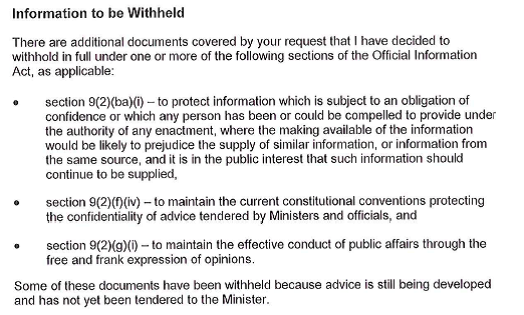
When the Bank originally withheld everything I requested they invoked a laundry list of excuses, including these two provisions of the OIA

9(2)(d) to protect the substantial economic interests of New Zealand.

9(2)(f)(iv) – to maintain the constitutional conventions for the time being which protect the confidentiality of advice tendered by Ministers of the Crown and officials.

The first excuse was always laughable, and has now disappeared.  But I was also interested that they are no longer invoking 9(2)(f)(iv).  In which case, why can we not see the advice the Bank did tender to the Minister on governance issues, and file notes of any discussions with the Minister on these issues?

It just isn’t good enough, but sadly it is par for the course with the Reserve Bank –  an organization in which the culture of secrecy has unfortunately become ingrained, beyond what is helpful, appropriate, or lawful.

In this case, it is doubly unfortunate because almost everyone –  perhaps with the exception of the current Minister –  thinks that changes should be made to the governance of the Reserve Bank.  Market economists canvassed by Treasury thought so, the Treasury itself thinks so, the Governor thinks so (unlike his predecessor who was strongly committed to the current model), Opposition parties appear to think so (the Greens certainly).

We have a system that was set up 27 years ago which (a)  doesn’t adequately deal with the range of issues the Bank is now responsible for, and actively wielding power over, (b) is out of step with international practice for monetary policy and financial regulation, and (c) is out of step with how we run other central government autonomous agencies in New Zealand.    Reasonable people can differ, perhaps quite strongly, on what the best alternative model might be. Personally, I think the Governor’s own preference is not at all the right response, and I laid out my alternative model here, but these are issues where we need good quality analysis from a range of perspectives, and some considered debate and discussion drawing not just on bureaucrats (inevitably skewed towards insider models) but on external analysts and, indeed, politicians.     These debates shouldn’t be about individuals –  Don Brash, Alan Bollard, Graeme Wheeler and any successors will all no doubt have strengths and weaknesses, and none walk on water –  but about the best institutional design for the governance of these important functions in New Zealand for the next few decades.  Openness on the analysis and advice already tendered would (should?) be a useful step to advancing the necessary discussion and debate.


A not very straightforward reversal by the Reserve Bank

Back on 27 August 2015, I wrote about the Reserve Bank’s refusal (having taken almost two months to consider the matter) to release anything material from the extensive work it had been doing on possible reforms to the governance of the Reserve Bank.

Somewhat frustrated by the obstructionism, I commented then

If the Official Information Act really provides protection for every single one of the papers covered by my request, including the titles of those papers, the Act is even more toothless than most had realised.  In fact, I suspect that this is a case of instititutional arrogance and over-reach by the Governor, who doesn’t really seem to regard himself as accountable to the public.  Perhaps the Governor is embarrassed, or frustrated, that the Minister of Finance or Treasury were not convinced by his particular arguments?  Perhaps he had staff simply look at one option, and ruled out of court any serious consideration of the wide range of options used internationally and elsewhere in the New Zealand public sector to govern powerful public agencies?  Whatever the explanation, he doesn’t want us to know.

And

As I’ve said previously, the Reserve Bank is much less transparent than it likes to make out.  This is just another example.  We’ll see whether the Ombudsman agrees with their interpretation of the Act.  Whether or not she does, this decision by the Governor is not the hallmark of an open and accountable public institution, committed to scrutiny and debate and to improving policy and institutions through the contest of ideas.

I had also requested information on any work on Reserve Bank governance from The Treasury.  With their accustomed more positive approach to the Official Information Act, they released a reasonable amount of material, which I wrote about here.  A paper dated 5 June 2015 confirmed (what I already knew) that the Reserve Bank work programme had ceased, and Treasury’s advice to the Minister (in a note on the Reserve Bank’s draft Statement of Intent) that work should be continued apparently went nowhere.

Several times since then, I have highlighted the Reserve Bank’s refusal to release any of the material on governance, despite it being a completed project.  I had lived in hope that one day the Ombudsman’s office would get to my complaint, and that the Bank might be compelled to release at least some of the material.

And then, out of the blue this afternoon, an email arrived from the Bank (apparently released simultaneously, and before I had even had a chance to read it, on the Bank’s website).  Here is the heart of their letter

At the time we responded to you in August 2015, we withheld information under section 9(2)(f)(iv) of the Act, on the basis that advice was being considered by the Minister and had been tendered to him.  In September, Associate Minister of Finance Steven Joyce told Parliament that the government had no plans to reform the governance structure of the Reserve Bank – meaning the advice to the Minister was no longer under active consideration. This is a change in circumstances that provides an opportunity for the Reserve Bank to revisit its decisions on your request. The Reserve Bank considers it now appropriate to release to you the following documents:

The Reserve Bank holds other information within the scope of your original request that we are continuing to withhold, as provided by the following sections of the Act, for the reasons described:

  • 9(2)(g)(i), to maintain the effective conduct of public affairs through the free and frank expression of opinions by or between or to members of an organisation or officers and employees of any department or organisation in the course of their duty;
  • 9(2)(h), to maintain legal professional privilege; and
  • 8(d) – the information is publicly available here – www.rbnz.govt.nz/research-and-publications/reserve-bank-bulletin/2014/rbb2014-77-01-02.

Back in September I had written about those comments from Steven Joyce, answering questions for the Minister of Finance from Greens spokesperson Julie Anne Genter.

I welcome the Bank’s change of heart.  But I doubt it is entirely sincere.  After all, it is now March, and the Associate Minister’s comments were made in September. I know the Reserve Bank is busy, but really…..   Moreover, they are not being straightforward in claiming that the matter had been under active consideration by ministers up to that point.  As the Treasury document, from June, already showed, the Bank had already ceased work on governance, and we can be pretty confident that cessation had occurred when the Minister of Finance had told them some time earlier still that he did not want to do anything about Reserve Bank governance. To reinforce the point, when they originally withheld all this material, back in August last year, they did not seek to invoke the argument that the material was under active consideration by the Minister (even though they included a laundry list of reasons for withholding).

I suspect the Ombudsman may finally have gotten round to investigating my complaint, and the Reserve Bank has decided to try to minimize its reputational losses by releasing this material now (and just prior to a long weekend etc), rather than wait for the Ombudsman to compel them to do so.  Even having done so, the Ombudsman will still have to decide on the other material which they have withheld.

I haven’t had a chance to read the papers the Bank has released.  They are all available at the link above.  I will probably write about the contents at some stage next week.

Meanwhile, Reserve Bank governance still needs reform, and  it is disappointing that the  current government has been so reluctant for the Treasury and the Reserve Bank to continue work on reforming an outdated model, that doesn’t align well with (a) the current functions of the Bank, (b) international practice in the governance of monetary policy and financial regulation, or (c) the governance of other entities in the New Zealand public sector.


Reforming Reserve Bank releases

I went into town this morning to talk to the Reserve Bank’s inquiry looking into the possible leak of last week’s OCR announcement (see last paragraph here).  I still have no idea whether there really was a leak, but it seems likely, and if so it seems likely to have come from one or other of the lock-ups the Bank runs, for analysts and for the media.

But the discussion this morning got me thinking again about some of the Reserve Bank’s processes around OCR decisions and Monetary Policy Statements. Insiders will recognize some old familiar arguments.

In many ways, it is remarkable that the Reserve Bank has not had an OCR leak, deliberate or inadvertent, before now (the memory of a couple of other earlier ones –  one deliberate and wilful, one inadvertent, are still seared in my memory).  As the Governor noted in his press conference last week, the decision to cut the OCR had been made the previous Friday –  six days before the announcement.  That delay is shorter than it used to be –  at one stage, the OCR decision was being made more than two weeks prior to release – but much much longer that it needs to be, or than is the typical practice in other countries.  In other countries, official interest rate decisions are typically announced within hours of the decision being made.  Draft news releases announcing the decision (and covering the range of possible options) must be part of the package of papers before the respective decision-making committees.

Delays have not always been that long in New Zealand. Prior to the introduction of the OCR in 1999, the Governor used to finalise any announcement on monetary policy (since we weren’t setting a specific interest rate, the announcements were more about the Bank’s overall take on things) at a 7:30am meeting in his office on the morning of the release of the Monetary Policy Statement.

The long lag between the Governor taking the OCR decision and the release of that decision arises solely because the Reserve Bank has chosen to release, four times a year, Monetary Policy Statements at exactly the same time as the OCR announcement (in fact the OCR announcement on these occasions is chapter one of the Monetary Policy Statement).  Long documents take much longer to finalise than one page OCR announcements do.

But there is no need for the two documents to be so intertwined.  Other central banks typically don’t do it that way.  In fact, in law, the Reserve Bank only has to publish two MPSs a year.    And, frankly, the MPSs (which are shorter than they used to be) often don’t add very much beyond what was in press release –  or certainly not much that couldn’t wait for a few days.  I’d favour the Bank moving to a system of monthly OCR reviews (well, 11 months a year), making the announcement the day the decision is made, and moving to publish two, or at most three, Monetary Policy Statements a year, not tied to the date of any particular OCR announcement.  On the one hand, it would improve security and markedly reduce the opportunity for inadvertent leaks, and on the other it might encourage the MPSs to become vehicles for more substantial background analysis and evaluation, along the lines of what the statutory provisions seems to envisage.

The counter-argument, of course, is that monetary policy is forecast-based, and so we need to see the forecasts to make sense of the policy.  It is fine argument in principle, but bears little relationship to reality.  Mostly, central banks respond to the immediate flow of data.  Yes, those data have implications for what happens in future, but almost all the information is typically in the initial revision of view –  about where things are right now, or perhaps a few months ago.  And, of course, as anyone who has been inside these processes knows, the forecasts are often adjusted to reflected the Governor’s priors about policy and policy messaging (the stuff dealt with in a couple of paragraphs in the press release).  That isn’t a criticism –  we know so little about the future that I think it is mostly right, proper and sensible as an approach.  But a full set of forecasts, and all the commentary that goes with them just isn’t necessary for the policy messages to be got across effectively. In fact, often less text is better than more on a policy announcement day –  there is less chance of inadvertent differences of emphasis etc.

My other suggestion is to consider discontinuing lockups.    Other central banks typically (as far as I know) don’t do them: they put the policy announcement out in the public domain, including as much or as little elaboration in the statement as the occasion warrants, and leave it to analysts and markets to work it out for themselves (sometimes with the benefit of later, open, press conferences).

There is case for lock-ups for some sorts of releases.  Government budgets seem like a reasonable example, when there is a multitude of announcements, often of complex unfamiliar material.  Or the release of major in-depth reports on some specialized aspect of government (which might be hard to report well, but perhaps not very market-sensitive).  It isn’t obvious that OCR announcements fit that bill.

Of course, the Bank does not typically do lockups for the OCR announcements that don’t come as part of Monetary Policy Statements, suggesting that –  in principle at least –  the Bank agrees that OCR announcements don’t need lockups.  The lockups must be for the rest of the MPS documents.  But they are quite familiar in structure and content, and little of the content is particularly complex or unfamiliar.

The Bank’s lock-ups come with two sets of risks.  The first is the risk of leaks.  The information in OCR announcements is enormously market sensitive –  look at how much and how quickly the exchange rate moved on last week’s announcement, creating a huge incentive for someone to try to cheat.  40 years ago it might have easy to secure people in an ordinary room, with no risk of them being able to communicate with outsiders.  Central bankers weren’t at much of a disadvantage in managing those who might want to cheat.  It is hard to believe that the playing field is quite so level these days, with all the advances in technology, including very small scale technology.   At least while I was at the Bank, the analysts’ lock-up used to occur in a room in which people could be seen quite easily from neighbouring apartments (other clever ways of signaling, getting round the rules, were covered in this recent New Yorker article –  more, outside fiction, than I had ever read about bridge).  Perhaps no one ever abused the systems, but why take the chance that someone one day finds (or just exploits) a way around the Bank’s precautions?       Perhaps they did last week.

The second risk, and perhaps more often practically important, is that the lock-ups are not just occasions when people are shut in a room with a document and left to digest it.  In these lock-ups staff, often quite senior staff, are available to answer questions and offer clarifying comments.  There is often plenty of ambiguity around Reserve Bank statements –  it isn’t like the specifics of a technical Budget announcement  –  and that creates the risk that attendees of a lock-up get information on the Bank’s views and interpretations that isn’t available to everyone else, or that people get slightly different messages depending on who they happen to talk to in the lock-ups.

It is quite valid for the Reserve Bank to have messages it wants to convey with OCR releases.  Those messages should be written down –  debated and refined internally as required –  and then be available to everyone. Further comment shouldn’t really be necessary, but if it is necessary or desirable to have occasional press conferences then at least (as the Bank does) they can be audible/visible to all (via the webcast).

On another, different, Reserve Bank topic, I was talking the other day to a business person who had been visited by Reserve Bank staff on their regular business visits, gathering conjunctural information.  This person told me that he had asked the staff whether the Bank was doing any work on reforming the governance of the institution. The staff apparently responded that they were doing so.

If this report is accurate it is quite newsworthy.  Previous reports had led us to believe that the Bank had done extensive work on possible governance reforms, but had completed the project.  They would not release any of the papers relating to the work.  Information that The Treasury released a few months ago confirmed that the Bank’s work has been discontinued, and that the Minister of Finance had indicated (against Treasury’s preferences) that he did not want work in that area continued with.  Perhaps some journalist might care to ask the Bank whether this report is accurate, and whether they do have work underway on governance reforms.  If they do, and if the Minister is becoming more interested, that would be very welcome news.   But perhaps some young economist just had the wrong end of the stick, or misinterpreted the question?

English on the PTA

Some interesting comments from Bill English on inflation and the Policy Targets Agreement appeared in the media over the weekend.

The lead comment was

Finance Minister Bill English says he’s willing to wait for next year’s review of the Reserve Bank’s policy targets agreement (PTA) to consider whether it is still appropriate in a global economy where inflationary pressures have dissipated.

That seems appropriate.  We have a statutory structure which provides normally for five-year PTAs.  That provides reliable guidance to the Reserve Bank and some predictability for the rest of us.  We don’t have to worry that whenever people get a little uncomfortable about the inflation numbers, the target will be revised up, or down, on the fly.  The Reserve Bank should just get on and meet the target, whatever it is at the time.

And, as it happens, it is only 18 months now until the Governor’s term expires.  (Of course, one of the downsides of the current structure is that the Governor will soon be making monetary policy decisions, the full effects of which on inflation will not be apparent until after his term has expired.)

The Minister also noted

English said he was reluctant to prejudge the outcome of the review, which would include advice from the Treasury, but noted he hadn’t seen any compelling argument that the agreement itself could change or any particularly coherent alternative.

I don’t myself favour material change to the PTA, although I think that coherent arguments can be made for a variety of possible alternative approaches.  I doubt that a different way of specifying the target would have made much difference either during the boom years when the Reserve Bank had monetary policy too loose, or over the last few years when policy has been too tight.  The mistakes and misjudgements over the years have been either forecasting ones, or ones reflecting the private preferences of the successive Reserve Bank Governors –  probably mostly some combination of the two.

The Minister goes on to note that

“I think they’re in some challenging territory. We’ve got an agreement in place and we’re happy that they’re acting consistent with the agreement. We are not trying to second guess the decisions the governor should make.

Again, if we are going to have an operationally independent central bank in respect of monetary policy, ministers generally shouldn’t be trying to “second guess” or put pressure on the Governor.  Except, that is, to fulfil the PTA – or “do his job”.

The New Zealand system is relatively unusual in providing such a prominent structured role for the Minister of Finance not just in setting a target for the Reserve Bank, and having  responsibility for ensuring that the Bank meets the target.   The Bank isn’t meeting the target, and has not done so for some years.

The Minister claims that the Bank is “acting consistent with” the PTA.  It is shame that the journalists behind the story didn’t ask the Minister more specifically what he meant.  I suspect the Governor really would like to see inflation a bit higher than it is, and core inflation (reflected in a range of measures) might still be just inside the target zone.  Of course, the forecasts always show inflation heading back towards 2 per cent, sometimes rather slowly.  It is just that actual inflation –  even stripping out oil prices, tobacco taxes, ACC levies and so on –  just hasn’t done so.  A proper assessment of the Governor’s performance would surely require not just a judgement about the Bank’s intentions, but about their competence and their actions.  If we delegate a major function of public policy to an unelected technocrat and his staff advisers, we should expect a very high level of technical capability to be on display.  Year after year of missing the target doesn’t suggest they have been meeting that standard.  They neither seem to adequately understand what is going on, nor to have been willing or able to adjust for their (widely shared) difficulties in how they run monetary policy.   When you market yourselves as the technical experts, backed by a high level of public resources, the performance standard has to be higher than if, say, a mere elected politician had been making the interest rate decisions.

In fact, I think what the whole experience is highlighting again is the unrealism around the Reserve Bank governance model.  The idea was to make a single individual responsible for a clear and specific target, and to dismiss that individual if he or she missed the target.  It was never a realistic approach, at least if one wanted a reasonably sensible monetary policy.  That had already become apparent under Don Brash’s term, but the point has been reinforced in the last decade.

Under Alan Bollard the Reserve Bank consistently ran with monetary policy that was too loose to be consistent with the PTA –  through a combination of technocratic forecasting errors, and gubernatorial preferences (a great deal of angst about the tradables sector).  There was no serious pressure on the Governor to operate in a way more consistent with the target, and if anything the political pressure –  at the height of one of the bigger booms in our modern history –  was for easier policy not tighter.  And yet the Minister of Finance was the one responsible for the Governor’s performance relative to the PTA.

And in recent years the Reserve Bank has undershot its target –  a failure made more obvious by the explicit addition of the midpoint reference to the PTA in 2012.  It has been some combination of technocratic forecasting errors and gubernatorial preferences (a great deal of angst about the Auckland housing market –  or on a bad day, about specific suburbs in Hamilton or Tauranga).   There has been no serious pressure on the Governor to operate in a way more consistent with the target –  not even, we are led to believe, from the Bank’s Board – even though the unemployment rate has lingered uncomfortably high and the growth performance of the economy, in per capita terms, has been poor at best.  The Minister of Finance is the one responsible for ensuring the Governor’s performance relative to the PTA, and yet (at least while the polls run strongly) the Minister has no obvious incentive to suggest there is anything wrong or disappointing about New Zealand’s economic performance.

My point here is not mainly to criticize the Minister.  I don’t think he  –  or his Board – is really operating as the Act envisaged, but mostly that is a reflection of the unrealism of the statutory provisions.  Our Act gives a huge amount of power to a single unelected individual on the assumption that a high level of effective accountability is possible.  History suggests it is not possible.  There is too much imprecision, and any concerns too quickly become personalized.   We would be better off with an alternative governance model –  a more internationally conventional one –  in which less emphasis was placed on the ability to dismiss an individual, or more emphasis was placed on spreading and sharing the power that is delegated to an unelected body.  It would be less ambitious than what we have now, but more realistic –  offering more ongoing effective scrutiny, with less high stakes emphasis on a single person (strengths, preferences, failures and so on).   In my model, we’d have a Monetary Policy Committee, appointed by the Minister of Finance, with members subject to hearings before the Finance and Expenditure Committee before taking up their position, serviced by technical experts from the staff of the Reserve Bank, with stronger effective statutory transparency provisions, and with the Secretary to the Treasury as an ex officio (perhaps non-voting) member, would be a much better way forward.  It would complement a Financial Policy Committee responsible for the regulatory and financial stability functions.

A model of this sort would not give us perfect monetary policy –  perfection is a useless standard in almost any area of public life –  but it would better reflect what we now understand about monetary policy, and effective accountability, than the current 1989 provisions do.

Finally, I noticed that the Minister talked about how the review of the PTA next year would ‘include advice from Treasury”.  That is all very well and good.  But the Policy Targets Agreement is the major instrument articulating how short-term macroeconomic management should be conducted in New Zealand over the following five years.  These reviews have typically been conducted with a totally unnecessary and inappropriate degree of secrecy, both before and after the event (recall the Reserve Bank’s refusal to release material relating to the 2012 PTA).  As I noted earlier, I don’t favour material changes in the PTA, but the Minister might be more likely to be exposed to arguments or evidence for a different approach if he opened up the process to wider input beyond just the Reserve Bank and the Treasury.  Governments and government agencies engage in public consultative processes on all manner of regulatory and related issues, most of which are no more important that the monetary policy regime.  If the Canadians can run a fairly open process, producing and scrutinizing relevant research, it isn’t obvious why we can’t.  As the current Policy Targets Agreement expires just more than three years since the last election –  and the political consensus around monetary policy is no longer strong –  the sooner such a process was got underway the more likely it is that it would produce something offering persuasive insights, rather than the merely partisan.


A non-New Zealander as Governor?

The Australian newspaper ran an article yesterday on the appointment of a new Governor to the Reserve Bank of Australia.  Glenn Stevens’ term expires in September.  As it now March, I was a little surprised to read that

A spokesman for current Treasurer Scott Morrison said ….that the specific process for choosing the new governor was still under consideration.

But perhaps that just reflects the overwhelming expectation that the highly-regarded Deputy Governor, Phil Lowe, will get the job.

The Reserve Bank of Australia has had a long history of Governors appointed from within –  in its (fairly short) history, only one Governor was appointed from outside (Bernie Fraser who moved from being Secretary to the Treasury).  But the article explored the possibility that the Treasurer could look outside the Bank, or even abroad, for a replacement for Stevens.

Even allowing for the recent appointment of an expatriate Australian banker as Secretary to the Treasury, it seems pretty unlikely that the Treasurer would do much more than take a cursory look at possible candidates other than Lowe.   If the Reserve Bank of Australia has perhaps been inclined to be excessively upbeat in recent years, it is not obvious that the Bank’s conduct of affairs has been so egregiously wrong –  or upsetting to the government – that it would make sense to reach beyond the pretty deep bench of senior officials that the RBA has maintained over the years.

As the article notes, the appointment of a foreigner to a role as central bank Governor is not unknown –  Mark Carney at the Bank of England at present, and Stan Fischer at the Bank of Israel are two I can think of – but it isn’t at all common in stable and advanced countries.  (New Zealand’s former Deputy Governor Peter Nicholl served as head as Bosnia’s central bank in the aftermath of the civil war in the 1990s).

When inflation targeting was young, and there was a strong belief that it would be easy to hold a Governor to account, there was a view in some circles that it might even be best to get a foreigner as Governor –  after all, the world labout market was so much deeper than that here in New Zealand, and since it was all very technical and the target was well-specified, the only thing that really mattered was technical expertise (perhaps even more than good judgement).

But no one looks at it quite that way now.  It is widely accepted that central banks excess a considerable degree of discretion.  That is so whether they are inflation targeting, nominal GDP targeting, wage targeting –  in fact, anything other than a fixed exchange rate, or Friedman’s fixed money base target rule.  There is considerable discretion, limited effective accountability, and the discretion is in areas of activity that matter to many people (ie the entire economy and financial system).  In that sort of climate it seems reasonable that people would prefer to be governed, or administered, by people from their own country.  No matter how capable other candidates might be, we don’t consider allowing people from abroad to become MPs or Cabinet ministers –  at least not until they have lived here for a few years and become citizens themselves.  It isn’t that all New Zealanders, or all Australians or all Americans, share the same values or views, simply a slightly inchoate but deep-seated sense that we should govern ourselves.  Part of it perhaps is that in any of those roles –  senior political ones, or powerful independent bureaucrats – the ability to explain oneself to the citizenry is a key aspect of the job, and that involves the ability to draw on common reference points, shared experiences etc.

In the Reserve Bank of Australia case, one could mount an argument that these issues are less compelling.  After all, the Governor is chief executive of the Bank and chair of the Board, but he doesn’t get to appoint the Board, and he isn’t a single decision-maker.  Interest rate decisions – the main decisions the Reserve Bank of Australia makes – are made by an outside Board appointed by the elected government.  Even the Deputy Governor is directly appointed by the Treasurer and sits, as of right, on the Board.

But what about New Zealand?

Here the formal process for appointing a Governor is laid out in the Act. The Reserve Bank Board nominates a candidate, whom the Minister of Finance can accept or reject.  If the Minister rejects that nomination, the Board must come up with another one.  The process can go as many rounds as it takes, but at no point can the Minister just impose his or her preferred candidate.  Personally, I think that is a weakness of our system –  it is unusual to give the Minister of Finance so little so in the appointment of such a powerful official.  Ours is a system where, formally, all the powers vest in the Governor personally, so the Minister of Finance also has no say in the appointment of any of the other senior officials of the Bank.

And compared to most central banks, the Reserve Bank of New Zealand exercises a large amount of discretionary powers in a wide range of areas.  In addition to monetary policy, the Governor has considerable autonomy in setting prudential regulatory policy (and the application of that policy), in foreign exchange rate intervention, in payment system operations, and in the physical currency.  On each individual limb, other central banks can be found that do what our Reserve Bank does, but take as a whole it would be difficult to find any central bank which (a) covers so many functions, (b) has so many powers formally delegated to the Bank, and (c) where all those functions vest with a single individual, the Governor.  It is a role at least as powerful as that of most Cabinet ministers – partly because of the actual powers the Governor wields, and partly because of how much more difficult it is to get rid of a person if they mess up (compare, say, Judith Collins and Nick Smith, as two senior ministers in the current government to have been dismissed when they erred).

As the Reserve Bank Board and the Minister approach the end of Graeme Wheeler’s term next September, there must be a temptation to consider overseas candidates.  After all, the current deputy chief executive will be in his mid 60s, a similar age to Wheeler, and was passed over when he sought to become Governor last time.  None of the other internal senior managers look like outstanding candidates –  and it was 1982 when an internal candidate was last appointed Governor (itself a pretty internationally unusual statistic).  Outside the Bank, the list of plausible contenders in New Zealand doesn’t seem overly deep either – and for almost all the names I’ve heard suggested I can think of material arguments against.

But I think it would still be a mistake to go global.  Some aspects of the role could be done by any able person –  revitalising, for example, the Bank’s research and analysis across the range of its policy functions.  That is partly just about good second and third tier appointments, and partly about being a voracious customer for the insights that analysis throws up .  But the role also needs someone who understand the New Zealand economy, the New Zealand system of governance, and someone who understands the New Zealand financial system.  And it needs someone who is comfortable, and credible, in telling the Bank’s story – and sometimes it will be a controversial or difficult story –  to New Zealand audiences.  Plenty of people criticized Don Brash over the years, but few doubted that his heart was in this country, and that its best interests were his priority.  In a small country, with a foreign-dominated financial sector, a very powerful central bank, and ongoing controversy about the role of monetary policy and New Zealand’s economic performance, it is hard to imagine any foreign appointee successfully filling the bill.

Of course, it might be a little easier if the governance of the Bank was reformed.  For example, in a system in which the Governor was chief executive, but had no more voting rights on monetary policy or financial regulation policy matters than others members of the respective committees, the stakes are a little lower.  But even then, I think such governance reform more appropriately opens the way to the appointment, from time to time, of a foreign expert as a member of one or other of the voting committees.  Since the Bank of England’s nine-person Monetary Policy Committee was established by legislation almost 20 years ago it has not been uncommon to have a foreigner sitting on that committee. In a New Zealand context, supplementing local expertise with outside perspectives in that way could have some appeal – if New Zealand government board fees were sufficient to attract quality candidates –  but we are still likely to be best, in all but the most exceptional circumstances, to look for a Governor from home –  as we do when we choose ministers, judges, (and these days Governors-General), military chiefs and so on.

As I’ve noted before, the next gubernatorial appointment is in any case complicated by the timing of next year’s election.  Graeme Wheeler’s term expires just beyond three years since the last election, and most of the opposition parties have been campaigning on changes to the monetary policy framework.  If they are serious about reforms, they are also likely to revisit the governance arrangements, to shift towards a model that is (a) more internationally conventional, and (b) more in line with how we govern other independent government agencies in New Zealand.  The current government would no doubt be within its legal rights to make an early appointment for the whole of a new five year term (having obtained a suitable recommendation from the Bank’s Board –  all of whom have been appointed, or reappointed, by the current Governor).  But given the timing it would seem an inappropriate use of power, that could materially complicate relations between the Bank and a future government.  Somewhat reluctantly, I think Graeme Wheeler should be asked to stay on for an additional year or so, allowing whichever party forms the next government to appoint a Governor to work with whatever model of monetary policy and central bank governance emerges from the electoral process.

The Treasury on Reserve Bank governance

Regular readers will know that one of the constants of this blog has been making the case for reforming, and modernising, the governance of the Reserve Bank.  The current model is out of step with international practice, and with the way other government agencies are run in New Zealand.   I’ve held this view for a long time, although the concerns are becoming more pressing as the Reserve Bank assumes, and is given, ever more discretionary power.     The current Governor is probably in the wrong job  (a huge role, making the holder probably the most powerful unelected person in New Zealand).  But the case for reform would be strong even if we had the best conceivable person as Governor.  Typically, we will have someone who is about average.

There has been a growing recognition of the case for change.  In 2012 The Treasury recommended to the Minister of Finance, before the current Governor was appointed, that further work be undertaken with a view towards moving to a committee-based decision-making framework.  At the time they found that most market economists were sympathetic to change.  At a political level, the Green Party has openly and repeatedly argued for change, while the Labour Party has come and gone on the issue.  But it isn’t an obviously ideological issue –  just a matter of finding a good governance model for an increasingly powerful New Zealand policy agency.

Graeme Wheeler himself recognised some of the weaknesses of the current system, and established the Governing Committee as the forum in which major decisions would be made.  He retains the legal power, and all the other members of the committee owe their positions, and remuneration, to the Governor, but in principle it represented a small step forward.  Whether it represents any real gain is impossible for outsiders to tell.  The Bank has flatly refused to release minutes of the meetings of the Committee, on any topic whatever, and –  in truth –  governance arrangements are really only tested in times of stress, and where there might be strong differences of view. Quasi-insiders –  the Bank’s Board –  could provide us with an assessment of how the new model is working, but their Annual Reports suggest that they are more interested in being champions of the Governor and the Bank rather than in providing substantive reports analysing and scrutinising the performance of the Governor and Bank.

The Bank has also refused to release any papers from its own work on reforming the governance model.  That refusal confirmed that a substantial amount of work had been done, at least some of which had been discussed with the Minister of Finance.

Fortunately, the Treasury generally takes a more accommodative approach to Official Information Act requests.  There are plenty of things about The Treasury that I am critical of, but they seem over the years to have displayed considerably more respect for the spirit of the Official Information Act and its role in New Zealand’s system of governance.  When the Reserve Bank refused my request for governance papers, I lodged a very similar request with The Treasury.

Yesterday, they released several papers, which are available here.

Treasury governance papers OIA response

There are a couple of nice and substantive background papers.  Some are focused just on monetary policy governance, but Treasury also recognises that the Reserve Bank has a much wider range of functions, and hence that any review of the legislative governance model really needs to look at the entire institution and all its roles and responsibilities.

Treasury still appears to favour change.   In particular, in a June paper to the Minister of Finance, commenting on the Reserve Bank’s draft Statement of Intent (page 48 in the release document) they note:

A key change from the previous year’s SOI is that a workstream on “best practice institutional frameworks…has been dropped.  In the Treasury’s view, this workstream would be worth continuing.  Nevertheless, we understand that the decision to drop this workstream is consistent with your feedback that the current decision making structure best supports accountability.

Recommendation

Note that the RBNZ is discontinuing its workstream on “best practice institutional frameworks”.  The Treasury would prefer this workstream to continue.

They have withheld a variety of other documents.  I’m not sure quite what the first ground (below) means in this context –  perhaps information from foreign agencies? –  but what is interesting is that the statement declining to release the other documents reveals that Treasury is continuing its own work on the issue.

Tsy governance OIA

At one level, it is nice to finally have public confirmation of the fact that the Minister of Finance has again rejected reforming the governance of the Reserve Bank.  Treasury reports that this is because the Minister thinks a single decision-maker best supports accountability.  But hardly any other country agrees with Mr English, and none do so among those who have reformed their arrangements for the central bank and financial supervision activities in the last couple of decades.    And we don’t apply that model to any other area in public life in which government agencies are making policy decisions.   There is a strong case for change, and no doubt in time change will happen.   It is a shame that the Minister is clinging to an outdated model, which is not serving New Zealand that well.  But well done to the Treasury for continuing the background work in thinking through the issues and options,