How much should we rely on stress tests?

A commenter, Kelly, writes as follows:

Michael – is it necessarily true that the failure ( or lack thereof) of a bank stress test is the benchmark for assessing the worth and more specifically the legality ( in terms of consistency with the RBNZ’s act) of regulatory action? The relevant section of the Act says if I remember correctly that the Bank must use these powers for the purpose of ensuring the soundness and efficiency of the financial system. While the stress test results are one potential indicator they are not a necessary condition to justify regulatory action. Indeed I suspect that very little prudential regulation might be justified if this were the case. Stress tests are indicators of what might happen given a number of important assumptions any of which may not be true in real life. Also stress tests almost always are calibrated to ensure banks pass them ( or else additional capital should be added by failed institutions). History shows that stress tests have a poor record at predicting financial crisis. I think many reasonable people would consider a large fall in Auckland house prices might challenge the stability of the financial system in NZ. It’s true that in some circumstances it might not but would you expect the Bank to bank on being that lucky? The spillovers to the rest of the country would potentially be great.

The Bank’s actions in this area are in step with the generally successful international experience with regional LVR type measures. I think that this alone makes it difficult to argue the Bank is acting in an ultra vires manner. The IMF’s advice in this area is that macro prudential measures can be employed assuming key macro policy settings are also supportive. Your stance on monetary policy settings thus seem further supportive of the Bank’s stance. Although I am sure that the government could be doing more to help as you point out.

I’ve always enjoyed debates with Kelly, and I thought it might be worth addressing a few of the points he makes:

  • The Reserve Bank Act (sec 68) requires that the regulatory powers in Part V of the Act be used (by the Governor General, the Minister, and the Bank, but here the Bank’s discretionary action is in focus) “for promoting the maintenance of a sound and efficient financial system”.  Note that it is not about “ensuring” such an outcome, and neither has a “sound” financial system ever been regarded as one in which no bank failed.
  • Kelly suggests that very little prudential regulation might be justified if stress tests were to be used a key indicator.  I don’t think that is right.  After all, the risks that the Reserve Bank and APRA assessed last year were those that existed given the current panoply of regulatory controls, including the earlier LVR restrictions.  In other words, some mix of market disciplines and regulatory measures had produced loan books which appeared to be pretty robust to some pretty severe shocks.  The issue here now is whether a case can be made, in terms of the Reserve Bank Act, for further, quite intrusive and quite unconventional, controls.   That case would have seemed much easier to make if the stress tests had produced results which appeared more threatening to the soundness of the financial system.
  • Kelly alludes to widespread scepticism about the use of stress tests by some regulatory and supervisory agencies.  It is certainly true that one would not expect a regulator to publish stress test results, particularly those undertaken in the midst of a financial crisis, suggesting that the financial system was in great danger without having first taken remedial action.    But context matters.  Clearly New Zealand and Australian banks are not in crisis now.  Moreover, the timing of the recent NZ stress test was determined by APRA, not by the Reserve Bank of New Zealand, and occurred at a time last year when, if anything, the Reserve Bank seemed to be looking at the possibility of winding back, or lifting, the avowedly “temporary” LVR restrictions.  When the results of the stress tests were published in the November 2014 FSR there was no hint of any undue concern about risky lending practices or region-specific controls.  In other words, even from outside, I think we can acquit the Reserve Bank of any suggestion that it undertook the stress tests with a particular end in mind.  Instead, they really wanted to assess the health of the New Zealand system, posed some deliberately searching test scenarios, and were pleasantly surprised by the results.
  • Stress tests aren’t the only possible measure of financial strength.  Indeed, in the day-to-day activity of prudential supervision they play a much less important role than regulatory capital requirements.  In fact, it is unease about the use of not-very-transparent, hard to evaluate, internal ratings-based models for calculating capital requirements that has encouraged many to put more weight on stress tests in recent years.   But in any case recall that New Zealand banks have high capital ratios by international standards, and that is so even when higher risk weights are applied to housing exposures than in is done by banks in many other advanced countries.
  • Kelly notes that “many reasonable people would consider a large fall in Auckland house prices might challenge the stability of the financial system in NZ”.  As a matter of description that is certainly true, but that is why, for example, stress tests are done and why, for example, Parliament mandated the publication of Financial Stability Reports. Those reports are supposed to enable us to better understand, and to assess, the risks and the Bank’s regulatory activities.   And I’m certainly not suggesting that New Zealand should rely on luck to get through an eventual house price adjustment (rather, high capital ratios, and slow growing balance sheets are what suggest pretty moderate risks)   Indeed, I was one of those who was a bit surprised when we saw the first stress test results.  I pushed and prodded, and wondered if they were missing something important.  Sunny optimism is not in my nature, but in the end I was persuaded.  There are no doubt some things the stress tests don’t fully capture –  the possibility of sustained deflation is one of those risks, but that can’t be the concern the Bank is relying on (since the word does not even appear in the FSR).  And frankly nor would I expect it to be at this stage.    It seems likely that the Governor does not really believe the stress tests, or the capital ratios.  There might well be a good reason for his doubts, but he owes it to us, and to Parliament (through FEC), to explain the nature of those doubts, and allow them to be scrutinised and challenged.  It isn’t enough –  given his Act –  simply to worry that Auckland prices are too high and might come down one day.   We particularly need to be able to scrutinise the Bank’s analysis given that it is a unelected single individual  –  with, frankly, not that much experience or background in these policy areas –  who is making these regulatory calls.
  • Finally, Kelly notes that “the Bank’s actions in this area are in step with the generally successful international experience with regional LVR type measures. I think that this alone makes it difficult to argue the Bank is acting in an ultra vires manner.”   There are at least two separate points here.  First, as a matter of law I’m not arguing that the Bank’s proposed new controls would necessarily be ultra vires.  Some others might.  I would argue simply that they are using the legislation for purposes Parliament never envisaged, which is not good for the legitimacy of policymaking, and that – at present – they have not met any sort of burden of proof regarding why such arbitrary restrictions on investment property lending (of the sort never before used in New Zealand, even under the Nash to Muldoon years) are either necessary or desirable to further enhance the soundness of the financial system, especially in face of the inevitable efficiency costs.  It is important to remember that whatever the preferences of the Governor, the Reserve Bank has been given powers by Parliament for the promotion of the “soundness and efficiency of the financial system”.  That is different from the mandates regulatory agencies in many other countries have.    Whatever other countries have done, the Reserve Bank must look primarily to its own legislation.   Second, Kelly suggests that Auckland-specific restrictions are in step with “generally successful international experience”.  I think that is wrong, at least in the sort of countries, market-based economies, and systems of government we typically like to compare ourselves with.  I’m not aware of regional-based banking regulatory controls in any of the other Anglo countries for example, or in the Nordic countries.

Perhaps all will become clear when the Reserve Bank releases its consultative document on the proposed new controls.  I certainly hope so.     But there is a lot to clarify.

The Reserve Bank stands by its stress tests

Last Saturday I highlighted the Reserve Bank’s response, via Herald columnist Mary Holm, to a reader’s concern about the possible impact of a 50% fall in house prices.  A Bank spokeswoman, speaking prior to the release of the Financial Stability Report and of the Bank’s proposed restriction on banks lending to investor property borrowers in Auckland, had expressed confidence in the ability of the financial system to withstand such a shock.

While I was happy to highlight those comments, I had wondered (and had mentioned the possibility to a couple of people) if it was just a case of the left hand not knowing what the right hand was doing –  perhaps the Governor had not been aware of what someone in his PR department had been saying.   That doubt was reinforced after I was told that at the Finance and Expenditure Committee hearing on the FSR the Governor had refused to engage on, or respond directly to, a question about the stress tests.

However, in today’s Mary Holm column another Reserve Bank spokesman was commenting. He is quoted as saying:

“We repeat our comments from last week that the Reserve Bank was generally satisfied with how banks managed their way through the impacts of two adverse economic scenarios in the 2014 bank stress tests, which included a scenario similar to what your reader describes.

“We are comfortable that the New Zealand financial system is capable of withstanding a major adverse event, such as a collapse by up to 50 per cent of the Auckland housing market.”

That is good to know.  It is not just a statement about last year, when the stress tests were done, but about the risks banks have on their books now.

But it just reinforces the question as to what possible basis, under its Act, the Reserve Bank can have for proposing to ban banks from lending a singe cent to anyone, secured on an Auckland investment property, above 70 per cent of the value of that property.    The Bank is required to use its regulatory powers to promote the soundness and efficiency of the financial system.  Efficiency will inevitably be impaired by the proposed restriction, and the Reserve Bank has just told us today that the system can cope with a fall in house prices as large as has been seen anywhere.

The Reserve Bank told us its consultation document would be published later this month.  That now leaves only the coming week.  We should look forward, with considerable interest and some scepticism, to the case they will make.

Dairy debt

I’ve had a couple of questions about risks around the dairy debt, and since the sector intrigues me – and my wife’s family has quite a few present or former dairy farmers – I dug around a little more.

The Reserve Bank publishes agricultural debt data monthly, but debt by agricultural sub-sector is only available annually, as at the end of each June.  Last June there was $34.5 billion of dairy farm debt.  In the year to the end of March 2015, agricultural debt grew by 6 per cent.  If that was representative of dairy, there will be around $36.5 billion of dairy farm debt by the end of this June.

As I noted last week, the rate at which new dairy debt has been taken on (and made available by lenders) has slowed markedly since around 2009.  Dairy debt grew at an average annual rate of 17 per cent from 2003 to 2009, and by around 4 per cent per annum in the six years since then.   Last week I showed the chart of dairy debt to total nominal GDP –  it rose sharply until 2009/10, and since then has fallen back a bit.

A commenter reasonably pointed out that nominal GDP (incomes of everyone in the country) doesn’t service dairy debt.  That is quite true –  although any aggregate debt ratios (except perhaps those involving government debt) have somewhat similar problems.  My household’s income isn’t servicing any mortgage debt either, and yet charts of household debt to GDP or to disposable income are quite common. And people who have debt are different, in a variety of ways, from people who don’t have debt.  For some purposes, these sorts of ratios are useful, but sometimes they can mislead.   Micro data are great when they are available –  and I commend the work the Reserve Bank has done in using the data that are available for dairy.  As everyone recognises, dairy debt is very unevenly distributed: plenty of farmers have no material debt at all, while others –  often the most aggressive and optimistic industry participants –  have huge amounts of debt.  A net $25 billion has been taken on in only 12 years.  Unsurprisingly, there were some nasty loan losses in the 2008/09 recesssion.

But sticking with aggregate measures, what about some other denominators?  This chart shows dairy debt as a percentage of annual dairy export receipts.

dairy2

The last observation is an estimate –  using the 6 per cent debt growth for the year to 2015, and assuming that the June quarter’s dairy export receipts bear the same relationship to the June quarter of 2014, as the March quarter of 2015 bore to the March quarter of 2014.  It will be wrong, but any error won’t materially affect the picture.  The stock of dairy debt this year will be just under 2.5 times the latest year’s dairy export receipts (industry sales, if you like).  Note that that is less than the average for the 12 years for which we have data.  That just reflects the fact that the fall in global commodity prices takes a while to feed into actual dairy export receipts.  On present trends –  including another fall in the GDT price yesterday – dairy receipts will fall a lot in the coming year, unless the exchange rate were to fall sharply.  But it is hard to envisage, at this stage, that the fall in dairy receipts will be enough to take the ratio of dairy debt to exports above the previous peak.  At a time when there was a lot of very new debt, reflecting exuberant attitudes among lenders and borrowers alike, that previous peak generated a nasty fall in rural land values, and some material losses for lenders, but no systemic threat.

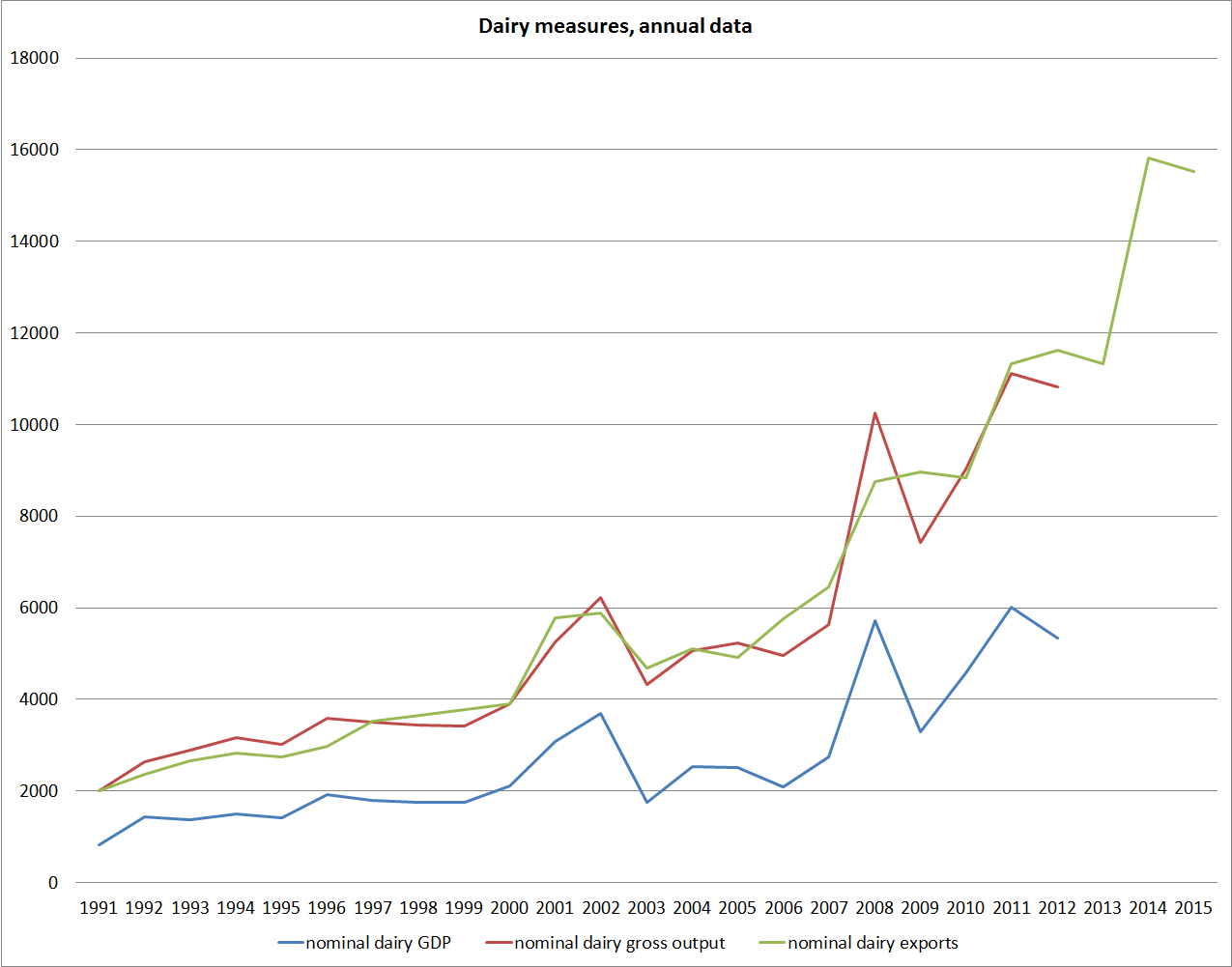
Statistics New Zealand produces annual data on the GDP and gross output of the dairy sector.  Unfortunately, it is only available with a considerable lag.  Fortunately, dairy export data and dairy sector gross output data line up quite well.

dairy3

When the data are available, we will no doubt see that dairy sector gross output and GDP rose quite sharply over the last couple of years.  The year to March 2015 will no doubt be a record high (in as much as record levels of nominal variables mean very much).  And then it is likely to fall back.  But again, on international dairy prices as they stand now, and the exchange rate as it is, it seems unlikely that nominal gross output or GDP for the dairy sector will fall much below the previous peaks – $10 billion gross output, and $6 billion of GDP.  If so, again it is difficult to see where material banking system stresses could arise from –  even though it will no doubt see some more exits, and quite a bit of nervous hand-holding by the banks.

It is worth briefly reflecting on the $6 billion of dairy GDP.  That does mean that dairy farmers on average have $6 of debt for every $1 of GDP they generate –  and among the indebted farmers that ratio will be much much higher.   That would be much higher than the ratio of household sector debt to household sector income, but then much of the household debt is supporting consumption not production.

So what could go really wrong?  The usual story around dairy debt is that if New Zealand’s export commodity prices collapse then the exchange rate should also be expected to fall sharply, mitigating the adverse impact on New Zealand dollar prices, and probably on local rural land values too.  That hasn’t happened so far.  There are some obvious reasons, including the  Reserve Bank choice to hold policy interest rates above the level that was required to have kept inflation on target.  And weak as dairy prices are now, our overall terms of trade still don’t look likely to fall to any sort of historically low level this year.   But if global dairy prices don’t fall much further, and the exchange rate hangs around current levels, or falls, there isn’t likely to be any systemic threat arising from the dairy debt.  The nightmare scenario is one in which, for some reason, the exchange rate rises sharply from here, even as commodity prices stay weak.   One possible scenario we toyed with a couple of years ago was a very disruptive new euro-area crisis, in which somehow currencies like the NZD and AUD became seen as some sort of refuge in the storm.    It isn’t likely, but then tail risks matter.  The experience of 2008/09 also argues against it: then both the NZD and AUD fell very sharply as speculative risk appetite unwound, even though the crisis had nothing directly to do with our two economies. It would seem likely that, eg, a disorderly break-up of the euro would be at least as large a trigger for hunkering down, and a  quick flight to safety, that didn’t involve a surging NZD TWI.

I noted last week that deflation remained the biggest (if remote) medium-term threat to the stability of the New Zealand financial system, as its loan books are structured currently (debt ratios pretty flat, debt stocks growing slowly).   But the dairy sector debt should be relatively immune to that threat.  I think it is pretty common ground that if the OCR were ever cut to zero, or slightly negative, the NZD TWI would fall sharply,  The main attraction in holding NZD assets over the years has been yield pick-up, and when that vanished-  as it did in 2000, when the Fed funds rate briefly matched the OCR –  so does any strength in the NZ exchange rate.  Of course, during the Great Depression deflation did pose huge problems for New Zealand’s farm debt, but getting a downward adjustment in the exchange rate then was a much more difficult and political process.  The then Minister of Finance resigned in protest when the government finally imposed a devaluation –  these days if things went badly a sharp fall in the exchange rate would seem much more likely to be welcomed.

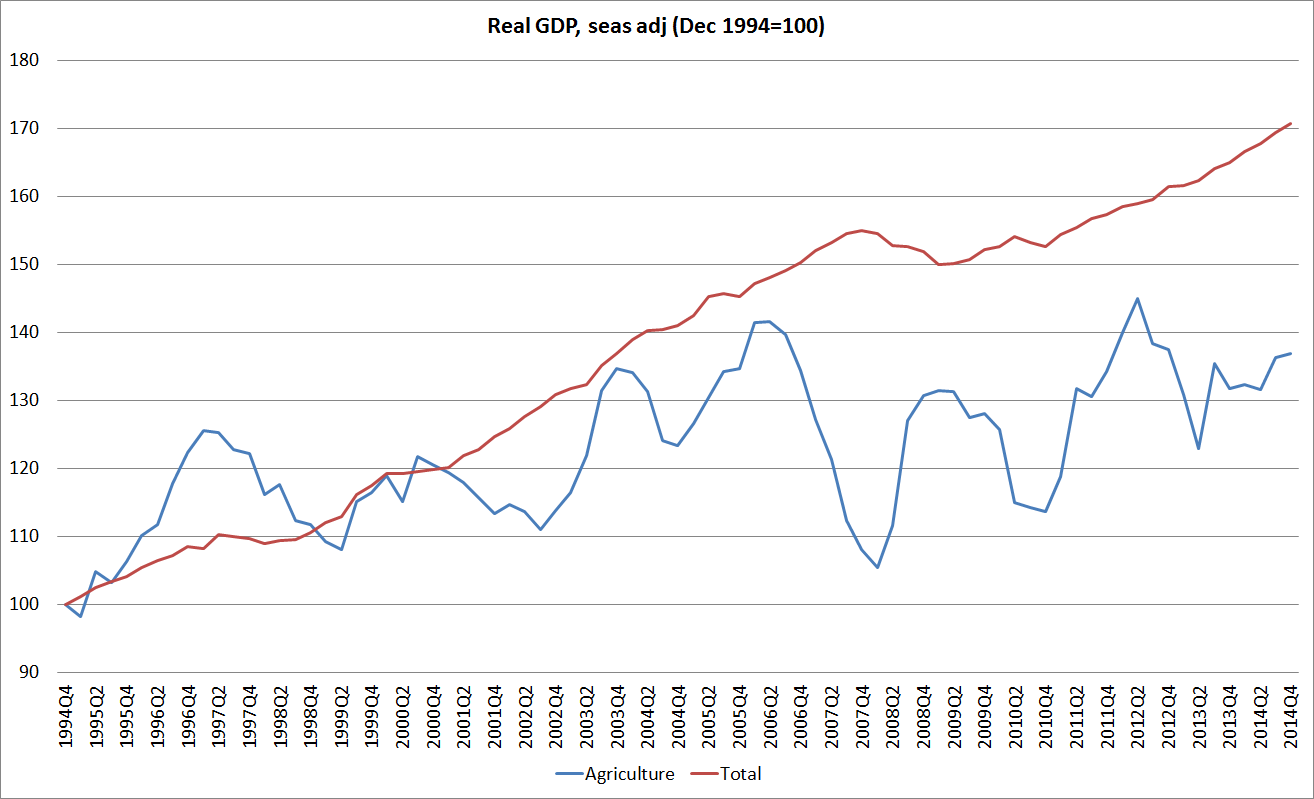
And, finally, one of the more sobering graphs I’ve seen in recent years ( there are many to choose from).  This is real agricultural sector GDP, which is available quarterly (albeit prone to considerable revisions), shown alongside total real GDP.

ag gdp

There is quite a bit of variability of course  – droughts etc  – and this is the whole agricultural sector, not just dairy, but over the 10 years or so that the terms of trade have been strong there has been almost no growth at all in real agricultural sector GDP.  Representatives of the manufacturing sector are prone to lament how manufacturing activity has been squeezed out, but actually even farm sector GDP has been tracking well below growth in total real GDP.   In some respects, things might be a little better than the picture suggests.  High dairy prices have encouraged greater use of more intensive production systems –  more irrigation and more supplementary feed.  Those inputs allow the production of more outputs, and the outputs can be sold for a higher price than previously.  In other words, more money might be being made in dairying, even if the real (constant price) value-added in the diary sector hasn’t changed much.  Ultimately it reflects the fact that there has not been much business investment taking place in recent years in response to the higher terms of trade – a very different picture from what was seen in Australia.  If commodity prices settle back at pre-boom levels that may be no bad thing[1] –  fewer wasted resources –  but if, as the optimists believe, the long-term prospects for global agriculture, and the sorts of products New Zealand produces in particular, are very good then it might end up looking like something of a last opportunity.   Daan Steenkamp wrote up some of this material at more length in a Reserve Bank Analytical Note last year.

Nasty financial crises usually follow fairly hard on the heels of periods of exuberance –  surging asset prices, surging credit stocks, downward revisions in credit standards, and so on.  In respect of dairy, all of those things were present in 2008, but they haven’t been in the last couple of years.  That suggests that the systemic risks associated with the high level of dairy debt are low.  Yes, an overhang of high debt stocks could still cause severe problems if a particularly unusual set of circumstances were to arise –  there is always a hypothetical shock which could, in the extreme, prove too much for an indebted industry – but that is simply to say that all business, in a competitive market economy, involves taking risk.  As consumers, we should not want it any other way.

[1] And the dairy component of the ANZ Commodity Price Index (expressed in USD terms) is now only around 10% higher in real terms than it was when the series began in 1986.

Yet another policy lurch

Having now read the Financial Stability Report, and listened to the Governor’s press conference, I was surprised by the poor quality of the Report and of the policy that it discusses.  The FSR is supposed to contain material to enable us to assess the effectiveness of their use of their powers (here and here).  This one just does not.

Policy seems to be lurching from one intervention to the next, without any compelling analytical framework or evidence.  There also appears to be little sign of any historical memory.

For example, only six months ago the Bank was reporting the results of its own stress tests, which suggested that the major New Zealand banks (and presumably the financial system) were resilient to even very severe shocks to asset prices and servicing capacity.  And yet, despite announcing its intention to impose yet more, quite invasive, controls on bank lending to one sector of SMEs, there was no reference at all to this assessment and experience.  Perhaps the Bank does not believe the results of the stress tests, but if not surely they it owe it to us to explain why.  .

Similarly, the Bank laments that investors have become a larger share of property purchasers in Auckland (what is the “right” or “appropriate” share, and where is the “model” to determine that, we might reasonably ask them) but they don’t seem to see any connection between the imposition of the first LVR speed limit 18 months ago –  which will have borne most heavily first-home buyers, who have always been those who relied most heavily on debt finance –  and the greater presence of investors in the market.  At the time their own analysis and modelling (eg see chart on page 9) made the point that potential buyers who were displaced would, over time, be replaced by other buyers.  Their modelling also showed that the most that could be expected of the speed limit was a dip in house price inflation for a year or so, which would then be reversed as the new buyers entered the market.

If amnesia is a problem, so apparently is schizophrenia.  On the one hand, the FSR and the press release tell us that “New Zealand’s financial system is sound and operating effectively”, but on the other hand they apparently think that banks are operating so recklessly that not a single Auckland investor purchaser should be able to take a loan of over 70 per cent of the value of the property, no matter how sound a proposition that borrower might otherwise appear to his/her lender (including their flow servicing capacity).    Continuing the theme of an institution that can’t quite make up its mind – or perhaps doesn’t want to scare the investor horses, but wants cover for yet more regulatory interventions – the Governor told us in the press conference that he was becoming seriously concerned about financial stability risks.  If so, perhaps the first sentence of the Report should have been written somewhat differently.

The Bank also doesn’t seem to display much regard for good process.  It is going to produce a consultative document shortly on its proposals to restrict investor loans in Auckland (which I hope will have much more substantive justification for the proposed policy than is in the FSR), and yet it ‘‘expects banks to observe the spirit of the restrictions” now.  “Consultation” is supposed to have substantive meaning, and not just around the fine details of the regulations.  Is the Reserve Bank open to countervailing arguments, or has it already made up its mind and just going through the motions?  If the latter, it might leave itself exposed to the risk of someone seeking judicial review.

The Bank blunders in with these policies, each no doubt well-intentioned, but with little apparent recognition of the way that its actions affect real people, their lives and their businesses.  18 months ago a nationwide LVR speed limit was put in place, apparently because the Bank thought that house price inflation and associated credit growth was going to become a widespread problem.  If the Bank was omniscient it might be one thing, but they were simply wrong.   Ordinary house-buyers in Invercargill or Wanganui had to delay purchasing a house because of a mistaken Reserve Bank hunch.  And these weren’t measures that were ever necessary –  by contrast there will always be an interest rate in an economy –  since large capital buffers were already in place.  And in Auckland, the Reserve Bank’s earlier policy won’t have materially adversely affected those from upper income families, where parental support will have helped young people get around the 80 per cent limit.  But what about those without wealthier parents, who are surely disproportionately Maori and Pacific? There was no hint of that distributive impact in the Regulatory Impact Statement for the earlier restriction.    In Auckland the earlier restriction provided cheaper entry levels for the lucky (those who got inside the speed limit), the wealthy, investors, and cashed-up purchasers.  Is that good public policy?

Who will be adversely affected and who will benefit this time?  One group that springs to mind who might benefit are the fabled offshore investors.  No one has any good idea how many of these people there are, but as Grant Spencer acknowledged in the press conference his regulatory restrictions won’t bear on them.   From a financial stability perspective that might not matter to the Reserve Bank, but I suspect that to voters it will.  First penalise first home buyers. Then penalise people looking to build a rental property business (and perhaps those who rent from them).  And who will that leave?  The middle-aged cashed-up purchasers, and any offshore purchasers.  It doesn’t look fair, it doesn’t look like a reasonable use of Reserve Bank powers (when less intrusive instruments, such as risk weights and overall required capital ratios are available), and frankly it doesn’t look very democratic.

Of course, Parliament gave these powers to a single unelected official –  although I doubt that anyone in 1989 ever envisaged them being used for such purposes.  Jim Anderton, a staunch opponent of that Act, must now be rubbing his eyes in disbelief.  And, on the other hand, the current government was supposedly committed to reducing the burden of regulation, not increasing it.  One wonders if the Reserve Bank given much thought to the lobbying it now opens itself up to  –  carving out one set of rules for Auckland will, in time, open it to lobbying for special rules for other areas.   Cashed-up purchasers wanting to buy more cheaply in Queenstown might be knocking on the Governor’s door before too long.   If we must have regional policies (in bank regulation or other areas), let the choices be made by those whom we elect, and can toss out.

And then we are back with the larger questions.

  • Is there any evidence, from anywhere, ever, of a systemic financial crisis in a country where credit has been growing around the rate of growth of nominal GDP, and has been doing so for the last six or seven years?  The Bank has produced some interesting new data on gross credit flows, but it doesn’t change the underlying evidence from the international literature: when credit is not growing fast relative to GDP one of the key risks of a future crisis is missing.
  • Where is the evidence that loans to investors, all else equal, are riskier than other residential property loans?  Repetition of the claim over and over again is not the same as evidence.  As I have noted previously, the evidence from Ireland and the UK (tho in UK loan losses were always small) is not particularly enlightening, since the rush into buy-to-let properties was very much a late cycle phenomenon.  None of the sources the Reserve Bank mentions look at losses on like for like (eg similar age, similar LVR) loans.    In an earlier post, I questioned whether the Reserve Bank had any domestic evidence on losses on loans to investors, as compared to those to owner-occupiers, in those places where nominal house prices have fallen considerably in recent years.  If there really is the sort of difference the Reserve Bank asserts, surely it should be showing up in New Zealand data.   The one area where international evidence does seem to suggest that loan losses are greater is new house building –  but the Reserve Bank is still carving that out from the limits.

One word that appeared very little in today’s document was “efficiency”.  The Act talks repeatedly about the “soundness and efficiency” of the financial system. The efficiency references were put in for good reason – to limit the risk of recourse to direct controls, of the sort that plagued our system for decades.   By almost any definition, somewhat arbitrary controls like the LVR speed limit and the proposed new Auckland investor lending limit impede the efficiency of the financial system.  Almost inevitably there is some trade-off between soundness and efficiency considerations in any set of prudential measures, but in this document the Reserve Bank gives us nothing to allow us –  or those paid to hold the Bank to account –  to see how and why they have made the trade-offs they have.    What basis is there, for example, for imposing a blanket ban of any investor loans in Auckland in excess of 70 per cent LVR[1] when, for example, the soundness of the system could have been protected at least as well –  if there is a material threat at all –  with, say, higher risk weights for Auckland property loans more generally, which would not skew the playing field between different classes of potential borrowers/purchasers at the whim of the Governor.   There may be good grounds for the trade-off that is made, but they simply aren’t presented.  How can people assess the effectiveness of the Bank’s exercise of its prudential powers?

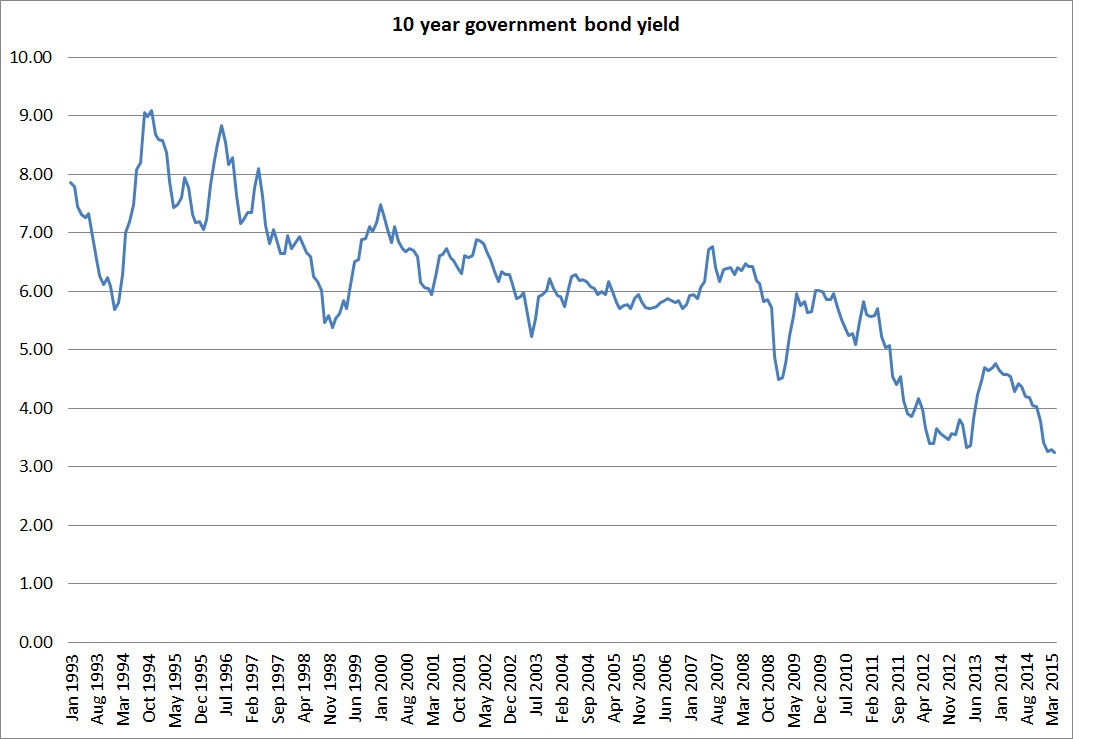
Finally, the Bank partly justifies its targeted intervention in Auckland, against one class of potential buyers, on the basis of rental yields in Auckland.  They argue that rental yields in much of the rest of the country are around 10 year average levels, but are at record lows in Auckland.  But has the Bank looked at a chart of New Zealand bond yields recently?  New Zealand 10 year bond yields are now at the lowest level probably ever (and certainly in the 30 years on the Reserve Bank’s website).  And the market now expects that the Bank will have to cut the OCR not raise it.  Shouldn’t we expect rental yields to bear some relationship to yields on alternative investments, such as long-term government bond yields.  Of course, the Bank would no doubt defend its stance by reference to the abnormally low level of bond yields globally.  And it is true that they are very low  (while NZ’s remain high by cross-country comparison), but the Reserve Bank –  even more than its overseas counterparts –  has been getting the future path of interest rates wrong for six years now.  Perhaps they will be right this time, but why should we be confident that they know better than the market?

10yr

It is difficult to fully make sense of what the Governor is up to. I suggested a few weeks ago that he didn’t want to be the person who presided over a NZ version of the US experience of 2006 onwards.  Which would be a laudable goal if there were any evidence that circumstances were even remotely similar. But there isn’t: overall credit growth is subdued, the Bank presents no evidence of a systematic deterioration in lending standards, and fundamental factors  provide a good basis to explain what is going on in house prices, both in Auckland and in the rest of the country.  Perhaps the Governor just wants to “do his bit” to solve the problems in Auckland, but (a) the Reserve Bank has no statutory mandate to focus on trying to manage house price cycles, especially in a single city, and (b) it isn’t clear how impeding access to finance (in a climate of modest per capita housing turnover, modest volumes of mortgage approvals and modest overall credit growth) is going to in any sense help deal with the structural problem.  There just isn’t a financial system problem –  and if there is the Bank just hasn’t made its case, and should get the evidence out there –  and it feels as if the Bank is misusing its extensive powers, based on a flawed reading of what is going on, and a failure to give due weight to how often past regulatory interventions have just made problems worse.

I pointed out a few weeks ago that it was now over a decade since the words “government failure” had appeared in a document on the website of the State Services Commission.  The Reserve Bank is now a major regulatory agency, exercising more and more powers by the decision of single unelected official.  I checked the Bank’s website, and the phrase “government failure” appeared only once (in a Bulletin article on historical crises), and “regulatory failure” appeared not at all.  It should disconcert citizens –  and those paid to hold the Bank to account –  that there is not more evidence of the Bank having reflected seriously on what that entire literature, and the experience of countless other regulatory bodies, might mean for how they should exercise their powers.

PS    In the press conference the Bank seemed to back away (perhaps just diplomatically) from the Deputy Governor’s expressed support for a capital gains tax. Almost a month ago, I lodged an OIA request for any material the Bank had considered on a CGT.   Since the Bank has taken so long to respond, and is required by law to respond “as soon as reasonably practicable”, I’m assuming they must have a considerable amount of substantive material that needs review.

[1] And, on the other hand, no such restrictions in Christchurch even though the Governor observed that he thought a glut of houses in Christchurch was quite likely.

Housing loans: big buffers and moderate risks

Paul Glass, of Devon Funds, had an article in the Herald yesterday, containing his agenda for action for New Zealand economic policymakers.   I was sympathetic to quite a bit of his analysis, but this section caught my eye:

It’s a technical area, but the amount of regulatory capital held against residential mortgages should be increased substantially, not just tinkered with around the edges as is currently happening. This would limit the amount of debt available for mortgages.

It is a common view, but I think it is wrong.  I’m not sure what reasoning Glass has behind his recommendation, but Gareth Morgan has argued along similar lines for years.  Morgan argues that  the bank regulatory capital regime (whether Basle I, II, or III) artificially favours lending secured on housing, because the risk weights used in calculating the amount of capital that needs to held in respect of such loans are less than those used in many other types of commercial bank assets.

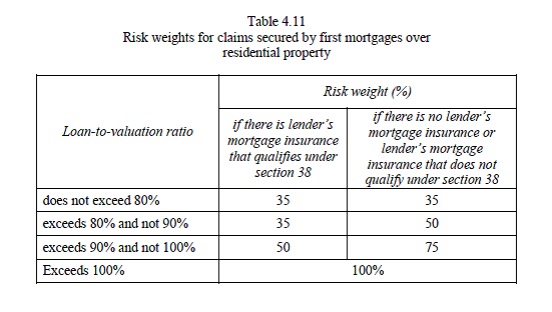
Calculation of risk weights for banks using internal ratings based model (the big 4 banks) is far from transparent, but the easiest way to see the difference is in the rules for other (“standardised”) banks.  Risk weights for residential mortgages are as follows:

riskweights

For loans with an LVR of less than 80 per cent, the risk weight is 35 per cent

By contrast, exposures to unrated corporate borrowers generally have a risk weight of 100 per cent.

But that is because the risks to banks from typical housing loans have been found to be less than those on many other bank assets.  This is not just an observation about boom times, or about New Zealand and Australia in recent decades, it is a result across many countries and many different circumstances.  Housing mortgages initiated by banks themselves, not under regulatory mandates to take on dubious risks, have rarely if ever played a major role in financial crises.  A recent Reserve Bank Bulletin reported on some of the international literature in this area.  A good example was Finland in the 1990s, where after a major credit boom and rapid growth in asset prices in the late 1980s, house prices fell by about 50 per cent in nominal terms, real GDP fell away sharply and unemployment rose substantially.  Banks took losses on their mortgage portfolios, but those losses were modest and not remotely enough to have threatened the health of banks.  The experience in the US since 2007 superficially looks like a counter-example, but binding federal government and congressional mandates played a key role in driving down the quality of new mortgage originations (and hence driving up subsequent loan losses).

It is not surprising that housing loan portfolios are not overly risky.  Lenders have a lot at stake, but they also have solid collateral.  Borrowers also have a lot at stake, especially in countries (like New Zealand and Australia with with-recourse mortgages).  You can escape your debts if you go bankrupt but fortunately (in my view) we don’t have a culture that is overly welcoming to bankruptcy.    And a owner-occupied home is not just a roof over the head, it is often also about a place in a community –  the local school, or sports club, or church.  So most residential mortgage borrowers do everything they can to avoid defaulting on their mortgage, and losing their house, even in very tough times.  There will always be a minority of bad borrowers, and other people who are just overwhelmed by events and the size of a shock.  Recent loans tend to be riskier than older loans –  most of us probably borrowed about as much as we could afford to get into a first house,  but mortgage portfolios age and typically get safer as they do.  And it portfolios of loans –  not individual loans –  that need to be evaluated in thinking about the risk to banks.

By contrast, the typical unrated business loans will have no collateral, revenue streams that depend quite strongly on the economic cycle (profits are more volatile than wages) and limited liability.   The nature of business is taking risk, and sometimes risks pay off and other times they go spectacularly wrong.  Empirical evidence is that a portfolio of unrated business loans is materially risker than a portfolio of unrated residential mortgages.  To be more specific, even in respect of property-based exposures, the evidence is that commercial property, and especially property development exposures, are far riskier (and more likely to lead threaten the health of banks and the financial system) than residential loan books.  Markets will, and regulators should, reflect that in their expectations around capital.

Actual risk-weighting for our big banks is more sophisticated than this description and, as mentioned, much less transparent.  Reasonable people can differ on whether anything is gained by having the IRB approach, or whether it would be better to simply use the standardised approach for all our banks –  all of which are relatively simple.

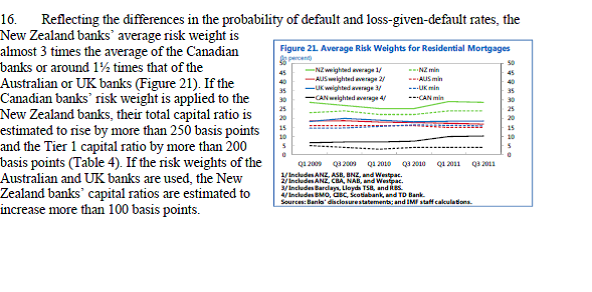
But not only is there good reason for residential mortgage risk weights to be lower than those on many/most commercial exposures, but New Zealand’s risk weights on residential loans are high by international standards.  This IMF piece, done a couple of years ago, contrasted effective risk weights on residential mortgages with those then in the UK, Australia and Canada

riskweights2

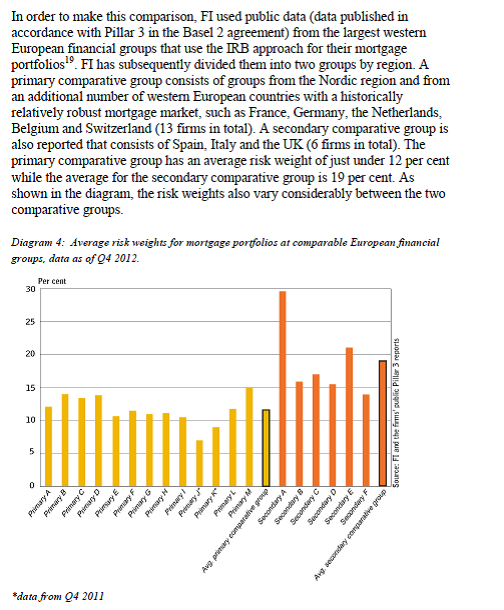
Sweden recently raised the minimum risk weights used by their banks on residential mortgages.  As part of the preparation for that move they produced this document, which includes this chart.  Again New Zealand risk weights on residential mortgage loans are higher than any of the banks in this chart – and are higher than the newly increased Swedish risk weights.

riskweights3

Residential risk weights, or overall required capital ratios, might still in some sense be too low in New Zealand.  But the onus should be on those calling for such increases to make the case that the threat to financial stability is greater than what is already allowed for in the bank capital framework.  The Reserve Bank did stress tests last year looking at the impact of a really quite severe adverse shock, in which nominal house prices fell a long way and unemployment rose substantially (it usually takes both to cause real trouble).  Not one of the banks, let alone the system as a whole, had its capital materially impaired in that scenario.  Those tests may well have been flawed, they may have missed something important, and they certainly won’t have captured everything that mattered, but on the information we have actually available the New Zealand banking system currently looks pretty well-placed to cope with a severe shock affecting the residential mortgage book.  With the stock of credit growing at only around 5 per cent per annum, that also should not be a great surprise.

And since housing seems to be one of those areas where to cast doubt on one possible explanation/solution is to risk being accused of thinking there is no issue or problem at all, I refer anyone inclined to react that way back to my take on housing.

Case not made: investor housing consultation

The Reserve Bank has been out consulting, I think for the third time, on proposals to differentiate clearly, in bank capital requirements, between loans for investment properties, and loans to owner-occupiers.   I made a fairly short high-level submission on their consultation document.  It is here:

housing consultation document 13 April 2015

The thrust of my argument is “case not proven”.  The Bank argues that, for otherwise similar borrower/loan characteristics, loans for investment properties are materially more risky than those on owner-occupied properties.  But they present surprisingly little data –  none from New Zealand, since we’ve had no material housing loan losses since the 1930s –  and what data are presented are largely taken as is, with no attempt to think seriously about how the New Zealand investor property market might be similar to, or different from, those in other countries.  In particular, the longstanding prevalence of small investors  –  which arises because our tax system treats them fairly neutrally with other potential holders –  is different from countries that often have large corporate holders of residential properties, and perhaps a rush into buy-to-let by individuals very late in the boom.

The Bank is quite open about the fact that its proposals would facilitate the imposition of eg a investor-specific LVR speed limit.  That is presented as an advantage, but as they have not consulted on the benefits and pitfalls of such a further intervention –  on top of the avowedly temporary initial LVR limit –  it cannot be considered as a public benefit at this stage.  The latest iteration of the proposals has the feel of something more focused on making an investor speed limit work, than on remedying material deficiencies in the New Zealand bank regulatory capital framework.  New Zealand already has among the very highest risk weights on housing loans of any advanced countries and, as the Reserve Bank has recently acknowledged, international experience is that housing mortgages are rarely central to even very serious financial crises.