Shipley and the China Council

Last week I wrote a post about Jenny Shipley’s position in the wake of the High Court judgment against her and other directors of Mainzeal.

I noted then that her position as chair of the local China Construction Bank was almost certainly untenable.  Even if, for some reason, the owners (the parent bank) had still been happy to have her, the Reserve Bank could not have allowed her to remain in her post and still retained any credibility around its “fit and proper person” regime. The Mainzeal board, chaired by Shipley, had continued trading for years with negative equity, with only the weakest suggestions of possible support from the parent.  Corporate law is designed to protect creditors from that sort of corporate (mis)governance.

Shipley has now announced that she will be leaving the China Construction Bank board.   We don’t know how much of a role the Reserve Bank played in that departure. No doubt they would hide behind the Official Information Act (or worse, section 105 of the Reserve Bank Act) and refuse to tell us.  That is a shame: it is a lost opportunity to demonstrate to the public that the regime has teeth when it comes to seriously problematic individuals. Mind you, I guess it might also leave them open to questions about how it is that they were happy to have Jenny Shipley chairing a New Zealand bank for the last several years, as more and more information about the Mainzeal situation emerged.

The focus now turns to Shipley’s role on the Executive Board of the New Zealand China Council.   In my earlier post I commented on this only briefly

As for Shipley’s membership of the executive board of the China Council……surely that tawdry taxpayer-funded body that sticks up for Beijing at every turn, has Jian Yang on its advisory board, defends Huawei, and won’t stick up for Anne-Marie Brady is just the place for her?  Then again, if the government doesn’t want the last vestiges of any credibility its propaganda body still has to be in shreds, they should probably remove her too. 

Shipley has clearly been very much in the good graces of Beijing over the years.  It wasn’t long ago that she had actually been on the parent board of the China Construction Bank, and she is now on the board of the regime-sponsored Boao Forum.   She has a long history of giving cover (literally in this case) to Beijing, going back to her brief time as Prime Minister.   Even that interview she gave to the People’s Daily back in December suggests a strong (and useful to Beijing) alignment between her public views and the preferred stances of Beijing.

But it isn’t clear whose interests are now really being served if she remains on the Executive Board of the China Council –  except perhaps those like me who poke the stick at this taxpayer-funded pro-Beijing advocacy and propaganda body.

Perhaps it suits Beijing to have such a tainted individual on their tame domestic lobby group.  See, democracy  and ‘doing the right thing’ is so enfeebled in New Zealand that our friend gets to retain her public position despite the very evident systematic poor governance on display at Mainzeal.   Perhaps, but Shipley’s failings are now sufficiently evident –  and will now always be associated with her name – that is doesn’t look as though it would really help the cause of keeping New Zealanders lulled into obliviousness about the nature of the regime.  The China Council is supposed to look like a bunch of decent public-spirited New Zealanders.

For similar reasons it can’t really be in the interests of the China Council itself for Shipley to stay on.  All the other, individually decent, people who sit on the Executive Board will be tarred by association.  You can’t so fundamentally mismanage a major business, resulting in huge losses for many people as a result of choices that were irresponsible and probably illegal, and expect to keep right on in prominent governance roles.    It wasn’t one small mistake early in someone’s career, but a big and very costly mistake for someone with the seniority and experience people should have been able to count on.  Shipley might still be well-connected in China, but there are other people with connections (if not, I’m sure Madame Wu at the PRC Embassy could help with introductions).  And everyone knows that neither corporate governance nor political governance in the PRC operate to the sorts of standards we expect in New Zealand.    If the China Council really wants us to believe that they champion New Zealand standing for New Zealand values, standards, and interests –  not just pre-emptively submitting to Beijing’s preferences – it should be in their interests too to get Jenny Shipley off their board, and quickly.

In a sense who owned Mainzeal shouldn’t be that relevant here –  the failure of the directors was alarming and unacceptable whoever the shareholders had been – but the fact that the firm was owned by someone originally from the PRC, and with extensive interests back there, just strengthens the argument around appearances.   The suspicion has been that, in effect, the China Council serves PRC interests more than those of New Zealanders.  A harsh critic might suggest something similar (perhaps unfairly) about the Mainzeal board.

And it shouldn’t be in the government’s interest for Jenny Shipley to remain on the China Council board either.  I was staggered at the way the Prime Minister the other day sought to avoid any responsibility or any involvement.

Prime Minister Jacinda Ardern was earlier asked whether she had any problem with Shipley being on the New Zealand China Council. She said it was not an appointment the Government had any role in.

The rules of the incorporated society that is the China Council are not readily available, so I’m not sure quite what the formal mechanism is for appointments to the Executive Board.  The China Council’s website also doesn’t say.   But it shouldn’t matter greatly.  The government pays

The Council receives approximately two thirds of its operational funding from the New Zealand Government through an annual grant from the Ministry of Foreign Affairs and Trade. 

[UPDATE: The latest set of accounts suggest just under half now, but with the government clearly the single largest funder.]

and very senior government officials serve on the Executive Board with Shipley.

The Secretary of Foreign Affairs and Trade and the Chief Executive of New Zealand Trade and Enterprise are both ex officio members of the Executive Board.

It is a creature of the New Zealand government and the Prime Minister simply can’t avoid responsibility.  I wonder what the Foreign Minister –  no fan of Shipley –  thinks?  Is the Secretary of Foreign Affairs and Trade really comfortable serving on an Executive Board with someone like Shipley?

Perhaps there are discussions going on behind the scenes, but after a week since the judgment was handed down, it is quite inappropriate that Jenny Shipley is still on the Executive Board of this prominent government-funded body, and that the Prime Minister won’t express a view on the appropriateness of Shipley’s position.

I was debating this point with someone the other day who argued that if the Prime Minister expressed a view she would open herself to attacks from the National Party (presumably something about inappropriate interference, or upsetting (Todd McClay’s, Jian Yang’s, Peter Goodfellow’s friends in) Beijing).   Well, maybe, but I wouldn’t have thought Jenny Shipley, in her current position, is someone even National would want to touch with a barge pole.  Are those the sorts of business governance practices National wants to defend, in public?  I can’t imagine so.

And so if the Prime Minister won’t express concern about a senior figure, found to have grossly underperformed in a very prominent governance position, it risks looking as though (a) the Prime Minister isn’t bothered by such misconduct (generally) or (b) remains more interested in not upsetting friends of Beijing and Beijing’s sensitivities than about defending acceptable standards of corporate governance and decency here in New Zealand.  She associates herself with all the tawdriness of the China Council –  defences of Huawei, silence on Jian Yang, silence on Anne-Marie Brady, and a general reluctance ever to articulate New Zealand interests when, as inevitably happens, those sometimes clash with those of the PRC. Perhaps it buys her an easier life in the short-term.  In the longer-term it further corrodes whatever reputation for decency she might once have had.  It simply shouldn’t be in her interests, or that of the government, for Shipley to remain on the China Council board.  And no one really doubts that – as the agency holding the purse strings –  if she wanted Shipley gone she would very soon be gone.

Whatever other contributions Jenny Shipley may have made over the years, her record at Mainzeal now means that she diminishes the standing and reputation of any body or individual that continues to use her in governance roles, or which support her in such roles.  Foremost among those now, the Prime Minister and the China Council itself.   As one expert noted in the Dominion-Post this morning, the market has ways of taking care of these issues – Shipley (and her other fellow Mainzeal directors) might now struggle to get directors and officers liability insurance.   But those mechanisms can’t protect us when it comes to public bodies. Only leadership protects us there.  But at present there seems to be a void – an abdication – where leadership on this issue should be.

I did an interview with Morning Report on this issue this morning.  If they put the audio up I will link to it.  [UPDATE: In fact, here it is.]

UPDATE:  A reader has pointed me to where the constitution and rules of the China Council are online (details in a comment).  It appears that the Executive Board is self-selecting and self-perpertuating

CC rules

The point remains that if the Prime Minister, representing by far the largest funder, wanted Shipley off the Executive Board (a) she would almost certainly be gone quite quickly, and (b) even if she wasn’t, the PM would have made clear her refusal to countenance the standards of corporate governance on display in the Mainzeal case.
Standing for what they believe in

There was a story on Stuff yesterday (in the Domininion-Post this morning) about Air New Zealand’s “generous provision” of free airfares to the New Zealand China Council.  The China Council, you will recall, is the largely taxpayer-funded propaganda body set up by the previous government to champion good and quiescent relationships with the party-State in Beijing, the People’s Republic of China.  “Good” relations with the PRC, of course, means never ever saying or doing anything they don’t like.  Friendships aren’t like that.

Air New Zealand’s funding for the China Council bothers me no more or less than the mindset that governs the whole relationship with the PRC, whether among officials, politicians, or business leaders (and if there are any exceptions, they keeep very very quiet).  It seems that, pure and simple, it is all about the money – whether trade deals, sales in the PRC, or the flow of political donations.  If Air New Zealand wants to fly to the PRC, it needs to keep sweet with the regime, and needs to keep the New Zealand government (and public) on the straight and narrow, not making difficulties for them, as far as possible.  If the China Council can help them do that, why wouldn’t they –  having decided to sup with the devil – provide support for those who can help their cause.  It isn’t done out of the goodness of their heart, but out of pretty cold commercial calculation.   And since the taxpayer has already been coerced to cover much of the China Council’s activities, it is probably pretty cheap PR expenditure.   Whether Air New Zealand is majority state-owned (as it is) or not isn’t really relevant.

I don’t suppose most people associated with the China Council really see themselves as getting involved to serve Beijing’s interests (there might be exceptions –  individuals on the Advisory Board with close ties to the regime, including its United Front organisations, and individuals on the Executive Board –  including our former Ambassador to the PRC and our former Prime Minister – who hold positions in regime bodies).  Probably most of them think of themselves as serving “New Zealand’s interests”, but people have a funny way of interpreting their own personal (or business) financial interests as being much the same thing as the “national interest”; perhaps the more so, more money is involved.  But whatever story they tell themselves, they nonetheless objectively do serve the PRC regime’s interests.  That is the effect of their involvement, their choices, their silence.

When you walk by evil every day, when your organisation exists to minimise and distract from evil, when you are indifferent to the values of New Zealanders, and the abuse of those values in the PRC, you serve the regime’s end.  It is as simple as that.  And for a regime that is among the most evil on the planet today –  certainly the most of evil of those who in any material way impinge on New Zealand.  Air New Zealand is part of that.  So are Don McKinnon, Jenny Shipley, Tony Browne, Grant Guilford, Cathy Quinn and the rest of them (including their hired gun and front person Stephen Jacobi).

I’m an economist by training, so I’m quite happy to sign up to the notion that trade is generally mutually beneficial for those directly participating.  But each of us, actively or passively, makes moral choices about those with whom we deal.   Big companies and their bosses, even more than individual citizens, have real and effective choices.  Those who associate themselves with a tawdry body like the China Council reveal the nature of their choices, of their values.

It is not as if the China Council exists to encourage real and open debate about the PRC and how New Zealand should engage with, respond to, and deal with it.   Such a body might, arguably, be a useful thing for taxpayers’ money to be spent on.   After all, it is a big country, and that sort of debate doesn’t even exist to any serious extent in our universities –  keen on their PRC students, (several) keen on the (PRC) Confucius Institutes, and where the Contemporary China Research Centre is chaired by someone who helps promote the regime agenda through the Confucius Institute movement.

But that isn’t the China Council.  The China Council is about keeping the (New Zealand) peasants in line and pandering to the regime in Beijing – that gala dinner, for example, for the new Ambassador.   To make out that the PRC is a normal, honourable and decent regime.

Where’s the evidence?   All around really.  Reports (pretty lightweight ones) championing one of the regime’s key geo-strategic initiative (the Belt and Road), public statements defending Huawei (and never any examination of the other side of that story), the constant attempts to trivialise –  or tar as racist or “xenophobic” –  any serious debate about the PRC and New Zealand.  This, as a reminder, was from their Annual Report last year

An, at times, unedifying debate about the extent of foreign influence in New Zealand risks unfairly targeting New Zealanders of Chinese descent

And you’ve never seen the China Council engage with the substance of Anne-Marie Brady’s work, never heard them express concern about the apparent threats to Brady’s physical safety, never heard them express concern about the regime control of most of the local Chinese language media, never ever heard them express concern about human rights abuses –  on the most egregious scale – in the PRC, and never heard them express concern about the growing evidence of PRC attempts to interfere in countries around the world, about the threat to Taiwan, or the militarisation of the South China Sea.  We’ve never heard them express concern about PRC attempts at economic coercion –  other perhaps than encouraging pre-emptive submission.  They just aren’t a serious body.  They are a cynical propaganda body –  largely paid for by your taxes and mine – serving the business interests of those involved, and –  in effect –  the wider interests of Beijing,  The test: when there has been any clash between the interests/values of the regime and the interests/values of New Zealanders, have they ever openly sided with the latter?  Not once (that I’m aware of).

If the private sector was stumping up all the funding for this lobbying and propaganda effort, we might just call it freedom of expression I suppose.  If you choose to sell your soul, then (within limits) I guess you can champion your cause.   As it is, taxpayers’ money –  and the choices of successive New Zealand governments –  is being used to serve the personal interests of these businesses, and of the political parties concerned.   I’m not suggesting private or public companies should be banned from doing business in the PRC, but they should be told much more than is common anywhere that they are on their own.  Dine with the devil if you must, be take a long spoon, and don’t be asking for support from the rest of New Zealand.   But we’d be better off as a country –  have rather greater moral clarity –  if there was less business undertaken with the PRC, given the nature of the regime.  There might be a modest economic cost –  but it would be modest – but let’s be grateful that business interests weren’t allowed to distract us from eventually standing up and taking on the Nazi regime 80 years ago.  The parallels with the PRC today are almost too numerous to list.

But, of course, it isn’t just businesses that have sold their souls.  Successive governments and political parties are at it too –  recall those National and Labour party presidents off in China praising the regime.  This one seems to be no different in substance.

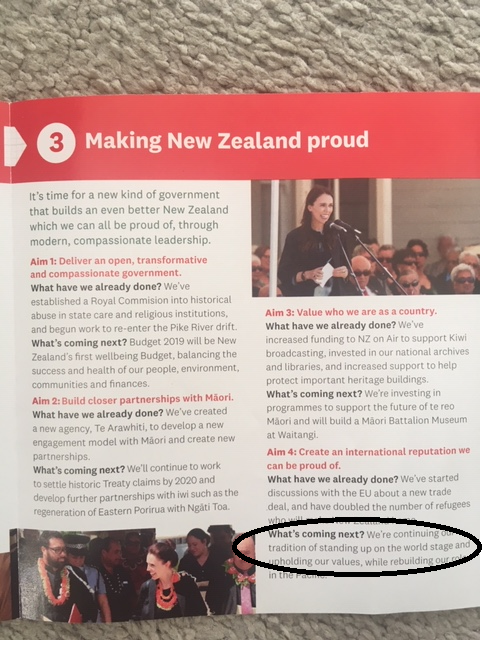
Yesterday a local Labour Party supporter dropped into my letterbox a Labour brochure headed “Our plan for New Zealand”, replete with photos of the Prime Minister.  I might write about the (lack of) economic substance in another post, but what caught my eye was this page.

ardern 2

The Prime Minister promises to “make New Zealand proud”.  How?  “By continuing our tradition of standing up on the world stage and upholding our values”.

And we are supposed to take this seriously?  A Prime Minister who will not talk openly about Xinjiang, who will not talk openly about the abducted Canadians, who will not talk openly about the militarisation of the South China Sea or the growing threat to Taiwan, who will not talk openly about the regime’s intellectual property theft, who says nothing about Jian Yang, who never utters a word about the sustained persecution of Falun Gong followers, Christian believers, civil rights activists and so on, and who won’t even stand up pro-actively in defence of Anne-Marie Brady.  If she herself won’t speak about, she also shows no sign of welcoming or encouraging those who do.

She probably isn’t any worse than the other lot (Todd McClay and the “vocational training centres” that are really no concern of ours), although her approach is made all the more nauseating by the pretence to representing something better –  all that talk of kindness, empathy, values, and so on.   The best test of a person’s values is how they choose to act.  Evidence to date is that our Prime Minister shares much the same “values” as the China Council –  don’t rock the boat, never stand for anything other than commercial interests (and party donations).  What you won’t pay a price for is in no serious sense a “value”.

I read this morning an article from the Italian site Bitter Winter.   Perhaps I could commend an article like this to the Prime Minister and to Mr Jacobi (or to Simon Bridges, Christopher Luxon, Don McKinnon, Tony Browne, Jenny Shipley, Jian Yang, Raymond Huo and the others).

One Christian who was previously assigned to work in a brick kiln described his working environment. “The brick kiln’s temperature can reach 60 or 70 degrees Celsius (about 140-160 degrees Fahrenheit). If prisoners are careless, they will be scalded, and their hair will be scorched. The prison authorities do not provide temperature-resistant shoes. Prisoners must stand on one foot, shifting from the left to the right. If someone spends too long on one foot, he will get burned and develop blisters. New prisoners couldn’t even last for five seconds before having to run out of the kiln. But whenever the manager saw someone running out, he would flog them with a pipe.”

Heavy labor made this Christian think about death. One time, after he tried to commit suicide, the team leader disciplined him by beating him and shocking him with an electric baton.

The living conditions in prisons are deplorable. Prisoners often eat vegetable-leaf soup with insects floating in it. As a result of malnutrition, they often feel dizzy and do not have the strength to work.

To ensure that prisoners complete their work even when physically exhausted, the prison authorities resort to torture.

The interviewees report that prison guards incite the more vicious prisoners to discipline other inmates. Thus, it is common to be beaten by “prison bullies” when someone fails to complete the task. Mr. Zhu told Bitter Winter, “If a prisoner cannot complete their task, the prison guards will tie the prisoner’s hands and feet to an iron fence, and they are forced to stand continuously except during meals. Whether in winter or summer, they remain continually tied up for three or four days and aren’t allowed to sleep.” In order to avoid corporal punishment, Mr. Zhu had to work hard to complete his production task.

I don’t suppose any of those people would be comfortable reading this sort of stuff (perhaps Jian Yang would be different –  he actually worked for the regime for years) but squirming slightly uncomfortably as you read it means nothing if you don’t –  when you can – do or say something.  There are plenty of areas in which I disagree with much of the consensus opinion of those who hold power in New Zealand, but what really upsets me about the PRC issue is the utter practical indifference to stuff these people all individually and privately know and agree is evil; stuff they’d not even considering supporting here.  And yet each of them choose –  by their actions and their passivity –  to give cover to such evil, on large scale and small.   They compromise themselves –  and they take our money to do it.

One day, I guess, they’ll be judged before the bar of history –  as the appeasers of the 1930s, the fellow-travellers with the Soviet Union were – but in the meantime I guess they’ll keep the dollars (deals and donations) flowing.  And evil will prosper just a little more because of choices those people make.

Fit and proper?

Should Jenny Shipley be on the board (actually chairing it) of the local arm of China Construction Bank?   A question primarily, you might have thought, for the owners (CCB in China), perhaps taking account of the views and behaviour of the bank’s customers and investors.  I’d be pretty hesitant about putting my money in a bank (or any other company) that had as the Board chair someone against whom there was the sort of civil judgement that was delivered yesterday by the High Court in the Mainzeal case.  But I’m not, so I don’t really have a strong view on the matter.   And I might be as worried about having a former primary school teacher with no particular expertise in banking, and no reputation for being willing to ask awkward questions and follow through, as chair of the Board of any bank I had money in.

The Reserve Bank doesn’t have the luxury.

And here I’m going to rerun much of an old post on the matter of “fit and proper” rules.

Under Reserve Bank rules (outlined here):

no appointment of any director, chief executive officer, or executive who reports to, or is accountable directly to, the chief executive officer, may be made in respect of the registered bank, and no person may be appointed as chairperson of the board of the bank, unless the Reserve Bank has been supplied with a copy of the curriculum vitae of the proposed appointee and has advised that it has no objection to that appointment.

“Fit and proper” requirements are pretty common internationally.  But citizens should reasonably ask “to what end, and with what evidence that the requirements make a useful difference?”

The Reserve Bank’s prudential regulatory powers have to be used to promote the soundness and efficiency of the financial system (sec 68 of the Act).  The focus of the suitability (“fit and proper”) tests is presumably on the soundness limb of that provision.  Prior Reserve Bank “non-approval” must be expected to reduce the threat to the soundness of the financial system (not just the individual institution, but the system itself).  How might it do that?  The Reserve Bank says it focuses on integrity, skills and experience.

At the (deliberately absurd) extreme, if the Reserve Bank were blessed with the divine quality of omniscience, they could see into the soul of each potential appointee, and discern accurately how those individuals would respond to the sorts of threats, risks, shocks ,and opportunities they would face while serving with a New Zealand registered bank.  No one prone to deceive under stress, to breach internal risk limits, or to take “excessive” risk would get appointed.  That sort of insight would be very helpful.  But it isn’t on offer.

Instead, the Reserve Bank’s document suggests a backward-looking focus – checking out past appointments, past criminal convictions, and the like.  All of which is fine, but all of that information is known (or knowable) to those at registered bank concerned who are making the appointment.  And most of the stuff that is really interesting, and telling, is likely to be about character.  That isn’t knowable in advance, and certainly not by Reserve Bank officials.  What expertise do Bank economists and lawyers –  many very able people – have in second-guessing the judgement of the banks themselves in making such appointments?  And what incentive do they have to get it right?  The model looks like one that favours the appointment of grey colourless accountants and lawyers, who have not yet blotted their copybooks – perhaps never having taken any risk – with a bias against anyone who has learned banking, and what it is to lose shareholders’ money, the hard way.

Banking regulators worry about the risks to depositors and taxpayers if widespread or large banking failures occur.  But the first people to lose money as a result of mistakes, misjudgements, or worse are usually the shareholders in the bank concerned.  They might reasonably be assumed to have more at stake from bad appointments of directors or senior managers than central bank regulatory officials do.  New Zealand has in place pretty demanding bank capital requirements.

No doubt there will be people (and perhaps there already have been) who were employed by failed finance companies coming up for Reserve Bank approval in the next few years.  In some cases, those people will have had no responsibility for the failure, and in others there may have been some culpability.  But business failures happen, and they aren’t always a bad thing (indeed, unlike some systems, our banking regulatory system is explicitly designed not to avoid all failures).  Why is the Reserve Bank better placed than the registered bank concerned to reach a judgement on whether any previous involvement with a failed finance company should disqualify someone from a future senior position in a bank (or other regulated financial institution)?

In a similar vein, I wonder if the Reserve Bank has done a retrospective exercise and asked itself how likely it is that, with the information available at the time, it would have rejected any (or any reasonable number) of those responsible for the 1980s failures of the DFC and the BNZ.  Done in a suitably sceptical way, it would be an interesting exercise

I’m not suggesting there be no rules at all.  Perhaps conviction for an offence involving dishonesty in the previous [10] years should be an automatic basis for disqualification from such senior positions?  It wouldn’t be a perfect test, but it is certain and predictable, and probably better than a “we don’t like the cut of your jib” sort of discretionary judgement exercised by regulatory officials.  It doesn’t hold the false promise of regulators being able to sift out in advance people who might, in the wrong circumstances, later be partly responsible for a bank failure.

Perhaps too there might be a requirement that a summary CV for each director and key officer be shown on the registered bank’s website.  Those summary CVs might be required to list all previous employers or directorships.

But the current fit and proper tests seem to be an additional compliance cost, for no obvious public policy benefit.  It has the feel of something they feel the need to be seen to be doing, to be a “proper supervisor”, and get ticks in the right boxes when the next IMF FSAP comes through, rather than something where there is evidence that the rules have advanced financial system soundness in New Zealand.

Provisions of this sort cost money, both to banks to comply with and to taxpayers to administer the provisions, and impede business flexibility.  Individually, the amounts involved and the degrees of inconvenience, are probably not large, but the old line remains true “take care of the pennies and the pounds will take care of themselves”.     There should be a general presumption against regulatory burdens – particularly where they impinge directly on the lives and professional careers of individuals – and an onus on the regulators to show that their provisions are making a material net difference to worthwhile public policy objectives.

2019 here again:

I can’t see that the Reserve Bank will have any choice but to indicate to CCB that they would object to the contined presence of Jenny Shipley on the Board.    The Mainzeal case involved the failure of a substantial institution while Shipley was chair of that Board, and not because of some unforeseeable shocks out of the blue, but because of actions and choices that the Board had control over.  The record suggests, apparently, that Shipley had expressed some unease on the Board.  That’s good, but of little or no value to anyone if it changed nothing, and she then did nothing further.

Of course, there is almost no chance the local CCB is going to collapse –  any problems are much more likely to be group ones, over which the local board will have no control.  But rules are rules, and how could the Bank’s fit and proper regime have any residual credibility if Shipley remains chair of the New Zealand registered, Reserve Bank supervised, bank’s board?  And this isn’t a time for pleasantries.  Whether or not she stands aside voluntarily, or the owners remove her, the Reserve Bank should make clear that her continued presence on the Board (let alone chairing it) would not be acceptable to the Reserve Bank.

One could, of course, argue that no CCB New Zealand problems have become apparent on Shipley’s watch.  I presume that is true, but it is also irrelevant.  Since (see above) the regime has no way of knowing who will turn out to be a dud as a director, it can really only exercise condign discipline after the event.  And I don’t think there is really a case for waiting for any appeals either.  The judgement has been delivered.  Perhaps a higher court will interpret the law differently, but there seems to be less dispute about the facts than about the legal implications, and frankly whether or not the directors are finally held financially liable, if a fit and proper regime is to mean anything it has to mean holding people to a higher standard, as bank directors, than is evident in the record at Mainzeal.

As I say, it shouldn’t be a matter for the Reserve Bank.  There is so much high profile coverage of this case that no one can seriously claim to be unaware, and if Shipley’s presence bothered them, they can bank elsewhere.  If enough people are bothered enough, the self-interest of the owners will resolve the situation.  It shouldn’t be the Reserve Bank’s business,  but it is.    They need to be seen to act pretty quickly.

As for Shipley’s membership of the executive board of the China Council……surely that tawdry taxpayer-funded body that sticks up for Beijing at every turn, has Jian Yang on its advisory board, defends Huawei, and won’t stick up for Anne-Marie Brady is just the place for her?  Then again, if the government doesn’t want the last vestiges of any credibility its propaganda body still has to be in shreds, they should probably remove her too.  But that was probably so anyway after all those pro-Beijing words she gave to the People’s Daily in December.   Effective propaganda can’t be too overt.

Unfit to govern

I’m probably the sort of person the National Party used to count on voting for them.   National was the only party I was ever a member of, the only party I ever canvassed for. There were family connections, and there were the founding principles, every one of which I identified with (and do still).   Even in Wellington, middle-aged conservatives might reasonably have been assumed to support National, even if (at times) through gritted teeth.  One of those founding principles talked, perhaps slightly quaintly, of “countering Communism”, and it seemed to be something taken fairly seriously throughout the post-war decades.  There was a suggestion of some values; a suggestion of things that mattered beyond just the next business deal.  Friends and allies, people and countries with whom we shared those values, seemed to count too.

But over the last couple of decades, New Zealand political figures, and the National Party ones in particular, seem to have binned any sense of decency, integrity, or values when it comes to Chinese Communist Party ruled China. I don’t suppose that individually most of them have much sympathy for PRC policies and practices, but they just show no sign of caring any longer.  Deals, donations, and indifference seem to be the order of the day.

Over the last couple of years the depths the party, its leaders and MPs, have been plumbing have become more visible.  In 2017, in government, they signed up to a Memorandum of Understanding with the PRC on the Belt and Road Initiative.  In that document they –  Simon Bridges as signatory –  committed to “promote” the “fusion of civilisations”.      Plenty of people will probably dismiss such statements as “meaningless”, the stuff of official communiques.  But decent people –  under no duress whatever –  don’t sign up to things suggesting that today’s equivalent of Nazi-ruled Germany is a normal and decent regime.  Of course, they would probably dispute the parallel, but that’s just willed deliberate blindness.

Later that same year we learned that the National Party had had a former PLA intelligence officer, Communist Party member, sitting in their parliamentary caucus.  It seems to be generally accepted that Jian Yang, of such a questionable background, is one of the party’s largest fundraisers.   Presumably the leaders (Key and Goodfellow) were aware of his past, but lets be generous and assume that most of the caucus was as unaware as the public.    But for the past 18 months, everyone has known.    They also know –  because Jian Yang acknowledged as much –  that he deliberately misrepresented his past to get into New Zealand, telling us that Beijing had told him (and others in his position) to do so.   Breathtakingly, there is no sign that official agencies in New Zealand have done anything about those admissions, but National is now out of office so I guess one can’t blame them for that.

But what the National Party –  leader, president, MPs, and all those holding office in the party –  is responsible for is the fact that Jian Yang still sits in Parliament, still sits in the National caucus, is still a National spokesman (on a couple of minor portfolios), with the express support of successive leaders, and (apparently) in ongoing business relationships with the party president (he who trots of to Beijing to praise the regime and its leader).   And not one MP, not one national councillor, no other officeholder –  not one –  has broken ranks, and been willing to openly question (or deplore) just what has gone on.  Doing so might, I suppose, jeopardise their individual futures.  But values are the things you are willing to risk for, to pay some price for.    Rumour hath it that some people within the party aren’t entirely comfortable, but so what, if you aren’t willing to do, or say, anything?

A few months ago we had the egregious former Minister of Trade, and foreign affairs spokesperson, Todd McClay plumbing new depths.    In an interview with Stuff, he championed the PRC regime interpretation of the mass internment of Uighurs in Xinjiang, noting that

“the existence and purpose of vocational training centres is a domestic matter for the Chinese Government.”

If he’d just kept quiet at least there might have been some doubt about his decency, but he opened his mouth and left no doubt.  He was spinning for the CCP regime in Beijing.

Since then even the regime in Beijing has more or less admitted that, of course, that line isn’t true.  But we’ve heard nothing more –  and certainly no apology –  from Mr McClay or his leaders.

And, of course, every so often the National Party leader Simon Bridges pops up if there is ever the slightest sign that anyone in the current government is expressing even the mildest reservations about the regime in Beijing.  Never mind that the Defence strategy document stated no more (considerably less) than was obvious to blind Freddy, it was too much for Mr Bridges.  Never mind that reservations about Huawei seem to be increasingly widely shared by governments and intelligence agencies across the western world, it might lead to furrowed brows and discontent in Beijing, and we couldn’t have that could we?   Never mind too that, in government and in practice it is hard to conceive that things would have been any different on that particular score under National –  I don’t suppose even National is quite so far gone in Beijing’s thrall that they would simply walk away from Australia, the United States, a growing number of other western countries, and what appears to be assessments of our own intelligence services.    No sense at all in anything Bridges –  or any other National Party figure – says that the PRC itself has changed: bad as the regime always was, it has now become worse.

But it was comments the other day from National’s third-ranked member and finance spokesperson, Amy Adams, that really left me open-mouthed in astonishment.  Both at what she said –  even if it wasn’t far from what had seemed to be the National stance in practice –  but also at the lack of any other coverage of, or follow-up to, those remarks.    In an interview with NBR, (behind a paywall but here) we are told

National’s finance spokeswoman Amy Adams has accused the government of putting the economy at risk by offending China.

“The first thing is you don’t p[…] off your major trading partner and, let’s be really clear about this, China is our single biggest trading partner.”

Quite extraordinary.

One could clear the small things out the way first. For example, governments don’t trade with China, firms in New Zealand trade with firms in the PRC.  Sure, governments set some of the terms on which that trade occurs, but government isn’t a business.

One might also note that if the PRC is the largest “trading partner” for New Zealand firms, it is very similar in size to Australia in terms of total New Zealand trade.  Until about five years ago, the EU in total accounted for more of New Zealand’s trade than the PRC.  Australia remains by far the largest source of foreign investment in New Zealand.     And these days exports to each of our largest “trading partners” –  in an economy (New Zealand) that doesn’t trade much with the rest of world by international standards – account for about 5 per cent of  GDP, in total.  For many decades, a much larger proportion of our GDP was accounted for by trade with the UK.

Oh, and a large proportion of New Zealand exports (not all of course) are commodities, and if not sold in one market they will be sold in some other part of the global market.   PRC babies seem unlikely to stop drinking infant formula.

But what really staggered me was the bald sense in which National’s finance spokesperson appears to think that the interests and priorities of foreign governments are what should matter most to our government. Not our values, not our people.  On her telling, we’d never annoy Australia about anything (apple import cases to the WTO, illegal migrants/asylum-seekers on Nauru, New Zealand citizens being deported from Australia).    We’d never have taken on France over nuclear-testing (at a time when the UK was entering the EU, and trade access to our largest market was substantially in danger).  We’d never have fought for Imperial Preference for our exports to the UK in the 1930s.  We’d never have banned nuclear ships (the US wasn’t our largest trading partner, but the US and EU together were hugely important markets, and we relied on the UK government (Thatcher) to fight our corner for EU market access).  The then Australia government wasn’t best-pleased with that New Zealand policy choice either.   And more generally –  and much more dominant – Canada would never ever stand for itself on anything that involved the United States, or Ireland vis-a-vis the UK.  I suspect Denmark and the Netherlands had had significant trade ties to Germany pre-1940, but they didn’t exactly put out the welcome mat to Hitler.  Southern African countries chose to limit trade with Rhodesia, and confront South Africa, because they considered they had a just cause.  And so on.    (Note that I’m not endorsing all these causes, just noting the willingness of governments to upset their closest “trading partner”.)

Of course, this almost certainly isn’t what Ms Adams believes at all.   Presumably as a senior minister she had no problem at all with the fact that at times we had, and have, open differences with Australia.  In any relationship, no matter how important, there are going to be differences from time to time, and in international relations governments (at least democratic ones) aren’t supposed to act for themselves, or even for small favoured groups, but for the citizenry as a whole.

Instead, the Adams approach –  presumably endorsed by her leader –  is about a particular thuggish regime. It seems to be that we should defer entirely to Beijing’s prickly style and never ever do or say anything that might upset them, never display any self-respect, and simply engage in either anticipatory compliance or abject penitent submission.  Worse, apparently we should even make excuses for them –  or retail their propaganda lines, as per Todd McClay.  It is classic domestic abuse situation, and yet championed by someone who aspires to be a senior minister of a free country, perhaps even aspires to be the Prime Minister.   In fact, someone who was the Minister of Justice, who led legislative attempts to respond to the family violence problems.  I’m quite sure it wasn’t her advice to victims –  “oh, don’t upset him…ever”.    So why does she propose that our foreign policy towards the international abuser par excellence be essentially just that?  Act that way and all you do is encourage the abuser, and lock yourself further into the cycle of abuse, humiliation and loss of any sort of self-respect.

Of course, the difference here is that Adams ask us (citizens) to bear the abuse and humiliation –  leaders who remain silent in the face of evil, leaders who won’t stand up for the integrity of the system, and even spend our money to run PR-front organisations to champion the pro-Beijing perspective –  all to benefit a few specific businesses that have (consciously and knowingly) over-exposed themselves to a thuggish regime, and the substantial flow of donations to their own political parties.    Politicians like Adams simply encourage the over-exposure, and encourage the false subservience of victimhood.   If our businesses were dealing with organised crime, or with shonky people who didn’t pay their bills, we’d either insist or encourage them to cut their exposures.  If you deal with the Mafia you are on your own –  in fact, society will shun you, not tolerate you asking for us to pander to the leaders.  But when it is the PRC –  organised coercive threat if ever there was such –  our leaders simply want us to defer, and complain when their opponents show any sign of not being quite deferential enough to the bully.  And they simply let evil pass by, and in so doing make themselves complicit with –  and thus partly responsible themselves –  for the evil.

In his Beijing-deferential interview on the Herald website the other day, David Mahon tried to frame the current PRC upset with New Zealand as “the Chinese see it as akin to infidelity”.    What a sickening image, but perhaps one that brings us right around to the abused-spouse parallel.  New Zealanders made no vows to Beijing – although perhaps our craven political leaders did –  but when the merest squeaks are heard, the abuser – freshly drunk on newfound power – seems to feel free to attempt to squash and silence, while politicians, lobby groups and business interests cheer on not the abused “spouse” but the abuser.   New Zealand “leaders ” have been among the most sycophantic and compliant anywhere in the western world, so perhaps there is a sense that they can’t afford to let us get away with some renewed self-respect.  That, after all, might encourage others to think and act for themselves, for the values of their peoples.   Better to foster the illusion –  assisted by local politicians and academics –  that the PRC holds our prosperity in its hand.

It simply doesn’t. It never did.

But that’s New Zealand politics, that seems to be today’s National Party. It is sickening.


“This country has prospered over the past decade, while other economies have suffered”

Or not.

The title to this post was taken from the latest column from veteran political journalist Barry Soper.  Apparently he had had some readers get in touch, not entirely convinced by his PRC-related articles earlier in the week.

They all ignore the fact that this country has prospered over the past decade, while other economies have suffered.

The Key Government’s management of the global financial crisis has been lauded but without the free trade agreement, signed in the Chinese capital as the final act of the Clark Government, this country wouldn’t be where it is today.

The puerile keyboard warriors’ bile is too vile to repeat but it seems to be based on envy, that the Chinese, after generations of deprivation, have shown the world they can compete and are a force to be reckoned with.

I’m not sure quite what he bases these assertions on (although it is the sort of line that less well-grounded champions of Beijing, including former Foreign Minister, Murray McCully, have repeatedly tried to run).  “Be grateful, peasants” seems to be the tone, for the CCP in Beijing has graciously bestowed its bounty upon you.

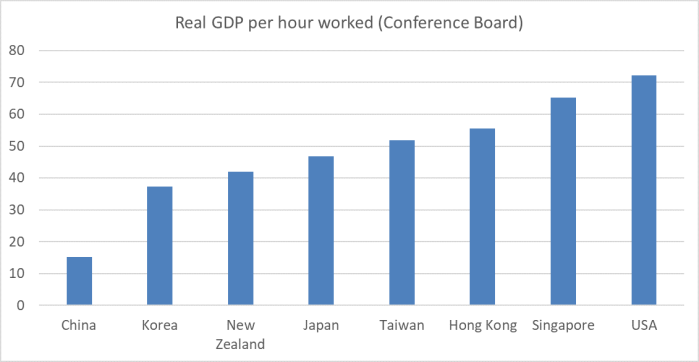
I don’t want to waste much time on the alleged PRC success story.    When you do so much damage to yourself, and then stop the self-destruction, of course you’ve got plenty of ground to make-up, and with half-decent policies you can do some of that quite quickly.   Here are the latest Conference Board productivity estimates.

China GDP phw feb 19

The PRC……not even half the levels of Korea or (decades of underperformance) New Zealand, not a third of Taiwan or a quarter of Singapore.     Who could possibly envy that sort of performance?  There was no obvious reason why China could not have matched the performance of Korea, Japan, or Taiwan.  Except that they chose to adopt, and continue to run, a system that consistently produces poor economic results.

But what I was really interested in was the assertion that New Zealand has had a really good economic performance over the last decade “while other economies have suffered”.  I guess if Greece, or even Italy, is your benchmark it isn’t too far wrong.  But then almost everyone does better than those troubled euro-crippled economies.

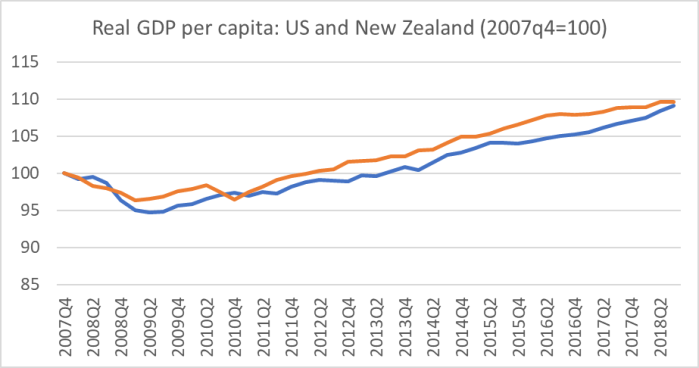
One comparison I like, and which I’ve run before, is between New Zealand and the United States.   Were there anything to the “we owe such a debt to Beijing, and have done so well ourselves” story, an obvious place to look might be a comparison with the United States.  After all, the US was the epicentre of the financial crisis itself, their central bank got to the limits of what it could do, and no one thinks Beijing someone “saved” the US.   And yet here is how real GDP per capita compares across the two countries since late 2007, when the last recession began.

US and NZ comparison GDP

We’ve mostly done very slightly better than the US over the decade or so, but there really isn’t much in it.   Certainly not a case of the US suffering and us “prospering”, whether thanks to Beijing or any other cause.

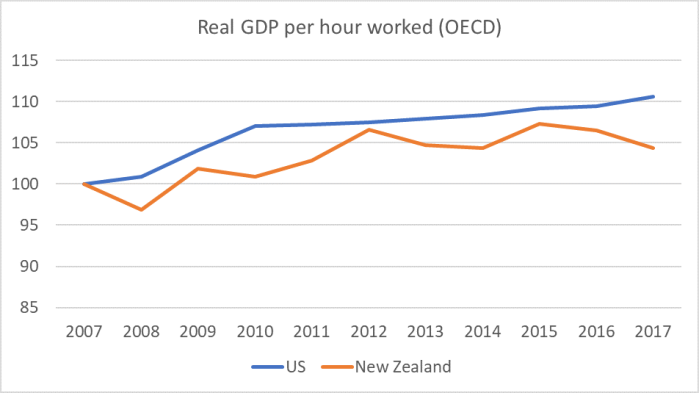
And to the extent we’ve done a touch better, it certainly isn’t reflecting stronger productivity growth.  The data are indexed to 100 in 2007.

US nz productivity

It isn’t just an us versus the US comparison either.  Over that decade, real GDP per hour worked rose by 4.4 per cent, but in the median OECD country productivity growth was 8.9 per cent.

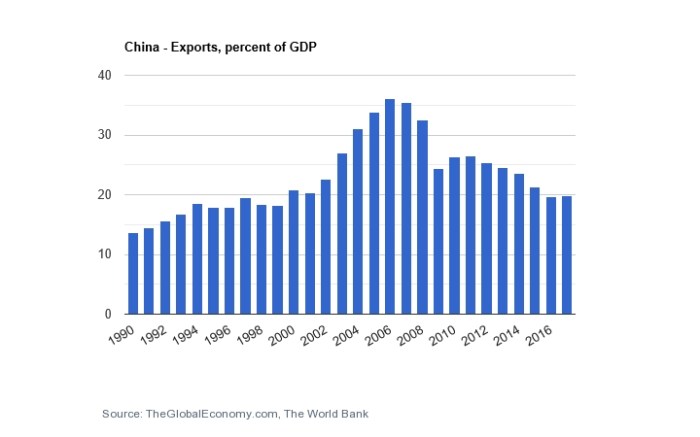
And if Beijing and the (so-called) free trade agreement were the source of any special New Zealand prosperity, exports might be an obvious place to look.  Except that over the previous decade New Zealand exports actually fell a little as a share of GDP.  In the United States, and in all but a handful of other OECD countries, exports became a larger share of the economy.

Even on more purely cyclical measures, New Zealand still doesn’t stand out (at least on the good side).  The unemployment, for example, has come down a long way, but it is still quite a bit above the lows reached before the recession (at a time when demographics will be tending to lower the “natural” rate of unemployment).    In the United States, by contrast, the unemployment rate is below pre-recession levels. That is also true across the G7 as a whole, the EU as a whole, and the OECD as a whole (individual bad euro-area countries notwithstanding).

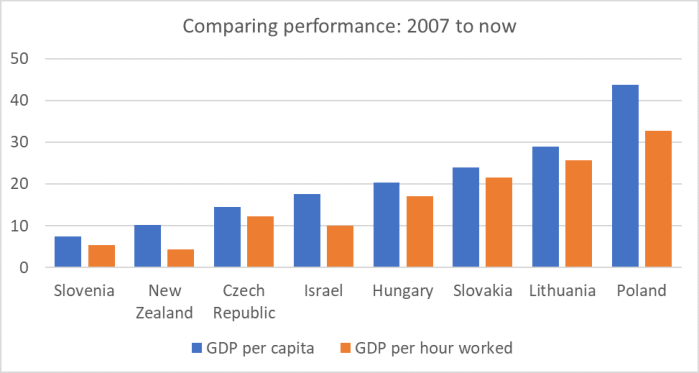
And if you don’t like the idea of comparing against the US –  even though it was the centre of crisis, and doesn’t owe anything in particular to Beijing –  here is how we’ve done against another group of countries, each now with productivity levels similar to those in New Zealand (and few doing much trade with the PRC).   Since all these countries started (in 2007) with productivity well behind global frontiers, all should have been able to do okay even if productivity growth at the frontier (eg US and northwest Europe) slowed.

small countries

Many did pretty well.  As for us – Beijing (alleged) beneficence notwithstanding –  either worst or second worst depending on your preferred measure.

As I noted earlier on, there are countries that have done a great deal worse than us.   But the suggestion that we have “prospered” over the last decade –  in some way materially outstripping the rest of the advanced world –  isn’t just a myth. It is worse than that.   And the people who run the story, whether as senior journalists or senior politicians should know better.

Countries mostly make their own prosperity.  We once did –  those decades when we really did lead the world.    We could again, although that might involve facing facts.  But these days politicians and their acolytes in the media seem more interested in playing distraction; in this case continuing to corrupt our system, supported by motivated fantasy stories about our (alleged) success and our (alleged) debt to Beijing.


Challenges and complexities

Interviewed on Radio New Zealand this morning, the Prime Minister conceded that there were “challenges and complexities” in the government’s relationship with the People’s Republic of China.    Fearful, and seemingly out of her depth, she wouldn’t or couldn’t identify any of those “challenges and complexities”.   And yet she is criticised for not doing enough to keep in Beijing’s good graces by the person in New Zealand politics with an even worse record on PRC issues –  Simon Bridges, leader of the National Party.

I don’t have anything much to say about the Air New Zealand story, or any particular reason to doubt the slowly-emerging explanation (which itself seems to have a PRC-coercion dimension, dating back to last year’s PRC insistence that airlines not suggest that Taiwan –  an independent democratic country –  was in fact or in any way not part of the PRC).  It is just that were the true story to have been more worrying, it isn’t clear that Air New Zealand would have much incentive to be straight with customers or the public: they have an ongoing business to run and Beijing relations to keep smooth (and, of course, the chief executive is the chair of the PM’s Business Advisory Council).    But perhaps leaks from within Air New Zealand would mean the truth still got out?

What of the two Barry Soper stories (this one from the front page of the Herald, and this opinion piece)?   The first is introduced this way

Diplomatic links with China appear to have plummeted to a new low as Prime Minister Jacinda Ardern is given the cold shoulder by Beijing and a major tourism promotion is postponed by the superpower.

Of the visit to Beijing, we learned this yesterday

Ardern confirmed she had an invitation from the Chinese administration to meet President Xi Jinping, but the problem was finding a suitable date. She was meant to meet with the President at the end of last year.

She wouldn’t say whether or not she was confident the meeting would take place this year.

In other words, she isn’t confident it will happen at all.   What is hard to understand is why any self-respecting person would put themselves through this rigmarole?   Abasement before the emperor, and all for the sake of a few New Zealand businesses (often taxpayer subsidised ones) that have got themselves too exposed to a country with a noxious regime.   She keeps telling us we are an independent sovereign state, not some tributary regime.  Why can’t she just politely walk away (and get some aide to make her a note of how constructive and useful  –  enhancing to their reputations –  foreign leaders meetings with Adolf Hitler were).    Perhaps late last year the “scheduling” excuse –  “we all have busy calendars” –  might have washed with some.  It clearly doesn’t now.  And that shouldn’t worry New Zealanders.  It shouldn’t be a cause for reproach from an Opposition leader who (a) has never distanced himself from his foreign affairs spokesperson’s defence of the PRC concentration camps in Xinjiang, and (b) who retains in his caucus, and expresses support for, a Chinese Communist Party member and former PLA intelligence official, and who (c) is understood to rely on that member as one of his largest party fundraisers.  That is where the focus should be, not on selling our souls for a meeting with Xi Jinping.

And then there is the year of the Chinese tourist,

The 2019 China-New Zealand Year of Tourism was meant to be launched with great fanfare at Wellington’s Te Papa museum next week, but that has been postponed by China.

Industry people and regime-sycophants had been very keen on this exercise.  The Contemporary China Research Centre –  funded partly MFAT, chaired by a New Zealander with a significant role in the global Confucius Institute movement – was even hosting a conference on it late last year.   But this isn’t some sort of normal country.  What Beijing giveth, Beijing can also take away.  We are told

Richard Davies, manager of tourism policy at the Ministry of Business, Innovation and Employment, said: “China has advised that this event has had to be postponed due to changes of schedule on the Chinese side.”

Officials are now working with China to reschedule the opening.

Believe all that and you’ll believe anything.  But the Prime Minister claimed to believe it, telling her RNZ interviewer that she could only go on what she’d been told, and she’d been told there was a scheduling problem.  I’m sure she doesn’t really believe it, but why can’t she come straight with the New Zealand public?   She is supposed to serve us, not a small group of business interests.    Better to take explicit credit for a slightly more distant relationship with one of the most appalling regimes on the planet.  Especially if all that talk about kindness and empathy means anything at all.  But she won’t do that –  won’t square with the public about the nature of the regime she (and his predecessors) have been pandering too, all no doubt on official advice.

You got a sense of the sort of business sector pressure she seems to be under in how she responded to the interviewer’s questions about Huawei.  Much as the China-oriented bits of the business community – and the China Council –  must hate it, almost everything that has emerged on Huawei in the last couple of months only confirms how unwise any decent and self-respecting country would be to allow Hauwei equipment to play a key role in 5G networks.   And yet the Prime Minister seemed to interpret the question as a suggestion that we should back down and just let Hauwei –  and the PRC state –  do its thing.  ‘If we did that could we really say we had an independent foreign policy?” was the gist of her response.

Barry Soper seems to be championing some of that sort of “never mind national security, never mind self-respect, never mind the advice of longstanding friends and allies, lets never ever upset Beijing” line.  It was clear in his selection of people to quote from in his article.  There was this, apparently on Huawei

Asset management and corporate adviser David Mahon, based in Beijing, said governments needed to get over thwarting Chinese economic aims in a way reminiscent of the Cold War struggle between capitalism and communism. “It’s unhelpful for politicians and a few anti-Chinese professors to feed uncorroborated McCarthyite conspiracies about Chinese spy networks in their countries and targeting anyone who doesn’t share their view,” Mahon said.

Just lie back and let Beijing have its way seems to be Mahon’s perspective.  That isn’t how self-respecting people, or nations, act.  But perhaps if you are just desperate for the next deal none of that stuff matters?

And then there was more melodramatic stuff from Philip Burdon, until recently chair of the taxpayer-funded PR outfit the Asia New Zealand Foundation, and of course a longserving senior National Party figure.

Philip Burdon,….said New Zealand couldn’t afford to take sides.

“We clearly need to commit ourselves to the cause of trade liberalisation and the integration of the global economy while respectfully and realistically acknowledging China’s entitlement to a comprehensive and responsible strategic and economic engagement in the region,” he said.

Sources in Beijing say China plans trade retaliation…..

Two-way trade with China trebled over the past decade to $27 billion. “The implications for New Zealand are dangerous at every level,” Burdon said.

Wouldn’t it be nice if the PRC seriously committed itself to the practice of liberalisation?  Doesn’t seem likely.  And “respectfully acknowledge their entitlement”?  Like true vassals?

But what’s with this “can’t afford to take sides” business?  It has been a convenient framing for some time, as if we are asked to choose between the US and the PRC.  Even if that were the choice, the United States (for all its faults) remains much more in tune with the values and attitudes of New Zealanders than the lawless regime in Beijing does.  But, of course, the choice isn’t really between the US and the PRC, but between the PRC and New Zealand, or even (charitably) the interests of a small number of New Zealand businesses (and parties reliant on donations) and New Zealand as a whole.   Given that choice, we can’t afford our governments not to take sides, not to back New Zealand and its values and long-term interests.   That includes defending the integrity of our political system, defending the freedoms of ethnic Chinese New Zealanders (whose media and community associations seem to have been largely taken over by Beijing-affiliated groups), and being the sort of nation that stands up internationally for the sort of behaviour –  treatment of other people –  we expect.

There is more from Philip Burdon in Barry Soper’s op-ed

We can’t afford to let this diplomatic tightrope slacken and that’s most certainly the view of a Peters confidante, former Trade Minister in the Bolger Government and recently the chair of Asia 2000 Phillip Burdon.

The mushroom magnate says China has constructively sought to engage with New Zealand for which we should be grateful.

It’s utterly ridiculous, Burdon contends, that China has sinister plans to subvert and interfere in our society or in our democratic institutions.

Ah, it is a debt of gratitude –  perhaps serviced with periodic offerings of tribute –  that we owe to Beijing, at least according to Burdon, for all that “constructive engagement”.     What exactly was that?

As for Burdon’s final sentence, one presumes he is so far down the track of abandoning all sense of self-respect that the presence of a former PLA intelligence official, who hob-nobs with the embassy and never ever says anything critical of Beijing just doesn’t bother Philip Burdon.  There are deals I guess, and never mind the integrity of our system.  Perhaps it doesn’t bother him that Parliament’s justice committee is chaired by someone with close ties to various United Front institutions?  It should.       It isn’t necessarily that Beijing “has” sinister plans –  as if this is something in the future. The very fact that Jian Yang in particular still sits in Parliament, challenged by no one in the entire political spectrum tells you that, by accident or design, those visions have already been coming to pass.  Or when neither the Prime Minister nor the Opposition leader will make a clear stand in defence of Anne-Marie Brady and her work.

I’m sure Beijing has no interest in toppling our formal institutions.  Why would they when those institutions have rotted from the inside.  I guess he too wants us to believe that only a “few anti-Chinese professors” are at all bothered.

All of which brings us back to the opening line of Barry Soper’s op-ed

New Zealand is feeling the heat of the Chinese dragon’s breath and if we’re not careful it could incinerate us.

Which is simply nonsense.    As an economy, we have much more to worry about from a sharp Chinese economic slowdown –  which may be underway already –  than from any sorts of specific attempts at economic coercion of New Zealand.  The PRC is a big country, and in a world with few buffers a recession there could matter a lot everywhere.   As for New Zealand, the PRC certainly has some capacity to harm some specific sectors, perhaps even quite severely.  I wouldn’t want to be a university vice-chancellor if the PRC decides to attempt to bring the government to heel. Then again, I don’t have any sympathy with those people, who have put themselves at the mercy of a known thug, all backed by dodgy immigration provisions, rather than looking to manage their exposures (as prudent businesses, unable to twist governments to their purposes, would).  I have some more sympathy for tourism operators –  who mostly are operating in an open market.  As for commodity exporters, well they are selling commodities and (to a first approximation) what isn’t sold in the PRC will be sold somewhere else.   Sometimes values and interests cost – in many ways, the only true measure of what is valuable is the price one is willing to pay to defend it.  Too many of these Beijing defenders don’t seem to have any particular interest in defending our system, our people –  let alone standing against the sheer awfulness of the PRC regime at home and abroad.

We can’t fix the PRC gross human rights abuses.  I’m not even suggesting we should be at the forefront of moves on those issues. But when other countries speak and our governments don’t, they shame us.   Neither our Prime Minister nor our Opposition leader will utter a word about (for example) Xinjiang, or about the abducted Canadians, even when other countries have –  otherwise reprehensible Turkey only this week in a strong statement on Xinjiang. Life – politics –  has to be more than just deals and donations if it is to have any meaning, command any respect.   Frankly, it is hard to tell at present which side of politics is worse on this issue, but on balance I’d have to give it to National –  whose only interest in all of this, in anything they say in public, seems to be placating Beijing.  In office there are hard choices and calls to make –  even if that is still no excuse for not openly engaging on the “challenges and complexities”.  In Opposition one might have hoped, just occasionally, for a slightly more principled position. But I guess their actions, their people, their words reveal what their “principles” really are in this area.


Donations, the PRC etc

There was interesting Herald story a couple of weeks ago suggesting that the National Party may be beginning to feel some heat about their affiliations with, and excuses for, and funds flowing from, the People’s Republic of China (or people with close associations thereto).    The story drew on a speech given by National’s spokesman on electoral law, longserving MP Nick Smith,  to the Nelson Rotary Clubs.  In that speech Nick Smith argued as follows

4.2 Banning Foreign Donations

The second change I want to promote is a ban on foreign donations. This proposal was floated by former Attorney General and SIS Minister Chris Finlayson in his valedictory speech last month with him forcefully arguing that New Zealand’s democracy is ours and should not be open to manipulation by any foreign influence. This risk has been highlighted in recent overseas elections.

The existing electoral law does put limits on foreign donors, but needs strengthening. Only kiwi citizens and residents should be able to donate to political parties or to campaigns that seek to influence an election outcome.

Such a change would need to be done with finesse so as not to discourage political participation by new New Zealanders. The issue is not about ethnicity. It is about New Zealand not allowing its democracy to be inappropriately influenced by overseas interests.

It isn’t that I disagree with Nick Smith on this specific, just that in raising it (and not other issues around electoral donations) he seems to be avoiding –  probably consciously and deliberately – some of the real specific issues that are apparent in New Zealand.

The Herald article summarised the current law this way

Current electoral law prohibits non-citizens or residents from donating more than $1500 to political parties, but these can be avoided by donating through New Zealand-registered corporate entities – such as companies, incorporated societies and trusts – which are allowed to donate regardless of whether they are owned or controlled by New Zealanders.

and in a recent commentary, Simon Chapple, director of Victoria University’s Institute for Governance and Policy Studies observed

Currently in New Zealand foreign donations to a party of up to NZ$1,500 are permissible. Moreover, foreign donations below this amount are not individually or collectively disclosed.

It would be easy for a foreign state or corporate body seeking political influence to channel a large number of donations into the system just under the threshold via numerous proxies. Whether such interference has been happening is unclear, since New Zealanders do not know how much money currently comes in to political parties via foreign actors.

Even if foreign donations are not a problem now, one could rapidly develop. A strong argument can be made that foreign money has no place in democracy, including New Zealand’s.

New Zealand would not be going out on an international limb by banning foreign donations. Foreign donations to political parties are not permissible in the [United Kingdom, Ireland and the United States. They are also banned in Canada but unfortunately a significant loophole exists. Australia is currently in the process of banning foreign donations.

And I’d certainly agree with Simon on that general point: foreign money should have no place in funding election campaigns or political parties.

So there probably is a good case for a blanket prohibition on donations (in cash or in kind) to political parties by non-resident non-citizens.  But that looks mostly like pre-emptively closing a possible source of a problem (although perhaps real in the case of Phil Goff’s last mayoral campaign) –  and thus looking as though you care –  when the real actual issues New Zealand faces in this area would not be addressed at all.   For example, the largest single (acknowledged) donation to the National Party a couple of years ago was from a New Zealand registered company owned and controlled by a PRC billionaire.  That is foreign money in New Zealand politics, and shouldn’t be allowed.  It would be bad enough if it were from donors in countries that generally shared New Zealand values and democratic norms.   It is far worse when the donor is from the PRC – or, if you like, North Korea, Equatorial Guinea or other repressive authoritarian states –  and (according to the media coverage) clearly in the good graces of Xi Jinping.   Personally, I would probably favour banning all corporate donations to political parties –  people are citizens, companies aren’t –  but at very least we should apply the same restrictions to foreign-controlled companies that we apply to non-resident non-citizen individual donations.

But laws can take you only so far, and I’m not convinced they can deal with what appears to be the rather bigger issue around New Zealand political party financing (probably mainly National, although it seems likely that Labour now in government will be seeking to get in on the act).   That requires decency, integrity, and a willingness to make a sacrifice –  in this case, not to take money from people –  not even New Zealand citizens or residents – with close associations with, declared support for, political regimes with values so inimical to, and inconsistent with, those that have underpinned New Zealand democracy, and its fairly free and open society.

It seems to be widely understood that National Party Jian Yang is the party’s biggest single fundraiser.  Jian Yang, as is now widely known, served in PLA overseas intelligence system and was (perhaps is) a CCP member, who eventually acknowledged that he misrepresented his past to get residency and citizenship in New Zealand. In all his years in Parliament he has never once criticised the PRC –  not even over Tiananmen Square (perhaps there is an opportunity for him on the 30th anniversary in a few months time) – he is observed to be very close to the PRC Embassy, and even a former diplomat (now a lobbyist, so hardly someone deliberately trying to stir up trouble) declared that he was always very careful what he said in front of Jian Yang.    It is, to put it mildly, hard to be confident that he is primarily serving the interests of New Zealand and New Zealanders.

I’ve noted previously comments made last year by serious senior people at a Chatham House rules event I was invited to

There was clear unease, from people in a good position to know, about the role of large donations to political parties from ethnic minority populations –  often from cultures without the political tradition here (in theory, if not always observed in practice in recent decades) that donations are not about purchasing influence.  One person observed that we had very much the same issues Australia was grappling with (although our formal laws are tighter than the Australian ones).  Of ethnic Chinese donations in particular, the description “truckloads” was used, with a sense that the situation is almost “inherently unhealthy”.   With membership numbers in political parties dropping, and political campaigning getting no less expensive, this ethnic contribution (and associated influence seeking) issue led several participants to note that they had come round to favouring serious consideration of state funding of political parties.

These will probably (almost) all be donations made by New Zealand citizens or residents, and nothing in what Nick Smith (or Chris Finlayson) was saying would even touch on them.

And thus late last year, Yikun Zhang sprang to brief public prominence, when Jami-Lee Ross revealed the tape-recording of his discussion with Simon Bridges about the $100000 donation(s), and the possible bid by one of Yikun Zhang’s associates for a place on National’s list.   I’m not mostly concerned with the question of whether this donation (or set of donations) was appropriately disclosed –  although in general I think there is a strong case for a lower, and more binding, disclosure threshold, tying all material donations back to identifiable natural persons –  but about the affiliations and identifications of Yikun Zhang and his associates.  We learned at the time the story broke that Yikun Zhang – despite being a long-time New Zealand resident (and citizen) doesn’t speak English.  We learned a lot about his involvement –  at senior levels –  in various United Front bodies, and the strong ties he appears to have with CCP entities back in the PRC.  It is, to put it mildly, hard for a dispassionate observer to be confident that he primarily has at heart the interests of New Zealand and New Zealanders.   Given the nature of the regime he enthusiastically and repeatedly assoicates with, no decent political party should voluntarily have any but the most formal relations with such a person, and certainly shouldn’t be soliciting money from, or through them.  It isn’t what decent people, with any regard for the integrity of our system, do.

In fact, of course, not only do they take his money, but Phil Goff, Jian Yang, and former National MP Eric Roy got together to nominate Yikun Zhang for an honour, something bestowed last year by the current government.  In effect, it appears, for services to one of the more evil –  most evil, judged by the numbers it rules –  regimes on the planet.

And of course we know that not just MPs but party officials seem to fall over themselves to praise that same regime, and run interference whenever there is a suggestion of problems (think of Todd McClay running Beijing propaganda lines about “vocational training camps in Xinjiang).  Peter Goodfellow, the National Party president, seems to work very closely with Jian Yang to pander to the regime, and keep the local donation flow going.  And on the Labour side, Nigel Haworth seemed to be little better.

So by all means, take up the specific suggestion to ban completely foreign donations.  It would be a small improvement on the current situation, but it would not even begin to tackle the deep corruption of the our political system around the PRC regime.  People who were long-serving senior ministers – Nick Smith and Chris Finlayson –  know that very well, even if they are genuinely well-meaning on their specific proposal.

But attempting to fool the public otherwise seems to be a bit of new theme.  That Herald story where I first saw reference to Nick Smith’s speech included this gem

In a related move, Parliament’s justice select committee have issued a rare invitation to the country’s intelligence agencies to give a – likely closed-doors and secret – briefing to MPs about “foreign interference” in local elections.

Nick Smith, a member of the committee and his party’s spokesperson for electoral law reform, confirmed the committee as a whole late last year sent a letter to the New Zealand Security and Intelligence Service (NZSIS) and Government Communications and Security Bureau (GCSB) inviting them to give evidence.

Smith yesterday said he hoped the NZSIS and GCSB would be able to provide insight on the local risks posed by issues such as the hacking the public officials’ communications, foreign donations, and anonymous and politicised social media campaigns.

“There is the issue of funding, and whether foreign governments are either directly, or indirectly through shelf companies, are using funds to inappropriately influence outcomes,” he said.

Smith said the invitation to the NZSIS and GCSB offered evidence to be given in secret if required. He conceded this would be an unusual move for usually-open committee meetings, but was justified: “I think this is a really important issue,” he said.

So a committee chaired by Raymond Huo, he of various United Front bodies, he who chose a slogan of Xi Jinping’s for Labour Chinese-language compaign in 2017, with a senior National MP promoting only the narrowest reform (while providing cover for Jian Yang) will invite the intelligence agencies to provide advice on foreign influence issues, but in secret.   Perhaps –  but only perhaps, because the fact of this hearing might be used to simply play distraction – it is marginally better than nothing, but we don’t need intelligence agencies to tell us there is an issue around the PRC. Both main parties know what they are doing –  who they associate with, who they take money from, who they honour, who they seek closer relations with, and who they refuse ever to criticise, no matter how egregious the regime’s abuses.  All the minor parties keep quiet and go along too.

There was column this week on Newsroom by political scientist Bryce Edwards argues that it is “urgent” that we start having a proper debate in New Zealand about the PRC and the relationship with New Zealand.   I don’t really disagree with him, although he seems to want an “elite” debate, and seems scared by the idea that the public might have a (strong) view (an “overly simplistic one” apparently, like ideas of good and evil perhaps?).

Edwards writes

Obviously, we can’t rely on the politicians to lead that [debate] – they’re too compromised, and they’re just too inclined to suppress the discussion. Instead it has to be other parts of the public sphere – especially the media and other public figures – that needs to step up to examine and discuss the issues.

But it seems like wishful thinking.  Sure there is the occasional voice from the margins –  whether Edwards or Anne-Marie Brady – but there doesn’t seem any sign that anyone in “elite New Zealand”, anyone who commands serious respect, is about to break ranks from the “keep quiet, keep the deals and donations flowing” sickening consensus of the last few decades.  Not former leading politicians, not church leaders, not leading business figures, no one.  Even if a few people mutter quietly –  even Fran O’Sullivan had some recent encouraging comments about donations – no one seriously breaks ranks.   The taxpayer even funds bodies that condemn taking action on Huawei.  So who does Edwards seriously think might lead such a debate?

As he says, all politicians have all sold their souls.  I was exchanging notes earlier this week with someone about Jian Yang.  It is easy to blame John Key and Peter Goodfellow for Jian Yang –  they either knew his background or should have, and didn’t really care (or worse) either way.  But the story of Jian Yang has been public for almost 18 months now and no one in politics has disowned him, called for his resignation, called for the National Party to remove him from their caucus.  Not Jacinda Ardern or Andrew Little, certainly not Bill English or Simon Bridges, not James Shaw or Marama Davidson, not David Seymour, not even (despite occasional timorous hints) Winston Peters.  Not even Jami-Lee Ross, who was at the centre of the whole donations business.  Not a single backbencher, of any party, was willing to break ranks and declare the situation unacceptable.  Fixed with knowledge, by their silence they now share responsibility.

It is little different on any of the other aspects of the PRC relationships:

  • the effective PRC control of the local Chinese language media,
  • the refusal to say a word about the Xinjiang abuses (or Falun Gong or Christian churches),
  • the refusal to say anything in support of Canada over the abduction of two of its nationals.

Probably most of these so-called leaders like to think they are somehow serving New Zealand interests.  People fool themselves that way, sometimes without necessarily fully realisng what they are doing.  They aren’t.

So, much as Bryce Edwards might deplore the prospect of an “overly-simplistic” serious public debate, or swelling tide of discontent, I’d cheer on the fact that it was happening at all.  Corrupted systems are rarely, if ever, upended and reformed without a strong strand of –  almost unreasonable –  public outrage.  It hasn’t happened here yet.  I’d like to say it was only a matter of time, but I’m a pessimist.    What would turn things around now after all these years in which our “elites” have degraded our political system (to complement their failures on other fronts, notably productivity)?  Labour and National are, after all, two sides of same coin on such issues, and together they seem to have a stronger hold on the political system (vote share combined) than we’ve seen for some decades.   We don’t have politicians of decency and integrity, and the public show little sign of (effectively) demanding something different.  The PRC Embassy must be pleased.


UPDATe (4/2):   There is a new column by Simon Chapple and a co-author on reviewing the rules around political donations.  I’m pretty sympathetic to the sorts of changes they propose, although as I argue above the PRC-influence issues around donations or more about atttitudes and integrity –  knowing what is right and wrong and eschewing the latter –  than something formal external (eg statutory) rules can deal with.


On a troubled, hugely-distorted, economy

The latest GDP numbers for China were released yesterday.  If they probably got more attention than they deserved in the international financial media, there appears to have been no coverage at all in the two main New Zealand newspapers –  surely there is some sort of happy median, as regards one of the two biggest economies in the world, one of the two economies with which New Zealand firms trade the most?    There has long been a sense that the PRC’s statisticians smoothed the national accounts data for political purposes, but in recent years there has been a growing sense that many of the numbers are, to a greater or lesser, extent, just made up.  Among the straws in the wind has been the remarkable stability in the reported GDP growth rates over the last few years.

More recently still, there has been a growing disconnnect between the reported GDP numbers and perceptions on the ground.   Here is how Michael Pettis, a leading analyst of Chinese economic developments and professor in Beijing, put it a few days ago

According to the National Bureau of Statistics, China’s economic growth in every quarter last year exceeded 6.5 percent. While that is much lower than the heady growth rates China has experienced for most of the past forty years, it is still, by most measures, a very brisk rate of growth.

And yet, when you speak to Chinese businesses, economists, or analysts, it is hard to find any economic sector enjoying decent growth. Almost everyone is complaining bitterly about terribly difficult conditions, rising bankruptcies, a collapsing stock market, and dashed expectations. In my eighteen years in China, I have never seen this level of financial worry and unhappiness.

“Perceptions” don’t help much in working out whether an economy really grew at 6.5 per cent or 6.2 per cent, but those aren’t the sorts of differences people are worrying about.

But what prompted this post wasn’t yesterday’s GDP release but rather finally getting round over the weekend to reading the translation of a speech given last month, marking the 40th anniversary of the PRC’s economic liberalisation, by a prominent Chinese economist.   It is introduced this way

On Dec. 16, Prof. Xiang Songzuo (向松祚) of Renmin University School of Finance and former chief economist of China Agriculture Bank, gave a 25-minute speech during a CEO class at Renmin Business School that was apparently applauded by the audience but immediately censored over the Chinese internet. Singling out 2018 as the year when China comes to a large shift unprecedented over the past 40 years, the speech can be seen as a landscape survey of Chinese economy, and obliquely, also of politics. Just as Tsinghua law professor Xu Zhangrun’s (许章润) broadside “Imminent Fears, Immediate Hopes”, which was superbly translated and widely talked about among China watchers, Prof. Xiang’s speech is another rare burst of Chinese intellectuals’ discontent with the direction the country is taking under Xi Jinping.

He begins with the economic slowdown

China’s economy has been going downward this year, as everyone knows. The year 2018 is an extraordinary year for us, with so many things taking place. But the main thing is the economic slowdown.

How bad are things? The number that China’s National Bureau of Statistics (NBS) gives is 6.5 percent, but just yesterday, a research group of an important institution released an internal report. Can you take a guess on the GDP growth rate that they came up with using the NBS data?

They used two measurements. Going by the first estimate, China’s GDP growth this year was about 1.67 percent. And according to the other calculation, the growth rate was negative.

(These latter suggestions were reported last month.)

It is a remarkably forthright speech.  For example

Second, what was the cause for the economic downturn? Why did private enterprises suffer setbacks in 2018? Looking at the data, investment by private businesses has dropped substantially, so what made private business owners lose confidence? On November 1, the national leaders convened a high-profile economic conference, which some interpreted as a signal that the government wants to win back the confidence of private businesses as the economy worsens.

Since the beginning of the year, though, all kinds of ideological statements have been thrown around: statements like “private property will be eliminated,” “private ownership will eventually be abolished if not now,” “it’s time for the private enterprises to fade away,” or “all private companies should be turned over to their workers.” Then there was this high-profile study of Marx and the Communist Manifesto. Remember that line in the Communist Manifesto? Abolition of private property. What kind of signal do you think this sends to private entrepreneurs?

Or

When we buy stocks, we are buying the profits of the company, not hype and rumors. I recently read a report comparing the profits of China’s listed companies with those in the U.S. There are many U.S. public companies with tens of billions dollars in profits. How many Chinese tech and manufacturing companies are there that have accomplished this? There is only one, but it’s not listed, and you all know which one that is. [Xiang is referring to Huawei, the Chinese tech company.] What does this tell us? As Yale professor Robert Shiller said: stock market performance may not work as a barometer of the economy in the short run, but it does for sure in the long run.

So I think that the terrible stock performance only demonstrates one thing, which is that the real economy in China is in quite a mess. Where is the stock market rebound? I think it’s obvious that investor confidence has yet to recover.

Or

I’m acquainted with many bosses of listed companies. Frankly speaking, a large part of their equity pledge funds did not go into their primary business, but used on speculation. They have many tricks. They buy financial products; they buy housing. The government said listed companies have spent 1-2 trillions on speculative real estate. Basically China’s economy is all built on speculation, and everything is over leveraged.

Starting in 2009, China embarked on this path of no return. The leverage ratio has soared sharply. Our current leverage ratio is three times that of the United States and twice that of Japan. The debt ratio of non-financial companies is the highest in the world, not to mention real estate.

Macro policies can be short-term palliatives, but they don’t deal with the basic issues

Moreover, these credit and monetary policies can only make short-term adjustments that are incapable of fundamentally solving the “imbalances” I mentioned earlier. We are still trapped within the box of the old policy and the old way of thinking. The key to whether transformation will be successful is the vitality of private enterprises—that is, whether policy can stimulate corporate innovation.

We have been making a game of credit and monetary tools for so many years. Isn’t this the reason we are saddled with so many troubles today? Speculation has driven housing prices sky-high.

Ending thus

I hear that the day after tomorrow, there’s going to be a grand conference to mark the 40th anniversary of the “reform and opening up.” I sincerely hope that we’ll hear something about further deepening of reforms at that conference. Let’s wait and see if any real progress can be made on these reforms.

If this doesn’t happen, let me conclude on these words: the Chinese economy is going to be in for long-term and very difficult times.

In some ways, what has been remarkable about China over the last year is that not only has there been no serious structural reform (of the sort that might actually position the economy to get towards material living standards in places like Korea, Japan, Taiwan or Singapore) but there has not been much counter-cyclical stimulus either.

If one takes a highly stylised view of China’s economic growth this century, there are two broad phases.    The first involved a huge increase in China’s exports, and in the export share of China’s economy.

china exports

From 2000 to 2007, exports as a share of (fast-growing) GDP rose from around 20 per cent to around 35 per cent  (imports also rose substantially, but this was the period when the current account surplus –  in a developing country –  peaked at almost 10 per cent of GDP).  Of course, not all of that was value-added by Chinese firms – many products are recorded as final exports from China, but may only have a relatively limited amount of Chinese value-added in them (i-phones are the most often-cited example).     In a country as  large as China, trade shares anywhere near 30 or 35 per cent were never going to be sustained –  large countries (see the US or Japan) mostly trade within their own borders –  and with the sharp rise in China’s exchange rate, and the slowdown in growth in demand from advanced economies, the “export engine” has lost power.  In fact in USD terms China’s exports have grown only quite modestly over the last five years (and consistent with that the export share of GDP has shrunk markedly).

After 2008, GDP growth has been underpinned by a massive domestic credit and investment/construction boom.

china capex

During that period, investment of GDP –  already absurdly and inefficiently high – reached new highs, in an economy that had neither strong population growth nor, any longer, was making big new inroads competing in world markets.   You can do that sort of thing for a while –  on a much smaller scale, one could think of the Think Big massive boost to recorded investment and activity here in the early 1980s, or of the construction booms in Spain and Ireland earlier this century.  But the economic returns to doing so tend to be quite severely diminishing, and the risks (associated with sustained misallocation of resources) mount.  It seems to take more and more additions to credit to get the next dollar increase in GDP.   And private borrowers/investors –  even aided and abetted by over-eager lenders –  get more uneasy, and only the most risk-loving are still keen to take on new projects.  To the extent that GDP still rises, productivity rarely does.  Excess capacity forms, even as the most deluded fails to recognise the symptoms,

Indications are that the Chinese authorities recognise that the credit boom and associated wasteful investment wasn’t sustainable, but there also seems to be a possum-in-the-headlights dimension to policymaking at present.   What are the feasible alternatives after all?

For a long time, my approach to China was that of course the state could prevent a financial crisis (of the sort in the US in 2008/09) if it chose to.  After all, there are few technical obstacles to a totalitarian state just guaranteeing all the liabilities of banks and other financial institutions.   Perhaps they still could, although the complex web of channels of financial intermediation –  combined with starting levels of debt and deficits –  make that a lot harder than it once was, and even guarantees don’t allay all the fundamental unease about the misallocation of resources and associated risks (you might not panic –  running on your bank – but you might be reluctant to invest or spend anyway).

Conventional mechanisms in a market economy rely heavily on cuts in official interest rates.  Chinese interest rates could be cut, but (a) the transmissions mechanisms aren’t the same as those in market economies, and (b) as we saw in the West after 2008, even big cuts in interest rates can –  when times are tough –  often only act to lean against the depth of a recession, not necessarily doing much to put growth on firmer sustained foundations.

There is fiscal policy of course.  Given the China is already starting from a deficit position (on OECD numbers, Chinese government net borrowing as a per cent of GDP is projected to be about 3.5 per cent of GDP next year) perhaps the possibilities there are more limited than they might seem, especially against the magnitude of the slowdown China seems to be experiencing.   But –  and these are the sorts of options we used to debate in western economies when we thought about the exhaustion of conventional instruments – there is always, at least in theory, the option of large scale directly government-financed construction and related projects: unsterilised fiscal policy, directly financed by the central bank: building bridges to nowhere, more empty apartments, airports that are little used and so on.   It could be done no doubt, although simply freeing up liquidity requirements and encouraging banks to lend isn’t likely to bring such outcomes about.   And PRC technocrats seem as uneasy about unconventional macro policy as many of their western counterparts were (it is, after all, only 70 years since China was experiencing hyper-inflation).  But even if it were done, it would have the feel of simply buying time, storing up bigger adjustment problems further down the track.

The other strand of a conventional transmission mechanism involves the exchange rate.  Economies experiencing difficulties will typically experience an exchange rate adjustment, which lifts returns to domestic producers, encourages more investment in the tradables sector, and so on.  It was one thing for China to engage in a massive domestic-focused credit boom starting from a position of a 10 per cent current account surplus (and massive –  relative to the then size of the economy –  foreign exchange reserves).  It is quite another now, when (a) the current account is near balance, (b) reserves are at unspectacular levels, and (c) the private sector seems increasingly distrustful.   Significant fiscal or monetary stimulus will, all else equal, boost domestic demand but not foreign demand, and would increase materially the pressure for an exchange rate adjustment (and the perceived returns to illegal capital outflows).   That would be rational and sensible adjustment in a normal economy –  places like Greece and Portugal would almost certainly have benfited from having the option, as New Zealand does in its downturns –  but it is nowhere near that easy an option for China, for economic and political reasons.    Such a devaluation –  let alone a float –  would only intensify that economic conflict with the United States, but might well be seen more widely (at a time when the world economy is not strong) as exporting deflationary pressures to the rest of the world, and potentially bringing renewed global economic stresses (the amount of USD borrowing by Chinese entities is also not an irrelevant consideration).

This isn’t an attempt to offer all the answers, more about identifying some of (very real) constraints that PRC economic policymakers now face.  I’m very much with the learned professor, quoted earlier, that what –  in some abstract longer-term sense –  China needs is serious thorough-going market-oriented reform and liberalisation.  But even in small advanced economies those sorts of programmes can be very disruptive, even costly, in the shorter-term, whatever the substantial longer-term gains on offer.  But in a society where the Party in charge has spent the last half-dozen years asserting increasing control, in an economy now one of the largest in the world (when the global economic environment is insipid at best), starting from all that debt, and in an increasingly tense global political environment how plausible is it to expect step-changes in policy for the better?   And how credible would either domestic or foreign investors even regards indications of such change as being?

What might it all mean for New Zealand?  The terms of trade is typically the main channel by which slowdowns abroad affect our economy, but one might reasonably be pretty nervous about the outlook if one were a New Zealand exporter of education services, construction products, or even (year of the Chinese tourist notwithstanding) tourism.  Fortunately for us, we do have a flexible exchange rate and fluctuations in our exchange rate don’t matter much to anyone else, but don’t forget how little conventional monetary policy firepower even our Reserve Bank has now, compared to what it had in previous downturns.

To end with just a couple of snippets.  This from the same Pettis commentary I linked to earlier

These concerns have even breached academia. One of my students told me yesterday that there was a huge increase last semester on the university website in the number of students selling their belongings because they are hard up for cash. They are selling their phones, computers, clothing, and lots of other possessions. He said the amount of selling is noticeably higher than last year, enough so that everyone is talking about it. And he indicated that this is apparently happening at other schools too. It seems that the poor and middle-class kids are squeezed for cash because they are getting much less money from home than they have in the past.  This isn’t what you’d expect to hear from an economy growing at more than 6.5 percent.

And this from a story I noticed over the weekend

“I’ve been a manager for almost half a century, but this is the first time I’ve seen such a large single-month drop in orders for us,” said Nidec CEO Shigenobu Nagamori. “What we witnessed in November and December was just extraordinary.”

Nidec, a Japanese company with $14 billion in revenues last year, makes a wide range of electric motors, from tiny devices that make the iPhone vibrate to industrial motors. It’s the world’s largest manufacturer of motors for disk drives. For the automotive industry, it makes things like engine and transmission oil pumps, coolant pumps, control valves, and fans and blowers. It makes motors for industrial robots, etc.

It’s a supplier to Apple, other electronics makers such as hard-drive makers, but also appliance makers, automakers, robotics manufacturers, industrial equipment manufacturers, etc. In other words, the company is a key supplier of advanced parts to Chinese factories.

The company slashed production at the end of 2018 for Chinese automakers and appliance makers by over 30% because of weak demand, Nagamori said.

This slowdown seems to be very real, and China is large enough now it is likely to really matter across the world economy.  As my former colleague Kirdan Lees has it (in a column I don’t fully agree with, but might comment on in a separate post), Grant Robertson needs a recession plan.  So does Adrian Orr.  Not because such outcomes are certain –  they never are (until it is too later) but because the risks are rising.

Cowering and contemptible

A couple of weeks ago I wrote a post about the utter silence, from all New Zealand officeholders (most notably the Prime Minister), about the abduction –  no better word for it –  by the People’s Republic of China of a couple of Canadian citizens, apparently in an attempt to coerce Canada into not proceeding – in the event the Canadian courts find that the other terms of the treaty have been met – with the extradition to the US of the Huawei CFO.

….you have to wonder what goes through their minds when Jacinda Ardern and Winston Peters decide to stay quiet, when our traditional allies speak out.   Does it not for a moment cross their mind that one day New Zealand might find itself in Canada’s position, and to wonder who –  if anyone –  might go into bat for us, and for our citizens if they were to be abducted by the regime in Beijing?

By their utter silence, on this as on so many other PRC issues, our MPs and ministers dishonour this country and its people.   Cowering in a corner, deferring to Beijing, is simply unbecoming people who purport to lead a free and independent country.

It isn’t as if any of this is particularly new.  Our Prime Minister won’t speak up about the gross abuses in Xinjiang, won’t speak up about the intensified persecution of other political and religious dissidents, won’t speak up about…..well, almost anything.  But somehow it is a degree more shameful when you won’t even stand up for your friends.   When you are the cowardly one when others around you – in this case, other advanced countries – have been willing to make a stand.  It is contemptible behaviour.

There was more news this week.  We are told that the Prime Minister took a call from Canada’s Prime Minister Justin Trudeau.  I suppose she didn’t have much choice but to take the call –  Trudeau has after all been seen as cut from the same left-wing ideological cloth as the Prime Minister.    But the Prime Minister wouldn’t even comment on the call –  has anyone heard from her on anything for weeks now? – instead sending out not even the government’s ‘duty minister’, but just a spokesman for him, to blather and say nothing.

Ardern was not available for comment today but a spokeswoman for duty minister Grant Robertson confirmed Ardern had a brief conversation with Trudeau yesterday.

“Although the cases are a consular matter between Canada and China, as the extradition case relates to a Huawei executive in Canada, there are principles at stake that concern us all.”

What an utterly meaningless statement.

Perhaps, perhaps. the Prime Minister had quietly given her support to Trudeau but just didn’t want to let New Zealanders know?  It never seemed very likely, but a day or so later the Canadian Foreign Minister pretty much ruled out that (exceedingly charitable) interpretation

Ms. Freeland said Canada is grateful for the support it has received in recent days from Germany, Estonia, France, Latvia, Lithuania, the Netherlands, the United Kingdom Britain and the United States.

But not New Zealand, even though the two Prime Ministers had talked just a day or two previously.

When I mentioned this around the dinner table, one of my kids suggested that perhaps New Zealand was just small and had been forgotten.  But, of course, not only is New Zealand a traditional close friend, ally, and partner of Canada, but we are bigger than any of the three Baltics in the list.  Clearly, Canada is receiving no support at at all from New Zealand.

It isn’t the way decent people behave.  But it seems to be an acceptable standard for every single one of our elected officials; cowering contemptibly.

Who knows quite what it is they fear?  Perhaps it is that “FTA”- upgrade, or the trip the PM wants to make to Beijing, or some threat to the success of their year of Chinese tourism, or the flow of political donations, or whatever.    Whatever the rationalisation, it is shameful, and imprudent.   Just as schoolyard bullies try to pick off weak kids one at a time, so the People’s Republic of China.  But Ardern –  and Peters, Bridges, McClay, Shaw et al – simply refuse to recognise the character of the regime.  Perhaps there might be a modest cost to some entities if New Zealand were to take a stand –  on an egregious abuse –  but any worthwhile moral stance almost inevitably involves a cost. It is the willingness to pay a price that, in many respects, marks out the value someone places on their belief.  There is little sign that, when it comes to the PRC, our leaders put any value at all on any beliefs –  just deals and donations.

On which note, the Executive Director of the government-funded pro-PRC propaganda agency, the China Council, returned from his holiday to tweet on this issue.

When I first saw the tweet I was momentarily pleasantly surprised, until I realised that what Jacobi was actually championing was the line that somehow New Zealand could be a bridge between the PRC regime and the rest of the world.  The old “elite New Zealand” delusion that somehow by making nice to evil, never ever uttering a complaint about anything –  recall how upset the China Council was when the Huawei ban was announced – we could influence Beijing for the better.   That’s worked out so well over the last seven years as Xi Jinping has taken the PRC ever further back to heavy-handed repression at home, and into an era of new aggression abroad.  Cosying up to such evil should be something to be ashamed of, not trying to fool yourself and others that somehow the regime will be deterred from its aggressive defence of Meng Wanzhou by sweet nothings murmured quietly (if at all) by our Prime Minister or her officials.

Finally, on things PRC, there was a strange column on Newsroom the other day by Robert Ayson, professor of strategic studies at Victoria University.   His lament is that New Zealand/PRC relations are not what they were, while his vision appears to be one of “untrammelled mutual respect and win-win cooperation”, as if he cares not a jot about the character of the regime.  Perhaps he’d have been one of those urging “untrammelled mutual respect” with Adolf Hitler in the late 1930s?

Ayson seems bothered about several things:

  • the proposed ban on Huawei around the new 5G network (where he seems to treat Hauwei as some sort of normal company, even though Chinese law requires Hauwei to comply with government edicts, whether at home or abroad),
  • the recent GCSB statement –  in tandem with a number of other countries –  about the official PRC involvement in commercial cyber-theft,
  • the rather mild comments in the Strategic Defence Policy Statement last year, and
  • the speech in Washington in December by Winston Peters.

All this is the context of a flawed sense of how much China matters to New Zealand’s prosperity (“crucial” in his view).

Professor Ayson is not happy at all.

This shift may please friends in Canberra, Washington and Tokyo, who view China as an unrelenting full-spectrum menace. But New Zealand’s growing alignment with a faux Cold War posture runs against the tradition of foreign policy autonomy Labour-led governments have cherished in recent decades. 

(The same Labour-led governments that have had troops in Afghanistan and Iraq?)

Having an independent foreign policy means making your own choices about the medium-term interests of your own country.  It doesn’t mean never doing things, or sharing common views/interests, with friends and allies.  I’m not sure when Professor Ayson thinks any New Zealand governments ever acted otherwise (whether or not he –  or I – agreed with any or all of those stances –  be it involvement in the first Gulf War, providing a frigate at the time of the Falklands, Vietnam, Suez, or even our current deployment in Iraq).  But in the Ayson view of the world –  seemingly similar in practice to the Prime Minister’s –  an independent foreign policy seems to imply acting entirely on your own, never in concert with anyone, never acting for common interests and values, never acting with a quiet expectation of possible future reciprocal support.

Personally, I don’t think we should be taking a stronger stand against the PRC because, say, the United States is, but because it is in our own longer-term interests to do so –  both about the integrity of our own political system (recall, for example, the former PRC intelligence officer sitting in our Parliament, nominating other Beijing-associated people for honours), and about pushing back against international expansionism (particularly  by a state/regime with values inimical to our own).

But for Professor Ayson, somehow Trump and Brexit are reasons to stay cowering in the corner, deferring to the PRC.

There is one final, very small, fly in the ointment. It would be one thing to add New Zealand’s principled voice to an ensemble of China concern if the choir was unified and led by an internationally respected conductor. But has anyone seen how today’s conductor is behaving? In Donald Trump’s universe, traditional allies and close partners are at best expendable and at worst counter-productive. To the 45th president of the US, the rules-based order is barely relevant, including as it applies to trade. Things would be even worse if any of New Zealand’s remaining five eyes partners weren’t outward-looking models of political reasonableness. 

That’s called playing distraction (perhaps especially in the UK case where, whatever one makes of Brexit, the UK remains fully engaged in both NATO and Five Eyes, and has upped its commitment to this region, including naval patrols in the South China Sea).   You might not like everything about your friends and allies –  some might even be inconstant –  but you actually share values and interests with them.  Few New Zealanders share the values of the Chinese Communist Party or the state it tightly controls.

Ayson’s article ends weirdly.  He wants relations with Beijing strengthened, he wants “balance” back in our foreign and defence policy –  does he mean indifference to China’s consolidation of its hold on the South China Sea, indifference to its plays for influence in PNG, Vanuatu, Tonga, and (perhaps newly-independent) Bougainville), indifference to the growing threat to free and democratic Taiwan?  If so, perhaps he could say so directly.    But the weird bit isn’t that sort of alleged “realpolitik” but the final sentence

But especially in light of Beijing’s reprehensible conduct in Xinjiang, in which case, to borrow the prime minister’s own words, New Zealand needs to begin “Speaking up for what we believe in, standing up when our values are challenged,” this necessary readjustment will not get any easier.

After all it appears that he recognises something of the character of the regime.  But if –  as he says –  he wants the Prime Minister to start speaking up about that evil, it is unlikely to be a path that works towards sweeter and more harmonious relations with the PRC.  Decent people wouldn’t want it to.


Cowering?

A month or so ago Meng Wanzhou, CFO of Huawei, was arrested in Canada, pursuant to an extradition request Canada had received from the United States.    Who knows what merit there is to the charges the United States wants to lay against her.   Should she be extradited, the substantive merits of the case will be determined in open court, with multiple layers of potential appeal.   Who know too whether the Canadians will actually extradite her –  open Canadian courts will reach a view on that (including on whether the alleged offences are also offences in Canada) and the federal Minister of Justice apparently makes the final decision.  Presumably, the court process will be open, and the Minister will face both political and public scrutiny for any decision they are finally called on the make.  In the meantime, after a hearing in open court, Meng Wanzhou is now out on bail in Canada.  Presumably she is free to talk to consular officials from the People’s Republic whenever it is mutually convenient.

All that is more or less how the extradition process works among countries with the rule of law.  We have our own long-running case in New Zealand, in which the United States has for some years been seeking the extradition of Kim Dotcom.

But the People’s Republic of China declared itself “outraged” by the arrest of Meng Wanzhou, calling for her immediate release.  It was, presumably, something akin to lese-majeste to have arrested such a prominent figure, regardless of any possible merits to the charges.

Part of the PRC response was to arrest – abduct or kidnap seem more apt words –  two Canadians in China.

Two Canadian men have been detained in China on suspicion of “endangering national security,” China’s Foreign Ministry said Thursday.

Spokesperson Lu Kang confirmed that entrepreneur Michael Spavor and former Canadian diplomat Michael Kovrig were taken into custody on Monday and that they are being handled separately.

No one seriously supposes there is any actual criminal activity behind these arrests.   Reports over recent weeks suggest very limited consular access, there have been no court appearances, and reports also suggest these people are being held in facilities where lights are on 24 hours a day, repeated interrogations occur, and so on.  As one of the Canadian papers reported

Chinese authorities are able to keep suspects in secret locations for up to six months – without access to a lawyer – as they gather evidence under a system called “residential surveillance at a designated location.” Those who have experienced the ordeal have described intense interrogation sessions and, on occasion, beatings and torture as authorities seek confessions that can be used in court or for propaganda purposes.

There is no indication that Kovrig has been beaten, although sleep deprivation through incessant lighting is classified as a form of torture.

It is the sort of behaviour rogue states engage in, the sort of conduct one might expect all decent people to deplore.   Apart from anything else, if China gets away with this sort of conduct in the case of Kovrig and Spavor (and it is hardly the first time they’ve engaged in hostage-taking of Canadians),  anyone from a free and open country is at risk –  perhaps especially people from second or third tier countries, such as Australia and New Zealand –  whether around future extradition cases or other points of tension involving the PRC.

Canada has called for the immediate release of these two Canadian citizens.  The Canadian government’s approach was backed by separate statements from the European Union, the United States, the United Kingdom, Germany and France.    For a time there was complete silence from the Australian government.   That prompted an open letter last week to Australia’s Foreign Minister from dozens of China-watchers and analysts in Australia –  including many with a long track record favouring engagement with the PRC.  This was their call

Since December 21, the European UnionUnited StatesUnited KingdomGermany and France have each issued statements of concern regarding the apparently political motivation for the arrests of these Canadian citizens, which raise serious concerns about legitimate research and business practices in China. It is time for Australia to do the same. 

In view of the risks this raises to Australian research and business activities that form the bedrock of positive Australia-China relations, we respectfully ask you to join the above-mentioned governments in supporting the Canadian government’s call for the immediate release of these two detainees.

The open letter seems to have been the prompt for the Australian government to finally make a comment, supported by the opposition the federal Labor party.   Senator Payne’s statement does not go as far as the signatories to the open letter sought, and in particular does not call for the immediate release of Kovrig and Spavor, but at least it was an official and public expression of concern.

Of the Five Eyes countries, the United States, the United Kingdom and Australia have all come out in public in support of Kovrig and Spavor, and in support of the Canadian government.    And what of New Zealand?

From our government –  and in fact from any elected political officeholder – nothing.   Just silence.  Her Excellency the Ambassador of the PRC to New Zealand, Wu Xi, must be delighted at such quiescence.   One can only imagine what our traditional friends and allies –  countries that share our commitment to the rule of law –  must make of this public utter indifference by the New Zealand government to the situation Canada, and its abducted citizens, face.  It isn’t even as if these were citizens of Trump’s America –  Justin Trudeau’s government has seemed on many of the same wavelengths as our own government.  And yet still the Prime Minister and the Minister of Foreign Affairs won’t utter even a word, pushing back against lawlessness by the PRC in mistreating citizens of a country we have longstanding close ties with.   It might be the summer holidays –  but then it is in Australia too –  but various ministers, including our Foreign Minister, managed other new public statements last week.    Staying silent is clearly a conscious choice –  a choice to be indifferent to evil, even when it happens to our friends.

Who knows, but perhaps our government has in fact raised the matter quietly with Beijing.  That is the standard line of successive New Zealand governments about every abuse.  But there is never any sign that these alleged representations make any difference, and public statements do matter –  if only to New Zealanders, in giving us a sense of in whose interests, and according to what values, our officeholders are actually governing.  This episode is yet another indication –  we’ve already seen it in their embarrassed indifference to Anne-Marie Brady – that when it comes to China the current government, like its predecessors, governs in the commercial interests of a few universities and big businesses, and of its own party fundraising, rather than for the values of New Zealanders.

But even so, you have to wonder what goes through their minds when Jacinda Ardern and Winston Peters decide to stay quiet, when our traditional allies speak out.   Does it not for a moment cross their mind that one day New Zealand might find itself in Canada’s position, and to wonder who –  if anyone –  might go into bat for us, and for our citizens if they were to be abducted by the regime in Beijing?

So the Ardern/Peters stance –  the awkward silence, as innocent Canadians are abducted and our friends speak up – seems both shameful and dishonourable, and yet imprudent too.  It serves no decent longer-term interest, but perhaps it suggests the Prime Minister is more desperate for that invite to Beijing –  to what end? –  than has previously been evident.

Jacinda Ardern and Winston Peters head the New Zealand roll of shame on this issue, since they are the most senior figures in the current government.   But the shame isn’t just theirs.  There is no sign of anything from Simon Bridges, Paula Bennett (perhaps both rather keen on those donations Yikun Zhang was arranging?), or Todd (“vocational training centres in Xinjiang) McClay.   Nothing from the Green Party or ACT leaders.   Nothing from the Minister of Justice (rule of law and all that). And of course nothing from our PRC-born and educated MPs.  In a decent society, they’d be at the forefront of condemning the abuses in the land of their birth.  In our society, it seems to be just fine that they keep very very quiet –  a silence that suits Beijing –  and help ensure that the donations keep flowing.  Perhaps a journalist might consider asking Raymond Huo his opinion on the abduction of the Canadians.  He was, after all, formerly a lawyer with a leading local law firm, and now he chairs the Justice select committee in Parliament.  You’d hope the rule of law meant a lot to him.  But, like his bosses, deferrring to Beijing, and never ever upsetting the murderous rogue state, appears to matter more than the rule of law, or standing by our friends and allies when they (almost inadvertently in Canada’s case) incur the wrath of a tyrant.

By their utter silence, on this as on so many other PRC issues, our MPs and ministers dishonour this country and its people.   Cowering in a corner, deferring to Beijing, is simply unbecoming people who purport to lead a free and independent country.