What do we want with the Belt and Road?

Readers will recall that the New Zealand China Council was set up by the government a few years ago, and is largely funded by the government, to promote

deeper, stronger and more resilient links between New Zealand and China

The Council includes the heads of government departments/agencies (MFAT and NZTE), and includes plenty of people –  including retired politicians – with strong business links to the People’s Republic of China.    A significant part of what they do –  see their Annual Report – is a “communications and advocacy programme”, designed –  it seems – to help ensure that as far as possible New Zealanders see things their way, and don’t create trouble around either the character of the regime (and the party that controls it), or that regime’s activities at home, abroad, and in New Zealand itself.   There are, after all, deals to be done, political donations to be solicited, friends to be protected, and so on.

Stephen Jacobi is the executive director of the Council, and its public face.  In the last few weeks I’ve written about a speech Jacobi gave recently in which he attempted –  without much depth or rigour –  to bat away concerns about PRC activities and risks, and also about a rather economics-lite press release he had put out attempting (Trump-like) to make much of the current trade surplus with the People’s Republic of China.

This week Jacobi was out with another speech, this one on Investing in Belt and Road – A New Zealand Perspective.  “Belt and Road Initiative” (or BRI) is the most recent label (previously “One Belt, One Road”) on a somewhat ill-defined but expanding PRC programme, partly about improved infrastructure (initially in and around central Asia) and partly –  some argue mainly – about extending PRC geopolitical interests in ways that display scant regard for recipient countries’ debt burdens, social or environmental standards, transparency and so on. A few weeks ago, a Bloomberg story reported that Xi Jinping had just added the Arctic and Latin America to the areas (now almost the entire world) supposedly cover by the Belt and Road initiative

BRI graphic

Or as a recent New Yorker story put it

“Across Asia, there is wariness of China’s intentions. Under the Belt and Road Initiative it has loaned so much money to its neighbours that critics liken the debt to a form of imperialism.  When Sri Lanka couldn’t repay loans on a deepwater port, China took majority ownership of the project”

I’ve also linked previously to a recent report on the potential debt risks associated with the BRI programme.

Last week’s speech isn’t, of course, the first time Jacobi has been talking about the BRI.  In a Newsroom article last year he was quoted this way

Jacobi says “the real play” in our corner of the world is less about infrastructure and more about connecting up with China through including the flow of goods, services and people.

“I’ve even heard reference to the Digital Silk Road, the vision is expanding … there’s a bit of talk in China about Belt and Road being a new way to manage globalisation instead of the old ways, which have been done off the back of trade liberalisation in particular.”

But it wasn’t very clear, at all, what it meant for New Zealand

Jacobi says New Zealand shouldn’t let too much time go by before it develops more concrete ideas for what Belt and Road could achieve in New Zealand.

“We’ve really got to move from a very conceptual phase to talking about more definite projects: I can see scope for some projects that exist at the national level between New Zealand and China on bigger picture economic cooperation-type matters, and I can see scope for more discrete projects with individual provinces.”

But what did Mr Jacobi have to say this week?

He mightn’t be sure quite what the substance of the Initiative is, but Jacobi seems pretty sure it is a good thing.

Meanwhile China under its newly-empowered President is proceeding to implement the Belt and Road Initiative (BRI) as a new model for globalisation, precisely at the time when people all around the world are calling for new ways to make globalisation work better.

What China –  with far-reaching restrictions still in place on foreign access to its market, especially around services –  means by “globalisation” isn’t what most people think of.

And so he tells us that

It is the assessment of the NZ China Council that New Zealand cannot afford to stand aside from developing a contribution to Belt and Road.

If we choose not to engage, others most certainly will and we will find our preferential position in the Chinese market further eroded.

There is the odd caveat

At the same time, we need to proceed carefully and in a way which matches our interests, our values and, especially, our comparative advantage.

although I don’t think I noticed any substantive discussion of our values or what they might mean in this context.

The context for any New Zealand involvement is a Memorandum of Arrangement signed by the two governments a year ago.

As Jacobi puts it

The MoA is non-binding and largely aspirational –  it set a timetable of 18 months for the development of this co-operation – we understand the official wheels are now in motion to put some greater flesh on the bones of how we might co-operate in the future.

And the China Council is working up its own ideas.

We suspect the greater benefit for NZ is likely to be in the “soft infrastructure” rather than the “hard infrastructure” – the way goods, services, capital and people move along the belt and road rather than building the road itself.

New Zealand has wide policy expertise and commercial services to offer in this area which matches a number of the policy areas China has highlighted for Belt and Road including policy co-ordination, investment and trade facilitation, and cultural and social exchange.

And they’ve had a consultant’s report done –  to be released in May –  with proposals.

Count me a little sceptical.  When Statistics New Zealand released the country breakdown of goods and services exports a few weeks ago, I had a look at the services exports of New Zealand firms to the PRC.  Under services exports –  themselves only 20 per cent of the total –  were tourism, export education, and travel/transportation.  Fifth on the list of “major services exports” was “other business services”.  Last year, that totalled $32 million – a fraction of 1 per cent of total exports to China.  It isn’t surprising, given that tight restrictions China has on most services sector trade, but it does leave you wondering what Mr Jacobi has in mind from his champion of globalisation.

I hadn’t previously got round to reading the Memorandum of Arrangement.  On doing so, it was hard to disagree with Mr Jacobi’s “aspirational” characterisation.  But equally, one had to wonder whether these were aspirations we should share (with Simon Bridges, who signed the agreement for the previous government).

It was, for example, a little hard to take at face value this bit of the preamble
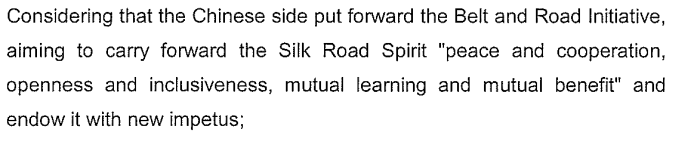
BRI 1

and a bit further on the preamble started to get positively troubling, the Participants

BRI 2

I’m quite sure I – and most New Zealanders –  have  little interest in pushing forward “coordinated economic…and cultural development” with a state that can’t deliver anything like first world living standards for its own people (while Taiwan, Singapore, South Korea etc do) and whose idea of cultural development appears to involve the deliberate suppression of culture in Xinjiang, the persecution of religion (Christian, Muslim, Falun Gong or whatever), the denial of freedom of expression (let alone the vote) and which has only recently backed away from compelling abortions.  And that is just their activities inside China.    “Fusion among civilisations” doesn’t sound overly attractive either –  most of us cherish our own, and value and respect the good in others, without wanting any sort of fusion,and loss of distinctiveness.  But perhaps Simon Bridges saw things differently?

The next section is “Cooperation Objectives”.  There is lots of blather, including this

BRI 3

Hard not to think that “regional peace and development” might be better secured if the PRC forebore from creating new articial islands, seizing reefs etc in the South China Sea, or patrolling menacingly around the Senkaku Islands, engaging in military standoffs with India, or even making threatening noises about Taiwan.  There seem to be two main threats to regional peace, and the other is North Korea.  But you’d never hear anything of that sort from a New Zealand government.

The next section is “Cooperation Principles” under which the governments agree to

BRI 4

In other words, if New Zealand keeps quiet and never ever upsets Beijing, whether about their domestic policies (economic, human rights, democracy), their foreign policies (expansionist and aggressive) or their influence activities in other countries, including our own, everything will be just fine, and the PRC will keep dealing with us.  And on the other hand…….?

There are then  five “Cooperation Areas”.   Apparently, we are going to actively conduct “mutually beneficial cooperation in….public financial management” (hint: that “wall of debt” is a sign things haven’t been done well so far).  But the one that really caught my eye was under the heading “policy cooperation”, where Simon Bridges committed us to
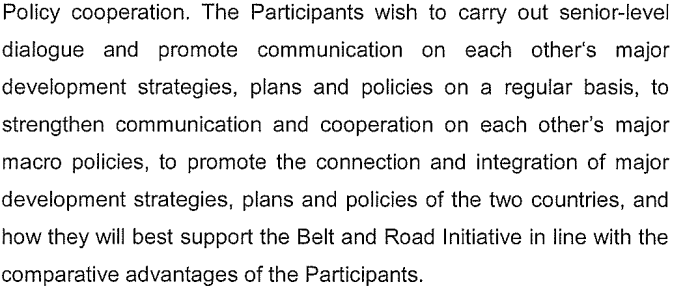
BRI 5

It isn’t obvious New Zealand now has any “major development strategies” (see sustained lack of productivity growth) or that the PRC ones offer much to anyone –  well, individual business deals aside –  when compared with, say, those of Taiwan, Singapore, or Korea.     And what is this bit about strengthening “communication and cooperation on each other’s major macro policies”?     Why?  To what end?     And who thinks it is desirable for New Zealand to “connect and integrate” our (largely non-existent) “major development strategies”, and our “plans and policies” with those of the PRC?  A country that, as even Mr Jacobi recognised in his earlier speech, has fundamentally different values.

And the agreement concludes

bri 6

One has to wonder how it is in the interests of the people of New Zealand (as a whole –  as distinct perhaps from some individual businesses looking for a good deal), or consonant with their values, to support such an initiative, or a regime such as that of the PRC. Apart from anything else, it all seems curiously one-sided: the agreement isn’t to support New Zealanders, but rather to advance a geopolitical projection strategy of a major power, with very different values than our own.   Can anyone imagine us having signed such an agreement with the Soviet Union in the 1970s?

We can only wait and see the details of what the China Council will propose in their paper in May.   And, even more interestingly, what the government comes up with –  being bound to formulate a detailed work plan by September.  Winston Peters may regret the previous government signing up, but he is now stuck with the agreeement for four more years.  One hopes the government will find a way to some minimalist, not very costly, arrangements, but given how keen governments of both major parties have been to cosy up to Beijing –  party presidents praising Xi Jinping –  it is difficult to be optimistic.  On the other hand, it is difficult to see quite what any New Zealand involvement might amount to, and perhaps Beijing has already had the real win –  getting a Western country, a Five Eyes member, to sign up to such a questionable deal with such an obnoxious regime.

But to get back to Mr Jacobi’s speech, nearing the end he observes

There is currently a debate in New Zealand about the extent of Chinese influence in our economy.

I am on record as being concerned about some of the “anti-China” narrative in that debate, especially in the unfortunate targeting of prominent individuals in the Chinese community, but there is nothing wrong with a debate focused on how to build a resilient relationship with China given the difference political values between our two countries.

While I welcome his final half-sentence, it is a little hard to take seriously when he never – at least in public –  engages seriously with the concerns that people like Anne-Marie Brady have been raising.  As I noted about his earlier speech, among other things he will simply never

  • address why it is appropriate to have as member of Parliament in New Zealand a former Chinese intelligence official, former (at least on paper) member of the Communist Party, someone who now openly acknowledges misrepresenting his past on forms to gain entry to New Zealand (apparently because that is what the PRC regime told people to do),
  • address the PRC control of the local Chinese language media, and associated (and apparently heightened) restriction on content,

Instead he falls back on plaintive laments about the “unfortunate targeting of prominent individuals in the Chinese community”.   These same people –  since presumably he has in mind Jian Yang and Raymond Huo –  sit on his own advisory board.  And both are not members of the public, but elected members of Parliament: not in either case elected by a local constituency (and certainly not by “the Chinese community”), but by all New Zealand voters for their respective parties.     And yet both of them –  but particularly Jian Yang –  simply refuse to answer questions or appear in the English language media to explain and defend (in Yang’s case) the background, and their ongoing ties to the PRC and apparent reluctance to ever say a critical word about that heinous regime.

It must now be six months –  since the Newsroom stories first broke –  since Jian Yang has appeared.   At the moment, it looks much less like “unfortunate targeting”, than quite specific and detailed targeting, with unfortunate defence and distraction being played by key figures in the New Zealand establishment, including Mr Jacobi.  Perhaps people might be more persuaded by Jacobi’s case –  that working closely with, and constantly deferring to, the PRC was in the best long-term interests of New Zealanders, if he called for his board members to front up, rather than giving them cover to simply shut up.

In concluding the post a few weeks ago about Mr Jacobi’s earlier speech, I had a speculative paragraph on some uncomfortable parallels between the PRC now, and Germany in the 1930s.  If the parallel isn’t exact –  and we must hope not, given how the earlier episode ended –  it still seems closer than any other historical case I can think of, including the same desperate desire to appease, to understand, to get alongside (key figures in the British Cabinet were still hoping to do economic deals with Berlin well into 1939), and the same reluctance to confront evil or take a stand (even at some cost to some businesses).  In a week when the PRC “Parliament” passed the amendment to remove the term limit on the office of President with 2958 votes in favour and two against, I decided to check out the results of the referendum Hitler staged in August 1934 after President Hindenburg died, to finally concentrate all power in his own hands.  This was 18 months into the Nazi era.  Despite widespread intimidation, almost 10 per cent of voters (on a high turnout) felt free to dissent

For 38,394,848 88.1
Against 4,300,370 9.9
Invalid/blank votes 873,668 2.0
Total 43,568,886 100

There is something to be said for our governments openly and honestly confronting the nature of the Beijing regime.   We can’t change them, and it isn’t our place to, but we can choose with whom we associate, we can choose how often we just keep quiet, and how much of our own values (and the interests of many of our own Chinese citizens) we compromise in the quest for a few deals for a few businesses (and universities) – and a steady flow of political party donations.   And we can, and do, as I’ve pointed out before, make our own prosperity.  If individuals firms want to deal with the PRC, on its terms, then good luck to them I suppose, but we then need to wary of those same firms and institutions, and to ask whose interests they are now, implicitly or explicitly, championing.

There is a weird line in Matthew Hooton’s column in today’s Herald in which he asserts that no one should be critical of China because “China is just doing what emerging Great Powers always do”.  That may be a semi-accurate description.  It didn’t stop us calling out, and resisting, the expansionist tendencies of Germany, Japan, or the Soviet Union.  It shouldn’t hold us back in recognising the threat the latest party-State, the People’s Republic of China, poses both abroad and here.


Bad economics from the China Council

For several years, Donald Trump has made much of the bilateral trade deficits between the US and Mexico, and between the US and China.   That rhetoric was to the fore again last week when Trump announced the imposition of steel tariffs.  This was from one of Trump’s tweets on Friday

Example, when we are down $100 billion with a certain country and they get cute, don’t trade anymore-we win big. It’s easy!

I’m not aware of a single economist –  with the possible exception of Trump adviser Peter Navarro –  who regards this focus as meaningful or as sensible economic analysis. At an aggregate level, a country’s overall current account balance is a reflection of the savings and investment choices of its own residents.  Thus, if for some reason one were concerned about a US current account (or trade) deficit, one thing that might make a difference could be a cut in the US fiscal deficit (lowering public dis-saving).

The mercantilist mentality, revived by Trump, sees trade deficits as, in some sense, a loss to the country, perhaps by analogy to the situation of a company running deficits (losses).  But the parallel is simply wrong.  Trade deficits are no more presumptively bad than trade surpluses are presumptively good.   Both can be reflections of bad policies, or indeed of good policies.  To the extent that the purpose of economic activity is to consume, trade deficits typically mean that of what your country produces not much is sold abroad, relative to what is purchased from abroad.  If product isn’t sold abroad it is available for domestic consumption.  And trade surpluses can be indicative of a deflationary impulse emanating from your country –  you are selling stuff abroad (absorbing demand from other people), but not matching that with an equivalent demand for the stuff others have produced.

I don’t want to be read as taking these arguments too far.  There have been plenty of trade imbalances (current account imbalances) that proved to be quite unsustainable, and the subsequent adjustment process was often quite messy and costly.  In the very long-term, and roughly speaking, people consume what they earn.  So sometimes, large aggregate imbalances can be a prompt to review policies.  Large surpluses in a fixed exchange rate country, for example, might finally trigger an upward exchange rate adjustment (as in China a decade ago).

But the argument is even more than usually flawed when focused on individual bilateral surpluses/deficits, which have almost no economic meaning.  That, in turn, is so for a variety of reasons.   At a statistical level, in an age of global value chains, any finished product (especially manufactured products) is likely to have been added in a number of countries, but the country where the finished product is exported from will record all the value in its gross exports.   An Airbus aircraft, for example, might have its final assembly in France.  If the plane is sold to, say, a Turkish airline, the full value of the plane will be included in the Turkey-France trade balance, even though much of the value might have been added by firms in, say, Germany or the UK.

And at an economic level, since money is fungible –  and we aren’t in a world of 1930s bilateral clearing agreements – why should anyone in the United States care whether there is a trade deficit with Canada and a surplus with France, or vice versa?   What is earned in one place can be spent in another.   Almost all of us, as individuals, have a goods deficit with the local supermarket, offset by the primary income surplus derived from selling our labour to some other firm.

At a country level, a country exporting mostly, say, diamonds might have a huge trade surplus with Belgium and Israel (places with specialist diamond-cutting industries), and large deficits with most other countries (spreading consumption more broadly).  What of it?  New Zealand won’t export many dairy products to, say, Ireland or Denmark, but might to desert places with not much of a dairy industry.  And what of it?

None of this is to suggest that there aren’t bad policies, or policies which distort the trade numbers.  But if the policies are bad –  eg China’s restrictions on access to its markets for service sector firms, or lack of market disciplines on firms in some sectors with major overcapacity, large US fiscal deficits when the economy is back near full-employment, or New Zealand policies which, in effect, subsidise export education by bundling immigration access with the commercial product –  they are bad on their own terms, regardless of any impact on particular bilateral trade balances.

But this isn’t a post about Trump and his take on economics. It was prompted by a rather similar outbreak of Trumpian economics from someone local who really should know a lot better.    I wrote last week about the speech from Stephen Jacobi, the Executive Director, of the New Zealand China Council attempting to push back against concerns raised in various quarters about the influence activities in New Zealand of the People’s Republic of China and the Chinese Communist Party.  Jacobi doesn’t have any specialist background on China –  he’s a paid advocate –  but he does apparently have a strong background in trade issues, from his time at MFAT, and subsequently as a lobbyist for trade liberalisation.

But his latest statement, released on Friday, left me thinking he must have put any economics to one side.    We were told that

China trade surplus shows relationship working in our favour

March 2, 2018

New figures out today showing a $3.6 billion trade surplus with China demonstrate the value of our growing economic connections with China, according to the New Zealand China Council.

It does no such thing.   Bilateral trade surpluses aren’t “a good thing” (or a “bad thing”) and bilateral trade deficits aren’t “a bad thing” (or “a good thing”).  They just are.

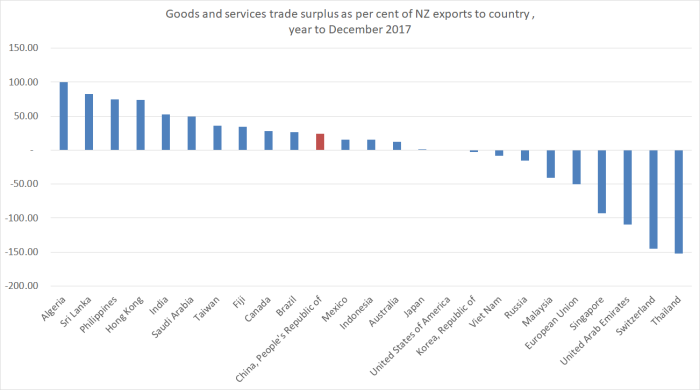
Here is a chart showing the bilateral goods and services trade surpluses/deficits for the top 25 “trading partners”, taken straight from an SNZ table.

bilateral trade surpluses

It is a mildly interesting chart, but I’m not sure it tells us much about anything, and certainly not about trade or economic policy.   Should we think better of Algeria and Sri Lanka  (which presumably have a taste for milk powder) than of Switzerland and Thailand?  I can’t think why we should.  And I suspect that if the bilateral balance with China ever swung into deficit –  and it does move around quite a bit with milk powder prices –  Mr Jacobi would be the first to (rightly) push back against true local mercantilists suggesting that such a deficit was reason for concern.

It isn’t even as if the trade by New Zealand firms with Chinese firms is extraordinarily large.  It is about the same size as our trade with Australia –  a country with about 2 per cent of China’s population.  Overall exports/imports as a share of GDP aren’t large at all for a country our size.  And here is quick table New Zealand China-based economist Rodeny Jones put out last week

NZ has only middling trade exposure to China by regional standards:

% of exports to China/HK 2017

Taiwan 41%
Australia 37%
Korea 32%
Singapore 27%
Philippines 25%
NZ 25%
Japan 24%
Malaysia 19%
Thailand 18%
Indonesia 15%

Mr Jacobi’s argument has the feel of rank opportunism.   Perhaps that might be acceptable in a corporate lobbyist (although I doubt it in the longer run) but Jacobi’s salary as Executive Director of the New Zealand China Council is largely paid by the New Zealand taxpayers.  We deserve better.

As it is, Mr Jacobi’s questionable economics is just the basis for another bid for New Zealand to maintain its subservient, deferential, attitude towards Beijing, and not get bothered about an expansionist hostile power seeking to exert influence in New Zealand politics.

“We need to see China as more than just a market. In New Zealand, China is looking for a long term, reliable partner which means working hard to build cooperation, trust and mutual respect even despite our obvious differences.

Indeed, the PRC is more than “a market”.  It is the government of a repressive dictatorial state, unable to produce for its own people the sorts of living standards places like Taiwan and South Korea have achieved, with an active agenda –  hardly masked –  of projecting its powerful and fundamentally different values [Jacobi’s own term from his recent speech] into countries and regions around the world, defying international law, and attempting to cow any country that makes a stand for its own values and its own self-respect.  It isn’t a regime worthy of trust, or respect.  Perhaps there are some trade opportunities for individuals, but it should be a clear case of “seller (or buyer –  but the sellers tend to have more concentrated interests) beware”,  in which it is more recognised that every time you defer to the regime, you advance an evil cause.

A bit like our politicians really.  Just occasionally, there is reason to think that perhaps our Minister of Foreign Affairs might take a different view.   There were the very delicately-phrased words in his speech the other day about Chinese activity in the Pacific.  There was the response, in after-speech questions, about the memorandum of understanding the previous government signed with the PRC on the Belt and Road Initiative (“I do regret the speed with which the previous government signed up”).

But what does it amount to?  Here is Winston Peters on Q&A yesterday, from the transcript

CORIN You know full well that the Chinese will be watching every word you’re saying right now. Are you worried that there could be—? They don’t like public declarations about the South China Sea from New Zealand. I know that. Are you concerned?

WINSTON No one has been more respectful of the place of modern China in the world than New Zealand First and Winston Peters.

Or

CORIN So do think there is too much? Because, I mean, we’ve got Anne-Marie Brady’s report. We’ve got Rodney Jones, Michael Reddell, others raising concerns and wanting a debate about Chinese influence in New Zealand – politics, but wider life. Do you think there is too much influence?

WINSTON Look, if you’re concerned about too much Aussie influence when it comes to banking you should say so upfront, and I have. If you think there’s been too much untoward American influence in this country in some ways then we should be upfront and say so, and I have. It doesn’t matter where it emanates from.

And thus our Foreign Minister, in his own inimitable style, but in much the same patterns as decades of his predecessors, trivialises the issue.  Just like Mr Jacobi in that speech a week or so back,

Of course, the other side of politics is no better.   Simon Bridges was also on Q&A.  Here he is on the Belt and Road initiative, a mechanism for Chinese power projection in many countries, partly (but not exclusively) by loading pliant recipient countries up with debt they have little prospect of servicing.

[UPDATE: Just after completing this post I noticed this new report on the debt aspects of OBOR.]

CORIN Give me an example of what the Belt and Road means?

SIMON Well, it means economic opportunity, and what do I mean by that? Infrastructure. You’re seeing China invest significantly in infrastructure around the world–

Never mind the strategic foreign policy perspectives, but there might be some consultancy opportunities for New Zealand firms.  It is reminiscent of Lenin’s line about the capitalists selling the rope they will, in time, be hung by.

I also heard Bridges on Morning Report this morning. It was straight out of the John Key playbook.  We will “engage positively”, and might even (quietly) mention the rule of law, democracy etc, all while avoiding the issues that should matter rather more to other countries, including New Zealand –  the expansionist efforts of the PRC beyond its own borders, and the influence activities in an increasing range of other countries, including our own.  I haven’t yet heard Bridges grilled about his MP Jian Yang, but on what we’ve heard so far there seems no reason to believe that he has departed from the Key/English approach (largely shared by the Labour Party) –  selling out our birthright, little by little, for the proverbial mess of potage.   Keep the deals flowing for the selected business elites, keep the party donations flowing and never mind any self-respect, or frank discussion of the nature of the regime, and the nature of the threats it poses.


New Zealand and the PRC: links and questions

Anne-Marie Brady has been at the forefront of identifying, and highlighting, the ways in which the People’s Republic of China, through the Communist Party’s United Front work programme, appears to have been attempting to influence, and interfere with, public life in New Zealand –  both among the local ethnic Chinese community, and more generally.  Her Magic Weapons paper remains required reading, and for all that apologists have attempted to brush aside the issues raised in the paper, no one has made any serious efffort to engage with, and refute, the concerns she has raised.

Most other New Zealand academics, with familiarity with the Chinese language, have stayed silent.  But another person –  with Chinese language –  who has written, quite extensively, about the New Zealand situation is the author of the pseudonymous blog Jichang Lulu.    He has a new and substantial piece (if characterised by an idiosyncratic style) on the United Front activities in New Zealand, which is likely to repay reading for anyone interested in these issues.  Whoever the author is, his usual focus is regions far from New Zealand (Nordics) but has been paying a lot of attention to the New Zealand situation in the last year or so and appears to be quite well-connected.   I linked the other day to his detailed piece on PRC efforts to attempt to bring Norway and Mongolia to heel.

Much focus in recent months has been on National Party list MP Jian Yang.  But, of course, National is in Opposition at present. Jichang Lulu has raised specific concerns about senior Labour backbencher Raymond Huo, who also appears to have close connection to the PRC regime.   From his latest post

According to a source with knowledge of the matter, recent requests from a CCP-unfriendly NZ Chinese organisation to have ministers send Chinese New Year greetings were reportedly redirected to Raymond Huo, effectively making the ruling party’s leading United Frontling, whose PRC-consonant views are wellknown, the government’s gatekeeper to contacts with the Chinese community. In contrast, ministers and other politicians didn’t hesitate to attend celebrations with PRC diplomats. In other words, the Party-state, through its local advocates, can vicariously veto official support for something as apolitical as a calendrical festivity, at least when the persons seeking such support happen to have Chinese surnames.

Huo currently chairs Parliament’s justice committee –  responsible for the triennial review of the election, and for handling new electoral legislation more generally.  And the way governments typically turnover their members, there has to be a pretty significant chance that he’ll be a member of the executive before this parliamentary term is out.  Much focus in recent times has been on past and present ties of senior National Party figures to PRC interests.  But with Labour in government –  and their party president an effusive public supporter of Xi Jinping –  it is about time harder questions were asked of the new government.

Another thing worth reading (although behind a paywall) is an article in The Australian today under the heading Cold War: Freeze on China Ties.  It builds on reports last week that

university leaders were concerned about Chinese government attempts to dissuade ­students from coming to Australia to study. In an escalation of the pressure on universities, school visits have been cancelled, senior educational meetings in Beijing have been “postponed” and messages warning of the dangers of studying in Australia have been posted on the website of the ­Chinese embassy in Canberra.

claiming that

China is putting Australia into a diplomatic deep freeze, stalling on ministerial visits, deferring a trip by our top diplomat and putting off a broad range of lower-level ­exchanges to pressure Malcolm Turnbull over the new foreign ­interference laws and naval challenges to disputed Chinese claims in the South China Sea.

Government sources are reported as conceding that “there is a diplomatic and ­bureaucratic stalling over a range of visits, as Beijing voices its ­displeasure at foreign-­interference laws”.

I guess this is the sort of thing that the subservient apologists in our own political, bureaucratic and business establishment worry about.  But perhaps it should prompt them to think again about the nature of the regime they want to cosy up to.    The PRC might have some capacity to hurt individual New Zealand economic sectors –  as, say, the Mafia or organised crime might in other countries – but our prosperity as a nation is simply not based on those firms’ trade with China.   And sometimes, just occasionally, there are advantages to distance: Korea, Vietnam, or the Philippines (let alone Taiwan) have to live with the PRC on their doorstep.  We don’t, and it is surely time to reflect on what manner of regime they abet, whether actively or by silence.

The other day, New Zealand Prime Minister gave her first major foreign policy speech.  As far as I could tell, it was better than it could have been on the PRC.

China’s global influence has grown along with its economic weight.  Its leadership on issues like climate change and trade liberalisation could add momentum to our collective efforts in those areas.

Naturally, there are areas where we do not see eye to eye with China.  My government will speak honestly and openly with our friends in Beijing.  Whether it is about human rights, pursuing our trade interests, or the security and stability of our region.

Taking that approach isn’t about singling countries out, , but about taking a consistent approach on the issues and principles that matter to us.

It wasn’t very grovelly –  none of the nonsense Murray McCully was using just a few months ago about China saving us through the financial crisis of 2008/09 –  although anyone who thinks China is somehow at the forefront of global trade liberalisation hasn’t looked very closely (or doesn’t wish to).

By contrast, here is Julie Bishop quoted in that same Australian article

After Mr Trump said he would “love” Australia to join the US in military passages through Chinese disputed territorial waters, Mr Turnbull refused to say in advance when an operation would take place. Such an operation, which the US has conducted in the past, would contradict ­Beijing’s claims of sovereignty in the South China Sea and assert the right of free passage for international shipping.

In Australia, Ms Bishop said: “We have been traversing the South China Sea for many years in accordance with international law and we will continue to do that. Australia is an upholder and defender of the international rules-based order. We believe strongly in the principle of freedom of navigation and freedom of overflight, and we will continue to traverse the South China Sea as we have in the past”.

I’m no great fan of the current Australian government more generally, but there is a degree of realism about the nature of the regime, and its external threats, that seems deliberately absent from the utterances of our own leaders, of whatever party.

Prompted by the events of the last few days, I wonder whether journalists might consider asking a few questions of some of our political leaders:

  • what do the Prime Minister, the Minister of Foreign Affairs think of the PRC actions in recent days to remove the term limit on how long Xi Jinping can serve as President?  One might hope that any answers would be somewhat more serious –  more engaged with the level of international unease – than suggesting, say, that, after all, we have no term limits, and our head of state reigns for life.
  • since National Party president Peter Goodfellow and Labour Party president Nigel Haworth (and former Prime Minister Jenny Shipley) have quite recently been effusive in their praise of Xi Jinping and his approach (links in the Jichang Lulu piece), how do they view this latest step?  It is no good attempting to say “oh, we are just party functionaries we do the organising”: if you are willing to praise the foreign leader of an aggressive dictatorial state, that increasingly threatens not only the human rights of its own people but other nations, you owe us your take on this latest step.
  • and since Bill English refused ever to engage seriously on the issue of Jian Yang –  the former PLA intelligence official, who now concedes he misrepresented his past to enter New Zealand, and who maintains very close ties to the PRC authorities –  perhaps they could ask Simon Bridges, the new National Party leader.  Is he comfortable having such a person in his caucus, and (reportedly) as one of the party’s leading fundraisers.   Most likely, Bridges would fob journalists off as English did whenever anyone asked, or fall back on the slurs his shadow Attorney-General has relied on.  But even if he did, at least we would have a clearer steer on the character of the man, and the nature of the new generation of New Zealand’s political leadership.


A semi-official take on New Zealand and China

The New Zealand China Council was established by the government a few years ago.  It exists primarily as an advocacy body, using (mostly) taxpayer money

in support of deeper, stronger and more resilient links between New Zealand and China.

It has been very close to  the government.  The Secretary of Foreign Affairs and Trade, and the chief executive of New Zealand Trade and Enterprise are both ex officio members of the Executive Board.  The Council is chaired by one former Deputy Prime Minister (Don McKinnon), and another member –  with considerable ties to People’s Republic of China institutions – is former Prime Minister, Jenny Shipley.   The Advisory Board, another 20 people, includes as members several of those about whom questions have been raised in recent months (Jian Yang, Raymond Huo, and Naisi Chen)  –  as well as, somewhat surprisingly, a senior journalist.

The public face of the Council seems to involve relentless optimism about things that don’t obviously seem to require taxpayer-funded advocacy (eg the several tweets about the first New Zealand avocadoes into China) and rather gushy, one-eyed, takes on the PRC/New Zealand relationship, always extremely careful never to utter a critical or sceptical word about the PRC.  More recently, in response mostly to the issues raised by Anne-Marie Brady (and the Jian Yang story) they seem to have been pushed somewhat onto the defensive.

The Council employs a part-time Executive Director, Stephen Jacobi.  He spent considerable time at MFAT, but from his own account his focus was Europe and North America (including as our deputy high commissioner in Canada) and in trade negotiations.  Since leaving MFAT in 2005 he has run his own consulting firm, and been employed as the public face of various trade-related bodies, including serving as Executive Director of the NZ US Council from 2005 to 2014.  He is articulate and readily available to the media, but has no specialist expertise in China or (indeed) on the workings of New Zealand democracy.   That isn’t a criticism –  after all, neither do I –  just to note that his arguments, and evidence, need to be reflected on and carefully examined, perhaps having regard to the interests that are paying him, not as coming from an expert authority in the area.

I’ve written previously about one of Jacobi’s speeches, given late last year at a regime party to mark the PRC national day.  Those were pretty brief (and obsequious) remarks, albeit to a PRC audience.  And so it was interesting to see that last week he had delivered a much more substantial address, Dancing with the Dragon – Opportunity and Risk in the New Zealand China Relationship, to the Nelson branch of the New Zealand Institute for International Affairs.  There is also a much shorter op-ed by Jacobi in the Herald today, headlined on the China Council’s own website as “Anti-China narrative not the Kiwi way”.   I’m not going to comment specifically on that piece –  it covers mostly similar ground to the speech – except perhaps to suggest that deferring to vested interests (business and political) who want us to hurry along and simply accept that there is nothing to see here shouldn’t be “the Kiwi way” either.

What of the speech?

The first couple of pages (of eight) is reasonably unexceptionable.   There are lots of statistics about the growth in trade between New Zealand firms and Chinese ones –  curiously, only about exports, and barely a mention of (the benefits of) the imports.   There is some nonsense about New Zealand alleged heavy reliance on China in the ‘global financial crisis”, but on the other hand a welcome acknowledgement that the New Zealand – China trade agreement isn’t the only factor explaining the growth in two-way trade and investment.  Of course, there is no acknowledgement that the interest of the entities exporting to China –  many represented around his board table – might not always be the same as those of New Zealanders as a whole.

But then he turns towards addressing the (quite limited) New Zealand public debate on issues around the activities of the People’s Republic of China and the Communist Party which controls it.  Part of Jacobi’s rhetorical strategy  appears to be to imply that anyone raising concerns about the Chinese regime and the Party that controls it, is somehow anti-China/Chinese more generally.  It is never quite put that like  –  just insinuations –  but the impression is pretty clear. Mention the poll tax, for example, to play up the guilt, but never mention that we and China (pre-Communist) fought on the same side in World War Two.   And never, ever (that would be job-ending for Mr Jacobi no doubt), note that across the Taiwan Straits is a highly succesful, prosperous, free, and non-threatening ethnic Chinese democratic state.  Never, ever, mention the unease apparently felt among numerous New Zealand citizens of ethnic Chinese origins –  some of whom migrated here to escape the party-state and its evil –  about the effective control regime-associated groups have over most of the Chinese language media in New Zealand, and many community groups.

Around the world there has been growing unease –  including in such impeccably liberal circles as academics –  about the growing number of Confucius Institutes established as part of many Western universities.  With PRC funding comes PRC restrictions, on hiring and on the sort of issues lecturers are allowed to address.   There are several of these institutes in New Zealand universities – Canterbury, Victoria and Auckland  In various places overseas there has been a pushback and some major universities –  notably Chicago – have closed their Confucius Institutes.   I’m sure no one has a problem with the PRC government subsidising Chinese language learning in New Zealand –  any more than with Alliance Francaise or the Goethe Institute –  but not as part of New Zealand universities, subject to a foreign governments controls and constraints.

Why do I raise this?  Because Jacobi included this line

There has been pleasing progress in the number of primary schools teaching Mandarin, especially with the help of the 150 Chinese language assistants in New Zealand, but this has not followed through at secondary and tertiary level.

I presume this is a reference to things like the Confucius Classrooms programme (or here) .  By this means PRC-funded and chosen people are operating directly in our school classrooms.  One can only imagine the awkwardness if a student asks about Taiwan or Tibet, the rule of law, or freedom of speech.

Can anyone imagine us allowing Soviet funded teaching in our schools in the 1970s, or German-funded teaching in the 1930s?  But Mr Jacobi, and his government-funded council, simply avoid ever confronting the nature of the regime.  (I’m sure they are quite aware of it, but if the public ever got concerned it might threaten the Council’s easy life, and the business and personal opportunities of some of its members.)

And then Jacobi turns directly to the recent debate, such as it has been.

Public debate about the relationship is to be welcomed in a robust democracy like ours, although care needs to be taken to ensure that public debate remains civil and properly focused on the issues.

And who is going to disagree?  But then perhaps Mr Jacobi could point us to examples of where the debate has been less than civil and not “properly focused on the issues”?  I can think of the former Attorney-General at an election meeting attacking Anne-Marie Brady as somehow “anti-foreigner”, but then I’m pretty sure he and Mr Jacobi are on the same side.    I’ve heard various claims that people raising issues are being “racist” or anti all things Chinese, but I’m pretty sure that not once have those sorts of slurs –  the stuff Jacobi purports to dislike –  been backed up with arguments and evidence.  In this speech, Jacobi certainly makes no attempt to.  For a taxpayer-funded body it is a pretty poor show really.  But then, unfortunately, it is par for the course.    Neither politicians, nor outfits like China Council, have made any attempt to address seriously and directly the issues raised in Professor Brady’s Magic Weapons paper, or the issues around the background and ongoing associations of National MP Jian Yang.

Jacobi notes that occasionally the New Zealand government and the PRC disagree

While we do have occasional public disagreements, these have not detracted from the momentum in the relationship.

If so, presumably because when such “occasional public disagreements” matter, politicians and diplomats scurry round and assure Beijing it will never happen again.  It is hardly news that the New Zealand government has operated a policy of avoiding do anything that might upset Beijing.  Nor that the PRC is not some typical country which recognises that the possibility of robust differences of view characterises real mutual –  as distinct from subservient – relationships in this world.

Politically, even while we receive occasional Chinese naval ship visits, we continue to maintain close defence and intelligence relationships with our Western allies.

I’m pretty sure we never welcomed naval vessels from the Soviet Union or Nazi Germany.  But even setting that to one side, Mr Jacobi simply never addresses the  unease our traditional Western allies –  including through Five Eyes –  have reportedly come to feel about the New Zealand government’s relationship with the PRC.  And he does not even seek to address the PRC’s own strategic interests, which might include a fostering a more semi-detached relationship between New Zealand and the countries which share rather more of our “fundamental values” [Jacobi’s own term].

And then there is the attempt to play distraction, with the suggestion that all that is going on is “soft power”, and “everyone does that”.

New Zealand itself uses soft power with great effect when it seeks to portray a positive view of our country overseas, including by funding visits by journalists and other “influencers” to New Zealand.

Although Americans, Europeans and Japanese all use soft power, it is the Chinese use of soft power that is being questioned today.

If the PRC wants to subsidise artistic or cultural displays in New Zealand, to foster a positive view of the regime, probably not too many are going to object very loudly.

But that isn’t the sort of influence that Professor Brady was writing about, and Mr Jacobi is well aware of that.    We don’t have (for example) formerly-French members of the New Zealand Parliament, constantly liaising with the French Embassy, and in front of whom former diplomats are careful of what they say.  And even if we did, there is a much greater commonality of “fundamental values” between,  say, France and New Zealand than there is between the PRC and New Zealand.  The British government doesn’t attempt to control the English language media in New Zealand.    The US government (and government-controlled entities) doesn’t dangle post-politics opportunities in front of former senior politicians.  No other government I’m aware of attempts to exert tight control over the students’ associations of its overseas students, in the way that the PRC does with the Chinese Students and Scholars Associations (CSSA).

Jacobi goes on

Some prominent members of the Chinese community have faced intense criticism about their past and present connections with the Chinese Government and the Chinese Communist Party.

Chinese community networks have been described as being a conduit for Chinese representatives to promote a positive view of China and to subvert local decision-making.

The funding of New Zealand political parties has also been highlighted.

Some of this criticism appears to be linked to a similar debate in Australia, although I would argue that the situation in Australia is quite distinct – although we share many things, we have a different political culture, we are not a military ally of the United States and we see our role in the world differently.

In all that, there is just nothing specific at all.  Jacobi doesn’t, for example:

  • address why it is appropriate to have as member of Parliament in New Zealand a former Chinese intelligence official, former (at least on paper) member of the Communist Party, someone who now openly acknowledges misrepresenting his past on forms to gain entry to New Zealand (apparently because that is what the PRC regime told people to do),
  • address the PRC control of the local Chinese language media, and associated (and apparently heightened) restriction on content,
  • address how it can be appropriate for the Mayor of Auckland to receive anonymous donations (from China) of $150000 for his mayoral campaign.

He asserts that the situation in Australia is ‘quite distinct’, but makes no effort to back his claim.  If anything his three points reduce to little more than “we’ve decided to just ignore these things, and that’s the way we do things in New Zealand”.    There is an increasing volume of material on Chinese influence activities in a range of countries, and if the situation here is not that of, say, the Maldives, or Cambodia or even perhaps the Philippines, there is little to suggest that things are materially different here than in Australia, or Canada, or a variety of European countries.

Jacobi response is

Recent allegations here in New Zealand have sought to identify ‘smoking guns’ but mostly without the proof or evidence to demonstrate culpable wrong doing.

Everyone in New Zealand is innocent until proven guilty.

If there has indeed been misbehavior or unwarranted interference, a higher standard of evidence needs to be provided so that this can be investigated by the proper authorities.

Innocent until proven guilty is, rightly, the criminal standard.  If crimes have occurred, they will need to be proved to that standard to secure a conviction.  But as Mr Jacobi knows very well (a) someone in authority needs to take an interest for anything to be proved to that standard, and our leadership appears to have an active lack of interest in doing so, and (b) plenty can be inappropriate or threatening that need not be illegal.    I’m not aware, for example, that anyone has suggested that Jian Yang’s membership of the New Zealand Parliament is, or should be, illegal (unless concerns about his citizenship application come to something).    The argument is that it is highly inappropriate in the specific conjunction of circumstances (PLA and Party background, deliberate misrepresentation of his past, continued close association with regime representatives in New Zealand, failure ever to say anything critical about the PRC regime, and so on).   Perhaps Mr Jacobi has a compelling and specific alternative perspective?  If so, it would be very interesting to hear it, but that would require engagement, rather than lofty disregard (“someone else’s problem”).    Perhaps next time he talks to Jian Yang he might suggest that in an open and democratic society, making yourself available to the local media for a searching interview is the way things should be done.  As it is, Yang has not made himself available for a single English language interview since the story first broke in September.  And this is an elected MP, paid with public money.

Jacobi has a brief discussion of trade ties.

I was struck by a comment on Twitter this week which suggested that China could if it wanted to “paralyse New Zealand’s economy at will”.

I’m not sure why China would ever see it in its interest to attempt to do such a thing

As I’ve noted in various posts, China can’t paralyse our economy.  We make our own prosperity.  But they could make a great deal of difficulty for specific industries.

And they have form in this regard.  Specifics around experiences of Norway and Mongolia are here, and the PRC was active in using sanctions on specific sectors on firms in South Korea last year over the deployment of the THAAD missile defence system.  So for Mr Jacobi to say “I’m not sure why China would ever see it in its interests” to do such a thing in respect of New Zealand is either simply deliberately avoiding actual recent experiences with this particular regime, or saying “so long as we never upset Beijing” we have nothing to worry about.  (Of course, in Norway’s case, it wasn’t even the government that upset Beijing, but a (prominent) private entity, the Nobel Prize     committee).   Surely we deserve better than this from taxpayer-funded mouthpieces?

There is plenty more questionable material in the speech

Chinese economic policy is changing too – a move away from investment-led growth to consumer-led growth and the realisation that a significant and growing share of the economy is now in the hands of the private sector rather than state owned enterprises.

A new generation of Chinese leadership is in office – President Xi Jinping has consolidated his power at the recent Party Congress.

The leadership knows the old style of economic management cannot continue, but it looks at the ravages the global financial crisis caused the Western economies and is determined not to see the same thing happen in China.

Globally we see China’s economic weight continue to grow and the mantle of leadership pass from an increasingly inward-looking United States to a more confident China.

China has some way to go to “walk the talk” of openness and inclusion, particularly in terms of the way it regulates its economy, but the language from Beijing these days is more appealing to many than what we hear from Washington.

China too is grappling with the demands of a growing middle class becoming more impatient with the restrictions on human rights and personal freedoms.

All of which is clearly designed to suggest that things are improving in the PRC, when demonstrably they aren’t.

For example, the economy might largely (and formally) be in private hands, but Mr Jacobi –  and his MFAT funders –  know very well that the Party has been increasingly extending its tentacles directly into private sector entities, domestic and foreign, and that no business in China can be considered much apart from the regime.

And China “has some way to go to ‘walk the talk’ of openness and inclusion”?  Is there any evidence  –  even a shred –  of an intention to adopt a culture of”openness and inclusion”?  The environment for people less than enamoured of the regime just seems to be getting tougher as Xi Jinping’s power is further consolidated.   (Nonetheless, it doesn’t stop the presidents of the National and Labour parties gushing about Xi and the regime.)

And the “middle class becoming more impatient with restrictions on human rights and personal freedoms”.  Perhaps they are, perhaps they aren’t.  But really what matters is the regime, and its resolve.  At present, that doesn’t seem to involve more freedom.  The chilling new “social credit” control scheme is just another example.  But you hear nothing of any of this from Mr Jacobi, and his supporters, who just want to keep the deals flowing.

Some modest political/societal convergence might have been a plausible narrative 15 years ago.  It isn’t now.  And really I’m sure Jacobi knows it, as he’ll know the expansionism in the South China Sea, the military stand-off over the Senkaku Islands, the suborning of various regional governments, and so on.

Perhaps the most chilling sentence in the entire speech was this one.

A second consequence is that as China’s confidence grows they will become less willing to accept challenges to their political system and their own decision making processes. This will require careful handling on the part of New Zealand

Quite possibly, Jacobi is descriptively accurate, but it doesn’t lead him to suggest that we might be increasingly wary of the PRC regime, or uneasy about the power projection (including into New Zealand) that accompanies this greater confidence. It doesn’t lead him to point that true friends – and genuinely self-confident people  –  live happily, and embrace –  challenge, debate and scrutiny.  Nothing about self-respect.  Nothing about the shared interests of like-minded countries.  No, apparently for Jacobi we should simply double-down and “engage even more with China, not less”.

There was the, surely laughably deluded –  but perhaps just an attempt at distraction –  invocation of his former MFAT colleague’s argument.

Former New Zealand Ambassador to China Michael Powles has written recently about the need for New Zealand to “develop the already strong relationship with China to increase the prospects for New Zealand to have influence with China as it wields increasing regional and global power”.

Michael writes that New Zealand has a lot of experience in being a “small friend to a great power” ie with Britain and the United States – co-operating actively but also discussing differences frankly.

In what plausible world does any of this make sense?  Set aside the fact that to the extent that we were ever a “small friend” to great powers the US and UK, it was based on shared values, shared heritage, largely common interests etc.  Friends, even brothers, don’t always agree, but they share crucial commitments or interests.  There is simply no sign that the sort of values the PRC regime lives by  –  increasingly so at present –  are ones most New Zealanders any part of.  And nor is there any reason to suppose that China would be likely to heed New Zealand’s counsel around the exercise of its rising “regional and global power”.      New Zealand’s policy, after all, seems to be premised on not upsetting Beijing, and the PRC are better placed than we are to know what will upset them.

At the very end of his speech, Jacobi returns to one of his early themes

With this engagement invariably comes public debate – it is a debate worth having, but we are a better nation if we respect the people about whom we speak.

Frankly, I don’t respect Xi Jinping, or the PRC regime, or the Chinese Communist Party.  The Party has been a great force for evil in its own country –  depriving tens of millions of liberty, and even life, and presiding over a system that can’t even produce prosperity (unlike, say, Singapore or Taiwan, or South Korea or Japan).

I don’t have much respect for Jian Yang either.  He may be a perfectly pleasant person, may even have been a competent academic.  But that isn’t the issue.  He served –  voluntarily –  an evil regime, in its military intelligence system, he misrepresented that past to get into New Zealand and into Parliament.  And if he has ever had a Damascus Road experience –  now deploring the evil he once served –  the public has heard nothing of it.  Oh, and despite being an elected member of Parliament –  on the list, elected by all National voters –  he simply refuses to front the media.   You can avoid searching scrutiny in the PRC, but you shouldn’t seek to (and shouldn’t be able to) here.

I don’t have much respect for those who’ve, apparently successfully, managed to exert regime control over Chinese language media here.

And I have even less respect for the New Zealand politicians, and party leaders, from every single party (so it appears), who simply let this stuff go by, and try to pretend there isn’t an issue.

Oh, but those weren’t the people Jacobi was meaning?   I guess probably meant ethnic Chinese New Zealand citizens. But as a group, they simply aren’t the issue anyone (including Professor Brady) has been raising issues about in this debate.   If anything, part of the issue is about protecting the rights and freedoms of these people –  fellow New Zealanders –  from the PRC regime interventions, and attempt to exert influence and control.   But it suits those who want to avoid the real issues to pretend that the debate is about ethnic Chinese in New Zealand more generally, rather than about the activities –  some probably illegal, others just threatening or flat-out wrong – of a heinous regime.

I’ve been reading a lot about the interwar period recently.  As I’ve done so, the more apparent the similarities between the current situation vis-a-vis the PRC and that of the 1930s.  Parallels are never in the nature of exact mirror images.  And perhaps in the end the differences will prove greater than the similarities.     But the same expansionist tendencies, the same denials of personal liberties, the same making trouble among diasporas, the same border disputes, perhaps even (in the long term) the same economic weaknesses, and (on the other side) much the same –  India aside this time perhaps –  desperate desire to appease and pretend there is nothing much to worry about.  As I say, perhaps the parallels are overblown, but I suspect we’d get much more value from some serious engagement on those sorts of topics, rather than more taxpayer-funded efforts to pat the public on the head, suggest there is nothing to worry about, and bat away any critics –  expert ones like Professor Brady –  as somehow insufficiently civil or respectful.

On which note, where are the rest of the genuine China experts in New Zealand?  Presumably many of them will have perspectives on these issues?  I wonder if the media have approached these people –  mostly academics paid with public money, partly to advance knowledge, public debate etc.  If they won’t talk, one has to wonder why not, and what that would say about our self-respect as a society, and our willingness to nurture and cherish what made countries like New Zealand what they were at their best.

At very least we deserve rather better, and more substantial, engagement with the issues and concerns from our elected leaders, and from their paid voices (such as Mr Jacobi).

“We could be the next Albania” – Brady

To their credit, the Herald yesterday ran a substantial op-ed from Professor Anne-Marie Brady on the influence-seeking and interference by the People’s Republic of China (PRC), and the Communist Party that controls the state, in New Zealand.

Professor Brady has been in the headlines in recent days over a burglary at her Christchurch home in which several laptops, phones etc (but nothing else of value) were stolen, the burglary occurring after she had received a letter warning that she was being targeted by the PRC regime.   The media has –  rightly –  sprung to her defence, suggesting a need to get to the bottom of just what is going on.   Another article in yesterday’s Herald suggested that the Police weren’t doing much about the break-in until the Prime Minister herself expressed concern.  In general, it is a bad look (and bad practice) for ministers to be putting pressure on Police to investigate, or not investigate, particular cases.  But perhaps on this occasion the end might almost justify the means.

Professor Brady’s article ran under the heading ‘We could be the next Albania’,  a reference to the reported observation last year by a senior Chinese diplomat that (in Brady’s words) “favourably compared New Zealand-China relations to the closeness China had with Albania in the early 1960s”.    Having fallen out with the Soviet Union, Albania sought refuge in ties with the PRC (a relationship described by one Western scholar as “one of the oddest phenomena of modern times: here were two states of vastly differing size, thousands of miles apart, with almost no cultural ties or knowledge of each other’s society, drawn together by a common hostility to the Soviet Union.”) before later also falling out with them.

Brady reports, and presumably is in a position to know, that this “startling and telling analogy…disconcerted New Zealand diplomats”.   She perhaps over-eggs the Albania point, arguing that

In the late 1970s the relationship ruptured over China’s failure to deliver economic development assistance. By the end of the Cold War era, Albania had become one of the poorest, most politically divided, and most corrupt of the former Eastern Bloc states.

Perhaps, but if we look at Angus Maddison’s collection of historical estimates of GDP per capita, Albania had long (well before the Communist era) been one of the poorest of those countries and had not exactly been a byword for political stability either.  Their failings were their own.

But I guess the real point –  and probably the one the Chinese diplomat was getting at –  was that New Zealand was seen from Beijing (with perhaps just a bit of exaggeration for effect) as small, remote (clearly both true), somewhat detached from its former allies, and diplomatically and economically subservient.   True or not, the suggestion will have put MFAT noses out of joint.

Brady goes on

Xi Jinping has been emboldened to pursue an increasingly assertive foreign policy and insisting that its strategic partners such as New Zealand fall into line with its interests and policies.  Accompanying this more assertive foreign policy has been a massive increase in the CCP’s foreign influence activities. China did not have to pressure New Zealand to accept China’s soft power activities and political influence: Successive New Zealand governments actively courted it. Ever since PRC diplomatic relations were established in 1972, New Zealand governments have sought to attract Beijing’s attention and favour. New Zealand governments have also encouraged China to be active in our region.

And not a word of scepticism is ever uttered openly, whether by politicians or by the (mainly government-funded) entities like the China Council and the Asia New Zealand Foundation.   No doubt, in most cases they genuinely believe their stance (quiescence) to be in the interests of “New Zealand” –  however those interests are defined.  In all too many cases, it also appears to have been in the personal economic interests of those involved.

The real point of Brady’s article appears to be to encourage the new government to think seriously about doing things differently.   As she highlights, the Australian government is taking these issues much more seriously   (for those still sceptical of the significance of these issues, in addition to Anne-Marie Brady’s main Magic Weapons paper, various of the submissions on the new Australian legislation make sobering reading –  for example, no 20 (by an academic whose new book on the subject –  already the subject of PRC threats –  is due out next week), or no 33 (from a national security academic at ANU) or no 32 (from an ethnic Chinese group, the Foundation for a Democratic China).

Brady appears to think there is a realistic possibility of change

In order to deal with the issue it can’t just attack the policies of the previous government, it also has to clean its own house. Significantly, unlike the previous National government, Ardern’s government has not endorsed Xi Jinping’s flagship policy the Belt Road Initiative, bringing New Zealand back in line with its allies and nearest neighbours.

It will take strenuous efforts to adjust course on the direction the previous National government set New Zealand. New Zealand has to address the issue, but the Ardern government must find a way to do so that does not invite pressure it cannot bear from the CCP, which is watching closely.

But is there any sign that this government is any different?  I’d like to believe that not having yet endorsed the Belt and Road Initiative (a sprawling massive geopolitical play, designed to extend PRC reach and in some cases load up poor countries with additional debts in ways that further extend PRC political influence) is significant.    But the New Zealand China Council –  largely taxpayer-funded, and with the Secretary of Foreign Affairs sitting on its Council –  was promising late last year that early this year they would have a report out on how New Zealand can engage with the initiative.  And senior Labour backbencher –  chair of a major select committee –  Raymond Huo seemed right behind the initiative

Meanwhile, China-born legislator Raymond Huo believed the Belt and Road Initiative can help solve the problem of infrastructure development facing many developed nations.

“There is a dilemma. New Zealand, Australia and other developed countries including the US and Canada are all facing the same problem,” Huo told Xinhua.

“We haven’t done much upgrading, so we need money, we need capital, and we need the construction capacity. China has both,” he said.

Huo said he first realized the potential of Belt and Road Initiative when he attended two high-level conferences in China, and he believed New Zealand should seize the opportunities it offers.

Along with other experts on China and leading business people, he has established a think tank and foundation on the Initiative.

What other straws in the wind are there?

As recently as this week, interviewed on Radio NZ about the Brady break-in and other matters the Prime Minister refused to express concern at all about PRC influence-seeking and interference in New Zealand. At one level, it is fine to talk about being concerned about any foreign influence from any source (as we all should be), but there is a real and specific issue around the PRC, which needs serious political leadership to address.  But instead there is a void.

It isn’t just the Prime Minister of course. In a post late last year, I highlighted that her minister responsible for the intelligence agencies, Andrew Little, was specifically dismissive of concerns around the PRC activities.

Andrew Little, the Minister Responsible for the SIS, said he was not aware of any undue Chinese influence.
“I don’t see evidence of undue influence in New Zealand, whether it’s New Zealand politics, or New Zealand communities generally.

“We have a growing Chinese community. We have a strongly developing trade relationship and diplomatic relationship with China. I don’t think those things, on their own, connote undue influence.

“If there’s other things she says constitutes undue influence, we’d have to know what that is.”

It was documented in Brady’s substantive paper minister, a paper which has had substantial coverage around the world.

Then, of course, there was the Deputy Prime Minister and Minister of Foreign Affairs.  Out of office he had occasionally been heard to express concerns, including around National MP Jian Yang.   In office, at a New Zealand event marking 45 years of diplomatic relations with the PRC, he wouldn’t even address the issue, stressing how cordially he would raise (privately) any concerns he ever had, and went on to suggest that, after all, one had to break a few eggs to make a omelette, and really no should get too bothered about human rights issues in China either.

“Sometimes the West and commentators in the West should have a little more regard to that and the economic outcome for those people, rather than constantly harping on about the romance of ‘freedom’, or as famous singer Janis Joplin once sang in her song: ‘freedom is just another word for nothing else to lose’.

“In some ways the Chinese have a lot to teach us about uplifting everyone’s economic futures in their plans.”

And since the election, Labour president Nigel Haworth –  presumably with his leader’s knowledge and approval – hobnobbing with the Chinese Communist Part itself, has been effusive in his praise of Xi Jinping and the Chinese regime.

One could add to the mix the stony silence of the Labour Party leadership –  pre and post-election – on the succession of revelations around National MP, and former PRC intelligence officer, Jian Yang.  From anything they say (or don’t say) in public, the Labour Party, and their allies in the Greens and New Zealand First, seem quite unbothered about the presence in Parliament of someone who acknowledges misrepresenting his past in his residency/citizenship applications,  who is widely regarded (by experts in the field) as likely to still be a member of the Communist Party, who closely associates with the PRC embassy, and who has never once been heard to criticise the Party-state that is the PRC.  Recall, former diplomat Charles Finny’s line, that be was always very careful what he said around Yang (and Raymond Huo) since both were known to be close to the PRC embassy.    But is there any sign that any of this bothers our new government?

Professor Brady calls for the government to emulate its 1980s predecessor

the Fourth Labour government made a principled stand on a matter that affected our sovereignty and our values with the nuclear issue; then it passed legislation to back up these principles. Now is the time for the sixth Labour government to take another principled stand to defend our sovereignty and values and make legislative changes such as to the Electoral Finance Act.

In truth, and whether you supported the anti-nuclear stance of not (I didn’t and don’t, and certainly don’t see it as a matter affecting our sovereignty) this one is a great deal harder.  For a start there wasn’t really money at stake around the nuclear-free issue.

I presume one of the issues that will be exercising ministers, and their MFAT officials, will be the negotiations around the proposed upgrade to the preferential trade agreement with China.  It would be easy enough for the PRC to put those negotiations on a slow track, or simply halt them altogether.  Such agreements might not matter very much taken as a whole, but they might matter quite a lot to a small group of people (with good political connections).  In the Australian context, there already appear to be some signs that the PRC is reacting to tougher Australian stance (and new legislation) by damping down the flow of foreign students.  We’ve already seen here the apparent ability of the export education industry to see off for now Labour’s promised changes to student work visa arrangements.  Those would have mostly affected the lower-level PTEs.  But our more prestigious – and government owned/controlled – universities get a lot of PRC students, and several attract direct PRC funding for their Confucius Institutes.  Chancellors and vice-Chancellors will be very nervous that if the government actually looked like taking a stand, their flow of revenue might be disrupted.  And they will constantly be bending the ears of ministers and officials, if ever the government showed any sign of self-assertion, and a respect for New Zealand values (and the interests of New Zealand citizens of Chinese origins).  And then there will be Auckland airport and the tourism operators too.

I’ve noted previously that during the Cold War it was much easier to maintain a moral clarity.  Most Western countries –  including New Zealand –  didn’t do much trade with the Soviet Union, and so there wasn’t a major self-interested constituency in New Zealand (or the US, or the UK) for simply bending over and letting a hostile regime, practising a completely different set of political values, have its way.  I noticed yesterday a recent interview with former (Obama-era) US Defense Secretary Ash Carter making much the same point.

Last time we competed with or had a long difficult strategic relationship with a large communist country was during the Cold War, and our approach to that was simply not to trade with them. Now, one of our largest trading partners is in fact a communist country, and I don’t think that the economists have given us much of a playbook to protect our companies and our people.

I’m not sure that economists can necessarily help much, except perhaps to repeat the point I’ve made here before: the PRC does have the ability to severely adversely affect the fortunes of individual firms/sectors (ask the Norwegian salmon industry, or some of the South Korea firms last year), but the PRC did not make Australia and New Zealand rich and it cannot, whatever unsubtle economic sanctions it attempted, make us poor.  Our prosperity, as a whole country, is very largely in our own hands.   And the very fact that we can worry about the possibility of such sanctions is perhaps the best case for making a stand now, rather than continuing to roll over, keep quiet, and hope that Beijing is happy.

But perhaps the other piece of economists’ advice might be, in this as in other fields, “beware of rentseekers”, people/institutions who will seek to use governments to advance their own economic interests, at the expense of the values, the freedoms, the self-respect, of the nation as a whole.  Governments have a poor track record of doing so, and there is little sign at this point that the current government will be any different.  As I wrote earlier

One of things we need to remember is that the interests of businesses (and universities) who deal in countries ruled by evil regimes, are not necessarily remotely well-aligned to the interests and values of New Zealanders.   Selling to China, on government-controlled terms, isn’t much different than, say, selling to the Mafia.  There might be money to be made.  But in both causes, the sellers are enablers, and then make themselves dependents, quite severely morally compromised.

Professor Brady’s Herald column seemed to build on an earlier (and somewhat longer) paper she produced shortly after the new government took office on things the government could do if it were serious about addressing the PRC political influence activities.   I wrote about it here (and here is the updated link to the paper itself).  In that earlier piece she had quite a list of things that could, or should, be done.

What should be done?  At an overarching level she says

The Labour-New Zealand First-Greens government must now develop an internally-focused resilience strategy that will protect the integrity of our democratic processes and institutions. New Zealand should work with other like-minded democracies such as Australia and Canada to address the challenge posed by foreign influence activities—what some are now calling hybrid warfare. The new government should follow Australia’s example in speaking up publicly on the issue of China’s influence activities in New Zealand and make it clear that interference in New Zealand’s domestic politics will no longer be tolerated.

Getting specific she calls on the government to

The Labour-New Zealand First-Greens government must instruct their MPs to refuse any further involvement in China’s united front activities.

That would be Raymond Huo I presume.

The new government needs to establish a genuine and positive relationship with the New Zealand Chinese community, independent of the united front organizations authorized by the CCP that are aimed at controlling the Chinese population in New Zealand and controlling Chinese language discourse in New Zealand.

And there is a list of six other specifics

  • The new Minister of SIS must instruct the SIS to engage in an in-depth investigation of China’s subversion and espionage activities in New Zealand. NZ SIS can draw on the experience of the Australian agency ASIO, which conducted a similar investigation two years ago. 
  • The Prime Minister should instruct the Department of Prime Minister and Cabinet to follow Australia’s example and engage in an in-depth inquiry into China’s political influence activities in New Zealand. 
  • The Minister of Commerce and Consumer Affairs should instruct the Commerce Commission to investigate the CCP’s interference in our Chinese language media sector— which breaches our monopoly laws and our democratic requirement for a free and independent media. 
  • The Attorney General must draft new laws on political donations and foreign influence activities. 
  • The New Zealand Parliament must pass the long overdue Anti-Money Laundering and Countering Financing of Terrorism legislation.
  • The new government can take a leaf out of the previous National government’s book and appoint its own people in strategically important government-organized non-governmental organizations (GONGOs) which help shape and articulate our China policy, such as the NZ China Council and the Asia New Zealand Foundation.

Most of those suggestions look sensible (although I’m no fan on AML/CFT legislation, with all its inane consequences –  goodbye ipredict, hello ID cards for 94 year olds changing banks).  There has been no sign of activity on any of these fronts.  Quite probably – based on what we saw in their BIMs, and Professor Brady’s mention of a Five Eyes discussion (itself repeated in the New York Times article last year on these issues –  our intelligence agencies themselves are worried).  But intelligence agencies can only apply the (current) law.  It is the political leaders who can bring forward legislation (on matters amenable to legislation, which not all of these are) and can display the leadership and moral standing that say “enough”  –  whether about Jian Yang, political donations, control of the Chinese-language media, university funding, PRC activities in the South China Sea, or whatever.   They could display such leadership, but there is no sign –  from any political party –  of anyone doing so.

I noted the other day that perhaps some journalist could ask the five contenders for the National Party leadership about their attitude to these issues, including (but not limited to) matters around Jian Yang and political donations.  A reader reminded me yesterday of Chris Finlayson’s arrogant and dismissive attitude before the election, when he was both Attorney-General and minister responsible for the intelligence services.  Finlayson still sits on the National Party front bench, and is still shadow Attorney-General.  Perhaps, five months on, someone could ask him if still thinks there is just nothing there, that Professor Brady is jumping at shadows etc.  Or is it that he just doesn’t want to know?

(I linked the other day to a couple of reports on PRC influence activities in other advanced economies.  For anyone interested –  including those doubting the seriousness of the PRC agenda –  I suggest searching out the (easy to find) serious articles about PRC involvement in places like the Philippines, the Maldives, Sri Lanka, Cambodia, and Pakistan.  The issues aren’t primarily about the internal nature of the PRC –  domestic human rights etc –  but about external expansionism, power projection, and the attempt to have other countries including (in Professor Brady’s words) “New Zealand fall into line with its interests and policies”, policies that are generally hostile to open and free societies.)

UPDATE:  Interesting ABC article based on an advance copy of Clive Hamilton’s book on PRC influence activities in Australia (book to be published next week).


Shameless and shameful

On Monday, just across the road from Parliament, Victoria University’s Institute for Governance and Policy Studies hosted a lunchtime lecture from Professor Anne-Marie Brady.  The lecture was built around her Magic Weapons paper on the extent of Chinese government/Party influence activities in New Zealand (and elsewhere), and her shorter policy brief with some specific proposals for the new government on how to deal with the issue (I wrote about that latter piece recently here).     (Radio New Zealand also had a good interview with Brady this morning, prompted by the new legislation announced yesterday by the Australian government, as part of its efforts to deal with this official Chinese interference.)

New Zealanders owe Professor Brady a considerable debt of gratitude for, first, writing her detailed paper, and secondly for deciding to put it in the public domain (it was done as part of an international project on Chinese influence-seeking activities globally, and the papers by other scholars have not yet been made public).    Her paper has found a receptive audience internationally (and she mentioned that Francis Fukayama has underway work for a similar paper on Chinese influence-seeking in the US).

Listening to her, one gets the sense that she isn’t that comfortable in the public spotlight.  Many academics aren’t.   In her lecture the other day she felt the need to include a photo of her Chinese husband and her three half-Chinese children –  no doubt a push back against the sort of despicable pre-election attempt to discredit her and her research tried by the then Attorney-General.  It can be a lonely position for an academic when her expert and well-documented research runs head-on into a wall of political indifference (or worse), vested interests, and a media which seems not quite sure whether or not this is a “proper” issue even to be talking about.    It is not as if (I’m aware that ) anyone has seriously sought to question the factual basis of her paper, or has demonstrated major flaws in her analysis and reasoning.   It seems as if there is just a desperate desire that she, and the issue, would go away.    Absent that, the political and business elites simply want to pretend it doesn’t exist.   I hope she doesn’t just retreat to her study.

Her Victoria lecture the other day covered pretty familiar ground (although many of the attendees indicated that they hadn’t read either of her papers so much will have been new for them).     There was:

  • the active efforts (largely successful) of the Communist Party to get effective control of almost all Chinese language media in New Zealand (similar story in Australia) –  and thus the story of the issues she is raising goes unreported in that media,
  • the efforts of suborn former senior politicians, with roles that align their personal economic interests with those of the Chinese authorites,
  • concerns about political donations, especially from individuals/entities with close ties to the CCP, and the associated close ties between political party leaders and China,
  • Chinese government interests in influencing New Zealand, both to stay quiet on issues of concern to China, and to detach New Zealand from its historical defence and intelligence relationships,
  • China’s interests in Antartica,
  • Confucius Institutes, funded and controlled by China, as part of New Zealand universities, complete with restrictions on what can be talked about,
  • efforts to promote ethnic Chinese New Zealand citizens, with those ties to the Embassy/CCP, into electoral politics –  in New Zealand’s case, both Jian Yang and Raymond Huo.

Huo is now chair of Parliament’s Justice Committee – the same Huo who, as she pointed out, is responsible for Labour campaigning for the Chinese vote under a Xi Jinping slogan, and who – Professor Brady reports –  was present at a meeting in Auckland earlier this year in which Communist Party propaganda chiefs (“propaganda” is apparently a literal translation of the role/office) met with local Chinese language media to offer “guidance” on how issues of interest to China should be reported.   A serving member of New Zealand’s Parliament…….

Brady noted that the Communist Party’s United Front work has always been an integral element in how the Party works, but that the efforts are now being undertaken with an intensity and importance that is greater than at any time since 1949, when the CCP took power.  It is a China that has thrown off Deng Xiaoping’s injunction (post Tiananmen) that China should mask its growing power and bide its time.

When it came to the New Zealand government, in some respects I thought Professor Brady pulled her punches (although she was happy to note that she couldn’t understand how it was that National Party MP Jian Yang – self-confessed Communist Party member, former member of the Chinese intelligence services, and someone who has acknowledged misrepresenting his past on residency/citizenship application papers –  is still in Parliament).   I’m not sure how much of that is tactical –  giving the new government a chance, hoping to be heard by talking constructively.   I fear that any such hope is misplaced.

In just the last week we’ve had a couple of episodes that confirm that the new government is quite as craven –  indifferent, obsequious –  as its predecessor.

A month or two ago, at the time of the 19th Communist Party Congress, it came to light through the Chinese media that the presidents of both the National and Labour parties had been sending warm greetings and congratulations.   This last weekend, the Labour Party went one step worse.

The Chinese Communist Party held a congress in Beijing for representatives of such political parties from around the world (300 from 120 countries) as it could gather to its embrace.    Most of them were from developing countries.  Nigel Haworth, the President of the New Zealand Labour Party, attended.   Here is how one Chinese media outlet reported the event.

The CPC in Dialogue with World Political Parties High Level Meeting was the first major multilateral diplomacy event hosted by China after the recently concluded 19th CPC National Congress.

It was also the first time the CPC held a high-level meeting with such a wide range of political parties from around the world…..

During the closing ceremony, Chinese State Councilor Yang Jiechi stressed that the meeting was a complete success with a broad consensus reached. He also said CPC leaders elaborated on the new guiding theory introduced by the 19th CPC National Congress.

“The innovative theoretical and practical outcomes of the 19th CPC National Congress not only have milestone significance for the development of China, but also provide good examples for the development of other countries, especially developing countries,” Yang said.

The Beijing Initiative issued after the meeting states that over the past five years, China has achieved historic transformations and the country is making new and greater contributions to the world.

It also highlighted that lasting peace, universal security, and common prosperity have increasingly become the aspiration of people worldwide, and it’s the unshakable responsibility and mission of political parties to steer the world in this direction.

“The most important thing between the 18th and 19th CPC party congress was the belt and road initiative,” according to the Russian Communist Party’s Dmitry Novikov. “And the most important thing about the initiative is the economic cooperation among various countries. Such cooperation leads to the promotion of relations in culture and politics.”

And the President of the New Zealand Labour Party was party to all of this.    In fact, not just a party to it, but someone who was willing to come out openly in praise of Xi Jinping.

Here he is, talking of Xi Jinping’s opening speech  (here and here)

“I think it is a very good speech. I think it is a very challenging speech. I think he is taking a very brave step, trying to lead the world and to think about the global challenges in a cooperative manner.  Historically we have wars and we have crisis, but he is posing a possibility of a different way of moving forward, a way based on collaboration and cooperation.  Making cooperation work is difficult, but he think that’s a better way for mankind. I think we all share that view.”

It is shameful.     Probably not even Peter Goodfellow would have gone quite that far –  if only because there might have been some (understandable) rebellion in the ranks if he had gone that public.

This is the same Chinese Communist Party (and associated state) that

  • flouts international law, including with its aggressive expansionism in the South China Sea,
  • denies any political rights to its own people,
  • that is directly responsible for the deaths of tens of millions of people (and which only just pulled back from its forced abortions practices),
  • lets dissidents die in prison,
  • has no concept of the rule of law,
  • persecutes religious believers (Christian, Muslim, Falun Gong or whatever),
  • actively interferes in the domestic politics of other countries in all manner of different ways,
  • and so on.

In her lecture the other day, Professor Brady mentioned Haworth’s comments, but this was one of the places she pulled her punches.  She asked, rhetorically, if we could imagine a New Zealand political party president attending a Republican Party convention and making such public remarks.   Or even a Russian political event.    At one level it is a fair point –  Haworth’s participation in this CCP event, and his positive comments, have gone totally unremarked in the New Zealand media (or from Opposition parties), in a way that would be simply inconceivable in those other cases.    But at another, it falls into the trap beloved of China-sympathisers and people on the left (one such academic at her lecture attempted this), of drawing a moral equivalence between, say, the United States and the UK on the one hand, and Communist China on the other.    A much better comparison would be to ask if we could imagine a major New Zealand political party President attending Nazi Party congresses pre-war or Soviet Communist party congresses?  And whether, even if it had happened, we would look back now with equanimity at associating so strongly with such an evil.  Such is the CCP.   The fact that certain New Zealand firms make a lot of money trading with them –  or that our political parties appear to raise large donations –  doesn’t change that character.

Former National Party Prime Minister, Jenny Shipley, was apparently also at the meeting, speaking warmly of China’s One Belt One Road initiative (all about geopolitical influence).

Yesterday, we had yet more proof of how far gone the New Zealand authorities (and the new New Zealand government are).     As I’d noted a couple of weeks ago, Victoria University (specifically its China-funded and controlled Confucius Institute) and the New Zealand Institute for International Affairs put on a half day symposium (celebration?) of 45 years of diplomatic relations with the People’s Republic of China PRC).   Not a word of scepticism or criticism was to be expected from the programme –  there wasn’t for example an opportunity for Professor Brady to present her work, and alternative perspectives on it to be heard.

Quite late in the piece, reportedly, the new Minister of Foreign Affairs agreed to be a keynote speaker at this forum, his first major speech as Minister.  Winston Peters had, in Opposition, occasionally been heard to express some unease about the activities of the PRC in New Zealand, including the questions around National Party MP Jian Yang (recall that even Charles Finny, former senior diplomat, noted that he is always very careful about what he says in front on Yang and Raymond Huo, given their closeness to the PRC Embassy).   In office, the Rt Hon Winston Peters not just tows the MFAT line, repeating the same obsequious words as former National Party ministers, he takes it up another step.

There was the published text, which was bad enough.   In entire speech he could only manage this, that might be pointed to for a modicum of self-respect.

New Zealand supports a stable, rules-based order in the Asia-Pacific region in which free trade and connectivity can thrive.  We urge parties to resolve disputes in accordance with international law, on the basis of diplomacy and dialogue.

New Zealand and China do not always see eye to eye on every issue; we are different countries and New Zealanders are proudly independent.  However,  China and New Zealand have a close, constructive and increasingly mature relationship.  Where we do have different perspectives, we raise these with each other in ways that are cordial, constructive and clear.

“New Zealanders” might be proudly independent, but it isn’t clear that our governments are.  At a New Zealand event –  so it wasn’t even a matter of talking politely in China itself –  our Foreign Minister can’t bring himself to name any specific concerns or risks (despite rising international unease, and the material documented by Professor Brady).   And if he ever has concerns he’ll raise them in “cordial” way………”cordial” and direct interference by a foreign power in New Zealand, undermining the freedoms of hundreds of thousands of our own people (ethnic Chinese) doesn’t strike me as the sort of words that naturally belong together.  At least in a country whose government retains any self-respect.

But then it got worse, at least according to the Stuff report of how Peters departed from his written text.

“We should also remember this when we are making judgements about China – about freedom and their laws: that when you have hundreds of millions of people to be re-employed and relocated with the change of your economic structure, you have some massive, huge problems.

“Sometimes the West and commentators in the West should have a little more regard to that and the economic outcome for those people, rather than constantly harping on about the romance of ‘freedom’, or as famous singer Janis Joplin once sang in her song: ‘freedom is just another word for nothing else to lose’.

“In some ways the Chinese have a lot to teach us about uplifting everyone’s economic futures in their plans.”

It is so remarkably reminiscent of the Western fellow travellers of the Soviet Union in decades past –  tens of millions might die, but not to worry, a new Jerusalem is on the way to being built.   Basic rights and freedoms might be trampled on, or simply not exist at all, but not to worry….what is freedom after all?

Personally, I don’t think the biggest issue in the China/New Zealand official relationship should be how the Chinese party/state treats its own people –  abominable as that is.  The issues people like Professor Brady are raising are about the direct, systematic, in-depth, interference by another country  –  a hostile power, run by a regime with mostly alien values –  in the domestic affairs of other countries.  Our own most of all.  International expansionism and defiance of the rule of international law might matter too.  And none of that has any connection whatever to improvements in material living standards in China.

And what to make of the nonsense claim that “the Chinese have a lot to teach us about uplifting everyone’s economic future in their plans”.  That is about as ignorant as it is offensive.

I’ve shown this chart before

Here is a chart showing GDP per capita for China, and a range of now-advanced Asian countries/economies.  I’ve shown each country’s GDP per capita as a percentage of that for the United States for each of 1913, 1950, and 2014, using the Maddison database for the 1913 observation and the Conference Board (which built on Maddison’s work) for the more recent observations.  Data are a bit patchy in those earlier decades, but 1913 was before China descended into civil  and external wars (from the late 1920s), and 1950 was the year after the Communist Party took control of the mainland.

asia gdp pc cf US

What stands out is just how badly communist-ruled China has done economically, and especially relative to the three other ethnic-Chinese countries/territories.  Substantial re-convergence has happened in all the other countries on the chart, but that in China has been excruciatingly slow.  A few buoyant decades (the aftermath of which we have still to see) struggle to make up for the earlier decades of even worse Communist mis-rule.

Or how about this one, using Conference Board data for real GDP per person employed (they don’t have real GDP per hour worked for China, but estimates are very low)?

china GDP ppe

Even on official Chinese data, the record is pretty poor: China barely matches Sri Lanka which was torn apart by decades of civil war, and doesn’t even begin to match the performance of the better east Asian economies (none of which has anything like the waste, the massive distortions, of China).   Surely China is best seen as a (potential) wealth-destruction story?  Taiwan’s numbers might be a reasonable benchmark for what could have been.  Taiwan threatens no one.

Just to cap an egregious speech, the Opposition foreign affairs spokesman indicated that he didn’t disagree with what Winston Peters had had to say  (well, after his government’s track record of cravenness, he would, wouldn’t he).

I came home from Anne-Marie Brady’s lecture the other day and pulled off the bookshelf my copy of The Appeasers, written in the 1960s by Martin Gilbert and Richard Gott, a heavily-documented account of British appeasement of Germany from 1933 onwards.    As I started reading, lots seemed to ring true to today.

Two situations are never fully alike.  For a start, New Zealand isn’t a “great power” and China is (as Germany was becoming again).    And Germany had little real interest in interfering in domestic British politics –  and there was no large German diaspora in the UK to attempt to corral and control.    But there is a lot of the same willed blindness to the evil that the regime represented.    In the 1930s, it wasn’t the bureaucrats who were the problem –  from the very first, British Ambassadors in Berlin recognised and reported on the nature of the regime, its domestic abuses and its external threats.     There were various forces at work it seemed –  a fear of Communism (and thus Nazism as perhaps some sort of bulwark against something even worse), unease and even guilt over some of the Treaty of Versailles provisions, the fear of new conflict (only 15 years after the last war), and often some sort of admiration for the order the new German government was bringing to things (and some philo-Germanism among many of the British upper classes).  As Gilbert and Gott summarise it

“Like alcohol, pro-Germanism dulled the senses of those who over-indulged, and many English diplomats, politicians and men of influence insisted upon interpreting German developments in such a way as to suggest patterns of cooperation that did not exist.”

Britain and France could (and should) have stopped Germany earlier.  New Zealand can’t stop China, of course, but we can assert ourselves, and reassert some self-respect, for our system, our freedoms, and for the interests of like-minded countries.    We can call out, firmly (not cordially) Chinese influence-seeking etc where we see it –  as the Australian government has been much more willing to do.  We can cease to pander to such an obnoxious regime that not only abuses its own people (including failing to deliver economically) but represents a threat to its neighbours, and which persists in seeking to interfere directly in other countries, whether in its neighbourhood or not, whether with large ethnic Chinese minorities (as NZ, Australia, and Canada) or not.  Our politicians shame us by their deference to such an evil power –  and frankly, one that has little real ability to harm us (as distinct from harming a few vested interests).

In her lecture the other day, and in her policy brief, Anne-Marie Brady called for our political leaders to insist that none of their MPs will have anything further to do with entities involved in the PRC United Front efforts.   That would certainly be a start –  though the Jian Yang stain on our democracy really needs to be removed altogether –  but it is probably a rather small part of the issue: we need political leaders who will recognise  –  and openly acknowledge –  the nature of the regime, and stop fooling themselves (and attempting to fool us) about the nature of the regime they defend, and consort with.   Perhaps our leaders are no worse than, say, British Cabinet ministers in the 1930s who enjoyed hunting with Hermann Goering, but if that is the standard they are comfortable with, New Zealand is in an even worse place than I’d supposed.   In their book, Gilbert and Gott quote from the former head of the British foreign service:

“Looking back to the pre-1939 era Vansittart wrote: “I frequently said that those who ask to be deceived must not grumble if they are gratified”

Indeed.

I said that I thought Professor Brady was inclined to pull her punches a bit.  Asked what New Zealand can do,  she began her response claiming that “Australia can be more forceful”.   No doubt Australia is, and will remain, more forceful –  we’ve seen in the DFAT Secretary’s speech, in the ASIO report, in the foreign affairs White Paper, and in the new legislation details of which were announced yesterday.  But “can” isn’t the operative word.   If trade is your concern, Australia trades more heavily with China than New Zealand firms do.  If distance is your concern, Australia is physically closer to Asia –  and the waterways of the South China Sea.  Our political leaders – National, Labour, New Zealand First, Green –  could speak out, could act forcefully.  But they won’t.

Shameless and shameful.


UPDATE: As I pressed publish, I discovered that I’d been sent a link to some other reflections on Peters and Haworth by China expert Geremie Barme.


Why do our politicians ignore PRC influence?

Our leading politicians appear quite unbothered about the rise of China and the way it is happening.   We don’t see emerging an open, free, peaceful, and democratic state  –  as with Taiwan, Korea or Japan.    We don’t even see something that looks like a large Singapore.    Instead we see a very large totalitarian party-state, suppressing most meaningful freedoms for its own people –  in ways reminiscent of the Soviet Union or Nazi Germany –  and increasingly willing to use the combination of size and wealth (not high per capita, but there are a lot of people) to throw its weight around internationally, at times (as in the South China Sea) in flagrant and ongoing violation of international law.  It is increasingly well-documented that that strategy includes attempting to exert control over ethnic Chinese cultural and religious groupings and media outlets in other countries, to suborn (with all sorts of blandishments, whether financial, access, or whatever) key figures in other countries, and to exert influence on the domestic politics of other countries, including encouraging ethnic Chinese in other countries who have suitably close ties to the Communist Party to run for elective office in those countries.

It is easy for the world-weary, and those who want to avoid confronting the issue, to respond “but everyone does it; every country seeks to exert influence”.   And, no doubt to some extent or other, that is true.   And so we need to look to the character of the country, and political regime, in question.  The People’s Republic of China today still looks much like the Soviet Union and Nazi Germany, two of the more odious regimes (at least among large countries) in the 20th century.  We –  citizens and governments –  should be treating it as such.

Instead, all our political parties, and their leaders, seem determined to look the other way, to try to pretend –  even though surely they know otherwise –  that China is some sort of normal state.   Why, the party presidents of National and Labour were recently sending warm fraternal greetings on the occasion of the five-yearly Communist Party Congress.     Would they have turned up to the Nuremberg rallies as well?   I guess political fundraising is a difficult business, but you might have hoped that former Foreign Minister Phil Goff would walk away from a $150000 donation to his mayoral campaign from an offshore donor.  Perhaps such donations should be illegal?

And then there are the elected politicians.  We have two elected members of Parliament who left China as adults and settled in New Zealand.    One appears to have misrepresented his past in his residency/citizenship application, and certainly hid it from the public when he first ran for Parliament.  That past: membership of the Communist Party, and being a member of the Chinese military intelligence system, clearly sufficiently in the good graces of the Party to have been allowed to move abroad.  The same MP remains very close to the Chinese Embassy, and has never been heard to utter a word of criticism of Chinese government policy.   And ever since the story broke, just before the election, he has gone very quiet: refusing to account to the voters (at least as represented by the English language media).

The other member of Parliament is a less egregious, but still troubling, case.  Raymond Huo is a Labour MP, also apparently widely known to be very close to the Chinese Embassy.  Of him, Professor Anne-Marie Brady wrote

Raymond Huo霍建强 works very publicly with China’s united front organizations in New Zealand and promotes their policies in English and Chinese. Huo was a Member of Parliament from 2008 to 2014, then returned to Parliament again in 2017 when a list position became vacant. In 2009, at a meeting organized by the Peaceful Reunification of China Association of New Zealand to celebrate Tibetan Serf Liberation Day, Huo said that as a “person from China” (中国人) he would promote China’s Tibet policies to the New Zealand Parliament.

It was Huo who made the decision to translate Labour’s 2017 election campaign slogan “Let’s do it” into a quote from Xi Jinping (撸起袖子加油干, which literally means “roll up your sleeves and work hard”). Huo told journalists at the Labour campaign launch that the Chinese translation “auspiciously equates to a New Year’s message from President Xi Jinping encouraging China to ‘roll its sleeves up’.”  ……    Xi’s catchphrase has been widely satirized in Chinese social media.   Nonetheless, the phrase is now the politically correct slogan for promoting OBOR, both in China and abroad. ……. In 2014, when asked about the issue of Chinese political influence in New Zealand, Huo told RNZ National, “Generally the Chinese community is excited about the prospect of China having more influence in New Zealand” and added, “many Chinese community members told him a powerful China meant a backer, either psychologically or in the real sense.”

So whose interests does Huo represent in our Parliament?  They are quotes from his own speeches/interviews, which I’m not aware that he has contested.  He has also been remarkably quiet since the Brady paper was published in September.

Recall that on TVNZ a few weeks ago, veteran diplomat (and now lobbyist) Charles Finny, who has been keen to stick up for both men and celebrate their membership in our Parliament, explicitly stated that he was always very careful what he said in front of either man, as he knew –  and given his diplomatic/trade background he would know – that they were both close to the Chinese Embassy.   If Finny always takes care what he –  just a private citizen lobbyist now –  says in front of Yang or Huo, how should ministers or senior opposition MPs react?

In fact, their reaction tends to be to pretend there is no issue.  Bill English has simply refused to answer any serious questions, referring journalists to Jian Yang as if he can answer questions about his own suitability for office, even if he were willing to make himself available for journalists.  The previous Attorney-General, and Minister for the GCSB and SIS, tried to pretend that any concerns were just racist or anti-foreigner –  as if no one could tell the difference between, say, Joseph Goebbels and Dietrich Bonhoeffer or between Xi Jinping and Liu Xiaobo.   It was pretty despicable.

Not that there was ever much hope that the Labour Party (or their partners) would be any different.  As Opposition leader, Jacinda Ardern sought to simply avoid the issue –  as, I suppose, you would when you had Huo on your list.  People who live in glasshouses and all that, I suppose.

And so it proves in government.   Last week, Raymond Huo was confirmed as chair of the Justice select committee of Parliament.    They do the triennial inquiry into the conduct of each election.  They handle legislation around such matters as political donations, the electoral system, the rule of law, and so on.    And the government is quite happy to have as chair of that committee, someone known to be close to the embassy of the dreadful People’s Republic of China, a government with little or no regard for the rule of law –  whether domestically or internationally.  Someone who channels quotes from Xi Jinping to win votes for Labour.  Who seems to think that China having more influence in New Zealand is a good thing.

I’d be uncomfortable with an American or a Briton who had become a New Zealand citizen championing greater influence of their country in New Zealand.  But there isn’t a moral equivalence between the UK, the USA, and the People’s Republic China.  The latter is a force for evil.   And you will, it seems, never hear that from Raymond Huo.

But, of course, the National Party seems unbothered.  People in glasshouses, I suppose.

And then as if to bring the last few months full circle, there was an interview on Newsroom last week with the new minister responsible for the GCSB and the SIS (and various other portfolios, including those around electoral law), Andrew Little.  Buried down at the end of a lengthy interview, Little was asked about the issue of Chinese influence

One thing that Little is not concerned about is any perceived growing influence of China in New Zealand.


When questioned about the issue and Yang, Little will not reveal if he had received any related briefings but says he has no concerns.

“There’s nothing here that’s alerted me to any Chinese nefarious influence in institutions like universities…I know there’s often the line about political influence but our donations regime is pretty transparent.

“That’s a legitimate public debate right now because it’s [Yang’s background] been revealed, he said he didn’t know he was teaching spies? I can’t recall what his defence is, he’s made it into Parliament because the National party wanted him to be there, people are going to have to form an opinion themselves.”

Asked if Yang should have been allowed to stand for Parliament or if he should have been granted citizenship, Little says he does not have enough background to comment on the latter but was more comfortable with the National MP being an elected official.

“He’s a New Zealand citizen, that entitles him to stand for Parliament. There’s a variety of backgrounds. Sue Bradford, who was a regular radical protestor, took on the police, took on the establishment, she became an MP.

“I’d be very worried about saying there were criteria beyond citizenship that we should add to about whether you can stand for Parliament.”

It doesn’t look to have been the most searching interview ever, with no questions at all about Huo, but at least the journalist asked about some things.  And as he asks, Andrew Little is scampering for cover, and in the process insulting Sue Bradford (of whom I’ve probably never knowingly previously defended). Our minister for the intelligence services compares a former spy, member of the Chinese Communist Party, and someone with close ongoing ties to a heinous regime and its representatives in Wellington (the validity of whose citizenship he doesn’t feel comfortable commenting on), with a domestic activist and protestor exercising –  and perhaps occasionally stepping over –  her rights as a New Zealand citizen.  I’m not aware anyone has ever questioned Sue Bradford’s loyalty.

And even if Jian Yang’s citizenship is securely grounded, is this senior minister really serious about that final sentence?  I don’t suppose anyone is proposing amending the Electoral Act to provide specifically that (unrepentant) members of the Chinese Communist Party, past or present, and past Chinese spies, should be disqualified from Parliament.  I wouldn’t want to amend the Act to legally disqualify a whole bunch of other people either.   If some former apartheid South African BOSS agent had somehow got New Zealand citizenship, s/he might be legally entitled to run for Parliament but –  without some serious exercise in penitence and contrition –  I hope no serious political party would consider nominating him/her.  Graham Capill is probably eligible to run again for Parliament –  and I’m a Christian, and believe in forgiveness and restoration – but no party that nominated him would ever get my vote.  And so on.  The law can’t and shouldn’t try to cover all circumstances.  But decent political parties should be able to draw lines themselves.  Ours don’t seem to anymore  (our version of Roy Moore and John Conyers perhaps?)   There is no way Jian Yang should be in our Parliament at all, and if Raymond Huo won’t distance himself from the PRC –  and call out its evil and abuses, domestic and foreign, neither should he.   Decent parties simply shouldn’t select them (being list MPs, the public have little or no direct effective recourse).

These issues of Chinese influence in other countries aren’t unique to New Zealand  (there is a good recent podcast from an Australian academic on these issues in an Australian context) although from what I’ve read of countries such as Australia, Canada, and the United States, New Zealand is the only country yet with two MPs with these close PRC ties in our national Parliament.

Quite why our politicians aren’t bothered is a bit of a mystery.  There is clearly an element of not upsetting Beijing, and with it a desire not to rock the boat in ways that could have short-term economic cost through the trade ties of some large New Zealand entities with close traditional ties to our governments.   Perhaps the political donations are part of the story as well.   That’s the shameful side of the story.  Is this what it must have been like in the 1930s, when plenty of politicians wanted to smooth things over with Germany, and more egregious abuses just made the cause of appeaement seem more urgent?

But the other side must be that the voters just don’t care very much, if at all (as European populations didn’t for a long time in the 1930s).    Perhaps that is understandable.  There isn’t a lot of foreign news in our papers and other media, and certainly not on stories that deal much with China.  We don’t have good foreign affairs think-tanks, and on the one hand taxpayer money is devoted to keeping the good news stories flowing, and journalists value the opportunity of funded trips to China.  How, then, will the average voter know what our political parties make themselves –  and by extension us –  party to?

It doesn’t make it less shameful though, and it isn’t even clear what our politicians think they achieving in selling out our values, the principles our society is built on, in keeping quiet about China.  There is the mythology that somehow China makes us (or Australia) wealthy.  It’s nonsense of course.  China is a middle-income country with a badly distorted economy.  More to the point, countries almost always make (or break) their own fortunes.  I’ve pointed out before how small a share of GDP is represented by the exports of New Zealand firms to China.  Of course, that trade matters a lot for some firms, but it doesn’t matter that much at all for the nation’s overall prosperity.  Politicians seem to sell out our soul for the financial interests of a small group of exporters, whose interests are not necessarily our own.

No doubt, MFAT advisers periodically remind any minister tempted to acquire some backbone of the potential for China to disrupt the trade of New Zealand firms.   You can read the stories about Mongolia, Norway, the Philippines, and –  most recently – South Korea.  There is some potential for disruption –  the Chinese seem to have been particularly willing to cut off the tourist flow when a country steps “out of line”, and presumably the international student market is also vulnerable.  In both cases, blocking trade hurts the seller (NZ) but doesn’t make much difference to the buyers (Chinese tourists just go to, say, France that year).    But is this the sort of country we want to become, where we quail before the butchers of Bejing, rather than standing for our own values and institutions, and telling anyone who wants to export to China –  to deal with a regime on a par with Soviet Union or Nazi Germany – that they are on their own?   South Korean firms are learning now, having experienced the nature of the Chinese state, that diversification is prudent.

There seems little doubt that Chinese global influence will only increase, and that that of the United States will continue to diminish. Perhaps one day, the Communist Party will be toppled and that influence will be more benign, but that isn’t the prospect for now.  Particularly for a country as far from China as we are, that still leaves us with choices.  I’d rather our politicians (and public) decided to take a stand.  Dealing with the PRC –  dealing with Chinese entities on PRC terms –  on other that proper and limited diplomatic terms, should be no more socially or politically acceptable than pandering to the Germans was in 1939.

Not, of course, that there is any likelihood of our government taking a stand.  Flicking through the Herald over lunch I noticed an advert from a Chinese-government affiliated entity celebrating the “New Zealand China Young Leaders’ Forum” held on Sunday which, we were told, was “setting NZ up for a bright future”.  Just like China you mean?  No political freedom, no religious freedom, no freedom of expression, just the dominance of the Party (and a mediocre economy)?   The Chinese premier, Li Keqiang had, we were told, sent his greetings and the Chinese delegation was led by a Vice-Minister.   And guess who opened this forum?   Well, that was Michael Wood, Parliamentary Under-Secretary to the Minister for Ethnic Communities.  I guess he was about as far down the official food chain as it was possible to get, but one likes to think that the British government wouldn’t have been sending a representative in 1939 to open some joint forum with, say, the Hitler Youth.

Our political leaders, apparently without exceptions (certainly none with the courage to speak out even timidly) disgrace us.

Speaking out or selling out?

There was a disquieting, if perhaps not unduly surprising, article in the Financial Times the other day.   New restrictions imposed by the Xi Jinping-led Chinese Communist Party regime, new measures to assert the dominance of the party (ideology, personality or whatever), just continue the pattern of the last few years.  Just recently, villagers in one province were being told to remove pictures of Jesus and replace them with pictures of Xi Jinping.   Leading academic publishers have been put under pressure –  some have given in to it – to remove access in China to all sorts of journal articles.  There was the requirement to establish Communist Party cells even in private businesses, whether foreign or domestic-owned.  There is chilling forthcoming “social credit scoring” regime to monitor and control hehaviour.

The latest article was about the new rules for foreign joint venture universities in China –  of which there are now, reportedly, some 2000.  Such joint ventures will, it is reported, be required to establish a Communist Party cell and –  more concerningly –  the party secretary in each ventures “will be given vice-chancellor status and a seat of the board of trustees”.   Many of these trustee boards require unanimous votes for major decisions, including senior appointments.   So much for the prospects of any sort of sustained academic freedom, and as the FT article notes even where there is explicit provision for academic freedom in joint venture agreements there is real doubt about whether those provisions will be honoured, or be effective (control the budgets, control the people, and there is a lot of incentive to just go along).

I haven’t seen the story reported in New Zealand yet, which is a little surprising given the close ties New Zealand tertiary institutions seem to have with China.  I’m not sure how many others have formal joint venture arrangements, but I recalled reading quite recently about how Waikato University is now offering degrees to Chinese students without them ever leaving China and so I looked up what was going on there.  Just this year, they launched a joint venture in China with Zhejiang University City College.  According to the deputy vice-chancellor

it was generally difficult to get permission to run these types of programmes in China, but the university’s 15-year relationship with ZUCC paved the way.

It would be interesting (but predictable enough really) to know how Waikato University is responding to the latest Chinese government control initiative.  How, for example, will they protect the academic integrity of the programmes they are running in China –  when the Party gets to veto all major decisions?  Perhaps the subjects that will be taught (Finance, Computer Graphic Design and Design Media) aren’t likely to be particularly politically sensitive, but the point of principle remains.   And with this sort of direct Party control over a significant Waikato subsidiary, one can only assume it is even less likely than ever that the hierarchy will be comfortable if any of their staff here are speaking openly in ways that upset Beijing.

But I don’t suppose we will be hearing any concerns voiced by the Chancellor (former Prime Minister Jim Bolger) or Vice-Chancellor of Waikato, or by Universites New Zealand.

There was an interesting commentary on this specific issue on an Australian “public policy and business innovation website”.    Australia’s leading universities –  generally much higher ranked than New Zealand universities –  appear to be much more engaged in this joint venture business than those here.

Monash University, for instance, is an institution that was at the forefont of the international student surge. It has a fully-fledged joint venture university with Southeastern University, a Graduate Management Institute in Suzhou part of the populous Yangtze River delta in middle of which sits Shanghai.

Most of the Group of Eight universities has at least one joint venture research institute, although some of these are “virtual”

As the commentary notes

The strategy reflects a broader project that was initiated under Xi several years ago to tighten state’s control over China’s already state-run universities, some of which were displaying a bit too much independent thinking for the control freaks in Beijing.

Party Committees were expanded and upgraded, and all students were made to take classes in Marxist-Leninist Theory with the usual rider of the version ‘with Chinese characteristics’.

So, in fact, Australian universities are already deeply complicit in compromised academic environments in the bewildering range of partnerships with scores of Chinese universities.

The author sees the whole thing ending badly, as it has for so many other private sector investments in China

Now the CCP has stuck an entire foot in to truly test the water to see how this could be stomached. But rest assured that further steps will have already been lined up to rollout for those who champion mammon over ethics.

The final result, and this is just a hypothesis based on the Party’s track record, will be fire sale with only one bidder.

For now, Australia’s universities are staying mum. Universities Australia offered a thoughtful and erudite contribution of “no comment.”

Doubtless the Group of 8 – and all the rest as well – are busily attending to duties in private, but at some stage they will have to say something without offending the Chinese.

It’s a classic Beijing trap: Stay silent and the West condemns you, speak up and Beijing cuts off your biggest revenue stream, Chinese students.

Or, in New Zealand, perhaps no one of note condemns you, because almost the entire establishment has simply chosen to do the kowtow.  But it is a reminder that when, for examples, universities stay silent, it is about continuing to do deals with the devil –  self-interest, blind (self-chosen) to the character of the people one is dealing with.  Do otherwise-decent people really have no qualms about the sort of regime they deal with and which, by their silence and their trade, they make themselves complicit with?

In the same vein, I happened to notice a forthcoming half-day seminar at Victoria University on New Zealand’s relations with China, marking the 45th anniversary of diplomatic relations with the PRC.  It looked potentially interesting, and was free, and I wondered if I might go along.  But then I had a closer look.  Sure enough, the seminar is co-organised by the Confucius Institute at Victoria University –  recall that these Institutes (there are hundreds around the world) are funded by the Chinese government, and subject to extensive Chinese government controls.    The seminar is supported by the New Zealand China Council, New Zealand China Friendship Society and New Zealand China Trade Association,  groups from whom never a critical word (about China anyway) is heard.    You certainly won’t find Professor Anne-Marie Brady, or the sorts of concerns she has been raising, on the agenda, as one might reasonably expect in a forum organised by a body genuinely interested in open debate, critical scrutiny etc (eg an old-fashioned university).  You might agree or disagree with her on some or all issues, but the lack of open debate in such fora should be a concern.  Instead, Victoria University prostitutes itself.

Australia has its own problems in these areas, including –  as noted in the commentary above –  the desperate desire of universities for the money that comes from keeping quiet and getting on.  But I was struck over the last few days by a contrast between the New Zealand Labour Party in Parliament, and the actions of words of an Australian federal Labor MP.

When the list of select committee memberships came out the other day, Labour’s Raymond Huo was the senior government member on the Justice select committee.  This is the same Raymond Huo whose affinities with Xi Jinping Anne-Marie Brady has written up, and of whom Charles Finny –  former senior diplomat and now leading lobbyist – told us recently that he was always very careful what he said in front of Huo, knowing that he was close to the Chinese Embassy.

What is the Justice select committee responsible for?

The Committee looks at business related to constitutional and electoral matters, human rights, justice, courts, crime and criminal law, police, corrections, and Crown legal services.

Huo’s place on committee –  whether he chairs it, or an Opposition MP ends up doing so – doesn’t fill one with any confidence that the government might take seriously issues around foreign electoral donations, for example.

And, by contrast, there was a speech given the other day in Tokyo by Michael Danby, an Australian federal Labor MP (and member of the foreign affairs select committee), headed “China’s rise in hard strategic and political power”.    There is a lot of material in the speech, and when he gets to China’s political influence operations he draws at length from Anne-Marie Brady’s work.  He calls out the expansionist activities in the South China Sea –  about which barely a word is ever heard in our Parliament –  about the push to establish Chinese bases across the Indian Ocean, about repression of religion, restrictions in Xinjiang, attempts to control Chinese language media in other countries, the co-option of politicians and business people.  Even Jian Yang gets a mention.

Sadly, it is hard to imagine any of our MPs willing or able to engage at such a level, and so openly, in dealing with the issues raised by a large aggressive repressive major power.  It is true of all sides of politics, from what we observe.

Then again, Australia is the country where the Secretary of Foreign Affairs, Frances Adamson, recently gave a pretty strongly-worded speech, clearly authorised by ministers, highlighting some of the risks around Chinese interference and what it means to be a free society, one with very different values from China.  Meanwhile, her New Zealand counterpart sits of the board of the government-funded China Coucil, which pumps out innocuous pap (avocados to China anyone?), sponsors seminars that avoid anything controversial, and only reinforces the sense that New Zealand’s elites have sold themselves out so much that they are almost afraid of their own shadows, and of standing up at all for the sorts of values that New Zealanders –  and probably many Chinese –  hold, but which the Chinese government counts as anathema.


Anne-Marie Brady’s new paper

Canterbury University politics professor Anne-Marie Brady has published today a follow-up to her substantial paper on Chinese party/government influence-seeking activities, particularly in New Zealand.   In the new short paper, published under the auspices of a NATO-funded project “Small States and the New Security Environment (SSANSE)”,  she poses specific challenges to our new government to do something about the issue, and the threat it poses to New Zealand and New Zealanders (including the many ethnic Chinese citizens).

[UPDATE 23/2/18.  Anne-Marie Brady has asked me to clarify that while NATO (under its “Science for Peace and Security” programme) funds the overall SSANSE initiative, most the funding goes to three NATO-nation based academics.  In her case the support amounts only to a couple of airfares to attend two offshore conferences, and accommodation for those events.]

Her abstract reads as follows

New Zealand—along with other nations—is being targeted by a concerted foreign interference campaign by the People’s Republic of China (PRC). The campaign aims to gain support for the Chinese Communist Party (CCP) government’s political and economic agendas by co-opting political and economic elites. It also seeks to access strategic information and resources. China’s efforts undermine the integrity of our political system, threaten our sovereignty, and directly affect the rights of Chinese New Zealanders to freedom of speech, association, and religion. The new Labour-New Zealand First-Greens government must develop an internally-focused resilience strategy that will protect the integrity of democratic processes and institutions, and should work with other like-minded democracies to address this challenge.

When I read that “must” in the final sentence, of course I strongly agreed that it should be so, but was not at all optimistic that it will.

She summarises her key findings as

  • China’s covert, corrupting, and coercive political influence activities in New Zealand are now at a critical level. 
  • The New Zealand government needs to make legislative and policy changes that will better protect New Zealand’s interests and help to protect our nation against foreign interference activities more broadly.

Coming just a day after the news that a leading publisher in Australia had pulled out, at the last minute, of publishing a book on exactly these sorts of issues in Australia, it was a reminder that we aren’t alone in facing these issues.  Where we may stand alone is the determination of our political and business elites to ignore the issue, and just hope any fuss dies away quickly without too much upset to Beijing.

As she has argued already in her main paper, the active Chinese intrusion has become a much more serious threat in the last few years, under Xi Jinping

United front work has now taken on a level of importance not seen in China since the years before 1949, when the CCP was in opposition. The CCP’s united front activities incorporate co-opting elites, information management, persuasion, and accessing strategic information and resources. It has also frequently been a means of facilitating espionage. One of the key goals of united front work is to influence the decision-making of foreign governments and societies in China’s favour.

New Zealand appears to have been a test zone for many of China’s united front efforts in recent years. Australia has also been severely affected; and the government there has now made strenuous efforts to deal with China’s influence activities.

She links to a nice ABC article on the issue in the Australian context.  I’ve linked previously to an article on the law changes the Australian government is currently proposing.

Brady notes that New Zealand is of interest to China for both economic and geopolitical reasons.  Much of it is covered in the main paper, but some of these lines were new to me and some are apparently dealt with in her new book.

New Zealand’s economic, political, and military relationship with China is seen by Beijing as an exemplar to Australia, the small island nations in the South Pacific, and more broadly, other Western states. New Zealand is valuable to China, as well as to other states such as Russia, as a soft underbelly through which to access Five Eyes intelligence. New Zealand is also a potential strategic site for the PLA-Navy’s Southern Hemisphere naval facilities and a future Beidou-2 ground station—there are already several of these in Antarctica.

Whenever Chinese navy ships visit Auckland, I’m afraid I can’t help thinking of Soviet Union and Nazi Germany parallels –  surely we’d never have had their vessels visiting?  Would even our governments contemplate granting naval facilities to China –  an actively aggressive naval power?  I hope not.

Does it all matter?

Some of these activities endanger New Zealand’s national security directly, while others will have a more long-term corrosive effect. The impact of China’s political influence activities on New Zealand democracy has been profound: a curtailing of freedom of speech, religion, and association for the ethnic Chinese community, a silencing of debates on China in the wider public sphere, and a corrupting influence on the political system through the blurring of personal, political and economic interests. Small states such as New Zealand are particularly vulnerable to foreign interference: the media has limited resources and lacks competition; the tertiary education sector is small and —despite the laws on academic freedom—easily intimidated or coopted.

On that latter point, while Canterbury University has apparently stood up for Brady’s right to speak and write in ways that Chinese interests don’t like, that same university hosts one of the Chinese funded and controlled Confucius Institutes.

As she notes, New Zealand governments have embraced this relationship with China, something that intensified under the most-recent National-led government.

What should be done?  At an overarching level she says

The Labour-New Zealand First-Greens government must now develop an internally-focused resilience strategy that will protect the integrity of our democratic processes and institutions. New Zealand should work with other like-minded democracies such as Australia and Canada to address the challenge posed by foreign influence activities—what some are now calling hybrid warfare. The new government should follow Australia’s example in speaking up publicly on the issue of China’s influence activities in New Zealand and make it clear that interference in New Zealand’s domestic politics will no longer be tolerated.

Getting specific she calls on the government to

The Labour-New Zealand First-Greens government must instruct their MPs to refuse any further involvement in China’s united front activities.

That would be Raymond Huo I presume.

The new government needs to establish a genuine and positive relationship with the New Zealand Chinese community, independent of the united front organizations authorized by the CCP that are aimed at controlling the Chinese population in New Zealand and controlling Chinese language discourse in New Zealand.

And there is a list of six other specifics

  • The new Minister of SIS must instruct the SIS to engage in an in-depth investigation of China’s subversion and espionage activities in New Zealand. NZ SIS can draw on the experience of the Australian agency ASIO, which conducted a similar investigation two years ago. 
  • The Prime Minister should instruct the Department of Prime Minister and Cabinet to follow Australia’s example and engage in an in-depth inquiry into China’s political influence activities in New Zealand. 
  • The Minister of Commerce and Consumer Affairs should instruct the Commerce Commission to investigate the CCP’s interference in our Chinese language media sector— which breaches our monopoly laws and our democratic requirement for a free and independent media. 
  • The Attorney General must draft new laws on political donations and foreign influence activities. 
  • The New Zealand Parliament must pass the long overdue Anti-Money Laundering and Countering Financing of Terrorism legislation.
  • The new government can take a leaf out of the previous National government’s book and appoint its own people in strategically important government-organized non-governmental organizations (GONGOs) which help shape and articulate our China policy, such as the NZ China Council and the Asia New Zealand Foundation.

I’m not sure the Commerce Commission is quite the right body to look at the effective Party/state control of the Chinese language media.  And I’m also not entirely sure how much confidence I would have in either the New Zealand intelligence services or DPMC, but I’m certainly supportive of the sort of direction she calls for.

She mentions the ASIO report.   As an example of the more realistic hard-headed mentality now afoot in Australia, consider this extract from the Director-General’s overview in the latest ASIO Annual Report

During this reporting period, ASIO identified a number of states and other actors conducting espionage and foreign interference against Australia. Our investigations revealed countries undertaking intelligence operations to access sensitive Australian Government and industry information. We identified foreign powers clandestinely seeking to shape the opinions of members of the Australian public, media organisations and government officials in order to advance their country’s own political objectives. Ethnic and religious communities in Australia were also the subject of covert influence operations designed to diminish their criticism of foreign governments. These activities—undertaken covertly to obscure the role of foreign governments—represent a threat to our sovereignty, the integrity of our national institutions and the exercise of our citizens’ rights.

You will look in vain for anything similar in our SIS Annual Report.  Then again, the Minister for the SIS was the same Chris Finlayson who was reduced to personally attacking Professor Brady at a recent election meeting.

I’m also sympathetic to her call regarding appointments to the New Zealand China Council and the Asia New Zealand Foundation.  Over the last couple of months I’ve kept an eye on the China Council’s Twitter feed: it is little more than just a propaganda feed, accentuating the positive, eliminating the negative, and more given to adulation than critical analysis.    Between the preferences of the (previous) government, and the personal economic interests of many of the key figures involved, perhaps it isn’t too surprising.

But it is also why I’m not very optimistic Professor Brady’s calls will come to anything.   Foreign policy –  perhaps especially towards China –  has been depressingly bipartisan –  and there is little sign on these sorts of issues that the Greens or New Zealand First are really any different.   Why would our new Prime Minister be inclined to do things differently when her own party president was just recently offering congratulations to the Chinese Communist Party on the occasion of the recent 19th Party Congress?  The Labour mayor of Auckland was apparently the recipient of large offshore Chinese donations to his election campaign.  I gather that Helen Clark has rubbished the sorts of concerns Professor Brady has raised.

And the National Party Opposition won’t be pressing her to –  not only do they have a Communist Party member in their caucus, but their party president was also offering warm fraternal greetings to the butchers of Beijing.   The system seems to be corrupted already, so what motivation does anyone inside it have to start to turn things around?  Perhaps external pressure might help –  if he had any political standing left himself, Malcolm Turnbull might well turn the fire back on the New Zealand government, and question the way it was allowing New Zealand to be used in Chinese party/goverment interests?

As Professor Brady notes, the standard response is always along the lines of

It has often been said that New Zealand is not important to China and that if we offend the Chinese government we risk our trade with them. It is simply not true that New Zealand is not important to China. And when our national interests may be threatened, the government should be prepared to weather temporary short-term blow back, for long-term political and economic gains.

And as I’ve pointed out previously, Australia does much more of its foreign trade with China than New Zealand does, and countries make their own prosperity.  China hasn’t made New Zealand, or Australia, rich: our own people and own resources have done that.  But the firms –  public and private –  with a direct vested interest in keeping on good terms with China have access and political clout.  One of things we need to remember is that the interests of businesses (and universities) who deal in countries ruled by evil regimes, are not necessarily remotely well-aligned to the interests and values of New Zealanders.   Selling to China, on government-controlled terms, isn’t much different than, say, selling to the Mafia.  There might be money to be made.  But in both causes, the sellers are enablers, and then make themselves dependents, quite severely morally compromised.

And if I were ever remotely hopeful that the sort of changes Professor Brady (admirably) calls for might come to pass, there was just another reminder of how our elites view these things.  At a corporate function last week, former Prime Minister John Key

…spoke at length about New Zealand’s relationship with China. “As PM I went to China seven times and everyone knows that I’m a massive China fan. I think the opportunities are enormous, the country is amazing, and the leadership is doing extremely well,”

I guess the leadership is doing “extremely well” at securing its own position, advancing China’s interests (over against the rule of international law) in the South China Sea, in expanding their influence in countries like our own, in extending the reach of the Party ever further in China itself, and pressing on with the chilling social credit scheme, to give the state ever more control over the populace.  Oh, and the small matter of an ever-more-distorted credit-driven economy that can’t even come close to replicating the material living standard available in the freer democratic bits of east Asia.

The system –  our system, as well as theirs – is corrupted.  Their corruption and destruction is conscious and deliberate.

It all also leaves me slightly uneasy about a comment I saw from Professor Brady suggesting that any inquiry needed to take place in secret.  Perhaps there are some national security issues where secrecy would be important, but if there is any hope of sustained change it can probably only come from something that happens openly, and which enables New Zealanders to see what their leaders have done –  pursuing some mix of a warped view of national interest, and of private and personal business interests.   Who, after all, would the secret reports be delivered to, but the same political leaders who have allowed this suborning of our system, and our people, to go on.  Someone wrote to me yesterday that ” this isn’t an oligarchic or anti-democratic society”.  That’s right.  But it can be a supine one, too ready to ignore what doesn’t affect most of us (non-Chinese New Zealanders) very much on a day to day basis.

UPDATE:

If you refuse to open your eyes, or read, it is hardly surprising you might not see anything.

Andrew Little, the Minister Responsible for the SIS, said he was not aware of any undue Chinese influence.
“I don’t see evidence of undue influence in New Zealand, whether it’s New Zealand politics, or New Zealand communities generally.

“We have a growing Chinese community. We have a strongly developing trade relationship and diplomatic relationship with China. I don’t think those things, on their own, connote undue influence.

“If there’s other things she says constitutes undue influence, we’d have to know what that is.”


“I’m always very careful what I say to either man”

It was to the credit of TVNZ’s Q&A show –  probably our leading current affairs television programme –  that yesterday they gave some time to the question of the Chinese Communist Party (and state) activities in New Zealand.

The centrepiece was an interview with Canterbury University politics professor Anne-Marie Brady, about her recent substantial paper Magic Weapons: China’s political influence activities under Xi Jinping, which had a particular (and mostly well-documented) focus on New Zealand, and the great deference shown by much of the New Zealand establishment towards a brutal and expansionist regime.  And it was preceded by an interview with Beijing-based New Zealand economist Rodney Jones on various topics including (CP)TPP, China’s own political and economic direction (including the increasingly visible and dominant role of the Communist Party), and some of the concerns raised in Brady’s paper and in the Financial Times/Newsroom disclosures about the background of National MP –  and Chinese Communist Party member –  Jian Yang.

Jones noted –  and of course I largely agree with him –  that we should consider it simply unacceptable to have a member of the Chinese Communist Party as a member of our Parliament (noting the point various other commentators have made –  you only get to leave the Party by death or expulsion).  Same goes for former serving members of the military intelligence establishment of a regime such as that of China.   Jones called for bi-partisan agreement on these points between the National and Labour parties.  Formal accords don’t have a great track record, but frankly any political party that took serious our heritage as a longstanding open and free democratic society would not even consider having such a person in their ranks.   As I’ve noted previously, I’d make an exception for someone with Jian Yang’s background who has now genuinely “seen the light”, is willing to openly disown and criticise the regime he was once part of, wanting nothing now to do with the representatives in New Zealand of such an evil regime.   Oleg Gordievsky was a hero, and rightly honoured as such.

Professor Brady noted that China’s influence-seeking activities in countries such as ours operate on multiple levels (all documented more extensively in her paper).  She noted the way in which almost all the Chinese-language media in New Zealand is now under the thumb of the Chinese Communist Party.   She highlighted the issue of political donations, and the way in which our electoral finance laws allow large donations, including from foreign individuals and foreign-controlled entities, to find their way –  often anonymously –  to political parties.  She has previously noted the way that many former senior politicians now hold directorships and other positions in ways that either directly serve the interests of China, or (at least) provide a severe economic disincentive to ever saying anything that might displease China –  noting yesterday that in at least some cases these people will have got into these roles barely aware of the wider context. And she drew attention to the extraordinary way in which our business and political elites go out of their way to pander to such a dreadful regime.    She noted that the presidents of both the National and Labour parties, and various heads of universities, had been issuing positive statements around the recent 19th (Communist) Party Congress –  in a way which, as she noted, one could never imagine happening for a US political party convention.  I couldn’t find a record of vice-chancellors’ statements –  although given the amount of fee income they derive from Chinese students, and the (Chinese-controlled) Confucius Institutes  several allow as part of their universities, what she says wasn’t a great surprise.  As for Peter Goodfellow and Nigel Haworth, that did surprise me a bit, but sure enough a quick search took me to Xinhua/China Daily stories under the heading “Global chorus of praise for party leadership”, with quotes from these heads of our two largest political parties (along with those from various parties in other countries), prefaced this way

The ongoing 19th National Congress of the Communist Party of China has received messages of greeting from foreign leaders, political parties and organizations around the world. They speak highly of the Party’s leadership as well as China’s socioeconomic development and global contributions, and express full confidence that the CPC will lead China to even greater success. The following is an edited summary of these messages.

These people –  these parties –  are a disgrace, selling out their (our) birthright for a mess of potage.    All the more so at a conference which set the public seal on the ascendancy of Xi Jinping, whose term in office has been marked by ever-less freedom, an ever-more instrusive state, a much more internationally aggressive foreign policy……as we see the stepped up United Front Work programme of influence-seeking in other countries.  It is as if our political parties had lost any sense of self-respect.

Brady urged New Zealand to take the issues more seriously, and to look to work closely with Australia and Canada, countries which face similar issues to those in New Zealand –  and where the governments have been more willing to confront the problems.   She highlighted the quote from a Chinese diplomat that appears in her paper

after Premier Li Keqiang visited New Zealand in 2017, a Chinese diplomat favourably compared New Zealand-China relations to the level of closeness China had with Albania in the early 1960s.

As she noted, we should hope that this was very far from true.  Albania had been the most isolated member of the eastern-bloc then, and we should not be comfortable as the most isolated member of the western-bloc now.   In making that comment she was probably alluding to the reports of growing unease among our traditional partners about the closeness of New Zealand governments (and our political/business establishment) to China.

But in many respect Brady was mostly traversing –  although presenting it to a wider audience –  ground that her fascinating paper has already made familiar.  My main reason for writing this post was some mix of astonishment and further dismay at the panel discussion that followed the Brady interview.   There were three panellists: Josie Pagani (who has Labour affiliations), Laila Harre (former Alliance Cabinet minister), and former diplomat and now lobbyist Charles Finny.   Add in the presenter, and they were all falling over themselves to play down any sort of issue –  with the possible exception of something around political donations, with Laila Harre using the opportunity to make the case for state-funding of political parties.

The word “racist” was never explicitly mentioned, but the panellists and presenters seemed to live in terror of being denounced as “racist” if they raised any concerns about a foreign government’s activities in New Zealand.    It was, after all, exactly the approach taken by (now) senior Opposition MP (and former Attorney-General) Chris Finlayson, who then added in a touch of personal abuse of Professor Brady for “good” measure.   Pagani expressed concern that there was “an element of singling out individuals” (MPs Jian Yang and Raymond Huo) about the paper, and the presenter chimed in with the suggestion that no one raises concerns about (American-born and raised) Greens minister, Julie-Anne Genter.

I’m not sure about anyone else, but I’ve explicitly addressed the Genter situation here previously.  Had Genter worked for the American military intelligence system, and spent her time hob-nobbing with the American Embassy, articulating American positions on issues, I’d have many of the same concerns as I have about Jian Yang (with the –  not trivial – difference that the United States is a historic friend and ally).  It probably wouldn’t be appropriate for such a person to be in our Parliament, as we could not be confident that their national loyalties lay exclusively with New Zealand.  But here’s the thing: no one has ever raised a shred of evidence to suggest that Genter’s past or present includes anything of that sort.    (Personally, I’d be reluctant to vote for someone for Parliament who had immigrated from anywhere as an adult, but there is still a material difference between Jian Yang –  and Raymond Huo –  and Julie-Anne Genter.  And the important differences aren’t about skin colour or sex, but about demonstrable patterns of conduct.)

But the most vocal, and egregious, of the panellists was the lobbyist Charles Finny.  He has sallied forth in defence of Jian Yang previously, and I wrote about his comments here.   He’s a lobbyist, whose livelihood, depends on “getting on” with the main political parties –  which does make one wonder about TVNZ’s judgement about having as a panellist someone who will be ever-emollient at best.  He knows a great deal about China, but can’t afford to say what he knows openly.

Here is some of what I wrote about Finny’s previous effort in defence of Jian Yang.

Finny’s article is headed “Time for NZ political parties to take the migrant vote seriously” (actually I was pretty sure Labour had been doing just that in South Auckland for decades), but his focus is on the ethnic Chinese vote, and Jian Yang.

On the last day of the Westie experience [some years ago] I was introduced to a National Party candidate, Dr Jian Yang. He was teaching in the political science department at the University of Auckland. We talked about his academic background, about what he had done in China before leaving for Australia (where he completed his PhD at ANU), about the China-New Zealand relationship and about the Chinese Embassy and Consulate network in New Zealand.

It was clear Dr Yang was very well-connected to the leadership of the Chinese communities in New Zealand, as well as to the Embassy of the People’s Republic of China and its Auckland Consulate. He also had significant connections in China, both to government figures, and to the business community. This was the first of many meetings I have had with Dr Yang. We have met in his context as a MP, as a member of select committees and at social functions. We have travelled together to China and elsewhere as part of official delegations. It is my understanding that Dr Yang has become one of National’s most successful fundraisers, in much the same way Raymond Huo is important for the Labour Party’s fundraising efforts.

Did they, one wonders, back in 2010/11 discuss Yang’s background in the Communist Party and his teaching role in the Chinese foreign intelligence services?

What is astonishing is that one of New Zealand’s most-experienced China experts is, at least in public, untroubled by any of this: the close connections to a foreign government’s embassy, even as he serves as a member of the New Zealand Parliament, or the key role he describes both Yang, and Labour’s Raymond Huo playing in party fundraising?  Not that many decades ago, the convention – perhaps not always rigorously observed – was that elected politicians stayed well clear of party fundraising efforts, for good reasons to help maintain the integrity of the parliamentary system.

Finny is in full defence mode for Yang (and presumably Huo).

But it was a strange campaign period, with political players employing various strategies. Among the twists and turns, a rather strange and well-coordinated analysis/investigation was undertaken and then reported by Newsroom and the Financial Times about the past of Dr Yang. Subsequent coverage has led to calls for Dr Yang’s resignation.

Now, I have been involved in politics long enough to know that there are few stories of substance to emerge in the middle of an election campaign by coincidence (particularly ones that are so thoroughly researched). This was a story suggested by someone who had an agenda of some sort – and the timing was intentional.

If 10 days before an election isn’t a reasonable time to ask questions about a candidate’s background. I’m not sure when is? And it isn’t as if, to date, anything those media outlets reported has been disproved or refuted?

And Finny has nothing at all to say about Professor Brady’s paper, the timing of which was determined by the dates of an international conference she was presenting at. As he talks up – no doubt correctly – the importance of the migrant vote, surely suggestions that a major foreign power might be actively engaged in attempting to control most of the local Chinese-language media, and Chinese cultural associations, might have been worthy of some mention?

In his comments yesterday, Finny went further.   He confirmed that he had known right back in 2010/11 that Jian Yang had served in the Chinese military intelligence system.  The voters, of course, were not so fortunate, until Newsroom and the Financial Times finally revealed that background a couple of months ago.

Finny confirmed that he knew both Jian Yang and Raymond Huo, the latter less well.  He observed that he thought it was great that we had Chinese MPs, and had no problem with them being in our Parliament.  But then he went on to note that he was always very careful what he said to either man, because he knew that both of them were very close to the Chinese Embassy.  One could only shake one’s head in some mix of astonishment and despair that a leading former diplomat is just fine with having two people in our Parliament whom he doesn’t feel confident about talking openly to, apparently because he thinks that anything he says could end up back at the Chinese Embassy.    Out of his own mouth…….

There was a belated (and lame) attempt to cover himself, as Finny observed that “many of us are close to other countries’ embassies.  I don’t suppose that anyone has concerns that if someone in public life in New Zealand talks to Charles Finny that whatever they say might end up with the American, Australia, or whatever embassy he had in mind.  There is quite a difference between having a good working relationship with the embassy of another country –  probably quite important if you are involved in trade lobbying etc –  and having divided loyalties.  Charles Finny served New Zealand for decades as a diplomat, and I’m sure no one has reason to doubt his national loyalties.  Were he to move to the United States, get elected to Congress, and maintain very close ties to the New Zealand Embassy, Americans might reasonably have doubts (in that hypothetical).

Finny also attempted to defend Jian Yang and Raymond Huo by suggesting that their first loyalties might well be to New Zealand, but that they would have views about how New Zealand’s interests might be best served.  I suspect Arthur Seyss-Inquart had views about how Austria’s best interests in the 1930s were served too, or Jozef Tiso in Slovakia.  It is a defence almost impossible to take seriously.  We need to know that our MPs have a national loyalty only to New Zealand, and the best interests of New Zealanders, and not to an advancement of a foreign power’s view of those interests.

After all, if (private citizen and lobbyist) Charles Finny is always “very careful” about what he says in the presence of Jian Yang or Raymond Huo, how much more uneasy should we be our the presence of these MPs in the caucuses of our two main political parties (one previously in the government caucus, the other now)?   Should those MPs’ peers always be “very careful” what they say in the presence of Yang and Huo?  Finny’s advice would appear to be so.    Both serve on select committees, which benefit from departmental briefings –  indeed, given the shortage of experienced Labour MPs, Huo will almost certainly be chairing a select committee this term.  Would Finny regard it as acceptable for these men –  who he is “always careful” with – to serve as ministers in our government?  In any of these fora –  caucuses, select committees, Cabinet (or travel with senior ministers) –  there is likely to be information or angles that the Chinese Embassy would regard as valuable.  I’m not suggesting either man passes on such information: it was Finny who appeared to make that claim.  It was an extraordinary concession.

As for Josie Pagani claiming that there was “an element of singling out individuals”, well in a way she is correct.  Brady’s paper singles out specific individuals about whom there are specific reasons for concern –  the exact opposite, for example, of tarring an entire community.  Here are the some of specific paragraphs from Brady’s paper.

On Jian Yang she has several pages of material, including

As widely reported in the New Zealand and international media in 2017, Yang Jian worked for fifteen years in China’s military intelligence sector. It was a history which he has admitted he concealed on his New Zealand permanent residency application and job applications in New Zealand,104 as well as his public profile in New Zealand—at least in English sources.

However in an article in the People’s Daily (Renmin ribao) magazine, Huanqiu renwu (Global People) in 2013, which was republished in a number of websites, Yang Jian gave an extensive interview detailing aspects of his earliest years, his career in China, and subsequent activities in Australia and New Zealand. Yang Jian entered the PLA-Air Force Engineering College to study English in 1978; he taught at the same college for five years after graduation, trained at the People’s Liberation Army Luoyang Foreign Languages Institute for his first Masters degree, studied for a year at the Hopkins-Nanjing Center for US-China Studies at Nanjing University, and after that, from 1990 to 1993 taught English to students at the Luoyang Foreign Languages Institute who were studying to intercept and decipher English language communications.

Yang Jian does not mention his 15 year career and studies with the PLA on his National Party online cv, and it also does not appear on the online cv provided for his profile when he was a lecturer at the University of Auckland. But he did provide this information in a cv in English to be circulated to Chinese officials which he gave to the New Zealand Embassy in China, preparatory to a visit to China in 2012, the year after he entered parliament.  And a Chinese language report promoting the setting up of the National Party’s Blue Dragons organization (an ethnic Chinese youth group within that party), highlights his studies at the Luoyang Foreign Languages Institute, while not mentioning any other details about his working life or other tertiary studies when he was living in China. The Financial Times speculated that these selective mentions of his past links with the Luoyang Foreign Languages Institute were meant as a “dog whistle” to the Chinese community in New Zealand.

She goes on to note to his role as key fundraiser, access to material that someone with his background would never get as an official, and noting that “Yang is seen at most official events involving the PRC embassy and the ethnic Chinese community in New Zealand.”

And of Huo she writes

Even more so than Yang Jian, who until the recent controversy, was not often quoted in the New Zealand non-Chinese language media, the Labour Party’s ethnic Chinese MP, Raymond Huo霍建强 works very publicly with China’s united front organizations in New Zealand and promotes their policies in English and Chinese. Huo was a Member of Parliament from 2008 to 2014, then returned to Parliament again in 2017 when a list position became vacant. In 2009, at a meeting organized by the Peaceful Reunification of China Association of New Zealand to celebrate Tibetan Serf Liberation Day, Huo said that as a “person from China” (中国人) he would promote China’s Tibet policies to the New Zealand Parliament.

Huo works very closely with the PRC representatives in New Zealand.  In 2014, at a meeting to discuss promotion of New Zealand’s Chinese Language Week (led by Huo and Johanna Coughlan) Huo said that “Advisors from Chinese communities will be duly appointed with close consultation with the Chinese diplomats and community leaders.”   Huo also has close contacts with the Zhi Gong Party 致公党 (one of the eight minor parties under the control of the United Front Work Department). The Zhi Gong Party is a united front link to liaise with overseas Chinese communities, as demonstrated in a meeting between Zhi Gong Party leaders and Huo to promote the New Zealand OBOR Foundation and Think Tank.

It was Huo who made the decision to translate Labour’s 2017 election campaign slogan “Let’s do it” into a quote from Xi Jinping (撸起袖子加油干, which literally means “roll up your sleeves and work hard”). Huo told journalists at the Labour campaign launch that the Chinese translation “auspiciously equates to a New Year’s message from President Xi Jinping encouraging China to ‘roll its sleeves up’.”   However, inauspiciously, in colloquial Chinese, Xi’s phrase can also be read as “roll up your sleeves and …..[expletive deleted] hard” and the verb (撸) has connotations of masturbation. Xi’s catchphrase has been widely satirized in Chinese social media.  Nonetheless, the phrase is now the politically correct slogan for promoting OBOR, both in China and abroad. The use of Xi’s political catchphrase in the Labour campaign, indicates how tone deaf Huo and those in the Chinese community he works with are to how the phrase would be received in the New Zealand political environment. In 2014, when asked about the issue of Chinese political influence in New Zealand, Huo told RNZ National, “Generally the Chinese community is excited about the prospect of China having more influence in New Zealand” and added, “many Chinese community members told him a powerful China meant a backer, either psychologically or in the real sense.”

And these are people establishment figures like Charles Finny think are just fine to serve in our Parliament?   Even if they do choose to be “very careful” about what they say in these presence of these MPs?  Extraordinary.

Of course, both Jian Yang and Raymond Huo continue to lie low.  TVNZ approached them for comment –  and I suspect would have been only to happy to have broadcast an interview with either.  Jian Yang apparently had nothing to add to what he has already said –  including that he had falsely represented his past on immigration or citizenship papers because the Chinese authorities told him to –  and Raymond Huo was quoted as rejecting “any insinuations against his character”.  Perhaps he should take that up with Charles Finny.

It was pretty extraordinary when, in the previous Parliament, Todd Barclay refused to front the press, or be interviewed by Police.  But at least there was his right to avoid self-incrimination in a potential criminal context to consider.  For two newly-re-elected MPs to simply refuse to front serious questions about their past and present activities, raised by major media outlets, serious academics, and (now) a leading lobbyist and former senior diplomat is just extraordinary.

What is perhaps more extraordinary is that they are presumably doing this on advice.  No one doubts that if the whips and party leaders told them to front up (or else), they would do so.  So we can only assume that the party leaders are complicit in their refusal to front up to the voters.

Sadly, that wouldn’t be very surprising.    Bill English tells the media they will simply have to talk to Jian Yang, while knowing that Jian Yang is refusing to front up to any English-language media.  And questions as to whether is appropriate to have a Communist Party member and former Chinese intelligence officer in his caucus, and as a key fundraiser, are really matters for the leader.  In fact, in the post-election reshuffle, Jian Yang actually won a small promotion –  now National Party spokesman on statistics.

The current Prime Minister and the leader of the Green Party are totally silent on the matter.  And although our Deputy Prime Minister and Minister of Foreign Affairs did utter the odd concerned noise before he took office, there has been nothing since.    The latest line –  reported by Newsroom –  now that he has rejoined the establishment  is that

However, Peters said he did not raise the issue with [Chinese foreign minister] Wang, blaming previous governments for not taking action.

Perhaps, but you are the government now, and the issues haven’t gone away.   Perhaps even more incredible –  or par for the course –  was this

Peters said he had never wanted an inquiry into China’s influence in New Zealand.

“I raised two things, I said the fact the Australians had expressed serious concern and that this was, in terms of the Brady report, a highly internationally recognised thesis and finding – I didn’t ask for a full-scale public inquiry and I’m not asking for one now.”

However, a press release issued by Peters on September 19, titled “China’s Growing Control in New Zealand Must Be Investigated”, quoted Brady as saying “a special commission was needed to investigate China’s impact on our democracy”.

Which might be slightly less concerning if there was any sign, even a shred, that the Minister of Foreign Affairs or the Prime Minister were taking the issue seriously in private, and were willing to do anything about it.

Is there really no political figure, in our entire political system, willing to stand up for the interests and values of New Zealanders, for our heritage as one of the longest-established democracies in the world?  Or to recognise, and openly call out, the nature of the Chinese regime?  Hard to believe really –  decades ago our then Labour government was at the forefront of resisting the appeasement of Germany – but for now the evidence seems to point in one direction, and it isn’t encouraging,