The curate’s egg

It was a poor package.  On so many counts.  And my sense of that has only strengthened overnight.  Perhaps at best one might label it as a curate’s egg –  and rather more in the original meaning than the colloquial one.

It had the feel of a package that started as one thing, perhaps relatively small, two or three weeks ago when the government was still focused on the coronavirus as a China issue –  things that had happened, but which would now gradually if slowly sort themselves out – and on the small range of sectors materially directly affected by the China experience.  They were backward looking, and they refused to face up to what was clearly coming –  and it was as clear as day at least a week ago.  So then rushed changes were made to the package on the fly, including efforts to bulk it up to look enormous –  presumably solely for political reasons –  regardless of whether the components were relevant at all to the times or to the specific needs in responding to the situation that is upon us.   And at the same time, whether because they were caught by the momentum of their own process, or because they are still reluctant to front the severity of what awaits us, most of the really pressing issues were barely even addressed.

The government then has the gall to talk of a new round of measures in the Budget –  two months away –  allegedly to be focused on the recovery phase.  There is (a) absolutely no way they can wait until the Budget to do a lot more, and (b) the recovery phase is much more likely to be something to think about in next year’s Budget.  Remember the comments from Prof Michael Baker reported in the Herald a day or so ago: anyone who thinks this will be over by Christmas hasn’t thought hard enough.  Or, as he went on to rephrase, perhaps Christmas 2021.

I want to focus mostly on the economics, but the politicisation by the government was also unfortunate.   Crisis times, all in this together etc.  But there were the silly boasts that somehow this package was bigger than was done in 2008/09 –  which is true but irrelevant since (a) this is quite different sort of shock, (b) there was huge fiscal stimulus already put in place in the 2008 Budget, oblivious to what was just about to break, and (c) there was room for 575 basis points of interest rate cuts (and the exchange rate fell sharply).  There was, in fact, no discretionary fiscal stimulus in New Zealand during the recession itself: it wasn’t needed.   Then there were the attempts to wrap themselves in the cloak of Michael Joseph Savage –  Labour’s icon –  in “responding to the Great Depression”.  At least some of them are presumably historically literate enough to know that Savage didn’t take office until the worst of the Depression in New Zealand was long past and recovery was well underway.   Or the silly attempts to boast that their package was bigger than some others when (a) as we shall see, for coronavirus purposes a lot of their numbers were simply irrelevant, and (b) the scale of interventions globally is rising by the day (those other packages were last week’s news).      It isn’t exactly confidence-inspriring re the seriousness of the Prime Minister’s leadership in a crisis when she goes on TV to claim this would be the biggest package she announced, and then it becomes very evident that the numbers were simply cobbled together in a way that produces just barely that result – headline-grabbing rather than substantive policy.

What would have been much more welcome was evidence that the Minister and Prime Minister clearly understood what was going on, what the key issues were, what the relevant horizons were, and so on.  But there was little or none of that.

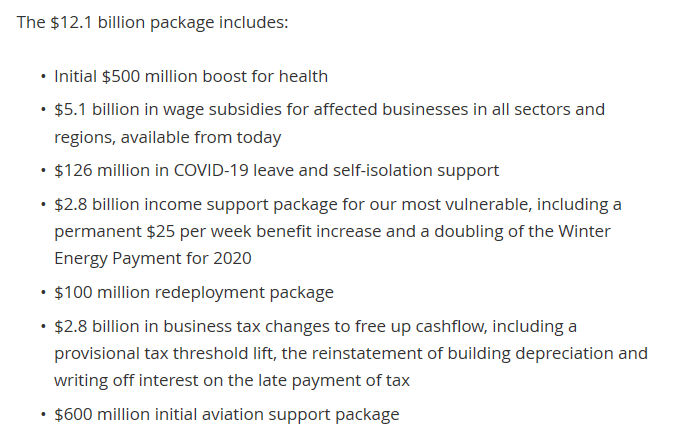
To get specific, this is the table summarising the package

package

We’ll get the easy bits out of the way first.  No one is going to argue with more resources going to health, although (a) some have asked why it wasn’t more (is that really all the sector can really use if we face 18 months of suppression strategies?), and (b) why this hadn’t been done at least six weeks ago.

And there probably isn’t much to quibble about (at least for now) re the sick leave and self-isolation support.

I didn’t see any details of the “redeployment package” although in his speech Robertson did make some comments, including mention of a package for Gisborne to be announced in the next few days. I guess the amounts are small, but mostly it seems to be a waste of time –  most likely before long hardly anyone (well apart from the health system and a few online retailers) will be taking on any new staff, and that could be the case for many months.  Face to face training doesn’t seem likely either.  It looks like just a legacy of where the package began weeks ago.

There is nothing to say about the “initial aviation support package” because they’ve said nothing about it, except that it apparently doesn’t include an Air New Zealand bailout.  Other than that, it isn’t entirely clear why this line item exists in the package, but I guess it bulked out the headline number.

And then we started getting to the big bucks.  Unfortunately, many of the big bucks are scheduled to be spent in several years time, and have nothing whatever to do with the coronavirus, whether stabilisation or recovery.   Because the thing that doesn’t get much attention in public consciousness is that the $12.1 billion number is total additional spending over four fiscal years.    That is an approach that makes sense in normal times (recognises the ongoing implications of new commitments) but it bears no relationship to the support provided for the coronavirus situation this year.

Thus, the business tax reforms they announced seem generally sensible.  I’ve argued against the previous government’s abolition of depreciation on buildings ever since the National Party adopted the policy in 2010. It was daft and without any good economic foundation, so I’m really glad to see it being scrapped.  Probably this was planned for this year’s Budget anyway (I hope so).  But it has nothing whatever to do with coronavirus, with stabilisation, or even with recovery.  And the bulk of the spend will be in future years.  It is simply in here to (a) bulk up the numbers, and (b) as some sort of political counterpoint to the next item, welfare benefits.

Raising welfare benefits permanently also has nothing to do with coronavirus.  Again most of the spending (at least $1.8 billion of it) won’t even be in the March 2021 fiscal year, and of the remaining billion probably only $700 million will be paid out in the next six months (largely the “winter energy payment”).  Raising welfare benefits permanently has long been a cause of the Green Party and probably much of the Labour Party.  There is talk that this too was going to feature in the (election-year) Budget.    If so, it is just in this package to (again) bulk out the headline number.

But the increase in welfare benefits now is much more pernicious than that.  Life on a benefit isn’t easy (and before anyone scoffs about what do I know, that isn’t just rhetoric: I have a close family member living on a long term benefit).   But what beneficiaries at least had going for them this year was certainty of income: the government was not going to default or closedown, unlike many private sector employers (with the best will in the world on their part).  They and public servants were safe.  And yet the government chooses to lock-in a permanent boost to its spending commitments (a) to those with the least degree of income uncertainty now, and (b) when the country is in the process of becoming a lot poorer and scarce resources need to be used wisely.   Raising benefits might or might not have been a reasonable luxury in settled times.  It is simply irresponsible and evidence of fundamental unseriousness to do so now.  (And before anyone tells me about the high marginal propensity to consume that beneficiaries have, let me remind you that now is not the time for stimulus or encouraging people to spend more: instead we are entering a phase of deliberately choosing to shrink the economy to give us the best hope of fighting of the effects of the virus).  Oh, and the unemployment rate is going to rise a lot, and one of the big challenges after this is all over is going to be reconnecting people with the labour market, at a time when wage inflation will have been depressed anyway.  In that context, higher benefit replacement rates (relative to wages) is really the last thing that makes sense in getting the economy back on track.

All of which leaves us with the centrepiece of the strategy, the wage subsidy scheme.  It is probably reasonable enough as far as it goes, but “as far it goes” is no more than a very short-term holding action, not remotely enough to really address much at all (it runs til June, the crisis will not, banks (for example) and other creditors will know that. So, before long, will most households).

But again there is a strong suspicion of political vapourware in the numbers.   The scheme is estimated to pay out $5.1 billion in the next three months.  That is a lot of money.

It is paid out at a rate of $7029.60 per full-time employee.  That means they expect to pay out for about 725000 fulltime equivalent employees (there is a lower rate for part-time employees).   That sounds like a lot.

In the latest HLFS, there were 2.6 million employees in total (including the self-employed). Of them 2.1 million were fulltime.  Applying the same ratio the package does (part-time staff are paid for at 60 per cent of the fulltime rate) to the 519000 part-time staff produces a full-time equivalent number of employees of 2.44 million.  In other words, the headline budget figure is premised on paying out in respect of 30 per cent of all employees in the coming quarter.   And this is even though the payment is capped at $150000 per employer, equivalent to compensating for only up to 21 staff.  And you can only get the payment is your monthly revenue is down 30 per cent year on year

Now, sure, there are lots (and lots) of businesses with fewer than 21 staff.   But lots of employees (by number) work for big organisations, both in the public and private sectors.  All those universities who were moaning about foreign students a few weeks ago could only each get $150000 (if total revenue had even fallen 30 per cent) even though they employ thousands of people each.

I am not saying that the $5.1 billion total is impossible.  But it seems unlikely.  And in particular it seems inconsistent with (a) the political messaging about the severity of the economic shakeout (even yesterday the Minister still wouldn’t accept that a recession was a done deal), and (b) the preliminary Treasury forecast the Minister was happy to wave around suggesting that at worst we’d have only about a 3 per cent fall in GDP.

I reckon I have been consistently one of the most pessimistic commentators about the economic effects.  It isn’t that hard to envisage GDP falling 5 per cent in the June quarter alone (reality could be a lot worse than that if suppression really comes to New Zealand), but that isn’t the sort of message the government is giving New Zealanders.   Either they aren’t being honest with us, or they’ve just bulked up the headline numbers (it isn’t as if any underlying assumptions about any of the forecasts have been released).

So for all the talk of a 4 per cent of GDP package etc, it would probably be more realistic at this stage to think in terms of immediate additional outlays (next few months) of no more than half that (and not even all that will be helpful).  Those are still big numbers: 2 per cent of annual GDP is 5 per cent of four months’ GDP.    The Minister released a chart suggesting the package will boost annual GDP itself by 2 per cent over the next year, but that too seems optimistic (but hard to tell how much without Treasury releasing their assumptions/workings).

But for whatever immediate good some elements of the package might do, it still largely fails to address the real and pressing issues.   In particular, in typical recession debt service costs for borrowers (new and existing, at least for floating rate borrowers) drop sharply, and returns to depositors drop sharply.  That reallocation is a natural and normal part of the rebalancing and stabilisation process.  Despite the spin from central bankers (abroad as well as here), 75 points just does not cut it: 500 points has been more like it in recessions (over a period when none has been as bad as what we are facing now).   Between a central bank that refuses –  adamantly promises –  not to cut further, and a failure to ever deal with the lower bound issues, nothing is on the way.  That has to change.  The government could and should simply insist on it changing now.   (Related to this, what fall in the exchange rate we’ve seen –  also a natural part of shock absorption –  is tiny compared to the usual recessions.)

And even more pressingly, in this unique sort of shock, the package does nothing about stabilising income expectations for firms or households in a way that would support banks being willing to (a) maintain existing credit exposures, and (b) be willing to significantly extend credit to cover the gaping net revenue holes that will be opening up for many firms (and households).    That needs urgent action.   With the best will in the world, and much harassment from the Governor and the Minister, banks are businesses too and have shareholders to answer to (primarily) and their own future existence to protect.   They can read things like this week’s Imperial College paper arguing that suppression strategies may need to be kept in place for most of the next 18 months.  If so, with no income guarantees –  and not even any certainty about what subsequent emergence looks like – as a bank you would often be in breach of your duties to extend more debt in many cases.  And many people –  firms and households –  would be reluctant to borrow more.   Better to manage and minimise exposures early, to whatever extent one feasibly can.

Of course, governments could lend direct.  But that simply isn’t realistic on any sort of scale.  Much better to think hard about the sort of idea I advanced in a post on Monday where the government passes emergency legislation guaranteeing –  in legally enforceable form (perhaps it could even just be done under the guarantee powers of the Public Finance Act, but better to get parliamentary sanction) – that no firm or household/individual would have net income in 2020/2021 (and perhaps even the following year) less than 80 per cent of that for the last year (for firms, the guarantee would be scaled to the extent they retained staff).   Doing so would give a floor –  and thus remove much of the variance in expectations – for households, firms, and for actual/potential lenders.  It should help underpin a willingness to extend credit.  It should also serve as an underpinning if we find ourselves adopting shorter-term expedients –  as say France has done –  of temporarily suspending utlilities bills or mortgage payments:  utility companies could themselves get bridging finance if banks knew household would still have most of their income, and banks themselves wouldn’t face the need to record impaired assets etc.

I want to come back, in a further post, this afternoon to my overall proposed package, including answering some of the questions/objections.  I still believe it is the best and fairest approach to take, complementing some of the other shorter-term cash income support measures (which would be nested within the guarantee).  But whatever the precise form of what they do, the government simply must act very quickly to ensure that credit is available. (And on that score the Reserve Bank temporary suspension of the scheduled increase in capital requirements is of second order significance, not remotely the main game.

Finally, I can only repeat a point I’ve made in various posts and numerous tweets over the last week: this is not the time for encouraging new private spending.  There will come a time for that, and it is likely that fiscal policy will have a significant role to play then.  But this is a time when we are deliberately scaling back the economy –  quite possibly savagely for months at a time – and discouraging spending in many areas.   We need to ensure have the income to live on, but for now much the most important economic priority is some set of guarantees –  supported by the strong Crown balance sheet – that means households are able to borrow, existing businesses are able and willing to borrow, and banks are genuinely willing to maintain and increase lending…..in the face of the most hostile and uncertain economic conditions of the lifetimes of almost all of us.

The government now needs to get serious and get down to real economic policy work.  It would be also good if they started authoritatively fronting with New Zealanders about just how tough things are going to get.    A lot of New Zealanders, who don’t obsessively follow the news or events abroad, really still have little no idea.


Coronavirus economics: 17 March

The apparent complacency of our key economic agencies is almost beyond belief at this point.

Thus, the Prime Minister told us yesterday that The Treasury’s advice “at the weekend” was that the economic impact “could” be larger than the recession of 2008/09 (as she loosely termed it “worse than the GFC”).  As various articles have pointed out, real GDP fell by just over 3 per cent over five successive quarters in 2008 and 2009.  The unemployment rate rose from a one quarter trough of 3.3 per cent to a one-quarter peak of 6.7 per cent (looking at the quarter-to-quarter volatility it is probably fair to talk of a three percentage point increase).

If that is – or even on Saturday was – still Treasury’s view, it is quite seriously worrying.  Whatever the outcome for the March quarter –  which still has two weeks to run, weeks that are likely to be pretty bad –  it isn’t at all hard to envisage a fall in the June quarter alone that will swamp the entire fall in real GDP in 2008/09.  Just remember the international tourism sector. We used to have one.

Recall that the Secretary to the Treasury is an observer on the Reserve Bank Monetary Policy Committee, and attended the meeting on Sunday where they agreed to cut the OCR 75 basis points and to commit not to cut in further for a year.  This was the same meeting the Governor emerged from to tell the press conference yesterday that only on “some scenarios” would there be a recession in New Zealand.  Surely, if the Secretary to the Treasury –  who unfortunately has no national policymaking experience or background –  thought differently she’d have conveyed that view pretty forcefully in the meeting.   Or are the Governor and the Secretary on the same pages.

But that was yesterday.   This morning three interviews with senior RBers, each members of the MPC, have become available.  I missed most of Orr’s on Radio NZ so may come back to that when it is available on the website.  So for now, lets just stick to comments made by Chief Economist, Yuong Ha on RNZ this morning and an interview Deputy Governor Geoff Bascand gave yesterday to interest.co.nz.   Complacency, combined with lack of any evident framework for thinking about and responding to the challenges, seemed to me to sum things up.

Yuong Ha was quoted saying that the Bank has given a considerable stimulus yesterday, with the 75 basis point interest rate cut.  But surely one could only judge “considerable” relative to the scale of the shock.   And in typical downturns, the OCR has been cut (or bill rates fallen pre-OCR) by 500 basis points or more –  in that 2008/09 downturn that the Treasury says this “could” be worse than – we cut the OCR by 575 basis points.  This MPC has cut by 75 basis points, and has committed not to cut any further for a year.  Ha claimed to be quite unbothered at the inability to take rates negative –  because bank systems can’t cope –  despite the Bank having given us no previous hint of such a problem, including in the Governor’s speech last week.  After all, he said, “we have lots of other ways to add stimulus”.

His favourite, and that of the Committee, appears to be large-scale purchases of government bonds.  That, all else equal, will greatly boost settlement cash balances at the RB, but so what?  That doesn’t lower servicing costs or returns to depositors,  and there is no identified transmission mechanism where it makes much difference to anything. I’m not opposed to such purchases –  as I said yesterday, the Bank should probably now stand in the market to buy any government bonds at 0% yields –  but on their own they won’t do much (recall that normal 500 points of easing).

Ha was then asked about the exchange rate, partly about where it is at now and partly about options to lower it by direct fx intervention.     Remarkably –  or sadly, perhaps what we have come to expect from this MPC –  he expressed himself quite pleased with the exchange rate and the buffering it was providing.  But again, he seems to forget –  or more likely chooose to skate over –  the fact that in serious downturns exchange rate buffering often involves, for New Zealand, 20 per cent plus falls in the exchange rate.     In TWI terms, that was almost exactly the extent of the fall over 2008/09.   And this time?   The TWI averaged 70.1 in the second half of last year (71.1 for the month of December) and, according to the RB website, was 68.7 yesterday.     It has barely fallen at all.

So the Bank can’t or won’t cut interest rates, (perhaps not entirely unrelatedly) the exchange rate hasn’t fallen much, and yet even The Treasury accepts this “could” be bigger than the GFC-associated recession.  But Ha isn’t bothered.  Government bond purchases will  do the job apparently.   Almost unbelievable.   (The same Ha whose comments from last week I quoted yesterday, suggesting that asset purchases could really only do a little, at the margin.)

But that performance was almost trumped by someone who, with much more media (and policy) experience, the Deputy Governor Geoff Bascand.   He wasinterviewed on interest.co.nz, video footage and all.

And he just seemed extraordinarily complacent.   Bank funding was just fine and would be for months he thought.  There was no sense, for example, of suggesting that banks might want to tap markets while they still can just to be on the safe side (as one courageous NZ bank treasurer actually did in early 2008).

But this is the bit that really got my goat

But for a number of them, their IT systems “aren’t ready and can’t cope with negative rates”.

“New Zealand hasn’t really contemplated negative rates in the historical period that we can think about. It’s a bit like a Y2K thing in a sense that they’re all set up to be positive, zero, or positive numbers,” Bascand said.

“It doesn’t mean that you couldn’t create some work-arounds eventually, or adjust this, but right now [this] doesn’t seem to be the key thing to do.

“We’ve got other ways of putting stimulus into the economy if we need to. Taking on additional risk of doing something that may or may not transmit, or work properly, doesn’t seem like the smartest thing to do.”

Take first that “other ways of putting stimulus into the economy if we need to”.  It reveals both a complacency about the economic shock, a misunderstanding of quite what easier monetary conditions do right now (would mostly ease servicing burdens and redistribute burdens), and that belief in other mechanisms which is simply belied by the evidence –  and by the comments of the Chief Economist only last week.

But it was the unreadiness of systems bit that really takes the cake.    He blithely tells us is “like a Y2K thing”, but never seems to recognise a profound difference.  Under some mix of commercial imperatives and central bank and other official pressure, there was a huge expensive effort undertakem to ensure that the financial system was ready for Y2K (I was heavily involved at the time, including the policy precautions).   The issue was recognised several years in advance and appropriately prioritised.   As it happens, Adrian Orr was the Bank’s chief economist at the time (although I guess it wasn’t an issue that much involved that bit of the Bank).

And then he claims

“New Zealand hasn’t really contemplated negative rates in the historical period that we can think about.

which is simply false.  As I mentioned yesterday, at the height of the euro crisis, in the dying days of his governorship, Alan Bollard set up an internal working group (which I chaired) to look at monetary policy issues and options should short-term interest rates get near-zero.  That report, to the (then-internal) Monetary Policy Committee, explicitly canvassed the possibilities of negative rates, including the wider (physical currency conversion) risks and limits, including in the light of international experience to date.  That report explicitly identified -0.5 per cent as appearing likely to be a true floor, and identified system constraints as a potential issue.

As a result, among the recommendation were three specific ones on that score: that we ensure that the Bank’s own internal systems (banking system, NZClear etc) could cope with negative rates, that we liaise with the Treasury to ensure that the DMO could handle negative interest rates, and that the Bank’s prudential supervisors should liaise with banks as to whether their systems could adequately cope with negative interest rates.

That report was dated 31 August 2012.  I do not recall anyone disagreeing, or refusing to accept, those recommendations.

Now, to be sure, that particular eased and passed.  But negative rates did not become less of an issue for advanced country central banks, with notable examples of countries with extensive experience in recent years being Switzerland, Sweden, Denmark, and the euro-area.

And yet today the Reserve Bank of New Zealand can blithely tell us that banks’ systems aren’t ready.  This despite the Bank’s proud repeated boast of the advantages of having monetary policy and bank supervision in the same organisation.  I’m simply staggered at this failure, this utter lack of preparedness –  all the more so because past Bank publications had openly talked of negative rates as a policy option for New Zealand.

And who bears responsibility.  Well, in a few days time, Adrian Orr will have been Governor for two years.  Plenty of time to ensure the Bank was ready for  a crisis even if his predecessor had been a bit slack (crisis preparedness is really core central banking –  the crash fire brigade that needs to be excellent, even as you hope they are never needed at all).  And, even more so, Geoff Bascand has been Head of Financial Stability (responsible for the whole supervisory and regulatory side of the Bank, as well as sitting on MPC) for almost three years.  (Oh, and then there is the small matter of the Board, who are supposed to have held the Bank to account, including ensuring things like crisis preparedness: Quigley has chaired the Board for more than three years now).

And yet, with not a hint of apology he blithely tells us banks aren’t ready and –  perhaps as egregious –  it isn’t really worth making it priority to fix that now.

It is simply breathtakingly inadequate.  They become more incredible –  literally hard to believe, impossible to have any confidence in, by the day.

UPDATE: For anyone here looking for views on the government’s economic package today, I suggest having a look at my Twitter feed (here).  A more considered post on the package will be forthcoming tomorrow.

A radical macro framework for the next year or two

The government’s sudden decision on Saturday to substantially close the border seems to have jolted some towards realising just how serious the coming economic dislocation is.   But it has also led to a plethora of comments suggesting that the “border closure” is itself the cause of, or trigger for, the dislocation and huge loss of income and output that is coming.  It wasn’t.  As is well known, willingness to travel internationally was drying up anyway, and was only likely to drop further, amid the progress of the virus and the skyrocketing levels of fear and uncertainty.  Only the marginal additional effect of the border closure, over and above what was already happening any way, is really relevant to assessing the cost of that particular policy.

Personally, I’m still a bit sceptical about border closures now, which seem more akin to political theatre than to serious policy (with hindsight the one –  simply impossible to conceive –  border closure that would have made sense would have been for China to have closed its border, in and out, in November).  But unless they distract attention, including media coverage and analysis, from the real and bigger issues I guess at this point they don’t do much harm either.

On the other hand, there has still been a real reluctance to grasp just how deep and long that economic shutdown/dislocation seems likely to be.  There was the absurdist extreme this morning of the (overwhelmed?) Reserve Bank Governor who was reluctant to even concede a recession.  But if the Prime Minister –  who is usually hopeless on matters economic, including in her Q&A interview yesterday –  and the Minister of Finance have been less bad than that, they’ve still refused to level with the public, in ways that leave one wondering whether even they have yet grasped what we’ve found ourselves in so quickly.

Thus, it was good on Saturday to hear the Prime Minister articulate the “flatten the curve” strategy, but neither she nor any other public figure I’ve seen or heard from has been willing to recognise that if we do flatten the curve a lot, whether by border closures or (more probably) physical distancing, there is no quick or easy exit strategy: in some form or another, perhaps varying through time, the restrictions and behavioural changes (compulsory or voluntary) have to be in place for a long time, unless/until (say) a widespread vaccine is available.    That means a huge economic cost, and huge economic uncertainty, for the (uncertain horizon) future.  Perhaps it is the only sensible strategy now –  notice the pushbacks against the UK “herd immunity”/cocoon the elderly notions – but how does it feel three months hence?  Six months?  Nine months?   There has been no open discussion of the exit strategy, or the implications economic and social.

It is pretty easy to develop scenarios in which real GDP for the next year could be 25 per cent lower than otherwise.   Foreign tourism has evaporated.  There’s 5.5 per cent of GDP gone.   Perhaps a few more people will holiday locally, but more likely reluctance to travel will keep on diminishing, even if we never quite get to the point of being penned in our homes, even just outside working hours.   No new investment project will start, and many of those underway will be halted –  whether because of uncertainty, illness, lack of finance, disrupted supply chains or whatever.  Housing turnover will dry up.  On the expenditure GDP side, investment is about 20 per cent of GDP.   Demand for many of our other exports will also weaken –  as most every other country battens down and experiences big income losses as well as disrupted distribution channels.  Personally, I went to a movie yesterday afternoon, but I doubt I’ll be going to any more for the duration.    Restaurant bookings in other countries are plummeting and so on.  Lock people down Wuhan style – or have them so fearful they won’t venture out –  and of course for a time the losses are even greater.

It is an enormous loss of income and wealth, most of which will never be recouped.  Those losses will be borne –  the only question is who bears them. That is likely to be some mix of law, canons of fairness/justice, and considerations of economics (what will help us eventually emerge with the least semi-permanent damage).

A key aspect of my approach to this issue is that now is not the time to be encouraging more spending and economic activity. In fact, to do so is likely to run directly counter to the public health imperatives.  There will come a time when we do want people to emerge from their shells and be ready, eager, and able to spend. But not only is that time not now, but a realistic take on what “flatten the curve” seems to mean here and abroad, suggests that at best that time will not not be for many months yet.

So talk of stimulus packages is really quite misplaced (much of the Australian package last week will have really just be wasted money).  The focus now needs to be on three things in my view:

  • basic income support for everyone, whether through companies or through the welfare system,
  • throwing all that can usefully be thrown at gearing up health system capability (I have no idea what can actually be done, but the impression so far is that not much has been done, perhaps so as not to muddy the waters of the political message about our “world-class health system”, when it is clear that no health system in the world can cope with very much of this virus at once –  another message politicians have not fronted the public with), and
  • creating a climate of confidence that in time –  as soon as possible, but it won’t be soon – things will get back to normal, including economically, and that the authorities will not stint in helping that happen WHEN THE TIME COMES, which is not now, and cannot be now.  Included among the imperatives regarding confidence are things around medium to long term inflation expectations –  something the Bank used to like to talk about, until it really mattered – and the assurances it takes to create credit and liquidity available.

So here I want to propose a strategy or framework for approaching the period ahead, the period before there really is light at the end of the coronavirus tunnel.    When that light becomes evident, my suggestion of the temporary cut in the rate of GST would be apt, as would a temporary cut in one of the lower income tax bands.  A one-off significant lump-sum cash transfer might even have a place.   And monetary policy would have been fixed in ways that mean interest and exchange rates strongly accommodate any nascent uptick.

But in the meantime here is something along the lines of what I think needs doing.

First, people keep playing down just how much it matters that monetary policy cannot adjust very much.  Even in normal recessions, whether or in the US or elsewhere, cuts in short-term interest rates of 500 basis points or more are quite normal.   This economic dislocations seem almost certain to be larger than anything anyone living has ever experienced in countries with their own monetary policy.   We simply cannot accept the status quo of an effective lower bound on nominal interest rates not far below zero (let alone the rank incompetence that for now has the RBNZ telling us the floor is 0.25 per cent, because they hadn’t ensured banks could cope with negative rates).

This problem can be solved.  The effective lower bound arises because people- and institutions can convert deposits into cash, which yields zero, rather than accept a materially negative interest rate.  It isn’t worth doing so –  insurance, storage, AML laws etc –  for a few tenths of percentage points, but if the OCR were to be set at – 5 per cent (quite plausibly what would be sensible now: there are papers for the US in 2008/09 which suggested -5 per cent would be appropriate then) the general consensus is that such conversion would occur on sufficiently large scale to make it not worth cutting that deeply.

But those restrictions can be eased, temporarily or permanently.    If, for example, the banks had to pay a premium of 5 per cent over face value to purchase (net new) notes from the Reserve Bank, they’d be likely to pass that cost on to customers –  and particularly to any large customers.  If a pension fund (say, and I’m a trustee of two so have thought about these options) considered switching into physical cash and faced a 5 per cent fee, they’d have to think about how long they expected the crisis to last.  If they thought it would be largely over this time next year, you’d rather accept a -5 per cent interest rate in a bank that pay the insurance and storage costs on top of the 5 per cent cash fee.  It isn’t technically hard to do. It is pretty countercultural –  cash and deposits have been essentially interchangeable –  but then so is coronavirus and the attendant economic and social disruption.  There is a bunch of other ways of achieving much the same effect.  They can be done in fairly short order (and announced, for the signalling benefits) even sooner.

Doing so would help ensure we could keep driving the exchange rate down, (as the Governor put it) a standard part of the buffering mechanism in New Zealand.  And it would demonstrate to markets, and anyone else paying attention, that New Zealand authorities were absolutely determined to keep medium-term inflation up  –  in the face, for the next year or so, of an otherwise deeply deflationary shock –  which might even lift inflation expectations, but would at least limit further erosion.

This stuff is geeky and may not make much direct sense to the man in the street.  But it is a reallly important part of a successful macroeconomic framework.  It does not put money in pockets now, but it helps keep the climate right for an effective recovery.

And what it would do is enable us to make a much more brutal and effective start on the appropriate income redistribution to fit the crisis.  Interest rates are really a reward for waiting, and for the opportunities used/foregone over periods of time.  But for the economy as a whole there really is no value in time at present.  And yet we still have deposit and lending rates –  even after today’s cut –  well above zero.   That simply shouldn’t be for the time being.

Of course, there are arguments around negative rates that depositors won’t readily accept negative returns.  Those are arguments –  mostly about slow adjustment of norms –  for relatively stable times, not for the next year or so.    What else are the depositors going to do with their money?   Extreme risk aversion will deter them from purchasing other assets here, and if they either shift abroad or starting spending either effect works in the macro-stabilising direction.

And on the other hand, in deep recessions servicing burdens for floating rate debt typically plummet.  That seems even more imperative than usual (for a recession) now.

In other words, radically lower interest rates would (a) lower the exchange rate, (b) achieve a desirable and typical downturn redistribution from depositors to borrowers, and (c) help create the medium-term confidence in the rate of inflation once we’d emerged.  Those are significant gains even if  no more overall economic activity is induced right now in the midst of the crisis.

If the Reserve Bank won’t act to do this now –  and they’ve shown no sign of any energy thus far, including nothing more than a passing mention in last week’s speech –  the Minister of Finance should insist on it, using his existing monetary policy override powers or, if they aren’t enough, passing special legislation.

Consistent with this, the Bank should –  and quite possibly will within the next couple of weeks –  starting standing in the market offering to purchase any and all government securities at a yield of (for the sake of a round number) 0 per cent.    Doing so would not make much difference to short-run economic outcomes –  frankly little (other than the virus) will or really should – but it would be a strong signal of how committed the authorities are to avoiding a deflationary shock turned into a deflationary underemployed semi-equilibrium. It would also establish upfront that any bond market disruptions – and there may be more –  would not impede the government’s ability to raise whatever it takes over the period ahead.  (And for monetary tragics, yes wouldn’t Major Douglas and Bruce Beetham have marvelled to see such an hour).

The second strand of my adjustment package is a proposal for a wage cut, across the board, of (say) 20 per cent for the coming year.  Remember that I noted that GDP could easily be 25 per cent lower than otherwise for the year ahead.  Someone (lots of people) will bear that loss. Most owners of businesses/shares will take very heavy losses for the time being.   Many people face losing their jobs, or being unable to find one (at a mundane level my son, in Year 13, fairly suggested that finding a holiday job next summer, prior to starting university is going to be…..well, challenging).  They lose out very heavily (recessions never fall evenly).   And at the other extreme, who won’t be losing out at all?    That would be the 20 per cent of so of the workforce employed in the public sector, few or whom will face any material risk of redundancy. (And sure, some public sector workers will be working harder than ever, but so will some private sector workers –  and in case anyone thinks this is beating up on public servants, our main household income is a public service salary.)

In such a dramatic climate, across the board wage rates seem fair, as a way of distributing the (inescapable) losses and pain.   It would have to be done by legislation, which might not be that easy to draft, but it is one of those cases where centralised coordinating devices allow adjustments that couldn’t otherwise readily or quickly occur (the floating nominal exchange rate serves a similar function).

Now, of course the typical high income person can afford to lose 20 per cent of their wage for a year more readily than someone at the bottom.  But in a typical recession the labour income losses are concentrated even more heavily on low income people, so that isn’t a particular argument against what I’m suggesting.  But frankly most people are likely to be spending less anyway over the next year, even if it is just saving the bus fare if people are coming into the office less often (or not at all), or closed bars or movie theatres etc.  But one could tailor the scheme to some extent: perhaps a fulltime equivalent cut of 20 per cent to wage rates, but cappped at $4000 (FTE) for low income workers?

Now one loud objection will be that such a cut will be deflationary: less income, less spending etc.  But (a) I have another big strand to come, and (b) recall that this is mostly redistribution –  instead of most losses falling on firms, more of them would be borne by workers (being as we are all in this together).  And don’t forget that the first strand of my suite of framework policies was a radically expansionary monetary policy, relative to what we have now.

The third strand of my framework –  perhaps the most controversial of all –  starts from asking the question of what we’d have done 20 years ago if we’d really focused on pandemic risk, including at a macroeconomic level.  Presumably the answer is that we would have sought insurance.  It would not necessarily have been available on market – especially not from anyone we’d count on to be around to meet the claims – so we’d have self-insured.  In fact, in the sort of as-if argument favoured by economists you could mount an argument that that is exactly what we have done, across successive governments, by keeping government debt low (and taxes higher as a result –  in effect, the premium).  Now is the time to draw on the policy.

I should say that much of what I’m about to suggest sticks in the craw.  There are some firms that I really have no sympathy with at all: if you are an airline then after 20 years of 9/11,  SARS, H5N1 planning, H1NI, MERS, and the never-long-away risk of major new terrorism, you surely have to plan on the basis that sustained disruption in ability to fly is a core business risk.   But, even if politics didn’t mean any such argument would just get ignored anyway, I think we have to set such perspectives aside, in the interests of a timely restoration when the virus fades as an issue/risk.

At a conceptual level, I am going to propose something like an “ACC for the national economy”.  ACC, you will, recall typically cover 80 per cent of lost earnings.

So how about committing as a country, and by law now –  would be needed to have the effect I’m seeking – that for the tax year 2020/2021 – we would guarantee that everyone taxpayer’s net income would be at minimum 80 per cent of what they received in 2019/2020.  That guarantee would apply to firms and individuals, even foreign-owned firms with substantial operations actually here. (For firms, it might be conditional on –  and scaled to – maintaining at least 80 per cent of the 31 Dec 2019 workforce.)

I’m not here proposing a mechanism to operationalise the payouts of these guarantees, but I don’t believe that would be necessary now.  It would, in effect, be akin to a government bond or guarantee which people and firms could count on and –  as important – their banks could count on.    With such a guarantee, there would be less reason for banks to be reluctant to keep existing loans outstanding, or indeed to extend further credit to cope with the –  often significant cash flow hole.    It wouldn’t avert all failures –  and nor, generally, would that be desirable –  but it would make a huge difference, and provide a high degree of certainty about income floors up front.

The guarantee doesn’t, of course, make people whole (not adversely financially affected) but then all this is on the assumption that 25 per cent of GDP is lost.  Those losses have to be borne by someone (and, as noted above, spending opportunities are going to be fewer anyway).

Recall again that the goal isn’t, and should not be, to stimulate new spending at a time when people have to hunker down, be careful, separate etc.  It is about minimising the longer-term disruption from a totally unforeseen, genuinely exogenous to the New Zealand economy shock.   Done well, firm failures and job losses –  at least of permanent employees –  should be kept to a minimum (as will inevitably be the case in the core public sector anyway), and keeping up something like the required level of credit (much of any addition, secured by a statutory government commitment).   Same applies to household mortgages.

How much would it cost?   It is impossible to tell.  But here’s the thing.  On the OECD net general government financial liabilities series, New Zealand’s net government debt is about 0 per cent of GDP.  That’s right, zero.

Suppose we lose 25 per cent of GDP for a year, but decide to pay every New Zealander (individual and firm) just what they got the previous year, what would that leave net government debt at the end of that year?  Well, that would be something like 25 per cent of GDP.  Not exactly high by international standards, having traversed one of the very worst shocks imaginable outside war.  Of course, the lost output could be larger than 25 per cent of GDP (in Wuhan it will almost certainly have been larger than that so far), or the losses could run longer than a year.  But worry about the second year when we get closer.  For now, an strong demonstrated fiscal commitment should support both credit and jobs.   And, as a society, we pay for it in higher taxes over the following 20 or 30 years.   It is, essentially, ex post pandemic insurance.

(If you wanted you could add some sort of “windfall profits tax”, levying a higher tax rate this year on anyone whose income in 2020/21 was more than 20 per cent higher than in the previous year.)

And that it is it for a big macroeconomic framework package.  It doesn’t obviate lots of short-term issues, including perhaps around sick leave etc. It doesn’t render irrelevant series stimulus effects –  fiscal and monetary – to demand and activity as the virus looks to be sustainably behind us.  What it is designed to do is (a) share the inescapable) losses fairly, if inevitably a bit crudely, without removing all risk from individuals or firms (b) support the existing level of credit and a secure basis on which existing banks could lend to cover shortfalls, (d) dramatically cut servicing burdens (and returns to depositors) as is normal in a deep recession ,and e) support/create confidence in an absolute commitment to keep medium-term inflation up at around 2 per cent, avoiding seeing real interest rates rising into a savagely. deep and at least somewhat prolonged recession and deflationary shock.

I’m sure there are many detailed pitfalls and issues to address.  Perhaps the biggest high level one is the possibility this is all over three or six months hence.  Frankly, I don’t even think that is really worth considering very seriously at present, but even if it were to happen (a) the wage cut could be shortened (new legislation) and (b) the net income guarantee is just that: if it isn’t called because incomes recover very quickly, then that is just great for firms, households, individual and governments.

I commend it to your consideration.
Pretty dreadful

I’m not sure why the Governor chose to hold a press conference this morning after the MPC’s announcement.  Were he an authoritative figure, perhaps it might have been some use.  Such a figure might have been able to offer thoughtful narrative, or framing, for what is going. But this was Orr, a sadly diminished figure, inadequacies fully found out in a crisis.  And the press conference only confirmed that grim assessment.   He should be replaced.

In fact, probably the only worthwhile thing to emerge from the press conference was that Deputy Governor Geoff Bascand is clearly the adult in the room, including that he was the only one of the three MPC members speaking who was willing to call a spade a spade regarding the economic consequences of what is unfolding.  He has chief executive experience.   He’d be a superior Governor to Orr (not ideal, but –  as I noted before the appointment was even made, when Bascand confirmed that he’d applied for the job –  a safe pair of hands).

As for Orr himself, there seemed to be no contrition at all for the February MPS (the one where they moved to a tightening bias) or for all that complacency in speeches and interviews just a few days ago.  He told us we should listen to the health experts etc –  quite possibly, but we should have been able to listen, and count on to act aggressively, economic and financial experts in our Reserve Bank. Instead, we got Orr and Hawkesby last week, given cover by the rest of the MPC and the Bank’s Board.

There were odd lines.  He claimed the exchange rate was acting as a buffer, and yet (a) the fall in the exchange rate is very limited compared to the experience in typical New Zealand recession, and (b) as he was talking, at least against the USD the New Zealand was higher than it was at 7 this morning (not very surprisingly, given that the Fed cut even more than the RBNZ did, on top of an earlier large cut).

And there was the confirmation of the point I highlighted in my earlier post.  They felt they couldn’t cut the OCR below zero because not all the retail banks were  “ready”.   Strangely, no journalists challenged Orr on this.  Isn’t crisis preparedness for the system a core part of what the Bank is going as regards the financial system?  Haven’t they been talking about negative rates as a possibility for a couple of years?  Haven’t other countries had negative rates for longer than that?  There is some legitimate debate about the usefulness of negative rates, but it is a gross dereliction of the Bank’s responsibilities not to have ensured long ago that all players could manage negative rates (in their systems etc).  And, of course, no contrition for that failure either.

We even had attempts to play down the coronavirus experience in New Zealand as well (“only a few very isolated cases”) something he’d surely just have been better to have shut up about.

He claimed they’d provided details of their unconventional policies in his long speech last week, even though that speech was very light on detail, and promised a series of more detailed papers to come. No word on those today.  He gushed about the capabilites of his unconventional instruments, but seemed to have no developed mental model for the relevant transmissions mechanisms.  It wasn’t exactly confidence-inspiring.

And then there was three final points worth noting:

  • asked if he was anticipating a recession, instead of simply saying “yes”, or “yes, a very serious one” –  surely the only honest answers –  he got into a debate with the journalist, apparently hung up on the (supposed) technical definition of two quarters of GDP falling.  He was prepared to concede “a period of very weak economic activity” but when pushed on a recession he would only fall back on “I don’t know”.  Every one else does.   He did finally concede that on some of the Bank’s scenarios –  really only some? – there would be a recession in New Zealand.
  • asked about his response to suggestions that the Bank had moved “too little too late”, his initial response was “Nothing”.  He simply wouldn’t engage.  And then he tried to make a virtue of MPC’s inordinate delay, claiming –  is the man serious to even raise this? –  that acting earlier wouldn’t have stopped the virus.  Then we got rhetoric about the importance of a medium-term framework for monetary policy –  a strange claim on the morning of an emergency cut –  and the value of fuller information, as if any information will ever be enough or definitive.   He then had the gall to claim that New Zealand was now in the “best possible position”.
  • and finally, there was a suggestion in Parliament a short-time ago (early last week?) that the Bank was trying to pressure banks not to be too negative in their commentary.  It was never actually confirmed, although there is reason to believe they were told-  by the Bank –  to exercise a sense of “social responsibility” in their commentary.   That was exactly the line Orr ended his press conference with today, to all the assembled media.  From an organisation that minimised the issue for so long, that really should have been a lot more alarmed and active earlier on, it is simply an unacceptable stance (more so than ever, since powerful government agencies should be welcoming, scrutiny, alternative perspectives etc – especially in uncertain times like this –  not (ever) trying to get happy-talk coverage.

It was a sadly revealing performance, as to just how unfit for office Orr is.  And of how he and Grant Robertson, Neil Quigley, the rest of the Bank’s Board, and the rest of the MPC have let New Zealand down.


Game’s up

I may well have more to write about the Reserve Bank announcement this morning after the Governor’s press conference at 11am – which I hope begins with a formal apology from him and Hawkesby for their appalling complacency and minimisation of the issues as recently as a few days ago –  but these are some initial reactions.

I guess I have three key points:

First, a 50 basis point was warranted at the time of the last  MPS (and doing so would have been entirely in line with past practice of reacting to out-of-the-blue shocks) so 75 basis points now is seriously inadequate.   Everything has got a great deal worse since then including –  though not mentioned in the statement –  medium-term inflation expectations.

Second –  and this was the mindblowing bit to me –  was this extract from the minutes

Staff also advised that an OCR of 0.25 percent was currently the lower limit, given the operational readiness of the financial system for very low or negative interest rates.

This is simply inexcusable if true (which it may not be).  As just one small point, I lead a working group at the Bank in 2012 –  height of the euro crisis – which identified then the need to ensure, as a matter of urgency, that banks and the RB itself were able to operate with modestly negative interest rates.   And for years we have seen various other countries operating with negative policy rates, so if the Bank has not been taking action to ensure the system could operate, when needed with negative rates it is simply an inexcusable failure. For which, frankly, heads should roll.   Neither when they put out their Bulletin article two years ago nor in the Governor’s speech last week was there any suggestion that negative rates could not be used now.  Best surmise, they simply weren’t taking things sufficiently seriously until the last few days.

And, third, they have basically conceded that it is game over and that monetary policy has reached current limit  (which is so wholly because of their failures –  on this narrow point and, like most of their peers, dealing more decisively with the near-zero lower bound.

Note that as part of their statement they formally rule out any further changes –  including cuts –  for at least the next 12 months.  In other words, tbey rule out taking urgent action now to remedy their past failures.  Simply extraordinary.   I guess climate change and the like were taking priority for the Governor and his staff?

But the point I also wanted to focus on was this bit of the resolution.

Agree that Large Scale Asset Purchases of New Zealand government bonds would be the best additional tool to provide further monetary stimulus in the current situation – if needed.

I never got round to writing about the substance of the Governor’s seriously inadequate speech last week, but had I done so one of the points I would have made was that outside immediate financial crisis conditions –  not NZ now –  these asset purchase routes simply did not offer much.    It isn’t as if bond yields are now at the still-high levels they were in most countries in 2009 even after the OCR had been cut (even if they have been rising in the last few days as the global rush to cash has taken hold).

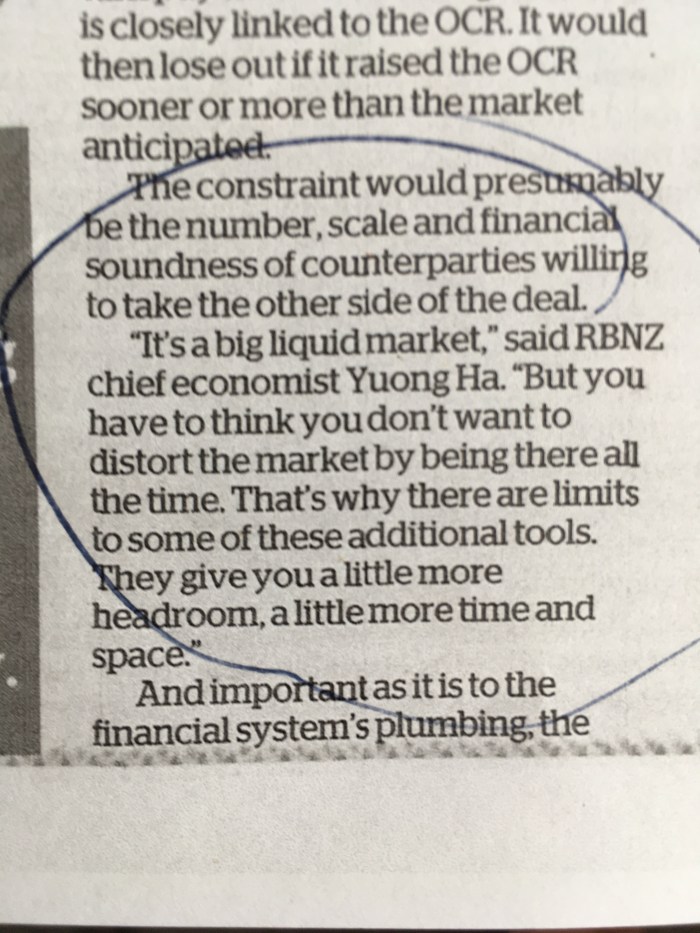
You might doubt my interpretation –  but you really shouldn’t as it is pretty widely shared, even if often in muted language –  but, as it happens, we have the word of one of the MPC members for it.  Again, I’d been meaning to use this in a fuller post this week.  I hadn’t seen this quote elsewhere, but in his column in Friday’s Herald Brian Fallow reported the RB Chief Economist Yuong Ha as saying, of the unconventional options,

“they give you a little more headroom, a little more more and space”

Precisely.  And “just a little more” is not what the occasion demands.

In effect, in this announcement it is a case of “one and done” –  not in sense of “we”ll be bold and not need to move again” –  sort of their justification for the 50 point cut last year –  but “we’ll move now, and then……well, we have to retire from the field and stare into the macro/monetary abyss….because we spent years just not doing our job, distracted by all sorts of pet things, always looking for rates to rise (as recently as the last MPS).

It really is inexcusable.   Personally I think there is a strong case for dismissing the Governor, and probably most of the MPC too –  including those externals we’ve never heard a word from to explain or justify their collective inaction and failure of preparedness.   I don’t suppose it will happen, but it is what often does –  and should –  happen after battlefield disasters and revealed gross failures of preparedness.   Then again, to act would be for the Minister of Finance to concede some of his responsibility –  he appointed them, he is supposed to hold their feet to the fire, hold them to account.  And only a few months ago in a letter to me he indicated how satisfied he was with the Governor’s stewardship.

I plan to have a fuller post this afternoon on some ideas for macro management now and in the months ahead.  As I’ve said in posts last week and on Twitter, now isn’t the time for stimulus per se –  new spending by the public isn’t the goal as the economies of the world deliberately de-power. The immediate focus has to be income support, the health system, and then some assurance about the framework to see us through the period –  perhaps protracted – until genuine stimulus becomes the appropriate focus.


Weighed in the balance

The feckless leadership of this country heading into the deepening coronavirus crisis has been pretty astonishing to behold.  Of course, there is the Governor of the Reserve Bank (and his statutory MPC offsiders), whose complacent utterances and utter inaction have been well-documented here this week.   And there is the Ministry of Health which has been actively discouraging people from stocking their pantries, constantly talking down any areas of concern, refusing to seriously engage with the public on the worsening overseas situation (including Australia, with whom we share a fairly open border) and is still telling us the risks of community outbreak are low.  This was still on their website a short time ago

MOH virus

(And when a reader asked the Ministry of Health for the justification for this stance, the only reply he got was along the lines of “we clear all our statements with clinicians” , as if these anonymous “clinicians” are different from people in any other field of expertise, where there will be a wide range of views, particularly amid extreme uncertainty. )

And then of course, there is the Prime Minister and the Minister of Health. The latter, despite being an elected politician, simply seems to channel his officials –  and perhaps only in the aftermath when all the OIAs are in will we know whether officials are tailoring their stance to suit ministers, ministers are so incurious as not to ask the hard questions, or both.

But in a crisis the focus should naturally fall on the Prime Minister.  It is for rare events of this sort of magnitude that we elect people who purport to be leaders.  But again we’ve just had constant minimisation, “pat on the head –  there, there” idle reassurances,  and a sense of always dithering and being behind the play.  There is no sense that our Prime Minister has any conception as to just how bad the global situation is getting, how serious the Australian situation is becoming, or any willingness or ability to articulate a coherent alternative view (if she has really thought hard enough to come to one).  There is no fronting the public about how no health system can adequately cope with large outbreaks, and only last week in Parliament she was still trying to play down the prospect of even a mild recession in New Zealand.  More recently, nothing serious has been heard confronting the very serious economic dislocation we face, whether or not the happy talk from her and her officials re low risk of community outbreak happens to come to pass.

Who knows why?  People speculate that it is all about the Christchurch commemoration –  whether for cynical reasons or because some short-term empathy with those victims has totally distracted her from a focus on the much larger threat that is now about to overwhelm us, and for which she –  as Prime Minister –  can actually affect outcomes.  But whatever the explanation it is pretty inexcusable to have a “leader” so totally in reactive minimisation, avoiding fronting with the public, mode.

But not to divert too long or too far from the main focus of this blog – economics and economic policy – I thought it might it would be good to give some coverage to some survey results out this morning, asking leading economists in both the US and Europe about the outlook.

The virus situation in Europe is currently worse than that in the US, so lets look at the European results first.

europe igm corona

Weighted by expertise, 82 per cent of respondents expect a “major recession” (none of the silly debate that still seemed to be in focus in New Zealand even last week as to whether we’d have two slightly negative quarters).

And although for most macro policy purposes, it doesn’t much matter whether the disruption is coming from the demand or supply side (contra the Reserve Bank public handwringing), 47 per cent think the main effects will be coming from the demand side.  Only 12 per cent disagreee.

(In New Zealand, so far, there is little doubt that almost all the effects we’ve seen have been demand-side ones –  reduced (mostly foreign) effective demand for our goods and services.)

And here are the US results

US igm panel corona

Not quite as bleak –  yet –  but almost.

The release doesn’t say when exactly the survey was taken, although I’m guessing very recently.

There is not a shred of reason to believe that the New Zealand situation will be any different, and that would be so whether or not we somehow manage to avoid community outbreak (I’m sceptical, but I guess we should always allow for the possibility the Ministry might be right).   Much of the world economy is now shutting down –  perhaps not for long, but no one can be sure of that – in a way for which there is almost certainly no modern (post Industrial Revolution) precedent.

And yet you still hear nothing of this from our Prime Minister, our Minister of Finance (let alone our central bank – and numerous senior central bankers have been choosing to talk in public this week).  It is simply irresponsible, if they realise, not to be fronting the issue and offering honest leadership. If they still don’t realise, it is simply inexcusable, and not one of them would then be fit for the offices they hold.  Crisis reveal whether those holding office are really leaders: at present you could really only say of ours, weighed in the balance and found wanting.

Perhaps they will all yet redeem themselves.  We must hope so, as a matter of urgency.


Following the Ministry of Health’s messages

A couple of weeks ago I signed up to follow the Ministry of Health on Twitter.  Seemed a sensible thing to do: coronavirus and all that.

Since then I’ve been interested to watch their messaging very slowly change.  Two weeks ago (28 February) was when the first New Zealand confirmed case was announced.   We got this

By the next day they were so relaxed about the virus they took to tweeting woke public service stuff

Pretty sure that even then the disease had killed a lot more people than “fears, rumors & stigma”, but…well…presumably that wasn’t Dr Bloomfield’s view.

On 1 March, we had the “wash your hands” message

and there wasn’t anything on 2 March.

But by 3 March, it was time for some more off-topic political rhetoric from another government agency. the Ministry retweeting this.

Here was the 4 March messages

Never have they given us anything substantial to justify their view that the “risk of widespread community outbreak” not only is low, but is expected to remain low.   Small matter of all those other countries, including ones that had much the same border restrictions we did.

By 5 March we had

Probably (a) really up to the public, and (b) any reviewers when this is all over, to decide whether things are being well-managed, but we know that the Ministry’s prime communications objective (stated in the pandemic plan) is to maintain confidence in themselves, whether justified or not.

Also, much as we might sympathise with that family, surely the Ministry of Health’s prime task isn’t those individuals but the safety and wellbeing of the wider public?

There wasn’t anything much on their feed for a few days, but then there was this

Which displays no sense that the Ministry recognises that while it knows about the cases it knows about, it doesn’t know what it doesn’t know. There was also this.

Given the rate at which the virus was spreading globally, it wasn’t clear quite what evidence they had for their misinformation claim.

(Although perhaps they had in mind the Director-General’s several claims around the time that asymptomatic transmission of the virus simply isn’t a thing, a stronger statement that what was made in the WHO report he claimed to draw on, and not consistent with the views of a bunch of other international experts.)

And by 10 March we have this

Talk about confidence: “just wash your hands and don’t worry”.   Oh, and by the way we are so confident there is no risk that they actively advise people not to “stock up”  (not even just “not panic buy”).  I imagine most people have done as I have and ignored their advice.  After all, wouldn’t want chaos in supermarkets if/when community outbreak becomes a thing or when much greater social distancing is mandated.

Here they are on 11th. Public events finally come into view.

Then yesterday, there was a change of tack from the Ministry

The “risk is low” message had been dropped, and the asymptomatic transmission message had been toned down.

And what of today, the 13th?

The ground seems to have shifted quite a bit.  No attempts to downplay risks, no reaffirmation of the risks being low, just some advice about hygiene etc things to think about in deciding whether or not to go.

And to read Dr Bloomfield’s press release today there is also quite a different tone coming through

“Our key advice, which is fundamental to our response, is not putting yourself or others at risk if you are unwell. This means not going to work or going to places where there are other people if you are sick. All of us have a role to play in stopping further spread. I need to emphasise how critical this is as New Zealand responds to COVID-19,” says Dr  Bloomfield.

‘This is particularly important for concerts and other large gatherings we have coming up, including this weekend. Please stay home if you’re unwell.’

Having said that, I went and looked at the Ministry’s website, and there it still says

With continued vigilance the chance of widespread community outbreak is expected to remain low.

But with not a single sentence to justify the Ministry’s view.

People seem to speak highly of Bloomfield. Personally, I tend to be a bit sceptical of anyone appointed by Peter Hughes (State Services Commissioner) and as a mere curious citizen haven’t seen anything much to allay my unease in the last couple of weeks.  In its public communications, the Ministry seems constantly to have been playing down risks as much as they can –  even as the global situation deteriorates rapidly, and Australia’s situation worsens.    It seems fundamentally unserious and it seems not at all consistent with the ideas of an open society, transparency and challenge.    And frankly it undermines confidence in whatever the Ministry will be saying through the next phases of this crisis.  Whatever actual expertise some of them no doubt have, they risk coming across as unserious and not interested in levelling with the public.  (Same goes for some of Bloomfield’s comments about some east Asian countries that seem to have checked their outbreaks for now: no sense of engaging with the public as to what it would take (resources, commitment, compliance etc) and for how long, to even hope to emulate those stories).

Wouldn’t it have been good to have seen the Director-General engaging on, for example, the deterioration in the Australian numbers, directly confronting the facts that (a) there is an open border between the two countries, and (b) a fair amount of travel each way all the time and addressing the implication that we might, in effect, really be considered as being in a Common Virus Area with Australia.  If so, the complacency about New Zealand risk might be particularly worth challenging.

And wouldn’t it be good if Bloomfield –  or the Minister of Health or the Prime Minister –  fronted with the public about the very real challenges the health system will face if we get a serious outbreak here (low number of ICU beds per capita, looking at the Italian experience etc).  That is what good, honest, effective-over-time communicators would do. It is the sort of thing that over time builds confidence: a view that, for example, while officials may be optimistic now (rightly or wrongly) they have thought hard about what might happen, and aren’t just trying to sugar-coat their messages and keep the public quiescent.

Wouldn’t it be good if they could effectively and openly articulate for the public the “flatten the curve” strategy that drives so much of what is going on?

I really hope that what we don’t see is better than what we are seeing.  Because what we are seeing seems complacent and uninterested in genuine openness and engagement.  And that is no way for a democratic society to be operating, in which we simply defer to officials, take what they tell us only when they tell us, and not bother our pretty little heads about other stuff.


Face reality and scrap the package

Here in New Zealand we are waiting for the details of the government’s promised economic package, which –  we are told –  will be tightly targeted and focused on the industries that particularly suffered from coronavirus.

Even to write that sentence, is to recognise how absurd a position the government has put itself in.     They seem –  no real doubt about it, their own words say as much –  focused almost wholly on the firms/sectors that suffered from China’s experience with the coronavirus, even as something so much bigger is already beginning to sweep over us.  China, after all, if not remotely back to normal, is offering practical assistance to Italy.   That outlook was something the Minister of Finance and, even more so, the Prime Minister have consistently refused to face.  Perhaps they’ve known it internally –  there must, surely, be some good adviserssomewhere –  but nothing they’ve said in public has prepared New Zealanders for the reality of what is unfolding, and what is likely to happen in the coming weeks and months.  (Our media don’t seem that much better: the Herald today has a full page story on the front cover “The World Faces Reality”, but readers will still have little or no sense that the economies of many countries are about to substantially shutdown.)

Whether or not we get serious outbreaks here –  and who aside from the Ministry of Health would be willing to punt on us not – the New Zealand economy will be severely –  really really severely –  adversely affected.   And there is very little that economic policy tools, macro or micro, can do to lean against or mitigate that loss.  Economists have talked for years about the benefits of exchange, specialisation, personal interactions etc etc.  But for the next few months the emphasis seems likely to be increasingly on keeping your distance, hunkering down.    Huge amounts of output just are not going to happen, and there will be hardly a firm or sector not really severely adversely affected.

Whether or not the government’s plans were reasonable when they were first being conceived –  and just perhaps they might have been six weeks ago –  surely now is the time to bin that package they were planning to announce next week.  They need to start over, facing the reality now before us, not the (now rather limited) shock that first faced us (and certainly hit some individual sectors hard).

Sensible policy responses now –  whatever they choose to do around further border closures –  look much more appropriately focused on immediate crisis management.  In other words:

  • ensuring the income support is going to be readily and effectively available for the many (especially low income) people who won’t be able to work from home or who will have exhausted their sick leave (and any ex gratia generosity employers may still be able to offer). That might require legislation: if so, pass it,
  • ensuring that the food distribution system is going to be reasonably robust if we go through closed-down periods (in an early post here, I recounted an anecdote from an early phase of pandemic planning that scared me then: big supermarkets typically only have 1.5 days of sales in stock at any one time),
  • spending/doing whatever can still usefully be done to prepare for possible severe health system stresses (rather than just happy talking the public about how well prepared they are –  for 100 cases I’m sure, but not for several thousand).

and so on.

Now, sure there are probably other things to do.  The Reserve Bank should be cutting the OCR (for all the reasons I outlined yesterday) and they need to be prepared to roll out liquidity support type operations if financial sector funding stresses start affecting banks here.

But you simply cannot plan to target individual firms, when almost every firm is going to be engulfed.  It would inefficient, unmanageable, and would simply to fail to recognise the magnitude of the coming losses.

And there is no point in thinking of huge fiscal outlays, as general stimulus, right now.    If the government was going to plan to actually purchase physical goods and services well (a) what would it do with them?, and (b) soon enough, the capacity of the economy to deliver much (workers at work, functioning distribution systems) are going to be severely impaired.  And – the more likely option –  simply putting money in people’s pockets, whether by cash grants or tax cuts (GST or low income thresholds on income tax) aren’t likely to achieve much systematically useful either.   For a start, if you are sensible then in such a climate you won’t want more people eating out (say) or moving around holidaying, or going out to big sports matches or concerts (classic discretionary items).  And even if online retail really was still fully functional locally, it just isn’t that large a share of New Zealand retail.  More generally, quite-rational fear and uncertainty about the future will have people pretty reluctant to spend anyway.   That is sensible and prudent, and not really something governments should now be trying to undo –  even if our happy-talking Prime Minister was the other day encouraging people just to go out and spend.       We need to start thinking in terms of the deepest contraction in economic activity any of us –  except perhaps the handful still alive who experienced the Great Depression-  have ever seen.  It is the price the world is going to pay to “flatten the curve” (something we’ll come back to).

Big stimulus is probably going to be appropriate and required as and when the worst of the virus is past us, and people are genuinely and rationally able to see some light at the end of all this, building on the fundamentals already at work by then, speeding up the recovery.  Ideally, that would be a mix of fiscal and monetary policy, bending over backwards to help get economic activity levels back to normal.  So use the time now –  you’ll have plenty –  to prepare for that sort of strategy  (and perhaps for the inevitable bailouts and recapitalisations our politicians will find themselves unable to resist –  anyone suppose that if it comes to that governments of either stripe would let Air New Zealand fail (but I hope at least they wipe out the private shareholders if it does happen)).   It might even be time to consider changing a few individuals at the top (poor generals are found out in wartime and, in good armies, quickly replaced).

On the fiscal side, make sure  –  for example –  that a universal lump sum cash payout to all residents could be made (from the outside hard now to see how it could be done).  Ensure that a temporary GST cut could be implemented quickly and smoothly.  And insist that the work is done to largely remove the near-zero effective bound on lower interest rates. It can be done  –  it should have been done, here and abroad, five years ago –  and failure to act will simply unnecessarily hold back eventual recovery (and reinforce those downside risks to inflation expectations that I’ve often worried about here).

One of the key things we all have to recognise is that this situation is not going to be resolved any time soon.  For hints of that we can look to China.   Sure the new case numbers and new deaths have come right down –  more infections this week, I think, from arrivals from other countries than locally –  but nowhere are things back to normal. In Wuhan it seems that recovery has barely even begun.  Look at successive waves of things like we are now seeing on Italy –  or early signs in other countries too –  and there is going to be no confidence (including about travel) and no certainty for a long time.

But perhaps even more importantly, remember that the virologists etc talk about the goal of current interventions being to “flatten the curve” .  This is perhaps the best version of the stylised chart I’ve seen, in a new article from the economist Richard Baldwin.

flatten

Perhaps it is a little cluttered, but it is trying to convey a lot of information.

The solid red line is a stylised representation of how new case numbers would look if there was no containment (given that there is no effective treatment).  You’ll have heard of experts talking of how if that happened perhaps 50 per cent of the world’s population would be infected before too long, since none of us has any natural immunity and the virus seems to spread easily.

The real worry in that scenario is the dotted red line –  people needing ICU-level care.   And this perhaps is where the chart is too sanguine.  On this version, the area under the dotted red line, and yet above the ICU bed capacity, is small relative to the total ICU demand.  But if 5 per cent of cases need ICU-level care (seems about right from what I’ve read) then it is worth remembering that New Zealand, for example, has about 175 ICU beds.   Perhaps with valiant efforts those numbers could be doubled in an emergency –  but doctor numbers can’t – but even that would mean that, if no one else was in an ICU bed at all, our system would be overwhelmed at 7000 cases at the same time (5 per cent of 7000 being 350).  That might seem a lot of cases, but recall that 50 per cent of New Zealand’s population is 2.5m people.

So trying to flatten out the curve is about trying to avoid the forced medical rationing already evident in the high-quality northern Italy health system and, presumably in the process, reduce the overall death toll (very old people will get treatment and as a result some will live who might otherwise have to be left to die). If the curve could be flattened out, by aggressive containment etc measures, the aim –  highly stylised –  is to produce something like blue line, where the ICU demand never quite exceeds the physical capacity.

But what isn’t often mentioned –  although it is quite clearly implicit in the stylised chart –  is that the aggressive containment measures don’t necessarily alter the likelihood that –  at least unless there is a widespread vaccine available next year –  many of us will still get it in the end (something like 50 per cent is still the number  – the sort of thing Angela Merkel said to the German people the other day).  It is just a matter of time, of stretching things out, and (thus presumably) of repeated waves or outbreaks in different physical locations.  Take Italy as an example, the current situation looks horrendous, but case numbers are not even close to 1 per cent of the population.

And, unless that narrative changes markedly as we learn a lot more, that seems likely to be the sort of scenario every country faces, in one form or another, for the time being.  There is nothing to suggest –  since no likelihood of a vaccine in that time –  that the problems/risks/disruptions will ease this year.  And the end of the year is still 9 months away.   Turning back to the economics, a great deal of economic output and wealth can, and probably will, be lost in that time.  It means –  sadly –  that there is likely to be plenty of time to think about planning for serious stimulation as we get to a recovery phase.   How many people are going to be keen to book travel, even if borders stay open or re-open and flights are still there?  How many people are going to be keen to spend (precautionary savings will look very rational for many if they still have an income)?  And who is going to be ready to commit to start investment projects, even if either debt or equity funders were willing to release the funds needed?

It isn’t hard at all to see New Zealand’s GDP for the rest of the year being perhaps 10 per cent lower than otherwise (that isn’t a forecast, just an attempt to suggest that the ballpark numbers people should be working with are very very large.  That alone would $25 billion of income lost that is mostly never coming back – even if next year we resumed the pre-crisis growth/income path – and losses which have to be (a) borne and (b) distributed. There will be significant business failures. There will be heavy job losses.  And, despite my scenario, it is not as if anyone –  government or private –  can safely plan on the losses being limited to this year and everything being pretty much normal thereafter.

There is a pressing need for the Prime Minister and the Minister of Finance to get real about the magnitude of the economic (and probable social) disruption we are going to face, the price we pay –  even though much of it will be out of New Zealand’s control –  to manage the virus.  Front the public and explain why now is no time for a limited backward-looking package, but for something much more dramatic and whole-of-nation crisis focused, with a time horizon that stresses that “normal” will almost certainly be some considerable time away.

Why the OCR should be cut substantially

I’ve seen a few people on Twitter, typically not economists, casting doubt on the case for an OCR cut.  Twitter isn’t really a suitable medium for serious engagement on the substance of such issues, so here is a short(ish) post, articulating a case that (I suspect) will seem pretty obvious, on most counts, to most readers.  I almost wrote the title to that post as “why the OCR should have been cut substantially”, but actually, and even though I thought the cut should have come in February, the actual announcement matters less than the confident expectation that the right thing will be done at the next scheduled opportunity.  Markets largely trade on expectations, even if short-term retail rates mostly move on announcements themselves.  Right now, it is the Bank’s talk –  see my last two posts –  that bothers me more than that the OCR is still at 1 per cent.

Why should the OCR be cut substantially?

  • because inflation expectations have already been falling (reflected in the bond market and in the ANZ business survey) leaving short-term real interest rates higher than those at the start of the year.   Faced with the facts of this year in early January, no one would have prescribed higher real interest rates as part of the appropriate policy mix.
  • almost certainly neutral short-term interest rates (consistent with being at the inflation target with full employment) have fallen considerably in recent weeks/months.  A useful way of thinking about monetary policy is that it needs to involve at least keeping pace with changes (estimated only) in the short-term neutral rate.   How large has that change been?  Well, one low-end estimate could be obtained by looking at the inflation-indexed government bond market.  Very long-term interest rates won’t be much influenced by how much markets think the Reserve Bank will do this month or next.  So take the 20 year indexed bond and the 10 year one, and you can back out an implied 10 year real interest rate for the ten years 2030-2040.   Even that yield has fallen by 30 basis points since the end of last year, and most everyone would expect coronavirus no longer to be much of a factor.  For the five years from 2025 to 2030, the implied real yield has also fallen 35 basis points.
  • add these sharp falls in long-term real rates to the drop in inflation expectations, and then bring the next year or two into the mix, and it is pretty easy to mount a case for a 100 basis point cut in the OCR.  (In fact, if we were starting with an inflation target centred on 5 per cent and an OCR of 4 per cent (instead of 2 per cent and 1 per cent) almost certainly that is what would have happened by now.  In periods when there is a very sharp fall-off in activity, or a huge surge in uncertainty, you cut the OCR early and decisively.  I suspect fear –  the limits of conventional monetary policy and a lack of conviction in the limited unconventional instruments –  is probably afflicting more than a few central bankers, not just in New Zealand, making them nervous of the limits being shown up.)  If the OCR was roughly in the right place at the last review pre-coronavirus, it is simply inconceivable it should now be anything like as high as it was then.  And yet it is.
  •  a common argument is that an OCR cut won’t do much to demand now.  And I agree. In fact, in some respects it isn’t even obvious we should want to boost some forms of domestic demand now –  more people going out socialising etc.  The scale of the disruption and dislocation we will face in the next few quarters is almost entirely independent of what monetary policy does (any monetary policy effects will be swamped by the scale of the real shock).  But it will, all else equal, ease debt-servicing burdens for both firms and households –  and you’ll have noticed that binding cashflow constraints is one of the prominent themes under discussion at present.   Consistent with the previous point, time has very little value now (materially less than a few months ago) and, at the margin, people (savers) shouldn’t be rewarded for that time, borrowers (on floating rates) shouldn’t be paying for it.   Will people say that is tough on retired savers?  I’m sure they will.  But, tough.  There is huge income loss underway, and “valid” returns to financial savings are just lower than they were for the time being.  It won’t last for even, but it is some of the loss-sharing that needs to happen.
  • looking ahead, whenever the worst of the crisis is over lower interest rates will do the usual job monetary policy does and support a recovery as fast as feasible.  And we shouldn’t wait and cut then for at least two reasons:
  • the first is the exchange rate.  All else equal a lower OCR will lower our exchange rate (failure to lower the OCR will tend to hold it up).  International trading conditions have become very hostile in aggregate and a lower real exchange rate is a natural and normal part of the buffering process.  And despite Christian Hawkesby’s claim (in his interest.co.nz) that the exchange rate is now low, the extent of the fall so far is small by the standards of typical New Zealand recessions: we aren’t getting any interest rate buffering and we aren’t getting much exchange rate buffering either.
  • the second is about inflation expectations.  Core inflation is likely to fall. Headline inflation is also likely to fall (oil prices).  Inflation expectations have already fallen and are likely to fall further.   When interest rates are getting near the feasible lows, the only prudent thing to do is to act aggressively to leave no doubt in anyone’s mind –  markets or public –  that the authorities are doing everything possible to keep core inflation near 2 per cent.  If they don’t convince people, the road to recovery will be harder and slower.  It was the very argument the Governor was using briefly last year when he noted that the risks were such he’d rather inflation ended up above 2 per cent than risk that downside trap.
  • we can still cut materially.  The ECB can’t do much on that score at all, and several other advanced countries are also very constrained.   But we can.  We need to for ourselves, and we also do our (little) bit for the world.
  • it is what you do with a significant adverse demand shock.  In fact, in a standard Taylor rule guidance, it is even what you do with supply shocks that raise the unemployment rate relative to the NAIRU (as this one certainly is) –  I thank an academic for reminding me of this further hole in the Bank’s reasoning.
  • other countries have.  Not all of them – even those who could –  but the UK, Australia, the US, and Canada have.  Perhaps they are wrong, but they are all experiencing very similar shocks, and it is a bit hard to see why Adrian’s judgement on this would be so much superior to those of his peers.  Wisdom of crowds and all that.
  • there is no conceivable downside to cutting the OCR aggressively now.  We aren’t starting with core inflation even at target, let alone above.  In fact, it hasn’t been at or above for a decade.  So at worst, the lower OCR has no effect at all on anything above (very unlikely, since at very least it will alter servicing burdens in a useful, slightly stabilising way).  Or, it works remarkably and astonishingly well, so much so that core inflation surges above 2 per cent.  After the record of the last decade and the threat to expectations, I can only really accentuate the Governor’s message from late last year and say “if so, bring it on”.
  • OCR cuts are easy to reverse when/if warranted, not relying to anything like the same extent as most temporary fiscal measures do on having a secure view of the period over which support will prove to be needed.  It should barely need saying, we have no idea of that now.

And I haven’t even mentioned tightening credit conditions, rising risk spreads, rising cost of equity capital etc.  It really is one of those times for “all hands to the pump”, even recognising that come what may the economic times ahead are going to be difficult and costly and any macro (or microeconomic) policies are going to make only a limited  – but better than nothing – difference for now.

I was just re-reading the post I wrote on the morning just prior to the last OCR decision, making a quick summary case for a cut then.   Most of it still reads pretty well, even if –  like everyone (well, certainly every economist) then, I was grossly underestimating the severity of just what was –  and is – still unfolding.


Almost literally unbelievable

Our central bank that is.

Except that I had to believe it.  The Governor himself was being quoted again in a Stuff article and the video footage of a full interview with his deputy (on the economics and markets side) Christian Hawkesby was on interest.co.nz.

On Tuesday, as I wrote about in my post yesterday, we had the Governor telling us that monetary policy would have no more than a supporting role –  despite being the main cyclical stabilisation tool – that there would be no “knee-jerk reactions”, that we were in “a good space” and  –  perhaps most incredibly of all –  that “confidence and cashflow will win the day”.  Confidence that had tanked, cashflow that was rapidly becoming a problem for many.  It was –  or one really wished it was –  unreal.

But Orr and Hawkesby –  both statutory officeholders charged with the stabilisation role of monetary policy –  were back at it yesterday.  Clearly, the Governor’s voice is most important –  especially with no deep or authoritative figures elsewhere on the MPC –  so we’ll take his new comments first.

Not all of it was silly.  There was the standard advice to firms to talk to their banks early (I imagine that, where they still can, firms might be well advised to draw down any credit lines early too).  But then we get lines like this

Reserve Bank governor Adrian Orr has advised businesses to focus on things they can influence and banks to consider their “social licence” and play a long game to bridge the gap in activity created by the coronavirus pandemic.

“That is it all it is, just a gap,” he said.

Talk about minimisation.  If a firm takes a deep hit to its revenue for six or nine months, and has fixed commitments it can’t get out of at all, and other semi-fixed commitments, what was a viable business can quickly run through any remaining collateral and not be viable at all (the underlying business might be, but not the existing owners).  So sure it is a “gap”, but it could be a mighty big one, with quite uncertain horizons for anything like normality returning.

Most especially because the Governor –  like the Minister of Finance – gives no hint of recognising that the worst  (probably a lot worse) is yet to come.

(And what about that strange suggestion that firms should focus on what they can influence?    What they can’t, really at all, influence is what is likely to be worrying most, more so by the day.)

But the interview goes on

He said he did not believe there was a perception that the bank had been slow to respond to date.

Instead, there were benefits in the central bank getting more information about how consumer and investor behaviour was unfolding and the response of global governments, he said.

“While some talk about ‘what is your interest rate response?’, at times like this central banks have a much broader and important role which is around financial-market functioning and financial institution stability,” he said.

“There, we certainly aren’t sitting on our hands, watching, worrying and waiting.

“We are on high alert around how the financial markets are operating and our role in the provision of liquidity.”

I guess he isn’t reading much of anything –  unless he now has his media clippings selected only for their favourability to him –  if he really believes that first sentence.  Perhaps the case for an OCR cut at the MPS was borderline, but there were plenty of sceptics even then as to whether their talk was taking things seriously enough.  And I haven’t seen many people who thought has remarks on Tuesday were appropriate, responsible, timely, or whatever.  In the meantime, central banks in Australia, the US, Canada and now the UK have acted.

But it was the rest of that quote that really staggered me –  the claim that the Bank had a “much broader and more important role” in this situation around market functioning and financial institution soundness.  Again, what planet is he on?   No one, but no one, believes the coronavirus shock’s economic effects are primarily a financial stability issue.  Really severe recessions could in time generate significant credit losses, but that is well down the track (for banks of our sort).  In things to do with the Bank this is primarily a severe adverse shock to demand (almost wholly a demand shock for New Zealand so far, something neither Orr nor Hawkesby seem to grasp).  These are the guys who go on and on about their new employment-supporting mandate.  Lots of jobs are being lost right now, and will be over the coming weeks and months.   There may be other things governments can/should do, there may be other stuff other wings of the central bank need to focus on, but monetary policy is their macroeconomic business, the tool that can be deployed quickly and flexibly, and which has been in every past crisis.  But Orr and Hawkesby seem to prefer to sit on their hands and gather more information (of the gathering of information in fast-moving, exponential, crises there is no end).

Before coming back to Orr’s final comments, I add some remarks on Hawkesby’s interview.

Assistant Reserve Bank Governor Christian Hawkesby says the RBNZ’s main focus at this point of the coronavirus crisis is making sure the banking system remains strong.

Echoing comments Governor Adrian Orr made on Tuesday around confidence and cashflow being key, Hawkesby said the RBNZ is looking at how funding markets and banks’ relationships with their coronavirus-affected clients are holding up.

“That’s really our first point of call and our main focus – at least in these initial stages,” he told interest.co.nz.

Much the same themes, but how utterly irresponsible.  No sense of his responsibility as a (statutory) monetary policymaker, explicitly charged with a macrostabilisation role.  Doubly so because, as he goes on to acknowledge (and unlike, say, Italy)

“We have a well-capitalised banking system and a well-funded banking system.”

So try looking under the right lamp-post for issues that need to be addressed.

Hawkesby, like Orr on Tuesday, hosed down expectations of large, if not emergency, Official Cash Rate (OCR) cuts in the immediate future.

He said the government could move with more haste than the RBNZ, targeting those most affected by coronavirus.

He also claimed it was “early days”: early days was a month or six weeks ago, when the Bank was doing its MPS forecasts.  This is now a full-throated downturn –  where even the local banks are now talking, belatedly, of recession.

And what of that nonsense about the government being able to move faster.  Not only is it generally not true –  OCR decisions can be taken and implemented almost instantly –  but on this occasion neither party has actually done anything yet.   In  fairness to Hawkesby when I listened to the interview he seemed to be trying to make a point that sectoral issues are better targeted with sectoral policies, but that doesn’t really help him this time, as he went on to say

Hawkesby said: “What we need to think through is, to what extent is it [coronavirus] a supply-side issue around supply chains; around specific sectors being affected – in which case monetary policy can’t provide direct help.”

He said monetary policy would be useful if there is a spill-over effect and a lack of demand and confidence across the economy.

Perhaps he missed the data release on Tuesday showing that business confidence had fallen to levels last seen in 2009.  And when you are talking about the temporary collapse of one of our largest economic sectors –  overseas tourism –  you are dealing with pervasive effects that really only macro policy can do much to lean against.

It is almost as if these guys think they are running some sort of academic seminar, rather than being alert to real world developments –  here and abroad, including monetary policy responses abroad.  Whatever the explanation –  and no one seems to have a good one, they are just failing to do the basics of their job.  In none of any of that was there any mention of the idea that (at least temporarily) neutral interest rates will have plummeted –  the fall in very long-term bond yields is probably a bare-minimum estimate of how much –  and that much of the job of monetary policy is keeping actual short-term rates in line with shifts in neutral.  These guys would appear to prefer to do nothing, even as real retail interest rates are rising. (I’m sure they will move, perhaps quite a lot, as spiralling global crisis will produce a lot of reality to mug them with in the next couple of weeks.)

Oh, and as in the Governor’s remarks on Tuesday, there was nothing in either interview about the threat to inflation expectations. They are falling around the world, and in New Zealand –  seen in the bond market and in the ANZ business survey.  As I noted towards the end of yesterday’s post, it is a strange omission, because only a few months ago both Orr and Hawkesby were dead-keen on emphasising downside risks to inflation expectations and making the case for pro-active least-regrets monetary policy adjustments.  Good and sensible quotes from both of them are included in this post from late last year.    Not sure what happened to those central bankers.  The threats/risks must be much greater now.  But it all fuels a sense that these guys are just out of their depth, with no consistent mental models or sense of the world (or this event) found especially wanting by a crisis.

By contrast there was good workmanlike speech on coronavirus economic issues yesterday by Guy Debelle, Deputy Governor of the Reserve Bank of Australia, Hawkesby’s direct counterpart.  It was what serious normal central banking looks like.

But I wanted to come back to Orr’s final comment in his Stuff interview.

The coronavirus was a reminder of why policies such as the Reserve Bank’s decision to increase the capital requirements of the major banks and to ensure they could operate on a standalone basis had been pursued, Orr said.

“We try to implement them in peace time, because it is hard to implement them in war time – not that I am saying we are in war time.”   

He probably should get his lines sorted out with his deputy: you’ll recall that Hawkesby quote that, at current levels before any of the increased capital requirements take effect, we have a “well-capitalised” banking system.   Which is what the Bank’s demanding stress tests have always shown, and what numerous serious critics pointed out in the consultation process last year.

But even if we take Orr’s comment in isolation, he seems not to recognise at all that whether his announced higher capital requirements made sense in some long-run steady-state, they will have some adverse effects on the availability of credit, rates of investment etc through the transition period.  Orr confirmed that capital requirements in December and they are to be phased in over seven years.   Unfortunately, the beginning of that transition period – when bank behaviour is already being affected (and we saw this in the last credit conditions survye months ago – the next one, presumably taken this month, will be fascinating) – happens to coincide with the nastiest economic shock we’ve had in a long time.   But, at present, no bank’s capital ratios will be any higher now than they would have been if Orr had seen sense and not proceeded (so there is none of the additional buffer he is implying).   As it happens, reported capital ratios  –  though not of course actual dollar capital – would drop before long, because the change to the rules around aligning minimum risks weights for iRB banks with the standardised rules is being frontloaded.

And while no one could foresee that we’d have a severe pandemic shock this year, Orr was warned of exactly this sort of issue: in a climate with little conventional monetary policy capacity, sharply increasing capital requirements over a period when a new recession was fairly probable at some point would simply compound the real economic and economic policymaking challenges.  This was from my submission

Finally, in this section, there was no discussion at all of the macroeconomic context in which these proposals would take effect.  The proposals involved a transition over five years.  Nine years into an economic recovery, with slowing domestic growth and growing global risks there has to be a fairly significant chance that the next significant recession will occur in the next five years (i.e. during the proposed transition period).  That means a significant risk that regulatory policy would be exacerbating any downturn (through tighter credit constraints, reduced credit appetite, and potential higher pricing), in a downturn in which monetary policy is likely to be hard up against conventional limits (the Bank’s own analysis has suggested the OCR might be able to be cut only to around -0.75 per cent).  Of course, if bank balance sheets were looking shaky it would be prudent to move ahead anyway – better ten years ago, but if not then now – but nothing in the Bank’s published analysis (past FSRs, stress tests, consultation document) nor in the credit ratings of the relevant institutions suggests anything like that sort of vulnerability.  Without it, you will – with a reasonable probability – make economic management over the next few years more difficult (additional upfront potential economic costs), in exchange for the modest probability of making any real difference to (already very low) financial system risks over that period. It isn’t a tradeoff that appears to be worth making – at least not without much more supporting analysis than we have had to date.

I’ve seen no sign Orr or his colleagues ever engaged with this point.

And before passing on, don’t overlook this bit from Orr

“not that I am saying we are in war time”

Relentlessly determined to minimise just what is going on and the extremely challenging period –  of indeterminate length –  we are now entering.

But whatever should have been, the new capital requirements are what they are.

There is some discussion as to whether it might make sense to suspend implementation of the new requirements.  In the UK, the Bank of England last night released their Countercyclical Capital Buffer (an element of their capital requirements).  More generally, people are looking at the merits of some regulatory accommodation.

For now at least, I have to say I’m quite sceptical, at least in New Zealand (and I noticed Hawkesby suggested these were conversations for well down the track).  Sure, capital is there to be used as loan losses mount (which, of course, they haven’t yet).  But it is always worth remembering how important expectations are to behaviour –  for bank/bankers as much as anyone else.  So, sure, Adrian Orr could suspend the implementation of the higher requirements, but why would that materially alter the attitude of banks to taking on additional risk?  After all, the Governor tells us this is just “a gap”, but even when reality finally mugs him, the banks –  and their parents in Australia –  will know that the Governor is still sitting there waiting to resume the steady escalation in capital requirements as soon as some modicum of normality returns.   I’m not going to oppose suggestions of a temporary suspensionm but I doubt there would be much bang for the buck in doing so, at least while Orr is still Governor.

It really has been a reprehensibly bad performance so far in this crisis from the Governor, his monetary policy deputy, and the Monetary Policy Committee as a whole (all of whom must, for now, be presumed to be on board – although will the next OCR decision be the first time someone on MPC is willing to record a dissent?).  Looking to the statutue books, you might have been hoping that the chair of the Bank’s board and/or the Minister of Finance –  both responsible for the Governor and the MPC –  would be demanding something better, but I’m not holding my breath about either of them.

There are, of course, more ultimate statutory provisions.  They won’t be used.  But the case is mounting that the Governor, the Bank, Hawkesby, and (as far we can tell) the external ciphers on the MPC simply are not doing their monetary policy job.  It is an utter failure of leadership, something we are now seeing far too much of at the top levels of government as this crisis deepens.  We are paying for unserious appointments, weakening public institutions, in the quiet times.