Scattered MPS points

I don’t want to say much about yesterday’s Monetary Policy Statement itself. It was the last before the MPC knocks off for their very long summer holiday and the last for the temporary Governor, the last of the old MPC who were responsible for the inflationary mess (and all those LSAP losses). A 25 basis point OCR cut seemed like it was probably the right call, but it was good to see some evidence of a range of views (in the form of one dissenting vote).

I didn’t watch the press conference yesterday (and the video of it doesn’t yet seem to be available). Someone who did watch it told me that Hawkesby had suggested that the dip in economic growth in the June quarter was mostly due to Trump and the extreme uncertainty about US tariffs policy (and, I guess, how other countries might respond). He is reported as having suggested that otherwise the recovery had been on track. Such a line would certainly be consistent with the very heavy rhetorical emphasis the MPC, and one of its members in speeches, has been putting on uncertainty in recent months, albeit the frequency of use of the term in the MPSs seems to be dropping back again.
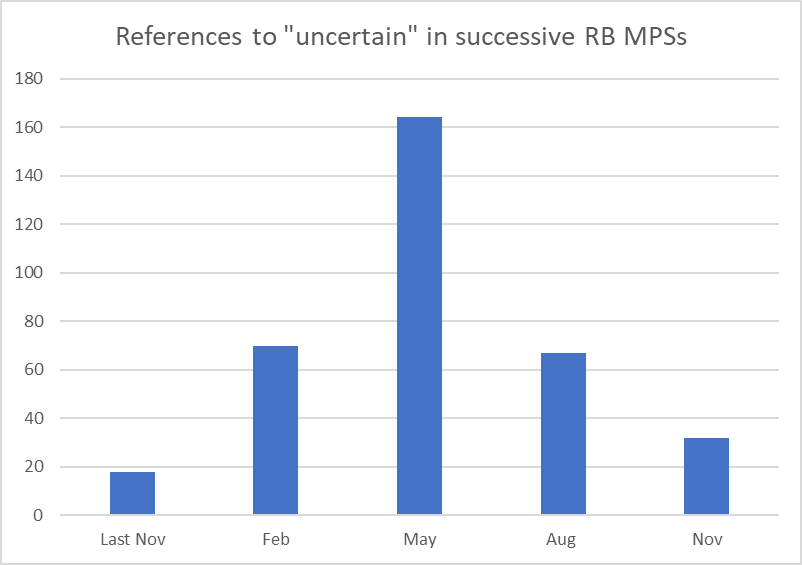
I don’t know precisely what words Hawkesby used, so perhaps it wasn’t as stark as what was passed on to me (the MPS text itself is fairly non-specific, while correctly noting that the -0.9 per cent was almost certainly not representative of how deep the real fall had been).

[UPDATE: In fact both Hawkesby and his chief economist – the latter more expansively – ran this line, citing not a shred of evidence in support of their story.]

But I’m sceptical that the (very real) heightened uncertainty around foreign tariff policy had anything much to do with the overall performance of the New Zealand economy in the June quarter. There simply aren’t any particularly obvious channels by which there would have been such effects. We weren’t Canada (directly in Trump’s firing line for a while), we weren’t subject to unusually large proposed tariffs (and our government was fairly clear they didn’t support retaliation), we weren’t likely to be facing higher prices (if anything lower, if large scale trade diversion happened), and while uncertainty can be a killer for investment projects few/none will turn on a dime (in terms of actual real outlays) anything like that quickly. None of which is to say that Trumpian tariffs are anything but bad for the world, and us (and I’ve consistently agreed with the RB view that they are, if anything, a negative aggregate demand shock from the rest of the world to us).

And if there was a material tariffs-uncertainty effect on New Zealand in Q2, surely we’d expect to have seen such an effect across many other countries, and showing up to a greater extent in many of those countries (in April appearing to face much higher tariffs or more dependent on US markets – remember (my post yesterday) we don’t export much by advanced country standards)?

What then do the data show (bearing in mind that all recent data are prone to revisions)? The OECD has a database of quarterly real GDP growth for member countries. Here is how quarterly real GDP growth in Q2 compared with that in Q1 (I’ve left off the US itself – source of the issue – and Ireland where tax effects mean quarterly growth rates are all over the place.)
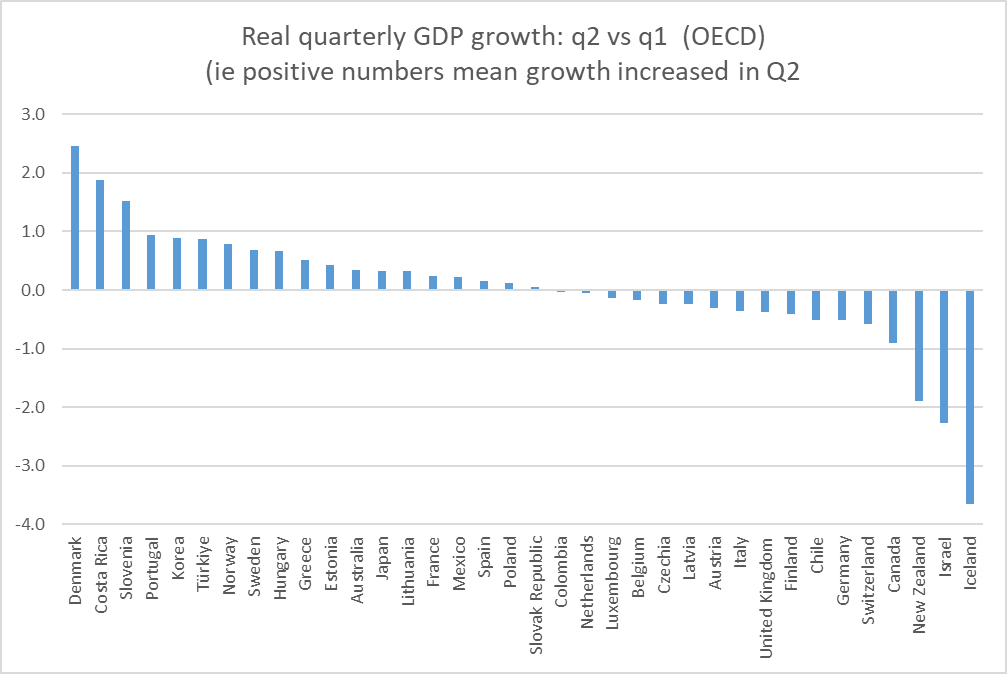
There is no consistent pattern, but actually slightly more countries saw higher growth (often only slightly) in Q2 than in Q1.

And here is another chart, this time comparing Q2 growth with the average growth rate for each countries over the previous four quarters. Still no consistent pattern (although this time slightly more countries had lower growth than higher growth).
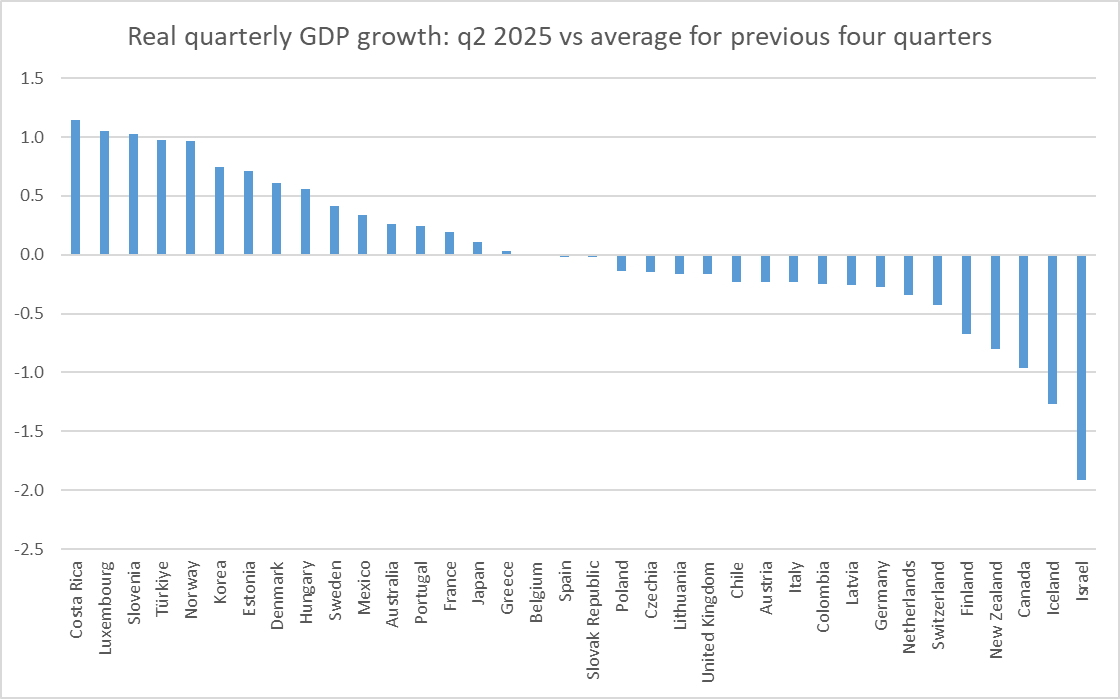
They are the sort of charts you might have thought the MPC would think to stick in the MPS. It may be – well, it is to me – a little surprising that global economic activity has held up as well as it seems to have this year in the wake of the tariff uncertainty, but…..for now, that is where the data seem to point. Perhaps effects begin to cumulate from here, but whether that happens or not, it is just hard to see much sign of Q2 New Zealand growth having been materially adversely affected. If the departing temporary Governor agrees, so much the better.

Since I was putting together this post I will add in here, as much for ease of future reference as anything, a few charts I put on Twitter yesterday, mostly going to one of my multi-decade hobbyhorses (dating back to 1997) of doubts about the merits, and value, of central banks publishing forward interest rate forecast tracks (not many do still).

This chart shows the Reserve Bank’s OCR projections through successive MPSs since late 2020.

They really had no idea what was going to be required. To be clear, I am not here bagging the RB MPC specifically (I’m pretty sure similar charts from the other central banks that publish endogenous forward tracks would look much the same). It is an observation about the (very limited) state of knowledge any and all central banks (and outside commentators) have, especially when anything interesting is going on with inflation.

To illustrate the point with just one date, here are the MPC’s successive forecasts for the OCR in the final quarter of this year (daily average).
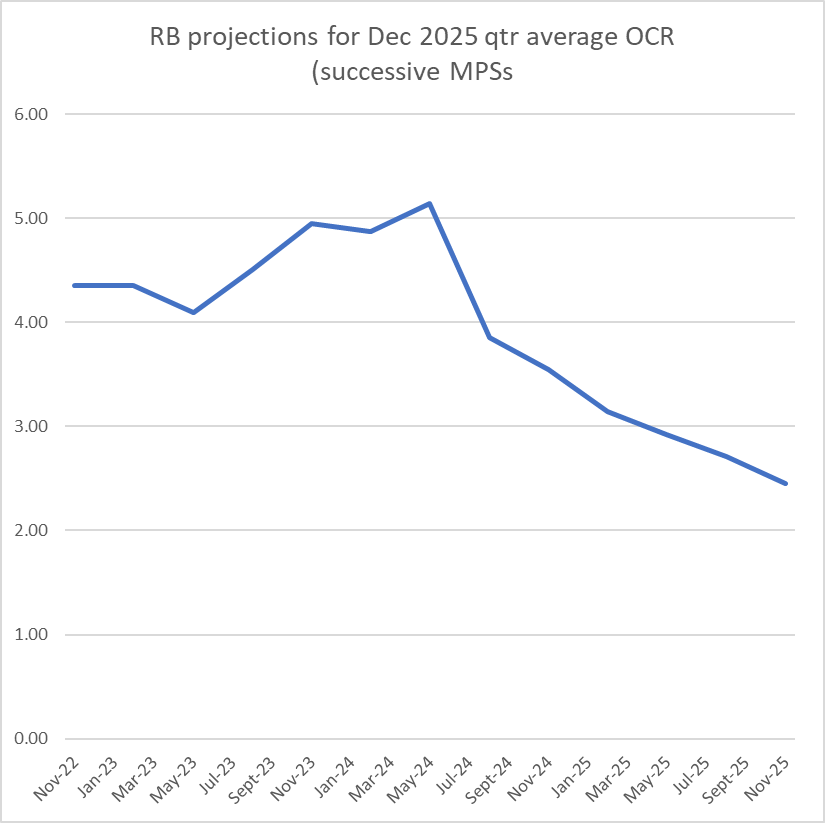
18 months ago they thought the OCR – which they set – would be around 5 per cent by now. Yesterday they actually set that rate at 2.25 per cent (and I could show you similar charts for various market economists, so again this is not about bagging our specific group of MPC members). Sometimes of course really nasty exogenous shocks happen: it would be unfair to look at MPC forecasts from early 2019 and compare them with what happened in 2020, since Covid was essentially unforeseeable (for central bankers in particular). But nothing very dramatic has happened in or to New Zealand in the last eighteen months. The Bank simply misread how much pressure would be needed to get core inflation near target.

You can also see that with this chart, showing the Bank’s successive estimates of how much excess capacity was going to be needed at peak to get inflation down. In the scheme of things – data uncertainty, revisions etc etc – those estimates have really been quite stable.
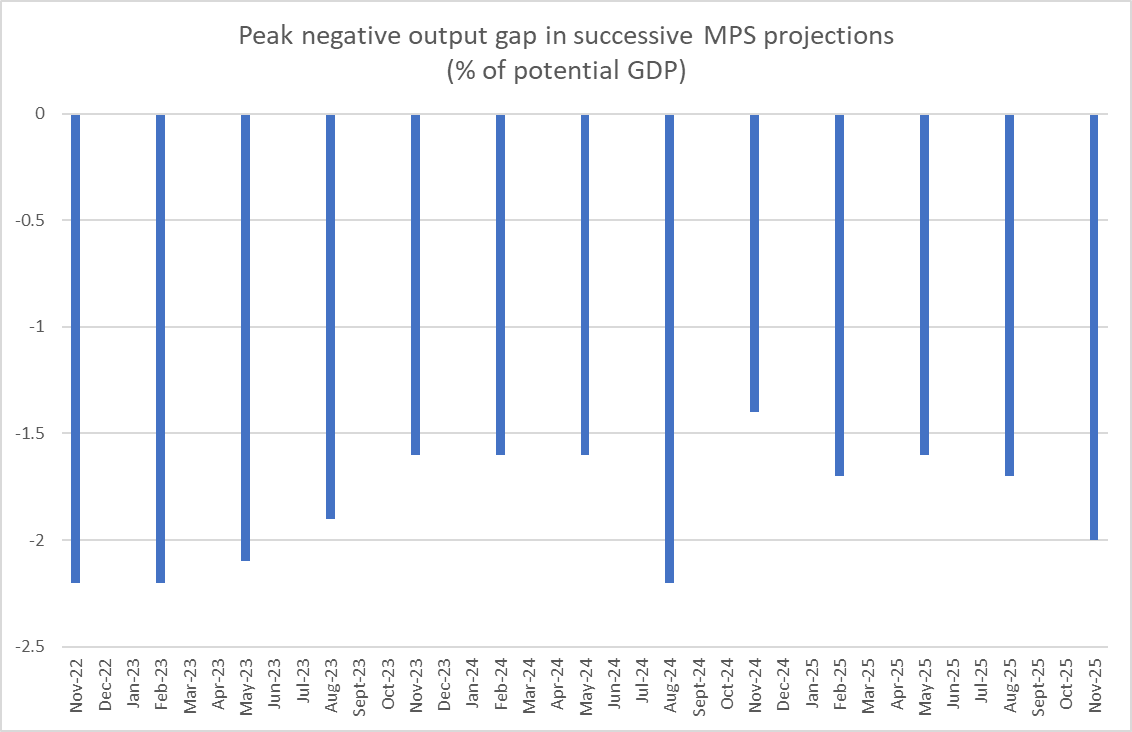
But – see the earlier charts – they had no real idea what monetary policy settings would be required to deliver.

As I noted in my post last week on the new Governor, she has talked about improving transparency, and if the Bank follows through then that would be a good thing. But there is distinction between things you can be transparent about – the views, arguments, votes etc in any particular meeting – and things where you can certainly publish numbers but really there isn’t much value at all. Now, to be clear, market economists pay attention to those future tracks because the MPC produces them, and – if things are anything like what they were in my day – large amounts of time and effort goes into producing them (precisely because the MPC will know markets look at the track because the RB publishes it). But there is no substantive value at all – the MPC just does not have any decent idea what will be required 12-24 months ahead. Often enough – as we’ve seen this year again – they often don’t have a reliable or consistent view on the next quarter. Much better to focus energies on this quarter and next, recognising that almost all the information new to the Committee each time it meets is about the (quite uncertain enough) recent past with just a few pointers to the very near-future. You need mental models to think about medium-term implications etc, and perhaps formal ones for research purposes, policy scenarios etc but….forecasting really is a mug’s game, and in a central bank context the medium-term forecasts, notably for the OCR, add very little value.

And I can’t face writing anything much about this morning’s dismal announcement from the Minister of Finance. When expectations are low, she still undershoots.

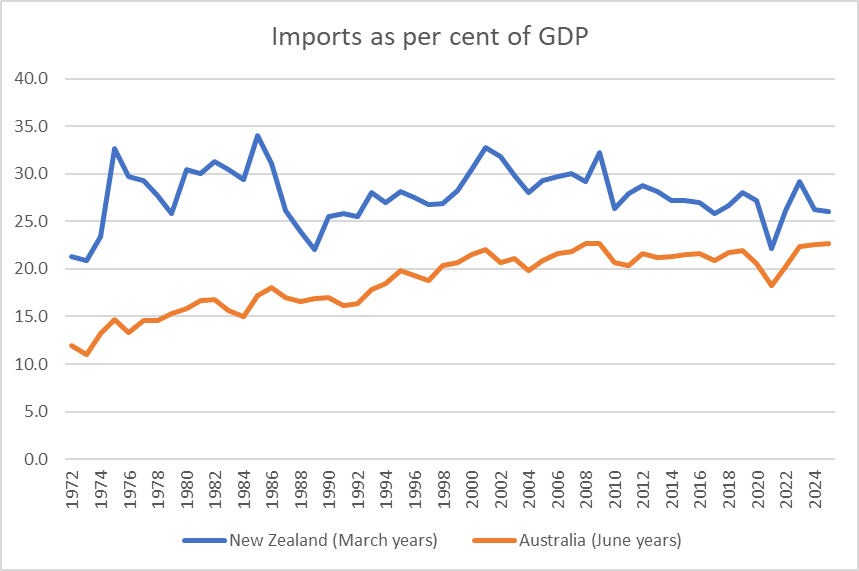
Trade: NZ vs Australia

For years now it has been recognised that New Zealand’s foreign trade (share of GDP) is small compared to what one would expect to see in a small country. Small countries generally sell to and buy from firms abroad to a greater extent (relative to the total size of the economy) than larger ones. There is nothing surprising about that: there are simply fewer domestic opportunities in a small country than there are in a large one. The United States, for example (and well before Trump), has exports of around 11 per cent of GDP. But New Zealand’s foreign trade share is small by the standards of small countries, and actually not many large countries now have a smaller trade (exports or imports) share than New Zealand. I’ve done various posts on variations of this issue over the years.

But time passes and I hadn’t noticed that exports from Australia – a country with a population more than five times ours – are now about as large a share of GDP as those from New Zealand. I put this chart on Twitter yesterday, with the observation that Australia itself is hardly a stellar success story.

Even back in the bad old protectionist days, when New Zealand tended to have higher trade barriers than Australia did, the value of exports as a share of GDP was higher in New Zealand than in Australia.

The imports chart is not as stark, but the gap has been narrowing (Australia now has a current account surplus after some decades of having run substantial deficits like New Zealand).

And, of course, from a New Zealand perspective don’t lose sight of the fact that as a share of GDDP both exports and imports are now well below the peaks, themselves well in the past. It isn’t exactly a marker of a successful economy. I’ve made this point numerous times before but I’ll say it again anyway: it isn’t that exports are special, simply that in successful economies it is usual for domestically-operating firms to find more and more opportunities to sell successfully in the rest of the world. You’d certainly expect to see it in any economy that was successfully closing the gaps to the rest of the world. Which New Zealand isn’t.

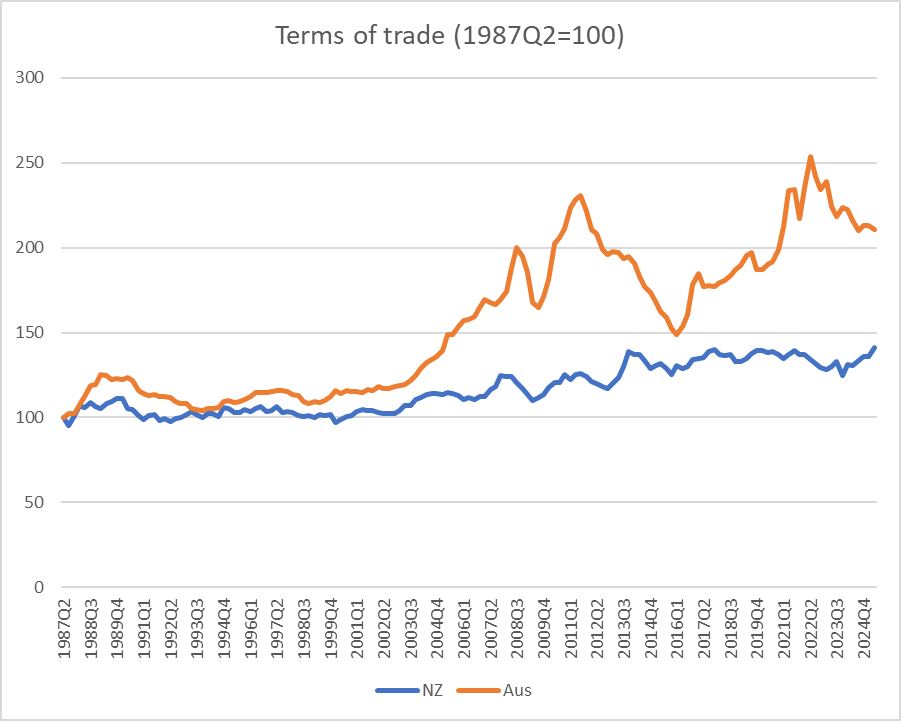
Export revenues result from the mix of price and volume. By wider advanced country standards our terms of trade have been pretty good in the last couple of decades. But Australia’s terms of trade (export prices relative to import prices) have been much more favourable – although also more variable. In the near-term, terms of trade for commodity exporting countries are largely outside their control, but over the longer-run firms presumably invest in anticipation of a particular view of future average selling prices.

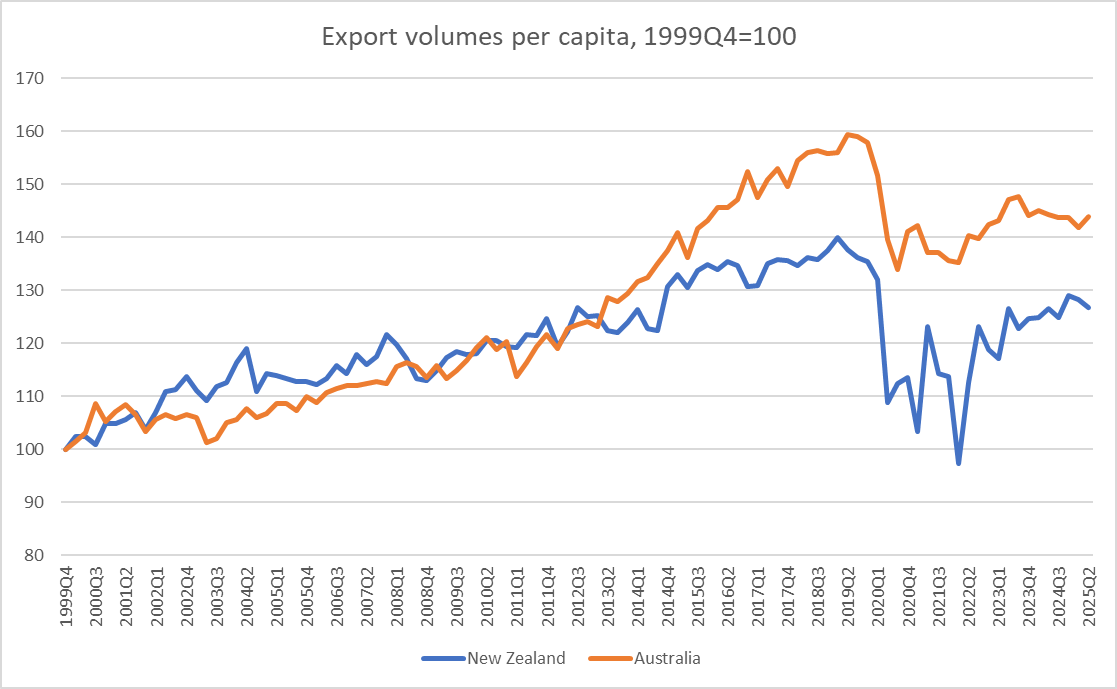
What about export volumes? Using the constant price exports series for each country, here is how the volume of exports per capita has unfolded in the two countries this century.

The two lines don’t materially diverge until the last decade or so,

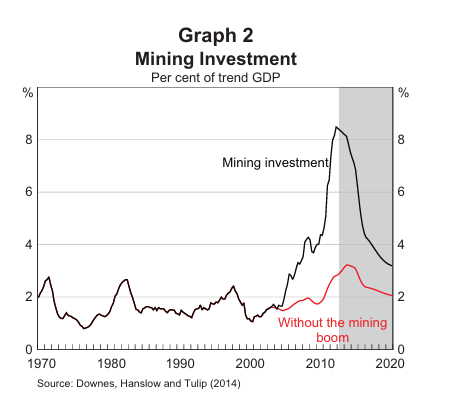
as the massive Australian mining investment boom translated into materially higher export volumes (and revenues). New Zealand simply had nothing similar.

One sobering snippet I took from that export volumes chart is that New Zealand export volumes per capita are no higher now than they were in 2012, 13 years ago now. As a share of GDP total export revenues are now at a level first reached in 1977.

But the other sobering snippet from that volumes chart is Australian export volumes per capita haven’t grown now for almost a decade (and so the gap between the New Zealand and Australian lines isn’t widening further). But then, as I noted already, Australia isn’t a stellar economic success story – and productivity growth there in the last decade has been next to non-existent – just richer and more successful than New Zealand, and the easy exit option for our people.

Both the New Zealand and Australian economies are very heavily reliant on natural resources for their exports to the rest of the world, and that shows little or no sign of changing. If, as the Australian economy did, firms can bring newly to market a huge swathe of natural resource exports things tend to go better for you, as a very remote economy, than if you can’t or don’t.

Treasury on tax

I’ve never really been persuaded that it is a good idea for public servants to be giving speeches, unless perhaps they are simply and explicitly explaining or articulating government policy. If they are, instead, purporting to run their own views or those of their agency it is almost inevitable that we will be getting less than the unvarnished picture and more than a few convenient omissions. Public servants still have to work with current ministers after all.

The thought came to mind again when I read a speech given last week by Struan Little, now a “chief strategist” at the Treasury but until recently a senior Deputy Secretary (and actually Acting Secretary for a time last year). The speech was to some accountants’ tax conference, under the heading “The role of the tax system in addressing New Zealand’s intertwined fiscal and economic challenges”. All else equal, you might suppose that lower taxes would be more likely to be part of dealing with the productivity failings and perhaps higher taxes might have some role to play in closing the gaping fiscal gaps. It isn’t clear that Treasury necessarily sees it that way. They seem quite keen on raising taxes generally, especially on returns to capital.

(To be clear, I’ve been on record for some time picking that whoever is in government over the next few years the GST rate will rise, but that is prediction not prescription – and I’m not a senior official. Somewhat oddly, in his speech Little claims that “there are no simple options to raise substantial merit over the shorter term” when, whatever the merits of such a policy, raising GST is certainly simple.)

Now, I guess it was a tax conference, but it was slightly odd that not even once was it mentioned how much spending has increased in the last few years. Core Crown operating expenses were 28 per cent of GDP in the last full pre-Covid year (to June 2019) and in this budget were projected to be 32.9 per cent of GDP this year (25/26), slightly UP on last year. The current structural deficit, from the same budget documents, was projected to be about 2 per cent of GDP. I guess officials always need to have tools to hand if politicians want to go the higher tax route but it isn’t obvious that the scope of expenditure savings has been exhausted (or even much begun perhaps outside core departmental operating costs, which generally isn’t where the big money is).

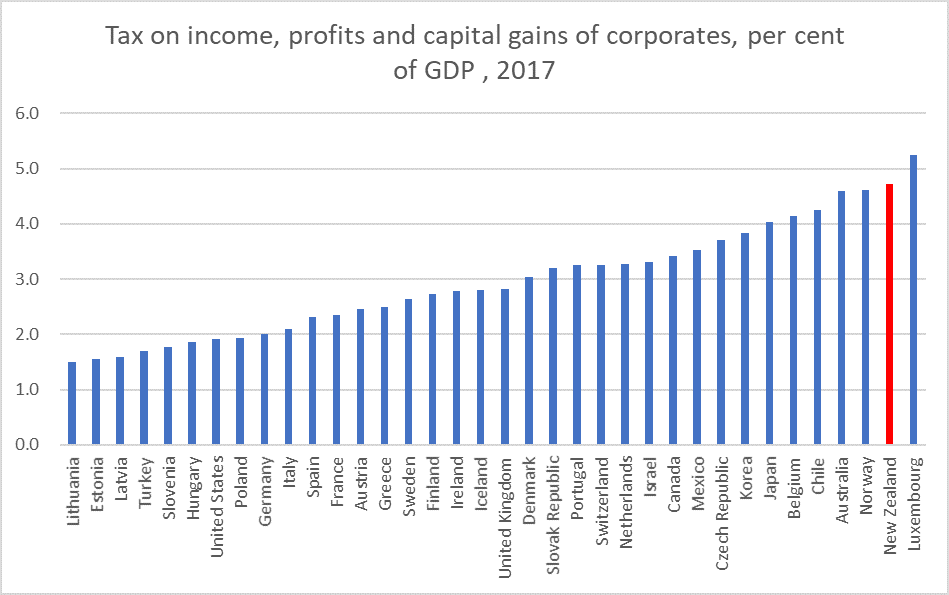
Remarkably also, there is no mention at all in the speech that New Zealand’s company tax rate is among the highest in OECD countries. In the literature, the real economic costs of company taxes are generally found to far exceed those of other main types of tax. There is no mention either that New Zealand has long taken one of the highest shares of GDP in corporate tax revenue.

That chart is a few years old now but the OECD data are very dated and the most recent I could find on a quick search was for 2020 (when, unsurprisingly, we would still have been well to the right on this chart).

Instead what we got is a straw man discussion, claiming that life (and literature) have moved on and that now everyone agrees the tax rate on returns to capital should be positive. In practice no one has seriously argued in the New Zealand debate that capital income should generally be taxed at zero, notwithstanding some literature suggesting that on certain assumptions a zero rate might be optimal. Where there is debate is a) how high that rate should be, and b) what should count as taxable (capital) income.

Now, to be fair, on a couple of occasions Little suggests that we need to cut taxation on returns to inward foreign investment (because of our imputation system the company tax rate falls most directly on foreign investors), but then never addresses the issue as to whether or why our income tax regime should treat foreign investors more favourably than domestic investors and what the implications of that might be.

Treasury has, of course, long been keen on the idea of a capital gains tax. Little repeats an estimate from the Tax Working Group some years ago suggesting that such a tax might raise 1.2 per cent of GDP per annum but then never bothers engaging with the fact that the largest source of (real) capital gains in recent decades has been in housing, and that the reform programme of the current government is supposed, at least according to the Minister responsible (if not to his boss) to be lowering house prices, and (presumably) making sustained and systematic real capital gains on housing/land a thing of the past.

Little champions the somewhat-strange Investment Boost subsidy introduced in this year’s Budget, and yet (of course) never notes that the biggest returns (by a considerable margin) to that subsidy are for investment in new commercial buildings. The very same sector that the government (perhaps over Treasury objections) increased taxes on last year, when it barred tax depreciation on commercial buildings. Where is the coherence in that? Or in the fact that Investment Boost offers a subsidy to rest home operators but not to providers of rental accommodation? But I guess Treasury wouldn’t really want to comment in public on any of that. The Minister would certainly not have been keen on them doing so. He never offers any thoughts either on why subsidising a specific input – as if capital goods are some sort of merit good – is preferable to lowering the tax rate on returns to whatever combination of inputs firms find most profit-maximising.

We also get the same (now decades-old) line about housing being tax-favoured while never noting either a) that the story of New Zealand in recent decades has been too little housing (& urban land) not too much, or b) that the largest tax advantage by far in respect of housing is to the owner-occupiers with no debt. Perhaps Treasury favours taxing imputed rents (with suitable deductions including for mortgage interest) but if so there is no hint of it in the speech (something for which the Minister would no doubt be grateful).

And there are tantalising but concerning lines suggesting Treasury might favour rather arbitrary distinctions between returns to different types of capital. Thus, there is mention late in the speech of possibly in future reducing tax on “productive capital investment” (which then does Treasury regard as “unproductive” ex ante), there is a reference at one point to taxation on “physical capital”, without being clear as to why physical capital returns should be treated differently than returns on intangible capital. And perhaps potentially most concerningly there was this line: “a coherent approach would not necessarily mean taxing all capital [returns to capital?] at the same rate, since not all capital is the same”. What, one wonders, does Treasury have in mind there? After all, not all human capital is the same either (you are different than me) but our tax system treats all financial returns to it much the same anyway (or so it seems to me; perhaps I’m missing something).

There are some fair points in the speech. Little notes that our system “penalises certain types of saving when inflation is high”, which is true but understates the point: even 2 per cent inflation results in such distortions, and they apply to borrowing (when interest is deductible, which it generally is for business) and depreciation, not just to returns on fixed interest assets. These distortions have been known for many decades, and yet there seems to be no momentum – political or bureaucratic – to address them, whether by changes to the tax system or to the inflation target.

And there was a paragraph late in the speech that I very much welcomed.

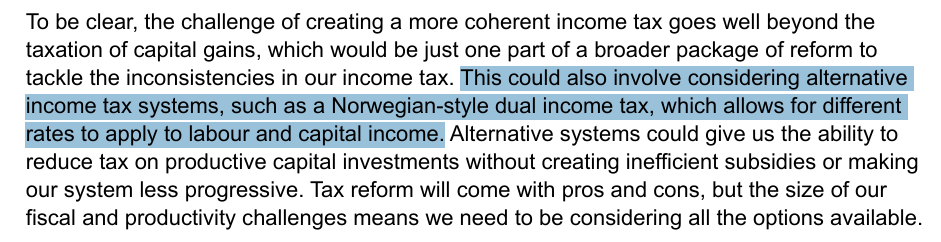
I’ve long been keen on a Nordic approach and it was an option noted by the 2025 Taskforce back in 2009. But what chance is there that the bureaucrats might support such a change? When I was involved in tax debates IRD was quite resistant to any cuts to business tax rates arguing (with little or no evidence) that many taxable profits were rents – returns above the cost of capital – and that taxing them came at little or no cost. And if by some chance a new generation of officials has emerged, what chance ministers (whichever main party is in government) being that bold. Another growth-supportive option that might have warranted mention in that paragraph would have been work on the possibility of a progressive consumption tax.

As I noted at the start of the post, I’m not sure senior officials really should be making speeches other than to represent the policy of the government of the day. They simply can’t add much, or any sort of unconstrained perspective. The free and frank advice has to be for ministers. That said, perhaps at some point it would be useful for Treasury to publish some research/analysis outlining what sort of tax structure would, in its view, be most conducive to supporting a much faster rate of productivity growth in New Zealand. It is unlikely that tax system changes could ever represent any sort of panacea but insights into the mental models of the government’s premier economic advisers could still be useful. Since it isn’t impossible that the answer might be much lower taxes (and thus spending) than at present, you could even put some constraints around the exercise: if you (or your political master) needed to raise 27 per cent of GDP in tax, which mix of taxes and tax rates would be most consistent with helping enable a materially faster rate of productivity growth.

The new Governor….and those responsible for her

A couple of months ago the Minister of Finance announced that Anna Breman had been appointed as the next Governor of the Reserve Bank. Breman takes office on 1 December, conveniently (and sensibly) just after next week’s final Monetary Policy Statement for the year. Given the very long summer holiday the MPC gives itself, it does give her plenty of time to get her feet under the desk, get to know staff, get a bit familiar with the New Zealand data and issues before she gets to chair her first MPC and deliver the first Monetary Policy Statement on her watch. (Quite where the bank capital review is getting to isn’t clear: there was talk of publishing decisions before the end of the year, which could mean either before 1 December (in which case she has no formal say) or afterwards in which case she and rest of the Board will be making important decisions within weeks of taking up the role, in a field in which she doesn’t seem to have any particular background.)

Just a few days after the position became vacant in March I noted

Having noted that there seemed to be no ideal or compelling candidate in any of the lists of domestic names that had started to emerge, that remained pretty much my view in the abstract through the many months it took for an appointment to be made.

When Breman’s appointment was announced I was overseas on holiday. A few media outlets asked me for initial comments, including Radio New Zealand’s Morning Report who I tried to put off but eventually agreed (“live from Ravenna” – former capital of the western Roman empire – had a certain wry appeal to me). The comment I’d made to them that it was 43 years since an internal person had been appointed Governor appeared to have piqued their interest. The interview and associated report is here.

I noted that while on this occasion it was clearly necessary to go for an outsider, it was a poor reflection on the Bank, its board and senior management, over decades that it had been so long since the last internal appointment (Dick Wilks in 1982 who was then pushed into an early retirement by Muldoon), and that one dimension of successful organisations (anywhere) tended to be the development of talent and succession planning such that most (not all by any means) top appointments came from within. Among central banks, the Reserve Bank of Australia is a striking contrast. I also noted that, for example, two successive foreign appointees as Secretary to the Treasury (very unusual appointments in themselves) had not exactly proved to be stellar success stories.

There were reasons for each outside appointment as Governor – and I’m not debating the merits of any of them individually here – but the accumulated track record should be concerning. (And one of the challenges for Breman and the Bank’s board over the next few years will be building a strong second tier such that in five years time there is at least one, ideally more, credible internal candidates if Breman decided, whether for professional or family reasons, it was time to return to Europe.)

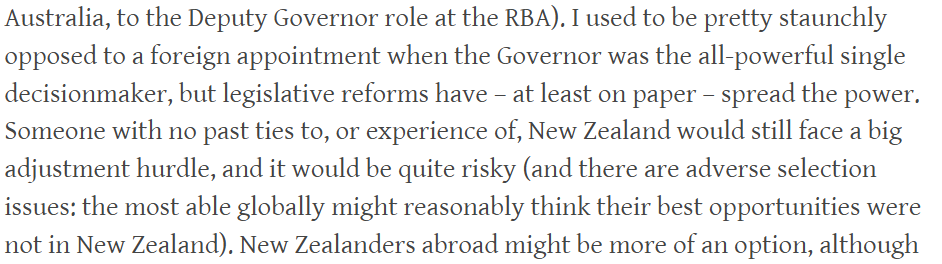
But if that backdrop is a concerning structural issue, my more immediate issue picked up the same concern I’d raised in abstract back in March: going offshore for a Governor who has no background or familiarity with New Zealand was a risky call. And if I’d contemplated a possible foreign Governor back in March I guess I’d probably have mainly thought in terms of someone from culturally and politically similar countries (Australia, Canada, UK), and Sweden is at an additional remove.

In terms of the technical side of monetary policy that isn’t an issue – Sweden has been a longstanding inflation targeter (I still have and use the nice glass plate a visiting Swedish parliamentary delegation gave me when they came to learn about the way we, who pioneered formal inflation targeting, did things decades ago) and the independent review of monetary policy done almost 25 years ago was conducted by Lars Svensson, a leading Swedish academic and later a member of Riksbank’s Executive Board (who made himself unpopular by openly expressing minority monetary policy views, which were – in my assessment – largely right). But monetary policy doesn’t operate in a vacuum – there is the context of the specific economy, of the specific political system, and of the place and record of the central bank itself. Perhaps as importantly, these days monetary policy is only one limb of what the Bank does. Much of its staff resources are now devoted to financial regulation and supervision, and that doesn’t appear to be a field in which Breman has any particular experience (for example, the Riksbank is not responsible for those functions).

So from day one it seems quite a risky appointment. I might be less worried if (a) the Reserve Bank were a high performing stable institution, b) there was a strong and respected second tier in place (who for some reason didn’t want to be Governor or who weren’t quite ready, and/or c) the appointee was a star.

As has become increasingly clear as this year has gone on, neither a) nor b) held, and (for all his faults and limitations) the departure of Christian Hawkesby only highlights how weak the top tier Breman is inheriting will be. There are two key second tier policy roles – Hawkesby’s day job (financial stability) is filled by a low profile acting person, and the macro/monetary policy side which is overseen by Karen Silk, who has such a limited background it is almost inconceivable she could have held such a role in any other modern advanced country central bank.

But nor is there any sign at all that the incoming Governor is a star. She sounds as though she probably has the temperament for the job (a person who knows her spoke quite highly of her on that score) but beyond that it isn’t clear that she is much more than a boilerplate MPC-member economist, without (it appears) that much executive management/leadership experience (let alone change management and institutional transformation). And, of course, there is no background in financial stability or regulation. She seems to have had a perfectly respectable career in the Swedish Ministry of Finance, a few years running the economics group of a Swedish bank, and then six years on the Executive Board, all against an academic background that, again while perfectly respectable, wasn’t focused on macroeconomics, financial markets, financial stability and regulation etc. She didn’t seem to have had particularly high visibility in international central banking or monetary policy circles.

One of the great things about the Riksbank is how transparent they are about monetary policy – materially more so than the Reserve Bank of New Zealand MPC, and arguably a touch beyond the optimum. Not only do Executive Board members seem to give a fair number of on-the-record speeches but all their contributions to the formal monetary policy deliberations are published verbatim. So when I got back from holiday I took some time to read pretty much all I could find from Breman. Since I didn’t previously know much more about her than her name I was genuinely curious. Some top-notch people, with distinctive perspectives, have served on the Executive Board over the years (with people brought in for full-time roles, such that it is more feasible to have mid-career people appointed than to our part-time non-executive MPC roles).

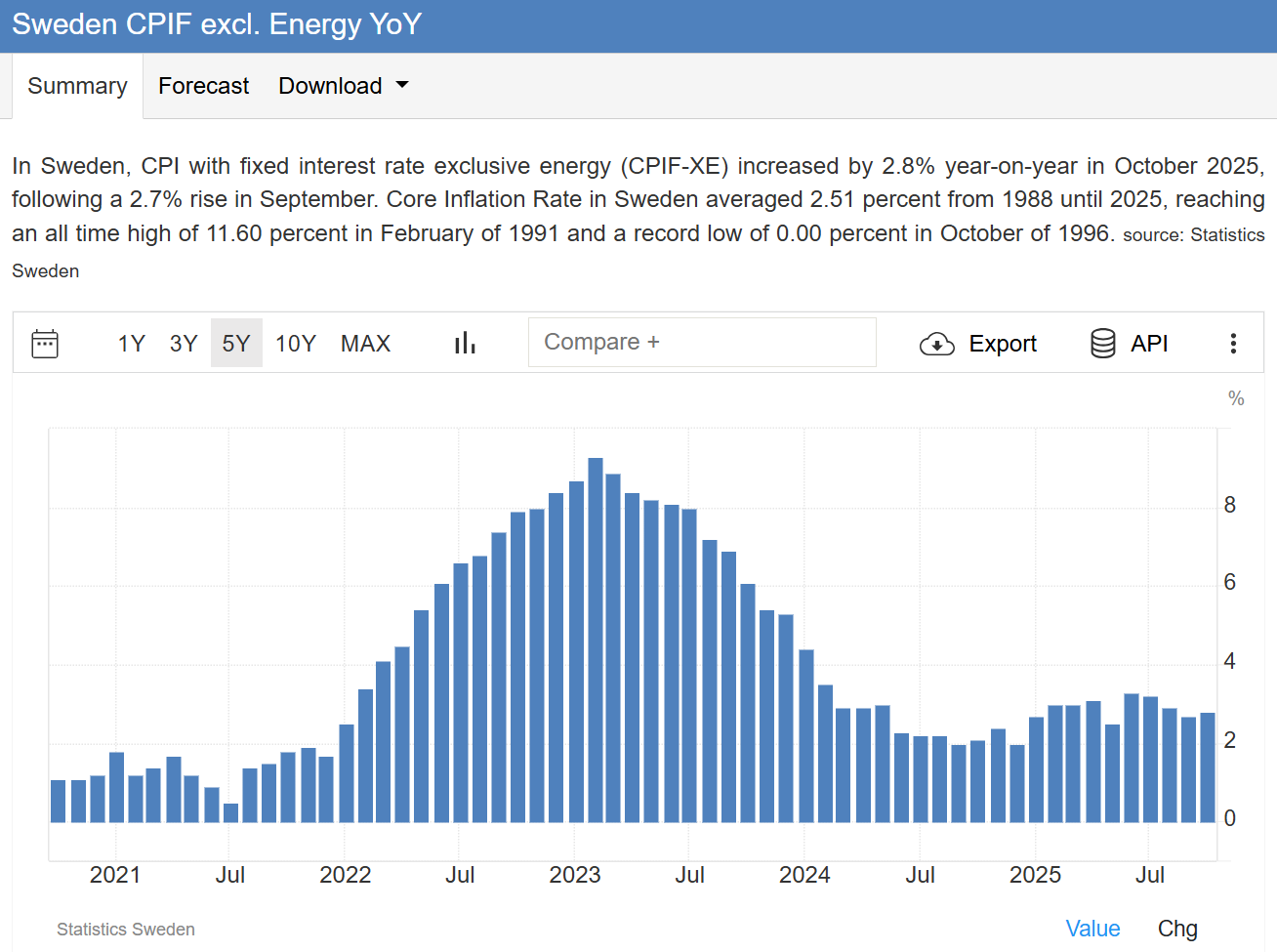
I was particularly interested in how she had contributed to monetary policy deliberations through the Covid and post-Covid inflation periods. It was a real test for central bankers, and frankly most did not show up well (which is why most – but not all – advanced economies ended up with the worst outbreak of core inflation in decades). As regular readers will know I have also long championed accountability for central bankers – real accountability with consequences, the quid pro quo for the considerable delegated power MPCs (and similar entities like the Riksbank Executive Board) wield. Other people got things wrong too, but central bankers took the job (and attendant pay and prestige) to stop outbreaks of inflation happening. If things go really badly – and they did – there should be, at very least, a strong presumption against reappointment. In fact, things went worse in Sweden than they did here – with core inflation peaking in excess of 9 per cent

And what were Breman’s contributions during this period? They were solid workman-like pieces (& her speeches were probably better than the – very few – Reserve Bank ones) but there were no interesting insights or angles, and no material (let alone votes) suggesting that her instincts or mental models were better than average – in a central bank that delivered a core inflation record worse than the average advanced country central bank. (And it doesn’t even look as though they got out the other side any better than we did – the Riksbank’s latest negative output gap estimate is very similar to the Reserve Bank’s for New Zealand.)

And so, at least on the monetary policy side, it looks like a case of a boilerplate central banker failing upwards – not at home, but promoted to the top job in an underperforming remote area of the world. Is it like being banished to the colonies in days gone by? Perhaps she’ll do just fine as MPC member and chair, but nothing in that record back home suggests we are getting, for example, a policy leader or distinctive thought leader. And is there really no price for failing so long as you are in good company?

Aside from being an outsider, it really isn’t clear what strengths she brings to the position. Perhaps under the previous government her evident enthusiasm for central banks wading into climate change issues might have been a selling point (she was last year a member of the steering committee of that central bank talk shop the Network for the Greening of the Financial System). The Riksbank apparently even puts restrictions on holding Australian state government bonds in its reserves portfolio on climate change grounds. But one had hoped that under this government they’d have been looking for a strong focus on the core statutory functions of the Bank.

One point of hope might be her expressed commitment to transparency. At the press conference she held with Nicola Willis – which featured some odd lines, including Willis claiming “we are opening a new chapter in New Zealand’s history” – there was the superficially encouraging line about how she (Breman) intended that “transparency, accountability, and clear communication will guide all the work we do”. On the monetary policy side we might look for some serious moves towards greater transparency. It isn’t her call alone, but she will over time control the appointments of the executive members of the MPC – and an earlier test will be what she does there – and it is clear that at least one non-executive member, Prasanna Gai, favours greater transparency. The Swedish experience, which she spoke positively about in a speech earlier this year, should be one of those considered seriously.

Her instincts then may be broadly sound, but a) there is no sign that she is a star, b) the culture of defensive non-transparency (transparent when it suits, obstructive when it doesn’t – I’m still engaged with the Ombudsman over charges the RB made for releasing information several years ago that should have been released – was in scope – in 2019) appears to have become quite deeply entrenched in the organisation over the last couple of decades. And much about the Reserve Bank is controlled not by the Governor but by the board – which never used to matter much but has been in the driving seat since the new legislation came into effect in 2022.

Which brings me back to the title of this post. One might have more basis for initial confidence in a little-known outsider if that person was selected/nominated and appointed by people who themselves commanded respect and had developed a track record of building (or requiring) a high-performing, lean, open, transparent, and accountable institution. But this appointment was made by Willis who had displayed spectacularly bad judgement in reappointing Neil Quigley as board chair last year, who did nothing about the board’s very bad budget calls last year (she and her officials seem not to have been aware for months), and who stood by for months while the board obstructed any clear sense of the circumstances surrounding the resignation of the previous governor. How much confidence can anyone have in a person nominated by the Quigley-led board, selected when the board was at is embattled and defensive worst, and when that board has shown no sign of having regretted anything about the way they’ve done things? The same board that really really cannot stand critical scrutiny – who instead of engaging or replying were responsible for management’s insistence to an overseas magazine that published an article critical of the Board’s record that the magazine should withdraw it and apologise for having published it. Whose acting chair – of a public agency, allegedly committed to transparency and accountability – celebrated (in writing) when the article was taken down. We are supposed to believe that these people share the incoming Governor’s stated commitments on those scores? Or to have confidence in the Minister who has sacked none of the board members, and has still not replaced Quigley as chair? They are albatrosses around Breman’s neck, no matter how good she might actually and eventually prove to be.

Way back in those RNZ remarks in September I noted “She could prove to be an excellent call. Time will tell.” We must all hope she is. The rebuilding of the Reserve Bank matters and we deserve better than we have had. Senior Reserve Bank officials have gone on record as (belatedly) recognising that confidence and trust in the Bank has taken a hit – a pretty severe one in my view. But rebuilding is going to be a tall order, the more so with such a discredited board – and would be so even for someone with excellent credentials and connections. How much more so for Breman.

An MPC member speaking

For the first six years of the newly-created statutory Monetary Policy Committee the external members were conspicuous by their silence. While their charter (agreed with the Minister of Finance) allowed them to speak openly we heard almost nothing from any of the three of them (and of course no disclosure of views or thinking in the minutes of the MPC either). The contrast with models like the central banks in the United States, Sweden, and the UK was stark.

This year there has been some sign of progress, albeit only from one of the members (whose approach may not be terribly popular with his MPC colleagues or – though they have very limited say – the Reserve Bank Board). The member in question is Prasanna Gai, a professor of macroeconomics at the University of Auckland and someone who spent the early part of his career at the Bank of England (and has had various other central banking involvements since). On paper he appears by far the strongest of the externals (and probably more so that at least of the internals), even if there is something less than ideal about having someone serving at the same time as an MPC member and on the board of the Financial Markets Authority. We also know nothing directly about his view on the state of the economy or much about his thinking about policy reaction functions etc, although we can deduce from his two recent speeches that he is probably the key player in the rather heavy (over)emphasis on uncertainty from the MPC in the last six months.

I wrote a few months ago about Gai’s published views (to be clear, from before he became an MPC member) on how Monetary Policy Committees should be functioned and governed. That post was shortly after his first speech

But in the last few weeks there have been two more sets of (fairly brief) remarks, and things have improved somewhat. In their email notification of upcoming speaking engagements, Bank management has noted that the two events were coming up, and the texts of the two sets of remarks are on the website (although you get the impression the Bank might be unenthused because they have not emailed out links, leaving people to remember to go and look for them, or otherwise to stumble over them).

The first of those sets of remarks was about uncertainty (mostly in the light of the US tariff situation), delivered to (it appears) an academic audience in Melbourne a few weeks ago. In those remarks, which were expressed reasonably abstractly, Gai could most reasonably be read as suggesting that the trade policy uncertainty was having a material macroeconomic effect on New Zealand and that fairly bold monetary policy responses were appropriate. I put some comments about those remarks on Twitter, which are in a single document here

tweet thread on Prasanna Gai’s uncertainty remarks

While welcoming the fact of the speech, I was a bit sceptical of the argument.  But then the good thing about policymakers laying out their thinking is so we can scrutinise, challenge, and engage with those arguments.

Gai’s most recent set of remarks was to some forum run by the Ministry for Ethnic Communities (one of those entities whose continued existence casts severe doubts on government rhetoric about cost-savings and lean efficient bureaucracy – but that isn’t Gai’s fault).   There is more about uncertainty (in fact the remarks carry the title “Navigating the Fog – A Tryst with Economic Uncertainty”) although he takes the issue rather wider than the US tariffs stuff.  I still wasn’t entirely persuaded, especially by the sentence I’ve highlighted.

Faced with the unknown, and already in the midst of a downturn, economic actors hesitate, delay investments, and reduce engagement. We see this in NZ surveys like the QSBO. Paradoxically, this cautious behaviour, while individually sensible, creates a self-fulfilling cycle. Caution reduces economic activity, which deepens uncertainty, leading to even more caution. Economists call this the “uncertainty trap.” It locks the economy into stagnation. By avoiding risk, we inadvertently create the very uncertainty we seek to avoid. This cycle of inaction feeds into a broader macroeconomic malaise, where growth stagnates, prices become sticky, opportunities are missed, and innovation slows. When everyone waits, nothing moves.

No doubt we can all agree in wishing away a fair amount of avoidable uncertainty (probably most people in New Zealand would count the US tariff uncertainty – regime uncertainty from day to day – in that category) but uncertainty is a part of life and always been.  Perhaps it is greater in the short to medium term in democracies and market economies (absolute dictators can, although perhaps rarely do, provide greater certainty about some things over those horizons) so it seems a bit odd to suggest that people dealing with uncertainty is somehow problematic, or even creates uncertainty itself.    There is more stuff along these lines in the remarks.

But my main interest in this set of remarks was the section headed “What Can Policymakers Do?”.   He seems to think they can and should do a lot.   I suspect he is far too ambitious (including on fiscal policy where he observes “At the same time, fiscal policy must step into its own strategic role — by investing through uncertainty and setting the stage for deep microeconomic reform. Where private actors
hesitate, public action creates space — catalysing investment in innovation, skills,
infrastructure, and housing8. And, like monetary institutions, fiscal policy must be guided
by intellectual clarity, coherence, and long-term commitment.”)   

But again, my main interest is monetary policy.    He writes

In other words, central banks must set the tone for the economic conversation. Their words, emphasis, and structure condition how millions of decisions unfold. They must illuminate the path ahead, not merely comment on the prosaic.

Transparency – describing the macro-landscape by publishing monetary policy statements and modelling scenarios – is helpful, but not enough. What really matters is the capacity to guide expectations. This requires intellectual rigour, deep technical expertise, and the agility to challenge conventional thinking. How we think, rather than who said what, is the essence of credibility when uncertainty is high.

It is important to remember that central bankers wield unelected power7. Direct engagement—through public speeches and testimony before Parliament—brings clarity to uncertainty. Speaking directly about how we think, and what would change our minds, provides analytical accountability that complements procedural channels that chronicle debate – such as meeting records and monetary policy statements. When we open the doors of our policy reasoning to scrutiny, the fog clears and trust builds. 

There is good stuff there (and in that footnote 7, which I’ve not reproduced, he refers readers back to the paper he wrote pre-appointment (see above), observing “some of those lessons are relevant for New Zealand”).

He is clearly laying down a marker here advocating for a materially greater degree of transparency from the New Zealand Monetary Policy Committee. The incoming Governor – about whom I will probably write later this week – went on record at her appointment announcement as favouring greater monetary policy transparency (unsurprisingly given that the Swedish central bank has substantively the most transparent monetary policy decision-making etc model anywhere). But you have to suspect it is going to be an uphill battle in an institution with a deeply rooted culture (not specific to any particular Governor) of favouring transparency only when it suits, whereas real transparency and accountability are about openness even when it hurts).

I’m all in favour of much greater transparency (and the new Bank of England MPC model looks as though it could provide a good model). But there is an important distinction between transparency that makes a difference to macroeconomic outcomes and that which largely supports heightened accountability. Perhaps the two should overlap but they rarely do. It isn’t obvious, for example, that the central banks that are much more open, including about differences of views and models among members, or whose MPCs had deeper stores of technical expertise among their membership, did any better at all – in terms of inflation outcomes – through the dreadful inflation resurgence of the early 2020s than, say, the Reserve Bank of New Zealand’s MPC did. But in those countries with greater transparency we know a lot more about the views of individual members and their thought processes and are thus better positioned to assess whether perhaps some are less guilty than others. Individual accountability is, thus, a serious possibility.

My impression is that Gai is much more optimistic about the scope for enhanced transparency to make a macro difference. In a sentence before the block of text I quoted he says “when uncertainty is high and the channels of transmission are weak, communication takes on greater importance”.

Well, perhaps, but only if the central bank has something meaningful to say, otherwise it just ends up as cheap talk. No doubt we can all agree that central banks should always and everywhere indicate that if (core) inflation looks like going off course they will respond accordingly. That is a (much) better place than we (advanced world fairly generally) were in 50 years ago, but it isn’t really much help in grappling the high levels of uncertainty firms and households actually face at times, most of which isn’t about monetary policy. Central banks can’t add much of any use on where US trade policy may go, let alone how other countries might or might not respond. Or whether (let alone when) the AI stock market surge will prove to be a bubble that will burst nastily. Or whether China will invade Taiwan. Or, to be more pointed and winding the clock back five years, what would happen to policy regimes around Covid (lockdowns, border closures etc) – surely the most extreme, perhaps inescapable, example of policy uncertainty in recent times. Central banks generally couldn’t get the macroeconomics right even when the policy uncertainty began to diminish (see inflation outcomes and generally very sluggish interest rate responses). The ability to “illuminate the path ahead, not merely comment on the prosaic” seems very limited in practice in most circumstances. (I think back, for example, to the early days of inflation targeting in New Zealand: we aimed then to be very transparent, and had a Governor who was a strong retail communicator, and yet if we consistently held out a vision – sustained low inflation and a fully-employed economy – we had no certainty to offer as to what it would take or when the payoff would be seen. Bigger central banks that went through similar dramatic disinflations generally found themselves in the same boat.)

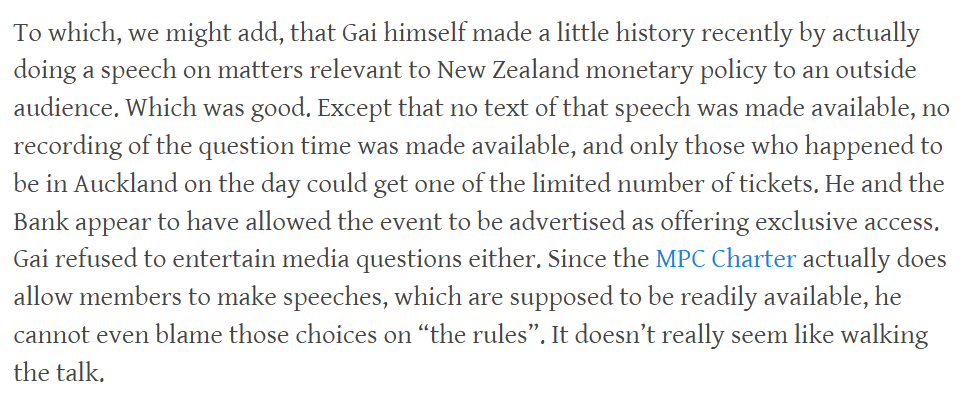
But to conclude, it is great to have an MPC member putting his thinking on record (even in this case it is still mostly about processes/structures than the specifics of how the economy and inflation might unfold). Perhaps some journalists might ask him about the speech and seek to tease out his ideas. We all benefit when those wielding power – unelected power in this case as he rightly notes – put their ideas out for information, scrutiny, and debate. Perhaps some other MPC members might think of taking up speaking opportunities that come. Perhaps Gai, who has dipped his toe in the water with a couple of brief sets of published remarks, might consider a fuller version at some point?

Government departments championing…bigger roles for themselves

When it comes to Long-term Insights Briefings (LTIBs) I sympathise with the public service, I really do. The requirement to produce these documents was introduced by the previous government in fiscally expansive times (core government agency staffing growing rapidly). Even then, it was a fairly flawed idea but if agencies were awash with cash I guess they might as well try to do some analysis. These days, even if the fiscal deficit is not being cut, core government department spending is under considerable pressure, and we have a track record in which the LTIBs that have been produced have rarely added much value. I gather the current amendments to the Public Service Act will eliminate the requirement to produce LTIBs but…..for now government department CEs and acting CEs still have to comply.

A year or so ago MBIE and MFAT decided to get together and produce a joint LTIB this time round. As the law requires they consulted on the proposed topic

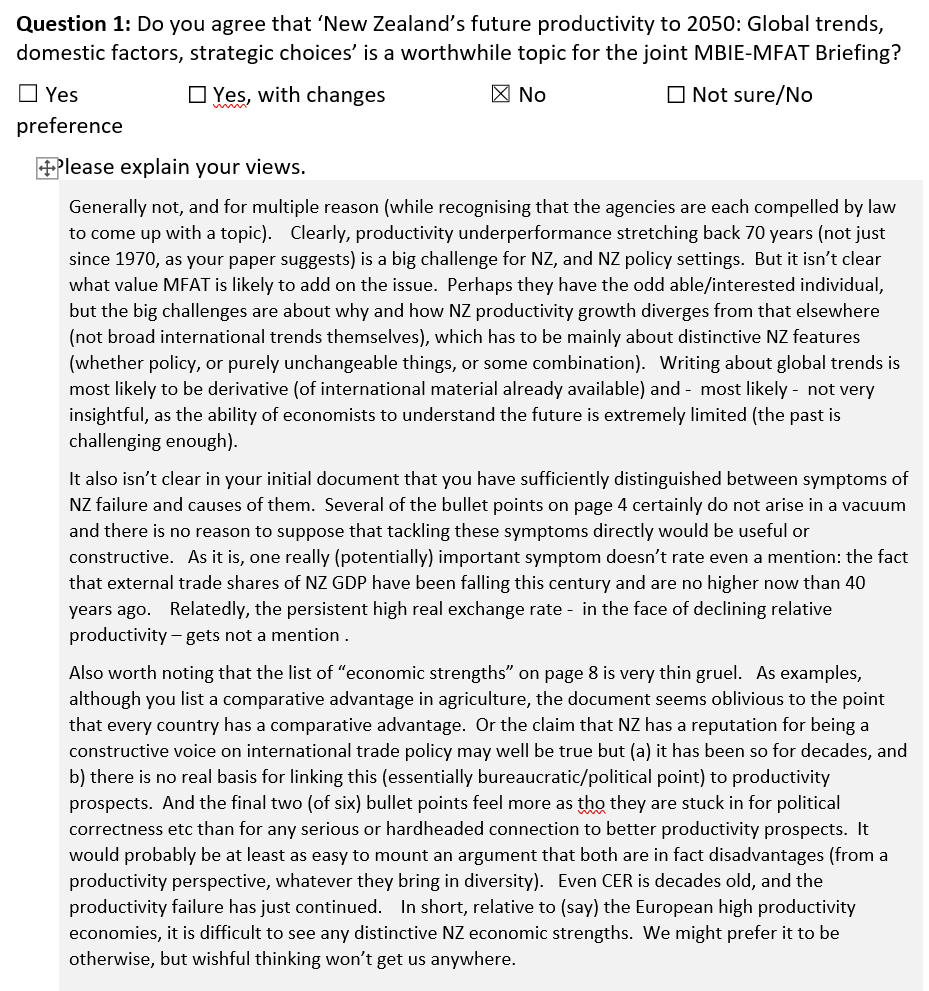
I put in a short but fairly sceptical submission on the topic

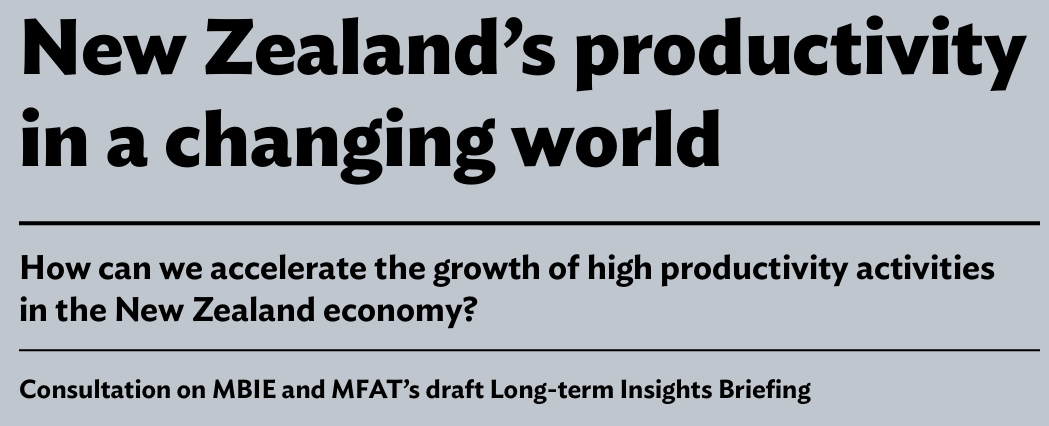
Anyway, the bureaucrats have beavered away and last month come up with a draft LTIB (on which submissions close next Monday). They must have refocused their efforts somewhat following consultation on the topic as it is now presented this way.

Having made a submission last year they’d included me on their general email inviting submissions on the draft. I’ve been away and otherwise busy and hadn’t really intended to even look at the thing, but there was another reminder yesterday so I took an initial look. It was the “accelerate the growth of high productivity activities” that prompted me to look a little further: the focus apparently was not economywide productivity and policy settings but the sort of “smart active government” stuff MBIE has long championed, involving clever officials and politicians identifying specific sectors to focus on and specific interventions to help those sectors. And, of course, lots of preferential trade, investment, etc agreements (the ones MFAT likes to call Free Trade Agreements). On a day when the dysfunctions of our public sector were on particularly gruesome display it seemed even less appealing and persuasive than usual. In a month when the government had been a) buying a rugby league game, b) increasing (again) film subsidies, and c) subsidising expensive New Zealand restaurants (via the Michelin corporate welfare), all in the name apparently of “going for growth”.

So I decided to sit down and read the draft document after all. It isn’t that long (45 pages or so excluding Executive Summary, glossary, references etc), reflecting no doubt the fact that LTIBs are a compliance cost for agency CEs rather than really core top priority claim on resources. Before reading it I heard on the grapevine last night of a smart person who had opened the document, read the first page, rolled their eyes, and closed the document again. But I persevered….and there is 25 minutes of my life I won’t get back.

Sadly, but perhaps not surprisingly, the draft report is unlikely to be any use to anyone looking for illumination rather than support (the old two uses of a lamppost line).

On New Zealand, we get a fairly long list of symptoms of our relative economic failure, but no serious attempt at analysis of the causes. If you don’t understand the causes, including the roles (positive or negative) of past policy interventions/choices, it is really difficult to see how you tell a compelling story about solutions, unless the document is just a prop for a longstanding predetermined narrative and set of policy preferences.

They then introduce a series of four small advanced economy “case studies” – a page each on Denmark, Finland, Ireland, and Singapore. Not only do they not engage with a really important difference between New Zealand and these countries – ie extreme remoteness – but there is no attempt to understand what drove the successes of these economies either. In each case there is a list of types of interventions that have been or are being used in these countries but no effort at all to assess what role (positive or negative) these interventions have played in contributing to medium-term productivity growth. It certainly isn’t impossible that some might have been helpful, some will almost certainly have been harmful (just consider the range of interventions our governments have tried over the decades), and perhaps many will have just been ornamental or redistributive – not really making much difference at all to the productivity bottom line. And I’m pretty sure that not once in the entire document is there any suggestion of the possibility of government failure, capture etc.

Then the draft report moves on to four domestic case studies (this time roughly two pages each), looking at the dairy industry, space and advanced aviation, biomanufacturing, and the Single Economic Market (mostly Australia but also beyond) with a focus on sector-specific interventions. None of it seems to display any scepticism, only a sense that we (governments) haven’t been sufficiently focused or willing to persist with particular sector supports. Strikingly, in the dairy “case study” there is no mention of the rather large role the government played in enabling the creation of Fonterra, and how the results have, to put it mildly, not exactly lived up to the promised hype.

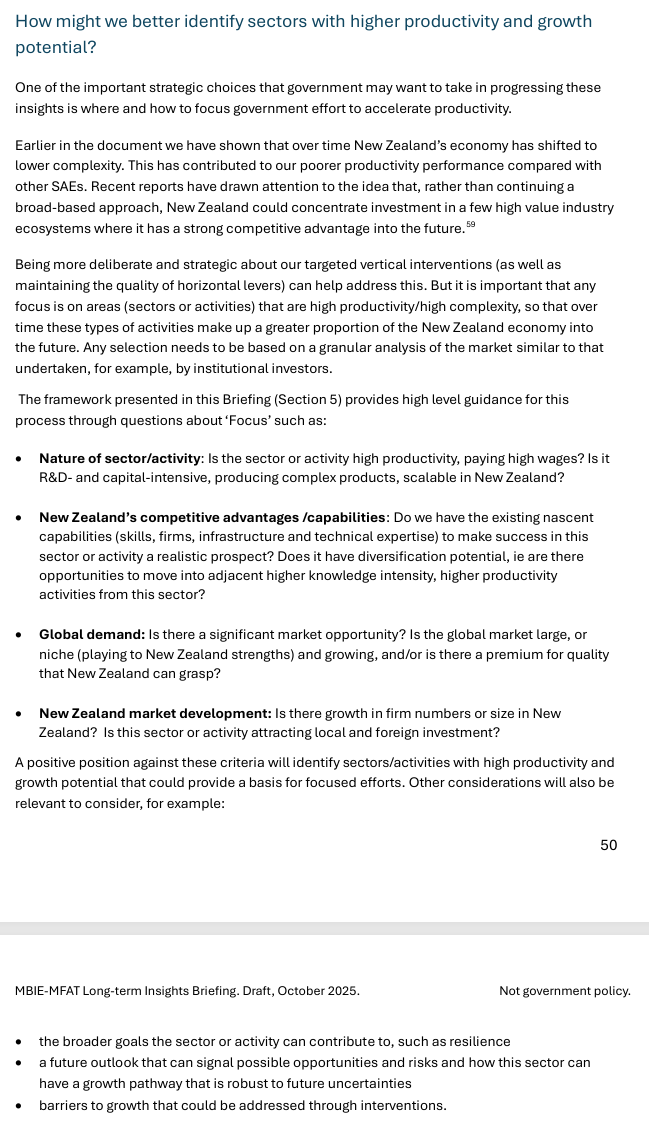
And the whole document ends with a question that shouldn’t even be being asked by government departments.

But perhaps it is all music to the ears of governments that like specific announceables from week to week? (Whether MBIE or MFAT like those specifics is another matter – quite possibly not, but their mindset and fairly shallow analysis in documents like this helps provide cover for governments more ready to paper over symptoms, toss out some cash to favoured firms/sectors, and avoid insisting that the hard structural issues are identified and addressed).

And this sort of stuff helps keep lots of officials busy and feeling useful.

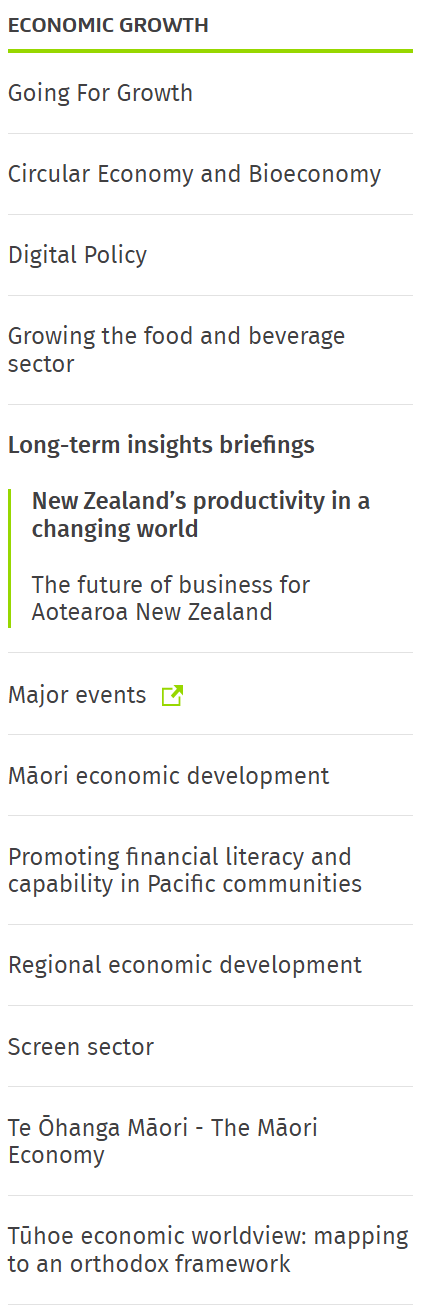
To any MBIE/MFAT readers, no I won’t be submitting, but I’m sure you get the gist. The sooner the LTIB requirement is removed from the law the better, but eliminating that won’t change the mindset. As far as MBIE is concerned, my ongoing unease was only reinforced when on the page with the consultation document on it, this was the list of tabs/items down the side of the page under the heading “Economic Growth”.