Weak minister, weak institutions

We’ve all seen or heard of the sort of parent who has a troubled teenager or young adult but who is always making excuses for, or minimising, the child’s repeated bad behaviour. Yes, yes, that [insert specific] was wrong, but really s/he is a good girl/boy. Parental love is, as it should be, a powerful force (mostly for good) but in those cases the indulgence and excuse-making rarely ends well.

It was a parallel that came to mind in thinking again about the extraordinary way in which Nicola Willis has indulged Neil Quigley, the chair of the of Reserve Bank Board, in which role he now seems to have had more lives than the proverbial cat. No one seems to understand why she reappointed him to one last two year term as chair last year (having already been caught out actively misleading Treasury and the public, and having accommodated pretty all of Orr’s own excesses, policy and behavioural, and uneasy relationship with the truth). And things have only gone downhill from there. The same week Quigley’s reappointment was announced, he released the Bank’s 2024/25 Statement of Performance Expectations which included an operating spending budget far in excess (23% in excess) of spending allowed to the Bank for that year in the last year of the old Funding Agreement, as amended by Grant Robertson just prior to the last election. When they had sought comment from the Minister on the draft SPE (as the law required them to) they simply failed to tell the Minister how much they proposed to spend – and it appears that neither she nor Treasury thought to ask (in their defence, presumably they implicitly assumed that the Bank would simply operate consistent with the Funding Agreement limits).

Then they – Quigley, Orr, and the rest – used that egregious budget not only to lock in fancy new and big long term office space in Auckland, to keep driving up staff numbers, but also as a base for their bid for spending for the next five years, all the while claiming their bid was quite consistent with the Minister’s expectation (as I noted on Wednesday, it seems that on the letter of what MoF had said it was – she and Treasury probably assumed they were dealing with decent and honourable people – but in spirit and substance it was anything but). They were eventually knocked back, but staff (lots of layoffs) and taxpayers (restructurings cost) are paying the price. The Board members, notably the chair, remain in office.

And, of course, it was capped by the extraordinary dishonesty of the last six months around the departure of Adrian Orr (I used to say “on 5 March” but it turned out yesterday he’d already been out of the office for a week prior to that) in which Quigley has – from the moment the first press release dropped – been actively misleading the public about what went on, attempting to block scrutiny, and (as revealed the other day) deploring Treasury’s compliance with the Public Records Act in writing a moderately-expressed file note of a major policy meeting between senior Bank and Treasury people and the Minister of Finance. Once again, it was too much for the Minister of Finance (and this time Labour’s finance spokesperson joined in), but….. Quigley (and the rest of the Board, and the governance of the Bank is vested in them collectively not in Quigley individually) is still there, even though his position as chair is one that Minister can remove him from more or less at will.

I won’t bore readers by tracing through all the chaotic litany of active misrepresentations we’ve been subjected to (and yes “litany” there was meant to evoke Peter Mahon) over the six months, through press statements claiming it was just that inflation was down and it was time to go, denial that there were any policy or conduct issues, claims that Quigley still had confidence in Orr, then the 11 June statement which again actively misled the public, through to yesterday’s new (and still selective) timeline. But just an example, compare and contrast his interview with Heather du Plessis-Allan little more than a month ago with the story revealed in yesterday’s release (which, incidentally, further confirms the story I first reported here from the anonymous insider who leaked to me). We have been misled and obstructed, deliberately, from day one – by someone who reveals repeatedly a disdain for public scrutiny and accountability, let alone the law when it might inconvenience him. Almost singlehandedly (although don’t forget Hawkesby and the rest of the Board) Quigley has materially furthered damaged the reputation of an institution already badly diminished by the now-departed Governor (who’d been lying to FEC the very morning he’d lost his cool at Treasury, forcing Quigley to apologise for at least the second of those). It is, frankly, scandalous that Quigley is still in office. A growing number of observers, not just those with a specialist in the Reserve Bank, seem to be reaching the conclusion that his position should be untenable.

It was, I think, the Taxpayers’ Union whose statement on Wednesday (ie before even yesterday’s release) which best captured for me what the repeated inaction says of the Minister of Finance herself.
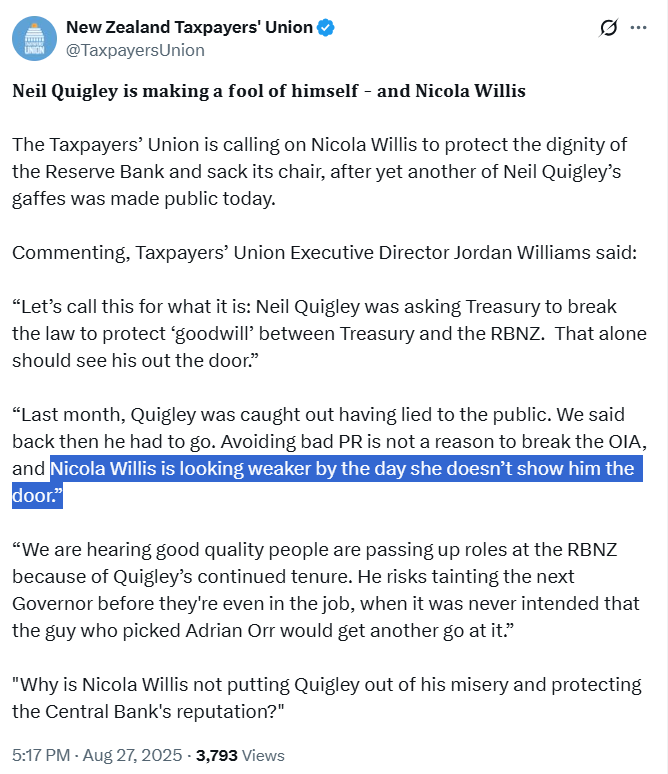
This is a major and very powerful public institution. The Board is put in place by the Minister to serve taxpayers’ interests in governing the institutions, but they seem to have driven a cart and horses through any sense of acceptable standards (whether around the spending or the attempts to obstruct and cover up in recent months). The institution is diminished, the standing of the individuals (notably Quigley) is diminished, and the Minister of Finance – responsible to Parliament and the public for the Bank – does nothing beyond disclaiming all responsibility and occasionally wringing her hands and wishing that her recalcitrant or rogue chair would only behave a bit better. What sort of Minister of Finance does that make her? She (and Treasury) was played for a fool herself, and she has let the public be repeatedly lied to. An effective minister would have dished out condign punishment months ago. From Willis, nothing.

Quite why is anyone’s guess. Perhaps she is just grateful that Orr is gone (aren’t we all?) and the board did help trigger that. Perhaps there is something about the medical school – would it reflect badly on the government if they now ousted as chair the chap they’d just given a controversial medical school to? Some claim it is that Quigley is a National partisan (I don’t take that one very seriously. He might fancy himself as a political operator – though as Jonathan Milne’s profile a couple of months ago noted, people who’ve been on boards with him don’t think he is very good one – but….he was reappointed as chair as recently as 2022 by a Labour government). There are, of course, still substantial unanswered questions about the Minister’s own involvement in, and knowledge of, events leading up to the Orr resignation announcement (and Quigley and the Bank are clearly still covering for her, with no mention in any of their releases regarding contact with the Minister or what she was advised or, and aware of, when). But it all reflects very poorly on her, including associating – the Minister of Finance – with a sequence of events which has left the standing and authority of the nation’s central bank in the gutter, and with Quigley still responsible for wheeling up the nominee to be next Governor – and if the Minister accepts Quigley’s nominee, that person’s standing will be tarred from day one.

Quigley should have gone long ago. But he should go now. He should do the decent thing and resign. But if he (still) won’t, the Minister should not have any hesitation in removing him, certainly as chair, and probably as a board member too (the standard there is tougher, but clearly met).

For the rest of this post, I want to (a) step through the legal provisions, and b) address any concerns that somehow removing Quigley (and, possibly, other board members, especially those from 2024) would be in some sense Trumpian (with his current attempt to fire Lisa Cook from the Federal Reserve Board of Governors). It wouldn’t. These bits are for reference/reassurance and anyone who simply wants to take my word for what can be done can easily stop here.

Legal Provisions

In many government entities, board members can be removed more or less at will. That isn’t so with the Reserve Bank, a conscious choice made in overhauling the Act in 2021, presumably reflecting the key policy role the Board has around financial system regulation and supervision. One can debate the pros and cons of that model, but the law is what it is.

Take the chair’s position first. The chair and deputy chair are directly appointed from among board members by the Minister
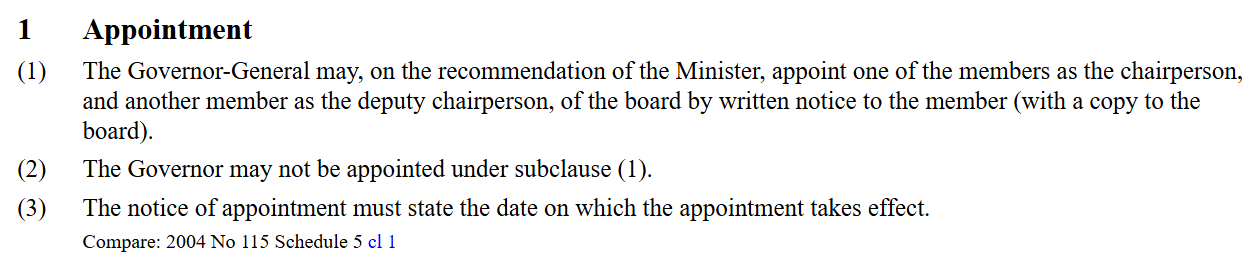
There is no requirement to specify a term for the appointment, although Willis reappointed Quigley last year explicitly for what was envisaged as a final two year term.

And if the chair (or deputy chair) can’t be removed instantly, in substance it is pretty close

The Minister is not required to specify a cause and can act once she has consulted with the person affected.

Removing Quigley as chair would still leave him as a member of the Board.

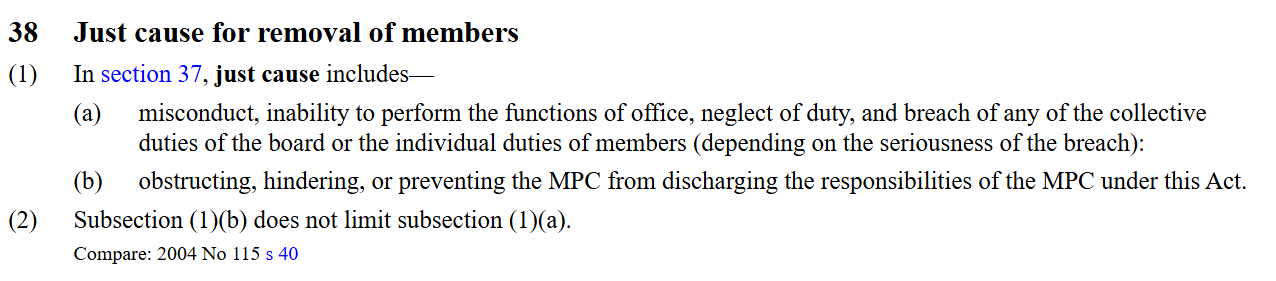
There is a tougher test to be met to remove a board member. Here is what the Act says.
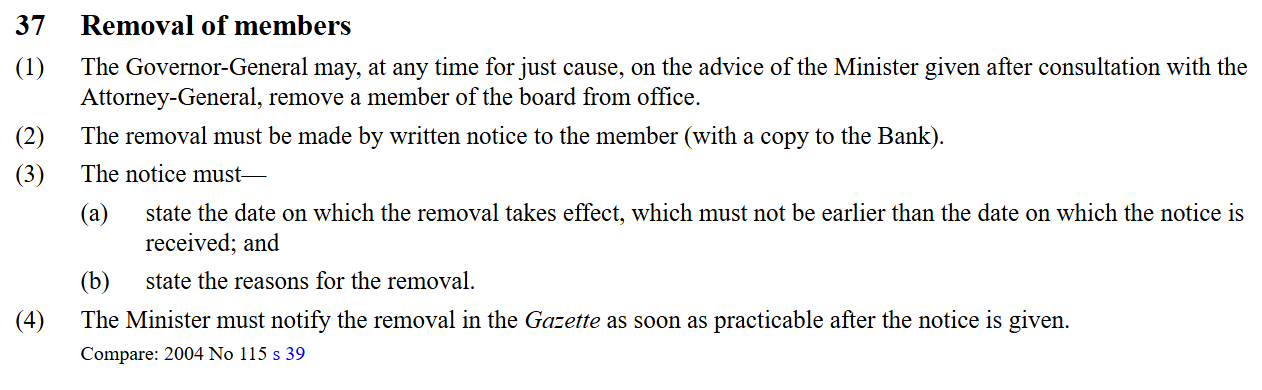
And here are the relevant bit of their duties. First, the collective ones
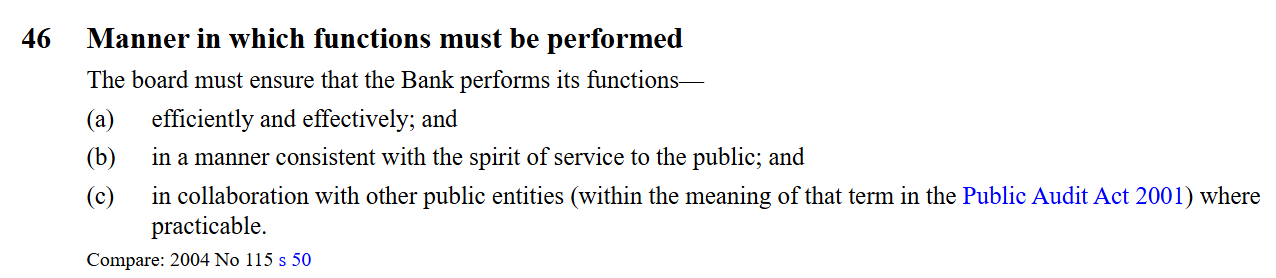
And these are from the individual duties

The Act is also pretty clear that the duties are owed to the Minister. For example

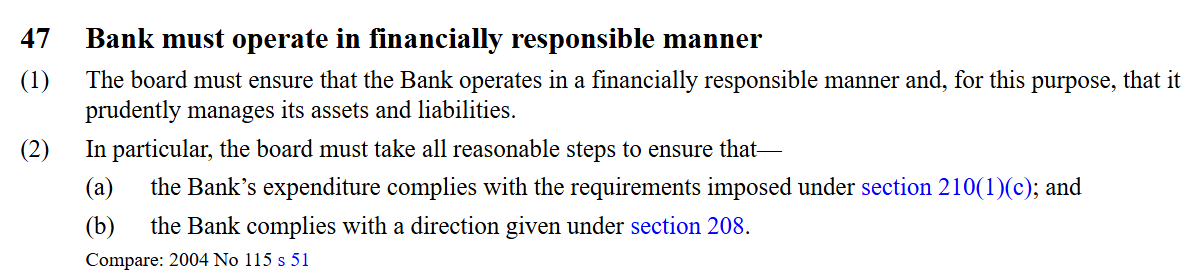
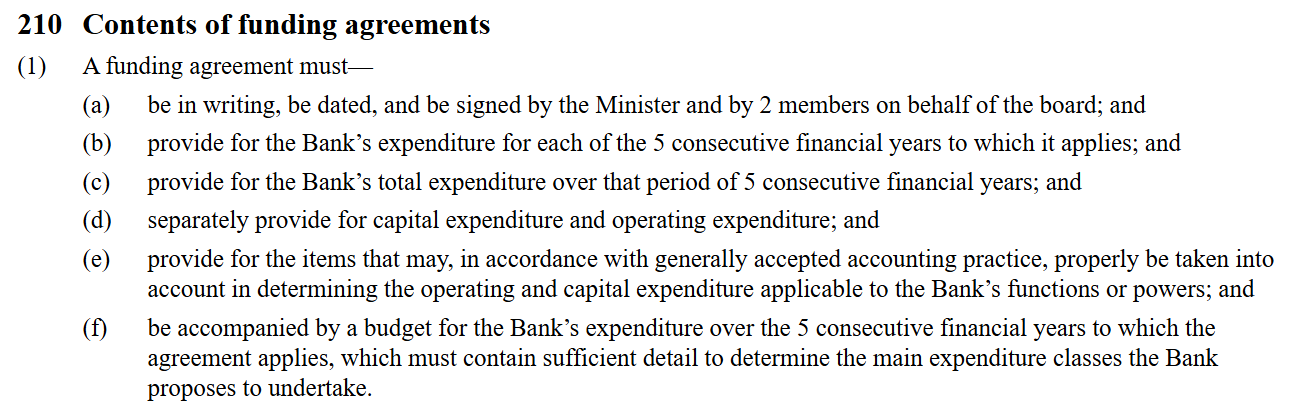
It would seem not difficult at all to remove Quigley from the Board altogether on multiple grounds including (a) not operating in a manner consistent with the spirit of service to the public (his disdain for legitimate public interest and scrutiny has been manifest and explicit on numerous occasions), b) not operating with honesty and integrity (in the coverup of the last six months), and c) in threatening non-collaboration with Treasury unless they defied the Public Records Act, and d) in not operating in a financially responsible manner (setting that 24/25 budget so far in excess of what was allowed for that year, and associated locking in property spending that could be warranted only if somehow the government had made something like that level of expenditure permanent, something for which he had no reasonable grounds to believe was likely to happen. But quite probably if Quigley was removed as chair, or stepped down voluntarily or under duress, he would not want to see out the last nine months as an ordinary board member again.

I reckon there is a pretty reasonable case that all the remaining 2024 board members could also be removed, since they have either supported or done nothing to stop, the decisions and behaviours described above. Probably the only board member in the clear is former Deputy Governor Grant Spencer who only took office in early July this year (although with each passing week of Quigley’s conduct and the Bank still providing only partial information his position is weakened), with Philip Vermeulen a marginal case (he was an observer – “future director” – last year, but became a full director on 13 February this year). I think there is a strong case for removing the deputy chair Rodger Finlay and Byron Pepper (both of whom had earlier ethical issues around their appointment) and Jeremy Banks and Susan Paterson, but I guess a) it isn’t likely to happen, and b) you would need a strong bench of replacements straight away. But it is a choice open to the Minister.

Lisa Cook comparisons

President Trump has, of course, been looking to oust members of the Federal Reserve Board of Governors. For now, he seems to have given up on the chair, Jerome Powell, but this week has (purported to) dismiss Lisa Cook, justifying it on the grounds of alleged misrepresentations (of the sort that, if true, could be fraudulent) relating to mortgage applications she had lodged before becoming a Governor.

People can and will debate the merits of the issues, and the legal one is likely only to be decided by the Supreme Court determining what “for cause” means in the context of the Federal Reserve legislation. But it is pretty clear that Trump wants more influence – direct, or through chosen appointees – as regards monetary policy decisions. Unsurprisingly, that is controversial and can be seen to go towards the heart of central bank operational independence, which has become a hallmark of most advanced country central banks in recent decades.

Quigley’s position (or indeed that of the other board members) is quite different in a number of ways.

In terms of policy/economic substance, the most important difference is that Cook is a monetary policy decisionmaker (all members of the board of governors have permanent positions on the decision-making FOMC). Quigley – and the Board – are not. Monetary policy decisions in New Zealand are made by the Monetary Policy Committee consisting of the Governor, three other internals, and three externals. The Board’s role is to (a) nominate MPC members, including the Governor (but the decision is finally the Minister’s and Cabinet’s) and b) to monitor and review their performance (since the Board can advise removal if MPC members breach their individual or collective duties). The Board does have important independent policymaking powers in respect of financial system regulation (eg bank capital requirements are a board policy decision now), and given the government’s expressed preferences re some of the banking regulatory issues there might be some queasiness about removing board members…..if it were not for the fact that their performance on quite other well-documented matters (and especially that of the chair) evidently rose to the standard for removal.

And that sentence is the other main point. We – and the RB – are not operating under decades-old legislation with fuzzy language around removal powers, but under brand new (2021) legislation, explicitly designed to ensure (a) that the chair is readily removeable, and b) that all board members are explicitly accountable to the Minister for their performance of their individual and collective duties, with removal an explicit remedy open to the Minister in the event of (serious) breaches.

The coincidence in timing with the Trump activities is unfortunate, but – frankly – the debasement of our institutions while the Minister wrings her hands and does nothing about egregious behaviour of the sort we’ve seen is, for want of a better word, more Trumpian (much more so) than taking breaches seriously and acting accordingly to signal that we will insist on high standards from those running our government agencies. That we will sweat the small stuff and (as this become) the big stuff.

Failure to act (specifically on Quigley) is a terrible signal from the government, both of the weakness of its own senior minister and (suggestive) of an indifference to high standards in public life.

A timeline

(I was going to follow-up on yesterday’s post and the associated (and welcome) media and political reaction regarding Neil Quigley’s latest disclosed (mis)conduct, but a new statement from the Reserve Bank this morning has seen that overtaken by events.)

The egregious chair of the Reserve Bank Board, Neil Quigley, has been at it again this morning. The Ombudsman has been inquiring into at least some of the complaints regarding the Bank’s handling of OIA requests around Adrian Orr’s departure. Here I stress – in contrast to the Bank’s statement this morning – “some”, since I have a letter from the Ombudsman yesterday that they are still looking into parts of my complaint on these issues

The outcome of the inquiry that the Ombudsman has concluded was that a) the Bank was not obliged to release any other documents than the carefully selected and very partial group, designed as much to mislead as to illuminate, that they released on 11 June, and b) that the Bank has, on the Ombudsman’s recommendation, nonetheless released a (also rather partial) “summary timeline of events relating to Mr Orr’s departure” (included in the statement at the link above).
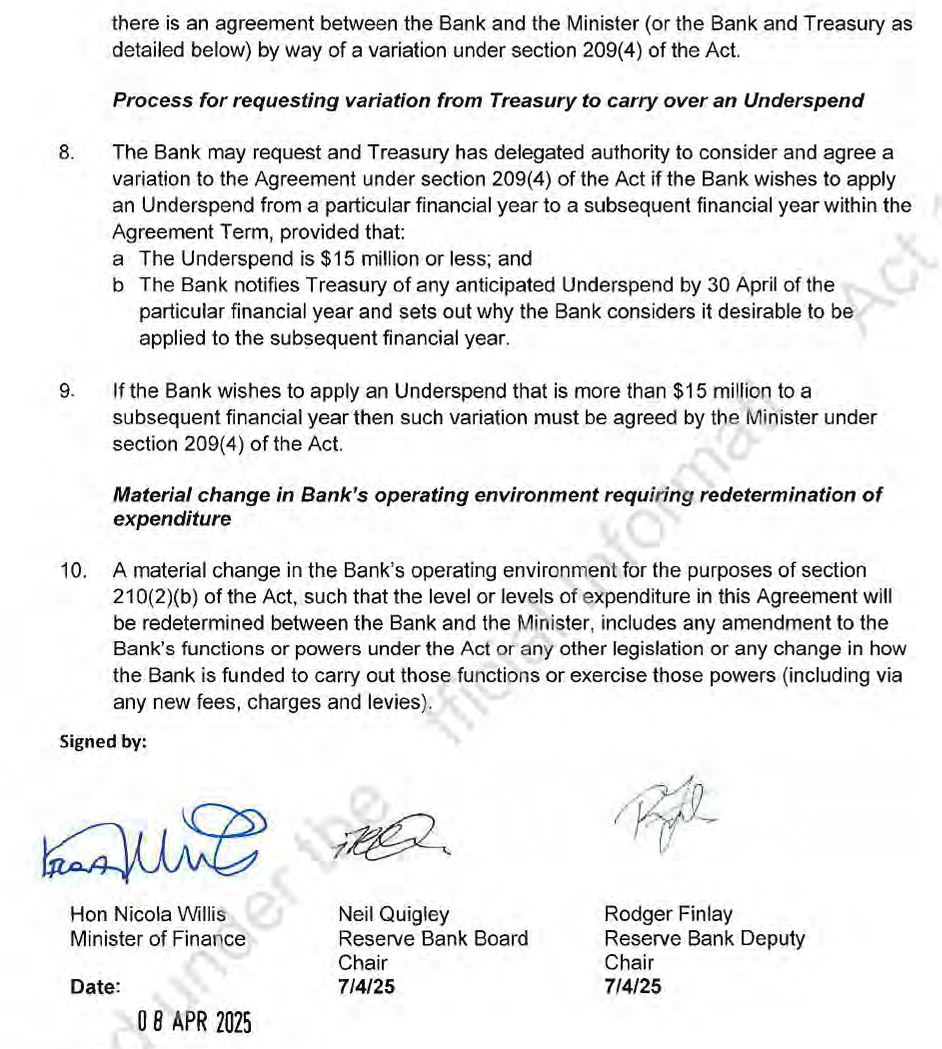
Quigley engages in some self-congratulation in this morning’s statement thus

Which is just an extraordinary claim since (a) delaying tactics are a serious issue in their own right, b) many of their responses never identified (and still have not done so) specific reasons for withholding specific documents, c) some aspects of OIA requests were simply ignored, and d) some are still outstanding. To which I could add that the pro-active statement (and selective document release) of 11 June was clearly designed to mislead, and much light has since been shed by a combination of (a) the apparent insider who leaked to me, b) releases by the Treasury in the wake of that leak, and c) the timeline the Bank has just released. Between all that and Quigley’s own very public obstructionism, open disregard for the intense public interest in this matter, and actively misleading answers to questions dating all the way back to 5 March (probably questions to public officials formally count as Official Information Act requests), Quigley’s claim would be laughable if the situation weren’t so serious. Much is still unanswered.

Anyway, the point of this post is to put in place a rather fuller timeline, drawing on all that we now know, including but not limited to the Bank’s release this morning. In a small number of places I will insert things that must have been so but are not formally confirmed in documents, but where I do that I will explicitly indicate as much. As much as anything, those items point to continuing gaps in the record. A few comments follow below the timeline.

Orr departure timeline as at 28 August (the document might be updated if further information emerges but the current text is below)

Quite a few things are still less than clear, and are deliberately not being disclosed:

  • there has been no indication as to what the Minister knew, when she knew it, including what (if any) contact she or her office had with Quigley after that meeting on 24 Feb,
  • we have none of the text of emails between Orr and the Board after 24 Feb (despite others, that seem to suit the Bank, being released, and others having been released in the past), or of exchanges among Board members themselves,
  • we do not know why the Board agreed to an exit agreement at all (if, as it is described, Orr had lost trust in Treasury, the Board, and the Minister –  and noting that he was the employee –  the simplest thing would be for him to have resigned, under standard contractual conditions)
  • or why the exit agreement seems to have provided for Orr to have been paid in full despite being absent from the office for more than a month,
  • we do not know the character or general terms of that exit agreement (eg who isn’t allowed to say what –  noting that Quigley has previously attempted to hide behind that agreement, before a lot more later came out),
  • we do not have an explanation or apology from Quigley for what was pretty clearly sequential efforts to mislead (and worse) the public, starting from 5 March (and further reinforced by the attempt revealed in full yesterday to squash Treasury’s file note of an important policy meeting),
  • we do not know if the other board members knew of the exit agreement terms before they were signed, and
  • we are led to believe that MoF, to whom Orr actually resigned, had no knowledge of the terms of the exit agreement.  If not, why not (as the person actually responsible for hiring and firing).
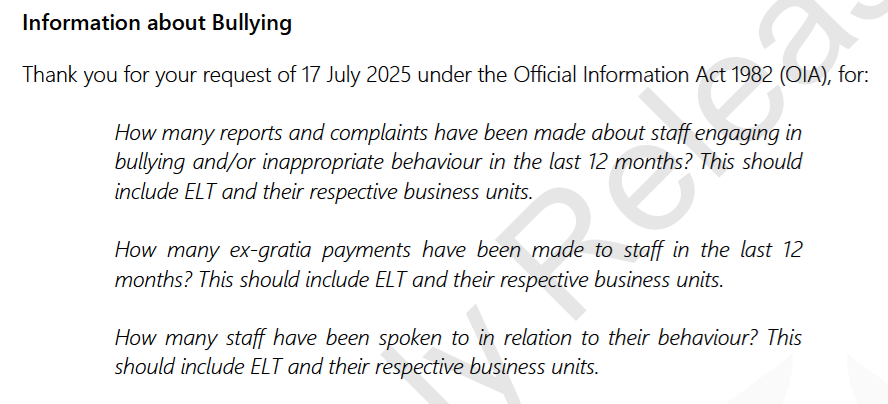
  • do those ex gratia payments to seven staff, each made after Orr left, relate to complaints about Orr and his conduct?
  • And perhaps someone might ask how much staff/Board time and outside legal expense has been incurred in almost six months of obstruction and coverup, when things could have been set out simply and straightforwardly months ago.

Reserve Bank, Treasury, and Willis

There have been numerous OIA requests around events leading up to and surrounding the (pretty clearly) coerced exit of Adrian Orr on 5 March. The Reserve Bank in particular continues to keep on with a fair amount of delaying and stonewalling, clearly resistant to the idea that the public has any real right to know what happened, in a case involving one of the most powerful officials in New Zealand, with a track record of poor personal behaviour and very costly policy choices. Judging from a couple of their recent responses to me and one I noticed to someone else via fyi.org they seem to be working towards a date around 18 September (at least three requests are extended to that date), perhaps around the expected timing of any final Ombudsman determination on the various appeals already in train. By then it will be well over six months since Orr resigned, and that it is with the Ombudsman apparently taking this matter seriously. It is pretty bad, in both appearances and substance, and had the Bank and the Minister of Finance been at all serious about transparency and accountability we could have had a full reckoning within a couple of weeks of Orr’s departure, and then moved on towards rebuilding the institution and with it its credibility and authority (eg that “social licence” Orr used to like to bang on about).

And yet, various responses do come in. While I was away last week there were responses – each with some information – from the Reserve Bank itself, from The Treasury, and from the Minister of Finance. In their different ways, whether by acts of commission or omission, they do not show any of those three parties in a good light.

You’ll recall that it was the Reserve Bank’s egregious Funding Agreement bid, and the resistance to it by the Minister of Finance and Treasury, that finally sent Orr over the top, resulting in behavioural breakdowns (described in the Herald the other day, with apparent extreme understatement, as “including at least one indecorous outburst”) that led to his coerced resignation.

I’ve been trying for months to get to the bottom of this; both how they ever made such an egregious bid in the first place, and how Treasury and the Minister did so little for so long, such that this only came to a head in late February (the bid having been submitted in September).

We know:

  • that in her letter of expectation to the Bank’s Board in April 2024 the Minister set out her expectations about future spending.   Against the backdrop of what was happening to other agencies most people would read this as suggesting that the Bank could expect less authorised spending under the new Funding Agreement than under the old one.
  • The Reserve Bank nonetheless went ahead and set its own 24/25 budget (which it could, in law, do) 23 per cent above the amount of operating spending authorised for that year by Grant Robertson in a variation to the previous Funding Agreement made just prior to the 2023 election.
  • The Reserve Bank did not tell the Minister of Finance this, by the simple device that when –  as the law requires – they gave her the opportunity to comment on their 24/25 draft Statement of Performance Expectations, they simply left out the planned budget amount. (It was filled in in the final published version but…..who reads such things).
  • The Treasury seems not to have raised any concern about this egregious 24/25 budget –  it isn’t even clear they asked about it or were aware of it at any time during 2024 – and certainly did not alert the Minister to what had happened.
  • The Reserve Bank (and note that this was the Board, unanimously, and not just the Governor) in September 2024 lodged a bid for the 2025-30 Funding Agreement that was quite explicitly set on the basis of involving a level of future operating spending 7.5 per cent below their own (grossly inflated) 24/25 budget.
  • Numbers consistent with this bid found their way into the HYEFU expense tables in December last year (Treasury telling me that they simply took the numbers the Bank gave them).
  • Treasury appears not to have engaged seriously with the Funding Agreement bid until February this year.

It was pretty much beyond comprehension all round. How could the Reserve Bank Board have the gall to have a) set such an initial budget inconsistent with the recently updated funding agreement and b) then used that as the base for a bid for such a higher level of resources (incidentally going on to commit to large and expensive new office space in Auckland without any certainty as to their future approved spending)? How could the Minister of Finance, who had very evidently been no fan of Orr, have let all this happen (where was her suspicion/curiosity, where was that of her advisers)? And how could The Treasury, supposedly the guardians of the public purse and specifically charged with monitoring the Bank (and Board minutes show Treasury DCEs turning up for chats at Board meetings), have been so oblivious to what was going on (would this have been an acceptable standard in any other government department monitoring its Crown entities)?

The Bank has been quite obstructive in releasing the relevant material (Treasury, more cooperative, reveals that it really had none) and are still refusing to release the final Funding Agreement bid that went to the Bank’s Board (I really only want it to check whether the Board exercised any discipline on management excess but the minutes suggest not). However, in consultation with Treasury, they have now released a letter of expectation sent by the Minister of Finance to the Board chair headed “Expectations for the 2025-30 Funding Agreement proposal and review process”.

The version they released has no date on it (I asked yesterday, but perhaps they’ll take another 20 working days to reply), but it must have been after the April 2024 general letter of expectation (see above), although perhaps not much after it.

[UPDATE 8/9: The Bank has confirmed to me today that the Board chair received the funding agreement letter of expectation from the Minister of Finance on 3 April 2024.]

If you were dealing with honourable people, it would be a perfectly reasonable letter.

The Minister outlines the general fiscal context:

In pretty much any core government agency the budget for 24/25 would have been the appropriations made by Parliament for that department for that year. The Reserve Bank was different, because it had a five year Funding Agreement, in which approved operational spending for each individual year was specified. The Minister (and Treasury, as drafters of the letter) should still have been safe because you’d surely be able to count on the Bank having set a 24/25 operating expenses budget very much in line with the limits in that previous Funding Agreement for 24/25?

With decent people, but not it appears with the Reserve Bank Board (Quigley, Orr, and the rest). They simply set themselves a budget for 24/25 that bore no relationship at all to what they’d previously been allowed to spend for that year, and then took the Minister at her (literal) word and put in a bid 7.5% lower than that grossly inflated budget. And thus, per the covering Board paper dated 12 August 2024, Bank management (in this case, two of the – very many – deputy chief executives, Greg Smith and Simone Robbers) offer this assurance to the Board

And on the letter of the Minister’s request, it was indeed so. But it was fundamentally dishonest and any half-alert board members (including, but not limited to, Quigley and Orr) must have known that. It is almost inexcusable that any of the Board members involved – both in setting the 24/25 budget itself, and playing fast and loose with the clear intent of the Minister’s letter, in turn leading to the massive dislocation to the organisation and its staff this year – are still in office (driving the determination of the nominee to be the next Governor).

These are the guilty men and women who are still in office, drawing (incidentally) the highest board fees for any non-commercial government agency in New Zealand:

Nei Quigley (who, for reasons apparent to no one else, the Minister continues to express confidence in)

Rodger Finlay, the deputy chair

Jeremy Banks

Susan Paterson

Byron Pepper

Meanwhile, Treasury seems to have been asleep at the wheel, and doing a particularly poor job in pro-active advice to the Minister, in drafting things in a way that ethically challenged people could not drive a cart and horses through, and in undertaking constant and reasonable challenge and scrutiny of the Bank. And the Minister and her team hardly emerge looking good, when they been clear all along that they’d had doubts about Orr.

Where, you might also wonder, were the Opposition and FEC? But the primary responsibility rested with the Board, the Treasury, and the Minister. And if we can’t count on more honest and straightforward behaviour from those charged with monetary stability and the regulation of our financial system, or more effective scrutiny from those responsible for safeguarding the public purse, things are even further gone than this pessimist had come to fear. Mistakes will happen, but then the question is whether those in a position actually take them seriously and do something. There is no sign Nicola Willis has done that (after all, all those board members are still in office, and although their bid was cut back there were no consequences for them for the havoc they wreaked or the ethically-challenged try-on).

The second part of this post skips forward some months. But before we get to that take note of what the Bank and Quigley had done in the earlier section, hardly (one would have thought) conducive to good and trustworthy relationships going forward between the Bank and Treasury, if Treasury now realises they have to dot every i and cross every t, and check every single document that the Bank is not attempting to pull a fast one).

You might remember that a month or so ago I reported what an apparently well-informed insider had told me about what really happened around the Orr departure. Pretty much all of that story has checked out as things unfolded. One element of the story was that Neil Quigley had gone ballistic when he learned that Treasury had kept a fairly full file note of a critical meeting held on 24 February between the Minister of Finance, the Reserve Bank, and the Treasury. So I lodged an OIA request with The Treasury, and this was the response

Treasury response to OIA request re 20 and 24 RB meetings

From it

Personally, having taken many file notes of meetings with Ministers of Finance and Treasury earlier in my career, neither the fact of the file note nor its contents seemed particularly surprising or inappropriate. Major issues (not just the funding agreement but bank regulatory ones) were being discussed, the language is not inflammatory – although the Orr walkout (itself described in muted terms) certainly was.

The fault here seems (and not surprisingly) all with Quigley. As ever with him, there is never a sense of why the Official Information Act exists, or whose interests it is supposed to serve. Instead, we get implied threats of (a) “this will require the full force of RBNZ legal advice to be brought to bear on it”, and b) the suggestion that release would “immediately destroy the goodwill between Treasury and the Bank that I have tried to create over the past few years”. You might wonder how Quigley is feeling now that the full file note has been released, but even set that to one side……goodwill????? This was the same Board chair whose chief executive had behaved so egregiously in a meeting with Treasury that Quigley had felt compelled to provide a written apology, and whose Governor (in that 24 Feb meeting) had (in muted Treasury language) “expressed frustration at the relationship between the RBNZ and the Treasury”. And this was the Board chair who had pulled the wool over Treasury’s eyes by agreeing to a budget for 24/25 quite out of step either (and more importantly) with his own Funding Agreement, or with the spirit of government fiscal policy last year, and then used that abuse as the base for a bid for a big increase in authorised spending for the coming years.

Quigley then puts one of the Bank’s attack dogs, their General Counsel, onto the issue and we have his crucial email as well

So, the Bank’s General Counsel tries to threaten Treasury that the Bank would not in future be willing to hold meetings with Treasury and the Minister of Finance on its future funding? Yeah right, but it is an attempt to intimidate Treasury.

And then, of course, there is that second paragraph. Which goes to the whole point, that the Reserve Bank’s Board appears to have engaged in attempts to make end runs around any serious public scrutiny, including via the OIA, by doing sweet-heart deals with Orr, the terms of which they also refuse to disclose. Fortunately, sweetheart deals done by Quigley et al don’t bind The Treasury, without whom it seems we would have no idea what went on at that critical meeting, when things were so bad that within 24 hours the exit process was getting underway.

Quigley repeatedly displays no regard for the public interest, and any relationship to the truth or straightforwardness on Reserve Bank matters seems entirely incidental (ie whether or not it serves his ends of the moment – see the repeated active misleading of the public, both on 5 March and since).

And, just briefly, one final OIA, this time from Willis herself.

My informant had told me that on the afternoon of 5 March there had been heavy pressure from the Minister’s office for the board chair (Quigley) to do a press conference on the resignation. One of the Bank’s earlier OIAs had also mentioned such approaches. The Minister’s response confirms that there were two conversations that afternoon involving her Senior Press Secretary and the Bank’s communications head to that end, and it also releases the draft press release and Bank comms plan that Neil Quigley had provided to the Minister’s office late on the morning of 5 March which included this: “Recommended media response plan for if [ “if”???? Really?] we get questions: No further comment”. The ill-fated press conference, at which Quigley did so poorly and actively misled the public, was clearly Willis’s initiative.

But that was not my main interest. I also asked for copies of “any material relating to exit conditions for Orr (process or substance)”. The Minister’s response was “No information about the Reserve Bank Governor’s exit conditions is held”. Which really is inexcusable. As a reminder, the Minister (and Cabinet) appoints the Governor, the Minister (and Cabinet) are the only ones who can dismiss the Governor, and the Governor’s resignation has to submitted to her specifically. The Minister is also responsible for the Board, and appoints – and can dismiss at will – the Board chair, and is the only person in the entire mix with any degree of direct public accountability. And yet we are expected to believe she is so incurious as not to enquire at all as to what sort of cover-up arrangements Quigley (and the “senior counsel” both sides engaged) was cooking up with Orr, as the basis for his departure, or even at what cost. And when a key precipitating event was a meeting she was part of?

I’m not sure I really believe it – not “holding material” is likely to be different from no phone calls were made, directly or indirectly, (and there is set of texts involving Iain Rennie on this topic that are still being withheld in full by Willis) – but if it is true it reflects very poorly on her as a steward of the public interest.

(And that is even granting that the wider public interest was almost certainly served by Orr’s departure, a couple of years after he would already have gone had the previous government not, inexplicably, reappointed him.)

Reserve Bank meeting the PM

There has been a flurry of coverage in the last couple of days after the Prime Minister told an interviewer yesterday not only that he thought the Reserve Bank should have cut the OCR by more/earlier, but that he had made this point to the Governor in a meeting with the Bank before the final OCR decision was made last week.

While I don’t think it is usually particularly wise, in general I don’t have a problem if the Prime Minister or Minister of Finance want to comment critically on particular OCR decisions or on the MPC’s handling of monetary policy. We give operational independence to the MPC for good (if arguable) reasons, but they aren’t a separate arm of government – so it is different than ministers criticising judges – and they are human and, as we’ve seen again in the last five years, they make mistakes, sometimes bad and very costly ones. The MPC is supposed to be accountable and ministers are our representatives and the ultimate vehicle for the exercise of that accountability. Back when core inflation was persistently undershooting the target last decade, ministers were eventually heard to grumble in public from time to time even about that poor performance.

It is another matter to be holding private meetings with the Governor (or other MPC members) and expressing your views – whether as PM or Minister of Finance – perhaps especially in the days immediately leading up to a particular interest rate decision. There is no public visibility – or, thus, accountability – for those comments, and Luxon was very unwise to have done what he said he did. That is particularly so at present when a) the Governor is on a short-term temporary contract and is bidding to be made the permanent Governor, and b) when things around the Reserve Bank have been so tangled and murky all year (and when, despite attempts to deny it, it seems clear that the capital settings review was mainly driven by pressure from the Minister of Finance). This is a time when people should be bending over backwards to ensure that they are behaving with propriety, and that there can be no question (or appearances) of anything else. I don’t really suppose that in his meeting the PM thought he would influence the MPC – maybe he was simply sounding off without thinking too hard – but those of a suspicious mind might reasonably worry that it was otherwise. Of course, in law the government cannot direct a particular OCR decision, and the Governor himself has only one of six votes on the MPC (and three other votes are held by externals who owe no particular deference to him).

It seems that these conversations occurred at a meeting that, in one form or another, has happened for decades in the day or two prior to each Monetary Policy Statement. I’ve been out of the Bank for 10 years now but my impression is that things are not very different now than they were in my day. The practice would be that at the end of the “forecast week”, when the Bank’s or MPC’s economic view had crystallised, the material from that forecast process would be used to prepare a short note for the Minister and Prime Minister. In my day, Treasury drew on Bank material to prepare that note, which included possible angles for questions that ministers might use to ask the Bank. But that note never touched on the OCR itself, and neither did the discussion in the meeting that followed (usually involving the PM, MoF, the Governor and chief economist, perhaps someone from Treasury, and perhaps some ministerial advisers). In all my years in the Bank I often heard reports back from these meetings, from the Governor or chief economist, and it was clear that boundaries were pretty consistently respected. What the Bank might do with the OCR was pretty much out of bounds (and in my day, OCR decisions were – formally – purely those of the Governor himself).

If the structure has remained much the same – and I gather the meeting in question happened last Tuesday – there is nothing very wrong with that model, except that the Prime Minister appears to have crossed the line, in ways that probably should prompt a rethink as to whether such meetings prior to the MPS are still appropriate. A model can have been around for decades, and appear to have worked okay, with people respecting conventions, but sometimes particular episodes prompt an overdue rethink. It was like that with the lock-ups the Bank used to hold for analysts and media immediately prior to MPS releases – which seemed to work okay until it became clear that security settings were weak and one media outlet was actually passing information from the lockup back to their office (something I got caught up in when their office passed information on to me, since I was due to be interviewed by them on the MPS later that morning). There are no more lockups (and nor should there be).

Should the Governor and an acolyte or two really be meeting with the Prime Minister and Minister of Finance immediately prior to MPS/OCR decisions? It may have worked fine for a long time, but it isn’t a good look, and on this occasion the PM has crossed the boundary, and it is hard to restore confidence now that the meetings are widely known of, and the PM has done what he says he did. There is no particularly compelling reason for the meeting. The Treasury has a non-voting observer on the MPC, and if there is any case for a briefing on the economic outlook before the release surely that person could arrange for the briefing. But it isn’t really clear that such a prior briefing is needed at all (and it has always been rather artificial for the Bank to be discussing the economic and inflation outlook without also discussing the monetary policy calls). Moreover, it isn’t the days of the single decisionmaker, and external MPC members in particular might reasonably think that it is time to rethink the approach (not just while the appointment of a new Governor is dragged out – will be six months next week since Orr left – but in the future more permanent state with a new longer-term Governor). Were I in Hawkesby’s shoes, I’d be thinking pretty hard about the risks and returns to those meetings anyway. There is plenty of time after releases and well clear of the next decisions to maintain Beehive relationships, to the extent they are needed on monetary policy matters.

Reading Grant Robertson

I got home from Papua New Guinea at 1:30 on Saturday morning and by 3:30 yesterday afternoon I’d finished Grant Robertson’s new book, Anything Could Happen, and in between I’d been to two film festival movies, a 60th birthday party, and church. It is that sort of book, a pretty easy read.

In some respects, that is to the credit of the author. It is pretty well written (although not exactly the publisher’s description: “beautifully written”). I almost always like the “early life and upbringing” chapters of autobiographies and this one was no exception. That is probably a mix of the various laugh-out-loud funny anecdotes,

the fact that there were certain similarities in our childhoods (heavy church orientation, and I too was six when Mum and Dad told us we were changing islands so Dad could pursue his sense of call to the ministry), and the discovery that my wife and kids are (distantly) related to Grant Robertson (former Minister of Finance, Downie Stewart, who resigned in 1933 on a key point of policy difference, is a common relative).

Two other sections will stick with me: the treatment of his father’s betrayal of his family and his employer, culminating in 18 months in Dunedin prison is quite moving, and something no one would wish on any teenager, and Robertson’s pretty severe physical debilitation by the second half of 2022, that meant that when Ardern first indicated (in the September quarter of 2022) that she might step down, Robertson stepping up really wasn’t a viable option.

For the rest, unfortunately, I imagine it is the sort of book many of his mates and Wellington Central supporters will want to have on their shelves. Perhaps his staff at Otago too.

But you will search in vain for any serious insight or reflection on the politics, politicians, or policies of the 20 years or so in which Robertson was first a staffer, then an Opposition MP, and then a senior minister and close confidante of the Prime Minister. He was Labour’s finance spokesperson and Minister of Finance for, in total, just under 10 years (Minister for six of them), and had been Labour’s spokesperson on economic development for a while before that. He ended his political career having held only one substantial portfolio – Finance – and yet in this book you will look in vain for any distinct Robertson perspective on events or issues or institutions or individuals relating to that portfolio or (mostly) for any perspective at all.

As just a small example, back when Robertson became Opposition finance spokesperson his big project was something called the Future of Work, Danish “flexicurity” and all that, (an old post on some of that here). There was serious work done, and yet the book contains just one mention of that project – a mention of getting agreement from Andrew Little (newly elected leader) that he could do it.

But step back a bit further. Robertson shifted over to the political side (from MFAT) in the Clark government, stepping in first to become political adviser to Marian Hobbs before shifting some time later to the Prime Minister’s office. Robertson obviously has and had great affection for Hobbs, who wasn’t one of the shining stars of that government. We get plenty of the amusing malapropisms to which Hobbs was prone under pressure, but little of what made her tick. And if she is now a name many readers will barely be aware of, the same can’t be said for the big players of that government – Clark, Cullen, even Anderton, and of course behind the scenes Heather Simpson. Do we learn anything about them from this book (written by someone who was actually a student of political science, before himself becoming a senior player)? Barely at all.

And if we get that Robertson really really didn’t like, or have any time for, his rival (and Labour leader at the 2014 election) David Cunliffe – and to be fair, there seem to be many people who share that view – and wasn’t too keen on Charles Chauvel (younger readers can look him up) either, that is about it from his side of politics, and even those critical comments are less insightful than conventional and one-dimensional. Robertson served as a senior minister for six years, in a government with lots (and lots) of Labour ministers, losing them by the end at a rate of not much less than one a month. But there is no critical evaluation of any of them (not Stuart Nash, not Kiri Allan, not Kelvin Davis’s time as deputy leader), and not even any insight on what made key players tick. My one takeaway about Jacinda Ardern was learning that she’d once been hospitalised with the same obscure 19th century condition that had once put my wife in hospital on the other side of the world.

And if you suspect that that silence might have had to do with not wanting to risk upsetting anyone in the Labour family, he isn’t really any better on people on the other side of politics (other perhaps than a few interesting comments on Winston Peters in the 2017-20 Cabinet). Luxon gets three mentions, only two from his time in politics, and one of them was simply a mention that he (Luxon) had suggested Robertson (as caretaker Minister of Sport) should go the Rugby World Cup final in 2023, and Nicola Willis – despite facing him as National’s finance spokesperson through the last 20 months of his term and the election campaign – gets no mention at all (critical or otherwise). You’d have thought that a shrewd and experienced operator like Robertson would have had some perceptive, witty, and perhaps even unfair, observations to make. But apparently not. Perhaps he just wasn’t a close observer of people?

And it isn’t just politicians. If productivity (or cognate words/ideas) gets no mention, neither does the Productivity Commission – whose fate Robertson sealed with his appointments in the government’s second term. There is barely any mention of the advisers in his office, whether the political ones or the Treasury secondees and almost nothing about Treasury at all. Gabs Maklouf, whom he inherited, gets just one mention – around the “budget leak” in 2019 – and Caralee McLiesh also rates only a single (and entirely non-insightful) mention. There is nothing about her recruitment – an overseas person with no macro experience – or contribution (Covid or otherwise) or personality or role in the institution. You will learn precisely nothing about Treasury itself (not even Robertson’s views of it) in this book.

And while I’m enough of a junkie that I was always going to buy the book, I was perhaps most interested in what Robertson would have to say about the Reserve Bank in general and Adrian Orr in particular, the more so since Orr was no longer the incumbent. The short answer is almost nothing.

Orr appears twice in the index. The first mention relates to his appointment at the end of 2017. Robertson suggests that on coming into office he did not want an RB insider to become Governor. Which would be fine except that by then (a) Wheeler had refused to seek reappointment, b) his deputy, Spencer, was serving as a – dubiously legal – acting Governor and planning to retire as soon as a substantive appointment was made, and c) I’m pretty sure the other senior RB potential contender, Geoff Bascand who had indicated that he had applied, had already been winnowed out before the change of government. Anyway, Robertson’s only observation is that he wanted to know whether Orr would be open to the reforms Robertson’s envisaged (an MPC, with externals), which Orr was.

And the second reference was to that odd episode in late 2020 when Robertson overruled the Bank and inserted in the MPC’s Remit a clause that (loosely) required the Bank to assess the impact of its policy measure on house prices (without having any particular implications for policy). It was, we are told, “the only time in my term as Finance Minister that I clashed with Adrian Orr as Governor”. And that’s it.

On the substance, that comment in the previous paragraph is pretty damning (if true). The Minister never raised concerns about Orr’s behaviour (of which there were many documented public episodes), the Minister never expressed concern about the $11 billion Orr and the MPC lost taxpayers, he never expressed concerns about FEC being misled, he never raised concerns about inflation being let to run rampant? And did he really never have the feisty Orr overstep the mark, even slightly, in his (Robertson’s office)? And, of course, we learn nothing of his sense of Orr – even with just with the benefit of hindsight – we get no sense of why Orr was reappointed (over the objections of Opposition parties, when Robertson himself had amended the legislation to require consultation), nothing about that weird ban on having experts appointed to the MPC, let alone anything about the wider reform of Reserve Bank governance (and the underpowered Board he appointed) or even such significant structural reforms as deposit insurance.

And, of course, there is nothing at all on the structural fiscal deficit Robertson bequeathed to his successors (yes, even on PREFU numbers which included quite a bit of last minute vapourware promises about future fiscal chastity and sobriety). Not even a rueful reflection on the contrast between those Budget Responsibility Rules he and James Shaw had launched (to the upset of the left of their own parties) back in Opposition in March 2017 and the way it all ended. And nothing at all on what role Treasury advice and (poor) forecasts played.

It is a shame. There was some good things done by Robertson as Minister of Finance. He was finally willing to grasp the nettle and reform the governance of monetary policy and of the Bank more generally (I was a discussant at the event in 2017 when he launched that policy and the associated post was headed “Grant Robertson made my day”). Not everyone was a fan (the RB wasn’t) but I thought, and think, that deposit insurance was an appropriate second-best reform. But even on RB matters, execution and details left so much to be desired. Perhaps Robertson can’t really be blamed for Orr in late 2017 (he was new, and had to appoint someone the Quigley-led Board wheeled up), but he can for most of what followed – the bloat, the loss of focus, the personal behaviour, the disempowered MPC (lightweight appointments, never heard from), and so on…..all culminating in that stunning exit on 5 March this year.

There aren’t many good books in New Zealand on policy and politics. You’d have thought (I did – I was looking forward to the book) Robertson would have been capable of something more. Perhaps the market is small, but it is hardly as if he’s in need of whatever money a New Zealand political autobiography might make. Sadly perhaps it reveals him finally as not much more than a political operator, without very much substance at all.

When I wrote here a few years ago about Michael Cullen’s book – which for all its faults, written against the clock of terminal illness, was better than this – I concluded this way (reacting to a quote from Helen Clark lauding Cullen)

Meanwhile Cullen – and Clark herself of course – bequeathed to the next government (who in turn bequeathed it to this one), the twin economic failures: house prices and productivity (the latter shorthand for all the opportunities foregone, especially for those nearer the bottom of the income distribution).

In that sense, what marks him out from a generation or two of New Zealand politicians, who have spent careers in office, and presided over the continuing decline?

And now the same failures were bequeathed by Robertson (and his bosses) to Willis (and hers). And just this morning we hear the latest Prime Minister distancing himself from his housing minister’s ambition for lower house prices (suggesting he just wants a slower rate of increase), and nothing at all shows any sign of improving productivity.

New Zealand politics for you…….

One more Treasury OIA about RB spending

All the interest in the Orr-departure story – the background, and the subsequent and ongoing efforts to mislead the public by the Board and the temporary Governor – seems to now centre on the Ombudsman. Various people, including me, have appealed the Bank’s OIA obstructionism on specific requests and the Ombudsman seems to be pursuing the issue reasonably expeditiously. I received a draft of a provisional opinion the other day for comment (which I have now provided extensive comments on) but I’m guessing it might be a couple of weeks before we get a final decision. I’m going to be away for a while so I don’t expect to write anything more after this post for at least a couple of weeks.

For the record, the Herald has an article today on the Reserve Bank staff cuts. Most of it is ground covered in my post last Friday. But the one bit that caught my eye was this

To which there are so many possible thoughts in response:

  • Surely no serious external observer ever thought they needed what they had bid for to do their statutory duties effectively,
  • But if the Board is now confident that everything can be done with 20 per cent fewer staff than they had in January, why did they ever bid for so much more money?  (And it was the Board’s bid, perhaps championed by the then Governor but he was their agent and they had responsibility for governance, budgets etc),
  • And if “no work programmes have been cut” [“out altogether” appears from context to be the intended interpretation] a) what were all those people previously doing? and b) given all the non-core stuff the Bank got into under Orr, why on earth not?
  • It seems like further evidence that the modest cuts Willis imposed relative to what Grant Robertson had allowed the Bank to spend did not go anywhere near deep enough.

And it remains extraordinary that none of the Board members has had the decency to resign and that the Minister continues to express confidence in the chair, whose signature had been on that egregious bid late last year for so much more money, in which he and the Governor stated that that increased funding was what was appropriate “to deliver on our mandate and agreed outcomes”.

So many puzzles and so few explanations when it comes to explaining the last 10 months or so of the Orr tenure, that all ended so ignominiously on 5 March, coverups and all.

But another OIA response came in from The Treasury yesterday (having taken the best part of two months to provide two pages of information (and not withhold or redact anything)). Another of the puzzles around that final year or so is why Treasury appears to have been doing its monitoring role of the Bank so poorly (and this is a formal monitoring role, for which resources are formally allocated, established under the overhauled Reserve Bank Act in 2021).

This had been the request, lodged on 16 June

Some of this had already been overtaken by events because the Reserve Bank had already released to me Treasury’s comments on the draft 2024/25 Statement of Performance Expectations (SPE), and then had released the draft SPE and covering note the Bank had sent to the Minister of Finance.

The mystery, you will recall, was that the Bank had chosen to spend about 23 per cent more in 24/25 on matters covered by its Funding Agreement than the variation approved by Grant Robertson just before the 2023 election had allowed. Surely, it seemed, Treasury and the Minister of Finance would have pushed back strongly on this? But it emerged – all documented in previous posts – that the Bank simply chose to leave out the planned budget numbers from the draft SPE they consulted the Minister on. She simply wasn’t told about this planned excess, and Treasury had not flagged any concerns to her (they’d noted that the draft SPE didn’t have the budget figures in, but raised no particular concerns and simply noted that the numbers would have to be in the final version). They were, but there was no particular reason for the Minister or her office to look closely at the final version because they’d not been alerted to any particular areas of concern, or requested any major changes to the draft. As I’ve noted before, perhaps the Minister and her advisers should have been more suspicious – Willis had scarcely been on record as an Orr fan – but the real fault seemed to lie with Treasury. They are, after all, supposd to be the guardians of the public purse.

So what new do we learn from yesterday’s release? Mostly, it is about gaps – and not in what they released, but in what work never seems to have been done.

There were four limbs to my request.

On the first, it seems that there was no additional analysis or advice internally, and certainly nothing documented outlining any concerns as to what the Bank might be up to or suggesting (say) that they should insist that the Minister was alerted to the planned budget for 24/25. There is no sign in any of the material that Treasury was even aware of the scale of the planned spending blow-out, let alone suspicious of how such a blowout might be used to try and leverage more resources in the forthcoming Funding Agreement bid.

The third limb related to something I’d spotted in this year’s government Budget documents.

A not inconsiderable chunk of the “savings” in this year’s Budget ($144 million in fact) was this item. We were told, reasonably enough, that the figures now included in the 2025 government Budget reflected the new Funding Agreement that had been signed and released in mid-April. But why had figures so much higher ever been included by Treasury in the HYEFU last year? After all, much higher numbers had no warrant in any document any minister had ever seen (eg the draft SPE – see above) or signed (eg the Funding Agreement then still in place covering the period to 24/25). Why, in an environment of fiscal stringency, had Treasury included levels of Reserve Bank spending for the next few years far higher than anything authorised from the centre to that point?

The answer, it appears, is that no one bothered to look or check or think. Treasury told me that “there is no material in scope of the third part of your request”. And went on to tell me that “we note that the RBNZ provides the Treasury with operating expenditure forecasts which are used in the Treasury’s Half Year Economic and Fiscal Update (HYEFU)”. Which seems almost beyond belief. The Bank isn’t a tiny entity (say the Walking Access Commission), but one spending a couple of hundred million dollars a year, and one which had been increasing its spending substantially, and yet Treasury staff simply took whatever the Bank told them it planned to spend for the following few years and stuck it in the formal fiscal forecasts without apparently raising any questions at all. Not exactly a fearsome (or effective) watchdog.

One reason I’d asked about those HYEFU numbers is because I knew that the Bank had lodged its egregious bid for the following five years with the (acting) Secretary to the Treasury on 13 September. I’d assumed that between then and when the HYEFU fiscal numbers were finalised (27 November) somebody at Treasury would have (a) looked even a little closely at the Funding Agreement bid, and b) raised some red flags about a bid that used as a baseline spending levels so far ABOVE what was allowed in the still-current Funding Agreement, and c) perhaps (optimistically) gone back and looked at how the 24/25 budget had been set relative to those Funding Agreement limits. They might even have alerted the Minister.

And that was the gist of the second limb of my request. In fact, it appears that none of this happened. Treasury never actually responds directly to that bit of the request but (a) does not say it is withholding anything, and b) notes that two documents are in scope and soon to be released (as part of the long-delayed pro-active release of papers relating to the 2025 Budget). The first of those is “T2025/3027 Aide Memoire: Preliminary assessment of the Reserve Bank of New Zealand’s funding proposal for the 2025-30 Five Year Funding Agreement”, and is dated 13 February. That appears to be the first time anyone at The Treasury had put anything in writing on an egregious funding bid they’d received five months earlier (from an agency with a chief executive who was well known for his aggression etc). It seems almost unbelievable, but there it is.

I am loathe to accuse Treasury officials of playing fast and loose with the Official Information Act, but in this case it is hard to believe I have been given a straight answer. Why? Because we have the written words of the former Governor to his senior leadership team, cc’ed to the Board chair and deputy chair. This, from 5 February, is from the Bank’s 11 June release

You don’t tell people to “cease and desist negotiating with various Treasury Officials” if there had been no discussions and negotiations. And you don’t pull down your initial bid (see second to last line) if there’d been no prior reaction from Treasury or the Minister, and it is hard to believe that Treasury had put nothing at all in writing prior to then (and had not let the Minister know there was a looming issue).

But I guess it is plausible that no one much at Treasury had turned their minds to Funding Agreement issues for months after receiving the bid. Which doesn’t reflect well on them at all.

The fourth limb of my request covered any material of substance relating to Funding Agreement negotiations from 1 December until the date the Cabinet paper was lodged (1 April as it turns out). I’d narrowed the timeframe because I’d assumed there’d have been initial reactions earlier (after 13 September) but what I was interested in was the stuff that had led to the blow-up with the Governor). Treasury does not directly respond to this limb of my request either, but lists another paper soon to be released, dated 13 March (ie post Orr), a formal Treasury Report on funding agreement issues. And that is all. If Treasury’s responses are at least approximately truthful, it seems that they were very late in getting onto this set of issues (either future Funding Agreement bid, with its artificially high purported baseline, or the 24/25 budget itself, which had blasted through the then Funding Agreement limits).

If so, one might – just possibly, and in a mood of charity – be marginally less unsympathetic to the Governor. Perhaps he really thought he was going to get away with a) the massive 2024/25 overspend, and b) the artificial baseline for the new Funding Agreement. After all, it seems there had been no Treasury challenge or scrutiny at all, and his numbers even seemed to have found their way into the official fiscal forecasts with no challenge or question. It is astonishing that for months – dating all the way back to that draft SPE – there seems to have been no serious pushback, from the Minister or from Treasury. What sort of job were top Treasury officials doing in monitoring this powerful Crown agency? Not much of one it appears. Deputy Secretaries (both now out of the jobs they held then) are recorded as having turned up for chats at Board meetings, but what of it if excess of this sort was allowed to roll on for months unchallenged?

It is always possible that the way my OIA requests were drafted means something of significance has been able to be withheld as not quite falling within the specific scope of those requests. It is certainly difficult – nay impossible – to believe that there was nothing at all prior to 13 February. But it certainly doesn’t look as though Treasury was doing its job in a way citizens, let alone the Minister, might have reasonably expected that they would be.

One in five roles could go at the Reserve Bank

That is the headline in a story in The Post this morning. After inquiries from Post journalists a Reserve Bank spokesperson said that final decisions on organisational change, advised to staff last week, would mean a net loss of 142 jobs (35 of which were currently vacant; presumably the Bank has had some sort of hiring freeze in place for some months now).

The last public number we had for Reserve Bank staff numbers was in the Minister’s Funding Agreement Cabinet committee paper: 660 FTEs as at 31 January. Presumably a) there were some vacancies even then, and b) the number of jobs was greater than the number of FTEs, but even if there were 700 filled or unfilled jobs in January the recent decisions would still be a cut in excess of 20 per cent. That is brutal in any organisation, especially when its statutory roles and functions haven’t changed a jot. It is hard to imagine morale is particularly high in the Bank at present, and we might even sympathise with the more junior of the staff losing their jobs, especially those hired in the last year or two, really on what amounts to false pretences. Even those (probably a minority) doing useless jobs far beyond the scope of the Bank’s actual statutory functions.

You don’t really expect junior hires to a core government agency to have to do due diligence on whether that agency was running spending levels – and hiring plans – far in excess of what had been approved for them by the Minister of Finance. But that is what had happened: Board approved spending last year was 23 per cent higher than what the previous Minister of Finance had approved for 24/25 when he increased the Funding Agreement amounts just before the last election. Treasury didn’t seem to have noticed, or done anything to call it out, so one can only sympathise with new hires now being thrown back onto the job market.

And you can see how last year’s excess created today’s problems. The number of FTEs increased from 601 to 660 between 30 June last year and 31 January this year. Had they not gone on that last hiring binge, adjustment now would be much less painful all round. This table, showing FTE numbers, is from the 2023/24 Annual Report published last September.

It is a reminder of how rapidly Orr and Quigley had been ramping up staff numbers, with no substantial change in functions. Cut FTEs by 20 per cent from that 31 January level (660) and it would take the Bank down to 528 FTEs, at which point it would still be larger than it had been on 30 June 2023, the final balance date under the previous Labour government (under whose term almost all agencies had seen rapid growth in staff numbers). It makes the point that the cuts the current Minister of Finance approved have not been deep at all relative to what was going on (spending allowances, staffing) on Labour’s watch. (I reckon the Bank’s core functions could probably be done professionally with 350 staff, but save that debate for another day.)

One way of seeing this is to look at the Bank’s total operating expenses. In the final budget approved during Labour’s term, the Bank budgeted to spend $212 million in total operating expenses in 2023/24. For 2025/26. the recently published budget for total operating expenses is $204 million, 3.8% lower than in 2023/24. Add in, say, 5 per cent inflation over the two years and you are still looking at a real cut of under 10 per cent. Not easy to adjust to perhaps, but not very different from what a lot of other government agencies have experienced. The wild card of course was the budget for 24/25: $231 million. This year’s budget is about 14 per cent lower than that in real terms. But that 2024/25 budget never had any ministerial authorisation at all.

Another, but murkier, way of looking at it is to look at approvals under the Funding Agreement (which cover a – changing – subset of total operating expenses, but which are where the Minister of Finance is supposed to have control).

In the August 2023 update to the last Funding Agreement, Grant Robertson approved the Bank spending $149.44 million on in-scope operating expenses. In addition, they were explicitly allowed to spend on these items about $5 million of the amount that had been allowed for currency issuance expenses but which wasn’t needed for that purpose. So, say, $154,5m on in-scope operating expenses.

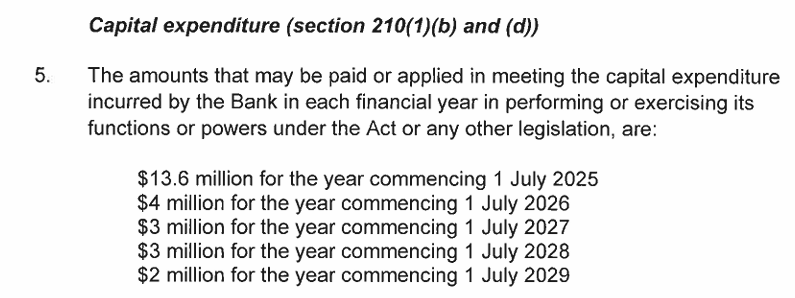
In the new Funding Agreement approved by the Minister in April this year, total in-scope operating expenses allowed for this year is $155 million (dropping away to $145 million next year, for reasons not made clear in the documents published so far, but maybe reflecting upfront restructuring costs – redundancy payments now for all those losing their jobs, already some weeks into 25/26?).

But you can’t just compare and contrast $155 million with $154.5 million because in the new Funding Agreement more spending items have been moved out of scope, not required to be covered within that $155 million limit. There are some smallish items (eg costs associated with the Bank’s legacy superannuation scheme, totalling probably less than half a million this year). But there is also this

Remember, these are business case costs, not some full cost of a project but you’d think they might easily total another million or two (consultants don’t come cheap).

And there is this explicit carveout, with some numbers

ie $5 million a year

Add those three items back in and the appropriate comparison to last year’s Funding Agreement level (the $154.5 million) is perhaps more like $161.5 million ($155 + 5 + 1.25 + 0.25). It drops away next year, but taking $10 million off that total still doesn’t leave them much less than the $154.5 million they were allowed for 24/25. The big problem – for them – is that they simply ignored that 24/25 limit and went for broke, hoping they could trick the Minister into setting them a permanently higher new baseline level of spending. It didn’t work fortunately. In a decent world they’d all (Orr, Quigley, the rest of last year’s board) apologise to the Minister, to the public, and to their own staff. In our world, staff lose their jobs and Quigley and the board keep theirs.

It is still interesting that they are needing to make such deep staff cuts to meet the budget and stay within the new Funding Agreement limits. Perhaps one partial reason might be the big new commitment they made to office space in Auckland – in what is apparently one of the fanciest new buildings in Auckland, with a five star green rating as well – on a scale which to have been anything like justified would have required even more growth in staff numbers. They signed up to that 4800 square metres last November, with no idea where the Funding Agreement would land and knowing they’d already well-overreached the previous Funding Agreement limits. According to last year’s Annual Report they spent $1 million on Rental and Lease Expenses (presumably mostly/wholly on their existing office space in a 40 year old building in Queen St). Not exactly a source I’d rely on for much but Google’s AI overview suggested that annual lease costs on the space in the new building could be $3.5 million (and their lease there runs from 1 August, while the existing lease doesn’t expire until 31 December).

In concluding I want to come back very briefly to the Post article. It is right to say that the Bank got much less than it had had the gall to ask for (unlike Oliver Twist, in asking for more they were already bloated), but what they are allowed to spend this year and next isn’t much different in real terms than what Grant Robertson had allowed them when he’d set the spending limit for 24/25. It is just a shame – actually, it should be scandalous – that they chose to ignore that limit so egregiously. Taxpayers and their own staff now pay the price.

Thinking about the MPC

I wrote earlier in the week about the as-yet unfilled vacancy in the office of Governor of the Reserve Bank. But there is also another significant vacancy that needs to be filled in the coming weeks, as the oft-extended MPC term of Bob Buckle finally comes to an end.

Buckle appears to be older than Donald Trump and has been on the MPC since it began 6.5 years ago. That means he’s been fully part of all the very costly bad calls ($11 billion of taxpayers losses when the MPC authorised the Bank to punt big in the bond market, and the worst outbreak of inflation in many decades, the consequences of which – notably in the labour market – we are still living with). And in his 6.5 years on the committee we’ve learned nothing at all of any distinctive contribution he may have made, we’ve heard nothing of his views (was he cheerleader, did he ever express any doubts etc?), there have been no speeches or interviews, he’s never apologised for or even acknowledged the bad calls (and their consequences) he’s been fully part of. And yet he has twice had his term extended (first reappointed by Robertson and was then extended again by Willis). He isn’t uniquely bad, and of the three externals first appointed back in 2019, when active expertise was deliberately excluded by Quigley and Orr, he was the least unqualified. But he is representative of all that is unsatisfactory with the Reserve Bank monetary policy governance reforms put in place in 2019. There is no accountability whatever, despite exercising huge amounts of delegated power.

Thinking about the vacancy, and the fact that it is now just over a year since Willis appointed two new, and apparently more capable, external MPC members prompted me to dig out the paper (“The Governance of Monetary Policy – Process, Structure, and International Experience”) that one of those new MPC members, (Prasanna Gai an academic at the University of Auckland but who’d spent a lot of time earlier in his career at the Bank of England), wrote in January 2023 as a consultant to the external panel reviewing the Reserve Bank of Australia. That review process that led to amended legislation and the creation this year of a distinct RBA Monetary Policy Board. It is a useful paper, easy to read and not long (28 pages), surveying experiences in a number of countries (including a quite sceptical treatment of the New Zealand MPC experience) and concluding with a couple of pages headed “Towards an ideal set-up” with six specific recommendations for the design of an MPC.

These were the recommendations

Recommendation 1: External members should be appointed through a merit based competitive process run at “double arms-length”, by a bi-partisan hiring committee appointed by the Treasurer that is diverse, experienced, and representative of society. Treasury Officials should be excluded from the MPC.

Recommendation 2: The threshold for economic expertise and policy acumen should be high. Members should be professional economists, with backgrounds in macroeconomics and financial economics, or offer broader experiences relevant to monetary policy. Gender, ethnicity, and industry diversity should be
important considerations in deciding the MPC make-up. Membership should be part-time with a commitment of around 3 days per week on average. Overseas members should be considered, subject to this time commitment.

Recommendation 3: The MPC should be relatively small (six). There should be two internal members and four externals. The role of Chair of the committee should rotate periodically and external members should be chosen for their capacity to serve in this regard. Pre-deliberation opinions should be sought, recorded (e.g. “dot plots”), and released to the public at an appropriate time. The chair should speak last and members invited to speak randomly. MPC members should be encouraged to interact with RBA staff between meetings.

Recommendation 4: The term of office be a single, non-renewable term of no more than five years.

Recommendation 5: To optimise information production and processing and to ensure democratic accountability, each member of the committee should “own” their decision and regularly explain their thinking to stakeholders at parliament and other fora. Members should have the freedom to dissent and MPC processes should be designed to diminish cacophony. Transcripts of the deliberation meeting should be released after a suitable lag so that stakeholders have a complete picture of the reasoning and debate behind the policy decision.

Recommendation 6: The MPC should be exposed to a regular schedule of external review by experts in monetary policy at 5-7 year intervals. These experts should be independently commissioned by the Treasury without consultation from the RBA, to avoid claims of partiality. The Treasury should take the lead in ensuring that review recommendations and insights are taken on board by the RBA and MPC.

Interesting food for thought, but anyone with any familiarity with the New Zealand system will recognise that list bears almost no relationship to what we have here (in law or in practice), except perhaps that odd “gender diversity” priority, which is pretty clearly what led Grant Robertson to appoint Caroline Saunders to the initial MPC (OIAed papers support that conclusion) and is probably why Orr appointed the otherwise utterly unqualified Karen Silk as the deputy chief executive responsible for macroeconomics and monetary policy, complete with a voting seat on the MPC. And, to be fair, there are some elements of Gai’s recommendations that I don’t agree with (including rotating the chair, bipartisan selection, and non-renewable terms).

One of the reasons I don’t like the idea of non-renewable terms is that serious accountability (ie with real and personal consequences at stake) is hard enough generally, but that the possibility of non-renewal is the most plausible point at which a monetary policy decisionmaker might face paying a price if they’d done poorly. Under the 1989 Act, the Bank’s Board was transformed into a body designed almost solely to hold the Governor to account, and they could recommend dismissal at any point if they concluded he was doing monetary policy poorly. The Board ended up so close to management (and for long periods was chaired by former senior managers), and had no resources of its own and limited economic expertise, that challenge was difficult. But, in principle, reappointment offered a chance, without too much awkwardness, to suggest that it was time for an incumbent to move on. The current Board still has some such role in respect of non-executive MPC members.

(The system was finally discredited in 2022 when, with all of Orr’s personal and policy failings already on display, the outgoing old board still recommended to their successors that Orr be reappointed, one of the worst public appointment decisions in New Zealand in quite some time, culminating in the engineered exit this year, barely two years into his second term.)

In formulating his recommendations, Prasanna Gai explicitly drew on a 2018 conference paper, (“Robust Design Principles for Monetary Policy Committees”) prepared for an RBA Conference, and written by David Archer (then a senior manager at the BIS) and Andrew Levin, a US academic but former Fed staffer. Archer, of course, had previously been chief economist and head of financial markets at the Reserve Bank until about 2004. It is another fairly accessible not-overly-long (16 pages) piece and they conclude with eleven principles, grouped as seven “governance principles” and four “transparency principles” (although I’m not sure I really buy the distinction). But like the Gai paper, it is very technocratic and rather weak on the place of a powerful central bank in a democratic society.

Reading the two documents together the thing I found most striking was that there was lots of talk (and they seemed to mean it seriously) about the importance of “accountability” (most explicitly in Gai’s recommendation 5 but strongly implicit in 3 and 6 as well). Archer and Levin are very much in the same vein (“Principle 6: Each MPC member should be individually accountable to elected officials and the public”). And yet, none of it seemed to involve any consequences whatever for the individuals. Both favour non-renewable terms so there is no potential discipline there, and Gai never ever seems to mention the possibility of removing an MPC member who had done monetary policy poorly. Archer and Levin are only slightly better, suggesting – in just a very brief reference not elaborated – that there should be “removal only in cases of malfeasance or grossly inadequate performance”.

I was a bit puzzled. One might expect serving central bankers to recite empty mantras about accountability that boil down in substance to not much more than having to publish a few documents and the Governor fronting up every so often to rather soft questioning at a parliamentary committee (in essence, the New Zealand model). But although each of these three authors had been central bankers none were at the time of writing.

It was, perhaps, particularly surprising in Gai’s case. After all, he was writing in January 2023 when central bankers in a wide range of countries were revealed as having stuffed up badly (no doubt with the best will in the world) and Phil Lowe was under fire in Australia. I wondered if perhaps one factor for Archer and Levin had been that were writing in 2018 when we were several decades into inflation targeting and in most countries if there had been monetary policy errors in the grand scheme of things they were relatively small.

And so I asked David Archer (now retired) why their paper had not dealt in any detail with options for serious personal accountability. He gave me permission to quote from his response (prefaced by a “joint papers are a compromise”)

On making accountability real, I favour the ability to remove for policy failure reasons
(a) where it is possible to define the objective with some clarity, and 
(b) where the procedure and protocols for assessing the bank’s/individual’s contributions to failure are fairly robust and shielded from political intervention.
 
I think (a) is possible, since maintaining medium term price stability — a single objective, able to be stated numerically — is clear enough.
 
I think (b) is more difficult. A previous NZ construction, involving a monitoring group that comprises outsiders who owe their duty to the public but that is able to peer inside the operation — that is, a board with independent chair and no management responsibilities — was a pretty good, though not perfect design. The imperfections were less in the construction than the execution, but the construction could still have been better — eg a requirement for an annual assessment report that requires a ministerial response and FEC examination.
 
It is noteworthy that the ability to remove for policy failures is almost vanishingly rare internationally. 

I agree with the spirit although not entirely with the details. In the end, I think that – in a democracy – decisions to appoint or to remove MPC members (executive or not) should be made by people who are elected (ie politicians) and thus themselves directly accountable. But it might be a reasonable balance to say that people could only be removed (for policy failure causes) on the recommendation of an independent assessment panel.

Unlike David, I think the old Reserve Bank Board model (while well-intentioned) was never likely to be an adequate approach. Operating within the Bank, with the Governor as a member, with a senior Bank manager as secretary, with no analytical or consulting resource of their own (to which one could add that they were required to review each MPS and see if it did the statutory job, which made it hard to stand back later and hold the Governor to serious account) it was never likely to succeed. Things got too cosy, the Board was more interested in having the Governor’s back, they held cocktail functions to help spread the Bank’s story, and to the extent there was challenge or questioning it was often on rather technical points rather than seriously attempting accountability. It might have been different if something like the Macroeconomic Advisory Council I used to champion had been set up, fully independent of the Bank and Treasury, and with serious analytical grunt itself.

Central bank monetary policymakers wield a great deal of power. There is no review or appeal process embedded. Being human, the best central bankers will make mistakes (just like the best corporate managers or corporate boards) and there needs to be a personal price to failure, otherwise we have given great power with little or no responsibility. If really big mistakes are not going to lead to those responsible being fired – or not even lead to them being not reappointed – we should rethink whether operational autonomy over monetary policy is appropriate at all. We still need expertise on these issues – as in so many other areas of public life – but there is no necessary reason why the decisionmaking power should be delegated. When politicians wield power we have the satisfaction of being able to toss them out when they do poorly. (And for those who worry about possible pro-inflation biases among politicians, a) for the decade pre-Covid we had the opposite problem (inflation a bit too low relative to target) from central bankers, and b) it is salutary to see how much “cost of living” now features among public concerns, here and elsewhere, even a couple of years after the worst of the inflation.)

To be clear, I am not suggesting that independent MPCs should be able to be second-guessed when they make their initial decisions (even if there had been a consensus in March/April 2020 that the MPC was going astray, Orr and company shouldn’t have been able to be tossed out then). But when outcomes go so badly off track, people should be removable and should not be reappointed. It can’t be a mechanical or formulaic thing – outcomes are always a mixture of specific policy judgements and unforeseeable shocks – but there is nothing particular unique about monetary policy in that (see the ousting of corporate chieftains when things go badly astray; sometimes it is just because there needs to be a scapegoat, somone seen to take the fall). But it does heighten the importance of making people individually responsible – speeches, interviews, proper minutes, attributed votes, FEC hearings and so on. It is hard to dismiss an entire committee – one of the 1989 government’s reasons then for choosing a single decisionmaker – but if a committee is doing its job at all well, some members will inevitably emerge looking better (or worse) than others. (Unlike our experts – above – I think there is a particular responsibility on the Governor, who controls staff analysis etc and is full time, but that isn’t an excuse for free-riding externals).

There is one area where we deliberately make it all but impossible to remove someone for bad substantive decisions: the judiciary. And that is probably as it has to be. But in the case of lower courts there are (layers of) appeal processes, and in higher courts finality is often the point (there may not be objectively right or wrong legal interpretations, but what the courts provide – subject to parliamentary override – is finality. And unlike most central banks, courts are unshamed about having majority and dissenting opinions, the latter often lengthy and thoughtful. There is no good reason for putting our central bankers on such a protected pedestal – mess up badly and face no personal consequences, no matter how much damage those bad choices have done to the country.

But to come back to the mundane, you have to wonder what Prasanna Gai makes of being an MPC member, operating in a model so much at odds with the analysis and recommendations he gave to the RBA review panel not much more than a couple of years ago:

  • He was selected last year by a panel, appointed entirely by the previous Labour government, led by Orr and Quigley, who would have spurned his expertise when the MPC was first set up in 2019,
  • The Secretary to the Treasury (or his nominee) is a non-voting member of the committee,
  • The MPC is numerically dominated by internals, one of whom has no economics background at all,
  • Not only is the chair not rotated, but it was held by a domineering personality, long observed to be intolerant of challenge and dissent, whose governorship finally flamed out when he completely lost his cool in meetings with, first, Treasury and then the Minister,
  • MPC members have renewable terms (although I guess Gai could decline to seek a second term)
  • There is no disclosure of individual member views, either in minutes or subsequently in speeches, interviews, or hearings (and in his paper Gai makes much of the free-rider problem/risk), and
  • Despite having been in place for 6.5 years now, through some of the most turbulent times for decades, the only “review process” was run by the Bank itself.

To which, we might add, that Gai himself made a little history recently by actually doing a speech on matters relevant to New Zealand monetary policy to an outside audience. Which was good. Except that no text of that speech was made available, no recording of the question time was made available, and only those who happened to be in Auckland on the day could get one of the limited number of tickets. He and the Bank appear to have allowed the event to be advertised as offering exclusive access. Gai refused to entertain media questions either. Since the MPC Charter actually does allow members to make speeches, which are supposed to be readily available, he cannot even blame those choices on “the rules”. It doesn’t really seem like walking the talk.

It is a shame in someone who appeared to have a lot to offer that he seems to have adapted to the cage Orr. Quigley, and Robertson built, and which so far Willis has done nothing to overhaul. I strongly suspect he adds more value than Peter Harris or Caroline Saunders – and I valued my engagement with him in those pre MPC years – but for the time being they are observationally equivalent. For those who initially talked him up as a potential Governor – and noting slim pickings – it isn’t a great display of leadership in action.

Meanwhile it will be interesting to see what sort of person Quigley and Willis find for the Buckle vacancy. Recall that, like the Governor’s position, the Board proposes, but the Minister of Finance is quite free to knock back a nomination and insist that the Board comes back with someone better.

Labour market data, and silly comparisons

The quarterly suite of labour market data came out yesterday, and it wasn’t a case of senior ministers at their most edifying (sadly, it is difficult to imagine things would be any different if the current government and Opposition parties swapped places, but….today’s ministers hold office today).

The one that first caught my eye was this from the Minister of Health

And in the newspaper this morning I see the Minister of Finance running the same line, suggesting that it was “of particular note” that the number of people unemployed was 8000 less than Treasury had forecast in the PREFU (the same source Brown appeared to be drawing from).

One assumes these senior ministers are smart enough not to take these lines substantively seriously. Macroeconomic forecasting two years ahead has always been something of a mug’s game. Some numbers might be needed to drop into spreadsheets – eg for budgeting purposes – but no serious observer ever expresses a great deal of confidence in any specific set of numbers forecast that far ahead. If Treasury got the current unemployment rate right to with 0.2 percentage points two years out one could say “well done them” but it might also suggest a reasonable element of luck. As it happens, on this occasion and this particular variable, the Reserve Bank was even closer, having predicted in its August 2023 MPS that the June 2025 unemployment rate would be 5.3 per cent. It was, in fact, 5.2 per cent.

I responded to Brown’s tweet yesterday afternoon thus

Treasury didn’t publish lots of detailed quarterly tables in the PREFU, but the Reserve Bank did in their August 2023 projections (completed a week or so later than Treasury’s numbers).

How are things looking?

We only have national accounts data to March. In August 2023 the Reserve Bank predicted that real production GDP would rise by 2 per cent (apc) in the year to March 2025. On current SNZ estimates, it actually fell 0.7 per cent. Private consumption was forecast to grow by 2.8 per cent and it actually rose by only 1 per cent.

What of the labour market data? The Bank had the unemployment rate forecast to be 0.1 percentage points higher than it turned out to be. But they thought the employment rate by now would be 68.2 per cent of the labour force, but it proved to be only 66.8 per cent (and they expected numbers employed would have risen by 1.1 per cent in the year to June 2025, when they actually fell by 0.9 per cent).

As for wages, the private sector Labour Cost Index measure was forecast to rise by 3.8 per cent in the year to June 2025 and actually rose by 2.3 per cent (and the difference isn’t inflation (non-tradables inflation in the year to June 2025 was actually a bit higher than the Bank had forecast a couple of years ago)).

And, finally, the OCR was forecast to be 5.12 per cent in the June quarter 2025, but ended up averaging 3.44 per cent (as it happens, Treasury’s short-term interest rate forecast was materially less wrong than the Bank’s).

None of which is really intended to have a go at the Bank (although those OCR projections always looked odd), because (a) this stuff is hard, and b) relatedly, there are big margins of uncertainty around all sets of economic forecasts, especially those two years ahead. Senior Cabinet minister deserve to be called out when they cherry pick one single datapoint and claim outcomes are better than (some forecasters thought -a couple of years previously – that they’d be) under the other lot. Calling them out won’t stop them – politicians will politik – but in doing so they (further) discredit themselves.

As for some of the recent labour market data, here are a few charts I used on Twitter yesterday.

First, hours worked

Second, (my preferred measure of) wage increases (although note that productivity growth is probably weaker now than last decade)

Third, jobs

And here is the monthly version of the filled jobs series (which is drawn directly from tax data), noting that this is the most frequent and the most timely series (NB: a monthly HLFS would be great…)

And as bank economists remind us each month, most recent estimates have been tending to be revised down as fuller information comes to hand.

And finally, the SNZ experimental weekly jobs data, this time (because the data aren’t seasonally adjusted) shown by comparison to the same weeks in previous years.

There doesn’t seem to be anything very positive in the labour market data. At best, perhaps, the drop in the number of job ads seems to have levelled out.

UPDATE: I just saw a journalist claiming the real wage increases had gone negative again. That is not so if one uses the appropriate wage measure (ie the analytical unadjusted measure of wages, which does not attempt to correct – reduce – for productivity growth), whether one then uses either the CPI or the Reserve Bank’s core inflation measure to deflate wage increases.

Reserve Bank bits and pieces

Various bits and pieces have emerged from the Reserve Bank in the last couple of days; two in the form of other people’s OIA requests, and one in a partial response from the Bank to one of mine lodged with Treasury.

First, bullying. Someone, who must have had some knowledge of what was going on, had lodged a request for this information

Perhaps the Bank is turning over a new leaf on OIAs, as the request had only been lodged on 17 July and not only did the response go back to the requester on Monday (4 August) but they put it on their website that day (the Bank is quite selective about which responses they post, and there are often quite long lags). In fact, I just noticed there is another response – to a request lodged on 24 July – sent today and posted on the website today. If this really is a change of heart it is excellent news.

Anyway, the answers were interesting, to say the least

In the words of one former colleague, those payouts were “startling”. The 20 staff being spoken to seems a lot too, but who knows quite what standard they were using. Perhaps someone had spoken disrespectfully of the tree god, or suggested that the Bank really should have stayed within its allowed Funding Agreement spending limits? But to actually write cheques, hand over money, things must have been quite serious, even in an organisation not recently known for its budgetary discipline.

We know nothing more at this stage (amounts, specific reasons, who was responsible for the behaviour for which the ex gratia payments were made). To be entirely literal it isn’t 100 per cent clear that all the payouts were for bullying (the request covers any ex gratia payments to staff), but they probably were, given that the Bank headlines the entire response “Information about Bullying” and would have had an incentive to minimise the bullying dimension if there really were other reasons for some of the payments. Were the payments made before or after Orr left, and were any of them on account of his behaviour? I gather from Twitter that someone has lodged a further OIA so perhaps we will learn a bit more in time. But it doesn’t look good – and cases rising to level of payout must only be the tip of an iceberg, as some people are likely to be reluctant to lodge complaints, and others may simply have left the organisation.

The second OIA was about the new Auckland office (also only lodged on 24 July). You may recall that my source had indicated that the Bank had signed up to a fancy new Auckland office of a size probably inconsistent with the looming budget cuts. The Bank’s response seems to broadly back that story. The new lease agreement was signed on 4 November 2024. By that time (and as far as we can tell at present) the Bank did not know that its approved spending levels would be cut a long way back from what they had bid for when they lodged their next five year Funding Agreement bid in September. However, they were well aware that they had gone out on a limb, adopting a budget for 24/25 that was 23 per cent in excess of what they were allowed by Grant Robertson for that year under the Funding Agreement then in place, and had sought to persuade the Minister and Treasury that any (modest) cuts should be only from that unauthorised high “baseline”.

And while they may have needed a new Auckland office, this was the new space

and this was what it was to replace

In other words, they committed to more than twice the floorspace, in a more up-market building, at a time of general fiscal stringency and when they had no particular reason to suppose that they’d be allowed to keep growing. I’m not a property person but it seems that 10-15 square metres per head is about normal for typical open plan office

So it looks as though the Bank had gone lavish on the per capita floor space even if the new office was to be fully occupied at some point in future (which would have been a lot larger scale than the 164 staff and contractors they had in the Auckland office as at 30 June).

It seems a lot like a cavalier use of public money, made even worse (than their general budget excess) by the no-doubt multi-year nature of the property lease. But perhaps they’ll be able to sublet some of it?

And that spilled over into the third OIA response, that turned up this afternoon. It was part of a request I’d lodged with Treasury a couple of months ago which they’d transferred (that part of) to the Bank, and covers some late-in-the-piece material from the Bank to and from the Minister on Funding Agreement matters, after Orr had left. To be honest, I didn’t even think this material was in scope, as I’d been looking for Treasury material. As it happens, when I read what came in, parts seemed familiar, and I realised they’d already released these particular documents to someone else a month or so ago and I’d used a couple of bits of it last month (end of that post). But I hadn’t looked that closely then, and the significance of other aspects is also more apparent now.

First, last Friday I highlighted the way the temporary Governor Christian Hawkesby appeared to have actively misled FEC on where the initiative lay for the review the Bank now has underway of bank capital requirements. He played down any ministerial involvement claiming it had been just a Bank decision to do the review. That it clearly wasn’t was pretty evident from the Treasury filenote of that 24 February meeting between the Bank, Treasury and the Minister.

But to reinforce the point, here is Neil Quigley writing to the Minister on 16 March basically pleading (successfully) that she not accept Treasury’s view of how deep the cuts to operating expenses should be. This was the paper in which he pleaded that the Bank’s “culture” had evolved in light of the fiscal excess of recent years and that it would take time to change the culture and save lots of money. But he also said this

Hawkesby actively misled FEC. Once upon a time that sort of thing mattered.

Where Quigley was largely unsuccessful at this stage was around the capital budget (not something I’d previously paid any attention to). The initial bid last September had been for $50 million over five years. At this point Treasury was proposing $26 million (which, assuming the numbers in the Minister’s Cabinet paper are comparable, was 12 per cent less than total expected capex for 2020-2025). Here was Quigley’s plea

Note that first item. If you’ve just rashly signed up to big new offices in a fancy building the fit out costs (for a lease that commenced on 1 August 2025) were likely to be large.

Quigley’s capex plea failed, and the Minister ended up agreeing to allow them only $26.3 million of capex over the full five year period. This is the annual phasing.

Which might suggest that they will be spending something close to $10 million on the fit-out of a new office that they simply shouldn’t have signed up to before they had any clear steer about the future. The 25/26 number ended up a bit higher even than the $13m Quigley had sought on 16 March – new estimates of fit out costs? – with the capex allowances for future years being slashed. (If Quigley’s plea is even roughly accurate you might wonder how sustainable all this proves – presumably the Bank will spend all its opex allowance, and perhaps they reckon they’ll come back cap in hand in a few years’ time, or degrade the existing capital and wait for the next Funding Agreement negotiations. Or Treasury might be right about what they need.)

The final observation from these papers is perhaps not of any great moment, but it is puzzling nonetheless. You’ll recall that the Bank had gone ahead and set a budget for 24/25 far in excess of what the Funding Agreement had allowed. There was never any serious suggestion that the Bank was allowed to carry forward earlier year underspends, use it all for a last year splurge, and then try to use that new level as a baseline against which any modest cuts should be set. But that is how Orr, Quigley and the rest of the board had operated (quite explicitly – it is in the Board minutes and the September 2024 Funding Agreement bid).

There are problems with the Funding Agreement model, which involves setting annual spending limits five years ahead. Sometimes it is hard to know when a particular cost might arise. So it probably does make sense – if this model is stuck to – to allow scope for some flexibility. It is there anyway – no one gets fired for going a bit under or over in any year (and isn’t formalised like a parliamentary appropriation), and there is always scope for a renegotiation mid-stream (as there’d been in 2023). But the Bank was keen to formalise something. I noted in a post last month that in that 16 March paper the version of the draft agreement the Bank submitted involved a model in which Treasury could agree to modest variations (up to about 10 per cent) and anything more required the Minister.

I’d noticed that the Minister must have said no to that as the final document on the Bank’s website provided only (and appropriately) for this

I included the signature block because what I hadn’t noticed before – hadn’t read to the end of the set of documents, which looked like they were just repetitions and admin paperwork – is that she seemed to agree to this only after she’d already signed up to something like what the Bank wanted.

In that OIA response there was this

All signed and dated and a scanned version sent back to Bank by one of the advisers in the Minister’s office, in a email of 10:14am on 8 April.

We are left wondering what happened. Quigley’s memo of 16 March did not touch on the variation issue at all. Was the Minister not made aware of it, including by Treasury, until the very last minute, or was she aware all along and very belatedly chose to take a harder line? Fortunately she did finally land on the best approach, but how? The original OIA to Treasury, lodged back in June but due shortly, may shed some light, but it just doesn’t look like a particularly smooth or adept end to the Funding Agreement process. And I wonder what Quigley, Finlay, and Hawkesby made of the latest, last, loss………..which couldn’t have happened to a more deserving bunch given their egregious bid six months earlier.

As for me, I guess I should read OIA responses – even other people’s – a bit more closely.